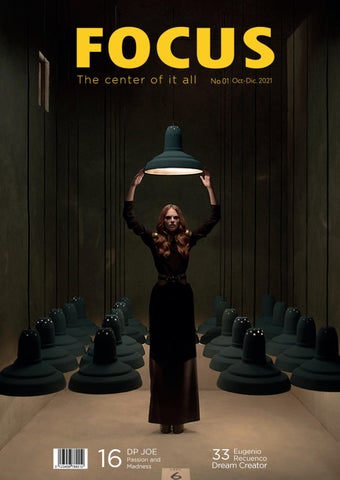
16
DP JOE Passion and Madness
33 Eugenio Recuenco
Dream Creator
Work by DP JOE
Work by Eugenio Recuenco
Work by Eugenio Recuenco
Content Editor’s Note
8-9
The Crew
10-11
Collaborators
12-13
The moodboard
14-19
Flashing
20-21
The female side
22-29
Talking
30-37
Work Toys
38-41
Living it
42-49
Setting
50-53
Point
54-59
The Rules
60-73
Posing
74-79
Editor’s Note Daniel De La Cruz
Focus, in addition to being a magazine, is a mentor showing the new trends, new exponents and the great ones that have generated a milestone in the way of taking photos. This magazine explores a perspective practice as you seek to inspire with various techniques and their results, applying them to various genres such as portraits, food style, products, weddings, conceptual among others, without matter what topic look for the public, you will always find a data new that will facilitate and enhance your work and passion. Each publication seeks to reinforce the support and knowledge between professionals thus forming a camaraderie space.
The moodboard
9
The crew General Editor of Art and Design Julio Contreras Art Editor Maria Fernandez Designers Ines Palacios Juana Martinez Carolina Jaramillo Digital Designers Alex Puértolas Roberto Palazuelos Esther galeas General Photo Editor & GEx Photo Studio Manager Alexander Garcia Junior Photo Editor Photo Coordinator Federica Alegria GEx Photo Studio Coordinator Santana perez Photographers GEx Photo Studio Luis Romero Ricardo Peraza Editorial assistant Mirian Hernandez Project Coordinators Specials Jenifer henriquez
12
13
THE MOODBOARD
The moodboard
17
Perhaps one of the reasons why photographs are so unique and magical is that they come from his heart, so in with the help of photography he can have a catharsis, so he only gives himself to create his images in which we can see a representation of emotions. What stands out the most is that they are all self-portraits to convey their feelings to the world, it is part of a project that marked the beginning of a creative journey in which he daily shows fantastic images of his emotions during the course of a year.
Daniel Serva
The moodboard
19
Joe Escobar, his photos have been exhibited at Central America Art Museums in publications both editorially and with world-renowned brands campaigns in regional high exposure, his work is also seen in the area of Cinematography in which already has won two awards with short independent Switching Frequency of which he was a senior tutor and producer. With high experience Joe rules his work always with commitment, passion a little of madness and love for what he does.
DP JOE
FLASHING A space dedicated to techniques photographic with different equipment
Flashing
21
Most techniques are based to a certain extent on lighting, you know that photography is writing with light, without it we would not have photography or many of the most visually interesting photographic techniques. So lighting or the lack of it is key when taking a step further in your images.
High Key
Low Key
In this technique, priority is given to light and white backgrounds. It transmits purity, happiness or joy. You can read more about it and learn how to do it step by step in our
The low key is a photographic technique that is based on darkness, on black backgrounds and that transmits mystery and elegance. It is widely used in portraiture, nudes or product photography.
article, find high-key inspiration here, and even get spectacular high-key photos with your mobile phone by following these tips.
We must not lose sight of the fact that one of the main parts of the process is the development, for this we also have an article dedicated to high-key editing explained in a very simple way and with many tricks. You will love this technique, it gives a lot of play and gives you positive images, with a lot of narrative and super pleasant to look at.
It is not difficult to use and, nevertheless, it provides us with spectacular images, you can see it for yourself in this inspirational compilation of photographs in low key. Did you like it? Well, learn how to take low key photography step by step with these tips, and how to edit your photos in an accessible and easy way in this other on low key editing.
THE FEMALE SIDE Show the best exponents industry women photographic.
24
The moodboard
The Female Side
25
His photos have been exhibited at Central America Art Museums in publications both editorially and with world-renowned brands campaigns in regional high exposure, his work is also seen in the area of Cinematography in which already has won two awards with short independent Switching Frequency of which he was a senior tutor and producer. With high experience Joe rules his work always with commitment, passion a little of madness and love for what he does.
LIZ PINTO
26
The Female Side
The Female Side
His photos have been exhibited at Central America Art Museums in publications both editorially and with world-renowned brands campaigns in regional high exposure, his work is also seen in the area of Cinematography in which already has won two awards with short independent Switching Frequency of which he was a senior tutor and producer.
His photos have been exhibited at Central America Art Museums in publications both editorially and with world-renowned brands campaigns in regional high exposure, his work is also seen in the area of Cinematography in which already has won two awards with short independent Switching Frequency of which he was a senior tutor and producer.
With high experience Joe rules his work always with commitment, passion a little of madness and love for what he does.
With high experience Joe rules his work always with commitment, passion a little of madness and love for what he does.
27
TALKING With Eugenio Recuenco
30
Talking
Talking
Who is Eugenio Recuenco now and how has he changed since you started? Well, I have not changed at all, if the illusion that for me is the most important thing, is still there. What I have changed is that I have learned things on this path but the desire is still intact so things continue in the same place. At first you think you know a lot but knowing that you had a lot of time left and now you have knowledge but knowing the things that still have to be learned. Maybe I’m getting old (laughs), I’d be left with the same illusion but less naivety.
31
32
Talking
Talking
Your work with the exhibition 365, ¿is it the most ambitious thing you have done? I would not say ambitious because in the end there is no more or less ambitious project, if I do them it is because they are necessary. I would tell you that this work is longer but because the project required it, but not better or worse because it cost more or less, it is the value in itself, regardless. There is a lot of talk about the 8 years it has taken, but when people enter CEART they forget that. It is the most personal project, yes.
33
34
Talking
Talking
Today, what is a photographer without Photoshop? Well, he is a photographer who is missing part of his tools. We have had a great time doing everything you see in the project, there is nothing in Photoshop but we have used the program a lot, and also, if I had used it in one way or another, it would be valid if it has worked for the project. We have been trying for a long time to assess whether or not the use of the technique conditions the final image. What we have to see is the result, whether you like it or not, whether it is done in analog or digital, whether more or less one program has been used.
35
36
Talking
Talking
Living from photography in Spain, is it difficult? It is just as easy and difficult as everything else. You need a percentage of luck, another of tenacity and work and another to appear at the right time, which would be part of luck in turn. To the question of can you live? Well, I don’t live from Spain. There is little demand from customers, a lot of ignorance and lack of demand for that very reason. That makes everyone the same. The problem is looking at everything economically, many times it does not cost more money, it is knowing how to appreciate the work. There is a lack of passion of those who request the jobs because they only see numbers, whoever orders you carries numbers and does not understand the image and is not someone directly from the brand, who could see to take care of that image, the other thinks that what they have The numbers have to be taken care of, and all this means that there is no demand, they do not know what is good and bad and in the end they see what is cheaper.
37
WORK TOYS News and trends Introduces new products and accessories compatible with different brands and models of photographic equipment.
40
Work Toys
Work Toys
41
Sony Alpha 1: Sony’s new flagship camera is a monstrous 50MP Full Frame mirrorless with 8K / 30 FPS video recording Sony has a new flagship camera. The Japanese company has just introduced the Alpha 1, a mirrorless one equipped with a full-frame sensor that has an effective resolution of 50.1 megapixels. This model arrives to reinforce the presence of this brand in the professional market, and will coexist with the large portfolio of E-mount lenses. So far it seems like one more camera for professionals and photography enthusiasts, but if we look at its specifications we will see that Sony engineers have put all the meat on the grill to ensure that this Alpha 1 can compete face to face with the models. flagship of brands such as Canon or Nikon. This is what the most advanced camera that Sony has right now offers us. The heart of this mirrorless camera with interchangeable lenses is a Full Frame Exmor RS CMOS sensor with a size of 35.9 x 24 mm and an effective resolution of 50.1 megapixels. To solve autofocus, Sony engineers have turned to a hybrid phase detection and contrast detection solution that, according to this brand, performs significantly better in compromised shooting scenarios than the focus of the most advanced cameras that it currently has in theaters. stores.
LIVING IT It shows behind the scenes of a photoshoot.
44
The moodboard
Living it
45
ØMAHI The photographer known as Omahi has a mission: to show us the process behind the photo shoots. Through her popular Instagram account, Omahi shows two images in the same post. The first is the final shot - fantasy portraits that have already been edited. However, if you slide to the right you will see the elaborate preparation required to make that first photograph a reality. Omahi does everything to capture the perfect photo. The photographer usually does his sessions in places that are not optimized for photography - such as in poorly lit
spaces - and he gets creative when making his compositions. The behind-the-scenes look isn’t glamorous at all, but you’d never know if I only posted the final photo. So why share these photos? “Many photographers are afraid to share the process behind the scenes simply because the public realizes that the photos are not always taken in the best places or with a lot of production and that detracts from their work,” Omahi tells My Modern Met. It is important to remember that the camera is only a tool to bring the photographer’s creative vision to life. “Personally I like to show how I take my photos on a low budget to show that when it comes to taking the photo you want, there are no excuses”, explains Omahi, “you just have to know how to imagine it”.
46
Living it
ØMAHI PROCESS
Omahi does everything to capture the perfect photo. The photographer usually does his sessions in places that are not optimized for photography - such as in poorly lit spaces - and he gets creative when making his compositions
Living it
47
Many times the superposition of different shots is used to create the final effect, in the shots in which there are two important elements and with movement, I usually capture the person and then the object.
48
Living it
In his photographs Ømahi shows the gazes of the characters, the movement of objects captured at the exact moment and fire, apparently it is an element that he likes and that achieves “almost magical” results.
Living it
49
“Personally I like to show how I take my photos on a low budget to show that when it comes to taking the photo you want, there are no excuses”
SETTINGS Presenta diagramaciones de iluminación y composición en espacios interiores. Mostrando los resultados.
52
The moodboard
Production As you can see in the diagrams for this photo a single studio light was used, with a softbox medium placed above and a little to the left of the face of the model. The position allows to use the softest part of the softbox light, which they are usually the edges. We have also included a BEFORE and AFTER the process of digital retouching of photography; it is It is important to highlight that digital retouching is a important part for any photography, especially for portraits. In terms general, you can not retouch a bad photo illuminated and turn it into a great photo, we must start from a good base and then exploit its potential with a touch-up process professional. One of the advantages of making your productions in Photo Studio El Salvador is not only that you have all the lighting equipment and modifiers you need, but also with accessories like clamps, cartons, booms, lightstands and others that make this type possible of photographs.
The moodboard
53
POINT Minimalist works with high visual impact
56
Point
Point
See the winning images of the first Award for Minimalist Photography in Black and White Black and white photography offers a different perspective on a world we often see in full color. Beyond the monochrome palette, many photographers choose to combine it with a minimalist aesthetic and simplify the subject to lines and shapes. Bnw Minimalism Magazine celebrates this style of image with its Black and White Minimalist Photography Award. In the inaugural edition of the contest, the post received more than 1,400 images for consideration. A three-judge jury — Olivier Robert, professional photographer and architect, Noell Oszvald, photographer and visual artist, and Milad Safabakhsh, editor-in-chief of Bnw Minimalism Magazine — selected a total of three award winners, in addition to recognizing 50 of the award winners. best proposals in general. The contest was open to amateur and professional photographers from anywhere in the world, with the only condition that they must be over 18 years of age. The winners will appear in the magazine’s next annual photography book, as well as an exhibition of the best works in the virtual gallery 3D Artdaloon. According to Safabakhsh, some of “the best contemporary black and white minimalist photographers” in the world are among the photographers selected in this edition of the Bnw Prize for Minimalist Photography.
57
58
The moodboard
The moodboard
59
THE RULES Treats the different compositional rules and their applications to multiple shooting situations
62
The moodboard
The Rules
63
Converging lines Converging lines in photography are used in different arts to effectively represent photographic perspective. We must bear in mind that perspective is one of the best tools to represent reality. That is why a good photographer knows how to use them within their frames. The convergence is more evident when we are located in the center of both lines. So these are parallel. The convergence effect occurs due to the distance at which we work. On the other hand, the place where the lines meet is known as the vanishing point in photography. Normally, this is shown outside the format of our frame. Also, the closer we are to the object, the larger it will
appear. Likewise, when we move away, the elements get smaller and tend to come together. If you are photographing the center of two parallel lines, you will be conveying a sense of central perspective. If you want to take advantage of this topic, here we will give you some tips. On some occasions, the stripes converge outside the photographic frame, so the focal point would be outside the frame, this can help to improve the image or it can be distracting. That is precisely why we must take care of our focus of attention, to avoid mistakes, you can use the rule of thirds and thus you will have the center of attention in the most interesting part of your image.
64
The moodboard
The Rules
65
The rule of movement It is a basic rule of photographic composition. Its application is very simple and its results will make our snapshot stand out. Once you put it into practice, you will discover the importance of good framing. It’s amazing how much you can improve a photo just by rotating the camera a few degrees at the instant of shooting. Said like this, it may have sounded a bit confusing, but if you look at the photo above you will understand immediately: the moving object (the bus) is located on one side of the photo and leaves room for “air”, which will be the which will give the sensation of movement. To achieve this effect, we can also use the sweep technique, which
consists of following the moving element that we want to photograph with the camera while shooting (a slow shutter speed is recommended). The result would have been very different if the subject appeared in the center of the photo or on the right margin. It would give the feeling that the photograph is cut off, that something is missing.
66
The moodboard
The Rules
67
Repeating elements The repetition of objects, what we call “patterns” in photography, is a technique widely present in the visual arts. Using them is a good opportunity to focus our minds on crucial aspects such as shapes, lines and, ultimately, composition, and allows us not only to compose effectively but also to give a certain rhythm to the photographs. Therefore, we are going to see how to use them more effectively. We can find them in many places, both in nature (such as flowers, leaves or animal skins) and in artificial environments (especially architecture), and our brain tends to look for them (as we said in this article ), due to its symmetry, as a way of remem-
bering things and fixing images in our memory. Therefore, its inclusion in photographs is undoubtedly a good useful resource for any type of composition. We would not be talking about anything special either, and in fact the settings we choose should depend more on the lighting situation than on the type of photo we are taking. In this case, a suitable composition is much more important than a specific technique; However, again we can point out some tips or recommendations.
68
The moodboard
The Rules
69
Color as a complement We are not going to talk in depth about Color Theory, a topic that could be used for several more articles or even for some books. We are going to talk more than anything about the attention we must pay to colors, and the emotions they convey to us. Color is everywhere. Most of the time we take it for granted. Sometimes we are surprised by them. Sometimes we are appalled for them. Obviously, they are important for our photographs. Color can help tell stories (visually) and can be used to communicate on an emotional level. The emotion part is very, very important. What’s more, you could say that color
is the main factor in making a photo feel exciting, joyful, melancholic, mysterious, or maybe a little bleak. One of the main mistakes, if not the main one, that most amateur photographers make, is to think that more color is better, or not to realize that too many colors, especially colors that do not follow any order (for example, not follow a pattern) make images very confusing, even in some cases they can be visually unpleasant, to say the least.
70
The moodboard
The Rules
71
Law of thirds It is undoubtedly one of the most popular standards to apply when composing an image (especially in photography but also in video). Probably the most popular, simply because it is very easy to understand and almost as much to apply and it helps the less experienced to obtain effective compositions in a simple way. Among other things because it serves to avoid the temptation that always exists to place the main subject of an image right in the center of the shot, or the horizon in the middle of the composition, which can make the results seem bland. The theory (which is actually a simplification of the golden ratio) says that these imaginary lines should
be equidistant and therefore the areas they form equal in size. But in practice, taking into account that they are usually imaginary lines (although it is common for cameras to show us a grid on the screen as an aid to compose) it does not have to be that way. In fact, although newbies may be tempted to find a way to adhere strictly to this rule, it is more advisable to apply it flexibly and adapt it to the scene and the specific perspective of each moment. The most important thing is to have it as a guide to obtain a balanced image, following the main idea that is none other than to promote an off-center and more dynamic composition.
POSING Dedicated to explaining how to direct a model thus facilitating the production work.
74
Posing
Because they are important the poses? We live in a visual world where each we see more images every day, and where ever mediocre photos are they become invisible. Today is more important than ever be able to take pictures that capture the public attention. In the same way as the composition slows down and directs the view in a way controlled. A good pose can make let’s capture the view more deeply of the viewer in the photograph. When we make people look closely at a photo (you pay your time and attention) is when we have been successful. The pose direction is just one more tool of the photographer ... in the same way to master the composition or master the light. In my opinion 99.99% of photographers knows too little about poses. Even 80% of the books on poses are very sketchy, they have bad advice or focus on what Let’s memorize more than understand. Even now that I have finished this book I realize that a year ago my knowledge of poses was still missing.
Posing
75
What is the client wants? If we want to satisfy the customer we have to know what he is wants. Many times we will find that not the most artistic photos, the better illuminated, with better composition, etc. those that the client selects. Many times the client chooses the worst photo (for us), since it is in her that the client looks better (for his own point sight). The solution? Let’s talk to the customer about what it is what you want, what are your fears of the time of posing and photography, which are your favorite parts, what are your least favorite areas. Based on this we will design poses and angles that will make you look your best to the client. Questions you should ask: 1. What is the purpose of the photographs?
2. How do you like to look? 3. What is your experience with photographs and poses? 4. Any recommendation or suggestion? 5. What is your favorite side? 6. If you have already had photos taken, can you show your favorite photos? Anyway, the more we ask and let us know what the client wants, it will be much easier to satisfy. On the other hand, there are clients who they just don’t accept themselves. And, as much as we make them show off their best possible version, they will never be satisfied with the photos. The ideal is to identify clients like this and not working with they. Remember that when they hire us the photos are not for us, they are to satisfy the customer.
76
Posing
How to direct to the subject? It is one thing that we know what we want and another is that the model (subject) understands and can perform the poses we want. 2 methods for directing poses: 1. Hands method 2. Mirror method Method of hands With this method we explain at the beginning a language in common with the model to direct face angle, torso angle and position on the floor. Subsequently, with our hands we make fixes in the air about what we want to correct and the model performs them. 1. For the direction of the gaze. 2. To view symmetrical to camera. 3. To tilt the face and chin. 4. For shoulders chest direction. Advantage: avoids the need for contact physical, it is quite effective. Disadvantage: There will always be people who It is difficult for them to understand it and follow the direction. Mirror method This is one of the best methods, since all the people come designed to mimic what they see (the mirror neurons). Basically when we want the model strike a pose (or expression) we do it ourselves so that they can understand us. Advantage: It is the easiest for the model understand. Disadvantage: first we have to be good themselves performing the pose and in other sometimes this can be uncomfortable (emotionally) for many photographers.
Posing
Poses as language It is not the same body language, for example, of an actor (who wants to sell diversity and drama) than that of a banker (who wants to sell security and experience), than that of a marketing manager (who wants to sell sociability and creativity). In other words, let’s find out as much as we can about the subject and the end of the photos to be able to direct in the best way.
77
Work by Eugenio Recuenco
Work by Eugenio Recuenco
80
The moodboard
22
Zhang Jingna
33 David Lachapelle Genuine perspective