RD Athletic Hall of Fame Ms. Kirkby and Mr. Flanagan’s Athletic Careers Page 10
Causes of Concern for Kids
Pro-Sports Gambling
Perks of the Trade
Vaping, E-Bikes, and Beaty Products, Oh My! Page 5
A deep dive into the most relevant & recent scandals Page 9
Shcool to Work Redefining the Education Experience Page 6
The Ridellion December 2025 Vol LXIX Issue 1
Opening Doors For All Their Members: How Key Club Empowers Student Success by Delilah Recio, Ridellion Editor
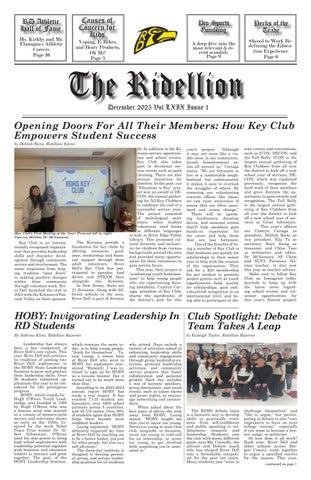
[Key Club’s First Meeting of the Year! Pictured left to right: Camryn, Delilah, Dr. McNamara]
Key Club is an internationally recognized organization that provides leadership skills and character development through community service and involvement. The name originates from helping students “open doors” to making positive changes within their community through volunteer work. River Dell launched the club in 2024 with the Kiwanis of Pascack Valley as their sponsor.
The Kiwanis provide a foundation for key clubs by offering resources, guidance, mentorship and financial support through their adult volunteers. River Dell’s Key Club has participated in parades, food drives and STEAM fairs alongside the Kiwanis. In New Jersey, there are 21 divisions. Along with different schools in the area, River Dell is part of division
20. In addition to the Kiwanis service opportunities and school events, Key Club also takes part in divisional service events such as park cleaning. There are also annual initiatives for districts. In the past, our “Education is Key” project won an award at DECON, the annual gathering for NJ Key Clubbers to celebrate the end of a successful service year. The project consisted of multilingual story times, when student volunteers read books in different languages to kids in River Edge Public Library. This promoted cultural diversity and inclusivity for children from various backgrounds around the area and provided many opportunities for their volunteers to gain service hours. This year, their project is “combatting youth homelessness” to help young people who are experiencing housing instability. Camryn Cariaga, president of Key Club, shares the significance of the district’s pick for this
year’s project. “Although it may not seem like a visible issue in our community, [youth homelessness] exists all around us,” Cariaga states. “We are fortunate to live in a comfortable neighborhood, but unfortunately it makes it easy to overlook the struggles of others. By centering our volunteering towards efforts like these, we can raise awareness of issues that are often unnoticed and create change.” There will be upcoming fundraisers, donation drives, and seasonal events that’ll help members gain hands-on experience for the cause and help those that are less fortunate. One of the benefits of being a member of Key Club is that students can qualify for scholarships in their senior year to help with the mission of the organization. They ask for a $20 membership fee per student to promote project grants such as youth opportunities fund, qualify for scholarships, gain individual/club recognition in an international level, and being able to participate in dis-
trict events and conventions, such as ICON, DECON, and the Fall Rally. ICON is the largest annual gathering of Key Clubbers from all over the district to kick off a new school year of services; DECON, which was explained previously, recognizes the hard work of their members and gives districts the opportunity to gain awards and recognition. The Fall Rally is the largest annual gathering of Key Clubbers from all over the district to kick off a new school year of services at Great Adventure. This year’s officers are Camryn Cariaga as president, Delilah Recio as vice president, Ella Tu as secretary, Raye Jeong as treasurer, and Chloe Tsao as webmaster and editor. Dr. McNamara, AP Chem and SUPA Forensics Science teacher, is also new this year as teacher advisor. Make sure to follow Key Club on Instagram (rdhs. keyclub) to keep up with the latest news regarding school events and volunteer opportunities for this year’s district project!
HOBY: Invigorating Leadership In Club Spotlight: Debate RD Students Team Takes A Leap
By Sabrina Klein, Ridellion Reporter Leadership has always been a key component of River Dell’s core values. This year, River Dell will continue its tradition of sending two River Dell sophomores to the HOBY State Leadership Seminar to grow and practice their leadership skills. Over 50 students submitted applications this year to be considered for the prestigious program. HOBY, which stands for Hugh O’Brian Youth Leadership, was founded in 1958 by Hugh O’Brian who was a famous actor who starred in a variety of western-style movies and television shows as early as the 1950s. Inspired by the work Nobel Peace Prize winner Dr. Albert Schweitzer, O’Brian used his star-power to bring high school sophomores with leadership potential together with business and education leaders to interact and grow together. The goal, of the HOBY Leadership Seminar,
which remains the same today, is to help young people, “think for themselves”. Tatum Leung, a senior here at River Dell who went to HOBY her sophomore year, stated, “Honestly, I was inclined to sign up for HOBY as a resume booster. But it turned out to be much more than that.” According to its 2023-2024 annual report HOBY has made a real impact. It has reached 7,135 student ambassadors, over 4000 school partners across 8 countries, and 49 US states. Over 90% of students agree that HOBY helps them become more confident leaders. Leung explained, “HOBY definitely impacted my time at River Dell by teaching me to be a better leader, not just for other people, but also as a self-advocate.” The three-day institute is designed to develop personal, group, and service leadership qualities for all students
by Kaileigh Taylor, Ridellion Reporter
who attend. Days include a variety of activities aimed at enhancing leadership skills and community engagement through group leadership exercises, personal leadership activities, and community service projects that foster collaboration and personal growth. Each day includes a mix of keynote speakers, group discussions, and social events, such as talent shows and game nights, to encourage networking and camaraderie. When asked about the best piece of advice she took away from HOBY, Leung stated, “HOBY taught me that you're never too young. Never too young to start that club, nonprofit, or business, never too young to cold call for an internship, or never too young to get involved with something you're interested in.”
The RDHS debate team is a fantastic way to develop skills in practically every area: from self-confidence and public speaking to collaborative research and leadership. Students join the club with many different goals, says Ms. Connolly, the advisor and Debate coach who has shaped River Dell into a formidable competitor for the past ten years. Many students just “want to
challenge themselves” and “like to argue,” but participating in debate is also “very impressive to have on your college resume,” especially if you want to become a lawyer, judge, or politician. So how does it all work? Each year, River Dell and other schools across Bergen County come together to argue a specified resolve for the season. This year, continued on page 7
Page 2
editorials The Ridellion
Staff
Audrey Cho
Senior Editor-in-Chief Sophie Gang Delilah Recio
December 2025
Mikie Sherrill Keeps Garden State Blue After Landslide Victory by Audrey Cho, Ridellion Editor
Co Editors-in-Chief Parnika Thota Yuna Hiura Sarah Chun
News Editors Allie Zagroba Ava Wittreich
Sports Editors Maddie Krieger Giada Caputo
Entertainment Editors Tatum Leung Seoyeon Kim Michelle Kim
Op-Ed Editors Hannah Yun Emma Pulumbarit Rida Desai
Features Editors Copy Editor The Ridellion
Reporters Audrey Cho Deborah Chun Madison Rosabal Michelle Kim Kaileigh Taylor L Rodriguez Ava Wittreich Sarah Chun Sabrina Klein Lauren Morgner Lexi Hart Hope Arturi Maddie Krieger Delilah Recio Ryan O’Shea Alessia Gutilla Samiya Bovell Parnika Thota Allie Zagroba Natalie Vadakkan Cate Theodorakos Sophie Simonyan Email us at
RDHSRidellion@ riverdell.org with an editorial idea or a response to something you’ve read. All members of the River Dell community are invited to respond to articles and editorials published in The Ridellion, as well as to any concern or event within the schools, our towns, the nation or the world. Please sign your letters: names will be withheld on request. The publishers reserve the right to edit those comments chosen for publication.
Advisor: Ms. Maczuga The Ridellion Published by the Students of
RIVER DELL REGIONAL HIGH SCHOOL
55 Pyle Street. Oradell, NJ 07649 (201) 599-7200
Source: Politco
Last spring, Mikie Sherrill, a veteran and four-term member of Congress, officially became the Democratic nominee for governor of New Jersey after the primary. Following the general election on Tuesday, November 4th, she became the GovernorElect of New Jersey. Her campaign, visible on social media platforms like YouTube, worked hard to ensure everyone knew what Sherrill stood for as a candidate. As with all big, spotlighted campaigns, there’s a lot of behind-thescenes information that is helpful to know when considering Sherrill’s victory over Ciattarelli. Across the country, political analysts have broken down the reasons for Sherrill’s landslide victory in various publications, such as CNN News, CBS News, and MSNBC News, but the most prominent argument regarding this election is not based on either candidate’s proposed policies but instead on President Trump’s association (and non-association) with Ciattarelli and Sherrill, respectively. They wonder if Sherrill’s win was because constituents liked her or because constituents didn’t like President Trump and closely
associated Ciattarelli with Trump? During her campaign, Sherrill often brought up Trump’s threat to cancel a construction project that would build new rail tunnels beneath the Hudson River to replace the dilapidated tubes used by trains headed to and from New York City. Whether intended or not, news of the termination of this project, which many New Jerseyans thought of as vital, created a stir among both Sherrill’s supporters and those on the fence, pushing many over to Sherrill’s side due to their close association of Ciattarelli with Trump. Whether this association is an accurate or not, this link between Ciattarelli and the President is relevant to the election results. Many argue that Ciattarelli was trying to walk a “fine line” between associating himself with the Republican President and not doing so, but due to President Trump’s endorsements of Ciattarelli, there is no doubt that the Republican governor nominee ended up associating himself with President Trump, even complimenting him and thanking him profusely for his donations and rallies the Trump administration spent on him.
In general, it’s important to acknowledge that in all elections, endorsements— especially by financial means—are imperative for a candidate’s wins and can often lead them across the final push of the election and into victory. In Ciattarelli’s case, the endorsement by President Trump hurt the Republican voter turnout by pushing moderate Republicans over the edge into blue territory. Some of the most notable parts of New Jersey where the Democratic win was by a large margin were in our resident county. Bergen County has always been a majority Democratic county, but this year displayed a stronger political orientation than ever. Some more surprising Democratic wins on a county-by-county basis were in Middlesex County and Union County, in which Democratic voting rates increased significantly. Whether everyone likes it or not, Sherrill has emerged victorious in the latest gubernatorial election, and there’s no doubt that this election meant a lot to many different demographic groups of New Jersey, especially considering the current national climate. There is also no
doubt that the two candidates would have done very different things in office. Many New Jerseyans were disappointed in Sherrill’s win because they believed Ciattarelli would have improved public safety and fought for affordability and lower taxes for the middle- and lowerincome residents. The situation is not entirely blackand-white, though; many argue that Sherrill will do the same, just via a different method. The framework of this nation’s intricate democracy was built so that the most popular candidate would always win, so we have our tried-and-true system to thank for Sherrill’s win. Whether or not people support the candidate who had such a landslide win in early November or not, and whether constituents end up deeming her a productive politician in office or not, it’s a positive sign on all fronts that voter turnout increased in New Jersey this year. More constituents came out to vote than in the past, and many claim that this is a positive sign of the rejuvenation of our country’s democratic values.
December 2025
Page 3
editorials
Humanity’s Overreliance On AI Poses Serious Risks by Lauren Morgner, Ridellion Reporter
Artificial intelligence serves numerous practical applications across various domains, yet there is a growing concern regarding its potential to destroy genuine human connections and conversations. As people increasingly rely on AI tools to improve exhaustion from interpersonal relationships and creative processes, there is a concern that the inherent messiness of human interaction may be diminished. This reliance could lead to a transformative shift in how we communicate, love, and create. Although there are benefits to AI, the replacement of meaningful affinity remains a problematic aspect. Furthermore, the potential danger of artificial intelligence may lie not in the fear of replacement, but in fostering a sense of complacency. The discourse surrounding AI often under-
estimates its transforma- the threat of super-inteltive potential, with some ligent robots with ill will perceiving it merely as towards humanity, but an improvement of ex- rather from AI’s advanced isting social constructs, tools that are unprerather than recognizing dictable and unreliable. its capacity to profoundly reshape life. While concerns about misinformation and bias in AI decision-making systems are valid, they may not fully capture the broader effects of AI’s integration into society,Source: Shutterstock Renowned physicist such as its impact on human interaction and so- Stephen Hawking noted ciety. With tech compa- that “the rise of powerful nies projected to invest AI will be either the best, about $400 billion in AI or the worst thing, ever infrastructure, it is cru- to happen to humanity.” cial to recognize that the While AI can mimic humost significant impacts man thought and action, of AI will not stem from
it will never replicate the spirit of being human. The discourse surrounding artificial intelligence often conjures comparisons to significant historical inventions such as fire, writing, or language. These analogies are rooted not in technical similarities but in the profound impact these technologies have on society. It’s important to remember, AI reflects its training data; it has inherent biases and outdated notions. A critical examination of the assumptions in AI-generated outputs is needed. Users should remain mindful that its training data does not equate to correctness.
A prevailing frustration in the current conversation about AI is the tendency to reprimand individuals for their reliance on this technology, often labeling them as lacking intelligence, which distracts from addressing the factors contributing to this reliance. Many individuals opt for AI assistance even in simple tasks due to societal pressures and economic realities, including stagnant wages despite rising productivity. This trend signifies a broader societal failure that diminishes critical thinking and educational values. Additionally, the rapid advancement of generative AI models raises environmental concerns, as their deployment generates a greater demand for electricity and water resources, which adds another layer to the societal challenges posed by AI.
The No Kings Protest: Reminding Americans That Power Is Vested In Them by Ava Wittreich, Ridellion Editor
Source: The Georgia Recorder
On October 18, 2025, the United States witnessed the largest single day protest in its history: No Kings Day. More than seven million Americans from every state poured into parks, streets and public squares across 2,700 communities to declare that “America has No Kings”- a reinforcement of the American Democratic ideals that many feel have
been treaded on by what some consider to be unprecedent presidential overreach. This movement has been ongoing in response to President Trump’s percieved claim to power. Recent actions such as firing of government officials, intervention in major cities, immigration raids, slashing federal education resources
and what some consider neglect of the rule of law have sparked people to come together and speak out. The diversity of issues boils down to the lack of democracy, constitutional rights and freedom the founding fathers entitled the U.S. to. Many organizations, teachers’ unions, civil rights advocates, pro-democracy groups, immigrant rights
activists, and students to name a few, came together against what many see as an overall drift towards authoritarianism. These peaceful protests took to the streets bonding people in more of a party fashion rather than a confrontational approach. They brought marching bands, creative costumes and bright yellow clothing
linked to a global No Kings Day pro-democracy movement. Many were featured with witty signs such as “No Kings since 1776” and “We Dumped Tea for Less.” While rallies were overwhelmingly peaceful, confrontations in Los Angeles required curfew measures. There were protests in major cities from New York to Philadelphia to Los Angeles, and the one in DC was even attended by Sen. Bernie Sanders, who spoke out against rich billionaires who he feels are the only people that benefit from Trump’s policies. The significance of these protests is that they are not limited to a specific agenda or divided political views. Protesters across the nation and beyond called for unity across classes and races, advocated for the abolition of racial capitalism, demanded protection for immigrants, and rallied against ICE violence and federal interventions, as well as resistance to attempts to weaken voting rights, environmental protections and healthcare. Organizers emphasize that No Kings Day proved the enduring strength of democratic action, reminding leaders that the power ultimately belongs to the people. “No Thrones, No Crowns. No Kings,” became the rallying cry for those defending dignity, opportunity and the rule of the law.
Page 4
December 2025
news
Hostage Exchanges, Airstrikes, And Humanitarian Crisis Challenge Gaza Peace Deal by Sarah Chun, Ridellion Editor Two years ago, on October 7, 2023, Hamas launched an attack that killed some 1,200 people and saw 251 people taken hostage, citing Israeli crackdowns in the West Bank, construction of settlements deemed illegal under international law, imprisonment of thousands of Palestinians, and the blockade of Gaza as catalysts. Two years later, on October 10, 2025, after Israel’s ensuing offensive killed more than 68,800 Palestinians, the first phase of the U.S. peace plan brokered by the Trump Administration began. The Israeli military subsequently withdrew from much of Gaza City, Khan Younis, and other areas, but troops remained in Rafah, northern Gaza, and border regions. Although the displaced Palestinians were allowed to return, the scale of destruction in Gaza’s inhabited areas left many without homes. In August, 2025, the World Health Organization reported that Gaza City was experiencing famine, and the Integrated Food Security Phase Classification warned that it would likely extend south to Deir al-Balah and Khan Younis if a ceasefire was not reached. Under the
new peace deal, humanitarian groups prepared to scale up aid deliveries, prioritizing food supplies that had been scarce throughout the enclave. Israeli officials said about 400 aid trucks per day would enter Gaza during the first five days of the ceasefire, increasing to 600 thereafter. On October 13, Hamas released all 20 living hostages and four of the 28 deceased hostages, attributing difficulties in recovering remains to widespread devastation, although Israel accuses Hamas of deliberate delays. In exchange, Israel freed nearly 2,000 Palestinian prisoners, including women, children, and around 250 members of Hamas or Fatah convicted of attacks that killed or targeted Israelis, along with others serving lesser sentences. However, two weeks after the ceasefire’s implementation, Israel launched airstrikes on Gaza, killing at least 104 people, including 20 women and 46 children, and injuring 253. Marmorstein, the Foreign Ministry spokesman, said Washington was informed about the strikes and that they were carried out in full coordination with the United States. An official of
the Israel Defense Forces stated that Prime Minister Benjamin Netanyahu called for strikes in retaliation for Hamas shooting down Master Sgt. Yona Efraim Feldbaum, a 37-year-old Israeli soldier who also held U.S. citizenship, in Rafah. Netanyahu also accused Hamas of violating the ceasefire by returning partial remains of a hostage recovered earlier during the war. Hamas denied involvement in the Rafah gunfire, reaffirmed its commitment to the ceasefire, and called on mediators to urge Israel to halt its actions. Additionally, Israeli officials alleged that Hamas staged the discovery of some remains, releasing edited drone footage as evidence. Hamas responded by accusing Israel of attempting to undermine the ceasefire through continued strikes and claimed the U.S. is providing a political shield for Israel’s infringement to the peace deal. On November 3rd, the Red Cross facilitated the transfer of 45 Palestinian bodies to Gaza. Of the bodies returned so far, only 78 have been identified, as forensic work is hampered by a lack of DNA testing kits. The Health Ministry posts pho-
tos of r e mains online to help famil i e s w i t h identification. Meanwhile, as of writi n g t h i s report, eight hostages remain in Gaza, and the slow pace of their return hinders progress toward the next stages of the ceasefire, including Hamas’s disarmament, deployment of an Arab-led international security force and Palestinian police trained by Egypt and Jordan, and decisions about future governance in Gaza regarding the international “Board of Peace” spearheaded by Donald Trump and former British Prime Minister Tony Blair, as well as potential Palestinian statehood, which isn’t guaranteed in the 20-point peace framework unless the unpopular Palestinian Authority, perceived as deeply corrupt and autocratic by the Palestinian
Source: CNN
people, reforms adequately and reconstruction in Gaza moves forward. As of early November, the ceasefire remains tenuous, with Israel and Hamas having accused each other of breaching other terms of the agreement. Aid agencies continue to warn of critical shortages in Gaza, where most residents remain displaced or dependent on relief. Mediators from Egypt, Qatar, and the United States are working to prevent a renewed escalation as both sides face mounting pressure to uphold the agreement and move forward with the next steps of the peace plan.
Louvre Heist Exposes The Word of The Year Security Lapses As Police Arrest Two Is A Number: 6-7, Explained In $102 Million Jewel Theft by Sophie Simonyan, Ridellion Reporter
by Hope Arturi, Ridellion Reporter
Source: OPB
At 9:30 AM on October 19th, four thieves broke into the Galerie d’Apollon (Apollo Gallery) and stole multiple jewels from glass display cases. They arrived shortly after the museum opened, posed as construction workers, and used a mechanical lift to get up to a second-floor balcony. From there, they broke into the room and utilized disk cutters to open the display cases. In only four minutes, the thieves had finished the robbery and were making their way back to ground level. The only clear evidence left behind was a dropped crown. Once they had made it down to ground level, they scootered away into the streets of Paris with $102 million worth of jewels.
Investigators in France have been hard at work trying to figure out who and how the robbery happened. Initally, two of the thieves have been arrested and two more are being investigated. The two men arrested both have criminal backgrounds and are supposedly the two men who carried the power tools during the theft. One was about to board a flight to Algeria when he was taken into custody, and the other had no plans on leaving the country. Authorities in France suspected that there may be more than just four people involved in this heist, revealing it may have been part of some sort of gang activity. As of late November, a total of seven
people were arrested in connection with the theft. The efficiency of the police has been a relief to the French public, but investigators still do not know where the stolen jewelry is. The issue with jewelry theft is that jewelry can be melted down and manipulated to look nothing like the original piece. Nonetheless, the investigators are very optimistic about their ability to recover the jewelry and return them to the Louvre. In wake of the heist, the director, Lawrence des Cartes, of the Louvre disclosed that the only cameras surveying the room were pointed in the opposite direction during the robbery. He now faces accusations from art experts and auditors alike of misusing the museums’ money to invest in future renovations instead of security improvements. The whole situation shines a light on France’s lack of security, especially because just a month before, another museum in France was robbed. In response to this theft, some of the Louvre’s precious items have been moved into the Bank of France for safe keeping.
In an evolving landscape of internet culture, “6-7,” a phrase repeated in comment sections of TikTok edits, viral videos, and even classrooms, has emerged as one of Gen Alpha and Gen Z’s most recognizable inside jokes. With no clear definition but guaranteed to annoy your teachers and parents, this remark symbolizes a new wave of humor, that some may find funny and others not so much. It all started with a song called “Doot Doot” by American rapper, Skrilla, which came out in December 2024. In the song, Skrilla says “6-7, I just bipped right on the highway,” which some believe is a reference to 67th Street in Chicago. However, the meme gained most of its popularity through a basketball vlog by Cam Wilder in early 2025, in which the camera pans from the court to the crowd of people, and a boy named Maverick Trevillian shouts “6-7,” gesturing with his hands, earning the title “6-7 kid” from fans. Since then, this phrase has continued to spread across multiple platforms, being widely used among
kids under the age of 14, confusing parents, and becoming so huge some schools have even banned it. And if that’s not enough to prove its significance, in a recent episode of the American sitcom’s, South Park, 28th season, depicted students saying “6-7” with its famous hand gesture, an amusing portrayal of its influence nationwide. At RDHS, 10th grader Rayna Won, said “it’s overrated, but if used in the right situations, it’s funny,” summarizing the general opinion among highschoolers. Love it or hate it, “6-7” has taken over 2025, leaving an everlasting impact on internet culture all over the world. And while it may seem like a joke, the article title does not deceive you. Dictionary.com has officially declared “6-7” word of the year.
December 2025
Page 5
news
States Say Let Kids Be Kids, Not Anti-Aging Experts by Michelle Kim, Ridellion Editor
Source: ABC News
On February 18, 2025, a California Assembly member introduced a new bill that banned the sale of anti-aging products to buyers under the age of eigh-
teen. This bill would require stores to verify a customer’s age by checking either their identification or their birthday. Alex Lee, the assembly member, proposed this bill
because of concerns regarding potential harm these products could bring to children under the age of eighteen. This problem mostly stems from social media, specifically from “Sephora Kids,” where children are encouraged and influenced by social media trends to buy and use adult beauty products. This is concerning, because those adult products can eventually lead to rashes and allergic reactions. “The viral trend of Sephora Kids is better marketing than any company could ever pay for. The multibillion-dollar industry is willingly profiting off this trend, even though they themselves admit and know that those products are not safe for children,” says Alex Lee,
a member of the California state assembly. In anti-aging skin care products are nasty, toxic chemicals such as formaldehyde, palmitate, triclosan (can cause antibiotic resistance), and retinol. Many dermatologists and families are worried about tweens using these types of products. “Retinol came from retinoic acid, which is actually for acne but probably 20 years ago it took off as an anti-aging serum,” said Dr. Stacey Tull, a cosmetic dermatology specialist in Missouri. “If pre-teens are having acne, then they should see their doctors or dermatologist and get it prescribed rather than go for an anti-aging serum. It does have some retinol, but the original intent is not to treat acne and it’s also in
the wrong formulation to treat acne.” Alexa, a student from New Paltz High School in New York, agrees with this proposed idea. “I see a lot of children on social media who have a skin care routine filled with a bunch of unnecessary creams, washes, etc. that do more damage to their skin,” she notes. “I think that it should be prohibited for children to access them, especially when they don’t need them.” While California’s bill stalled sue to opposition Opposition from the retail/ skincare industry, concerns about enforceability, and arguments that social media is the real issue, New York’s bill requiring age verification for these specific products is progressing through the Senate.
E-Bike Boom In The U.S. Spurs Safety Concerns And Calls For Stricter Regulations by Sarah Chun, Ridellion Editor
Electric bicycles are reshaping how Americans get around, offering an efficient and eco-friendly alternative to cars and public transit. As of last year, more than 1.7 million e-bikes were imported into the United States by roughly 900 businesses. Yet, while their popularity grows, so too concerns over safety, battery-related hazards, and inconsistent regulations. Through 2019 to 2022, the American Journal of Public Health found that e-bike injuries increased 293% nationwide, with approximately one-third involving collisions with motor vehicles. In 2023, the National Library of Medicine reported that nearly half of injured e-bike readers were between the ages of 10 and 13, and 97.3 percent of injured riders were not wearing a helmet. Safety concerns reached beyond crashes that same year; New York City documented 267 fires linked to
lithium-ion e-bike batteries, which injured 150 people and caused 18 deaths. In May of 2024, Governor Phil Murphy adopted legislation that categorized e-bikes into three classes. Class 1 and Class 2 models, both capped at 20 mph, are regulated like conventional bicycles. F a s t e r Class 3 bikes that are capable of reaching 28 mph, although bikes that exceed that speed can be bought online, now require licensing, registration, and insurance, and can only be operated by riders 15 and older. Nonetheless, during the summer of 2025, a 14-yearold in Somers Point was
killed after his e-bike collided with a car, a 15-year-old in Montvale was hospitalized following a crash, and a 13-year-old in Westfield sustained a serious head injury after losing control of his e-bike. Local hospitals across North Jersey also re-
ported a rise in e-bike related emergency cases involving minors. In response to the increase in e-bike injuries and deaths, U.S. Congressman Josh Gottheimer, serving
New Jersey, unveiled his S.A.F.E. Ride Act (Safety and Funding for E-bikes Ride Act) that would provide federal funding for states to create or expand “Electric Bike Safety Plans”, aiming to promote helmet use, improve crash data collection, and support local law enforcement in safety education and enforcement. Gottheimer also urged the U.S. Department of Transportation to establish national e-bike safety guidelines and encouraged collaboration between the New Jersey Department of Transportation and the Department of Education to develop a statewide public information campaign. He similarly called on major
e-bike rental companies, including Citi Bike, which operates 82 stations in Hoboken and Jersey City, to strengthen safety policies and age verification. Experts advise wearing a properly fitted helmet at all times, following traffic laws, using bike lanes where available, and avoiding high-speed or congested areas. Children under twelve should always be supervised, and unregulated or modified e-bikes that exceed legal speed limits should be avoided. Riders should charge batteries according to manufacturer guidelines and perform checks beforehand. As e-bikes continue to expand their presence on U.S. streets and roads, policymakers, medical professionals, and industry leaders alike are weighing the benefits of sustainable mobility against the need for stronger safety measures and consistent regulation.
Teen Undergoes First Double Lung Transplant Due To Vaping by Natalie Vadakkan, Ridellion Reporter On October 15th, 2019, 16-year-old Daniel Ament underwent a double lung transplant at the Henry Ford Hospital located in Detroit, Michigan. The surgery, prompted by a condition called EVALI, also known as E-cigarette or Vaping-Associated Lung Injury, was the first double lung transplant ever performed for a patient suffering from EVALI. Before being admitted, Daniel was an athlete who loved to run, swim, and sail. However, he began to vape at parties, and when his friend left a Juul e-cigarette in Daniel’s car, Daniel became hooked. Early in September, he began to have trouble breathing and was admitted to St. John Hospital in case he had pneumonia. However, his breathing was not improving, so they admitted him on September 5th. Eventually, Daniel was in-
tubated on September 12th and was transferred to the Children’s Hospital of Michigan on September 17th. At that point, the doctors hooked him up to ECMO, or Extracorporeal Membrane Oxygenation, to provide life support and do the job of his failing lungs. “He was gone from the typical life of a perfectly healthy 16-year-old athlete – attending high school, hanging out with friends, sailing and playing video games – to waking up intubated and with two new lungs, facing a long and painful recovery process as he struggles to regain his strength and mobility, which has been severely impacted,” his family said in a statement given to the hospital. On October 15th, cardiothoracic surgeon Dr. Hassan Nemeh performed the double lung transplant on Daniel, and this six-hour
surgery marked the first double lung transplant in the United States due to vaping-related disease. Dr. Nemeh described the lungs as “not visible” when looking at them through a CT scan because the lungs were not working and did not contain air. Dr. Nemeh said, “What I saw in his lungs is like nothing I’ve seen before, and I’ve been doing lung transplants for 20 years. This is an evil I haven’t faced before.” According to CDC, as of February 18th, 2020, there are more than 2,800 hospitalized cases in the country, with 68 of these being deaths.Specifically, EVALI has been connected to illegal vaping products containing THC, the main ingredient of cannabis, and the vitamin E acetate present in some of these THC vapes. Vitamin E acetate is a chemical additive which can thicken
vaping liquids, and it is the main cause of EVALI. Daniel will have to spend the rest of his life taking anti-rejection medication. He knows the dangers of a double lung transplant and does not want anyone else to experience being so close to death. Therefore, he is calling for others to stop the habit if they have already begun vaping. He created a campaign called #justdoitfordaniel which inspired others to stop vaping. He also worked with The Family Center to offer resources to those who need help with quitting. Today, he is the president of a non-profit called “Fight4Wellness” that
Source: Fight4Wellness
involves him visiting schools to discuss the dangers of vaping and substance abuse in general. EVALI cases have dropped since 2020 due to the removal of vitamin E acetate from e-cigarettes. However, vaping’s long-term effects are still not completely known. After the surgery, Dr. Nemeh stated, “The damage that these vapes do to people’s lungs is irreversible. Please think of that – and tell your children to think of that.”
Page 6
December 2025
features
Forks In The Road: River Dell Helps Redefine The High School Experience by Audrey Cho, Ridellion Editor
Right now, we are all secondary school students. What we share is that same experience: we all walk through the yellow locker-covered halls of River Dell High School each morning, go to our first few classes of the day, and hear the announcements on the loudspeaker. After lunch, though, what happens next depends on who we are. Some of us may don lab coats and pipet solutions into volumetric flasks in our AP Chemistry classes. Others may go to art class and work on paintings. Still others may leave the school entirely and go to trade school for the rest of the day. The trade school program in particular makes River Dell a school that allows students to explore their diverse interests and begin careers of their own at a young age. This program at River Dell is called School to Work, and it allows students who are already interest-
ed in trade fields to start training for their trades while still receiving a secondary education. The solution? They leave early in the school day and go to work. After talking to a few students who actually participate in this program—and find it fulfilling and rewarding career-wise—it’s easy to see why the School to Work program at River Dell is a great option for those who already have their minds set on their future trades. When I first heard about the School to Work program when I came to River Dell last year as a new student, I wondered whether it would be truly possible to complete schoolwork while working hard to become, for example, an electrician. What I didn’t realize is that the program allows for some flex-
ibility within one’s school schedule. The school is very flexible about deadlines, especially on the part of the faculty. Teachers are willing to accept later deadlines and work with students involved in the program individually and on a case-by-case basis.
Even more importantly, though, is whether the program is rewarding for the students who participate in it. The answer seems to be yes; every student I’ve talked to who is part of this program has told me great things about it. For someone who is not as interested
in academic fields or pursuing a four-year degree for their undergraduate experience, time is much better spent in a place where they can practice what they one day plan to do for a living. We are all at the point in our lives where the path we have all followed together, from elementary school to middle school to early high school, is beginning to diverge left and right. The majority of us will graduate from River Dell, but what happens after that is largely up to us. By providing students with an opportunity to chart their next steps before even leaving high school, River Dell is helping to support a wide range of interests and passions, as well as to cultivate those passions.
River Dell High School is a diverse community of students who are all dedicated to their crafts. What that craft is determines the trajectory of a River Dell student’s day. What ties us together, though, is our shared identity in being RD students. We may leave throughout the day, go home to practice an instrument, or go off to trade school halfway through the day, but even across all of these identities and lifestyles, we are rooted in our school. After speaking with some kids who participate in the School to Work program, I can conclude that River Dell does a phenomenal job of providing opportunities to its students, no matter what careers or futures those students plan on having. For many students, attending high school fulltime isn’t the best use of time when they could be working toward improving their skills in fields they’re planning on pursuing later on in life.
RD Alum Returns To River Dell: Meet Ms. Dunleavy! by L Rodriguez, Ridellion Reporter Have you ever wondered who would take the reigns of the RDHS music department after Mr. Wilson left? Students were left eager to find out who would step to the plate and take charge of the department, which consists of over 140 students, since his departure to Scotland in June of 2025. Few students were surprised when they found out that their music teacher would be a returning RD alumnus: Ms. Dunleavy! Being a recent graduate of River Dell, Ms. Dunleavy is excited to share her passion for music and create a positive atmosphere in the current music department. Under her leadership, all music classes seem to be in great hands this year! Growing up in River Edge, Ms. Dunleavy’s story isn’t different from many students at RDHS. Dunleavy attended Cherry Hill Elementary, then River Dell Middle School, and finally graduated from River Dell High School in 2020. After that, Dunleavy decided to keep up with her passion for music and attended Westminster Choir College as a double major in music and education. Following her graduation, Dunleavy built a brand-new choir program at Hoboken middle school for just a year before making a comeback at her former high school, now as a
teacher. As a student, Dunleavy participated in every musical activity possible, which included choir, band, marching band, pit orchestra, and more. Ever since middle school, Dunleavy has worked tirelessly on her music and toward her future of one day scoring her dream job: teaching music at River Dell High School. Sure enough, all that hard work paid off. Although music serves as Dunleavy’s main interest and hobby, she also loves spending time doing other fun activities unrelated to her career. Hobbies that Dunleavy holds close to her heart include reading, solving jigsaw puzzles, going on long rides, and observing nature. Activities like these help Dunleavy clear her head during times of stress and give her a sense of enjoyment. “I like to go up to Ringwood a lot to the New Jersey State Botanical Gardens, any state parks. I just drive to clear my head,” Dunleavy says, “and then when I feel better, I go home!”. For reading, Dunleavy has set clear goals that she pushes herself to keep up with. At the moment, she is reading a series titled “Throne of lass” which she started around mid-June. [LR1] Dunleavy also never goes a weekend without a jigsaw puzzle. Currently, she has a puzzle of a piano hung up in her of-
fice, and her mother – who is also a high school teacher – is in the process of framing one of Dunleavy’s works on her own office walls. In general, all of Dunleavy’s hobbies are ones that evoke a sense of ease and a relaxed state of mind that most of us should take inspiration from in times of stress. Even in a musical setting, Dunleavy believes there’s a lot to learn from high school and life in general. Dunleavy has many life aspirations and beliefs she lives by, which she hopes to pass down onto her students one day. She encourages “making every day count – doing what you want to do, having no regrets, going outside your comfort zone, trying new things, and not holding any grudges.” Dunleavy discusses how life is short and how every moment has meaning depending on which road you decide to take. She continues to push the idea
of “never selling yourself short,” encouraging students they “can do anything that [they] put [their] mind to.” This conversation I had with Dunleavy was so inspiring that I even forgot the rest of my questions. Dunleavy speaks her words with truth, keeping them as straightforward as possible with minimal confusion, making her morals all the more valuable. More importantly, Dunleavy believes in her students more than anything. In conclusion, if you’ve ever considered joining a musical ensemble, Dunleavy is sure to welcome you with
open arms. As a teacher, she truly believes in providing the best for her students and teaching lessons that are worth more than just notes on paper. Dunleavy knows what it’s like to be a student in modern day River Dell and hopes to improve upon the environment she once experienced during her own time in order to create the best experience possible for her students. Music is an open book, so whenever you enter room 301, never hesitate to take in the lessons Ms. Dunleavy has for you beyond the notes on the staff.
December 2025
Page 7
entertainment
Wave Goodbye To Green And Red: What To Club Spotlight: Debate Team Know About “Beige Flags”
by Kaileigh Taylor, Ridellion Reporter continued from page 1
By: Madison Rosabal, Ridellion Reporter Social media has brought a lot of attention to the concept of “beige flags.” While it may be a widely spread phenomenon online, some teens haven’t yet grasped what it truly means to have a beige flag. One River Dell sophomore tried her hand at defining beige flags: “Something you do not really approve of, but you also do not hate. Beige flags are necessary because there is always going to be something in a friend or partner that you may not like, but you will just have to put up with, but the trend is humorous as well.” In the internet’s words, a beige flag is described as a weird trait or a quirk that someone has, which makes you think to yourself… “That was a bit off-putting” or “That’s so annoying!” Perhaps they are best explained as traits someone has that are not ideal, but you wouldn’t throw a fit over. Beige flags are often seen as somewhat of a middleground, meant to make up for the grey area between your typical green flag and red flag. Often, people find beige flags in some people before they even find their green or red flags. It is just something odd that a person does that you might pick up on. But really, a beige flag is no big deal breaker… right? Tik Tok, Instagram, Facebook, and other social media platforms allow for influencers to talk about the beige flags they find in other people. Common beige flags seem to be people who just can’t stop talking, even after the topic ended a long
time ago, people who are lefthanded, and those who wear mismatched socks. Beige flags, most used in the dating world, expose the different quirks and habits of people, potentially leading to signs about who they are as a person later on in a relationship. These seemingly bland qualities can say a lot about a person and who they are. But don’t worry, your beige flag most likely won’t cause concerns with your friendships or relationships because they aren’t necessarily what make or break them. But keep in mind that beige flags can draw people away or closer to you, sort of like how who you root for in sports or who you watch on social media can do the same. Have you ever been with a friend or a partner and they just do something so out of pocket, it makes you say “Huh”? Maybe you’ve witnessed a person who eats the crust before they finish the rest of their pizza, or those people who have crazy obsessions with different rocks and minerals. Yes, these might be normal for people who are doing these things, but maybe not so much for others who might have to put up with it. The beige flag trend started to go so viral that people started making video posts explaining their partner’s beige flags. Creator @avashipleydonuts made a post saying that her boyfriend brushes his teeth for more than 10 minutes every night. While a pretty minute detail, this slight habit of her boyfriend made her say, “huh?” The trend blew up so much
that there are now filters or even debates on social media platforms that consist of “What’s my beige flag?” Beige flags are within everyone, so I decided to see what some River Dell students have to say about theirs. Students Tyler Hodge and Lucas Bernard talk about some beige flags they feel like others may see in them. Lucas says, “A beige flag I see in myself is, sometimes when I really want to say something, I’ll talk over people” and Tyler adds on with “When I find something funny, I get repetitive with the joke”. Tyler Gastman says that one of his beige flags he sees in other people is when they put an excessive amount of salt and pepper on their food. Overall, don’t be alarmed if you become aware of your own beige flags. And yes, you have them. Although they might make you more selfconscious of your seasoning habits or conversation skills, they’re designed to be a detail, not a deal-breaker. Be proud of your beige flags! Or at least, be proud they’re not red…
they’re focusing on the exploration and development of the Arctic. According to Ms. Connolly, “students join a debate team either as debaters, a team [of] two people, or as a judge… one person.” In each debate tournament, she explains, these teams are assigned affirmative or negative, which determines whether they are arguing in favor of the resolve or against it. In JV debates, which take place after school about once a month, debaters typically participate in one affirmative and one negative round. For the best of the best, the RDHS Varsity Debate Team competes in full-day tournaments consisting of four rounds. Some even become captains – knowledgeable, experienced leaders who are happy to guide others on their journeys. Judges, meanwhile, score ballots for each round based on the quality of the debaters’ speeches and get to decide who wins each debate. If this seems like a lot, you’re in the same boat as many team members. Students “have to learn everything they can about the Arctic,” Ms. Connolly says, which means that “the beginning of the season is the toughest,” but that it becomes much easier once teams gather more experience. There’s a point at which the information just clicks and many debaters
cruise through the rest of the season, obliterating other schools within the Bergen County Debate League. Becoming a great debater doesn’t require any special inborn skills. The more experience team members get, the better they perform. Along the way, they gain critical research and public speaking abilities, as well as confidence in themselves and pride in their school. A large part of this is due to the supportive nature of the team, which works together to build up all its members. Debate isn’t just for “nerds,” either. River Dell’s debate team, Ms. Connolly rightfully boasted, contains a diverse group of students with varying life experiences that other schools simply cannot compete with. The broad nature of debate draws in students with vastly different personalities and interests, creating an environment in which members constantly learn from one another. In her closing remarks, Ms. Connolly made sure to emphasize that “you’re taking a great leap just by doing it…so anything can happen when you take that leap.” Looking to join? Team meetings are held every Monday morning at 7:15. Email Ms. Connolly or one of the captains if you’re interested in becoming a part of this amazing group!
Why Did Andy Wow With Unlikey DWTS Run? by Cate Theodorakos, Ridellion Reporter
Source: salon.com
“Dancing with the Stars is an extremely wellknown and popular television show that has been on the air for thirty-four seasons. The basic premise of the show are to take one pro ballroom dancer and one celebrity, pair them together, and see how well they can dance. Each season, new celebrities join and there’s always one fan favorite found. This year’s fan favorite was found
early, and gained a large audience quickly, and his name is Andy Ricther. Richter, most notably known for acting and comedic skills, rapidly gained popularity. This all began with his pro partner Emma Slater and her social media posts. Slater took to TikTok and other social media and began posting herself and Andy in their training. The two quickly gained popularity
and touched the hearts of many. Andy—58—is older than the average competitor on “Dancing with the Stars.” Seeing this, many people decided to dedicate their votes to Andy and Emma once the competition began. The way “Dancing with the Stars” works each week is one couple is voted out through a combination of judge votes and audience votes. Knowing this, a large number of the audience decided to make it their mission to keep Andy competing for as long as possible. So, the competition started, and unfortunately Andy began scoring in the lower digits. It seemed to many that he would go home quickly, and likely first. But this was not true. Andy made it safe through nine weeks on the show. Almost every time he was on the chopping block and he narrowly made it through. The multitude
of votes from the fans are what have kept him in for so long. But as usual, there will always be conflicting opinions. As weeks went on, more talented pairs left the show, while Andy remained. This began to aggravate many viewers. Take for example, a quote from Hope Arturi: “I don’t think Andy should be on
Source: Cinemablend
the show anymore because he is clearly a worse dancer than the rest of them.His best dance is still worse than Scott, Jen, Hilaria, and Lauren’s
worst. The show is a dancing show so we shouldn’t let popularity control who is still in the show”. This opinion is shared by many but is still overshadowed by the vast number of Andy supporters. Overall, Andy’s charisma and charm have an appeal that many can’t deny, and that made it hard not to root for him to succeed.
Andy Richter did not win the competition, but the underdog stuck around for an impressive nine weeks and won the hearts of the audience!
Page 8
December 2025
entertainment
Wicked Part One Destroys Global Records And Part Two Does It Again On Larger Scale by Lexi Hart, Ridellion Reporter
Source: Cinema Paradiso
When the play Wicked first came to stage in 2003, who would have expected it to become a major franchise and a two-part movie? Wicked is about two witches on a path of discovery to find who they are and what they truly want. The movie is light-hearted but filled to the brim with deeper meaning and hard concepts such as animal cruelty and betrayal, yet the movie is so loving and fun. Glinda, played by Ariana Grande, brings that bubbly happiness to the film which is
another reason the movie skyrocketed to the top of the charts when it first came out. Wicked: Part One completely dominated the movie world when it first premiered in theaters. It ended with Elphaba, played by Cynthia Erivo, singing to the iconic “Defying Gravity which had fans yearning for more and was the #1 movie worldwide in its first week of being out. Everything about Wicked is perfectly put together to make sure there is something for everyone. From the costumes and set design to
the music, all viewers have something they could enjoy. Even the gym bros could admire the cunning Fiyero. Wicked: Part One had people buying Elphaba and Glinda clothes, water bottles, and snacks, so it was widely expected for Wicked: Part Two to be very successful, and it was. Audiences around the world packed theaters once again, which proved that the love for Wicked did not fade after the first part. Wicked: For Good broke more box office records with a larger opening weekend than the
first movie ever did. The Wicked franchise will forever be missed, but it will be remembered how successful both movies were.
Source: Hennepin Arts
A Different Perspective on Love Island USA Season 7 by Lauren Morgner, Ridellion Reporter
This summer, there was a not-so-hot bombshell who entered Love Island USA’s villa: misogyny. Love Island USA Season 7 aired this summer and, while immensely popular, highlighted significant issues. Love Island is a reality dating show that takes place abroad in a fluorescent neon “villa” where hot singles partner up and date one another, switching couples every so often to find their perfect match. Love Island USA Season 7, like many reality TV dating shows, featured a cast that fit the status quo and was full of over-the-top drama that lacked depth. This season though, became uncomfortable to watch as social media ripped the female contestants to shreds. This season, the women were pitted against one another and left vulnerable to the criticisms of social media. With over 18.4 billion minutes streamed on Peacock, opinions about the “islanders” flooded platforms like TikTok. Huda Mustafa was the first female islander to receive overwhelming back-
lash and online abuse. Huda and fellow islander Hannah Fields were mocked online for being “fast” after being intimate with their partners, while the reputations of their male partners faced no reputational damage. Hannah’s intentions were questioned when she explored multiple men on the show, criticizing her for “jumping ship” and “moving weird,” although that’s ultimately the object of the show. Huda, throughout the season and after the show had aired, stated that islanders Olandria Carthen and Michelle “Chelley” Bissainthe bullied her and made her time on the show difficult. Olandria and Chelley, after being branded as bullies, would go on to lose 50,000 followers combined, despite male contestants engaging in equally or more problematic behavior on the show. Olandria and Chelley were both early favorites of the viewers but were “woman’d,” a term used to describe the collective shift of being beloved/tolerated to vilified. The phenomenon
of “tone-policing” emerged, with female contestants often branded as “mean” or “aggressive” for holding others accountable, while non-Black contestants received a more favorable reception for similar assertive behaviors. The criticism directed at female contestants, particularly the Black women, for expressing boundaries and emotions highlighted significant flaws in the show and society’s treatment of its female participants. “BuzzFeed Tasty” a liberal media outlet, furthered the dogpiling on Chelley by threatening her with a “knuckle sandwich.” The swift removal of Yulissa Escobar and Cierra Ortega for their past racist remarks further highlighted inconsistencies in the show’s vetting process and its approach to addressing problematic conduct. Cierra went from being loved to being public enemy number one, lost 120,000 followers in 24 hours and faced ICE threats against her family, while male contestants like Austin Shepard gained support even after spreading anti-Haitian propaganda and platforming racism. The
actions of the female contestants cannot always be justified, but the double standards are astounding, and the cyberbullying is unwarranted. This woman-versuswoman debate is a product of the environment and the societal pressure on women to be a “girl’s girl” first and foremost. Love Island USA Season 7 is a textbook example of how patriarchal double standards play out in real life, especially when women are held to higher moral, emotional, and behavioral standards than men. These women were expected to be emotionally mature, nurturing, and conflictaverse, while the men were allowed to be impulsive, aggressive, and emotionally unavailable. These are modern witch trials, where women are publicly shamed, stripped of social capital, and denied redemption. Social media apology videos and statements from the women were often dismissed as performative, even as the men were not held nearly at all accountable for their actions during the season. Love Island is not just a
lighthearted dating show; it mirrors a troubling trend where women are judged by harsher, unattainable standards. The question isn’t whether to hold people accountable, but whether we can do so without creating harassment campaigns disproportionately targeting women. Accountability cannot be gendered, and this season exposes how far we still have to go.
Turn Off TikTok, Tune In To Three Bingeable TV Shows For Chilly Days by Allie Zagroba, Ridellion Editor
If you haven’t gathered from the recent Starbucks menu changes, Fall flew by and Winter is here! Leaves have fallen, sweaters are coming out, and the sun is setting earlier, and the chilly temperatures are here,giving you an excuse to cuddle up on your couch with a nice hot cup of apple cider and watch tv. If you want shows that are worth your time and are actually fun to watch, these three are perfect for capturing the chilly season before its gone: One Tree Hill, Gilmore Girls, and How I Met Your Mother. One Tree Hill is, in my opinion, a classic. It truly embodies that 2000s Autum/ Winter vibe that all shows now are dying to replicate. It follows the story of two halfbrothers, both star basketball players, as they navigate high school. Nathan and Lucas, the two brothers, as well as their loyal friend group and all of the people they encounter are so relatable; they face problems that we’ve all
been through ourselves, and watching this show makes you feel like you’re growing up with them. Even if you are not particularly into the small town or high school drama, this show’s shocking plot twists and cozy characters will have you bingeing one episode after another. Why It’s the Perfect Bingeable Chilly Day TV Show: • • • • •
Relatable teen problems Characters who start to feel like friends Small town, autumn vibes Plot twists you won’t see coming 40-minute episodes and 9 seasons (complete with 22 episodes each) provides plenty of material to keep you entertained!
Watching Gilmore Girls is like drinking a pumpkin spice latte: Comforting, and the epitome of cool weather charm. The tiny town where the main characters live, Stars Hollow, is full of quirky people, endless coffee, and hilarious fast-talking banter. The protagonist mother-daughter duo, Lorelai and Rory, deal with school, friendships, family, and their own beautiful yet frustrating love lives. Stars Hollow’s small-town charm, autumn festivals, and cozy coffee shops make it the perfect escape, and all the constant drama keeps you on the edge of your seat. Much like with One Tree Hill, the captivating characters in Gilmore Girls are real: they make mistakes just like us. As you watch, you’ll find yourself more hooked with every episode, allowing Rory’s questionable decisions and Lorelai’s great style to lure you deeper into the plot.
Why It’s the Perfect Bingeable Cilly Day TV Show: • • • • •
Witty dialogue Cozy vibes and small-town charm Relatable family and friendship drama Characters you’d envision yourself hanging out with And again…long episodes with long seasons!
How I Met Your Mother is an amusing mix of laughs and life lessons. It follows the protagonist, Ted, throughout his relentless romanticism, and his search for “the one” who will finally complete him. But the real star of the show is Ted’s witty friend group. They’re constantly up to new shenanigans, and you’ll grow to love them more and more as you watch their own lives develop onscreen. The short episodes make it easy to watch, and the awk-
ward crushes, friend drama, and constant ups and downs of each character’s story make you feel like you’re experiencing real people, not actors. It is funny, sometimes cheesy, and filled with loveable, complex characters. Why It’s fect Chilly Day • • • •
the PerBingeable TV Show:
Quick, funny moments that make you actually laugh Friendship and drama Short episodes perfect for late night binges Emotional moments that sneak up on you
So, if you want to spend less time doomscrolling on TikTok and more time getting invested in some festive stories, grab a blanket, some snacks, and start watching. These shows are perfect for cool November nights, and once you start watching, it is impossible to stop.
December 2025
Page 9
entertainment & sports
Reviewing Alice in Wonderland by Deborah Chun, Ridellion Reporter
Alice in Wonderland is a beloved children’s classic, written by English mathematician and logician, Lewis Carroll. The tale begins with Alice, a well-mannered, curious, and slightly entitled girl from a wealthy English family, lazing under a tree. She’s mind-numbingly bored, before spotting a white rabbit remarkably dressed in a waistcoat and panicked over the time of his watch. Curiosity piqued, Alice follows him down a rabbit hole and plummets into Wonderland, a fantastical world that op-
erates outside of the rules of logic and reason. She experiences drastic size changes and encounters its curious, anthropomorphic residents – the harried White Rabbit, the emotionally volatile Duchess, the grinning Cheshire Cat, the Mad Hatter, the enigmatic Caterpillar, the Queen of Hearts with a penchant for beheadings, etc. I enjoyed this book immensely; it’s whimsical and outlandish. I absolutely adore Alice’s rambling thoughts and curiosity. She’s so sweet and childish, and it’s so in-
triguing to watch her navigate an illogical world. I think when you’re reading this book (or rereading!), keep in mind that this is in-
tended to be absurd; there is no tangible plot to follow. It’s full of Jabberwocky. Overall, it’s five out of five-star book.
Dark Side Of The Game: Gambling And Pro Sports Scandals by Ava Wittreich, Ridellion Editor Gambling has become one of the major issues in professional sports controversies in 2025, with recent scandals shaking public confidence in the integrity of major American leagues. As the nationwide legislation and expansion of sports betting change, scandals have exposed the weaknesses of highest levels of team management. This year, professional baseball and basketball faced headline-grabbing indictments involving active players, coaches, and ties to organized crime. Just recently, Two Cleveland Guardian pitchers allegedly leaked inside information about their plays with sports betters and profited off pitches, leading to Luis Ortiz and Emmanuel
Clase being charged. They had wagers totaling hundreds of thousands of dollars to corrupt sports bettors. As a preventative measire, the MLB quickly partnered with major sportsbooks to cap prop bets on individual pitches at $200 and banned these bets from being included in parlays, aiming to reduce the incentive for manipulation. Meanwhile, the NBA experienced its most significant betting scandal ever. The Portland Trail Blazers’ head coach, Chauncey Billups, Miami Heat guard Terry Rozier, and former NBA player Damon Jones were among 34 people indicted in October as part of a multi-year FBI and federal investigation into Mafia-operated gam-
bling rings stretching across 11 states. The investigations revealed deep links between the leagues, organized crime, and an elaborate web of illegal wagers and game fixing. As of October, the NCAA approved a change that will allow athletes and athletic department staff members to bet on professional sports. According to athletic director Robert Page, this change reflects the “realities of today’s sports environment” and believes sports betting could happen without compromising the athlete’s integrity. Yet both the NFL and MLB are scrambling to lock down oversight. The NFL, facing growing outside pressure, recently reminded teams of prohibitions against
“prop” bets, which is wagers on specific statistical outcomes for players, reiterating that these remain banned to curb temptation and opportunities for dangerous risks. Major sports leagues are now working closely with regulators and betting companies to limit risky bets
and flag suspicious activity. Overall, while sports gambling has generated new revenue streams and added fan engagement, recent scandals have revealed deep systemic risks, prompting urgent reforms to preserve the fairness and authenticity of athletic competition.
Source: Variety
New Rules: NCAA Athletes Can Now Bet On Pro Sports by Alessia Gutilla and Ryan O’Shea, Ridellion Reporters
Source: Sportico.com
For the first time in the history of the National Collegiate Athletic Association (NCAA), college athletes and the athletic department staff will be allowed to bet on professional sports. This shift was planned to begin on November 1st, but was later postponed to November 22nd, to allow for a final rescission period among Division I schools. The decision to lift the ban represents a huge departure from the NCAA’s long-standing prohibition on practically all sports betting for student-athletes. The new policy is extremely strict, as it enforces a zero-tolerance ban on student-athletes and athletics staff betting on any
collegiate sports competition (including their own school’s games, other college games, and any NCAA events) and sharing inside information on college sports for the purpose of betting. However, the new rule will allow college athletes to legally place bets on professional sports leagues such as the NFL, NBA, MLB, and NHL. The NCAA’s decision to make this change has much to do with sports wagering becoming increasingly legalized, as well as normalized across the United States. Advocates for the change, including the Division I Student-Athlete Advisory
Committee, argued that the previous extensive ban was “overly punitive” and out of step with the present environment. Supporters suggest that allowing a legal outlet for professional sports betting could help administration efforts primarily on protecting the honor of college games and reduce the motivation for athletes to engage in forbidden, unregulated betting on college sports. Despite the large efforts pushing to lift the ban, many have skepticized the NCAA’s decision. Many fear the pos-
Source: The New York Times
sibility of distraction and addiction for the young athletes and staff members, who need
to set a good example for their athletes. A misconception about student-athletes is that they have an easy time in college, yet it is quite the contrary. They are held to the same standards as their peers academically, while having to worry about grueling practice schedules and games that take up most of their free time. Now these students will be faced with even more hardships as they may be tempted by the constant accessibility of sports betting platforms, designed to be ad-
dictive and engaging. NCAA athletes are now getting paid more than ever,
with students receiving income from both NIL (name, image, and likeness), as well as direct payments from universities for their enrollment. The modern sports gambling industry offers a specially engineered method meant to entice their users into gambling more money. With increased income comes more responsibility, and with kids just out of high school suddenly having access to such large amounts of money, the combination becomes very dangerous. Many of these young athletes, who have most likely never managed significant amounts of money in their entire lives, are now responsible for taking care of more money than the average adult makes per year. Without proper education on responsible spending, many students will be tempted by the faulty promises, and quick wins gambling has to offer, and will fail to understand the huge disadvantage they face with every bet they make.
December 2025
Page10
sports
From Athletes to Administrators: Ms. Kirkby And Mr. Flanagan’s Lasting Impact On RD Athletics by Maddie Krieger, Ridellion Editor ing a piece of PH history. As a coach, Mrs. Kirkby gained many life skills, like “learning to manage emotions,” that influenced her on the field and continue to help her today as a guidance counselor. Her commitment to her athletes made her an admirable leader, and she even shared that one of her proudest moments during her coaching career was getting a softball field built on PHHS’s campus. After coaching at River Dell, Mrs., Kirkby had noticed that male and female athletes at Pascack Hills were being treated differently: The baseball team Among other things, had a field on school grounds, RDHS prides itself on its while softball had to play offprowess in athletics. Home site. Standing up for her athto winning teams, devoted letes, Mrs. Kirkby advocated athletes, and incredible for equal opportunity and, in coaches, it’s no secret that 2017, construction began for River Dell is the place to be a softball field. Mrs. Kirkby has proved for all things sports. What people might not know, how- herself tenfold as an exever, is that many of River emplary coach and leader. Dell’s administrators blazed While she has accomplished their own trails on our turf so much as a mentor, she’s as coaches and players be- actually being honored for fore they could make waves her work as an competitor. A triple-sport player and as dedicated staff members. To shed light on some RDHS Alum, Mrs. Kirkby of RD’s best and to cement grew up as an athlete. She them in River Dell history, played basketball, volleyball, the Athletics Committee is and softball throughout her honoring two familiar names four years at RD, and created in the River Dell Athletics a name for herself with each Hall of Fame: Mrs. Kirkby of the 11 varsity letters she and Mr. Flanagan. We know earned. Her immense skill both inductees as our beloved as a softball player led her faculty members. But, before to become a 4-year starter on they could get to the main Bucknell’s Softball Team afoffice, their journeys started ter graduating from RDHS. There, she thrived. She was on the field. Coaching volleyball, bas- even named Patriot League ketball, AND softball, is not Softball Scholar Athlete of an easy feat. But Mrs. Kirk- the Year in her senior seaby took it on with grace. She son. All of these accolades alcoached all three sports over lowed her to fit the Athletic the span of 15 years at both Committee’s criteria for inRiver Dell and Pascack Hills duction. More importantly, all of High School. In 2021, she led her Pascack Hills Varsity these accolades made Mrs. Softball team to win the title Kirkby the strong and deterof League Champions for the mined person she is. Being an athlete gave first time since 1975, creat-
her so much resilience and taught her skills she describes as “staying calm under pressure and not having big emotional reactions.” Learning to be supportive of her team and practicing problem-solving carried her through her time as a coach, and stays with her now as a guidance counselor. It would be remiss not to mention how Mrs. Kirkby has integrated her love for athletics into how she cares for her students. According to her, she loves talking to student-athletes who are looking to continue their sports in college. She’s passionate about informing them about the benefits of continuing athletics through college and always makes sure to help them see that, “it’s not just about the physical skill, but it’s also about the mental.” Nothing good comes without challenges, and Mrs. Kirkby can attest to that. The intensity of playing softball at a collegiate level was one of “the hardest things [she’d] ever done” and forced her to never give up, even in times when she faced failure and disappointment. Ultimately, the good outweighed the bad and now Mrs. Kirkby can reflect on her time as a student-athlete as some of her most memorable years. To this day, her love for sports holds true, and her endless grit and inspiring story are more than enough to qualify Mrs. Kirkby for this honor, and to solidify her place in RD history forever. Speaking of inspiring stories, Mr. Flanagan, this year’s other inductee, had quite the journey. Unlike most coaches, Flanagan wasn’t a collegiate athlete. Rather, he spent his college years commuting to class and splitting the rest of his time between three jobs: working with his dad, substi-
tute teaching, and of course, coaching. Flanagan accredits his love for coaching to two people: his dad and his high school baseball coach. As a kid, his dad coached him in both baseball and football. When he got to high school, he was inspired by his own Pascack Valley principal and baseball coach’s tenacity and love for baseball, leading him to start his own first coaching job at Northern Valley Demarest as a senior in college. In his own words, Flana-
when his players come back to visit him because it’s “the best compliment [he] could get.” There’s a reason that this occurs so often, though. Flanagan learned, through coaching, how to take care of a team. “Those players are someone else’s kids,” he says. So, he always tried to be fair with his athletes and “upfront [in] communicating with the guys.” Moreover, the more effort he put in, the more effort he saw from his players. He says, “I want to succeed because I want it for
gan says that the work ethic he gained from being so busy in college helped him “be a good coach, and a good dad later in life” because he learned the importance of always showing up for the people that needed him. That same dedication led him through coaching careers at NVD, Bogota, Emerson, and River Dell in both football and baseball. Here at River Dell, Mr. Flanagan served as the head baseball coach for 20 seasons as well as a baseball coach for 15 before leaving coaching behind to be Vice Principal. Although he was able to win almost 400 baseball games, his greatest accomplishment as coach was not the wins, but rather the relationships he built. He says that what he loves most about his job, is
them” and that without passion, he could’ve never been the coach he was. While Mr. Flanagan is no longer a coach, he still demonstrates these same qualities as an educator, making sure to always connect with his students and make them feel supported. He truly loves working with kids and even says that “coaching was the biggest thing that prepared [him] for this” because it taught him to be open-minded and how to grow connections with the kids. He said it best, “some people have a calling, and this was mine”. Overall, congratulations are definitely in order for the two newest inductees. Their love for sports and success as coaches, players, and overall people, allowed them to be honored among RD’s best.
Athlete Spotlights: Marissa Petrocelli And Chris Baxter by Samiya Bovell, Ridellion Reporter As the fall sports season winds down, let’s take a look and honor two of our hardworking athletes: volleyball player Marissa Petrocelli (sophomore), and cross-country runner Chris Baxter (senior). Marissa Petrocelli has had a spectacular second year playing volleyball at River Dell High School. Led by Petrocelli, who has 252 kills and 65 aces in the season so far, the volleyball team has gone 19-5 (statistics as of Nov. 2) and shares the Patriot Division title for the 6th consecutive year. She has been nominated for North Jersey’s athlete of the week twice and nominated for freshman and sophomore volleyball player of the year. Petrocelli has had a season high of eighteen kills in a match three times this season, in wins against Fair Lawn (3-1), Northern Highlands (2-1), and Glen Rock
(3-1). Marissa’s favorite memory from this year is winning against top team Ramapo in five sets, saying that the student section “helped [the team] carry through all five sets and [ultimately] the win”. She started playing this sport because she grew
up around it with her sister and mom playing volleyball and decided to keep up the family tradition because “volleyball is the sport that challenges [her] and keeps [her] interested”. She continues to play because of the friendships she’s made and feeling of pride after improving and representing the River Dell in a great way. A big part of volleyball is the team environment. With
only six players on the court at a time, players have to rely on each other and trust their teammates to do their job in order to succeed. When dealing with pressure, Marissa trusts her teammates and “focuses on the next play”, leaving the past in the past and not stressing over it. She loves being a part of such a tight knit group that both rises and falls together. Moving to the other side of fall sports, Chris Baxter has almost completed his final year of XC at River Dell, and he is going out with a bang! He placed 6th in the Bergen County Group Championships on October 18th, qualifying for the Bergen County Meet of Champions. There, Baxter competed in the Bergen County Meet of Champions, setting a new PR of 17:17 in Darlington Park. Baxter competed in State Sectionals on Saturday, November 1st, placing and qualifying for the Groups Meet. He has dropped 30 seconds on his 5k
since last year, a major improvement, by working hard, both over the summer and in the fall. Although cross country may not appear to be a team sport, running workouts, bus rides, and supporting each other at meets fosters a sense of camaraderie that is unmatchable. Baxter’s favorite part of cross country is the team, whether it’s running grueling workouts together or having pasta dinners before big meets. He looks forward to cross country every year because of “the bond the guys share on the team”. Being such an incredible athlete and now a senior, Baxter faces a lot of pressure to perform well for the team and set a good example for the underclassmen. Instead of letting the stress get to him, he “approaches each race as an opportunity rather than
a burden” and trusts himself and his training to help him. If you’re looking to improve and become competitive within your sport while balancing academics, here are a few tips from some of the best! 1. Stay committed! You can’t get better if you aren’t showing up consistently to work hard. 2. Set goals both academically and athletically to stay motivated! 3. Be coachable! Always take constructive criticism and work to improve. 4. Practice your sport year-round! You can join AAU teams, club teams or participate in clinics. Marissa and Sean are both extremely talented athletes that River Dell is proud to have on their teams!