1
2
olivier meslay
Dallas Museum of Art February 17–May 26, 2013 La Piscine, Musée d’art et d’industrie de Roubaix October 13, 2012–January 13, 2013 Accompanied by Marc Chagall: L’épaisseur des rêves, published by Gallimard, 2012
Acknowledgments In 1936 one of Marc Chagall’s paintings was first exhibited at the Dallas Museum of Fine Arts during the Centennial Exhibition of Paintings, Sculpture, and Graphic Art. And almost fifty years have passed since the Magic Flute was performed in Dallas with its magnificent Chagall designs. Chagall in many aspects has been present in the Dallas Museum of Art’s history and in Dallas public and private collections but his work has never had a proper exhibition. When presented with the idea for this exhibition, DMA staff embraced the opportunity to explore Chagall’s interest in volume through his work in theater, ballet, dance, sculpture, and ceramics. We hope our visitors will enjoy this unique chance to see the magical works of art Chagall created throughout his life and to experience the endless variety of media through which he explored his own limits. This exhibition would not have been possible without the combined efforts of many dedicated individuals. We would like to offer our deepest thanks to Chagall’s family, especially Meret Meyer, who has been instrumental in organizing so many things for this exhibition and who always welcomed us so warmly. We would also like to thank Bella Meyer and David McNeil for their encouragement during the preparation of the show. Special thanks go to Ambre Gauthier, at the Comité Marc Chagall, who helped us throughout the project. I, personally, would like to express my gratitude to Bruno Gaudichon, Chief Curator of La Piscine, Musée d’art et d’industrie de Roubaix. For almost thirty years, I have had the pleasure of working and talking with him. Together we conceived the idea for this exhibition a long time ago, but without Bruno and his team Chagall: Beyond Color would not have been realized. He generously welcomed the Dallas Museum of Art as a partner, and he has been the driving force both in front of and behind the curtain. I would also like to acknowledge the great team at La Piscine, in particular Hélène Lathoud Panhard, Séverine Muteau, and all of the Roubaix registrars and preparators.
4
Most especially, the Dallas Museum of Art is also grateful to the lenders to Chagall: Beyond Color, without whom the exhibition would not have happened: the Centre Pompidou (MusÊe national d’art moderne), Paris; the Museum of Modern Art, New York; the Fred Jones Jr. Museum of Art, Norman, Oklahoma; and two anonymous lenders. In addition, the DMA thanks presenting sponsor BBVA Compass for its support of the exhibition. Each project undertaken at the Dallas Museum of Art represents the combined creativity and labor of many individuals. I am pleased to pay tribute to Tamara Wootton-Bonner, who has overseen both the publication and the exhibition with her poised attention; Brent Mitchell, who tirelessly organized so many aspects of the show; Jessica Harden, who designed the masterful display of the exhibition; and Joni Wilson-Bigornia, Elizabeth Donnelly, Eric Zeidler, and Jeff Zilm for their contributions. For the translation of my essay from French to English, I thank Chris Miller. Queta Moore Watson brought her vigilant eye to editing the text, and graphic designers Mandy Engleman, Rebecca Winti, and Natalia Daniels amazed us with their creativity and inventiveness. I owe a large debt to my colleague curator Sue Canterbury for her help with the exhibition, and to Hannah Fullgraf, McDermott Graduate Curatorial Intern, for her unflagging assistance. Hannah played a critical role during the last few months. Dallas Museum of Art interns Adrien Lenoir, Brittany Luberda, Alexandra Wellington, and Andrew Sears helped give shape to the project in its early stages. My last but enduring thanks go to Martha MacLeod, who provided daily help and guidance on this project and many others.
olivier meslay Associate Director of Curatorial Affairs Senior Curator of European and American Art The Barbara Thomas Lemmon Curator of European Art Dallas Museum of Art
5
Chagall: Beyond Color marc chagall (1887–1985, fig. 1) is still seen today as a magician whose virtuosic use of light and color is the essence of his achievement. This perception is accurate but arbitrary. Like many of the great figures of the 20th century, Chagall approached his art through prisms so various that we have yet to catch up with him. His tireless curiosity and freedom of tone and vision allowed him to try out different forms of expression with a mastery that never ceases to surprise, while his creative ardor was never entirely fulfilled by the use of color and light. This exhibition invites us to explore aspects of Chagall’s art that are less well
Fig. 1 marc chagall in St. Petersburg, 1910
known but also quite important. If one seeks an essential common denominator in the works presented at the Dallas Museum of Art, it is surely volume. We encounter it in an extraordinary variety of forms. From the artist’s earliest collaborations with Léon Bakst, who is of fundamental importance in theatrical art of the 20th century, to those with the Moscow State Yiddish Theater (fig. 2, cat. 9) and the many ballets that subsequently punctuated his life, the stage designs, costumes, and sets Chagall created are a series of raids on the third dimension. Although today we must resign ourselves to contemplating the maquettes of stage sets and the sumptuous costumes of Aleko and The Firebird in static isolation, they were once seen swirling across the footlights. We have thus forgotten not only the third dimension of Chagall but a fourth: his use of movement. One of the motivations for this exhibition is also to present the little-known connections between Chagall and the Mexican, Hopi, and Zuni cultures he experienced while in exile in the United States during the Second World War. This aspect of his work is exhibited in the United States for the first time here and constitutes one of the major innovations of this show. Although the theatrical aspect of his work is by nature ephemeral, his research in sculpture and ceramics produced works that are more permanent. After his return to France in 1948 from exile, Chagall discovered Vence, a town in Provence. There he made his first ceramics and subsequently his first sculptures. Until then, immaterial color had always taken precedence; now, suddenly, he was overwhelmed with the beauty of the French soil to which he had returned. Traumatized by the death of his wife, Bella, and his successive migrations, Chagall came to see clay as a
6
Fig. 2 marc chagall with solomon mikhoels in Mazel Tov, 1921
study for the decoration of scholem aleichem’s mazel tov no. 1, 1919 cat. 9 (detail)
metaphor for his attachment to France and its countryside, which now defined his identity. After pieces molded on the wheel, and others shaped and painted, came his engagement with stone. During these years, Chagall also set about exploring the infinite variations of color afforded by stained glass and the tesserae of mosaic. They were perhaps the most fertile years of his entire career—years in which he avidly explored every dimension of artistic creation. This exhibition attempts to convey the sheer density of his exploration by retracing the chronology of Chagall’s quests, investigations, and discoveries. There can be no possibility of presenting in one place the prodigious ensemble that constitutes his oeuvre. The purpose is rather to suggest a new interpretation, allowing the spectator to confront Chagall’s tireless interest in volume, which erupted decade after decade throughout his life.
7
marc chagall was born on July 7, 1887, in Vitebsk in Belarus in the heart of a large Jewish community, from which he inherited an inexhaustible source of inspiration and forms. In the winter of 1906–07, he moved to St. Petersburg, where he enrolled at the School of the Imperial Society for the Protection of Fine Arts; the successes he had there gained him the support of great collectors and patrons such as Maxim Vinaver. In 1909 he entered Léon Bakst’s class at the very liberal Zvantseva School, where his peers included the artists Mikhail Larionov and Natalia Goncharova and the dancer and choreographer Vaslav Nijinsky. While working on his own paintings—then at a very sculptural stage, as seen in The Seated Red Nude (cat. 1)—Chagall discovered the world of stage and set design, which had been revolutionized since the beginning of the century by Alexandre Benois, Serge Diaghilev, and Bakst. On his arrival in Paris in 1911, Chagall found himself at the center of an unparalleled artistic effervescence. Meeting artists such as Robert Delaunay, Albert Gleizes, Roger de La Fresnaye, Fernand Léger, Jean Metzinger, André Lhote, Louis Marcoussis, and André Dunoyer de Segonzac, he was immersed in discussions about cubist and futurist movements. He moved into the building known as La Ruche, not far from the home of poet Blaise Cendrars, and quickly gained the support of author and art critic Guillaume Apollinaire. In June 1914 he left for Vitebsk, where the First World War caught up with him, and he was forced to stay. He married his beloved Bella there on July 25, 1915. In 1917 the Russian Revolution broke out, and old friends such as author and politician Anatoly Lunacharsky, who had been appointed Commissar for Education and Enlightenment, were propelled into significant positions in the new political class. By virtue of these friendships, Chagall was able to create a museum and school of popular art in Vitebsk in 1918. There he devoted much of his energy to the stage, working for the Jewish Kamerny Theatre and subsequently the Jewish Habima Studio, but also for the Hermitage Theatre and satirical theater. He created the sets for The Agents (fig. 3), The Lie, Mazel Tov, and Nikolai Gogol’s The Gamblers and Marriage. His most remarkable contribution was surely the decoration of the little auditorium of the Moscow State YiddishTheater (GOSET), known as “Chagall’s box.” It is a work of “total art.” Both monumental and choreographic, the decorations took over both stage and auditorium; actor and dancer alike became parts of the set. This totalizing,
8
Fig. 3 the third-class train car in the agents, 1921
the seated red nude, 1909 cat. 1
enveloping vision was a constant throughout Chagall’s life in his work for the theater and ballet. Like the studies and maquettes for plays as different as The Agents (cat. 8) and Mazel Tov (cat. 9–10), many of his costume designs show both the visual influence of cubism and suprematism and a powerful deconstruction of theatrical habits. Certain of these characteristics reemerged in the sets and costumes of Aleko (fig. 4, cat. 58), in the radically different context of Chagall’s exile in the United States. Thanks to American journalist Varian Fry and diplomat Harry Bingham, Chagall was able to escape Nazi persecution, but he found it difficult to adapt to his new American life despite the presence of fellow émigré artists André Masson, Alexander Fig. 4 chagall with aleko dancers, 1942
study for backdrop for scene iii of aleko: a wheatf ield on a summer’s afternoon, 1942 cat. 58 (detail)
Calder, Fernand Léger, and André Breton, and, shortly afterwards, the loyal support of Pierre Matisse. The earliest works that he painted in 1941 were, for the first time in his life, somber and tormented. Then the Aleko ballet project materialized and with it the enticing prospect of working with choreographer Léonide Massine and dancer Lucia Chase. Chagall’s participation in the ballet was not confined to the creation of sets and costumes, as magnificent as these are. His deep knowledge of the theater, his work with Massine in bringing out the beauty of Pyotr Ilyich Tchaikovsky’s music, and his reading and rereading of Aleksandr Pushkin’s text seem to have been a thrilling experience for him. He and Massine both believed in the idea of the ballet as total art. Chagall dictated certain choreographic sequences to Massine and imposed a new geography on the theatrical space that enhanced the interaction between choreography and set. It was on this scale that Chagall’s capacity to imagine his creation as a world of three dimensions is most brilliantly manifested. Indeed, it was Chagall’s desire to fully realize this symbiosis and his determination to intervene at every level of design that led to the making of the set and costumes in Mexico. Chagall and Bella moved to the San Angel quarter of Mexico City. More than three hundred people, including other émigrés from Europe such as the surrealists Remedios Varo and Esteban Francés, worked for more than a month to create this magical theatrical ensemble. Chagall combined the role of conductor of this visual cosmogony with a remarkable eye for detail—a touch of color here and there proving transformative. Not only did he create immense stage sets but he would, for example, alter the line of a costume so that it would move more easily in the theatrical space. Aleko had a lasting influence on his art; the monumental scale of the work afforded him a new liberty, which he brought to bear thereafter in the most diverse media. 11
his profound knowledge of movement and volume was acknowledged by many different actors and spectators. The other revelation provided by the
mexican crucifixion, 1945 cat. 26 (detail)
play was the influence of popular Mexican culture on Chagall’s work. This is visible not only in the costumes but also in the works he painted in the wake of his stay, such as Mexican Crucifixion (cat. 26). Moreover, it seems that some of Chagall’s subsequent ceramics owe part of their inspiration to the pre-Columbian works he saw in Mexico, perhaps thanks to Remedios Varo. The première of Aleko at the Palacio de las Bellas Artes on September 8, 1942, was a triumph. On his return to New York, Chagall was commissioned to undertake the sets and costumes for The Firebird (fig. 5). Here another culture influenced the creation of some of his costume designs: that of the kachina dolls of the Hopi and Zuni peoples. Chagall extended his stay in America for three years after the end of the Second World War, by which time he was already a famous artist whose work was celebrated by a retrospective in 1946 at the Museum of Modern Art, New York. His return to France in 1948 marked a powerful change in Chagall’s life and work. His discovery of the city of Vence, near the coastal town of Nice, brought an end to his succession of migrations and with it a profound attachment to France. This love for the country and its history, concomitant with his growing links to the new Israeli state, was soon reinforced in very material fashion by his attachment to the soil of Provence and its rocks. For it was there, in 1949, that he made his first ceramics. Before considering this part of his oeuvre and career, it is important to remember that an interest in ceramics was not what Chagall’s painting, history, or identity might have led one to expect. While multiplying his experiments with the most varied techniques, he devoted more and more of his time and work to illustrating biblical history, Jewish and Christian alike. Though his entire corpus is profoundly connected to his Jewish identity, its very existence is at odds with a religious tradition in which imagery and, to an even greater extent, sculpture are forbidden. As critic Itzakh Goldberg wrote, “The philosophy and theology born of Judaism are, if not hostile, at least indifferent to any reflection on beauty and artistic production. This is one of the points of discord between the famous couple Athens and Jeru-
salem—an ancient tension between Hellenism and Judaism.” 1 Chagall was well aware of this contradiction, and it is no coincidence that his major excursions into the third dimension were contemporary with his two voyages to Greece, perhaps the most important trips of the second part of his life.
12
Fig. 5 chagall working on the f irebird, 1945
13
the technique of ceramics, new to Chagall, came into its own during the 1950s (fig. 6). He began by painting on standard Provençal forms, but his imagination and creativity soon exhausted traditional canons. Forms deriving from the Mediterranean tradition were quickly enriched by Mexican influences, and above all by a tireless imagination not only for themes but also for figures, hollows, and reliefs (cat. 101–103). Chagall’s relationship with ceramics is not unlike that of Paul Gauguin, and it is no coincidence that he paid one of his relatively few tributes to another artist in his picture Homage to Gauguin (location unknown), a variation on the latter’s Te Rerioa (The Courtauld Gallery, London). Chagall’s earliest painted ceramics were succeeded from 1950 onward by more originally shaped pieces, and in 1952 came the first wholly “sculpted” vases (cat. 89–90, 94). His large-scale ceramic compositions such as The Israelites Crossing the Red Sea, in the baptistery of the church of Plateau d’Assy, brought public recognition for this new technique in Chagall’s repertoire. During these same years, Chagall made his first sculptures under the overt influence of Gauguin and of medieval art; his first visit to the Romanesque abbey at Vézelay in north-central France in 1933 also proved important. The idea of capitals and columnar statues and the very nature of materials such as weathered Rognes stone contributed to renew his fascination with Romanesque art, which at the time was being celebrated in numerous publications. This aspect of his work has remained in the shadows and is only rarely exhibited. The final manifestations of Chagall’s interest in volume and material came in the latter decades of his life: the marvelous collages created between 1960 and 1970. These were not collages such as those the cubists made, with their focus on the picture plane and geometry, but an accumulation of materials, reliefs, and textures. Even as one is astonished by the freedom and inexhaustible invention expressed in these small works, one recognizes their intrinsic link with painting. Many of them were transposed into large paintings as though the adventure of the third dimension was, in Chagall’s work, inevitably connected with that of painting and color.
14
two women, 1953; nude with raised arms, 1953; the offering, 1953 cat. 101–103 Fig. 6 chagall with ceramics in vence, france, c. 1950s
15
16
Fig. 7 chagall with the paris opera ceiling, 1964
Finally, in 1964, as if marking a culminating point and homage to his entire theatrical oeuvre, the commission to paint the ceiling of the Paris Opera (also known as the Opera Garnier) signaled Chagall’s recognition as one of the greatest living
f inal study for the ceiling of the opera garnier, 1963 cat. 125 (detail)
artists: it was an apotheosis (fig. 7, cat. 125). The whole of this relatively obscure aspect of Chagall’s work must be understood in light of his excursion into space through the byways of volume. It is as if what Apollinaire defined as supernatural in the work of Chagall was not merely the magical use of color and dreamlike references but also the creation of a veritable space into which the spectator steps—a space possessing the density of dream. note 1. itzhak goldberg, “la tentation de la troisième dimension,” in marc chagall. l’épaisseur des rêves (paris: gallimard, 2012), 22. the quotation was translated by chris miller.
17
Checklist of the Exhibit ion
1.
The Seated Red Nude
1909
oil on canvas
33 1/8 x 45 5/8 in. (84 x 116 cm)
private collection
THE RUSSIAN JEWISH THEATER 2.
The Newspaper Seller
1914
oil on cardboard
38 5/8 x 30 7/8 in. (98 x 78.5 cm)
centre pompidou, paris, musée national d’art moderne / centre de création industrielle, gift of mrs. ida chagall in 1984
3.
Sketch for Feast Day or The Rabbi with a Green Lemon
1914
gouache and watercolor on paper
16 3/4 x 13 1/2 in. (42.7 x 34.4 cm)
private collection
4.
The Man with the Goat
1919
pencil, watercolor, and gouache on brown arches paper
14 1/8 x 10 3/8 in. (35.9 x 26.5 cm)
private collection
5.
Study for The Green Violinist
1917
pencil, gouache, and watercolor on paper glued on japanese paper
framed dimensions: 18 7/8 x 14 7/8 x 1/2 in. (47.9 x 37.8 x 1.3 cm)
private collection
18
19
6.
Project for the curtain for the Jewish Art Theater: two goats
1918
pencil and gouache on thick brown paper
framed dimensions: 14 x 14 3/8 x 3/4 in. (36.8 x 36.5 x 1.9 cm)
private collection
7.
Sketch for The Dance (Jewish Art Theater)
1918–1920
gouache, watercolor, and pencil on graph paper glued on japanese paper
framed dimensions: 15 x 10 1/2 x 3/4 in. (38.1 x 26.7 x 1.9 cm)
private collection
8.
Study for the decoration of Scholem Aleichem’s The Agents
1919
pencil, india ink, and watercolor on paper
framed dimensions: 18 1/4 x 22 5/8 x 3/4 in. (46.4 x 57.5 x 1.9 cm)
private collection
9.
Study for the decoration of Scholem Aleichem’s Mazel Tov no. 1
1919
pencil, india ink, and watercolor on paper
10 x 13 3/4 in. (25.4 x 35 cm)
private collection
10.
Study for the decoration of Scholem Aleichem’s Mazel Tov no. 2
1920
pencil and watercolor on paper
framed dimensions: 25 x 21 x 1 1/8 in. (63.5 x 53.3 x 2.9 cm)
private collection
11.
Study for the costume for the actor Solomon Mikhoels in The Lie
1919
pencil, india ink, and watercolor on beige paper
10 5/8 x 10 5/8 in. (27 x 27 cm)
private collection
20
12.
Study for a costume in Scholem Aleichem’s The Agents
1919
pencil and gouache on crumpled yellow paper
10 3/4 x 8 1/8 in. (27.3 x 20.5 cm)
private collection
13.
Study for a costume for Mazel Tov: man with a spotted cloak
1920
pencil, gouache, and ink on beige paper
framed dimensions: 8 3/8 x 14 3/8 x 3/4 in. (46.7 x 36.5 x 1.9 cm)
private collection
14.
Study for a costume: man with a long nose
1920
pencil and gouache on yellow paper
framed dimensions: 18 3/8 x 14 1/2 x 3/4 in. (46.7 x 36.8 x 1.9 cm)
private collection
15.
Composition with Circles and with Goat (Jewish Art Theater)
1920
oil on cardboard laid on chipboard
14 5/8 x 19 1/2 in. (37 x 49.6 cm)
private collection
16.
Study for Introduction to the Jewish Art Theater: man urinating
1920
gouache, oil, and pencil on brown paper pasted on cardboard
14 x 6 7/8 in. (35.5 x 17.4 cm)
private collection
21
PAST AND PRESENT 17.
The Bride with the Double Face
1927
oil on canvas transposed, relined
39 1/4 x 28 3/4 in. (99.8 x 73 cm)
private collection
18.
The Nude Above Vitebsk
1933
oil on canvas
34 1/4 x 44 1/2 in. (87 x 113 cm)
private collection
19.
Study for The Fall of the Angel
1934
oil on canvas, lined, mounted on wood panel
14 3/4 x 19 1/8 in. (37.5 x 48.5 cm)
private collection
20.
Study for The Fall of the Angel
1934
india ink and gouache on paper
16 7/8 x 20 7/8 in. (43 x 53 cm)
private collection
21.
Study for The Fall of the Angel
1934
india ink, pastel, and gouache on paper
framed dimensions: 17 1/8 x 18 3/4 x 1 5/8 in. (43.5 x 47.7 x 4 cm)
private collection
22.
Between Darkness and Night
1938–1943
oil on paper mounted on canvas
39 3/8 x 28 3/4 in. (100 x 73 cm)
private collection
22
23
THE BALLET “ALEKO” IN MEXICO 23.
Listening to the Rooster
1942
gouache, black chalk, and pastel on paper mounted on japanese paper
19 1/4 x 13 3/4 in. (49 x 35 cm)
private collection
24.
Study for Spring Time
1942
gouache, watercolor, and india ink on paper mounted on chinese paper
21 1/8 x 14 5/8 in. (53.5 x 37 cm)
private collection
25.
Around Aleko (The Red Rooster)
1942–1945
gouache and pastel on laid paper
22 5/8 x 17 1/2 in. (57.5 x 44.5 cm)
private collection
26. Mexican Crucifixion
1945
pastel and gouache on rough arches paper
22 1/2 x 20 5/8 in. (57 x 52.4 cm)
private collection
27.
Costume for a gypsy with cards (Aleko, Scene II)
1942
painted silk taffeta dress
private collection
28.
Costume for a clown (Aleko, Scene II)
1942
top of painted cotton jersey, cotton gabardine with applications, and silk taffeta, cotton gabardine belt, and cotton jersey tights with applications
private collection
24
25
29. Costume for a gypsy (Aleko, Scene IV)
1942
dress of silk taffeta, silk faille with applications, and silk satin, and painted silk georgette shawl
private collection
30. Costume for a fish (Aleko, Scene IV)
1942
painted nylon, cotton organdy, and wool jersey one-piece suit
private collection
31.
Costume for a rooster (Aleko, Scene IV)
1942
painted nylon one-piece suit and painted nylon gloves
private collection
32.
Costume for Aleko (Aleko, Scene I, III)
1942
velvet jacket, embroidered silk shirt, embroidered wool pants, and elastic suspenders
private collection
33.
Costume for a candlestick holder (Aleko, Scene IV)
1942
wool and silk satin jacket, painted wool pants, painted silk satin vest, and cotton shirt
private collection
34. Costume for a bandura player (Aleko, Scene III)
1942
painted cotton gabardine shirt with applications, and painted cotton gabardine pants
private collection
35.
Costume for a peasant (Aleko, Scene IV)
1942
painted cotton shirt and painted cotton gabardine pants
private collection
26
36. Costume for a bat (Aleko, Scene IV)
1942
painted silk crepe cape, leotard, tights, and nylon mask
private collection
37.
Costume for Zemphira (Aleko, Scene IV)
1942
silk chiffon blouse, and skirt of silk chiffon, tulle, and velvet with applications
private collection
38. Costume for a peasant (Aleko, Scene III)
1942
painted cotton gabardine dress and apron
private collection
39. Costume for a society woman (Aleko, Scene IV)
1942
painted taffeta, leno silk, and tulle dress
private collection
40. Costume for Zemphira (Aleko, Scene I)
1942
painted silk crepe dress with embroidered silk taffeta and tulle applications and silk crepe shawl (version for alice markova)
private collection
41.
Costume for Aleko as a gypsy (Aleko, Scene IV)
1942
silk taffeta shirt, painted wool vest, and painted wool pants
private collection
42.
Costume for a gypsy (Aleko, Scene IV)
1942
painted silk satin dress and painted silk georgette shawl
private collection
27
43.
Fox mask (Aleko, Scene II)
1942
paper on armature
13 x 9 1/2 x 8 1/4 in. (33 x 24 x 21 cm)
private collection
44. Costume design for a gypsy (Aleko, Scene I)
1942
gouache, watercolor, pencil, and ink on paper
16 x 10 1/4 in. (40.6 x 26 cm)
the museum of modern art, new york, ny. acquired through the lillie p. bliss bequest, 1945
45.
Costume design for a fortune teller and a gypsy (Aleko, Scene I)
1942
gouache, watercolor, and pencil on paper
14 1/2 x 9 7/8 in. (36.8 x 25.1 cm)
the museum of modern art, new york, ny. acquired through the lillie p. bliss bequest, 1945
46. Costume design for a birch tree (Aleko, Scene III)
1942
gouache, watercolor, and pencil on paper
14 5/8 x 11 7/8 in. (37.2 x 30.2 cm)
the museum of modern art, new york, ny. acquired through the lillie p. bliss bequest, 1945
47.
Costume design for a rooster (Aleko, Scene IV)
1942
gouache, watercolor, pencil, and ink on paper
16 x 10 3/8 in. (40.6 x 26.4 cm)
the museum of modern art, new york, ny. acquired through the lillie p. bliss bequest, 1945
48. Costume design for a bandura player, a bear, and Zemphira (Aleko, Scene II)
1942
gouache, watercolor, pencil, and ink on paper
14 1/2 x 18 3/4 in. (36.8 x 47.6 cm)
the museum of modern art, new york, ny. acquired through the lillie p. bliss bequest, 1945
28
49. Costume design for a society girl (Aleko, Scene IV)
1942
gouache, watercolor, and pencil on paper
16 x 11 7/8 in. (40.6 x 30.2 cm)
the museum of modern art, new york, ny. acquired through the lillie p. bliss bequest, 1945
50.
Sketch for the choreographer for Aleko
1942
gouache, watercolor, pencil, and ink on paper
8 1/4 x 10 1/4 in. (21 x 26 cm)
the museum of modern art, new york, ny. acquired through the lillie p. bliss bequest, 1945
51.
Costume design for peasants (Aleko, Scene III)
1942
gouache, watercolor, and pencil on paper
20 7/8 x 14 1/2 in. (53 x 36.8 cm)
the museum of modern art, new york, ny. acquired through the lillie p. bliss bequest, 1945
52.
Costume design for a snake and a cow (Aleko, Scene IV)
1942
gouache, watercolor, pencil, and ink on paper
14 x 9 7/8 in. (35.6 x 25.1 cm)
the museum of modern art, new york, ny. acquired through the lillie p. bliss bequest, 1945
53.
Costume design for a candlestick and a society lady (Aleko, Scene IV)
1942
gouache, watercolor, ink, and pencil on paper
11 7/8 x 14 7/8 in. (30.2 x 37.8 cm)
the museum of modern art, new york, ny. acquired through the lillie p. bliss bequest, 1945
54.
Costume design for a bat (Aleko, Scene IV)
1942
watercolor and pencil on paper
16 x 11 7/8 in. (40.6 x 30.2 cm)
the museum of modern art, new york, ny. acquired through the lillie p. bliss bequest, 1945
29
55.
A Clown Playing the Violin
1941–1942
watercolor, pastel, and pencil on paper
24 3/8 x 19 1/4 in. (61.9 x 49 cm)
private collection
56. Study for backdrop for Scene I of Aleko: Aleko and Zemphira by moonlight
1942
gouache and pencil on paper
15 1/8 x 22 1/2 in. (38.4 x 57.2 cm)
the museum of modern art, new york, ny. acquired through the lillie p. bliss bequest, 1945
57.
Study for backdrop for Scene II of Aleko: the carnival
1942
gouache, watercolor, and pencil on paper
15 1/4 x 22 1/2 in. (38.7 x 57.2 cm)
the museum of modern art, new york, ny. acquired through the lillie p. bliss bequest, 1945
58.
Study for backdrop for Scene III of Aleko: a wheatfield on a summer’s afternoon
1942
gouache, watercolor, and pencil on paper
15 1/4 x 22 1/2 in. (38.7 x 57.2 cm)
the museum of modern art, new york, ny. acquired through the lillie p. bliss bequest, 1945
59. Study for backdrop for Scene IV of Aleko: a fantasy of St. Petersburg
1942
watercolor, gouache, and pencil on paper
15 x 22 3/8 in. (38.1 x 56.8 cm)
the museum of modern art, new york, ny. acquired through the lillie p. bliss bequest, 1945
30
31
“THE FIREBIRD� 60. Study for the curtain of The Firebird by Stravinsky: The Firebird
1945
gouache on paper
14 3/4 x 24 3/8 in. (37.5 x 62 cm)
private collection
61.
Study for the curtain of The Firebird by Stravinsky: the enchanted forest
1945
collage with paper, watercolor, gouache, and pencil on paper
14 3/4 x 24 3/8 in. (37.5 x 62 cm)
private collection
62. Costume design for The Firebird by Stravinsky: the red princess
1945
gouache on paper
framed dimensions: 38 x 29 7/8 x 1 1/8 in. (96.5 x 75.9 x 2.9 cm)
private collection
63. Costume design for The Firebird by Stravinsky: the hunting
1945
gouache, watercolor, and pencil on paper
16 3/4 x 13 3/4 in. (42.5 x 35 cm)
private collection
64. Costume design for The Firebird by Stravinsky: man with a water jug
1945
watercolor, gouache, and pencil on paper
framed dimensions: 21 x 17 x 1 1/8 in. (53.3 x 43.2 x 2.9 cm)
private collection
32
33
65. Costume design for The Firebird by Stravinsky: the warrior with a donkey’s head
1945
pencil, india ink, and gouache on paper
framed dimensions: 30 x 21 3/4 x 1 1/8 in. (76.2 x 55.3 x 2.9 cm)
private collection
66. Costume design for The Firebird by Stravinsky: the dancer with a bird
1945
pencil, india ink, watercolor, and gouache on paper
framed dimensions: 22 1/8 x 17 x 1 1/8 in. (56.2 x 43.2 x 2.9 cm)
private collection
67.
Costume design for The Firebird by Stravinsky: the mauve princess
1945
watercolor and gouache on paper
framed dimensions: 28 3/4 x 20 7/8 x 5/8 in. (73 x 53 x 1.5 cm)
private collection
68. Costume design for The Firebird by Stravinsky: monster, Katschei’s guard
1945
watercolor, gouache, india ink, and pencil on cardboard
framed dimensions: 20 7/8 x 28 3/4 x 5/8 in. (53 x 73 x 1.5 cm)
private collection
69. Costume design for The Firebird by Stravinsky: the blue and yellow monster, Katschei’s guard
1945
watercolor, gouache, pencil, and india ink on paper
17 1/8 x 10 in. (43.5 x 25.5 cm)
private collection
70.
Costume design for The Firebird by Stravinsky: woman monster
1945
gouache, watercolor, and pencil on paper
18 1/8 x 12 3/8 in. (46 x 31.5 cm)
private collection
34
71.
Costume design for The Firebird by Stravinsky: the green monster in black stripes
1945
pencil, india ink, and gouache on paper
16 7/8 x 13 3/4 in. (43 x 35 cm)
private collection
72.
The Cemetery
1917
oil and pencil on linen
27 3/8 x 39 3/8 in. (69.5 x 100 cm)
centre pompidou, paris, musÊe national d’art moderne / centre de crÊation industrielle, dation in 1988
35
CERAMICS AND SCULPTURE 73.
Naked Cloud
1945–1946
oil on canvas
26 x 34 1/4 in. (66 x 87 cm)
private collection
74.
Self-Portrait with a Wall Clock
1947
oil on canvas
33 7/8 x 27 3/4 in. (86 x 70.5 cm)
private collection
75.
Moses at the Spring
1950
ceramic, painted with slips and oxides, engraved with a knife and drypoint, underglaze
17 3/4 x 14 1/8 in. (45 x 36 cm)
private collection
76.
Christ on the Cross or Christ in the Night
1950
ceramic, painted with slips and oxides of white enamel
10 5/8 x 9 in. (27 x 22.8 cm)
private collection
77.
Lovers with a Goat
1950
ceramic, painted with slips and oxides of black slips
10 3/8 x 9 in. (26.5 x 23 cm)
private collection
78.
A Village at Sunset
1950
oil on canvas
29 x 27 3/8 in. (73.5 x 69.5 cm)
private collection
36
79.
Descent from the Cross or Deposition
1951
ceramic, painted with slips and oxides, colored enamel applied with a brush
13 3/8 x 16 3/4 in. (34 x 42.5 cm)
private collection
80. The Two Faces
1951
ceramic, painted with slips and oxides, engraved with a knife and drypoint, underglaze
15 x 9 3/8 in. (38 x 24 cm)
private collection
81.
Christ
1951–1952
limestone
20 1/2 x 9 3/8 x 5 7/8 in. (52 x 24 x 14.9 cm)
private collection
82. Lovers with a Bouquet
1951–1952
limestone
21 1/4 x 9 x 4 in. (54 x 23 x 10 cm)
private collection
83. Nudes or Two Nudes with a Goat
1951–1952
marble
15 7/8 x 6 3/4 x 4 1/2 in. (40.3 x 17.2 x 11.4 cm)
private collection
84. The Woman on a White Horse
1952
ceramic, painted with slips and oxides, engraved with a knife, underglaze
12 1/4 x 14 in. (31 x 35.5 cm)
private collection
37
38
85.
Rooster or A Woman and a Rooster or Woman Rooster
1952
painted limestone on marble stand
10 3/8 x 8 1/4 x 3 1/8 in. (26.3 x 21 x 8 cm)
private collection
86. A Woman with a Fish
1952
marble
10 3/8 x 13 x 6 1/8 in. (26.5 x 33 x 15.5 cm)
private collection
87.
A Couple with a Goat or The Lovers Lying
1952
marble
8 1/2 x 15 x 4 3/4 in. (21.5 x 38 x 12 cm)
private collection
88. A Midsummer Night’s Dream
1952
ceramic, painted with slips and oxides, engraved with a knife and drypoint, colored enamel applied with a brush, glazed interior
height: 14 3/4 in. (37.5 cm)
private collection
89. Sculpted Vase
1952
ceramic, engraved with a knife, oxides and colored enamel applied with a brush
height: 17 3/4 in. (45 cm)
private collection
90. The House
1952
ceramic, painted with slips and oxides, engraved with a knife and drypoint, underglaze, glazed interior
height: 10 7/8 in. (27.5 cm)
private collection
39
91.
The Fantastic Beast or The Donkey or The Fantastic Horse
1952
bronze
20 1/2 x 31 1/2 x 7 7/8 in. (52 x 80 x 20 cm)
private collection
92. The Bastille
1953
oil and colored ink on canvas
31 7/8 x 39 3/8 in. (81 x 100 cm)
private collection
93. Landscape (recto) and Couple with a Bird (verso)
1952
limestone
20 1/2 x 14 1/2 x 9 3/4 in. (52.1 x 36.8 x 24.8 cm)
private collection
94. The Peasant at the Well
1952
ceramic, painted with slips and oxides, engraved with drypoint
13 x 8 5/8 in. (33 x 22 cm)
private collection
95.
The Dream
1952
ceramic, painted with slips and oxides, engraved with a knife and drypoint, colored enamel applied with a brush, glazed interior
height: 13 1/8 in. (33.5 cm)
private collection
96. Self-Portrait
1952(?)
marble
15 1/2 x 15 1/8 x 2 3/8 in. (39.5 x 38.5 x 6 cm)
private collection
40
97.
Woman Rooster
1952
marble
9 1/4 x 10 3/8 x 1 1/8 in. (23.5 x 26.5 x 3 cm)
private collection
98. Woman Rooster
1952
bronze
9 x 10 1/4 x 2 5/8 in. (23 x 26 x 6.6 cm)
private collection
99. The Banks of the Seine
1953
oil on canvas
31 1/8 x 26 3/4 in. (79 x 68 cm)
private collection
100. In Front of Notre Dame
1953
ceramic, painted with slips and oxides, colored enamel applied with a brush
16 3/4 x 12 3/8 in. (42.5 x 31.5 cm)
private collection
101. Two Women
1953
ceramic, decorated with oxides of white enamel, colored enamel applied with a brush
diameter: 16 in. (40.5 cm)
private collection
102. Nude with Raised Arms
1953
ceramic, decorated with white enamel on oxides
diameter: 15 3/4 in. (40 cm)
private collection
41
103. The Offering
1953
ceramic painted with slips and oxides
diameter: 16 in. (40.5 cm)
private collection
104. Sculpture-Column or Peasant Woman with a Cow and Animal
1953
marble
15 x 7 7/8 x 7 1/2 in. (38 x 20 x 19 cm)
private collection
105. Vase with Hand
1953
ceramic, decorated with oxides of white enamel, decorated with paraffin, engraved with a knife
6 1/8 x 7 7/8 in. (15.5 x 20 cm)
private collection
106. Two Nudes or Adam and Eve or Sculpture Column
1953
marble with gray veins
20 7/8 x 7 7/8 x 6 5/8 in. (53 x 20 x 17 cm)
private collection
107. The Louvre Carousel
1953–1956
oil on canvas
37 3/8 x 31 1/8 in. (95 x 79 cm)
private collection
108. Paris Between Two Banks or Two Rivers
1953–1956
oil on canvas
framed dimensions: 59 x 41 1/8 x 1 1/8 in. (149.9 x 104.5 x 2.7 cm)
private collection
42
109. The Chimera
1954
ceramic with white enamel decoration and oxides
height: 12 1/4 in. (31 cm)
private collection
110. For Vava
1955
gouache on paper
25 1/4 x 18 7/8 in. (64 x 48 cm)
private collection
111. The Lovers and the Beast
1957
ceramic, painted with slips and oxides, engraved with drypoint
height: 12 3/4 in. (32.5 cm)
private collection
112. Couple with a Bouquet in Front of Saint Paul or A Couple in Vence
1958
ceramic
diameter: 12 5/8 in. (32 cm)
private collection
113. The Two Birds
1961
ceramic, decorated with glaze and oxides, engraved with a knife and drypoint, colored enamel applied with a brush
10 1/4 x 17 in. (26 x 43 cm)
private collection
114. The Walk
1961
ceramic, painted with slips and oxides, colored enamel applied with a brush, engraved with a knife and drypoint
height: 10 1/4 in. (26 cm)
private collection
43
115. Large Figures
1962
ceramic, decorated with oxides, engraved with a knife and drypoint, underglaze, glazed interior
height: 17 3/4 in. (45 cm)
private collection
116. The Betrothed (Blue)
1962
ceramic, decorated with glazes and oxides, engraved with a knife and drypoint
13 1/8 x 5 7/8 in. (33.5 x 15 cm)
private collection
117. Donkey, Fish, Moon, and Two Birds or The Hill
1966
jerusalem stone
17 3/4 x 20 1/8 x 3 1/8 in. (45 x 51 x 8 cm)
private collection
118. Two Birds and a Rabbit or The Hill
1966
jerusalem stone
18 1/8 x 20 1/4 x 3 1/8 in. (46 x 51.5 x 8 cm)
private collection
119. Birthday
1968(?)
marble
with base: 21 x 22 5/8 x 3 1/8 in. (53.5 x 57.5 x 8 cm)
private collection
120. The Madonna with the Donkey or Mother and Child
1968–1971
marble
24 3/4 x 12 3/4 x 6 1/2 in. (63 x 32.5 x 16.5 cm)
private collection
44
121. Study for The Madonna with the Donkey
1971(?)
painted porcelain insulator, painted pebble, glue, and gouache on plywood on wooden base
7 7/8 x 4 1/4 x 2 1/8 in. (20 x 10.7 x 5.3 cm)
private collection
122. The Couple
1973
pink limestone
14 1/8 x 10 3/8 x 4 7/8 in. (36 x 26.5 x 12.5 cm)
private collection
123. Face and Animals
1970(?)
india ink on pebble
4 3/8 x 2 1/8 x 1 3/4 in. (11 x 5.5 x 4.6 cm)
private collection
124. Nude Woman and Lovers
1970(?)
india ink on pebble
3 1/2 x 2 1/8 x 1 3/8 in. (9 x 5.5 x 3.5 cm)
private collection
45
THE PARIS OPERA CEILING 125. Final study for the ceiling of the Opera Garnier
1963
gouache on paper on canvas
55 1/2 x 55 1/2 in. (141 x 141 cm)
private collection
126. Study for the ceiling of the Opera Garnier
1963
ink, pencil, and india ink on paper
13 1/8 x 13 1/8 in. (33.5 x 33.5 cm)
private collection
127. Study for the ceiling of the Opera Garnier
1963
pencil and india ink on paper mounted on canvas
31 1/8 x 31 1/8 in. (79 x 79 cm)
private collection
128. Study for the ceiling of the Opera Garnier
1963
india ink and pencil on paper
13 1/8 x 13 1/8 in. (33.5 x 33.5 cm)
private collection
129. Study for the ceiling of the Opera Garnier
1963
watercolor, gouache, india ink, colored pencil, and pencil on paper
17 3/8 x 14 1/2 in. (44 x 37 cm)
private collection
130. Study for the ceiling of the Opera Garnier
1963
pastel and india ink on paper
13 1/8 x 13 1/8 in. (33.4 x 33.4 cm)
private collection
46
131. Study for the ceiling of the Opera Garnier
1963
collage with felt, pastel, and india ink on paper
13 1/8 x 13 1/8 in. (33.5 x 33.5 cm)
private collection
47
COLLAGES 132. Sketch for The Clown and His Shadow or The Blue Violinist
1964
collage with paper, india ink, and print in color on paper
12 7/8 x 10 in. (32.7 x 25.4 cm)
private collection
133. Study for Rainbow
1967
collage of painted paper and fabric, gouache, india ink, and pastel on paper
9 x 9 1/2 in. (22.9 x 24.1 cm)
private collection
134. Sketch for The Tower of David
1968
collage with fabric, paper, and printed card on arches thick paper with gouache and pastel
10 x 7 7/8 in. (25.3 x 20 cm)
private collection
135. Sketch for The Comedians or The Violinist with Double Profile
1968
collage with fabric, pearl japanese paper with gouache, and oil on paper
13 1/8 x 10 in. (33.5 x 25.4 cm)
private collection
136. Hymn to Quai de L’Horloge
1968
collage with paper and mixed media
14 3/8 x 9 7/8 in. (36.5 x 25.1 cm)
private collection
137. Bride with Lace
1968
collage with paper and painted lace with gouache and india ink on paper
8 7/8 x 6 1/8 in. (22.5 x 15.5 cm)
private collection
48
49
138. Sketch for The Harlequin
1968–1971
collage with fabric, gouache, colored pencil, and ink on lithographed paper
11 1/4 x 9 in. (28.7 x 22.8 cm)
private collection
139. Dancer with Mauve Background
1970
collage with fabric, paper, watercolor, india ink, gouache, and pastel on paper
12 3/4 x 9 7/8 in. (32.3 x 25 cm)
private collection
140. Couple at the Red Goat
1970
collage with paper, pine tree needles, gouache, and india ink on paper
15 1/2 x 12 1/8 in. (39.3 x 30.8 cm)
private collection
141. Profile of a Rooster
1970
collage with paper, watercolor, and india ink on paper and tissue paper
14 x 11 1/2 in. (35.4 x 29.2 cm)
private collection
142. Profile of a Harlequin with a Green Horse
1970
collage with layering of gilded paper, watercolor, gouache, india ink, and pencil on arches paper
13 5/8 x 10 3/8 in. (34.7 x 26.5 cm)
private collection
143. The Blue Dream
1970
collage with tissue paper, lace, gouache, india ink, and pencil on paper
9 5/8 x 6 1/4 in. (24.5 x 16 cm)
private collection
50
144. The Flight of the Bride with Lace
1970
collage with paper, painted veil, pencil, colored ink, gouache, and india ink on paper
12 3/8 x 8 7/8 in. (31.5 x 22.7 cm)
private collection
145. Rider in the Flowered Skirt
1970
gouache, pencil, colored pencil, and india ink on paper
framed dimensions: 22 1/4 x 17 1/8 x 1 3/8 in. (56.5 x 43.5 x 3.5 cm)
private collection
51
This catalogue is published in conjunction with the exhibition Chagall: Beyond Color, on view at the Dallas Museum of Art, Dallas, Texas, from February 17 to May 26, 2013. Chagall: Beyond Color is co-organized by the Dallas Museum of Art and the Musée La Piscine de Roubaix. The exhibition in Dallas is presented by Air transportation is provided by American Airlines. The Dallas Museum of Art is supported in part by the generosity of DMA Partners and donors, the citizens of Dallas through the City of Dallas Office of Cultural Affairs, and the Texas Commission on the Arts.
photography and copyright credits Cat. 1–145: © 2013 Artists Rights Society (ARS), New York / ADAGP, Paris Fig. 1, 4–6: Archives Marc and Ida Chagall, Paris; fig. 2: Courtesy of Jacob Baal-Teshuva, New York; fig. 3: Austrian Theater Museum, Vienna, PSA 299.497; fig. 7: Photo Izis Bidermanas, 1964
Published by the Dallas Museum of Art, Dallas, Texas
© 2013 dallas museum of art
olivier meslay, Associate Director of Curatorial Affairs, Senior
This book may not be reproduced, in whole or in part, including
Curator of European and American Art,
illustrations, in any form (beyond that copying permitted by Sections
and The Barbara Thomas Lemmon Curator of European Art
107 and 108 of the U.S. Copyright Law and except by reviewers for the
sue canterbury, The Pauline Gill Sullivan Associate Curator of
public press), without written permission from the publishers.
American Art
hannah fullgraf, McDermott Graduate Curatorial Intern, European Art
martha macleod, Curatorial Administrative Assistant, European and American Art
tamara wootton-bonner, Associate Director of Collections and
Library of Congress Cataloging-in-Publication Data Meslay, Olivier. Chagall : beyond color / Olivier Meslay. pages cm “February 17-May 26, 2013.”
Exhibitions
This catalogue accompanies the exhibition “Chagall: Beyond Color”
eric zeidler, Publications Manager
co-organized by La Piscine Museum, Roubaix, France, and the Dallas
giselle castro-brightenburg, Manager, Imaging Department
Museum of Art.
jeff zilm, Intellectual Property Administrator
ISBN 978-0-936227-03-0 1. Chagall, Marc, 1887-1985--Exhibitions. I. Chagall, Marc, 1887-1985.
Edited by queta moore watson, Senior Editor Designed by mandy engleman, Director of Creative Services Essay translated by chris miller
Works. Selections. II. Musée d’art et d’industrie de Roubaix. III. Dallas Museum of Art. IV. Title. N6999.C46A4 2013 709.2--dc23
Printed by Millet the Printer, Dallas, Texas Typeset in The Sans
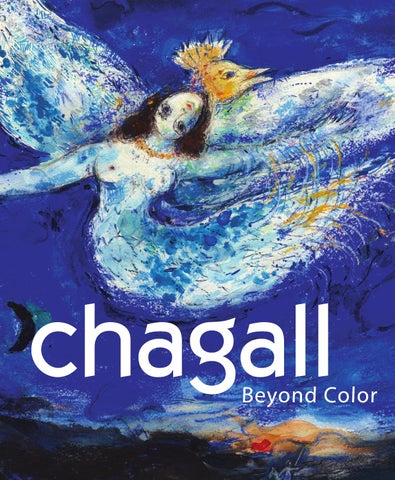
Cover: Study for the curtain of The Firebird by Stravinsky: the enchanted forest (detail), cat. 61 Inside front and back cover: Study for backdrop for Scene II of Aleko: the carnival (detail), cat. 57 Page 54–55: Costume for a fish (Aleko, Scene IV), cat. 30; Costume for a rooster (Aleko, Scene IV), cat. 31; and Costume for a clown (Aleko, Scene II), cat. 28
[FSC Logo (white background/ black type if possible)]
54
2012050524
55
56
ISBN 978-0-936227-03-0