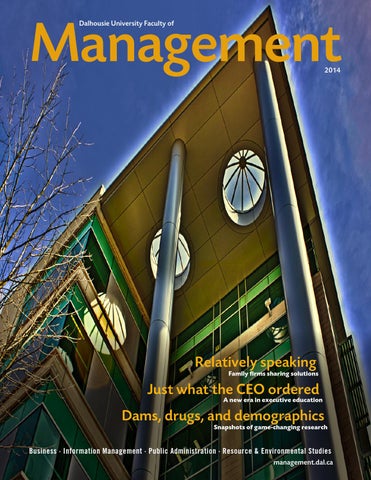
Management Dalhousie University Faculty of
2014
Relatively speaking
Family firms sharing solutions
Just what the CEO ordered
A new era in executive education
Dams, drugs, and demographics
Snapshots of game-changing research
Business 路 Information Management 路 Public Administration 路 Resource & Environmental Studies management.dal.ca
IDEAS INTEGRITY
…is essential to building trust and maintaining sound working relationships
DIVERSITY
…brings strength and unity to all endeavours
EXPERIENCE …prepares our students for their careers as they learn through experience
ACTION
…that is accountable is at the core of values-led management
SUSTAINABILITY …is the engine of prosperity that accounts for society, the environment and profits
The Dalhousie University Faculty of Management is Canada’s leader in advancing values-based management to bring sustainable prosperity to individuals and communities. Offering management education for every stage of your career:
Executive Education Mid-Career Development Graduate Programs Undergraduate Programs
dal.ca/IDEAS
Diversity-driven learning — 4
Contents
Our dean, Peggy Cunningham, reveals how diversity brings strength to all that we do
Taking it out of the classroom — 5 Corporate Residency MBA students are using their MAD projects to help others while gaining hands-on experience
From some to many — 6 The Faculty of Management is becoming increasingly internationalized and with the challenges this presents come great rewards for all
A global perspective — 8 Canadian work terms for our international students are benefiting employers through fresh perspectives and global connections
Solution revolution — 10 Teams of grad students from our four Schools tackle real-world problems as they prepare for today’s complex and interdisciplinary workplace
Dams, drugs, dissemination and demographics — 12 Research across our four Schools is rich in diversity and has application to real-world problems
Partnering for prosperity — 14 Bespoke curriculum and flexible framework open new era in executive education
Relatively speaking — 16 Family businesses come in various shapes and sizes and our Centre for Family Business and Regional Prosperity works to support them all
Giving back — 19 Students, faculty and staff put their values into action in a diverse range of projects supporting charities and non-profit organizations Cover image: Perspective gained through diversity brings strength and unity to all forms of endeavour in our Faculty.
Beyond the bottom line — 20 Ethics in Action is what you get when students of a Faculty grounded in values-based management gain support of a major bank to foster ethical leadership
Management alumni — 22 Our alumni work in a wide range of fields to build a better world
Management Special Publication | 2014 · Editor: Colin Craig Designers: Jane Lombard, Scott Pronych | Writer: Scott Neilson | Feedback/Suggestions: Colin.Craig@dal.ca Contact: Faculty of Management, Dalhousie University · Kenneth C. Rowe Management Building, Suite 3050 6100 University Avenue · PO Box 15000 · Halifax, Nova Scotia, Canada B3H 4R2 · Tel: 902.494.2582 · management.dal.ca management.dal.ca 3
The founding of the Faculty of Management is rooted in diversity. By bringing together the Schools of Business, Information Management, Public Administration, and Resource and Environmental Studies, Dalhousie University created a unique environment for the advancement of management education and research. Students in our four Schools apply diverse values and approaches to our shared pledge to Manage with Integrity and Make Things Happen as they learn. Our programs are built on a foundation of values-based management captured by the acronym IDEAS: Integrity, Diversity, Experiential Learning, Accountable Action and Sustainability are front and centre. Our students, faculty and staff integrate these values into all we do. Managing with integrity is essential to building trust and maintaining sound working relationships. Our student body is increasingly inter-
4   management.dal.ca
national, so valuing and respecting different perspectives and different voices is a key to our cross-sector perspective and global outlook. But for us, embracing diversity goes beyond ethnicity, race, socioeconomic status, gender, language, religion and sexual orientation. It is found in the manifold perspectives we bring to bear on management problems when students and academics from our four schools collaborate. The interdisciplinary learning opportunities we are able to provide help to prepare our students for the complex challenges they will face in the course of their careers. Diversity brings strength and unity to all forms of endeavour in our Faculty. The wide range of programs we deliver to undergraduates, graduate students, mid-career professionals and executives drives the advancement of management practice in all sectors. The power of academic freedom to pursue diverse
Peggy Cunningham
Diversity-driven learning
ideas drives our research. The diversity of backgrounds found in our staff, from the frontlines to senior management, supports all that we do. This unique combination of strengths enables us to make wideranging contributions to students, the community and the university. The diversity of opportunities found in the Faculty of Management prepares students for their careers in a way that is without parallel. Our students benefit from workplace experiences offered by our employer partners, direct engagement with our alumni, the sharing of realworld endeavours by our professors and through the management of student-led initiatives. The diversitydriven learning we provide enables our graduates to drive productivity and sustainable prosperity at home and around the globe. Peggy Cunningham Dean
Taking it out of the classroom Grads give helping hand, expertise — gain hands-on experience
Thanks to our Faculty’s new Make a Difference initiative, not-for-profits are tapping into much-needed management expertise — while giving graduate students a chance to gain experience solving real-world problems. Last September saw our second-year Corporate Residency MBA students kick off eight projects that are set to make a tangible difference to communities across the Maritimes and internationally. Formulation vs. implementation Working in teams of six or seven, students began their respective Make a Difference (MAD) projects by identifying a real-world problem — and using the knowledge gained during their strategic formulation and professional development classes to come up with a solution to it. Then, late fall, each team switched into practical mode — this time applying insights from their strategic implementation studies to set about actually solving their problem. Jenny Baechler, associate director of our Corporate Residency MBA program and one of four faculty members involved with MAD, explains the benefits behind the program: “These projects provide students with an opportunity to integrate knowledge and skills acquired throughout our core curriculum and apply them in such a way that they positively influence problems and issues facing organizations and communities. Students get a chance to see the impact they can have on real-world problems.” The eight projects range from helping jobless Nova Scotians find permanent employment to getting a micro-credit scheme get off the ground in Uganda.
Case study: Go to market One team is working to strengthen relationships between the Halifax Seaport Farmers’ Market and the province’s producers. Explains team member Mike Carey: “Through a series of community meetings, we’re reaching out to farmers and fishers to communicate the market’s vision and plans and to build its brand among these groups and also among urban consumers. One of our project’s outcomes will be the creation of a database that helps the market better match vendors to customers.” Case study: Reaching out PEI-based Reach provides at-risk youth with personal development and a safe environment in which they can interact. A third team of students is helping the not-for-profit build a business plan to launch and sustain a revenuegenerating line of clothing. Case study: True understanding A second team has partnered with Sackville-based not-for-profit The Empathy Factory, which works to
The MAD team at the Halifax Seaport Farmers’ Market
raise awareness among youth of the power of empathy and the importance of giving back. The team is collaborating on a new crowdfunding website that will raise revenue for other not-for-profits, charities and individuals needing seed capital for projects that enhance the greater good. Explains team member Beth Whitfield: “Our role involves conducting user testing, creating a plan to market the site and helping to launch the site.”
“These projects provide students with an opportunity to integrate knowledge and skills acquired throughout our core curriculum and apply them in such a way that they positively influence problems and issues facing organizations and communities.” – Jenny Baechler
management.dal.ca 5
From some to many The internationalization of our Faculty
Around 2010, our Faculty began to experience a steep rise in the number of international students studying at the undergraduate level. Our Bachelor of Commerce program, for example, rose from 100 international students in March 2009 to 220 only three years later — constituting 23 percent of the enrolment. At the same time, students’ countries of origin have changed dramatically with most of our international students no longer coming from English-speaking countries such as the U.S., but instead from China. Problems But with change comes challenge. Dal was poorly prepared for the influx of Chinese students, a situation that left the students dealing with a plethora of problems — and our Faculty subsequently facing high attrition rates. Enter Linda Macdonald, who joined our Faculty three years ago to aid integration and reduce attrition. Explains Linda: “For Chinese students, difficulties with language interfere with the abilities to listen to lectures, understand course expectations, read sophisticated academic texts, produce writing assignments, complete examinations and to converse with instructors and domestic student peers. In particular, she says, evaluative tools were inadvertently assessing linguistic rather than course knowledge. “For example,” says Linda, “this occurs when an instructor asks students to create a business plan on a ‘shoestring’ budget — an example
6 management.dal.ca
BComm student, Lucinda Xue confers with MBA student, Tomas Stryncl
of evaluating students’ knowledge of English colloquialisms rather than business acumen.” Meanwhile, Chinese students frequently lacked the work experience and business contacts usually required to land co-op work terms in this country. Solutions Linda immediately reviewed existing research into these problems and devised some solutions — most of which our Faculty is currently implementing. Works both ways The Faculty began to abandon what Linda labels a ‘deficiency-based perspective’ of expecting international students to adapt to Canadian
ways — trading it for one that instead sees them as “assets in an increasingly diverse international business community”. Says Linda: “International students offer us valuable perspectives on global markets, along with a unique ability to communicate crossculturally. In an age of increasing globalization, we’re eager to make much more of this.” Other academic adaptations, meanwhile, include using clearer and more consistent lecture formats, providing PowerPoint summaries so students can focus more on what lecturers are saying, allowing more time for exams and adjusting evaluation methods. Instructors requiring group work are strongly encouraged to create intercultural teams.
“International students offer us valuable perspectives on global markets, along with a unique ability to communicate cross-culturally. In an age of increasing globalization, we’re eager to make much more of this.” – Linda Macdonald
Our Faculty’s biggest leap forward, however, comes in the form of our International Student Support Program (ISSP). Set up in 2012, the ISSP is a hub that helps international students — particularly undergrads — plug into the faculty’s support services such as Dal’s writing and international student centres and our Faculty’s Management Career Services team. Third-year Bachelor of Commerce candidate Lucinda Xue helped coordinate a growing team of volunteers tasked with promoting the ISSP to our Faculty’s international students. She says: “The ISSP offers informal, drop-in style networking where international students can come together to talk about their problems and — most importantly — learn work search skills, discover volunteering opportunities to help them gain work experience and prepare for coop work terms they have secured.”
Success Already, these adaptations have delivered a dramatic drop in attrition rates among undergraduate international students. And just in time, says associate dean Vivian Howard, a champion of the internationalization of our Faculty. Notes Vivian: “Given the importance of the tertiary education sector to our province’s economy, and with our own population of universityage people diminishing here in the Maritimes, Nova Scotia can’t afford to get this wrong.”
Professor Binod Sundararajan
Not just our students It isn’t only our student body that’s changing. Increasingly, our faculty members are becoming more diverse too. From ‘Sundararajan’ to ‘Zhang’ and ‘Zhao’, a quick survey of Rowe School of Business, for example, reveals approximately one in four faculty members is from either China or the Indian subcontinent or has heritage from those areas. Meanwhile, four of our Faculty’s most recent hires are members of visible minorities – as is the case with recent A. Gordon Archibald Teaching Excellence Award winners Sujit Sur, Binod Sundararajan, Shamsud Chowdury, and Abdul-Rahim Ahmad. And last year alone, Eddy Ng picked up four awards and honours, three of them from outside Dal. Perhaps unsurprisingly, our curriculum has also changed to keep pace with the demand for a more international outlook. Classes such as Business in a Global Context, International and Intercultural Management, International Business, and Global Markets and Institutions are now commonplace across our Faculty’s four schools. At the same time, the services we offer have adapted to the influx of international students. A good example is our Faculty’s Management Career Services team, which provides specialist guidance, workshops and other resources tailored to the needs of international students.
BComm students collaborating in the Rowe Building Media Lab
management.dal.ca 7
A global perspective Cultural conduits provide key piece of post-Ivany puzzle
Each year, scores of our international students undertake work experience with a diverse range of Canadian employers. With our province now in critical need of young entrepreneurs with global connections, these placements are playing a part in reversing Nova Scotia’s economic decline. Released in mid-February, the highprofile Ivany report predicts a drop in living standards and a serious decline for Nova Scotia unless our province addresses a long list of problems. Prominent among them, points out the report, are our decreasing working-age population, our lack of dynamic exporting businesses and our apparent reluctance to welcome outsiders. It’s a call to action that’s resonating particularly strongly within the walls of Dalhousie’s Faculty of Management, which — for the past two decades — has been facilitating international business students into work terms with Nova Scotian employers. Anna Cranston, who heads our faculty’s Management Career Services team, says the work terms play a small but important part in turning the Ivany report’s aspirations into reality. Says Anna: “Last year, almost 100 [Faculty of Management] international students completed work terms with Canadian employers. When a local business, for example, takes on an international student, it builds a cultural conduit with that person’s country, making it easier for the business to understand and
8 management.dal.ca
access new — and often, emerging — markets such as Russia and China. “For example, the student can provide cultural context and translation skills — or can perhaps conduct research on foreign businesses,” she says. War for talent International students also help employers build a culture of inclusion, says Anna, subsequently allowing them to tap pools of much-needed young, skilled and professional talent — something of “huge importance” given our province’s aging population. “Meanwhile,” adds Anna, “international students improve an employer’s ability to innovate because the diverse perspectives they bring allow organizations to see problems in new ways and from fresh angles.” The Faculty’s international students come from as far afield as Azerbaijan, Bangladesh and the Bahamas, although the vast majority originates from China. Irrespective of origins, however, Anna says her team’s post-placement evaluation surveys show that employers typically find the students motivated, reliable, adaptable and flexible.
Case study: Chronicle Herald It’s a conclusion shared by Kevin Colvey, the Chronicle Herald’s VP for Corporate Development. Kevin spent eight months supervising international student and Corporate Residency MBA candidate Xiaoyu ‘Nate’ Zhang during 2013. The first of our Faculty’s Corporate Residency MBA students to be hosted by the Herald, Nate took on data analysis and financial modelling. An “eager and fast learner”, he provided “important insights” — among them knowledge of retail trends applicable to the Herald’s business, Kevin says. “Meanwhile, Nate also provided a unique view from the younger demographic, as well as a view on the behaviours and trends of people living and studying abroad away from their family — of which there are plenty in Nova Scotia.” In fact, Kevin says the experience was so positive that the Herald has since offered corporate residencies to two more of Dal’s international students. Nate says the work term helped him gain a lot of knowledge and in-
MBA student Xiaoyu ‘Nate’ Zhang on his corporate residency at the Chronicle Herald
sight, improve his business communication skills and learn about business strategy and how to implement organizational change. “But perhaps most importantly,” he says, “the placement helped increase my overall self-confidence. “Before it began, I was very nervous about speaking in public and would usually keep silent during a meeting. However, I now feel more comfortable sharing my opinions and debating with my non-Chinese peers. “Also, Kevin was a great mentor. He taught me how to tackle different problems and invited me to attend some senior executive meetings with him so I could learn more about the different projects my work was touching,” he says. “Overall,” says Nate, “everyone at the Herald was extremely friendly and very easy to get along with. I’ll never forget how, on my first day, the CEO took time out to give me a tour of the entire company and introduce me to everybody. And on my last day, the company held a surprise party for me. They wrote me a card and gave me many gifts. I felt extremely welcome the entire time.”
Lokiy Wang on her co-op work term with ACOA
“International students improve an employer’s ability to innovate because the diverse perspectives they bring allow organizations to see problems in new ways and from fresh angles.” – Anna Cranston
Case study: ACOA Bachelor of Commerce student Lokiy Wang spent one of her work terms with the Atlantic Canada Opportunities Agency (ACOA) where she assisted with trade missions and conducted research with a focus on the Asian market. Says Lokiy: “The work term provided me with a chance to expand my business contacts across the public sector and with several of the Maritimes’ leading companies.” Gilles Gaudet, Lokiy’s manager during her placement, says he hired her because of her first-hand knowledge of China and Chinese consumers and business practices. “Lokiy added a fresh perspective to our team and improved our cultural awareness.” Meanwhile, says Gilles, it’s also worth remembering that — postplacement — international students may well raise awareness of a company’s products or services among their family and friends if and when they return to their home countries. “What better way to get a product known outside Canada? And it’s free!”
Anna Cranston
management.dal.ca 9
Solution revolution Big picture perspectives resolving real-world problems
Canadian organizations are working with graduate students from our Faculty’s four schools to tackle a range of problems. Each fall, approximately 150 master’s degree students from our Faculty’s four schools team up to bring an interdisciplinary perspective to bear on diverse problems faced by Canada’s public, private and not-for-profit organizations. Working under the auspices of our mandatory Management Without Borders (MWB) course, the students come together in groups of five or six (with no more than two students from the same school per group) to collaborate with a partner organization on one of the issues it faces. Explains coordinator Jenny Baechler: “These are often issues the organization simply can’t get to because of resource constraints or a lack of expertise.” Three months later, the course culminates when teams present their work and recommendations to their host organizations. Win win Besides making a tangible difference to hosts, the course prepares students for the challenges of the complex and interdisciplinary workplaces many of them will soon work in, says Jenny. “As such, we look for projects that require the integration and application of numerous skill sets and knowledge bases from across the Faculty’s four schools.”
10 management.dal.ca
Says master’s student Danika Kowpak: “MWB allowed me to appreciate the significance of clear communication with teammates, as students from different programs may have been taught to complete the same tasks in different ways.” Cross-country clients While MWB’s partners have traditionally been in Nova Scotia, the course is increasingly working with organizations in Ottawa, Montreal and Vancouver. Case study: Should Chester build an eco-park? Located on Nova Scotia’s South Shore, the Municipality of the District of Chester is considering
whether it ought to develop an ecopark in Kaizer Meadow. Powered by clean energy, the park would create manufacturing jobs and a market for nearby renewable woodland. And it would also, the district hopes, become a location of choice for green businesses looking for low-impact accommodation in a natural setting. District officers collaborated with a MWB team to ascertain if the park is financially feasible. Among other issues, the feasibility study looked at the availability of funding, potential obstacles, planning and processes, possible return on investment — and any lessons that could be learned from similar ventures. The district is now using the study to consider its next move.
THE KAIZER MEADOW ECO-INDUSTRIAL PARK FEASIBILITY STUDY
Ashbourne, K., David, A., Driscoll, M., Hart, C., Prendergast, M., and Scannell, S. Dalhousie University, Faculty of Management
PURPOSE & OBJECTIVES
RECOMMENDATIONS
The Kaizer Meadow site is located in the Municipality of the District of Chester (MODC) between Halifax Regional Municipality and Lunenburg. There is an operating landfill on site and the resources it provides creates the opportunity for an eco-industrial business park 1.
The ultimate configuration of Kaizer Meadow ought to be determined by the collaborative efforts of residents and business stakeholders. What follows are suggested next steps for development of the site. Step1: Agree on a Vision To discover the correct balance of options presented within the report, the MODC ought to hold further consultations with citizens and relevant stakeholders to build a shared vision for the site.
This study evaluated the potential opportunities for infrastructure, economic development and next steps to achieve a synergy-focused park that can be supported by both traditional and growing industries in the area.
CONTEXT Step 2: Encourage Collaborative Development Once a shared vision has been agreed upon, the MODC can begin marshalling technical expertise, potential business partners, and administrators to develop a concrete path forward.
The reuse and recycling of resources at landfills is a growing sector of research and development. Kaizer Meadow is situated in an ideal location for potential businesses and is accessible to a substantial labour force 2. Traditionally, areas of employment in the MODC are fishing, manufacturing, forestry, and value-added processing. Emerging sectors relevant to Kaizer Meadow include tourism, niche agriculture, and value-added processing3. This study aligns Kaizer Meadow’s desire to be innovative and sustainable, with the need for profitable development.
ACKNOWLEDGEMENTS Thanks to Jenny Beachler for her preparation and coordination of the Management without borders course as well as to the teaching assistances and faculty coaches. Thank you also to the support of members of Kaizer Meadow and the MODC.
METHODOLOGY An extensive literature review of best practices, infrastructure, resource potential and business opportunities was completed. The following resources were investigated: (1) Methane & Landfill Gas Capture, (2) Organic Waste, (3) Biomass, (4) Construction & Demolition Waste, (5) Forestry, (6) Recreation, and (7) Education. The feasibility of utilizing each resource was evaluated based on the following criteria: • • • •
Investment Marketability Long-term Sustainability Economic Impact
• • • •
Stakeholder Engagement Potential for Shared Resources Level of Synergy Barriers/Risks
In addition, financial projections for future development of Kaizer Meadow were produced.
Step 3: Create a Marketing Plan Upon creation of a development plan, the MODC would benefit from developing a marketing campaign to begin attracting businesses to Kaizer Meadow.
REFERENCES 1 Municipality of the District of Chester. (2013). An Economic Development Strategy. Municipality of the District of Chester, NS: Canada. 2 Municipality of the District of Chester. (2013). Strategic Plan 2013. Municipality of the District of Chester, NS: Canada. 3 Eco-Industrial Solutions Ltd. (2010). Business Plan for the Operations and Maintenance of the Kaizer Meadow Eco-Park Development. Vancouver, BC. Photo Credit: The Municipality of the District of Chester
Case study: A pearl of a partnership Oysters have historically provided food and income for people living around Cape Breton’s Bras d’Or lakes and waterways — while playing a vital role in purifying lake water. Now, however, overexploitation and disease have severely depleted stocks. In a bid to better manage the resource, the Bras d’Or Lakes Collaborative Environmental Planning Initiative (CEPI) asked an MWB team to get involved. The students began by reading about the key issues and reviewing project work CEPI had already completed. Next, the team conducted a land use management analysis of six areas of the Bras d’Or Lakes that have been protected as critical oyster habitats. The analysis included research into current land use around the lakes and, subsequently, recommendations for better management of the land. Finally, the team worked with CEPI to formulate a policy for effectively and sustainably managing the resource — along with strategies for getting the municipal and provincial government to adopt the policy.
“These are often issues the organization simply can’t get to because of resource constraints or a lack of expertise.” – Jenny Baechler
Case study: Getting Nova Scotians off the couch Recreation Nova Scotia (RNS) is a not-for-profit that advocates for high quality recreation and leisure opportunities across our province. The organization’s funding depends for the most part on building and maintaining good relationships with volunteers and with public- and private-sector stakeholders. While Nova Scotia is fortunate to have many outdoor assets — not simply spaces and but also people, events, activities and information — these resources are often fragmented and hard to find. The solution? Create and promote a website capable of connecting our province’s outdoor communities and resources. Known as the Outdoor Network, the site will — upon completion — provide a one-stop-shop for people wanting to access new hiking trails, learn outdoor skills, volunteer or to share their knowledge, to name only a handful of examples. With one eye on its partnerships, RNS asked an MWB team to draw up a creative brief that would enable RNS to brand the site in a compelling way. Working with a brand specialist from National Public Relations, the students set about researching and creating a compelling narrative, core brand concept and a suite of key messages upon which to build the site’s brand. Several weeks later, the team presented its brief to RNS, incorporated feedback and then passed it to three Nova Scotia College of Art and Design students who used the brief to develop the site’s look and feel.
Then, in the winter, our team devised a social media strategy for the site, planned its launch event and delivered a range of marketing materials. A beta version of the Outdoor Network is now live. You can see it here: novascotiaoutdoors.ca.
Partner organizations on most recent MWB course: 23 Students enrolled in MWB each year: 150 Need some know-how? If you’d like to find out more about MWB, please contact Jenny Baechler at (902) 494-3321 or via email at jenny.baechler@dal.ca
management.dal.ca 11
Dams, drugs, dissemination and demographics Management provides a peek into the range of research occurring across our Faculty’s four schools
School of Information Management The digital age has left many of us drowning in data and information. Researchers, in particular, can easily spend millions of dollars of public money producing groundbreaking research — only to discover policy-makers remain unaware of their report. This is something that Bertrum MacDonald is hoping to change. A professor of Information Management, Bertrum has assembled a 12-strong interdisciplinary team dedicated to tracking the awareness and use of environmental marine research — as well as its influence on policies designed to help save our oceans. Explains Bertrum: “There is a wealth of scientific information that tells us how we could mitigate the deterioration of our oceans.
12 management.dal.ca
But the policy-makers aren’t always making use of them. Our research strives to find out where the momentum gets lost between research being published and that information finding its way into the hands of decision-makers.” Backed by a significant threeyear grant from the Social Sciences and Humanities Research Council of Canada, Bertrum’s team makes the most of our Faculty’s breadth to bring together people from a range of backgrounds — from information management to public policy to environmental research. “Our team’s diversity allows us to approach every problem from multiple angles, which is vital when dealing with such complex and unpredictable flows of information,” he says. “The fact that we come from different experiences really capitalizes on our creativity.”
School for Resource and Environmental Studies Located 15 km north of the New Brunswick city of Fredericton, the Mactaquac Dam uses the Saint John River to generate approximately 12 percent of that province’s power requirements. Completed in 1968, the dam is nearing the end of its life — a development that has sparked increasing public controversy about whether the dam should be refurbished, decommissioned or perhaps even demolished. Demolishing would ‘rewild’ the river and also remove the 100 km-long headpond created by the dam. But what about the region’s residents? Do they have a clear preference for the dam and its head pond? To find out, Dr. Kate Sherren and her small team of researchers spent some of August 2013 cruising the headpond with members of the public who use it or live near it.
(R to L) Dr. Tom Beckley (UNB), co-investigator and Dr. Kate Sherren (son George) with their research assistants
Explains Kate: “New Brunswick has some big decisions to make about its energy infrastructure. People living near the dam have a lot to gain and a lot to lose depending on who they are and how the dam and headpond affect them. Before any decisions can be made effectively, we need to find out how people feel about it. “For the first half of the cruise, we gave people recording devices and encouraged them simply to respond to the landscape — to point out the features that mean the most to them, to tell stories about it and so on. Then, on the way back, our research took a much tighter focus — specifically, a focus group about the region’s landscape and its energy choices,” she says. “Ultimately, our research allowed us to generate a more grassrootslevel dialogue — and will enable policy-makers and planners to make better-informed and more democratic decisions on this issue and around the province’s energy use going forward.”
Rowe School of Business Nova Scotia’s pending skill shortage and its aging population means our province needs to find ways of extending the careers of older workers. But how well are employees 55 and older able to keep up in a changing workplace? Why are some better at it than others? And how, ultimately, can employers help them adapt? To answer these and other questions, Prof. Ed Ng conducted an in-depth analysis of workers aged 55 to 64, publishing his findings this year in the Canadian Journal on Aging under the title Keeping Up! Older Workers’ Adaptations in the Workplace after Age 55. Among its key findings, the study revealed that older workers use a range of strategies to adapt, most of them successfully. “For example,” says Ed, “older workers substitute the loss of cognitive resources, physical functioning and mental wellbeing with gains in perspective, experience and fortitude. Meanwhile, older workers who focus on future time perspectives find new purposes and possibilities that enhance their subjective wellbeing.”
School of Public Administration The pan-Canadian Oncology Drug Review (pCODR) is an evidencebased review process designed to bring consistency and clarity to the assessment of cancer drugs. The pCODR reviews clinical evidence, cost-effectiveness and patient perspectives then uses this information to make recommendations to Canada’s provinces and territories (other than Quebec) — recommendations that guide cancer-drug funding decisions.
Dominika Wranik
Dominika Wranik, a professor in our Faculty’s School of Public Administration, leads a team of researchers seeking to understand how the pCODR — an interdisciplinary and formulary body — weighs clinical, economic and other types of information. Explains Dominika: “A pilot study of a similar formulary committee in Nova Scotia revealed economic evidence isn’t used to its full potential — both because of technical challenges and a lack of trust in studies sponsored by the pharmaceutical industry. “To address this, we are working on a conceptual framework that will improve the use of economic evidence by formulary committees and support consistent and transparent decision processes. Our results will support the pCODR process specifically, and drug-funding decision processes in general.”
management.dal.ca 13
Partnering for prosperity Dalhousie’s Executive Education Program breaks new ground
In the fall of 2012, the Faculty of Management broke new ground in the field of executive education with the launch of cohort-based leadership development learning that continually reconfigures itself to meet the distinct needs of clients. Like many executive education offerings, the training provides a great grounding in problem-solving, strategic thinking and other skills and competencies senior managers need in order to lead. It’s there, however, that the similarities end. Director of Executive Education Rachel Sumner explains: “During my 20 years in learning and development, I’ve seen many universities become so caught up in their expertise that they forget to connect with the world out there. By contrast, we begin by listening to the client’s needs, then building our offering from there. It’s pulling the input in, rather than pushing our preferences out to them.” “Our offering has a core curriculum, with standard courses leveraged from the Faculty’s four diverse schools. However, each time we deploy it for a client, we begin by collaborating closely with them to analyze their organization and to understand their development-related needs, goals and priorities — then carefully adapt our offering to suit,” she says. “This includes working with the client to co-design learning objectives and agree on a unique set of learning outcomes — all of which is carefully contextualized to the client’s organization,” says Rachel. “The client can change the
14 management.dal.ca
offering as they see fit, to focus on the elements most important to them. In addition, we offer flexible scheduling, to run our offering in a timeframe that best suits the client. “Essentially, our framework’s flexibility allows us to adapt our offering — including our award-winning and world-class teachers — to meet the client’s unique needs. This method is a big improvement on simply presenting a cookie cutter offering and hoping the client will be able to fit their needs into whatever we’re offering,” she adds. Modular approach The learning takes a modular approach, supported by practice between courses, personalized coaching and ongoing performance management. Learning takes place in the Faculty of Management’s state of the art executive training suite in one of Dalhousie’s newest buildings. The three adjoining multifunction rooms facilitate group work or boardroom-style seating, with flexible furnishings to meet different needs. The tiered executive classroom seats 55 and includes built-in internet and power ports, rear-projection screen, document (transparency and object) display, computer and video display and touchscreen controls. High-profile clients Home to more than 3,500 employees, Halifax-based I.M.P. Group International has been handpicking potential leaders from across its aerospace, aviation, airline, IT, healthcare and hospitality divisions
and sending them to the training since January 2013. Says Rachel: “Following their first, 10-strong cohort, I.M.P. was so impressed with the results that it committed a second cohort from January 2014.” It’s a sentiment shared by Halifax Port Authority president and CEO Karen Oldfield, who is looking forward to 11 of her executives completing their training in June. “The amount of time and effort we put in up-front to customize their offering to our specific needs was worth every minute. I love it. And I’m very committed to ensuring that it continues on a sustainable basis,” says Karen. Lindsay Construction was the third corporate client to sign up before Dal reinvented the training — this time taking on a sector association as a client. This fall, the team will take in the first cohort for its brand new Executive Certificate in Construction Leadership. Announced in February by the Minister of Labour and Advanced Education, Kelly Regan, the certificate is the result of a partnership between our faculty and the Construction Association of Nova Scotia, which represents more than 760 companies of varying sizes.
“The client can change the offering as they see fit, to focus on the elements most important to them.” — Rachel Sumner
(L to R) Rachel Sumner, Director of Executive Education; Stewart Clark, RKO Steel Ltd.; Duncan Williams, CANS
Says faculty dean Peggy Cunningham: “Following our success with our first three clients, we’re now pleased to open the doors to an industry-based cohort.” Adds Rachel: “In terms of diversity, there’s so many ways we believe this could still be configured and iterated to adjust it to specific and individual businesses, public sector bodies, community groups and professional associations. Depending on a client’s need, we could involve any number of faculties from across Dal. “Going forward, the sky’s the limit really. It all comes down to the way an organization needs to develop its executives to turn them into tomorrow’s leaders.”
• We are working with clients who are listed in 50 Best Managed Companies in Canada • 100% of our program participants would be ‘highly likely’ to recommend this program to their colleagues • 100% of our program participants rate our programs as either VERY or EXTREMELY relevant to their roles • By the end of 2014 we expect to have worked with over 100 high potential leaders in Nova Scotia management.dal.ca 15
Christina Pace, Burger King
Relatively speaking Specialist education, research and outreach are helping Atlantic Canada’s family firms From farms and franchises to big box retailers, family-owned or -operated businesses employ approximately half of Canada’s workforce. Atlantic Canada is no exception. Here, these companies dominate our business landscape both in terms of billion dollar enterprises such as Sobeys and Irving and in scope — with revenue from family firms comprising an estimated 70 percent of this region’s economy. Yet from sibling squabbles to poor succession planning, this type of enterprise tends to face a specific set of challenges — challenges our Faculty’s Centre for Family Business and Regional Prosperity is helping to manage, moderate and mitigate.
16 management.dal.ca
Explains Centre director Leslie Crowell: “Many Atlantic Canadian entrepreneurs are reaching retirement age. Soon, their businesses must be passed to the next generation — or sold, with the wealth passed down. “Many of these businesses, however, unfortunately remain unprepared for either of these scenarios.” Three-pronged approach With this in mind, the centre offers education, research and outreach to help family firms tackle their common conundrums. The centre’s educational efforts take the form of undergraduate, graduate, continuing and executive-
level learning that enables family businesses — along with their advisors — to plug into best practice and get better at governance, conflict resolution, communication and succession planning. In addition, the Centre offers outreach opportunities for people working in and with family firms to socialize, share and celebrate. “For example,” says Leslie, “our family legacy gala dinner — each year featuring an intimate discussion between the Faculty of Management dean and a prominent family such as the Braggs or the Fares — showcases real-life examples of creativity, knowledge and effort successfully transferred to the next generation.”
Succession situation taught burger queen good governance lesson When the head of Atlantic Canada’s largest privately-owned hotel chain passed away in 2006, the family business behind the brand could have been hit hard. The question was: which family member would now step up and lead? It’s the kind of uncertainty that can cause even a highly successful business to stumble and perhaps fall. But in the case of Rodd Hotels and Resorts, that risk was decisively and pre-emptively removed thanks to the family having put in place a solid advisory board to guide the business through the succession process the Rodd family now found itself facing. Halifax-based businesswoman Christina Pace — who nowadays runs three HRM Burger King restaurants — sat on Rodd’s advisory board at the time her father, David, died. “During what was a very difficult time for my family, having a solid advisory board already in place proved invaluable,” explains Christina. “The board provided an essential forum for myself and the other family members to come together and successfully steer the business through the succession. From a governance
Photo by Darrowmultimedia Inc.
Research, too Leslie — with faculty members Scott Comber and Robert Blunden – co-leads Dal’s participation in the Successful Transgenerational Entrepreneurship Practices (STEP) global research project. Founded in 2005, this unique project brings together entrepreneurship and family business academics and leading multigenerational family businesses to explore, identify and share successful business practices. Explains Scott: “Dal is proud to be part of STEP, which is making excellent progress in identifying ideas and practices capable of helping family business continue to innovate, succeed and grow over the short, medium and long term.”
Fiona Diamond, Brookes Diamond Productions
perspective, it really did make all the difference.” The experience prompted Christina to this year take a seat on the board of our faculty’s Centre for Family Business and Regional Prosperity. “I want to help ensure other Atlantic Canadian family businesses have solid plans in place to help move their business from the current generation to the next — if and when the worst happens and you lose a family member who is also heavily involved in the family business.” Best of both worlds Christina says growing up in the hotel business is a world away from running franchises. “Franchises leave you relatively little room to manoeuvre when it comes to policy, products, procedures, processes, marketing programs and all the other operational aspects that are controlled from the centre. “On the other hand, franchising has taught me a lot best practice — things like health and safety and quality assurance — all of which I’ve been able to use to improve how we run Rodd Resorts and Hotels.” Three simple rules Run by husband and wife team Brookes and Fiona Diamond, Brookes Diamond Productions has during the past four decades delivered many of Atlantic Canada’s most successful events. From Rita MacNeil and Jerry Seinfeld to the Halifax Comedy Festival and a G-7 event for 50,000 people, the full service entertain-
ment production company — and the couple behind it — have plenty to be proud of. Being married to a man who also happens to be your business partner hasn’t always been easy, says Fiona — especially in a pressure cooker industry such as show business. As such, Fiona and Brookes have had to follow three simple rules to ensure success both at home and at work, she says. “First, we’ve done our best to keep our own areas of responsibility separate from each other — and to not interfere with each other’s work. “Secondly, we’ve always done our best to leave domestic issues at home, rather than taking them into meetings and so on. “Finally, I think you need to try once in a while to either get away with each other, to give yourselves a break from the office and the pressures of the job. “And, when you can’t do that, do your best to get away from each other,” jokes Fiona. “Some separate interests are a good idea.” Practicing what she preaches, Fiona spends some of her time leading the Nova Scotia chapter of the Canadian Association of Family Enterprises (CAFE) — a national notfor-profit that offers peer networking, seminars and conferences to help family business share expertise and best practice. Explains Fiona: “CAFE has taught me that no matter how diverse family businesses are, they nevertheless share the same problems — issues around succession, for example.” continued
management.dal.ca 17
(L to R) Lee Bragg, CEO EastLink with his father, John Bragg
Corporations can be family businesses, too When someone says the words ‘family business,’ EastLink isn’t necessarily the first brand that comes to mind. But the cable television and communications company, with 1,500 employees and half a million subscribers across nine provinces, is one of the Bragg family businesses — an entrepreneurial empire that also includes farming, forestry, frozen food and the largest wild blueberry operation on the planet. While his four children were growing up, founder and current patriarch John Bragg made sure each one had plenty of opportunities to move around and between the different businesses, all the while learning them from the ground up — quite literally in the case of eldest son Lee. Recalls Lee: “As a young man, I would often don spurs and a safety belt and climb telephone poles to repair cable problems.” Lee’s pole position provided him with a high-level view of that sector,
18 management.dal.ca
knowledge that would prove indispensible when he took on the top job at EastLink in 1999. “The sector was very dynamic at that time — with a lot of risks and opportunities. The year I took over EastLink, it became the first cable company in Canada to launch a home phone service. All the bankers thought we were crazy to broaden our residential TV offering to landlines,” Lee says, “but our competitors were soon following us.” In fact, being nimble enough to make the most of changes in the market is one of a family business’s biggest advantages, says Lee. “Without shareholders attempting to second-guess every other thing we do, we can make significant, longer-term strategic investment decisions — then get on with implementing them fast,” he says. Lee offers a recent example of EastLink’s move into the cellular market: “That takes a lot of capital — and a publicly-traded company just wouldn’t deploy that much money
to gain a return over such a long time horizon. But as a family business, we base decisions such as that one on the fact that we’re still going to be with this business in many years. We’re not torn apart by the shifting interests of multiple stakeholders such as analysts, activist shareholders or perhaps a chief executive out for only short-term gain. “Our employees enjoy working for a company defined by solid family ownership that delivers the best decision for everyone,” he says. But what about people who look at Lee and see only the boss’s son? “I don’t care too much about it,” he says. “I don’t think I ever did. EastLink has had an advisory board in place since 1986. Besides family members, the board comprises 10 independent, non-family advisors who are there to monitor how well I perform, set my salary — and who would happily replace me if I failed the business in some way or if a better CEO came along.”
Giving back 2013–2014 Our students, staff and faculty put values-led management into action through a wide range of initiatives
The Rowe Mo Bros and Sistas raised $35,370 to establish themselves as the 2nd highest student fundraising team in Canada and the number one undergraduate team in Canada earning them a private reception with Col. Chris Hadfield. Dalhousie University as a whole raised $95,606, winning the Big Moustache per Capita Campus Challenge for most money raised per student.
For the third year in a row the Dalhousie Commerce Society organized the Inside Ride event at Dalhousie University to raise money to help children with cancer. The three-year total for funds raised is over $35,000.
A Toast to the Coast raised $12,000 in its ninth year of raising funds for Breast Cancer Research through a studentorganized gala dinner and auction.
Leslie Crowell, director of the Centre for Family Business and Regional Prosperity at Dalhousie, was this year’s campaign co-chair for Light the Night. Our Faculty was represented by the “Sunny’s March” (in memory of the late professor Sunny Marche) team who helped to raise money for the Leukemia and Lymphoma Society.
For the past three years, staff, faculty, students and even a few alumni from the Faculty of Management have been dedicating one spring day to do physical labour for United Way supported agencies in the HRM. They leave behind their desks, computers and daily routines to don rubber boots, gloves and painting clothes to face major chores that busy community service agencies rarely have the time or resources to face. The event is called “A Day of Caring”.
Beyond the bottom line Showcasing and fostering ethical leadership
Student organizing committee
Sparked by bad decisions and poor transparency across the financial services sector, 2008’s global financial crisis left banks battling Scotiabank Ethical Leadership a slump Award, handcrafted by Island in trust on Crystal, Cape Breton, Nova the part of Scotia. consumers, investors and regulators. And with companies such as Nike, Starbucks and Apple increasingly in the dock for their approach to issues such as supply chain management and tax, it’s perhaps unsurprising that ethics and integrity are — according to PwC’s latest global Annual CEO Survey — fastmoving up the C-Suite’s agenda. “Increasingly, businesses are seeing ethics and integrity as less of a discretionary ‘nice to have’ and more and more as a significant driver of
20 management.dal.ca
their success,” explains Peggy Cunningham, dean of Dalhousie’s Faculty of Management. Part of the solution “Against this background, and because of the importance the Faculty of Management places on valuesbased leadership and management, we wanted to find a way to increase students’ understanding of ethical business, to highlight its importance — and to showcase best practice in this area on a national and international level,” says Dr. Cunningham. That’s why, late last year, the faculty worked with Scotiabank to successfully launch Ethics in Action. Designed to foster a new generation of leaders well-grounded in the principles of ethical leadership, Ethics in Action is intended to engage both management students and the public in a conversation about business ethics, explains Laura Fougere, an organizer of the student-led event who is due to graduate from the faculty’s Corporate Residency MBA program in May. “The event aims to challenge students right across North America to think through complex ethical dilemmas, and to showcase role models who have consistently made right, but not
often easy choices throughout their careers,” she says. Diverse entries The event, held for the first time in November, comprises an annual conference, a case competition open to undergraduate business and MBA students from across Canada and the United States, awards for the best video and written essays on the topic of ethical leadership — and a national ethical leadership award program open to corporate, non-profit and government leaders. Made possible by a $1.5 million donation from Scotiabank, the event attracted entries from more than 100 business and commerce students at schools as far away as Alberta and North Carolina. Case competition The event’s case competition required students to place themselves in real-life, complex situations similar to those they may face as leaders. The teams were given an ethical dilemma and asked to find a solution, before presenting it to a panel of judges. First prize went to a team from the University of Prince Edward Island, while our faculty’s Rowe
Made possible by a $1.5 million donation from Scotiabank, the event attracted entries from more than 100 business and commerce students at schools as far away as Alberta and North Carolina.
School of Business came second (a team from our Corporate Residency MBA program) and third (from our Bachelor of Commerce program). Essay and video competition Entries in the essay and video competition, meanwhile, aimed to provoke the audience to think differently and deeply about how we practice and honour ethical leadership today. Drawing on her Romanian background, Rowe School of Business student Irina Bojinescu won the essay competition with a piece that looked at different cultures’ perspectives on ethical behaviour. A team from Concordia University’s John Molson School of Business won the video competition for a four-minute piece that looked at how companies can convince stakeholders of the need to change unethical behaviour — even when it is deeply rooted in company culture.
Variety of perspectives Offering diverse perspectives on ethical behaviour and leadership, the event’s speakers and panelists included the chief of Halifax Regional Police, the CEO of the Halifax Port Authority, Scotiabank’s head of international compliance and operational risk as well as the Halifax Regional Municipality’s auditor general. Making a difference Ms. Fougere, who is due to start a permanent position with business advisory giant Deloitte, says getting involved in the event helped her understand why business needs to move beyond the bottom line. “Beyond profit, business also has to be about creating long-term value for the stakeholders that your firm impacts.”
Leadership award Chief Phil Fontaine and Sir Graham Day were co-recipients of the first annual Scotiabank Ethical Leadership Award. A longstanding National Chief of the Assembly of First Nations until 2009 and an Officer of the Order of Canada, Chief Fontaine’s nomination noted his success with facilitating change and advancement for First Nations people. The nomination paid particular attention paid to his leadership in successfully negotiating the $5 billion Indian Residential Schools Settlement Agreement. A highly successful business leader and lawyer, Sir Graham was nominated in part because of the leadership he displayed while chairman of Cadbury Schweppes — in particular the move he made to oppose apartheid in South Africa while still protecting the economic welfare of that company’s employees. Nominate an Ethical Leader for 2014 at ethicsinaction.ca
Sir Graham Day
Chief Phil Fontaine
Get involved Would you like to enter one of our competition categories, volunteer as a judge or step forward as a conference panelist or speaker? Please contact us at ethicsinaction@dal.ca. management.dal.ca 21
Management alumni — Building a better world
Céline Beauregard
Marie-Eve Lengham
Leslie Crowell
Master of Information Management 2014 Director of Information and Library Management Canada School of Public Service Ottawa, Ontario
Master of Resource and Environmental Management 2011 Environment and Permitting, Tata Steel Minerals Canada Montreal, Quebec
Bachelor of Commerce 1990 Director, Centre for Family Business and Regional Prosperity Dalhousie University Halifax, Nova Scotia
Céline leads a team responsible for providing library services and management support for electronic and physical documents and records. A strong advocate of breaking down silos and working collaboratively, Céline is an enabler who uses her skills in relationship and people management to create hybrid teams of information, records, technology and business specialists. Respecting the diversity of skills and knowledge each brings to the table, these teams collaborate to provide end-to-end content management solutions. Céline is actively working with other departments to spread this winning formula. Céline found that the Master’s of Information Management provides students with an environment in which to learn from today’s thought leaders as well as each other’s experiences.
Marie-Eve says that her two years at Dalhousie were intense but definitely rewarding. She felt a strong sense of community at the School for Resource and Environmental Studies and immediately felt at ease in her graduate program. Marie-Eve tries to keep that sense of community and comradeship in her workplace and with her relations with the community. Her time at Dal exposed her to diverse people from around the country and the world. Coordination of environmental impact studies and public consultations with local and Aboriginal communities in Labrador, the mine’s site, has been a career highlight for Marie-Eve.
When Leslie graduated from Dalhousie, she never dreamt that almost two decades later she would return to campus as a full-time employee. Prior to joining Dal, Leslie spent 19 years in the financial services industry, which provided her with amazing opportunities to organize global corporate events. As a student at Dalhousie, her experiences on Shirreff Hall Residence Council and working as an RA, along with various part-time jobs on campus, developed skills that she has used throughout her career. Since returning to work at Dalhousie, Leslie has served on the Alumni Association and the University Club boards, allowing her to share her experiences with our students and alumni.
22 management.dal.ca
Fiona Wang
Steve James
Kelli Wooshue
Master of Public Administration 2012 Performance Measurement Information Coordinator Alberta Health Edmonton, Alberta
MBA 2004 Manager, Product Management Canada Post Ottawa, Ontario
Master of Library and Information Studies 2003 Manager, Emerging Technologies Halifax Public Libraries Halifax, Nova Scotia
Fiona is involved in developing and implementing the Alberta Health System Outcomes and Measurement Framework, a foundational document for planning strategic directions and advancing accountability in performance reporting for Alberta’s health system. Dalhousie not only offered Fiona the essential skills and practical experience for a promising career in the public sector, but also inspired her desire for life-long learning and built her confidence in taking on challenges for continuous personal growth. She greatly appreciates everything Dalhousie offered her and would love to give back.
While an MBA student, Steve spearheaded the first annual A Toast to the Coast charity event for breast cancer research. As the Organizing Committee Chair, he returns each year to be the auctioneer. The event was set up to give back to the community and to get people together to have a good time in support of the cause. This year will be 10th annual event with a goal of bringing the ten-year total raised to $100,000. Steve’s journey down east from Ottawa for his MBA studies not only helped prepare him for work and life, it led to his marriage to Miranda MacPherson (MBA ’05).
In her role at Halifax Public Libraries, Kelli explores applications for new technologies in the library environment. She is also part of the planning team for the Central Library due to open in Fall 2014. In 2007, Kelli travelled to the United States through the Department of State’s International Visitor Leadership Program to meet US colleagues and share her work, particularly in the area of social media. Recently, Kelli has worked with program alumni to create a group for State exchange participants in the Atlantic Provinces. Kelli has served as a member of the School of Management Alumni Association board and has been a mentor with the School’s Professional Mentoring Program.
management.dal.ca 23
Business · Information Management · Public Administration · Resource & Environmental Studies
Building a Better Future
Faculty of Management
Our alumni are getting involved in the life of the Faculty of Management to contribute to the building of a better world. You can too.
Find out more: dal.ca/mgmtalum Do you know you can stay connected forever through your Dal email account? Check your In Box! Interested in discussing setting up an estate gift to Dalhousie Faculty of Management? Please call Ian Lewer, Director Planned Giving @ 1.800.565.9969 or ian.lewer@dal.ca
Attend: Campus events • Charitable events • Chapter events Mentor: Guide a student to success Hire: Co-ops & Interns • Corporate Residents • Graduates Volunteer: Speak to a class • Participate in events Stay connected forever through your Dal email account. Or, submit your preferred contact information at dal.ca/mgmtalum.
Stay Informed. Stay Connected. Facebook.com/DalManagement Marianne Hagen DalManagement @DalFoMAlumni @DalManagement
Contact Us Marianne.Hagen@dal.ca 902.494.7142