AN N UAL R EPO RT & A C C O U N T S 2 0 2 5 /2 6
Annual Report 2025/26
ABOUT DALE FARM OUR PURPOSE
O U R VALU ES
To process all members’ milk and add optimal value to enable a competitive milk price and investment in assets to ensure the long-term stability and viability of the Society.
O U R G RO U P
POSITIVITY
CURIOSITY
RESOLVE
ACCOUNTABILITY
TEAMWORK
AMBITION
• Dairy cooperative owned by approximately 1,300 UK farmer members • Largest UK farmer-owned dairy cooperative • Milk pool 1 billion litres • 1,099 employees operating across eight locations with head office in Belfast • Specialise at every step of the food chain from farm support to milk collection, processing and manufacturing a wide range of dairy products for the retail, foodservice and ingredient markets • Operate across seven different categories - Beverages, Cheddar & Whey, Butter & Spreads, Creams & Custards, Ice Cream, Feeds, Agri Services • Distribute products across the UK and export to 40 markets across the globe • Home to award-winning brands - Dale Farm, Dromona and Mullins
AN N UAL R ES U LTS AT A G LAN C E
TURNOVER
EBITDA
OPERATING PROFIT
OPERATING PROFIT %
NET PROFIT BEFORE TAX
NET PROFIT PER LITRE PURCHASED
While our Annual Report reflects on our performance during the 2025/26 financial year, we also look to the future challenges and opportunities.
2025/26
£ 74 9. 3 M
£ 50.6M
£ 3 9. 2 M
5. 2 %
£ 33 .0M
3 . 27 p p l
The images throughout this report capture daybreak across our cooperative from farm to road to site, symbolising the potential of each new day.
2024 /25
£ 722 . 4 M
£ 45.6M
£ 37. 7 M
5. 2 %
£ 31 . 9M
3 . 31 p p l
2023/24
£6 31 . 4 M
£ 44. 9M
£ 37.5M
5. 9 %
£ 2 9. 8 M
3 . 24 p p l
2022 /23
£ 727. 8 M
£ 43 M
£ 3 5.5M
4. 9 %
£ 26. 8 M
2 . 92 p p l
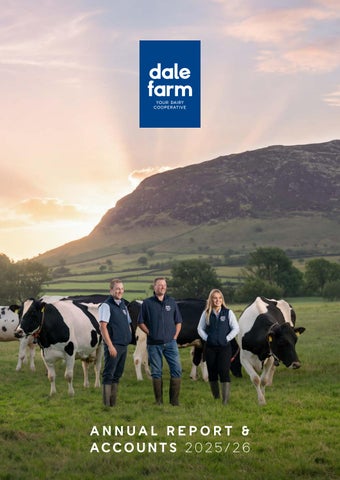
Thank you to everyone who contributed to bringing this concept to life. Pictured on the front cover are: Dale Farm producer Allistair McCullough on his farm in Broughshane, with Dale Farm’s Farm Liaison Manager Paul Reaney and Farm Sustainability Technical Lead Bronagh Dempster.
2
Annual Report 2025/26
CO N T EN T S PAG E I NTRO D U CTI O N About Dale Farm 2 Our Year in Review
5
Chairman’s Review 7 Chief Executive’s Review 9 Market Overview
13
B U S I N ES S R EVI EW Commercial, Marketing and Innovation
17
Operations, Supply Chain and IT
25
People and Health & Safety
31
Agri Division
39
TH E G RO U P Executive Leadership Team
49
Board of Directors
51
Area Councils
53
Corporate Governance
55
FI NAN C IAL STATEM E NTS
3
Strategic Report
59
Directors’ Report
73
Board Members’ Responsibilities Statement
76
Independent Auditors’ Report
77
Group Income Statement
81
Group & Society Statement of Comprehensive Income
82
Statement of Changes in Equity
83
Group Statement of Financial Position
85
Society Statement of Financial Position
87
Group Statement of Cash Flows
89
Notes to the Financial Statements
91
4
OUR YEAR IN REVIEW
827,408
AV E RAG E LITRES PER FAR M I N N I - M ILK SUPPLIES I N C R E AS E OVER 9%
£2.1M
SAVINGS THROUGH I M PROVEM E NT PROG RA M M E
MILK COMPONENTS IMPROVE FOR 10TH CONSECUTIVE YEAR
1BN
LITRES MILK COLLECTED & PROCESSED
99.7%
CUSTOMER SERVICE LEVELS
5
Annual Report 2025/26
UNITED FEEDS RETURN £510K THROUGH MILK CHEQUE REBATE AND MEMBER TRADING DIVIDEND
78K
TONNES CHEESE PRODUCED
NET PROFIT PER LITRE PURCHASED
3.27ppl
£21M
CAPEX SPEND
6
INTRODUCTION
BUSINESS REVIEW
THE GROUP
FINANCIAL STATEMENTS
Annual Report 2025/26
CHAIR MAN’ S REVIEW Chairman Fred Allen
Another year has passed, and it has been a year in which dairy markets performed well across a range of dairy categories. Against this backdrop, Dale Farm delivered an average milk price of 40.38ppl after transport cost, compared with 43.67ppl in the previous financial year. Market conditions during the latter part of the financial year and into the early months of 2026/27 have reflected the realities of increased global milk supply and a correction in dairy commodity values. I was pleased we were able to provide a 13th payment at the year end. As I reflect on this last year, one of the highlights was the Cheese Plant 2 (CP2) facility at Dunmanbridge, which is now fully commissioned. This proved to be a timely investment and enabled us to handle another record volume of milk. Our CP2 as it stands has an operating capacity to produce four tonnes of cheese per hour. With the accelerated growth of our milk supply, it is important we continue to invest in infrastructure. During the year, your Board approved a further investment programme to increase capacity of the new CP2 cheddar plant to six tonnes per hour, three years ahead of schedule of our five-year plan. Credit to both operational and commercial teams for processing and selling the record milk supply which was well ahead of planned volumes. During the year 2025/26 in line with corporate governance, your Board asked for a revision of the
7
cooperative rules, as these have been in place since the cooperative was established 30 years ago. I would like to take this opportunity to thank the members for their attendance, participation and feedback at all the meetings during this process and for the vote which saw the adoption of the revised rule book. Another outworking of our revised rulebook is the allocation of 2.74m bonus shares for the 2025/26 year. This new mechanism will enable the realignment of shares held to milk volume supplied. This process is set to continue over the next few years, with the aim of issuing shares until the membership equity is reflective of the original share allocation, when the cooperative was originally formed. Membership participation is both welcome and important to maintain a vibrant cooperative. This was evident not just through agreeing revised rules, but also when discussing a possible partnership, or merger, with neighbouring cooperative Aurivo. Whilst it did not progress, commercial opportunities are being developed which have the potential to benefit both cooperatives. Sustainability remains a priority for customers and for our cooperative and we are heartened to see continued participation from members in our Future Strong programme. We continue to engage with the wider industry and government representatives to find workable and science-based solutions to relevant environmental issues.
Together with a wider agri-food sector, Dale Farm lobbied against the original Nutrients Action Programme (NAP) proposal and as I write this review, a revised NAP is out for consultation. There is no doubt that as we go forward some aspects of milk production will be affected by new proposals. The Farm Liaison team will strive to help our members navigate which options suit their individual production systems, and as an industry we will encourage the department to pursue a holistic approach that takes into account the environment, economic growth and food security. I would like to thank my fellow Board members for their continued commitment, leadership and support throughout the year. My thanks also go to the Executive Leadership Team (ELT) and all the employees across the business for their dedication and hard work. Finally, I would like to thank you, our producer members, whose commitment to quality, sustainability and excellence remains the foundation of Dale Farm success. Your continued support is greatly appreciated as we work together to build a strong and sustainable future for our cooperative.
Chairman Fred Allen
8
INTRODUCTION
BUSINESS REVIEW
THE GROUP
FINANCIAL STATEMENTS
Annual Report 2025/26
CHIEF EXECUTIVE’S REVIEW Group Chief Executive Nick Whelan
It has been another strong year for our cooperative. While market conditions remain complex and geopolitical uncertainty continues to shape the global trading environment, Dale Farm has once again delivered a resilient performance. Turnover increased, year-on-year, from £722.4m to £749.3m, EBITDA (earnings before interest, tax, depreciation and amortisation) increased from £45.6m to £50.6m, operating profit grew by 4% to £39.2m and net profit before tax rose by 3.4% to £33m, while net debt reduced by £32.8m to £29.6m. This continued success reflects the strength of our strategy, the commitment of our people and the value of our cooperative model. Over the past decade, Dale Farm has become stronger, more resilient and more ambitious. The steady progress we have made in recent years indicates the effectiveness of our long-term strategic approach, providing a platform to invest, innovate and grow. Our focus remains on building a sustainable and profitable business that delivers value for our farmer members today, and for generations to come. Our milk pool continues to strengthen and during 2025/26 we maintained our commitment to delivering a competitive and sustainable milk price. This included an additional year-end payment of 1ppl on all milk supplied, returning
9
more than £10m directly to our members. This is the ethos of the cooperative movement in action, creating value and returning it directly to farm businesses and rural communities across NI. Our ability to deliver sustainable returns is underpinned by continued investment across the business. During the year, we began realising the benefits of the £70m investment in our Dunmanbridge facility, the largest single investment in Dale Farm’s history and one of the largest in the NI agri-food sector. This major development has significantly enhanced our cheddar production and whey processing capabilities, strengthening our competitiveness and enabling us to meet growing demand across UK, Irish, European and international markets. We want and need to invest further. Additional upgrades to our cheese plant are being completed to increase throughput and deliver additional capacity, supporting our long-term growth ambitions. Alongside our ongoing asset replacement programme, we continue to invest in automation, digitalisation and technology to improve efficiency, strengthen performance and ensure our operations remain competitive in an increasingly demanding marketplace. Digital transformation is also now a key strategic priority. During the
year we continued an ambitious programme to modernise systems, enhance our data capabilities and improve decision making across the group. The dairy sector is evolving rapidly, and the businesses that will succeed in the future are those that combine operational excellence with digital intelligence. Our investments in technology will help ensure we remain agile, efficient and responsive to customer and market needs. People remain at the heart of everything we do. The dedication of our farmer members continues to underpin our reputation for quality, sustainability and excellence, while our employees across every part of the business consistently demonstrate commitment, agility and innovation. Across operations, supply chain, commercial and support functions, our people are the driving force behind our success. We continue to invest in training, leadership development and employee engagement, creating opportunities for colleagues to grow, contribute and thrive within the business. With Future Strong our sustainability journey continues to strengthen. The programme is now embedded within our cooperative and is helping drive meaningful progress on farm and across the business to include environmental performance, energy efficiency and responsible sourcing. During the year we enhanced
10
INTRODUCTION
BUSINESS REVIEW
the Dale Farm portal, enabling farmers to access sustainability metrics tailored specifically to their farms. Alongside this, our nutrient management programme is supporting producers with bespoke plans designed to improve efficiency and environmental outcomes. As a farmer-owned cooperative, sustainability is not simply about meeting customer expectations. It is central to the long-term competitiveness of our members and our business. We are committed to leading by example, both on farm and across our operations, and we continue to invest in initiatives that reduce environmental impact while improving productivity and profitability. However, there remains a clear need for greater collaboration between industry and government. While we recognise the importance of delivering meaningful environmental improvements, and making a positive contribution on sustainability, progress must be underpinned by practical, evidence-based solutions developed in partnership with industry. Achieving sustainable growth will require coordinated action and a shared commitment across the entire food supply chain. We are entering an exciting new phase in Dale Farm’s development. Having expanded our cheese capacity, our focus is increasingly turning towards identifying the next value-led opportunity for the cooperative. Global trends around health, wellness and protein present significant opportunities for growth, and we are actively exploring how best to position the business to capture that potential through innovation, targeted investment and strategic partnerships. This was the focus of our discussions with Aurivo during the year. The talks were productive and we see great opportunities for both cooperatives
11
THE GROUP
FINANCIAL STATEMENTS
Annual Report 2025/26
in working more closely together. While it became clear that the time is not right for a merger, we are now scoping a partnership with Aurivo. As consumer demand for proteins continues to evolve we are encouraged by the opportunities this presents us, and we continue to assess options that support further sustainable growth for Dale Farm. The support and guidance of our Board continues to be invaluable. I would like to thank our Chairman, Vice-Chairman and Board members for their leadership, commitment and strategic insight throughout the year. I am also grateful to my colleagues on the ELT for their dedication, collaboration and focus in delivering our strategy. Their collective efforts ensure we remain focused on creating value for our producers and customers. Most importantly, I would like to thank our farmer members and employees. The progress we have made is a direct result of your commitment, resilience and ambition. We will continue to invest in our people and our facilities to ensure our cooperative remains strong, sustainable and competitive for generations to come.
Group Chief Executive Nick Whelan
12
INTRODUCTION
BUSINESS REVIEW
THE GROUP
Annual Report 2025/26
FINANCIAL STATEMENTS
MARKET OVERVIEW 2025/26
Global dairy markets overall were characterised by exceptionally strong milk supply and only moderate demand growth which had a significant negative impact on commodity pricing in the second half of the year.
Group Commercial Director Mark Boyle
At a glance Ongoing pressure on consumer confidence and household spend Shift towards value-led shopping behaviours Increased retail competition and focus on loyalty Strong global milk supply impacting commodity markets Divergence between fatbased and protein-based demand dynamics
13
C O N S UM E R MAR KE TS Summary: Economic pressures persist and consumer confidence remains low. Shoppers adopt ‘little and often’ to balance budgets.
LO O KI N G FO RWAR D Shoppers and consumers are expected to continue balancing their spending power with their desire for affordable products. Meanwhile longer-term trends including making sustainability tangible for shoppers and focusing on health and wellness solutions will grow in importance for consumers.
Retailers compete for footfall and loyalty. The economic pressures of the year, resulting in flattening incomes and rising food prices, continued to put pressure on household grocery spend. Consumer confidence remained muted with shoppers prioritising value for money; seeking out quality products at a fair price. Households further adapted shopping habits, taking a ‘little and often’ approach to buying groceries, visiting stores more frequently but buying less per trip. The retail environment became even more competitive with retail groups heightening focus on competitive pricing and strong marketing of loyalty schemes with a view to attracting and retaining shoppers. The outlook suggests this tension is set to continue, reinforcing the requirement for quality brand and own label products in formats that meet the consumer need-states with enhanced reasons to buy.
C OM MO D ITY MAR KE TS Summary: Global milk supply growth drives downward pressure on pricing. Strong first half followed by significant market correction. Butter and cheese markets experience high volatility. Protein markets, particularly whey, remain exceptionally strong. Geopolitical and supply dynamics continue to shape outlook. The financial year of 2025/26 will be remembered as a year of two halves for general dairy pricing, and the year that whey proteins moved into a new paradigm, boosted by a reinvigorated global wellness trend and the uptake of weight-loss medications.
Milk supply was strong globally throughout 2025 and still growing into 2026, with Rabobank estimating the big exporting regions finishing 2025 over 2.2% year-on-year with an expectation to expand at a slower pace in 2026. Most of this growth was in the latter half of the year applying strong downward pressure to the general dairy markets. Growth was supported by relatively good farm margins, favourable feed conditions, and in some markets a shift toward higher milk solids rather than just more volume. Europe and GB noted high output: AHDB forecast GB milk production for 2025/26 at c.13bn litres, up 4.9% year-on-year. EU milk production is expected to ease later in 2026 following the adjustment of calving patterns in some regions due to bird flu the previous year. In the US, the USDA repeatedly lifted milk production forecasts in 2025 and 2026, reinforcing the view that North American supply would stay strong despite a declining herd. Improvements in yield combined with very strong demand for beef continue to support on-farm incomes. The huge investment in cheese production capacity in recent years also means that processors are keen to drive milk flows to fill their new plants. New Zealand milk was also very strong across the 2025/26 season, growing 3.4% ahead of 2024/25. Production was briefly constrained by weather mid-2025, but strong again late 2025, and robust in the first quarter of 2026 posting additional growth of 5.5% ahead of the first quarter of 2025. March 2026 saw
significant growth with record high volumes and almost hitting doubledigit growth over March 2025. With milk production so high in the main regions exporting it was impossible for domestic demand to absorb the additional volumes. This inevitably led to competition across the importing regions and the strong negative market phase from August 2025. Approaching August, the UK and EU markets had held up very well, but stocks of cheese and butter had been building heavily right across the continent. Until this stage, milk output from the spring and early summer was extremely strong in the main cheddar producing regions of the UK, Ireland and Poland. However, this was offset by flat to marginal growth in the bigger milk producing regions of Germany and France which appeared to lend the market some much-needed support. During this period however, UK/EU domestic pricing had been trading well above New Zealand and US-origin product resulting in a slowdown of UK/EU exports in June/July followed by a substantial drop-off in August. The slowdown in exports caused a storage issue across the region and, when combined with the first month of strong milk supply growth in Germany and France, it was a signal to market participants of what lay ahead. As in recent years, butter markets were the most volatile and drove the overall market decline. The fact that butter had hit an all-time high of €8,000/Mt in September 2024, and stayed above €7,300/Mt until August 2025, made the fall in butter markets so aggressive. By December 2025, butter was trading just above €4,000/Mt, before momentarily falling below €4,000/Mt in January 2026, losing close to 50% of its value compared to the first half of the year.
Prior to 2017, butter at €4,000/Mt was deemed as expensive and at the upper end of the historical range. However, in 2026 butter below €4,000/Mt represents excellent value for some and can trigger heavy demand, particularly from larger multi-nationals, who are content to physically hold and finance butter at around €4,000/ Mt. This wave of demand came in January and February 2026 and by March 2026 butter was trading at €4,500/Mt before falling back towards €4,000/Mt again. Butter markets have increasingly acted as a leading indicator for cheese markets. At the midway point of the year, UK cheddar was trading around £3,900/ Mt bottoming out in December around £2,800/Mt. By March 2026, UK cheddar had crawled back to £3,000/Mt before coming under pressure again. EU cheddar curd entered the second half of the year at €4,600/ Mt but closed the year out at €3,200/Mt before making it back to €3,450/Mt by March 2026. At the start of the 2026/27 financial year milk remained extremely strong globally and whilst UK/EUorigin product was competitive versus New Zealand-origin product, the gap has since closed and USorigin remains more competitive. The forecast for exports looked positive early 2026, but the geopolitical situation in the Middle East, and subsequent logistical issues with the Strait of Hormuz has hindered opportunities, added costs and knocked buyer confidence in the region and buyers are currently only prepared to dripfeed product into the region. Whilst fat-based products have struggled and will depend heavily on exports, proteinbased products, in particular high-protein whey products,
14
INTRODUCTION
BUSINESS REVIEW
THE GROUP
Annual Report 2025/26
FINANCIAL STATEMENTS
have entered a completely new paradigm and for the foreseeable future may struggle to keep up with domestic demand relieving the need for export competitiveness. The combination of general wellness trends we see in society today, coupled with the increasing uptake of weightloss medications, are driving what seems to be an insatiable demand for protein fortification in almost all food categories. Despite the expansion of cheese production capacity in the US and milk prioritised to cheese and whey in Europe, the growth in cheese production is not sufficient to meet the growth in demand for whey protein. Whilst wellness trends are driving the underlying demand growth for protein fortification, the demand for protein from GLP-1 medication users bring an extra dimension to demand. Users of GLP-1 medications are advised to increase their protein intake to preserve bone density and muscle mass. Generally, these users are prepared to pay more per kilo of protein whether it comes from whey or from beef. Usage of GLP-1 medications in the US has more than doubled since early 2024 with 12% of US adults (c.30m people) reported using them for weight loss. These figures are almost guaranteed to grow with Danish pharmaceutical company Norvo Nordisk selling its obesity medication, Wegovy, in pill form at the start of 2026 and early reports indicate very strong sales.
Whey protein isolate which led the protein market for much of the year reached €25,000/Mt in March 2026. The surreal price increases in whey proteins have led to many food manufacturers looking at protein substitution rather than replacement which is enhancing the prospects of all other protein alternatives, namely skimmed milk powder, milk proteins and caseins. Skimmed milk powder as a general commodity has been structurally weak from 2023 hitting a recent year low of €2,000/Mt in December 2025 but by March 2026 it was close to €2,700/Mt, a price level it had not seen in three years. Whilst protein feels extremely well supported and perhaps has even some further upside ahead, butter and cheese feel more vulnerable. Looking ahead, the key variable is whether milk supply growth slows enough in 2026 to let demand catch up; if not, prices are likely to remain capped or under further pressure. Global dairy supply is likely to stay strong in several exporting regions even though growth is expected to slow versus the very strong growth experienced in 2025/26. General commodity prices are likely to remain under pressure unless supply growth clearly eases as the market is still carrying the effects of expanded milk production across the US, New Zealand and the EU.
High-protein whey derivatives have been the clear benefactors of this additional protein demand. Having reached a record €11,000/Mt in 2024, whey protein concentrate (WPC80%) spent most of 2025 around €12,000/Mt reaching €13,000/Mt in December 2025 before hitting almost €20,000/Mt in March 2026.
15
16
Annual Report 2025/26
B US INES S REVIEW COM M ERCIAL , M AR KETI N G AN D I N N OVATI O N CO N S UM E R FO O D S 2025/26
19
B U S I N ES S -TO - B U S I N ES S/ I N G R E D I E N TS 2025/26 20 B RA N D AC T I V I T Y 21 I N N OVAT I O N 23
17
18
BUSINESS REVIEW
INTRODUCTION
THE GROUP
COMMERCIAL, MARKETING AND INNOVATION Group Commercial Director Mark Boyle
At a glance Consumer Foods delivers robust performance Continued expansion of global businessto-business (B2B) cheddar footprint Brand investment drives visibility and shopper engagement Strong innovation pipeline across product and process Business well positioned for continued growth 19
Annual Report 2025/26
FINANCIAL STATEMENTS
C O N S UM E R FO O D S 2025/26 Summary: Robust performance overall across categories. Cheddar well positioned for further growth. Challenging butter and spreads market. Resilient year for liquid milk and drinks volumes. Strong ice cream performance - case volume growth 8% year-on-year. The 2025/26 financial year was shaped by contrasting trading conditions for the Consumer Foods business in the first and second half of the year. Against a backdrop of pronounced commodity price volatility, the business remained focused on supporting customers through consistent service levels, disciplined pricing actions, and a continued emphasis on product quality. As a result, turnover exceeded the prior year, underpinned by close collaboration with customers, agile commercial decision‑making, and the ability to respond effectively to evolving consumer requirements.
We continued to strengthen our consumer cheddar performance, underpinned by our close and ongoing collaboration with key retail and foodservice partners across the UK and Europe. Following a standout prior year, the business delivered further growth within the retail channel, outperforming the broader market. Capacity investments completed in the previous year enabled incremental volume expansion and supported sustained turnover growth, reinforcing our competitive position. Looking ahead, the consumer cheddar business remains well positioned for continued expansion, supported by recent customer acquisitions and a robust growth pipeline across the UK and EU retail markets. The beverages business remained resilient throughout the year, upheld by a disciplined focus on sustainable category and portfolio management. Beverage volumes were impacted by supply chain challenges within the Sukie drinks business in the first half of the year, as well as changes to customer distribution across the fresh custard portfolio within UK retail. Despite these headwinds, liquid milk volumes continued to outperform the market, with the planned exit from some foodservice contracts successfully offset by incremental new business secured within the convenience channel.
Buttermilk sales continued to grow, supported by a full year of supply to several national retail listings, expanded distribution across the UK, and a robust performance in the foodservice sector. The butter and spreads business performed strongly as falling commodity prices across the second half of the year boosted overall performance. An exceptionally strong volume and turnover performance in the first half of the year was offset by aggressive retail pricing from competitors later in the year. Overall, retail volume and turnover was in line with the previous year. The growth of butter portion volumes across the year was supported by the installation of new and upgraded packing lines. Ice cream trading delivered a positive performance during the year, with growth achieved across both the foodservice and retail channels. This strong trading environment drove increases in both volume and turnover, reflecting solid customer demand and effective commercial execution. Impulse sales performed particularly well, supported by favourable weather conditions. NI experienced historically strong summer weather, ranking as the second warmest on record, which significantly boosted consumer demand for impulse ice cream products. Multipack sales also benefited from the prolonged periods of sunshine, delivering double digit year-on-year growth. This performance highlights the continued importance of at-home consumption occasions and the strength of the multipack category within the wider retail portfolio. Within foodservice, new business wins contributed to incremental growth, with increased sales across a small number of key product lines. This was complemented by stable performance within the existing foodservice customer base, resulting in overall positive channel growth.
B U S I N ES S -TO - B U S I N ES S (B2 B) / I N G R E D I E NTS 2025/26 Summary: 40% volume growth in cheddar in challenging market. Access to new global markets and customers. Tight stock management with a strong year-end position. In 2025/26, we completed our first full year of commercial production with our second cheddar cheese plant making Dunmanbridge the biggest standalone cheddar plant in the UK and Ireland. The acceleration of milk growth in our region, combined with our additional capacity, provided an opportunity to accelerate our B2B sales pipeline activity. Our B2B division is now a major player in global cheddar markets selling record bulk cheddar volumes for the business across
the UK, Europe, the Middle East and North Africa. This has driven further growth in cheddar volumes across markets including Algeria, Morocco, Egypt, Libya, Bahrain, and Saudi Arabia, whilst at the same time strengthening our position in countries such as England, Germany, Belgium, and the Netherlands. Trading in these markets means Dale Farm cheddar cheese is being utilised in many different applications including table cheddar, cheese sauces, cheese flavourings, cheese powders, pizza toppings and processed cheese. Accessing these markets requires agility on a week-to-week basis, as well as maintaining global relationships and country import approvals throughout the year regardless of export conditions. Our global logistics expertise has also come to the forefront, growing our team with additional proven expertise to compete effectively on cheddar exports. Export business was extremely challenging in the first six months of the financial year as domestic
20
INTRODUCTION
BUSINESS REVIEW
pricing was much higher compared to product exported from the US or New Zealand. As we entered the second half of the financial year, UK/ EU domestic pricing began to fall as milk supply and stocks continued to build right across the region. As our pricing fell, UK/EU-origin product became competitive again on the export markets, which enabled business wins across the Middle East and North Africa. As we entered 2026, we navigated the logistical impact of the geopolitical situation in the Middle East. This had a significant impact on shipping routes, although only moderate product quantities at sea, we were able to redirect via alternative sea and land routes. Our whey business has performed well, benefitting from the insatiable domestic and global demand for whey protein and protein-enriched foods. Looking ahead to 2026/27 and beyond, with our cheddar volumes growing and the continued risk around the Strait of Hormuz, we will be exploring additional export markets.
B RAN D ACTIVITY Summary: Strong integrated campaigns drive brand awareness. On-pack promotions support shopper engagement. Increased digital and in-store visibility across key brands.
THE GROUP
FINANCIAL STATEMENTS
Economic pressures in 2025 resulted in continued challenges to the FMCG retail landscape. While retailers doubled down efforts to attract footfall and secure shopper loyalty, those shoppers adopted ‘little and often’ shopping habits as they proactively sought to reduce grocery bills. Dale Farm focused on consistently delivering high product quality, crafted to meet consumer needs across all categories of our own label and brand portfolios. Our brand marketing programme concentrated on attracting shoppers on all steps of their path to purchase including continuation of a strong digital presence to keep brands relevant and top of mind, in addition to delivering strong presence at the point of purchase including standout pack design and on-pack promotions. Product sampling was a key pillar to demonstrate quality and reinforce value for money.
D ROMO NA C H E D DAR LEAD I N G WITH C O N FI D E NT MAR KE TI N G Dromona cheddar benefited from its ‘No Competition’ campaign running consistently throughout the year resulting in the brand outperforming category sales*. The comprehensive campaign increased visibility of Dromona cheddar range across all shopper touchpoints and kept the brand front of mind across everyday meal occasions. Activity ran across outdoor advertising, digital advertising, email marketing, sampling, couponing, point of sale and in-store radio, all succeeding in recruiting new shoppers and driving rate of sale.
Annual Report 2025/26
‘OPEN JOY’ WITH DROMONA BUTTER In a challenging category environment influenced by cost inflation and strong competitive promotional activity, Dromona butter set out to reward loyal shoppers via a cash-winning incentive strongly communicated on block butter packs. The ‘Open Joy’ campaign ran over the Christmas period supported with a robust outdoor and digital advertising, social media and point of sale campaign. Exceptional awareness and standout drove record entries into the promotion with many shoppers benefitting from a cash bonus in the run up to Christmas.
DALE FARM ICE CREAM Dale Farm ice cream retains its place as NI’s No.1 Ice Cream Brand* bolstered by campaigns to keep the range top of mind with consumers. Influencer marketing via social media (TikTok) influenced adoption of Ice Break as shoppers’ snack of choice during the summer months. While Dale Farm family sharing ice cream tubs featured an onpack added value promotion with opportunity to win family days out at key local attractions. Ice cream sampling remained a stalwart of the marketing campaign with our famous van pitching up at key events throughout NI encouraging trial and incentivising repeat purchase. * Source: Nielsen IQ Scantrack market data, NI Hard Cheese MAT to 29.11.25 and NI Impulse Ice Cream MAT to 01.11.25
Sampling reinforces product quality and value. Continued focus on recruiting new shoppers.
21
22
INTRODUCTION
BUSINESS REVIEW
I N N OVATI O N Summary: 20 new products launched, and 68 products rejuvenated. Continued focus on process innovation within cheddar. Delivery of new products to meet evolving consumer expectations. Strengthening of new category knowledge and development of team expertise. This year’s innovation strategy focused on product improvement, customer collaboration, and enabling sustainable innovation for the future.
THE GROUP
FINANCIAL STATEMENTS
Annual Report 2025/26
Within ice cream, activity was particularly strong, with the launch of 16 new products. These included five new scoop kiosk lines and eight innovative impulse and take home offerings. In addition, many existing products were rejuvenated through pack format and design updates to keep brands fresh and appealing, alongside a transition towards more sustainable packaging materials. Longer-term research and development initiatives focused on opportunities within the dairy protein space, where market demand remains robust and positive consumption trends set to continue.
Significant progress was made in cheddar optimisation, including the refinement of year-round recipes to enhance consumer perception of products. The team prepared several new cheddar recipes which are in long-term maturation trials involving alternative cultures and rennet suppliers. Work was undertaken using novel in-line analytical equipment and advanced data analysis to further build technical knowledge which will continue into 2026/27. A new patent for predicting cheddar maturity classification has also been approved in the UK. This may be extended globally pending outcome of additional trials in 2026/27. At Dromona, capital investment was directed towards the installation of new equipment to support key customer contracts and future proof technical challenges in softer butter manufacturing without the need for on-farm feed intervention and which should be an easier more reliable long-term solution.
23
24
Annual Report 2025/26
B US INES S REVIEW O PERATI O N S , SU PPLY CHAI N AN D IT O P E RAT I O N S 27 S U P P LY C HA I N 28 I T 2 9
25
26
INTRODUCTION
BUSINESS REVIEW
THE GROUP
OPERATIONS AND S UPPLY CHAIN Group Operations Director Chris McAlinden
At a glance Commenced digital transformation - will be a long-term programme Installed two new butter portion packing machines at Dromona Heat pump investment at Dunmanbridge completed, saving over £700k annually First full year of CP2 running successfully Upgrade of CP2 capacity commenced at the end of 2025
27
Annual Report 2025/26
FINANCIAL STATEMENTS
O PE RATI O N S Summary: Record performance in milk processing and cheese production. Successful first full year of CP2 operations. Strong cost control and operational efficiency delivered. High service levels maintained across all sites. Continued investment supporting future growth. The group saw another record year in 2025/26, with over 1bn litres of milk collected and processed, and a record 77,906 tonnes of cheese produced. The successful installation of CP2 was instrumental in delivering this performance and timely completion of the investment proved critical from a processing perspective. The quality of product from our new cheese plant has been excellent. This supported a seamless delivery of the project by ensuring cheese produced could be sold without additional quality control. Factory performance remained strong during the year. Production volumes were strong across all
areas and our improvement programme generated over £2m in annual savings. Costs were delivered slightly under budget, which was a good performance given the pressures in the year with strong milk volumes, commissioning of CP2 and continued inflationary pressures. Inflation and cost volatility remain a challenge across all areas of the business, however, our focus on productivity, risk management strategies and strategic investments are helping us offset and manage these. From a quality perspective, it has been another good year. Product quality and complaint numbers remained low across the group which has ensured we continue to be the supplier of choice within our key markets. Ongoing investment ensures we remain at the forefront of customer requirements.
I NVEST M E NT The total investment for the year totalled £21m. This is 50% less than spend last year and was mainly driven by CP2. Key projects in the year included the completion of the CP2 investment, butter mini portions lines and the energy-saving heat pump project. Other smaller
investments completed during the year included pasteurisation upgrades, factory IT systems, in addition to compliance projects. Towards the end of 2025 we initiated the expansion of CP2 to increase capacity by 50% to six tonnes per hour. The requirement for additional capacity has been driven by strong milk growth over the last 18 months. The upgrade will be complete at the start of 2027. Investment in capability and asset replacement was also a key feature of the year. Upgrade work was completed at our liquid milk plant in Pennybridge to develop capability to supply milk bottles with a tethered cap. This is a legislative requirement which needs to be completed by autumn 2026. To ensure our assets are fit for purpose, some redundant compressed air systems, metal detectors and checkweighers were replaced in the year.
S U PPLY C HAI N This year we reviewed our milk collection policy and completed a tender process to explore moving this part of our operation to be managed by external contractors, in line with the industry standard across the dairy industry on the island of Ireland. The consultation process was completed in March 2026 and we have now transitioned to increasing third party collection of our milk pool from 40% to 71%.
Similar to last year, weather, changing packaging legislation and ongoing geopolitical tensions lead to volatility and subsequent challenges with ensuring access to all essential supplies. The supply chain team and procurement strategies deployed have effectively managed these risks. In addition to supply, price volatility, energy inflation, chemicals and packaging remain a focus area. Ensuring a mix of suppliers on fixed price and spot contracts across these categories has been instrumental to manage risk and supply. Sustainability was a key focus from a supply chain perspective. Increasing customer demands in areas such as recyclable packaging and lightweighting of packaging drove activity within the cheese and liquid milk business. Solutions for tethered caps on our retail milk bottles and recyclable cheese film were two key projects which continued in the year and are due to be introduced to the market in late 2026. Service levels were excellent at over 99.7%, ensuring we delivered what the customer ordered and on time.
Key Stats
1.01BN
litres of milk collected and processed
77,906 tonnes of cheese produced
£2.1M
savings through improvement programme
Yield performance improved by
£235K Service levels an excellent
99.72% £21M of capex spend
Volatility, risk, supply disruption and cost inflation continue to be the challenges for our business. Whether it is planning for exceptional milk supplies, managing interrupted supply chains or offsetting inflation in commodities, our supply chain team have delivered a stellar performance in another extremely unpredictable year.
28
INTRODUCTION
BUSINESS REVIEW
THE GROUP
IT
and Microsoft 365 environments. By using AI driven analytics to improve the speed and accuracy of threat detection, we are better able to focus on genuine risks rather than high volume alert triage. This investment represents a deliberate shift towards continuous, behaviourbased threat detection, materially improving cyber resilience and aligning with industry best practice for modern hybrid enterprise environments. This is supported by an internal audit programme, governed by the Audit and Risk Committee, driving ongoing improvement in cyber security controls and assurance.
Chief Financial Officer John Morgan
At a glance Expansion of digital and Operational Technology (OT) capability Investment in data and analytics
IT Summary: Strong progress in Enterprise Resource Planning (ERP) implementation across the group. Digital transformation programme advancing. OT capability enhancing operational performance. Strengthening of cyber security.
Strengthening of cyber security framework Supporting long-term digital transformation Two targeted Artificial Intelligence (AI) initiatives progressed during year
Data and analytics supporting decision making. A major focus for the IT team during the year was the continued delivery of the group’s ERP upgrade programme. Two further divisions of the business were successfully transitioned to the Microsoft Dynamics 365 Business Central platform. The new solution is already delivering tangible benefits, including improved process automation through enhanced system functionality and the introduction of Optical Character Recognition (OCR) technology, reducing manual processing and improving efficiency. The group-wide ERP programme remains on track for completion in 2027 and is a fundamental element of our digital transformation strategy,
29
Annual Report 2025/26
FINANCIAL STATEMENTS
providing a single, standardised platform that delivers trusted, consistent data to support effective decision making across the group. During the year, the OT team made good progress in establishing OT capability as a core enabler of operational excellence, primarily within cheese manufacturing operations. Key OT foundations were delivered, including the deployment and embedding of a central OT software platform providing real-time visibility of production, utilities, and process performance. This capability has supported a number of successful process improvement initiatives, delivering measurable operational benefits. In addition, production OT environments were fully incorporated into the group’s cyber security assurance programme, further strengthening operational resilience and risk management. The OT strategy is focused on connecting people, machines, and data to enable smarter, safer, and more efficient ways of working and will continue to be delivered through a structured multi-year programme. As part of the continued strengthening of our cyber security posture, we invested in a next generation Network Detection and Response (NDR) capability. This solution replaces our previous NDR tooling and provides enhanced visibility of real attacker behaviour across on-premise, cloud,
Building on prior investments, we successfully completed a major Warehouse Management System (WMS) upgrade, replacing a legacy platform with a modern, fully supported solution. The upgraded system improves real-time stock visibility, strengthens integration with third party logistics partners, and provides a robust foundation for future automation, OT integration, and ERP alignment. As part of the modernisation of our physical security and site governance controls, a new access control and Automatic Number Plate Recognition (ANPR) solution was implemented at several sites, replacing legacy card-based systems that were no longer fit for purpose. The new capability strengthens site security by introducing biometric access controls for employees and controlled vehicle entry via ANPR, reducing administrative overhead while improving accuracy and resilience. Importantly, the solution enhances health and safety compliance, providing more reliable real-time visibility of personnel on site during fire evacuations and supporting better management of contractors and visitors. This investment also establishes a scalable foundation for future integration with workforce, time and attendance and wider digital transformation initiatives across the business. To strengthen leadership capacity and
ensure the organisation is equipped to deliver its expanding digital agenda, we appointed a new Head of IT, establishing a dedicated senior role to provide clearer accountability across IT operations, applications, cyber security and strategic delivery. This appointment reflects the increasing scale and complexity of our technology landscape and the need for stronger governance and prioritisation at senior level.
DATA & ANALY TI C S The Central Data Hub is now embedded as a core tool supporting automation, insight, and datadriven decision making across the business. Over the year, the platform continued to expand as new systems were brought online, like Foods Connected, supporting consistency, reliability, and timeliness of management information. To support an increase in demand for data and data-led initiatives, the Data and Analytics team adopted agile delivery practices, improving prioritisation, transparency, and delivery of value. A key milestone was the
introduction of the first self-service reporting solution as part of the United Feeds Business Central upgrade. This enables United Feeds users to develop their own reporting solutions from a single, trusted source of data. Over the last 12 months the approach to AI has matured, shifting from early day experimentation in 2024 to a more discipled focus on clear business value and data readiness. Two targeted AI initiatives were taken forward this year. The first project digitised Dale Farm’s cheese grading process, converting historical records, held in images, into a searchable digital dataset. This has also been built to support the process in the future, ensuring a continuous digital grading record. The second developed through the UK Government’s Bridge AI programme, produced an AIdriven milk volume and composition forecast model. This demonstrated the potential to improve forecast accuracy against existing internal forecasts. The potential deployment of this capability is now under active review.
30
Annual Report 2025/26
B US INES S REVIEW PEO PLE AN D H EALTH & SAFET Y P EO P LE 33 LE A R N I N G & D E V E LO P M E N T
34
E N G AG E M E N T 3 6 TA LE N T 3 6 H E A LT H & SA F E T Y 37
31
32
INTRODUCTION
BUSINESS REVIEW
THE GROUP
Annual Report 2025/26
FINANCIAL STATEMENTS
PEOPLE AND HEALTH & SAFETY Group HR Director Karen Gaw
LEAR N I N G & D EVE LO P M E NT Summary: £316k invested in learning and development. 504 employees supported through external training programmes. Continued expansion of our Learning Management System.
At a glance
Summary:
Investing in employee learning and development
£316k spend on learning and development.
Growing our talent
Early careers - Higher Level Apprentices / Engineering Apprentices / Graduates Focus on Health & Safety Strengthening engagement, culture and value-led behaviours
PEO PLE
46% of workforce trained in external development programmes. Strong focus on early careers, leadership, technical capability and future skills.
Our people remain at the heart of our cooperative and are fundamental to our longterm success. It is the collective commitment, effort and expertise of our teams across the group that enables us to deliver our strategic priorities and support sustainable growth. During the year, we continued to invest in our people, with a strong focus on building capability and preparing the organisation for future skills requirements. Against a backdrop of evolving workforce expectations, increased skills demand and advancements in OT, our priority has been to further support learning and development.
We have strengthened our approach by investing in dairy and technical excellence, leadership capability and early careers pathways, while continuing to expand accessible, flexible learning through digital platforms to ensure our teams are able to perform at their best to grow within the business. The health and safety of our people underpin everything we do. During 2025/26, we made positive progress in strengthening Health and Safety governance, improving visibility of risk and enhancing leadership oversight, supported by improved transparency through the reporting of key safety indicators. Increased near miss and safety improvement reporting reflects a more proactive safety culture, while the introduction of a Group Health Surveillance Programme has strengthened our approach to managing occupational health risks. Although further progress is required, we remain committed to creating a safer and healthier workplace for everyone. Together, these priorities reflect a joined up people strategy focused on capability, culture and care, ensuring our workforce is skilled, engaged, safe and future ready.
Dale Farm Future Leaders Programme with Queen’s University. Launch of Area Council Development Programme.
Investing in the skills and capability of our people remains critical to both individual development and the long-term performance of the business. During 2025/26, we continued to prioritise learning and development across all levels of the organisation, providing opportunities aligned to operational requirements, leadership effectiveness and future skills. Total investment in learning and development during the year amounted to £316k, with 504 employees participating in structured programmes facilitated by external providers. Our Learning Management System continued to mature, with over 8,000 courses completed since launch, and more than 200 courses now available. These include compliance and induction training, technical programmes covering cheese and whey operations, and environmental learning, providing accessible and consistent development opportunities across the group. Targeted technical programmes were delivered to strengthen operational capability within
33
the business. These included the development of an internal cheese and whey programme for Dunmanbridge operatives, specialist cheese science and butter technology courses delivered by University College Cork, and Corazza training to support the operation of new butter portioning equipment at Dromona. Investment in leadership capability remained a priority. To enhance performance and leadership effectiveness 16 leaders were supported through tailored coaching. A mentoring programme was also introduced, with 19 trained mentors supporting 19 mentees from our early career intakes, providing structured guidance and development as they progress in their roles. We also continued to support professional development and
future-focused capability, including senior leadership participation in a Driving Digital Strategy programme at Harvard Business School, completion of the Institute of Directors Chartered Director Programme, postgraduate study in business improvement, and a senior leadership programme in Project Management, delivered by the Irish Management Institute, to establish a common language and approach across the group. To support the development of our Area Council members, we launched our first Dale Farm Area Council - Future Focused, Farmer Led programme. Internally designed the course will cover cooperative governance, the business side of Dale Farm, operations, member engagement, advocacy and the constitution, and will be supplemented by input from Cooperatives UK.
34
INTRODUCTION
BUSINESS REVIEW
THE GROUP
Annual Report 2025/26
FINANCIAL STATEMENTS
E N G AG EM E NT Summary:
Summary:
Progressing MySay actions through meaningful, values-led change.
Total numbers employed at March 2026: 1,217 (1,099 employed, 118 agency)
Recognising and reinforcing behaviours that reflect Dale Farm’s values.
1.45% decrease from 1,235 in March 2025
Strengthening communication, collaboration and leadership connection.
Employee engagement at Dale Farm continues to be shaped by listening to our people and acting on what we hear, in line with our values and behavioural expectations.
Inclusive of temporary and agency employees.
Sustaining our success depends on attracting, developing and retaining talented people across the business. We continue to maintain a strong and stable workforce throughout the year with turnover at 10.94%.
While a full MySay engagement survey was not conducted during the year, we remained focused on progressing the actions agreed following our last survey and maintaining strong, open dialogue across the business.
Through targeted recruitment campaigns, we grew our cohort of early career apprentices. This included Higher Level Apprenticeships in Food Manufacturing in partnership with Loughry College, and Engineering Apprentices in conjunction with the regional college network.
Key areas of focus included strengthening communication and collaboration, increasing visibility of leadership, improving local facilities, and reinforcing feedback and recognition.
To support both current performance and future growth, we also extended our specialist expertise during the year, including digital, trading and logistics, LEAN, IT, procurement and sustainability.
Our values continue to guide how we work and how we engage with one another. Through initiatives such as ‘Rewarding the Legendairy’, we recognise employees who consistently demonstrate our values in action, celebrate contribution and encourage positive behaviours across the business. Since it’s inception in 2023, over 144 colleagues have now been recognised through this scheme.
Three Higher Level Apprentices successfully completed their programmes during the year, and are now undertaking key operational roles across the business; while six Engineering Apprentices continued their development across the group. In addition, 16 graduates completed the Dale Farm Future Leaders Programme, delivered in partnership with the William J Clinton Leadership Institute at Queen’s Business School, supporting the development of future leaders with strong commercial and leadership foundations. Our annual placement programme remains committed
Further embedding of our values and associated behavioural standards remains an area of focus.
35
TALE NT
to assisting undergraduates, offering 12 placements in essential business areas. Specialist expertise remains an important enabler of operational excellence. Dairy experts and industry ‘gurus’, continued to bring their knowledge and insights to support capability development across our sites. This included CIP training at Pennybridge, ice cream manufacturing excellence for Mullins and NPD, and evaporation for site leaders at Dromona, all ensuring knowledge transfer and continuous improvement within critical manufacturing processes. Through continued investment in early careers, leadership and specialist expertise, we are strengthening our talent pipeline and building the capability required to support the cooperative now and for the future.
36
INTRODUCTION
BUSINESS REVIEW
H EALTH & SAFE TY Summary: 20% improvement in overall safety performance. 5% reduction in reportable incidents. Increase in lost time incident performance. 226% improvement in near misses reported since roll out of Safety Improvement Reports (SIR) including over 1,000 hazard observations. Slips, trips and falls remains biggest contributor of accidents. Group Health Surveillance Programme implemented.
During 2025/26, we made positive progress in strengthening Health and Safety governance, improving visibility of risk, and increasing workforce engagement. While improvements have been achieved, we recognise this marks an early stage of a longer journey and that sustained improvement will require continued commitment and involvement from everyone across our business. Overall safety performance improved during the year, with total accidents reducing by 20%, from 91 to 73, and RIDDOR reportable incidents decreasing by 5%, from 20 to 19. While this reflects progress in managing serious injury outcomes, performance has not yet met our Health and Safety ambitions and remains a key focus for continued improvement. Slips, trips and falls continued to be the leading contributor to lost time incidents. Lost Time Injuries (3), Total Recordable Incident Rate (TRIR - 2.08) and Accident Annual Frequency Rate (AAFR - 3.4) were
37
THE GROUP
Annual Report 2025/26
FINANCIAL STATEMENTS
formally reported, improving transparency and providing a stronger basis for benchmarking and performance management. Despite reductions in incident numbers, total days lost increased by 42% to 480.5 days, driven by a small number of high impact injuries and prolonged recovery cases. This highlighted the need for a more consistent and structured approach to postincident management and return to work arrangements. Improving this outcome requires a collective effort, with effective management support and employee engagement to reduce the overall impact of workplace injuries. A significant achievement during the year was the continued development of a more proactive safety culture. Near Miss and SIR increased by 226%, from 402 to 1,312 submissions, reflecting improved engagement, confidence in reporting systems, and a shift towards early hazard identification. The SIR programme, supported by training, KPI targets and the SIR Hero recognition scheme, is now embedded across the business. As this continues to mature, strong leadership visibility and follow through will remain essential to ensure issues are challenged, addressed and closed out effectively. Governance and assurance arrangements were further strengthened during the year. The Health and Safety Management System was comprehensively revised, with tier one policies approved by the ELT and tier two policies progressing for high-risk activities including confined space, hot work, isolation/LOTO and permit to work. Health and Safety performance is now routinely monitored through monthly Board KPI reporting, quarterly ELT and Board updates, and monthly site level operational reviews.
A new third party audit programme was introduced, with two full site audits completed during 2025/26 and further audits planned. Key risk control activities included updated risk assessments, enhanced contractor management, improved driver audits, specialist occupational hygiene and DSEAR assessments. Significant progress was also made in occupational health management. A Group Occupational Health Surveillance Programme was re-established and implemented at three sites, supported by a new Occupational Health Policy. This provides greater assurance over the effectiveness of risk controls and enables early identification of work related health issues. To support continued improvement, the Health and Safety team will expand to five Advisors during 2026/27. In parallel, work is underway to implement a fully integrated digital Health and Safety system, aligned to Dale Farm’s wider digital transformation strategy.
year we enhanced our focus on financial wellbeing through support and guidance delivered in partnership with Ulster Bank. During the year, we participated in the Business in the Community NI Take 5 Workplace Accreditation, which is delivered in partnership with local Health and Social Care Trusts. The accreditation is based on the five steps to wellbeing; Connect, Be Active, Take Notice, Keep Learning and Give. Dale Farm were awarded level three, which is the highest level of accreditation. Health and Safety will always remain a key priority. Our commitment is to make the workplace safer and healthier, and we believe that by ‘working together to stay safe’, we can achieve these goals.
Overall, 2025/26 saw meaningful progress in systems, governance and employee engagement. While isolated high impact incidents increased days lost, the foundations have been strengthened to better identify, control and prevent harm. These improvements position the business well to deliver sustained reductions in serious injury risk and continued performance improvement in 2026/27. Our Thrive - Live Well, Work Well programme underpins our ongoing commitment to employee wellbeing. Through a year-round calendar of events, initiatives and support resources, we promote a holistic approach to wellbeing, covering physical, mental, emotional and financial health. Employees also benefit from access to Inspire Wellbeing’s Employee Assistance Programme and this
38
Annual Report 2025/26
B US INES S REVIEW AG R I D IVISI O N M I LK S U P P LY 41 P R O D U C E R S E RV I C ES 42 U N I T E D F E E D S 43 E N V I R O N M E N TA L & S O C IA L G OV E R NA N C E 45
39
40
INTRODUCTION
BUSINESS REVIEW
THE GROUP
AGRI DIVISION
PRO D U C E R S E RVI C ES Summary: Steady increase in business for Tankcare, Parlour Care and Dairy Herd Management.
Producer Services Director Neville Graham
At a glance
M I LK S U PPLY Summary:
NI milk pool increased by 7.6% surpassing 1.01bn litres Continued improvement in milk components
Milk supplies increase over 9% to average 827,408 litres per farm. Milk components jumped substantially to record ten years of improvements. Average paid out milk price net of transport was 40.38ppl.
NI milk volumes grew by 7.6% during 2025/26 surpassing 1bn litres.
Strong participation in sustainability programmes Agri performance underpinning group success
Milk supplies from our 1,224 NI producers increased by 9.1% during 2025/26 to an average of 827,408 litres per farm. Milk production during the year was influenced by a solid milk price and an attractive milk to feed price ratio. Grass quality and growth were favourable during the growing season ensuring good quality fodder which maintained milk production right through the winter. The core Dale Farm producers were joined by 15 new entrants commencing milk for the first time. However, 27 members retired throughout the year so by year-end the cooperative finished with 12 less producers. Adjustments to milk solids payments and an increased focus on genetics and nutrition saw milk components
41
Annual Report 2025/26
FINANCIAL STATEMENTS
Tank sales up 50%. Dairy Herd Management attracted 27 new customers.
improve for the tenth year in a row. Protein increased by 0.04% to 3.41% while butterfat improved 0.05% to an average of 4.32%. Bactocount rose slightly to average 47,000/ml, while somatic cell count decreased on the previous year to average 174,000/ml. The base milk price plus loyalty bonus paid to members began the year at an April price of 41.80ppl. Rising global supplies combined with sluggish demand saw prices soften during the year, with a marked downturn during the autumn when the full scale of the European supply increases became evident. The price of butter was again volatile, and it led the downward market price trend, while cheese followed at a slower rate. Towards the end of the year powders and especially skim milk powder prices steadily improved, but with a depressed butter market, milk prices remained under pressure. Base milk price to members reduced through the winter, however winter bonuses and support payments helped offset the full effects. Winter support payments were then removed in February 2026, while a 1ppl addition to the March price resulted in the year finishing with a base price of 29.3ppl.
The Farm Liaison team has been actively advising members on milk components and milk quality. Bonus payments for butterfat and protein have become a substantial part of the milk price in recent years and producers have continued to respond positively with improved milk solids. The introduction of two thermoduric tests per month for every producer has allowed the team to offer support and targeted advice to those needing to make improvements in this key quality measure for the business. The team continue to assist members preparing for Red Tractor audits while advising new entrants and suppliers commencing supply to the cooperative. In recent years our Future Strong sustainability framework has become a key programme for the business and demonstrates
our sustainability credentials to customers. This has resulted in increased sales into higher value markets and generated better returns to members. The team have supported producers through this programme and continue to provide guidance in completing the survey returns. Increased milk production and reasonable cash flow on dairy farms resulted in a boost in tank sales for Tankcare. New tanks once again proved popular with sales up 50%, while the sale of refurbished tanks also improved by 48%. Tankcare, in partnership with Flogas, continued to market new water heating systems using LPG. A 12-month 0% finance scheme payable through the milk cheque for Dale Farm members helped underpin sales of this product, while heat recovery sales were also boosted by this scheme as members chose to offset rising energy costs. Tankcare is underpinned by a comprehensive service contract and a reliable breakdown service which includes cover for milk loss. This has led to a steady flow of new customers who appreciate the value in quick response times, knowledgeable engineers, and a fixed monthly cost. Parlour Care has been active during the year with increased customers benefitting from its
timely service and maintenance of their milking parlour. Several parlour upgrades have been undertaken, helping streamline efficiency during the milking process. Dairy Herd Management (DHM) welcomed 27 new customers during the year. The desire to improve milk components and somatic cell count (SCC) remain common reasons for many to commence milk recording, but others cite an increased focus on breeding and nutrition as they strive to improve efficiency and profitability. Additional offerings to the service in the form of Johne’s testing and PregCheck also remained popular during the year. During the year DHM agreed a discounted price for customers to sign up to the Uniform Agri management programme. This proved incredibly successful at the Winter Fair and has generated a steady stream of business since. SenseHub sales remained buoyant throughout the year as dairy farmers remain keen to embrace laboursaving technologies. Such was the popularity of the system that the revenue from sales increased once again. Originally designed primarily for fertility management it has become increasingly appreciated for its ability to detect sick cows at an early stage, allowing for rapid intervention and improved recovery rates.
Thus, over the 2025/26 year, the average base milk price paid by the Society was 36.42ppl, rising to an actual paid out price net of transport of 40.38ppl.
42
INTRODUCTION
BUSINESS REVIEW
U N ITE D FE E D S Summary: Record year for feed and calf milk replacer volumes. Growth supported by strong customer base. Stable raw material markets supported performance. Geopolitical uncertainty remains a key risk. Continued focus on supporting farm profitability.
United Feeds had another record year for tonnes of feed and calf milk replacer sold. The business returned over £510k directly to Dale Farm member customers through the ‘milk cheque payment method rebate’ and the ‘Members Trading Dividend’ which is also paid to those customers choosing to pay via milk cheque. A sustained, favourable milk price to feed price ratio alongside good returns in the beef and sheep sectors encouraged farmers to feed for marginal meat or milk gain during the first half of the year. These positive returns did reduce over Q3 and Q4, however growth in customer numbers during this downturn allowed United Feeds to continue to see growth in tonnes sold.
43
THE GROUP
FINANCIAL STATEMENTS
Geopolitical tensions remained high for much of the year, with ongoing challenges in the Black Sea region, alongside uncertainty surrounding the US/EU trading relationship with threats of 50% tariffs being implemented by either side. Then, to conclude the year came the Gulf conflict which immediately brought a surge on freight costs due to its impact on oil supply globally. Raw material markets could be described as relatively stable and perhaps subdued for much of the year in the backdrop of mostly good news regarding global supplies and ‘normal’ weather in the key growing regions. Much of the price movement during Q1-Q3 was down to fluctuations in the US dollar having a significant effect on prices locally.
Annual Report 2025/26
spring and summer of 2025. A dip in global gas markets saw fertiliser prices drop slightly in Q1 and Q2. The impending introduction by the EU in January 2026 of the CBAM carbon tax on fertilisers produced outside the EU saw an increase in demand in autumn 2025 and fertiliser markets returned to similar prices to early spring 2025. The war in the Middle East and its effect on global gas and oil prices saw fertiliser prices increase by over 25% in March 2026 and has led to significant concern going forward around global fertiliser supply.
The planned implementation of the EU Deforestation Regulation (EUDR) on 31st December 2025 was again delayed by 12 months to 31st December 2026 with a simplification review due mid-year. The 2025/26 financial year was a relatively stable year for fertiliser prices and sales, however the conflict and increasing tensions in the Middle East in late winter caused a significant upward movement in fertiliser prices. Good weather and ideal growing conditions locally resulted in a reduced demand for fertiliser through
44
INTRODUCTION
BUSINESS REVIEW
THE GROUP
Annual Report 2025/26
FINANCIAL STATEMENTS
E N V I R O N M E NTAL & S O C IAL G OV E R NAN C E Summary: Third year of Future Strong introduction of new platform with increased functionality. GB milk suppliers integrated into Future Strong. Partnership established to offer cost-effective renewable energy solutions to milk suppliers. Major renewable energy initiative completed with the commissioning of the Dunmanbridge Heat Pump project. Work continued to ensure compliance with upcoming packaging legislative changes.
F UT U R E STRO N G The third year of the cooperative’s farm sustainability framework Future Strong was launched in December 2025 with the soils information request module being sent to all suppliers. For the first time our GB suppliers were integrated into the Future Strong programme. By the end of April, 90% of suppliers participated in the scheme, receiving a sustainability payment within the base milk price. Future Strong allows the group to incentivise milk suppliers to take actions which will reduce their carbon footprint. It also provides detailed information concerning the environmental performance of our milk pool. This information enables the group to target environmental interventions at areas with greatest potential impact. It also allows the cooperative to provide anonymised aggregated information concerning the environmental performance of the cooperative’s milk pool to customers such as the carbon footprint of milk. Customers now require such information as a condition of business.
45
The focus of the programme this year is the development of a robust survey platform with the necessary functionality to enable better exchange of data between Dale Farm and milk suppliers. The survey element of Future Strong 3 was launched in May 2026. From the information provided in the survey we will produce a carbon footprint for our milk based on calendar year 2025. The Future Strong survey covers land and nutrient management, feed management, herd management and knowledge transfer. In response to work undertaken across the group to evaluate the effects of climate change, the third year of Future Strong has incorporated a farm business resilience element. A requirement to review resilience-related practice on farm forms part of this year’s survey. To support this a guidance document on dairy farm business resilience has been produced for our milk suppliers. As in previous years an ongoing sample-based assurance programme confirms the accuracy of information submitted in response to Future Strong requirements. Pilot projects commenced in 2025/26 to determine the value of several interventions in terms of driving sustainability and efficiency on farm. These include: • Anti-microbial resistance project. Benchmarking of antibiotic use in a representative sample of our milk pool with a view to reducing antibiotic use per cow and to develop a programme to support our suppliers in addressing the issue of antimicrobial resistance. • Nutrient Balance Project. To enable Dale Farm to have a more robust understanding of nutrient flows in our milk pool, nutrient balances have been completed on a representative sample of farms. The learnings applicable to the whole milk pool will then be shared across the group.
• Grass measurement through the use of radar. A pilot project to determine the value of the use of radar for the measurement of grass growth is underway. • In March 2026 we were successful in obtaining funding for a PhD based at Queen’s University Belfast examining the barriers to the uptake of sustainability interventions on dairy farms. The successful candidate is scheduled to start in October 2026. In addition, the group has negotiated a discount for all Dale Farm suppliers with a renewable energy provider to help drive the uptake on farm of green energy options.
E NVI RO N M E NTAL MANAG EM E NT AN D C OM PLIAN C E S C H EM ES The cooperative operates a single Environmental Management System certified to ISO 14001 across all of our activities covering milk production, processing and, ultimately, the end use of the group’s products by consumers. This is the mechanism through which environmental improvement and environmental compliance within the business is delivered. The group has previously completed a carbon inventory for the cooperative’s activities and is in the process of developing its carbon inventory for financial year 2025/26. This will be an annual process and forms the basis of setting and evaluating progress against carbon reduction targets in line with the requirement of the ScienceBased Target initiatives (SBTi). The group complies with a range of environmental authorisation and schemes. Dunmanbridge met the requirements of the UK Emissions Trading Scheme (UK ETS).
Climate Change Agreement (CCA) application data was submitted for all five manufacturing sites and group agreements obtained for both the Dale Farm and the United Feeds facilities. The Energy Savings Opportunity Scheme (ESOS) annual action plan review was completed and submitted to the Environment Agency. Pollution Prevention and Control (Industrial Emissions) permits are required at five production sites. Inspections by the regulator have been completed at all sites and no major issues have been identified.
PRO C ES S I N G FAC I LITI ES The focus on energy management aims to reduce the cost of energy for the business and reduce the carbon emissions from processing activities. This is achieved through addressing the energy efficiency of the production facilities and increasing the proportion of renewable energy used by the group. The major renewable energy initiative in 2025/26 was the Dunmanbridge Heat Pump project, which has been made possible with funding from the Industrial Energy Transformation Fund. This innovative project captures waste heat from the site’s chilled water system and repurposes it for pasteurisation and other hot water processes. The heat pump system is capable of producing water at temperatures of up to 85°C, significantly reducing the site’s natural gas consumption, equating to a decrease of more than 3,500 tonnes of CO2e emissions each year. The project was commissioned in March 2026. The cooperative continues to identify and source further viable opportunities for renewables across the manufacturing facilities. The need to further understand and monitor patterns of energy
46
INTRODUCTION
BUSINESS REVIEW
usage versus production demands, means that the cooperative continues to invest in and develop the data infrastructure to capture data from large energy users such as refrigeration, effluent and compressed air systems as well as core production processes. Over the course of financial year 2025/26 trials have taken place to help Dale Farm determine the right approach to decarbonisation of our transport fleet. To date trials have taken place in terms of electrification of the retail delivery fleet and the refrigerated trailers used in primary distribution.
PAC K AG I N G Throughout 2025/26, work continued on projects to ensure the group is on track to comply with upcoming packaging legislative changes. The most ambitious of which is the EU’s Packaging and Packaging Waste Regulation. This provides a roadmap for increasing the sustainability of packaging out to 2040 and will form the basis of our customers’ requirements in this area over the coming years. The cooperative works to ensure packaging is recyclable, lightweight and contains recycled material where possible. This year for example, we have changed our hand and shrink wrap to material that includes 30% recycled content.
C O R P O RAT E S O C IAL R ES P O N S I B I LITY Summary: £65k raised for Cancer Focus NI. £4,077 raised for Air Ambulance NI. 53,000 meals provided through FareShare NI, 143 charities supported, 44.6 tonnes CO2e emissions avoided.
47
THE GROUP
FINANCIAL STATEMENTS
Across 2025/26, Dale Farm continued to strengthen its commitment to corporate social responsibility through meaningful community engagement, charitable fundraising, and strategic partnerships. A key highlight of the year was the successful fundraising partnership with Cancer Focus NI, which raised £65k. This achievement was driven by the Dale Farm Charity Committee, representing colleagues across all NI sites, and supported through a wide range of activities including a golf day, the Carlingford Loop cycling event, the Causeway Coast Marathon Walk, and seasonal events such as raffles and quizzes. Building on last year’s success, the Dale Farm Tractor Run returned to Ballymena Mart, attracting over 170 vehicles and strong support from employees, farmers, suppliers and the local community. We also raised £4,077 for Air Ambulance NI during the four-day Balmoral Show, demonstrating continued support for the vital emergency services they provide to our local community. We continued our long-standing partnership with FareShare NI, providing weekly donations of fresh milk and spreads to help tackle food poverty and support vulnerable groups. During the year, this contribution delivered: • Over 53,000 equivalent meals • 44.6 tonnes of CO2e emissions avoided • Support for 143 charities and community organisations
Annual Report 2025/26
Our sponsorship of the Grand Opera House Belfast pantomime continued for the ninth consecutive year, enabling us to bring together families from across the Dale Farm community, including employees, farmers, customers and consumers. Through our Local Roots Community Support Programme, we continued to provide targeted financial support to organisations located near our manufacturing sites. This year, we extended our partnership with Young Enterprise NI, supporting its Business Backer Campaign to reach 100,000 young people across NI. Employees also contributed their time and expertise through volunteering in both the Company and Primary School Programmes. In collaboration with Business in the Community NI, we launched our ‘Adopt a School’ initiative, partnering with Cullybackey College. This programme aims to bridge the gap between education and industry by providing students with practical insights into careers in agri-food. Key activities included career and HR presentations, mock interviews, business workshops and a guided tour of the Dromona facility for their GCSE Agriculture group. We continue to work closely with our supplier network to uphold high standards in health and safety, environmental performance, ethical conduct and labour practices. Dale Farm remains proud to hold accreditation under the internationally recognised Sedex Ethical Trading standard, reinforcing our commitment to responsible sourcing and transparency across our supply chain.
Dale Farm maintained active membership with several key organisations, including Arts & Business NI, Business in the Community NI, and Women in Business NI. These partnerships support employee development through volunteering, networking and skills-based learning opportunities.
48
INTRODUCTION
BUSINESS REVIEW
THE GROUP
Annual Report 2025/26
FINANCIAL STATEMENTS
EXECUTIVE LEADERSHIP TEAM N I C K W H E LAN
K AR E N G AW
Group Chief Executive
Group HR Director
Appointed Group Chief Executive of Dale Farm in 2016. Nick is Vice-Chair at Dairy UK, a board member of the Dairy Council for Northern Ireland and appointed Vice President of NI Chamber. He is a former Chair of the Northern Ireland Food and Drink Association and the CBI NI’s Innovation Forum. He was previously Commercial Director at Glanbia for 10 years and held senior management positions in the Kerry Group for 12 years.
Joined Dale Farm in 1990 and has extensive experience in generalist HR management within the group. Karen was Group HR Manager for 14 years prior to her appointment as Group HR Director in 2021 with responsibility for People, Health & Safety, and Corporate Communications. In addition, Karen serves as a NonExecutive Director at Praxis Care. Karen is an Associate Member of the Chartered Institute of Personnel & Development, and a member of the Institute of Directors.
C H R I S MCALI N D E N Group Operations Director Appointed Group Operations Director in 2013 with responsibility for group manufacturing and supply chain operations as well as the group’s capital investment programme. Chris is a Chemical Engineering Graduate with a Masters degree in Agri-food Business Development and is a member of the Chartered Management Institute. He joined Dale Farm in 2008 from Moy Park where he held a number of production management posts.
MA R K BOY LE Group Commercial Director Joined Dale Farm in 2021 as Group Commercial Director and leads the cooperative’s Commercial, Innovation and Marketing teams, responsible for delivering sustainable growth for the business. Mark has a depth of experience in a variety of leadership roles in the international food industry having started his career at the Green Isle Foods Group followed with 20 years at Kerry Group culminating in the leadership of the Kerry Foods Consumer Foods business in Ireland.
49
Nick Whelan Neville Graham
John Morgan
Chris McAlinden Mark Boyle Karen Gaw
N E V I LLE G RAHA M Producer Services Director Joined Dale Farm in 2017 as Head of Farmer Services. In 2024 he was appointed to position of Producer Services Director with responsibility for Farm Support, Producer Services and Group Sustainability. In April 2025, Neville took on the additional role of Company Secretary and became a board member of the Dairy Council for Northern Ireland. He has previously held a number of positions within the agri-sector including college lecturer and Farm Director for the Greenmount Farm Estate.
J O H N MO R G AN Chief Financial Officer Appointed Group Chief Financial Officer in May 2023. Prior to this, John was Finance Director of South, Wales & Northern Ireland, BT plc. Before joining BT, John trained as a Chartered Accountant with EY in Belfast before spending two years working within the London Private Equity Corporate Finance Team. John was elected to the CBI Northern Ireland Council in 2019. 50
INTRODUCTION
BUSINESS REVIEW
THE GROUP
Annual Annual Report Report 2025/26 2023/24
FINANCIAL STATEMENTS
BOARD OF DIRECTORS
The Board of Directors of Dale Farm Cooperative consists of 12 non-executive Directors. The Board of Directors of Dale Farm Limited consists of four nonexecutive Directors, all of whom are also Directors of Dale Farm Cooperative.
1 . B RYC E KE LS O
7. R O B E RT B RY S O N
2. ST E V E N B R OW N
Bryce Kelso is a dairy farmer from Maghera, Co. Londonderry. He was elected a Director of Dale Farm Cooperative in April 2022.
4. I VO R B R O OM FI E LD
3. HAR O LD J O H N STO N
Steven Brown is a dairy farmer from Moneymore, Co. Londonderry. He was elected as a Director of Dale Farm Cooperative in April 2016.
5. JA M ES M U R P HY
Ivor Broomfield is a dairy farmer from Armagh, Co. Armagh. He was elected as a Director of Dale Farm Cooperative in April 2020 and is also a Director of the Dairy Council for Northern Ireland.
Harold Johnston is a dairy farmer from Ahoghill, Co. Antrim. He was elected as a Director of Dale Farm Cooperative in April 2011. He is a past County Chairman of the Ulster Farmers’ Union for Co. Antrim.
Robert Bryson is a dairy farmer from Banbridge, Co. Down. He was elected as a Director of Dale Farm Cooperative in April 2013.
6. DAV I D R EA
James Murphy is a dairy farmer from Tempo, Co. Fermanagh. He was elected as a Director of Dale Farm Cooperative in April 2010 and is a former County Chairman of the Ulster Farmers’ Union for Co. Fermanagh.
8. N O R MA N T H OM P S O N
1 0. FR E D A LLE N
David Rea is a dairy farmer from Crossgar, Co. Down. He was elected as a Director of Dale Farm Cooperative in April 2008. He was re-appointed as Vice-Chairman in April 2026.
9. E U G E N E LY N C H
Norman Thompson is a dairy farmer from Banbridge, Co. Down. He was elected a Director of Dale Farm Cooperative in April 2015.
1 1 . DAV I D R OW E
Fred Allen is a dairy farmer from Randalstown, Co. Antrim. He was elected as a Director of Dale Farm Cooperative in April 2009. He was re-appointed as Chairman in April 2026.
Eugene Lynch, an Independent Director of Dale Farm Cooperative since April 2020, is a Chartered Accountant with board leadership experience at Hughes Christensen, JP Corry Group Ltd and The McAvoy Group Ltd.
12. E LLV E NA G RAHA M O B E
David Rowe is a dairy farmer from Armoy, Co. Antrim. He was elected as a Director of Dale Farm Cooperative in April 2014 and is a Director of the Dairy Council for Northern Ireland.
Ellvena Graham OBE, an Independent Director of Dale Farm Cooperative since April 2020, chairs Tourism NI, as well as working with a number of NI’s leading companies. She was formerly Head of Ulster Bank in NI.
1 2
3
4 5
51
6
9
8
7
10
11
12
52
INTRODUCTION
BUSINESS REVIEW
THE GROUP
Annual Report 2025/26
FINANCIAL STATEMENTS
AREA COUNCILS AREA 1
NAME
AREA 2
NAME
AREA 3
NAME
AREA 4
NAME
DISTRICT 1
Philip Hanson
DISTRICT 6
Chris Hamilton
DISTRICT 11
William Parkinson
DISTRICT 16
Bryce Kelso
DISTRICT 2
David Rowe
Jason Rankin
David Simpson
William Hamill
Gary Thompson
Martin Sloan
Matthew Carrick
John McCaughern
Mark McIntyre
Stuart Simpson
Desmond Bloomer
Andrew Gardiner
Robert McConaghy
Rory Woods
Jonathan Ewing
Michael Stewart
Linda Campbell
Philip Donaldson
Ivor Broomfield
Jonathan McAleese
Lee McKinstry
Cyril Andrew Orr
Stuart Orr
James Brownlee
Thomas Johnston
Ben Scott
David Rea
Thomas Mitchell
Adam Davis
Timmy McAuley
Chris Crea
Daryl Morton
R Sheppard
Ross Beattie
Simon Stevenson
Alice Gillespie
Richard Mulholland
John Hanna
DISTRICT 13
Wayne Ferguson
DISTRICT 18
Steven Brown
Trevor McConnell
Clive McVitty
Paul Millar
Caryn Webster
Robert Bryson
James Lunny
Neil Gourley
Jack Moore
Andrew Murray
Russell McCourt
Stephen Sterling
Ian Logan
Geoffrey Malcomson
John Edgar
Ronan Campbell
Andrew Shanks
James Murphy
Stephen Rogers
Arron Graham
Mervyn McBride
Alan Graham
Fred Allen
Colin Johnston
Ian Hamilton
Aaron Shortt
John Ferguson
Seth Mathers
Richard Coalter
Trent Brown
Andrew Boyd
George Porter
Neville Robinson
William Crawford
David Wilson
Lynda Mitchell
Peter Coote
Gregg Somerville
Martin McGirr
David Stevenson
Heather Patterson
Norman Thompson
Peter Bleakley
Robert Hunter
Harold Johnston
George Mitchell
Annie Boyd
Jane McAleese
Samuel Hill
John Beckett
Hall Taylor
David McCann
Trevor McNeilly
Gavin Thompson
James Bell
DISTRICT 5
DISTRICT 8
William Robert Wallace
Thoburn McCaughey
Julie-Ann Lyle
DISTRICT 4
DISTRICT 17
Chris Heenan
Wallace Gregg
Jessica Crawford
DISTRICT 3
DISTRICT 7
DISTRICT 12
DISTRICT 9
DISTRICT 10
DISTRICT 14
DISTRICT 15
DISTRICT 19
DISTRICT 20
Adrian McFarland
Andrew Dale
Jonathan Alcorn
Robert J Smyth Jennifer Hayes
53
54
INTRODUCTION
BUSINESS REVIEW
THE GROUP
CORPORATE GOVERNANCE The Board is committed to adopting best practice in Corporate Governance as deemed practical and appropriate for a member-owned cooperative.
TH E BOAR D The Board meet monthly (except for July) with a formal schedule of matters specifically reserved for its decision. Additional meetings are held as required. The Board reviews trading performance, ensures adequate funding, sets and monitors strategy, examines major acquisition opportunities and formulates policy on key issues. To enable the Board to discharge its duties all members receive appropriate and timely briefing papers. The group has appropriate insurance cover in place for Board members. The Board comprises 12 Directors, eight of whom are appointed by the farmer members through Area elections; two are elected by the members’ Area Councils acting collectively; and two Directors are appointed by the elected Directors. The term of office of elected Directors is four years while appointed Directors are appointed for not more than three years and can only serve a maximum of three terms.
Annual Report 2025/26
FINANCIAL STATEMENTS
TH E AU D IT C OM M ITTE E
The attendance of Directors at the 11 routine Board meetings in 2025/26 was as follows: Fred Allen
11
David Rea
11
Ivor Broomfield
11
Stephen Brown
11
Robert Bryson
11
Ellvena Graham
10
Harold Johnston
11
Bryce Kelso
11
Eugene Lynch
11
James Murphy
11
David Rowe
11
Norman Thompson
11
The Chairman and Vice-Chairman are both elected annually by the Board. The remuneration of the Directors of the Society is increased in line with the Consumer Price Index (CPI) annually, with the remuneration policy reviewed by an independent third party and the chairs of the four Area Councils every three years. Recommendations as a result of the review is presented to members for approval at the Annual General Meeting (AGM). All farmer Directors are also suppliers of milk to Dale Farm Cooperative, but they and the appointed Directors are regarded as independent. Induction training is provided for newly elected/ appointed Directors and further training is provided as required.
The Audit Committee meets at least twice a year and has specific terms of reference which include responsibility for reviewing the Annual Accounts prior to submission to the Board, monitoring the internal control systems and liaison with both external and internal auditors. The Committee satisfies itself on the independence of the auditors and monitors the level of non-audit fees. The internal auditors review key risk areas and relevant controls across the group and report their findings to the Audit Committee, together with any recommendations for improvement.
D IALO G U E WITH S HAR E H O LD E R S Communication with members is given the highest priority by the Board and the Annual Report gives a comprehensive review of the financial and operating performance of the group for the year. The Board uses the AGM to have an
open dialogue with members, and the group has four Area Councils elected by the membership, which meet about four times a year with the elected Directors for their Area to discuss the affairs of the Society. In addition, “Open” Area Council meetings are held to which all members in the relevant Area are invited. The Society also keeps in
touch with members through the issue of the bi-monthly magazine “Dale Farm View” and via the group website www.dalefarm.com. Any member wishing to contact the company can do so at the registered office of the company.
TH E N OM I NATI O N S C OM M ITTE E The Nominations Committee makes recommendations to the Board on the appointment of “non-elected” Directors to the Boards of the group subsidiary and associate companies, as well as senior executive appointments.
TH E MANAG EM E NT TEA M The Group Chief Executive and management team, who are responsible for operating decisions and the effective functioning of the main activities in the group, report to the Board.
The Board Committees Comprise: Audit
Nominations
Eugene Lynch
Fred Allen
Robert Bryson
David Rea
Ellvena Graham
Nick Whelan
Ivor Broomfield Bryce Kelso Norman Thompson
55
56
INTRODUCTION
BUSINESS REVIEW
C HAI R MAN Fred Allen
VI C E - C HAI R MAN
THE GROUP
FINANCIAL STATEMENTS
Annual Report 2025/26
AU D ITO R S Ernst & Young LLP Bedford House 16 Bedford Street Belfast BT2 7DT
David Rea
D I R ECTO R S Fred Allen Robert Bryson Harold Johnston James Murphy David Rea David Rowe Norman Thompson Steven Brown Eugene Lynch Ellvena Graham Ivor Broomfield Bryce Kelso
BAN KE R S Ulster Bank 11-16 Donegall Square East Belfast BT1 5UB Danske Bank Donegall Square West Belfast BT1 6JS PNC Financial Services UK Ltd 34-36 Perrymount Road Haywards Heath West Sussex RH16 3DN
C H I E F EXEC UTIVE Nick Whelan
S O LI C ITO R S
C H I E F FI NAN C IAL O FFI C E R
Tughans LLP The Ewart 3 Bedford St Belfast BT2 7EP
John Morgan
S EC R E TARY Neville Graham
C OM PANY STAT U S Dale Farm Cooperative Limited is a registered co-operative society under the Co-operative and Community Benefit Societies Act (Northern Ireland) 1969
R EG I STE R E D O FFI C E Dale Farm House 15 Dargan Road Belfast BT3 9LS
57
58
INTRODUCTION
BUSINESS REVIEW
THE GROUP
Annual Report 2025/26
FINANCIAL STATEMENTS
STRATEGIC REPORT
O P E RAT I O NA L P E R FO R MA N C E
P R I N C I PA L ACT I V I T I ES Dale Farm Cooperative Limited is a registered co-operative society under the Co-operative and Community Benefit Societies Act (Northern Ireland) 1969. The principal activities of the group include manufacturing an extensive range of dairy products for the retail, foodservice and food ingredients sectors, marketing and distributing these products to both domestic and international markets. The group includes the overall parent, Dale Farm Cooperative Limited, and its subsidiary undertakings referenced in note 11. The group also collects and markets members’ milk, supplies animal feed to farmers, and provides a range of other farm services.
FI NAN C IAL PE R FO R MAN C E The key performance indicators (“KPI”s) for the group are:
KPIs
2026
2025
Group turnover (£000)
749,302
722,433
Profit before taxation (£000)
33,017
31,897
Average employee numbers
1,103
1,074
Average milk price paid to members (pence per litre)
40.38
43.67
Group turnover increased by 3.7% year on year, primarily due to strong dairy commodity prices in the first half of the year, and additional cheese output from the new cheese plant driving increased sales. The group profit before tax increased by £1,120k to £33,017k. The profit variance primarily reflects the following:
R I S K MANAG EM E NT G OVE R NAN C E
MILK SUPPLY
2026 / Litres
2025 / Litres
Average output per member
827,408
758,750
Strong milk prices in the first half of the year, combined with a favourable milk to feed price ratio, significantly elevated milk volumes supplied by farmer members. Good weather conditions aided grass quality and growth, ensuring milk production increases were sustained throughout the winter months. Milk supplies increased more than 9% year on year as a result.
RISK MANAG E M E NT APPROAC H TO R I S K MANAG EM E NT
• Exceptionally strong growth in milk supplied by farmer members in the year, with volumes up over 9% year on year; • Additional processing capacity offered by the group’s newly constructed second cheese plant, allowing for increased cheese production, directing milk towards value-adding output and away from sub-optimal processing; • Continued focus on the group’s core divisions and value-added markets, with an emphasis on quality and exceptional levels of customer service at all times; • Growth in export channels, with the group now trading to more than 40 countries globally; • Robust cost efficiency and performance improvement initiatives across the business, targeting all opportunities to make gains throughout the group’s cost base; • A central focus on data, technology and automation, using these critical points of difference to drive decision making and investment decisions across the business; and • Research and development driving innovation into both our processes and product base. After commissioning the new cheese plant in 2024/25, the group has continued to invest in the year, with ongoing and projected investment representative of its ambitious forward plans. The net debt position has been well managed, and the group has generated satisfactory cash flow from operations in the year. This has contributed to a balance sheet that continues to strengthen, with the net asset position having improved by £27,605k year on year. Employee numbers have grown year on year as the group continues to invest in new people and skills in line with strategic priorities and operational need. The average milk price paid to NI members decreased by 3.29ppl (7.5%) in 2025/26, reflecting weakening commodity returns in the second half of the year due to a global surplus supply of milk (2024/25: increased by 8.47ppl (24.1%)). The group continues to seek all opportunities to add value to members’ milk, in order to return a competitive and sustainable milk price to members.
59
The group assesses each new and emerging risk according to overall risk appetite. The group’s risk appetite is the amount of risk that would be acceptable in order to meet operational strategies and goals. The Board have assessed that the group’s overall risk appetite is low. This means the group will not accept risks where it is deemed there may be adverse consequences which could have a material impact on, amongst others, profitability, the group’s farmer members and their milk pool, group reputation and brand, and key stakeholder relationships. This does not mean the group is not exposed to risks with a potentially medium to high impact, but in these cases robust controls and mitigations are implemented to reduce residual risk to an acceptable level.
The Board retain overall responsibility for risk management oversight, which includes ensuring that an appropriate risk appetite has been set and that suitable policies relating to risk are in place. The Board has delegated responsibility for monitoring the group’s risk management process and system of internal controls to the Audit and Risk committee. The Audit and Risk committee report to the Board on the status of the risks identified within the group’s risk register. This is maintained by senior management, supported by the group’s Head of Risk. The Audit and Risk committee also gains assurance over the group’s internal controls through internal review, and audit procedures performed by external professionals. Senior management are responsible for the day-to-day maintenance of the group’s system of internal control and mitigation strategies for new and emerging risks. Senior management are supported by sub-committees and taskforces which have responsibility for tailoring mitigation plans for specific risks. A ‘three lines of defence’ model is used to facilitate effective risk management: Level 1: provided by frontline staff and operational management, including systems, internal controls, and culture developed and implemented across operations. Level 2: provided by risk management and compliance functions, including financial control measures, health and safety, quality measures, compliance checks, cyber, and IT management.
R I S K AS S ES S M E NT The group operate a live rolling risk register which tracks the status of risks. When new risks are identified by management, a thorough assessment is made which considers the likelihood, together with the potential impact. The assessment is based on a range of both qualitative and quantitative factors depending on whether the risk relates to: • Strategic; • Financial; • Commercial and operations; or • Regulatory and compliance. The risk is then assigned an impact and likelihood risk scoring between 1 and 9. This allows for appropriate prioritisation of the risk, so that it can be managed and mitigated effectively. All risks are assigned an ultimate owner within the ELT, who is responsible for the development and implementation of effective mitigation plans. During 2025/26 the Audit and Risk Committee met on five occasions to review the group’s progress with regard to its risk management agenda. A total of four internal audit reviews were conducted in-year, and remediation plans have been put in place to address any recommendations made by the internal audit team. Updates were presented with respect to progress in other areas of the risk management programme, which included remediation actions from previous financial years.
Level 3: provided from risk assurance through the group’s internal audit function.
60
INTRODUCTION
BUSINESS REVIEW
P R I N C I PA L R I S KS The following represent the principal risks identified by the group:
B U S I N ES S P ER FO R M A N C E R I S K The group faces a number of business performance risks due to internal and external factors including competitive pressures in markets in which it operates. Cost-of-living inflationary pressures, geopolitical issues, such as the ongoing conflicts in Ukraine and the Middle East, and the uncertainty caused by changing global trade policies and tariffs, pose significant risks to the performance of the global economy. These risks are managed through several different measures: ensuring the appropriate management team is in place; business planning and regular forecasting; financial controls; key performance indicators; monthly reporting and timely corrective action when variances occur.
B U S I N ES S C O NTI N U ITY R I S K While there is a reliance on physical infrastructure, the group operates seven geographically autonomous production facilities which helps mitigate business continuity risks. The group also ensures that there is adequate knowledge throughout the management team and sufficient IT support and back up capability available should an unforeseen event occur. Management conducts ongoing reviews of business continuity and IT disaster recovery plans and participate in industry wide crisis management exercises.
PRO D U CT Q UALITY The group has stringent controls in place to monitor product quality and safety throughout the production process. The group continuously invests in significant
61
THE GROUP
Annual Report 2025/26
FINANCIAL STATEMENTS
levels of technical knowledge, resource, and attention to ensure that quality standards remain high.
H EALTH AN D SAFE TY R I S K The group is committed to ensuring a safe working environment. These risks are managed by the group through the promotion of a best practice health and safety culture, risk management, extensive safety training and well-defined health and safety policies.
KE Y MANAG EM E NT D EVE LO P M E NT AN D EM PLOYE E R E TE NTI O N The long-term success of the business depends on the group’s ability to attract, retain, and develop talent. This risk is managed through succession planning and the pursuit of best practice in HR, through group wide development plans which are regularly reviewed and updated. These are accompanied by specific policies in areas such as recruitment, training, management development and performance management.
C R E D IT R I S K Credit risk arises principally on third party derived revenues. Group policy is aimed at minimising such risk through the application of satisfactory creditworthiness procedures, including where appropriate, taking out credit insurance cover. The group monitors the levels of credit to individual customers within their approved credit limits, so as to ensure the group’s exposure to bad debts is minimised.
LI Q U I D ITY R I S K C YB E R S EC U R ITY AN D C R I S ES MANAG EM E NT
FI NAN C IAL R I S K MANAG E M E NT P O LI C Y
The activities of the group rely on various IT systems. In the current environment, all organisations are vulnerable to cyber attacks, which could jeopardise the integrity of systems and potentially result in data breaches or disruption to activities. The group has both cyber security and data protection policies in place which provide frameworks and controls to protect against this risk. The group also have a dedicated IT team, who are responsible for the security of IT systems, through implementing and maintaining best practice in relation to cyber processes. The group has detailed disaster recovery and crises management plans in place which are thoroughly designed and regularly tested.
The group’s principal financial instruments comprise cash, trade debtors and creditors, and certain other debtors and accruals. The main risks associated with these financial assets and liabilities are set out below.
C LI MATE R E LATE D R I S K S Climate-related risks are discussed within the Climate-related Financial Disclosures report on page 62.
PR I C E R I S K The group has some exposure to commodity price movements in the markets in which it operates. This risk is mitigated through proactive engagement with the group’s customers, and a diverse product offering which reduces overall exposure to commodity price movements. The group has no exposure to equity securities price risk as it holds no listed or other equity investments.
FO R E I G N CURRENCY RISK The group’s exposure to foreign currency risk arises primarily on revenues from customers denominated principally in Euro. The group has a policy of entering into forward currency contracts to reduce this risk.
Liquidity risk is the risk that an entity will encounter difficulty in meeting obligations associated with financial liabilities. The group aims to mitigate liquidity risk by managing cash generated by its operations and applying cash collection targets throughout the group. The group also manages liquidity risk via revolving credit facilities.
CAS H FLOW R I S K Cash flow risk is the risk of exposure to variability in cash flows that is attributable to a particular risk associated with a recognised asset or liability, such as future interest payments on variable rate debt. The group manages this risk, by reviewing short and medium term cashflows and taking appropriate action as necessary. Particular attention is paid to headroom within debt facilities.
N O N - FI NA N C IA L A N D S U STA I NA B I LITY I N FO R MAT I O N STAT E M E NT C LI MAT E - R E LAT E D FINANCIAL DISCLOSURES ( “C FD ” ) I NTRO D U CTI O N In accordance with s414C, s414CA and s414CB of the Companies Act 2026, mandatory Climate-related Financial Disclosures (‘CFD’) are required. These aim to promote more informed decisions, and better consideration of the risks and opportunities from climate change within organisations, while, in turn, enabling stakeholders to understand better the concentrations of carbonrelated assets and exposures to climate-related risks, by providing a common global framework. Companies within the scope of the CFD are required to make climaterelated disclosures structured around four thematic areas, representing core elements of how companies operate. These are: •
Governance
•
Strategy
•
Risk management
•
Metrics and targets
The CFD further recommends 11 specific disclosures across these four core elements which allow companies to report on how they are considering, assessing, and addressing climate-related risks and opportunities. The Board recognises the very real risks, but also opportunities, that climate change will pose both to the group and the wider dairy industry, and understands the key role the group will play in the industry’s response to those challenges moving forward. The Board also recognises
the importance of continuing to evolve and enhance the group’s processes, policies, and controls with regards to climate change, allowing for reporting of the group’s progress, while also allowing it to effectively respond to the risks and opportunities arising from climate change. The Board confirms that Dale Farm Cooperative Limited has reported on climate-related financial disclosures consistent with the CFD recommendations. A summary of the group’s progress against the 11 disclosure recommendations is presented below.
G OVE R NAN C E Disclose the organisation’s governance around climaterelated risks and opportunities. a) Describe the Board’s oversight of climate-related risks and opportunities. The issue of climate change is central to the operations and activities of the group, as well as its key stakeholders, and response to the issue requires a high degree of oversight from the Board. During the current financial year, the group’s Sustainability Committee, which is comprised of members of the Board and ELT, as well as the group’s Sustainability department, has met a total number of four times, having been established in the previous financial year. The current focus of this committee is to further develop the group’s risk management processes in response to climate risk, along with considerations of climate impacts on the group’s forward strategy. The work of the committee this year has been focused on overseeing the group’s detailed risk assessment which has been carried out in relation to climate-related risks and opportunities both on farm and for the Cooperative. Further details of this exercise can be found on page 64.
62
INTRODUCTION
BUSINESS REVIEW
THE GROUP
CLI MATE - RELATED FINANCIAL DISC LOSURES (CONTINUED) The Board continues to receive presentations on specific areas of focus in relation to climate change which is coordinated by the group’s Head of Sustainability. The Board monitors these issues and challenges management processes and controls, enabling more effective oversight.
STRATEGY
b) Describe management’s role in assessing and managing climaterelated risks and opportunities.
a) Describe the climate-related risks and opportunities the organisation has identified over the short, medium, and long term. Climate-related risks to the group fall into two categories:
Management is engaged in risk management exercises with regards to climate-related issues impacting the group. In 2021, a Sustainability department was established within the society, with an experienced Head of Sustainability recruited externally to lead it. In the years since, the department has been further resourced and its role and responsibilities within the business have broadened. The CEO and ELT receive updates from the Head of Sustainability with regards to risks and opportunities arising from climate change. This is laid out formally at the ELT’s quarterly sustainability meeting where risks and opportunities are a key agenda item. Additional meetings are scheduled, if required, as and when challenges arise, new information comes to light, or the group becomes aware of changes in its environment, via legislation or otherwise, which requires a more immediate response. Climate change impacts are considered in the group’s short, medium, and long term strategy. As well as robust risk management programmes being initiated in the short term, innovative discussions with several stakeholders are being led by the CEO and the ELT, to explore ways to both mitigate the risk posed to the group by climate change, but also realise the opportunities presented by the group’s unique position. These discussions receive oversight from the Board and are an ongoing process.
63
Annual Report 2025/26
FINANCIAL STATEMENTS
Disclose the actual and potential impacts of climate-related risks and opportunities on the organisation’s businesses, strategy, and financial planning where such information is material.
Physical risks: The consequences of both hotter, drier summers, or warmer, wetter winters, as well as increasing frequency of floods, storms, and drought; and Transitional risks: The consequences of government, customers, suppliers, financiers, and other stakeholders’ approaches to addressing climate change and related risks. The risks and opportunities identified as part of the risk assessment process carried out in the current year can be broadly categorised into: On Farm Risks • Increasing costs for producers stemming from changes resulting from climate change or changes in legislative requirements which threaten the ability of producers to generate profit or carry on in business in their current way or size; • Reduced milk volumes or quality produced from reduced herd numbers or impact of climate events on herd; and • Disruption to supply of critical inputs e.g. feeds, fertilisers etc. Opportunities • Increased milk litres produced from longer growing seasons or from changes to cattle feed; and
• Reductions in costs of materials from reduced volumes of raw materials required, for example feeds, fertiliser etc. Supply Chain Risks • Reduction in ability to generate returns due to changes in climate which restrict the markets into which the group can trade, or increase the cost of doing business, materially impacting group profitability; • Reduced production capacity; • Reputational damage resulting from increased pollution or emissions; • Increased reliance on refrigeration equipment which results in higher costs/increase in breakdowns; and
models makes a number of forwardlooking assumptions about a broad range of variables. Included within these variables are considerations of climate-related risks and opportunities, with assumptions adjusted for the best current estimate of their impact. Key variables such as milk pool growth, energy pricing, customer specific requirements, legislation, as well as the wider needs of key stakeholders, are all factored into the group’s projections.
pool, or for the group to expand its production, along with any punitive actions by key stakeholders with regards to climate change, could have significant impact. At the same time, opportunities that allow the group to leverage its unique position as a member owned cooperative, or diversify into new technologies or sustainable, green business practices, could positively impact group performance and profitability.
The risks and opportunities outlined in section a) above, have, to varying degrees, the capacity to materially impact the group’s business, strategy, and financial planning. Risks that could, for example result in a cap on the ability of the group’s farmer members to grow their milk
These factors are being considered in detail as part of the group’s strategic planning and risk management programme. The risks and opportunities formally identified will be built into decision making and strategy formation. The group’s understanding of climate
CLIMATE RELATED EVENT
• Disruption to supply of materials & goods & utilities which limit production capacity. Opportunities • Development of collaborative partnerships; • Investment opportunities which drive profitability through production efficiency in conjunction with reduced carbon emissions;
Government requirements to meet Climate Change (Northern Ireland) Act 2022
• Energy management and renewable energy initiatives which drive down costs; and • Reduction in competition due to exits of high emission producers in the dairy industry. Higher barriers to entry for new entrants. b) Describe the impact of climaterelated risks and opportunities on the organisation’s businesses, strategy, and financial planning. Financial projections, including those used for budgeting purposes and strategic 5+ year planning, are based on financial models. Each of these
IMPACT/ RESPONSE
SIGNIFICANT RISK IMPACT /CONSEQUENCE ON
Combined actions too onerous for some farmers to continue dairy farming.
Reduction in farmer numbers potential for reduction in milk pool.
Farm actions to reduce Greenhouse Gas (GHG) footprint mandated by government (for example CH4 inhibitors) without appropriate subsidy or consideration of on-farm/rural economic impact.
Reduced farm profitability/milk volumes.
risks and opportunities both physical and transitional have informed the requirements of the Future Strong farm sustainability programme, and recent transformative activities at the group’s processing facilities. It will be a core focus moving forward. c) Describe the resilience of the organisation’s strategy, taking into consideration different climaterelated scenarios, including a 2°C or lower scenario. As described below, the following are the key mitigation strategies the Cooperative is employing in response to the climate-related risks and opportunities identified:
TIMEFRAME
MITIGATION STRATEGIES Lobbying government (push for clarity & support) through Dairy Council of Northern Ireland & Dairy UK. Exploring milk production efficiencies to increase litres per animal.
Farm
20302050
Use of Future Strong sustainability programme to help farmers meet requirements. Capital investment strategy, including renewable energy initiatives.
Reduction in farmer numbers leading to potential for reduction in milk pool.
Milk pool management strategy and farmer incentivisation through milk price and engagement.
Government reduction in allowances to mitigate the financial impact of renewable/energy efficiency penalties
Increased costs of fossil fuel energy sources due to allowance reduction (for example UK ETS and CCA).
Increase in direct energy costs.
Group Supply Chain
20302050
Increasing legal standards to reduce climate impact adding cost to the supply chain.
Increasing costs of raw materials and logistics.
Reduction in profitability.
Group Supply Chain
20302050
Group Cost Transformation programme targeting cost reductions to offset energy cost increases The group also has an investment strategy targeting new investments which considers mitigation of climate-related risks.
As above.
64
INTRODUCTION
BUSINESS REVIEW
THE GROUP
CLI MATE - RELATED FINANCIAL DISC LOSURES (CONTINUED) R I S K MANAG EM E NT
a) Describe the organisation’s processes for identifying and assessing climate-related risks.
impact and likelihood of occurrence using scores from 1 to 9 ranging from 1 extremely low, to 9 extremely high. Given the projections are based on historical trends and there is not a high degree of certainty that the projected change to the climate will in fact occur as expected, an occurrence factor has been added to each event as follows:
The group have a robust process in place to identify and assess climaterelated risks. This is in line with the risk management policy applicable to all risks that the group faces.
• Short term - the climate impact assessed as highly likely and therefore an occurrence factor of 90% was assigned to the risk/opportunity.
Disclose how the organisation identifies, assesses, and manages climate-related risks.
A comprehensive formal climate risk assessment process was undertaken in the autumn of 2024, supported by AECOM in the collation of baseline data. Climate baseline data were gathered from the Met Office for the baseline period 1981-2010 from eight weather data areas across Northern Ireland. Quantitative climate projection data were collected from the UK Climate Projections (UKCP) database, for three future time periods 2030s (2020-2049), 2050s (2040-2069) and 2080s (2070-2099). A series of climate risk assessment workshops were conducted covering all aspects of the cooperative’s activities to identify climate-related risks and opportunities. For this assessment Representative Concentration Pathway (RCP) 8.5 was used. RCP 8.5 represents the ‘business as usual’ pathway. As RCP 8.5 represents the most extreme high emissions scenario it captures all the climate hazards and conditions which may be experienced in the future. The values used for this assessment are the median (50th percentile) values of these projections. The results of the climate projects were used in a bottom-up risk assessment carried out both from the perspective of producers on farm, and the group’s supply chain. The potential risk and opportunities which were identified as part of the exercise were assessed according to potential
65
Annual Report 2025/26
FINANCIAL STATEMENTS
• Medium term - the climate impact assessed as moderately likely and therefore an occurrence factor of 45% was assigned to the risk/opportunity. As described in the Governance section, climate-related risks and opportunities are a key agenda point for the Sustainability committee. It is the responsibility of the Head of Sustainability to flag any current issues or threats from climate-related risks to the committee so that these can be appropriately assessed. In addition, new business cases, strategic updates, changes in key stakeholder relationships, and other business-asusual processes are scrutinised and assessed for climate-related risks. b) Describe the organisation’s processes for managing climate-related risks. The results of the risk assessment now form the group’s climaterelated risk register which is a subset of the group’s corporate risk register. Risks which have an overall occurrence weighted risk score of greater than 4 is deemed to be of significance and management are in pursuit of strategies to mitigate those specific risks. c) Describe how processes for identifying, assessing, and
managing climate-related risks are integrated into the organisation’s overall risk management. The Sustainability Committee continue to meet regularly, and as new or emerging risks are identified, the climate-related risk register will be updated accordingly with new risks being added. The group’s Head of Sustainability has responsibility for keeping the group’s risk register up to date. On an annual basis, the register reviewed, and the likelihood & impact of each identified risk will be reassessed. However, if new information is identified which would change the result of the climate projections previously carried out, a full risk assessment will be undertaken to reconsider each of the risks and whether new risks or opportunities would emerge as a result of the new information. The groups risk management processes are the same across all identified risks, including climaterelated risks. This is described in the risk management section of the Strategic report on page 60.
M E TR I C S AN D TARG E TS Disclose the metrics and targets used to assess and manage relevant climate-related risks and opportunities where such information is material. a) Disclose the metrics used by the organisation to assess climaterelated risks and opportunities in line with its strategy and risk management process. The group has established a qualitative and quantitative approach to the scoring/rating of risks in terms of both the likelihood and impact of a given risk occurring. Risks are scored both on an inherent basis, before considering the mitigating internal controls, and then on a residual basis, after considering the effectiveness of mitigating controls.
Likelihood is related to the timescale within which a given risk may occurwith more imminent occurrence leading to a higher risk rating. Impact is assessed on both a qualitative and quantitative basis, depending on which of the four categories, outlined in the risk management section above, the risk relates to. Quantitative metrics are based on the potential financial impact from the risk, while qualitative metrics consider a range of factors including potential direct and indirect impact on stakeholders and employees, outcomes of adverse regulatory inspections, consideration of impact on brand and reputation, and various other considerations likely to have a material effect on the group. Risks with more material impact receive higher risk ratings. The highest combined risk rating is nine. Climate-related opportunities are also assessed based on their qualitative and quantitative merits. Business case assessments are required for all major strategic decisions, capital projects, and material contract negotiations/renewals. These are presented to the Board for approval. Potential opportunities, as well as risks, from material climate-related matters are considered within these business case presentations. b) Disclose Scope 1, Scope 2 and, if appropriate, Scope 3 GHG emissions and the related risks. The group’s GHG are available in the Streamlined Energy and Carbon Reporting (SECR) section of the Directors’ report on page 75. The group is aware of the risks associated with GHG emissions and recognises the importance of the society continuing efforts to reduce emissions moving forward. The group reports its carbon emissions normalised against turnover. This year the group produced 45.1 tCO2(e)/£ million turnover, an improvement from the 24/25 figure of 51.5 tCO2(e)1/£million turnover. The total Scope 1, 2 and 3 emissions fell by over 9% from 37,227 to 33,786 tCO2(e)1.
c) Describe the targets used by the organisation to manage climaterelated risks and opportunities and performance against targets. The group formally committed to working with the Science-Based Targets Initiative (SBTi) in February 2024. Near-term science-based emissions reduction targets will be set in line with the SBTi criteria and recommendations for validation by SBTi. In 2023 Dale Farm set the following targets which will be revised as part of the SBTi process: • Reduction in absolute GHG emissions from the group’s processing facilities and owned transport by 50% by financial year 2027/28 from a 2017/2018 baseline; and • A reduction in the GHG intensity of milk produced on farm by 31% by 2030 from a 2020 baseline. Work is currently ongoing to ensure accuracy of the group’s GHG inventories. The group has a record of success in reducing GHG emissions from its factories. Since 2019/20 reporting under the Streamlined Energy and Carbon Reporting (SECR) requirements demonstrates an emissions reduction of over 30%. The primary target is the submission of our SBTi application in 2026. Once the SBTi process is concluded and targets confirmed, secondary targets and KPIs to monitor progress can be set. Beyond this, the focus in 2025/26 has been on the development of targets, KPIs and associated materials for our milk producers, the area of greatest direct climate risk. The mechanism for this is our farm sustainability programme Future Strong. The following targets with regards to milk producers have been set: • Milk producers to assess their resilience to climate-related risks - assessment through the Future
Strong assessment tool. Targeting 95% completion rate by end of 2026. • Milk producers to have farm specific nutrient management plans produced in 2026. 94% of producers have provided the necessary information by May 2026 against a 95% target. Engagement ongoing to bring provision of information into line with target. • Dale Farm suppliers to provide information and evidence of climate actions on farm. Targeting 95% of farms to complete Future Strong Survey and provide supporting evidence by 31st July 2026. • Dale Farm to produce a carbon footprint of its milk pool. Targeting 95% of suppliers to provide the necessary information to facilitate the production of milk pool footprint by 31st July 2026. This will enable measurement of progress against the footprint completed based on information for calendar year 2022. A large body of work has been carried out within financial year 2025/26 which offers a range of opportunities to enhance the group’s ability to report on our carbon emissions including: • Operational Technology programme: This initiative will give much richer data to enable us to more accurately quantity consumption of utilities thereby improving both environmental decision making and accuracy of reporting. • Ongoing work around corporate travel to increase accuracy of reporting of travel CO2(e) footprint. • A new employee expenses app provides the ability to track CO2(e) emissions relating to employee travel between sites, further improving both environmental decision making and accuracy of reporting. The coming financial year 2026/27 will see the roll out of the DAERA carbon auditing programme, commencing the process of carbon footprinting every farm in the Northern Irish milk pool. These audits will highlight specific actions individual farms can undertake to reduce their CO2(e) emissions. 66
INTRODUCTION
BUSINESS REVIEW
THE GROUP
Annual Report 2025/26
FINANCIAL STATEMENTS
S ECT I O N 1 72 (1 ) STAT E M E NT The directors, having prepared the strategic report, have complied with s414CZA (1) - Section 172(1) statement of the Companies Act 2006 (“The Statement”). The Statement has been prepared for the group as a whole and provides that a director must act in a way consistent to promoting the success of the group while having due regard to the various stakeholder groups engaged. The key factors considered throughout include:
STAKEHOLDERS AFFECTED
KEY DECISIONS/ACTIONS
IMPACT
Oversight of treasury, including cash management and compliance with banking covenants.
The Board receives updates on the group’s banking position throughout the year, ensuring the long-term funding requirements of the group are met, and that the group remains compliant with its covenants.
Indirectly affected all group stakeholders.
Review and approval of group strategy. Consideration of strategy is made at both the board level, and in the strategic sub-committee, which is comprised of board members, and receives detailed updates from the business on specific considerations with regards to strategic projects and direction. The sub-committee met three times in 2025/26 to consider key strategic updates. Additional meetings of the entire board were held in the year to consider strategy, including multiple representations on a potential relationship with Aurivo Cooperative Society Limited.
The Board has a major role to play in the strategic priorities and direction of the group, ensuring all proposals align to the ethos and values of the society, while providing robust challenge and input. The Board has made a significant contribution to this process in the year, acting at all times in the best interests of the cooperative. Discussions to conclude the medium to long term strategic priorities of the group are ongoing.
Some level of impact on all group stakeholders.
Consideration of cost base pressures on both the group and its farmer members.
These ongoing reviews ensure that proper consideration is given to the current environment facing the group’s farmer members, and ensuring all other decisions are contributing to the group’s central aim of paying a competitive and sustainable milk price.
Some level of impact on all group stakeholders.
Approval of the Annual Report & review, update and approval of the group risk register through the Audit and Risk Committee (ARC) processes. The ARC engages with the groups internal auditors and agrees programmes of work across the year on key areas of risk. These work streams include independent testing and review of control environments by internal audit, reporting of findings to the ARC including any necessary actions, and ongoing ARC monitoring of resolutions.
This process and approval by the Board is key in ensuring compliance with the Board’s responsibilities under Section 172(1) of the Act. The annual report and ongoing group risk review encompass all operations across the group, and as such are relevant to all aspects of the Board’s responsibilities. Risk management is a key function of the Board and senior leadership.
Some level of impact on all group stakeholders.
The Board considered, at each of its regular meetings, reports from the ELT on the commercial, financial, and operational performance of the group, as well as applications for new members, and various other business matters and ad-hoc items requiring Board consideration.
These regular agenda points ensured that the Board considered all relevant matters in the discharge of its duties, in line with the factors outlined in Section 172(1) of the Act.
Some level of impact on all group stakeholders.
• the likely consequences of any decision in the long term; • the interests of the group’s employees; • t he need to foster the group’s business relationships with suppliers, customer and others; • t he impact of the group’s operations on the community and the environment; • t he desirability of the group maintaining a reputation for high standards of business conduct; • the need to act fairly between members of the group.
O U R STRATEGY The long-term strategy of the group is to pay a competitive and sustainable milk price and add value to members’ milk through supply chain excellence, consumer led branded and own label innovation, and building added value positions in the consumer and nutrition markets. Exceptional service levels and the highest quality products are central to these aims, with well invested production facilities and a skilled workforce crucial to maintaining these high standards. The strategy has been directly developed to align with the interests of the key stakeholders of the group. The inclusion of milk price and group profitability as key performance metrics, and a focus on collaboration with our stakeholders to achieve these metrics, underlines the commitment of the group to delivering on its strategy.
BOAR D MATTE R S The Board charges the ELT with the day-to-day management and decision making of the group; however, the Board retains control over key strategic decision making and considers these at monthly board meetings throughout the year. Key decisions in the 2025/26 financial year are summarised, with reference to Section 172(1) as follows:
67
KEY DECISIONS/ACTIONS
IMPACT
Agreeing the Dale Farm Red Tractor base milk price for milk payments at each Board meeting. This includes considerations in relation to constituent payments, and winter support payments. The Board were also able to approve a 13th payment at the end of the financial period to further enhance returns to farmer members.
The Board makes the ultimate decision on this price as the milk payment is a key element in fostering the group’s relationship with its main suppliers, i.e., the farmer members. The volume and quality of the milk supply is vital to the success of the group.
Review and approval of capital expenditure projects presented by the ELT and senior management at each Board meeting.
Board review and approval of these projects is a vital part of the long-term decision-making responsibilities of the Board. This ensures the Board fulfil the requirements of contributing to the short and longterm success of the group.
STAKEHOLDERS AFFECTED Suppliers & Shareholders.
A range of stakeholders are affected by this decision making across various projects, including shareholders, customers, suppliers, employees and wider communities.
68
INTRODUCTION
BUSINESS REVIEW
THE GROUP
S ECTION 172 (1) STATEM ENT (CONTINUED) STAKE H O LD E R E N G AG EM E NT The group recognises that effective engagement with key stakeholders, including farmer members, suppliers, customers, employees, and communities is vital in achieving the overall group strategy. The group has actively engaged with these stakeholders throughout the year across a variety of platforms.
EM PLOYE ES During the year the group’s people strategy remained focused on building the capability, leadership and resilience required to support long-term growth. The group continued to invest in learning and development across technical, leadership and early careers pathways, strengthening the skills base required to deliver current priorities and longerterm ambition, while supporting the group’s employees in their own development pathways. The group is focused on engagement, talent development and values-led behaviours. A collaborative approach, targeted development programmes, and early careers investment has supported capability and engagement across the organisation, while helping to build a stronger pipeline of future talent and specialist expertise. Health and safety is a core leadership priority- the health, safety, and wellbeing of group staff being of paramount importance. Notable improvements have been made in governance, risk visibility and safety performance reporting through the year. Overall safety performance improved, reflecting positive progress in a proactive safety culture. The implementation
69
Annual Report 2025/26
FINANCIAL STATEMENTS
of a group Health Surveillance Programme further strengthened the management of occupational health risks and supports continued improvement across the business.
C U STOM E R S Exceeding the expectations of all customers is key to a sustainable and profitable business. The group has highly valued, strategic relationships with a range of customers across its core ingredients and consumer foods divisions. These relationships are characterised by a collaborative, open approach, with a focus on long term, mutually beneficial partnerships. Customer relationship management remains a central priority. In 2025/26, a year characterised by commodity volatility, economic pressure, and changing consumer behaviours, the group worked closely with retail, foodservice and B2B customers to deliver consistent service, pricing discipline, and high product quality. This partnership-led approach strengthened existing relationships, supported new business wins, and enabled the business to respond effectively to evolving customer and market requirements. Across consumer foods, close collaboration with key retail and foodservice partners underpinned continued growth in core categories, particularly cheddar, beverages and ice cream. In B2B markets, relationship management was equally important, with sustained focus on maintaining global customer connections, and deploying agile logistics solutions to support export growth in challenging trading conditions. Complementing this, ongoing investment in innovation, brand activity, and category development helped deliver customer-centric solutions,
reinforce shopper engagement, and create long-term value for partners across domestic and international markets.
FAR M E R M EM B E R S The group maintained close engagement with its farmer members throughout 2025/26, recognising their central importance to the long-term success of the cooperative. This included ongoing communication on milk price, quality, and production, alongside targeted support to help members respond to market conditions and improve farm performance. During the year, milk supplies increased by more than 9%, while milk components improved for the tenth consecutive year, reflecting sustained engagement on genetics, nutrition and quality improvement, and the exceptional efforts of the group’s farmer members. The group continues to work directly with farmers to strengthen productivity, quality and resilience. Support in 2025/26 included advice on milk solids and thermoduric performance, assistance with Red Tractor audits, and onboarding support for new entrants. Group offered services such as Tankcare, Parlour Care, Dairy Herd Management, in addition to digital herd monitoring tools, provide practical, value-adding support to members, helping them improve efficiency, manage costs, and adopt new technologies. The group also engaged with farmers through its Future Strong sustainability framework. Now in its third year, the framework helps members to understand and improve their environmental performance, while allowing the group to meet evolving stakeholder expectations with regards to sustainability. High participation in the programme,
together with guidance on survey completion and targeted on-farm initiatives, helped strengthen the cooperative’s sustainability credentials and support access to higher-value markets. Through these actions, the group seeks to balance short-term support for members with longer-term investment in farm resilience, sustainability and value creation. The group connects directly with members via the AGM, area council meetings, ad-hoc member information meetings, and other events such as the Balmoral Show and Winter Fair. Members participate in a number of ways, with the AGM in particular an important forum with regards to the presentation of annual results, and formal voting on and approval of any changes required to the Cooperative rules over time. The group keeps in touch with members through the issue of the bi-monthly magazine, Dale Farm View; via the members portal of the group website www.dalefarm.com; and via the producers iMilk app.
O PE RATI O N S Effective operational engagement is fundamental to the group’s long-term success and its ability to deliver sustainable value for members, customers and other stakeholders. During 2025/26, despite a challenging external environment, the group maintained strong operational performance, achieving record milk processing volumes and cheese output, while sustaining high service levels, strong quality standards, and disciplined cost control. In taking decisions during the year, the Board had regard to the critical importance of maintaining constructive and
dependable relationships with suppliers, service providers, and logistics partners. Against a backdrop of inflation, supply disruption, legislative change, and geopolitical uncertainty, the group continued to work closely with suppliers to secure essential materials and services. Procurement strategies were designed to balance cost, availability and risk across key categories including energy, chemicals, and packaging. This collaborative and disciplined approach supported continuity of operations, protected service delivery, and helped strengthen the resilience of the group’s wider supply chain. The Board also recognises the importance of long-term investment in infrastructure, systems, and operational capability to support the group’s future competitiveness and its broader stakeholder responsibilities. During the year, the group continued to invest in strategic assets, digital transformation, cyber security, and operational technology, alongside projects supporting sustainability, compliance, and packaging transition. These actions were taken after careful consideration of the long-term benefits for operational efficiency, risk management, environmental performance, and customer service. The investments made will help to ensure the business remains well positioned to meet evolving stakeholder expectations and deliver value and growth over time.
C OM M U N ITY The group is committed to supporting the communities in which it operates, by maintaining strong relationships, and making positive contributions through charitable, educational, and
community-based initiatives. During 2025/26, the group continued to support local communities through fundraising, donations, sponsorship, and targeted partnership activity, reflecting its cooperative values and long-standing commitment to social responsibility. Key initiatives during the year included raising £65,000 for Cancer Focus NI and over £4,000 for Air Ambulance NI through employee-led fundraising. The group’s partnership with FareShare NI provided weekly donations of fresh milk and spreads that supported over 53,000 equivalent meals, benefited 143 charities and community organisations, while avoiding 44.6 tonnes of CO2 emissions. The group’s sponsorship of the Grand Opera House Belfast pantomime continued for the ninth consecutive year, bringing together families from across the Dale Farm community, including employees, farmers, customers, and consumers. The group also engaged in longerterm community development through partnerships with organisations such as Young Enterprise NI and Business in the Community NI. This included the launch of an ‘Adopt a School’ initiative with Cullybackey Collegeproviding students with practical insights into careers in agri-food. These activities, along with numerous other programmes and initiatives, demonstrate the group’s commitment to creating wider social value, and sustaining positive community relationships over the long term.
70
INTRODUCTION
BUSINESS REVIEW
THE GROUP
FINANCIAL STATEMENTS
Annual Report 2025/26
S ECTION 172 (1) STATEM ENT (CONTINUED)
E NVI RO N M E NTAL/ S U STAI NAB I LITY The group is committed to proactive engagement with environmental and sustainability matters, recognising the significance to long-term business performance, member value, customer expectations, and stakeholder interests. Across the group, activity continued to centre on the development of Future Strong, the group’s farm sustainability framework, which was expanded during the year to include GB milk suppliers. By the end of April 2026, 90% of suppliers had participated in the scheme. The group pays a sustainability increment within base milk price to these members, incentivising actions which will reduce their carbon footprint.
Heat Pump project in March 2026 marked a significant milestone in reducing emissions from processing activities and is expected to reduce natural gas consumption materially, lowering CO2(e) emissions by more than 3,500 tonnes per annum. Broader sustainability activity also progressed across the group, including renewable energy initiatives, transport decarbonisation trials, and packaging projects designed to improve recyclability, reduce material usage, and increase recycled content. By order of the Board N Graham Secretary Date: 15 June 2026
Progress was also made in strengthening surveying and assurance processes to support the collection of robust environmental data, enabling more targeted interventions, improved transparency, and enhanced responsiveness to increasing customer requirements in relation to sustainability performance. Across operations, the group maintained its focus on environmental management, compliance, and decarbonisation. A single ISO 14001-certified Environmental Management System continued to support environmental improvement and regulatory compliance across the business. This was alongside the development of the group’s annual carbon inventory process, and compliance with relevant schemes including UK ETS, CCA, ESOS and industrial emissions permitting. At the production facilities, the commissioning of the Dunmanbridge 71
72
INTRODUCTION
BUSINESS REVIEW
THE GROUP
Annual Report 2025/26
FINANCIAL STATEMENTS
DALE FARM COOPERATIVE LIMITED - REGISTERED NO. IP350
DIRECTORS ’ REPORT The directors present their report and the audited financial statements for the year ended 31 March 2026. R ES U LTS AN D D IVI D E N D S The group reported an operating profit before exceptional items of £39,226k (2025 - £37,705k), which was an increase of £1,521k on the previous year. The profit after taxation for the year amounted to £27,791k (2025 - £27,355k) which is to be transferred to reserves. On 13 February 2026, the directors declared and authorised the issue of bonus shares to members, in line with the rules of the Cooperative. These shares are allocated to members on the basis of the volume of milk they supplied in the financial year ended 31 March 2026. £2,735k has been transferred from accumulated reserves to issued share capital to reflect the allocation. Further detail is outlined in note 20. The directors do not recommend the payment of a dividend (2025 - £nil).
R EVI EW O F 2025/26 YEAR AN D F UT U R E D EVE LO P M E NTS Dale Farm Cooperative Limited has continued to trade positively in the markets in which it operates, and the group made a satisfactory return on sales during the year. This has been achieved in the context of ongoing inflationary pressures, and economic volatility as a result of geopolitical issues. The performance through the year has allowed the group to return a competitive milk price to its farmer members, while continuing to invest in the future of the cooperative. However, oversupply of milk globally has constrained market returns in the second half of the year, and this has led to falling milk prices across the industry.
D I R ECTO R S For the year ended 31 March 2026 the directors of the society were
The directors continue to monitor on-farm cost, and seek ways to further enhance on-farm income, including payment of the group’s largest ever 13th payment on all litres supplied in 2025/26. The directors continue to implement a proactive and forward-thinking strategy to ensure the group can effectively meet the needs of key stakeholders, including customers and consumers, while addressing challenges posed by volatility in commodity markets and significant inflationary pressures on costs. Discussions are ongoing regarding the medium to long term strategic priorities for the group, but the directors have confidence that the future outlook remains positive.
Elected by - Area 1
Fred Allen, Harold Johnston
Elected by - Area 2
Robert Bryson, Norman Thompson
Elected by - Area 3
Ivor Broomfield, James Murphy
Elected by - Area 4
Steven Brown, Bryce Kelso
Elected by Conference of Area Councils
David Rea, David Rowe
Appointed
Ellvena Graham, Eugene Lynch
The term of office of one of the elected directors from each of Area 3 and Area 4 ended on 31 March 2026. James Murphy was re-elected as director for Area 3 and Bryce Kelso was re-elected as a director for Area 4, effective 1 April 2026. The term of office of David Rowe ended on 31 March 2026. David was re-elected by all four area councils to serve another term, effective from 1 April 2026. In addition, effective 1 April 2026, Fred Allen was re-elected as Chairman and David Rea was re-elected as Vice Chairman of the society which was ratified at the Board meeting on 13th April 2026.
FI NA N C IA L R I S K MANAG E M E NT
The directors are satisfied with the performance of the group during the financial year and of its position at the year end.
Details of financial risk management is provided in the strategic report on page 61.
R ES EARC H AN D D EVE LO P M E NT
EM PLOY M E NT P O LI C Y
The group maintains an ongoing programme of innovation in added value dairy products and further widened its portfolio of products offered as follows:
The group fully supports and complies with all legislation which is designed to promote equality of opportunity.
PRODUCT DEVELOPMENT
2026
2025
Number of new products launched
20
1
Number of rejuvenated products launched
68
53
Health and safety awareness and best practice is actively promoted at all group sites. Other employee relevant information and policies, including matters relating to payroll and pensions, are conveyed via the employee handbook and internal communications. The group gives full consideration to applications for employment from disabled persons where the candidate’s particular aptitudes and abilities are consistent with adequately meeting the requirements of the job. Opportunities
73
are available to disabled employees for training, career development and promotion. Where existing employees become disabled, it is the group’s policy to provide continuing employment wherever practicable in the same or an alternative position and to provide appropriate training to achieve this aim.
EM PLOYE E I NVO LVEM E NT The group is committed to involving all employees in the performance and development of the group. Employees are encouraged to discuss with management matters of interest to the employee and subjects affecting day-to-day operations. The policies around employee involvement include performance improvement groups, personnel surveys, and a programme of continuous improvement. Discussions also take place regularly with trade unions representing employees on a wide range of issues.
D I S C LO S U R E O F I N FO R MATI O N TO TH E AU D ITO R S The directors confirm that so far as they are aware, there is no relevant audit information of which the group’s auditor is unaware. The directors have taken all necessary steps in order to make themselves aware of any relevant audit information and to establish that the group’s auditor is aware of that information.
GOING CONCERN The group is in a strong position to pursue its strategic objectives. Despite commodity market volatility, economic uncertainty due to the geopolitical landscape, and inflationary pressure on the cost base, the group continues to show its resilience in the face of these challenges, delivering robust performance and steady returns. The directors have reviewed budgets, cash flows and forecasts for a period to 30 September 2027, and have determined that the group has adequate resources, sufficient cash flow, and a strong order book to enable it to trade positively into the foreseeable future. The group’s financial forecasts and projections show that the group continues to be cash generative and that it will operate within its banking covenants and meet its obligations until 30 September 2027. Thus, the directors continue to adopt the going concern basis of accounting in preparing the annual financial statements.
74
INTRODUCTION
BUSINESS REVIEW
THE GROUP
Annual Report 2025/26
FINANCIAL STATEMENTS
The following section represents a summary of the group’s reporting obligations as required under the Companies (Directors’ report) and Limited Liability Partnerships (Energy and Carbon Report) Regulations 2018.
BOARD MEMBERS’ RESPONSIBILITIES STATEMENT
In line with SECR requirements, energy consumption data and associated scope 1, 2 and 3 emissions were collated for all Dale Farm UK operations and are tabularised below. The intensity ratio has decreased by 12.4% since last year. This is primarily due to changes in the conversion factor applied to scope 2, combined with the positive impact of emissions savings initiatives across the group. The decrease should also be considered in the context of continued business growth, with milk volumes up over 9% in the year.
The board are responsible for preparing the Directors’ report and the financial statements in accordance with applicable law and regulations.
S EC R ( STR EA M LI N E D E N E RGY AN D CAR BO N R E P O RTI N G )
For the year ended 31 March 2026
SCOPE
ACTIVITY
MWh
tCO2e
1
Dale Farm Gas and Transport Energy Use
108,300
21,377
2
UK Electricity
46,547
12,282
3
Grey Fleet Mileage
535
127
155,382
33,786
TOTAL Tonnes CO2e/million £ turnover
45.1
For the year ended 31 March 2025
FY24/25 TURNOVER
FY24/25 GHG EMISSIONS (TCO2E)
INTENSITY RATIO (tCO2e/£ MILLION FINANCIAL TURNOVER)
37,227
51.5
£722,433k
The group continue to monitor energy performance and comply with carbon compliance schemes. Investment continues to be made into the sustainability team, which is driving the energy and emissions strategy across the group. The group recognises its important role in the move towards net zero in the coming years- reducing emissions and focusing on sustainability remain central to group strategy.
D I R ECTO R S ’ I N D EM N ITI ES Directors’ and officers’ insurance cover has been established for all directors to provide appropriate cover for their reasonable actions on behalf of the society.
AU D ITO R S The auditors, Ernst & Young LLP, have indicated their willingness to continue in office and a resolution concerning their reappointment will be proposed at the Annual General Meeting. By order of the Board N Graham Secretary Date: 15 June 2026
75
Company law requires the board to prepare financial statements for each financial year. Under that law the board have elected to prepare the group financial statements in accordance with United Kingdom Generally Accepted Accounting Practice (United Kingdom Accounting Standards and applicable law), including Financial Reporting Standard 102 “The Financial Reporting Standard applicable in the UK and Republic of Ireland”. Under company law the directors must not approve the financial statements unless they are satisfied that they give a true and fair view of the state of affairs group and the company and of the profit or loss of the group and the company for that period. In preparing these financial statements, the Board are required to: • select suitable accounting policies in accordance with Section 10 of FRS 102 and then apply them consistently; and • make judgements and accounting estimates that are reasonable and prudent; • present information, including accounting policies, in a manner that provides relevant, reliable, comparable and understandable information;
• provide additional disclosures when compliance with the specific requirements in FRS 102 is insufficient to enable users to understand the impact of particular transactions, other events and conditions on the group and company financial position and financial performance; • in respect of the group and parent company financial statements, state whether FRS 102 has been followed, subject to any material departures disclosed and explained in the financial statements; and • prepare the financial statements on the going concern basis unless it is inappropriate to presume that the company and/ or the group will continue in business. The board are responsible for keeping adequate accounting records that are sufficient to show and explain the company’s and group’s transactions and disclose with reasonable accuracy at any time the financial position of the company and the group and enable them to ensure that the company and the group financial statements comply with the Co-operative and Community Benefit Societies Act (Northern Ireland) 1969. They are also responsible for safeguarding the assets of the group and parent company and hence for taking reasonable steps for the prevention and detection of fraud and other irregularities.
76
INTRODUCTION
BUSINESS REVIEW
THE GROUP
INDEPENDENT AUDITORS ’ REPORT OPINION
BAS I S FO R O PI N I O N
We have audited the financial statements of Dale Farm Cooperative Limited (‘the parent company’ and ‘the Society’) and its subsidiaries (the ‘group’) for the year ended 31 March 2026 which comprise the Group Income Statement, the Group and Society Statement of Comprehensive Income, the Group and Society Statement of Changes in Equity, Group and Society Statement of Financial Position and Group Statement of Cash Flows and the related notes 1 to 30, including a summary of significant accounting policies. The financial reporting framework that has been applied in their preparation is applicable law and United Kingdom Accounting Standards including FRS 102 “The Financial Reporting Standard applicable in the UK and Republic of Ireland” (United Kingdom Generally Accepted Accounting Practice).
We conducted our audit in accordance with International Standards on Auditing (UK) (ISAs (UK)) and applicable law. Our responsibilities under those standards are further described in the Auditor’s responsibilities for the audit of the financial statements section of our report. We are independent of the group in accordance with the ethical requirements that are relevant to our audit of the financial statements in the UK, including the FRC’s Ethical Standard, and we have fulfilled our other ethical responsibilities in accordance with these requirements.
In our opinion, the financial statements:
C O N C LU S I O N R E LATI N G TO G O I N G C O N C E R N
• give a true and fair view of the group’s and of the society’s affairs as at 31 March 2026 and of the group’s income and expenditure for the year then ended;
In auditing the financial statements, we have concluded that the Board’s use of the going concern basis of accounting in the preparation of the financial statements is appropriate.
• have been properly prepared in accordance with United Kingdom Generally Accepted Accounting Practice; and • have been prepared in accordance with the requirements of the Co-operative and Community Benefit Societies Act (Northern Ireland) 1969.
Annual Report 2025/26
FINANCIAL STATEMENTS
We believe that the audit evidence we have obtained is sufficient and appropriate to provide a basis for our opinion.
Based on the work we have performed, we have not identified any material uncertainties relating to events or conditions that, individually or collectively, may cast significant doubt on the group and parent company’s ability to continue as a going concern for a period to 30 September 2027.
M AT T ER S O N W H I C H W E A R E R EQ U I R ED TO R EP O RT BY EXC EPT I O N
Our responsibilities and the responsibilities of the Board’s with respect to going concern are described in the relevant sections of this report. However, because not all future events or conditions can be predicted, this statement is not a guarantee as to the group’s ability to continue as a going concern.
OTH E R I N FO R MATI O N The other information comprises the information included in the annual report, other than the financial statements and our auditor’s report thereon. The Board are responsible for the other information contained within the annual report. Our opinion on the financial statements does not cover the other information, we do not express any form of assurance conclusion thereon. Our responsibility is to read the other information and, in doing so, consider whether the other information is materially inconsistent with the financial statements or our knowledge obtained in the course of the audit or otherwise appears to be materially misstated. If we identify such material inconsistencies or apparent material misstatements, we are required to determine whether this gives rise to a material misstatement in the financial statements themselves. If, based on the work we have performed, we conclude that there is a material misstatement of the other information, we are required to report that fact. We have nothing to report in this regard.
We have nothing to report in respect of the following matters in relation to which the Co-operative and Community Benefit Societies Act (Northern Ireland) 1969 requires us to report to you if, in our opinion: • The Society has not kept proper books of account; or • A satisfactory system of control over its transactions has not been maintained; or • The financial statements are not in agreement with the books of account; or • We have not received all the information and explanations we require for our audit.
R ES P O N S I B I LI T I ES O F T H E B OA R D As explained more fully in the Board members’ responsibilities statement set out on page 76, the Board is responsible for the preparation of the financial statements and for being satisfied that they give a true and fair view, and for such internal control as the Board determine is necessary to enable the preparation of financial statements that are free from material misstatement, whether due to fraud or error. In preparing the financial statements, the Board is responsible for assessing the group’s and the parent company’s ability to continue as a going concern, disclosing, as applicable, matters related to going concern and using the going concern basis of accounting unless the Board either intend to liquidate the group or the parent company or to cease operations, or have no realistic alternative but to do so.
AU D I TO R ’ S R ES P O N S I B I LI T I ES FO R T H E AU D I T OF THE FINANCIAL S TAT E M EN T S Our objectives are to obtain reasonable assurance about whether the financial statements as a whole are free from material misstatement, whether due to fraud or error, and to issue an auditor’s report that includes our opinion. Reasonable assurance is a high level of assurance, but is not a guarantee that an audit conducted in accordance with ISAs (UK) will always detect a material misstatement when it exists. Misstatements can arise from fraud or error and are considered material if, individually or in the aggregate, they could reasonably be expected to influence the economic decisions of users taken on the basis of these financial statements.
EXPLANATI O N AS TO WHAT EX TE NT TH E AU D IT WAS C O N S I D E R E D CAPAB LE O F D E TECTI N G I R R EG U LAR ITI ES, I N C LU D I N G FRAU D Irregularities, including fraud, are instances of non-compliance with laws and regulations. We design procedures in line with our responsibilities, outlined above, to detect irregularities, including fraud. The risk of not detecting a material misstatement due to fraud is higher than the risk of not detecting one resulting from error, as fraud may involve deliberate concealment by, for example, forgery or intentional misrepresentations, or through collusion. The extent to which our procedures are capable of detecting irregularities, including fraud is detailed below. However, the primary responsibility for the prevention and
detection of fraud rests with both those charged with governance of the entity and management. Our approach was as follows: We obtained an understanding of the legal and regulatory frameworks that are applicable to the Society and determined that the most significant are Co-operative and Community Benefit Societies Act (Northern Ireland) 1969, the reporting framework FRS 102 ‘The Financial Reporting Standard applicable in the UK and Republic of Ireland’, the Bribery Act 2010, Money Laundering Regulations and UK Tax Legislation. We understood how Dale Farm Cooperative Limited is complying with those frameworks by making enquiries of senior management, those charged with governance and those responsible for legal and compliance procedures. We corroborated our enquiries through review of the following documentation or performance of the following procedures: • obtaining an understanding of entity-level controls and considering the influence of the control environment; • obtaining an understanding of policies and procedures in place regarding compliance with laws and regulations, including how compliance with such policies is monitored and enforced; obtaining an understanding of management’s process for identifying and responding to fraud risks, including programs and controls established to address risks identified, or otherwise prevent, deter and detect fraud, and how senior management monitors those programs and controls; • issuing confirmation letters to all known legal counsel in the year and reviewing responses for instances of non-compliance; and • review of board meeting minutes in the year and to date of signing.
77
78
INTRODUCTION
BUSINESS REVIEW
THE GROUP
Annual Report 2025/26
FINANCIAL STATEMENTS
We assessed the susceptibility of the Society’s financial statements to material misstatement, including how fraud might occur which included: • considering the risk of management override and by assuming revenue recognition to be a fraud risk. Our testing of revenue included performing analysis of the Society’s revenue using data analytics, agreeing a sample of transactions to supporting invoice, delivery documents and receipt of payment in bank statements and testing of certain revenue journals; • identification of related parties, including circumstances related to the existence of a related party with dominant influence; • understanding the group and Society’s business and entitylevel controls and considering the influence of the control environment; and • considering the nature of the account and our assessment of inherent risk for relevant assertions of significant accounts. Based on this understanding we designed our audit procedures to identify noncompliance with such laws and regulations. Our procedures involved journal entries testing, with a focus on journals meeting our defined risk criteria based on our understanding of the business’ inquiries of legal counsel and senior management of the group. Furthermore, to address the presumptive risk of management override we performed the following additional procedures: review of significant or unusual transactions, review of Board meeting minutes, review of any correspondence from regulatory authorities, review of correspondence from external legal counsel and performed a review of material related party transactions and balances. We also made enquires with the directors and of management of the company regarding compliance with laws and regulations.
79
A further description of our responsibilities for the audit of the financial statements is located on the Financial Reporting Council’s website at www.frc.org. uk/auditorsresponsibilities. This description forms part of our auditor’s report.
U S E O F O U R R E P O RT This report is made solely to the society’s members, as a body, in accordance with Section 43 of Cooperative and Community Benefit Societies Act (Northern Ireland) 1969. Our audit work has been undertaken so that we might state to the Society’s members those matters we are required to state to them in an auditor’s report and for no other purpose. To the fullest extent permitted by law, we do not accept or assume responsibility to anyone other than the Society and the Society’s members as a body, for our audit work, for this report, or for the opinions we have formed. Sara McGreer (Senior Statutory Auditor) for and on behalf of: Ernst & Young LLP, Statutory Auditor Belfast Date: 19 June 2026
80
INTRODUCTION
BUSINESS REVIEW
THE GROUP
Annual Report 2025/26
FINANCIAL STATEMENTS
G RO U P I N COM E STATEM ENT
G R O U P & S O C I E T Y S TAT E M EN T O F CO M P R EH EN S I V E I N CO M E
FO R TH E YEAR E N D E D 31 MARC H 2026
FO R TH E YEAR E N D E D 31 MARC H 2026
2026 / £000
2025 / £000
2
749,302
722,433
Cost of sales
(669,378)
(645,860)
GROSS PROFIT
79,924
76,573
Profit for the financial year
Selling and distribution costs
(27,257)
(24,440)
TOTAL OTHER COMPREHENSIVE INCOME
Operating and administration costs
(13,441)
(14,428)
TOTAL COMPREHENSIVE INCOME FOR THE YEAR
Group turnover
OPERATING PROFIT
3
39,226
37,705
Exceptional items
6
(1,042)
(260)
38,184
37,445
(5,167)
(5,548)
33,017
31,897
(5,226)
(4,542)
27,791
27,355
OPERATING PROFIT AFTER EXCEPTIONAL ITEMS Interest payable and similar charges
7
PROFIT BEFORE TAXATION Taxation charge PROFIT FOR THE FINANCIAL YEAR
81
G R O U P STAT E M E N T O F COM P R E H E N S I V E I N COM E FO R TH E YEAR E N D E D 31 MARC H 2026
NOTES
8
2026 / £000
2025 / £000
27,791
27,355
-
-
27,791
27,355
2026 / £000
2025 / £000
(2,925)
(4,641)
-
-
(2,925)
(4,641)
S O C I E T Y S TAT E M E N T O F CO M P R E H E N S I V E LO S S FO R T H E Y E A R EN D ED 3 1 M A R C H 2026
Loss for the financial year TOTAL OTHER COMPREHENSIVE INCOME TOTAL COMPREHENSIVE LOSS FOR THE YEAR
82
INTRODUCTION
BUSINESS REVIEW
THE GROUP
Annual Report 2025/26
FINANCIAL STATEMENTS
STATEM ENT O F CHAN G ES I N EQ U IT Y
STATEM ENT O F CHAN G ES I N EQ U IT Y
FO R TH E YEAR E N D E D 31 MARC H 2026
PROFIT AND LOSS ACCOUNT £000
TOTAL SHAREHOLDERS’ FUNDS £000
SOCIETY
9,558
138,518
148,076
At 1 April 2024
Profit for the financial year
-
27,355
27,355
TOTAL COMPREHENSIVE INCOME FOR THE YEAR
-
27,355
27,355
CALLED UP SHARE CAPITAL £000
GROUP At 1 April 2024
PROFIT AND LOSS ACCOUNT £000
TOTAL SHAREHOLDERS’ FUNDS £000
9,558
24,219
33,777
Loss for the financial year
-
(4,641)
(4,641)
TOTAL COMPREHENSIVE LOSS FOR THE YEAR
-
(4,641)
(4,641)
CALLED UP SHARE CAPITAL £000
Ordinary shares issued
21
131
-
131
Ordinary shares issued
21
131
-
131
Bonus shares issued
21
2,745
(2,745)
-
Bonus shares issued
21
2,745
(2,745)
-
Shares cancelled
21
(302)
-
(302)
Shares cancelled
21
(302)
-
(302)
12,132
163,128
175,260
AT 31 MARCH 2025
12,132
16,833
28,965
Profit for the financial year
-
27,791
27,791
Loss for the financial year
-
(2,925)
(2,925)
TOTAL COMPREHENSIVE INCOME FOR THE YEAR
-
27,791
27,791
TOTAL COMPREHENSIVE LOSS FOR THE YEAR
-
(2,925)
(2,925)
AT 31 MARCH 2025
Ordinary shares issued
21
259
-
259
Ordinary shares issued
21
259
-
259
Bonus shares issued
21
2,735
(2,735)
-
Bonus shares issued
21
2,735
(2,735)
-
Shares cancelled
21
(278)
-
(278)
Shares cancelled
21
(278)
-
(278)
-
(167)
(167)
Distribution in lieu of shares
21
-
(167)
(167)
14,848
188,017
202,865
14,848
11,006
25,854
Distribution in lieu of shares AT 31 MARCH 2026
83
FO R TH E YEAR E N D E D 31 MARC H 2026
AT 31 MARCH 2026
84
INTRODUCTION
BUSINESS REVIEW
THE GROUP
Annual Report 2025/26
FINANCIAL STATEMENTS
DALE FARM COOPERATIVE LIMITED - REGISTERED NO. IP350
DALE FARM COOPERATIVE LIMITED - REGISTERED NO. IP350
G RO U P STATEM ENT O F FI NAN CIAL POS ITI O N
G RO U P STATEM ENT O F FI NAN CIAL POSITI O N (CO NTI N U ED)
AT 31 MARC H 2026
AT 31 MARC H 2026
NOTES
2026 / £000
2025 / £000
NON-CURRENT ASSETS Intangible assets
9
1,134
197
Tangible assets
10
145,826
137,647
Investments
11
22
14
146,982
137,858
NOTES
2026 / £000
2025 / £000
Creditors: amounts due after more than one year
15
(1,871)
(1,065)
Provisions for liabilities - deferred tax
18
(20,995)
(18,306)
Deferred income - capital grants
19
(2,333)
(1,928)
(25,199)
(21,299)
202,865
175,260
14,848
12,132
Profit and loss account
188,017
163,128
SHAREHOLDERS’ FUNDS
202,865
175,260
NET ASSETS CURRENT ASSETS Stocks
12
93,910
105,022
Debtors
13
104,079
110,413
Corporation tax receivable
3,206
3,000
Cash at bank and in hand
16,073
18,621
217,268
237,056
CREDITORS: AMOUNTS FALLING DUE WITHIN ONE YEAR Producer accounts
(37,191)
(40,282)
Trade creditors
(37,524)
(40,475)
Other creditors and accruals
14
(60,689)
(96,895)
Share capital repayable on demand
22
(782)
(703)
(136,186)
(178,355)
81,082
58,701
228,064
196,559
NET CURRENT ASSETS TOTAL ASSETS LESS CURRENT LIABILITIES
85
CAPITAL AND RESERVES Called up share capital
20
The financial statements were approved and authorised for issue by the Board of Directors and signed on their behalf on 15 June 2026 by:
Fred Allen Chairman
David Rea Vice-Chairman
Neville Graham Secretary
86
INTRODUCTION
BUSINESS REVIEW
THE GROUP
Annual Report 2025/26
FINANCIAL STATEMENTS
DALE FARM COOPERATIVE LIMITED - REGISTERED NO. IP350
DALE FARM COOPERATIVE LIMITED - REGISTERED NO. IP350
SOCI ET Y STATEM ENT O F FI NAN CIAL POS ITI O N
SOCI ET Y STATEM ENT O F FI NAN CIAL POSITI O N (CO NTI N U ED)
AT 31 MARC H 2026
AT 31 MARC H 2026
NOTES
2026 / £000
2025 / £000
NON-CURRENT ASSETS Intangible assets
9
1,132
195
Tangible assets
10
7,264
7,073
Investments
11
13,586
13,578
21,982
20,846
Stocks
12
834
684
Debtors
13
63,119
68,336
407
129
64,360
69,149
Cash at bank and in hand
CREDITORS: AMOUNTS FALLING DUE WITHIN ONE YEAR Producer accounts
(37,191)
(40,282)
Trade creditors
(6,283)
(6,475)
Other creditors and accruals
14
(14,392)
(11,533)
Share capital repayable on demand
22
(782)
(703)
(58,648)
(58,993)
5,712
10,156
27,694
31,002
TOTAL ASSETS LESS CURRENT LIABILITIES
87
2026 / £000
2025 / £000
Creditors: amounts due after more than one year
15
(1,596)
(1,065)
Provisions for liabilities and charges - deferred tax
18
(182)
(893)
Deferred income - capital grants
19
(62)
(79)
(1,840)
(2,037)
25,854
28,965
14,848
12,132
Profit and loss account
11,006
16,833
SHAREHOLDERS’ FUNDS
25,854
28,965
NET ASSETS
CURRENT ASSETS
NET CURRENT ASSETS
NOTES
CAPITAL AND RESERVES Called up share capital
20
The society has taken advantage of the exemption from presenting its own profit and loss account in these financial statements. The group profit and loss account for the year included a loss of £2,925k (2025: £4,641k) attributable to the society. The financial statements were approved and authorised for issue by the Board of Directors and signed on their behalf on 15 June 2026 by:
Fred Allen Chairman
David Rea Vice-Chairman
Neville Graham Secretary
88
INTRODUCTION
BUSINESS REVIEW
THE GROUP
Annual Report 2025/26
FINANCIAL STATEMENTS
G RO U P STATEM ENT O F CAS H FLOWS
G RO U P STATEM ENT O F CAS H FLOWS
FO R TH E YEAR E N D E D 31 MARC H 2026
NET CASH INFLOW FROM OPERATING ACTIVITIES
FO R TH E YEAR E N D E D 31 MARC H 2026
NOTES
2026 / £000
2025 / £000
23(a)
59,554
43,573
INVESTING ACTIVITIES 7
(5,128)
(5,532)
Preference share interest paid
7
(39)
(16)
(20,286)
(41,077)
(143)
(131)
12
2,550
(25,584)
(44,206)
Payments to acquire tangible fixed assets Payments to acquire intangible assets Receipts from disposals of tangible fixed assets NET CASH OUTFLOW FROM INVESTING ACTIVITIES
2026 / £000
2025 / £000
23(b)
33,715
(995)
Net movement of finance lease and hire purchase obligations
(971)
(142)
Issuance of share capital repayable on demand
(79)
(21)
Cancellation of loan stock
137
8
32,802
(1,150)
(62,426)
(61,276)
(29,624)
(62,426)
MOVEMENT IN NET DEBT IN THE YEAR
Issue of share capital repayable on demand
22
111
32
Redemption of share capital repayable on demand
22
(32)
(11)
Repayment of ordinary share capital
20
(278)
(302)
Issue of ordinary share capital
20
259
131
Repayment of obligations under hire purchase agreements
(315)
(212)
NET CASH OUTFLOW FROM FINANCING ACTIVITIES
(255)
(362)
33,715
(995)
23(b)
23(b)
NET DEBT AT 1 APRIL 2025 NET DEBT AT 31 MARCH 2026
FINANCING ACTIVITIES
89
NOTES Increase/(Decrease) in cash
Bank interest paid
INCREASE/(DECREASE) IN CASH AND CASH EQUIVALENTS
R EC O N C I LIATI O N O F N E T CAS H FLOW TO MOVEM E NT I N N E T D E BT
23(b)
90
INTRODUCTION
BUSINESS REVIEW
THE GROUP
N OTES TO TH E FI NAN CIAL STATEM ENTS
N OTES TO TH E FI NAN CIAL STATEM ENTS
AT 31 MARC H 2026
1 . AC C O U NT I N G P O LI C I ES D E FI N ITI O N S I D ale Farm Cooperative Limited is a registered society incorporated in Northern Ireland. The registered office is Dale Farm House, 15 Dargan Road, Belfast, BT3 9LS. The society’s activities include marketing and transport of milk, sales promotion, laboratory services, and other services to dairy farmers. II ‘Dale Farm Limited’ is a private limited liability company which, as a wholly owned subsidiary of Dale Farm Cooperative Limited, carries out manufacturing, processing, distribution, and marketing activities. During the year under review it had two trading subsidiaries, Dale Farm (GB) Limited which sells and distributes milk, and Dale Farm Ice Cream Limited which is involved in the production, sale and distribution of a range of ice cream and frozen products. Dale Farm Limited also wholly owns three non-trading subsidiaries- Ash Manor Cheese Company Limited, Dale Farm Dairies (Ireland) Limited and Rowan Glen Dairy Products Limited. Dale Farm Ice Cream Limited wholly owns two further non-trading subsidiaries- Dale Farm Ice Cream (Ireland) Limited and Mullins Ice Cream Limited. III ‘United Feeds Limited’ is a wholly owned subsidiary of Dale Farm Cooperative Limited, which carries out manufacturing, distribution, and marketing activities in the animal feed sector.
91
Annual Report 2025/26
FINANCIAL STATEMENTS
AT 31 MARC H 2026
BAS I S O F PR E PARATI O N AN D G O I N G C O N C E R N
STATEM E NT O F C OM PLIAN C E
The financial statements have been prepared on a going concern basis under the historical cost convention and in accordance with applicable accounting standards.
The group’s and society’s financial statements have been prepared in compliance with United Kingdom Accounting Standards, including Financial Reporting Standard 102, ‘The Financial Reporting Standard applicable in the United Kingdom and the Republic of Ireland’ (‘FRS 102’).
The group is in a strong position to pursue its strategic objectives. Despite commodity market volatility, economic uncertainty because of the geopolitical landscape, and inflationary pressure on the cost base, the group continues to show its resilience in the face of these challenges, delivering robust performance and steady returns. The directors have reviewed budgets, cash flows and forecasts for a period to 30 September 2027, and have determined that the group has adequate resources, sufficient cash flow, and a strong order book to enable it to trade positively into the foreseeable future. The group’s financial forecasts and projections show that the group continues to be cash generative and that it will operate within its banking covenants and meet its obligations until 30 September 2027. Thus, the directors continue to adopt the going concern basis of accounting in preparing the annual financial statements. The financial statements are prepared under the Co-operative and Community Benefit Societies Act (Northern Ireland) 1969 and where this Act does not provide relevant guidance the directors have adopted the requirements of the Companies Act 2006. The financial statements are prepared in Sterling which is the functional currency of the group and rounded to the nearest £’000.
The society has taken advantage of the following disclosure exemptions available to it under FRS 102: a) t he requirements of Section 7 Statement of Cash Flows - and Section 3 - Financial Statement Presentation, paragraph 3.17(d); b) t he requirements of Section 11 - Basic Financial Instruments, paragraphs 11.42 to 11.48A and Section 12, paragraphs 12.26 to 12.29A; and c) the requirement of Section 33 - Related Party Disclosures, paragraph 33.1A and 33.7.
BAS I S O F C O N S O LI DATI O N The group financial statements consolidate the financial statements of Dale Farm Cooperative Limited and all its subsidiary undertakings made up to 31 March each year. No profit and loss account is presented for Dale Farm Cooperative Limited as permitted by the Co-operative and Community Benefit Societies Act (Northern Ireland) 1969.
J U D G EM E NTS AN D KE Y S O U RC ES O F ESTI MATI O N U N C E RTAI NTY The preparation of the financial statements requires management to make judgements, estimates and assumptions that affect the amounts reported for assets and liabilities as at the balance sheet date and the amounts reported for revenues and expenses during the year. However, the nature of estimation means that actual outcomes could differ from those estimates. The following judgements (apart from those involving estimates) have had the most significant effect on amounts recognised in the financial statements. Stock provision - The group reviews and considers prevailing market conditions, the levels of stock held and forecast market movements and makes a provision to the carrying value of the stock where necessary.
N EW STAN DAR D S, A M E N DM E NTS AN D I NTE R PR E TATI O N S I S S U E D B UT N OT YE T E FFECTIVE On 27 March 2024 the Financial Reporting Council published Amendments to FRS 102 The Financial Reporting Standard applicable in the UK and Republic of Ireland - Periodic review 2024 (FRS 102). The key changes impact revenue recognition and accounting for leases effective from 1 January 2026. The company is currently assessing the impact on the financial statements,
with the amendments applicable to the group from the financial year beginning 1 April 2026. There are no other applicable new standards, amendments and interpretations issued but not yet effective which have a material impact on the group and company financial statements.
R EVE N U E R EC O G N ITI O N Sale of goods Revenue is recognised to the extent that the group obtains the right to consideration in exchange for its performance. Revenue is measured at the fair value of the consideration received, excluding discounts, rebates, VAT and other sales taxes or duty. The following criteria must also be met before revenue is recognised: Revenue from the sale of goods is recognised when the significant risks and rewards of ownership of the goods have passed to the buyer, usually on dispatch of the goods, the amount of revenue can be measured reliably, it is probable that the economic benefits associated with the transaction will flow to the entity and the costs incurred or to be incurred in respect of the transaction can be measured reliably. Dividends Revenue is recognised when the group’s right to receive payment is established.
EXC E P TI O NAL ITEM S The group classifies certain oneoff charges or credits that have a material impact on the group’s financial results as ‘Exceptional items’.
These are disclosed separately to provide further understanding of the financial performance of the group.
PRO PE RTY, PLANT AN D EQ U I P M E NT Property, plant and equipment are stated at cost less accumulated depreciation and accumulated impairment losses. Such cost includes costs directly attributable to making the asset capable of operating as intended. Depreciation is provided on all property, plant and equipment, at rates calculated to write off the cost, less estimated residual value, of each asset on a systematic basis over its expected useful life. Buildings freehold - 50 years Buildings leasehold - over the period of the lease Plant and equipment - 3 to 20 years Vehicles and associated equipment - 4 to 10 years Land is not depreciated Assets held under finance leases are depreciated over their expected useful lives on the same basis as owned assets or the years of the leases where these are shorter. The carrying values of tangible fixed assets are reviewed for impairment in periods when events or changes in circumstances indicate the carrying value may not be recoverable.
92
INTRODUCTION
BUSINESS REVIEW
THE GROUP
N OTES TO TH E FI NAN CIAL STATEM ENTS
N OTES TO TH E FI NAN CIAL STATEM ENTS
AT 31 MARC H 2026
1 . AC C O U NT I N G P OLIC IES (CONTINUED) G OVE R N M E NT G RANTS Capital grants are credited to a deferral account and are released to revenue on the same basis as the related assets are depreciated. Grants of a revenue nature are credited to income so as to match them with the expenditure to which they relate.
I NVEST M E NTS - S O C I E TY Investment in a subsidiary company is held at cost less accumulated impairment losses.
G O O DWI LL Goodwill is the difference between the cost of an acquired entity and the aggregate of the fair value of that entity’s identifiable assets and liabilities. Positive goodwill is capitalised, classified as an asset on the balance sheet and amortised on a straight-line basis over its useful economic life. It is reviewed for impairment at the end of the first full financial year following the acquisition and in other periods if events or changes in circumstances indicate that the carrying value may not be recoverable. Negative goodwill is capitalised and released to the profit and loss account as the related assets are realised.
93
If a subsidiary or a business is subsequently sold or closed, any goodwill arising on acquisition that was written off directly to reserves or that has not been amortised through the profit and loss account is taken into account in determining the profit or loss on sale or closure.
AT 31 MARC H 2026
The carrying value of intangible assets is reviewed for impairment at the end of the first full year following acquisition and in other periods if events or changes in circumstances indicate the carrying value may not be recoverable.
STO C K S I NTAN G I B LE AS S E TS Intangible assets acquired separately from a business are capitalised at cost. Intangible assets acquired as part of an acquisition of a business are capitalised separately from goodwill if the fair value can be measured reliably on initial recognition, subject to the constraint that, unless the asset has a readily ascertainable market value, the fair value is limited to an amount that does not create or increase any negative goodwill arising on the acquisition. Intangible assets, excluding development costs, created within the business are not capitalised and expenditure is charged against profits in the year in which it is incurred. Subsequent to initial recognition, intangible assets are stated at cost less accumulated amortisation and accumulated impairment. Intangible assets are amortised on a straightline basis over their estimated useful life. The carrying value of intangible assets is reviewed for impairment if events or changes in circumstances indicate the carrying value may not be recoverable. Rates vary according to the class of asset but are typically: Goodwill - 10 years Brands - 10 years Software - 5 years
Annual Report 2025/26
FINANCIAL STATEMENTS
Stock is valued at the lower of cost or net realisable value. Cost includes an appropriate element of overheads. Net realisable value is based on estimated selling price less further costs expected to be incurred for disposal.
TA X ATI O N Taxation expense for the period comprises current and deferred tax recognised in the reporting period. Tax is recognised in the profit and loss account, except to the extent that it relates to items recognised in other comprehensive income or directly in equity. In this case tax is also recognised in other comprehensive income or directly in equity respectively. Current or deferred taxation assets and liabilities are not discounted. Current tax Current tax is the amount of income tax payable in respect of the taxable profit for the year or prior years. Tax is calculated on the basis of tax rates and laws that have been enacted or substantively enacted by the period end. Management periodically evaluates positions taken in tax returns with respect to situations in which applicable tax regulation is subject to interpretation. It establishes
provisions where appropriate on the basis of amounts expected to be paid to the tax authorities. Deferred tax Deferred tax is recognised in respect of all timing differences that have originated but not reversed at the balance sheet date where transactions or events have occurred at that date that will result in an obligation to pay more, or right to pay less or to receive more, tax with the following exceptions: Provision is made for tax on gains arising from the revaluation (and similar fair value adjustments) of fixed assets, or gains on disposal of fixed assets that have been rolled over into replacement assets, only to the extent that, at the balance sheet date, there is a binding agreement to dispose of the assets concerned. However, no provision is made where, on the basis of all available evidence at the balance sheet date, it is more likely than not that the taxable gain will be rolled over into replacement assets and charged to tax only where the replacement assets are sold. Deferred tax assets are recognised only to the extent that the directors consider that it is more likely than not that there will be suitable taxable profits from which the future reversal of the underlying timing differences can be deducted. Deferred tax is measured on an undiscounted basis at the tax rates that are expected to apply in the periods in which timing differences reverse, based on tax rates and laws enacted or substantively enacted at the balance sheet date.
G RO U P R E LI E F It is the group’s policy to pay for group relief at the fiscal rate of tax on losses utilised during the period.
The exchange difference arising on the retranslation of opening net assets is taken directly to other comprehensive income. All other translation differences are taken to the profit and loss account.
PE N S I O N S The group operates, for most of its eligible employees, two defined contribution schemes - the Dale Farm Cooperative Group Scheme, and the United Feeds Limited Scheme. Contributions to the two defined contribution schemes are charged in the profit and loss account as they become payable in accordance with the rules of the schemes.
R ES EARC H AN D D EVE LO P M E NT
LEAS E C OM M IT M E NTS Assets held under finance leases, which are those where substantially all the risks and rewards of ownership of the asset have passed to the group, are capitalised in the balance sheet, and are depreciated over their useful lives. The interest element of the rental obligations is charged to the profit and loss account over the period of the lease and represents a constant proportion of the balance of capital repayments outstanding.
Research and development expenditure is written off as incurred.
Rentals paid under operating leases are charged to income on a straightline basis over the term of the lease.
FO R E I G N C U R R E N C I ES
CAPITAL I N STRUM E NTS
Transactions in foreign currencies are recorded at the rate ruling at the date of the transaction. Monetary assets and liabilities denominated in foreign currencies are retranslated at the rate of exchange ruling at the balance sheet date. All differences are taken to the profit and loss account. The assets and liabilities of non-UK subsidiary undertakings are translated at the rate of exchange ruling at the balance sheet date. Income and expenses of non-UK subsidiary undertakings are translated an average rate for the year.
Ordinary shares are included in shareholders’ funds as any redemption requires the prior consent of the Board. Other instruments such as preference shares are classified as liabilities if they contain an obligation to transfer economic benefits and if not, they are included in shareholders’ funds. The finance cost recognised in the profit and loss account in respect of capital instruments other than equity shares is allocated to periods over the term of the instrument at a constant rate on the carrying amount.
94
INTRODUCTION
BUSINESS REVIEW
THE GROUP
FINANCIAL STATEMENTS
Annual Report 2025/26
N OTES TO TH E FI NAN CIAL STATEM ENTS AT 31 MARC H 2026
1 . AC C O U NT I N G P OLIC IES (CONTINUED) I NTE R EST- B EAR I N G LOAN S AN D BO R ROWI N G S All interest-bearing loans and borrowings which are basic financial instruments are recognised at the present value of cash payable to the bank (excluding interest).
BO R ROWI N G C O STS All borrowing costs are recognised in profit or loss in the period in which they are incurred.
PROVI S I O N S FO R LIAB I LITI ES A provision is recognised when the group has a legal or constructive obligation as a result of a past event, and it is probable that an outflow of economic benefits will be required to settle the obligation.
CAS H AN D CAS H EQ U IVALE NTS Cash and cash equivalents in the balance sheet comprise cash at banks and in hand. For the purpose of the consolidated cash flow statement, cash and cash equivalents consist of cash and cash equivalents as defined above, net of outstanding bank overdrafts.
S H O RT-TE R M D E BTO R S AN D C R E D ITO R S Debtors and creditors with no stated interest rate and receivable or payable within one year are recorded at transaction price. Such assets are subsequently carried at amortised cost using the effective interest method. Any losses arising from impairment are recognised in the income statement in other operating expenses.
Provisions for the expected costs of maintenance under guarantees are charged against profits when products have been invoiced. The effect of the time value of money is not material and therefore the provisions are not discounted.
95
96
INTRODUCTION
BUSINESS REVIEW
THE GROUP
Annual Report 2025/26
FINANCIAL STATEMENTS
N OTES TO TH E FI NAN CIAL STATEM ENTS
N OTES TO TH E FI NAN CIAL STATEM ENTS
2. T U R N OVE R AN D S EG M E NTAL R E P O RTI N G
3. O PE RATI N G PRO FIT
Turnover, which is stated net of value added tax, represents the amounts derived from the provision of goods and services which fall within the group’s ordinary activities. Turnover is attributable to the marketing and transporting of milk, the processing and sale of dairy products and the manufacture and sales of animal feeds.
This is stated after charging/(crediting):
AT 31 MARC H 2026
AT 31 MARC H 2026
2026 / £000
2025 / £000
Depreciation of owned tangible fixed assets
11,582
8,150
Analysis of revenue by activity:
2026 / £000
2025 / £000
Amortisation of goodwill within cost of sales
4
5
Sale of goods - dairy
671,513
645,840
Amortisation of brands within cost of sales
-
1
Sale of goods - animal feed
77,789
76,593
Amortisation of software within cost of sales
39
39
749,302
722,433
Capital grant release
(182)
(301)
Revenue grants
(330)
(556)
Research and development costs
541
554
Auditors’ remuneration
- audit services*
121
110
Non-audit services**
- taxation compliance services
173
175
- other non-audit related services
146
64
- land and buildings
257
285
- plant and equipment
3,426
3,096
(1,136)
459
2026 / £000
2025 / £000
346
262
Analysis of revenue by geography:
2026 / £000
2025 / £000
United Kingdom
494,294
464,107
Rest of World
255,008
258,326
749,302
722,433
Operating lease rentals Foreign exchange loss
*£56k (2025 - £45k) of this relates to the society **Included in non-audit services is £146k (2025 - £39k) relating to the society
4. D I R ECTO R S ’ R EM U N E RATI O N SOCIETY Fees and other emoluments
The highest paid director was paid remuneration of £61k (2025: £49k). No contributions were made to the group pension scheme on behalf of the directors (2025: £nil).
97
98
INTRODUCTION
BUSINESS REVIEW
THE GROUP
Annual Report 2025/26
FINANCIAL STATEMENTS
N OTES TO TH E FI NAN CIAL STATEM ENTS
N OTES TO TH E FI NAN CIAL STATEM ENTS
AT 31 MARC H 2026
AT 31 MARC H 2026
5 . S TA F F C O S T S
7. I N T ER ES T PAYA B LE A N D S I M I L A R EXP EN S ES GROUP 2026 / £000
GROUP 2025 / £000
SOCIETY 2026 / £000
SOCIETY 2025 / £000
Wages and salaries
48,175
45,141
14,502
13,419
Social security costs
6,701
4,667
2,245
1,434
Other pension costs
2,028
1,847
695
603
56,904
51,655
17,442
15,456
.
2026 / £000
2025 / £000
5,128
5,532
39
16
5,167
5,548
2026 / £000
2025 / £000
Corporation tax on profit for the period
1,785
-
Bank loans and overdrafts Interest on preference shares
8 . TA X (a) The taxation charge is made up as follows:
AV ER AG E E M P LOY EE N U M B ER S
BASED ON PROFIT FOR THE YEAR: CURRENT TAX:
GROUP 2026 / £000
GROUP 2025 / £000
SOCIETY 2026 / £000
SOCIETY 2025 / £000
Processing
569
559
-
-
Adjustments in respect of previous periods
752
(2,078)
Selling and distribution
192
187
-
-
TOTAL CURRENT TAX
2,537
(2,078)
Operations and administration
293
272
277
254
Milk recording (part-time)
49
56
49
56
DEFERRED TAX:
2026 / £000
2025 / £000
1,103
1,074
326
310
Origination and reversal of timing differences
4,323
6,992
The number of group employees at 31 March 2026 was 1,099 (2025 - 1,099). The number of society employees at 31 March 2026 was 311 (2025 - 319).
Adjustments in respect of previous periods
(1,634)
(372)
TOTAL DEFERRED TAX
2,689
6,620
6 . EXC EPT I O N A L I T E M S
TOTAL TAX CHARGE (NOTE 8(b))
5,226
4,542
Exceptional items
2026 / £000
2025 / £000
1,042
260
Exceptional items of £1,042k were incurred during the year. £476k related to redundancy and other related payments. £365k related to exceptional legal and professional costs. £201k related to asset obsolescence associated with restructuring exercises. Exceptional items of £260k were incurred during the prior year. £247k related to asset impairment costs associated with a restructuring exercise completed at one of the operating sites. £13k related to other exceptional costs.
99
100
INTRODUCTION
BUSINESS REVIEW
THE GROUP
Annual Report 2025/26
FINANCIAL STATEMENTS
N OTES TO TH E FI NAN CIAL STATEM ENTS
N OTES TO TH E FI NAN CIAL STATEM ENTS
8 . TA X (C O N T I N U ED)
9 . I N TA N G I B LE F IXED A S S E T S
AT 31 MARC H 2026
AT 31 MARC H 2026
(b) Factors affecting tax charge for the year The tax assessed on the profit for the period varies from the standard rate of corporation tax in the UK. The differences are explained below:
GROUP
GOODWILL £000
BRANDS £000
SOFTWARE £000
TOTAL £000
9,171
331
1,767
11,269
COST:
2026 / £000
2025 / £000
Profit before tax
33,017
31,897
Additions
-
-
135
135
Profit multiplied by standard rate of corporation tax in the UK of 25% (2025 - 25%)
8,254
7,974
Reclassification
-
-
876
876
9,171
331
2,778
12,280
9,135
331
1,606
11,072
Provided during the year
4
-
39
43
Reclassification
-
-
31
31
9,139
331
1,676
11,146
AT 31 MARCH 2026
32
-
1,102
1,134
AT 1 APRIL 2025
36
-
161
197
AT 31 MARCH 2026
Effect of: Disallowed expenses and non-taxable income
177
276
-
1,588
Tax credits
(913)
(1,097)
Other tax relief
(1,410)
(1,750)
Adjustment in respect of previous periods
(882)
(2,449)
5,226
4,542
Losses carried forward
At 1 April 2025
The group is within the scope of the Organisation for Economic Co-operation and Development (OECD) 15% minimum effective tax rate Model Rules (Pillar Two) which have been enacted into legislation as part of the UK Finance (No.2) Act 2024. The objective of these rules is to achieve minimum effective tax rates of 15% globally.
AMORTISATION: At 1 April 2025
AT 31 MARCH 2026 NET BOOK VALUE:
The net book value of goodwill at 31 March 2026 is analysed below: The group has assessed the impact of these new rules and determined that no liability is expected to arise for March 2026 on the basis that the effective tax rate is expected to exceed 15%. We will continue to monitor and refine our assessment as further guidance is made available. The group has applied the mandatory exception in relation to recognising and disclosing information about deferred tax assets and liabilities related to Pillar Two income taxes.
£000 Purchased goodwill
32 32
The reclassification in the year relates to intangible software assets previously included within tangible assets.
101
102
INTRODUCTION
BUSINESS REVIEW
THE GROUP
Annual Report 2025/26
FINANCIAL STATEMENTS
N OTES TO TH E FI NAN CIAL STATEM ENTS
N OTES TO TH E FI NAN CIAL STATEM ENTS
AT 31 MARC H 2026
AT 31 MARC H 2026
9 . I N TA N G I B LE F IXED A S S E T S (C O N T I N U ED)
1 0 . TA N G I B LE F IXED A S S E T S
GOODWILL £000
SOFTWARE £000
TOTAL £000
45
1,765
1,810
Additions
-
135
135
Reclassification
-
876
876
AT 31 MARCH 2026
45
2,776
2,821
At 1 April 2025
9
1,606
1,615
Provided during the year
4
39
43
Reclassification
-
31
31
AT 31 MARCH 2026
13
1,676
1,689
AT 31 MARCH 2026
32
1,100
1,132
AT 1 APRIL 2025
36
159
195
SOCIETY COST: At 1 April 2025
AMORTISATION:
NET BOOK VALUE:
The net book value of goodwill at 31 March 2026 is analysed below:
£000 Purchased goodwill
LAND AND BUILDINGS £000
PLANT AND EQUIPMENT £000
VEHICLES AND ASSOCIATED EQUIPMENT £000
TOTAL £000
47,226
195,637
2,755
245,618
1,251
17,812
1,755
20,818
-
(876)
-
(876)
(419)
(1,314)
-
(1,733)
48,058
211,259
4,510
263,827
At 1 April 2025
16,311
90,310
1,350
107,971
Provided during the year
1,274
9,973
335
11,582
-
(31)
-
(31)
On disposals
(419)
(1,102)
-
(1,521)
AT 31 MARCH 2026
17,166
99,150
1,685
118,001
AT 31 MARCH 2026
30,892
112,109
2,825
145,826
AT 1 APRIL 2025
30,915
105,327
1,405
137,647
GROUP
COST: At 1 April 2025 Additions Reclassification Disposals AT 31 MARCH 2026 DEPRECIATION:
Reclassification
NET BOOK VALUE:
The net book value of assets held under finance leases or hire purchase contracts included above are as follows:
32
2026 / £000
2025 / £000
2,812
1,405
2026 / £000
2025 / £000
Freehold
26,617
26,895
Leasehold
4,275
4,020
30,892
30,915
32 The reclassification in the year relates to intangible software assets previously included within tangible assets.
Vehicles and associated equipment The net book value of land and building comprises:
Assets under construction of £4,138k are included in the closing net book value (2025: £4,594k). The group’s bank borrowings are secured by certain fixed charges over the property of the group. 103
104
INTRODUCTION
BUSINESS REVIEW
THE GROUP
Annual Report 2025/26
FINANCIAL STATEMENTS
N OTES TO TH E FI NAN CIAL STATEM ENTS
N OTES TO TH E FI NAN CIAL STATEM ENTS
1 0 . TA N G I B LE F IXED A S S E T S (C O N T I N U ED)
1 1 . I N V ES TM EN T S
AT 31 MARC H 2026
SOCIETY
LAND AND BUILDINGS £000
AT 31 MARC H 2026
PLANT AND EQUIPMENT £000
VEHICLES AND ASSOCIATED EQUIPMENT £000
TOTAL £000
5,636
5,171
2,844
13,651
Additions
-
743
970
1,713
Reclassification
-
(876)
-
(876)
5,636
5,038
3,814
14,488
2,454
2,683
1,441
6,578
105
286
286
677
-
(31)
-
(31)
2,559
2,938
1,727
7,224
AT 31 MARCH 2026
3,077
2,100
2,087
7,264
AT 1 APRIL 2025
3,182
2,488
1,403
7,073
AT 31 MARCH 2026 DEPRECIATION: At 1 April 2025 Provided during the year Reclassification AT 31 MARCH 2026 NET BOOK VALUE:
The net book value of assets held under finance leases or hire purchase contracts included above are as follows:
Vehicles and associated equipment
2026 / £000
2025 / £000
2,075
1,403
The net book value of land and buildings comprises:
2026 / £000
2025 / £000
Freehold
94
95
Leasehold
2,983
3,087
3,077
3,182
105
GROUP 2025 / £000
SOCIETY 2026 / £000
SOCIETY 2025 / £000
-
-
13,564
13,564
22
14
22
14
22
14
13,586
13,578
SHARES AT COST: Subsidiary undertakings
COST: At 1 April 2025
GROUP 2026 / £000
Trade investment
The movement in trade investments in the year relates to additional shares acquired in AI Services (Northern Ireland) Limited. The group holds less than 10% of the total share capital of this company. At 31 March 2026 the principal subsidiary undertakings were:
SUBSIDIARY UNDERTAKINGS
HOLDING
PROPORTION OF VOTING RIGHTS AND SHARES HELD
NATURE OF BUSINESS
Dale Farm Limited
Ordinary shares
100%*
Manufacture, sale and distribution of milk and a comprehensive range of dairy products
Dale Farm Dairies (Ireland) Limited
Ordinary shares
100%**
Dormant
Dale Farm (GB) Limited
Ordinary shares
100%**
Sale and distribution of milk
Rowan Glen Dairy Products Limited
Ordinary shares
100%**
Dormant
Ash Manor Cheese Company Limited
Ordinary shares
100%**
Non-trading
Dale Farm Ice Cream Limited
Ordinary shares
100%**
Sale and distribution of ice cream and frozen products
Dale Farm Ice Cream (Ireland) Limited
Ordinary shares
100%***
Dormant
106
INTRODUCTION
BUSINESS REVIEW
THE GROUP
N OTES TO TH E FI NAN CIAL STATEM ENTS
N OTES TO TH E FI NAN CIAL STATEM ENTS
AT 31 MARC H 2026
AT 31 MARC H 2026
1 1 . I N V ES TM EN T S (C O N T I N U ED)
12 . S TO C KS PROPORTION OF VOTING RIGHTS AND SHARES HELD
NATURE OF BUSINESS
SUBSIDIARY UNDERTAKINGS
HOLDING
Mullins Ice Cream Limited
Ordinary shares
100%***
Non-trading
United Feeds Limited
Ordinary shares
100%*
Manufacture and sale of animal feeds
United Feeds (Ireland) Limited
Ordinary shares
100%****
Dormant
Dale Farm Dairies Limited
Ordinary shares
100%*
Dormant
Dale Farm Ingredients Limited
Ordinary shares
100%*
Dale Farm Gridco Limited
Ordinary shares
100%**
Ash Manor Holdings Limited
Ordinary Shares
100%**
* Held by Dale Farm Cooperative Limited. ** Held by Dale Farm Limited. *** H eld by Dale Farm Ice Cream Limited. **** Held by United Feeds Limited. The registered offices of the subsidiary companies are as follows: Dale Farm Limited, Dale Farm Ice Cream Limited, Mullins Ice Cream Limited, United Feeds Limited, Dale Farm Dairies Limited, Dale Farm Ingredients Limited, and Dale Farm Gridco Limited are registered at Dale Farm House, 15 Dargan Road, Belfast, BT3 9LS.
107
Annual Report 2025/26
FINANCIAL STATEMENTS
GROUP 2026 / £000
GROUP 2025 / £000
SOCIETY 2026 / £000
SOCIETY 2025 / £000
Raw materials and consumables
9,576
9,738
707
491
Finished goods and goods for resale
84,334
95,284
127
193
93,910
105,022
834
684
The difference between the carrying value of stocks and their replacement cost is not material. Stocks recognised as an expense in the period were £552,348k (2025: £538,533k) for the group and £381,491k (2025: £395,259k) for the society. No stock was pledged as security for banking facilities as at 31 March 2026 (2025: £27,594k).
1 3 . D EBTO R S Dormant GROUP 2026 / £000
GROUP 2025 / £000
SOCIETY 2026 / £000
SOCIETY 2025 / £000
80,434
86,632
576
821
- loans
-
-
14,320
14,120
- trading
-
-
34,210
40,478
Other debtors
7,158
6,985
7,093
6,940
Prepayments and accrued income
16,487
16,796
2,424
2,502
-
-
4,496
3,475
104,079
110,413
63,119
68,336
Dormant Trade debtors
Ash Manor Limited and Ash Manor Holdings Limited are registered at Unit 63, Clywedog Road North, Wrexham Industrial Estate, Wrexham, N Wales, LL13 9XN. Dale Farm (GB) Limited is registered at Lakeland Creamery, Shap Road Industrial Estate, Shap Road, Kendal, Cumbria. LA9 6NS. Rowan Glen Dairy Products Limited is registered at Palnure, Newton Stewart, Wigtownshire, DG8 7AX. Dale Farm Dairies (Ireland) Limited, Dale Farm Ice Cream (Ireland) Limited, and United Feeds (Ireland) Limited are registered at Unit 19, Pinehill Industrial Park, Mountain Top, Letterkenny, Donegal, Ireland.
Dormant
The above undertakings are incorporated and operate in Northern Ireland, with the exception of Dale Farm (GB) Limited which is incorporated in England and operates in Great Britain, Ash Manor Cheese Company Limited which is incorporated in Wales, Rowan Glen Dairy Products Limited which is incorporated in Scotland, and Dale Farm Dairies (Ireland) Limited and Dale Farm Ice Cream (Ireland) Limited which are incorporated in the Republic of Ireland.
Amounts due from subsidiary undertakings
Group relief
In the company, an amount of £14,000k (2025: £14,000k) due from subsidiary undertakings falls due after more than one year. The amount is unsecured, and interest is charged at a variable rate based on SONIA. Amounts due from group undertakings are unsecured, interest free and repayable on demand. Debtors with a carrying value of £38,391k (2025: £48,216k) are pledged as security for the group’s banking facilities.
108
INTRODUCTION
BUSINESS REVIEW
Annual Report 2025/26
FINANCIAL STATEMENTS
THE GROUP
N OTES TO TH E FI NAN CIAL STATEM ENTS
N OTES TO TH E FI NAN CIAL STATEM ENTS
AT 31 MARC H 2026
AT 31 MARC H 2026
14. OTH E R C R E D ITO R S AN D AC C RUALS
1 6. C O NVE RTI B LE LOAN STO C K
GROUP 2026 / £000
GROUP 2025 / £000
SOCIETY 2026 / £000
SOCIETY 2025 / £000
42,656
78,919
-
278
Obligations under finance lease and hire purchase agreements (note 17)
384
219
345
219
Amounts due to subsidiary undertakings
-
-
6,139
1,488
Other taxes and social security
1,438
1,228
1,435
1,225
Other creditors
1,416
896
1,154
774
Accruals
14,791
15,492
5,315
7,408
4
141
4
141
60,689
96,895
14,392
11,533
Bank overdrafts & other facilities
Loan stock (note 16)
1 5 . C R ED I TO R S : A M O U N T S D U E A F T ER M O R E T H A N O N E Y E A R
109
£000
At 1 April 2025
141
Converted during the year
Amounts due to group undertakings are unsecured, interest free and repayable on demand.
Obligations under finance lease and hire purchase agreements (note 17)
GROUP AND SOCIETY
GROUP 2026 / £000
GROUP 2025 / £000
SOCIETY 2026 / £000
SOCIETY 2025 / £000
1,871
1,065
1,596
1,065
1,871
1,065
1,596
1,065
(137)
AT 31 MARCH 2026
4
Loan stock is convertible on the basis of £1 of loan stock to £1 of ordinary shares held, subject to current legal limits on the maximum number of shares being raised.
1 7. O B LI G ATI O N S U N D E R FI NAN C E LEAS E AN D H I R E P U RC HAS E AG R E EM E NTS The group and society’s future minimum hire purchase agreement and finance lease agreement payments are as follows:
GROUP 2026 / £000
GROUP 2025 / £000
SOCIETY 2026 / £000
SOCIETY 2025 / £000
Not later than one year
497
282
441
282
Wholly repayable within one and five years
1,769
1,059
1,543
1,059
Repayable later than five years
351
137
255
137
LESS: FINANCE CHARGES
(362)
(194)
(298)
(194)
CARRYING AMOUNT OF LIABILITY
2,255
1,284
1,941
1,284
The finance lease and hire purchase agreements primarily relate to vehicles used by the society in the collection and distribution of raw milk.
110
INTRODUCTION
BUSINESS REVIEW
THE GROUP
Annual Report 2025/26
FINANCIAL STATEMENTS
N OTES TO TH E FI NAN CIAL STATEM ENTS
N OTES TO TH E FI NAN CIAL STATEM ENTS
1 8. D E FE R R E D TA X ATI O N
20. I S S U E D S HAR E CAPITAL
The movements in deferred taxation during the current year are as follows:
GROUP AND SOCIETY
AT 31 MARC H 2026
AT 31 MARC H 2026
GROUP £000
SOCIETY £000
At 31 March 2025
18,306
893
Charge/(credit) in the current year
2,689
(711)
AT 31 MARCH 2026
20,995
182
Deferred taxation provided in the financial statements is as follows:
2026 / NO.
2025 / NO.
2026 / £000
2025 / £000
14,848,000
12,132,000
14,848
12,132
2026 / £000
2025 / £000
At 1 April
12,132
9,558
Issued during the year
259
131
Bonus shares issued during the year
2,735
2,745
Cancelled during the year
(278)
(302)
AT 31 MARCH
14,848
12,132
ORDINARY SHARES OF £1 EACH
ORDINARY SHARES:
GROUP 2026 / £000
GROUP 2025 / £000
SOCIETY 2026 / £000
SOCIETY 2025 / £000
Capital allowances in advance of depreciation
22,319
19,053
1,313
980
Other timing differences
(237)
(248)
(44)
(87)
Losses
(1,087)
(499)
(1,087)
-
20,995
18,306
182
893
The deferred tax liability expected to reverse within 12 months is £1,582k (2025: £1,760).
On 13 February 2026, the directors approved the issuing of 2,735,000 bonus shares to members, allocated on a fixed ratio, based on the litres of milk supplied to the Cooperative in 2025/26. £2,735k has been transferred from accumulated reserves to allotted share capital to reflect this bonus share issue. In prior year, the directors approved the issuing of 2,745,000 bonus shares to members, allocated on a fixed ratio, based on the litres of milk supplied to the Cooperative in 2024/25. £2,745k was transferred from accumulated reserves to allotted share capital to reflect that bonus share issue.
1 9. D E FE R R E D I N C OM E - CAPITAL G RANTS
111
ALLOTTED, CALLED UP AND FULLY PAID
GROUP £000
SOCIETY £000
At 31 March 2025
1,928
79
Received in year
587
-
Release for the year
(182)
(17)
AT 31 MARCH 2026
2,333
62
Dale Farm Cooperative Limited is a registered society established under the Co-operative and Community Benefit Societies Act (Northern Ireland) 1969. It is governed by its rules which require all members to have a minimum shareholding of 200 £1 ordinary shares, fully paid up.
21 . R ES ERV ES Called up share capital The balance classified as share capital includes the nominal value of issued society’s share capital. Profit and loss account The society’s profit and loss account includes the accumulated profits and losses of the society less any dividends declared.
112
INTRODUCTION
BUSINESS REVIEW
THE GROUP
Annual Report 2025/26
FINANCIAL STATEMENTS
N OTES TO TH E FI NAN CIAL STATEM ENTS
N OTES TO TH E FI NAN CIAL STATEM ENTS
22 . S H A R E CA P I TA L R EPAYA B LE O N D E M A N D
23. N OTES TO TH E G RO U P STATEM E NT O F CAS H FLOW S (C O NTI N U E D)
AT 31 MARC H 2026
AT 31 MARC H 2026
(b) Group analysis of net debt
GROUP AND SOCIETY
PREFERENCE SHARES
AT 31 MARCH 2025 / £000
CASH FLOW / £000
AT 31 MARCH 2026 / £000
Cash at bank and in hand
18,621
(2,548)
16,073
Overdrafts & other facilities
(78,919)
36,263
(42,656)
(60,298)
33,715
(26,583)
(1,284)
(971)
(2,255)
Loan stock
(141)
137
(4)
Preference shares
(703)
(79)
(782)
(62,426)
32,802
(29,624)
£000
At 1 April 2025
703
Issued during the year
111
Cancelled during the year
(32)
AT 31 MARCH 2026
782
£111k of share capital repayable on demand was issued in the year in lieu of ordinary shares to members who had retired from milk production (2025: £32k). Interest on the preference shares is payable annually at bank base rate less 0.25%, or at such higher rate as may be determined by the Board: for the year ended 31 March 2026 the rate of interest paid was 3.5% (2025: 4.25%).
23. N OTES TO TH E G RO U P STATEM E NT O F CAS H FLOW S
Finance lease and hire purchase agreements
24. PE N S I O N S C H EM E I N FO R MATI O N
(a) Reconciliation of operating profit to net cash inflows/(outflows) from operating activities:
Defined contribution schemes
2026 / £000
2025 / £000
Operating profit
38,184
37,455
Depreciation/impairment of tangible fixed assets
11,582
8,397
Amortisation of intangibles
43
45
Decrease/(increase) in stocks
11,112
(3,775)
Decrease/(increase) in debtors
592
(20,775)
(Decrease)/increase in creditors
(4,978)
19,832
Capital grant release
(182)
(301)
Asset obsolescence in exceptional items
201
-
Corporation tax refunded
3,000
2,705
NET CASH INFLOW FROM OPERATING ACTIVITIES
59,554
43,573
113
The pension costs represent contributions payable by the group to the schemes and amounted to £2,028k (2025 - £1,847k). The unpaid contributions outstanding at the year end, included in ‘Other creditors’, is £189k (2025 - £177k).
25. F UT U R E CAPITAL C OM M IT M E NTS At 31 March 2026 the directors have authorised future capital expenditure which, without taking account of government grants, amounts to:
CONTRACTED
GROUP 2026 / £000
GROUP 2025 / £000
SOCIETY 2026 / £000
SOCIETY 2025 / £000
5,911
4,160
-
-
114
INTRODUCTION
BUSINESS REVIEW
Annual Report 2025/26
FINANCIAL STATEMENTS
THE GROUP
N OTES TO TH E FI NAN CIAL STATEM ENTS
N OTES TO TH E FI NAN CIAL STATEM ENTS
AT 31 MARC H 2026
AT 31 MARC H 2026
26 . OT H ER F I N A N C I A L C O M M I TM EN T S
27. FI NAN C IAL I N STRUM E NTS
The group leases various premises, forklifts, vehicles and equipment. Contracts are typically in place for fixed periods, normally spanning 1 to 5 years. Longer term leases are held in relation to premises only. The monthly cost of the lease is recognised on a straight-line basis as an expense to the income statement. At 31 March 2026 the group and society’s future minimum rentals payable under non-cancellable operating leases are as follows:
GROUP LAND AND BUILDINGS
PLANT AND EQUIPMENT
FINANCIAL ASSETS MEASURED AT AMORTISED COST
GROUP 2026 / £000
GROUP 2025 / £000
SOCIETY 2026 / £000
SOCIETY 2025 / £000
Cash at bank and in hand
16,073
18,621
407
129
Trade debtors (note 13)
80,434
86,632
576
821
-
-
48,530
54,598
7,158
6,985
7,093
6,940
Bank overdraft (note 14)
42,656
78,919
-
278
Trade creditors
37,524
40,475
6,283
6,475
Producer accounts
37,191
40,282
37,191
40,282
-
-
6,139
1,488
Other creditors (note 14)
1,416
896
1,154
774
Accruals (note 14)
14,791
15,492
5,315
7,408
Amounts due from subsidiary undertakings (note 13)
LEASES EXPIRING:
2026 / £000
2025 / £000
2026 / £000
2025 / £000
Within one year
213
151
2,954
2,773
Other debtors (note 13)
Within two to five years
157
157
4,633
4,529
After more than five years
1,413
1,452
639
400
1,783
1,760
8,226
7,702
FINANCIAL LIABILITIES MEASURED AT AMORTISED COST
SOCIETY LAND AND BUILDINGS
PLANT AND EQUIPMENT
LEASES EXPIRING:
2026 / £000
2025 / £000
2026 / £000
2025 / £000
Within one year
-
-
1,354
1,373
Within two to five years
-
-
1,295
1,994
-
-
2,649
3,367
115
Amounts due to subsidiary undertakings (note 14)
116
INTRODUCTION
BUSINESS REVIEW
THE GROUP
FINANCIAL STATEMENTS
N OTES TO TH E FI NAN CIAL STATEM ENTS AT 31 MARC H 2026
28. R E LATE D PARTY TRAN SACTI O N S The directors, with the exception of the appointed directors, are all engaged in dairy farming and supply their milk to Dale Farm Cooperative Limited on the same terms as all other members. They are also entitled to utilise all other services made available by Dale Farm Cooperative Limited on the same terms as other members. The net value of milk purchased from, and services provided to these directors during the year was £6,263,470 (2025 - £6,384,553). At 31 March 2026 the net amount owed to the directors was £681,587 (2025 - £742,631). Key management personnel All directors and certain senior employees who have authority and responsibility for planning, directing, and controlling the activities of the group are considered to be key management personnel.
29. C O NTI N G E NT LIAB I LITI ES The group’s bank borrowings are secured by certain fixed and floating charges over the property, assets, and undertakings of the group. At 31 March 2026 the Dale Farm Cooperative group borrowings amounted to £42,656k (2025: £78,919k). There exists an unlimited intercompany cross guarantee between the members of the Dale Farm Cooperative Limited group. Under the terms of different grant schemes there exists a contingent liability to repay grants received if certain conditions therein are not fulfilled. Certain other contingent liability claims and guarantees occur in the normal course of business, but it is not considered that any material liabilities will arise.
30. U LTI MATE C O NTRO LLI N G PARTY The society is owned by members of Dale Farm Cooperative Limited, none of whom own more than 20% of the issued share capital of the society. Accordingly, there is no parent entity nor ultimate controlling party.
117
DA L E FA R M C O O P E R AT I V E LT D dalefarm.com Follow us