AN N UAL R EPO RT & A C C O U N T S 2 0 24/2 5
Annual Report 2024/25
ABOUT DALE FAR M OUR PURPOSE
O U R VALU ES
To process all members’ milk and add optimal value to enable a competitive milk price and investment in assets to ensure the long-term stability and viability of the Society.
O U R G RO U P
POSITIVITY
CURIOSITY
RESOLVE
ACCOUNTABILITY
TEAMWORK
AMBITION
• Dairy cooperative owned by approximately 1,300 UK farmer members • Largest UK farmer-owned dairy cooperative • Milk pool 984M litres • 1,099 employees operating across eight locations with head office in Belfast • Specialise at every step of the food chain from farm support to milk collection, processing and manufacturing a wide range of dairy products for the retail, foodservice and ingredient markets • Operate across seven different categories - Beverages, Cheddar & Whey, Butter & Spreads, Creams & Custards, Ice Cream, Feeds, Agri Services • Distribute products across the UK and export to 40 markets across the globe • Home to award-winning brands - Dale Farm, Dromona and Mullins
AN N UAL R ES U LTS AT A G LAN C E
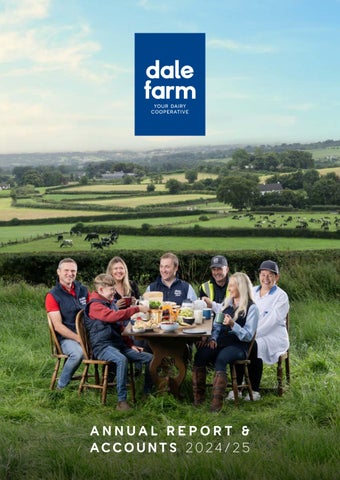
A seat at the table. At Dale Farm, we want to ensure that everyone, right from farm to our sites and facilities, has a voice in shaping our cooperative’s future. The cover image and pages that follow represent inclusion, collaboration, and shared influence, bringing our people together around a table of Dale Farm products. Around the table we recognise the collective strength that drives us forward. A heartfelt thank you to all who contributed to turning this concept into reality. Pictured on the front cover (L-R) we have our Dale Farm farmers James and Bobby Wilson; Adele Loughlin, Head of Foodservice Channel; Paul Reaney, Farm Liaison Manager; Chris Moore, Relief Team Leader; Bronagh Quinn, Process Operative; Jenny Hamilton, Ruminant Nutritionist, United Feeds.
TURNOVER
EBITDA
OPERATING PROFIT
OPERATING PROFIT %
NET PROFIT BEFORE TAX
NET PROFIT PER LITRE PURCHASED
2024 /25
£ 722 . 4 M
£ 45.6M
£ 37. 7 M
5. 2 %
£ 31 . 9M
3 . 31 p p l
2023/24
£6 31 . 4 M
£ 44. 9M
£ 37.5M
5. 9 %
£ 2 9. 8 M
3 . 24 p p l
2022 /23
£ 727. 8 M
£ 43 M
£ 3 5.5M
4. 9 %
£ 26. 8 M
2 . 92 p p l
2021 /22
£ 591 .6M
£ 33 . 8 M
£ 25.6M
4. 3 %
£ 22 .1 M
2 . 41 p p l 2
Annual Report 2024/25
CO N T EN T S PAG E I NTRO D U CTI O N About Dale Farm 2 Our Year in Review
5
Chairman’s Review 7 Chief Executive’s Review 9 Market Overview
13
B U S I N ES S R EVI EW Commercial, Marketing and Innovation
17
Operations, Supply Chain and IT
25
People and Health & Safety
31
Agri Division
39
TH E G RO U P Executive Leadership Team
49
Board of Directors
51
Area Councils
53
Corporate Governance
55
FI NAN C IAL STATEM E NTS
3
Strategic Report
59
Directors’ Report
73
Board Members’ Responsibilities Statement
76
Independent Auditors’ Report
77
Group Income Statement
81
Group & Society Statement of Comprehensive Income
82
Statement of Changes in Equity
83
Group Statement of Financial Position
85
Society Statement of Financial Position
87
Group Statement of Cash Flows
89
Notes to the Financial Statements
91
4
OUR YEAR IN REVIEW
758,750
AVERAGE L ITRES PER FAR M I N NI - MI L K SU PPL I ES I NCREASE OV ER 6%
£2.6M
SAVINGS THROUGH I M PROVEM E NT PROG RA M M E
MILK COMPONENTS IMPROVE FOR 9TH CONSECUTIVE YEAR
984M
LITRES MILK COLLECTED & PROCESSED
99.6%
CUSTOMER SERVICE LEVELS
5
Annual Report 2024/25
UNITED FEEDS RETURN £458K THROUGH MILK CHEQUE REBATE AND MEMBER TRADING DIVIDEND
62.5k TONNES CHEESE PRODUCED
NET PROFIT PER LITRE PURCHASED
3.31ppl
£39.7M OF CAPEX SPEND
CHEESE PLANT 2 INVESTMENT COMPLETED
6
INTRODUCTION
BUSINESS REVIEW
THE GROUP
CHAIR MAN’ S REVIEW Chairman Fred Allen
The past year has been a game of two halves when it comes to both milk supplied to the cooperative and the financial margin realised by producers at farm level. A prolonged spell of wet weather lasting into the spring of 2024 resulted in cows turned out later and grass growth not performing as per normal years. Over the 2024 growing season grass growth reduced by some 18%, when compared to the ten year average, which resulted in a tight supply of silage on many farms for the winter of 2024. Milk volumes over the period April to September grew at a modest 1.8% amidst challenging conditions and fine margins. With volumes curtailed globally, markets improved by late summer which resulted in the Dale Farm base milk price inclusive of winter support payments, peaking at 44.8 ppl by October. This price was retained for five months. With favourable autumn weather, an improved milk to feed price ratio and the implementation of Dale Farm’s Milk Production Re-alignment Scheme, paying out an additional 4ppl on additional milk, the die was cast for increased milk volumes and enhanced margins on farm. Over the second half of the year from October to March milk volumes grew at 8.2%, with volumes continuing to grow at double digit percentage figures in the spring of 2025. In the financial year ended March 2025, Dale Farm paid out on average 43.67 ppl after transport costs were deducted; this included the
7
Annual Report 2023/24
FINANCIAL STATEMENTS
13th payment of 0.5ppl. In the past year Dale Farm has delivered a sustainable milk price to members and grown profits, which has also allowed record levels of investment to be undertaken to strengthen the cooperative for future generations. Year two of the Future Strong farm sustainability programme commenced in autumn 2024. The programme has developed yearon-year with producers asked to provide various sources of farm data, which included soil analysis results, cow numbers and feed usage, methods of feed storage on farm, silage sample results and herd fertility metrics. A step change was introduced requiring producers to select from a menu of initiatives to further drive efficiency and lower emissions on farm. Data supplied has been analysed by Producer Services and the Sustainability teams, allowing meaningful insights to be shared with long-term blue-chip customers, as well as meeting the needs of new customers, particularly in the cheese market. In more recent times, anonymised farm data has been used to engage with government around herd health issues, environmental targets and impending legislation. It is good to see that 97% of producers have embraced the Future Strong programme. This provides powerful information to tell our story better and allow representatives within the cooperative to speak from an informed position. As the programme further develops please be assured that the Farm Liaison and Sustainability teams will be on hand to advise and support producers as required. Looking ahead, the Board and Executive Leadership Team (ELT) are eager to continue the development of the business in line with our strategy. This will require sustained investment in our facilities to achieve world-class product standards. The Board have
been heavily engaged in reviewing investment plans and working with the ELT to chart the business development in the medium to long-term. I would like to acknowledge the sterling work my Board colleagues have undertaken in the past year through attending numerous meetings, engaging with producers, and completing work behind the scenes on the various sub-committees to help shape the business. During the year the Membership Committee have reviewed the cooperative’s milk payment structures, culminating in changes to how butterfat and protein is valued and paid. A new super hygiene bonus was introduced to encourage and reward improved hygienic milk production. In addition, the annual volume bonus was reviewed to broaden the scope and introduce monthly payments from the 2025/26 year onwards. The Sustainability Committee met to assess and guide the development of the Future Strong programme, review issues around climate risk, and debate our response to the 2026-2029 Nutrient Action Programme consultation. My thanks also to the ELT and all the employees at Dale Farm who have delivered another profitable year for the cooperative. A particular note of thanks to all the employees who collectively supported the execution of Cheese Plant 2, ensuring it was delivered both on time and within budget. Overall, our strong, consistent performance can be attributed to the hard work from the teams across the group, together with the dedication of our 1,300 producers, who week in, week out, deliver quality milk from herds managed to the highest standards. A sincere thank you for your continued and valued support.
Chairman Fred Allen
8
INTRODUCTION
BUSINESS REVIEW
THE GROUP
FINANCIAL STATEMENTS
CHIEF EXECUTIVE’S REVIEW Group Chief Executive Nick Whelan
It has been a good year for our cooperative, with another set of strong financial results for the year ending March 2025. Turnover increased, year on year, from £631.4M to £722.4M, while net profit before tax has increased to £31.9M (previous year £29.8M). EBITDA (earnings before interest, tax, depreciation and amortisation) also rose to £45.6M (previous year £44.9M). Operating profit grew from £37.5M in the previous tax year to £37.7M in 2024/25. Given the situation in which the dairy sector, and agri-food more broadly, finds itself, these are impressive results. In the face of several policy challenges and a volatile global environment, we remain innovative, constantly reinforcing our reputation for quality, consistency and sustainability, while investing in our facilities and in our people. The growth of our cooperative over the past decade has been directed by our strategic approach. Our strategy continues to evolve, and we are now firmly in the investment phase - with a focus on production, automation and digitalisation. This in turn is delivering profitability, as reflected in last year’s figures, as well as milk price competitiveness. In 2024/25 we delivered competitive, sustainable milk prices for producers with an average of 43.67 ppl. People are at the core of our success and the ongoing execution of our strategy. The farmers who own our
9
cooperative continue to lead the industry on sustainability, quality and hygiene. Our employees across sites also continue to excel, working day in, day out, with drive, determination and an innovative spirit. A can-do attitude is shared by the teams connected to Dale Farm across farms, factories and head office. We continue to invest in our people, and attract the best talent into the business. Our MySay employee engagement survey is an important tool in ensuring Dale Farm remains a good place to work. Some 79% of our team engaged with the survey, the highest participation in five years with overall satisfaction scores hitting an impressive 73%. Alongside investment in people, investing in our facilities is a key part of the strategy. This past year, our £70M investment in Cheese Plant 2 at Dunmanbridge was completed on time, and on budget. As one of the largest investments made by a Northern Ireland food processor, it is a statement of intent. It is increasing cheese capacity at Dunmanbridge by 20,000 tonnes per year while also bringing significant sustainability gains. I want to pay tribute to all involved for completing the work so efficiently, and to the wider team at Dunmanbridge for ensuring production continued smoothly as works were ongoing. Successfully delivering the new build while continuing to operate at the site was no mean feat, and I congratulate the entire team on this tremendous achievement.
10
INTRODUCTION
BUSINESS REVIEW
Investment is key to ensuring the business continues to be profitable and sustainable for the future. Our asset replacement programme is ongoing, and there is also a focus to invest in digital transformation to further drive efficiency and performance across all locations. Every decision we take as a cooperative is about ensuring the profitability and sustainability of our producers’ farm businesses. We want producers’ farms, and our business, to be sustainable in every sense of the word. It is about more than just the environment, it means taking decisions to protect the profitability of farms today and for future generations. That is the philosophy of our Future Strong framework, now in its third year. Through Future Strong, producers are incentivised to take action to improve their carbon footprint and we continue to be impressed by the uptake of Dale Farm members on the programme, with a 97% participation rate this past year. This is crucial not just in making farm businesses more efficient, but in demonstrating environmental improvements for our customers. We are making strong progress on the environment but unfortunately government decisions, and poor policy coordination, risk holding the industry back. The pace of delivery from DAERA on the implementation of the Carbon Calculator is just one example. Likewise, the proposed Nutrients Action Programme (NAP) posed huge challenges for industry. Together with wider sectoral partners we are urging a change of course from DAERA on NAP and more broadly we encourage departments to pursue policies that allow businesses to grow in the most sustainable way. It has been a point of frustration not just for us, but for agrifood as a whole, that in recent times departments have been reluctant to work collaboratively 11
THE GROUP
FINANCIAL STATEMENTS
Annual Report 2024/25
with industry on the shared challenges we face. We need to see a new collaborative relationship develop between government and the food supply chain, and we continue to push Ministers to ensure policies are evidence-based, aligned across departments, and work for the good of the Northern Ireland economy. The support and efforts of the Board continue to be invaluable. The input and guidance of the Chairman and Vice-Chairman continue to facilitate an exceptional working relationship. Our Board members both at meetings and through our various committees ensure we continue to deliver for farmers and our cooperative. I am also very grateful for the dedication and support of my colleagues on the ELT over the past year, for their decisive decision making and collaboration. Thanks to the efforts of our farmers and employees, Dale Farm remains well positioned to take advantage of further opportunities for the sector. We are pleased with our performance this past year but take nothing for granted. Each of our farmers, alongside the ELT, Board and wider team share a determination to remain innovative and constantly reinforce our reputation for quality, consistency and sustainability. I want to thank all of our farmers for your ongoing support and commitment to Dale Farm as, together, we ensure your businesses and the cooperative remain in a strong position for generations to come.
Group Chief Executive Nick Whelan 12
INTRODUCTION
BUSINESS REVIEW
THE GROUP
MARKET OVERVIEW 2024/25
C OM MO D ITY MAR KE TS Summary: Another volatile year for dairy commodities. Butter and some protein categories reach new highs.
Group Commercial Director Mark Boyle
At a glance
C O N S UM E R MAR KE TS Summary: Cost-of-living concerns persist.
Cost-ofliving crisis
Consumers managing tight budgets. Consumer confidence subdued.
Challenging year for foodservice
Volatile year for dairy commodities Butter and protein categories reach new highs
13
Annual Report 2024/25
FINANCIAL STATEMENTS
Own label remains resilient.
In 2024/25 there was broad anxiety amongst consumers about the economic landscape, driven primarily by rising food prices and escalating food bills. Just as many consumers are worried now about food prices as they were during the height of the cost-of-living challenges in early 2023, with some anticipating they will be worse off in the year ahead. In response, consumers stuck to budget-saving tactics, shopping around different retailers to seek value for money and trading down to cheaper alternatives. Branded butter has suffered from continued retail price hikes due to cost pressures, with consumers reacting by trading into own label whilst branded milk volumes have remained broadly steady throughout the year.
Geopolitical tensions remain.
Cheddar, in comparison, enjoyed volume growth driven by increased branded promotional activity and its inherent versatility as an everyday cheese. Own label is also enjoying volume growth but at a slower rate than brands. The year was tougher than predicted for foodservice, as consumers started to become more cautious with their spend in the last quarter of the year, visiting food-to-go outlets less often.
LO O KI N G FO RWAR D Consumer confidence will remain subdued, reflecting the changing external environment and the prospect of higher taxes in the autumn which will impact disposable incomes. Consumers will continue to take a considered approach, shopping around for the best value, seeking promotions, and trading down to cheaper alternatives. Own label volumes will remain strong, with price promotions and marketing investments being key for brands to maintain share.
Strong milk growth in the UK and ROI in early 2025. The financial year 2024/25 saw huge volatility in commodity markets as buyers and sellers alike had to navigate the potential impacts and subsequent volatility of Avian Bird Flu, Blue Tongue, Foot & Mouth Disease, evolving food trends, mergers & acquisitions, and US tariffs on top of the normal global dairy supply and demand drivers. 2024 will be remembered as a year full of confusion and disbelief as we experienced butter pricing and some protein category pricing at levels which seemed unfathomable only a few short months prior. Following the boom and bust commodity cycle witnessed across 2022/23, we entered 2024 with global milk production flat, and buffer stocks across the globe on both sides of the supply chain at very low levels. Approaching the Northern Hemisphere milk supply peak, bearish sentiment started to increase, mainly due to the assumption of strong milk output across April and May following some improvement in milk prices across Europe. As we entered the flush, market participants held their positions. Sellers, with low inventory, did not feel pressure to sell and buyers, also with limited inventory, were betting on a strong supply turnaround followed by a sharp decline in pricing.
Some early signs of milk supply recovery appeared in Europe over April and May, but the big growth engines of France, Germany and the Netherlands could not maintain their growth and supply turned flat to negative in July, resulting in a change in sentiment across Europe. The inability of Europe to maintain meaningful growth of 1% or more year-on-year, highlighted the fundamental constraints that many regions in Europe face such as environmental limitations, labour shortages, and a lack of succession, with Blue Tongue and Foot & Mouth Disease adding to these challenges. Outside of Europe, everyone looked to the US to see if they could fill the potential supply gap that was building. The assumption was, that with all the new cheese capacity opening, milk would need to flow. However, US cheese prices at the time did not yield much margin and cow numbers remained low due to the high beef prices and elevated cost of replacement heifers. There was also the challenge of Avian Flu in the US which started to affect sentiment and increase nervousness amongst market participants. As global supply growth failed to materialise, demand patterns and buyer tactics did not change much, as many buyers assumed that with milk prices increasing, supply would improve. Buyers home and abroad maintained short-covered positions only, covering their nearby requirements, and avoiding holding stock in a high-interest rate environment. For most of 2024, international demand was relatively subdued, particularly as China continued to disappoint. However, dynamics here slowly changed as farmer margins have been negative for some time, and in the final quarter of 2024 rumours emerged that many large-scale dairy projects were
being pulled back as government budgets could no longer compensate for the negative farm margins. As these dynamics shift, the expectation is for Chinese imports to gradually start to increase. With stocks already low on both sides of the chain, global milk supply failing to achieve any meaningful growth, the Northern Hemisphere milk supply past peak, and buyers needing to forward fill their pipelines, dairy commodities turned aggressively bullish as we entered the second half of 2024. As market pricing evolved, there was one product clearly leading the way. In September 2024 we first experienced butter pricing over €8,000/Mt which smashed the previous all-time high of €7,250/Mt seen in May 2022. With butter making new all-time highs, every other commodity was expected to do the same. However, only whey protein isolate (WPI) managed the same feat breaking past the previous record of €18,000/ Mt in December 2024 and creating a new all-time high of €22,000/ Mt in March 2025, highlighting the renewed strength in the global demand for protein-enriched food. Cheese such as cheddar, mozzarella and Gouda followed butter’s trajectory but none of them were able to come close to their all-time highs set in 2022. Cheddar peaked in October 2024 but missed the record high set in 2022 by close to £500/Mt. Whey protein concentrate (WPC80%) rallied off the back of WPI matching its previous all-time high, and despite struggling to create new highs, it has remained elevated and strongly supported for some time. From the final quarter of 2024 into the first quarter of 2025 we have seen the lag between commodity prices and farmgate milk prices play out, with farmgate milk prices increasing and commodity markets decreasing.
14
INTRODUCTION
BUSINESS REVIEW
THE GROUP
Annual Report 2024/25
FINANCIAL STATEMENTS
Since the peak pricing in October 2024 through to March 2025, UK mild cheddar has fallen circa £350/Mt, cheddar curd has fallen circa £335/Mt, mozzarella has fallen circa £460/Mt and Gouda has fallen circa £420/Mt. Despite falling circa €1,000/Mt, butter has only temporarily fallen back below €7,000/Mt on a few occasions since August 2024 and each time it does, more demand is triggered. During 2023 butter traded as low as €4,000/Mt; back further in 2020 butter traded just above €3,000/Mt. As Europe and the US have opted for increased cheese investment, butterfat is being valorised through the cheese lines resulting in periods of shortages in butter, which was further compounded in late 2024 as increased volumes of Irish butter were taken out of the domestic market and shipped to the US in advance of any new tariffs. WPI and WPC80% have followed a similar trajectory to butter and have been elevated and reached close to all-time highs for some time as food trends further evolve. The demand for protein enrichment has been insatiable in many western domestic markets particularly with the boom in usage of weight-loss drugs.
Looking further out to the second half of 2025, butter and high protein whey prices are still holding at relatively high levels and lending some support to other categories. However, with farmer margins healthy across the majority of the globe it would not be unreasonable to assume a scenario where milk production growth across mainland Europe and the US catches up with the current growth rates that we are experiencing in Ireland and the UK, bringing more downward price pressure into our markets. As always, there are other factors at play to consider, such as the impact of tariffs on US farmer margins, the US economy, and Chinese whey derivative import activity. If we do not see milk supply growth improve in EU/US, 2025 could turn positive again towards the end of Q3 or early Q4, assuming EU and US domestic retail and foodservice demand can withstand potential changes in consumer habits and spending.
Entering the first quarter of 2025, there has been a significant increase in milk production in our domestic markets, creating processing and capacity challenges which have been partly off-set by lacklustre milk production and some spare capacity in continental Europe. Long-term, competition for milk remains high which can be seen by increased consolidation across Europe. In the short-term, with domestic and export demand questionable at best, economic challenges increasing, geopolitical tensions high, and consumer confidence and spending under pressure, strong milk production is weighing heavily on pricing.
15
16
Annual Report 2024/25
B US INES S REVIEW COM M ERCIAL , M AR KETI N G AN D I N N OVATI O N CO N S UM E R FO O D S 2024/25
19
B U S I N ES S -TO - B U S I N ES S/ I N G R E D I E N TS 2024/25 20 B RA N D AC T I V I T Y 21 I N N OVAT I O N 24
17
18
BUSINESS REVIEW
INTRODUCTION
THE GROUP
Annual Report 2024/25
FINANCIAL STATEMENTS
COMMERCIAL, MARKETING AND INNOVATION Group Commercial Director Mark Boyle
At a glance Consumer foods deliver a robust performance
C O N S UM E R FO O D S 2024 /25 Summary: Robust performance overall. Cheddar well positioned for further growth.
Continue to build cheddar pipeline
Brand visibility drives trial & sales growth
Innovation in recipe & process optimisation
19
Solid ice cream performance. Stable liquid milk and drinks volumes. In 2024/25, the Consumer Foods business delivered a robust performance, with volume broadly in line with the previous year. This was achieved despite significant inflationary pressure on commodity pricing and continued strain on consumer spending. Our liquid milk business outperformed the market, recording a modest volume decline of circa 1% as we exited unprofitable business in the foodservice channel. Retail channel performance was strong, supported by new business in the convenience sector.
Our drinks business followed a standout prior year with another solid performance. Volumes remained steady as we focused on profit-led portfolio management. Retail buttermilk sales held firm as we strengthened national listings and expanded distribution. The butter and spreads category faced a challenging environment, navigating sustained commodity cost inflation, aggressive pricing from competitors, and shifting consumer habits. We managed to hold volumes steady and protect our market share whilst recovering commodity inflation. The sales volume of retail spreads was slightly down, impacted by aggressive promotional activity on competitor spreads. However, butter volumes increased year-on-year, despite the strategic withdrawal from unprofitable promotions in Q1. Effective implementation of cost price increases in response to rising input costs were required throughout the year. Foodservice sales grew by more than 2% year-onyear, with volume uplift supported by new customer growth. Consumer cheddar volumes continue to grow with key partners as we look to optimise our cheddar growth pipeline, with our increased capacity coming on-stream at the end of
the year. The business remains well-positioned, with second-half growth supported by new customer acquisitions in the foodservice channel. Our continued collaboration with key retail and foodservice partners in the UK, many of whom are outperforming the market, provides a strong foundation for future growth. Ice cream trading remained solid throughout the 2024 spring/summer season, despite the poor weather conditions. The retail channel delivered steady volumes versus the prior year, with the impulse category driving strong year-on-year growth. This was achieved through increased distribution in both the convenience and grocery sectors. The take home / multipack categories experienced a volume decline as a result of recovered inflation softening demand at elevated retail selling prices, particularly evident with promotional lines. The foodservice channel performed in line with forecasted volumes.
B U S I N ES S -TO - B U S I N ES S (B2 B) / I N G R E D I E NTS 2024 /25 Summary: Strong growth in cheddar. Building our long-term growth pipeline. Key strategic partnerships. Building new markets. Global ingredients markets continue to evolve with everchanging market dynamics, food trends, geopolitical issues and requirements, in addition to consumer trends. Over the past two years we have increased our focus on the global cheddar markets and as volumes continue to grow from Cheese Plant 2, we have become a major cheddar supplier both within our UK and EU domestic markets as well as within the MENA region.
Building and executing our longterm cheddar pipelines has seen our B2B cheddar client list extend to well over 40 regular clients across the UK, Europe, the Middle East and North Africa. With growing volumes in our B2B division, our commercial and logistics teams had to remain agile to react to opportunities in any market, which has required a large focus on maintaining global relationships and country export capabilities and approvals. Growing our B2B cheddar business remains a priority as we look towards our first year of Cheese Plant 2 being fully operational. Our whey business has performed satisfactorily and the trends for protein-enriched foods are very encouraging as we continue to monitor this evolving landscape.
20
INTRODUCTION
BUSINESS REVIEW
B RAN D ACTIVITY Summary: Sukie wins Best New Product/ Product Relaunch Award. On-pack promotions drive conversion to sales for Dromona. Increased visibility of Dale Farm impulse ice cream range in stores. Reaching new consumers with sampling activities. With consumers remaining budget conscious amidst an uncertain economic climate, the marketing focus was to drive ‘trial and grow’ sales through increasing brand visibility and communicating a clear added value message. This was executed through a comprehensive programme including new product development (NPD), on-pack promotions, merchandising, sampling, outdoor advertising, and social media.
S U KI E S C O O P S B EST N EW PRO D U CT/ PRO D U CT R E LAU N C H AT TH E B E LFAST TE LEG RAPH G RO C E R MAR KE TI N G AWAR D S To stay ahead in a competitive juice category, the recipe for Sukie was reformulated to become sugar-free without compromising the iconic taste consumers love and a new Summer Fruits flavour was launched. It was supported with an integrated campaign that ran across out-ofhome and digital advertising, social media, in-store activations, and student-led experiential sampling to drive awareness and trial. Standout tactics included a ‘same great Sukie taste or your money-back guarantee’ offer on 250ml cartons 21
THE GROUP
FINANCIAL STATEMENTS
Annual Report 2024/25
which featured on display units in major retail stores, and a cash-win offer on 500ml bottles. The campaign around Sukie won Best New Product/Product Relaunch at the annual Belfast Telegraph Grocer Marketing Awards in May 2025.
OPEN JOY WITH DROMONA Inspired by the advent calendar, the “Open Joy” campaign was developed to drive consideration to purchase through a high value-added promotion. Consumers could use the unique code on each block butter pack to unlock a door and discover if they had won a prize. At a time when shoppers were trading out of brands into own label due to higher retail prices, Dromona block butter grew its market share during the campaign period.
KE E PI N G DALE FAR M I M P U LS E I C E C R EA M TO P O F M I N D To maintain Dale Farm’s position as ‘NI’s No.1 Ice Cream Brand’, new branded wraps and point of sale were developed to increase visibility of its impulse freezers in-store. This initiative drove more shoppers to the fixture and supported sales growth. The brand also enjoyed incremental growth with impulse lines being available in increased distribution.
B RAN D S R EMAI N FRO NT O F M I N D WITH EXPE R I E NTIAL SA M PLI N G Continuing from the success of Dromona’s award-winning ‘Give into the Melt’ campaign, the bespoke sampling van visited high footfall locations to drive awareness of Dromona cheddar as a NI favourite - a meltingly good cheese toastie. Dale Farm’s ice cream van also hit the roads, visiting store car parks offering delicious samples and giving out coupons to drive sales in store.
22
INTRODUCTION
BUSINESS REVIEW
THE GROUP
Annual Report 2024/25
FINANCIAL STATEMENTS
I N N OVATI O N Summary: Focus on recipe and process optimisation. New patent granted. Curd innovation for new customers. New ice cream recipes. Sugar-free Sukie recipes. The focus of commercial research and development activity in 2024/25 has been on recipe development, process optimisation, and product rejuvenations. Dunmanbridge has seen several recipe and process optimisation projects. Recipe activity includes developing retail cheddar products to enhance the flavour and texture in line with consumer preferences, using reverse engineering from texture analysis and data-driven insights. Work with new curd customers is ongoing to develop recipes that reliably deliver performance in end-user applications.
At Dromona, a softer butter alternative was developed in small-scale batches, to meet consumer needs using methodology that is not reliant on uncontrollable variables such as feed response rate and weather conditions. Development continues to upscale this to production level. For ice cream, the focus was on the development of new scoop flavours for launch in summer 2025 and moving the Dale Farm sliceable ice cream block production in-house at Mullins. The sugar-free Sukie range was successfully redeveloped and launched. This included existing product matching and development of a new flavour variant. On beverages, technical scouting was completed to understand the market, as well as identify potential gaps and opportunities Dale Farm could exploit in longer life products. Pack format rejuvenation and design changes were implemented for many products to keep the brands fresh and appealing to customers. Changes included the move to more sustainable packaging materials.
A new patent was also granted in February 2025 which relates to improvement in cheddar processing, enabling greater control of upstream process variables. An additional patent has been submitted relating to characterising matured cheeses using predictive technology and models. This was carried out in conjunction with Agri-Food and Biosciences Institute (AFBI) and the project will move to the next phase with a technology service provider in 2025.
23
24
Annual Report 2024/25
B US INES S REVIEW O PERATI O N S , SU PPLY CHAI N AN D IT O P E RAT I O N S 27 S U P P LY C HA I N 28 I T 2 9
25
26
BUSINESS REVIEW
INTRODUCTION
THE GROUP
OPERATIONS AND S UPPLY CHAIN Group Operations Director Chris McAlinden
At a glance
O PE RATI O N S Summary:
Cheese Plant 2 investment completed
Five-year investment plan commenced with focus on automation Investment in butter mini portions
Energy-saving technology investment at Dunmanbridge New team structure to manage business digitisation
27
Annual Report 2024/25
FINANCIAL STATEMENTS
Record year for volume of milk collected and processed. Installation of Cheese Plant 2 completed. Costs managed well across the group. Five-year investment plan developed and implementation underway. Supply Chain continues to manage constant change and volatility. 2024/25 was another record year for the group, with over 984M litres of milk collected and processed, and 62,488 tonnes of cheese produced. Given the team were installing and commissioning Cheese Plant 2 alongside the regular operation of the current cheese plant, this was a significant achievement. Performance metrics across the group were strong, and in some areas saw further improvement compared to the previous year. Cheese yields and line efficiencies improved versus last year, driven by the focus on continuous improvement and ‘LEAN’ manufacturing.
Costs were well managed coming in 1.4% under budget. Inflation and volatility of the global landscape remain a challenge for managing costs; energy and labour costs in particular are heavily influenced by these areas. We continue to look at options to reduce costs through automation and renewable energy initiatives. From a quality perspective, it has been a good year. Product quality and complaint numbers were low across all product categories, even with the growth in volumes experienced in our core cheese and whey business. Investment in ongoing quality improvement continues across our business to ensure we continue to meet customer and legislative requirements. Examples in the year included fabric upgrades in our retail liquid milk plant, pasteuriser improvements in our butter plant, and a focused improvement project on whey quality.
I NVEST M E NT Capital investment for the year totalled £39.7M. Key projects within this included our Cheese Plant 2 investment, an upgrade to our butter mini portions lines, an energy-saving
heat pump project, and the start of our journey to automate and digitise our processes. Ongoing investment to address aged assets, as well as to implement quality, safety and environmental improvements continued in the year. Improved hygiene junctions, upgrades to water treatment systems, replacement of old chill plants, and various building fabric improvements were among some of the projects completed across our manufacturing sites.
was made during the year. This continues to be an increasingly busy area for the business with legislation driving change. Excellent service levels were maintained in the year, even with increased retail volumes in grated and sliced cheese. Planning in the extra output from Cheese Plant 2 introduced an added complexity, which has been extremely well managed, ensuring we have a smooth stock profile to meet the forward sales demand.
Key Stats
984M
litres of milk collected and processed
62,488 tonnes of cheese produced
The next five year investment plan has been developed and is now in action. Focus areas within this plan include automation, asset replacement, efficiency improvement, new product categories, and further increases in capacity across key product sectors.
1.4%
S U PPLY C HAI N
£2.6M
Managing extreme volatility and constant change were the main themes across the year. Geopolitical tensions and various economic changes in the year continued to ensure volatility across all markets - energy, chemicals and packaging all seeing the effects with extreme volatility in spot pricing. The business managed this by having a mix of fixed price and spot contracts, ensuring we managed input costs well and maintained supply of all the key inputs to our sites in a timely manner. Sustainability was a key work area in the year from a supply chain perspective. Increasing customer demands in areas such as recyclable packaging and light weighting of packaging drove activity within the cheese and liquid milk business. Solutions for tethered caps on our retail milk bottles and recyclable cheese film are two key projects in which progress
costs under budget
savings through improvement programme
Yield performance improved
0.1%YoY Service levels an excellent
99.61% £39.7M capex spend
28
BUSINESS REVIEW
INTRODUCTION
THE GROUP
IT Chief Financial Officer John Morgan
At a glance
IT Summary:
Roll-out group’s Enterprise Resource Planning (ERP) project New Digital Transformation Programme Focus on IT security
Significant expansion to Central Data Hub
29
Annual Report 2024/25
FINANCIAL STATEMENTS
Roll-out of the group’s Enterprise Resource Planning (ERP) upgrade project continued. Good progress made on the development of our Operational Technology (OT) project. Initiated a new Digital Transformation Programme. Continued to enhance IT security. Advancement of Artificial Intelligence (AI) capabilities. A major initiative for the IT team this year was the continued roll-out of the group’s Enterprise Resource Planning (ERP) upgrade project. The first company, Dale Farm Cooperative Limited, successfully went live on the new platform, marking a significant milestone. Functional requirements for two additional companies were approved during the year, with their go-live scheduled for 2025. The overall project remains on track for completion in 2026. This strategic investment in modern ERP technology is expected to drive ongoing process and administrative efficiencies, while enhancing readiness for future system integrations.
The development of our Operational Technology (OT) project progressed well throughout the year, highlighted by the successful deployment of several production systems into our OT software. These implementations have advanced our goal toward a more digitalised and data-driven approach to production efficiency. A comprehensive OT strategy is currently being developed, with the goal of driving operational excellence through technology at our manufacturing sites.
security awareness platform. This included a broader range of training courses, targeted departmental initiatives, and the introduction of user risk registers and simulated phishing exercises to strengthen user awareness and resilience. To further support our cybersecurity framework, several new security and device usage policies were issued to the user base during the year, reinforcing our commitment to security and compliance. In line with best practices, independent internal and external penetration (PEN) tests were conducted throughout the year to proactively identify and address potential vulnerabilities.
DATA & ANALY TI C S Throughout the year, the Central Data Hub has seen significant expansion, with the integration of new data sources and structural enhancements. These updates have improved the Hub’s efficiency, ensuring timely access to critical
business information. Notably, this progress has enabled the development of in-house automated solutions that support key operational processes. One major achievement includes the automation of weekly profitability reporting. Previously dependent on a legacy system requiring significant resource to maintain, this process has now been streamlined by the Data & Analytics team. The new solution has accelerated the availability of weekly profitability figures by one day, supporting faster and more informed decision-making. In conjunction with the OT project, the Data & Analytics team has successfully integrated factorylevel data to deliver actionable insights for production teams. This integration represents a significant step toward systemising performance-driven metrics, which will play a growing role in operations in the coming year.
A strategic priority included the advancement of Artificial Intelligence (AI) capabilities. The team made notable progress in developing robust forecasting tools using AI technologies, including Machine Learning, to enhance data-driven decision-making. A dedicated AI-driven Human Resource agent is scheduled for launch in 2025, providing employees with an intelligent interface to ask standard policy and HR-related queries efficiently. With enhancements to the Central Data Hub infrastructure and access to Microsoft’s Open AI platform, the Data & Analytics team are well-positioned to further explore and adopt advanced AI technologies that align with the strategic goals of the business.
During the year, we initiated a new Digital Transformation Programme, designed to align with and support key strategic projects over the next five years. The convergence of IT and OT remains a cornerstone of this new digital transformation strategy, enabling more integrated, intelligent, and agile operations. Throughout the year, we upgraded IT infrastructure across all locations, significantly enhancing network bandwidth and redundancy. In parallel, we reviewed and streamlined several communication platforms which delivered notable cost savings to our IT operating budget while improving alignment with our Office 365 ecosystem. In response to the persistent and evolving threat of cyber-attacks, we continued to enhance our IT security position through the expansion of our 30
Annual Report 2024/25
B US INES S REVIEW PEO PLE AN D H EALTH & SAFET Y P EO P LE 33 LE A R N I N G A N D D E V E LO P M E N T
34
E N G AG E M E N T 3 6 TA LE N T 3 6 H E A LT H & SA F E T Y 37
31
32
BUSINESS REVIEW
INTRODUCTION
THE GROUP
Annual Report 2024/25
FINANCIAL STATEMENTS
PEOPLE AND HEALTH & SAFETY Group HR Director Karen Gaw
LEAR N I N G & D EVE LO P M E NT Summary: Groupwide roll-out of Learning Management System (Open LMS) - with 1,896 courses completed. 65 external training initiatives delivered. Training and development opportunities offered to everyone within our business.
At a glance
PEO PLE Summary:
Investing in employee learning and development
£312,000 spend on learning and development. 55% of workforce trained in external development programmes.
Growing our talent graduates / key expertise
Steps taken to attract, develop and retain key talent.
Our people are at the heart of our cooperative, and are fundamental to our continuing success. It is the collective effort, commitment, and expertise from every individual that enables our sustained growth, and the achievement of our strategic aims.
Positive MySay survey results - employees proud to work for Dale Farm Focus on Health & Safety
This year, we continued to invest in our people and ensure their well-being remains at the heart of everything we do. Against a backdrop of evolving workforce expectations and ongoing operational pressures, we have strengthened our commitment to cultivating a safe, inclusive and high-performing workplace. We have continued to invest in creating a supportive working environment, with a focus on learning and development, well-being and collaboration;
33
recognising that our collective success depends on the strength and the engagement of our teams. This section highlights our accomplishments and initiatives over the past year, emphasising our commitment to our employees, which we see as essential for our future growth. We have taken positive steps in attracting, developing, and retaining key talent, and in broadening opportunities for continuous learning and professional growth. We maintain an environment where the health, safety, and well-being of our teams are prioritised. This is a core part of our wellness programme and reflected in our safety record. Having an engaged workforce is key, and we continue to drive initiatives for better communication, more recognition and stronger teamwork to ensure a positive employment experience where our people will flourish and achieve.
28% of jobs filled internally. Investing in our employees’ skills is critical for both individual growth and satisfaction, and for company performance. In 2024/25 we continued to prioritise our learning and development opportunities at all levels, providing employees with access to tailored programmes, updated industry knowledge, practical skills and continuous professional growth. Key programmes delivered a focus on performance and strategic priorities, including:
Our internal pilot ‘Using Lean Techniques to Solve Complex Problems’ was successfully rolled out and earned a ‘Highly Commended’ recognition at the Open College Network Learning Endeavour Awards. Uspire’s Colour Insights programme, aimed at building self-awareness and inspiring high performing teams, continued and was extended to additional teams, including our Board which also undertook Board Governance training with the Institute of Directors. We continued our partnership with Dynamic Partners for tailored coaching for senior managers and the ELT team development programme. The successful roll-out of Open LMS has been a major milestone, providing all employees with a centralised learning platform which underpins onboarding and hosts custom-made programmes such as LGV Driver Induction, Dynamic Risk Assessment, and GDPR. There are currently more than 200 training courses available on the platform. Learning & Development Hubs were launched at Dromona, Pennybridge, and Dunmanbridge,
with the remaining locations to be fully operational in 2025. These hubs provide dedicated space for continuous learning, self-directed development, and collaborative training sessions. We continue to build learning pathways for key operational roles, which offer clear, structured development journeys for our people. This will be an ongoing process as we continue to enhance learning frameworks across the business. We actively supported professional advancement for our employees including Post Graduate Certificate in Dairy Technology & Innovation with University College Cork, and through Loughry College, a Masters in Business for Agri Food & Rural Enterprise, and a BSc Degree in Food & Drink Manufacturing. Invest NI’s Skills for Growth Programme continues to provide support on learning and development. Continuous investment in the growth and development of our teams ensures their skills and knowledge are current, and that employees are agile and proficient in a changing environment.
• Difficult Conversations: providing all our leaders with practical guidance for confident, empathetic discussions on underperformance and values alignment. • Dairy Masterclasses: delivered by industry alumni covering topics such as UV technologies and whey permeate. • Level 3 Certificate in Logistics. • Food Labelling & Artwork Programme designed for our NPD, Technical and Marketing teams. • Cheese Plant 2 Training Workstream supporting the second cheese plant. • IEMA Foundation Certificate Course in Environmental Management. • Cheese Science & Technology in collaboration with University College Cork. 34
INTRODUCTION
BUSINESS REVIEW
THE GROUP
Annual Report 2024/25
FINANCIAL STATEMENTS
E N G AG EM E NT Summary: 79% participation and 73% engagement. 87% say they know what they need to do to be successful in their role. 84% say they are proud to work for Dale Farm. 82% would recommend Dale Farm as great place to work.
MySay, our annual engagement and culture survey, plays a key role in helping us keep Dale Farm a great place to work, and allows us to gather valuable feedback on the employee experience to make a positive difference. Our latest engagement survey had 79% participation and showed an overall satisfaction score of 73%, surpassing the UK Food & Beverage industry benchmark by 6%. Key drivers of engagement include work/ life balance, company confidence and management, while areas for improvement remain collaboration, communication and action, and feedback and recognition. This employee feedback is essential to drive continuous improvement in our workplace. Based on this year’s survey the ELT will focus on delving deeper to understand this feedback; our Group Chief Executive will deliver townhall-style business updates to all employees, we will share the group agenda for digital transformation, and we will conduct a review of site facilities and agree priorities. We continue to reward and celebrate the individuals who show their brilliance whilst upholding the Dale Farm values, through ‘Rewarding the Legen-dairy’. Since the scheme inception in 2023 we
35
have recognised over 96 colleagues. Our teams also launched a pilot programme to further embed our values and bring awareness to the associated behavioural standards; and we look forward to rolling this out across the group.
TALE NT Summary: Total numbers employed at March 2025: 1,235 (1,099 employed, 136 agency). 6% increase from 1,164 in March 2024. Inclusive of temporary and agency employees.
Sustaining our success depends on attracting, nurturing, and keeping great people. We maintained a strong and stable workforce throughout the year, with turnover of 9.38%. Recruitment efforts focused on attracting talent aligned with the Cheese Plant 2 investment, business improvement, our future growth in data, and digital transformation. We also acquired specialist talent in risk management and OT. We remain committed to nurturing new talent and building a robust pipeline for the future and our Graduate Management Programme continued to attract top university talent. We onboarded 11 graduates, integrating them into key functions to develop foundational skills and contribute to critical projects. We also supported one of our Higher Level Apprentices to achieve a BSc Degree in Food & Drink Manufacturing. We continue to support undergraduates with our annual placement programme, and provided five placements this year across key business functions.
As part of the Schools Outreach Programme, we provided the opportunity for schools across the province to participate in work experience and gain a valuable insight into career options in food manufacturing. We also hosted open days for interested students on our Engineering Apprenticeship Programme. We are proud to be a founding member of the Food Employment and Education Network, an industry partnership with Northern Ireland Food & Drink Association and South West College, which launched this year and works to promote careers in the food and drink industry. Our recruitment strategy continues to be supported by a dedicated Dale Farm Careers Facebook page and a LinkedIn profile, together with bespoke digital and community campaigns, which this year included engineering. The total number of employees across the group, including temporary and agency workers, increased from 1,164 in March 2024 to 1,235 in March 2025. This can be attributed to additional personnel to support Cheese Plant 2 and additional temporary agency personnel. We remain committed to robust succession planning to ensure continuity of leadership and key expertise, and to support the development of future talent across the organisation. Our greatest strength is our people. It is through a dedicated community of impressive skills, tireless effort, adaptability and devotion that our business success is achieved. The commitment of all our people has been instrumental in our company’s growth and in realising our ambition in 2024/25.
36
INTRODUCTION
BUSINESS REVIEW
H EALTH & SAFE TY Summary: Increase in lost time incident performance. 69% improvement in near misses reported. Slips, trips and falls - remains biggest contributor of accidents. Digitisation of Health & Safety.
Keeping our people safe is at the heart of everything we do. We are committed to creating a workplace where everyone feels protected, supported, and confident that their well-being matters. Health & Safety is about building a positive culture where risks are taken seriously, and everyone plays a part in making our sites safer. 2024/25 presented notable challenges in terms of safety performance. We recorded an increase in total workplace accidents, and reportable accidents, with slips, trips and falls being the leading cause of lost time accidents during the year, followed by impact injuries. These figures serve as a clear reminder that while progress has been made, there is more work to be done to protect our people and improve outcomes. Our focus has been on strengthening the foundations of our Health & Safety approach, this included the decision to move from our legacy ‘Workrite’ system to the ‘Foods Connected’ platform. This is a key part of our journey toward a more digital, efficient, and transparent way of managing incidents, investigations, and case tracking. We also made significant strides in strengthening proactive safety measures with increased frequency of structured manager-led inspections and departmental spot checks. To ensure consistent standards, an
37
THE GROUP
FINANCIAL STATEMENTS
internal Health & Safety Management System Audit Programme was developed, offering new layers of assurance and oversight. Investing in the capability and competence of our workforce remains a central theme, with Open LMS providing access to a wide range of Health & Safety learning resources which were delivered during the year. By strengthening knowledge and understanding at every level of the organisation, we are laying the groundwork for long-term cultural change. Our group Health & Safety strategy prioritises leadership accountability, risk management, training, regulatory compliance, and employee wellbeing, with clear, measurable site objectives to support consistent progress and performance tracking. The continued engagement of our workforce is key and this year we introduced further lines of communication and participation with Health & Safety focus briefs and newsletters, the active involvement of Health & Safety representatives, and structured site committees. This collective approach reflects our core belief: that safety is a shared responsibility.
Annual Report 2024/25
F UT U R E FO C U S Our people remain the foundation of Dale Farm’s future growth and success. We remain committed to creating an environment where every colleague feels valued, safe, and supported and inspired to fulfil their potential. Future priorities include: • Focused learning and development to support strategic priorities, including growth through mentorship, the evolution of the online learning platform with clear learning pathways. • Driving action from 2024 MySay Survey, ensuring survey results lead to real change. • Driving accountability for performance management ensuring the right people are in the right roles. • Succession planning, including investing in early career talent to further strengthen and futureproof key roles. • Fully embed Foods Connected to drive actions and measure proactive safety targets.
Our “Thrive - Live Well, Work Well” programme reinforces our commitment to health and wellbeing, offering an annual calendar of events and guidance to our employees, supported by Inspire Wellbeing’s Employee Assistance Programme. We also have a dedicated team of 40 Mental Health First Aiders to offer peer support to recognise and address mental health challenges; this was extended to our Agri team during the year with our ‘Boots on the Ground’ programme. Health & Safety will always remain a top priority. Together, we are working to create a safer and healthier workplace and delivering on our promise to “work together to stay safe”.
38
Annual Report 2024/25
B US INES S REVIEW AG R I D IVISI O N M I LK S U P P LY 41 P R O D U C E R S E RV I C ES 42 U N I T E D F E E D S 43 E N V I R O N M E N TA L A N D S O C IA L G OV E R NA N C E 45
39
40
BUSINESS REVIEW
INTRODUCTION
THE GROUP
AGRI DIVISION
PRO D U C E R S E RVI C ES Summary: Steady increase in business for Tankcare, Parlour Care and Dairy Herd Management.
Producer Services Director Neville Graham
At a glance
M I LK S U PPLY Summary:
Milk supplies increase Increase in business for Tankcare, Parlour Care and Dairy Herd Management
Feed price reductions Second year of Future Strong uptake high
Annual Report 2024/25
FINANCIAL STATEMENTS
Milk supplies increase over 6% to average 758,750 litres per farm. Milk components improve for ninth successive year. Average paid out milk price net of transport was 43.67ppl. Milk supplies from our 1,235 NI producers increased by 6.2% during 2024/25 to an average of 758,750 litres per farm. Milk production during the year was influenced by a solid milk price and falling feed price, resulting in an attractive milk to feed price ratio. The core Dale Farm producers were joined by 13 new entrants commencing milk for the first time and 11 new suppliers coming on board. However, 38 members retired throughout the year, so by year-end the cooperative finished with 14 less producers.
LPG water heating systems grow by 250%. Sensehub sales generate 57% increase in profit.
The base milk price plus loyalty bonus paid to members began the year at an April price of 35.55ppl. Concerns over supply in GB and a general tightness in global supply caused prices to strengthen gradually during the year. This was seen mainly in fat prices, with butter reaching an all-time high in the autumn of 2024. Cheese prices, while not nearly as volatile, increased as a result of the exceptionally strong butter market. Base milk price to members peaked in January and February 2025, with the base price supported after the removal of the winter bonus. Winter support payments were then removed in March 2025 to finish the year with a base price of 41.8ppl.
The Farm Liaison team have been actively advising members on milk quality and milk components. This year saw the commencement of the Super Hygiene bonus, which better rewards very high-quality milk, while on-farm trials aimed at improving thermodurics were initiated. Bonus payments for butterfat and protein also increased significantly during the year and producers responded positively with more milk solids. The team continues to assist farmers in preparation for Red Tractor audits, and support new entrants and suppliers in commencing supply to the cooperative.
Following the launch of year two of Future Strong, the team have been assisting producers with the requirements at farm level, and communicating how farmer participation helps the business target higher value markets.
Parlour Care has been active during the year with customers benefitting from its service and maintenance of their milking parlour. Parlour upgrades have been undertaken with positive feedback from members on the high standard of service provided.
Improving cash flow on dairy farms resulted in a positive year for Tankcare. New tanks once again proved popular with the larger producers, while the supply of second-hand tanks remained challenging. Tankcare, in partnership with Flogas, continued to promote sales of new water heating systems using LPG. The introduction of the 12-month 0% finance scheme payable through the milk cheque for Dale Farm members helped boost these sales by 250%, while heat recovery sales were also aided by this scheme.
Dairy Herd Management welcomed 24 new customers during the year. The desire to improve milk quality remains a common reason for many to commence milk recording, but increasing numbers highlight a desire to receive additional management information to improve efficiency and profitability, with resultant benefits for farm sustainability. Additional offerings to the service in the form of Johne’s testing and PregCheck also remained popular during the year.
Tankcare is underpinned by a comprehensive service contract, which offers a reliable breakdown service and peace of mind for milk loss. This has led to a steady flow of new customers who appreciate the value in rapid response times, knowledgeable engineers, and a fixed monthly cost.
SenseHub sales soared with the electronic cow monitoring system, which proved extremely popular for customers seeking an accurate, costeffective solution for fertility and health management. Labour and cost-saving technology continue to be in demand on dairy farms and with a 0% finance deal being offered, customers were keen to avail of this technology at a modest monthly price. The popularity of this offer and the improved farm economics resulted in SenseHub sales recording a 57% increase in profitability.
Thus, over the 2024/25 year, the average base milk price paid by the Society was 41.32ppl, rising to an actual paid out price net of transport of 43.67ppl.
Milk components improved for the ninth year in a row. Protein increased by 0.03% to 3.37% while butterfat improved 0.01% to an average of 4.27%. Bactocount fell to average 45,000/ml, while somatic cell count decreased significantly on the previous year to average 179,000/ml.
41
42
INTRODUCTION
BUSINESS REVIEW
U N ITE D FE E D S Summary: Record year for tonnes of feed, fertiliser and calf milk replacer sold. Feed price reduced by circa 8%. Uncertainty around EU Deforestation Regulation (EUDR) proved a challenge. United Feeds paid out £458,000 through its milk cheque rebate. United Feeds saw a record year for tonnes of feed, fertiliser and calf milk replacer sold. Feed price reduced by circa 8% at the beginning of summer 2024, remaining close to that level throughout the financial year. This decrease coupled with poor spring weather and increased farm output prices encouraged farmers to feed for marginal meat or milk gain and this trend continued right through from early in the financial year. Summer 2024 proved to be a difficult season for grass growth due to persistent wet weather. This led to difficult grazing and silage making
43
THE GROUP
FINANCIAL STATEMENTS
conditions, leading to concerns in many areas over silage stocks for winter. In many cases, additional concentrate or alternative forage sources were introduced to supplement or replace silage. Raw material markets were relatively stable throughout the year with increases in grains one month often offset by decreases in protein markets at the same time or vice versa. This stability was due to a backdrop of good growing and harvest weather across the main cropping regions of the world. One of the challenges of the 2024/25 year was the uncertainty around EU Deforestation Regulation (EUDR), which was to take effect on 31st December 2024. This is a European Union initiative designed to combat deforestation and forest degradation associated with the consumption of certain products within the EU market. The EUDR requires companies to demonstrate that their products do not contribute to deforestation and forest degradation. Neither the EU, nor the countries supplying into it, were prepared for the December 2024 date, and a 12-month delay was agreed. There is still much work to be done across the world if this is to be actioned in its current state.
Annual Report 2024/25
Soon after the EUDR delay was announced, we had the US elections and the results from that have brought obvious concerns around tariffs and retaliatory tariffs. These did not take effect during the financial year and are still pending, which has made it necessary to look to alternative “non-tariffed” raw materials or sources. Fertiliser prices were relatively stable throughout the 2024 sowing period, with increases seen early in 2025 on the back of higher gas prices. Higher early demand in 2025 due to good weather brought supply issues across the island of Ireland. That early demand in Q1 of 2025 boosted fertiliser tonnes for the 2024/25 financial year, with sales at United Feeds increasing by over 30% on the previous year. During the year, United Feeds paid out £458,000 through its milk cheque rebate and the member trading dividend, which pays a dividend of 1% on the purchases of feed and fertiliser by members.
44
INTRODUCTION
BUSINESS REVIEW
THE GROUP
Annual Report 2024/25
FINANCIAL STATEMENTS
E N V I R O N M E NTAL & S O C IAL G OV E R NAN C E Summary: Second year of Future Strong uptake high with 97% participation. Single Environmental Management System certified to ISO 14001 across all of our activities. GB milk suppliers completed a carbon footprint exercise. Major renewable energy initiative commenced with the Dunmanbridge Heat Pump project. Work continued to ensure compliance with upcoming packaging legislative changes.
F UT U R E STRO N G The second year of the cooperative’s farm sustainability programme Future Strong was launched in the autumn of 2024. As with the first year of Future Strong, the uptake was high amongst the cooperative’s milk suppliers with a 97% participation rate. From January 2025 suppliers taking part in the programme received a payment within the base milk price. Future Strong allows the group to incentivise milk suppliers to take actions which will reduce their carbon footprint. It also provides detailed information concerning the environmental performance of our milk pool. This information is vital in two respects - it enables the group to target support at environmental issues where it is needed most, and it allows the cooperative to provide anonymised aggregated information concerning the environmental performance of the cooperative’s milk pool to customers. Customers now require such information as a condition of business.
This year Future Strong was made up of four sections covering Land and Nutrient Management, Feed Management, Herd Management and Knowledge Transfer. Farmers were required to respond to a number of compulsory items and select from a range of optional items.
The group complies with a range of environmental authorisation and schemes.
This year’s programme was a significant build on the first year including options being introduced for the first time around milk urea measurements and genetics.
All climate change submissions were completed and submitted, and the group achieved all the specified targets. The administration of Climate Change Agreements is changing significantly and, to comply with the new requirements, baseline applications were submitted for the new phase.
A sample-based assurance programme is underway to confirm accuracy of information submitted in response to the survey.
G B M I LK P O O L As of April 2025, all Dale Farm GB milk suppliers completed a carbon footprint exercise using the Agrecalc carbon footprint tool. As part of this process, they received a report summarising their results and highlighting actions which would have the biggest impact on reducing their emissions. The results recorded that the carbon footprint of the milk from the cooperative’s GB members is lower than the GB average. It is intended to integrate the GB milk pool fully into the Future Strong programme during 2025/26.
E NVI RO N M E NTAL MANAG EM E NT AN D C OM PLIAN C E S C H EM ES The cooperative operates a single Environmental Management System certified to ISO 14001 across all of our activities covering milk production, processing and, ultimately, the end use of the group’s products by consumers. This is the mechanism through which environmental improvement and environmental compliance within the business is delivered.
Dunmanbridge met the requirements of the UK Emissions Trading Scheme (UK ETS) and successfully completed a baseline application.
The Energy Savings Opportunity Scheme (ESOS) has a new additional requirement for action plans and our plans were developed and submitted to the Environment Agency. These will be updated on an annual basis. Pollution Prevention and Control (Industrial Emissions) permits are required at five production sites. These were updated by the regulator this year to comply with new Best Available Techniques guidance; these new permit variations have been integrated into the group’s operations. Inspections by the regulator have been completed at all sites and no major issues have been identified.
PRO C ES S I N G FAC I LITI ES The focus on energy management aims to both reduce the cost of energy for the business and also reduce the carbon emissions from processing activities. This is achieved through addressing the energy efficiency of the production facilities and increasing the proportion of renewable energy used by the group. The major renewable energy initiative which commenced in 2024/25 is the Dunmanbridge Heat Pump project, which has been made possible with funding from the Industrial Energy
Transformation Fund. This innovative project captures waste heat from the site’s chilled water system and repurposes it for pasteurisation and other hot water processes. The heat pump system is capable of producing water at temperatures of up to 95°C, significantly reducing the site’s natural gas consumption by over 35% annually. This reduction equates to a decrease of more than 3,500 tonnes of CO2(e)1 emissions each year. The project is scheduled for completion in November 2025. The cooperative continues to identify and source further viable opportunities for renewables across the manufacturing facilities. In order to reduce gas usage, in-depth reviews of steam and condensate distribution systems are being carried out on major sites to identify areas of wastage and to improve efficiencies. This has already led to significant reductions on several sites including the gas usage at one facility being reduced by over 30%. The need to further understand and monitor patterns of energy usage versus production demands, means that the cooperative continues to invest in and develop the data infrastructure to capture data from large energy users such as refrigeration, effluent and compressed air systems as well as core production processes. The major upgrade to the Dunmanbridge effluent treatment plant has been completed and fully commissioned.
1
45
carbon dioxide equivalent
46
INTRODUCTION
BUSINESS REVIEW
PAC K AG I N G Throughout 2024/25 work continued on projects to ensure the group is on track to comply with upcoming packaging legislative changes. The cooperative works to ensure packaging is recyclable, lightweight and contains recycled material where possible. For instance, a project completed at Dunmanbridge on shelf-ready packaging resulted in a saving of approximately five tonnes of paper packaging a year (equating to a saving of four tonnes of CO2(e)1 a year) without compromising the performance of the packaging.
C O R P O RAT E S O C IAL R ES P O N S B I LITY Summary: Raised £65,000 for Cancer Focus NI. Raised £3,017 for Air Ambulance NI during the Balmoral Show. Continued to support FareShare NI donating 56,785 equivalent meals and assisting 138 charities. Continued membership with Arts and Business NI, Business in the Community and Women in Business NI. Extended partnership with Young Enterprise NI. In the last five years we have introduced a number of initiatives and programmes which have created significant impact in our community. Through the support of our employees, farmers, and suppliers we raised an impressive £65,000 for Cancer Focus NI during 2024/25.
1
THE GROUP
FINANCIAL STATEMENTS
The dedicated charity committee at Dale Farm, made up of team members from across our NI sites, coordinated the fundraising efforts. Activities included a golf day, team participation in the ‘Lap the Lough’ cycling event, hikes in the Mourne Mountains, Christmas raffles and quizzes. Last year also saw the inaugural Dale Farm Tractor Run in Ballymena, with over 160 tractors, trucks and vans taking to the roads in aid of a good cause. In turn, the charity supported our employees with a visit from their ‘Keeping Well’ van to all NI sites delivering 30 minute health checks to employees. We recently announced a further extension to the charity partnership, which will continue until 2027. Fundraising activities also extended to Air Ambulance NI, through the collection at the Balmoral Show which raised a total of £3,017 during the four-day event. We continued to supply fresh milk and spreads every week to FareShare NI. Supporting FareShare NI is a commendable effort to address food poverty and support vulnerable groups in NI. FareShare NI, a project of Homeless Connect, collects food from the food industry and redistributes it to charities, community groups, and schools to provide meals to low-income families, senior citizens, people with disabilities, and other vulnerable individuals. In the 2024/25 year the group’s contribution amounted to 56,785 equivalent meals, 47.7 tonnes CO2(e)1 avoided and 138 charities supported.
Annual Report 2024/25
personal learning and development pathways. This year, two employees participated in the Arts and Business NI Leaders on Arts programme which enables development of leadership skills, insights into the arts and culture sector, as well as strategies for successful governance. Our sponsorship of the pantomime at the Grand Opera House Belfast, continued for the eighth consecutive pantomime season. The pantomime is designed to bring families together, and this is a key part of its celebration. This sponsorship enables us to bring our Dale Farm community of families together to include our farmers, employees, customers and consumers. Our Local Roots Community Support programme, offering financial help to organisations close to our manufacturing sites continued. Funds this year were committed to extending our partnership with Young Enterprise NI to support their Business Backer Campaign. Through this partnership, we supported the Young Enterprise mission to deliver its entrepreneurial programmes to 100,000 young people across NI. As well as our financial contribution, employees volunteered to lend their expertise with the Company Programme and Primary School Programme. We collaborate with suppliers to ensure that a high standard is maintained for health, safety, environment, ethics and labour; we are compliant and audited to the internationally recognised Sedex Ethical Trading Standard.
Continued membership with nonprofit organisations and charities, Arts and Business NI, Business in the Community, and Women in Business NI remained strong during the year. These organisations provide our employees with a bridge to team-building activities, networking opportunities as well as
carbon dioxide equivalent
47
48
INTRODUCTION
BUSINESS REVIEW
THE GROUP
Annual Report 2024/25
FINANCIAL STATEMENTS
EXECUTIVE LEADERSHIP TEAM N I C K W H E LAN
K AR E N G AW
Group Chief Executive
Group HR Director
Appointed Group Chief Executive of Dale Farm in 2016. Nick is a member of the UK Food and Drink Sector Council, Vice-Chair at Dairy UK, a board member of the Dairy Council Northern Ireland and appointed Vice President of NI Chamber. He is a former Chair of the Northern Ireland Food and Drink Association and the CBI NI’s Innovation Forum. He was previously Commercial Director at Glanbia for 10 years and held senior management positions in the Kerry Group for 12 years.
Joined Dale Farm in 1990 and has extensive experience in generalist HR management within the Group. Karen was Group HR Manager for 14 years prior to her appointment as Group HR Director in 2021 with responsibility for People, Health & Safety, and Corporate Communications. Karen is an Associate Member of the Chartered Institute of Personnel & Development, and a member of the Institute of Directors.
C H R I S MCALI N D E N Group Operations Director Appointed Group Operations Director in 2013 with responsibility for group manufacturing and supply chain operations as well as the Group’s capital investment programme. Chris is a Chemical Engineering Graduate with a Masters degree in Agri-food Business Development and is a member of the Chartered Management Institute. He joined Dale Farm in 2008 from Moy Park where he held a number of production management posts.
MA R K BOY LE Group Commercial Director Joined Dale Farm in 2021 as Group Commercial Director and leads the cooperative’s Commercial, Innovation and Marketing teams, responsible for delivering sustainable growth for the business. Mark has a depth of experience in a variety of leadership roles in the international food industry having started his career at the Green Isle Foods Group followed with 20 years at Kerry Group culminating in the leadership of the Kerry Foods Consumer Foods business in Ireland. 49
Nick Whelan Neville Graham
John Morgan
Chris McAlinden Mark Boyle Karen Gaw
N E V I LLE G RAHA M Producer Services Director Joined Dale Farm in 2017 as Head of Farmer Services. In 2024 he was appointed to position of Producer Services Director with responsibility for Farm Support, Producer Services and Group Sustainability. In April 2025, Neville took on the additional role of Company Secretary and became a board member of the Dairy Council for Northern Ireland. He has previously held a number of positions within the agri-sector including college lecturer and Farm Director for the Greenmount Farm Estate.
J O H N MO R G AN Chief Financial Officer Appointed Group Chief Financial Officer in May 2023. Prior to this, John was Finance Director of South, Wales & Northern Ireland, BT Enterprise. Before joining BT, John trained as a Chartered Accountant with EY in Belfast before spending two years working within the London Private Equity Corporate Finance Team. John was elected to the CBI Northern Ireland Council in 2019.
50
INTRODUCTION
BUSINESS REVIEW
THE GROUP
Annual Annual Report Report 2024/25 2023/24
FINANCIAL STATEMENTS
BOARD OF DIRECTORS
The Board of Directors of Dale Farm Cooperative consists of 12 non-executive Directors. The Board of Directors of Dale Farm Limited consists of four nonexecutive Directors, all of whom are also Directors of Dale Farm Cooperative.
1 . B RYC E KE LS O
7. R O B E RT B RY S O N
2. ST E V E N B R OW N
Bryce Kelso is a dairy farmer from Maghera, Co Londonderry. He was elected a Director of Dale Farm Cooperative in in April 2022.
4. I VO R B R O OM FI E LD
3. HAR O LD J O H N STO N
Steven Brown is a dairy farmer from Moneymore, Co. Londonderry. He was elected as a Director of Dale Farm Cooperative in April 2016.
5. JA M ES M U R P HY
Ivor Broomfield is a dairy farmer from Armagh, Co. Armagh. He was elected as a Director of Dale Farm Cooperative in April 2020 and is also a Director of the Dairy Council for Northern Ireland.
Harold Johnston is a dairy farmer from Ahoghill, Co. Antrim. He was elected as a Director of Dale Farm Cooperative in April 2011. He is a past County Chairman of the Ulster Farmers’ Union for Co. Antrim.
Robert Bryson is a dairy farmer from Banbridge, Co. Down. He was elected as a Director of Dale Farm Cooperative in April 2013.
6. DAV I D R EA
James Murphy is a dairy farmer from Tempo, Co. Fermanagh. He was elected as a Director of Dale Farm Cooperative in April 2010 and is a former County Chairman of the Ulster Farmers’ Union for Co. Fermanagh.
8. N O R MA N T H OM P S O N
1 0. FR E D A LLE N
David Rea is a dairy farmer from Crossgar, Co. Down. He was elected as a Director of Dale Farm Cooperative in April 2008. He was re-appointed as Vice-Chairman in April 2025.
9. E U G E N E LY N C H
Norman Thompson is a dairy farmer from Banbridge, Co. Down. He was elected a Director of Dale Farm Cooperative in April 2015.
1 1 . DAV I D R OW E
Fred Allen is a dairy farmer from Randalstown, Co. Antrim. He was elected as a Director of Dale Farm Cooperative in April 2009. He was re-appointed as Chairman in April 2025.
Eugene Lynch, an Independent Director of Dale Farm Cooperative since April 2020, is a Chartered Accountant with board leadership experience at Hughes Christensen, JP Corry Group Ltd and The McAvoy Group Ltd.
12. E LLV E NA G RAHA M O B E
David Rowe is a dairy farmer from Armoy, Co. Antrim. He was elected as a Director of Dale Farm Cooperative in April 2014 and is a Director of the Dairy Council for Northern Ireland.
Ellvena Graham OBE, an Independent Director of Dale Farm Cooperative since April 2020, chairs Tourism NI and Catalyst, as well as working with a number of NI’s leading companies. She was formerly Head of Ulster Bank in NI.
1 2
3
4 5
51
6
9
8
7
10
11
12
52
INTRODUCTION
BUSINESS REVIEW
THE GROUP
Annual Report 2024/25
FINANCIAL STATEMENTS
AREA COUNCILS AREA 1
NAME
AREA 2
NAME
AREA 3
NAME
AREA 4
NAME
DISTRICT 1
Philip Hanson
DISTRICT 6
Chris Hamilton
DISTRICT 11
H Doupe
DISTRICT 16
Bryce Kelso
DISTRICT 2
David Rowe
Jason Rankin
David Simpson
William Hamill
Gary Thompson
Martin Sloan
Matthew Carrick
John McCaughern
Mark McIntyre
Stuart Simpson
Desmond Bloomer
Andrew Gardiner
Robert McConaghy
Rory Woods
Mervyn Robert Ewing
Michael Stewart
Wallace Gregg
Philip Donaldson
Ivor Broomfield
Jonathan McAleese
Lee McKinstry
Ben Scott
Stuart Orr
James Brownlee
Thomas Johnston
Timmy McAuley
David Rea
Thomas Mitchell
Adam Davis
Ross Beattie
Chris Crea
Daryl Morton
R Sheppard
Thoburn McCaughey
Simon Stevenson
Alan Latimer
Richard Mulholland
Bryan Graham
DISTRICT 4
DISTRICT 8
DISTRICT 13
John Hanna
Caryn Webster
Trevor McConnell
Jonathon Moore
Wayne Ferguson
DISTRICT 14
DISTRICT 18
William Robert Wallace
Steven Brown
John Edgar
Paul Millar
Robert Bryson
James Murphy
Neil Gourley
Arron Graham
Andrew Murray
Alan Graham
Stephen Sterling
Fred Allen
Geoffrey Malcomson
Ian Hamilton
Ronan Campbell
Andrew Shanks
Richard Coalter
Stephen Rogers
John Ferguson
DISTRICT 5
DISTRICT 17
Thomas Connolly
Cyril Andrew Orr
DISTRICT 3
DISTRICT 7
DISTRICT 12
DISTRICT 9
DISTRICT 15
DISTRICT 19
Andrew Boyd
Alan Johnston
David Wilson
Colin Johnston
Neville Robinson
Ian Patterson
James Bell
Seth Mathers
Peter Coote
Stephen Brown
Gregg Somerville
Martin McGirr
William Crawford
Samuel Hill
Norman Thompson
Peter Bleakley
Andrew Wright
Hall Taylor
George Mitchell
Trevor McNeilly
John Beckett
David Stevenson
Robert J Smyth
David McCann
Robert Hunter
Gavin Thompson
Jane McAleese
Harold Johnston
DISTRICT 10
Arnold Maxwell
DISTRICT 20
Adrian McFarland
Andrew Dale
Jonathan Alcorn
53
54
INTRODUCTION
BUSINESS REVIEW
THE GROUP
CORPORATE GOVERNANCE C O R P O RATE G OVE R NAN C E The Board is committed to adopting best practice in Corporate Governance as deemed practical and appropriate for a member-owned cooperative.
TH E AU D IT C OM M ITTE E
The attendance of Directors at the 11 routine Board meetings in 2024/25 was as follows: Fred Allen
11
David Rea
11
Ivor Broomfield
11
Stephen Brown
11
Robert Bryson
11
TH E BOAR D
Ellvena Graham
11
The Board meet monthly (except for July) with a formal schedule of matters specifically reserved for its decision. Additional meetings are held as required. The Board reviews trading performance, ensures adequate funding, sets and monitors strategy, examines major acquisition opportunities and formulates policy on key issues. To enable the Board to discharge its duties all members receive appropriate and timely briefing papers. The group has appropriate insurance cover in place for Board Members.
Harold Johnston
11
The Board comprises 12 Directors, eight of whom are appointed by the farmer members through Area elections; two are elected by the members’ Area Councils acting collectively; and two Directors are appointed by the elected Directors. The term of office of elected Directors is four years while appointed Directors are appointed for not more than three years and can only serve a maximum of three terms.
Bryce Kelso
11
Eugene Lynch
10
James Murphy
11
David Rowe
11
Norman Thompson
11
The Chairman and Vice-Chairman are both elected annually by the Board. The remuneration of the Directors of the Society is determined each year by the members at the Annual General Meeting (AGM). All farmer Directors are also suppliers of milk to Dale Farm Cooperative, but they and the appointed Directors are regarded as independent. Induction training is provided for newly elected/ appointed Directors and further training is provided as required. The Board Committees Comprise: Audit
Nominations
Eugene Lynch
Fred Allen
Robert Bryson
David Rea
Ellvena Graham
Nick Whelan
Ivor Broomfield
Annual Report 2024/25
FINANCIAL STATEMENTS
The Audit Committee meets at least twice a year and has specific terms of reference which include responsibility for reviewing the Annual Accounts prior to submission to the Board, monitoring the internal control systems and liaison with both external and internal auditors. The Committee satisfies itself on the independence of the auditors and monitors the level of non-audit fees. The internal auditors review key risk areas and relevant controls across the group and report their findings to the Audit Committee, together with any recommendations for improvement.
D IALO G U E WITH S HAR E H O LD E R S Communication with members is given the highest priority by the Board and the Annual Report gives a comprehensive review of the financial and operating performance of the group for the year. The Board uses the AGM to have an open dialogue
with members, and the group has four Area Councils elected by the membership, which meet about four times a year with the elected Directors for their Area to discuss the affairs of the Society. In addition, open Area meetings are held to which all members in the relevant Area are invited. The Society also keeps in touch with members through the
issue of the bi-monthly magazine “Dale Farm View” and via the group website www.dalefarm.com. Any member wishing to contact the Company can do so at the registered office of the Company.
TH E N OM I NATI O N S C OM M ITTE E The Nominations Committee makes recommendations to the Board on the appointment of “non-elected” Directors to the Boards of the group subsidiary and associate companies, as well as senior executive appointments.
TH E MANAG EM E NT TEA M The Group Chief Executive and management team, who are responsible for operating decisions and the effective functioning of the main activities in the group, report to the Board.
Bryce Kelso David Rowe
55
56
INTRODUCTION
BUSINESS REVIEW
C HAI R MAN Fred Allen
VI C E - C HAI R MAN
THE GROUP
FINANCIAL STATEMENTS
Annual Report 2024/25
AU D ITO R S Ernst & Young LLP Bedford House 16 Bedford Street Belfast BT2 7DT
David Rea
D I R ECTO R S Robert Bryson Harold Johnston James Murphy David Rea David Rowe Norman Thompson Steven Brown Eugene Lynch Ellvena Graham Ivor Broomfield Bryce Kelso
C H I E F EXEC UTIVE Nick Whelan
C H I E F FI NAN C IAL O FFI C E R
BAN KE R S Ulster Bank 11-16 Donegall Square East Belfast BT1 5UB Danske Bank Donegall Square West Belfast BT1 6JS PNC Financial Services UK Ltd 34-36 Perrymount Road Haywards Heath West Sussex RH16 3DN
S O LI C ITO R S
John Morgan
Tughans LLP The Ewart 3 Bedford St Belfast BT2 7EP
S EC R E TARY
C OM PANY STAT U S
Keith Agnew (resigned 25 March 2025) Neville Graham (appointed 25 March 2025)
Dale Farm Cooperative Limited is a registered co-operative society under the Co-operative and Community Benefit Societies Act (Northern Ireland) 1969
R EG I STE R E D O FFI C E Dale Farm House 15 Dargan Road Belfast BT3 9LS
57
58
INTRODUCTION
BUSINESS REVIEW
THE GROUP
Annual Report 2024/25
FINANCIAL STATEMENTS
STRATEGIC REPORT
O P E RAT I O NA L P E R FO R MA N C E
PRINCIPAL ACTIVITIES Dale Farm Cooperative Limited is a registered co-operative society under the Co-operative and Community Benefit Societies Act (Northern Ireland) 1969. The principal activities of the group include manufacturing an extensive range of dairy products for the retail, food service and food ingredients sectors and marketing and distributing these products to both domestic and international markets. The group includes the overall parent, Dale Farm Cooperative Limited, and its subsidiary undertakings referenced in note 12. The group also collects and markets members’ milk, supplies animal feed to farmers, and provides a range of other farm services.
FI NAN C IAL PE R FO R MAN C E The key performance indicators (“KPI”s) for the group are:
KPIs
2025
2024
Group turnover (£000)
722,433
631,421
Profit before taxation (£000)
31,897
29,783
Average employee numbers
1,074
1,053
Average milk price paid to members (pence per litre)
43.67
35.20
Group turnover increased by 14% year on year, primarily due to strengthening dairy commodity prices, with butter in particular experiencing record highs in year. The group profit before tax increased by £2,114k to £31,897k. The group has invested heavily in the year, with the new cheese plant at the Dunman site now complete and adding significant additional processing capacity. Rising commodity prices, and corresponding increases in the milk price returned to farmer members has necessitated additional working capital investment, but the net debt position has been well managed, and the group has generated satisfactory cash flow from operations in the year. Employee numbers have grown year on year as the group continues to invest in new people and skills in line with strategic priorities and operational need. The profit variance primarily reflects the following: • Strengthening returns from dairy commodity markets, with positive demand side pressures and stable global supply ensuring a more sustainable level of return across the basket of bulk dairy produce; • The introduction in early 2025 of additional processing capacity in the group’s newly constructed second cheese plant, allowing for increased cheese production and in turn directing milk away from sub-optimal processing outlets; • A focus on the group’s core divisions and value-added markets, with an emphasis on quality and exceptional levels of customer service at all times; • Robust cost efficiency and performance improvement initiatives across the business, targeting all opportunities to make gains throughout the group’s cost base; • A central focus on data, technology and automation, using these critical points of difference to drive decision making and investment decisions across the business; • Research and development driving innovation into both our processes and product base; and • Proactive management of inflationary pressure through engagement with our commercial partners. The average milk price paid to NI members increased by 8.47ppl (24.1%) in 2024/25 reflecting strengthening conditions and higher returns in global dairy markets during the year (2023/24: decrease of 10.29ppl (22.6%)).
59
R I S K MANAG EM E NT G OVE R NAN C E
MILK SUPPLY
2025 / Litres
2024 / Litres
Average output per member
758,750
717,924
Strengthening milk prices, due to higher returns available from global commodity markets, have ensured a better, more financially sustainable income stream for farmer members in the year. This in turn has allowed for higher outputs per member and year on year growth in the Northern Irish milk pool.
RISK MANAG E M E NT APPROAC H TO R I S K MANAG EM E NT The group assesses each new and emerging risk according to overall risk appetite. The group’s risk appetite is the amount of risk that would be acceptable in order to meet operational strategies and goals. The Board have assessed that the group’s overall risk appetite is low. This means the group will not accept risks where it is deemed there may be adverse consequences which could have a material impact on, amongst others, profitability, the group’s farmer members and their milk pool, group reputation and brand, and key stakeholder relationships. This does not mean the group is not exposed to risks with a potentially medium to high impact, but in these cases robust controls and mitigations are implemented to reduce residual risk to an acceptable level.
The Board retain overall responsibility for risk management oversight, which includes ensuring that an appropriate risk appetite has been set and that suitable policies relating to risk are in place. The Board has delegated responsibility for monitoring the group’s risk management process and system of internal controls to the Audit and Risk committee. The Audit and Risk committee report to the Board on the status of the risks identified within the group’s risk register. This is maintained by senior management, supported by the group’s Head of Risk. The Audit and Risk committee will also gain assurance over the group’s internal controls through internal review, and audit procedures performed by external professionals. Senior management are responsible for the day-to-day maintenance of the group’s system of internal control and mitigation strategies for new and emerging risks. Senior management are supported by sub committees and taskforces which have responsibility for tailoring mitigation plans for specific risks. A ‘three lines of defence’ model is used to facilitate effective risk management: Level 1: provided by frontline staff and operational management, including systems, internal controls, and culture developed and implemented across operations. Level 2: provided by risk management and compliance functions, including financial control measures, health and safety, quality measures, compliance checks, cyber, and IT management. Level 3: provided from risk assurance through the group’s internal audit function.
R I S K AS S ES S M E NT The group operate a live rolling risk register which tracks the status of risks. When new risks are identified by management, a thorough assessment is made which considers the likelihood, together with the potential impact. The assessment is based on a range of both qualitative and quantitative factors depending on whether the risk relates to: • Strategic; • Financial; • Commercial and operations; or • Regulatory and compliance The risk is then assigned an impact and likelihood risk scoring between 1 and 9. This allows for appropriate prioritisation of the risk, so that it can be managed and mitigated effectively. All risks are assigned an ultimate owner within the Executive Leadership Team (ELT), who is responsible for the development and implementation of effective mitigation plans. The Audit and Risk committee receive regular updates on the status of items on the risk register, as well as the progress of ongoing mitigation plans.
P R I N C I PA L R I S KS The following represent the principal risks identified by the group:
B U S I N ES S P ER FO R M A N C E R I S K The group faces a number of business performance risks due to internal and external factors including competitive pressures in markets in which it operates. The cost-of-living inflationary crisis, and geopolitical issues, such as the ongoing conflicts in Ukraine and the Middle East, and the uncertainty caused by changing global trade policies and tariffs,
60
INTRODUCTION
BUSINESS REVIEW
also pose significant risks to the performance of the global economy. These risks are managed through several different measures: ensuring the appropriate management team is in place; business planning and regular forecasting; financial controls; key performance indicators; monthly reporting and timely corrective action when variances occur.
B U S I N ES S C O NTI N U ITY R I S K While there is a reliance on physical infrastructure, the group operates seven geographically autonomous production facilities which helps mitigate business continuity risks. The group also ensures that there is adequate knowledge throughout the management team and sufficient IT support and back up capability available should an unforeseen event occur. Management conducts ongoing reviews of business continuity and IT disaster recovery plans and participate in industry wide crisis management exercises.
PRO D U CT Q UALITY The group has stringent controls in place to monitor product quality and safety throughout the production process. The group continuously invests significant levels of technical knowledge, resource and attention to ensure that quality standards remain high.
H EALTH AN D SAFE TY R I S K The group is committed to ensuring a safe working environment. These risks are managed by the group through the promotion of a best practice health and safety culture, risk management, extensive safety training and well-defined health and safety policies.
61
THE GROUP
Annual Report 2024/25
FINANCIAL STATEMENTS
C YB E R S EC U R ITY AN D C R I S ES MANAG EM E NT
FI NAN C IAL R I S K MANAG E M E NT P O LI C Y
The activities of the group rely on various IT systems. In the current environment, all organisations are vulnerable to cyber-attacks, which could jeopardise the integrity of systems and potentially result in data breaches or disruption to activities. The group has both cyber security and data protection policies in place which provide frameworks and controls to protect against this risk. The group also have a dedicated IT team, who are responsible for the security of IT systems, through implementing and maintaining best practice in relation to cyber processes. The group has detailed disaster recovery and crises management plans in place which are thoroughly designed and regularly tested.
The group’s principal financial instruments comprise cash, trade debtors and creditors, and certain other debtors and accruals. The main risks associated with these financial assets and liabilities are set out below.
C LI MATE R E LATE D R I S K S Climate related risks are discussed within the Task Force on Climate related Financial Disclosures report on page 62.
KE Y MANAG EM E NT D EVE LO P M E NT AN D EM PLOYE E R E TE NTI O N The long-term success of the business depends on the group’s ability to attract, retain, and develop talent. This risk is managed through succession planning and the pursuit of best practice in HR, through group wide development plans which are regularly reviewed and updated. These are accompanied by specific policies in areas such as recruitment, training, management development and performance management.
PR I C E R I S K The group has some exposure to commodity price movements in the markets in which it operates. This risk is mitigated through proactive engagement with the group’s customers, and a diverse product offering which reduces overall exposure to commodity price movements. The group has no exposure to equity securities price risk as it holds no listed or other equity investments.
FO R E I G N CURRENCY RISK The group’s exposure to foreign currency risk arises primarily on revenues from customers denominated principally in Euro. The group has a policy of entering into forward currency contracts to reduce this risk.
C R E D IT R I S K Credit risk arises principally on third party derived revenues. Group policy is aimed at minimising such risk through the application of satisfactory creditworthiness procedures, including where appropriate, taking out credit insurance cover. The group monitors the levels of credit to individual customers within their approved credit limits, so as to ensure the group’s exposure to bad debts is minimised.
LI Q U I D ITY R I S K Liquidity risk is the risk that an entity will encounter difficulty in meeting obligations associated with financial liabilities. The group aims to mitigate liquidity risk by managing cash generated by its operations and applying cash collection targets throughout the group. The group also manages liquidity risk via revolving credit facilities.
CAS H FLOW R I S K Cash flow risk is the risk of exposure to variability in cash flows that is attributable to a particular risk associated with a recognised asset or liability, such as future interest payments on variable rate debt. The group manages this risk, by reviewing short and medium term cashflows and taking appropriate action as necessary. Particular attention is paid to headroom within debt facilities.
TAS K FO R C E O N C LI MAT E R E LAT E D FI NA N C IA L D I S C LO S U R ES ( “ TC FD ” ) I NTRO D U CTI O N In 2015, the Financial Stability Board (FSB) established the TCFD to develop recommendations for more effective climate-related disclosures. These aim to promote more informed decisions, and better consideration of the risks and opportunities from climate change within organisations, while, in turn, enabling stakeholders to understand better the concentrations of carbonrelated assets and exposures to climate-related risks, by providing a common global framework. Companies within the scope of the TCFD are required to make climaterelated disclosures structured around four thematic areas,
representing core elements of how companies operate. These are: •
Governance
•
Strategy
•
Risk management
•
Metrics and targets
The TCFD further recommends eleven specific disclosures across these four core elements which allow companies to report on how they are considering, assessing, and addressing climate-related risks and opportunities. The Board recognises the very real risks, but also opportunities, that climate change will pose both to the group and the wider dairy industry, and understands the key role the group will play in the industry’s response to those challenges moving forward. The Board also recognises the importance of continuing to evolve and enhance the group’s processes, policies, and controls with regards to climate change, allowing for reporting of the group’s progress, while also allowing it to effectively respond to the risks and opportunities arising from climate change. The Board confirms that Dale Farm Cooperative Limited has reported on climate-related financial disclosures consistent with the TCFD recommendations. A summary of the group’s progress against the eleven disclosure recommendations is presented below.
G OVE R NAN C E Disclose the organisation’s governance around climaterelated risks and opportunities. a) Describe the Board’s oversight of climate-related risks and opportunities. The issue of climate change is central to the operations and activities of the group, as well as
its key stakeholders, and response to the issue requires a high degree of oversight from the Board. During the current financial year, the group’s Sustainability Committee, which is comprised of members of the Board and Executive Leadership Team, as well as the group’s Sustainability department, has met a total number of four times, having been established in the previous financial year. The current focus of this committee is to further develop the group’s risk management processes in response to climate risk, along with considerations of climate impacts on the group’s forward strategy. The work of the committee this year has been focused on overseeing the group’s detailed risk assessment which has been carried out in relation to climate-related risks and opportunities both on farm and for the Cooperative. Further details of this exercise can be found on page 62. The Board continues to receive presentations on specific areas of focus in relation to climate change which is coordinated by the group’s Head of Sustainability. The Board monitors these issues and challenges management processes and controls, enabling more effective oversight. b) Describe management’s role in assessing and managing climaterelated risks and opportunities. Management is engaged in risk management exercises with regards to climate-related issues impacting the group. In 2021, a Sustainability department was established within the society, with an experienced Head of Sustainability recruited externally to lead it. In the years since, the department has been further resourced and its role and responsibilities within the business have broadened. The CEO and Executive Leadership Team (ELT) receive updates from the Head of Sustainability with regards to risks and opportunities arising
62
INTRODUCTION
BUSINESS REVIEW
THE GROUP
TASK FORC E ON CLI MATE-RELATED FINANCIAL DIS CLO S URES (CONTINUED)
from climate change. This is laid out formally at the ELT’s quarterly sustainability meeting where risks and opportunities are a key agenda item. Additional meetings are scheduled, if required, as and when challenges arise, new information comes to light, or the group becomes aware of changes in its environment, via legislation or otherwise, which requires a more immediate response. Climate change impacts are considered in the group’s short, medium, and long term strategy. As well as robust risk management programmes being initiated in the short term, innovative discussions with several stakeholders are being led by the CEO and the ELT, to explore ways to both mitigate the risk posed to the group by climate change, but also realise the opportunities presented by the group’s unique position. These discussions receive oversight from the Board and are an ongoing process.
Transitional risks: The consequences of government, customers, suppliers, financiers, and other stakeholders’ approaches to addressing climate change and related risks. The risks and opportunities identified as part of the risk assessment process carried out in the current year can be broadly categorised into: On Farm Risks • Increasing costs for producers stemming from changes resulting from climate change or changes in legislative requirements which threaten the ability of producers to generate profit or carry on in business in their current way or size; • Reduced milk volumes or quality produced from reduced herd numbers or impact of climate events on herd; and • Disruption to supply of critical inputs e.g. feeds, fertilisers etc. Opportunities
STRATEGY Disclose the actual and potential impacts of climate-related risks and opportunities on the organisation’s businesses, strategy, and financial planning where such information is material. a) Describe the climate related risks and opportunities the organisation has identified over the short, medium, and long term. Climate-related risks to the group fall into two categories: Physical risks: The consequences of both hotter, drier summers, or warmer, wetter summers, as well as increasing frequency of floods, storms, and drought; and
63
Annual Report 2024/25
FINANCIAL STATEMENTS
• Increased milk litres produced from longer growing seasons or from changes to cattle feed; and • Reductions in costs of materials from reduced volumes of raw materials required, for example feeds, fertiliser etc. Supply Chain Risks • Reduction in ability to generate returns due to changes in climate which restrict the markets into which the group can trade, or increase the cost of doing business, materially impacting group profitability; • Reduced production capacity; • Reputational damage resulting from increased pollution or emissions;
• Increased reliance on refrigeration equipment which results in higher costs/increase in breakdowns; and • Disruption to supply of materials & goods & utilities which limit production capacity. Opportunities
degrees, the capacity to materially impact the group’s business, strategy, and financial planning. Risks that could, for example result in a cap on the ability of the group’s farmer members to grow their milk pool, or for the group to expand its production, along with any punitive actions by key stakeholders with regards to climate change, could have significant impact. At the same time, opportunities that allow the group to leverage its unique position as a member owned cooperative, or diversify into new technologies
or sustainable, green business practices, could positively impact group performance and profitability.
recent transformative activities at the group’s processing facilities. It will be a core focus moving forward.
These factors are being considered in detail as part of the group’s strategic planning and risk management programme. The risks and opportunities formally identified will be built into decision making and strategy formation. The group’s understanding of climate risks and opportunities both physical and transitional have informed the requirements of the Future Strong farm sustainability programme, and
c) Describe the resilience of the organisation’s strategy, taking into consideration different climaterelated scenarios, including a 2°C or lower scenario. As described below, the following are the key mitigation strategies the Cooperative is employing in response to the climate related risks and opportunities identified:
• Development of collaborative partnerships; • Investment opportunities which drive profitability through production efficiency in conjunction with reduced carbon emissions;
CLIMATE RELATED EVENT
• Energy management and renewable energy initiatives which drive down costs; and • Reduction in competition due to exits of high emission producers in the dairy industry. Higher barriers to entry for new entrants. b) Describe the impact of climaterelated risks and opportunities on the organisation’s businesses, strategy, and financial planning. Financial projections, including those used for budgeting purposes and strategic 5+ year planning, are based on financial models. Each of these models makes a number of forward-looking assumptions about a broad range of variables. Included within these variables are considerations of climaterelated risks and opportunities, with assumptions adjusted for the best current estimate of their impact. Key variables such as milk pool growth, energy pricing, customer specific requirements, legislation, as well as the wider needs of key stakeholders, are all factored into the group’s projections. The risks and opportunities outlined in section a) above, have, to varying
IMPACT/ RESPONSE
Combined actions too onerous for some farmers to continue dairy farming.
Government requirements to meet Climate Change (Northern Ireland) Act 2022
Farm actions to reduce GHG footprint mandated by government (for example CH4 inhibitors) without appropriate subsidy or consideration of on-farm/rural economic impact.
SIGNIFICANT RISK /CONSEQUENCE
IMPACT ON
TIMEFRAME
Lobbying government (push for clarity & support) through Dairy Council of Northern Ireland & Dairy UK.
Reduction in farmer numbers potential for reduction in milk pool.
Reduced farm profitability/milk volumes.
MITIGATION STRATEGIES
Exploring milk production efficiencies to increase litres per animal.
Farm
2030-2050
Use of Future Strong sustainability programme to help farmers meet requirements. Capital investment strategy, including renewable energy initiatives.
Reduction in farmer numbers leading to potential for reduction in milk pool.
Milk pool management strategy and farmer incentivisation through milk price and engagement. Group Cost Transformation programme targeting cost reductions to offset energy cost increases
Government reduction in allowances to mitigate the financial impact of renewable/ energy efficiency penalties
Increased costs of fossil fuel energy sources due to allowance reduction (for example UK ETS and CCA).
Increase in direct energy costs.
Group Supply Chain
2030-2050
The group also has an investment strategy targeting new investments which considers mitigation of climate related risks.
Increasing legal standards to reduce climate impact adding cost to the supply chain.
Increasing costs of raw materials and logistics.
Reduction in profitability.
Group Supply Chain
2030-2050
As above.
64
INTRODUCTION
BUSINESS REVIEW
THE GROUP
M E TR I C S AN D TARG E TS
TASK FORC E ON CLI MATE-RELATED FINANCIAL DIS CLO S URES (CONTINUED)
R I S K MANAG EM E NT Disclose how the organisation identifies, assesses, and manages climate-related risks. a) Describe the organisation’s processes for identifying and assessing climate-related risks. The group have a robust process in place to identify and assess climaterelated risks. This is in line with the risk management policy applicable to all risks that the group faces. A comprehensive formal climate risk assessment process was undertaken in the autumn of 2024, supported by AECOM in the collation of baseline data. Climate baseline data were gathered from the Met Office for the baseline period 1981-2010 from eight weather data areas across Northern Ireland. Quantitative climate projection data were collected from the UK Climate Projections (UKCP) database, for three future time periods 2030s (2020-2049), 2050s (2040-2069) and 2080s (2070-2099). A series of climate risk assessment workshops were conducted covering all aspects of the cooperative’s activities to identify climate related risks and opportunities. For this assessment Representative Concentration Pathway (RCP) 8.5 was used. RCP 8.5 represents the ‘business as usual’ pathway. As RCP 8.5 represents the most extreme high emissions scenario it captures all the climate hazards and conditions which may be experienced in the future. The values used for this assessment are the median (50th percentile) values of these projections. The results of the climate projects were used in a bottom-up risk assessment carried out both from the perspective of producers on farm, and the group’s supply chain. The 65
Annual Report 2024/25
FINANCIAL STATEMENTS
potential risk and opportunities which were identified as part of the exercise were assessed according to potential impact and likelihood of occurrence using scores from 1 to 9 ranging from 1 extremely low, to 9 extremely high. Given the projections are based on historical trends and there is not a high degree of certainty that the projected change to the climate will in fact occur as expected, an occurrence factor has been added to each event as follows: • Short term - the climate impact assessed as highly likely and therefore an occurrence factor of 90% was assigned to the risk/opportunity. • Medium term - the climate impact assessed as moderately likely and therefore an occurrence factor of 45% was assigned to the risk/opportunity. As described in the Governance section, climate-related risks and opportunities are a key agenda point for the Sustainability Committee. It is the responsibility of the Head of Sustainability to flag any current issues or threats from climate-related risks to the committee so that these can be appropriately assessed. In addition, new business cases, strategic updates, changes in key stakeholder relationships, and other business-as-usual processes are scrutinised and assessed for climate-related risks.
Risk Register. Risks which have an overall occurrence weighted risk score of greater than 4 is deemed to be of significance and management are in pursuit of strategies to mitigate those specific risks. c) Describe how processes for identifying, assessing, and managing climate-related risks are integrated into the organisation’s overall risk management. Going forward, the Sustainability Committee will continue to meet regularly, and as new or emerging risks are identified, the Climate - Related Risk Register will be updated accordingly with new risks being added. The group’s Head of Sustainability has responsibility for keeping up to date the group’s risk register. On an annual basis, the register is to be reviewed, and the likelihood & impact of each identified risk will be reassessed. However, if new information is identified which would change the result of the climate projections carried out, a full risk assessment will be undertaken to reconsider each of the risks and whether new risks or opportunities would emerge as a result of the new information. The groups risk management processes are the same across all identified risks, including climaterelated risks. This is described in the risk management section of the Strategic report on page 60.
Disclose the metrics and targets used to assess and manage relevant climate-related risks and opportunities where such information is material. a) Disclose the metrics used by the organisation to assess climaterelated risks and opportunities in line with its strategy and risk management process. The group has established a qualitative and quantitative approach to the scoring/rating of risks in terms of both the likelihood and impact of a given risk occurring. Risks are scored both on an inherent basis, before considering the mitigating internal controls, and then on a residual basis, after considering the effectiveness of mitigating controls. Likelihood is related to the timescale within which a given risk may occurwith more imminent occurrence leading to a higher risk rating. Impact is assessed on both a qualitative and quantitative basis, depending on which of the four categories, outlined in the risk management section above, the risk relates to. Quantitative metrics are based on the potential financial impact from the risk, while qualitative metrics consider a range of factors including potential direct and indirect impact on stakeholders and employees, outcomes of adverse regulatory inspections, consideration of impact on brand and reputation, and various other considerations likely to have a material effect on the group. Risks with more material impact receive higher risk ratings. The highest combined risk rating is nine.
Climate-related opportunities are also assessed based on their qualitative and quantitative merits. Business case assessments are required for all major strategic decisions, capital projects, and material contract negotiations/ renewals. These are presented to the Board for approval. Potential opportunities, as well as risks, from material climate-related matters are considered within these business case presentations. b) Disclose Scope 1, Scope 2 and, if appropriate, Scope 3 greenhouse gas (GHG) emissions and the related risks. The group’s greenhouse gas emissions are available in the Streamlined Energy and Carbon Reporting (SECR) section of the Directors’ report on page 75. The group is aware of the risks associated with GHG emissions and recognises the importance of the society continuing efforts to reduce emissions moving forward. The group reports its carbon emissions normalised against turnover. This year the group produced 51.5 tCO2(e)/£ million turnover, an improvement from the 23/24 figure of 57 tCO2(e)1/£million turnover. However, the total Scope 1, 2 and 3 emissions rose by 3.4% from 35,960 to 37,175 tCO2(e)1. This should be considered in the context of the inyear growth in processing - with milk intake increasing by 6.2%. This shows that while aggregate emissions increased in year, they did so at a rate below the overall growth of the business. The group is fully engaged in the need to reduce emissions in
aggregate, and is pursuing multiple opportunities, as outlined in this report, to continue the positive progress on reductions made to date. c) Describe the targets used by the organisation to manage climaterelated risks and opportunities and performance against targets. The group formally committed to working with the Science-Based Targets Initiative (SBTi) in February 2024. Near-term science-based emissions reduction targets will be set in line with the SBTi criteria and recommendations for validation by SBTi. In 2023 Dale Farm set the following targets which will be revised as part of the SBTi process: • Reduction in absolute GHG emissions from the group’s processing facilities and owned transport by 50% by financial year 2027/28 from a 2017/2018 baseline; and • A reduction in the GHG intensity of milk produced on farm by 31% by 2030 from a 2020 baseline. Work is currently ongoing to ensure accuracy of the group’s GHG inventories. The group has a record of success in reducing GHG emissions from its factories. Since 2019/20 reporting under the Streamlined Energy and Carbon Reporting (SECR) requirements demonstrates an emissions reduction of over 23%. Detailed pathways to meet the group’s GHG reduction targets are currently being developed. This will include setting KPIs required to monitor progress against those targets.
b) Describe the organisation’s processes for managing climate-related risks. The results of the risk assessment now form the group’s ClimateRelated Risk Register which is a subset of the group’s corporate 66
INTRODUCTION
BUSINESS REVIEW
THE GROUP
Annual Report 2024/25
FINANCIAL STATEMENTS
S ECT I O N 1 72 (1 ) STAT E M E NT The directors, having prepared the strategic report, have complied with s414CZA (1) - Section 172(1) statement of the Companies Act 2006 (“The Statement”). The Statement has been prepared for the group as a whole and provides that a director must act in a way consistent to promoting the success of the group while having due regard to the various stakeholder groups engaged. The key factors considered throughout include:
STAKEHOLDERS AFFECTED
KEY DECISIONS/ACTIONS
IMPACT
Oversight of treasury, including cash management and compliance with banking covenants.
The Board receives updates on the group’s banking position throughout the year, ensuring the long-term funding requirements of the group are met, and that the group remains compliant with its covenants.
Indirectly affected all group stakeholders
Review and approval of strategy. Consideration of strategy is made at both the Board level, and in the strategic sub-committee, which is comprised of Board members and receives detailed updates from the business on specific considerations with regards to strategic projects and direction. The sub committee met twice in 24/25 to consider key strategic updates.
The Board has a major role to play in the strategic priorities and direction of the group, ensuring all proposals align to the ethos and values of the society, while providing robust challenge and input. The Board has made a significant contribution to this process in the year and discussions to conclude the medium to long term strategic priorities of the group are ongoing.
Some level of impact on all group stakeholders.
Consideration of inflationary pressures on both the group and its farmer members
These ongoing reviews ensure that proper consideration is given to the current environment facing the group’s farmer members, and ensuring all other decisions are contributing to the group’s central aim of paying a competitive and sustainable milk price.
Some level of impact on all group stakeholders.
Approval of the Annual Report & review, update and approval of the group risk register through the Audit and Risk Committee (ARC) processes. The ARC engages with the groups internal auditors and agrees programmes of work across the year on key areas of risk. These work streams include independent testing and review of control environments by internal audit, reporting of findings to the ARC including any necessary actions, and ongoing ARC monitoring of resolutions.
This process and approval by the Board is key in ensuring compliance with the Board’s responsibilities under Section 172(1) of the Act. The annual report and ongoing group risk review encompass all operations across the group, and as such are relevant to all aspects of the Board’s responsibilities. Risk management is a key function of the Board and senior leadership.
Some level of impact on all group stakeholders.
The Board considered, at each of its regular meetings, reports from the Executive Leadership Team on the commercial, financial, and operational performance of the group, as well as applications for new members, and various other business matters and ad-hoc items requiring Board consideration.
These regular agenda points ensured that the Board considered all relevant matters in the discharge of its duties, in line with the factors outlined in Section 172(1) of the Act.
Some level of impact on all group stakeholders.
• the likely consequences of any decision in the long term; • the interests of the group’s employees; • t he need to foster the group’s business relationships with suppliers, customer and others; • t he impact of the group’s operations on the community and the environment; • t he desirability of the group maintaining a reputation for high standards of business conduct; • the need to act fairly between members of the group.
O U R STRATEGY The long-term strategy of the group is to pay a competitive and sustainable milk price and add value to our members’ milk through supply chain excellence, consumer led branded and own label innovation, and building added value positions in the consumer and nutrition markets. Exceptional service levels and the highest quality products are central to these aims, with well invested production facilities and a skilled workforce crucial to maintaining these high standards. The strategy has been directly developed to align with the interests of the key stakeholders of the group. The inclusion of milk price and group profitability as key performance metrics, and a focus on collaboration with our stakeholders to achieve these metrics, underlines the commitment of the group to delivering on its strategy.
BOAR D MATTE R S The Board charges the Executive Leadership Team with the day-to-day management and decision making of the group; however, the Board retains control over key strategic decision making and considers these at monthly board meetings throughout the year. Key decisions in the 2024/25 financial year are summarised, with reference to Section 172(1) as follows:
67
STAKEHOLDERS AFFECTED
KEY DECISIONS/ACTIONS
IMPACT
Agreeing the Dale Farm Red Tractor base milk price for milk payments at each Board meeting. This includes considerations in relation to constituent payments, and winter support payments. The Board were also able to approve a 13th payment at the end of the financial period to return further value to farmer members.
The Board makes the ultimate decision on this price as the milk payment is a key element in fostering the group’s relationship with its main suppliers, i.e., the farmer members. The volume and quality of the milk supply is vital to the success of the group.
Suppliers & Shareholders
Review and approval of capital expenditure projects presented by the Executive Leadership Team at each Board meeting.
Board review and approval of these projects is a vital part of the long-term decision-making responsibilities of the Board. This ensures the Board fulfil the requirements of contributing to the short and longterm success of the group.
A range of stakeholders are affected by this decision making across various projects, including shareholders, customers, suppliers, employees and wider communities
68
INTRODUCTION
BUSINESS REVIEW
THE GROUP
S ECTION 172 (1) STATEM ENT (CONTINUED) STAKE H O LD E R E N G AG EM E NT The group recognises that effective engagement with key stakeholders, including farmer members, suppliers, customers, employees, and communities is vital in achieving the overall group strategy. The group has actively engaged with these stakeholders throughout the year across a variety of platforms.
EM PLOYE ES Group employees are critical to the ongoing success of the business, and central to the achievement of its strategic aims. The group has continued to invest in its people in the form of wellbeing initiatives, training and development, and health and safety programmes, to ensure that employees feel fully supported, engaged, and safe and secure in their workplace. Employee engagement is of utmost importance. MySay, the group’s annual engagement and culture survey, plays a key rolegiving employees a platform to feedback on important areas affecting their everyday work life, while allowing the business to gather valuable information on the employee experience in order to make a positive difference. The survey highlights key drivers of engagement while also indicating areas for improvement. This feedback loop is vital, and drives the direct actions the group takes in the year to continuously improve the employee experience. Sustaining our success depends on attracting, nurturing, and keeping great people. Recruitment efforts this year focused on attracting talent aligned with the new cheese plant investment, business improvement initiatives,
69
Annual Report 2024/25
FINANCIAL STATEMENTS
and future growth in data and digital transformation. The group also acquired specialist talent in risk management and operational technology. The group remains committed to nurturing new talent and building a robust pipeline for the future, and our Graduate Management Programme continues to attract top university talent. The group’s graduate placement programme and school outreach programme further enhances its offering to the further education space. Health and Safety plays a central role in any production focused business, and investing in the capability and competence of our workforce remains a central theme, with the group’s Open LMS platform providing access to a wide range of Health & Safety learning resources delivered during the year. Our group Health and Safety strategy prioritises leadership accountability, risk management, training, regulatory compliance, and employee wellbeing, with clear, measurable site objectives to support consistent progress and performance tracking.
C U STOM E R S Exceeding the expectations of all our customers is key to having a sustainable and profitable business. The group has highly valued, strategic relationships with a range of customers across its core ingredients and consumer foods divisions. These relationships are characterised by a collaborative, open approach, with a focus on long term, mutually beneficial partnerships. The amount of engagement and resource is tailored for each customer, including level and frequency of contact, level of account management and planning, the approach to new
product development, and risk management considerations. This is based on a deep and meaningful understanding of the specific needs of the group’s customers and meeting these needs through the provision of high-quality product and exceptional customer service. All while working with customers to support their own growth agendas, meet the demands of changing consumer preferences and trends, and comply with regulatory and legislative changes with regards to sustainability and environmentally friendly packaging solutions. In addition to current customer engagement, the group has a well embedded program of new customer business development to support the growth of the business in both existing and new markets.
FAR M E R M EM B E R S Effective engagement with our farmer members is key to the successful operation of the groups supply chain and achievement of the group’s strategic objectives. On a micro level, the group has a dedicated producer services team who actively engage with the members providing our milk pool on a day-to-day basis, assisting members with milk quality issues, preparing for Red Tractor farm audits, attending member meetings and other general enquiries. The team has various divisions which provide services to the groups farmer members- Tankcare and Parlourcare, which provide on farm services including breakdown repair and upgrades, Dairy Herd Management which provides advice, guidance and testing services to existing members and new entrants, and Sustainability, which assists members in meeting and improving on environmental requirements under the Future Strong programme.
On a macro level, the Board of Directors is made up of dairy farmers representing members, and as such provides a vital link for engagement with the wider co-operative membership. Communication with the members is given the highest priority by the Board and the Annual General Meeting is utilised to have open dialogue with members. The group has four Area Councils elected by the membership, which meet approximately four times a year with the elected directors for their Area to discuss the affairs of the society. In addition, “Open” Area meetings are held to which all members in the relevant Area are invited. All meetings through the year took place as normal. The Board and executive leadership team engage with members through several other forums each year- including the AGM, Balmoral Show and Winter Fair. The society also keeps in touch with members through the issue of the bi-monthly magazine, Dale Farm View; via the members portal of the group website www.dalefarm.com; and via the producers iMilk app.
S U PPLI E R S The groups non-farmer member supplier base is key to the provision of ingredients, packaging, energy, logistics, and other operational inputs across the group. The group continues to collaborate with its network of suppliers, ensuring that a high standard is maintained across all areas including health, safety, environment, ethics and labour. We are proud to be accredited with the internationally recognised Sedex Ethical Trading standards. Engagement with our suppliers is more important than ever, with economic uncertainty caused by geopolitical issues,
and ongoing inflationary pressures meaning that robust supply chains, with strategic, mutually beneficial partnerships are critical to the effective performance of the business. With regards to investment in capital projects in year, and particularly the recently completed second cheese plant at our Dunman site, the group has benefitted enormously from the use of world class contractors and suppliers of key equipment. These partnerships have brought with them exceptional levels of knowledge, skills and on time delivery, ensuring effective completion of these strategically important projects.
C OM M U N ITY The group is committed to supporting the communities in which it operates, and has continued to engage in, support and drive numerous initiatives during the 2024/25 year. Various group initiatives have positively impacted the community. In 2024/25, the group raised £65,000 for Cancer Focus Northern Ireland through efforts coordinated by its charity committee. Fundraising events included a golf day, cycling event, hikes, raffles, and the first Dale Farm Tractor Run in Ballymena in July 2024, with over 160 vehicles taking part. The group’s relationship with Cancer Focus NI continues to go from strength to strength, and gives a real insight into the generosity and charitable spirit of the group’s employees, farmer members and other stakeholders. The group’s partnership with the charity has been extended until 2027. In year, the group also supported Air Ambulance NI, with over £3,000 raised at this year’s Balmoral show.
The group continues to be a major supporter of FareShare NI, helping to address food poverty and support vulnerable people across the country. 56,785 equivalent meals were contributed by the group in 2024/25. Membership of non-profit organisations remains centrally important to the group, including Arts and Business NI, Business in the Community, and Women in Business NI. These organisations provide our employees with invaluable personal development and networking opportunities. The group’s Local Roots Community Support programme continues to make a positive impact in communities close to Dale Farm production sites, with financial and other assistance offered to various groups. Elsewhere, the group’s partnership with Young Enterprise NI has been extended, providing entrepreneurial opportunities to young people right across NI. The group has also maintained it’s position as the lead sponsor of the pantomime at the Grand Opera House, Belfast. This is a much-loved annual event, allowing the group to bring together families from across its farmer members, employees and other stakeholders for a fantastic, festive celebration.
E NVI RO N M E NTAL/ S U STAI NAB I LITY Responding appropriately to the challenge of climate change and other linked environmental issues such as biodiversity loss and water pollution is central to the on-going well-being of the group, its farmer members, and the rural communities it directly and indirectly serves.
70
INTRODUCTION
BUSINESS REVIEW
THE GROUP
FINANCIAL STATEMENTS
Annual Report 2024/25
S ECTION 172 (1) STATEM ENT (CONTINUED)
F UT U R E STRO N G The second year of the group’s farm sustainability programme, Future Strong, launched in Autumn 2024. Participation remains exceptionally high- with 97% of suppliers engaged in the programme. These suppliers continue to receive a payment within their base milk price to assist with the cost of implementing on farm sustainability initiatives and providing information to the group. This information is important in two respects: • I t allows the group to direct targeted resources to environmental issues with the greatest impact or immediate need; and • I t enables the collection of anonymised, aggregated data regarding the environmental performance of the group’s milk pool. This information is crucial both to the Cooperative in terms of helping to define its forwardlooking sustainability action plans, but also to the group’s key stakeholders, who have their own sustainability obligations. Many customers for example, now require such information as a condition of business. In 2024/25, a carbon footprint exercise was completed over the group’s GB milk pool. This will allow it to be fully integrated into the Future Strong programme from 2025/26.
PRO C ES S I N G FAC I LITI ES There is a focus on energy management within the group to both reduce cost and carbon emissions associated with processing activity. This is being addressed through both energy
71
efficiency work streams, and the use of renewable energy sources. During the year, the group began a major project to install a heat pump at Dunman. This innovative project captures waste heat from the site’s chilled water system and repurposes it for pasteurization and other hot water processes. It will significantly reduce the sites consumption of natural gas when it becomes operational in late 2025. The group is conducting other reviews of steam and condensate usage systems across the production sites. This aims to identify any wastage or opportunities for efficiencies, and is already leading to significant reductions in use. This exercise will continue into the foreseeable future, and the group continues to explore other options for the use of renewable energy.
Pollution Prevention and Control (Industrial Emissions) permits are required at five production sites. These were updated by the regulator this year to comply with new Best Available techniques guidance; these new permit variations have been integrated into the group’s operations. By order of the Board N Graham Secretary Date: 18 June 2025
I S O 140 01 E NVI RO N M E NTAL MANAG EM E NT C E RTI FI CATI O N All group sites fall under one group wide ISO 14001 certified Environmental Management System (EMS), ensuring a consistent approach to environmental management across the business.
C OM PLIAN C E S C H EM ES Dunman successfully complied with the UK Emissions Trading Scheme (UK ETS), and all Climate Change Agreements (CCA) submissions met the CCA requirements. The Energy Savings Opportunity Scheme (ESOS) has a new requirement for the delivery of action plans. Plans have been developed and submitted to the Environment Agency. These will be updated on an annual basis.
72
INTRODUCTION
BUSINESS REVIEW
THE GROUP
Annual Report 2024/25
FINANCIAL STATEMENTS
DALE FARM COOPERATIVE LIMITED - REGISTERED NO. IP350
DIRECTORS ’ REPORT The directors present their report and the audited financial statements for the year ended 31 March 2025. R ES U LTS AN D D IVI D E N D S The group reported an operating profit before exceptional items of £37,705k (2024 - £37,548k), which was an increase of £157k on the previous year. The profit after taxation for the year amounted to £27,355k (2024 - £24,171k) which is to be transferred to reserves. On 13 March 2025, the directors declared and authorised the issue of bonus shares to members, in line with the rules of the Cooperative. These shares are allocated to members on the basis of the volume of milk they supplied in the financial year ended 31 March 2025. £2,745k has been transferred from accumulated reserves to issued share capital to reflect the allocation. Further detail is outlined in note 21. The directors do not recommend the payment of a dividend (2024 £nil).
R EVI EW O F 2024 /25 YEAR AN D F UT U R E D EVE LO P M E NTS Dale Farm Cooperative Limited has continued to trade positively in the markets in which it operates, and the group made a satisfactory return on sales during the year. This allowed the group to return a competitive, sustainable milk price to its farmer members, while continuing to invest heavily in the future of the
73
business- the completion of the second cheese plant at Dunman representing a major milestone. This has been achieved in the context of ongoing inflationary pressures, and economic volatility as a result of geopolitical issues. The directors are satisfied with the performance of the group during the financial year and of its position at the year end. The directors continue to implement a proactive and forward-thinking strategy to ensure the group can effectively meet the challenges posed by volatility in commodity markets, as well as the ongoing inflationary pressures on costs. Discussions are ongoing regarding the medium to long term strategic priorities for the group, but the directors have confidence that the future outlook remains positive.
D I R ECTO R S For the year ended 31 March 2025 the directors of the society were
AS H MAN O R C H E ES E C OM PANY LI M ITE D Due to a simplification of the group’s structure in the year, trading ceased in Ash Manor Cheese Company Limited in November 2024. Assets supporting the trade were transferred to Dale Farm Limited via the immediate parent, Ash Manor Holdings Limited, a subsidiary of Dale Farm Limited. Dale Farm Limited will meet all existing demand and customer requirements into the future. Operations at the Ash Manor site in Wrexham are unaffected by the simplification exercise, and the facility remains key to the group’s overall strategy. Dale Farm Cooperative Limited is the ultimate parent of all entities involved in the simplification. The group and company position in these financial statements is unaffected by the transfer.
R ES EARC H AN D D EVE LO P M E NT
2025
Fred Allen, Harold Johnston
Elected by - Area 2
Robert Bryson, Norman Thompson
Elected by - Area 3
Ivor Broomfield, James Murphy
Elected by - Area 4
Steven Brown, Bryce Kelso
Elected by Conference of Area Councils
David Rea, David Rowe
Appointed
Ellvena Graham, Eugene Lynch
The term of office of one of the elected directors from each of Area 1 and Area 2 ended on 31 March 2025. Fred Allen was re-elected as director for Area 1 and Robert Bryson was re-elected as a director for Area 2, effective 1 April 2025. In addition, effective 1 April 2025, Fred Allen was re-elected as Chairman and David Rea was re-elected as Vice Chairman of the society which was ratified at the Board meeting on 10th April 2025.
FI NA N C IA L R I S K MANAG E M E NT
employees for training, career development and promotion.
Details of financial risk management is provided in the strategic report on page 61.
Where existing employees become disabled, it is the group’s policy to provide continuing employment wherever practicable in the same or an alterntative position and to provide appropriate training to achieve this aim.
EM PLOY M E NT P O LI C Y
The group maintains an ongoing programme of innovation in added value dairy products and further widened its portfolio of products offered as follows:
PRODUCT DEVELOPMENT
Elected by - Area 1
The group fully supports and complies with all legislation which is designed to promote equality of opportunity.
2024
Number of new products launched
1
-
Number of new product variants launched in above
3
-
Number of rejuvenated products launched
53
19
Number of rejuvenated product variants launched in above
113
223
Health and safety awareness and best practice is actively promoted at all group sites. Other employee relevant information and policies, including matters relating to payroll and pensions, are conveyed via the employee handbook and internal communications. The group gives full consideration to applications for employment from disabled persons where the candidate’s particular aptitudes and abilities are consistent with adequately meeting the requirements of the job. Opportunities are available to disabled
EM PLOYE E I NVO LVEM E NT The group is committed to involving all employees in the performance and development of the group. Employees are encouraged to discuss with management matters of interest to the employee and subjects affecting day to day operations. The policies around employee involvement include performance improvement groups, personnel surveys, and a programme of continuous improvement. Discussions also take place regularly with trade unions representing employees on a wide range of issues.
D I S C LO S U R E O F I N FO R MATI O N TO TH E AU D ITO R S The directors confirm that so far as they are aware, there is no relevant audit information of which the group’s auditor is unaware. The directors have taken all necessary steps in order to make themselves aware of any relevant audit information and to establish that the group’s auditor is aware of that information.
GOING CONCERN The group is in a strong position to pursue its strategic objectives. Despite commodity market volatility, economic uncertainty due to the geopolitical landscape, and inflationary pressure on the cost base, the group continues to show its resilience in the face of these challenges, delivering robust performance and steady returns. The directors have reviewed budgets, cash flows and forecasts for a period to 30 September 2026, and have determined that the group has adequate resources, sufficient cash flow, and a strong order book to enable it to trade positively into the foreseeable future. The group’s financial forecasts and projections show that the group continues to be cash generative and that it will operate within its banking covenants and meet its obligations until 30 September 2026. Thus, the directors continue to adopt the going concern basis of accounting in preparing the annual financial statements.
74
INTRODUCTION
BUSINESS REVIEW
THE GROUP
Annual Report 2024/25
FINANCIAL STATEMENTS
S EC R ( STR EA M LI N E D E N E RGY AN D CAR BO N R E P O RTI N G ) The following section represents a summary of the group’s reporting obligations as required under the Companies (Directors’ report) and Limited Liability Partnerships (Energy and Carbon Report) Regulations 2018. In line with SECR requirements, energy consumption data and associated scope 1, 2 and 3 emissions were collated for all Dale Farm UK operations and are tabularised below. The intensity ratio has decreased by 9.6% since last year. This is primarily due to growth in revenue year on year, as a result of increasing commodity market returns, combined with the positive impact from emissions savings initiatives across the group. Tonnes of CO2 equivalent have increased in year, but this should be considered in the context of business growth, with milk intake up over 6% versus 2023/24.
For the year ended 31 March 2025
SCOPE
ACTIVITY
MWh
tCO2e
1
Dale Farm Gas and Transport Energy Use
109,683
21,468
2
UK Electricity
43,684
15,699
3
Grey Fleet Mileage
2,725
60
156,092
37,227
TOTAL Tonnes CO2e/million £ turnover
51.5
For the year ended 31 March 2024
FY23/24 TURNOVER
FY23/24 GHG EMISSIONS (TCO2E)
INTENSITY RATIO (tCO2e/£ MILLION FINANCIAL TURNOVER)
35,960
57.0
£631,421k
The group continue to monitor energy performance and comply with carbon compliance schemes. The sustainability team has grown in size in the year and is driving the energy and emissions strategy across the group. The group recognises its important role in the move towards net zero in the coming years- reducing emissions and focusing on sustainability remain central to group strategy.
D I R ECTO R S ’ I N D EM N ITI ES Directors’ and officers’ insurance cover has been established for all directors to provide appropriate cover for their reasonable actions on behalf of the society.
AU D ITO R S The auditors, Ernst & Young LLP, have indicated their willingness to continue in office and a resolution concerning their reappointment will be proposed at the Annual General Meeting. By order of the Board N Graham Secretary Date: 18 June 2025
75
BOARD MEMBERS’ RESPONSIBILITIES STATEMENT The Board are responsible for preparing the Directors’ report and the financial statements in accordance with applicable law and regulations. Company law requires the Board to prepare financial statements for each financial year. Under that law the Board have elected to prepare the group financial statements in accordance with United Kingdom Generally Accepted Accounting Practice (United Kingdom Accounting Standards and applicable law), including Financial Reporting Standard 102 “The Financial Reporting Standard applicable in the UK and Republic of Ireland”. Under company law the directors must not approve the financial statements unless they are satisfied that they give a true and fair view of the state of affairs group and the company and of the profit or loss of the group and the company for that period. In preparing these financial statements, the Board are required to: • Select suitable accounting policies in accordance with Section 10 of FRS 102 and then apply them consistently; and • make judgements and accounting estimates that are reasonable and prudent;
• provide additional disclosures when compliance with the specific requirements in FRS 102 is insufficient to enable users to understand the impact of particular transactions, other events and conditions on the group and company financial position and financial performance; • in respect of the group and parent company financial statements, state whether FRS 102 has been followed, subject to any material departures disclosed and explained in the financial statements; and • prepare the financial statements on the going concern basis unless The Board are responsible for keeping adequate accounting records that are sufficient to show and explain the company’s and group’s transactions and disclose with reasonable accuracy at any time the financial position of the company and the group and enable them to ensure that the company and the group financial statements comply with the Co-operative and Community Benefit Societies Act (Northern Ireland) 1969. They are also responsible for safeguarding the assets of the group and parent company and hence for taking reasonable steps for the prevention and detection of fraud and other irregularities.
• present information, including accounting policies, in a manner that provides relevant, reliable, comparable and understandable information;
76
INTRODUCTION
BUSINESS REVIEW
THE GROUP
INDEPENDENT AUDITORS ’ REPORT OPINION
BAS I S FO R O PI N I O N
We have audited the financial statements of Dale Farm Cooperative Limited (‘‘the Society’) and its subsidiaries (the ‘group’) for the year ended 31 March 2025 which comprise the Group Income Statement, the Group and Society Statement of Comprehensive Income, the Group and Society Statement of Changes in Equity, Group and Society Statement of Financial Position and Group Statement of Cash Flows and the related notes 1 to 31, including a summary of significant accounting policies. The financial reporting framework that has been applied in their preparation is applicable law and United Kingdom Accounting Standards including FRS 102 “The Financial Reporting Standard applicable in the UK and Republic of Ireland” (United Kingdom Generally Accepted Accounting Practice).
We conducted our audit in accordance with International Standards on Auditing (UK) (ISAs (UK)) and applicable law. Our responsibilities under those standards are further described in the Auditor’s responsibilities for the audit of the financial statements section of our report. We are independent of the group in accordance with the ethical requirements that are relevant to our audit of the financial statements in the UK, including the FRC’s Ethical Standard, and we have fulfilled our other ethical responsibilities in accordance with these requirements.
In our opinion, the financial statements:
C O N C LU S I O N R E LATI N G TO G O I N G C O N C E R N
• give a true and fair view of the group’s and of the society’s affairs as at 31 March 2025 and of the group’s income and expenditure for the year then ended;
In auditing the financial statements, we have concluded that the Boards’ use of the going concern basis of accounting in the preparation of the financial statements is appropriate.
• have been properly prepared in accordance with United Kingdom Generally Accepted Accounting Practice; and • have been prepared in accordance with the requirements of the Co-operative and Community Benefit Societies Act (Northern Ireland) 1969.
77
Annual Report 2024/25
FINANCIAL STATEMENTS
We believe that the audit evidence we have obtained is sufficient and appropriate to provide a basis for our opinion.
M AT T ER S O N W H I C H W E A R E R EQ U I R ED TO R EP O RT BY EXC EPT I O N
with respect to going concern are described in the relevant sections of this report. However, because not all future events or conditions can be predicted, this statement is not a guarantee as to the group’s ability to continue as a going concern.
OTH E R I N FO R MATI O N The other information comprises the information included in the annual report, other than the financial statements and our auditor’s report thereon. The Board is responsible for the other information contained within the annual report. Our opinion on the financial statements does not cover the other information and, we do not express any form of assurance conclusion thereon.
Based on the work we have performed, we have not identified any material uncertainties relating to events or conditions that, individually or collectively, may cast significant doubt on the group and parent company’s ability to continue as a going concern for a period to 30 September 2026.
Our responsibility is to read the other information and, in doing so, consider whether the other information is materially inconsistent with the financial statements or our knowledge obtained in the course of the audit or otherwise appears to be materially misstated. If we identify such material inconsistencies or apparent material misstatements, we are required to determine whether this gives rise to a material misstatement in the financial statements themselves. If, based on the work we have performed, we conclude that there is a material misstatement of the other information, we are required to report that fact.
Our responsibilities and the responsibilities of the Boards
We have nothing to report in this regard.
We have nothing to report in respect of the following matters in relation to which the Co-operative and Community Benefit Societies Act (Northern Ireland) 1969 requires us to report to you if, in our opinion: • The Society has not kept proper books of account; or • A satisfactory system of control over its transactions has not been maintained; or • The financial statements are not in agreement with the books of account; or • We have not received all the information and explanations we require for our audit.
R ES P O N S I B I LI T I ES O F T H E B OA R D As explained more fully in the Board members’ responsibilities statement set out on page 76, the Board is responsible for the preparation of the financial statements and for being satisfied that they give a true and fair view, and for such internal control as the Board determine is necessary to enable the preparation of financial statements that are free from material misstatement, whether due to fraud or error. In preparing the financial statements, the Board is responsible for assessing the group’s and the parent company’s ability to continue as a going concern, disclosing, as applicable, matters related to going concern and using the going concern basis of accounting unless the Board either intend to liquidate the group or the parent company or to cease operations, or have no realistic alternative but to do so.
AU D I TO R ’ S R ES P O N S I B I LI T I ES FO R T H E AU D I T OF THE FINANCIAL S TAT E M EN T S Our objectives are to obtain reasonable assurance about whether the financial statements as a whole are free from material misstatement, whether due to fraud or error, and to issue an auditor’s report that includes our opinion. Reasonable assurance is a high level of assurance, but is not a guarantee that an audit conducted in accordance with ISAs (UK) will always detect a material misstatement when it exists. Misstatements can arise from fraud or error and are considered material if, individually or in the aggregate, they could reasonably be expected to influence the economic decisions of users taken on the basis of these financial statements.
EXPLANATI O N AS TO WHAT EX TE NT TH E AU D IT WAS C O N S I D E R E D CAPAB LE O F D E TECTI N G I R R EG U LAR ITI ES, I N C LU D I N G FRAU D Irregularities, including fraud, are instances of non-compliance with laws and regulations. We design procedures in line with our responsibilities, outlined above, to detect irregularities, including fraud. The risk of not detecting a material misstatement due to fraud is higher than the risk of not detecting one resulting from error, as fraud may involve deliberate concealment by, for example, forgery or intentional misrepresentations, or through collusion. The extent to which our procedures are capable of detecting irregularities, including fraud is detailed below. However, the primary responsibility for the prevention and
detection of fraud rests with both those charged with governance of the entity and management Our approach was as follows: We obtained an understanding of the legal and regulatory frameworks that are applicable to the Society and determined that the most significant are Co-operative and Community Benefit Societies Act (Northern Ireland) 1969, the reporting framework FRS 102 ‘The Financial Reporting Standard applicable in the UK and Republic of Ireland’, the Bribery Act 2010, Money Laundering Regulations and UK Tax Legislation. We understood how Dale Farm Cooperative Limited is complying with those frameworks by making enquiries of senior management, those charged with governance and those responsible for legal and compliance procedures. We corroborated our enquiries through review of the following documentation or performance of the following procedures: • obtaining an understanding of entity-level controls and considering the influence of the control environment; • obtaining an understanding of policies and procedures in place regarding compliance with laws and regulations, including how compliance with such policies is monitored and enforced; obtaining an understanding of management’s process for identifying and responding to fraud risks, including programs and controls established to address risks identified, or otherwise prevent, deter and detect fraud, and how senior management monitors those programs and controls; • issuing confirmation letters to all known legal counsel in the year and reviewing responses for instances of non-compliance; and • review of board meeting minutes in the year and to date of signing.
78
INTRODUCTION
BUSINESS REVIEW
THE GROUP
Annual Report 2024/25
FINANCIAL STATEMENTS
We assessed the susceptibility of the Society’s financial statements to material misstatement, including how fraud might occur which included: • considering the risk of management override and by assuming revenue recognition to be a fraud risk. Our testing of revenue included performing analysis of the Society’s revenue using data analytics, agreeing a sample of transactions to supporting invoice, delivery documents and receipt of payment in bank statements and testing of certain revenue journals; • identification of related parties, including circumstances related to the existence of a related party with dominant influence; • understanding the group and Society’s business and entitylevel controls and considering the influence of the control environment; and • considering the nature of the account and our assessment of inherent risk for relevant assertions of significant accounts. • b ased on this understanding we designed our audit procedures to identify noncompliance with such laws and regulations. Our procedures involved journal entries testing, with a focus on journals meeting our defined risk criteria based on our understanding of the business’ inquiries of legal counsel and senior management of the group. Furthermore, to address the presumptive risk of management override we performed the following additional procedures: review of significant or unusual transactions, review of Board meeting minutes, review of any correspondence from regulatory authorities, review of correspondence from external legal counsel and performed a review of material related party transactions and balances. We also made enquires with the directors and of management of the company regarding compliance with laws and regulations. 79
A further description of our responsibilities for the audit of the financial statements is located on the Financial Reporting Council’s website at www.frc.org. uk/auditorsresponsibilities. This description forms part of our auditor’s report.
U S E O F O U R R E P O RT This report is made solely to the Society’s members, as a body, in accordance with Section 43 of Cooperative and Community Benefit Societies Act (Northern Ireland) 1969. Our audit work has been undertaken so that we might state to the Society’s members those matters we are required to state to them in an auditor’s report and for no other purpose. To the fullest extent permitted by law, we do not accept or assume responsibility to anyone other than the Society and the Society’s members as a body, for our audit work, for this report, or for the opinions we have formed.
Sara McGreer (Senior Statutory Auditor) for and on behalf of: Ernst & Young LLP, Statutory Auditor Belfast Date: 23 June 2025
80
INTRODUCTION
BUSINESS REVIEW
THE GROUP
Annual Report 2024/25
FINANCIAL STATEMENTS
G RO U P I N COM E STATEM ENT
G R O U P & S O C I E T Y S TAT E M EN T O F CO M P R EH EN S I V E I N CO M E
FO R TH E YEAR E N D E D 31 MARC H 2025
FO R TH E YEAR E N D E D 31 MARC H 2025
NOTES
2025 / £000
2024 / £000
2
722,433
631,421
Cost of sales
(645,860)
(556,702)
GROSS PROFIT
76,573
74,719
Selling and distribution costs
(24,440)
(23,455)
Operating and administration costs
(14,428)
Group turnover
2025 / £000
2024 / £000
27,355
24,171
-
2
(13,716)
Foreign exchange movement on retranslation of foreign operations
-
2
27,355
24,173
Profit for the financial year
OPERATING PROFIT
3
37,705
37,548
TOTAL OTHER COMPREHENSIVE INCOME
Exceptional items
6
(260)
(1,493)
TOTAL COMPREHENSIVE INCOME FOR THE YEAR
37,445
36,055
(5,548)
(6,236)
-
(36)
31,897
29,783
(4,542)
(5,612)
27,355
24,171
OPERATING PROFIT AFTER EXCEPTIONAL ITEMS Interest payable and similar charges
7
Net loss on financial instruments measured at fair value through the profit and loss account PROFIT BEFORE TAXATION Taxation charge PROFIT RETAINED FOR THE FINANCIAL YEAR
81
G R O U P STAT E M E N T O F COM P R E H E N S I V E I N COM E FO R TH E YEAR E N D E D 31 MARC H 2025
8
S O C I E T Y S TAT E M E N T O F CO M P R E H E N S I V E (LO S S)/ I N CO M E FO R T H E Y E A R EN D ED 3 1 M A R C H 2025
(Loss)/profit for the financial year TOTAL OTHER COMPREHENSIVE INCOME TOTAL COMPREHENSIVE (LOSS)/INCOME FOR THE YEAR
2025 / £000
2024 / £000
(4,641)
981
-
-
(4,641)
981
82
INTRODUCTION
BUSINESS REVIEW
THE GROUP
Annual Report 2024/25
FINANCIAL STATEMENTS
STATEM ENT O F CHAN G ES I N EQ U IT Y
STATEM ENT O F CHAN G ES I N EQ U IT Y
FO R TH E YEAR E N D E D 31 MARC H 2025
PROFIT AND LOSS ACCOUNT £000
TOTAL SHAREHOLDERS’ FUNDS £000
SOCIETY
10,023
114,345
124,368
At 1 April 2023
Profit for the financial year
-
24,171
24,171
Other comprehensive income
-
2
2
TOTAL COMPREHENSIVE INCOME FOR THE YEAR
-
24,173
24,173
CALLED UP SHARE CAPITAL £000
GROUP At 1 April 2023
PROFIT AND LOSS ACCOUNT £000
TOTAL SHAREHOLDERS’ FUNDS £000
10,023
23,238
33,261
Profit for the financial year
-
981
981
TOTAL COMPREHENSIVE INCOME FOR THE YEAR
-
981
981
CALLED UP SHARE CAPITAL £000
Ordinary shares issued
21
174
-
174
21
(639)
-
(639)
9,558
24,219
33,777
Ordinary shares issued
21
174
-
174
Shares cancelled
Shares cancelled
21
(639)
-
(639)
AT 31 MARCH 2024
9,558
138,518
148,076
Loss for the financial year
-
(4,641)
(4,641)
Profit for the financial year
-
27,355
27,355
-
(4,641)
(4,641)
TOTAL COMPREHENSIVE INCOME FOR THE YEAR
-
27,355
27,355
TOTAL COMPREHENSIVE INCOME FOR THE YEAR
AT 31 MARCH 2024
Ordinary shares issued
21
131
-
131
Ordinary shares issued
21
131
-
131
Bonus shares issued
21
2,745
(2,745)
-
Bonus shares issued
21
2,745
(2,745)
-
Shares cancelled
21
(302)
-
(302)
Shares cancelled
21
(302)
-
(302)
AT 31 MARCH 2025
12,132
16,833
28,965
12,132
163,128
175,260
AT 31 MARCH 2025
83
FO R TH E YEAR E N D E D 31 MARC H 2025
84
INTRODUCTION
BUSINESS REVIEW
THE GROUP
Annual Report 2024/25
FINANCIAL STATEMENTS
DALE FARM COOPERATIVE LIMITED - REGISTERED NO. IP350
DALE FARM COOPERATIVE LIMITED - REGISTERED NO. IP350
G RO U P STATEM ENT O F FI NAN CIAL POS ITI O N
G RO U P STATEM ENT O F FI NAN CIAL POSITI O N (CO NTI N U ED)
AT 31 MARC H 2025
AT 31 MARC H 2025
NOTES
2025 / £000
2024 / £000
NON-CURRENT ASSETS Intangible assets
10
197
111
Tangible assets
11
137,647
109,179
Investments
12
14
14
137,858
109,304
NOTES
2025 / £000
2024 / £000
Creditors: amounts due after more than one year
16
(1,065)
(974)
Provisions for liabilities - deferred tax
19
(18,306)
(11,686)
Deferred income - capital grants
20
(1,928)
(1,876)
(21,299)
(14,536)
175,260
148,076
12,132
9,558
Profit and loss account
163,128
138,518
SHAREHOLDERS’ FUNDS
175,260
148,076
NET ASSETS CURRENT ASSETS Stocks
13
105,022
101,247
Debtors
14
110,413
89,638
Corporation tax receivable
3,000
2,682
Cash at bank and in hand
18,621
7,807
237,056
201,374
CREDITORS: AMOUNTS FALLING DUE WITHIN ONE YEAR Producer accounts
(40,282)
(27,258)
Trade creditors
(40,475)
(31,201)
Other creditors and accruals
15
(96,895)
(88,925)
Share capital repayable on demand
23
(703)
(682)
(178,355)
(148,066)
58,701
53,308
196,559
162,612
NET CURRENT ASSETS TOTAL ASSETS LESS CURRENT LIABILITIES
85
CAPITAL AND RESERVES Called up share capital
21
The financial statements were approved and authorised for issue by the Board of Directors and signed on their behalf on 18 June 2025 by:
Fred Allen Chairman
David Rea Vice-Chairman
Neville Graham Secretary
Date: 18 June 2025
86
INTRODUCTION
BUSINESS REVIEW
THE GROUP
Annual Report 2024/25
FINANCIAL STATEMENTS
DALE FARM COOPERATIVE LIMITED - REGISTERED NO. IP350
DALE FARM COOPERATIVE LIMITED - REGISTERED NO. IP350
SOCI ET Y STATEM ENT O F FI NAN CIAL POS ITI O N
SOCI ET Y STATEM ENT O F FI NAN CIAL POSITI O N (CO NTI N U ED)
AT 31 MARC H 2025
AT 31 MARC H 2025
NOTES
2025 / £000
2024 / £000
NON-CURRENT ASSETS Intangible assets
10
195
110
Tangible assets
11
7,073
5,917
Investments
12
13,578
13,578
20,846
19,605
2025 / £000
2024 / £000
Creditors: amounts due after more than one year
16
(1,065)
(974)
Provisions for liabilities and charges - deferred tax
19
(893)
(516)
Deferred income - capital grants
20
(79)
(96)
(2,037)
(1,586)
28,965
33,777
12,132
9,558
Profit and loss account
16,833
24,219
SHAREHOLDERS’ FUNDS
28,965
33,777
NET ASSETS
CURRENT ASSETS Stocks
13
684
650
Debtors
14
68,336
62,980
129
-
69,149
63,630
Corporation tax recievable
CREDITORS: AMOUNTS FALLING DUE WITHIN ONE YEAR
CAPITAL AND RESERVES Called up share capital
21
The financial statements were approved and authorised for issue by the Board of Directors and signed on their behalf on 18 June 2025 by:
Producer accounts Trade creditors
87
NOTES
(40,282)
(27,258)
(6,475)
(6,958)
Other creditors and accruals
15
(11,533)
(12,974)
Share capital repayable on demand
23
(703)
(682)
(58,993)
(47,872)
NET CURRENT ASSETS
10,156
15,758
TOTAL ASSETS LESS CURRENT LIABILITIES
31,002
35,363
Fred Allen Chairman
David Rea Vice-Chairman
Neville Graham Secretary
Date: 18 June 2025
88
INTRODUCTION
BUSINESS REVIEW
THE GROUP
Annual Report 2024/25
FINANCIAL STATEMENTS
G RO U P STATEM ENT O F CAS H FLOWS
G RO U P STATEM ENT O F CAS H FLOWS
FO R TH E YEAR E N D E D 31 MARC H 2025
NET CASH INFLOW FROM OPERATING ACTIVITIES
FO R TH E YEAR E N D E D 31 MARC H 2025
NOTES
2025 / £000
2024 / £000
24(a)
43,573
69,572
INVESTING ACTIVITIES
R EC O N C I LIATI O N O F N E T CAS H FLOW TO MOVEM E NT I N N E T D E BT
(Decrease)/increase in cash
Bank interest paid
7
(5,532)
(6,200)
Preference share interest paid
7
(16)
(36)
(41,077)
(27,762)
(131)
(34)
MOVEMENT IN NET DEBT IN THE YEAR
2,550
38
NET DEBT AT 1 APRIL 2024
(44,206)
(33,994)
Payments to acquire tangible fixed assets Payments to acquire intangible assets Receipts from disposals of tangible fixed assets NET CASH OUTFLOW FROM INVESTING ACTIVITIES
NOTES
2025 / £000
2024 / £000
24(b)
(995)
35,159
(21)
(189)
8
20
(1,008)
34,990
(60,134)
(95,124)
(61,142)
(60,134)
Issuance of share capital repayable on demand Cancellation of loan stock
NET DEBT AT 31 MARCH 2025
24(b) 24(b)
FINANCING ACTIVITIES Issue of share capital repayable on demand
23
32
245
Redemption of share capital repayable on demand
23
(11)
(56)
Repayment of ordinary share capital
21
(302)
(639)
Issue of ordinary share capital
21
131
174
(212)
(107)
-
(36)
(362)
(419)
(995)
35,159
Repayment of obligations under hire purchase agreements Net loss on financial liabilities NET CASH OUTFLOW FROM FINANCING ACTIVITIES (DECREASE)/INCREASE IN CASH AND CASH EQUIVALENTS
89
24(b)
90
INTRODUCTION
BUSINESS REVIEW
THE GROUP
N OTES TO TH E FI NAN CIAL STATEM ENTS
N OTES TO TH E FI NAN CIAL STATEM ENTS
AT 31 MARC H 2025
1 . AC C O U NT I N G P O LI C I ES D E FI N ITI O N S I D ale Farm Cooperative Limited is a registered society incorporated in Northern Ireland. The registered office is Dale Farm House, 15 Dargan Road, Belfast, BT3 9LS. The society’s activities include marketing and transport of milk, sales promotion, laboratory services, and other services to dairy farmers. II ‘Dale Farm Limited’ is a private limited liability company which, as a wholly owned subsidiary of Dale Farm Cooperative Limited, carries out manufacturing, processing, distribution, and marketing activities. During the year under review it had three trading subsidiaries, Dale Farm (GB) Limited which sells and distributes milk, Ash Manor Cheese Company Limited which was involved in the cutting, packing and sale of cheese products, and Dale Farm Ice Cream Limited which is involved in the production, sale and distribution of a range of ice cream and frozen products. Dale Farm Limited also wholly owns two non-trading subsidiaries- Dale Farm Dairies (Ireland) Limited and Rowan Glen Dairy Products Limited. Dale Farm Ice Cream Limited wholly owns two further non-trading subsidiaries- Dale Farm Ice Cream (Ireland) Limited and Mullins Ice Cream Limited. Trading ceased in Ash Manor Cheese Company Limited in November 2024, with the trade and assets transferring to Dale Farm Limited, a subsidiary of Dale Farm Cooperative Limited.
91
Annual Report 2024/25
FINANCIAL STATEMENTS
III ‘United Feeds Limited’ is a wholly owned subsidiary of Dale Farm Cooperative Limited, which carries out manufacturing, distribution, and marketing activities in the animal feed sector.
BAS I S O F PR E PARATI O N AN D G O I N G C O N C E R N The financial statements have been prepared on a going concern basis under the historical cost convention and in accordance with applicable accounting standards. The group is in a strong position to pursue its strategic objectives. Despite commodity market volatility, economic uncertainty because of the geopolitical landscape, and inflationary pressure on the cost base, the group continues to show its resilience in the face of these challenges, delivering robust performance and steady returns. The directors have reviewed budgets, cash flows and forecasts for a period to 30 September 2026, and have determined that the group has adequate resources, sufficient cash flow, and a strong order book to enable it to trade positively into the foreseeable future. The group’s financial forecasts and projections show that the group continues to be cash generative and that it will operate within its banking covenants and meet its obligations until 30 September 2026. Thus, the directors continue to adopt the going concern basis of accounting in preparing the annual financial statements. The financial statements are prepared under the Co-operative and Community Benefit Societies Act (Northern Ireland) 1969 and where this Act does not provide relevant
AT 31 MARC H 2025
guidance the directors have adopted the requirements of the Companies Act 2006. The financial statements are prepared in Sterling which is the functional currency of the group and rounded to the nearest £’000.
STATEM E NT O F C OM PLIAN C E The group’s and society’s financial statements have been prepared in compliance with United Kingdom Accounting Standards, including Financial Reporting Standard 102, ‘The Financial Reporting Standard applicable in the United Kingdom and the Republic of Ireland’ (‘FRS 102’). The society has taken advantage of the following disclosure exemptions available to it under FRS 102: a) t he requirements of Section 7 Statement of Cash Flows - and Section 3 - Financial Statement Presentation, paragraph 3.17(d); b) t he requirements of Section 11 - Basic Financial Instruments, paragraphs 11.42 to 11.48A and Section 12, paragraphs 12.26 to 12.29A; and c) the requirement of Section 33 - Related Party Disclosures, paragraph 33.1A and 33.7.
BAS I S O F C O N S O LI DATI O N The group financial statements consolidate the financial statements of Dale Farm Cooperative Limited and all its subsidiary undertakings made up to 31 March each year. No profit and loss account is presented for Dale Farm Cooperative Limited as permitted by the Co-operative and Community Benefit Societies Act (Northern Ireland) 1969.
J U D G EM E NTS AN D KE Y S O U RC ES O F ESTI MATI O N U N C E RTAI NTY The preparation of the financial statements requires management to make judgements, estimates and assumptions that affect the amounts reported for assets and liabilities as at the balance sheet date and the amounts reported for revenues and expenses during the year. However, the nature of estimation means that actual outcomes could differ from those estimates. The following judgements (apart from those involving estimates) have had the most significant effect on amounts recognised in the financial statements. Stock provision - The group reviews and considers prevailing market conditions, the levels of stock held and forecast market movements and makes a provision to the carrying value of the stock where necessary.
N EW STAN DAR D S, A M E N DM E NTS AN D I NTE R PR E TATI O N S I S S U E D B UT N OT YE T E FFECTIVE On 27 March 2024 the Financial Reporting Council published Amendments to FRS 102 The Financial Reporting Standard applicable in the UK and Republic of Ireland - Periodic review 2024 (FRS 102). The key changes impact revenue recognition and accounting for leases effective from 1 January 2026. The company is currently assessing the impact on the financial statements, with the amendments applicable
to the group from the financial year beginning 1 April 2026. There are no other applicable new standards, amendments and interpretations issued but not yet effective which have a material impact on the group and company financial statements.
R EVE N U E R EC O G N ITI O N Sale of goods Revenue is recognised to the extent that the group obtains the right to consideration in exchange for its performance. Revenue is measured at the fair value of the consideration received, excluding discounts, rebates, VAT and other sales taxes or duty. The following criteria must also be met before revenue is recognised: Revenue from the sale of goods is recognised when the significant risks and rewards of ownership of the goods have passed to the buyer, usually on dispatch of the goods, the amount of revenue can be measured reliably, it is probable that the economic benefits associated with the transaction will flow to the entity and the costs incurred or to be incurred in respect of the transaction can be measured reliably. Dividends Revenue is recognised when the group’s right to receive payment is established.
EXC E P TI O NAL ITEM S
PRO PE RTY, PLANT AN D EQ U I P M E NT Property, plant and equipment are stated at cost less accumulated depreciation and accumulated impairment losses. Such cost includes costs directly attributable to making the asset capable of operating as intended. Depreciation is provided on all property, plant and equipment, at rates calculated to write off the cost, less estimated residual value, of each asset on a systematic basis over its expected useful life. Rates vary according to the class of asset but are typically: Buildings freehold - 50 years Buildings leasehold - over the period of the lease Plant and equipment - 3 to 20 years Vehicles and associated equipment - 4 to 10 years Land is not depreciated Assets held under finance leases are depreciated over their expected useful lives on the same basis as owned assets or the years of the leases where these are shorter. The carrying values of tangible fixed assets are reviewed for impairment in periods when events or changes in circumstances indicate the carrying value may not be recoverable.
The group classifies certain oneoff charges or credits that have a material impact on the group’s financial results as ‘Exceptional items’. These are disclosed separately to provide further understanding of the financial performance of the group.
92
INTRODUCTION
BUSINESS REVIEW
THE GROUP
N OTES TO TH E FI NAN CIAL STATEM ENTS
N OTES TO TH E FI NAN CIAL STATEM ENTS
AT 31 MARC H 2025
1 . AC C O U NT I N G P OLIC IES (CONTINUED) G OVE R N M E NT G RANTS Capital grants are credited to a deferral account and are released to revenue on the same basis as the related assets are depreciated. Grants of a revenue nature are credited to income so as to match them with the expenditure to which they relate.
I NVEST M E NTS - S O C I E TY Investment in a subsidiary company is held at cost less accumulated impairment losses.
G O O DWI LL Goodwill is the difference between the cost of an acquired entity and the aggregate of the fair value of that entity’s identifiable assets and liabilities. Positive goodwill is capitalised, classified as an asset on the balance sheet and amortised on a straight-line basis over its useful economic life. It is reviewed for impairment at the end of the first full financial year following the acquisition and in other periods if events or changes in circumstances indicate that the carrying value may not be recoverable.
was written off directly to reserves or that has not been amortised through the profit and loss account is taken into account in determining the profit or loss on sale or closure.
AT 31 MARC H 2025
following acquisition and in other periods if events or changes in circumstances indicate the carrying value may not be recoverable.
STO C K S I NTAN G I B LE AS S E TS Intangible assets acquired separately from a business are capitalised at cost. Intangible assets acquired as part of an acquisition of a business are capitalised separately from goodwill if the fair value can be measured reliably on initial recognition, subject to the constraint that, unless the asset has a readily ascertainable market value, the fair value is limited to an amount that does not create or increase any negative goodwill arising on the acquisition. Intangible assets, excluding development costs, created within the business are not capitalised and expenditure is charged against profits in the year in which it is incurred. Subsequent to initial recognition, intangible assets are stated at cost less accumulated amortisation and accumulated impairment. Intangible assets are amortised on a straightline basis over their estimated useful life. The carrying value of intangible assets is reviewed for impairment if events or changes in circumstances indicate the carrying value may not be recoverable. Rates vary according to the class of asset but are typically:
Negative goodwill is capitalised and released to the profit and loss account as the related assets are realised.
Goodwill - 10 years Brands - 10 years
If a subsidiary or a business is subsequently sold or closed, any goodwill arising on acquisition that
The carrying value of intangible assets is reviewed for impairment at the end of the first full year
93
Annual Report 2024/25
FINANCIAL STATEMENTS
Software - 5 years
Stock is valued at the lower of cost or net realisable value. Cost includes an appropriate element of overheads. Net realisable value is based on estimated selling price less further costs expected to be incurred for disposal.
TA X ATI O N Taxation expense for the period comprises current and deferred tax recognised in the reporting period. Tax is recognised in the profit and loss account, except to the extent that it relates to items recognised in other comprehensive income or directly in equity. In this case tax is also recognised in other comprehensive income or directly in equity respectively. Current or deferred taxation assets and liabilities are not discounted. Current tax Current tax is the amount of income tax payable in respect of the taxable profit for the year or prior years. Tax is calculated on the basis of tax rates and laws that have been enacted or substantively enacted by the period end. Management periodically evaluates positions taken in tax returns with respect to situations in which applicable tax regulation is subject to interpretation. It establishes provisions where appropriate on the basis of amounts expected to be paid to the tax authorities.
Deferred tax
G RO U P R E LI E F
Deferred tax is recognised in respect of all timing differences that have originated but not reversed at the balance sheet date where transactions or events have occurred at that date that will result in an obligation to pay more, or right to pay less or to receive more, tax with the following exceptions:
It is the group’s policy to pay for group relief at the fiscal rate of tax on losses utilised during the period.
Provision is made for tax on gains arising from the revaluation (and similar fair value adjustments) of fixed assets, or gains on disposal of fixed assets that have been rolled over into replacement assets, only to the extent that, at the balance sheet date, there is a binding agreement to dispose of the assets concerned. However, no provision is made where, on the basis of all available evidence at the balance sheet date, it is more likely than not that the taxable gain will be rolled over into replacement assets and charged to tax only where the replacement assets are sold. Deferred tax assets are recognised only to the extent that the directors consider that it is more likely than not that there will be suitable taxable profits from which the future reversal of the underlying timing differences can be deducted. Deferred tax is measured on an undiscounted basis at the tax rates that are expected to apply in the periods in which timing differences reverse, based on tax rates and laws enacted or substantively enacted at the balance sheet date.
The exchange difference arising on the retranslation of opening net assets is taken directly to other comprehensive income. All other translation differences are taken to the profit and loss account.
PE N S I O N S The group operates, for most of its eligible employees, two defined contribution schemes - the Dale Farm Cooperative Group Scheme, and the United Feeds Limited Scheme. Contributions to the two defined contribution schemes are charged in the profit and loss account as they become payable in accordance with the rules of the schemes.
R ES EARC H AN D D EVE LO P M E NT
LEAS E C OM M IT M E NTS Assets held under finance leases, which are those where substantially all the risks and rewards of ownership of the asset have passed to the group, are capitalised in the balance sheet, and are depreciated over their useful lives. The interest element of the rental obligations is charged to the profit and loss account over the period of the lease and represents a constant proportion of the balance of capital repayments outstanding.
Research and development expenditure is written off as incurred.
Rentals paid under operating leases are charged to income on a straightline basis over the term of the lease.
FO R E I G N C U R R E N C I ES
CAPITAL I N STRUM E NTS
Transactions in foreign currencies are recorded at the rate ruling at the date of the transaction. Monetary assets and liabilities denominated in foreign currencies are retranslated at the rate of exchange ruling at the balance sheet date. All differences are taken to the profit and loss account. The assets and liabilities of non-UK subsidiary undertakings are translated at the rate of exchange ruling at the balance sheet date. Income and expenses of non-UK subsidiary undertakings are translated an average rate for the year.
Ordinary shares are included in shareholders’ funds as any redemption requires the prior consent of the Board. Other instruments such as preference shares are classified as liabilities if they contain an obligation to transfer economic benefits and if not, they are included in shareholders’ funds. The finance cost recognised in the profit and loss account in respect of capital instruments other than equity shares is allocated to periods over the term of the instrument at a constant rate on the carrying amount.
94
INTRODUCTION
BUSINESS REVIEW
THE GROUP
FINANCIAL STATEMENTS
Annual Report 2024/25
N OTES TO TH E FI NAN CIAL STATEM ENTS AT 31 MARC H 2025
1 . AC C O U NT I N G P OLIC IES (CONTINUED) I NTE R EST- B EAR I N G LOAN S AN D BO R ROWI N G S All interest-bearing loans and borrowings which are basic financial instruments are recognised at the present value of cash payable to the bank (excluding interest).
BO R ROWI N G C O STS All borrowing costs are recognised in profit or loss in the period in which they are incurred.
PROVI S I O N S FO R LIAB I LITI ES A provision is recognised when the group has a legal or constructive obligation as a result of a past event, and it is probable that an outflow of economic benefits will be required to settle the obligation. Provisions for the expected costs of maintenance under guarantees are charged against profits when products have been invoiced. The effect of the time value of money is not material and therefore the provisions are not discounted.
D E R IVATIVE I N STRUM E NTS
subsequently measured at fair value through profit or loss. Derivatives are carried as assets when the fair value is positive and as liabilities when the fair value is negative. The fair value of the forward currency contracts is calculated by reference to current forward exchange contracts with similar maturity profiles. The group does not undertake any hedge accounting transactions.
CAS H AN D CAS H EQ U IVALE NTS Cash and cash equivalents in the balance sheet comprise cash at banks and in hand. For the purpose of the consolidated cash flow statement, cash and cash equivalents consist of cash and cash equivalents as defined above, net of outstanding bank overdrafts.
S H O RT-TE R M D E BTO R S AN D C R E D ITO R S Debtors and creditors with no stated interest rate and receivable or payable within one year are recorded at transaction price. Such assets are subsequently carried at amortised cost using the effective interest method. Any losses arising from impairment are recognised in the income statement in other operating expenses
The group uses forward foreign currency contracts to reduce exposure to foreign exchange rates. Derivative financial instruments are initially measured at fair value on the date on which a derivative contract is entered into and are
95
96
INTRODUCTION
BUSINESS REVIEW
THE GROUP
Annual Report 2024/25
FINANCIAL STATEMENTS
N OTES TO TH E FI NAN CIAL STATEM ENTS
N OTES TO TH E FI NAN CIAL STATEM ENTS
2. T U R N OVE R AN D S EG M E NTAL R E P O RTI N G
3. O PE RATI N G PRO FIT
Turnover, which is stated net of value added tax, represents the amounts derived from the provision of goods and services which fall within the group’s ordinary activities. Turnover is attributable to the marketing and transporting of
This is stated after charging/(crediting):
AT 31 MARC H 2025
AT 31 MARC H 2025
milk, the processing and sale of dairy products and the manufacture and sales of animal feeds.
Analysis of revenue by activity:
Sale of goods - dairy Sale of goods - animal feed
2025 / £000
2024 / £000
Depreciation of owned tangible fixed assets
8,150
7,567
2025 / £000
2024 / £000
Amortisation of goodwill within cost of sales
5
15
645,840
553,455
Amortisation of brands within cost of sales
1
4
76,593
77,966
Amortisation of software within cost of sales
39
66
722,433
631,421
Capital grant release
(301)
(259)
Revenue grants
(556)
(366)
Research and development costs
554
474
Auditors’ remuneration
- audit services*
110
110
Non-audit services**
- taxation compliance services
175
130
- other non-audit related services
64
10
- land and buildings
285
305
- plant and equipment
3,096
2,793
-
133
459
610
2025 / £000
2024 / £000
262
265
Analysis of revenue by geography:
2025 / £000
2024 / £000
United Kingdom
464,107
439,234
Rest of World
258,326
192,187
722,433
631,421
Operating lease rentals
Loss on disposal of fixed assets Foreign exchange loss *£45k (2024 - £45k) of this relates to the society ** Included in non-audit services is £39k (2024 - £15k) relating to the society
4. D I R ECTO R S ’ R EM U N E RATI O N SOCIETY Fees and other emoluments
The highest paid director was paid remuneration of £49k (2024: £47k). No contributions were made to the group pension scheme on behalf of the directors (2024: £nil).
97
98
INTRODUCTION
BUSINESS REVIEW
THE GROUP
Annual Report 2024/25
FINANCIAL STATEMENTS
N OTES TO TH E FI NAN CIAL STATEM ENTS
N OTES TO TH E FI NAN CIAL STATEM ENTS
AT 31 MARC H 2025
AT 31 MARC H 2025
5 . S TA F F C O S T S
7. I N T ER ES T PAYA B LE A N D S I M I L A R EXP EN S ES GROUP 2025 / £000
GROUP 2024 / £000
SOCIETY 2025 / £000
SOCIETY 2024 / £000
Wages and salaries
45,141
42,432
13,419
11,929
Social security costs
4,667
4,299
1,434
1,236
Other pension costs
1,847
1,692
603
515
51,655
48,423
15,456
13,680
.
Bank loans and overdrafts Interest on preference shares
2025 / £000
2024 / £000
5,532
6,200
16
36
5,548
6,236
2025 / £000
2024 / £000
-
2,102
8 . TA X (a) The taxation charge is made up as follows:
AV ER AG E E M P LOY EE N U M B ER S
BASED ON PROFIT FOR THE YEAR: CURRENT TAX:
GROUP 2025 / £000
GROUP 2024 / £000
SOCIETY 2025 / £000
SOCIETY 2024 / £000
Processing
559
558
-
-
Adjustments in respect of previous periods
(2,078)
142
Selling and distribution
187
181
-
-
TOTAL CURRENT TAX
(2,078)
2,244
Operations and administration
272
261
254
242
Milk recording (part-time)
56
53
56
53
DEFERRED TAX:
2025 / £000
2024 / £000
1,074
1,053
310
295
Origination and reversal of timing differences
6,992
5,023
The number of group employees at 31 March 2025 was 1,099 (2024 - 1,051). The number of society employees at 31 March 2025 was 319 (2024 - 292).
Adjustments in respect of previous periods
(372)
(1,655)
TOTAL DEFERRED TAX
6,620
3,368
6 . EXC EPT I O N A L I T E M S
TOTAL TAX CHARGE (NOTE 8(b))
4,542
5,612
Exceptional items
2025 / £000
2024 / £000
260
1,493
Corporation tax on profit for the period
Exceptional items of £260k were incurred during the year. £247k relates to asset impairment costs associated with a restructuring exercise completed at one of the operating sites. In addition, other exceptional costs of £13k were incurred during the year. Exceptional items of £1,493k were incurred during the prior year. £359k relates to final costs associated with the GB restructuring completed in 22/23. £408k of costs relate to reductions in the carrying value of certain assets at the GB site. In addition, redundancy costs of £435k along with other exceptional costs of £291k were incurred. 99
100
INTRODUCTION
BUSINESS REVIEW
THE GROUP
Annual Report 2024/25
FINANCIAL STATEMENTS
N OTES TO TH E FI NAN CIAL STATEM ENTS
N OTES TO TH E FI NAN CIAL STATEM ENTS
8 . TA X (C O N T I N U ED)
1 0 . I N TA N G I B LE F IXED A S S E T S
AT 31 MARC H 2025
AT 31 MARC H 2025
(b) Factors affecting tax charge for the year The tax assessed on the profit for the period varies from the standard rate of corporation tax in the UK. The differences are explained below:
GOODWILL £000
BRANDS £000
SOFTWARE £000
TOTAL £000
9,171
331
1,636
11,138
-
-
131
131
9,171
331
1,767
11,269
9,130
330
1,567
11,027
5
1
39
45
9,135
331
1,606
11,072
AT 31 MARCH 2025
36
-
161
197
AT 1 APRIL 2024
41
1
69
111
GROUP COST:
2025 / £000
2024 / £000
Profit before tax
31,897
29,783
Additions
Profit multiplied by standard rate of corporation tax in the UK of 25% (2024 - 25%)
7,974
7,446
AT 31 MARCH 2025
At 1 April 2024
AMORTISATION:
Effect of: Disallowed expenses and non-taxable income
276
424
Losses carried forward
1,588
-
Tax credits
(1,097)
(245)
Other tax relief
(1,750)
(500)
Adjustment in respect of previous periods
(2,449)
(1,513)
4,542
5,612
At 1 April 2024 Provided during the year AT 31 MARCH 2025 NET BOOK VALUE:
The net book value of goodwill at 31 March 2025 is analysed below:
9 . ( LO S S)/ P R O F I T AT T R I B U TA B LE TO T H E M E M B ER S O F T H E PA R EN T C O M PA N Y The loss attributable to the society for the financial year ended 31 March 2025 is £4,641k (2024 - profit of £981k).
101
£000 Purchased goodwill
36 36
102
INTRODUCTION
BUSINESS REVIEW
THE GROUP
Annual Report 2024/25
FINANCIAL STATEMENTS
N OTES TO TH E FI NAN CIAL STATEM ENTS
N OTES TO TH E FI NAN CIAL STATEM ENTS
AT 31 MARC H 2025
AT 31 MARC H 2025
1 0 . I N TA N G I B LE F IXED A S S E T S (C O N T I N U ED)
1 1 . TA N G I B LE F IXED A S S E T S
SOCIETY
GOODWILL £000
SOFTWARE £000
COST: At 1 April 2024 Additions AT 31 MARCH 2025
PLANT AND EQUIPMENT £000
VEHICLES AND ASSOCIATED EQUIPMENT £000
TOTAL £000
At 1 April 2024
47,411
161,793
2,382
211,586
Additions
4,622
34,706
373
39,701
Disposals
(4,807)
(862)
-
(5,669)
AT 31 MARCH 2025
47,226
195,637
2,755
245,618
17,429
83,853
1,125
102,407
Provided during the year
1,011
6,914
225
8,150
Impairment
74
173
-
247
On disposals
(2,203)
(630)
-
(2,833)
16,311
90,310
1,350
107,971
AT 31 MARCH 2025
30,915
105,327
1,405
137,647
AT 1 APRIL 2024
29,982
77,940
1,257
109,179
GROUP 45
1,636
1,681
-
129
129
45
1,765
1,810
AMORTISATION: At 1 April 2024
4
1,567
1,571
Provided during the year
5
39
44
AT 31 MARCH 2025
9
1,606
1,615
AT 31 MARCH 2025
36
159
195
AT 1 APRIL 2024
41
69
110
NET BOOK VALUE:
COST:
DEPRECIATION: At 1 April 2024
AT 31 MARCH 2025
The net book value of goodwill at 31 March 2025 is analysed below:
£000 Purchased goodwill
LAND AND BUILDINGS £000
TOTAL £000
36 36
NET BOOK VALUE:
The net book value of assets held under finance leases or hire purchase contracts included above are as follows:
2025 / £000
2024 / £000
1,405
1,255
2025 / £000
2024 / £000
Freehold
26,895
25,350
Leasehold
4,020
4,632
30,915
29,982
Vehicles and associated equipment The net book value of land and building comprises:
Assets under construction of £4,594k are included in the closing net book value (2024: £32,111k). The group’s bank borrowings are secured by certain fixed charges over the property of the group. 103
104
INTRODUCTION
BUSINESS REVIEW
THE GROUP
Annual Report 2024/25
FINANCIAL STATEMENTS
N OTES TO TH E FI NAN CIAL STATEM ENTS
N OTES TO TH E FI NAN CIAL STATEM ENTS
1 1 . TA N G I B LE F IXED A S S E T S (C O N T I N U ED)
12 . I N V ES TM EN T S
AT 31 MARC H 2025
SOCIETY
LAND AND BUILDINGS £000
AT 31 MARC H 2025
PLANT AND EQUIPMENT £000
VEHICLES AND ASSOCIATED EQUIPMENT £000
TOTAL £000
COST: At 1 April 2024
5,636
3,876
2,471
11,983
-
1,295
373
1,668
5,636
5,171
2,844
13,651
2,349
2,501
1,216
6,066
105
182
225
512
2,454
2,683
1,441
6,578
Additions AT 31 MARCH 2025
GROUP 2025 / £000
GROUP 2024 / £000
SOCIETY 2025 / £000
SOCIETY 2024 / £000
Subsidiary undertakings
-
-
13,564
13,564
Trade investment
14
14
14
14
14
14
13,578
13,578
SHARES AT COST:
At 31 March 2025 the principal subsidiary undertakings were:
DEPRECIATION: At 1 April 2024 Provided during the year AT 31 MARCH 2025 NET BOOK VALUE: AT 31 MARCH 2025
3,182
2,488
1,403
7,073
AT 1 APRIL 2024
3,287
1,375
1,255
5,917
The net book value of assets held under finance leases or hire purchase contracts included above are as follows:
2025 / £000
2024 / £000
1,403
1,255
2025 / £000
2024 / £000
Freehold
95
95
Leasehold
3,087
3,192
3,182
3,287
Vehicles and associated equipment The net book value of land and buildings comprises:
105
SUBSIDIARY UNDERTAKINGS
HOLDING
PROPORTION OF VOTING RIGHTS AND SHARES HELD
NATURE OF BUSINESS
Dale Farm Limited
Ordinary shares
100%*
Manufacture, sale and distribution of milk and a comprehensive range of dairy products
Dale Farm Dairies (Ireland) Limited
Ordinary shares
100%**
Dormant
Dale Farm (GB) Limited
Ordinary shares
100%**
Sale and distribution of milk
Rowan Glen Dairy Products Limited
Ordinary shares
100%**
Dormant
Ash Manor Cheese Company Limited
Ordinary shares
100%**
Non-trading
Dale Farm Ice Cream Limited
Ordinary shares
100%**
Sale and distribution of ice cream and frozen products
Dale Farm Ice Cream (Ireland) Limited
Ordinary shares
100%***
Dormant
106
INTRODUCTION
BUSINESS REVIEW
THE GROUP
N OTES TO TH E FI NAN CIAL STATEM ENTS
N OTES TO TH E FI NAN CIAL STATEM ENTS
AT 31 MARC H 2025
AT 31 MARC H 2025
12 . I N V ES TM EN T S (C O N T I N U ED)
1 3 . S TO C KS PROPORTION OF VOTING RIGHTS AND SHARES HELD
NATURE OF BUSINESS
SUBSIDIARY UNDERTAKINGS
HOLDING
Mullins Ice Cream Limited
Ordinary shares
100%***
Non-trading
United Feeds Limited
Ordinary shares
100%*
Manufacture and sale of animal feeds
United Feeds (Ireland) Limited
Ordinary shares
100%****
Dormant
Dale Farm Dairies Limited
Ordinary shares
100%*
Dormant
Dale Farm Ingredients Limited
Ordinary shares
100%*
Dale Farm Gridco Limited
Ordinary shares
100%**
Ash Manor Holdings Limited
Ordinary Shares
100%**
* Held by Dale Farm Cooperative Limited. ** Held by Dale Farm Limited. *** H eld by Dale Farm Ice Cream Limited. **** Held by United Feeds Limited. The registered offices of the subsidiary companies are as follows: Dale Farm Limited, Dale Farm Ice Cream Limited, Mullins Ice Cream Limited, United Feeds Limited, Dale Farm Dairies Limited, Dale Farm Ingredients Limited, and Dale Farm Gridco Limited are registered at Dale Farm House, 15 Dargan Road, Belfast, BT3 9LS.
107
Annual Report 2024/25
FINANCIAL STATEMENTS
GROUP 2025 / £000
GROUP 2024 / £000
SOCIETY 2025 / £000
SOCIETY 2024 / £000
Raw materials and consumables
9,738
9,113
491
445
Finished goods and goods for resale
95,284
92,134
193
205
105,022
101,247
684
650
The difference between the carrying value of stocks and their replacement cost is not material. Stocks recognised as an expense in the period were £538,533k (2024: £458,055k) for the group and £395,259k (2024: £299,647k) for the society. Stock with a carrying value of £27,594k (2024: £30,584k) is pledged as security for the group’s banking facilities.
14 . D EBTO R S Dormant GROUP 2025 / £000
GROUP 2024 / £000
SOCIETY 2025 / £000
SOCIETY 2024 / £000
86,632
71,825
821
327
- loans
-
-
14,120
14,000
- trading
-
-
40,478
39,168
Other debtors
6,985
5,625
6,940
5,405
Prepayments and accrued income
16,796
12,188
2,502
995
-
-
3,475
3,085
110,413
89,638
68,336
62,980
Dormant Trade debtors
Ash Manor Limited and Ash Manor Holdings Limited are registered at Unit 63, Clywedog Road North, Wrexham Industrial Estate, Wrexham, N Wales, LL13 9XN. Dale Farm (GB) Limited is registered at Lakeland Creamery, Shap Road Industrial Estate, Shap Road, Kendal, Cumbria. LA9 6NS. Rowan Glen Dairy Products Limited is registered at Palnure, Newton Stewart, Wigtownshire, DG8 7AX. Dale Farm Dairies (Ireland) Limited, Dale Farm Ice Cream (Ireland) Limited, and United Feeds (Ireland) Limited are registered at Unit 19, Pinehill Industrial Park, Mountain Top, Letterkenny, Donegal, Ireland.
Dormant
The above undertakings are incorporated and operate in Northern Ireland, with the exception of Dale Farm (GB) Limited and Ash Manor Cheese Company Limited which are incorporated in England and Wales respectively and operate in Great Britain, Rowan Glen Dairy Products Limited which is incorporated in Scotland, and Dale Farm Dairies (Ireland) Limited and Dale Farm Ice Cream (Ireland) Limited which are incorporated in the Republic of Ireland.
Amounts due from subsidiary undertakings
Group relief
In the company, an amount of £14,000k (2024: £14,000k) due from subsidiary undertakings falls due after more than one year. The amount is unsecured, and interest is charged at a variable rate based on SONIA. Amounts due from group undertakings are unsecured, interest free and repayable on demand. Debtors with a carrying value of £48,216k (2024: £39,810k) are pledged as security for the group’s banking facilities.
108
INTRODUCTION
BUSINESS REVIEW
Annual Report 2024/25
FINANCIAL STATEMENTS
THE GROUP
N OTES TO TH E FI NAN CIAL STATEM ENTS
N OTES TO TH E FI NAN CIAL STATEM ENTS
AT 31 MARC H 2025
AT 31 MARC H 2025
1 5. OTH E R C R E D ITO R S AN D AC C RUALS
1 7. C O NVE RTI B LE LOAN STO C K
GROUP 2025 / £000
GROUP 2024 / £000
SOCIETY 2025 / £000
SOCIETY 2024 / £000
78,919
67,110
278
2,023
Obligations under finance lease and hire purchase agreements (note 18)
219
168
219
168
Amounts due to subsidiary undertakings
-
-
1,488
1,741
Other taxes and social security
1,228
1,108
1,225
1,103
1 8. O B LI G ATI O N S U N D E R FI NAN C E LEAS E AN D H I R E P U RC HAS E AG R E EM E NTS
Other creditors
896
779
774
735
The group and society’s future minimum hire purchase agreement and finance lease agreement payments are as follows:
15,492
19,611
7,408
7,055
141
149
141
149
96,895
88,925
11,533
12,974
Bank overdrafts & other facilities
Accruals Loan stock (note 17)
Amounts due to group undertakings are unsecured, interest free and repayable on demand.
1 6 . C R ED I TO R S : A M O U N T S D U E A F T ER M O R E T H A N O N E Y E A R
Obligations under finance lease and hire purchase agreements (note 18)
109
GROUP 2025 / £000
GROUP 2024 / £000
SOCIETY 2025 / £000
SOCIETY 2024 / £000
1,065
974
1,065
974
1,065
974
1,065
974
GROUP AND SOCIETY
£000
At 1 April 2024
149
Converted during the year
(8)
AT 31 MARCH 2025
141
Loan stock is convertible on the basis of £1 of loan stock to £1 of ordinary shares held, subject to current legal limits on the maximum number of shares being raised.
GROUP 2025 / £000
GROUP 2024 / £000
SOCIETY 2025 / £000
SOCIETY 2024 / £000
Not later than one year
282
222
282
222
Wholly repayable within one and five years
1,059
666
1,059
666
Repayable later than five years
137
444
137
444
LESS: FINANCE CHARGES
(194)
(190)
(194)
(190)
CARRYING AMOUNT OF LIABILITY
1,284
1,142
1,284
1,142
The finance lease and hire purchase agreements primarily relate to vehicles used by the society in the collection and distribution of raw milk.
110
INTRODUCTION
BUSINESS REVIEW
THE GROUP
Annual Report 2024/25
FINANCIAL STATEMENTS
N OTES TO TH E FI NAN CIAL STATEM ENTS
N OTES TO TH E FI NAN CIAL STATEM ENTS
1 9. D E FE R R E D TA X ATI O N
21. I S S U E D S HAR E CAPITAL
The movements in deferred taxation during the current year are as follows:
GROUP AND SOCIETY
AT 31 MARC H 2025
AT 31 MARC H 2025
GROUP £000
SOCIETY £000
At 31 March 2024
11,686
516
Charge in the current year
6,620
377
AT 31 MARCH 2025
18,306
893
Deferred taxation provided in the financial statements is as follows:
ALLOTTED, CALLED UP AND FULLY PAID
2025 / NO.
2024 / NO.
2025 / £000
2024 / £000
12,132,000
9,558,000
12,132
9,558
2025 / £000
2024 / £000
9,558
10,023
131
174
Bonus shares issued during the year
2,745
-
Cancelled during the year
(302)
(639)
AT 31 MARCH
12,132
9,558
ORDINARY SHARES OF £1 EACH
ORDINARY SHARES:
GROUP 2025 / £000
GROUP 2024 / £000
SOCIETY 2025 / £000
SOCIETY 2024 / £000
Capital allowances in advance of depreciation
19,053
11,855
980
546
Other timing differences
(248)
(169)
(87)
(30)
Losses
(499)
-
-
-
18,306
11,686
893
516
The deferred tax liability expected to reverse within 12 months is £1,760k.
At 1 April Issued during the year
On 13 March 2025, the directors approved the issuing of 2,745,000 bonus shares to members, allocated on a fixed ratio, based on the litres of milk supplied to the Cooperative in 2024/25. £2,745k has been transferred from accumulated reserves to allotted share capital to reflect this bonus share issue. Dale Farm Cooperative Limited is a registered society established under the Co-operative and Community Benefit Societies Act (Northern Ireland) 1969. It is governed by its rules which require all members to have a minimum shareholding of 200 £1 ordinary shares, fully paid up.
20. D E FE R R E D I N C OM E - CAPITAL G RANTS
111
GROUP £000
SOCIETY £000
At 31 March 2024
1,876
96
Received in year
353
-
Release for the year
(301)
(17)
AT 31 MARCH 2025
1,928
79
22 . R ES ERV ES Called up share capital The balance classified as share capital includes the nominal value of issued society’s share capital. Profit and loss account The society’s profit and loss account includes the accumulated profits and losses of the society less any dividends declared.
112
INTRODUCTION
BUSINESS REVIEW
THE GROUP
Annual Report 2024/25
FINANCIAL STATEMENTS
N OTES TO TH E FI NAN CIAL STATEM ENTS
N OTES TO TH E FI NAN CIAL STATEM ENTS
23 . S H A R E CA P I TA L R EPAYA B LE O N D E M A N D
24. N OTES TO TH E G RO U P STATEM E NT O F CAS H FLOW S (C O NTI N U E D)
AT 31 MARC H 2025
AT 31 MARC H 2025
(b) Group analysis of net debt
GROUP AND SOCIETY
PREFERENCE SHARES
£000
At 1 April 2024
682
Issued during the year
32
Cancelled during the year
(11)
AT 31 MARCH 2025
703
AT 31 MARCH 2024 / £000
CASH FLOW / £000
AT 31 MARCH 2025 / £000
Cash at bank and in hand
7,807
10,814
18,621
Overdrafts & other facilities
(67,110)
(11,809)
(78,919)
(59,303)
(995)
(60,298)
Loan stock
(149)
8
(141)
Preference shares
(682)
(21)
(703)
(60,134)
(1,008)
(61,142)
£32k of share capital repayable on demand was issued in the year in lieu of ordinary shares to members who had retired from milk production (2024: £245k). Interest on the preference shares is payable annually at bank base rate less 0.25%, or at such higher rate as may be determined by the Board: for the year ended 31 March 2025 the rate of interest paid was 4.25%.
25. PE N S I O N S C H EM E I N FO R MATI O N Defined contribution schemes
24. N OTES TO TH E G RO U P STATEM E NT O F CAS H FLOW S
The pension costs represent contributions payable by the group to the schemes and amounted to £1,847k (2024 £1,692k). The unpaid contributions outstanding at the year end, included in ‘Other creditors’, is £177k (2024 - £157k).
(a) Reconciliation of operating profit to net cash inflows/(outflows) from operating activities:
2025 / £000
2024 / £000
Operating profit
37,445
36,055
Depreciation/impairment of tangible fixed assets
8,397
7,975
45
85
(Increase)/decrease in stocks
(3,775)
13,907
(Increase)/decrease in debtors
(20,775)
19,827
Increase/(decrease) in creditors
19,832
(8,504)
Capital grant release
(301)
(259)
Loss on disposal of fixed assets
-
133
Foreign exchange movement
-
2
Corporation tax refunded
2,705
351
NET CASH INFLOW FROM OPERATING ACTIVITIES
43,573
69,572
Amortisation of intangibles
113
26. F UT U R E CAPITAL C OM M IT M E NTS At 31 March 2025 the directors have authorised future capital expenditure which, without taking account of government grants, amounts to:
CONTRACTED
GROUP 2025 / £000
GROUP 2024 / £000
SOCIETY 2025 / £000
SOCIETY 2024 / £000
4,160
16,180
-
95
114
INTRODUCTION
BUSINESS REVIEW
Annual Report 2024/25
FINANCIAL STATEMENTS
THE GROUP
N OTES TO TH E FI NAN CIAL STATEM ENTS
N OTES TO TH E FI NAN CIAL STATEM ENTS
AT 31 MARC H 2025
AT 31 MARC H 2025
27. OT H ER F I N A N C I A L C O M M I TM EN T S
28. FI NAN C IAL I N STRUM E NTS
The group leases various premises, forklifts, vehicles and equipment. Contracts are typically in place for fixed periods, normally spanning 1 to 5 years. Longer term leases are held in relation to premises only. The monthly cost of the lease is recognised on a straight-line basis as an expense to the income statement. At 31 March 2025 the group and society’s future minimum rentals payable under non-cancellable operating leases are as follows:
GROUP LAND AND BUILDINGS
PLANT AND EQUIPMENT
FINANCIAL ASSETS MEASURED AT AMORTISED COST
GROUP 2025 / £000
GROUP 2024 / £000
SOCIETY 2025 / £000
SOCIETY 2024 / £000
Cash at bank and in hand
18,621
7,807
129
-
Trade debtors (note 14)
86,632
71,825
821
327
-
-
54,598
53,168
6,985
5,625
6,940
5,405
Bank overdraft (note 15)
78,919
67,110
278
2,023
Trade creditors
40,475
31,201
6,475
6,958
Producer accounts
40,282
27,258
40,282
27,258
Amounts due to subsidiary undertakings (note 15)
-
-
1,488
1,741
Other creditors (note 15)
896
779
774
735
15,492
19,611
7,408
7,055
Amounts due from subsidiary undertakings (note 14)
LEASES EXPIRING:
2025 / £000
2024 / £000
2025 / £000
2024 / £000
Within one year
151
237
2,773
2,558
Other debtors (note 14)
Within two to five years
157
329
4,529
4,506
After more than five years
1,452
1,491
400
295
1,760
2,057
7,702
7,359
FINANCIAL LIABILITIES MEASURED AT AMORTISED COST
SOCIETY LAND AND BUILDINGS
PLANT AND EQUIPMENT
LEASES EXPIRING:
2025 / £000
2024 / £000
2025 / £000
2024 / £000
Within one year
-
-
1,373
1,066
Within two to five years
-
-
1,994
2,063
More than five years
-
-
-
158
-
-
3,367
3,287
115
Accruals (note 15)
116
INTRODUCTION
BUSINESS REVIEW
THE GROUP
FINANCIAL STATEMENTS
N OTES TO TH E FI NAN CIAL STATEM ENTS AT 31 MARC H 2025
29. R E LATE D PARTY TRAN SACTI O N S The directors, with the exception of the appointed directors, are all engaged in dairy farming and supply their milk to Dale Farm Cooperative Limited on the same terms as all other members. They are also entitled to utilise all other services made available by Dale Farm Cooperative Limited on the same terms as other members. The net value of milk purchased from, and services provided to these directors during the year was £6,384,553 (2024 - £4,458,633). At 31 March 2025 the net amount owed to the directors was £742,631 (2024 - £463,770). Key management personnel All directors and certain senior employees who have authority and responsibility for planning, directing, and controlling the activities of the group are considered to be key management personnel.
30. C O NTI N G E NT LIAB I LITI ES The group’s bank borrowings are secured by certain fixed and floating charges over the property, assets, and undertakings of the group. At 31 March 2025 the Dale Farm Cooperative group borrowings amounted to £78,919k (2024: £67,110k). There exists an unlimited intercompany cross guarantee between the members of the Dale Farm Cooperative Limited group. Under the terms of different grant schemes there exists a contingent liability to repay grants received if certain conditions therein are not fulfilled. Certain other contingent liability claims and guarantees occur in the normal course of business, but it is not considered that any material liabilities will arise.
31. U LTI MATE C O NTRO LLI N G PARTY The society is owned by members of Dale Farm Cooperative Limited, none of whom own more than 20% of the issued share capital of the society. Accordingly, there is no parent entity nor ultimate controlling party.
117
DA L E FA R M C O O P E R AT I V E LT D dalefarm.com Follow us