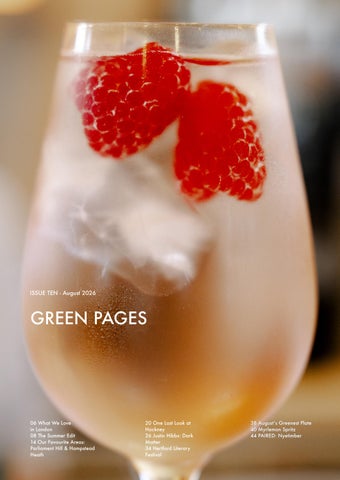
ISSUE TEN - August 2026
GREEN PAGES
06 What We Love in London 08 The Summer Edit 14 Our Favourite Areas: Parliament Hill & Hampstead Heath
20 One Last Look at Hockney 26 Justin Hibbs: Dark Matter 34 Hertford Literary Festival
38 August’s Greenest Plate 40 Myrlemon Spritz 44 PAIRED: Nyetimber
HELLO AUGUST Prue Freeman & Tom Onions, Daisy Green Collection Founders
One of the pleasures of putting Green Pages together each month is discovering the unexpected connections between stories. Often they aren’t planned, but somewhere along the way a common thread begins to emerge. This issue became one about perspective.
We hope this issue inspires you to explore somewhere new, revisit somewhere familiar, or simply see the city you thought you already knew from a fresh perspective.
Across these pages you’ll meet artists and creatives who invite us to see the world through a different lens. David Hockney finds endless inspiration in a single stretch of Normandy countryside, while Justin Hibbs reflects on the energy and creativity of Mexico City’s art scene. That same idea continues as we head to Hampstead Heath, where Parliament Hill Café has entered an exciting new chapter. Beyond the café itself, the Heath remains one of London’s greatest reminders that the city doesn’t always need to move at full speed. Sometimes the best way to experience it is simply to slow down, take a walk and notice what’s around you. London’s relentless summer brought us all out to play. The Summer Edit looks back at some of our favourite moments from across the Daisy Green collection during one of the hottest summers in recent memory. Alongside that, we’ve rounded up some of the best things happening across the capital this month, from exhibitions and outdoor festivals to seasonal food, wine and plenty of reasons to gather with friends.
ISSUE 10 - AUGUST 2026
1
THE 08. CON 14. TENTS 6.
What We Love In London
The Summer Edit
Our Favourite Areas: Parliament Hill & Hampstead Heath
ISSUE TEN - AUG 2026
2
GREEN PAGES
22. 38. One Last Look at Hockney
August’s Greenest Plate
26. 40. Justin Hibbs: Dark Matter
Myrlemon Spritz
34. 44. Hertford Literary Festival
PAIRED: Nyetimber
ISSUE 10 - AUGUST 2026
3
4
GREEN PAGES
AUGUST GUIDE What to see, do and where to visit this month.
ISSUE 10 - AUGUST 2026
5
01 fiaformulae.com
03 Notting Hills Carnival Shutterstock
02 Marilyn Monroe™; Rights of Publicity and Persona Rights are used
04 nationaltheatre.org.uk
with permission of The Estate of Marilyn Monroe LLC. Photo by Sam Shaw © 2026 Shaw Family Archives
WHAT WE LOVE IN LONDON Our favourite exhibitions, openings and seasonal moments across the city this month.
Formula E London E-Prix (15–16 August) The ABB FIA Formula E World Championship returns to London as the season finale takes over the ExCeL circuit. The unique indooroutdoor track promises two days of high-speed electric racing, with tickets starting from £20, making it one of the capital’s most accessible major sporting events of the summer. Marilyn Monroe: A Portrait at the National Portrait Gallery (until 6 September) There’s still time to catch Marilyn Monroe: A Portrait before it closes at the National Portrait Gallery. Created in collaboration with the Marilyn Monroe estate, the exhibition explores the Hollywood icon’s life, career and legacy through works by some of the most celebrated photographers and artists of the 20th and 21st centuries. Notting Hill Carnival (30–31 August) Europe’s largest street festival returns to west London for a weekend of Caribbean culture, music and celebration. Notting Hill Carnival fills the streets with colourful costumes, steel bands, sound systems and incredible food, drawing millions of visitors each year.
6
GREEN PAGES
Electra / Persona at the National Theatre (from 19 August) Cate Blanchett returns to the London stage alongside Nina Hoss in Electra/ Persona, a bold new production at the National Theatre. Directed by Benedict Andrews, the play fuses Sophocles’ ancient tragedy with Ingmar Bergman’s Persona, creating an exploration of identity, grief and performance in one of the year’s most anticipated theatre shows. BBC Proms at the Royal Albert Hall (throughout August) Summer in London wouldn’t be complete without the BBC Proms. Running throughout August, the world-renowned classical music festival brings orchestras, soloists and conductors from across the globe to the Royal Albert Hall, alongside family concerts, late-night performances and the much-loved Proms atmosphere. London Parks Exhibition at the Southbank Centre (throughout August) Celebrating the capital’s much-loved green spaces, this free exhibition explores how London’s parks have shaped the city’s social, cultural and environmental history. Through photography, archive material and contemporary artworks, visitors can discover the stories behind the landscapes that continue to define everyday life across London.
Greenwich + Docklands International Festival (throughout August) London’s leading free outdoor performing arts festival transforms parks and public spaces across Greenwich, Newham and Tower Hamlets. Expect spectacular theatre, dance, circus and large-scale installations in some of the city’s most unexpected locations.
01
02
05 BBC Proms bbc.co.uk
07 festival.org
06 southbankcentre.co.uk
03
04
05
06
07
ISSUE 10 - AUGUST 2026
7
THE SUMMER EDIT
8
GREEN PAGES
Some of our favourite moments from a summer well spent.
ISSUE 10 - AUGUST 2026
9
F
rom sun-soaked terraces and long-table feasts to wine dinners, cultural collaborations and community celebrations, every season brings something new to the Daisy Green calendar. As summer continues, we’re taking a look back at some of the moments that have brought our venues to life, and perhaps offering a little inspiration. Over the past few months, our restaurants and cafés have welcomed everything from artist exhibitions and book launches to exclusive dining experiences, live performances and seasonal gatherings. Whether celebrating with friends over a long lunch, discovering a new artist or raising a glass at one of our wine dinners, it’s these shared experiences that make each season unique. Here’s a snapshot of some of our favourite moments from across the Daisy Green collection so far this summer.
10
GREEN PAGES
ISSUE 10 - AUGUST 2026 11
12
GREEN PAGES
ISSUE 10 - AUGUST 2026 13
OUR FAVOURITE AREAS:
PARLIAMENT HILL: HAMPSTEAD HEATH Where to stay, eat and explore around Hampstead Perched on one of London’s highest points, Hampstead has long attracted artists, writers and free thinkers looking for space, fresh air and inspiration. In the 18th and 19th centuries, visitors escaped the smoky city for the area’s clean spring water and open heathland, while literary figures including John Keats, D.H. Lawrence and George Orwell all found themselves drawn to its winding lanes and village atmosphere.
Today, much of that character remains. Georgian cottages, hidden alleyways and centuries-old pubs sit alongside independent bookshops, cafés and galleries, while Hampstead Heath offers more than 790 acres of woodland, meadows and wild swimming ponds just a few miles from central London. Climb to the top of Parliament Hill and you’ll find one of the capital’s most celebrated views, stretching from the City skyline to Canary Wharf.
It’s this balance of village charm and wide-open green space that makes Hampstead one of London’s most enduring neighbourhoods, equally suited to a leisurely afternoon stroll as it is to losing track of time entirely. Nearest Station: Hampstead or Gospel Oak.
Stay: The Bull & Last
Eat: The Wells Tavern
168 Highgate Road, London NW5
30 Well Walk, London NW3 1BX
Standing at the northern edge of Hampstead Heath, The Bull & Last combines the warmth of a traditional London pub with the comfort of a boutique country inn. Its handful of individually designed bedrooms offer a peaceful retreat, while downstairs the award-winning restaurant has earned a loyal following for its seasonal British menu.
Just moments from Hampstead Heath, The Wells Tavern is one of the area’s best-loved pubs. Set within an elegant Georgian building, it’s the perfect place after a walk across the Heath, whether for a leisurely lunch or a wellearned pint in front of the fire.
With Parliament Hill just moments away and both Hampstead and Kentish Town within easy reach, it’s an ideal base for discovering one of London’s greenest and most characterful corners.
The Wells has become something of a Hampstead institution under the stewardship of Beth Coventry, who has run the pub since 2003 and is widely credited with transforming it into one of London’s original destination gastropubs while retaining its welcoming neighbourhood feel.
thebullandlast.co.uk
thewellshampstead.co.uk
14
GREEN PAGES
Parliament Hill Café: A New Chapter on the Heath Few places in London capture the spirit of Hampstead Heath quite like Parliament Hill Café. Set beside the famous viewpoint, playground and sports facilities, it’s the natural stopping point for morning dog walks, post-run coffees, weekend brunches and afternoons spent exploring one of the capital’s greatest green spaces. Following a thoughtful refurbishment, the café has entered a new chapter while remaining firmly rooted in its surroundings. Bright, welcoming interiors, improved facilities and generous outdoor seating create a relaxed space to pause, whether you’re meeting friends, refuelling after a swim in the bathing ponds or simply soaking up the atmosphere of the Heath. Like Hampstead itself, Parliament Hill Café is all about slowing down. Grab a speciality coffee before climbing to one of London’s finest viewpoints, settle in for an Australian-inspired brunch after a morning walk, or simply take a moment to enjoy the landscape. It’s a place designed to become part of your day on the Heath and one you’ll want to return to time and time again.
More Info on Parliament Hill Cafe
ISSUE 10 - AUGUST 2026 15
16
GREEN PAGES
ISSUE 10 - AUGUST 2026 17
ART AT PARLIAMENT HILL CAFE
A
ny hang of art is shaped by certain idiosyncrasies – where it is housed, the surprising connections that emerge, trains of thought running together from parallel tracks, and sometimes a little serendipity. The artworks gathered here reflect all these elements, bringing together some of our most cherished artists alongside others that are new and reflect the history of the Heath and the many who have taken inspiration from it. We are delighted to present and share them, taking Parliament Hill Café and Hampstead Heath’s glorious surroundings as our starting point. We kick things off with Peter Liversidge’s large ‘HELLO’ flag, a welcoming greeting as you enter the café, which has special meaning for us. 18
GREEN PAGES
A London-based artist, Peter’s commissions include helping to launch the new extension at Tate Modern. He was originally commissioned by us to celebrate the reopening of London’s hospitality industry after the pandemic with a special edition of HELLO T-shirts based on his famed flags. These brought a little joy and love while raising money for two hard-hit charities: the House of St Barnabas and the North Paddington Food Bank. Peter’s internationally recognised work captures what he describes as the ‘notion of creativity’ and the idea that art is most successful when it sits slightly outside conventional definitions of fine art.
Humour is a rare commodity in contemporary art, and it is one that both Peter Liversidge and David Shrigley share. Beyond Peter’s flag are three irresistibly deadpan, foodrelated missives by Shrigley. David first came to prominence in the 1990s for distinctive drawings whose subject matter often displays a witty absurdity, rendered in a deliberately crude, seemingly amateurish style. It is a sublime comedy with a distinctly British sense of the surreal, gently prodding us to “always look on the bright side of life.” We have selected images relating to the café’s favourite dishes. Following these are Katrina Blannin’s ‘Domenica’ series of prints, whose circular motifs bring a burst of springlike joy through a distilled sense of form and colour. Blannin uses the circle to explore a space where chromatic patterns unfold in intuitive formations, shaped in part by her unique monoprinting process. Her work is an investigation into the history of colour in painting, examining perception and deception via Josef Albers’ influential ‘Interaction of Colour’ exercises and developments in early Renaissance painting.
ISSUE 10 - AUGUST 2026 19
Colour leads us to the signature Cadmium Yellow and Payne’s Grey of Graham Crowley’s work, whose subject is a sustained fascination with light, shadow and luminosity in painting. An understated humour underpins the title, ‘The Stray Dog’, suggesting a ‘Where’s Wally?’ moment: somewhere amidst the gestural brushstrokes there is a lost dog to be found. Crowley’s statement, ‘I paint shadows’, is a masterclass in simplicity, distilling a lifetime’s focus on the craft of painting into a single phrase. The addition and removal of wet paint over a light-coloured ground generate luminosity and an illusory quality that speaks to the complex experience of seeing. Graham was the recent winner of the John Moores Painting Prize, the most prestigious prize for painting in the UK – longoverdue recognition for one of our finest contemporary painters. Alongside Crowley is another of this country’s most celebrated contemporary painters, Hurvin Anderson, with a special edition print of his painting ‘Chicken Wire’ from the Country Club series. Those entering the Heath from the Parliament Hill side will pass the Hampstead Heath tennis courts, and his depiction of this familiar scene is a masterful play between abstraction and figuration. The vivid red and green of the court, bathed in summer light and seen through the geometric mesh of the chicken wire, dramatises the act of looking with a cinematic sense of memory and tropical reverie. These two artists connect us to the English landscape tradition, allowing us to experience the world anew through their focus on looking. One of the greatest exponents of the English landscape, John Constable, produced an extensive collection of paintings, sketches and cloud studies of Hampstead Heath after moving here in 1819. Over almost two decades, the rolling landscapes, unique light and dramatic skies of the Heath became one of his greatest inspirations. Painting in the open air directly from the landscape, Constable captures the transient beauty and luminescence
20
GREEN PAGES
of the sky in more than 100 cloud studies, represented here by our reproduction, central on the wall. Two contemporary artists to the left of Constable pay homage to him in their own inimitable ways. Sasha Bowles, from her project ‘Taking Liberties with the Masters’, presents mischievous painterly interventions, rendered in exquisite detail, on postcard reproductions of Constable paintings. These discrete deceits have a distinctly British sense of the absurd and surreal – a humorous collaboration with the past, seducing us into a double take. ‘For John Constable’ by Peter Blake was originally commissioned in 1976 by gallerist Bernard Jacobson for an exhibition of the same name, celebrating the 200th anniversary of Constable’s birth, and shown again this year to mark the 250th. Blake adopts a playfully conceptual
approach, using his daughter Liberty as the sitter. He presents multiple versions of her image – as an etching, a photograph, a tracing and a postcard – laying bare the mechanics of image-making and the different ways a single subject can be represented. To the right of ‘Constable’s Cloud Study Hampstead’ we have a pair of ‘Winter Drawings’ by Peter Liversidge. Made exclusively during the winter season on the endpapers of books and exhibited as diptychs, these works are created with black masking tape, delicately cut with a surgical scalpel. They capture the quiet essence of the season’s cycle through to winter and the slowed time needed to imagine the missing narrative between the endpapers. We hope that you enjoy!
ISSUE 10 - AUGUST 2026 21
ONE LAST LOOK AT HOCKNEY As David Hockney’s landmark Serpentine exhibition enters its final weeks, there’s never been a better time to revisit one of Britain’s greatest artists.
T
here are some exhibitions that linger in your mind long after you’ve left. David Hockney’s A Year in Normandie and Some Other Thoughts About Painting is one of them. After months at Serpentine North, the exhibition is now entering its final weeks, making this the perfect moment to catch it before it closes. Following Hockney’s death earlier this summer, and with the Bayeux Tapestry making its historic journey to Britain for the first time in almost a thousand years, the exhibition feels especially timely. The connection between the two is no coincidence.
Serpentine North, 2026 © David Hockney. Photo: George Darrell
Stretching more than 90 metres around the gallery, A Year in Normandie was inspired by the Bayeux Tapestry’s remarkable storytelling. But instead of recording kings, battles and conquest, Hockney turns his attention to the changing Norman landscape. Created on an iPad while living in rural Normandy during lockdown, the work unfolds through blossom, birdsong, summer foliage, autumn colour and bare winter branches, capturing an entire year in one continuous panoramic painting. It’s an ambitious piece, but one that feels remarkably accessible. As you walk alongside it, you’re not expected to decode hidden meanings or understand art history. Instead, you’re 22
GREEN PAGES
David Hockney at Audrey Green 2023
On the Specials Board: Hockney’s Fish Pie Created for David Hockney during one of his visits to Larry’s, this dish has become a muchloved special. Available at Larry’s.
Serpentine North, 2026 © David Hockney
invited to do something Hockney encouraged throughout his career: look more carefully. For decades, Hockney found beauty in the things many of us pass every day. A winding country lane. The changing light across a field. Blossom bursting into life after winter. His paintings remind us that familiar places can still surprise us if we give them our attention. Alongside the monumental Norman frieze, the exhibition also brings together a selection of more recent paintings, portraits and still lifes, offering a glimpse into the curiosity and energy that continued to define Hockney’s work well into his eighties. Every room feels optimistic, full of colour and completely alive.
The timing couldn’t feel more fitting. As London welcomes the Bayeux Tapestry for its first visit in almost a millennium, Hockney’s modern response to the Norman landscape provides a fascinating companion. One tells the story of a defining moment in medieval history; the other celebrates the changing seasons, the passing of time and the enduring beauty of the same region nearly a thousand years later. Whether you’ve been meaning to visit all summer or are discovering the exhibition for the first time, A Year in Normandie is one of London’s cultural highlights and a wonderful way to celebrate the legacy of an artist who never stopped finding inspiration in the world around him.
David Hockney: A Year in Normandie and Some Other Thoughts About Painting runs at Serpentine North until 23 August. Admission is free.
ISSUE 10 - AUGUST 2026 23
24
GREEN PAGES
CULTURE AT DAISY GREEN
ISSUE 10 - AUGUST 2026 25
26
GREEN PAGES
DARK MATTER Justin Hibbs on Mexico City, creative community and his latest solo exhibition
Daisy Green has proudly supported artist Justin Hibbs’ latest solo exhibition, Dark Matter, at Arróniz Arte Contemporáneo in Mexico City. Speaking with fellow artist Rosalind Davis, Justin reflects on his long-standing relationship with the city, the creative community that keeps drawing him back, and the ideas behind his new body of work.
ISSUE 10 - AUGUST 2026 27
How did your relationship with Mexico City begin? Rosalind Davis: You’ve exhibited and visited Mexico City many times. How did your relationship with Arróniz Arte Contemporáneo and the city itself first begin? Justin Hibbs: I first met Gustavo Arróniz in 2013, when he visited a show I was having with my gallery in Zurich, which he was collaborating with at the time. It started with an exchange exhibition between Mexican and European artists and has since developed through a range of projects at Arróniz. From group shows and commissions to my first solo exhibition in 2018 and now my second this year, it’s grown into a really strong relationship, not just with Gustavo, but with the city’s artists, creative community and wider culture.
28
GREEN PAGES
Carbon Bloom, 2018-26, Unique Giclée print on Hahnemuhle photo rag paper Dry mounted on Alubond, 240 x 180cm
What keeps bringing you back? RD: You’ve described developing a relationship not just with the gallery, but with the city itself. JH: It’s become something of a love affair. Mexico City has an incredible creative energy, not just through its art scene but across its wider culture. The food is extraordinary and a large part of every visit is simply eating our way through the city while exploring its architecture. For a visual artist, it’s a constant source of inspiration. Historic colonial buildings sit alongside Art Deco, mid-century modernism and striking contemporary architecture. Everywhere you look there’s something visually exciting.
ISSUE 10 - AUGUST 2026 29
A City Full Of Colour RD: The colour always strikes me too. Every street seems to have its own personality, and even the food feels incredibly vibrant. What was your food highlight this time? JH: Definitely Tetetlán. We actually went twice so we could all have the octopus dish to ourselves rather than sharing it. It’s located within Casa Pedregal, designed by Mexico’s renowned architect Luis Barragán. Built into volcanic rock with glass floors, it also houses an incredible library of books and records.
Working with Arróniz RD: Tell me about your relationship with the gallery. JH: Trust between an artist and a gallery is everything. Gustavo gives me the freedom to develop the work I want to make, and I have enormous respect for his vision and the innovative program he has established at the gallery. Arróniz celebrates its twentieth anniversary this year, having overcome significant challenges, including losing its previous gallery during the 2017 earthquake. That resilience reflects the strong community surrounding the gallery and the friendships I’ve built there over the years.
30
GREEN PAGES
How does Mexico City’s art scene compare with London? RD: One thing that stood out to me was the generosity of the creative community, a genuine willingness to engage in the work being shown... JH: That’s something I’ve always loved about the city. Making work is often more affordable, which naturally creates opportunities for collaboration. During one of my earliest visits, another artist lent me part of a shared studio that was bigger than my entire London workspace. The artists regularly cooked together, shared meals and discussed each other’s work. That generosity of spirit and genuine sense of community is something that has stayed with me ever since.
ISSUE 10 - AUGUST 2026 31
Inside Dark Matter RD: This exhibition follows on from your previous solo show in 2018. How are they connected? JH: This exhibition picks up threads from the previous show, ‘Between, Before and After’, which featured works on newspaper pages. That project saw me beginning to grapple with events beyond the studio; the dizzying impact of rolling 24-hour global news cycles, the emergent posttruth reality in our political discourse and its implications as we transitioned towards fractured digital information spaces. So, the current show ‘Dark Matter’ picks up the baton with some small overlooked newspaper fragments that I had kept from that time, which are covered in black blooms of ink - remnants from cleaning my printmaking rollers. I had those small pieces photographed, enlarged and printed at a monumental scale. What we see are fragments of the news stories, poking through a dissonant layer of inky black visual noise. The pieces narrate the collapse of ink on paper as the primary carrier of information and communication that has been with us for hundreds of years. The works ask questions about how visual art might address this moment, a shifting, borderless terrain, whilst celebrating the pathos and beauty to be found in these disintegrating fragments soon to be the stuff of the past.
32
GREEN PAGES
Creating A Slower Experience RD: Music also plays an important role within the exhibition. JH: I’m aware that attention spans are becoming diminished by our digital age, and I wanted to create something that slowed down the whole process of looking. Working with my long-term musical collaborators Ben Lancaster (modular synths), Sean Roche (saxophones), with contributions from Francine Loze (cello) and David X Green (piano), we created a sound composition to accompany the visual works. Our idea was to create an imaginative drift into a landscape of sonic visions that mirrors the visual journey, moving from analogue instrumentation through to a digital soundscape. RD: I think pairing the sonic and visual allowed the audience to access the work on a more emotional level, emphasising a sense of longing and hope, as well as melancholy and loss a sense of the familiar and estranged.
ISSUE 10 - AUGUST 2026 33
CELEBRATING STORIES BEYOND LONDON Daisy Green was proud to support this year’s Hertford Literary Festival, celebrating a weekend of books, music, ideas and inspiring conversation.
A
t Daisy Green, we’ve always believed great conversations begin around the table. This summer, those conversations extended beyond our cafés as we proudly supported the eighth Hertford Literary Festival, a two-day celebration of books, music, history and creativity held at the historic Hertford Club. The festival brought together an eclectic mix of authors, musicians, photographers and cultural figures, creating an intimate space where audiences could hear directly from the people behind the stories.
34
GREEN PAGES
Among this year’s highlights were original Clash drummer Terry Chimes discussing his memoir, photographer Greg Brennan sharing three decades behind the lens, and Dee Anderson reflecting on growing up with the world of Thunderbirds. Alongside nationally recognised names, the programme also showcased local writers, historians and musicians, making the festival a genuine celebration of Hertford’s creative community. Supporting events like Hertford Literary Festival reflects something that sits at the heart of Daisy Green: bringing people together through culture, conversation and community. Whether it’s hosting artist residencies in our cafés, championing emerging creatives or supporting festivals that celebrate storytelling in all its forms, we’re always delighted to play a small part in helping those conversations continue.
ISSUE 10 - AUGUST 2026 35
36
GREEN PAGES
COOKING WITH DAISY
FOOD AND DRINK
ISSUE 10 - AUGUST 2026 37
38
GREEN PAGES
AUGUST’S GREENEST PLATE Sweet peas, crisp beans and summer greens take centre stage this August.
There’s a point in every British summer when the vegetables finally start showing off.
themselves, bringing colour, texture and flavour that only comes around for a few short months each year.
The peas are sweeter, the beans have more crunch, and market stalls suddenly fill with every shade of green imaginable. After months of root vegetables and hearty winter cooking, August is the season that reminds us just how good simple produce can be when it’s picked at the right time.
Whether you’re adding grilled chicken, opting for tofu or enjoying it exactly as it comes, the Green Goddess Salad is a small celebration of summer produce while it’s at its very best.
Across the Daisy Green Collection, that feeling arrives in the form of our Green Goddess Salad. It’s the sort of dish that captures the season on a plate: crisp French beans, tenderstem broccoli, cauliflower and sweet garden peas, all brought together with creamy avocado, roasted coconut and crunchy pepitas. What makes it work is the contrast. Fresh vegetables with plenty of bite, richness from the avocado and a satisfying crunch from the seeds and coconut. Light enough for a sunny lunch, substantial enough to keep you going through an afternoon of meetings, park walks or people-watching from a terrace table.
At Home: Blanch French beans, tenderstem broccoli, cauliflower florets and garden peas until just tender, then cool in iced water to keep them vibrant. Toss with sliced avocado, toasted pumpkin seeds and toasted coconut flakes, before finishing with a generous drizzle of a lemon and herb vinaigrette. Simple, fresh and at its best on a warm August afternoon.
The best seasonal dishes are often the simplest. When ingredients are at their peak, they don’t need much dressing up. August’s vegetables do the hard work
ISSUE 10 - AUGUST 2026 39
COCKTAIL OF THE MONTH:
MYRLÈMON SPRITZ Some drinks capture a season. Others capture a place. This month’s Cocktail of the Month manages to do both, bringing the flavours of Australia’s subtropical east coast to the heart of London. At the centre of the Myrlèmon Spritz is lemon myrtle, an extraordinary native Australian botanical that many describe as tasting even more lemony than lemon itself. Native to the narrow coastal belt where the rainforest meets the ocean, stretching from Byron Bay to Port Douglas, the aromatic leaf has been used by First Nations communities for generations before becoming one of Australia’s most celebrated native ingredients. Rich in naturally occurring citral, it delivers an intense citrus fragrance without the sharp acidity of fresh lemon, resulting in a flavour that’s bright, rounded and remarkably smooth. That distinctive ingredient is transformed into Myrlèmon, a contemporary Australian aperitivo
40
GREEN PAGES
crafted using Queensland sugarcane spirit and sustainably grown lemon myrtle. Rather than overwhelming sweetness, it offers delicate botanicals, vibrant citrus and a clean, refreshing finish that lends itself perfectly to long summer serves. Throughout August we’re serving it simply as the Myrlèmon Spritz; topped with sparkling wine, finished with soda and poured over plenty of ice. It’s light, aromatic and wonderfully refreshing, equally suited to a leisurely lunch or an early evening aperitif as the day begins to wind down. The only catch? You won’t spot it on the menu. Available exclusively as a special at Margot Green throughout the month, the Myrlèmon Spritz is one of those hidden gems reserved for guests in the know. Ask your server and discover one of Australia’s most exciting native botanicals in a glass.
ISSUE 10 - AUGUST 2026 41
42
GREEN PAGES
AUSSIE HEROES:
BEACHTREE DISTILLERY Nestled in Queensland, Beachtree Distilling Co. has earned an international reputation for combining Australian native botanicals with precision craft distilling. Led by master distiller Steve Grace, the distillery has become known for creating spirits that celebrate Australia’s unique landscape while placing sustainability at the heart of every bottle. Steve’s background as a mechanical and electrical engineer shapes the meticulous approach behind every spirit. After years of experimentation, he turned his attention to lemon myrtle, a native leaf whose naturally high concentration of citral delivers an astonishingly vibrant citrus character. Rather than trying to imitate traditional citrus liqueurs, Myrlèmon embraces something distinctly Australian, showcasing the botanical in its purest form.
Sustainability is equally central to the distillery’s philosophy. Production takes place at a solar-powered facility, while Myrlèmon is bottled in recycled glass with recycled closures, reducing environmental impact without compromising on design. The warm amber hue of the bottle is even a natural characteristic of the recycled glass itself, becoming part of the brand’s identity rather than something to hide. The approach has earned widespread recognition. Beachtree Distilling Co. has collected multiple international gold medals for Myrlèmon, while Steve Grace has twice been recognised as the World’s Best Craft Producer. Together, they continue to champion Australian ingredients on the global stage, proving that some of Australia’s oldest and most exciting flavours have been growing quietly on its subtropical coast all along.
ISSUE 10 - AUGUST 2026 43
PAIRED WITH NYETIMBER This month, our Paired series heads to Peggy Jean for an evening celebrating one of England’s greatest wine success stories.
There was a time when English sparkling wine was met with raised eyebrows. Today, it’s winning international awards, appearing on some of the world’s finest wine lists and giving Champagne genuine competition. Few producers have done more to change perceptions than Nyetimber.
Today, Nyetimber remains one of the country’s leading producers, crafting every bottle exclusively from estategrown fruit across Sussex, Hampshire and Kent. By overseeing every stage of production, from vineyard to bottle, the team has earned a reputation for exceptional consistency, elegance and precision.
The estate’s history stretches back almost a thousand years, but its modern story began in 1988 when it became the first English vineyard to plant the three classic Champagne grape varieties: Chardonnay, Pinot Noir and Pinot Meunier. It was a bold move that helped shape the future of English winemaking.
This month, we were delighted to welcome Nyetimber to Peggy Jean for the latest edition of our Paired dinner series. Set against the backdrop of the Thames in Richmond, guests enjoyed six exceptional sparkling wines, each thoughtfully matched with a seasonal menu designed to showcase the character of every pour.
44
GREEN PAGES
The evening began with Classic Cuvée alongside pickled oyster, horseradish crème fraîche and dill, before moving through Blanc de Blancs 2017 with shellfish crumpet and Tillington Single Vineyard 2016, paired beautifully with Cornish plaice, sauce gribiche and caviar. The richer courses were matched with 1086 by Nyetimber 2014 and the beautifully expressive Rosé MultiVintage, before the evening finished on a sweet note with Cuvée Chérie Demi-Sec, served alongside white chocolate choux, strawberry and vanilla cream.
ISSUE 10 - AUGUST 2026 45
A
s pioneers of English sparkling wine, Nyetimber has helped redefine what homegrown wine can achieve. With vineyards dedicated exclusively to sparkling production and an award-winning portfolio recognised around the world, the estate has played a leading role in putting English wine firmly on the global map. We spoke with Charles Lowe, Brand Ambassador at Nyetimber, about what makes English sparkling so distinctive, his favourite food pairings, and how to get the very best from a bottle at home. English sparkling wine has come a long way in recent years. What do you think makes it so special today? “I think the time in which the quality of English sparkling has come to light. As the first to grow Chardonnay, Pinot Noir and Pinot Meunier exclusively for sparkling wine in the UK, Nyetimber is less than 40 years old and we have shown our quality through the wines and the awards that they have won, especially with the IWC best sparkling wine producer award wins in 2018 and 2025, this is not only exciting for us but the category as a whole.” For someone trying English sparkling wine for the first time, which Nyetimber bottle would you recommend and why? “I would recommend starting with Nyetimber Classic Cuvee multi-vintage, this is our flagship wine and reflects the elegance, delicacy and balance that you can expect from the rest of our portfolio.” 46
GREEN PAGES
What’s a food pairing you love with Nyetimber that might surprise people? “I think that the most surprising pairing option for people would come from Cuvee Chérie, while made with desserts in mind, it pairs wonderfully with dishes with light spice such as deep-fried softshell crab and sweet chilli sauce.” What’s the biggest misconception people have about English sparkling wine? “I would say the end goal of the wine, I think that many assume England is trying to emulate Champagne. While the wine we make at Nyetimber uses the same grapes and method, the terroir and climate result in a style of wine that is uniquely its own.” Is there one tip you’d give people for getting the most out of a bottle at home? “At home, the goal is your own enjoyment, as such I would serve the wine at whatever temperature, in whatever glassware suits you best. My personal preference is to serve the wine between 7-10 Celsius in a tulip style glass.”
AUGUST PAIRED PICKS UT DO SOL 31 MARCH
JIM BARRY (£140pp) UT APRIL O29
OLD
S MICHAEL HILL SMITH MW FROM SHAW + SMITH (£140pp) UT D O06 MAY
SOL
HENSCHKE (£160pp) UT D O03 JUNE
SOL
TORBRECK (£140pp) Classic Cuvée Multi-Vintage Classic Cuvée Multi-Vintage The wine that defines Nyetimber. A blend of Chardonnay, Pinot Noir and Pinot Meunier, it balances crisp citrus and orchard fruit with notes of brioche, honey and toasted pastry, finishing with the fine, elegant mousse that has become the producer’s signature.
UT D O24 JUNE
SOL
WILLUNGA (£140pp) 22 UT JULY
DO
SOL
ENGLISH SPARKLING SPECIAL NYETIMBER (£150pp) 30USEPTEMBER T
LD O
SO GROSSET & MT HORROCKS (£140pp)
21 OCTOBER
VASSE FELIX WINES (£140pp) OUT 18D NOVEMBER
SOL
PENFOLDS (£200pp)
2026 LISTINGS
Blanc de Blancs 2017 Made only in exceptional vintages, this all-Chardonnay sparkling wine is wonderfully refined, with layers of lemon, white peach and green apple complemented by subtle toasted almond, fresh pastry and a distinctive mineral finish.
ISSUE 10 - AUGUST 2026 47
MY LONDON: PETER LIVERSIDGE P
eter lives and works in London, and much of his work focuses on the conceptual practice of creating typewritten proposals for performances and artworks across a wide range of media. Created on an old manual typewriter, complete with typographical errors and hand annotations, the proposals describe ideas ranging from the practical to the purely hypothetical. Some of his performances, such as Gin or Hot Dog Stands, present the viewer with a piece of work to take away with them. Another aspect of his practice involves sending various objects through the post, unwrapped and adorned with stamps and handpainted addresses. Liversidge considers the postal service to be a collaborator in the work. Peter was originally commissioned by the Daisy Green Collection to celebrate the reopening of London’s hospitality industry after the pandemic with a special edition of HELLO T-shirts based on his famed flags.
RECORD SHOP TOP THREE: 1.
2.
3.
Stranger than Paradise, Mare Street, Hackney – excellent stock, brilliant staff and in-store events. World of Echo, Cheshire Street, off Brick Lane – great second-hand section, and esoteric releases on their own label, all of which are good. Sounds of the Universe, Broadwick Street, Soho – a favourite place to shop with my two sons who have been coming record shopping with me since they were three and a half.
PUBLIC PARK:
Abney Park Cemetery © Fred Adams Photography
48
GREEN PAGES
Abney Park Cemetery, Stoke Newington, is cool on the hottest days and full of hidden corners. The Lion Tamer’s grave is one to look out for. It’s close to some great shops on Church street and not far from the Spence Bakery, which is excellent – especially their raspberry bostock.
WATCHING SPORT:
Going to watch cricket in London is a treat, especially either at Lords or the Oval. It’s like stepping into an oasis. A good way to see cricket without the hefty price tag of a test match is to go to county games and take a packed lunch. Tickets are £15 for a whole day - it’s very relaxed and a good place to think whilst being totally distracted. Take a hat and sunglasses.
WALKING:
Walking in London is one of the things I wish I had more time to do. Often with my friend the photographer Mischa Haller, walking is a great way to be introduced to new places at a ‘slower than London’ pace.
BETHNAL GREEN POST OFFICE: COFFEE SHOP:
Doppio on Kentish Town Road. Excellent coffee in what can feel like a storeroom, but don’t let that put you off. Their coffee is great and their vegan breakfast cookie is so good too, especially with an oat milk flat white.
The best staff and post office in London. Not far from my studio, they have been accepting my postal objects since the late 90s, (Thank you!).
RESTAURANT:
Kula Kula Sushi in Soho. I’ve been going there for 25-30 years. Both my sons have been obsessed since their first visit. When I go there with them, almost always afterwards we take the short walk to Gelupo on Archer Street for ice cream. I also LOVE Toklas on Surrey Street, off the Strand. It is continually and consistently excellent.
MUSIC VENUE:
I can’t imagine London without Café Oto in Dalston. It’s a venue I’ve been going to pretty much since it opened. I’ve seen some of the best shows anywhere in the world there. It is always good, sometimes challenging, always exactly what you need on the day or evening you are there. The bookshop and record shop are stocked with books you can’t find anywhere else and with records you didn’t know you needed. Also, there’s a great Turkish restaurant about 5 minutes from there on Crossway called Yeni Umut 2000. ISSUE 10 - AUGUST 2026 49
Green Pages by The Daisy Green Collection