Page 2 • Dairy Conference and Expo Special Edition • Saturday, November 14, 2015
Dairy Conference and Expo Special Edition • Saturday, November 14, 2015 • Page 3
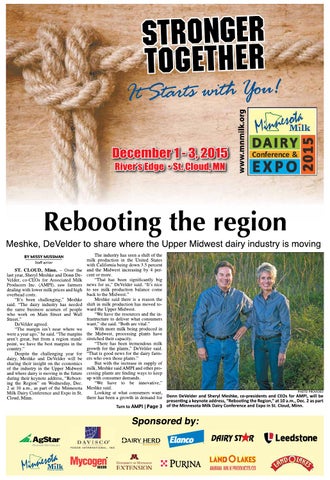
Continued from AMPI | Page 1 milk fat, cheese and whey protein. “There has been an expansion in the market share,” DeVelder said. “One of the drivers for the demand in milk fat was the recent news that the ‘good’ fats found in dairy products are good for you.” Due to the growth in the market share, processing plants like AMPI are operating at full steam to keep up with demand. “We have kept an eye on the dairy products in demand and worked to meet those demands through our manufacturing network,” Meshke said. “Lately, we have focused on the protein market. That has been a real growing area.” DeVelder saw the importance of sharing those changes with the dairy producers. MARK KLAPHAKE/DAIRY STAR FILE PHOTO “We want to offer producers inforThe Discover Alley Trade Show for the Minnesota Milk Dairy Conference mation of where the market is going to and Expo will be in a smaller space, while maintaining the same number of help them further develop and adjust exhibitors. their business plans,” DeVelder said. Another area Meshke and DeVelder will briey touch on during their keynote address is the Trans-Pacic Partnership (TPP) trade agreement. “The trade agreement and how it will impact farmers is a hot topic right now, especially since Minnesota borders Canada,” Meshke said. “I’m sure we’ll get some great discussion.” Seeing all of these changes in the industry, Meshke is very optimistic about the Midwest dairy industry’s future. “There is considerable promise here,” Meshke said. “At AMPI, we will continue to focus on the success of our dairy farmer-owners.” More on DeVelder and Meshke Donn DeVelder and Sheryl Meshke serve as co-presidents and CEOs for Associated Milk Producers Inc. (AMPI). DeVelder has spent more than 30 years with the milk marketing cooperative, beginning as a eld representative providing on-farm consultation and assistance to the co-op’s dairy farmerowners. He then joined the corporate staff at the cooperative’s New Ulm, Minn., ofce. Prior to being named copresident and CEO, DeVelder was the executive senior vice president, responsible for uid marketing and member services. DeVelder is a graduate of the University of Northern Iowa. Meshke has been with AMPI for nearly 25 years. During that time she
888.438.8683
MARK KLAPHAKE/DAIRY STAR FILE PHOTO
On Wednesday evening, MMPA will once again be having the annual scholarship auction prior to the awards banquet. has served as vice president of public affairs and strategic planning. Following appointment as executive senior vice president, she focused on human resources and strategic initiatives aimed at strengthening the Midwest dairy cooperative’s performance and value. Meshke holds a bachelor’s degree in agriculture from South Dakota State University and a master’s degree in business from the University of St. Thomas.
UDDERTECHINC.COM U
AMPI is headquartered in New Ulm, Minn., and owned by 2,500 Midwest dairy farm families from Wisconsin, Minnesota, Iowa, Nebraska, South Dakota and North Dakota. AMPI members annually market about 5.8 billion pounds of milk, resulting in $2.2 billion in sales for the cooperative. AMPI owns 10 manufacturing plants and markets cheese, butter and powdered dairy products, serving food service, retail and food ingredient customers.
DAIRY ST R www.dairystar.com
522 Sinclair Lewis Ave. Sauk Centre, MN 56378 Phone: (320) 352-6303 Fax: (320) 352-5647
General Manager/Editor Mark Klaphake - mark.k@dairystar.com 320-352-6303 (ofce) 320-248-3196 (cell) 320-352-0062 (home) Ad Composition Janell Westerman 320-352-6303 janell.w@dairystar.com Nancy Powell 320-352-6303 nancy.p@dairystar.com Consultant Jerry Jennissen 320-346-2292 President Dave Simpkins 320-352-6577 davesimpkins@saukherald.com Staff Writers Krista Kuzma - Assistant Editor 507-259-8159 • krista.k@dairystar.com Andrea Borgerding Assistant Editor/ Online Editor 320-352-6303 • andrea.b@dairystar.com Missy Mussman (320) 429-1084 • missy@dairystar.com Ron Johnson 608-874-4243 ron.j@dairystar.com Ruth Klossner 507-240-0048 cowlady@centurylink.net Jenn Janak (320) 352-6303 • jenn@dairystar.com Cassie Olson (715) 245-6848 • cassie.o@dairystar.com Maria Hager (320) 352-6303 • maria.h@dairystar.com
Advertising Sales Main Ofce: 320-352-6303 Fax: 320-352-5647 Deadline is 5 p.m. of the Friday the week before publication Sales Manager - Jeff Weyer (Northern MN, East Central MN) 320-260-8505 (cell) jeff.w@dairystar.com Mark Klaphake (Western MN) 320-352-6303 (ofce) 320-248-3196 (cell) Laura Seljan (National Advertising, SE MN) 507-250-2217 fax: 507-634-4413 laura.s@dairystar.com Jerry Nelson (SW MN, NW Iowa, South Dakota) 605-690-6260 jerry.n@dairystar.com Mike Schafer (Central, South Central MN) 320-894-7825 mike.s@dairystar.com Lori Menke (Eastern Iowa, Southern WI) 563-608-6477 • lori.m@dairystar.com
Deadlines The deadline for news and advertising in the Dairy Star is 5 p.m. Friday the week before publication. Subscriptions One year subscription $35.00, outside the U.S. $110.00. Send check along with mailing address to Dairy Star, 522 Sinclair Lewis Ave., Sauk Centre, MN 56378.
EasyFix Stall Divider with rubber Loop and Double Foam Mattress Mat The safest, most comfortable cow stall in the world.
COME AND SEE US AT MIDWEST DAIRY EXPO! Come see us at the Minnesota Milk Dairy Conference and expo
WALKWAYS • STALLS • SLATS www.easyfixrubberna.com • 1-877-247-4685
Page 20 • Dairy Conference and Expo Special Edition • Saturday, November 14, 2015
Smith to share secrets for dairy reproduction success
BY CASSIE OLSON Staff writer
ST. CLOUD, Minn. – Finding a balance between reproductive success and achieving a high production is a challenge often faced by dairy producers. It is not, however, unattainable, according to King Smith of Select Sires, Inc. Smith will address this topic as well as others as he presents a producer panel and two sessions at the Minnesota Milk Dairy Conference and Expo on Dec. 2 and 3 in St. Cloud. As the Western Manager of Technical Service for Select Sires, Inc., Smith has worked with cooperative members and personnel to improve cow reproduction in western United States since 2010. As an experienced consultant, Smith looks forward to the Dec. 2 producer panel’s focus on the producer’s decision whether or not to utilize a technician in reproductive work. “We are going to have a variety of producers that can have an open discussion and dialogue in regards to using professional technicians for their reproductive work,” Smith said. The goal of the discussion is not to sway producers’ decisions either way, but rather to help them decide if technicians are the right option for their herd’s reproduction. “The panel will help producers get an idea on what way they want to go and what it takes to be successful with or without a professional technician,”
Smith said. In addition to the producer panel, Smith has also prepared two sessions that he will be presenting on Dec. 3. The rst session, “Great Repro, High Production: You Can Have it All,” will look at ways producers can nd a balance between high production and reproduction within the herd. “From a commercial standpoint, I want to look at people who are performing at a high level of proKing Smith duction and a high Select Sires level of reproduction,” Smith said. “We will look at dairies that are already doing this and at the practices they utilize to make that work.” The session will look at ways for producers to maximize their reproductive success on the farm, and what they are doing to have a high production to match it. Smith hopes attendees can leave with the tools necessary to improve their success within their own herds. “I want those in attendance to be able to identify the key things these dairies are doing to not only get great production and reproduction, but to maintain it,” Smith said. “Many people think you can only have one or the other, but in reality, you can have both.”
Smith’s second session, “We are Monitoring Performance – Now What?” will cover the things Smith monitors on farms and how they are monitored. “We will explore what success looks like, and the benchmarks that indicate how producers are doing,” Smith said. Smith’s goal is by diving into this information; attendees will leave with a greater sense of what to do after they begin monitoring performance. “After we see these, we will determine the things we need to look at to correct the areas where the dairy is not performing,” Smith said. “We will give recommendations on what to look at and change in order to make production even better.” After producers leave his sessions, Smith hopes they leave with a sense of reection and motivation to make changes on their own dairies. “I would like producers to spend time thinking about where they current-
Attend Smith’s two sessions and producer panel Dec. 2-3
ly are with their situation and hopefully nd some things through the presentations that they can, in turn, make their situation even better,” Smith said. The opportunity to motivate and encourage producers to better their herds excites Smith. “If I can motivate these guys or at least give them some sort of information that motivates them to be more successful from a protability standpoint, that really makes it worth it,” Smith said. More about Smith Smith is a Texas native who has been involved with the industry for over 40 years. At the age of 13, he began working for an area dairy and beef producer. He has continued to be involved in agriculture and the industry ever since. Smith graduated from Texas A&M University with a degree in agricultural economics before going into dairy genetics. He began working in San Antonio where he collected semen and worked with embryo transfers in half of the state. He then moved to California where he ran his own technician business before beginning his work with ABS. While working for ABS, Smith served as the western manager covering ve different states for four years. Smith began his position as the Western Manager of Technical Service for Select Sires, Inc., in 2010 and has been there ever since. He resides in Stephenville, Texas.
Reduce the amount of waste at feeding time, improve your hay harvest efficiency and reduce loss in harvest and storage.
Start a cycle of success. IDEXX PregTests identify open animals early and accurately. Visit our booth at the Minnesota Milk Conference and Expo. For more information, visit idexx.com/pregnancyMN.
KEMCO BENEFITS:
3 Wrap up to 4 bales per minute 240 per hour! 3 Wraps round bales up to 6’6” or square bales to to 6’6” 3 Increase protein content by up to 8% by wrapping balage 3 Simple & easy to use one person operation 3 Heavy Built unit - 5,500 lbs.
Model 260 and 262 Units In Stock! Eliminate the rush of baling hay for threat of an oncoming storm! Optional Self-Propelled Drive Unit Available
Test with Confidence © 2015 IDEXX Laboratories, Inc. All rights reserved. 107706-01 • All ®/TM marks are owned by IDEXX Laboratories, Inc. or its affiliates in the United States and/or other countries. The IDEXX Privacy Policy is available at idexx.com.
SAUK CENTRE, MN
320-352-6543 • Hwy. 71 South
PIERZ, MN
320-468-2161 • Hwy. 27 West
Store Hours: Monday-Friday 8-5, Saturday Seasonal
www.modernfarmequipment.com
Dairy Conference and Expo Special Edition • Saturday, November 14, 2015 • Page 23
Are automatic calf feeders right for you? Salfer discusses research, moderates producer panel BY JENN JANAK Staff writer
ST. CLOUD, Minn. – Consistent milk intake at a young age has been proven to be crucial for the vitality of calves as they grow. With advanced technologies, calf-management practices continue to evolve in ways that focus more on calf health, by monitoring the basic needs of each individual calf. At the Minnesota Milk Dairy Conference and Expo on Wednesday, Dec. Jim Salfer 2, Jim Salfer, with U of M Extension the University of Minnesota Extension Dairy Team, will moderate a producer panel to discuss the benets and challenges of automatic calf feeders. During this time, Salfer and his co-worker, Dr. Marcia Endres, will highlight research ndings collected from 38 farms in Minnesota, Wisconsin and Iowa, all of whom utilize this type of group feeding system. “With increasing popularity,
DAIRY STAR
automatic calf feeders have been benecial additions to some dairy farms, while a costly hinder to others,” Salfer said. While some work may be alleviated with the application of this technology, automatic calf feeders are not designed to lessen the time it takes a farmer to care for their calves, but rather improve time management to better monitor the health of these young animals. “Raising calves in hutches is a great way to go, but you have to be there in the morning and afternoon through the cold, miserable winters,” Salfer said. “It can be easier to manage one pen with 20 calves rather than 20 pens with 20 calves.” The purpose of the yearlong research trial was to comprehensibly look at feeding relative to well being of the calves. Farms were monitored every two months and data was collected in relation to health, feed intake and building ventilation among other key aspects of the automatic calf feeders,
“At this presentation, hopefully people can walk away with an idea of what to do right if they want to put in automatic feeders.” - Jim Salfer
including air quality and even the cleaning schedule. “We wanted to identify factors that farmers are doing to manage their buildings in order to keep their calves healthy,” Salfer said. “Ultimately, the best management practices are what we already know – clean, clean, Tim Kerfeld clean.” Hillview-S Dairy W i t h frequently cleaned housing and adequate space, calves drink more milk. “Lots of [milk] calories make healthy calves,” Salfer said. Chad Carlson In addition to Carlson Dairy the research trial being discussed, two dairy producers – Tim Kerfeld and Chad Carlson – will be available to answer questions pertaining to their experience with automatic calf feeders. In 2009, Kerfeld and his family implemented one automatic calf feeder on their 100-cow dairy near St. Rosa, Minn. The Kerfelds use a Lely Calm automatic calf feeder for two pens of calves. Just last year, the Carlsons installed Urban CalfMoms onto their 1,250-cow dairy near Pennock, Minn. “I think it will be nice to see the
variations between large- and smallscale farms and how management is different,” Salfer said. “Both [Kerfeld and Carlson] are successful with their calves; they really think through any problems that may arise in order to make sure their calves are growing strong and staying healthy.” Despite their differences, Salfer credits both farms for their approach to putting in automatic calf feeders, and guarantees audience members will be pleased with the producer panel and the information shared the rst afternoon at the Minnesota Milk Dairy Conference and Expo. “Farmers are a great group of people. They are willing to say to each other what doesn’t work well and what does; they share the secrets,” Salfer said. “At this presentation, hopefully people can walk away with an idea of what to do right if they want to put in automatic calf feeders.”
Attend the calf feeder producer panel 3 p.m. Wed., Dec. 2
Bookmark Dairy Star Online On Your Mobile Device Have one-click access to H w www.dairystar.com by adding a bo bookmark to your home screen. Br Browse news, ads, and look up co contact info in our business directory.
Questions? Contact Andrea a at andrea.b@dairystar.com or 320-352-6303