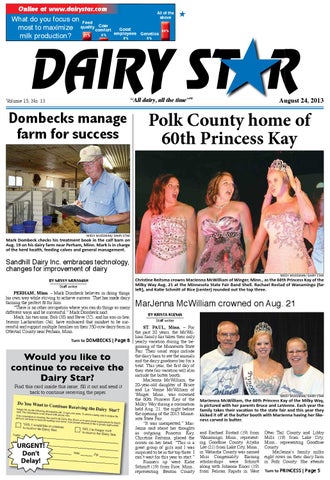
Online at www.dairystar.com
What do you focus on Feed Cow most to maximize quality comfort 6% 31% milk production?
All of the above Good employees Genetics
DAIRY ST R 0%
63%
0%
August 24, 2013
“All dairy, all the time”™
Volume 15, No. 13
Dombecks manage farm for success
Polk County home of 60th Princess Kay
MISSY MUSSMAN/ DAIRY STAR
Mark Dombeck checks his treatment book in the calf barn on Aug. 19 on his dairy farm near Perham, Minn. Mark is in charge of the herd health, feeding calves and general management.
Sandhill Dairy Inc. embraces technology, changes for improvement of dairy BY MISSY MUSSMAN Staff writer
PERHAM, Minn. – Mark Dombeck believes in doing things his own way while striving to achieve success. That has made dairy farming the perfect t for him. “There is no other occupation where you can do things so many different ways and be successful,” Mark Dombeck said. Mark, his two sons, Bob (38) and Steve (32), and his son-in-law, Jeremy Lachowitzer (36), have embraced that mindset to be successful and support multiple families on their 350-cow dairy farm in Ottertail County near Perham, Minn.
Turn to DOMBECKS | Page 8
Would you like to continue to receive the Dairy Star? Find this card inside this issue, ll it out and send it back to continue receiving the paper.
URGENT! Don’t Delay!
MISSY MUSSMAN/ DAIRY STAR
Christine Reitsma crowns MarJenna McWilliam of Winger, Minn., as the 60th Princess Kay of the Milky Way Aug. 21 at the Minnesota State Fair Band Shell. Rachael Rostad of Wanamingo (far left), and Katie Schmitt of Rice (center) rounded out the top three.
MarJenna McWilliam crowned on Aug. 21 BY KRISTA KUZMA Staff writer
ST. PAUL, Minn. – For the past 20 years, the McWilliam family has taken their only yearly vacation during the beginning of the Minnesota State Fair. Their usual stops include the dairy barn to see the animals and the dairy goodness bar for a treat. This year, the rst day of their state fair vacation will also include the butter booth. MarJenna McWilliam, the 20-year-old daughter of Bruce and La Vonne McWilliam of Winger, Minn., was crowned the 60th Princess Kay of the Milky Way during a coronation held Aug. 21, the night before the opening of the 2013 Minnesota State Fair. “It was unexpected,” MarJenna said about her thoughts as outgoing Princess Kay, Christine Reitsma, placed the crown on her head. “This is a great group of girls and I was surprised to be in the top three. I can’t wait for this year to start.” Runners up were Katie Schmitt (19) from Rice, Minn., representing Benton County
MISSY MUSSMAN/ DAIRY STAR
MarJenna McWilliam, the 60th Princess Kay of the Milky Way, is pictured with her parents Bruce and LaVonne. Each year the family takes their vacation to the state fair and this year they kicked it off at the butter booth with MarJenna having her likeness carved in butter. and Rachael Rostad (19) from Wanamingo, Minn., representing Goodhue County. Alydia Lee (21) from Lake City, Minn., in Wabasha County was named Miss Congeniality. Earning scholarships were Schmitt along with Johanna Knorr (19) from Pelican Rapids in West
Otter Tail County and Libby Mills (19) from Lake City, Minn., representing Goodhue County. MarJenna’s family milks eight cows on their dairy farm in Polk County. She attends Turn to PRINCESS | Page 5
Dairy Star • Saturday, August 24, 2013 • Page 3
It’s all inside... Kids Corner: The Kalthoffs
Dombecks manage farm for success
Pages 38 - 39
Pages 1, 8 - 9
Needy people getting milk, thanks to six Washington dairy farms
Singing Hills Dairy crafts, markets own product
Women in Jeans: Barb Grimm
Pages 10 - 11
Page 14 Second Section
Pages 8 , 10 Third Section
Showcase at state fair features red and white animals Pages 12 - 13
Everses host thrashing demonstration
Borgerdings recognized as 2013 Stearns County Farm Family of the Year
Pages 5, 6 Third Section
Pages 36 - 37
Communication keeps preg rate steady at Hoscheit Dairy
WCROC hosts Organic Dairy Day Pages 12 - 13 Second Section
Pages 18, 23
Perham
Helmuths earn Organic Valley regional quality award in second year of operation
Albany
Continuing a family tradition
Morris
Page 25
Belgrade Cedar Mills Waconia
A day in the life of the Weiland family
Kellogg
Nerstrand
Pages 16 - 17 Second Section
Dell Rapids
Pages 25 - 26 Second Section
Millville Caledonia
Contents FIRST SECTION Pages 20, 22 On the Road with Princess Kay Page 26 FSA News & Notes Page 28 Safety is an everyday deal Page 29 Highlights of Precision Dairy 2013 Conference Page 31 Giving back is a valuable thing Page 35 Corn silage processing becoming more popular
Page 7 Dairy Markets Page 8 Iowa hay auction results Page 15 Dairy in the Suburbs Pages 19, 21 Pricing options for hay harvest agreements Pages 23 - 24 Control bird damage on dairies Page 28 People in the Dairy Community Page 30 Dairy Recipes
SECOND SECTION Page 3 Farmland values increase 25 percent Ag economists caution farmers for potential downturn Page 4 May mailbox prices up in six reporting areas Page 6 The “Mielke” Market Weekly
THIRD SECTION Pages 2 - 3 Understanding genomics Pages 12 - 13 Dairy Calendar Pages 16, 18 - 19 Some Udder Stuff Pages 21 - 26 Classieds
Hornstra Farms: Long history of milk production, delivery
Fairbank
Pages 10 - 11 Second Section
Columnists Ag Insider
Nutritionist
Pages 6-7
Page 34
Just Thinking Out Loud Page 32
Getting Kerry’d Away
The Next Generation Page 33
Page 27
Dear County Agent Guy Page 30
Call Us For All Of Your Barn Equipment Needs!
HD Headlocks
Single Beam Mounting System
Durable and cow friendly... Functional and rugged design
Superior cow comfort in a versatile system
• Positive locking and heavy-duty
galvanized construction. • Automatic down cow release. • 17” Wide opening.
• Heavy duty and easy to install. • Patented design.
(Patent # 7,469,658 & 6,925,962.) • Excellent for remodel projects.
GEA Farm Equipment | Norbco
20903 W. Gale Avenue | Galesville, WI 54630 | Tel: 608.582.3081
engineering for a better world
www.gea.com | www.gea-farmtechnologies.com/norbco/en
GEA Farm Technologies
Dairy Star • Saturday, August 24, 2013 • Page 5
Continued from PRINCESS | Page 1
FARMERS/LANDOWNERS We Do Stumps! Andrew Moritz
320-290-7156
• Custom Tilling • Fenceline • Poplar Stumps Trimming • CRP
MISSY MUSSMAN/ DAIRY STAR
MarJenna McWilliam waves to the crowd after she was crowned the 60th Princess Kay of the Milky Way Aug. 21 at the Minnesota State Fair Band Shell. North Dakota State University, majoring in English education with a Norwegian language emphasis. “She has never missed a state fair,” Bruce said about his daughter. This year, her 20th state fair, will be the most memorable.” The McWilliams will watch as her daughter becomes part of a Minnesota State Fair tradition as she will sit in a rotating cooler in the dairy building for about six hours and has her head carved out of 90-pound block of butter. Each of the other nalists will have her likeness carved in butter during the fair, as well. This year marks butter sculptor Linda Christensen’s 42nd year carving the Princess Kay of the Milky Way winner and nalists at the Minnesota State Fair. “She gets to be a part of history,” said Bruce, who has been milking cows for 63 years. MarJenna is excited to be a part of that history. “It’s been a long-time dream of mine,” MarJenna said about being a butterhead. “I’ve always seen all the other butterheads when we visited the state fair. I’m really excited. Butter is a great product as long as it’s eaten in moderation.” However, what MarJenna is looking forward to most are the classroom visits she’ll make throughout her year-long reign. “Dealing with younger people is something I enjoy,” said MarJenna. Her parents can see this enjoyment.
“She likes to talk to all children,” Bruce said. “She is like a pied piper. The kids just follow her around. She makes them happy.” Along with her love for working with children, MarJenna has other good qualities that will make her a good Princess Kay, said her parents. “We knew she could do it. She’s a wonderful speaker. It’s easy for her to talk to everyone,” LaVonne said. “And she likes to dress up and has a good fashion sense,” Bruce added. Although Polk County is not the most populous when it comes to dairy cows, MarJenna doesn’t let that affect her enthusiasm for promoting. “A dairy farm is a dairy farm no matter where it is in Minnesota,” she said. The last Princess Kay to come from Polk County was Diane Schroeder Dunn in 1958, a mere 55 years ago. “I wish she was here today so I could talk to her,” MarJenna said. During the coronation, over 20 past Princess Kays appeared on stage to celebrate the program’s 60 years. “It’s a vibrant program and a huge part of the (Minnesota) dairy industry. The fact that it’s been going for 60 years says something,” MarJenna said. She is happy to help propel the program forward another year. “I want people to know the dairy industry cares about the cattle, the land and the community …” MarJenna said. “Dairy farmers are respectful of the environment so it can be around for the rest of the generations after.”
cow comfort • ventilation & cooling flat barn parlor • farm automation barn equipment • curtains • wall finishing N6989 ROLLING MEADOWS DR. FOND DU LAC, WI 54937
(800) 800-5824 • www.agromatic.net
952-442-4808
Ron Miller, MN Rep
DAM OF SHAKESPEARE
LADYS MANOR RUBY D SHAWN EX-90 EX-MS GMD DOM 4-04 2x 365 37920 4.8 1,808 3.2 1208
Genomic Poetry in Motion
2450 GTPI ▼ 3.28 Type ▼ 2.94 UDC ▼ 2.73 FLC 014HO07223
SHAKESPEARE
MISSY MUSSMAN/ DAIRY STAR
Sarah Paskewitz’s fans wait eagerly for the coronation to begin Aug. 21 at the Minnesota State Fair Band Shell.
800-451-9275 | WWW.ACCELGEN.COM
Photo © Billy Heath
proof data 8/13
{ Epic x EX-90 Shottle x EX-90 Debut x EX-94 Rudolph x 6 EX or VG dams } Thiss early Thi eaarl rlyy Epic son s is from a world reknowned chart-topping family with nin nine generations of EX & VG dams and loads of G ld Medals. M d l Write W it a new chapter in your herd with Shakespeare. Gold
Page 6 • Dairy Star • Saturday, August 24, 2013
Peterson said Farm Bill extension may be reality
RENEW YOUR TRACTOR CAB!
Repaired Or New!
1” Black Vinyl Upholstery At Wholesale Prices!
AUGERS
WE SHIP DAILY JD Sound Guard Cabs & Sound Guard Cab Parts BUY - SELL - TRADE
TO YOUR SPECS
KIESTER IMPLEMENT
Also Manure Augers, Belt Conveyors, Hammer Mills
WINONA ATTRITION MILL 507-452-2716 • 800-429-2716
KIESTER, MN
www.midwestfarmsales.com tfn
507-294-3387
Uncertainty continues to dominate the ongoing farm bill saga. During the Farmfest forum, House Agriculture Committee Ranking Member Collin Peterson offered insight into the possible timeline. “The Speaker told me that he is going to ask for a vote on the food stamp thing right away when we get back after Labor Day. They’re not sure it’s going to pass, but whatever happens, he’s going to appoint conferees the next day and he wants to get the bill done by September 30.” That offers a glimmer of hope, but Peterson questions if House Republicans will allow a House-Senate compromise bill to pass. There’s only nine days on the congressional calendar during the month of September. If a bill can’t be completed, an extension is certainly possible. “When we get to December and we don’t have a bill and milk goes to $39, there will be an extension.” If necessary, a two-year extension may be the best bet. “(House Agriculture Committee Chair Frank) Lucas is talking about two years and I may support that given what’s being going on here because I don’t think we’ll get anything done in an election year.” Dairy reform remains on the table If a farm bill can make it to a HouseSenate conference committee, Minnesota Congressman Collin Peterson believes he has the votes to revive the Dairy Security Act. This dairy policy reform plan was changed in the House debate, but was included in the Senate bill. “I have the votes to put dairy back in, but (House Speaker John) Boehner doesn’t know that; he won’t be happy about that.” Boehner has been critical of the supply management component of the Peterson dairy plan. Farmers need a Farm Bill While speculation is circulating about a farm bill extension, Minnesota Senator Al Franken does not want that to happen. “Minnesota farmers have made it very clear that they not only want a farm bill, they need a farm bill,” said Franken. “They need it for cer-
Feed Mixing… Vertical or Rotary? Your dairy’s performance depends on choosing the right feed mixer to improve your operation. Roto-Mix designs and manufactures strong, durable feed mixing equipment. Both Vertical and Rotary models are available in truck, trailer or stationary.
Starwood Rafters Uses Available at
Dairyland Supply Sauk Centre, MN
K&R Equipment Fountain, MN
Blue Hilltop Lake Wilson, MN
Mark’s Tractor Osage, IA
tainty. I think it would be a disaster for us not to get one.” While at Farmfest, Franken said farmers need to keep the pressure on the House to complete a farm bill. Congress has time to act While the current farm bill expires at the end of September, National Farmers Union President Roger Johnson said lawmakers have four months to act. “Practically speaking, it will be the end of the year before there is a real impact,” said Johnson. “That’s plenty of time to get this done.” Johnson said agriculture groups do not support a farm bill extension. “We realize this may go past Sept. 30, but that doesn’t mean they have to pass an extension.” FSA offers temporary help in drought areas USDA’s Farm Service Agency has announced temporary assistance to livestock producers through the Conservation Reserve Program. Under limited conditions, farmers affected by drought will be allowed to use certain CRP acres for emergency haying and grazing. The reduction in CRP rental payments on the affected acres will be reduced from 25 percent to ten percent. The sale of hay will be allowed under certain conditions. Landowners must work with local FSA ofces on this Turn to AG INSIDER | Page 7
Starwood Rafters Lam-Ply Truss
620.225.1142 www.rotomix.com
Larsen Industries Goodhue, MN
By Don Wick Columnist
Which Barn is Best for Your Herd?
Birds just love this barn. The webs in these trusses are easy nest areas for birds. They also restrict air flow which leads to poor ventilation and moisture buildup in the building.
Steve Gehrke 608-778-3878
Ag Insider
Baker Iron Works Platteville, WI E&M Farms Ossian, IA
• Pole Sheds • Free Stalls • Pavilion Shelters • Machinery Storage • Riding Arenas • Spans up to 72 ft. • Up to 12’ spacing depending on the load you desire • Bird Nesting Control • Better Ventilation & Visability • No Feed Alley Post Obstruction • Additional Ceiling Height
The arched rafters create a more open barn allowing better ventilation. Also since there are no open webs in the trusses, there are no places for birds to nest.
ANOTHER QUALITY PRODUCT FROM STARWOOD RAFTERS
STARWOOD RAFTERS, INC. 715-985-3117
W24141 Starwood Ln., Independence, WI 54747 Website: www.starwoodrafters.com
888-525-5878
From Our Side Of The Fence
Dairy Star • Saturday, August 24, 2013 • Page 15
A) What is a typical day like for you? B) Tell us a unique story about your time hauling milk. C) What do you like most about your job? D) How has your occupation changed in the years you've been hauling? E) What do you like to do in your free time? F) What do you listen to between stops?
Milk truck drivers: What do you like most about your job?
Bruce Finnesgard Zumbrota, Minn. Goodhue County 36 years of experience Finnesgard Trucking LLC A) Usually it’s about a 13-hour day. I get going at about 2 a.m. and nish around 3 p.m. I drive one truck and my son, Josh, drives the other truck. I get about two loads of milk each day with four farms per load. It ends up being about 320 miles per day or about 10,000 miles per month. Most of the farms we visit are in the Goodhue and Rice County areas. We take the milk to various plants, usually in Minneapolis. We work for First District. A lot of the milk we haul is used for bottling. B) I pick milk up for two bachelor brothers. I never saw them too much, but one early morning (while it was still dark) when I was at their farm to pick up the milk, I heard pounding while I was in the milk house. It quickly stopped and I didn’t think much of it. When I went to leave, I looked in my rearview mirror and saw the two boys up on the roof doing some roong work while their dad held the ashlight. I think they stopped working while I was there because they were embarrassed to be working on the roof at night. That was pretty funny. C) The relationships I form. To me, it’s like driving around visiting my friends every day. For some, it’s almost like I’m part of the family. I see the moms, dads and kids every day. One family I don’t even knock at their house. I just walk right in the door because I’ve gotten to know them so well. They make me feel at home and I sometimes have breakfast with them, too. When I stop at farms, I try to be as helpful as I can. I scrape a little or wash down the milkhouse oor. It’s tedious work that is seven days a week, but it’s a way of life. It’s not for everyone, but I enjoy what I do. I love the farm families. D) The number of farms I stop at has gone down. In 2000 I used to stop at 60 farms. Now there are only 16. Even though there are fewer farms now, we probably haul twice as much milk than in 2000. The family part of the farm hasn’t changed much, though. All our farms are still very family-oriented. E) We have about 20 head of beef cattle we raise. I used to sh, but I haven’t done it lately. A lot of our time now is spent with family, especially our grandkids. We like to have them over for supper. I’m denitely blessed to have family so close. F) I listen to a lot of talk radio, especially politics. I like Bob Davis and Rush Limbaugh. For music I like country or rock and roll. I’m a child of the 70s.
Joe Arnzen Grey Eagle Todd County, 39 years of experience Arnzen Trucking Inc. A) I used to drive seven days a week but since the accident, I drive when my drivers need off. I own six trucks and ve are on the road every day. I have ve full-time drivers and two part-time. I drive ve days a week most of the time. The length of the day depends on the route I drive. Some are eight hours long, but some are 14 to 15-hour days. When I am done driving, I work on repairing trucks for the next day. B) One night I got to Paynesville around 6 p.m. to unload in a so-called snowstorm and two of my trucks were still in Paynesville. The drivers said we should stay there for the night. I said I was going home and they could follow me or stay overnight. They came home with me. It took us over three hours to get back to Grey Eagle what otherwise was a 45-minute run. I was the leading truck and had to look for mailboxes, highline poles, highway signs and fences in ditches to stay on the road. One time I walked in a milk house and was going to hook the milk hose to the tank to pump out but the valve on the tank fell off and there was 4,000 pounds of milk running out of the tank. I put one hand over the hole to stop the milk and with the other hand found the valve clamp, gasket and put it back on the tank then put the hose on and pumped the milk into the truck. I had a milk bath and the milkhouse was white with milk. I was cleaning the milkhouse and the farmer came in and asked what happened. He thought it was funny. C) Meeting with the farmers and their families. I try to help them anyway I can. I work for the farmers, some people say you work for the dairy plant but if it wasn’t for the farmers, I would not have a job and there would also be no dairy plants. D) I remember getting out of school in 10th
Traditional good looks...hidden strengths... easy, cost-saving installation.
LUMBER INC. www.strosalumber.com
grade to haul can milk when dad was short a driver and then bulk milk started. It was smaller farms and smaller trucks. I maybe was loading 25 patrons a day now there are less farms but bigger farms and bigger trucks. I may be loading one or 15 patrons to get a load of milk. E) I like hauling milk or repairing trucks. I also like to be at home with my two Cocker Spaniels (Casper and Copper) and being on the re department and rescue department for 37 years. F) I used to listen to Cliff Mitchell on KASM until he retired. It was good to nd out the news. Now I listen to country music.
Got Slow Quarters? Milk ‘em Faster With Milk-Easy! Patented
ST. ROSA
Chad Stevens Freeport, Minn. Stearns County 15 years of experience Stevens Transport Inc. leased to Millwood Transport Inc. A) I usually get up and have my rst load picked up before the sun rises. I usually drive 300 miles a day and have 18 stops a day. B) I met my ancee, Karen Gerads, and her entire family while picking up their milk years before we ever started dating. C) I enjoy driving through the countryside and talking to the patrons. D) The trucks are a lot nicer and quieter but we also put on a lot more miles. E) I like taking the Harley out. I also like to go shing. Hopefully I still have time to drive tractor and do some eldwork for my dad. F) I listen to anything, from country to rock, depending on my mood.
BETTER UDDER HEALTH!
• Easy to use • Less teat-end damage • Fewer mastitis infections! CONTACT US TODAY TO LEARN MORE...
320-836-2284 1-888-276-1751
29033 County Road 17 • Freeport, MN 56331
JOHNSTON PRODUCTS (517) 546-6271 • www.milkeasy.com E-mail: milkeasy@sbcglobal.net
From Our Side Of The Fence Page 16 • Dairy Star • Saturday, August 24, 2013
A) What is a typical day like for you? B) Tell us a unique story about your time hauling milk. C) What do you like most about your job? D) How has your occupation changed in the years you've been hauling? E) What do you like to do in your free time? F) What do you listen to between stops?
Milk truck drivers: What do you like most about your job?
Pat Debilzen Urbank, Minn. Ottertail County 34 years experience Pro Ag Farmers Coop A) I leave the shop at about 7 a.m. and average between 160 to 200 miles per day. The farms on the routes vary from day to day. There are 14 stops one day and 12 stops another day. By the time the day is done, I have put in a 10 to 12 hour day. B) One time the roads were really icy and I was going to make a righthand turn. The truck slid completely around. I was facing the same direction I came from. Another time I was in a farmyard during a storm and a silo roof blew off. It came down next to the truck, which is where I had just walked about ve minutes earlier. C) I like being on the farms and getting to see different farmers everyday. Nothing is ever the same on the route and there are always different things to see. D) I went from part-time driving to full-time. In the past six years, I manage the milk division and still drive part-time. The farm numbers have dropped substantially and there are more miles in between stops. E) I like to golf, spend time with family and do yard work. F) I have country music on the radio most of the time and sometimes nothing.
E-EDITION
Russ Legler Woodstock, Minn. Pipestone County 34 years of experience Trucking company: Legler Milk Transfer A) The day for our drivers and me begins at 3 a.m and usually ends 12 hours later. We each average 400 miles a day and stop at two farms. Our company has nine tractors and 21 trailers and hauls 850,000 pounds of milk each day. Altogether, we will put on a million miles per year. B) Once, at Christmas time, I found a plate of bars and candy on top of a farmer’s milk tank and thought, wow, how nice. I ate the stuff and it was all pretty good. The next time I stopped, the farmer’s wife came to the barn and asked if I had eaten the things on that plate. I said yes and she said that it was for the cats. C) The people. All of our farmers are wonderful folks. I have been doing this for so long that I have seen farmer’s kids get born, grow up and have kids of their own. I have never had a bad experience with a dairy farmer; they are all very easy to work with. D) Our son, Brady, and his wife, Kate, joined the operation about six years ago. Brady drives and Kate is taking over bookkeeping duties from my wife, Lon. The average dairy is much bigger than it used to be. We used to stop at 15 farms to ll a tanker, but now we can get a full tanker from one dairy. Milk quality has also improved greatly over the years. And I don’t know how we did things before we had cell phones. Some of the larger dairies now send us a text or an email when their tanker is full. E) We like to watch our kids and grandkids play baseball and fast pitch softball. Every summer, we take the kids for a week up at the lake. We have a daughter who recently moved to the Virgin Islands, so we went to visit her last winter. F) Talk radio or the farm news and markets. I also like to listen to old time rock and roll.
Bob Fritz Cologne, Minn. Carver County 45 years experience Bob Fritz Trucking A) I’m a ll-in for all my different truckers. I supervise and organize everything. The average stops that they have in a day is around 12 and they put on 200 plus miles. B) When I bought a new truck a producer came out and was mad that I bought a new truck. He wouldn’t talk to me after that. There has also been numerous times I’ve pulled people out of the ditch. C) The friendships you develop. Even after the farmers quit milking you keep in contact. D) When I started hauling we just hauled to Bongards’ Creameries, now I run to DFA, First District, Land O’Lakes and Bongards’. The size of the trucks has changed as well. When I rst started hauling, a load would be 17,000 pounds of milk, and now a full load is 50,000 pounds of milk. The producers have got less and larger and it’s become more of a business. I don’t know the farmers as well as I used to. E) I like to spend time with the grandkids. F) I usually don’t listen to anything. Most often than not I leave the radio off; it gives me time to organize in my head.
Read the Dairy Star online
FREE
at www.dairystar.com 8 BALE MOVER 9’wide x 31’ long gooseneck or dolly.
12 BALE MOVER 9’ wide x 39’ long, flotation tires, lights & SMV sign, travel highway speeds.
PAINTED IMPLEMENT COLOR CHOICE • DELIVERY AVAILABLE.
Justin 712-441-0868 Aaron 712-441-2074
Custom LLC
Welding & Fabricating 307 E. 1st St. • West Liberty, IA 52776
319-627-6700
Fax: 319-627-6701 • customweld@Lcom.net
Dairy Star • Saturday, August 24, 2013 • Page 17
Make the most of your valuable manure with spreaders that handle the job efficiently and effectively!
!
s n e p p a H e r u n a M
l a t n o z i r o H • l a c Verti quid Pumps i L • s k n a Liquid T
Artex Vertical & Horizontal Spreaders
Houle Pumps & Tanks HYDRA-SPREAD Manufactured by
Hydra-Spread Vertical & Horizontal Spreaders
DAIRYLAND SUPPLY INC. 320-352-3987 • 1-800-338-6455
8100 Series ProTwin Slingers ®
www.dairylandsupply.com SAUK CENTRE OFF I-94 ON THE CORNER OF HWY. 28 & 71 SOUTH
IF YOU HAVE MANURE - WE HAVE THE EQUIPMENT FOR IT!
Dairy Star • Saturday, August 24, 2013 • Page 19
“... contributes to our milk quality... ...puts more money in our pocket.” — Brandon and Shi Ferry Brandon and Shi Ferry with Junior 3-year-old Del-Hollow Durham Jodie-ET, scored VG-88 with EX mammary. She was second in her class and honorable mention intermediate champion at the 2013 District Show.
FER-CREST FARMS, HILBERT, WISCONSIN Brandon and Shianne Ferry 100 Reg. Holsteins, a few Jerseys; BAA 110.4 RHA: 23,149 M 3.9 F 3.2 P — SCC avg: 85,000
Dairying has been a labor of love for Brandon and Shianne Ferry ever since she grew up on a dairy in Richland and he in Rosendale. Both had opportunities to own and show cattle since age 9, and they attended Univ. of Wisconsin-Madison where he completed dairy short course and she received a dairy science degree. They began farming in 2010 with 40 cows, renting Brandon’s parents’ farm before relocating their 100-cow Fer-Crest Farm dairy to its present location near Hilbert, Wisconsin. Brandon and Shi focus on quality and keep a low SCC average of 85,000. “Udder Comfort™ definitely contributes to our milk quality, along with keeping cows clean, and stalls bedded,” say Brandon and Shi. “We use Udder Comfort on the fresh udders, putting it on after every milking 2x/day for 4 days after calving. We’ve been doing this for 2 years, and it really brings out the quality. “Udder Comfort gets the edema out of the udder, faster, so the quality and texture are much better.
“The cows are more comfortable, and they get going and do better, overall. “We also use Udder Comfort, at the first sign of mastitis. We put it on 2x/day for 3 days. Catching things early, using Udder Comfort, and getting ahead of a problem puts more money in our pocket. This product works, and we don’t have to dump the milk. We love it.”
Quality Udders Make Quality Milk
Keep the milk in the system 1.888.773.7153 1.613.652.9086 uddercomfort.com Call to locate a distributor near you. For external application to the udder only after milking, as an essential component of udder management. Always wash and dry teats thoroughly before milking.
Page 24 • Dairy Star • Saturday, August 24, 2013
Page 26 • Dairy Star • Saturday, August 24, 2013
Tractors
JD 9220, 18 spd., PS .........................$154,900 JD 8520T, 25” tracks........................$126,900 JD 8270R, IVT, ILS, 1100 hrs. ........$206,900 JD 8260R, PS ...................................$209,900 JD 8235R, 4 to choose from..........starting at $167,900 JD 8225R, MFWD, PS, 900 hrs.......$159,900 JD 8220, MFWD, PS .......................$119,900 JD 7420 - 3 to choose from ........... $72,900 JD 7330 Prem, loader.................. $119,900 JD 7330 Prem, loader.................. $113,900 JD 7230 standard, loader............... $99,900 JD 7230 Prem, 2 to choose from, loaders ....................................... $108,900 JD 7200R, MFWD, PQ, 198 hrs .. $146,900 JD 6210R, AQ ............................. $132,900 JD 6170R, AQ ............................. $111,900 Case IH Puma 180, MFWD .......... $94,900 JD 6430, 2WD .............................. $49,900 LD ............... $30,900 JD 5425, MFWD,SOloader JD 4430, new paint ....................... $15,900 IH 886, 1980 ................................. $10,900 D JD 720, diesel,SNF $5,900 OL........................... MF 2675, 2WD ............................. $14,400 MF 7475, ‘07 ................................ $72,900
Combines
JD S670 ....................................... $309,900 ‘11 JD 9770 STS, CM, duals, RWA $269,900 ‘10 JD 9670, RWA ...................... $239,900 JD 9670 STS, CM, RWA............. $232,900 JD 9670, RWA............................. $259,900 JD 9670, CMFH, HDVAR .......... $239,900 JD 9660, 2WD, duals .................. $139,900 JD 9650 STS, RWD .................... $134,900 JD 9650, PRWD, singles ............ $109,900 JD 9600, PRWD ............................ $49,900 JD 9660, duals, CM .................... $149,900 JD 9500, duals............................... $34,900 , SOLD
6620, hydro ................................... $11,900 ‘81 JD 4420 ..................................... $5,900 Many heads to choose from ................Call
Planters
JD 1770 CCS, 16R30” ................. $121,900 JD 1770 CCS, 16R30” ................. $119,900 JD 1770 CCS, 16R30” ................. $106,900 JD 1770, 3 bu. .................................. $114,900 JD 1770 CCS, 16 row .................. $112,900 JD 1770, 16 row, liq. ..................... $98,900 JD 1770, 16 row, liq. ..................... $98,900 JD 1770, 16 row, liq. ......................$49,900 JD 1770, 16R30”.......................... $106,900 JD 1770, 16R30”.......................... $113,900 JD 1770, 12R30”, dry ....................$37,900 JD 1770, 12 row, liq. fert. ............. $44,900 JD 1760, 12 row ............................ $72,900 JD 1760, no fert............................. $58,900 JD 1760, no fert............................. $29,900 JD 1720, 16R30”........................... $54,900 JD 1750, 8R30”............................. $39,900 JD 1750, 6R30”............................. $22,900 Case IH 1200, 6 row, dry ............. $25,900 White 8 row, no fert. ....................... $6,900
Hay Equip.
JD R450, 14’, rubber roll, 186 hrs $103,900 JD 956 MoCo, rubber roll ................... Call 2 - JD 936 11’6” MoCo..................$13,900 JD 730 MoCo Impeller ..................$14,900 JD 635 MoCo, drawbar, rubber .....$19,900 JD 568, 4 to choose from ..Start @ $29,900 JD 558, reg. P/U, mega tooth .........$18,900 JD 535, 540/wrap .............................$9,990 JD 535, wrap ....................................$8,900 JD 468SS, wrap, hyd. P/U, acid .....$38,900 JD 468SS, wrap, hyd. P/U .............$33,900 JD 430, twine ...................................$6,900 JD 375, 5x4 bale ..............................$4,900 NH 688 round baler .......................$14,900 Case IH RBX561, twine ................ $11,900 Gehl 2880, twine ............................$10,900
Inventory changing daily at miesoutland.com
1947-2013 66 Years of Excellent Service!
Watkins, MN
320-764-5310
Year Round Sunday Parts Hours 10:00 - 3:00 p.m.
1-800-324-8269
THERE’S WORK TO DO!
Highly erodible lands, wetland compliance
Producers participating in most programs administered by the Farm Service Agency (FSA) and the Natural Resources Conservation Service (NRCS) are required to abide by certain conditions on any land owned or farmed that is highly erodible or that is considered a wetland. To be in compliance with the highly erodible land conserFSA News & Notes vation and wetland conservation provisions, producers must agree, that they will not: • Produce an agricultural commodity on highly erodible land without a conservation system; • Plant an agricultural commodity on a converted wetland; • Convert a wetland to make possible the production of an agricultural commodity. Producers planning to remove fence rows, convert woodlots to cropland, combine crop elds, divide a crop eld into two or more elds, install new drainage, or improve or modify existing drainage, must notify the FSA and update Form AD- By Phyllis Framstad 1026. FSA will notify NRCS and NRCS will then provide Stearns Co. Exec. Dir. highly erodible land or wetland technical determinations. To get additional information on highly erodible land and wetland conservation compliance contact the FSA ofce or the NRCS ofce at a local USDA Service Center. Additional information about conservation programs offered by FSA can be found online at www.fsa.usda.gov/conservation, and information on NRCS programs can be found at www.nrcs.usda.gov. 2013 State of the Birds: Report on Private Lands and Continuous Conservation Reserve Program (CRP) On July 2, Secretary Vilsack and Interior Secretary Jewell released the 2013 State of the Birds: Report on Private Lands. Produced by the North American Bird Conservation Initiative (NABCI), the report uses eBird data to analyze the private land distribution of bird species in different habitat types. This report is very well presented and discusses in part how CRP and other conservation efforts have contributed to increased bird populations in the past two decades. The full report is available for download at http://www.stateofthebirds.org/ One of the keys to bird habitat is the continuous CRP program in MN, the restart of sign-up for continuous CRP, including the Farmable Wetland Program, the State Acres for Wildlife Enhancement Initiative, the Highly Erodible Land Initiative, the Pollinator Habitat Initiative and other related initiatives are under way. Sign-up for continuous, non-competitive CRP began on May 13 and will continue through Sept. 30, 2013. CRP is an important program for protecting environmentally sensitive lands from erosion and sedimentation, and for ensuring the sustainability of our groundwater, lakes, rivers, ponds and streams. Through the voluntary participation of our farmers and ranchers, CRP helps us to protect our natural resources, preserve wildlife habitat and bring good paying jobs to rural America related to hunting, shing, and outdoor recreation. Producers enrolled in CRP plant long-term, resource-conserving covers to improve the quality of water, control soil erosion and develop wildlife habitat. In return, USDA provides participants with rental payments and cost-share assistance. Contract duration is between 10 and 15 years Up-coming deadlines for 2013 • Sept. 1 - 2014 NAP Deadline - Value Loss Crops (Aquaculture, Christmas Trees, Ginseng, Turf Grass); Controlled Environment Crops (Floriculture, Mushrooms); or Fall Seeded Annual Crops (Rye) Sept. 2 - FSA Ofce closed for Labor Day • Sept. 15 - CRP Managed Harvesting & Grazing ends – remove all livestock and bales • Sept. 25 - CRP Managed Harvesting and Grazing reporting deadline • Sept. 30 - 2013 Expiring CRP re-enrollment deadline • Sept. 30 - 2014 NAP Perennial Forage Crops; Select Fruits and Vegetables; or Wild Rice sales deadline • Ongoing - Continuous CRP sign up Farm Service Agency is an Equal Opportunity Lender, Complaints about discrimination should be sent to: Secretary of Agriculture, Washington, D.C. 20250. Visit the Farm Service Agency website at: www.fsa.usda.gov/
take advantage of the
many options!
NEW! 14” Auger
- Capacities up to 11,000 bph!
Sentinal Buildings Dealer
Drive Over Hopper
We offer more options with both wood frame and steel frame buildings. We specialize in a variety of dairy projects, and have built facilities that ranged in size from small to large.
Contact Your Local Dealer Today!
- Capacities up to 7500 bph!
• Versatile • Rugged • Reliable • Made in the USA
Kimball 320-398-3800 • St. Martin 320-548-3285
Willmar 320-235-4898 • No. Mankato 507-387-5515
Glencoe 320-864-5531 • Alden 507-874-3400
Lester Buildings Dealer
712-439-1101 Dennis: 712-470-3147 Fax: 712-439-1116
hoksdsconst@yahoo.com
Give us a call today and let us bid your new expansion dairy facility!
• Ag buildings • Concrete Work • Commercial Buildings • Dairy Facilities
514 Main St. • Hull, Iowa 51239 • www.hoksdsconst.com
Page 28 • Dairy Star • Saturday, August 24, 2013
www.extension.umn.edu/dairy Hugh Chester-Jones (507) 835-3622 chest001@umn.edu Marcia Endres (612) 624-5391 miendres@umn.edu Brad Heins (320) 589-1711 hein0106@umn.edu Jose Hernandez (612) 625-4731 jahernan@umn.edu Kevin Janni (612) 625-3108 kjanni@umn.edu Emily Krekelberg (320) 255-6169 krek0033@umn.edu Noah Litherland (612) 624-6789 lithe003@umn.edu Brenda Miller (320) 732-4435 nels4220@umn.edu Jim Paulson (320) 234-0438 jcp@umn.edu Randy Pepin (320) 333-1369 pepin019@umn.edu Jeff Reneau (612) 624-9791 renea001@umn.edu Jim Salfer (320) 203-6093 salfe001@umn.edu Chuck Schwartau (507) 536-6301 cschwart@umn.edu Julie Sievert (507) 237-4100 schu0944@umn.edu
Safety is an everyday deal Safety on the farm is something that needs to be practiced every day and by everyone on the farm. It makes no difference whether the task is large or small, the hazards are the same. Sometimes the small ones might even lull people into a lax attitude and result in a huge event. I hesitate to take advantage of tragedies, but two recent tragedies illustrate my point. A few weeks ago, a central Minnesota man and his young grandson were killed when the tractor they were using rolled over. Reports suggest this may have been a hobby farm using older and smaller equipment. This type of equipment seldom has modern safety features like ROPS (Roll Over Protective Structure). Tractors of this type are used By Chuch on many farms for mowing large lawns and Schwartau road banks. That is a recipe for an incident in Extension Educator- itself. The second mistake in this event was Livestock having another passenger, especially a child, on the tractor along with the operator. We all want to give our youngsters an opportunity to learn and experience what we do on the farm, but the loss of a young life is a high price for that experience. Most equipment is not designed to carry passengers, so don’t. A second incident was reported in Wisconsin just a few days later. In this case a man was mowing grass with a trailer-type mower behind an ATV. The ATV apparently had a cargo tray on the back and several children were riding in the cargo tray. One reached for a branch and fell off the ATV and under the mower. One even hates to think about that tragedy and the trauma the other children and the father experienced. Common themes in these two incidents are children and equipment. In both cases the children were on equipment not intended for passengers. There aren’t safety belts, cages or anything else to protect people on many of these implements. The now popular side by side ATVs usually have seat belts, but they need to be used in order to be effective, and they aren’t found in cargo trays. Tractors with ROPS also have seat belts but again they have to be used properly in order to be effective. Children develop at slightly different rates, and every parent probably thinks their children are more advanced and prepared than others for helping with tasks around the farm, but we still need to remember they are children. They haven’t developed all the reasoning skills, physical strength, and reaction time to operate modern farm equipment – or old equipment. It is important that children not be given or allowed to work at tasks for which
they simply are not prepared. The Marsheld Clinic Research Foundation (Marsheld, Wisconsin) has a national reputation in the areas of farm medicine and farm safety programming. One of the excellent tools they have developed is the North American Guidelines for Children's Agricultural Tasks (NAGCAT). This set of guidelines helps determine a child’s stage of development and judgment for tasks. The program also includes excellent fact sheets about how children develop skills and abilities for farm work and tools to help you assess your child’s readiness for the multitude of tasks involving livestock and equipment around your farm. The Marsheld Clinic Research Foundation’s website is http://www3.marsheldclinic.org/NFMC/. This site features many of the programs I have discussed and the tools offered to help parents keep children safe on the farm. The website is full of resources that can make your farm a safer place to live and work. Another great source for training lessons for farms is located at Gemplers.com. This company is a major supplier of safety equipment and has an extensive list of ready to use safety lessons in both English and Spanish – free of Child Children d develop l at slightly li h l charge. Go to the web- different rates, and every page and click on the parent probably thinks her link to “Safe- children are more advanced. ty Training Sheets”. Regardless of all the programs and equipment suggested for a safer workplace, it still all comes down to the people at the workplace practicing what they know and doing it all the time. It means having the proper training and equipment on the farm so all those working there know what to use and how to use it safely. It means farm owners need to set good examples by using proper protective equipment and safe operating procedures. It means keeping children from unsafe areas and tasks on the farm. In closing, you may have noticed I did not use the word accident in this article. One source denes an accident as “an unforeseen and unplanned event or circumstance”. The incidents I described at the beginning of this article were the result of judgmental errors. While we have to extend sympathy to those families, the possible results should have been foreseen. They were tragedies waiting to happen. Don’t make the headlines with such a tragedy in your family.
Specials
UPGRADE YOUR MIXER WAGON WITH THESE HOT DEALS!
Cross Ventilation
New Trioliet 1600 VLS vertical mixer coming in
Less Stress.
Call For Price
More Milk. Natural Ventilation
GREATER PROFIT! ™
2011 Farm Aid 430
New 3620 Automatic Roller Mill
fully loaded ........................................ $20,500
4 cut rolls, auger discharge $44,000 List - Cash $37,500
fully reconditioned ......................... $19,800
2012 Houle Agi Pump 42’ Lagoon Pump
2010 Farm Aid 430
New Luck Now 360
4-auger wagon, 4’ discharge w/magnet...........$32,500 list - Cash $29,000
RENTAL UNIT Less than 2 M Gallons Was $19,000 - Now $17,900
Call for a dealer near you.
Tunnel Ventilation
1.800.779.3267
www.schaeferfan.com
RIDGEVIEW E QUIPMENT SALES SERVICE
605-886-2595 Cell: 605-881-9017 45909 169th St., Watertown, SD
AND Ed & Pam Dorneman - Owners From Jct. 212 & I-29, go North 2 miles to exit 180, then 1-1/2 miles East
Highlights of Precision Dairy 2013 Conference
The University of Minnesota hosted the rst-ever U.S. Precision Dairy Conference and Expo this summer. It was an event attended by 535 people from 25 countries, 26 U.S. states and four Canadian provinces. About 20 percent of the attendees were dairy producers, and if spring hadn’t been so wet, we would most likely have had more producers in attendance. I crossed paths with a producer from Australia, and I asked him if he had come to the United States only to attend the event and he said yes. I was impressed. It is a long trip to say the least. One of keynote speakers, Henk Hogeveen (Netherlands), said. When a precision dairy conference was held in Ontario, Canada, three years ago, “there wasn't that much good science available yet. This conference showed quite a change; there were plenty of interesting talks. In addition, there were quite a number of farmer panels, explaining what their experience is with certain types of precision dairy farming applications.” By Marcia Endres Precision dairy management is growing fast, with more and Extension Dairy more research being done in the United States and around the Scientist world. There was a lot to see in the trade show as well, with new technology products and more to come. Stay tuned for another precision dairy conference in the next two to three years. I invite you to send me an email to let me know when would be the best time of year for you to attend this type of event (miendres@umn.edu). Technologies discussed or showcased at the event included robotic milking, cow sensors for heat and disease detection, inline milk sensors for the parlor, automated calf feeders, precision feeding, TMR tracking, on-farm data management and analysis, barn designs, parlor automation and more. The section on robotic milking included a panel of ve producers (Wisconsin, Pennsylvania, Ohio, and two from Canada) using robotic milking systems, with all ve companies that now sell robots in the U.S. represented (Lely, DeLaval, AMSGalaxy, GEA Farm Technologies, and Boumatic Robotics). It was great to learn from the producers what has worked well for them. For example, two of the producers were using guided ow and three were using free ow. It appeared that both can work well. Jack Rodenburg (Canada) spoke on the topic and indicated that he prefers free ow for cow comfort. More research is needed on what is best for maximizing milk production per robot or per cow. Number of cows per robot will certainly inuence it. Jim Salfer and I are collecting data from 52 robotic milking herds in Minnesota and Wisconsin, and this is one factor we plan to investigate in our study. Some of the economics abstracts indicated that it takes six to seven years to pay for the robots. But many producers mention quality of life as the main reason to use a robotic milking system, and it is hard to put a dollar value on that. One study showed that individual cow milking intervals can be optimized to increase robotic milking performance. Another showed that by using individual pulsation ratios, milk ow increased by eight percent. It seems that there is still more to learn and optimize, which is exciting. There are many cow sensors in the market today and more yet to come. They can monitor cow activity, temperature, rumination and lying time all day long, 24-7365, and help improve reproductive efciency and transition cow management. There were many abstracts on cow sensors, more than any other topic. Ray Nebel (U.S.) summarized information on sensors for reproduction. He said that activity monitors should be reliable and provide clear actionable alerts in user friendly lists and graphics. An increase in pregnancy rate from 18 to 24 percent can result in annual value of $100 per cow per year. Rumination monitors can help detect disease in earlier stages, before loss in production. Some of the producers on the sensor panel indicated that this aspect of the sensor, which helps them improve transition cow management, has a lot of value. We are currently studying rumination monitors in two settings, a large freestall facility and our grazing herd in Morris. Ilan Halachmi (Israel) indicated that when developing sensors, a developer should work simultaneously on both – the sensor and the decision making. Not only on the sensor. The aim is the automated decision making. The aim is not accumulating data. Hogeveen said “The ultimate goal of precision dairy management should be to explore the full potential of each individual dairy cow, instead of managing cows in groups. In the old days with small herds, that was possible; with the larger herds, that became difcult, but now with assistance of precision dairy technology it is possible again.” There was a lot more discussed at the conference, and I may be writing additional articles to tell you about it. The reality is that precision dairy is here to stay, and many of you are already using and have been for a while, including things like data management software, TMR tracking and daily milk weights.
Dairy Star • Saturday, August 24, 2013 • Page 29
Replastering and Complete Silo Repair
AT ITS BEST!
Silo Replastering is a very specialized business that we excel in, due to experience, the best equipment and mixture for cement.
1st 1st
2nd
We high pressure blast the walls for the cleanest and roughest finish. The rougher the better. We want the walls to get moist so the stave doesn’t dry the plaster any faster than possible; It is extremely important that all old silage and corroded concrete be removed. This important wall cleanup will assure the Osakis crew that the new plaster will bond completely with the existing silo walls.
Once the silo is washed, we rinse and re-rinse the bottom; again the cleaner the wall, the better the bond.
Hoop Barn Super Sale! www.silverstreamshelters.com 30’ X 72’ single Galvanized Gatorshield Pipe and Ratchet
$5,790 Limit 5
38’ X 100’ Black Truss Pipe and Ratchet
$11,900 Limit 2
42’ X 100’ Black Truss Pipe and Ratchet
$14,250
Limit 1
SILVER STREAM SHELTERS
1-877-547-4738 • WWW.SILVERSTREAMSHELTERS.COM
Experience the Advantage
A special combination of cement, hardener, plaster sand, and water are thoroughly mixed to create heavy, rich concrete plaster. The mixture is pumped and applied under pressure to the silo walls. During this process, the silo crew makes every effort to fill any voids or worn spots on the wall. We also hand trowel for a very smooth finish for a slick wall.
The finished product; Heavy plaster, very rich concrete, seals your silo and allows the feed to clean off the wall much better. All this applied by the company you know will stand behind what we sell!
Your newly replastered silo is now ready for many additional years of service.
Add additional repair to your silo at the same time and
SAVE $$$$!
ARE YOU LOOKING FOR A GREAT SILO UNLOADER AT A GREAT PRICE? TRY REBUILT HANSON® UNLOADERS Why Rebuilt Hanson® Unloaders?
4th
3rd
Wood & Plastic Doors, Pipe, & Distributors Available
• Osakis Silo installed. • Around 150 Rebuilt Hanson® unloaders the last 3 years! • Heaviest ware parts. • Best warranty. • Experience! Over 50 years on every crew! • SAVE up to 45% over new. • Professionally rebuilt with experience.
• Professionally powder coated. • NO GIMMICKS! Just unloaders that throw! • 100s of references available! Our customers are our best sales people. • We always stand behind what we sell! NO GIMMICKS! The Best Service Crews, The Best Replacement Parts, The Best Service...That’s The Osakis Silo Advantage To You!!!
1-800-433-0581
24 Hours 7 Days A Week
Call Out Of Minnesota Call 320-859-5340 n A ytime 300 E Main St., Osakis, MN • 320-859-5340 • Fax: 320-859-5751
Giving back is a valuable thing
For my family, showing dairy cattle at the Steele County fair has become a tradition. Although we aren’t showing in 4-H anymore, my sister, Kelsey, was determined to show her prized cow, Bandit, as a senior 3-year-old this year in the Holstein show. Bandit is the best cow we have ever had on our farm, and we were so thrilled to have her place third in a class full of high quality cows. As Kelsey walked out of the ring with Bandit and seeing the smile on my dad’s face, I realized we wouldn’t have gotten to this point without all the help we received over the years. It was the summer after fourth grade, and I was able to show my rst 4-H dairy calf. Her name was Marki and I couldn’t wait to spend nearly a week with her at the county fair and show her in the grade Holstein junior calf class. This was a rst for our family in the dairy show ring. My dad had grown up showing horses and had By Missy Mussman never shown dairy. Needless to say, my mom and dad were a little nervous and unsure of what we needed to Staff Writer do to prepare for the big show day. One day, I was getting ready to work with my calf and a vehicle pulled in the driveway. I assumed it was someone to see my dad, which happened quite frequently on our farm. To my surprise, they were here to see me too. Ev and Joe Stransky and their children, Reid and Dawn, came over and told me to go get my calf out of the barn and put a show halter on her. I went and got Marki out of her pen and took her over to Ev and she started explaining everything I needed to know. I soon realized I had a lot to learn before the fair. Ev, Reid and Dawn taught me to put my hand in the halter, walk backwards, keep my eye on the calf and judge and make sure that when I stop, to have Marki’s back foot closest to the judge a half step back. She also told me I had to know her birthday, dam’s name, sire’s name and something I would change about her since the judge was going to ask me that at the show. As a fourth grader, I never realized all the things I needed to know! I wasn’t the only one learning things that day. While Ev was explaining what I needed to wear at the show, white pants and a white shirt, Joe and Reid were showing my dad the proper way to body clip my calf and how to do a topline. Once the show came, we had her clipped and I felt like a pro going into the showmanship class. During the junior open show, I took champion junior showman my rst year out. I was smiling from ear to ear. What the Stranskys had taught me must have sunk in. As the years went on, Ev pushed me to learn more about the project. She told me that if I was going to show cows, I had to know how to pick out the best calf, so dairy judging was a must. I started attending practices and soon learned that just because the calf is cute and the nicest one to you in the barn doesn’t always mean you should take her to the fair. After getting reds and sitting at the bottom of the class, we started to earn blues, winning classes and eventually being named a champion and getting state fair trips. If someone wouldn’t have taken the time to encourage me and mentor my family and me through the years, I wouldn’t have had the experiences in the show ring and the dairy project I have been fortunate enough to have. Once I nished 4-H, I was eager to mentor others in the dairy project. I started volunteering at shows, helping coach dairy bowl and dairy judging teams and even as a 4-H program coordinator, put on a dairy workshop to help the younger and newer 4-H members have the same opportunity to learn the valuable things I did growing up with the Stransky family. Ev taught me one very important thing over the years. She told me that it is wonderful to get the awards and have the success in the contests and shows, but when you are done you have to give back. She reminded me that I had someone help me and coach me over the years, so it was only right that I step in and provide that same opportunity for someone else. Kelsey and Bandit placing third at the Holstein show only reminded me how important it is to give back to others in the dairy project. We need to remember to step forward and prepare the next generation of dairy enthusiasts for success because we were once just like them and had a little help along the way.
Dairy Star • Saturday, August 24, 2013 • Page 31
Storms Welding Does Calf Barns
Shortly after Halquist Farm lost their calf barn/fresh cow barn to a fire they turned to Storms Welding and Manufacturing of Cologne, Minn. to start the rebuilding process. Owner Charlie Storms drew up the dimensions of the new barn. He also set up the fencing for all the pens on his 3-D CAD system.
Scott Muehlenhardt
He was involved with all the designing, according to Scott Muehlenhardt who works on the farm that his parents Lee and Mary own. “We’re very pleased with what he did for us.” Storms was also the source for most of the steel for the new facility. Storms set all the posts, built and galvanized all the gates, built the brackets for the feed trough and constructed four inch pipes on the top of the fencing which allows Halquist Farm to stack 3x4x8 big squares bales of straw on top. This has made bedding the pens very easy. “If you have a problem, he’s the one to talk to. He’s always trying to improve,” Muehlenhardt said. This wasn’t the first time Storms had done superior work for Halquist Farm. Previously, Storms had helped with a crowd gate and redid the parlor. “We’ve worked with Charlie for years. He’s very prompt, reasonable and fair. He’s always been good for us to work with,” Muehlenhardt said. “They (Storms Welding & Mfg.) are great people to work with.”
Dairy Equipment By
Specializing In: • Hot Dipped Galvanized Gating • Fiber Glass Gates • Crowd Gates • Parlor Stalls • Free Stalls • Parlor Floors• Parlor Remodels
Charlie Storms • 952-466-3343
Fax: 952-466-2268 • 513 W. Lake St., Cologne, MN • www.stormsweldingmfg.com
FASTER CLEANER ALL DA CUT
We don’t want to switch cows all winter, so we have a whole bunch of cows to sell before the snow ies. This has become something of a perennial problem. Beginning in late summer, Glen and I each make a list of who should go and who should stay. Then we take those lists and try to come up with a list we agree on, much the way our legislators use conference committees to agree on a bill they can pass. It’s a process neither of us enjoy. This year, to make the situation even worse, we have lobbyists trying to sway our votes. The Next Generation Last week, our cattle hauler came to pick up a couple of cows who we had on the ‘do not breed’ list. As he backed the trailer up to the barn, Dan and Monika appeared on the front steps of the house. “Don’t sell Lucy,” Dan shouted at the top of his lungs. (Lucy is Dan’s pet – the cow who lets Dan and Monika lay on top of her in her stall.) Then, after Monika said something to Dan, he shouted again: “Monika doesn’t want you to sell Garnet, either.” (Garnet is the Milking Shorthorn cow who Monika loves to help dip and put the milker on.) By Sadie Frericks “And don’t sell Sable.” (Sable was the mother Columnist/Writer of one of Monika’s fair calves. I haven’t told her yet that we sold Sable last month.) This wasn’t our children’s rst lobbying effort. Two weeks ago we had the vet out to gender check a group of pregnant cows. We also had a couple of cows who needed to be preg checked, one of which was Lucy. Dan and Monika were in the barn with us as we worked through the list. While we worked, we discussed the implications of the result from each gender check. If we know whether a cow is carrying a heifer calf or a bull calf, that information gets factored into the decision about whether she’ll spend the winter with us or spend the winter somewhere else. After Doc checked Lucy, he said, “Pregnant” Glen and I let out a sigh of relief and we told Dan that Lucy was going to have a baby. A few cows later, Dan pressed his face into my leg and I realized he was weeping. “What’s wrong, Dan?” I asked with concern. “We don’t know if Lucy is going to have a girl or a boy. And if she’s going to have a boy, she’ll get sold,” he said. We quickly explained that it was too early to tell if Lucy was going to have a heifer or a bull, and that, even if she was going to have a bull calf, we wouldn’t sell her. Dan accepted our explanation and relaxed. But he obviously didn’t stop thinking about it. That night, when Glen tucked Dan and Monika into bed, Dan said to Glen: “Promise me that if Lucy gets sick, you’ll call the vet the x her.” After which, Monika promptly made him also There’s Th ’ something hi about b promise to call the vet if Garnet or Sable got sick. giving cows second chances I thought we had been and watching them become doing a decent job teaching old cows that is really special. our kids about the facts of dairy farm life: Sometimes cows get sick, sometimes cows die, and sometimes cows are sold. We don’t like it when any of those things happen, but they’re part of dairy farming. The sadness we feel when we say good-bye to a cow isn’t a bad thing – it means she was an important part of our lives. I’m afraid my explanations haven’t been enough. We were driving home from town one afternoon last week when Dan asked, from the back of the van, “Why do we have to sell cows?” I can usually come up with decent explanations for Dan’s questions about why things happen on our farm, but I was caught off guard and couldn’t answer. “I’ll explain when we get home,” I told him, hoping to buy myself some time. How do you answer that question? How do you explain the economics of dairy farming to a six-year-old without sounding insensitive? Or help him understand that we just don’t have the physical space or the human manpower to keep them all? I wish we could keep (almost) all of them, too. There’s something about giving cows second chances and watching them become old cows that is really special, but we can’t give all of them second chances and we can’t watch all of them become old cows. But we can give some of them second chances. And thanks to our little lobbyists, Lucy and Garnet have much better odds of growing old here. Sadie and her husband, Glen, milk 75 cows near Melrose, Minn. They have three children – Dan, 6, Monika, 4, and Daphne, 8 months. Sadie also writes a blog at www.dairygoodlife.com. She can be reached at gsfrericks@meltel.net.
CUT CUT
“Don’t sell Lucy!”
Dairy Star • Saturday, August 24, 2013 • Page 33
Y LONG macd on.co m
MacDon pull-types lead the pack.
feature MacDon patented “next
Discover just how much quicker your
generation” harvesting technologies
hay and forage harvesting can be with
including MacDon’s patented Articulated
either MacDon’s award winning Pull-Type
Power Turn (APT) hitch. Regardless of
R Series Rotary Disc Windrowers or
which one you pick, you’ll find yourself
A Series Mower Conditioners. Both
at the finish line faster than ever before.
Lake Henry Implement • Lake Henry, MN Jungclaus Implement • Glencoe, MN New Vienna Ag Automation • New Vienna, IA Peterson Implement • Whitehall, WI & Durand, WI 3 year cutterbar and cradle warranty valid on R85 products. Check with dealer for details.
CMP 2000 CALF MILK PASTEURIZER from Darlington Dairy Supply Co. Inc.
• Fully Automated Cooling/Pasteurize Process • Simple Operation, Easy to Clean, Proven Dependability • “Batch Style”-No clogging or build-up Pasteurizes with proven technology Eliminates the Johnes Bacteria
BENEFITS
• Low operating/maintanence costs. • One complete unit cools, holds & pasteurizes milk in the same tank • Tested and proven to reduce harmful pathogens and bacteria. “Installing this pasteurizer was one of the best cost-saving measures I’ve done so far with our dairy! It is much heavier duty than what I expected it to be - a much better value than I expected! The pasteurizer is very user friendly and put together very well. Gary from Dairy Direct and Torri from Darlington Dairy Supply came out to install it and they did a very professional job. They helped us pasteurize the first batch with us to make sure we knew how to run it and clean it properly. My initial concern was that it would be difficult for everyone to understand and operate. The controls were very user friendly, very simple to use and more automated than I expected. With calves it is very important to keep everything as clean as possible. Gary does an excellent job with keeping our milking parlor system clean. With Gary’s expertise, I had no doubt that he would do a great job on my pasteurizer. One of the reasons why I chose this pasteurizer was that I have all the parts and service available locally.” - Brent Czech of New Heights Dairy/Rice, MN
I can help! Call 320-352-6303 to place your classied or mail to: Dairy Star, 522 Sinclair Lewis Ave., Sauk Centre, MN 56378.
FULL LINE OF CHEMICALS & MILKING EQUIPMENT SALES & SERVICE
Call Gary Von Wahlde for a quote....
OVER 20 YEARS EXPERIENCE
320-248-2236 - Sauk Centre, MN gary@dairydirectsales.com
CT Turner
STALLS
“Leading you in the right direction for your dairy operation needs.”
Look for high corn silage diets this fall Page 34 • Dairy Star • Saturday, August 24, 2013
It is the time of year when farm discussions fo- 26 mm chop length) may be particularly appealing as cus on corn silage harvest. As I visited farms this past corn silage replaces alfalfa in diets. Shredlage appears week, it was apparent corn silage harvest would be- to be a very good way of harvesting corn silage, but shredlage only makes good corn silage gin soon in some areas where others are better, not bad corn silage good. The sihopefully a few weeks away. Corn on sandy ground and planted in early May lage will have to be harvested at the right is drying down fast in the dry August DM and stored correctly to gain the adweather. Other areas with late-planted vantages shredlage has to offer. corn are going to need a few more weeks • Has your inoculant been ordered of warm weather for full grain developand the equipment to apply it tested and ment. However, these elds will dry fast calibrated? too with 90-degree temperatures and • Harvest plants at the correct DM: strong southerly winds. Corn silage should be harvested at 33 to Corn for silage is harvested every 37 percent DM (67 to 63 percent moisBy Jim Linn year, so the process is a standard routure). Crop development needs close Nutritionist tine. However, it seems every year some monitoring this year, as there will likely glitch occurs in the process and a lot of be crops at different stages of maturity corn silage is not optimally harvested. Some of the at the time of harvest. Visual appearance of the plant things that go wrong are it doesn’t get chopped and will not sufce as the indicator of when to start chopprocessed properly, the corn is either too wet or too ping and whole plant DM is 35 percent. Chopping dry at harvest or upon opening the silo we nd out some stalks and drying them down is the best way to it didn’t ferment well and there is mold/yeast in the get the DM of the silage right at harvest. Corn can dry silage. Therefore, with this in mind, here is a quick down fast this time of year, so monitor the crop drying checklist of good corn silage harvesting practices. process closely. • Chopper in good working order and set to go: • Once chopping has started, check the particle The chopper knives should be sharp and there should length of the corn silage using the Penn State Particle be proper clearance between the knives and shear bar. Separator. General recommendation is 5 to 15 perThis will help avoid the shredding of corn silage and cent of the particle sample size by weight on the top allow for a uniform chop. Recommended theoretical screen. Wisconsin particle sizing of shredlage shows length of chop (TLC) for corn silage is 3/8 inches (9 the top screen can be over 30 percent. The middle box to 10 mm) for unprocessed and 3/4 inches (19 mm) should contain greater than 50 percent of the particlewith a processor. Evaluate the processing rollers for sized sample (by weight). The middle screen also is wear. The grooves should be clearly visible with a very good place to inspect effectiveness of kernel sharp edges. Suggested roller gap to start harvesting processing. The bottom pan should have minimal mais about 3 mm. terial in it, generally less than 10 percent. Baggers and • Do not forget about the silage wagons and silo unloaders can decrease corn silage particle, so be tires. Check them over before starting to harvest. It sure to factor this in to the chop length of the silage is quicker and easier to replace a worn out tire on an going into storage. empty wagon than a fully loaded one during harvest. • If you are using a processor, it is good to check • I am sure we are going to see a lot more shred- if the silage is being adequately processed. Dr. Bill lage corn silage this year. Initial research last year Mahanna recommends lling a 32-ounce cup with a looked very promising and the longer ber (1 inch or representative sample of chopped corn from the eld.
Spread the material on a at surface and pick out the half or whole kernels. If the processor is working correctly, there should be less than two kernels (halved or whole) picked out. This test may work also for shredlage, as you do not want whole kernels in shredlage either. • Filling the silo: Rapid lling, tight packing, and proper sealing are essential in order to exclude air from the silage mass. These three important tasks represent the last management opportunity to establish a good ensiling process and have high quality silage coming out of the silo. In general, the faster any silo (upright, bag, bunker or pile) is lled the better. Slow lling encourages mold and yeast growth, which can result in unstable silage at feed out. Cover bunkers and piles with a heavy polyethylene plastic and preferably use an oxygen-limiting barrier to aid in reducing spoilage and DM loss. • Mold, mycotoxins and yeast in the silage all originate in the eld and plants pre-harvest. Environmental conditions such as excessive moisture, temperature extremes, humidity, drought and physical damage to the plant from insect or hail all predispose the plants in the eld and determine the severity of contamination. Molds also originate from soil contamination on the plant pre-harvest or during the time of harvest. Preventing proliferation of these organisms during storage through good silage management practices is essential for high quality low mold and yeast silage. Feeding high corn silage diets: For many producers, corn silage will be the major forage in the diet this fall. Do some ration planning to get a good estimate of the quantity needed for this next year. Build corn silage inventory as this will be the lowest cost forage source this year and a good hedge against an unknown 2014 growing year. Here are a couple of ration items to watch for when feeding high corn silage diets. • Watch starch levels in the diet (23 – 28 percent Turn to CORN SILAGE | Page 35
Page 40 • Dairy Star • Saturday, August 24, 2013
. T R A M . S S D R A M W E R R E A C F N A N E T N I A M L L A F
FOR A LIMITED TIME, RECEIVE A
40 CARD
$
REWARD *
with a qualifying purchase of New Holland lubricants, filters and batteries. With a $400 purchase on any combination of New Holland lubricants, filters and batteries.** See your dealer for details and to receive your reward code. *Restrictions apply. Visit partstore.agriculture.newholland.com for details. **Lubricant and battery offers are only available at New Holland dealers.
© 2013 CNH America LLC. New Holland is a registered trademark of CNH America LLC.
Stop By One Of These New Holland Dealers For Details... A & C FARM SERVICE INC.
ARNOLD’S EQUIPMENT INC.
MELROSE IMPLEMENT INC.
SCHLAUDERAFF IMPLEMENT
TITAN MACHINERY
LITCHFIELD, MN
ALBERT LEA, MN THIEF RIVER FALLS, MN WINGER, MN
ADKINS EQUIPMENT INC.
FRANZEN SALES & SERVICE
MODERN FARM EQUIPMENT
TIMMER IMPLEMENT INC.
TJOSVOLD EQUIPMENT
PAYNESVILLE, MN
DETROIT LAKES, MN
ST. CLOUD, MN
FORT ATKINSON, IA
MELROSE, MN
SAUK CENTRE, MN PIERZ, MN
PEASE, MN
GRANITE FALLS, MN
TRUEMAN-WELTERS INC. BUFFALO, MN
WERNER IMPLEMENT
VERMILLION, MN