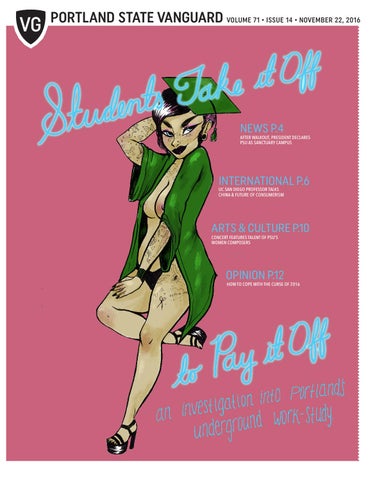
PORTLAND STATE VANGUARD VOLUME 71 • ISSUE 14 • NOVEMBER 22, 2016
NEWS P.4
AFTER WALKOUT, PRESIDENT DECLARES PSU AS SANCTUARY CAMPUS
INTERNATIONAL P.6
UC SAN DIEGO PROFESSOR TALKS CHINA & FUTURE OF CONSUMERISM
ARTS & CULTURE P.10 CONCERT FEATURES TALENT OF PSU'S WOMEN COMPOSERS
OPINION P.12
HOW TO COPE WITH THE CURSE OF 2016
Still looking for housing? LIMITED SPACES REMAINING FOR FALL 2016! WALK OR BIKE TO CLASS P R I V AT E B E D R O O M S & B AT H R O O M S A V A I L A B L E
Apply online today at
UNIVPOINTE.COM
UNIVERSITY POINTE
F U L LY F U R N I S H E D A PA R T M E N T S A M E N I T I E S F O R A F I T & H E A LT H Y L I F E S T Y L E INDIVIDUAL LIABILITY LEASES R O O M M AT E M AT C H I N G A V A I L A B L E
1955 SW Fifth Ave | 503.924.0003
Amenities subject to change. While supplies last. See office for details.
The Digital Gallery features over 11,000 images from the University Archives highlighting Portland State’s rich dynamic history. Explore over 60 years of campus buildings and events, athletics and student life, portraits of faculty and staff, and more. Search by keyword. Download images. Celebrate and learn more about the Portland State legacy at, http://archives.pdx.edu/digitalgallery
ILLUSTRATION BY ARLEN CORNEJO
NEWS INTERNATIONAL STRIPPERS IN COLLEGE ARTS & CULTURE OPINION EVENTS
4 6 8 10 11 14
COVER DESIGN: SHANNON KIDD
MISSION STATEMENT:
The Vanguard’s mission is to serve the Portland State community with timely, accurate, comprehensive and critical content while upholding high journalistic standards. In the process, we aim to enrich our staff with a quality, hands-on journalism education and a number of skills that are highly valued in today’s job market. EDITOR-IN-CHIEF Colleen Leary editor@psuvanguard.com MANAGING EDITOR Molly Ozier managingeditor@psuvanguard.com NEWS EDITOR Jon Raby news@psuvanguard.com
COPY EDITORS Jacoba Lawson MULTIMEDIA MANAGER Andy Ngo multimedia@psuvanguard ADVERTISING MANAGER Madelaine Eivers psustudentmediaadmanager@ gmail.com ADVERTISING DESIGNER Sam Hicks ADVERTISING SALES Michael Hardy Ilyse Espino DESIGNERS Lauren Chapluk Terra Dehart Shannon Kidd Aaron Osborn Lydia Wojack-West
ARTS & CULTURE EDITOR Daniel Finnegan arts@psuvanguard.com
CONTRIBUTORS Matthew Andrews Myles Boyns Joan Brown Andy Clark Kevin Hadsell Chris May John Pinney Christian Pointdexter Nick Tool
OPINION EDITOR Jennee Martinez opinion@psuvanguard.com
PHOTOGRAPHERS Jamon Sin Lauryn Smith-Freimark
INTERNATIONAL EDITOR Jessica Gaudette-Reed international@psuvanguard.com
ADVISER Reaz Mahmood reaz@pdx.edu
CREATIVE DIRECTOR Arlen Cornejo production@psuvanguard.com
ADVERTISING ADVISER Ann Roman
ASSOCIATE NEWS EDITOR Alanna Madden associatenews@psuvanguard.com
PHOTO EDITOR Silvia Cardullo photo@psuvanguard.com ONLINE EDITOR Tim Sullivan online@psuvanguard.com COPY CHIEF Thomas Spoelhof copy@psuvanguard.com
RIVALRY GAME RESULTS IN CRUSHING LOSS AGAINST EASTERN WASHINGTON COMMENTARY BY MYLES BOYNS
The Portland State Vikings football team hosted conference rival Eastern Washington on Friday Nov. 18. PSU entered the field as the clear underdogs against the third-ranked Eagles, but they begged to differ with their performance on the field. The first quarter began with the Viks showing a strong offense. Their 12-play, 84–yard drive ended with Alex Kuresa connecting with wide receiver Justin Calo on a 13–yard touchdown pass. The score was Justin Calo’s first touchdown catch of his PSU career. “Calo has been with us for a long time,” said PSU head coach Bruce
Barnum. “What a great operation by him to catch a touchdown in that game. I was proud of him.” Vikings defense forced the Eagles to punt, allowing PSU to drive down the field and score again. This time it would be thanks to Maximo Espitia on a 2– yard touchdown, placing the Viks up 14-0. Eastern Washington finally scored when Gage Gubrud connected to Nic Sblendorio on a 46–yard touchdown pass, cutting the lead to seven. The Eagles tied the game in the second quarter when Tamarick Pierce ran to the end zone from 2–yards out. The game would go back and forth
with two touchdowns by Nate Tago, but PSU held a 28–21 lead heading into the fourth quarter. Eastern Washington came back and took its first lead of the game with a 10–yard touchdown pass from Gubrud to Kendrick Bourne. PSU then drove down field for its final possession of the season. It was a dramatic finish that came to a fourth down, where Kuresa scrambled out of the pocket attempting to carry but was stopped just a few yards short. Eastern Washington held PSU off to win 35–28. Eastern Washington’s Gubrud finished with 22–41 attempts, 304
yards, three TDs, one intercepton; 10 rushes, and 45 yards. Shaq Hill finished with seven receptions, 124 yards, and one TD. For the Viks, Kuresa finished with 22–33 attempts, 252 yards, one TD, one interception; 13 rushes, and 93 yards. Tago finished the day with 16 rushes, 73 yards, and two TDs. As the Eagles prepare for the playoffs, the Vikings' football season has come to an end. The question remains: What will we see from the Viks next year? Will we see another tough season? Or will #BarneyBall bounce back to its winning days?
The Vanguard is published weekly as an independent student newspaper governed by the PSU Student Media Board. Views and editorial content expressed herein are those of the staff, contributors and readers and do not necessarily represent those of the PSU student body, faculty, staff or administration. JAMON SIN/PSU VANGUARD
NEWS
PSU STUDENTS PARTICIPATE IN NATIONWIDE COLLEGE WALKOUT
PRESIDENT WIEWEL DECLARES PSU A SANCTUARY CAMPUS JON RABY
The various uses and meanings of the word “fuck” are nearly uncountable and usually offensive, but despite its lack of definitive meaning the message it conveys is fairly clear. Chants of “Fuck Donald Trump” both started the Portland State student walkout at noon on Nov. 16 and continued intermittently throughout the event. A few hundred students at PSU gathered in conjunction with other college walkouts around the nation to signify a public opposition to President-elect Donald Trump, though the number of students who actually walked out of class could not be determined. “Class attendance may be a bit down since the election,” said Professor Sharon Carstens, who noted low attendance during the event but could not conclude the protest as a reason. “I have noticed a small drop in attendance post-election, though I am not sure what to attribute this to,” said Professor Charles Klein. “Often attendance declines at the end of the quarter. For Wednesday there may have been perhaps three or four fewer people in class.” The walkout lasted twoand-a-half hours and primarily involved public speakers, both organized and from the crowd. After more than an hour of speaking in the park blocks, the protest moved to the Market Center Building where PSU President Wim Wiewel’s office is on the 8th floor. After reading a list of demands, the students then marched to the red bricks in front of the Student Academic and Recreation Center for more public speaking and then dispersed. Topics discussed at the event varied, but a repeated focus was that they would campaign for PSU to be a “sanctuary university,” a sys-
4
tem used in many cities which does not prosecute illegal immigrants based on their immigration status or hold illegal immigrants until the Federal Immigration and Customs Enforcement agency can pick them up for deportation. The front lobby of the Market Center Building was occupied for approximately 15 minutes as a speaker read aloud a demand letter to the PSU Board of Trustees. The demands included PSU barring police from enforcing immigration laws on campus and forbidding the university from releasing information to ICE. Two days later, on Nov. 18, President Wim Wiewel sent an email to PSU students stating that PSU would indeed be a sanctuary campus. “We as a community share a commitment to the protection and support of all of our students, regardless of immigration status, national origin, religion or any similar characteristics,” the email stated. “Therefore, we declare that PSU is a sanctuary campus dedicated to the principles of equity, diversity and safety.” On Tuesday, Nov. 15, future Portland Mayor Ted Wheeler said Portland would be a sanctuary city. He also said he would wait to see what the Trump policies around sanctuary cities would be in terms of the cutting of federal funding. Police presence at the walkout was minimal, mostly comprised of campus security and police. Four motorcycle police escorted the crowd as they marched. Close by, on 13th Ave. between Clay and Market streets, a row of police vehicles marked and unmarked sat parked. Nine or ten police in riot gear were visible standing outside, and an unknown number of others were inside of the vehicles, some visible.
PROTESTERS LISTENING TO SPEAKERS IN THE PARK BLOCKS BEFORE THE WALK OUT. SILVIA CARDULLO/PSU VANGUARD A second issue of focus was for listeners to join groups fighting for racial justice, of which a number were listed by both organizers and the crowd. Speakers reiterated this was just a beginning in gearing up for a larger school walkout on Jan. 20, the inauguration of Presidentelect Trump. “If you’re not in an organization fighting for racial justice, you need to be,” a speaker said. Not all attendees agreed with the messages of the many speakers and their varying political viewpoints and ideologies.
PSU Vanguard • NOVEMBER 22 2016 • psuvanguard.com
“I attended because I’m in favor of nonviolent direct action in opposition to the Trump agenda, which I believe is illegal and immoral,” said Conflict Resolution Professor Tom Hastings. “I initially intended to bring my class to the event at two—I had already posted to my class as such—but then one of the speakers said everyone should ‘learn to shoot a gun.’ I left and canceled that field trip,” Hastings continued. A few speakers brought up the idea of bystander intervention, which is being taught
on the PSU campus. This refers to witnesses intervening in situations in which other individuals are being harassed or are in danger. “I want you to pledge that you will stand in front of that person being attacked,” said one speaker. “Do not leave here just feeling good about yourself,” another speaker said and asked members of various organizations to raise their hands, again encouraging the crowd to get involved in some capacity. Groups mentioned included: Associated Students of PSU, PSU Student Union, Students United
for Palestinian Equal Rights, Rural Organizing Project, Showing Up for Racial Justice, Portland State International Socialist Organization, Portland Tenants United and Know Your City. The crowd was mostly calm and attentive to listeners and numbered in the hundreds, but numbers dropped significantly when the crowd marched to the Market Center Building a few blocks away. Numbers in attendance fell further after the list of demands had been stated.
NEWS
ASPSU READS RESOLUTIONS FOR SOLIDARITY UNITING IN SUPPORT FOR STANDING ROCK AND SOCIAL JUSTICE JOAN BROWN
On November 21 the associated students of Portland State will vote on two resolutions involving racial justice in the United States. At the Nov. 7 ASPSU senate meeting two resolutions were read for the first time. The first resolution was to support the struggles of indigenous organizations against construction of the Dakota Access Pipeline. The second called for a financial boycott to impress solidarity against injustice, specifically racialized violence and police brutality. The “Resolution in Support of the Water Protectors at Standing Rock,” sponsored by the Multicultural Affairs Committee and contributed to by United Indigenous Students in Higher Education, shows support for those seeking to immediately and permanently halt construction of the Dakota Access Pipeline in the territory of Standing Rock Sioux Reservation and near their water supply. In recent years the Federal Energy Regulatory Commission has approved dozens of plans to pump fossil fuel from the earth and send it in pipelines zig-zagging across the American landscape. Many of those plans have faced protests. Currently, the Dakota Access Pipeline is in fervent protest. The resolution asserts that the Dakota Access Pipeline threatens the water supply, environment and public health of the Standing Rock Sioux Reservation and violates the United States’ treaties with the Sioux.
ASPSU AT THEIR BIWEEKLY SENATE MEETING. JON RABY/PSU VANGUARD On the Standing Rock Dakota Access Pipeline Opposition Facebook page is a teleSur English video of Dennis Banks, American Indian Movement founder and leader of the 1973 Wounded Knee standoff, saying, “When Standing Rock happened, we said, ‘Hey, we've got to go support them at all costs.’” The U.S. Department of the Interior estimates Standing Rock Sioux Tribe has 15,568 enrolled members. In solidarity, thousands of people, including members of more than 300 Native American tribes, have traveled to the Standing Rock Indian Reservation. Banks asked, “Why didn’t we as Native people band together before like this?” The resolution further asserts, “TigerSwan, a private security firm contracted with Dakota Access, LLC, the National Guard and the Morton County Sheriff’s Office have escalated against
protesters with violence, including the use of rubber bullets, tear gas and attack dogs.” Dakota Access, LLC is a subsidiary of Energy Transfer Crude Oil Company. The Energy Transfer website states, “[The project] will enable domestically produced light sweet crude oil from North Dakota to reach major refining markets in a more direct, cost-effective, safer and environmentally responsible manner.” Energy Transfer estimates local impact during construction is creation of 8,000– 12,000 jobs. In addition, ET predicts an increased demand for products and services which will produce an estimated $156 million in sales and income taxes. After construction the estimated annual revenue in property taxes is $55 million. “I believe there are so many reasons why this pipe-
line shouldn’t exist,” said Zia Laboff, Student Life director for ASPSU. “One of them is that it is furthering our dependence on fossil fuels. We keep mining and keep destroying the environment with this toxic fossil fuel drilling—let’s keep destroying the planet for this limited resource that is only going to last us a little bit more time just so we can keep that industry going instead of investing in renewables or finding solutions that are actually going to last us.” This message from ASPSU has been ongoing since last year’s members passed a resolution to divest from fossil fuel industries. “We hold the value that if enough outside entities speak up on a specific issue it does apply pressure on certain institutions and corporations,” says Alex Herrera, Cultural Affairs director for ASPSU. “The resolution
supports people who are doing the work on the ground, and lets people across the country know that they have support.” A motion to edit and reread the “Resolution in Support of the Water Protectors at Standing Rock” passed 22-01, at the Nov. 7 meeting. The “Injustice Boycott Resolution,” sponsored by the Multicultural Affairs Committee, calls on PSU students “to participate in a voluntary week-long financial boycott of the university beginning Dec. 5, 2016.” The boycott encompasses “the university and university services (i.e. SMSU cafeteria, Aramark services, bookstore [and the] SMSU marketplace).” “A couple things we’ve talked about are purchasing things like Scantrons and blue books in bulk and giving them out to students for free for the week," Herrera
said. "Purchasing coffee in bulk, snack bars, breakfast bars and giving those out to students throughout the week. Obviously we’re asking students to abstain from purchasing a lot more than just those things so we have to work out how we’re going to go about offering those things.” “ASPSU calls on the university to put in place a committee dedicated to creating and maintaining cultural competency training for students, as well as sponsoring a student subcommittee dedicated to crafting cultural competency and implicit bias training for CPSO,” the resolution states. Also, ASPSU “calls on the university to revisit the decision of armament.” “The boycott resolution is about the overall message to support Black Lives Matter and trying to find a way to get that message out,” Laboff said. “Cultural competency means understanding perspectives and cultures that aren’t your own.” A motion to edit and reread the “Injustice Boycott Resolution” at the Nov. 7 ASPSU meeting passed 22-0-1. In passing these resolutions ASPSU will ask the university to act in solidarity with the Standing Rock Dakota Access Pipeline Opposition and with the Injustice Boycott. The vote for both resolutions was Nov. 21. Check psuvanguard.com for results.
PSU Vanguard • NOVEMBER 22, 2016 • psuvanguard.com
5
INTERNATIONAL NEWS
WILL CHINESE RESCUE U.S. WITH CONSUMERISM? U.C. SAN DIEGO PROFESSOR TALKS CHINA AND THE FUTURE OF CONSUMERISM CHRIS MAY On Nov. 14, Dr. Karl Gerth, professor of History and Hwei-chih and Julia Hsiu Endowed Chair in Chinese Studies at the University of California, San Diego, made his case for the question, “Can Chinese consumers rescue China and the world?” being one of, if not the most important question in the world today. His talk was part of the Institute for Asian Studies’ ongoing “Focus on China Series,” which coincided with International Education Week. As Gerth postulates, “everything” here really does mean everything: “From your objective biosphere, the world that you inhabit, to your subjective experience of the world through your consciousness, this is all being impacted by this attempt to get China to go from the world's manufacturer to the consumer.” According to Gerth, international anxieties about “what's coming out of China that we need to worry about and respond to now?” can be understood as resulting from the effects of China's development of a consumerdriven economy, which is the central driver for both the radical transformation of Chinese society domestically and the consequences arising from the international competition over Chinese consumer consciousness and the environmental degradation left in its wake. China is a country currently ruled by a party that is Communist in name and which espouses socialism with Chinese characteristics as official ideology. Not long ago, the government used its power to suppress individual consumption and instead promoted industrial production at all costs. World Bank statistics show that among the largest countries for which data is available, China ranks
6
ON NOV. 14, KARL GERTH, PROFESSOR OF HISTORY AND HWEI-CHIH AT THE UNIVERSITY OF CALIFORNIA, SAN DIEGO, MADE HIS CASE FOR THE QUESTION, “CAN CHINESE CONSUMERS RESCUE CHINA AND THE WORLD?” COURTESY OF YUKO SOLBACH as one of the worst in economic inequality. On the other hand, International Monetary Fund show that China's world-beating economic growth has averaged around 10 percent over the last 30 years. “I would say there's been a consensus for 20 or more years, among both Chinese and American political and economic elites, that Chinese consumers were meant to save the world," Gerth continued. “By changing their economy from one that relied on all of us to keep buying stuff, and instead, unleash domestic consumption, get Chinese consumers to buy everything else that we associate with our own lifestyles that would drive a new wave of economic growth around the world.” Gerth presented the Chinese automobile industry as a case study in which the positive and negative
trade-offs of China's move towards a society of mass consumption can be examined. “Once upon a time, China was one of the few socialist countries that decided it wasn't going to compete at private automobiles," Gerth explained. "China intentionally decided that it wasn't going to build this mass automobile-dependent civilization. In the early 1990s, however, they reversed course, and within a decadeand-a-half they went from having virtually no personal cars to becoming the world's largest market, passing the U.S. in 2009." “The argument about cars I want to make here is that the car industry in China and the desire for cars wasn't created because the government got out of the way, but rather the government rearranged the market and Chinese society in ways which helped push people into needing cars,”
PSU Vanguard • NOVEMBER 22, 2016 • psuvanguard.com
Gerth said. The government accomplished this through a series of policies that included privatization of housing, urban planning that shifted from mixed-use to centralized business districts, and stimulating demand through reduced tariffs and car loans through state-owned banks. But perhaps the single largest factor in China’s reversal of its previous stance toward the automobile industry was its preparations and negotiations prior to joining the World Trade Organization in 2001. “To my mind, the most important thing that got China to dramatically change its economy in the 1990s, and what we've seen since then, was in the lead up to the WTO, China feeling like it had a teeny little window in which it had better develop key industries," Gerth explained. "Before, foreign cap-
ital was kept out of China, or at least had a lot more restrictions on entering China.” Gerth described this as a window of opportunity for developing a domestic car industry to prevent China being permanently locked at the lower end of the valuechain, out-produced and outcompeted by firms such as General Motors or Toyota. “If China developed that domestic car industry quickly and well enough, it would have its equivalent of one of the companies it would be competing with,” Gerth explained. Being locked at the lower end of the value-chain would mean that the millions of Chinese graduates looking for new jobs would be working at Nike factories instead of in high-tech, value-added service sectors that would pay well enough to allow them to participate in the kind of consumer-driven economy
China hopes to create. In many ways, this model of stimulating the market to create a favorable environment for consumers was taken from the U.S.; as a result, China is facing similar consequences from these policies. “We now see that it’s like many problems in China, not a problem of ‘can't make the stuff,’ but a problem of ‘making too much of the stuff,’” Gerth said. What happens when you have that massive overcapacity? You look for new markets for those cars. And a lot of those cars aren't coming to the United States—yet— but are going to developing countries. So this car-dependent logic that was thrust upon China is now thrust on other parts of the world by way of China. Suggesting that the credibility of those who advocate putting more money into the hands of Chinese consumers is substantially undermined by the finite nature of earth’s resources, Gerth continued, “In their analysis, they never talk about the externality side of all of this, they never talk about the consequences of re-balancing the Chinese economy on the biosphere the way I've sort of suggested.” Unfortunately, Gerth’s conclusions on the state of affairs are more fire and brimstone than silver lining: “In China, they're on the front lines of this; they have more of a vested interest in figuring out the incredibly difficult math of how to have a better life and a growing economy without destroying the biosphere even more than they already have, so maybe the answers will emerge from there," Gerth said. "I'm not sure they're going to emerge from here.” For an extended version of this piece, visit psuvanguard. com
INTERNATIONAL
UPCOMING INTERNATIONAL EVENTS CHRISTIAN POINDEXTER
DEEYAH KHAN FILM "ISLAM'S NON-BELIEVERS" FIRST UNIVERSITY SCREENING BY PSU FREETHINKERS The group Freethinkers of Portland State is hosting the first university screening of Islam’s Non-Believers. The film, directed by Deeyah Khan, “investigates the lives of ex-Muslims, who face extreme discrimination, ostracism, psychological abuse and violence as a result of leaving Islam,” and features Rafida Bonya Ahmed, widow of murdered secular BangladeshiAmerican writer, Avijit Roy. What: “Islam’s Non-Believers” When: 7 p.m., Nov. 23 Where: Smith Memorial Student Union, Room 328
NOV. 16
NOV. 18
NOV. 19-20
Nov. 14-21 Jessica Gaudette-Reed
NOV. 20
PSU’s Center for Japanese Studies presents, “From Hello Kitty to Cool Japan: The Political Economy of Japanese Popular Culture in Asia” on Nov. 29. In this talk, Dr. Nissim Otmazgin will present on issues related to “the expansion of Japanese popular culture industries, especially the music, television, and anime industries, into the market in East Asia since the late 1980s, and the response of the Japanese government to these processes.” What: “From Hello Kitty to Cool Japan: The Political Economy of Japanese Popular Culture in Asia” When: 6 p.m., Nov. 29 Where: Smith Memorial Student Union, Room 296/8 PSU Institute for Asian Studies Visiting Scholar Lecture Series is hosting “North Bay of Bengal as a SubRegion: An Indian Perspective on the China Factor,” presented by Professor Chanwahn Kim. Kim is Professor of Indian and ASEAN Studies at the Graduate School of International and Area Studies, Hankuk University of Foreign Studies in Seoul, Korea. The presentation will examine why and how the North Bay of Bengal is important, especially for India, and will discuss India’s major policies to handle the China factor in the region.
What: “North Bay of Bengal as a Sub-Region: An Indian Perspective on the China Factor” When: 6 p.m., Dec. 1 Where: Smith Memorial Student Union, Room 327/8 On Saturday, Dec. 3rd, the First Saturday PDX Asian Lecture Series presents “Literati Life and Neo-Confucianism in Song China” by Dr. Linda Walton, Professor Emerita, PSU. Dr. Walton will be discussing “an exploration of the intersection between thought and society during the Song Dynasty (960-1279).” The First Saturday Series features monthly “lectures and presentations on art, architecture, gardens and historical culture of China and East Asia, highlighting connections with the Pacific Northwest.” What: Walton talk on “Literati Life and Neo-Confucianism in Song China” When: 9:30 a.m., Saturday, Dec. 3 Where: PSU Academic and Student Recreation Center, Room 230 All events are free and open to the public unless noted otherwise.
RUSSIA
Russia withdrew support from the International Criminal Court after it released a report accusing Russia of war crimes during the annexation of the Crimean Peninsula in 2014. Unlike Burundi, Gambia, and South Africa, Russia had not ratified the Rome Statute of the ICC, the withdrawal of Russia’s signature is primarily symbolic. The ICC report states, “[The] annexation of the Crimean Peninsula amounts to an international armed conflict between Ukraine and the Russian Federation.” More than 9,000 people have died in eastern Ukraine since early 2014, according to Amnesty International.
TURKEY
Thousands took to the streets in Istanbul, Izmir, and Trabson to protest a recently introduced bill that would allow men who had sex with underage girls to be forgiven of their crimes if they married their victim. The bill has been partially approved but will be voted on after debate on Tuesday, Nov. 22. It follows on a previous controversy concerning a constitutional annulment a section of Turkey’s criminal code which classified sexual acts with children under 15 as sexual abuse. The bill would only pardon men if they had sex “without force or threat.” Critics say that the measure legitimizes child rape and child marriage.
PERU
The 2016 Asia-Pacific Economic Cooperation meetings culminated in the APEC Economic Leaders’ Meeting. Heads of state from the 21 Pacific Rim member countries were present. Notably, South Korean President Park Guen-hye and Thai Prime Minister Prayuth Chan-ocha were not present. President Park is currently under investigation regarding a political scandal, and PM Chan-ocha was observing the state-declared mourning period for the late King Bhumibol Adulyadej. At the summit, leaders prioritized discussions on the investment in human capital development, modernizing small and medium enterprises, fostering the regional food system, and advancing the regional economic integration and growth agenda. Though the topic of the recent U.S. presidential elections was fresh on leaders’ minds, Canadian Prime Minister Justin Trudeau emphasized the purpose of the meeting as “talking about ways to continue working together” and combating the growth of anti-globalization sentiments.
INDIA
Fourteen carriages of the Indore-Patna Express train derailed near the city of Kanpur. At least 115 people have been been confirmed dead and an additional 150 injured as rescue workers tried to recover any remaining passengers. Authorities have launched an official investigation, which they believe could have been caused by damage to the tracks. India boasts the world’s third-longest railway system, with 115,000 kilometers of track, and is the carrier of over 22 million passenger journeys per day.
PSU Vanguard • NOVEMBER 22, 2016 • psuvanguard.com
7
OPINION FEATURE
STUDENTS TAKE IT OFF TO PAY IT OFF AN INVESTIGATION INTO PORTLAND'S UNDERGROUND WORK-STUDY BY ALANNA MADDEN
STRIPPER
1 : A PERFORMER WHO REMOVES HIS OR HER CLOTHING IN A SEXUALLY EXCITING WAY : A DANCER WHO DOES A STRIPTEASE. In Portland you can barely throw a microbrew without hitting a strip club: Our city holds the highest number of strip clubs per capita in the United States. There is approximately one venue for every 11,286 residents. If you’re a local, this isn’t news—and if you haven’t tried dancing for a living already, you have probably considered it a viable option; especially with the rising cost of living and education. Recently unemployed, I wanted to consider my options as to what jobs I could work while in school that would be the most lucrative, schedule friendly and easily obtained. What were the pros and cons of dancing? Was stripping to “pay off your loans” a stereotype? I decided to find other Portland State students who dance to find out.
STIGMA
1 : A SET OF NEGATIVE AND OFTEN UNFAIR BELIEFS THAT A SOCIETY OR GROUP OF PEOPLE HAVE ABOUT SOMETHING. IN GREEK AND LATIN, A STIGMA WAS A MARK OR BRAND, ESPECIALLY ONE THAT MARKED A SLAVE, SO A STIGMA MARKED A PERSON AS INFERIOR.
Out of the 16 students I found at PSU who work as professional dancers, only two were willing to go on record about their stripping occupations. A common boundary I found was that many strippers are tired of being questioned and judged because of their jobs
8
and are unwilling to justify their decision. “Why do strippers have to constantly defend stripping to non-strippers about the world of strippers?” wrote a dancer who uses the name Mmmmeadow. “I, a stripper, can confirm that the world of stripping can be just as boring as a desk job or just as drug-filled and toxic as being a barista at Starbucks,” Mmmmeadow continued. “It’s your character, not your job.” Another reason many students choose to avoid talking about their professions is to avoid judgment from peers, staff and family. They want to avoid being fetishized outside of their workplaces and protect their safety and per-
sonal boundaries by leaving the dance persona at work. The same stigma that allows people to judge and c ritic ize c a n a l s o c a us e undue shame for dancers and a fear of speaking openly or even proudly about their profession. More importantly though, with any job that one has whil e a tte nding s c hool , building a network of support around your goals requires transparency and accountability—a luxury our culture sparingly gives to any sex worker. Consider the community's role in encouraging students to pursue their educational goals: Are we making exceptions for discrimination in regard to strippers? Have we
PSU Vanguard • NOVEMBER 22 2016 • psuvanguard.com
allowed our personal beliefs involving sexuality to hinder the encouragement of other students? If so, does this help us feel better about the way we see ourselves or the way we want others to see us? Asking ourselves these questions may be an important factor in understanding the perspective of the dancers interviewed for this article and why they asked to remain anonymous. My first step was finding out how many students actually dance. Through the dance scene grapevine I found James*, a current PSU student who recently retired after stripping for three years at Silverado. When asked about the existence of other student danc-
LAURYN SMITH-FREIMARK/PSU VANGUARD ers he said, “Surprisingly, yes. There were four other PSU students who I danced with, [in addition to] a student who was getting a master’s at Pacific, a student from Reed, and a student from Clark College.” James continued, “I’d say a majority of the dancers were students, or at least it was a lie they made up to get more tips.” When searching for a list of strip clubs I came across Xoticspot.com, which acts as a social media platform or a "Yellow Pages" of strippers. The number of active strippers listed in PDX alone came to 1,387. In sampling 100 users, the average age was 25 years old, leading me to speculate that the number of
student-dancers could be far larger than imagined. Mary’s Strip Club was the first of many stops in my search for other students. This wasn’t my first rodeo, however, so I knew that sitting at the rack and tipping well would be the best way to ask questions. Rochelle* was on her way off the stage when I introduced myself and asked for an interview. When asked if she was a student or if she knew of other student dancers, Rochelle replied, “I just graduated from college actually. I have a master's in psychology [from PSU]. There are lots of women in college who dance around here.” Spyce, a recruiter of PSU students, was bound to be a gold mine for fellow students due to their hiring of dancers who are not yet 21. Spyce is also one of the few strip clubs in PDX where the dancers do not remove their panties. While ordering drinks I asked the bartender, Melissa*, for her experience regarding students. “We have lots of college students who come to dance here,” she said. “I’ve been working here for over seven years and it’s definitely a common thing.” “Most girls I see though, just pass through,” Melissa said. “There’s not a lot who stick around.” The next venue, Casa Diablo, is often referred as Portland’s wildest strip club or simply the “infamous vegan house of sin” by their website. Accompanied by a female friend, we spent the night admiring the athleticism of the dancer’s pole tricks, the variety of attitudes each dancer personified, and the amount of boldness it would take to be so overtly erotic in a packed room of mostly males. Casa only allowed an interview with the purchase of a lap dance, so with four drinks and $200 between us, we picked the sweetest and most outgoing dancer we saw on stage. After polite introductions we began asking our dancer,
FEATURE OPINION Crystal*, about her dancing experience and if she worked with any students. “A lot of girls who are in school that start stripping realize how much more they make dancing, and it makes their degrees seem pointless," Crystal said. “And so, they just drop.” At Club 205, the dancers were also very sweet, offering nearly three hours of conversation in between dance sets. “There are definitely girls who are in school and who dance at night to support themselves,” said Carissa*, a Club 205 dancer. “I’m not a student, but there are some here tonight that I can show you!” Another dancer, Jasmin*, said, “I see a lot of girls who dance and go to school, but they usually quit dancing after a couple years to focus on class.” Upon asking studentdancers how they decided to start stripping, their answers were fairly similar: schedules, lifestyles, and the need to support themselves. “My friend was telling me about how this guy was a dancer and how much money he made doing it,” James said. “At the time I was pretty broke, so I entertained the idea.” “That weekend, a friend and I went to scope the place out," James explained. "I didn’t realize it at the time, but I went during Pride, so it looked like the dancers were pulling in a grand a night. After that, I decided to audition and quickly realized that most nights I make a fraction of what I witnessed.” James’ introduction was nearly identical to another PSU student, Eric*. “When I first moved to Portland I didn’t know anyone and had just started school,” Eric said. “It seemed like a lot of fun and like they made good money.” “I got all ready, shaved everything and started working out more,” Eric said while remembering his first night auditioning. “It felt really weird and I was really selfconscious. That part never got better for me.” Stag, a male strip club with a body-positive “bear” and “cub” culture, was more difficult in competing for the dancer’s attention. Upon discovering that many male strippers identified as being straight, Eric offered an interesting insight: “A lot
of them use their job as a way to hook up with women.” “For a long time, we weren’t even allowed to give lap dances to women,” Eric explained. “[Not until] Stag opened, where they let anyone buy lap dances, and it took a lot of business away from the club.” “It was so competitive for money and attention,” Eric said. “Some guys would just sit there and not talk to anyone and be only focused on getting laid or just waiting to get on stage.” It’s not a surprise to hear how competitive dancers can be with one another,
depending on if they were male or female. Female strippers reported a much higher pay than the men interviewed, although they wouldn’t admit to an average take home. Crystal reported she and other dancers made “a couple grand” every weekend. Eric reported an average of $80 per night and disagreed with the idea of male stripping as being a lucrative means to making money as a student. “When I started I would make an easy $2,000 working 20 hours a week,” said James. “On top of that, random guys
Eric left for similar reasons but added, “I am just too self-critical. I just put too much pressure on myself to look the way I wanted and it got to be too much.” Regarding how strippers felt about their jobs and how they are received by the public, both male and female students expressed similar sentiments. All reported feeling the pressure of being stigmatized and the need for discretion. A 2015 article by a University of Michigan student called "Confessions of a College Stripper" states: “It is easy to believe that
especially because dancers are commonly asked to pay stage fees in order to work. This is due to the fact that
would pay my rent, pay my bills, take me to dinner, take me shopping. Building those kinds of relationships are
being a dancer is degrading and shows that you have no self-respectand low selfesteem. I find the experi-
“A lot of girls who are in school that start stripping realize how much more they make dancing, and it makes their degrees seem pointless," Crystal said. “And so, they just drop.” they are employed as independent contractors, therefore waiving the option of hourly pay. Clubs may also require dancers to tip out security, bar staff and makeup artists if provided. A large difference in earnings appeared to affect the longevity of a dancer’s career
mentally exhausting.” Both Eric and James decided to eventually leave their stripping careers. “Academics are my primary concern right now,” explained James. “While the flexibility in the dancing schedule can be beneficial most of the time, I really dislike getting home at 3 a.m. and waking up at 8 a.m. for class.”
ence of being a stripper very empowering because instead of getting catcalled on the street, you are instead taking control of your sexuality and choosing what you want to do with it.” “A lot of people just assume that all strippers are drug addicts and prostitutes,” Carissa said. “I work full time
and I don’t even drink.” “Girls who are using drugs or selling themselves don’t last here, or anywhere, very long,” Carissa added. “Most of us have boyfriends or husbands and families. It’s just a job and we live normal lives.” I asked Carissa if there was any truth to the stereotypes, suggesting the possibility of them existing for a reason. “You know there are clubs where some of the girls are shady,” she responded. “You just have to be selective and careful about your environment.” “Society has this negative impression of sex workers that is deeply rooted in systemic
LAURYN SMITH-FREIMARK/PSU VANGUARD sexism,” James said. “It is difficult for me to provide a decent perspective since male dancers don’t experience the same stigma that female dancers do. At the end of the day, we are there to make money, just like everyone else at their respective jobs.” James continued to explain his experience, mentioning negative stereotypes associated with strip clubs. “I’ve seen guys be pushed to their breaking point. The profession can be empowering at many times, but it also attracts individuals who are exceptionally vulnerable.” “I’ve seen guys develop debilitating drugs habits, I’ve seen guys struggle with depression, I’ve seen guys resort to suicide, and I’ve seen guys place their entire self-worth on how much money they made that night,” James said. “For some of the guys I’ve
worked with, it is the only viable option they think they have.” A recent Ph.D dissertation published by the PSU Urban Studies department found that many female dancers manifested issues in their personal relationships due to their jobs. Reported symptoms included hostility towards men, difficulty with sexual intimacy and alienation from family members. The stigma associated with being a stripper was found to make female participants more vulnerable to sexual harassment from people who expected them to always be sexually available. A study conducted in 2005 compared female indoor sex workers (strippers) and female nurses in measuring levels of burnout and exhaustion. Results showed that strippers suffered higher levels of burnout, exhibiting symptoms of emotional exhaustion due to the lack of job autonomy, social support, negative work motivation, and the condemning treatment of their character and self-worth that is contributed from their community. According to the same s t u d y, t h e a m o u n t o f hours, income, or type of labor were not important influences in measuring emotional exhaustion. PSU’s Women’s Resource Center actively advocates students seeking and accessing safety for all areas of their lives regardless of their occupations. The WRC website states, “Students participating in the sex industry often feel like aspects of their life are compartmentalized, and access to non-judgmental support and mentorship on campus is not available.” WRC offers a Student Sex Worker Outreach Project, providing many services that include planning classes around work, or handling nonconsensual disclosure of their sex worker status on campus. I found there wasn’t a black and white answer in regard to deciding if dancing would be a good option for me. Was the money worth it for short term gain? Could I “just brush it off and have fun with it,” like the bartender from Spyce advised? Regardless of what I decide to do, I’m grateful for the insight given to me from my fellow PSU students who participated.
PSU Vanguard • NOVEMBER 22, 2016 • psuvanguard.com
9
ARTS & CULTURE OPINION FEATURE
CHORAL CONCERT SPOTLIGHTS PSU’S FEMALE COMPOSERS MATTHEW ANDREWS
ETHAN SPERRY CONDUCTS THE PSU CHAMBER CHOIR. MATTHEW ANDREWS/PSU VANGUARD It has often been difficult for women to be accepted as musicians, especially as composers. Who knows what women like Clara Schumann and Ruth Crawford might have accomplished if they had not struggled against patriarchal expectations and the massive shadows of their more successful husbands? Even in our time, highly accomplished artists such as Björk and Kim Gordon must fight against assumptions that they don’t understand the musical techniques or the technology they use, fielding questions like, “Who makes your beats?” and “What’s it like to be a girl in a band?” Most female rock musicians share similar experiences: They go into guitar shops and get asked if the expensive effects pedals they’re
10
looking at are gifts for their boyfriends; they play in rock bands and get asked why they’re not at home with the kids. They work with male producers who take credit for their ideas and demand sexual favors, and on and on. Perhaps worst of all, those of us who haven’t experienced these things tend all too often to be dismissive and skeptical. When the Vanguard heard that Portland State’s three choirs, under the direction of Ethan Sperry, were not only putting on a series of concerts showcasing female composers but that no less than four of those composers would be living composers affiliated with PSU, we knew we had to find out more. The four composers— School of Music Director Bonnie Miksch, composi-
tion Professor Renée FavandSee, piano and body-mapping Professor Lisa Marsh, and PSU alumna Stacey Philipps—are a diverse group with widely different influences. They contributed four very different works to these concerts. Miksch’s "There is No Rose of Such Virtue" sets an anonymous 15th-century text with passages in both Renaissance-era English and medieval Latin. Miksch, who has more often been associated with her electroacoustic works, combines clear, simple melodies with dense and complex polyphony to create an overwhelmingly rich texture, which she calls “a sensuous sound profusion.” Philipps, who describes herself as “not a young composer but a relatively new composer,” returned to college when her daughter
PSU Vanguard • NOVEMBER 22 2016 • psuvanguard.com
started elementary school, exploring her passion for music theory and ultimately obtaining a second bachelor’s degree in music composition from PSU. Her choral piece, "Morning", was crafted around a much more recent text: an internet meme. This “haiku about getting out of bed” is indeed a haiku, but its formally faithful five+seven+five syllables are nothing more than the word “no” repeated seventeen times. Philipps translates this haiku into 5/8 and 7/8 rhythms, using innovative choral effects to imitate a dreamlike state and the beepity-beep-aaank-aaankaaank alarm clock sounds which disturb it. Marsh describes herself as “a dressed-up hippie” who has “done all the traditional
roles for a woman: teacher, nurse, wife, mother” and only started identifying herself as a composer five years ago. She is, like the other PSU composers, a member of Cascadia Composers, a local branch of NACUSA. She was also a co-founder of Cascadia’s sister group, Crazy Janes (who recently performed at PSU). Her piece for choir and piano, "The Heart’s Constellation", sets a text by her friend and frequent collaborator, local poet Deborah Buchanan, using lush seventh chords and spare dissonance to evoke “the mystery and allure of the night” and “the promise of love.” Marsh’s music is perhaps the most accessible of the four—she said her music is often criticized for being “too beautiful”—but was certainly no less profound.
Favand-See’s composition was the briefest of the four and the most intense. Based on a poem by American poet, novelist, and environmental activist Wendell Berry, "The Woods" is a song of despair giving way to hope. FavandSee told the Vanguard that, following a tragic death in her family, Berry’s poetry was an oracle and a companion through grief. Written on commission for local vocal ensemble Resonance, "The Woods" was the first new music she composed after what she called a long silence. FavandSee describes the song as “an affirmation of life in the face of darkness.” The composers certainly succeeded in the face of their own adversity, and from this share an important musical voice.
OPINION
D’OH?
"THE SIMPSONS" WILL HELP YOU COPE WITH THE NEXT FOUR YEARS ANDY CLARK
IN SEASON 11, EPISODE 17 "BART TO THE FUTURE" THE SIMPSONS PREDICTED DONALD TRUMP WOULD BE PRESIDENT. FOX/2000 On Nov. 8, America received some incredibly unforeseen news: For the next four years, our country will be run by former reality TV show star, Donald Trump. While half of America celebrates and the other half smashes the windows of car dealerships, there is one thing that can bring us all together: The Simpsons, which was renewed for two more seasons. On Nov. 4, Fox executives extended an order for two more seasons of the historic sitcom giving the show its 29th and 30th seasons. With the addition of the new seasons, the show’s total episode count will climb to 669, passing the record for most episodes of a prime-time scripted series in television history. In recent years—and by recent years, I meant the last decade-and-a-half—some fans have pushed back against the show, calling it a shell of its glory seasons. Many believe it should be canceled. But what would a world without The Simpsons look like? That’s a question some of the younger students at Portland State might literally not be able to answer. The show started in
1987 as a series of shorts on the Tracey Ullman Show. That means to have experienced a truly Simpson-less world, you’d have to be at least 29 years old. It’s no wonder the old people who voted for Trump are so jaded: they’ve gone most of their lives without The Simpsons. Since its inception, The Simpsons has gone on to become a pop culture force like none the world has ever seen. The franchise earned Fox more than 2.3 billion dollars in profits during its first 23 seasons alone. Its catchphrases are so wildly used and commonplace that even Homer’s annoyed grunt, “D’oh!” has made it into Oxford’s English Dictionary. It even has a penchant for predicting the future, including calling Donald Trump’s presidency—a prediction which would leave us broken. As a franchise, The Simpsons has speared on some of America’s greatest comedic writers, including Conan O’Brien who honed his talent for simultaneously silly and sharpwitted jokes with the show in the early ’90s.
In addition to famous former writers, the show has had more notable celebrity guest appearances than anything except for Saturday Night Live. From its start to its current season, The Simpsons has become the destination spot for stars across the entertainment stratosphere to make fun of themselves. Not only do they use typical stars like Danny Devito and Jon Lovitz but also get American heroes like astronaut Buzz Aldrin. The Simpsons is less of a television show now and has become more of a cultural icon. Because it has been on the air for such a long time, the setting of Springfield and the characters Homer, Marge, Bart, Lisa, and Maggie are no longer a driving force of the show but rather a vehicle for jokes. In the same way that Saturday Night Live has been institutionalized, so has The Simpsons. Regardless of how good a new season is compared to older ones, the show deserves to stay on the air if only to remind us of a funnier time—something we all may need in the next four years.
PSU Vanguard • NOVEMBER 22, 2016 • psuvanguard.com
11
OPINION FEATURE
2016: THE YEAR IN REVIEW Musings from the Sub-Basement by Kevin Hadsell While perusing my Facebook newsfeed these past few days, taking in the reactions to recent events, one status in particular stood out from rest. It focused on the attention journalists have been giving to celebrities and pop musicians over the election results: “I’m not really sure how to comment,” this person wrote. “I’ll just shed a few more tears of frustration and disbelief into my coffee.” I put down my phone and gazed down into my own cup of coffee, picked up a nearby spoon and gave it a good stir. The tears, I have found, provide a pleasantly savory, salty taste to the coffee, which pairs well with eggs and toast. And while I know I would probably enjoy the coffee more without the tears, I have nonetheless grown accustomed to it. The past year has brought a series of calamities that have proven difficult to reconcile. We have lost David Bowie, Prince, Alan Rickman, Gene Wilder, Janet Reno, and now Leonard Cohen (whose timing seems impeccable in retrospect, as if he saw Tuesday’s election results, mulled it over for a second and said, “Well, I think I’ll be going now. So long,” and slipped away from this world. Can’t say I blame him for it). We have witnessed Brexit, numerous police shootings, ongoing armed conflicts in various parts of the globe, and a widespread infestation of invisible Pokemon. And now we have just elected Donald Trump as president of the United States. The election was going to be historic regardless of the outcome. Hillary Clinton would have been the nation’s first female president; Donald Trump, the nation’s first orange president. We got the first orange president. I think the natural question to ask at this point is, how did it come to this? The answer, of course, is not easy to discern. These things never are. And yet, in this case, there may actually be a clue to what, finally, went wrong. The long-awaited World Series win for the Chicago Cubs also happened in 2016, breaking a 76-year pennant drought and a 108-year World Series drought. It is the longest such drought in professional sports. A short list of things that have happened in that time: two World Wars, modern sewage treatment techniques, the widespread adoption of the automobile. In short, it has been a while. The long drought, according to Chicago legend, can be attributed to the “billy goat curse,” when one William Sianis was asked to leave Wrigley Field during game four of the 1945 World Series due to the odor of his pet goat. According to legend, William Sianis levied a curse upon the team and its fans that they may never win another World Series. And for 71 years, the curse held true. Until 2016. Curses, as we all know, only strengthen over time if not properly dealt with, like a stubborn weed patch in the garden. This curse has only become stronger over the years, making it more and more difficult to dislodge. It would require something extraordinary—possibly several things—to overturn it. And while I cannot say for certain that the Cubs invoked some sort of blood ceremony of the dark arts in order to secure a Cubs victory, I can say that, if one would sit down and do the math, the numbers add up: Leonard Cohen, Prince, David
12
ILLUSTRATION BY LYDIA WOJACK-WEST Bowie, Gene Wilder, Janet Reno, Alan Rickman, and, perhaps the most powerful and darkest Faustian agreement, a Donald Trump presidency. Added together, they could conceivably be strong enough to break a curse that had been building steadily in power for 71 years now. Numbers don’t lie. While all of the evidence is circumstantial at this point, it’s something worth looking into. There is nothing we can do, of course, to bring back those we have lost. Yet there may be ways to resist the ascendance of President Trump, a candidate that has made campaign promises to restrict the rights of ethnic minorities, utilize torture techniques, restrict the freedom of the press, and build a wall along the U.S.-Mexico border. According to a recent article, the destruction of Donald
PSU Vanguard • NOVEMBER 22 2016 • psuvanguard.com
Trump’s walk of fame star in October, in which a man smashed the star with a sledgehammer in the wee hours of the morning, has effectively rid the world of one of the seven Horcruxes it would take to vanquish the president-elect. According to the piece, “Stabbing a copy of The Art of the Deal with a basilisk’s tooth is the next step to eliminating Donald Trump.” There are others, of course (HINT: the hairpiece is probably one of them, but with his Secret Service detail it will be difficult to get close). Trump Tower may perhaps be another. So take heart; there is still hope. We can resist this thing if we band together and act now. In the meantime, I recommend a squeeze of lemon to accompany the tears shed in 2016. It goes quite nicely with a warm cup of Earl Grey tea.
OPINION
ORGANIZE YOUR TIME OR WASTE IT The Complete Tool by Nick Tool
“Busy people get things done.” According to the preeminent authority on procrastination, Timothy A. Pychyl, Ph.D. of Canada’s Carleton University, procrastination is an avoidable part of life if students can only understand the risks and causes of procrastination. Pychyl has published many reports and studies on the subject and has been interviewed in psychology publications to discuss procrastination. To understand Pychyl’s ideas how to prevent procrastination or combat it, watch the one-hour lecture he gave to Carleton University teachers’ assistants on YouTube. The root of efficiently managing time is breaking it down into manageable pieces. Realistically building a schedule is the way to do what needs doing when it needs to be done. There is an applicable saying for breaking down a task that is common among the armed forces: “How do you eat an elephant? One bite at a time.” This is a good start, but it isn’t the whole picture. Priority is also important. Where does the first bite come from? When breaking a schedule into bite-sized pieces, those pieces need to be prioritized, equally distributed, and manageable for the specific person. Taking on too many tasks at one time will not work. Taking on tasks that are too large will not work either. Be specific in your task outlining and schedule setting. Scheduling never stops being important as a part of life. It is essential to student success, professional success, and personal success. “Busy people get things done,” as Pychyl said. Organizing time keeps people on task and completing goals. The time to start organizing time is now, and it does not require any preparation or a fancy system. The next time an instructor assigns an assignment, write down the day and time you’re going to do it. Every time something arises that requires a piece of time, it just gets placed based on priority, time required, and complexity. Some tasks are so large they require multiple 20-minute time blocks over a week, several 15-minute blocks a day for several days, or one houra-day per week for several weeks. The way to find the right formula is by experimenting. The fallacy that most students use to delude themselves is that they do better under pressure. The fact is, no one does. Preparation produces better results every time. This is observable in the real world. Classes do not work if the teacher is just coming in every day whenever they feel like it and trying to run through a lecture off the cuff. What if they assigned all of the course's homework in the last week? How much would students learn? Organization is important to learning, and accomplishing tasks at a steady pace is equally important. Business works the same way. Very few successful companies have gotten anywhere without a plan and a steady flow of work toward their goals. Another issue that plagues people who fail to manage their time well is work flow. When a task is done, turned
ILLUSTRATION BY TERRA DEHART in, and there are a few leftover hours between that moment and the deadline, how great does that feel? Most people stop there if no other tasks are pressing down on them with the type of urgency that the previous one held. If instead people used that sense of accomplishment to move into another task, they would start developing a steady flow of accomplishment. That is a steady flow of good feelings. That is a steady flow of jobs well done, and deadlines looming way out in the future that need not scare anyone. Imagine productivity as a line that is constantly moving forward every second on a horizontal axis. That horizontal axis is time. While students are doing nothing, the line sits at zero on the vertical axis of productivity. Putting in all the work to move the line up and up and up while, for example, writing a paper rewards a higher emotional payoff.
Why, then, do students allow the line to drop back to zero? Wouldn’t it be easier to maintain a lower but more constant level of productivity? There are several issues that lead students, and people in general, to failures in planning. It is a lifestyle change after all. The most important thing for now is to just get started. Make the first step an easy step. Sit down with a sheet of paper, and on that sheet of paper write today’s date, the current time, and mark out 15 minutes. In that 15-minute block, write down, “Make a schedule for the rest of the week.” The last item for the week should be planning next week, and include some time for listing out incremental goals. What do you want to get done that week? This month? This quarter? Next quarter? All year? Planning is absolutely essential to staying busy, and busy people get things done.
PSU Vanguard • NOVEMBER 22, 2016 • psuvanguard.com
13
OP-ED OPINION FEATURE
AN AUTOPSY OF PLANET EARTH: A REPLY GUEST COLUMNIST
In an article published by the Vanguard on Oct. 31, 2016, writer John Larson addresses one of the most crucial issues the world is currently facing: climate change. Larson argues that climate change is due to a multitude of factors such as carbon dioxide and fossil fuels. Although it’s fair to say that both factors are leading contributors to global warming, the article fails to acknowledge the greatest contributor of them all: animal agriculture. There is extensive research showing the impacts of animal agriculture on the environment. The Food and Agriculture Organization of the United Nations argues that the livestock sector emerges as one of the most significant contributors to the most serious environmental problems, at every scale from local to global. Once we put the animal agriculture industry’s impact into numbers, it’s not hard to see why this is the case. According to the groundbreaking documentary, Cowspiracy: The Sustainability Secret, animal agriculture is responsible for
18 percent of greenhouse gas emissions (more than the combined exhaust of all forms of transportation), 51 percent of all worldwide greenhouse gas emissions, 80–90 percent of all U.S. water consumption, and occupies 45 percent of the earth’s total land. Animal agriculture is also the leading cause of species extinction, ocean dead zones, water pollution and habitat destruction. With all of these issues that animal agriculture presents to our planet, almost all of it is entirely unchallenged. Why? Since animal agriculture contributes over $790 billion to the U.S. gross domestic product, it’s easy to conclude that it is viewed as vital to the American economy. Therefore, zero governmental action has been taken in an effort to combat the industry’s unsustainable practices. This intentional refusal to acknowledge the threats that this industry poses to our planet will end up costing us more than we could ever imagine. Although it may seem arbitrary that something as simple as cow farts
are threatening our planet’s well-being, it is ultimately a proven reality that we cannot continue to ignore. The best way to combat climate change is to adopt a plant-based diet. As of now, we are feeding at least 50 percent of all the grains in the world to livestock. According to an article featured in Cornell University’s Cornell Chronicles, ecologists and animal scientists argue that the U.S. could feed nearly 800 million people with this amount of grain. Not only would this form of producing and eating food be more sustainable, but it would combat an array of other important issues such as famine and animal welfare. Ultimately, the state of our planet is in our hands, and one of the major solutions lies within the way we eat. Could it get any simpler? Making plant-based food choices is not only incredibly easy in today’s society, but also indescribably beneficial to the state of our planet, our animals, and our health. –Lauren Mash
EVENT LISTINGS FOR NOV. 23–27
ILLUSTRATION BY TERRA DEHART "AN AUTOPSY OF PLANET EARTH" FEATURED IN THE NOV. 1 ISSUE
Daniel Finnegan
FEATURED EVENT THE PORTLAND BALLET LINCOLN HALL THEATER (LH175) FEE: $5–35
The Portland Ballet has teamed up with the Portland State Orchestra to present The Enchanted Toyshop over Thanksgiving weekend. The award-winning PSU Orchestra will accompany dancers from the Portland Ballet Youth Company. The performance features original works by choreographers like Portland Ballet’s Co-Artistic Director Anne Mueller and Artistic Advisor John Clifford. Bring the family and enjoy a PSU holiday performance featuring live music, original sets and great costumes. The Enchanted Toyshop plays over three days: Nov. 25, 26 and 27. Friday and Saturday performances begin at 2:30 p.m. and 7:30 p.m. Sunday’s performances begin at 1 p.m. and 5 p.m.
WEDNESDAY, NOV. 23 MARY CHESTNUT: A CIVIL WAR DIARY WEDNESDAY, NOV. 23 THE OLD CHURCH NOON FEE: FREE
The Old Church offers free concerts every Wednesday at noon. Bring your lunch and enjoy mezzo-soprano Elizabeth Eklund as she portrays Mary Chestnut grappling with the difficulties of the Civil War.
14
FREE THANKSGIVING DINNER WEDNESDAY, NOV. 23 GENESIS COMMUNITY FELLOWSHIP 6–7:30 P.M. FEE: FREE
Genesis Community Fellowship is hosting its 10th annual Thanksgiving feast, offering turkey and sides to all who could use a warm meal during the holiday season.
THURSDAY, NOV. 24 SALT & STRAW THANKSGIVING THURSDAY, NOV. 24 SALT & STRAW 11 A.M.–11 P.M.
For ice cream aficionados, Salt & Straw presents a five-course ice cream meal with flavors reminiscent of Thanksgiving dinner, including ice cream mashed potatoes, turkey and cranberry stuffing.
LEAVING TROY THURSDAY, NOV. 24 BLACKFISH GALLERY 11 A.M.–5 P.M. FEE: FREE
Former Portland tenants Barbara Black and Angela Passalacqua reflect on their displacement from Troy Laundry in this social art exhibit. The images represent the all-too-common story of developers raising rents and pushing out artists.
PSU Vanguard • NOVEMBER 22 2016 • psuvanguard.com
FRIDAY, NOV. 25 MACY’S HOLIDAY PARADE FRIDAY, NOV. 25 STARTS AT NW 9TH AVE. AND W. BURNSIDE 9–10 A.M.
The 2016 Macy’s Holiday Parade features 25 floats, middle and high school marching bands, and over 600 costumed characters. The event is free and great for families.
FRIDAY FLAT FIX CLINIC FRIDAY, NOV. 25 PSU BIKE HUB NOON–12:30 P.M. FEE: FREE FOR MEMBERS
In this rainy weather, bicycle safety is paramount. Attend the Friday clinic to learn how to change your flat tires and stay in good biking shape over the holidays.
SATURDAY, NOV. 26 A LUTHIER’S LEGACY SATURDAY, NOV. 26 LINCOLN HALL 1ST FLOOR 8 A.M.–5 P.M. FEE: FREE
The College of the Arts presents an exhibit on stringed instruments donated to Portland State by Kathy Hagler. The 35 instruments include ukuleles, guitars, dulcimers and a banjo, mandolin and Chinese Pipa.
THE WONDER OF CHRISTMAS SATURDAY, NOV. 26 NEWMARK THEATRE 2 P.M. AND 7 P.M. FEE: $15–20
The Portland Choir and Orchestra performs this annual Christmas concert featuring traditional and secular music performed by a 150-member choir and orchestra. Dancers from the Fired Up Dance Academy add grace and energy to the performance as well.
SUNDAY, NOV. 27 FALL FESTIVAL OF SHAKESPEARE SUNDAY, NOV. 27 ALDER STAGE 2 P.M. AND 7 P.M. FEE: $25 (STUDENT)
Set during a time when the country is divided by conflicting ideologies following a contentious presidential election, Vogel’s sweeping music-rich story plays out one frigid Christmas Eve on the banks of the Potomac River.
CHRISTMAS BAZAAR SUNDAY, NOV. 27 PORTLAND EXPO 10 A.M.–5 P.M.
Still looking for that perfect gift? America’s largest Christmas bazaar features over 900 booths with local gift opportunities across all price ranges.
ETC
RUDE SISTER AND BEGGING FOR FREEDOM SUBPAR ADVICE FROM THE SUB-BASEMENT JOHN PINNEY
like cats, and Jackson Galaxy has taught me that you can’t just tell them no and lock them in a bathroom for 20 minutes and expect them to change. I guess the question is: Are you willing to have a conversation where you don’t just vent your frustration but actually listen? Or are you only willing to have a conversation where your sister feels appropriate shame? Because those are two different conversations. Those conversations will affect both you personally and your relationship with your sister for the rest of your natural born lives. All I have to say is, thank God I’m an only child because I wouldn’t want to have to choose. This conversation will make all the cringe inducing moments on Modern Family look positively picturesque. Hearts and Stars, Your Advice Guru Freedom is Not Free writes: I recently moved home after graduating from college. I was living in another state but couldn’t get a job in my field, and I thought this would be an ideal situation. My parents loved it when I came home every three months to visit and would always invite me to stay for longer periods. Long story short, this is a nightmare now. We started with some ground rules that I thought we all agreed to, but one night I stayed over at an old friend’s house and they flipped out on me when I came home the next day. My dad tried to confiscate my phone. I’m trying to reconnect and restart my life so I can’t exactly move out after having just come back (I have some friends but it’s like meeting people all over again). I’m over 21, not a 15-year-old girl anymore. How do I approach my parents without burning bridges? Heya, Freedom is Not Free.
ILLUSTRATION BY LAUREN CHAPLUK Rude Girl writes: Every year for my mother’s birthday, the family gets together to make a big meal. We usually have to work within my sister’s schedules the most because she’s a very busy person. This year, though, she was extremely rude. She didn’t actually come to help, just to remind us every 15 minutes that she had to leave soon. She ate most of the (undercooked) steak before any of us got to sit down and actually have the meal. I am livid and though my parents are okay with/used to this behavior, I don’t even want to talk to her anymore. Any admiration I had for her is gone. What should I do to get past this? Heya, Rude Girl. Well, you’ve made yourself the hero and your sister the villain of your story, so I don’t know how you get through this other than accepting that you have resentments you’re not willing to discuss with her. As my therapist likes to say, “Relationships are 90 percent conversation.” Or something like that. I tend to tune out when she’s not talking directly at me.
You drove down to see your parents once every three months? Whoa. That’s commitment to the family dynamic. Now, I don’t know the cultural makeup of your family, but I’m willing to bet a dollar to a donut that it’s probably not too invested in that mythic pioneer spirit of old-school America. Your family is probably maddeningly close and sees a lot of each other between October and January. I would be exhausted if I were you. Mainly because I like space. I wish I could tell you that it will get easier and you’ll find something in your field (whatever that is) and that your parents will stop acting foolish, but I think we both know that would be a foolhardy sentiment. We both know your parents are freaked out about the possibility of you getting pregnant as a young single woman (I’m assuming). The rules, the curfew, the detailed planned out map of your life: Though they are dancing around the issue, their hearts are begging not to find out one day that you have a bun in the oven. Like all parents from the dawn of time, this worry has translated into hovering. Helicopter parenting is not a new phenomenon, we’ve just got a term for it now. And your parents have trapped you in their house. Especially if they’re paying your bills, they have a right to take your phone and see how much electricity you use and set chores. Taking their offer was a double-edged sword and you’re now falling on it. There’s no easy out. You move out and you lose that security. You stay and you end up 15 years old again, maybe perpetually. Maybe until the day they pass and beyond.
I don’t think this was the first time she’s been rude, but this seems to be the tipping point for you which means lots of little things have festered into a great big YouTube video of a cyst needing to get drained before you feel comfortable again. You say you admire her work ethic but you don’t say you admire much else about her, and that’s a little alarming.
Why is it so important to you to be successful in your chosen field? Why can’t you just work so you can move out and then figure it out from there? Give yourself a bit of personal security first. I know it’s hard to find work, but maybe you need to give yourself a deadline. Give yourself an excuse to be poor within the state or even move back across state lines. I can’t tell you what’s right for you, I can only tell you that no conversation is going to go well because you can’t trust what your parents say anymore. And that sucks.
You’re not completely at fault, but I will say you can’t use the high road as a way to throw words into your sister’s face. You can’t correct her behavior like you would a dog’s. People are more
Hearts and Stars, Your Advice Guru
PSU Vanguard • NOVEMBER 22, 2016 • psuvanguard.com
15
1977
Student Today, Alumni Forever 2016
@PSU_Alums /portlandstatealumni pdx.edu/alumni
| ILLUSTRATION BY ARLEN CORNEJO
ILLUSTRATION BY TERRA DEHART