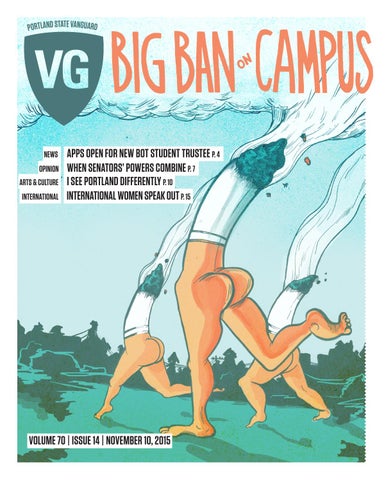
NEWS NEWS OPINION ARTS & CULTURE INTERNATIONAL
APPS OPEN FOR NEW BOT STUDENT TRUSTEE P. 4 WHEN SENATORS’ POWERS COMBINE P. 7 I SEE PORTLAND DIFFERENTLY P. 10 INTERNATIONAL WOMEN SPEAK OUT P. 15
VOLUME 70 | ISSUE 14 | NOVEMBER 10, 2015
Where students love living.
CONTENT NEWS OPINION COVER ARTS & CULTURE ETCETERA INTERNATIONAL
4 6 8 10 12 14
EDITOR-IN-CHIEF
ADVERTISING MANAGER
EDITOR@PSUVANGUARD.COM Turner Lobey
NEUB@PDX.EDU Stuart Neuberger
MANAGING EDITOR
ADVERTISING DESIGNER
MANAGINGEDITOR@PSUVANGUARD.COM Tim Sullivan
Tessa Millhollin
NEWS EDITOR
Reaz Mahmood
NEWS@PSUVANGUARD.COM Colleen Leary
ARTS & CULTURE EDITOR ARTS@PSUVANGUARD.COM Aislinn Renninson
ADVISER
ADVERTISING ADVISER Ann Roman
DESIGNERS
OPINION@PSUVANGUARD.COM Chelsea Lobey
Terra DeHart Nimi Einstein Elise Furlan Rachel Goldstein Shannon Kidd
INTERNATIONAL EDITOR
WRITERS
OPINION EDITOR
INTERNATIONAL@PSUVANGUARD.COM Molly Ozier
ASSOCIATE NEWS EDITOR ASSOCIATENEWS@PSUVANGUARD.COM Lisa Dunn
PRODUCTION MANAGER PRODUCTION@PSUVANGUARD.COM Hunter Sharp
PHOTO EDITOR PHOTO@PSUVANGUARD.COM Jeoffry Ray
Nathan Anderson, Brie Barbee, Ellie Bradley, Yuni Choi, Catherine Johnson, Shannon Kidd, Tina Matthews, John Pinney, Thomas Spoelhof
PHOTOGRAPHERS Silvia Cardullo
ADVERTISING SALES Eva Spencer Becca Propper Dennis Caceres Kayla Clemens
COPY CHIEF COPY@PSUVANGUARD.COM Molly K.B. Hunt
ONLINE EDITOR ONLINE@PSUVANGUARD.COM Jaime Dunkle
COPY EDITORS
Kellie Doherty Cora Wigen Alexis Woodcock
MARKETING MANAGER Ryan Brewer
The Vanguard is published weekly as an independent student newspaper governed by the PSU Student Media Board. Views and editorial content expressed herein are those of the staff, contributors and readers and do not necessarily represent those of the PSU student body, faculty, staff or administration. One copy of the Vanguard is provided free of charge to all community members; additional copies or subscription issues may incur a 25 cent charge. The Vanguard is printed on 40 percent post-consumer recycled paper.
Cover: Terra Dehart & Rachel Goldstein ©2015 PORTLAND STATE UNIVERSITY VANGUARD 1825 S.W. BROADWAY SMITH MEMORIAL STUDENT UNION, RM. S-26 PORTLAND, OR 97201
ILLUSTRATION BY TERRA DEHART
Vanguard | NOVEMBER 10, 2015 | psuvanguard.com
3
NEWS
BOT SEEKS NEW STUDENT TRUSTEE FOR 2016 COLLEEN LEARY
The Portland State Board of Trustees and Associated Students of PSU are seeking student trustee applicants eligible to serve a two-year term on PSU’s governing entity, beginning in June 2016. The BOT, made up of 14 trustees and President Wim Wiewel as a non-voting member, includes one student trustee position. A Nov. 2 press release from ASPSU described the role of the PSU BOT. “The [BOT] has the ability to set tuition, institutional policies and other major decisions
that greatly affect PSU students,” said the press release. “ASPSU is taking the student recommendation process very seriously and will ensure a process that is both ethical and allows for the best student nominee to be chosen,” the press release continued. Current student trustee Maria Carolina GonzalezPrats, a Ph.D. student at the PSU School of Social Work, is the second student trustee to serve on the BOT. Gonzalez-Prats replaced the BOT’s first student trustee, Pamela Campos-Palma, in December 2014.
OUTGOING STUDENT TRUSTEE MARIA CAROLINA GONZALEZ-PRATS (foreground) listens to student input during a June Board of Trustees meeting.
Launch Your Career With the Peace Corps Information Session: “Make a Difference Overseas in 2016” Portland State University Friday, November 13 2 to 3 p.m. Smith Memorial Student Union Room 296
Returned Peace Corps Volunteer Jesse Doner will discuss how you can make a difference overseas and return home with the experience and global perspective to stand out in a competitive job market.
Life is calling. How far will you go?
ASPSU President Dana Ghazi described the qualities she’ll seek in student trustee applicants. “What I’m interested in is someone that’s really aware of the issues that are happening,” Ghazi said. “[Someone who is] aware of…where students’ concerns lie with some issues—not necessarily having a certain opinion on it—but really very aware of the complexity of the issues.” “And [someone who] really has at heart the interest of the students they’re representing,” she continued. ASPSU opened the applica-
tion for the student trustee on Nov. 2. The deadline to apply is 5 p.m. on Nov. 25. ASPSU representatives will interview eligible applicants on Dec. 4. After the Dec. 4 interviews, ASPSU representatives will forward three student trustee recommendations to the office of Governor Kate Brown, who ultimately makes the final selection. The student trustee interview committee will include ASPSU representatives and outgoing student trustee Gonzalez-Prats. Ghazi said ASPSU is looking for two students outside of ASPSU
APPLICATION OPENS: NOV. 2
HOTTEST WIENIES IN TOWN!
HOP / DOG LOCATED ON SW STARK BETWEEN 11 TH & 12 TH
4
Vanguard | NOVEMBER 10, 2015 | psuvanguard.com
to sit on the student trustee interview committee. She added that she’d like to see representatives from other student organizations get involved in the interview process. Student trustee applications can be found at pdx.edu/ board or in hardcopy form at the ASPSU office in Smith Memorial Student Union 117. Students interested in serving on the student trustee interview committee should email Ghazi or Vice President David Martinez. Contact info can be found at aspsu.pdx.edu
STUDENT TRUSTEE APPLICATION
15% OFF FOR STUDENTS WITH VALID ID!
855.855.1961 | www.peacecorps.gov/events
SILVIA CARDULLO/PSU VANGUARD
11AM - 9PM EVERYDAY Does not apply for Harvey Hour between 3-6pm
APPLICATION CLOSES: NOV. 25 APPLICATION AVAILABLE AT PDX.EDU/BOARD EMAIL: ASPSUPRS@PDX.EDU AND/OR : ASPSUVP@PDX.EDU IF INTERESTED IN SERVING ON INTERVIEW COMMITTEE
NEWS
PEDAL POWER: PSU GOES PLATINUM COLLEEN LEARY
Portland State has been named a Platinum-level Bicycle Friendly University by the League of American Bicyclists, making it one of five universities in the United States with this ranking. According to a Nov. 5 press release from PSU’s Office of University Communications, PSU’s emphasis on creating a bike-friendly campus has reduced congestion, improved air quality and lowered the demand for parking on campus. “Portland State encourages bicycling as an affordable, efficient option for transportation and provides amenities such as indoor bicycle parking, low-cost bicycle rentals and an on-campus Bike Hub, where students can find everything they need to make bicycling a part of their commute options,” the league stated in the press release.
PSU encourages bike commuting in several ways, including its Vik Bike bicycle rental program—which has expanded its inventory in the past two years from 12 to 134 rentable bikes. Bike rentals include a lock and helmet, and provide access to bike commuter and maintenance resources for the Bike Hub. The university has also increased its protected bike parking in the past two years to 300 spaces. Ian Stude, PSU’s director of parking services, said in the press release that the university has about 2,200 indoor and outdoor bike parking spaces on campus, a six-fold increase over the last decade. The additional bike spaces make for a 20-percent increase in bike parking over the past two years. Meanwhile the growth
CRIME BLOTTER
ELLIE BRADLEY
Nov. 2
Nov. 4
FIRE ALARM
SEXUAL ABUSE III, HARASSMENT
A fire alarm went off at the Broadway Apartments due to poor ventilation from using a cotton candy machine in the lobby for a housing event. Portland Fire Bureau arrived and cleared the scene.
Officer Peter Stuart Ward responded to a call from a student who reported an attack while walking along a trail from Oregon Health & Science University. The student reported that a male sprang up in front of her and wrapped his arms around her, face to face. The student shouted to be let go but the male did not do so, rubbing his chest against her breasts until she screamed and attempted to knee him in the groin. The student then ran down the trail, attempting to get assistance from other people without success. She made it back to Portland State, where she reported the attack. Portland Police Bureau Officer S. Endicott came to assist on the case. The man was described as having a muscular build and was wearing a hunter
Broadway Apartments
Nov. 3 CAR PROWL
Parking I
Officer David Troppe took a report from a student whose vehicle had been broken into. The student was parked on the south side of the third floor of Parking I and found the vehicle with a broken window on the rear driver’s side. The student reported that a new Apple MacBook Pro was missing.
Terwilliger Blvd. Parkway
of car parking spaces on campus has remained relatively fla, Stude added. Clint Culpepper, PSU’s bicycle program coordinator, said in the press release that 15 percent of employees and 10 percent of students regularly bike to campus. He added that most never bring a car to campus. About 80 percent of PSU students and employees commute by taking mass transit, bicycling or walking, Culpepper said. PSU shares its platinumranking status with Stanford University, University of California Davis, Colorado State University and University of Minnesota Twin Cities. For more information on PSU’s Bike Hub, visit pdx. edu/bikehub.
A BICYCLE MAP produced by the Bike PSU student group features locations and interest of various Portland State bicyclists. Bike PSU will host a social ride on Wednesday, Nov. 11, from 2—4 p.m. JEOFFRY RAY/PSU VANGUARD
Week of Nov. 2–Nov. 8 green jacket and brown khaki pants. The report said he had strong body and marijuana odor and appeared to be homeless.
Nov. 5 FIRE ALARM WITH SMOKE
Science Research and Teaching Center
Campus Public Safety officers responded to a general fire alarm at the SRTC building. Portland Fire Service attended and advised that the alarm had been activated by a burnt bagel. The fire alarm was reset and PFS authorized reoccupation of the building.
Nov. 6 POSSESSION OF METHAMPHETAMINES, TRESPASS, BURGLARY TOOLS, THEFT MISLAID Ondine Parking
Officer Matthew Masunari responded to a PPB dispatch to the parking lot of Ondine, where a male was attempting to open
doors of vehicles. Officer Masunari found the man hiding between two cars on the north side of the lot. The man had an active exclusion and was arrested for trespass. Stolen goods and meth were recovered.
Nov. 6 THEFT III
Urban Center Plaza
Officer Masunari was dispatched to a call that a student is bicycle tires were stolen and replaced with different ones.
Nov. 6 EXCLUSION
Hoffman Hall
sex offender. The man was issued an exclusion.
Nov. 8
Nov. 7
CAR PROWL
DOMESTIC VIOLENCE COERCION, HARASSMENT Campus Housing
CPSO was dispatched to a dorm following the report of a domestic incident. CPSO located a student and non-student within a room in the dorm. Based on physical evidence and statements from the student, the non-student was arrested and charged with Domestic Violence Coercion and Harassment. The non-student was also excluded from PSU before being lodged at Multnomah County Detention Center.
Art Building
While on patrol, Officer Troppe found a maroon Hyundai with a broken rear passenger window. Officer Troppe met with the student who owned the vehicle, who stated that she parked the vehicle without damage the evening before. Two bags had been taken from her car with items totaling just under $1,000.
Officer Masunari contacted a man sleeping on a bench in front of Hoffman Hall. The man first gave a false name, which was linked to a list of aliases leading him to be identified as a registered predatory
Vanguard | NOVEMBER 10, 2015 | psuvanguard.com
5
OPINION
GRIEF AND HEALING GO HAND IN HAND The Campus Oracle by Nathan Anderson
It’s been 30 days. Thirty days since my former school, my friends and my community were transformed by one single act of unimaginable violence. The shooting at Umpqua Community College left not only death and physical destruction behind, but also fear and pain and anger in those who must now pick up the pieces and rebuild their lives and their community in its wake. Clearly, the healing process grinds slow, taking its sweet time as it does its subtle magic. My suffering has been deeply internal, as I struggle to quietly get through my schoolwork here at Portland State while offering whatever help I can to my friends and community back home. During this process, I’ve been told several times by several people that I must “get over it” and that I should “let it go” and move on with my life. To be blunt, this is crap, and those who suggest such things should feel deeply ashamed of themselves. The grieving process is intensely personal, and one that should not suffer judgment by others. Moving at our own pace,
processing traumatic events in a way that is healthy for each individual, is what is needed—not condescending lectures by those who have no connection or experience with painful events. Maybe we need to eat chocolate for breakfast and binge-watch Bugs Bunny cartoons. Maybe professional counseling is in order. Maybe…maybe it just takes time. Lots and lots of time. But whatever it takes, the process is individual, unique and one that needs to be allowed to happen without interference. It’s clear I’m not alone in this. On a campus of around 30,000 students with daily barrages from various venues of outrage, both personal and recreational, I think it’s important to realize that each of us internalizes and reacts to offenses against us in different ways. Do we ask a cancer survivor if they’ve “put it behind them”? (Pro tip: Don’t ever do that.) Do we ask people who’ve lost close loved ones if they’ve “gotten over it”? (Don’t do that either.) Certainly
SILVIA CARDULLO/PSU VANGUARD
6
Vanguard | NOVEMBER 10, 2015 | psuvanguard.com
not. There is no expiration date on the healing process. It’s a road map, a journey with no specific route and, for many, no specific destination. Progress will be made, lost, gained again. There is no right way to grieve and heal, and there is no right time frame in which to accomplish it. It’s vital that we understand the suffering of others, to empathize with their struggles. To openly admit that it’s OK to feel pain, fear, anxiety, hopelessness, anger or all of the above. We need to understand that to tell someone to “get over it,” that “you’re overreacting,” that “it’s not that bad,” is counterproductive and likely even harmful. We all have struggles, both obvious and subtle. To accept that fact, to accept our fellow humans without judgment or scorn, is a vital piece of what makes us social animals. Whether it’s a friend struggling with midterm anxiety, stresses about housing or any other fear or worry, we need to accept that and simply be there for them without judgment.
OPINION
LET THE WRITERS WRITE. RIGHT? Page by Page by Brie Barbee Writers write; they put words on a page for others to read, to interpret, to enjoy, to make their own. Writing can be a hobby or it can be a career, something you do in your free time or to pay the bills. Nowadays, just writing isn’t the only thing a published author is expected to do. They must now also maintain a presence on social media, attend conventions, do readings, have book
ILLUSTRATION BY SHANNON KIDD
tours, make guest appearances, blog and among other things, market their new books and pieces they get published in the process. Writers still write—it’s an inherent part of the job—but they are also responsible for a lot of other things that keep them connected with their readers. And with authors who no longer just focus on the words they are putting on their pages, books—and particularly sequels— seem to be coming out slower than ever. There might have been a time when a sequel to a popular novel would come out a year after the first book, and while this still happens occasionally, it’s not uncommon to see sequels being published two, three or even ten years after the last book in the series. And with longer wait times between novels, the desire to find out the outcome of one’s favorite story can be overwhelming for some. More and more readers have taken to begging, pleading and even threatening their favorite authors to write their next books more quickly. George R.R. Martin, the author of the insanely popular A Song of Ice and Fire series, has experienced many of these reader reactions firsthand. Martin first began the legacy of his series back in 1996, with the publication of A Game of Thrones. Now, in the year 2015, readers are rabidly awaiting the sixth installment of the popular fantasy series (which is rumored to be released sometime in 2016). The fifth novel in the series, A Dance with Dragons, was published back in 2011, a little o v e r four years ago. Nineteen years is a very long time to wait for a story, and with one more book planned for release in the series, it looks
like readers will have to wait a bit longer to learn the fates of all of their favorite characters. All this waiting raises the following question: Should Martin be publishing his novels faster to please his audience, many of whom have stuck with him over the last two decades? Readers are beginning to worry that Martin, with less-thanperfect health, might not live to see the end of his series, much like popular fantasy author Robert Jordan. George R.R. Martin, in response to these concerns, gives his readers a big middle finger. Which may seem harsh, but I’m going to side with him on this one. While it is a good idea to keep your readers happy—I mean, they are the ones buying your books and allowing you to make money as a writer—writing shouldn’t consume a person’s life. Even if there is a chance Martin might not live to write the end of ASOIAF, he’s a goddamn human being. His life is much more important than an ending to a book series. And with all of the other obligations writers have these days to create an author platform and market themselves to their readers, it’s a wonder Martin even has the time to dedicate to his incredibly detailed and complex fantasy world. Writers write, but they are also humans. There is only so much quality content one person can produce in the midst of conventions, interviews, travel and life. If we are going to insist on our authors also managing the sales of their books and staying connected with their readers, we are going to have to accept that those responsibilities leave them less time to write. Martin has even made a pledge to attend fewer conventions until the publication of his next book, but there are only so many events that a popular author can risk missing. So maybe, instead of criticizing writers for not producing content quickly enough, we should be criticizing the system that leaves them less time to do their job, which is to write. And if our favorite books aren’t coming out as quickly as we might like, we should remember that writers are humans, and maybe they’re just trying to enjoy their lives.
OP-ED: PARTNERSHIPS ACT SENATORS RON WYDEN AND JEFF MERKLEY
Last month, on campuses across Oregon, students told us that college debt is suffocating opportunity. It’s preventing a move, a job, a car or a house. Debt is stifling ideas for the future before they have a chance to grow. Those students implored us to find real solutions to cut tuition costs and prevent the crushing debt that follows too many college graduates for decades. In Oregon, the average student graduating with debt owes more than $25,000, and that number only keeps climbing. Nationally, with out-of-pocket tuition costs continuing to fly past inflation—by nearly 24 percent from 1999 to 2011—students and their families face the brunt of this burden with no end in sight. The key driver of tuition increases and skyrocketing debt levels is states dramatically cutting their share of funding for public higher education. In fact, researchers at Demos, a policy research organization, found that declining state support was responsible for nearly 80 percent of the rise in tuition costs between 2001 and 2011. That has certainly been the case in Oregon, where the state’s
contribution to the per-student cost of public college has fallen from $5,587 in 2009 to $4,214 in 2014—a decline of almost 25 percent in just five years. In the last state legislative session, the state increased higher education funding by almost 20 percent, which is great progress. However, Oregon ranked 45th in the nation in per-student support for public higher education in 2014. That’s why we introduced legislation to encourage states to put in a bigger share and reinvest their dollars into public colleges and universities. Our bill, the PARTNERSHIPS Act, would provide federal matching funds for states that agree to freeze or reduce the cost of tuition and bring up graduation rates. The bill signals to states and colleges that the federal government wants to be a partner in making college more affordable. The partnership would work like this: The federal government would send dollars to states if states use those dollars to stop tuition costs from going up, or, better yet, if they use those dollars to bring down tuition costs at public colleges. Under our bill, a school could get up to $1,700 per student each year from the federal government if it meets those conditions. Even as we work to stop tuition from climbing higher, we know costs are already so high that many feel college is out of
reach. So another key piece of the puzzle is ensuring that all kids—starting in junior high and high school—know that they will have the ability to repay their loans. In August, we introduced the AFFORD Act, which would give all borrowers that peace of mind. Our bill would make student debt more manageable by ensuring no borrower has to pay more than 10 percent of his or her discretionary income on student loan payments. Any unpaid balance after 20 years would be forgiven. Everybody, from baristas to bankers, would be able to afford their student loan payments. In our country, a higher education is often the ticket to a good-paying job. Making college affordable is not only critical to the future of students, it’s vital for our state. It’s the surest way to grow our economy and the incomes of ordinary Oregonians. We must keep higher education—a central pathway to the middle class—open to all. Bringing down college costs is going to take effort from students, states and the federal government. But Oregonians have never been afraid of hard work. Our students’ future and our state’s require that we meet this challenge. Working in partnership, we can keep the doors to opportunity open to all Oregonians.
Vanguard | NOVEMBER 10, 2015 | psuvanguard.com
7
ELLIE BRADLEY
PSU JOINS THE RANKS OF TOBACCO-FREE CAMPUSES ACROSS THE NATION
On Sept. 15, Portland State joined more than 1,000 other campuses across the nation and banned the use of all tobacco products on campus property. As part of PSU’s Healthy Campus Initiative, the University Policy Committee passed the Smoke and Tobacco Free Campus Policy following a campus-wide survey in 2012 that showed a majority of respondents in favor of the ban. With ambiguous boundaries, problematic litter and an unclear road ahead for enforcement, advocates for the Smoke and Tobacco Free Campus Policy still face many challenges on the road to long-term change. Upon first glance, the new guidelines appear effective, according to representatives from the Campus Public Safety Office. “[At first there were] 30 to 40 people [warned about smoking on campus per] day,” said Sergeant Joseph Schilling, Police Sergeant for CPSO. “The second week it was down to 15 or 20; the third week was five or six…just nonexistent.”
Schilling cited ignorance of policy as the primary reason students continue to smoke in prohibited areas. However, tobacco use and litter from cigarettes continue to be problematic, even within the defined smoke-free boundaries. “Cigarette butts are the most common litter collected on our cleanup walks,” said Campus Rec, in a post from their Twitter account on Sunday. An informational handout cites commitment to “wellness, health and safety of [PSU] students and the sustainability and cleanliness of our campus” as reasons for implementing the policy. With these focal points in mind, compliance is still a barrier in the campaign to eliminate tobacco from campus.
“It’s culture change,” said Julie Weissbuch-Allina, director of health promotion at the Center for Student Health and Counseling. “It takes time for our PSU community to catch up to the policy. We know that.” [We] are spending a lot of time this year doing a lot of education and assessment of policy so we can better implement programming and more targeted education,” she continued. Weissbuch-Allina said work with CPSO and facilities staff will help determine problem areas, as well as the best approach for continued education and targeted enforcement.
POLICY ENFORCEMENT Currently, CPSO ranks enforcement of this policy low on their list, describing a passive approach. “We’re out there to give information to make sure people are safe, give them the information they need, and then if they’re ILLUSTRATIONS BY ELISE FURLAN
8
Vanguard | NOVEMBER 10, 2015 | psuvanguard.com
cooperativeandthey’removingon from that, then we can move on as well,” Schilling said. It would take a significant act of retaliation to escalate
a smoking violation to the Student Conduct Committee. The low risk for penalty leaves questions about the motivation for
students, faculty and staff to discontinue the use of tobacco products on campus. “I don’t think a formal warning would be sufficient and fines would need to be actually enforced,” said Otto Zietz, a graduate student and tobacco user. Though Zietz makes a point not to smoke on campus property, he knows he doesn’t necessarily represent the majority. The policy has impacted some, but it may only be reaching those who were already conscientious smokers. “I think there are smokers like me that recognize that smoking is disruptive and a health risk to others and will respect the new rules. Other smokers will disregard the new rules and continue
proach moving forward. Aier agrees with a message of respect. “Students who smoke should not be shunned,” Aier said. “Moreover, it is as important to have specific bins around campus which allow for students and other people to discard cigarette butts to lessen the burden environmentally.” In addition to respect for fellow students, Siefert emphasized respect for campus and the surrounding environment. “This ban will help to minimize the amount of tobacco product litter and air pollution, as well as provide a safe and health-conscious environment for students and staff to thrive in,” Siefert said.
smoking in newly prohibited areas,” Zietz said. Small business-sized cards are available for students, staff and faculty to hand to those in violation of the policy. “[The cards] make it easier for folks to talk with people and says basically, ‘Hey, did you know that PSU is smoke and tobacco free?’,” Weissbuch-Allina said. “I give them to people all the time and it’s a really easy, nonconfrontational way.” Other students are in agreement with Zietz and don’t feel like peer enforcement will solve the problem. “[Enforcement] wouldn’t work unless [smokers] see a person of authority—like campus police,” said Shree Aier, an undergraduate student. Graduate student Audrey Siefert agreed. “I would not approach someone directly who was in violation of the policy,” Siefert said. “I would contact Campus Safety and let an officer address the situation.” While CPSO officers said they are more than happy to offer information to tobacco users in violation of the policy, time is an issue. “An officer will go by when they’re available, but usually that’s more than a couple minutes, and usually that means the smokers are gone so we rarely find them,” Schilling said.
AN ISSUE OF RESPECT Ty Patterson, former director of the National Center for Tobacco Policy, now consults
with campuses across the country in the development stages of tobacco-free policies, including many campuses in Oregon. When it comes to enforcement, Patterson doesn’t rely on CPS officers to enforce long-term change. “Complying with any policy should be self-enforced and not dependent on being caught and punished by some external authority,” Patterson said. “The idea that it is OK to violate a policy you think is wrong if you are not going to be punished must be replaced with voluntary compliance.” Patterson has found success in approaching tobaccofree policies from a message of respect, rather than healthfocused campaigns. “When it’s a health-driven initiative, you also get people who say, ‘Look, it’s not the college’s business to tell me what is in my health interest,’” Patterson said. “Make the policy based on respect and then have as an advantage that it will help people who want to quit, or it possibly serves as a message of the damaging effects of tobacco use for those who haven’t taken it up yet.” While respect is an element of PSU’s campaign, it is just one of many. “The enemy of
HEALTHY CAMPUS While policy enforcement may be more successful with an emphasis on respect, the university will continue to support student health. PSU’s Healthy Campus Initiative includes several resources and options to help students, faculty and staff quit smoking. Students have access to health educators through SHAC, with whom they can meet and begin strategizing ways to give up tobacco. “Discussion includes identifying motivators, potential obstacles/triggers, and things you can implement to keep you on track, all in a nonjudgmental supportive environment,” according to PSU’s Health Campus informational website. “With the help of the health educator, you will decide what option is best
for you, such as using Nicotine Replacement Therapy (NRT) (gum or patch) or through prescription medication.” SHAC’s health educators customize programs to fit the needs of students. This includes follow up appointments and consultation. Students may also access SHAC’s acupuncture services as a strategy for smoking cessation. The healthy campus website lists several tobacco-related benefits from acupuncture, including treatment of cravings, restlessness, jitters and irritability during nicotine detox. PSU’s student health insurance, Pacific Source, also implemented its Quit for Life program on Sept. 20. This nocost program provides ongoing support to participants attempting to quit tobacco use. The full Smoke and Tobacco Free Campus Policy can be found at pdx.edu/healthycampus/tobaccofreePSU. Additional reporting by Colleen Leary.
any kind of policy or rule is ambiguity,” Patterson said. “One of the most significant factors [PSU] is going to have to overcome is the topography and the campus and its relationship to non-vacated public thoroughfare.” Boundaries will continue to be an obstacle, especially since PSU is an urban campus with significant foot traffic from members of the community who are unaffiliated with the campus. With the removal of designated smoking areas, cigarette litter also poses an ongoing problem, both on and off campus. “One of the messages in our campaign is to be courteous to our neighbors,” Weissbuch-Allina said. “So if you are on PSU property and you have to step off property and that happens to be in front of our neighbors, we’re asking you to be respectful.” The emphasis on respect is echoed throughout the policy: respect for neighbors, respect for the environment and respect for peers. Because the health risks of smoke are not in question, focusing on respect may be an effective ap-
Vanguard | NOVEMBER 10, 2015 | psuvanguard.com
9
ARTS & CULTURE
MAPPING OUR PERSPECTIVES:
GEOGRAPHIC REPRESENTATION IN PDX CATHERINE JOHNSON
On Wednesday, Oct. 27, Portland State geography professors David Banis and Hunter Shobe presented their new book, Portlandness: A Cultural Atlas, as part of the annual 10-day Portland State of Mind celebration of knowledge and culture. In an entertaining presentation, Banis and Shobe described the evolution of their project, from class assignments to a published book. Initially, they asked students to come up with things that define Portland and mapped each one of those, such as liberalness, environmentalism, breweries and food carts. In some ways the results weren’t surprising, like the fact that there are more breweries in Portland than any other city in the world. But they worried that talking about Portland in a statistical way leaves out a lot and might just stereotype Portland. “What we need to do is explore other ways of seeing other parts of Portland,” Banis said. They aimed to capture a sense of place, questioning what defines Portland, what makes it different from any other place in the world, and represent that graphically through a cultural atlas. “A cultural atlas is something that challenges our geographic imaginations and provides us with different cartographies we’re not used to seeing, and asks us to see places from the perspectives of other people,” Shobe said. Banis explained that while we tend to trust the authority of maps, we forget there is a cartographer picking and choosing what’s on that map, thereby telling a story. A lot of maps use the same conventions, so they tried to use as many different cartography and map styles as possible “to not only get people to think differently about Portland, but also to get peo-
10
ple to think differently about maps,” Shobe said. In this vein, they encouraged their contributors to be as creative as possible. Banis and Shobe shared many of the book’s maps, including a map of Portland in the style of the London Tube (featuring a “Hipster Line” that basically wanders and goes nowhere), a map of security cameras downtown (over 400) so you can track a route with the least surveillance, a map of wait times for brunch, a map of backyard beekeepers and the loss of hives, and a map of city plans that never came to fruition (including grand boulevards, a network of freeways, water taxis and Olympics host venues). “We’re trying to suggest different ways to pay attention to your city,” Banis said. “There’s so much interesting stuff. When we travel we
have a tendency to be hyperobservant, but we aren’t that way in our own cities.” They also included mental maps, featuring the illustrations from a third-grade class, mapping the city from their perspectives. Other maps reveal surprising paradoxes; despite being the third-whitest metropolitan area, 55 different languages are spoken at Portland’s David Douglas High School. Many of the maps have a humorous, quirky edge, but some also represent the city’s internal conflict, like the discriminatory process of redlining and gentrification in the Mississippi district. Banis and Shobe described the laborious process from ideas to manuscript draft to choosing a publisher to editing with a graphic designer to finalizing the finished product. It was a giant collab-
SASQUATCH BOOKS/2015
Vanguard | NOVEMBER 10, 2015 | psuvanguard.com
oration of over a hundred people who helped develop the ideas for the book and who volunteered their time. “The most significant part of working as a cartographer on Portlandness was the level of collaboration and the way that collaboration helped the pages evolve throughout the project,” said Corinna Kimball-Brown, one of the cartographers. “There were many ideas that came out of Hunter and David’s classes and then were discussed and iterated upon by the core group of cartographers and researchers for months or even years.” Another cartographer and recent transplant to Portland, Randy Morris, explained how the project helped him discover parts of the city he never would have found on his own.
“Just looking through the book shows such a diversity of perspectives, environments and stories,” Morris said. “Not just from the authors’ points of view, but from that of all the cartographers, and the data as well.” Portlandness is about capturing the city from the experience of those who actually live here, not the New York Times’ notion of the city which, according to Banis and Shobe, tends to portray an upscale, self-consciously quirky version that is very limited. The project has inspired Shobe to walk around neighborhoods he doesn’t usually go to. Banis now sees Portland as a mix of interconnected stories. He explains that urban issues are often put forth as
simple choices instead of complex ones that should consider a variety of perspectives. “I think we all have a tendency to see the city through our own personal lens and not through the eyes of the many fellow citizens [who] we do not know,” Banis said. The audience, mostly comprised of their students, was engaged and laughing throughout the presentation. Boisterous, excited conversation followed. Jessica Beutler, a former student of Shobe, came back for the event. “It’s fun to come out and support them,” Beutler said. “I’m really excited to get [the book], personally. It’s definitely on my Christmas list.”
ARTS & CULTURE
ENTER ‘THE TERRITORY’ AT JAZZ PROFESSOR DARRELL GRANT’S ALBUM RELEASE CONCERT
THOMAS SPOELHOF
Darrell Grant—a nationally renowned pianist and composer, and Portland State School of Music associate director—will host a concert and celebration for the release of his new album The Territory this Saturday, Nov. 14, 3:30 p.m., at First Unitarian Church. The Territory is an extended jazz suite in nine movements that represents the interface of art and place: our home. The conceptual territory exists in the sweet spot, welding classical chamber music and jazz together. The music is distinct in blending composition and improvisation to try to depict the Oregon experience. The movements also reflect local historical heritage and the diverse landscapes of the region. “The album arose from a desire to explore the idea that our terroir—the sense of place and ethos that the land brings into being—might inspire and connect us, whether we are native or transplant,” The movements
of the piece are inspired by topography, history and the human stories that took place on the land.” Each movement gleans spirits of local history and weaves them into auditory and visual-inducing jams: the grit and bone of glaciers carving the Willamette Valley, a Nez Perce tribal chant, the lost tragedy of a band of Chinese gold miners and Portland’s first African-American–owned hotel. Each part contributes to a collective musical range. “The piece arose from the thought that all these together might vibrate in a way we can sense, in our art, in our folklore and in our dreams,” Grant said. The whole of the album immerses the listener in an eclectic soundscape, a deluge of supreme instrumentation. The album experience delivers avant-garde expressionism with fleeting threads of familiar, satisfying melodies. Grant wanted to bring newfangled composition to the production table. “Making the live recording at the prestigious Chamber Music
Northwest festival was a thrill,” Grant said. “And of course being able to play my music with some of the most amazing musicians in jazz, who are also long-time friends and collaborators in front of that full house was unforgettable. I think all that energy and good vibes also comes out on the recording.” Grant credits the album’s production to the New Jazz Works Grant from Chamber Music America. Grant was provided a commission to compose and premiere the piece, along with a number of other career development opportunities. He was excited to partner with the Oregon Historical Society and donate a portion of the proceeds from the concert and CD sales to further their important work. Tickets to Saturday’s concert are $10, or $8 with student ID, and can be purchased at the door or online. If you can’t make it to the concert, The Territory can be heard through iTunes, Amazon.com, Google Play Store and other online distributors.
EDITOR PICK OF THE WEEK
RECIPE: HOT TODDY COLD REMEDY AISLINN RENNISON
Hurray! It’s the season for warm hotty toddys! However, most of us are sick and shouldn’t be drinking alcohol. If you are like me, and about 50 percent of Portland it seems, then you’re battling a nasty cold that has been lingering for the last three weeks. I am sick of drinking plain citrus tea for my throat and eating cough drops as one of my main food groups. So, I went searching for something that would help me feel better but that also tastes good. I know you aren’t supposed to drink alcohol while you’re sick, but I am pretty sure this is an exception. Because, hey, you need something a little extra when you’re trying to get a bunch of nasty shit out of your nose and throat.
Thanks to Food.com, I found a drink that uses Grandpa’s cough medicine to get healthy! Now that’s a win-win.
Food.com’s Hot Toddy Cold Remedy
Ingredients: 2 ounces whisky (my personal favorite is Jameson) 1 tablespoon honey 4 ounces hot water 1 teaspoon lemon juice 1 slice fresh lemon Procedure: 1 Pour whisky into a mug. 2 Add honey, stir until all the honey has dissolved. 3 Pour hot water into the mug. 4 Add lemon juice, stir. 5 Microwave until hot. 6 Add lemon slice. 7 Enjoy! Drink right before bed to help you sleep, and you will feel better by the morning!
FYI COST
Whisky: Depending on the brand and size of the bottle, $10 to $30, but you will have a lot leftover! You could even buy two mini-bottles for a few bucks each. Honey: $3 to $5 (use local honey to help with allergies) Lemon juice: $2 Fresh lemon: $1
PSU JAZZ PROFESSOR DARRELL GRANT released his new album, ‘The Territory,’ Nov. 10. Grant will perform live Sat., Nov. 14 at First Unitarian Church at 3:30 p.m. COURTESY OF DARRELL GRANT
DARRELL GRANT CD RELEASE CELEBRATION SATURDAY, NOV. 14, 3:30 P.M. AT FIRST UNITARIAN CHURCH PORTLAND TICKETS ARE $10W OR $8 WITH A STUDENT ID Vanguard | NOVEMBER 10, 2015 | psuvanguard.com
11
ETC WEDNESDAY NOV. 11 Women in Science Mixer 5:30–8 p.m. OMSI Free
This social event is for women-identified students and faculty looking to connect and network in the science and medical industries. Hosted by WIS.
Workfriends
4–11 p.m. Likewise (3564 SE Hawthorne) 21+ This bar and art space is showcasing all exploitation inherent in, and the possibility for, creating while working at a job like bartending. Labeled a “combination of both art exhibit and performance.”
EVENT LISTINGS FOR THE WEEK OF NOV. 11–15 THURSDAY NOV. 12 Lost Music
5 p.m. Art Bldg, Room 200 Free tickets through PSU Box Office Join Dr. Alexander Lingas as he explores the music and architecture of the Church of Hagia Sophia in Turkey.
O Christmas Tree!
12 p.m. Pioneer Courthouse Square Free Join the start of the annual holiday festivities with the parade and reception of the 75foot Douglas fir tree that will be bedecked out in Christmas decorations and be the centerpiece for a variety of November and December festivities. Hot chocolate provided.
FRIDAY NOV. 13 Eurydice
7:30 p.m. Lincoln Hall Mainstage Fee: $8 students, $15 general admission Tickets available through PSU Box Office Come see this reimagining of the Orpheus myth as told by Sarah Ruhl. This tale of love gone right and then wrong is told through the eyes of Eurydice, the woman Orpheus loves and yet leaves in the Underworld when curiosity gets the better of him. Showing for two weeks—don’t miss it! Sunday matinee also available. Most showings are at 7:30 p.m.
From the Emerald Isles 7 p.m. 5th Ave Cinema Free
This past summer, Professor Morrow led a few students to Dublin, Ireland, for an intensive film program. Their labors will be on display for all to see. Q-and-A will follow the unique event, as seen through the eyes of some of PSU’s most creative minds.
JOHN PINNEY
SATURDAY NOV. 14 Living Dead Horror Convention
Oregon Convention Center Fee: $65 adult weekend pass or $30 per day
SUNDAY NOV. 15 Mortified Portland
7 p.m. Alberta Rose Theatre Fee: $20
The horror community will revel in its own culture for three days. Not just for horror film buffs or scary makeup artists, but also for horror literature and art nerds in general. Live (or not yet dead) bands, burlesque, oddities, VIP parties and more are part of the package that doesn’t get much spookier. Advance tickets sold through TicketsWest.com.
The trend of honesty overtaking nostalgia through humor and the power of hindsight works wonders in “Mortified,” where people share old photos, letters and diaries to let us into the world of their younger selves on stage.
Hamlet Matinee
If you’re on the quest to be healthier, VegFest is a twoday celebration just for you. Plant-based living is thrown into the light—from food demonstrations to health and beauty, and even activities for younger kids to enjoy. Come for the demos and stay for the bookstore!
2 p.m. World Trade Center Theatre Fee: $20 This is a National Theater Live screening of Hamlet with Benedict Cumberbatch in the title role. Come watch Cumberbatch as Hamlet while he grapples with anger, sanity and a lust for revenge against the uncle who sits on his father’s throne.
VegFest
10 a.m. Oregon Convention Center Fee: $8
FEATURED EVENT National Choir Festival
First Congregational Church Fee: $15 Thursday through Saturday, some of the best choral efforts in the nation (including our own beloved Portland State choirs) will perform six separate performances. The festival pass of $50 for all six concerts is recommended, but can also be sold individually. Several different venues are being used for events—see the handy guide below! Thursday, 10 a.m.: University of Southern Mississippi, Riverside City College Chamber Singers Thursday, 8:30 p.m.: Azusa Pacific University Chamber Singers, University of Louisville Cardinal Singers Friday, 2 p.m.: Temple University Concert Choir, University of the Redlands Chapel Singers, University of SoCal Thornton Concert Choir $25 performances: Friday, 7:30 p.m.: Portland State Chamber Choir and Pacific Lutheran University Choir of the West at St. Mary’s Cathedral on Northwest Davis Saturday, 1 p.m.: University of North Texas, Oregon State Chamber and Portland State Man Choir/Vox Femina/Symphony Orchestra at First United Methodist Church Saturday, 8 p.m.: Yale Schola Cantorum and Juilliard 415 at St. Mary’s on Northwest Davis
JOHN PINNEY
Scorpio (Oct. 23–Nov. 21)
Your friend has been in a sort of high-octane, outof-control spin-off for a while now, and you’ve been supportive while muttering under your breath. It’s time to stop muttering.
Sagittarius (Nov. 22–Dec. 21)
Never forget that others believe in your talents. This week may put those talents through the crucible, but the end product will be worth it.
12
Capricorn (Dec. 22–Jan. 19)
All eyes are on you this week, and you’ve been preparing for this event. Everything is going to go smoothly—all you have to do is glide through the day like you own the world.
Aquarius (Jan. 20–Feb. 18)
Sometimesreasonisn’tenough to break through the cocoon of stress. The best that I can offer this week is to take a mini-vacation with your people and hope it’s enough to get you through.
Pisces (Feb. 20–March 19)
You might scoff, Pisces, but you’re allowed to enjoy life and its rites of passages. Sometimes the most ironic thing to be is a participant.
Aries (March 21–April 19)
The temptation to find your own true happiness is strong this week, but the sacrifice of another’s love for your joy may be too much.
Vanguard | NOVEMBER 10, 2015 | psuvanguard.com
Taurus (April 20–May 20)
Always make sure to carry duct tape and those little bleach pens to clean up messes. You never know when you’ll need them.
Gemini (May 21–June 20)
That color of flower does compliment your dress. You have great taste, and hopefully people will love your enthusiasm.
Cancer (June 21–July 22)
Your job has always been to watch out for your best friend. Sometimes it can be bittersweet to watch them change and grow, but that’s just the way life is.
Leo (July 23–Aug. 22)
Stop making so much noise, Leo. You don’t need the focus and the attention all the time. This is another person’s moment to shine. Don’t forget that.
Virgo (Aug. 23–Sept. 22)
You might find yourself deeper in debt than ever before, but sometimes it’s worth it to lose what economic security you have to help someone else.
Libra (Sept. 23–Oct. 22)
Though some events will spiral out of control, you always have control over the soundtrack to those events. Whether it’s a Wedding Singer or High Fidelity sort of day, enjoy the tunes.
ETC
SUDOKU
CROSSWORD
5 4 2 7 3 8 1 3 6 2 1 5 7 6 8 3 2 5 6 7 6 8 7 3 9 7 8 3
Š Puzzles provided by sudokusolver.com
9
Create and solve your Sudoku puzzles for FRE
E.
Play Sudoku and win prize
s at:
prizesudoku.com
The Sudoku Source of
“Portland State Vanguard�.
ACROSS 1 Book that’s to see novelist accepted by South Africa (7,2,4) 8 Gordon Brown’s tax? (4) 9 Woman with aspiration to go on the game (5) 10 Second most important animal (4) 11 He works at keeping body in good shape (8) 12 Eastern saint from second century impaled by a knight (6) 13 This plant has a fat lot of value (10) 16 William Hill (4) 17 One gets in through support (4) 18 Indication of relative lack of success in exam – old Scottish one (5,5) 20 One receiving deliveries of cooking mix (6) 22 Emptied bottle, without getting tighter? That’s possible with this drink (4,4) 24 Member of political party netting millions (4) 25 Before noon I depart with a friend (5)
COURTESY OF ALBERICHCROSSWORDS.COM
26 Song of Joy (4) 27 It’s attractive, currently! (13) DOWN 1 Former Marxist – not a good man – active in organisation of removal of church privileges (15) 2 Actor involved in sex transformation (5) 3 English pub on the green short of pennies – being so, won’t last long (9) 4 New Orleans is a port (7) 5 Listener’s supporting new approaches (5) 6 Christ appears in a church in Devon (9) 7 Information given to men in court after a confession is obtained (15) 14 Go by the board procuring part of audio system (9) 15 Flavouring given to a Spanish wine (9) 19 Girl told to travel to find mythical monster (7) 21 Note parliamentary
decision and respond (5) 23 Open mountain’s home for serviceman (5)
Vanguard | NOVEMBER 10, 2015 | psuvanguard.com
13
INTERNATIONAL
SOUTH KOREAN CONTROVERSY OVER NEW HISTORY TEXTBOOKS YUNI CHOI
At secondary school, few students question the choice of textbooks from which they learn, yet the contents of these books establish a foundation of understanding for these students. Students are given books selected by their schools, who make their decision from a list of options approved by the United States Department of Education. As a multicultural society, the U.S. continues to discuss issues of fair representation
and protection of diversity. Such emphasis is greater for educating the young in the subject of history. Since 2010, the South Korean government has given private publishers the opportunity to commission teachers and historians to write history textbooks to be used in the public school system. After being written, these textbooks are submitted for approval from the government panel and schools are
free to choose from an accredited list. Today, there are eight textbooks from which the choice is made. Recently, an intense controversy escalated over academic freedom and diversity after the South Korean government announced that middle and high school students will be taught from a single government-issued textbook by 2017. This was the result of months of debate over how history should
Oregon's premier plant-based food and lifestyle event!
November 14 –15 10am – 6pm
Oregon Convention Center FREE FOOD SAMPLES! Free admission for volunteers: volunteer@nwveg.org
PSU
Speakers • Chef demos • Fitness • Fashion / Beauty Films • Kids‘ & teens‘ activities • Restaurants
www.PortlandVegFest.org
B R I N G T H I S A D FO R $1 O F F A D M I S S I O N!
be taught to children, especially in respect to characterization of modern Korea and its development as a democratic nation. The Korean Ministry of Education has invited a panel of historians to write new textbooks and a wide range of reviewers to “ensure objectivity and balance,” according to the New York Times. After her election in 2013, South Korean President Geun-hye Park pointed out that the current history textbooks displayed “ideological prejudice.” Park’s conservative party dominates the National Assembly and supports the move towards newly issued textbooks. The party claims that the current textbooks euphemize description of North Korea and are biased against Korea’s period of dictatorship from 1961 to 1979 after a coup led by, as highlighted in the controversy, Park’s father, Chung-hee Park. For example, one textbook applied the term “dictatorial” 28 times in describing South Korea under the military regime, in contrast to two times regarding North Korea. The party intends to rectify leftwing bias by eliminating proNorth Korean connotations. According to an interview with the Economist, Dong-won Kim, an assistant minister of education, stated that competing histories caused “great confusion in the classrooms.” In a different interview, Woo-yea Hwang, minister of education, explained that a governmentapproved history may promote
national unity: “A country in which the public remembers history differently has only division in its future.” Over the past two years, the Ministry of Education has asked publishers to make alterations in their textbooks. A new revised manual was published, but only one school in the nation adopted the book—a testament to the lack of public agreement on the necessity of such revision. Many critics of President Park and the conservative party express great concern over the recent plan, saying that the “government’s decision deviates from standard practice in advanced democratic nations.” A great part of this apprehension lies in the years marked by martial law and brutality during the dictatorial regime of President Park’s father, Chunghee Park. In this time, Park’s father issued single textbooks to portray his coup as a revolution and justify his authoritarian rule. However, because South Korea saw great economic growth in this time, conservative supporters tend to revere Chung-hee Park, while liberals criticize him for violation of civil rights. It is feared that President Park’s government will use this as an opportunity to euphemize the portrayal of historical dictatorship and whitewash the deeds of past conservative elites. “The father staged a military coup, and now the daughter is engineering a coup in
history education,” said Hanyong Park, a chief researcher at the Center for Historical Truth and Justice, in the New York Times. Alarmed by the potential risk to academic freedom in South Korea, many people are voicing their opposition. Two hundred and four overseas scholars of Korean studies signed a statement opposing the move, stating “the state mandating the use of a single, government-issued history textbook violates the principle that a diversity of views is essential to democracy.” Civic groups and regional education leaders are working on a bill to prohibit government rights from writing textbooks. The main opposition party in the government plans to boycott parliament this week in protest. Furthermore, the Korean History Research Association, the biggest forum for historians in the country, stated their intention not to participate in writing a new textbook if asked to do so. These educators and activists argue that history education should primarily be guided by experts in the field, not politicians. Historically, Korea has a proud tradition in which chroniclers pledged to record events with a “straight brush,” not yielding to power and dedicated to recording the truth. As expressed in the controversy, it is the hopes of many to continue this tradition—by protecting educational freedom and public orientation towards diversity in historical interpretation.
PRESIDENT GEUN-HYE PARK OF SOUTH KOREA (center) meets with Secretary of State John Kerry and United States military officials ahead of a 2013 discussion in Seoul. PUBLIC DOMAIN
14
Vanguard | NOVEMBER 10, 2015 | psuvanguard.com
INTERNATIONAL
CAN WECANEVER REACH PLANET FIFTY-FIFTY? A FIFTY-FIFTY PARTNERSHIP BETWEEN TINA MATTHEWS
Heads of state and government from 89 countries across the world convened at the United Nations on Sept. 27, to end what they believed was the greatest social injustice in the world today: gender discrimination. It was a historic gathering at the highest level. The focus was committed to empowering women and establishing gender equality. But can this fifty-fifty partnership between men and women ever become a reality?
Here are some current figures: • 1 in 5 women on college campuses in the United States have experienced sexual assault. • Only 22 percent of all national parliamentarians are women. • Women with full-time jobs only earn about 77 percent of the earnings of their male counterparts. • Women currently hold only 4.8 percent of CEO positions at S&P 500 companies. “On an average, there are about 200 instances of gender discriminatory acts reported annually on campus,” said Sheena Ino, from the Women’s Resource Center at Portland State. WRC works to support victims of sexual assault, Inter Personal Violence (IPV) or any genderbased violence on campus. The IPV program is connected with their Title IX rights. This includes, but is not limited to: • Safety in attending classes, working on campus and participating in campus life. • Help with relocation of housing and finding alternative temporary housing. • Academic support to make sure grades are not deducted and made up at a later date. • Assistance with counseling, medical and legal services. “Gender discrimination and subordination of women in particular has been existent in human society since its origin,” said Heejung Youn, a South Korean graduate student. In her culture, it is ingrained that women are subordinate to men. “In schools and colleges, the student president is al-
MEN AND WOMEN EVER BECOME A REALITY? most always a male student,” Youn said. In her own family, her parents paid for her brother’s higher education in a private university and also offered him a house when he got married. She was not offered such privileges. Gender discrimination and violence is a huge issue in Brazil, according to Mitzi Passos, a post-baccalaureate student from Brazil. So much so that this year’s essay theme for the Exame Nacional do Ensino Medio exam in Brazil—similar to the SATs in the United States—was “the persistence of violence against women in Brazilian society.” Despite the opposition and controversy surrounding this topic, Passos said, “I am glad this topic was put out there, because it forces people to think about it, discuss it and realize that it is wrong and that there needs to be a change.” According to Passos, education is the only key to mass cultural change in society. “Children are the change agents. It’s only through the education system that children can learn new ideologies better suited to our current world.” “Austria is a meritocracy, where you prove yourself based on skills, education and hard work. This concept is drilled into children from a young age,” said an Austrian graduate student, who wishes to remain anonymous. “Men don’t have to prove to be macho or powerful in society. And women are respected as much in their homes and profession as men are.” However, the zeitgeist in North America is very different, according to the unnamed student. Having lived in both Canada and the United States for a considerable amount of time, the student said, “Society here is based mostly on sexualization of everything and everyone. Media runs society. Advertisements on TV just need to be sexual to sell.” Unlike in Austria, where ads have to have real substance. In Canada—where the student worked in a restaurant— women were not allowed to
be chefs. They were only expected to be good waitresses. “People at the top of many companies are mostly old white men. And these men don’t really care about gender issues or supporting genderbased causes,” the anonymous student said. “The non-diversity of thought and culture at the top is what is preventing change from happening.” So are the promises and commitments made by the 89 heads of state in the United Nations really going to close the gap between the two genders? The conclusion here is that change will take time, and it will take a lot of women not giving up. No one will help women, unless they help themselves.
Women need to support their own cause and go into the workforce and be great role models for change to happen. The world needs strong female role models that go into politics, government, media and various different fields and change the minds of leaders in those fields. Only then will the change trickle down into society. This, coupled with modern methods of education, is the key to mass cultural change. If allowed to flow freely through society, we will definitely reach planet fifty-fifty—hopefully sooner than 2030. Students can access an IPV advocate by calling 503-725-5672.
FLAG OF THE UNITED NATIONS
PUBLIC DOMAIN
Vanguard | NOVEMBER 10, 2015 | psuvanguard.com
15
THE POR TLAND SPECTRUM
IS HIR ING A NEWS EDIT OR! If i nt erested, please em ai l a copy of your resume a long w it h a writi ng sample to: ask ousen@pdx .edu
PLEASE CONTACT COLUMBIA RESEARCH GROUP AT 503-222-1261
n ow h i ri n g
Associate News Editor & Writers for all Sections a p p ly at p s u va n g ua rd . co m / j o b s