VOLUME 81 ISSUE 09
11.04.2026
CONTENTS
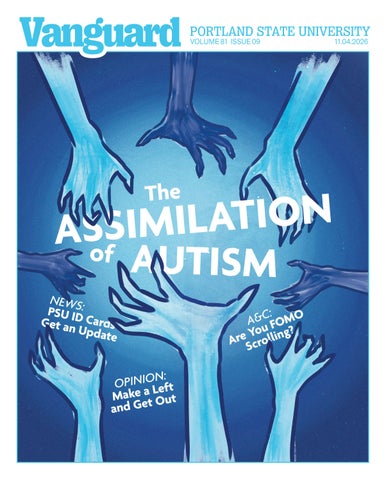
COVER DESIGN BY HALEY HSU
LETTER Letter from the Editor
P. 3
OPINION Vanguard on Vinyl: “Blue Wonder Power Milk” (1998) by Hooverphonic Callaway Column: The Assimilation of Autism Dystopian Discographies Make a Left and Get Out
NEWS PSU ID Cards Get an Update
P. 4
ARTS & CULTURE Defiance Through Villains in Musical Theatre Are You FOMO Scrolling?
P. 5 P. 10
STAFF EDITORIAL EDITOR IN CHIEF Olivia Hendry Young MANAGING EDITOR Grace Peterson NEWS EDITOR Will Lowe ARTS & CULTURE EDITOR Hayden Neumann OPINION EDITOR Daniela Hernandez SPORTS EDITOR Vacant MULTIMEDIA EDITOR Vacant SOCIAL MEDIA EDITOR Liam Schmitt
COPY CHIEF Jude Callaway ONLINE EDITOR Vacant DISTRIBUTION MANAGER Caleb Dougherty CONTRIBUTORS Drew Dattilo Jasper Duncan Edy Ferrara PRODUCTION & DESIGN CREATIVE DIRECTOR Haley Hsu CONTRIBUTORS Piper Acton Stella Billingsley Chesca Casis Arielle Chhunkeo Naue Pagtakhan Emily Ward
P. 5 P. 6-7 P. 8-9 P. 11
To contact Portland State Vanguard, email editor@psuvanguard.com. ADVISING & ACCOUNTING COORDINATOR OF STUDENT MEDIA Reaz Mahmood SALP ACCOUNTANT Anne Le STUDENT MEDIA TECH ADVISOR Rae Fickle STUDENT MEDIA TECH DEVELOPER Kaylee Hynes WEB DESIGNER Vacant
MISSION STATEMENT PSU Vanguard’s mission is to serve the Portland State community with timely, accurate, comprehensive and critical content while upholding high journalistic standards. In the process, we aim to enrich our staff with quality, hands on journalism education and a number of skills highly valued in today’s job market. ABOUT Vanguard , established in 1946, is published weekly as an independent student newspaper governed by the PSU Student Media Board. Views and editorial content expressed herein are those of the staff, contributors and readers and do not necessarily represent the PSU student body, faculty, staff or administration. Find us online at psuvanguard.com.
Letter from the editor Vanguard’s AI policy Earlier in the term, members of PSU Vanguard’s
creation in journalism spaces, and how AI doesn’t align
editorial board discovered that a former editor
with our publication’s mission statement. This AI policy
had used generative artificial intelligence (AI)
is used when training new contributors, and remains
software during their reporting and writing process.
readily accessible during the writing and editing process.
This editor used the generative software to write
We have taken several steps to ensure that this policy
interview questions, an introduction and “clean
is fully understood by everyone in our newsroom.
up” various parts of the article, such as creating
Additionally, continued monitoring and discussions
transition sentences and finding synonyms. We will
surrounding AI are happening in our newsroom, includ-
not give direct details about this editor to protect
ing our Copy Chief performing regular AI checks on all
their privacy, however we can say that it has been
articles during the copyediting process.
several years since this editor has left PSU Vanguard.
While generative AI is not allowed at PSU Vanguard,
Additionally, to the best of our knowledge, no AI has
we acknowledge that some softwares that we use in our
been used in our reporting since then.
reporting have AI components. We allow the sparing use
PSU Vanguard strongly condemns this use, or any
of online editing softwares, such as Grammarly, to fix
use, of generative AI in any aspect of our newspaper’s
grammar and spelling mistakes. We also allow the use
coverage.
of online transcription services in order to quickly tran-
As Portland State University’s student run newspaper,
scribe interviews. Both grammar checkers and transcrip-
creating news content for students, by students is para-
tion services have been rebranded as AI in recent years,
mount to our mission. We want to provide students the
however these are practices that journalists have been
opportunity to not only read/watch impactful coverage
using for decades, predating the AI boom. Nonetheless,
created directly by fellow students, but also to learn how
we require contributors to inform us of when these soft-
to create said coverage. While we acknowledge the nu-
wares are used in reporting.
ances of AI use, we at PSU Vanguard are committed to
As you continue to view content from PSU
not using generative AI in our creation of written, au-
Vanguard, know that, once again, the content is cre-
ditory and visual content.
ated by students, for students. We have established
We wanted to take this opportunity to explain our newspaper’s AI policy going forward, which had been established before the aforementioned editors' use of AI. Our AI policy clearly lays out how we value human
PSU Vanguard • NOVEMBER 4, 2026 • psuvanguard.com
safeguards so that instances such as those previously mentioned will not happen again. We look forward to informing the campus community through ethical, human made content.
LETTER
3
PHOTOS BY STELLA BILLINGSLEY
PSU ID Cards Get an Update A new design and streamlined process for getting your PSU ID
EDY FERRARA Portland State University has introduced new ID cards for students, faculty and staff. Along with a redesigned look, PSU has also made changes to how people get their IDs. This update comes as part of a larger transition effort at PSU, which shifted ID Card Services operations from Student Financial Services (SFS) to the Office of Information and Technology (OIT). This transition has brought a new streamlined process for getting your ID. Students and faculty now have the option to upload a photo online at pdx.edu/id-photo or take one in person at Fariborz Maseeh Hall (FMH) in the Student Services Lobby. “We focused on creating a seamless transition to new tools, processes, and team, providing a better ID card experience for the campus community,” writes the OIT Annual Report 2025-2026. The new ID cards now feature an image of the Karl Miller Center (KMC) building located on SW 6th and Harrison in the background. Student IDs are landscape-oriented and have an aerial image of the building, while faculty and staff IDs now are portrait-oriented and have a ground-level image of the building. When submitting a PSU ID photo online, people should allow up to two business days for processing. OIT will email the student’s PSU account to approve or deny the photo submission. Once the photo is approved, students are advised to head to Technology Help Desk and
4
NEWS
ID Services in FMH with a valid governmentissued photo ID to collect their new ID Card. According to Jerrod Thomas, the senior director of academic and technology services at OIT, the transition effort began during the 2023-2024 academic year when PSU received funds from the Higher Education Coordinating Commission, where a portion was put towards operational efficiency projects such as streamlining ID Card Services. “It was just enough cash to make this transition happen,” Thomas said. “OIT and our partners in Student Financial Services got together and said, what if we moved the operations of ID card production into the [OIT] help desk area and then also have [ID Card Services] under OIT.” ID Card Services had been dispersed across multiple departments at PSU such as OIT, Campus Public Safety Office and Student Financial Services. While some processes — like access control — are still managed by the Campus Public Safety Office, OIT has absorbed the responsibilities of ID Card Services. The transition of ID Card Services operations from SFS to the OIT Helpdesk has created new potential opportunities for campus efficiency, with one example being student orientation sessions. “About 800 people register for the summer orientations or two-day events and [SFS] would often have hour-plus long lines,” Thomas said. “We leveraged that photo upload software where we worked with orientation to send text messages to folks that said ‘click here and take a
selfie,’ and we pre-printed all those [ID cards].” The introduction of the photo upload software, CloudCard, to ID Card Services allowed for students at summer orientation sessions to submit their photo online, and then pick up the ID card after receiving an email confirmation that it was ready for pickup, creating a will-call pickup system. “We had 55% of all the summer orientation folks upload their photo. So we were able to will call 55% of the students, which was fantastic,” Thomas said. “I think the highest we saw was 15 people in line [to get ID cards], and probably about a 20-minute wait.” In addition to reducing wait times during summer orientation and the beginning of fall term, OIT identified and segmented a portion of the student body that did not already have an ID card. On Sept. 1, 2026, there were 1,029 students who did not have an ID card associated with their account. By Oct. 9, 2026, OIT had gotten that number down to 137 students. Between Jun. 22 and Oct. 9, 2026, 6,596 ID cards were printed at PSU. “The faster and smoother we make it for everyone — the students, faculty, staff and contractors — the better [it is] for everybody,” Thomas said. “Anything we can do to make it easier for students is what we’re shooting for.” ID cards provide important
access to spaces on campus like the Campus Recreation Center, library, student housing and academic buildings. With the new ID cards being introduced, Thomas highlighted the importance of managing ID cards responsibly. “I think the important thing is if you have an ID that’s lost, you should report it so that nobody can use it to get into areas they shouldn’t get into,” Thomas said. “It’s really important that you tell [the Campus Public Safety Office] about that so they can turn your [ID card] off.” If a replacement ID card is needed, now through Dec. 18, all PSU faculty and staff are eligible to get a free replacement ID card. This offer does not extend to PSU students. The first ID Card issued to students is free, and a Replacement Student ID Card is $21. However, OIT stated that if an ID is broken or has a defect, they will issue a replacement for free. Lost ID cards are subject to a replacement fee.
PSU Vanguard • NOVEMBER 4, 2026 • psuvanguard.com
COURTESY OF JUDE BREHL
Defiance Through Villains in Musical Theatre The Trans Voices Cabaret in Portland’s fifth anniversary showcase JASPER DUNCAN The Trans Voices Cabaret (TVC), filled with an entirely transgender and gender non-conforming crew, has sold out each year in Portland since their debut in 2022. With this year’s theme of “Vilified”, the group is anticipating this year holds a similar fate. This is the fifth year TVC is being held, with new additions each year. This year, one new addition is more group numbers. “This is the first year we’ve got an actual group number outside of the opening and closing, which is gonna be ‘Cell Block Tango’ from Chicago,” said Damian Luis, choreographer of the TVC. “The other group numbers this year are the opening number from Carrie The Musical and ‘Rose Tint My World’ from Rocky Horror Picture Show.” Luis’s style of choreography aims to focus on the individual skills and strengths of each performer, taking inspiration from these iconic numbers, as well as from the skillsets of the performers themselves. “We have a lot of talent. We have a lot of really amazing vocalists and performers and a lot of joy,” Luis said. The TVC aims to focus on this trans joy, rather than reducing the trans experience to just struggles of dysphoria and discrimination. The cabaret shines light on the delights of being trans, the euphoria and the talents these people hold that are often overlooked because of their identity. Luis claims trans performers may have been overlooked by Portland producers based on their identities and nonadherence to societal roles. This show allows them to show their talents on stage and prove they have as much a right as any to perform, says Luis. The TVC allows trans people a foot in the doorway to be involved in local theatre. “The TVC is a musical theatre cabaret show designed to showcase trans talent in Portland to producers in local
theater companies,” Venus Etlin, TVC’s Marketing Manager, said. Along with Portland producers, an audience of any identity and any position may engage in this content. The TVC allows everyone to see trans people performing on stage and being themselves in an uncompromising way. “Seeing the way other people exist in the world and exist in their art is always an impactful experience. Seeing trans people push the boundaries of gender in the way we do really allows [cisgender people] to do the same and not have their identities questioned either,” Etlin said. The TVC held auditions until Sept. 13th, where they said they had a wide selection of auditionees to choose from. The rehearsals then consisted of one day each week for eight weeks for four hours. On top of these few rehearsals, performers were expected to practice on their own time as well. “We weren’t struggling to fill spots,” Etlin said. “We had a really great awesome pool to choose from.” The performers suggested their own solos and duets for themselves, their choices adhering to the “Vilified” theme, which showcases villains and anti-heroes throughout musical theatre media. Once the music was approved, the long process of practice and rehearsals began. “I’m really excited in particular for this year’s theme,” Etlin said. “It’s speaking to the legacy of ostracization and villainization of queer people, how good versus evil isn’t so clear, and is especially empowering in this current moment.” Etlin’s marketing focuses around the classic deep purples, lime green and thorns to represent the villain theme. This theme can be seen guiding the choices of song, represented in costume, choreography and set design. As this is the fifth annual performance of TVC, Etlin believes it is time to further this organization into a more seri-
PSU Vanguard • NOVEMBER 4, 2026 • psuvanguard.com
ous performance. The TVC members are working to make this happen with steady improvements each year, such as a newly established board. “Our long term goal is to make it a more formalized organization,” Etlin said. “It is only this year that there’s been a board established, and we are working towards getting a nonprofit status.” One challenge faced throughout this process is the funding. Hence, according to Etlin, having a more formalized organizational structure would benefit the cast and crew’s process greatly in this way. “How do we secure funds for rehearsal and venue rental costs?” Etlin said. “How do we get sponsorships and promote ticket sales?” These are questions pondered by the crew of the TVC on the logistics side of production. The cabernet has opened the option to donate items to them for raffles during the show. They allow any items from art or gift certificates to fitness materials. The money funded from the raffles will go to pay both cast and crew. Even with funding challenges, the show must go on, and Etlin says it is going fast and strong. The performers are rehearsing in much of their free time on top of jobs and outside obligations. The crew is preparing sets, costumes and the choreographer is teaching formations and dances. The TVC’s one night only performance will take place on Nov. 22 at 7:30 p.m. at the Curious Comedy Theater in Northeast Portland. Tickets for the performance are available now on the website and are selling quickly as they did in previous years. “To be able to have a show like this in the first place, and to have it for five years, is pretty amazing,” said Etlin. “We are able to tell a story on our own terms, and I think that is really powerful in the conditions we live in.”
DREW DATTILO For whatever reason, I always gravitate towards dream pop during fall and winter. Perhaps the laid-back atmosphere of the genre complements the coziness of the two seasons in a way that just feels right. Lately, I’ve been spinning “Blue Wonder Power Milk” by Belgian dream pop/trip hop aficionados Hooverphonics. This record is the first to feature vocalist Geike Arnaert, and it pushes their original trip-hop sound into something more distinctive. The album kicks off with “Battersea,” which propels its slow, orchestral intro into a breakbeat, giving it a mellow but danceable rhythm. On “Dictionary,” primary songwriter Alex Callier’s deep vocal layering and pulsating synth leads immediately recall Depeche Mode, but the song still maintains cohesion with the album’s overall sound. “Eden” is simply gorgeous and devastating. Arnaert and Callier both deliver a lament about a pair who can never quite understand one another and be what each other wants. The string arrangement following the chorus is elegant and carries much of the song’s emotional vibrance. “Out of Tune” continues the record’s pattern of mixing mellow compositions with exciting, bouncy rhythm sections. My favorite track, a cover of Dave Berry’s “This Strange Effect,” perfectly translates the original’s twangy guitar riff into Hooverphonic’s signature string-laden, dreamy sound. Arnaert sings an octave up from the original, giving her voice a vulnerability that elevates the song’s subject matter of an indescribable — yet elated romance. “Blue Wonder Power Milk” is an odd name for an album, but the title track suggests it is a metaphor for things we use to distract ourselves from reality. I find that this record has a similar effect on me because with each listen, I only become more entranced by Hooverphonic’s sonic world.
A&C
5
The Assimilation of Autism How society strips autism down to its marketable parts JUDE CALLAWAY Neurotypical culture has undergone a radical shift in how it interacts with autism. What was once a strategy of marginalization is now best described as conditional assimilation. This shift threatens the reality of autism as a whole, as well as the disabled individual. It is commodified, separated into bite-sized chunks, and primed for consumption. To best understand this movement and its dangers, one needs to recognize the processes that are actively attacking autism: appropriation, extraction, infantilization, predation and erasure.
vice again next week. Even when given a marriage and a child, he is never written out of needing supervision.
INFANTILIZATION AND THE “NERDY” BOYFRIEND
When selective extraction spills into personal relationships, short-form video platforms reduce autism to a manageable novelty, transforming its misconstrued traits into romantic infantilization. On TikTok, it most prominently circulates
through an original audio clip, uploaded by user @atributetozombies, in which a voice declares: “I like him, I like that autistic man.” As of October 2026, TikTok’s public directory has 49,000 videos indexed under the sound. Most of the videos display women recording their boyfriends as they do “autistic” things: throwing sticks at the beach, playing with Legos or being raptly enthralled in lawn-mowing simulators. Several of these clips boast more than a million likes. The trend — and
APPROPRIATION AND STIMMING
For autistic individuals, and those with sensory processing disorders, stimming is defined as a necessary method of regulation, such as movement, auditory, visual or tactile stims. But this is no longer the only definition, as the digital space has stolen and twisted the term. Youth digital culture has redefined stimming as the performative repetition of viral trends — regurgitating audio clips, recreating repetitive physical movements or mimicking funny catchphrases. This redefinition turns a necessary form of regulation into social currency, twisting disability jargon into a quirky token of speech that peers parrot to one another. This signaling tactic is used to disclose which part of the digital sphere the speaker inhabits without risking genuine vulnerability. The byproduct of stimming’s assimilation into trend culture is sanitization, where the term is repackaged without its context and “baggage,” made more palatable to everyday consumers. At the same time, algorithms push these sanitized terms, valuing speed over nuance to maximize consumption. Those who use this watered-down terminology may claim ignorance, or that they are “following trends.” But the internet isn’t a bad game of telephone. Human users choose to use the terms without understanding or context.
EXTRACTION AND SAVANTISM
Beyond the appropriation of language lies a more representational issue. Corporate media has primed our very understanding of autism to be conditional, selectively harvesting only the most marketable traits. Entertainment industries routinely foreground one highly sanitized archetype of autism: a conventionally attractive — and naturally young — person who struggles with social nuance, but offsets it with phenomenal intellect. This archetype, the savant, is explicitly designed in media around markers of autism; however, the diagnosis is frequently absent from the script. Any traits not easily sold are intentionally underrepresented, leaving out the people who constitute the full spectrum of adult autism: the non-speaking grocery store worker, the adults who require daily support, and the women and men navigating midlife diagnoses that render them burnt-out and directionless. This deliberate extraction process shapes our fundamental understanding of autism. Producers isolate the traits that can be translated into narrative utility — primarily savantism, but also hyper-focus and blunt literalness — while editing out the disability’s less appealing sides; namely, executive dysfunction and complex support needs. The media exposes this narrative framework to us at a young age, imparting that the acceptance of disability is conditional. In particular, the savant trope demands that an autistic person earns their basic humanity through extraordinary usefulness to the neurotypical world. “The Good Doctor” is a textbook case of conditional acceptance. Dr. Shaun Murphy’s savantism photographs well and resolves on schedule, but to sell the disability, the writing renders him a perpetual child. He’s talked down to, and his autonomy is staged as an ongoing debate among his colleagues. His intellect is the asset, and his adulthood is an endless negotiation that can never conclude because a network drama needs it as a plot de-
6
OPINION
PSU Vanguard • NOVEMBER 4, 2026 • psuvanguard.com
the larger online romantic desire for an “autistic” man — often misconstrues autism as over-the-top nerdiness. Building Legos is a hobby. It’s not autistic, and the label is supplied here by the sound, rather than earned by the behavior or an actual diagnosis. These creators are not seeking or depicting a complex human being, and while the affection may be real, they are shopping for and parading a novelty — a selection of traits posing as a disability. This false label is often attached to a minuscule quantity: “just a little autistic.” Such restrictions allow autism only when it is seen as charming, and only to a limited extent. Bluntness reads as proof he isn’t lying; a hyperfixation, attention that won’t wander. Yet the moment these traits cross an invisible threshold, they cease to be charming and become inconvenient, telling the men in these clips — and the larger autistic population scrolling at home — to present only the desirable portions of their disability, and only in the precise dosage dictated by neurotypical comfort. That forced performance is called masking, and in a landmark 2020 study published in Autism in Adulthood, autistic adults identified masking as a key driver of autistic burnout
— a state of severe exhaustion they linked to mental-health crises and suicidal thoughts. The trend may be cute, but the implications are not.
PREDATION AND CREDULITY
In October 2025, Dazed reporter Angel Martinez noticed that men’s dating profiles were explicitly requesting women who are “slightly autistic” or have “a touch of the ‘tism.” The qualifier is identical to the one TikTok creators used for boyfriends; however, this desire’s power dynamics and rhetoric are vastly different, pointed in a far more degenerate direction. Either these men truly have no concept of what autism is — doubtful — or they are seeking someone they perceive as easy to control and manipulate. Some defenders suggest these men might be autistic themselves, searching for a compatible partner. But nobody seeking a disabled peer sets an upper limit on their identity. There is no widely advertised desire for a partner who only slightly enjoys the outdoors or just sort of likes to read. On men’s dating profiles, setting a maximum threshold for a disability is not a preference; it is a method of control. Rather than a complete
ARIELLE CHUNNKEO
PSU Vanguard • NOVEMBER 4, 2026 • psuvanguard.com
individual, the desirable “autistic woman” is a partner who conforms to the non-autistic male gaze and its expectations of naivete. Carina, a 27-year-old autistic woman, told Dazed what the fantasy actually demands: “a woman with youthful interests and colorful outfits, who will take him at his word when he tells her he’s a good guy.” These men are shopping for credulity — the willingness to believe or trust something too readily — in a demographic historically taken advantage of for that very trait. A 2022 study published in Frontiers in Behavioral Neuroscience surveyed 225 women in the autistic community. A staggering 88.4% reported having survived at least one form of sexual assault; for 75% of those victims, reporting the violence yielded no supportive action or justice. While sexual violence affects roughly 30% of women in the general population, autistic women face it at nearly triple the rate. Filtering for a woman who is “slightly autistic” is not an innocent preference for quirky hobbies or a unique style. It is a predatory search for a partner who struggles to understand social subtext, identify deception or enforce boundaries.
ERASURE AND THE AUTISTIC ADULT
From digital slang to predatory dating preferences, the contemporary attack on autistic identity is underpinned by a fundamental cultural refusal to acknowledge autistic adulthood. A 2011 study published in Disability Studies Quarterly revealed that across autism organization homepages, the face of autism was a child 95% of the time; in fiction, 90%; and on the news, autistic children appeared four times as often as autistic adults. While a 2022 follow-up study in Autism in Adulthood found that adult presence had climbed to roughly one in five across media platforms, the framing remained the same: adults were overwhelmingly depicted through the lens of childhood. Systemic infantilization of this nature leaves autistic adults unprotected and unprepared. On an institutional level, academia and educational frameworks frequently reinforce the myth of the blue angel, which positions autistic individuals as permanently innocent, asexual, and incapable of mature decision-making. Yet on a societal level, autism is increasingly sexualized and commodified. This polarization has left autistic college students significantly less satisfied with consent education than their neurotypical peers, according to a study published in the Journal of Autism and Developmental Disorders. This institutional neglect directly fuels the crisis of autistic vulnerability: by denying autistic adults the language and proper education to recognize coercion or negotiate intimacy, they are left largely unprepared in a culture that fetishizes their compliance. Trace the trajectory of modern assimilation: Appropriation strips a necessary regulatory mechanism of its context and sanitizes it into cheap internet slang. Extraction harvests the palatable savant traits to sell network dramas and perpetuate the neurotypical misunderstanding of autism. Infantilization reduces the maturity of adult men under the guise of affection, misinterpreting childlike hobbies as a developmental disability. Predation filters for credulity to maximize the non-autistic man’s domestic control and further threaten the safety of autistic women. Erasure denies the very existence of the autonomous autistic adult, insisting on a perpetual child. The most insidious aspect of modern machinery is that, to an uninformed eye, it masquerades as progress. TikTok trends sound affectionate, dating profile qualifiers sound complimentary and television dramas frame themselves as empathetic. Nobody is hurling slurs. But it is not progress. It is a systemic separation of the autistic individual and their desirable traits. The redefinition of “stimming” doesn’t need a person who stims for sensory regulation. The television drama does not need an adult who requires complex support. The social media trend does not need a partner with executive dysfunction. The dating profile does not need a woman who enforces boundaries. Among all five versions of autism assimilated into popular culture, not one of them requires an actual, autonomous autistic adult. Disability is not a punchline; it is not a narrative device, an aesthetic, or a fetish. While harm is not always the explicit goal of those who perpetuate these facets of assimilation, it does not always require bad intent, and ignorance is no excuse. True acceptance requires an uncompromising stance of intention and protection: we must reject the sanitized aesthetic of disability and actively defend the safety, agency and experience of the autistic adult.
OPINION
7
Dystopian Disc
How playing commercial music reduces a bu
DANIELA HERNANDEZ Editors note: This article was originally published in PSU Vanguard Volume 81 Issue 3. Modern-day establishments like coffee shops, restaurants, beauty salons, thrift stores and other popular places pride themselves on authenticity and individuality. A “no place like us” attitude that simply isn’t true. All these businesses choose to play the same “top hits” as background music, which is a catalyst for their poor quality of individuality. No matter how a business may distinguish itself with its multi-thousand-dollar remodel or its gluten-free products, it is all thrown away when “Flowers” by Miley Cyrus plays over the speakers. Forget about going somewhere else — the same playlist is playing in the establishment a couple of blocks away. These playlists include the overplayed singles of America's top artists. Hit songs from the last two months are played to draw younger folks and give the impression that the business is culturally relevant. New-age country songs are incorporated for those who don’t identify with mainstream pop. Viral hits made by music industry veterans reinforce a sense of familiarity and nostalgia. Together, the songs create a soundtrack that provides a safe, comfortable and clean atmosphere for customers. However, it's important to acknowledge the extremely hard work that goes into minimalist interior design. The wooden and marble fixtures are carefully chosen to be subtle. Concrete walls create the illusion that the place is a lot bigger than it is. A vibrant green plant is placed in a corner as a sign of life and vegetation. The marketing for this establishment will promote a high-end quality product with a top-tier atmosphere and an experience that comes with free wifi. It's all a lie. There is nothing high-end or original about the experience, down to the fake plant. It's a false sense of
8
OPINION
authenticity because playing the same Spotify “Chill Hits” is producing a copy-and-paste business atmosphere. Making the decision to play the same music in an establishment that has saturated our radios, social media and streaming services reduces the potential quality of a business to a dystopian experience. It's a horror that is felt not only as a customer, but as an employee. As someone who has worked retail for the past four years, I have been subject to these types of playlists regularly. It's haunting. What sounds like a harmless playlist for background music becomes an exhausting cycle of earworms. Eventually, the sound becomes a sensory overload during already stressful shifts. My fellow employees can also feel the overstimulation from the music while ringing up a line of customers. As an employee, I can say that my performance progressively worsens. By the end of the shift, I am ready to collapse. Forcing employees to work every day to the same aggravating soundtracks worsens the business's customer service performance. The willingness to uphold an upbeat, bubbly mood for eight to 10 hours a day steadily declines with every hour. When working in an already overstimulating environment, the quality of customer service is compromised. Employees become more mentally and emotionally fatigued. Morale and patience also rapidly decline. This contributes to a less positive experience for the employee and the customer. Apart from being an employee, I am also a consumer. When I clock out, I leave my workplace with excitement for freedom from the corporate-curated music, humming LED
lights, and customer service scripts. But the music follows me into big-box retailers, franchises, start-ups, and mom-and-pop shops. It's the same soundtrack of death that seems to be inescapable. Generic music also adds a lack of culture to the business. The songs that are played are mostly American-dominated and exclude non-Western languages and genres. There is a loss of rich history when establishments opt out of playing music that is connected to the roots of the business. Language, lyrics, rhythm and history are tools used to understand a story. Music is a powerful medium to interpret identity. Commercial music is supposed to appeal to everyone, which means it belongs to no one. It is placeless and nameless. Choosing to play Spotify’s “Top 40” is a rejection of a culture that causes a business to lack identity. As a customer, originality and uniqueness are attractive qualities craved in a world of replicas. Product uniqueness is just one part of a good experience; environment quality is the other. A few of Portland's businesses have hopped on the train of creating and playing playlists that align with the store's atmosphere. Specifically, ethnic grocery stores deliver a variety of songs tied to their culture. Super Mercados México is a hub for those searching for authentic Mexican groceries.
PSU Vanguard • NOVEMBER 4, 2026 • psuvanguard.com
cographies
usiness's quality
Stepping into the building, sounds of Banda, Mariachi and Norteño music fill the room. Saigon Market is an Asian grocery store that plays Thai and Vietnamese music. These establishments provide a refreshing experience as customers escape the clutches of America's chart-toppers. It is also nice to see employees hum along while working. Listening to sounds that identify with you as an employee makes the work environment much more immersive and fulfilling. The journey in and out of the store is much more enjoyable for both sides of the aisle. Employees are the people who best understand business culture. Sales associates, sales leads, baristas, frontline staff and those we call in customer service know what matters to consumers. They interact with clients the most and understand their stories, frustrations and values. Employees also drive the culture of the business. The dynamics of employees during an opening shift, a midday rush and the final closing hour create hard-working teams that can eventually develop into friendships. Each team is unique, which adds to the uniqueness of a business. These teams deserve the right to choose the music played in their establishment. Business is a form of storytelling. Don’t tell your customers that you got lazy and put the first playlist on Spotify you could find. Also, don't tell your clients you are ashamed of who you really are. Stepping away from repetitive dystopian commercial music is an act of rebellion and choosing to claim your own identity as a business. Now that's authenticity.
PSU Vanguard • NOVEMBER 4, 2026 • psuvanguard.com
OPINION
9
HALEY HSU
Are You FOMO Scrolling? The necessity of PSU student-run social media accounts
GRACE PETERSON A University of Cincinnati study said that 54% of college students feel lonely. The study also shared that these lonely students are typically spending more time on social media rather than directly interacting with their campus. In the 2026 study, 13% of responders reported scrolling on social media for 16 hours or more a week, which was classified as excessive usage. In 2023, almost 90% of Portland State’s undergraduate students were commuting to campus; 63% of freshmen lived off campus. The National Library of Medicine says that commuter students can have a harder time getting community from their schools. They bring up the “Parking-Lot-To-Class” mentality, which means commuter students don’t get to enjoy campus to the fullest, they are often just going from the parking lot to class and back. These students can miss out on making connections, and the spontaneous moments of on-campus life. Commuter students can always get a campus job or join a club to get more involved with the community, but that’s not possible for all students. Some have busy schedules, far commutes, different jobs or other priorities. They may not be able to afford spending additional time on campus beyond classes. These students often turn to social media to get their social connection. Turning to social media is not an inherently bad way to approach
10
A&C
college life, especially if it’s done with intention. There’s a key difference between active and “FOMO” (Fear of Missing Out) scrolling. FOMO scrolling tends to be associated with negative emotions, worsens feelings of loneliness/ isolation and can be harmful for students’ mental health.While it shares similarities to doomscrolling, both are markedly different forms of social media consumption. Doomscrolling is the overconsumption of short-form negative news, according to the American Brain Foundation. FOMO scrolling is about loneliness as a direct impact from a loss of community, rather than a reaction to the news cycle. Active scrolling can be different. Active scrolling means the student is actively engaging with groups online and connecting with real individuals in their community. PSU has an official Instagram account — @ portlandstate — but for students craving an online community with fellow classmates, the best place to actively scroll could be through student-run accounts. Portland State has many student-run niche accounts, such as @psuhottiefinder2, @psu_victor_viking and @psuvikswsoc_fanpage. These accounts share secret crush confessions, the whereabouts of PSU’s iconic mascot and even a Women’s Soccer fan page run by the Women’s Soccer team. These accounts are created by students for students; there is an account out there
for everyone and every community. Addie Kennedy just started at PSU this year as a commuter. In late September, she decided to begin posting squirrel photos and created the @portlandstatesquirrels Instagram. “[I] love squirrels,” Kennedy said. “My camera roll was filling up with so many cute campus squirrels that I wanted to share with our lovely community. Creating this account has definitely made me feel more connected to the PSU community. People send me their squirrel pictures, so I get to see all the different ones around campus.” By having other community members share photos, Kennedy can talk to more students and become more engaged in a niche part of Portland. Clubs often run their own social media accounts. The Interdisciplinary Neuroscience Association (INA) at PSU — known as @pdxbrains on Instagram — posts about their events online. They most recently hosted a “Neuro Halloween” karaoke night, with free food and costumes. Before that, they co-hosted “Doc Talk: A Presentation about Post Undergrad Plans” with the Pre-Medicine Students Association. These events are usually free to attend and open to anyone in any major or discipline. The account is run by the group, but the president, Natalie McWilliams, is usually the one posting. They’re majoring in Business
Administration with a minor in Indigenous Nation Studies, and believe that the account has connected INA more deeply within the PSU community. “I think our student org, INA, has one hundred percent created more community and connection at PSU and [Instagram] has been a great way to facilitate that connection to the community … we want to connect people and let them know about the events we are having.” According to McWilliams, clubs have been using social media for a long time. The first INA Instagram post was in 2017, but they were on Facebook before that. “Our account [has] been around for a long time, passed down to generations of students,” McWilliams said. “It’s fun to be a part of something so much bigger than just one of us.” Social media extends beyond Instagram and Facebook. r/portlandstate on Reddit is popular for curious students. There are many posts about study spots, dorm life and PSU memes. These online spaces can be vital for students, providing a virtual third space that’s both active and low-stakes. When students open their favorite social media apps, they should consider whether they are experiencing FOMO or actively scrolling. Filling their feed with community-driven, PSU student-specific content may help with feelings of isolation and connect them with the campus community.
PSU Vanguard • NOVEMBER 4, 2026 • psuvanguard.com
Make a Left and Get Out COURTESY OF AIDAN BILLINGSLEY
Why Waymo Will Be Bad for Portland
DREW DATTILO Since April 2026, Waymo, an autonomous vehicle (AV) rideshare service, has been mapping Portland streets in preparation for a commercial launch. At the time of publishing, Waymo can not operate in the city, but the Portland Bureau of Transportation (PBOT) has been working on revising the codes and regulations that prevent Waymo from receiving a permit to operate. Portland Mayor Wilson has been one of Waymo’s biggest supporters, claiming AVs can help the City meet “Vision Zero” goals, according to an April press release from Waymo. “Vision Zero” is a global strategy adopted by Portland that aims to “eliminate traffic deaths and serious injuries” by making streets safer for drivers and pedestrians alike. But not everyone supports Waymo being a part of our city. Between February and April 2026, PBOT ran a public comment process to gather feedback on AV implementation; many rightly expressed concerns over safety, accountability, congestion and impacts to transit and pedestrians, among other things. Waymo will be bad for Portland, as the robotaxi’s artificial intelligence technology still causes avoidable traffic issues, threatens to displace rideshare drivers and brings very little benefit to transportation infrastructure. Safety was especially a priority since Waymo has a long history of traffic incidents. Just this past Fourth of July in San Francisco, a fleet of Waymo cars bricked — coming to a sudden stop — when returning from a fireworks show. This worsened already heavy congestion, and prevented other cars from safely leaving. Waymo’s technology is questionable, but that is far from the only flaw these vehicles bring.Waymo likes to tout its impressive crash metrics, showing that its cars are significantly better at avoiding crashes that result in serious injury. But their data obscures a critical flaw of self-driving cars: they lack common sense. One of the biggest issues with AVs is that the AI technology regularly makes simple traffic mistakes that would be avoided by a human driver. In June, Waymo recalled over 3,000 vehicles across Arizona and California after cars had repeatedly ignored closed freeway ramps and drove through construction sites. The safety recall report from the National Highway Traffic Safety Administration revealed that the Automated Driving
PSU Vanguard • NOVEMBER 4, 2026 • psuvanguard.com
System for multiple cars had failed to recognize construction zones and prioritized avoiding other highway closures, causing them to drive into closed lanes. Even before the recall, Waymo vehicles were making catastrophic mistakes. In March 2026, another instance of Waymo’s decision-making failure occurred in Austin, Texas, when a Waymo car blocked an ambulance that was responding to a mass shooting. Fortunately, the situation was resolved quickly, but it demands questioning the extent to which we can trust driverless cars to properly respond to emergency situations where people’s lives are at risk. If Waymo begins operating in Portland, we may see these same types of problems repeated. Incidents like these occur because AVs lack the decision-making skills necessary to navigate rare or unexpected situations as humans do. A 2021 study published in the National Library of Medicine cited a deficit in common sense decision-making among self-driving cars — despite its importance to safe driving. Whereas a human driver would intuitively know to avoid driving into a construction zone or an area marked with traffic cones, AVs don’t have that intuition. They instead rely on their AI training along with structured testing and national data, meaning their knowledge of road safety and object recognition is derived from whatever the testers decide to simulate. AVs will inevitably have gaps that cause them to make ludicrous errors that have real consequences. Physical safety is not the only concern with Waymo, but job security as well. Drivers for rideshare apps like Uber or Lyft would have to compete with AVs, which could displace workers. The city has to take into consideration a loss in human labor with Waymo and figure out ways to mitigate harm to Portland rideshare drivers. Councilor Mitch Green supports levying fees on any AV company that operates in Portland in order to help workers who have lost their jobs, according to Oregon Public Broadcasting. Despite Waymo’s faults, Mayor Wilson espouses self-driving cars for their positive impacts on transportation. But the actual benefits that Waymo — or other self-driving car services — might bring to Portland are unclear. A 2022 dissertation from Portland State University doctoral candidate Sangwan Lee reviewed the
benefits associated with AV transportation, including reduced travel time, carbon emissions, traffic congestion, travel costs, and parking demand. Lee also cited increased operational efficiency, safety and transportation equity with AVs. At the same time, Lee highlighted common concerns with AV usage, several of which directly contradict supposed benefits: increased safety risk, congestion and a lack of time-saving travel, along with data privacy and liability issues. This makes the question of how AVs can benefit cities complicated. Since AVs can theoretically make streets safer by eliminating human error, safety should increase with more AVs. But machine errors present their own dangers, which means there are tradeoffs that need to be considered when evaluating the safety of self-driving cars. These ambiguous advantages raise an interesting question: doesn’t public transportation already accomplish what AVs — and Waymo — set out to do? A 2026 report from the Victoria Transport Policy Institute identified all of the same benefits from public transportation as AVs from Lee’s dissertation. A well-equipped transit system increases road safety, reduces pollution and emissions and reduces traffic congestion, while moving a higher volume of people than rentable AVs would. Despite recent service cuts, Portland’s public transportation system is robust. Buses, light rails, streetcars and one commuter rail line spread throughout the city and metropolitan region, making many places easily accessible for people without cars. Additionally, TriMet has made strides in accommodating disabled people, with each MAX car and bus containing retractable ramps for wheelchair users, while the streetcars contain level boarding platforms. They also offer LIFT, a paratransit service that offers rides to people unable to use regular transit. AVs are a superfluous addition to what is already providing an essential service and making the city a safer place for pedestrians. At their best, AVs are just glorified public transportation; at their worst, they make roads less safe and pose risks to pedestrians, cyclists and actual drivers alike. If Portland allows Waymo to operate commercial rides in the city, travel will be much worse. Portlanders should hope that local leadership will remember their responsibility for serving its citizens, not Silicon Valley.
OPINION
11