CONTENTS
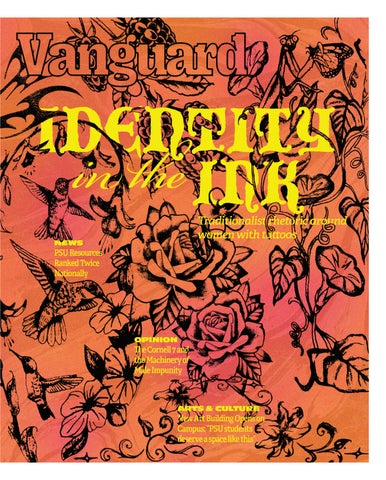
COVER DESIGN BY HALEY HSU ART COURTESY OF GINA CARLSON, KENNA DOLAN AND TRICIA HOOLEY
NEWS PSU Resources Ranked Twice Nationally
P. 3
OPINION The Cornell 7 and the Machinery of Male Impunity Identity In The Ink How to Make Portland Feel Like Home
P. 4 P. 5 P. 7
ARTS & CULTURE New Art Building Opens on Campus: “PSU students deserve a space like this”
P. 6
STAFF EDITORIAL EDITOR IN CHIEF Olivia Hendry Young MANAGING EDITOR Grace Peterson NEWS EDITOR Will Lowe ARTS & CULTURE EDITOR Hayden Neumann
COPY CHIEF Jude Callaway ONLINE EDITOR Vacant DISTRIBUTION MANAGER Caleb Dougherty CONTRIBUTORS Drew Dattilo
OPINION EDITOR Daniela Hernandez
PRODUCTION & DESIGN CREATIVE DIRECTOR Haley Hsu
SPORTS EDITOR Vacant
CONTRIBUTORS Arielle Chhunkeo
MULTIMEDIA EDITOR Vacant SOCIAL MEDIA EDITOR Liam Schmitt
ADVISING & ACCOUNTING COORDINATOR OF STUDENT MEDIA Reaz Mahmood SALP ACCOUNTANT Anne Le STUDENT MEDIA TECH ADVISOR Rae Fickle STUDENT MEDIA TECH DEVELOPER Kaylee Hynes WEB DESIGNER Vacant
To contact Portland State Vanguard, email editor@psuvanguard.com. MISSION STATEMENT PSU Vanguard’s mission is to serve the Portland State community with timely, accurate, comprehensive and critical content while upholding high journalistic standards. In the process, we aim to enrich our staff with quality, hands on journalism education and a number of skills highly valued in today’s job market. ABOUT Vanguard , established in 1946, is published weekly as an independent student newspaper governed by the PSU Student Media Board. Views and editorial content expressed herein are those of the staff, contributors and readers and do not necessarily represent the PSU student body, faculty, staff or administration. Find us online at psuvanguard.com.
PSU Resources Ranked Twice Nationally
ARIELLE CHHUNKEO
PSU national rankings in LGBTQ+ friendly, social mobility and service learning
WILL LOWE Two recently released studies ranked Portland State University the first in the Pacific Northwest for social mobility and service learning and sixth-friendliest fouryear university for LGBTQ+ students in the nation. Erobella and U.S. News & World Report released the studies independently in Sept. 2026 Erobella’s study graded 1,718 universities against 12 public data sources, including policies, state and city law, community and federal records.The scores were divided into three main categories: campus policy, with a possible 40 points; environment, with a possible 25 points; and scene, with a possible 20 points. PSU scored a total of 81.9/100 points. The study also included bonuses and penalties; student voice and reviews could raise a school’s score by up to 15 points, or decrease it by up to 25 points. Penalties included Title IX rules being left up to interpretation, being ranked on Campus Pride’s “Worst List,” or being on Princeton Review’s top 25 “LGBTQUnfriendly” schools. PSU got full marks in campus policy for having a staffed LGBTQ+ center, gender-inclusive housing, nondiscrimination policy, trans-inclusive
health insurance, chosen name on records, pronouns on rosters and a five-star campus pride, according to a 2024 snapshot. “I have been heartened by the experiences of queer and trans students here because it’s … primarily positive,” said Erica Fonseca, the director of queer student services and interim director of the Women’s Resource Center at PSU. The Queer Resource Center, located on the top floor of Smith Memorial Student Union, hosts many events for queer students, including large social events and identity-specific meetings. “I want to create a space on campus where students can come in contact with each other in a low-barrier, low-stakes type of way,” said Fonseca “So whether that’s through events like the drag show, where it’s fun and there’s something to do and look at, or something more intimate like the affinity groups, where there are identity-based specific groups where you can find other people who look like you.” Erobella’s study also looked at the surrounding environment and scene of the universities. PSU got a 23.6/25 for environment, citing state policy and city equality. Additionally, the university received an 18.4/20 for scene, flagging six LGBTQ+ venues within two miles of PSU campus.
PSU Vanguard • OCTOBER 14, 2026 • psuvanguard.com
PSU did not receive any penalties or bonuses, though it was documented that there were three reported hate crimes against LGBTQ+ individuals from 2022-2024. The report states this is for context only and isn’t scored, as low counts can cause under-reporting. PSU also holds first place for social mobility among schools in the Pacific Northwest and is tied for 31st place overall. PSU also tied for 15th place in service learning. Social mobility scores were calculated using the graduation rate among Pell Grant recipients. “Some colleges are more successful than others at advancing social mobility by enrolling and graduating large proportions of disadvantaged students awarded with Pell Grants,” states the U.S. News & World Report rankings page on social mobility. PSU has several ways that it helps students with financial need graduate. One example is the Tuition-Free Degree program, which covers tuition fees — up to 16 credits per term — for students who qualify for the Pell Grant. This helps ensure that PSU students are less often forced to drop out because of financial burden. Additionally, PSU’s Career Center provides students access to service learning opportuni-
ties such as jobs, internships and volunteering. “68% of internships nationally end with a ‘Would you like to stay here?’” said Marisa Miller, the internship coordinator at PSU. “Internships are a recruitment pipeline; it’s another tool for [employers] to get new people in the door … it also gives the intern a chance to cut their teeth on something that’s real.” Service learning is something that relates to a class but applies more hands-on learning; it often gives students more opportunities to learn about the realities of work spaces. “[It] not only enhances your own understanding of what this looks like that you can apply to your future classes to get a more robust experience,” Miller said. “Service learning is helpful for students in that it gives them this practical piece outside of a class project or a homework assignment to be able to feel like they have an extra … data point to be able to compare.” Being in an urban environment with an open campus, PSU claims that students have access to spaces and opportunities that some other schools do not, such as robust job and internship opportunities with a multitude of employers, and access to a wide array of people and experiences.
NEWS
3
The Cornell 7 and the Machinery of Male Impunity Inside the online movement converting peer pressure into legal immunity and male grievance JUDE CALLAWAY Editor’s note: The following opinion piece includes explicit language and discusses of rape and sexual assault. Reader discretion is advised.
ARIELLE CHHUNKEO
The “Cornell 7” lawsuit describes the alleged gang-rape of a 20-year-old student drugged inside a Cornell fraternity house. Sexual violence of this nature is disturbingly common, and although newspaper headlines feign outrage every few weeks, the usual outcome is that the perpetrators get away largely unscathed. The Cornell 7 is a real-life example of the social structures that perpetuate male impunity, and the hypermasculine movement’s response to the case has exposed the manosphere’s role in preserving modern society’s rape culture. As a corner of the digital world claiming to address men’s struggles, the manosphere relies on rhetoric that weaponizes hypermasculinity and grievance. Commentators within this space aim to frame the Cornell 7 case as a “woke” mob’s witch hunt; painting the accused as victims, they evoke public outrage against the survivor. The machinations of a radically misogynistic online community reveal a larger, purposeful movement, which twists the standards of brotherhood and masculinity to enforce male impunity in contemporary society. Traditional ideals of brotherhood — integrity and honor — have been coopted and perverted in the name of hypermasculinity, resulting in a culture of silence and collective entitlement. Such entitlement and silence were grossly displayed in the Cornell 7 fraternity group chat, where defendant Jonathan Newell snapchatted his peers the message “free pussy in alum pu” in reference to the heavily drugged victim, Jane Doe. Of the 57 active members in the fraternity group chat, not one chose to intervene. In hypermasculine spaces like fraternities, messages like Newell’s demand conformity and participation, not intervention. The manosphere has built a rhetoric that demonizes stepping in to stop an assault or defending a survivor as ultimate violations of the “bro code,” which risks instant exile from masculine society. This effectively converts peer pressure into complicity, teaching young men to prioritize loyalty to the male circle over basic morality and advocacy. And when a victim comes forward, the manosphere brings out the false allegation and “poor young boy” rhetoric.
Whenever sexual assault allegations gain traction and break into public view, the manosphere’s online mob and gendersupremacist influencers immediately shift focus away from the survivor and their trauma, postulating that the real victim is the accused man and his alleged persecution — often called counter-victim rhetoric or a reversal of victimhood. This process of inversion rebrands alleged rapists as innocent victims; the headstone martyrs of false allegations, meant to stoke the flames of male grievance and rage. This strategy feeds directly into what sociologist Michael Kimmel termed “aggrieved entitlement:” a state of defensiveness, resentment and rage among dominant groups who feel the privileges they consider their rightful due are being lost or taken away. In
4
OPINION
the case of the manosphere, it is the belief among privileged young men that immunity from consequences is a right, and that holding assaulters accountable is an act of oppression. By casting legal consequences and social fallout of sexual assault as a war on men, the manosphere manufactures a sense of collective, misogynistic male martyrdom. The co-existing result of aggrieved entitlement within the manosphere is a network of intimidation. The digital weapons of this network are deployed against survivors like Jane Doe, who has already faced multiple death threats and doxing attempts after coming forward. When male-supremacist creators broadcast a survivor’s details or host livestreamed defenses of accused men — like manosphere influencer Myron Gaines, who defended the Cornell 7 at the University of Texas on October 7, 2026 — they call for a digital army to wage war on the true
victims. The movement threatens personal consequences for seeking justice. In doing so, the manosphere’s network, formed by perverted ideals of brotherhood and masculinity, sustains modern rape culture through intimidation and counter-victim rhetoric, slowly raising the price of coming forward until silence feels like the only option. It is natural, I would even say necessary, to feel visceral outrage and disgust at the Cornell 7 case, its defendants, and the digital mob that rallied to defend it and invert a survivor’s trauma. The entire dynamic is absurdly dystopian; a surreal collapse of society’s basic moral consensus. But playing whack-a-rapist — attacking individual court cases while ignoring the larger structure — targets the symptoms, not the systems. The manosphere sustains itself through insufficient definitions of manhood that fail to offer young men a grounded vision of positive, accountable masculinity, leaving them susceptible to hypermasculine rhetoric. Systems are not abstract entities; they are powered by everyday compliance. Exposing the mechanism of conversion is not an excuse, nor is it a gateway to absolution. The men who subscribe to misogynist doctrines, perpetuate sexual violence and enforce silence need to be named and held responsible. This does not, however, mean we can be blind to the patriarchal funnel that directs these men down such a path. When a young man’s malleable moral and intellectual beliefs are stained by rhetoric that purports equality as oppression and empathy as weakness, his pathway toward aggression and misogyny is not a deviation, but rather the system working as it was designed. Defeating the system requires structural clarity and a recognition that the manosphere’s network of male entitlement and impunity relies on compliance at the individual level. The silent group chat and unchallenged perversions of brotherhood are the primary infrastructures that provide institutional cover and funnel young recruits into the patriarchal pipeline. Standing up and breaking rank in private, male-only spaces replaces the cowardice of complicity with the courage of active rejection; by stripping impunity of its peer-group protection and proving that real brotherhood demands accountability, men can begin dismantling male supremacy from within.
PSU Vanguard • OCTOBER 14, 2026 • psuvanguard.com
COURTESY OF TRICIA HOOLEY
COURTESY OF GINA CARLSON
COURTESY OF TRICIA HOOLEY
IDENTITY IN THE INK Traditionalist rhetoric around women with tattoos
DANIELA HERNANDEZ Although women have been getting tattoos for centuries, they remain prone to prejudice, stereotypes and are looked down upon. Narratives that target women with tattoos include arguments of hypermasculinity, and that they portray them as unattractive, unprofessional, trashy and vulgar individuals. Traditional beauty standards praise hairless, wrinkle-free, flawless skin, which contrasts with the view of tattooed skin– tattooed skin is classified as unladylike, and is a sign of impurity. This traditionalist rhetoric around women with tattoos has influenced how society views women. Many women — including myself —have been subject to these narratives that are a misrepresentation of our identity. Although prejudice has existed for centuries, getting tattoos isn’t a new custom. For centuries, Indigenous cultures have used tattoos for various purposes. Many signified sacred, spiritual or communal traditions; others represented milestones and personal stories. In today’s society, tattoos still have this representation. According to the Pew Research Center, 32% of Americans have a tattoo, and women are more than 10% more likely than men to have one. Portland, in the late 19th and 20th centuries, became a hub for tattoo parlors for sailors, military personnel, bikers and circus performers. The tattoo scene later became a part of Portland’s vibrant, artistic identity. A tattoo artist in the Portland Area, Gina Carlson, explains that women have led the tattoo practice. “The Ainu Culture of Ancient Japan, Nubian Women in Africa, as well as the Berber People of Morocco and Inuit people in the circumpolar Arctic circle are predominantly ancient civilizations that have had women practicing tattoos,” said Carlson. In 1882, Nora Hildebrandt, America’s first professional tattooed lady, was famous for having a reported 365 tattoo designs on her body. Her fame was short-lived after Irene Woodward stepped on stage with tattoos from head to heel. Victorian upper-class women also often got tattoos. However, stigma grew after the Great Depression when tattoos began to be associated with criminal activity. In the 1950s, many tattoo artists turned away women for services if they were under the age of 21 and unmarried. Then, during the era of second wave of feminism, there was a reemergence of women in the tattoo scene, as more began getting tattoos for reproductive power and empowerment. Although years have passed and stigma has slightly died down,
PSU Vanguard • OCTOBER 14, 2026 • psuvanguard.com
women continue to be misrepresented by traditionalistic rhetoric. Nothing about the ink determines the weight of someone’s qualities like professionalism, femininity or character. There is another, more misogynistic narrative behind this language. Tattoos are a decision made by the individual. Many decisions regarding body art are made with the intention to satisfy the mental, emotional or physical state of an individual, otherwise known as bodily autonomy. A public symbol of bodily autonomy isn’t welcome in a traditional view of beauty, when the actions for beauty are to satisfy the public – specifically, a view of women that satisfies the male gaze. Tricia Hooley is an independent tattoo artist in Gresham, Oregon, who combats this rhetoric. “Unfortunately, a lot of our journeys as women are to unlearn internalized misogyny, not dressing for the male gaze and not trying to get male approval,” said Hooley. Part of the practice of tattoos is making decisions for oneself and claiming power over the body. Along with this reclaiming of power, self-expression blooms. One’s body becomes an unapologetic canvas displaying the stories, memories, values and characteristics of one’s identity. A sense of empowerment and confidence comes through when making choices for oneself. It is an act of taking ownership of the physical body and mind. Getting a tattoo is also a display of mental and physical maturity. Along with other bodily procedures, such as piercings, haircuts, rhinoplasty and other cosmetic practices, tattoos require a legal age to be met. Traditional rhetoric and traditional beauty standards are in alignment with prepubescent children. The patriarchal ideal woman is hairless, petite, skinny and has a flawless complexion. It’s a description of a child; women cannot fit into this description because they have mature bodies. Unfortunately, it is a view that is repeatedly sold to young women on social media. “I urge young women to remember that most of what they see online is fake,” said Kenna Dolan, a Portland tattoo artist. “Real women have stretch marks, scars, textured skin, and more that makes them unique and human.” Using traditional language, like unladylike and impure, to criticize tattooed women upholds a distorted, perverted view of women. Tattoos tear down the language that views women as girls. The practice isn’t just an indicator of maturity; it’s a
celebration of entering womanhood and growing as a woman. Although barriers have come down regarding stigma and women’s ability to get tattoos, there are still problems with society deciding what is or isn’t feminine. Tattoos that are small, dainty and cutesy tend to be classified as feminine. Larger, bolder tattoos are seen as unfeminine. Though some women may choose smaller tattoos, societal pressures can push women into choosing smaller tattoos to rebel against society while still conforming. This notion limits women in what they believe is attractive and feminine on their body. For these women, it refrains them from bolder, louder, darker texts and images and turns to cursive, smaller and light-hearted illustrations. “Traditionally we have been stuffed into a small space and a specific role and tattoos are one of the things today that we can embrace to break out of that mold,” said Dolan. Tattoos are supposed to take up space on the body. But it’s not the size of the tattoo that’s the problem; it’s the intention. Believing that smaller tattoos are more feminine than bigger tattoos creates issues. It bolsters the idea that women should be small and stay confined to small spaces. Notions that bigger, louder pieces of work are masculine and unattractive reinforces traditionalistic rhetoric. This is even reflected in what is allowed to take up space on their own body. The placement of a tattoo can also be influenced by this rhetoric, creating fear of judgment and leading to placing tattoos in parts of the body that can be easily covered. There is no place for traditionalist rhetoric in the lives of women. Many women seek the freedom and liberation to be themselves without misrepresentation, prejudice and stereotypes. Hooley said she wishes more people understood the strength of women who get tattoos. She explained the mental, emotional and physical pains that women go through throughout their entire lives that they don’t want to. Sexism, misogyny, menstrual cycles, and lack of civil rights are all pains that women don’t ask for. “There are a lot of painful things that women go through all the time, but when you see a woman with a tattoo, you get to know that she chose to do something a little painful so she can have something for herself,” said Hooley.
OPINION
5
New art building opens on campus:
“PSU students deserve a space like this.” The Park Block’s newest addition aims to be student and artist centric for years to come OLIVIA HENDRY-YOUNG After 24 years of need, 18 years of conceptualizing, 12 years of intense planning and nearly two years of construction, the new Jordan Schnitzer School of Art + Art History + Design stands tall at the southernmost end of the Park Blocks. Inside the building, patrons are met with a multitude of artist and student centric spaces, with the building now housing nearly all of Portland State University’s art studios and classrooms. The space mixes light colored walls and support beams with brightly colored signs, art installations from local artists and a wayfinding throughline of hot pink stairs. The interior is complimented by the myriad of windows throughout the building, creating connections between the artistic capabilities within and the everchanging landscape of Portland throughout the seasons. The roughly 100,000 square foot building is a mix of timber green on the outside and actual timber infrastructure on the inside, making this PSU’s first building made of mass timber. All of the timber used in the project comes from the Pacific Northwest, and over 50% of it comes from forests managed by indigenous tribes. Additionally, the new building was paid for completely through state bonds and philanthropic donations, totaling $90.3 million. No student dollars were put towards the construction of the new building. “It’s symbolic,” said Jordan Schnitzer, the building’s namesake and president of the Jordan Schnitzer Family Foundation. “It shows that we Portlanders and the [Oregon] legislature believe in Portland, believe in education and believe in the arts. And
6
COURESY OF © JASON O'REAR
that’s a message right now that Portland needs. Schnitzer and his family have made multiple contributions to PSU, including the creation of the Arlene Schnitzer Visual Arts Prize, as well as contributing both monetarily and artistically to the Jordan Schnitzer Museum of Art at PSU. Their $10 million donation towards the new building makes them the most generous benefactor family in PSU history. “I’m honored my name is there, that I’m associated with the arts that meant so much to my parents and me,” said Schnitzer. “I hope that my children and their children understand the importance of giving back.” Lis Charman, director of the Jordan Schnitzer School of Art + Art History + Design, has been working on the conceptualization and planning of the new building since 2014. According to her, despite the cult-like following of the old art building, the need for a larger and more cohesive space has been evident for decades. “One of the main reasons we needed a bigger building was because the [art] programs were so large,” said Charman. “We were spread over five different buildings. So a lot of the time, students didn’t get to meet each other [or] see each other.” Now, all art students are housed in the same area, with the only discipline not currently based in the new space being the Sculpture program, located in the adjacent Shattuck Hall. “The new building is so nice because we’re all under one roof… it’s really nice to get to know each other and see a little bit more in-depth what each program is about, and what we’re capable of doing,” said junior graphic design student Emily McKenzie. The student-centric design has been evident to McKenzie throughout her first few classes in the new space. “I think I’m just excited to have facilities that were built for us and with us in mind,” said McKenzie. “Being in a place that feels very thoughtful and intentional is something I don’t think that we take lightly.” “[The building] honors the students, honors the professors and teachers, and honors the… importance of art and culture in this community and every community,” said Schnitzer. Students were not only considered in the design of the new building; they were actively part of it. In the fall of 2022, a cohort of 15 students worked together directly with equity and inclusion consultant Amara Perez, Ph.D., to bring student needs into the space. The cohort, composed wholly of Black, Indigenous, and People of Color (BIPOC) attending PSU, used a COURESY OF PATRIC SIMON FOR PORTLAND STATE UNIVERSITY Critical Race Spatial Analysis lens as well as Participant Action
Research to bring together a set of “Spatial Aspirations.” These Spatial Aspirations were created by examining relationships between race and equity, analyzing present spaces and contextualizing BIPOC student experiences on campus. The cohort found several examples of space hindering inclusive experiences in previous art areas on campus. Some examples included “professional and neutral” art spaces that weren’t racially inclusive and didn’t foster creativity, and limited access to art galleries that were sometimes hidden. Students in the cohort then brought forth aspirations for several aspects of the new space, from hopes for the building itself to wayfinding improvements. According to Charman, considering, and implementing, these spatial aspirations was critical to the design of the new art building. “We wanted this space to feel welcoming and feel like a space where when you walk into it, you felt like you belonged,” said Charman. “A large portion of our students are BIPOC. It’s incredibly important to make sure their voices were heard in the process.” Some of the aspirations included having quiet spaces alongside working spaces, more light and safe connections to nature. Now in the new building, students can enjoy an abundance of third spaces, including the new outdoor courtyard. In these new spaces, students are also met with art from both current and former PSU artists. Having local examples of art was also important, and emphasized, by the cohort. “[The student cohort] wanted to see themselves in the building… as we start to fill the building with murals, the students will be able to see themselves in the spaces, and their art in the space, as well as professional art in the space,” said Charman. According to Charman and Karen O’Donnell Stein, marketing and communications manager for the College of the Arts, the new art building will continue to be both student and artist centric. This will be done through residency spaces, student art galleries, student-painted murals and more. As the building ages, new student art will be displayed throughout, paying homage to generations of PSU artists. “This will be a beacon,” said Schnitzer. “I think this building is going to revolutionize arts education at Portland State.” “The building matches the quality, the excellence of PSU students, [and] of the teaching, the programs, the dedication of the faculty,” said O’Donnell Stein. “It’s a building that suits that level of quality.”
A&C
PSU Vanguard • OCTOBER 14, 2026 • psuvanguard.com
COURTESY OF AIDAN BILLINGSLY
How to Make Portland Feel Like Home Advice for navigating rural or suburban to urban transitions in Portland DREW DATTILO Cities can feel overwhelming — especially to those unfamiliar with them. Excessive noise, traffic and population density starkly contrast the quieter, sparse quality of rural and suburban areas. The transition to an urban environment is often difficult and requires fundamental lifestyle changes. Having lived in rural areas before moving to Portland, I know firsthand how difficult lifestyle adjustments can be. After a while, it becomes tempting to lock yourself away and stay in your bubble. But cities provide many opportunities for exploration and connection that one might not find otherwise. Facing difficulty head-on and making an active effort to adjust to city life will ease your transition and improve your experience in a big city, especially Portland. Cities are full of advantages, and one of the greatest is being able to walk almost anywhere. Restaurants, stores, parks and even schools or workplaces can be accessed with a short walk, negating the need for driving. If you are from a rural or suburban area, you likely had to drive to most places. It takes a learning curve to adjust, but in general, cities are better calibrated for walking and public transportation, while driving is more strenuous. Senior instructor of Urban Studies and Planning Norene Hough claims that the shift to walking is one of the biggest challenges faced by people moving to a city from a rural area. “[Driving] is often not your best choice: it’ll take longer to find parking, it’s more expensive, so thinking about yourself as a walker
through transportation is a different mindset,” said Hough. All I did was walk around my neighborhood during my first days in Portland. I walked for hours at a time, and afterward, I felt like I knew my area significantly better. Even if you drive, I recommend making an effort to walk as much as you can. You will learn about your neighborhood and the people within it much better, and start to feel more comfortable. It is also much easier to discover shops, restaurants, recreational spaces, and other places through walking —- which is another critical factor in urban adjustment. Small towns are famously ‘boring,’ but cities, especially Portland, offer a diverse selection of spaces and communities for just about any hobby you can imagine. Use that opportunity to explore as many hobbies or interests as you can. Not only will you enrich your life with meaningful activities, but you will find like-minded people to connect with. Hough says that finding people to connect with is crucial for making Portland feel like home. “Getting to know people so you can find your group is the way you feel some sense of belonging — which gives you community, which makes the city feel less big, less strange, less different,” said Hough. For me, it was live music. During high school, I did not have access to live music beyond some local bands. Seeing a popular touring act usually meant driving three hours into the Bay
PSU Vanguard • OCTOBER 14, 2026 • psuvanguard.com
Area — which was infeasible for me. That all changed when I moved to Portland. With a quick transit ride, I could access Portland’s music venues with ease, partaking in a social outing that was not previously accessible to me. Five years later, I have met plenty of people at shows and even know several musicians from local bands. Maybe it won’t be live music, but finding a hobby or indulging in an existing one can go a long way in making you feel at home in Portland. As stated before, cities are overwhelming sensory-wise, and it is important to find spaces where you can relieve stress. It sounds counterintuitive, but one of the best ways to deal with the urban environment is to leave it, temporarily, at least. A 2025 review published in the Journal of Consumer Psychology showed that getting out of the city and into nature has shown positive cognitive and social benefits. Spending time in nature improves mood, replenishes cognition and better prepares you for the dense, stimulating urban environment. Portland has no shortage of natural areas for residents to retreat to. Washington Park, Forest Park and Multnomah Falls are all popular transit-accessible spaces with plenty of hiking trails and natural scenery. To this day, Washington Park is one of my favorite places to visit. It isn’t completely isolated from the city, but it still has enough green space to be a meaningful escape from daily pressures. After each trip, I find myself rejuvenated and able to better handle the crowds and noise upon return.
If you have a car, your options expand dramatically. Oregon is full of national forests, lakes and mountains. If you find yourself particularly exhausted by the city, don’t hesitate to leave for a day trip or weekend getaway. At the risk of contradicting myself, cities are incredible places, but they are not perfect. The most important advice I can relay is to be honest about your feelings on Portland and city living. Some people come to love urban life, others hate it, and some — like me — have feelings of both. After five years of living in Portland, there are just as many things I loathe about city life as I love about it — and that is okay. Sometimes I come home fuming because yet another crappy driver almost hit me, or I’m overstimulated after being subjected to the worst music I have ever heard while riding public transportation. I love cities and believe that people should try and make the best of where they live — I wouldn’t be writing this article otherwise — but I’m also a realist. It’d be nice if cities were utopian and never challenging, but there are always downsides you simply have to accommodate. It takes time, patience and even courage to get a handle on city life, and there are always bumps along the way. Just because Portland is the “City of Roses” does not mean you should wear rose-colored glasses. Be honest with any negative feelings and experiences with urban living, but remember that exposure will benefit you in the long run. And know that Portland, like every other city, will enrich your life if you let it.
OPINION
7