To contact PortlandStateVanguard, email editor@psuvanguard.com.
MISSION STATEMENT
PSU Vanguard’s mission is to serve the Portland State community with timely, accurate, comprehensive and critical content while upholding high journalistic standards. In the process, we aim to enrich our staff with quality, hands on journalism education and a number of skills highly valued in today’s job market.
ABOUT
Vanguard, established in 1946, is published weekly as an independent student newspaper governed by the PSU Student Media Board. Views and editorial content expressed herein are those of the staff, contributors and readers and do not necessarily represent the PSU student body, faculty, staff or administration. Find us online at psuvanguard.com.
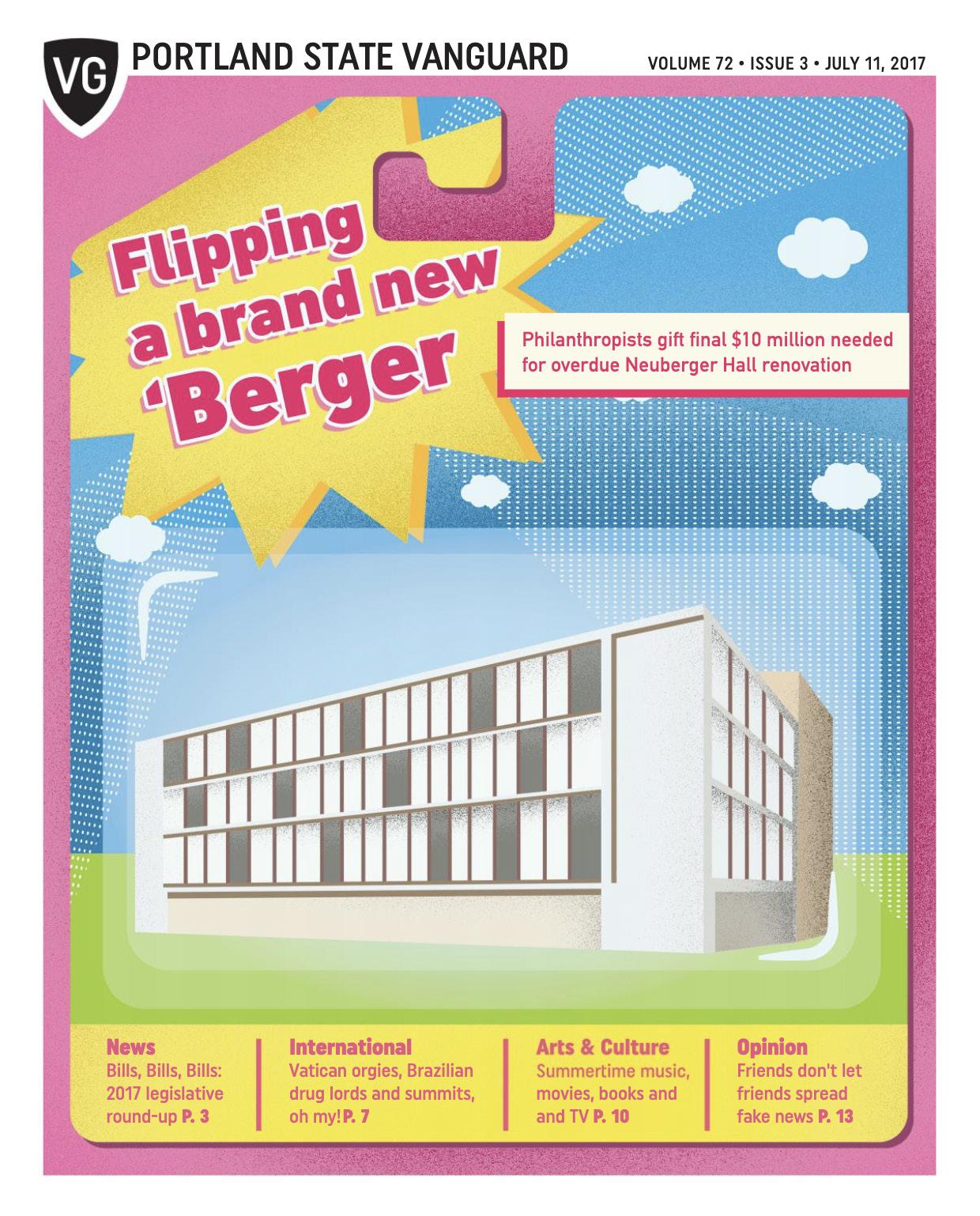
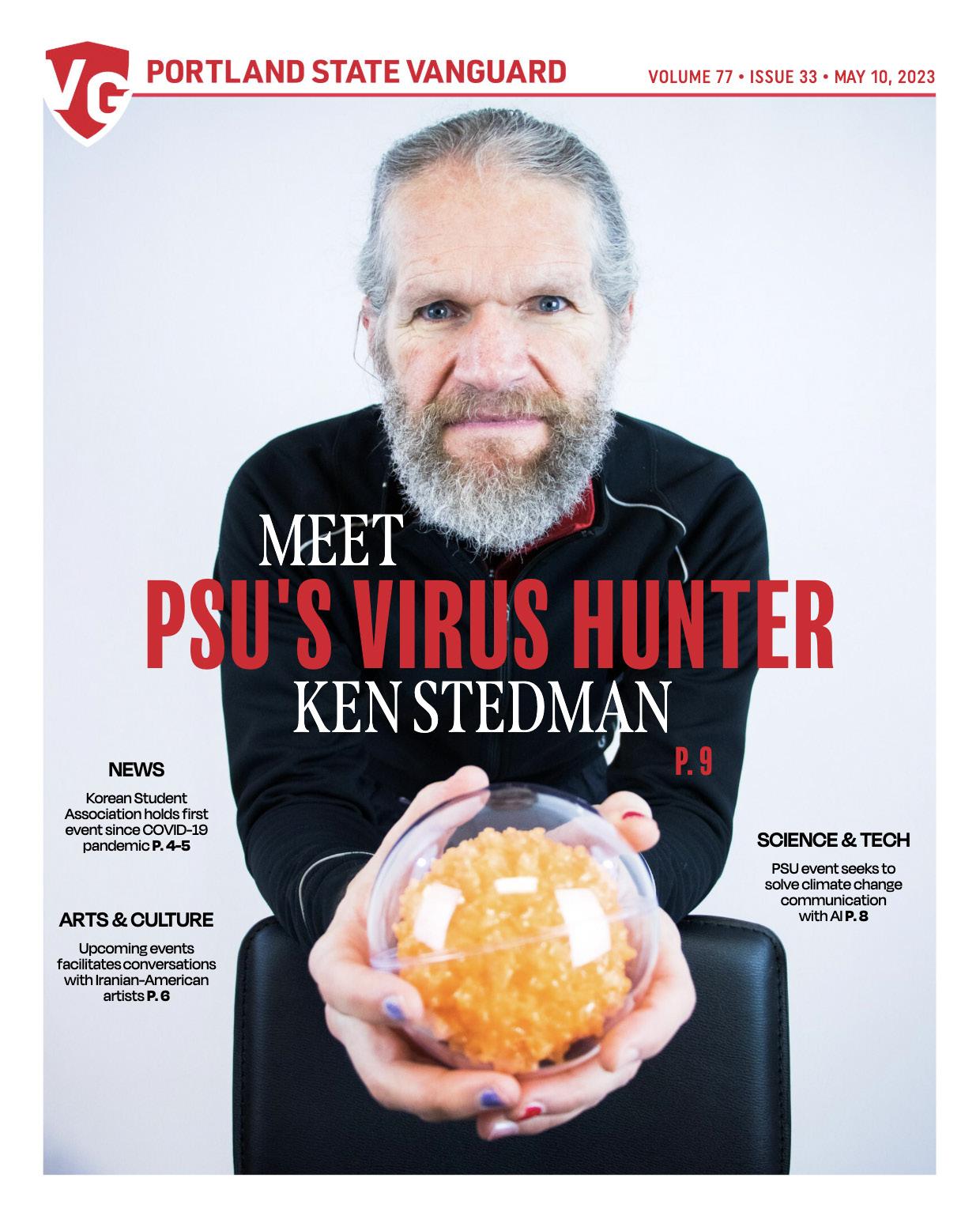
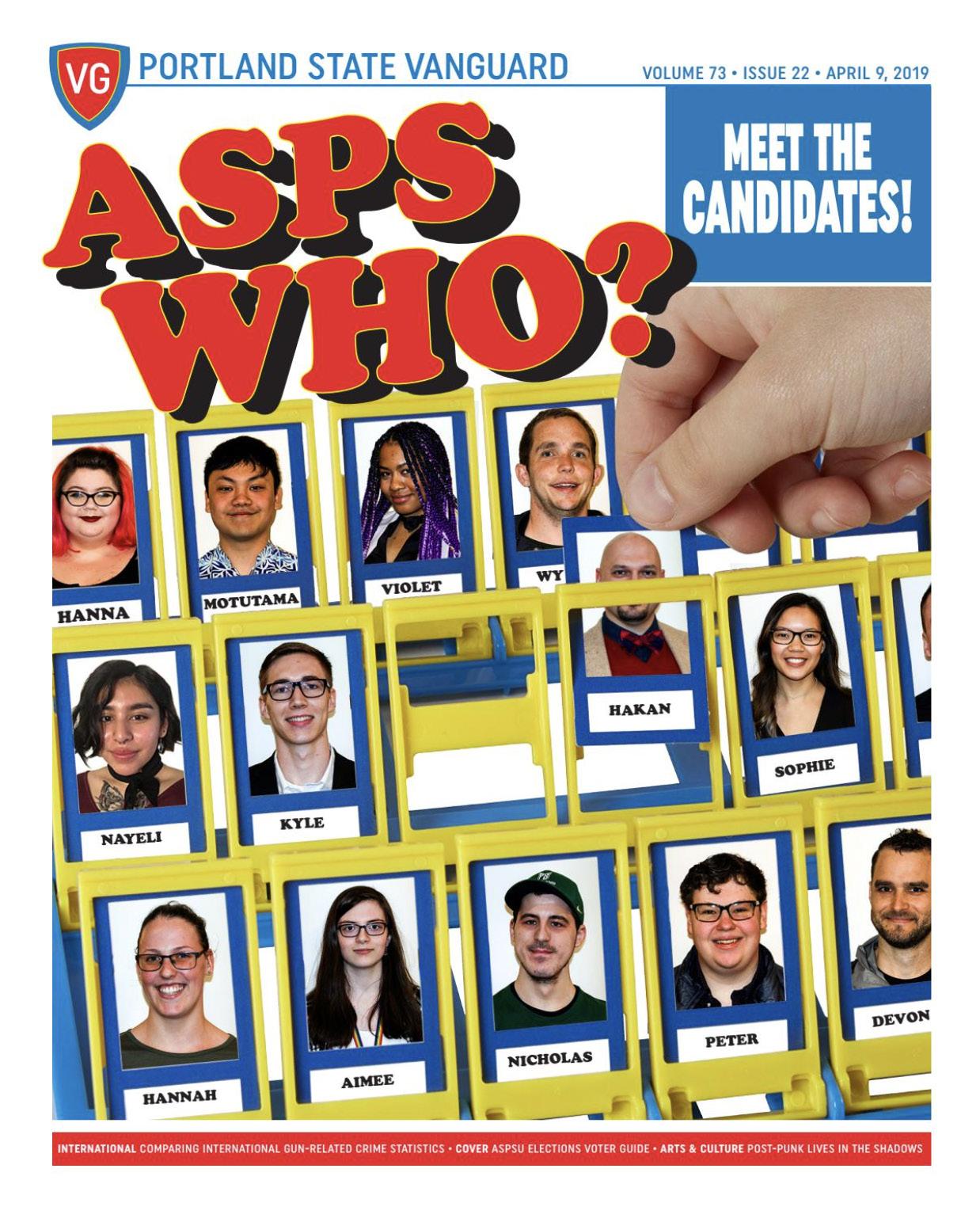
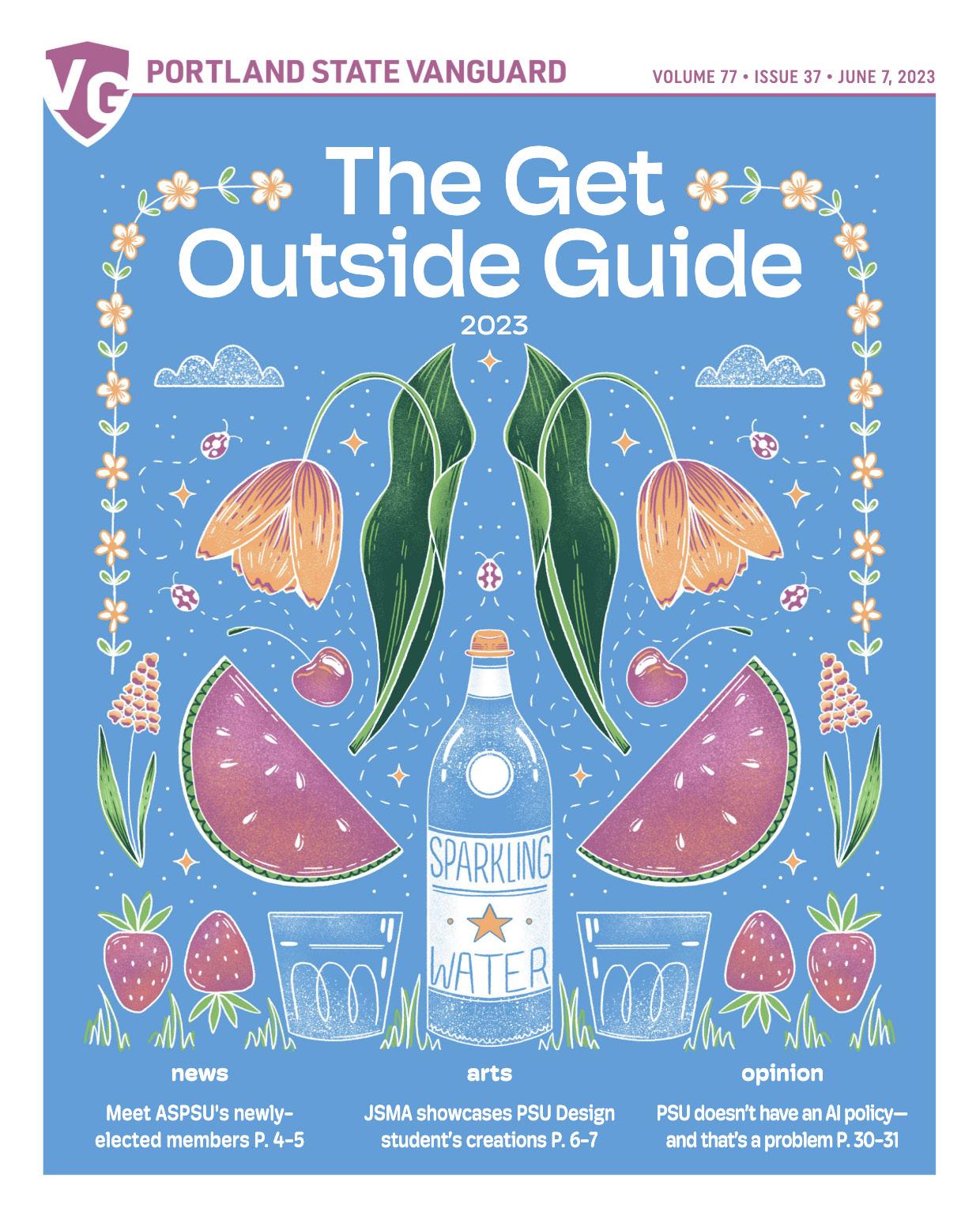
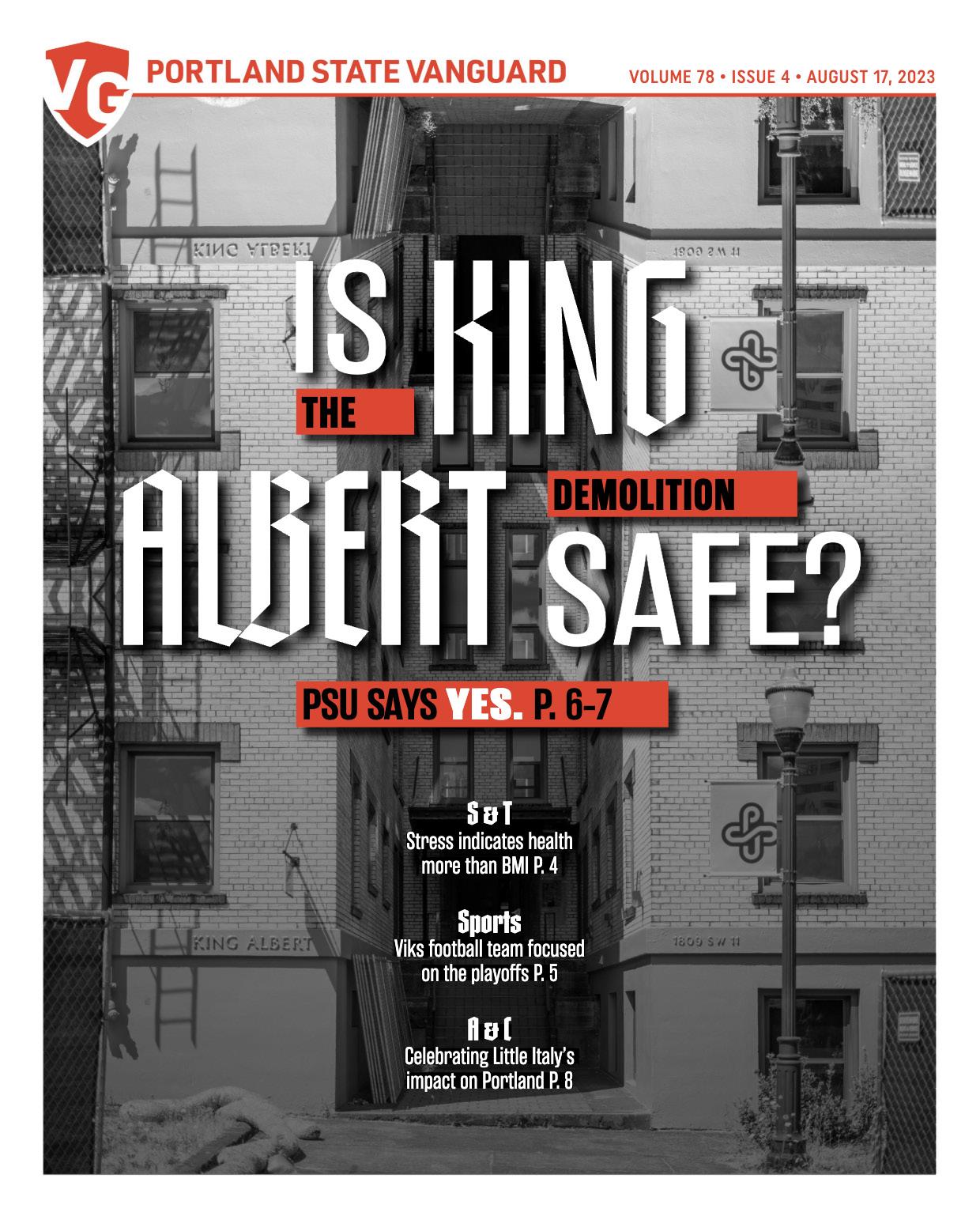
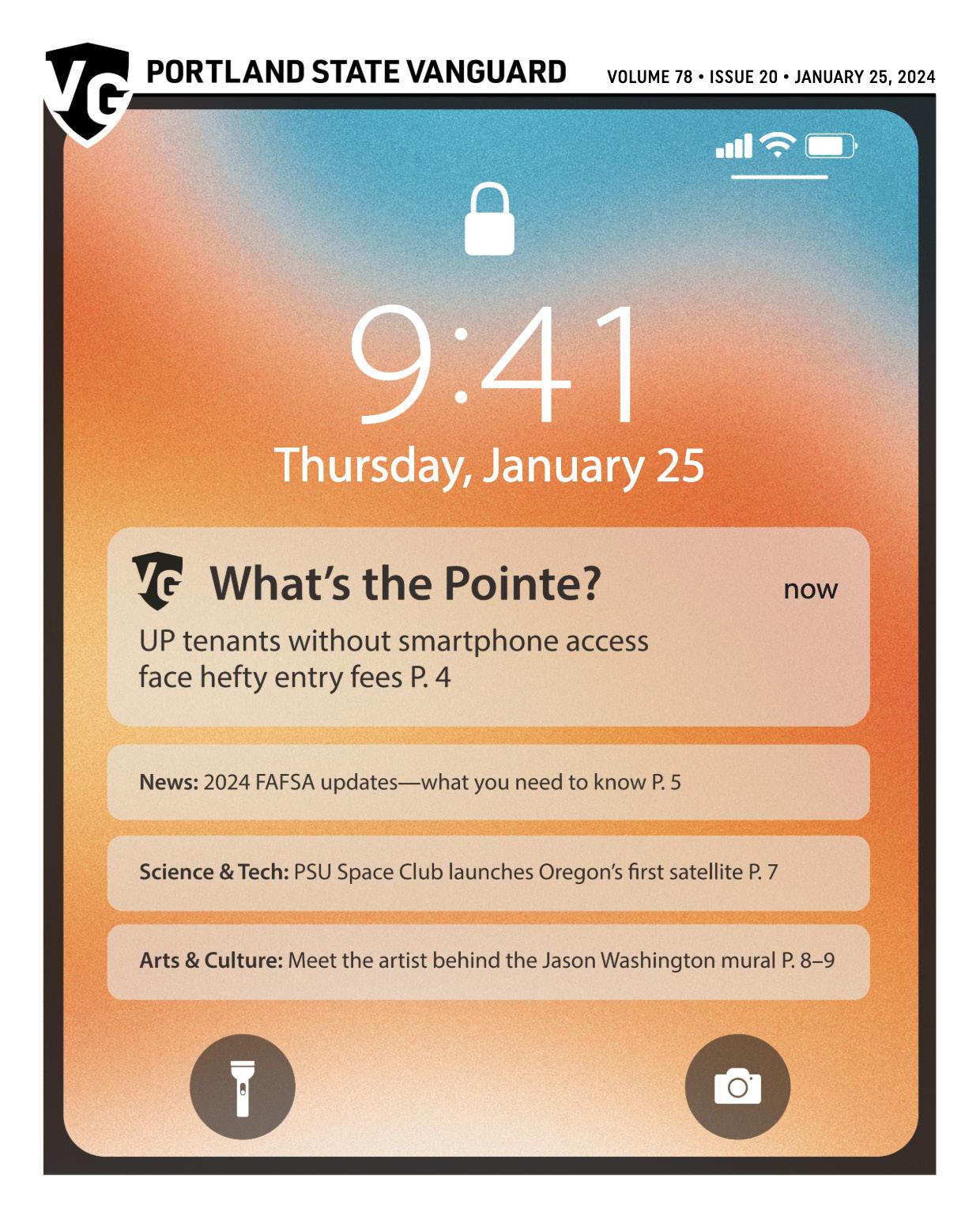
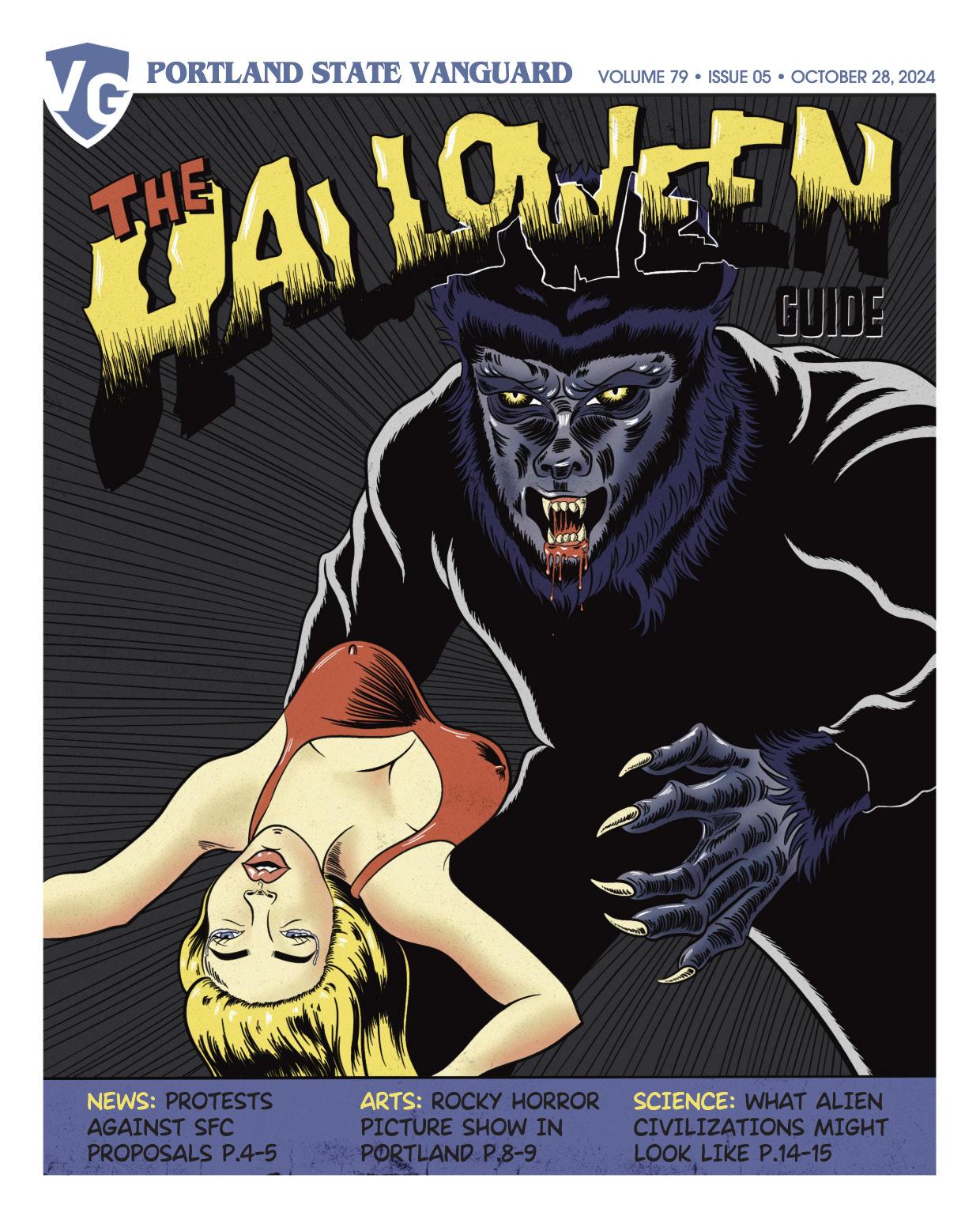
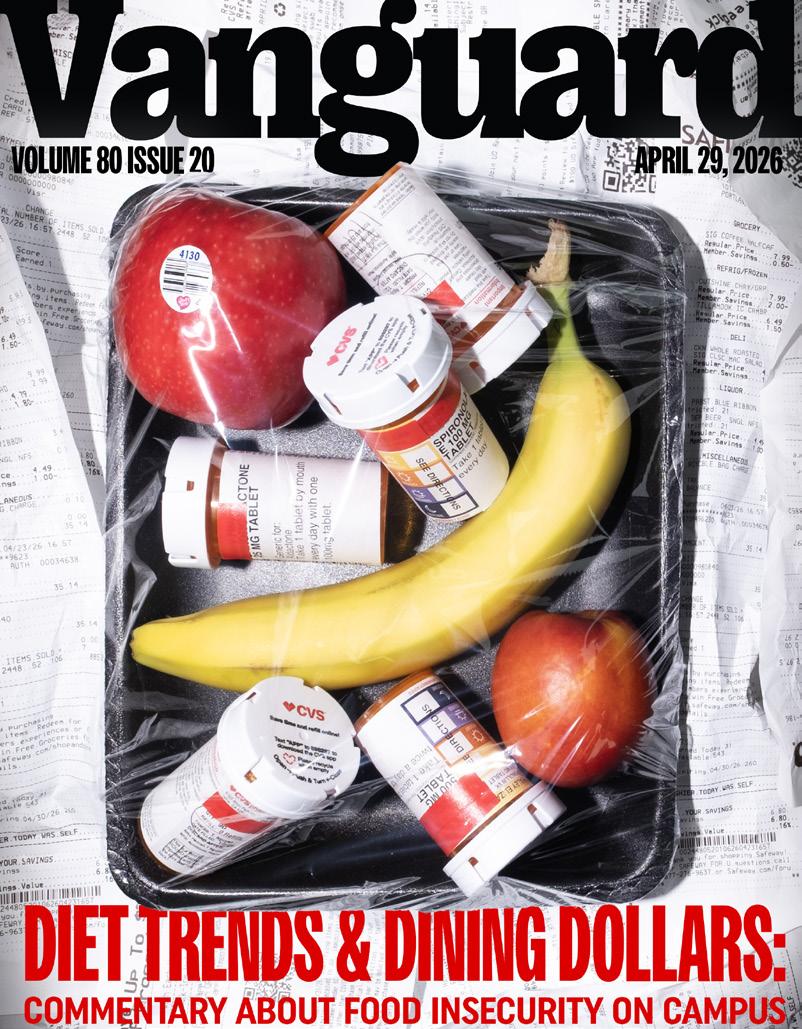
Cover design by Haley Hsu
Letter from the editorial staff
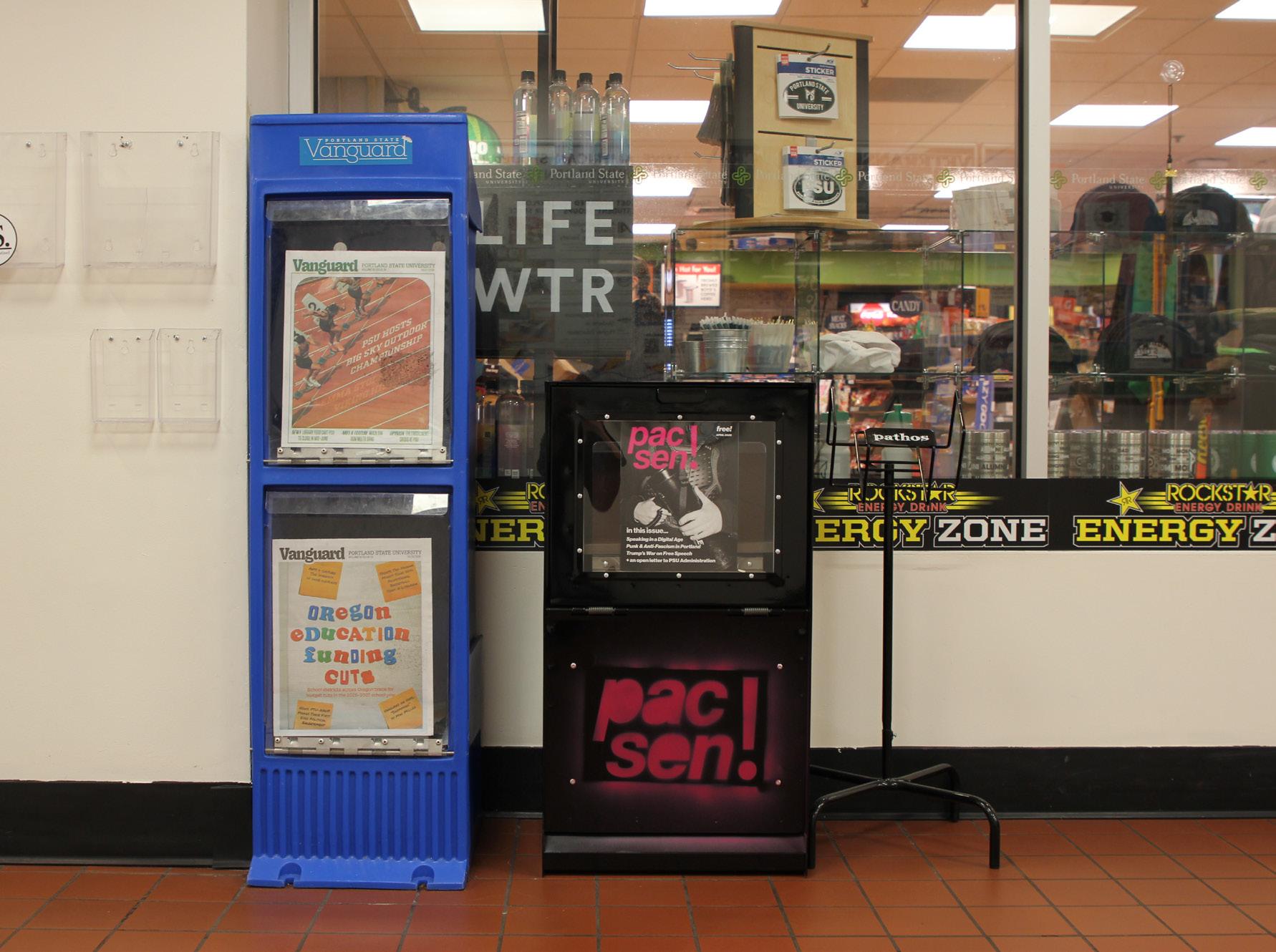
Since its inception in 1946, Vanguard has been a constant presence in the life and routine of Portland State University students. Our news stands have dotted the Park Blocks for decades as beacons of community knowledge available to anyone willing to read it. Walking through the campus, issues of Vanguard can be seen strewn about on tables and park benches, hanging on student’s dorm walls and sitting in professor’s offices. This paper, which has gone from a daily, to a weekly, to a website and to social media, has borne witness to a myriad of stories throughout the years.
As with any 80 year old, eight decades sparks reflection within our newsroom. Hung upon the walls are groups of Vanguard staff from years prior; editors wearing ties and slacks and writers sitting down at typewriters. While the technology and platforms that Vanguard utilizes has changed, its mission has remained resolute in the face of time. This publication is one that seeks to report truth in the most accurate, ethical and timely manner possible. It is one that incubates the fire of student journalists’ passion for storytelling. It is one that is committed to being a public good for this community, free to anyone who wishes to read our issues.
The state of journalism today is vastly different from the era in which Vanguard was founded. Members of the press are dismissed and attacked from the highest levels of government. Misinformation spreads with the tap of a button, reaching an audience larger than any previously imagined. The Park Blocks continues to be roiled in crisis as Portland finds itself in a post-pandemic world. We must ask ourselves, what do we want to be as Vanguard journalists?
Ultimately, the staff of this storied publication wants to continue to care. To care deeply about the truth of the stories we write. To care deeply about the community members who trust us to cover what is most important to them. To care deeply about this campus that so many past have reported on before us.
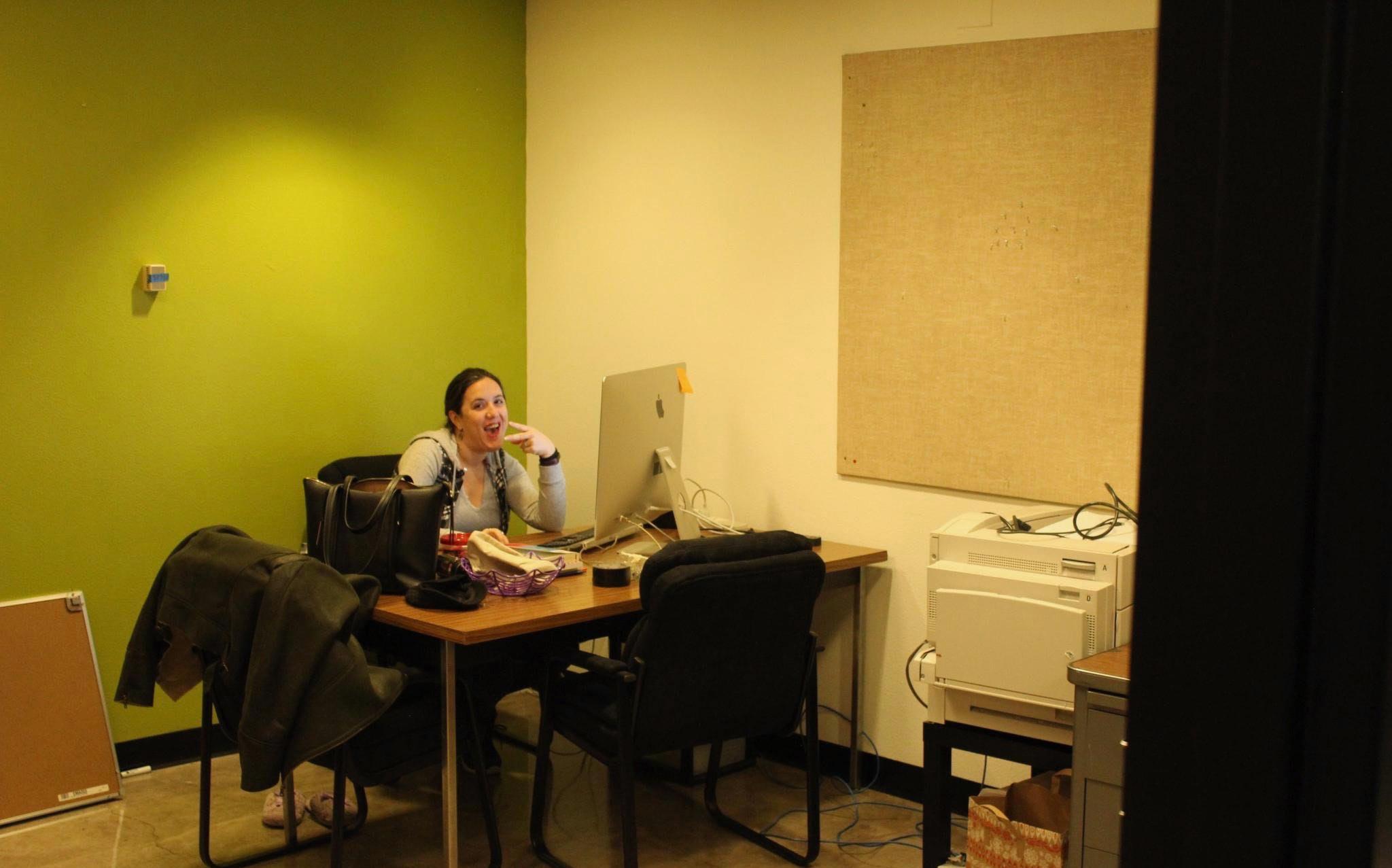
The beating heart of this entire history has always centered on the newsroom. Tucked away in the sub-basement of Smith Memorial Student Union, we pitch stories, edit articles, interview sources, tell jokes, eat snacks, take naps and create precious memories. The work of this publication is not only found within the pages of our issues. It is found within the countless
Sincerely ,
stories of alumni proclaiming that Vanguard shaped their college experience, and even their lifelong careers.
Yet, the continuation of this publication depends critically upon one thing: you. As readers of Vanguard, you challenge us to put our best work forward as writers and editors. We care about getting the most accurate information so that you may better understand and interact with the reality of this campus. This university is a blend of diverse experiences and perspectives where everyone has a story to tell.
Within this special edition of Vanguard, you will find a labor of love from the present staff to the past. Our paper’s official motto is “the paper that would not die.” This is a motto that demands each generation of staff and readers continue to care about journalism, truth and community. While a lofty calling, it is this Editorial Board’s belief that the PSU community will care for another 80 years.
We reflect not to dwell on the past, but to remember what has guided us throughout the decades. It is our sincere hope that you continue to support us by telling us your stories, joining our staff and reading our work.
As we celebrate the 80th anniversary of the Portland State Vanguard, I’m struck by a simple truth: a university is only as strong as its capacity for honest self-reflection and open dialogue with its community. For eight decades, this studentled newsroom has served as Portland State University’s "mirror," documenting our wins, questioning our direction and capturing the evolution of our campus.
If you want to understand the history of Portland, look to the Vanguard archives. From our 1946 beginnings as the Vanport Extension Center to our current standing as Oregon’s Urban Research University, the Vanguard has been our primary recordkeeper. Whether in times of civic unrest or institutional shift, student journalists have provided the vital context that helps us understand not just where we’ve been, but who we are becoming.
Letter from the president Letter from our advisor
I often speak about the strength and resilience of our students. The Vanguard’s own journey — starting as a pamphlet called Vet’s Extended in 1946 and growing into today’s sophisticated multimedia operation — is a perfect example of that PSU grit.
At a time when newsrooms across the country are shrinking, the free press is more important than ever. In this climate, the Vanguard is more than just a campus paper — it is a critical piece of our media ecosystem. It is a place where students develop the professional rigor to ask hard questions and a platform for the diverse voices that make our community what it is.
Because of this legacy of truth-telling, I feel it is important to reflect on where we stand today. In 2026, we find ourselves at a significant crossroads. We are determining what kind of university we will be in the future, in what ways we will serve our stu-
With gratitude and pride,
Ann Cudd President, Portland State University
It’s hard to imagine Portland State without its student-run newspaper, because Vanguard is as old as the university itself. I’ve had the privilege of advising the paper for 13 of those 80 years.
Over that time, Vanguard has brought impactful information to light, covered countless protests, withstood moments of controversy, endured a pandemic and earned some national awards along the way. It also kept on evolving.
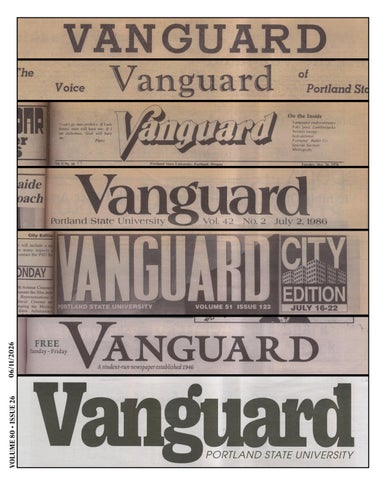
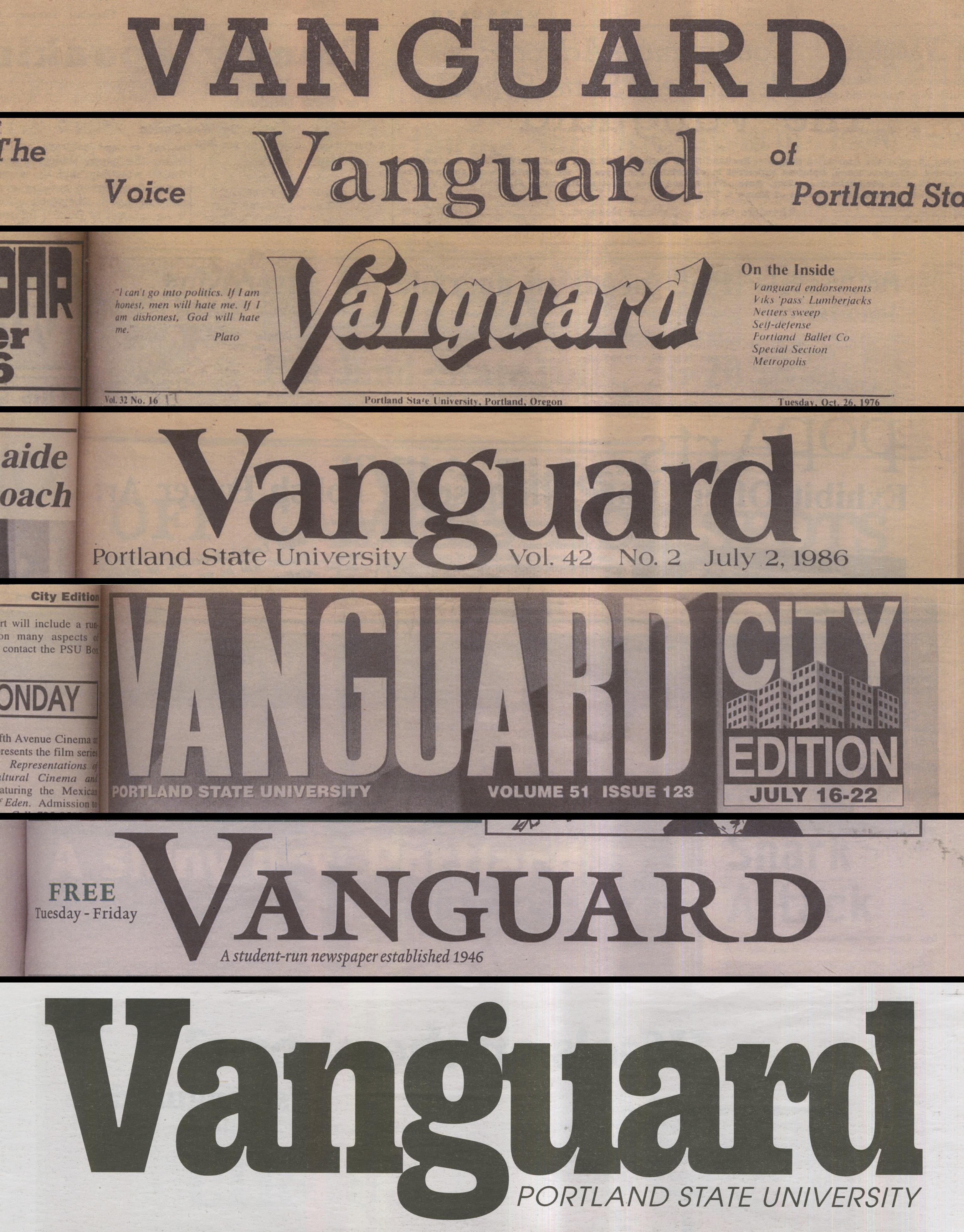
I started advising at just the moment when Vanguard shifted from a traditional horizontal broadsheet to a vertical tabloid format paper. This change was already in the works, ushered in by Editor in Chief Whitney Beyer. The design took on a quick succession of adjustments over the next few years, but eventually took on a form by 2017 that lasted for eight years.
Just as the design of the paper had settled, and the newsroom itself was renovated, Vanguard underwent an even more fundamental change, moving away from advertising in 2017. For decades, newspapers across the country were confronted with declining ad revenue. This reality eventually caught up with Vanguard. What could have become a crisis became a moment to align the operations of the paper with the ideals of media as a public good rather than a commodity within a market framework. With the help of the Student Fee Committee, Vanguard moved on from an unsustainable funding model, becoming a truly
unique college paper on the national landscape. Gone were the days of running a story on the problematic practices of a company only to have readers turn a page or two to see advertising from that very company. Now, Vanguard could instead provide free ad space to student-fee-funded groups, expanding its usefulness to the community it served.
The funding change also brought the establishment of our Student Media Tech Team that supports Vanguard, enabling the paper to customize its website in a way like never before. There have since been different versions of the website based on what the leadership envisioned and prioritized, giving the Vanguard a level of control over its digital presence that was also unique among college newspapers.
And then, not long after so many great things happened in such a short time, we had a pandemic. This didn’t help at all.
As with the broader society, Vanguard had to learn how to function as a team when no one was sure how safe it was to be around others even with precautions. While staff meetings could be carried out on Zoom, journalism still had to be done in the real world. Thousands of people were out in the streets protesting the murder of George Floyd and chronic abuses of power against the Black community. They were protesting the presence of Federal agents who were snatching people off the street. Vanguard could have chosen to stay on the sidelines,
Sincerely,
Reaz Mahmood Student Media Coordinator, Portland State University
dents and how we will endure and continue to "Let Knowledge Serve the City" in all the forms that motto takes. I want future readers to know that we did not shy away from our challenges. We chose a transformative path to ensure that PSU remains a beacon for social mobility and innovation for the next 80 years.
To the editors and staff: Thank you for staying the course. Your work is a service to this city and a gift to the students who will follow you. You aren’t just reporting on the news of the day — you are preserving the soul of this institution.
As I look at what’s ahead for Portland State, I am genuinely optimistic. We are a university that rises with its city, fueled by the energy of students like those at the Vanguard. Congratulations on 80 years of excellence! May you continue to "Let Knowledge Serve" by seeking the truth for many more decades to come.
but it didn’t. It was out covering historical events as they unfolded, often in the middle of the night.
Similarly, Vanguard made its value to the community felt with round-the-clock coverage of the library encampment in 2024. In addition to the tireless efforts of Editor in Chief Kat Leon and the editorial staff, what a perfect time to have Liam Schmitt join as a contributor. That was an inflection point for the next step in Vanguard’s evolution, a heightened presence on social media and emphasis on multimedia content.
After the intensity of the library protest coverage and graduation of experienced editors, Vanguard faced a period of significant staffing challenges. This was the just the right time for Editor in Chief Noah Carandanis to step in with his particular strengths as a strategic thinker and community builder to reinvigorate the organization. Under his guidance and led by Creative Director Briana Cieri, the paper underwent its first print redesign in eight years and also began working with our Tech Team to redesign its website. The latter will be completed in the near future, rounding out Vanguard’s latest wave of modernization.
This is an incredible time to join Vanguard and help write the next chapter in its history. You can come with little experience, a strong work ethic and a willingness to learn. You can make mistakes and grow. Above all, you can discover if journalism is just the thing that might change your life.
Articles Through the Decades
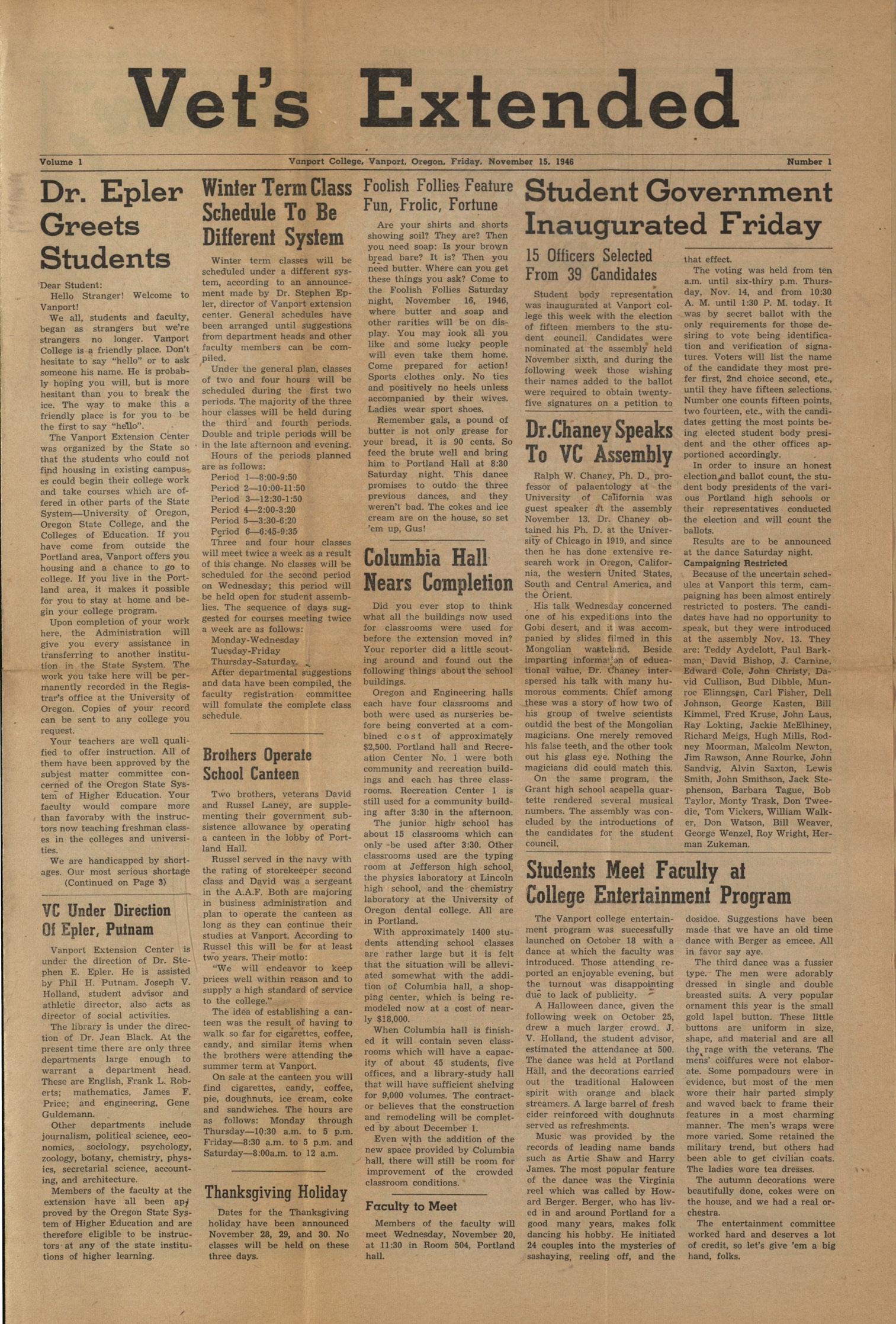
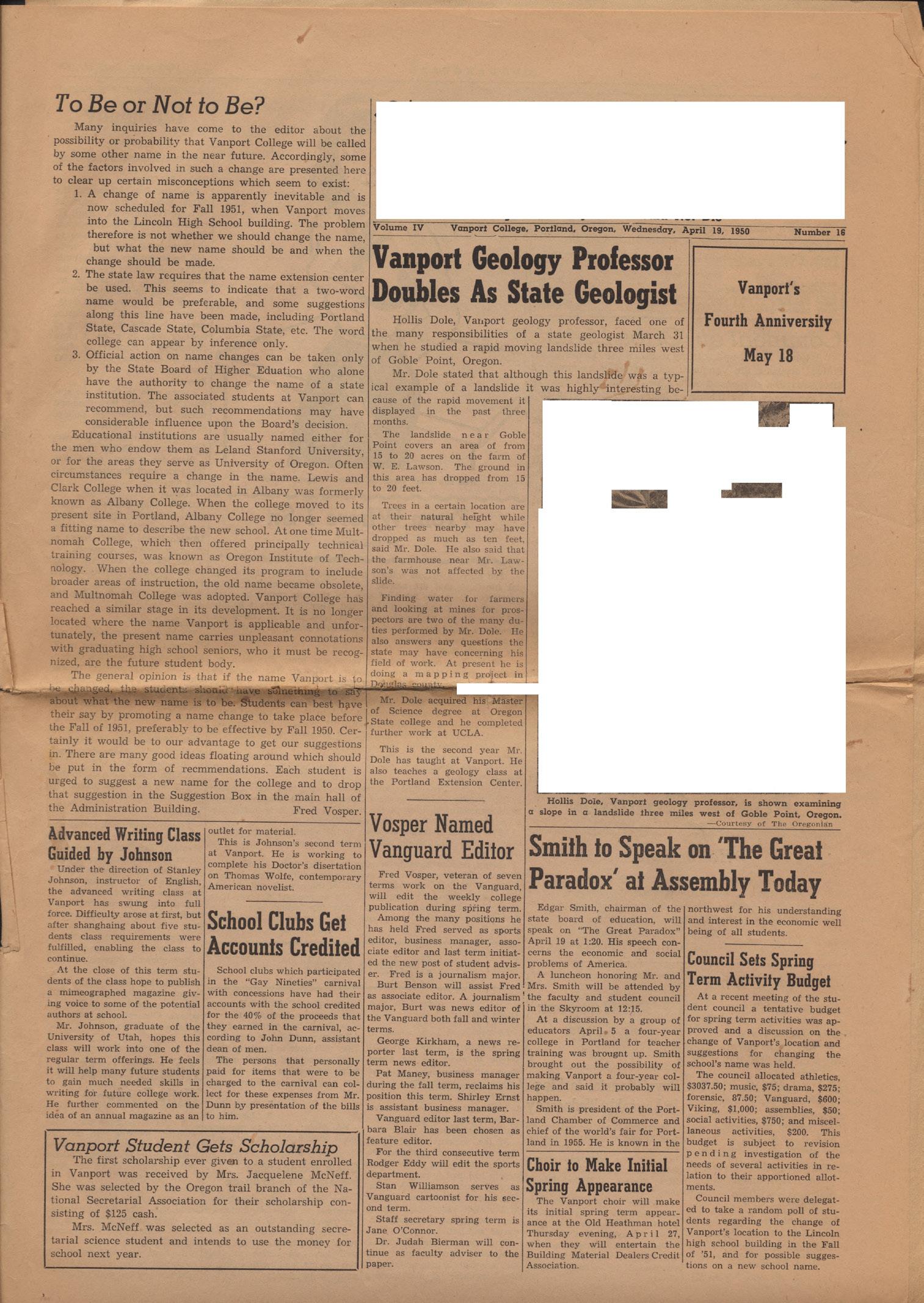
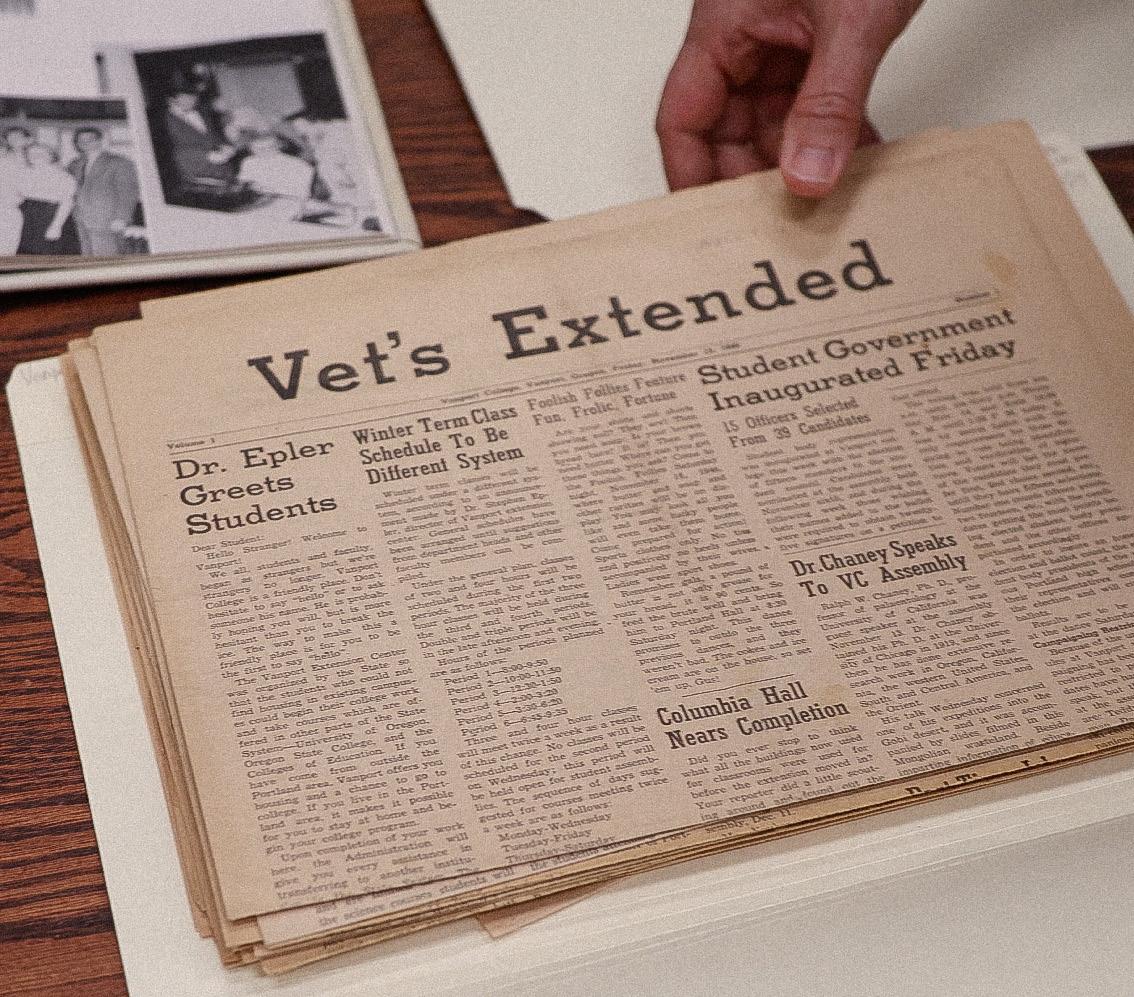
— was published on Nov. 15, 1946. Stephen Epler, Ph.D., was the founder of the Vanport Extension Center, now known as Portland State University, and he welcomed students to campus with a letter in the newspaper. ified professors and fair opportunities. Epler did admit to a shortage of classrooms, but vowed
After four years as the Vanport Extension Center, the institution's name was ready to be changed. Other colleges have a history of changing their names — Lewis and Clark was originally calledprove the final decision. Students were encouraged to suggest a new name for the university. Cascade State and Columbia State were two of the top contenders, but Portland State University
ing to College Work-Study and loan programs. This put a strain on PSU’s Financial Aids office, leading them to not have enough money to offer all applicants. PSU had $1 million for work-study payroll, and there were already 1,748 applicants before June 1970. That amounted to over $1.3
GRACE PETERSON
the Red Cross had such a huge donor turnout they had to turn away donors due to limited storage dents. Following one of the most devastating events in American history, the campus stayed united.
First police-involved shooting near campus since CPSO armed its officers
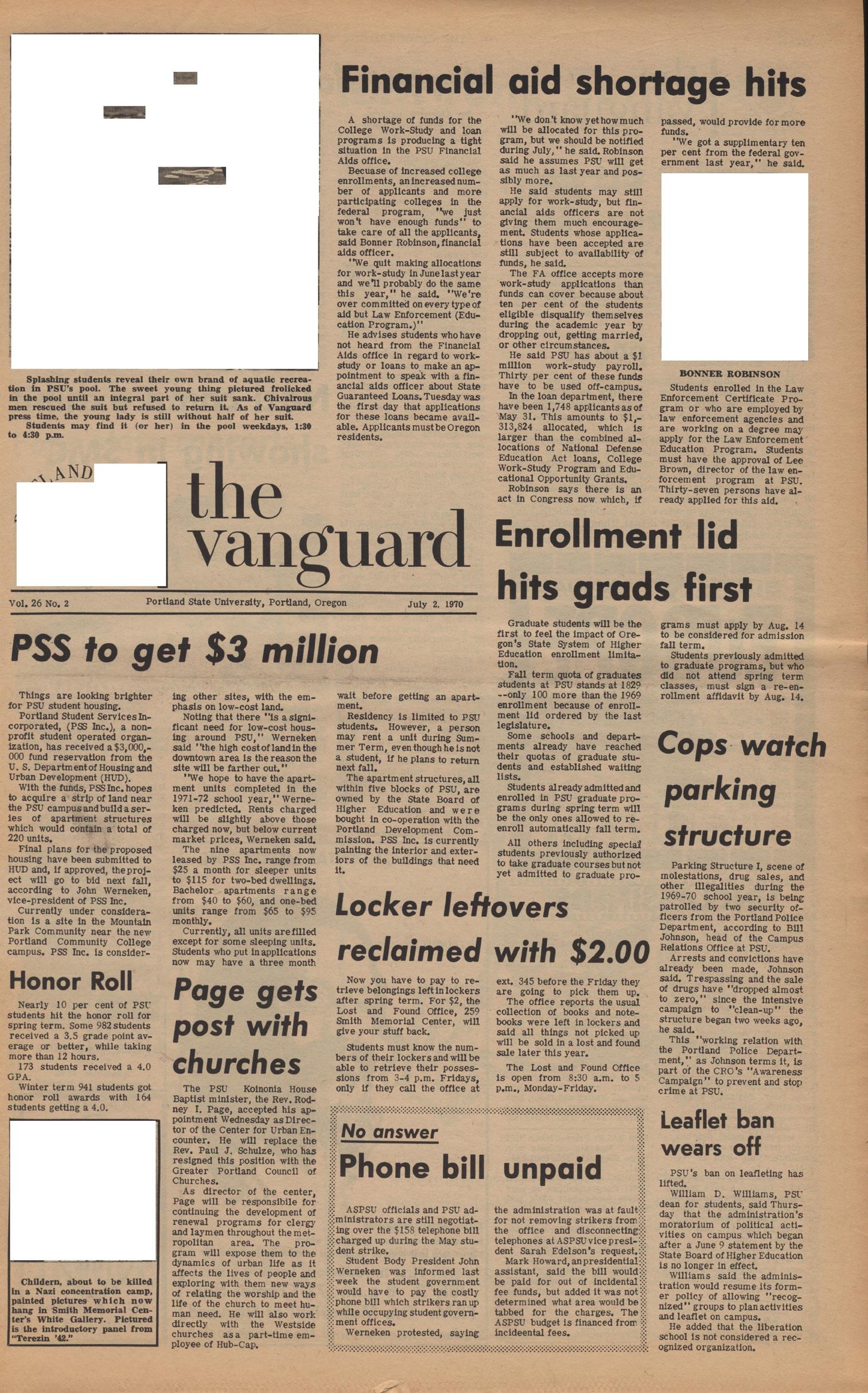
2010S: FIRST POLICE-INVOLVED SHOOTING NEAR CAMPUS SINCE CPSO ARMED ITS OFFICERS
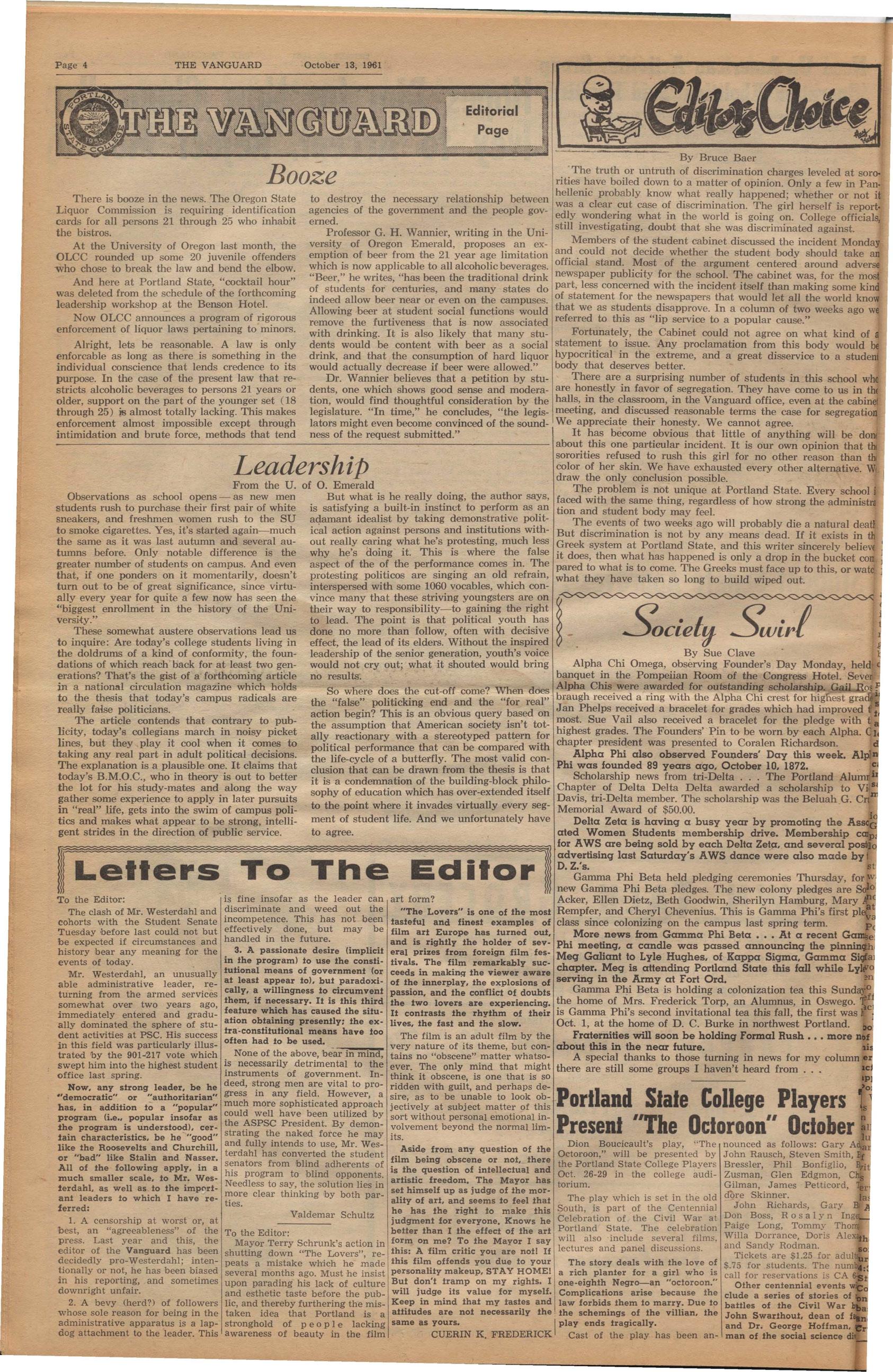
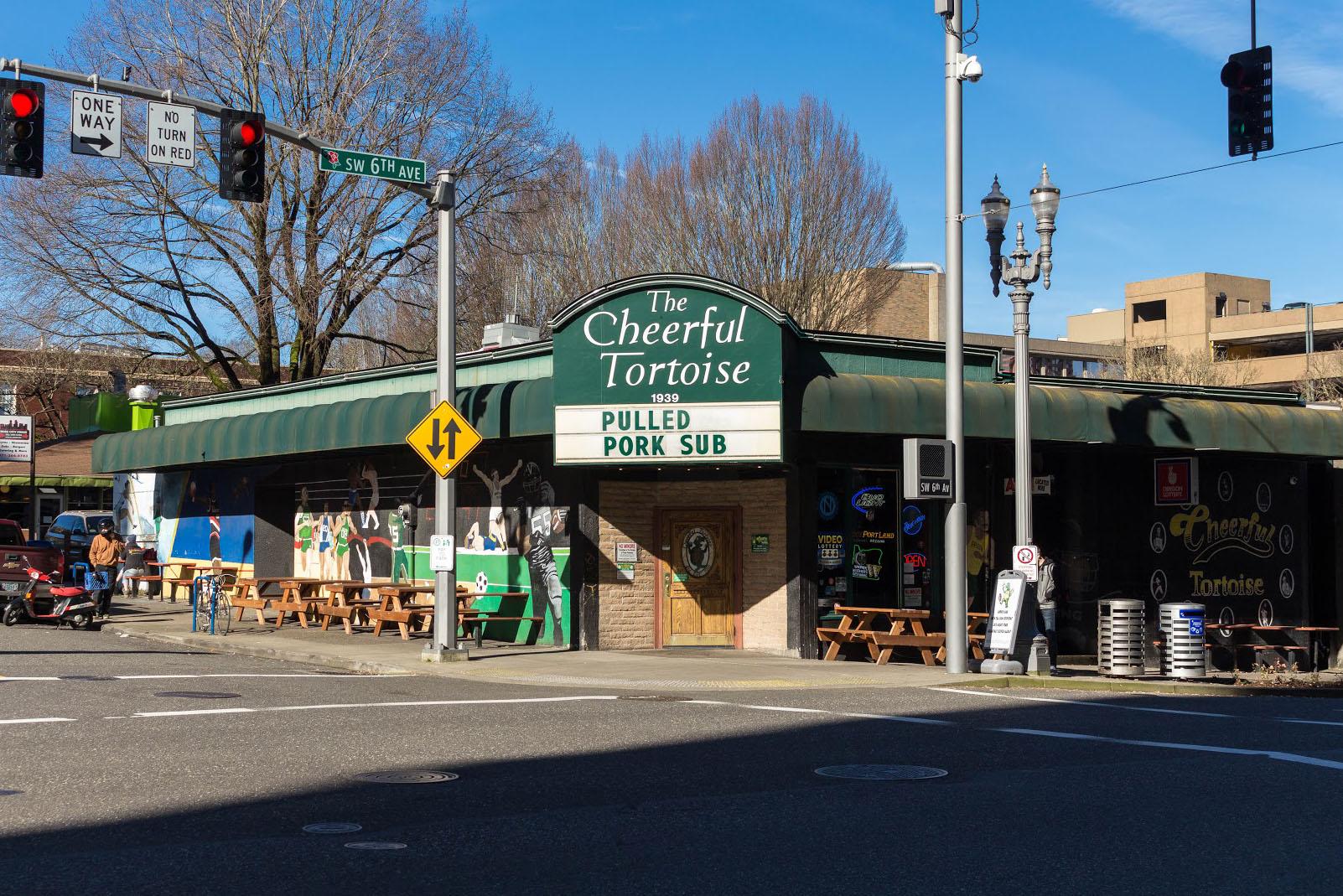
On June 29, 2018, Campus Public Safety Officers responded to an altercation near the Cheerful Tortoise, a bar steps away from campus. The officers fired their guns and killed civilian Jason Washington. Washington was reportedly trying to break up a fight between two people, he fired warning shots and his firearm fell out of his holster. Officers told him not to reach for it — when he tried to grab it, they shot him. Following his death, a cement pillar was erected near the site of his shooting.
Written by David Gillespie
Cervantes/PSU Vanguard
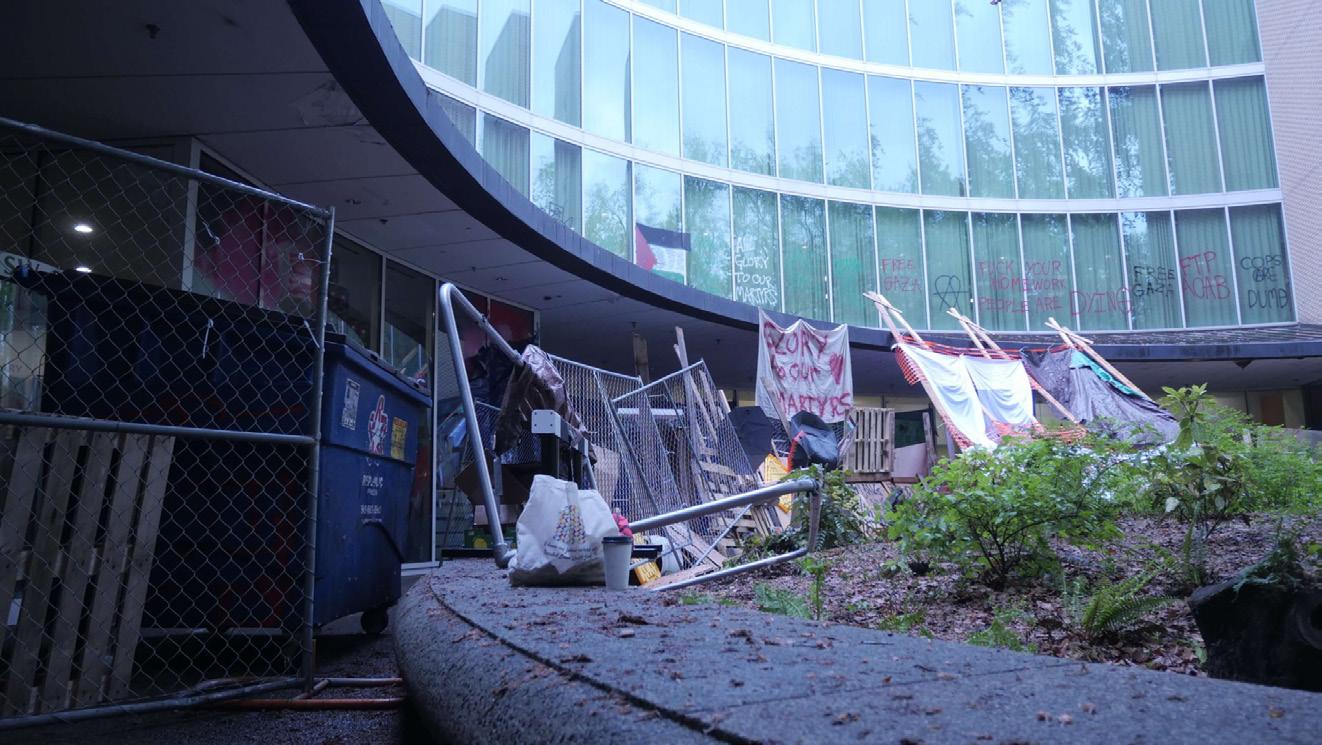
Protesters blockade themselves inside the Millar Library
Campus closed while awaiting police response
Written by Kat Leon, Isaiah Burns and J.M. Vincent
2020S: PROTESTERS BLOCKADE THEMSELVES INSIDE THE MILLAR LIBRARY
Following a large protest on campus at around 7 p.m. on Monday, April 29, individuals entered and barricaded themselves inside Portland State’s Millar
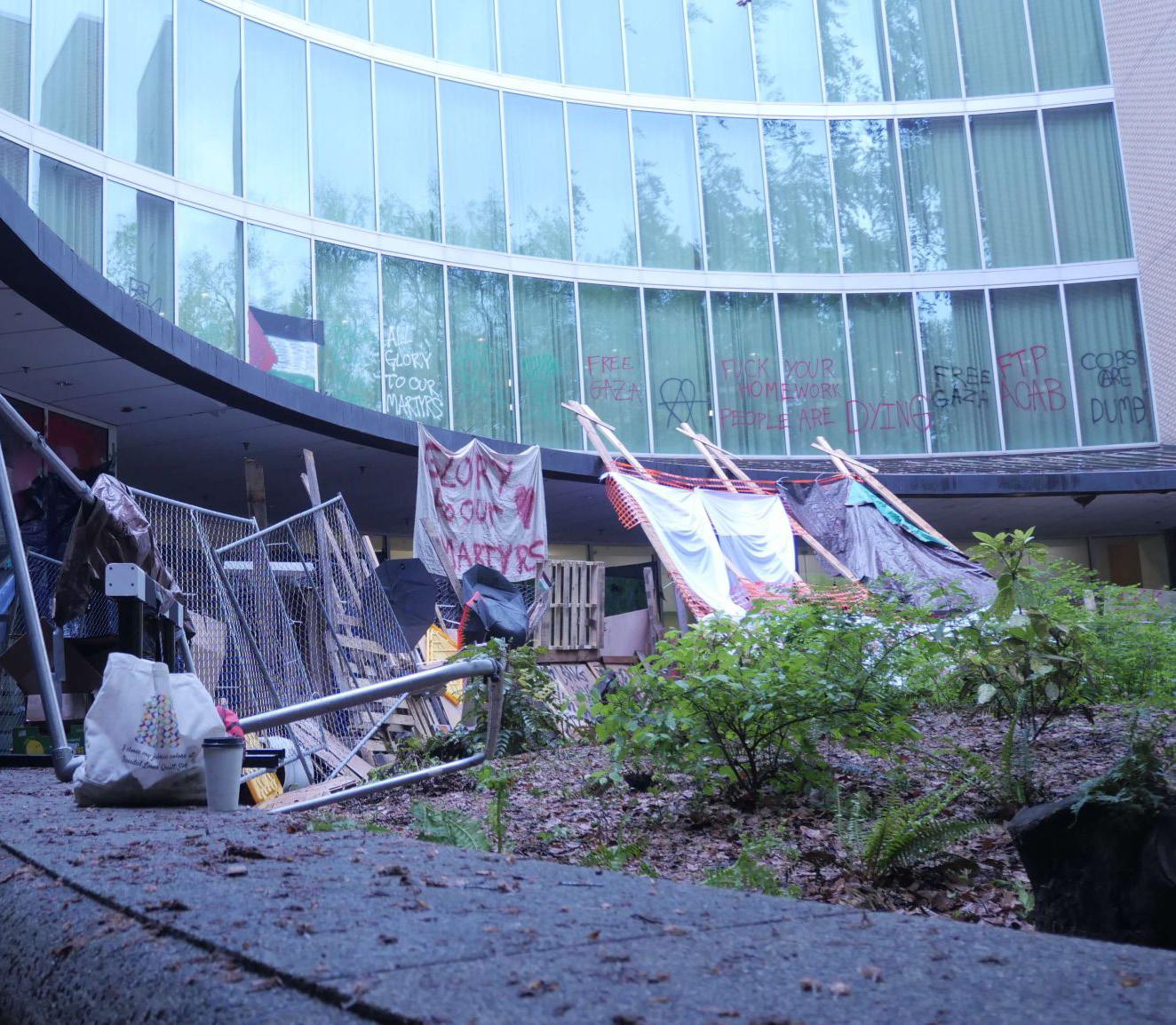
Protesters broke into and barricaded inside the Millar Library on April 29, 2024. They graffitied and destroyed parts of the building, protesting the ongoing genocide in Gaza. PSU President Ann Cudd asked the protesters to leave voluntarily. Police officers considered the situation an active burglary, and anyone inside the building would face felony charges. The protesters were aware and did not leave until nearly four days later.
A History of Vanguard
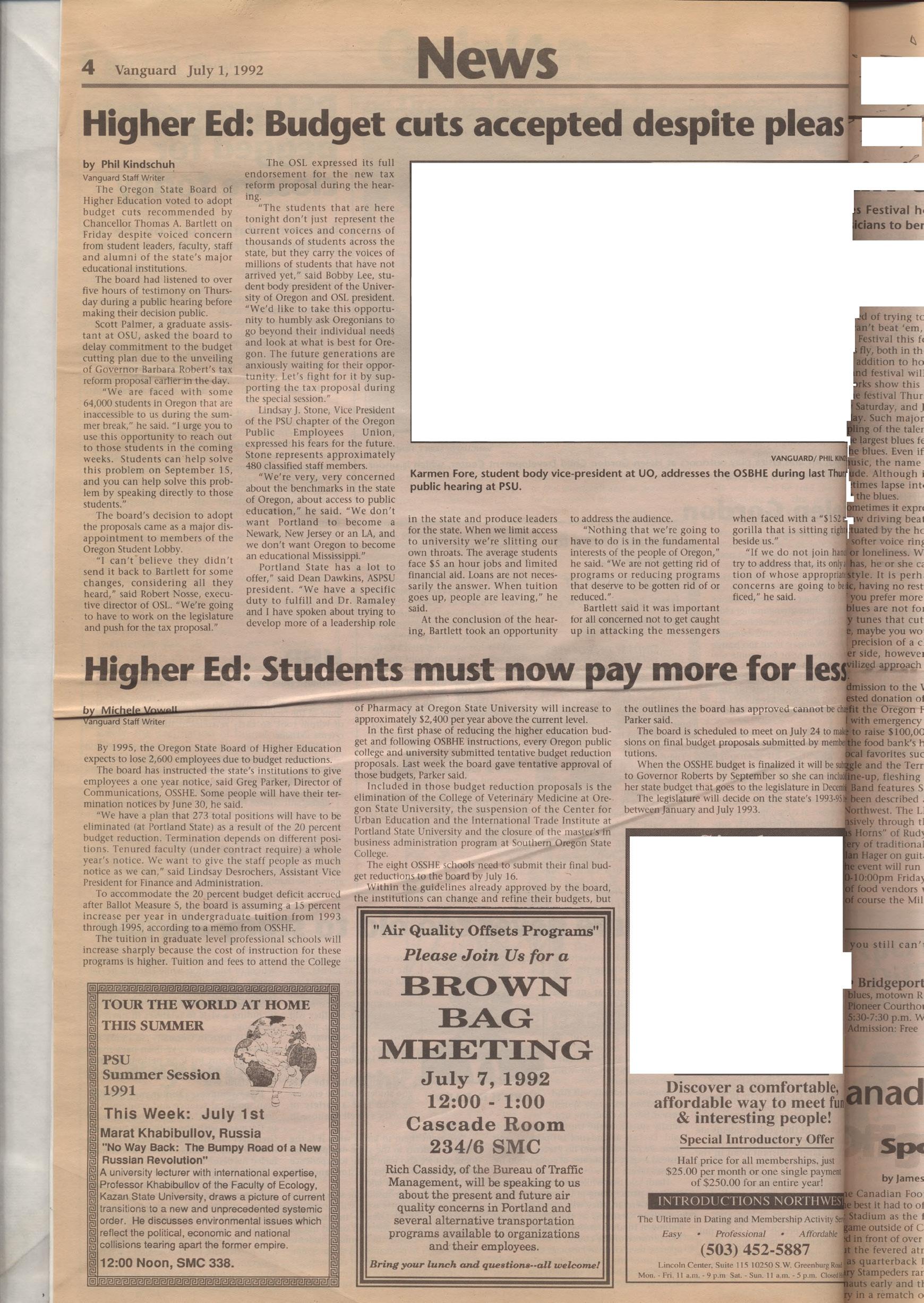
Vanguard was founded Nov. 16, 1946, and began as the Vanport College Extension newspaper. The Vanport College Extension was destroyed May 30, 1948, during the Vanport flood, and was moved to downtown Portland, becoming what is now Portland State University.
1946
❦1947
Vanguard has had several controversies throughout its 80 year history. In 1949, editor Ray Bouse had to defend Vanguard staff from accusations that they were communists. This happened during a board meeting attended by faculty, board members and students — though the accusations ultimately led nowhere.
1949
Vanguard staff went on strike in 1967, protesting against salary and budget cuts that were affecting their publication. The strike lasted only a week; following this, they published twice weekly.
1967
The first issue was published by Don Carlo, the founding editor and a blind military veteran, under the temporary name Vet’s Extended. Vanguard went through several name suggestions before its current title was chosen Jan. 14, 1947.
Later that spring, Vanguard published a nude photograph of Allen Ginsberg, a poet and writer from New Jersey, on the front page. This was done as part of the counterculture movement. Following this, PSU suspended the newspaper, and the paper spent its next few issues as the Independent Vanguard. The costs of the paper were funded through donations from PSU faculty. Vanguard was reinstated a few months later.
WRITTEN BY WILL LOWE
DESIGNED BY HALEY HSU
During the 1990-91 school year, Vanguard started publishing daily, changing its name to the Daily Vanguard. This continued until 2013, when it shifted back to a weekly publication.
1990
1986
In 1986, Vanguard uncovered that Michael Erickson, president of the Associated Students of Portland State University, was planning to make the year’s homecoming game segregated. After backlash, Erickson’s approval rating dropped.
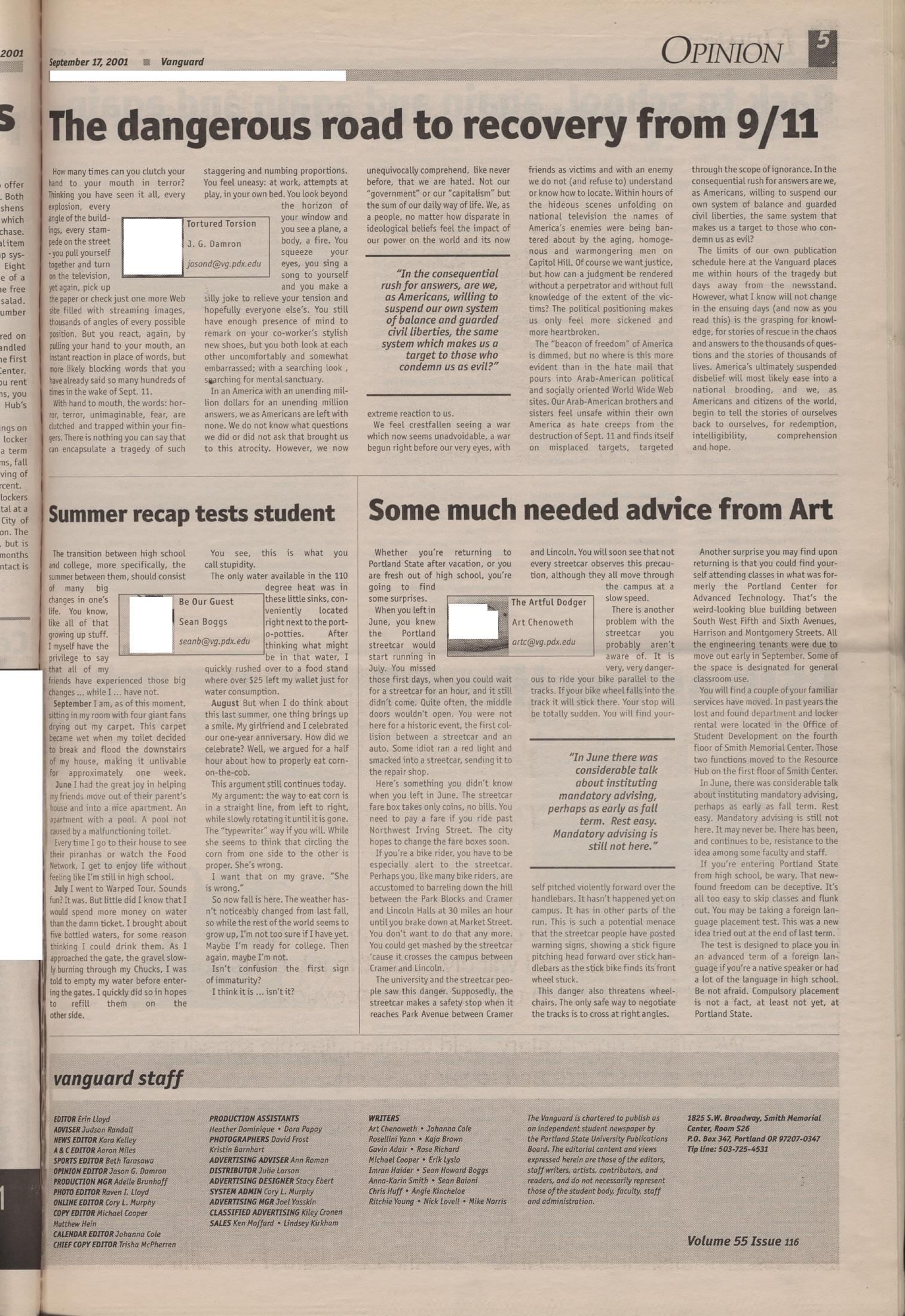
In October of 2005, Vanguard published an opinion piece that discussed the religious divide over Jerusalem and the ArabIsraeli conflict. This piece caught the attention of a proIsrael monitoring group called the Committee for Accuracy in Middle East Reporting and Analysis (CAMERA).
2005
CAMERA contacted Vanguard and requested an apology. Nine days later, the article was removed and replaced with a letter from the editor saying that the story didn’t meet the paper’s editorial standards. On Oct. 28, 2005, Vanguard ran an editorial asserting that the piece should not have been published.
Since its start, Vanguard has undergone many changes and controversies. As of its 80th anniversary in 2026, Vanguard publishes an eight-page paper weekly in color. It’s still freely distributed around PSU’s campus.
2026
Editor in Chief Alumnus
Former EIC Kat Leon reflects on the Spring Library Protest
The role of the editor-in-chief (EIC) evolves with whoever is in the job. It can be an extremely personal position, coalescing with the individual’s growth as a person as well as a journalist. The responsibilities of an EIC are many and fluctuate from year to year. Each crop of editorial staff, contributors and Vanguard readers have different priorities depending upon the needs of the campus. While some years require the EIC to look internally towards the publication’s structure, other years have demanded attention towards paradigm shifting events occurring on the Park Blocks.
Kat Leon served as EIC during the Spring Library Protest of 2024. This event saw the Branford Price Millar Library being occupied by protestors from Monday, April 29, to May 2 when the Portland Police Bureau arrested protestors and cleared the library. The library remained closed for repairs until the fall term of 2024. Leon oversaw the publication’s coverage of the library occupation while simultaneously wrapping up earning their master’s degree in communications.
The Vanguard staff’s reporting under Leon’s leadership garnered an audience far exceeding years in the past. After the coverage, Instagram follower count ballooned to approximately 10,000 people, with breaking news videos garnering hundreds of thousands of views.
I had the opportunity to talk with Leon in an interview for this special anniversary issue. In this interview, I found many points of connection between the work they did at the paper and the work I continued to do. From balancing editorial duties and schoolwork, to bonding with staff during stressful times, I saw reflected in our conversation similar highs and lows that all student journalists experience.
about a year. And then a couple months towards the end of that year I restarted the Science and Tech section, which I wanted to do partially because I just felt like you know, [Portland State University] is a research university, and there's so much research that goes on at PSU that I really wanted to find a space to highlight it. And I started to really get into science communication within my own major. So it was a really good way to connect those two things for me. And so I did that for a couple months before becoming editor-in-chief, and then did that for a year. So most of my college experience, if not all of my undergrad and grad school, I was involved in Vanguard.
The lessons they learned from this once in a generation story are indicative of the spirit of this paper: doggedly seeking the truth, deliberating about how to minimize harm and ultimately caring for the community who relies on Vanguard for information.
Editor’s Note: This interview has been edited for brevity and clarity.
REGARDING BECOMING INVOLVED WITH VANGUARD
Kat Leon (KL): So I started as a very lowly contributor in November of 2020. I actually sought it out as an undergrad, because my initial thought was, because my master's is in communications, to go into journalism and or something of the sort. And so I thought, well, the best way to figure out if I like journalism is to do student media. So I got involved, wrote as a contributor from 2020 to 2022, and then was the Arts and Culture editor for
REGARDING EDITORIAL RESPONSIBILITY DURING THE LIBRARY PROTEST
There were a lot of questions about safety and how we can't prevent [new contributors] from [covering the protest]. But like, if you're coming out here as Vanguard, I have to think about a lot more than just you covering a story. I have to think about you as another person that I have to make sure is safe, and I have to know where you are, and I have to make sure that you have the things that you need, and you can connect with people if you need to. There's so much more that goes into that when you're coming down there … I had to consider a lot of different things, and also, you know, continue directing the quality of the content.
REGARDING THE LIBRARY PROTEST
I think that connection with our community is really what led to the quality of content that we got to have with the library protest. That shit exploded, and it became way bigger than I ever imagined or thought possible. And I think that because we had been doing content like that all year. We were a little bit more prepared to do contact like that. We had already kind of worked out some kinks, and more importantly, we had started building relationships with people and with the community. People recognized us. People knew who we were. We had that name recognition that I wanted, and that I knew we needed to gain access to spaces like that in a way that would have a greater impact. And so the content that we were creating by the time that we got to that story was 1,000 times better than basically what even major news publications could potentially or even possibly create. They didn't have the relationships or the connections that we were fostering through the entire year.
REGARDING COMMUNITY
There was so much tension coming from so many directions. Obviously, we had the death threats that were coming from a different angle. And so it was a pressure cooker of a time, it was a lot. We're dealing with things like pepper spray and seeing students hurt and all this different stuff, which was really difficult. But I think what came out of that, and what I saw that was positive, was although there were very loud and very scary people within these protests that were against us or upset at us, there was also a more quiet but larger majority of people who were just grateful for the content, for the non-biased reporting and the community feeling of our content. The student focus of our content … And there was a whole outpouring of love and support and connection. I've never felt more part of a group or community than in that moment and covering those protests.
FINAL REFLECTIONS
I hope people get to look back and see that memory of history. To read and remember what happened and [have] that record is so important, and remembering things that happened is so important … But ultimately, I think I want people to look at the content and look at that time and remember the power of community. I really want to focus on that. Most of the content that we made, I think, especially during that time, was to focus on all of us [who] make PSU. We are all PSU, and we have different opinions, and we have different feelings, and some of them are very strong, and some of them are very intense, and all of them have a place in this space. I hoped Vanguard was, is and continues to be a lynch pin for everyone to find a way to connect. We brought all the voices into one central place, one central paper, one central story and got to look at this from a bunch of different perspectives and views and find understanding and common ground. That's what I hope that people see when they look at that content. I hope that's what people see when they look at Vanguard
NOAH CARANDANIS
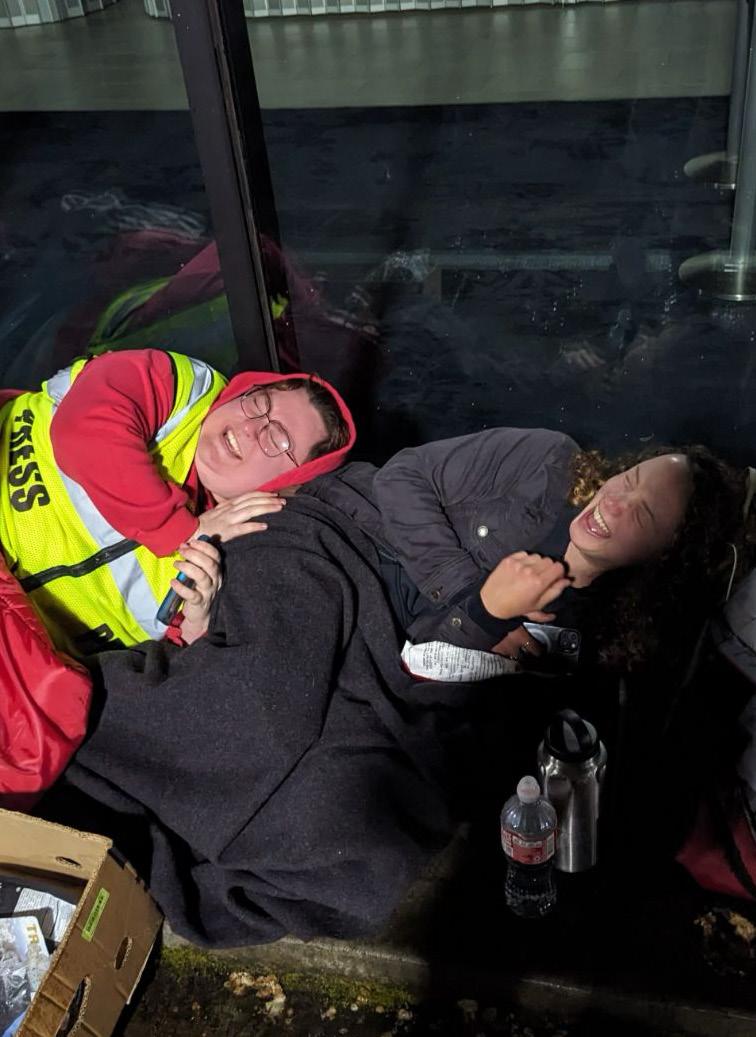
Former Vanguard EIC Kat Leon at the Spring Library Protest with Former News Editor Zoë Buhrmaster.
Carandanis adorably posing in the Park Blocks.
PHOTOS COURTESY OF KAT LEON AND NOAH CARANDANIS
Former Vanguard News Editor Excels After Graduation News Editor Alumnus
Zoë Buhrmaster, a former Vanguard News Editor, first began their journalism career writing a newspaper for their childhood neighborhood at 8 years old. They joined Vanguard as a contributor in 2022, and worked their way up to becoming News Editor before graduating in 2024.
Before their time with Vanguard , they worked at The Independent, the student-run newspaper at Clark College, and The Columbian in Vancouver, Washington. Following their work with Vanguard, they were a reporter at The Oregonian, and now work at The Flathead Beacon in Kalispell, Montana as a staff writer.
“Portland State is a unique university,” said Buhrmaster. “You’re tucked in the city, and a lot of times city issues affect the university campus … I think it’s true for any university that staying at least mildly aware of what is happening in the city around you is absolutely integral.”
World events greatly impacted campus life during Buhrmaster’s tenure as news editor. In April 2024, protesters blockaded themselves inside the Branford Price Millar Library on campus in opposition to the Gaza genocide. Many Vanguard staff at the time stayed in a nearby building to provide firsthand reporting and gather information about the situation.
“A lot of us stayed 24 hours at the building across from the library in front of it, just observing, noting, reporting. It definitely was a crazy experience to go through,” said Buhrmaster. “[I’m] grateful for the team that cared enough to stay … it was our moment all of a sudden, the stuff we were doing as a small student publication mattered in some regard, and that was meaningful.”
As the News Editor, Buhrmaster covered many major Portland State University events, some of the largest being the protests at the library and a story on non-safety compliance by the on campus daycare. Reporting began after a child had bitten through
their lip and wasn’t given proper care, nor had 911 been called. It was found that the staff hadn’t given proper medical care for other situations either. Afterwards, it was found that several staff members hadn’t completed required trainings, such as “Introduction to Childcare Health and Safety” and “Recognizing and Reporting Child Abuse and Neglect.”
These experiences taught Buhrmaster about the importance of journalistic integrity, especially when confronting larger and more emotional stories. They advised current writers to slow down and ensure their stories are fully completed with good sources and accuracy, instead of rushing for the breaking news headline.
“It was easy when I was just getting [into] journalism to see an injustice and want to report it outright,” said Buhrmaster. “Knowing when to push the envelope and when to pull the reins is a skill that develops over time, but not every story needs to be published right away just because you need to fill pages. If it’s not ready, it’s not ready.”
In addition to writing, Buhrmaster enjoys outdoor sports and beautiful landscapes. They did dragon boating while at PSU, and now they participate in a Montana outrigger canoe club.
“If it’s an outdoor sport, I am probably trying to take a stab at it [to] some degree,” said Buhrmaster. “[I like] just spending time in nature, I think it is my favorite hobby, and being in the sun and watching the clouds go by, to keep it simple.”
While Buhrmaster always had a passion for journalism, they didn’t take the academic track one might expect, graduating with a Bachelor of Arts in Anthropology. They found that anthropology gave them a unique perspective in their journalism career. Anthropology discusses cultural respect, teaches about various cultures and offers a deeper understanding into the complexities of humankind. They say that to write a good news story, writers need to understand humans.
“How a story is received, or what storytelling practices are like within a culture that you might be reporting on, I think that's invaluable and definitely an important skill to have as a journalist,” said Buhrmaster. “You’re studying people, and then
the other one, you’re writing about them.”
Buhrmaster shares that it takes a lot of time to learn the skills needed for a newspaper. It requires good ethics and integrity, scouring campus for pitches, editing contributors’ stories to Associated Press style and following a quick news cycle. It doesn’t come overnight, and takes a lot of effort, but Buhrmaster says anyone interested can do it.
“If there's one thing you can do to continue getting better at writing news, is reading news and knowing how to read news and what news sources are,” said Buhrmaster. “I think that stands the test of time a little bit. Trust your instincts … [and don’t] be afraid to ask questions.”
They also argue for a good work-life balance, constantly following news can be exhausting and world-consuming. In order to fight burnout journalists need to take authority for themselves and leave time for rest.
“I remember those nights when I would not sleep,” said Buhrmaster. “... you get done with all of your homework, and then you go home and you have stories to edit, and you have reporters to find out why they haven't turned in their story. Finding time to carve out for yourself, even if it's a five-minute walk in the sun, is integral to any sort of longevity.”
GRACE PETERSON AND WILL LOWE
Buhrmaster during the Spring Library Protest.
The Vanguard library protest staff.
PHOTOS COURTESY OF ZOE BUHRMASTER
Arts & Culture Editor Alumni Building the Voice of Arts & Culture
“Comply and read ‘Bitch Planet’”, a review by Andy Anady, was the first piece to kickstart the Arts & Culture (A&C) section at Vanguard. The section has since served as an outlet for creativity at both Portland State University and Portland as a whole. As it morphed and evolved, every editor contributed their own creative vision and perspective. Some editors have chosen to focus on sharing moments with different cultures, whereas others have worked to thoroughly explore Portland’s art scene.
Kat Leon, an alumna with a master's in communication, began their time at Vanguard in 2020 as a contributor. Almost two years later, in June 2022, they took over the A&C section as the appointed editor.
“When I came on as the Arts and Culture editor, we were just coming out of the pandemic. [...] The ways in which we were doing things were completely different during the pandemic and [leadership] often didn't require us to do interviews — the quality of our content tanked during that time,” said Leon.
While the world was in a total shutdown due to COVID-19, artists lost access to studio space and performing artists were unable to share their passion publicly. Soon after the quarantine period was over, creatives from all over jumped back into their craft.
“A lot of [my] focus was on the importance of the arts and how we can reconnect with people, and the beauty and the love of coming back to live theater,” said Leon. “There was so much excitement during that time in the art world because there had been years of not being able to do stuff like that because of the pandemic.”
Covering stories for Vanguard's A&C section can mean a plethora of things. From attending ballets and concerts to spending hours at a museum, the scope of creativity holds little bounds.
“Arts and culture is so broad, and when the next editor took over, she really focused on the culture element. [She] focused a lot on cultural events and cultural elements in our community
— there are so many things that you can do with the section. I really loved seeing how much it can morph and change to fit the times and what's needed,” said Leon.
While Leon served as the A&C editor, resources and knowledge were limited. Vanguard at the time lacked training materials, as well as contributors able to cover a large scope of news.
“We didn't have any set standards for what the section should cover, or what it looks like — there was just no structure whatsoever. And as a person who's a little bit type A, especially when it comes to stuff like this, it was like…we have to create something,” said Leon.
Leon worked generously to rebuild the A&C section into what it is today. Creating expectation guides — such as who to connect with and how to move stories along — were all considered tasks while carving out the boundaries for A&C and, more broadly, all of Vanguard.
“Obviously, we're working with a lot of structural barriers; it was very much a boys' club when I came in,” said Leon. “It took a lot; I had to fight for the respect that I had. There's also a level of arts and culture [where it's seen] as not as important as news, which I don't think is true — there's so much that goes into that section.”
Soon after Leon was appointed the A&C editor, the section won first place for Best Section at the Oregon Newspaper Publishing Association in 2024, as well as first place for Best Review.
“Being a voice for students was, and definitely still is, my favorite part of Vanguard. I love Vanguard's independence. I love looking back over the history and seeing how it's changed and morphed [to] fit the times,” said Leon.
Sarah Applin, a sociology graduate and former A&C Editor who started at Vanguard in 2023, now balances teaching with a strong involvement in theater. Applin enjoys acting and is an assistant director in production, working with Clackamas Repertory Theatre. With a minor in child, youth and family studies, Applin’s interest remains grounded in culture and social systems.
“I’m proud of covering topics that may not have been thought about or really looked at,” said Applin. “I think that's really important for the work we did at Vanguard because, yeah, it's somewhat smaller scale, but there's still a chance to highlight the people that are actively in your community that you can see in the park blocks every day.”
A&C is a space dedicated to expression — where sharing a moment of color and excitement could reach the eyes of all of Portland. Naturally, it doesn't work well with constraints.
“A big challenge was working around your oppressors. With writing for an institution like a University, there are limitations on what can and can't be covered, as well as] who can be put into a video and who can't,” said Applin. “We were doing work that was nationally recognized, and we wanted to continue to have people take us seriously.”
Applin served as the A&C editor during the pro-Palestinian protests at the Bradford Price Millar Library. Because of the protest’s significance, PSU students were recognized all throughout the United States for their fight against the ongoing genocide in Palestine.
“There's a great amount of freedom in figuring out what it is that you want to showcase. As people of color, especially feminine people of color, Vanguard was one of the first times where I had full authority to decide what I’d show for a section,” said Applin. “It was really meaningful to intentionally spotlight BIPOC artists, and other artists facing different forms of oppression.”
Applin was passionate about amplifying voices that were oftentimes overlooked. By spending time with diverse communities and focusing on artists that aren’t being spotlighted by the wider media, Applin crafted an inclusive and dynamic space in Vanguard “Vanguard really helped me define myself as an artist and open doors for communities that I didn't even know existed,” said Applin. “Working and fighting for what you believe in, and how people connect with the current world in the time that they're in — all of that goes into what I create today.”
ADYAN HUSSEIN
PHOTOS COURTESY OF KAT LEON
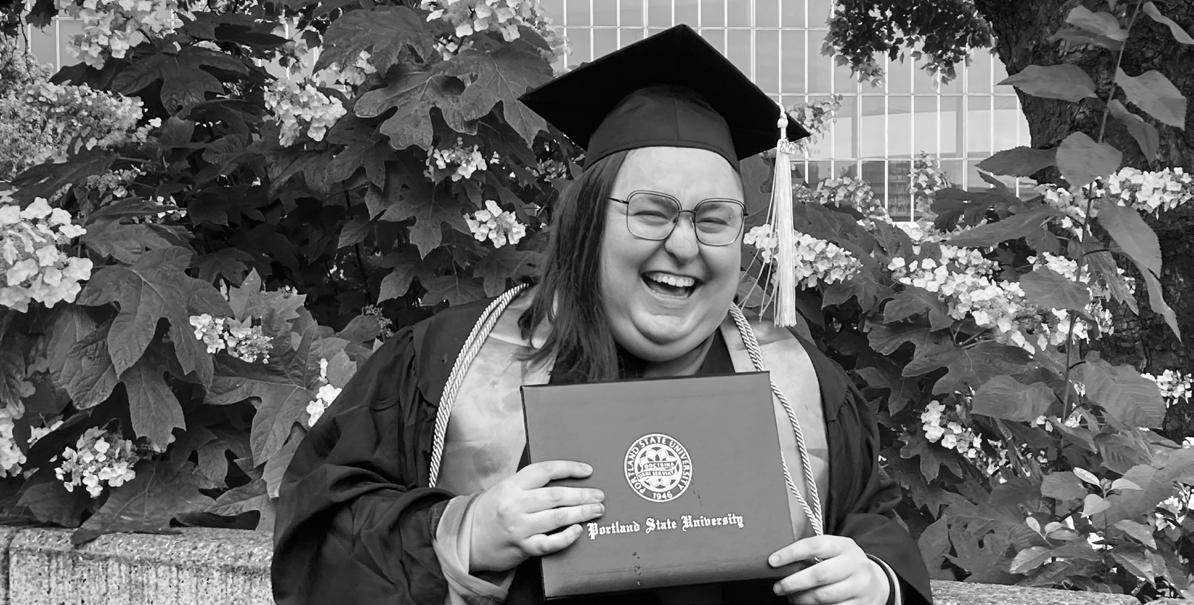
Leon on their graduation day.
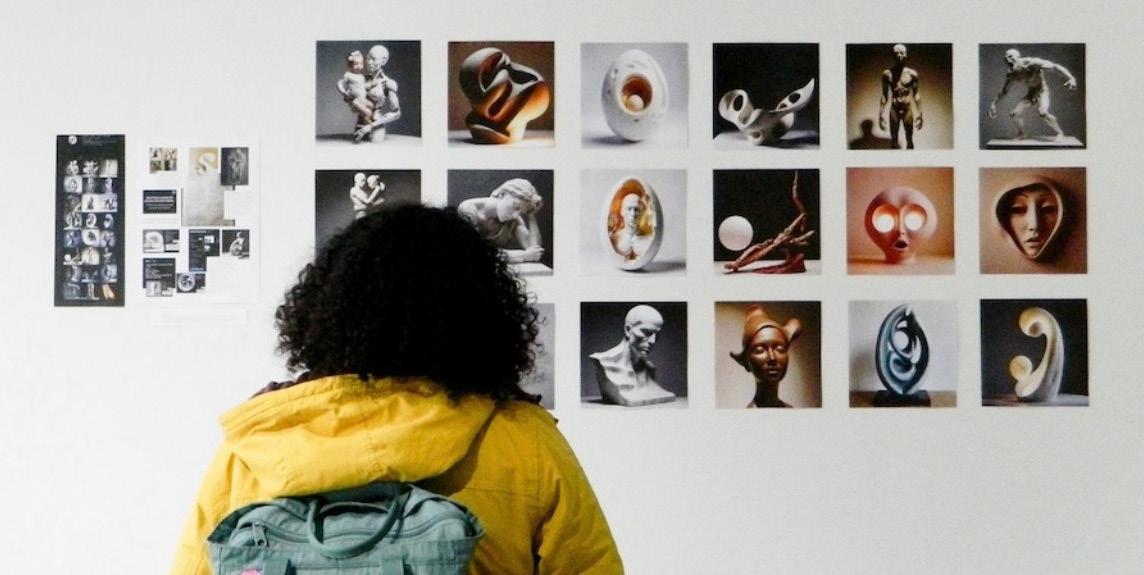
Applin gazes at a photo gallery.
Leon smiles on the Park Blocks.
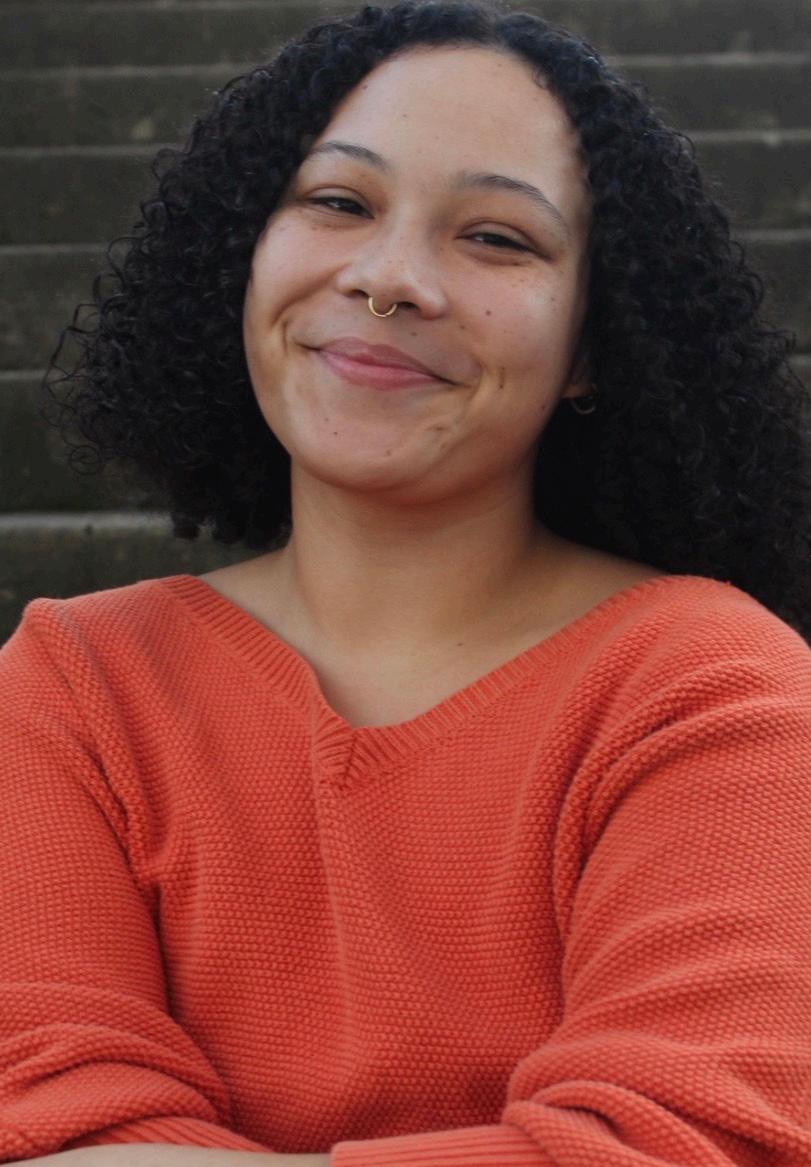
Headshot of Applin.
Creative Director Alumni
An ode to past Creative Directors
The Creative Director (CD) role at Vanguard inherits a significant amount of responsibility. It involves much more than creating the physical layout and design of the paper, which can be a feat in and of itself. CDs are in charge of production, which means facilitating workflows between the editorial board, writers, designers, photographers and illustrators to ensure every element of the paper comes together before the deadline.
The weekly strict deadlines of the newspaper teach us to make decisive design choices quickly. We are constantly working on 2-3 issues at once and always need to have an eye on everything. In the classroom, we have time to iterate, flush out concepts, implement feedback from professors and peers and polish each project. But as Creative Director, you needed to make a decision yesterday, and it needs to go to print now. There’s no time to second-guess your skills or opinion.
Whitney McPhie and Shannon Kidd, both former CDs, hold their Vanguard memories close to their hearts and carry it with them throughout their careers and lives.
WHITNEY MCPHIE started as CD in July 2022 after working as a design, illustrating and copyediting contributor. She remained in the role for around a year and a half before hiring her successor and stepping down to focus on school. A week later, Portland weekly newspaper Willamette Week reached out with a job offer — the same week that she had to present her thesis. Amidst the chaos, she accepted the role while managing her responsibilities as a student. A year later, she was offered the position of Art Director at Willamette Week, and now serves as the paper’s CD.
Thrown into her director role at Willamette Week with the scraps of a staff and basically no training, she executed a 44-page issue — the longest she has ever done. Despite the baptism by fire, she learned a lot quickly and felt her experience at Vanguard was “the best experience [she] could have gotten to then step into the role.”
McPhie started at Vanguard soon after the COVID-19 pandemic and, at first, worked mostly remotely. Once people became more comfortable coming in person, she stepped up beyond her role and started attending pitch meetings. She
found that bridging some of the disconnect between the stories and design helped her present the paper more effectively. Ever since, McPhie has been the CD of Willamette Week and continues to be powered by the hustle of a weekly paper. “I put out a weekly paper every week for almost five years. I don't know what to do without it now,” said McPhie. McPhie is strongly driven by her ambition, always reaching upwards — whether in her role at Vanguard as a student or her professional career at Willamette Week. She elevated the student role of CD and carries this into her professional career.
SHANNON KIDD served as CD in 2017 after working as a design contributor, and now is a Portland State University Graphic Design adjunct teaching illustration. Her time as a design contributor helped hone her design skills and prepared her for the managerial responsibilities of organizing contributors.
“It got me to think more critically about my design choices and my design ethics. Not all media outlets are ethical and unbiased, which is important to learn. Especially now, you need to consume your media with a critical eye.”
One conflicting aspect the CD role is balancing experimentation with neutral and ethical design. Upholding journalistic responsibilities is a unique skill — one that’s especially valuable as a student. It prepares creatives to work with clients who have restrictions and reputations to uphold. It also challenges the CD to find a balance between their responsibilities to the paper and their desire to explore innovative design.
“A position at the paper really expanded my general awareness…[and] changed how I move through work now,” said Kidd.
Her knowledge and experience at Vanguard prepared her to work at the monthly newspaper Portland Mercury soon after, giving her substantial experience in how news and publishing work in the “real world.”
Kidd’s experience as a CD helped her find her voice
and gave her a new perspective which impacts her pedagogy as a teacher to this day.
“Teaching is kind of like being a creative director of a classroom of people,” said Kidd.
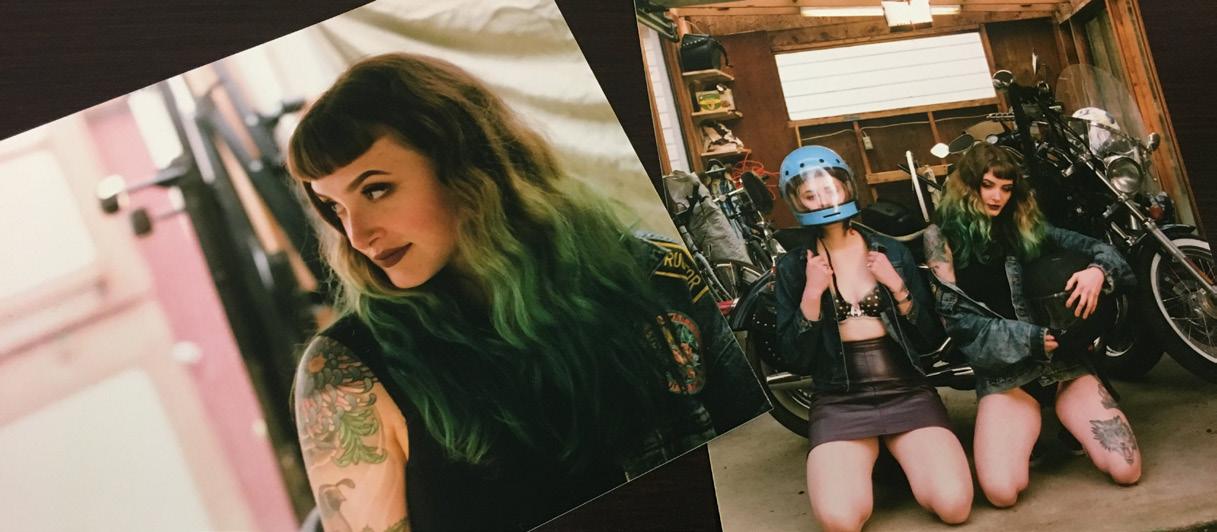
Her favorite memories were bonding with the editorial team and doing impromptu photoshoots with her friends. She used the space and experimented with design, making fun memories — wearing Hawlloween costumes in the basement, posing with her friend’s ferret or riding Harley Davidson motorcycles in the garage.
The CD title means more than its responsibilities; it is something that has given so many ambitious souls unforgettable memories, unmatched career experience and lifelong skills. The challenges of learning to manage contributors, upholding journalistic integrity, making quick decisions and meeting strict deadlines on top of being a student and trying to grow as a designer are not for the faint of heart. The role calls for exceptional ambition.
“It’s so special to hold, feel or smell something. To hand over this thing to someone else or sit in a coffee shop, read something and leave it on the table when you're done,” said Kidd. “There is something that will forever be very important to me about physical media, especially as we live in this perpetually, consistently more digital age.”
HALEY HSU
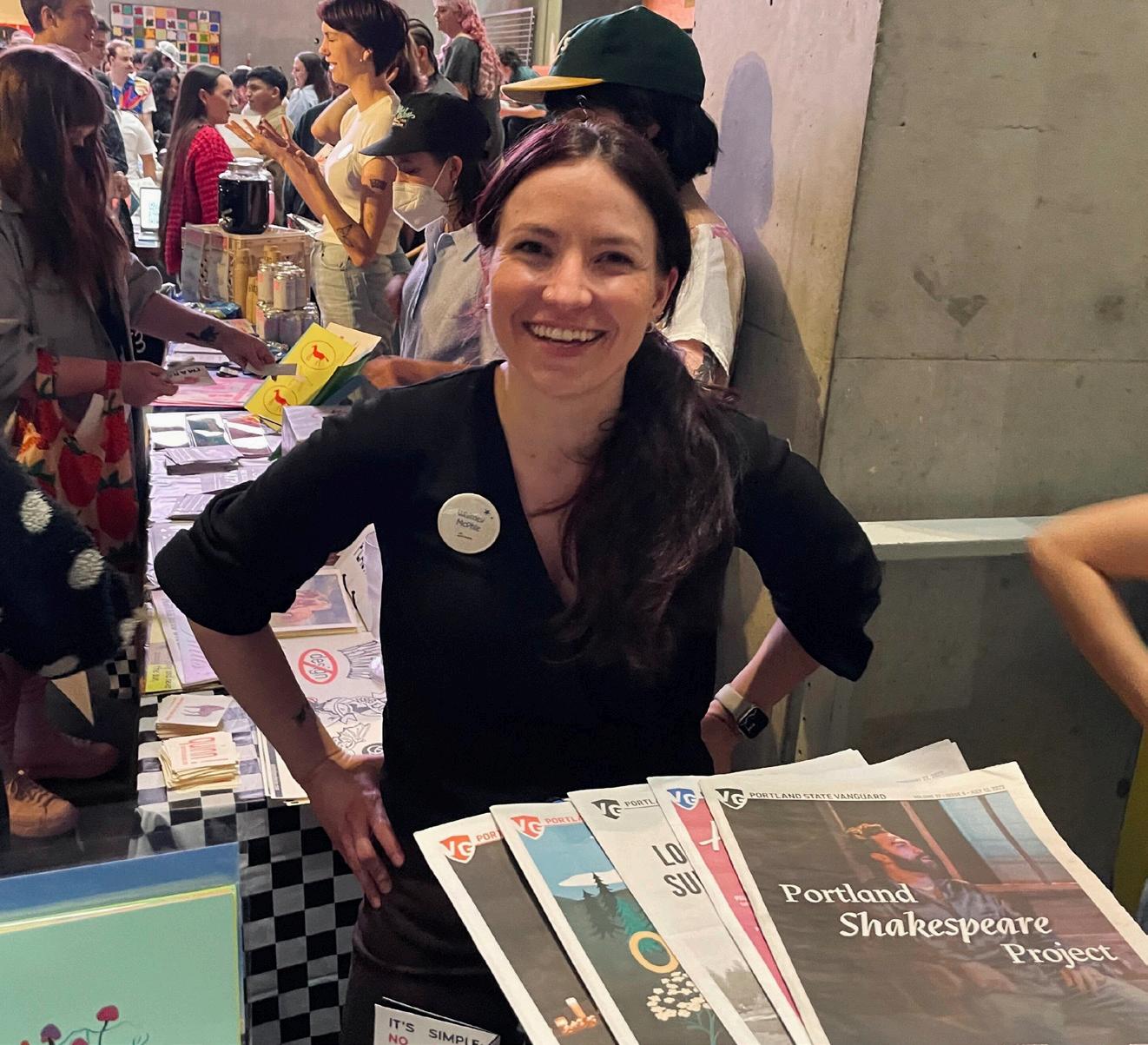
McPhie at Be Honest, an annual student design showcase, where she had Vanguard papers in a news box.
PHOTOS COURTESY OF WHITNEY MCPHIE AND SHANNON KIDD
Shannon in front of the Art Building.
A photoshoot for a Vanguard story.
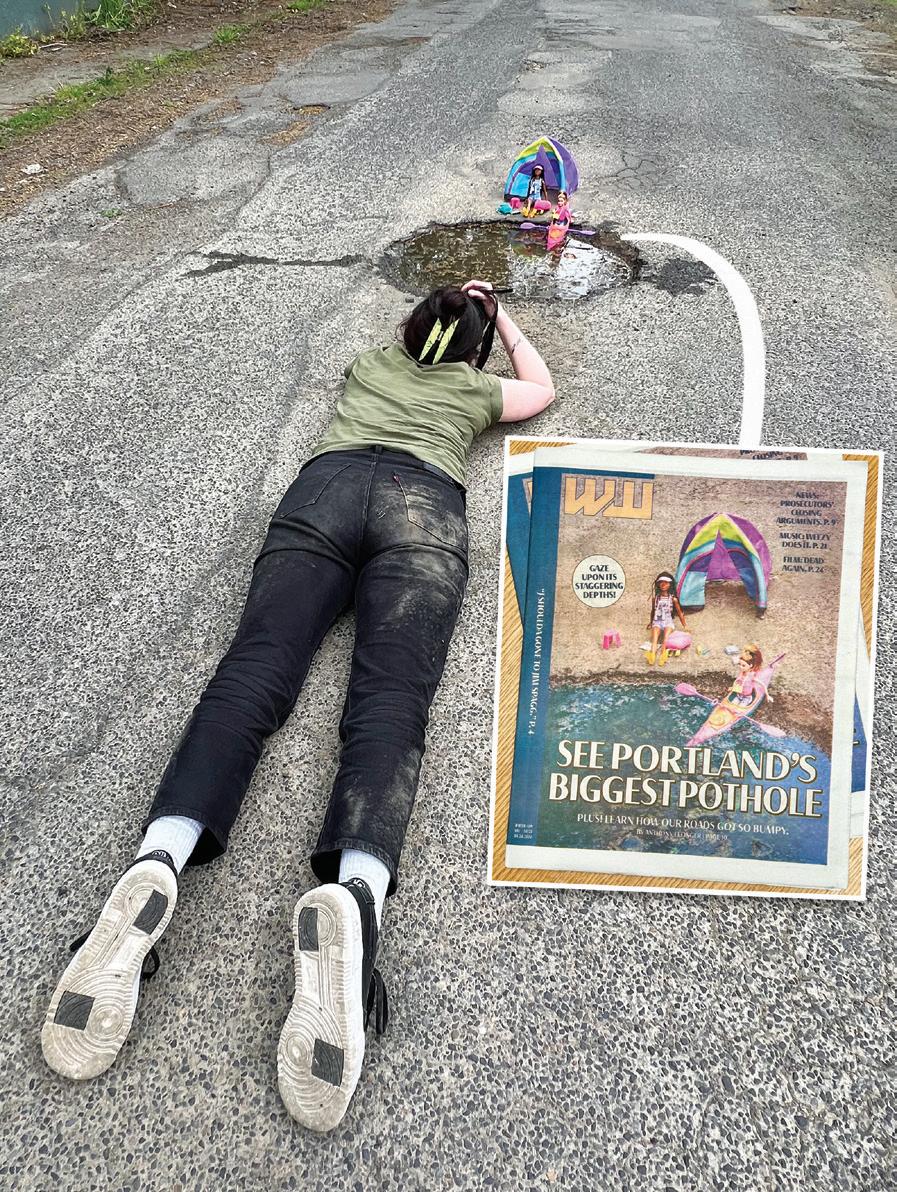
McPhie creating Willamette Week's Barbie cover in 2024.
“I really found my home”: Missy Hannan on Vanguard Managing Editor Alumnus
For those who don’t pursue a career in journalism, some of the lessons learned during their time at Vanguard stay in the newsroom post graduation. Sure, leadership skills are important, but who needs to know AP style and the inverted pyramid when you’re not working as a journalist?
For Missy Hannan, former Copy Chief and Managing Editor, that wasn’t the case. Vanguard didn’t just teach them journalism basics– it taught them to have confidence in themselves.
“I didn't know I was a leader,” said Hannan. “I didn't know that I had experience and wisdom to offer until I was in [the newsroom] and people started saying, ‘What do you think about this?’ I said, ‘Who gives a shit about what I think?’ and [the editors] said, ‘Well, I do.’”
Currently, Hannan works as a compliance analyst for an apparel company. They’re also finishing up a paralegal certification, to which they plan on being a paralegal in criminal defense upon completion.
“It took me long enough to get on the right track, but I’m here now,” said Hannan regarding their career path.
Hannan came to Portland State University at 27-years-old, after spending the majority of their 20’s teaching English in southeast Asia. For them, coming to PSU was an opportunity to get serious about their studies. Or, in their own words, “get [their] shit together.”
“I hadn't really taken myself that seriously until I got to school and I said, ‘All right, we got to get our shit together,’ you know? And I all of a sudden found a home in academics that I had not expected to find. And then in Vanguard, I really found my home,” said Hannan.
Hannan initially joined Vanguard because they wanted to work in book editing and wanted to add editing experience to their resume. During their copyediting contributor interview, they quickly realized that the role of Copy Chief, the main editor responsible for AP style edits and ensuring proper grammar, punctuation and overall clarity, was also open. The role Hannan was interviewing for quickly shifted.
“I don’t know anybody who has better grammar than me,” said Hannan. “[The editorial board] figured that out very quickly, and said, ‘Wait a minute, do you want to be a Copy Chief?... Can you apply for that instead?’ I said, ‘Sure, why not?’”
After copyediting a passage, Hannan got the position of Copy Chief. During their tenure, Hannan went above and beyond their editing duties by developing a Vanguard style guide and creating standard operating procedures. Their role shifted when they were appointed to Managing Editor, a title they held Oct. 2018 to Jan. 2019. Managing Editors typically work closely with the Editor in Chief to lead the newsroom, and work closely with each editor and contributor.
For Hannan, some of their favorite parts of being an editor lied within training the incoming contributors. In some instances, they had to train new reporters to ask for someone’s name before interviewing them.
“You know, being a 19 or 20-year-old kid, this is your first [time] in college, you don’t even know to ask for somebody’s
name. Of course you don't, but that's what makes it all the more fun to do the training,” said Hannan. “Teaching and training is where I’ve spent most of my life, so I was very comfortable with [that] already when I got to Vanguard.”
Through working with their team of editors, Hannan developed a confidence that hadn’t previously been there. Working in the newsroom showed Hannan that they were a leader, and that what they had to say mattered, and was important.
“For the first time in my life, people gave a shit about what I had to say. And, as it turns out, I have a lot of cool things to say that are actually really helpful to people,” said Hannan. Hannan specifically credits their editorial team for helping them with their confidence.
“[They were] so impactful in the ways that I see myself, in the way I think about my skill set, the way I think about how I relate to people. I don’t know if they know this, but those people changed my life,” said Hannan.
Learning about objectivity, people management and clear communication during their time at Vanguard has been instrumental for their time outside of college. They continue to use these lessons in their current line of work
“Bottom line up front, don’t bury the lede… everywhere you go, every job you have. I didn’t learn that anywhere but Vanguard. Get it up front so people know what you’re doing,” said Hannan.
Despite their current career not being in journalism, the lessons they learned in the newsroom have been invaluable to their career, and personal, development. They continually cite the gratitude they feel for not only Vanguard, but for PSU as a whole.
“It just felt like one of those golden windows where everybody’s working together on the same page, working towards the same goal… it was so cohesive, it was so ethics driven and values driven,”
said Hannan.
Hannan’s feelings towards Vanguard and PSU as a whole, according to them, all come back to one central emotion.
“Just gratitude,” said Hannan. “So much gratitude. Not just for the legacy of the publication and not just for the people I was lucky enough to do that with, but also for the institution, for the academic advisors, the staff and faculty… Gratitude. That’s what I keep coming back to. Just so grateful.”
OLIVIA HENDRY YOUNG
Present day Hannan poses for the camera.
Hannan during their time at Vanguard, as photographed by a member of their editorial team.
PHOTOS COURTESY OF MISSY HANNAN
Reviving the Sports Section
The concept of sportswriting can be simply defined by looking at the word itself: writing about sports. Reporting on games, roster changes and other team news all contribute to the craft of sports journalism. Vanguard does this within its Sports section, covering Portland State University’s sports teams and events. However, not only does sportswriting encapsulate more than just general reporting, but the Vanguard’s Sports section has fluctuated over the years.
“In my 13 years with the Portland State Athletics Department, the sports section of the Vanguard has gone through ebbs and flows,” wrote Assistant Media Relations Director Andy Jobanek in an email statement. “Some editorsin-chiefs have cut it entirely. At its healthiest, we've had an engaged Sports Editor who comes to games and covers our athletes and teams regularly.”
At its core, sportswriting is a form of creative nonfiction that captures the human experience. Statistics can be captured in a spreadsheet; scores can be read off a scoreboard. But there are people behind those numbers. There are stories to be told, both on and off the court, the field and the pitch.
“I think it’s easy for people who aren't fans of sports to be dismissive of the pomp and circumstance around sports and big-time college sports specifically,” wrote Jobanek. “But within a basketball team, for instance, there are 15 different personal stories waiting to be told. Each win and loss is context for what comes next or what came before. On the court and off of it.”
It’s the job of the Vanguard Sports section to do just that: tell the stories of PSU athletes, dive into the behind-the-scenes action and spotlight those who otherwise would not get the attention. Despite being a Division 1 NCAA school, PSU is not considered a sports school, such as University of Michigan or Ohio State University.
Why the Vanguard’s Sports section is vital to the paper
Portland State is widely known as a commuter school, where the majority of its students do not live on campus. Additionally, the campus is well integrated into downtown Portland, which creates a unique community and lifestyle compared to other universities. Because of PSU’s distinct features, its campus culture does not primarily revolve around its sports. This does not mean that PSU athletes are not important to the school, however.
“We’re not a sports school,” said PSU alum and Offside News contributor Charlie Huxley. “A lot of people come to campus and they leave. We don’t have a big social life around sports like other schools do.”
Sports coverage within Vanguard has not been consistent. Going through the newspaper’s archives, there are several instances where a reader will find a few years of routine articles from a single writer, but then it disappears suddenly. Whether the writer had graduated or left Vanguard for another reason, the reporting ultimately suffers, and Vanguard enters another drought of sportswriting.
A new team of sportswriters is currently being built at Vanguard. With steady and reliable coverage at the heart of the paper’s goals, it’s important the sports section is revitalized and doesn’t disappear once its current writers graduate. It’s also crucial the sports section showcases the right stories, being people-forward and connecting with its student body.
“The stories that seem to connect most with the student and faculty audience at Portland State are human-interest stories on our athletes and coaches,” wrote Jobanek. “We have one of the most diverse groups of students on campus, so telling those personal stories can bring a wealth of new voices into Vanguard.”
Sports journalism provides a vehicle to tell important and personal stories, connecting people across race, gender, spirituality and political beliefs. Jobanek pointed out we’ve already
seen it work throughout history, specifically highlighting how Jackie Robinson broke the color barrier eight years before the Montgomery Bus Boycott, or how Billie Jean King was a trailblazer for women’s athletics. Athletes have always had important causes and inspiring stories to share. Sportswriters have an important role in amplifying their voices.
“Sharing stories of athletes who may not be in a reader's personal circle can expose them to different perspectives they wouldn't have otherwise engaged with in today's siloed media landscape,” wrote Jobanek.
PSU has eleven teams across nine different sports, and some are inherently more popular than others. Track and field, for example, may not draw the same audience as basketball, but the athletes and teams that receive less attention still have stories just as meaningful to tell.
“Some of the sports here are not as big, but we still deserve that recognition,” said track and fielder Sienna Rosario. “That doesn’t take away from the amount of work each athlete has to put in to get to this point.”
There are a plethora of stories to tell that go beyond a statistics sheet or a listed roster. The football team is currently building their reintroduction to Portland State, with General Manager Rashad Floyd leading the way in new branding, creative directions, partnerships and more. Tre-Vaughn Minott, who played for the PSU basketball team from 2023 to 2026, recently signed with a professional team in Lithuania. It’s the responsibility of Vanguard sportswriters to get the story beyond the story, diving into the details that cannot be communicated via a statistics sheet.
“Sportswriting at Portland State is really important for the ways it can bring students into a community they may otherwise not know about,” said Huxley. “It really breathes life into something that is not necessarily always central to the Portland State story.”
HAYDEN NEUMANN
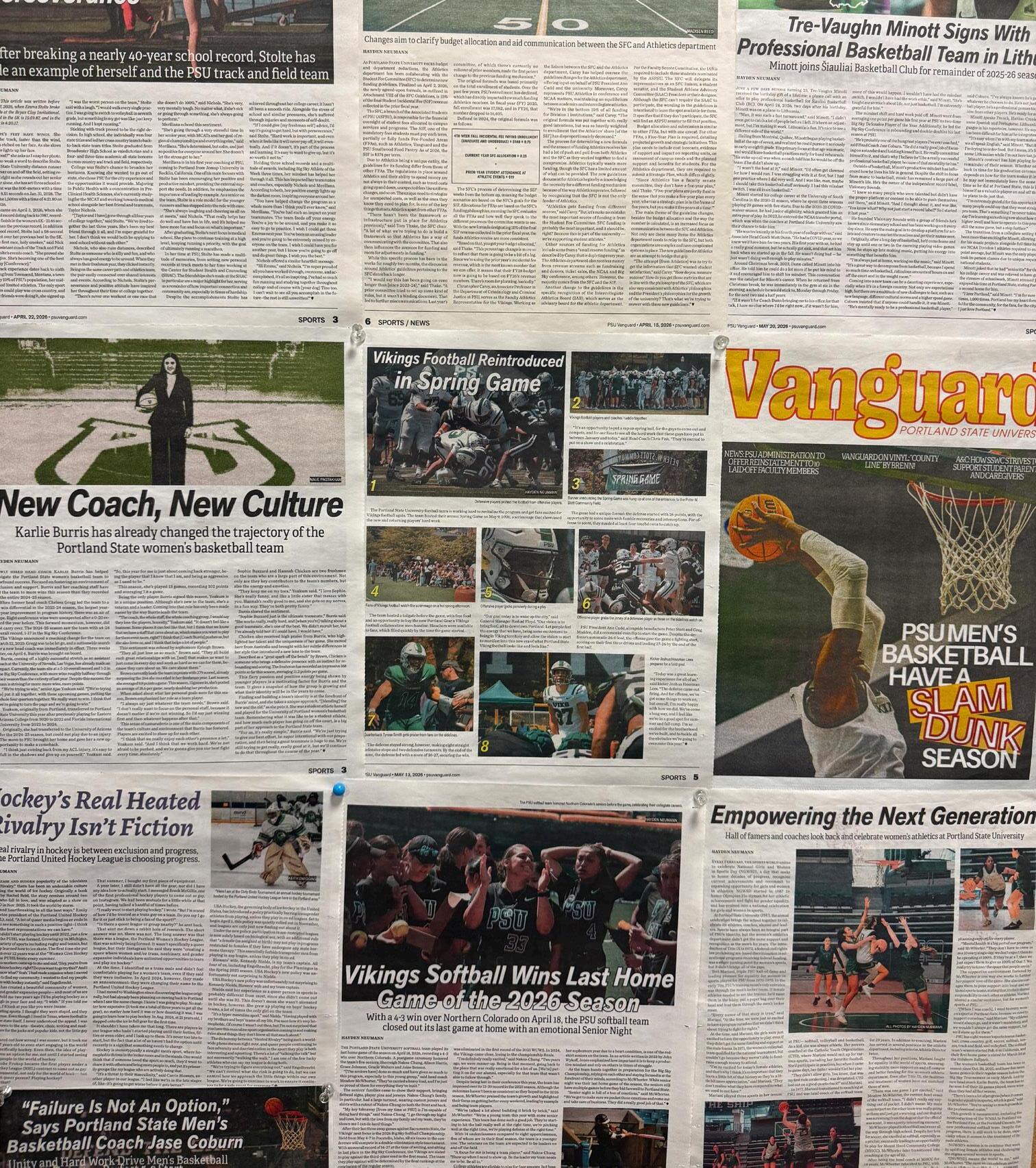
A collage of some of Neumann’s pieces for Vanguard
Unlocking 80 Years of History Vanguard Digitization Project
From its beginning in 1946 as the Vet’s Extended, the student newspaper of the Vanport Extension Center, to the multi-format news platform of today, Vanguard has been a cornerstone of the Portland State University experience. Showcasing generations of intrepid work by student journalists, photographers, and artists, Vanguard is an extensive and ongoing record of Portland State’s history, documenting campus life, local and national news, turning points in higher education and politics, student movements and activities, sports, and community events—all the breadth of inquiry and engagement that makes Portland State the vibrant and unique urban university it is.
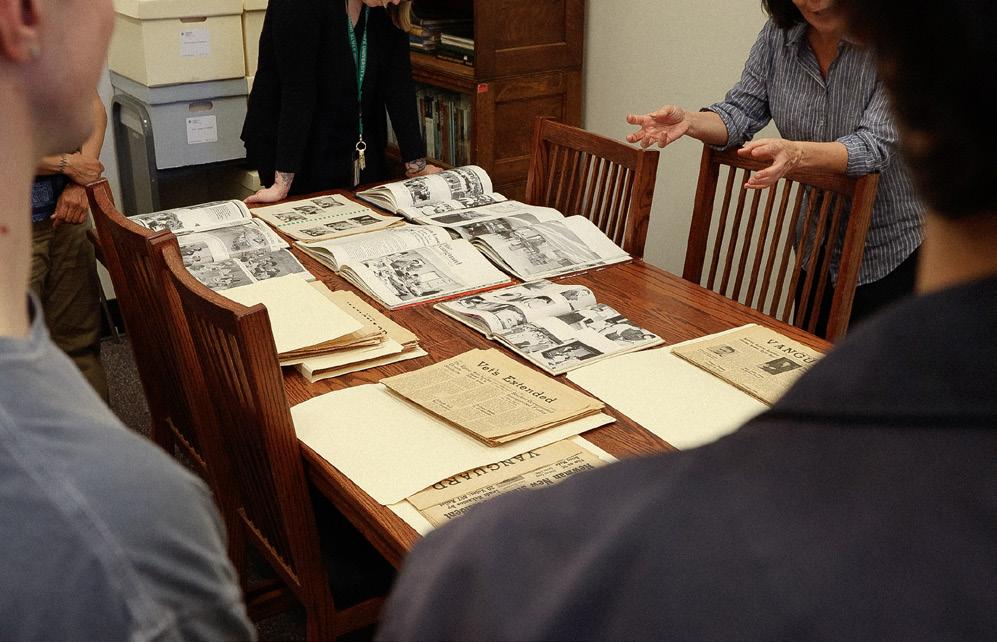
Vanguard is one of the most heavily used collections of the PSU Library’s University Archives, but the original newsprint copies are vulnerable to deterioration and damage. Without an index or digital copies, all researchers must visit onsite or request multiple scans to search for their topics of interest, limiting access to this rich historical resource. With this in mind, on the 80th anniversary of Vanguard's founding, the PSU Library proposes digitizing the full run of the newspaper to create preservation copies that will secure its availability for years to come and to make a digital, searchable Vanguard archive open to all everywhere, anytime.
A CRUCIAL PRESERVATION INITIATIVE
The physical collection, comprising thousands of pages, represents eight decades of continuous publication. This vast historical resource is currently facing the dual threats of natural paper degradation and repeated physical handling. Every time a researcher turns a page, the brittle newsprint edges closer to permanent damage.
The Vanguard Digitization Project will utilize high-resolution scanning and Optical Character Recognition (OCR) technology to transform this fragile physical collection into a stable, perpetually accessible digital archive.
The goals of this project are:
• Preservation: To create a master digital copy of every published issue, ensuring a permanent historical record regardless of the condition of the original newsprint.
• Universal Access: To remove physical and geographical barriers to accessing the archive. The digital collection will be available to students, alumni, faculty, local historians, and the public worldwide, 24 hours a day.
• Enhanced Research: To leverage OCR technology, making every word, name, and headline within the 80-year run instantly searchable. This capability will revolutionize how students and researchers engage with our history.
THE SCOPE AND PHASED APPROACH
The scale of the Vanguard archive is significant, encompassing over eighty years of weekly and sometimes daily publication. The PSU Library Archives is managing the project in partnership with the current Vanguard editorial staff.
HOW YOU CAN SUPPORT OUR HISTORY
The Vanguard Digitization Project is a major undertaking that requires resources beyond the Library's operational budget.
Initial planning and seed funding have begun, but community support is vital to ensure the project is completed efficiently and hosted on a sustainable, long-term platform.
We invite the community to join us in securing this legacy:
• Make a Donation: Financial contributions will support the work necessary to make preservation-quality scans and share them in an accessible digital archive.
This project is an investment in the future of our past. The completed digital Vanguard archive will serve as an enduring testament to the voices, ideas, and impact of generations of students.
XAN ARCH, DEAN OF THE UNIVERSITY LIBRARY AND CRIS PASCHILD, UNIVERSITY ARCHIVIST AND HEAD OF SPECIAL COLLECTIONS
The first ever issue of Vanguard, titled Vet’s Extended.
Vanguard members and the Library staff discuss Vanguard’s history.
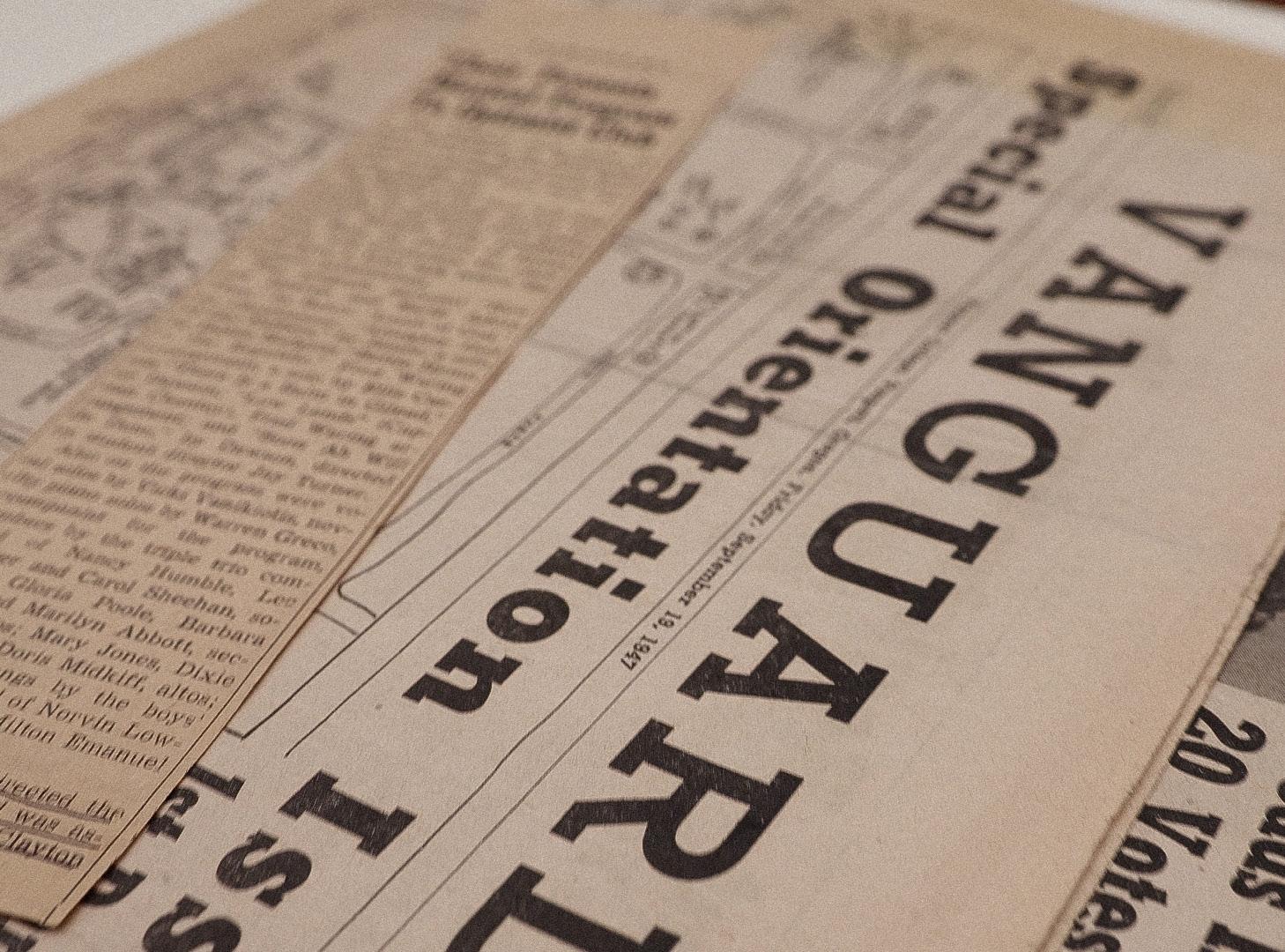
One of Vanguard’s “Orientation Guides,” circa 1947.
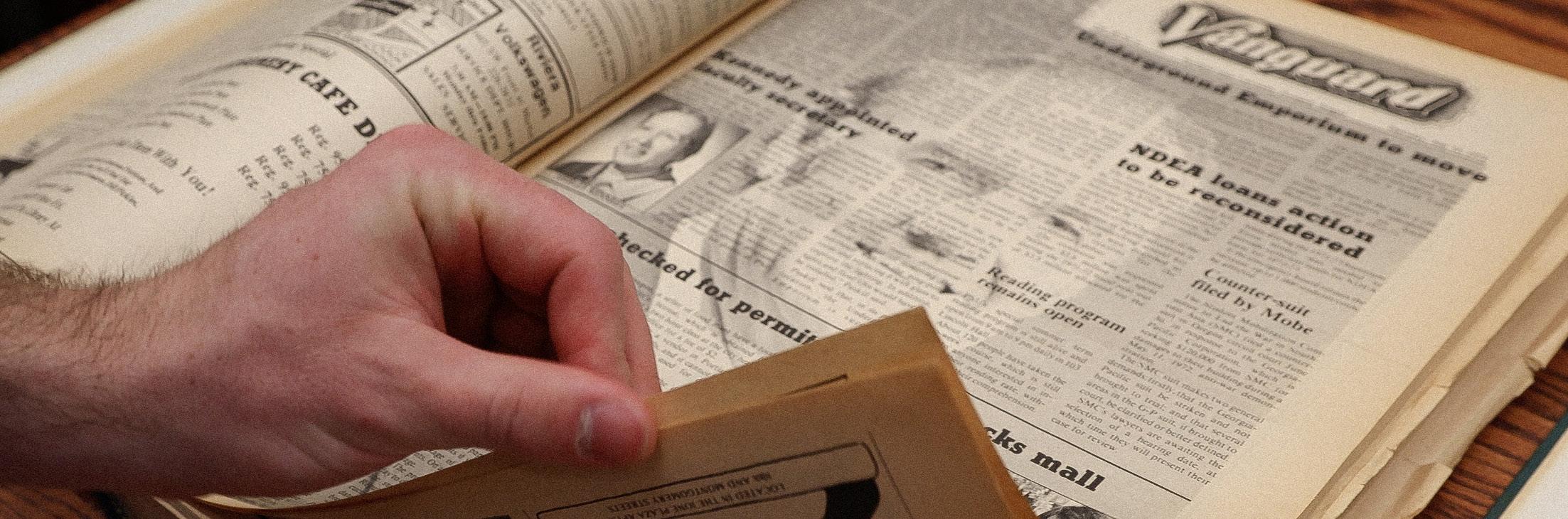
A student flips through a preserved issue of Vanguard
ALL PHOTOS COURTESY OF ARCH PASCHILD
Photography Through the Years
NASH BENNETT
In its 80 year history, Vanguard has seen major technological advancements in the medium of photography. Our newsroom started with fully mechanical 35mm film cameras, requiring the editorial board to allocate time for developing before each publication. Today, we use mirrorless digital cameras with touchscreens and Bluetooth, allowing us to share our photos seconds after taking them. Looking at Vanguard’s catalog not only acts as a timeline for the camera’s evolution, but the stories told through each photo taken.
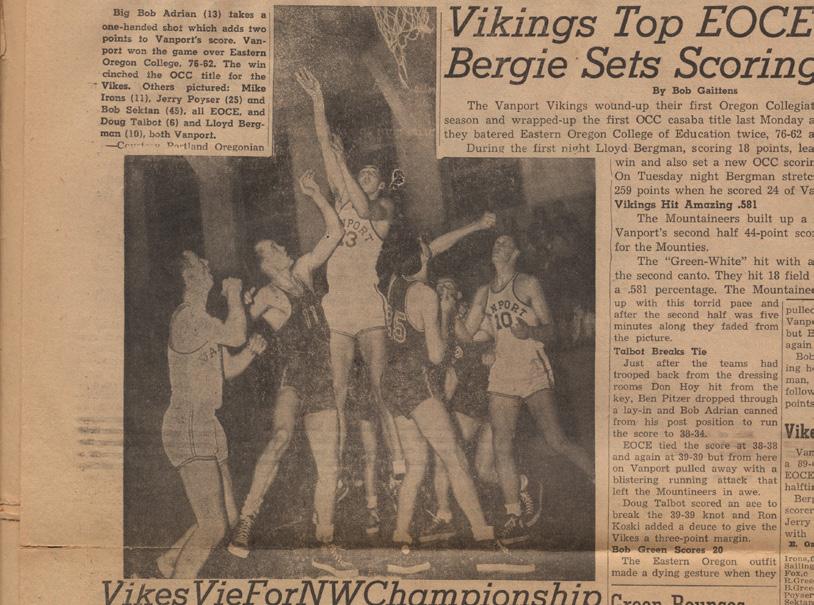
1951
The Portland State University Vikings beat the Eastern Oregon College’s Mountaineers 76-62 at this game. Note the “Vanport” stitched on the front of their jerseys, as PSU was known as The Vanport Extension Center at the time.
1971
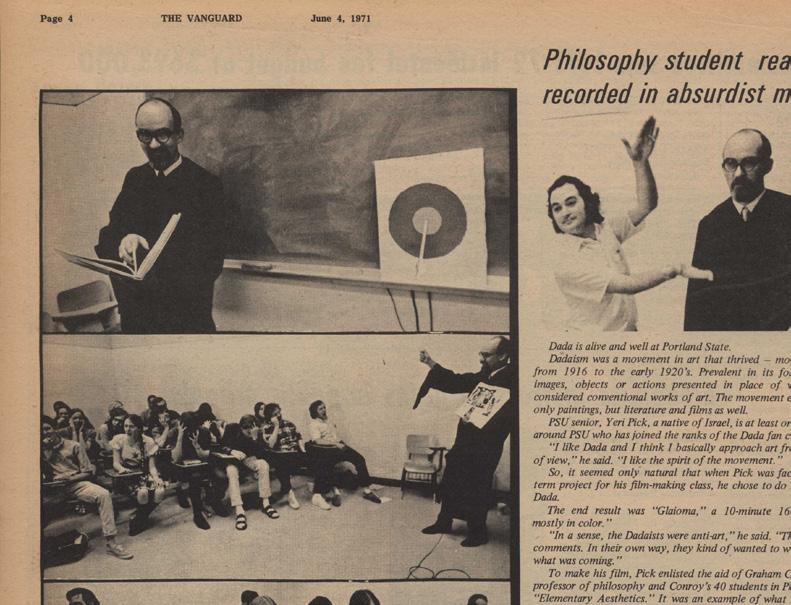
In the 70s, PSU had a Dada Club, inspired by the avante-garde art movement in the 1910s. The club would make surrealist short films and discuss various Dadaist art.
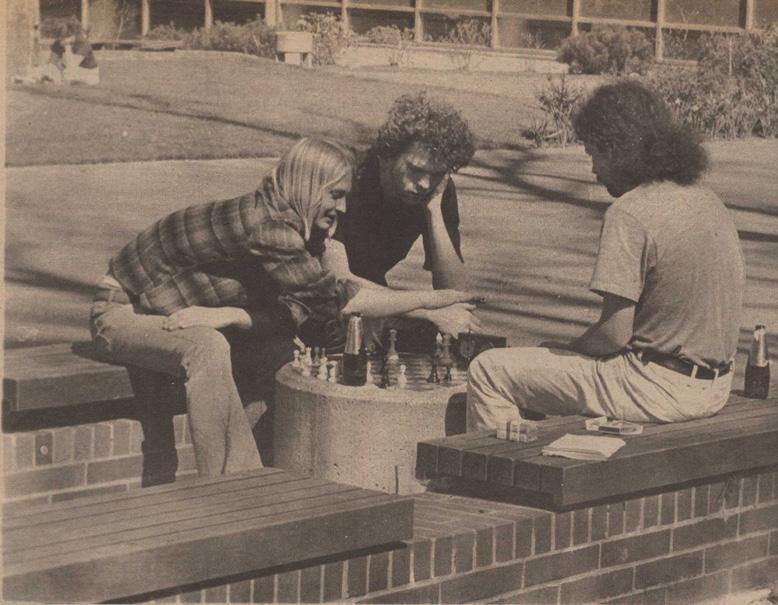
1980
Included in the now defunct “Events Calendar” of Vanguard was this photo of three students
ing chess in the Park Blocks. These outdoor
chess tables are still being used, and games are perhaps still accompanied by the
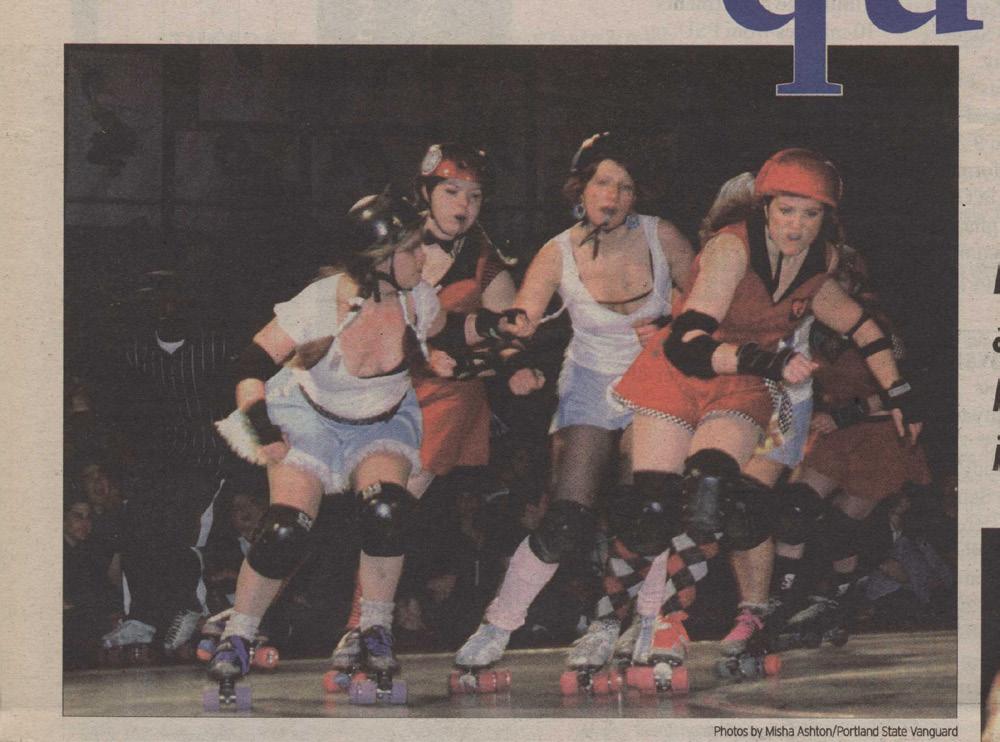
2006
The 2000s marks Vanguard’s foray into color printing. Exemplified here with an colorful and intense action shot of Portland’s Rose City Rollers team.
the
play-
cement
pictured beverages.
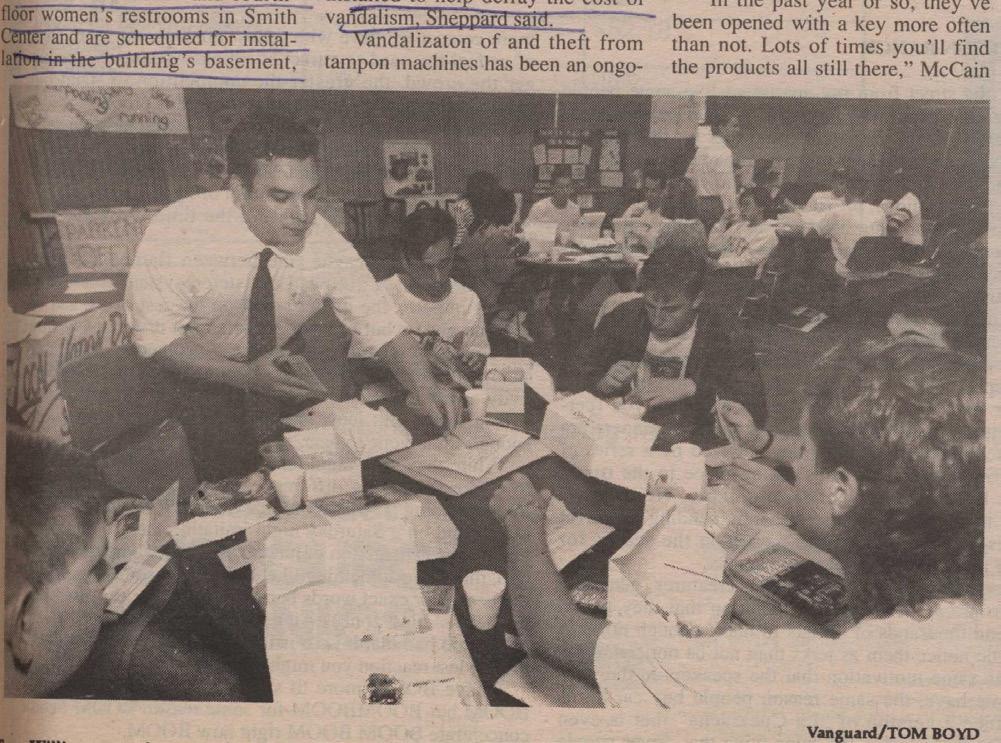
1990
Photo by Tom Boyd
Greek Life at PSU often flies under the radar nowadays, with only a few organizations on campus left. In the 1990s, PSU’s chapter of Tau Kappa Epsilon was alive and well. Pictured here is the fraternity’s president at the time, Tony Williamson, attempting to recruit incoming freshmen.
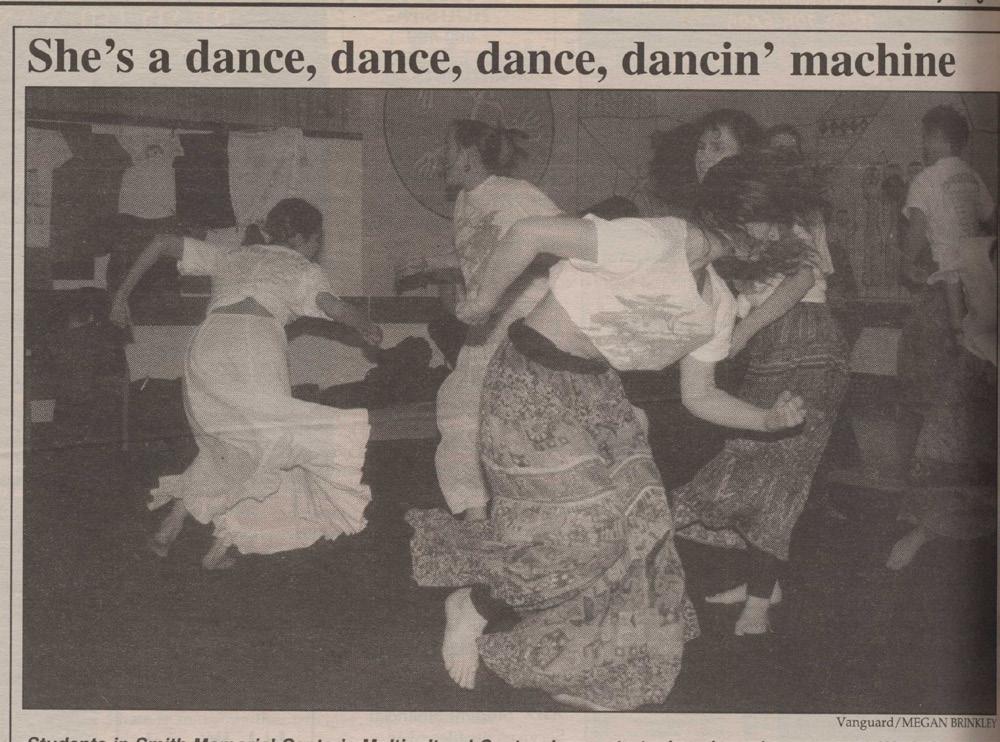
1997
Photo by Megan Brinkley
Students demonstrate traditional Jamaican dances in Smith’s Multicultural Center, which had opened four years prior.
2015
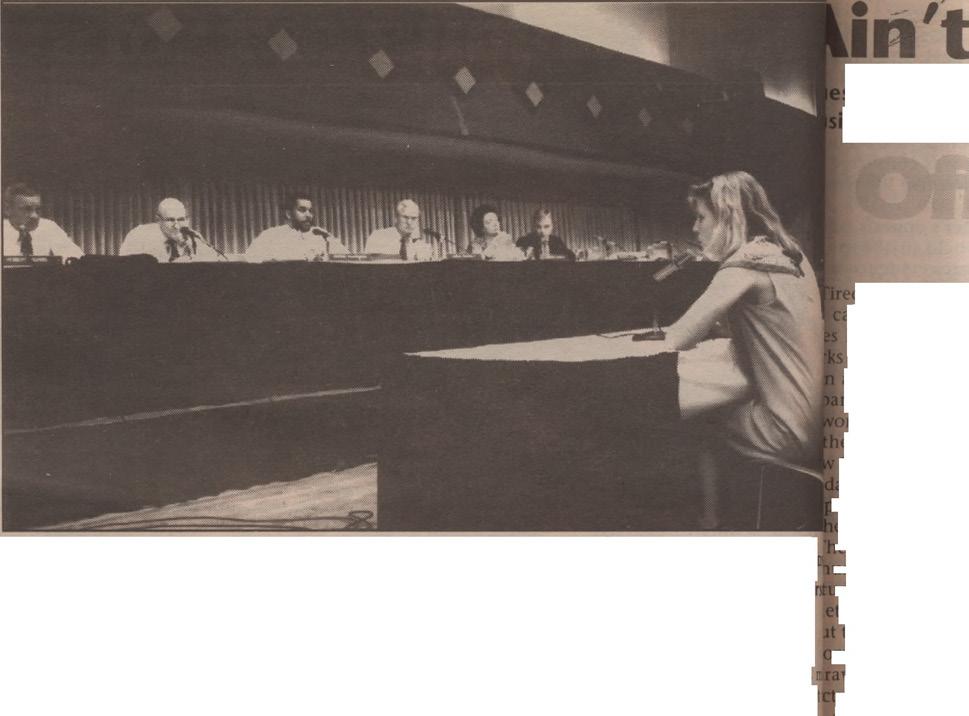
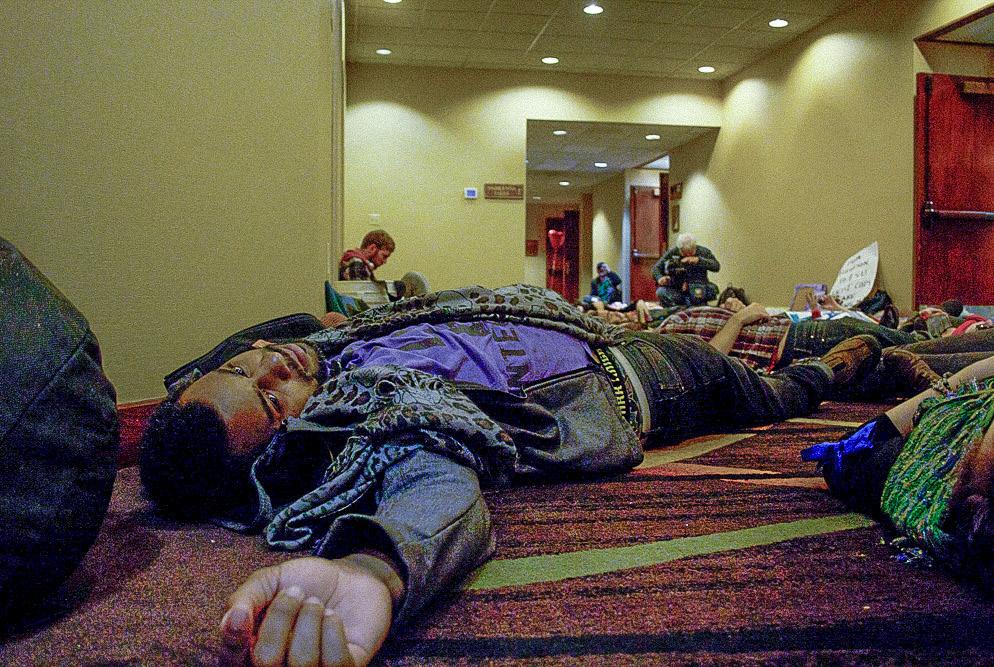
Here we see students engaged in a die-in protest outside a Board of Trustees meeting. This was in response to the Board’s decision to rearm campus police officers that year.
2024
Photo by Sergio Cervantes
In 2024, students occupied the Millar Library in protest of the genocide in Gaza, and
university’s ties the Boeing company. It lasted for about four days, and drew media attention from major international news outlets.
Best Covers
From Print to the Digital Age
LIAM SCHMITT
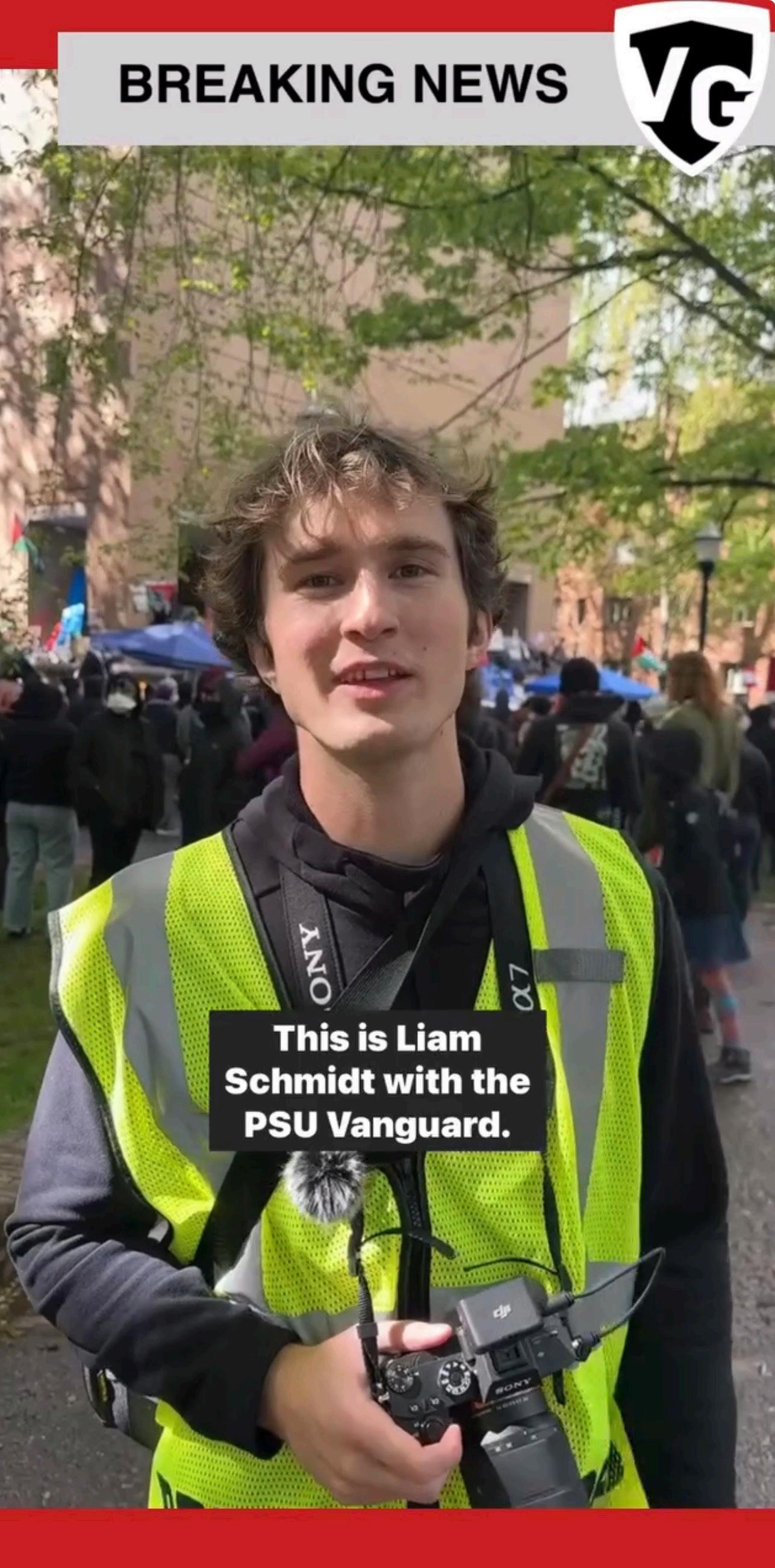
My journey at Vanguard started when I was freshly 19; a young, naive freshman on campus, hungry for any opportunity to pursue my dream in video creation and storytelling. Now, after over two years with the paper, I am a young, naive junior on campus, while also serving as the most tenured member of our editorial staff.
This journey has not been without its challenges. By the time I covered my first story, I had applied to work for Vanguard three times, being rejected after my first two applications, and finally joining the paper in the spring of 2024. That same week, I was called to cover my first story, the protest at the Branford P. Millar Library.
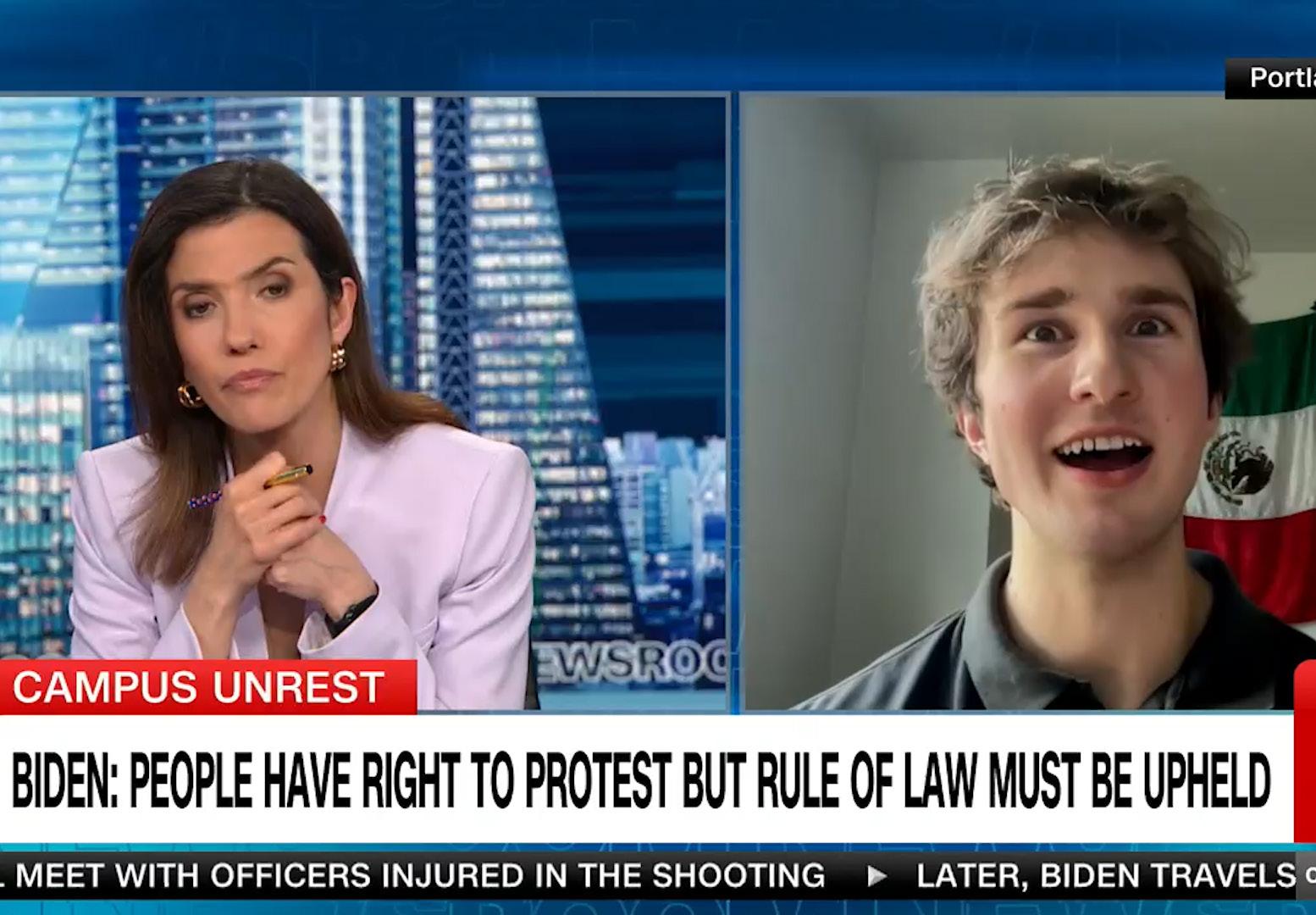
That story immediately threw me into the fire of the journalism world. Before that, my only experience in journalism came as an intern for my local newspaper in high school and as a sound technician for the local station. My first week covering that story consisted of more than 60 hours of work, multiple sleepless nights and my first appearance on TV as a journalist when I called into CNN International. To me, those sleepless nights and countless hours in the field mattered little. Any exhaustion or stress was masked by my love for what I was doing. I was telling a story through videos and giving a voice to those who needed it the most.
My love for video creation and storytelling didn’t start in journalism. I grew up, as many in my generation have, as a YouTube fanatic, which sparked my initial interest in video creation.
Over time, that interest became an outlet for my storytelling. Being lucky enough to grow up in a Spanish-immersion school the majority of my life, the only downside was that my writing in English was leagues behind that of my peers. This, coupled with my YouTube obsession, is why I began my journey in storytelling through videos. I found it to be the best outlet to express my ideas, using visuals to make up for what was lacking in my vocabulary and grammatical structure.
By sheer luck, the same issue that left me behind in my English writing had caused what propelled me to the forefront of the future of journalism; digital storytelling. This helped me land my first internship making videos for the local paper, and eventually led me to where I am today with Vanguard
The rise of social media’s popularity has been coupled with a decline in readership across the majority of physical newspapers. My goal is to ensure our social media coverage is playing a pivotal role in not only ensuring people’s feeds are filled with accurate information and reliable sources, but also guiding viewers to our website or print newspapers, helping promote the written part of our news. This rise in social media isn’t the first time journalists have been at the forefront of digital innovation, though.
“I think we had gotten our first digital camera at the Vanguard the year I was there,” Shanna Schlitz said, who served as Vanguard’s Photo Editor in 1999. “I certainly learned about digital photography because I had been film only up until that
point. I'd never had a digital camera until they handed me. I think it was like a Nikon D7 or something.”
As journalists, it’s a constant battle to be ahead of the curve and keep readers educated, informed and engaged. It’s no secret that readership for print journalism is dwindling, with weekday circulation dropping by 32% between 2017 and 2022, according to a 2023 Pew Research Center report. But this same report does provide some hope, as it details the success The New York Times has found by focusing on digital innovation, resulting in a 32% increase in digital-only subscriptions in 2022 alone.
This digital innovation is never meant, at least in the case of Vanguard, to replace our print newspapers. Our goal is to use these tools to promote the paper, as print will always be a part of our mission. Nothing feels better than seeing one of our readers walking around campus with our newest issue in hand.
Although Vanguard has been around for 80 years, our social media is one of the newest facets of our paper. I feel lucky to be playing a role in helping build this ever-innovating and changing part of our outlet, but more than anything, I am forever grateful that it has allowed me to connect with countless members of the community. The times I am approached in public by someone who recognizes me from our coverage makes me forget every sleepless night and unpaid hour, making me think only of the amazing people’s voices I’ve been fortunate enough to share.
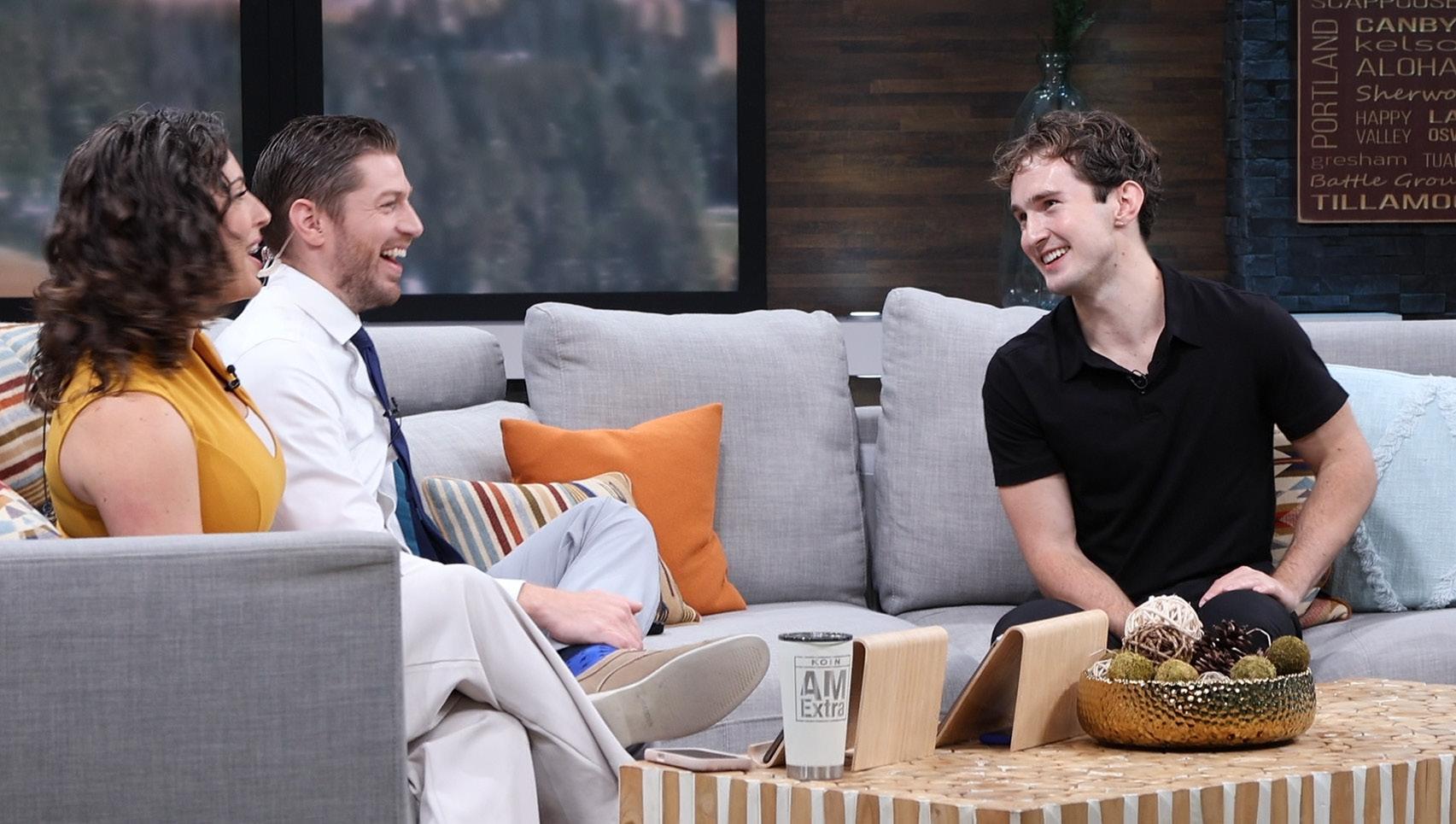
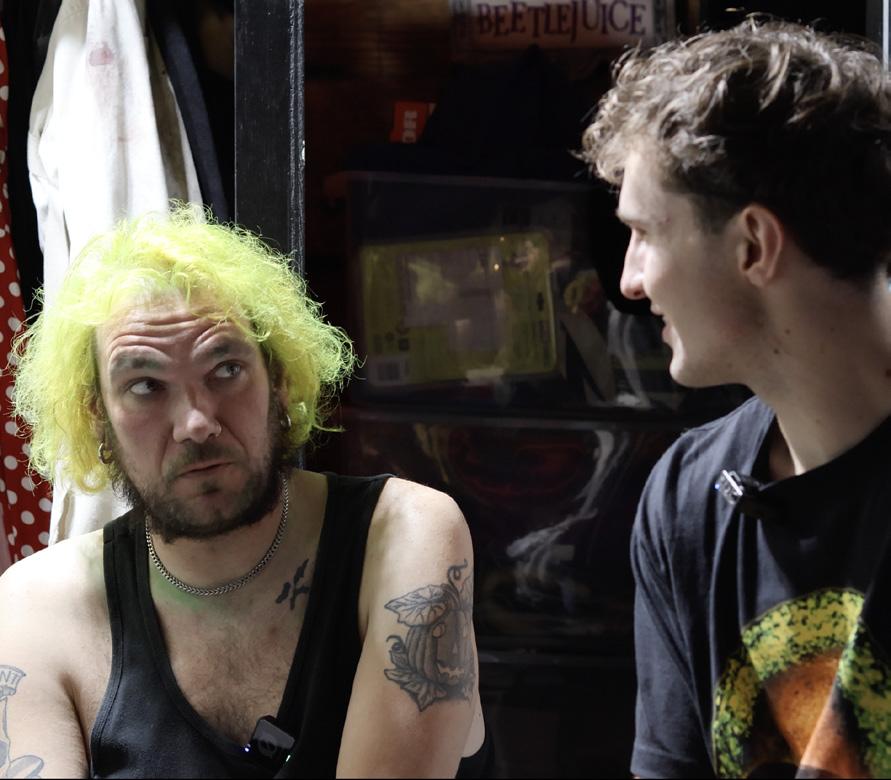
Schmitt interviews Beetle Juice scare actor. Schmitt appears in his first video covering Spring Library Protest.
Schmitt appears on "Move It Monday" broadcast on Koin promoting Vanguard's Portland Marathon coverage.
Schmitt appears on CNN discussing the Spring Library Protest.
To Arm or Disarm Campus Police?
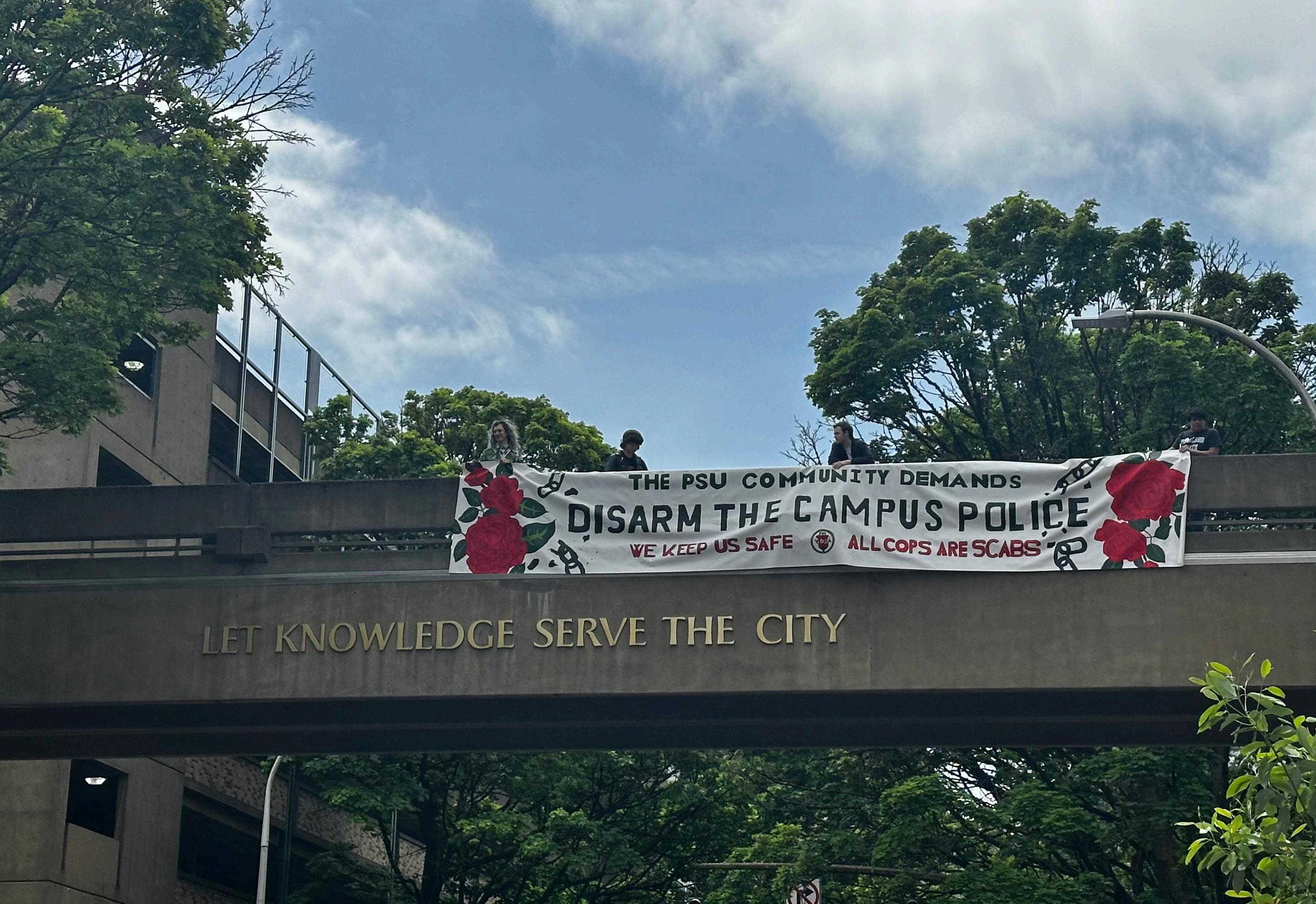
On May 20, 2026, members of the Young Democratic Socialists of America (YDSA) of Portland State University displayed a banner on the sky bridge that crosses SW Broadway Ave, that read “The PSU community demands, disarm the campus police… we keep us safe; all cops are scabs.”
Following this, on May 28, YDSA held a rally outside the Campus Public Safety Office (CPSO) to demand that campus police officers disarm. YDSA has had a series of protests to make its stances on campus safety heard. PSU has made on-and-off changes to campus officers from arming to disarming. The movement to disarm campus police has been ongoing for the past several years. Campus security has patrolled without firearms since PSU's establishment in 1946. However, beginning July 1, 2015, the PSU Board of Trustees voted to allow campus officers to carry guns.
On June 29, 2018, PSU campus Officers James Dewy and Shawn McKenzie killed Jason Washington on campus. According to body cam footage, Washington was seen near PSU between SW 6th Avenue and College Street attempting to break up a fight. The 17 shots fired by officers, resulting in Washington's death, caused outrage among students. Some students became involved in the movement to disarm campus police.
On Sept. 1, 2021, PSU stated that campus officers would begin patrolling unarmed. However, on Feb. 14, 2024, CPSO quietly rearmed some of its patrol officers. Since then, groups around campus like YDSA have been on a mission to disarm CPSO.
In consultation with the University Public Safety Oversight Committee, PSU Media Relations Manager Katy Swordfish addressed the administration's changes to firearm policies in an emailed statement.
“The department remains open to evaluating policies and practices that promote safety and community trust. Any adjustments to campus firearm policies would depend on a comprehensive evaluation of university safety requirements, current risk factors, resource allocation, and personnel capacity,” said Swordfisk.
Diego Pajuelo, the vice chair for PSU YDSA, was one of the members who spoke at the May 28 rally. He explained that YDSA has taken up the role of campaigning for the disarming of campus police due to tensions with law enforcement in communities across the country.
“We’ve seen an increase in state violence, particularly with [Immigration Customs Enforcement (ICE)] kidnapping people across the country,” said Pajuelo. “As well as the National Guard being sent to cities.”
YDSA began its campaign by focusing primarily on anti-ICE work, creating whistleblower
kits and distributing signage for people to put up in their classrooms. The signage stated that immigration officers are not allowed in campus buildings. Action to disarm also came after a lawsuit claimed that Oregon State University Police were assisting and sharing information with ICE.
“There is always a risk of the campus police working with ICE if they were to come on campus,” said Pajuelo.
Apart from protesting, YDSA has created a petition in the hopes of presenting it to CPSO to demonstrate the desire from students to disarm campus police
“We’ve got a petition that we are running, which has amassed 550 signatures from students,” said Olive Watson, the co-chair of PSU’s YSDA as well as a member of the Student Worker Union.
Watson explains that obstacles have stood in the way of achieving the group’s goals. Contact and conversation with CPSO have been difficult, as CPSO expresses a lack of desire to meet, according to Watson.
“They're trying to wait us out, hoping people will forget about it,” said Watson.
PSU is a commuter school, which brings YDSA another obstacle; many students are not on campus often enough to be aware of the issue. Raising awareness among students who take online classes or spend time commuting to campus has been difficult for YDSA.
YDSA argues that it is possible to keep a university safe without firearms, because PSU has done it before.
“We didn't even have [armed officers] until 10 years ago, and we have been a school since the 50s,” said Sierra Buhlert, secretary for PSU YDSA. “Lewis and Clark and Reed are both disarmed campuses, and they have done just fine, so it is not the only option to have guns on campus.”
While the movement has gained momentum, PSU remains committed to its stance. According to Swordfisk, there are no plans to update its firearms policy.
In the statement, Swordfisk said, “There is currently no predetermined timeline for changes to campus public safety policies. Future policy timelines are shaped by deliberate review, structural readiness, stakeholder feedback, statutory obligations and executive directives.”
While the organization has remained peaceful in its course of action, PSU YDSA said it might have to escalate its tactics to get the administration's attention. Tactics like shutdowns and sit-ins could assist in escalation. However, YDSA claims that walkouts are the most effective.
“We try and stay out of trouble, but we are not pacifists. We will do what is needed,” said Pajuelo.
DANIELA HERNANDEZ
PHOTO BY OLIVIA HENDRY YOUNG
Young Democratic Socialists of America display its banner on campus.
Beloved Political Science Professor Retires
Richard Clucas, Ph.D., a political science professor at Portland State University, announced his retirement at the start of the 2025-2026 school year. He’s worked for PSU for over 31 years, specializing in state government, legislative politics and democratic institutions.
From an early age, Clucas absorbed the political world around him. He watched the Democratic National Convention when he was 10, and some of his earliest memories are of the John F. Kennedy and Martin Luther King Jr. assassinations.
By the time he was in high school, Clucas knew he wanted to be a political science professor. He went on to receive his Ph.D. in political science from the University of California before teaching in the Santa Barbara area and in Wisconsin. He came to Portland State in 1995.
“A position open[ed] at Portland State that happened to be right in my area of expertise, and they hired me,” Clucas said. “I liked to say to friends at the time … I won the lottery. They also didn't want somebody who could [just] teach, and they also wanted somebody who could run the internship program as well, though I do know their number one concern had to be research.”
Clucas’ research focused on topics similar to his teaching curriculum. He’s co-written and co-edited a range of novels, and had his work published by numerous papers and magazines, including “Political Research Quarterly” and “Oregon Historical Quarterly.” Clucas has written with multiple authors from different backgrounds, including other professors, specialists and students.
Skylar Brocker-Knapp got her master’s in political science at PSU. While there, she wrote and published with Clucas. “Dr. Clucas was writing this chapter of this book, and so they kind of assigned me to him,” said Brocker-Knapp. “He needed someone to help him write it, basically do some of the research, write the first draft. And so he took a chance on me, which I really appreciated. And, you know, we kind of both learned along the way, and he was really magnanimous.”
Brocker-Knapp now works for the City of Portland as the director of Portland Solutions. Her time with Dr. Clucas had a
positive impact on her career and gave her skills she still uses in her day-to-day life.
“It was really a great experience for me to have somebody who was that experienced … to really take me under his wing and say, ‘No, we did this together,’” said Brocker-Knapp. “Not everybody does that, and I think that was a testament to him and his character.”
Debra Porta, the current executive director for Pride Northwest, was a nontraditional student when they were enrolled in Clucas’ classes. Originally from Texas, Porta found his Oregon Politics class especially helpful in navigating the Pacific Northwest— and that his lectures overall were helpful for their current job.
“It's one of those classes that I still use in my mind today,” Porta said. “It gave me a lot of perspective on navigating how to have conversations with people on that topic.”
Clucas is also the Politics & Global Affairs Internship Program’s coordinator. His students have interned in representatives' offices, the Oregon legislature, Washington, D.C. and even the Scottish Parliament.
Jessica Ventura, a PSU graduate who studied economics, took Clucas’ Capstone class. She interned at the Oregon legislature and now works as the Director for the Office of Immigrant and Refugee Advancement. She said the internship program helped get her career started, and that Clucas played a critical support role.
“He genuinely cares about Oregon politics and also cares about his students and the folks that really want to get involved,” said Ventura. “And I think he's kind of built that reputation and trust among policymakers to really connect students, particularly from PSU, to have those opportunities to connect to the legislature.”
Working with students as the internship coordinator was one of Clucas’ favorite parts of his job, as he enjoyed coordinating and building connections with students outside the classroom.
“I'd say it's the most rewarding part of what I do, because some of those students had never thought about some of the stuff that they were going to do, or they have, but it opens doors, and then they've gotten jobs and make careers out of it,” Clucas said.
After connecting 31 years' worth of students to career opportunities, educating thousands of individuals, winning awards and publishing novels, Clucas is known for his humility.
“I don’t think he would see his own impact to an extent … he’s just not that kind of ego person,” said Porta.
Brocker-Knapp agreed that Clucas was a boon for the Political Science department and the PSU community.
“I'm just one of many, many thousands of students who've been impacted by his great teaching and his kindness and his brilliance over the years, and so it's a gift,” said Brocker-Knapp. “He will be missed dearly. I'm excited for him for retirement, but I'm sad to see him go.”
Outside of PSU, Clucas is the executive director for the Western Political Science Association (WPSA). The WPSA is composed of more than 1,250 political scientists and is based at Portland State. It connects the western United States and the western provinces of Canada to conduct annual conferences. Clucas was elected the official executive director in 2009 and regularly attends panels.
“It provides a place where it's always doing what we call ‘cutting-edge research,’” Clucas said. “People study alternative research methods like us, because we're accepting of the alternative approaches, and we focus on a lot of issues … addressing women, feminism, environmental politics [and] minority politics.”
While Clucas is retiring, he’s not quite leaving the political sphere. He will finish out his term as the WPSA’s executive director until 2027 and stay connected to PSU as a professor emeritus. He says he’s excited for this transition because of the free parking and the opportunity to still help students achieve their goals.
“I really like being at PSU. I've had very good experiences. I think the political science department has only become stronger over the years,” Clucas said. “I am sure there'll be times after I retire that I'll miss it, particularly students. But you know, I probably won't miss all the committee meetings.”
Following his retirement at the end of the 2025-2026 school year, Clucas looks forward to traveling, resting and taking more tap dance lessons.
GRACE PETERSON
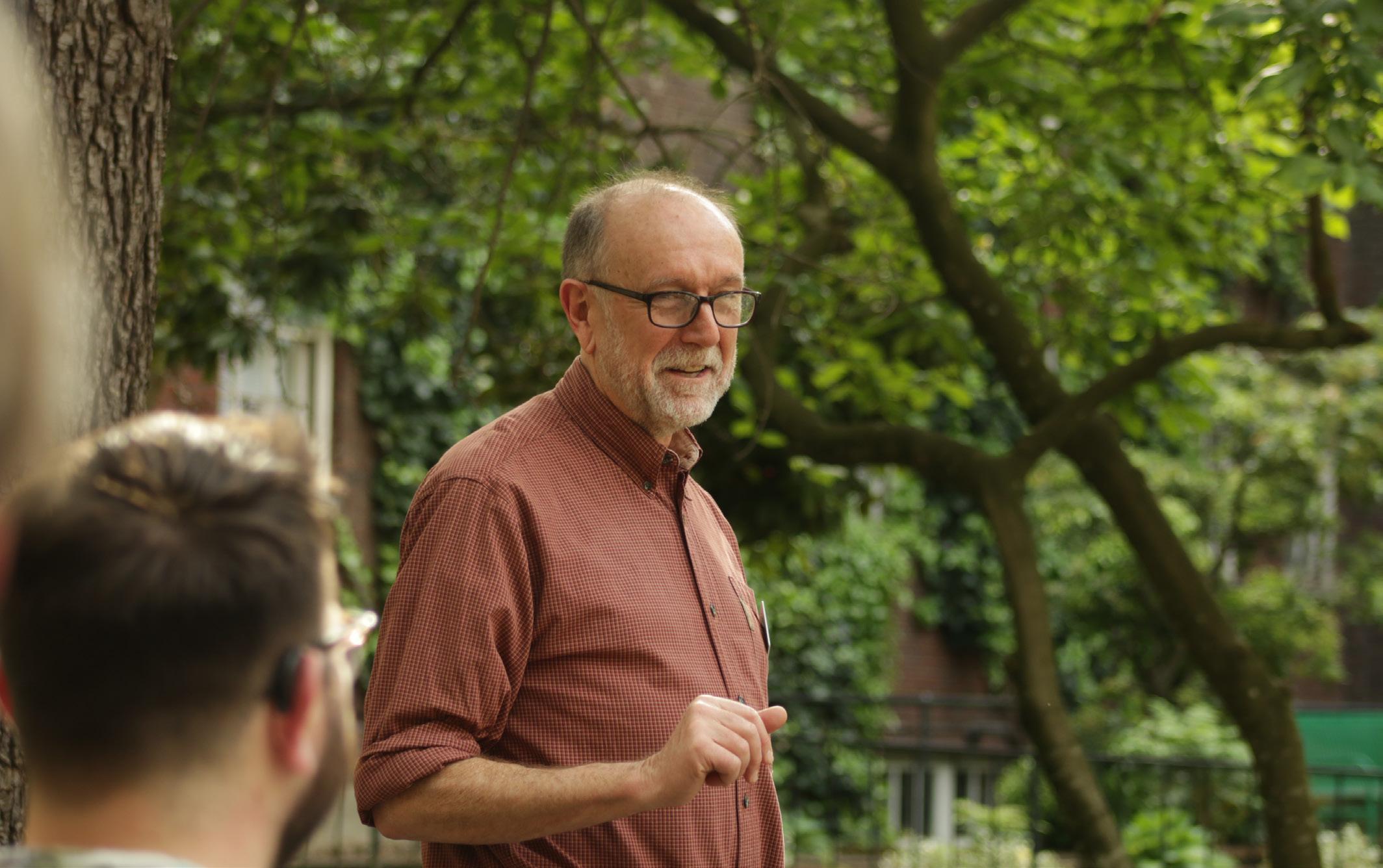
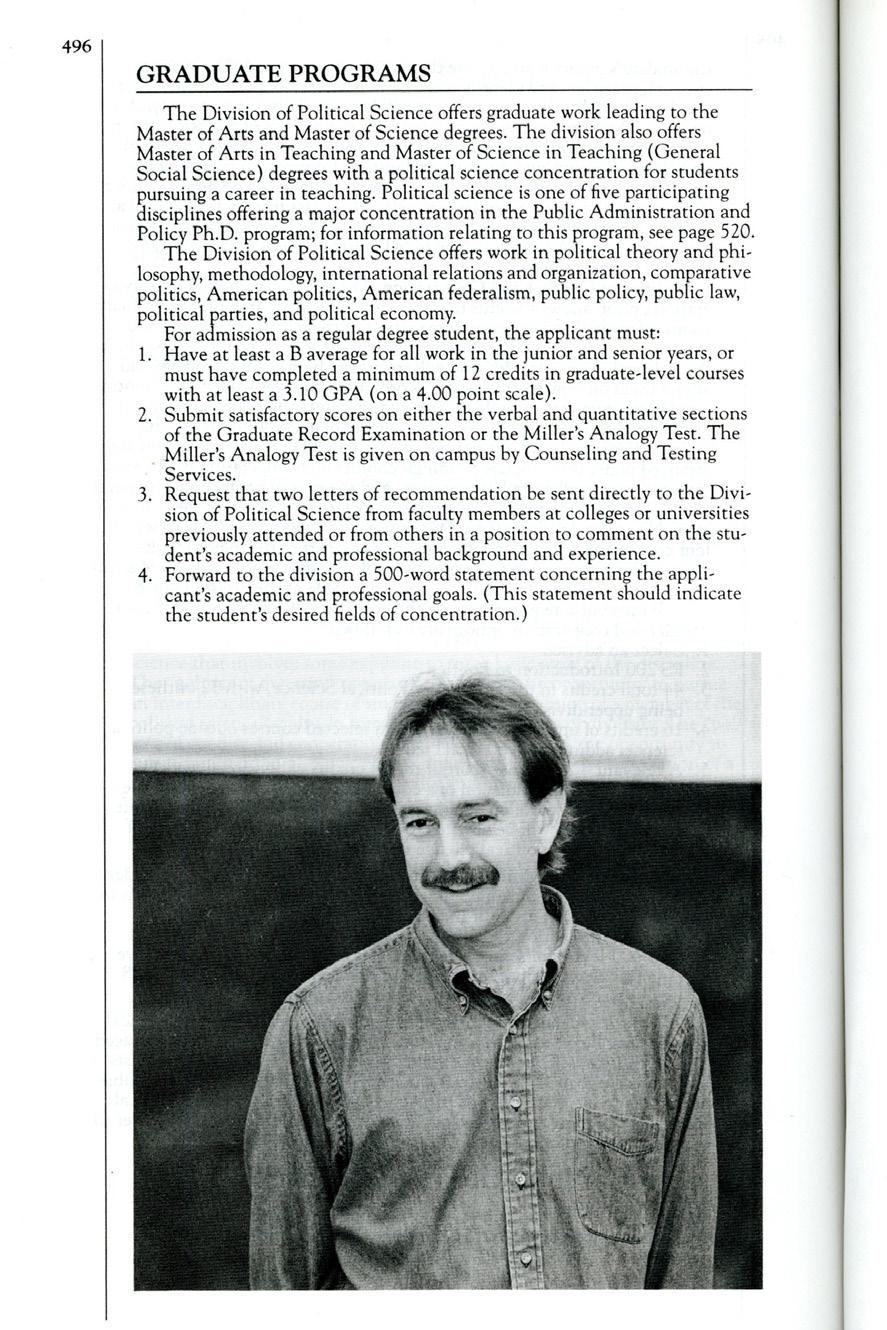
Dr. Clucas at an alumni event in 2025. Scan of the University Bulletin soon after Clucas began working at PSU. COURTESY OF RICHARD CLUCAS
When I wake up in the morning, I scroll on Instagram for a while. It’s ingrained in my daily routine. In between my funny dog videos and photos of my family, I get my news. More often than not, I see a meme about the news story before I see the actual article. For the most part, it’s short briefs about world and nation events — news on social media is consumable, small and thin. It also rarely dives into the real heart of the story. Rarely is it local. Portland isn’t frequently in the news, and it’s not always good news when it is. Instead, these stories on social media often stay broad. They have to make the story digestible and accessible to everyone from every corner of the Internet. If they don’t, the story won’t get reposted or rack up comments and likes. They end up writing stories for the clicks and the algorithm to remain relevant in an ever-changing digital landscape.
This rise in social media journalism has coincided with the decline of local papers across the country. The Oregon Journalism Project says more than a quarter of Oregon’s local newspapers have closed, and 68% of the state's cities lack a local news source. The Oregonian states that 75% of Oregon’s newspaper jobs have been eliminated in the past 24 years. The Skanner, a Black-owned Portland paper, formally shuttered in January after 50 years of operation. In 2024, Pamplin Media Group, the largest locally owned media company in Oregon, sold to a Mississippi chain.
Part of this is due to the business model. Some of Oregon’s publications suffer from out-of-state ownerships, meaning the media group that owns the ‘local paper’ isn’t actually local. Even worse, sometimes that out-of-state ownership brings in out-ofstate journalists to cover in state issues. They don’t write stories for the people in the town they represent, they write it for anyone to consume — they don’t get to the real heart of the stories. A journalist from Mississippi might be a great writer, but they aren’t an Oregon writer. They cannot write about local topics as well as a local can.
As stated earlier, social media — and online news, really — has had an effect on the business model as well. Don’t even get me started on AI, for that surely adds another unique layer to the onion.
As a journalist, hearing all of this is really discouraging. As a reader, I am outraged. I’m interested in world events, but I want to hear about local stories too. I want easy access to longer, indepth articles that show the local twist to a nationwide angle. I want to know about nearby events in my community and why they’re important.
Out-of-state newspapers won’t write that. How could they ever? They don’t know Oregon like Oregonians do. My hometown would never make it onto one of these social media buzzword salad bowl Instagram posts — it’s too small, too niche and wouldn’t go viral.
Local News is Shrinking. The Solution? Student Newspapers.
I have had the pleasure of reading good local journalism lately, from writers who know their local audiences. And of course, working for one, I find myself ever so drawn to student-run newspapers.
Nothing is more local than a student-run newspaper. These student writers know the ins and outs of their campuses, towns and communities. Their stories extend past students, faculty and professors; they reach their neighbors, families and local city governments. These papers tell the real story, with fresh sources and original takes. They don’t write for algorithms or for virality — they write the stories that need to be told. They write Oregon’s stories for Oregon readers.
Sometimes, these student papers are the only local papers in the town. They are the only opportunity communities have to engage with journalism and connect with each other. While states are closing down newspapers, students are staying resilient and vital to the continuation of local reporting. Due to this, many student papers cover stories that happen outside their campus — covering strikes, sports, businesses and more. If they don’t, who will?
Here in Portland, we are lucky to have multiple local outlets that provide coverage, including The Oregonian/Oregon Live, Willamette Week and Portland Mercury. We also have multiple news stations such as KATU News and KOIN who are based in Portland, and include our city in its statewide coverage.
But there are multiple areas across the country that are quickly falling through the cracks, and student newspapers are picking up the pieces. These areas are called “news deserts,” which, according to the University of North Carolina’s (UNC) Hussman School of Journalism and Media, are, “a community, either rural or urban, with limited access to the sort of credible and comprehensive news and information that feeds democracy at the grassroots level.” UNC also tracks the amount of news deserts across the country. For Oregon, they show that 17 counties fit this news desert classification — 15 counties only have one newspaper, and two, Sherman and Wheeler, have none. That’s over 464,000 Oregonians living within a news desert. In the counties with colleges and high schools, often student journalists are making up that difference.
It’s a huge weight for a student to carry, but these newspapers give back as much as they get. Even for students not looking to have a career in journalism — and, with the journalism economy, who’s to blame them — working in a formal publication offers a lot of skills. Connecting with community members, writing in a specific style, collaborating with a team, accepting criticism, engaging professionally; there is so much a newspaper can teach its staff members. These writers then go out into their communities as stronger versions of themselves.
Many people believe that journalism is a dying craft, and newspapers a dying business. I’d challenge that. While the world of journalism has shifted beyond its original description, I think the old-style flame is forever set ablaze by student newspapers. This passion remains in all forms of student media. Newspapers are critical, but so are literary journals and magazines. Radio stations and comic collections. Film groups. These are all ‘outdated’ ways of interacting with media, but it gives students a place to have their voices heard. Students can talk and hear about the things that matter to them, experiment with forms of media and meet like-minded or diversely-thinking individuals. Student media is necessary not just for campus, but for the greater community.
News is a critical part of daily life. While it is easy to just get sucked into the doomscroll headlines, I urge you to read a fulllength, local news story. Bonus points if it’s from a student organization. It is one of the strongest ways to support news and connect with the world around you.
GRACE PETERSON
Vanguard issues in the newsroom.
PSU's student media publications located in Smith Memorial Student Union.