

NEWS
Oregon K-12 Schools Face Education Funding Cuts
PSU-AAUP Makes Their First Ever Political Endorsement
May Day Protest Recap: PSU Unions,
Defend Migrants Alliance and More

NEWS
Oregon K-12 Schools Face Education Funding Cuts
PSU-AAUP Makes Their First Ever Political Endorsement
May Day Protest Recap: PSU Unions,
Defend Migrants Alliance and More
EDITORIAL
EDITOR IN CHIEF
Noah Carandanis
MANAGING EDITOR
Olivia Hendry Young
NEWS
Grace Peterson
Will Lowe
ARTS & CULTURE
Adyan Hussein
OPINION
Vacant
SPORTS
Neumann
Liam Schmitt
COPY CHIEF
Jude Callaway
ONLINE EDITOR
Karli Schwartz
DISTRIBUTION MANAGER
Caleb Dougherty
CONTRIBUTORS
Daniela Hernandez
Layla Phillis
Lilly Santangelo-St. Martin
PRODUCTION & DESIGN
CREATIVE DIRECTOR
Haley Hsu
CONTRIBUTORS
Naue Pagtakhan
Arielle Chhunkeo
ADVISING & ACCOUNTING
COORDINATOR OF STUDENT MEDIA
Reaz Mahmood
SALP ACCOUNTANT
Anne Le
STUDENT MEDIA TECH ADVISOR
Rae Fickle
STUDENT MEDIA TECH DEVELOPER
Kaylee Hynes
WEB DESIGNER
Owen Cook
To contact Portland State Vanguard, email editor@psuvanguard.com.
MISSION STATEMENT
PSU Vanguard’s mission is to serve the Portland State community with timely, accurate, comprehensive and critical content while upholding high journalistic standards. In the process, we aim to enrich our staff with quality, hands on journalism education and a number of skills highly valued in today’s job market.
ABOUT Vanguard, established in 1946, is published weekly as an independent student newspaper governed by the PSU Student Media Board. Views and editorial content expressed herein are those of the staff, contributors and readers and do not necessarily represent the PSU student body, faculty, staff or administration. Find us online at psuvanguard.com.

Oregon’s Kindergarten through grade 12 schools may soon be facing an educational crisis. Districts across the state are showing a trend of declining enrollment, budget deficits and a lack of federal funding, resulting in widespread budget cuts.
Districts are now releasing their proposed budgets for the 2026-2027 school year, with cuts expected to affect programs and cause faculty layoffs. Portland Public Schools (PPS), Gresham-Barlow (GBSD), and Reynolds School District are among the many school districts that will be severely impacted.
Concerns rose after Oregon’s 4th-grade reading scores ranked last among all 50 states. Recently, Oregon was found to rank 47th out of 50 for the lowest instructional time for K-12 students in the United States. Governor Tina Kotek responded to the data by issuing Executive Order 26-06, which prevents schools from reducing instructional time for students.
“This order makes clear: protecting and strengthening student instructional time is essential to improving student achievement and setting our kids up for long-term success,” said Kotek in her press release.
The potential Oregon education crisis is influencing higher education, including Portland State University. Within the New Proposed General Education Program, the First-Year seminar and Transfer Bridges reflect how students coming out of high school are not prepared with necessary workforce and higher education skills. The plan emphasizes learning about email writing, comprehension skills, time management and note-taking strategies.
Associate Dean of Academic Affairs for the College of Education at PSU, Amanda Sugimoto, Ph.D., understands that amid budget cuts, schools must make tough decisions about what best serves students.
“Schools must find ways to meet the Governor’s executive order to preserve student instructional time while reducing expenditures. The College of Education is proud of its partnerships with Oregon districts and its ongoing collaborative work to meet local workforce and student needs,” said Sugimoto in an emailed statement. Within the proposed district budgets, reductions are calculated in dollar amounts or Full-Time Equivalent (FTE), a unit of measurement used to determine staff or student workload. FTEs that are whole are equal to the staff who are full-time, while anything in between is considered part-time.
PPS is planning a $50 million budget cut that will impact staffing in schools and the central offices. Elementary schools in the district will lose an estimated 73 full-time staff members. Middle schools will prepare for a reduction of 40 instructional coach staff members and interventional and behavioral support measures will be removed, totaling $6.3 million. High school students will face a $1.5 million reduction of resources for credit recovery assistance, college and career readiness and the arts pathway. All schools in the districts are planning for class size adjustments due to the overall decline in enrollment. The reports finalized the reductions at $50 million, totaling 288 faculty members.
“My school has been gutted by cuts over the past several years. We have lost dedicated educators and support staff. It has impacted staff morale, school climate and student achievement,” wrote Kirsch in an emailed statement. Elizabeth Kirsch is a journalism and English teacher at Franklin High School.
According to Kirsch, teacher lay-offs and budget cuts to programs cause shifts in students’ and staff education attitudes. The loss of dedi-
cated educators leaves students without the academic and emotional support needed to guide them through their academic careers.
PPS summarized the report with reductions to experienced educators. However, an increase of $1.8 million will be seen in the amount of lunch and recess staffing resources.
“Like many school districts across the state, we are forced to make some painful decisions to balance our budget,” said Superintendent Tracy Klinger in the GBSD 2026-27 Budget Update.
The 2026-2027 Budget Reduction List for GBSD was designed to close its $10 million funding gap. For elementary schools, there is a projected districtwide reduction of 9 FTE classroom teachers, 9.5 FTE music teachers, 3.8 FTE multilingual learner specialists, and 1 counselor. Middle schools will have to let go of 10.5 FTE classroom teachers, 1.5 FTE counselors and 0.5 FTE multilingual specialists. 8.34 FTE high school classroom teachers and 2 counselors will also be laid off. The reduction list for the district totals 69.93 staff members, with a total savings of $10.48 million.
In GBSD’s 2026-2027 Proposed Budget Report, tutoring services and the Summer School programs are also facing extreme cuts. Tutoring services will move from a total budget of $52,250 in the 2025-2026 school year to $25,373 for the 2026-2027 school year. The Summer School programs in the district will have a proposed budget of $5,100, opposed to the $91,528 budget for the 2025-2026 school year. Additionally, the Advancement Via Individual Determination (AVID) program provides tutoring, along with after-school programs and work-time sessions. Since these programs are also being reduced or cut, this further reduces all tutoring sources.
“Lower birth rates, the impacts of [Immigrations and Customs Enforcement]
activity and unaffordable housing are significant factors. Enrollment is the main factor in the state revenue formula for funding schools, and when enrollment drops, so does funding,” said Frank Caropleo, the Superintendent for the Reynolds School District.
With the $20 million reduction, the 20262027 Proposed Budget for the Reynolds School District estimates 172.76 FTE staff members will be laid off. Elementary school programs are said to be reduced by $1.19 million. Middle school programs have an estimated $1.81 million, while high schools have a $1.08 million reduction. Guidance services in the district will suffer a $826,319 reduction, and sectors such as student safety, health services, assessment and test resources are also facing reductions.
Many school districts have taken the approach of reducing programs and laying off staff to cut costs. Teachers and staff have now needed to turn to legislation for change and find an advocate for students’ education.
J. Schuberth, a former Portland State University University Studies professor, has taken action to prioritize Oregon Education by forming Pencil4Governor. Pencil strives to improve education for K-12 students. Brady Roland is a campaign Organizer for Pencil4Governor, and they emphasize the need for legislative action to improve the Oregon education system. K-12 education is necessary for higher education and for job growth. Referring to faculty and administrators who are not directing funds towards classroom improvement, Roland points out that when one part of the educational sector suffers, the rest of the educational system does as well.
“They are not budgeting. No one wants to pick up the slack, so at this point it’s not about telling your leaders, it’s about getting new leaders because these ones won’t do it,” said Roland.
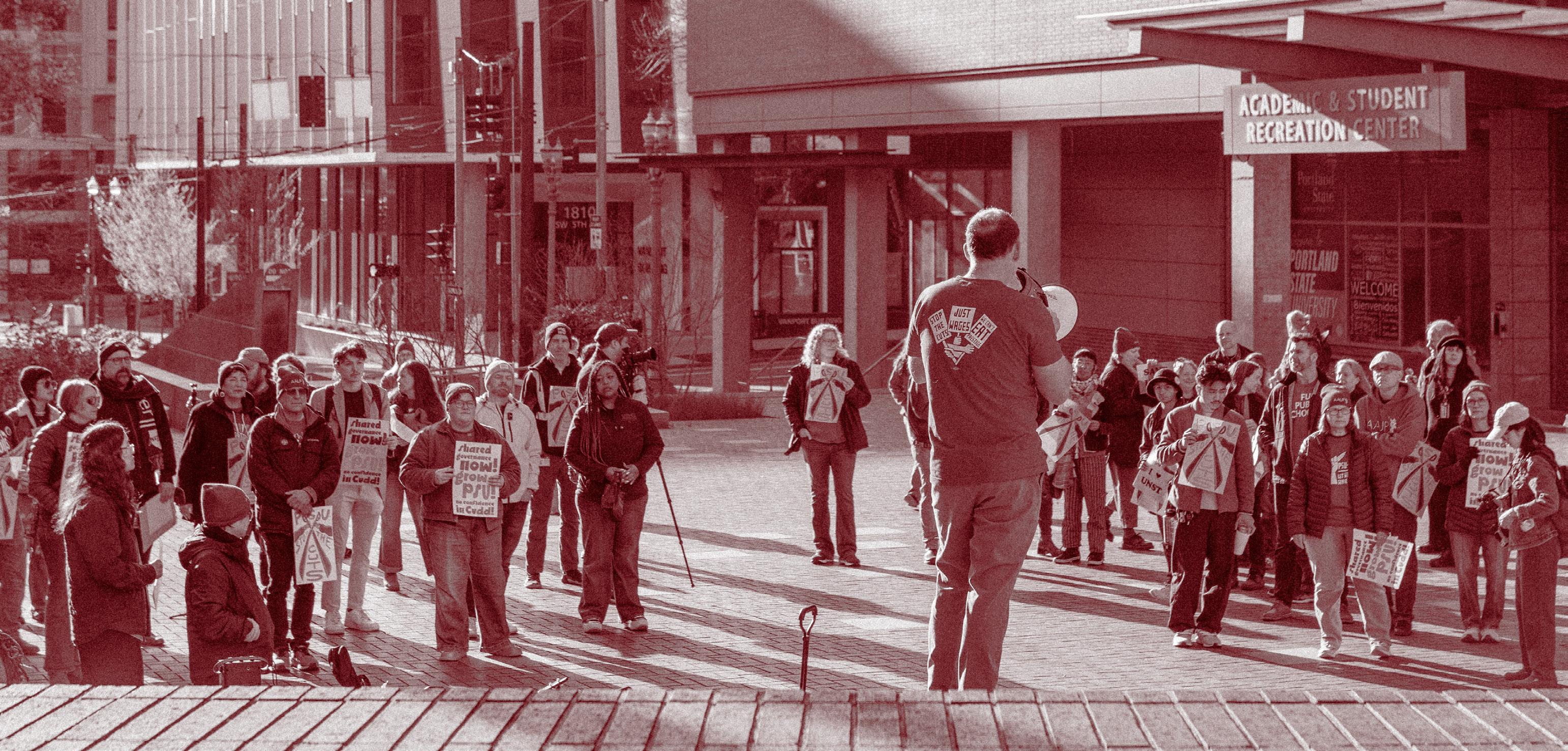
For the first time in its 48-year history, Portland State University’s chapter of the American Association of Professors Union (PSU-AAUP) have made political endorsements in the hope of working toward solutions for Oregon’s higher education funding concerns.
Oregon Public Broadcasting reports that Oregon ranks 46th in the nation for per-student state funding for public universities. This ranking drove PSU-AAUP to make political endorsements. The group believes that with the right people in office, changes can be made.
Dr. Tammy Carpenter is one of the five politicians who received an endorsement from PSU-AAUP. Carpenter is in the race for House District 27.
Carpenter’s website states, “All adults should be able to continue their education without taking on debt, and parents shouldn’t have to spend more than half their salary on childcare.”
Evelyn Kocher is running for Beaverton City Council; she’s focused on immigration, housing, transportation and LGBTQ+ rights. She received her endorsement from PSUAAUP for her support, and goals, towards funding higher education.
Myrna Muños is in the race for State Senate District 15. She currently serves as an Education Specialist at the Oregon
Department of Education. According to her website, she collaborates with different agencies to advocate for students’ civil rights. She also received an endorsement from PSU-AAUP for her support of higher education funding.
David Osborn, who’s running for the Oregon State Representative seat, also received an endorsement from the union.
According to his website, Osbon is in favor of supporting teachers, lowering class sizes, investing in proven practices, increasing student achievement and making college affordable again by lowering tuition.”
John “Waz” Wasielewski is running for House District 38; one of his top priorities is education. His website states that he has experience advocating for students and educators.
Karlyn Adams-Wiggins, PSU-AAUP’s Vice President for Legislative and Political Action and associate professor in the psychology department, is a first-generation college student and very passionate about education affordability. This is the first election cycle Adams-Wiggins has gone through in her role as Vice President. She felt there was a need to endorse candidates who would advocate for funding higher education.
“Tuition hikes can’t be the answer,” Adams-Wiggins said. “I know students personally who have been made homeless as a
function of trying to go to school here. To me, that’s absolutely horrifying.”
Bill Knight, president of PSU-AAUP, emphasized the importance of not funding higher education by raising tuition. Knight explains that there must be another solution to this issue, whether it is from new revenue or a wealth tax.
“We’ve raised tuition 12 years in a row at PSU, and every time it’s at least 5%. It’s this horrible situation in which students are asked to bear this burden for the state’s bad political decisions,” Knight said.
According to Adams-Wiggins, higher education is under attack at the federal level.
Coupled with PSU’s current funding crisis, it made sense for PSU-AAUP to make political endorsements this election cycle. State funds are vital to how institutions operate— because of this, the union endorsed candidates who are committed to understanding that.
“We look to see who’s actually taking a stance in favor of finding a way to fund public higher education,” Adams-Wiggins said. “The candidates who we opted to endorse were very strong on the revenue question in terms of ‘How are we going to afford this?’”
Knight affirmed this sentiment, agreeing that their choices for political endorsements were based on which politicians are pro-funding and pro-education.
“These candidates want change,” Knight said. “They’re doing so in the interests of what we think of PSU. We want their candidacy and [to] help them get to Salem. That way, we can pass some legislation that will help serve PSU in the end, a lot better than the present.”
For PSU-AAUP to advocate for PSU, it needs representation in Oregon’s capital so it can be more directly involved with politics.
“I think there are a lot of ways it serves our interest to have the capacity to endorse, and we’ve taken that opportunity now because the political situation is really dreadful,” Knight said. “What we face here at PSU is a direct outcome of that situation.”
Adams-Wiggins explains that each candidate, as well as their competitors, completed a questionnaire provided by the union. Each candidate’s responses to the questionnaire were reviewed by the committee attached to the vice president. From there, each endorsement was made.
Though this is PSU-AAUP’s first-ever time making political endorsements, it is not unheard of for unions to endorse candidates. Knight mentioned that PSU-AAUP’s endorsements aligned with the Portland Community College faculty union. Going forward, the support of local and state governments may be further incorporated to fix the budget crisis that PSU is currently facing.

HAYDEN NEUMANN
Just a few days before turning 25, Tre-Vaughn Minott received the birthday gift of a lifetime: a phone call with an offer to play professional basketball for Šiauliai Basketball Club (BC). On April 24, 2026, two days after his birthday, Minott was on a plane to Lithuania.
“Man, it was such a fast turnaround,” said Minott. “I didn’t even get to catch a lot of people before I left. It’s been an adjustment, but I’m making it work. Lithuania is fun. It’s nice to see a different side of the world.”
Hailing from Montréal, Québec, Minott began playing basketball at the age of seven, and realized he could pursue it seriously as early as eighth grade. His primary focus at that age was music, and would leave basketball practices early for band rehearsals. His wake up call was when a coach told him he would be off the team if he didn’t show up.
“I wasn’t the best at it,” said Minott. “I’d often get clowned for how I would run. I was struggling with it at first, but I had one practice where I did very well. And I was like, man, maybe I should take this basketball stuff seriously. I had this mindset switch. I was all in on basketball.”
Minott started his college career at the University of South Carolina in the 2020-21 season, where he spent three seasons playing 29 games with five starts. Due to the 2020-21 COVIDwaiver season, he had junior eligibility, which granted him an extra year of play. In 2023, he entered the NCAA transfer portal, which was when the coaches at Portland State University saw their chance to take him.
“He was technically in his fourth year of college with us,” said Associate Head Coach Matt Dunn. “He had a COVID year, so we knew we’d have him for two years. His first year with us, he had a really good summer, but he actually got sick, and that set him back when we started up in the fall. He wasn’t doing bad — he just wasn’t doing well enough to play minutes.”
Around Christmas break, 2023, Dunn called Minott into his office. He told him he could do a lot more if he put his mind to it and encouraged him to shift his mindset. This conversation was the catalyst for Minott’s career. When he returned from Christmas break, he was immediately in the gym at six in the morning, a schedule he would stick to, Monday through Friday, for the next two and a half years.
“If it wasn’t for Coach Dunn bringing me to his office for that talk, I have no clue where I’d be right now…if it wasn’t for him,
none of this would happen. I wouldn’t have had the mindset switch. I wouldn’t have had the work ethic,” said Minott. “He’s taught me so much about life, not just basketball. I’m extremely grateful for him.”
The mindset shift and hard work paid off. Minott went from averaging one point per game his first year at PSU to two-time Big Sky Defensive Player of the Year. Additionally, he led the Big Sky Conference in rebounding and double-doubles his last season at PSU.
“He’s probably one of the hungriest players I’ve ever coached,” said Head Coach Jase Coburn. “He did a really good job of focusing on a standard and holding himself to it. He really committed himself to it, and that’s why I believe he’ll be a really successful professional basketball player, because of that mentality he has.”
Outside of basketball, Minott’s productive mindset has influenced how he lives his life in general. Despite the shift in focus from music to basketball, music has remained a large part of Minott’s life. He’s the owner of the independent record label, Visionary Sounds.
“I knew so many people who were talented but didn’t have the proper platform or content to be able to push themselves out there,” said Minott. “And I thought about it, and was like, ‘You know what? Why not just start a record label?’ So I started it last year.”
He founded Visionary Sounds with a group of friends he’s known since elementary school and has been working on it every day since. He says the main goal is to develop a platform for artists and creators to market themselves and get their names seen.
Originally, after a long day of basketball, he’d come home and stay up until one or two in the morning playing video games. Now, he stays up late making music, putting his energy into something that benefits him.
“I’m always just at home, working on the music,” said Minott. “It’s a great way to decompress from basketball, because I spend so much time on basketball, ridiculous amounts of hours on and off the court and in the weight room.”
Coming into a new team can be a daunting experience, especially when it’s in a foreign country. Not only are expectations high, but there are a multitude of new challenges to face, such as a new language, different cultural norms and a higher speed game. Coburn insisted that if anyone could handle it, it was Minott.
“He’s mentally ready to be a professional basketball player,”
said Coburn. “I’ve always known he’s going to be successful at whatever he chooses to do. He’s not just a professional basketball player, he’s a professional person too. That’s what separates him from other players. He’s ready for sure.”
Minott speaks French, Haitian Creole, and can understand some Spanish and Portuguese. Lithuanian isn’t one of the languages in his repertoire, however. He says the language barrier has been difficult for him as he integrates into the new country. “It’s easy when I’m with my teammates on the court, because we all speak English,” said Minott. “But it’s a little harder when I’m trying to order food. But I mean, it’s fun. I’m trying to learn some Lithuanian while I’m out here too, just to ease my way in.” Minott’s contract has him playing for Šiauliai BC for the remainder of their season. Whether or not he can make it back in time for his graduation ceremony at Portland State depends on how far the team makes it in the playoffs. While he may not immediately have the same minutes of playing time as he did at Portland State, this is his chance to prove himself as a valuable player on and off the court, and he says he plans to do just that.
“I’m extremely grateful for this opportunity,” said Minott. “Not many people could say that they went straight from college to a pro team. That's something I'm never taking for granted. Every day I’m learning something new about how the game works [at a higher level] and how to operate in this professional space. It’s still the same game, but a step further.”
The transition from a collegiate setting to professional has been more than exciting for Minott, allowing him more free time for his music projects alongside full time basketball. Not only are NCAA Division 1 athletes required to maintain a 2.3 grade point average, but Minott was the only player on his team who took in-person classes due to unique requirements for international students.
Minott joked that he had “senioritis” for the last two years of his college career and was relieved to have graduated. Despite the stresses of schoolwork, Minott stressed just how much he enjoyed his time at Portland State, stating Portland has become a second home for him.
“I love Portland,” said Minott. “I'm for sure going to visit 100 times, 1,000 times. Portland has my heart forever. I’m so grateful for the community, for the fans, for the city, just everything. I just love Portland.”

From Yemeni tea traditions to Lebanese slang to Libyan wedding customs, the Arab world encompasses a vast range of cultures that are often generalized. While each culture holds its own traditions and values, together they reflect the depth and diversity of the Arab identity.
The annual event “Arabian Nights,” hosted by the Arab Students Association, brought together communities throughout Oregon to celebrate the diversity of Arab culture through music, food and performances. Guests arrived in their traditional attire and filled the Portland State University ballroom with cultural pride and vibrancy on May 9, 2026.
Among the attendees was Hager Arheim, a Libyan student in the Early College program at Tigard High School and Portland Community College. Arheim has observed different ways her culture has diverged from what is expected of the typical Arab social gatherings.
“I think most Arabs would be surprised because Arabs are known for their extravagant [mixed] weddings and all their parties, but [Libyans] don't really partake in co-ed,” said Arheim.
These expectations influence how social events are organized and experienced in the Libyan community. Gatherings such as weddings are structured to separate men and women, dividing the space according to traditional social norms.
“We are a Muslim country, but unlike a lot of other Muslim countries, we are very strict with our co-ed versus separate parties. You will never find a mixed wedding in Libyan culture [and]
you will never find men and women hanging out together casually. It's very strict on that,” said Arheim.
The structure of Arheim’s culture also extends to her daily habits. In her family, there is a strong emphasis on cleanliness and maintaining an orderly home.
“My mom was very, very strict. She says every single morning when you wake up, you have to spend at least two hours cleaning before you're able to rest. When I was younger, this was the worst thing ever, but now I think I've learned that it helps me get through my day better if I wake up and I just get everything done immediately,” said Arheim.
Other elements of Arheim’s life center on more playful traditions, like adding humor and song to everyday conversations. This habit is further shared across multiple Arab cultures.
“In Libya, it's very common to rhyme and make songs out of everything,” said Arheim. “You could [ask] your mom, ‘where'd I put the cup?’ and she'll randomly burst out into song, some random rhyme her grandma made up years ago.”
Similar cultural expressions manifest across different regions. Amah Alshaibah, a PSU student from Yemen, has observed how the enjoyment of television was passed down through her family.
“When I was younger, I remember my mom would always watch a certain show or series. I never thought I would do that, but as my parents have grown older… I've done the same,” said Alshaibah. “There are a bunch of Yemeni shows — you find them on YouTube, and they're liter-
ally filmed on an iPhone, but it's okay. They're good.”
Physical objects from her home also hold important sentimental value, such as a dallah, a traditional Arab coffee pot with a larger body and long flared top. These pieces serve as a reminder of her home and heritage after moving away.
“I have this dallah qahwa from when I was really little…somehow it still holds the smell of my grandma's room from our house in Yemen,” said Alshaibah. “One of the things that my mom brought when we moved was something called Aziza. It's a small handheld vacuum, and you operate it by rolling it around the carpet. I still use it like every day.”
These objects are passed down to keep traditions alive, allowing the new generation to maintain a connection with their culture — even when they aren’t in their home country.
“My mom has this medara. [It’s a] bowl that we use to cook selta in, which is a traditional Yemeni dish. I think I'd want to pass that along to my kids, or use it in my own family,” said Alshaibah.
Another crucial aspect of Arab culture is traditional food. This includes dishes that may seem unfamiliar to some, but for others, like Jad Saad, they are considered a community delicacy.
“Eating raw meat is definitely something that many people would find surprising. It’s definitely not traditional here, especially in the West, and even in other Arab countries, you don't find it too often,” said Saad. “[We] typically have beef mixed with wheat and spices, drizzle it with some olive oil, and then [we] usu-
ally have it with some bread as well.”
Hospitality and generosity are greatly valued in Lebanese culture. Welcoming others and sharing their food are important expressions of cultural pride and connection.
“I feel like Lebanon, if you ever have the ability to go visit it, is a place where you'll feel at home no matter where you go. At every single corner, if you ask for a bite to eat because you don't have enough money, anybody will be happy to give you a free sandwich. Truly, the nicest people I meet are down there,” said Saad.
An important celebration in most Arab cultures is Eid, an Islamic holiday with two major celebrations: Eid al-Fitr and Eid al-Adha. Eid al-Fitr marks the end of Ramadan, whereas Eid al-Adha occurs during the annual Hajj pilgrimage season — roughly two months after Ramadan. These holidays are celebrated with specific communal prayers, charity, community gatherings and friendly greetings.
“When we were younger, we’d get money, but we're too old for that now, so we're the ones giving it out. We usually put on our nicest clothes and head to the masjid and do our Eid prayer, and then get some breakfast or lunch right after — [we] just spend it as a family,” said Saad.
Across these different cultures and identities, experiences as small as everyday habits or as big as major celebrations are often more nuanced than common stereotypes suggest. Rather than fitting into a single, simplified narrative, the Arab world is shaped by a wide range of regional and cultural differences.
Several protests took place across Portland, including threats of arrest outside President Ann Cudd’s office

May 1, otherwise known as International Workers Day or May Day, marks the organization and enactment of pro-worker protests across the world. Several protests happened around Portland, with one of them, organized by different Portland State University unions, taking place right on campus.
Protests are historically held to honor the Haymarket Affair of 1886, when seven police officers were killed in a labor protest and seven protestors were sentenced to death. According to Oregon Public Broadcasting, members of the labor movement believed they were sentenced to death because they were immigrants, not because they’d actually committed a crime.
For May Day 2026, members of every campus union participated in a protest in the lobby and eighth floor of the Richard and Maurine Neuberger Center (RMNC). The eighth floor holds the Office of the President, where the protestors stood outside. This protest came in response to potential cuts coming to the university and dissatisfaction with President Cudd’s enactment of Article 22. Currently, 19 departments are facing potential cuts, with three facing elimination.
“She is threatening the worst austerity measures that have ever occurred in PSU history. We are at risk of losing 200 jobs ... We are here as a last and final stand against the austerity measure,” said Olive Watson, member and active organizer of PSU’s Student Workers Union (PSU-SWU) and co-chair of PSU’s Young Democratic Socialists of America chapter (PSU-YDSA), who was present at the protest.
Other unions represented at the protest included PSU’s chapter of the American Association of University Professors (PSUAAUP) and PSU Graduate Employee Union (PSU-GEU).
Shortly after entering and protesting in the RMNC lobby, the protestors attempted to go to the eighth floor via the elevators, but the elevators were not working. Protestors believed that the elevators were put on lockdown, though the Vanguard has not independently verified this.
The protestors took the stairs to the eighth floor after the elevator lockdown, eventually stopping in front of Cudd’s office. Protestors held signs reading, “Cutting Programs Means Cutting People,” and stuck an adhesive note reading “The butcher of PSU” over Cudd’s office’s name plate.
According to demonstrators, CPSO arrived about half an hour later and issued the group their first warning of potential trespassing. After another hour, a second warning was issued, and protestors were informed that a third would result in arrest.
While occupying, union members voiced their concerns about the university’s future. They discussed the impact of the cuts, how they will affect the student body and their dissatisfaction with Cudd and her administration. Protestors remarked that Cudd isn’t doing enough to reduce PSU’s deficit without affecting personnel.
“Instead of doing her actual job she makes $700,000 a year from, she has decided to do the easy thing and fire people,” said
Sloan Oakrest, president of PSU-GEU. “We have to be very clear about ... the way that they treat us. They are making very clear choices about whether or not they value actual education.”
Around 8:30 p.m., the protestors left the eighth floor and the RMNC on their own accord. Protestors addressed the crowd outside the building, vowing they’d return.
“They only care about their real estate projects, they care about commerce, they care about business, they don’t care about education. They are not letting knowledge serve the city,” said Watson.
Outside of PSU, some larger protests were spearheaded by the Defend Migrants Alliance (DMA), a Portland-based organization that works closely with the International Migrants Alliance (IMA). The IMA is the “first-ever global alliance of, for and led by grassroots migrants, refugees and displaced peoples,” and works to support migrants in the face of exploitation, racism and xenophobia, according to their website.
The focus of DMA’s May Day protest was on protecting the rights of migrant workers, protesting against Immigration and Customs Enforcement and promoting solidarity among marginalized groups. It began in the South Park Blocks by SW Main Street. From there, protestors made their way up Main Street before heading south on 11th Ave. According to KATU News, over a hundred people participated.
DMA worked closely with IMA through their week of action from May 1 to May 8, 2026. Each day had a theme of support and mobilization focused on different marginalized groups.
But DMA and IMA weren’t the only groups holding protests. The group Sunrise Reed mobilized in the lead-up to May Day to protest funding cuts to Oregon. Sunrise Reed is a Reed College subset of the organization Sunrise Movement, which focuses on youth-driven climate activism.
“This action occurred in the lead up to massive mobilizations for May Day, in which people across the country are taking action to win a world that works for us,” stated Sunrise Reed’s press release on the protest.
Students from multiple schools throughout Portland walked out on Thursday, April 30, 2026. This included both high school and college students, with participants from Grant, Franklin and Northwest Academy high schools, as well as Lewis & Clark, Reed and PSU.
The initial plan was for the walkouts to take place on April 29, but it was pushed back a day “due to PPS furlough days as a result of Oregon shifting away from funding public education,” according to the Sunrise Reed press release.
“We know that students and workers are often on the frontlines against authoritarianism. We’re building a mass movement rooted in solidarity and centered on the idea that our schools and communities should be prioritized over corporate interests,” says Lucy Breuer, an organizer with Sunrise Reed.

In “Swimming” and “Circles,” Mac Miller details the loop of addiction: heal, swim, drown, repeat. A month after “Swimming” was released, he died of an overdose, leaving “Circles” unfinished. Even somewhat incomplete, the two albums fit together like puzzle pieces.
When Mac passed away, he was roughly 90% finished with “Circles.” The album was meant to be the second installment in a concept trilogy about mental health, addiction and personal growth. Despite its abrupt end, the relationship of the two albums is clear: “Swimming” serves as the other half of a mirrored loop, soulfully capturing the Sisyphean nature of healing and recovery.
Addiction isn’t a battle you win once; it’s a continuous struggle. “Swimming” immediately establishes this exhaustion, dropping the listener amid the audio waves and melancholy lyrics of “Come Back to Earth.” The album, as a whole, feels like treading water in a vast ocean. It beautifully contrasts peaceful production with heavy and vulnerable lyrics about struggling to keep your head above water, swimming to find relief.
The end of “Swimming,” a soaring synth outro meant to signify Mac’s ascention to heaven, perfectly transitions into the first song on “Circles” (“Circles”), preparing you for the fall back to earth. This fall, however, is accompanied by acceptance. The album relies heavily on singing, emphasizing the importance of relinquishing the desire for complete control amidst the weight of depression, addiction and the messy world we live in. The parallel between “Perfecto” and “Blue World” encourages us to understand that our greatest freedom lies in how we react to things.
“Swimming” displays growth through exertion — the act of fighting as proof of progress. In “Circles,” the perspective evolves: true maturity is realizing the water isn’t going away, so you might as well learn to float.