Special Frosh Issue Friday August 7, 2026 vol. CL no. 15
Founded 1876 daily since 1892 online since 1998
Twitter: @princetonian Facebook: The Daily Princetonian YouTube: The Daily Princetonian Instagram: @dailyprincetonian
{ www.dailyprincetonian.com }
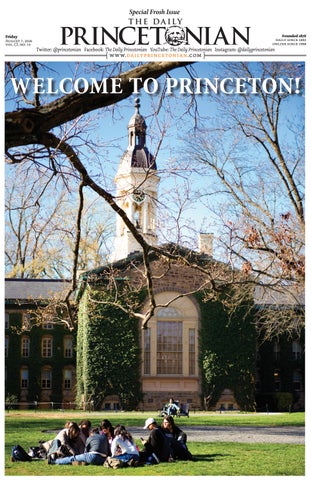
WELCOME TO PRINCETON!
The Daily Princetonian
page 2
Friday August 7, 2026
Letter from the Editor Jerry Zhu
Editor-In-Chief
Dear frosh, Looking back to three years ago — when I and the other seniors were in your shoes — I marvel at how much Princeton has changed. The physical campus has witnessed sprawling construction, University policies have undergone significant flux, and Princeton has downsized itself in the face of changing political winds. But while change can be scary, it is also a place of great opportunity. This year marks the 150th anniversary of this newspaper. Looking through our archives and in our commemorative book “Princeton in Our Words,” I am comforted to see that change and turmoil are no strangers to this University. In some ways, the times in which we live are quite “normal.” But what strikes me is that the stories of these past decades have demonstrated just how much power students have to shape and influence that trajectory of change, and leave their mark in the annals of this institution. It was the fight of female students, both through activism and legal action, that brought an end to allmale Bicker eating clubs. Black student activists began the fight that eventually culminated in the removal of Woodrow Wilson’s name from the School of Public and International Affairs and a residential college, and the addition of the Culture and Difference distribution requirement. Today, climate activists at Princeton have scored both wins and losses in their continued campaign. Activism is, of course, just one of many ways to have influence at the University. In 2022, University President Christopher Eisgruber ’83 urged the first-years at opening exercises to be “fully present in this special and
marvelous place.” The good news is that there are many, many ways to be present and engaged at Princeton. My colleagues and I have found the work of newsgathering and reporting to be an important way of being engaged here. For you, it might be delving deep into research and scholarly inquiry, becoming a member of a dance group, participating in campus politics — or joining the work that we do. In this special frosh issue, you’ll get a taste of the stories that have defined Princeton over the past year (and you can read many more on our website and app). We hope that this selection of stories will help get you acquainted with recent discourse and issues of today on campus, or simply help you find a fitness class or where to get your caffeine fix. But what comes next in The Daily Princetonian, and Princeton, is up to you. Best, Jerry Zhu Jerry Zhu is the 150th editor-in-chief of The Daily Princetonian (also known as the ‘Prince’).
Learn more about joining the ‘Prince’
Subscribe to the ‘Prince’
Follow us on Instagram @dailyprincetonian Cover image photo credit: Emily Tang / The Daily Princetonian
DOWNLOAD THE ‘PRINCE’ APP FOR NEWS, MENUS, PARTIES, AND MORE!
SCAN TO DOWNLOAD:
Inside The Paper FROSH DICTIONARY PAGE 4
OUT ON THE TOWN PAGE 30
SHIFTING ACADEMIC WATERS PAGE 9
HUMOR PAGE 33
EATING CLUBS PAGE 12
A CHANGING CAMPUS PAGE 35
ART MUSEUM PAGE 15
SPORTS: LACROSSE CHAMPIONSHIP PAGE 38
IN THE EYE OF THE TRUMP ADMINISTRATION PAGE 19
SPORTS: WOMEN’S BASKETBALL PAGE 39
OPINIONS ON CAMPUS PAGE 22
SPORTS: TIGERS DOMINATING THE IVY LEAGUE AND POSTSEASON PAGE 42
SENIOR SURVEY PAGE 26 THE AI DEBATE PAGE 28
YOU’RE MOVING TO NEW JERSEY! PAGE 46 THE ‘PRINCE’ INVESTIGATES PAGE 48
Friday August 7, 2026
The Daily Princetonian
page 3
The Daily Princetonian
page 4
Aa
A.B., abbrev. Artium Baccalaureus, or Bachelor of Arts. Though called B.A. at most other schools, you’re still receiving your typical liberal arts degree. Unless you’re an engineer, of course. See “B.S.E.” Academic mediocrity, n. The subject of a 2022 quote by Eisgruber on mental health. Divisive topic on campus. Acaprez, n. Name of the group that represents Princeton’s eight most prestigious acapella groups. You can only hold membership in one group — they host auditions together. There are acapella groups on campus that are not recognized by Acaprez. Yes, there is a hierarchy within the a cappella scene… welcome to the Ivy League. Adviser, n. 1. Faculty member assigned to first-years to assist in course selection. Usually a specialist in a field totally unrelated to yours. 2. Faculty member assigned to sophomores with an unclear role. 3. Faculty member assigned to juniors and seniors to provide guidance in writing junior papers and theses. All vary widely in quality of advising and level of engagement. Alcohol Initiative, n. A Universitysponsored attempt to reduce alcohol consumption by throwing huge sums of money at undergraduates for alternative activities. Alexander Beach, n. Princeton’s version of a beach. Lacks sand and water but used to be filled with lots of bodies in bathing suits on sunny spring days. Is now the location of the freshman BBQ and, for much of the year, a gigantic tent. See “tents.” All-nighter, n. 1. Grim, dusk-to-dawn studying or writing marathon in which sleep is postponed indefinitely. Often procrastination-induced and caffeinefueled. Usually followed by prolonged periods of hibernation. 2. Comedy show co-hosted by two members of the senior class and performed at Frist Theater. Finishes around midnight. See “Frist.” Alumni, n. pl. Those who came before. Gosh, they sure do love the place. Prone to wearing abominable combinations of orange and black. See “Reunions.” Arch sing, n. Event where a cappella singing groups perform a few of their favorite tunes in campus archways. Good singing and great acoustics, but the novelty can wear off quickly. A large percentage of the audience is made up of group members’ significant others (or situationships) and roommates. See “jam,” “Blair Arch.”
Bb
Baker Rink, n. Ice rink located downcampus where the hockey teams practice. USG sometimes holds free Skate Nights where you can take dates. Band, n. The University scramble band. Football halftime shows are occasionally funny and always tasteless.
Often uses unconventional percussion (termed “garbussion”), including a plastic Santa Claus and a stop sign. Hard to miss in their extremely plaid orange blazers as they parade through libraries on Dean’s Date or serenade the hapless on Valentine’s Day. Beer, n. Beverage of choice on Prospect Avenue. Some clubs try to impress potential members by serving such brew-house delicacies as Killian’s or Yuengling, but four times out of five it’s watered-down Natty Light. Bicker, n. Princeton’s multi-day equivalent of fraternity or sorority rush for the six selective eating clubs. During Bicker, club members meet sophomores and other upperclass students to determine whether they are worthy of membership. “Worthiness” is determined in a variety of ways. See “sign-in club,” “street week,” “double Bicker.” Blair Arch, n. That large, pretty arch across from Richardson Auditorium. Campus landmark and frequent site of a cappella jams. Saving grace of Matheyites. See “Mathey College.” Blair Tower, n. Former home of despised sophomores who lucked out during residential college room draw and got amazing rooms with amazing views. Now used as classrooms and housing for resident graduate students and a few faculty members in residence. Bomb, v. To do miserably on an exam. Translates to a range between A-minus to actually failing. See “Orgo,” “grade deflation.” Bonfire, n. Tradition of lighting an enormous bonfire on Cannon Green to celebrate the football team’s victories over both Harvard and Yale in a season. Involves singing praises to Old Nassau as effigies of John Harvard and the Yale bulldog are burned in a fiery inferno. Pretty much as cultish as it sounds. Last occurred in 2021. Considering the recent performance of the football team, it’s unlikely you’ll see one. Bridges (nickname), CEE 102: Engineering in the Modern World. Counts as an HA for science kids and an SEL for humanities kids. In past years, the final has involved literally memorizing pictures of bridges. See “P/D/F.” B.S.E., abbrev. Bachelor of Science in Engineering. Though called “B.S.” at some other schools, there’s no b.s. in Princeton’s engineering degree. Bubble, the, n. The metaphorical orange bubble that surrounds campus, keeping us in and the real world out. Also called “The Orange Bubble.” Usage: “Back in the bubble!”, “Welcome to the bubble.” To be used sparingly. Butler College, n. Residential college with new-ish buildings and a relentless obsession with its bee mascot. Located in what used to be far down-campus and now is the center of campus. See “Studio 34.”
Cc
Campus Club, n. Defunct eating club purchased by the University to hold events. Home to one location of Coffee Club. See “Alcohol Initiative,” “Coffee Club.”
Campus fox, n. The fox that resides on campus, most often spotted up-campus. Although multiple foxes have been spotted at once, campus legend says there is only one campus fox. See: “upcampus.” Cannon Dial Elm Club, n. Bicker club known for its three taprooms. The club plays host to a large proportion of athletes, especially field sports. Canvas, n. The University’s “Learning Management System” where you will check your coursework and submit assignments (unless your professor is really old-school or modern). Was recently a target of cybercriminals. Cap & Gown Club, n. Consistently the most bickered club, Cap has a selfproclaimed reputation for being “chill and diverse,” and a non-self-proclaimed reputation for some of the worst food on the Street. Some of its classic night out themes include Capmandu and Boxers and Blazers. Once the club of U.S. Secretary of Defense Pete Hegseth ’03. Carl A. Fields Center, n. Properly called the Carl A. Fields Center for Equality and Cultural Understanding, but colloquially known as CAF. A building located on Prospect Avenue that hosts events and programming aimed at celebrating diversity. Once called the “Third World Center.” Carnegie, Lake, n. Five minutes from campus, five miles long. Scenic venue for crew but too slimy for swimming. Gift of Andrew Carnegie so that Princeton could have a crew team, after thenUniversity President Woodrow Wilson, Class of 1879, asked him for money for University construction. Wilson’s reported comment: “We asked for bread, and he gave us cake.” Carrel, n. For better or for worse, you will know only a handful of the fourby-six-by-eight-foot metal study closets in Firestone Library, and only as a museum-like display. In the olden days, seniors locked themselves in these boxes around February to emerge in April with 30,000-word theses. Don’t worry, you’ll get study spaces that aren’t fire hazards. See “thesis.” CD, abbrev. Culture and Difference. A distribution requirement that began with the Class of 2024, and the only requirement that can be satisfied concurrently with another. Interdisciplinary requirement whose applicable courses are in many fields. Certificate, n. The now-mostly-defunct Princeton term for minors. In years prior, students contended with a weird combination of both. Source of impossibly niche thesis topics. See “thesis.” Chapel, n. Site of religious services and opening exercises at the start of every year until the class sizes got too large. Third-largest university chapel in the world. Contrary to Orange Key legend, it wasn’t built by a Yalie. Chancellor Green, n. Gorgeous library attached to East Pyne featuring stained-glass windows and amazingly comfortable couches. Naps happen here. Charter Club, n. Club located extremely far down Prospect Avenue, near the E-Quad. After a rebrand, a popular club on the street with lots of competition for selective sign-in spots. Site of Friday debauchery.
Friday August 7, 2026
Chabad, n. Recently renovated hub of Jewish activity at all hours of the day, located off-campus. Known for its daily coffee hours and packed Friday night Shabbat dinners. ChatGPT, n. Depending on who you ask, the oracle of all truth or the destruction of the humanities as we know it. What no student has ever used to complete a take-home exam. Someone in your lecture’s girlfriend. See “Committee on Discipline,” “Honor Code.” Choi Dining Hall, n. Not that anyone calls it that. Also known as the Yeh/Huo dining hall. Home of pretty nice food, an Asian station, and insane lines during the lunch rush. CJL, abbrev. Center for Jewish Life. Self-explanatory building on Washington Road. Popular lunch spot regardless of religious affiliation due to its central location, now with a shiny new dining hall. Clapper, n. Part of the Nassau Hall bell that the incoming class tried to steal each year. The logic behind the age-old tradition is that if the clapper is stolen, the bell signifying the start of classes won’t ring, so classes can’t be held. After Geoffrey MacArthur ’95 fell from the tower in 1992, the administration decided to remove the clapper permanently. Cloister Inn, n. Sign-in club known for hosting a high percentage of waterbased athletes, a frequent landing spot for people who are hosed by two bicker clubs. Home of Frosh Week’s “Moist Cloist,” where legend has it they pee in the beer. Currently closed for “renovations.” See “hosed.” Coffee Club, n. Student-run coffee shop in the taproom of Campus Club and the lobby of Huo College. Closer alternative to coffee shops on Nassau Street. Colonial Club, n. Sign-in club that at one point claimed Friday nights from Charter. Currently predominantly east Asian, once the club of Ted Cruz ’92. Committee on Discipline, n. The University body responsible for investigating and adjudicating all academic integrity offenses by undergraduate that do not fall under the purview of the Honor Code, and other serious disciplinary charges. CA, abbrev. Community Action. Week-long pre-orientation activity built around service trips in the Princeton, Trenton and Philadelphia areas. Like Outdoor Action, but with showers and beds. Will you do anything? Who knows. Community Living Adviser, n. Like an RCA but for upperclass students, with half the pay and 1/100th of the responsibilities. A significant number of positions were recently cut due to budget cuts. See “RCA.” Consulting, n. What many of your classmates will go on to do. No one actually knows what consulting means, but they do know it brings in the bucks. See “SPIA.” Co-op, n. Upperclass dining alternative in which members share cooking responsibilities. Vegetarians, try 2 Dickinson St.; omnivores, stick to Brown, Scully, or the International Food Co-ops. COS, n. Campus abbreviation for computer science, rather than “CS”
Friday August 7, 2026 From the three-letter course code for computer science classes. Cottage Club, n. Officially called “University Cottage Club.” Bicker club populated by athletes, Southerners, and the wealthy. Known for its spring Sunday Fundays, darties with various themes that can always be counted on to feature beer and American flags. CPS, abbrev. Counseling and Psychological Services. Office of therapists located on floors one and two of the Frist Health Center, available to you free of charge. See “McCosh.”
Dd
Daily Princetonian, The, n. What you’re reading now. Your one true source of information on life, the universe, and everything, as well as the only daily newspaper on campus and one of the oldest college dailies in the country (and older than The Washington Post). Available for free everywhere. Editorially and financially independent from the University. Also known as the ‘Prince.’ Dead Week, n. Week between the end of finals and graduation, when seniors and students employed for Reunions hang out and try to do as little as possible. This can take the form of group vacations to Myrtle Beach, S.C. See “Reunions.” Dean’s Date, n. 5 p.m. on the last day of reading period. It used to be the day all course papers were due. Now the deadline for all term work, after which is an amorphous final assessment period where papers are due at staggered times. Over time, students have created many traditions to combat the stress, including the Band playing in Firestone and a midnight meal in the res colleges. See “all-nighter,” “reading period” Dei Sub Numine Viget, phrase. Princeton’s official motto on Princeton’s seal. Translation: “Under God’s Power She Flourishes.” Unofficial version: “God Went to Princeton.” Dillon Gymnasium, n. Recreational center in the middle of campus open to non-athletes. Contains a pool, squash courts, multipurpose rooms, a large gym, and a fitness center. Site of loud Zumba and spin cycle classes. Officially known as the Class of 1986 Fitness and Wellness Center, following a renovation in 2024. Dining Points, n. pl. $150 a semester in underclassmen’s meal plans to spend at an ever-growing list of restaurants in town. Frequently (and incorrectly) referred to as Paw Points. See “Paw Points.” Dinky, n. Train that takes you to Princeton Junction for connections to the real world, and shortest scheduled passenger railway in the U.S. Flashpoint of battle between town and University. The station used to end at Blair Hall and has been moved back several times to accommodate new buildings. Dinky Bar, n. Where seniors and graduate students who are too mature for the Street go for expensive cocktails. Distribution requirements, n. Princeton’s plan for a true liberal arts education. Ensures STEM students take copious humanities classes, and humanities students take a few STEM classes. See “P/D/F.” Double Bicker, n. Initiative begun somewhat recently in which Bicker clubs allow sophomores to bicker two clubs at once. See “Bicker.” Down-campus, adj. n. Located on the part of campus closer to the lake, down the hill. Begins roughly at Dillon, ends at the lake. Synonyms: “South.” Usage: “It’s a little further down-campus than Edwards.”
Ee
E-Quad, abbrev. Engineering Quadrangle. A collection of academic buildings where engineers spend all their time. Very, very far east from central campus.
The Daily Princetonian East Pyne, n. Pretty building upcampus near Firestone Library that houses language departments, the Department of Comparative Literature, and the Department of Classics. Eating clubs, n. Eleven large mansions on Prospect Avenue that serve as the hub of upperclass student life. What you would get if a fancy dining hall had a baby with a sorority/fraternity house. Biggest reason that Princeton is still considered elitist by the outside world. EC, abbrev. Epistemology and Cognition. Distribution requirement with no discernible meaning. Filled most frequently by philosophy and psychology classes. See “P/D/F.” Eisgruber, Christopher L., n. Your fearless leader. Eisgruber ’83 ascended to the University presidency from the position of provost in 2013. Seems to have forgotten that this isn’t high school and assigned you summer reading. Well-respected in academic circles, including for defending the principles of the university against the Trump administration’s attacks. EM, abbrev. Ethical Thought and Moral Values. Distribution requirement once filled by Peter Singer’s “Practical Ethics,” in which one of the most prominent philosophers of our time tries to convince you to stop eating meat. He’s since left the University, so good luck figuring out your “values” now. Entryway, n. Self-contained section of a dorm or classroom building. Most frequently found in older buildings, which were said to be built to be riotproof. Only way to get from one entry to another is to go outside and back in again or go through the basement or up to the top floor. Partly because of this system, you may never meet the person who lives on the other side of your bedroom wall.
Ff
Fall break, n. Week-long vacation immediately following fall midterms. Implemented in the 1970s when campus activists demanded time off before Election Day to campaign for their favorite bleeding-heart liberal congressional candidates. A prime road-trip week. Fine Hall, n. The name of that extremely ugly brown building rising high above the earth down-campus behind Lewis Library. Contains the math department. Fire inspection, n. Unannounced visit to your dorm room, before which you should (1) put on clothes, (2) frantically hide illegal appliances under your blankets, and (3) un-tape your door. Otherwise, they’ll fine you. Not for the nudity. For the other stuff. Firestone Library, n. The mothership. Books on books on books (on shelves). Large behemoth of a library containing books on every subject imaginable, as well as asbestos. Popular study spot. Deathly quiet. See “carrel.” First College, n. Once Princeton’s oldest residential college and named for Woodrow Wilson. Now primarily a shallow hole in the ground. On the site of the future Hobson College. First-year, n. What you are. The University has spurned the word “freshman.” See “frosh.” FitzRandolph Gate, n. Gate in front of Nassau Hall. If you walk out the center gate while an undergraduate, you will not graduate. Of course, that’s just a legend. Try it and let us know. Fizz, n. A social media app popular with campus youngsters which has replaced TigerConfessions as the hub of campus gossip. Forbes brunch, n. The concession Princeton had to make to Forbesians to ensure they wouldn’t drop out. In exchange for living in The Land Far Far Away, Forbesians get a chocolate fountain on Sundays. Is it a fair trade? That’s for you to decide. Forbes College, n. The res college rumored to exist just west of the Lewis Center for the Arts and Wawa. Only visited by non-Forbesians on weekends due to its fancy brunch spreads. See “Forbes
brunch.” Franzia, n. Brand of boxed (read: dirt cheap and sickeningly sweet) wine. Goes down easy, comes back up more painfully. See “Tower Club.” Frist. n. 1. The campus center. Home of the student government, mailboxes, and chicken tenders. Also one of the campus theaters. A fun and relaxing place to socialize and study as long as you don’t take introductory Chinese. Not to be confused with First. See “Late meal.” 2. The last name of a big donor family who also recently funded the new health center. Also not to be confused — “Frist,” alone, usually refers to the campus center. Frist Health Center, n. The new health center. The old health center was called McCosh; when one was sent for alcohol overconsumption it was called being “McCoshed.” So now, perhaps students will be Fristed? Fraternities, n. pl. First-years, avert your eyes. Groups of males that gather to drink and make lots of grunting noises. First-years are not allowed to rush Greek organizations. Those who do face suspension. Not a big presence on campus, but they may be your ticket into a bicker club. Frosh, n. What you are. More colloquial use than “first-year.” Frosh Week, n. The week before classes, when sophomores and upperclass students reacquaint themselves with campus life and “meet” the first-years, who are kept busy by an array of University-sponsored activities. Prime time to drink copious amounts of alcohol amid nighttime mosh pits in the eating clubs’ backyards. In recent years, actual frosh have been banned. You can thank the Class of 2022 (and the pandemic, if you’ve heard of it). See “McCosh.” FYRE, abbrev. First-Year Residential Experience. A group of “required” assemblies and zee group meetings that begin during orientation, and end sometime during first semester. Cover important topics such as diversity and inclusion.
Gg Garden Theatre, Princeton, n. Community theater. Shows mostly artsy films as well as a few big-budget flicks. Good first date. Often offers free movies for students sponsored by USG, usually on Fridays. Graduate College, the, n. Commonly called the “Grad College.” A mythical castle across the golf course behind Forbes rumored to be inhabited by those they call “graduate students.” Undergrads like to climb its tower to take pictures of the view and eat in its dining hall on Thursday nights, when dinner features specialty food stations with made-to-order sesame noodles, quesadillas, etc. See “D-bar.” Grade deflation, n. Former university policy to limit A’s in courses to 35 percent of grades per department. Although the official policy ended, its residual effects are still around. A source of many a dining hall debate and Princeton’s second unofficial motto, “It would’ve been an A at Harvard.” Graduate student, n. An individual smart enough to translate Kierkegaard into 14 languages but mostly isolated from campus life. Many are forced to live roughly one mile from central campus. GSRC, abbrev. Gender and Sexuality Resource Center. Name is self-explanatory. Located in Frist. Replaced centers formerly known as the Women*s Center and LGBT Center.
Hh
HA, abbrev. Historical Analysis. Distribution requirement that can be fulfilled by, you guessed it, a history class. Head, n. Faculty member who acts as
page 5 den mother or father for the students in the residential colleges. Hoagie Haven, n. A Princeton institution, once known for catering to the late night wishes of drunken eating club go-ers. Now with earlier closing times, the small hoagie shop on Nassau Street still serves up sandwiches filled with things like french fries, chicken tenders, multiple burger patties, and buffalo sauce, often in combination. Hobson College, n. Currently, the construction site in the center of campus. Starting in 2027, the newest residential college, named for investing CEO and serial corporate board member Mellody Hobson ’91. Holder Howl, n. A moment of collective campus catharsis at midnight each Dean’s Date when students gather in Holder Courtyard in Rocky to release a primal scream of fear and frustration. There are now copycat events held across campus. See “Dean’s Date.” Honor Code, n. Institution through which University exams are policed. Students sign pledges agreeing not to cheat on exams and to turn in those who do. Taken very seriously. See “Committee on Discipline.” Hookup culture, n. A semi-significant feature of the social scene which is the topic of significant online debate. Hose, v. To reject; to render helpless. Most often done to rejected Bicker prospects, who are hosed at their doorstep. Fraternities, sororities, and a cappella groups hose, but don’t worry — a literal hose is typically not involved. See “Bicker.” Hotspot. n. 1. A place to revalidate your prox after fall, winter, and spring break, conveniently located by the Dinky or inconveniently in a random basement. 2. An app used for list spots for several eating clubs, including Tiger Inn and Ivy. Huo College, n. One of Princeton’s newest pair of residential colleges. Located at the far-southern end of campus. Named in June 2026, formerly known as NCW. Has a Coffee Club and a ceramics studio. See “Yeh College.” Houseparties, n. Pseudo-bacchanal scheduled for the weekend after the end of spring semester classes. With theses complete and exams two weeks distant, eating clubs host wine-filled formal and semiformal dinners.
Ii
IB, nickname. Investment Banking. What many of your classmates are striving for a job in. Among the most prestigious of the banking jobs. Shocking in its remuneration, hours, and culture. ICC, abbrev. Interclub Council. Group made up of the 11 eating club presidents. Coordinates relations between Prospect Avenue, the municipality, and the University. Independent, n. adj. In prior years, referred to students who were not in an eating club and did not purchase a University meal plan. Effective this year, all on-campus students must now be in an eating club, purchase a meal plan, or be in a co-op. You’ll find some scattered seniors who are vengeful at the University for taking away their Independence. IW, abbrev. independent work. B.S.E. equivalent of the Junior Paper for A.B. juniors. See “JP.” Interactor, n. Upperclass B.S.E. student who helps advise B.S.E. first-years, especially at the beginning of the year. Periodically checks in and hosts study breaks. Ivy Club, n. Bicker club with a reputation for elitism, mahogany, and international students. Its women’s bathroom may be the most photographed part of Princeton, after Blair Arch. Ivy Inn, n. One of three “bars” in Princeton. Right near Hoagie Haven. Definitely “end of the night” vibes.
Jj
The Daily Princetonian
page 6 Jadwin Gymnasium, n. Gym for varsity athletes and sports located far, far down-campus, informally called “Jadwin.” Site of varsity basketball games. Not Jadwin Hall. Jadwin Hall, n. An academic building south of Fine Hall that contains the physics department. Covered in brown tile. Not Jadwin Gymnasium. Jam, n. An event at which one or more a cappella groups sing, commonly under an arch. JP, abbrev. Junior paper. Lengthy independent work for A.B. juniors meant to prepare them for the senior thesis. Some departments require one; many require two. Tragic reminder of impending mortality.
Kk
Keller Center, n. Center located near the E-quad that sponsors events, classes, and programming related to entrepreneurship and innovation. Stop by before you drop out to work on your start-up full-time. Even if you don’t, you’ll get dozens of emails from them every day. Kiddie lit, nickname. ENG 385: Children’s Literature. Over-enrolled course that people think will be an easy LA. Beware — it’s quite large and grades are heavily deflated. See “LA.”
Ll
LA, abbrev. Literature and Arts, a category of your distribution requirements. See “kiddie lit.” Late meal, n. The only thing that makes upperclass students jealous of first-years. In theory, an option for students who miss dining hall meal times. In practice, free noms and mixers sold in the basement floor of Frist Campus Center. See “Frist.” Lawnparties, n. Afternoon drink-athon and dance-a-thon on the lawn of each eating club, held in early fall and at the end of spring Houseparties. Known for importing bands ranging from so-so to great and creating a massive influx of sundresses on Prospect Avenue. Traditionally, an explosion of preppy clothing. See “Houseparties.” LCA, abbrev. Lewis Center for the Arts. Modern building complex that serves as Princeton’s home for the arts. Safe haven for many theater kids. Lectures, n. pl. Oft-missed speeches by professors that constitute the foundation of the Princeton education. Try to attend a couple so you can tell your parents that you are making the most of their tuition dollars. Lewis Library, n. Large, modern science library located down-campus across Washington Road. Its treehouse floor is an especially popular study spot that features many windows. List, n. Method that clubs use to determine who can enter for a night out. What first-years and sophomores agonize about getting onto. Why juniors and seniors in these clubs get texts from younger students they barely know. Listserv, n. Where life at Princeton happens, and the reason your Gmail app continuously gives you notifications. A main line of communication between campus groups and their members. Most common iterations include your res college listserv, filled with messages ranging from dance group ticket sales to political manifestos, and the free food listserv, which is exactly what it sounds like. Can be accessed at https:// lists.princeton.edu/.
Mm
Mathey College, n. Residential college located just south of Rocky. A collection of loosely associated buildings with no central quad. Shares a large, picturesque dining hall with Rocky.
McCosh Hall, n. A large, sprawling series of lecture halls up-campus in which many of your introductory-level large lecture classes will be held. Also features smaller seminar rooms mainly used by the English and history departments. Desks are small, cramped, and wooden; bathrooms are difficult to find. McCosh, abbrev. 1. n. McCosh Hall. 2. n, archaic. The old health center, replaced by Frist Health Center in spirit but not in body. 3. v. Sending your toodrunk friend to the infirmary, or getting sent yourself. Usage: “We had no choice but to McCosh him,” or “Frosh week was so messy, I got McCoshed.” Unclear whether this will fall out of use in favor of a Frist-inspired verb. See: “Frist Health Center.” McCosh Walk, n. Walkway extending from University Place on the west to Washington Road on the east. Has been under construction for most of the past year as collateral damage from the art museum construction site. McGraw, abbrev. McGraw Center for Teaching and Learning. Academic support center that offers one-on-one and group tutoring for many introductory courses, as well as other resources for students. Located in Frist. Also a good study spot. Murray-Dodge, n. Free cookies and tea, but be prepared to hand over your prox as collateral. Also don’t forget to wash your own mug once you’re done. Try the matcha tea cookies if you dare. Extremely popular study spot, so go at off-peak times if you want to get a seat.
Nn
NARP, abbrev. Non-athletic regular person. We are here and we are proud. Nassau Herald, n. Princeton yearbook containing only the senior photos. Nassau Weekly, n. Also “the Nass.” A weekly tabloid co-founded in the early 80s by David Remnick, who now runs The New Yorker. Known for humorous “Verbatim” section, which is filled with random overheard quotes from around campus, and for printing other random musings. See “WPRB,” “St. A’s.” netID, n. The part of your email address preceding “@princeton.edu” and your username for most campus websites. New York City, n. Just an hour-and-ahalf train ride away. Sometimes certain classes take you there for free. NCW, abbrev. New College West. One of Princeton’s newest pair of residential colleges. Located at the far-southern end of campus. Not yet named for a donor. Has a Coffee Club and a ceramics studio. See “Yeh College.” Nude Olympics, n. Sophomore rite of passage banned in 1999. Celebrated by running naked through Holder Courtyard at midnight on the night of each year’s first snowfall.
Oo
OA, abbrev. Outdoor Action. Weeklong pre-orientation program that sends half of the incoming class into the woods to get dirty and make friends. There’s (mostly) no action on Outdoor Action, but there’s always frosh week to get to know a new friend even better. ODUS, abbrev. Office of the Dean of Undergraduate Students. Oversees campus organizations, undergraduate student government, and various student centers. Responsible for undergraduate student discipline. OIT, abbrev. Office of Information Technology. Controls the University’s computer and Internet systems. Runs a tech clinic in Frist. Notorious for incompetence in information security, leading to recent breaches of donor records and students’ grades and academic records. Old Nassau, 1. phrase. Nickname for Princeton University, derived from Nassau Hall. 2. n. School song. Orange Key, n. Campus tour-guide
group. Don’t believe everything they told you on your tour. Orange and Black Ball, n. Campuswide ball resurrected after a decadeslong absence. Run by the Undergraduate Student Government. Held in Dillon Gym; mostly completely empty. Lots of finger food. See “USG.” Orgo, abbrev. CHM 301/302: Organic Chemistry. Soul-killer. Separates the kids from the doctors.
Pp PAA, abbrev. Peer Academic Adviser. Student available to give first-years academic advice. Shows up sparingly at zee group study breaks. Pace Center, n. Civic engagement center on campus that runs Community House, the Student Volunteers Council, and a program pairing interns-to-be with summers in nonprofits and government. Distributes large amounts of money for service projects. Palmer Square, n. Town square located just across Nassau Street from the University. Home to preppy stores, specialty boutiques, and townies. PAW, abbrev. Princeton Alumni Weekly. The nation’s fourth-oldest weekly magazine, published by the Alumni Association. Tagline “editorially independent since 1900,” but funded by the University. Doth protest too much? Paw Points, n. Dollars that you load onto your prox card. Worse than a dollar in your wallet because now you can only spend it at certain campus locations. Critically, your own money. See “prox,” “dining points.” P/D/F, abbrev. Pass/D/fail. Grading option developed to facilitate a true liberal arts education. Designed to allow students to take a class that expands their horizons with the guarantee that their GPA won’t tank. Unless you get a D. Or fail. You can choose this option once per semester, for up to four semesters. See “distribution requirements.” Federal law gives you a right to see what grade you received in a class you P/D/F’d if you ask the Office of the Dean of the College. PEV, abbrev. Personal electric vehicle. Uniformly banned on campus starting this year. Previously used extensively by athletes to get to practice. Pequod, n. 1. Fictional ship in Herman Melville’s “Moby Dick.” 2. Outrageously expensive photocopied packets of required reading that often resemble the aforementioned whale. Mostly supplanted by readings posted on Canvas, but alums will tell you about them. Physics for Future Leaders, n. The actual name of PHY 115A, a physics course designed to introduce non-scientists to just enough science to ostensibly be able to make decisions. Future leaders who are also scientists should seek an actual education elsewhere. See “P/D/F.” Pickups, n. pl. A tradition among Princeton’s many, many selective clubs and organizations where they greet new members by showering them with champagne, Silly String, etc. in their dorm rooms and then take them elsewhere for revelry. PMC, abbrev. 1. Princeton Medical Center. The destination you absolutely don’t want to end up at after a night out. Getting PMCed is a much more expensive alternative to getting McCoshed. See “McCosh,” “Frist.” 2. Princeton Model Congress. Event for high schoolers, staffed by students who get to stay in D.C. for free. Not to be confused with the former. PMT, abbrev. Princeton Mock Trial. A very competitive traveling competition team; somewhat cultish. If your friend joins, you may never see them again. See “Cap & Gown Club.” Poe Field, n. Large oval field at the far southern end of campus where club and intramural sports teams hold practices, sunbathing frequently occurs, and barbecues are sometimes held. P-Rade, n. Annual procession of ridiculously spirited, multi-generational alumni sporting black-and-orange cos-
Friday August 7, 2026 tumes. Takes place on the final day of Reunions. See “alumni,” “Reunions.” Pre-med, n. A student hoping to go to medical school. Generalized anxiety and cutthroat behavior varies by person. Precept, n. Discussion between a small group of students and a preceptor (a grad student or faculty member) to supplement lectures. A unique feature of Princeton’s education system inaugurated by Woodrow Wilson. Vary widely in quality. Truly mandatory for only a handful of classes. Prefrosh, n. What you are until you arrive on campus. Pregame, 1. n. Name for any gathering held prior to a night out on the Street. Usually a source of hard liquor. Usage: “birthday pregame,” “frat pregame.” 2. v. To consume drinks at a party held on campus prior to a night out on the Street. Usage: “Let’s pregame at John’s birthday party before heading to T.I.” Princeton, n. 1. The University to which you have committed the rest of your life (including your future earnings). 2. The affluent suburban town in which your blissful Orange Bubble is located. Princetoween, n. The night on which all of campus collectively celebrates Halloween, irrespective of the actual date. Prospect, abbrev. 1. Prospect House. Formerly the University president’s home in the middle of campus. Now a faculty dining hall and the site of endof-semester fancy dinners for various organizations. 2. Prospect Garden. The gardens surrounding Prospect House; popular venue for Houseparties photos. 3. Prospect Avenue, a.k.a the Street. 4. The Prospect, the ‘Prince’ section for arts, culture, and student life. Prospect 12, n. The ultimate drinking challenge: one beer at every eating club in one night. A favored item on senior bucket lists. Most commonly conquered on Princetoween or Dranksgiving. Although only 10 clubs are operational, the 12th is Campus Club. Prox, 1. n. Common name for PUID, or the Princeton University TigerCard. 2. v. To unlock a door by holding your PUID close to an electronic sensor. Usage: “Could you prox me in?” See “PUID.” P-Safe, abbrev. Public Safety. University police and security officers responsible for regulating parking, ignoring room parties, and opening doors for locked-out students. PTL, abbrev. Post-Thesis Life. The time of year after seniors have turned in their thesis, but before graduation, where they have no responsibilities in life. A time well-spent but poorly remembered. PUID, n. 1. Your University ID. Your key to admission at the library, sporting events, and eating clubs. Can be used to charge food purchases to your student account. Eating club members sport special stickers on theirs. 2. Method sign-in clubs use to determine who can enter during nights out — if you have a PUID, you’re good. See “prox.”
QCR, abbrev. Quantitative and Computational Reasoning, a distribution requirement that forces humanities students to do math again. Quadrangle Club, n. Sign-in club commonly known as “Quad.” It has the best drinks because it has a license to serve hard liquor. The eating club to which Jeff Bezos ’86 belonged.
Rr
RCA, abbrev. Residential College Adviser. An upperclass student who lives in your hall and provides free food (see “study break”), condoms, and answers to questions like what to do when your roommate hasn’t showered in five weeks. See “Zee group.”
Friday August 7, 2026 Reading period, n. Week and a half after classes end and before exams begin. Originally intended as time to do independent research, students now sleep in until 2 p.m. and read and write everything they haven’t in the past semester. Dean’s Date happens at the end. Residential college, n. Your home at Princeton for at least your first two years of college. There are now seven residential colleges on campus: Rocky, Mathey, Butler, First, Whitman, Forbes, Yeh, and Huo. Each college varies greatly in amenities, types of rooms, and location, but they all provide a sense of community, and more importantly, a source of free gear. Residential College Facebook, n. Database containing (almost) every Princeton undergraduate and information such as their class year, major, and most importantly, a photo. The singlemost useful tool you will encounter in your time at Princeton. Easiest way to stalk your peers. Residential college staff, n. Wellmeaning faculty members who work for your residential college but have varying degrees of helpfulness. Skilled at clogging your email inbox. Includes the Head of College, Dean, Assistant Dean for Studies, and Assistant Dean for Student Life. Source of federal governmentesque alphabet soup. Reunions, n. Beer-saturated gathering of alumni during the weekend before Commencement for drinking, fellowship, and the P-Rade. Good excuse for students to delay returning home for a week at the end of the year. Reportedly the event with the second-highest level of alcohol consumption in the U.S., after the Indy 500. See “P-Rade.” Richardson Auditorium, n. Enormous performance hall located up-campus across from Blair Arch. Rival, n. What Princeton lacks as the third wheel in HYP. What Penn thinks we are. Rocky College, abbrev. Rockefeller College. Northernmost residential college known for gorgeous Gothic architecture and the occasional dorm bat. Rocks for Jocks, nickname. GEO 103: Natural Disasters. See “P/D/F.” RoMa, nickname. Rockefeller/ Mathey College dining hall. Source of curly fries, weird quesadillas, and the occasional duck pasta. Room draw, n. Computerized process by which students select rooms for the upcoming year. Conspiracy theories abound about the supposed randomness of the process: People with high social security numbers, third letters of their last names near the end of the alphabet, and Minnesota addresses may receive better times. Route 1, n. A large, divided road about a five-minute drive from campus along which real-world institutions like movie theaters, malls, Walmarts, discount liquor stores, and chain restaurants can be found. Proof that you are, in fact, in New Jersey. Rush, v. To move very quickly toward something. n. 1. An aquatic plant. 2. A process you are forbidden to know anything about. Shhh.
Ss
SA, abbrev. Social Analysis. Distribution requirement that can be fulfilled by a large variety of courses in the realm of humanities and social sciences. Safety school, 1. n. Yale, Harvard, Penn, etc. 2. phrase. Popular chant at basketball games regardless of opponent. SEL, abbrev. Science and Engineering with Lab, a self-explanatory distributional requirement. See “Bridges.” Selective sign-in, n. A process to sign in to Charter and Quad that gives you better odds the more interest (attendance at random cookie decorating events) you demonstrate. Not bicker, although still the source of hand-wringing among sophomores. SEN, abbrev. Science and Engineering, Nonlaboratory, a self-explanatory distribution requirement. See “Physics
The Daily Princetonian for Future Leaders.” Sexile, v. To render your roommate homeless after a successful date or night out. Etiquette in case of sexile should be discussed with your roommate ASAP. Sign-in club, n. Eating club that takes members through a lottery system rather than Bicker. Also has convoluted variants. See “Charter,” “selective signin.” Squirrel, n. A furry friend and foe. Cute when scurrying around campus. Scary when rabid. Not scared of people. Comes in brown, gray, and black varieties. Sororities, n. pl. Groups of women who gather together to take pictures in dresses and “network.” There are only three at this school: Kappa Kappa Gamma (“Kappa”), Pi Beta Phi (“Pi Phi”), and Kappa Alpha Theta (“Theta”). First-years are not allowed to rush Greek organizations. It may be your ticket into a bicker club. SPIA, abbrev. School of Public and International Affairs. Formerly application-only concentration for students interested in becoming bankers or consultants and learning the language of bureaucracy, as well as those rare folk who actually do want to save the world through government (but will probably end up in consulting). Formerly named for Woodrow Wilson. SPIA fountain, n. Idyllic fountain and pool located in Scudder Plaza, north of Robertson Hall. Formally known as the Fountain of Freedom. The entire student body can be found taking photos here pre-Lawnparties. Popular wading spot in the spring, especially after SPIA theses are submitted. Beware of skateboarders. Stars for Stoners, nickname. AST 203: The Universe. Purported to actually be a somewhat difficult class involving equations. See “P/D/F.” Street, the, nickname. Prospect Avenue, home of the eating clubs and center of University nightlife. Street Week, n. Week of conversations and social events at the eating clubs in early February. At the end, sophomores choose the eating clubs they want to join, and clubs choose which sophomores they will admit. Studio 34, n. Late-night convenience store in the basement of Butler College known for its French bread pizzas. Study break, n. Code for free food. At any given time, there is a high chance some study break is happening around campus. Most common benefactors of study breaks include res colleges, RCAs, and clubs.
Tt
Terrace Club, n. Sign-in club known for artsy types, vegans, and stoners. Popular end-of-night stop for all of campus. The only eating club not actually located on Prospect Avenue. Thesis, n. The T word. Major senior pastime, required of every A.B. student and some B.S.E. students. Most are close to 100 pages. Often replaces socialization, exercise, happiness, etc. in the spring. Tents, n. Gigantic abominations that appear on nearly every quad in April, and in select quads nearly constantly. See “Reunions.” T.I., abbrev. Tiger Inn. Bicker club known for raucous, beer-soaked parties and heavy preponderance of bros. No backyard for … reasons. Tiger, n. 1. Princeton student or athlete. 2. Mascot dressed in tiger-skin suit who capers and cavorts at football games while trying to avoid attacks by the opponent’s band. 3. Striped predatory jungle cat. Tiger Confessions, n. Old Facebook page run by an anonymous student where students can submit any thoughts, questions, ideas, etc. they have. Now supplanted by Fizz. TigerHub, n. Poorly named and poorly designed software to fulfill administrative duties such as enrolling in courses and checking grades. Have to reload the page at least twice before
it works. TigerTransit, n. Free University-run bus system mostly used by grad students. Occasionally useful for shuttling up Washington Road. Also runs the Weekend Shopper, which slowly tours the various grocery stores on Route 1. Tower Club, n. Bicker club known for its first-year-friendly dance floor and taproom, as well as heavy preponderance of theater types, a cappella groups, and SPIA majors. Triangle Club, n. Undergraduate musical theater group that writes and stages an annual extravaganza of song, slapstick and dance. Famous for the drag kickline and alumnus Jimmy Stewart ’32.
Uu
USG, abbrev. n. Undergraduate Student Government. A group of aspiring politicians who are responsible for the multiple free orange t-shirts shoved into the back of your dresser. Up-campus, adj. n. Located on the part of campus closer to Nassau Street, up the hill. Begins around Dillon Gym and extends through Rocky. Synonym: “north.” Usage: “From here, go up-campus to find Brown.” U-Store, n. Officially, the Princeton University Store. Campus location is at 36 University Place, across from Blair Arch. Sells food, dorm items, and school supplies. Significantly overpriced, but unbeatable location.
Ww
Wa, The, n. Campus colloquialism for the Wawa convenience store. The only fast food in Princeton, located between the Dinky and Forbes. Popular late night meal spot, but prepare to wait
page 7 an egregious amount of time on nights out. Whig-Clio, abbrev. The American Whig-Cliosophic Society. Centuries-old debate society that hosts such topical events as the Annual Latke versus Hamantaschen Debate. Whitman College, n. Residential college that bears a striking resemblance to the castle in Shrek. Built in 2007, it has air conditioning and very nice rooms. WPRB, n. Student-run, communitysupported independent radio station located in the basement of Bloomberg Hall. See “Terrace Club.” Writing Center, n. Single-handedly responsible for helping many first-years survive writing sem. Offers individual appointments to help at any point in the writing process. Writing sem, abbrev. Writing seminar. If you are a STEM major, likely your least favorite first-year class; if you are a humanities major, responsible for your first A minus.
Yy
Yeh College, n. One of Princeton’s newest pair of residential colleges. Located on the far-southern end of campus. Hybrid Dr. Seuss-Soviet architecture. See “Huo College.”
Zz
Zee group, abbrev. Group of advisees. The 20 or so first-years frequently found under the wing of a residential college adviser. Each recently increased in size following budget cuts. May or may not become close friends over thev course of the year. Statistically, at least one combination within the group will hook up.
page 8
The Daily Princetonian
Friday August 7, 2026
The Daily Princetonian
Friday August 7, 2026
page 9
S H I F T I N G A C A D E M I C WAT E R S
N E W S | M AY 2 0 2 6
Princeton faculty mandate proctoring for in-person exams, upending 133 years of precedent By Devon Williams Contributing News Writer
All in-person examinations at Princeton will be proctored starting July 1, representing the most significant change to the honor system since it was established in 1893. The faculty passed a proposal requiring instructor supervision at Monday’s faculty meeting, with one opposing vote. The historic vote was the culmination of months of deliberation within the administration and student governing bodies about how to address increasing concerns over academic integrity violations, including the proliferation of AI usage. The proposal cleared a full faculty vote as the final of three required rounds of approval, having already been passed unanimously by the Committee on Examinations and Standing and the Faculty Advisory Committee on Policy. According to the policy proposal, previously sent by Dean of the College Michael Gordin to the Faculty Advisory Committee and included in Monday’s
meeting notes, instructors will remain present in exam rooms “as a witness to what happens,” but are instructed not to interfere with students. If a suspected Honor Code violation occurs, proctors will document their observations and submit a report to the student-run Honor Committee, where they may later testify under the same standards used for other witnesses. The proposal notes that additional details, including proctor-to-student ratios and guidelines regarding monitoring practices, will be finalized in consultation with faculty and student representatives before the policy takes effect. Princeton’s honor system dates back to 1893, when the faculty first instituted the Honor Code following a student petition to eliminate proctoring during examinations. Since then, the honor system has relied on individual accountability, with students pledging both to refrain from academic dishonesty and to report those they witness in violation. Following the Honor Code’s original implementation, proctoring was explic-
LUKE GRIPPO / THE DAILY PRINCETONIAN
Faculty gather for a reception celebrating those transferring to emeritus status outside Nassau Hall after passing a policy mandating proctoring on examinations during a faculty meeting, Monday, May 11, 2026.
itly banned in the Rules and Procedures of the Faculty and the Rights, Rules, Responsibilities of the University, which remained in effect for 133 years up until Monday’s vote. The policy proposal cites AI and personal electronic devices as major catalysts behind the policy shift. “The ease of access of these [AI] tools on a small personal device have also changed the external appearance of misconduct during an examination,” it reads, making cheating “much harder for other students to observe (and hence to report).” The proposal also points to a growing reluctance among students to report peers directly. The proposal claims that anonymous reporting of allegations has increased in recent years, fueled by fears of “doxxing or shaming among their peer groups” online. In The Daily Princetonian’s 2025 Senior Survey of over 500 seniors, 29.9 percent of respondents reported that they had cheated on an assignment or exam during their time at Princeton. 44.6 percent of senior respondents reported knowledge of Honor Code violations that they chose not to report. Only 0.4 percent of seniors responded saying that they had reported a peer for an Honor Code violation. An Undergraduate Student Government survey of students cited in the proposal reportedly found that “a majority would favor proctoring or are indifferent to any change,” though a “sizeable minority opposes it on the grounds that students should behave honorably, and that faculty and students should trust each other given the 1893 Honor Code compact.” Similarly, students and faculty previously interviewed by the ‘Prince’ expressed divided views on the policy’s implementation. Some cited the inadequacy of the current student reporting model, while others said the introduction of proctors could erode the trust
that defines Princeton’s academic culture. The historic change comes in the wake of a November policy change mandating proctoring for all individual and smallgroup exams, including make-up exams, exams taken by student-athletes while traveling, and exams taken with disability accommodations. In a March guest Opinion column in the ‘Prince,’ Honor Committee Chair Emerita Nadia Makuc ’26 wrote that the Honor Committee, which adjudicates suspected violations of the Honor Code during in-person examinations, had long discussed introducing proctors as an additional witness and reporter in exam rooms, and that the time had come to take that step. “The Honor Committee has experienced new strains, including an uptick in cases in the last year and challenges such as generative AI, and student sentiment has recognized that its procedures need to better reflect the current challenges to academic integrity,” Makuc wrote. Honor Committee hearings are confidential, student-led proceedings addressing potential violations of the Honor Code. Accused students can present defenses, call witnesses, and be assisted by a Peer Representative. If students are found responsible for Honor Code violations, the maximum penalty that can be assigned is expulsion. William Aepli ’26, former co-chair of the Peer Representatives, which advises students accused of academic integrity violations, previously told the ‘Prince’ that his organization would likely see changes in the type of evidence presented in hearings in Honor Committee hearings. The Honor Committee Constitution and the Honor Code itself will not need to be changed following the institution of proctoring. Gordin previously confirmed to the ‘Prince’ that just the Rules and Procedures of the Faculty and
Rights, Rules, and Responsibilities will need to be updated. The section of the Rules and Procedures of the Faculty that previously banned proctoring will replace those lines with language mandating instructor supervision during in-person examinations, according to the proposal. A one-sentence revision to Rights, Rules, and Responsibilities will be made before the start of the new academic year. The proposal states that Gordin met with and received endorsements on the policy from “current and former student chairs of the Honor Committee; colleagues from the Office of the Dean of Undergraduate Students and the McGraw Center for Teaching and Learning; the Faculty-Student Committee on Discipline; and the Academics Chair of the Undergraduate Student Government.” “Undergraduates and faculty are realistic in understanding that having an instructor supervising examinations will not eradicate cheating,” the proposal notes. “However, they believe that there will be a significant deterrent effect, and that having an additional witness in the room will reduce pressure on students to notice and report concerns while they are themselves completing exams.” Multiple faculty members declined to comment on the new policy following the meeting. Professor of English and Theater Jill Dolan, who served as dean of the college from 2015 to 2024, briefly discussed the change in an interview with the ‘Prince.’ “I think it’s a shame, but it’s necessary,” Dolan said. “But I also do understand why it passed. I think we need some different practices in this day and age, but it does mark a moment.” Devon Williams is a News contributor for the ‘Prince’ from Menlo Park, Calif. Luke Grippo contributed reporting.
NEWS | FEBRUARY 2O26
Students and professors express enthusiasm for new linguistics major
By Elizabeth Hu Staff News Writer (former)
Princeton will now offer a Linguistics major in lieu of the current Independent Major option, allowing the Class of 2028 and beyond to declare a major in linguistics. The proposal was formally approved at the faculty meeting on Monday, Feb. 2. Prior to this change, students interested in linguistics could apply to the Independent Major in Linguistics Program. Unlike other independent majors, which require students to develop their own program, the linguistics program had an established, standardized curriculum. The linguistics program has been running its independent major under a standardized curriculum for eight years, according to Laura Kalin, associate professor of linguistics and associate director of the Program in Linguistics. Since Kalin came to Princeton in 2016, she has been working towards turning the Independent Major in Linguistics into a formal major. “Princeton takes very seriously changes to its undergraduate curriculum, so everything is very carefully thought out and planned. They give everything time to work all the bugs out and
to see if there is really enough student interest in this to justify this change,” Kalin told The Daily Princetonian. The Program in Linguistics was housed under the Council of the Humanities but moved to the Social Sciences Academic Division in the fall, which gave it the freedom to independently hire faculty and manage its financial chartstring. The Linguistics major will be the only major at the University that is housed by a program instead of a department, school, or institute. Professors and students are hopeful about establishing new independent work courses, being able to internally administer the program, and increasing the program’s visibility. One of the biggest drawbacks for students considering the linguistics program was the legitimacy of their degree. “From an international perspective, people are quite worried about the employability of an independent major in linguistics, as opposed to just a linguistics major,” said Caitlin Hodge ’27, a linguistics independent major and international student from New Zealand. Currently, there is only one senior with an independent major in linguistics. The linguistics
program is still awaiting confirmation that the current senior will be able to switch to the official Linguistics major, but Kalin said she believes the five juniors majoring in linguistics will likely be able to have “Linguistics” on their diploma. “We’re excited to not have ‘Independent’ on our diploma and have ‘Linguistics,’” linguistics independent major Ellie Noland ’27 told the ‘Prince.’ “This vote only just happened, and there’s just an amount of stuff that we have had to do to actually fully launch, so there are a lot of things to figure out,” Kalin said. “It’s a little tricky, and we trust the University to figure this out in the best way possible, and we advocate for what our students want to the best extent possible.” When declaring an independent major in Linguistics, students had to complete an application process, which involved meeting with the director of undergraduate studies for linguistics and submitting a list of courses they planned to count toward the major. “The application itself is not very tedious, but going out of your way to inquire for details about the application and to commit yourself to that process so early on … it has a high activa-
tion energy,” prospective linguistics major Angela Hou ’28 told the ‘Prince.’ “The main thing is, most people don’t know linguistics is an option … Maybe they took LIN 201 back in freshman year. But most people don’t even know what linguistics is, much less whether they would like it,” Noland said. Because the program has been established for some time, Kalin says that the major’s curriculum works “really well” and will not change for both current and prospective majors. She also says she hopes to preserve the close-knit culture of the program. “We get together for good meals. All the students know about the independent research that all the other students are doing, and all the faculty know about all the students … It feels like a family to us, and we very much want to keep that experience going, even though we become, hopefully, a little bit of a bigger community,” Kalin said. Given the rise of artificial intelligence and large language models, many students — particularly math and computer science students — have started exploring linguistics classes, according to Kalin, which helped sustain and increase interest in the program over the years.
In the past, the lack of an established major has proved to be a deterrent to both current and prospective Princeton students interested in linguistics. “When I originally came into Princeton, I wanted to major in linguistics and study linguistics, because that’s my passion. It’s the thing that I love the most in life. But there was no official major here… [so] I settled on computer science, intending to use language or use technology to facilitate work with language,” Hou said. “One of the reasons I almost didn’t apply to Princeton was because [linguistics] wasn’t real, but I’m glad I did, because it’s a great program. I’m now very happy that we’re going to be legit,” Noland said. Students and professors hope more undergraduates will be encouraged to declare a major in linguistics. “New language is getting invented all the time,” Hodge said. “I feel like [linguistics] is something really worth studying, and so I hope more people are able to major in it.” Elizabeth Hu is a staff News writer, assistant head Copy editor, associate Data editor, and staff Podcast producer from Houston.
The Daily Princetonian
page 10
Friday August 7, 2026
FEATURES | MARCH 2O26
What it means to ‘fail’ at Princeton
By Sena Chang Contributing Features Writer
Sitting among 1,264 other undergraduates in Princeton Stadium, Rebecca Berman ’23 did not feel the triumph that usually comes with graduation. Instead, she felt demoralized for most of the ceremony. Over several days of commencement events, Berman recalled that the only students publicly singled out in front of the graduating class were those receiving major prizes. “You only felt the recognition, or got to feel proud if you got the big awards that you were called out for in front of everyone … the rest of us felt not great about what we’d accomplished,” Berman said, although she generally reflected on her years at Princeton with immense gratitude and fondness. “That’s the most Princeton thing: graduating is still not enough,” she continued. “Even when we’re graduating, we’re competing for recognition, competing for that validation that all of us want.” At a university defined by excellence, success is visible and publicly affirmed; failure, by contrast, is rarely part of Princeton’s public vocabulary. Across several dozen interviews with The Daily Princetonian, many past and current students largely defined “failure” at Princeton in similar terms: the inability to optimize one’s time or to extract maximum value from four finite years.
Faced with often overwhelming pressure to “make the most” of vast resources, many students attempt to optimize their lives, strategically selecting classes, internships, and extracurricular commitments. While most students appreciate the opportunities offered by the University, many noted the difficulties of social comparison, seeking help, and engaging in critical self-reflection in such an intense environment. “Now that I’ve graduated, I really loved so much of the things that I did end up being involved in at Princeton,” Berman said. “But it was hard to breathe sometimes, through all of the possibilities.”
‘A real optimization of childhood’
A restless pursuit for something more has been embedded in American culture since the nation’s inception, said Brigid Schulte, the author of “Over Work,” in an interview with the ‘Prince.’ “It’s this idea for self-improvement, this idea of social mobility: that you can always improve yourself,” Schulte explained. Beginning in the 1980s, that cultural instinct collided with structural economic change as globalization reshaped the economy and blue-collar manufacturing jobs declined sharply, hollowing out what had once been stable middleclass pathways. During this time, parents dramatically increased their
children’s structured activities outside of school. Beneath decisions about test prep, early enrichment programs, and sports leagues, Kimberley Lear, a researcher focusing on the future of work, pointed to “an underlying economic anxiety” that continues to shape childhood and led to a cultural impulse to optimize. Last year, studies showed that less than a third of 2025 college graduates in the U.S. secured a full-time job in their field. At the same time, recent graduates have expressed anxiety about AI’s impact on the job market. Anna Nguyen ’29 came to Princeton after graduating from a prep school, where juggling a multitude of commitments felt like a way of life. “But, I feel like there are some things that I feel nobody really expects at Princeton: how hard the academics are, and how you have to manage time, and [how] people around you are going to do so many different things that you can’t really all get involved in,” she said. “You’re in such a competitive environment [that] what you really care about is the outcome,” Nguyen added, speaking to a culture of competition around grades and internships at Princeton. “There are a lot of parents who feel like good jobs are getting better and bad jobs are getting worse, and middle jobs are disappearing,” Lear said. Parents, faced with that bifurcation, en-
ILLUSTRATION BY SENA CHANG / THE DAILY PRINCETONIAN; PHOTO BY CALVIN KENJIRO GROVER / THE DAILY PRINCETONIAN
Many students define failure at Princeton as the inability to optimize one’s time
tered what Lear described as an “arms race — a mad scramble to get their kids on the right side of this economic schism.” “Childhood is optimized, adolescence is optimized, so then there’s no surprise that college becomes optimized,” Lear said.
‘Am I making the most of the institution?’
Students are f luent in being busy by the time they arrive at Princeton. According to the annual frosh survey conducted by the ‘Prince,’ the percentage of students reporting 10–24 hours of weekly study time in high school has increased slightly since 2020, averaging at nearly 50 percent each year. Roughly seven in 10 members of the Class of 2029 held jobs during high school, a rate more than triple the national average for college students. At Princeton, this impulse to optimize intersects with an abundance of opportunities: this semester, there are more than 500 student organizations, and a steady stream of guest lectures, performances, and travel opportunities. What begins as a genuine desire to take full advantage of Princeton’s resources can result in being stretched thin across more commitments than students can comfortably hold. “If you’re trying to do 100 percent of everything, it might end up being more like 80 or 90 percent,” Samuel Kleiner ’25, who was a
varsity rower, said. “I tried to do many things freshman, sophomore year, and did rather poorly [during] freshman semester,” Kleiner added. After asking for help from teammates and getting accustomed to Princeton’s academic workload, Kleiner ended up receiving a “Most Improved” award from the electrical and computer engineering department. Undergraduate Student Government (USG) Mental Health Chair Aakansh Yerpude ’27 added, “[Students] want to really immerse themselves in the content of the course, but it’s so hard when they have 10,000 other responsibilities that aren’t just academics.” Students also pointed to the University’s rigorous academic curriculum as a source of stress. Princeton’s grading system appears less inf lationary than some of its peer institutions, though the percentage of A-range grades soared almost 10 percentage points during the pandemic and has generally increased over the past 20 years. 66 percent of graduating seniors in the University’s class of 2025 reported a cumulative GPA of 3.7 or higher, compared to 56.3 percent in the graduating class of 2022. “This place really does push you. It made me restructure a lot of my habits,” Athena Apaga ’26 said, reflecting on her challenges getting accustomed to Princeton’s workload and the difficulties of finding a balance between school-
The Daily Princetonian
Friday August 7, 2026
work, social life, and extracurriculars. And beneath these daily decisions about what to prioritize in a sea of possibilities, students said, lies a more existential concern: whether they are truly making the most of their time. “I think failure at Princeton mostly boils down to feeling like you haven’t made the most of the major facets of Princeton life,” Jay Crowther ’27 said. Crowther is a former Sports contributor for the ‘Prince.’ “That gratefulness that I’ve had since freshman fall has never gone away and diminished despite the many difficult times I’ve had here,” Connor Romberg ’27, a former USG Academic Chair, added. Romberg is a former assistant Prospect editor for the ‘Prince.’ “But every single day, I’m like, ‘Am I making the most of the institution that I fought so desperately to attend?’ And I think that question alone will put this intense weight on anybody.”
‘Average fish in the pond’
This pressure to optimize, students said, does not operate on an individual level. The question is not whether one is working hard, but whether one is working hard enough relative to everyone else. Mikayla Barton ’28, a Peer Health Advisor, noted that many of the courses she has taken assign grades on a curve, a structure she described as making the experience feel “all about comparison.” Apaga similarly said that although she would be satisfied with an A-minus or a B-plus, she has seen peers retake classes because they would not get an A. “In your high school or in your town, you might have been the biggest fish in that pond, but when you get here, it’s going to turn out you’re just kind of an average fish in the pond, right?” politics professor Charles Cameron said. Cameron recalled teaching POL 329: Policy Making in America last fall, where he added a new final oral quiz to deter artificial intelligence use. “There was one student who almost threw up,” he said. This anxiety extends beyond coursework and into the social environment. “There was so much performative busyness at times,” Berman recalled. “Obviously, everyone was genuinely very busy, but we were helping encourage each other: a lot of times when you have conversations with people, it’s like, ‘Who got less sleep? Who did more studying on a Friday night?’” According to many students, the dynamic of social comparison is a structural problem due to the selectivity of certain clubs and organizations. “[Failure] could be sleeping through a class, or not making a performing arts club, or getting hosed from an eating club,” Romburg
said. “Princeton has such niche and specific things that students hyperfixate on, and when they don’t find success in those things, it disproportionately affects their mental health and wellbeing as a student.” Admission into eating clubs, a defining feature of Princeton’s social landscape, has grown more competitive as the University expands class sizes. Similarly, admission into certain student groups can be as low as 1.4 percent. “It seemed like all of the coolest opportunities were ones that not everyone could be a part of,” Berman said.
‘Anxious about falling behind’
The pressure to optimize in all areas of the Princeton experience may suggest a remedy: pause. But students and professors described an environment in which the drive to maximize one’s time collides with a campus culture that makes stepping back feel costly. USG President Quentin Colón Roosevelt ’27 noted that while Princeton does offer many avenues of support, the campus culture makes it difficult to ask for help. “There is an issue where it seems like you have to be performing at the highest level here all the time, and that causes you to not reach out for support and not even discuss with your friends that you might be struggling academically, mentally, socially,” Colón Roosevelt said. As a result, rest has become perceived as unproductive, and struggle can feel deeply isolating. “The students who are really failing … are students who become so anxious about the quality of their work; anxious about falling behind; anxious about disappointing people that they stop communicating, stop coming to class, or stop answering emails,” English professor Jeff Dolven said. Dolven encouraged students to make use of what he described as one of Princeton’s greatest privileges: faculty accessibility. “There are so many open doors on this campus, and it’s almost the only way to fail at Princeton: to not walk through them,” Dolven said. The doors, faculty say, are open. But beyond a cultural aversion to asking for help, students expressed that Princeton is institutionally ill-equipped to encourage rest. “I’ve seen someone be super, super sick,” Barton said. “They can’t come to [Thursday] lab, and the alternative proposed to them is coming in on Friday, one day later, for lab.” Barton emphasized that the issue was less about unwilling professors than about logistics: while faculty encourage communication, missing a precept can require attending another session or completing alternative assignments, sometimes adding work
rather than reducing it. In a July 2025 article, The Daily Princetonian documented the tensions that can arise between mental health needs and institutional expectations. One student who had missed 11 days of school due to mental health issues recalled being asked by University administrators to choose between completing all of her assignments in the two days before Dean’s Date in December 2023, or taking a leave of absence. Compared to many peer institutions, Princeton’s semester is also shorter: 12 weeks of instruction in addition to an exam period, as opposed to around 13 to 14 weeks of instruction at other Ivy Leagues. “The materials are so packed that you’re just going through the motions during the actual academic year,” Nguyen said, referencing the University’s 12week semester. “I think Princeton, in its commitment to academic rigor, has gotten in the way of having a f lexible environment for students where they can go through life with all of the changes that might come with being a college student and be able to still pursue academics rigorously,” Roosevelt said. “And I think those two things do not have to be in conflict.” ‘You can’t optimize everything’ Recently, there have been efforts among some students to interrogate such a culture and strive toward a more purpose-driven experience. Early in the 2025–26 academic year, Kyler Zhou ’27 launched a student-run chapter of the School for Moral Ambition, inspired by Dutch historian Rutger Bregman’s book “Moral Ambition.” The movement convenes small “Circles” of individuals committed to addressing global problems. Kyler Zhou is a former News contributor for the ‘Prince.’ Within weeks, more than 120 students had signed up for the email list, according to Zhou — a sign of appetite for change. “We go to the top school in the world,” he said, “and I think for us to use that and advance our own riches, instead of giving back to the world, to our community — that would be a waste.” Over dinners and guest talks, including one featuring Bregman, participants discuss how to orient their studies and careers around purpose instead of optimization without moral consideration. On another front, student leaders have sought to address the emotional toll of campus life directly. In February, USG’s mental health committee, led by Yerpude, launched a mental health campaign titled “One Too Many,” in collaboration with the Alumni Mental Health Coalition. Students were invited to share their experiences and beliefs, with findings to be compiled in policy proposals presented to the University administration.
page 11
But change, others say, can stem simply from a recalibration of mindset. “I’m one of certainly many who feel that there’s something lost in the absence of open and unscheduled time,” Dolven said. “I think Princeton could become more of an oasis; the structure is there to permit that.” Natalie Lord ’29 described the process of reconsidering her own reflex toward optimization. “If you approach [life] with the fact that every experience is valuable, then you’re learning something from everything you do,” she said. “You’re human. You can’t optimize everything.” Natalie Lord is a staff Copy editor for the ‘Prince.’ Brian Chan ’29 noted a similar shift in his attitude towards failure. “Rather than trying to grasp at everything, I would rather choose to experience what I’m able to, and what would make me happy,” he said. “So I think the end goal is happiness, which is pretty elementary.” Despite some students seeking to change their mindsets, campus culture remains one of optimization driven largely by anxi-
ety and social comparison. “I feel like you definitely see more people who are working for the grade and internship, more than those who are more purpose-driven,” Nguyen said. Ultimately, the question facing Princeton, perhaps, is not whether its students are capable, worthy of abundant resources, or utilizing them to the fullest, but whether they can permit themselves, occasionally, to step outside a culture of optimization and ask what exactly they are optimizing for. “We are on autopilot,” Yerpude added. “We don’t think that [issues like mental health] are problems, or we don’t have enough time to think that they are problems because we have another problem to go after, we have another p-set [problem set] to do.” “We can’t spend time thinking about things that aren’t ‘productive.’” Sena Chang is the associate News editor and a contributing Features writer for the ‘Prince’ leading investigations. She is from Japan and South Korea, and she often covers local politics and student life.
PODCAST | MARCH 2026
OPINIONATED: GRADE INFLATION AT PRINCETON
DEVON RUDOLPH / THE DAILY PRINCETONIAN
Members of the Opinion section discuss grade inflation at Princeton.
Opinionated episodes host Daily Princetonian Opinion writers to discuss and debate top issues. The theme was composed by Liam Silverberg ’28, and the cover art is by Devon Rudolph ’28. Devon Rudolph is a head Podcast editor and senior News writer. She is from Fairfax, Va. and typically covers investigations.
LISTEN HERE!
page 12
E AT I N G C L U B S
The Daily Princetonian
Friday August 7, 2026
DATA | DECEMBER 2025
After years of losses, Cloister needed cash before closing. It turned to other clubs on the Street for help. By Alexa Wingate Head Data Editor (former)
In June, Cloister’s Graduate Board shocked current members: The club would not re-open in September. Instead, it would close its doors for two to three years for extensive renovations. The Graduate Board hopes to re-open the club in Fall 2027 or 2028, which is after all current members will have graduated. With consistently fewer than 50 members each year since 2020, Cloister has struggled to maintain student interest in the club. “The product Cloister is offering is not meeting the needs of what most students are looking for,” said Mike Jackman ’92, the chair of Cloister’s Graduate Board, when reflecting on Cloister’s low membership over the past few years. To understand Cloister’s financial situation, as well as its closure in the context of eating club history, the ‘Prince’ analyzed the 990 forms for all the eating clubs — tax documents containing financial information that the eating clubs, as non-profit organizations, must file with the IRS. Cloister Inn has taken significant losses in recent years and has the fewest assets of any eating club — so much so that it obtained a $90,000 loan from six other members of the Street in the spring. For eating clubs, “program service revenue” is membership dues. Since the beginning of the COVID-19 pandemic, Cloister membership has fallen to less than half of what it was previously. Prior to that, the club’s 990 forms indicate that Cloister had revenues around a million dollars every year since 2005, corresponding to approximately 100 dues-paying members. Jackman told the ‘Prince’ in an interview that the club had maintained this level of membership since the mid-80s. He later clarified that the club can accommodate up to about 165 members at full capacity — lower
than most other eating clubs due to the clubhouse’s small size. In 2005, there were only two clubs with under $1,000,000 in net assets — Cap and Gown, with $734,841, and Cloister, with $457,476. Most clubs had between $1 and $2 million in assets. Cloister’s low assets-to-revenue ratio means that it is particularly vulnerable to years with low membership. Averaged over fiscal years 2022 through 2024, Cloister’s net assets have declined nearly a quarter of a million dollars per year. This past spring, Cloister received a $90,000 loan from Cannon, Cap and Gown, Charter, Ivy, Tiger Inn, and Cottage, secured by the clubhouse. Jackman wrote in an email to the ‘Prince’ that Cloister needed the money to help pay bills that were due, and receiving funds from other clubs on the Street was the quickest and easiest way to do so. A significant portion of Cloister’s income over the past three years has been in the form of contributions, a category that usually consists of alumni donations. Across fiscal years 2023 and 2024, Cloister received a total of $496,738 in donations. This was third highest among the eating clubs, behind Cottage and Charter, which was raising money for major renovations. According to Rodrigo Menezes ’13, the current graduate board chair of Charter Club, every club periodically faces low membership. “Almost every single club goes through a boom and bust cycle … We experienced these cycles where there were 200 people and [at other times] less than 40.” Charter and Cloister’s membership struggles are far from the exception in eating club history. In September 1987, the Graduate Board of Colonial met and recorded the following situation in their minutes: “[Low membership] will result in a loss of $25,000 for the year. Another such year would threaten the existence
of the club.” Later comments discuss possible reasons for this low membership: “a lack of club spirit/identity/enthusiasm;” “perhaps the membership has become a little too diverse in recent years;” and “if one does not have to compete to join, one does not have an immediate sense of accomplishment.” In 1980, Colonial Graduate Board members predicted the club would open for the academic year with just $18,000 in the bank account, the equivalent to $69,600 in 2025. And yet, Colonial has not even temporarily closed its doors in at least the last 75 years of recorded history. “Random selection just does a terrible job of maintaining enthusiasm during these booms,” Menezes said about the challenges of sign-in clubs. “If you get more applicants than you could possibly accept, then random selection means that you’re going to reject people who are really enthusiastic about the club while accepting people who are maybe barely present at events. So that enthusiasm per capita slowly goes down in booms.” Menezes told the ‘Prince’ that this reasoning contributed to Charter’s decision to shift from sign-in to a selective sign-in process in 2020, where prospective members can only join if they attend enough pre-selection events. Quadrangle Club also recently announced its decision to switch to selective sign-in. According to Jackman, the club has not yet made any decision as to what the process to join Cloister will look like when they reopen. Apart from the sign-in process, one of the most common ways that eating clubs manage periods of low membership, according to Menezes, is by putting off clubhouse renovations. “We had a boiler at Charter … We prolonged replacing that,” Menezes said. Eating clubs also often run alumni giving campaigns, both to complete needed renovations and to revamp the
clubhouse for the evolving needs of future generations of students. Cannon Dial Elm campaigned for its reopening in 2011. Charter announced its Project 79 expansion project in 2023. As Jackman sees it, now it is Cloister’s turn. It’s been 40 years since Cloister’s last major renovation, and, as Jackman pointed out, “A lot of these buildings [on the Street 40 years ago] were not as big, or not as nice, or the dining spaces were not as big, and didn’t have the capabilities they have today.” “We just had a focus group two weeks ago with young alumni from multiple clubs up and down the street to talk about what’s important to them … We’re trying to gather intelligence from folks who are in that mindset who are in that age group or that mind set where they can speak to what students want,” Jackman said. Recently, Cloister’s board selected Joseph K Oppermann - Architect as their design firm. Still in the early phases of “Reimagine Cloister,” they have not yet started conversations with the Princeton Planning Board to approve specific renovations to the historic property. Cloister’s initial fundraising goal is $650,000 over the next 10–12 months to plan their goals, followed by three to
five million for construction. Depending on the scope of the work, they hope to reopen in either the fall of 2027 or 2028. By then, even the most recent students to have joined Cloister, as sophomores in Winter 2025, will have graduated. Hap Cooper, chair of the GICC, told the ‘Prince’ that these fundraising goals and timeline are in line with previous eating club renovation projects. In the wake of the University’s decision to eliminate the independent option, as well as the Huron report, which revealed that independent students are generally less satisfied with their dining plan, Jackman sees a mission that extends beyond Cloister. “This is an opportunity for us to not only do something that enables Cloister to survive long term, but also helps the clubs as a whole meet the needs of Princeton students,” he said. “That means more students who want to be in a club can find a club that will work for them.” Alexa Wingate is a head Data editor for the ‘Prince.’ Luke Grippo and Anna Song contributed reporting.
CANDACE DO / THE DAILY PRINCETONIAN
Cloister Inn.
NEWS | NOVEMBER 2025
U. will cover expense of Block 32 plan after backlash; Independent students still required to purchase a meal plan By Kian Petlin & Gray Collins Staff News Writer (former) & News Contributor (former)
The University will cover the cost of the Block 32 plan for all students next year, effectively eliminating the controversial new requirement for students in eating clubs and co-ops to pay for a dining plan. Independent students, however, will still be required to purchase a meal plan. The announcement was made by University administrators at the Undergraduate Student Government (USG) Senate meeting on Sunday after weeks
of sharp backlash from students and alumni across the dining spectrum. The announcement added that students not affiliated with an eating club or co-op will be required to purchase at minimum a Block 128 meal plan, a change from the previously proposed Block 160 plan. This plan, in addition to the 32 meals provided by the University, total in 160 meals per semester. The Block 128 plan will cost $3,600, a $900 reduction from the proposed block 160 plan. Students on financial aid will effectively see no change from the Sept. 29 policy. Under that policy, the University
KAYLEE KASPER / THE DAILY PRINCETONIAN
The Office of Institutional Equity and Diversity, led by the Vice Provost and staff, remain committed to uphold ideals.
would increase financial aid by $900 to compensate for the cost of the Block 32 plan. There will be no such increase under the modified policy. The change follows weeks of student and alumni criticism over the proposed dining plan. Independent students have voiced concern over the elimination of a separate room draw process for kitchen-equipped dorms like Spelman Hall. The Inter Club Council (ICC) and co-op members have criticized the potential financial burdens on students, limited capacity issues, and the University’s decision to proceed without consulting students. Alumni joined the effort, too, with the Graduate Interclub Council (GICC) flying a plane over the Oct. 25 homecoming football game for its “Don’t Harvard Our Princeton” campaign protesting the change for eating club and co-op classes. University Services is still determining how Spelman Hall, which is equipped with in-room kitchens for independent students, will fit into the updated room draw process. The University aims to make a decision by Thanksgiving Chad Klaus, Vice President for University Services, said at the meeting. “We really want that to be a studentled decision as to how we will allocate Spelman going forward,” he said, noting that USG was “very critical” in making
the change. Under the new policy, Block 32 meals can be used during fall or spring breaks as well as at Late Meal. Unused meals will roll over from week to week, allowing students to use swipes at their discretion — a change from the two dining hall swiped all upperclassmen receive per week, which expire at the end of each week and cannot be used during breaks. The change stems from a policy memorandum presented by Anuj Krishnan ’27, University Student Life Committee Chair, on behalf of USG at an Apr. 21 meeting with University Services. “We are grateful to USG for identifying this option in their memorandum and for articulating why it was important to students that the meals be available in block form,” Klaus said at the Senate meeting. At the Sunday meeting, he also thanked USG representatives for their engagement in a meeting that took place on Friday, Oct. 31 between USG members and University administrators. “We’re incredibly grateful to the university administration for being committed to taking in student engagement and utilizing that moving forward,” USG Vice President Aishwarya Swamidurai ’26 said. “We’ll continue to be persistent about matters that are important to students, including Spelman draw
and so we’ll keep you guys looped in on that conversation.” The University first announced its housing and dining restructuring on Sept. 29, citing a desire to address upperclassmen student isolation and foster a greater sense of belonging. This plan followed recommendations from the Huron report released last spring, which assessed the state of campus dining. Members of the ICC did not respond to requests for comment in time for publication. On its website, the GICC claimed victory, writing that “existential crisis for Princeton’s eating clubs and co-ops has been averted due to alumni and student support.” “This outcome shows the power of our community when we stand together. Princeton’s eating clubs and co-ops will continue to be the vibrant, studentled institutions that have defined the undergraduate experience for generations,” the GICC said. Kian Petlin is a staff News writer for the ‘Prince.’ He is from San Francisco, Calif. and typically covers campus events and student life. Gray Collins is an assistant News editor for the ‘Prince.’ He is from Villanova, Penn.
The Daily Princetonian
Friday August 7, 2026
page 13
NEWS | FEBRUARY 2O26
With Cloister Inn closed, 111 students left without immediate eating club placement
By Justus Wilhoit & Luke Grippo Senior News Writer (former) & Head News Editor
On Friday, 1,168 students were offered membership in one of Princeton’s 10 active eating clubs, which select new members through either a Bicker or sign-in process. An unprecedented 111 students were left without a club, a sharp departure from previous near-universal placement. In 2025, all 1,263 Street Week participants secured a spot, and Street Week 2024 saw 1,207 students placed — over 99 percent of participants. In a statement to The Daily Princetonian, vice president of the Interclub Council Sofia Marina ’26 explained that the temporary closure of Cloister Inn contributed to this year’s high number of unplaced students. The ICC is a governing body composed of all eating club presidents that convenes to discuss “club policies, student life projects, and best practices to ensure a safe environment for all members and visitors to the clubs.” “While the remaining clubs aimed to accommodate as many students as possible, this temporary capacity ceiling meant that a small number of students could not be immediately placed through the initial system,” Marina wrote. Marina told the ‘Prince’ that 78 percent of the accepted sophomores were placed into their first-choice club, showing “that the vast majority of students are finding a place in the clubs they were the most excited about.” Marina additionally shared that 96 juniors and 1,183 sophomores participated in Street Week activities. With approximately 84 percent participation, the Class of 2028 set a recent record for sophomore Street Week turnout, slightly exceeding last year’s 83 percent participation by the Class of 2027. Street Week, which was held from Jan. 25 to Jan. 31, is a week of social events during which many sophomores and juniors explore the eating clubs located on or near Prospect Avenue. Six of the 10 active eating clubs — Cap and Gown Club, Cottage Club, Cannon Dial Elm Club, Ivy Club, Tiger Inn, and Tower Club — held
CANDACE DO / THE DAILY PRINCETONIAN
Prospect Ave., where most of the eating clubs are located. Bicker the following week, a process in which prospective members engage in conversations and games with current members. Clubs then hold member or Bicker committee discussions to select their incoming classes. Each student is able to bicker up to two clubs. This year, Cap was the most selective club, dethroning Tiger Inn, which has held the distinction for the past two years. Cap has also retained the status of the most bickered club, with 401 students bickering. Tower saw another decrease in acceptance rate, from 42 percent last year to 35.8 percent this year. Other than Bicker, there are two systems for admission into the eating clubs. Cloister, which is currently closed, Colonial, and Terrace, all use the “sign-in” system, where students can simply sign up for membership. Although all clubs are currently at capacity according to the ICC website, unplaced students may be able to join sign-in clubs if spots free up as membership is finalized. A recent addition to the sign-in system is the group sign-in, which was introduced by the ICC in 2024. This feature allows groups of sophomores and juniors to sign in to a club with their friends, ensuring they receive the same placements. The ICC said in its statement that 47 students used group sign-in, up from last year’s 32. The selective sign-in process, adopted by Charter and Quadrangle in 2021 and 2025, respectively, awards points to prospective members for demonstrating interest in the club. Interest is measured by attendance at events such as coffee chats or so-
cials before winter break and during Street Week. Quadrangle announced in November 2025 that all prospective sophomore members were required to attend at least one of three “Quad Socials” in Street Week 2026 and that it would cap the number of new sophomores at 75. For both Charter and Quadrangle, membership is selected based on where prospective members rank the club, as well as participation in activities. In a previous email to the ‘Prince,’ Marina, who also served as the Quadrangle president, said the change was in response to feedback given by sophomores who wanted more opportunities to meet members and experience the club’s community prior to eating club selection. The ranking window for eating clubs opened on Tuesday, Feb. 3 at 8 p.m. and closed on Thursday, Feb. 5 at 8 p.m., before decisions were released the next day at 10:15 a.m. Marina wrote that 24 percent of participating sophomores utilized the single-bicker option and 64 percent utilized the double-bicker option. 12 percent of all participating students, or 153 of the original participants, chose not to bicker.
Breakdown of clubs
613 of the 1,168 students placed in clubs were offered spots in Bicker clubs, 11 fewer spots than last year. Cap, which had 401 bickerees, accepted an equal number of male and female bickerees, which has been a pattern for the club in the two previous bicker cycles. The club welcomed 100 new members, the same number as last year. Its 24.9 percent acceptance rate is a 0.3 percent decrease from last year. Tiger Inn welcomed 96 new members of the 374 bickerees for a 25.7 percent acceptance rate, an increase from last year’s 24.3 percent acceptance rate. 90 of these accepted students were sophomores, while the remaining six were juniors. Tiger Inn accepted the same number of students this year as it did last year. Cannon offered admission to 109 of its 189 bickerees for a 57.7 acceptance rate — cutting last year’s acceptance rate of 60 percent by a little over 2 percentage points. Cannon admitted 118 members last year, and 101 members the year prior. Tower accepted the most members among the Bicker clubs, accepting 140 of the 391 bickerees. This year, Tower saw an increase in bickerees, compared to 337 last year. The club had an acceptance rate of 35.8 percent, a decrease from last year’s 42.4 percent. Cottage welcomed 95 new members out of its 255 bickerees, a 37.2 percent acceptance rate compared to last year’s 36.7 percent. In 2025, it accepted 88 of 240 prospective members. Ivy had a 25.2 percent acceptance rate, accepting 80 of 317 bickeeres, a 5.2 percent decrease from last year.
Last year, the club accepted 79 of its 260 bickerees. Ivy let in 15 fewer students than Cottage — which had the second fewest admitted students — and 33 fewer than the average of all the clubs. Bicker club acceptance rates have f luctuated dramatically in recent years. This year, Tower saw a continued increase in selectivity, while Cannon decreased in acceptances after an increase in them last year. This year, Quadrangle welcomed 115 members, marking a dramatic decrease from last year’s 155 acceptances. Charter welcomed 112 new members, an increase from 100 last year. With 180 acceptances, up from 120, Colonial offered membership to the most new students among the sign-in clubs — a distinction held by Quadrangle last year. Terrace welcomed 133 members to the club, similar to last year’s 131.
Looking ahead, students consider their options
This year, an unprecedented number of participants were both “hosed” — not accepted by a Bicker club — and left without a placement in a sign-in club. Still, the ICC said that 86 percent of sophomores who participated in Street Week were placed into their first or second choice club, four percentage points more than last year. 78 percent of sophomores were placed into their first choice club. The ICC is encouraging students to join sign-in clubs that might still have open spots. “We are actively encouraging students to engage with sign-in clubs that may have additional capacity as they finalize their memberships following Street Week,” Marina wrote. Students will have until noon on Feb. 22 to sign in to any open clubs. At the time of publication, some spots in Colonial appear to be available, and other sign-in clubs may become open if students decline their acceptances. In the wake of these decisions, students have begun to explore alternate options for their dining
plan next year. Aside from the eating clubs, dining options for upperclassmen include remaining on the unlimited dining plan, selecting a 128-block meal plan, or joining one of the four student co-ops. The block plans allow students to eat in the dining halls as upperclassmen if they are not in an eating club or a coop. The co-ops are groups in which upperclass members prepare and share food in on-campus facilities. Last fall, the University eliminated two dining options: the independent status and the 105-block meal plan. Students with independent dining status previously did not need to pay the University any fee for dining. Under the original changes, upperclassmen living in University housing, regardless of their dining plans, would be required to pay for the 32-block plan starting fall of 2026. After opposition from eating clubs, co-ops, and alumni, the University decided to rescind the decision to make students pay for the 32-block plan. Although the 160-block plan was changed to a 128-block plan, the independent status and the 105-block plan remain eliminated. Historically, Ivy, Cap, and Cannon have offered fall Bicker for upperclassmen students who were not placed into a club in the spring. However, getting a spot in a Bicker eating club during Fall Bicker is far from guaranteed; the process has become more competitive with lower acceptance rates and fewer spots available. Justus Wilhoit is a former head Audience editor and current senior News writer for the ‘Prince.’ He is from Kenosha, Wis. and typically covers Princeton’s eating clubs/co-ops, identity & student life, and the Trump administration. Luke Grippo is a head News editor for the ‘Prince.’ He is from South Jersey and typically covers high-profile interviews and University and town politics. Justus Wilhoit is a member of Cap and has recused himself from reporting on the club.
The Daily Princetonian
page 14
Friday August 7, 2026
NEWS | OCTOBER 2025
Alumni and eating clubs initiate dining plan opposition at Princeton-Harvard game
By Luke Grippo Assistant News Editor (former)
Powers Field saw two surprises on Saturday: a monstrous 21-point loss at the Harvard-Princeton homecoming game and a plane flying over with a banner reading “dontharvardourprinceton.com.” Earlier this month, the University announced that all students on campus would be required to purchase a dining plan, effectively eliminating independent status. Since then, opposition to this change has been steadily ramping up, with the annual Princeton-Harvard football game giving students and alumni the opportunity to publicly express their anger at the change. The meal plan requirement includes students already in eating clubs and co-ops, who will be able to purchase a $900 Block 32 plan on top of the dues they already pay to their club. Students not currently on a University dining plan will be required to purchase a Block 160 plan at about $4,500 a year or an unlimited meal plan, which is currently about $8,700. The game marked the official
start of the “Don’t Harvard our Princeton” campaign led by the Graduate Interclub Council (GICC) protesting the new dining plan requirement for eating club and co-op members. The policy change, which also eliminates the separate room draw for kitchen-equipped dorms like Spelman Hall, has also garnered significant backlash from independent students. “We consider this unwelcome turn of events to be the most serious threat faced by the Street in our 146-year history,” Robert ‘Hap’ Cooper ’82, Chairman of the GICC and alumnus of Tiger Inn, wrote to The Daily Princetonian in a statement. Accompanying the flyover during the second quarter of the game, hundreds of attendees wore shirts and buttons distributed by the GICC throughout the week. Aaron Meng ’26, Vice President of Charter Club, told the ‘Prince’ that he attended another event following the game, where many alumni questioned him about the shirts and plane they saw in the stadium. “People didn’t know. They were like, ‘I saw a lot of people wearing this, and I saw the plane,’ and they
PODCAST | FEBRUARY 2026
OPINIONATED: BICKER AND THE FUTURE OF EATING CLUBS
DEVON RUDOLPH / THE DAILY PRINCETONIAN
This year’s unprecedented Bicker led to discussions about the future of eating clubs at Princeton.
Opinionated episodes host Daily Princetonian Opinion writers to discuss and debate top issues. The theme was composed by Liam Silverberg ’28, and the cover art is by Devon Rudolph ’28.
LISTEN HERE!
were wondering what’s going on,” Meng told the ‘Prince.’ “I was able to have a conversation with them about that. In that sense, I think it was noticeable.” Meng and Charter President Madeleine Murnick ’26 shared that 150 shirts were picked up by club members when they were distributed earlier in the week. “I’ve spent the past four weeks talking to our membership about how they’re feeling and their opinions and their questions and concerns,” Murnick told the ‘Prince. “My first and foremost job as an eating club officer is to hear from my club members, and so I’m really going to continue that process.” Charter’s members have already expressed discontentment with the new dining system — a decision that the other eating clubs seem to share. Scott Becker ’26, President of Cannon Dial Elm Club (CDE) expressed that most students in the club are in disagreement with the University’s decision. In a statement to the ‘Prince,’ Becker wrote that a “majority of CDE members are in agreement with the position of the club’s graduate board” to oppose the new meal plan. “Our members who are not on aid do not consider a $900 charge as insignificant, as is suggested in University statements,” Becker added. The sentiments of these clubs is one that, Murnick suggested, is shared among the clubs, who have been in close dialogue with each other since the Sept. 29 announcement. “We also need students to let the ICC know what they’re thinking and communicate with [University administrators] and let them know what they’re thinking,” Murnick said.
CONNOR MCKEOWN / THE DAILY PRINCETONIAN
Don’t Harvard our Princeton banner. Alumni have also been invited to the conversation. Cap and Gown Club sent an email to alumni suggesting they write a comment on the “Don’t Harvard our Princeton” website or email University administrators, an alum told the ‘Prince.’ Cooper wrote that the “Don’t Harvard our Princeton” campaign is fighting what the GICC views as a University distaste for eating clubs 120 years in the making, since exUniversity president Woodrow Wilson called the clubs “divisive” and “snobbish.” The campaign is seeking to protect an “overwhelmingly popular” institution that promotes “a robust and safe social environment for all undergrads at no cost to the University,” Cooper said. “No student at Princeton needs a car or a credit card to have a social life.” The slogan “Don’t Harvard our Princeton” originates in the ongoing controversy surrounding Harvard University and its social finals clubs. Cooper and the GICC fear that a similar fate awaits Princeton and Prospect Avenue. “They’ll drive enough of the open clubs out of business, so the remaining clubs can no longer handle
100% of the demand — then they can justify building a new social/ dining system,” Cooper wrote. “As with Harvard, the remaining clubs will become more selective, serving a privileged minority and the proclub sentiment will begin to reverse. Eventually, they’ll turn the Street into a few nightclubs and B&Bs.” Both the GICC and the clubs have alluded to future actions in the works, including a potential proposal from the GICC that would suggest making the Block 32 optional, according to Murnick, though the proper handling of this situation is of the utmost importance. “[Students] don’t want to be required to buy an additional dining plan, and it is troubling that this decision was made without the eating clubs,” she said. “A red line has been crossed,” Cooper said. “This is an ill-considered and ultimately dangerous policy against which we must all stand firm in opposition.” Luke Grippo is an assistant News editor for the ‘Prince.’ He is from South Jersey, and typically covers University and town politics, on a national, regional, and local scale.
Friday August 7, 2026
ART MUSEUM
The Daily Princetonian
page 15
OPINION | NOVEMBER 2O25
The art museum promised a revolutionary layout. Why didn’t the space deliver? Robert Mohan & Madison Anderson Guest Contributors
W
hen it opened on Friday, Oct. 31, the Princeton University Art Museum became one of the largest collegiate museums in the United States, enclosing an astounding 146,000 square feet. On architectural and curatorial terms, however, the use of that massive space is far from optimal. We find a few areas to be responsible for the disparity between actual and apparent square footage at the museum. Architecturally, the first floor is full of disappointing redundancies. On the second floor, the distribution of galleries exposes a number of oversights in the curatorial program, relegating art produced in the global south to corridors and “in-between” spaces. The nail in the coffin? None of it is labeled. The Grand Hall is an architectural feat, providing a tripleheight “town square” for the museum. However, the doubleheight atrium directly next to it (with an embedded mosaic underneath) fulfills the same role, only it is grossly overshadowed by its competitor. To be triply certain, there is a third reception area: the vast foyer surrounding the oversized Grand Stair. These redundancies add up, guzzling thousands of square feet of interior space. While most museums are plagued by a lack of square footage, ours is spoiled for it, but sets aside cavernous areas for occasional use. At the same time, crucial functions are squeezed for space. Just two seminar rooms for the Department of Art and Archaeology are almost certain to fall short, even with six object study rooms, as all are shared with the museum. The auditorium seats just 70, and could have been built where the “amphitheater” (a lawn, really) presently stands. Plus, an auditorium of 150 would mitigate the problem of closing the Grand Hall for department lectures. Haskell Education Center, conceived with rich potential to combine department, library, and museum, ended up as a glorified hallway, with no substantive student
commons. Moving above the compromised allocation of educational space on the first floor, we see a gallery layout that is best described as contradictory. Art Museum Director James Steward has repeatedly claimed that consolidating the collections on one level “overcomes traditional hierarchies of display.” To set out for a non-hierarchical museum is a tantalizing fool’s errand — every museum, regardless of its spatial layout, is deeply hierarchical. Our museum’s intertwined histories with Princeton “expeditions” is a key example of our embedded colonial “hierarchies.” This is not to be cynical, but rather to say: Hierarchies cannot be escaped, and the present layout has plenty on display. To give Steward his due, the promise of displaying most art on one level is fulfilled, but why would a vertical axis be the only means of articulating spatial superiority? As visitors roam through the primary exhibition level, they encounter clear demarcations between three tiers of regions: those thought to merit their own enclosed, sanctified “pavilions,” those given smaller, walled rooms, and finally, those cast helplessly into the fissures in between. Regionally speaking, standalone pavilions are bestowed upon European Art, Asian Art, and American Art. These double-height bravura spaces are the “gold standard” in museum design — their opulent dimensions, solar-tubed and artificial diffused lighting, and deep jewel-tone palettes all testify to it. In fact, these pavilions may very well be among the best rooms to house art on any American university campus. If only three regional collections receive this treatment, though, what do the others get? The next rung consists of what we call “rooms.” These spaces are still remarkably designed, with the same eightfigure Studio Joseph casework and exceptional object lighting found elsewhere. Operating on a diminished scale, however, these rooms are closer to human height, and are about twothirds the square footage of a standalone pavilion. The museum calls these rooms “pavilions,” too, but architecturally, a
“pavilion” is a detached volume. Ancient Mediterranean Art and Art of the Ancient Americas, simply walled spaces, are rooms. The lowest rung exposes the most spatially literalized concepts of inferiority on the site. This tier includes the cultures without any demarcated place at all: South Asia, Latin America, the Islamic World, and Africa. These geographies — unapologetically cast out from the grandeur of the pavilions, and not deemed worthy of a walled room — sit instead in the hallways. South Asia occupies a space scarcely six feet wide, crammed between an interior wall and the glass of that surplus atrium. Latin America is quite literally a corner outside the American pavilion. Africa is given the most disheartening treatment among these, occupying the unorganized space at the end of an arterial corridor. African objects float in this afterthought of a gallery space, estranged from any spatial anchor. It is not a destination to linger in, but a transit zone between other regions. Princeton’s over eight hundred pieces of African art (most in storage, with a precious few in this hallway) deserve better. While the gallery titles on the museum’s map reflect regionality, the physical signage in the museum conveys only the names of donors. This hands-off approach to wayfinding is baffling for a museum of this size. With so many galleries, some at intersections and in hallways, wall text is crucial to loudly introduce each space. Without it, cultures are not only spatially disenfranchised, but outright disappear. Thankfully, the utter lack of signage could be remedied. First, regional nomenclature could be added outside each gallery. Without it, the museum precludes the viewer from an intentional approach. Secondly, ample wall space exists near the entrances of each gallery, an ideal place to add orienting text. These blank, nondescript walls give the museum a deserted feel. Larger works of art are swallowed by even larger sections of bare walls, as if the space was decorated, rather than curated. In other instances, works are hidden in drawers or crammed haplessly into
KATHARINE SHEA / THE DAILY PRINCETONIAN
A porthole window in the Latin America collection at the Princeton University Art Museum.
vitrines surrounding the Grand Hall. The result is an erratic visual rhythm — blank expanses beside crowded displays. Despite more displayed art and a tripled floor area, the galleries toggle between underfilled and cluttered. Yet the museum’s curators are quick to assure that these choices are radical strategies for promoting intellectual crosspollination. In a recent interview, Steward held that a more undefined, unlabeled program would “bring out ideas of cultural exchange and encounter across geographies and chronologies.” We aren’t convinced. If we assume an intuitive geographic flow, what could justify the movement from South Asian into Native North American and Alaskan Art? The indiscernible calculus of this arrangement, combined with the total lack of signage, impoverishes the regions relegated to hallways. They become a collective “other,” the filler-space between civilizations. The denial of demarcated space for specific geographies is hardly a transgressive act. When we look at the scattered display of African Art across its corridor, and then compare it with the lavish, commanding pavilion that houses European Art, we cannot help but ask: Why does one continent deserve permanence in this museum? Why does one continent deserve
that special kind of “slowness” which only a closed, walled space can provide? The answer is an unfortunate one: Africa and its peers serve purely a didactic purpose, as counterpoints to the favored geographies of Europe and America. That is what the spatial program proclaims. Even if the hallways had the same square footage as the pavilions, these cannot realistically be held as equal to the pavilions to which they lead. The construction of walls around African, Islamic, and Latin American Art would add a meaningful sense of place and spatial permanence to these collection areas. Enclosure should not terrify the curator. It should be recognized as an empowering, enunciatory act. To be sure, Princeton’s new art museum is an outstanding work of architecture. Its centrality on campus is commendable, and its neobrutalist façade is compelling. However, our shared optimism for this project makes us all the more attuned to its overt missteps. It’s one thing to build a museum. It’s another to fill it. Robert Mohan is a senior from Phoenix studying Art & Archaeology (History of Art). Madison Anderson is a junior from Rochester, N.Y. studying Art & Archaeology (History of Art), and is a former Cartoonist for the ‘Prince.’
COURTESY OF ROBERT MOHAN, BASED ON PUBLICLY AVAILABLE SITE PLANS
Illustration of how geographic galleries are allocated on the second floor, showcasing three “tiers” of display.
KATHARINE SHEA / THE DAILY PRINCETONIAN
A double-height atrium directly beside the museum’s Grand Hall.
The Daily Princetonian
page 16
Friday August 7, 2026
THE PROSPECT | NOVEMBER 2O25
Start exploring the new art museum with these five standout pieces In the Princeton University Art Museum’s mazelike galleries of eye-catching material, it can be hard to know what to look at first. While there are many paths, there are also highlights you won’t want to miss. If you’re planning a visit to the museum, but only have a short time to stop by or feel overwhelmed by the abundance, consider our recommendations for your itinerary.
“Water Lilies and Japanese Bridge” by Claude Monet By Emma Cinocca | Staff Prospect Writer
Inhabiting a wall of its own in the European Pavilion, Claude Monet’s “Water Lilies and Japanese Bridge” is both a classic and one of many — it is one in a series of about 250 oil paintings of water lilies by Monet. Princeton’s entry recalls similar pieces in the National Gallery of Art in DC, the National Gallery in London, and the Metropolitan Museum of Art in New York City. In Princeton’s museum, the saturated blue pattern backing the painting’s ornate golden frame strongly contrasts the pastels of Monet’s impressionist water garden. The longer I looked, the more the contrast pulled me towards the painting. The pale greens and blues almost melt into the backdrop of willows. The colors — while muted — do not blend entirely. The painting’s overall atmosphere exudes quiet serenity. When viewing the piece, I was surrounded by a group of fellow captivated onlookers. “Water Lilies and Japanese Bridge” serves as a place of refuge. A moment of calm to slow down, reset, and start again.
XIN YAN ZHENG / THE DAILY PRINCETONIAN
Princeton University Art Museum.
an evil emperor after their reign. Whatever emperor the torso belonged to, the magnitude of this figure are apparent with its elegance and detail. Mia Mazzeo is a contributing writer for The Prospect and is a member of the Class of 2029.
“The Center of Creation (Michael)” by Mario Moore
Emma Cinocca is a member of the Class of 2027 and a staff writer for The Prospect.
By Lily Hutcheson | Assistant Prospect Editor (former)
Amy Jeon is a contributing writer for The Prospect and a member of the Class of 2029.
The museum’s second-floor orientation gallery is a hodgepodge of some of its most impressive and arresting works, each one vying for patrons’ attention. However, “The Center of Creation (Michael)” by Mario Moore stands out for its stature and contrast to other oil portraits nearby. The painting was created during Moore’s 2018-19 Hodder Fellowship at Princeton, during which he produced portraits of numerous Black staff members on campus. Here, Moore’s painting portrays security guard Michael Moore — no relation to the artist — who was employed at the art museum itself before its revamp. He holds the elevator door open to reveal the Kienbusch Galleries of the old museum building, now reimagined as an exhibition of Black artists, including Charles White and Barkley Hendricks. The portrait captures the softened realism of an excellent oil painting, and its sharp details give the sense of its subject’s fully fleshed-out life. Among a globe-spanning lineup of household names and artworks, “The Center of Creation” provides an opportunity for patrons to connect with the museum’s local and historical context. According to the corresponding wall plaque, the piece is a “visual corrective” to the museum’s previous systems of collection and display. Centering this painting is a striking claim that these past issues have been addressed, and will hopefully serve to keep the museum accountable for continuing to create a space that highlights diverse artworks and the people who take care of them.
“Torso of an emperor in armor, ca. 50-100 CE”
Lily Hutcheson is a member of the Class of 2028 and an assistant editor for The Prospect and a contributing constructor for the Puzzles Section.
“Notary” by Jean-Michel Basquiat
EMMA CINOCCA / THE DAILY PRINCETONIAN
“Water Lilies and Japanese Bridge” by Claude Monet
By Amy Jeon | Contributing Prospect Writer (former)
Bold, electric, and delightfully hectic, Jean-Michel Basquiat’s “Notary” captures art as a commodity. The art seems set into motion, transforming into a bank note. In his scrawling artistic style, Basquiat weaves haphazardly placed words together under the theme of transaction. The word “PLUTO” is repeatedly crossed out and rewritten with a copyright symbol. Meanwhile, the words “LEECHES,” “FLEAS,” and “DEHYDRATED” are painted on the right side of the canvas — which implies that creating art under the pressure of art collectors can suck the creativity from the art-making process. A frenzied anatomical figure takes charge of the center of the canvas, while the phrase “study of the male torso” is written on the right — possibly an allusion to da Vinci’s anatomical drawings. In “Notary,” Basquiat’s weaves seemingly disparate motifs, evocative phrases, and frenetic brushstrokes to create a thrillingly curious viewing experience. The piece’s combined elements have a striking freneticism as they trace the feverish movement of figures and subtle themes.
AMY JEON / THE DAILY PRINCETONIAN
“Notary” by Jean-Michel Basquiat
MIA MAZZEO / THE DAILY PRINCETONIAN
“Torso of an emperor in armor, ca. 50-100 CE”
By Mia Mazzeo | Contributing Prospect Writer
Despite being fragmented remains, this marble torso looms over the Ancient Mediterranean gallery. Immortalizing a now unidentifiable Roman emperor, the sculpture asserts its presence with its hulking size, intricate carvings, and fascinating history. The breastplate is adorned with the fatal head of Medusa, and the striking flourishes of the armor also demand attention. The winged Victories at the center of the torso erect a trophy by nailing non-Roman shields to a tree, a powerful symbol meant to legitimize the unknown emperor as a respected conqueror. The sculpture, like many others in the gallery, would have once been painted with vibrant hues. Remnants of ancient restoration hint at the complex political backdrop surrounding the statue’s iterations. Having been knocked down and altered, the statue underwent a process known as Damnation Memoriae, the purging of all traces of
“Intrigue” by Morris Louis By Leia Pei | Contributing Prospect Writer LILY HUTCHESON / THE DAILY PRINCETONIAN
“The Center of Creation” by Mario Moore
LEIA PEI / THE DAILY PRINCETONIAN
“Intrigue” by Morris Louis
From a series of paintings known as the Veil paintings, “Intrigue” is a work from Morris Louis’ period of stylistic maturation. Familiar with his work, I recognized signature atmospheric colors, particularly hues layered upon one another with a harmonious lightness. The colors intermingle with both the material of the canvas and each other. Intrigue’s tones are muted while still engaging. Louis’ masterful manipulations of color led to an atmospheric and aura-like effect in the viewing experience, particularly arising from the manner in which they drip across the entirety of the canvas. Leia Pei is a contributing writer for The Prospect. She is a member of the Class of 2029.
The Daily Princetonian
Friday August 7, 2026
page 17
DATA | NOVEMBER 2O25
Princeton University Art Museum: By the Numbers By Vincent Etherton & Aayush Mitra Head Data Editor (former) & Contributing Data Writer
After nearly five years of renovations, the Princeton University Art Museum has reopened, showcasing more than 3,000 pieces from a collection of over 50,000. Featuring household names like Monet and Warhol alongside works from more obscure or even unidentified artists, the data reveals a varied curation across over 500 artists and 1,000 distinct artistic mediums in Princeton’s newly renewed public art experience. The Daily Princetonian analyzed trends from the art museum collections database, focusing on the 3,241 artworks currently on display out of 58,348 total in the database. Where the data was consistently formatted, the ‘Prince’ used simple text-analysis machine learning (ML) techniques — word tokenization (breaking text into words or phrases) and clustering (grouping similar items based on shared features) — to organize the mediums and dates of works into broader categories. The art museum opened to the public on Halloween, drawing more than 20,000 visitors over a 24-hour opening event.
Artists
The ‘Prince’ first looked at a breakdown of credited artivsts on display at the art museum. Any art piece in the collections database whose artist description mentioned “unknown”, “attributed”, “unrecorded”, or “unidentified” were removed for this analysis. There are 514 credited artists with works on display, 14 of which have more than four works on display. The artist with the most works on display is Eleanor Antin, mostly as part of a project called 100 Boots, which documents the staged travels of 100 pairs of black rubber boots. The project consists
of 51 postcards of the boots photographed in a cross-country journey. The ‘Prince’ used the Bosworth Art score, a modification of the Bosworth score, to analyze how wellknown artists are based on Google Trends data. The score compares an artist’s number of monthly searches to Toshiko Takaezu, former Princeton art professor and creator of “Dialogues in Clay,” the welcome exhibit to the museum. Andy Warhol, Claude Monet, and Benjamin West hold the top three Bosworth Art scores, averaging roughly 84, 80, and 78 respectively for 2024. This means that each of these artists were searched about 80 times more often than Takaezu. By this metric, seven of the fifteen most recognizable artists are painters and four are photographers or print artists.
Mediums
The original dataset from the art museum’s collection search included 1,084 different art mediums. To make these easier to study, the ‘Prince’ used a machine learning technique called k-means clustering to group similar mediums into broader categories to analyze. The original 1,084 medium entries were grouped into 40 broader categories, chosen using common data science methods to capture meaningful differences between mediums while keeping the categories simple enough to interpret. More than 240 works were categorized as either “black-figure” or general ceramics. Roughly onequarter of these originated from Greek or Classical Greek culture, many representing black-figure pieces, which are bowls and vases decorated with ornamental motifs along the sides. Almost 99 percent of oil paintings, the second most frequently used medium, were not given a cultural label.
KATHARINE SHEA / THE DAILY PRINCETONIAN
A wall of portraits in the Princeton University Art Museum.
Cultures
There are 252 unique cultures on display at the art museum. Almost two thirds of works with labeled cultures had either East Asian, Mesoamerican, or Greek and Roman origins. 1,543 works had no culture label, usually indicating modern or contemporary art.
Image Analysis
The Museum’s dataset contained 2,384 unique images. For each, the “dominant color” was found by averaging RGB (Red, Green, Blue) values across all pixels. k-means clustering was used to group these works into eight groups, with each sharing similar color profiles. Most of the works on display at the museum have muted color tones on average. About two thirds of all works have some shade of gray or beige as their average color — categorized into clusters representing the colors stone gray, ash brown, beige gray, and light sand. Golden tan, a smaller group of 253 works, has a yellow/gold average color, representing many
of the images of clay sculptures. The smallest group, slate blue, is a blue-gray color and contains many of the more colorful and modern works on display at the museum. The ‘Prince’ also analyzed the relative brightness, saturation, and vibrance of works using HSV (Hue, Saturation, Value) codes. This was broken down by the ten most frequent cultural clusters, identified using k-means clustering. Most of the artistic cultural groups had similar brightness levels, with Roman works falling below the average by 5.3 percent and works in the Greek (other) category having 7.1 percent higher brightness levels than average. Olmec art, recognized for its stone sculptures and expressive human features, shows a 36.5 percent higher saturation than average. Etruscan art, known for its terracotta sculptures and ornate pottery, has a 15.3 percent higher saturation than average. In contrast, Japanese works, Egyptian works, and Non-Attic Greek works
register about 10 percent lower saturation scores, suggesting subtler or more restrained palettes. Differences in vibrance values are more moderate, with Chinese, Roman, Japanese, Maya, Nasca, and Olmec artwork being close to average in value. Notably, Etruscan works have a vibrance value 17.5 percent higher than average, while Egyptian works have a value about 10 percent lower than average. The reopening marks an invitation to examine only a snippet of Princeton’s collections. By the numbers, the museum’s collection is vast and complex, hailing from many time periods and regions throughout human history. All visitors are able to visit the Princeton University Art Museum’s collection of over 3,000 works for no cost. Vincent Etherton is a head Data editor for the ‘Prince.’ Aayush Mitra is a contributing Data writer for the ‘Prince.’
page 18
The Daily Princetonian
Friday August 7, 2026
The Daily Princetonian
Friday August 7, 2026
page 19
I N T H E E Y E O F T H E T R U M P A D M I N I S T R AT I O N
NEWS | FEBRUARY 2026
Department of Defense to stop funding active-duty graduate sponsorship at Princeton By Nico David-Fox & Devon Rudolph Head News Editor and Senior News Writer
The U.S. Department of Defense will end sponsorship for graduate students at Princeton and other Ivy League institutions beginning in the 2026–27 academic year, Secretary of Defense Pete Hegseth ’03 announced in a video on social media Friday. Hegseth said the Pentagon would stop funding active military students’ attendance in graduate programs, fellowships, and certificate programs at dozens of “elite” universities, which he characterized as incompatible with military training priorities. It is unclear whether currently enrolled active-duty students at Princeton will have their sponsorships
canceled for the next academic year. The number of these students attending the University is not public information. “For decades, the Ivy League and similar institutions have gorged themselves on a trust fund of American taxpayer dollars, only to become factories of anti-American resentment and military disdain,” Hegseth said in the video. The directive expands on a Feb. 6 announcement similarly targeting Harvard University, which Hegseth had previously threatened to extend to its peer institutions. In the Feb. 6 press release, the Pentagon clarified the nature of the decision about Harvard, stating that it affects “graduate-level professional military education, fellowships and certificate programs” and that “military personnel who are currently
attending classes” will be able to finish their current course of study in one of those aforementioned categories, “with some exceptions.” According to the video, the policy will affect active-duty service members and Defense Department personnel who use DOD Tuition Assistance or are assigned to graduate study programs at civilian universities as part of professional military education. However, graduate programs at the School of Public International Affairs, including the Master in Public Affairs, Master in Public Policy, and Ph.D. are fully funded by the University. Most other master’s programs and all Ph.D. programs at the University are also fully funded. The DOD did not answer calls from The Daily Princetonian. A University spokesperson declined to
comment. The announcement notably did not reference undergraduate military programs such as Reserve Officers’ Training Corps (ROTC), nor did it address veterans receiving tuition assistance from the Post-9/11 GI Bill, which is administered by the Department of Veterans Affairs rather than the DOD. Hegseth served as a cadet in ROTC at the University as an undergraduate. The ‘Prince’ recently interviewed Raymond DuBois ’72, an alumnus and war veteran, who condemned the initial Feb. 6 threat to end Harvard’s graduate sponsorship with the DOD. “This policy is going to be damaging to our military, to our defense department, to our national security, and to the schools involved,”
DuBois said in the interview, which took place before the expansion of the policy to Princeton was announced. DuBois, a self-described “traditional Republican,” has held several senior leadership roles in Washington, including as acting Undersecretary of the Army. “Critical thinking, what the hell has that got to do with wokeness or political bias?” said DuBois. “Hegseth doesn’t even understand, I think, what critical thinking is.” Nico David-Fox is a head News editor for the ‘Prince.’ He is from Washington, D.C., and often covers academics and the Undergraduate Student Government. Devon Rudolph is the head Podcast editor and a senior News writer. She is from Fairfax, Va.
NEWS | MARCH 2026
‘At a disadvantage’: Faculty and military community members condemn new DOD policy By Devon Rudolph Senior News Writer
“My commitment to the United States and to the U.S. Constitution is larger than any one administration,” one undergraduate student in the Reserve Officers’ Training Corps (ROTC) at Princeton told The Daily Princetonian. The student, who spoke on the condition of anonymity to avoid jeopardizing their military career, emphasized that their statements were not made on behalf of Princeton’s ROTC. Throughout the interview, they continued to select their words carefully. “I’ve had the tremendous privilege of knowing so many fantastic students at Princeton, who I know will become extraordinary military leaders. And I think that it would be a massive shame if that potential was eliminated,” the student said in response to an announcement that Secretary of Defense Pete Hegseth ’03 made on Feb. 27. In a video posted on social media, Hegseth announced that the U.S. Department of Defense (DOD) will end sponsorship for graduate students at Princeton and other Ivy League institutions beginning in the 2026–27 academic year. “We’re done paying for the privilege of our enemies’ wicked ideologies to be taught to our future leaders,” Hegseth said in the video. He also claimed that top institutions have “gorged themselves on a trust fund of American taxpayer dollars.” Though the policy does not directly affect ROTC undergraduate students, a number of current ROTC cadets will enter active-duty service under the current administration after graduation. An active-duty graduate student in the School of Public and International Affairs previously declined a request for comment. In addition to Hegseth’s video, an official memo from the DOD wrote that they will eliminate “certain Senior Service College Fellowship (SSC) programs for the 2026–2027 academic year and beyond,” though currentlyenrolled students would be able to finish their course of study. The SCC is a program through the DOD that finances higher-level active-duty service members to attend graduate programs and continue their service in the military. The DOD memo includes a list of
schools where SSC fellowships for the 2026–2027 school year have been canceled. According to the list, one fellowship will be canceled at Princeton, whereas other schools with larger graduate programs have more student admissions canceled. At Harvard, 21 student fellowships have been terminated, and a total of 93 fellowships across 22 institutions will be canceled. The DOD declined to comment beyond the contents of the memo. University spokesperson Jennifer Morrill wrote in a statement to the ‘Prince’ that there are “a dozen activeduty military graduate students currently enrolled at Princeton, representing all four branches of the U.S. Armed services with all but two of those students enrolled at SPIA.” The Master in Public Affairs in SPIA is fully funded by the University, and additional need-based funds are available for living expenses. As the policy currently stands, active-duty service members may be unable to attend Princeton for graduate school while remaining in service. In announcing the cancellations, Hegseth cited student “indoctrination” at elite institutions that “undermine the very values they are sworn to defend.” “They have replaced the study of victory and pragmatic realism with the promotion of wokeness and weakness,” Hegseth said in the Feb. 27 video. Professor of History Kevin Kruse disagreed with Hegseth’s characterizations. In an interview with the ‘Prince,’ Kruse described Hegseth’s critique of “wokeness” at elite universities as a “lazy insult.” Since the start of his second term in office, President Donald Trump has attacked higher education universities and Ivy League schools using this same logic, suspending dozens of research grants at “woke” programs, criticizing diversity, equity, and inclusion (DEI) initiatives, and questioning free speech on campuses across the country. Hegseth “has thrown out this charge of wokeness without any substantiation for what that means,” Kruse told the ‘Prince.’ “It seems like an empty buzzword.” Kruse said that if Princeton’s history department followed the Trump administration’s view of history, it would lead to a telling of American history that “only talks about the
strengths and not the flaws.” “That’s not history, that’s propaganda, and that’s not what we do,” Kruse said. “If you’re talking about training military leaders, they’re going to need to know the failures as well as the successes, if only to try not to repeat them, if only to be aware of the consequences.” “That’s not being woke, that’s being aware of reality,” Kruse added. Retired colonel Doug Lovejoy GS ’68, who formerly served as the commander of the Princeton Army ROTC unit, underscored the divisive nature of Hegseth’s commentary. “It’s not an ‘either/or,’ ‘liberal versus conservative,’” Lovejoy told the ‘Prince.’ The anonymous ROTC student agreed that the new policy decision “doesn’t seem the most unifying” and “creates a divisive ‘us versus them’ mentality that is not conducive to a strong, cohesive, diverse military.” The student added that programs that send military personnel to top universities help bridge the gap between military and civilian populations and prevent echo chambers from forming “to ensure that our military leaders are in tune with the population that they serve and defend.” Conservative students also derive benefits from encountering different perspectives at predominantly liberal universities, even if they are in the political minority, the student noted.
“If you are a strong, conservative individual in a liberal institution like Princeton, it strengthens your ability to reason, to critically think about issues, and to encounter conflict, which is the complete nature of a military profession,” they said. Kruse said that the Democratic party currently has a “more supportive approach to teaching” than the climate created by the Trump administration, pointing to the current administration’s severing of research grants, as well as book bans in states like Florida. That’s why, for Kruse, professors may align more strongly against the current administration. “It’s not that there are a bunch of dedicated Democrats who rush into academia as a means of advancing the cause. It’s rather that they’re educators first and looking around for which party best reflects their values,” he said. War veteran Raymond DuBois ’72, who recently spoke to the ‘Prince’ after Hegseth’s initial Feb. 6 announcement regarding the termination of fellowships at Harvard, discussed his views about the latest changes. He believes that the true purpose of Hegseth’s new policy is to “curry favor.” “As long as Hegseth thinks he’s getting mileage in the Oval [Office], he will continue to do this,” DuBois said. “You will note the professional production values of his videos. The lighting is perfect, the audio is perfect, his
makeup is perfect.” DuBois also pointed to the number of senior military officials, both past and present, who attended the targeted universities. “Did Hegseth bother to ask his senior military officers what their opinions might be with respect to this policy?” DuBois asked. “Because guess what? Three of the current serving chiefs of staff all went to the Kennedy School,” referring to the public policy graduate school at Harvard. “Certainly, the presence of active duty military in our graduate programs, when we’ve had them, has been a benefit to our scholarly communities,” Kruse said. “This just struck me as a misguided effort to inflict some kind of punishment on Princeton, which is only going to hurt members of the military themselves.” The ROTC undergraduate echoed concerns that this policy would put military members “at a disadvantage” and give their civilian counterparts a “leg up.” “Princeton will continue with or without the military’s support. It’ll continue to produce world leaders,” the student said. “It’s important that the military has a seat at that table.” Devon Rudolph is the head Podcast editor and a senior News writer. She is from Fairfax, Va.
DEVON RUDOLPH / THE DAILY PRINCETONIAN
The relationship between the DOD and top universities including Princeton appears to be souring.
The Daily Princetonian
page 20
Friday August 7, 2026
NEWS | FEBRUARY 2026
Princeton professor maintained sustained communication with Epstein from 2008 to 2012 By Bridget O’Neill & Luke Grippo Head News Editor (former) and Head News Editor
Newly released files in the investigation of convicted sex offender Jeffrey Epstein show Princeton professor Corina Tarnita communicated with Epstein between 2008 and 2012, first as a Ph.D. student and later as a junior fellow in the Society of Fellows at Harvard. Emails reviewed by The Daily Princetonian include friendly exchanges, research updates, mentions of trips, and arrangements for two separate wire transfers to Romanian and Californian bank accounts. Tarnita, now a professor of ecology and evolutionary biology at Princeton, joins a growing list of academics who communicated extensively with Epstein after his first conviction and deny any knowledge of the criminal activity that led to him being charged in 2019 with sex trafficking of minors. In her statement to the ‘Prince,’ Tarnita wrote she never saw Epstein “behave inappropriately” and that all her in-person interactions with Epstein were “in the company of senior, prominent scientists.” The files do not include any materials indicating that Tarnita was aware of or participated in any crimes related to Epstein’s 2019 charges. Epstein was a frequent donor to academic and research institutions, including Harvard’s Program for Evolutionary Dynamics, where Tarnita was a graduate student and then postdoctoral researcher from 2008–10. “Like most people who knew Epstein in his capacity as a donor to scientific research, I am revolted by his depravity and
regret having met him,” Tarnita wrote. The records concerning Tarnita were included in roughly three million pages of documents and thousands of videos and images released by the Department of Justice on Friday. In her statement, Tarnita wrote that she was introduced to Epstein in 2008 while she was a graduate student and then a postdoctoral researcher in Harvard’s Program for Evolutionary Dynamics, a program then led by professor Martin Nowak, a longtime associate of Epstein. Tarnita is mentioned at least 344 times in the newest batch of files, which show correspondence between Tarnita and Epstein beginning in 2008. That same year, Epstein was convicted for soliciting prostitution of a minor. Nowak, a professor of mathematics and biology at Harvard, maintained a close relationship with Epstein. In 2003, Epstein donated an initial $6.5 million to Harvard to establish the Program for Evolutionary Dynamics. Nowak left the Institute for Advanced Study in Princeton to direct the new program. Tarnita, who was advised by Nowak, was awarded her Ph.D in mathematics in 2009. She remained at Harvard as a member of the Harvard Society of Fellows until 2012. A series of exchanges from 2009 appear to show that Tarnita helped facilitate wire transfers to two bank accounts, one located in Romania and one in California. The names associated with the bank accounts have been redacted by the Justice Department. The ‘Prince’ could not independently verify the intended recipient or recipients of the payments or the purpose of the funding.
In one email with Epstein’s accountant Richard Kahn, Tarnita shared the banking information of a “girl from Romania” who she wrote “will receive $10,000.” She later sent Kahn the wire information for a California bank account, which she indicated was to be wired $5,000. In another exchange from later that year, Epstein’s assistant Lesley Groff asked Nowak for the “name of the University in Romania that you ‘got the people from.’” Nowak forwarded the message to Tarnita, who responded that both students were from the University of Iași. In her statement, Tarnita wrote that while she was in the Program for Evolutionary Dynamics, Epstein said he was inspired by Tarnita’s career trajectory and wanted to “support other early-career women in mathematics.” She wrote he asked her to help “with such an effort in Romania” — where Tarnita is from — for which he would be an anonymous donor. Around the same time, Tarnita wrote that the Program “began to develop a scientific collaboration” with the University of Iași. The collaboration, she wrote, included “a visit by a group from Harvard to give talks, meet with people, and conduct experiments that are published in a working paper.” “In the context of this developing relationship, we raised with the University of Iasi the idea of an anonymous donor supporting exceptionally promising women mathematicians,” Tarnita wrote. “The University of Iasi put forward candidates, which I helped vet based on their academic promise.” Tarnita wrote that she recalled that only two mathematicians were ultimately selected for Epstein’s support. She wrote
that she helped arrange payment to these women, “in keeping with Epstein’s stated desire to remain anonymous.” Other correspondence between Tarnita and Epstein included a referral for help with a “visa issue,” Epstein’s facilitating of a haircut for Tarnita with a celebrity stylist, and three files suggesting that Tarnita traveled with Epstein or was invited to do so. In a Dec. 18, 2008 email, Tarnita told Epstein she was in Romania, asked him to review her paper he appeared to have edited previously, and mentioned “the visit to Florida.” The records do not specify the timing or purpose of the visit. Tarnita, through a University spokesperson, clarified to the ‘Prince’ that she attended one to two meetings at Epstein’s Florida residence alongside “senior, prominent scientists.” In an Aug. 11, 2009 email, Tarnita thanked Epstein for a “beautiful” and “productive” trip. “it was great to see you again and it was such a productive trip -- i’ve learnt so much. We have so many new things to think of right now,” Tarnita wrote in the email. During this time, Epstein had been on house arrest following his initial 2008 conviction. In a Dec. 12, 2011 email, Tarnita apologized for not being able to “come to the island.” In that same email, Tarnita also described having anxiety over “the Princeton situation,” apparently referring to a faculty hiring process. Tarnita stated through a University spokesperson that she had been invited by now deceased MIT Professor Marvin Minsky to attend a scientific conference on one of Epstein’s private islands, but
declined to attend. Virginia Roberts Giuffre, a prominent accuser of Epstein, said in a deposition released in 2016 that Epstein’s co-conspirator, Ghislaine Maxwell, directed Giuffre to provide sexual services for Minsky. On Dec. 16, 2011, Tarnita sent Epstein an email saying, “great news: princeton officially wants me!” “My interactions with Epstein naturally diminished as I moved on from the Program for Evolutionary Dynamics, and they ended after I began working at Princeton,” Tarnita wrote in her statement. Tarnita joined Princeton as an assistant professor in ecology and evolutionary biology in 2013. She was promoted to associate professor and granted tenure in 2018, then became a full professor in 2021. “Again, I wish I had never known him,” she wrote in her statement. The latest batch of files show that Epstein was heavily involved in academic and creative spheres. Professors at Duke, Yale, and Harvard also sustained contact with Epstein after his criminal conviction. The Daily Princetonian continues to review the newly released documents and will continue to review additional files as they become public. Bridget O’Neill is a senior News correspondent, head News editor emerita, and managing editor emerita for the ‘Prince,’ covering the University administration and the law. Luke Grippo is a head News editor for the ‘Prince.’ He typically covers high-profile interviews and University and town politics.
N E W S | M AY 2 0 2 6
Princeton spared from endowment tax, PRINCO executive says, saving hundreds of millions
By Gray Collins & Nico David-Fox Assistant News Editor & Head News Editor
Princeton will not have to pay any net investment income tax on returns from its $36.4 billion endowment, a University investment official said at a private event in January, after a recent expansion of its undergraduate financial aid program left the University below a 3,000 tuition-paying student threshold to qualify for taxation. Experts had projected that the new tax on wealthy university endowments — enacted under H.R. 1, the omnibus tax and spending bill passed by congressional Republicans in July 2025 — would have cost Princeton roughly $180 million annually. The 8 percent endowment tax was predicted to impose one of the country’s highest university tax burdens on Princeton, which currently enrolls 9,100 undergraduate and graduate students. According to University President Christopher Eisgruber ’83, recent widespread budget cuts have been driven by decreased long-term endowment projections — growth estimates that likely would have been further eroded if the University were required to pay the tax. The University currently pays out about 5.35 percent every year of its $36.4 billion endowment — the fourth-largest in the country — which accounts for 64 percent of annual revenue and supports key University priorities such as financial aid. The revised tax modified a provision enacted in 2017 that imposed a 1.4 percent excise tax on investment income at wealthy private colleges with over 500 students, which the University has since paid annually. In interviews with The Daily Princetonian, several attendees of the Princeton Class Leadership Conference in January confirmed that Princeton University Investment Company Managing Director Susan Ciniglio ’09 said the Uni-
versity’s endowment was exempt from the tax, set to kick in for the fiscal year starting on July 1, 2026. According to the attendees, who were granted anonymity to speak about the closed-door event, Ciniglio stated that the number of tuition-paying students at the University was under the 3,000 threshold to qualify for the tax, in response to an audience question. This comes after a $44 million expansion of the financial aid program for the 2025–2026 academic year, which eliminated tuition for most families making less than $250,000 and followed previous aid increases. The University has previously declined to share the number of tuition-paying students it enrolls. In a statement to the ‘Prince,’ University spokesperson Michael Hotchkiss wrote that “Princeton University fully complies with all its tax obligations. Our payments under the revised tax will be calculated and disclosed in 2028, as required by the government.” PRINCO and Ciniglio did not respond to requests for comment. In July, amid several Trump administration attacks on higher education, Congress set the 8 percent tax rate for universities with over $2 million in endowment funds per student and over 3,000 tuitionpaying students. At around $3.9 million in endowment funds per student, Princeton was expected to be subject to the tax, and many of its peer institutions are still likely to pay hundreds of millions annually. “The endowment tax is a serious threat to Princeton and other top research universities which it targets,” Hotchkiss wrote. “It reduces the higher education sector’s ability to provide student financial aid and to make investments in research and teaching that support U.S. prosperity, innovation, and security. We continue to advocate against it.” Republicans argued the new tax in-
crease was intended to ensure elite universities with massive endowments contributed more federal revenue, arguing that the schools had benefited from favorable tax treatment. House Ways and Means Committee Chairman Jason Smith wrote after the tax was enacted that the measure would “hold woke, elite universities that operate more like major corporations accountable.” The new endowment tax emerged in 2025 as one of Princeton’s federal lobbying priorities. In the first quarter of 2026, it spent its second-highest quarterly total ever on lobbying, $240,000, part of which was focused on the endowment tax. In a September 2025 interview with the ‘Prince,’ Eisgruber briefly discussed a lobbying group he organized, which included about two-dozen peer institutions and discouraged the implementation of an increased endowment tax. One of the group’s proposals was reportedly to implement a mechanism to spare universities that increased spending on financial aid. Emeritus Professor of Economics Burton Malkiel GS ’64, who has publicly written about how universities benefit from the illiquid assets of endowments, called the University’s endowment tax strategy a “brilliant response to a punitive and discriminatory tax.” The expansion of financial aid “increases our income and produces much-needed student support,” he wrote to the ‘Prince.’ However, not all experts on the matter shared Malkiel’s view. Economics and public affairs professor Owen Zidar took fault with what he saw as a lack of transparency in the University’s financial operations. “It’s remarkable how little input faculty have had in this process despite the material implications for research and teaching,” Zidar wrote. Professor Edward Zelinsky of Cardozo Law School, a legal scholar and expert in
tax policy, believes that some funds from all endowments — including those of universities, private and community foundations, and donor-advised funds — should be directed to the federal government. “I really think that the appropriate law, which is far from where we are today, is a flat tax, where every such institution pays the same amount to help the federal government,” Zelinsky said in an interview with the ‘Prince.’ “So from that vantage, I would say it’s not a good thing that Princeton is able to avoid the tax.” However, he affirmed the legality of Princeton’s expansion of financial aid as a mechanism to avoid the tax. “Assuming that Princeton has been able to adopt policies so that it is below the 3,000 student threshold, then that strikes me as a legally appropriate position for Princeton to take,” Zelinsky said. He argued that the endowment tax should not function as a regulatory tool to influence university behavior. He noted that some supporters of the law — including Senator Chuck Grassley, an early advocate of the original endowment tax — viewed wealthy university endowments as underutilized and wanted institutions to direct more resources toward students. University administrators have consistently pushed back on this notion, pointing to the nationally recognized financial aid program and robust academic opportunities made possible by the previously tax-free status of the endowment. “For better or worse, we have the social overhead of the federal government, and an income tax ideally should be a tax that is economically neutral … that tries to impose its obligations similarly on similar institutions,” Zelinsky added. Princeton’s total enrollment falls well below that of peer institutions such as Harvard, Stanford, and Yale, which remain likely to pay hundreds of millions due to the 8 percent tax.
These institutions have responded to the expanded endowment tax with austerity measures. In June 2025, Stanford University announced plans to reduce its operating budget by $140 million, citing “federal policy changes” including increased taxes on university endowments, while also extending a staff hiring freeze and delaying some capital spending. Harvard extended a university-wide hiring freeze as administrators warned that federal actions, including the higher endowment tax, could place as much as $1 billion in annual revenue at risk. Yale, meanwhile, announced spending cuts and hiring slowdowns while emphasizing that most of its endowment consists of donorrestricted funds dedicated to financial aid, research, and academic programs. A July Opinion column by Isaac Barsoum in the ‘Prince’ argued that Princeton could potentially avoid the expanded federal endowment tax by increasing financial aid enough to reduce the number of tuition-paying students counted under the law. Barsoum noted that the University was uniquely positioned to avoid the tax because, unlike many peer institutions, it lacked large tuition-paying law and medical schools and had a comparatively small student body already receiving strong financial support. After aid expansions in August, subsequent reporting by the ‘Prince’ estimated that the share of students paying tuition had declined to around 3,000 as more undergraduates qualified for substantial aid. Gray Collins is the assistant News editor for the ‘Prince’ leading University administration coverage. Nico David-Fox is a head News editor for the ‘Prince.’ He is from Washington, D.C. and often covers breaking news.
The Daily Princetonian
Friday August 7, 2026
N E W S | J U LY 2 0 2 6
page 21
New data and AI unit quietly absorbs five research units, costing survey research director his job
By Nico David-Fox Head News Editor
Over 28 years, Edward Freeland, former executive director of the Princeton Survey Research Center, helped hundreds of undergraduates, graduate students, and faculty develop survey research projects. When he was presented with a proposal in March to merge his center with four other University units focused on data, computing, and artificial intelligence research, he was excited to bring his ideas to the table. Freeland planned to test groundbreaking AI telephone interview services and systems for detecting bot survey respondents over the summer. Then, in May, he learned that not only was he excluded from the new academic unit, named Data and Intelligent Systems (DaIS) — he was being laid off. “Someone came from HR to show me the new organization chart,” Freeland said. “Two of my staff members were going to move over to it, but I was not in it.” DaIS — the result of a quiet summer merger of the Princeton Survey Research Center, the Center for Statistics and Machine Learning, the Data Driven Social Science Initiative, the Princeton Institute for Computational Science and Engineering (PICSciE), and the AI Lab — is an academic unit that aims to “support Princeton’s artificial intelligence and data science research communities,” University spokesperson Jennifer Morrill wrote in a statement to The Daily Princetonian. Many of DaIS’ key operational details remain unclear, even to faculty previously involved in the now-merged units, most of which had individual governing structures including faculty executive committees. DaIS currently has no online profile except for a lecturer job posting. In the last two faculty meetings, ownership of the undergraduate and graduate minors in Statistics and Machine Learning was transferred from the Center for Statistics and Machine Learning to DaIS. “It isn’t clear to me, as a faculty member, executive committee member, or affiliated faculty member, who is making the decisions, and when and why,” said English professor Meredith
Martin, who was affiliated with or on the executive committee of four of the merged units. But she added that the lack of communication, both publicly and among faculty, is an effect of broad institutional change. “It’s not like [the merger] has been hidden. It’s more that the things are happening as quickly as they can manage, but institutional organizational work takes a lot of time, because when you change administrative lines, you have to change people’s jobs, and you have to do that really carefully, and create new positions, and move people from one to another in the HR landscape,” Martin said. Martin is also the founder and faculty director of the Center for Digital Humanities. Over two dozen employees and affiliates of the units merged into DaIS declined to comment or did not respond to requests for comment. The University provided a brief statement in lieu of responding to a detailed list of questions. It declined to confirm whether additional employees were laid off and whether the merger was a result of budget cuts, which led to layoffs in the Keller Center and the Trenton Arts Program in the spring. “This new unit has a nimble structure that allows Princeton to remain at the forefront of these fast-moving fields, while continuing to support student research and the minor and graduate certificate in Statistics and Machine Learning,” Morrill wrote. “DaIS will be a base from which the university can provide undergraduate and graduate populations with the coordinated training and skills they need to succeed when working with data and AI.” DaIS, which will take over the Center for Statistics and Machine Learning’s home in Bendheim House, was created to promote collaboration between researchers and administrators previously separated both physically and intellectually, Martin said. The new unit includes two divisions, with one focused on statistics and data science and another on AI, she added. DaIS is the University’s latest addition to a series of AI-focused initiatives, such as the New Jersey AI Hub, which opened over a year ago.
“It’s really a way of actually optimizing administrative resources, and at the same time providing [a] conduit for collaboration across emerging fields that use the same technology, same technique for different goals,” said Luigi Martinelli, the new interim director of PICSciE and a mechanical and aerospace engineering professor. In his capacity as PICSciE interim director, Martinelli will serve on DaIS’s executive committee, which he said will handle the unit’s strategic planning and maintain relations with other University units. The ‘Prince’ could not confirm whether the survey research center would have a seat on the executive committee. Morrill confirmed that DaIS has two co-directors — politics professor Arthur Spirling, former director of the Center for Statistics and Machine Learning, and computer science professor Tom Griffiths, former director of the AI Lab. Remi Moss, currently listed online as the executive director of the AI Lab, serves as DaIS’s executive director, Martin said. Freeland’s layoff has led to questions about whether DaIS will continue the Princeton Survey Research Center’s operations. Both sociology and public affairs professor Paul Starr and psychology and public affairs professor Eldar Shafir, who are not involved in DaIS, predicted that the University’s survey research resources would take a hit without Freeland’s expertise and industry knowledge. “The people who are moving from the [Princeton Survey Research Center] to [DaIS] might very well try to replicate all this. I’m not going to say it could never happen, but I’m very sure it’s not going to happen in the next year or two,” Shafir said. He argued that the layoff was handled abruptly and without regard for its downstream effects. “Those who made these decisions did not ask themselves the imputed cost of this move on students’ future research, on the seniors who are planning to do a survey this coming year, on faculty whose research had to stop in the middle,” Shafir said. “It was all done unceremoniously, with little fanfare, just announced and without any
consultation, and that was very, very frustrating and not Princeton-like.” Freeland helped ensure that survey research projects obtained real data, despite the proliferation of AI bot respondents that has called the validity of survey research into question, Shafir noted. Freeland estimated that he has saved the University millions of dollars either negotiating contracts with survey collection companies or administering survey projects himself. “Freeland has provided not just technical advice, but also a great deal of counsel about how to do the research,” said Starr, who sent students to work with Freeland and personally co-authored an article with him. “Many more faculty have had the experience of doing large-scale projects, part of which involved a survey, and he has been instrumental in making those things successful.” Freeland sees his layoff as symptomatic of a broader trend in academia, where he believes survey research is losing ground as a priority. “In some ways, it’s viewed as old technology, so we’re either moving on to AI or other kinds of data science, trying to do more to extract data from these troves of administrative data or social media,” he said. In addition to questions about the prioritization of survey research, it remains unclear to what extent existing governance structures will be preserved alongside DaIS’s executive committee of directors. “My sense is that there isn’t consultation in the ways that I would have expected about governance, when there’s so many different faculty involved,” Martin said. She said that she was unsure what role she and other faculty involved in the governance of the merged academic units play in DaIS. But she explained that some of the now-incorporated units, such as the Data Driven Social Science Initiative, benefited from having executive committees of faculty with knowledge across a diverse range of disciplines. “My sense is that the scenario would probably be that each of the places would have one faculty director who sits on … the bigger executive committee, but that wouldn’t be a logical body
to make decisions about things like grants or research software engineers, because there’s a lot of domain specificity required there,” Martin said. The merger placed each of the absorbed groups into its two divisions, statistics and data science, and AI. PICSciE, which focuses on the “use of computation in simulation, modelling and analysis for scientific discovery and technology development” according to its website, may not directly map onto either of these divisions. “Computational Science is a discipline per se which requires the numerical solution of complex mathematical models of physical phenomena that are not necessarily data-driven,” Martinelli explained in a written comment after the interview. However, he is confident that his field will remain a priority under the DaIS umbrella. “Being part of the executive committee of the entire operation guarantees that the voice and the priority of the computational science and engineering community are actually represented,” Martinelli said. He added that PICSciE became an initiative under DaIS, rather than an institute. He also emphasized the importance of integrating AI and new numerical and algorithmic methodologies into his field. “It’s going to get a huge multiplier, and I think that’s the rationale for doing this, but it is a work in progress, and we’re starting right now,” Martinelli said. “We are excited about the potential of this new unit and look forward to sharing more with the university community as we move into the fall semester,” Morrill wrote. But that optimism about DaIS’ future was tempered, for some, by frustration over how it came about. “It’s funny to me because during the day we teach at Princeton about work relations and collegiality and respect and ethics, and then we act like a vulgar corporate entity, just firing people without much consultation,” Shafir said. Nico David-Fox is a head News editor for the ‘Prince.’ He is from Washington, D.C. and often covers breaking news.
NEWS | JUNE 2026
Princeton University Investment Company walks back divestment from publicly traded oil and gas companies By Kian Petlin Senior News Writer
The Princeton University Investment Company (PRINCO) has ended its divestment from publicly traded oil and gas companies, according to a letter from PRINCO President Vincent Tuohey published Monday. The University will maintain its previously-established dissociation from the thermal coal and tar sands portions of the fossil fuel industry. PRINCO, which manages the University’s endowment, has set a net-zero emissions goal for the University endowment portfolio by 2046, according to the letter, which is the same year as the University’s campus net-zero target. As a step towards achieving a net-zero endowment, PRINCO previously committed to eliminating all of its holdings in publicly traded fossil fuel companies in 2022. At this time, the University dissociated from 90 fossil fuel companies involved in thermal coal and tar sands, as mandated by the Board of Trustees. In the letter, Tuohey described the change in divestment policy as part of PRINCO’s “revised approach” to balancing support for the University’s research
mission and its commitment to climate sustainability. “Our revised approach will give PRINCO greater flexibility in managing an endowment whose resources are critical for financial aid and scientific research — including climate research — at a time when our sector is under financial strain,” Tuohey wrote. The letter stated that it is “not obvious” whether the University’s previous approach to fossil fuel divestment had any meaningful impact on moving the endowment towards its net-zero goal. Tuohey added that major energy companies may not be “out of bounds” for the new 2046 target. “This sector will necessarily play a significant role in the clean-energy transition we want for our nation and for the earth,” the letter reads. “These are questions we will explore in the years to come.” The University provided an update in February 2024 that PRINCO had completed its divestment of endowment holdings in publicly traded fossil fuel companies. The University most recently updated its list of companies subject to fossil fuel dissociation to include 1,769 companies
meeting the dissociation criteria. According to the University FAQs on fossil fuel dissociation, dissociation is defined as “refraining, to the greatest extent possible, from any relationships that involve a financial component with a particular company.” The University may also accept funds from these same companies that meet the dissociation criteria “if and only if those funds will be used for research projects that aim to produce environmental benefits.” Accepting research funding from companies meeting the dissociation criteria was a change made in October 2024 after the University found dissociation to have had a “disparate and unfair impact across [the] faculty.” Following the change, the University opted to no longer publish the names of companies that meet the criteria for dissociation. Last fall, the University and the fossil fuel company BP decided against renewing a funding agreement for the Carbon Mitigation Initiative, ending a long-running partnership. Divestment is defined by the FAQs as “a decision to refuse to invest in a company or set of companies and entails the sale of all securities associated with a
company.” In February 2026, PRINCO reduced its long-term endowment return projections from 10.2 percent to 8 percent per year, anticipating an endowment value $11.3 billion lower and an annual payout $500 million lower than the previous forecasts. As of October 2025, Princeton’s endowment was valued at $36.4 billion. This year’s annual “State of the University” letter from University President Christopher Eisgruber ’83 outlined the arrival of additional budget cuts as a result of the downturn in endowment growth. Tuohey also underscored that U.S. government policy may constrain the University’s ability to achieve its new 2046 net-zero commitment. “It’s important to note that whether we achieve this target is to a meaningful degree contingent on sustained U.S. government policies that encourage reduced emissions, on the accelerated deployment of decarbonization technologies in the economy, and on consumer and industrial adoption of these technologies,” Tuohey wrote. Tuohey’s letter also points to a 2022 column in the Princeton Alumni Weekly
by Eisgruber arguing that the heart of Princeton’s climate strategy is the commitment to scholarship and the educational mission of the University. “The transformative impact of our faculty’s research and the intellectual and leadership contributions that our students and alumni make to the world will far outweigh the effects of any dissociation choices we might make,” Eisgruber wrote. In making the case for PRINCO’s revised approach to achieving a net-zero endowment, Tuohey committed to annual updates on progress and serious engagement with Princeton’s impact on “a more sustainable climate and environment.” “I am here making a promise to deliberately explore the issue and to provide an annual update to the Princeton community about our progress toward a netzero endowment, a goal which we take seriously,” Tuohey wrote. Kian Petlin is a senior News writer for the ‘Prince.’ He is from San Francisco and typically covers University administration and the state of higher education.
The Daily Princetonian
page 22
Friday August 7, 2026
OPINIONS ON CAMPUS
OPINION | FEBRUARY 2026
Grade inflation is making you miserable Owen Zidar & Sarath Sanga Guest Contributors
The following is a guest contribution and reflects the authors’ views alone. You took four classes this semester and now the grades are in. The first three come back A-range. Relief. But the last one makes you wince. It’s a week later and you’re still thinking about that B+. You hoped it would be an A-. It should have been an A-. You try to put it out of your mind. But you can’t. On some level, you know something isn’t right. How can a single letter cause so much angst when even graduate admissions deans have admitted — among themselves and increasingly in public — that they have stopped trusting it? When so many employers skip it and focus on the rest of your résumé, or on who recommended you? And yet the B+ is still in your head. Your friend’s A- in the same class is still in your head. The difference between those grades could be a single multiple choice question, or even the subjective style of your final essay. Two-thirds of grades at Princeton are now in the A-range, and the share keeps rising. The standard view is that this is fine, or at most a minor concern, because anything else would just stress students out. But maybe grade inflation is the
thing actually stressing you out. Because over time, grade inflation defines failure as anything less than the best possible outcome. And even in the best case scenario, you’re still left with the same result as everyone else. So you search for other ways to distinguish yourself. The right student club. The right summer job. The right professor’s good opinion. It’s a search without end that follows you outside the classroom, into the dining hall, and onto your phone, scrolling LinkedIn at 1 a.m. Imagine a place where this wasn’t so. Where student clubs were not for résumés but just for fun. Where you and a friend could walk out of class comparing what you got back — a C+ for you, a B for her — and you both shrug and head to lunch. Not because the grades don’t matter, but because neither of you has been forced into a world where your career prospects — where your very sense of self — is defined by the chasm between an A- and a B+. Yes, it sounds like a fantasy. But suspend your disbelief just a moment more. Imagine getting an A a few weeks later in a class that asked something hard of you, feeling good about it for an evening, and then going to a party. Imagine a graduate admissions officer who sees a B from Princeton and thinks: strong. Or one who looks past a C- because that one grade — that one class, that one professor
you couldn’t figure out — is the least interesting part of who you are. Imagine spending most of your hours learning, rather than auditioning for roles you’re not even sure you want. This is not the university we live in. But it is the one we can have, if only we could want it. Princeton tried something in 2004. The school encouraged (but did not require) classes to cap Arange grades at 35 percent, held the line for a decade, and reversed course in 2014. The official narrative is that the experiment failed. We would put it differently. The instinct was right; the design was wrong. The policy preserved the very features that were producing the misery: hard cliffs between letters, arbitrary cutoffs, single-question swings between an A- and a B+. It also had only a modest impact on average GPA, which continued to creep up. It was small enough to be invisible to outsiders but large enough to feel punitive to students — students who knew their peers at Yale and Harvard were not subject to it. The 2004 reform asked students to pay a price the world did not even notice; that’s reform that should be undone. But the lesson of 2004 is not that the world we want is impossible to build. It is that the design has to be unmistakable from the outside. There are designs that meet this test. The simplest is to report the percentile alongside the letter grade on the transcript. Percentiles can-
not be inflated, and small differences are reflected as appropriately small. There is no A-/B+ cliff. Harvard and Yale are both considering this. Princeton should too. A more substantial step is to normalize course or departmental means to a common figure — such as a 3.0 — and let variation return naturally around that baseline. Make a B+ in English mean the same thing as a B+ in economics. A grading system built on these designs is not just a more honest record. It is a different kind of place. The arbitrary razor-thin distinctions with seemingly massive career implications — and the anxieties that come with it — they all fade away because we decided to stop tolerating them. If you are an undergraduate at Princeton, you want this because everything we just described is your life. You’ve been cornered into a world where one slip — one multiple choice question — can produce real and absurd consequences. You bear all the cost of a system that we, the faculty, did not just design poorly, but did not design at all. This is not the world you want. You want to be challenged, get honest feedback, and move on. If you are a faculty member, you want this because every semester, you must weigh the benefit of providing that honest feedback against the cost of disadvantaging your students, because they’ll be compared
to peers who only get As. You are all but forced to assign an A for completing the work, an A- because all A’s look suspicious, and maybe — maybe — a B+ if you can’t think of a good reason not to. But you don’t want to be forced into that choice. You just want to teach the subject you love. And if you are University President Christopher Eisgruber ’83, you want this because the academy is defined by standards of its own making. Grading, more than any other practice, has become something else. The institution’s most public statement of the student-teacher discourse is now driven mostly by the pressure to keep pace with grade inflation at peer schools. In no other domain has the institution let so central a practice drift so far from anything it would design on its own. The 2004 experiment is not a cautionary tale. It is proof that this institution has the nerve to lead. The lesson of its reversal is not that the goal was wrong; it is that the design has to be unmistakable from the outside, and enforceable from within. That is a problem that Princeton — its students, its faculty, and its president — can solve together. Sarath Sanga is a professor of law at Yale Law School. Owen Zidar is a professor of economics and public affairs at Princeton.
OPINION | NOVEMBER 2025
The University wants a compliant USG. Recently, it’s gotten what it wants. Daily Princetonian Editorial Board The following piece represents the views of the undersigned Editorial Board members alone. Earlier this month, University President Christopher Eisgruber ’83 introduced a new policy in front of the Council of the Princeton University Community (CPUC) that prohibits the “covert/secret recording” of any “conversation or meeting” occurring in many University contexts without obtaining the consent of all participants. The University omitted many important details of the policy, which, as currently written, is shockingly broad. At the meeting, Eisgruber motioned for a vote on this policy that caught some student representatives off guard, and the motion passed overwhelmingly. The CPUC comprises 52 people, including 12 undergraduate representatives — 10 U-Councilors, elected each spring by the student body, plus the Undergraduate Student Government (USG) president and vice president. The agenda sent out to these representatives in advance of the meeting included the language of the policy, but unlike other voting items for the day, did not indicate that there would be a vote. Despite this apparently impromptu call to vote on an ill-defined policy, and questioning from the audience that suggested objections, no U-Councilors (or any CPUC member) voted against the policy. Why would the U-Councilors deliver a rubber-stamp for this kind of administrative decision? These events are emblematic of the biggest problems with undergraduate student representation, both on the CPUC and in USG: resignation about their ability to challenge the Univer-
sity, a lack of policy-focused coalitionbuilding, and a University administration that frequently tries to stymie them. Past and current members of USG told us that their roles are twofold: represent student voices on University policy matters and provide programming, like Lawnparties and movies at the Garden Theater. USG is generally successful at the latter, providing necessary structural and financial support to student organizations and USG-run events. But it has not recently been successful at the former. In interviews with members of the Editorial Board, USG members expressed a reluctance to advocate for policies that receive pushback from the administration. Policy successes have been limited to priorities that present a win-win scenario for both students and the University. When asked to identify wins from his administration, current USG president Enzo Kho ’26 offered the ability for upperclass students to bank meal swipes in the future and Princeton login protection of the University’s directory. While these changes are commendable in isolation, meal swipe banking comes in connection to a much larger loss on independent dining, and it is troubling that these were the most significant successes Kho could articulate. USG seems to have abandoned its more ambitious goals. While it is still pursuing last year’s pass/D/fail languages referendum that the University initially rejected, it appears that the other referenda that passed last fall have stalled. Furthermore, Kho admitted that, because of budget cuts, USG has stopped pressing for the University to cover the 14 percent tax levied on some international students’ financial aid, despite the fact that it was a campaign priority for the current elected
members of USG. It is not acceptable for our representatives to simply give up, even — and especially — when obstacles to student interests feel formidable. While framing and phrasing policy as win-win for students and the University is an important and effective skill, there are also persistent mismatches between student needs and University policy. When student representatives assume their roles, they sign up to be advocates, not just figureheads. Navigating disputes with the University is part of the job. These problems are exacerbated by a USG structure that is not conducive to creating meaningful change: while different committees can and should pursue different projects, when it comes to responding to the University — on issues like dining and the recording policy — the members of USG need to be on the same page to be effective. Turnover across years makes continuing efforts difficult, especially because University timelines are usually much longer than a single USG administration’s tenure, as many members of USG pointed out. Even within this year’s USG, interviews with various members revealed significant discrepancies in their familiarity with ongoing policies. Furthermore, the University increasingly disregards students’ perspectives and places structural barriers in the way of effective USG advocacy — even leaving them out of the loop until certain decisions, like dining and the end of Wintersession, were already made. Our conversations with multiple USG members indicated that the University is seeking a deferential USG. The University relies on USG to legitimize decisions they’re making, such as the elimination of independent status. But a compliant USG fails to represent its constituents. The housing
and dining changes announced earlier this semester were met with immediate backlash both on their merits and unilaterality. The proposed policy requiring upperclass students living on campus to purchase a meal plan has been softened, presumably in response to powerful alumni opposition. But would-be independent students remain without redress, and USG has not fought for independent dining as vigorously as alumni fought for the eating clubs. So what should USG do? Take the recording policy example that started this piece. The U-Councilors, who had four days’ notice, could have organized a coalition in time for the CPUC meeting, blocking the University’s apparent plan to push the reform through quietly — or at least publicly communicating student dissent. CPUC attendance is sparse; even a medium-sized group of student representatives voicing substantive objections to the policy and voting “no” instead of merely asking questions and accepting insufficient answers before voting “yes” would have changed the tenor of the meeting entirely. When a proposed policy could threaten to limit student liberties, a strong justification from the University should be required to even consider a vote, followed by serious, democratic deliberation. The natural response to an insufficiently-justified repression of liberties should be a “no.” Even a more neutral and moderated reaction, like coordinated abstentions, would have hewed closer to the U-Councilors’ goal of advocacy. These failures in responsibility and communication have the same twin drivers that we discussed before: structural USG inefficiencies and University secrecy. Both facilitated the CPUC’s enactment of suppressive policy shifts.
The U-Councilors’ compliant approval of a sweeping measure without soliciting their constituencies’ opinions allowed the change to pass without resistance. This sends a message to the University that they can make policy changes that substantively affect the student experience and restrict student liberties without cooperation, and encounter no resistance. This year, we have learned that the University is inclined to disregard student representatives on policy matters of where University policy and student interests diverge. When our representatives acquiesce to the simplest bureaucratic barriers, they neglect their basic responsibility to represent student interests. As USG elections near, we hope that future USG members and U-Councilors will better execute these responsibilities. 149th Editorial Board Isaac Barsoum ’28 Raf Basas ’28 Frances Brogan ’27 Eleanor Clemans-Cope ’26 Preston Ferraiuolo ’26 Anna Ferris ’26 Ava Johnson ’27 Christofer Robles ’26, Chair Bryan Zhang ’26 The Editorial Board is the institutional voice of The Daily Princetonian and consists of nine members: two managing editors, the Head Opinion Editor, and a group of six Opinion section editors, columnists, and contributing writers. It convenes to discuss issues and current events of interest to the Princeton University community, as well as collectively write signed editorials addressing them, which reflect the consensus of a majority of the Board’s membership. The Editorial Board operates independently of the newsroom of the ‘Prince.’
The Daily Princetonian
Friday August 7, 2026
OPINION | APRIL 2026
vol. cl editor-in-chief Jerry Zhu ’27
business manager Alistair Wright ’27
150TH MANAGING BOARD Managing Editors
Frances Brogan ’27 Victoria Davies ’27
Corbin Mortimer ’27 Maya Mukherjee ’27
creative director Juan Fajardo ’28
Sections listed in alphabetical order. head archives editor Jillian Ascher ’28
associate newsletter editor Annika Plunkett ’28
associate archives editor Lucy Zschoche ’29
head opinion editors Lily Halbert-Alexander ’28 Charlie Yale ’28
head audience editor Loreta Quarmine ’27 Ambre Van de Velde ’29
associate opinion editors Isaac Barsoum ’28 Shane McCauley ’28
associate reels editors Angelyn Ansah ’28 Molly Ziskind ’28
head photo editor Emily Tang ’28
head cartoon editor Noam Rabinovitz ’27
associate photo editor Siena Sydenham ’29
associate cartoon editor Paulette Martinez ’29
head podcast editor Devon Rudolph ’28
head copy editors Sarah Li ’28 James Thompson ’27
associate podcast editor Julia Hack ’29
associate head copy editors Roberto Sampaio ’28 Felix Santiago ’28 Bobby Xia ’28 head data editor Madeline Wadsworth ’28 associate data editors Christine Cai ’29 Elizabeth Hu ’29 head features editor Nikki Han ’28 associate features editors Jamie Creasi ’28 Mara DuBois ’28 head humor editor Tarun Iyengar ’28 associate humor editors Nicolas Rohou ’28 Francesca Volkema ’28
head print design editors Jamie Creasi ’28 Albert Rho ’29 associate print design editor Marley Hartnett-Cody ’28 head prospect editors Gavin McLoughlin ’28 Ysabella Olsen ’28 associate prospect editors Amy Jeon ’29 Amaya Taylor ’28 head puzzles editors Luke Schreiber ’28 Emma Simon ’27 head spanish translation editor Jorge Reyes ’28 associate spanish translation editor Roberto Sampaio ’28 head sports editors Lily Pampolina ’27 Doug Schwartz ’28
head news editors Nico David-Fox ’28 Luke Grippo ’28 associate news editors Sena Chang ’28 Haeon Lee ’28 Caitlyn Tablada ’27 head newsletter editor Ryan Choe ’28
associate sports editors Lucas Nor ’28 Matthew Yi ’27 head web design and development editors Cole Ramer ’28 John Wu ’28
strategic initiative directors
Graphics Caroline Naughton ’29
Education Charlie Yale ’28
150TH BUSINESS BOARD assistant business manager Angela Han ’28
Kosta Botev ’29 Sarah Cai ’29 Mason Dauber ’29 Will Liu ’29 Sara Mironov ’29
business directors James Swinehart ’27 Chloe Zhu ’27 Ella Miner ’28 Devin Panalal ’28 Shravan Venkat ’28
Business Manager Emeritus Jessica Funk ’26
150TH TECHNOLOGY BOARD chief technology officer Abu Ahmed ’28
page 23
Chief Technology Officer Emeritus Yacoub Kahkajian ’26
software engineers Nicole Deng ’28 Ziya Momin ’28 Kyaw Naing ’28 Stephanie Sugandi ’27
End the conversation Issac Barsoum
Associate Opinion Editor
A
few months ago, I heard from one of the greatest antitrust legal scholars of our time — Lina Khan, the former chair of the Federal Trade Commission (FTC) — in an event hosted by the Princeton Program in Law and Public Policy. The event was billed as the “Donald S. Bernstein ’75 Lecture,” with the subheading “Economic Inequality and the Law.” I attended the event hoping for an engrossing talk about the intricacies of economic inequality and law, wherein Khan would expound on her experience working in the Biden administration in service of a way forward for antitrust in 2026 and beyond. Instead, the event turned out to be a “fireside chat” between Khan and Director of the Program in Law and Public Policy Deborah Pearlstein, an all-too-familiar manifestation of the “conversation” format that plagues Princeton events. Instead of letting visitors speak for themselves, we filter their thoughts and ideas through a moderator, who all too often serves to dilute whatever interesting points the speaker might have to share into a superficial overview of their career and accomplishments. When a speaker’s biography is interesting, the conversation format makes sense. But when it is their ideas and expertise that are interesting, it’s imperative that they give a lecture instead. The conversation began with Pearlstein first asking Khan what she had been doing on New York City Mayor Zohran Mamdani’s team after he won the election. After an explanation of her role as chair of the mayoral transition, the conversation turned to Khan’s work as FTC chair, a notable paper she wrote as a law student and how it catapulted her into antitrust stardom, and more career highlights. Khan, for her part, gave
reasonable answers to the questions she was posed. But Pearlstein’s questions focused almost exclusively on Khan’s experiences, rather than her expertise. While these two elements are obviously intertwined, the “conversation” format forced the event away from a rich discussion of policy, regulation, and litigation and toward “Lina Khan’s Greatest Hits.” It isn’t Pearlstein’s fault that the event was rather uninteresting. The conversation is an overused and uninteresting format at Princeton. Instead of watering down the ideas of presenters, Princeton should host speakers whom we ask to speak for themselves and ask attendees to engage wholeheartedly with their ideas, both by listening critically and participating in rigorous Q&A. For decades, if not centuries, well-known academics have traveled the country, giving lectures at universities and having spontaneous intellectual dialogues with students, faculty, and community members in attendance. This process allows them to develop their ideas, while simultaneously giving the audience a chance to engage with them critically. On Monday, I heard a lecture from the Brown University historian of genocide Omer Bartov, where he spoke about his forthcoming book “Israel: What Went Wrong?” While I am more familiar with the subject area of modern-day politics surrounding Israel’s genocide in Gaza, it was still fascinating to hear Bartov explicate the intricacies of Israeli history and a dramatic shift in the philosophy of Zionism — from emancipatory to ethnonationalist. Bartov, in his older years, is not necessarily the most compelling speaker. But his talk was more engaging, more instructive, and more relevant than the fireside chat with Khan, simply because he was allowed to speak uninterrupted for an hour. Moreover, students
and community members asked questions about and pointed out contradictions in his argument during a Q&A session after the talk, where he confronted the ambiguities and complexities of Israeli politics throughout history. If this event had had a moderator, it would likely have been much less detailed and engaging than it was. The lecture allows ideas to thrive. The conversation often kills them. Not all conversations are bad ones: Exceptionally good interviewers can elicit interesting ideas from exceptionally good interviewees. The essayist James Baldwin frequently gave compelling interviews and recorded conversations in which he made sophisticated arguments about race, gender, sexuality, love, and his contemporary America in response to questions and challenges from the likes of Audre Lorde and Nikki Giovanni. But this level of sophistication requires special, unusual conditions, and precludes the generalizability of the conversation to all events, all speakers, and all moderators. Of course, conversation is important to all academics, especially as a research method, or a way to develop one’s ideas across disciplines. But it is the act of putting conversations on stage that can render them cursory. Especially when one is trying to construct and defend an academic argument, a conversationstyle event simply does not afford the space to do so. We ought to be engaging deeply with thinkers like Khan, Bartov, and Pearlstein. The structure of our forums must allow us to do so, not reduce them to a Wikipedia page. Isaac Barsoum ’28 is an associate Opinion editor from Charlotte, N.C. He likes conversations, but usually not enough to watch other people have them.
THIS PRINT ISSUE WAS DESIGNED BY Juan Fajardo ’28
Albert Rho ’29
AND COPIED BY Sarah Li ’28
FROSH ISSUE DIRECTOR Lucy Zschoche ’29
BOARD OF TRUSTEES president Thomas E. Weber ’89 vice president David Baumgarten ’06 secretary Chanakya A. Sethi ’07 treasurer Douglas Widmann ’90 assistant treasurer Kavita Saini ’09 trustees Suzanne Dance ’96 Gabriel Debenedetti ’12
Stephen Fuzesi ’00 Zachary A. Goldfarb ’05 Michael Grabell ’03 Danielle Ivory ’05 Rick Klein ’98 James T. MacGregor ’66 Rohit Narayanan ’24 Marie-Rose Sheinerman ’23 Julianne Escobedo Shepherd Abigail Williams ’14 Tyler Woulfe ’07 trustees ex officio Jerry Zhu ’27 Alistair Wright ’27
COURTESY OF SAMEER A. KHAN / FOTOBUDDY
Lina Khan converses with Deborah Pearlstein at an event on Wednesday, Feb. 18, 2026.
The Daily Princetonian
page 24
Friday August 7, 2026
OPINION | NOVEMBER 2025
Princeton needs a first-year engineering design course Emily Zhang
Contributing Opinion Writer
When I tell some of my peers that I don’t know what my major will be, I often receive this response: “Don’t worry, you’re still a first-year — you have time to explore.” But do I, really? At Princeton, prospective B.S.E. majors must declare at the end of their first year — a full year before A.B. students, who declare at the end of their sophomore spring. “Take your first year to explore,” people say. But as an A.B. student strongly considering switching into engineering, I’ve found the process immensely frustrating. To keep the B.S.E. option open, I have to take rigorous prerequisites — like physics
and calculus — on top of general distribution requirements. And while these classes can lay a theoretical foundation to engineering, they often offer little insight into what the field as a practice is really like. But there is a solution to alleviating the woes of prospective engineering majors across this campus: The University should implement a first-year engineering design course that provides exposure to specific fields before students have to declare. Currently, due to the demands of prerequisites, most engineers have to wait until sophomore fall before they can take a departmental or practical engineering course like Engineering Design (MAE 321). By then, students would have already had to de-
clare a B.S.E. major. At that point, switching from A.B. to B.S.E. becomes not just inconvenient but discouraged: you’re behind on engineering pre-requisites and pressured to make a choice with limited information about the department you will end up joining. The current engineering track forces premature specialization without the empirical insight to make an informed choice. This isn’t just inefficient — it’s downright discouraging for students like me who genuinely want to explore and not commit blindly. Princeton’s liberal arts ethos encourages breadth and experimentation, yet engineering is treated as an exception to that rule. The absence of an introductory, hands-on design course signals that exploration is welcome
CAROLINE NAUGHTON / THE DAILY PRINCETONIAN
everywhere except in the discipline that might need it most. While certain engineering clubs like Racing Electric and Robotics offer a practice-based approach to engineering, these shouldn’t be the only entry points for students considering the field. Clubs are sometimes competitive and ultimately extracurricular, and thus should not be a substitute for the guided academic experience that classes can offer. Constructing a general engineering design course could be challenging, given that Princeton’s engineering offerings span majors from Chemical and Biological Engineering to Operations Research and Financial Engineering. But schools like Duke’s Pratt School of Engineering can provide a guide. Through Pratt’s first-year design program, student teams identify a community-based need, develop engineering design criteria, brainstorm solutions, build and test their ideas, and repeat. The first half of the semester emphasizes defining and researching the problem and selecting a solution. The second half focuses on building, refining, and testing prototypes — an iterative process that teaches creativity and practical engineering skills. Some prototypes that have emerged from this include a weather-resistant residential bridge, a software system for remote tutoring, and a hand-held inhaler for the elderly to self-administer medicine. Princeton could adopt a similar interdisciplinary model that prioritizes an approach centered on service. A course at Princeton might pair teams with local orga-
nizations or campus groups, allowing for stronger partnerships between students and the Princeton community. The School could mobilize the Andlinger Center or the Keller Center, both of which emphasize meaningful societal impact through research and design, alongside the Program for Community-Engaged Scholarship (ProCES), which supports these classroom-community partnerships. Students would be able to choose specific avenues of design aligning with their interests in the School of Engineering and Applied Science, from biomedical devices to operations models. Such a program would serve Princeton students in several important ways. It would provide meaningful early exposure, especially for students whose high schools lacked engineering programs. It teaches students to weave creativity and ethics into their technical work — exactly the cross-disciplinary blend that Princeton claims to define its engineering program. It would allow undecided students to explore engineering without immediately committing to a full sequence of prerequisites, strengthening Princeton’s liberal arts model rather than undermining it. The University should give students the chance to make informed academic choices. If Princeton values interdisciplinarity and genuine exploration, then its commitment shouldn’t end when the study of engineering begins. Emily Zhang ’29 is a contributing Opinion writer for the ‘Prince.’ She is from Poughkeepsie, N.Y.
OPINION | NOVEMBER 2025
Did you hear about the University’s recording policy? Probably not. Issac Barsoum
Associate Opinion Editor
P
rinceton has rolled out a new policy on recordings and photography that, as written, will dramatically curtail student ability to access University decision-making processes and further exacerbate the power disparity between students and administrators. At the Council of the Princeton University Community (CPUC) meeting on Monday, Vice President for Campus Life Rochelle Calhoun unveiled a new policy on recording events that prohibits the recording of public events or meetings “when it has been explicitly stated that recording is prohibited,” and prohibits disseminating any such recordings. With this policy, the University retreats even further from the democratization of its decision-making processes. At the meeting, University President Christopher Eisgruber ’83 did not rule out prohibiting the recording of CPUC meetings, saying he would defer to the body’s Executive Committee. Prohibiting the recording of CPUC and other public meetings would reduce the access of students, faculty, and staff to University policymaking. In the words of my colleague Alex Norbrook ’26, this would destroy “transparency in one of the University’s few relatively accessible decision-making spaces.” Student activists and others seeking change at the University have long relied on forums like CPUC as opportunities to question powerful figures on campus, including Eisgruber and Calhoun. But the CPUC is by nature closed to most students:
for instance, there are fewer than 200 seats available in the audience, the meetings are not publicized except on the CPUC website, and the agendas are opaque. To know that today’s changes to recording policy were happening, for example, you’d have to infer them from one bullet point on the agenda, which read only “University Recording Policy [25 minutes].” And while the ‘Prince’ will continue to cover CPUC meetings, the coverage inherently does not encapsulate the meeting in its entirety: For example, Sunrise Princeton asked two climate-related questions at the September meeting that did not make
it into the coverage. As a result, the recording and dissemination of the answers we receive from top University brass — down to the exact word — is crucial for informing our members and the general public to prompt policy changes. This is not all to mention the glaring threat to that very student journalism: If a writer for the ‘Prince’ wishes to record a CPUC meeting, which “might otherwise be construed as public,” are administrators empowered to prohibit them from doing so, and discipline them if they do? Moreover, many crucial elements of the policy remain opaque, although it
CALVIN GROVER / THE DAILY PRINCETONIAN
Administrators in discussion after the CPUC meeting of April 29, 2024.
has been ostensibly enacted. It’s not clear when exactly this prohibition takes effect, nor what kinds of penalties it will entail. For example, one “exception” to the rule of unanimous consent appears to be when recording is “authorized by a meeting chair.” That could mean that, in a meeting convened by a University administrator with a group of students, the administrator has discretion to permit recording in the meeting, regardless of whether the students consents to the recording, but the students cannot record unless all participants consent. This would further upset an already
unbalanced power arrangement between the University and students. It would hand complete control over recording authorization to administrators, allowing them to decide when they can be held accountable and when they cannot. This is all in spite of the fact that New Jersey is a one-party consent state, meaning that it is legal to record so long as one — just one — person in the room consents to it being done. In a time when dissent is repressed and journalism is dying, it is more essential than ever to protect and promote the free flow of ideas and information, the dissemination of truth, and the value of political disagreement. Princeton’s new recording policy harms all three. In his remarks to the Class of 2029, Eisgruber said that “the free exchange of ideas is essential to the pursuit of truth.” Prohibiting recordings in this fashion will damage the campus discourse, allowing administrators to limit who gets to access those politics to a small group of particularly engaged students. In doing so, truth may be distorted, as the campus will come to rely on second or third hand recountings instead of objective recordings. This authoritarian policy undermines the possibility of a democratic University community and is the latest step toward fully stripping CPUC meetings of transparency and open debate. For truth, ideas, and dissent — for the record — the University must allow us to record. Isaac Barsoum ’28 is a prospective Politics major from Charlotte, N.C. who nearly failed his MAT104 problem set to write this column.
The Daily Princetonian
Friday August 7, 2026
page 25
FEBRUARY 2026
“Digital Display”
By Emma Simon Head Puzzles Editor
ACROSS
1 Malice 6 Combine 10 Pixar short which showed before “Incredibles 2” 13 Task-switching shortcut on Windows 14 And they lived happily ___ after 15 Cannon Dial ___ Club 16 Chance 18 Get better, as wine or cheese 19 Piano part 20 Flirt 21 Soda container 22 McDonalds logo since 1962 25 Aplenty 28 Russian ruler 29 Word that sounds like its middle letter 30 Delicious 34 Suitor 37 Events where Bach or Beethoven might be heard 41 Lockbox 42 One of a hundred in Dante’s “Divine Comedy” 43 Uno + uno 44 Chicago or Boston? 47 Rodent-catching cat 49 Creepy creatures from the German words for “noisy ghost” 54 Year, in Spain M AY 2 0 2 6
55 Awaken 56 Classic Jewish dessert 60 Word that rhymes with blue, in a classic wedding rhyme 61 Give the middle finger... or a hint to the circled letters 63 Word before date or process 64 MLB All-Star De La Cruz 65 Put down again, as tiles 66 Busy month for the I.R.S. 67 Manic Panic products 68 Salad green
DOWN 1 Popular gin flavoring 2 Modern term for “shell shock” : Abbr. 3 We’re on! 4 Fit for 5 Flow’s counterpart 6 Skirmish 7 European bottled water 8 Sics on 9 Machines with lint traps 10 Books you might pick up in the airport 11 Fish tank buildup 12 Black cats or shooting stars, to some 13 Notes or Maps 17 ___ be a shame 23 Shakespearean monarch
24 Iconic yellow symbols of New York 25 Braces might fix them 26 Opera solo 27 Loud yard tool used in the fall 31 One of 60 in a min. 32 Charlamagne ___ God 33 Money in Tokyo 35 Natural burn relief 36 World power until 1991, for short 38 Without any rocks, say 39 PIN requesters 40 Soda shop staple
45 Opposite of buffed, in gamer slang 46 With a dry wit 48 Functional 49 Po or Master Shifu 50 Top 51 Cunning 52 Sports award show 53 Hairy cousin of TV 57 K-pop term for one’s favorite band member 58 Kardashian-Jenner matriarch 59 Butt in 62 She lost to DJT in 2016
For answers and more, visit crossword.dailyprincetonian.com!
Snip, snip!
By Paulette Martinez | Associate Cartoon Editor
The Daily Princetonian
page 26
Friday August 7, 2026
D ATA | M AY 2 0 2 6
The Class of 2026, by the numbers: Our annual senior survey Scan for the full survey
By The Daily Princetonian Staff
Welcome to The Daily Princetonian’s fifth annual survey of the senior class. The data within this writeup — compiled and verified through months of planning, outreach, and analysis — tell a bit of the story of the Great Class of 2026. Our project seeks to better understand the nuances of the University’s soon-to-be newest alumni. Though the University publicly reports some information regarding demographics and academics, other data — such as the goings-on on Prospect Avenue, favorite dining halls, or the expected income after graduation of our seniors — are impossible to find publicly.
Demographics
The Class of 2026 came to Princeton from across the world, with 13.1 percent of them being international students, and over 40 states and Washington, D.C., represented. Among the Class of 2026, most respondents were white, at 63.9 percent, which is around 20 percentage points higher than the national enrollment average of 41 percent white students. 46.2 percent of the graduating class have parents who obtained a masters or professional degree, which was higher than the 14.4 percent national average in 2022. Continue reading to learn more about the demographics of the Class of 2026. Identity Among the Class of 2026, 63.9 percent of respondents are white, 33.5 percent are Asian, and 9.8 percent are Black or African American. 9.1 percent of respondents identify as Hispanic or Latine, and 67 percent are straight. The Class of 2026 holds a variety of religious beliefs, with 23.2 percent agnostic, 15.5 percent Catholic, and 9.2 percent Jewish.
Background Most members of the Class of 2026 don’t have any other family members who attended Princeton: 23.4 percent of respondents having some sort of legacy status, whether a parent, grandparent, sibling, or some combination of those. However, some eating clubs have an even higher proportion of legacy students — with Tower, Charter, Ivy, and Cottage having 31.7, 27.5, 27.8, and 26.7 percent of members with some form of legacy, respectively. 17.7 percent of students reported having an annual total household income above $500,000, a 0.9 percentage point increase from last year’s graduating class.
Geography The largest home state represented by the Class of 2026 is New Jersey with 17.8 percent of domestic students coming from the Garden State. The state that is home to the next-largest percentage of the Class of 2026 is New York, with 14.88 percent; California follows closely behind, at 12.2 percent. There were no respondents from Alaska, Arkansas, Delaware, Maine, Mississippi, North or South Dakota, Utah, Vermont, or Wyoming.
College Life
What did the Class of 2026 do outside the classroom? We asked the graduating class about their extracurricular activities, from exercise and study habits to nightlife and sexual activity. With 35.2 percent of respondents reporting studying at Firestone multiple times a week, 51.6 percent attending sporting events once or twice a semester, or 17.3 percent of respondents liking to party at Terrace Club the most, the Class of 2026 kept themselves busy. Read below to find out more. Daily Life Freshman fall was a defining time for the Class of 2026. 63.7 percent of students stated that they have maintained at least one friend from Orientation, while 43 percent met their closest friend during freshman fall. Throughout their time at Princeton, 43.7 percent of the Class of 2026 reported having two to five close friends, while 40.3 percent reported having six to 10 close friends. Students in co-ops had the highest dining satisfaction rate at 90 percent, followed by students in eating clubs, with a 78.6 percent satisfaction rate. Those on the unlimited University meal plan and those who were independent trailed not far behind, both with satisfied percentages also in the high 70s. University libraries were the Class of 2026’s most popular study spot, and 60.1 percent of students were able to sleep five to seven hours per night during the academic year.
Drugs and Alcohol Around 34 percent of students consume alcohol once or twice a week. Compared to 9.5 percent of B.S.E. students, 13.4 percent of A.B. students reported drinking more than twice a week, making A.B. students more frequent drinkers overall. However, B.S.E. students were more likely to report drinking moderately often, with 21.2 percent of B.S.E. students drinking 2–3 times a month versus 16.9 percent of A.B. students. Sex and Romance Love might not be in the air for the Class of 2026, but sex certainly is. A majority of seniors — 71 percent — reported having had sex in their lifetime. This is a decrease of approximately five percentage points from both the Class of 2025 (76.6 percent) and the Class of 2024 (75.9 percent). The number of seniors who reported having had exactly one significant other while at Princeton remained approximately constant from the Class of 2025, with over 47 percent of seniors reporting having had one significant other. However, almost 26 percent of respondents reported having none, an increase from the Class of 2025, where almost 22 percent reported not having a partner. 30.9 percent of respondents have sex at least once a week, with most in that group having sex more than twice a week.
Activities Non-varsity athletics were the most common extracurricular among the Class of 2026, with 38.9 percent of seniors reporting participation. Affinity groups and community service were also popular, with 35.2 percent and 34.5 percent participation, respectively. Over 59 percent of the graduating class reported exercising more than once a week, and 51.6 percent of respondents attending a varsity sporting event once or twice a semester.
Mental Health A.B. students in the Class of 2026 were more likely to seek therapy than B.S.E. students, with 56.5 percent of B.S.E. respondents reporting not attending mental health counseling or therapy during college, compared with 42.1 percent of A.B. students. Those that had mental health counseling or therapy during college reported using the University-provided Counseling and Psychological Services (CPS), at 36.3 percent of respondents, compared to 23.8 percent using an alternate service. Among the various meal plan options, those who joined a co-op were most likely to get counseling from CPS, at 75 percent, compared to figures in the 35-to-45percent range for those on other meal plan options.
Social Life The most bickered eating club was Cap and Gown Club, with 28.1 percent of respondents, while 38.8 percent of the Class of 2026 reported not bickering at all. 23 percent of respondents reported being rejected one to two times. Despite Cap and Gown being the most bickered, the eating club most people enjoyed partying at was Terrace Club, at 17.3 percent. The most-enjoyed
Friday August 7, 2026
late-night meal option was Wawa at 41.4 percent, while 22.5 percent said their favorite late-night meal location was the U-Store.
Academics
The Class of 2026 generally felt the academic rigor at Princeton is sufficient, with 55.4 percent of respondents disagreeing with the idea that Princeton needs to increase academic rigor and 61.1 percent disagreeing with the statement that grade inflation at Princeton is a significant issue. Among the respondents, 34.3 percent of A.B. students self-reported a GPA of 3.9 or higher; for B.S.E. students, that figure sat at 26.6 percent. To see what the lives of this year’s graduating seniors looked like in the classroom, we asked the Class of 2026 about their studies, grades, and the Honor Code. Read below to find out more. Grades Like the Class of 2025, this year a higher proportion of B.S.E. students reported earning a 4.0 GPA than A.B. students, at 5.5 percent and 3.9 percent of respondents, respectively. Students in the Class of 2026 who never played for a varsity sports team generally reported higher GPAs than those who have. Members of the Class of 2026 without legacy status also reported higher GPAs than students with some form of legacy.
Studies 18.5 percent of respondents did not pursue any certificates or minors, but among those who did, the most popular minor was Computer Science. 21.2 percent of the Class of 2026 found the Science and Engineering with Laboratory (SEL) distribution requirement their least favorite to complete, with the second-least favorite being Ethical Thought and Moral Values (EM) at 12.6 percent. Around a third of the Class of 2026 — 31.2 percent — studied Spanish during their time at Princeton, while 27.3 percent said they did not study a language at Princeton at all. ASL fell in popularity compared with the Class of 2025, from fifth-most popular to 14th. The majority of the eating clubs had more A.B. students than B.S.E students, except for the now-shuttered Cloister Inn, which sat at 50 percent B.S.E, as well as Quadrangle Club and Colonial Club, which both had 60.5 percent B.S.E students. Honor Code Despite the University’s strong emphasis on academic integrity through the Honor Code, 24.8 percent of the Class of 2026 respondents reported having cheated on an assignment or exam in violation of the Honor Code. Only 1.6 percent of B.S.E. respondents and 7.6 percent of A.B. respondents have never used ChatGPT or any other large language models (LLMs). When allowed, over 80 percent of A.B. students and 90 percent of B.S.E. students used ChatGPT or another LLM. When banned, the number of B.S.E. students that use ChatGPT or another LLM roughly halves to 46 percent, while the number of A.B. students drops significantly, to 27 percent. Less than 1 percent of respondents reported a peer for violating the Honor Code, although 46.8 percent of respondents had knowledge of a peer violating the Honor Code and chose not to report it.
The Daily Princetonian Pre-Princeton While Princeton remains test-optional, the Class of 2026 seniors didn’t take significant advantage of the test-optional policy. Back when they were applying, only a small percentage of seniors chose not to submit their SAT/ACT scores. A majority of respondents report having no Princetonian peers from their high school class. After Princeton Shortly after the Class of 2026 graduates and departs the Orange Bubble through FitzRandolph Gate, 17.8 percent will continue to graduate school or academia, while 75.3 percent will start their careers and 6.9 percent remain undecided about next steps. Regardless of destinations, 68.6 percent of respondents reported that they would characterize their post-grad plans as following the University’s unofficial motto “In the Nation’s Service and the Service of Humanity.” Continue reading to learn more about their next steps. Career Aspirations Similar to the Class of 2025, graduate school or academia is the most common postgraduate plan for the Class of 2026 with 17.8 percent of respondents, an increase from last year’s 12.6 percent. The next most popular job field after graduation is engineering with 10.1 percent of respondents followed by finance at 9.2 percent and medicine at 9.2 percent. Regardless of their postgraduate plans, 68.6 percent of the Class of 2026 would categorize their postgraduate plans as “in the nation’s service and the service of humanity.”
page 27
Academic The graduating class faced a challenging academic experience at Princeton: 55.4 percent of respondents believe that Princeton should not prioritize academic rigor more heavily, and 61.1 percent of graduating seniors disagree that grade inflation is a significant issue. The Class of 2026 believed that sociology, anthropology, and economics were the top three easiest majors, at 22.7 percent, 19.6 percent, and 10.4 percent of respondents, respectively. Having seen the rise of AI throughout their college experience, 32.8 percent of respondents believed the University should not be stricter with AI policies.
Social The Class of 2026 generally look back favorably on their time at Princeton, with 76.7 percent of respondents either agreeing or strongly agreeing that they have been happy at Princeton. 75.2 percent of respondents either agree or strongly agree that they would recommend that their kids go to Princeton, and over 18 percent of respondents plan on attending Reunions every year. Despite this, 34.4 percent of respondents disagreed or strongly disagreed that Princeton has adequate mental health services.
Finances The five most popular immediate post-grad plans for seniors were graduate school or academia, engineering, finance, medicine, and software engineering; for students with plans in all five of these fields, over 50 percent plan on donating directly to the University at some point in their lifetime. 22 percent of students who reported receiving no financial aid expect to make over $150,000 in income in the year after graduation, compared to around 13 percent for those who receive full financial aid, and around 20 percent for those who are receiving partial financial aid. A majority of students — 75.9 percent — are renting for their first living arrangement after graduation, with over 53 percent renting with roommates or significant others.
Views
Having witnessed the completion of the Art Museum this fall, we asked the Class of 2026 about their views on construction on campus: 37.3 percent viewed it somewhat unfavorably. A majority of the class voted in the 2024 election, with 83.9 percent of respondents preferring Kamala Harris. The Class of 2026 was generally not in favor of Bicker, with only 23.3 percent of respondents viewing it as somewhat or strongly favourable. Read below to learn more. Political Around 75 percent of the Class of 2026 identified as liberal, with almost 15 percent being leftist/socialist and just 10.5 percent identifying as a conservative. Within those groups, 27.9 percent identify as only “slightly liberal,” compared to 3.3 percent who identify as “very conservative.” 73.3 percent of the graduating class voted in the 2024 presidential election, and 6.2 percent of respondents say they would have voted differently in that election knowing what they know now.
Campus After four years at Princeton, 54.8 percent of students reported that their life goals have changed significantly. When reflecting on those years, 43.7 percent of students viewed on-campus housing somewhat favorably, in contrast to 22.8 percent of students who viewed it somewhat unfavorably. Construction was generally unpopular on campus, with 37.3 percent of students viewing it somewhat unfavorably and 32.5 percent viewing it strongly unfavorably. Having witnessed the ban on e-scooters (data was collected prior to the announcement that ebikes would also be banned), 29.7 percent of the Class of 2026 had a strongly favorable view on restrictions on personal electric vehicles.
page 28
T H E A I D E B AT E
The Daily Princetonian
Friday August 7, 2026
NEWS | OCTOBER 2025
The end of the take-home era: How exams have changed in the age of AI By Veda Devireddy & David Estrada Assistant Data Editor (former) & Staff News Writer
Artificial intelligence tools like ChatGPT, Gemini, and Claude have started influencing the way that universities and institutions of higher education operate. AI has not only changed the ways in which professors navigate their classrooms, but it has also upended long-established systems for exams. This change is well-illustrated by the economics department, which has begun administering only in-person final exams. Senior Lecturer Smita Brunnermeier, the executive director of undergraduate studies for the economics department, spoke with The Daily Princetonian about how this policy development first came to be considered. “Some of our students submitted a request to the department to switch to in-class final exams,” Brunnermeier said. “The request was discussed in our Undergraduate Steering Committee meeting, and both the faculty and student members of this committee unanimously agreed that the policy made sense given concerns of AI use and academic honesty.” The ‘Prince’ analyzed the final assessment schedules for the last
three semesters to better understand how the University is trying to tackle concerns relating to cheating and AI. The number of take-home exams has been continuously declining over the last three semesters. In Spring 2025, they were more popular than inperson finals, but just a year later, they have become scarce as generative AI has become more commonplace, with only 49 take-home exams being administered this semester. By analyzing the types of exams given, it becomes easier to understand why projects and papers have maintained their lead over in-person final exams.The majority of the University’s offered majors are in the humanities or social sciences, which often rely more heavily on papers and assessments, while natural sciences and engineering courses tend to hold in-person final exams. As such, these other types of non-exam final projects take up a greater share of the collective data. For example, the Writing Seminars, which are required for every firstyear student, all have project and paper-based finals, as do the majority of Freshman Seminars and classes in the School of Public and International Affairs — two types of classes which large swaths of undergraduates tend to enroll in.
Consequently, as take-home final exams have become less common, non-exam-based assessments have increasingly taken hold. Exam timings have shifted slightly throughout the last three semesters: in Spring 2026, more exams are held in the afternoon when compared to Fall 2025. Most in-person finals will be held 12:30–3:30 p.m., while most other assessments will take place from 4–7 p.m. The number of take-home exams have more than halved in number since this time last year, from 168 to 49. There were more take-home exams in the Spring 2025 semester than there were inperson finals. Now, there are less than 50 take-home exams scheduled. From Spring to Fall 2025, the number of in-person exams has increased by over 50 percent. The number of papers, projects, and presentations have increased by 61 exams in the span of only a year. During the final assessment period, in-person exams are more common at the start and end of the week. This is in direct contrast to the scheduling of papers, projects, and presentations, which peak in the middle of finals season, specifically on May 10. Even at its peak, the number of takehome exams is much lower than the other two options.
CANDACE DO / THE DAILY PRINCETONIAN
McCosh 50, where some of the largest final exams are held.
Brunnermeier gave some insight into the in-person exam policy’s future. “We don’t have enough observations yet to know whether [getting rid of take-home exams] has significantly impacted outcomes like student learning and grade distribution,” she stated. “That said, faculty members who have spoken to their students after the policy was implemented report that the vast majority of their students stated that they were supportive of or had neutral feelings about this change, so we do not foresee a return to takehome exams.” The impact of generative AI on the University’s future is still
unclear. As these tools rapidly change and their reach expands, individual departments and University administration as a whole have fought to preserve academic integrity. It is hard to say if takehome exams will ever regain their popularity over in-person finals — but regardless of what happens, nothing is certain except death, taxes, and exams. Veda Devireddy is an assistant Data editor for the ‘Prince.’ She is from Baton Rouge, La. David Estrada is a staff News writer for the ‘Prince.’ He is from Los Angeles.
OPINION | APRIL 2026
The humanities don’t need to be afraid of AI
By Ava Chen
Contributing Opinion Writer
L
ast semester, my English professor acknowledged that he probably wouldn’t recognize an essay generated by artificial intelligence, but also warned students that if this was the route they chose, they would only be cheating themselves. The value of a humanities education should not come from a desire for a good grade, but rather from a love of learning and the process of developing original ideas, and he trusted that his students felt the same, he argued. Princeton’s humanities departments are far from a consensus on the regulation of AI usage. Some have instituted department-wide policies, like the history depart-
ment’s ban on using AI as a “text-generation tool,” while others, like the English department, have not yet implemented an official policy. Many of my own professors have expressed concerns over the capabilities of AI to author convincing essays, interpret dense sources, and create shortcuts. From higher ed journalism to concerned professors, AI is often portrayed as an unprecedented frontier to be tamed, a danger to both the future of the humanities and the independent, critical thinking abilities of its scholars. But a strict AI ban is superfluous, not to mention difficult to enforce: If students are plugging essay prompts into ChatGPT en masse, there are larger issues at stake that a band-aid AI ban won’t fix. Yet AI does not actually destabilize or introduce any
CALVIN GROVER / THE DAILY PRINCETONIAN
The entrance to one of East Pyne’s arches.
new threat to higher education in the humanities. Upper-level courses in the humanities overwhelmingly self-select students who are genuinely passionate about the material and do not want to replace their original thinking with AI. The demanding workload and complexity of these courses inherently draw a body of students motivated to think for themselves, and they are unlikely to take AI shortcuts. Furthermore, the unique specificity, creativity, and originality required to study these subject areas are inherently difficult for the homogenization and generic writing style of AI to adequately replicate. In my current English seminar on film adaptation, for example, close reading and watching is essential for successful and substantive engagement. In each discussion and Canvas post, we analyze specific punctuation choices, the slight expression shift of an actor, and thematic parallels with a text discussed weeks ago. We frequently disagree and debate interpretative arguments, and the productivity of this conflict represents exactly the kind of insight which AI’s regurgitated material fails to replicate. Generative AI can summarize, but it cannot offer the highly individual and varied set of perspectives that emerges from a discussion between a group of advanced humanities students. It can give a homog-
enized, Western-centric, and bland perspective, but it cannot come up with the unique, differing personal viewpoints that are so central to a meaningful seminar. Studies have routinely shown that AI writing displays lower rates of ideological and stylistic diversity than human subjects. But even if AI eventually develops the ability to meaningfully close-read and come up with unique arguments, the future of the humanities will not necessarily be in jeopardy. While some students in humanities classes see no problem with AI usage — and would prioritize passing a course or minimizing effort over meaningful engagement — there still exist passionate humanities students who want to contribute to their fields with original thinking driven by their human perspective and experience. AI will not replace human scholars, even if it becomes capable of an A-level paper, because motivated students won’t allow AI such influence and power. One may reasonably argue that this view is too idealistic — after all, the overbooked schedules of Princeton students makes efficiency the academic ideal, driving students toward AI due to perceived necessity. Indeed, if one can get away with AI-generated essays for a decent grade, freeing up valuable time and mental effort, then why wouldn’t they? But under-
lying this question are the issues of profit-seeking and misaligned motives in education, which have existed far before AI. AI is a new manifestation of the same problem, and no technology ban will solve it. In suggesting that AI will not undermine the intellectual integrity of the humanities, I’m not saying that the humanities won’t evolve. But evolving is not the same as vanishing. To suggest that AI-generated analysis and sped-up research techniques will replace real humanistic scholarly work is not just to overestimate AI’s capabilities, but to underestimate the passion of the students who care to do this scholarship themselves. Humanities departments should approach AI not as an unprecedented antagonist but rather as a tool with both admissible and inadmissible use cases. AI is not fundamentally revolutionary to human thought, nor capable of replacing it. It enables jaded students to cheat more easily, and it helps motivated scholars to pursue their original research with new and innovative strategies. In other words, it only amplifies and enables our existing tendencies. AI’s effects are more human — and less artificial — than its name may suggest. Ava Chen is a contributing Opinion writer and an English major from Massachusetts who is pursuing a minor in Computing, Society, and Policy.
Friday August 7, 2026
The Daily Princetonian
page 29
FEATURES | APRIL 2026
In an age of distraction, Princetonians adjust how they teach and learn
By Nikki Han & Chris Braun Head Features Editor & Contributing Features Writer
“I definitely feel like my mind is wandering a little bit more compared to freshman year,” Angie Ling ’26 said, reflecting on her decreasing attention span and the compulsive need to scroll. “With all the short form content, like Tiktok and Instagram Reels, etc. I think that’s definitely had an impact on me … That’s affected my ability to consume longform content.” “Damn,” she continued. “Kind of sad, reflecting on that.” Since 2020, approximately half of incoming students reported spending five or more hours on their phone per day, according to The Daily Princetonian’s Frosh Survey. As short-form content has proliferated and increasingly dominated young people’s media appetites, much attention has been placed on how this has impacted college students’ abilities to focus, learn, and read. In conversations with the ‘Prince,’ students and professors at Princeton reflected on how constant exposure to technology has decreased attention spans and increased levels of distraction in academic settings. In recent years, faculty members have begun to experiment with new policies around technology and different methods of teaching, such as taking more breaks during class — and many students saw the policies produce positive changes in their lives. However, debates over cutting down on assigned readings or whether or not to ban technology still persist. “I definitely think universities should experiment with all kinds of different policies to make more and more of the university a tech-free zone,” politics professor Gregory Conti said. Distraction due to technology, he continued, is an “existential threat to the University.” The relentless scroll In classrooms across Princeton’s campus, laptops are a constant presence, with artificial light and the tapping of keyboards filling each room. In settings like these, the urge to check notifications and scroll on social media can be difficult for students to resist. Sarah Hu ’27, a Peer Academic Advisor (PAA), watches all her recorded lectures and videos at twotimes speed. “My attention span is definitely very cooked,” she admitted. “And that’s what the shortform content is designed to do: make your brain like that, which is really terrible.” It’s easy for students — even those who take handwritten notes or attempt to pay attention — to get distracted when their peers are off task. “Many computer screens are doing so many things at one time,” Nadia Makuc ’26, chair emerita of the Honor Committee, said. “Even if I’m listening, I can’t fully pay attention, right? Because it’s like, ‘Oh, someone’s playing 2048, and someone’s shopping for handbags.’” Economics professor Ulrich Müller views distraction as a “negative externality,” where the initial actions of several distracted students leads to later learning losses for others. Distracted students “signal to the other students that this is not interesting,” Müller said. While distraction during lectures has been an issue for decades, recent technological advances have exacerbated the problem. With the advent of artificial intelligence, many students don’t bother taking notes during class. Instead, they record lectures or flick through summary slides posted on Canvas to make AI-generated transcripts, notes and flashcards. “What I’ve seen a lot of people doing is plugging those notes [from Canvas] directly into ChatGPT and saying, ‘Please explain this as if you are a four year old,’” Luke Chatham ’27, a Peer Representative, said. Peer Representatives provide support for students who are accused of Honor Code violations or have cases before the Honor Committee or Committee on Discipline. Geosciences professor Christopher Griffin makes a point not to post lecture slides. In his own experience as a student and teaching assistant, Griffin came to believe that posting class slides effectively discourages students from actively listening and taking notes. Griffin also does not use a textbook, and his course content is difficult to find online, so students “kind of have to pay attention.” “If you’re in an 80-minute lecture, this thing,” Griffin said, holding up his phone, “comes out. We think, ‘what’s going on on Instagram?’” For Makuc, distraction in class can be attributed to what she believes is the increasingly utilitarian
framework with which students view higher education — that higher education is intended for students to find employment, rather than learning for the sake of learning. “I feel like people are more likely to be flipping between online shopping in lecture than if they were at their internship in the summer and they’re at a meeting with their boss,” Makuc said. “The mission — why we’re here — of academic excellence is just one of the things among social and international experiences, securing jobs, and participating in clubs, and it’s lost some of its respect,” Makuc added. Offloading reading loads The same issues that lead to distraction inside the classroom also translate to distraction outside of it. Reading for an extended period of time has become mentally taxing, students noted, though some say that they eventually finish their assignments and homework — it just takes longer now than it used to. Conti has noticed significant changes in students’ ability to read and digest lengthy texts. He says they have more difficulty summarizing the main ideas of a text compared even to eight years ago, when he began teaching as a professor. “It’s harder for students to read a sustained amount of difficult text,” Conti said. “[The average student] used to find it easier to recapitulate what they’ve read in their own words, even if it was something quite difficult. Already in my time you see that more and more students struggle to do that … because it’s harder for them to pay attention when they read with all the distractions they have.” “There is no continued 40-minute focus. It’s really, really rare and quite hard,” Hu said. “But I also don’t think it’s been debilitating for my ability to do work; I just get on with it.” Many have embraced the art of skimming readings, or strategically reading just the introduction and conclusion to get the best gist of a paper. “I do this thing where if it’s under 20 pages, I do read the whole thing. If it gets more than that, I’m just like, ‘let me get the main point,’” Colin Hepner ’29 said. “For assignments, there’s really no incentive not to take the shortcut and just look things up for instances where it’s not built into the assignment to do deeper thinking,” Makuc said. Whether or not this has affected scholarly integrity is unclear. Chatham believes that students’ distraction in class translates to a higher inclination to be academically dishonest in assignments and exams. A proposal to proctor all examinations is currently being considered by two faculty committees. If passed by a majority faculty vote, it would end the University’s traditionally unproctored examination system, which has been in place since 1893. “I tend to believe that people are now more inclined to violate some form of the Honor Code because they’re paying less attention in class,” Chatham said. “There’s a lot of pressure academically to perform, and with people’s attention spans decreasing, they’re understanding things a lot later, which means they’re cramming the nights before exams.” However, Attending Peer Representative and CoChair of Peer Representatives Seryn Kim ’27 said that “it is a bit of an assumption that attention span or access to technology is the primary driver of academic misconduct accusations.” Kim explained that the reasons behind Honor Code violations are “multi-factored.” The most common reasons, she said, included time limits, seating, and the way students write and turn in assessments, rather than using unauthorized aids. Experimenting with no-technology policies Faculty are actively discussing technology policies, although no consensus seems to have been reached. Undergraduate Student Government (USG) Academics Committee Chair Isaac Bernstein ’28, who often engages in discussions with faculty members, said that “there’s not necessarily a policy that we believe would be the best fit for passing towards students.” Bernstein is a former staff News writer for the ‘Prince.’ Some faculty members have implemented notechnology policies in their classes. Professor of Politics and International Affairs Frances E. Lee used to simply suggest that students put their devices away during her lectures — a policy which she now acknowledges had no effect — but this year, she outright banned technology during her lectures. Instead, she handed out notebooks to every student in her class POL324: Congressional Politics, telling them to take physical notes instead. “I’m not authoritarian in my approach, but I do
try to establish a classroom norm where we’ll be looking at each other, and do[ing] more active engagement rather than looking at a screen,” Lee said. “Students [now] do seem to be more engaged. I have regarded the experiment as a success in my classroom.” After more than 20 years of teaching ECO202: Statistics and Data Analysis for Economics, Müller introduced a similar policy forbidding students from taking out their laptops and phones during lectures. Students in his class are also given a small grade bonus for attending lectures, and Müller enforces his technology policy by removing this bonus for any students caught using a device. He still allows students to annotate on iPads, however. “Of course, you can also browse the internet or buy socks using your iPad,” Müller said. “There’s sort of an understanding that people don’t do that. I don’t know if that is always successful, but that’s the compromise that I’m currently running with.” Students said they generally appreciated the engagement that comes with a technology-free class. “When there’s no phones in the class or the precept, it’s caused me to make friends,” Hepner said. “I had started to have a more positive experience in classes where it was handwritten notes only,” Ling added. However, some students still prefer being given
then gives students a short break before beginning a 25-minute period of exercises and other activities, seeking greater student engagement. The lengths of assigned readings have also come under fire. Makuc recalled a class she took in which a professor “totally just cut the syllabus from what it used to be.” This professor made sure to keep a strict grading standard, but “changed the content by lowering the reading,” Makuc said. Changes in the lengths of assigned reading may appear extreme, but some instructors at other institutions have also adopted the practice. The Harvard Crimson reported that many instructors in the humanities and social sciences at Harvard have had to trim or entirely cut readings due to student complaints. Conti, however, strongly opposes reducing reading load, especially for his graduate-level courses. As someone that teaches political theory, Conti said that reading theory in full is necessary for students to truly grapple with its ideas. Likewise, he explained that AI summaries are counterproductive to student learning, as they replace student engagement with generic answers and reduce the nuances of texts. Long reading is “the only way to actually know anything,” Conti said. Part of the learning process is “going through a whole process of trying to figure
ILLUSTRATION AND PHOTOGRAPHS BY AVELINE HERYER / THE DAILY PRINCETONIAN
an option as to whether or not they want to use technology. “Banning technology [entirely in courses] is not a solution, and it’s not helpful for a lot of the students that prefer taking notes on electronic [devices],” Bernstein said. Müller is ultimately hopeful about student responses to restrictive technology policies. He has not encountered much resistance with his own laptop and phone bans. “I’ve never gotten really much pushback on any of these things,” Müller said. “So it’s not as if I feel I’m really putting myself out there by having these policies.” Changing course content and pedagogy While some faculty members have implemented strict no-technology policies, others have been more adaptive. Bernstein said some of his professors have incorporated more videos in their classes in order to respond to the way some students now learn most effectively. “A lot of them are open to using that technology as well, which is a really exciting innovation,” Bernstein said. “I think the faculty, just like the students, are continuing to adapt and help make sure that their content is absorbed in the most effective ways possible.” Many professors are incorporating small changes in their teaching pedagogies. “I try to incorporate more shifts of gears,” Lee said. “We’ll talk about a topic for a while, and then I signal a change. I spruced up my slides to make them more interesting. I will take pauses and do a little discussion, or at least ask a rhetorical question and take a pause.” In past years, students had approached Müller and told him they had trouble focusing during the 80-minute-long class. For this reason, he now introduces new content in a 50-minute lecture block,
out how some problem makes sense to you,” he said. “One thing I worry about is students [asking ChatGPT], ‘Rousseau says X, and he also says Y, but these don’t seem to fit. What’s the answer?’ And ChatGPT will tell you some way to make them consistent. But why? How do you know that’s right? Maybe they’re not consistent. There’s no substitute for doing your own thinking,” he continued. Changing habits, changing mindsets While University policy can shift and faculty can experiment with their teaching strategies, students acknowledged that any solutions are ultimately dependent on their own behavior. Hepner summed up the problem with the idiom, “You can lead a horse to water, but you can’t make it drink.” “The University can take you to the water with the strictness about technology, but then you inevitably have to make a conscious effort,” Hepner said. Most students don’t see a clear way out of the attention span crisis. But some see small reprieves. Ling’s simple solution involves forcing herself to read more books. Beyond these smaller habits, students expressed that more lasting change may require a shift in the cultural mindset. “We’re here to get an education, and it’s really important to have the patience and integrity and care to go through long readings or to watch very long documentaries,” Kim said. “And I’ve definitely noticed that your brain, once it gets primed to just expect reel after reel after reel, has to sort of reset and decide, ‘Alright, you just need to lock in and do this.’” “Just kind of reminding ourselves that we as humans have that ability to create and not just to consume — I feel like that is important,” Ling said. Nikki Han is the head Features editor for the ‘Prince.’ Chris Braun is a Features contributor for the ‘Prince.’
The Daily Princetonian
page 30
Friday August 7, 2026
OUT ON THE TOWN
THE PROSPECT | APRIL 2026
Nassau vs. Dillon Gym: which fitness class is the best fit?
By Larkin Macosko | Prospect Contributor
As a regular at Dillon Gym’s group fitness classes, I was intrigued to hear about other fitness studios right next to campus. This left me wondering: how do the Dillon Gym classes, taught by students and free for students, compare to classes run by established businesses? And more importantly, are the business’ classes worth the price? I reviewed three studios in town: Gratitude Yoga, ALIGN Method Studio, and Pure Barre. I took classes that were as similar as possible to those offered at Dillon in order to best compare them.
Vinyasa Yoga at Gratitude Yoga
The first class I tried was the “Gentle Vinyasa Yoga” class at Gratitude Yoga studio, which costs $15 for the general public and $10 for students. The studio’s classroom is a long, narrow room with a large window overlooking Nassau Hall and framed with several plants. Even though I was ten minutes early, there were already people set up on mats beginning to warm up. The instructor quickly came over to introduce herself, and kindly grabbed me a mat. Immediately, it was clear the instructor had strong relationships with her clients, greeting some of them with kisses on the cheek. Before I knew it, the small room was filled with about 18 people, all our mats side by side. The hour of class was spent holding various stretches and poses, with one brief yet intense portion of core exercises. She encouraged us to focus on gratitude in our lives, all set to calm, classical music. The instructor spent about half the time demonstrating, with the other half spent circling the room correcting form. The shape of the studio, however, sometimes made it difficult to see her demonstration at the front of the room. I was pleasantly taken aback when she praised me by name, despite our brief introduction. It was clear that she genuinely wanted each of us to have an enjoyable workout experience. The instructor’s close bonds with her clients, the small studio, and being in close proximity to other yoga-goers all contributed to the intimate atmosphere.
Vinyasa Yoga at Dillon Gym
To compare, I took a Vinyasa yoga class at Dillon. The Dillon studio was much larger than Gratitude‘s, but only had 10 attendees. I was surprised at how similar the class structure was: both followed a similar order of exercises, had us
focus on our breathing, and ended the class lying down with our eyes closed. In both classes, I became very acquainted with the Downward Dog to Chaturanga to Cobra sequence. The Dillon Gym class had more of an emphasis on strength, while Gratitude Yoga’s class focused on stretching and holding poses. I was unable to complete some of the difficult moves, and some left my entire body shaking. By comparison, Gratitude’s class was much more relaxed. At Dillon, the instructor demoed the entire time and did not walk around. Though it meant that I couldn’t get individual feedback on technique, being able to turn your brain off and simply copy her movements so early in the morning was nice. Both Vinyasa classes left me feeling rejuvenated, and they were both a great start to my day. Overall, I felt I had more of a workout at the Dillon Gym class, while the camaraderie at the Gratitude Yoga class created a more personal experience.
Reformer Pilates Align Pilates
at
The next off-campus studio I tried was Align Pilates. They specialize in reformer Pilates, which involves a reformer machine — a platform attached to springs and straps often used for resistance-based and Pilates exercises. The machine allows one to target specific muscles and is lower impact. The machines make this class the most expensive class I tried, ringing in at $45. The Align Pilates lobby was much more professional than the Gratitude one, decked out with a full coffee station, a selection of merchandise for purchase, and lockers. I walked into the classroom and immediately saw the reformer machines lined up in a slightly intimidating fashion. The instructor briefly explained how the spring system worked and told us about the various equipment: a wooden box, ball, and mat. However, she did not introduce herself or make an effort to get to know me. Each section of the class started with a typical mat Pilates exercise and then progressed to using the machine, a ramp-up that made using the machine feel more accessible. The instructor didn’t do any demos, except for one exercise; instead, she explained the moves and corrected our form. Since there were only seven of us in the class, she was able to help us each individually. This was super helpful, especially with the more foreign exercises. Overall, the machines added a novel experience to my daily workout, which made the class fly by. However, there
was more transition time between exercises to set up the different equipment, and it would take several classes to become comfortable with the reformer technique. This made the workout a lot less intense. Also, it was harder to incorporate what I learned from class into my own gym routine; I would have to continue booking this class to make it a regular workout.
Pilates at Dillon Gym
To compare, I took Dillon Gym’s regularly scheduled Pilates class at 4:45 p.m. on a Thursday. I often frequent this extremely popular class and was accompanied by about 50 other participants. While there are no reformer machines in Dillon, the class still offers a full-body workout rooted in the Pilates principles, and uses similar auxiliary equipment as Align Pilates. The pop music was more upbeat, and the instructor demoed the exercises for the majority of the class. With fewer breaks between sections, the 45-minute class feels quicker, but also harder. While I regretted signing up for the class during lunge pulses that caused my entire body to shake, I left and immediately signed up for the following week. Overall, this class felt more like a lecture, while the class at Align Pilates was more akin to a precept. At Align Pilates, we were able to ask the instructor for clarification on technique, and she could more easily watch our form. While I do think it’s worth it to try a reformer Pilates class to experience an alternative workout style, I feel Dillon offers a free equivalent or even more challenging option, even without the reformer machines.
Pure Barre
Pure Barre was the first fitness studio I had heard of in town. I know several other students who frequent it, so I was excited to see what it was like. The class was $35, but they also offer unlimited class memberships for $209 per month. Walking into the studio, which is situated right next to the cafe Maman, there were cubbies for personal storage and a small area to purchase merchandise. I went with a friend who is a regular, and she was instantly greeted by the friendly staff, introducing me to them. We grabbed our equipment, found a spot, and started stretching. Within the first five minutes, the instructor announced a 90-second plank that made me nervous about the difficulty in the rest of the class. Exercises went straight from one to the next, maximizing class time and making it feel very efficient, which also made it the hardest class I
JEAN SHIN / THE DAILY PRINCETONIAN
A view of Dillon Gym. tried. The class had 18 people, and the average age was much younger than the other two off-campus classes I tried. The instructor would demo the move to start, and then circle the studio correcting form. Additionally, each participant was at a spot at the barre on the perimeter of the room, creating a circle around the instructor. This made it easier to see the instructor and gave the class a more communal feel. Furthermore, the instructor remembered my name and would call out to each student specifically. Pure Barre is a chain fitness studio, unlike Gratitude Yoga and Align Pilates. While this probably meant a greater degree of consistency across locations and instructors, it also limits the instructor’s personalization for the class. The instructor told me that Pure Barre gives them playlists to choose from that are curated to the timing of the class. At the other studios, the instructor made their own playlists. While I didn’t mind the Pure Barre playlist, letting instructors make their own playlists would have been a nice way to add flair to the class.
Barre at Dillon
For my final comparison, I took Dillon’s barre class. It was at 7:30 a.m., so there were only two attendees, including me. Although it was a barre class, we didn’t use an actual barre. Instead, the class featured pilates-esque exercises with fewer motions and more repetitions. It also made the class less intense, since most of the exercises just used bodyweight, as opposed to the resistance band used at Pure Barre. At both Dillon and Pure Barre, we used light weights for the arm portion.
The instructor demoed the entire time, but would call out general corrections from what she could see in the mirror. The music also involved more pop songs, with the playlist curated by the instructor. I enjoyed both classes, but the one at Dillon felt more like recovery or stretching, while I felt more energized from the solid workout that I received from the class at Pure Barre. Prior to writing this article, I was already a fan of several Dillon Gym fitness classes, so I didn’t think paying for a town class would be worth it. And while I’m not rushing to sign up for another class in town, I can definitely see the appeal in going off campus for a workout. Gratitude Yoga offered a much more intimate setting, with an instructor and community who seemed to all really know each other. Align Pilates was a fun and unique twist to an everyday workout, while the class at Pure Barre was an intense and efficient workout. In contrast, the classes at Dillon were less personable, as the instructors don’t get to know the participants as much. The student instructors also tend to perform the workout the entire time, rather than correcting form. However, the classes are still intense and feel very professional, leading me to attend them week after week. While there’s value in trying other studios to experience new workouts and learn new exercises to integrate into your own routine, routinely paying for off-campus studios doesn’t seem worth it to me. Larkin Macosko is a member of the Class of 2028 and a contributing writer for The Prospect.
The Daily Princetonian
Friday August 7, 2026
page 31
THE PROSPECT | FEBRUARY 2026
Hit me with your best shot: exploring Princeton’s strangest coffee orders
By Lulu Pettit | Senior Prospect Writer Every day, coffee shops on Nassau fill with Princeton students looking for their morning cup o’ joe, a midday pick-me-up, or an ambient study spot. Most people have a familiar, go-to order: Small World’s Nola, a strawberry matcha at Ooika, or illy’s classic cappuccino — but what about the unusual orders? The crazy concoctions and unexpected genius combinations? To discover the answer to this question, I visited a coffee shop every day this week to find out the weirdest orders they’ve received lately. I even tried a few myself.
Sakrid
I started my caffeine adventure at Sakrid. The Monday morning atmosphere was bustling as usual, stirring a sense of excitement within me as I waited to order. As a tried-and-true fan of their maple latte, I was hesitant to order anything else.
When I asked the barista for the weirdest order she’d heard recently, she countered with a question of her own: “Something that tastes good or terrible?” I requested both. For the “good” drink, she described a gingersnap mocha that takes Sakrid’s seasonal gingersnap syrup, typically paired with a chai latte instead. The “gross” drink consisted of a latte with half-and-half, which she felt was way too thick and creamy for a drink that’s already mostly milk. I decided to order the gingersnap mocha, which I found to be a brilliant idea. Though it’s sweeter than my usual latte, it’s an indulgent treat that I would definitely order again. The cinnamon, ginger, and nutmeg fusion of the gingersnap perfectly complemented the rich, chocolatey mocha, creating a unique, layered flavor. I highly recommend trying this order while they still have the specialty seasonal syrup, or you could try your hand at a
personalized combination of syrups.
Ooika
On Tuesday, I made the trek down Witherspoon to Ooika. I’ve never been the biggest matcha fan, so impressing me would be an uphill battle. Similarly to Sakrid, their weirdest order contained a seasonal syrup only available in February: a cherry chocolate matcha latte. Despite my aversion to matcha, at first taste, I quite enjoyed the drink. The chocolate and cherry paired well with the matcha’s subtle flavor, adding an extra sweetness and tartness. However, with more sips, I felt as though the cherry flavor became lost amid the overpowering flavors of matcha and chocolate. If you’re considering ordering this drink, I would recommend adding an extra pump of cherry to balance the flavor.
Small World
For a mid-week interlude, I ventured to Small World, which unsurprisingly was packed with what felt like every Princeton resident, student, and professor alike. After finally making it to the front of the line, the barista offered an immediate answer to my inquiry: a mango cappuccino. I knew right away that I was not going to sacrifice my morning coffee for this adventure. A cappuccino is creamy and frothy with rich espresso. In my opinion, it’s the perfect coffee drink, and mango would make it far too artificial and sweet. I can potentially see the appeal of a mango latte, but a cappuccino? Unfortunately, a hard pass from this writer.
illy
AARUSHI ADLAKHA, ANGEL KUO, KAT MCLAUGHLIN, LOUISA GHEORGHITA, CONNOR MCKEOWN / THE DAILY PRINCETONIAN
Clockwise starting top left — illy, Sakrid, Ooika, Small World Coffee, Coffee Club.
I found myself on Thursday at illy, a block off Nassau. While one of the quieter coffee shops in the area, illy always has exciting monthly specials and an extensive range of syrups, so I was ready for something crazy. The barista exceeded my expecta-
tions, recounting, “One time, someone ordered a latte with no milk and six shots of espresso. We said that a latte has to have milk, so he asked for a splash of half and half.” Just when I thought there was no way I could handle that much caffeine at once, she then told me about a matcha with cookie butter syrup, an unusual addition to the earthy, grassy flavor of matcha. This odd flavor combination certainly made for a unique drink but not special enough to recommend. The notes of caramel, butter, and gingersnap in the syrup clashed with the matcha’s freshness, lacking the balance of Ooika’s cherry chocolate matcha.
Coffee Club
Finally, on Friday, I visited Princeton’s very own student-run cafe, Coffee Club. Knowing how creative Princeton students can be, I was excited to try their unusual drink order — until the barista told me that it was a cherry chai. Much like the cookie butter matcha situation, these two flavors did not sound at all appealing together. To me, chai, with its warm, aromatic flavor, wouldn’t complement cherry. Therefore, like at Small World, I wasn’t quite brave enough to order this strange drink. During this bizarre caffeine odyssey, many of the orders may have sounded ridiculous at first. Yet, as I made my way through the good, the bad, and the ugly of Princeton coffee, some concoctions grew on me. I even found a new potential go-to: the gingersnap mocha from Sakrid. While it’s important to have your staples and go-tos, it’s equally important to, once in a while, take that step outside your comfort zone and get that mango cappuccino (even if I couldn’t). Lulu Pettit is a member of the Class of 2027 and a senior writer for The Prospect from the suburbs of Philadelphia.
THE PROSPECT | OCTOBER 2025
Checking off your non-academic Princeton bucket list
By Devon Williams | Prospect Contributor
Princeton never stops moving. People are always rushing across the street, rushing to class, or rushing to submit an assignment on time. It can push us to race through our time at Princeton — the end of our undergraduate careers might come before we are ready if we don’t pause to look around. If we’re lucky, we can check off everything on our non-academic bucket list before that clock strikes grad. Below is my uncompleted bucket list.
Stargaze on the Forbes golf course
As a Rocky resident, the number of times I have walked past Forbes are few and far between, but the view of the golf course and distant yet stately grad tower is quite the sight. The open sky and vast expanse, partially detached from campus, make it a haven from academic worry and looming deadlines. The scenic green space lets the night fully revolve around the shining stars in the sky in contrast to the rest of campus, lit up by academic buildings and dorms. There would be nothing better than just me, my friends, and the moon.
Go picnicking at Carnegie Lake
Just like the golf course, Carnegie Lake feels like an entirely different world from campus. In the fall, its leaves are vibrant and reflect on the placid water. The air is full of the loud but gorgeous flocks of Canada geese, at least when the rowing teams aren’t shouting and cutting through the lake at surprising speeds. This makes it the perfect place to unwind: on a blanket with a book, an NCW coffee club drink, and some snacks from Maruichi.
Take a quick dip in the SPIA fountain Anyone who knows me will tell you just how much I hate getting my feet wet in the Jersey rain. However, this may be the one case in which I can get past my pet peeve. Jumping in the SPIA fountain is a tradition that some near-graduates participate in as a celebration of their time at Princeton and an optimistic beginning to their post-grad life. Hailing from Menlo Park, Calif., I have seen Stanford graduates jump in their own fountain near Hoover Tower all my life, and it certainly leads to some fun graduation photos. I will definitely be partaking before I take my final steps through FitzRandolph gate.
See an old classic movie at the Garden Theatre
Princeton has many free activities, and the free movies that run at the Garden Theatre are gems. As the Garden Theatre is over a hundred years old itself, seeing an old classic movie there would be a perfect afternoon activity. I’ve seen movies ranging from a new retelling of the second half of “The Odyssey” to “American Psycho.” Nothing makes a better study break than grabbing some free popcorn and catching a quick movie across the street with friends.
Taste the seasonal drinks at Coffee Club
Since before Princeton, caffeine has been a significant driver of my academic motivation, for better or for worse. But I could think of a worse caffeine fix than a Slippery Slope banana bread latte, or the Vietnamese coffee-inspired False Dichotomy to motivate my studies. The combinations are ever-changing and seemingly endless, and it would be a shame to miss even one when they brighten up even the
most difficult of Firestone lock-in sessions.
See all of the Princeton University Art Museum and the rotating collection at Bainbridge
As an avid art lover and prospective Art History minor, Princeton’s extensive collection feels unreal to me. I’ve been enjoying it in satellite museum Bainbridge, and I’m excited for the new museum’s upcoming opening. Seeing our extensive collection inspires me in my studies and the simple enjoyment of my Princeton surroundings and is the best possible detour. And the best part? Both museums are free — not just for students, but the whole community. I can’t wait to take advantage of the wealth of history, beauty, and relaxation that the new museum will have to offer.
Stroll the towpath in the fall
some high prices, but you can find plenty of bargains on their racks. Plus, the journey of searching through each article for something that perfectly screams “you” can be half the fun. The accessibility and perfect outing these stores provide are something I won’t forget to take advantage of while I am in Princeton.
Attend a concert or orchestra performance at Richardson
Although I live in Holder Hall, I somehow never remember to see performances of the most stunning musical acts happening right outside my door until I see buses of off-campus viewers dressed up in their best outfits waiting outside Richardson Auditorium. There are tons of events each month, including performances from Princeton University Orchestra, Sinfonia, Richardson Chamber Players, and more. As someone who loves classical musical and literary tradi-
tions, I am especially looking forward to seeing the Princeton Pianists Ensemble’s “Odyssey” show in a few weeks. On the whole, Princeton offers far more than just a rich academic life. It also provides nature, foods, arts, and experiences that make all of our time here unforgettable. The constant pressure to meet high standards we often set for ourselves and our futures shouldn’t keep us from seeing all that we have access to as Princeton undergrads. In the (overused) words of Ferris Bueller, “Life moves pretty fast. If you don’t stop and look around once in a while, you could miss it.” So go get that coffee and thrift before you no longer live a 10-minute walk away from Nassau! Devon Williams is a contributing writer for The Prospect and a member of the Class of 2028.
If being a California resident has taught me anything, it’s that colorchanging leaves in the fall should never be taken for granted. The towpath and forests behind New College West boast some of the most vibrant arrays of this color, and getting to both stretch my legs and see the stunning nature that is still new to many students not from the East Coast will always be a welcome joy.
Shop at the thrift shops in town Being a broke college student can seem like a death sentence for a girl’s wardrobe, but it doesn’t have to be. Thrift stores like Greene Street Consignment and Nearly New allow students to find perfect pieces to update their seasonal look without breaking the bank. Greene Street, as a consignment shop, can have
SOPHIA HOPPER / THE DAILY PRINCETONIAN
The unveiling of the Princeton Loop Express on April 10, 2026.
The Daily Princetonian
page 32
Friday August 7, 2026
THE PROSPECT | FEBRUARY 2025
I tried the $13 matcha at the Princeton University Art Museum so you don’t have to
By Amy Jeon | Prospect Contributor When I sat down to view the menu of Mosaic in the Princeton University Art Museum, I didn’t expect to see a list of shocking prices — the $13 matcha latte left me floored. For a restaurant in the middle of a college campus, the prices didn’t seem to reflect the spending abilities of the average students passing through. The matcha latte came with a thick layer of deep green foam, hinting at hopes of richly concentrated, ceremonial matcha. However, the drink itself was disappointing: pale, milky green, and tasting similar to Starbucks matcha. Clumps of matcha remained at the bottom of the mug, suggesting poor blending, and the taste was overwhelmingly vegetal with no complexity. For an outrageous price of $13, the matcha latte was a huge let-down. The rest of the beverage selection — including soft drinks, teas, coffee drinks, and mocktails — was more impressive. In addition to the matcha, I ordered a mocktail called “Fruit From The Tropics” and a regular latte. The Fruit From The Tropics mocktail stole the show in its refreshing flavor profile. Presented in a glass topped with a slice of lime, the mocktail consisted of passionfruit, citrus and coconut. Passionfruit was the main note, but the citrus zest added a sour tinge that complemented the beverage’s fruity sweetness. The coconut took a backseat, only appearing as a slight hint. At $12, the drink was a delicious investment. The latte arrived with a teaspoon and sweetener on the side. Both the latte and matcha latte came in distinctive ceramic mugs, underscoring the restaurant’s implicit artistic eccentricity. The warm latte was unsweetened, with a silky layer of foam on top. The coffee itself was extremely deep in flavor with a strong aftertaste. The restaurant uses a locally-sourced blend from Small World Coffee. For a price point of $7, the latte was extremely worthwhile. The pastry menu featured an impressive variety. I ordered a cinnamon bun, pumpkin oatmeal cookie, chocolate croissant, and crepe cake. Every pastry arrived on a colorful ceramic plate, turning the dining table into a visual palette.
The cinnamon bun was warm and comforting with roasted apples — a spin on a classic dessert. The glaze, slightly caramelized, held notes of chai and autumnal spices. Meanwhile, the bread itself was a delicious dichotomy of textures. It was slightly crisp on the outside and soft on the inside. A quintessential autumn staple, the cinnamon bun was well worth its $12 price point. On the other hand, the pumpkin oatmeal cookie came slightly stale, with a hardened glaze and a sprinkle of crumble toppings. The cookie’s texture was a distinct combination of chewy, crunchy, and grainy. The flavor profile featured a deep nuttiness, while the pumpkin was barely detectable. Although the cookie wasn’t entirely unenjoyable, it was quite unremarkable. For $3, it felt appropriately priced. The chocolate croissant was on par with those from most cafes. The croissant was flaky on the outside, and the inside was soft and spongy. There was very little chocolate in the pastry itself, despite its name. For $4, the croissant was worth its price. Ultimately, the crepe cake took the cake, literally, with its deliciously absurd combination of orange mascarpone and cranberry curd. While many of the restaurant’s other desserts were classics, the crepe cake was daring. Its main flavors of orange and cranberry took turns taking charge, creating a curious but pleasant tasting experience. The cake was visually appealing in its alternating layers of white and pink with the mascarpone and curd. Priced at $12, the crepe cake was my favorite pastry and one that I highly recommend. Generally, the restaurant’s item prices were on the higher end, and the beverages in particular felt overpriced. A trip to Small World or Maman would offer beverages with the same quality at far lower prices. However, many of the pastries and desserts were well-priced, especially given that the restaurant’s bakery prepares them. Although the restaurant is housed in a location central to students on campus, the menu suggests a target demographic of tourists and professors.
AMY JEON / THE DAILY PRINCETONIAN
A hot latte from Mosaic.
AMY JEON / THE DAILY PRINCETONIAN
A matcha latte from Mosaics Restaurant.
AMY JEON / THE DAILY PRINCETONIAN
The Crepe Cake at Mosaic.
Amy Jeon is a contributing writer for The Prospect and a member of the Class of 2029.
AMY JEON / THE DAILY PRINCETONIAN
A croissant from Mosaic.
THE PROSPECT | OCTOBER 2025
Is Princeton Shopping Center’s Wonder Pho worth the walk? By Caroline Naughton | Prospect Contributor There are few things that will motivate a college student to walk nearly an hour across town, but the promise of warm broth, crispy rolls, and juicy meat? That might just do the trick. Wonder Pho is a newly opened restaurant in the Princeton Shopping Center that serves its namesake dish alongside other Vietnamese offerings like banh mi and banh xeo, a crispy crepe with various fillings. The restaurant was founded by four cousins, who sought to reimagine Vietnamese comfort food with a modern twist. With midterms coming up and papers to be finished, I was in serious need of a tasty meal, or at least a change of scenery. Since Wonder Pho recently had its soft opening, I braved the journey there last Tuesday to see what they had to offer. After walking through the neighborhoods of Princeton and across a multi-lane roadway, my friend and I reached the Princeton Shopping Center. Beware: the Apple Maps location will bring you to a random Dunkin’ Donuts. The actual restaurant, I discovered, is located next to a lovely outdoor seating area with white picnic tables and Adirondack chairs. The outside is clean and modern, but once inside the restaurant, you are greeted with a colorful accent wall contrasting dark teal and warm-toned wooden tables. There are plants lining the seating area and woven lamps hanging from the ceiling. At lunchtime, Wonder Pho was surprisingly busy for a newly-opened restaurant, but we were seated quickly at a small, inviting table in the corner. Service was prompt, with mason jars of cool lemon-mint water swiftly greeting us. Wonder Pho was abuzz with the background chatter of happy diners and the restaurant’s soft pop playl-
CAROLINE NAUGHTON / THE DAILY PRINCETONIAN
A display of food and drink at Wonder Pho.
ist. For appetizers, I ordered the summer rolls and spring rolls. The summer rolls came out within a few minutes. The shrimp was fresh, perfectly cooked, and the hints of mint and strips of cucumber added a refreshing taste and good crunch. The peanut dipping sauce was the perfect addition to the plate, adding a rich, creamy taste and tang that complemented the light flavors of the roll. After a couple more minutes, the spring rolls arrived. Four of them were plated with a sweet Nuoc Cham (fish) sauce. The spring rolls were the perfect level of crispy. But while the pork and
shrimp filling sounded good when I was ordering, the flavors overwhelmed each other, and the dish was much greasier than I had expected. However, I did enjoy the taste of the sauce, as its slightly sour taste somewhat offset the greasiness of the rolls. For the entree, I ordered the namesake Wonder Pho. With thinly sliced raw beef, cooked, braised short ribs, and Vietnamese-style beef balls, the dish sounded like a meat-lover’s dream. I added bean sprouts and lime and ate away. I am normally happy with any pho dish, but this one was especially good. The broth was served at the per-
fect slurpable temperature, and the umami taste was very strong. I honestly could have just had the broth and been satisfied. The rice noodles were the perfect thinness for slurping, and the various kinds of beef were fantastic. I was not a fan of the beef balls, however, as I found them too spongy and a little tasteless. A big bottle of hoisin sauce was available on the table, allowing me to add the perfect amount of sweet and salty to the meat. For dessert, I attempted to order the mango sticky rice. Sadly, I was informed that they were all out and the wait time would be around an hour. Instead, I ordered the ube ice cream, which was recommended by the waiter as a popular item. When it arrived at our table, it looked unreal, a shade of purple that only exists in sci-fi fantasies. The ice cream was topped with little purple cereal bits and two rolled wafer cookies to complete the dish. I was excited to try it but was disappointed by the taste of the ice cream. It had almost no ube flavor at all, tasting exactly like the vanilla ice cream available in Princeton’s dining halls. If I had wanted perfectly purple vanilla ice cream, I would have been ecstatic, but it lacked the ube flavor I was seeking. Wonder Pho’s menu offerings were tasty but not mind-blowing. If you need an escape from campus or have the time to kill, Wonder Pho, with its quick service and pleasant atmosphere, may be worth the trip. But since the 40 minute trek (and $12 Uber back) was my introduction to Princeton’s food scene, I’m looking forward to trying other restaurants that are closer to campus. Caroline Naughton is a contributing writer for The Prospect and a member of the Class of 2029.
Friday August 7, 2026
HUMOR
The Daily Princetonian
page 33
FEBRUARY 2026
Newsroom fire places Humor in charge of ‘Prints’ By Nicolas Rohou & Nathaniel Voss Associate Humor Editor & Assistant Humor Editor
The following content is purely satirical and entirely fictional. Sirens wailed at 48 University Place last week as firefighters worked desperately to fight the flames erupting from The Daily PrintsAnything newsroom headquarters. After a headcount, it was determined that all but the Humor section tragically passed away. “We got kicked out during the content meeting,” explained Head Humor Editor Tarun Iyengar ’28. “They were talking about Epstein or something, I don’t know… but Frankie triple-dogdared me to write ‘t**ty’ on the whiteboard so none of us were really paying attention.” The entire section was promptly (and violently) removed from the newsroom with Contributing News Writer Rod Upbum ’29 to chaperone them. The firstyear, though technically the entire Humor section’s superior,
didn’t seem so superior when he was gagged and tied to a telephone pole. Approximately 30 minutes later, a Molotov cocktail crashed through the window of the publication’s building. Humor roundly denies throwing the incendiary device, with the “funniest” Assistant Humor Editor Nate Voss ’29 responding with a cheeky grin and a handcovering-the-mouth giggle. When asked if Humor did it, Upbum said “mff mfff mffff brfff mfff,” which translates to, “no. Have you seen what a stud Nic Rohou is though? WOULD.” With all other staff out of commission, Humor has taken over the publication: Nic Rohou ’28 – Hed of Speling :P Frankie Volkema ’28 – Head of Beer! Nate Voss ’29 – Head of ChatGPT Usage and Journalistic Integrity. Tarun Iyengar ’28 – Head of Embezzlement. The Yearly PrintsAnything
will now feature a tribal managing structure, with funny-offs determining who becomes the chief, a.k.a the “Jerry.” This term is named for former Editor-in-Chief Jerry Zhu ’27. Being dead, he did not respond to a request for comment.
Nic Rohou is an Associate Humor Editor. He tacks hes knew joob very seriosly. Nate Voss is an Assistant Humor Editor. This article was written — according to University guidelines — no AI was used.
ILLUSTRATION AND PHOTO BY NATHANIEL VOSS / THE DAILY PRINCETONIAN
The Daily PrintsAnything newsroom at 48 University Place on fire.
page 34
The Daily Princetonian
Friday August 7, 2026
The Daily Princetonian
Friday August 7, 2026
page 35
A CHANGING CAMPUS NEWS | APRIL 2026
Princeton bans e-bikes in latest update to PEV policy
By Hayk Yengibaryan Head News Editor (former)
Electric bikes will be banned on campus beginning June 1, according to a campus-wide message obtained by The Daily Princetonian set to be distributed Monday morning. The decision was finalized by the Environmental, Safety, and Risk Management Committee (ESRM). “E-bike users have increasingly been observed violating safety rules, including riding on sidewalks and pedestrian pathways, failing to yield to pedestrians, and carrying multiple riders on a single device,” the message reads. The ban updates the University’s existing Personal Electric Vehicle (PEV) policy and prohibits e-bikes in the restricted zone, which includes all of the University’s main campus. It extends to e-bike use, storage, parking, and charging, and will apply to students, faculty, staff, and visitors. The FAQs note that the restricted zone includes University-owned sidewalks along Washington Road. The message also states that students should not bring ebikes to campus at the start of the Fall 2026 semester, warning that “any e‐bike found on campus after June 1 will be considered abandoned property and will be subject to confiscation, with no expectation of return.” The only exception to the rule is for commuters: Faculty, staff, and graduate students with proof
of an off-campus address may apply for a University e-bike commuter permit and park it in a designated space near TigerTransit stops. Undergraduates are not eligible for the permit. The FAQ obtained by the ‘Prince’ states that e-bikes cannot be operated as traditional bicycles, meaning that simply removing the battery will not exempt the bike from the ban. They also provide guidance on shipping the e-bike home, which may prove complicated, as most airlines prohibit batteries in cargo and most commercial shipping services require e-bikes with larger lithium-ion batteries to be handled as hazardous materials. Students are encouraged to contact a local bike shop or thirdparty hazmat shipping company. The decision comes after a months-long debate over campus safety, discussed at the final Council of the Princeton University Community meeting of the fall semester. During that meeting, Director of Campus Safety and Health Kelly States told attendees that ESRM had been tracking e-bike injuries on campus in cooperation with University Health Services. States said at the meeting that e-bikes have “gotten much, much larger, they’ve gotten faster, they are heavier, they are more powerful.” She added that the ESRM believes that the number of injuries was “vastly underreported,” and didn’t capture the “near misses.”
The ban aligns with Princeton’s 2019 Campus Mobility Framework, which aimed to keep motorized vehicles “mostly behind the scenes,” States noted. States also said that on a national scale, “pedestrians being struck by bicycles and killed by bicycles was nearly unheard of from a manual bike perspective versus an e-bike perspective.” At the time, informal polling showed that the student body was “split” on the issue, with States noting that staff, faculty, visitors, parents, and contractors also had concerns. Following the December CPUC meeting, ESRM released a public feedback form and reconvened in February. In January 2024, the University banned e-scooters as part of a broader PEV policy, which quickly led to the confiscation of at least 80 e-scooters. That policy also imposed restrictions on e-bikes, including no motor-only riding, no speeds exceeding 10 miles an hour, no riding on pedestrian pathways, and no use inside buildings. The University’s decision comes just months before e-bike regulations are set to take effect across the Garden State. During his last full day of office in February, former Governor Phil Murphy signed a bill enacting some of the strictest e-bike regulations in the country. The new state law — which is set to take effect in July — requires riders to register, license,
ILLUSTRATION BY CAROLINE NAUGHTON / THE DAILY PRINCETONIAN; PIXABAY / CC0 1.0 UNIVERSAL, “ELECTRIC BICYCLE” BY MIKEFAIRBANKS / CC BY-SA 3.0
and insure their e-bikes, mandates minimum rider ages, and places a one-year ban on online e-bike sales. University spokesperson Jennifer Morrill told the ‘Prince’ in February that the legislation, “along with feedback collected from the campus community,” would inform the CPUC’s discussions about a potential policy update. The FAQ notes that “the ESRM committee updated this policy based on campus feedback, safety observations, and established campus mobility principles,” and that this decision was not solely based on the new state legislation.
Students who rely on e-bikes for daily transportation across campus, particularly athletes who regularly commute between upper campus and athletic facilities, have previously raised concerns about a potential ban. In the FAQ , the University proposes TigerTransit as an alternative for longer trips, noting that stops are within a five- to 10-minute walk of most buildings on campus. Hayk Yengibaryan is a former head News editor and senior Sports writer for the ‘Prince.’ He is from Glendale, Calif. and typically covers breaking news and profiles.
NEWS | JUNE 2026
Four years after opening, NCW officially named Huo College By Razan Verde Contributing News Writer
New College West has been named Huo College, according to a University announcement Thursday morning. The naming follows a gift from graduate alumnus Yan Huo GS ’94, which was previously anonymous. The residential college is one of seven at the University. The announcement comes four years after NCW opened and after the graduation of the first cohort of students — the Class of 2026 — who lived in the college. Both Huo College and its neighboring Yeh College
AMMAAR ALAM / THE DAILY PRINCETONIAN
New College West.
were central parts of the University’s efforts to expand the undergraduate student body. “We are very excited to be the beneficiaries of such a wonderful gift from Dr. Yan Huo *94, who has been supporting the college since its opening in 2022,” Head of Huo College AnneMarie Luijendijk wrote in an email to Huo College students. The college’s website states that the gift was made early in the Venture Forward campaign, an alumni engagement and fundraising campaign which ran from 2021–25. Huo was not publicly named as the donor until
Thursday, differing from the naming announcement of Yeh College, Huo College’s counterpart. The gift from James Yeh ’87 and Jaimie Yeh, who gave their names to the college previously called “New College East,” was made in 2022 as part of the same campaign. In 2018, the University had announced that now-Huo College would be named Perelman College following a $65 million donation pledge from then-Revlon CEO Debra Perelman ’96 and her father, owner and CEO of MacAndrews & Forbes Inc. Ronald Perelman. In 2021, the University announced that the residential college would no longer bear the Perelman family name after the Perelmans did not follow through with payments for their pledge. The University declined to comment further on the timeline of Huo’s donation and announcement of the naming. University spokesperson Jennifer Morrill did not immediately provide information about the size of Huo’s gift. Huo earned a master’s degree and Ph.D. in electrical engineering from Princeton and is a cofounder, managing partner, and chief investment officer of Capula Investment Management LLP. He is a University trustee and previously supported faculty and graduate student work at the University, as well as the Huo Pavilion in the Princeton University Art Museum. Huo could not be reached for
comment in time for publication. The renaming now makes Huo College the eighth of Princeton’s residential colleges, including Hobson College, which is scheduled to open in 2027, to be named after a current or former University trustee. “Princeton sparked many opportunities and lifelong friendships for me, and I am grateful every day for what it made possible in my life,” Huo said in the University announcement of the gift. “Now, I am truly excited to see Huo College offer new generations of Princetonians the same opportunities to build lasting friendships and gain new knowledge.” “Hopefully, like me, they will look back at their time at Princeton with the same fondness and gratitude for how it shaped their lives,” Huo said. “It’s cool that the college has a proper name now,” member of Huo College Peter Litwin ’29 wrote in a statement to The Daily Princetonian. “I thought NCW was a bit bland compared to the other colleges that are named after alums.” In the email, Luijendijk wrote that, in addition to the change to the college’s website, students will see different signs and merchandise in the fall, but that the college’s staff and shield will remain unchanged. Additionally, Morrill confirmed that the college’s mascot will remain a fox. “As Huo College we can illuminate Yan Huo’s long-time support of our community
alongside the traditions founded by the students in New College West,” Luijendijk wrote. However, students from the Class of 2029, who are required to live in Huo next year as part of the University’s residential housing guidelines for underclassmen, will still have merchandise with the NCW branding. “I think it’s a little funky how all of our merch from our freshman year has a filler name, since they changed it, but Huo makes for great puns, which is always a plus,” Rayyan Rami ’29 wrote in a statement to the ‘Prince.’ “Although this name change does not impact the strong community, advising, and support network that has shared Choi Dining Hall with Yeh since 2022, I am extremely excited about the name change to Huo College,” Isaac Bernstein ’28, another member of Huo, wrote. “I look forward to channeling my Huo College spirit for my next two undergraduate years.” Bernstein is a former staff News writer for the ‘Prince.’ Huo College will welcome returning students and the Class of 2030 under its new name this fall. Morrill said it has yet to be determined whether there will be an official naming ceremony, although the residential college’s website now identifies it under its new name. Razvan Verde is a News contributor for the ‘Prince.’ He is from Newport News, Va.
The Daily Princetonian
page 36
Friday August 7, 2026
ARCHIVES | APRIL 2026
Where the girls were, before they were at Princeton
By Lucia Zschoche Associate Archives Editor
In the fall of 1965, Peter Sandman ’67 was a junior, in a relationship, and, in his own words, “as far from a ‘Princeton man’ as you get.” So, when he was instructed by ‘Prince’ Senior Editor Jim MacGregor ’66 to write a dating guide, he adopted the “guise of the hypothetical, stereotypical Scott Fitzgerald Princeton man.” “This was a book written by a very nonpreppy, New York Jewish male, pretending to be a ‘Princeton man’ writing for high school and college women, pretending to be writing for other men. It was a pretense on top of a pretense.” Over the course of the 1960s, The Daily Princetonian published three dating guides for the University’s all-male student body, as well as students nationwide: two editions of “Where the Girls Are” in 1965 and 1967, and “Who the Girls Are” in 1968. Filled with jokes and insulting jabs alike, the first “Where the Girls Are” and “Who the Girls Are” described east coast women’s colleges and strategies on how to approach dating their students. The 1967 edition of “Where the Girls Are” expanded the scope, covering public and coeducational institutions as well as women’s colleges. Although both editions of “Where the Girls Are” saw success nationwide among high school and college students, attention waned by the time “Who the Girls Are” was available for purchase in 1968. All three guides provided helpful logistical information about getting to each college, housing accommodations, rules, and more for men to navigate an east coast school culture that was still separated by gender. However, the descriptions of the girls and schools — at some points misogynistic, by today’s standards — were so outrageous that they were understood as satire at the time. “I don’t have a sense that anybody was seriously [offended]. I have a sense that some people were seriously misled; I hate the idea that high school kids were looking at this and saying, ‘Oh, I better not
go to the University of Missouri, they’re all dumb.’ It was too bad that happened,” Sandman explained. “I remember a lot of people being mock angry at our mock descriptions, but everybody knew the whole thing was mock.” 60 years later, the ‘Prince’ looks back at these light-hearted relics of a school on the cusp of coeducation. ‘Where the Girls Are’ The idea for “Where the Girls Are” was conceived by MacGregor. After losing the 1965 election to be chairman of the ‘Prince,’ MacGregor was appointed senior editor, which meant he “was in charge of all the stuff that doesn’t happen everyday.” In his role, MacGregor made the move to introduce the long-form style, deviating from short-form daily content to more comprehensive or specific pieces. “And that started out with [taking] whole pages and devoting them to a single topic, which nobody had ever done. We discovered that people liked reading it, and people really loved reporting it,” MacGregor explained. MacGregor and the business team also worked on one-off projects, including special editions that were not the daily paper but focused on a singular topic. Spurred by conversations with the paper’s business team, the first special edition published under MacGregor’s supervision was a booklet called “Business Careers After College,” which was distributed to over 200 schools. Following the initial success of “Business Careers After College,” MacGregor and the business team discussed how they could better appeal to their main audience: Princeton students. “Who are the students? They’re all guys, and, with the exception of three of my classmates … they’re all white, and then two-thirds of them went to prep schools all over the country. So if they want to get a date, how do they find one?” MacGregor explained. Not only were there no women’s colleges in the immediate Princeton area, but Princeton men were not allowed to have cars. This made Princeton’s dating pool
THE DAILY PRINCETONIAN
A part of the Ole Miss and Mizzou sections of “Where the Girls Are” in 1967.
ILLUSTRATION BY CAROLINE NAUGHTON / THE DAILY PRINCETONIAN; “WHERE THE GIRLS ARE” BY PETER M. SANDMAN AND THE DAILY PRINCETONIAN STAFF / THE DAILY PRINCETONIAN; “WHO THE GIRLS ARE” BY PETER BROWN AND THE DAILY PRINCETONIAN STAFF / THE DAILY PRINCETONIAN
small, which was further compounded by the social ineptitude of some of its students who hailed from all-male high schools, according to students who were at Princeton at the time. Thus, MacGregor and the business team dedicated their next special issue to helping male college students find dates. With this, the first iteration of “Where the Girls Are” was born. Each chapter of the book included a satirical description of a different school, campus map, and information about travel, special dates, accommodations, telephones, rules and hours, restaurants and night spots, and “other things to do.” Sandman was credited as the writer and editor “under the eye, thumb and feet of” MacGregor, and the “dirty work [was] turned over” to Ned Scharff ’68 and Lane Lasater ’68 — “two bright, young freshmen who didn’t know what they were going to do, but had a lot of fun.” “We were trying to make the newspaper
staff freshman year, and somebody had this idea,” Scharff said. “It caused kind of a minor sensation. There was a front page article about it in the New York Times, but it’s really just these over-privileged, uppity kids [writing it].” The writers began selecting women’s colleges to include and sending questionnaires to their students to collect information for the book. MacGregor recalled that Lasater and Scharff would cold-call dormitories at these colleges in the evening and ask whoever answered for anecdotes and stories. They would end up talking to “six girls sitting around [the phone] who couldn’t wait to just tell stories,” he said. They also collected information on the rules, dorm visiting hours, dormitories, and events at each college. The writers then began asking Princetonians if they knew students at women’s colleges like Vassar and Bennett, and for information about those schools. Some of the responses from the women’s college students were less than precise. As MacGregor explained, the person who answered the phone for Smith College was vague with instructions. These imprecise instructions became the start of their section: “There is a gas station down the road just after you have passed Smith. They’ll tell you how to get back.” Other schools did not send in school crests; student cartoonist Jean-Christophe Agnew ’68 drew seals — the animal — in their place. “Where the Girls Are” went on sale at Princeton Commons for $1 a copy on Sept. 14, 1965. By October, the “little black book” was seeing major success. On Oct. 19, The New York Times ran a front-page article on “Where the Girls Are.” According to the article, 10,000 copies were on sale at twenty-five men’s colleges in the East. The Associated Press distributed an article about the guide to newspapers across the country, appearing as far apart as Texas, and Pennsylvania. “The weird part was that we never expected that anything would happen other than the fact that we had fun putting out something, and we thought maybe somebody would enjoy it. And when it showed up on the front page of The New York Times, we had no idea what had just happened to us,” MacGregor explained. On Nov. 9, The Dial Press, “one of the nation’s largest publishers of paperback books” and owned by major publishing company Dell Publishing, bought the publication rights to “Where the Girls Are” and began distributing the first of 25,000 additional copies. Sandman became a minor celebrity, even appearing on the CBS television show “To Tell the Truth.” Despite its success, many of the anecdotes in “Where the Girls Are” offended some women at these colleges. While
Friday August 7, 2026
The Daily Princetonian
THE DAILY PRINCETONIAN
An ad printed in the ‘Prince’ for “Who the Girls Are,” featuring Brown, left, and Hyde, right.
Sandman’s girlfriend at the time — who attended Vassar — did many of the illustrations, the ‘Prince’ staff was, like all of Princeton, entirely male. “Always keep in mind that a Smithie is looking at you not only as her date, but also as the man who may some day be footing the bills to send her daughter to Smith,” the Smith College section read. According to the guide, exam period at Bennett College was “one week of not-too-strenuous study and fairly active dating.” “Understand, I don’t think we hurt anybody’s feelings. I hope we didn’t, because no one in their right mind would take this seriously,” Scharff explained. “But I was 18 years old and pretty callow, and I didn’t really have a good grasp of other people’s feelings. I do think it’s so silly and sophomoric, really. I doubt anybody was hurt by it.” “We were conscious of the fact that the people who would be reading this were going to be both the guys who took interest, and also the girls who took interest in what was being said about their place. And they weren’t going to mind having a little fun poked at them,” MacGregor said. In April of 1966, Amherst College students, in conjunction with the Mount Holyoke News and Smith College Sophian, published “Where the Boys Are.” In it, they ranked Princeton’s eating clubs and judged Princeton men. “Princeton is the only place in the world where when a boy and his date walk past a mirror, it’s the boy who stops to comb his hair,” Amherst’s guide said about Princetonians. In all, the ‘Prince’ made a “phenomenal amount of money” on “Where the Girls Are,” according to MacGregor. That year, MacGregor was the second-highest compensated person on the news board, making the equivalent of $29,000 today, according to his own assessment. ‘Where the Girls Are’ goes national As the first “Where the Girls Are” continued to be sold nationwide, the ‘Prince’ discovered that the book wasn’t being consumed by its intended audience. As Sandman explained, the staffers “thought [the] audience of [“Where the Girls Are”] was going to be men in men’s colleges, who are traveling around to women’s colleges.” However, they discovered that the first edition sold predominantly to college and high school women. “It turns out we were selling to college women who wanted to know what we thought of them, and high school women, who, God help us, were using us to decide where to go to college,” Sandman added. Although the writers never intended for the exaggerated stereotypes in the book to be taken seriously, some high school girls used “Where the Girls Are” as a reference for which schools had the least negative caricatures, according to Sandman. With the publishing rights in hand, Dell Publishing wanted to capitalize on the success of the first edition of “Where the Girls Are” and its newly-discovered audience by publishing a sequel, according to Sandman. However, this version
would not be constrained to the east coast women’s colleges Princeton men tended to visit — it would cover universities across the country. “Dell contacted The Daily Princetonian and said, ‘We want to do a national edition.’ So the second edition … was a Dell paperback that sold a couple hundred thousand copies,” Sandman explained. According to Sandman, the ‘Prince’ placed an ad in the New York Times over Thanksgiving break, soliciting college students from all fifty states to submit information. ‘Prince’ staffers sat at the phone the entire vacation, fielding calls from women and men alike who joked and talked about their schools. From the beginning, the “whole concept was meant to be snarky” and satirical, which callers knew, Sandman said. The second edition of “Where the Girls Are” “[hit] the newsstands of America” in February 1967. It featured 126 institutions, from Bryn Mawr, to UCLA, to Georgetown, to the University of Oklahoma. There were no photographs and only a few illustrations. The vast majority of the guide was descriptions of each school and its standard information. “It was some mix of big schools, schools people had heard of, schools where there was a stereotype that we could imagine might be fun to make fun of,” Sandman explained. While still successful, the nation-wide “Where the Girls Are” drew stronger criticism than the first because of its sharper
page 37
jabs. The guide claimed that female students at the University of Missouri were “almost uniformly unintelligent and uninspiring,” and didn’t “care about studying anyways.” Women from several colleges sent in complaints to the ‘Prince,’ with one Centenary University graduate “hoping that [the writers would] all soon be in Vietnam.” ‘Who the Girls Are’ Since Princeton didn’t admit women until 1969, dating at Princeton and other single-sex colleges remained difficult. So, an idea for a third installment of the book was hatched during the summer of 1967. This new guide would go a step further in facilitating love affairs, including photographs of first-years from each women’s college. “Dating was so different. It was men’s schools, women’s colleges, and I never went to a party unless I had a date,” Carol Ferring Shepley, a member of the Wellesley College Class of 1972, explained. She added, “You had to wait for someone to choose you — that was awful.” Shepley’s headshot, name, and home city of St. Louis are in “Who the Girls Are,” although she does not remember giving permission to be featured. “Who the Girls Are” was spearheaded by roommates Peter Brown ’70, Greg Diskant ’70, and Tom Hyde ’70. Brown, the special projects director, is credited as the writer and editor, while Diskant and Hyde, who were on the ‘Prince’ business team, directed the project. None of them had worked on either edition of “Where the Girls Are.” They also had “collaborators at the various schools,” according to Hyde. According to Diskant, ‘Prince’ staffers spent the summer of 1967 tabling at firstyear orientations at various women’s colleges. Having received legal advice that the ‘Prince’ needed consent to publish women’s photographs, staffers asked first-year students and their families if they wanted to appear in the book, and for written consent. “I promise you that no pictures were in that book for which we did not have written consent,” Diskant explained. “If you see the book, there are many women for whom there’s no picture, and that means they didn’t give consent.” However, “Who the Girls Are” fell flat. According to Brown, news coverage about the guide peaked several weeks before the book was ready. A picture of Hyde and Brown perusing the book with Elizabeth Grottle GS ’74 looking over their shoulder was carried on the AP wire nationwide. By the time 10,000 copies of “Who the Girls Are” — each containing 1,487 different photographs of women and schools — were printed on Dec. 6, 1968, demand had diminished as readers’ attention moved to other subjects.
“This incredible promotion completely failed because there was a lot of demand for the books, but we couldn’t provide them,” Brown explained. “Three weeks later, the books came out from the printer and nobody wanted them. I think attitudes had changed pretty much overnight, and here we were with this silly dating idea, and everybody was suddenly interested in very serious topics like the [Vietnam War] and keeping out of the war, and nobody wanted to think about just having fun.” “I remember being in the basement of the ‘Prince’ building, and there were just boxes of them sitting there. I think somebody was saying, ‘These are never going to go anywhere, let’s get rid of them,’” Hyde explained. In addition to the usual descriptions and new headshots, “Who the Girls Are” featured photography from students such as Rich Edwards ’69 and a foreword by C. Holly Davies ’70, one of the first women on the ‘Prince.’ In her foreword, Davies wrote separate letters to the men and girls purchasing “Who the Girls Are.” “Unless someone puts out a ‘Who the Boys Are,’ [a girl is] not going to know whether you’re King Kong or the man of her life. As I said before, this is unfair, and any decent young man would refuse to buy this book,” Davies addressed the men reading her foreword. However, to the girls, she acknowledged that “if you were one of 16 undergraduate girls at Princeton,” you would know why the guide was necessary. Although fun at the time, “Who the Girls Are” has a mixed legacy amongst its former writers. “I remember it as a whole lot of fun, and maybe that was the prime intention. We never got into trouble. The ‘Prince’ didn’t go bankrupt or anything. If the real aim was to have fun, that was successful,” Hyde said. “I’m not as amused by it all as I was when I was twenty and writing for The Daily Princetonian. Either I’ve lost my sense of humor, or as a society, we’re no longer as indulgent as we once were,” Davies said in a comment to the ‘Prince.’ Today, “Who the Girls Are” may seem like a rudimentary version of Facebook or a dating app. To the writers, it was a fun opportunity to push boundaries and meet young women “in a time in which that was hard to do,” as Diskant recounted. However, to the women on the precipice of coeducation, these guides reflected east coast college culture’s reluctance to accept them as equals. Lucia Zschoche is the associate editor for Archives and an assistant Features editor for the ‘Prince.’ She is from St. Louis, Mo., and does not agree with the evaluation of Mizzou girls in “Where the Girls Are.”
THE DAILY PRINCETONIAN
Pages from the Goucher College section of “Who the Girls Are.”
The Daily Princetonian
page 38
Friday August 7, 2026
SPORTS: LACROSSE CHAMPIONSHIP
M E N ’ S L A C R O S S E | M AY 2 0 2 6
The wait is over: No. 1 men’s lacrosse roars past Notre Dame to secure first national title since 2001
By Hayk Yengibaryan & Cadigan Perriello Senior Sports Writer (former) & Assistant Sports Editor
CHARLOTTESVILLE, Va. — The quarter-century wait is over. After 25 years, Princeton has returned to the mountaintop of college lacrosse. On Memorial Day, No. 1 men’s lacrosse (17–2 overall, 5–1 Ivy League) defeated 2-seeded and No. 3 ranked Notre Dame (13–3, 3–1 Atlantic Coast Conference) 16–9. This marks the program’s seventh overall title and the first since 2001. It is also the first team NCAA championship for Princeton athletics since men’s and women’s fencing won the NCAA combined title in 2013. “We walk into an office with six national championship trophies every day,” Head Coach Matt Madalon told The Daily Princetonian. “It reminds us we’re at a place where it can absolutely be done, so it’s extremely motivating.” “It reminds everyone on campus that it can be done at the highest level and done the right way with high academic guys,” Madalon later said when asked about winning the University’s first team NCAA championship since 2013. Senior captain and attacker Chad Palumbo led the Tigers’ scoring with four goals, alongside junior captain and attacker Colin Burns, who tallied three. Junior attacker Nate Kabiri — a 2026 Tewaaraton Award finalist — had a goal and three assists while being guarded by fellow Tewaaraton finalist and Notre Dame defender Shawn Lyght. “[Offensive Coordinator Jim Mitchell] really talked about how it’s all about us, so we just focused on doing us well, which is good spacing and ball movement, and trusting each other, and winning matchups,
and I think when we do all those things, good things happen,” Burns said. Senior goalkeeper Ryan Croddick, who had 20 saves to lead the Tigers through the semifinal to the title game, finished with 13 saves and 1 assist. Croddick was named the Most Outstanding Player in the tournament after 55 saves in four games and allowing just eight goals per game. “When [Croddick’s] seeing the ball, this team feels unstoppable,” Palumbo said. After going down 3–0 in the early minutes, the Orange and Black went on an 11–0 run that extended the rest of the first half to take a commanding 11–3 lead at halftime. Despite struggling in the second half, Princeton held on for a 16–9 win. After bowing out of the NCAA quarterfinals in 2025 due to defensive struggles, the 2026 team buckled down and honed in on that end of the field. With a balanced offense, stellar play at the face-off X and in goal, and contributions from its entire midfield unit, they powered their way to a national championship. Following the strong start by the Fighting Irish, the Tigers were facing the largest deficit in their NCAA tournament run, with Madalon opting to call an early timeout. Coming out of the timeout, the Tigers switched to a zone defense. On the other end of the field, Palumbo opened the scoring before sophomore midfielder Porter Malkiel cut the deficit to one. “We prepared as much as we could for it, but unfortunately, we didn’t show up today when they went to zone,” Notre Dame attacker Josh Yago said. Yago, a fifth-year transfer from Air Force, finished the Memorial Day game with two goals and one assist to lead the Fighting Irish offense. “I think we prepared all year to go into the zone,” Croddick
PHOTO COURTESY OF PRINCETON ATHLETICS/NICK IERARDI.
The championship marks the first title for Head Coach Matt Madalon.
added. “We haven’t had to use it much lately, but we just have trust in our guys, and the zone sort of slows them down a little bit. They’re a super athletic team, so the game started to move a little slower, and it was very helpful for us.” Malkiel is part of a second midfield that has the most goals out of any Division I program, with 42 heading into Monday’s game. At the end of the first quarter, the game was tied at three following Palumbo’s 10th goal of the NCAA tournament. “He’s our emotional leader. He’s one of our team captains. His love for the game is what we’ve kind of always based our recruiting around,” Madalon said of Palumbo. Like they had done earlier against Cornell in the Ivy League Tournament and against Penn State and Duke in the national tournament, the Orange and Black went on an extensive 8–0 run throughout the entirety of the second quarter. “Today was just not our day,” Notre Dame Head Coach Kevin Corrigan said. “We felt like there were periods of the game where we just got outplayed, and I know there were large periods of the game where we were outcoached. This was a very disappointing result for a team that found a way week after week.” Burns got the party started with a diving goal, and shortly after, senior face-off specialist Andrew McMeekin won the face-off on the ensuing possession and took it to the end himself to make the score 5–3. The scoring continued as senior midfielder John Dunphey, junior midfielder Tucker Wade, sophomore midfielder Jake Vana, and Kabiri all added their names to the scoresheet. “He knows that he’s going to have the number one defenseman on him every game, and he doesn’t make it about him-
self,” Palumbo said of Kabiri. “He just wants the team to win. I think that’s what makes him so special. He’s an unbelievable player, and I think his pointto-turnover ratio is awesome, and he’s the best player on the best team.” The Fighting Irish trailed for just 134 seconds in the NCAA tournament before the title game. Heading into the locker room, they had trailed for over 13 minutes in the first half, with the Tigers dominating, particularly in the ground balls. “We always kind of preach that,” Madalon said. “We break huddles on [ground balls] a lot. As not exciting as that sounds, it is the most important part of the game, so I think our guys really focused on that.” During that halftime break, the Tigers’ 2001 title-winning team was honored at midfield. Similar to 2016, when the University of North Carolina won and broke a 25-year drought while its 1991 title-winning team was honored, Princeton got the job done on Monday. However, despite the eightgoal deficit, the Fighting Irish refused to give up. After attempting just 15 shots in the first half, Notre Dame beat that number with 17 third-quarter shots. The Tigers struggled with clearing the ball as Notre Dame midfielder Will Angrick scored two goals before attacker Luke Miller’s 34th goal of the season cut the deficit to five. But a crucial late goal by Burns gave Princeton a 13–7 lead heading into the final quarter of play. In the fourth quarter, both sides began by exchanging goals to make the score 14–8. In 11 of their last 12 games, Princeton has scored 14 or more goals, whereas the Fighting Irish have averaged just over 8 goals allowed per game. In the middle of the quarter, junior short stick midfielder Cooper Mueller put the Fight-
ing Irish to bed after going coast to coast following a loose ball on the defensive end that was picked up by senior captain and long stick midfielder Cooper Kistler. “I don’t think [senior longstick midfielder Zach Friedman] and Kistler got enough credit throughout the year; they just did their job,” Madalon said. “You never write about them. You never hear about them. That’s the best attribute of a defenseman. Means [they] didn’t make too many mistakes.” Following that goal, the Tigers held on for a 16–9 win, giving Madalon his first national championship as his players poured the blue Gatorade over him. The win also marks the second consecutive year that an Ivy League team has won the title, with Cornell winning in 2025. “That’s a moment that you dream about your whole life,” Palumbo said. “When we realized that we were going to win it, it was just unbelievable. I don’t think there’s words that really describe that moment.” While Croddick, McMeekin, and Palumbo are not easy players to replace, the Tigers will return a majority of their starting lineup and will likely be the No. 1 ranked team heading into 2027. Madalon’s squad will return their entire defense, along with Kabiri, Burns, and sophomore attacker Peter Buonnano, who missed the second half of the season due to injury. “It’s really exciting,” Madalon said. “We’ll very much miss those guys, and we’re thrilled to get right back to work. It will be a hungry group.” Hayk Yengibaryan is a senior Sports writer for the ‘Prince.’ He is from Glendale, Calif. Cadigan Perriello is an assistant Sports editor for the ‘Prince.’
The Daily Princetonian
Friday August 7, 2026
page 39
SPORTS: WOMEN’S BASKETBALL WOMEN’S BASKETBALL | MARCH 2026
Back on top: Women’s basketball stifles Harvard in Ivy League Tournament Final
By Lily Pampolina Head Sports Editor
Sometimes history does not repeat itself. After defeating Princeton in the semifinals of the Ivy League Tournament a year ago, Harvard looked to upset the No. 1 seeded Tigers on an even bigger stage in 2026: the tournament finals. Coming off an overtime win against No. 2 seed Columbia the night before, the Crimson were hungry to upset the Tigers, who had secured a comfortable win over Brown. Unfortunately for the Crimson, they will be heading back to Cambridge empty-handed. On Saturday afternoon, No. 1 Princeton (25–3 overall, 12–2 Ivy League) handled No. 3 Harvard (18–10, 10–4), defeating the Crimson for the third time this season with a final score of 63–53. “We definitely felt like we fell short last year,” junior forward Fadima Tall told The Daily Princetonian postgame. “We knew that coming into this, and we knew we would have to sweep teams that we’ve beaten twice or haven’t beaten at all. But coming into every single game, we told ourselves it was us who was going to win this game.” “It is truly just a full team effort,” head coach Carla Berube said to the ‘Prince.’ “As a staff, we couldn’t be happier and prouder of this win and this championship.” This is the sixth Ivy League Tournament title for the Tigers, their most recent prior to this year being in 2024. Princeton’s early exit in 2025 was the first time they had not made the finals in the tournament’s history. With the win, Princeton secured an automatic bid into the NCAA Tournament. After defeating the Crimson
twice in the regular season, the Tigers acknowledged the difficulty of tackling the strong Harvard team in tournament play. “Harvard came to play and we came to win, so we did exactly what we came here to do,” junior guard Ashley Chea told the ‘Prince.’ “A lot of credit to Carrie [Moore] and to her staff and players, we had to fight to the very end,” Berube added, referring to Harvard’s head coach. Harvard controlled the opening tipoff, but it was Princeton who got on the board first with a layup from Tall. On each of the Crimson’s first three possessions, the Tigers forced a turnover. By the end of the first quarter, Harvard had given up the ball nine times, compared to Princeton’s one. Junior forward Olivia Hutcherson converted another secondchance shot for the Tigers to counter Harvard’s first bucket, but Crimson guard Olivia Jones hit a triple to give Harvard a one point lead. The Tigers trailed 5–4 early in the first quarter. Turnovers continued to plague Harvard, though, and Princeton continued to capitalize. Buckets from senior guard Madison St. Rose, Tall, and Hutcherson, put the Tigers back ahead by five. For the rest of the quarter, the Tiger success continued. Princeton held the Crimson to a six-minute scoring drought, during which the Tigers put up 10 unanswered points. Harvard ended the drought and the quarter with a much-needed jumper, but Princeton continued leading 15–7. Harvard struck first in the second quarter, hitting a three pointer on their first possession. Tall responded for Princeton with a jumper on the other end
PHOTO COURTESY OF @PRINCETONWBB/X.
The Tigers await Selection Sunday for their NCAA Tournament matchup.
of the floor, but from here the Tigers would struggle defensively. St. Rose picked up her second foul of the game with over eight minutes left in the quarter, and Tall and Hutcherson each picked up one of their own. The Crimson fought back against their early deficit, now only trailing by four at 17–13. After shooting zero for four from beyond the arc, Chea halted Harvard’s run with an uncontested three-pointer near the Harvard bench. Twice in her career has Chea hit game-winning three-pointers against the Crimson, the most recent coming in their matchup from this past January. From here, the teams exchanged trips to the free throw line, and it was Chea again who hit the first field goal to break the drought. Princeton led 24–15 with three minutes left in the quarter. Tall continued to pave the way for the Tigers, earning a dominant and-one basket to fire up the Princeton offense. Coming off of a double-double from the night prior, Tall ended the half with 13 points and 4 rebounds. To close the half, the teams exchanged baskets and Princeton headed into the locker room with a nine point lead at 33–24. Harvard struck first in the second half with a layup. Each team would turn the ball over twice before Harvard earned another driving layup to cut the Tiger lead to four early in the third quarter. Having entered halftime with only two points, St. Rose got herself back on the board for Princeton to turn the momentum in the Tiger’s favor. Tall put up a layup off of a dime from Hutcherson, and St. Rose powered to a contested layup to extend the lead to ten at 39–29.
Soon after though, St. Rose and Hutcherson each picked up their third fouls. Luckily for the Tigers, Harvard found themselves in similar foul trouble, with both guard Karlee White and forward Abigail Wright heading to the bench for the Crimson. The teams traded baskets, and with two minutes left in the third quarter, the Princeton lead remained at ten. However, a brief surge led to two consecutive baskets for Harvard to make the score 43–37 to close out the period. White’s return to the court put Harvard within four early in the final quarter. Continuing her dominance, White fought to an offensive rebound for the Crimson, earning a put-back basket to make the score 45–43. Tall commanded the court for the Tigers with a bucket, but White responded once again to limit the Tiger lead to two. A minute later, Katie Krupa tied the game at 47–47. Princeton struggled to find their footing and could not hit the bottom of the net from deep. Relying almost solely on contested drives in the paint, a fatigued Tigers squad moved slowly on defense, allowing the Crimson to grab several offensive boards. Twice after the initial tying play, Harvard was able to earn secondchance baskets to respond to Tiger scoring. White picked up her fourth foul, and Hutcherson put back two layups for Princeton to give them a four-point lead with three minutes remaining. Coming out of a timeout called by Harvard, Hutcherson picked up right where she left off, earning another two points from the Tigers’ defensive stop. With two minutes left to play, White fouled out of the game,
finishing with 15 points; junior guard Skye Belker converted both free throws. An additional foul by Krupa sent the Tigers to the line again, where St. Rose tallied on one more point for the Tigers, now leading 60–51. In the last minute of the game, Belker found Hutcherson under the basket yet again, capping off an 11–0 run. The teams exchanged trips to the free throw line to close out the game, and the Tigers capped off a successful trip to Ithaca with a 63–53 win. Tall led Princeton with 20 points and seven rebounds, earning Most Outstanding Player honors for the tournament. Both Chea and Hutcherson boasted doubledigit performances, with Hutcherson serving as the Tigers’ key defensive catalyst with six rebounds, three steals, and two blocks. “We don’t have just one way to win or one way to score, and we don’t just have one or two people that can do it either,” Berube told the ‘Prince’ postgame. “We’re pretty deep in the offensive realm; it’s anybody’s game to have.” With another championship under their belt, Princeton now has their eyes on an even bigger prize: an NCAA Tournament win. As Selection Sunday unfolds, the Tigers will begin to prepare for gameplay on the national stage and avenge their first-four loss to Iowa State from the year prior. “We’re definitely not done yet,” Tall concluded. “We’ll have some more games next week, and we’re ready to flip the page, have some recovery this week, and then get at it.” Lily Pampolina is a head Sports editor for the ‘Prince.’
The Daily Princetonian
page 40
Friday August 7, 2026
WOMEN’S BASKETBALL | APRIL 2026
‘A dream job for me’: Lauren Gosselin named 11th head coach of Princeton women’s basketball By Hayk Yengibaryan Senior Sports Writer
For the third time in two decades, Princeton women’s basketball has a new head coach at its helm. This time, they didn’t have to look far. Lauren Gosselin, who spent seven years on former head coach Carla Berube’s staff, including the last three as associate head coach, was named the program’s 11th head coach on April 8 following Berube’s departure to Northwestern. “The pride I have for this university and this team and the people that I’ve come in contact with in my time here, it’s a dream come true,” Gosselin told The Daily Princetonian. “I’m so excited about having the opportunity to lead this specific team, a veteran team that’s coming back, that’s accomplished a lot, but I think having coached them and [gotten] the behind the scenes of what what drives them and what motivates them, I think they’re hungry for more, and so I’m excited to hopefully lead them there.” Princeton Director of Athletics John Mack ’00 announced Gosselin’s hire to the team on Wednesday afternoon. “It means everything to have their support. No coach is successful without the trust, respect, and love from their players,” Gosselin said. “I think just their genuine excitement for me and confidence in me to step into this role and lead them, it’s going to give me the confidence to do the best possible job that I can. Their reaction today definitely made it all worth it,” she continued. Gosselin takes over a Tiger pro-
gram that has seen tremendous success under its two previous head coaches, who both left Princeton for power four programs. Courtney Banghart spent 14 years at Princeton, taking a program that had never been to the NCAA tournament to March Madness eight times in 10 years and earning national recognition as the 2015 Naismith Women’s College Coach of the Year. Banghart departed in 2019 to take over at the University of North Carolina, where she still serves as head coach. Berube then joined the Tigers and saw the success continue. Under her leadership, the Orange and Black won five Ivy League championships in six seasons, held an .835 winning percentage, and earned two NCAA tournament wins. Berube capped off her career in Old Nassau with the Kathy Delaney-Smith Mid-Major Coach of the Year Award before leaving for Evanston. The answer to who follows them, it turns out, was already in the building. “When the opportunity presented itself, it was just a nobrainer to put my name in the hat and go for it,” Gosselin said. A graduate of Bentley University, Gosselin finished as the program’s all-time leading scorer before capping off her senior year with an undefeated 35–0 year, a DII national championship, and recognition as the Women’s Basketball Coaches Association (WBCA) NCAA Division II Player of the Year. She then completed a postgraduate internship at the NCAA office, where she worked on a ticketing project to improve attendance at the NCAA Women’s Final Four. “It certainly was a fun project at a time when the NCAA was wor-
ried about putting butts in seats is what they would call it,” Gosselin said. While noting that the problem no longer exists, she said she is excited “to work with [the] marketing and external team” to continue engaging the greater Princeton community, students, and alumni. Following her internship, Gosselin earned a master’s degree in leadership and administration from Boston College while simultaneously serving as a graduate assistant. Her first coaching experience came in the 2018–19 season when she joined Berube’s staff at Tufts before following her to Princeton at the end of that year. The continuity she offers is perhaps her strongest immediate asset. “The continuity piece is awesome,” Gosselin said. “It’s not learning a new vocabulary system and all that, but it’s just optimizing the things we already do so well, and hopefully taking it through to that next level.” The Berube era was defined by the mantra of “Get Stops”, a defensive identity that led the Tigers to a 147–29 record. While Gosselin has not thought of a mantra or hashtag for her tenure, she described herself as “more offensive-minded” than Berube, while remaining clear that defense remains a non-negotiable. “I think the [Gosselin] era will be a team that is connected, is poised, is confident, [and] is player-led,” Gosselin said. “My job is to prepare them again Monday through Friday to compete on Saturday … and so I think you’ll see a team that is communicating with each other, connected, tight, bench energy.” “Those are all things that you saw with the successful teams
we’ve had these past few years. And I hope to just build on it and empower them so that they again are a player-led group that knows what the task at hand entails,” she continued. Off the court, she emphasized the importance of continuing the culture created during Berube’s tenure. “There’s the gospel X’s and O’s piece, but if you don’t have that culture and that connectivity in your staff, that translates to your team,” she said, while also noting the importance of valuing the student-athlete experience. “We’re gonna value the experience that our players are having, how we approach the day-to-day, the balance that we have, right? They’re student-athletes, not just athletes,” she said. Among her first orders of business will be rounding out her staff. Gosselin confirmed that retaining current assistant coach Jordan Edwards is “in the works” and that she hopes to “finalize that in the coming weeks.”
“I’m certainly going to make sure that my staff is representing the best, and I think Jordan does represent the very best,” she said. “She’s a young star in this profession.” Gosselin — a first-time head coach — now steps into a role vacated by two coaches who built a dynasty. At her disposal will be the junior quadrant of guards Skye Belker and Ashley Chea, guard/ forward Olivia Hutchertson, and forward Fadima Tall. Belker and Tall were named second-team AllIvy in 2026, while Chea and Hutcherson received honorable mention honors. “The torch that’s being passed to me — I know what it represents,” Gosselin said. “I’m confident in what we have and where we’re going.” Hayk Yengibaryan is a head News editor emeritus and senior Sports writer for the ‘Prince.’ He is from Glendale, Calif. and typically covers breaking news and profiles.
PHOTO COURTESY OF PRINCETON ATHLETICS.
Berube hoisting the 2024 Ivy Mandess title inside Levien Gymnasium.
WOMEN’S BASKETBALL | MARCH 2026
Agony on the court: Women’s basketball loses opening March Madness game for third consecutive year By Alex Beverton-Smith Senior Sports Writer
LOS ANGELES — In a highly-anticipated No. 8 Big 12 vs No. 9 Ivy League matchup, two squads who have never faced each other before fought to the end in a one-sided thriller. Princeton (26–4 overall, 12–2 Ivy League) were not able to hang on in the fourth despite a strong rally as they fell 82–68 to the Oklahoma State Cowgirls (24–9 overall, 12–6 Big 12) who put up a 52 percent field goal percentage alongside a dominant 36 points in the paint. Forward Achol Akot led the Cowgirls on the night with a career-high 28 points on 12–15 shooting, all of which came from layups. Low ballscreens prevented the Tigers from effectively guarding Akot as she had free rein in the paint against an undersized Princeton five. This Tiger disadvantage was amplified by the fact that the Tigers were outrebounded 35–26. “Of course a ton of credit to Oklahoma State, they were really tough and they made things really really hard for us on both ends of the floor,” Head Coach Carla Berube said to The
Daily Princetonian. “But I’m really proud of my team and the season we had. We’re not hanging our heads.” The Cowgirls dominated in the paint from the offset as Akot went 4–6 from the field to no avail for the Princeton defense. Despite a quick start from the Tigers to go up 6–2, helped by junior guard Skye Belker’s jumper and some defensive physical play, Princeton lost this physicality — and energy — as Akot’s run continued. The Cowgirls were able to hurtle the ball across the court, giving them open looks at every corner and ending Princeton’s only lead of the game. After the first timeout following a 6–0 Oklahoma State run, the Tigers still came up empty from three and the Cowgirls conversely found much success — 12 of their 15 points — in the Princeton paint. The first quarter ended with a deflated Princeton team trailing 23–13 after the Cowgirls hit two triples to run down the clock. Princeton struggled to respond as the second period started and quickly fell into an 18-point hole three minutes into the quarter. Six more points off layups from Akot only worsened this deficit, as she would end the half
shooting 73 percent – a dominant force the Tigers could not handle. The Orange and Black would not give up, however, going on a 12–5 run and hitting five of their seven field goals to make the score 36–25 Oklahoma State. Belker and junior guard Ashley Chea carried half of the points in this stretch with crucial triples. More shots began to fall for the Tigers but a sloppy final minute would keep the Cowgirls out of reach at 48–33 going into the break. Princeton had managed to bring their field goal percentage up to a respectable 41 percent, but allowing 57 percent for Oklahoma State was not tenable in the long term. As they have often this season, Princeton found themselves down at the break. To combat this deficit, the second half began with an essential 11–0 Tiger run, capped off by a pullup jumper from senior guard and First Team All-Ivy selection Madison St. Rose to tighten the match at 48–44. “The biggest thing in the third quarter was that we were able to knock down our shots and get a stop on the other end,” Belker said to the ‘Prince.’ “We used that defense to fuel our offense which we’ve been
doing all season in every comeback we had.” “In the fourth quarter it ended up being more trading baskets and by the end a couple turnovers that led to them pulling away,” Belker continued. The Cowgirls’ first points of the half came from none other than Akot with a layup in the paint and another triple from Oklahoma State — shooting 47 percent from three so far — kept Princeton down 53–44. The teams traded points to end the quarter but the Tigers would never get closer than their four-point difference in the middle of the third. By the end of the quarter St. Rose, Chea, Belker, and junior forward Olivia Hutcherson all had double-digit points. The game’s final quarter would see any hope slip from Princeton’s fingers as the team started out fighting for their lives with the deficit hanging around five after a Belker triple which saw her reach 1000 career points, the 30th Tiger to do so. A 9–0 Oklahoma State run buried the Tigers once and for all, going down 72–58. Ten more points for each team ended the game at 82–68 and with
it Princeton’s season. For seniors St. Rose and forward Taylor Charles, it was added heartbreak as their final Princeton moments came earlier for the No. 9 seed than they would have liked. “I had an incredible season and incredible journey with this program,” St. Rose reflected to the ‘Prince’ on her Princeton career. “I found teammates and made them my family … when we get on that court we all have that same goal and that is what I love about playing with someone who has the same values as me such as Skye [Belker] and coach [Berube].” This is the Tigers’ third-straight first game loss in the NCAA tournament to Big 12 teams, and for their junior core of Tall, Chea, Belker, and Hutcherson, it is all they have experienced in the Orange and Black uniform. Luckily for them they have one last season together and will undoubtedly be looking to right these wrongs in their last dance. “Losses like today are what motivate us for next season,” Belker told the ‘Prince.’ Alex Beverton-Smith is a senior Sports writer for the ‘Prince.’
The Daily Princetonian
Friday August 7, 2026
page 41
WOMEN’S BASKETBALL | APRIL 2026
The Carla Berube era at Princeton By Hayk Yengibaryan Senior Sports Writer
Six seasons. Five Ivy League titles. Five NCAA tournament appearances. Two NCAA tournament wins. And one coach behind it all: Carla Berube, who in March decided to leave Princeton for Northwestern. The decision came fast, finalizing just before the Tigers’ NCAA Tournament game this March, capping a season in which Princeton went 26–4, won the outright Ivy League regular season title, and claimed the Ivy League Tournament championship. “I kind of knew that was probably my last game coaching at Princeton when it was over,” Berube told The Daily Princetonian. The news broke to the team days after the loss to Oklahoma State, with Berube addressing the team shortly before the official announcement. “Very difficult, to say the least,” Berube said of her announcement to the team. “It was a very tough decision, a very emotional meeting.” “We were just really, really sad about it. A bunch of people were crying,” senior forward Taylor Charles told the ‘Prince,’ while acknowledging that the players are aware that Berube is “not out of [their] lives completely.” Berube will now take over a Big Ten program and face a challenge unlike anything she encountered in the Ivy League. She will be succeeded by Associate Head Coach Lauren Gosselin, who was named the program’s 11th head coach on Wednesday afternoon. When Berube arrived at Old Nassau in 2019, she replaced outgoing head coach Courtney Banghart, who had spent 12 years building Princeton into a powerhouse that reached the NCAA tournament eight times in 10 years. The Tigers’ 2015 season saw them finish 31–1 before losing to No. 1-seeded Maryland in the second round. That season earned Banghart recognition as
the 2015 Naismith National Coach of the Year. The transition from Banghart to Berube provided an uncertain period, particularly for players recruited by Banghart. “When Coach Berube came in, it was a very uncertain time for me,” said Grace Stone ’23, who had been recruited by Banghart and played her first season under her. “She took what could have been a really uncertain and scary and maybe not-so-great three years left at Princeton and really made them incredible for me.” All non-seniors from the 2018–19 roster remained on the team under Berube the following season, with the incoming Class of 2023 committing to the new era at Jadwin. “I honestly never even considered actually reopening my recruiting,” Ellie Mitchell ’24, who took a gap year during the COVID-19 pandemic to preserve her Ivy eligibility, said. “I was excited for the opportunity to play under Coach Berube and it turned out being the biggest blessing in disguise.” Berube herself described the transition as “amazing,” crediting the players for making it so. “Everybody was super welcoming and just so kind to me and my family, just letting us in and teaching us all about Princeton and the Princeton women’s basketball,” Berube said. In her first season, the Tigers went 26–1 with their only loss coming in overtime against the Iowa Hawkeyes. Berube’s squad finished the season with an AP poll ranking of 22. Unexpectedly, the pause created by the pandemic gave the team space to adjust and, in many ways, to grow closer under a new staff. “Berube, having [the COVID-19 break], in some sense, helped give her some time to get her head around things,” Abby Meyers ’22 said. “It gave us an opportunity to just get to know each other really well, work on just cultivating leaders and what we
want for the program moving forward,” Berube added. “We made the most of that time.” During that time, Berube also recruited her first class with the Tigers, which included Parker Hill ’25. Hill got to see Berube coach a local game before committing to Princeton. “We were the first people that she picked to come, which was very exciting,” Hill said. “And I found that every time I took an issue with a call or saw something, she would stand up and be talking about it.” Hill joined a long list of Tigers from the Maryland area, including Chet Nweke ’24, Ellie Mitchell ’24, Abby Meyers ’22, and Bella Alarie ’20. That list now also includes sophomore guard Toby Nweke and junior forward Fadima Tall. “A lot of people could speak to how good the program was, including people that played under her,” Hill said. “I think just having the positive word of a lot of people in the Princeton basketball network … that was another big motivating factor as well.” Charles — part of Berube’s second recruiting class — had a similar experience after catching a local game. “She had a great head coaching record previously, before being at Princeton. And then I was able to watch her coach a little bit after COVID, just see kind of if she walked the walk and she did,” Charles said. What followed the pandemic proved to be one of the most successful stretches in program history. The Orange and Black went 121–28 over the next five seasons, winning the Ivy League regular season and tournament four times and earning an NCAA tournament bid every season. During her tenure, Berube coached three Ivy League Player of the Year winners, three-time Ivy Defensive Player of the Year Ellie Mitchell ’24, three WNBA Draft selections, and a total of 21 All-Ivy honorees. This includes Alarie, a unanimous
PHOTO COURTESY OF PRINCETON ATHLETICS.
Berube hoisting the 2024 Ivy Mandess title inside Levien Gymnasium. Ivy League Player of the Year and twotime AP All-American, whom Berube coached for her senior season, as well as Meyers and Kaitlyn Chen ’24, both of whom earned All-American honors under her. “It’s just the winning mindset,” Meyers said. “That comes with the practices. The preseason is some of the toughest times that I’ve ever played basketball, and the drills that we did are ingrained in my memory in a kind of post-traumatic way … but it makes you really appreciate the process.” “I think with Berube and her coaching staff, they’re able to kind of ingrain a trust and love for the process, however hard it may be. And I think that’s really attributed to our successful postseason play,” Meyers continued. That process translated into a defensive identity, one built around Berube’s mantra of “Get Stops.” “A lot of teams like to throw that around, defense wins championships, but it’s not simply a slogan for us,” Hill said. “I do think it’s a big core of the way [Berube] coaches and plays and prepares for games.” While many fans immediately think of the defensive mentality that shaped Berube’s tenure, her impact extended beyond the court. Multiple players described a coach whose sideline tenacity was masked by a day-to-day warmth and humor that defined the program. “She’s actually very goofy and loves to joke around,” Mitchell said. “And I think something that’s so special about her is that she’s able to demand this excellence from her team and coach at an extremely high level, but at the same time, she’s able to balance the relationships with her players.” “One of the things that she would say before every one of our games was, play hard, play smart, have fun. And that’s on our team room wall, and I think that ‘have fun’ piece is something she always really brought, and we were able to joke with her on and off the court,” Stone said. Senior forward Taylor Charles echoed similar sentiments, adding that Berube is “really good at bringing us all together and creating a community that we are so bought into and want to be a part of for four years.” That community was, by Berube’s own account, what she was most proud of. “You can say the championships were incredible, but I think it’s the relationships and the connections with those players … that’s what it’s all about,” Berube said. That relationship is most evident with Mitchell, who still speaks with Berube regularly since graduating in
2024. “My relationship with Coach Berube is one that I’ll carry with me for the rest of my life,” Mitchell said. “She obviously helped me become a better basketball player on the court, but more importantly, a better person off the court.” No moment crystallized the program’s rise under Berube more than the success in March in both 2022 and 2023. In 2022, the 11-seeded Tigers upset six-seeded Kentucky 69–62, who had just won the Southeastern Conference tournament. In the next round, the Tigers lost in heartbreaking fashion to No. 3 seed Indiana, 55–56. Following the news of Berube’s departure, Meyers spoke with Tani Brown ’10, co-president of Friends of Princeton Basketball. “[Brown] was just like, ‘We need to figure out a way to continue this legacy and this winning mindset, and show how important Princeton basketball is, and she mentioned the Kentucky game,” Meyers said. “The next year as well, they went into the round of 32, and they were able to beat [North Carolina State],” Meyers said. For Stone, the win against N.C. State was capped by a game-winner that traces back to Berube’s trust in her. “That shot that I hit was one that Coach Berube had drawn up for me before against Columbia … that same exact three, to send the game to overtime,” Stone said. “It was something that we prepared for.” “The confidence that Berube had to draw that up … meant a lot to me. Berube’s confidence when she has it never wavers,” Stone continued. Berube capped off her tenure at Princeton this past season by winning the Ivy League regular season title outright and the Ivy Madness tournament. This was the first time in four years they had won both outright, having shared the regular season title with Columbia in the 2022–23 and 2023–24 seasons. “That was always a goal,” Charles said. “We shared it with Columbia a couple of years and that’s just not as sweet as winning it completely by yourself. So I think that really was probably the most defining moment of the four years that I’ve had here.” While Berube’s time on the Princeton sideline has come to an end, her place in the program will remain. “She’ll be a tiger forever, and she’ll always be in our corner,” Mitchell said. Hayk Yengibaryan is a head News editor emeritus and senior Sports writer for the ‘Prince.’ He is from Glendale, Calif. and typically covers breaking news and profiles.
The Daily Princetonian
page 42
Friday August 7, 2026
S P O R T S : T I G E R S D O M I N AT I N G T H E I V Y L E A G U E AND POSTSEASON
WOMEN’S ROWING | JUNE 2026
Princeton rowing sees success in national championship regattas By Leila Eshaghpour-Silberman Staff Sports Writer
On Sunday, May 31, all four of Princeton’s rowing teams — men’s heavyweight, women’s openweight, and men’s and women’s lightweight — saw strong performances in the national championships. Both lightweight teams and the men’s heavyweight competed in Gold River, Calif., at the Intercollegiate Rowing Association (IRA) National Championship Regatta, and the women’s openweight team raced in Gainesville, Ga., at the NCAA National Championship. Women’s lightweight The women’s lightweight team claimed first place overall at the IRA Championships, winning the Commissioner’s Cup for the fifth consecutive year. With a total of 67 points, Princeton beat out both Boston University and HarvardRadcliffe — who earned 61 points and 59 points, respectively — to claim the trophy. “This win means a great deal,” Assistant Coach Katherine McFetridge wrote to The Daily Princetonian after the race. “Seeing our ladies achieve something they’ve poured so much into is an outof-this-world feeling.” The eight-plus varsity boat won their Grand Final with a time of six minutes and forty-eight seconds. The Tigers fought hard throughout the race, crossing the line almost a full boat-length in front of their competitors. This marks their sixth consecutive victory
in this heat. Rising senior Cate Barry, who captained the team and sat in the eight seat, credited the Tigers’ success to their mindset in the face of pressure. “By the end of the season, we weren’t racing with a fear of losing,” Barry said. “We were racing with confidence in what we had done all year and belief in what we were capable of accomplishing together.” The four-plus varsity boat also claimed first, earning a gold medal for the second year in a row. Princeton finished with a time of 7:20, beating second place finishers Boston University by five seconds. McFetridge highlighted the entire team’s “tremendous grit, resilience, and determination,” noting that “they never stopped believing in each other.” While there is no single secret to Princeton’s incredible success, McFetridge attributed it in part to the “magic in the community of our boathouse and in the balance of competitiveness and teamwork.” Women’s openweight The women’s openweights competed at the NCAA national championship in Gainesville at the end of May. The only Ivy League to automatically qualify for the regatta, the Tigers came in sixth overall. The first varsity boat finished in sixth, crossing the line with a time of six minutes flat, while the second varsity boat came in fifth in their heat, finishing the race in 6:03. Princeton’s varsity four boat
placed fourth in their heat with a time of 6:58, giving them a tenth place finish overall. This marks the Tigers’ second top-10 finish in the event since 2009. Head Coach Lori Dauphiny lauded their performance, noting, “to finish in the top 10 is an honor that we don’t take for granted.” While the Tigers’ immense success across divisions and boats to conclude the season will provide a solid foundation for next year’s races, they will have to keep fighting next season. Men’s lightweight The men’s lightweight team earned second overall at the IRA Championships, winning 48 points over the course of the regatta. The Tigers finished just behind Harvard at 54 points, and ahead of Dartmouth and Penn, who both earned 40.5 points. The Tigers earned silver in the eight-plus Grand Final, with the first varsity boat crossing the line with a time of 5:49, just two seconds behind Harvard. The second varsity boat also medaled in their Grand Final, earning third place with a time of 5:58. The Tigers trailed first place finisher Harvard and second place Penn. Head Coach Matt Smith celebrated Princeton’s strong performance in May at both the national and regional IRA championships, noting “this was the first time since 2016 that we came away with that many medals in the top boats at the championship races.”
PHOTO COURTESY OF PRINCETON ATHLETICS.
The women’s lightweight team claimed first place overall at the IRA Championships, winning the Commissioner’s Cup for the fifth consecutive year.
Men’s heavyweight Following an undefeated season, all three men’s heavyweight varsity eight-plus boats made the Grand Finals in their respective heats. The Tigers’ first eight-plus won bronze, completing the race in 5:40. While Princeton was neck and neck with their competitors for the first three quarters of the race, the University of Washington team pulled ahead in the last 500 meters of the race. Princeton crossed the line in third place, less than three seconds behind Washington, and just one second behind second-place finisher University of California, Berkeley. “I’ve never seen a championship final like that,” Head Coach Greg Hughes told the ‘Prince.’ “It was thrilling to watch.” The second varsity boat
also achieved excellence. For the first time since 1998, the Tigers claimed first place in the 2V Grand Final, winning their heat with a time of 5:42. Princeton took the lead from the outset of the race, pushing hard to stay in front of both Washington and Harvard in what Hughes described as an “epic performance.” The men’s heavyweight team earned second place overall with a total of 272 points across all boats. They finished just behind Washington, which led with 284 points. “No one else is getting slower,” Hughes warned. “This year’s speed won’t be enough for next year’s key matchups.” Leila Eshaghpour-Silberman is a staff Sports writer and contributing Features writer for the ‘Prince.’
WOMEN’S FIELD HOCKEY | DECEMBER 2025
The Yeager years: Princeton’s prized player earns her last post-season accolades By Emilia Reay Staff Sports Writer (former)
If you follow Princeton field hockey, Ivy League field hockey, Division I field hockey, or even just Team USA field hockey, you know the name Beth Yeager. The senior midfielder is consistently the Tigers’ go-to player, and she has taken on this role ever since her first season. For her efforts, she has been showered in praise and awards, including the Ivy League Offensive Player of the Year award, the Mid-Atlantic Regional Player of the Year award, and a first-team All-American selection. Yeager is only the eighth player to be named a four-time first-team All-American in Division I field hockey, the first in Ivy League history to achieve the four-peat. She is also the first Princeton player to be named the Mid-Atlantic Regional POTY twice. Despite all her accolades, Yeager only started playing field hockey during middle school to keep active during her fall athletics season. Playing for Princeton wasn’t always in the cards. “I remember one summer, I came
to a field hockey camp at Princeton with my friends just for fun — like I wasn’t looking at the school, it was just something fun to do over the summer,” Yeager told The Daily Princetonian. “I remember thinking how cool it would be to go to a school like Princeton, but I don’t think I really thought it was possible for me. I never made it the goal because it seemed too big.” Yeager has been an integral part of the Tigers’ run to the NCAA Tournament semifinal this year. The Tigers also won their first Ivy League Tournament Title this season, beating out the only undefeated Division I program in the nation and one of Princeton’s biggest rivals, Harvard, to do so. To nobody’s surprise, Yeager was named the tournament’s most outstanding player. But in an interview with the ‘Prince’ intended to focus on the attention she has received because of her field hockey skills, she was quick to talk about her team, not herself. “The best part about getting the recognition is feeling like I did the best I could for my team,” Yeager said. The interview took place be-
fore the team’s first playoff game. Yeager acknowledged she couldn’t remember what was going on when she won her first player of the year award. Fast forward to this year’s accolades, and it still didn’t matter. “I don’t remember talking to anyone, I found out after practice on the way up to the Ivy League Tournament. I wasn’t super focused on it. I kind of just opened up my phone and saw it,” Yeager said. Head coach Carla Tagliente said that what makes Yeager so great, especially this season, is her ability to work so well with her teammates. “For Beth, it’s not about her padding her stats,” Talgiente said. “Our coach always says this: ‘You can win a championship, but if you’re not doing it with people you love and have fun with every day, it means a lot less,’” Yeager said. Yeager’s team mentality is something that has contributed to the Tigers’ success this season. “It’s always nice to get recognition, it is for anyone. It’s not that I completely disregard them,” she said, referring to her awards. “But I think for me, I find so much more satisfaction after a game feeling
like I made strides and improved on something I wanted to work on, I played well overall, or I connected with a teammate.” Yeager and her team extended their season as far as they could, all the way to the national championship, where they lost to Northwestern in double overtime. Yeager scored the lone Princeton goal in that 2–1 matchup. This was the Tigers’ first appearance at the championship game since 2019 and Yeager’s only championship appearence. The last time Princeton won the championship was in 2012. No matter the stage, Yeager looks for the best play for everyone, not just the best play for herself. She racked up 15 goals and ten assists this season. She is just one of two players to be in double digits in both of those categories this season, the other being Ashley Sessa of the Northwestern championship team. “Every team wants to win an NCAA,” Yeager said. “This season so far has been the most satisfying of them all in terms of winning the Ivy Tournament, having some really good performances like the Northwestern game, and even
games that we lost that were close against a team like UNC.” While she will have to hang up the Princeton jersey without the national title on her resume, she is not saying goodbye to field hockey anytime soon. “I hope to be playing field hockey as long as I can after Princeton, hopefully training with the U.S. National Team, and with that, developing into a better player,” Yeager told the ‘Prince.’ “The unique thing will be that instead of being a student and an athlete, I will just be an athlete.” Yeager is one of 153 Princeton Olympians, having represented Team USA at the Paris games last summer. The Yeager years of Princeton Field Hockey will always be historic. Her fourth Ivy League POTY award, fourth first-team All-American honor, and her second MidAtlantic Regional POTY accolade further add to what she has accomplished wearing the Orange and Black. Emilia Reay is a staff Sports writer for the ‘Prince’ and the Spanish Language Pilot Program Director.
The Daily Princetonian
Friday August 7, 2026
page 43
MEN’S SOCCER | NOVEMBER 2025
‘We keep getting better’: the recipe behind men’s soccer’s unprecedented season By James Li Sports Contributor
Men’s soccer has been nothing short of historic this year. They are the first men’s team in 75 years of Ivy League soccer to not concede a single goal in conference play, earning the No. 1 seed for the Ivy League Tournament, where they would become the first to ever win the regular season and tournament title. The team has climbed up the rankings, leading the nation in RPI and NCAA mid-season rankings, and placing third in the United Soccer Coaches ranking. On Monday, Princeton earned the No. 3 seed in the NCAA Tournament, the highest in Ivy League history. Individual Tigers dominated as well. Senior forward Daniel Ittycheria won Ivy League Offensive Player of the Year, junior goalkeeper Andrew Samuels won Ivy League Defensive Player of the Year, head coach Jim Barlow ‘91 and his staff won Ivy League Coaching Staff of the Year, and ten Princeton players were selected to All-Ivy Teams. This was not always the case. Three years ago, the Tigers won only one Ivy game. This year a combination of lineup continuity, individual talents, and a focused, missiondriven mindset has led the team to their NCAA second round match against Duke on Sunday. Ten of eleven starters returned, rare in the NIL era where teams are both bringing in and losing out on transfers. A result of that continuity is a team led by players with extensive minutes played on the field together for the Tigers. Seven players have been in the top ten minutes played in each of the last two seasons. Offensively, Ittycheria has led the Orange and Black in goals scored three years consecutively. Another result, Barlow emphasized, is a strong team culture built off of the experience of older players. “I think we have guys who went through a couple of tough years and learned a lot of lessons,” Barlow told The Daily Princetonian. “They all became super motivated to figure it out and to get better and to become a team that could win games that we weren’t winning three
PHOTO COURTESY OF PRINCETON ATHLETICS.
The Tigers celebrated their Ivy League Tournament victory against Cornell which sent them with an automatic bid to the NCAA Tournament.
years ago.” The senior class did not always taste success at Princeton. Over their first two seasons, the team won less than a third of their games and only two Ivy League games. Last season proved to be a turning point. The Tigers had some missteps in non-conference play but only dropped two Ivy matches in the regular season — to top-20 ranked Penn and Cornell. The Ivy League Tournament was the breakout moment in 2024. Princeton pulled off a miraculous comeback against the Big Red and then dominated the highly ranked Quakers in the title game. Their run ended in the first round of the NCAA Tournament on a snowy night in Akron, but the streak of success was a sign of more to come. “Towards the end of last season we started kind of figuring it out,” senior Guiliano Fravolini Whitchurch told the ‘Prince.’ Over the past seasons, the Orange and Black often lost games late in the second half off of lapses in focus on corners and other set pieces. From the long bus rides home emerged a grit and mentality that defines the
squad now. “It was that growth and development and just playing together,” that made all the difference, Samuels said. This cohesion extends to the bench. Fans in Roberts will know that the team spirit is an integral part of the way the team functions. “I can’t imagine that there’s a team in college soccer that is more together than our team,” said senior defender Jack Jasinski. “You’re taking classes together, doing work, hanging out, making jokes … it builds the culture. Everyone wants to win.” Specific characteristics of the Tigers’ playstyle were equally important in driving their success this season. The defense was the cornerstone of many of the team’s wins, coming from players up and down the field. “In past years, sometimes it kind of looked like there’s this line between the defense defending and then the attackers attacking,” Fravolini Whitchurch told the ‘Prince.’ “This year, I feel like everyone from the striker to the goalkeeper takes defending really seriously, and it takes a lot of the
pressure off of the defense too.” Barlow credits the cohesion built from playing together over a long period of time for creating a system where every player feels a responsibility to contribute defensively. “It’s more a mentality,” Barlow told the ‘Prince.’ “They work for each other. They understand the importance that everybody has to defend. They take pride in defending all over the field.” The lone misstep for Tigers came in their singular 1–0 loss to Hofstra early in the season. The grueling loss was important in shaping the team’s approach. “I think the lessons we learned from the Hofstra loss was that it doesn’t matter what ways we win, just that the most important thing is to win,” Ittycheria told the ‘Prince.’ In a gritty match, Hofstra took advantage of any set piece they could force. “They just did whatever it took to win […] and I think it was a good lesson for us to lose that game, because it helped us win even more,” Ittycheria added. And win even more they did. Since that September night, the Tigers have not dropped a
match, winning fourteen of sixteen. “I think we know how to have a lot of 1–0 to 2–0 [wins]. And I think we know how to win games, and that’s our best trait,” Samuels said. The players lauded the coaches for playing their part in making the team stronger and contributing to its success. “Our training sessions are honestly fun,” Ittycheria said. “They give us a lot of freedom to just play and express ourselves. And it really helps us get those mental and physical reps in before the weekend and build confidence just through playing.” The Tigers will look to continue to build on this historic season, beginning their title run against Duke. Despite their unprecedented season, the players are keeping focus. “We have to keep winning,” Samuels told the ‘Prince.’ “We got to stay humble. I think that some teams are really successful in the beginning of the season, and then they fall off. We keep getting better.” James Li is a Sports contributor for the ‘Prince.’
page 44
The Daily Princetonian
Friday August 7, 2026
S P O R T S | M AY 2 0 2 6
As college sports boom, Princeton’s athletics director says ‘our model is far from broken’ By Hayk Yengibaryan
When Ford Family Director of Athletics John Mack ’00 sat down with The Daily Princetonian in April 2024, college athletics was shifting quickly. Name, image, and likeness (NIL) deals had reshaped recruiting; donor-funded collectives were a standard across many power-conference programs; and Ivy League stars were beginning to leave for schools offering athletic scholarships and ample NIL opportunities. Still, Mack was unequivocal. “I don’t think we institutionally see [collectives] as a path of success for us,” Mack said at the time. “It’s been a means to attract kids to your institution, just because you are the highest bidder. That is never going to be who we are, it’s never going to be our philosophy.” Two years later, the broader college athletics landscape has continued to change. Last June, a federal judge approved the $2.8 billion House v. NCAA settlement, paving the way for participating Division I programs to directly share athletic revenue with student-athletes, with up to $20.5 million in the first year. Maintaining its prohibition of athletic scholarships, direct revenue-sharing, and “pay for play” compensation, the Ivy League chose not to opt into the settlement. In the midst of the settlement, former Princeton standout Xaivian Lee transferred to then-reigning national champion University of Florida, marking the most prominent portal departure in recent Tigers history. That same summer, Caden Pierce ’26 announced his intention to redshirt the 2025–26 season to pursue NIL opportunities in his graduation season at Purdue University. Across the Ivy League, the compensation gap remains a topic of contention. In an interview with The Harvard Crimson, Harvard Director of Athletics Erin McDermott noted that NIL has raised recruiting challenges for lower-income athletes. Senior Sports Writer (former)
Generous financial aid packages can no longer compete with full scholarships combined with six- or seven-figure NIL opportunities. In a second sit-down interview with the ‘Prince’ on Tuesday, Mack’s confidence remains unshaken. When asked whether he still believed “the lifetime value of a Princeton education will almost always exceed NIL opportunities at other institutions,” his answer was clear: “Absolutely.” “I think the value is as strong, if not stronger, than it’s ever been — of not just the Ivy League experience, but the Princeton experience,” Mack said. Mack pointed to what he described as a “really, really low number” of athletic transfers during his tenure, adding that student-athletes continue to cite the same reasons for choosing Princeton: a consistent four-year experience, a highly lauded academic environment, and the opportunity to compete at a high level without sacrificing campus life. “While I’m very aware of what is happening everywhere else in the world … we are more competitive now athletically than we’ve ever been,” he told the ‘Prince.’ He also pointed to the 17 conference titles this season and the current top-10 ranking in the Learfield Directors’ Cup Standings, which is a national ranking of Division I athletic departments. “Our model is far from broken,” Mack said. “We can be successful being true to who we are … the more time that I spend worried about what other schools are doing is less time that I can spend focused on our teams, our coaches, and our student athletes.” *** Despite Mack’s confidence, across the Ancient Eight, the boundaries of that model are being tested. In November, new University of Pennsylvania men’s basketball coach Fran McCaffery told alumni that supporters could contribute to what he called a “collective,” with money disbursed through “true NIL opportunities” and paid internships. According to The Daily Pennsylvanian, around 30 alumni were involved.
PHOTO COURTESY OF PRINCETON ATHLETICS.
Ford Family Director of Athletics John Mack ’00. With the Ivy League barring direct compensation from institutions, the initiative introduced by McCaffery and the Quakers is the most organized alumni-backed NIL effort publicly associated with an Ivy League program to date. The Quakers have also benefited from the transfer portal, recently garnering a commitment from Notre Dame transfer Sir Mohammed, a former top100 recruit out of high school. Mack told the ‘Prince’ that he doesn’t believe Penn’s efforts put Princeton at a comparative disadvantage. “Every school has always had different levers that they pull. I think competitive balance is something that’s easy to say, but it looks very different in reality,” he said. Princeton too has benefitted from high-level student-athlete transfers in the past. Former quarterback Blake Stenstrom ’25, who played at the University of Colorado, re-classed as a sophomore at Princeton in 2021. Similarly, Sondre Guttormsen ’23, an NCAA gold medalist and two-time Olympian, enrolled at Princeton as a sophomore in 2020 after transferring from UCLA. Mack emphasized that aside from isolated cases, “it’s really, really, rare” for Princeton to admit athletic transfers. “That’s not what our university’s transfer program was designed to do.” Princeton reopened undergraduate transfer admission in 2018, emphasizing community-college students, military veterans, and other nontraditional applicants. When asked about the current rules regarding athletic transfers coming into Princeton, Mack said that “there’s no one-size-fits-all process,” while emphasizing that all coaches recruit with an “eye towards” longevity. Mack added that the portal’s accelerated timeline is ill-suited for Princeton, which focuses on a longterm recruiting process that allows coaches time to assess athletic, academic, and culture fit. “You can’t replicate that process in the transfer portal the same way,” Mack said. That culture, he argued, is part of what makes the Princeton brand durable. “We have a name recognition that very few institutions in America have, which carries a lot of weight. We don’t have to do what other schools are doing to be successful,” he said. Mack did not dispute that money matters, but noted that the issue of students weighing financial incentives is a challenge that has always existed with Ivy League recruiting. “We have always, as a non-scholarship school, recruited against money,” he said. “Now our financial aid has increased, so it’s our financial aid policy against someone else who has a scholarship and maybe a little bit of NIL — different side of the same coin.” Recalling his own decision to turn down a scholarship to Michigan to attend Princeton, Mack said the recruiting pitch remains focused on Princeton’s long-term propositions: an elite undergraduate degree, Division I athletics, a strong alumni network, and what he described as a predictable four-year environment where athletes know their coaches and teammates. “I don’t pass judgment on people who choose other options, because the reality is that depending upon the sport or the family situation, there are some decisions that just work better for families,” Mack said. “But for people who want the kind of quality experience that we have, who want the lifetime benefits of what this experience provides, I tend to think that there’s no better place.” In 2025, that argument met its most prominent
stress-test. The year before, when other Ivy stars transferred — Yale’s Danny Wolf to Michigan and Harvard’s Malik Mack to Georgetown — Princeton had seemed to have escaped losing a player of that profile. That changed in 2025, with Lee’s decision to transfer and Pierce’s to redshirt. However, Mack pushed back on the idea that Lee’s transfer taught him a broader lesson. “I can both acknowledge that [Lee] had an opportunity that very few students at Princeton or in the Ivy League will have, but also believe that our model still works and is still the right model for 99 percent of student athletes,” he said. Mack’s argument mirrors McDermott’s, who said that Harvard has “largely stopped” losing athletes before graduation over NIL, adding that current athletes are arriving with a clearer understanding of what Ivy schools are able to offer. The eligibility landscape, meanwhile, is also shifting. Last month, the Division I Board of Directors directed the NCAA’s Division I Cabinet to advance an age-based eligibility that — if adopted in its current form — will allow athletes up to five years of athletic eligibility. Students’ eligibility periods will begin in the academic year either after they turn 19 or after they graduate high school, whichever comes first. The proposal is expected to pass and go into effect for current members of the Class of 2027. The rule change will effectively eliminate traditional redshirts at power-conference programs and hardship-waiver extensions, replacing the current system with a clearer five-season window. Mack is in favor of the change. “I think it actually will be helpful for us and for the Ivy League,” he said. Mack argues that the five-year window strengthens Princeton’s pitch. Because Ivy League rules do not allow graduate student recruitment, the proposal would allow athletes to complete four years in the Ivy League without foreclosing a fifth year elsewhere. The COVID-era eligibility also created a similar structure, as dozens of Ivy athletes finished their degrees and used their remaining eligibility at graduate programs outside the conference. Mack expects the proposed rule, if adopted, to make that pathway more common. “You get a four-year Princeton education … at the best institution in America, and … you have the opportunity to then go on and do an extra year and do graduate work, and, if you are at the level, to get NIL or revenue share payments,” Mack said. Nevertheless, Mack was careful not to reduce Princeton to a feeder system for fifth-year programs. “I don’t want people coming here just because they think it is a pathway to something else,” he said. “This opportunity is for student athletes who want a specific kind of four-year experience where you don’t have to choose between practice or class … Those are the kinds of kids that we have always attracted and are still continuing to attract.” While the landscape of college athletics has evolved throughout the last few years, Mack’s answer has not. “I’m more confident now than ever in our model, and being true to what has worked at Princeton for the 160 years or so that we’ve been playing college athletics,” he said. Hayk Yengibaryan is a senior Sports writer for the ‘Prince.’ He is from Glendale, Calif.
Friday August 7, 2026
The Daily Princetonian
page 45
The Daily Princetonian
page 46
Friday August 7, 2026
YOU’RE MOVING TO NEW JERSEY!
NEWS | MARCH 2026
Altman candidacy survives scare, faces controversy after hundreds of signatures invalidated
By Oliver Wu Assistant News Editor
Following a contentious twoday hearing, Sue Altman appears to have survived challenges to her eligibility to be on the ballot in the Democratic primary for New Jersey’s 12th congressional district, which includes Princeton. Three challenges, including two brought by the campaigns of candidates Sam Wang and Adrian Mapp, questioned the validity of significant portions of the collected signatures in the Altman campaign’s nominating petitions. Of Altman’s initial 1,022 signatures previously approved by the state Division of Elections, New Jersey administrative law Judge Michael Stanzione ruled that 664 remained valid, above the 500 threshold needed for ballot qualification. Stanzione will issue an advisory opinion on Wednesday, with a final determination to be made by the Secretary of State, Dale Caldwell ’82. Two signatures collected by the Altman campaign are attributed to “Jesus Christ” and “Louie Lunchmeat.” Both of these names, along with hundreds of the over 500 contested signatures, were disqualified by Stanzione during a hearing that lasted over 12 hours on Monday and continued on Tuesday. Following the hearing, Rob West, Altman’s campaign manager, claimed the challengers were seeking to “disenfranchise” voters in an interview with The Daily Princetonian. When asked about the comment, Randy Jones, a senior advisor on Sam Wang’s campaign, responded by calling Altman’s petitioning issues “embarrassing and deeply troubling.” Additionally, Paul Blodgett, the chair of the Montgomery Democratic Organization, called on Altman to drop out of the race. “Any leader of a campaign that falsifies signatures should step aside in the interest of preserving our democratic systems that are actively under attack. For these reasons, I believe Sue Altman should suspend her campaign to serve as the Representative of 12th district of New Jersey in our Congress,” Blodgett wrote in a statement to the ‘Prince.’ West declined to comment on Blodgett’s statement. The challengers alleged that over half of Altman’s signatures had issues, including that some were signed by people who were not registered to vote or were not registered in the right congressional district. The challengers also raised concerns regarding several circulators for the Altman campaign who were involved in collecting signatures, including four Princeton students, as some circulators were not registered in New Jersey or were affiliated with a different political party. In addition to Sam Wang and Mapp, Eric Salcedo, representing a group called the Concerned Citizens’ Coalition Against Carpetbagging, also filed a challenge. Sam Wang is a professor of neuroscience at Princeton. Mapp is the City of Plainfield’s mayor. Salcedo is also the Engagement Director for Wang’s campaign. West told the ‘Prince’ that the
ILLUSTRATION BY JUAN FAJARDO / THE DAILY PRINCETONIAN; PHOTO BY OLIVER WU / THE DAILY PRINCETONIAN
N.J.-12 candidate Sue Altman.
Altman campaign had “contracted a portion of our signatures out to a paid field firm” and that the contracted firm “subcontracted to a few circulators.” “We expected them to be at a certain integrity, and obviously they weren’t,” West said. “That is disappointing, but nonetheless, we had 664 ballot signatures.” At the beginning of Tuesday’s hearing, Robert Renaud, the lawyer representing Jansel FuentesJimenez, the Mapp campaign’s chief of staff, voluntarily dismissed the campaign’s challenge. “Based on the rulings that you’ve made thus far, we’ve made an assessment and have decided to voluntarily dismiss that challenge,” Renaud told Stanzione. Altman was the Democratic nominee for New Jersey’s 7th congressional district in 2024, where she lost to Rep. Tom Kean (R-N.J.). She announced her campaign in the 12th district in February and received the endorsement of the Princeton Community Democratic Organization later that month. Some of the most contentious disputes came over the eligibility of several of Altman’s circulators. Four Princeton students — Aidan Davis ’26, Paul Wang ’27, Jayden Moore ’29, and Michelle Miao ’26 — served as circulators but are not registered to vote in New Jersey. Stanzione disqualified the signatures collected by the four students on the basis of a state statute which reads, “the person who circulates the petition shall be a registered voter in this State whose party affiliation is of the same political party named in the petition.” Moore wrote to The Daily Princetonian that he canvassed for Altman door-to-door and only collected “about a measly 3 signatures.” Moore acknowledged he is not registered to vote in New Jersey and remains registered in his home state of North Carolina. He said that the campaign had told him his voter registration “may pose a conflict,” but that “they did still have me sign off because they believed it was not in any violation.” Brett Pugach, the Altman campaign’s legal representation, said that the campaign had verified the out-of-state circulators with New Jersey’s Department of Elections and that court precedent in-
dicated the signatures should be permitted, but Stanzione rejected that argument and said he had to decide based on his reading of the statute. “We were advised by [Dawn Schilling, of the Department of Elections], that they could be circulators as long as we provided ID, and we followed suit in all those processes,” West said of the out-of-state students in an interview with the ‘Prince.’ “If you’re not registered in N.J., I guess it wouldn’t make too much sense to be trying to influence elections here,” Moore added about Stanzione’s decision. Miao and Paul Wang declined to comment, and Davis did not respond to multiple requests for comment. Over a dozen Princeton students have volunteered for Altman’s campaign. “I think it is very interesting that a professor at Princeton, Sam Wang, was leading the charge on disenfranchising his own students,” West said. “He was directly involved in disenfranchising students from being a part of the democratic process, and I think students should know that, but they should also hold him accountable because I think he has betrayed their trust.” Randy Jones, a senior advisor on Wang’s campaign, blasted West’s comments in an interview with the ‘Prince.’ “That’s one hell of a way to defend an embarrassing and deeply troubling effort from a supposed veteran campaign, and instead of lashing out at a nationally respected democracy reformer, I suggest Mr. West get his house in order, because currently it’s an unimpressive ill-fit effort for the moment facing our country,” Jones said. In a statement to the ‘Prince,’ Sam Wang characterized West’s comments as “deeply offensive and knowingly ridiculous.” “Their campaign turned in hundreds of fake signatures, and they’re sloppily using petition gatherers from outside the district, including a registered Republican. They are in no position to criticize and should be concerned for the legitimacy of their effort,” Sam Wang told the ‘Prince’ via a spokesperson. Another circulator for Altman’s campaign was a registered member of the Green Party while collecting signatures. The chal-
lengers sought to disqualify the signatures she collected, but Stanzione ruled that because the circulator switched voter registrations to Democrat within three days of being notified of the issue, the collected signatures could stand. Another circulator is a registered Republican, and the judge disqualified the 26 signatures the circulator collected. Candidates had to submit signatures to appear on the primary ballot by Monday, March 23, and challenges were accepted until Friday. Thirteen candidates submitted signatures for the Democratic primary, four fewer than the 17 who were initially running. In recent days, Mike Anderson, Raymond Heck, and Iziah Thompson have announced they are dropping out. Rick Morales also did not file signatures before the deadline. The hearing began on Monday with Robert Renaud, representing Mapp’s campaign, raising objections to all of the signatures in the first four packets of signatures, totalling over 150 names. The vast majority of those signatures were disqualified by Stanzione because the written name, signature, and address could not be matched with a registered voter in the district. Stanzione said the signatures were “construed liberally to not block people’s access to voting,” and that he would allow some of Altman’s disputed signatures to remain valid if their listed addresses or names were similar enough to an identified voter. Some of the names were difficult to decipher, though Stanzione worked with expert witnesses Jillian Barby, from the state Division of Elections, and Caitlyn Heuman, from the Atlantic Government Superintendent of Elections, to review each name that was individually objected to. “I’m at a loss,” Barby said of one hard-to-read written name, roughly seven hours into the hearing on Monday. “Numbers are jumbling in my head,” Stanzione said a while later. The Mapp and Wang campaigns announced the challenges in a press release on Monday morning. “Of the nearly 200 signatures listing Plainfield addresses, only a small number could be readily matched to registered voters in Plainfield,” the release said.
Sam Wang said in an interview with the ‘Prince’ on Monday that he had “developed a method” to randomly sample his signees to verify the accuracy of the signatures. He said that he confirmed the validity of “well over” 90 percent of the sample. He then applied the same process to check all of the other candidates’ signatures. “When we checked the Altman petitions, our random sampling revealed candidates like ‘Jesus Christ,’” Sam Wang said. “We found about 30 in a row people who we could not find in the voter file. At that point, we became very concerned, and so then we started checking every signature.” Sam Wang said he then “got in touch” with Mapp’s campaign, which checked the Plainfield signatures. Of the first roughly 165 Plainfield signatures, Mapp’s campaign “found that virtually none of them were real people in Plainfield,” according to Sam Wang. West claimed that the three challengers “got together and were part of the typical Democratic machine politics in Jersey in trying to disenfranchise not only students, but voters.” “I think that these tactics are very Trumpy, that they’re very Republican-coded to disenfranchise and to litigate these sorts of things,” West said. “It’s very telling of how machine politics in Jersey operate, and this is exactly the fight that Sue Altman has been having for the past 10 years.” “What is actually ‘Trumpy’ is being less than competent and lashing out at others to cover for your actions,” Jones told the ‘Prince’ in response to West’s comments. Salcedo wrote that “defending democracy sometimes entails challenging questionable signature gathering tactics no matter who is the perpetrator,” in a comment to the ‘Prince.’ Mapp also criticized West’s characterization of disenfranchisement. “Instead of honestly reckoning with the sheer volume of invalidated signatures and the carelessness exposed in court, they have chosen to attack the challenge itself and mischaracterize a lawful review process as disenfranchisement,” Mapp wrote in a statement to the ‘Prince.’ “That does not reflect respect for voters. It reflects a campaign attitude that seems unwilling to be burdened by facts or truth when they become inconvenient.” “Even though Ms. Altman survived this challenge, the record established in court raises legitimate questions about the integrity, diligence, and judgment of her campaign,” Mapp wrote in the statement. Oliver Wu is the assistant News editor for the ‘Prince’ leading town coverage, focused on the Municipality of Princeton and beyond. He is from Stony Brook, N.Y. Luke Grippo contributed reporting.
The Daily Princetonian
Friday August 7, 2026
page 47
NEWS | NOVEMBER 2025
Mikie Sherrill wins New Jersey’s governor’s race, will join Board of Trustees in January
By Luke Grippo Assistant News Editor (former)
Mikie Sherrill has won the 2025 race for governor of New Jersey, becoming the third Democratic winner in a string of nationally observed
elections in Virginia and New York City that concluded Tuesday night. The Associated Press called the race for Sherrill and her running mate, Dale Caldwell ’82, at 9:23 p.m. on Tuesday night. Their victory comes after a year of fierce battle
VEENA KRISHNARAJ / THE DAILY PRINCETONIAN
The American flag flies over Nassau Hall.
with Republican opponent Jack Ciattarelli, who was also the Republican nominee for governor in 2021. When Sherrill officially becomes governor in January, she will hold an ex officio position on the Princeton University Board of Trustees. In this position, she will have the same rights and responsibilities as the other board members, including her own vote in University decisions. She will succeed eight-year Democratic Gov. Phil Murphy, who has enjoyed a close relationship with Princeton University, specifically with the development of the New Jersey AI Hub. During a gubernatorial debate in September, Ciattarelli had made remarks criticizing the state’s relationship with Princeton, believing the University funding should be fed to public schools like Rutgers and the New Jersey Institute of Technology. Sherrill, on the other hand, responded favorably to continuing the state-University partnership. The ‘Prince’ spoke with Caldwell, Sherrill’s running mate, on Mon-
day, prior to the election, about the campaign. Caldwell attributes his political ideology and current political position to Princeton and was all-in on Sherrill’s campaign to fight for higher education federal funding back. In the interview, Caldwell said that alumni and activist Lawrence Hamm ’78, who led protests against South African apartheid, has been a source of inspiration for him regarding his and Sherrill’s work on being a voice for those communities without a voice. As of Tuesday night, Sherrill has won with 56 percent of the vote statewide and 69.48 percent of the Mercer County vote, although further results will continue to be reported. In a statement to The Daily Princetonian, University spokesperson Jennifer Morrill said that University is looking forward to work with Sherrill and welcoming her to the Board of Trustees. “During any gubernatorial transition, our job is to monitor and learn what the priorities are for the
incoming administration, highlight our shared vision and goals, and continue to illustrate the tremendous impact that Princeton and the higher education sector have on New Jersey and the region,” she wrote. The Daily Princetonian has reached out to Sherrill’s press team for comment. Outside of New Jersey, Zohran Mamdani (D) has won the New York City mayoral election, defeating former Democratic Gov. Andrew Cuomo, who ran as an independent, and Republican candidate Curtis Sliwa. Democrat Abigail Spanberger has won the governor’s race for Virginia over Republican candidate Winsome Earle-Sears, making Spanberger the first female governor for the state. Luke Grippo is an assistant News editor for the ‘Prince.’ He is from South Jersey, and typically covers University and town politics, on a national, regional, and local scale.
FEATURES | OCTOBER 2025
Navigating the move from a small-town bubble to the orange one
By Synai Ferrell Staff Features Writer
At home, the job of Eleanor Wright ’28 was to feed the pigs. Wright grew up on a farm on the edge of Bulloch County in Statesboro, Ga., where she woke up at 6 a.m. and drove over to the pig pen on her ATV. “For many people here, if they grew up on a farm, it’s more like their parents’ passion project. For me, it was a livelihood,” she said. For all the Princeton students that hail from New York City or central New Jersey, there are also students from smaller and more geographically isolated towns like Avella, Penn. and Bethel, Vt. In interviews with The Daily Princetonian, students from rural and small-town America described the process of adjusting to Princeton as difficult, but following a familiar arc: While a rural background might be initially isolating, students realize over time that digging into differences actually helps to create meaningful relationships. Leyton Watts ’26 has called Charleston, W. Va. home his entire life and had never travelled internationally. Nor did he participate in many high school activities available to his peers, like lacrosse and Model UN. “To be fair, I’m not sure how much of the aforementioned experiences could be chalked up to me being a rural student, but my lack of access to things definitely made me feel different,” he said. Based on Frosh Surveys for the Class of 2029, 2028, 2027, and 2026, less than 10 percent of students in each class year come from rural towns like Watts. Josh Lanch ’28 is from Avella, a town in western Pennsylvania with a population of approximately 700. His high school of 40 students had limited course offerings, so he ended up graduating early because they “ran out of stuff to teach me,” he said. Though his rural background created social barriers upon
his arrival at Princeton, it also helped Watts become more comfortable in forming relationships with people who share different experiences. “Ultimately, embracing my identity as a West Virginian helped me to stand out and individualize myself. I’ve come to value my difference in perspective because it’s made conversations more interesting once you actually start talking to people just beyond surface level,” he said. Lanch also discovered that college was an opportune place to develop cultural literacy, a skill that was difficult to attain in Avella. “Names were hard for me at first because I had never encountered any ethnic names,” he said. “I think it’s fun whenever people have an ethnic name, but they choose to go by an American name. I usually ask them if they mind if I call them by their traditional name.” “I think it’s cool to connect with other cultures. It feels like everyone here has a desire to understand other people as well,” Lanch added. Wright said she wanted to attend Princeton so that she would be exposed to different beliefs and ideas outside of her homogenous community in Ga. “I grew up in a Christian school with very conservative circles,” she said. “I wanted to break out of the bubble.” Despite opportunities to develop community on campus, Anita Miller ‘28, from Bethel, Vt., a town of approximately 1,900 people, believes that the University needs to better address a lack of rural representation in the student body. “I think geographical diversity is a really overlooked aspect of admissions right now,” she said. Multiple factors contribute to the lack of representation of rural students in higher education, including fewer course options in high school curriculums, geographic isolation, and economic disadvantages.
“I think that a rural student group could be a nice thing for Princeton to have. There are definitely unique experiences that come with being from a rural background,” Miller said. Watts posited that a lack of college outreach in small towns is one of the main reasons that rural students are not well-represented in higher education. “I think that would have benefitted a lot of people back home,” he said. On campus, the Freshman Scholars Institute (FSI) and Scholars Institute Fellows Program (SIFP) offer affinity groups for first-generation, low-income students, some of whom are from rural areas. However, none of the students that were interviewed were aware of this initiative. “I would have liked to see more programming dedicated to rural students, maybe more of an outreach effort on behalf of the University,” Watts said. “We know that many stu-
dents from rural communities associate with different aspects of the first-generation and/or lower-income (FLI) identity, and benefit from participating in programs like the Freshman Scholars Institute (FSI), FSI Online, and the Scholars Institute Fellows Program (SIFP), which support Princeton students during the transition to and journey through the [U]niversity,” University spokesperson Jennifer Morrill wrote in an email to the ‘Prince.’ Being from a close-knit community, Wright expressed difficulty in adjusting to Princeton. “Even though it’s considered a small college, it’s a lot bigger than anything I’m used to,” she said. Having an association that reaches out to rural students would be really helpful.” Other institutions have partnered with organizations that increase college outreach to rural students. For instance, universities like Yale, Vanderbilt, and
Stanford have collaborated with the Small Town and Rural Students (STARS) College Network to improve pipeline programs and recruitment efforts for prospective students from these areas. Watts is working to create a Rural Students Association that incorporates college outreach and community building for rural students and makes space for non-rural students to learn more about their peers. Transitioning to an institution like Princeton can be tough for any student, but a rural upbringing provides students with niche perspectives in college. Even among rural students, there is a great diversity of life experiences which can make Princeton feel foreign. “There is no one definition of ‘rural,’” said Watts. “It’s a lifestyle. Not often by choice.” Synai Ferrell is a staff Features writer and staff Podcast writer at the ‘Prince.’
CAROLINE NAUGHTON / THE DAILY PRINCETONIAN
The Daily Princetonian
page 48
Friday August 7, 2026
T H E ‘ P R I N C E ’ I N V E S T I G AT E S
NEWS | JUNE 2026
Princeton custodial staff allege ‘toxic’ work environment, ‘dismissive’ leadership By Sena Chang & Benedict Hooper Associate News Editor & Staff News Writer
In February 2025, over 30 custodial staff at Princeton were summoned to hear a climate review conducted by the Office of Human Resources the month before. The findings were stark: “a majority of employees do not feel valued,” one slide read. “Some employees feel they are ignored,” another bullet point read. The presentation was the culmination of over 20 HR interviews held in January 2025 that solicited feedback on workplace strengths and areas of opportunity from managers, supervisors, and administrative staff within the Building Services division of University Facilities. According to the presentation, which was obtained by The Daily Princetonian and verified by two custodians familiar with the matter, the respondents interviewed for the climate review also cited a lack of support, a sense of having “no voice,” dismissive behavior, and low trust. While briefly noting strengths such as “a very good camaraderie” among custodial staff and supportive campus partners, the presentation largely focused on issues around leadership, morale, and staffing. Building Services has seen little change in the year since the climate review presentation, according to six current employees and two former employees, all of whom spoke to the ‘Prince’ on the condition of anonymity for fear of reprisals. In complaints, messages, and emails viewed by the ‘Prince,’ custodians cited verbal harassment stemming from employees challenging leadership. Others reported instances of physical intimidation and loud, heated conflicts among co-workers that interfered with their ability to carry out custodial work. Some of these messages and emails date back as far as 2024. Custodians interviewed by the ‘Prince’ said that these “toxic” workplace conditions have led to “mental breakdowns” and low morale among staff. Some custodians said they have sought counseling or taken time off simply to distance themselves from their work. “Our upper management utterly and truly does not care about our department,” a custodian familiar with the matter told the ‘Prince.’ “There are people at the moment trying to abandon ship, looking for other departments and looking for other jobs.” “And I’ve never seen it anywhere [in] other places I’ve worked,” the custodian continued. Departmental leadership was identified as a central concern in interviews with custodians and emails. The February 2025 climate review conducted by HR included a slide listing “Areas of Opportunity - Leadership,” with examples including “director’s micromanaging stunts progress and innovation,” “dismissive behavior undermines motivation,” and “lack of confidence and trust.” Addressing employee concerns and strengthening conflict resolution were also cited as “areas of opportunity” for leadership. The presentation noted that the findings would be conveyed to Facilities senior leadership and the Building Services directors. Director of Building Services Twyla Seward and assistant directors of Building Services did not respond to multiple requests for comment. The University declined to make Building Services leaders available for comment or an interview. Multiple custodians pointed to instances of bias, saying employees who
were personally disliked or who spoke negatively about leadership were subjected to heightened scrutiny or had feedback repeatedly dismissed by leadership. One custodian also described a pattern of verbal harassment by supervisors, which would occur following a disagreement over workplace protocol or when an issue with the department was raised. If the supervisor perceived disobedience or disrespect, the custodian said that the supervisor would stop talking and walk away in the middle of a conversation or “lash out.” In another instance, a different custodian reported being yelled at in what they described as “verbal threats” after offering solicited feedback to leadership. The employee also identified departmental leadership as a source of what they characterized as a “toxic” work environment. Following exchanges with HR, the custodian chose not to escalate these concerns further. While internal complaints were raised repeatedly by custodial staff concerning co-workers and departmental leadership, custodians said that written reports and in-person meetings with the Office of Human Resources produced little meaningful change. But custodians said that leadership problems are only one aspect of a broader “toxic” workplace culture affecting employees throughout Building Services. In multiple emails to HR reviewed by the ‘Prince’, another custodian raised concerns about what they described as a stressful work environment. Among other instances described in the emails, the employee cited an incident in which a co-worker allegedly physically intimidated them during a disagreement. The custodian made multiple requests through emails viewed by the ‘Prince’ to transfer to a different team within Building Services due to mental exhaustion from the job. The custodian also wrote that confrontations with co-workers and frustrations with assignments and shift schedules directed toward them made it difficult to carry out their workplace responsibilities. HR provided the custodian with a list of mental health resources, and the individual remained in Building Services. They told the ‘Prince’ that the underlying concerns about workplace culture were not resolved. A number of other emails reviewed by the ‘Prince’ addressed complaints raised by custodial staff, often directing the staff to the Office of Human Resources and offering a list of mental health resources. “First and foremost, any allegations of physical intimidation, harassment, or inappropriate behavior, whether involving coworkers or supervisors, are taken seriously, and any such conduct is not tolerated,” University spokesperson Jennifer Morrill wrote in a statement to the ‘Prince.’ “We actively encourage employees to come forward with concerns, which are reviewed promptly and addressed in accordance with University policies and processes,” she continued. Morrill also wrote that the University is “limited in what we can share in order to protect employee privacy and the integrity of our processes.” Beyond concerns about workplace culture, custodians also raised issues related to equipment and claimed that they are often required to work with outdated or poorly maintained tools. Princeton Facilities, which oversees Building Services, periodically posts updates regarding its equipment and
supplies on its website, including a new sanitation truck and a supplier fair held to “broaden the pool of businesses to potentially provide goods and services to the University.” But according to three custodians and the presentation summarizing the 2025 climate review, multiple problems were raised about staff having to use old, outdated equipment to carry out their duties. For instance, one bullet point in the presentation highlighted having to spread ice-melt salt with cups, rather than with a salt spreader. The presentation not only described material problems with equipment being “in disrepair” and needing “better tools” for the tasks they were assigned, but also stated that requests for new equipment or appropriate tools for their work duties were frequently “denied and/or delayed.” Morrill wrote that the University is “providing employees with the tools they need to perform their work safely and effectively,” and that regular equipment assessments and upgrades are conducted as needed. While the climate review last year similarly noted that “replacement of critical equipment” would be a priority moving forward, the custodians expressed continued frustrations with their equipment being obsolete and having limited access to new equipment. Building Services is not new to these kinds of claims. For years, allegations of misconduct and intimidation by members of management have circulated around Building Services. In May 2018, campus staff members, including custodial staff, publicly shared concerns about job insecurity, low wages, favoritism, and sexual harassment during a town hall organized by Princeton Young Democratic Socialists of America (YDSA) and Service Employees International Union, Local 175 (SEIU 175). At the event, one custodian described his team as understaffed and expressed concern about overwork; allegations of intimidation and bias within management were also raised during the forum. SEIU 175 did not respond to multiple requests for comment through email and phone calls. The custodians interviewed by the ‘Prince’ pointed to a slow-acting union that is ineffective in resolving workplace challenges and negotiating wages. According to notes viewed by the ‘Prince’ from a union meeting
ILLUSTRATION BY CAROLINE NAUGHTON / THE DAILY PRINCETONIAN; PHOTOS BY STEVEN MESSIAH / THE DAILY PRINCETONIAN AND EMMA BERTRAN / THE DAILY PRINCETONIAN, OTHER IMAGES COURTESY OF CANVA ELIZABETH
several years ago that discussed paid time off and wage negotiations, SEIU 175 leaders seemed “content with how slow [the] University is with updates and changes.” “I did not feel particularly welcome,” the union member wrote of the meeting they attended. In interviews, custodians said that stress related to work has led them and fellow colleagues to seek mental health counseling, request a reassignment to other departments, or take time off to recover from sustained workplace stress. In a message viewed by the ‘Prince,’ one custodian told their colleague that their blood pressure had gone up due to work-related stress following their shift. When workplace concerns arise, Princeton encourages staff to first raise issues with their manager or contact HR, who can review complaints and develop a plan of action. Anonymous reports can be submitted through EthicsPoint, an independent hotline service available for the campus community, and concerns specifically involving bias, discrimination, or harassment may also be reported to the Office of Institutional Equity and Diversity. Despite these years-long concerns, custodial staff emphasized that they view the issue as specific to departmental leadership and culture rather than the University as a whole. Princeton boasts pay and benefit packages for custodial staff that are compara-
bly better than state averages, which it says contributes to employee retention. At the annual Council of the Princeton University Community town hall meeting hosted by University President Christopher Eisgruber ’83 on Feb. 9, Vice President for Human Resources Romy Riddick said that “we tend to pay a slightly higher rate … than what those jobs pay in other environments,” referring to service roles at the University. Custodians in New Jersey earn an average of $18.56 per hour, according to the hiring website Indeed. At Princeton, the starting hourly rate is $22.15, and eligible employees receive benefits that may include healthcare coverage, education savings programs, and retirement contributions. Riddick added that many staff working in custodial positions serve “stay at the University for the long term — very, very long tenures.” “Princeton is a great place to work,” a custodian told the ‘Prince.’ “But at the same time, it’s not worth it. It’s not worth your mental health. It’s not worth your sanity.” Sena Chang is the associate News editor for the ‘Prince’ leading investigations. She is from Japan and South Korea, and she often covers local politics and student life. Benedict Hooper is a staff News writer for the ‘Prince.’ He is from Greenwich, Conn.