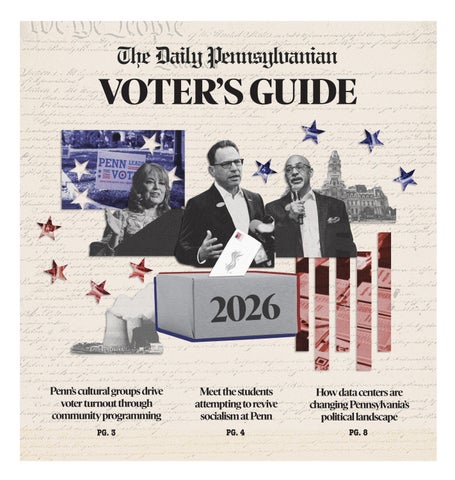
VOTER’S GUIDE
2026 Penn’s cultural groups drive voter turnout through community programming
Meet the students attempting to revive socialism at Penn
How data centers are changing Pennsylvania’s political landscape
PG. 3
PG. 4
PG. 8
THE DAILY PENNSYLVANIAN | THEDP.COM
Table of Contents 3 4 6 8
This Issue’s Team NEEMA BADDAM President JASMINE NI Executive Editor ETHAN YOUNG DP Editor-in-Chief ANDY MEI Design Editor PRASHANT BHATTARAI Copy Editor JESSICA HUANG Copy Editor ISHA CHITIRALA News Editor FINN RYAN News Editor
2
VOTER’S GUIDE
THURSDAY, OCTOBER 29, 2026
AYANA CHARI Assignments Editor ARTI JAIN Politics Desk Editor INGRID HOLMQUIST Opinion Editor ALEX NAGLER Deputy Design Editor CONNIE ZHAO Opinion Photo Editor CATHERINE FAN Deputy Photo Editor
COVER Design by Catherine Garcia
9 10 11
Trump threats to mail-in voting won’t significantly impact midterms, Penn experts say Shelly Gottlieb | Your vote matters more than you think Eden Liu | Penn students are educated but uninformed
Penn’s cultural groups drive voter turnout through community programming Meet the students attempting to revive socialism at Penn A voter’s guide to the 2026 midterm elections How data centers are changing Pennsylvania’s political landscape
UMOJA, Asian Pacific Student Coalition, United Minorities Council, and Lambda Alliance told The Daily Pennsylvanian they favor issue-based organizing over endorsing specific candidates RIANA MAHTANI Senior Reporter
F
way. College junior Zainab Adeoye, the group’s political chair, wrote in a statement that UMC is emphasizing civic engagement among minority communities. “Political engagement doesn’t have to be tied to a political party,” Adeoye wrote. “It can also start with the issues students care about most.” UMC, she wrote, occupies a space that is cultural, community-oriented, and political — and prioritizes making sure its members’ voices are heard on campus and in Philadelphia. Students, she wrote, “may not always participate through traditional party politics, but they’re still engaging through community organizing, issue-based advocacy, and conversations about the issues that directly affect them.” Wharton junior Juliet Adam, the political chair of Penn UMOJA — which represents Black students and Black organizations on campus — said the group’s primary focus is “educating students on what things are important to them.”
VOTER’S GUIDE
Locust Walk on Oct. 5.
CATHERINE FAN | SENIOR PHOTOGRAPHER AND DESIGN BY AKSHAY GUPTA
3
approach to campus activism. “For those who can vote, we are hoping and continuing to push for high voter engagement,” he said. College junior Nina Rivera-Gonzalez, who leads Lambda Alliance, Penn’s advocacy group for queer students, described a similar dynamic. Like Thomas, they resisted characterizing the group as purely political — engagement among Lambda members, they said, tends to flow through their other involvements rather than through the group as a political bloc. “I wouldn’t call Lambda a political club, because just having the identity of queer shouldn’t make you a political hot topic,” Rivera-Gonzalez said. “But we do recognize our importance as an umbrella group.” Rivera-Gonzalez referenced two pieces of Pennsylvania legislation: House Bill 1315, which would seal namechange records to reduce the risk of hate crimes against transgender people, and House Bill 1800, which would redefine marriage in state law as “a civil contract between two individuals.” Neither will be on the ballot in November — but that, they argued, is beside the point. “This is something that you could call into your state or local governments and share your opinion,” they said. Rivera-Gonzalez also noted that some students may be sending mail-in ballots to home states where transgender rights are directly on the ballot. “Nearly half of the LGBTQ-related bill and ballot initiatives this year would restrict trans student athletes from competing,” they said. Why, Rivera-Gonzalez asked, had those measures been prioritized over issues “involving economic status or protecting the environment”? The United Minorities Council, a coalition of minority student groups, framed its election-season work the same
David Kerendian wrote in a statement that the organization’s student members “certainly engage with politics and political issues in their individual capacities.” The group’s focus is on “creating a space where students with different backgrounds and viewpoints can come together, engage in meaningful dialogue, and feel supported in their Jewish identities,” Kerendian added. Some leaders described a general mood of political anxiety on campus. Thomas said while students feel “a lot of uncertainty,” they are not yet “discouraged from voting.” Rivera-Gonzalez said many people they knew were “saddened by the current direction of the country and are unsure whether their voice, their opinion, or their vote actually matters.” Some students, Adam said, might have felt discouraged after 1968 Wharton graduate and President Donald Trump was elected to a second term. “They feel like their vote might not be heard,” she said. “I think people are realizing it’s now or never. This is the chance to possibly reverse some of those things and the climate that we’re experiencing right now as Black students on campus.” What united the coalitions, in the end, was a feeling of shared responsibility to keep their members civically engaged. “Your vote matters,” Rivera-Gonzalez said. “We want to hear what you think.”
THURSDAY, OCTOBER 29, 2026
or many leaders of several of Penn’s cultural and identity-based coalitions, political engagement runs through their communities, not partisan clubs on campus. In conversations with The Daily Pennsylvanian, they described their work as issue-based organizing and community conversation rather than support for specific candidates or parties. Several groups pushed back on being called political organizations at all, even as they work to turn their members out to vote. Wharton junior Simon Thomas, who chairs the Asian Pacific Student Coalition, does not draw a hard line between his group’s cultural work and its political work, which he said move in tandem. As Penn grapples with fights over diversity, equity, and inclusion, affirmative action, and mounting attacks on higher education, Thomas said he wants his coalition in the room. “APSC is in those rooms, and we want to be able to be in those rooms to represent the API voice,” he said. The coalition was among the student groups that criticized an early draft of Penn’s open expression guidelines — rules that, once finalized, will govern speech and protest on campus for years. “You don’t have to be in a political group to be politically engaged,” Thomas said. Real engagement, in his view, means showing up in one’s own community and working to improve it. Thomas pointed to the Save Chinatown Coalition, which successfully killed the original proposed site for a new Philadelphia 76ers arena, as evidence of that philosophy working in practice. Because a large share of its members are international students who cannot vote in the United States, APSC sometimes takes a nontraditional
“The number one thing we’re trying to highlight is why midterm elections are important,” Adam said. “People forget that, while you’re not electing Trump right now, the people that you are electing in Congress right now are the people that will be approving or rejecting those laws.” She said that many of the group’s members were concerned about student loans and employment opportunities, particularly for international students. In September, multiple international students told the DP they were feeling mounting uncertainty over a flurry of federal proposals that could reshape work authorization policies. The group stressed the importance of being bipartisan and of “educating students for them to then use those tools to vote and realize what is important to them and their separate groups,” according to Adam. That means, she said, thinking about politics beyond race alone, because “these issues are all interconnected.” “Maybe the immigration policies aren’t impacting you as an American citizen, but they are impacting the other students within your classroom and the people that you will be working with and will be making up your office in the future,” she added. Penn Hillel declined to weigh in on the election itself. While Hillel does not take institutional positions on races or candidates, co-President
THEDP.COM | THE DAILY PENNSYLVANIAN
Penn’s cultural groups drive voter turnout through community programming
THE DAILY PENNSYLVANIAN | THEDP.COM THURSDAY, OCTOBER 29, 2026
CATHERINE FAN | SENIOR PHOTOGRAPHER AND DESIGN BY AKSHAY GUPTA
The constitution of Young Democratic Socialists at Penn.
Meet the students attempting to revive socialism at Penn After a series of victories for progressives this summer, students reestablished a chapter of the Young Democratic Socialists on campus ARTI JAIN Senior Reporter
4
VOTER’S GUIDE
E
arlier this semester, a handful of Penn sophomores set out to build something the University had not seen in recent years: an outlet for politics outside the conventional two-party framework. Hoping to revive student-driven socialist activism that had dissipated from campus, they reestablished a chapter of the Young Democratic Socialists of America at Penn. It is an auspicious moment
to try. Democratic socialism is burgeoning across the country, and Penn is no exception. In May, Pennsylvania House Rep. Chris Rabb (D-200), a Democratic Socialists of America-backed candidate, clinched the Democratic nomination for Pennsylvania’s third congressional district, which includes University City. Running with no major opposition to represent the nation’s bluest House seat, Rabb — a 2006 Penn graduate with a
master’s degree in organizational dynamics — is all but guaranteed to take office in January. His victory followed democratic socialist Zohran Mamdani’s upset in New York’s mayoral election last year, and it presaged a string of wins for non-incumbent democratic socialists in congressional districts across New York, Colorado, and Michigan. It’s a “very special time to be a YDSA chapter,” Skylar Fan, a College sophomore and a co-chair for the group, said
in an interview. “It’s the first time in history I think people don’t hear the word ‘DSA’ in the YDSA and just go, ‘That’s some radical blue-haired socialists,’” she added. “People are taking this seriously because they’re seeing the electoral wins.” Fan and the club’s other founding members began to think about starting a YDSA chapter in July. Fan — a former staffer for The Daily Pennsylvanian — said a few students attended a training boot camp in Portland, Ore.
over the summer to learn about political organizing. Penn YDSA kicked off programming at a Sept. 24 meeting, which roughly 40 people attended, according to Fan. “The attendance at our kickoff meeting blew my mind,” she recalled. “I remember, freshman year, I had felt so alone in how I felt politically. I thought there wasn’t a second person on campus who felt the way I do, and suddenly in this room, I don’t have enough seats for the people who feel the same
“People are taking this seriously because they’re seeing the electoral wins.”
“Don’t expect any of our members or us or even anybody in the greater Penn community to stay silenced when injustice is being committed.” — Engineering sophomore Joshua Wangia “If we want to make any meaningful change in this world, we can’t wait until we find someone or something that we 100% agree with,” Quitoriano added. “We are really lucky to be in a place where there are so many lances and so many people who want to fight.” “We’re given a choice — to pick up a lance or not,” he concluded. “And I ask people to do it.” *** At Penn’s semesterly all-parties debate, YDSA returned on equal footing with Penn Democrats and College Republicans. “When we engage with anybody, we’ve got to show respect,” Wangia said. “We’ve been shown respect from the people we’ve come across — the College Republicans and Penn Democrats have both shown us respect.” At the start of last month’s debate, organizers surveyed
the room. Ahead of the discussion, about half leaned toward Penn Dems, 35% backed YDSA, and 15% sided with College Republicans. By the end, both YDSA and the College Republicans had gained support, at 38% and 21%, respectively. YDSA’s spokesperson at the event argued in favor of a “fair, cleaner society,” listing healthcare for all, universal access to education, and getting “corporate money out of politics” as central causes. The debate convinced Quitoriano that YDSA had real momentum on campus. “Penn’s administration has done a really effective job at shutting down political dissent on this campus through its free speech rules,” Quitoriano said. “To finally see in front of my eyes just how many people personally really do believe that means that it’s not a question of energy, it’s not a question of mobilization, it’s a question of organizing.” The University has been reviewing its open expression guidelines since 2024 and has released two revised drafts since March. Temporary standards for demonstrations — which sharply restrict protests and event registration — took effect shortly after the encampment was dismantled and will remain in place until the guidelines are finalized. “I think it’s rather remarkable that Penn’s educational system does a really good job of describing how the world is, but not exactly how the world could be,” Quitoriano said, adding that he hopes administrators will be interested in engaging with the organization. In September 2024, Penn adopted a policy of institutional neutrality. Penn President Larry Jameson argued the rule — which bars University leaders from issuing public statements on local or global events that do not have a direct impact on Penn — would protect the “diversity of thought” on campus. “Benjamin Franklin founded this institution to build citizens that were thoughtful, that were able to create a stately society that works well,” Quitoriano continued. “That is the calling of this University. There’s a reason why higher education exists. And to treat Penn like a business is such a disservice to Benjamin Franklin’s vision, to our history, and to our students.”
5
“I have friends that are techno-capitalists, and when I tell them about the kind of things YDSA wants to do, no matter how much they slam socialism from a political standpoint, they’re like, ‘Oh,
on campus featuring conservative commentator Ben Shapiro. “It felt to me there was an imbalanced treatment of the Overton window here at Penn and that there was no meaningful counterbalance to that,” he said. “But I knew that there was energy for something else there.”
VOTER’S GUIDE
— College sophomore Skylar Fan
this is good,’ because they also have a financial aid burden,” he said. More of the University’s funds, including its endowment, “should be going towards students, and less and less towards its leaders,” Wangia said. Last month, the University reported a record-high $6.3 billion return on its endowment in fiscal year 2026. Daniel Wolff, a College sophomore and general body member of YDSA, said the group also discussed whether universities have an obligation to make voluntary payments to local governments to make up for their tax-exempt status. Penn and Columbia University are the only Ivy League institutions that do not make payments in lieu of taxes, or PILOTs. In 2021, protesters marched in University City to demand Penn and Drexel University pay their “share.” *** Originally from San Diego, Quitoriano — who helped found Penn’s YDSA chapter — began identifying as a socialist in high school. “I started asking myself if the world that I was living in was working for me and my friends,” he said. “And I think the resolute answer that I came to was no.” As a result, Quitoriano sought another source of political representation on campus, saying he had been unable to find a “political home with the existing political infrastructure on campus.” “I felt like a lot of it was about striving for these greater personal goals of how do I as an individual climb this ladder of getting to the Hill one day or working for a candidate so that I can then run for office someday,” he said. “It very much embodied the preprofessional spirit of Penn.” Fan felt similarly. Students, she said, are so often caught up in the competitive “rat race” of achieving high grades or securing post-graduation employment that they don’t get a chance to “look out into the community and start actually doing work.” “I think it really makes you stress a lot less about your personal and individual struggles,” Fan said on political organizing. “You start to see that you, as a member of your community, have the power to do better.” One of Quitoriano’s “wakeup calls” was an April event
THURSDAY, OCTOBER 29, 2026
of Penn’s YDSA chapter and a former DP staffer, said the group follows a democratic process when determining organization-wide goals. “Fundamentally, people focus quite a lot on the ‘S’ of DSA and the ‘socialism,’ but just as important as the ‘S’ is the ‘D’of democracy, in which the values that we uphold are built from the values of our members,” Quitoriano said. The group, he said, represents a broad range of perspectives. But Quitoriano added that “across the board, YDSA at Penn and the DSA fundamentally believe that the profit motive and the concentration of capital in private hands is bad for society.” “The working class are the people who drive the machine of production in society,” Fan argued. “What are all the goods and results of this production for? Today, within the capitalist system, I see that the fruit of the working class production goes to the corporate class.” Socialism, she said, “aims to give this production back to the people who work for it — the people whose labor fuels the production machine.” To start, Penn YDSA’s primary focus will be undergraduate financial aid, Fan said. “My desire to become more educated shouldn’t burden my family to the point that my parents are constantly worried about saving up,” she said. “My parents were constantly worried when I was applying to college about how much this is going to cost.” Wangia emphasized that the organization’s advocacy extends to all undergraduates.
THEDP.COM | THE DAILY PENNSYLVANIAN
way that I do.” *** Democratic socialist organizing at Penn in recent years traces back to 2015, when students canvassed for Bernie Sanders’ presidential campaign through a Penn Students for Bernie chapter. That group largely went dormant after Sanders lost the primary in 2016. Three years later, 2022 College graduate Jack Cahill restarted the chapter as Sanders sought the Democratic nomination for a second time. In the summer of 2020, after Sanders again lost his bid, the group rebranded as Penn Justice Democrats. The club continued under the Penn Justice Democrats banner until summer 2022, when it became a YDSA chapter. It operated on campus for two years before dissipating in 2024 shortly after the 16day Gaza Solidarity Encampment was dismantled. According to an Office of University Life spokesperson, the organization has not been formally registered with Penn since 2020. During its two-year stint on campus, the group focused on several issues, according to 2023 College and School of Arts and Sciences graduate Matthew Liu — including assisting resident advisor unionization efforts. The current YDSA chapter may take a different approach from its predecessor — it has no plans to start an encampment, according to co-chair and Engineering sophomore Joshua Wangia — but Wangia still thinks students should feel hopeful. “Don’t expect any of our members or us or even anybody in the greater Penn community to stay silenced when injustice is being committed,” he said. Since its return to campus this fall, YDSA at Penn has continued its advocacy for individuals affected by the Israel-Hamas war, a conflict that a range of human rights organizations and experts — including Amnesty International, Human Rights Watch, and the United Nations — have labeled a “genocide” by Israel of the Palestinian people. Earlier this semester, Wangia said, the organization held a bake sale for a pregnant Palestinian woman whose parents had died and who has two siblings to care for. The group raised about $1,000. College sophomore Matthew Quitoriano, vice chair
THE DAILY PENNSYLVANIAN | THEDP.COM THURSDAY, OCTOBER 29, 2026 VOTER’S GUIDE
6
A voter’s guide to the 2026 midterm elections Here’s everything voters need to know ahead of the Nov. 3 election, from finding polling places to exploring the candidates and questions on the ballot CATHY SUI Staff Reporter
A
head of the midterm elections on Nov. 3, The Daily Pennsylvanian compiled everything voters need to know — from finding their polling place to exploring the candidates and questions on the ballot. Registration and mail-in ballots The deadline for voter registration was Oct. 19. Applications for mail-in ballots — which may be requested by any voter without an excuse — must have been submitted by 5 p.m. on Oct. 27. In the case of an emergency illness, disability, or unexpected absence on Election Day, voters can request an emergency absentee ballot after 5 p.m. on Oct. 27 and before 8 p.m. on Nov. 3. All votes cast by no-excuse mail-in or absentee voting must be received by the county election office by 8 p.m. on Nov. 3. Polling places Individuals who have registered to vote may cast their ballots on Penn’s campus from 7 a.m. to 8 p.m. on Nov. 3. All voters in line by 8 p.m. will be allowed to vote. Residents of Kings Court
English, Lauder, and Hill College Houses, as well as Sansom East, Sansom West, and Domus, can vote in Room 108 of the ARCH building. Students in the Quad and Stouffer Hall in Stouffer College House can vote in Houston Hall’s Reading Room. Students living in Harnwell, Gregory, Harrison, Rodin, Du Bois, and Gutmann College Houses, Mayer Hall in Stouffer College House, The Axis, The Chestnut, the Radian, Chestnut Hall, Hamilton Court, The Hub on Chestnut, and 3737 Chestnut will vote in the Bodek Lounge of Houston Hall. First-time voters must show a valid form of photo identification at the polls. Students may use their PennCard as identification. Other approved forms include a United States driver’s license, passport, or voter registration card, as long as they are not expired, canceled, or revoked. United States House of Representatives Chris Rabb is the Democratic nominee for Pennsylvania’s third district, seeking to represent Philadelphia in Congress. The district faces its first open-seat race in years, after Rep. Dwight Ev-
ans (D-Pa.) — who has represented Penn’s district since 2016 — announced plans to retire. Rabb has served in the Pennsylvania House of Representatives since 2017. He is a member of the Democratic Socialists of America and received a master’s degree in organizational dynamics from Penn in 2006. With endorsements from U.S. Reps. Alexandria Ocasio-Cortez (D-N.Y.), Summer Lee (D-Pa.), Rashida Tlaib (D-Mich.), Jamie Raskin (DMd.), Ro Khanna (D-Calif.), Pramila Jayapal (D-Wash.), and Ilhan Omar (D-Minn.), Rabb advocates for Medicare for All, protecting reproductive freedom, and expanding access to affordable housing. Rabb is also supported by Pennsylvania state Rep. Rick Krajewski (D-188) and State Sen. Nikil Saval (D-1), both of whom represent Penn. He has received endorsements from The Philadelphia Inquirer, the Working Families Party, and Philadelphia DSA. In the May 2026 Democratic primary, Rabb — who was considered an underdog for much of the race — won in a three-way race involving Penn professor Ala Stanford and 1999 University of Pennsylvania Carey Law School
AP PHOTO/MARC LEVY AND DESIGN BY ALEX NAGLER
Shapiro speaks with members of the media outside his polling place on May 19.
graduate and State Sen. Sharif Street (D-3). At the time, Penn professors and progressive organizers told the DP that Rabb’s win signals a shift in the city’s Democratic Party politics. Earlier this month, Rabb visited campus for a panel hosted by Penn Reproductive Justice on the role of abortion in the midterms. In an interview, Rabb said that students should recognize their ability to organize and hold universities accountable. With no Republican challenger in the race, Rabb is all but guaranteed to win the November general election and go on to represent Penn and University City in Congress for the next two years. Pennsylvania Governor Pennsylvania’s 2026 gubernatorial race pits incumbent Gov. Josh Shapiro, a Democrat, against Republican challenger Stacy Garrity, the state treasurer. Shapiro — who serves as an ex officio member of the University Board of Trustees — is seeking a second term after taking office in 2023. He previously served as Pennsylvania’s attorney general. While announcing his cam-
paign in January, Shapiro outlined policy goals for a potential second term, including raising the minimum wage, protecting reproductive freedom, and producing more clean energy. During his first term, Shapiro criticized Penn’s response to allegations of campus antisemitism on multiple occasions. He wrote in a memoir later that he “flatly” would not apologize for statements he made about pro-Palestinian protesters at Penn. At an event promoting the book, Shapiro also addressed Pennsylvania’s readiness to handle U.S. Immigration and Customs Enforcement operations across the state. Garrity, a retired U.S. Army Reserve colonel, received an endorsement from 1968 Wharton graduate and President Donald Trump in January. She previously advocated for the passage of Trump’s “One Big Beautiful Bill” and championed conservative fiscal policies. If elected, Garrity would become Pennsylvania’s first female governor. She formerly worked as a lobbyist for a defense contractor, influencing public policy, military manufacturing, and global trade. Libertarian candidate Ken Krawchuk is also on the ballot. According to a September poll, 58% of Pennsylvania’s likely voters said they would vote for Shapiro over Garrity. Lieutenant Governor The lieutenant governor serves as the governor’s second-in-command and can take over if the governor dies, resigns, or becomes unable to
AP PHOTO/MATT ROURKE AND DESIGN BY ALEX NAGLER
Ga rrity spea k s du ri n g a news con ference at t he Pen n s ylva n ia T rea su r y Department in Harrisburg on April 23.
Committee. The Libertarian candidate is John Thomas, a previous cyber-school educator. Pennsylvania Senate Incumbent State Sen. Anthony Williams (D-8), who has served in the Pennsylvania Senate since 1998, is running unopposed for reelection. The 8th district includes the majority of Penn’s campus, including Stouffer, Lauder, Hill, Gregory, Harnwell, Harrison, and the Quad. All other college houses are represented by State Sen. Vincent Hughes (D7), who is not up for reelection until 2028. Williams has supported tax-credit scholarship programs that help families access alternatives to traditional public schools. He also helped to establish the Philadelphia Gun Violence Task Force. Williams sponsored Pennsylvania’s Clean Slate legis-
lation, which allows eligible criminal records to be sealed from public view, and created a Diversity Apprenticeship Program during his time in office. In the current legislative session, Williams serves as the minority chair of the Senate Community, Economic and Recreational Development Committee and sits on the Banking and Insurance, Education, and State Government committees. Pennsylvania House 2013 Engineering graduate and incumbent state Rep. Rick Krajewski (D-188) is seeking reelection to the Pennsylvania House, where he has served Penn’s district since 2021. Krajewski has advocated for ending mass incarceration and increasing education funding. During his time in office, he won a $2.5 million allocation to establish a state-
wide tenants’ right to counsel, passed medical parole for the sick and elderly incarcerated, and has advanced publicly accountable cannabis legislation. Amid Graduate Employees Together — University of Pennsylvania’s preparations for a strike in February, Krajewski told the DP that he was “fully in support” of the union’s decision. While GET-UP ultimately reached an agreement with the University, Krajewski pledged he would “be there on the picket line to show support.” Krajewski is running unopposed in this office. Ballot questions All Philadelphia voters, no matter their party affiliation, may vote “yes” or “no” on two citywide ballot questions. The first question asks whether the city should amend its Home Rule Charter — which outlines how
Campus Polling Locations
consec
ARCH 108
3900 Spruce St. Beta Theta Pi
Walnut Street West Library
Axis Chestnut Hall Du Bois Gregory Gutmann HamCo Lorem ipsum Harnwell Harrison Radian Rodin Sigma Delta Tau Stouffer-Mayer The Chestnut The Hub
Houston Hall Bodek Lounge VOTER’S GUIDE
The Quad Stouffer-Stouffer
Houston Hall Reading Room
7
MICHAEL PINCUS | STAFF DESIGNER
THURSDAY, OCTOBER 29, 2026
Lorem ipsum dolor sit amet,
Alpha Chi Rho Domus Hill KCECH Lauder Sansom House Zeta Psi
Philadelphia’s local government operates — to give contracting preferences to small businesses. A “yes” vote would also mean expanded city-funded project access for local businesses. The measure comes after Philadelphia Mayor Cherelle Parker — a 2016 Fels Institute of Government graduate — signed an executive order replacing a 40-year-old contracting quota system for women- and minority-owned businesses with a policy that prioritizes small and local businesses. The second ballot question asks whether Philadelphia should establish an office dedicated to the arts, culture, and creative industries. The legislation would make “Creative Philadelphia” — previously known as the Office of Arts, Culture and the Creative Economy — an official city department with its own leadership and staff.
THEDP.COM | THE DAILY PENNSYLVANIAN
serve. The role also presides over the Pennsylvania State Senate and chairs the state Board of Pardons. Incumbent Lt. Gov. Austin Davis (D) has served in the role since 2023. He made history as Pennsylvania’s first African American lieutenant governor and was the youngest lieutenant governor in the state’s history when he took office. Davis — previously a state representative — has worked to secure grants for violence intervention, 911 services, community and worship centers, and after-school programs. Running alongside Stacy Garrity is Jason Richey, a Pittsburgh-based attorney who specializes in energy, construction, and commercial law. He has received endorsements from the Pennsylvania Republican Party and the Pennsylvania Manufacturers’ Association Political Action
THE DAILY PENNSYLVANIAN | THEDP.COM THURSDAY, OCTOBER 29, 2026 VOTER’S GUIDE
8
I
n the battleground state of Pennsylvania, data centers have become a kitchen-table issue. This September, nearly twothirds of likely Pennsylvania voters told The New York Times they either strongly or somewhat oppose the construction of data centers to support artificial intelligence. For Pennsylvania Gov. Josh Shapiro, who is seeking reelection in November, the subject has become unavoidable. After proudly announcing Amazon’s $20 billion data center investment in Pennsylvania in June 2025, the governor signed an executive order in August restricting further data center development across the state and requiring local approval for new installations. The reversal, according to his press release, was informed by “many residents who have expressed their concerns to him directly, and to many more who have shared feedback.” Neither political party has “really figured out how to respond to the challenge” of rising voter discontent over the issue, according to Matthew Levendusky, a professor of Political Science and Communication. Levendusky expects the pressure to keep building into the 2028 presidential race. “Data center construction has become a bipartisan issue,” said Parrish Bergquist, an assistant professor of Political Science. Any electoral effect, she added, might
be “an anti-incumbent effect rather than a partisan effect.” “This is why you see Shapiro coming out against them, because if people are mad about these things, they will vote against whatever incumbent they view as being responsible for building them,” Bergquist added. “At the city council, town council level, I think that could have implications on both parties.” Bergquist thinks the debate over data center construction is largely driven by concerns from residents. “People don’t like the disruption associated with construction, or they don’t like noise or disruption to their sense of place,” she said in an interview. “People are like, ‘This isn’t a thing that’s going to benefit us,’” Bergquist said. “Why does it need to be built here?” Levendusky — who is also the Stephen and Mary Baran Chair of the Institutions of Democracy at the Annenberg Public Policy Center — wrote that media coverage of data centers and AI as a whole has generally “been framed in a way that generates a sense of grievance.” On one hand, he explained, voters are told the rise of AI will reduce the value of higher education and eliminate white-collar jobs, and might even wipe out humanity. The data centers that power that very technology, he continued, “raise utility bills, pollute, and reduce the quality of life for neighbors.”
How data centers are changing Pennsylvania’s political landscape For Pennsylvania Gov. Josh Shapiro, who is seeking reelection next month, the issue has become unavoidable LAVANYA MANI Senior Reporter
“Who benefits?” Levendusky continued. “Mostly a few large companies and their billionaire founders. So, you have highly concentrated benefits and much more broadly dispersed costs — a recipe for people to feel aggrieved.” John Quigley, a senior fellow at the Kleinman Center for Energy Policy, said that while corporations have made “promises about the economic benefits of data centers,” those claims “don’t withstand scrutiny.” While data centers create temporary jobs during construction, he said they “hardly employ anybody” once fully operational. According to Levendusky, companies need to “figure out how to structure the benefits of these centers” so that they “outweigh the costs for communities.” Pennsylvania State Sen. Anthony Williams (D-8), whose district includes parts of Penn, said he has heard pronounced concerns from constituents regarding larger data centers. Despite
that public opposition, he said the facilities “meet a need that the public may have.” “There’s a lot of ads and literature that’s been generated about who supports a data center, who does not, what data centers would do to a community,” Williams explained. “The actual substantive portion related to policy and bills — I don’t think we’ve spent much time on that at all.” Instead, Williams said that at the state level, discussions of data centers and AI were more “political fodder” than substantive policymaking conversations. These concerns could be amplified by a lack of regulation, according to Quigley, who explained that, so far, the data centers proposed in Pennsylvania largely rely on diesel backup generation. “A data center could be running several hundred generators, which, even with the best available technology, are going to be releasing significant amounts of NOx and particulate matter pol-
AP PHOTO/TED SHAFFREY AND DESIGN BY AKSHAY GUPTA
Data center development has emerged as a crucial issue in Pennsylvania ahead of the 2026 midterm elections.
lution, to say nothing of carbon dioxide pollution,” Quigley said. If inhaled, nitrogen oxides, or NOx, can cause respiratory harm — and even lead to asthma. Professor of Earth and Environmental Science Michael Mann wrote in a statement that data centers are “massive sinks of energy and water” that “produce substantial waste and pollution.” Mann, who is also the director of the Penn Center for Science, Sustainability, and the Media, said the environmental effects of data centers had previously been mitigated by using renewable energy. The Trump administration, though, has moved to have data centers run on natural gas, which Mann argued adds to “carbon emissions when we need to be rapidly decreasing them.” According to Bergquist, there has not been a concurrent push for the development of renewable energy sources to support the centers. “We have to figure out how to be able to build clean and renewable energy capacity and distribution in ways that are just and fair and not environmentally detrimental, but that don’t delay things for longer than they need to be delayed,” she explained. Despite rising calls for a pause on construction, Pennsylvania does not have a data center moratorium. Philadelphia already houses eight data centers, though none are the hyperscale developments needed for AI. A Philadelphia City Planning Commission meeting in July raised the possibility of constructing such data centers on two sites — the Bellwether District in South Philadelphia and a city-owned plot near the Northeast Philadelphia Airport — but no specific proposals have been made. New York has had a moratorium in place since July, and several other states have proposed similar legislation. “This is a transformational technology, and no one knows how to respond to it,” Levendusky concluded. “This will continue to unsettle politics.”
Staff reporters Una Cutrone, Aadit Garg, and Cynthia Nga contributed reporting.
THEDP.COM | THE DAILY PENNSYLVANIAN AP PHOTO/MATT SLOCUM AND DESIGN BY AKSHAY GUPTA
Trump threats to mail-in voting won’t significantly impact midterms, Penn experts say The proposed changes would impose new requirements for envelope markings, barcodes, and ballot distribution CATHY SUI Staff Reporter
P
ly to succeed on the merits of its challenge.” “Inevitably, I think this rule is headed for a full-on trial after the election,” Meredith predicted. “We’re almost certainly going to end back at the Supreme Court at some point.” He described mail-in voting as a “good option for people who need to use it,” particularly for students who vote in a state other than Pennsylvania. “I do think that if you have the capacity to vote in person, it’s probably going to be a better experience than mail voting,” Meredith said. “In part, I think it adds a little bit more of a social element to the process of voting, and there is always a small chance that something will go wrong with a mail-in ballot.” Political Science professor and elections analyst Daniel Hopkins highlighted that “this is not the sort of thing you want to procrastinate on.” “There is real value in returning these and not even
waiting until anywhere close to the deadlines,” he said. “At times, the state may say that you can send it any time until a certain point, but if the postal service is unable to deliver within that time frame, then you still may risk being disenfranchised.” Trump — who graduated from the Wharton School in 1968 — has urged his supporters to vote by mail despite making claims that the system perpetuated fraud. Hopkins hypothesized that this was because mail-in voting is historically used by Democrats in larger numbers. “One of the challenges is that when one party disproportionately relies on one method of voting, then there are at least incentives for the other party to make that method of voting harder,” he said. In Pennsylvania, applications for mail-in ballots — which may be requested by any voter without an excuse — must be submitted by 5 p.m. on Oct. 27.
Staff reporters Ayesha Faruki, Emily Kohler, Meredith Rinaldi, and Nandita Shetty contributed reporting.
“Inevitably, I think this rule is headed for a full-on trial after the election.”
— Political Science professor Marc Meredith
9
the rule-making process within 60 days. “The question is: Has Congress sufficiently given the Postal Service authority to be the place where a rule like this would develop?” Meredith, whose research focuses on the political economy of American elections, said in an interview. “I think courts will also be weighing — even if it has been given this authority — whether it’s using that authority in a way that would significantly inhibit people’s ability to vote.” On Aug. 11, a federal judge blocked USPS from implementing the executive order’s provisions on mail-in ballots. Nearly two weeks later, the Supreme Court intervened and concluded that the lower court had acted prematurely because USPS had not yet issued a final rule. By Aug. 21, the rulemaking process was complete, and opponents of the order secured a new preliminary injunction — which the Supreme Court left in place after finding that the federal government “is unlike-
VOTER’S GUIDE
resident Donald Trump’s legal battle over mail-in voting is unlikely to affect how Penn students vote in November, but it could shape how future elections are conducted, election experts told The Daily Pennsylvanian. Trump signed an executive order on March 31 seeking to change how federal elections and mail-in ballots are administered. The order, which would impose new requirements for envelope markings, barcodes, and ballot distribution, faces legal challenges over its expansion of presidential authority over elections. According to Political Science professor Marc Meredith, mail-in balloting “should run as it normally does” during the 2026 midterm elections. The executive order — titled “Ensuring Citizenship Verification and Integrity in Federal Elections” — directed the postmaster general of the United States Postal Service to initiate
THURSDAY, OCTOBER 29, 2026
On March 31, Trump signed an executive order seeking to change how mail-in ballots are administered.
THE DAILY PENNSYLVANIAN | THEDP.COM THURSDAY, OCTOBER 29, 2026
1 0 VOTER’S GUIDE
Your vote matters more than you think GUEST COLUMN | The value of your vote
T
his fall, I have spent a significant amount of time working on political campaigns. I have spoken with voters, met with people from all walks of life, and witnessed the enormous amount of work that goes into persuading people to participate in an election. And yet, one of the most persistent things I hear is also one of the simplest: “My vote doesn’t matter.” If there is one thing working in politics and campaigns has taught me, it is that your vote does matter. Campaigns are built around the understanding that individual voters matter. Volunteers and staff spend hours knocking on doors, making phone calls, sending text messages, registering voters, and having conversations with people who may still be deciding whether they will vote at all. All of that work happens one voter at a time. If your vote was inconsequential, no campaign would work so hard
to earn it. Yet voting matters for another reason, one that has less to do with campaigns and more to do with citizenship. We often talk about voting as though its value depends on whether our preferred candidate wins. I think that misses the point. Casting a ballot is an assertion that we have a stake in what our government does and in the communities it serves. Voting also gives citizens the opportunity to make consequential policy decisions directly. This November, Florida voters will decide on Amendment 3, a proposed constitutional amendment that would change the state's property tax system. In Colorado, voters will choose between Amendment 87, which would create a graduated income tax to fund public services, and Proposition 136, which would cap individual and corporate income tax rates. These are not abstract questions. They shape how governments raise revenue, how
much residents pay in taxes, and ultimately how public services are funded. On issues like these, voters are not choosing representatives to make decisions for them. They are making those decisions themselves. Your vote also matters even when the candidate you support loses. A ballot does more than select a winner; it communicates what voters want from their government. Consider the 1992 presidential election. Republican incumbent George H.W. Bush faced Democratic Arkansas Governor Bill Clinton, while Texas billionaire Ross Perot mounted an independent campaign. Perot did not win a single electoral vote. He did, however, receive nearly 19 percent of the popular vote, an extraordinary showing for an independent candidate. Those voters did not elect Ross Perot, but their votes did not vanish. Perot had campaigned heavily on concerns about the federal deficit, the size of government, and government
performance. As Donald Kettl explains in “The Global Public Management Revolution,” the Clinton administration recognized the political significance of Perot’s supporters as it developed its approach to government reform. The administration subsequently launched the National Performance Review under Vice President Al Gore, an effort focused on making the federal government more efficient, less expensive, and more responsive. In other words, Perot lost the election, but the voters who supported him helped make their concerns difficult to ignore. You do not have to support a Democrat or Republican simply because one of them is more likely to win. A vote for an independent or third-party candidate still communicates something. It tells candidates, parties, and elected officials that there is a constituency for a particular set of ideas. Politicians pay attention to voters whose support they believe they can win in the next election.
LAYLA NAZIF | DP FILE PHOTO AND DESIGN BY AKSHAY GUPTA
Guest columnist Shelly Gottlieb argues that casting a ballot is one of the clearest ways you can make your priorities heard.
“Casting a ballot is an assertion that we have a stake in what our government does and in the communities it serves.” — Shelly Gottlieb As a graduate student at Penn, I find the idea that our votes do not matter particularly difficult to accept. We are part of a university community that encourages us to engage with difficult problems, challenge existing ideas, and believe that our work can make a difference. That sense of agency should not disappear when we vote. Politics can be frustrating. Candidates disappoint us. Institutions move slowly. Sometimes, none of the choices on a ballot reflect what we believe. Disengagement does not solve any of those problems. It only means surrendering our opportunity to have a say in them. Voting is not a love letter. It is a choice about who you trust to make decisions on your behalf. So, when you see another political advertisement or another reminder to vote this fall, do not brush it aside. Read about the candidates. Look at the amendments on your ballot. Decide which issues matter to you. And vote! I have spent enough time working in politics to know that campaigns take individual voters seriously. We should take our votes just as seriously. SHELLY GOTTLIEB is a graduate student at the School of Arts and Sciences pursuing a master’s degree in public administration and is from Miami. Her email is shellygo@sas.upenn.edu
EDENLIGHTENED | When recruiting comes before being knowledgeable
P
THURSDAY, OCTOBER 29, 2026
enn is filled with extraordinarily educated students who are surprisingly uninformed about the world around them. I was reminded of this recently while playing “Jeopardy!” with friends, some of whom struggled to name the three branches of government, despite excelling in demanding majors and possessing expertise in fields I know little about. This apathy reflects a broader problem with the University’s preprofessional culture: We are encouraged to become experts in increasingly narrow fields while treating basic awareness of political, economic, and international developments as optional. That contradiction has grown to bother me. Penn prides itself on the interdisciplinary nature of its education. Yet from the moment we set foot on campus, its preprofessional culture pushes us toward specialization. Meanwhile, basic awareness of geopolitical developments is treated as optional. Between academics, extracurriculars, and career preparation, Penn students have CHENYAO LIU | SENIOR PHOTOGRAPHER AND DESIGN BY AKSHAY GUPTA little time to spare. We become adept at prioritizing activities Columnist Eden Liu argues that Penn’s preprofessional culture encourages students to become hyperspecialized at the expense of that offer tangible academic or remaining informed about the world around them. professional returns. Reading the news has none. Being educated should mean medicine within a healthcare not name the three branches implications. If we aspire to It’s great to know what hap- more than being professionally system shaped by politics and of government than the three influence the institutions that pened in Congress today, but or academically competent. It public policy. states of matter. I am the first govern our society, surely we that won’t get anyone an A. No should also mean understandWe constantly hear about person to acknowledge I do should take an interest in who recruiter will ask you to ex- ing the political, economic, and the influence Penn students possess glaring blind spots of is running them. pand on your thoughts about social forces that shape our and graduates will have after my own, including in subjects This is precisely the kind of the most recent headline in lives and the fields we hope to leaving campus. Having a Penn others would consider basic intellectual curiosity I worry Brazil. And unless current enter. degree tied to your name can knowledge. Penn’s preprofessional culevents interAcademia is automatically create an air of And, of course, nobody can ture is eroding. We are encoursect with your often accused of legitimacy that others spend keep up with everything. aged to evaluate everything Morgan Stanliving in an ivo- years attaining, opening doors There is more happening in through a cost-benefit lens. ley interview, ry tower, out of to influential positions in a va- the world than any one person Penn will make us specialists. knowing about touch with the riety of fields. We are given op- could reasonably follow. The For many of us, it will give us them can seem average individ- portunities to make decisions, expectation cannot be omni- the opportunity to shape decilike something ual. However, offer opinions, and occupy science. But there is a differ- sions affecting people we will to do after evno discipline rooms where what we say car- ence between knowing every- never meet. erything else is exists in a vac- ries weight. thing and knowing only what The least we can do is know finished. But at uum. Financial That privilege should come is useful to you. something about the world Penn, nothing markets are with some responsibility to With the midterm elections those decisions will shape. We is ever finished. influenced by understand the world we are approaching, this distinction spend four years at Penn preThis attitude every war, ev- being invited to shape. Ex- feels especially relevant. How paring to make our mark on results in a ery election, pertise is indispensable, but many of us can name our local the world. We should spend perverted kind and even the tie without context, it has its candidates, let alone explain some of that time actually payof hyperspethat the Federal limits. their policies? How many are ing attention to it. cialization. In Reserve chair I’m not arguing that every following the races themselves essence, we be— Eden Liu wears. The com- Penn student needs to become rather than simply waiting for come very good puter scientist a political junkie. Nor do I seek the summary top sheet? We EDEN LIU is a College junior at gaining the developing arti- to impugn the expertise of probably will have some grand studying philosophy, politics, knowledge that benefits us pro- ficial intelligence works amid those not in the social scienc- explanation about the mid- and economics from Taipei, fessionally, while ignoring the debates over regulation, labor es. As someone who studies terms’ implications for our re- Taiwan. His email is edenliu@sas. information that would benefit displacement, and nation- politics, I am much more likely spective sectors, but we aren’t upenn.edu. us intellectually. al security. Doctors practice to notice when someone can- tapped into the source of those
THEDP.COM | THE DAILY PENNSYLVANIAN
Penn students are educated but uninformed
“Expertise is indispensable, but without context, it has its limits.”
VOTER’S GUIDE 1 1
THE DAILY PENNSYLVANIAN | THEDP.COM THURSDAY, OCTOBER 29, 2026
me & my friends using our emotional support votes on Nov 3rd. Are you in?
1 2 VOTER’S GUIDE
Make a plan to vote PAID FOR BY PROJECT 26 PENNSYLVANIA