THE INDEPENDENT STUDENT NEWSPAPER OF THE UNIVERSITY OF PENNSYLVANIA • FOUNDED 1885
PHILADELPHIA, THURSDAY, SEPTEMBER 17, 2026
VOL. CXLII
NO. 21
A history of the Penn presidency As the search for Penn’s 11th president continues, here’s how the role has changed AIDAN SHAUGHNESSY Senior Reporter
For most of Penn’s history, there was no University president. Until 1930, Penn shouldered administrative responsibility as a collective, with its University Board of Trustees bearing responsibility for the most consequential decisions. With time, the University came to primarily entrust its direction to a single person. Larry Jameson is the latest individual to embody Penn’s presidency. In 2024, he was handed the reins to the University at a time of unprecedented volatility on campus. But much of what has defined Jameson’s tenure has not been unprecedented at all. The office he stands to leave has only existed for 96 years, and in that time, nearly every president has faced campus protests, federal scrutiny, and political tension. As the search for Penn’s 11th president continues, The Daily Pennsylvanian dug through University archives to examine the history of the office. The role of the president From Penn’s founding in 1740 until the late 19th century, the provost was the University’s highestranking administrator — with oversight only over faculty in the College of Arts and Sciences. As new schools were added to the University, the administration was reorganized, a process that established the Office of the President in 1930, according to the University Archives. On Oct. 6, 1930, the Board of Trustees elected Thomas Sovereign Gates, resolving to discharge all executive duties through a “President of the University” who would hold office at the board’s discretion. That language still defines the job. Under the current Statutes of the Trustees, the president is the University’s chief executive officer and its educational and administrative head. The president also serves as a liaison between the trustees and the faculty, holds the rank of professor, and is a “member of every Faculty of the University.” Gates himself was a product of the Board of Trustees. An 1893 Penn graduate and J.P. Morgan partner, he had served as the chairman of the Board of Trustees for four years before his presidential appointment. Gates’ administration went on to create the College of Liberal Arts for Women and the School of Nursing, while leading the University through both See PRESIDENT, page 3
JULIA WANG | SENIOR DESIGNER
A ‘Penn kind of football’ turns 150 Whenever Penn football hits the field, it’s the ‘guys from Philly against everyone else’ ELLIE CLARK Sports Editor
When then-freshman quarterback and 1983 Wharton graduate Gary Vura moved to Philadelphia in the fall of 1979, the idea that Penn football could become a powerhouse program was laughable at best. It had been 20 years since the Quakers won an Ivy League championship. The Mount Rushmore of Penn football — John Heisman, Chuck Bednarik, George A. Munger, John H. Outland — had been firmly unchallenged since the dawn of the modern era. Although the namesakes of the four biggest awards in college football took their first steps toward greatness
on Franklin Field, Penn was considered a “basketball school” after a surprise run to the Final Four of the March Madness tournament in 1979. Vura was determined to change that. The Cleveland native and Miami transplant got his first minutes with the Quakers during his sophomore season in 1980. Although he began the 1981 season as a starter, Vura would ultimately lose the role after a number of low-scoring performances, including a 58-0 shutout loss against Lehigh. It’s hard to pinpoint what changed going into the 1982
Penn Reading Project offers first years a taste of academic life Since 1990, the program has been a cornerstone of New Student Orientation and a chance for incoming students to experience academics at the University CHRISTINE OH Senior Reporter
All across Penn’s campus, Benjamin Franklin gazes down at passersby from pole-mounted street flags celebrating the nation’s semiquincentennial. This August, first-year students encountered that history up close. Since 1990, the Penn Reading Project has served as a cornerstone of New Student Orientation and a first taste of the University’s intellectual life for first years. Before arriving on campus, incoming students from Penn’s four undergraduate schools receive reading materials to prepare for the event, which marks their first college lecture at Penn. In an interview, Penn Reading Project and New Student Orientation Director David Fox described the event as a “commitment to the educational and intellectual mission of the University.” “We felt that it was really important that people are here because it’s a major university,” Fox said. “We should make that a kind of groundbreaking part of New Student Orientation.” Fox acknowledged the tendency for Penn students to “start to really identify” with their respective schools “very quickly after orientation.” “There’s interaction across schools, but there are very few experiences that everybody has,” Fox said. “That was really a significant idea behind the Reading Project that whether you’re in Nursing, or the College, or Wharton, or Engineering, you could talk with your fellow students and you could share this experience.” The project was put on pause between 2022 and 2025 while resources were dedicated to different programs for incoming undergraduates. This year, American History professors Sarah Gronningsater, William Sturkey, and Karen Tani jointly curated a selection of written material that NEWS Penn has begun its search for the next Stuart Weitzman School of Design dean
3
season. Vura was back in the starting lineup. Thencoach Jerry Berndt made weight training mandatory after realizing the Quakers were being manhandled on short-distance downs. Franklin Field was re-turfed amid historic renovations. The Quakers took their first game of the 1982 season — against defending Ivy League champion Dartmouth — in a shocking 21-0 shutout victory for the program’s first road victory since 1976. Lehigh, the same team that the Quakers struggled to score against just a season prior, See FOOTBALL, page 9
No — AI will not wipe out humanity by 2030, Penn experts say An Anthropic employee believes the technology has a greaterthan-10% chance of leading to human extinction within the decade ADDISON SAJI Senior Reporter
EDDY MARENCO/UNIVERSITY COMMUNICATIONS
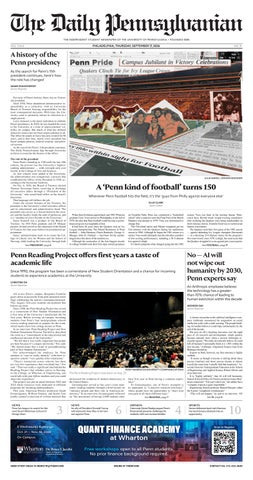
The Penn Reading Project took place on Aug. 23.
showcased the evolution of modern democracy in the United States. Gronningsater served as this year’s event moderator, leading students through a brief lecture on “ordinary people and their role in American democracy.” In an interview, Gronningsater reflected on “the specialness of having 2,000 students enter NEWS An ally of President Donald Trump will represent Amy Wax in her lawsuit against Penn
6
their first year at Penn having a common experience.” To Gronningsater, one of Penn’s strengths is its reputation as “a massive research university,” where people have the opportunity to “chart your own path in all these different ways.” See READING, page 7
OPINION Columnist Gloria Oladejo argues Penn’s financial aid presents challenges for students with non-nuclear families
4
A former researcher at the artificial intelligence company Anthropic announced his resignation on social media last week with a stark warning: The people building AI models believe it could wipe out humanity by the end of the decade. His post set off a dayslong discourse over the rapid pace of AI research and development, which quickly became national news when a current Anthropic researcher agreed. “We really do earnestly believe AI could kill all humans! I personally think it is >10% within the next decade,” Anthropic Alignment Science lead Evan Hubinger chimed in. Experts at Penn, however, say that outcome is highly unlikely. “It seems as though everyone is talking about these precise timelines and those precise threats at almost exactly the same time. I usually find that suspicious,” Associate Dean for Undergraduate Education at the School of Engineering and Applied Science Robert Ghrist said in an interview. It is “highly unlikely” that AI will kill humanity, School of Social Policy & Practice professor Ioana Marinescu concurred. “You can’t rule it out,” she added, but a “complete wipeout is quite improbable.” Engineering School professor Hamed Hassani called the X posts “completely overdramatic.” “This will not happen,” he said in an interview. “Of See AI, page 6
SPORTS Senior defensive back Josh Narcisse has turned every obstacle into an opportunity
10
SEND STORY IDEAS TO NEWSTIP@THEDP.COM
ONLINE AT THEDP.COM
CONTACT US: 215-422-4640