THE INDEPENDENT STUDENT NEWSPAPER OF THE UNIVERSITY OF PENNSYLVANIA • FOUNDED 1885
PHILADELPHIA, THURSDAY, NOVEMBER 5, 2026
VOL. CXLII
NO. 27
DEMOCRATS CRUISE TO VICTORY IN BLUE WAVE Historic election delivers reckoning for Republicans RIANA MAHTANI Senior Reporter
Democrats made sweeping gains nationwide on Tuesday in an election experts are calling a historic rebuke to 1968 Wharton graduate and President Donald Trump and the Republican Party. In Pennsylvania, Gov. Josh Shapiro and United States Representative-elect Chris Rabb both easily secured victories as Democrats took control of both chambers of the state’s legislature for the first time since 1993. The results, political science professors told The Daily Pennsylvanian, signal more of a rejection of Trump than an endorsement of the Democratic Party.
DIVYA SOVANI | STAFF PHOTOGRAPHER
MATT ROURKE | AP PHOTO
Penn voters decisively back Shapiro, Rabb in high-turnout midterm elections LAVANYA MANI AND JAMES WAN Senior Reporters
Penn broke overwhelmingly for Democrats on Election Day, part of a nationwide wave that saw the party make major gains. Voters cast 3,110 ballots on Nov. 3 across four campus polling locations: the ARCH building, Houston Hall, Walnut Street West Library, and Civic House. Both Pennsylvania Gov. Josh Shapiro, running for reelection, and state Rep. Chris Rabb (D-200), running to represent Pennsylvania’s 3rd Congressional District in the United States House of Representatives, handily won their races. “I really want to say how impressed I am by the amount of peer-to-peer work that was done,” Dawn
Midterms could upend Trump-era governance at Penn
Deitch, the executive director of Penn’s Office of Government and Community Affairs, said in an interview. “I think the student voters on our campus organized and mobilized themselves. They did this.” Rabb dominated in votes cast on campus, taking 91.8% of U.S. House ballots at Penn’s polling locations. Independent challenger Dennis Mahoney drew 7.6%. He will be University City’s first new congressional representative in years, succeeding Rep. Dwight Evans (D-Pa.), who announced his retirement last year after a decade in the role. Rabb, who has served in the Pennsylvania House of Representatives since 2017, is a member of the Democratic Socialists of America and
earned a master’s degree in organizational dynamics from Penn in 2006. On the campaign trail, he championed a slate of “Universal Basic Guarantees” — including Medicare for All and progressive policies on housing, income, childcare, food and water, and public transit. Rabb was an underdog for much of the early campaign — but he took roughly 44% of the vote in a three-way primary, beating second-place candidate state Sen. Sharif Street (D-3) by more than 15 percentage points. At the time, Penn professors and progressive organizers said his decisive win signaled a See MIDTERMS, page 6
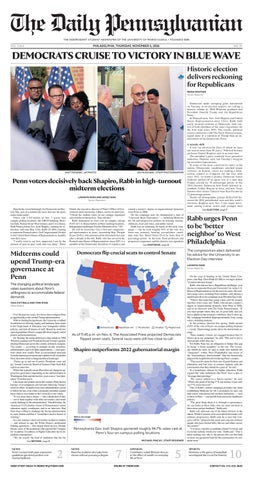
Democrats flip crucial seats to control Senate
ISHA CHITIRALA AND FINN RYAN News Editors
As of 11:45 p.m. on Nov. 4, The Associated Press projected Democrats flipped seven seats. Several races were still too close to call
Shapiro outperforms 2022 gubernatorial margin
Pennsylvania Gov. Josh Shapiro garnered roughly 94.7% votes cast at Penn’s four on-campus polling locations MICHAEL PINCUS | STAFF DESIGNER
See REFORM, page 2
NEWS Penn’s revised draft open expression guidelines garnered positive community feedback
2
SEND STORY IDEAS TO NEWSTIP@THEDP.COM
See ELECTION, page 7
Rabb urges Penn to be ‘better neighbor’ to West Philadelphia The congressman-elect delivered his advice for the University in an Election Day interview LAVANYA MANI Senior Reporter
The changing political landscape raises questions about Penn’s willingness to accommodate federal demands
Over the past two years, few forces have reshaped Penn as significantly as the second Trump administration. With its funding facing threats, the University scrubbed its references to diversity, equity, and inclusion, bent a knee to the Department of Education over transgender athlete policies, and laid off dozens of staff. Bound by restrictive speech guidelines, Penn’s campus fell silent, largely void of protest and demonstrations. On Tuesday, the nation delivered a clear rebuke to 1968 Wharton graduate and President Donald Trump’s agenda, electing Democrats across the country at historic margins. The results — according to multiple faculty members, administrators, and civil rights organizations — raise questions about how readily Penn accommodated demands from the federal government and whether it will reconsider those decisions amid a changed political landscape. “Parties go in and out of power. Presidents come and go,” former University Board of Trustees Chair Scott Bok said in an interview. While that typically means Penn does not change its approach to governance depending on the administration in Washington, Bok said the last few years were a “real aberration” from that norm. Like many universities across the country, Penn faced a barrage of investigations and lawsuits following Trump’s return to office. At nearly every turn, administrators vowed to follow the law, even when community members argued those choices ran counter to the University’s core values. “It was more than a shame — but a dereliction of duty — not to band together with other universities and mount a joint challenge to the administration,” Harold Jordan, the American Civil Liberties Union of Pennsylvania’s senior education equity coordinator, said in an interview. Had Penn been willing to challenge the Trump administration in court, Jordan said that it “would have stood a chance of winning.” In a rare instance where universities worked in tandem — and refused to sign the White House’s preferential funding agreement — they largely found success. Despite threats, none of the institutions that rejected the Compact for Academic Excellence in Higher Education faced immediate consequences. “We are exactly the kind of institution that has the
A seismic shift It was “an election the likes of which we have not seen in more than 50 years,” Political Science professor Daniel Hopkins said in an interview. The president’s party routinely loses ground in midterms, Hopkins said, but Tuesday’s margins far exceeded expectations. In some of the most conservative states in the nation, Democratic candidates notched major victories. In Kansas, voters are sending a Democratic senator to Congress for the first time since 1932. In South Carolina, Democrat Annie Andrews pulled off an upset win in a state that Trump carried by 18 percentage points in the 2024 election. Democrat Josh Turek defeated incumbent Ashley Hinson in Iowa, and now Texas Senator-elect James Talarico beat Ken Paxton by 12 percentage points. Nearly all demographic groups shifted left between the 2024 presidential race and this week’s elections, Hopkins said. Nov. 3 saw major movement among Latino voters and younger men
NEWS Meet the students who take Penn classes without pursuing a degree
7
OPINION Contributor Judah Blitstein discusses the effect of wealth on everyday life at Penn
ONLINE AT THEDP.COM
5
On the cusp of heading to the United States Congress, state Rep. Chris Rabb (D-200) is vowing to deliver “transformational change.” Rabb, who did not face a Republican challenger, won the race to represent Penn and University City in the U.S. House of Representatives for the next two years. He credited young voters, including Penn students, with playing a significant role in his campaign at an Election Day event. “There’s this trope that young voters can’t be trusted, that they won’t come out,” Rabb, who earned a master’s degree in organizational dynamics from Penn in 2006, said in an interview with The Daily Pennsylvanian. “If you meet people where they are, in good faith, and you have a platform that resonates with them, they’ll show up. My campaign benefited disproportionately from young voters, including students.” In the primary election this spring, Rabb earned 63.9% of the vote at Penn’s on-campus polling locations — nearly 20 percentage points above his districtwide average. “Penn students, I know, are engaged because they’ve shown up in my campaign,” he said. “But you’ve got to meet people where they are.” For Rabb, Penn has an obligation to bridge that gap by being “a better neighbor” in the city. The University should do more, he said, to make sure students are “integrated” within West Philadelphia and aware of the “extraordinary disinvestment” that has historically plagued the neighborhoods bordering Penn’s campus. “They need to atone for their sins of gentrification and alienation, and find ways to connect students with the communities that they should be a part of,” he said. In a tumultuous climate for higher education, Rabb argued that “elite institutions like Penn” have a duty to “leverage their privilege.” “We cannot submit to a fascist regime,” he said. “What’s the point of having f**k you money if you can’t say f**k you to fascism?” One of Rabb’s central campaign priorities has been establishing Medicare for All. Lawmakers, he said, can help ensure educational and medical institutions — such as those at Penn — can benefit from university healthcare policies. “The great thing about it is, through co-governance, we can listen to those folks who are most involved in these areas and get feedback,” Rabb said. Rabb will represent one of the bluest districts in the nation. While it remains to be seen which electorates will embrace progressives, Rabb said, he is sure that Congress will be “attuned to the needs and concerns of those people who have elected folks like me and others across the country.” “I’ve never voted for a candidate whom I’ve loved, and if you did, nobody would ever vote,” Rabb said. “This is about making sure who is the person who can best help us move our agenda forward for the communities we care about most.” SPORTS Nowhere is the game of basketball worshipped like it is at the Palestra
10
CONTACT US: 215-422-4640
2 NEWS
THURSDAY, NOVEMBER 5, 2026
THE DAILY PENNSYLVANIAN | THEDP.COM
Revised draft open expression guidelines garner positive feedback The latest draft addressed community feedback on how Penn would protect free expression and enforce guidelines ANANYA KARTHIK Senior Reporter
Penn’s effort to rewrite its open expression guidelines has been marked by months of debate permeated by competing visions for free speech on campus. Now, community members say the latest proposal could bring the University closer than ever to striking the right balance. Released Oct. 20 by the Committee on Open Expression, the new draft addresses community feedback on a March proposal with revisions to how Penn would protect free expression and enforce its guidelines. Compared to the previous, widely criticized proposal — which did not receive final oversight from the committee — the new guidelines have been met with optimism. College senior Niheer Patel, who serves as the Student Committee on Undergraduate Education chair external, wrote that the revised guidelines “represent a significant improvement over the previous iteration, meeting most of SCUE’s recommendations.” “These new guidelines recognize the centrality of free expression in creating a vibrant intellectual atmosphere at Penn,” he wrote. College senior and Undergraduate Assembly President Musab Chummun welcomed the committee’s incorporation of student feedback, noting that two UA members have participated in the committee. “I’m glad to see the progress made by the COE in platforming the UA and other stakeholders’ feedback into this new draft,” Chummun wrote in a statement. “I believe there are strong improvements, such as expanding the COE, clarifying violations, and involving the University Council more.” The revised proposal would restore a committee of 17 voting members selected by their respective constituencies, replacing the March draft’s proposed 13-member body named or approved by the provost. The earlier structure drew criticism from former committee members, who argued it would undermine the body’s independence. A member of the Committee on Open Expression, who was granted anonymity to discuss the group’s private conversations, said the revisions reflected an effort to respond to community concerns about the balance of authority between the committee and administrators. “We took the community input very, very seriously,” the committee member said. “We read it all very carefully — the input from the proposed guidelines — and we took it to heart.” The committee member identified the shift toward greater committee oversight as the most substantial change from the spring proposal. “The community really wanted to see that balance of power changed back to the Committee on Open Expression, and we’ve done that,” the member said. Maya English, a Ph.D. candidate at the Perelman School of Medicine and a member of Graduate Employees Together — University of Pennsylvania, credited community participation with shaping the revisions. “The improvements in the new proposed guidelines on open expression demonstrate the importance of the democratic processes in shaping University Policy, while still leaving some areas needing further refinement,” English wrote in a statement. The University’s August summary of community feedback documented concerns about concentrated administrative authority, vague language, and restrictions on demonstrations. It compiled 193 written responses alongside feedback from listening sessions and governance meetings. The executive committee of Penn’s chapter of the American Association of University Professors wrote
REFORM, from front page resources to weather the storm of the Trump administration,” Lorena Grundy — the vice president of Penn’s chapter of the American Association of University
that it “views the defeat of the open expression guidelines proposed by the administration in the spring as a victory for organizing on campus.” The group characterized the new draft as “a major improvement in many ways” while noting that “key areas fall short” of the open expression principles cosponsored by AAUP-Penn and several campus unions. “AAUP-Penn members are in conversation with colleagues and campus partners, and plan to publicly share further information as those discussions progress,” the group wrote. English praised the revised proposal for clarifying language she described as “uninterpretably vague” in the March draft and explicitly allowing spontaneous expression, such as a vigil held on the day of a tragedy. The revised draft permits spontaneous expressive activities in publicly accessible outdoor campus spaces, provided they comply with the guidelines and do not conflict with previously registered events. That provision would depart from the temporary standards currently governing demonstrations, which require advance registration — including two weeks’ notice for events on Locust Walk and in certain other locations. The committee member said that protecting spontaneous protests was a priority during the revision process. “That was something that was incredibly important to the community and also to us,” the member said. The member also described the proposed Campus Expression Facilitator program — renamed from the March draft’s Open Expression Observer program — as a “reimagined” effort to build trust with participants and emphasize mediation. “We want people who will feel more like collaborators and facilitators,” the member said. For Chummun, the remaining restrictions raise questions about whether Penn would permit forms of disruption that have historically driven campus change. He pointed to the four-day occupation of College Hall in 1973, when approximately 200 women protested the University’s response to a series of rapes on and around campus. The demonstration helped secure safety improvements and the creation of the Penn Women’s Center. “We are a University that has made immense progress because of disruptive open expression, and to limit the ability to express oneself is antithetical to our history,” Chummun wrote. He expressed concern that restrictions on blocking pathways could prevent sit-ins like the 1973 demonstration. The revised proposal prohibits physically blocking entrances, hallways, ramps, and other areas in ways that prevent people from navigating buildings or walkways. He also questioned whether requiring authorization for tents and other temporary structures would leave room for encampments in practice. Although the revised draft removes the word “encampments,” it retains the approval requirements for temporary structures. “I fear that any request for encampments may simply be denied,” Chummun wrote. Patel wrote that the draft would be further improved by “reducing the barriers to expression that lie in the time, place, and manner restrictions.” The board of the Asian Pacific Student Coalition wrote that it is “encouraged by this revised draft” because of restored community involvement, more clarity for students facing disciplinary referrals, and
viewpoint-neutral enforcement. According to APSC, one area for further improvement is the approval process for projected images. Under the revised draft, projections require the executive director of open expression’s review and approval, with written reasons required for rejected submissions. The board called for revisiting that provision “so that expression is regulated by time, place, and manner rather than by what is being said.” The coalition also sought clearer limits on the regulation of personal online speech. The March proposal’s reference to “cyberspace” had prompted concerns that the guidelines could reach students’ personal social media accounts. The revised draft removes that broad reference and specifies circumstances involving University premises, affiliated groups, resources, or representations of University affiliation. APSC nevertheless asked for clarification that identifying oneself as a Penn student would not, by itself, bring personal online speech under the guidelines. The board also called for retaining safeguards concerning consultation with the committee before police are called to demonstrations. Another suggestion was restoring protections against student groups facing pressure through their funding or recognition for hosting controversial speakers. English’s remaining concerns centered on how much authority the committee would maintain over enforcement and discipline under the proposed executive director. The position, first introduced in the March draft, would retain final authority over disciplinary referrals. Under the revised proposal, committee members would constitute a voting majority of the director’s search committee, and the committee would have primary operational oversight of the office.
Professors — said in an interview. But on the whole, Penn has been far more willing to negotiate, and at times compromise, with the federal government than its peers. In a move many faculty called political capitulation, the University settled with the Education Department to restore $175 million in federal funding in July 2025. “Once you kneel to these kinds of demands, you have
sacrificed something inherent about what you are as an institution,” Grundy said. She added that Penn’s recent decision-making has reflected the “wrong set of priorities” by responding to a “certain political moment.” Repeating a line Penn has employed throughout Trump’s second term, a University spokesperson wrote that the University will “continue to follow the law” and — “when necessary” — challenge federal actions that it believes “violate” it. What comes next for Penn’s dealings with the federal government is largely unknown. The forthcoming Democratic education agenda is far less explicit than the roadmap Republicans outlined ahead of Trump’s second term. Tuesday’s results “might afford the university a bit more space to make decisions it sees as being in its best interest,” Penn’s Faculty Senate tri-chairs wrote in a statement. One example of Penn’s compliance with the Trump administration was the dismantling of DEI programs and policies, a key fixture of the GOP’s higher education agenda. On his first day in office, Trump signed an executive order requiring universities that receive federal funding — such as Penn — to terminate DEI programs that could be in violation of federal civil rights laws. In response, the University abandoned longstanding diversity and affirmative action policies across its schools and programs, drawing widespread backlash from members of the Penn community. Philadelphia City Councilmember Jamie Gauthier — who represents Penn — wrote in a statement that she hopes
DP FILE PHOTO
The White House in 2023.
Prepare for kickoff
WE DELIVER 2206 WASHINGTON AVE (215) 546-7301
English welcomed the committee’s greater involvement in selecting the director but questioned whether its ability to issue advisory opinions would provide sufficient influence over enforcement decisions. “As such, although these guidelines are improved and provide a better starting point for an eventual policy (whereas the March proposal was unusable), I still hope that more will be done to ensure that the enforcement and disciplinary process are as democratic as possible,” English wrote. Similarly, Patel suggested “increasing the COE’s executive power, particularly in the referral process for disciplinary action.” The revised proposal also provides a mechanism for challenging referrals. Individuals would be able to appeal to the committee’s tri-chairs, who could temporarily pause a referral pending review by a three-member committee panel. A referral would not itself constitute a finding that a violation occurred. The committee member said retaining the executive director position was intended to address limits on the time and resources available to the committee and the Office of the Vice Provost for University Life. The director would oversee facilitator training and deployment and have the ability to respond when initial mediation attempts at an event fail, the member said. The committee would play a “complementary” role in interpreting the guidelines and reviewing decisions. The Committee on Open Expression member emphasized that the proposal remains open to revision and encouraged community members to identify provisions they support alongside those they want changed. “We don’t treat these as finished at all,” the member said. “We’re absolutely going to have more revision.”
KENNY CHEN | SENIOR PHOTOGRAPHER
College Hall on Oct. 26.
Tuesday’s results encourage the University to “recommit to a campus that is inclusive and welcoming to diverse communities.” Even though a Democratic congressional majority could revoke previous Trump policies, the tri-chairs noted that the shift has yet to “signal any change in the public distrust of higher education” or relieve uncertainty over federal funding. Penn’s strategy of federal compliance “isn’t a matter of turning off and on a switch,” history of education professor Jonathan Zimmerman said. “None of us know what role Congress will play,” he said in an interview. “None of us know if it will be able to rein in what the [Trump] administration has done.” “In the final two years of his presidency, Democrats will try — and fail — to reverse everything President Trump has done,” a White House press release read. Attempts to reverse the gains of his administration — including eliminating “race-based DEI” and “mass deportations” — the release said, will fail. Whatever changes may come, Jordan thinks the damage at Penn has already been done. The University has already “compromised” on academic freedom, he said — and sent a message that it will not “protect certain things or certain students.” “The justification that you often hear from the administration for not consulting our community is this fear of pushback from the federal government,” Grundy said. “I hope that as the threat of pushback is weakened by political change, the University will be less afraid.”
THEDP.COM | THE DAILY PENNSYLVANIAN
THURSDAY, NOVEMBER 5, 2026
NEWS 3
4 OPINION
THURSDAY, NOVEMBER 5, 2026
Opinion
142nd Year of Publication
THIS YEAR’S BOARD NEEMA BADDAM President JASMINE NI Executive Editor ETHAN YOUNG DP Editor-in-Chief ANDY MEI Design Editor KATE AHN Design Editor PRASHANT BHATTARAI Copy Editor JESSICA HUANG Copy Editor ISHA CHITIRALA News Editor FINN RYAN News Editor AYANA CHARI Assignments Editor INGRID HOLMQUIST Opinion Editor ELLIE CLARK Sports Editor EMILIE CHI Sports Editor KENNY CHEN Photo Editor UMA MUKHOPADHYAY Video Editor NIRA GOYAL Puzzles Editor RANVITH ADULLA Business Manager MAYA ECHAMBADI Corporate Relations Manager SHREYA SRINIVASAN Strategy & Promotions Manager
THIS ISSUE’S TEAM
THE DAILY PENNSYLVANIAN | THEDP.COM
A tale of two cities GLORIA OBJECTS | Penn’s rocky relationship with West Philadelphia This fall, I started an Academically Based Community Service course titled “August Wilson and Beyond.” The seminar class, where Penn students learn alongside West Philadelphia residents, drew my attention with its intracommunity structure. In all honesty, during my time at Penn so far, my engagement with West Philadelphia and the greater city has been quite individualistic, driven by pursuits of engaging in the restaurant scene, vintage popups, or nightlife over engaging directly with community members. That’s not to say that the former is wholly negative — but it’s worth critiquing. I placed more value on my individual experience in the city than its history and community. I came to this harsh realization a couple of weeks ago in one of the class units that explored Penn’s relationship with what most Penn students know as University City but was once the Black Bottom. Prior to the class, I knew about Penn’s dark past of displacing a predominantly Black community that once resided alongside Penn. Looking at side-by-side map photos of our campus before and after the displacement, I learned that the dorm buildings where I hung out or the fast-food chains where I spent late nights used to be homes and community gathering spaces. When I first learned about this, I was angry. I felt anger toward Penn’s past administration, and I felt a sense of shame for being affiliated with an institution that would commit such an act. Selfishly, driven by this shame, I thought that by knowing this history and informing my friends of it or expressing comfortability with exploring different parts of Philadelphia, I could separate myself from this legacy. Additionally, I thought that being part of a newer generation of Penn students who challenged prejudice ideas — mainly concerning the bandwidth of campus we choose to pass — meant that we were progressing. But the harsh truth is that we aren’t. During this unit, we had a discussion exploring student attitudes toward West Philadelphia, which was sparked by one of the community members taking the class. We discussed
the popular sentiment of “Don’t go past 40th Street,” and how it appeared to be fading due to gentrification. The emerging attitude among our student body was treating Philadelphia as a liminal space existing solely for our college experience. We discussed examples of this, such as comments on Sidechat that belittled homeless Philadelphians or how students moving out from their apartments litter the streets with discarded items, lowering the property value of neighborhoods. My professor, Herman Beavers, traced this behavior through history, describing popular sentiments of the student body in the 1960s. Many students held classist and anti-Black perceptions of the community surrounding their campus, often making derogatory comments about residents. While there were some students that opposed prejudiced perceptions or the demolition of the Black Bottom, they represented a small percentage of the population and dominant opinion. When considering the past, present, and blossoming dynamics between the Penn community and West Philadelphia community, our discussion framed it as shifts from one attitude to another over this time period. While overt prejudice is no longer a norm, the common thread between these sentiments is that they come from a lack of knowledge of West Philadelphia and its history. We haven’t truly progressed because we, both as an institution and community, have not made a collective effort to connect with the West Philadelphia community. Just weeks ago, the 3600 block of Market Street was renamed to Walt Palmer-Black Bottom Way in honor of Walter Palmer — an activist who grew up in the Black Bottom and is a current lecturer at the School of Social Policy & Practice — and every resident who was displaced in the expansion of Penn’s campus. While this a step toward progress and reform, it is a baby step in our long journey to amend the strained relationship between Penn and West Philadelphia. It would take another article to address all the things that Penn should do as an institution to
OSCAR VASQUEZ | DP FILE PHOTO
Columnist Gloria Oladejo argues Penn students’ disregard for West Philadelphia strains the possibility of a relationship between the two communities.
create an equitable and authentic relationship with West Philadelphia. But as students, we can take action even in seemingly simple ways. Reading this article and visiting the cited sources is one step in the right direction. Gentrification is also a major issue that our institution, private companies, and even we contribute to. Whether it’s student housing or purchasing dinner from a company that is covertly backed by a private equity firm, these actions throw off the economic balance of the community. From making more efforts to eat at small or family-owned businesses to lowering our waste, baby steps made by each of us can create a massive positive footprint. Most importantly, talk to those outside the Penn bubble. Some of the best conversations I’ve had at Penn so far have been with West Philadelphia residents, largely thanks to my class but
also in random interactions. I still remember a conversation I had in the beginning of the year on the bus with an elderly woman about the US Open and our shared love for Naomi Osaka — which I didn’t expect to have after running errands. That’s the beauty of the college experience: the unexpected. In a community like West Philadelphia, there are so many people, stories, and places that have existed, and will continue to exist, to co-exist, with our experience if we let it. GLORIA OLADEJO is a College sophomore studying law and society and Africana studies from Coopersburg, Pa. Her email is gloriao6@sas.upenn. edu.
A global campus with American rules CONTRIBUTION | International diversity means more than international enrollment
ALEX NAGLER Deputy Design Editor ALENA RHOADES Deputy Copy Editor KAIA FEICHTINGER-ERHART Deputy Copy Editor RAYNA JOHNSON Deputy Copy Editor AVA SAVINO Deputy Copy Editor MARTY SIGNES Deputy Copy Editor LINDSAY MUNETON Deputy Opinion Editor CHARLOTTE PULICA Deputy Opinion Editor CONNIE ZHAO Opinion Photo Editor CATHERINE FAN Deputy Photo Editor
LEO DING | STAFF PHOTOGRAPHER
Contributor Yasmine Santini explores how Penn’s international community is expected to adapt institutionally.
Penn is undeniably global. Simply walking down Locust Walk, the melting pot of cultures on Penn’s campus is evident, as their presence is felt in all aspects of student life. Penn praises this diversity as a source of cultural and intellectual richness, but bringing students together from around the world is not the same as building a university around them. For many international students, arriving at Penn means more than just adjusting to a new country. It also means abiding by a new set of unwritten rules that govern American customs and education. Penn’s own guidance for the international community urges students to adapt
— whether through academic environments or in social spheres. These expectations may feel natural to American students who were raised with them, but for outsiders, they can serve as a second curriculum. That second curriculum is especially visible in the classroom. College sophomore Lottie Galperin came to Penn from a highly competitive private school in London, where academic success focused primarily on essay writing, structured classes, and preparing for her qualification exams. At Penn, she immediately noticed how the academic environment was wired differently. Instead of emphasis placed on more
tangible grading, classroom culture seemed more “discussion-based,” where pressure was placed on “volunteering answers.” For a student who’s more accustomed to individual work, this difference in classroom expectations can feel intimidating and off-putting at first. That cultural distinction matters: What we may interpret as a normal schooling environment can not only look, but also feel strange to outsiders. We reward those who persistently participate in class, and judge the student who is more reserved without consideration for their background or lack of adequate preparation to live in a new country. Yet, this difference in treatment may say more about the educational culture Penn cultivates rather than raw intellectual ability. At what point do our judgments about people’s abilities and attitudes start to reflect our cultural biases rather than objective judgments? This learning curve also manifests socially. College sophomore Maria Costea, who moved from Romania to Penn, described a similar sentiment of shock. But for Costea, it was triggered by Penn’s well-known networking culture. On arrival, she immediately noticed the amount of small talk she was expected to conduct with American strangers, noting that people were “super friendly,” but in ways she was not familiar with. And that is precisely the issue with the way Penn approaches cultural adjustment: Rather than teaching its broader student body how to navigate cultural differences, Penn largely provides resources that help international students adapt to American norms. Penn does provide substantial support through International Student and Scholar Services, which allocates “comprehensive immigration and integration services.” These resources include peer mentorship programs, advising opportunities, and presentations on cultural adjustments. But why is it the sole responsibility of international students to learn American customs instead of a shared responsibility to adopt greater cultural
sensitivity? A more global Penn could begin by making students and faculty more conscious of cultural differences embedded in everyday life. Awareness of such basic discrepancies can start with the small details: Penn can facilitate discourse on things as simple as small talk, networking, and classroom participation, which may feel intuitive to American students, but could be unfamiliar for international students. Professors, students, and orientation services alike can make these expectations more explicit rather than assuming that they are widespread. Penn certainly recognizes that international students feel out of place, but they should remediate these issues with meaningful solutions, not sweep them under the rug. None of these potential solutions require Penn to abandon discussion-based classrooms or the so-called features of American higher education. Still, the University should recognize that these practices are culturally specific rather than universal. Penn can provide a homespace for international students through organizations, programming, and events, while still operating according to what American educational success looks like. International diversity should mean more than just inviting students into a whole new sphere: Penn should encourage its students to learn from each other, whether culturally or socially. The deeper measure of a university’s global inclusivity should not be defined by how many cultures are mixed together, but by whether those cultures are allowed to influence the institution they have joined. Education should reflect the customs and traditions of all its recipients, and Penn’s campus is no exception. YASMINE SANTINI is a College first year studying philosophy from Los Angeles. Her email is ysantini@sas. upenn.edu
Penn should let students spend Dining Dollars off campus CONTRIBUTION | Penn’s dining plans are not as flexible as they claim to be LETTER SUBMISSION Have your own opinion? Send your letter to the editor or guest column to letters@thedp.com. Editorials represent the majority view of members of The Daily Pennsylvanian, Inc. Editorial Board, which meets regularly to discuss issues relevant to Penn’s campus. Participants in these meetings are not involved in the reporting of articles on related topics.
LAND ACKNOWLEDGEMENT The Land on which the office of The Daily Pennsylvanian stands is a part of the homeland and territory of the LenniLenape people, known to the original Indigenous people as “Lenapehoking.” We affirm Indigenous sovereignty and will work to hold The Daily Pennsylvanian and the University of Pennsylvania more accountable to the needs of Native American and Indigenous people.
Penn Dining emphasizes its “flexible dining plans designed for different appetites, schedules, and lifestyles.” Yet in reality, how flexible are these plans? The first-year meal plan costs $6,960 with a choice between more meal swipes or Dining Dollars. Similarly, the second-year meal plan costs $4,714, allowing sophomores to select the cheaper plan or opt into the first-year plan with more swipes. Regardless of which plan students pick, they are required to purchase some amount of Dining Dollars. Most students spend Dining Dollars on coffee at Pret A Manger or the Starbucks at 1920 Commons. But as someone who bought a relatively inexpensive coffee machine this summer, I don’t have a similar need to spend my Dining Dollars — except for occasional midday coffee or sandwich cravings. With a significant amount of Dining Dollars and limited locations to spend them, the mandatory meal plan creates a pressure of forced indulgence on students, pushing them to buy items they wouldn’t have otherwise purchased. Instead, to reduce the strain of obligatory purchasing, students should be allowed to spend their Dining Dollars at venues where they already eat. The obstacle to overcoming this narrow range of locations does not stem from a lack of options, given the culinary hub in which our campus is located. Besides the diverse restaurants in places
like Fishtown and Center City, there are dozens of establishments within a 10-minute walk from our dorms. In fact, because of the easily accessible locations, students who dislike the dining plan spend a significant amount of money on meals from fast-food chains like Chipotle and Raising Cane’s or local restaurants like Pattaya and U-Town. Students who like the dining plan still eat out near campus to hang out with friends, for coffee chats, or to celebrate. Unfortunately, these expenses add up on top of the substantial expense of the dining plan. Students should be able to spend their Dining Dollars at a wider range of nearby restaurants and chains in the spirit of a truly flexible, costeffective plan. This wouldn’t necessitate the development of novel payment systems, either. Many other universities like Drexel University or Case Western Reserve University already have systems in place that allow students to spend dining dollars at local establishments. These systems empower students to spend their time and dining dollars at local restaurants, encouraging them to explore areas near campus. Through this change, Penn would also support local businesses and strengthen its community ties with the city. Store managers at restaurants and food chains near campus support an expanded Dining Dollars system. Malik Mitchell, a shift manager
at Sweetgreen, told me he agrees that students should be able to use their Dining Dollars at Sweetgreen. He also noted that students have previously asked about this idea and that he believes it would help the store and be healthy for students. Acknowledging that he cannot make this change as a shift manager, he encouraged students to communicate with the corporate office. Some may argue that implementing a Dining Dollars system at local restaurants and chains may instigate conflict between West Philadelphia residents and Penn students. Given that both populations frequently eat at places like the McDonald’s on 40th Street, another added level of association with Penn may be perceived as the University increasingly dominating the city. However, many chains and local restaurants decided to locate near campus to attract students as their target customers. Donte Smith, the manager of the Ben & Jerry’s off the corner of 40th and Walnut streets, said, “A primary reason we located our store near Penn was to help serve the [Penn] community.” He thought this proposed solution could “help bring more students into the store, which would be beneficial for their business as well.” Penn students share similar sentiments. College senior Alexis Bienstock shared that she spent her Dining Dollars faster than her swipes
and would have “definitely spent [her] Dining Dollars at convenient and nearby locations [in particular] at the stretch with Cane’s and Chipotle.” Similarly, College senior Shirley Yuan would have liked the option to spend her Dining Dollars at nearby establishments where she frequently purchased meals from, like Sweetgreen, noting that it would have been highly cost-effective. Many Penn students would appreciate and benefit from an enhanced dining plan that gives them greater flexibility and agency in the locations they can spend their Dining Dollars at. Although it would take time for Penn to collaborate with corporate locations, it would ultimately benefit both students and the community greatly. Local restaurant and corporate chain partnerships already exist at other universities, meaning that this change is definitely possible. It just requires effort and initiative. With dedicated conversation and ideation about expanding students’ Dining Dollars freedom, we can create truly flexible plans that more students enjoy. BHARGAVI VATTE is a College sophomore studying neuroscience and law and society from San Jose, Calif. Her email is bvatte@sas.upenn.edu.
THEDP.COM | THE DAILY PENNSYLVANIAN
THURSDAY, NOVEMBER 5, 2026
OPINION 5
What Penn owes the Black Bottom THE CATCH UP WITH KAMAU | History is never open and shut Penn as a university could not unilaterally destroy a community. It took the backing of government officials, medical and educational institutions, and most importantly, money. Nonetheless, even though Penn is not solely responsible for the displacement, it holds a duty as a wealthy institution to provide to former residents. Coming to Penn to get my master’s degree in city planning, I was excited to learn about the history of the city and learn more about different planning theories. But then I learned about Penntrification: the University’s aggressive expansion into West Philadelphia which displaced thousands of people. I felt a pang of guilt about going to an institution that has caused so much damage, especially as someone who wants to use my urban planning degree to support underserved communities. But I soon realized that it was a simplification to say that Penn was solely responsible for the razing of the Black Bottom. The danger of this simplification is that it leaves other institutions, city agencies, and politicians off the hook for the systematic displacement of thousands. The Black Bottom existed between 32nd and 40th streets in West Philadelphia and was a Black workingclass community. Drexel University, Penn Presbyterian Medical Center, the Philadelphia College of Pharmacy and Science, and the Philadelphia College of Osteopathic Medicine, like Penn, advanced redevelopment. These institutions led their redevelopment efforts through West Philadelphia Corporation, a nonprofit they created. The Philadelphia City Planning Commission bears responsibility for the destruction of the Black Bottom; they initially certified the Black Bottom to be redeveloped. Additionally, urban planners for the city, when doing planning, did not take into account the community who lived there and “discounted the communal values, neighborly attachments, and cooperative
activities of Black Bottom residents.” These efforts were all supported and backed by the mayor and the city council at the time. Penn gets the majority of the blame today for several reasons. Penn, since the destruction of the Black Bottom, has continued to expand physically, maintained its status as an elite school, and now even boasts a $31 billion endowment. In contrast, Drexel, in recent years, has been struggling with a budget deficit and declining enrollment. Additionally, the Philadelphia College of Pharmacy and Science, which was part of the University of Sciences, merged with Saint Joseph’s University due to financial issues, and Presbyterian Hospital became a part of Penn in 1995. The politicians and bureaucrats responsible have all since left office or passed away. Still, it’s one thing to scour the archives and read about the damage done to the Black Bottom. It’s another to hear it from someone who was there: Graduate School of Education lecturer Robb Carter, who prefers to go by Brother Robb. He grew up in the Black Bottom at 33rd and Filbert streets — an intersection that no longer exists on the map, because Drexel built their athletic center on that plot of land. I asked Brother Robb if he held anger towards the University when he attended Penn as a graduate student and when he later began working at the University. He said no, even though the feeling he had towards Penn since he was a youth was one of elitism and racism. Brother Robb described an incident that occurred when he first began working at Penn in 2005, in which a car full of white men yelled the N-word at him as he was walking on Spruce Street. I asked Brother Robb what Penn and the city can do to redress the wrongs of the Black Bottom. “Firstly, there needs to be major appreciation for what was lost,” he said. Brother Robb spoke about the vibrant
CATHERINE FAN | SENIOR PHOTOGRAPHER
Columnist Kamau Louis reflects on how Penn can rectify its legacy of destruction.
Black Bottom community of his youth, the many Black-owned businesses, and the strong connection Penn had with the surrounding community. The city has started the process of redressing the wrongs by renaming a block of Market Street after the Black Bottom and lifelong community advocate Walter Palmer. A simple way the University can continue to redress its wrongs is by providing medical care for the former residents of the Black Bottom, many of whom are now in their 80s and 90s. The University can also offer free
tuition to descendants of the Black Bottom who get accepted into the University. Penn may not bear the full responsibility for the razing of the Black Bottom, but it can be the institution that helps guide the healing process. KAMAU LOUIS is a second-year graduate student studying city planning from Orlando, Fla. His email is louis3@upenn.edu.
How much do your parents make? CONTRIBUTION | Penn students normalize lifestyles defined by affluence
ERIC ZENG | DP FILE PHOTO
Contributor Judah Blitstein discusses the impact of wealth and luxury in everyday life at Penn and across the Ivy League.
This past Sunday night, I once again found myself deep in the crumpled pages of a hefty coursepack reader under the dim lights of the Moelis Reading Room. While some of my neighbors also appeared engrossed in their work, writing lines of Python faster than Zuckerberg, others focused on curating posts from their weekend in Soho, looking for upcoming flights to Boca Raton, and scouring retail websites, gluttonously searching for yet another Goyard bag. Somewhere in that same room, someone was thinking about their grocery budget, work-study hours, and if they could afford to eat out with their closest friends later in the week. Those students share a class year, a major, and maybe even a GroupMe. However, when a “Dinner Saturday?” text drops in that group chat, only one can tap the
thumbs-up button without a second thought. The other does the math, checks their balance, and then waits a little too long to answer. Only one of them gets to treat credit card bills like background noise. At Penn, you don’t hear about wealth. You see it. Whether it’s a red-eye flight to the Bay Area for a weekend stay or an Equinox membership, luxurious habits have become routine to Penn students. While Canada Goose began as a durable, warm option for Canadian laborers cut out for treacherous weather, it now dresses Locust Walk’s winter uniforms, alongside Maison Margiela sneakers, Longchamp bags, and a myriad of other high-quality businesscasual pieces that will run you upwards of $200 per item. Across the Ivy League, many can attest: one Princeton student described a $1,000 Canada Goose coat as “just what you do” to stay afloat socially,
while another put it bluntly, establishing how “the default is everyone is wealthy.” Come March, Instagram turns into a yacht brochure of Punta Cana and Casa de Campo, as fraternities and campus groups use time off to blow a pretty penny in the Gulf of Mexico. Penn won’t list it in the course catalog, but every student without a trust fund takes the same unofficial seminar: “Fitting In 0100.” The syllabus covers dinner etiquette and outfit do’s-and-don’ts, plus a unit on silence for the conversations about sundresses, sailboats, and ski trips you can’t follow. The theme of affluence-based exclusion also holds true throughout the Ivy League. A Brown first year mentioned his welder father once, watched the conversation die, and never brought it up again. At Penn, one student skipped birthday and Christmas gifts for a year to afford a $1,500 spring break, while downtown tickets scattered across the semester’s schedule often lead to biweekly charges ranging from $80 to $100. So what about the students who are unable to pay? The excuses start small, with “I’m not hungry,” and “I have to study tonight,” standing in for a $15 dinner, but in a place where going out for food is how students bond, every “no” carries a cost. One Harvard junior described getting “weeded out of friendships based on what you could afford.” A Penn sorority member attested to not eating out in order to cover the cost of cover dues, leading her friends to stop inviting her. It would be easy to write these off as anecdotes if the numbers didn’t back them up. In 2017, Penn’s median family income hit $195,500: a figure that out-earns 82% of American households. The top 1% sent more students to Penn than the bottom 60% combined — 18.7% to 16.5%, respectively — and a random survey of 1,113 undergraduates found zero who grew up in a ZIP code in the country’s poorest fifth. Money doesn’t just afford the tuition; it opens the gate. Applicants that come from the top 1% of wage earners receive admission to Ivy-Plus schools at twice the rate of middle-class applicants with similar scores. Penn’s figures date back almost a decade, and the price tag has only grown. A former Penn
dean summed it up best, stating, “We’re not even a top 10 percent school, we’re a one percent school.” Meanwhile, for the other 99%, a paycheck rarely closes the gap. Work-study students spend their evenings on the other side of the circulation desk, working for the classmates they’d rather be studying with, and they’re still 21% more likely to take on student debt than similar peers who don’t work. As one Harvard student put it, “I couldn’t afford to attend Harvard, and Harvard couldn’t afford me all it had to offer.” While we aren’t a small school outside of Cambridge, Penn would argue it already picks up the tab. On Oct. 14, the University launched a new cost calculator meant to prove it’s “more affordable than most people realize,” against a cost of attendance topping $99,000. Still, only 14% of Penn students received Pell Grants, compared to 32% of college students nationally. While an administrative promise may suggest students can afford the Philadelphia Ivy debt-free — and a calculator can estimate tuition, housing, and meal plans — neither accounts for the social fee that comes with one’s enrollment here. Penn researcher Laura Perna nailed it: the freedom of not having to worry (financially) is a perk experienced only by those with wealthy parents. Here, that advantage reaches well beyond the scope of tuition and ends up shaping our social scene. It writes the rules, sets the prices, and decides who gets to play. Penn students may never truly ask you how much your parents make. They just let the answer dictate your life. Back in Moelis, the lights will be dim again next Sunday night, and the same quiet split will play out over the same wooden desktops and blue suede seats. And just like this past Sunday, no one will name it out loud. Instead, the silence will do what it always does, and sort the room without saying a word. JUDAH BLITSTEIN is a College sophomore studying international relations and political science from Elkins Park, Pa. His email is blits@ sas.upenn.edu.
Girls, wear whatever you want on Halloween CONTRIBUTION | Our costumes are not for attention In the wise words of 2000s philosopher Cady Heron, “Halloween is the one night a year when a girl can dress like a total sl*t and no other girls can say anything about it.” Heron was partially right — for college girls, Halloween is the perfect opportunity to show off the weeks spent in the gym and the creatively crafted two-piece sets. However, despite what she says, it seems like everyone has something to say about it — including me. Although Halloween is traditionally supposed to be scary, it has evolved into an opportunity for women to step outside themselves and adopt an alter ego. At schools like Penn, it’s a weekend of freedom in identity, clothing, and expression — a chance to grow comfortable in one’s skin. It was never about garnering attention. Historically, groups like the Spice Girls, TLC, and Destiny’s Child — all great costume ideas for next year, by the way — have used provocative clothing as a bold rejection of the status quo. Beyoncé’s mother, Tina Knowles, designed all of the group’s first costumes. This was especially revolutionary in an era when high-fashion designers and the general population were unaccepting of curvy bodies. Rather than wear mainstream clothing that wasn’t made with Black features in mind, the group’s innovation and creativity began a groundbreaking movement for minority body positivity. In more recent years, costumes still help women express themselves and their confidence in their bodies. If that means wearing something that shows a little chest, so be it. Penn’s party scene is a place where provocative Halloween costumes, desirability, and social expectations intersect. Even before Halloween, campus norms encourage women to wear desirable clothing that appeals to bouncers and brothers alike. Whether or not a girl is wearing a skimpy outfit for “attention,” her outfit is likely interpreted as an invitation for it. Otherwise, it’s perceived as an effort to get into a full house party or to catch
somebody’s eye. But why is an outfit perceived as anything more than freedom of expression at all? Amid crazy chemistry midterms and never-ending late nights in the library, Halloween is a night to stimulate our minds with creativity instead of homework. Believe it or not, girls aren’t always dressing to appeal to a man. Crazy, I know. This paradox extends to Penn’s competitive and judgmental culture, which associates style and expression with behavior. In many instances, students feel pressured to forsake their creative expression in fear of judgment or missing out on opportunities. Halloween costumes fit into that category. We shouldn’t fear being misjudged because we want to wear revealing clothing. A girl could present herself in something “immodest” by societal standards, and still be an incredible research assistant and effective board member. The contradiction between expectations to look desirable and judgment for looking too “suggestive” becomes even more prevalent during Halloween season. This party culture that rewards women for looking revealing enough simultaneously shames us for looking too revealing, or worse, taking ownership of our sexuality. On the other hand, men are rarely, if ever, shamed for wearing “nothing” on Halloween. Why don’t we shame them for not wearing shirts, even though they’re embracing their bodies the same way? This is an impossible double standard, so I suggest that next Halloween, women free themselves from it. Women must use Halloween as a time for authenticity, creativity, and expression. We too often feel the need to dress for the male gaze and the attention of being seen. No matter what a brother thinks of your Catwoman costume, you still decide your intention behind it. So, whether girls want to wear something provocative or something to keep them warm, Halloween is all about what you want to do. Our choices do not define our character. Enjoying the attention of looking good while appreciating our features is
SYDNEY CURRAN | SENIOR PHOTOGRAPHER
Contributor Evealla Banya challenges the double standard surrounding provocative Halloween costumes and the students who wear them.
not mutually exclusive. Obviously, reclaiming our sexuality doesn’t eliminate the likelihood of getting approached by a guy. It does, however, make us feel more comfortable in our own skin, no matter how much clothing we wear. This begs the question: Should you wear as little as possible this Halloween? Whether or not you choose to, you don’t have to be
“attention-seeking.” Wanting to be confident in your own body is more than enough reason. EVEALLA BANYA is a College first year studying neuroscience from Provo, Utah. Her email is evealla@sas.upenn.edu.
6 NEWS
THURSDAY, NOVEMBER 5, 2026
THE DAILY PENNSYLVANIAN | THEDP.COM
News
New tool aims to keep take-home writing honest This semester, 17 instructors teaching nearly two dozen classes across Penn’s four undergraduate schools piloted the program CHRISTINE OH AND KORI ROBINSON Senior Reporter and Staff Reporter
As generative artificial intelligence threatens to compromise the academic integrity of take-home writing assignments, some Penn professors are finding new ways to keep up with ever-changing demands in teaching. Rumi is a writing platform that enables instructors “to set guardrails around student AI use and provide students a way to make their writing and thinking process visible.” This semester, 17 instructors teaching nearly two dozen classes across Penn’s four undergraduate schools piloted the program, according to Executive Director of the Center for Excellence in Teaching, Learning, and Innovation Bruce Lenthall. The workspace, which offers similar functions to Google Docs, gives instructors greater access to student writing and revision history. Though not an AI detection service, students can collaborate on documents, peer review work, and post on discussion boards through the software. Various AI models — such as ChatGPT, Gemini, and Claude — can be integrated with the program at an instructor’s discretion. At Penn, new technology can be adopted on a school-specific or University-wide basis, according to Lenthall. Because many professors identified a need for increased student transparency on takehome assignments, Lenthall said Rumi was offered
MIDTERMS, from front page shift in the city’s Democratic Party politics. “You’ve got to meet people where they are,” Rabb said in an interview with The Daily Pennsylvanian. “That’s something the University of Pennsylvania should do to be a better neighbor — to make sure that students are integrated with the neighborhoods and understand the history and culture of those neighborhoods.” Over the course of his campaign, Rabb garnered endorsements from progressive politicians nationwide — including Reps. Alexandria Ocasio-Cortez (D-N.Y.), Ilhan Omar (D-Minn.), Pramila Jayapal (DWash.), Ro Khanna (D-Calif.), Jamie Raskin (D-Md.), and Summer Lee (D-Pa.). He also received endorsements from The Philadelphia Inquirer, the Working Families Party, and the Philadelphia Democratic Socialists of America. In the ballots cast on campus for Pennsylvania’s gubernatorial race, 94.7% went to incumbent Shapiro while 4.2% went to Republican challenger Stacy Garrity. Shapiro — who won reelection statewide — far outperformed former Vice President Kamala Harris, who received just 81.6% of votes cast at Penn in the presidential election two years prior. The former attorney general of Pennsylvania, Shapiro is widely considered a potential contender for the White House in 2028. His Nov. 3 victory was called by
as a “cross-school pilot.” “Pilots are conducted on a short-term basis to evaluate a learning technology’s ability to meet the instructional needs of faculty and students,” a Penn Canvas webpage reads. “Pilots are often limited to a small number of participants and usually require that instructors be willing to evaluate the tool and provide feedback.” “We have a lot of instructors on campus that think their students learn an incredible amount from takehome assignments,” Lenthall said in an interview. “In this moment of AI, those kinds of assignments are really stressed.” Lenthall outlined various ways instructors have responded to student AI use, including “by pushing more assignments into the classroom,” and “by creating other kinds of mechanisms to ensure that students are doing their own work.” “Rumi is a technology that is designed to support those kinds of out-of-class assignments,” he said. Wharton School Accounting professor Catherine Schrand — who is using Rumi in her undergraduate honors thesis course this semester — wrote in a statement that she chose to participate in the pilot because “it wouldn’t impose a significant burden on students.” “The only students who would be ‘burdened’ are students who intended to use AI,” she wrote.
While Schrand was unsure if Rumi would “improve student writing,” she “was convinced that it would make students think twice before using AI inappropriately.” Her students, she added, “liked the idea that they wouldn’t be competing against students who are using AI inappropriately.” Political Science professor Alex Weisiger said in an interview that he implemented Rumi in his political science lecture this semester. While Weisiger, who teaches “The Causes of War and Peace,” admitted the tool “does feel a little big-brothery,” he said that it gives him confidence that students are writing their submitted work themselves. “The reason why I view writing as so important is because it forces you to figure out what you think about something,” Weisiger said. “College is where I got better at writing.” On the other hand, Middle Eastern Languages and Cultures professor Emily Hammer expressed concerns about the technology and ultimately came to “reject the idea of Rumi and similar programs” because she has “seen how easy it is to fool them.” “If we try to go the Rumi-like path, we will always be spending our time and energy to try to keep up with technological advances and ever-more advanced forms of cheating,” Hammer said in an interview.
Beyond her concerns about the program’s functionality, Hammer, like Weisiger, acknowledged the negative association with “surveillance software.” Middle Eastern Languages and Cultures professor Heather Sharkey — who piloted Rumi in her first-year seminar “The Middle East through Many Lenses” this semester — said in an interview that she has enjoyed exchanging ideas with students about the tool. “I told my students, ‘We’re going to be in this pilot project, and hopefully we’ll be able to advise Penn on policy,’ and my sense is that they were thrilled,” Sharkey said in an interview. “They really appreciated the idea that the faculty — the University — would ask them for their input.” Sharkey added that several “eye-opening” conversations with her first-year students led her to the realization that many “are as anxious and scared about this new AI landscape” as she is. “We’re all in this together,” Sharkey said. Lenthall said that while it’s “really easy to think” that Rumi is “a game of gotcha,” the tool’s primary aim is to improve student learning. “I would emphasize that this is an experiment, and we are very hopeful that it’s a positive experiment because we want all of the tools at our disposal that will help students learn,” Lenthall concluded.
The Associated Press at 8:01 p.m., shortly after polls closed in the state. Garrity, who was endorsed by 1968 Wharton graduate and President Donald Trump, trailed significantly behind in polling throughout the campaign season. She will continue to serve as the state’s treasurer until her term ends in 2029. When Shapiro launched his reelection campaign in January, he laid out a second-term agenda centered on protecting reproductive justice, raising the minimum wage, and boosting clean energy production. Shapiro — who also serves as an ex officio member of the University Board of Trustees — has repeatedly criticized the University’s response to campus antisemitism over the past two years. During his first term, he oversaw the reconstruction of a collapsed I-95 overpass and expanded the state education budget. He has also touted his ability to reach across the aisle with a state Senate that was controlled by Republicans. Incumbent Lt. Gov. Austin Davis, Shapiro’s running mate, has held the office since 2023. He made history as the state’s first Black lieutenant governor and was the youngest lieutenant governor in Pennsylvania history when he took office. Davis previously served in the Pennsylvania House of Representatives. Pennsylvania also secured a Democratic trifecta — control of the state House, Senate, and governor’s office — for the first time in decades on Nov. 3. “Now, with a Democratic trifecta, we’ll be able to get even more stuff done — from raising the minimum wage and lowering costs, to giving survivors their day
in court, to building more housing and codifying abortion rights,” Shapiro wrote in a Nov. 4 press release. “I’m proud of the work we’ve done to win up and down the ballot.” This election cycle’s voter turnout far surpassed that of 2022 — the last midterm election cycle — when roughly 2,300 ballots were cast. In 2018, just over 3,600 votes were cast at Penn’s on-campus polling locations. The significant turnout “really says a lot about the people in our campus community and students connecting with each other,” Deitch said. “We witnessed here today on our campuses that our student community is engaged — they’re tracking and following things, they decided to vote their voices,” she said. “They decided they had something to make them come out and vote today, and that is an indication to me that they are motivated by each other and in response to the news that they’re consuming.” Most of Penn’s campus — including Stouffer, Lauder, Hill, Gregory, Harnwell, Harrison College Houses, and the Quad — will continue to be represented by incumbent state Sen. Anthony Williams (D-8), who won his reelection bid. All other college houses are represented by state Sen. Vincent Hughes (D-7), who will be up for reelection in 2028. Williams has backed tax-credit scholarships that provide families with alternatives to traditional public schools, helped establish the Philadelphia Gun Violence Task Force, and sponsored Pennsylvania’s Clean Slate law, which lets eligible criminal records be sealed from public view.
Incumbent state Rep. Rick Krajewski (D-188), a 2013 Engineering graduate who was running unopposed, also won reelection. In office, he helped win $2.5 million to establish a statewide tenants’ right to counsel, passed medical parole for the sick and elderly incarcerated, and advanced publicly accountable cannabis legislation. Philadelphia voters passed both citywide ballot questions. The first establishes contracting preferences for small businesses and expands access to city-funded projects for local businesses. The second promotes Creative Philadelphia — previously the Office of Arts, Culture, and the Creative Economy — to an official city department with its own leadership and staff. Penn Leads the Vote tabled on Locust Walk from 9 a.m. to 5 p.m. — handing out merchandise, free food, and stickers. “We want to get campus excited about voting,” College senior Pètra de Beer — PLTV’s research and data analytics coordinator — said. “We want voting to be a fun activity that everyone is able to enjoy and take part in.” Penn Democrats also tabled on campus on Tuesday. College junior and communications director Samara Lacks said that individuals were “excited to vote for those candidates — especially as they see how politics really impacts their day-to-day lives over the last two years.” The day, Deitch said, was filled with “high energy, lots of volume, and lots of interaction.” Staff reporter Max Mao contributed reporting.
STUDYING LATE? WE’RE OPEN LATE!
Domino’s
TM
SUN-THURS: 10AM - 2AM • FRI & SAT 10AM - 3AM
WE MAKE ORDERING EASY!
CALL DIRECTORCHOOSEYOUR ONLINEORMOBILE DEVICE
215-662-1400
4438 Chestnut St.
215-557-0940 401 N. 21st St.
THURSDAY, NOVEMBER 5, 2026
THEDP.COM | THE DAILY PENNSYLVANIAN
NEWS 7
Meet the students taking Penn classes without pursuing a degree While the University primarily enrolls undergraduate and graduate students, it provides external scholars with educational opportunities outside of traditional programs DANIELLE JASON Staff Reporter
From high school students to senior citizens, Penn’s classrooms offer a space for learners across generations. While the University primarily enrolls undergraduate and graduate students, it provides external scholars with educational opportunities outside of the traditional degree programs. The School of Arts and Sciences hosts low-tuition programs that allow participants to take up to two undergraduate courses per semester while gaining credit or auditing lectures. The Young Scholars High School Program, offered on a semesterly basis, is catered toward local high school juniors. Students in the program are limited to choose from a selection of in-person introductory courses — including those in disciplines ranging from economics and math to anthropology and art history — and can only enroll in one per semester. While participants can take these courses on a pass/fail basis, they are not allowed to audit them. High school senior Adaline Sand — a student at the Philadelphia High School for Creative and Performing Arts — enrolled in two courses through the program during her junior year. Sand, who took “Introduction to Sociology” and “The Social Contract,” said she enjoyed the “challenge” that courses offered her. “I learned a lot about my ability to maintain whatever expectations there are and also still have something important to say, even though I’m not in college and I don’t necessarily have the background of the classes that other people at Penn do,” she said. For Sand, being surrounded by undergraduates dismantled the “intimidating” reputation that Ivy League institutions have. She explained that the experience helped her realize that “Penn students are no different than any college student.” “In reality, people are just people, and they could say and make mistakes just as I would, and that was inspiring to me,” she said, adding that “it made me feel special that I was in that room.” She emphasized that completing the courses and managing Penn’s workload as a high school student made her “more confident going into college,” regardless of where she ends up going to school. To participate in the program, students must submit
ELECTION, from front page — groups Trump had made significant strides with just two years earlier. “The extent of this failure is really pretty remarkable,” Hopkins said. Experts disagreed on what drove the nationwide repudiation. Hopkins attributed the backlash to immigration-enforcement overreach, the ongoing war in Iran, and the rising cost of living, while Diana Mutz, a Political Science and Communication professor, warned that reducing the result to a single issue would risk missing what voters were signaling. “This election was about a lot more than just economic distress,” Mutz said in an interview. Her research, which analyzed how Americans’ views shifted over the past two years, attributed the decline in Trump’s public standing less to the economy than to his handling of trade and foreign wars, and a general sense that the United States is less well regarded abroad. Political Science professor Melissa Lee argued, however, that voters were responding to poor economic conditions and that Trump had broken the central promise that got him elected. “He has actively made the economic situation worse for ordinary people by raising tariffs and starting a war of choice against Iran,” she wrote in a statement. “Voters are fed up, and they voiced their displeasure at the ballot box.” Wins for progressives The rising prominence of progressive and democratic socialist candidates drew attention on election night, but faculty were skeptical of reading too deeply into the results. “This is part of a larger blue wave, so it’s hard to say that they won because of that in particular,” Mutz said. Abdul El-Sayed, who was backed by the Democratic Socialists of America, won Michigan’s U.S. Senate race — defeating his Republican opponent
an online application, high school transcript, and answers to three essay questions. Upon successful completion of the courses, they earn one course unit per course. High school students attending City of Philadelphia public and charter schools are eligible to take one course in the fall and spring semesters tuition-free, while others must pay a tuition fee to participate in the program. While the young scholars program offers a path for students to explore a college curriculum before pursuing higher education, the Senior Auditing Program allows those 65 and older to go back to the classroom without enrolling full time. This program is run through the College of Liberal and Professional Studies and allows senior citizens to audit undergraduate lecture classes across disciplines. Participants can take up to two courses per semester — at the discretion of each professor — for $500 per course. Prospective auditors complete an enrollment form to gain access to this program. In the month prior to a semester, they fill out a registration form based on published course listings. Each semester, there are about 40-50 courses available to them. LPS Vice Dean Nora Lewis wrote in a statement that the program is aligned with the school’s mission to “extend the benefits of a Penn liberal arts education to audiences beyond our traditional undergraduate and graduate students.” “Some individuals want to pursue a lifelong passion for a subject; others have developed an interest in learning about something they didn’t study while in college,” she added. Lewis emphasized that auditors in the program “gain a deeper appreciation for and understanding of history, current events, and advances in science and technology.” 1967 College for Women graduate and senior auditor Sherry Blumenthal explained that participating in the program has allowed her to stay intellectually engaged. “It’s adding a huge amount of quality to my life,” she said, emphasizing the importance of finding new interests in retirement. Blumenthal, a retired doctor, has been a part of the by seven percentage points — in a major win for the nation’s progressive coalition. After making it out of contested primaries, New York DSA candidates Darializa Avila Chevalier and Claire Valdez both won their respective U.S. House races on Tuesday. In Philadelphia, voters elected Rabb, a selfdescribed democratic socialist who will represent Penn and University City for the next two years. The widening ideological range within the Democratic Party could “raise challenges for coming to agreement and passing laws,” according to Political Science assistant professor Parrish Bergquist. Progressives might offer a sense of direction to the party, Annenberg School for Communication lecturer David Eisenhower said. Newly elected democratic socialists, he added, could give Democrats a “philosophical spine.” Penn, Philadelphia, and Pennsylvania Turnout increased significantly at Penn from the midterm elections in 2022. Over 3,000 ballots were cast across four on-campus polling locations — a nearly 40% increase from the previous midterm cycle. Shapiro overwhelmingly carried campus votes, garnering 94.7% of ballots, well above the 81.6% Kamala Harris drew at Penn just two years prior. Bergquist said that heightened student engagement may have come from anxiety among young voters. “It is really hard to get a job right now as someone who’s for the first time entering the job market,” she said, adding that the Trump administration’s increased scrutiny on universities has left campuses “tense and fearful.” In Pennsylvania, Democrats gained control of all three chambers. The trifecta, according to several experts, will position Shapiro well to build a national profile ahead of a potential 2028 presidential run. Eisenhower placed Shapiro at the forefront of possible Democratic presidential candidates. The trifecta, he said, “elevates Governor Shapiro into a very solid prospect as a national nominee.” He
KENNY CHEN | SENIOR PHOTOGRAPHER
Shapiro speaking at a Penn Democrats rally on Oct. 11.
EBUNOLUWA ADESIDA | SENIOR PHOTOGRAPHER
Students studying in Van Pelt-Dietrich Library on Sept. 24.
auditing program for a number of years. In that time, she has found herself drawn to course offerings rooted in the humanities. “I don’t know as much about the humanities as I do about the sciences,” she explained, adding that she had little opportunity to take humanities courses while pursuing a biology major as an undergraduate. “I didn’t have time to really explore all the other interesting things,” Blumenthal said. “So now I am — with no pressure.” She has previously taken courses focused on Western political philosophy, astrophysics, and Buddhism. This semester, Blumenthal is auditing two classes:
“Anthropology, Race, and the Making of the Modern World” and “Postmodernism.” During her time auditing classes, Blumenthal expressed that she has had a “great time” interacting with undergraduate students and professors — despite originally taking courses with the goal of keeping her mind active. For those questioning whether they should audit a course as a non-undergraduate, she advised them to “try it.” “You can’t enjoy your life, you can’t learn, you can’t advance in any way unless you’re willing to take calculated risks,” Blumenthal said. “It’s really freedom.”
drew a distinction between Shapiro and the other figures, such as Talarico and U.S. Sen. Jon Ossoff of Georgia. As senators, he said, they would have national visibility but “doubtful impact on policy.” Shapiro, on the other hand, he argued, holds “power on a different order” as governor of a key battleground state. While the trifecta strengthened Shapiro’s chances, Hopkins cautioned that Shapiro would still have to build a national constituency in what he predicts to be a crowded primary field.
“This reads like much more a repudiation of the Trump administration’s policies than an embrace of Democratic ones,” Political Science and Communication professor Matthew Levendusky wrote in a statement. “The danger for Democrats is that they misread it as the opposite.” “The American public — from studies of electoral behavior — tends to have very short memories,” Mutz said. “What’s happened in the year preceding an election is by far the most important, so two years out is very hard to predict.” Still, it’s clear for Mutz that Tuesday’s results signal that voters want change. “Election outcomes are supposed to be a means of communicating to government what kinds of things people are upset about and want to see changed,” she added. “It would be a shame if that message doesn’t get relayed to our leadership.”
The Democratic Party’s future Many experts declined to predict whether the Democratic Party could carry this success into 2028 with any confidence, citing how much can change in two years.
8 SPORTS
THURSDAY, NOVEMBER 5, 2026
THE DAILY PENNSYLVANIAN | THEDP.COM
Sports
Penn women’s basketball welcomes six newcomers Four freshmen and two transfers joined the Quakers this fall EARL COKER Sports Associate
After finishing in the middle of Ivy League standings year after year, Penn women’s basketball is projected to finish fourth this season. With 10 returning players, the Red and Blue have a familiar core, but new talent could take the squad to the next level. Here are the six newest additions to the Red and Blue. Madison Kocis Madison Kocis, a six-foot guard from Chatham, N.J., joins Penn as a freshman from Saint John Vianney High School, where she won numerous championships and earned several first team honors, including a 2026 All-State and All-Non-Public selection. In her final season, Kocis was ranked No. 2 in New Jersey and averaged 13.2 points per game. She also became her high school’s all-time leader in three-pointers, finishing with an impressive count of 172. For Kocis, Penn offered the perfect opportunity to compete at the Division I level while receiving a top-tier education. As she continues to develop as a player, she acknowledged that the biggest adjustment to college basketball has been “the pace of the game,” particularly learning to find her spots on the court and getting comfortable playing alongside new teammates. Coach Mike McLaughlin is already impressed with her development. “She’s got good size. She can shoot the three,” McLaughlin said. “She really wants to be a part of this program at a pretty good level. I’m really pleased with her progress.” Jayah Curtis Joining Kocis in the freshman class is Jayah Curtis, a five-foot-eleven guard from Parsippany, N.J. Curtis played three seasons at Montclair Immaculate Conception before transferring to Morris Catholic for her senior year. Throughout her high school career, Curtis built an impressive resume. She was a 2026 McDonald’s All-American nominee, won the Essex County championships in 2023 and 2024, and secured both a state sectional championship and a Non-Public B state championship in 2025. Her success continued into her senior campaign, when her team captured Morris County and state sectional titles. Curtis’ decision to attend Penn came after her first visit. Beyond basketball, Curtis is also proud to represent her family as one of its first members to compete at the Division I level.
GABRIELLA, from back page During Gabriella Kelley’s junior year of high school was the last time she got to share the court with her younger sister. They overlapped for a season on their high school team before Pilar Kelley made the switch to volleyball, which eventually led her to Penn. “When we were on the same team, we would fight. We would definitely fight. We were very competitive, of course. So maybe it’s for the best that we’re in the same place but different sports,” Gabriella Kelley said. With high school also came the older sister’s first collegiate offers. The first one was from a local school in her freshman year, but Kelley was willing to play the long game. In her sophomore year of high school, she attended a basketball camp at Penn, falling in love with the school, but she had to wait another full year before
McLaughlin sees Curtis as a player with plenty of room to grow and the potential to build a strong career at Penn. “I think she’s going through that developmental stage right now,” McLaughlin said. “But I like what she’s doing, and she is developing.” Curtis is already looking to make her mark, particularly through her “impact on [the] defensive side of the ball,” with an emphasis on securing both defensive and offensive rebounds. Despite Penn’s projected middle-of-the-pack finish in the Ivy League, Curtis believes the team’s dedication can take it further, especially with the added excitement of playing during the Palestra’s 100th anniversary season. Ava Jones Ava Jones, a six-foot-one guard from Hutchison School in Memphis, Tenn., arrives at Penn as a freshman with an impressive list of accomplishments, including three consecutive West Region championships from her last three seasons. She earned Regional Freshman of the Year honors in 2023 and was named a Tennessee Secondary School Athletic Association Miss Basketball finalist in 2026. But her achievements do not stop there. Before reaching her final season at Hutchison, Jones had already surpassed 1,000 career points in her junior year. She followed that milestone with an outstanding senior campaign, ranking among the top five scorers in Memphis. She averaged 18 points, eight rebounds, four assists, three steals, and three blocks per game. Beyond her success on the court, Jones also earned a biliteracy distinction during high school, recognizing her proficiency in two languages. Penn was an easy decision for Jones after meeting with the coaching staff and considering the University’s academic standards, beautiful campus, and location in the tristate area. Her impressive high school numbers are only strengthened by what McLaughlin has seen from her so far. “She’s strong around the rim. She’s got a good burst off the floor at times,” McLaughlin said. “She has a chance to be a good player here at Penn.” At Penn, Jones hopes to use her strength to create second-chance opportunities for the team. As she adjusts to the college game, she is also focusing on improving her pace and ability to get up and down the floor. Rachel Thatcher Penn officially offered her a spot. As soon as the offer arrived, her decision was clear. “The coaches, that was like my biggest thing in the recruiting process. Just coaches that I really liked. The city was another thing. I really wanted to be in the city, and I love Philadelphia,” Gabriella Kelley said about the factors that drew her to Penn. “And then I feel like I could kind of see myself with the girls when I was meeting them.” “The whole thing was like three years of really talking to schools, which is a pretty drawn-out process, but it’s worth it to find a place like this,” she added. Her first two seasons with the Quakers have been starkly different experiences. In her freshman year, she barely saw the court, only appearing in 10 games for an average of five minutes per game. “Just being a supportive teammate was the original role,” she said. That changed going into her sophomore year. Gabriella Kelley saw significantly more playing time, and Penn coach Mike McLaughlin would rely on her off
Rounding out the freshman class is Rachel Thatcher, a five-foot-eight guard from Haddon Township, N.J., who arrives with an impressive championship history. She’s a three-time South Jersey Invitational Basketball Tournament champion, a Camden County Tournament champion and MVP, and was recognized as an All-Olympic Conference performer in 2026. During her final season at Paul VI High School, Thatcher averaged 12.7 points, 7.1 rebounds, and 5.2 assists per game, demonstrating her ability to contribute to multiple areas of the game. For Thatcher, Penn represents a standard of greatness in women’s basketball while also offering exceptional opportunities to prepare her for life beyond the sport. And, if McLaughlin’s early impressions are any indication, Thatcher could make her presence felt immediately. “From the first time she’s walked in here, [she] has commanded the floor,” McLaughlin said. “She’s physical, she’s fast, she’s really mature on the floor. She’s really going to impact this program from day one. Her level of intensity, her level of competitiveness is off the chart for a young kid. She’s really made the players around her better as well.” McLaughlin’s assessment of Thatcher’s competitiveness matches exactly how she describes herself. “I’m a dog, so I’ll do anything to help my team win. I’m willing to put my body on the line,” Thatcher said. Candice Lienafa Along with its four freshmen, Penn added two players through the transfer portal, beginning with junior forward Candice Lienafa. Lienafa, a five-foot-eleven forward from Quebec, arrives from Davidson College, where she established herself as an efficient scorer. She recorded the team’s second-best three-point shooting percentage and led the team in field goal percentage, bringing another shooting threat to the Red and Blue. Her basketball accomplishments stretch back to high school, when she became a two-time provincial champion and earned a bronze medal at the Canadian national championships. When considering her next destination, Lienafa wanted a university with a strong history in both academics and athletics. Penn offered that balance, along with the opportunity to compete at a higher level that more closely matched the basketball experience she was accustomed to in high school. the bench when he wanted a change of pace. The junior describes herself as “more of a shooter” despite her position as a forward, a role that can help the team when it needs to switch up its offensive look. This year, Gabriella Kelley hopes to take a step up in her game. In the season opener against Swarthmore, she was among the first players to be subbed in, a promising sign that she could spend this season as a more consistent contributor off the bench. “[I’m] just trying to make an impact in whatever way that we need. But I’d say shooting is probably going to be my main role this year,” Kelley said. “She had a great summer. Her body’s strong. Her fitness is great. Her confidence is high,” McLaughlin said. “Just really, the game slowed down for her. She’s starting to really understand what the next play looks like.” “She’s going to be a big factor in our success,” he added. The way the players push each other in practice has helped Gabriella Kelley improve her game significantly.
THREADS
A S T A L A L B
D E Y E S A O V L B T A E O T W N M H E O S A U C T A A A D N L
P P A P R I C O
Theme: Tsunami Warning
ANSWER TO PREVIOUS PUZZLE
Instructions: To play Threads, search the grid for hidden words related to the provided theme. Each letter can only be used exactly once. Each game includes a “spangram,” which is a challenge word that connects two sides of the board and hints at the remaining words in the puzzle. This is not your ordinary word search: letters may be found horizontally, vertically, and diagonally for a single word! Play hundreds of more DP puzzles created at www.thedp.com/section/crosswords. Editor: Nira Goyal
THINGS THAT GO BUMP IN THE NIGHT 11/4/26, 6:11 PM
ACROSS
10/28/26, 9:08 PM
1 2 3 4 5 6 7 8 9 10 11 12 13 14 30 Graveyard 52 Birds that haunter can twist their 1 Famous toy 15 16 alien quote from 32 E.T., for example heads almost 360 17 18 33 Dracula’s diet degrees “Toy Story” 19 20 21 22 34 Country south 53 Trig function 8 Raw Japanese of Can. 54 “___-I-Am,” Dr. delicacy 23 24 25 26 37 “Body Party” Seuss character 15 Trachea 27 28 29 30 31 singer 57 Dizzy 16 Source of 32 33 34 35 36 38 Kylo ___ 61 Radiologists maple syrup read these 37 38 39 40 17 Mexican street 39 Extend a loan period, as for a 64 The state of food 41 42 43 44 library book hiding something 18 TV’s teenage 45 46 41 Luxury designer 65 Passing witch 47 48 49 50 51 brand, abbr. 66 Locks of hair 19 Greek island 20 “___ we there 42 Heels, flats, and 67 French stars 52 53 54 55 56 sneakers DOWN yet?” 57 58 59 60 61 62 63 22 Nocturnal fliers 44 Martini garnish 1 Sticky ___ 65 45 Costume made 2 Chorus of a song 64 23 Sauce that with toilet paper sung by the Seven 66 pairs well with 67 46 Moon howlers Dwarfs 17-Across 47 “___ a 3 Famous Taylor 24 Chinese25 Native 40 Little girl’s 58 Foot, in Latin dangerous thing” Swift world tour American fashion nickname Americans of 59 Tray found in a - “The Shawshank 4 Mil. rank Nebraska icon 43 ___ Pinafore, freezer Redemption” 5 “Charlie’s 27 Edgar Allan 25 Tic-tac-toe line comic opera 60 Albany is its 50 Foe Angels” Lucy Poe’s favorite 26 Place for shoes 45 Traditional cap. 6 Shocks birds? 27 Risqué plural 62 ___-cone 7 Damages 28 Boxer abbreviation of 63 401, in 8 Many urban rds. Muhammad and Mr. Roman numerals ANSWER TO PREVIOUS PUZZLE 9 Altar family 46 Tackled 29 Lab container 47 Lift up U A T R E E B RICK S J A W constellation I N RO A D S F R A O L E 10 Nickname, say, 31 Sweeties 48 Person in N A I L S U P L O V A B L E for the famous 33 ___ Bones of charge GR A D H A L E N crab in “The Little “The Legend of 49 Noun, at times MNO C A T L I T T E R Mermaid” Sleepy Hollow” 51 Specialty S A F F RON T I A R A 34 Penn, for one 54 Type of boat B U RG E E T E N 11 Type of tea 12 Basketball Hall 35 Quality of 55 “___ of Green WR I T E I N V O T E of Famer Thomas wine: Fr. P L I E H A N D I N Gables” H I N T S G A L I L E E 13 Kind of ray 36 Amazes 56 Txts. D U K E I T OU T A R T 14 “Skip my turn” S T R A P P E C K 21 Sharp vision Play this puzzle and hundreds more created by the DP at SWA T S A T B L E S S E R www.thedp.com/section/crosswords. 23 Person with a H A L U N E L OR E T T A Authors: Basia L’Heureux, Sophie Mercer, Charlotte Traub sixth sense Y R S P QR T U R D U C KEN Print
https://puzzleme.amuselabs.com/pmm/crossword-pdf
JOSH
CHRIS
PALESTRA, from back page
1/1
then-Athletics Director Jerry Ford, the organization was officially unveiled to the public by then-Penn President Gaylord Harnwell at Houston Hall in November 1954. A $60,000 loan from the University Board of Trustees’ Committee on Student Affairs laid the groundwork for the vision to become a reality. St. Joseph’s upset thenundefeated Villanova at the Palestra in the organization’s inaugural match just eight months later. For aspiring basketball players growing up in the greater Philadelphia area, there was no higher standard than the Big 5. Until 1986, each game was hosted exclusively at the Palestra, with play headlined by intense double-headers between nationally ranked programs. Economic interests raised by Temple President Peter Liacouras and then-Temple Athletic Director Charlie Theokas brought some round robin games to Temple, which later expanded to games at other Big 5 schools. “First, there were games that were played at the Spectrum, special games … I actually played in the first game where Penn played Temple at Temple,” 1987 College graduate Bruce Lefkowitz said. “We actually got blown out, and there was a power failure in the middle of the first quarter, our first half, and I got myself in a little bit of trouble after the game … I said, ‘See, even God wants the games back in the Palestra.’” Even though Lefkowitz isn’t from the Philadelphia area, he immediately recognized basketball was important at Penn after witnessing dozens of students camping out outside the Palestra for season tickets on his 1982 recruiting trip. If he’d gone inside, perhaps he would have witnessed the scores of Philadelphia elementary, middle, and high school students lining the stands, hoping one day they’d get the chance to play for a Big 5 program. 1982 Wharton graduate and current men’s basketball coach Fran McCaffery was one of those kids. Growing up, McCaffery attended every Big 5 game at the Palestra he could. “All through the late ’60s, all through the ’70s, into the ’80s when I played, to me there was nothing else to do,” McCaffery said in an interview with The Daily Pennsylvanian. “That’s what our social life was. All the best players in the country came through here.” For those who couldn’t make it to the games in person, every single Big 5 game was widely broadcast on Channel 17 WPHL-TV. 1978 College graduate Stanley Greene was a Big 5 fanatic, watching every game he could on a portable black-and-white television. A Philadelphia native, Greene started playing beforethe-bell pick-up basketball at Wagner Junior High in eighth grade after being pulled off the sidelines when the regular players were shorthanded. Even though he watched the game, Greene didn’t know how to dribble. “The next day going to school, I was teased, and it was merciless,” Greene recalled. “I committed from that point to start playing basketball, to learn the game, and really
Lienafa is especially excited to play in the Palestra during its 100th anniversary season and compete in the Ivy League tournament on her home court. “Candice is a high-energy, highly competitive player with a relentless motor. She can stretch the floor, knock down the three, and is very effective around the rim,” McLaughlin told Penn Athletics. “She gives 100% on every possession.” Christina Pham Penn’s second transfer, sophomore guard Christina Pham, adds even more shooting talent to the Red and Blue. Pham joins Penn after spending her freshman season at Fairfield University. During her time there, she knocked down 42 three-pointers on 37.5% shooting and scored in double figures five times. Her success began long before college. In high school, Pham was a three-time New England Preparatory School Athletic Council champion and earned Gatorade Massachusetts Player of the Year honors. Pham chose Penn because she believes she can make an immediate impact on a team capable of winning an Ivy League championship. “Penn is a world-class institution and very different from where I was at. So, I think I’m getting a holistic experience here,” Pham said. “And then basketball-wise, the system again, I think fits better to my strengths.” McLaughlin shares her confidence, particularly in the shooting ability she brings to the team. “Christina is an elite shooter from three-point range who will really space the floor for us. She has a great feel for the game, competes hard on every possession, and brings a consistent toughness that we value,” McLaughlin told Penn Athletics. Despite her established shooting ability, Pham recognizes that transitioning to a new program comes with challenges. She is currently focused on improving her “playmaking ability,” especially as she adjusts to a system different from the one she played in last season. Beyond her contributions on the court, Pham also recognizes the importance of her representation as a Vietnamese American competing in the Ivy League. “I think we’re seeing a lot of Asian basketball players now. So I’m really excited to also represent part of that in the Ivy League,” Pham said. Looking ahead to conference play, Pham believes Penn is “a sleeper team” and is confident the Red and Blue are heading toward a long, successful season.
Going up against strong post players in junior forward Katie Collins and senior center Tina Njike has taught her a lot, especially as she continues to adjust to playing in the forward position rather than as a guard, which was her position in high school. Across the board, hopes for the season are high. “Just enjoy it, like enjoy the process, even though that’s corny,” Gabriella Kelley said. “This group is really special, and we’re so close with the seniors, and just thinking about it being the last year with them, I really want to soak it all in.” There is no doubt that Pilar Kelley will be on the sidelines to watch her sister have her potentially most important season yet with Penn women’s basketball. Living far from home was not always easy for Gabriella Kelley in her first two years, and her teammates became her family as she adjusted to life on the opposite coast of the United States. “When I didn’t have her here and I was so far from home, that was a little tougher. But now, you know, my home is here now,” Gabriella Kelley said. get good at it.” The Big 5 and the Palestra became an integral part of Greene’s education. By the time he made the varsity basketball team at Germantown High as a junior, Greene was determined to prove himself as a tenacious defender, notching interest from local programs, including Penn. A confluence of Philadelphia natives joined the program during the 1970s, largely due to the Big 5’s outsized presence in the basketball community. “We were all in different places and [went to] different schools, but that common thread was the thrill of either being at a Big 5 game or watching it on television,” Greene said. “Even after I made the commitment to go to Penn, [Davidson College] said, ‘Well look, we want to give you tickets. Come down, spend the weekend,’ … but at the end of the day, it was about being home and playing in the Big 5.” The Big 5 will cease to exist in its current iteration after the championship game at Xfinity Mobile Arena on Dec. 5, but the beating heart of its history will continue to live on in the bricks and mortar of the Palestra. The Palestra will continue to pull people in, on and off the court, just like 1971 College graduate Dave Wohl. “I was actually recruited to play football, and the third day I was on campus, I wanted to go find a pickup [basketball] game because freshman football wasn’t supposed to start for about another month or so,” Wohl said. “I walked into the buildings between the Palestra and the other gym, and I made a left turn for some reason.” “There was nobody checking IDs or anything like that, and the left turn took me up to the Palestra at that point,” Wohl added. “When I got up there, the current varsity players — my future teammates — were all just starting to get ready to play some pickup games and I just joined in. Nobody knew who I was. I didn’t know who any of them were.” After a few weeks of pickup games, Wohl got the attention of freshman team coaches Dick Harter and Digger Phelps. After a hamburger with Phelps at Hill Dining Hall, Wohl decided to try out for the basketball team and effectively abandon the football program. Although the football coach thought Wohl was making “one of the biggest mistakes” of his life, it ultimately ended up working out for the first team All-Ivy honoree and eventual third-round NBA draft pick. Despite his success in the NBA as a player, a coach, and eventual general manager, some of Wohl’s fondest memories come from his time at the Palestra with Penn men’s basketball. “It was just a crazy atmosphere, which was wonderful because before that, the thing used to be the big four and Penn,” Wohl said. “In other words, the big four were so far ahead of Penn, you couldn’t even include Penn in the Big 5. And then when we got good and we ran off 8-0 my last two years, Digger [Phelps] said, ‘Yeah, it really is the big four and Penn. Penn is so far out in front. The big four is so far behind.’” “I have so many good memories of the Palestra, you tend to forget, God, this thing’s 100 years old,” Wohl added.
THEDP.COM | THE DAILY PENNSYLVANIAN
THURSDAY, NOVEMBER 5, 2026
SPORTS 9
Meet Penn men’s basketball new faces This year, the Red and Blue welcomed six freshmen and two transfers to its roster RACHEL BERLINER Sports Associate
With a first-place ranking in the 2026-27 preseason polls and eight new players joining the roster, Penn men’s basketball is gearing up for a heated season. Six freshmen and two transfers will be adding their skills, experience, and athleticism to the team. The freshmen are forward Finley Billy, guard Chase Geremia, guard Isaiah Carroll, guard Johnny Keenan, guard Ethan Lin, and center Michael Pereira. The two transfers are junior guard Sir Mohammed, from Notre Dame, and sophomore guard Dorian Glogovac, from Caltech. Let’s meet the new faces of Penn men’s basketball. Finley Billy Hailing from Arlington, Va., Billy is joining the Quakers to start his collegiate career. The 6-foot-8 forward dominated in high school basketball, graduating with four varsity letters and three years of captain experience. Billy played two seasons at St. John’s College High School under coach Patrick O’Connor before transferring to The Bullis School, where he worked with coach Bruce Kelly. Billy also became a Washington Catholic Athletic Conference champion and an Adidas 3SSB champion. “I chose Penn because Coach McCaffery is a terrific coach and Penn is a terrific school,” Billy told Penn Athletics. “I fell in love with the campus and want to strive to be the best on the court and in the classroom.” Chase Geremia Geremia is a two-time AAA champion and no stranger to success. Leaving his hometown of Madison, Conn., the guard joins the Quakers with a long list of titles. After winning a state championship with the Daniel Hand Tigers, Geremia transferred to the Newman School, where he became a national prep champion under coach Jackson Johnson. He was also named MVP of the national prep championship and earned all-state and All-NEPSAC honorable mention.
DALTON, from back page rebounds against Rowan — the first double-double in a collegiate debut for a Penn men’s basketball player since 2016. “It was a lot for me to take in,” Scantlebury said. “My brother sent me a picture where I was at the press conference after, and he was like, ‘Dude, this is insane!’ It was cool to feel how many people I had supporting me, and the love I could draw up just with my basketball.” He went on to appear in all but one of the Quakers’ games, earning Ivy League Rookie of the Week honors twice in December. Yet, even amid that success, he noticed the old pattern of tying his identity to basketball coming back. “That’s not how I’m going to be the best person, best friend, best son that I can be. I’m the best in all
In a statement to Penn Athletics, Geremia said that he “chose Penn because of the playstyle, coaches, and overall school environment was the right fit.” Isaiah Carroll The 6-foot-6 guard and Mid-Atlantic Prep League champion is ready to take on his first year at the collegiate level. Carroll’s success at Blair Academy makes him an exciting addition to the Red and Blue. Carroll is a New Jersey Prep Open State champion and a member of the All-MAPL second team. Although originally from Woodland Hills, Calif., Carroll is already connected to Philadelphia. “I chose Penn because Philadelphia is where my father’s side of the family is from,” Carroll told Penn Athletics.
Lin is a two-time New Jersey all-state selection, Central Jersey Player of the Year, and Somerset County Player of the Year. He etched his name into the Montgomery High School record books at the end of the 2025-26 season, closing his high school career with 1,747 points to break a 50-year school record. “Coach Fran’s leadership and the staff’s dedication to player development stood out to me immediately,” Lin wrote to Penn Athletics. “On top of that, I wanted a campus environment where I could connect with and learn from students coming from all over the world. It’s a place where coaches, professors, and peers will push me to be my best.”
Division III program in the Southern California Intercollegiate Athletic Conference. Although his team struggled, posting a 4-21 record, Glogovac stood out as a star player, leading the conference with an average of 23.6 points per game. He finished the season as the highest-scoring freshman in Division III and the 16th-best scorer overall. “I’m really grateful for my experience this year because being the leading freshman scorer in the nation forced me to learn how to play against a lot of different defensive coverages,” Glogovac wrote in a statement to The Daily Pennsylvanian.
Ethan Lin Lin is stepping into his college basketball career with not one, not two, but three New Jersey State Sectional Group 4 titles. The four-year varsity player and two-year captain also won the Skyland Conference championship in 2024 and 2025.
Dorian Glogovac From Vancouver, B.C., to Caltech, Glogovac, a 6-foot-6 guard, is continuing his journey in Philadelphia. In high school, Glogovac played for St. George’s School, racking up a variety of titles for the team. As a junior, he won gold at the Canadian Accredited Independent Schools National Championship, and as a senior, he placed second with Team BC U17 at the Canadian National Championships. Glogovac spent his freshman year at Caltech, a
Sir Mohammed Last but certainly not least is Mohammed, who joins the Quakers after two seasons with Notre Dame’s Fighting Irish. “I went to Notre Dame the past two years, so it was important to me to find a place where I can strive for all my dreams on the basketball court while also getting a great education,” Mohammed wrote in a statement to the DP. Before his career in Indiana, Mohammed led Myers Park High School to a North Carolina 4A state championship as a junior. Mohammed’s success on the court catapulted him to a No. 43 ranking from 247Sports and a No. 57 ranking from ESPN among players in the high school Class of 2024. His impressive accolades didn’t stop in college. At Notre Dame, Mohammed averaged 5.7 points and 2.6 rebounds per game and was named to the fall 2025 and spring 2026 ACC All-Academic teams. In May 2026, Mohammed announced his transfer to Penn in the wake of the Quakers’ unexpected March Madness run. “The way those guys played this year was a big part of my decision,” Mohammed wrote. “All the guys are really good players, and I am excited to join a group of winners.” Mohammed has already given the Quakers a taste of his competitiveness, putting up a whopping 32 points in the Red and Blue Scrimmage. On top of that, his versatility makes him a standout.
facets of my life if I diversify who I am and what I’m doing,” Scantlebury said. “I think I got a lot closer with my teammates second semester, and I’ve been finding other parts of my identity.” One of those “other parts” for him has been music. He’s increasingly devoted his free time to mixing house music, finding avenues for expression that he can’t get through basketball. “Music has become a big part of my identity, in terms of creativity and having another outlet to look at the world,” Scantlebury said. “It’s been a really good way for me to connect with people. If one of my buddies sends me a song … he’s almost sending me an invitation to be closer to him.” Jones has heard some of Scantlebury’s mixes but isn’t quite ready to review them. “From what I’ve heard, he’s good,” Jones said, laughing. “But I don’t think I have enough knowledge to tell you.” Scantlebury has taken music from the dorm to the crowd, spending time at music festivals and concerts
with his friends and teammates. “It was a majority EDM stuff. My favorite one was probably Beyond Wonderland,” Scantlebury recalled. “There’s still so many artists that I want to see; Calvin Harris is coming to Philly in the spring, we’re going to go to that, we’re super excited.” Still, finding an identity outside basketball hasn’t made him any less committed to the game. Entering his second collegiate season, he’s looking for ways to improve on his freshman campaign. “One thing really important to me … is defense off the ball,” Scantlebury said. “It takes experience knowing where to be on defense. Also just taking care of my body consistently. I want to be physically the best version of myself, and I want to be smarter on the defensive side.” On offense, Scantlebury expressed his love for rebounding, but he’s also been training his shot in the offseason. “We’re extending the range,” Scantlebury said of his shooting. “I’ve been shooting threes almost
every day, and right now it’s a lot of midrange shots. I’ve felt a lot of improvement and confidence in that.” His improvements were already on display during the Red & Blue Scrimmage, where he hit three mid-range shots in his double-double performance. Scantlebury said he felt more comfortable and confident coming into the new season, playing on what he called “the closest team I’ve ever been on.” “We’re super close off the court, and it definitely does help us on the court,” Jones echoed. “[Dalton’s] really good at getting me pumped up. He’s just a really good teammate.” For Scantlebury, basketball is just one part of the person he wants to become — his definition of success extends well beyond the court. “The ability to have a long day and still do one of your hobbies to relax, I think that’s cool,” he said. “Being a good son and being a good friend, that’s cool to me. I think what I think is cool is who I want to be, and that’s sort of who I am.”
Johnny Keenan With four varsity letters and two years of captain experience, Keenan finished his time at Iona Preparatory School with 1,048 points. Keenan was also a Catholic High School Athletic Association first team all-league selection as a senior. At the club level, Keenan played with the New York Gauchos in the 2023 season, earning a Las Vegas Big Time Tournament title. Although he graduated from high school in 2025, Keenan opted to spend a postgraduate year at St. Thomas More School, earning an All-NEPSAC AAA honorable mention. “I chose Penn because it offers a combination of world-class academics and high-level basketball,” Keenan wrote to Penn Athletics. “Between the culture of the team and the historic tradition of the school, Penn is everything I was looking for.”
Michael Pereira As a 2026 Suburban League champion, PIAA 6A District champion, and Surf n’ Slam champion, Pereira, a 6-foot-10 center, is joining the Quakers with impressive titles and years of basketball experience. In addition to his success at the high school level, the Plymouth Meeting, Pa., native has made a name for himself on the international stage, playing for the Brazilian national team. Pereira earned a pair of bronze medals at the FIBA AmeriCup and the Albert Schweitzer Tournament while representing Brazil last summer. “I chose Penn because it was the ideal balance of academic excellence and athletic prowess,” Pereira wrote to Penn Athletics.
SPORTS
THE INDEPENDENT STUDENT NEWSPAPER OF THE UNIVERSITY OF PENNSYLVANIA • FOUNDED 1885
PHILADELPHIA, THURSDAY, NOVEMBER 5, 2026
VOL. CXLII
NO. 27
AKSHAY GUPTA | DESIGN ASSOCIATE
A century in the making: How the Palestra became more than just a basketball court Nowhere is the game worshipped like at the Cathedral of College Basketball ELLIE CLARK Sports Editor
2004 College graduate Jewel Clark remembers the first time she stepped into the Palestra down to the day — Saturday, April 13, 1996. The then-eighth grader had advanced to the final round of a Nike skills competition, where some of the best athletes in the country would face off in Philadelphia. But before they laced up their sneakers, the competitors were treated with brotherly love and given front-row tickets to the Team USA vs. Team China Olympic exhibition game. Just 11 days before the WNBA was established, Clark watched future legends Lisa Leslie, Sheryl Swoopes, and Teresa Edwards ball out, posting an 85-52 victory on her future home court. “All of this happened at the Palestra before I even had an idea about the fact that I could potentially be an athlete,” Clark recalled. “Coach [Kelly] Greenberg was like, ‘It doesn’t matter what’s going on. You need to appreciate being here. You probably don’t understand all the fibers that come together to make the building, but just treat it right.’” “I’m so happy coach Greenberg understood the value, understood the significance, and shared that with us,” Clark added.
Clark joined Penn women’s basketball at the turn of the millennium, joining a resilient Quakers squad led by then-senior and 2001 College graduate Diana Caramanico. Coach Kelly Greenberg was entering her sophomore season after leading the Quakers to an 18-10 record, good for second in the Ivy. There was an expectation, a craving, a deep-seated desire to claim Penn’s first conference championship in nearly a decade. And with the reigning back-to-back Ivy League Player of the Year at the helm, it seemed like a real possibility. Renovations to support the Palestra’s upcoming rededication loomed over the nonconference slate of the 2000-01 season. But by Dec. 7, 2000, panels honoring Penn Band’s “Go Stan Greene” cheer and the Big 5 broadcast tradition were erected alongside bronze statues enshrining program greats like Ernie Beck and Bob Weinhauer. The Quakers would stare down local rival La Salle in a Big 5 contest immediately after the rededication ceremony. Caramanico remembers the game like it was yesterday, a storybook ending with Big 5 play at her home court, which now resembled a museum more than an arena.
“Before that, it was just the brick that’s in there,” Caramanico said. “It was just expanses of brick. There was maybe a sign here or there, but they went and they made it so all the history went in there.” Penn’s victory over La Salle foreshadowed a legendary 14-0 conference campaign, only the second undefeated Ivy League season in conference history. By the time she graduated, Caramanico claimed the conference record for career points, ranked second on the NCAA’s all-time rebounding list, and became the program’s first AllAmerican. Despite all of the team’s success during her senior season, Caramanico remembers the extenuating circumstances surrounding each conference game more than the victories themselves. The Palestra became a backdrop for clutch performances that would eventually write themselves into the annals of the cathedral’s storied history. A January 2001 game against Dartmouth ended with 2000 College graduate Michael Jordan rallying a sea of girl scouts to the east end of the Palestra to foil the Big Green’s attempts at the stripe. In the penultimate game of the regular season, Greenberg was thrown out of the Palestra with four minutes left on the clock as the Quakers
stared down a Yale squad thirsty to avenge a doubleovertime loss. Just four days later, with the Ivy title secured and a ticket to Lubbock, Texas punched for the first round of the NCAA tournament, Penn defeated Princeton 78-69. As the minutes wound down into seconds, Palestra custodian Dan Harrell passed out miniature brooms to the bench, celebrating the first — and only — clean conference sweep in program history. While intense Ivy League matches draw crowds to the Palestra in the present, the Big 5 was — and continues to be — the main attraction. Caramanico, a Blue Bell, Pa. native, was initially drawn to Penn and Philadelphia-area schools because of the “novelty of the Big 5.” The legends of streamers stopping games and a standing-room-only audience packed shoulder-to-shoulder like sardines were an enticing draw for many prospective student-athletes from the greater Philadelphia area. The Big 5 cannot be separated from the Palestra; it’s an institution that remains forever tethered to the Palestra and the University. Originally conceived by See PALESTRA, page 8
Dalton Scantlebury sees beauty in balance There’s more to basketball — and himself — than what’s on the court, the sophomore forward/center has learned DANIEL OBSTGARTEN Sports Associate
When sophomore forward/center Dalton Scantlebury’s roommates put basketball on the TV, they’ve learned they’re not going to get much of a reaction. “He’ll walk in, just stand up and look at the TV kind of plainly,” said sophomore guard Jay Jones, one of those roommates. Scantlebury has never been into watching sports. Playing them, however, is a different story — especially when it comes to basketball. “It’s the thing that I can compete at the best,” Scantlebury said. “It’s by far my best [sport], which means I can compete at the highest level. It’s the competition that draws me to the game.” But there was a time when he thought basketball was nearly all he had. Growing up in Chicago, Scantlebury had long viewed basketball as central to his life. That feeling became even more pronounced, he said, when he transferred to Lane Tech College Prep High School before his sophomore year. “I think I was putting all my eggs in one basket for a while,” Scantlebury explained. “I went to a new high school where I didn’t know anyone, and I relied on basketball for a majority of my identity. It wasn’t a fulfilling way for me to live.”
As he got more accustomed to Lane Tech, Scantlebury began building a life beyond basketball. He grew closer to his teammates and developed hobbies off the court, finding the things he felt he had been missing. “By junior year, my life was full enough outside of basketball to look at the game from a different lens and be able to really enjoy it,” Scantlebury said. When considering his collegiate options, he knew he didn’t want to play at a school that prioritized athletics over academics; he wanted a Division I program that could challenge him as a student. The Ivy League seemed like a natural fit, but Scantlebury approached it with some skepticism. “I had an idea of what an Ivy League student-athlete was like in my head, just incredibly busy and all work, no play, no fun, no hanging out with friends,” Scantlebury remembered. “But when I researched Penn, that [concept] of work hard, play hard was like the best in the country. It’s the balance here between basketball and everything else. It’s possible to not let it become all-consuming.” His freshman year tested that dynamic. He began with a debut to remember, putting up 17 points and 10 See DALTON, page 9
COURTESY OF PENN ATHLETICS
Scantlebury poses for a photo shoot. SEND STORY IDEAS TO DPSPORTS@THEDP.COM
RAJ BASU | STAFF PHOTOGRAPHER
Kelley poses for a photo shoot at the Palestra.
Gabriella Kelley found her home at Penn ‘My home is here now,’ the junior forward said KAIA FEICHTINGER-ERHART Deputy Sports Editor
Basketball has always been about family for junior forward Gabriella Kelley. She first fell in love with the sport from watching her mother play in recreational leagues. Then, it was a hobby she shared with her little sister, Penn volleyball freshman hitter Pilar Kelley. Attending college on the opposite side of the country, she has found a family in Penn women’s basketball. At the Quakers’ season opener against Swarthmore, Pilar Kelley was sitting in the stands, watching her sister play 13 minutes in the first game of her junior season. It was an obvious choice for her to come, given that Gabriella Kelley has been at every single one of her volleyball games. “It’s so special when I’m playing, and then I see her sitting right here, and so I’m just gonna come to every game like she’s come to literally every single one of mine,” Pilar Kelley said after the game. After the team’s postgame meeting, Gabriella Kelley emerged from the locker room carrying two Chipotle bowls and settled down next to her sister. The two of them immediately started chatting in the stands, despite the fact that they “literally hang out every single day,”
ONLINE AT THEDP.COM
the older Kelley said. The Kelley sisters have long been bonded by sports. Their mother, Catherine Crisera Kelley, played college basketball at Harvard, so naturally, her daughters also grew up playing the sport. Besides basketball, Gabriella Kelley tried out a bunch of different sports growing up, including ballet and gymnastics. Basketball stuck, and she joined an AAU team in fourth grade, which she continued playing on until COVID19 hit. All of a sudden, she found herself locked in at home. “All I was doing every day was playing basketball in my backyard, and that was pretty much my whole life,” she said. When she was able to get back to playing, she was in high school and on a new AAU team that was “a little bit more serious.” At their small high school, Gabriella Kelley and her best friend, Isabella Perez, led the team during a number of successful years. Their coach, Mary Hile-Nepfel, was previously a two-time West Coast Conference Coach of the Year, and Kelley credits her for shaping the player she is today. See GABRIELLA, page 8 CONTACT US: 215-422-4640