THE INDEPENDENT STUDENT NEWSPAPER OF THE UNIVERSITY OF PENNSYLVANIA • FOUNDED 1885
PHILADELPHIA, THURSDAY, AUGUST 27, 2026
VOL. CXLII
NO. 18
Jameson tells new class to ‘explore bravely’ at Convocation
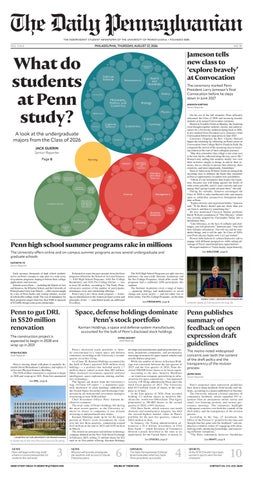
What do students at Penn study?
The ceremony marked Penn President Larry Jameson’s final Convocation before he steps down in June 2027 ANANYA KARTHIK Senior Reporter
On the eve of the fall semester, Penn officially welcomed the Class of 2030 and incoming transfer students at its annual Convocation ceremony. Hosted at Franklin Field on Monday, the hourlong event brought together students, faculty, and administrators for a University tradition dating back to 1894. It also marked Penn President Larry Jameson’s final Convocation before he steps down in June 2027. University Chaplain the Rev. Charles Howard began the ceremony by reflecting on Penn’s move of Convocation from College Hall to Franklin Field. He compared the arrival of the incoming class to receiving a baton at the start of their collegiate journeys. “May they remember that college is not some race to be won, but be collected along the way, nor is life,” Howard said, adding that students should “not view their activities simply as things to add to their resumes, but as vehicles to pursue their interests, their creativity, and most importantly, friendships.” Dean of Admissions Whitney Soule encouraged the incoming class to embrace the limits they encounter at Penn as opportunities to explore new possibilities. “I think it’s the boundaries that inspire the expansion, because you will bump against the limits of what seems possible, and it’s your curiosity and your energy that’s going to push you past them,” she said. During his remarks, Jameson encouraged the Class of 2030 to take intellectual risks and remain open to unfamiliar perspectives throughout their time at Penn. “Explore bravely and experiment boldly,” Jameson said. “If the theory doesn’t pan out, learn what you can from it, and then try something else.” He also mentioned Classical Studies professor Emily Wilson’s translation of “The Odyssey,” which was recently adapted by Christopher Nolan into a blockbuster film. “Like Odysseus, in the face of setbacks and challenges, you will persevere,” Jameson said. “You will have fantastic adventures. You will see and do wonderful things, and it will be epic. So Class of 2030, your Penn odyssey begins now. Let’s get started.” Provost John Jackson Jr. echoed Jameson’s call to engage with different perspectives while taking advantage of Penn’s interdisciplinary opportunities. He urged students to “listen deeply, argue honestly,
A look at the undergraduate majors from the Class of 2026 JACK GUERIN Senior Reporter Page 6
Penn high school summer programs rake in millions The University offers online and on-campus summer programs across several undergraduate and graduate schools
See WELCOME, page 3
KATHRYN YE Senior Reporter
Each summer, thousands of high school students arrive on Penn’s campus to take part in a wide array of academic programs, hoping to bolster their college applications and resumes. Schools across Penn — including the School of Arts and Sciences, the Wharton School, and the University of Pennsylvania Carey Law School — offer courses taught by a mix of Penn faculty and visiting scholars, several of which offer college credit. The cost of attendance for these programs ranges from less than $400 to upwards of $23,000, though some grant scholarships.
Penn to gut DRL in $520 million renovation
Estimated revenue this past summer from the three programs offered by the School of Arts and Sciences — SAS High School Programs, SAS Pre-College Residential, and SAS Pre-College Online — was at least $8 million, according to The Daily Pennsylvanian’s analysis of the number of participants, attendance costs, and scholarship offerings. Penn Carey Law’s three-week program — featuring an introduction to the American legal system and principles of law — contributed nearly an additional $1 million.
Penn is moving ahead with plans to partially demolish David Rittenhouse Laboratory and replace it with a new Physical Sciences Building. The $520 million renovation is expected to begin in 2028 and wrap up in 2031. Penn first announced See DRL, page 6
COURTESY OF THE UNIVERSITY OF PENNSYLVANIA
A rendering of the new Physical Sciences Building.
NEWS Penn will begin enforcing mathematics course prerequisites for students this semester
3
SEND STORY IDEAS TO NEWSTIP@THEDP.COM
See PROGRAMS, page 6
Karman Holdings, a space and defense system manufacturer, accounted for the bulk of Penn’s disclosed stock holdings EMMA DESMET Staff Reporter
Penn’s disclosed stock portfolio is heavily concentrated in a single space and defense contractor, according to the University’s secondquarter securities filing. As of June 30, Karman Holdings accounted for the bulk of Penn’s reported $104 million stock holdings — a position that included nearly 1.7 million shares valued at more than $82 million. Other disclosed investments spanned artificial intelligence, space exploration, mining, and battery technology. The figures are drawn from the University’s Aug. 10 Form 13F report — a mandatory quarterly disclosure of stock holdings submitted to the United States Securities and Exchange Commission by all institutional investment managers overseeing at least $100 million. Chief Investment Officer Peter Ammon declined to comment. The total value of Penn’s holdings fell during the most recent quarter, as the University reduced its shares in companies it was already investing in and purchased new shares. Karman Holdings made up by far the largest portion of Penn’s stock investments by value over the last three quarters, comprising around $143 million at the end of 2025 and $156 million in March. The American aerospace and defense technology company debuted on the New York Stock Exchange in February 2025, selling 23 million shares for $22 each in its first public offering. Karman Holdings NEWS Wharton will provide undergraduate students with access to Claude Enterprise plans
6
develops and manufactures payload protection systems, propulsion components, and aerodynamic interstage structures for space launch vehicles and missile defense programs. While the number of shares in Karman Holdings was consistent between the last quarter of 2025 and the first quarter of 2026, Penn disclosed 300,000 fewer shares in its latest report. According to the data, Intuitive Machines — an American company specializing in infrastructure for space exploration — has appeared in every 13F filing submitted by Penn since the third fiscal quarter of 2023. The University held $3.9 million worth of shares in the company as of June. In the first quarter of 2026, Penn recorded holding 3.2 million shares in Intuitive Machines Inc. worth over $60 million. That figure plummeted to 180,000 shares in the second quarter of 2026, a 94% decrease. USA Rare Earth, which extracts rare-earth elements and manufactures magnets, has held the second-highest market value in Penn’s portfolio for the past two quarters, valued at $10.6 million in June. In January, the Trump administration announced a $1.6 billion investment in USA Rare Earth — which Secretary of Commerce Howard Lutnick described at the time as an opportunity for the United States to ensure its
ONLINE AT THEDP.COM
Penn publishes summary of feedback on open expression draft guidelines The memo noted widespread concerns over both the content of the draft policy and the transparency of the revision process JAMES WAN Senior Reporter
Penn’s proposed open expression guidelines have drawn sharp backlash from faculty and students, according to a memo published on Tuesday. The University released a formal summary of community feedback, which compiled 193 responses from an anonymous online survey and email, two listening sessions, and various governance meetings. The takeaways highlight widespread concerns over both the content of the draft policy and the transparency of the revision process. According to the Aug. 25 document, the Office of the Provost is “grateful for the time and thought that has gone into the feedback” and emphasizes common values of “engaging with ideas, seeking truth, producing knowledge, and expressing different viewpoints.” “The Penn community deserves Guidelines See DRAFT, page 3
See STOCKS, page 3
OPINION The Daily Pennsylvanian Editorial Board evaluates what has made Penn presidents successful
KENNY CHEN | SENIOR PHOTOGRAPHER
Jameson spoke at Convocation on Aug. 24.
Space, defense holdings dominate Penn’s stock portfolio
The construction project is expected to begin in 2028 and wrap up in 2031 RYAN RUCKER Staff Reporter
The SAS High School Programs are split into two pathways: the non-credit Summer Academies and the Pre-College Programs, which offer credit. The programs had a combined 1,050 participants this summer. The Summer Academies cover a range of topics — spanning biology and mathematics to social change and social justice — and last either two or three weeks. The Pre-College Programs, on the other
4
SPORTS At the WTA Ennoble Care Open, women’s sports were the real champion
10
CONTACT US: 215-422-4640
2 NEWS
THURSDAY, AUGUST 27, 2026
THE DAILY PENNSYLVANIAN | THEDP.COM
B:12.25" T:12" S:11"
T:22"
S:21"
THEDP.COM | THE DAILY PENNSYLVANIAN
THURSDAY, AUGUST 27, 2026
NEWS 3
Penn begins enforcing math course prerequisites Students who were already enrolled in the courses prior to Aug. 12 will not be affected KATHRYN YE Senior Reporter
Starting this semester, mathematics course prerequisites will be enforced on Path@Penn for specific classes. MATH 1080, MATH 1400, MATH 1410, MATH 1610, MATH 2200, and MATH 2300 will now require students to satisfy a prerequisite before registering. Students who were already enrolled in the courses prior to Aug. 12 will not be affected. The change was announced earlier this month in an advising email, which stated that students who do not fulfill the necessary requirements may see “a prerequisite notification or registration issue” on their schedule. “This semester, the College and the Math Department jointly rolled out a process for verifying that students meet existing prerequisites at the point of course registration,” Deputy Dean for Undergraduate Studies Molly McGlone wrote in a statement. “The change reflects careful consideration of how to help students learn at the level of instruction that is appropriate for them—which we believe will improve outcomes for all students.” McGlone added that the process is designed to “do a better job placing students in the math classes they’re best prepared for and will learn the most from.”
DRAFT, from front page that unambiguously embrace the foundational importance of open expression and effectively support it on our campus,” the document read. “With that goal as their guiding light, the COE has been working on an updated draft of the revised Guidelines.” The summary was assisted by members of the president’s and provost’s offices, the Committee on Open Expression, and University of Pennsylvania Carey Law School professor Eric Feldman — a former Faculty Senate tri-chair who now serves as the senior advisor to the provost on open expression. Feldman moderated the April listening sessions, which allowed students and faculty to share feedback on the guidelines. Provost John Jackson Jr. pledged to release a
In order to satisfy a prerequisite, students must complete a relevant corresponding math course at Penn, receive credit from an Advanced Placement or other qualifying program, or pass a credit exam. Credit exams for math courses are held once during New Student Orientation and once at the beginning of the semester. In a statement to The Daily Pennsylvanian, Mathematics professor and Department Chair Jonathan Block wrote that this change was “motivated by at least two factors.” “We are trying to provide better guidance and placement into our curriculum,” Block wrote. “In some cases, students ignore the prerequisites, enrolling in classes they think they are ready for that end up being too advanced for them.” Block also explained that the department’s decision supported a school-wide effort to enforce prerequisites. The announcement comes after Penn’s Math Department restructured its linear algebra and differential equations sequence. The department shared earlier this year that it would replace MATH 2400 and MATH 2410 with MATH 2200 and MATH 2300. The reorganization also discontinued summary of comments on open expression in June — a request made by listening session attendees in April who asked for the document to be shared with the entire community rather than only administrators. According to the summary, criticism of the revision process largely centered on transparency issues — including a lack of clear explanation for why the guidelines were changed and how the Task Force on Open Expression’s recommendations were incorporated. In June, the Faculty Senate called on the task force — which shaped the draft guidelines without final oversight from the Committee on Open Expression — to release its recommendations. Other concerns included a perceived “lack of openness to feedback” and “discontent that the full transcript of the listening sessions would not be made public.” Numerous points of feedback in the summary also focused on the concentration of authority
CONNIE ZHAO | SENIOR PHOTOGRAPHER
David Rittenhouse Laboratory on April 1.
MATH 3120 and replaced MATH 3140 with a new proof-based course, MATH 3000. In 2023, the department created two courses tailored to students of the social sciences — specifically the economics major — in an effort to adapt
the curriculum to be suitable for all disciplines. “We are committed to improving the process for students over time, and we expect to extend prerequisite verification to additional courses in the coming years,” McGlone concluded.
under the provost — who will now have the power to approve members of the Committee on Open Expression along with its new executive director, who will oversee relevant disciplinary matters. Provisions governing free speech and demonstrations also garnered criticism, particularly those regulating spontaneous protests, restricting signage and other forms of demonstrations, and governing social media. A major theme was how the new guidelines would affect interactions with law enforcement, including possible “police violence” and ID checks that “could potentially be used for criminal prosecution and deportation.” Further comments described concerns about academic freedom, vague wording that could enable “unbridled interpretive discretion,” and “overly legalistic and prescriptive” language that heavily focused on consequences for guideline violations. The summarized criticism was accompanied by numerous suggestions, some of which the University has already implemented. Recommendations regarding authority asked for a greater distribution of power, joint decisions on disciplinary referrals, and increased independence of the Committee on Open Expression. Commenters also suggested balancing the
representation of faculty, staff, and students on the committee — which, under the current structure, is heavily skewed toward faculty. Other respondents advocated for more leeway on permissible protests, stricter limits on ID requests, a hands-off approach to personal social media use paired with anti-doxxing protections, and a stronger emphasis on “the value of expressive activity.” Penn extended the feedback period in accordance with community suggestions and is now set to circulate a new draft in the fall. The Guidelines on Open Expression — which are decades old — have seen several iterations and have been under review since 2024. The beginning of the overhaul of open expression on campus came after a semester marked by oncampus protests, including the Gaza Solidarity Encampment. At the time, Penn instituted temporary standards for events and demonstrations, effectively replacing part of the guidelines. Those policies are still in place, while the current provisions governing authority and committee structure originate from the 1993 version of the guidelines. The draft was released in March and is expected to be finalized by November, with implementation scheduled for January 2027.
STOCKS, from front page “supply chains are resilient and no longer reliant on foreign nations.” In the most recent quarter, Penn invested in two new companies: $7 million in Cerebras
Systems, which develops semiconductors and supercomputers to power AI applications, and $151,000 in Amprius Technologies, which specializes in batteries for aviation and robotics. Krispy Kreme, an American doughnut and coffeehouse chain, is absent from Penn’s holdings this quarter despite previously appearing in every 13F filing submitted by the University since the last quarter of 2022.
CATHERINE FAN | SENIOR PHOTOGRAPHER
College Hall on July 2.
WELCOME, from front page and recognize the humanity in people whose experiences and worldviews can sometimes differ quite profoundly from your own.” “The more seemingly disparate the dots, the more surprising, the more transformative the connections
you make will be,” Jackson said. During the ceremony, audience members were able to view messages and photos displayed on a scoreboard behind the podium. Class of 2027 President and Wharton senior Steven Li presented the official class flag of the Class of 2030, followed by a performance of “The Red and Blue” by Penn Glee Club. The ceremony was capped with a dessert reception on Franklin Field, where students socialized as they enjoyed a range of treats.
Join our team! Editorial
Business
Arts & Culture Copy Design News Opinion Photo Puzzles Video Satire Social Media Sports
Corporate Relations Strategy & Promotion
Applications open through Sept. 11 at 11:59 p.m.
ABHIRAM JUVVADI | DP FILE PHOTO
Locust Walk on March 12, 2024.
Back to School Block Party Annenberg Plaza| Friday, Aug. 28 | 3-5 p.m. Free food, drinks, and other giveaways!
4 OPINION
THURSDAY, AUGUST 27, 2026
THE DAILY PENNSYLVANIAN | THEDP.COM
Opinion
142nd Year of Publication
THIS YEAR’S BOARD NEEMA BADDAM President JASMINE NI Executive Editor ETHAN YOUNG DP Editor-in-Chief MAKAYLA WU Design Editor KATE AHN Design Editor PRASHANT BHATTARAI Copy Editor JESSICA HUANG Copy Editor ISHA CHITIRALA News Editor FINN RYAN News Editor AYANA CHARI Assignments Editor INGRID HOLMQUIST Opinion Editor HANNAH CHANG Sports Editor EMILIE CHI Sports Editor KENNY CHEN Photo Editor UMA MUKHOPADHYAY Video Editor NIRA GOYAL Puzzles Editor RANVITH ADULLA Business Manager MAYA ECHAMBADI Corporate Relations Manager
AMY LUO | SENIOR DESIGNER
Editorial | What we need in Penn’s next president
SHREYA SRINIVASAN Strategy & Promotions Manager
THIS ISSUE’S TEAM AMY LUO Deputy Design Editor ANDY MEI Deputy Design Editor EBUNOLUWA ADESIDA News Photo Editor
Earlier this month, Penn announced its selection of an advisory committee in search of our University’s next president. This notice came after Penn President Larry Jameson’s communitywide email announcing that he would be resigning from Penn’s highest office after the spring of 2027. As members of the Editorial Board, we are taking this opportunity to voice what we believe Penn students deserve out of their next leader. This upcoming decision comes at a crucial moment for University leadership, as the presidency has been a hotly contested office, often fraught with political, financial, and cultural demands all at once. Through a historical account of the strengths (and weaknesses) of Penn’s former presidents, we suggest key considerations that the advisory committee can take into account. First, the president needs a clear and actionable vision for Penn’s future. Judith Rodin, the Ivy League’s first female University president, arrived in 1994 with the West Philadelphia Initiatives and the Agenda for Excellence, and she stuck to both ideas for a decade. Amy Gutmann, Penn’s longest serving president, did the same with the Penn Compact, cementing Penn’s international footprint and bolstering our interdisciplinary academic culture. Gutmann also took office with the goal of revolutionizing access to Penn and succeeded in doubling enrollment of first-generation, low-income students during her 18 years as president.
Both Rodin and Gutmann entered their roles with specific objectives and stepped down having made a tangible difference on our University. As pragmatic and consistent leaders, they were integral to our institutional image. They did not need to reintroduce themselves at the beginning of every year. As recent turmoil in our University’s highest office has made such enduring commitments impossible, we need a president that will remain devoted to an impactful agenda throughout their tenure. Penn’s president also needs to practice strong and supportive engagement with Philadelphia. Rodin in particular had a strong record of collaboration with the city she’s always called home. She helped broker the partnership between Penn and Philadelphia Mayor Ed Rendell to support the construction of the National Constitution Center. Additionally, she expanded the Netter Center for Community Partnerships, which strengthened the relationship between Penn students and our neighbors in West Philadelphia. Rodin invested in local public schools, affordable housing around Penn, and in the growth of local businesses. For her, support for Philadelphia runs deep. Even long after resigning the presidency, Rodin still contributed her time to our city’s needs. As evidenced by recent history, the University needs a president who walks in with a real framework for handling speech and conduct. Crucially, said framework cannot be improvised.
Through the tumult of the fall 2023 semester, following campus activism surrounding both the Palestine Writes Literature Festival and the events of Oct. 7, then-Penn President Liz Magill demonstrated how a failure to have and adhere to a conduct policy was ruinous to Penn’s highest office. The Committee on Open Expression has been revising its guidelines since 2024, a process that has already drawn criticism for its lack of transparency. Our next president must faithfully contribute to and carry out these guidelines before the next crisis impacts our campus. The governance that surrounds the president also needs to include the people it manages. A strong president must be dedicated to seeking input from Penn students, faculty, and staff across the University. The advisory committee’s membership already lacks representation from five of Penn’s 12 schools. This group must understand that such exclusion is inappropriate if practiced by our next president and ensure that the future leader of our University is someone who recognizes its diversity and will commit to seeking input from all members of our community. Finally, we believe the next president should understand the student experience at Penn, ideally firsthand. A Penn alum would be exceptionally equipped to handle the intricacies of our University. Those who have sat in our classrooms as undergraduate or graduate students and
been immersed in our campus culture will have genuine experience to ground their tenure. Rodin was our most recent president to also be an undergraduate alumna, and her experience as a student here undoubtedly influenced her leadership agenda. She held the Penn community in incredibly high regard, leaving her career as a researcher to lead our University because “Penn and Philadelphia trumped the other issues.” This commitment is no coincidence. Our alumni strongly believe in Penn’s mission and are uniquely suited to serve as its institutional leader. In choosing Penn’s next president, we implore the advisory committee to consider what makes leaders effective and ethical. We’ve traced throughlines of progress and success in our past presidents. Now, we challenge the committee to act on them wholly and find us our strongest president yet. Editorials represent the majority view of members of The Daily Pennsylvanian Editorial Board, who meet regularly to discuss issues relevant to the Penn community. This body is led by Editorial Board Chair Jack Lakis and overseen by Opinion Editor Ingrid Holmquist. It is entirely separate from the newsroom. Questions or comments should be directed to letters@thedp. com.
No, AI detection won’t save your pedagogy GUEST COLUMN | Educators cheering Anthropic’s watermark are dodging the real work
LETTER SUBMISSION Have your own opinion? Send your letter to the editor or guest column to letters@thedp.com. Editorials represent the majority view of members of The Daily Pennsylvanian, Inc. Editorial Board, which meets regularly to discuss issues relevant to Penn’s campus. Participants in these meetings are not involved in the reporting of articles on related topics.
LAND ACKNOWLEDGEMENT The Land on which the office of The Daily Pennsylvanian stands is a part of the homeland and territory of the LenniLenape people, known to the original Indigenous people as “Lenapehoking.” We affirm Indigenous sovereignty and will work to hold The Daily Pennsylvanian and the University of Pennsylvania more accountable to the needs of Native American and Indigenous people.
Last week, Anthropic announced that text generated by its Claude models will now carry an invisible watermark. Within hours, certain corners of education X were celebrating: “We’ve got ’em now, Jack!” While I understand the impulse, the schadenfreude revealed more about the educators than the students they thought they’d finally gotten the upper hand on. Of course, Anthropic did not build its watermarking technology for educators. The watermark exists to satisfy the European Union’s Artificial Intelligence Act — another attempt by EU regulators to dictate technological progress through misguided regulation. It works by subtly altering the model’s word choices, creating a pattern detectable with a key. Anthropic itself urges skepticism: a detected mark means Claude processed a text, which could mean drafting, proofreading, translation, or summarization. Nor does an unmarked text mean a human wrote it. Most critically, marked or not, a text tells us little about our students’ thinking. So what, exactly, were these educators celebrating? The truth is they were hoping for deterrence — that their students, under threat of shaming or a bad grade — would be scared back to a world where the word processor is the only technology in the writing process. They appeared less concerned with the edge cases: the student who drafts in Spanish and translates, the one who has AI proofread his grammar, the one who argues her thesis out loud with a chatbot — while their most tech-savvy peers find ways around the watermarking key. A pedagogy rooted in instilling fear does little to engender learning. Rather, it pushes students to choose between missing the opportunity to develop skill with the technologies shaping their world or getting better at evasion — both poor uses of their time and energy. Responding to the announcement, technology analyst Ben Thompson called back to a 2022 piece that forecasted this change. Thompson distinguishes between having an idea, substantiating it, and distributing it — activities “bundled” and “unbundled” over the centuries. Educators should recognize this history. To learn from a great teacher once meant sitting in the room while she taught. Socrates never wrote a word, and to learn from him you had to
JOCELYN VARGAS | STAFF PHOTOGRAPHER
Guest columnist Jared Francis argues that educators are mistaken in hoping watermarking will save them from the real work of redesigning how they assess student thinking.
stand in the agora while he questioned. It was Plato who wrote the ideas down, and the dialogues outlived them both. The written word allowed lessons to outlive the lecture. The printing press allowed ideas to enter every classroom. The internet put the lecture in every pocket. Writing, print, and the internet each pried apart a piece of that bundle; what AI unbundles is the last pairing, the idea from the physical labor of substantiating it. To put this in education terms: writing is thinking — or rather, the writing process is thinking. Framing a problem, deciding what matters among sources, revising an argument, deciding something is worth arguing about — that is the thinking, and thankfully (for now) it remains distinctly human. What AI can take on is the stringing together of subjects and verbs. But all of this, as Thompson argues, is downstream from the prompt. That is, it is downstream from the thinking. This is why the cheers deserve to be
named for what they are: a kind of laziness. The worry is legitimate — polished prose really did once serve as rough evidence of thought, and tools like Claude and ChatGPT really have broken that proxy. But faced with this shift, some educators are refusing to reimagine and redesign their pedagogy for the demands of the day. They are now relying on the chilling effect of a detector so their syllabi and assignments can remain evergreen. While accusing students of outsourcing their thinking, it is these same educators who are outsourcing a critical piece of their pedagogy to AI. Writing in the National Catholic Register this spring, Santiago Schnell brings us to where educators should be focused. Learning, he writes, “is not the production of acceptable performances but the formation of a person capable of truth, judgment and responsibility.” Schnell calls on educators to look past prohibition and toward pedagogical redesign: oral
defenses, on-demand essays, seminars built around live questions. Educators might also task students with sharing drafts or AI chat logs, making their thinking visible. If we want to know whether students are thinking, we will have to build assessments that look at the thinking, not the outputs. To the extent that your assessment strategy has been anchored in word and page counts — that in this moment you are fetishizing the typing of sentences — AI is exposing a vulnerability in your practice. You may still welcome the AI detectors, but they won’t tell you whether your students are thinking, because the construction of a sentence is no longer evidence of the mind. JARED FRANCIS is a doctoral student in the Graduate School of Education’s Mid-Career Doctoral Program from New York. His email is jrf1@upenn.edu.
THURSDAY, AUGUST 27, 2026
THEDP.COM | THE DAILY PENNSYLVANIAN
OPINION 5
Engage with energy GUEST COLUMN | A welcome message from Penn President Larry Jameson
CATHERINE FAN | SENIOR PHOTOGRAPHER
Jameson welcomes students and offers advice for the upcoming academic year.
Welcome, Quakers, to the official start of the 2026-27 academic year. Locust Walk is once again full, and the back-to-school energy is contagious. I have enjoyed meeting many of you during Move In, at Convocation, and other welcome events, and I look forward to all we will accomplish together in the months ahead. Our strategic planning initiative, Penn Forward, is gaining momentum, and we will be sharing updates later this semester on how Penn is building trust, enabling bold discovery, and expanding the University’s reach. We continue to mark America’s 250th anniversary by exploring themes rooted in Benjamin Franklin’s example and ideals. The Penn community is also observing an incredible range of University anniversaries, including 150 years of women at Penn. As this exciting year gets underway, I encourage you and everyone at Penn to be energetically engaged. If you are eligible to vote in the general election on Nov. 3, be sure to register and make a voting plan. Penn Leads the Vote, a phenomenal student-led nonpartisan campus organization, is a great place to begin. Stop by the PLTV table on Locust Walk on National Voter Registration Day, Sept. 15, where volunteers will be answering questions and helping members of the Penn community navigate the voting process. In addition to your civic engagement, our new students will be invited to participate in a new, first-of-its-kind campus lifesaving initiative: the Penn Lifesaver program. Penn Lifesaver will help make first aid training and skills a core part of campus culture, and each September, every
incoming first-year student will have the opportunity to learn in their College Houses. Our goal is to make Penn a national model for campus education and preparedness. As returning students know and new students quickly discover, learning and growth here happen everywhere: in classrooms and labs and libraries, College Houses and performing arts centers, on the fields and courts, and out in Philadelphia’s vibrant neighborhoods. Penn students and faculty push the boundaries of exploration and experimentation, regularly tackling interesting problems and pursuing ambitious ideas that never fail to inspire me. The energy of a new academic year is powerful. What matters most is how you channel it. Here are a few more suggestions: Meet new people with backgrounds and perspectives different from yours. Take a class that is outside your intended course of study. Visit the Palestra in its centennial year, sign up for an arts program that challenges you, or volunteer for a cause you are passionate about. I know you will value your time at Penn for what it is: a priceless asset that will compound the more you invest in yourself and your academic community. Even more valuable are the lifelong friendships you make along the way. We have much to look forward to, and your vigorous engagement will deepen the experience of our entire University community. Together, let’s have an exceptional year. LARRY JAMESON is the 10th Penn president. His email is president@upenn.edu.
Penn stopped talking to its applicants. Admissions is worse for it FOR PETE’S TAKE | Why the admissions interview belongs back in the application It’s time the admissions interview returns to Penn. In July 2025, University leadership discontinued the optional alumni interview for undergraduate applicants, effective for the 2025-26 application cycle. The interviews ran through the Penn Alumni Ambassador Program, which paired alumni with applicants for brief, one-on-one conversations to discuss the applicant’s background and interest in Penn. In their letter to PAAP volunteers explaining the change, senior officials from the Admissions Office and Alumni Relations cited a sharp rise in applications and the narrow review window as the basis for the decision. At first glance, it may seem that Penn made the right call. In the 2024-25 cycle, Penn received a record 72,544 applications — more than double the 31,000 applications it received when PAAP began offering an alumni interview in 2012. As applications climbed, the program placed heavier demands on alumni volunteers’ limited time, and the University could not always honor every student’s request for an interview. On top of that, the interview was non-evaluative to begin with; it never officially factored into an admissions decision, and skipping it carried no penalty. In other words, the interview had become an administrative burden that asked a great deal of alumni for a step that, on paper, decided nothing. Despite this, Penn has good reason to bring the interview back — and make it evaluative. With an interview, admissions can more effectively screen for authenticity, move in the direction higher education and the labor market are already heading, and give applicants a dose of a campus driven by face-to-face interaction.
The emergence of artificial intelligence has only sharpened the problem. Claude, ChatGPT, and Gemini can draft a personal statement, research a school’s programs, and manufacture a reason for wanting to attend Penn. It’s also cheaper, faster, and harder to catch than a parent or paid consultant ever was. The result rewards whoever games the system best and punishes the student who writes every word themselves. None of this means the essay has to go. But it’s worth rethinking how much weight to place on a task so easily outsourced, when a 15-minute conversation can give admissions officers a better sense of the person behind the application, in their own voice, than an essay ever can. Reinstating the interview would also put Penn Admissions in step with where Penn faculty, higher education at large, and the workforce beyond it, are already heading. As AI reshapes how students learn, professors nationwide are leaning on oral defenses, in-class exams, and cold-calling to gauge student understanding. Employers are doing the same, testing candidates on their feet rather than on a polished resume. Penn wouldn’t be alone in leaning into this, either. Georgetown conducts an interview for each and every applicant while Ivy League peers including Yale, Harvard, and Dartmouth all offer (and encourage) prospective students to participate in an alumni interview. Reinstating the interview also fits into the current Penn undergraduate experience. Long before “Social Ivy” became shorthand for our school, students built their four years around conversation — coffee chats, club interviews, small talk with teaching assistants and professors that
Every year, millions of people—including students like you—trust Planned Parenthood for affordable, high-quality sexual and reproductive health care.
In-person and Telehealth appointments available.
www.ppsp.org 215-496-9696
shaped as much of the Penn experience as any lecture. The admissions interview is simply a preview of that culture, and a screen for the kind of person who can thrive within it. College admissions have been turned upside down over the past several years. Essays get outsourced, extracurriculars get inflated, and much of what makes an applicant a person gets flattened into a file. As Penn selects its next classes, the interview remains one of the few places left where a personality can come through in a student’s own
words, to another human, and feel heard. For the $75 application fee, applicants deserve at least that much. PETER KENNEDY is a College sophomore from West Chester, Pa. studying philosophy, politics, and economics. His email is kenned29@sas.upenn.edu.
CHENYAO LIU | SENIOR PHOTOGRAPHER
Columnist Peter Kennedy argues that Penn should both reinstate and formally weigh the alumni interview.
6 NEWS
THURSDAY, AUGUST 27, 2026
THE DAILY PENNSYLVANIAN | THEDP.COM
Wharton to provide undergraduate students with Claude access All users will be required to complete a training course before activating their accounts AYANA CHARI Assignments Editor
Wharton School undergraduate students will gain access to Claude Enterprise generative artificial intelligence accounts. Cait Lamberton, vice dean and director of the Wharton Undergraduate Division, announced the licensed AI tool in an Aug. 25 email welcoming students back to campus. According to the message, students can expect additional guidance on using their accounts shortly. All users will be required to complete a training course on the rules, risks, and privacy measures associated with agentic coding tools before activating their accounts. MBA students have already been granted access. A request for comment was left with a Wharton spokesperson. Penn community members can use Microsoft Copilot Chat through their University accounts. The University also began piloting its own AI portal — titled PennChat — in July. The pilot, which includes certain Claude and ChatGPT models, is part of a wider effort by Information Systems and Computing to provide AI tools, resources, and training to students and faculty.
The portal is “hosted within Penn’s secure network environment” on Amazon Web Services “where companies cannot use Penn data to train AI models.” Based on the open-source tool LibreChat, the service provides access to Anthropic models through Amazon Bedrock and to OpenAI models through Microsoft Foundry. Users must be connected to PennNet, AirPennNet, or the University’s GlobalProtect VPN to access the PennChat portal. Once on the platform, users can select from 14 different models, sorted into three categories based on credit consumption — premium, balanced, and economical — as well as a legacy category for older LLMs. The University offers general guidance on AI use, and its official course policy is that “each instructor is responsible for setting their own guidelines” on AI use in the classroom. As part of the most recent reports by Penn’s Faculty Senate, the Senate Committee on Students and Educational Policy recommended that the University adopt broad, centralized guidelines regarding acceptable and unacceptable uses of AI.
ETHAN YOUNG | STAFF PHOTOGRAPHER
Wharton announced that undergraduate students would have access to Claude Enterprise on Aug. 25.
Litigation drags on in $2 billion price-fixing lawsuit against Penn The class-action case accuses Penn and 16 other universities of forming a ‘price-fixing cartel’ that colluded to reduce financial aid LAVANYA MANI Senior Reporter
Penn is among five universities scheduled to undergo additional hearings in an ongoing financial aid antitrust lawsuit that could expose defendants to approximately $2 billion in damages. The class-action lawsuit — filed in January 2022 — accuses Penn and 16 other universities of forming a “price-fixing cartel” that colluded to reduce financial aid awards and benefit wealthy students. The new hearings will further delay the trial, which was previously set to take place at the beginning of November. A Penn spokesperson previously wrote that the University “continues to see no merit in this lawsuit.” On Monday, the Seventh Circuit Court of Appeals granted the defendants’ petition to appeal the certification of a class in the lawsuit. Now, additional briefings will be required to determine if more than 220,000 students currently involved in the lawsuit compose a valid class. The court also granted the defendants’ motion to reconsider whether the testimony of the plaintiffs’ expert was “adequately analyzed.” In light of the court’s rulings, the plaintiffs filed a motion on Aug. 24 to suspend all pretrial deadlines. Alongside Penn, the only universities still active in the suit are Cornell University, Georgetown University, the Massachusetts Institute of Technology, and the University of Notre Dame. The student plaintiffs have collected about $319 million from the 12 schools that have settled so far. Initial payments went out last month, and a second wave is due later this year. If found responsible, the five remaining universities would pay an average of nearly $350 million each in damages. The largest settlement from a single school to date is Vanderbilt University’s $55 million payment. Brown University, the University of Chicago, Dartmouth College, Duke University, Emory University, Northwestern University, Rice University, and Yale University are among the institutions that have already settled. The initial 2022 suit alleged that the elite universities, as members of the 568 Presidents Group — an organization of American universities and colleges practicing need-blind admissions — exchanged
PROGRAMS, from front page hand, run for five weeks and allow students to enroll in college courses during Penn’s summer term. Penn’s most popular offering, the Wharton Global Youth Program, oversaw 2,827 total participants interested in business education this summer. Program costs range from $8,299 to $11,899 for residential
“methodology” and “principles” for calculating financial aid. The group operated under an antitrust exemption in the Improving America’s Schools Act of 1994, which allowed schools to collaborate on financial aid policy so long as they were need-blind in admissions. The lawsuit alleged that the group’s members were unlawfully collaborating under the statute because the schools were not operating with need-blind admissions. Penn left the group in 2020, citing the University’s
KENNY CHEN | SENIOR PHOTOGRAPHER
The ARCH building on Aug. 15.
students and from $329 to $4,799 for online students. Excluding possible scholarships, Wharton’s on-campus and online summer programs would have raked in a minimum of roughly $14 million last summer. In a statement, Wharton’s Global Youth team wrote that expanding access was an “important priority” for the program. The team added that it was “proud to award the highest number of scholarships” in its program’s history this summer, which it explained was “made possible in large part through the generosity of
CATHERINE FAN | SENIOR PHOTOGRAPHER
Locust Walk on July 10.
DRL, from front page its decision to gut DRL — which was originally built in 1954 — two years ago during a University Board of Trustees meeting. School of Arts and Sciences Dean Mark Trodden described the development as a “interdisciplinary scientific community” in a statement to The Daily Pennsylvanian. The building will house Penn’s Departments of Physics and Astronomy, Mathematics, and Earth and Environmental Science. The project will add 265,000 square feet of teaching and research space, while renovating 85,000 square feet of the existing building. Much of the sixstory building will be demolished. The complex is expected to include nearly 40 classrooms and lecture halls, a teaching observatory,
need for more flexibility in offering financial aid awards to students. Since then, Penn’s financial aid policies have expanded. In November 2024, Penn announced that beginning in 2025 it would no longer consider the value of the primary family home in determining financial aid eligibility, a departure from the methodology used by the 568 Group. That same year, the University announced the Quaker Commitment — which expanded financial aid to allow families earning up to $200,000 with typical assets to receive full tuition scholarships.
a makerspace, hands-on teaching laboratories, and more than 30 study spaces. The Department of Earth and Environmental Science will relocate from the 65,000-square-foot Hayden Hall to the new building. Penn has not yet determined which program will occupy Hayden Hall following the move. “As a member of the Physics and Astronomy department, DRL is my home, and while I appreciate its distinguished history at Penn, science has changed and our facilities need to keep up,” Trodden wrote. University Architect Mark Kocent told the DP that the demolition was necessary “in order to build more density on the site.” “As you enter the building, there’s a large communal space and all of the users of the building will be able to mix and mingle,” Kocent said. The Physical Sciences Building is being designed by Los Angeles-based CO Architects and Philadelphia-based EwingCole. According to CO Architects’
Wharton alumni and donors.” According to Tiffany Clayton — who serves as the director for high school programs at SAS — the school is currently “only able to offer scholarships and not financial aid.” “We have a scholarship program where 10% of our seats for non-credit programs are saved for the School District of Philadelphia students,” Clayton explained. She added that other organizations and sponsors could also help students pay for the programs. The Penn Carey Law Pre-College Academy also offers four full scholarships for students. Since 2022, pricing for summer programs has gradually increased year-over-year. The University’s program offerings have expanded as well — including a new five-day middle school program for local students that Penn began running this past summer at the cost of $2,400 per participant. According to the program directors, the high school summer experiences also provide an opportunity to organize involvement for Penn students. “Penn undergraduate and graduate students play an important role in our on-campus programs, primarily as teaching assistants,” the Wharton Global Youth team wrote. “TAs also offer high school students a valuable connection to the Penn and Wharton student experience.” For the SAS High School Programs, Penn students are often hired as “residence counselors” who oversee small cohorts of students living in residence halls and organize extracurricular activities. “I think more than 90% of them are really happy with the experience, and they really love being able to connect with other high-achieving students,” Clayton said. “People don’t realize how much you can gain from a short experience.” project portfolio, “the building massing faces and engages with Shoemaker Green, a large open space on the eastern edge of campus.” Plans also include a new science library, offices, theoretical research centers, and an open-concept lobby. The Physical Sciences Building is not Penn’s only major upcoming construction project. Penn also began a multi-phase renovation of 1920 Commons over the summer that is expected to conclude by January 2029. The updated building will feature over 200 more seats, an expanded Gourmet Grocer location, a new coffee shop, group study pods, elevators, and a locker-based food pick-up system. Platt Student Performing Arts Center, a brand-new space, is also expected to open in January 2027. Located near Hill College House and Lauder College House, the center was initially announced in 2021 and will serve as a space for Penn’s student performing arts groups.
MAJORS, from front page This week, thousands of undeclared first years arrived on campus — many still uncertain about their future field of study at Penn. These students will have the chance to choose from 87 majors and concentrations across the University’s four undergraduate schools: 55 in the College of Arts and Sciences, 20 in the Wharton School, 11 in the School of Engineering and Applied Science, and one in the School of Nursing. Using the University’s most recent Commencement records, The Daily Pennsylvanian analyzed data from the Class of 2026 to provide a snapshot of Penn’s academic landscape. The data spanned degrees conferred in August 2025, December 2025, and May 2026. The DP was unable to determine the majors of 10 graduates. Across the undergraduate class, the five most popular majors and concentrations were finance, with 412 graduates; computer science — including both the Bachelor of Applied Science and Bachelor of Science in Engineering programs — with 270; philosophy, politics, and economics with 192; biology with 175; and economics with 154, respectively. Together, these majors represented roughly half of the total graduating class of 2,426 individuals. On the whole, Penn students specialize in academic disciplines relevant to their future careers. In 2025, 48% of the graduating class immediately entered jobs in finance, consulting, and technology, according to an analysis by the DP in March. Many of the most popular majors and concentrations — including finance, computer science, PPE, and economics — directly correlate to those fields. PPE — the most popular major in the College — represented more than 13% of the College’s Class of 2026. PPE, introduced in fall 1994, has long been one of the most represented majors in the College. “Since inception at Penn, PPE has been popular and today it is one of the largest majors in the College of Arts and Sciences,” the major’s webpage reads. After PPE, biology was the second most popular major in the College with 175 students, trailed by economics with 154, neuroscience with 142, and political science with 134, respectively. Five majors in the College had only one graduate in the Class of 2026 — Middle Eastern languages and cultures, East Asian languages and civilizations, South Asia studies, theatre arts, and visual studies. 287 College students double majored, 17 College students triple majored, and one student triple majored in the College and earned a second degree from Wharton as part of the Huntsman Program in International Studies and Business. In Wharton, 412 out of 599 students — over two-thirds of the class — concentrated in finance, by far the most popular concentration. 269 finance students double concentrated, with management, statistics and data science, and business analytics being the most popular second choices. 86 Wharton students concentrated in management, the second most common concentration, followed by business analytics at 70, statistics and data science at 60, and operations, information, and decisions at 48. Two Wharton students concentrated in marketing and communication — the least popular concentration — and two others pursued self-designed individualized Wharton concentrations. Two Wharton students also concentrated in artificial intelligence for business — Wharton’s newest concentration introduced last fall — and four Engineering School students majored in artificial intelligence under the Raj and Neera Singh Program in AI, one of the first AI undergraduate majors offered at an American university. In the Engineering School, computer science was followed by mechanical engineering and applied mechanics with 57 students, bioengineering with 56, electrical engineering with 31, and chemical and biomolecular engineering with 28. 14 Engineering students majored in systems science and engineering — which has since been replaced by the Engineering AI major — and 13 majored in digital media design, which is set to be replaced next year by the new visual and interactive computing program. All 95 Nursing School students graduated with the same degree, a Bachelor of Science in Nursing. Seven Nursing students also majored in nutrition science, a cross-school collaborative program between the Nursing School and the College. Across the four schools, 196 students — 8.1% of the graduating class — graduated with dual degrees, with 125 participating in a coordinated dual degree program and 71 earning uncoordinated degrees. 171 dual-degree students earned one of their degrees from Wharton, followed by the College at 110, the Engineering School at 103, and the Nursing School at nine.
T:11" THURSDAY, AUGUST 27, 2026
THEDP.COM | THE DAILY PENNSYLVANIAN
NEWS 7
#1 IN THE U.S. FOR NEUROLOGY & NEUROSURGERY. Five years in a row. 2026, 2025, 2024, 2023, 2022.*
Better health starts with a better health system.
Learn more about what makes us #1 *2026-2027 U.S. News & World Report Best Hospitals, our rankings reflect data from: Tisch Hospital, Kimmel Pavilion, NYU Langone Orthopedic Hospital, NYU Langone Hospital—Brooklyn, NYU Langone Hospital—Long Island.
T:21.25"
It takes an obsessive pursuit of excellence to deliver the best patient outcomes in treating neurological conditions. Our integrated teams maintain one of the lowest neurosurgical mortality rates in the U.S., and the fastest stroke intervention rate in all of New York.
8 SPORTS
THURSDAY, AUGUST 27, 2026
THE DAILY PENNSYLVANIAN | THEDP.COM
TENNIS, from back page Brotherly Love. In 1887, then-17-year-old Ellen Hansell became the first United States women’s national singles champion at her home Philadelphia Cricket Club. Just over three decades later, fellow Philadelphian Ora Washington earned national acclaim as the “queen of two courts,” earning a spot in both the U.S. Tennis Association Hall of Fame and the Naismith Basketball Hall of Fame. From 1920 to 1930, a Black woman from Germantown was at the top of the global doubles rankings, inspiring another wave of hometown pride. Although Lunkenheimer grew up playing basketball and rugby, women’s tennis defined her perception of female athletes. Her childhood was soundtracked by Elton John’s “Philadelphia Freedom,” a musical tribute to feminist tennis trailblazer Billie Jean King. As a teenager, Lunkenheimer began idolizing tennis star Jennifer Capriati after seeing her play in Philadelphia. Capriati’s power on the court even inspired Lunkenheimer to begin using the beauty product Oil of Olay in an attempt to emulate the rising star. She still uses it today. As a two-time All-American rugby player at Amherst College and the first-ever team captain of the U.S. Women’s Under-23 National Rugby Team, Lunkenheimer understands what it means to show up for women’s sports both on and off the court. “My dream is to give our city the pride that we deserve, [show] that Philly is a women’s sports town. And every time something comes here like this, we do it with care to make it really special,” Lunkenheimer said. “That’s our duty to the kids, so that they get to grow up and say, ‘I could be like her,’ or ‘I could get her autograph,’ or ‘she bothered to come.’” And last weekend, the comedian and actress Wanda Sykes did show up, making an appearance at the WTA tournament to cheer on the competition. While Sykes’ celebrity endorsement attracted national attention and increased foot traffic to the tournament, her wife, Alexandra NiedbalskiSykes, is the brains behind the operation. Niedbalski-Sykes, a Sisters Sports Group cofounder, began her sports business career working for the WTA in France. When she expressed interest in working on the world tour, her bosses sent her to the United States for six months for English language immersion. She’s been here ever since. In 2019, Niedbalski-Sykes co-founded the Philly Sisters Sports Group after a conversation with an NBA executive kept coming back to a single question: Why didn’t Philadelphia, the sixth-largest city in the United States, have a single women’s professional sports team? In the following years, the Philly Sisters became the backbone behind the city’s campaign for a WNBA expansion team, influencing the Philadelphia 76ers to submit an ownership bid. When the dust settled in June 2025, Philadelphia was one of three new franchises added to the WNBA. With Niedbalski-Sykes’ background in tennis, the next item on the bucket list was obvious — bringing the WTA back to its birthplace of Philadelphia. After securing Ennoble Care as a title sponsor and raising over 90% of the total sponsorship revenue, the stage was set, but there were still concerns about the feasibility of the event. “Two weeks ago, we were still wondering. It wasn’t sold out, and that’s the only way we can do it here with women’s sports in Philadelphia,” Niedbalski-Sykes said. “We have to crush it, we have to do better than everybody, and for the game and the day to be selling out and sold out, it’s sending this huge message to everybody.” *** As one of the only collegians in the field, Velaga was making a statement and her supporters in the crowd were rooting for an upset. It was even through the first set, with Velaga rebounding
COURTESY OF PENN ATHLETICS
Velaga on the court on Aug. 23.
whenever Ovcharenko got the upper hand. By the fifth game of the first set, Ovcharenko and Velaga settled into a rhythm, trading advantage points whenever a game went to a deuce. Serve speeds regularly exceeded 100 miles per hour as Velaga sought to prove she could hang with Ovcharenko, defying the expectation of an easy battle between an unranked rookie and an experienced veteran. “Obviously [it’s my] first pro tournament, I was very nervous,” Velaga said after the match. “There were definitely a lot of nerves and tension I had to overcome in the beginning, but I knew my level was there and I knew I could compete in the match, no matter what.” The Colmar, Pa., native steadily built momentum throughout the first set, taking a second point in the sixth game, but Ovcharenko ultimately took the set, 6-2. Velaga would bounce back after the break, securing the first two games of the second set as Ovcharenko was foiled by strategic serves and net balls. Sneaky slow lobs snuck past the senior as Ovcharenko claimed the next three games in the set after game point deuces. More back-andforth play ensued, but Ovcharenko came out on top once again, capturing the set and the match with a 6-4 victory. Velaga was back on the court Monday evening for her professional doubles debut alongside teammate and junior Lara Stojanovski, who earned All-Ivy Honorable Mention Doubles honors with Velaga last season. After another hard-fought battle, the duo fell to the No. 2 doubles seed, Miriam Skoch and Jesika Maleckova, 6-4, 6-2. *** Molly Viscardi, a 2014 Nursing Ph.D. graduate and chief financial officer of Ennoble Care, watched her fellow Quakers battle it out from the sidelines. Viscardi is no stranger to athletics at Penn. She spent a season on the rowing team as a freshman and camped outside of the Palestra for men’s basketball season tickets, attending every single game during the 2002-03 season. Despite her interest and involvement in the Philadelphia sports scene as a mom of two young athletes and a Philadelphia Phillies season ticketholder, Viscardi realized she hadn’t been to a
women’s professional sporting event until she attended the Unrivaled Basketball League last January. By her own admission, she cried “multiple times” after seeing so many women and girls come together to support professional women’s sports. As her 8-year-old daughter explores sports, including tennis, the value of watching professional women’s sports is becoming more and more apparent, Viscardi said. There’s a special sense of inspiration when girls watch professional female athletes excel at the sports they love. Viscardi couldn’t emphasize enough how excited she was for her daughter to watch the tennis pros at work in her hometown. “When I went to Unrivaled and I realized that I had never been to a women’s sporting event, it’s like you don’t even realize how it sets your image of the world,” Viscardi said. “I didn’t realize that I’d grown up really just thinking men are big and
POLLS, from back page year’s preseason poll, the same finish as its regular-season result last year. The Quakers fell short of expectations one year ago, finishing third and losing in the semifinals of the Ivy League tournament after a preseason first-place rank. This year, the poll put them in third behind last year’s tournament champion and runner-up, Princeton and Cornell, respectively. The Quakers did not receive any first-place votes from the media but are still expected to make it to the Ivy League tournament, where they would have a shot at winning the conference championship to regain an NCAA tournament berth. Penn has been to the NCAA tournament twice in the last four seasons. The Red and Blue open their 2026 season next Tuesday, Sept. 1, against Monmouth at home. Field hockey Penn field hockey came in at sixth in this year’s preseason poll, mirroring both last year’s poll result and regular-season finish. Like last year, the Quakers are projected to finish ahead of Columbia and Dartmouth, but outside of the four qualifying
powerful and strong and stuff like that.” “I really hope with sports and a lot of things my kids can have a little bit of difference [and think] this is normal, not think like, ‘Oh my God, there are women playing sports,’” Viscardi added. No matter who ultimately takes the singles and doubles crowns at the end of the tournament, the tournament is here to stay for at least two more years, while Penn women’s tennis’ season kicks off on Sept. 11 with the Tribe Invitational. As Velaga looks forward to her final season with the Quakers, she’s confident that the tournament and a renewed interest in women’s tennis in Philadelphia will draw more spectators to home matches. “It means a lot that people were willing to come out and just experience a women’s-only professional tournament,” Velaga said. “I feel like a lot of the tournaments played, they’re co-ed, and to really highlight women’s sports was amazing.” berths for the Ivy League tournament. The Red and Blue finished with an overall winning record last year, but went 2-5 in conference games, with wins against Columbia and Dartmouth. Last year’s regular-season champion Harvard is expected to finish first again despite falling to Princeton in the 2025 tournament, with the Tigers a close runner-up in the polls. The Quakers have already played an exhibition game this season, with another to follow on the weekend. Their first competitive match awaits on Sept. 4 at North Carolina. Volleyball Penn volleyball was selected for fifth place in this year’s preseason poll, ahead of Harvard, Dartmouth, and Columbia. Penn is slightly under the four qualifying berths for the Ivy League tournament. The Red and Blue concluded last season with a flat 12-12 record and a 6-8 conference record in the Ivy League, with wins against No. 2 Yale and No. 3 Cornell. Last season was also coach Tyler Hagstrom’s first year at the helm. The Ivy League volleyball season is set to begin on Sept. 4. Penn volleyball will open its season the same day against Stony Brook in Annapolis, Md.
ABHIRAM JUVVADI | DP FILE PHOTO
Franklin Field on April 15.
Welcome Back Students • Awesome selection • Ridiculously low prices • Open 7-days-a-week
WE DELIVER
2206 Washington Ave. | (215) 546-7301
THURSDAY, AUGUST 27, 2026
THEDP.COM | THE DAILY PENNSYLVANIAN
SPORTS 9
Karson Siqueiros-Lasky named starting football quarterback The promotion to starting quarterback will be Siqueiros-Lasky’s first start with the Quakers HANNAH CHANG Sports Editor
COURTESY OF PENN ATHLETICS
Siqueiros-Lasky will take the helm at the line of scrimmage for Penn football this season.
ROWING, from back page points. So that is something that is still captured in men’s rowing, but I would say it’s not like the very top priority of a program. It’ll be really cool to try and help foster an environment where we’re really trying to prioritize the entire team’s performance because it all matters. If your varsity four gets the difference between fifth and sixth place in a final, that can have an impact for the entire team. So it’s a little bit more high stakes for the whole squad. DP: Have you started training with the team yet, and have you got the chance to get to know them better? Nase: We haven’t started practice, so our first official practice day will be the 27th, but I did have an individual meeting with every member of the team over the last two weeks. So I sat down and met with a roster of 55 athletes. It was pretty fun to get to know all of them. It was all virtual, but it was just a really good touch point to ask questions. DP: You competed at every level from the Ivy League to the Olympics. What do you think are the differences between collegiate and Olympic rowing? And what did rowing at the Olympic level teach you that you now bring into coaching? Nase: At the end of the day, it’s all the same. You’re doing the same sport. I think what is really cool about college rowing in particular is that you’re balancing it with academics, which is a challenge, but also, I think it really helps too. Being immersed in a class and studying material or learning new material was an opportunity for me to not worry about rowing. The very best athletes who do it really well, I think the two go hand in hand and you really get good at both. I felt that
when I graduated from Princeton, I was mentally and physically like I can handle almost any problem you throw my way. So that’s something that I really want to impress upon our athletes. It’s not easy to do this at a really high level, and also have this huge academic venture as well. I think then the piece for the Olympics was just so much more specialized. If I was spending, let’s say, 40% of my day focusing on rowing, and then the other, you know, 60% was towards school and taking care of myself. The Olympic process was probably 70% of my day spent on rowing sort of nonstop. DP: As you lead the program, where do you see the biggest opportunities for improvement? Nase: With me coming in the door, it’s really an opportunity to start something new. My approach is really about trying to understand what worked well last year and what maybe didn’t work so well last year. So that way we can come up with a sense of hey this is the new direction we want to go, but also
Junior quarterback Karson Siqueiros-Lasky will take the helm at the line of scrimmage for Penn football this season. Penn football coach Rick Santos made the announcement during Ivy League Football Media Day last month. The promotion to starting quarterback will be Siqueiros-Lasky’s first start with the Quakers. “[He] does a phenomenal job being a facilitator, getting the ball out of his hands on time,” Santos said. “So [we’re] really proud with what we’ve seen out of him the last six or seven months.” Siqueiros-Lasky said he “had no idea” he’d be the starting quarterback when the announcement was made, but this past spring he focused on “really putting [his] head down and working as hard as [he] could, and [that he] was just super excited when that news came out.” He was the backup quarterback for 2026 Wharton graduate Liam O’Brien last season. He suited up for two games, completing 2-for-2 pass attempts, including a 10-yard pass in an October game against Brown. “Going into this year, obviously, I don’t have a
ton of experience, but I’m just looking to take it one game at a time,” Siqueiros-Lasky said. “And just take what the defense gives me, honestly, just really rely on my preparation, that’s something that the coaches harp a lot on.” He was also named captain this season, along with senior defensive back Josh Narcisse, senior linebacker Cole Olsztyn, senior offensive lineman Luke Sacchetti, and junior offensive lineman Ryan Mitchell. “I got named team captain in high school, so it was kind of a similar feeling, just on a bigger stage at this point,” he said. Before coming to Penn, Siqueiros-Lasky led Seminole High School to the 2022 SSAC State Championship and won team offensive MVP in the 2023 season, while also participating in the track and field program. Now, the Florida native is ready to lead Penn when the season starts on Sept. 19 against Bucknell. “I just want to do everything that a great leader should do,” Siqueiros-Lasky said. “Just because if we want to be successful at the end of the day, you need great leaders on the team.”
honoring what has historically worked well for the squad in the past. There have been periods of success, as recent as 2024. So I do think there’s
a lot of good foundation here, and it’s really a matter of getting the people working together and working in the right way.
COURTESY OF PENN ATHLETICS
Nase was named the nex t head coach for Penn women’s rowing.
WELCOME BACK, PENN!
Domino’s
TM
SUN-THURS: 10AM - 2AM • FRI & SAT 10AM - 3AM
WE MAKE ORDERING EASY!
CALL DIRECTORCHOOSEYOUR ONLINEORMOBILE DEVICE University City
215-662-1400
4438 Chestnut St.
Center City
215-557-0940 401 N. 21st St.
SPORTS
THE INDEPENDENT STUDENT NEWSPAPER OF THE UNIVERSITY OF PENNSYLVANIA • FOUNDED 1885
PHILADELPHIA, THURSDAY, AUGUST 27, 2026
VOL. CXLII
NO. 18
How will Penn teams fare this fall? Here’s what the polls say A look at the Ivy League’s fall sports preseason polls KAIA FEICHTINGER-ERHART Deputy Sports Editor
Classes have begun, and the fall sports season is already underway. Here’s a look at the Ivy League preseason polls that have already been released. The preseason polls are voted on by members of the media. Football After a third-place finish in the Ivy League last season, Penn football has been picked to finish fourth in this year’s preseason poll. Last season, the Quakers outperformed preseason expectations. Picked to finish sixth, a strong senior class led by All-American and Walter Payton Award finalist Jared Richardson went 4-3 in conference matchups to edge out Dartmouth for third place in the league. A lot has changed since last season, with seniors with important roles on the team graduating and an entire new coaching staff at the helm of the Red and Blue. Only time will tell whether there will be a transition phase for coach Rick Santos or if he can make an immediate impact in his first season with the team. The football season kicks off on Sept. 19 with a road game at Bucknell. The teams picked to finish ahead of the Quakers are Yale in first place, Harvard in second, and Dartmouth in third. Women’s soccer Penn women’s soccer is the sole fall team to already start its season, playing out-of-conference matches at George Mason and against FDU in the past week. Penn was picked sixth in this year’s preseason poll, ahead of Cornell and Yale, for the same poll result as last year. A sixth-place finish this year would be an improvement from last season, when the Red and Blue finished seventh with a 1-3-3 conference record. The Quakers are looking to make it back to the Ivy League tournament, which is held among the four best teams in conference play. Last year’s regular-season champion Princeton was picked first in this year’s poll despite being upset by Dartmouth in the Ivy League tournament. Men’s soccer Penn men’s soccer was picked third in this See POLLS, page 8
ANDY MEI | SENIOR DESIGNER
Women’s sports are the real champion at the WTA Ennoble Care Open Professional women’s tennis’ return to Philadelphia attracted sold-out crowds to Penn ELLIE CLARK Deputy Sports Editor
Senior tennis player Esha Velaga spent last Saturday moving in. Less than 24 hours later, she was back at home at the Hamlin Tennis Center, making her professional debut at the Women’s Tennis Association Ennoble Care Philly Open in front of a sold-out crowd. A Philadelphia area native who’s been playing tennis at Hamlin Tennis Center since she was a kid, Velaga headlined the first women’s tennis match in Philadelphia in her lifetime. “The promotion for the tournament was insane, and it was really awesome to see how many people came out just to support tennis and come
to support all the players,” Velaga said. “It was really, really cool, especially because I was able to have my family there, my teammates there, all my friends from college. It was a really incredible experience.” “I’ve never seen the courts so full,” Velaga added. The stands paused and watched with rapt attention whenever play resumed. Occasional cries from Velaga’s supporters and applause were the only noises interrupting tennis shoe squeaks from the Plexipave acrylic court. Velaga was an unseeded wild card entering the
tournament, hoping to earn her spot in the qualifying rounds by defeating No. 3 tournament seed and WTA-ranked No. 639 Ekaterina Ovcharenko. The odds were stacked against the senior, but according to Ashley Lunkenheimer, the vice president of Sisters Sports Group, an organization that works to create local networks to promote women’s sports, Velaga was winning just by showing up and giving the crowd a “hometown hero” to root for. *** Women’s tennis has a deep history in the City of See TENNIS, page 8
Women’s basketball adds two players from transfer portal
Q&A with new Penn women’s rowing coach Tyler Nase
Junior forward Candice Lienafa and sophomore guard Christina Pham join the Quakers
Tyler Nase spoke with The Daily Pennsylvanian about his new role, his rowing career, and his return to Philadelphia
ELLIE CLARK Deputy Sports Editor
EMILIE CHI Sports Editor
Penn women’s basketball is filling out its roster. After losing six players, including two starters, mostly to the transfer portal and graduation, the Quakers look to bounce back with some new additions of their own. 5-foot-11 junior forward Candice Lienafa joins the program from Davidson College, which went 21-12 on the season and 12-6 in the Atlantic 10 conference. The Wildcats ended their season at the Atlantic 10 tournament semifinals, falling to Rhode Island at a score of 55-46. Lienafa was a key reserve player on the Wildcats’ lineup last season, earning minutes in every game. She averaged 4.8 points and 2.9 rebounds per game while shooting 37.6% from the field and 70.2% from the stripe. The Quebec native has been consistent on the court. She was named the Atlantic 10 All-Rookie team after scoring 236 points during the 2024-25 season. Lienafa will prove to be an asset at the three this season as the Quakers look to rebuild the wing. “Candice is a high-energy, highly competitive player with a relentless motor,” coach Mike McLaughlin said in a press release. “She gives 100 percent on every possession, and that competitive spirit will make a tremendous impact on our program.” The other addition to the program, 5-foot-6 sophomore guard Christina Pham, hails from Fairfield University. The Stags went 28-5 during the
2025-26 season, which featured a 75-63 victory over 2025 Big 5 champion Villanova in the season opener. Fairfield readily claimed their third straight MAAC regular season title with a 19-1 conference record. The Stags completed their three-peat after taking the MAAC tournament title in a 51-44 victory over Quinnipiac. Pham appeared in 28 games for the Stags, making one start. She averaged 5.1 points per game while shooting 36.6% from the field and 37.5% from the deep. The 2024-25 Gatorade Massachusetts Player of the Year will be a force on the Quakers’ lineup, following in the footsteps of 2026 College graduates and guards Simone Sawyer and Saniah Caldwell. “She has a great feel for the game, competes hard on every possession, and brings a consistent toughness that we value,” McLaughlin said to Penn Athletics. “Her ability to play both on and off the ball gives us versatility in our system, and we’re really excited to have her as part of our program.” The Quakers missed the Ivy Madness tournament for the first time in four years at the end of last year’s season, ultimately finishing 7-7 in conference play for fifth in the Ancient Eight. Although the Red and Blue retain All-Ivy selections senior guard Mataya Gayle and junior forward Katie Collins, fans can expect to see some shakeups in the starting lineup this fall.
COURTESY OF PENN ATHLETICS
Lienafa and Pham will join Penn women’s basketball. SEND STORY IDEAS TO DPSPORTS@THEDP.COM
Olympic oarsman Tyler Nase was named the next head coach for Penn women’s rowing this summer. He previously served as the head coach of lightweight rowing at Cornell after working as an assistant coach with the Penn lightweight rowing program. During college, Nase competed for Princeton’s lightweight rowing team before joining the United States Men’s National Team subsequently. He earned a silver medal at the 2013 World Rowing Cup before representing the United States at the 2016 Rio Olympics. Nase spoke with The Daily Pennsylvanian about his new role, his rowing career, and his return to Philadelphia. The interview has been lightly edited for grammar and clarity. DP: What are your initial thoughts about taking over as head coach for Penn women’s rowing? Nase: I grew up in the area, so I rowed on the Schuylkill River in high school. After my national team career was over, I got my start coaching here at Penn as the assistant lightweight coach. So in all aspects, it really feels like a homecoming. It’s a place that I’m really familiar with. In terms of the women’s rowing piece, as a coach, I’ve always kind of felt that women’s rowing is the college football equivalent in the United States. Just like the number of programs, the level of competition, the roster size. I really viewed women’s rowing as this next step in my coaching career. I think Penn is uniquely positioned in terms of its assets and locations to offer a world-class education and training environment. I think this program can really do something special. DP: What made you want to return to Philadelphia when considering the job? Nase: My family is around here. My friends are around here. So definitely coming back to Philadelphia, beyond just the incredible opportunity to work here, was something that was in the back of my mind. I’ll be honest. It’s an amazing city and Penn is an amazing place to work. So those were really what I missed a lot. I just think Penn attracts a certain type of person and it really feels like a good fit. DP: Was there anything about Philadelphia or Penn that you particularly missed? Nase: I mean, definitely the food. I’ll be honest. I even had picked up some Philadelphia salt. There’s some key staples about the area that you can only get in Philadelphia. It’s kind of wild. Like not many places have good soft pretzels.
ONLINE AT THEDP.COM
DP: Are there any coaching ideas you are carrying over from your experiences with the Penn and Cornell lightweight programs to the Penn women’s program? Nase: I definitely think my approach to coaching has kind of been the same. The recipe for success is really about whether you can create an environment that really helps athletes grow and develop over the course of four years. I think for this program I’m really gonna try and help our athletes. Can we create a system, an environment that is safe, supportive, but also pushes them? So that way they can really kind of get themselves to that NCAA championship caliber by the time they’re a junior or senior. DP: What do you think are some of the differences between men’s and women’s rowing? Nase: Everyone has been asking me that, and it’s been really cool for me having coached both, or starting to coach an all women’s team to really understand the nuances and the differences. I do think just as human beings, everyone is different. Gender aside, different people have different needs and experiences and backgrounds. So it is really about getting to know people on an individual level. I have picked up on some conversations and I don’t know if it’s where different genders are at in their development process, but I’ve noticed that men’s approach in the sport is a little bit more like what’s immediate and what’s in front of them. The guys are really focused on the here and the now. Like, what are we doing today? Whereas, I think a lot of my conversations with our female athletes, they’re really looking at it from more of a wider lens. A little bit more of a bigger picture and how it all works together. That’s definitely something that’s been interesting. And just in terms of recruiting, we’re talking about classes in 2027 and 2028, and I do think, young females at the end of their high school career are just a little bit more mature than young males at the end of their high school. I’ve been really impressed by their maturity level, their thought process, how they think about the sport, and this next part of their career. DP: How does it feel to coach women’s rowing for the first time? Anything that you are particularly excited about? Nase: I think it’ll be really cool to coach an entirely different league. Women’s rowing versus men’s rowing has a little bit more focus on the team aspect. So, for instance, like NCAAs, you don’t just win NCAAs by winning the varsity. You win NCAAs by having the total team See ROWING, page 9
CONTACT US: 215-422-4640