thursday, sept. 3, 2o26
celebrating 121 years
free
football guide 2026
‘Anywhere but the States’ As SU enrollment drops, international students say U.S. politics spark concern
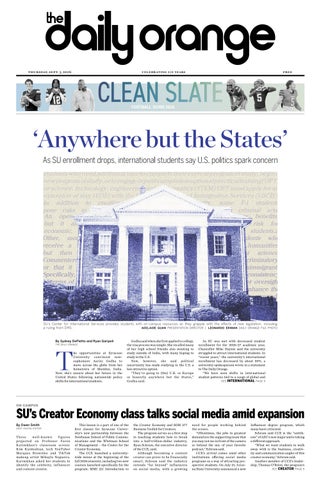
SU’s Center for International Services provides students with on-campus resources as they grapple with the effects of new legislation, including a ruling from DHS. adelaide guan presentation director | leonardo eriman daily orange file photo
By Sydney DePietto and Ryan Garipoli the daily orange
T
he opportunities at Syracuse University convinced nowsophomore Aarini Godha to move across the globe from her hometown of Mumbai, India. Now, she’s unsure about her future in the United States following nationwide policy shifts for international students.
Godha said when she first applied to college, the visa process was simple. She recalled many of her high school friends also wanting to study outside of India, with many hoping to study in the U.S. Now, however, she said political uncertainty has made studying in the U.S. a less attractive option. “They’re going to (the) U.K. or Europe or honestly any where but the States,” Godha said.
As SU was met with decreased student enrollment for the 2026-27 academic year, Chancellor Mike Haynie said the university struggled to attract international students. In “recent years,” the university’s international enrollment has decreased by about 50%, a university spokesperson wrote in a statement to The Daily Orange. “We have seen shifts in international student patterns tied to a range of global and see international page 5
on campus
SU’s Creator Economy class talks social media amid expansion By Owen Smith
asst. digital editor
T h ree wel l-k now n f ig u res projected on Professor Faren Karimkhan’s classroom screen: Kim Kardashian, tech YouTuber Marques Brownlee and TikTok makeup artist Mikayla Nogueira. Karimkhan asked her students to identify the celebrity, inf luencer and content creator.
This lesson is a part of one of the first classes for Syracuse University’s new partnership between the Newhouse School of Public Communications and the Whitman School of Management – the Center for the Creator Economy. The CCE launched a universitywide minor at the beginning of the fall 2026 semester, including two new courses launched specifically for the program: MMI 211 Introduction to
the Creator Economy and SOM 277 Business Toolkit for Creators. The program serves as a first step in teaching students how to break into a half-trillion-dollar industry, Ryan Schram, the executive director of the CCE, said. Although becoming a content creator can prove to be financially smart, Schram said the industry extends “far beyond” influencers on social media, with a growing
need for people working behind the scenes. “Oftentimes, the jobs in greatest demand are the supporting team that you may not see in front of the camera or behind the mic of your favorite podcast,” Schram said. CCE’s arrival comes amid other institutions offering social media programs as a way of attracting prospective students. On July 21, Arizona State University announced a new
Influencer degree program, which many have criticized. Schram said CCE is the “antithesis” of ASU’s new major and is taking a different approach. “What we want students to walk away with is the business, creativity and communication angles of this creator economy,” Schram said. Another member of CCE’s leadership, Thomas O’Brien, the program’s see creator page 5
2 september 3, 2026
WEATHER
about
The forecast for this upcoming week, per The Weather Channel.
THU 9/3
SAT Editor@dailyorange.com News@dailyorange.com Opinion@dailyorange.com Culture@dailyorange.com Sports@dailyorange.com Digital@dailyorange.com Design@dailyorange.com Photo@dailyorange.com BUSINESS 315-443-2315
9/5
The Daily Orange is an independent, nonprofit newspaper published in Syracuse, New York. The editorial content of the paper — which started in 1903 and went independent in 1971 — is entirely run by Syracuse University students. The D.O., a 501(c)(3) nonprofit, is editorially and financially independent from SU, and the paper receives no funding from the university. Instead, The D.O. relies on advertising revenue and donations to sustain operations. This fall, the paper will be published Thursday when SU classes are in session. The D.O.’s online coverage is 24/7, including while SU is on break. To show your support to The D.O.’s independent journalism, please visit dailyorange.com/donate. Donations are tax deductible.
MON 9/7
High of 75° Low of 56°
SUN
High of 77° Low of 56°
TUE
letter to the editor policy The D.O. prides itself as an outlet for community discussion. To learn more about our submission guidelines, please email opinion@dailyorange.com with your full name and affiliation within the Syracuse community. Please note letters should not include any personal information pertaining to other people unless it is relevant to the topic at hand. All letters will be edited for style and grammar.
The D.O. is published weekdays during the Syracuse University academic year by The Daily Orange Corp., 230 Euclid Ave., Syracuse, NY 13210. All contents Copyright 2026 by The Daily Orange Corp. and may not be reprinted without the expressed written permission of the editor-in-chief. The Daily Orange is in no way a subsidy or associated with Syracuse University. All contents © 2026 The Daily Orange Corporation
News Editor Editorial Editor Culture Editor Sports Editor Presentation Director Digital Design Director Photo Editor Illustration Editor Social Media Editor Enterprise Editor Asst. News Editor Asst. News Editor
Arabella Klonowski Will Chadwick Lily Zuckerman Jordan Kimball Adelaide Guan Abigail Aggarwala Tara Deluca Emma Soto Claire Zhang Ally Goelz Vivian Collins Ryan Garipoli
Asst. News Editor Asst. Editorial Editor Asst. Editorial Editor Asst. Culture Editor Asst. Culture Editor Asst. Sports Editor Asst. Sports Editor Asst. Sports Editor Asst. Photo Editor Asst. Photo Editor Asst. Photo Editor Video Editor
Mirren Grimason Addy Kimball Dayna Roberts Tara Binte Sharil Joel Pelachik Harris Pemberton Jason Glick Spencer Brod Eli Schwartz Zoe Xixis Christian Calabrese Reese Niccolls
9/4
9/6
9/8
High of 78° Low of 59° High of 75° Low of 52° High of 77° Low of 59°
U.S. bowling league day
If you are a Syracuse University or SUNY-ESF student interested in contributing to The D.O. on either its advertising or editorial teams, please email editor@dailyorange.com. The D.O. strives to be as accurate in our reporting as possible. Please email editor@dailyorange.com to report a correction.
FRI
scribble
how to join us corrections policy
High of 86° Low of 68°
arabella klonowski news editor
Delia Sara Rangel
Noah Nussbaum
Quinn Postman
EDITOR-IN-CHIEF
MANAGING EDITOR
DIGITAL MANAGING EDITOR
Video Editor Asst. Video Editor Asst. Video Editor Design Editor Design Editor Design Editor Asst. Digital Editor Asst. Digital Editor Asst. Digital Editor Asst. Digital Editor Asst. Digital Editor Asst. Digital Editor
Collin Snyder Thandi McCain Nathan Olszewski Lily Wilkin Zoey Grimes Ana Rodriguez Fiona McHugh Owen Smith Peter Radosh Jack Wood Ava Demcher Alex Rice
Asst. Copy Editor Sydney DePietto Asst. Copy Editor Bailey Dunn Jordan Fendrich Asst. Copy Editor Asst. Copy Editor Gabe Ewen Asst. Copy Editor Caroline Erskine Asst. Copy Editor Kosta Konstantopoulos I.T. Manager Eliza Raphael I.T. Manager Sam Benoit Business Manager Kevin Ross Business Asst. Tim Bennett Circulation Manager Steve Schultz Student Delivery Agent Kaila Hu
DEIA Manager Savannah Stewart Development Editor Eliana Rosen Development Editor Avery Magee Development Editor Mauricio Palmar Alumni Engagement Editor Charlotte Price Alumni Engagement Editor Ben Butler
dailyorange.com news@dailyorange.com
NEWS
september 3, 2026 3
on campus
SU alum, Chinese native Yinfei Ru explores creative side of AI By Helena Chernosky contributing writer
In 2009, Yinfei Ru landed at the Syracuse Hancock International Airport at 2 a.m. before meeting a car full of Syracuse University students, all ready to help with his transition moving to the United States. Setting up a new bank account, going grocery shopping and registering for classes were overwhelming, but Ru was fueled by the promise of the American Dream.
I didn’t really want to miss out. I saw an opportunity to contribute both my management experience and technical expertise to (OpenArt AI). Yinfei Ru head of engineering at openart ai
Originally from Xi’an, the capital of China’s Shaanxi Province, Ru graduated from China’s Northwest University in 2009. Shortly after, Ru knew he wanted to pursue his master’s degree in the U.S. and SU was at the top of his list. During his studies at SU, Ru said classes such as operating systems taught him the foundations of the computer science industry. He said the class projects taught him how to break down complicated problems into smaller pieces and to understand the fundamentals of what he was working on. “I still remember there were many nights I didn’t leave the lab until like 1 or 2 a.m. in the morning. Those were very great memories for me,” Ru said. “And most importantly, by studying that course and finishing all the labs and the materials, it taught me how to approach a large, complex and unfamiliar system.” Xu Geng has known Ru for about 15 years, since the pair were classmates at SU, both earn-
Yinfei Ru is helping an AI company, OpenArt AI, grow from a startup to amassing 8 million users.
ing their master’s degrees at the same time. During their time on campus, the two would play badminton and often study together in Bird Library. After graduating in 2011, they moved to a shared apartment in Silicon Valley, where they both said most of the opportunities in the tech field were located. “At that time it’s not easy to get a job. I think he (was) the second guy to get a fulltime job,” Geng said. “I can tell he works really hard every day even after coming from the office, he still works hard or learns new technology.” Zaicheng Wang, a 2014 electrical engineering graduate from SU, worked with Ru from 2021 to 2025 at CloudKitchens, a ghost kitchen company, where Ru worked as an engineering manager. While working together, Wang said Ru was a leader and had the passion and knowledge to teach junior engineers in his
spare time, spending a minimum of two hours a week with each junior engineer on staff. “Some junior engineers need a lot of help understanding the business goal to understand the project, he’s not rushing or pushing them too hard,” Wang said. “He’s kind of trying to protect the junior engineer and give them time (to) learn more things.” Over the course of Ru’s career, he’s worked with over six different companies, the most recent being OpenArt AI, where he works as the head of engineering. Created in 2022 by Coco Mao and John Qiao, OpenArt AI is an all-in-one AI platform for media, ranging from generating and editing photos to creating videos and scripts. Before OpenArt AI, Ru worked in a more technical space, choosing to go into the more creative world of AI because of how fast the industry has grown.
leonardo eriman daily orange file photo
“I didn’t really want to miss out,” Ru said. “I saw an opportunity to contribute both my management experience and technical expertise into the company.” During Ru’s time at OpenArt AI, the platform amassed about 8 million monthly users. Ru said the team’s biggest achievement came in June through the AI tool named Director, which has the ability to generate cinematicquality videos. It can take roughly 10 to 20 minutes to generate a two-minute clip. “If you asked me five years ago if I could make a video on my own, I couldn’t believe it. But nowadays, after we launched Director, I was able to create multiple very high-quality videos by myself,” Ru said. “So I think for the first time I truly felt that I’m empowered by AI. It enabled me to accomplish something that I would have never thought of.” hmcherno@syr.edu
city
Potential uptick in Syracuse insects following high temperatures By Vivian Collins asst. news editor
As temperatures this week reach over 80 degrees, Syracuse University students may see more insects on their way to class as the bugs’ life cycles are sped up by warmer weather. SUNY-ESF Ph.D. candidate David Harris said while he hasn’t personally seen an increase in insects on campus, construction on sewage systems and water mains can release fumes that attract flies and could contribute to students observing more insects. Muscoid flies and drain flies are specific species that Harris said are likely to be drawn to the sewage smells.
I don’t think that people should feel like we need to kill all these insects because they’re a problem, it’s a very temporary situation. David Harris suny-esf ph.d. candidate
SU experienced “one of the most active construction periods in recent years” during summer 2026, the university announced in May. Humidity related to recent rainstorms could also be a cause for the higher concentration of insects. Harris explained that cold-blooded animals develop faster in warmer temperatures and wet conditions. On July 14, the city of Syracuse broke a 74-year-old heat record, reaching 97 degrees for the first time since 1952. “Because it’s been very hot this summer, a number of species have been sort of fasttracked, so a whole bunch of them came out, and then there was less of a spread,” Harris said.
maria masek contributing illustrator
SU and ESF are both recognized as Bee Campus USA affiliates by the Xeres Society, as both campuses actively encourage native plants to benefit pollinators, Harris said. So, students may be seeing an uptick in pollinators — not just honeybees. “When people talk about pollinators, it’s not just honeybees. In fact, honeybees are a pretty small percentage,” Harris said. “There are a lot of flies and fairly harmless wasps and beetles that are also (pollinators), as well as many, many native and non-native bees that are associated with that. So there’s definitely an increase in those locally.” Worldwide, there’s a steady downward trend in the number of insects, but the decrease is
inconsistent, Harris said. In certain places, “there’s been observed and measured huge decreases over the course of several decades in both species abundance and total biomass,” he said, while others haven’t seen these decreases. So, when there are local events like at SU, Harris said sudden spikes in insects don’t indicate a trend. “I don’t think that people should feel like we need to kill all these insects because they’re a problem,” Harris said. “It’s a very temporary situation.” For those concerned about spotting more bugs in their dorms and homes, Harris suggested making sure any openings to the outside are filled and encouraged the use of plug-in
repellents and citronella products. He also advised against using harsh insecticides like Raid because they’re non-specific, meaning they target anything and can potentially expose people to dangerous chemicals. Planting native plants, including citronella plants, around your house can also keep insects out of your home, Harris said. Houseplants can also help boost your mental health, according to the Cleveland Clinic Newsroom. “The more robust of an insect ecosystem that we can support, the better able the environment around us will be to rein in some of those populations without us having to intervene directly,” Harris said. viviancollins@dailyorange.com
4 september 3, 2026
dailyorange.com news@dailyorange.com
city
Great NYS Fair closures early due to heavy rain, flooding By Mirren Grimason asst. news editor
The Great New York State Fair closed early at 6 p.m. Wednesday as a result of heavy rain flooding the grounds, syracuse.com reported. Almost two inches of rain fell over two hours on Wednesday morning, leading to an initial closure at 11:30 a.m. as the fairgrounds are prone to flooding. The fair reopened around 12:35 p.m. as the rain and flooding subsided, before closing again five hours earlier than planned after a second storm. The National Weather Service issued a flood watch until 8 a.m. Thursday across central New York, along with a tornado warning until 11 p.m. Wednesday. If needed, the fair will open shelter-in-place areas for those camping and staying in RVs on the grounds, syracuse.com
reported. At 8:41 p.m., the NWS issued a tornado warning for Onondaga County until 9:15 p.m. Parking lots at the fairgrounds stopped letting cars in at 4:30 p.m. and the fair’s entry gates closed to new visitors at 5:15 p.m. To plan around the closure, concerts were moved up, with Priscella Block performing at 4:30 p.m. and Tori Kelly at 5 p.m, the fair announced in a Facebook post. In 1998, a storm during the NYS Fair caused three deaths, injured 10 people and caused extreme damage to the fairgrounds, forcing a closure on the fair’s last day. Fair officials have not yet announced if the fair will operate with normal hours on Thursday. However, its Facebook post read, “We apologize for the inconvenience, and hope to see you back here tomorrow!” mirrengrimason@dailyorange.com
The Great New York State Fair closed early at 6 p.m. Wednesday due to heavy rain flooding the grounds. christian calabrese asst. photo editor
on campus
Haynie backs SU’s investments, says demand isn’t the ‘problem’ By Bailey Dunn asst. copy editor
Syracuse University Chancellor Mike Haynie defended the university’s investments in a Monday campus-wide email and said student demand “has never been our problem.” In the email, Haynie said he aims to be “candid” with the SU community about the challenges the university faces, while noting steps SU is taking to address such issues. “Higher education has a long history of moving slowly. We do not have the luxury of that pace right now,” he said. “We will move with urgency because the institutions that do not adapt will be the ones left behind. It’s clear to me that now is not the time to retreat and play defense.” Haynie called SU’s ongoing budget deficit “far from a crisis” and instead a push to commit to “differentiated academic excellence.” He noted SU has been more “open” about its admissions than other institutions and laid out ongoing university initiatives that look to manage and invest in students and the future of SU. Students and faculty received two versions of the email with different subject lines. The first, from “The Office of the Chancellor,” read “Building Our Bold Future, Together.” The second, from the “Office of Senior Vice President and Chief Advancement Officer,” read
“Message from Chancellor Haynie: Setting the Record Straight.” The statement comes after The Wall Street Journal released an article highlighting the corresponding issues associated with the university’s budget deficit. Haynie announced SU’s 1.5% operating budget deficit on June 11, saying it would not meet its undergraduate enrollment goals for the upcoming fiscal year. Moving forward, Haynie said he plans to “lean further into” the subjects and programs where SU “already is among the best in the country,” such as its communications, sport management, architecture and public policy programs. Haynie referenced SU’s strong alumni network, as well as new offerings such as the Center for the Creator Economy, the Whitman School of Management’s 2030 plan, its AI Academic portfolio and the Center for Advanced Semiconductor Manufacturing partnership with Micron as ways the university will carry on its institutional and academic identity. The three new residence halls on North Campus, set to be ready by fall 2027, are also part of the university’s initiatives to enhance the undergraduate experience while continuing. “These investments don’t reflect a university playing defense,” he said. “They represent an institution that knows who we are, and where we are going.”
chancellor mike haynie wrote in a campus-wide email Monday that he aims to be “candid” about SU’s budget deficit as it continues adapting as a university. avery magee development editor
Hay n ie’s 12-person com m it tee, announced on June 30, will send him a report by Nov. 15 with suggestions on how to move forward from the deficit. He said he expects the report to be “honest enough to surprise us and disciplined enough that we can act on it.” Despite the deficit, Haynie said he continues to remain positive about what the region
and university hold. “Demand for a Syracuse education has never been our problem,” Haynie said. “However, what is clear is that we cannot take for granted that prospective students and families inherently understand the enduring and lifelong value of a Syracuse University degree.” badunn@syr.edu
city
Common Council’s 2025 recap: Budget cuts, $1 billion housing project The council also approved a 2% tax on all occupied hotel rooms in the city of Syracuse. The tax is added onto Onondaga County’s existing 7% tax on occupied hotel rooms, CNY Central reported.
By Mirren Grimason asst. news editor
Syracuse Common Council released its first “Legislative Year in Review,” which included an overview of 2025 budget proceedings, laws passed and corresponding recommendations for the year to come. During 2025, the council held 25 voting meetings, preceded by two “study sessions,” alongside 52 committee meetings and 34 budget hearings, meaning councilors met 213 times, according to the report. 1,400 pieces of legislation were considered and just over 1,000 of them were passed, including eight local laws and 15 resolutions. The goal of the report is to help Syracuse residents better understand what the Common Council does, Syracuse City Auditor Alexander Marion wrote in its introduction. “The Syracuse Common Council is a critical part of our local government. But I am often asked by members of the community: “what does the Common Council…do?,” Marion said in the report. “That’s never asked with disrespect, but genuine curiosity and a desire to better understand their local government. I often find myself asking the same question, and this report was born out of seeking those answers.”
Budget proceedings
Every year, the mayor creates a proposed budget which is presented to the council for approval. The council then holds hearings with individual departments and a later public hearing on the budget. The council proposed the most changes to former Syracuse Mayor Ben Walsh’s $348.4 million proposed budget for 2025 in its history, resulting in a $16 million budget cut. Cuts included almost $3.7 million from the Department of Public Works, $3.5 million from the Syracuse Police Department and $2.4 million from the Syracuse Fire Department.
Councilor changes
Council President Helen Hudson, CouncilorAt-Large Amir Gethers and Second District Councilor Pat Hogan are no longer a part of the council. Hudson’s term ended, Gethers did not gain re-election and Hogan made a run for mayor and lost. Their successors include President Rita Paniagua, who ran unopposed and has served as a councilor-at-large since 2019, Hannah Ehrenreich, who was elected to the at-large seat and Donna Moore, who was elected to the second district councilor seat.
The auditor’s recommendations
Syracuse Common Council released its first “Legislative Year in Review,” looking at 2025 budget proceedings, laws passed and future recommendations. ike wood senior staff photographer
Local laws passed
The council passed eight local laws in 2025 and Marion noted three as the most significant in the report. A law was passed to begin construction in the East Adams neighborhood as a part of a city revitalization project. The $1 billion “neighborhood transformation” encompasses part of the historic 15th Ward area and is intended to “reconnect” the neighborhood ahead of the demolition of I-81, according to the City of Syracuse.
The plan aims to create 132 modern and affordable homes in the area, and construction began on Dec. 3, 2025, as of the last update. Additionally, under Walsh, a land transfer agreement was reached between the city and the Syracuse Housing Authority. The land acquired by the city allows it to begin the redevelopment of the Eastwood Heights neighborhood, according to a March release. The neighborhood has been an “important housing resource for older adults,” and SHA intends to upkeep the affordable senior housing, according to a release.
At the end of the written report, Marion proposed four key recommendations for the council’s future: Councilors should request justification from administrations when waivers are requested, to ensure “transparency when spending public dollars.” There should be more meetings at night and weekends to accommodate working councilors and encourage “public engagement.” Councilor positions should be reworked into full-time jobs, including limits on external income. Non-partisan special elections should be used to fill vacancies rather than succession. “It is my hope that this report can serve as a guidebook for citizens looking to better their understanding of government but also for those civic-minded individuals who may one day want to run for office and serve as Common Councilors,” Marion said in the report. mirrengrimason@dailyorange.com
september 3, 2026 5
dailyorange.com news@dailyorange.com
from page 1
international domestic factors outside of our control, including visa interview suspensions and heightened screening,” the spokesperson wrote. “As a result, our international enrollment has declined significantly.” In a September 2025 University Senate meeting, former Chancellor Kent Syverud said the percentage of international enrollment in the “undergraduate entering class” decreased to 5%, 7% lower than in 2023. During the meeting, Syverud said SU was 41 students below its master’s students goal and attributed the problem to international students having difficulties obtaining student visas. SU isn’t alone in this reality. Anna O. Law, a professor of political science and Herbert Kurz Chair in Constitutional Rights at CUNY Brooklyn College, said there is “no doubt” the primary reason for a decline in international students is federal enforcement on legal immigration. On the first day of President Donald Trump’s second term in office, he signed Executive Order 14161, which increased strict vetting and screening for foreign visitors and immigrants entering the U.S. Now, almost two years later, recent orders restricting international student visas are still “rooted” in the January 2025 bill, according to NAFSA: Association of International Educators. In 2025, Trump made efforts to prevent Harvard University from enrolling international students, revoked international student visas and terminated their records, halted scheduling new visa appointments and included additional fees for international students under the One Big Beautiful Bill Act. In April 2025, Trump’s administration revoked the visas of three SU students, without providing the university an explanation. These efforts have continued into his second year back in office. In January 2026, Trump expanded a previous executive order, restricting entry for citizens of 19 countries and suspending entry and visa issuance to 39 countries. In August 2026, Trump’s administration paused all immigrant visa applications while implementing a new screening policy, NBC News reported. The pause is expected to end in early to mid-September, following several policies to restrict immigration and student visas for international students. The number of international student applications in the U.S. fell by 10% for the 202627 academic year, the steepest drop since the
Common App began tracking international applications, CNBC reported. Law explained it’s already difficult enough to secure admission to an American university, but now students have to also worry about visas, whether they’ll be readmitted if they leave and return to the country and if they’ll be detained and deported by the U.S. Immigration and Customs Enforcement. “Trump’s overt hostility to non-white immigration creates uncertain visa interview and issuance processes,” Law said in a statement to The D.O. “Historically, non-citizens do not have the same free speech rights as U.S. citizens today, and now, even U.S. citizens’ speech rights are under threat.” Noah Graff, an SU junior from Windsor, United Kingdom, said one of his friends from Switzerland had trouble going through U.S. customs following a misdemeanor, which has made him extra cautious about jeopardizing his visa status. “It’s not a big thing, but I’ve got to be extra careful because one thing goes wrong and I’m out,” Graff said.
50% Decrease in SU international enrollment
In July, the U.S. Department of Homeland Security capped international students’ stay in the U.S. to four years unless the federal government approves an extension. DHS also placed restrictions on when and how international students can change their major program ahead of the 2026-27 academic year, while also halving the time international students have to find a job after graduation from 60 to 30 days. “In addition to creating risks to national security, some F-1 students pose risks to public safety and have been charged with criminal acts,” the final rule states. The act will take effect on Sept. 15. As the new rules restrict the amount of time international students are permitted to stay in the U.S., job security has become a major concern. Graff said the need to quickly find a job and the complexity of obtaining one just to stay in the U.S. is a reason he’ll likely move back to the U.K. after college. “I don’t want to rush to get a random job,” Graff said. “For an international student, you have
a better chance of being an entrepreneur than getting a job because American companies don’t want to do the extra work of sponsoring a visa.” Godha agreed with Graff, saying the DHS restriction on international students’ time to secure a job after graduation could push her to not pursue a career in the U.S. “I think I’m gonna have more pressure towards junior year to find a good job,” Godha said. “(The pressure) definitely would eventually make me not want to stay in the states anymore.” SU, like other American universities, faces the challenge of attracting international students during a time of shrinking application pools. Yunnai Modi, an SU junior from Mumbai, India, said he thinks SU isn’t doing enough to stand out to international applicants, pointing out perks of attending other American universities. “It only makes sense to go through the visa process if you get in the top 1% (of schools),” Modi said. “If you look at Northeastern right now, they have one of the best career centers for internships in the world. There’s no professional advantage of going (to Syracuse).” SU isn’t just facing competition from other American universities, but also international universities as well, Deputy Executive Director, Public Policy at NAFSA and SU alumna Jill Allen Murray said. As U.S. policy reduces the number of international applicants its colleges receive each year, Allen Murray said other countries are implementing policies to attract talented international students. “There is competition from other countries. Germany is enrolling more foreign (students) than it ever has before… and they have several policies that help to retain them,” Allen Murray said. “South Korea also hit its target of 300,000 international students two years earlier than they had planned.” NAFSA research found that the U.S. economy could lose $3.4 billion and nearly 40,000 jobs after the loss of around 111,000 international students in 2026. International student enrollment at SU contributed the sixth most to New York state’s economic gains from international students in 2024. Allen Murray said the added difficulty and uncertainty of studying in the U.S. creates a stressful experience. She said the unpredictability of a student enrolling at an American university, not knowing if their extension will be granted, adds significant anxiety to their personal experience. SU remains “focused on supporting current and prospective international students through every stage of their admission and
enrollment process, and through their time while at Syracuse University,” the university spokesperson wrote. Godha, however, feels SU isn’t doing enough. She wishes SU had more established initiatives that help international students career-wise, to show it has “the best interest of their students” in mind. Godha said SU needs to have more one-on-one conversations with students instead of the seminar-style speaker events it hosts. While Graff said he feels SU has provided him with fun experiences, he also wishes the university did more to help international students develop their careers. “In terms of job-finding and internships, if you want to stay in this country, that’s one thing they don’t really help with well,” Graff said. SU’s Center for International Services supports international students through its resources surrounding immigration status and regulations, passports, visas, travel, insurance, employment and cultural, social and academic experiences, according to its website. In 2025, just over a third of its staff did not return for the fall semester. Looking ahead, Law said the efforts to limit international students are “probably temporary,” but the long-term damage is “profound.” She said the Trump administration’s ongoing attacks on higher education, including cutting federal research funding, has set back a generation, if not more. “U.S. academic institutions were once the envy of the world, I don’t know that they will recover that status in my lifetime,” Law wrote. “Foreign students will differently assess the U.S. as a destination for their training.” Allen Murray emphasized the value of international students’ perspectives. As a graduate student at the Maxwell School of Citizenship and Public Affairs, she recalled being surrounded by international students, exposing her to different cultures and backgrounds from across the world, an experience she deemed invaluable. “The attack on foreign students and higher education is an abdication of U.S. soft power,” Law wrote. “When foreign students study in the U.S., they gain insight, understanding, and build relationships which leave a positive view of all things American when they return to their home countries.” “The same students that have studied at U.S. universities may go home to be leaders in business, government, industry, or the arts,” she added. “That influence is now destroyed.”
from page 1
what we used to know as traditional to everything you now see being an ad on Instagram and TikTok,” Brooks said. In addition to MMI 211 and SOM 277, students are also required to take an entrepreneurship course through either Newhouse or Whitman, O’Brien said. Many students in the introduction course said they’re interested in using the skills they learn in class in future entrepreneurial projects down the road. Sheldon Birthwright, a freshman television, radio and film major, said he enjoyed the class because he felt he was learning about all areas of the industry. “The social media world is evolving every day,” Birthwright said. “I feel like the creator economy can help me understand every aspect of it, so in the future I won’t go in blindly.” To allow students to create their own content, Schman said the CCE lets students rent out cameras and microphones universitywide, separate from Newhouse’s CAGE facility. The CCE has also invested in new podcast booths in Newhouse 3. O’Brien and Schman said the center is looking for additional ways for students to gain experience through a planned registered student organization, the Creator Crew. The group will give students opportunities to work on content, whether it be filming or editing, while also involving “analytics and strategy,” according to its website. The center will host its second annual CUSE Creator Con in late October, bringing in social media executives and brands to campus. When Karimkhan’s class broke off into discussion, students weren’t instructed to talk about the best strategy to go viral – instead, they talked about how to communicate with businesses to promote products using the creator economy. “The idea here isn’t how do you buy the ideal ring light or what smartphone is best for you,” Schram said. “It’s recognizing that by definition, whether it’s a side hustle or whether you make it a full-time career, being a creator is a small business.”
creator
professor faren karimkhan teaches students the business behind content creation through her class Introduction to the Creator Economy. paul hakimian contributing photographer
project coordinator, said the center is designed to give students an understanding of the industry, regardless of what they choose to do in it. O’Brien added that the creator economy is for everyone on campus, even those with majors not connected to communications. “You could be a chemist who’s done research that you’re super excited about,” O’Brien said. “A well-thought-out social media campaign could be the difference between that research becoming a reality and getting the funding that you need.” During an MMI 211 class, Achilles Santiago, a sophomore economics major, said it’s helping him understand how he might be able to turn his interests in fitness, gaming and reaction content into a potential career or side business. The creation and popularity of artificial intelligence influencers was thoroughly discussed throughout the class. Example accounts shown during the class had millions of followers and struck sponsorship deals with companies including BMW and the Coachella music festival. “Believe it or not, but audiences have responded very positively to AI content creators,” Karimkhan said during the class. George Geisert, a sophomore majoring in television, radio and film, said he didn’t understand why anyone would follow an account that generates photos of an influencer instead of following a real person. “I don’t understand how a human being can follow or be influenced by someone that you know is not real on social media,” Geisert said. “It’s straight slop.” The discussion of AI influencers was one example Karimkhan used to show the evolution of social media platforms. Addy Brooks, a freshman visual communications major, said she didn’t enroll in the course to understand how to become big on social media, but rather to see how social media is changing advertising and marketing. “I think what’s super important right now is recognizing that ... everything that’s happening in the marketing world is transitioning from
news@dailyorange.com
owensmith@dailyorange.com
CULTURE
6 september 3, 2026
dailyorange.com culture@dailyorange.com
CNY
Crash Course
Fairgoers continue to buzz around the Great New York State Fair late into the night. Alongside staples such as games and food, the Fair features museums and gardens that offer visitors a glimpse into local history. paul hakimian contributing photographer
The Great New York State Fair offers more than rides — it shows central New York’s history
By Caroline Erskine asst. copy editor
C
arnival rides flashing, people snacking on elephant ears and funnel cakes, a giant butter sculpture and drinking 25-cent cups of milk are all staples of the Great New York State Fair. Syracuse University students, Syracuse residents and out-of-towners alike gather with their family and friends for a sugar- and adrenaline-filled good time. But there’s more to the Fair than amusement rides and sweets. Today, over a century’s worth of history and education lies on 581 State Fair Boulevard. “At this point in our world, we have become very disconnected from the place things are grown to what we actually see,” Harold Nugent said. “The hope is to have people, when they’re coming out to the state fair, come into the garden and see the plant that the fruit is grown on.” Nugent, a natural resources educator with Cornell Cooperative Extension of Onondaga County, is one of many people at the state Fair responsible for educating fairgoers about New York state. The 375-acre Fair features dozens of hands-on displays, agricultural centers, educational hubs and historical build-
ings scattered throughout its grounds. From discovering the secrets of New York state agriculture to witnessing authentic performances at the Fair’s four cultural villages, SU students can learn more about their central New York home with a quick visit to the Fair. What many fairgoers don’t know is that it’s rooted in agriculture. The butter sculpture’s attraction is all about the large dairy farming industry, gardens show off the crops of the region and barns full of livestock draw farmers from across the state and country. There was even a period of time — from 1938 to 1962 — where the Fair was named the New York State Agricultural and Industrial Exposition. Decades later, Helena Chernosky, a junior at SU, grew up visiting the state Fair. When Chernosky was younger, she didn’t understand why people cared about exhibits like the Jared van Wagenen Carriage Museum or horse jockeying, but now she sees how much they can teach people about central New York’s history. “When I was like five or six I was like ‘Why is this here? I didn’t care about the history,” Chernosky said. “Now, I get it.” Near the Expo Center is the Voice of the Farmer Garden, a plot of vegetables, herbs, fruits and flowers meant to close the gap between what people eat and where their produce came from. see fair page 8
beyond the hill
Garbo’s stylists offer trust, expert cuts on Marshall Street By Charlotte Price
alumni engagement editor
In the heart of Marshall Street, a few flights of stairs above Faegan’s Cafe & Pub, there’s a storefront many Syracuse University students miss — a place where any problem can be solved with a hair stylist’s expert skill. Stepping into Garbo’s Barber & Beauty is like stepping into your childhood best friend’s home. There’s always a friendly face, an open ear, music playing and people singing along. At Garbo’s, “everything is fix-
able,” colorist and co-manager Micah Jareo said. Garbo’s has been the one-stop shop for SU students’ beauty needs since 1995. Alongside traditional salon services like haircuts and coloring, Garbo’s also offers spa services like spray tanning, lashes and nails. But the upbeat playlist and environment bring in the most compliments, stylist Santana Wright said. “(Clients) just love the vibe, and they always say they feel comfortable and at home and just like the atmosphere,” she said.
When you walk in, you’re met with pop music playing from a TV behind the front desk. To the left, you’ll find Garbo’s owner and barber Stavros Vigliotti’s station. SU fraternity members looking for a clean cut funnel in and out all day long. Jareo works in the next room, applying a halo of foils to an SU senior, who’s settling in for a four-hour hair transformation from black to red. This type of drastic change is fairly common for Jareo’s clients. Those transformations reflect equally big changes in college students’ lives,
Jareo said, like moving across the country or making new friends. “It’s like a lot of changing identities,” Jareo said. “I feel like it’s just trying to see who you want to be and present yourself to the world before you go out there.” Across the lobby and down the hallway is a color-mixing room, where Wright is perched on a stool waiting for a client. It’s also where the stylists come to collect themselves if something unexpected happens, Jareo said. Hair color tubes hang from a clothesline strung above two washing
machines, resembling paint tubes in an art studio. Stylist Chloe Regan’s suite is in the opposite direction down the hall, a gothy haven that she chose for its great lighting — a necessity for making TikToks that promote her work and attract new clientele. She focuses on vivid dyes, like the transformation she’s working on — a red split dye with a raccoon tail. Vigliotti worked at Garbo’s as a barber for around three years before he bought the shop in 2024 for “pennies,” see garbo’s page 9
september 3, 2026 7
dailyorange.com culture@dailyorange.com
campus life
Ray-Bans and ankle weights: Inside SU students’ school bags By Claire Zhang
social media editor
On Jesse Nunan’s walk to and from class, she sometimes questions what people with tiny backpacks could possibly be carrying. It’s quite the downsize compared to her large, sagging Trader Joe’s tote. “I really load up this bag to the point where it’s hurting my shoulder a little bit,” Nunan, a Syracuse University fine arts senior, said. “I wonder if people do the same or if it’s just that I can’t keep track of my stuff.” While size, shape and style may differ and contents are often unknown to passersby, almost every SU student carries a bag to class. Some contain the bare necessities, others have everything from a midday snack to a change of clothes — all to ensure a trip back to their dorm or apartment won’t be needed. Sophomore musical theater major Emma Andrews represents the latter. Contributing largely to the weight of Andrews’ “massive” Free People Emerson Tote Bag are her MacBook, dance shoes and, most importantly, a music binder. Andrews’ binder is something she can never leave the house without, which has stayed true since she was 10-years-old. It’s stuffed to the brim with sheet music she can give to pianists if she needs to sing impromptu. Andrews said her tote is the “quintessential musical theater bag.” While she may seem overprepared to a business or humanities student, her classes require certain items, which explains the volume of her bag contents, Andrews said. A lace-embroidered leotard, tights, LaDuca boots and ballet slippers are required for Andrews’ dance class every day. Her folder of
scripts is there to look over when rehearsing plays and monologues. Before a day of singing, her Grether’s Pastilles — Broadway performerapproved cough drops — are a “niche pull” that soothes her throat. Andrews said while every musical theater student carries similar items, they’re all specifically tailored to the individual, which means lending things back and forth can get complicated. “You can borrow someone’s calculator, but you can’t borrow someone else’s shoes,” Andrews said. “It’s also such bad looks.” Junior Connor Merrigan is an example of the aforementioned business student. In his Patagonia knapsack are primarily the essentials: his Ray-Ban sunglasses, six Ticonderoga #2 pencils (which he’s loaned to classmates many times), a five-subject notebook for his five classes, Apple AirPods and his laptop. At the bottom of the bag are loose papers — a crumpled class syllabus, two printed New York Times articles and his name tag written in bright pink highlighter. Merrigan said he’s probably the archetype of an SU finance major, except he’s missing a calculator. Merrigan is part of the cohort of students that have largely moved past physical supplies for class, like textbooks, he said. “I could probably get by going to class with only my laptop every day,” Merrigan said. However, Merrigan said he still enjoys taking handwritten notes and brings a copy of “Poor Charlie’s Almanac” to browse when he can. Even if it doesn’t get read as often as he’d like, it’s a consistent component of his bag. Other SU students, like musical theater sophomore Maximo Paniagua, change their
Strapped with a black Prada bag, Maximo Paniagua has “expensive taste.” He carries a music book, granola bar and a “Rent” script. claire zhang social media editor
Jesse Nunan’s tote bag carries a sketchbook, sunglasses and dried mango. Nunan said the canvas tote fits all her necessities for the day. claire zhang social media editor
bag contents almost every day. On a lighter day, Paniagua’s black Prada bag is filled with his music book, a granola bar, the script for “Rent” and ankle weights. As a musical theater major, it’s important to be prepared and take care of yourself, he said. But it doesn’t have to mean sacrificing his style. Over the summer, he bought his black patent leather Prada bag that he now uses as a school tote. Inside are a pair of black Prada sunglasses. His Prada sunglasses and bag coordinate his puttogether “expensive taste.” “I have a very specific aesthetic,” Paniagua said. “This bag is very me.” Similar to Paniagua, Nunan’s also a fan of a worn leather bag with metal detailing, but when it comes to packing the materials she needs for her art studio classes, she said it’s simply impractical. Instead, she favors her canvas Trader Joe’s tote, which holds her devices, sunglasses and sketchbook covered in stickers. There’s also a box set of nails and dog poop bags, among other items. As a husky owner and busy art student who frequents her Shaffer Art Building studio, Nunan said her bag is both representative of her and convenient. “I kind of destroy the inside. It’s good to have something durable,” Nunan said. “Plus, it’s covered in dog hair” Most of Nunan’s items are to help her stay prepared, but one in particular is meant to stir conversation. In a green envelope are postcards of her paintings she printed herself. They’re part of Meriwether Print Club, a subscription service where she sends out two postcards of her work a month. When she encounters new people, Nunan said she makes sure to give them one.
“I’m really big on talking to strangers, and so it tends to come up more than you would think,” Nunan said. “This is a fun way of doing that.” Some students like Nunan suffer shoulder pain from carrying a heavy tote bag, while others like Merrigan have stayed loyal to the traditional backpack for that very reason. But choices often evolve over school years. When Nunan was a freshman, she used to cram her backpack full of paint and projects even when she didn’t have a studio. Merrigan’s devotion to his Patagonia (he’s had it for over 7 years) doesn’t mean his bag-packing habits have stayed the same. Over the years, he’s cut back on the number of items he brings. “Freshman year, backpack to body ratio was suboptimal,” Merrigan said. “Now it’s a little more condensed.” While students like Paniagua “use and abuse” everything they pack for the day, others like Merrigan and Nunan may forget about certain items. Nunan used to carry dried mango slices as a snack throughout the day, but when she didn’t eat it, her husky Louie figured out how to open the packages himself. Andrews said she thinks nearly everyone on campus packs a laptop in their bag, but depending on the major, some students might have rarer items. Whether it’s seeing someone walk the Promenade in a bag he wants or noticing a cute bag charm, Paniagua said he now wonders what people might be taking around campus, just as they might be wondering that of him. “You never really know with people, huh?” he said. “I don’t think people would expect tights, a dance belt and ankle weights in a Prada bag.” cmzhang@syr.edu
beyond the hill
ESF students share work, address ecological issues at NYS Fair By Paige Schoen staff writer
SUNY ESF chemical engineering graduate students Chi Zhang and Sushant Gawali are on a mission: replace plastic wrap, a household staple, with a green alternative made from sugar maple tree shavings. Their current sample, a sheet of biodegradable film about an inch across, allows air to pass through it. Zhang and Gawali showcased their invention, part of their shared thesis project, at ESF’s booth at the Great New York State Fair after their thesis adviser told them they’d been selected. ESF highlights its students’ work, along with science demonstrations and promotional brochures, for ten days every year — an ongoing tradition dating back to the early 20th century. ESF showcases a wide range of research and activities from its booth in the State Park section at the Fair. Zhang and Gawali displayed their film and its components alongside the chemical engineering department, which had taken over the ESF booth on Friday. Zhang and Gawali’s process starts by taking shavings from a sugar maple, a hardwood tree common to the eastern United States. Zhang and Gawali then bleach the shavings and grind them into a fine powder. A proprietary blend of chemicals is added to the powder, and the mixture is left to dry into a thin sheet. The resulting product is translucent and has a faint yellow tinge. Presentations are hosted by most of the college’s departments on a rotating basis throughout the Fair’s yearly production. Each department has one or two days to make its case to the
SUNY ESF students shared projects at their Great New York State Fair booth. One display showed an alternative to plastic wrap. christian calabrese asst. photo editor
public at the forum. On Wednesday, one spotlighted the Lake Ontario Watershed — which encompasses the city of Syracuse, the Finger Lakes and Oneida Lake — by constructing a large puzzle made from satellite imagery. On Monday, a department explained how blight wiped out the American chestnut tree, which is valued for its strength and color. The booth also discussed how ESF researchers are attempting to restore the tree’s population.
Sean Hohm, director of operations at ESF’s Paper and Bioprocess Technology Center, demonstrated some of the paper industry’s standard testing procedures. These included crush tests where paper sheets are suspended between two clamps while subjected to increasingly heavy weights, and trials where paper cups have weights placed on them. Hohm said that children, many of whom are just beginning to understand weights and dimensions, are particularly impressed by the demonstration.
“When the little piece of two-inch by twoinch paper is holding 30, 40 pounds, they’re like, ‘that’s holding me,’” Hohm said. The interactive science model hopes to leave younger fairgoers with lasting memories, but it also allows the college to raise awareness about its academic programs. Kelly Watson-Collins, an instructional support specialist in ESF’s chemical engineering department, said some students remembered their time at the fair influencing their college decisions. “We have people who come to the booths every year, and they’re like, ‘This was my first exposure to ESF, making a sheet of paper when I was a kid,’” Watson-Collins said. “You know, so that helped them come to ESF.” In addition to boosting admissions, the college’s booth also educates the general public on a variety of topics from geography to biology. Karen Moore, associate director of communications at ESF, said the public asks about much more than just the college and its research at its annual table. These often revolve around neighborhood trees or animals in someone’s backyard, questions faculty and students are happy to answer. Zhang and Gawali emphasized that their film was far from a finished product, but they’re optimistic about the future and happy for the exposure. If it can be mass-produced, the duo hopes that it can replace Saran Wrap and other petroleum-based cling films. “There are still more aspects to consider, like economics, what chemicals we are putting in, how much water we are using,” Gawali said. “We’re working on it.” paschoen@syr.edu
8 september 3, 2026
dailyorange.com culture@dailyorange.com
beyond the hill
Westcott market boosts farm-fresh practices By Kaila Hu
contributing writer
Emma Sheridan passes by the Syracuse Eastside Farmers Market every Wednesday while walking home from class. From peaches to jalapeños, Sheridan prefers buying produce from the market over chain stores like Wegmans because of the access to fresh goods and the market’s sense of community. “It’s awesome. There’s a lot of good stuff they have to offer, and I’d rather get it here and give them my money,” Sheridan, a Syracuse University graduate student, said. Every Wednesday, the Farmers Market hosts local vendors from 2 to 6 p.m. at the Westcott Community Center’s parking lot on Euclid Avenue. The market operates from June through
Having the market makes it really easy for me and other students to get nonchain store food. Emma Sheridan su graduate student
October, or as long as the growing season allows until winter hits. Since 2007, the market has brought fresh produce, baked chicken pies and rice pudding to
support the cultural heritage and life of the community. This year, it featured a range of vendors, such as Syracuse Honey and Stay Sizzled. Beth Southwick, co-owner of Southwick Family Farm in Onondaga County, has been participating in the market for about 15 years. Despite rotating vendors, the Westcott neighborhood still has a lively spirit every time the market comes around. For Southwick, she believes its longevity and success can be attributed to the continuous student interest throughout the years. “When the market first started out, we had two vendors. They had really good products, so there was a big neighborhood interest,” Southwick said. “It brings local food directly to the neighborhood, and a lot of this is for the students who need food for the week.”
see market page 9
THIS WEEKEND Jesse McCartney “Alvin and the Chipmunks” voice actor and singer-songwriter Jesse McCartney shows off songs like “Leavin’” and “Beautiful Soul” at the Great New York State Fair on Thursday night. WHEN: Thursday, 6 p.m. PRICE: $8.32 WHERE: Chevy Court
Violent Femmes Founded by Gordon Gano and Brian Ritchie, folk-punk band Violent Femmes adds a touch of alternative rock to the Fair. You’ll hear songs like the band’s ironic hit “Blister in The Sun” on Friday. WHEN: Friday, 8 p.m. PRICE: $8.32 WHERE: Suburban Park
from page 6
fair
The garden, which first opened at the Fair in 2023, is part of the Farm Journal Foundation’s national Voice of the Farmer Garden program. The garden is planted and maintained through a partnership between Cornell Cooperative Extension of Onondaga County and the New York State Department of Agriculture and Markets. Nugent, who runs the garden alongside Kathleen Burns Copeletti, master gardener volunteer coordinator for the CCE, said the space is designed to represent and educate visitors on both New York state’s major crops and its cultural diversity. “We are trying to showcase a lot of the agriculture that the farmers do grow here in New York state,” Nugent said, “But we also have some things that we grow that represent the diversity of New York state, different food or different plants and crops that the ethnic diversity of New York state would grow at home if they couldn’t find it.” That diversity includes a bed of bok choy and kohlrabi, rows of grapes and conifer trees representing the state’s Christmas tree industry, an apple display modeled after high-density production orchards and, new this year, a bed of cut flowers — a growing industry in upstate New York. One bed is planted with corn, beans and squash, arranged to reflect the Three Sisters, an agricultural practice developed by the Haudenosaunee, a confederacy of six Native American nations that originated in upstate and central New York. “Coming into this space, you can get an idea of what the agriculture of New York state is,” Nugent said. “And I think a little bit better understanding of the people of New York by that agriculture.” Visitors get an even deeper historical understanding of the Fair’s agricultural roots at the Daniel Parrish Witter Agricultural Museum, which opened in 1928. At least 1,000 people pass through the museum every hour, said Barbara RaymondLaPrease, a member of the Friends of the Witter Agricultural Museum, the volunteer group that helps run the building. Originally located in Schoharie County, the museum landed on the fairgrounds in 1928. It’s filled with recreations of 19th-century agricultural life: a general store, a maple sugaring display, a dairy collection, a hops exhibit and a log cabin built in the early 1800s. Volunteers in period costumes weave textiles, work treadle lathes older than the museum itself and demonstrate woodworking entirely by hand — no power tools allowed. “It’s so important for (the younger generation) to understand how things used to be done so that they know where their heritage is,” RaymondLaPrease said. “That’s the key.” Just next door is the Jared van Wagenen Carriage Museum. George Hand, a member of the board of directors, has spent recent years restoring and adding to the museum’s carriage displays, including a rare Victoria carriage from the 1980s with a restored leather top and fenders from funds raised by the friends’ group. The room is full of Syracuse- and central New York-focused history. Three other carriages in the collection were built in Syracuse by a company called Moyer Carriage Lofts, which has now been turned into apartment buildings. Hand said he volunteers and tries to educate visitors because he doesn’t want to lose its history, and warns that it repeats itself given time. Kay Smith, a fifth-year architecture student at SU, said she’s visited the carriage museum before and comes back mostly because she thinks carriages are “cool,” not necessarily because she set out to learn about New York state. She pointed to a few carriages that had stuck with her from past visits — one she thought resembled the sleigh from “The Polar Express,” a funeral carriage and another she remembered as particularly ornate, though she couldn’t recall who it had belonged to. Smith also connected the collection to research she’s done for her major, which she found often
CONCERTS
Trace Adkins
In the Voice of the Farmer Garden lies vegetables, herbs, fruits and flowers. The garden opened in 2023. paul hakimian contributing photographer
characterizes Syracuse and the surrounding region as part of the Rust Belt. “They always mention that it’s a huge migration spot for the Black community and other minorities,” Smith said. “But again, there’s not really enough information on that aspect.” A short walk from the museum buildings lies the Haudenosaunee Village, the oldest of the Fair’s four cultural villages. Each village — Haudenosaunee, Pan-African, Latino and Asian — is run by a superintendent from that community, who has autonomy over the vendors, art and performances on display. “We have Native American populations, and that is represented by the Haudenosaunee here at the Fair,” Katie Rey, associate director of public information for the Fair, said. “We work closely with each of our villages to represent their cultures in the best way possible.” The Van Robinson Pan-African Village is one of the larger cultural villages at the Fair, but it wasn’t always that way. The village opened in 1993 as a single tent, started by the Syracuse chapter of the NAACP in response to a lack of Black vendors and performers at the Fair. It was renamed in 2017 for its founder, longtime Syracuse Common Council President Van Robinson, who ran the village alongside his wife until his death in May 2025. Alongside musicians, performers and other vendors at the village, vendor Tabitha Munoko sells crafts sourced from Africa — olive wood and mahogany spoons, soapstone carvings and clothing. Munoko said she sources her products directly from Africa rather than making them herself, something she said matters to customers who want more than what they could order online. “This is very important so that the young people around can learn something about their ancestry — you know, from where they came from originally, their parents, their grandparents,” Munoko said. “A lot of people come here, and they like to see all this culture, and they enjoy it.” Next door, Joshua Williams has run a free African drumming tent at the Fair for more than 30 years. Williams, who grew up on Syracuse’s Southside, started learning African drumming and dance at 7-years-old, and later studied under teachers from Ghana, Senegal and the Ivory Coast, learning multiple drumming styles. “When I found out what African drumming was about and the stories behind it, it was like, ‘I want everybody else to know what I know,’” Williams said. “It’s a positive message.” Williams said the majority of the roughly 20 people who stop by his tent every 15 minutes have never experienced African drumming before — a fact that doesn’t discourage him. Life is about exposing people to unfamiliar cultures and educating them, Williams said.
A few roads away from the Pan-African Village is the New York State Grange booth. The Grange, a fraternal organization founded in 1867 for farmers recovering from the Civil War, now counts for around 3,000 members statewide, including roughly 300 across three active chapters in Onondaga County. The Grange has taught people to grow their own food in recent years, Tom Lawton, the Grange’s leadership membership director, said. For the organization’s members, that can look like anything from a backyard plot to a box in a community garden the local chapter provides for free to residents without yard space. “That has been one of the educational aspects we’ve been doing, to teach them and help them explore where their own food comes from,” Lawton said. Tucked inside the Grange’s building is also a museum dedicated to the history of the Fair itself. The Fair started in 1841 in Syracuse — making it older than SU — and is the oldest state fair in the country. It moved throughout 11 cities before permanently settling on its current fairground site in the 1890s. For a hands-on closure to a fairgrounds walk steeped in history, the timber framing demonstration outside the Agricultural Museum offers a look at 1850s-era construction — done entirely without power tools. A group of timber framers with The Woodwrights Guild has spent the past three years coming together to work on hand-carving a 40-by-36-foot barn frame from pre-squared beams of hemlock, cutting scarf joints and tenons with chisels, axes and handmade wooden keys instead of nails. Earl Burning, one of the group’s members, said the crew sharpens its own chisels by hand — some doing it 20 times, others 50, depending on how sharp they like the edge — and refurbishes old tools with new handles rather than buying new ones. “We don’t want to lose our history,” Burning said of the demonstration’s purpose. “It’s just neat stuff.” For SU students navigating a new home — whether they’ve traveled a state or an ocean to get here — the fairgrounds are a crash course in central New York: what grows here, who’s settled here and what they’ve built, taught and passed down along the way. The Fair encapsulates Chernosky’s New York state roots. “Up here, it’s all about nature. It’s all about peace. All about being one with the land,” Chernosky said. “It’s a very different vibe from a lot of places and it’s important for people to learn more about upstate New York.” ne, part of a national chain of comedy clubs and restaurants, takes “no responsibility if a comedian makes fun of your outfit,” according to its website. Disclaimer: Helena Chernosky is a contributing writer for The Daily Orange. Chernosky did not influence the editorial content of this article. cberskin@syr.edu
Country artist Trace Adkins has been a household name with his heartwarming lyrics and signature storytelling, like in his sentimental hit “You’re Gonna Miss This.” This Saturday, he brings three decades of performance experience to the Fair. WHEN: Saturday, 8 p.m. PRICE: $8.32 WHERE: Suburban Park
Stella Lefty Breakout artist and first-time NYS Fair performer Stella Lefty fuses pop and country this Saturday. Her viral hit, “Boston,” which has over 185 million Spotify streams, is a must-see. WHEN: Saturday, 6 p.m. PRICE: $8.32 WHERE: Chevy Court
Robin Thicke “Blurred Lines” singer and charttopping artist Robin Thicke makes his debut at the Fair this Sunday night. Thicke merges R&B and pop fusion. WHEN: Sunday, 8 p.m. PRICE: $8.32 WHERE: Suburban Park
Wyclef Jean Wyclef Jean, a multi-time Grammy Award winner, closes out the Fair’s last day. Catch his performances from his new album released on Friday, “Q Theory - Quantum Leap, Vol. 2” this Labor Day. WHEN: Monday, 6 p.m. PRICE: $8.32 WHERE: Suburban Park
september 3, 2026 9
dailyorange.com culture@dailyorange.com
stavros vigliotti, owner of Garbo’s Barber & Beauty, cuts a client’s hair. Vigliotti worked as a barber at Garbo’s for three years before buying it in 2024. kaitlyn galeazzi contributing photographer from page 6
garbo’s he said. Before Vigliotti started at Garbo’s, he had no interest in working at a hair salon. Now, he couldn’t imagine himself not working with the college kids who rotate through his chair. He was convinced to start working at Garbo’s during his working interview, he said. While hanging out at the salon for a day to get a feel for the business, Vigliotti said he saw “22 dudes” file in and out. That’s when he knew the salon was the right place for his skills. Now, if you glance at Vigliotti’s calendar, it’s all blue — he’s completely booked on a Friday afternoon. He can sometimes finish a haircut in only 15 minutes, so he gets a break between each cut. Vigliotti has garnered a loyal clientele, especially among SU fraternity members. Some of the brothers even joke with Vigliotti about adding him to their composites, he said. But Vigliotti isn’t the only barber in town. SU senior Greg Carlton said his fraternity, Delta Upsilon, has a “schism.” Half of the members are Vigliotti’s clients, while the others get their hair cut at Forum Barber in the Westcott neighborhood. When a new client sits in Vigliotti’s chair, the first question he asks is how they found him. Often, it’s a recommendation from a fraternity brother. One of Carlton’s fraternity brothers grew up with Vigliotti, so he suggested Garbo’s when Carlton was a freshman. Since then, Vigliotti hasn’t “messed him up.” SU freshman Alex Watkins chose Vigliotti because of the convenient location, he said. Watkins takes a lot of pride in his hair, so he was nervous to put it in Vigliotti’s hands for the first time. But he didn’t stay worried for long. “I haven’t known him long, but I trust him,” Watkins said — about two minutes after he sat down in Vigliotti’s chair. It takes time to build trust with clients, but the easiest way to do it is by being a good listener, Jareo said. from page 8
market Though Southwick believes having places like Walmart and Target in the Syracuse area can be more convenient for students, buying local is always the best option to help the Syracuse community, she said. Bonita Roney, who’s worked at the farmers market for three years, is always excited to sell her baked goods at the market, hoping to provide healthier options to SU students and Syracuse residents. Roney is the baker behind Good Stuff, where she sells over 20 different flatbreads and pound cakes, some of which are available at the farmers market. “(This market) provides a sample of fresh fruits, vegetables, and meat to local people who might not be able to get it at another site,” she said. For Eva Essi of Mom’s Diner on Westcott Street, the market helps her connect with the community and spread the word about her business. At this year’s farmers market, Essi offers a variety of homemade goods, including Catskill maple syrup, New York-made local honey and red chili sauce. Despite working in the neighborhood for over 23 years, this is Mom’s’ first year selling food at the farmers market. Another vendor, Brady Farm, grows vegetables, fruits and flowers, using organic farming practices for all of its products. Jessi Lyons, Brady Farm’s director, said she views the farm-
One of the most important parts of the process is knowing a client’s hair history and conducting an in-depth consultation, Jareo explained as she applied color remover and foils, never missing a beat. Jareo initially studied to be a nurse, then she realized life-or-death situations were too high stakes for her. But for some clients, a haircut can feel like a life-or-death situation, too. “People don’t understand how important somebody’s hair is,” Wright said. “If you mess up a girl’s hair, you could ruin her life for a month or two.” Wright builds trust with clients by offering them a “dusting” — just trimming off a bit at a time until they’re ready for a bigger cut. It proves to clients that she’s not “scissor happy.” In her seven years at Garbo’s, Wright said she’s never had a bad review — quickly turning to knock on the wooden shelves behind her. Vigliotti’s consultations take place more on the spot. When a first-time client like SU sophomore Sean Bramli comes in, Vigliotti gets a sense for their normal style, then quickly lays out a game plan and gets to work. Expert hair advice about styling and treatment is also sprinkled in. Once the trust is there, it’s there for good. “If you get me right, you’ll see me once a month for the next four years,” Bramli said to Vigliotti. Behind Vigliotti’s station, a sign reads “what happens at the barber shop stays at the barber shop.” Though it’s just a decoration, Vigliotti takes the sentiment seriously — his clients can speak openly in his chair. Many male clients are afraid to talk about their lives, Vigliotti said, so when a client comes in and “won’t shut up,” he loves it. “I just get to help them out with life because being 18 to 21 feels like such a hard time, right? Vigliotti said. “So I feel like if I can give them a little bit of advice, we become bros by the end.” Along with good vibes and strong recommendations, the convenient Marshall Street location is a big draw for students — they can roll out of bed and walk right in. That means Vigliotti has to tame some egregious bedhead, he joked. Wright loves being on Marshall Street because she gets to be there for things like ers market as a form of community building, and having a place that people from all over the area can come to and benefit from is important. Brady Farm stands out from other businesses because it’s accessible for Syracuse locals. The farm accepts food stamps, coupons and other food benefits that most farms don’t. Lyons shared that rising food costs — particularly labor and input costs — have been an ongoing challenge. But Brady Farm, a nonprofit organization, subsidizes prices with grant funding. Lyons not only sells produce at her stall, but also offers services. The farm does educational work with kids, offering tours, teaching them about different plants, encouraging them to eat healthy and exposing them to fresh food from the garden. “Us being here meant that a lot of people who relied on food benefits had a vendor they could come to, and it enabled the rest of the market to use those benefits as well,” Lyons said. For Sheridan, the market provides easy access for her weekly meals. Though she lives in a city, Sheridan enjoys how the market uses the available outdoor space to bring the community together. “It brings more access to these kinds of things, especially in a city,” Sheridan said. “Having the market makes it really easy for me and other students to get non-chain store food).” ne, part of a national chain of comedy clubs and restaurants, takes “no responsibility if a comedian makes fun of your outfit,” according to its website. khu126@syr.edu
game days and last year’s Banana Bar Crawl, she said. “I’ll always see fresh new faces and all the passion and all the excitement that goes on the campus,” Wright said. Plus, serving mostly students means being on their schedule. When SU empties out, the stylists have a lull in clients — which Wright said helps her avoid burnout. If you’re wondering if Vigliotti ever gets burnt out, the answer is simple: “no.” But there are cons to being in the hub of SU nightlife, too. Vigliotti sometimes has to clean vomit, urine and cigarette butts off his front steps, left over from the night before. Student culture creates some added hair risks; everyone has a self-proclaimed barber buddy who will offer a $10 haircut from their dorm, Carlton said. But it’s usually worth the extra $20 to pay a professional to do it, and you don’t have to pay again to get it fixed, he added. Vigliotti agrees; dorm haircuts are a pet peeve. “Everyone thinks they’re creative,” Vigliotti said. “Someone came in with an actual line in his head and asked me if I could fade it out. Like no, you’re bald.” Though the environment of Garbo’s is enough to get someone in the door, stylists need skills to back it up. For Vigliotti, part of that is his organic cutting style. He cuts hair based on where it naturally grows, without sectioning or clipping it. That helps keep the hair looking styled even after clients leave the chair. Between clients, Vigliotti watches Marshall Street from the window next to his chair. “I think this is my next one,” he said. “You can always tell they’re coming to Garbo’s because they’re on a mission.” Though Vigliotti is confident with the clippers now, he used to give out a lot of free haircuts when he wasn’t happy with the results, he said. “Cutting hair was actually a necessity for me at one point because I was really down in the dumps with a lot of personal stuff,” Vigliotti said. “I was forced to get better. The better that I got, the more that I saw people returning, and that’s what kind of gave me confidence in myself.”
The stylists help each other build those skills. As Vigliotti works on Bramli’s cut, he calls Jareo over to watch how he fades a line. Whenever Jareo has an extra minute, she’s trying to learn the more complex fade styles Vigliotti specializes in. He’s a wizard, she said. As Bramli’s cut starts to come together, Vigliotti can’t hide his excitement. “Look how clean that is,” he exclaims. After spending so much time around fraternity members, Vigliotti sounds a little like one: “type sh-t” is part of his vernacular. At the end of his cut, Bramli puts his glasses back on to take a clear look. He has one word: “wow.” When Jareo returns to her hair transformation, Wright gives her a helping hand with applying the bleach. Vigliotti loves the chemical smell that fills the salon when a client is going lighter, he said. Sharing skills and helping each other is a quintessential part of the Garbo’s culture, Jareo said. “We strongly believe that one person’s success singly correlates to anybody else’s success in the salon,” she said. That mindset extends to brainstorming new ways to grow the business, too. The team is rolling out weekly specials like “Manicure Monday,” “Tinsel Tuesday” and “Waxing Wednesday.” “Garbo’s After Dark” was one of those team innovations: a late-night special offering a complimentary drink with your haircut Wednesday through Friday (with ID). Garbo’s has gradually expanded since it opened, with each owner adding their own touch. When Vigliotti took over, he overhauled black furniture, yellow lettering, lots of curtains and brushed silver surfaces in an effort to make the vibes more “chic,” he said. “If I were to rip this wallpaper up and peel some paint, you’d probably see nine different colors,” Vigliotti said. Now, the place has a more Gen Z vibe, with clean white walls and a neon “Mean Girls” quote sign to greet customers with a compliment: “You’re like, really pretty.” Though Garbo’s isn’t a family business, it feels like one. Multiple stylists found their jobs through family members. Vigliotti and Jareo’s parents hang up fliers at their workplaces to help promote the business. Stylists even sometimes play matchmaker for clients like an aunt or uncle would. Wright remembers introducing a girl and guy while they were getting haircuts side-by-side — they hung out after, she joked. Carlton knows the stylists by name, participating in their conversations and trading haircut horror stories like he’s a fellow employee. Jareo’s clients who are around her age often turn into her friends, she said. That ability to build close relationships with clients isn’t a given. Vigliotti said it’s the most important thing he looks for when hiring someone. The vetting process for employees is intense; he doesn’t want anyone to throw off the salon’s dynamic. Vigliotti said he meshes well with clients because he always tries to see the positive in people and life. To him, the glass is half-full regardless of the circumstances. “If you can find the goodness in people versus like, ‘Oh, your hair’s greasy, you rolled out of bed’ and show them some grace, they’re always gonna come back,” Vigliotti said. “Everybody goes through a bad time sometimes.” cprice04@syr.edu
A vendor from Brady Farm packs a box of fruit in a bag for the Syracuse Eastside Farmers Market. The market started in 2007. peter shin contributing photographer
10 september 3, 2026
OPINION
dailyorange.com opinion@dailyorange.com
column
SU must underscore professional development across all majors By Trayson Blain columnist
Last April, I took an immersion trip to New York City. The trip was hosted by Syracuse University’s Bandier Program and Whitman School of Management. Over three days, my group was tasked with building a business pitch from the ground up. We presented our ideas to investors who offered industry-level feedback. When we weren’t working in groups, students networked with senior professionals across industries, spanning investment banking, venture capital, independent and major music labels and other media fields. On the bus ride back to Syracuse, I kept wondering why I’d never experienced anything like this through my home college, the College of Arts and Sciences. My psychology major has its own immersion opportunities, but my three days in NYC felt different. I wasn’t simply learning about careers networking was built into the experience. Throughout my four years at SU, I hadn’t experienced anything comparable through the Arts and Sciences program. That made me wonder whether students across SU are really being given equal opportunity to become career-ready. So, I started asking. I reached out to 14 university offices and programs. Eight responded. I found that schools at SU are giving their students the tools to succeed post-grad. Internships, experiential learning, capstones, portfolio-building and other forms of professional development exist throughout the university. In the College of Visual and Performing Arts, internships are required in several programs. Music education students complete student teaching, and many visual arts students develop portfolios. Newhouse School of Public Communications students can graduate with clips, reels and campaigns created for real clients, while Falk College programs incorporate experiences ranging from capstones to clinical internships and supervised placements. The College of Engineering and Computer Sciences has also created a formal structure for experiential learning through its Experiential Learning Milestone program. According to ECS, 87% of students completed at least one milestone, most commonly an internship. Those experiences are strongly
encouraged, though not yet required across the college. The Maxwell School of Citizenship and Public Affairs and Arts and Sciences aren’t without resources either. Career Ready offers advising, immersion trips, alumni connections, job shadowing, internships and other opportunities. But in some programs, more of the burden falls on students to find those experiences themselves. Students from different home colleges don’t all benefit from these programs the same, though. Over a month ago, I published a questionnaire asking SU students, alumni and recruiters across various fields to offer insight into how they view career readiness. I asked students how their home colleges prepare them for their industries, and I asked recruiters what they value in new graduates. Amaya Saintal, a 2026 graduate who studied in the School of Education and Maxwell, didn’t have to find all of her professional experience on her own, she said. Two practicums were required for graduation. Saintal rated her program’s career preparation a five out of five and said her practicum was the most valuable part because it showed her how the field actually operates. Gavin Morales, a junior studying in the School of Information Studies, experienced a mix of institutional support and initiative. Emails from his adviser helped connect wwhim to a Deloitte apprenticeship and Synchrony externship, while he pursued entrepreneurship and side projects independently. Morales rated his program’s career preparation a four out of five, but said a lack of connections remained his biggest barrier. He wanted more opportunities for students to interact directly with employers and recruiters. But whether students feel prepared is only one side of the equation. Employers ultimately decide what preparation is valuable once students enter the job market. To understand career readiness from the other side of the hiring process, I surveyed five recruiters, founders and hiring professionals. Despite their different backgrounds, their answers indicated they value similar qualities: communication, initiative, adaptability, judgment, networking and a candidate’s ability to demonstrate their own experience. Melanie Vernoia, an SU alum and co-founder of Stacker, a digital media company that produces data-driven journalism and
lars jendruschewitz senior staff photographer
distributes the stories to news outlets, told me that when evaluating recent graduates, intelligence, attitude, communication and interview performance can outweigh extensive professional experience. Resumes and internships still matter, but Vernoia heavily emphasized that relationships and how candidates present themselves can matter even more. Arianny Mercedes, founder and principal consultant of Revamped, a career and workplace consulting firm, defined career readiness as the ability to articulate one’s value and turn experience into demonstrated capability. She also cautioned employers against confusing accumulated opportunity with underlying potential, arguing that career preparation should begin early and be built throughout college. That distinction matters because students don’t enter college with equal access to professional opportunities. As a first generation college student, I’ve had to create much of my own roadmap. I didn’t arrive at SU already knowing how internships, networking or professional relationships worked. Other hiring professionals raised similar concerns about access. Talent acquisition professional Tiffany Pitts pointed to unequal access to paid internships, mentorship and employer connections, while Jodi Swaby, an executive recruiter with The People Studio, identified finances, geography and institutional networks as factors that can shape a student’s professional opportunities. This is where SU’s uneven approach to career preparation becomes consequential for
students. Telling students that internships, networking and professional experience matter assumes that every new student knows how to find those opportunities or has the time, money and connections necessary to pursue them. When professional development is built into a degree, students enter the workforce with a head start. A practicum, client project or structured networking experience puts students in situations where they can begin developing those skills. When these experiences are optional, students become disadvantaged. SU doesn’t need to make career preparation identical across every school. Television, social work, engineering and psychology students are all preparing for different professions. Their experiences should reflect that.But every student should graduate having completed at least one meaningful experience that requires them to apply what they’ve learned beyond a traditional classroom assignment whether through a practicum, research project, portfolio, client project, internship or another form of experiential learning. Students should also receive structured opportunities to learn how to network, articulate their skills and navigate the hiring process before senior year. On that bus ride back to Syracuse, I reflected on the immersion trip. I went into the experience not knowing much but left grateful, feeling like SU put me into a position to succeed. Every student doesn’t have the same route to success, but they all deserve a clear path to it. Trayson Blain is a senior majoring in psychology. He can be reached at tblain@syr.edu.
personal essay
There shouldn’t be pressure when it comes to finding friends in college By Mira Anosike personal essayist
There’s an unspoken pressure that you must arrive at college and immediately find your people. Find the friends you’ll eat, study, go out and eventually look back on college with. We see it everywhere. Friend groups walking across campus together. Birthday dinners. Group pictures. Social media posts that make it seem like everyone has found their place. And if you haven’t found yours yet, it can feel like you’re doing something wrong. I used to think that way, too.Before college, I was content with the people I had in my life. My senior year of high school brought me closer to my friends because we knew we were approaching graduation and our lives were about to change. Even now, many of those friendships remain some of the closest relationships in my life. Then I went to college, and I felt like I needed to recreate that. I wanted to find my people at Syracuse University. I tried. And when it didn’t happen as quickly or naturally as I expected, I found myself wondering if I was doing something wrong. Then I went home for a break. Being home reminded me of something I’d somehow forgotten: I already had people. I had beautiful friendships that’d survived distance, time and change. I realized I was trying so hard to find something I wasn’t actually missing. I’m privileged enough to miss people and be missed by them. That realization changed how I approached college. I still have friends at SU. I still meet new people, join organizations, participate in activities and build relationships. But I no longer feel like I need to find one specific group and immediately make it my entire world. Maybe that’s the problem with how we talk about finding your people. We make it sound like there’s one group waiting somewhere
emma soto illustration editor
on campus, and once you find them, you’ve finally made it.But belonging doesn’t work that way. Your people can be friends. They can be classmates, coworkers, teammates, club members or people you meet through a hobby. You can belong in multiple places, and you don’t have to belong in the exact same way everywhere. Some people might be lucky enough to have five people in five different places. Some might have one person they’ve known for years. Some might have a small circle. Others might not find their closest friendships until their sophomore, junior or senior year. None of those experiences is better than the other.We also have to be careful about confusing fitting in with belonging. Fitting in can mean changing yourself to be accepted. It can mean becoming quieter because the group is quiet, pretending to like
something because everyone else does or molding your personality into whatever you think people will respond to. I know what that’s like. But belonging is different. Belonging is being able to show up as yourself and still feel valued. It requires effort, reciprocity, respect and loyalty, not a performance. And social media doesn’t always make that distinction easy. We see the big friend groups, the parties, the vacations and the perfectly coordinated pictures. What we don’t see are the disagreements, misunderstandings, awkward moments and complicated dynamics that exist behind those pictures. A large friend group isn’t automatically a happy one, just as a small social circle isn’t automatically a lonely one. Maybe college would be easier if we stopped treating friendship like a race. Instead of entering a new environment thinking we need to find our people, we should instead enter
wondering who we’re going to meet. Treat college like a networking event. Talk to people. Join the club you’ve never heard of. Sit next to someone new. Try the hobby you always thought looked interesting. Go to the event even if you don’t know anyone there. Make connections without immediately deciding whether someone is going to become your best friend. Some connections will last a semester. Some will last four years. Some will last a lifetime. You don’t have to know which relationship is which when you meet someone. And most importantly, don’t abandon yourself because you’re afraid of being alone. There’s nothing wrong with not having a defined friend group. There’s nothing wrong with spending a Friday night by yourself or realizing the people you thought you needed aren’t for you. Your happiness shouldn’t depend on whether you’ve been accepted into someone else’s circle. Finding your people has less to do with searching and more to do with living. You meet people. You try things. You grow. You learn who you are and what you value. You stop forcing connections and stop measuring your worth by the size of your social circle. And then, sometimes without even realizing it, you look around and think: “Oh. These are my people.”There is no deadline for that realization.Your people aren’t something you have to find by the end of orientation, your first semester or even your first year. Let it happen naturally. Because the best relationships aren’t always the ones you worked the hardest to find. Sometimes they’re the ones you eventually realize were worth finding. Mira Anosike is a sophomore majoring in forensic science and psychology. She can be reached at manosike@syr.edu.
dailyorange.com
september 3, 2026 11
12 september 3, 2026
dailyorange.com sports@dailyorange.com
from page 16
jones ful people were who were going. I wanted to be somewhere that would also push me.” Regardless of the circumstances, Vickie was ready for Year 1. Michigan won the Big Ten Tournament and reached the NCAA Tournament Quarterfinals in 2021, solidifying itself as one of the nation’s top programs. Vickie said it’d be difficult to earn minutes immediately, but she earned them anyway. She appeared in 17 of the Wolverines’ 18 games and recorded her first collegiate assist against Rutgers on Oct. 20, 2022. “My goal was just any type of minutes I got, to make an immediate impact on the field, and I was able to do that, and I think it gained a lot of trust between me and my coach,” Vickie said. “It was a very solid start, and I think it helped me gain confidence in myself to be like, ‘OK, I can do this.’” But her strong start didn’t last. While playing for Oakland Soul in summer 2023, she sustained a bone bruise during a tackle, keeping her out of the first half of the regular season. “It was really tough that year because I had done really well to gain a spot in the spring and was really working towards gaining more minutes my sophomore year,” Vickie said. Vickie thinks her junior year was the most trying of her college career, but her mother, Chris Jones, argued it was her sophomore year. Chris said Vickie impressed coaches as a freshman, and it was “really, really difficult” for her to be out for half of 2023. Even when Vickie returned late in the season, Chris said she lost confidence and tried too hard to please her coaches. “She wasn’t prioritizing herself at all,” Chris said. Vickie started therapy that spring and leaned into her faith to regain her strength, Chris said. Shortly after, she earned a starting spot. Just as her confidence was returning, she tore her ACL. What made it worse was the injury came on a non-contact play Vickie had done “500 million times,” Chris said. “Being across the country, it was horrible,” Chris said. “Her initial thought was, ‘Why me? Why now?’” Vickie tried to avoid thinking about the injury for the next few months. She was upset with herself and did whatever she could to stay busy off the pitch. Inspired by Vanessa, Vickie began crocheting and baking. Chris said both of her daughters were bookworms, and Vickie read books in her spare time. She also earned a 4.0 GPA for the first time in her junior fall. As Vickie recovered, she offered advice to teammates from the sidelines. “She never got too down about it,” Waranoff said of Vickie’s injury. “She recognized the challenge in recovery and how big that task is, and she set herself to it.” Four to six weeks after tearing her ACL, Vickie started doing certain exercises, such as standing on a balance pad and volleying a soccer ball. A few from page 15
strikers last three seasons, the only forward to lead SU in scoring was Nicholas Kaloukian in 2023, and he was tied for most goals with midfielder Lorenzo Boselli with six each. But through nonconference play in 2026, it seems the Orange found a happy medium. The creativity of midfielders Rodriguez and Laghjibi in the center has allowed Grey, Ming and Gulli to drift wide before passing into the half-space or shooting on goal. “We like to play down the wing,” Grey said. “I know that once it gets down the wing, I have to get there at the front pole.” Both of Grey’s goals this year were scored off crosses at the near post. The first came when Nathan Scott freed space on the left wing behind UConn’s defense for Ming, who placed a low driven cross into the box. Grey, Ming’s striking partner at the time, cashed in. He placed the ball neatly between UConn goalkeeper Kyle Durham’s legs. Grey’s second goal of the season against New Hampshire was assisted by Dario White, who joined the match off the bench. White pushed up from his initial spot as a left midfielder and put a cross in, which Grey headed home. Ming and Grey, who have spent 146 minutes together up front, lead Syracuse in key passes per game with 1.8 and 1.5, respectively, per Sofascore. Alongside attacking fluidity, McIntyre’s mindset with his bench is another factor in the forwards’ success so far. “Coach always talks about, ‘when you’re a sub, just be ready,’” Laghjibi said postgame Friday. “When you come in, play your part, even if you don’t start, you still might be playing more minutes than the starter.
vickie jones dribbles past a defender in Syracuse’s 2-1 loss to Niagara on Aug. 27. Jones leads the Orange with three goals this season after transferring from Michigan. cole christopher contributing photographer
months into the process, Vickie and Michigan women’s soccer trainer Carter Pallett passed a ball around on the sidelines, allowing Vickie to connect with the team without pushing it. She continued her recovery with Michigan’s return-to-run program, a five-week process beginning on a treadmill. Closer to the sevenmonth mark and again three months later, she performed a return-to-play test, which involved cutting, jumping and lower-body strength tests. Finally, Vickie was cleared to return. “The community that (Vickie) built here with the teammates, coaches and the personality and attitude that she had really allowed her to excel and work through that recovery process,” Pallett said. Vickie had no doubt she’d fully recover. Chris wanted her daughter to wear a brace upon her return, but she refused, saying, “I don’t want to even think about my knee. If it happens again, it happens. I can’t go into a situation hyperfocused and overthinking something.” Vickie played in Michigan’s season-opening win over Villanova on Aug. 14, 2025, though she played just 21 minutes. She started 13 games for the Wolverines, none more memorable than Oct. 16 at Maryland. Before the game, Michigan head coach Jennifer Klein informed Vickie she’d play attack for the first time in her career, Chris said.
“Wait, I haven’t even trained there,” Vickie told Klein. “You’re fine. Just go out there and do you,” Klein responded. Her inexperience wasn’t a problem, though. Less than three minutes in, Vickie scored her first collegiate goal. Chris couldn’t attend the game but watched from her living room. After the match, Vickie called Chris in excitement. “It’s probably one of the very few moments throughout my college and club years that I’ll remember forever,” Vickie said. “It felt super rewarding. All that work I put in throughout that year and a half, it finally paid off.” Chris said she views Vickie differently after her injury. Before the torn ACL, Vickie used to tell herself, “Everybody else got injured except me.” After realizing she’s not immune, Chris said Vickie had a greater appreciation for her teammates. “It’s almost like getting senses back for the first time after losing them,” Chris said. “She walked into a situation almost a brand new person but still being Vickie.” As a graduate student, Vickie entered the transfer portal early. Sixty schools were interested in her, but she narrowed her choices to Illinois and Syracuse. She eventually
chose the Orange because of head coach Nicky Thrasher Adams. Chris said Thrasher Adams was present for all of Vickie’s two-day visit and came off very vulnerable in their conversations. Vickie was also drawn to SU by associate head coach Brian Dunleavy, who overlapped with her at Michigan for two years. “Syracuse has had a really difficult couple of seasons, and I think she wanted to be a part of a program that was blue collar, gritty, where girls really loved each other and supported one another,” Chris said. “(She wanted to) help be a Cinderella story for the program.” It took 43 games for Vickie to score at Michigan. At Syracuse, it took just two. In SU’s win over Holy Cross on Aug. 16, Vickie didn’t just tie her goal total from Michigan; She broke it. The graduate student notched two of the Orange’s three goals in the victory and hasn’t let up since. Now, whenever Vickie has doubts, she thinks of fall 2024. Being on the sidelines. Missing an entire season. Countless hours of rehab. It reminds her that, after two years at the bottom of the mountain, she’s finally back on top. sabrod@syr.edu @spencerbrod20
“Just understanding that once you go in, it’s your time to shine. And all of us understand that.” Substitutes scored or assisted six of the Orange’s 10 goals this season, and Laghjibi, alongside White, is one of the foremost examples. Against Loyola, Laghjibi came off the bench in the 24th minute for Grey at striker. In just over 10 minutes, he assisted two goals. Both stemmed from Laghjibi drifting toward the right flank, widening the field.
8
Goals Syracuse’s forwards have contributed to this season
Syracuse isn’t nailed into a rigid structure. The Orange have started three games in the aforementioned 3-5-2, but it frequently functions as a 4-4-2. Chimere Omeze — who, as a defender, was SU’s second-highest goalscorer last year — lends an attacking hand, while Ming drops back to help the midfield or defense. “Understand that we can keep on going,” Lagjibi said postgame Friday. “Every time we lost the ball, we gained it right back. We keep pressing, keep stepping on them.” That night, alongside 22 shots, the Orange kept 63% possession and notched 3.06 expected goals to Loyola’s 0.03. With Syracuse’s toughest test yet in Clemson approaching, it’ll have to do the same. peterhradosh@gmail.com @PeterRadosh
jordan grey scans the Loyola defense in SU’s 2-0 win on Aug. 28. Grey has scored two goals and logged one assist in his first four games with the Orange. tara deluca photo editor
september 3, 2026 13
dailyorange.com sports@dailyorange.com
You don’t wish you stayed at Syracuse a little longer than you did? The answer, honestly, is yes. He does wish that. He says he doesn’t miss a game. He doesn’t remember what he felt in 2003, watching Boeheim claim SU’s first national championship. But he vividly remembers 1975, and San Diego, and beating North Carolina in the Sweet 16 before that. He doesn’t break eye contact as he recounts it: Bobby Parker came in off the bench to guard the inbound, causing a turnover with five seconds left; the ball got to Hackett, who kicked it out to Lee, who sank his shot and the Tar Heels at once. Everybody asked Hackett how he knew Lee would be where he was. “He’d been there for three years,” Hackett said. “And I expected him to be there then.” Danforth eases back in his chair, sinking into its cushions. “Time gets away from you,” he says.
from page 16
danforth
Eleven years ago, after four decades without recognition, Syracuse celebrated Danforth’s Final Four squad. SU’s athletic department hosted the team’s first reunion on Jan. 30, 2016, during an Atlantic Coast Conference matchup. Thus, the legend of the 41st-anniversary reunion — the most overlooked celebration for the most overlooked team in Syracuse history — was born. “We always laugh about it,” Shaw said. “Who has a 41st anniversary?” ••• THE DOOR’S AJAR, but barging in would be impolite. A couple light taps will do. Knock, knock. “Come in!” a woman says, knowing her husband is expecting visitors. They’re about 45 minutes late, which would’ve mattered more if it wasn’t a Monday, and if his days consisted of anything other than going to the Hyannis Yacht Club. “They’re closed on Mondays,” Danforth would later say. “Or you wouldn’t be here.” Danforth’s second wife, Alicia, walks into the living room, where her husband sits in a brown lounge chair on this July afternoon. There’s a walker to his right, a cane in his lap and a foldable wooden TV tray in front of him. He apologizes for not rising to greet his visitor. It’s been a while since he could walk on his own. He used to be an avid golfer, but he hasn’t played a round in two years. Alicia helps him with just about everything.
•••
roy danforth huddles his team during the 1975 Final Four. Syracuse lost that game, but Danforth’s tenure shaped the future of SU men’s basketball. courtesy of su athletics
Danforth pauses, then exhales. A few seconds pass. His mind’s elsewhere, recalling memories and stories and faces and places, all at once. Sitting in his chair, he carefully considers his next words. “... had a great career.” •••
Roy was the coach when it all got started. He’s kind of been forgotten along the way. Tom Green former su asst. coach
She brings out a glass of water and sets it on the TV tray. “Why don’t you bring him it in a bottle?” he asks her. “No,” Alicia replies, making him laugh. “That’s not nice.” Danforth’s wearing red trousers, leather loafers and a blue Nike polo with a gray sweater vest over it, which he got from — you guessed it — the Hyannis Yacht Club. He has a relatively full head of hair, just as he did when he manned Syracuse’s sideline. It’s been 50 years since he jumped to Tulane and ended his eight-year run as SU’s head coach. He retired decades ago to spend his days in the sleepy Cape Cod community of Osterville, Massachusetts. This past January, Danforth turned 90. “I’m not going to be around much longer,” he says. Lee’s determined to get his coach into SU’s Ring of Honor while he’s still here to see it. This is the man who took the Orange to four straight NCAA Tournaments and their first Final Four. This is also the man who hired Boeheim as an assistant, inadvertently making the most consequential decision in Syracuse basketball history. There’s little evidence of his achievements in his living room. Perhaps that’s how he’d like it. When he first started going to the yacht club, he tried to hide his past life, but those efforts failed years ago. “Sometimes, it’s good not to be who you are,” Danforth says. So, this conversation begins in a place where Roy Danforth wasn’t Roy Danforth yet: Summitville, “probably the smallest city in Indiana,” a town of about 1,000 people. His high school didn’t have enough students to field a football team, which never bothered him. He always preferred basketball. “If you don’t play basketball in Indiana,” Danforth says, “you can’t get laid.” “Oh, God, Roy,” Alicia says, laughing from the kitchen. He didn’t garner much attention from college coaches, though. Danforth was lightly recruited out of Summitville High School, earning two scholarship offers from schools he chose not to disclose. He didn’t like either offer, so he enlisted in the military. After meeting a Southern Miss alum in the army, he ended up with the Golden Eagles. He became their starting point guard, playing under future Syracuse head coach Fred Lewis. Out of college, Danforth turned down an offer from The Dow Chemical Company to be a Southern Miss assistant coach. He later accepted a head coaching job at Pearl River Junior College in Poplarville, Mississippi, where he spent a year before joining Lewis at SU. “I was at Syracuse 13 years,” he begins.
THE CONVERSATION DRIFTS to Boeheim, as it tends to do when the topic is Syracuse basketball. The two are now synonymous. Danforth discusses him for just under two minutes — what he was like as a player, how he got hired, etc. — before he stops. “We won’t talk about Boeheim,” he says. Almost nothing in this world is the same as it was five decades ago. It’s been 58 years since Danforth replaced Lewis and hired Boeheim as his assistant. Bill Finney, a Syracuse forward from 1968-72, says it happened after a blowout loss to La Salle. There was tension among players who felt they weren’t getting enough coaching attention, Finney says, and they’d seen other schools use assistants to help. They felt Danforth should add one, so he did. The players recommended Boeheim. “If it wasn’t for him,” Boeheim told The Daily Orange, “it wouldn’t have ever happened for me.” The two complemented each other well. Danforth led practices and in-game coaching, while Boeheim focused on Xs and Os, handling scouting reports and film review. Together, they engineered the 2-3 zone, the same one Boeheim made famous. Syracuse’s two assistants, Boeheim and Green, shared an office, and Danforth often stopped by to bounce ideas around. Boeheim and Danforth were closer then, often sharing postgame dinners at Danforth’s house. Fifty years later, they fondly remember that first Final Four team and how it felt to return to Syracuse in the dead of night to thousands of fans waiting at the airport.
67.6% Roy Danforth’s winning percentage at Syracuse
“It was crazy,” Boeheim recalled. “Just unbelievable.” But then Danforth recommended Boeheim for the head job, and Boeheim gained five more Final Four teams to remember, including his national championship squad. Their bond faded over the years. Thirteen years ago, Danforth was quoted in the Cape Cod Times saying they hadn’t been in touch since he left Syracuse. “Boeheim doesn’t talk to anyone,” Alicia jokes from the kitchen. Lately, those bridges have partially mended. It’s been two years since Green last called Boeheim, but he said they’d previously been calling at least once a year. “I really should think about picking up the phone, even today, and just giving him a call,” Green recently said. When asked about their relationship after Danforth left SU, Boeheim said, “We’d talk every year, and stuff.” Sitting in his living room,
Bill Finney (left) played under Roy Danforth (right) at SU. courtesy of bill finney
Danforth repeats that he hasn’t spoken to Boeheim since leaving Syracuse. The truth lies somewhere in between. Overhearing the conversation, Alicia tells Danforth he’s wrong — he last spoke with Boeheim on Feb. 8, 2025, at the 1975 team’s 50th anniversary reunion in Syracuse. “He came over to you,” Alicia says, jogging his memory. “And you spoke to him first.” ••• SPEAKING OF the 50th anniversary reunion, Alicia has another story to tell. That day, they were honored in a halftime ceremony during a matchup between SU and Boston College. As they walked off the court, Alicia swears she heard a fan yell out to her husband. “They said, ‘Roy Danforth, you should have been our athletic director!’” Alicia remembers. He thinks so, too. Danforth leans in, adjusting his forearms as they rest on his legs. “He wasn’t real happy with how things turned out for him at Syracuse, beyond coaching,” Green said. In 1973, Syracuse hired Les Dye — its dean of admissions — as athletic director. When Danforth heard the news, he called one of SU’s vice presidents. “I’m interested in being the dean of admissions,” he said. “What the hell do you know about being dean of admissions?” he recalled them replying. “Just as much as that guy you hired knows about being an athletic director,” he bristled. Being a Division I college basketball head coach was Danforth’s first aspiration. Then being a D-I athletic director became his biggest aspiration. In 1976, he left for Tulane with that goal in mind. His reported $30,000 salary — more than Boeheim’s $25,000 opening pay — was a plus, but he won just 45 games in five seasons in New Orleans. He coached his last game in 1981 and became Fairleigh Dickinson’s athletic director in 1986. Danforth still doesn’t know what went wrong at Tulane. He says he doesn’t live with regret, that people who do are in bad shape. But he’s an honest man. If you ask him, he won’t hesitate to admit it.
ASK ANYONE. Fifty years later, they could never forget Danforth’s pithy one-liners. Entering the Final Four, Lee says, Danforth likened SU’s appearance to Jesus walking on water. After giving up a then-NCA A record 68 points to Niagara’s Calvin Murphy in 1968, Finney remembers Danforth joking that Murphy could’ve had 136 if they let him go to both his right and left. Shaw recalls Danforth once telling reporters that instituting a shot clock would be unfair to Seibert, who couldn’t make it down the court in 28 seconds. “He liked to be on stage with his jokes,” Seibert says. “Sometimes, I would become the brunt of those jokes. You just gotta get to the point where you ignore them.” Danforth is a people person. He’s always been one. He proudly says he was the president of Summitville High School’s class of 1954. It is who he is, just like how a basketball coach was who he was. He says, above all, he wants to be remembered as a “nice guy.” “I love Syracuse, still love Syracuse,” Danforth says, before briefly pausing. “Although …” He stops again. It feels longer than the two seconds it is. Danforth’s in a boxing match with himself — the urge to say it all sits in one corner, the urge to say nothing in the other. Lee said Danforth has previously wished he received more credit, both for his accomplishments and hiring Boeheim. During a 2017 visit to Martha’s Vineyard, Danforth told Finney he “felt that his Final Four team never got anything from Syracuse.” But it’s been a while, and a lot has changed since then. Lee and Hackett had their jerseys retired last February. Danforth brims with pride as he talks about it. His achievements currently live in his basement, a room littered with paintings and plaques and almanacs and a framed 2016 story from the Syracuse Post-Standard reliving his Final Four run. He could remember Syracuse for what it didn’t do for him, or he could remember it for what it did. The decision is his to make. “I’m not going to say this. I don’t want to say that,” Danforth says, letting out a chuckle. “I don’t want to say anything derogatory; I’m not a derogatory kind of guy. I’m all positive.” Right then, he pulls out two packets. They’re copies of a long text from Finney, full of memories and musings about their time together. The message is best summarized by this excerpt: Roy Danforth didn’t build the dynasty, but he built the runway that allowed the next 50 years of Syracuse basketball to take flight. “I got a few thoughts,” Danforth says, flipping through his legacy for the first time. There’s wonder in his eyes, like a child on his first visit to the zoo. All of this information is new to him. If pages are like portals, these ones take him to a time and place he should visit more often than the two occasions he has in the past half-century. The stories come easier here, so Danforth begins another one: On March 20, 1972, he left Madison Square Garden upset after a loss to Maryland; he ducked into a hotel bar down Lexington Avenue, surrounded by fans, and forgot his first wife, Carolyn, in the stadium. One thought runs into the next, and now he’s talking about Carolyn. He still remembers how Syracuse gave her a free car and allowed her to host a TV show. It was supposed to be about basketball; Danforth says it was about “bullsht.” But that’s inconsequential, anyway. Shows run their course, and cars break down. Feelings don’t come with expiration dates. The first thing he said about Carolyn, before he called her show “bullsh-t,” was that Syracuse loved her. A few minutes before that, he said he thinks Syracuse loved him then, too. He’d like to believe it still does now. mjpalmar@syr.edu @PointPalmar
14 september 3, 2026
dailyorange.com sports@dailyorange.com
ice hockey
SU ice hockey’s Brian Idalski talks staff roles, team depth “I think she’s going to do a great job with our goaltenders.” Idalski said Knight will work with SU’s forwards and run its first power play unit, while Idalski will coach the second unit himself. Elsmore, he said, will work with Orange’s defenders and goalies and coach the penalty kill. A defender at the University of WisconsinStevens Point and professionally in the Central Hockey League and the United Hockey League during his playing career in the 1990s, Idalski said he will gravitate toward instructing Syracuse’s defensive players. Idalski also said that Knight will handle Syracuse’s recruiting efforts and offered a description of what SU is seeking in its recruits. He grounded his answer in Syracuse. “The buildings, the environment. It’s gritty, tough. We just want relentless competitors. We’re looking for solid B kids with A work ethic,” Idalski said.
By Gabe Ewen
asst. copy editor
Atlantic Hockey America hosted its preseason media availability Wednesday morning. With Syracuse ice hockey’s 2026-27 season 23 days away, first-year head coach Brian Idalski joined the conference’s six other coaches and its commissioner, Michelle Morgan, in fielding questions. Idalski didn’t expand on any of the players currently populating Syracuse’s roster, stressing his desire not to add any undue pressure. “Obviously you want to lean on your seniors, your older players with experience. I wouldn’t put any pressure on anybody single,” Idalski said when asked if anybody had separated themselves from the pack as a leader. “I think that that’s a little premature.” SU’s new head coach instead described a developing “pack mentality” and focused more on intangibles like competition and drive. “I’ve been impressed so far,” Idalski said. “We’ve had everyone’s full attention, their work ethic has been terrific and it seems like everyone’s pretty excited to get going.” Idalski also talked about the importance of depth and a team that regularly rolls four lines. “We’re not depending on one player, two players to carry the load for us game in and game out,” he said. Here are some other quick takeaways from what Idalski shared Wednesday:
Internal focus
Throughout the availability, Idalski emphasized his intent to avoid imposing early external expectations on his team or making predictions, saying he didn’t want to put pressure on any players “out of the shoot.” “I want those kids to work hard,” Idalski said. “Really, that’s what we’re looking for out of this club. A work ethic, a compete level that is consistent, that is tough to play against.” Idalski similarly avoided identifying any early measuring sticks for Syracuse in his first
College return
Syracuse ice hockey congregates before facing Mercyhurst. This year, SU is led by head coach Brian Idalski, who spoke to the media Wednesday. charlie hynes staff photographer
year in charge of the program, describing his goals as internal. “What we want to do is compete as hard as we can every game. If we do that, that’s successful to me,” he said. While Idalski didn’t identify any measuring sticks, he said Penn State is the AHA’s “gold standard” and where he wants SU to be.
Staff responsibilities
Syracuse announced the two newest additions to its coaching staff Saturday, naming Brendon Knight associate coach and Patricia Elsmore assistant coach. Idalski explained his selection of the two and broke
down his staff’s roles for the upcoming season Wednesday. Idalski described his hire of Knight, an assistant and associate coach at SU under Paul Flanagan from 2012-22, as a “no-brainer.” “Bringing Brendon back, his knowledge of the university, the inner workings, recruiting to this area, the kind of players that thrived at Syracuse, that one was pretty easy for me,” Idalski said. Speaking of Elsmore, Idalski praised her playing career at Minnesota-Duluth, where she backstopped the Bulldogs to national championships in 2001, 2002 and 2003. “Patty was one of the first super elite goaltenders in college hockey,” Idalski said.
Taking the head coaching job at Syracuse returns Idalski to college after a year away coaching the Vancouver Goldeneyes in their inaugural season in the Professional Women’s Hockey League. “There’s something about college athletics,” Idalski said. “The hunger, the desire, the work ethic and the fact that all these players now have desires on playing professional and making a career of it.” Idalski is confident he can develop some of SU’s players into professionals. “I feel pretty good about helping them get to those levels, and what does that look like and what are the habits and things that players are doing at that level to make them successful,” Idalski said. SU’s first-year head coach also pointed to investment as key to player development. “There’s no secret to success,” Idalski said. “We like to dress it up in different clothing. Time still equals success. It’s putting time into your craft.” gfewen@syr.edu @gabe_ewen
football
Previewing Syracuse football’s season opener vs. New Hampshire By Noah Nussbaum managing editor
Syracuse football is back. And the Orange will look a bit different from last season. When SU takes the JMA Wireless Dome field on Saturday against New Hampshire, it’ll try to snap the eight-game losing streak that’s bothered everyone in the program since December. Starting quarterback Steve Angeli is back under center. Angeli has made a full recovery from his Achilles injury in Week 4 of 2025, which should help bring SU’s offense back to form. The cast around him is a bit more suspect, but Syracuse’s bout with the Wildcats — the only Football Championship Subdivision opponent on its schedule — can weed out who can be a major contributor in 2026. “I can’t wait for the first moment to pop in place,” SU head coach Fran Brown said Monday. “That’s what you really look for as a coach. You try to create as many of those opportunities in practice, but there’s nothing like the game.” Here’s everything to know about New Hampshire (0-1, 0-1 Coastal Athletic) before it faces the Orange (0-0, 0-0 Atlantic Coast) in their seasonopener Saturday:
All-time series
This is the two teams’ first-ever meeting.
The Wildcats report
Last season, New Hampshire finished the regular season 8-4 behind quarterback Matt Vezza, who tossed 19 touchdowns and added eight on the ground. The Wildcats’ campaign ended on a sour note, though, being decimated 41-3 by No. 14 seed South Dakota State in the FCS Championship First Round. After Vezza transferred to Ohio, New Hampshire has already started the 2026 season on the wrong foot. The Wildcats fell 28-14 to conference foe UAlbany last weekend. The Great Danes bullied New Hampshire on the ground, only finishing with seven pass completions but a whopping 374 rushing yards. That’s out of character for New Hampshire, which allowed 22.8 points per game last year, good for third in the CAA, and totaled 10 interceptions, tied for the conference’s most. Versus UAlbany, New Hampshire rocked with Wingate University transfer Brooks Bentley under center. Bentley had a respectable stat line, going 19-for-27 for 230 yards, two touchdowns and zero interceptions.
A group of Syracuse players gather on the sideline during SU’s loss to Duke in 2025. The Orange begin their 2026 season on Saturday against New Hampshire, which already lost to UAlbany. leonardo eriman daily orange file photo
The Wildcats lost their top three receivers from last year, but Delaware transfer Ja’Carree Kelly picked up where they left off with six catches for 123 yards and a touchdown versus the Great Danes. New Hampshire retained starting running back Myles Thomason — who had nearly 1,000 total yards last year — but he only rushed 10 times for 53 yards last weekend.
How Syracuse beats New Hampshire
If there’s anything to gauge from UNH’s battle with UAlbany, it’s how easily the Great Danes exposed New Hampshire in the running game. Joey Koch had 144 yards on just seven carries, and two other players rushed for at least 60 yards. And unlike UNH, Syracuse has film to dissect exactly how UAlbany did it. The Orange will be shorthanded at running back on Saturday, with LSU transfer Ju’Juan Johnson dealing with an injury, Brown revealed Monday. But Jackson State transfer Ahmad Miller will likely feast just like UAlbany did, with Tylik Hill
and even Matt Outten — who Brown said will play both running back and receiver — pitching in, too. Angeli will certainly be a major focal point in his return to the Dome, but Miller and Co. can help ease that pressure against a favorable matchup.
Stat to know: 1,815
Like Syracuse, one of New Hampshire’s weakest units is its wide receiver room. The Wildcats lost their top three receivers — Caleb Burke (764 yards), Chase Wilson (704 yards) and Casey McKinney (347 yards) — who combined for 1,815 yards last year. Their top returner in receiving is Thomason, a running back who finished with 30 catches for 233 yards last season. The mass departures force transfers like Kelly and Ty Carlson, along with sparsely used returner Logan Perez, to step up. Eight UNH players caught a pass against UAlbany, while 10 were targeted. The weak group should help the Orange’s defense ease back into the season, a welcome
start after being one of the ACC’s worst units last year.
Player to watch: Ja’Carree Kelly, wide receiver, No. 9
If one player on New Hampshire’s offense stands out, it’s Kelly. In three years at Delaware, he never truly broke out. His most productive year came in 2025, when he hauled in 34 passes for 327 yards — more than half of his career totals (52 receptions for 503 yards). But maybe Kelly just needed a switch to the FCS. No New Hampshire receiver came within 80 yards of his 123 versus UAlbany. He also hauled in a 45-yard touchdown that narrowed UNH’s deficit to 21-14 at the start of the third quarter. Expect Kelly to be New Hampshire’s No. 1 target against the Orange. He’ll likely match up against one of SU’s star corners, Chris Peal or Demetres Samuel Jr. njnussba@syr.edu @Noahnuss99
september 3, 2026 15
dailyorange.com sports@dailyorange.com
football
How Syracuse fortified its QB room after Angeli’s injury By Nicholas Alumkal senior staff writer
Fran Brown stood at a podium in Charlotte resplendent in a light-gray plaid suit with a white dress shirt and beige-gray tie dotted with small dark spots, finished with an orange Syracuse “S” lapel pin. It was Atlantic Coast Conference Kickoff on July 16 — the first wider spotlight for the Orange head coach since his team lost eight straight games to conclude the 2025 season. The first question Brown fielded in the press conference asked about the greatest lesson he took from that campaign. Brown didn’t need long to reply. “To have backup quarterbacks,” he said. Brown expounded, but his reflex answer was illuminative. It’s easy to see how SU’s 2025 season was derailed. Quarterback Steve Angeli was second in the Football Bowl Subdivision in passing yards and guided the Orange toward a 3-1 record, which was punctuated by their firstever win at Clemson on Sept. 20. But that victory in Death Valley proved not only Pyrrhic but the death knell for SU’s season. Angeli exited in the third quarter and was diagnosed with a torn Achilles. His season was over. The Orange didn’t win another game. So, what did SU do in the offseason? It remodeled its quarterback corps using the transfer portal. Angeli has fully convalesced, and Brown confirmed on Aug. 24 he’ll be Syracuse’s starter, beginning against New Hampshire Saturday. To back Angeli up, the Orange added three QBs who’ve started a Division I game — Amari Odom, Malachi Nelson and Danny Lauter — and hired quarterback coach Sean Ryan, who has NFL pedigree. In 2025, Brown and Syracuse had to turn to backup signal-callers, and it didn’t go well. The Orange platooned between LSU transfer Rickie Collins, freshman Luke Carney and even started freshman Joe Filardi, who was recruited to the school’s lacrosse team and walked on to the football team, three times. Combined, they mustered seven touchdowns and 13 interceptions. Each week, the Orange’s games were noncompetitive. “We’ve been working on doing something opposite of that as the next season comes in,” Brown said of the QB situation following SU’s season-ending loss to Boston College on Nov. 29, 2025. Brown admitted SU’s backup quarterbacks were “extremely young and new to the system.” He added high school may not be the route to take when choosing a quarterback.
malachi nelson participates in SU’s preseason practice on Aug. 17. The redshirt junior was a five-star recruit and provides depth behind Steve Angeli. madison cox staff photographer
Brown said he learned to ensure he has “fourto-five really good quarterbacks, especially when you’re able to use the portal.” So Syracuse went to work. It snagged Nelson, the former class of 2023 No. 1 recruit, who’d played for three schools in three years and threw for 1,163 yards for UTEP in 2025. The Orange added Kennesaw State’s Odom, who logged 2,594 yards last season. Syracuse even grabbed Lauter, a Georgetown transfer who’s thrown for 2,898 yards in three years. “A lot of talent in that room,” transfer wide receiver Cole Weaver said Tuesday. “It’s awesome that you can be at practice and let’s say we rotate in Amari, rotate in Malachi. It almost feels like there isn’t a step lost. No matter who’s leading the offense, they can make all the throws, make all the plays. They know how to read a defense, so it’s honestly great being a receiver in that offense.” The additions gave Syracuse experience it lacked after Angeli went down. But Brown also changed the room’s leader. Quarterbacks coach Ryan has almost 20 years of NFL experience and won two Super Bowls with the New York Giants. He’s coached Eli Manning, Matthew Stafford, Cam Newton and Sam Darnold.
“We have guys that can step up and play and win without a question,” Ryan said of SU’s quarterback corps on Aug. 20. “Amari Odom and Malachi Nelson stand out to me right now,” Ryan added. “We certainly have guys behind them that can also play. If Danny Lauter came in the game, there’s certain things that he could do. And then (three-star 2026 recruit) Zaid (Lott’s) a young player, but he’s trending in the right direction. But those top three guys, I feel very good about that room and believe wholeheartedly that we can step in and win with the quarterbacks that we have in that room.” Angeli played a role in recruiting, mentoring and teaching the system to the new quarterbacks, even as he recovered from his injury, offensive coordinator Jeff Nixon said on Aug. 5. “Those guys do a great job, and I think having them as my second set of eyes, whether it be on the sideline or in the film room, they’re with me every step of the way,” Angeli said. “It’s a credit to Coach Ryan. It’s been a fun, competitive environment.” Nelson said he transferred to SU for stability at his fourth school. Brown promised him a fair shot in the starting quarterback competition. Although Angeli got the nod, Nelson said he’d “be ready in a heartbeat” if called upon.
Asked to evaluate SU’s quarterback depth, Nelson extolled the Orange’s options. Angeli is “a hell of a player who has tons of strengths as a quarterback and is exciting to watch. Odom is a freak athlete who can do everything on the field,” Nelson said. Lauter is the oldest in the room and brings “tremendous energy.” Nelson called Filardi, sophomore Rich Belin and freshman Lott “the future,” saying they all give each other insight in practice. Ryan has also been a vital voice leading the unit. “He’s been a tremendous asset for not only me but the entire room to kind of learn and pick some things up from,” Nelson said. “So everything he says is gold, and I’m just trying to soak up as much stuff in.” When Ryan addressed the media on Aug. 20, he emphasized footwork. “The quarterbacks will tell you, we’re obsessed with footwork here and always will be,” Ryan said, “That will never change.” Ryan’s inspiration came from the 2026 documentary “Rise of the 49ers,” about the 1980s and 1990s San Francisco 49ers under legendary head coach Bill Walsh. An integral part of Walsh’s successful West Coast offense — a trend-setting scheme prioritizing short, highpercentage passes over traditional running plays — was footwork. Ryan stressed the importance of footwork with the Giants, Detroit Lions and Boston College. He wants fans to focus on Syracuse’s quarterbacks’ legwork this season. “It’s always been there and I’ve always leaned on it, but now it’s exclusively what I believe in,” he said. As SU’s opener versus New Hampshire quick ly approaches, the Ora nge’s quarterback picture looks like a desirable passing pocket — clean. On Monday, standing at another podium at Syracuse’s John A. Lally Athletics Complex Football Performance Center, Brown wouldn’t reveal who the second-choice signal-caller is. After last season, he doesn’t want to rely on one. But Brown knows if he has to, the options are proven and prepared. “I’m praying that Steve’s just the quarterback the entire year, but I do think that we have a bunch of guys that are getting ready, they are willing to go in,” Brown said Monday. “They can play football. They’ve done well on the football field at other universities, and we felt there was a need for that to happen here; for them to go in and keep the train rolling the way it’s been rolling.” njalumka@syr.edu @nalumkal
men’s soccer
Jordan Grey, Pedro Gulli resolve Syracuse’s 2025 scoring woes By Peter Hua Radosh
asst. digital editor
Syracuse’s forwards scored three goals last year. That’s not a typo. Michael Acquah, Emanuel Cappello, Bright Nutornutsi, Callum Lugton and Sachiel Ming combined for just three. Two came from Ming, who often plays midfield. So, of SU’s four true forwards, only Acquah scored. Once. To make amends, head coach Ian McIntyre added three strikers in the offseason: Jordan Grey, Pedro Gulli and Dakota Jonke. Grey (two goals, one assist), Gulli (two goals) and Landon Darko (one goal) have already exceeded SU’s forward production last season. Including Ming’s two assists, SU’s forwards have contributed to eight of its 10 goals this season. Badr Laghjibi (two assists) or Bryson Rodriguez (two goals, two assists) often plays attacking midfield in a 3-5-2 formation behind the two strikers. With their support, the front three has been reliable throughout early-season play, and they’ll be the focus as Syracuse opens Atlantic Coast Conference play against No. 18 Clemson Friday. “It’s working with guys, it’s getting the right combination,” McIntyre said of his approach. “But Bryson gave important goals from midfield. We’ve got some depth up front, but we’ve got the ability to score from a number of positions.” SU’s four goal contributions from attackers in 2025 were the lowest across McIntyre’s 16 years and fewest in the ACC by six, behind Clemson’s 10. It underscored a trend for the Orange. Since Nathan Opoku and Levonte Johnson lit up the NCAA in 2022 with 11 goals each, Syracuse has relied on midfielders for goals. Carlos Zambrano in 2025 and Gabe Threadgold in 2024. Over the see strikers page 12
pedro gulli scores a header during Syracuse’s 2-0 win over Loyola on Aug. 28. Gulli has recorded two goals this season and is one of several newcomers in the Orange’s forward group. tara deluca photo editor
SPORTS
16 september 3, 2026
il ana
zahav
y s en
ior st aff d e signe
r | courte
sy of alist air hennes
dailyorange.com sports@dailyorange.com
sey | courtesy of su athletics
the architect 50 years after his Syracuse departure, Roy Danforth wants to be remembered By Mauricio Palmar
development editor
O
STERVILLE, Mass. — The sun was shining when they landed in San Diego. Jim Lee heard it’s like that year-round. He had no choice but to believe it, because no man had taken the Orange basketball program this far from Syracuse and its sub-zero forecasts until then. In March 1975, it might’ve been Mars to those runts making the trip to SU’s first Final
Four. They stepped off the plane thinking life would never be the same when they returned, as if they were the first college kids to believe nothing matters more than the present. “That was the thing,” said Earnie Seibert, a center on that team. “You were just caught up in the tidal wave of activities, interviews, banquets and practices. It just went so quick.” Everything passed them by, even the man who led them there. His name was Roy Danforth. He coached Syracuse to its first Final Four, left for Tulane a season later and watched his successor build on everything he’d done. Now, the prevailing sentiment among members of that Final Four team is they never received the respect they deserved, even then. Shortly before they left for San Diego, SU’s athletic director told Lee their equipment manager couldn’t travel with them. The football team needed him for spring practice. “When we were in school, (the football team) had losing records,” Lee said. “And it was more important than going to the Final Four.”
The history of Syracuse basketball is now told in two distinct epochs. There’s everything that happened in Jim Boeheim’s 47-year Hall of Fame run — over 1,000 wins, five Final Fours, a national championship — and everything that’s happened since. “The feeling is that basketball around here didn’t start till Boeheim took over,” said Steve Shaw, a forward on Danforth’s Final Four team. There’s little room for anything that existed before. Rudy Hackett was one of the leaders on Danforth’s first Final Four squad. In his words, “No one knows who’s making skyscrapers until the name goes up there at the end,” because people seldom stop to consider how the things around them came to exist. People seldom stop to consider how Syracuse became Syracuse. “Roy was the coach when it all got started,” said Tom Green, one of Danforth’s assistant coaches with the Orange. “He’s kind of been forgotten along the way.” see danforth page 13
women’s soccer
After 2 injuries at Michigan, Vickie Jones leads SU’s attack By Spencer Brod asst. sports editor
Vickie Jones was ready. Ready to return from injury. Ready to become Michigan’s star. She’d just spent a summer with her club team, Oakland Soul, and entered the 2024 preseason in a “great spot” after a bone bruise in her knee sidelined her for seven games the year prior.
“This is my year,” Vickie thought. But two days into preseason workouts, Vickie misstepped in practice. “Full-blown” tears rushed down her face. She’d torn her ACL. “It was hard to grasp it in the moment,” Vickie said. “A whole year, in the moment, felt so long, and it was just hard for me to understand what I was about to go through.” Although two significant injuries in two years prevented Vickie from
starring at Michigan, she returned for her senior season after 10 months of rehab and scored her first collegiate goal last October. She joined Syracuse this season for her final year of eligibility, where she’s scored a teamleading three goals through six games to lead SU’s revamped attack. “(Vickie’s) a very smart player. She reads the game very well,” said Andrew Waranoff, Vickie’s high school coach at Arroyo High School
(California). “She puts herself in the right positions defensively, instinctively, and then she has a very strong touch on the ball. She’s able to receive, get the ball under control and make a decision on what to do with it.” Vickie’s sister, Vanessa Jones, played college soccer at the University of Toledo, introducing Vickie to the Midwest and nearby Michigan. The California native thought trav-
eling across the country would push her outside of her comfort zone. Due to the COVID-19 pandemic, Vickie couldn’t officially visit Michigan before committing. She and her family didn’t see campus until a selfguided tour after her commitment, but she still had some high praise. “I truly just loved the campus. I loved the environment,” Vickie said of Michigan. “I loved how successsee jones page 12