thursday, november 5, 2026
celebrating 123 years
free
O • Water worries
C • New ventures
S • Changing course
Page 10
Page 6
Page 16
Our columnist argues SU should be more transparent about its water quality, considering the city of Syracuse’s reputation for unclean water
Some SU students use their free time to turn their startup ideas into fruition, from power washing to a blanket business
Bryan Blair spoke with The Daily Orange about his first seven months as Syracuse’s director of athletics
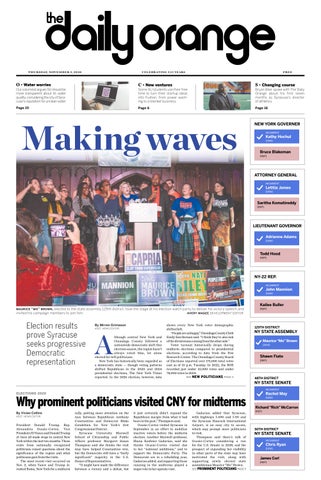
Making waves
NEW YORK GOVERNER incumbent
Kathy Hochul (dem)
Bruce Blakeman (rep)
ATTORNEY GENERAL incumbent
Letitia James (dem)
Saritha Komatireddy (rep)
LIEUTENANT GOVERNOR Adrienne Adams (dem)
Todd Hood (rep)
NY-22 REP. incumbent
John Mannion (dem)
Kailee Buller maurice “mo” brown, elected to the state assembly 129th district, took the stage at his election watch party to deliver his victory speech and invited his campaign members to join him. avery magee development editor
Election results prove Syracuse seeks progressive Democratic representation
By Mirren Grimason asst. news editor
A
lthough central New York and Onondaga County followed a nationwide democratic shift this election season, the region hasn’t always voted blue, let alone elected far-left politicians. New York has historically been regarded as a democratic state — though voting patterns shifted Republican in the 2020 and 2024 presidential elections, The New York Times reported. In the 2026 election, however, data
shows every New York voter demographic shifted left. “People are unhappy,” Onondaga County Clerk Emily Essi Bersani said. “I think they’re also sick of the divisiveness coming from the other side.” Voter turnout historically drops during midterm elections compared to presidential elections, according to data from the Pew Research Center. The Onondaga County Board of Elections reported over 175,000 total votes cast as of 10 p.m. Tuesday. In 2022, the BOE recorded just under 32,000 votes and under 78,000 votes in 2024. see new politicians page 5
(rep)
129TH DISTRICT
NY STATE ASSEMBLY Maurice “Mo” Brown (dem)
Shawn Fiato (rep)
48TH DISTRICT
NY STATE SENATE incumbent
elections 2026
Why prominent politicians visited CNY for midterms By Vivian Collins asst. news editor
President Donald Trump, Rep. Alexandria Ocasio-Cortez, Vice President JD Vance and Donald Trump Jr. have all made stops in central New York within the last two months. These visits from nationally recognized politicians raised questions about the significance of the region and what politicians gain from the visits. The most recent visit occurred on Nov. 2, when Vance and Trump Jr. visited Rome, New York for a midterm
rally, putting more attention on the race between Republican Anthony Constantino and Democrat Blake Gendebien for New York’s 21st Congressional District. Syracuse University Maxwell School of Citizenship and Public Affairs professor Margaret Susan Thompson said she thinks the visit may have helped Constantino win, but the Democrats still have a “fairly significant” majority in the U.S. House of Representatives. “It might have made the difference between a victory and a defeat, but
it just certainly didn’t expand the Republican margin from what it had been in the past,” Thompson said. Ocasio-Cortez visited Syracuse in September in an effort to mobilize inactive voters before the midterm election. Another Maxwell professor, Shana Kushner Gadarian, said she thinks Ocasio-Cortez visited due to her “national ambitions,” and to support the Democratic Party. The Democrats are in a rebuilding year, Gadarian added, and supporting those running in the midterms played a major role in her upstate visit.
Gadarian added that Syracuse, with highways I-690 and I-90 and the Syracuse Hancock International Airport, is an easy city to access, which may prompt more politicians to visit. Thompson said there’s talk of Ocasio-Cortez considering a run for the U.S. Senate in 2028, and the prospect of expanding her visibility in other parts of the state may have motivated the visit, along with supporting newly elected state assemblyman Maurice “Mo” Brown. see prominent politicians page 5
Rachel May (dem)
Richard “Rich” McCarron (rep)
50TH DISTRICT
NY STATE SENATE incumbent
Chris Ryan (dem)
James Corl (rep)
2 november 5, 2026
FOOTBALL
about
saturday, october 31
SYRACUSE 30, SMU 27 saturday, november 7
SYRACUSE VS CLEMSON Editor@dailyorange.com News@dailyorange.com Opinion@dailyorange.com Culture@dailyorange.com Sports@dailyorange.com Digital@dailyorange.com Design@dailyorange.com Photo@dailyorange.com BUSINESS 315-443-2315
MEN’S BASKETBALL
The Daily Orange is an independent, nonprofit newspaper published in Syracuse, New York. The editorial content of the paper — which started in 1903 and went independent in 1971 — is entirely run by Syracuse University students. The D.O., a 501(c)(3) nonprofit, is editorially and financially independent from SU, and the paper receives no funding from the university. Instead, The D.O. relies on advertising revenue and donations to sustain operations. This fall, the paper will be published Thursday when SU classes are in session. The D.O.’s online coverage is 24/7, including while SU is on break. To show your support to The D.O.’s independent journalism, please visit dailyorange.com/donate. Donations are tax deductible.
monday, november 2
SYRACUSE 74, NEW HAVEN 58 thursday, november 5
SYRACUSE VS CENTRAL CONNECTICUT
scribble
Doughnut day
how to join us
letter to the editor policy
If you are a Syracuse University or SUNY-ESF student interested in contributing to The D.O. on either its advertising or editorial teams, please email editor@dailyorange.com.
The D.O. prides itself as an outlet for community discussion. To learn more about our submission guidelines, please email opinion@dailyorange.com with your full name and affiliation within the Syracuse community. Please note letters should not include any personal information pertaining to other people unless it is relevant to the topic at hand. All letters will be edited for style and grammar.
corrections policy The D.O. strives to be as accurate in our reporting as possible. Please email editor@dailyorange.com to report a correction.
The D.O. is published weekdays during the Syracuse University academic year by The Daily Orange Corp., 230 Euclid Ave., Syracuse, NY 13210. All contents Copyright 2026 by The Daily Orange Corp. and may not be reprinted without the expressed written permission of the editor-in-chief. The Daily Orange is in no way a subsidy or associated with Syracuse University. All contents © 2026 The Daily Orange Corporation
The forecast for this upcoming week, per The Weather Channel.
tara binte sharil asst. culture editor
THU 11/5
High of 71° Low of 49°
FRI 11/6
High of 65° Low of 45°
SAT 11/7
High of 49° Low of 42°
SUN 11/8
High of 53° Low of 42°
Get the latest on all things Syracuse!
MON 11/9
High of 50° Low of 41°
@dailyorange
TUE 11/10
on Instagram, X and Facebook
High of 60° Low of 38°
News Editor Editorial Editor Culture Editor Sports Editor Presentation Director Digital Design Director Photo Editor Illustration Editor Social Media Editor Enterprise Editor Asst. News Editor Asst. News Editor
Arabella Klonowski Will Chadwick Lily Zuckerman Jordan Kimball Adelaide Guan Abigail Aggarwala Tara Deluca Emma Soto Claire Zhang Ally Goelz Vivian Collins Ryan Garipoli
Asst. News Editor Asst. Editorial Editor Asst. Editorial Editor Asst. Culture Editor Asst. Culture Editor Asst. Sports Editor Asst. Sports Editor Asst. Sports Editor Asst. Photo Editor Asst. Photo Editor Asst. Photo Editor Video Editor
Mirren Grimason Addy Kimball Dayna Roberts Tara Binte Sharil Joel Pelachik Harris Pemberton Jason Glick Spencer Brod Eli Schwartz Zoe Xixis Christian Calabrese Reese Niccolls
Delia Sara Rangel
Noah Nussbaum
Quinn Postman
EDITOR-IN-CHIEF
MANAGING EDITOR
DIGITAL MANAGING EDITOR
Video Editor Asst. Video Editor Asst. Video Editor Design Editor Design Editor Design Editor Design Editor Design Editor Design Editor Asst. Digital Editor Asst. Digital Editor Asst. Digital Editor
Collin Snyder Thandi McCain Nathan Olszewski Lily Wilkin Zoey Grimes Adler Neu Ana Rodriguez Elise Flannery Hailey Raymond Fiona McHugh Owen Smith Peter Hua Radosh
Asst. Digital Editor Jack Wood Asst. Digital Editor Ava Demcher Asst. Digital Editor Alexandra Rice Asst. Copy Editor Sydney DePietto Asst. Copy Editor Bailey Dunn Jordan Fendrich Asst. Copy Editor Asst. Copy Editor Gabe Ewen Asst. Copy Editor Caroline Erskine Asst. Copy Editor Kosta Konstantopoulos I.T. Manager Eliza Raphael I.T. Manager Sam Benoit Business Manager Kevin Ross
Business Asst. Tim Bennett Circulation Manager Steve Schultz Student Delivery Agent Kaila Hu DEIA Manager Savannah Stewart Development Editor Eliana Rosen Development Editor Avery Magee Development Editor Mauricio Palmar Alumni Engagement Editor Charlotte Price Alumni Engagement Editor Ben Butler
NEWS
dailyorange.com news@dailyorange.com
november 5, 2026 3
elections 2026
Memorable moments Watch parties across Onondaga County celebrate ‘blue wave’ as GOP concedes By Vivian Collins, Ryan Garipoli and Owen Smith the daily orange
Politicians hosted watch parties across Onondaga County Tuesday night, anxiously awaiting the results of this year’s midterm elections. From seats in Congress to the state assembly, The Daily Orange followed the races and candidates all night as crowds watched the results roll in live with local politicians.
Kailee Buller and the Onondaga GOP
Republican NY-22 candidate Kailee Buller and fellow Republican candidates in Onondaga County gathered at the Embassy Suites at Destiny USA for the Onondaga County GOP watch party. Buller opened the watch party by taking questions from the press and spoke about the issues she felt were defining local and national elections. She emphasized wanting to make central New York a place her family and friends want to stay in. “I want to fight to keep you here. I want to get your kids back here. I want to get my girlfriends back here,” Buller said. “I want to raise my kids the way I was raised alongside them. We have a lot of work to do.” Buller clarified that she was thankful for President Donald Trump’s endorsement, but doesn’t agree with him on every issue, citing policies such as Trump’s universal tariff rollout, “tragic” mistakes made by U.S. Immigration and Customs Enforcement and the war in Iran. Despite falling behind early in the night, facing a nearly 50-point deficit after early votes had been counted, Buller remained confident throughout the race. “I don’t lose, so we have no plans,” Buller said. “I’m just focused on winning tonight.” At 9:55 p.m., The Associated Press called the race in favor of Democratic Incumbent Rep. John Mannion. Buller and her husband, Eric Buller, left the watch party shortly after at around 10:12 p.m. Most attendees remained at the watch party after Buller’s departure. She later returned and took the stage at 10:52 p.m., thanking attendees for their support. Buller said she still wants to be part of the Republican Party’s future despite the loss.
“They’re still raising our taxes and they’re raising our utility bills and someone has to keep fighting,” Buller said. “This is a rebuilding year for our party, and I plan to be part of that solution. Tonight doesn’t change the commitment to this community.” When Buller was asked what’s next for her politically, she responded: “I’ll let you guys know.” Buller spent the rest of the night speaking to the press and embracing her supporters. Later in the night, Republican nominee for State Senate in NY’s 48th District Rich McCarron took the stage and thanked attendees for their support after his loss to Democratic incumbent Sen. Rachel May. “It’s really time for us to look inside and try to reconnect with the public better and redefine who we are as a party,” McCarron said.
John Mannion and supporters
After doors opened at The Palladian Hall at The Treasury for Democratic Incumbent Rep. John Mannion’s watch party, an R&B cover band, The Blacklites, played songs including The Spinners’ “I’ll Be Around,” and Earth, Wind & Fire’s “September.” Political analysts heavily favored Mannion over Buller before Election Day. Several guests huddled around a small TV displaying early election results from ABC News. Syracuse Mayor Sharon Owens made an appearance shortly after 9 p.m., and said although she hoped Mannion would focus more on housing for the new term, she felt he always has the “community in mind.” “There’s what people say, and then there’s what people do. With John, I can get on the phone,” Owens said. “I can talk to him. I can go meet him at a meeting, or just see him in the neighborhood, and he will respond, particularly when it’s been with ICE activities in our community.” Attendee Roy Tracy said he’s personally known Mannion and his wife for over 15 years. Tracy was visiting in support of his home within District 21, hoping to witness Mannion’s reelection victory. “When we have our private conversations, we just agree on a lot of things about decency and people being good to one another,” Tracy said. “One of the most important things John has said to me is that we just need to reach across the aisle and love each other.”
eli schwartz asst. photo editor
Republican nominee for NY-22 Kailee Buller holds a press gaggle at the Onondaga County GOP watch party. 15TH DISTRICT ONONDAGA
COUNTY LEGISLATOR
STATE COMPTROLLER
christian calabrese asst. photo editor
Rep. John Mannion sings “Lovely Day” by Bill Withers to a crowd of supporters at his Election night watch party. Tracy emphasized Mannion’s love for the community and his high hopes for Mannion’s second term in Congress. “No matter what he does in his policy, he’s going to advocate for the people,” Tracy said. After much anticipation, Mannion and his wife greeted the crowd after his victory over Buller. The band, playing “Lovely Day” by Bill Withers, gave Mannion the microphone as he led the crowd in song. “Today’s a lovely day in central New York,” Mannion said, beginning his speech after the song ended. In his victory speech, Mannion thanked his family and the Syracuse community, reciting his family’s history in the area. He also criticized inflation and Trump’s recent deal for Russian diesel. “We know we’re not better today than we were a few years ago, but we’re all going to make it better together,” Mannion said. Later in the night, Buller claimed during her remarks at the Onondaga County GOP watch party that Mannion hung up the phone when she called to congratulate him on his reelection. Buller called Mannion’s behavior “disgusting.” A campaign spokesperson for Mannion responded to Buller’s claim, saying her story was false. “We wished her and her family the best,” his spokesperson said. “The accusations are a big nothing burger.”
Maurice “Mo” Brown and the Onondaga County Democratic Committee
At The Mizpah, near Palladian Hall, Maurice “Mo” Brown and fellow members of the Onondaga County Democratic Committee hosted their own election night watch party. In an opening press gaggle, Brown spoke about his priorities should he be elected to state assembly, such as making the area more affordable and addressing cuts to Supplemental Nutrition Assistance Program benefits. “I want to do a lot of things around rent and stabilizing it, but just fundamentally it’s housing, it’s energy, it’s just making sure that people are able to get what they need,” Brown said. “I think that this is a time for us to come together as a community. I think that my vision, our vision, for central New York is one that will unite us.” Later in the night, New York State Sen. Chris Ryan gave a victory speech before his race was called as early polling put him ahead of Republican James Corl by over 20%. Incumbent New York state Sen. Rachel May followed Ryan, leading by the same margin, urging Americans to be “decent human beings,” and hold politicians accountable. “We have been able to see up close what it looks like when Democrats are in charge,” May said. “They’ve been transparent, they’ve been accountable, they have been looking to the voters to tell them what they care about.” Owens was also in attendance, along with Onondaga County Legislature elect Jo Bennett, representatives from CNY Solidarity Coalition
(dem)
Thomas DiNapoli
and the Onondaga County Young Democrats. While on stage, Owens, having just come from Mannion’s watch party, told the crowd to expect more wins throughout the night. Although a few of the races were still too close to call, Democratic Legislature Chairwoman Nicole Watts announced that the OCDC had reached a supermajority, calling up the candidates onto the stage. “One year ago, we flipped the (legislature) and look at this, we have a supermajority,” Watts said. “Let’s make this a four years that Onondaga County will never forget.” In his victory speech, Brown called up several of his supporters onto the stage, thanking them for their hard work and dedication during his campaign. “This was not done alone, this wasn’t a solo project. This was a lot of people who saw what was going on in their community and they stood up and they fought back,” Brown said. “What we’re seeing around the country, this blue wave, is a response, but it’s also a message: the people need government that works for them.” While the event ended promptly at midnight, most races, including Brown’s, weren’t called until around 1:00 a.m. on Wednesday.
Staff Writer Ben Lofy contributed reporting to this article.
news@dailyorange.com
126TH DISTRICT
127TH DISTRICT
128TH DISTRICT
NY STATE ASSEMBLY
NY STATE ASSEMBLY
NY STATE ASSEMBLY
incumbent
Jo Bennett
avery magee development editor
In her victory speech, Sen. Rachel May speaks to attendees of the Onondaga County Democratic Committee’s election night watch party about the importance of holding politicians accountable.
Ian Phillips (dem)
(dem)
incumbent
incumbent
Albert A. Stirpe
Pamela Jo Hunter
(dem)
(dem)
incumbent
Woodruff “Woody” Carroll (rep)
Joseph Hernandez (rep)
John Lemondes (rep)
TOO CLOSE TO CALL
Timothy Kelly
Patrick J. Becher
(rep)
(rep)
4 november 5, 2026
dailyorange.com news@dailyorange.com
elections 2026
1st supermajority signifies major change to county legislature By Bailey Dunn
asst. copy editor
Onondaga County Legislature Democrats secured a supermajority in Tuesday’s midterm elections for the first time in history, holding the party’s majority it secured in 2025 for the next four years. Tuesday’s outcomes represent a major change in the legislature’s political makeup, as Onondaga Republicans previously held a 12-to-5 majority before Democrats gained a 10-seat majority in 2025. The Democrats flipped three seats in the County Legislature, including District 1, where Justin Neal defeated incumbent Brian May and District 2, where Matt Jones defeated incumbent Kevin Meaker. In District 11, Jessica Hacket will fill a seat previously held by Republican Rich McCarron before he left to run for New York state Senate. McCarron lost his election to incumbent Senator Rachel May. Now, Democratic leaders credit their historical victory with “delivering” on promises including general oversight, a $25 million housing investment and efforts to “earn” trust from county voters, according to a Tuesday release from the Onondaga County Legislature. “Tonight we have been given a clear mandate to continue delivering for the residents of Onondaga County,” Onondaga County Legislature Chairwoman Nicole Watts said in the release. “After a year of governing, we hit the campaign trail and engaged thousands of constituents about their concerns and hopes for the county.” Democrats also highlighted their work on
the county’s 2026 budget in the release, which was unanimously approved by all 17 legislators. The spending plan included provisions that the Democratic Party said benefited children and families, according to the committee. The Onondaga County Slate of 17, a legislative campaign in collaboration with the New York Democrats Coordinated Campaign and Rep. John Mannion, spent “countless” hours on campaign calls, messaging, creating voter-centered branding and strategies, as well as creating a support network that “lifted” candidates, according to the release. The campaign knocked on over 40,000 doors in total. Syracuse Mayor Sharon Owens congratulated the newly elected legislators for Onondaga County and expressed interest in continuing to collaborate with the county government. “There’s a lot of important work ahead of us, and I look forward to continuing to work together to make Syracuse and Onondaga County a better place for everyone,” Owens said in the release. Onondaga County Democratic Committee Chair Josh Ludden said he was proud of the work they’ve done this year and also celebrated the voter turnout and support. “In every corner of the county we had strong candidates and robust campaigns centered on delivering real results for our county instead of focusing on the negative politics of fear and division,” Ludden said. The Democratic majority in the Onondaga County Legislature follows a larger national
For the first time, Onondaga County Legislature Democrats secured a supermajority in Tuesday’s midterm. avery magee development editor
trend, as the party also secured key victories in this year’s midterm elections, including control of Congress. These include historic victories, including Kansas flipping to a Democratic Senate seat for the first time in 94 years, Abdul El-Sayed becoming the first Muslim Senator-elect and Georgia gubernatorial nominee Keisha Lance Bottoms
becoming the first Black female governor elected in the United States. The election results for Onondaga County give Democrats an expanded role in determining the legislature’s direction as the party enters another session with control of the county government, the release said. badunn@syr.edu
elections 2026
Rep. Mannion bashes Trump, shares goals in press conference By Owen Smith
asst. digital editor
After winning reelection for New York 22nd Congressional District, Rep. John Mannion held a press conference Wednesday going over his political stances and what he hopes to bring to the district following his victory. Mannion criticized President Donald Trump’s recent policy decisions but advised that the work wasn’t done following wins across the Democratic party on Tuesday. He thanked voters in the district and said that the voters’ choice shows a time for change in central New York. “It’s time for the newly elected (Democratic) members in the House and the Senate to deliver for the people,” Mannion said. Congress has “failed” to serve as a check on Trump’s executive power since his second term, Mannion said, and restoring constitutional checks and balances would be a major focus of the new Congress. “The reason why the American people spoke the way they did last night is because I believe they’re frustrated that there’s no necessary checks on the executive office,” Mannion said. Besides checks on the president, affordability is a top issue for Mannion, calling for protections of Social Security and Medicare. One of his first goals, Mannion said, is to reverse the healthcare cuts and prevent states from “absorbing” Supplemental Nutrition Assistance Program costs. Mannion said his office has been “inundated” with calls from residents with high coverage changes and rising costs. Congress has to move “quickly” to restore funding, Mannion said.
rep. john mannion speaks at a post-election press conference about the work he plans to do, along with the rest of the Democratic party, in office. eli schwartz asst. photo editor
“People across NY-22 are working hard, they’re playing by the rules and they’re struggling to get ahead,” Mannion said. Prompted by reporter questions, Mannion said the Micron Technology’s semiconductor project and high energy costs wouldn’t have happened if his “colleagues across the aisle” hadn’t made certain decisions in the past two years. He also called for a ban of stock trading for Congress members and tighter restrictions for executive orders.
“The people do not trust their leaders in this country,” Mannion said. “They don’t trust their government more than ever before.” Mannion hopes to see “fair” investigations of the federal government’s actions over the past two years. He described the efforts as “serious oversight,” similar to his wish for more checks and balances in Washington. “That (investigative) work should be driven by evidence, by the Constitution, not revenge, not political theater,” Mannion said.
Although he criticized Trump, Mannion said he’s willing to work with the president on bipartisan legislation. Mannion looked at action on healthcare, affordability, artificial intelligence and Social Security protections. Mannion admitted that if Trump had never been elected in the 2016 presidential election, Mannion doesn’t think he’d be a candidate today. He pointed to increased interest in politics because of Trump’s election leading to his motivation to run for the Senate in 2018 after a career of teaching. After losing the New York state Senate seat in 2018, Mannion ran again in 2020 and won. He ran for his first time in the U.S. House of Representatives in 2024 and won again. During his first term, he voted for an amendment by Rep. Thomas Massie to drastically cut foreign aid to Israel. Elon Musk’s loss in Texas, in which he gave over $200 million to GOP candidates, was an example of American citizens having their “own voice,” Mannion said. He criticized Musk and his grip on Starlink bandwidth in critical locations, such as the warfront in Ukraine. “Musk receives billions of dollars in government contracts, and he has the power to shut (Ukraine’s Starlink) down,” Mannion said. “He should not be able to do that.” Although he hadn’t watched many Democratic victory speeches after his watch party, Mannion said he understood how voters were feeling in the U.S. following the election. “The election results across America last night have renewed my hope in this country,” Mannion said. owensmith@dailyorange.com
elections 2026
Democrats secure historic wins, gain control of U.S. Congress By Sydney DePietto asst. copy editor
A blue wave swept across the country, with Democrats gaining control of Congress and winning several gubernatorial races in historic wins, breaking up GOP control of traditionally deep red states in this year’s midterm election. Young voters throughout the nation who had previously voted Republican in the 2024 presidential election shifted back to Democrat in a rebuke of President Donald Trump. An Associated Press poll showed about 7 in 10 voters under 30 said they supported their Democratic candidate. President of College Democrats at Syracuse University Tomasz Saarloos said the number one issue he’s heard from college students was the cost of living. He also mentioned the war in Iran and continued funding of Israel as popular issues among college students. Saarloos said the political atmosphere among students on SU’s campus during election season
was “electric.” He previously heard others talk about voting in a “begrudging sort of way,” but said people were now “fired up” to vote. Saarloos also attributed more engagement this midterm season to Trump’s October visit to Syracuse, which he said left a “bad taste in many people’s mouths.” “A blue wave like this isn’t possible without young people,” Saarloos said. “We saw young people all over the country engaged in this past election by knocking on doors, phone banking, registering their friends and neighbors to vote.” A Rock the Vote statement said in the final weeks before Election Day, the organization saw early signs of “youth enthusiasm” with a surge in voter registrations and early ballots, both surpassing 2022 levels. The nonpartisan nonprofit also stated that by 2028, Millennials and Generation Z will make up the largest voting bloc in the country. “The work doesn’t end when the polls close. Generation after generation, young people vote at lower rates than older voters,” the statement
reads. “That’s not a generational problem. That’s a systems problem.” This year, Onondaga County residents cast over 175,700 ballots during the midterm elections, almost 100,000 more than the 2024 presidential election. In an election season filled with extremely competitive races, The Daily Orange compiled a list of the most highly anticipated midterm contests across the country for Congress and Governor.
Senate
Democrats now control the U.S. Senate with at least 54 seats, picking up seven seats so far, and saw many historic firsts. One of the most closely watched races was the Texas Senate race, with Democratic candidate James Talarico defeating Republican Ken Paxton. Talarico’s win marks the first time in 38 years a Texas Democrat has been elected to the Senate since Lloyd Bentsen’s win in 1988.
Ohio and Maine saw two major incumbent flips. Ohio Democrat Sherrod Brown’s win, ousting Republican incumbent Jon Husted, provided “a ray of hope” for the future of Democrats in a swing state that previously turned “sharply to the right over the last decade,” The AP reported. Democrat Troy Jackson unseated Republican Susan Collins in Maine in what The Guardian called “one of the biggest upsets of the 2026 midterms.” Adam Hamilton defeated Roger Marshall, becoming the first Democrat to win a Senate race in Kansas since 1932, ending a 94-year GOP streak. North Carolina, Iowa and South Carolina flipped Democrat, with Roy Cooper, Josh Turek and Annie Andrews, all winning historically Republican seats. The Democrats also held several seats, including Abdul El-Sayed’s win against Mike Rogers in Michigan, Georgia incumbent Jon Ossoff’s victory and Minnesota’s Peggy Flanagan, who became the first Native American woman see national results page 5
november 5, 2026 5
dailyorange.com news@dailyorange.com
from page 1
new politicians Rural districts in New York state have a record of electing republicans to Congress. District 24, which borders Syracuse’s District 22, elected incumbent Republican Claudia Tenney to the House with 60% of the vote, The Associated Press called. The more suburban regions of New York state, including central New York, offer a mixed bag of election results each year. The county legislator flipped democrat in 2025, and Tuesday’s results mean it not only secured the democratic majority for four more years, but has also gained a supermajority for the first time in its history. “The end goal is to care for people and their needs, and to take that responsibility seriously as government is something that, no matter where people fall on that democratic spectrum, we share in common,” Watts said. Newly elected legislators include multiple Democratic Socialists and Working Families Party candidates, showing an increase in progressive democrats being elected. “Of the 13 WFP cross-endorsed candidates for County Legislature, 10 won their races this year, showing that voters approve of not only progressive candidates but also their leadership and performance,” a central New York Working Families Party release said. Syracuse City Auditor Alexander Marion cited Sen. Rachel May’s first primary win in 2018 as the first “big insurgent primary win” that enabled more progressive democrats to run locally. “There’s been a conscious effort by a lot of people to say ‘We’re gonna run as progressives and we’re going to run with these issues’ and when they see in general elections, that message
is winning,” Marion said. “In primaries, when those folks run against other democrats who may not be running on issues, that message is still living.” Republican Ryan McMahon has served as Onondaga County Executive since his election in Nov. 2018. The County Legislature’s supermajority now means it can override a veto from McMahon, Democrat Nicole Watts, chairwoman of the legislature, said. Watts said she’s excited to work with the newly elected legislators, regardless of whether they’re progressive democrats. “There will be work to be done, for sure, on how we can come to a common consensus that helps to move things like the budget forward or a local law forward,” Watts said. “But so far, having worked on the campaigns with all of the folks that are now elected. I think we’ve got a great group of people.” Watts herself said she leans progressive on issues surrounding “equity,” but shifts republican on fiscal issues. She said oftentimes “the details are where we differentiate,” but that she believes the democratic legislature will be able to “come together” on issues that need to be pushed forward. Marion said more progressive versus establishment democrats aren’t an “either or” situation, and that candidates across “all spectrums of ideas” within the party won on Tuesday. “What voters were looking for last night, more than anything else, were candidates who believed in ideas or candidates who believed in delivering big results and improving people’s lives,” Marion said. Maurice “Mo” Brown, who was elected to the 129th assembly district, said the number of democratic candidates elected excited him. “We’ve been talking about the blue wave for
a long time and it’s finally good to swim in it,” Brown said. Brown’s win comes after he defeated 28-year incumbent Bill Magnarelli in the June primary. Brown ran with fellow democratic socialists Jo Bennett and Tammy Honeywell on the “Affordability Slate.” The slate focused on three key policies: safe and affordable housing, universal childcare and free transportation. Bennett won the midterm election for 15th District Onondaga County Legislator, overtaking Brown’s current position. Honeywell lost her primary for 8th District Onondaga County Legislator to Chad Ryan, who won his midterm election. The three ran with endorsements from Syracuse’s Democratic Socialists of America chapter. “People are afraid of the word socialism, but if you really break it down, socialism is happening all the time,” Essi said. Brown emphasized the importance of the other parts of his identity, such as his career and personal interests, rather than people focusing on the democratic socialist title. “I am a democratic socialist, I am a member of the DSA chapter, but I’m also a veteran, I’m also a homeowner,” Brown said. Essi isn’t in a legislative position as county clerk, but has been a supporter of Brown and progressive policies across the county. Bennett said focusing on cost of living and seeing the “return” on taxes are some of the policies that set themself and other democratic socialists apart. “(Voters are) worried about their childcare, they’re worried about their housing, they’re worried about paying for groceries, gas,” Bennett said. “These are the main issues everyone’s kind of dealing with and these are the issues that we care about as well.”
from page 1
prominent politicians “I think there were a couple of motivations, or potential motivations here,” Thompson said. “I mean, obviously, she came here to support Mo Brown, but that may have not been the entire reason she came here.” Less than two weeks after Ocasio-Cortez’s visit, Trump held a rally in Syracuse in support of Republican gubernatorial candidate Bruce Blakeman, who lost to Gov. Kathy Hochul in a race that was called almost immediately after polls closed. Trump’s visit marked his first time in Syracuse while in office. Trump’s rally prompted protests from thousands of Syracuse community members, including Syracuse Mayor Sharon Owens, Sen. Rachel May and Brown. Thompson said she didn’t understand why the president hosted the rally and that she doesn’t think it helped Republicans. “I just don’t know what Donald Trump thought he would accomplish here,” Thompson said. Newly elected Onondaga County Legislator Jo Benett concurred with Thompson’s idea that the rally didn’t seem to help Blakeman in the midterms, but instead mobilized more Democrats. “Trump is extremely unpopular. People don’t want ICE in their communities. They’re seeing basically masked people coming in and abducting people. They’re seeing gas prices go wild,” Bennett said. “So it galvanizes the opposition.” The influx of prominent political figures from page 4
national results elected to the U.S. Senate and defeated Michele Tafoya. Chris Pappas won in New Hampshire, holding the Democratic seat and becoming the first openly gay man elected to the U.S. Senate. The Mississippi and Alaska races have not yet been called by The AP. Mississippi Democrat Scott Colom narrowly leads Sen. Cindy HydeSmith in “the nail-biter of the midterms,” CNN reported. Alaska Democrat Mary Peltola also currently leads Republican incumbent Dan Sullivan, however, The New York Times reported it may “be a long wait for a call” as many mail-in ballots won’t be counted for days.
House of Representatives
The Democrats gained control in the U.S. House of Representatives, with 242 seats. However, NBC News’ Decision Desk analysis currently projects the party to win at least 258 seats. Democrat J.D. Ford defeated three-term Rep. Victoria Spartz in Indiana’s 5th Congressional District in an “upset that many analysts did not see coming,” PBS reported. The seat was rated as leaning Republican by the Cook Political Report. In Michigan’s 4th District, Democrat Sean McCann won, unseating Republican Rep. Bill Huizenga, who has served in the House since 2011. Additionally, Democrat Zach Dembo was victorious in Central Kentucky’s 6th District, upsetting a traditionally conservative area.
Politicians including Rep. Ocasio-Cortez and GOP gubernatorial candidate Blakeman stopped in CNY. avery magee development editor | paul hakimian staff photographer
could also be due to Micron Technology, interim President of the Onondaga County Young Democrats Madeline Thibault said. She said that Syracuse is a “missing market,” a “heavily labored” city and that community members are very attentive and decisive when it comes to electing candidates. SU student and former volunteer director for Owens’ campaign Kenny Lanterman found the stops from politicians to be unsurprising, as he believes Syracuse is “expecting a moment,”
and the city has been on an upswing with developments including Micron, the I-81 project and “new leadership.” Thompson disagreed, saying Micron will make more of a political difference once it’s actually operational. She said Syracuse could change once the plant is up and running, but “it hasn’t changed yet.” “I think the people in Syracuse right now are finding that, among other things, the potential of Micron is doing things like raising
Interim President of the Onondaga County Young Democrats Madeline Thibault said she voted for Magnarelli in the primaries because she was more aware of his policies than Brown’s. She said some voters may have been focused on upholding a lot of the “protections” they have in New York state. “Folks may have been apprehensive of electing someone new just because we want to hold onto some of those things (protections) but having Mo here, he is literally advocating for us all and I’m so excited to see what he can do,” Thibault said. The title of democratic socialist didn’t sway her vote, Thibault said, as she more closely aligns with the DSA than the Democratic Party on certain topics, such as people’s “working roles” in society. Despite adopting different policies, politicians like Brown said they aren’t opposed to working with their Republican counterparts. Brown said he wanted his opponent Shawn Fiato’s input on how to address common voter concerns, citing gas and rent prices, but claimed she “declined to do that.” “That’s what the Republican Party has been in 2026,” Brown said. “It’s not about actually helping people. It’s just name-calling and distraction, for lack of a better term, because they don’t have much to offer.” While the midterms showed an increase of progressive democrats, the CNY-WFP said “cross-endorsed” democrats and mainstay democrats “joined forces” in its release. “Every time you go around and look, you keep finding this message of vision, delivery, execution and that seems to be working pretty well for people,” Marion said. Asst. News Editor Vivian Collins contributed reporting to this article.
mirrengrimason@dailyorange.com
rents,” Thompson said. “But it’s not necessarily helping their lives in the short run.” Central New York is home to several colleges, universities and young voters, which contributes to its active political climate. Lanterman said when politicians like Trump arrive in the city, students are more motivated to attend rallies and voice their opinions. He added that having politicians from different parties visit can create opportunities for more political discourse on college campuses. Gadarian said while central New York’s high concentration of young voters could prompt more visits from well-known politicians, students aren’t “typical” midterm voters because they aren’t always registered to vote in the state they attend college and “pay less attention to politics.” “Students and young people are not your most typical voters at midterm times,” Gadarian said. “Parties who are smart start to build out their party with young people, but they’re not actually reliable voters most of the time.” Thompson noted that New York state won’t likely see as many visits during the 2028 presidential election compared to other states like South Carolina or Nevada, which both have early primaries. “I think Syracuse is in a state that is pretty clearly a blue state,” Thompson said. “The New York primary is relatively late, and therefore, a lot of the decisions will be made by the time…So there are gonna be a lot of other places that are gonna get a lot more visitors.” viviancollins@dailyorange.com
GOP Speaker of the House Mike Johnson won’t run for minority leader when the new Congress is seated and House Minority Leader Hakeem Jeffries officially announced his candidacy for House speaker, CBS reported.
Governor
Several gubernatorial races saw historic flips in the Democratic Party, including Gina Hinojosa, who became one of the first Democrats to win a Texas statewide office in more than 30 years, unsettling Republican Greg Abbott, The New York Times reported. She also became the first Hispanic candidate elected in Texas. Another first was Keisha Lance Bottoms, who became the first Black female governor elected in the U.S. The former Atlanta mayor also flipped control of the battleground state for the first time in 24 years, along with Democrat Aaron Ford, who won in Nevada, flipping the seat and becoming the first Black governor elected within the state. The wins of Ohio Democrat Amy Acton and Iowa Democrat Rob Sand mark the first time in two decades voters elected a Democrat in their states. Democrats also held several governor seats, including Wisconsin’s David Crowley, who became the state’s first Black governor and Deb Haaland, who became New Mexico’s first female Native American governor. Maxwell School of Citizenship and Public Affairs professor of political science Thomas
Breaking up GOP control of traditionally deep red states in this year’s midterm election, the Democrats gained control of Congress christian calabrese asst. photo editor
Keck said the president’s party losing seats during the midterm elections is a “recurring pattern.” However, he said the scale was both bigger than normal and bigger than people anticipated. Keck said the message from voters is one of accountability, citing that many Americans are tired of corruption within Trump’s administration. He also said the election results are an “enormous repudiation” of the current
government and said the closeness of the races shows how important voting is. “Young voters might sometimes feel like these politicians don’t even care about young people, and it’s not worth it even to bother,” Keck said. “But just that kind of reminder that sometimes a voter turnout effort on one college campus could get 50 people to go vote and sometimes the race is decided by fewer votes than that.” sadepiet@syr.edu
6 november 5, 2026
CULTURE
dailyorange.com culture@dailyorange.com
Student startups
Syracuse University senior Charley Cole works on a customizable blanket design for one of her clients. Cole’s business, Core Memory, has made blankets for schools like Tulane University and for luxury hotels. tara deluca photo editor
Some SU students juggle clients, launch startups — all while taking classes By Tara Binte Sharil asst. culture editor
C
naheem cadiz sits in Bird Library. Cadiz’s app, Coveted, brings fashion brands together. tara deluca photo editor
harley Cole always wanted to start a business. Throughout her life, she had many different ideas, but nothing ever came to fruition — that was, until this summer. The Syracuse University senior and her friends were caught up in the viral Lola Blanket trend — supposedly the softest and most plush blanket on the market. But with a price tag of around $325, Cole saw an issue. “I want one of those, but that’s crazy,” Cole’s friends said about the Lola Blanket price. “Give me a minute,” Cole responded. In June, Cole officially launched her own blanket brand, Core Memory. Within one week of starting her business, Cole said she received around 250 orders for her custom blankets. Cole isn’t the only SU student running a business in between classes. From an app that gathers local fashion brands in one place to a power washing company, SU students have turned their startup ideas into reality. These students aren’t waiting until post graduation to start a company. Their entrepreneurial journeys have already begun.
At first, Core Memory was a side hustle catered to Cole’s friends. But word of the more affordable version of Lola Blankets got around. Since then, Cole said she’s made custom blankets for her sorority, Sigma Delta Tau, and for students at other schools like the University of Texas at Austin, Tulane University and the University of Florida. Cole also has clients like sleepaway camp suppliers, luxury hotels and different sporting events. “It all happened really quickly,” Cole said. “I was getting texts from random middle-aged women in the suburbs of New York asking if they could have 15 blankets. In my New York City apartment, you literally cannot walk. There were blankets everywhere.” The moment Cole received orders from people beyond her social circle and businesses was when her passion project turned into a legitimate startup, transforming from made-to-order batches to stock inventory. Core Memory had grown so quickly that Cole had to find a warehouse in New Jersey to store orders. Similarly, SU sophomore Imaad Maqsood turned his power washing side hustle into a legitimate business. Maqsood’s startup, Upstate Pressure, focuses on providing residential and commercial power washing services. Based in central New York, Maqsood and see entrepreneur page 9
beyond the hill
Aaron Sorkin draws ‘straight line back’ to SU for writing career By Eliana Rosen
development editor
When Aaron Sorkin writes scripts, he reads each line of dialogue aloud, acting out scenes and performing the parts the way he was taught when he was a student at Syracuse University. “As a playwright, as a screenwriter, I can draw a straight line back to the things I learned at Syracuse,” Sorkin said. Sorkin is an award-winning screenwriter and playwright known for works like “The West Wing,” “The
Social Network” and “Moneyball.” He graduated from SU’s College of Visual and Performing Arts in 1983 with a bachelor’s degree in musical theater. In 2012, he received an honorary doctorate of fine arts before delivering the school’s commencement address. Sorkin’s play, “A Few Good Men,” opened for its first-ever Broadway revival on Oct. 29 and runs until Jan. 10, 2027. At 25 years old, “A Few Good Men” was the first play Sorkin ever wrote, just a few years after he graduated from SU. It wasn’t until after graduation that Sorkin began writing
for pleasure, or anything that wasn’t a VPA class assignment. Still, he said his time at SU influenced the writing of the play. “Suddenly all these lessons I learned at Syracuse, which I thought were about being an actor, were, for me, instead about being a playwright,” Sorkin said. “All throughout ‘A Few Good Men’ are my teachers from Syracuse.” The 1989 play “A Few Good Men” tells the story of two United States Marines charged with the murder of a fellow marine, and the young Navy lawyer assigned to their case. In 1992,
Sorkin adapted the play into an Oscarwinning film directed by Rob Reiner and starring Tom Cruise, Jack Nicholson and Demi Moore. Now, nearly 40 years since its inception, the play is being revived on Broadway for the first time. The story is relevant now because it focuses on illegal orders from high authority figures, Sorkin said. He said he hopes students who see the show are inspired to find their “inner courage” like the play’s characters. Since “A Few Good Men” was his first play, Sorkin said he felt like he
never quite finished it. One of his conditions in agreeing to revive the show was that it would be treated as a new play, with the opportunity to rewrite parts he didn’t feel were working. When Sorkin was an SU student, he formed relationships with his professors in the musical theater program, including Brent Wagner. Wagner, a Robertson Emeritus Professor of Musical Theatre at the University of Michigan, taught Sorkin during Wagner’s eight-year stint in SU’s program. Sorkin referenced see sorkin page 9
november 5, 2026 7
dailyorange.com culture@dailyorange.com
beyond the hill
Jeremy Garelick loves comedy. So, he created American High. By Lily Zuckerman culture editor
Jeremy Garelick said he was “never a great reader,” so he’d learn about the world around him from watching movies over and over again as a kid. From “Airplane!” to “Ferris Bueller’s Day Off,” Garelick quickly realized his favorite genre was comedy, because he’d much rather laugh than get scared. Growing up with two older sisters in New City, New York, Garelick said he fought for the attention of his household. The only way he could get his family’s focus was to do or say something funny. When met with a chuckle, Garelick said it was always “the greatest feeling in the world.” Now, decades later, 50-year-old Garelick’s love for comedy translated into something more than just watching movies. He created a production company dedicated to the genre. “My first goal is I want to write and make a really funny movie that’s gonna make everybody laugh. So that was what drove me,” Garelick said. “Financial success was never ever a goal.”
When I was younger, I wanted to make a movie that was going to make people laugh. Now I want to make a company that’s going to make people laugh. Jeremy Garelick founder, ceo of american high
That ethos is partly what kept Garelick in the industry for so long, even after moving out of Beverly Hills, California, to Syracuse in 2022. Garelick started frequently visiting Syracuse in August 2017 when he bought a former Liverpool middle school for his production company, American High, to operate out of. Garelick founded American High in 2017, and since then, the company has produced feature films like “Pizza Movie” and “Big Time Adolescence” as well as TV series like “Minimum Wage.” While living in Syracuse, Garelick kept himself busy as the CEO of American High
jeremy garelick smiles on an American High set. Garelick moved to Syracuse in 2022. Since then he’s directed films like “Rolling Loud: The Movie.” courtesy of frank masi
while directing his own films. Garelick’s most recent directorial project, “Rolling Loud: The Movie,” released Oct. 2 and stars Owen Wilson and Matt Rife. During his years at Clarkstown North High School, Garelick had no clue cinephiles like him could make a career out of filmmaking. Walking through the halls of his high school, Garelick said he’d wield a video camera and make movies for his classmates. When peers presented artistic, experimental films in Garelick’s high school film class, he’d show his homemade, “ridiculous films.” He remembers one short film about someone having to go to the bathroom at school, but all restrooms in the building were locked. “I just loved the response that I would get from making people laugh. Whatever idea or whatever decisions I’ve made, it’s always ‘how could we have fun?’” Garelick said. Being a cineaste and experimenting with storylines led Garelick to majoring in film and theater at Yale University, where he also played Division I football. In college, Garelick dipped his toes into the world of Hollywood, spending a summer interning at Disney with producer Marty Katz and another summer with writer and producer David Milch. After his 1998 graduation, Garelick moved to Los Angeles and started working as an assistant at Creative Artists Agency. He then went
on to work with director Joel Schumacher on “Tigerland,” where Garelick worked on his first set. During that time, Garelick sold his first script and met Vince Vaughn. Vaughn pitched a movie idea that would later become “The Break-Up,” which Garelick co-produced and co-wrote. That was around the time Syracuse University assistant professor Ben Frahm met Garelick through a writers group they were part of. It was around 2008, Frahm estimates, and Garelick had completed uncredited work for “The Hangover.” The group of writers — Garelick, Frahm, Dean DeBlois, Daniel Goldberg and Blake Snyder — shared pages with each other, compared scripts and talked about stories over meals, Frahm said. It was apparent Garelick was a “real people person” in a room full of people in showbiz. “I’m always trying to keep up with the dude,” Frahm said. “What I find most commendable is just his inability or unwillingness to accept ‘No.’ It just doesn’t vibe with him.” Now, Frahm regularly works with Garelick for a “Script-to-Screen” class that he teaches in the Newhouse School of Public Communications and collaborates with Garelick and American High for. Will Phelps, American High’s president and Garelick’s former assistant, said this isn’t offbeat for Garelick.
“I’ve worked with a lot of directors who are just very all about themselves, but I’d say Jeremy spends half his time mentoring people or finding ways to give back,” Phelps said. The business partners and friends met in 2014 and clicked instantly, Phelps said. Although Phelps lives in Los Angeles and Garelick in Syracuse, Phelps spends at least eight months of the year in Syracuse. Since Phelps met Garelick, Garelick’s directed “The Wedding Ringer,” “Murder Mystery 2” and “The Binge.” Because the duo spends so much time together, Phelps said he and Garelick have the same sense of humor. “We write so much together that we’ll be on Zoom calls and we’ll throw each other layups for a joke,” Phelps said. “He’ll set up a punch to a joke, and I’ll hit the punchline, or we’ll say the punchline at the same time.” When Garelick isn’t working — which is rare because he’s a self-diagnosed “workaholic” — he’s probably spending time with his four kids, two dogs and one fish in Syracuse. Garelick’s proud of all he’s built in Syracuse, he said. If Garelick tells other entertainment industry members where he lives, he usually receives the same answer: “‘What the hell is wrong with you? Like, what are you doing?’” Then, Garelick jokes that he couldn’t handle the sunshine every day in California. Moreover, Garelick said he’s fallen in love with Syracuse. Feelings or jokes like those are common with Garelick because he’s not very mysterious, Phelps said. Among all the times with Garelick, both of Phelps’ favorite memories have been at American High’s Liverpool space when they were both overworking themselves. One day, it was the middle of the night, and the duo installed a trampoline under the school’s basketball hoop instead of working on their movie prep. Another fond moment was when Phelps and Garelick needed to relieve stress from writing scripts; they used a vacuum cleaner to smash down a wall. That sparked an American High tradition: after every American High movie, the cast destroys the same wall with a fire extinguisher. Although Garelick’s personality hasn’t changed much, his career goals have evolved slightly. “When I was younger, I wanted to make a movie that was going to make people laugh,” Garelick said. “Now I want to make a company that’s going to make people laugh.” lvzucker@syr.edu
beyond the hill
Local creatives see Pink Rock’s Collage Buffet as place to be ‘vulnerable’ By Cate Slaughter staff writer
When 43-year-old Amanda Rogers moved back to Syracuse after touring globally as a singersongwriter, she realized her hometown lacked creative venues for music and art. Rogers took matters into her own hands, jumpstarting Pink Rock Culture Co-op over two years ago. “I felt like the city needs it. I need it. Other artists need it,” Rogers said. “I’ve always loved gathering people, building community and trying to support other artists as best I can.” The Pink Rock Culture Co-op doubles as a music and arts venue. It specializes in entertainment, art and community events, like the Syracuse Story Project or open mic nights, to name a few. On the first Tuesday of every month, the venue hosts its Collage Buffet, where attendees pay $10 to create pieces of art using provided materials. Located on East Jefferson Street, the space’s tables were covered in old magazines, glue and patterned card stock on Tuesday, allowing attendees to unleash their creativity through collaging. Attendee and Syracuse resident Nicholas Morciglio came to the most recent Collage Buffet for the first time with his wife, who loves to collage and wanted to check it out. As he started flipping through magazines, he decided on a “food and furniture” theme, Morciglio said. “I just love chairs. Their design is so cool,” Morciglio said. “It’s very much like collage, where the possibilities are endless.” To create a safe and welcoming space for artists coming to Pink Rock Culture Co-op, Rogers implemented a substance-free policy — something important to her as a musician. “In a creative environment, sobriety is just really kind. It’s kind to the person receiving the gift of the art, and it’s kind to the person expressing it,” Rogers said. “It doesn’t have to be a party setting.” This attitude stems from Rogers’ tours around the world and the feeling she had onstage
in a room full of seemingly intoxicated people, Rogers said. Rogers began singing and songwriting when she was a teenager, and she’s produced over 15 EPs and albums. Her passion for music grew when she started performing locally at places like coffee houses and open mics. She then transitioned into touring regionally in her later teens. In 2003, after releasing albums with Immigrant Sun Records, Rogers said her music began to receive global attention, and she started touring internationally. “It is very hard to be truly vulnerable and express your pain, your sorrow, your joy, in an environment where you don’t feel safe,” Rogers said. After touring, Rogers returned to Syracuse in 2012 with a goal: to settle down. And she did just that, starting a family and launching the co-op. A self-described creative kid, Collage Buffet attendee Kali Collins took a break from art until recently, when she reconnected with it through collaging. Collins was another first-timer at Tuesday’s event, but she said she’s created collages since she was 8 years old. “I never know what I’m doing,” Collins said. “Because if I try to plan something, then I won’t do it at all, because I’m gonna stress myself out.” Collins pasted magazine cutouts on the pages of a green notebook, which included her past collages and junk journaling projects. Each page of her notebook was covered in different colors and textures, with occasional small keepsakes she’d collected. Rogers believes creating unplanned works is “good for the soul.” You can make a mess with artistic intention, she said. After the event participants were settled, Rogers began to collage alongside visitors, making a project of her own. “There needs to be more options that are art focused, starting this space was my answer,” Rogers said. “I’m not gonna sit and wait for someone else to answer the question, I’ll do it myself.” csslaugh@syr.edu
A participant at Syracuse’s Pink Rock Culture Co-op Collage Buffet collages. The space hosts music and arts events. daniel carson staff photographer
8 november 5, 2026
dailyorange.com culture@dailyorange.com
food and drink
10 years in, Glazed & Confused earned ‘staple’ moniker By Joel Pelachik
asst. culture editor
Syracuse’s Glazed & Confused, a nationally recognized doughnut shop on North Clinton Street, launched as a pop-up stand at the Taste of Syracuse festival on June 3, 2016. Coincidentally, it was National Doughnut Day. Over 10 years, Glazed & Confused has undergone changes, like moving to its brick-and-mortar location nearly nine years ago and adding a food truck. But some aspects haven’t changed, including an over 100-year-old doughnut recipe and the shop’s pillar: giving back to the Syracuse community. “I’m just kind of wired that way. My dad was an immigrant from Italy. He didn’t have a lot of money,” Glazed & Confused owner Paul Valenti, 55, said. “It was always ‘Be kind to people, help out as much as you can.’ This just happens to be our vehicle.” Valenti has greeted locals and celebrities like Sam Smith and Post Malone with classic and specialty donuts. From Churro, Milk ‘n Cookies and the Fruity Pebbles-inspired Cereal Killer doughnuts, Glazed & Confused — a play on words of Led Zeppelin’s “Dazed And Confused” — celebrated its 10-year milestone in June. Plus, Nov. 17 marks nine years since the business settled in the Clinton Square area, near downtown Syracuse staples like Dinosaur BarB-Que and Apizza Regionale. Valenti never thought he’d own a permanent storefront. Now, he’s earned the nickname “Paulie Donuts” — a nod to Paulie “Walnuts” Gualtieri, a character from “The Sopranos.” The idea for the fried-dough joint was sparked by a family vacation to Rehoboth Beach, Delaware. After a visit to The Fractured Prune Doughnut, Valenti said his daughter and son — ages 13 and 8 at the time — asked why there wasn’t a similar shop in Syracuse during their car ride home. Thus, Glazed & Confused. From the start, it was a family effort. Valenti said his kids worked the pop-up stand and donated 10% of the proceeds to local charities. Valenti’s kids were involved with the business until leaving for college (Valenti’s daughter is a Syracuse University alum), but both still help out some weekends and in the summer. Valenti’s son even acted as an entrepreneur for the spot in middle school by handing out free doughnut coupons, customer Tabitha Cleveland
said. She first visited the shop in 2020 because her daughter received a coupon, and Cleveland’s returned often over the years. Early on in the business’ inception, Tommy Lincoln, a graphic designer who founded Syracuse design agency Stay Fresh in 2014, collaborated with Valenti on the business’ logo: a doughnut featuring a handlebar mustache and dripping purple icing. Lincoln said he showed Valenti some logo options, but Valenti was intrigued by a mustache drawing — based on Lincoln’s Sicilian grandfather’s push broom mustache — in Lincoln’s sketchbook. So, they made it happen. Lincoln said he’s created doughnut icons for nearly every flavor Valenti launches. Some icons are based on real people or pop culture figures, like Jim Boeheim and Clark Griswold from “National Lampoon’s Christmas Vacation.” Lincoln also designed Glazed & Confused’s food truck, doughnut boxes and painted the shop’s interior and exterior. “When you go into it or if you see it out, you see this little universe of doughnuts coming at you, or you step into this universe of these confused donuts,” Lincoln said. Valenti said the same employee has fried the doughnuts in an old-fashioned kettle fryer around 12 a.m. for close to eight years, so they’re fresh for customers each morning. Glazed & Confused is now a “downtown staple,” so despite new doughnut icons, the logo doesn’t need to change, Lincoln said. “That’s the Glazed & Confused doughnut,” he said. “It’s been 10 years. It’s embedded in people’s brains now.” Cleveland appreciated Glazed & Confused’s contributions to the Syracuse community — something that’s not advertised, she said. Instead of trying to make a profit from leftover doughnuts, the shop gives them to people in need. “Rather than just toss them in the garbage or try to resell them the next day, they’re giving them to people who are hungry, which is a wonderful thing,” Cleveland said. Leftover doughnuts from the day get dropped off at local businesses, the Samaritan Center, Catholic Charities of Onondaga County or given to homeless people, Valenti said. He also added that Glazed & Confused donates gift cards for raffles or giveaways, benefiting organizations from the Liverpool High School volleyball team to Vera House.
Paul Valenti, the 55-year-old owner of Syracuse’s Glazed & Confused, holds a doughnut box. The business launched in 2016 after a vacation. sparrow lieu staff photographer
“It’s an important part of the equation,” Valenti said. “And I just thought it was important for the kids to see at an early age, like giving back is part of a good DNA.” As an associate broker at Keller Williams Realty, Cleveland picks up dozens of doughnuts for client appreciation events. She said clients love the sweets and look forward to them every year. Some of Cleveland’s top picks are the Pardon My French Toast and “Fill It” Friday doughnuts — this week’s is a blueberry pie filling-stuffed doughnut — but her favorite part about Glazed & Confused is the customer service. She said the staff is incredibly friendly; even if there are three people ahead of you in line when you walk in, employees still greet you. “It’s really kind of old-school customer service,” Cleveland said. “There’s a lot of places you just don’t find that anymore.” Valenti said online customer orders have grown to around 40% of Glazed & Confused’s business. Many SU students order on the weekends and game days through DoorDash or Grubhub, but students’ families usually stop by the shop when they’re visiting Syracuse, he said. Valenti’s clientele isn’t only expanding online — the business also caters weddings, parties and even former Syracuse Mayor Ben Walsh’s inaugural ball. Glazed & Confused rotates flavors every quarter and introduced mini doughnut platters for catering last spring, but outside of that, a lot
of aspects haven’t changed. The spot still just focuses on doughnuts and beverages. “We’re not adding bagels or nothing. We’re not adding cookies,” Valenti said. “(We’ll) stay in our wheelhouse.” The best-selling doughnut, The Dizzy Pig — a maple glaze and bacon combo that Homer Simpson would probably die for — was sold at the original pop-up stand in 2016. And, the prices have even remained the same since opening. “We were like the (New York) Yankees for a while. We were so busy in the beginning that they either loved us or hated us,” Valenti said. “We haven’t raised our prices since the day we opened. So people that once perceived us as an expensive doughnut shop, now we’re less expensive than Dunkin’.” Glazed & Confused was set to expand, but the COVID-19 pandemic hindered those plans. Valenti said he’s currently looking into a possible expansion to Binghamton or Rochester, though. But for now, Glazed & Confused continues giving back to the community, one doughnut at a time. “People were like, ‘There’s no way you can make it just selling doughnuts.’ I was like, ‘All right, we’re gonna give it a run,’ and here we still are,” Valenti said. “So it means a lot. That’s why we give back to the community. Because if it wasn’t for them, we’d be in a lot of trouble.” jdpelach@syr.edu
beyond the hill
From SU students to vintage fans, Plum Coyote meets all needs By Alexandra Rice asst. digital editor
From Syracuse University students looking for old Victoria Secret lingerie for a sorority party to an 85-year-old woman looking for a vintage blazer to a group of Syracuse residents buying cowboy boots for a line dance, Allysa Barnaba has seen it all at her vintage clothing business. “I think because I’ve curated an aesthetic for the store and not a type of vintage that I sell, I attract everybody,” Barnaba said. Barnaba officially opened Plum Coyote in September. Plum Coyote is a vintage business that sells pieces anywhere from 1990s suede jackets to antique wedding dresses. Barnaba opened a studio at CNY Vintage Marketplace in downtown Syracuse where customers can book an appointment to come and shop pieces in person. Barnaba, who grew up in Baldwinsville, moved to New York City and then Ireland after graduating high school in 2020. In Ireland, Barnaba shopped at many thrift stores, around the time her thenboyfriend sold vintage T-shirts at local Irish markets. Barnaba advised him to expand the range of items he was selling, which led to her selling women’s vintage clothing alongside him, she said. When she left Ireland in 2025, she took her leftover vintage clothes back to New York City
and continued casually selling them on Depop while looking for a “big girl job,” Barnaba said. While running her Depop storefront, Barnaba landed a job at a Buffalo Exchange, which expanded her passion for secondhand clothing. There, she learned how to care for vintage clothing and authenticize pieces, Barnaba said. Within the first month of being back in Syracuse, Barnaba continued posting pieces online and would set up shop at different local events to promote her side-hustle. And she turned a profit from her sales. By working in different vintage environments, Barnaba noticed how much the market depends on a store’s location, she said. She found that Ireland had an overflow of items from brands she had a hard time finding in the United States. In Syracuse, she noticed the vintage market was geared toward styles like Y2K. A lot of this is because of the young college demographic in Syracuse, which she has worked to balance, Barnaba said. She started posting more about her studio and gained traction through TikTok. SU junior policy studies major Amanda Horn came across Plum Coyote on Instagram and was drawn in because of her love of vintage shopping and the way Barnaba styled her pieces. Since being at school, Horn hasn’t had
the chance to shop secondhand, so she set up an appointment at the Plum Coyote. Horn immediately noticed Barnaba’s bubbly demeanor and the studio’s homey, cozy atmosphere. Horn got to choose different clothing styles and try them on without feeling pressured to buy anything, she said. For Horn, Plum Coyote’s identity is clear. “It’s a young woman who is trying to break into a very oversaturated field, and she’s trying to make it affordable, make it compassionate, really make it a comfortable space for people to try new styles,” Horn said. To achieve that, Barnaba searches practically all day, every day. Whether it’s scrolling online shops at 2 a.m. or going to six stores in one day, Barnaba said finding pieces is a time-consuming process. Horn liked that pricing at Plum Coyote was reasonable, especially after shopping at other vintage stores. Barnaba once found a beautiful vintage wedding dress which she bought for “pennies” in a thrift store bin. Someone in the shop told her she could charge a higher price for the wedding dress, but she wanted a bride to be able to come in and not worry about being able to afford it, Barnaba said. “I’m very conscious of the fact that I’m not in New York City, and I want the people of my town to be able to shop vintage and feel like they are
getting a curated, luxury, fun experience when they come into the studio without having to spend $900,” Barnaba said. Skylar Chilson-Wood is a model from Syracuse and heard about Plum Coyote through a friend, so she reached out to Barnaba to do some modeling at her studio for the store’s social media. Chilson-Wood appreciated the environment curated in the Plum Coyote shop. “It’s a lot more personal which I really love,” Chilson-Wood said. “When I did that shoot with her and my friend, it was just the three of us and we were there for two hours picking out our own outfits and putting together our own pieces, working together. It feels more fun, it’s like a girl’s time.” In the next year, Barnaba hopes to own her own Syracuse storefront so that people can visit whenever, she said. Barnaba wants to continue to grow creative spaces in Syracuse and plans to do that by building her brand through a community. “I do love having a connection with the girls that come in,” Barnaba said. “For some reason that’s more rewarding than just somebody comes in, buys a sweater and walks out because I don’t like feeling super transactional.” arice19@syr.edu
november 5, 2026 9
dailyorange.com culture@dailyorange.com
from page 6
entrepreneur two friends from high school started the company about two years ago to make some extra money. Growing up in Silicon Valley, Maqsood has always been surrounded by different tech CEOs, executives and startup culture, that’s where he’s formed his go-getter attitude, he said. “That’s what influenced me to develop my sense of entrepreneurship at a young age, and I carried it over when I came to Upstate four years ago,” Maqsood said. Despite growing up in Silicon Valley, Maqsood never had any experience starting a business. When learning how to use his equipment, Maqsood relied on YouTube and TikTok, and he used artificial intelligence to write captions for his social media platforms. With over 60 clients, including places like Pitch Social, Maqsood has used door-to-door marketing and social media to expand his business. With AI quickly advancing, there’s never been a better time to start a business, Zachary Greenberg said. Greenberg, an SU sophomore and vice president of the Entrepreneurship Club, developed his own software, CyberDialect, which allows law firms to quickly draft documents using AI. “It’s never been easier in the existence of humanity to make a business, to put yourself out there, to make a website, to make the sales thing, to learn the knowledge with AI,” Greenberg said. This semester, Greenberg and Sawyer Tardie, an SU senior and the Entrepreneurship Club President, have conducted weekly workshops to teach how to start a business in the club. Weekly workshops consist of topics like sales and learning how to advance a business through AI, as well as hosting guest speakers. Through the Entrepreneurship Club, Naheem Cadiz met fellow SU junior Ziek Diallo. When Cadiz noticed how local fashion brands lack a platform to showcase their catalogue, he decided to develop an all-encompassing app that brings fashion brands into one space, rather than relying on separate platforms. During winter break of his freshman year, Cadiz began working on his app project, Coveted. Today, Coveted is running a beta test before officially launching on app stores, with Cadiz overseeing the business and Diallo working social media. from page 6
sorkin Wagner as one of the professors who had the most profound impact on his time at SU; without the lessons Sorkin learned from professors like Wagner, Sorkin said he wouldn’t have become a screenwriter. When Sorkin was Wagner’s student, Sorkin was an actor rather than a writer. Wagner said he remembers being impressed by Sorkin’s ability to speak about stage works in class, and his understanding of how they were constructed. At the time, he wouldn’t have guessed Sorkin would become a playwright; he remembers being caught by Sorkin’s strong ability as a stage performer. But Wagner remembers Sorkin’s love for the entire musical theater industry, not necessarily just acting. Wagner said that was evident in class discussions. “He was very witty and very funny and spoke with a really full scale use of the English language,” Wagner said. “I just remember he really had a command of language that you wouldn’t necessarily notice about a performer, but just in talking with them.” This verbal skill is apparent in Sorkin’s work to this day, Wagner said. His portfolio has become known for fast-paced, walk-and-talk witty dialogue between his characters. When Wagner watches one of Sorkin’s movies, plays or TV shows, he can still hear young Sorkin’s voice. It’s a sound he remembers well. Wagner remembers watching the original production of “A Few Good Men,” feeling a sense of pride for his former student. The experience was especially meaningful because the show was performed in the Music Box Theatre, a historic Broadway venue Wagner had talked about in his classes. Sorkin was now a part of the theater’s legacy. After seeing the play, Wagner wrote Sorkin a letter to express his pride. Over the years, the student-professor pair have maintained communication, Wagner said, with email and letter exchanges after various milestones in Sorkin’s career. In his 2012 commencement speech, Sorkin encouraged graduates to take risks, learn to fail and think of themselves as part of a community. His advice would be the same now: Take chances at something you love and you’ll find the thing you’re good at. Sorkin’s career is “inspiration with a capital I” for SU students, Wagner said. His story is a reminder that anything is possible if you follow your interests and let them lead you where you’re meant to go.
Sawyer Tardie (left) and Zachary Greenberg pose during an Entrepreneurship Club meeting. The club holds workshops and guest speakers. courtesy of mattingly weisholtz
Cole, Maqsood and Greenberg had to learn the ropes of entrepreneurship as they went, but Cadiz was fortunate enough to gain the skills he needed while working for other startups, he said. With that knowledge secured, all he needed was a team. Whether it’s going to a party or hanging out at SU’s LaunchPad in Bird Library, the relationships Cadiz formed allowed him to build his eight-person team, including Diallo. While awaiting the results of Coveted’s beta test, Diallo has been attempting to raise awareness through content creation, which Diallo has four years of experience in. Though Diallo has accumulated over 26,000 followers on his personal Instagram and TikTok accounts, creating content for Coveted is different from the funny skits and commentary videos Diallo is used to making. “You can get a bunch of views for a business, but if no one goes to it, then what’s the point?” Diallo said. “It’s learning how to do product Since 2006, Sorkin has supported “Sorkin Week,” a week-long immersion program in Los Angeles through the VPA school. Students meet Sorkin and learn from successful alumni working in entertainment. Sorkin said he was excited to give back to students and help the industry feel less intimidating. “I thought if I could give seniors just a week out here to look around and meet people and just see what it’s like, it won’t feel like a far-off planet,” Sorkin said. If it weren’t for Sorkin, Barbara Deutsch wouldn’t be teaching in SU’s L.A. program. In 2012, Deutsch was invited to teach acting as a part of Sorkin Week, and she agreed for the chance to meet Sorkin. A decade later, she was asked to come back as an adjunct professor. In March, Deutsch and Sorkin’s paths crossed again when Sorkin spoke to students studying in the L.A. program at the most recent Sorkin Week. Deutsch said she thanked Sorkin for the unknown impact he’d made on her life, and he was appreciative of their connection. Rather than urging students to think of their audiences when they write, Sorkin encouraged students to write what they wanted to. Deutsch said she sat in the back of the room, listening intently. “He was very gracious to every single question. No question was silly,” Deutsch said. “You got someone like Aaron Sorkin in front of you, and you’re embarrassed to ask a question that might be considered not smart enough, but he encouraged them to ask anything.” Deutsch said Sorkin stood out from other guest speakers, who sometimes feel too removed from their beginnings to provide helpful advice for students. He appreciates his roots and gives back, which came through in the way he spoke, she said. “It’s gratitude for your beginning,” Deutsch said. “That’s why he’s so humble when he’s talking. There’s no arrogance. You could just feel the time he took with each person’s question and the way he answered the questions was more than a quick fix.” With “truth bombs” and honesty, Sorkin encouraged students to commit to their writing and push through moments where they get stuck, Deutsch said. “He really inspired people,” Deutsch said. “We saw the humanity in him. Even though he’s famous, and an icon, you just felt when he was talking that your creativity is as important as his.” Sorkin told students not to be afraid to fail and to take chances, Deutsch said. It’s the same advice he’d give college-aged Sorkin, though he doesn’t think his younger self would’ve followed it, Sorkin said.
placement and make it so the video is still enjoyable to watch, but it’s also sharable. That happens through repetition and trial and error.” Aside from workshops and guest speakers, Greenberg and Tardie also instilled 7 a.m. Wednesday meetings for the Entrepreneurship Club, where members participate in run clubs and coffee chats. For many college students, 7 a.m. meetings may seem unappealing, but to be an entrepreneur, Tardie said the grind is part of the game. “The reason why we implemented that is because we want the kids to get to know each other more, and the people who are dedicated are going to wake up at 7 a.m. and just get out there and talk to people because it’s a great time,” Greenberg said. With business founders working primarily for themselves, it can be hard to find a support system. That’s why having those social events are especially important in the Entrepreneurship Club.
“I think one of the hard parts of entrepreneurship is that it’s typically a lonely journey. That’s what we try to solve in our club,” Tardie said. “We’re not whipping out the pen and paper. You don’t need your laptop at our meeting. We literally have a run.” SU junior Tommy Brown handles his business, Palmm, mostly on his own. Starting out as a freelance videographer throughout middle and high school, Brown could be seen filming for his school’s athletics teams. In 2018, Brown officially felt it was time to turn his passion for videography into something meaningful. It started out as simply reaching out to friends’ families for video work. However, once he began attending SU, Brown officially expanded his business. His goal? To one day hire employees at Palmm and take a step back. “Since I know the A through Z for videography, AI and marketing, I can teach more people how to do that for me, and just scale and focus on getting more clients instead of doing the actual work myself,” Brown said. Today, Palmm provides consultations, web development, marketing and media to servicebased businesses for companies that focus on construction and HVAC. That grind especially pays off when running a business while balancing school. When she’s not working on her design studies major and public communications minor, Cole can be seen taking calls and holding meetings with the factories she works with in China. From waking up at 6 a.m. to coordinating delayed shipments, Cole said to be an entrepreneur is to be flexible with whatever unexpected circumstances arise. For Tardie, who also has his own business, running social media and Meta ads for companies, he’s found that many student entrepreneurs often have an idea to start their own business, but they never end up actually working on it. Whether the work is too intimidating or they simply don’t have the drive to get started, Tardie has seen many good ideas go obsolete. When it comes to starting a business as a fulltime college student, Tardie’s advice is simple. “There’s a lot of people like, ‘Oh, I’m gonna start a business.’ They don’t ever start a business. Just do it,” Tardie said. “You’re in college. You have so much free time. There’s no better time than now.” tabintes@syr.edu
Aaron Sorkin gives a commencement speech to Syracuse University in 2012. Sorkin credited his SU professors for his Hollywood career. courtesy of syracuse university
Wagner said many of the topics covered in his and other SU musical theater acting classes translated into strong screenwriting skills. Learning how characters are formed and songs are put together are things apparent in Sorkin’s work that they “would talk about back in the day,” Wagner said. Many of Sorkin’s characters and dialogue have a musical quality and theatrical side, Wagner noticed. Wagner said he believes this comes from Sorkin’s deep love of theater, something he cultivated at SU. There are many references to songs or theater in his works, something Wagner gets excited about when he sees them on screen. “While all of my friends were learning how to be actors, it was just going into a different part of my brain,” Sorkin said. “I was learning what a play was.” Wagner remembers Sorkin’s love and respect for history, a “defining element” of his filmography that comes out in his historical works about real events or institutions, he said. Deutsch said Sorkin writes about timeless issues, something he told the students in March.
In Deutsch’s TRF 415 “Acting for Writers, Producers and Directors” class, she had her students put on the well-known courtroom scene in “A Few Good Men” that takes place between Lt. Daniel Kaffee and Col. Nathan R. Jessep. She said teaching the scene was like teaching students to cook and starting with a quiche — difficult, but exciting and worthwhile. There’s a certain idealism to Sorkin’s writing, Wagner said, a heroic quality that feels like he’s fighting for the good of the country, the government or even mankind. It’s the same bright-eyed attitude he saw in Sorkin as his student. College comes with a feeling that anything is possible, and Wagner thinks some of the optimism Sorkin had at SU is still his work. Sorkin said he likes to write about everyday people, superheroes without supernatural powers or capes. It’s a story that should always be told, he said. “It’s pretty easy to be cynical and pessimistic, it’s well earned. But the only way to combat it is optimism,” Sorkin said. “It’s not delusional. It’s fuel in the tank.” ehrosen@syr.edu
10 november 5, 2026
OPINION
dailyorange.com opinion@dailyorange.com
guest column
SU students deserve clarity on possible lead-infused drinking water By Malina Campanella columnist
Syracuse University’s packing list instructed me to bring pillows, blankets, laundry detergent and medications. I checked off every item. What the list failed to mention was a water filter. At 17, like most freshmen, I moved far from home, assuming the basics were covered. Soon after arriving, I learned about the city of Syracuse’s lead problems. In early 2024, Syracuse’s lead testing came back at 70 parts per billion, nearly five times the accepted Environmental Protection Agency’s action level of 15 ppb. In January, the EPA criticized the city for failing to adequately notify residents about lead and replacing only 700 lead pipes instead of the targeted 1,500. More than 14,000 known lead service lines were still in the ground. I don’t know if this applies to my dorm; SU doesn’t make it easy to find out. I couldn’t figure out if SU publishes lead testing results for its residence halls. The fountain on my dorm floor had no water test date or additional information posted. I’m not saying the water in our dorms is unsafe; I’m saying my peers and I shouldn’t have to guess about what’s in our cups. This lack of public information isn’t due to an inability to test. During the pandemic, SU routinely tested wastewater from every residence hall. The university has already shown it can sample every dorm on campus. They just haven’t done it for what we drink. Some will say this isn’t an issue. SU states that its water comes from the city, which is required to meet federal regulations. While the city is subject to these regulations, that only tells me where my water comes from, not what it passes through before reaching my cup. Lead often enters drinking water through pipes, solder and brass fittings. A citywide average can’t speak for a specific building, and residence halls aren’t all alike.
One evening at DellPlain Hall, I observed the second-floor fountain. Ten residents passed by, and not one drank from it. Five filled their own Brita filters. The other five walked past, commenting to me on the water’s quality and warm temperature. The fountain itself looked neglected. Its status indicator was off, and nothing was posted about when it’d last been inspected. I can’t tell you what’s in the water based on observations of one fountain on one evening, but other students walking past can’t tell either. The solution is simple: SU should test the drinking water in every residence hall and publish the results online, where students and parents can easily access and understand them. Move-in checklists should link those results so students know what to expect before arriving on campus. This isn’t an expensive or difficult ask. It only requires the university to acknowledge we have the right to know. When the greater Syracuse city’s water quality has been questioned, “trust us” doesn’t cut it. We’re paying to live in our dorms. Right now, students are cleaning their water themselves, with their own filters due to their doubts. Other institutions don’t leave students guessing. The University of North Carolina at Chapel Hill tested its older residence halls and installed water coolers in a dorm where lead was found. At the University of Oregon, faucets in four residence halls built in the 1950s tested positive for lead, and students were supplied bottled water until the fixtures were improved. The Syracuse City School District posts lead testing results for each building on its website. If a local school district can publish results for each of its buildings, a distinguished university can as well. Malina Campanella is a freshman majoring in international relations. She can be reached at mcampane@syr.edu.
maria masek contributing illustrator
column
Our obsession with short-form media is ruining how we watch movies By Peyton Tapp columnist
In a world full of short-form content, the act of sitting down and watching a movie is becoming a lost art. There was a time when sitting down to watch a movie, in theaters or at home, meant giving it two hours of undivided attention. Now, movies have become background noise as viewers consume other forms of media simultaneously. Somewhere along the way, we lost the ability to appreciate the slower parts of entertainment. The slow scenes of movies that prompt viewers to reach for their phones aren’t flaws we’re supposed to endure — they’re often the moments when a movie is doing its most important work. Our growing inability to sit through these scenes suggests we’ve come to expect constant stimulation.
In a world full of short-form content, the act of sitting down and watching a movie is becoming a lost art. Peyton Tapp
emilia cappers contributing illustrator
columnist
Stillness helps films build tension. That’s how a character’s feelings land, how a director can make a payoff earn its weight. Think back to the end of the first Avengers movie. After a long battle, the team sits and eats together in near silence. Nothing happens, but it’s one of the film’s most memorable scenes, giving everything that preceded it a place to land. Short-form content has conditioned our brains to expect something new every few seconds, and we’ve started to lose interest in anything that lasts as long as movies do. Our attention spans are like muscles: They weaken when we don’t exercise them. Nobody needs to schedule time into their week to practice being bored, but our habit of reaching for a screen whenever we aren’t entertained is concerning. The slow death of movie theaters, one of the few spaces designed for undivided attention, isn’t helping. In 2018, movie theaters across the United
States and Canada sold over 1.3 billion movie tickets. In 2025, they sold 769.2 million. The COVID19 pandemic was almost the end of theaters. I recently went to see a movie with my mother, one of our favorite activities since I was young. I ordered my usual snacks: a bag of M&Ms, a small popcorn and a small Diet Pepsi. She got a bottle of water and Junior Mints. Altogether, our trip to the movies cost nearly $80. It’s hard to blame anyone for choosing to stay home and stream over paying that price. The “window” that movies stay in theaters before becoming available on demand was also much longer before the pandemic. Before 2020, that period was typically around 80 to 90 days. Since the pandemic, that window has shrunk to as little as 17 days. That shrinking window shifts how audiences are expected to watch movies. A film that reaches your living room TV in two and a half weeks can
be easily watched in a room full of distractions, where the pause button is always within reach. People have watched movies at home for decades, but today’s viewers have an endless stream of entertainment at their fingertips. Pull out your phone at home, and no one bats an eye. Pull it out in a theater, and everyone stares and sighs. As living room movies become the expectation, resisting distractions during the slower parts of a film becomes more difficult. Sitting through a slow scene means staying engaged with something that hasn’t paid off yet, trusting that it might and being comfortable with uncertainty. These are the same habits that benefit us in all aspects of life: completing a homework assignment, reading a dense book, listening to someone that we may disagree with or working through a problem that can’t be solved in seconds. Watching a movie is one of the simplest ways to practice this patience. A movie asks
us for our time and attention, offering a meaningful experience in return. If we lose the ability to remain engaged with movies, where stakes are low, it’s hard to imagine maintaining that patience in situations where it matters more. I’m not claiming people must dedicate hours each week to watching movies, or even to enjoy every movie they see. People are busy and movies are long. The goal is being able to sit with a movie when it’s worth it. Find a movie you think will interest you and give it what it asks for: time and attention. The next time you’re watching a movie and it begins to get quiet, stick with it. The few minutes of boredom will reward you, I promise. Peyton Tapp is a junior majoring in philosophy and political science. She can be reached at petapp@syr.edu.
dailyorange.com
november 5, 2026 11
TICKETS ON SALE NOW! NOV. 10 - 15 • LANDMARK THEATRE BROADWAYINSYRACUSE.COM
12 november 5, 2026
dailyorange.com sports@dailyorange.com
courtesy of ainsley fauth theacc.com
With just 15 minutes standing between Syracuse and the ACC championship game, the fourth quarter passed with just one major scare. Bruder had found a seam in the Orange’s backline, creating a one-on-one chance with King. King lunged forward, but Bruder dispensed with the ball with enough time to draw a penalty stroke. As Heck walked to the spot to take the stroke, it seemed yet another conference title game awaited the Tar Heels. Until Heck missed. The shot was hooked, sailing high and left, way beyond the cage, keeping the game level with two and a half minutes left. The score held for the rest of regulation, sending the game to a place SU is all-too-familiar with: sudden-victory overtime. During the extra quarter, Syracuse finally recorded another shot, its first since Madden uncorked a screamer that went off Shahbo’s leg pads with five minutes left in the second quarter. Neither side was particularly aggressive in over-
time, as both were content to let a shootout end the game. That was a mistake for North Carolina. After Heck made the first shot of the shootout, King saved three straight, and Turner, Madden and Goin all slotted theirs home with ease, despite the Tar Heels making a substitution in net for Merritt Skubisz, who has been Shahbo’s superior in shootouts. As Goin’s shot rolled past Skubisz, King was met with a rush of white jerseys streaming past Farquhar, hands outstretched in victory. The job isn’t done, though. Standing between Syracuse and its first ACC title is Boston College, a team that just beat the Orange a week ago. While the Eagles are the tournament’s sixth seed, they matched up well against Syracuse and exposed several glaring weaknesses in their regular-season finale.
Syracuse sprints onto the field after beating North Carolina in the ACC Championship Semifinal on Wednesday. from page 16
north carolina massive amount of space in the circle and, after receiving a pass from beyond the hashes, beat Jessie Eiselin between the legs to level the game at one with less than a minute to go before the half. After two quarters of play, it seemed SU was headed for its second straight high-scoring game. Instead, the second half was filled with defensive brilliance from the Orange. SU did not record a single shot in the second half, and UNC began peppering Tane King, who SU head coach Lynn Farquhar subbed in at halftime, but couldn’t find the back of the net, as King and the Orange’s defense stood tall. “It was a surprise,” King said. “I just tried to stay ready, which is always best when I don’t know ahead of time.” With under a minute left in the third, the dam broke after Ryleigh Heck, one of the
from page 15
stephens-martin
A couple years later, Farrah played closer to her hometown at her family’s favorite EPL club, Arsenal. “I don’t think I grasped where I was until I was 16,” Farrah said of the Arsenal stint. “When I was younger, I was more fun. Goals, running around, keeping myself back there.” Farrah returned to Brighton and paid less attention to field hockey and track. Wales was captivated by the 16-year-old striker’s speed and scoring, and Ashton recognized a turning point in his sister’s game. “I’d reckon it was locked in when she got the call-up to play for Wales,” he said. Farrah’s time with Wales was brief, just 10 games, Ashton said. But she played in Sweden’s 2020 UEFA Women’s Championship. She said she hoped to play past U-17, but a torn ACL hindered that. It was Farrah’s first-ever setback, so she took a gap year after graduating from Epsom College, her secondary school. That’s when she filled out the aforementioned online form, and she nearly used another agent her brother had met when he was a blackjack dealer at London Empire Casino. It fell through, though, and Farrah ended up homesick in the middle of Kansas. “The girls took her in and took care of her and made her feel at home,” said Jaycie Ackerman, a former Kansas State assistant coach. “She was very mature with it.” Ackerman noted a chip on Farrah’s shoulder despite her regularly expressing her homesickness. Before Farrah arrived, Kansas State personnel had only seen her on film, so when she stood next to Ackerman for the first time, Farrah, then listed at 5-foot-3, was much taller than Ackerman thought. SU has her at 5-foot-7, and that surprise helped since American playstyles were more “athletic,” and England’s are more “technical and methodical,” Ackerman said. “You could tell she was raised in a different system than the rest of the girls,” Ackerman said.
ACC’s most prolific scorers, beat King. Farquhar challenged successfully, as the goal was scored after play had been whistled dead for a penalty corner.
2015 The last time Syracuse reached the ACC Championship game
“I made the first save, and then somewhere after that we all heard the whistle and stopped playing,” King said. “I also had a feeling that (Heck) had played it above her knees so it could be a dangerous hit.” Farrah played just 130 minutes across eight games as a freshman. Her teammates were confused, as fellow striker Hannah Palmer, now at Kansas, saw her as “confident, strong-willed and determined.” Farrah sometimes kept to herself. She was taken aback by the region’s heat at summer’s apex, and she disliked American food chains, choosing to make homemade teriyaki chicken with rice every day since arriving in the United States. Farrah started just one game and registered three shots, one on goal, in that matchup with UCF. “With Farrah being able to get three shots in the Big 12 conference, you could tell that was a big step for her in her career in America,” Ackerman said. When Dibbini was fired, Farrah stayed through the spring semester. She shared her fondness for reading books with Palmer, and they developed a strong on-field connection in spring games. “I sent a cross in at the top of the 6-yard box, and Farrah was in the right place at the right time to finish it,” Palmer said of one spring connection. “I remember being so happy that she scored.” But that was a rare moment. Farrah wasn’t interested in the Wildcats’ rebuild and transferred to UConn. Her time with the Huskies was a blip, but she got more playing time and respected head coach Margaret Rodriguez. Farrah only made one start but put five of her 11 shots on goal in 527 minutes in 2025. She scored in back-to-back matches, and she’ll never forget her first goal against St. John’s on Sept. 20, 2025. “I dribbled up with a bender, and it was one of my basic goals,” Farrah said. “But it was a staple for me. I just really needed it in that moment. Because I didn’t play as much as Kansas State, I didn’t get the goal I wanted.” After one year at UConn, Farrah entered the portal again and fully understood what she wanted. She went to Kansas State because it was
jwood20@syr.edu @JackWood_55
farrah stephens-martin, then on UConn, shields the ball from a Villanova defender. Her favorite collegiate memory was her first goal on the Huskies. courtesy of uconn athletics
the only school her agent connected her with. She went to UConn because it was near family in New York City. But a conversation with Syracuse assistant coach Brian Dunleavy and another with Rodriguez actually gave her “the confidence to transfer.” Farrah is scoring as frequently as she did at UConn, but her SU experience has been different. She isn’t an anxious freshman upset about heat and fast food chains. She isn’t the excluded sophomore. She’s the fastest player on the pitch. “Farrah is so fast,” fellow striker Ali Howard said, stretching the “o” in so. “She’s going to get to that ball, so it’s been awesome having all of our skill sets come together.” Syracuse is somewhere for Farrah to settle. She said she’ll pursue a fifth year of eligibility next offseason to play for the Orange through 2028. She
scored a pivotal goal in SU’s most dominant win this year, a 3-0 triumph over Princeton, plus the winner against Pitt. Amid many position switches at forward, she’s one of Syracuse’s few starting staples. For the first time in a long time, she controls her decisions. It takes Ashton back 10-plus years. She’s a cat, and he’s more the race car type in a game of Monopoly back in England. Farrah’s on the railroad, and Ashton’s road-tripping through Kentucky, Indiana and Illinois. Farrah’s far from those states. She’s not in Kansas anymore. In control, Farrah moves the cat along. The race car gives in. Farrah’s won. She’s at Syracuse. “I don’t regret any of it,” Farrah said. “This was the best-case scenario for me.” jaglick@syr.edu @jason_glick
november 5, 2026 13
dailyorange.com sports@dailyorange.com
men’s soccer
SU reaches ACC Quarterfinals with shootout win over Pitt By Peter Hua Radosh asst. digital editor
Facing the deafening buzz of Pitt supporters’ vuvuzelas, Dakota Jonke puffed out his chest and took one more breath. For the moment, it felt like all of the Orange could. Jonke wasn’t supposed to take this penalty, but he’d asked for it. Syracuse went 1-of-4 on penalties before Wednesday and hadn’t won a conference match since Sept. 25, but it took the No. 20 Panthers to sudden-death penalty kicks in the Atlantic Coast Conference Championship First Round. Like the 15 previous players, Jonke could’ve gone left or right and buried the ball in the side netting, far from the goalkeeper’s grasp. But he calmly slid it down the center as goalkeeper Jack Moxom guessed left. “Just happiness,” Jonke said of his feelings afterward. “I’m excited for our team to be together for another week. Just very happy for the team. We needed this.” Jonke’s penalty kick sealed No. 13 seed Syracuse’s (7-7-3, 1-5-2 ACC) 7-6 penalty shootout victory over No. 4 seed Pitt (9-4-4, 4-2-2 ACC) after regulation and extra time ended 1-1 Wednesday. The Orange advanced to the quarterfinals, where they’ll travel to No. 12 seed Stanford on Sunday. It was a triumph of the mindset SU head coach Ian McIntyre has created with his bench this from page 16
blair
fourth,” Blair told The D.O. “Students are a priority within our athletic program.” Blair spoke about his goal and more with The D.O. on Monday as he navigates a crucial time for SU Athletics and Syracuse University. He revealed SU Athletics sits in the “bottom third” of the ACC in commercial revenue. So, he introduced One Orange Alliance to streamline name, image and likeness donations and has placed a major emphasis on fundraising, traversing the East Coast with Chancellor Mike Haynie to fix its position. It’s all in an effort to return Syracuse’s athletic programs — particularly football and men’s basketball — to national relevance, which would boost the university as it faces a budget deficit. “The ceiling of Syracuse Athletics is so incredibly high, and it feels like a place that’s got all the ingredients to do something really special,” Blair said. “I see it as my job to pull all those ingredients together.”
•••
BLAIR KNOWS Syracuse’s position, but he also knows he can work with it. He saw the same scenario play out in MLB. Blair pointed to the 2026 World Series between the Milwaukee Brewers and Tampa Bay Rays, two teams with payrolls in the bottom half of the league. “They’re playing for the World Series, not the Dodgers, not the Yankees, not these teams that regularly exceed,” Blair said. “So in sports, there’s always been a pathway for that underdog.” SU’s in the same boat, though it hasn’t reached that success. In September, The Athletic estimated the Orange spent between $17-22 million on their football roster in 2025. CBS Sports reported SU sat in the $10-12 million range in men’s basketball spending, near schools like Clemson, Wisconsin and Georgia, the leastfunded Southeastern Conference team. Blair wouldn’t discuss specific numbers but confirmed SU’s bottom-of-the-barrel ACC status. He stressed SU needs to generate more commercial revenue. That starts with NIL and fundraising efforts. Blair said he didn’t think Syracuse had a cohesive NIL strategy when he arrived, especially as new men’s basketball head coach Gerry McNamara was venturing into the transfer portal and needed money to pay players. Previously, Syracuse had a collective that only served football, called SU Football NIL, while Orange United acted as the overarching group. But Orange United shut down after two years in October 2025 when its parent company closed. Blair introduced third-party NIL marketing agency One Orange Alliance in April to hold everything under one umbrella. “There’s been a lot of fits and starts related to NIL efforts in Syracuse the last couple years,” Blair said. “So to have one group that can be that central conduit is really important.” One Orange Alliance has collaborated with Meier’s Creek Brewing Company, meaning any Meier’s Creek beer sales during SU football games go toward SU’s NIL efforts. Blair saw more people drinking the beer at the SMU game Saturday than any previous week.
season. Freshman Badr Laghjibi said the bench has a collective understanding that when someone goes in, it’s their “time to shine.” “Trusting the guys in our locker room,” McIntyre said when asked about his approach to assigning penalties. “Some guys can say that they’re ready to take a penalty before the game. When you play 110 minutes, some of our guys were emotionally and physically drained.” Jonke was one of eight players who subbed in and one of five nonstarters who took a penalty. Only the back four of Chimere Omeze, Kelvin Da Costa, Ivan Irinimbabazi and Garrett Holman played all 110 minutes. Visually, the Orange began in a 4-5-1, with Bryson Rodriguez the lone striker up top. Holman, who spent most of the season on the left in a back three, played right back, while Omeze, typically on the right, was the left back. The changes paid off quickly. In the 17th minute, it took three headers inside the box for the Orange and Panthers to settle Gabriel Oksanen’s free-kick cross. The ball fell to Omeze on the right edge of the six-yard box, and his shot ricocheted off the underside of the crossbar. Sachiel Ming crossed the rebound to Rodriguez, whose one-touch finish flew past Moxom’s extended left hand. With a one-goal lead, SU continued its electric attack. The Orange took five shots to the Panthers’ three in the first half, seemingly always on the front foot. But Syracuse started flickering out in the second.
Pitt’s Caden Grabfelder cut in from the left wing onto his right foot and put it just wide of Juan Martinez-Bastidas’ near post in the 56th. Four more Pitt shots followed. In the 75th, Gavin Wetzel drove a shot down the center, forcing a Martinez-Bastidas save. Two minutes later, Pitt’s Miguel Bertran saw a gap. About 10 yards outside the box, Bertran weaved a through ball between SU midfielder Jackson Miller and Irinimbabazi as they tracked back. Mamadou Tall, who spirited in the box behind Irinimbabazi, collected the pass and slid the ball under Martinez-Bastidas. Tie game. Almost poetically, Tall’s goal came at the exact minute Pedro Gulli scored Syracuse’s equalizer the last time the two teams met on Oct. 2. Tall celebrated by jumping onto the elevated barrier separating the fans and the pitch at Ambrose Urbanic Field. The Orange, who started the second half with strikers Gulli and Jonke up top, initially kept pace, taking four shots to match Pitt’s five before it equalized. But the Panthers slowly pulled away as the match progressed. Throughout regulation, Pitt kept 61% possession to Syracuse’s 39%. Through the subsequent 20 minutes of extra time, Syracuse didn’t log a shot on target. “Pitt’s a wonderful team, extremely well coached,” McIntyre said. “We showed a lot of courage. We were brave. And we found a way to win this game.”
Instead, Syracuse sat back. Da Costa moved into midfield to make way for Pablo PatrickGalvez at center back. Although they allowed four shots, the Panthers pushed seven players back whenever they attacked, and the Orange squeaked by the 110-minute threshold. Penalty kicks gave Syracuse a new playing field, as both sides drilled their first five penalties past the opposing goalkeeper, forcing the shootout into sudden death. Pitt’s Tall knocked the sixth penalty off the crossbar and in, while SU’s Dario White picked out the top left in response. Martinez-Bastidas saved Wetzel’s penalty, giving Laghjibi a chance to seal the win in the seventh round. But Pitt goalkeeper Moxom guessed right, diving to that bottom corner and pushing the shootout once more. But when Bruno Bertran, who took a penalty kick after not playing in the match, skied his chance, Syracuse got another opportunity. “We had a very interesting month before this; we had our backs against the wall,” Jonke said. “It was do or die. We took the route of do.” This time Moxom guessed wrong. Because this time it was Jonke at the spot, and he didn’t pick a corner. The vuvuzelas of the Pitt supporters fell quiet for a moment as the Orange swarmed each other in the box. And Jonke could exhale. peterhradosh@gmail.com @PeterRadosh
On the fundraising side, Blair said the unit is understaffed to achieve his current goals. He wants to make people “nervous” by setting high aspirations — that’s the only way SU makes headway. “You want people to say, ‘Oh, I don’t know if we can actually accomplish that. But I’m willing to give it a shot because I believe in the leadership, I believe in the coaches, I believe in what I’m seeing,’” Blair said. Meanwhile, Blair has zipped across the country. Last week, he traveled to New York City and Washington, D.C. for a panel with sports broadcaster Mike Tirico and MetLife CEO Michel A. Khalaf, both SU alums. It was part of Haynie’s Orange Forward tour, which the first-year chancellor introduced to discuss challenges facing higher education and college sports with alumni, parents and industry leaders. Blair said his inclusion shows Haynie’s commitment to SU Athletics. “We did New York City, we (did) D.C., we got Boston coming up and L.A. in the future,” Blair said. “That is a visible example of the chancellor of this university saying, ‘Hey, athletics matters, and it matters to this degree that I want Bryan on this stage every single time I take the stage.’”
•••
BLAIR IS CONTENT where SU’s football and men’s basketball teams — the sports that bring the most revenue and fan support — stand. But he’s also blunt about where they can improve. Brown has overseen a two-game winning streak, beating North Carolina on Oct. 24 and SMU Saturday. But that run was preceded by four losses to start conference play. “I’m really proud of this program,” Blair said. “It faced a ton of adversity early in the season, some self-inflicted, some not self-inflicted. But the team kept battling.” Blair commended Brown for adding three quarterbacks with starting experience — Amari Odom, Malachi Nelson and Danny Lauter — before the 2026 season, although he hoped starter Steve Angeli would return to his early 2025 form before his Achilles tear. The four quarterbacks have all taken meaningful snaps this season. “When I watch football, I see a team that matches up really well with everybody we’ve played,” Blair said. “Oftentimes I think we’re the more talented team on the field. That’s a testament to Coach Brown and (his) team.” Syracuse carries its momentum into hosting Clemson on Saturday. The ACC Network’s pregame show “ACC Huddle” will be on campus, a “monster opportunity” to prove “who’s the real orange,” Blair said. He wants raucous support at the Dome, which he hasn’t fully seen yet. Attendance is also a priority for men’s basketball. Last year, it declined for the second straight season as SU missed a fifth consecutive NCAA Tournament. Its average attendance was the third-worst in program history, at under 18,000 per game. McNamara has already attracted ardent support. Three thousand people packed the Miron Victory Court for his March introductory press conference. The squad’s season-opening win
bryan blair stands in the JMA Wireless Dome on Oct. 30. Blair became SU’s director of athletics after spending four years in the same role at Toledo. eli schwartz asst. photo editor
Monday saw over 23,000 attendees — the most for an opener since 2016. The university offered discounted tickets and concessions along with giving away McNamara’s No. 3 jersey to the first 5,000 fans. “There’s this hope and optimism that maybe did not exist to the same degree it does over the last couple of years,” Blair said. “And so people are buying tickets. People are stepping up and saying, ‘Hey, I want to support, I want to be a part of this thing.’” Blair was announced as SU’s next athletic director the day after the Orange fired former men’s basketball coach Adrian Autry. Blair said he looked to hire a sitting head coach to replace Autry. Someone who’d “made their mistakes off of Broadway,” he said. Someone who’d called a timeout before or conducted a halftime speech. McNamara being a program legend was a bonus, Blair said, because he knows what Syracuse should be. “This is a basketball blue blood, but our reality right now is a real basketball blue blood that hasn’t made the tournament in five years,” Blair said. “So we’ve got to get that rectified. We’ve got to get back into being in contention for March and then advancing in March in the coming years.”
•••
FOOTBALL AND MEN’S BASKETBALL bring the most money and fans, but Blair said producing winning teams in all sports is “definitely a priority.” He thinks women’s basketball head coach Felisha Legette-Jack and her team don’t receive enough attention. Legette-Jack has guided the Orange to two of the last three NCAA Tournaments, winning their opening game before losing to UConn both times.
“She is what we want to aspire to getting back to on the men’s side,” Blair said. Like McNamara, Legette-Jack is an SU alum whose number hangs in the Dome rafters. “We’re not where we need to be in terms of supporting that program from a fan attendance standpoint,” Blair said. “We’ve got to find some way to get more bodies in seats supporting Felisha and those young ladies.” Blair also cited Syracuse’s Olympic sports’ recent success. A ranked field hockey team. A men’s soccer program that captured the school’s most recent national championship in 2022. Two lacrosse programs that lead the nation in attendance. Ice hockey’s program-best start under new head coach Brian Idalski. While he doesn’t want to “fast forward” through his first year, Blair said he’s excited about the future as he continues putting his stamp on SU Athletics. Seven months in, Blair said he doesn’t assess his tenure on whether he’s checked a box or not. He’ll let others decide that. But he still puts pressure on himself. He’s learned SU had more potential than he originally thought. With that in mind, what’s Blair’s ultimate goal? “I need to be the best AD in the country,” he said. It’s the same thing he asks of Syracuse’s coaches and teams. But he realizes SU still isn’t where it needs to be. “We’ve got a lot of work to do from a structure standpoint, a staff talent standpoint and a capital standpoint to get to where we need to,” Blair said. “But (I’m) certainly undeterred and probably more confident than ever that we’ve assembled the team that can get us there.” sports@dailyorange.com
14 november 5, 2026
dailyorange.com
november 5, 2026 15
dailyorange.com sports@dailyorange.com
women’s soccer
An Instagram ad brought Farrah Stephens-Martin to U.S. By Jason Glick
asst. sports editor
A desk separates two things Farrah StephensMartin doesn’t treat equally. On one side, her teacher at her school in England delivers a class lecture. But she doesn’t see them, hear them or care what they’re saying. Her face is lit by a smartphone on this desk, and that’s Farrah’s only focus. She scrolls Instagram aimlessly and encounters an advertisement. Female soccer football player. Can you play football? “Obviously, yeah, I can,” Farrah told herself while filling out the form.
The quality in this team is the best I’ve been at. That speaks the most volumes. Farrah Stephens-Martin syracuse forword
Name your skills. Name the club you play at. Two weeks later, James Wilson, Soccer Student Pathway’s director, sees Farrah’s submission and texts her, “I can show you off.” Farrah’s initially uninterested, but Wilson tries again. Farrah’s never met him in person, so she claims the text is spam. Eventually, she realizes it’s legitimate and sends a highlight reel to be recruited in America without
understanding American conferences and schools and whatnot. Farrah’s never heard of a Kansas State or a Wildcat, but then-head coach Mike Dibbini suddenly calls her. It’s March 2024, and Dibbini offers her a full ride with flights covered if she reports for July preseason. Farrah agreed. Her class distraction brought her to the middle of a foreign country, and now she has no desire to leave. While she was admittedly clueless choosing Kansas State and then UConn, she was enticed by the Atlantic Coast Conference, college soccer’s pinnacle. So she transferred to Syracuse, where she’s third in goals and netted an 88th-minute go-ahead score in the Orange’s lone ACC win this season against Pitt. “The quality in this team is the best I’ve been at,” Farrah said. “That speaks the most volumes.” Farrah said Kansas State had coaching tension, and she didn’t feel like she belonged in its rebuild after Dibinni stepped down when the 2024 season ended. At UConn, Farrah felt excluded by her teammates as one of three transfers. When she entered the portal, nobody even said goodbye. But she said Syracuse values her and has a “plan.” Farrah trusts it because she’s been in situations where she’s had to choose her next team. Farrah’s from England. Her mother’s British with Guyanese parents. Her father’s Welsh with Dominican parents. She could use her nationality in many ways. But she settled on the Under-17 Welsh National Team. “Wales is better,” Farrah said. “Better quality, better training, better goals.” Making Wales’ U-17 team was a big accomplishment for Farrah after her career began around age 11 at AFC Wimbledon,
farrah stephens-martin attacks the ball during a scoreless draw with Harvard. She’s a typical starter and has scored twice this year, a top-three mark on SU. eli schwartz asst. photo editor
admittedly a late start. Her twin brother, Ashton Stephens-Martin, said she was on track for professional field hockey and secured track and field hardware before touching a soccer ball. When Farrah starred on the track, she went by Millie, her middle name. But Millie couldn’t reach the heights Farrah did in soccer, where she initially went by Adora. By 14, Ashley wanted Farrah on English Premier League academy squads and trained her through intense cardio to increase her speed.
“Those clubs are quite big, so to get into the girls’ academy is a challenge and an accomplishment in itself,” Farrah said. She commuted nearly two hours south from her home in Couldson, England, to Brighton & Hove Albion, where soccer became her priority, and Millie disappeared. Ashton said it was a full family effort. Ashley dropped Farrah off at training and always told Ashton, who came along, to run a 5K along the English Channel until practice ended. see stephens-martin page 12
field hockey
Jovie Weaver’s impact at SU stemmed from PA’s HS circuit By Jack Wood
asst. digital editor
Jovie Weaver needed to make an impression. Then a freshman at Palmyra Area High School (Pennsylvania), Weaver was trying to break into the Cougars’ rotation. It took a while, but eventually, she found herself in a game late in the fourth quarter against nearby Mechanicsburg High School. The game was tied at one. As the clock neared zero, Weaver found space and easily beat the Mechanicsburg goalie, winning the game and making her presence known early in her career. “She was one of our first people off the bench her freshman year,” Palmyra head coach Kent Harshman said. “That huge goal really set the stage for a great career.” Weaver’s fast start in high school was even more impressive considering Pennsylvania’s incredibly competitive high school field hockey circuit. Seven of the top 10 players in the Max Field Hockey class of 2026 rankings hail from Pennsylvania, making getting noticed that much harder. “If you’re from Pennsylvania, the competition is very high, so you’re used to playing against those types of players,” Weaver said. But Weaver said it helped prepare her for the leap from high school to the Atlantic Coast Conference. Many familiar players became teammates and opponents in college, like ACC Freshman of the Year Sofia Ferri, who attended The Hill School in Pottstown, about 60 miles east of Palmyra. As a freshman at Syracuse, Weaver has four goals and eight points, helping stabilize a new-look SU offense. “She’s really risen to the occasion,” SU head coach Lynn Farquhar said. “She’s making some good connections now.” Weaver arrived at Palmyra with expectations weighing on her shoulders. Her mother, Katie Weaver, had an illustrious playing career as a defender at UConn, earning two first-team All-American selections and four all-region nods. Katie’s success also meant Weaver grew up with a stick in her hand. Weaver said she knew she wanted to go all-in on field hockey as her primary sport when she was in middle school, giving her ample time to prepare for high school competition. The family ties extended further when Weaver began playing for the Alley Cats Field Hockey Club in Palmyra. Weaver’s club coach, Tami Scola, was also Katie’s high school coach when she played at Hershey High School. Weaver developed under Scola with the Alley Cats, while continuing to train with her mom. “They practice a lot,” Scola said of the Weavers. “(Katie) would work with her on the finer skills.”
jovie weaver defends during Syracuse’s win over Louisville on Oct. 9. Weaver, who hails from Pennsylvania, played top competition while at Palmyra High School. peter hua radosh asst. digital editor
Katie’s reputation looms large in central Pennsylvania. She decimated competition at Hershey before doing the same in Connecticut. Now, Katie’s still involved as a private coach, developing more immensely skilled players to add to the vaunted Pennsylvania pipeline. So, when it came time for Weaver to enter the high school circuit, she didn’t just have expectations to live up to, but she had the tools to eviscerate them. “Given the family history, you thought the genes would be passed down to the next generation,” Harshman said. “We had little doubt that she was going to be a standout player once she got to high school.” And she was. Over the next four years, Weaver dominated neighboring teams. She led the Cougars to three state championship appearances in four years. After spending her freshman year as the first substitute off the bench, Weaver earned her starting spot as a sophomore and never looked back. “It’s hard to crack our starting lineup as a freshman,” Harshman said. “(Jovie) was still an integral part of our success that year.” That was just the first step for Weaver. In her high school years, Weaver notched 58 goals, tallying 145 career points. The Cougars dominated, too. Along with the state title games, Weaver helped Palmyra to
three district titles, with the highlight coming her senior year. After losing in her first two attempts, Weaver finally won her state title in the final game of her high school career. “Not only did Jovie play against some great competition in Pennsylvania, but she did so at the highest level, reaching those games in three of her four years,” Harshman said. Weaver showed she could perform against top high school opposition, and that came with plenty of attention from top-tier Division I programs. “I was looking at a lot of high-level D-I schools,” Weaver said. “I had come to (SU) for a clinic during high school and knew the coaches and the culture well.” When Weaver arrived at SU, she once again needed to earn a rotation spot, albeit in a much more talented lineup. Weaver knew the quality of players she was competing against, she said, but the challenge of standing out excited her. Once Weaver began getting playing time during preseason exhibitions at Albany and Colgate, she realized she had a chance to break into the starting lineup when the Orange traveled to Fairfield. “It was right before our first game when I found out,” Weaver said about making the starting lineup. “We were watching a film when I was told.
“I had no idea,” Weaver added. Late in SU’s season opener against the Stags, Weaver found herself in a nearly identical position to the one she was in against Mechanicsburg. This time, though, it was the second quarter and SU trailed 1-0. Aubrey Turner tied the game on a penalty corner, and when SU rushed down the field six minutes later, Weaver put the Orange on top. Fairfield goalie Paige Jackson’s rebound found Weaver’s stick in the circle, and she drove it home for the game-winner. Weaver didn’t stop there, though. Just two days later, she scored another game-winner against Northeastern. It was a reminder of how Weaver had broken through in her last stop. The freshman’s no stranger to making an immediate impact — it’s what she’s done everywhere she’s played. Syracuse was different, though. After picking up ACC Co-Offensive Player of the Week honors in the first week of the season, sharing the title with California forward and eventual Offensive Player of the Year Liz Klompmaker, Weaver knew she belonged. Not just at SU, but in D-I. “Making an impact right away really boosted my confidence,” Weaver said. “That showed me that this is where I belong and that I fit in.” jwood20@syr.edu @JackWood_55
SPORTS
16 november 5, 2026
dailyorange.com sports@dailyorange.com
PATH FORWARD Bryan Blair details efforts to reach SU Athletics’ ceiling in D.O. sit-down By Nicholas Alumkal and Noah Nussbaum the daily orange
F
RAN BROWN’S PRESS CONFERENCES start the same each week. At 1 p.m. every Monday, Syracuse’s football head coach walks down from the balcony in the John A. Lally Athletics Complex auditorium, accompanied by an SU Athletics spokesperson. He starts with an opening statement, then the room opens for questions. For the first time all year, that pattern changed Monday. Bryan Blair, SU’s first-year Director of Athletics, had something to say. He took the podium before Brown to discuss a key emphasis of his seven-month tenure: “weaponizing” the JMA Wireless Dome.
The ceiling of Syracuse Athletics is so incredibly high, and it feels like a place that’s got all the ingredients to do something really special. Bryan Blair syracuse director of athletics
Blair emphasized he wants to make the Dome — one of only 11 indoor Division I college football stadiums — the “hardest place to play in the entire country.” Just hours before, he discussed the same topic with The Daily Orange in an exclusive sit-down interview. Blair described the atmosphere of Syracuse football’s upset over then-No. 19 SMU on Saturday as “unbearably loud.” But SU finished 12th in the Atlantic Coast Conference in football average attendance last year, per D1.ticker, and the Dome often empties late in games. Blair’s not focused on the fourth quarter, though; he’s laser-focused on the third. In September, Blair introduced $2 concessions in the third quarter, creating “massive lines” at stands. It’s a clever way to keep fans at games and make the Dome the “competitive advantage” Blair craves. “We need the students there in the third. And if you’re there in the third, you’re likely to stay for the see blair page 13
bryan blair spoke with The Daily Orange about his first seven months as Syracuse’s director of athletics. He discussed how SU Athletics can reach its ceiling. reese niccolls video editor | thandi mccain asst. video editor
field hockey
SU defeats UNC to reach 1st ACC Championship since 2015 By Jack Wood
asst. digital editor
Syracuse has had its fair share of struggles against North Carolina in recent years. Going into Wednesday’s Atlantic Coast Conference Championship semifinal, the Orange had dropped eight straight games to the Tar Heels, dating back to 2021. Between UNC’s winning streak against SU and its 24-straight ACC Championship wins to capture nine straight conference titles, it seemed like the game wouldn’t be any different.
But that’s the thing about ACC field hockey. Its defining characteristic is that any of the conference’s eight teams can beat any opponent on any given day. And that’s what Syracuse did Wednesday afternoon. Despite being outshot 22-5, the No. 4 seed Orange (11-6, 4-4 ACC) downed the No. 1 seed Tar Heels (12-7, 6-2 ACC) 3-2 in a shootout, punching their ticket to their first ACC Championship final in 11 years. “After losing the first time we played here, we weren’t going to let that happen again,” Sammie Goin said
of SU’s loss to UNC on Oct. 18. “We had more grit today.” In the first quarter, Syracuse looked like it was struggling to recapture its offensive rhythm after a 15-shot outburst from its quarterfinal game against Louisville. On defense, Syracuse staved off four Tar Heel shots in the opening frame, while defending a pair of penalty corners. SU continued allowing scoring chances early in the second quarter, but it was the Orange who got on the scoreboard first. Ally Snyder picked off a pass into the Tar Heels’ circle and began her run forward. Just past mid-
field, Snyder let a pass fly for Hattie Madden, who entered the circle. Grace Anne McCooey received a pass from Madden in a shooting lane, but her try was blocked. That blocked shot rolled to Madden, almost as if by divine intervention, before she knocked it past Tessa Shahbo. On its first shot on target of the game, Syracuse took the lead thanks to Madden, but it was short-lived. Two minutes later, the Tar Heels answered on their third penalty corner. Jenna Narleski was the fortunate owner of the last stick to touch the ball,
as it was deflected four times on its way into the net for the leveling shot. After three more minutes passed, SU took the lead again, courtesy of who else but Aubrey Turner. The forward added to her impressive ACC Championship performance with a goal after collecting the rebound off her own shot and rifling it home from the right side of the cage. The goal was reviewed for possible foot interference. But it was ultimately confirmed, putting SU back up. Once again, Syracuse’s lead was short-lived, as Charly Bruder found a see north carolina page 12