thursday, november 19, 2026
celebrating 123 years
free
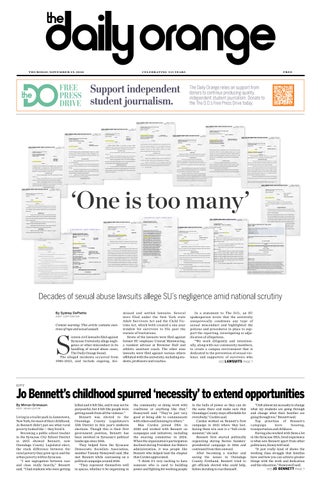
‘One is too many’
Decades of sexual abuse lawsuits allege SU’s negligence amid national scrutiny By Sydney DePietto asst. copy editor
Content warning: This article contains mentions of rape and sexual assault.
S
ixteen civil lawsuits filed against Syracuse University allege negligence or other misconduct in its handling of sexual abuse cases, The Daily Orange found. The alleged incidents occurred from 1980-2021, and include ongoing, dis-
missed and settled lawsuits. Several were filed under the New York state Adult Survivors Act and the Child Victims Act, which both created a one-year window for survivors to file past the statute of limitations. Seven of the lawsuits were filed against former SU employee Conrad Mainwaring, a resident advisor at Brewster Hall and athletic assistant coach. The other nine lawsuits were filed against various others affiliated with the university, including students, professors and coaches.
In a statement to The D.O., an SU spokesperson wrote that the university unequivocally condemns any type of sexual misconduct and highlighted the policies and procedures in place to support the reporting, investigating or adjudication of allegations. “We work diligently and intentionally, along with our community members, to create a campus environment that is dedicated to the prevention of sexual violence and supportive of survivors who see lawsuits page 7
city
Jo Bennett’s childhood spurred ‘necessity’ to extend opportunities By Mirren Grimason asst. news editor
Living in a trailer park in Jamestown, New York, for most of their childhood, Jo Bennett didn’t just see what rural poverty looked like — they lived it. Becoming a public school teacher in the Syracuse City School District in 2015 showed Bennett, now Onondaga County Legislator-elect, the stark difference between the rural poverty they grew up in and the urban poverty within Syracuse. “I saw segregation between race and class really heavily,” Bennett said. “I had students who were getting
killed and it felt like, and it may not be purposeful, but it felt like people were getting numb from all the violence.” Bennett was elected to the Onondaga County Legislature’s 15th District in this year’s midterm elections. Though this is their first government position, Bennett has been involved in Syracuse’s political landscape since 2016. They helped form the Syracuse Democratic Socialists Association, member Tammy Honeywell said. She met Bennett while canvassing on a political campaign around 2018. “They represent themselves well in spaces, whether it be organizing in
the community or doing work with coalitions or anything like that,” Honeywell said. “They’re just very good at being able to communicate with others and listening to others.” Mae Carden joined DSA in 2020 and worked with Bennett on campaigns and initiatives, including the steering committee in 2024. When the organization’s participation declined during President Joe Biden’s administration, it was people like Bennett who helped lead the chapter that Carden appreciated. “I think it’s very exciting to have someone who is used to building power and fighting for working people
in the halls of power so they can do the same there and make sure that Onondaga County stays affordable for everybody,” Carden said. Carden worked on Bennett’s first campaign in 2021 where they lost. Seeing them win now is a “full-circle moment,” she said. Bennett first started politically organizing during Bernie Sanders’ presidential campaign in 2016 and continued from then onward. After becoming a teacher and seeing the issues in Onondaga County firsthand, Bennett tried to get officials elected who could help, before deciding to run themself.
“I felt almost (a) necessity to change what my students are going through and change what their families are going through too,” Bennett said. Top priorities of Bennett’s campaign were housing, transportation and childcare. Having also worked with them a lot in the Syracuse DSA, lived experience is what sets Bennett apart from other politicians, Honeywell said. “It just really kind of shows the working class struggle that families have and how you can achieve greater things with the work and dedication and the education,” Honeywell said. see jo bennett page 7
2 november 19, 2026
FOOTBALL
about
saturday, november 14
SYRACUSE 34, NC STATE 31 saturday, november 21
SYRACUSE AT BOSTON COLLEGE Editor@dailyorange.com News@dailyorange.com Opinion@dailyorange.com Culture@dailyorange.com Sports@dailyorange.com Digital@dailyorange.com Design@dailyorange.com Photo@dailyorange.com BUSINESS 315-443-2315
MEN’S BASKETBALL
The Daily Orange is an independent, nonprofit newspaper published in Syracuse, New York. The editorial content of the paper — which started in 1903 and went independent in 1971 — is entirely run by Syracuse University students. The D.O., a 501(c)(3) nonprofit, is editorially and financially independent from SU, and the paper receives no funding from the university. Instead, The D.O. relies on advertising revenue and donations to sustain operations. This fall, the paper will be published Thursday when SU classes are in session. The D.O.’s online coverage is 24/7, including while SU is on break. To show your support to The D.O.’s independent journalism, please visit dailyorange.com/donate. Donations are tax deductible.
wednesday, november 18
SYRACUSE 91, CORNELL 82 saturday, november 21
SYRACUSE VS LAFAYETTE
WEATHER The forecast for this upcoming week, per The Weather Channel.
how to join us
letter to the editor policy
If you are a Syracuse University or SUNY-ESF student interested in contributing to The D.O. on either its advertising or editorial teams, please email editor@dailyorange.com.
The D.O. prides itself as an outlet for community discussion. To learn more about our submission guidelines, please email opinion@dailyorange.com with your full name and affiliation within the Syracuse community. Please note letters should not include any personal information pertaining to other people unless it is relevant to the topic at hand. All letters will be edited for style and grammar.
11/19
The D.O. is published weekdays during the Syracuse University academic year by The Daily Orange Corp., 230 Euclid Ave., Syracuse, NY 13210. All contents Copyright 2026 by The Daily Orange Corp. and may not be reprinted without the expressed written permission of the editor-in-chief. The Daily Orange is in no way a subsidy or associated with Syracuse University. All contents © 2026 The Daily Orange Corporation
MON
corrections policy The D.O. strives to be as accurate in our reporting as possible. Please email editor@dailyorange.com to report a correction.
News Editor Editorial Editor Culture Editor Sports Editor Presentation Director Digital Design Director Photo Editor Illustration Editor Social Media Editor Enterprise Editor Asst. News Editor Asst. News Editor
Arabella Klonowski Will Chadwick Lily Zuckerman Jordan Kimball Adelaide Guan Abigail Aggarwala Tara Deluca Emma Soto Claire Zhang Ally Goelz Vivian Collins Ryan Garipoli
Asst. News Editor Asst. Editorial Editor Asst. Editorial Editor Asst. Culture Editor Asst. Culture Editor Asst. Sports Editor Asst. Sports Editor Asst. Sports Editor Asst. Photo Editor Asst. Photo Editor Asst. Photo Editor Video Editor
Mirren Grimason Addy Kimball Dayna Roberts Tara Binte Sharil Joel Pelachik Harris Pemberton Jason Glick Spencer Brod Eli Schwartz Zoe Xixis Christian Calabrese Reese Niccolls
THU
SAT 11/21
11/23
High of 64° FRI Low of 44° 11/20
High of 62° Low of 34°
High of 65° Low of 42°
High of 64° Low of 48°
High of 51° Low of 32°
SUN 11/22
TUE 11/24
High of 37° Low of 21°
Delia Sara Rangel
Noah Nussbaum
Quinn Postman
EDITOR-IN-CHIEF
MANAGING EDITOR
DIGITAL MANAGING EDITOR
Video Editor Asst. Video Editor Asst. Video Editor Design Editor Design Editor Design Editor Design Editor Design Editor Design Editor Asst. Digital Editor Asst. Digital Editor Asst. Digital Editor
Collin Snyder Thandi McCain Nathan Olszewski Lily Wilkin Zoey Grimes Adler Neu Ana Rodriguez Elise Flannery Hailey Raymond Fiona McHugh Owen Smith Peter Hua Radosh
Asst. Digital Editor Jack Wood Asst. Digital Editor Ava Demcher Asst. Digital Editor Alexandra Rice Asst. Copy Editor Sydney DePietto Asst. Copy Editor Bailey Dunn Jordan Fendrich Asst. Copy Editor Asst. Copy Editor Gabe Ewen Asst. Copy Editor Caroline Erskine Asst. Copy Editor Kosta Konstantopoulos I.T. Manager Eliza Raphael I.T. Manager Sam Benoit Business Manager Kevin Ross
Business Asst. Tim Bennett Circulation Manager Steve Schultz Student Delivery Agent Kaila Hu DEIA Manager Savannah Stewart Development Editor Eliana Rosen Development Editor Avery Magee Development Editor Mauricio Palmar Alumni Engagement Editor Charlotte Price Alumni Engagement Editor Ben Butler
NEWS
november 19, 2026 3
university senate
USen proposes IDEA changes, early syllabi submissions in meeting By Ryan Garipoli asst. news editor
The Syracuse University Senate tabled a discussion on two motions involving a proposed amendment to a motion that would change the required IDEA course category description at its Wednesday meeting. The Ad hoc Committee - IDEA consists of faculty members involved in such courses, which stands for inclusion, diversity, equity and accessibility. Part of the committee’s charge is to review the language used in the undergraduate course catalog. In the summer of 2025, SU removed 165 words from its IDEA course description. The cuts left no mention of DEIA or related words like “social justice.” SU changed “IDEA” to “Idea,” removing the meaning from the previous acronym. However, on SU’s website and during the committee’s presentation, the IDEA acronym was used. The first motion proposed all IDEA category descriptions go through the Senate Committee on Curriculum and Instruction, saying the process needs faculty oversight. There have been two descriptions — one former and one currently used — since the introduction of the IDEA class categories. The descriptions were not approved by the Senate, IDEA committee co-chair Devashish Mitra said. The second motion proposed changing the current IDEA category description to a shortened, 100-word version. The committee’s proposal reads as follows: “This requirement helps students examine social, cultural, and institutional forces that shape individual and community identity. IDEA courses on various topics, offered across SU schools and colleges, share two or more of these objectives: analyze U.S. and/or global historical and contemporary contexts of exclusion/inclusion; explain how socialization shapes identities, values, and perspectives; analyze influence of social, cultural and other institutions on communities; assess strategies for civic engagement, ethical decision-making, and/or community participation and interaction. Students can additionally learn how to negotiate difference and address societal challenges. Pass/
fail, credit by testing, transfer credit, and petitions for non-approved courses are not accepted.” Senators Roger Hallas and Robert Van Gulick expressed concern with the new statement because it only mentioned the “inclusion” part of the acronym. Van Gulick said the IDEA acronym clearly had a “political perspective” and that he doesn’t see that in the proposed statement. “I do think this is a significant change in terms of what the motivating spirit and intent of the requirement was,” Van Gulick said. “I’d like to hear from the committee about whether or not they saw this as simply finding language that’s student-friendly as it’s presented, as opposed to actually changing the focus and depoliticizing the kind of perspective that was built into the original requirement.” IDEA committee Co-chair Kira Reed said the committee had to consider the 100-word cap and that course instructors aren’t covering the full range of topics named in IDEA when writing the new description. “We’re still evaluating that particular acronym and its relation to it being accurate in describing 146 courses equally,” Reed said. Mitra added that students have given positive feedback to the language in the revised description and that they had a negative reaction to the language of the previous one. “If you present them with preachy, politically charged language, they might be a little more negative right from the start,” Mitra said. “And so we thought, and the feedback we got was that this appeals to them much more.” Senators Margaret Susan Thompson and Student Government Association Executive Vice President Max Lachut expressed concern with the second motion’s segment that disallows students petitioning for non-approved IDEA courses. They both agreed that IDEA courses eventually being approved down the line doesn’t help students now. Reed explained that petitioning for an IDEA course occurs at the academic level and therefore “did not seem appropriate.” The committee could look into making petitions for nonapproved IDEA courses by making the process go through faculty instead of advisors, Reed said. Senator Harvey Teres proposed an amendment to add to the description in the second motion
USen’s AD HOC IDEA committee proposed a shortened category description. “Inclusive” was the only word in the acronym mentioned in the description. solange jain daily orange file photo
to include “the IDEA acronym encapsulates the core concepts of inclusion, diversity, equity, and accessibility” after the first sentence. “Those words have almost been taboo on this campus for a number of years,” Teres said. “I think they need to be there.” After the amendment was proposed, Senator Logan Hollins, SGA director of Internal Communications and Culture, suggested tabling motion two altogether until a final decision has been made on the acronym. “What I am hearing from the co-chairs of the committee is that what that acronym stands for, let alone whether we keep that exact acronym at all, is up for debate,” Hollins said. While discussing the motion to table motion two, Senator Horace Campbell recommended that both motions and the amendment be tabled until the USen’s next meeting in December. SGA also presented three student requests at the USen’s third meeting of the semester. The requests included student access to syllabi and textbook information prior to course registration, more in-person office hours offered by professors in addition to office hours over Zoom and better access to mentored research and creative work. SGA presented its request to the Senate in an effort to improve its proposals, Lachut said.
SGA’s Vice President of Academic Affairs Beckam Polis presented the request for earlier syllabi access, explaining concerns that students are forced to commit to courses without understanding the workload they’re taking on or the additional textbook costs the course requires. Polis said that 70% of students nationally have skipped buying required course material due to its cost. “When tuition is over $34,000 a semester, students should know what a course will ask of them academically and financially before signing up for it,” Polis said. SGA’s proposal involves course syllabi being posted on MySlice alongside course catalogs during registration and faculty submitting textbook lists to the campus store prior to registration. Polis clarified that finalized syllabi would not be required, saying a syllabus draft “gives students far more than they have now.” SGA President Emily Castillo-Melean presented SGA’s request for faculty to offer more in-person office hours, and said the recommendation focuses on strengthening faculty-student relationships. “We want to see these practices become a more consistent priority throughout the see usen page 7
on campus
Ph.D. candidate aims to address Palestinian conflict through cinema By Anya Pei staff writer
When Syracuse University Ph.D. candidate Hyejun Kim interviewed Palestinian filmmaker Kamal Aljafari at the 64th New York Film Festival, she pitched the idea of paying him to screen one of his films to SU students. What she didn’t expect was for him to offer to screen all of his films for free. Kim became a fan of Aljafari after viewing his work at South Korea’s DMZ International Documentary Film Festival this September. While working on her dissertation about lost South Korean cinema, she found films from Palestinian directors who are trying to restore lost visuals stolen during the siege of Beirut in 1982. “In the absence of (a) Palestinian archive, they’re making cinema,” Kim said. “They’re using cinema in order to make an archive.” Cinecuse, an SU cinema club created by Kim, ended its three-part film screening series “Archives Against Erasure” on Tuesday in Kittredge Auditorium. The final screening, titled “Reclaiming the Archive: Cinematic Sabotage,” featured two of Aljafari’s short films, “Paradiso, XXXI, 108”and “UNDR,” and his feature-length documentary “A Fidai Film.” The screening revolved around the experimental practice of “cinematic sabotage,” coined by Aljafari, that reclaims archival footage of Palestine from the Israeli archive. Earlier screenings in the series featured films explaining the connections and solidarity between Palestine and Japan. Kim said she wanted to create Cinecuse and the screening series because of a lack of independent film culture on campus and around the Syracuse area. “I wanted to introduce film. Foreign films, international films and experimental films that people wouldn’t normally get exposed to,” Kim said. Serene Masri, another SU English Ph.D. student, was invited by Kim to co-moderate the panels for the first two “Archives Against Erasure” screenings. As a Palestinian-American,
su ph.d. candidate hyejun kim hopes to address Palestinian issues through her cinema club Cinecuse. anya pei staff writer
Masri said Aljafari’s films can reveal how current events aren’t singular, but intertwined with the history of other groups and past incidents. “Addressing Palestinian liberation doesn’t just address Palestinian liberation,” Masri said. “It also addresses the liberation of so many other peoples who are also existing under settler-colonial governments as well.” Attendee Emma Frank said while she was still processing the screened films, they shouldn’t be seen as out of people’s comfort zones. “The big takeaway is the idea that films like this are important because they let us be in conversation with one another in a way that is difficult to do when you’re approaching learning and activism in a way that’s not communityoriented,” Frank said. Mainstream and entertaining films can be helpful at times, Kim said, but she doesn’t believe they have the power to change how a person thinks. She said she hoped to provide a space where a group can view international struggles in a way that can affect their lives.
Kim said there’s currently overwhelming silence around Israel and Palestine across SU’s campus due to previous disciplinary action students have faced. Her status as an international student, she said, made speaking out a “risky business.” Kim received support for the “Archives Against Erasure” series from several SU departments, including the SU’s English, History and Women and Gender Studies departments, the Moynihan Institute of Global Affairs’ East Asia Program and the Television, Radio and Film program. Kim said this backing revealed a group of allies who had her back and weren’t afraid to speak out for their beliefs. When she first planned the event, Kim said she didn’t know what to expect, and considered hosting the screenings as a part of a “secret” series. “It was gonna be like ‘Dead Cinephile Society,’” Kim said. “But having this much support really showed me that there (is a) community of people in Syracuse who are
advocating for justice in Palestine and condemning genocide.” Kim aimed to recover lost memories with the screening. In doing so, she found an unseen community of people who were willing to speak and help out others, she said. Masri highlighted the importance of Palestinians telling their own stories due to past violence against Palestinian journalists and writers. She said she hoped those who attended the screenings would take away a desire to learn more about Palestinians and their history. “I’m somebody who doesn’t necessarily believe that one book, one film or one image of something is going to completely give somebody a new perspective,” Masri said. “But I think the hope is always that it creates this desire to learn more and to learn from the people themselves as well.” Kim said the screening taught her what it meant to curate films for a larger audience. She said she wants to continue the club’s nature of being politically engaged and giving her audience the freedom to make their own judgments in a safe community space. “To have a screening is not just about watching a film. It’s about creating a space for people to gather together,” Kim said. “I think right now for me, the important question (is) what sort of community space do I want to create, and what film is conducive for that. I think that’s the question that I will be grappling with in the future.” The popular narrative in the United States is that Palestinian solidarity is a controversial topic, Masri said. But she believed that bringing screenings to college campuses can help challenge that notion and shine a light on the voices that have been hidden and erased for decades. “My identity kind of just becomes a controversial topic, and so I don’t see holding a film screening as something that I am willing to cut myself off from,” Masri said. “If people have a problem with us holding a film screening on films that highlight and center Palestine, then I think that says more about them than it does us.” apei01@syr.edu
See the s
4 november 19, 2026
Friendsgiving festivities dish out cravings, camaraderie for SU students By Tara Binte Sharil asst. culture editor
Photos By Avery Magee development editor
L
ou Michelson was accustomed to celebrating the holidays in Los Angeles. Every New Year’s Eve, Michelson’s family had food trucks, karaoke and an open bar at their home. But when Michelson moved to London in high school, she noticed hosting culture was a rarity. That’s why when the Syracuse University junior moved into her off-campus two-bedroom apartment this semester with her roommate, SU junior Mary Gibson, Michelson hoped to return to her roots. Thanksgiving was probably the only chance she’d get this fall to host a dinner before she goes abroad in the spring.
“When Mary and I moved in together, we very much wanted to be in the hosting department, which hasn’t really turned out that way, but hopefully this is a first and final hurrah,” Michelson said. While SU students rush to get their final assignments and quizzes done before Thanksgiving break, some students are spending their days before break hosting Friendsgiving. Whether it’s in a South Campus living room or an intimate dinner in a onebedroom apartment, Friendsgiving is a tradition observed not just at SU, but across the United States, too. The concept of gathering with friends and acquaintances for Friendsgiving has been around for decades — ultimately, it’s similar to Thanksgiving. Thanks to pop culture references like “Friends” and “A Charlie Brown Thanksgiving” over the decades, the word was officially added to Merriam-Webster’s dictionary in 2020.
A Friendsgiving dinner consists of full plates, wine glasses clinking and living rooms decorated in orange and brown colors. The key to a successful Friendsgiving lies in the preparation. For Michelson, that preparation began a week and a half before her Saturday dinner. Michelson started with the invite list. Her open living area could accommodate a large number of guests, but she also didn’t want the apartment to feel packed. Michelson and Gibson first decided on inviting their immediate friend group, which came out to 30 altogether. That invitation then extended to their friend group’s friends. In the days leading up to their Friendsgiving, the Partiful guest list ballooned to 40 attendees. On the other hand, Lolita Mamulashvili’s Friendsgiving guest list was on the smaller side with 17. After all, since Mamulashvili was cooking for her guests by herself, the amount of food she was cooking depended highly on her invite list. The SU sophomore knew she wanted to include friends she’s formed at different points in her college life — some through mutual friends and others at University Union’s Block Party last year. “I was kind of nervous about the portions that I’m serving, whether they were too small or big,” Mamulashvili said. “Talking to my mom, I think that they were too small, so I bought two
Aidan Banayo cuts ribs he bought from Tops. Banayo said he’s used to preparing Filipino dishes, not Thanksgiving-style foods.
chickens and I’m begging my friend to buy me more potatoes.” Mamulashvili learned how to cook over the summer and sharpened her culinary skills over the past few months. But that didn’t mean she could wait until the last second to cook for 17 guests. With guests planning to arrive at Mamulashvili’s Friendsgiving at 6:15 p.m., Saturday preparations began at 1 p.m. Mamulashvili’s food spread was less-thantraditional, she said, featuring Slavic dishes she grew up eating. Having never cooked a turkey before, Ma mu la shv i l i opted for a different protein. On Saturday, Mamulashvili served roasted chicken — marinated two ways — alongside her mom’s recipe for mashed potatoes, a Georgian salad inspired by her dad, fried mushrooms and other dishes brought by guests. “The best dishes are always when you’re experimenting,” Mamulashvili said. Across campus, SU seniors Aidan Banayo and Abby Long hosted their Friendsgiving together — it was Banayo’s first and Long’s second time hosting a Friendsgiving dinner. Friendsgiving was the opportune time for the couple to host — Long enjoyed the planning process, while Banayo
A guest at Lolita Mamulashvili’s Friendsgiving potatoes and a Georgian salad.
november 19, 2026 5
d a e r sp The best dishes are always when you’re experimenting. Lolita Mamulashvili su sophomore
wanted to showcase his home to his friends who’d never seen his apartment before. While Mamulashvili mostly cooked all of the food in her spread, Banayo and Long settled on a potluck-style meal. Long made stuffing and pumpkin cookies, while the other eight guests brought dishes like green bean casserole and mashed potatoes. Unfortunately for Banayo, his culinary expertise mostly pertains to Filipino food. It’s a cuisine he grew up with but isn’t usually in Thanksgiving dinners, he said. Banayo enlisted the help of his mom to figure out what dishes he could cook. “What do I have in my freezer that I know how to cook? Which of these do you think is a good idea?” Banayo asked his mom. “None of it. Figure out something else,” his mom responded. Banayo resorted to purchasing rotisserie chicken and ribs from Tops. While Banayo and Long had only eight guests to worry about, Michelson and Gibson had 40. Though a big guest list would create an animated dinner party, cooking for that many people was a daunting task. That was why the pair also settled on a potluck-style dinner. To coordinate, Michelson sent out a Google Sheet for people to list what dishes they’d bring. With the menu
secured, the pair started planning decorations for their apartment. Using colored paper from Michelson’s job and several cheap Amazon purchases, the roommates spent a week and a half decorating their apartment. In the living area, Gibson streamed brown and orange paper across the ceiling, while Michelson made paper chains attached to the dining area’s chandelier. Saturday at 6:30 p.m., Michelson and Gibson’s guests filed in with their dishes to accompany the roommates’ roasted brussel sprouts and deviled eggs. Michelson also made her mom’s classic Thanksgiving dish: a “chocolate chip coffee cake that has no coffee in it.” By the couches, a banner was filled with turkey-traced hands alongside messages of what each guest was thankful for. Next to the drinks station was a handwritten menu of each food item, including mashed potatoes and gravy. The roommates’ guests finished off the menu, writing dishes like turkey, a baked brie wheel and thyme Rice Krispies Treats. By 8 p.m., the night was still going strong at Michelson and Gibson’s. Groups of people sat on the floor in the kitchen, on the couches and by the food spread. While guests chatted, some grabbed more servings of foods, and toward the end of the night, desserts. Friendsgiving was clearly more than just food for Michelson. “Friendsgiving is a good way to remember the people that you literally choose to have in your life,” Michelson said. “Hosting is my way of showing people that I love them and care about them. I want them in my home and I trust them in my home.” While Banayo headed to Tops to purchase his rotisserie chicken and ribs, Long began to decorate the apartment. She hung a Friendsgiving banner across the arch between the kitchen and
g feast grabs fried mushrooms. Mamulashvili’s spread included roasted chicken, mashed
living room, while a pyramid of martini glasses sits on the countertop underneath the arch. By 6:45 p.m., Banayo and Long’s guests streamed in. Guests carried Semmelknödel (German bread dumplings), pumpkin pie and different types of wines. As Banayo prepared the main course and guests heated up their home-cooked dishes, the remaining guests sat in the living room enjoying a charcuterie spread. As jazz music filled the air, the guests caught up with each other with their latest whereabouts. Creating a relaxed, cozy atmosphere was Banayo’s main goal of hosting Friendsgiving at her apartment. “I live for those intimate, close dinner settings with a group of friends that are less than double digits,” Banayo said. “Plus, it’s my favorite time of year. It’s just starting to snow, no big lights, jazz music in the background.” Over on South Campus, Mamulashvili cooked and decorated the afternoon away for her now 12 guests. With cutouts of leaves on the wall and warm lighting to set the mood, Mamulashvili’s apartment transformed into a homey and inviting atmosphere. The empty apartment began to fill with Mamulashvili’s guests. Wearing different skirts and sweaters in autumnal tones, everyone was dressed for the occasion. Mamulashvili also swapped out the T-shirt and sweats she wore while cooking with a purple and dark yellow sweater dress. Surrounded by candles, Mamulashvili’s food spread was coming together, alongside other dishes her guests brought, like fried plantains and garlic bread. The center of the food spread would be Mamulashvili’s two roasted chickens she marinated overnight.
One was marinated with olive oil and spices, which included khmeli suneli, the same Georgian spice in her salad. The other was marinated in different spices and butter; Mamulashvili had to add the butter under the chicken’s skin, something she found “disgusting.” By 7 p.m., all of Mamulashvili’s guests had arrived — perfect timing as the roasted chickens were ready to be served. With the chickens plated on the table, the guests admired the food spread. The enamored guests captured the lavish spread with their digital cameras as compliments flew around the table. A smile appeared on Mamulashvili’s face. As the sound of growling stomachs overtook the compliments and music in the air, Mamulashvili performed the classic carving of the turkey — in this case, chickens. With a knife in her right hand, Mamulashvili carved pieces of chicken as her guests recorded her for memories sake. Some guests even had the honor of carving the chickens. With plates full of chicken, mash potatoes and salads, the guests flocked to the couch to feast. By 10 p.m., guests were suffering from food comas. Though everyone’s stomachs were aching, the night ended with chatters and watching finger gloving videos on YouTube. For Mamulashvili, she wanted the feast to be more than just the food. “All of my friends, they’re not people who just pose. They’re always their authentic selves. I think that’s the most important,” Mamulashvili said. “I want everybody to be on good terms for the party, just coming together and talking.” tabintes@syr.edu
Guests at Lou Michelson’s Friendsgiving pick desserts. Choices included brownies, cookies and thyme Rice Krispies Treats.
6 november 19, 2026
dailyorange.com news@dailyorange.com
on campus
Slopes 4 Smiles hopes to restore youthful joys for sick children By Cate Slaughter staff writer
Growing up, Evelina Caruso attended and volunteered at Double H Ranch camp for 10 years while she dealt with a chronic illness. Now a junior at Syracuse University, Caruso says she wants to help children discover life outside of their diagnoses.
I want to make sure that the kids are still able to experience and have those joys of childhood. Keelie Karh public relations and social media chair
“Being able to do something and it not revolve around your disease, it was something that just made me super happy as a kid,” Caruso said. Double H Ranch is partnering with Slopes 4 Smiles, a club at SU working to build community, inclusion and adaptive recreation by creating opportunities for students to support children with serious illnesses and disabilities through volunteering, awareness and service, Caruso said. The club is in the process of becoming a new student organization. The camp, located in Lake Luzerne, New York, has provided free specialized programs
for children living with chronic illness and their families since 1993, according to its website. Double H Ranch offers programming all year long, such as summer camp with archery and ziplining, and an Adaptive Winter Sports Program, which offers skiing and snowboarding. “It is exceptional when we see a camper that can succeed and seize the positivity in what the program gave to them,” Double H Volunteer Director Ethan Atwood said. “And they then become the inspiration for the campers who are there.” Double H Ranch has partnered with about eight other colleges and universities, including Cornell University and Hamilton College, where students can visit the camp and volunteer, Atwood said. Slopes 4 Smiles plans to volunteer at one of the Adaptive Winter Sports Program offerings from Jan. 29-31, Caruso said, as well as its fall 2027 program. About 40 SU students have already signed up for the club’s trip in January, Keelie Karh, Slopes 4 Smiles’ public relations and social media chair, said. Karh said she’s always cared for children. At a young age, she began assisting her mom’s work at an early learning center and was also a youth sports coach in high school. “I want to make sure that the kids are still able to experience and have those joys of childhood that dealing with a chronic illness might diminish,” Karh said. In addition to its January trip, the club will also participate in community service with Upstate University Hospital and hold education and awareness events on campus for different disabilities, Caruso said.
SU’s Slopes 4 Smiles Club has partnered with Double H Ramp, a camp dedicated to supporting children with chronic illness. kai pavlova staff photographer
“We just want to promote inclusion, accessibility and equal opportunities for all the children despite their medical needs,” Caruso said. The club members have the option to volunteer as a ski or snowboard instructor, or as a Family Pal, Caruso said. Family Pals help guide families through the daily activities, run events and provide general assistance, according to its website.
“Reading some of the personal statements from either members or campers themselves of what it felt like to go through this experience and be at Double H, it’s just giving them back something that they might have not been able to easily access as someone who wasn’t sick,” Karh said. csslaugh@syr.edu
on campus
Haynie announces committee to appoint SU’s next academic provost By Fiona McHugh asst. digital editor
Syracuse University Chancellor Mike Haynie announced a search committee to help appoint the next vice chancellor, provost and chief academic officer, according to a Wednesday release. The next provost will begin by July 1, 2027, after current Provost Lois Agnew’s term completes in June, according to the release. Agnew was initially appointed as interim provost in 2024 after serving
as associate provost for academic affairs. “The provost will be driving our academic vision at a consequential moment for Syracuse University,” Haynie said in the release. Agnew’s term was extended in Sept. 2025 by former Chancellor Kent Syverud so a replacement could be chosen by the new chancellor, which he had called a “rare situation.” The committee, formed in consultation with the University Senate, will be chaired by Judiciary Studies Professor Keith Bybee.
The university will also work with Isaacson, Miller, an executive search firm, to help “identify and recruit a talented slate of candidates.” The firm will work in conjunction with the committee. “Working with the firm, the committee will help develop the position description, participate in campus stakeholder listening sessions, review candidate materials and interview candidates,” the release reads. The committee will then recommend
finalists to Haynie. “We are looking for someone who champions our students, collaborates across our community and delivers differentiated excellence that distinguishes our students, our faculty and our research enterprise,” Haynie said in the release. The 19-person committee combines professors across the university’s schools, university trustees and other university staff. fmchugh@syr.edu
on campus
Native Student Program builds ‘home away from home’ for largest cohort By Bailey Dunn
asst. copy editor
To sophomore Shayla Benedict, Syracuse University’s Native Student Program became a place for Indigenous students like herself to express and value their culture, something she said is typically harder on a college campus than at home. “I think it’s important to show people there’s a home away from home,” Benedict said. The program, started in 2006, was originally formed as a collaboration between three SU offices — the Student Experience Division, Belonging and Student Success and the Office of Academic Affairs, according to its website. This year, the Native Student program, which is part of the university’s Intercultural Collective, reached its largest student community in SU’s history. The house, located at 113 Euclid Avenue, serves as a place where Native students and those interested can gather to explore Indigenous culture and history, according to the program’s website. It also offers a variety of resources, including an Ionkerihonnien:ni Guide Program focused on supporting Indigenous first-year and transfer students through peer mentorship, cultural events, professional workshops and academic counseling. For Mac Schmidt, a junior peer mentor for the guide program, coming to SU has helped her form a closer relationship to her culture. “I wasn’t super connected to my culture before I came here because I do live off the reservation, so it’s kind of hard to connect with that,” Schmidt said. “Being here has made it a lot easier.” The Euclid Ave. house features student-led interior design to represent Native communities, including the Haudenosaunee Confederacy and Turtle Island tribal communities, through its exposed beams representing the Roots of Peace and four directional colors of the Medicine Wheel. Schmidt describes the house as a “home away from home,” something Benedict, a sophomore peer mentor, concurred with.
The Native Student Program, with the largest cohort in SU’s history, has become a place for the Indigenous community to express themselves. christian calabrese asst. photo editor
“I think it’s really important because coming from small communities as Native Americans, it’s really hard to find your footing and you get a lot of imposter effects sometimes, ” Benedict said. “I feel like I grew up so foreign, but I’m not foreign at all, in a sense.” Having a community of students who understand similar experiences helps create a sense of belonging, Benedict said. “It’s very good because we have a strong community there and we support each other,” Benedict said. “The house is really important for that community base.” The program also includes a “Native Identity Series,” where students take a spring trip to Native communities or historical sites, according to the website. In addition to cultural programming, the Native Student Program offers professional development opportunities throughout the
academic year. Professional workshops this year have covered topics including LinkedIn, public speaking and navigating MySlice, Benedict said. The program also provides opportunities for students to form connections with people they might not otherwise meet on campus, such as alumni and new students, serving as a space to hang out in between classes, senior Maisie Helsey said. “If you go to the house, there’s gonna be someone else there,” Halsey said. “If someone’s at the house that I don’t know, I feel comfortable enough to ask them questions about themselves and get to know them.” The program provides several opportunities for students to engage with one another throughout the academic year, including a three-day orientation for first-year and transfer students as well as weekly workshops
and events such as Full Moon Ceremonies, a Witness to Injustice Blanket Exercise and an Indigenous Celebration where graduating members are given a symbolic stole. The current Native Student Program becoming the largest in the university’s history reflects the importance of spaces where students can find others with shared backgrounds and experiences, particularly for those who may be coming from smaller Native communities, Hesley said. The Native Student Program events often overlap with Indigenous Students at Syracuse, like its “Friendsgiving” event on Monday. Morgan Huff, vice president of ISAS, the only student organization for Indigenous students at SU, said the two groups work together to create “a sense of home” for native and Indigenous students. “They provide us a space to share with people who come from the same culture and values as I do, and it’s been essential to my success so far,” Huff said. “To be able to learn my history while simultaneously sharing with the Syracuse community is something that I’m grateful and proud to be part of.” Since graduating in 2019, SU alum and former ISAS President Maris Jacobs said she continues to hear about the success of both programs, saying most Indigenous Students grow up with lots of familial support. “Most of us come to Syracuse with that environment already fostered for us,” Jacobs said. “So the Native Student Program, it replicates that to some extent, and tries to fill the gaps that are created when you leave your community for the first time.” The Native Student Program events are open to all SU students, and Jacobs encourages students to attend, form connections and “learn something you would not have otherwise.” “They’re there not just to educate others, but there to celebrate our own existence, culture and resilience,” Jacobs said. badunn@syr.edu
november 19, 2026 7
dailyorange.com news@dailyorange.com
from page 1
lawsuits come forward to report any act of sexual misconduct,” the spokesperson wrote. Colleges and universities across the country have faced scrutiny regarding their handling of campus sexual assault after the Cornell University rape lawsuit gained national attention. Timothy Heaphy, chief investigative counsel for the United States House Select Committee on the January 6 attacks and former general counsel of the University of Virginia, stressed the importance of separating the Title IX process from lawsuits against a university. At UVA, Heaphy oversaw all legal affairs of the institution. He explained cases usually follow an internal process governed by an investigation with an accusation, a fact-finding process and a mini trial. He said cases almost never leave the Title IX process. “These cases rarely get litigated in court. At UVA, we had very few of those cases that went outside of the Title IX process,” Heaphy said. “If Syracuse has had (16) cases where victims have said, ‘I don’t feel like the Syracuse process complied with the law or protected my rights,’ that is unusual.” Several of the lawyers The D.O. spoke with said the ASA and CVA likely increased the number of lawsuits filed against SU. Of the 16 lawsuits, 12 were filed under these acts. The SU spokesperson noted that several of the lawsuits that happened decades ago are no longer pending, some having been dismissed in court. Over 3,000 civil lawsuits were filed under the ASA and over 10,000 were filed under the CVA within their respective windows. “The volume of cases and the circumstances surrounding them don’t reflect the current conditions or prevention protocols on our campus today,” the SU spokesperson wrote. Heaphy explained that universities have an obligation to conduct an investigation before a lawsuit is filed. When an institution receives a complaint of any kind, he said they have to investigate and create a process that provides fairness to all parties. If someone says the university’s process wasn’t fair, Heaphy said the complaint then goes to court, where the university’s interest shifts from the student to self-protection. from page 1
jo bennett Honeywell ran with Bennett alongside Maurice ‘Mo’ Brown on the “Affordability Slate” in the primary elections. The legislature’s 8th district and 15th district border each other and both are a part of the 129th assembly district, Honeywell said, and since they were all endorsed by the local DSA chapter, it made sense to run together. Bennett and Brown won their primaries and later their midterm elections as well. Honeywell lost her primary to Chad Ryan. Having endured many different life experiences, Brown said Bennett is able to understand and meet people where they are. “You can’t come in condescending. You can’t come in with all the answers, and Jo gets that,” Brown said. “I think we need more elected officials who get that.” When considering running for state assembly, Brown said he wanted to make sure the legislator seat would not be vacated if he did so. “It was like, ‘I’m not gonna run unless we know Jo is running,’ so if I’m hinging so much on their running, we might as well run together,” Brown said. Bennett moved to the central New York region with their mother at 17 years old and later attended SUNY-Oswego, earning a bachelor’s and master’s degree in physics. While they were interested in political and history-based elective courses, it wasn’t until after graduation that Bennet first got involved in local politics. Carolina Ilie, a professor at SUNY Oswego, met Bennett around 2011 in her upper-level physics classes they took while in school for their bachelor’s degree. from page 5
usen
university so that students have reliable opportunities to connect with their professors outside the classrooms,” Castillo-Melean said. The request proposes that faculty offer in-person office hours as the default, with Zoom remaining an option in the case of travel or scheduling conflicts. Office hours are to be clearly communicated by being posted on the syllabus, Blackboard, or both in every class, Castillo-Melean said. Senator Li Wang questioned the need for SGA’s office hours proposal, as everyone teaching courses in her college, the College of Engineering and Computer Science, is required
The Title IX process is difficult for schools to get right due to unreliable information, Heaphy said. At UVA, he said the university had a robust process that protected victims and provided supportive measures, but the quality can vary across the country. Mitchell Epner, a former assistant U.S. attorney who’s handled sexual abuse cases, said no college or university is immune to the problem. He said although there’s been some improvement, it’s important to remember how society used to treat survivors and that better is “far from good enough.”
Prevention is as important as punishment. Timothy Heaphy former general counsel of the university of virginia
Epner said the standard of care should be significantly higher than most universities practiced when he was in college. “Until very recently, there was an enormous amount of shame and secrecy that surrounded these issues, which made it much less likely that somebody would file a lawsuit like this,” Epner said. There were 10 rapes reported in SU’s campus residential facilities in 2025, four more than the year prior, according to an Oct. 1 campus safety report from SU’s Department of Public Safety. News10NBC examined the number of sexual assault cases at nearby college campuses in October and found Nazareth University had the highest number of reported sexual assaults in 2025, with more than 160 cases. University of Rochester’s website had 20 reports of sexual assault during the 2023-2024 academic year, News10NBC reported. Mark Boskovich, who’s litigated sexual abuse lawsuits involving institutional negligence, said he thinks poor leadership and lack of accountability from staff and professors often lead to an increase in lawsuits filed. Boskovich said through his nearly 15 years in the field, he’s learned sexual misconduct and abuse are prevalent everywhere. Due to the “Jo was looking at everything around (them) with a very fresh look. (They) always had a very fresh look and (were) very inquisitive,” Ilie said. “I didn’t have any type of profession for (them), because I was thinking that (they) can become everything (they) want.” Bennett studied with a group of students in Taiwan, worked on professors’ research projects, including one of Ilie’s, and won awards for research they presented, she said. While physics and politics may seem very different, Bennett said their studies allowed them to think and approach the world differently. “It was something about physics that, just trying to understand the nature of reality and why we’re here, kind of even deeper questions than political, I think really got me,” Bennett said. Bennett’s interest in politics first sparked after taking an Advanced Placement U.S. History course in high school. While studying physics, electives relating to history and politics interested them. Bennett has campaigned on policies that affected them throughout their childhood and life. Housing isn’t just about affordability for Bennett, but also safety. As a child, Bennett said they were hospitalized for a week due to mold in one of the trailer homes they lived in, later finding out they’re highly allergic. Bennett now sees their students go through similar issues with housing, specifically with lead. “Getting lead out of housing is huge for me,” Bennett said. “I was on (the) attendance team and I would go around to see why students were missing school and I’d go to their houses and I’d see what they’re going through. It’s terrible.” The county legislature recently passed a $25 million housing fund that Bennett would like to oversee in their position. Having accessible to set up fixed in-person office hours. Lachut said he recalls a student telling him three out of five of his courses don’t offer in-person office hours with the professor. Lachut presented SGA’s request concerning aiding student research and creative opportunities, saying there is no central place for students to find openings for student research. Lachut said SGA has been working with SU’s Office of Undergraduate Research and Creative Engagement on an online platform where research mentors can post undergraduate research opportunities. The website is already live with three openings, Lachut said. He cited studies that show mentored research narrows graduation gaps, adding that faculty who mentored
commonness of these cases, Boskovich said seeing lawsuits doesn’t surprise him anymore. “Unfortunately, a lot of sexual deviants are out there, and they are in every context. They find their way everywhere,” Boskovich said. “That’s why we always suggest that all these organizations who are dealing with young kids and young adults take precautions because this could be you.” Kat Thomas, an attorney for several plaintiffs in the Mainwaring cases, said it’s important to shift the blame off the victim and onto the institutions that should’ve “done the right thing” in the first place. Although Thomas said 16 lawsuits are “way too many,” she added “even one is too many,” saying she’s sure more people have experienced abuse but haven’t reported the instances. Thomas explained SU’s 16 cases only represent those that had the courage to come forward. Thomas emphasized how difficult it is for victims to speak up, especially at universities, for fear of blame and retaliation. She said in her experience, the default is to not believe survivors, especially college-aged students. “It’s very upsetting to me that this is still going on. I mean, look at (SU’s) budget for athletics,” Thomas said. “Look at what they will spend money on, right? Why aren’t we doing better trainings? Why aren’t we vetting people? Why is this still an issue?” Thomas said the issue of sexual abuse on college campuses is an epidemic and, based on her experience as a litigator, she said SU “definitely has a problem.” In his professional background, Epner said sexual harassment and assault incidents are much more likely to occur when there’s excessive use of alcohol and other intoxicants. He explained that an institution being widely known as a “party school” also contributes to the frequency of these instances. Boskovich agreed and said in cases of assault between students, he expects to see an increase at party schools with heavy drinking and fraternity systems. He said some of the worst tendencies unfortunately come out in those situations. Although certain cases, like the Cornell lawsuit, can make it feel like the problem is getting worse, Boskovich said over time things are “definitely getting better.” He said today,
these incidents are in the news cycle much more than in the past, bringing more attention and awareness. “I think you are seeing a cultural shift in the right direction,” Boskovich said. “I would say there is a gradual improvement in this because there’s just so much more awareness.” Heaphy said as these high-profile cases prompt conversation, schools look at their own process, more victims come forward and more attention is drawn to the problem. “That is a healthy conversation that we need to have,” Heaphy said. “Prevention is as important as punishment.” The SU spokesperson said the university’s approach to prevention, reporting and response has “changed a great deal over the years.” They also wrote that federal guidance and requirements, including Title IX regulations, have evolved over the decades, and SU has changed its policies and programs accordingly. The spokesperson mentioned the mandatory training required for every student at the start of each academic year and highlighted that executive leaders of recognized student organizations, including fraternities and sororities, complete additional training. The spokesperson also highlighted SU’s direct engagement with student organizations, clear reporting options, support and ongoing review as work that is constant. “We regularly review our protocols, processes and services related to preventing and responding to sexual violence,” the spokesperson wrote. “We align them with current law and best practices, so that every member of our team understands their role and is prepared to act.” Thomas said SU and other universities should offer more training for students and teachers, saying they need to be trauma-informed. In addition to greater exposure and accountability, she said it’s vital to know that, as a survivor, you’re not alone. “I think it’s very impactful because we need to put light on it. This stuff grows in the dark,” Thomas said. “They should not be able to get away with allowing students to be harmed like this in some of the most egregious forms of assault you can imagine.” sadepiet@syr.edu
jo bennett was elected to the Onondaga County 15th district, championing policies such as safe and affordable housing, transportation and lead poisoning prevention. zoe xixis asst. photo editor
transportation for students and parents is another important policy to Bennett. With the expense of cars, especially the high prices for gas and maintenance, they want there to be an alternative and more affordable option. Growing up with parents who weren’t always around, Bennett wants to make sure childcare is available to anyone who needs it. “I had some other families that kind of took me in, but you gotta be lucky enough to have these other families that can take you in,” Bennett said. undergraduates for more than a year published more when working with students. SGA also requested the Senate to create a report explaining how mentoring students’ academic research and development correlates with the promotion of professors and faculty.
Other Business •
Vice Chancellor and Provost Lois Agnew announced that the Provost search committee, chaired by College of Law Professor Keith Bybee, will work with the search firm Isaacson, Miller and hold listening sessions on campus before recommending finalists to Chancellor Mike Haynie. The goal is to have the next Provost in place by July. 1, 2027, Agnew said.
Addressing the things Bennett has overcome in their life has been a pillar of their campaign. They’ll officially take office in Jan. 2027, overtaking the position previously held by Brown. “Jo has potential to even be better than me, if for no other reason, Jo’s gonna have state reps, like myself, that get it,” Brown said. “What I learned as a county legislator is you need that good partnership. Jo will have that from day one.” mirrengrimason@dailyorange.com
•
•
Agnew also announced that the search for a new Renée Crown Honors Program director has closed and the search committee hopes to announce a new director by the end of December. Agnew announced that the Academic Affairs Committee recommended a second round of public feedback regarding SU’s faculty workload policy. The policy will undergo final revisions after the second round of feedback early next semester and has not yet taken effect, Agnew said.
Asst. News Editor Vivian Collins contributed reporting to this story. rcgaripo@syr.edu
8 november 19, 2026
dailyorange.com
FIND YOUR PATH TO TEACHING OR SERVICE PATHWAY 1 | FRESHMEN AND SOPHOMORES ADD a dual major in Inclusive Adolescent Education Pair your English, History, or STEM degree with certified teaching credentials.
Whatever shape your future in education or service takes, your major doesn't have to change.
PATHWAY 2 | FRESHMEN THROUGH JUNIORS DECLARE an Education Studies minor Explore careers in education and service and widen your knowledge and skills base, regardless of where you land.
PATHWAY 3 | SENIORS AND RECENT GRADUATES APPLY to a graduate program Degrees in teacher preparation (Childhood, Adolescent, Inclusive Special Education), plus programs in social work, counseling, higher education, and instructional design. 50% Forever Orange tuition scholarships available for Class of 2027 graduates.
go.syr.edu/soe/pathways
dailyorange.com culture@dailyorange.com
CULTURE
november 19, 2026 9
Booming basements
Attendees at Basement 560’s show sway during a performance. Basement 560 is one of many house venues near Syracuse University that is reinventing the music scene with hardcore music. courtesy of elliot messier
‘All about the music:’ DIY student venues amplify Syracuse’s hardcore scene By Caroline Erskine asst. copy editor
A Reggae rock band Peace for the Kids poses for a photo in a store. The band performed at a house venue in Westcott, where attendees sang to their original songs. courtesy of milo ungaro
t night, the neighborhoods surrounding Syracuse University come alive. No matter the weather, SU and SUNY ESF students alike aren’t tucked away into beds. Groups of students from around campus make their way to fraternity houses and bars, but a select few find themselves walking to a basement on Lancaster Avenue. Once inside, the flocks are greeted with colorful string lights, people dressed in goth or other alternative styles and musicians tuning their instruments. Buckle up — it’s another Saturday night at The Coven. “DIY venues are close quarters, a cool environment, and it’s all about the music, not like other party venues,” Aiden Lindblom, a freshman who attended the show, said. The Coven isn’t the only house venue near SU. Other DIY venues, like Basement 560, are becoming more popular in the Westcott-University Neighborhood. Now, more than ever, these venues are hosting goth, punk and hardcore bands and fans. see hardcore music page 11
food and drink
Thanos Import Market blends Greek, Italian enclaves in Syracuse By Kosta Konstantopoulos asst. copy editor
In 2008, Peter Copanas planned to retire and close his family’s Syracuse grocery store, Thanos Import Market, the store his family had run since 1919. Soula Carni, 64, had been shopping there since 1986 when she immigrated to the United States from Tripoli, Greece. When Soula heard about Copana’s plans to close Thanos, she said she couldn’t bear to see another city staple close. So, she bought it and has been working at the market nearly every day since.
“I’ve been going to Thanos my whole time in Syracuse, and businesses like these have kept us fed and getting what I want,” Soula said. “It was the Greek choice to make.” Greek immigrant Christ Thanos founded the market in Syracuse’s North Side in 1919. In 1947, the 424 Pearl St. location was passed to his daughter, Sophie Copanos, and her husband, Peter, who ran the spot for over 60 years. By 2008, the market was at its North Celina Street location. When it came time for Sophie and Peter to retire, Soula decided to purchase the family-run business. Her son, Joe Carni, who worked nights
and weekends at the store while attending high school and SUNY Plattsburgh, now runs the establishment alongside her. Since 2016, the mother and son duo have run Thanos together, Monday through Saturday, coming in as early as 6 a.m. and leaving after 6 p.m. (5 p.m. on Saturdays.) The shop moved to its current spot on Green Street 10 years ago, but it kept the same offerings, Joe said. The storefront acts as a grocery store and sandwich shop, serving longtime neighborhood customers as well as Syracuse University students and athletic teams.
Soula recognizes members from SU’s sports teams by their orders. Whether it’s the rowing or lacrosse team, Soula knows what to do. While she said it’s not her place to name names, she knows who wants their chicken cutlets cold, with pesto or with extra mozzarella. Aside from cheese, Baklava, canned stuffed grape leaves and 12 specialty cheeses, including feta, gorgonzola, kefalotyri and kefalograviera, line the shelves and refrigerators of the shop. Its sandwich menu has ten options, including The Thanos, made with mixed Italian meats and aged provolone, and The Green,
with tomato, mozzarella and basil pesto. Among SU students, Joe said Thanos’ sandwiches with chicken cutlets are the most popular. The history behind the store reflects the Greek and Italian communities that shaped its offerings, Joe said. The previous owner, Peter, hired retired Italian butchers from Syracuse’s North Side, which brought in products such as salami, capicola and prosciutto, adding Italian specialties to the market’s Greek roots. “It’s funny to think about because when the previous owner brought in the butchers, they brought their own see thanos page 11
10 november 19, 2026
dailyorange.com culture@dailyorange.com
campus life
Professor tailors media musings with @fittedprof persona By Ava Demcher
asst. digital editor
Taylor Vaughn Lasley’s social media username started with an offhand compliment. Every day, the Newhouse School of Public Communications professor posted her outfit to her Instagram story. Whether it be cheetah print pants or a popped collar, Vaughn Lasley describes her fashion as preppy and slightly athletic. The overall look is “coastal grandma,” Vaughn Lasley said. One day, a student told her, “Prof, you’re so fitted.” “I’m gonna brand that somehow,” Vaughn Lasley said. “I just don’t know how.” Brand it she did. Vaughn Lasley, an assistant professor of screenwriting in Newhouse’s television, radio and film department, now has more than 150,000 followers on her TikTok account @fittedprof, where she breaks down pop culture and news from the perspective of a TV writer. Born and raised in Los Angeles, Vaughn Lasley worked on film sets before writing for TV series like Netflix’s “Family Reunion” and “Moon Girl and Devil Dinosaur,” which won several Children’s Emmys. In 2022, Vaughn Lasley taught a TRF class remotely from LA with Jeremy Garelick and American High. When the 2023 Writers Guild of America strike hit, Vaughn Lasley pivoted and joined the full-time Newhouse tenure-track faculty that fall. Vaughn Lasley swore off TikTok, opting for a Substack account with the username instead. However, Vaughn Lasley never posted, and “FOMO” led her to download TikTok in spring 2025, she said. Vaughn Lasley started by posting fit checks in the summer of 2025. Now, Vaughn Lasley’s content revolves around hot topics like Taylor Swift’s wedding or her most successful niche, covering the Lindsay Clancy case. “I just kind of started talking,” Vaughn Lasley said. “Literally yapping on my page.” For SU sophomore Ava Plofsky, Vaughn Lasley’s self-proclaimed yapping is what makes her class so interesting. Plofsky, a TRF and political science dual major, first met Vaughn Lasley during a guest lecture in her COM 107 course. Plofsky’s professor recruited professors like Vaughn Lasley from each
Newhouse major to help students determine what they wanted to study. At the time, Plofsky was a journalism major. Vaughn Lasley came to talk about the TRF department and Plofsky was hooked. After taking a semester to deliberate, Plofsky officially changed her major to TRF and made it a point to sign up for Vaughn Lasley’s class. “She is just so confident and has really cool experiences,” Plofsky said. Plofsky wasn’t the only one who wanted to listen to Vaughn Lasley’s experiences. When Vaughn Lasley began to cover the Lindsay Clancy case on TikTok this summer, she approached it from the perspective of a screenwriter. Vaughn Lasley considered the way she would write a TV show, asking herself what details made sense to a broader audience. Vaughn Lasley found an online community that agreed with her, and began to grow in popularity. Before the summer, she had about 60,000 to 65,000 followers. By September, her following more than doubled. Vaughn Lasley’s viral comments on the Clancy trial were noticed by TMZ — who then offered her to be a contributor on the case, she said. She’s even featured in a documentary about the Clancy trial, releasing later this month on cable TV, she said. Vaughn Lasley’s students hear about her successes first. During class check-ins, she mentions flying out to watch the trial or to film the documentary, SU sophomore Maddy Wetlaufer said. “We take every chance we can to talk and hear about it,” Wetlaufer said. “My class is very much enamored by that part of her life.” Wetlaufer, a TRF major and student in Vaughn Lasley’s screenwriting class, appreciates the knowledge and fun she has with her teaching, Wetlaufer said. Away from the classroom, Vaughn Lasley’s brand comes down to nuance. Online conversations tend to get flattened, so Vaughn Lasley likes to bring in a multifaceted approach, she said. Vaughn Lasley’s years in the industry shape her content. Much of what she posts feels like second nature and her platform allows her to be accessible to all audiences. A few weeks ago, after class, she filmed a video walking viewers through the screenwriting lesson she taught that day.
Taylor Vaughn Lasley wears a brown sweater, trench coat and aviator sunglasses during the work day. Vaughn Lasley is known online as @fittedprof. calvin wood staff photographer
“People really liked that,” Vaughn Lasley said. “I like making things that can only be taught by a professional public.” Teaching college kids influences how Vaughn Lasley approaches her audience. Most of her viewers are probably younger than her, so she tries not to take comments personally, Vaughn Lasley said. Being an educator informs the way she speaks to her followers. Inside the classroom, teaching looks a little different. Thursday class starts with students going around the room sharing their highs and lows, no matter how long it takes, Wetlaufer said. “No teacher does that,” Wetlaufer said. “Now I know everybody’s name in that class for sure. I know about their lives.” Professor Vaughn Lasley and @fittedprof are two different people, Wetlaufer said. Vaughn Lasley’s social media accounts do not influence her professionalism as an educator. To Plofsky, a professor with a big online following fits right in.
“It ’s so on brand and typical for Newhouse,” Plofsky said. “The point of Newhouse is that professors are in the communications themselves.” Vaughn Lasley never set out to hit a follower count, she said. Through hyperfixations and talking about whatever comes to mind, she built her page with the trust that “your people will find you,” she said. Wetlaufer said she looks up to how Vaughn Lasley turned an interest into an “entire passion” that’s building Vaughn Lasley a name and career. In the future, Vaughn Lasley isn’t looking to do any “crazy sponsored content,” she said. Instead, she plans to cover the Clancy retrial live, which is expected in April 2027. Whatever comes next, @fittedprof is staying. “There’s no changing it,” Vaughn Lasley said. “I’m Fitted Prof.” ahdemche@syr.edu
campus life
‘Beyond the Books’ makes space for reading discourse, discovery By Rozalia Finkelstein staff writer
At 6:30 p.m. Wednesday, students filed into a cozy room on the Hall of Languages’ second floor. But they weren’t there for class. Readers gathered for Beyond the Book’s latest meeting, where they talked about Jennette McCurdy’s 2026 novel “Half His Age.” That pick was controversial, though. “I’m glad everybody hated it,” Syracuse University freshman Layton Nydam said. Still, joining the club has given Nydam a reason to read something he wouldn’t have on his own, he said. The gathering Nydam participated in isn’t uncommon, it’s another meeting for Beyond the Book — SU’s only student book club. Every month, the club hosts a discussion about a single title, with this fall’s first meeting drawing more than 65 attendees. There’s no mandated pace for reading, and books are provided on loan for free. After they meet, members can either return the book or purchase it for half the listed price. Alongside monthly book talks, the club hosts regular trivia nights, movie screenings, tote bag decorating and other events. The club’s origins can be traced back to the 2023-24 school year, when founder Brālyn Louise noticed a lack of designated reading spaces for
SU students among the array of campus magazines and writing organizations. After pitching the idea to SU English professor Sarah Harwell, Louise sent out a mass email looking for students to join the executive board. Both Karina Nieves-Santana and Kai Scott answered that email. The club’s discussions loosely follow questions the executive board writes and displays on slides, though the questions are conversation starters instead of strict guidelines. If the conversation drifts somewhere silly, the executive board lets it. Beyond the Book’s president Nieves-Santana said the relaxed format of meetings keeps it from feeling like homework. “I’m the slowest reader you will ever meet,” Nieves-Santana said. Other board members, like vice president Scott, read quickly. Thankfully though, members who didn’t finish reading that month’s book are still encouraged to join the monthly discussions, Nieves-Santana said. “It’s not a class,” Scott said. “So we try to keep it very welcoming and open.” Beyond the Book’s events follow the same philosophy. For Nieves-Santana, a Valentine’s Day-themed event in February, called Blind Date with a Book, was one of the best gatherings. Board members wrapped leftover books from past semesters, wrote short descriptions on the
front and set them out on a table at the Schine Student Center for any SU students to pick up. Nieves-Santana said heavy academic workloads can sour students on books, which the club hopes to combat. “It’s unfair. It’s unavoidable. It happens to all of us,” Nieves-Santana said. “But I think there’s a lot of good in reading, and I’m glad we get to remind people of that.” The club’s selections, which focus on representation in literature, aim to bring in diverse authors and underrepresented voices. This year, members read African American author George Johnson’s 2020 novel “All Boys Aren’t Blue” for Black History Month and Dominican American author Julia Alvarez’s 2020 novel “Afterlife” for Hispanic Heritage Month. The executive board used to choose the books, but now members vote through a Google form — fiction titles still dominate, though. The group also reads poetry collections, graphic novels, memoirs and other genres. Next month, members will discuss Ted Chiang’s “Exhalation,” a pick proposed by Scott. Nieves-Santana said Beyond the Book considered reading only popular titles when it started but decided it wanted a space for different voices. Scott said sticking to lesser-known authors pushes members out of online echo
chambers like BookTok, which he said suggests the same material. Ellie Ensign, an SU sophomore, said she joined the club after her roommate recommended it. Ensign worked at a library in high school and wanted a reason to read for fun again. “(Beyond the Book) introduces me to a lot of new titles and authors I wouldn’t have tried,” Ensign said. Group discussions allow for a variety of perspectives not gained during individual reading, Ensign said. While Nieves-Santana enjoyed Stephen King’s “Never Flinch,” other members’ reactions were mixed. “I always love it when someone disagrees,” Nieves-Santana said. The club’s first semester drew about 20 people in total, Nieves-Santana said, but since then, attendance has grown to its current enrollment. For Scott, that growth matters in an era of Artificial Intelligence and book bans. He wants members to see reading as “a source of pleasure and social interaction and just genuine joy,” not a chore. In May, both Nieves-Santana and Scott will graduate, but they hope Beyond the Book lives on. “I’m very proud of the space that we’ve fostered here,” Nieves-Santana said. “We have some of the best of Syracuse, hands down.” refinkel@syr.edu
november 19, 2026 11
dailyorange.com culture@dailyorange.com
beyond the hill
Different traditions spice up SU students’ Thanksgiving plans By Joel Pelachik
asst. culture editor
When Syracuse University freshman Angelo Valenzuela Tobia visits his godmother’s house for Thanksgiving in California, he can expect the classics: turkey, mashed potatoes and stuffing. Alongside those traditional dishes, though, Filipino staples like adobos and bisteks line the tables. But the centerpiece is the lechon — an entire suckling pig, head and tail included. The meal may seem fit for an army, and that’s because Valenzuela Tobia’s godmother expects about 100 people each year. “It’s just been something that’s been going on since I was born,” Valenzuela Tobia said. “And hopefully it continues even after, when I have kids.” Some SU students’ Thanksgiving traditions go beyond eating too much turkey and napping before dessert. Whether it’s attending the Macy’s Thanksgiving Day Parade, watching a Martin Scorsese flick or celebrating the holiday in Spain, these traditions spice up Turkey Day. Since they became random roommates during freshman year, SU seniors Ian Beaupre and Ben Zangas have bonded over 1960s and 1970s rock, like the sounds of Bob Dylan, Neil Young and The Band. When Beaupre and Zangas hosted Friendsgiving last year, everyone watched Scorsese’s 1978 documentary “The Last Waltz.” The film captures The Band’s farewell concert on Thanksgiving 1976, which features guest artists like Dylan, Young, Joni Mitchell and more. Beaupre and his dad started watching “The Last Waltz” each Thanksgiving around five years ago. Inspired by that tradition, Beaupre threw from page 9
hardcore music SU has always had a dynamic music scene. Student musicians have never been in short supply — the only question has been where they can play.
DIY House music venues have been popular around the world since the 1970s, and SU as well as ESF have a history of a thriving DIY scene. A few years ago, venues like Mudpit and Crater ruled the SU scene, but over the last three years, they slowly fell off as hosts graduated or, in the case of Dazed, litigation shut them down. Now, new-gen DIY venues are gaining traction in the area, and most of them are leaning into hardcore, goth and punk music. The Coven is a gothic-focused venue that throws shows every few weeks. Run by an ESF doctoral student, the venue is located in a basement on Lancaster Avenue and encourages an alternative/ goth dress code. At Saturday’s show, multiple bands played music ranging from softer goth to screamo. Students swayed to the slower tracks, then amped it up during the last band, Desire Lines, creating a mosh pit — running into each other and bouncing off of the walls. Basement 560 is part of the 560 Art Collective, a house in the University Neighborhood that ESF students have resided in for over 20 years, said Mac Puckett, an ESF graduate who’s been running the venue for about a year. Puckett revived the basement shows after they stopped following the COVID-19
from page 9
thanos culture to Thanos,” Joe said. “And what would we be without our capicola?” While many students now think of Thanos as a sandwich shop — thanks in part to the fresh bread and pesto it gets from Pastabilities — Joe said it remains primarily a grocery store, serving longtime residents and children of customers who came to the store’s previous location. Specialty stock alternates from halva to Cuse Salt Co., though it keeps classic staples like dried figs and pastas stocked. Along with its signature bread, there’s an olive bar with black and green olives imported from Greece — the black ones being Soula’s favorite — as well as olive oil and prepared foods like eggplant Parmesan and chicken with broccoli. But the house-aged provolone, which is in The Thanos and other sandwiches, is what sets the market apart, Joe said. At $17.99 per pound, it’s also his favorite item. The shop ages its provolone using the same proprietary method passed down from earlier generations. The provolone is sharp and has a kick to it, while remaining soft and creamy, Joe said. After moving to its current storefront, Thanos’ business grew even more. About a mile away from SU’s campus, the relocation brought more clients from SU, starting with fraternities and sororities. Sorority members, like SU sophomore Clare Payson, a member of Delta Delta Delta, visited
on the movie as just a background activity at his Friendsgiving. But the opening title card — “This film should be played loud!” — caught everybody’s attention. “Everyone stopped what they were doing and just got really interested in it,” Beaupre said. “It’s actually sort of important that everyone finishes eating, finishes chatting and really sits down and enjoys the film in its entirety.” Beaupre and Zangas’ Friendsgiving potluck doesn’t necessarily feature Thanksgiving food — they made barbecue ribs last year — but Zangas felt “The Last Waltz” was on theme for the event. “The music I think works well for Thanksgiving kind of situations,” Zangas said. “It’s warm, cozy, happy music, so it fills the void nicely for your music needs.” For Valenzuela Tobia, his Thanksgiving feast doesn’t end with the suckling pig. In the last three years, Valenzuela Tobia’s other side of the family gathers at his uncle’s Mexican restaurant for Thanksgiving. About 25-30 people sit at a long table, chatting and watching the NFL on the restaurant TVs. Typically, the potluck meal features Latin food, and guests can even fire up the grill or comal to make tacos or quesadillas, Valenzuela Tobia said. In contrast, SU junior Liana d’Amore’s Thanksgiving smorgasbord is primarily traditional. Though d’Amore’s mom and dad are from New Jersey and Naples, Italy, respectively, d’Amore lived in Spain until 2022 — though she visited the United States regularly. Known as the “American family” in Spain, the d’Amores continued hosting Thanksgiving, even though
it’s not a Spanish holiday. D’Amore said her mom invited American friends living in Spain and any curious Spanish people. “We didn’t have that much family in Spain besides our immediate family,” d’Amore said. “It was more like being thankful for the friendships that make you feel like it’s home.” D’Amore and her family moved to her mom’s childhood New Jersey home in 2022. Since then, d’Amore and her mom have attended the annual Macy’s Thanksgiving Day Parade — which celebrates its 100th anniversary on Nov. 26 — in New York City. D’Amore usually grabs a pretzel or coffee, and she visits Rockefeller Center’s Christmas tree before returning home for dinner. After dinner, d’Amore goes to a friend’s house for dessert. And if the weather permits, they’ll walk off their Thanksgiving feast. Valenzuela Tobia said the eating never really ends at his godmother’s house, but after the main course, adults and children alike play games. “My older lolas and lolos will get in on it, and it’s funny to just watch them just have fun,” Valenzuela Tobia said. “And what’s cool about it is I feel like these gatherings and these kinds of activities allow them to basically feel like young again.” A few years ago, Valenzuela Tobia skipped out on both of his Thanksgivings because he was on a trip — likely in Mexico, he said. His family FaceTimed him and sent videos and photos throughout the meals, but he was disappointed he couldn’t be there in person. “At first it was like ‘Oh yeah, it’s the thing we do every year. It’s whatever,’” Valenzuela Tobia said. “But then, missing out on it, and then realizing how much it actually matters for me really stuck out.”
As seniors, Beaupre and Zangas’ final SU Friendsgiving is a way to spend time with their friends before graduation. The roommates fittingly named their Partiful event “The Last Waltz” — a nod to the movie and their last year at SU. The film celebrates the past and new beginnings, so Beaupre said it’s appropriate to watch with his college friends. “Being able to watch it every year with my dad, and now being able to use ‘The Last Waltz’ as a way to celebrate a great four years here at SU and all the friends that we have and what we get to do together is just really special to me and special to us,” Beaupre said. This Thanksgiving, d’Amore is looking forward to experiencing the holiday with a friend from Spain. Her friend is currently studying in Canada, and it’ll be her first time in the U.S. “Once you do traditions so often, it seems like you take it for granted rather than seeing it through like someone’s eyes that are experiencing it for the first time,” d’Amore said. Valenzuela Tobia won’t make the trip home to Oakland, California, for Thanksgiving break. But he’ll be spending the holiday with his roommate — who went to elementary, middle and high school with Valenzuela Tobia — and his roommate’s family, who is flying to New York. Still, he expects some FaceTime calls from back home. “I’m a really family-oriented person,” Valenzuela Tobia said. “I really love my family, and so being able to see them every year is something that I really look forward to.”
pandemic. Hosting two to three times a month, the venue leans toward metal and punk music, though Puckett also books noise, drum and bass and shoegaze acts. Almost all proceeds go to the performers, and some shows have raised money for groups such as Food Not Bombs. Puckett said the basement aims to capture moments like one he remembers from last year, when the vocalist for the band Char stood on a chair beneath a beam of light during a show. His head was craned back, mic raised to his mouth as he screamed the lyrics. “It felt religious. It felt extraordinary. It felt like this was an essence to being human,” Puckett said. Another aspiring house venue, The Jugg, teamed up with Nights at Cage, a mostly DJ-driven venue on Walnut Avenue, on Oct. 23 for a hardcore show. Attendee Logan Michaels, a Syracuse local, estimated about 100 people packed into Cage’s fenced-in space. These genres are defined in very distinct ways. Goth stems from the punk movement of the late 1970s and took shape in England with a more melodramatic style. Hardcore also grew out of punk, but it took root in the United States. Anthony Shumway, a 19-year-old guitarist and vocalist who grew up in Syracuse, said hardcore sits closer to punk, while metal developed as its own genre. Puckett said Syracuse’s hardcore music scene stretches back to the late 1980s or early 1990s with local bands such as Earth Crisis, a Syracuse-based band. Audrey Farris, an SU sophomore and first-time attendee of The Coven, said the people drawn to harder music help explain why so many new venues lean that way.
“I think that people that are into harder music tend to be a little bit more rebellious, so they’re not as scared about getting in trouble for throwing,” Farris said. Despite the different genres, the communities are known for being inclusive, welcoming and especially LGBTQ-friendly. The alternative dress code helps fans who want to wear elaborate looks feel welcome without fear of ridicule, according to multiple attendees. Lyric Hutzelmann, an SU sophomore who performed at The Coven as part of her band, Sleeper Pick, said the dress code sets the venue apart from others. “This feels like something that’s more organized and put together, and you can really show it off, show that side of your personality off,” Hutzelmann said. “You don’t have to feel weird and out of place with it.” Hutzelmann said SU’s campus felt “cookie cutter” after arriving as a freshman, and The Coven offers a place where alternative dressers don’t stand out. Farris said she doesn’t dress alternatively every day, and that’s part of the appeal. At Saturday’s show, there were attendees in everything from an edgy top and eyeliner to full corpse paint and a black lacy dress, all dancing to the music and talking to the people around them. “I don’t wear this eyeliner and stuff all the time,” Farris said. “But this is who I am, and it’s great to be able to have a space like this to express it.” At Basement 560, Puckett said the venue runs with an anti-fascist, pro-queer, pro-feminist model, and often donates to related causes. Puckett said that mission extends to booking. A spring show last semester raised money for the New York Immigration Coalition, and Puckett looks for
bands whose music carries messages of resistance and hope. Puckett said the venue makes no profit, and Basement 560 attendees tend to care about the music and look out for one another. “I want to create a space for artists to share what they’ve got to say,” Puckett said. Local musicians said they seek out basement venues for the connection. Michaels and Ari Oviedo, the founding members of the band Peace for the Kids, grew up in Syracuse and take part in the music scene both in the city and around SU’s campus. The band plays punk-influenced reggae rock, and Michaels said house shows shape their sound. Earlier this year, the band played a living room show at Wormland, a house venue in Westcott. There, a crowd sang along to their original songs for the first time, which Michaels said was a “really special moment.” Times like those are why Syracuse’s hardcore scene feels like a big family, Shumway said. Hardcore has always been about being with friends, caring about other people and being passionate about the same topics. Some students share the vision of building up the scene themselves. Hutzelmann plays bass in two bands, hopes to start a mosh pit by the end of the semester and urges more people to open DIY venues. “I think things are coming back. I just don’t know that they’ll come back to the magnitude that they were before,” Hutzelmann said. “But I don’t know. The people need to gather.” cberskin@syr.edu
Thanos for the first time last week after a recommendation from her fellow sorority sisters. “I didn’t know what to expect, but it’s a cute shop in a great location,” Payson said. “The Thanos, though, with extra banana peppers, was seriously delicious. And we love Soula.” The way Payson found Thanos is the way Joe said most clients from SU hear about the market. After the Greek life exposure, word spread to the student-athletes. SU’s Lacrosse team even catered chicken cutlet sandwiches before a game last year. Joe said the chicken cutlet sandwich has become especially popular among students, while the Thanos has drawn attention through local media coverage and TikTok posts. For SUNY ESF junior Paul Cuneo, who attended SU last year, Thanos was the spot all his rowing teammates talked about. It’s the spot he drives to with his friends and just when he’s feeling hungry, even if he has food at home. “I ordered Thanos, and it was extremely good, and the ingredients seemed to be of the highest quality,” Cuneo said. “My only disappointment was that the Mad Titan himself wasn’t the one who made my sandwich.” Student traffic has grown over the last 10 years, with lunch now being busy all week long, Joe said. It gets so busy that the market has seven staff members on rotation to cover rush hours. While the rush is great, Joe also said meats and cheeses are sliced to order, which can take longer than ordering at a chain sandwich shop. But the extra wait is what the shop is all about.
jdpelach@syr.edu
soula carni (left) and joe carni stand behind the counter at Thanos Import Market. The mother and son run the market together. eli schwartz asst. photo editor
“Things are probably a little bit more expensive than other places, but I think that’s just a testament to our quality,” Joe said. “It might take a little bit longer to get a sandwich than you might at Jersey Mike’s, but it’s gonna be a lot better, and this is not Jersey Mike’s.” The Carnis also try to work with other regional markets, Joe said. Rather than viewing one another as just competitors, they sometimes buy from wholesalers together to get better prices. It’s all a competition with big-box stores, especially the largest Wegmans store in America, which is 20 minutes away, he said. For now, Soula and Joe plan to focus on preparing for the busiest stretches. This semester, they added a third sandwich press, because on some Saturdays two just wasn’t enough, he said. He is now considering adding a fourth.
A larger location with a kitchen could let Thanos prepare more food, including chicken Parms, Joe said, which are “ordered by the truckload.” Customers ask for it, but the current store’s layout doesn’t have enough space for a full kitchen. If the option for a larger storefront in the same area appears, Joe said it would be a good opportunity to expand the market’s offerings. For now, he said the family is working to understand the busiest times and make the most of the store they have. More importantly, they haven’t lost the goal of serving fresh groceries and food to the community that Thanos has served for over a century, Soula said. “We’re making the best of what we got,” Soula said. “Hopefully I’ll be here for 100 more years.” kkonstan@syr.edu
12 november 19, 2026
OPINION
dailyorange.com opinion@dailyorange.com
column
Young men are turning to the ‘manosphere,’ and it’s a problem By Jude Magnotti columnist
Young men today are facing a crisis. Not a crisis of ambition, intelligence or potential, but a crisis of identity. In the wake of the COVID-19 pandemic, young men have felt increasingly isolated from the rest of the world. Over 25% of men ages 15-34 have reported feeling lonely the previous day. Male suicide rates are four times higher than female suicide rates. Humans are social creatures who require belonging and purpose, and for far too many men, these needs are going unmet. Much of this loneliness is a result of gender expectations placed on men by hypermasculine Western culture. Men are expected to be confident, brave and protective providers with little to no emotional vulnerability. Not only do modern-day men struggle to reconcile these expectations with their own identities, but they also face growing uncertainty around issues like sexual identity and career aspirations. The pressure to live up to these expectations while navigating their own lives has driven many young men toward one of the most dangerous social phenomena of the digital era: the manosphere. The manosphere, made up of “red pill” content, is an online ecosystem of male influencers who produce everything from selfhelp videos to content reinforcing misogynistic fallacies. Prominent figures in the manosphere, like Andrew Tate and Jordan Peterson, purport these views while advertising themselves as the gold standard of masculinity. They offer a seemingly easy roadmap to success while simultaneously twisting and radicalizing men’s views to subscribe to their rhetoric. “Generations of men have passed down their own insecurities without addressing mental health,” Syracuse University freshman Dylan Greene said. “The manosphere can seem like it has everything figured out, offering an identity and something to aspire to.” This culture resonates with many young men who feel ostracized by society. It offers them a sense of belonging and community, gives them
a clear definition of masculinity to follow and rejects the ideals of “wokeness” they feel have left them behind. It validates men’s frustrations about being overlooked while also promising them a path toward self-improvement. The problem is what happens when these legitimate frustrations are weaponized into resentment and misogyny. Rather than helping young men through their insecurities, red pill content exacerbates them and redirects that frustration toward women and society. Confidence becomes dominance, self-improvement becomes inadequacy and emotions are reframed as weakness. What begins as a search for belonging leaves men more resentful and disconnected than before. The manosphere has fostered a generation of men known as “incels,” romantically frustrated individuals who spend their days
emma soto illustration editor
consuming misogynistic content online. They’re taught to treat women as objects and blame them for their loneliness. They’re encouraged to pursue manipulative, maledominated relationships with women rather than genuine, equal partnerships. While not every consumer adopts these beliefs, the manosphere’s messaging reinforces harmful, often subconscious gender expectations. What’s scarier than the content itself is how easily men are exposed to it. Social media introduces boys as young as middle school to the manosphere through initially harmless interests like fitness and self-improvement. The algorithm quickly adjusts, often sending more ideological or extreme messages about what it means to be a man. A 2026 Movember study found that 37.7% of toxic masculinity-related TikTok content viewed by men ages 16-25
centered on everyday interests. Men don’t have to search for this content to encounter it. Not every aspect of the manosphere is harmful. Fitness, discipline and motivation for self-improvement can all be positive. Where the culture fails is in reinforcing the same rigid structures of hypermasculinity that traumatized men in the first place. It brainwashes men into believing their worth is defined by wealth, sexual success and dominance over others, leaving little room for genuine connection or vulnerability. Instead of helping men become better versions of themselves, it teaches them to measure their value against unrealistic standards and to forsake the female sex as insignificant. Simply condemning manosphere influencers won’t solve the underlying problem. Mentorship, purpose and belonging will. Schools, families and communities must create spaces where young men can find guidance and develop healthy relationships with one another and women. They need mental health resources to help them process their trauma. Most importantly, they need positive examples of masculinity that show strength and vulnerability aren’t mutually exclusive. In Syracuse, across the United States and around the world. The manosphere’s popularity should force us to confront a larger failure in how we talk about masculinity. Young men deserve to feel confident, respected, and connected to others. None of those things require dominance over women or the suppression of human emotions. If we want young men to stop looking for belonging in the manosphere, we must ensure they have somewhere better to turn. Masculinity should be defined in a way that supports one’s personal journey, not one that confines it. There is no single way to be a man, but perhaps real strength comes in the courage to define that for yourself — and the freedom to not be judged for it. Jude Magnotti is a freshman majoring in public relations and political science. He can be reached at jpmagnot@syr.edu.
column
Gen Z is using millennial optimism as a platform for change By Peyton Tapp columnist
Somewhere in between wired headphones, Neon Trees and side parts, my generation has changed its mind about millennials. A year or two ago, you would find Generation Z mocking «millennial cringe” trends. Everything the 2010s left behind was a punchline. Mustaches, folk-pop music, BuzzFeed quizzes. We hated them. Now, those same things are part of Gen Z’s “millennial optimism” movement. The shift hasn’t come out of nowhere. In a tense, politically divided world, Gen Z’s judgement of millennials has shifted from mockery into jealousy and understanding. Part of it’s money. 2016 has an economic hold on us. It had smartphones and apps similar to what we know today, but at prices young people could afford. Part of it’s that we never got to live it. A Her Campus writer described the era as “a secondhand story told by millennials,” and that’s exactly right. Most of us were in elementary or middle school in 2016. We don’t miss living it — we miss the feeling we were told we’d one day experience. In other words, Gen Z borrowed the mood board. The question is whether we also borrowed the worldview. Millennial optimism was never just an aesthetic. It was a belief. It was as if life just felt simpler: get the degree, get the job, things work out and history bends the right way. You could even live in a nicely decorated townhome with all of your best friends in New York City while it all unfolded. Progress was something that happened to you if you were patient enough to wait for it. Then, our optimism faltered. A recession whose affects never quite went away, politics that kept getting angrier and a pandemic that froze the entire world. That faith fizzled into the burnt-out “adulting is hard” persona that came to define millennial internet culture today. The optimism millennials once lived on didn’t survive because it needed reality to cooperate. Gen Z had a front-row seat to all of it. We were kids when the recession hit our parents
and teenagers when the pandemic sent us home from school. Now we’re entering a job market where young Americans’ confidence fell 27 points from 2023-25. So when we picked millennial optimism back up, we weren’t naive about it. We knew how the story ended, so we knew we needed to do something differently. This year’s midterm elections offered a glimpse of what that looks like. Instead of treating hope as a mood just to scroll past, young voters treated it as something to act on. The Center for Information and Research on Civic Learning and Engagement estimates 27% of young people voted in this year’s midterms, marking the second-highest turnout in a midterm election in the past 30 years.
emma soto illustration editor
For a generation that’s spent so much of its adolescence watching political dysfunction unfold, participating in politics is one way to claim some control over the future. Hope is no longer just believing things will get better; it’s doing your part to make sure they do. Maybe that’s where Gen Z’s version of optimism differs most from the millennial idea. Millennial optimism was about the life you could build for yourself: the career, the home, the future that would eventually fall into place. Gen Z is taking that hope and directing it outward, using it to help our communities and vocalize what we expect from leaders.
By late October, 3% more young people were registered to vote than in 2022. Syracuse University was filled with midterm watch parties, voter education and registration tabling. There was even a Stroll to the Polls event where students walked to a local polling station on Election Day together. Keep the wired headphones in. We aren’t trying to live in someone else’s decade. We’re trying to bring the best of it: the hope, the optimism and the belief that we can build something better. Peyton Tapp is a junior majoring in philosophy and political science. She can be reached at petapp@syr.edu.
november 19, 2026 13
dailyorange.com sports@dailyorange.com
from page 16
cheung Dominic, however, already signed up to raise one goalie. Two sounded like a nightmare. He agreed to let Cheung borrow Nathan’s pads and face his shots in the backyard but begged her not to become the family’s second fulltime netminder. Fortunately for Dominic, Cheung settled on shooting pucks rather than stopping them. That meant Nathan was her target. At first, he could drop into his butterfly position and easily stop practically everything his little sister threw at him. But as Cheung grew, those saves became increasingly difficult. At 17, Cheung delivered a particularly rude reminder of her progress. Cutting across their backyard rink, she pulled “The Kucherov” — a shootout move popularized by Tampa Bay Lightning forward Nikita Kucherov — on Nathan, fooling him and slipping the puck five-hole. “I might have taken her for granted for just being my little sister,” Nathan said. The backyard wasn’t all sibling rivalries, though. Before games, Dominic put Cheung through 10-minute sessions of backward skating, sharp cutbacks and rapid-fire passes. When Ottawa’s winters finally surrendered, Cheung took her stick to the driveway, sometimes firing hundreds of pucks into a net. The routine helped Cheung reach Canada’s Under-18 national team — where she won bronze at the 2024 International Ice Hockey Federation U-18 World Championship in Zug, Switzerland — and eventually Syracuse. College hockey wasn’t quite as forgiving as a backyard showdown with her older brother. Suddenly, Cheung got pushed around. She could skate circles around everyone, but she struggled to hold her ground against bigger, stronger opponents. Cheung found her remedy in a “little barn,” as she called it, just 10 minutes from home. That barn was SHIFT Performance, where Cheung’s trained since her teens. Its rink is roughly the size of one offensive zone, with crooked boards, old NHL goalie posters and white panels replacing shattered glass from from page 15
4 keys So, Syracuse must adapt. That doesn’t mean it should shy away from involving Russell heavily, but it needs to get Hatcher and Ross-Simmons going early as well. Wide receiver depth has been an issue all year. Since Russell debuted in Week 5, he and Hatcher have been the Orange’s only consistent receiving options. Ross-Simmons has had spurts of success, but if he can channel his superhuman effort from the NC State game consistently, it would do wonders for Syracuse’s offense. That would free up both Russell and Hatcher, as quick throws to Russell did for his two partners in Raleigh. The more options SU has on any play, the better. To do that, it needs to keep the Eagles guessing on who will get the ball.
Lock down in coverage early
Demetres Samuel Jr. has had an abysmal last two games. He’s recorded two of the three worst Pro Football Focus grades of his college career in those matchups, at 47.5 and 34.8, respectively. For reference, his second-worst grade (42.3) came in his college debut against Tennessee in 2025. Against Clemson, Samuel allowed six catches for 104 yards before giving up another five for from page 15
cornell “With 3-for-17 on open shots, we’re just not making enough shots,” he said. Doty concurred with McNamara, saying the Orange will shoot better than their 22% mark most nights. Their missed shots were “why the game was a little closer than it probably should have been.” Syracuse’s shooting struggles have been compounded by injuries to two of its potential perimeter threats. Although Morano played 23 minutes after five at SJU, he shot 1-for-5 from 3 and isn’t back to full health after rolling his ankle. Temple transfer Aiden Tobiason hasn’t played this season. He’s recovering from a refrom page 14
harvard Plus, this was a quarter when Syracuse struggled getting Izoje one-on-one chances. “We don’t know how to get our bigs involved, and we got to do a better job with that,” LegetteJack said. Legette-Jack was visibly irritated with a foul call moments before the first-half buzzer that epitomized a frustrating half. The Orange had an abysmal 10-for-26 first-half field-goal clip with
jessica cheung defends during Syracuse’s loss to Colgate on Nov. 17. In her third year at SU, Cheung leads the team with 31 blocked shots. eden price staff photographer
flying pucks. There isn’t much room to hide a bad habit. One morning this past summer, SHIFT player development coach Al Daggett was determined to fix one of Cheung’s. He fed her a pass. Cheung sent it back. She trapped the return and unleashed a one-timer. The puck zipped over the crossbar. Another attempt produced the same result. “Her shot got pretty scary there,” Daggett said. Missing the net meant risking a rocket ricocheting back toward Daggett at “100 miles an hour.” So Daggett adjusted the angle of Cheung’s stick, teaching her to make contact with the ice before the puck and let the stick’s f lex do more of the work. A few attempts later, the puck was whistling just beneath the crossbar. Cheung broke into a grin and tapped 123 versus NC State. When asked about Clemson targeting Samuel, Brown took blame for some calls, like playing Samuel outside the box. “I think a couple of those calls were on me,” Brown said. “I told him to do some things that we possibly shouldn’t have done, and I have to put everybody in a better position to compete.” Samuel is part of a more glaring trend across the last few games, where SU’s secondary has been porous early in drives before hunkering down in the red zone. NC State quarterback CJ Bailey threw for 211 yards on just 15 completions, with multiple chunk plays setting up scoring drives. The Clemson game went the same way, as SU posted its worst PFF coverage grade (61.5) since its loss to Louisville. SU didn’t allow an offensive touchdown to the Tigers, but its inability to limit big gains early in drives doomed Syracuse amid its offensive struggles. That isn’t sustainable. To beat BC, Samuel and SU’s secondary need to kill drives early through strong coverage. Don’t let the Eagles move into the red zone before getting a stop. A single field goal could end SU’s season, especially when it consistently plays onescore games. njnussba@syr.edu @Noahnuss99
her stick against her shin pad. Daggett found the cure. “It’s night and day once you realize what you’re doing wrong and then you’re able to fix it,” Cheung said. Cheung made SHIFT her second home. Summer days began around 8 a.m. coaching younger players, continued with her own workouts and sometimes ended with 10 p.m. skating with friends. “She lives there pretty much,” said Mike Ho, SHIFT Athletic Director. For nearly a year, Cheung couldn’t surpass 115 pounds on bench press. No training or added muscle seemed to budge the bar. But this summer, she finally conquered 125 pounds. Cheung called it one of the biggest highlights of her summer. The celebration? A fist bump with Ho. Apparently, breaking a yearlong curse didn’t warrant much fanfare.
The extra muscle wasn’t just for show. When Syracuse faced Penn State on Oct. 9 and 10, Cheung no longer felt intimidated by the physicality that gave her fits as a freshman. She finally held her own. New head coach Brian Idalski wanted more than a defender who could stand her ground. He wanted one who could make opponents lose theirs. Idalski also gave Cheung more room to join the rush and said he’s “encouraged her to take (offensive) opportunities.” “Athletically, (she’s a) super skater,” Idalski said. Cheung needed little convincing. With 20 seconds left against Stonehill on Sept. 26, she collected the puck near the neutral zone, saw open ice and went for it, scoring her second power-play goal of the opening weekend. It was the sort of decision she’d rehearsed all summer. Recognize the opening. Trust the shot. Don’t hesitate. Associate head coach Brendon Knight is now accustomed to watching those shots leave Cheung’s stick with seemingly suspicious intentions. “She has those shots where they got eyes,” Knight said. “You could see, ‘Oh, Jesus, this puck might have a chance.’” Cheung isn’t the only one learning to make a puck find the net at SHIFT. This summer, she coached a handful of 8- and 9-year-old girls from the Nepean Wildcats, the same organization she once played for. At their final session, one girl broke into tears because Cheung had to return to Syracuse. “It’s like a whole circle, just because I was once in their shoes, too,” Cheung said. Dominic no longer floods the backyard every November. With his children grown, he’s swapped the rink for a garden and a golf practice net. His “Field of Dreams” has thawed for good, but the lessons haven’t melted away with it. Cheung still relies on the quick cuts, deceptive moves and shooting touch she developed on Ottawa’s pint-sized ice. Only now, she has an entire college rink to cause trouble on. jfendric@syr.edu @jordan_fendrich
davien kerr backpedals during SU’s win over NC State on Nov. 14. Kerr has been a bright spot in a secondary that’s struggled recently. peter hua radosh asst. digital editor
aggravated hamstring injury, and McNamara said on Wednesday that he’s “still a ways away” from playing. “I’m really confident in our shooters in this team, and I believe anybody can step in and knock down 3s,” Doty said postgame. When asked about SU going 3-for-14 on second-half triples at St. John’s on Sunday, McNamara pinned it on settling for looks as part of a stagnant second-half performance. He followed that up after Wednesday’s woes. “If we can make any shots, we’d be pretty darn good,” McNamara said. “We just make four or five wide-open 3s, the game looks a little bit different. You’re talking 105 points or so. So, yeah, we just can’t quite capitalize when we get open shots.”
After that loss to the Red Storm, McNamara said SU had “rough travel” and didn’t return until late Monday with only one day to prepare for the Big Red. On the other end, Cornell’s ability to hit 3s from any position on the floor was a handful for the Orange. Syracuse led by two at the break. In the second half, SU’s rotation shrank. “I had to go with the guys that had the right groove and had the right defensive mentality in this game,” McNamara said postgame. So, Anthony, fresh off 33 combined points against Indiana and St. John’s, didn’t play a minute in the second half. “A lot of people got beat tonight,” McNamara said when asked about Anthony’s limited minutes.
Moesch saw just seven minutes after the break, with fellow point guard Garwey Dual recording 20 points, eight assists and three steals. Amarri Monroe, battling foul trouble, played just five minutes in the second stanza. “I went with the guys that I thought in the second half were playing well on defense,” McNamara said. “That was part of it. Part of it was how many (points Syracuse) gave up in the first half.” McNamara stated his expectations clearly before the season began. Wednesday, he demonstrated a win wouldn’t change them. It’s been evident he won’t have it with poor play. He also won’t have it with poor attitude.
15 turnovers, a first-half season-worst mark, and Rodriguez uncharacteristically began 1-for-5. However, the second half began on a higher note for SU with a triple to cut its deficit to 12. Then, Sarah Rambus evaded a double team for a bucket and soon added four points and a block after a scoreless first half. Although a Skinner inside cut made it 42-34, the Crimson battled back with two 3-pointers from White and Lydia Chatira. Rodriguez eurostepped for a floater to make it 50-39 Harvard with just over three minutes left in the
third. Then, Olivia Jones made a diving buzzerbeater bucket to go up 14 after three quarters. Izoje and White went blow for blow throughout the fourth quarter, with Izoje nailing three early field goals. “Whoever is hot, you have to follow that person and make certain they get fed until they get full,” Legette-Jack said. It was too late to feed Izoje, even though she was far from a liability with a team-high 23 points. That sentiment set in further because Syracuse’s last memory was an Izoje layup in the waning moments.
Postgame, Legette-Jack spewed numerous lessons SU can take to grow as she briskly walked through the locker room tunnel toward the end of her abbreviated postgame scrum. Whether it’s not feeding the bigs or whoever catches fire or simply playing the right players to sabotage an opponent’s leading scorer, there’s a lot to learn. There wasn’t much more to say. “Hats off to Harvard,” Legette-Jack said.
njalumka@syr.edu @nalumkal
jaglick@syr.edu @jason_glick
14 november 19, 2026
dailyorange.com sports@dailyorange.com
women’s basketball
SU stalls in 79-67 loss at Harvard for 1st defeat of season By Jason Glick
asst. sports editor
Felisha Legette-Jack admitted she didn’t need to schedule a matchup with Harvard this year. Not only that, mid-major teams like the Crimson typically visit Power Four schools like Syracuse. Not the other way around. But Legette-Jack said she had reasons for booking Harvard after four straight home games against mid-majors — Sacred Heart, Cornell, Siena and Canisius — and the Orange won each by double digits. She said her team deserved to learn some lessons at this stage of the season, especially before its three-game Discover Puerto Rico Shootout slate. It’s a justified claim. Wednesday’s game was one of two true nonconference road contests for SU, something it didn’t have last year. And Legette-Jack has preached doing everything differently to avoid another NCAA Tournament loss to UConn like two of the prior three seasons.
I want to learn some lessons on this. Felisha Legette-Jack su head coach
When Legette-Jack referenced lessons, a loss was also in the cards. Syracuse (4-1, Atlantic Coast) now has more to learn from after a 79-67 defeat to Harvard (4-2, Ivy) on Wednesday at Lavietes Pavilion. The Orange committed a season-high nine first-quarter turnovers, which helped the Crimson take a lead they never surrendered. SU turned in its lowest single-game point total this season. Plus, Harvard’s Karlee White scored 30, the most an opposing player has bagged against Syracuse this year. from page 16
reunion The Hoyas finished above .500 in two of their three years and made the 2017 Women’s National Invitational Tournament. That led to Adair’s hiring at Delaware in 2017, and Walker followed as an assistant. In 2019, Adair and Sarah Jenkins, then the Blue Hens’ recruiting coordinator, attended an American Athletic Union circuit, and Adair noticed a 5-foot-5 girl who was “the one.” “I have to credit Sarah Jenkins on that,” Walker said of finding Skinner. “She was like, ‘I don’t care. We’re going to keep going after her.’ And we did.” The meek Skinner, ghosted by her lone Power Five discussion with Rutgers, worked the cash register at a harborside McDonald’s to pay for training and couldn’t afford a car. So, she didn’t hesitate when Adair offered her. “She might be too small, but her heart is as if she’s 6-foot-5 inside,” Adair said of Skinner. “Her energy is the energy she comes with every day. In the morning at 6 a.m. In the evening at 6 p.m. She knows who she is as a person. She exudes that, and it’s contagious.” “That’s ‘Showtime,’” Walker said, referencing Skinner’s nickname. “She’s got one of the most bubbly and electric personalities that I’ve ever been around.” Skinner’s personality was contagious. She brought out Adair’s emotional side. Adair wanted seriousness from Walker, and Walker needed Skinner’s energy. The triangle persists at SU. On a 2019 day in Newark, Delaware, Adair told Skinner, her mother, Yulanda Scott, and her brother, Jajuan Skinner, to sit down. Adair waxed poetic about how she’d make Skinner’s WNBA dream achievable. “She basically told me, ‘Look me up. I’ve done this. I’ve sent players to the league. I’ve always coached a small guard. This is my resume. This is who I am. This is what I do,’” Skinner recalled. “And she’s from D.C., so qit hits home different because we speak the same language on and off the court.” It wasn’t happening in one year, though. Before every season, Adair asked players to write down their goals. The freshman Skinner handed Adair a piece of paper with “20” on it. It stood for averages for every statistic, and Adair ripped it up and told her to try again. That same year, Skinner approached Walker unprompted and told her, “I’m gonna get 20 and 10.” Walker was perplexed about which statistic Skinner was referring to, and the guard said, “You name it.” Adair told Skinner it wasn’t her time. Still, it’s no coincidence the Blue Hens went from losing records in Adair and Walker’s third year to a 24-5 campaign with Skinner in 2020-21. A Delaware teammate, Lizzie Oleary, said
uche izoje rises at the rim in Syracuse’s loss to Harvard on Wednesday. Despite the defeat, Izoje recorded 23 points and 10 rebounds. courtesy of su athletics
“I want to learn some lessons on this,” Legette-Jack said postgame. “It would have been almost a shame how bad we played and to have success and have the score say we were better than them.” From the final first-quarter moments on, there was never a moment when the score said the Orange were better than the Crimson. Sure, Emely Rodriguez and Uche Izoje got SU going early with a bucket apiece, but there were grander issues. The aforementioned nine first-quarter turnovers were uncharacteristic, especially for a team that typically is on the other side of Adair drew up plays for Skinner that year. The most common one was a Skinner lob into a midair Oleary shot. “She was like, ‘I knew you were going to catch it,’” Oleary recalled Skinner telling her. The three-way trust extended to players like Oleary. The coaches gave them reason to believe Skinner, an undersized freshman reserve, could excel in two WNIT starts following future WNBA point guard Paris McBride’s injury. The following year, when Skinner started full time, she cheated up for an offensive rebound in a Colonial Athletic Association Tournament game against Towson. Adair didn’t want Skinner, who was beyond the 3-point line, to attack the rim. Nonetheless, the smallest player on the court corralled the ball and drew the foul. Adair and Walker recalled Skinner motioning her hands, saying, “I got this.” Skinner nailed both free throws, and Delaware made March Madness. The three departed for Arizona State in 2022 because Adair landed her first Power Five job. Walker said that, by then, she trusted Skinner in everything. But that trust took time, forged through consistent meetings in Adair’s office. Still, Adair supported Skinner as her “agent,” aiding financial decisions and booking dentist appointments. It was a far cry from the trio’s glory days. The Sun Devils never won more than three Pac-12 games in a single season in their three years. Still, Skinner averaged a career-high 19.3 points per game in her first year with ASU. Walker said it was disastrous. The team had no donors, and she and other coaches felt “unwelcome” because everyone clung to the halcyon of head coach Charli Turner Thorme’s 26-year tenure before Adair replaced her. “We weren’t prepared for Arizona State,” Walker said. “Having gone to Arizona State and sticking it out for the three years, (Skinner) didn’t have to do that for free.” In the 2023-24 season, Skinner missed her first extensive stretch of basketball games at any level and the rest of the season with a right ACL tear. She considered quitting. She returned the next year with 17 points per game, heavily guided by former ASU assistant E.C. Hill. “I give her a hard time,” Hill said. “You got to play some defense, and she’d be like, ‘Coach, I’m locking down. I’m like, ‘Girl, you’re not.” After a lackadaisical 2024-25 campaign that ended with Adair’s firing, Walker told Skinner to “go chase the biggest bag or go be on a team where you knew you would win.” Skinner saw a promising ACC school in SMU helmed by former Arizona head coach Adia Barnes. “I knew she was going to let me walk out,” Skinner said. “She had another small player before me, so why not? I’m trying to go to the league.”
a giveaway. Célaine Ricco, in her first-career start in Keira Scott’s place, committed an early giveaway — one of three — that spurred an elongated Harvard possession with two offensive rebounds. “I know that they were fast. I know that 12 was good,” Legette-Jack said. “I thought (Ricco) could fly around, and she kept coughing up the ball. As a freshman, they were making freshman mistakes.” No. 12 is White’s number, and preparing for the Crimson’s leading scorer made sense. But Legette-Jack said she pivoted to Madison Howard over Ricco because she was a better-suited freshman. But beyond her
lone steal, Howard hardly changed White’s season-high day. White retaliated an Izoje bucket early in the first quarter with four straight points. Syracuse barked back a bit after Rodriguez swiped Asani Caesar and flung the ball down the court for a streaking Jaleesa Molina to claim a lead. Tyi Skinner even extended her 3-point streak to five games for the Orange’s largest lead of the game, five. But four more White points let Harvard claw back and take a 17-13 lead after a turnover-plagued first quarter. LegetteJack admitted the Crimson’s full-court press contributed to it. A two-possession game seemed feasible to retaliate from early in the second quarter. After Molina drilled a 2-pointer just in front of the arc, Scott scooped up a loose ball, and SU had a chance to tie or lead. Molina botched back-to-back free throws, and Mary Hollensteiner capitalized with her first basket on an unusually high-arcing 3-pointer. White nailed a layup after Abigail Wright fed her a full-court touchdown-esque pass — similar to Rodriguez’s aforementioned toss — to claim a 22-15 advantage. That prompted Legette-Jack to admit to another lesson learned. “I’ve learned our defense isn’t aggressive enough,” she said. “That’s on me. I’ve got to be better defensively.” Izoje made her third basket about four minutes into second-quarter action, and Syracuse didn’t hit a shot for another five minutes, which was Shy Hawkins’ 3-pointer. By then, the Orange had trailed by as many as 15. In the five-minute span, SU missed seven consecutive shots and turned the ball over three times. Harvard had scored nine straight points and nailed another triple, courtesy of Aubrey Shaw, who hit another soon after. see harvard page 13
tyi skinner attempts a 3 during SU’s win over Sacred Heart on Nov. 3. Skinner has scored 10-plus points in four of Syracuse’s five games. cole christopher staff photographer
Adair communicated with SU head coach Felisha Legette-Jack less than 24 hours after being fired. Syracuse hired her on May 29, 2025. Walker, meanwhile, moved to California, while ASU’s staff dissipated. She’d never lived out west before but considered planting herself there. “OK. Well, enjoy yourself,” Walker told Adair after the SU hiring. Walker can’t explain it, but a couple calls reunited her with Adair on Oct. 13, 2025, as general manager. She met Legette-Jack when she visited Wake Forest in 2012. But one piece was missing at Syracuse, just like seven years ago. Skinner hadn’t amounted to much at SMU, dipping her scoring averages from the year prior. After exiting the most mentally taxing game of her career against SU, Skinner got bone-spur surgery. Walker spoke with WNBA head coaches about SU transfers Laila Phelia and Dominique Darius that year, and they told Skinner she could have a real shot at achieving her WNBA aspirations. Legette-Jack knew Darius’ eligibility was in jeopardy, so SU needed a Plan B at point guard. She saw Skinner’s tape and asked Walker what she thought. Walker’s subtle reaction told Legette-Jack all she needed to know about Skinner, and now, Legette-Jack challenges Skinner to play with the youthful moxie she possessed at Delaware, despite being the team’s oldest player.
“Coach Mykala, she has no emotion. I’m all emotion. She has zero,” Adair said. “But I’m sure, when she went home, or subconsciously, she’s clapping and kicking and screaming and celebrating inside that Tyi did say ‘Yes.’” It takes Skinner back to the days when the three united for the first time. “I’m just glad to be reunited with my coach that I started everything with,” Skinner said. In each of the Orange’s four wins, Skinner’s the first out of the locker room tunnel and takes the first warmup layup. Walker joins the team shortly after, and Adair stands on the sideline. It’s just like Moody Coliseum again, only this time, at the JMA Wireless Dome, Adair doesn’t glance across the court to see Skinner. They’re on the same side. The three know this season’s their last together, and Adair can’t help it, even though she told Skinner and Walker to not “be emotional in this decision.” Walker’s happy she landed a point guard, and Skinner’s bursting at the seams for one last ride with the people it started with. “I am grateful,” Adair began. “To be able to go through this journey, even in transition, I never knew in a million years we would start together and now finish together. This is a life commitment.” jaglick@syr.edu @jason_glick
november 19, 2026 15
dailyorange.com sports@dailyorange.com
football
4 keys to SU clinching bowl berth against Boston College By Noah Nussbaum managing editor
Syracuse has thrust itself into a win-and-in scenario entering its road matchup with Boston College on Saturday. The Orange did so by winning three of their last four games, most recently a 34-31 comeback triumph at NC State. They allowed 21 third-quarter points and entered the final six minutes of the fourth quarter trailing 31-20. But Tunmise Adeleye’s pick-six, another defensive stop and Justus Ross-Simmons’ jump-ball touchdown pushed Syracuse in front for good. It gave SU its fifth win, one shy of the six needed to become bowl-eligible. With a matchup against No. 3 Notre Dame looming in its regular-season finale, beating BC is realistically Syracuse’s last shot to qualify for a bowl. A loss would mean missing the postseason for a second straight year. Here are four keys to the Orange clinching a bowl berth versus Boston College:
Get clean play from Angeli again
Though Syracuse’s offense was stagnant for much of the game Saturday, quarterback Steve Angeli played relatively clean football. He had some nervy passes, but he played turnover-free and had a much-improved 64% completion rate, aided by SU’s game plan to emphasize short passes. Angeli hasn’t always played that way this year, and it’s hurt SU. He had three interceptions against Cal, two at Pitt and two turnovers versus Clemson, all contributing to losses. Against the Tigers, he also went an abysmal 18-of-40 passing. Brown said Angeli began looking more like himself in practice last Tuesday. Brown “cussed him out” the next day because he overthrew a few passes. And he looked better against the Wolfpack. “It was like, ‘We got to go and compete. We need you. We’re counting on you, the leader of our team. Let’s get all these things done,’” Brown said of his conversation with Angeli. There’s already evidence of what good quarterback play can do for the Orange. It can lift them to wins, like when Angeli had a near-flawless day against New Hampshire or when he led game-winning drives against UNC and then-No. 19 SMU. But it can also tear them down.
steve angeli looks downfield in SU’s win over NC State on Nov. 14. To become bowl-eligible this season, Angeli must be sharp in the Orange’s last two games. peter hua radosh asst. digital editor
Syracuse needs the clean version of Angeli against the Eagles, not the turnover-prone and inconsistent one. A team is often only as good as its quarterback. SU has proved that, especially when it was forced to play third- and fourth-stringers Malachi Nelson and Danny Lauter in October. A solid performance from Angeli can spark a victory against a subpar BC team.
Improve in the 3rd quarter
The Orange’s worst quarter by far is the third. When Tylik Hill sped around the edge for a 13-yard score to cut NC State’s lead to 21-13 Saturday, it was Syracuse’s first third-quarter points since Week 5 against UConn. SU went five straight games without scoring in the third. The disappearing act turned leads
into losses and made wins tighter than necessary. Against Virginia, the Orange blew a 10-point lead in a 28-25 loss. Against Louisville, Syracuse couldn’t chip into a 28-23 deficit and fell 34-26. And versus Clemson, its 9-6 disadvantage doubled. The Orange let NC State score three touchdowns and rack up 220 yards in the third on Saturday. Syracuse is being outscored 71-22 and averages a paltry 2.2 points per game in the third quarter this season. The Orange might be able to overcome that against some subpar opponents, as shown by wins over North Carolina or NC State, but it’s not a winning formula. Coming out of halftime strong could be the difference between a win or loss against BC. And in this case, the difference between extending its season or going home early.
Keep feeding Russell, but adapt to BC’s defense
Syracuse’s game plan for Calvin Russell III worked perfectly against the Wolfpack. The Orange took advantage of NC State’s enormous cushion against Russell, finding him on quick screens, some behind the line of scrimmage. He finished with 17 catches and 161 total yards. Brown said it was a tactic to free up Umari Hatcher by forcing NC State to either choose who to double or not guard at all. The strategy also got the ball to one of SU’s most dynamic playmakers and gave him room to work. But the Orange are naive to think BC will let that same plan fly this weekend. Sure, it might still work once in a while, but 17 times? The Eagles have certainly watched Syracuse’s film. see 4 keys page 13
men’s basketball
SU beat Cornell, but Gerry McNamara was still ‘very angry’ By Nicholas Alumkal
senior staff writer
In his first year as Syracuse’s head coach, Gerry McNamara has made his identity and expectation at his alma mater clear. To bring back winning to the Orange, he asked every player on his roster for two nonnegotiables: respect and maturity. “If they gave us those two things, we were going to get along just fine,” McNamara said at the team’s preseason media day on Oct. 9. Through SU’s three exhibition games, McNamara spoke candidly and in detail regarding the critiques of his team. When the Orange lost at No. 13 St. John’s on Sunday, he stressed, “there were no moral victories.” The candor continued Wednesday. Despite Syracuse (3-2, Atlantic Coast) beating Cornell (2-3, Ivy) 91-82 to return to the win column, McNamara voiced frustration about his team’s attitude and energy, along with its continued 3-point shooting struggles. “I’m gonna be completely transparent with you: I’m very angry about some of the faces that I look at in the locker room,” McNamara said postgame, without elaborating on who he referred to. “I felt like there was a little sulking going on tonight.” His demanded respect and maturity wasn’t returned. If someone doesn’t meet McNamara’s expectation for carrying themselves, he “won’t have it,” he said Wednesday. “If you have it, you will be on the court,” McNamara added. “That’s what it means. So it’s really simple. So if you have a bad face and you can’t hide it, no, we’re good on that.” It’s the first time McNamara directly called out his team’s behavior this season. He criticized its second-half defense and rebounding against New Haven, its overaggressiveness against Indiana and its 21 turnovers against the Red Storm. McNamara has repeatedly spoken about pushing his players — from freshmen Ryan Moesch and Mark Morano to returners Sadiq
gerry mcnamara stands on the sideline during Syracuse’s win over Cornell on Wednesday. Although SU got back on track, McNamara was upset with its performance. carter williams staff photographer
White Jr. and Kiyan Anthony to experienced transfers Gavin Doty and Luke Wilson — to realize the potential he sees in them. But his message Wednesday made clear that talent alone won’t be enough. The head coach’s expectations extend to how players respond when they struggle individually or lose minutes. Doty, who’s played under McNamara for three years, backed his head coach’s approach. “There’s ups and downs for every player,” Doty said. “You’re not going to have the
exact game you want, and in some games, the ball might be rolling around the rim, and it’s just not falling, or you’re not in the swing of things.” Doty, seated in the Orange locker room donning a camouflage hoodie, pointed to his head. “It’s all about controlling up here.” He continued: “Whatever happens, whatever amount of minutes, if you’re on the bench, getting off and clapping for your teammates and wanting that for each other. That’s what this program is about.”
Beyond McNamara’s frustration with his team’s attitude, he criticized the Orange’s defense against the Big Red, who knocked down 14 3s and frequently escaped SU’s defense with backdoor cuts. The “biggest problem,” though, was Syracuse’s shooting, McNamara said. He ran through the Orange’s 3-point stat line. Eighteen triples. Four makes. The second straight game under 23%. McNamara even went so far as to say all but one of the attempted treys were good looks. see cornell page 13
SPORTS
16 november 19, 2026
dailyorange.com sports@dailyorange.com
‘A LIFE COMMITMENT’ An array of positive emotions marks Adair, Walker and Skinner’s SU reunion
I’m grateful that we started together, and we get to finish together. Natasha Adair su associate head coach
zoe xixis asst. photo editor, cole christopher staff photographer, griffin uribe daily orange file photo
By Jason Glick
asst. sports editor`
I
t was unethical. Unethical to even make a scouting report, Natasha Adair said. Dec. 7, 2025, was a day she dreaded. A month into her first season as Syracuse’s associate head coach, she had to prepare for its Atlantic Coast Conference opener against SMU. But she couldn’t. Tears streamed down Adair’s face when she pictured the hundreds of possible scenes at Moody Coliseum. She didn’t think she could coach knowing who was on the other side. Adair’s eyes wandered. She saw her self-proclaimed “daughter,” Tyi Skinner, warming up.
“I have two biological children, but she serves the same role,” Adair said. Down the tunnel, SU general manager Mykala Walker casually shot the breeze with her former colleague Carter Caplan, the Mustangs’ director of basketball operations. Skinner passed by, and rather than stirring up emotions, Walker felt relaxed. Skinner played 25 minutes before exiting with an injury and later undergoing season-ending bone-spur surgery, but her presence filled Adair with emotion and Walker with composure while scouting. Simple moments like their pregame interactions defined their dynamic when Skinner reunited with them at Syracuse after transferring in April.
SU’s point guard starred under Adair and Walker for her first five collegiate seasons at Delaware and Arizona State. Adair also coached Walker at Wake Forest and coached with her at Georgetown. But the trio’s road ends this year at SU. “I’m grateful that we started together, and we get to finish together,” Adair said. The triangular relationship was more like a straight line in 2009. Walker, a reserve forward, began a four-year career at Wake Forest, with Adair as associate head coach for three. After broadcasting for three months, Walker joined Adair, then Georgetown’s head coach, in 2014 as director of basketball operations. see reunion page 14
ice hockey
Jessica Cheung channels backyard-built offense at SU By Jordan Fendrich asst. copy editor
Jessica Cheung’s first opponent on the ice was impossible to beat. He was bright yellow, bucktoothed and porous — a fry cook in a red tie more accustomed to flipping Krabby Patties in Bikini Bottom than braving an Ottawa winter. But when Cheung was 3 years old, SpongeBob SquarePants found himself a long way from his pineapple under the sea. His face was plastered on a little plastic pail
hanging from a homemade skating trainer Cheung’s father, Dominic Cheung, had fashioned out of plumbing pipes. As Cheung shuffled forward, SpongeBob came along for the ride. Catching him was impossible. Learning to skate wasn’t. “Ever since I got old enough to walk, he threw me out there,” Cheung said. Nearly two decades later, Cheung’s become a skilled skater at Syracuse, shaking opponents with quick cuts, spins and shimmies. After scoring three goals across her
first two seasons at SU, the junior defender scored twice during its season-opening sweep of Stonehill. Cheung’s also added three assists, including two in an overtime upset of then-No. 4 Penn State, while quarterbacking Syracuse’s power play and leading the team with 31 blocked shots. But before Cheung learned to find open ice, her father gave her some. Dominic had no cornfield, no baseball diamond and no ghosts waiting to take the field. But he had a backyard and an aspiring goalie for a son.
So he gave Kevin Costner’s “Field of Dreams” a Canadian remake. The diamond was a 25-by-50-foot rink. Floodlights stretched games into the night. The cast consisted of Nathan Cheung, his friends and, eventually, his little sister. “If you build it, they’ll come,” Dominic said, borrowing a line from the movie. And come they did. So did the snow, rain and inevitable thaw. But Dominic made a promise: As long as his kids kept skating, he’d keep the ice ready.
Once SpongeBob served his purpose, Dominic found another way to keep Cheung moving. He stood at one end of the rink and offered imaginary “tickets” for skating toward him. The currency was glove taps. After collecting her reward, Cheung grabbed his stick and let him pull her around the ice before starting again. Before long, Cheung wanted Nathan’s goalie pads. Watching her older brother stop pucks looked like a pretty good gig. see cheung page 13