
Basketball Guide 2016

Page 1


student newspaper of syracuse, new york

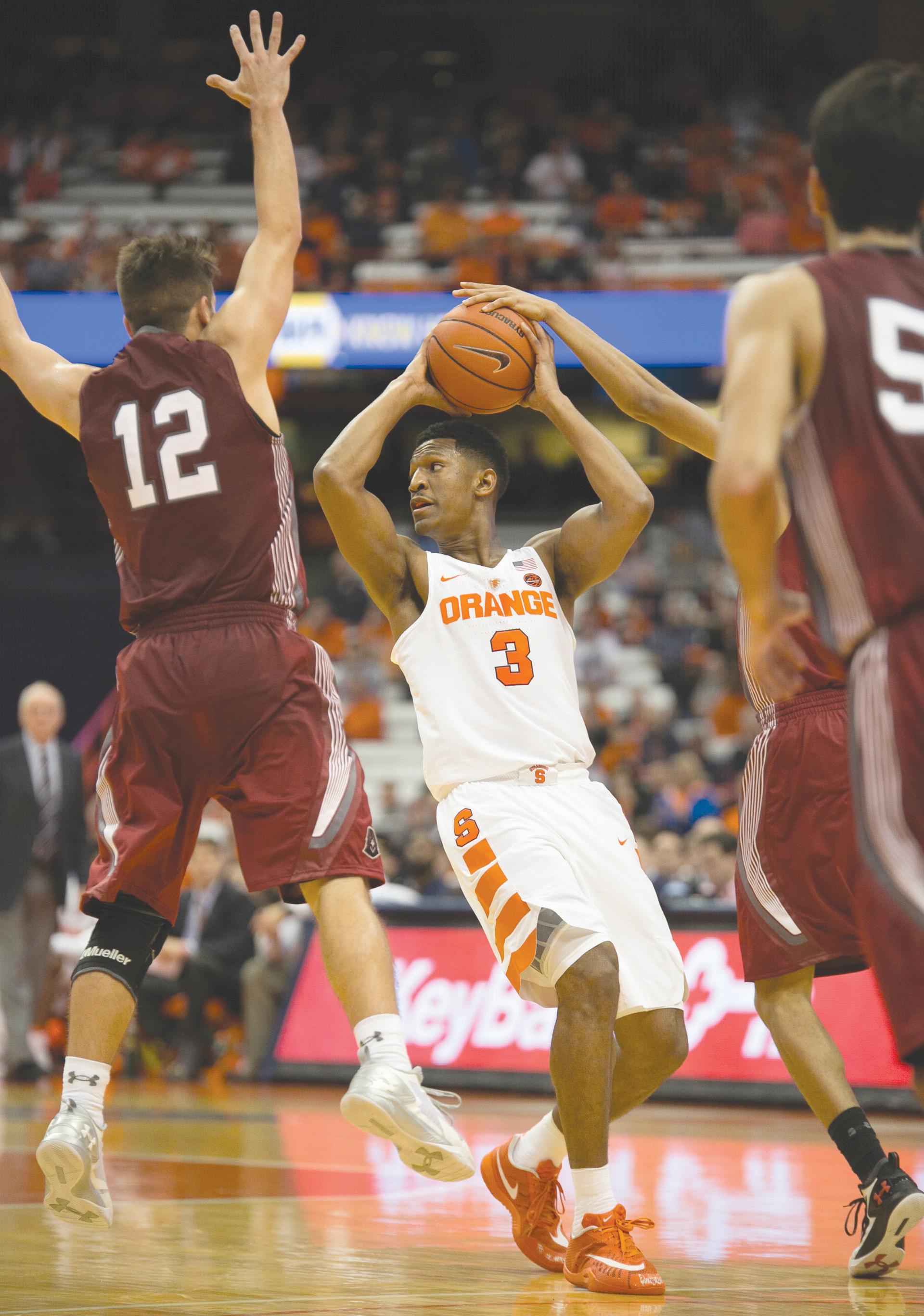
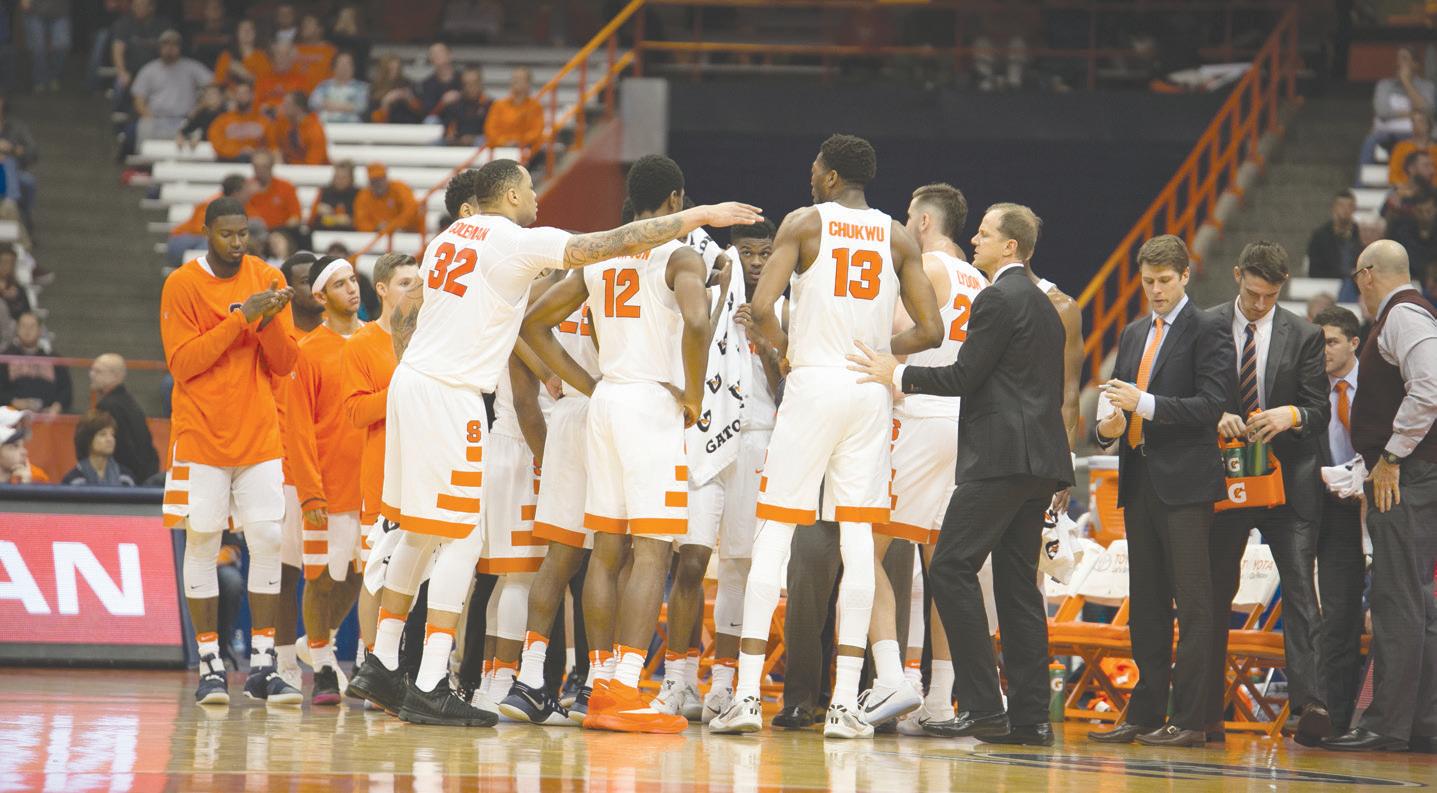
Dear Readers, Both Syracuse’s men’s and women’s basketball teams enter the 2016-17 season coming off Final Four appearances. Check out our comprehensive guide for everything you need to know about the seasons set to kick off on Friday. On the men’s side, three transfers — Paschal Chukwu, Andrew White and John Gillon — fill holes in the Orange’s lineup. On the women’s side, three returners — Alexis Peterson, Brittney Sykes and Briana Day — are poised to repeat last year’s success. Take a peek at our feature stories and follow along for our coverage throughout what’s shaping up to be two exciting basketball seasons.

Thanks for reading, Paul Schwedelson, Sports Editor

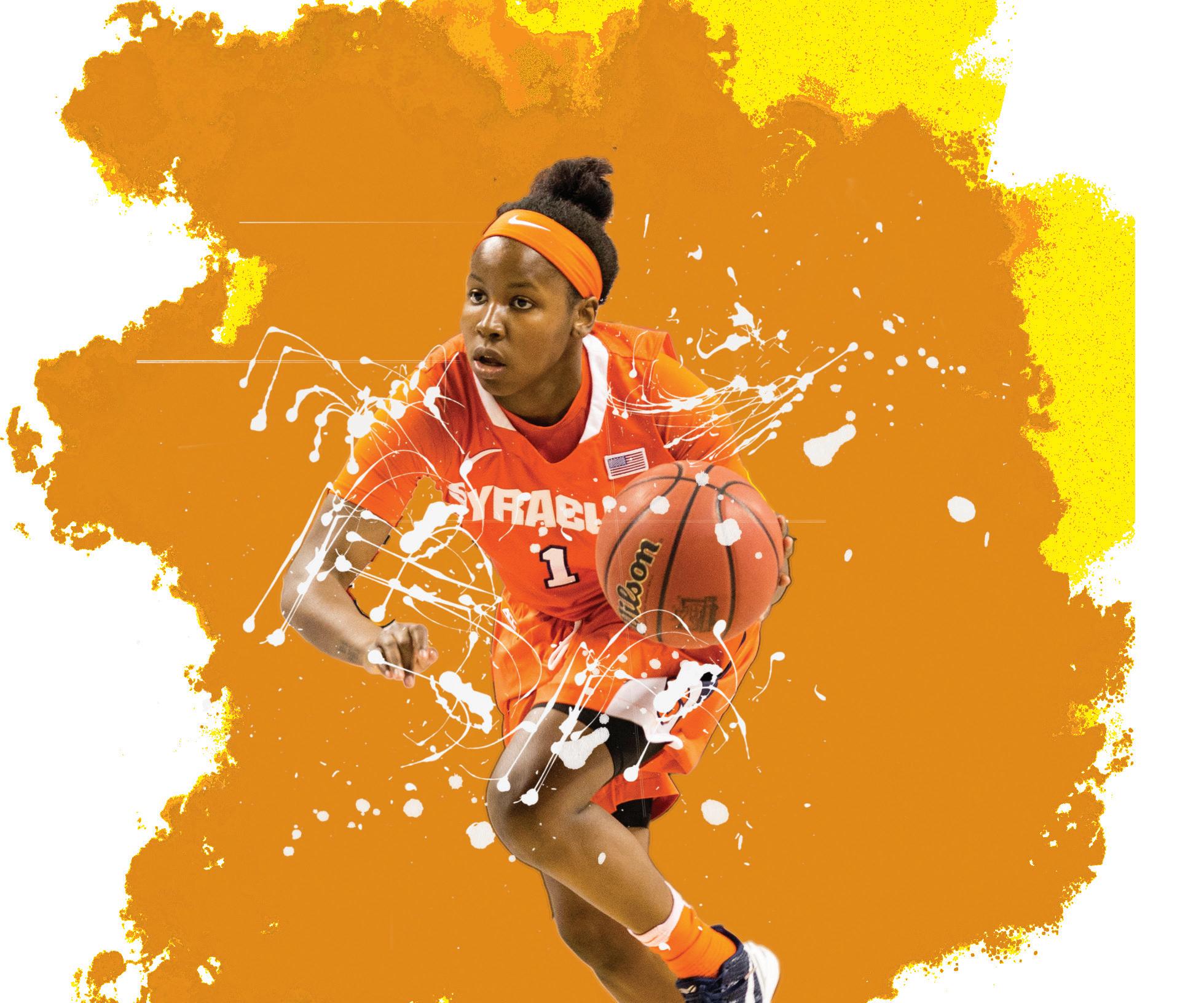
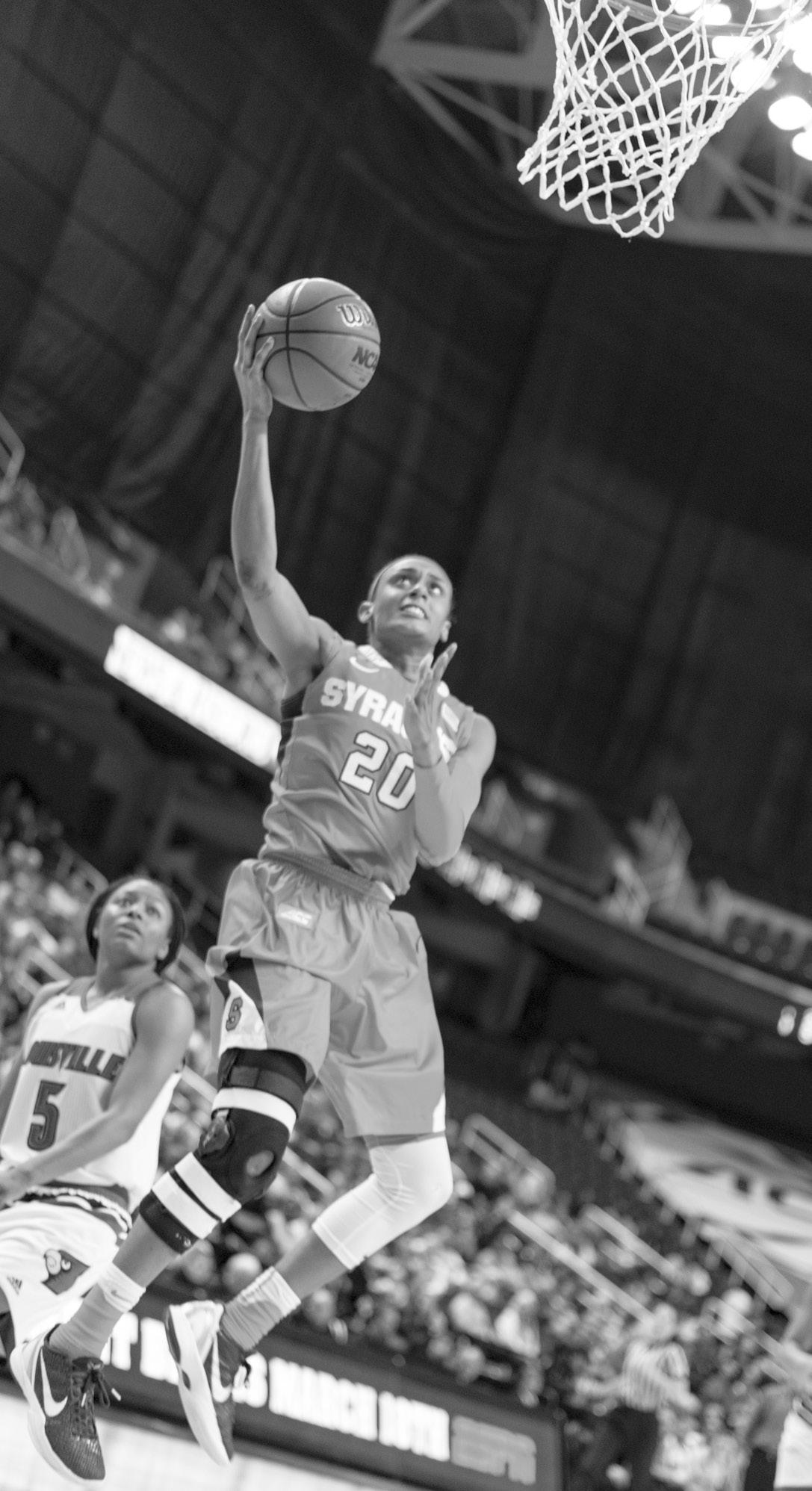
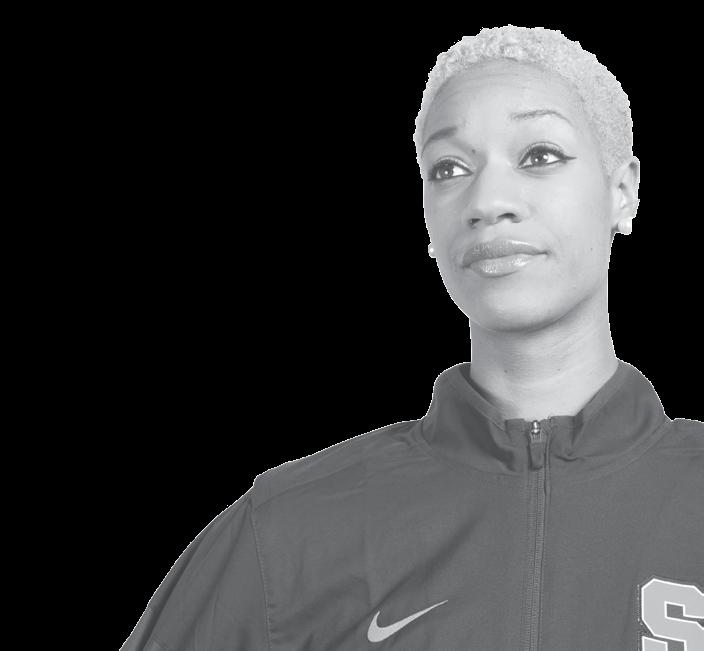
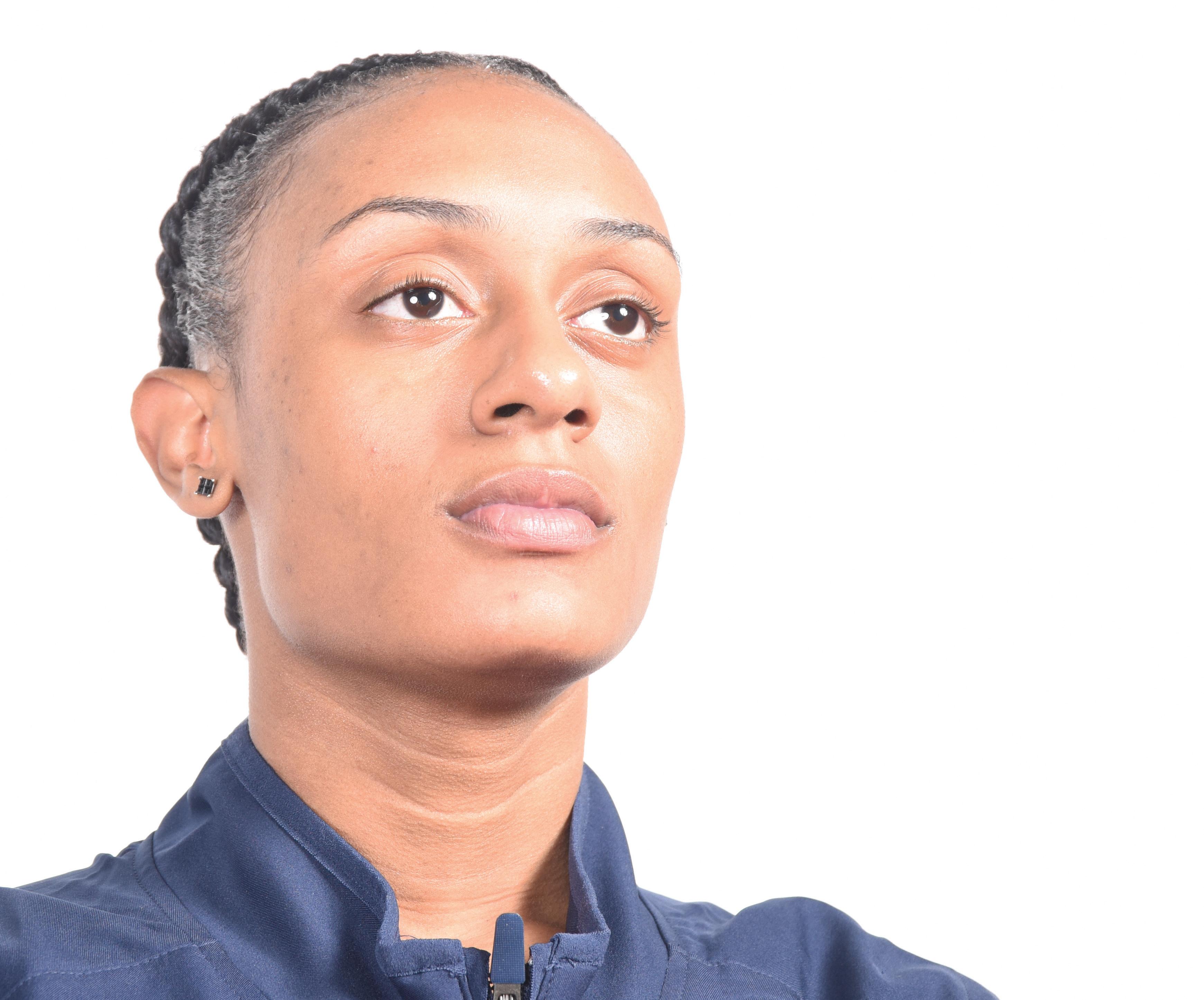
Men’s and women’s basketball cover photo illustrations and portraits by Jessica Sheldon | Photo Editor

follow us on dailyorange.com

@dailyorange facebook.com/thedailyorange @dailyorange

The Daily Orange is published weekdays during the Syracuse University academic year by The Daily Orange Corp., 744 Ostrom Ave., Syracuse, NY 13210. All contents Copyright 2016 by The Daily Orange Corp. and may not be reprinted without the expressed written permission of the editor in chief. The Daily Orange is distributed on and around campus with the first two copies complimentary. Each additional copy costs $1. The Daily Orange is in no way a subsidy or associated with Syracuse University. All contents © 2016 The Daily Orange Corporation

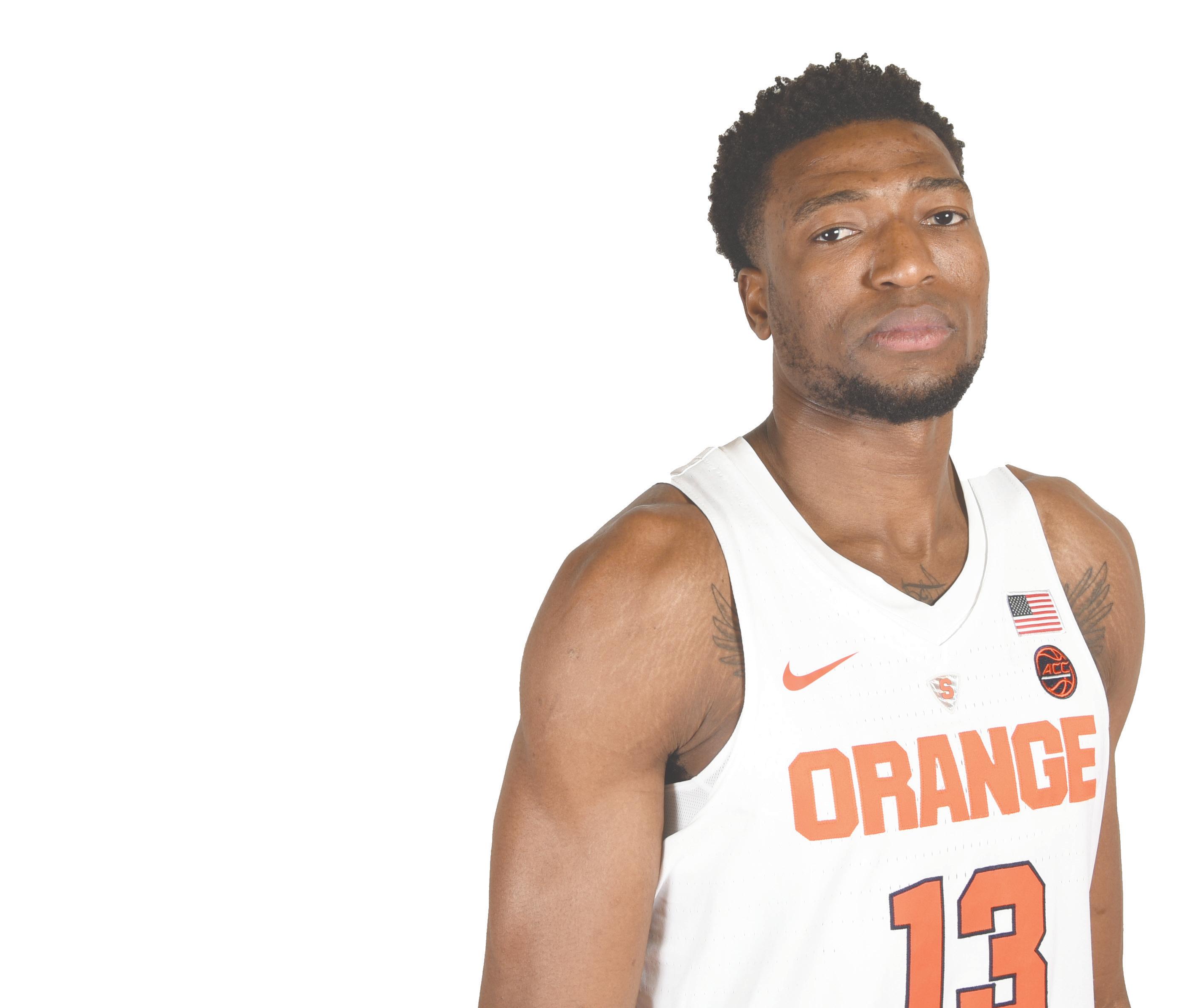
Paschal Chukwu watched in awe as a high school girls’ basketball scrimmage paced up and down the court.

The 15-year-old had never seen a game that organized, with referees, bleachers and a wooden surface. He forgot, if only for a couple minutes, that he needed a family.

He sat over 5,000 miles from his hometown of Enugu, Nigeria. All he had in Stamford, Connecticut, was a brown nylon windbreaker, an undershirt, white capris, a pair of socks, open-toed sandals, Converse sneakers and a backpack. He didn’t know where he’d sleep that night.

Dave Caputo, Chukwu’s legal guardian at the time, wanted Chukwu to live with him in nearby Port Chester, New York, but didn’t have the means to house him anymore.

Several days after settling on Trinity Catholic High School, then-school president Joe Quinn accompanied Chukwu into the gym that day. His goal: find a family that would take in this 7-foot-2 teenager while knowing next to nothing about him.

“He had no place to go, really,” Trinity Catholic head coach Mike Walsh said.

cal family member in the U.S. When they’re together, they reminisce over the “ghetto,” as Paschal calls it, that surrounded them in Enugu, but the safe haven they had in close quarters.

“Although he has family members here, like his host family, I’m like someone he grew up with,” Emmanuel said, “someone he can connect back to that African roots with.”

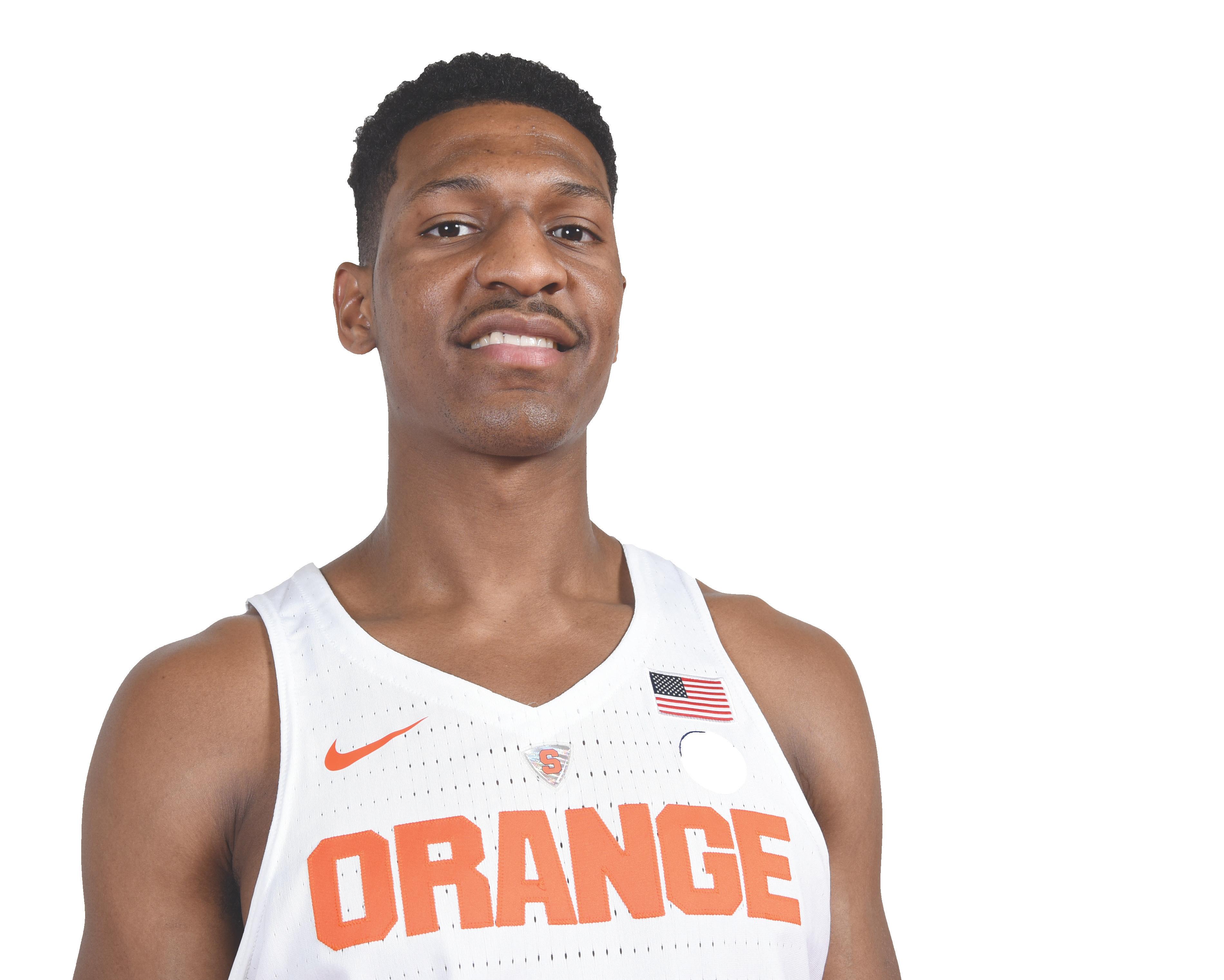
Paschal is primed for a breakout season as the tallest player in Syracuse history. He’ll anchor the middle of the 2-3 zone when he’s on the court, a task he yearned for last season when sitting out following his transfer from Providence.

Just six years ago, though, a future in Division I basketball was a pipe dream.

ALTHOUGH HE HAS FAMILY MEMBERS HERE, LIKE HIS HOST FAMILY, I’M LIKE SOMEONE HE GREW UP WITH. SOMEONE HE CAN CONNECT BACK TO THAT AFRICAN ROOTS WITH.
EMMANUEL CHUKWU pascal chukwu’s brother

It was Chukwu’s third stop on his tour of schools, and two months of the school year had already passed. He grew tired of looking and chose Trinity Catholic. Blissfully ignorant to everything around him, Chukwu had no idea where he was headed when he left.

• • •

In Enugu, the Chukwu’s hoop consisted of rebar with a slab of wood pinned to the top. When the ball hit the makeshift backboard, the wood often shifted out of place. Chukwu and his younger brother Emmanuel built the hoop themselves and played on gravel outside their house. They lived in a three-bedroom apartment in a housing compound while their tenant lived in a backyard shed. Emmanuel, 19, came to the United States in 2011 and is Paschal’s only biologi-

Paschal first came to the U.S. in the summer of 2009 for a basketball camp in Atlanta. The best players from Africa were chosen to stay. At the time, he had never consistently played basketball.

Paschal estimates 60 players attended and 50 made the cut. He wasn’t one of them.

Paschal’s coach in Nigeria, Alex Owoicho, arranged for him to fly to the U.S. for good in November 2010. The plan was to stop in Ethiopia, continue to Washington, D.C. and grab a connecting flight to Florida. Paschal’s I-20, a “certificate of eligibility for nonimmigrant student status,” placed him at Westlake Prep School in Cooper City, Florida.

Owoicho didn’t tell Paschal who would pick him up at the airport, only that someone would recognize him because of his height and that Paschal should go with them. A new life awaited, but a naive 15-year-old didn’t know what it entailed.

Before Paschal left, he gave Emmanuel 500 naira, Nigeria’s currency, equivalent to $1.59 in the U.S. The brothers embraced and Paschal said goodbye. Emmanuel didn’t know when or if he’d see his brother again.

• • •

Instead of Chukwu catching his connecting flight to Florida, he left Dulles International Airport in Caputo’s car bound for New York.

Owoicho knew Caputo personally, and improvised that plan because he wanted

Chukwu in familiar hands.

When Chukwu didn’t show at Westlake, the school contacted him via Facebook, concerned for his safety and angry that he was nowhere close. They repeatedly messaged Chukwu and eventually he ignored them. Chukwu remembers being told police searched for him in Washington, D.C. He called Owoicho, concerned and confused. Owoicho told Chukwu not to worry.

“The problem is, I had no clue, didn’t want to know what was going on,” Chukwu said. “I’m like a nonchalant person … so I just forgot about it and just lived my life.”

Chukwu wanted to settle into a high school. He visited South Kent School in Connecticut and Saint Benedict’s Preparatory School in New Jersey. Neither appealed to him, and he chose the small private school in southwestern Connecticut.

Caputo said he negotiated with Westlake to alter Chukwu’s I-20 so he could legally attend Trinity Catholic. Chukwu lived in Port Chester with Caputo and the trip from Caputo’s house to Trinity Catholic took about 20 minutes. Now, a shy 7-foot-2 teenager tried to blend in at a new school where all he did was stand out.

As Chukwu walked into the gym on that early November afternoon, Jen Featherston played in her first game since tearing her ACL a year before. Jen’s mom, Sheila, worked with the school’s parent teacher association and Quinn knew the family fairly well from his two months as school president.

While the scrimmage occupied Chukwu’s attention, Quinn approached the Featherston’s father.

Hey, I need to talk to you.

“That night, we ended up taking him home with us,” John Featherston said, “because he had no place to stay.”

• • •

Inside the local Big & Tall luxury clothing store, Chukwu towered over John and spoke in a whisper.

Could I get shoes?

Before heading home with the Featherstons, Chukwu added a second set of clothing to adhere to Trinity Catholic’s dress code — a blazer, khakis, button-down shirt and, lastly, a pair of dress shoes. The Featherstons heard him giggling in the dressing room while trying on clothes that were vastly different from anything he’d ever worn.

On the ride home, Chukwu remained silent in the back seat of John’s Audi A6. Chukwu knew nothing about the family whose home he’d sleep in or how long he’d be there. That night, Sheila cooked chicken and rice since it was one of Chukwu’s favorite meals in Nigeria. Even if it was going to be only one night, the Featherstons wanted Chukwu to feel at home.

“We were just hopefully doing the right thing,” John said.

Chukwu stayed in Ray Featherston’s room but barely spoke (Ray is now a freshman walk-on for Syracuse). Chukwu slept with the

lights on because he was nervous and struggled to establish a consistent sleep schedule with a five-hour time difference between Nigeria and Connecticut. It took only a week for Chukwu to call Sheila “mom,” but he wasn’t as comfortable outside the house.

The Featherstons visited New York City for Thanksgiving in 2010, and Chukwu became the center of photo shoots on the streets. Every time someone asked his height, Ray answered. Eventually, the Feathertson sisters yelled at strangers to leave him alone. One time, Chukwu caused a minor accident when he turned left without the right-of-way. Police officers asked him to pose for a picture after they were done at the scene.

“At the beginning, he did not like that one bit and he would kind of look away and not acknowledge,” Sheila said. “We had to teach him that, ‘You are different. You are gonna get the looks.”

After school on Fridays, Jen drove Chukwu 20 minutes to Rye, New York, so he could play for the AAU team Caputo was associated with. Chukwu stayed there until Sunday night, when Jen brought him home in time for school the next morning. Chukwu hated playing basketball for two full days.

During the week, John sat down with Chukwu at the kitchen bar and went through his grades, comparing them to NCAA requirements. The Featherstons taught him how to shake hands and look someone in the eye at social gatherings. Family competitions in table tennis and the FIFA soccer video game cultivated a sense of family for Chukwu even though the Featherstons still weren’t his legal guardians.

“I always wanted a little brother and then I got Paschal,” Ray said. “And I was like, ‘Wow, this is even cooler than a little brother.’”

Chukwu told Ray he wanted to play in the NBA, but Ray said it wasn’t possible. Chukwu struggled to make a layup or even dunk on the Featherston’s real-size indoor basketball hoop.

During his first varsity game with Trinity, the referee repeatedly told Chukwu to “get out.” At the next timeout, he asked his coach why the referee wanted him out of the game, when the referee was just warning Chukwu about a three-second violation.

He gradually assimilated to a new life off the court while his interest in basketball dwindled. Chukwu still had the Featherstons, but even that faded.

• • •

Tears streamed down Chukwu’s face as he packed his bags.

Just several days prior, John Featherston received a phone call from a man named Derrik Riullano, who said he was assuming guardianship of Chukwu. Chukwu’s biological father signed off on the switch, the only signature needed to make the change official, but Riullano said Chukwu could still live with the Featherstons.

Now, Riullano was calling again to tell John that Chukwu had to move out without explanation. Ray, distraught, stood on a side table so he could reach a window to watch Chukwu leave after his four-month stay. The Featherstons couldn’t do anything about it and neither could a sobbing Chukwu. Riullano declined comment for this story.
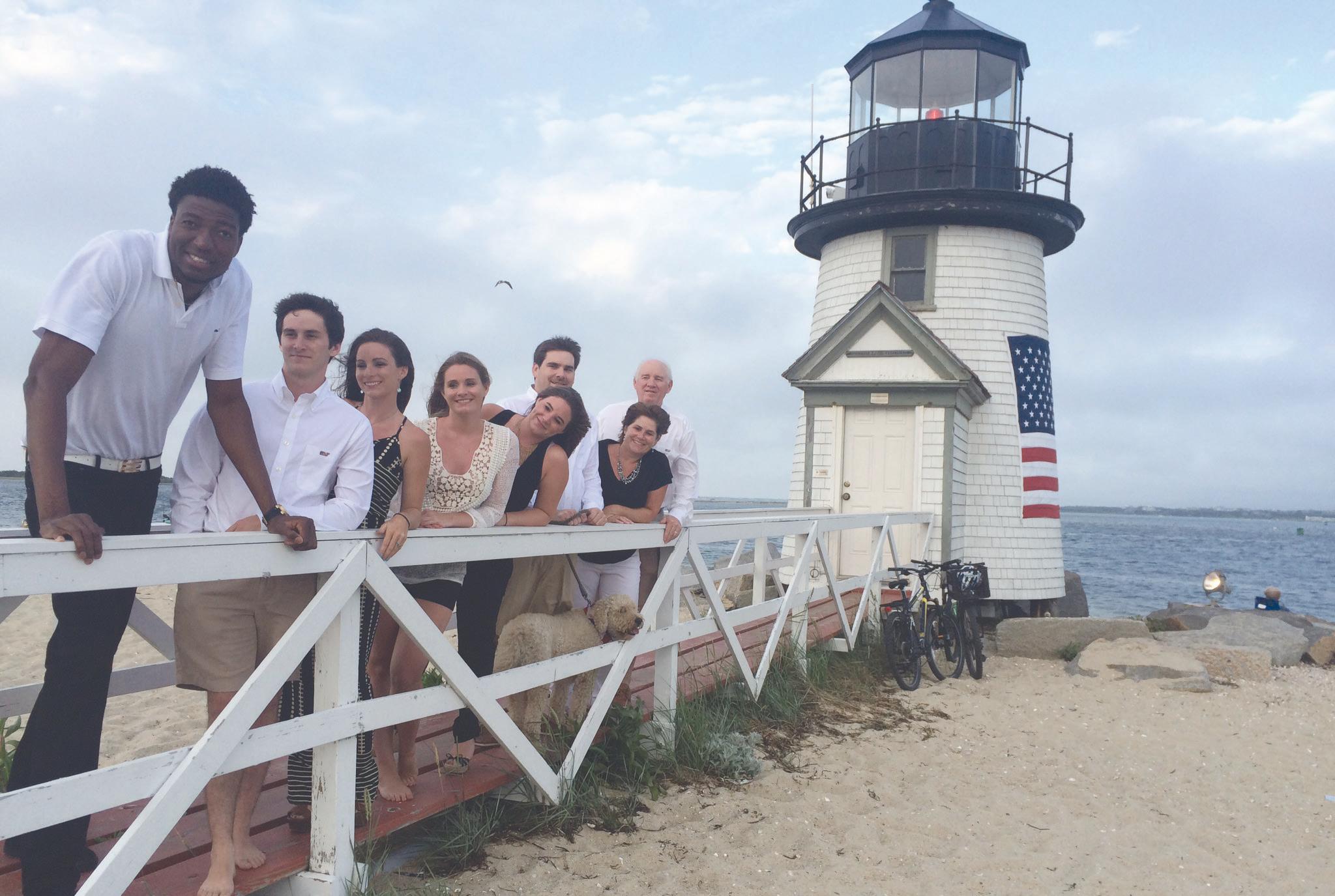
The Featherstons didn’t know if he would ever return. They feared for his grades and college eligibility. He had already lived in two different homes and was thrust into yet another unfamiliar environment.

Riullano, according to Chukwu, didn’t have the means to house him and sent Chukwu to live with a friend named Paul Staubi in Rye. Chukwu took the local train to Stamford, where he bussed to school. He was late almost every day because of the long commute and Quinn was afraid Chukwu would fail out.

He played for AAU teams he doesn’t remember the names of — ones that temporarily needed a 7-foot-2 presence. While he lived with Staubi, Chukwu never talked with the Featherstons.

“I wasn’t happy in a way,” Chukwu said. “They cut off my communication with them and everything.”

In mid-April, Chukwu finally texted Sheila. Mom, can I talk to you?

The two met in a classroom at Trinity Catholic, away from the people who didn’t want Chukwu talking with the family he actually wanted to be with. In mid-May, Chukwu’s biological father signed off on one more switch. The Featherstons allowed him to finish the AAU season in July before he moved in with them for good.

“He wasn’t 7’2” that day,” said Quinn, who drove an ecstatic Chukwu from Rye back to the Featherstons. “He was almost 8’3” because he was walking off the ground.”

The Featherstons placed Chukwu on a Connecticut-based AAU team with Ray. Head coach Dan Donnelly, who coached Chukwu in 2011 and 2012, was the first to teach him Xs and Os and make him feel like part of a team.

When Chukwu did dribbling drills, everyone did, even though they were all fundamentally superior. It made Chukwu feel like he mattered, and he bought in.

He transferred to Fairfield Prep in Connecticut for his last two years of high school, and that’s where he finally started to have fun playing basketball. Chukwu solidified his academic standing to ensure college eligibility.

“The Featherstons…they really saved him,” Syracuse head coach Jim Boeheim said. “They really gave him stability.”

• • • Chukwu and Chinonso Obokoh embraced and began talking in their native language.

To Syracuse assistant coach Mike Hopkins, the two resembled long-lost brothers reunited when they met on Chukwu’s unofficial visit to Syracuse two summers ago.

Chukwu won’t elaborate on why he transferred from Providence after one year and chose SU, but he does heavily credit Obokoh, the former Orange center. The two are from the same Nigerian tribe, and Obokoh made Chukwu comfortable with yet another move.

On a personal level, Chukwu adapted to change like he had multiple times before. Now he needed to transform as a player. At one preseason practice last year, he lowered the ball below his neck and had it stolen. Boeheim yelled at Chukwu that he had 13 months to figure it out.

Chukwu couldn’t travel with the team or

stacking up

Chukwu played fewer than 10 minutes per game in his freshman season at Providence, posting underwhelming numbers 9.9

dress for home games last season because of NCAA transfer rules. During away games, he watched intently in his South Campus apartment and envisioned himself in certain situations. When he jumped up in tense moments, he nearly hit his head on the ceiling.

His offensive repertoire is a work in progress, but a 7-foot-2 presence in the middle of the zone defense is something Syracuse has never had.

“He’s had some really good days in practice,” Boeheim said, “but he’s got a lot of work to do.”

This season is Chukwu’s next test. He has never shied away from an obstacle, because just getting to this point has been one.

“It’s the courage, being able to adapt,” Hopkins said. “I think all those experiences will just help him get to where he’s gotta get, to where he wants to get.”

Chukwu wants to eventually make enough money playing basketball to bring his family to the U.S., but a visit home isn’t an option at this point because of violence in Nigeria. His home in Connecticut for the better part of six years now is a luxury compared to the threebedroom apartment in Enugu.

The Featherstons have an immense yellow house with a pristine patio behind it. Inside, a slim white door opens to a spiral metal staircase that leads to an indoor basketball court. The house is tucked in the back-right corner of a private road away from the commotion of traffic. His life in Connecticut, let alone his basketball career at Syracuse, is hardly what Chukwu envisioned when he stepped off the plane in Washington D.C. six years ago. When he didn’t know who would call his name. When he didn’t know where he was going. When he just went along with it, because that was his only option. He struggles to muster the words to describe what it means to be sitting in a state-of-the-art practice facility half a world away from the gravel courts of Nigeria.

But he’s here now. And if the past is any indication, there’s no telling what’s next. mcschnei@syr.edu | @matt_schneidman

PASCHAL CHUKWU was taken in by the Featherston family. Ray Featherston is now a freshman walk-on for the Syracuse. courtesy of the featherston family
PASCHAL CHUKWU came to the United States with not much more than a few articles of clothing, sneakers and a backpack. courtesy of the featherston family
Andrew White brings consistency and experience to Syracuse in final year of college career

The unknown doesn’t faze Andrew White, but he likes sticking to what he knows. That means whipping up a plate of white rice and tilapia when he can, trying mightily to avoid the perils of fruits and vegetables. When he returns home to Richmond, Virginia, that means he’s not long to endear himself again to his five pet turtles.

And on the basketball court — the only location in the last four years he can soundly call home — sticking to what White knows means progressing through the same routine before every practice and game. He throws on compression boots and dips into an ice bath after working out on game days. He’s one of the first to arrive to practice, stretching on his own before looping himself into shooting drills with the other guards.

Now the fifth-year senior wants to dispel any notion that he might be a damaged good, or that he’s unable to integrate himself into the culture of a new team. White’s temperament appears to weave seamlessly into the fabric of an SU team inexperienced with one another, a team that will lean on White for the consistency that’s eluded his career.

“He’s a pro player, a pro person,” Syracuse assistant coach Mike Hopkins said. “The way he approaches everything. He’s humble. He’s respectful.

“
HE’S A PRO PLAYER, A PRO PERSON... EVERYTHING THAT YOU’D WANT YOUR SON TO BE.

Much like everything else with White, there aren’t any frills to it. He features the diligence and discipline of an aged soul, caged inside the freakishly athletic body of a 23-year-old, 6-foot-7 basketball player.

“I like for things to be consistent,” White said, “so that’s kind of how I am, generally. Just doing something that I’m familiar with.”

But the biggest constant in White’s college career has been change. Tangled in his web of consistencies is a U-Haul truck and a trio of collegiate jerseys. White wears the scarlet letter of being a double transfer, spending two seasons each at Kansas and Nebraska before selecting Syracuse as his third and final home.

“Everything that you’d want your son to be.”

White’s decision to leave the Cornhuskers after withdrawing from the NBA Draft last spring was highly publicized, and even more scrutinized. The ensuing 62-day race for White’s services only amplified that. Finally, it was SU that emerged as White’s landing spot after weeks of jockeying with Miami, Michigan State and Virginia Commonwealth.

White’s addition to the Orange is integral given that the team is without its three top scorers from last season. Nebraska’s year ended in the Big 10 tournament. White led the Cornhuskers with nearly six rebounds per game and finished second on the team with 16.6 points per game. While Syracuse kept its season alive, White decided his days at Nebraska were numbered.

On last year’s SU squad, White’s 16.6 points per game would’ve placed second to only Michael Gbinije’s 17.5. So even without playing a single minute in an Orange jersey, White stands as SU’s most proven scoring option on a team without Gbinije, Trevor Cooney and Malachi Richardson.

1.

4. TREVOR COONEY 12.9 points per game

5. TYLER LYDON 10.1 points per game

6. TYLER ROBERSON 8.7 points per game

“Every time I get to shoot against him,” sophomore see white page 6 the point

Despite averaging fewer minutes per game than six SU players last year, Andrew White’s 16.6 points per game would have been second only to Michael Gbinije on last year’s Syracuse team
MICHAEL GBINIJE 17.5 points per game 2. ANDREW WHITE 16.6 points per game 3. MALACHI RICHARDSON
points per game
Andrew White led Nebraska in scoring in half of the 34 games he started last season
Number of points Andrew White scored in his last collegiate game at Nebraska, a Big 10 quarterfinal

Tyler Lydon said, “he just pushes everyone to get better.

“Especially a shooter. He can really shoot the ball.”

Lydon and White have been known to engage in “crazy” shooting competitions, ones that White said you can’t keep up in unless you’re shooting 90 percent. White’s calling card has always been his jump shot, but just in the last few months at Syracuse, it’s end-of-practice free-throw competitions where he’s truly made a name for himself.

The parameters are pretty straightforward: Everyone needs to make consecutive free throws for practice to end. When White stepped up to the line several weeks ago, he remembers forward Doyin Akintobi-Adeyeye bark out, “Come on, Uncle Drew!”

With smiles spread across their faces, teammates say the moniker, still permanently affixed to White, is a testament to his maturation, and of course, his age. Fellow fifth-year, double-transfer senior John Gillon even gets in on the name-calling, and Jim Boeheim brought it up in his Atlantic Coast Conference Media Day press conference.

All that lauded experience has given White enough perspective to laugh off his teammates’ jabs. He’s found the silver lining in the back-handed compliment.

“I’ve always had the temperament of an old man, so I’ve always been Uncle Drew,” White said. “It’s kind of crazy. I try to say, ‘That’s not me, I don’t act like that.’

“But everywhere I’ve been, everybody kind of picks up the same vibe from me.”

The news doesn’t evoke any bit of surprise in White’s father, Andy White, who said his eldest son has long displayed the maturity of someone beyond his years. White grew up a “babbler,” Andy said, but spoke less as he grew.

Admittedly, White is one of the quieter heads in Syracuse’s locker room. Among plenty of young, boisterous personalities, White limits most of his talking to moments he can push the group to a consensus.

He speaks deliberately, enunciating each word with a drip of his southern drawl.

There’s no irregularities or built-in space for “um’s” or “uh’s.” White disseminates the message he wants to, speaking comprehensively about others in addition to himself.

“If you didn’t know he was a twentysomething-year-old kid,” Andy White said, “you’d probably think otherwise.”

Almost as if he were a coach or recruiting coordinator, White’s vast experiences over just four seasons have left him with enough scenarios and anecdotes to relate to every teammate that comes his way.

Like three other players on the roster, White transferred to SU. Like Paschal Chukwu, White sat out for a year after transferring from Kansas to Nebraska. Like Tyus Battle, Matthew Moyer and Taurean Thompson, White was once a touted freshman after being labeled a top-100 recruit.

For those that don’t share a biography line with White, he’s unafraid to open up about himself. About his pregame routine, his tilapia and rice lunch, and of course his beloved turtles: Miller, Dame, Mo, Tre and Turtle.

“If you want to be a college athlete, you want to be Andrew White,” Matthew Moyer, one of Syracuse’s handful of first-year players, said. “… I don’t give people respect like that.”

Four days before Syracuse’s first exhibition tips off, White is sitting in a chair being interviewed by a local television station at the

Carmelo K. Anthony Basketball Center. He dispatches long-winded answers about his upbringing and wanting to play college basketball. He looks ahead to this season, trying to repeat the magic of last year’s run through March.

When White finishes, the reporter shakes his hand and exclaims, “You’re a pro! That was really impressive.” White smiles, accepts the compliment he’s heard plenty of times before and heads off to his next media obligation.

Three schools later, almost five collegiate basketball seasons later, he’s done all this before. What he really hasn’t done is fit, and Syracuse is his last shot to prove he can — that a career marred by movement can be stabilized in one outstanding season.

“I’m trying to be a testament that everybody who double transfers isn’t crazy,” White said. “That everybody who double transfers isn’t running from something.

“You’re just trying to navigate what the best path for you is.”

cgrossma@syr.edu | @connorgrossman

ANDREW WHITE hasn’t had many constants in his life outside of basketball. The twotime transfer is hoping to bring his steady, mature play and personality to strengthen Syracuse and help it go on another run. liam sheehan staff photographer
Andrew White’s accuracy behind the arc improved markedly last year compared to his first two seasons at Kansas

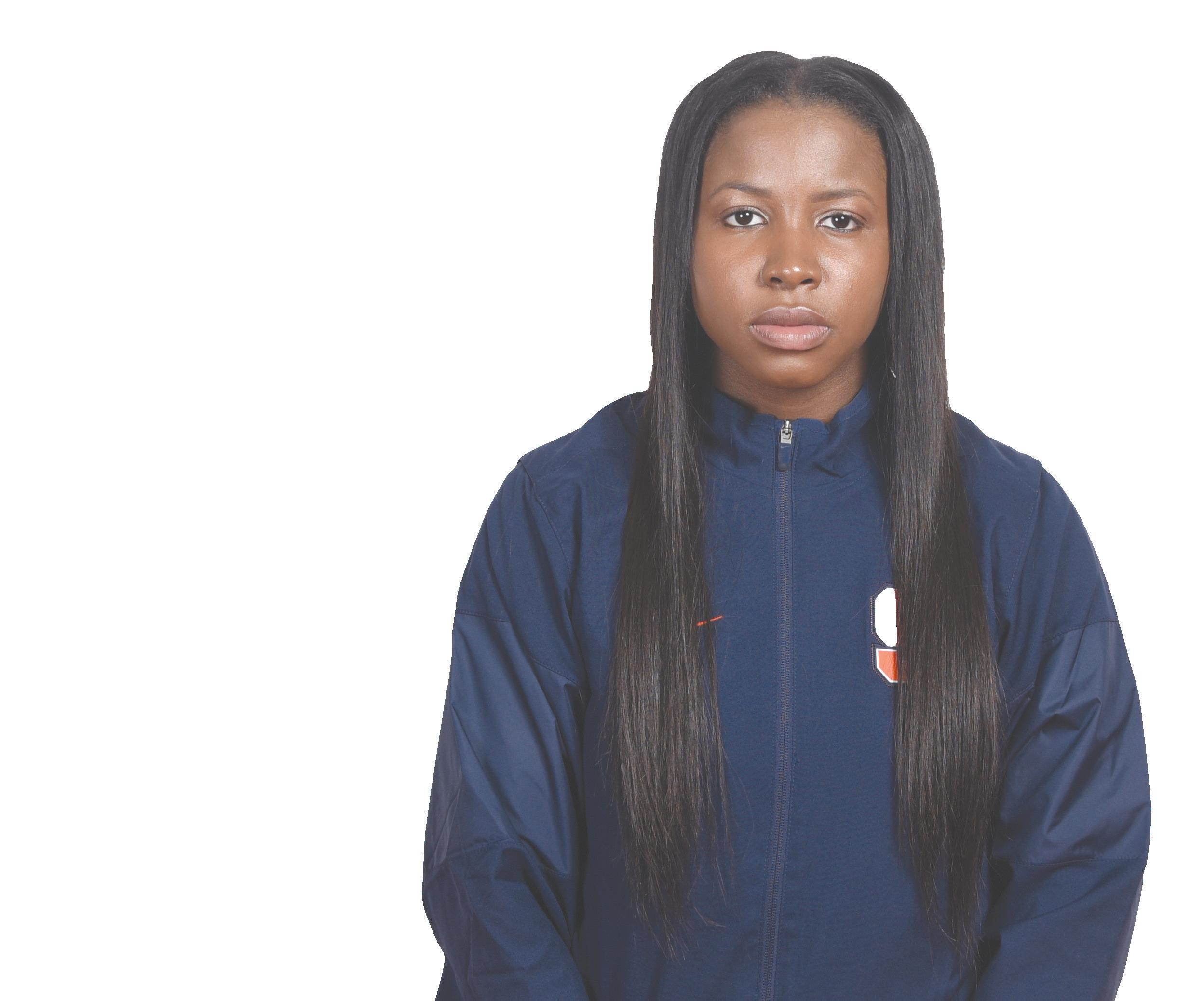
All of a sudden, John Gillon faded in and out of consciousness. His right arm had been swelling over the past couple days and doubled its normal size as he sat in his sixth grade classroom.

Gillon couldn’t bend his right arm because a cyst formed between his elbow and shoulder. If anyone touched his arm, Gillon said it felt like he was being stabbed.

His mom, Phyllis Gillon, rushed him to the pediatrician and then to Texas Children’s Hospital in Houston. John was diagnosed with a staph infection, which developed into MRSA, and the cause was unknown. As the infection spread to his hip, he underwent emergency surgery and spent the next eight days with Phyllis in the hospital.

“John almost died,” Phyllis Gillon said.

“John shouldn’t be here.”

On one night, at least two patients on John’s floor died of MRSA. Fearing he’d suffer the same fate, John forced himself to stay awake.

“Knowing that you’re close to death makes you value life more,” John said. “It makes you have a certain appreciation for life and the opportunities that I have.”

Nine years later, the next opportunity for Gillon is his final season of eligibility at Syracuse. He transferred from Arkansas-Little Rock to Colorado State after his freshman year and from Colorado State to SU after three years, including a redshirt season. He’s finally entrenched in a nationally relevant program that he’s longed to be a part of.

Gillon’s developed a knack for bettering nearly every situation he’s been in. The 6-foot point guard has been shaped by the let downs he’s faced and still plays inspired by the ones who have counted him out. From surviving the MRSA scare to not making his junior varsity team as a freshman in high school to only receiving less than a handful of Division I offers, Gillon kept climbing.

Syracuse head coach Jim Boeheim compared him to former SU point guard Jonny Flynn, who was also 6 feet, physical, strong and able to get to the basket. But Gillon’s still aware of the naysayers: He’s still

John Gillon’s 13.2 points per game last season would have ranked third on Syracuse behind Michael Gbinije (17.5) and Malachi Richardson (13.4)

an unknown. He hasn’t proven himself against top competition. His size leaves him at an inherent disadvantage against bigger guards.

“All I’ll say is just, if you really think I’m too small, just come guard me,” Gillon said.

JOHN ALMOST DIED. JOHN SHOULDN’T BE HERE.

PHYLLIS GILLON

john gillon’s mother

In high school, Gillon would wake up at 5:30 a.m. and put up hundreds of shots at a local gym before school started. Until that point, Gillon was just a spot shooter. He struggled dribbling and would get trapped in the corners of the court. He told his mom that he wanted to get better.

YEAR/SCHOOL

Gillon didn’t have a license so Phyllis would drive him. On the days he wouldn’t want to go, she’d tell him, “It’s gonna pay off one day.”

“If you’re not going to do it to the best of your abilities, don’t even waste my time,” Gillon’s AAU coach, Jawann McClellan, remembers Phyllis Gillon telling her son.

In eighth grade, Gillon didn’t start on his middle school team. In his freshman year at Strake Jesuit (Texas) College Preparatory, Gillon didn’t even make the junior varsity team and started at point guard on the freshman squad. Players filled spots ahead of him and Gillon needed the reps. Still, it irked the undersized guard.

During the summers after his sophomore and junior years, Gillon played AAU for Houston Hoops. But the team didn’t have a high-profile sponsor meaning he received significantly less exposure than other players.

Gillon was named first-team all-district his junior and senior year. The accolades didn’t matter, though. Recruiters looked at his size and dismissed him. Coaches gave him letters for Division II and Division III schools.

“I wouldn’t even open them,” Gillon said. “I would be like, ‘I’m not going to that. I’m going to Division I.’

But Gillon still knew not to take what he had for see gillon page 8
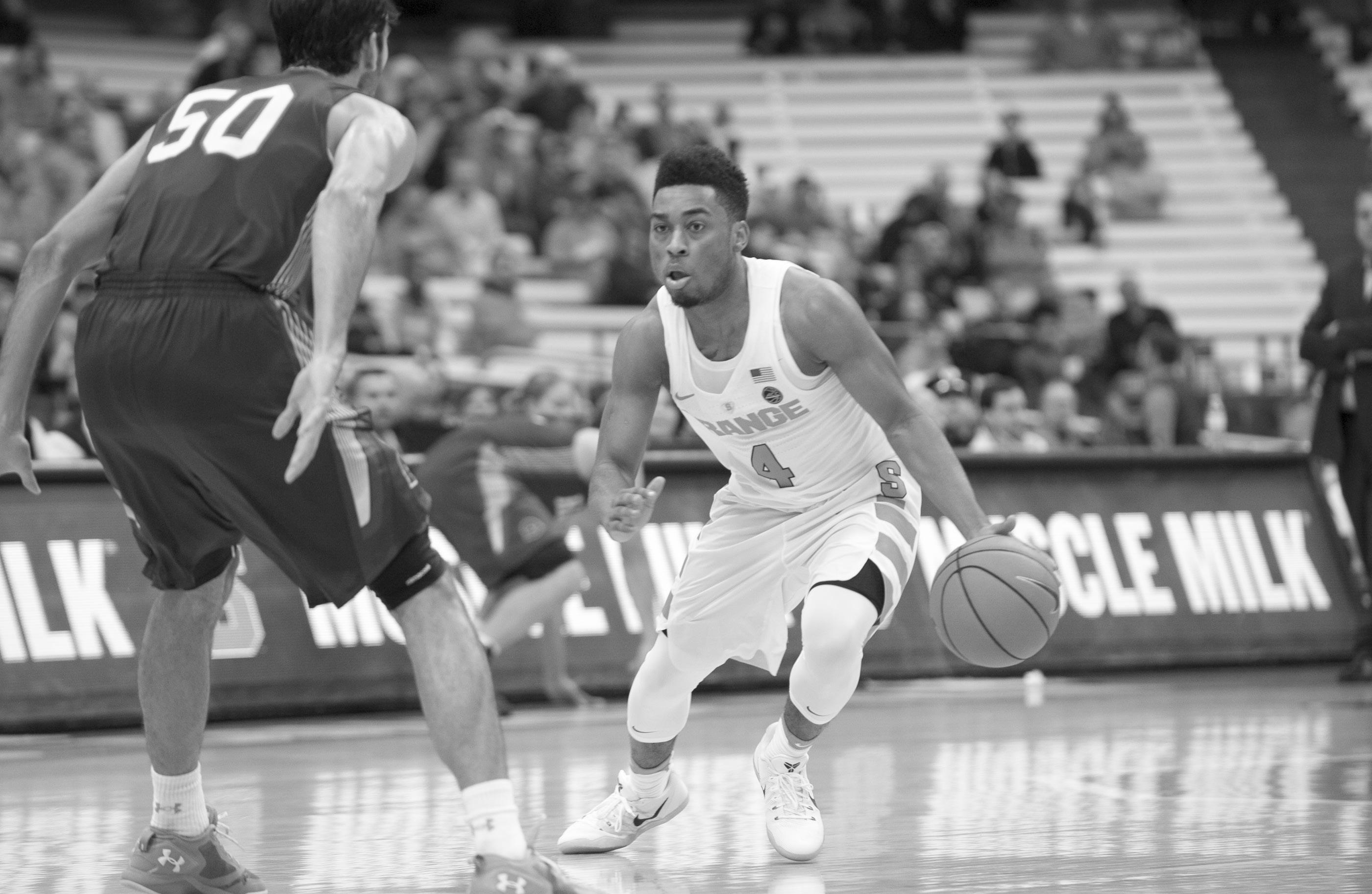
JOHN GILLON didn’t make his junior varsity team as a freshman in high school and didn’t get many Division I offers. He felt that the level of competition at both his previous schools — Arkansas-Little Rock and Colorado State — wasn’t strong enough, and that’s partially why he transferred to Syracuse.

from page 7 gillon getting buckets

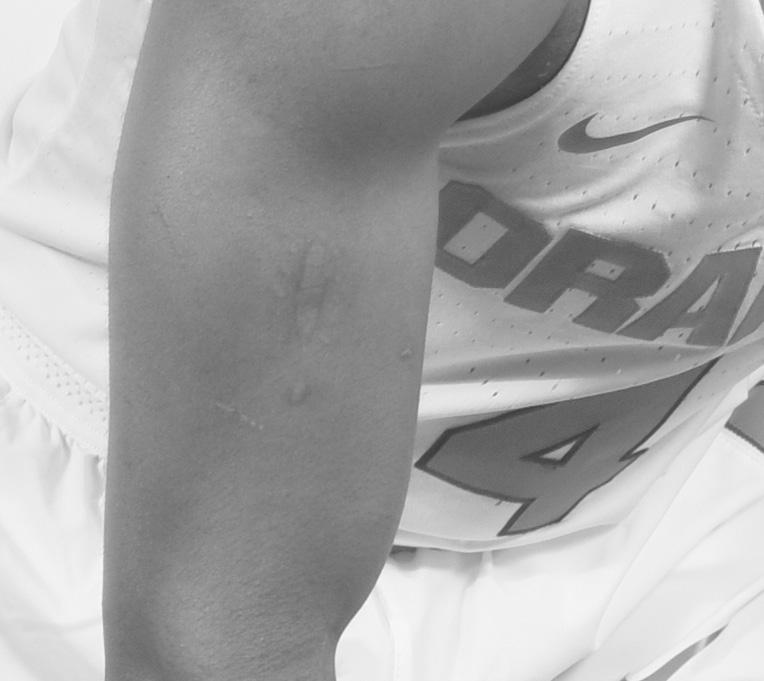
granted. That’s a lesson he learned years earlier when his life was on the line. A scar on his right arm was a reminder.

After the eight days he spent in the hospital in sixth grade, Gillon had to receive medicine through a port in his chest every eight hours for six weeks. The scheduling had to be impeccable: Right before school, right after school and around midnight.

The process was a challenge. Gillon hated being away from the court. While he still couldn’t unbend his right arm for several weeks, Gillon practiced dribbling and shooting with his left hand.

“A determination to live and let no one define his truths,” Phyllis Gillon said of how the experience shaped her son. “No one will tell him what he cannot do.”

As a high schooler, coaches told Gillon he’d never be a contributor at a highprofile program. He’d never play in a Power 5 conference. He’d never play Division I.

points and 3.8 assists, providing a dynamic spark to CSU’s offense.

That’s what set him up for the opportunity he never had out of high school even though he didn’t know it yet. When Gillon requested his release from Colorado State, he wasn’t sure how many schools, and at what level, would come calling.

He didn’t leave Colorado State on bad terms, Gillon said. With professional hopes in mind, he simply thought he could maximize a rule that allowed him to transfer and play immediately at a higher-profile school.

His family prayed the move would pay off since another year at Colorado State wasn’t a bad alternative. But once he got his release, there was no turning back. Forty schools came clamoring for Gillon’s talents, those of a fifth-year senior who’s seen the highs and lows of college basketball.

NO ONE WILL TELL HIM WHAT HE CANNOT DO.

PHYLLIS GILLON

But Gillon worked his way up the college basketball ranks, elevating and removing the ceiling atop his career with each transfer he made.

As a freshman at Arkansas-Little Rock, Gillon started 12 games, averaged 10.6 points and led the Sun Belt Conference with an 81.7 free-throw percentage. At the end of the year, he decided to transfer because he knew he could play at a higher level.

After a breakout game during his redshirt sophomore year at Colorado State, he texted McClellan, his coach on Houston Hoops.

“Coach, it’s kind of easy,” Gillon wrote in the message, McClellan recalled. That’s when McClellan realized Gillon could one day make it on a bigger stage.

Later that season, Gillon went on to win Mountain West Sixth Man of the Year. In his redshirt junior year, he averaged 13.2

“I really had to apologize to him,” said John’s father, John Gillon, who wasn’t expecting that much interest.

Gillon narrowed his top three to Syracuse, Oklahoma and Texas A&M and eventually chose SU. Earlier in his career, he didn’t have much of a choice. With one season left, he had the chance to be selective.

At Orange Madness, Syracuse’s preseason pep rally on Oct. 21, SU’s returners received their Final Four rings from last season. Gillon looked into a camera, held up both hands and wiggled his fingers.

“I gotta get one of my own,” Gillon said. “I’m naked out here.”

As rapper Jadakiss performed one last song to end the event, Gillon stood next to him with the SU team surrounding them at halfcourt. He tilted his head back and gazed up at the ceiling as his eyes widened.

“John likes the lights on,” Phyllis Gillon said. “And he believes this is his stage.” pmschwed@syr.edu | @pschweds

87.9%

Gillon ranked first in the Mountain West Conference and 16th nationally in free-throw percentage last season

john gillon’s mother
liam sheehan staff photographer
JOHN GILLON had a near-death incident when he was in the sixth grade and has a scar on his right arm as a reminder. He transferred to Syracuse to gain more exposure and to play for a more nationally-relevant program. jessica sheldon photo editor
John
3.9
John Gillon averaged 3.9 assists per game last season for the Rams. That would have ranked second on the Orange, behind just Michael Gbinije’s 4.3 helpers per contest.

BEAT WRITER PREDICTIONS

MEN’S BASKETBALL

CONNOR GROSSMAN

Regular Season Record: 22-9

NCAA Tournament Finish: Sweet 16

Team MVP: Tyler Lydon

X-Factor: Andrew White

In supposedly the penultimate season of his career, Jim Boeheim faces the challenge of meshing his most diversified roster in years. Returning starters will share the floor with fifth-year transfers and first-year players. This melting pot of experience will not mix perfectly together, and Boeheim may not fully figure his team out until a few weeks of conference play. But there’s undeniable talent, from a budding star in Tyler Lydon to dynamic freshman Tyus Battle. Nebraska transfer Andrew White needs to help Lydon fuel the offense, and SU will survive long enough to tease a deep run into March.

MATT SCHNEIDMAN

Regular Season Record: 24-7

NCAA Tournament: Sweet 16

MVP: Tyus Battle

X-Factor: Paschal Chukwu

On paper, Syracuse has a far better chance to reach the Final Four than it did last season.

The Orange has more pieces to help it get there, and a 24-7 regular season will set SU up for a No. 3 or 4 seed in the Big Dance. Paschal Chukwu, all 7 feet, 2 inches of him, proves to be Syracuse’s X-factor by anchoring one of the country’s best defenses from the middle of the zone. This year, though, the Orange’s run ends in the Sweet 16 and team MVP Tyus Battle has a tough decision to stay in school or enter the NBA Draft.

PAUL SCHWEDELSON

Regular season record: 23-8

NCAA Tournament Finish: Sweet 16

MVP: Tyler Lydon

X-Factor: Tyus Battle

Jim Boeheim will have the chance this year to go four or even five deep on the bench, allowing Syracuse to be more flexible in its schemes. Expect to see more full-court pressing and more transition offense. The most indispensable player on the team will be Tyler Lydon, who can play either forward position and center based on the lineup surrounding him. Boeheim said he’s “probably” the only player he’s coached that has done that. Likely coming off the bench will be Tyus Battle, who has already shown in exhibitions he can provide a spark. How SU’s new players mesh together will determine this team’s fate.

liam sheehan staff photographer

MEN’S SCHEDULE

Friday, Nov. 11 at 7 p.m. vs. Colgate

Tuesday, Nov. 15 at 7 p.m. vs. Holy Cross

Friday, Nov. 18 at 7 p.m. vs. Monmouth

Tuesday, Nov. 22 at 7 p.m. vs. South Carolina State

Saturday, Nov. 26 at 2 p.m. South Carolina at Brooklyn, New York

Tuesday, Nov. 29 at 7:30 p.m. at Wisconsin

Saturday, Dec. 3 at 4 p.m. vs. North Florida

Monday, Dec. 5 at 7 p.m. Connecticut at New York

Saturday, Dec. 10 at noon vs. Boston University

Saturday, Dec. 17 at noon vs. Georgetown

Monday, Dec. 19 at 7 p.m. vs. Eastern Michigan

Wednesday, Dec. 21 at 7 p.m. vs. St. John’s

Tuesday, Dec. 27 at 7 p.m. vs. Cornell

Sunday, Jan. 1 at 12:30 p.m. at Boston College

Wednesday, Jan. 4 at 7 p.m. vs. Miami

Saturday, Jan. 7 at noon vs. Pittsburgh

Tuesday, Jan. 10 at 7 p.m. at Virginia Tech

Saturday, Jan. 14 at 4 p.m. vs.Boston College

Monday, Jan. 16 at 7 p.m. at North Carolina

Saturday, Jan. 21 at noon at Notre Dame

Tuesday, Jan. 24 at 8 p.m. vs. Wake Forest

Saturday, Jan. 28 at noon vs. Florida State

Wednesday, Feb. 1 at 7 p.m. at North Carolina State

Saturday, Feb. 4 at noon vs. Virginia

Tuesday, Feb. 7 at 8 p.m. at Clemson

Saturday, Feb. 11 at 1 p.m. at Pittsburgh

Monday, Feb. 13 at 7 p.m. vs. Louisville

Sunday, Feb. 19 at 6:30 p.m. at Georgia Tech

Wednesday, Feb. 22 at 7 p.m. vs. Duke

Sunday, Feb. 26 at 2 p.m. at Louisville

Saturday, March 4 at 4 p.m. vs. Georgia Tech

In the past five seasons, SU has either had seven or eight players who’ve appeared in at least 75 percent of the team’s game. The team has the potential to be 10 players deep this year.

Will Jim Boeheim lean on different styles of play this year?

It took only one exhibition for the 41-year veteran head coach to reach into his bags of tricks. SU deployed man-to-man defense from the opening tipoff, and quickly doubled down by pressing shortly thereafter. SU certainly has the depth this year to be more unorthodox, and don’t be surprised to see Boeheim substitute liberally as his team is on the cusp of pressing, for example. The Orange will largely operate like it always has under Boeheim’s watch. But an apparent wealth of bench players will allow for some experimentation, especially before conference play begins.

ESPN ranked Tyus Battle as the No. 35 recruit in the nation's 2016 recruiting class. Malachi Richardson slotted 23rd in ESPN's 2015 recruiting rankings.

Will Tyus Battle be the next Malachi Richardson or even better?

Battle was ranked as the No. 35 recruit in the country by ESPN and will have a chance to step in and contribute as a freshman this season. The Orange must fill the hole left by Malachi Richardson, who bolted for the NBA after just one collegiate season. In Syracuse’s first exhibition against Indiana (Pennsylvania), Battle scored a game-high 16 points and flashed the scoring ability from the wing that has fans salivating. Whether Battle emerges as the threat Richardson was remains to be seen but the potential of another dynamic freshman certainly exists for SU.

THE WAY BACK

Tyler Lydon led SU in 3-point shooting percentage last season and his return this year could result in even bigger numbers
Is Tyler Lydon an elite player in the ACC and even nationally?

Bovada gave him the sixth-best odds to win AP Player of the Year. That seems a bit steep for the sophomore, but still expect Lydon to build off his breakout freshman season with a second year where everyone expects him to be a prominent figure from the start. As we know, his ability to step outside and hit shots from the elbow and outside the arc puts him in the upper tier of players in the ACC. But until Lydon becomes a premier low-post threat, his name rests slightly outside the conversation for best players in the country.

Breaking down the biggest men’s storylines to watch entering the season

& name ht. yr.

position hometown / high school

1 Alexis Peterson G 5-7 Sr. Columbus, Ohio / Northland

2 Chelayne Bailey G 5-6 Fr. Pickering, Ontario / Pickering

3 Julia Chandler F 6-2 So. Toronto, Ontario / Northern Secondary School

5 Jade Phillips G 5-11

Four runs last Syracuse’s men’s and are searching for...

WAY BACK

Friday, Nov. 11 at 3 p.m. vs. Rhode Island

Monday, Nov. 14 at 7 p.m. vs. Siena

Friday, Nov. 18 at 7 p.m. at Stony Brook

Monday, Nov. 21 at 7 p.m. at Drexel

Friday, Nov. 25 at 7:30 p.m. George Washington at Estero, Florida

Saturday, Nov. 26 – TBA Florida Gulf Coast OR Ohio State at Estero, Florida

Sunday, Nov. 27 – TBA TBA, Estero, Florida

Wednesday, Nov. 30 at 7 p.m. vs. Michigan State

Sunday, Dec. 4 at 2 p.m. vs. Central Connecticut State

Wednesday, Dec. 7 at 11 a.m. vs. Coppin State

Saturday, Dec. 10 at 3 p.m. vs. Niagara

Tuesday, Dec. 20 at 3:15 p.m. Old Dominion at Winter Park, Florida

Wednesday, Dec. 21 at 3:15 p.m. Texas A&M at Winter Park, Florida

Thursday, Dec. 29 at 7 p.m. at Louisville

Monday, Jan. 2 at 7 p.m. vs. Virginia

Thursday, Jan. 5 at 7 p.m. at Clemson

Saturday, Jan. 8 at 2 p.m. vs. Boston College

Thursday, Jan. 12 at 7 p.m. vs. North Carolina State

Sunday, Jan. 15 at 1 p.m. at Georgia Tech

Thursday, Jan. 19 at 8 p.m. at Florida State

Sunday, Jan. 22 at 2:30 p.m. vs. Miami

Brianna Butler, now in the WNBA, accounted for 39 percent of Syracuse’s 3-pointers last year The Orange has to replace 41 percent of its scoring from last season Alexis Peterson and Brittney Sykes combined for nearly 30 points per game last season

Will the Orange be able to rely on 3-pointers as heavily?

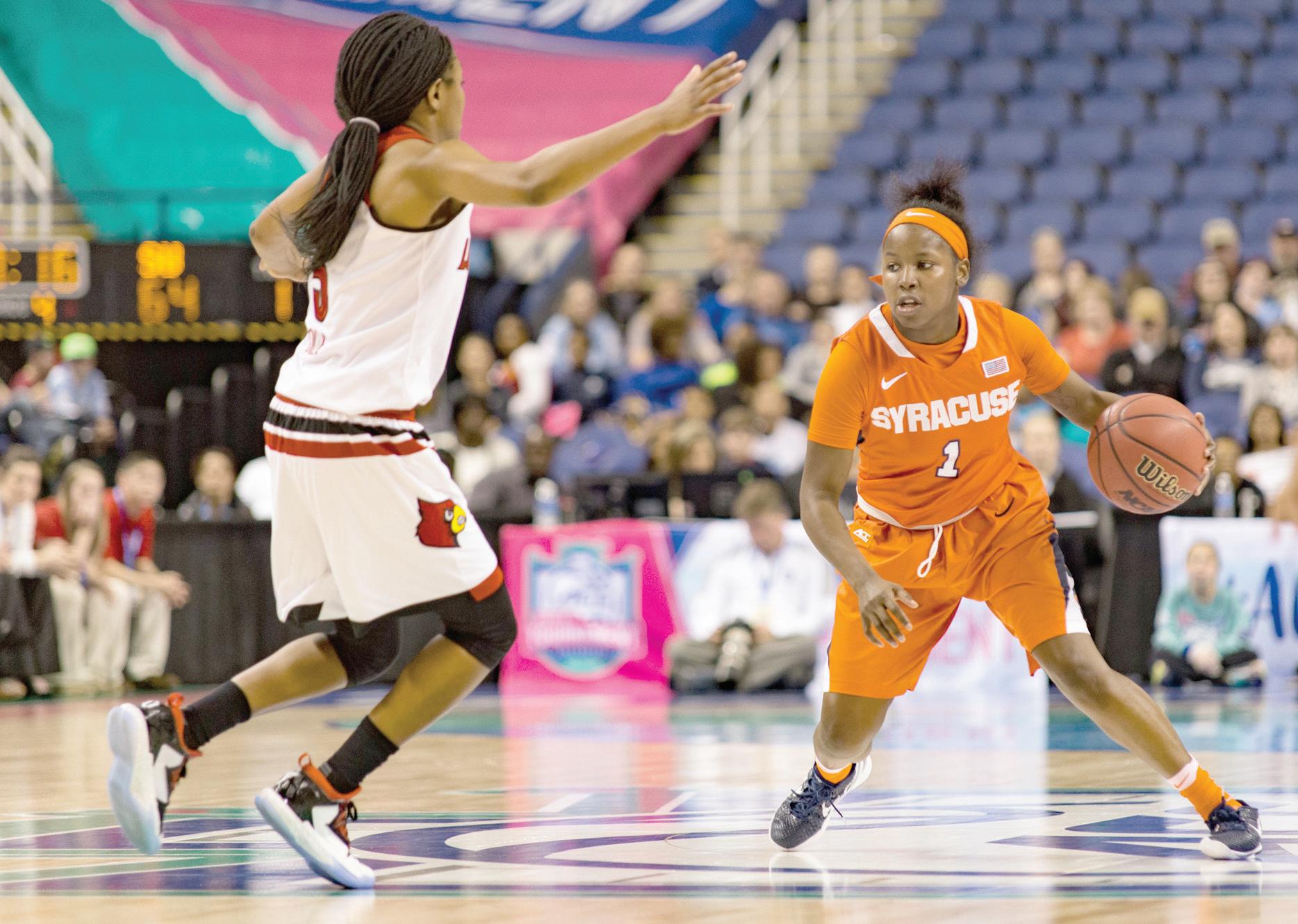
One of the biggest question marks surrounding this year’s squad is its ability to rely on 3-pointers as heavily as it did last year. Head coach Quentin Hillsman said his team has “no other choice,” but to shoot a lot of 3-pointers, after reliance on the 3-ball carried the Orange to the national championship game last season. The Orange lost two of its top three 3-point shooters in Brianna Butler and Maggie Morrison. Their absence will force the Orange to rely heavily on seniors Brittney Sykes and Alexis Peterson to pick up the slack from behind the arc.

Can Alexis Peterson and Brittney Sykes carry Syracuse?

Three weeks ago, Syracuse head coach Quentin Hillsman dubbed Peterson and Sykes as the ‘best backcourt in the country.’

He asked rhetorically, “How are you going to guard that?” adding that the duo is AllAmerican caliber. While there’s no telling how good they can be, both must weather the demands of 35 to 40 minutes a game in what’s likely a 35-plus game season. And considering Brianna Butler’s absence, Peterson needs to inch closer to 20 points per game, Sykes closer to 15, for any shot at ‘best backcourt in the country.’

Which player will step up for Syracuse this year?

With Syracuse losing so many key players from last year’s team, SU needs somebody to step up and fill a big role. Four starters — Peterson, Sykes, Briana Day and Isabella Slim — return, and the Orange has a few options. One is Julia Chandler, the sophomore forward who played in 32 games last year. The other returning player Abby Grant. There are two guards who haven’t played yet — redshirt freshman Davida Dale and freshman Desiree Elmore — who could be promising, but it remains to be seen how much opportunity they’ll be given.

Sunday, Jan. 29 at 2 p.m. at Virginia Tech

Thursday, Feb. 2 at 7 p.m. vs. Pittsburgh

Sunday, Feb. 5 at 2 p.m. at Boston College

Friday, Feb. 10 at 7 p.m. at Duke

Sunday, Feb. 12 at 3 p.m. vs. North Carolina

Sunday, Feb. 19 at 5 p.m. vs. Notre Dame

Thursday, Feb. 23 at 7 p.m. vs. Wake Forest

Sunday, Feb. 26 at 2 p.m. at Pittsburgh

BEAT WRITER PREDICTIONS

WOMEN’S BASKETBALL

MATT FELDMAN

Regular Season Record: 23-6

NCAA Tournament Finish: Sweet 16

Team MVP: Alexis Peterson

X-Factor: Briana Day

The 2016-2017 Orange have eerily similar talent to last season’s national runner-up squad, returning three starters and eight players who saw action. With Brittney Sykes and Alexis Peterson bolstering what head coach Quentin Hillsman called “the best backcourt in the country,” the Orange will have the ability to make waves in the postseason. But, that ability is reliant on Briana Day proving herself as a viable center, and a third guard who can emerge to replace the lost Cornelia Fondren. Barring a breakout season from five-star shooting guard recruit Desiree Elmore — the program’s first first-star recruit since Sykes — or Gabby Cooper, expect the Orange to get no further than the Sweet 16.

MATTHEW GUTIERREZ

Regular Season Record: 24-5

NCAA Tournament: Elite Eight

MVP: Alexis Peterson

X-Factor: Brittney Sykes

So much of what they are and could be depends on Alexis Peterson and Brittney Sykes. There’s no question Peterson’s work in piloting the offense is much easier if Sykes can hit 3-pointers, get to the basket and sometimes run the point. Down low, there are reasons to be optimistic if Briana Day can stay healthy and score. Syracuse could benefit from a crop of newcomers in Gabby Cooper and Chelayne Bailey, too. Brianna Butler’s gone, but the Orange still has enough talent to finish near the top of the ACC and run deep into the NCAA Tournament.

TOMER LANGER

Regular season record: 21-8

NCAA Tournament Finish: Sweet 16

MVP: Alexis Peterson

X-Factor: Abby Grant

Syracuse lost major parts from last year’s team — Brianna Butler, Maggie Morrison, Cornelia Fondren and Taylor Ford — and has a lot of fairly unproven young players set to replace them. But, SU’s schedule does seem a little lighter than last year’s and has some matchup against tougher teams at home. Alexis Peterson will have her best season ever in making up for that. SU needs to replace some 3-point shooting it lost, and the most capable player from last year’s roster seems to be Grant.

Those who know Sykes laud her athleticism. Once she developed that, her former coaches said, her skills developed and she started to flourish. By Syracuse’s opening night in her freshman year, she cracked the starting lineup. She logged 63 starts through her first two seasons.

“She possesses the athleticism that gives you the ability to play in the WNBA,” Reiss said. “She is probably one of the best athletes I’ve ever seen.”

But when the 2014 NCAA tournament came along, Sykes, at the end of her sophomore campaign, tore her right ACL, forcing her to miss the bulk of the year. She retore her ACL on Jan. 4, 2015 against Notre Dame, just three games into her return from tearing it the first time.

national semifinal games.

In her 41 games since returning from injury, though, she’s averaged just 9.7 points per game. Last year, she shot only 35 percent from the field. Sykes acknowledges the decline.

She felt slighted when she wasn’t named to the All-ACC team. That she wasn’t even mentioned gives her one more thing to prove. She’s fine with qualifying as overlooked but she wants to be special, an AllACC and All-American selection.

SHE POSSESES THE ATHLETICISM THAT GIVES YOU THE ABILITY TO PLAY IN THE WNBA. SHE IS PROBABLY ONE OF THE BEST ATHLETES I’VE EVER SEEN.

Faced with yet another ACL tear, Sykes sulked. For most of the ensuing months, pain irked her. The ability she showed early had dimmed. Reiss said Sykes’ first step has regressed because of the injury.

TAMMI REISS su assistant coach “

Sykes has shown glimpses of her skillset. Her sophomore year, she averaged a team-high 16.6 points per game on 50.5 percent shooting from the field. Her 24-point game against Albany in the 2016 NCAA tournament, also her first 20-plus point game in more than two years, sent Syracuse to its first-ever Sweet 16. She posted 17 points in both the Sweet 16 and

“At first I hated talking about my injury just because it was one of those things you didn’t want to talk about anymore,” she said. “It’s something you want to depart from, detach from, say that’s not you.

“But then you mature up, come to the realization that it did happen and you made it through. My testimony is that those two injuries saved my career, and ultimately my life.”

How Sykes looks at the world, her thought process and her stepping into a leadership role have changed this year. Looking back, she said the injuries taught her not to take anything for granted. Sykes isn’t dwelling on what could have been.

There’s a stark contrast in her tone when she talks about what drives her. She takes on a mellow demeanor and her voice softens, far from her normal, jubilant self. She wants to become a household name, or the “master prototype,” Oliver said.

Her maturation began with a resolution to, hours after a national championship loss, forgo the WNBA Draft and stick for her fifth year at Syracuse. Now, the seasons drained by injury, the decision to come back for a final year, the prospect of another NCAA tournament run have added up.

Before tipoff on opening night against Rhode Island, Sykes said she’ll grab a seat on the Syracuse bench. She’ll look to the crowd, give her signature nod and take it all in.

“It’s finally here,” Sykes said. “This is my last go-around. So why not have a lot of fun with it?”

mguti100@syr.edu | @MatthewGut21

When the rest of the team returned for the second session of summer classes to begin preseason practices, there was a noticeable buzz around the program regarding the new and improved Day, teammates and coaches said at media day.

Graduate assistant coach Maggie Morrison, a former Orange guard who’s spent the last three seasons with Day at Syracuse, said she immediately noticed Day was more aggressive, much more vocal on and off the court and performing as “a better all around player.”

Morrison sees Day in more of a leadership role this year, and expects her final season at SU to be her best. She thinks

that with the time Day spent in the weight room and gym this summer, she’s in the best shape she’s been in since arriving at SU, and poised to be one of the team’s strongest assets. With just one season remaining in her SU career, Day’s opportunity to take her game to the next level is limited. But as was the case in high school, she’s lived in the gym and made basketball her top priority. If she’s able to fully piece her game together, the Orange will thrive because of it.

“Everything (with Day) is about toughness,” Hillsman said. “She’s really gotten herself to the level where she plays hard, and that’s what’s really important for her is staying aggressive. I’m hoping she’s able to do that all season and make us a better team.”

mjfel100@syr.edu

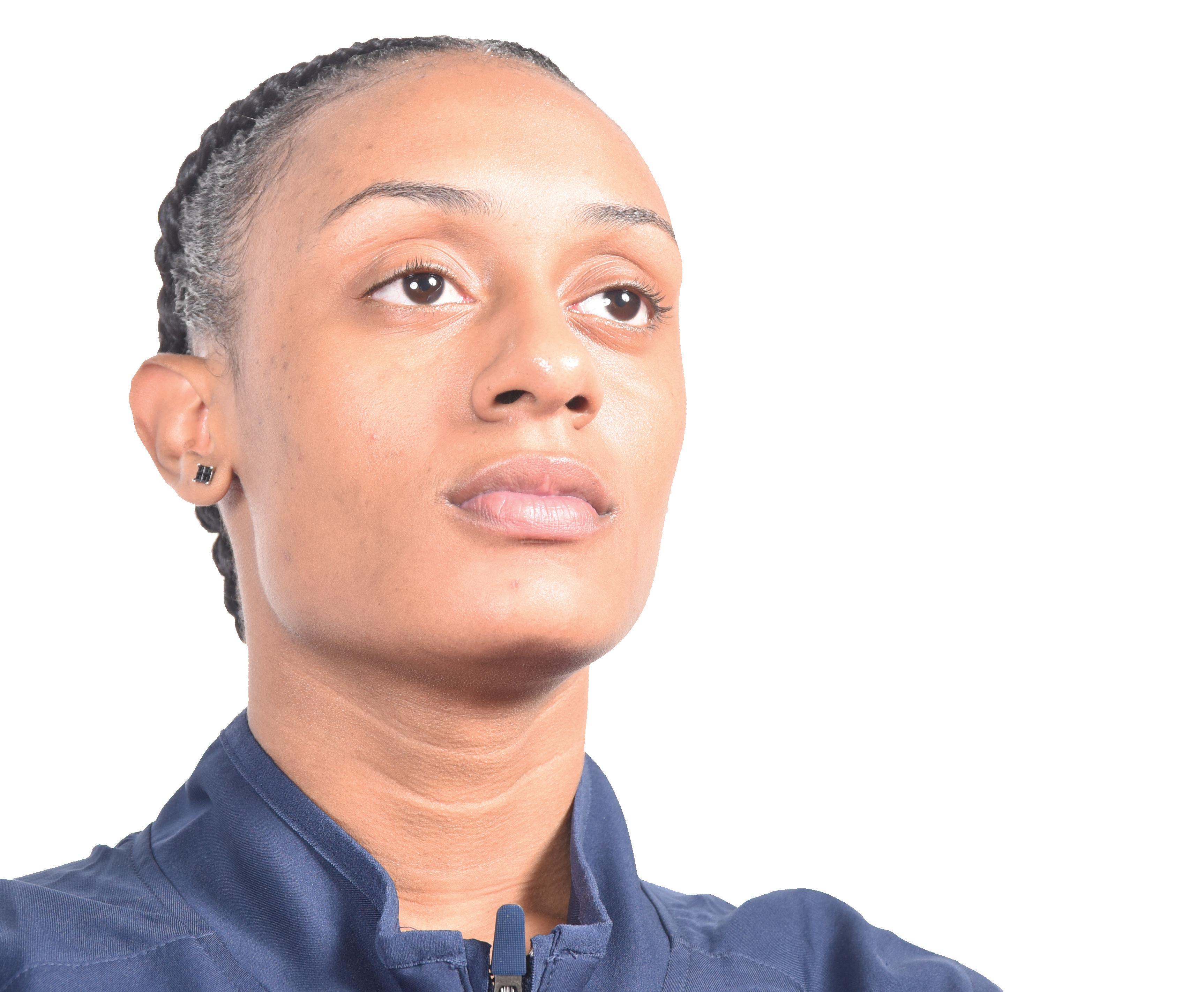
BRIANA DAY enters her senior season trying to help Syracuse
back to the national championship. The 6-foot-4 senior center has improved each year at Syracuse and has gotten stronger and into better shape. evan jenkins staff photographer
BRITTNEY SYKES possesses a hint of fret at some of her past seasons marred by injuries. After a productive 2015-16 campaign and busy summer, the 5-foot-9 senior looks to break out and bring the spark she used to. evan jenkins staff photographer
Brittney Sykes’ points per game last year, good for third on Syracuse, but six points fewer than her average three years ago

In eighth grade, when Briana Day decided to hang up her track spikes and join her middle school basketball team, the tall center said she was “awful” compared to where she’s at now.

She was too big for her body, and her coordination wasn’t nearly where it is today.

Day had a lot to improve on in her first years of playing, but since she didn’t start until eighth grade, the improvement would have to come much quicker than it did for her peers if she wanted to become a target for collegiate programs.

“(My sister Bria and I) weren’t always good. I’m glad nobody has footage of (us playing in eighth grade),” Day said. “It was just so bad, we wore glasses, we didn’t have contacts yet we just looked so ugly, it was bad.”

But Day knew that with time in the gym, she could change that.

Day has built on what she learned as a young player, living by her credo of dedicating herself to her craft even now as one of the top centers in college basketball. The starting senior center for the No. 14 Orange, Day has learned that when something doesn’t come easy, the remedy is almost always the same. It’s how she took her Millbrook (North Carolina) High School squad to back-toback state championship appearances, and how she plans on helping to bring SU back to the national championship game.

With a 6-foot-4 frame and some of the most untapped potential the Raleigh, North Carolina,

basketball community had ever seen, Day’s high school head coach Chris East insisted that she had the potential to be a top player.

“(The Day twins) were a little raw when they first came in as freshmen, but they just worked,” East said. “The best part is, both of them wanted to get better. I’ve never seen kids that have a motor like they do, these kids took it to another level.”

After spending nearly two years lifting, shooting and drilling in the school’s gymnasium, the Day twins led Millbrook to a state championship appearance in 2011. The following season, surrounded by six sophomores, they led the Wildcats to a state title — a new height for the program, East said.

In the spring of 2016, weeks after the Orange lost to Connecticut in the national championship game, and seven years after East had said something similar, SU head coach Quentin Hillsman told Day that he wanted to see her tap deeper into her potential. He said he especially wanted to see her improve her

Briana Day tallied 301 of the Orange’s 1532 total rebounds last season (20 percent) double day

mid-range game in the offseason in order to be an asset to the 2016-2017 squad.

“She needs to be able to step out a little bit and shoot the ball from 17 feet,” Hillsman said at the Orange’s preseason media day. “Her game has to evolve some for us to be successful this season.”

She stayed in Syracuse for both academic sessions of the summer, preparing for her final goaround as a senior. Most of Hillsman’s players go home for the first session and return for the second.

It was a six-week period that Day spent almost solely playing basketball, and extra time in the Carmelo K. Anthony Center that helped her in almost every facet of their game. Bria Day said the twins went back to North Carolina for a short visit, but otherwise, it was a full summer of basketball.

“You could stay here all summer, and do nothing, and it wouldn’t really matter,” Hillsman said, explaining it was the time in the gym that mattered. “That’s just the way it is.”

Briana Day and her sister Bria, who is also on the team, combined for 432 rebounds in the 2015-2016 season
Briana Day has 23 career double-doubles

final go

Brittney Sykes ranks eighth in Syracuse’s all-time games started, with 104. She’s made 31 or more starts in each of her seasons at SU, excluding her 2014-15 redshirt campaign.

14

Brittney Sykes’ rank among Syracuse’s all-time career points leaders. Her 1,214 total points (11.6 per game) rate her first among active players.

16.6

Brittney Sykes’ points per game as a sophomore three years ago, the most in her career

Brittney Sykes placed 10th in program history with 77 steals last season. In March, the 5-foot-9 redshirt senior guard set the Syracuse NCAA Tournament game-high record with five swipes against Albany.

5* 77

Brittney Sykes insists she’s ripe for stardom. Her summer was ordinary enough: she assisted on the new director of athletics search committee, hoisted 500 3-pointers a night and pondered her year ahead.

That’s about as normal as her last three summers have been. Two she spent recovering from ACL injuries, which had cut down her career and lengthened her path to a pro career.

This offseason, Sykes stayed in Syracuse for both summer sessions. After dinner every night, one of Sykes’ roommates, Isis Young, said Sykes would go back to the Carmelo K. Anthony Basketball Center for extra shots. She hadn’t had this much time to prep for a season since 2013.

“Now that she has confidence in her knee, she should have an unbelievable breakout year,” Syracuse assistant coach Tammi Reiss said. “I think she’s ready to show people the real Brittney Sykes, not the Brittney that came off two ACLs last year.”

Sure, she started every game, averaged more than 10 points per contest and helped lead Syracuse to its first-ever national championship game. But last season did not represent the kind of player she is, Sykes and those around her said.

She said she could have added more to a national title-contending team. A medical redshirt two years ago gave Sykes a fifth year of eligibility and a second chance to prove that. Sticking with her strengths has put her on an ascent with just one more level to reach:

“She wants to be that player she was,” Regina, her mother, said.

Sykes thrived at University (New Jersey) High School. Yet when Sykes’ freshman year basketball coach, Felicia Oliver, told her she’d grow into a Division I prospect, Sykes looked up at her coach, gazing in disbelief.

“I don’t see that,” Oliver recalls her star guard saying.

But coaches did. They inquired about Sykes, a lean guard with a knack for getting to the rim. She drew offers from Rutgers, Duke, Notre Dame, Penn State, Georgetown and Syracuse, among others — so many that Oliver didn’t know what to do with a mailbox full of letters. At times, they’d just pile up in a bin.

postseason run. She would rave to both of them about how excited the run made her. Although SU hadn’t accomplished the ultimate goal it also shocked most of the basketball world.

She didn’t talk much about the loss to Connecticut. They both knew she was disappointed with the loss, but she focused more on the wins and then more on the upcoming season.

“When they beat (No. 1 seed and 33-1) South Carolina, that was truly like ‘Oh my god, we can’t believe this,’” Georgia Peterson said. “So I don’t think anything after that would have destroyed their mood.”

Moving past setbacks is something Peterson wasn’t always good at, said Tom Jenkins, her Sports City U AAU coach.

“That was one of the things that I felt like she had to learn to compartmentalize a little bit more,” Jenkins said. “Because in high school, and in AAU, if there was a loss … she didn’t want nothing to do with nobody, and she took it very hard.”

Peterson went back to work out with her personal trainer, Ronnie McClendon. She’d been working out with McClendon since she was in high school. This summer, she took the training up a notch.

said. “That the maturity level is there, the intestinal fortitude is there, the leadership is there. And those are all things we reinforce throughout every workout, throughout every conversation.”

Still, the fiery “prove-it” side of Peterson came through during these sessions. She was taking part in a ball handling and shooting drill, making the first five shots in a row before missing one. Peterson then hit the next four to finish the rep. McClendon remembers seeing Peterson annoyed with herself afterward. She didn’t care that she’d made all the shots but one. She was still upset with the miss.

Norris has seen that attitude from Peterson from the days they were playing against each other on a curbside hoop, and even she sees a change in her. Norris knows that Peterson has more weight on her shoulders, yet she isn’t too worried about Peterson overstressing herself to the point where the game isn’t fun anymore.

SHE PLANS ON BEING A 40-MINUTE GIRL, 40-MINUTE PLAYER. SHE’S JUST READY TO GET RIGHT BACK AFTER IT.
CARLA NORRIS peterson’s aunt

The intensity of the drills stayed the same. The difference was that in high school, the sessions usually lasted between 60 to 90 minutes, never exceeding the hour-and45-minute mark, McClendon said. This summer, the sessions lasted three to four hours. Peterson was in the gym at least four days a week, McClendon said, and would sometimes come in twice in the same day.

The two would work on offensive and defensive drills on the basketball court. Next, they’d move on to strength training before hitting the treadmill. No two sessions were ever exactly the same, according to McClendon, in an effort to break up the monotony.

On top of that, Peterson was running more outside of her work with McClendon. Norris said she told Peterson to run more on her own in high school but she didn’t like doing it so she wouldn’t. In an effort to get into the best shape of her life, though, Peterson needed to change.

McClendon remembers that when Peterson approached him, telling him she wanted to ratchet up the workout level, he smiled at her, expecting that day to eventually come.

“Anytime that happens, it pretty much solidifies that the kid’s arrived,” McClendon

“She’s hungry. She plans on leaving it all out there,” Norris said. “She plans on being a 40-minute girl, 40-minute player. She’s just ready to get right back after it.”

A few weeks away from the start of the regular season, Peterson still hasn’t rewatched the tape of the national championship loss to UConn. Her mother says that she doesn’t remember if that’s ever happened before, for her daughter to skip out on rewatching a game.

But for Peterson, not watching isn’t related to do with bitterness from the loss. In fact, she says, it’s quite the opposite. She feels she’s grown from the game and doesn’t need to see it again to feel the difference.

Peterson talks about how the Syracuse players got to live out a dream by playing on college basketball’s biggest stage, about how they surprised teams by making it that far and how the experience from that moment is something the whole team can carry forward.

Peterson says that Syracuse as a whole won, despite the loss in the game. The same player who, according to Jenkins, once went into a shell after losses, was finding positives in a heartbreaking defeat.

“I’ve already taken away from that game what I need to take away from it, and I’m ready to move forward,” Peterson said.

“You move forward by just understanding that you had a once —”

She stopped herself short of saying “once in a lifetime.” Syracuse’s point guard has grown as a person and as a leader this offseason. Still, she has one thing left to prove. tdlanger@syr.edu | @tomer_langer

ALEXIS

Alexis Peterson still feels like an underdog.

There was no sense of anger or vengeance in her voice, though. Peterson sounded calm when talking about how she’s grown as a player and as a leader this year, ready to accept the challenge of guiding a relatively young team after the departure of many role players.

“I think that’s to our benefit,” she said about being viewed as the underdog.

“It’s to be expected,” she replied when asked about SU being picked to finish fourth in the Atlantic Coast Conference.

Syracuse is coming off the best run in its history, making it all the way to the national championship game, ranked No.14 in the preseason and head coach Quentin Hillsman had just finished calling Peterson, along with Brittney Sykes, part of the best backcourt

in the country.

Still, she felt like an underdog.

Peterson’s basketball career has been about proving people wrong. It started with the boys she played with growing up in youth leagues. Then it was for college coaches, like Jim Foster, then the head coach of Ohio State, who deemed the 5-foot-7 Peterson too small to play in the Big 10 and didn’t offer her a scholarship.

“I proved him wrong,” Peterson said flatly.

That aspect is still a huge part of Peterson’s character. But, as she gets ready to go into her final season, another layer is developing. A heightened maturity level and a newfound ability to put away the past and focus ahead is allowing Peterson develop into the total leader she’ll need to be for Syracuse this season.

When she came home for the summer, Peterson talked frequently with her mother, Georgia Peterson, and aunt, Carla Norris, about Syracuse’s

peterson page 17 lead the way

Alexis Peterson set the record for most points in a season for Syracuse, which was fueled by her NCAA Tournament performance

Alexis Peterson accounted for nearly 22 percent of the Orange’s scoring per game last year

Turn static files into dynamic content formats.

Create a flipbook
Basketball Guide 2016 by The Daily Orange - Issuu