2020-2021 ACC Men's Basketball Schedule
dec. 12 at Boston College
dec. 22 Notre Dame
dec. 29 or 30 at Wake Forest
jan. 2 at North Carolina
jan. 5 or 6 Florida State
jan. 12 or 13 Clemson
jan. 16 at Pittsburgh
jan. 19 or 20 Miami
jan. 23 Virginia Tech
jan. 25 at Virginia
jan. 31 N.C. State
feb. 2 or 3 Louisville
feb. 6 at Clemson
feb. 9 or 10 at N.C. State
feb. 13 Pittsburgh
feb. 16 or 17 at Louisville
feb. 20 Boston College
feb. 22 at Duke
feb. 27 at Georgia Tech
march 1 North Carolina
2020-2021 ACC Women's BASKETBALL SCHEDULE
dec. 10 at Miami
dec. 17 at North Carolina
dec. 20 at Boston College
dec. 31 North Carolina
jan. 7 Virginia
jan. 10 Notre Dame
jan. 14 at Georgia Tech
jan. 17 Miami
jan. 21 at Duke
jan. 24 at Clemson
jan. 28 Pittsburgh
feb. 1 at Louisville
feb. 4 Wake Forest
feb. 7 at Pittsburgh
feb. 11 at Florida State
feb. 14 Louisville
feb. 18 at Notre Dame
feb. 21 at Virginia Tech
feb. 25 Boston College
feb. 28 vs NC State
still spread.
The Orange use the chip technology so that, if someone does test positive, they can quantifiably tell how frequently the players were around one another and how often they came within six feet of each other. Now that Syracuse has multiple positives, the protocols will go into effect.
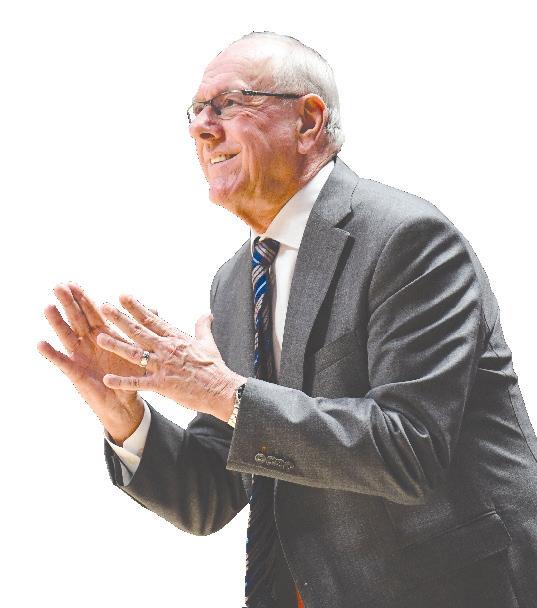
Per the NCAA’s guidelines, Boeheim will quarantine for 10 days following his positive test, if he doesn’t have symptoms. But if Boeheim did develop any, he’d need to quarantine for 10 days following the onset.
The Orange aren’t able to “test out” of quarantine, meaning that multiple negative
tests won’t enable them to leave early. One positive test could mean that a player misses up to four games in a two-week period.
While Boeheim’s status is now in doubt for Syracuse’s season-opener against Bryant, games beyond that could be in even more danger.
Larsen is expecting a potential shutdown of New York state in December, after Thanksgiving, which he called “a disaster” for potential transmission between families. With the need and desire to see families, Larsen thinks that cases will only continue to rise into December.
Even as parts of Europe are heightening COVID-19 restrictions through stayat-home orders and mandating the closure of businesses, many countries have chosen
the game.”
Less than six months after Tiana was named one of the top five point guards in the country, she was playing pickup with anyone who’d let her join — former high school players, SU football players or people trying to get some exercise. Back in Australia, Tiana played basketball exclusively with trainers, teammates or family members. Pickup games with strangers were a new concept that she didn’t experience until she came to the United States in 2015.
“I kind of liked it,” Tiana said. “Playing in Melo is regular to me. So playing in Barnes, playing in JD was nice to meet new people and playing the sport you love with people who love playing it.”
Just getting through a game was monumental for Tiana at first. Most five-on-five games were played to 11 points, with 2-pointers counting as one and 3-pointers as two, and Tiana often felt herself getting dizzy by the time one team reached four. Those playing with her knew her limits, and her team always carried a sixth player to sub her in and out.
“It would just depend how I felt,” Tiana said. “Most of the time I couldn’t finish
that she wasn’t one of the team’s best players. The competition at practice was steep compared to that in Brazil. Cardoso played with and against Division-I talent such as Treasure (Kentucky), Ruth (Central Arkansas) and Elizabeth Balogun (Louisville) and Jazmine Massengill (Kentucky). Cardoso quickly realized her height didn’t matter against stronger defensive players.
“That was her biggest progression that I’ve seen, not to rely on her height and learn how to do things right,” Keisha said.
During her freshman and sophomore years, Cardoso didn’t understand the purpose of posting up, Treasure said. She didn’t need it during games. Opponents easily pushed Cardoso off the ball because she never “sat down” when posting up, Treasure said. On defense, Cardoso just stood there, “straight and tall” with her hands in the air, Keisha said. Still, few Hamilton Heights opponents could match up with Cardoso. She wasn’t a traditional post-up player, Treasure said. Instead, she got her points from running the
Indiana Pacers first-round draft pick. After crossing the free throw line, Dolezaj dunked on the 6-foot-11 center.
In Duris’ defense, Dolezaj slotted in the weak side block of the 2-3 zone and the top of their 1-3-1 three-quarter or full-court press. Because of his wingspan, offenses struggled to cycle the ball from side to side, Duris said. Their goal was to chew at least eight seconds off the shot clock before opponents crossed half court. And they often did with Dolezaj, forcing quick and rushed shots that he rebounded.
Off those steals and rebounds, Duris emphasized the need to push the ball up the floor. It was how Dolezaj could use his speed to gain a step or two. Slovakia looked for points around the rim while attempting to draw mismatches with post players lined up against Dolezaj outside the 3-point line. Unlike his spot in Syracuse’s rotation the last three years,
Upon being declared cancer-free, the pickup games shifted from a treatment distraction to a channel for improving her skills. If Tiana saw someone execute a move that wasn’t already in her repertoire, she’d ask them to teach her. The biggest addition was the Euro step, which helped absorb contact from or entirely evade players such as Syracuse’s 6-foot, 288-lb fullback-turnedlineman Chris Elmore.
Tiana considered the risk associated with pickup but played anyway. She would, however, step out of the way on defense when “other dudes who don’t know basketball” drove at her full force. Regardless, she still had her own “season,” keeping her three-day-a-week schedule while Syracuse (16-15) was in the middle of its worst season since 2006-07.
On Feb. 24, Tiana’s progress allowed her to resume practicing with the Orange. Her return lasted just over three weeks before SU shut down its campus due to COVID-19. She headed back to Brisbane on March 12, where pickup basketball was replaced with activities permitted by Australia’s “stay-at-home” order, including bike rides, runs and one-on-one games against her siblings.
court and outpacing the other post. To a certain degree, she still isn’t a “true post.”
“If (an opponent was) a good post player, they would eat her lunch,” Keisha said. “Especially her trying to guard them.”
Hamilton Heights’ strength and conditioning coach helped Cardoso improve her footwork by her final two seasons, creating a strong, low center of gravity that made her harder to push off a spot.
“I’ve always wanted to see Kamilla in a true post-up,” Treasure said. “When she did that in high school, we used to go crazy, crazy on the sidelines.”
In addition to post-move drills, Keisha also had Cardoso working on midrange shooting, defensive movement and layups. Early on, teammates lobbed balls up to Cardoso for layups — but she would miss most of them, Ruth said. She laughed about the way Cardoso would “miss, put it back, miss, put it back and then finally make one shot.” Oftentimes, that meant games with 20 rebounds and four points, Ruth said.
Keisha had a drill for Cardoso where she had to make a layup on one end of the court and then the other. Back and forth, Cardoso had to score 50 in a certain amount of time.
which has traditionally been in the paint, Dolezaj often slotted as a two or three guard with Slovakia.
“We were afraid that this would be his problem, but I think he really meshed this with his IQ,” Mario Ihring, a fellow national team member, said. “If you have this IQ, you can still play also with this kind of body.”
When the Slovakian national team trained in Bratislava before the European Championships, it often only had 30 days together prior to competition. That meant training sessions focused more on learning systems than technical development. Ihring occasionally stayed at Dolezaj’s house in the capital city and went on tours with his teammate. They visited Bratislava Castle and the city’s center, both pit stops in between Eurovia Arena practices.
Before joining the national team, Dolezaj solved the ongoing problem that followed him throughout his youth basketball career with his Karlovka club: his smaller frame. Longtime coach Peter Ivanovic taught him how to contribute as a smaller player. It earned him a
not to shut down sporting leagues. In the United Kingdom and France, there are new lockdowns in place, but the nation’s top soccer and rugby leagues are still playing without fans.
Larsen foresees a similar future for college basketball throughout the fall, where players are staying together, traveling together and being tested frequently. Boeheim the Orange are currently being tested once per week, and that will increase to three times per week once the season begins, Boeheim said.
Multiple basketball coaches in the Syracuse area, including Boeheim, have commented on the mental health aspects of the pandemic. While the athletes are here to play basketball, the mental toll of not being able to attend social gatherings
“When she came home, she was so positive about her life,” Tiana’s brother Brandon Mangakahia said. “It’s so easy when we have trials in our life to feel sorry for ourselves, feel sad and get stuck in those mindsets. But she was so happy.”
Back in high school, Tiana established her three-day-per-week training schedule, working out on Monday, Wednesday and Friday with trainers and her team. In college, she’d text those trainers to let them know when she was back in Brisbane.
When she wasn’t doing mandatory workouts or practices, Tiana played with Brandon or one of her four older brothers in their yard. Brandon, the youngest, often found himself standing under the basket, rebounding for Tiana as the 88% career free throw shooter took 100 straight from the charity stripe.
“(I) still enjoy that because she gets swishes after swishes, so we’re just like, ‘Sweet, we’ll rebound,’” Brandon said.
While Tiana and her family relished being at home together again, there wasn’t any substitute for the competitive outlet that pickup provided the point guard. Tiana returned to Syracuse in late June and quickly resumed play at J-D Middle, Jamesville’s Tecumseh Elementary School and wherever hoops
Another included setting balls on the ground at midcourt that Cardoso had to pick-up and score the layup. Over the years, drills such as those made Cardoso “consistent and unstoppable,” Ruth said.
At Syracuse, Ruth expects Cardoso to win Atlantic Coast Conference Freshman of the Year and break records for blocks and rebounds. SU teammate Tiana Mangakahia expects Cardoso to play over 25 minutes a game and average a double-double because of her strong rebounding abilities.
“We played against some of the (Syracuse) football players up at Tecumseh (Elementary School) in the summer, and she was rebounding over (tight ends),” Mangakahia said. “She made it look so easy.”
Cardoso didn’t know any English when she arrived from Brazil, instead using Google Translate to communicate with teammates and with Keisha and Treasure, whom she lived with from the middle of freshman year until graduation. But in less than a year, she was fluent in English — she had no choice because no one else spoke Portuguese.
“She’s a strong person,” Treasure said. “To be honest, I don’t know how she did it. It
spot on the Slovakia national team for the U-16 team at age 15, where he met Ihring for the first time, two promising prospects on a team that finished 4-5 in that tournament.
“We all knew I was the skinniest one,” Dolezaj said. “That was always my problem, all my life.”
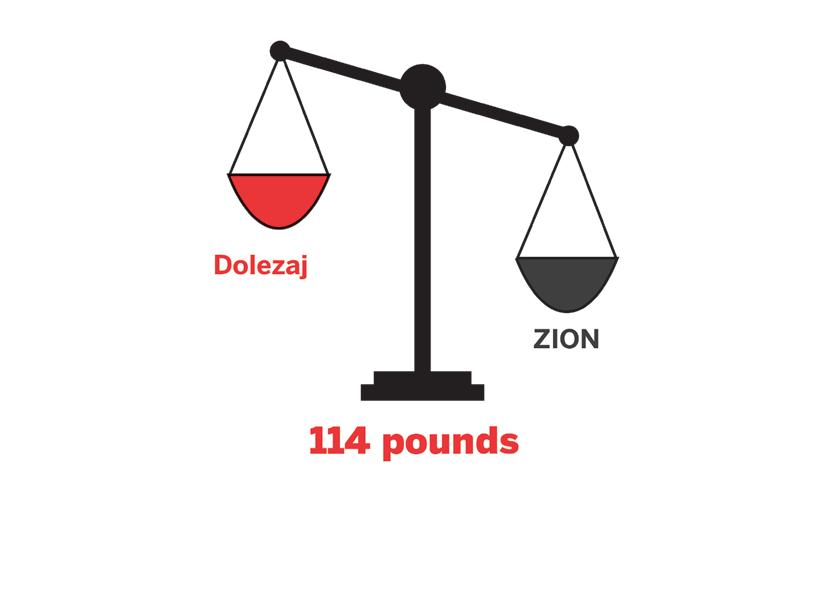
Dolezaj’s role in the paint at Syracuse differed completely from the one with Karlovka and a Spanish pro team back home. Suddenly, the 180-pound forward was thrust into the paint against Atlantic Coast Conference players weighing significantly more than he did.
So he brought the same approach — using his quickness and out-smarting opponents — to earn a spot in Syracuse’s starting lineup for its final 17 games that season.
“That’s the most important thing for him: to gain weight and to improve his shot,” Ihring said. “I think he did it.”
Midway through the first half of Syracuse’s upset win over Duke in his sophomore season, Dolezaj stepped up into the Cameron Indoor Stadium paint as Zion Williamson raced
and see friends outside the team is weighing on college athletes. “It’s exhausting,” Champion said. “Going in everyday and not knowing when you get tested, ‘could this be the week that we get shut down for a couple weeks?’” As the fall semester ends and most students return home, the Orange hoped the window from now until Jan. 25— the start of the spring semester — would enable them to be more protected from COVID-19 while playing over half of their schedule. But now, they’re one of many schools to run into COVID-19 spread within their programs. Boeheim’s positive test is the reminder that, though the college basketball season may begin, its future is fragile. amdabbun@syr.edu | @Anthony Dabbundo
remained up.
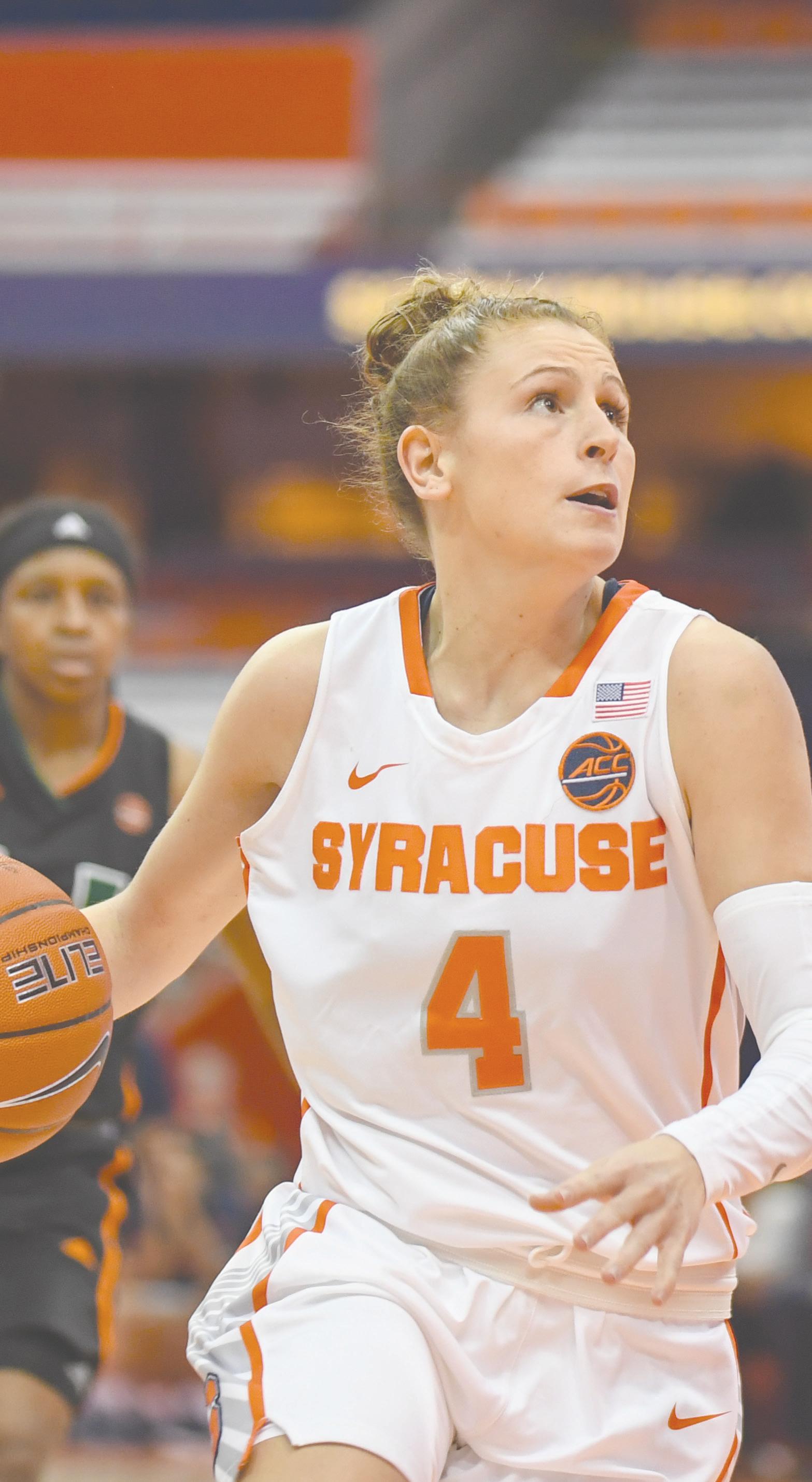
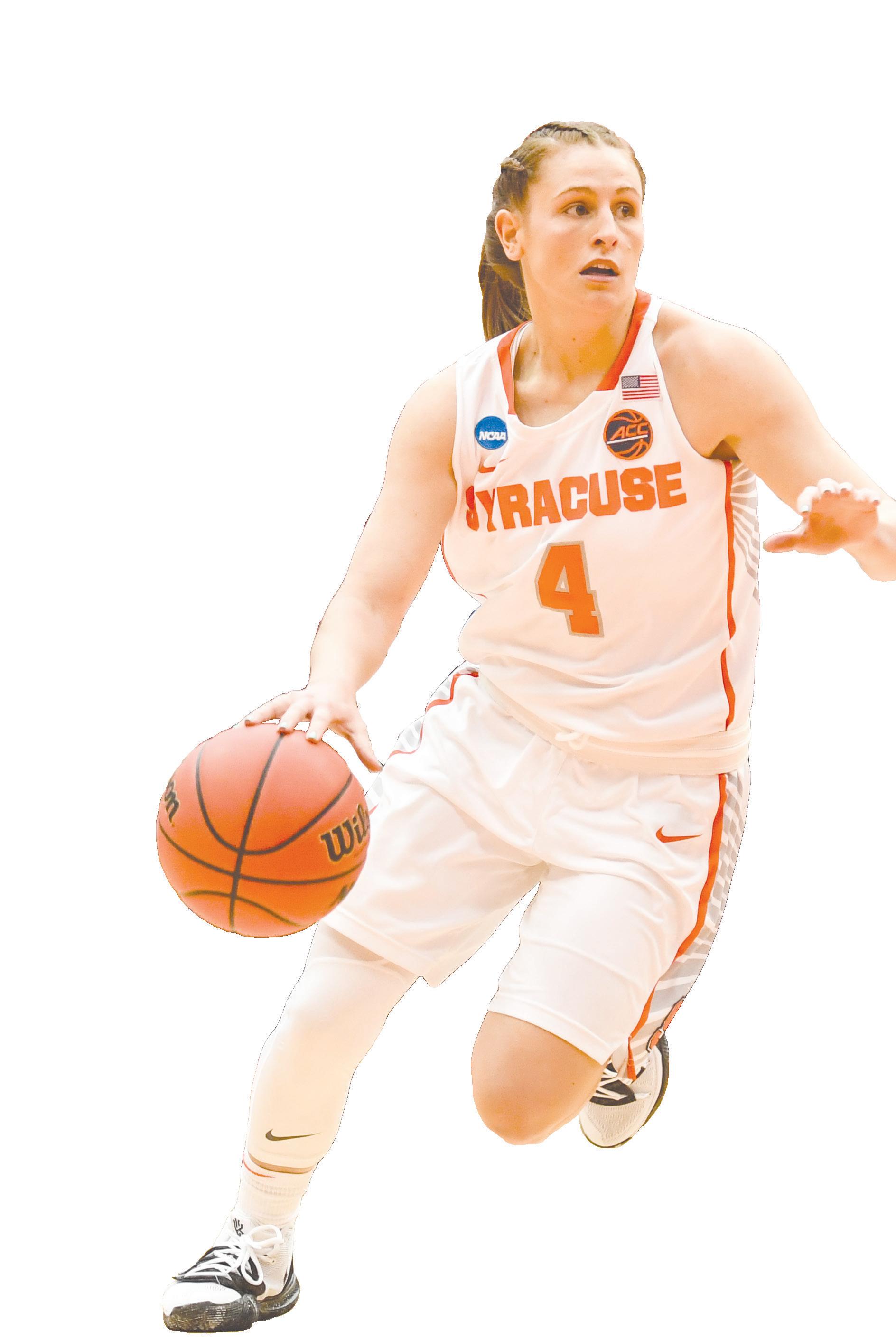
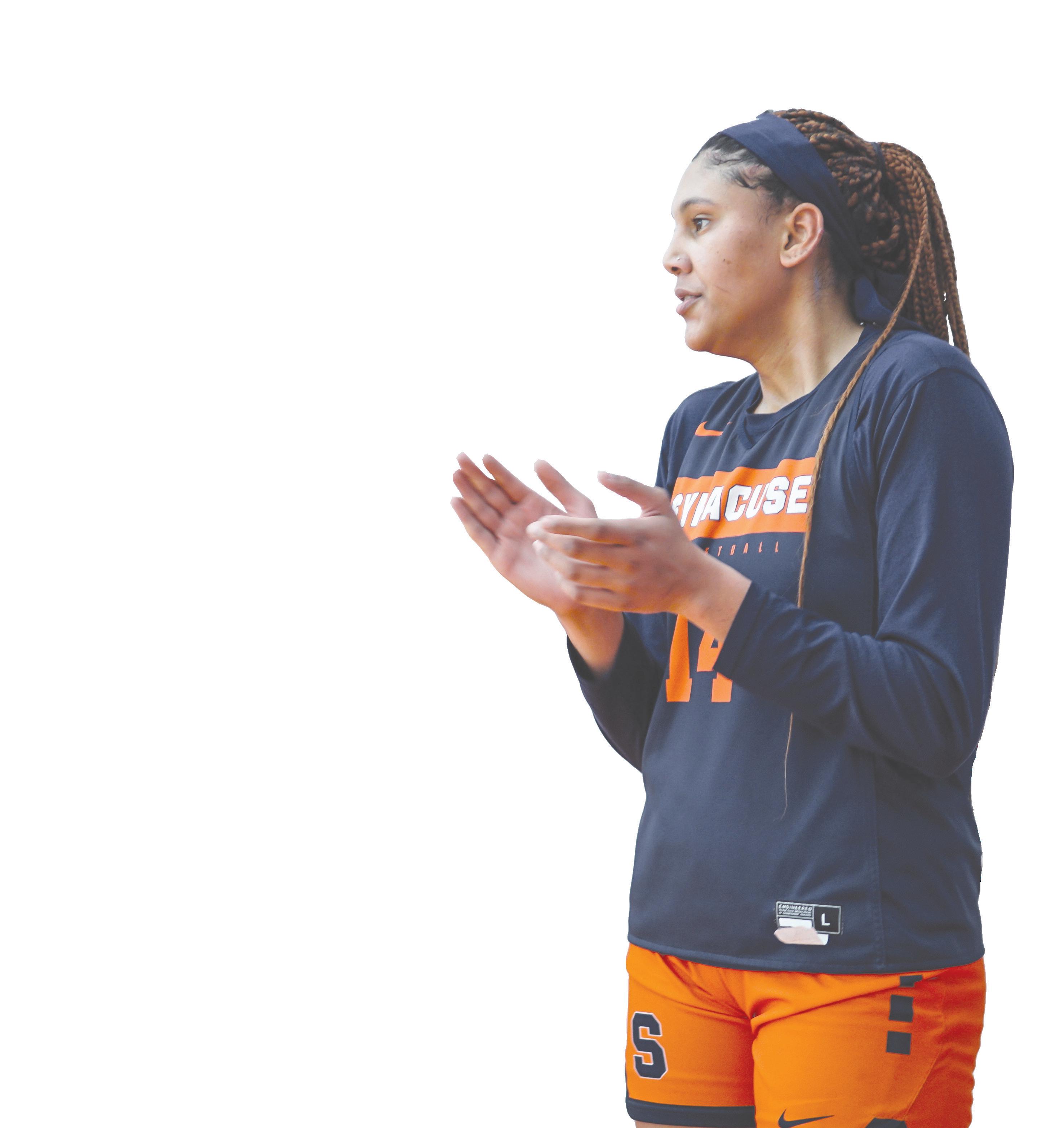
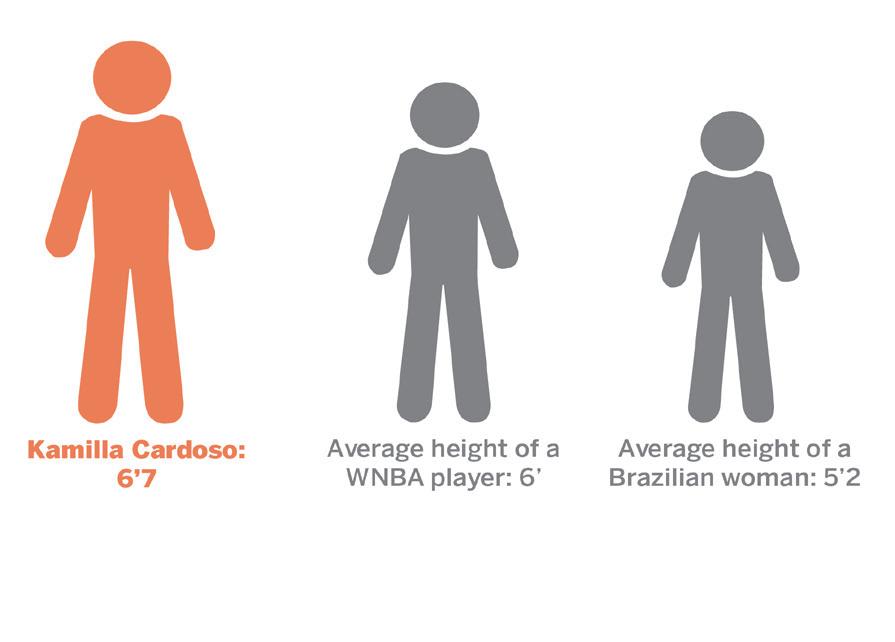
Teammates joined her because it was the offseason. Tiana improved her rapport with fellow veterans Emily Engstler and Digna Strautmane and built chemistry with 6-foot-7 freshman Kamilla Cardoso.
“I think she’s a great leader,” Cardoso said. “She push(es) all the players to go hard.” Tiana’s eligibility status for the 2020-21 season remained in limbo, but the same goals sat at the front of her mind during every pickup game: win Syracuse a national championship and get drafted in the WNBA’s first round. And in October, the NCAA’s waiver made both possible. It’s the first time the Orange have been ranked in the AP Top 25 since November 2019. At 25 years old and SU’s eldest player, Tiana’s ready to fill that leadership role. The fifth year’s independence stems from a lifetime of experience — being an only sister, living thousands of miles from home, beating cancer or simply being the lone Division-I athlete on a central New York street court at times.
“I always told myself that this was going to happen,” Tiana said. “To know that this (battle) was going to be over soon, and I was going to get my opportunity.”
tnolan@syr.edu
amazed me that she did what she did.”
Before Cardoso arrived at Hamilton Heights, Keisha received videos of the center from a fellow coach. The head coach was impressed that Cardoso still ran up and down the court as fast as the guards, despite her size. She took the highlights to Hamilton Heights’ principal, who wasn’t a women’s basketball follower, and he emphasized a couple of her missed shots.
“He said, ‘You know, she doesn’t look that good to me,’ and I said ‘Are you crazy?’” Keisha said. “We accepted her and haven’t looked back since.”
Cardoso’s technical development at Hamilton Heights built her into “a dominant force in the middle of (Syracuse’s) zone,” Quentin Hillsman, Syracuse’s head coach, said. So far, she’s quickly grasped new information from the coaching staff, Hillsman said. At Hamilton Heights, she learned not to rely on her height and athleticism like in Brazil. At Syracuse, she’ll need to progress more as an ACC center.
“I have to do a lot of things,” Cardoso said. “I just need to keep working.” Because the next step, in her mind, is the WNBA. rferna04@syr.edu | @roshan_f16
down court in transition. Dolezaj absorbed the charge, flew backward and landed on his back, rolling around as Brad Pike, Syracuse’s associate athletic director for sports medicine, walked onto the court.
“Marek is sneaky. He plays pretty strong,” Boeheim said. “Even though he was 170 pounds, you didn’t see him get overpowered a lot. Zion knocked him down, but Zion would knock down a tractor.”
Watching the game back in Slovakia, Duris grimaced as Dolezaj hit the floor. Then, he started laughing. “Good job Marek, hopefully you will be healthy,” he said of his former player. That sequence reflected the type of player he’d seen while preparing for the European Championships year after year, the type of player who had gathered Duris’ feedback and applied it during games.
Against Duke, there was only one way for Dolezaj to stop Williamson, Duris said, and that was to take a charge. Duris taught that years ago. And now, Dolezaj knew it, too. arcrane@syr.edu | @CraneAndrew
improve her range.
Amadou, who is French, became DjaldiTabdi’s primary recruiter to SU. While he and Hillsman both flew to Europe to watch DjaldiTabdi play, Amadou spoke to Djaldi-Tabdi’s mother in French.
But for Djaldi-Tabdi, it was also important that her coaches have a relationship with her whole family. Syracuse called and spoke with her mother, brother and sister almost daily.
Eventually, Djaldi-Tabdi picked Syracuse over other colleges and a professional career. But once she arrived, Djaldi-Tabdi learned she was ineligible to play her first year due to NCAA rules.
“I was upset obviously because you should come here to play basketball, and you end up not playing,” Djaldi-Tabdi said.
During her redshirt year, Djaldi-Tabdi inched out her range further and further. She also practiced post moves — including her best, the up-and-under — and improved her cardio.
Teams in France play at a slower pace, DjaldiTabdi said, but Hillsman coaches an up-tempo
reminded him that he can impact the game in other ways besides scoring, such as helping on the glass, setting screens and running hard in transition. Alan said his limited role at Illinois taught him to never take a play off. He’s “always active” with loose balls and offensive rebounds, point guard Joseph Girard III said. Head coach Jim Boeheim compared Alan’s energy to that of Baye Moussa Keita, who played center at SU from 2010 to 2014.
“I think he’s a very, probably the most high-motor player that I’ve seen in a while,” Boeheim said during a press conference. “I haven’t seen that many perimeter players that have that kind of motor. On every play, he’ll go after a rebound from 20 feet away and go get it above the rim. Loose ball, he’ll go get it from 25 feet away.”
The combination of effort and skills gives
offense that focuses on quick shots. If there’s an offensive rebound, it leads to another quick shot from the perimeter, Djaldi-Tabdi said.
In practice and in individual drills, Amadou wanted Djaldi-Tabdi to focus on post-moves. The French player wanted to work on her outside shot, a goal she had since she crossed the Atlantic Ocean.
So they compromised and worked on both.
“She really wanted to become a very versatile player,” Amadou said. “A player that is capable of having an impact anywhere on the floor.”
Last season, Djaldi-Tabdi began shooting from behind the arc more often. In SU’s second game of the season against Maryland Eastern Shore, Djaldi-Tabdi hit the first 3 of her career. While she attempted just 21 3s last season, Djaldi-Tabdi led the team in 3-point shooting percentage by almost 5%.
Djaldi-Tabdi began sliding lower on her drop steps and following through more on her shots, said Whisper Fisher, a former SU teammate. Earlier in the season, Djaldi-Tabdi might’ve used the wrong post-move on a defender or might’ve spun the wrong way.
But as the season progressed, so did Djaldi-
Alan a “chance to be a star” at Syracuse, as Massaroni said in April. At 6-foot-5, with great length and a knack for high-pointing rebounds, Alan shouldn’t have a problem sliding into the bottom of Syracuse’s 2-3 zone. But his star potential can only be reached if Alan combines his natural talent and physical gifts with the work ethic he’s developed from a young age.
Alan’s been around the game since he was born. Adrian, who’s now the lead assistant coach of the Toronto Raptors, retired from playing in the NBA when Alan was 8 years old. When his dad coached the Chicago Bulls, Alan would watch Derrick Rose and Jimmy Butler workout.
Two summers ago, leading up to Alan’s sophomore year at U of I, Butler invited Alan to stay at his house for about a week and work out with him in Los Angeles, where many NBA players spend their offseasons. Butler, a notoriously competitive player, led Alan through three workouts a day: one on the beach at sunrise, one in the afternoon and one at night.
Tabdi. Teammates were ready for her to enter the game sooner, Fisher said.
whatever it was. I mean, in my opinion, I think that she deserves more playing time.”
Last year, Syracuse often dealt with scoring droughts. But once Djaldi-Tabdi entered the game, she always seemed to hit a couple of shots, grab rebounds and head to the free throw line in the first 30 seconds, Alexander said.
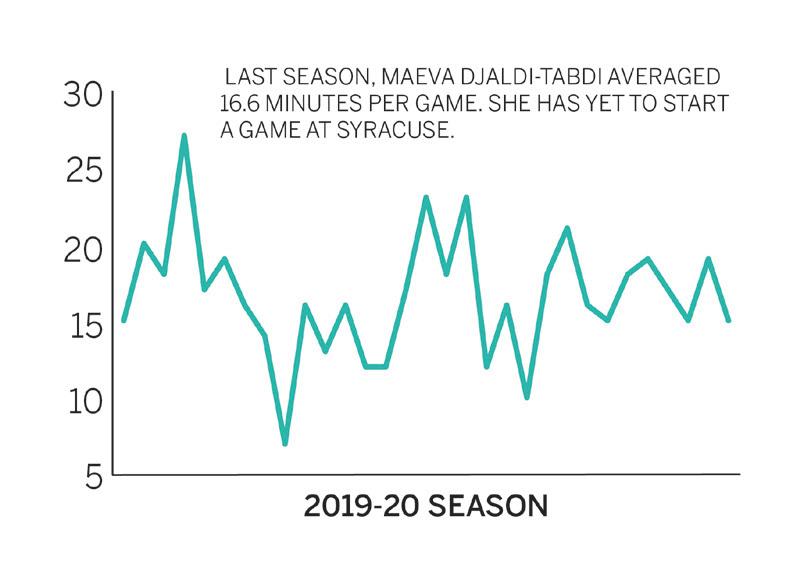
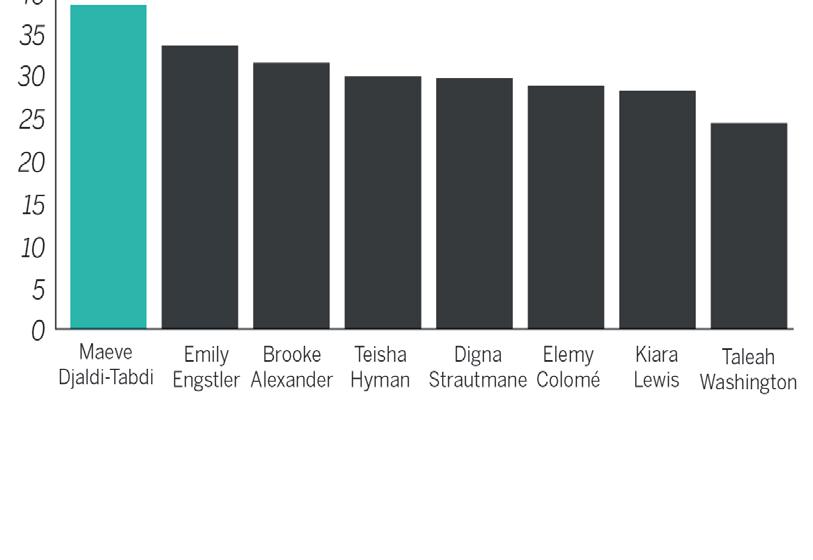
Djaldi-Tabdi averaged 16.6 minutes per game, a slight decrease from her redshirt freshman season, and she still hasn’t started a game for the Orange. Alexander thinks if she played the minutes “she deserves,” she could have averaged a double-double. Djaldi-Tabdi was the only player from last year’s team who played and was of WNBA caliber, she said.
After complaining about practices earlier in her Syracuse career and dreading early wake-ups, Djaldi-Tabdi’s focus intensified. It’s resulted in a leadership role and an emergence of her potential.
“Maeva to me is like a game changer,” said Brooke Alexander, a Syracuse graduate transfer last season. “When she would come into the game, things would shift a little bit, she would score a couple of baskets consecutively,
“It was nice going out there, to be able to see what it’s like working out as a pro,” Alan said. “You know, what he does, everything’s done on point. From the start of the morning to the end of the night, everything’s on point.”
Alan’s work ethic also stems from his family. His younger brother AJ, who signed his letter of intent to play for Duke next season, has always pushed Alan in the gym. His younger sister, Aubrey, is a rising star for Connecticut’s women’s basketball team. Their intra-family games, with the sons playing against Aubrey and Adrian, often ended with AJ in tears. The Griffins’ mom, Audrey, was also an All-American track runner at Seton Hall.
When Alan knew this summer that he had to expand his playmaking ability in preparation for a bigger role at SU, the foundation was already set. Alan recorded more than two assists just twice in his 58-game Illinois career, and Syracuse will be in need of more off-the-dribble playmaking without Hughes.
“Some people can work their whole life, and there is a ceiling,” Amadou said. “But for her, the formula is very simple. It’s going to depend on how much she wants to put in, how much she wants to invest.”
tgshults@syr.edu |
@ThomasShults_
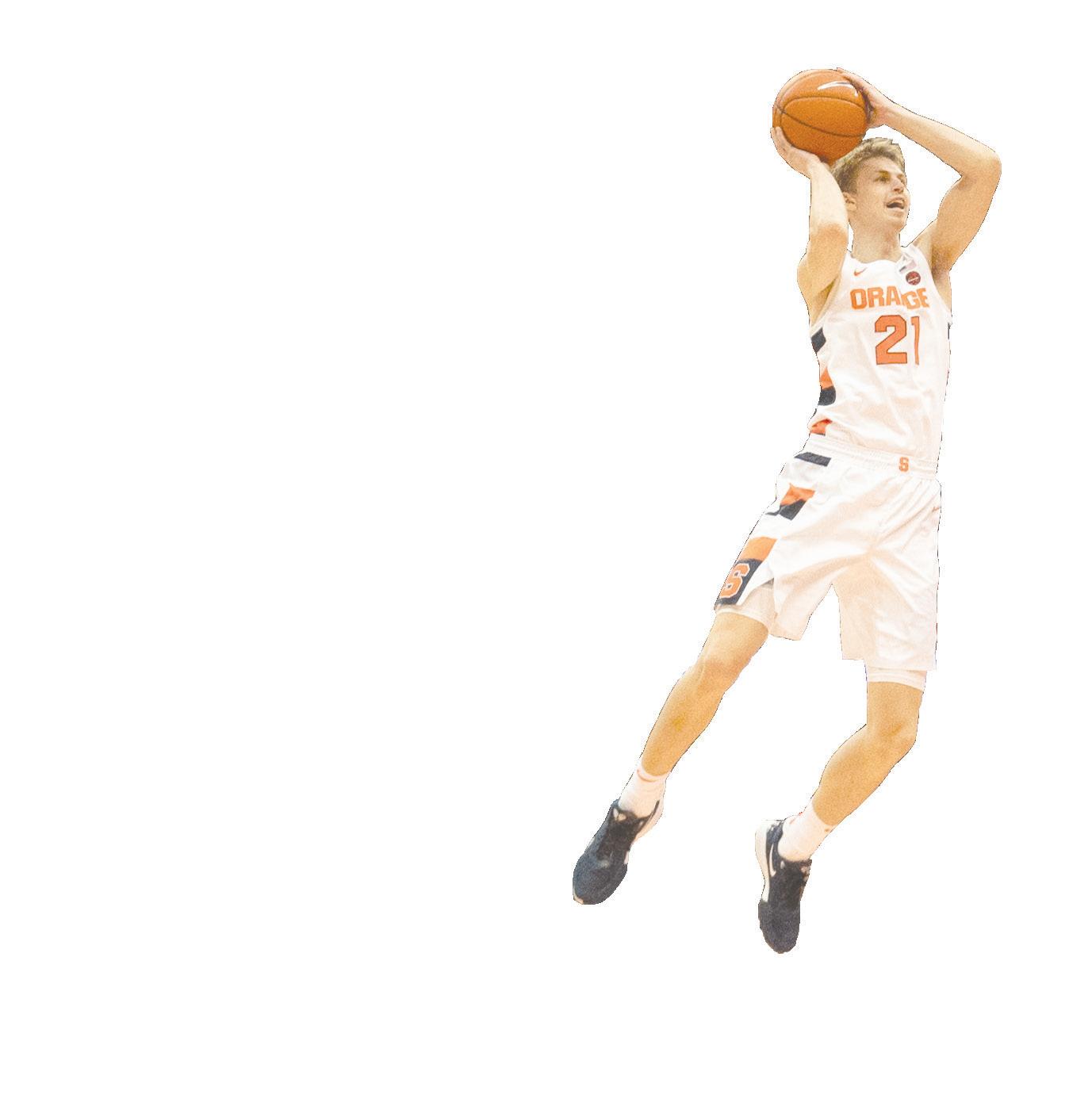
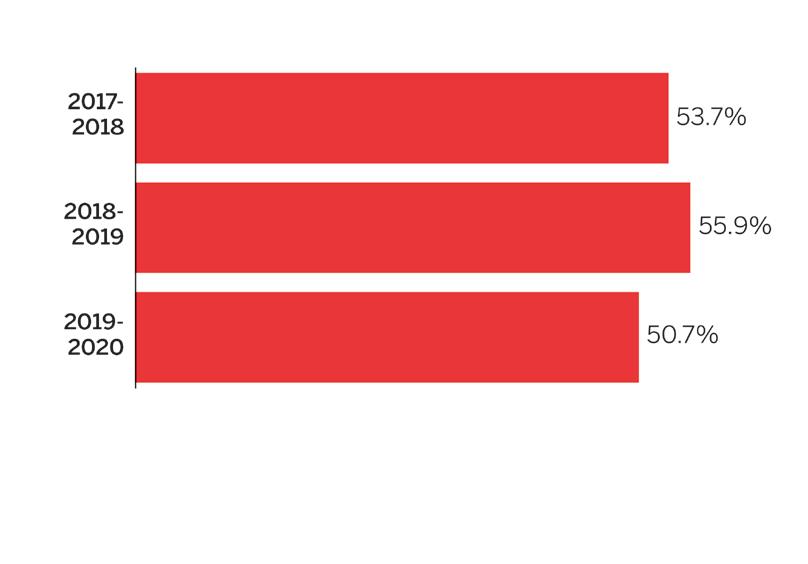
with 63.4% of his attempts coming from behind the arc — 3.1% more than
He’ll have more freedom to attack the basket in Syracuse’s perimeter-oriented offense — which Adrian called “right up his alley.” How much Alan’s up to his latest challenge of transforming his game may set the ceiling on the Orange’s season.
“The way he can shoot the ball is unparalleled. Mix that with all the other things he’s been adding to his game, and then his mental preparation, I think lastly, his desire to get better and to prove to people that he can be an elite player at any level,” Adrian said, “I think that’s what’s going to shock a lot of people.”
dremerma@syr.edu
@DannyEmerman
He arrived at SU for offseason workouts and began training with assistant coach Gerry McNamara, who helped him see what angles to attack and when to use dribble moves. His shot distribution last year skewed extremely toward 3-point shots,
Buddy Boeheim in 2019-20.