thursday, august 27, 2026
celebrating 122 years
free
O • Remembering a Struggle
N • Where AI fits
S • ‘Redheaded splash’
Page 11
Page 6
Page 16
Our guest columnist argues the Chinese American fight for belonging helped define citizenship in the U.S., saying it should not be forgotten.
After Elizabeth Watt’s death, her best friend decided to display her photography in the same building they met in.
What’s the T Pitch?
Growing up, Sarah Weisberg competed with older players. She’s doing the same at SU after forgoing a year of high school.
Pitch Social revamps ‘Blucy’s’ to unleash club energy on SU’s bar scene
By Tara Binte Sharil asst. culture editor
oday, Marshall Street’s bar scene is limited to three options: Faegan’s Cafe & Pub, Orange Crate Brewing Co. and Harry’s Bar. At Faegan’s, a typical 21-plus Syracuse University student can
expect a laid-back night playing cards with friends and sipping beer on Flip Night. For a rowdy night filled with dancing, students head over to Orange Crate, while Harry’s primarily operates as a sports bar. Once all three options have run their courses, a night out can become repetitive. Enter Pitch Social at Syracuse. “Students that we’ve talked to have told us that back in the day,
the bar scene was way different. Now, it’s a little more stale and it’s the same stuff over and over again,” Drew Patel, Pitch Social’s founder, said. “Orange Crate has its charm. Faegan’s has its charm. Harry’s has its charm. But I think it’s time to bring something new to campus, a new idea.” see pitch page 8
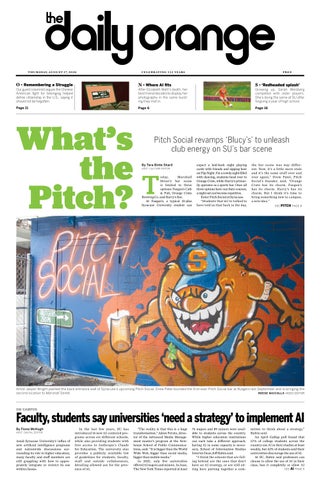
Artist Jasper Wright painted the back entrance wall of Syracuse’s upcoming Pitch Social. Drew Patel founded the first-ever Pitch Social bar at Rutgers last September and is bringing the second location to Marshall Street. reese niccolls video editor
on campus
Faculty, students say universities ‘need a strategy’ to implement AI By Fiona McHugh asst. digital editor
Amid Syracuse University’s influx of new artificial intelligence programs and nationwide discussions surrounding its role in higher education, many faculty and staff members are still grappling with how to appropriately integrate or restrict its use within classes.
In the last few years, SU has introduced 14 new AI-centered programs across six different schools, while also providing students with free access to Anthropic’s Claude for Education. The university also provides a publicly available list of guidelines for students, faculty, staff and outside collaborators, detailing allowed use for the presence of AI.
“The reality is that this is a huge transformation,” Adam Peruta, director of the Advanced Media Management master’s program at the Newhouse School of Public Communications, said. “It is bigger than the World Wide Web, bigger than social media, bigger than mobile media.” In 2021, only five universities offered AI majors and minors. In June, The New York Times reported at least
74 majors and 89 minors were available to students across the country. While higher education institutions can each take a different approach, having AI in some capacity is necessary, School of Information Studies Interim Dean Jeff Rubin said. “I think the schools that are falling behind are the ones that don’t have an AI strategy, or are still sitting here putting together a com-
mittee to think about a strategy,” Rubin said. An April Gallup poll found that 57% of college students across the country use AI in their studies at least weekly, but 42% of students said their universities discourage the use of AI. At SU, Rubin said professors can choose to allow the use of AI in their class, ban it completely or allow AI see ai page 5
2 august 27, 2026
WEATHER
about
The forecast for this upcoming week, per The Weather Channel.
THU 8/27
SAT Editor@dailyorange.com News@dailyorange.com Opinion@dailyorange.com Culture@dailyorange.com Sports@dailyorange.com Digital@dailyorange.com Design@dailyorange.com Photo@dailyorange.com BUSINESS 315-443-2315
8/29
The Daily Orange is an independent, nonprofit newspaper published in Syracuse, New York. The editorial content of the paper — which started in 1903 and went independent in 1971 — is entirely run by Syracuse University students. The D.O., a 501(c)(3) nonprofit, is editorially and financially independent from SU, and the paper receives no funding from the university. Instead, The D.O. relies on advertising revenue and donations to sustain operations. This fall, the paper will be published Thursday when SU classes are in session. The D.O.’s online coverage is 24/7, including while SU is on break. To show your support to The D.O.’s independent journalism, please visit dailyorange.com/donate. Donations are tax deductible.
MON 8/31
High of 80° Low of 66°
letter to the editor policy The D.O. prides itself as an outlet for community discussion. To learn more about our submission guidelines, please email opinion@dailyorange.com with your full name and affiliation within the Syracuse community. Please note letters should not include any personal information pertaining to other people unless it is relevant to the topic at hand. All letters will be edited for style and grammar.
The D.O. is published weekdays during the Syracuse University academic year by The Daily Orange Corp., 230 Euclid Ave., Syracuse, NY 13210. All contents Copyright 2026 by The Daily Orange Corp. and may not be reprinted without the expressed written permission of the editor-in-chief. The Daily Orange is in no way a subsidy or associated with Syracuse University. All contents © 2026 The Daily Orange Corporation
News Editor Editorial Editor Culture Editor Sports Editor Presentation Director Digital Design Director Photo Editor Illustration Editor Social Media Editor Enterprise Editor Asst. News Editor Asst. News Editor
Arabella Klonowski Will Chadwick Lily Zuckerman Jordan Kimball Adelaide Guan Abigail Aggarwala Tara Deluca Emma Soto Claire Zhang Ally Goelz Vivian Collins Ryan Garipoli
Asst. News Editor Asst. Editorial Editor Asst. Editorial Editor Asst. Culture Editor Asst. Culture Editor Asst. Sports Editor Asst. Sports Editor Asst. Sports Editor Asst. Photo Editor Asst. Photo Editor Asst. Photo Editor Video Editor
Mirren Grimason Addy Kimball Dayna Roberts Tara Binte Sharil Joel Pelachik Harris Pemberton Jason Glick Spencer Brod Eli Schwartz Zoe Xixis Christian Calabrese Reese Niccolls
8/28
SUN 8/30
TUE 9/1
High of 76° Low of 52° High of 84° Low of 65° High of 82° Low of 67°
National peach day
If you are a Syracuse University or SUNY-ESF student interested in contributing to The D.O. on either its advertising or editorial teams, please email editor@dailyorange.com. The D.O. strives to be as accurate in our reporting as possible. Please email editor@dailyorange.com to report a correction.
High of 79° Low of 59°
FRI
scribble
how to join us corrections policy
High of 79° Low of 62°
claire zhang social media editor
Delia Sara Rangel
Noah Nussbaum
Quinn Postman
EDITOR-IN-CHIEF
MANAGING EDITOR
DIGITAL MANAGING EDITOR
Video Editor Asst. Video Editor Asst. Video Editor Design Editor Design Editor Design Editor Asst. Digital Editor Asst. Digital Editor Asst. Digital Editor Asst. Digital Editor Asst. Digital Editor Asst. Digital Editor
Collin Snyder Thandi McCain Nathan Olszewski Lily Wilkin Zoey Grimes Ana Rodriguez Fiona McHugh Owen Smith Peter Radosh Jack Wood Ava Demcher Alex Rice
Asst. Copy Editor Sydney DePietto Asst. Copy Editor Bailey Dunn Jordan Fendrich Asst. Copy Editor Asst. Copy Editor Gabe Ewen Asst. Copy Editor Caroline Erskine Asst. Copy Editor Kosta Konstantopoulos I.T. Manager Eliza Raphael I.T. Manager Sam Benoit Business Manager Kevin Ross Business Asst. Tim Bennett Circulation Manager Steve Schultz DEIA Manager Savannah Stewart
Development Editor Development Editor Development Editor Alumni Engagement Editor Alumni Engagement Editor
Eliana Rosen Avery Magee Mauricio Palmar Charlotte Price Ben Butler
dailyorange.com news@dailyorange.com
NEWS
august 27, 2026 3
on campus
Q&A: ECS interim dean discusses AI programs, goals for future By Arabella Klonowski
students while also offering the degree and minor programs?
As artificial intelligence begins to impact industries worldwide, Syracuse University, along with over 350 institutions across the country, are rapidly introducing programs aimed at preparing students for the constantly evolving job market. After introducing a few programs last academic year, the list of faculty-led AI majors, minors, online degrees and certificate programs at SU is now 14, including specialized uses on policy, business and data. The list reaches six different schools – College of Engineering and Computer Science, Newhouse School of Public Communications, Whitman School of Management, School of Information Studies, College of Professional Studies and Maxwell School of Citizenship and Public Affairs. Arriving at SU 26 years ago as an assistant professor in biomedical engineering, Associate Provost for Academic Programs and ECS Interim Dean Julie Hasenwinkel heard from ECS and iSchool faculty firsthand about their interest in creating AI programs at SU. Through her work with ECS and university administration, Hasenwinkel gained unique insight into the process for introducing new programs, as well as gaining approval from the New York State Department of Education. As interest in the programs increases, The Daily Orange sat down with Interim Dean Hasenwinkel to provide a glimpse into AI’s newfound presence on campus as students begin their classes this fall.
Hasenwinkel: I don’t think that’s just an ECS issue. In the degree programs, it’s less about learning how to use AI and more about learning how to design the systems that are the foundation for AI. We have an academic integrity policy at the university that spells out what students are allowed to do in certain courses, and as you might imagine, it’s challenging to enforce that. I think what we really should be focusing on is educating students on the ethical use of AI, giving them opportunities to learn how to use it, embedded in coursework and also in academic programs and also creating opportunities for students to demonstrate their own authentic learning in ways that they can’t use AI to do it. It’s not unlike any other tool that has emerged over time, like the internet, the smartphone. There’s always a way to cheat or use unauthorized aids if you want to. But we also want to incentivize our students that the end goal here is really learning, and you’re cheating yourself from a learning opportunity if you’re relying on AI to do your work.
news editor
The D.O.: What are your thoughts on the influx of AI programs university-wide? Hasenwinkel: We’ve approached it from the strategic standpoint of having a technically based AI program, which is ECS, and then having the AI program in the iSchool that’s really more the integration of technology and society. There are minors that have popped up in many of the schools and colleges, and I expect that to continue to grow, and those minors are incorporated in the integrative AI program. I think our overall strategy was to not create AI majors everywhere, but (instead) ‘let’s have two programs that are different and distinctive that could give any student with an interest an opportunity to study AI. I think a lot of students will choose to do minors that are related to AI and add them on to other majors. And I think there’s also a lot of faculty (who) are starting to incorporate aspects of AI into their teaching at the course level to help students develop those skills or to understand how AI is impacting the particular field of study that they’re working in. There’s the degree level, the minor, the course level and
The D.O. discussed goals for the future of AI programs at SU in a Q&A with Associate Provost for Academic Programs and ECS Interim Dean Julie Hasenwinkel. courtesy of julie hasenwinkel
recognizing that creating opportunities for our students to be educated, both in the usage of AI, but also in the critical thinking around how to use AI. What should we develop? How far should we push the boundaries? What kinds of policies should be put around it? All of those things, I think, are important for areas for us to give students an opportunity to be educated in. The D.O.: What does student interest and enrollment look like for these AI degrees and minors? Hasenwinkel: The nature of the development of the programs and the approval process was such that we couldn’t actually advertise them until they were approved by the state, which didn’t happen until this summer. So, these programs were not on the Common App last year. Students can’t apply to them. No students have been admitted into them yet. This year is really a year where we are starting to teach the courses in the programs and trying to attract students into them, and now starting to heavily advertise them for the next recruitment cycle.
there was a good nucleus of faculty already here that are able to teach in both programs. But I think there’s a lot of research interest building in the AI space, both in ECS and more broadly at the university. And so I think down the road it’s an area that we look to grow, and as these programs grow, if they really blossom and take off, then that will be a good case for hiring additional faculty in these areas. The D.O.: Have you received or heard about any pushback from any faculty or staff about these programs?
The D.O.: Has the university hired any new ECS or iSchool faculty or staff members to work on the new programs?
Hasenwinkel: Not that I’m aware of, but I have primarily been working with people that have been involved in building it. I think there’s always concern about new things and where we’re placing our resources. I would say there’s probably been a little more pushback on the student side. AI is polarizing, but we also got some great student feedback on the integrative AI program while we were in the process of developing it. That was really helpful for the faculty to incorporate and think about feedback. I think that’s something that we should get in the habit of doing, like involving our students in the process of building our curriculum to understand their perspectives and what is attractive to them (and) what kinds of things they’re looking for in programs.
Hasenwinkel: No, we actually haven’t hired any new faculty or staff for either program because
The D.O.: How does ECS plan to balance regulating unauthorized AI use among
The D.O.: What goals do you have for the future of the AI programs? Hasenwinkel: I think the main goal is that these programs flourish, that they attract students, that we have really strong applicants. When you attract a lot of applicants, then you can be selective and take the best ones. Right now, we have a couple years before we’re producing graduates, and so the focus is on getting students in the door and starting to educate them. But it’s also our responsibility to prepare them so that they can be successful and so that they are able to get good jobs or go on to graduate study or whatever their goal is. The D.O.: What are you looking forward to this fall semester? Hasenwinkel: I’m most looking forward to being able to help ECS continue to build and strengthen. I think there (are) so many great things that go on within the College of Engineering and Computer Science, and sometimes we don’t do a good enough job telling our story and making (sure) students within the university, prospective students outside of the university, really understand what’s special about us, and so we are working on that. So, being able to play a part in that as the interim dean is something that is particularly motivating for me. arabellaklonowski@dailyorange.com
on campus
Students respond as SU phases out South Campus with new dorms By Owen Smith
asst. digital editor
Syracuse University is experiencing “one of the most active construction periods in recent years,” with three new residence halls in progress and ongoing renovations across campus – all the while facing a budget deficit and declining enrollment. As a core pillar of former Chancellor Kent Syverud’s Campus Framework to improve student living, the construction of new dormitories is part of a plan to eventually place every future sophomore on SU’s North Campus. In February, Vice President and Chief Campus Facilities Officer Pete Sala reiterated the plan to phase out South Campus. For students who’ve lived on South Campus, SU’s plan has received a mixed response. Jack Newcomb, a junior who lived on South Campus last year, said he enjoyed his time at the off-campus residence, taking advantage of the proximity to easy parking and access to a kitchen. However, he admitted living there can sometimes feel socially isolating. “South just kind of seems like you’re put away from everything else,” Newcomb said. “Moving everything back to the main campus is a better strategy for the university.” In a statement to The Daily Orange, a university spokesperson said the university’s housing strategy is part of a “deliberate, multi-year” effort to modernize campus living.
Nationwide, administrators in higher education face the challenge of convincing a declining prospective student population to choose their university. Senior Vice President and Chief Financial Officer Brett Padgett said students today are attracted by “modern housing.” “One of the most common pieces of feedback from our current students was the desire to have more modern living accommodations that [...] support their ability to thrive inside and outside of the classroom,” Padgett said in a 2024 release. “The two new residence halls will offer all of that and more and serve Syracuse University students for decades to come.” The projects include two new residence halls on Waverly and Comstock Avenue, along with new dormitories on 544 University Place. Each construction project has created extensive road closures and noise pollution on campus. A 3-year housing review completed in 2024 found that most students wanted modern dorms located on SU’s North Campus, with easy access to campus facilities and buildings. In 2021, SU’s Board of Trustees’ special committee proposed moving all student residences to main campus in a year-long report. The recommendation was based on findings that students of color were disproportionately relocated to South Campus. Many students came out in protest against the change. As the idea only acted as a “discussion point” after the #NotAgainSU protests, the see housing page 5
The three new SU dormitory construction projects will eventually phase students out of living on South Campus. daily orange file photo
4 august 27, 2026
dailyorange.com news@dailyorange.com
on campus
Long lines, wait times: Reactions to Dunkin’s new mobile ordering By Vivian Collins asst. news editor
Syracuse University students can now order Dunkin’ ahead from their phones, but the first few days with the university’s new system didn’t exactly shorten the line snaking around Schine Student Center. Monday marked the first day students were able to use the mobile ordering app at Dunkin’, and despite the new option, the long line of students on the first floor of Schine still remained.
For some students, it was the wait time displayed on the app that dissuaded them from using the new system. “I just didn’t think of it today,” SU student Harrison Quinn said. “I think I’ll probably use it in the future. The last time I looked at it though, the wait time was like a half an hour so (I) just thought it’d be quicker to wait in line.” SU’s Senior Vice President and Chief Operations Officer John Papazoglou first announced the plans for a mobile ordering system at a Student Government Association meeting on April 2o. The system uses the Transact Mobile
The Never Wait Again app uses a “Waze” style model to track wait times at local businesses.
Ordering app, allowing students to place orders online from anywhere on campus rather than waiting to order in person. “We are excited to bring this technology to the Syracuse campus,” Papazoglou said in a statement to The Daily Orange. “We are continually looking for ways to enhance the dining experience for our campus community, and we believe mobile ordering will make it quicker and easier to access our retail locations.” Director of Information Technology Mark Romano, who aided Papazoglou in the beta
testing process, did not immediately respond to The D.O.’s request for comment. While some students avoided the app because of its wait times, others simply hadn’t learned how to use it yet. Junior Jaxen Pniewski said she didn’t know how to place a mobile order with the Transact Mobile ordering app and wanted to avoid the wait time, so she decided to join the regular line instead. A representative from the university was helping people in line learn how to use the mobile ordering app, Quinn said, but not all students were approached or received instructions. see dunkin’ page 5
cole christopher contributing photographer | design by avery magee development editor
on campus
SU senior launches line tracking app to ‘Never Wait Again’ By Avery Magee
development editor
From 45-minute waits at Chipotle to lines out the door at Collegetown Bagels, Syracuse University senior David Simon realized long lines weren’t just an issue in his hometown of New York City. Waiting in lines became Simon’s fulltime job this summer as he prepared to launch an app, ensuring his friends never had to wait again. Simon’s app, Never Wait Again, is a userdriven platform that shares wait times and line lengths to improve users’ efficiency and time management. Featuring bars, restaurants and gyms in Syracuse and New York City, the app operates as a “Waze for lines,” where users can self-report activity levels of certain locations, he said. “No one enjoys a line,” Simon, an advertising senior in the Newhouse School of Public Communications, said. “Never Wait Again is people helping people because they understand that.” As a New York City native, long lines have been an unwelcome staple in Simon’s life. Early-morning bike rides to the basketball courts at Hudson River Park inspired the idea for Never Wait Again, which Simon said has been in the works since 2020. A selfproclaimed line hater, he frequently came home from court trips complaining about how long he waited to play, or not play at all. Simon’s father encouraged him to make an app. When he was a sophomore in high school, Simon said he laughed at the idea of creating an app. Without any coding experience or knowledge of what it would take to complete, Simon ignored his father’s suggestion and continued to suffer through long lines every day.
Attending SU welcomed a host of new lines and wait times to deal with, he said. Each year, Simon would return home with a myriad of related complaints, and his family continued to echo the same response: make an app. However, it wasn’t until a guest lecturer in SU Professor Sean Branagan’s Trendspotting in Digital Media class that Simon finally decided to address his lifelong feud. Nick Moscatiello, founder of music video production company Project Freefall, spoke to Simon’s class about his experience as a startup founder. Moscatiello, being only one year ahead of Simon academically, lit a fire beneath the line-hater and encouraged him to begin working on Never Wait Again. An app can’t be successful without the right founder, Branagan said. “It doesn’t matter how great the idea is; it’s about the person,” he said. Branagan noticed Simon’s entrepreneurial spirit and pushed him to pursue Never Wait Again seriously, propelling him to “just make the app.” Fear and low confidence are normal among student founders, Branagan said. He often encourages students to take risks while they’re still students and use all the resources SU has to offer. “Failure can look a lot like success,” Branagan said. “If you look back in six months at what you did, and you’re not embarrassed, you did it wrong.” Simon took a risk and began walking the streets of New York, taking photos of lines, talking to businesses about peak rush times and interviewing people in lines whom he affectionately calls “sheep.” Simon defines a “sheep” as a person who follows a herd or crowd. “Anytime I see people waiting in line, I go, ‘Oh, those people are sheep,’” he said.
On his daily walks monitoring lines in New York, Simon said he often ran into line “sheep” who had no idea what they were in line for. Whether it was a tote bag or a new frozen yogurt flavor, many in line told Simon they joined the line to follow the trend. Simon and his close friend Jeremy Cohen visited spots including viral frozen yogurt shop Myka and iconic pizzeria John’s of Bleecker Street in the city to document lines for social media. To create a brand identity and gain attention for the app, Cohen donned a furry white onesie and a lamb mask, then lurked around busy lines along the street. “The costume is a little scary, a little demonic,” Cohen, a television, radio and film student at Newhouse, said. “I truly believe in his product… whenever I have time, I’m willing to throw on the suit.” Cohen used the app over the summer while living in New York but said he hasn’t had a chance to try it out in Syracuse yet. He appreciated the ability to check how long the lines are between classes to save time in his busy schedule. In addition to the app’s presence on campus, Simon also added nine locations to Never Wait Again NYC, a tab on the app that features some of his and his friend’s favorite spots in the city. The Never Wait Again Syracuse tab currently features six locations, including popular bars on Marshall Street like Harry’s Bar and Faegan’s Cafe and Pub, as well as the Barnes Center at the Arch, with plans to expand in the near future. Collegetown Bagels is featured in the app as a location where users can upload photos and videos of the line and report whether it is “empty,” “light,” “busy” or “packed.” During a recent visit to Collegetown Bagels, Aarini Godha, a sophomore at SU, turned around at the sight of the long line. She said
she plans to download the app to avoid similar situations next time she wants a quick bite on Marshall Street. Colin Lee, a manager at Collegetown Bagels, said he hadn’t heard of the app before his interview with The Daily Orange, but said the app could help improve long lines outside the store. Lee said he hopes Never Wait Again will develop a pamphlet to include in order bags to let customers know about the app. Similarly, R.C. Faigle, the owner of Orange Crate Brewing Company, said he welcomed the possibility of working with the app in the future in addition to their current partnership with LineLeap, an app that allows users to skip lines and pay cover fees before arriving. When patrons identify patterns in line lengths and wait times at the bar, lines can move faster based on staggered arrival times, which Faigle said Never Wait Again could help with. Faigle said he had a few reservations about the inaccuracies reports might bring, which could lead to lower activity levels. “When you go to theme parks, they say the wait times are always longer than they really are,” he said. “If it says 55 minutes but you get on the ride in 35, you’ll be a lot happier.” Simon’s solution is a verified badge that businesses can post alongside wait times and lines to ensure accuracy on the platform. While SU classes begin, Simon hopes to help students develop strong time-management skills and build a community on his app to improve campus life. As someone who spent years complaining about lines with no solution in sight, Simon found an unexpected way to make lines his life. “I’m passionate about helping people,” Simon said. “I’m passionate about lines.” aamagee@syr.edu
august 27, 2026 5
dailyorange.com news@dailyorange.com
from page 1
ai
under certain conditions. All of his syllabi use the third option, but he said he believes every professor is still experimenting with AI policies as they see varying results. “I have used AI to help create practice exams and have actually watched the scores on my exams go the highest they’ve been in 15 years,” Rubin said. “The exams haven’t changed.” The University of Chicago also offers its students free Claude access. However, the university recently banned all technology in classrooms and AI assistance on all coursework, a decision which Rubin said is different from SU’s strategy. “They’re giving you the tools,” Rubin said. “They’re just setting expectations on when those tools and how those tools can be used, which is different from how we’re doing it.” Jennifer Stromer-Galley, an iSchool professor, said her current class focuses on exploring the tool by using generative AI to not only create text and images, but also learn to create synthetic podcasts and AI-generated clones. “Each of us kind of brings our own flavor to this phenomenon,” Stromer-Galley said, explaining that she constantly tries to maintain focus on the human-first component of AI, which aligns with the iSchool’s overall goal for its programs. While some professors like StromerGalley and Rubin allow AI usage in their classrooms, Assistant Professor Quran Karriem, who teaches in the Department of Communication and Rhetorical Studies, said he takes a different approach – even though one of his classes is titled “Critical Approaches to Artificial Intelligence.” “It might seem surprising since all my courses are about technology, but I have shifted as much coursework as possible to in-class activities, group discussion, pen-and-paper assessment, hands-on art and music making, active listening/viewing of works and oral presentation,” Karriem wrote in a statement to The Daily Orange. Although in support of guided AI usage, Rubin and Stromer-Galley SU acknowledge a change in coursework. “Asking someone just to write a five-page paper on the history of some topic is probably not the right assessment in 2026,” Rubin said. For Stromer-Galley’s former student, recent graduate Simeon Zoeckler, the push toward AI is worrying. Zoeckler said he took Stromer-Galley’s “Interfacing with AI” class in the spring 2026 from page 3
housing current construction of the new dorms acts as a larger push to remove South Campus in the future. In order to build the new dorms, SU borrowed over $500 million from the Onondaga Civic Development Corporation, a benefits corporation which provides money for nonprofit projects, syracuse.com reported. The projects are not a sudden or deliberate initiative, the spokesperson said, as the Campus Framework includes the three new residence halls in addition to a new Hilton Hotel on University Avenue. A key driver of the framework is a university commitment to house all first- and second-year students on North Campus, the spokesperson said, though 50% or about 2,500 second-year students currently live on South Campus. from page 4
dunkin’ “I don’t know how to, so I just didn’t,” Pniewski said. “I’ve heard people try to mobile order and it took a long time…so you might as well just wait in the line.” For some students, mobile ordering has improved their daily routines. Sophomore Nicole Lei said she used the app and found the ordering process to be easy. However, she also said the wait time for her order was listed as 40 minutes, but she was able to pick up her drink much sooner. Junior Julia Morrissette said she’s used mobile ordering twice since its launch and has been able to order before leaving class and have it ready by the time she arrives at Schine. Morrissette noted that the app limits users’ ability to add certain customizations like flavors and syrups. “(Mobile ordering) makes it easier and saves a lot of time, especially if you’re grabbing (an order) before class. It can be ready when you get there,” Morrissette said. “But I think if you want certain things you might have to wait in line.” In addition to the mobile ordering, Dunkin’ has new, more modern ordering kiosks with
maria masek contributing illustrator
semester, but is not personally pursuing a career in AI because of his own ethical and environmental concerns. “I think there’s this whole overhead of ‘Are we destroying the Earth because of AI?’” Zoeckler said. Zoeckler isn’t alone, as Stromer-Galley said she thinks some other students feel similarly, or simply will choose not to embrace AI. She said her daughter, a sophomore at SUNY-Geneseo, has no interest in AI and prefers learning about biology to learning about deepfakes. “A lot of universities like Syracuse still have a lot of students who just want to go be teachers or nurses or veterinarians or doctors,” StromerGalley said. “Their motivation, their love, isn’t AI or technology at all.” Stromer-Galley and Peruta both emphasized and acknowledged the ethical difficulties surrounding AI, and said they spend time in their classes discussing common concerns with students. Peruta said he makes sure to touch on topics directly related to the media industry, such as copyright infringement, that students voice concerns about.
“We need them to be aware of the legal and ethical implications so that they can use and integrate AI responsibly,” Peruta said. In March, the Pew Research Center found that 50% of Americans say increased AI use in daily life makes them “more concerned than excited.” From 2025 to 2026, Gallup found the number of Americans who felt that AI did more harm than good increased by 8%. The same uncertainty and criticism are present on SU’s campus, and Zoeckler questions if AI in higher education is only exacerbating existing issues. “For now, it just seems very like ‘Is this helping the situation with everything in the world, and even just on the level of just getting a degree?’” Zoeckler said. Jack Lesser, lead editor at United AI, a student organization focused on AI education, said he’s aware of the “backlash” surrounding getting an education in AI. “There’s definitely people who I’ve talked to who think that I’m contributing to maybe a downturn in society because of AI,” Lesser, an SU junior minoring in AI policy in the Maxwell School of Citizenship and Public Affairs, said.
But for Lesser, embracing AI in his education seems essential. He said he’s trying to stay involved and educated in case knowledge of AI provides advantages later down the line. Peruta echoed his sentiment, saying students graduating from Newhouse need to know how to use AI to properly adapt into a changing industry. “The reality is that the media industry now expects our students to come out knowing how to use AI, being familiar with the AI landscape and able to hit the ground running,” said Peruta. There are very few interdisciplinary majors at SU, but current initiatives for AI are attempting to bridge that gap, Stromer-Galley said. Her goal is for students to understand the architecture driving image and video generation to become more informed AI users. Peruta said in classrooms, the AI landscape isn’t as daunting as someone might think. After two years of teaching AI-related courses, he said engaging conversations with students have made him feel far more hopeful, in direct contrast to opinions that most college students are using AI to cheat. “AI is not going anywhere,” Rubin said. “There’s no putting the genie back in the bottle.”
The 544 University Place residence hall will stand six stories and house approximately 570 students. In addition, both Waverly and Comstock halls will be approximately ten stories high. Waverly will hold 719 beds, with Comstock holding 582. The construction of Waverly and Comstock required demolitions of both Marion and Kimmel halls, as well as the Comstock Avenue garage. While the 544 University Place residence hall will consist of classic dorms, the Waverly and Comstock dorms will also include suites, air conditioning and private bathrooms. Each student placed in the halls will have their own bedroom, according to the site’s signage. All three residence halls are scheduled for completion in August 2027. However, Sala suggested a possible reassessment in 2027 for an earlier opening. The now-demolished Comstock garage, which provided university parking for the
northeast portion of campus, will not be replaced with any additional parking, making parking a new issue. Students must use existing lots and street parking to accommodate the new dorms. “Multiple parking studies confirm the University has more than sufficient capacity to support students who wish to park on campus,” the spokesperson said. In addition to parking restraints, dining options will also be limited. Although a new dining hall will open in the Waverly dorm, most food options being built will include “retail dining,” the signage said. Ali Anderson, a junior who lived on South Campus her sophomore year, said the distance made getting to class difficult and struggled to connect with peers during group projects. “I think you definitely had to make much more of an effort to have a good social life on South Campus,” Anderson said.
Both Newcomb and Anderson also said they both experienced safety incidents while living on South Campus. Newcomb reported a car break-in, while Anderson suffered an attempted apartment break-in. “I definitely felt safer in my dorm than I did on South,” Anderson said. “At a dorm, you have to key in to get into the main door, scan your ID at security past a certain hour, and your dorm locks. On South, you’re open to the outdoors.” All three residence halls mark the first opening of a built residence hall since Ernie Davis Hall opened in 2009. The construction projects can be viewed using an interactive map on SU’s website. “This housing strategy is a cornerstone of the University’s enrollment and retention efforts, reflecting what today’s students expect and deserve from campus housing,” the spokesperson said.
fmchugh@syr.edu
owensmith@dailyorange.com
larger screens that display pictures of food and drink items. Some students complained the new tablets made the lines longer as customers weren’t sure how to use them yet. “I don’t mind it, but it’s obvious the line is going slower than it was in previous years,” senior Avery Zavod said of the new tablets. “I think there was no reason to switch it. It was kind of fine the way it was.” The new development at Dunkin’ coincides with the opening of a Starbucks at Bird Library, along with several other new commercial dining installations across campus, including Einstein Bros. Bagels and Beyond Boba. The close proximity of the Bird Library Starbucks to Schine’s Dunkin’ will push students to make the choice between which coffee shop line they’re willing to endure. SU student Kierra Baxter found that the Starbucks line moved “quicker than expected,” while Lei said she plans to stick with Dunkin’ because it’s cheaper. “I just personally think (Starbucks’) coffee is better. They give me the same coffee every single day,” Baxter said. Assistant Digital Editor Owen Smith contributed reporting to this story. viviancollins@dailyorange.com
Students wait in the Dunkin’ line wrapped around the Schine Student Center as SU introduces mobile ordering capabilities. tara deluca photo editor
CULTURE
6 august 27, 2026
dailyorange.com culture@dailyorange.com
Decked-out dorms
freshmen grace mik (left) and addison lauer (right) sit on their ottomans in their Day Hall room. Sticking with a coastal theme, the pair sent each other Pinterest ideas to decide on decor. tara deluca photo editor
Every year, Syracuse University students go all out to decorate their dorms, creating a comfortable and inviting environment to live in By Joel Pelachik
asst. culture editor
W
hen Syracuse University freshmen Emma Paris and Cori Messinger decided to be roommates in January, they cycled through varying options for their dorm aesthetic. Red decor might’ve been too grim, while cheetah print felt busy. Eventually, the Day Hall roommates settled on a fashion editorial theme accompanied by navy blue and pops of color. Vogue prints and matching neon signs of their first names line the walls of their open double. Paris has a piece of wall art with Ralph Lauren’s signature Polo
Bear, while Messinger has a framed print that displays a bottle of Tom Ford’s F—ing Fabulous perfume. The navy-and-white print not only fit with the roommates’ decor, but served as a reminder of Messinger’s mom’s signature perfume scent. “If you’re just sitting in a dorm with bare everything, I feel so out of my comfort zone, and coming to college is already putting you out of your comfort zone,” Messinger said. “Having things from home or (things that) feel like home, allows me to be myself more.” Every fall, SU students travel across the world and arrive in their dorm rooms. The standard-issue drywall or white-painted cinder blocks don’t present the most welcoming environment, but they provide
a blank canvas to paint a slice of your life. From posters to trinkets, several SU students go above and beyond to decorate their rooms — without hiring an interior designer. Paris and Messinger, both from New Jersey, knew of each other through their counterpart summer camps in Greeley, Pennsylvania. But they became roommates after their moms — who were also friends at SU — reconnected on Facebook when they learned their daughters would both be attending SU in the fall. Two floors above them, in another Day open double room, SU freshmen Addison Lauer and Grace Mik opted for a coastal theme, using whites and lighter shades of blue to spruce up their home for the next few months. see dorms page 9
campus life
SU students remember Pages Cafe, anticipate new Starbucks By Ava Demcher
asst. digital editor
When working late night shifts as a producer in the CitrusTV sports department, Syracuse University junior Charlie Scott needed a pick-meup — past dining center hours. Pages Cafe in Bird Library was his solution. “We always needed a late-night snack, and Pages was open the latest,” Scott said. “Not having to use our dining dollars was pretty awesome, too.”
In April, SU Campus Dining announced a full-service Starbucks would move into Pages in Bird before the fall semester. This marks the third Starbucks on campus with a full-service location on West Campus plus a “We Proudly Serve” spot in the Canteen at the National Veterans Resource Center. The change took social media by storm. Students shared their happiness and disdain for Pages’ replacement on popular campus forum Yik Yak. Campus Dining also shared an Instagram reel about the
new location that garnered comments such as “no” and “Y tho.” SU senior Robert Rickman agreed with the commenters and opposes the erasure of Pages. Whether it be a latenight study session with friends or an early-morning coffee, Pages was integral to the campus experience, Rickman said. Its drip iced coffees no longer exist, and in its place are Starbucks venti frappucinos. What most students grieve is the loss of Pages’ meal swipe dinner. It originated in November 2023 as a limited-time option during finals
week, when the cafe extended its operational hours. Students could use one meal plan swipe for a breakfast or packaged sandwich, a snack and a cold beverage. At the new Starbucks, meal plan dining dollars, CUSE Cash or credit cards are accepted, but students can no longer use their meal swipes after dining hall hours. “I just think the fact that it was a meal swipe system once it passed dining hall hours was amazing,” Scott said. “It’s something that we really utilized for those late nights
when we couldn’t really make it to dining halls.” SU Food Services worker and junior Harrison McClements worked at Pages for almost two academic years. In his time there, he said he met a lot of hard workers, including his supervisors, many of which turned into his friends. “I tried to build really good relationships with coworkers and that’s what happened,” McClements said. “And I got to a point where I would go into work and I look see starbucks page 10
august 27, 2026 7
dailyorange.com culture@dailyorange.com
campus life
Kids whose parents battle cancer find joy at SU’s Kesem By Alex Rice
asst. digital editor
For one week a year since 2023, Syracuse University senior Zoe Szvetecz trades her given name for “Starfish.” What started as a passion she shared with her mom ended up becoming her official “camp name” at SU’s chapter of Camp Kesem.
At Camp Kesem, every counselor and camper leaves their real names behind to go by their camp names. From “Sunset” to “Starfish,” these names are picked by the kids based on childhood nicknames or hobbies. Camp Kesem is a national organization that provides free summer camp and year-round support for kids whose parents or guardians have been impacted
by cancer. Since Camp Kesem’s founding at Stanford University in 2000, the organization has partnered with more than 115 colleges and universities — including Yale University, the University of Southern California and SU. SU’s chapter started in 2015. For one week each summer, campers ages 6 to 18 get to be whoever they want to be, leaving their worries
and responsibilities behind for a chance to simply be kids. Oftentimes, a child whose parent or guardian has been affected by cancer tends to take on adult responsibilities they shouldn’t have to worry about, SU junior Charlie Raibman, “Baller,” said. At Camp Kesem, its mission is to cultivate a space for kids to be kids.
This year’s Camp Kesem for SU took place in Copake, New York, from August 13 to 18. Raibman, who was a counselor this summer and is part of its administrative board, has been involved with the organization since he was 9 years old. He attended his first camp after his mother was diagnosed with cancer. From ages 10 to 18, he see kesem page 10
arts
A Syracuse mural’s message inspires album track ‘Light Bill’ By Kosta Konstantopoulos asst. copy editor
After performing again at Funk ’n Waffles with Seeing Double in 2022, musician Allie Sandt got into a car to head home. While sitting in the back with her bandmates, a mural with a message painted across a railroad bridge on West Fayette Street caught her eye: “I paid the light bill just to see your face.” Little did she know, the mural would inspire a song on her debut solo album. “It was a great night, and I looked up and I just made a mental note of it at the time. It was something that I knew was going to stick with me,” Sandt said. Sandt, 24, is a New Jersey-based singersongwriter who previously played bass and sang lead vocals for Seeing Double while attending SUNY Oneonta. On July 17, Sandt released her seven-track debut album, “In Pursuit of a Good Time,” which blends indie, folk, rock and country influences. Two of its songs draw inspiration from central New York: “Light Bill” from the Syracuse mural and “Amanda Antiques” from a conversation Sandt had with Cazenovia antique store owner Amanda Bury. “Light Bill,” is directly inspired by Sandt’s brief glimpse with a downtown Syracuse mural on West Fayette Street. Written and performed in fall 2023, the track took nearly three years for its official release and talks about Sandt longing for another person’s presence.
The phrase that caught Sandt’s attention is part of artist Steve Powers’ “A Love Letter to Syracuse” project, a collection of text-based murals painted across railroad bridges near West Fayette Street. Powers created the murals in 2010 through a collaboration with the Near Westside Initiative and Syracuse University. Before painting the bridges, Powers and his crew attended community meetings and spoke with Near Westside residents about their lives in the city. The project used public art to reinvest in historically marginalized neighborhoods. Those conversations inspired messages about relationships, paying bills and living through central New York’s seasons on the series of murals. They also include phrases like “nothing to do is everything with you” and “Spring comes. Summer waits. Fall leaves. Winter longs.” Thirteen years later, one of those messages became the foundation for Sandt’s song, which currently has over 8,000 Spotify plays. Unlike most of her other songs, “Light Bill” began with Powers’ words rather than a melody, she said. “I only paid the light bill to see your face / Cause night will stretch like shadows from the clouds / On the hills that you point out, “ Sandt sings in “Light Bill.” “I usually start with a melody and not lyrics, almost every time without fail,” Sandt said. “But it is just unique in that I started with just singing that line, and the rest of the connective narrative kind of came with it.”
On the railroad bridge on West Fayette Street, a mural painted by Steve Powers served as the inspiration for Allie Sandt’s song “Light Bill.” zoe xixis asst. photo editor
Sandt held onto “Light Bill” until she had the time and resources to record her debut album, she said. The track was one of the album’s earliest-written songs. After the album’s release, Sandt shared videos on Instagram explaining the song’s inspiration. Syracuse residents responded that they recognized the mural and regularly passed beneath it during their commutes. Brian Pham, an SU senior who commutes from Clay, New York, has passed the mural countless times without knowing it inspired a
released song. Learning through social media about the connection between his commute and Sandt’s song gave a familiar part of his journey new meaning and showed how his surroundings can take shape. “It is super cool how this subconscious thing can come to light, especially on my feed,” Pham said. “I never looked up at it before, but now I know something else about it.” The connection to driving also reflects how Sandt views “In Pursuit of a Good Time.” see light bill page 10
beyond the hill
Great NY State Fair’s parking restrictions divide, burden vendors By Paige Schoen staff writer
Jeanne White, who runs Simme Valley Farm with her nephew, has been taking bulls to the Great New York State Fair’s Beef Cattle Barn since 1978. However, due to the new restrictions on vehicles inside the fairgrounds, she said this year could be her last. “Go back to reality and let us come in and out as we always have,” White said. The new rules, announced July 2, restrict all vehicles inside the fairgrounds from 8:30 a.m. to 11:30 p.m., including vendors’ personal cars and livestock trailers. Kathleen Rey, associate director of public information for the state’s Department of Agriculture and Markets, cited several “near-miss” incidents that endangered fairgoers in previous years at the NYS Fair, as well as a recent incident in Syracuse’s Washington Square that nearly injured pedestrians, as reasons for the change. Animals that arrive at the fairgrounds after 8:30 a.m. cannot be offloaded from their trailers directly into the fairgrounds, as was previously the case. Instead, they must be led from adjacent parking lots to their stalls, which exposes them to cars and other usually unfamiliar stimuli. White said her animals, which range in weight from 500 to 1,800 pounds, aren’t used to being handled in the dark. “When you get them upset, they can do damage quickly to you, people around you, equipment that you’ve got with them,” White said. “You can’t control something that large if they get upset.” The rule changes have led to backlash on social media, with commenters calling the NYS Fair management out of touch with actual safety concerns. They’ve also cancelled the barrel racing and horse pull events, two long-running NYS Fair traditions. Nathan Wooster is the president of the New York State Horse Pullers Association, an organization that supports horse pulling competitions and promotes the sport. He said the changes created a time constraint that was incompatible with most of the horse pullers’ schedules. Horses would have to stay on the fairgrounds from the load-in time at 8:30 a.m. to the load-out
Lazing around in a cattle enclosure, four cows sit inside the fairgrounds of the Great New York State Fair. This year, vendors are not allowed to park their trailers inside the fairgrounds, having to transport the animals from across the street. meghan hendricks daily orange file photo
time at 11:30 p.m., a period of about 16 hours, so handlers couldn’t leave early to deal with other obligations, Wooster said. “Most of us are just blue-collar guys that do this as a hobby, and most of us travel three, four hours,” Wooster said. “We just didn’t feel like we could get enough horses there to put on a show with the regulations they had, so rather than having two teams show up, we left it on good terms with (the NYS Fair).” In addition to longer attendance hours, White said vendor parking was changed because of the rule switch-up. In prior years, vendors were allowed to camp, park their trailers and graze their competition cattle in a designated area on the fairgrounds behind the Beef Cattle Barn. Because no vehicles are allowed on the property while fairgoers are in attendance, that space was eliminated. Now, farmers have to compete with fairgoers for parking spots and camping sites have been restricted to designated areas away from where animals are kept.
Vendor parking isn’t the only thing changing this year. Live cow-birthing presentations, long a staple of the NYS Fair experience, were also suspended over animal welfare concerns. The decision was celebrated by PETA and other animal rights organizations. Not everyone is impacted by these changes, though. Sara Kerrick runs Sorrell Hill Milk Co., a dairy farm in Baldwinsville, NY, with her husband. On Wednesday, they brought five Holstein cows to the Fair. She said the rules made little difference to their load-in process compared to the four fairs they’ve worked at in the past, but acknowledged that vendors loading in during the NYS Fair might have a different experience. “We haven’t seen a huge impact on our schedule compared to other animals that are showing in the fair,” Kerrick said. “I think maybe the hype got a little bit blown out of proportion.” Kerrick noted some changes, like stricter parking passes, but acknowledged that public
safety was a bigger concern than minor challenges like those posed to her by the rules. Others, like the Horse Pullers Association, weren’t as lucky. Wooster said his members never want to lose a pull, and the NYS Fair always drew a large crowd for what he described as a dying event. Some members of the board were in favor of attending despite the potential issues, and the organization left on good terms with the fair. “They tried to work with us,” Wooster said. “It’s just that the parameters they gave us will not work.” Like Wooster, White said she doesn’t have any hard feelings. She’s happy to continue showing her cows at the fair if the changes are reversed, she said. The Kerricks, however, remain undeterred. “The dairy industry as a whole faces a lot of adversity and challenges,” Kerrick said. “Some people have faced more of a challenge than we normally do, but we’re here, we’re ready to talk to and educate the public and share our love with them.” paschoen@syr.edu
8 august 27, 2026
dailyorange.com culture@dailyorange.com
STATE FAIR CONCERTS The Calling Formed in Los Angeles in 1996 and fronted by vocalist Alex Band, The Calling rose to international fame with its 2001 multi-platinum debut album “Camino Palmero.” Join the band for a night of contemporary rock. WHEN: Thursday, 1 p.m. WHERE: Chevy Court PRICE: $8.32
Brandy Clark Look no further for a night of classic country and Americana with Brandy Clark, a Grammy Country Music Award and Americana Award-winning artist. She brings songs like “When Will I be Loved” and “Dear Insecurity” to Chevy Court this week. WHEN: Friday, 6 p.m. WHERE: Chevy Court PRICE: $8.32
A Pitch Social mural is surrounded by a DJ booth and strobe lights. Located at 161 Marshall St., Pitch Social features club-like energy — not the standard dive bar atmosphere. reese niccolls video editor Melissa Etheridge
from page 1
pitch
Since July, the former Lucy Blu Island Bar & Club, also known as “Blucy’s” has been undergoing a makeover with Pitch Social, a college bar that first started at Rutgers University last September. Centered on creating a night club atmosphere, Pitch Social will be opening its second location at SU in the next four to six weeks, Pitch Social partner Sebastian Ramirez said. Ramirez, who is from Syracuse, had been coming to 161 Marshall St. for several years, even before Lucy Blu had its start in 2021. Over the years, Ramirez has seen the space evolve and always knew it needed a Pitch Social spin. Ramirez tried connecting with Lucy Blu’s owner, R.C. Faigle — who also owns Orange Crate — for a while, until his chance came last October. One night, Ramirez said he saw R.C. in Syracuse’s downtown area. He went up and introduced himself. “That’s how it went and was a lot more organic than I thought it was going to be,” Ramirez said. The innocent conversation led to Pitch Social’s involvement. At the time, Faigle owned and managed two bars simultaneously. When Faigle decided to focus solely on Orange Crate, he entrusted Ramirez and the rest of the Pitch Social team to manage the space. Patel, who graduated from Rutgers in 2022, started Pitch Social when he purchased a local bar near Rutgers, Golden Rail. Similar to SU, Patel said Rutgers lacked a varied bar scene, making a night out difficult to enjoy. So, when Patel had the opportunity to create a bar with a completely different atmosphere, it was a “no-brainer.” “We saw a need in the market for something different, something that’s not just normal lights-on and people just talking about what class they had and what essay they’re writing,” Patel said. “We wanted to create something special. We wanted to bring special experiences.” Last Sept. 4, Patel and his team officially opened the first ever Pitch Social, which has since accumulated 85,000 followers on Instagram, becoming the most followed college bar in the country, according to its Instagram bio. Patel credited Pitch Social’s success to its social media virality, when the team began documenting a 10-part series of the bar’s transformation journey. Its first ever Instagram video accumulated over 100,000 likes, with users — from both Rutgers and outside the school — eagerly speculating what the anticipated bar would look like, Pitch Social partner Cris Caballero said. By teasing Rutgers’ Pitch Social renovations, followers began streaming in. It even caught the attention of celebrities like Bert Kreischer and internet personality @jerseyyjoe. “Social media is going to decide which businesses go to the next level. The brand behind any business is what keeps you relevant and keeps you appropriate by social standards,” Caballero said. “If you’re able to push any events that you have, specials, deals, clothing you’re releasing, it keeps people on top of that.” As Pitch Social brought in big names like NAV and Sommer Ray to the Rutgers bar in New Brunswick, New Jersey, the bar cultivated a huge following on and off social media. That attention and revenue paved the way for its expansion to Syracuse less than a year since its original location opened. While Patel and his team could’ve simply continued growing their Rutgers location and audi-
One of rock’s preeminent women, Melissa Etheridge has been performing for audiences for five decades. This week, she puts her raspy vocals and rock sounds on display Friday night. WHEN: Friday, 8 p.m. WHERE: Suburban Park PRICE: $8.32
Third Eye Blind
Pitch Social’s DJ booth will help create a night club atmosphere. The second-ever Pitch Social location adds another option to Marshall Street’s classic bar scene. reese niccolls video editor
ence, he didn’t see a reason to stop at the Garden State. After the high engagement on social media, Patel figured college students craved a bar that featured club-like energy rather than the typical dive bar environment. “We found a product that really works that people enjoy,” Patel said. We want to continue sharing it with campuses, and the love that we’ve gotten on social media from these other schools, students and people of all sorts, like celebrities and stuff like that, is unfathomable.” Using the same format when opening its first location, Caballero and the team documented the transformation process — from Lucy Blu to Pitch Social — at Syracuse. Just like at Rutgers, SU students, mostly seniors, quickly became curious about the new bar’s appearance. When SU students Macey Arden, Taylor Serrano and Olivia Katz first came across @pitchcuse on Instagram, they immediately expected a club-like addition near campus. Less than a week into the fall semester, the three were already tired of Marshall Street’s bar options. They believed Pitch Social offered something unlike any other bar on campus. “I’m seeing bottle service and shot girls, so I think it’ll be interesting considering the other bars we have,” Katz said. “(Pitch Social) is not the vibe of the other bars, but I think it will be fun to switch it up and go a little crazy.” SU senior Jack Hicks didn’t venture into Lucy Blu much, even before it closed. When he saw Pitch Social taking over the space, he wanted to see something different. With Pitch Social partnering with Margaritas Mexican Cantina, the new bar will feature a fully operational kitchen that serves food while the bar is open — which Hicks thinks is much-needed in the current Marshall Street bar scene. In terms of the bar’s atmosphere, Hicks believes it can go two ways. Pitch Social could be turned into a “mini Westcott Theater” by bringing in big name celebrities like Clavicular and featuring local DJs to spin. The other possibility is having a more relaxed atmosphere for seniors to simply have a good ol’ time. Hicks prefers the former. “I’m leaning more towards the first one because I feel that it just gets more eyeballs, and if you’re
also doing social media, that is a part of the goal, too, not just to make a good bar,” Hicks said. Since construction began in July, the Marshall Street space has swapped its tropical, Tiki-style theme for a strobe-lit atmosphere with new murals, lights and an added kitchen. With a fully functioning bar already in place, Patel said there’s minimal construction required — all that’s needed is to add the “Pitch Social touch.” As newcomers on the block, Pitch Social has seen how the other bars and SU’s community have welcomed its team to the Hill. From visiting bars downtown to meeting SU athletes and Greek organizations, Caballero said Pitch Social has no complaints about the friendly charm in Syracuse. However, even with local support, the bar still has big shoes to fill. In 2023, SU was named the “Best Bar Town” in the country by Barstool, while Niche placed SU as the seventh-best party school in America in 2026. However, Arden, Katz and Serrano disagreed with SU’s party school reputation, and Ramirez noticed how SU’s bar scene hasn’t lived up to what it once was through his time partying on campus. Though Ramirez never attended college, he grew up in Syracuse and has witnessed the bar scene shift. When his SU friends went to bars and house parties on campus, Ramirez often tagged along, seeing firsthand how active SU’s nightlife was. But when COVID-19 struck, Ramirez watched the bar scene decline. With Pitch Social introducing itself to Syracuse, Ramirez firmly believes in bringing the party reputation back to SU. “We want to bring the Pitch Social-ism from Rutgers to Syracuse to set and elevate the whole bar scene and hopefully win ‘Best Bar Town’ for our school in the country again,” Ramirez said. Similar to Ramirez, Patel has seen how Rutgers’ declining bar scene transformed when Pitch Social entered the conversation. At SU, students can expect the same change. “We plan to bring some really cool experiences like we did at Rutgers here. We want to bring something new for the students,” Patel said. “At the end of the day, that’s what we’re looking to do. Made by students, for the students.” tabintes@syr.edu
One of the most defining voices of the 1990s alternative rock scene, Third Eye Blind will be bringing its timeless hits like “Semi-Charmed Life” and “Never Let You Go” to the fair. WHEN: Saturday, 8 p.m. WHERE: Suburban Park PRICE: $8.32
Gym Class Heroes Rising to fame in the 2000s, Gym Class Heroes is known for its alternative hip-hop sounds like “Stereo Hearts” and “Cupid’s Chokehold / Breakfast in America.” Join lead vocalist Travie McCoy for a lively Sunday afternoon at the fair. WHEN: Sunday, 1 p.m. WHERE: Chevy Court PRICE: $8.32
Flo Rida Get down and boogie this Sunday with recording artist Flo Rida, wellknown for his hip-hop and dancepop sensations like “Low” and “Good Feeling.” WHEN: Sunday, 8 p.m. WHERE: Suburban Park PRICE: $8.32
dailyorange.com culture@dailyorange.com
august 27, 2026 9
cole christopher contributing photographer
Sitting on her ottoman, Emma Paris is surrounded by her prints and dog pillows. After deciding against different themes like red decor and cheetah print, she and her roommate decided on a navy blue color-scheme.
cole christopher contributing photographer
On Emma Paris’ dresser sits her jewelry, Sonny Angels and makeup stand. Paris and her roommate Cori Messinger decided on a fashion editorial theme for their dorm room decor. tara deluca photo editor
Nestled inside Lawrinson Hall is April Milewski and Violet Smith’s dorm, as indicated by their pennants. The pennants aren’t the only charms in their rooms, as the pair both have decor of their favorite movies and musicians.
cole christopher contributing photographer
In Emma Paris’ Day Hall room, prints of the Ralph Lauren Polo Bear and Vogue line her walls. The freshman and her roommate, Cori Messinger, decorated their rooms from 8:30 a.m. to 5 p.m. to make their room a homey place.
cole christopher contributing photographer
In their Day Hall dorm, Emma Paris and Cori Messinger share a whiteboard for their “behavior chart.” The board is on Paris’ side, accompanied by Ralph Lauren Polo Bear and Tom Ford perfume prints.
from page 6
dorms
“Coming in as a freshman, it’s definitely scary to move a little bit far away from home, and I think obviously you’re going to get a little bit homesick sometimes,” Mik said. “Having a place that you feel comfortable in just makes you happy to be in the room. I think it really helps with the homesick part.” Mik and Lauer each bought the larger items — headboards, desk hutches and storage bins — online, purchasing most of their other decorations in person. The pair collaborated on some decor by sending each other Pinterest ideas after they connected on Instagram in April. In tandem with their theme, prints of sailboats and coastlines hang above each bed. Below their headboards sit matching monogram pillows featuring Lauer and Mik’s initials. One of Lauer’s favorite pieces is a framed photo of her hometown friends back in Erie, Pennsylvania, that stands next to a vase of flowers atop her white desk hutch. She also highlighted her homemade bulletin board. Lauer said her room feels like her bedroom at home, which keeps her productive. “(The coastal theme) makes it organized and more homey,” Lauer said. “Some dorms don’t really feel like your bedroom at home, and this kind of felt like my bedroom at home.” Mik pointed out a framed picture board that hangs above her desk. Featuring flicks of her family and friends, the board keeps her grounded. “When I’m sitting at my desk, if I ever get sad or I’m doing schoolwork, they just kind of remind me why I’m here,” Mik said. A short walk from Day, down the Mount steps and past the JMA Wireless Dome, brings you to Lawrinson Hall, where SU freshmen April Milewski and Violet Smith coordinated their split double dorm room together. Like the other pairs of roommates, Milewski and Smith — who met on Instagram in May — used Pinterest to execute their dorm decor ideas. Before entering their split double, handmade pennants on the door highlight their names. The pennants, purple for Smith and pink for Milewski, reflect the primary colors on either side of the room. Smith fittingly loves the color purple — remember, her first name is Violet.
“I texted her. I was like, ‘OK, I’m making pennants. You can’t say no. What color felt do you want?’” Milewski said. “(Smith) said purple and green, but the color green that they had was like this neon ugly booger green, and I was like, ‘OK, we’re not doing this.’” Besides the color theme, Milewski and Smith hung up prints of their favorite artists: Clairo for Milewski and Phoebe Bridgers for Smith, among others. The roommates also included movie memorabilia. Near Milewski’s bed, she hung a “Scott Pilgrim vs. the World” and a “Secretary” poster — two films in her Letterboxd top four. On Smith’s dresser sits Sofia Coppola’s book “Archive.” Coppola is Smith’s favorite director, and as a history major with an interest in film, Smith has a soft spot for Coppola’s “Marie Antoinette.” Across from Coppola’s pink-covered book, Smith keeps a memorial card for her best friend that died during high school. Next to the card is a piece of rose quartz and a knitted Totoro from “My Neighbor Totoro” — two things that Smith’s friend loved. Smith said keeping those pieces is like bringing her friend with her. “My room is always my pride and joy,” Smith said. “That’s my space, especially because I’m a really big sleeper.” Milewski and Smith wanted to make their pad cozy for visitors, so they added carpet and warm lighting. “I always knew I wanted our dorm to kind of be the hangout dorm because we love having people over,” Milewski said. “Our door is always open, so I was like, ‘OK, if we have a cute little dorm that’s cohesive and cute, then people want to come in.’” For Paris and Messinger, they said their portable air conditioner has been a huge hit on their Day floor to fight the sweltering heat in the unairconditioned dorms. They also aimed for a homey space fit for hosting guests. They decorated from 8:30 a.m. to 5 p.m. on move-in day and said the final product couldn’t have been achieved without help from their parents. But after many hours, Paris and Messinger made the room their own, with pillows of their dogs and Sonny Angels on display. “You want to make it you. You’re coming to a new place,” Paris said. “People don’t really know you, so this is kind of a way to show people a little bit more into who you are.” jdpelach@syr.edu
10 august 27, 2026
dailyorange.com culture@dailyorange.com
from page 6
starbucks forward to it because I was either working with my friends or I became friends with who I was working with.” Last fall, McClements and his coworkers began hearing rumors about Starbucks possibly moving into Pages. His team was notified of the official change before the student population knew. The workers’ initial reactions were mostly positive, McClements said. He and his coworkers thought it was “pretty cool” to join something larger. Some students appreciated Pages’ novelty and independence, and the transition into a larger corporation is unwelcome. Scott said the commercialization of the location is not an issue, but losing Pages’ late-night convenience is. Pages was a specific SU spot, and removing it from Bird takes away the charm of the library and campus as a whole, Rickman said. “Not everything needs to be a chain,” Rickman said. “I feel like Pages being so uniquely SU was what made it different.” Scott said he was confused by the change to Starbucks. At Pages, he could get a coffee and a bacon, egg and cheese sandwich, he said. He didn’t care whether the coffee was grande or venti. However, the people working at Pages saw the changes as a way to continue growing in revenue and campus reach, McClements said. As a franchise and national company, there would from page 7
light bill She described the album as lighthearted “road trip music,” saying many of its melodies and ideas came to her while she was in the car. Sandt’s affectionate interpretation of the mural adds a new chapter to the art piece that didn’t receive universal support when it was installed. Karen Reed, a longtime Syracuse resident, recalled from page 7
kesem attended Camp Kesem every summer at the College of William & Mary’s chapter in Virginia. After his years as a camper, Raibman knew Camp Kesem was something he wanted to continue to be a part of. Following his senior year of high school, Raibman became a counselor for the summer at the College of William & Mary’s chapter and continued his journey with SU’s chapters the years following. “It’s a time where you can come as you are, be whoever you want to be and be surrounded by people who understand what you’re going through,” Camp Kesem counselor Sophia Babcock said. Camp Kesem is a way for college students to volunteer, fundraise and create connections with those kids and work throughout the year to plan the camp, Raibman said. Though none of Babcock’s family members have had cancer, the overall impact Camp Kesem has on its campers is just as large on its counselors, even to the point where it’s influenced what they may pursue as a career in the future, Babcock said, who graduated from SU in May. “How do you have those hard conversations while supporting them, but at the same time we are college kids ourselves, we are still young and have a lot of growing and maturity,” Babcock said. “So a lot of these heavy conversations can be daunting but teach you how to make them feel less alone and heard.” Counselors prioritize making campers feel seen and heard while they experience potential pressure or stress at home. Raibman’s 11th birthday fell during his first week at Camp Kesem. Since then, he’s had five birthdays celebrated at the summer camp. On Raibman’s 13th birthday, Camp Kesem held an activity called “messy games,” where campers and counselors run around throwing paint and shaving cream at one another. The night before his birthday that year, Raibman’s counselors asked him what he wanted. All he told them was Oreos and silly string. The next morning, Raibman had a box of Oreos to himself and was the only kid with silly string at “messy games,” he said. “I never would have imagined I would ever want to spend my birthday anywhere but home, but having your birthday at camp is the best,” Raibman said. “Everyone makes you feel so special.” Babcock first got involved with SU’s Camp Kesem chapter when she heard about it through a friend four years ago. At the end of this summer, Babcock closed out as one of the co-directors of the SU chapter and worked as a counselor every summer before. Since the kids aren’t forced to talk about their experiences, Camp Kesem has on-site mental health professionals who are available at all
Syracuse University Food Services employees concoct drinks at Bird Library’s Starbucks. The Pages Cafe location is one of three Starbucks located on SU’s campus. tara deluca photo editor
be more opportunities for improvement, and it would bring a much-needed “breath of fresh air,” McClements added. “The first question I had, and how everyone really was, is can we still keep our jobs?” McClements said. Fundamentally, the answer to that question was yes, McClements said. But
they had to do so without priority. Former Pages employees were invited to apply and be re-hired as any other new applicant would, McClements said. The rehiring process would also include being trained by Starbucks. McClements decided to continue working for Food Services instead of applying to work at Starbucks.
that some community members felt the mural’s unusual phrases could give people entering Syracuse a strange first impression of the city. “I remember when a lot of these murals went up, and in particular the one about the light bill,” Reed said. “It felt like an interesting choice at the time to put those words in one of the poorest areas of the city.” After years of seeing the mural while diving down West Fayette Street, Reed said hear-
ing “Light Bill” with her nephew revived a conversation surrounding the mural when it was installed. The song was deep, meaningful and was a fitting tribute to the decade-old painting, Reed said. Syracuse has a long history of public murals, Reed said. But as new pieces appeared across the city, she feels like residents don’t always listen to how community input shaped them or learn the stories behind their creation.
times for the kids to speak to. This also means that anytime there’s an active diagnosis or a camper loses a parent during the year, the Camp Kesem staff is able to offer support for them. “Even the parts that are hard are so worth it,” Raibman said. “Seeing the kids have a good time makes everything throughout the year and at camp so unbelievably worth it.” Sudha Hurley-Heil, who also graduated from SU in May, found Camp Kesem in a tabling event during her freshman year. Hurley-Heil has two moms with breast cancer diagnoses, so when she saw Camp Kesem’s table with a banner of people cheering “Love kids, hate cancer,” she immediately knew it was something she wanted to be involved in. Four years later, Hurley-Heil has been a counselor each summer of college and was a co-director with Babcock this year. The experience with Camp Kesem has been “lifechanging,” she said. The biggest thing that campers and counselors get out of Camp Kesem is the sense of community, Hurley-Heil said. It’s a sense of understanding and being around people who have different stories but all relate to what someone’s going through. “There’s a saying from Camp Kesem, ‘Under the same moon and stars,’ so even when you leave camp, you are still with all of those people who are there to support you throughout the year,” Hurley-Heil said. Every summer, Camp Kesem has a time called “empowerment,” which gives campers a chance to share with others about their experience having a parent who’s been impacted or lost to cancer. During this time, kids are usually posed with a question like, “Why do you Camp Kesem?” or “How has your parent or guardian’s cancer affected you?” The campers are never forced to share but are always welcome to speak about their experience with others who understand what they’re going through, Raibman said. Babcock’s favorite memory from SU’s camp this year was at the end of empowerment when the campers and counselors linked arms together and sang “Lean On Me” by Bill Withers. During this moment, Hurley-Heil pulled Babcock aside and told her to look at what they helped create this year — the look on the kids’ faces had made it all worth it. “After this moment of vulnerability and having these difficult conversations, it was so special to just stand back for a second and watch everyone,” Babcock said. Szvetecz heard about Camp Kesem through the same tabling as Hurley-Heil during her freshman year, where she started out as a counselor before becoming one of the co-directors for this year. Since being involved with Camp Kesem through SU, Szvetecz’s outlook on resilience
The thought of new students not knowing Pages or taking advantage of the flexible hours is upsetting, Rickman said. He’s disappointed that new students wouldn’t experience Pages’ signature long lines on late nights during final exam season. “I vividly remember the experience of waiting in line for half an hour just to get a breakfast sandwich,” Rickman said. “And even though it was annoying having to wait in line for that long, I feel like that added to the experience.” Despite the lines, the convenience of the location and meal swipe option were unmatched, Scott said. Even the late 9 to 11 p.m. hours where meal swipes were accepted at Pages were “clutch,” he added. McClements said an alumni once ordered at Pages and showed him his old Pages employee card from years back, which featured a logo of the Carrier Dome — not the JMA Wireless Dome. That interaction spoke to the type of camaraderie that was found at Pages, McClements said. “It’s tough to think that in a few years, Pages might be something that people don’t know about anymore with new students,” McClements said. “My hope is that it definitely gets the kind of recognition that it deserves.” DISCLAIMER: Harrison McClements is a contributing writer for The Daily Orange. McClements did not influence the editorial content of this article. ahdemche@syr.edu
With “Light Bill,” Sandt not only added a personal spin on a piece that impacted her, but she brought the mural back in conversation within the Syracuse community. “People who do know this song w ill drive under it and maybe hum it to themselves,” Sandt said. “I think it ’s just a sweet message, and the mural on the bridge was here first.” kkonstan@syr.edu
sudha hurley-heil (second) got involved with Kesem as a freshman. Hurley-Heil’s family has dealt with cancer, so joining Kesem was an easy choice. courtesy of charlie raibman
su junior charlie raibman (middle) got involved with Camp Kesem at 9 when his mom was diagnosed with cancer. He’s now a counselor at several chapters. courtesy of sudha hurley-heil
has changed after seeing how wise and emotionally mature the campers are. After going through her own experience with her mother’s cancer diagnosis, Szvetecz realized how much strength it takes to go through that experience, she said.
“People just want to talk about their loved ones, obviously not everyone is going to want to jump to share personal details, but in my experience, you just want to keep that person’s spirit alive,” Szvetecz said. arice19@syr.edu
dailyorange.com opinion@dailyorange.com
OPINION
august 27, 2026 11
GUEST COLUMN
We must remember Chinese Americans’ struggle for citizenship By Renee Yu
guest columnist
I stood on the sixth floor of Bird Library, walking through an exhibition celebrating 250 years of activism in the United States. I stopped at nearly every display case, searching for a history that resembled my own. I expected to see the Chinese Exclusion Act highlighted, showcasing the struggle that helped shape the meaning of American citizenship. I assumed I may discover displays detailing the Filipino American labor movement that improved working conditions and reshaped labor rights in the U.S. I at least expected to see the Stop Asian Hate movement, which brought anti-Asian violence and discrimination into national political conversation. Instead, I encountered a striking absence. Asian American social movements were nearly invisible in the exhibition’s story of American activism. Some of the rights Americans take for granted were won through struggles that are now barely remembered. Chinese Americans weren’t simply victims of exclusion. Their resistance helped force the U.S. to confront the boundaries of American citizenship. In the 19th century, Chinese immigrants were described as perpetual foreigners in legal and popular discourse. The term was more than a stereotype. It reflected a system that treated Chinese belonging as conditional, no matter how long people lived in the U.S., how much they worked or how deep their communities ran.
Some movements change history not with a single spectacular protest, but through the stubborn accumulation of ordinary acts of resistance. Renee Yu guest columnist
The Page Act of 1875 and, more significantly, the Chinese Exclusion Act of 1882 marked a major shift in federal immigration policy, explicitly restricting immigration based on nationality and race. Chinese immigrants were increasingly positioned outside the imagined boundaries of American citizenship. This question of belonging eventually moved into the courts. Consider Wong Kim Ark, a child born in San Francisco to Chinese parents who
maria masek contributing illustrator
were barred from becoming U.S. citizens under exclusion laws. After traveling outside the country, Wong was denied reentry. Officials argued he wasn’t a citizen because his parents were Chinese and therefore ineligible for naturalization. The case exposed a fundamental contradiction between the 14th Amendment’s promises of birthright citizenship and a legal system that still tied belonging to race and ancestry. In 1898, the Supreme Court ruled in Wong’s favor in United States v. Wong Kim Ark, affirming that a person born in the U.S. is a citizen regardless of the nationality or immigration status of their parents. The case is remembered as a precedent for birthright citizenship and tells us about how citizenship is defined. Citizenship isn’t simply a fixed legal category handed down by the state — it’s been contested, interpreted, defended and transformed through struggle. Some struggles are easier to see than others. Marches make for photographs; mass demonstrations give history its defining scenes. But much of Chinese American resistance unfolded far from the streets: in courtrooms, newspapers, mutual-aid societies and community meetings, through people who kept pressing the government to recognize their rights.
That resistance may lack the drama we’ve come to associate with social movements. It doesn’t make it any less consequential. Some movements change history not with a single spectacular protest, but through the accumulation of ordinary acts of resistance. Chinese American activism isn’t a missing movement so much as a reminder that movements don’t always look the same. When we equate visibility with significance, we risk allowing the archive to determine which struggles count. But public memory isn’t neutral. Museums, libraries and archives do more than preserve history. They help shape how a nation understands itself and how the next generation understands who belongs in that story. When certain communities are repeatedly absent, their role in shaping the nation becomes harder to see and easier to forget. The absence of Asian American movements from public narratives reflects the enduring idea of Asian Americans as perpetual foreigners. Even when their histories are deeply connected to American legislation and political identity, they can be treated as stories about immigration rather than the making of America. The tendency to tell American racial history primarily through a Black-white framework is another issue. That framework is crucial for
understanding slavery, segregation and the Civil Rights Movement, but it can also flatten histories that don’t fit neatly within it. Asian American struggles over immigration, labor and citizenship occupy a different historical position, and they disappear when the national story is organized around only one racial binary. If Wong Kim Ark helped establish the constitutional meaning of birthright citizenship, then forgetting his struggle doesn’t merely leave an Asian American story out of an exhibition. It leaves out part of the history of American citizenship. To broaden the story isn’t to displace the histories already told. It’s to make the story more accurate. American democracy was shaped by courtrooms, newspapers, community organizations and neighborhoods by people who challenged the boundaries of belonging, one institution at a time. Wong Kim Ark’s story belongs in that history, not because Chinese Americans need a place in someone else’s narrative, but because they were part of defining citizenship in America. The question is whether we choose to remember this impact. Renee Yu, Class of 2026, can be reached at correrrenee@gmail.com.
PERSONAL ESSAY
Academics, like the gym, come easier when prioritizing discipline By Emmanuel Usiomwanta personal essayist
I once associated discipline with desire. If I cared enough about getting stronger, I’d go to the gym. If I cared enough about good grades, I’d study. As I became more consistent academically, I realized that motivation has little to do with discipline. Some days I don’t want to work out. I’m tired. I’m busy. I’d rather stay in bed or do something else. But there’s a difference between not wanting to do something and deciding not to do it. Going to the gym has taught me that discipline begins when motivation ends. This lesson has carried over to other parts of my life, including academics. When you first start going to the gym, it’s easy to expect immediate results. You may finish a workout, look in the mirror and expect a significant change. The only issue is that one workout doesn’t transform your body. Neither will the next. In fact, you likely won’t see results for a long time. Progress is invisible when you gauge it day by day. Eventually, you’ll notice you’re able to lift more than you could a week or two ago. Academics work the same way. One night of studying or taking notes won’t change your GPA. One good essay won’t suddenly make you a better student, and one productive afternoon won’t free up an entire semester.
Academic success is built through many small decisions: going to class when it’s cold, starting an assignment before it becomes an emergency, studying even when the exam feels far away and doing the reading, especially when nobody is checking. Results aren’t always immediate, which makes discipline difficult. College makes this even harder, because nobody is constantly reminding you what you have to do. At Syracuse University, there’s almost always something competing for your attention. There are friends, family, e-boards, clubs, jobs, events, internships and the overwhelming temptation to do nothing after a long six to eight hour day on campus. When I first started taking the gym seriously, I realized how easy it was to make excuses that my dorm was too far or that I’d be too sore the following day. My discipline allows me to put aside these excuses and go regardless. Similarly, without anyone standing over you, urging you to finish that reading or start that project, you must decide to do it yourself. That is where the gym and academics have something in common — both require you to become comfortable with completing tasks you don’t always feel like doing. Motivation is temporary, but discipline is about commitment. Emmanuel Usiomwanta is a junior majoring in policy studies. He can be reached at eousiomw@syr.edu.
sarah yudichak contributing illustrator
12 august 27, 2026
dailyorange.com
august 27, 2026 13
dailyorange.com sports@dailyorange.com
from page 16
weisberg Then college rolled around. Weisberg didn’t think twice. In August 2025, Weisberg reclassified from the 2027 to 2026 class, skipping her junior year of high school to join Syracuse a season early. She’s SU’s youngest player at 17 years old after years of playing in higher age groups. Weisberg said she didn’t mind sacrificing a year of high school to attend college early. Through four games, she’s one of two Orange freshmen to play. “I remember seeing other girls commit to play college soccer, and I was like, ‘I want to do that,’” Weisberg said. It was a rare opportunity Weisberg could only achieve at SU. On June 15, 2025, Syracuse head coach Nicky Thrasher Adams revealed she had an extra roster spot, and Weisberg pounced. Although she missed events and forfeited her class’ vice president position, she wasn’t deterred. “Everything folded into place with the opportunity that Coach Nicky had offered her,” Weisberg’s father, Dan Weisberg, said. Dan became emotional while scrolling Facebook flashbacks of his lefty redhead daughter the day before flying to support her in her third college game at Northwestern. When Weisberg was young, she didn’t expect to play up a year. Once the Weisbergs realized, they switched her to the appropriate level for fall 2017. Yet Dan said Weisberg wanted a challenge. So, one day before Weisberg’s spring 2018 season while the family was at SeaWorld Orlando, Weisberg’s mother, Andrea Weisberg, called her fall coach, saying she wouldn’t return. Andrea spoke with league director Joe Soto, who connected her to Doug Shaver, the coach of a 2008-dominant team. “She’s a year younger than your girls,” Soto told Shaver. “Is that OK?” “Absolutely,” Shaver responded. An attorney by trade, Shaver was a “grandfatherly” figure to Weisberg. At first, something peculiar gnawed at him. He recognized the quiet, tiny redhead smiling after shoving cupcake frosting in her face. Shaver greeted Weisberg individually after she arrived to practice earlier than everyone else, and they talked about their days. Every few practices, he’d hand her a hard drive containing videos of 15 “touch drills.” Weisberg mastered them, primarily direction-changing stepovers, so Shaver kept preparing 15 more. Soon, he saw a “redheaded splash” whiz past three defenders for a goal. As a 9-yearold, she tied a match against a U-11 Elite Club National League development team, which sent “tremors through the competitive program.”
“Every time she learned another skill, it was another tool in her toolbox, and she would just take these girls on in the game,” Shaver said. “She would terrorize those girls on the outside. It’s not how big the dog is in the fight. It’s how big the fight is in the dog.” Florida Elite had five travel teams, and Shaver’s squad ranked toward the bottom. But it didn’t take long for Weisberg to climb to ECNL — the nation’s top league — when play resumed after the COVID-19 pandemic. Weisberg submitted videos of her training sessions to Florida Elite coaches during the pandemic. She played with a kickboard indoors but was repeatedly scolded for dribbling around the house. Dan recalls a pre-ECNL coach asking Weisberg to continue sending videos before offering her a roster spot. On a new team without Shaver, Weisberg’s role changed. “Coach Doug was adamant about playing people all over the field,” Dan said. “With a new coach, she got planted back on defense.” After the brief defensive stint, Weisberg eventually settled on midfield before high school. Weisberg said she doesn’t like putting pressure on herself but does anyway when opportunities arise. She oscillated between three coaches, with Michael Dowling helping the team reach nationals. An assistant coach, Lexie Messick, couldn’t believe Weisberg’s skills. “Who is this girl?” Messick, who also coached Weisberg at Creekside High School (Florida), thought to herself. “Who is this lefty dynamic player?” Dan said 75% of recruiting depends on club play, but the additional 25% at Creekside also helped. In full-circle fashion, Soto was the Knights’ head coach during Weisberg’s freshman year at Creekside. Despite their prior relationship, she didn’t play much early in 2023. Soto realized his decision was a mistake when he began to start Weisberg. Tied 1-1 with Boca Raton in the 7A FHSA A State Championship later in 2023, Weisberg had her dribble terminated in the attacking third, resulting in a corner. She wound up on her swinger right side and pummeled an Olimpico to win the Knights a state championship. Cameras swarmed her afterward for her first-ever television interview. Messick said she didn’t know what to do. “Really cool taking that moment in,” Weisberg said. It seemed Weisberg’s magnum opus was her Creekside career, which featured 13 goals and 14 assists in two seasons, or her ECNL tenure, but there was more to come. Weisberg played up again at 16 at a stage parallel to collegiate soccer. Although Dowling left Florida Elite midseason and they didn’t reach back-to-back national tournaments, Weisberg received a grand opportunity.
sarah weisberg (left) smiles with former Florida Elite coach Doug Shaver (right) in 2019. Shaver was a “grandfatherly” figure to Weisberg. courtesy of dan weisberg
It wasn’t ECNL. Nor was it National Pro Leagues. Sporting Jax, another club team, merged with Florida Elite and formed a United Soccer League Super League team. It wanted Weisberg to sign a contract beginning in July 2025. Of course, she’d be the only 2009 player on a team of professionals, playing exhibitions against college and pro squads. She accepted. “She has this gear that I cannot explain,” Dan said. “The motor just keeps running.” During her senior year of high school, Weisberg was considered athletic royalty and had a modified class schedule. But her routine wasn’t easy. Weisberg left her house by 7:00 a.m. every weekday to drive 40 minutes to the Sporting Jax facility. The team ate breakfast and lunch together, trained and lifted. She completed every drill alongside grown-up women on the USL W League squad. “I felt like I was ahead,” Weisberg said. “I grew a lot physically, mentally and the older girls would push me a lot harder, which made me improve a lot.” Weisberg drove to Creekside for civics and English courses at 12:45 p.m. When she couldn’t make it, she participated online. Her commitment to Sporting Jax limited her from playing for the Knights, but she still attended every practice, played on senior night and when the team was shorthanded. She also acted as a coach alongside Messick, who said Weisberg wasn’t afraid to pull players aside to offer advice.
Yonder north, Weisberg became the youngest girl on Syracuse’s team. Again. There was nothing odd about taking the pitch next to Vickie Jones, who, in her fifth season, scored against Holy Cross. Moments after Jones’ goal, Weisberg approached her new teammate. “I just turned around, and she was smiling, and then I jumped up and gave her a big hug,” Weisberg said. Weisberg finds it completely normal to eat dinner, watch movies and listen to music with her neighbor, junior Farrah Stephens-Martin. She’ll walk around Green Lakes State Park and eat at Fayette’s Soft Serve Cafe with girls five years older. Next August, for the first time in eons, Weisberg won’t be the youngest girl on the pitch. That makes this season so special and made Thrasher Adams’ seldom offer so enticing. The chance reminded Dan about enrolling Weisberg in taekwondo years ago. Her sensei said achieving the black belt was deceptive and actually represented new beginnings. Age is irrelevant now, so there are levels beyond the esteemed belt to earn the title of sunbae, meaning an accomplished student. To become one in soccer, Weisberg had to jump the gun and class up. And when Dan and Andrea approached her, she already had the answer. “They asked if I was ready,” Weisberg began. “I was ready.” jaglick@syr.edu @jason_glick
from page 16
receivers “I think that the team that we have now is a better fit for us,” Brown said at the start of camp. “I’m not upset about any of them leaving. I’m actually happy that they’re comfortable and happy being in another place.” But without Ross-Simmons, the room looks like a smattering of unproven transfers and inexperienced returners. That’s not to say Brown and Gattis can’t find success with them, though. Darien Williams, Tyshawn Russell and Darius Johnson could take that step up this year. Sixthyear Umari Hatcher provides a veteran presence and previously showed flashes for SU, though he’s returning from a season-ending injury. The former three are back for their second year with the Orange after being buried in the rotation behind Gill, Cook and Ross-Simmons in 2025. Johnson and Williams were three-star high school prospects, while Russell received the same grade as a South Carolina transfer. Gattis likes what he’s seen from Russell during camp, saying he dealt with “confidence issues” last season. Russell appeared in three games before missing the rest of the year with an injury. But Gattis didn’t shy away from calling him “one of the most talented players we have.” “He has played college football but not a significant portion, so this offseason was just about believing in him,” Gattis said on Aug. 12. “We wanted him to know that he needed to believe in himself just as much as we believed in him, and once he did that, his talent really showed up.” The most intriguing confirmed return — if you want to call it that — is Demetres Samuel Jr. Samuel played both sides of the ball last year but spent significantly more time at corner, as is expected from one of the team’s best defenders. He hauled in just one 10-yard catch. Samuel said at Atlantic Coast Conference Media Day in July that he expects to “make some plays on offense and defense” this year, and Gattis echoed that sentiment.
darius johnson hauls in a pass during Syracuse’s preseason practice on Aug. 24. Johnson recorded six catches in his freshman season in 2025, and most players behind him on SU’s depth chart have since departed. zoe xixis asst. photo editor
“He’s a full-time corner, but he has such a skill set with his speed and his athleticism with the ball in his hands, so we want to use as many playmakers as we can on offense,” Gattis said. The returners will pair with three portal additions — Matt Outten (Penn State), Cole Weaver (Miami Ohio) and Elijah Moore (Florida State). Weaver is the most experienced of the three, compiling 45 catches and 642 yards last year for the RedHawks, while Moore has only caught five collegiate passes. Outten didn’t play last season for PSU, but Syracuse recruited him two years ago while he
was in high school, and he quickly committed out of the portal. Offensive coordinator Jeff Nixon said the Orange plan to use him all over the field, comparing his usage to CeeDee Lamb taking handoffs at Oklahoma from 2017-19. Weaver called Outten a “do-it-all player,” lining up in the backfield often during camp. “I think the best thing that we have about this receiver room is guys are versatile,” Angeli said Tuesday. “They do a bunch of different things really well. (Hatcher’s) speed is unreal. It’s a big (asset) for us. I think Cole (Weaver) does a great job in 50/50s.” The group’s chemistry has been consistent throughout camp, with many describing the
unit as one of the program’s closest. Brown appointed Hatcher as the group’s “leader” Monday, saying he holds youngsters accountable. The bonds make the room competitive, Gattis said, which could weed out consistent starters as the year persists. Though at the end of the day, Syracuse is taking a gamble with its wide receivers, especially as Ross Simmons’ status remains undetermined. Chemistry will only do so much when it’s staring down Clemson or Notre Dame in the JMA Wireless Dome. It just needs a few of them to be a hit. njnussba@syr.edu @Noahnuss99
14 august 27, 2026
dailyorange.com
Syracuse’s Aiden Drabick (left) and Aubrey Turner (middle) trap a North Carolina player in SU’s loss to UNC on Oct. 17, 2025. Turner was one of the Orange’s best players in 2025 and will likely assume a bigger role this season. tara deluca photo editor
field hockey
What questions Syracuse field hockey needs to address in 2026 decided by one were especially high. Its largest margin in a conference game was its 3-1 victory over Boston College. Conversely, SU lost its five ACC games by a goal, including an overtime loss to Wake Forest, which Syracuse beat later in the ACC Tournament. Though SU’s one-goal losses were frustrating, they could easily become wins in 2026. If the Orange flip one or two of them, they’d be in a better postseason position. If Syracuse plays well defensively, and helps the offense continue outshooting its opponents by a wide margin, its losses from last year could flip.
By Jack Wood
asst. digital editor
Syracuse’s 2025 season ended in heartbreak. Then-No. 10 SU fell 2-1 to third-seeded Princeton in the NCAA Tournament Third Round despite beating the Tigers in the regular season. The Orange were a game from the Final Four, but didn’t reach it for the 10th straight year. With the loss in the rearview mirror as 2026 starts, Syracuse begins at No. 9 in the NFHCA Preseason Poll, exactly where it finished 2025. Despite SU’s top-10 ranking, head coach Lynn Farquhar is working with a vastly different team. Significant roster turnover means Syracuse has several questions heading into the 2026 season. Here are four questions SU must answer in its quest for a sixth consecutive NCAA Tournament berth:
Will the defense continue producing offensively? The hallmark of SU’s 2025 squad was its defense’s ability to score effectively. Both Syracuse’s goal (van Kempen) and assist leader (Pati Strunk) played defense.
Can Syracuse outrun Bo van Kempen’s long shadow?
Syracuse was the Bo van Kempen show in 2025. She accounted for 39% of SU’s scoring last season, scoring 23 of its 59 goals and garnering multiple honors, including NFHCA Mideast Player of the Year and NFHCA All-American First Team. But van Kempen isn’t there anymore. SU’s biggest question mark in 2026 involves how Farquhar replaces her scoring. It’s not realistic to expect one player to fill van Kempen’s void. Instead, an amalgamation of players must improve their scoring. Two likely options to fill the hole are senior Hattie Madden and sophomore Aubrey Turner. Turner was one of Syracuse’s most productive freshmen in 2025 with 18 points, while Madden tallied 19. The two are SU’s highest returning scorers. Taylor Bigbie could also have an offensive impact. While she had a limited role last season, only starting once, Bigbie is poised to take a leap with more playing time. She joined Turner and Farquhar at the Four Nations tournament this summer, representing the United States, showing the coach’s faith in the sophomore.
Which goalie starts?
In 2025, Syracuse had two goalies. Jessie Eiselin and Tane King split the regular season, with Eiselin starting more before being pulled for
95
SU defender Genevieve Huston’s number of assists in high school
hattie madden sprints upfield in Syracuse’s win over Penn State on Sept. 28, 2025. Madden was SU’s second-leading scorer last year. chris calabrese asst. photo editor
King in the second half. As the playoffs began, however, Eiselin appeared to win the starting job, starting each postseason contest. Their regular-season stats were nearly identical. King allowed goals at a higher rate, with a 1.62 GAA compared to Eiselin’s 1.35. However, King’s 71.7% save rate bested Eiselin’s 71.2% mark. The difference is negligible on both counts, so going off their 2025 seasons, there’s no reason to stop the platoon system that helped SU win 13 games. If Syracuse doesn’t platoon its goalies, Eiselin will likely receive more playing time after starting last year’s postseason. Even if Eiselin plays
more, King should still have plenty of field time as a backup.
Can SU flip 1-goal ACC losses into wins?
Despite going 8-0 against nonconference opponents, Syracuse went a paltry 3-5 in 2025 against Atlantic Coast Conference teams in the regular season. The ACC has become one of the most competitive conferences, boasting six teams in the NFHCA preseason rankings. While close games are an ACC norm, with only four contests having a margin of four or more goals in 2025, Syracuse’s seven games
But this year, the Orange’s defense is a wildcard. Farquhar has a major question to answer in 2026: Will Syracuse’s backline keep conducting its offense, or will its midfielders and forwards be forced to carry the load? The answer may be one of Syracuse’s newcomers, Genevieve Huston. Huston was one of New York’s best high school players for the past five years, winning five state titles and setting school records for career (95) and single-season (27) assists. Syracuse may depend on Huston to produce at a high level defensively this season. While speculation persists now, the Orange should begin answering those questions when their season starts Friday against Fairfield. jwood20@syr.edu @JackWood_55
cross country
Syracuse cross country places 1st, 13th in ACC Preseason Poll By Donald Cucuzzella contributing writer
Syracuse men’s cross country placed first in the Atlantic Coast Conference Preseason Poll, which released Tuesday. The Orange’s 269 points, along with six first-place votes, gave them the edge for the top spot over Wake Forest, which received the same point total with five first-place votes. Meanwhile, the women’s side placed 13th with 124 points. SU’s men’s team was picked sixth in the conference last year and exceeded expectations, finishing second at the ACC Cham-
pionship and missing out on first by four points to Virginia. The Cavaliers slot in at fourth with 216 points, sandwiched between third-place Notre Dame (234) and fifthplace Louisville (214). Helmed by head coach Brien Bell, the reigning ACC Coach of the Year, and 2025 All-ACC runner Benne Anderson, Syracuse is positioned to claim an ACC Championship for the first time since 2019. Although the women’s team didn’t crack the top 10, it topped SMU (91), California (64), Pittsburgh (55), Georgia Tech (47) and Miami (19). Meanwhile, defending conference champions NC State received all 18 first-place votes, com-
manding the rankings with 324 points. Notre Dame (305), North Carolina (271), Stanford (270) and Virginia (253) round out the top five.
6
SU men’s cross country’s 1st-place votes in ACC Preseason Poll
Last season, the Orange women were projected to finish middle of the pack, placing 10th in the preseason poll, but ultimately finished in the same spot as Tuesday’s ranking. SU enters with a young squad, featuring no seniors and just eight juniors. All-ACC junior and Benne’s sister, Selma Anderson, is set to pave the way for the Orange this season. Last season, both teams opened with wins at the Harry Lang Invitational, and they’ll look to replicate that success when they return to Colgate for the event on Sept. 5. drcucuzz@syr.edu @donaldcucsports
august 27, 2026 15
dailyorange.com sports@dailyorange.com
men’s soccer
Kyle Jansen didn’t play for 2 years. Now, he’s SU’s No. 1 GK. By Quinn Postman
digital managing editor
The perception of a goalkeeper can change drastically. If you make numerous saves and record clean sheets, you’re revered as the team’s reason for success. If you don’t, you can regularly be labeled the cause of failure. Simply put, they’re judged — fairly and unfairly — by how they handle the strain of being the last line of defense. Some goalkeepers, however, never get a chance to show whether they can handle that pressure at a high level.
(I’ve) been doing everything I can the last two years to prove myself.” Kyle Jansen su goalkeeper
Until this year, Kyle Jansen was one of those goalies. A captain for Ian McIntyre’s side in 2026, the 6-foot-2 junior from Marietta, Georgia, played his first game for Syracuse (1-1-0, 0-0 Atlantic Coast) against then-No. 24 UConn, which SU beat 2-1 on Aug. 20. The former Under17 South African international and Atlanta United Academy goalkeeper had backed up Tomas Hut, who ended his SU career in very impressive form, for the last two years. And while Jansen’s performances against the Huskies and New Hampshire haven’t been as eye-catching as Hut’s in 2025, he’s assumed one of soccer’s more daunting positions like a seasoned veteran. “(I’ve) been doing everything I can the last two years to prove myself,” Jansen said.
It was never guaranteed that Jansen would become McIntyre’s No. 1. Of course, as the backup, there’s the assumption he’s the next man up. Jansen had hoped so, especially since he and the coaching staff, which includes McIntyre’s right-hand man, Jukka Masalin, and goalkeeper coach Matty Evans, discussed him becoming their 2026 starter last year. SU’s coaching staff wanted to give Jansen game experience before this season. Ideally, Jansen was supposed to play during the nonconference portion of SU’s 2025 schedule if it led by multiple goals. But since all six of the Orange’s opening nonconference matches were either scoreless or single-goal encounters, that chance was void. If the opportunity came, Jansen believed he would’ve been ready. His training dynamic with Hut was rooted in both wanting to start. Jansen credits it for how Syracuse’s 2025 success went hand-in-hand with Hut’s heroics — none greater than his nine saves in a 3-0 ACC Tournament Quarterfinal win over then-No. 5 and eventual NCAA College Cup Championship finalist NC State. “I was impacting the team in whatever way that I could,” Jansen said. Jansen was in Syracuse’s 2024 recruiting class, along with Garrett Holman, Sachiel Ming, Kristjan Fortier, Chimere Omeze and Kelvin Da Costa. All of them except Jansen have played over 20 matches for SU but had to wait to play significant minutes for McIntyre. But playing goalie meant Jansen likely wouldn’t play as much, or as quickly, as the others. That sentiment was communicated when Jansen committed to Syracuse. After Hut won the starting job over junior Jahiem Wickham and senior Jason Smith in 2024, Jansen redshirted his freshman year. Hut transferred from Army after making 14 of 35 possible starts in two years. Transferring is a decision many goalkeepers, who tend to improve with age, face in college soccer. Jansen never
kyle jansen shouts forward in Syracuse’s loss to New Hampshire on Aug. 23. Jansen has become SU’s starting goalkeeper this season. eli schwartz asst. photo editor
considered that. Syracuse was always where he wanted to be because of the school and conference’s stature, as well as the coaching staff’s transparency about how he could improve and eventually start. A few days before Syracuse began its season against UConn, Evans told Jansen he’d start. It was a special moment for Jansen and marked a defensive overhaul, as McIntyre gave debuts to Jansen, Gabriel Oksanen and Buster Honeywood, while moving Holman to left back and Ivan Irinimbabzi to center back.
The perception of Jansen as a college-level goalkeeper can still change drastically. With at least 14 games left in 2026, including one at SU Soccer Stadium Friday against Loyola, Jansen has many varying tests ahead. Yet after two years of waiting to be SU’s starter, he can finally show his worth for a Syracuse side that only sees putting a second star above its crest as a successful campaign. “I wouldn’t change a thing,” Jansen said. qdpostma@syr.edu @quinnpostman_
football
Syracuse’s recruiting summer: Improved secondary, new weapons positions as possible just gives you as many opportunities as possible.” SU also received more help up front a day later when three-star offensive tackle Botond Varga pledged to its 2027 class. The 6-foot-8, 310-pound lineman developed at Tabor Academy (Massachusetts) after moving from Hungary. Nearly two weeks after Varga, three-star tackle Ben Sakyiama committed on June 20. Defensively, the Orange also gained muscle by securing Edan Richardson, Jason Lewis and Chima Okechukwu. Additionally, SU’s 2027 class picked up its second edge rusher when Otis flipped from Boston College in early June. “It’s a defensive scheme that I want to be a part of because it’s the exact same thing I’ve played. I know it by heart, and it’s just going to make everything easier and more fun,” Otis said.
By Matthew Gray
senior staff writer
What Syracuse football head coach Fran Brown lacked in wins during a disastrous 2025 campaign, he made up for on the recruiting trail. Headlined by Calvin Russell III, Syracuse’s third-ever five-star commit, Brown and his staff built the 2026 recruiting class into SU’s highestranked yet. The Orange upheld that recruiting standard this summer, upgrading their 2027 class with talented players from Florida, New Jersey and New York. Since May 10, SU has received 18 verbal commitments, two more than last year’s recordbreaking summer. The 26-athlete class is almost entirely three-star recruits and ranks 39th in the country, per 247Sports. While the group boasts slightly less talent than the previous class, its members are confident it’ll have an equal if not greater impact. “This (class) is going to change the entire trajectory of Syracuse with the crew that’s coming in,” 2027 edge rusher commit Braylon Otis told The Daily Orange. While the Orange didn’t add any more 2028 commitments over the summer, they were on promising prospects’ radars through visits and offers. Here’s a breakdown of Syracuse’s progress over the last four months in bolstering its 2027 and 2028 classes:
Improving the 2027 secondary
Entering May, Syracuse didn’t have many 2027 recruits from the secondary. Its lone defensive back commit was three-star safety Travis Miles, who the Orange landed early in the 2028 recruiting cycle. Over the summer, Syracuse reeled in four cornerbacks and a pair of safeties. First came three-star corner Masiia Acrey, who chose SU over five other Atlantic Coast Conference offers. He was later joined by three-star cornerbacks Jamel Griffin, Michael McQueen and Dylan Northcutt. At safety, Brown’s coaching staff landed Matthew Schlenhardt from Illinois and Jalen Welch from Georgia just two days apart. During his recruitment, Welch said SU’s coaching staff kept in contact through constant FaceTime calls and messages. When Welch met Brown in person, he said he was “starstruck”. “I remember him from being at Georgia as a defensive backs coach,” Welch said. “The types of guys that he recruited and coached just made
2028 class remains minimal
fran brown roams the sideline on Sept. 27, 2025. Brown molded SU’s 2026 recruiting class, and he’s making progress for the future. leonardo eriman daily orange file photo
my eyes wide. When I first talked to him, I was like, ‘Yeah, this is the type of coach I would love to be around.’”
Key 2027 RB, WR additions
Syracuse’s 2027 class took two hits in early June when three-star running backs Sa’Nir Brooks and Xavier Bala decommitted. But Brown and his staff filled those gaps quickly. On June 30, the Orange landed three-star running back Tylek Lewis, the 42nd-best at his position and 23rd-best 2027 player in Louisiana, per 247Sports. Then, SU’s most notable backfield addition came days later when top New York 2027 prospect Elijah Kimble committed on July 3. Kimble’s decision further backed Brown’s claim from his opening press conference that he would attack SU’s “backyard” when recruiting. As for the passing game, Syracuse’s biggest wide receiver addition was three-star wideout Chanin Harris. A track and field state champion at Byrnes High School (South Carolina), Harris’ speed separates him from other receivers in his class. Due to his agility
and wide catch radius, he’s the 64th-best wide receiver and ninth-best South Carolina player in the 2027 class, per 247Sports. Syracuse added two more three-star wide receivers in Josh Barr and Amari Eliano, who also plays safety. Eliano is Orange defensive backs coach Perry Eliano’s son.
Shaping the 2027 trenches
In recent months, Syracuse built its 2027 pass rush and offensive line from the ground up. Three-star athlete Nico Ramos was SU’s first 2027 interior offensive lineman commit of the summer. Ramos was originally a fulltime baseball player but switched to football during his sophomore year due to his size. According to Ramos, playing first base, third base and pitching made him a better fit for the gridiron. “I try to bring over some of my mentalities from being a baseball player, where versatility is a very big thing,” Ramos said. “Any chance I could, I would get working with the tackles, guards, the centers just trying to learn anything I can. Being able to play as many
While Syracuse took many positive strides toward shaping its 2027 class, it hasn’t seen as much success in building for 2028. The Orange entered May with four-star offensive lineman Omari Lawson as the group’s lone recruit, and he remained the sole commit throughout the summer. However, it wasn’t for lack of effort. Syracuse welcomed various promising 2028 prospects onto campus before official visit season ended, helping them start building connections with coaching personnel. Some notable players included three-star quarterbacks Maddox Twigg and Jackson Stecher, though Stecher ultimately pledged to Buffalo on June 21. A few days later, Brown and Co. hosted another three-star talent, 6-foot-4, 235-pound tight end Jacob Bostian (Pennsylvania). Syracuse also secured a visit from fourstar defensive lineman Nikolas Stevens in late June, the 13th-best defensive lineman and fifth-best player from Maryland in his class, per 247Sports. Landing Stevens may be a long shot, as he holds offers from seven other ACC programs and contenders like Penn State, Michigan and Notre Dame. As the football season progresses, more 2028 prospects will reveal their lists of top programs. For now, Syracuse can grow the class by inviting prospects to take in the JMA Wireless Dome atmosphere as it fights to avoid a second consecutive losing season. mgray06@syr.edu @ma77hew_gray
SPORTS
16 august 27, 2026
dailyorange.com sports@dailyorange.com
Little
Red
Syracuse 17-yearold Sarah Weisberg remains unfazed playing a year up By Jason Glick
asst. sports editor
F
irst, it was an accident. Nobody knew. The league didn’t. Heck, her parents didn’t. Sarah Weisberg moved from Fort Myers, Florida, to Jacksonville in January 2017 and registered to play spring recreational soccer. The 7-year-old, born in February 2009, was placed on a team one year older, but the age difference didn’t hinder her. Two years later, when she played up again, it was far from accidental. Weisberg was ready. She traveled to out-of-state showcases with her under-12 club team, formerly Florida Elite Soccer Academy. She “carb-loaded” pasta with her older teammates before games and shopped with them. Weisberg grew accustomed to bigger and stronger competition, but there was no indication she’d bend the rules at a higher level. see weisberg page 13
sarah weisberg plants her left foot to boot the ball downfield in Syracuse’s 3-1 win over Holy Cross on Aug. 16. She’s SU’s youngest player after classing up a year and is one of two freshmen to have seen the field. courtesy of su athletics
football
With Ross-Simmons’ status looming, SU turns to new WRs By Noah Nussbaum managing editor
The Justus Ross-Simmons saga will majorly impact whether Syracuse football stays afloat this season. For a while, it seemed like a forgone conclusion that the receiver exhausted his eligibility after a productive, yet injury-riddled 2025 campaign with the Orange. Then, reports surfaced that Ross-Simmons was working on a return upon the court injunction in Colorado granting class of 2022 athletes a fifth year of eligibility. Ross-
Simmons even began practicing with SU on Aug. 18. Naturally, everything is up in the air again after that injunction was halted by the court Friday. The decision deems Ross-Simmons ineligible again, pending appeals of Friday’s ruling or his joining of an independent lawsuit. He’s remained a consistent locker room voice but hasn’t practiced since. Ross-Simmons wins jump balls with ease, but that isn’t the only reason he’s vital to Syracuse’s hopes of a revival season. He’d instantly become SU’s most experienced pass catcher.
Unless Ross-Simmons returns, the Orange will lose their top seven leading receivers from last year via the transfer portal and NFL Draft. But even he wouldn’t completely solve SU’s wideout issue. Syracuse simply lacks experience. The 10 returners who caught a pass last year combined for 349 yards. If the Orange want to rebound from their 3-9 campaign, they need serviceable options from returners and portal additions so Steve Angeli has open targets, especially if Ross-Simmons can’t play.
For now, Fran Brown remains optimistic. “(Wide receivers coach Josh) Gattis, (offensive quality control coach Deon) Maddox, they’ve been huge help for us in that room in lifting the mindset of the room and shifting the culture to what our whole team’s culture is,” SU’s head coach said Monday. “They got them all on the right page and right path to be successful.” Of Syracuse’s departures, none hurt more than Johntay Cook II and Darrell Gill Jr. After finishing 2025 as SU’s top two receivers, with 549
and 506 yards, respectively, they both transferred to Ole Miss. Starting tight end Dan Villari graduated and signed with the Los Angeles Rams, leaving another position to fill. Meanwhile, Emanuel Ross left for UConn and Jaylan Hornsby went to Purdue. Both may have seen bigger workloads if they stayed with SU. Despite the group’s overhaul, Brown continues pouring confidence into it. He understands the departures — especially after a three-win year — but likes what he has. see receivers page 13