Carrie Bettinger-López, the White House adviser on violence against women, spoke at Syracuse University on Monday about sexual assault. Page 3
P Innovation nation
The South Side Innovation Center is celebrating its 10th year of helping startup companies get their footing in Syracuse and expand beyond the city. Page 9
A SOBERING
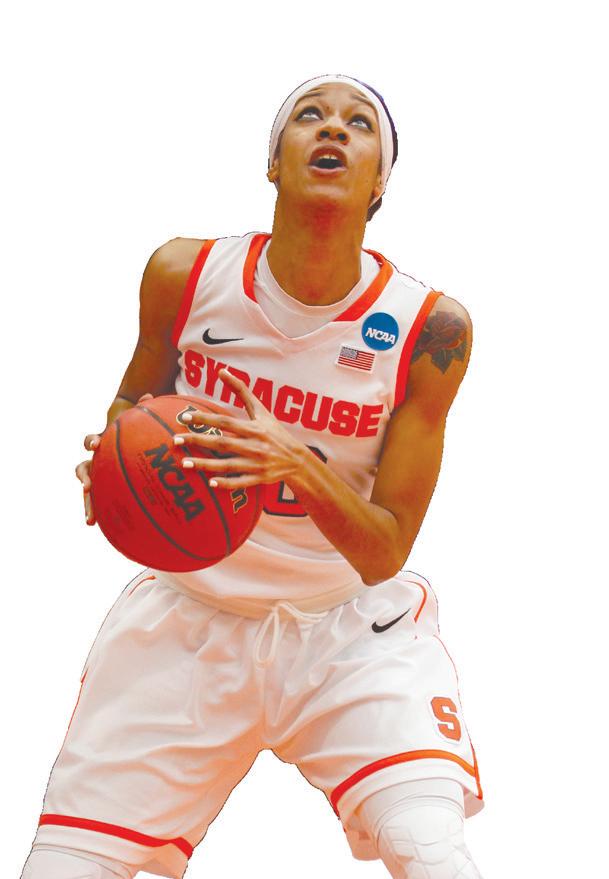
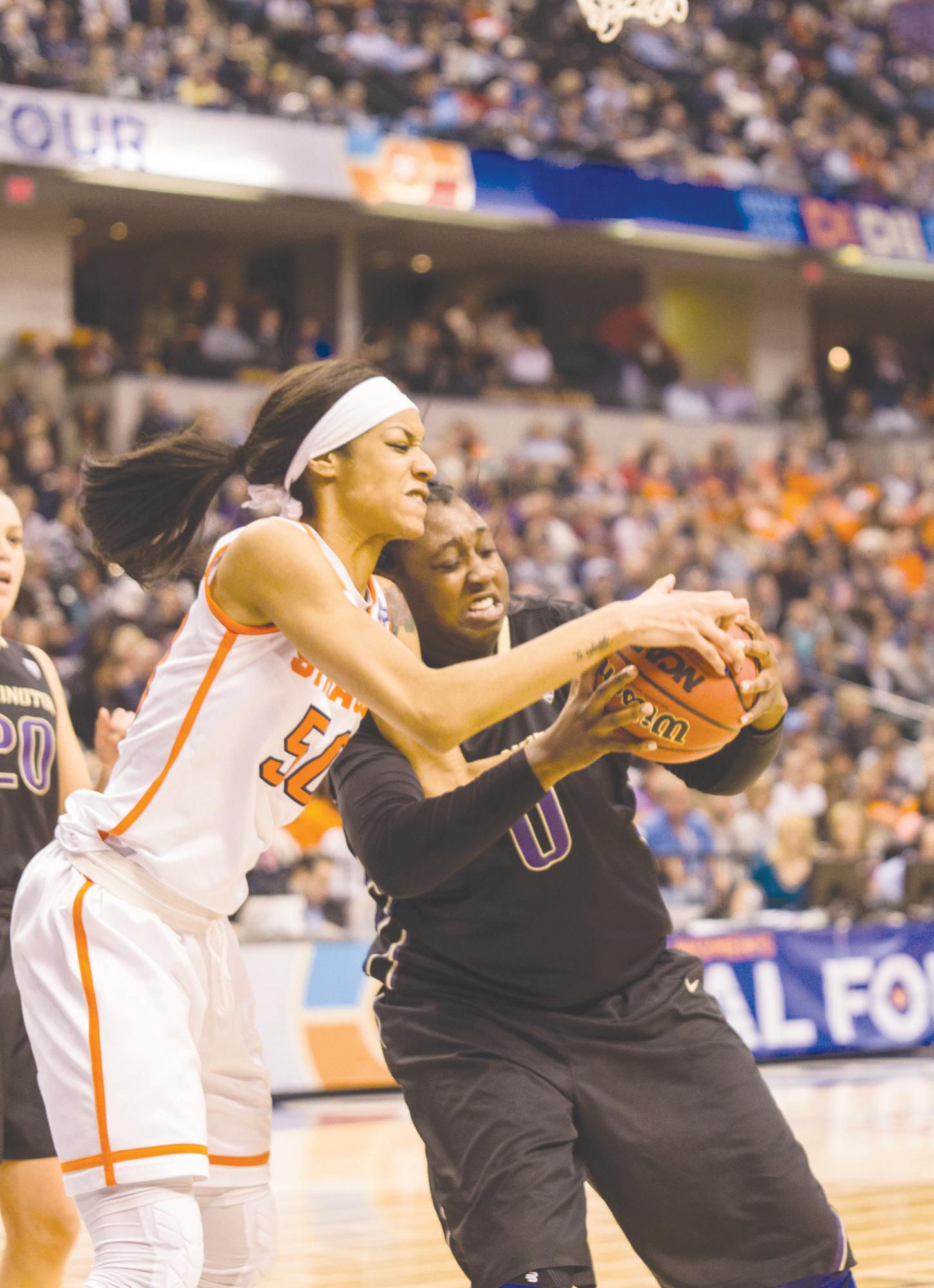
S Briana Day, Syracuse’s best shot blocker, has stopped blocking shots to prevent herself from getting into foul trouble. Instead, Day has started taking charges. Page 16
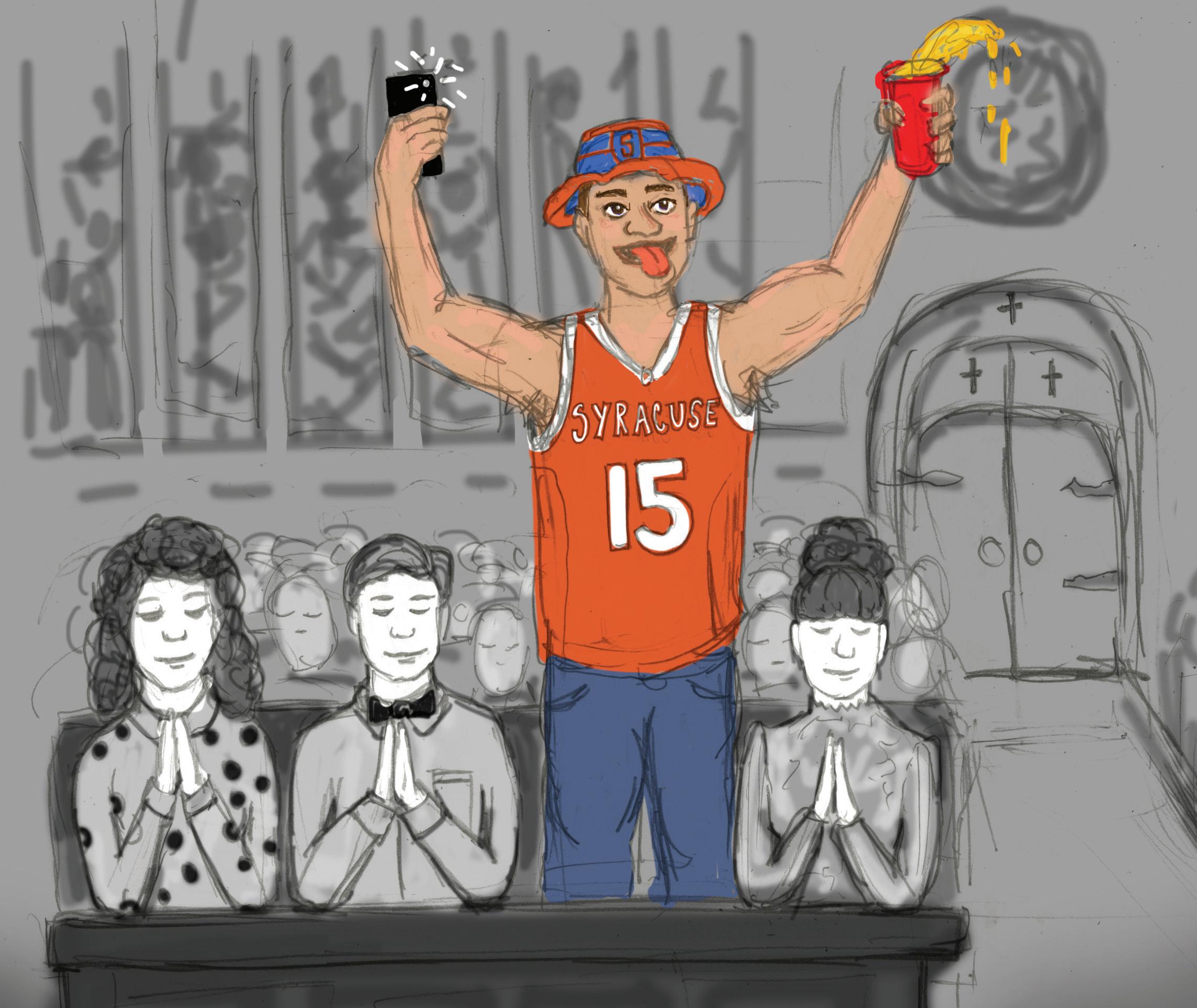
FROM PRAY TO PARTY
How SU became one of the nation’s top party schools
By Jacob Gedetsis social media director
Editor’s Note: Over the past month, The Daily Orange has collaborated with the Department of Newspaper and Online Journalism at Syracuse University on a series of stories relating to alcohol culture on the SU campus. Multiple stories will appear in The D.O. in the coming days.
Atall blond girl stumbles toward the Carrier Dome. Her arms wrapped around two of her friends, she cocks her head back and screams, “We are the No. 1 party school!”
No one blinks an eye.
This wasn’t always a common sight. In the 1870s, consuming alcohol of campus could get you expelled. Over its 146-year history, Syracuse University has transi-
O f cials reflect on donation
JPMorgan Chase sustains 5 years of investment in SU’s
By Justin Mattingly managing editor
When you walk into the ofces of the Institute for Veterans and Military Families, there’s a collage of photos on the right-hand side. Around the center text announcing where you are, there are scenes of Syracuse University serving veterans over multiple decades.
World War I. World War II. Now there are images of the university serving post-9/11 veterans. It’s that history — that commitment — that the IVMF uses to attract partners. That’s the pitch.
“I think that as folks are thinking about whether or not to partner with the IVMF, you’re always looking for signs of long-term sustainability and certainly this kind of commitment speaks to that,” said IVMF Chief Operating O fcer Maureen Casey.
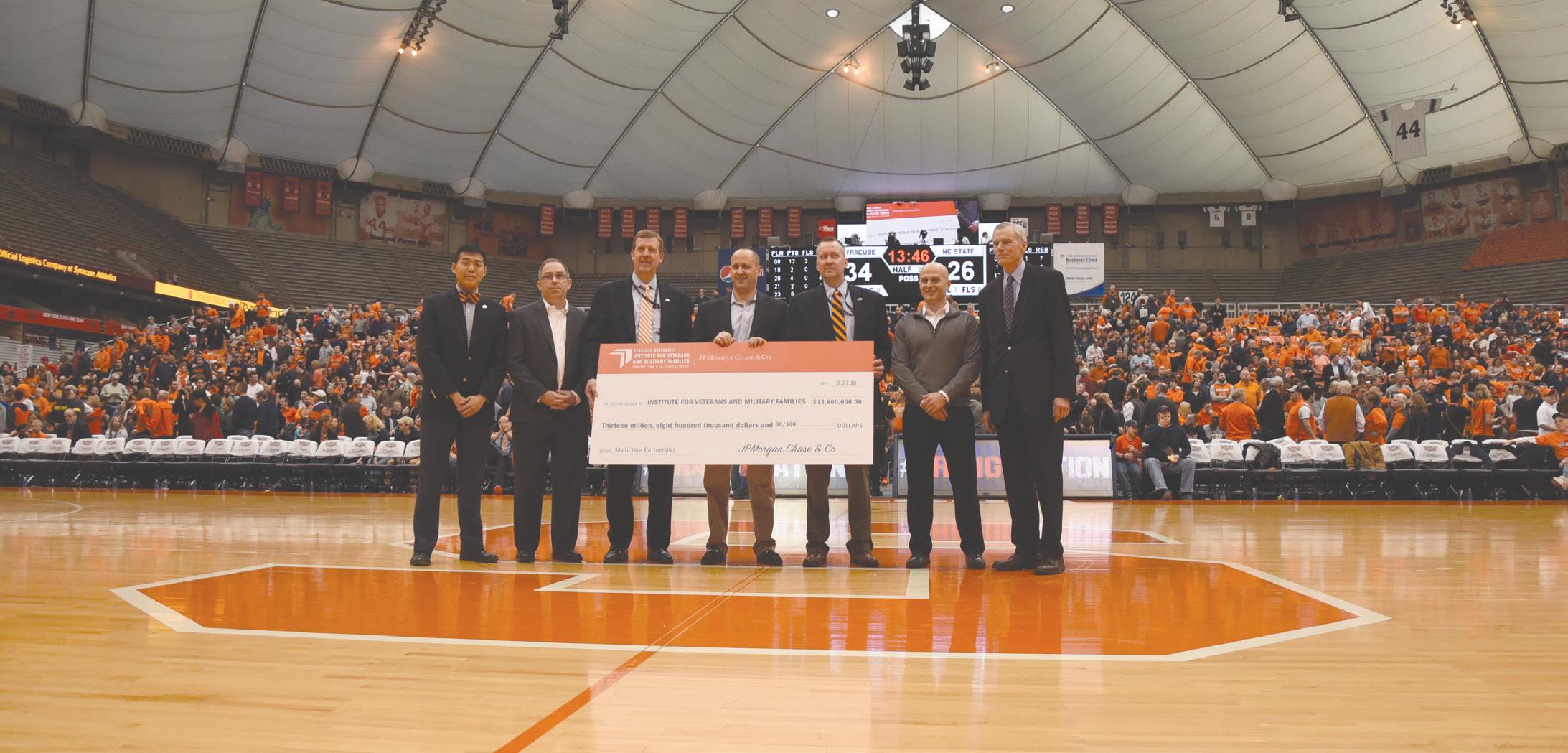
Five years ago, the IVMF got of the ground with a large investment from JPMorgan Chase & Co. Now, five years later, the largest financial institution in the world has invested another $13.8 million into the institute, which aims to help SU continue its long history of transforming the services and resources relating to veterans and their families.
tioned from a strictly dry campus to one of the nation’s top party schools.
Michael Hevel, a professor at the University of Arkansas who is currently working on a book about the history of alcohol on college campuses, said he suspects less has changed than people may think. He said he has found that despite campus rules, drinking has always been part of see alcohol page 6
The IVMF is a soft money institution, which means it doesn’t receive money from SU. So partnerships like the JPMorgan Chase one allow the IVMF to survive.
The process for creating the IVMF began with the expansion of Entrepreneurship Bootcamp for Veterans with Disabilities (EBV), one of the entrepreneurship and small business programs o f ered by the institute.
As EBV endured more success, there was an “opportunity recognition” moment for the university, said Mike Haynie, the founder of the IVMF and the vice chancellor for veteran and military a f airs at SU. There wasn’t an interdisciplinary academic institute focused on veterans and their families anywhere in the United States.
“To me that didn’t make a whole lot of sense,” Haynie said.
Haynie ended up in a
illustration by devyn passaretti head illustrator
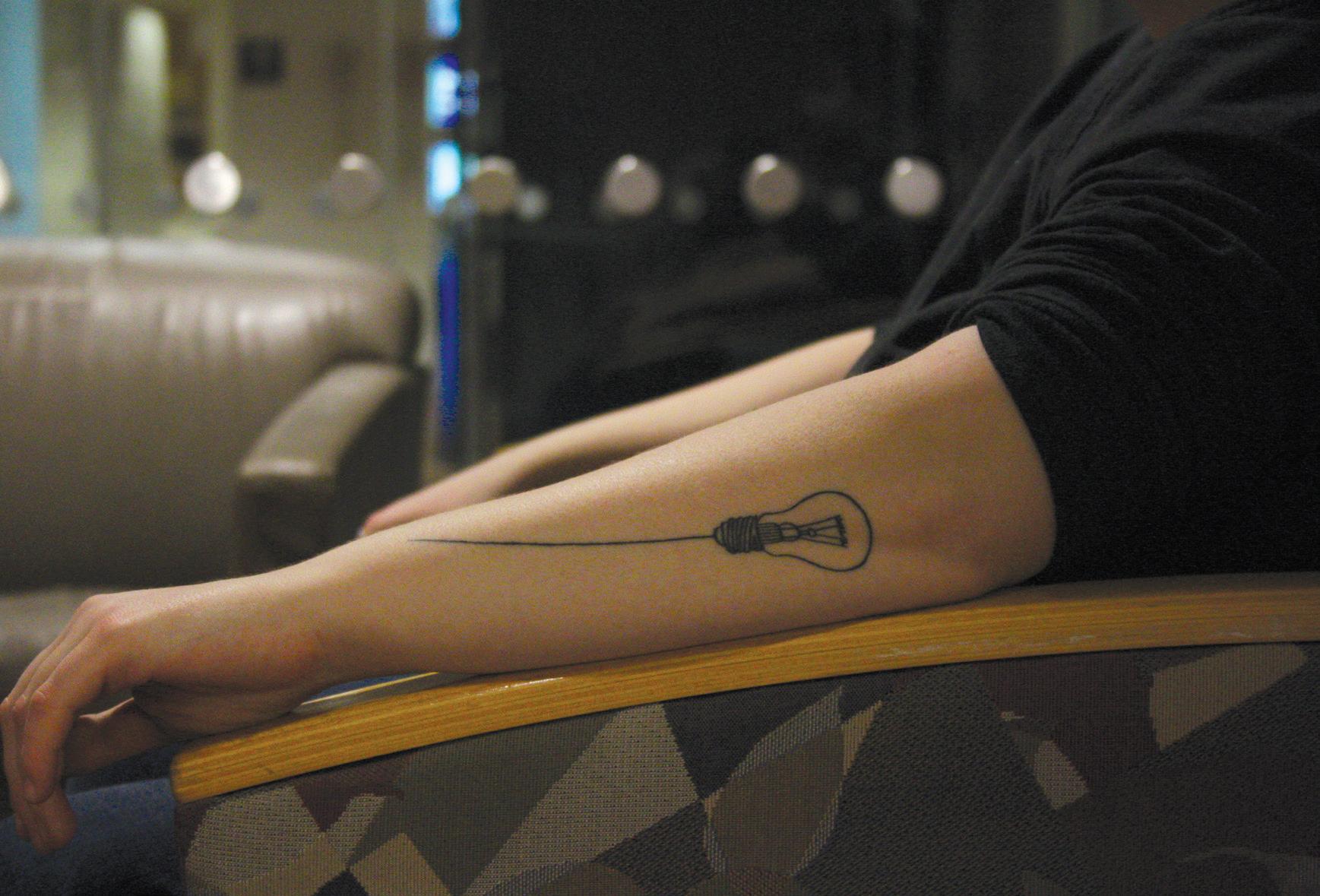
Junior’s tattoo honors stage lighting design
By Leah Meyers staff writer
For a long time, Anna LiDestri struggled with what career they wanted to pursue.
But when they came to Syracuse University, they found their passion in a career that often gets overlooked. LiDestri, a junior theater design and technology major, is a theatrical electrician and a lighting designer.
There is a lyric from the song “Last Hope” by Paramore that says, “It’s just a spark, but it’s enough to keep me going” that really struck LiDestri. Besides the fact that Paramore is their favorite band, the lyrics inspired LiDestri to get a tattoo of the passion that created a “spark” in their life and has kept coming back for more.
This past January, LiDestri tattooed an upside-down light bulb with an extra long cord down their left forearm. The tattoo was done at Sleepy Hollow Tattoo in Milford, Connecticut.
LiDestri works in the electrics shop for Syracuse Stage and SU Drama. As an electrician, their main responsibilities are to hang all of the lights for the stage and to help focus them.
LiDestri explained that essentially, their job is to make sure the lighting designer has everything they need to reach their artistic vision. But how can lights be art? LiDestri had
this same question, which ultimately pushed them to go into the field.
“With set design, you can touch the walls you put up, or sit on the couch on the stage that you designed,” LiDestri said. “With costume design you can zip up a jacket or button a blouse. But you can’t touch light with your hands.”
What intrigued LiDestri the
most was how one could create beautiful art with something that wasn’t tangible. The answer to this is what LiDestri is trying to figure out through their studies.
While these admirations of intangible art are what LiDestri likes most about being a lighting designer, there are other perks they enjoys as an electrician. LiDestri said they loves to be
hands-on with their studies, and being an electrician allows them to do so. And they gets to do more than design — they learns about the diferent lighting instruments and really gets into the nitty-gritty of how they work.
Said LiDestri: “I love getting my hands dirty with the technical side of the art.”
lmeyers@syr.edu
N Travel safety
An economics professor at Syracuse University weighs in on how the tourism industry in Europe could be affected by terrorism. Page 7
S Winning time
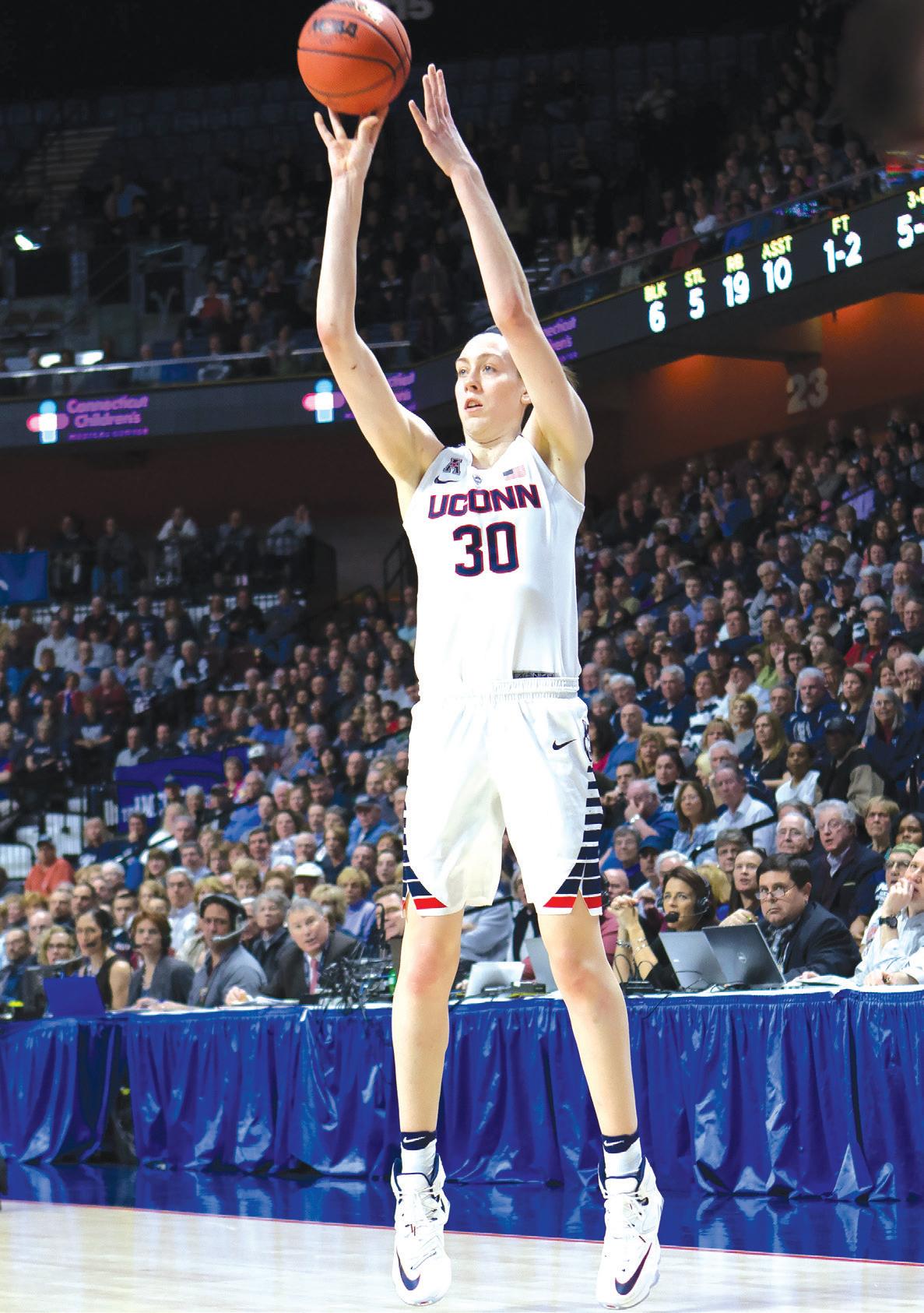
Syracuse plays Connecticut for the NCAA championship on Tuesday. Check out stories about Briana Day and Breanna Stewart. Page 16
ANNA LIDESTRI is a lighting designer and theatrical electrician for Syracuse Stage and SU Drama. Their tattoo is an upside-down lightbulb and cord on their arm. eddie natal staff photographer
Three things
What do you need to know about Monday night’s Student Association meeting? The D.O. News Department can help. See dailyorange.com
@NYGovCuomo
Proud to sign into law $15 statewide minimum wage and the strongest paid family leave policy in the nation.
Dance with somebody
Former Secretary of State
Madeleine Albright will speak at SU on Tuesday. A protest is scheduled to boycott her lecture.
See Wednesday’s paper
student association
Members discuss position
Decision to create director of diversity affairs will be voted on
By Nina Leeds staff writer
The Student Association met Monday night in Watson Theater to discuss the establishment of a director of diversity a fairs within SA, the sponsoring of undergraduate research and the buses sponsored by the Division of Student A fairs to bring Syracuse University students to the Final Four basketball games in Houston and Indianapolis.
photographer
Syracuse University’s Orange Pulse Dance Troupe rehearsed for its 13th annual charity showcase dance performance, called “Spellbound,” on Monday. The show features more than 50 performers who each portray different forms of dance such as ballet, tap, Irish step and Tahitian Hula. The showcase also donates funds to a different charity each year.
frankie prijatel senior staff
Screening, panel held for ‘It’s On Us’ event
By Sara Swann asst. news editor
The handling of sexual assault as a national and college campuswide issue has changed, said Carrie Bettinger-López, White House adviser for violence against women. But some things need to change a whole lot more, she said.
Bettinger-López spoke in Stolkin Auditorium inside the Physics Building on Monday night as part of Syracuse University’s “It’s On Us” National Week of Action. She provided opening remarks about sexual assault prevention and awareness before a screening of “The Hunting Ground,” a documentary about sexual assault on college campuses, before leaving to board Air Force Two with Vice President Joe Biden.
Bettinger-López, who is the second-ever White House adviser
for violence against women, reminded the crowd of about 60 SU community members that in addition to it being the “It’s On Us” National Week of Action, April is also National Sexual Assault Awareness and Prevention Month.
23.1
The percentage of incidents of sexual assault and sexual misconduct due to physical force, threats of physical force or incapacitation among female undergraduate students
source: america association of universities
Currently, 327,000 people nationwide have taken the “It’s On Us” pledge to end sexual assault, Bettinger-López said. “This is about developing a
robust response that enforces the law, but also sends a message on a societal level about the importance of change,” Bettinger-López said. “And all of you are those change agents. … Just remember how powerful each and every one of you are in your own capacities to create that change.”
After Bettinger-López finished speaking, a short, 60-minute version of “The Hunting Ground” was shown. The documentary is usually one hour and 45 minutes long.
The documentary shared the stories of numerous women and men who experienced sexual assault at their college or university. Some of the schools included in the video were the University of North Carolina at Chapel Hill, Florida State University, Harvard University and Saint Mary’s College, among others.
Following the screening, a fiveperson panel was held to answer questions from the audience. Mem-
bers of the panel included Samantha Skaller, a junior at SU who is on the National “It’s On Us” Student Advisory Committee; Susan Pasco, associate director of the Counseling Center at SU; Erin Duran, associate director of the LGBT Resource Center at SU; Eric McGrif, a sophomore in the College of Arts and Sciences and a member of A Men’s Issue; and Miriam Ward, a senior in the College of Arts and Sciences.
When asked what it takes to change the culture around sexual assault on college campuses, McGri f said events like the panel and others such as Take Back the Night and the Vagina Monologues are ways students are changing the campus culture.
“On this campus, we have been fortunate that many times we have been at the forefront of this issue. And it’s because we recognize that
see it’s on us page 8
Speakers talk on experiences as Asian-Americans
By Kennedy Rose staff writer
Former United States Transportation Secretary Norman Mineta spent part of his childhood living in a Japanese internment camp during World War II. Since his parents were from Japan, Mineta and his family were forced to live in internment camps designed for “all alien and non-alien people of Japanese ancestry.” His brother’s draft card
changed from 1A — fit and able to serve — to 4C, a code used for “enemy aliens.”
“That psychological warfare was being used on us,” Mineta said. “My own government wasn’t willing to call me a citizen.”
A discussion of living in internment camps, the importance of public service and the role of minorities in elections dominated The Minority Report panel Monday night in Maxwell Auditorium. The Kappa Phi Lambda sorority and Sigma Beta
Rho fraternity hosted the panel with Mineta and NBC News anchor Richard Lui to discuss the role of minorities in politics and media.
Diminov Boestami, secretary of Sigma Beta Rho and a junior in the S.I. Newhouse School of Public Communications, was the moderator of the event.
In addition to serving as secretary of transportation, Mineta has also served as the mayor of San Jose as well as other roles in public ofce. Lui is currently an anchor
at MSNBC and NBC News, and he was the first Asian-American anchor for CNN International. Lui discussed his background as well. As a teenager in the 1980s, he would make fun of other AsianAmericans who were “fresh o f the boat” from countries like Japan and China. He said that upon maturing, he was angry with his past self for being so rude and ashamed of his ethnicity, because the people he would ridicule were
see minority report page 8
SA voted during Monday’s meeting to put the approval of the position of director of diversity a fairs on the ballot for the coming election so that the student body will have the power to decide whether this position should be created.
SA debated during the meeting whether it would be better to have one person direct diversity a f airs or if it would be more efective to have the job done by a committee. The assembly did not come to a decision and concluded that there is still more to discuss regarding how the position would work.
The specifics of the job will be discussed more by SA in the see sa page 8
Here is a round-up of the biggest news stories happening in the nation and the world right now:
PANAMA PAPERS
In one of the biggest document leaks in history, the International Consortium of Investigative Journalists uncovered evidence of massive corruption through offshore tax havens and shell companies among world leaders, politicians and businessmen.
source: international consortium of investigative journalists
U.S.
REJECTED CASE
The Supreme Court unanimously rejected on Monday a conservative challenge to how states draw legislative districts. The lawsuit claimed that by counting all residents and not just registered voters, states were violating the important principle of “one person, one vote.” The court, however, rejected this line of argument.
source: reuters
Tax hike letter from New York’s wealthiest warrants skepticism
Millionaire New Yorkers plead for a tax hike, but aren’t ready to put their money where their mouths are.
Dozens of New York-based millionaires had requested a tax hike on themselves while Gov. Andrew Cuomo and state legislative leaders negotiated the 2016-17 state budget in late March. The budget, which was adopted by New York’s Legislature Friday, ignored the request — rendering it obvious that the letter was insincere attempt at addressing inequality.
In the form of an open letter, the group, including the notable Abigail Disney and Steven Rockefeller, had written that in order to ensure New York’s long-term economic success, the state must invest in both physical infrastructure and human capital by the means of what they call “shared sacrifice,” or, in other words, a tax increase on the “1 percent.”
But these millionaires should acknowledge that a tax hike may only entice the rich to dodge taxes in increasingly clever ways. Proposing such an increase without confronting such rampant fraudulent — and yet often completely legal — practices is futile when the ultra rich should be held accountable with common-sense tax reform first.
The authors of the letter to Cuomo stated that the state cannot a ford to ignore its ailing infrastructure and poverty levels, claiming that investments in such areas of society will foster job growth and reduction in extreme income inequality.
They wrote, “As New Yorkers who have contributed to and benefited from the economic vibrancy of our state, we have
MIA TOMASELLO TO THE LEFT, TO THE LEFT
both the ability and the responsibility to pay our fair share. We can well a ford to pay our current taxes, and we can a ford to pay even more” referring to such a redistribution of wealth as a “shared sacrifice.”
But is it really a “sacrifice” to pay a fair marginal income tax rate when there are copious dodging strategies and legal loopholes that the wealthy elite may use to evade taxes? This letter may have come as a hopeful change of rhetoric for those who pay attention to wealth inequality, but the letter completely ignores a fundamental driver of it — the exclusive, unwritten tax code of the 1 percent.
Unlike the group of New York millionaires, multi-billionaire and chief executive of Berkshire Hathaway, Warren Bu fett, gave a surface insight into the deeply rooted issue of flawed tax policy in the United States in his wildly popular 2011 op-ed with The New York Times titled “Stop Coddling the Super-Rich.”
“While the poor and middle class fight for us in Afghanistan, and while most Americans struggle to make ends meet, we mega-rich continue to get our extraordinary tax breaks,” wrote Bu fett.
He described how his federal tax bill was lower than that of his secretary — a statement so shocking even President Barack Obama alluded to it in his 2012 State of the Union speech.
This, Bu fett elaborated, was due to the fundamental loophole in the very definition
of income. For most of us, income is our salary and if we’re lucky enough, a bonus. But the ultra-wealthy earn their income from “carried interest” or “capital gains,” economic jargon for profit from the sale of properties or investments. This is taxed in a completely different manner at 15 percent, thus essentially creating a private tax system that caters solely to those privileged enough to know it, allowing billionaire executives to pay lower taxes than their secretaries.
Of course, a manifesto could be written on the innumerable clever strategies that the ultra-rich use to avoid taxes, from tax havens and of shore trusts to even renouncing one’s citizenship, all of which deserve attention. However, Warren Bu fett proposed the candid solution of not only raising taxes on taxable income excess of $1 million, but also including such capital gains.
We should absolutely encourage and implement a higher tax rate on New York’s top earners.
They owe it to New York for having reaped the various benefits in the state that have contributed to their wealth. These multi-millionaire elite claim to wish to heal New York’s reputation by alleviating poverty and homelessness, but with the greed and corruption of Wall Street being one of the most popular and quintessential New York references, they should look within their own social stratum before o fering “sacrifices” to the subordinate classes.
Such pejorative characterizations of New York have been aided by media perpetuation. For example, the 2013 motion picture “Wolf of Wall Street,” based on the
letter to the editor
true story of 1990s era New York criminal stockbroker Jordan Belfort, was presented as an idolization of selfish greed-seduced millionaires, rather than a cautionary tale of the consequences that such players have on our society.
Belfort engaged in a multitude of tax avoidance behaviors. And when rationalizing his business tactic of preying on naive middleclass investors, his character, played by Leonardo DiCaprio, said, “Their money was better of in my pocket — I knew how to spend it better,” perhaps alluding to the collective sentiment of New York’s financial district.
So while upon first glance some may applaud the group of New York millionaires for ofering such altruism to their state, when understood in conjunction with fundamental tax policy flaws, a level of skepticism should be raised about the intentions of their letter. The one-percenters have the power to demand, but instead they plead.
These powerful elite have every opportunity to “sacrifice” and unveil the corruptive practices of their own class, but appear to avoid it. One can only assume that the public letter was a call for attention in attempt to ameliorate the derogatory stereotypes of the rich in an election cycle that has exposed tremendous wealth inequality in America.
Such a display should be taken with suspicion. After all, the New York elite are known to be wolves in sheep clothing. Mia Tomasello is a junior environmental communications major at SUNY-ESF. Her column appears weekly. She can be reached at atomasel@syr.edu and followed on Twitter @MiaTomasello1.
Pan-Hellenic Council endorses Malik Evans for comptroller
The National Pan-Hellenic Council at Syracuse University proudly supports Malik Evans as the next Student Association Comptroller. As a council, we have collaborated to create programs that ofer a broader college experience, bring light to important issues within our communities and impacts student life on campus in a positive manner. We feel that Malik Evans shares our beliefs and can lead our campus in the right direction.
We are proud to stand behind Malik’s platform “Engage SU” because it promotes the finance board to be more engaged with Registered Student Organizations, enhancing student innovation, and fostering relationships with student leadership within these organizations.
Malik has the most experience in this realm of Student Association and is thinking forward in the right direction to benefit all students. Malik has served on the finance board for the past 2 years under two separate comptrollers. He has seen how these two comptrollers supported student
organizations, but he still believes there is room for improvement.
Aside from his ambitious plans for the direction of the finance board, Malik Evans is the ideal candidate because he truly has a deep love for the university. He has proven to be an outstanding leader with passion and drive for change that is unmatched by the other candidates.
Therefore, on behalf of the National Pan-Hellenic Council at Syracuse University, we would like to ofcially endorse Malik Evans for Comptroller of the Student Association 60th Session.
We encourage all to VOTE April 11-14 on myslice.syr.edu.
National Pan-Hellenic Council:
Alpha Phi Alpha Fraternity, Incorporated
Alpha Kappa Alpha Sorority, Incorporated
Kappa Alpha Psi Fraternity, Incorporated
Omega Psi Phi Fraternity, Incorporated
Delta Sigma Theta Sorority, Incorporated
Phi Beta Sigma Fraternity, Incorporated
Sigma Gamma Rho Sorority, Incorporated
Albright poor choice for ethics lecture
The decision to bring Madeleine Albright to Syracuse University as a part of the Tanner Lecture on Ethics, Citizenship, and Public Responsibility series on Tuesday is an ironic one considering Albright’s politics do not fit the agenda of the talk.
Albright’s controversial reign as Bill Clinton’s right-hand woman during his second term as president is characterized as a time of aggressive U.S. foreign policy in which she exercised a vision of the country leading from the front on international issues. But regardless of the fact that Albright’s past decisions are in no way a reflection of her personal character — considering she served in one of the highest political offices — her responses to crises were often too coldhearted — even questionable — as seen in the role Albright played in Yugoslavia and Iraq.
First there were the atrocities associated with NATO’s deadly bombing campaign in Yugoslavia in response to the ethnic cleansing of Albanians in Kosovo led by Slobodan Milosevic, the former President of Serbia and the Federal Republic of Yugoslavia. Albright was a main proponent of this decision — a decision that was ordered illegally in the eyes of international law without U.N. Security Council approval.
The air campaign may have sounded like a good idea, but it decimated Kosovo and left an unknown number of Serbians dead and some 300,000 displaced, according to the Balkan Transitional Justice initiative. Should Milosevic have been taken out? Yes, but it shouldn’t have come at the price it did, especially without proper permission. Ultimately Albright’s risk-taking failed, proving to expose her insensitivity and poor ethical approach in handling international dilemmas.
The bombings came after Albright’s involvement in Iraq in the 1990s resulted in a humanitarian disaster, during which she oversaw U.N. sanctions that were an attempt to cut of Saddam Hussein’s power.
While Hussein was a horrendous dictator that killed
hundreds of thousands of people, the U.N. Security Council’s sanctions ruined the Iraqi economy to the point that its citizens weren’t getting enough basic resources like food or medicine, according to The Guardian. Scientists on behalf of the Food and Agriculture Organization found that by 1995, more than 576,000 children died under Hussein’s rule due to the sanctions.
At the time, Albright was U.S. ambassador to the U.N. and should take responsibility for reinforcing sanctions that were far too strict. Instead, Albright said on 60 Minutes that the sanctions were “worth it.” Though she took back the statement, the damage was already done. The enemy was supposed to be Hussein, not the U.N. And yet its poor choice left Iraq crippled and its people ended up clinging to the regime for rations — an example of why Albright’s ethics should be called into question, making her unfit to be chosen for the Maxwell lecture.
James Steinberg, dean of the Maxwell School of Citizenship and Public A f airs, said in an email, “Secretary Albright has an extraordinary career as both an academic and public servant,” when asked why SU’s Maxwell School of Citizenship and Public A f airs chose Albright. “She has 40 years of experience in the practice of international a f airs — for which she received the nation’s highest civilian honor, the Presidential Medal of Freedom.”
It makes sense, judging from her background of fleeing Nazi occupation of Czechoslovakia, as to why she was callous at times in her foreign policy measures. On one hand, Albright would be a great choice for a speaker discussing foreign policy and U.S. security issues because there was still evil in the world in the 1990s, something she witnessed firsthand as secretary of state.
But the fact of the matter is that the Tanner lecture is supposedly on “Ethics, Citizenship, and Public
Responsibility.” And while it may be necessary, there’s nothing ethical about the decision to bomb a country or cut of its resources.
Because her policies to save lives were misguided and were often responsible for doing the opposite, there have been several protests on college campuses against Albright as a visiting speaker. In 2001, there was a movement at the University of California, Berkeley to protest Albright’s planned speech. There was another peaceful demonstration in 2005 at the University of Winnipeg in disagreement with Albright’s reception of an honorary degree.
And like the students at Scripps College — who are currently objecting to Albright as a commencement speaker this year for being a “genocide enabler” — the response to challenge the morality behind Albright’s record at SU is no exception.
In a recent Letter to the Editor to The Daily Orange, SU student Collin Chambers of the Syracuse ANSWER Coalition, a local social and political justice organization that intends to protest Albright on Tuesday wrote, “Having Albright speak on campus gives Syracuse University a bad name. It says that the University supports war criminals!” Albright is definitely not a war criminal like the Syracuse ANSWER Coalition has argued because of her intentions to rid oppressive regimes of their power, not to do harm.
And while it is understood that war unfortunately results in the death of innocent civilians, that’s not to say that Albright was a suitable fit for the SU lecture series either.
In bringing Albright to campus, Maxwell should emphasize her knowledge of international security, not morality. SU students should be exposed to Albright’s expertise, not her past closedminded actions as one of the most powerful women in the history of the U.S.
Kyle O’Connor is a sophomore sport management major and political science minor. His column appears weekly. He can be reached at kdoconno@syr.edu.
editorial board
Use of video could allow for greater connection
If a significant event were to happen within the Syracuse University community, the administration should consider using a video response to more powerfully have its message resonate with students.
Patrick Sims, the vice provost of the University of Wisconsin for diversity and climate, made a nine-minute video last week in an emotional reaction to a hate crime on the Madison campus. In the video, Sims described what happened and — while visibly struggling to describe how disappointed he was — said “no letter from the provost,” chancellor or vice provost would prevent what he called a “cowardly act.” As of Monday night, the video had about 11,300 views.
At SU, an email is expected during times when the campus community is engaged in a collective conservation — whether that is regarding inclusivity, student safety or the achievements of the university. But even with bolded words and italicized phrases, email correspondence may not be enough in certain situations that warrant an administrative response. And in these cases, the consideration of a video message may offer the
administration a very digestible outlet for complex topics that may be facing the university.
Pushing the bar past a strongly-worded email has the capacity to add a human element to what may be very personal situations for students, sta f and faculty. Establishing this level of connection provides the opportunity for a stronger communal bond in which the sentiments of administrative members have the potential to be visibly communicated to demonstrate urgency, emotion and clarity.
The use of video also makes it clear to those who watch them that the administrative member is actively involved in the respective campus discussion rather than only contributing to a general message signed of by several names students may not even be able to put a face to.
Though the incorporation of videos into SU’s communications should only be carried out when appropriate to not undermine the power of the message, the administration should reflect on Sims’ example and evaluate the ways in which this form of response would have its ideas better resonate with students in ways that text cannot.
scribble
School aims to raise $40,000 in crowdfunding campaign
By Kennedy Rose staff writer
One Syracuse University alumnus — a business analyst at JPMorgan Intelligent Solutions — has pledged $20,000 in a crowdfunding campaign at the iSchool.
ReFuel, the School of Information Studies’ crowdfunding campaign, aims to raise money for four di ferent programs in the iSchool. The campaign will last 44 days and has a goal of $44,000 raised by alumni, parents, current students, faculty and sta f
“As a young alumnus, I felt that giving back to the university was such a critical component,” said Sam Clarvit, the JPMorgan analyst who graduated from SU in 2010.
ReFuel was launched at the end of March during Philanthropy Week and is set to end on May 3, the last day of classes for the academic year.
Kimberly Pietro, assistant dean for advancement at the iSchool, said the campaign hopes to raise close to $40,000 on its own, and then with the matching $44,000 from the Board of Advisors come to a total of about $75,000.
The number 44 was worn by SU’s football titans: Jim Brown, Ernie Davis and Floyd Little. ReFuel chose 44 and the goal of $44,000 to “keep the tradition of No. 44 at
SU alive,” Pietro said.
The four programs ReFuel is raising funds for are: Student Immersion, Librarians in the Field, Women in Technology and Researchers of Tomorrow. Pietro said all of the funds will go directly toward benefitting students.
The Student Immersion program would allow iSchool students to take trips to technological hubs, such as Silicon Valley or New York City, according to the ReFuel website.
As a young alumnus, I felt that giving back to the university was such a critical component.
Sam Clarvit jpmorgan analyst and su alumnus
Through the Librarians in the Field program, students in the library and information science program would be able to attend conferences and workshops, according to the website.
The Women in Technology program is a gender-based initiative, according to the website, and it would help the iSchool introduce women to information technology.
Doctoral students would receive funding for research through the Researchers of Tomorrow program, according to the website. Funds would go toward sending doctoral candidates to conferences — both domestic and international — to immerse them in the world of information technology.
The funds raised through contributions to the crowdfunding campaign will be matched by the iSchool’s Board of Advisors, Pietro said. Out of the four programs that can be donated to, the one that gets the largest number of contributions will also receive the largest amount of challenge funding — $8,000 — from the Board of Advisors.
The distribution of challenge funding is determined by the number of contributions rather than the amount of money each program receives, Pietro said. A program that receives 500 separate contributions of $1 each would get more challenge funding than a program that received one contribution of $500, she said.
Because each contribution acts as a vote toward which program should receive the most challenge funding, Pietro said the program with the most individual contributions — or votes — will receive the most challenge funding.
The program that comes in first place with the highest number of contributors will
receive $8,000, the program in second place will receive $6,000, the program in third will win $4,000 and the program in fourth place will get $2,000, Pietro said.
Major contributors to the matching funding were Clarvit, the JPMorgan analyst, and Stephen Marsh, the founder and CEO of tech company Smarsh.
Marsh said he contributed to the ReFuel campaign because there were similar programs that enabled him to help finance his education when he went to SU. He added that the programs helped make parts of the program available to him and other students.
“So I figured it would be a good chance for me to give back,” Marsh said.
While Marsh is a member of the iSchool’s Board of Advisors, he said he did not organize the campaign, but rather contributed by donating to the Board of Advisors’ matching funds initiative.
Clarvit and Marsh are both Generation Orange alumni, an alumni base composed of people who have graduated within the past 10 years. The ReFuel program was designed to engage Generation Orange alumni by adapting to more modern forms of fundraising like crowdfunding and eliminating the pressure to donate, Clarvit said.
krose100@syr.edu
campus life, just not one in full view.
“I don’t really think there’s too much new about the party school atmosphere,” Hevel said. “I think that one of the things that history shows is that it’s not a new problem. It’s something educators have dealt with for a long time.”
The beginning
The Methodist State Convention held its annual meeting in the winter of 1870 in Syracuse and passed a resolution to start a university in the Salt City. Soon after, on March 30, 1870, SU was o fcially founded.
There was no ofcial policy against the use of alcohol on campus, but the Methodist Church — at that time and now — preached abstinence from all forms of drugs, including alcohol, according to the SU Archives. Hevel said this was common when campuses were closely associated with a religious organization.
I don’t really think there’s too much new about the PARTY SCHOOL atmosphere.
Michael Hevel
university of arkansas professor
In the early 1900s, SU began to provide on-campus student housing and adopted a brief policy stating there would be no drinking at home or on school property, according to a 1914 Daily Orange article.
Prohibition
W hen prohibition went into effect, not much changed at SU since it was already a dry campus.
Then-Chancellor Charles Flint wrote an ofcial damnation of the 21st Amendment repealing prohibition in an article in The Daily Orange.
“Tra fc in intoxicating liquors, not merely for 15 years but for 15 centuries and more, has been generally recognized as the most prolific cause of poverty, crime and misery,” Flint wrote.
dike was too big for my puny hands.” He condemned those who saw the sale of alcohol as a chance for profit and urged the SU community to avoid drinking altogether as it degraded “moral convictions.”
The university made it clear that the repeal of prohibition did not change its own stance on drinking, telling The Daily Orange the policies in the student handbook were “to be strictly adhered to.” That meant students abstain alcohol or else, face expulsion.
The 1960s: Free love, plenty of beer
Peter Jefer cracked open a can of beer, leaned his head back and drank. In one swift motion, the president of SU’s student government in 1967 challenged an almost century- old rule in front of the entire student organization.
He was trying to make a point. The student group was pushing for legislation that would allow drinking at university social functions and in SU buildings, according to an article in The Daily Orange.
In a series of investigations by various student judicial organizations and the university, Jefer was eventually let of the hook, and no disciplinary action was taken against him. His actions created a domino e fect that could not be stopped.
A committee of students, faculty and sta f approved a policy on Feb. 8, 1968, to allow drinking at college events, according to the SU Archives.
A little over a year later on March 9, 1969, a Post- Standard headline read: “Tradition broken as beer flows at SU dance.”
Four years, three drinking ages
Scott Dann, a Class of 1986 SU alumnus and a member of the Sigma Phi Epsilon fraternity, had to borrow his friend’s driver’s license for two weeks.
After being able to drink for his entire college career, it was suddenly illegal for him to purchase or possess alcohol. So he bummed a license from his fraternity brother so he could indulge in the culture he had grown accustomed to, Dann said.
In 1984, Congress passed the National Minimum Drinking Age Act, which required states to raise the legal ages for both the purchase and public possession of alcohol to 21 by October 1986. If the states didn’t comply, they’d lose 10 percent of their federal highway funds. New York state abided, raising the minimum age on Dec. 1, 1985.
The number of people arrested after a 1999 block party near Syracuse University turned into a riot
SU adjusted its drinking policy to match the state’s standards.
“I don’t think it a fected a lot,” said Dann, whose daughter is currently a freshman at SU. “My hypothesis is that if kids want to drink they are going to drink. It wasn’t going to stop anybody, it may have made it more di fcult for some people to obtain it, but for the most part it was readily available, it was never really a problem.”
As a result of the age change, the SU campus favorite bar and concert venue, The Jabberwocky, was forced to close its doors. A schoolsponsored bar couldn’t survive with 75 percent of its population suddenly being underage.
Riots rage in grunge-filled 1990s
An alcohol-fueled crowd of 1,000 students and others hurled insults, beer bottles and more at authorities in an almost three-hourlong standof on Livingston Avenue in 1999.
The annual block party known as “Livingstock” turned into a riot, after police came to shut it down after the permit time of 10 p.m. expired, according to an SU Magazine article. Students reacted violently, throwing items at police ofcers and starting a fire. Rioters stoked bonfires made of mattresses, branches and lawn furniture, and they formed human barricades to prevent firefighters from reaching the flames.
At 1 a.m., a reinforcement squad of 50 police arrived to stop what had become a full-scale riot.
charges ranging from littering to rioting in the first degree, according to the article.
“We are very fortunate that a neighborhood didn’t go up in flames and that no one was seriously hurt,” said Barry Wells, who at the time was SU’s senior ofcer on matters related to alcohol and other drug abuse and is now a special assistant to Chancellor Kent Syverud, in a statement. “You can analyze this a million di ferent ways, but the bottom line is that this mob behavior was sparked by the excessive consumption of alcohol.”
Millennials mix drinks and school
SU’s ofcial alcohol policies have changed only slightly since the ‘90s. A ban of kegs at registered campus parties made the most notable splash, but overall the policy has stayed the same.
The administration’s most critical reaction to student drinking came when The Princeton Review ranked SU the No. 1 party school in August 2014.
It wasn’t going to STOP anybody, it may have made it MORE DIFFICULT for some people to obtain it, but for the most part it was READILY AVAILABLE, it was never really a problem.
Scott Dann
class of 1986 su alumnus and member of sigma phi epsilon fraternity
Kevin Quinn, senior vice president for public a f airs at SU, released a statement saying the university was disappointed with the party school ranking.
Flint wrote that he was in favor of prohibition, but in the end “the hole in the
He had just missed the cutoff when the drinking age was raised by the state in 1982 from 18 to 19. It was a governmental effort to curb the amount of drinking -related driving deaths.
By night’s end, 39 people — including 15 SU and seven State University of New York College of Environmental Science and Forestry students — had been arrested on
“We do not aspire to be a party school,” the statement said. “With new leadership, we are very focused on enhancing the student experience, both academically and socially. Students, parents, faculty and the full Syracuse University community should expect to see important and positive changes in the year ahead that will improve and enhance the student environment in every aspect.”
jagedets@syr.edu from page 1
ask the experts
Travel plans
Professor explains how terrorism has affected tourism industry in Europe
By Caroline Bartholomew staff writer
Brussels is famous for its chocolate, beer and medieval architecture, but after a series of bombings that killed 32 people in March, Brussels has become associated with terrorism, and this reputation is likely to hurt the city’s tourism industry, according to the International Business Times.
Shortly after the November 2015 terrorist attacks in Paris, concerts were cancelled, sporting events were postponed and hotel bookings dropped 30 percent, according to Time Magazine. Overall, tourism in Paris dropped for a three- to six-month period before it returned close to normal.
Other countries like Germany and Italy also saw a decrease in tourism following the Paris attacks, which means that there is a spillover efect. A travel-data firm reported to USA Today that “repeated terror attacks could have a cumulative efect that hasn’t fully been felt, coming atop the ongoing refugee crisis and news of several countries’ financial struggles … there’s nothing good on the news about Europe right now.” It is unclear whether the same phenom-
enon will take efect in Brussels after the March 22 bombings, but the “Visit Brussels” agency, which aims to promote tourism for the city, has started a public relations campaign to let visitors know Brussels is safe to visit. The campaign, “CallBrussels,” began in January. The campaign provides specialized phones in the busiest areas of the city so tourists can report anything suspicious or get information on the security of their current location.
As the peak of travel season for Europe — spring and summer — approaches, some ofcials are worried tourists will be a fected more because of the timing of the bombings. European travel is down 13 percent from what it was at this time last year, while tourism in Asia and South America has increased, according to USA Today.
To get an expert’s perspective on the situation, The Daily Orange interviewed via email Tod Rutherford, a professor of geography who studies economic geography in North America and Europe. Rutherford’s answers have been lightly edited for clarity.
The Daily Orange: What kind of impact have the attacks had concerning travel throughout Europe?
The amount European travel dropped compared to this time in 2015
The amount hotel bookings dropped after November 2015 Paris attacks 13%
Tod Rutherford: The most significant is the re-institution of border checks between many nations in the so-called Schengen zone, which comprises 26 countries in the European Union (EU) that over the last 30 years no longer require the showing of any passport or visa when you cross the border. This includes nations such as Germany, France, Italy, the Netherlands, Austria, etc. (The UK and Ireland never joined Schengen.)
Thus border controls have been reintroduced between France and Germany, Sweden and Denmark, etc. However, this is as much due to the migrant crisis as terrorism.
The D.O.: How are the attacks a f ecting security in European countries?
T.R.: More specific measures over terrorism are increasing cooperation between EU nations and information sharing around security. At the moment this doesn’t happen enough between some EU nations, like France and Belgium, and within some EU nations. For example, Belgium is very divided along ethnic lines, and this also impacts security efectiveness.
It is pretty evident that this was a major problem in both the Paris and Brussels attacks. There are also divisions between eastern and western EU nations — the former don’t see a significant terrorism threat at present, while the western nations such as France and the UK do.
The D.O.: What e f ect do these terrorist attacks have on everyday life?
T.R.: At the day to day level, what this means for the average person is the heightened presence of security and checks in public transportation hubs such as airports, train stations, etc. cbarthol@syr.edu
One of the many memorials created in Paris after the November 2015 terrorist attacks included candles, flowers and messages of solidarity for victims of the attacks. These attacks and a recent bombing in Brussels have affected travel across Europe, experts say. clare ramirez asst. copy editor
room with ofcials from JPMorgan Chase, including then-Co-Chief Operating O fcer Frank Bisignano. Haynie had prepared a presentation of about 40 slides. He never had to use it. With the pitch of SU’s history and an overview of what they were trying to do, he had the fish on the line.
Now he jokes that the meeting lasted about seven minutes and the SU ofcials walked out of the meeting room with $7.5 million to launch the institute.
“I think the success in the conversation we had with JPMorgan Chase was not about doing research and the impact that could have or the policy analyses and the impact that could have,” Haynie said, “but it really was about how we could efectively leverage what higher education does well — teach, train and inspire — to develop our programs such that we expand both the breadth and the reach of those programs to have real, tangible impacts on veterans and their families.”
Partnering with SU was a “natural selection,” said current JPMorgan Chase COO Matt Zames.
“Our support for veterans and their families spans business cycles. We’re not doing this when times are good and then going away when times are bad. We’re fully committed, and the commitment we made to the IVMF goes back five years, and we have recommitted for the next five years,” he said. “We do what’s right for the veteran and for our country, and what the IVMF does is consistent with that.”
With the initial funding in hand, the IVMF was ready to grow.
Programs and services o f ered by the
from page 3
the contemporary version of his grandparents and other immigrants who’d migrated to the U.S.
Lui focused on past elections and their impact on the upcoming presidential election. He said the 2008 and 2012 elections were pivotal because they introduced the U.S.’s first minority president and they were the first elections propelled by social media.
“This is, when we look at modern history, is one of those key elections because now that we have moved past a minority president, what have we learned? And what will we do next based on what we’ve learned in the past eight years?” Lui said.
He added that the civil rights protests of today “remind us of the (1960s),” which he said also makes this election historic and pivotal.
Mineta explained that Asian-Americans have been consistently marginalized in elections, but said they should be considered the “margin of victory”.
“Seeing how Asian-Americans are the fastest-growing immigrant group in the
institute have expanded to address di ferent issues related to veterans a f airs — from entrepreneurship and small business to career preparation and employment.
“Without their support, these programs and services wouldn’t be available,” said Jim McDonough, the managing director of programs and services for the IVMF. “It should not be taken for granted that one partnership allowed us to reach an untapped population.”
Not only did the JPMorgan Chase partnership allow the institute to get o f the ground, but it provided a level of respect for future partners, IVMF ofcials said.
United States, I think he’s foreshadowing the impact that the Asian-American community can have in the future,” said Bryan Dosono, a doctoral candidate in SU’s School of Information Studies who attended the panel.
After his time in the internment camp, Mineta pursued a career in service. It began with his appointment to the city council of San Jose and continued to his appointment as secretary of transportation by former President George W. Bush.
Mineta stressed the importance of public service and suggested that minorities dedicate their time to pursuing their career goals as well as “speaking up for the unrepresented and those who don’t have a voice.”
He suggested that people pursue their interests through serving on public boards and commissions if they didn’t want to run for ofce. He also made it a point to illustrate the role of Asian-Americans in the uniting of the U.S.
“This country was united by Chinese immigrants working on the railroad,” Mineta said.
krose100@syr.edu
Ray Toenniessen, the managing director of development and external relations for IVMF, has binders upon binders representing each of the IVMF’s partners in his ofce. He’s the money guy.
“You bring a behemoth like JPMorgan Chase on and other companies look to that and say: ‘If the largest financial institution in the world is making an investment in them, there’s some credibility there,’” Toenniessen said.
Take, for example, a three-week stretch in March of last year. The IVMF raised $8.5 million during that time.
“If we don’t continue to push against the
upcoming weeks.
“I think the ideal person for this job would be a leader who is passionate about diversity and inclusion on this campus,” said SA Vice President Jane Hong. “And whether that’s an assembly rep, who has been in this organization for years, or someone outside of it who wants their first year of experience in SA. Regardless, if you’re qualified, you’re qualified.”
Also at the meeting, SA President Aysha Seedat said SA will continue to sponsor undergraduate research. SA is planning to allocate $10,000 for students to conduct research this summer, she said.
Seedat added that this year the Ofce of the Provost and the Ofce of Research have committed money to the sponsorship program, which means the amount of money committed to the cause will be about double what it was last year.
Students will be able to fill out applications in order to apply for this money soon, Seedat said.
Last week, the Division of Student A fairs sponsored three buses to Houston and one bus to Indianapolis to give students the opportunity to attend the Final Four games for men’s
status quo and continually look to do di ferent things, then we’ll stagnate and die,” said Haynie, the founder of IVMF.
In the span of five years, the IVMF has created the first of its kind institute. It’s expanded to provide more programs to serve veterans and their families. All that wouldn’t have been possible without JPMorgan Chase, SU ofcials said.
“I think myself, the other SU folks and the JPMorgan Chase folks, none of us thought it would grow and become what it is today,” Haynie said. “But the reality is that the big and early gift made all the di ference in the world.” jmatting@syr.edu | @jmattingly306
and women’s basketball teams, respectively.
The students who went to the women’s game in Indianapolis were given complimentary tickets to the championship game on Tuesday.
Seedat attended the Final Four game in Houston and said she was pleased that the Division of Student A fairs was able to sponsor the buses. She recalled that buses to the men’s Final Four in Atlanta were provided in 2013, her freshman year, and added that she was happy a similar service could be provided this year.
“The student section looked pretty packed from what I saw,” Seedat said.
Seedat added that she has received a lot of positive feedback from students who went on the trips.
“A lot of students told (me) that this trip made their experience at Syracuse,” Seedat said. “For them to be able to be in that arena … every time that Syracuse made a shot the crowd went wild.”
In regard to SA’s bike-share program, Hong said it has been confirmed that 10 bikes will be purchased for the program. Mello Velo, a bicycle company, will be able to check up on the bikes on a minimum biweekly basis, Hong said, adding that she hopes the initiative will launch the first week of the fall 2016 semester. nsleeds@syr.edu
on college campuses,” Skaller said.
there is a need for culture change,” McGrif said. “… I think we’ve done a lot and we’re still doing a lot. And it’s about admitting, ‘No, we’re not perfect. No, we haven’t handled these issues perfectly, but we’re willing to do it now.’”
During the panel discussion, Skaller shared part of her story as a three-time sexual assault survivor. She said she faces one of her attackers regularly in one of her Thursday classes, as he was not prosecuted for the sexual assault.
Skaller said the “It’s On Us” campaign has taken two directions regarding a change in culture. The first is about changing the way students view sexual assault and relationship violence and the second is about changing the way the university administration views it.
“(The It’s On Us campaign) is shifting the culture to make sexual assault unacceptable
But, she added, it is a slow change. Duran said conversations about sexual assault are often not inclusive of the LGBTQ communities, adding that in order to truly change the culture, they have to be.
“We need to be addressing rape culture, and that also means addressing homophobia and racism,” Duran said.
The next big thing McGrif said he would like to see the university do regarding sexual assault is create a space where all of the campus advocacy groups can get together. This kind of space used to exist at the Advocacy Center before it was shut down in the summer of 2014, he said. The event ended with a vigil at Hendricks Chapel during which attendees stood for a moment of silence with lit candles, showing solidarity for victims and survivors of sexual assault.
smswann@syr.edu | @saramswann
Members of Syracuse University’s Institute for Veterans and Military Families accepted a $13.8 million donation from JPMorgan Chase at SU’s men’s basketball game against North Carolina State on Feb. 27. jess sheldon staff photographer
Visiting authors
Pulitzer Prize winners, poets and more are a part of the Visiting Author Reading Series at a Syracuse YMCA.
Duck, duck goose
A SUNY-ESF group aims to protect wildlife, specifically wetland birds, with an upcoming fundraiser and eventual outdoor project
DOWN TO BUSINESS
South Side Innovation Center reaches 10 years of assisting the community
By Delaney Van Wey asst. web editor
Cedric Bolton walked into the South Side Innovation Center two years ago with a passion for barbecue and an idea for a business, but little direction.
Over time, Bolton, the coordinator of student engagement in Syracuse University’s O fce of Multicultural A f airs, came up with a plan he could visualize: a food truck. After a few intensive workshops the SSIC pointed him toward, he was ready to
submit his business plan to a competition.
He won.
The South Side Innovation Center (SSIC) was founded under former SU Chancellor Nancy Cantor’s charge of Scholarship in Action to help people like Bolton. On Friday, it celebrated its 10th anniversary.
Since then, the SSIC has assisted hundreds of Syracuse community members — along with some SU students, sta f and alumni — in making their entrepreneurial dreams a reality.
“We are helping individuals explore entrepreneurship who may not have been
able to before,” said El-Java Abdul-Qadir, the director of the SSIC.
The SSIC works as both a business incubator and a services provider. It currently has 27 resident clients, which the SSIC’s team works closely with, and serves 300 program clients on an as-needed basis. More than 95 percent of clients come from the City of Syracuse community, Abdul-Qadir said.
The center is a part of the Falcone Center for Entrepreneurship in the Martin J. Whitman School of Management. This has allowed it to serve as a bridge between SU and the greater Syracuse community, Abdul-Qadir said.
“Our a f liation with the university exposes individuals to the university in
see south side page 10
Top fashion picks from the spring 2016 runways
It’s time to switch out your wardrobe. Despite the unfortunate lapse back into winter, the weather should finally be warming up in the next few weeks, which means you can break out all the trends from the spring 2016 runways. Here is your
go-to guide to make the most of spring fashion: PJs for a Day: One of the big-
@UniversityUnion
#BP2016 ticket update: floor and first level are #SoldOut, tickets for second level are still on sale!
gest trends on the spring runways was pajama dressing: To try this trend without taking it too literally, mix and match pajama pieces with more structured items. Think silky pants with a stifer blouse, a button-down PJ top with jeans and heels, or a lacy, slip dress paired with a
humor
I spent my Final
Four at Castle
CDANNY CUNEO WORKING ON IT
astle Court is where people go to party. Short people, round people, tall people and perhaps even turquoise people end up at the castle — that doesn’t look anything like a castle — before and after Syracuse University basketball games. I was one of those people the past two weekends, because SU continued to play well and apparently had no regard for human livers. The two visits to Comstock Avenue proved totally different.
Like Floyd Mayweather fighting or doing anything probably, I was very defensive at my first trip back to Castle as the Sweet 16 approached. I hadn’t returned in many moons, and I had forgotten the frenzy it creates on campus. You walk up the hill and it feels like the opening 20 minutes of “This is the End,” except this time we saved Aziz.
It’s easy to get intimidated. There are hundred, nay, millions of students in the fray and for some reason, it appears you don’t know a single one. Plus, with all of those girls on their phones, I would probably be getting in everyone's way — think of the Snapchats I could be ruining with the back of my head.
I will give Castle some credit — no place on campus can make you feel quite like a freshman again like Castle can. I’m not sure if it’s the drunk kids or the drunk kids, or maybe it’s the drunk kids, but I’m not sure I’ll ever feel totally there when I’m at Castle. I bounced around the periphery for an hour before leaving.
But then we went back to Castle the next weekend, and everything changed. Syracuse had made the Final Four, a full week had passed, and I had met Vince Papale.
For those of you who don’t know, Vince Papale was a walk-on with the Philadelphia Eagles who started out as a normal person and then ended up playing in the National Football League. If you don’t think that’s hard, go ahead, give it a shot. I’ll wait.
*waits*
chunky sweater and lots of layers. This is probably one of the most comfortable trends to ever hit runways, so take advantage of it and hit the sheets and streets in style.
Men’s Bombers: For men this spring, a bomber jacket is a cool
I’m sorry it didn’t work out, that bone bruise should heal within the next two to three months depending on your sign. But yeah, that shit is hard. I wish I could say that Vince Papale inspired me to dive into the fray of Castle Court with a rousing sports movie-esque speech, but that was
The South Side Innovation Center is part of the Falcone Center for Entrepreneurship at the Martin J. Whitman School of Management. About 95 percent of its clients hail from the Syracuse community. ally moreos contributing photographer
JACKIE HOMAN PROBABLY WEARING PAJAMAS
SUNY-ESF organization aims to preserve wetland birds
By Alex Archambault asst. feature editor
if you go
Ducks Unlimited Fundraising Event
Where: Gateway Center
When: Thursday from 69 p.m.
How much: $25 with SU or SUNY-ESF ID
When Taylor Della Rocco’s friend approached him at the beginning of the school year asking if he wanted to help start a campus chapter of Ducks Unlimited, he was quick to agree. The senior environmental science major with a focus in watershed science had known about the Wetland Conservation group for a long time, yet never had a chance to be involved.
Now, just a few months later, Della Rocco is the program director of a large group of State University of New York College of Environmental Science and Forestry students committed to helping a greater conservation efort. Though just starting out on the SUNY-ESF campus, he said he hopes the club will expand onto Syracuse’s campus so even more students get involved.
Ducks Unlimited is one of the world’s largest wetlands and waterfowl conserva-
tion groups, according to its website. It started in 1937 when a couple of sportsmen noticed how many waterfowl species had lost large portions of their populations during the Dust Bowl.
With a grassroots approach, the sportsmen, or bird hunters, began to draw attention to their eforts started raising money with small fundraisers. To date, Ducks Unlimited has conserved more than 13 million acres of wetlands all over North America and has members in all 50 states of America. It mainly focuses on areas that are main migration routes for waterfowl.
SUNY-ESF’s Ducks Unlimited Club will be having its first ofcial fundraising event this Thursday, April 7, in the Gateway Center on the SUNY-ESF campus. For SU and SUNY-ESF students, tickets will cost $25 and can be purchased on the Ducks Unlimited website.
The organization boasts a very simple mission: “habitat conservation.” While wetlands are crucial to the preservation of waterfowl, they also, according to the Ducks Unlimited website, “recharge and purify groundwater, moderate floods and reduce soil erosion.”
To fulfill this goal, the organization
aims to teach farmers better practices that aren’t as harmful to the wetlands. Ducks Unlimited encourages farmers to buy land that has been worn out and replenish it, as well as buy healthy land with the intention of keeping it flourishing.
... by preserving these wetlands, you are saving a lot of other organisms and birds that are wetland birds.
Taylor Della Rocco program director of ducks unlimited
Ducks Unlimited campus clubs like the one at SUNY-ESF exist all around the country, but the SUNY-ESF one is only the second to be created in New York state.
After already attracting several students, Della Rocco said that the strong interest on their campus gives him hope for the future of the organization.
Right now, the club focuses on fundraising for the organization. But in the future, members will also go to state parks in the
area and help band birds to track their migration patterns.
For example, members will work at Montezuma Wetlands Complex about 45 minutes from Syracuse, as it is a large breeding ground for snow geese. Della Rocco said the process of banding a bird is humane and can teach scientists both about that particular species and about the environment in general.
“The big mission is to help preserve wetlands for waterfowl,” he said. “But in turn, by preserving these wetlands, you are saving a lot of other organisms and birds that are wetland birds.”
A ticket to the event will include a catered dinner of pasta, sliders and hummus, along with an open bar for students who are of age. They’ll also get a Ducks Unlimited membership which is usually priced at $35 a year.
There will be newsletters and Ducks Unlimited memorabilia included in the membership. For anyone who would like to attend the event and isn’t a student, tickets cost $50.
“We want to ofer this discounted membership because we know students don’t always have a ton of money. But every little donation counts,” Della Rocco said. “We want students to be able to help out if they want to.”
ararcham@syr.edu
a di ferent way,” Abdul-Qadir said. “These are people who lived in the community, and they’ve experienced the university in a certain way. We represent the university in a positive light.”
Courtnee Futch, founder of ThunderCakes and a graduate student at SU pursuing a master’s in entrepreneurship, said she thinks the university is somewhat detached from the city. She said programs like the SSIC establish a connection.
“It’s the stability of Syracuse University with the roots of South Salina Street,” she said. Futch utilized the SSIC to grow her baking business, ThunderCakes, which she started in her freshman dorm during her undergraduate years at Syracuse.
She won a full year of residency at the center through a student business award, but had already been using the center’s test kitchen to make her baked goods. She also started using her ofce as storage, which she said alleviated some stress.
“That was a steppingstone,” Futch said. “Otherwise I would still be doing it out of my apartment, even though the university said, ‘Don’t do it.’”
While Futch said she did not need the services the SSIC ofered as much as the
physical space, the center was able to provide much more personal attention to its clients than Whitman could. She also said the SSIC is much less intimidating for community members who might not think they were welcome to seek services on campus.
“You don’t want the kid growing up in a socio-economically deprived area to look up and see all this tremendous potential at the university but think it’s out of their grasp,” said Abdul-Qadir, the center’s director.
17,000
The cost for every job the SSIC creates, compared to some government-funded programs that cost hundreds of thousands of dollars per job
He said working for the center combines his passions for helping others and entrepreneurship. After earning his undergraduate degree and master’s in social work from SU, AbdulQadir returned to the city when he heard about the work the SSIC was doing. He came on as a consultant eight years ago, and has been the director of the center for three years.
The benefit to the community is closely tied with the ideology of Scholarship in Action, Abdul-Qadir said. A critical part of the SSIC’s mission is to provide SU students
the right people.
just kind of a cool moment.
I ended up going into the pit, and it was definitely better than the first weekend. And by better, I mean I was just deeper into a mob than I was a week ago. Full disclosure: It was a lot of fun. I bumped into more people than a busy day on the New York City subway. I drank riot punch, which sounds like a band your cousin is in. I even got beer spilled on me while avoiding getting hit in the head by a bottle, because apparently we’re doing this now?
Side note: Can we stop this? No one should be throwing full beers or empty glass bottles across a crowd — it’s not right. What did you get out of throwing that bottle? You still aren’t the SU quarterback, and no girl is going to be so impressed that she sleeps with you because you threw a beer not very far. But maybe I haven’t met
After about an hour, I left the pit because, just like the weekend before, whatever you do at Castle, it’s not going to be fun for more than an hour. That’s the big secret. Regardless of what you’re doing there, whether it’s hanging on the side or getting into the mix, you don’t really want to be there for more than an hour. Just ask those girls on their phones.
Castle Court is one of those weird distinct things that I will never forget about my time at Syracuse University. It was where I attended my first party as a freshman, and it‘s where I’ll probably die.
But however you feel about the block of land at the end of Walnut, you’ll probably be gone after an hour.
Danny Cuneo is a senior television, radio and film major. He has never seen the movie “Invincible,” along with many other sports classics. He can be reached at dacuneo@syr.edu.
with real-life learning experiences, which they get by providing their skills to clients at the center.
Some students provide consulting services to clients through classes, and some businesses at the center reach out to students looking for interns or volunteers. Abdul-Qadir said it makes the relationship mutually beneficial.
Terry Brown, the executive director of the Falcone Center, said this hands-on experience is one of the SSIC’s biggest benefits.
“You’re going to forget most of your professors, and you’re going to forget 99 percent of the stuf that you’ve taken in courses,” Brown said. “But you will not forget those project-based learning experiences and the impact they have on you as a person and in your career.”
He said the center has been very successful in fulfilling its mission over the last 10 years. It has gotten more financially sustainable as well, particularly under AbdulQadir. The SSIC is funded primarily by grants from New York state.
Although the center is working on developing exact figures about its growth, Brown said it costs $17,000 for every job the SSIC makes. Some government-funded programs cost hundreds of thousands of dollars per job, he said, which shows how efficient the SSIC is with its limited resources and space.
and retro trend that is quickly taking over.
Bomber jackets are great for layering — wear with a T-shirt, jeans and sunglasses to complete the look.
Halter Tops: Halter styles are the new way to show some shoulder with a playful tie behind the neck. Halter shirts, dresses and even bathing suit tops are all rising in popularity, so pick any of them to stay in style under the sun.
Men’s Suede Boots: If there’s one pair of shoes guys should buy for this transitional weather, it’s a pair of quality brown or tan suede boots. Syracuse’s changing weather better. Wear them with cu fed chinos — maybe in a spring pastel color if you’re feeling bold — and a button-down shirt for a preppy look, or pair with bomber jacket for a cool style.
Plaid: When you think plaid, you might think fall flannels and chunky scarves, but
The center has also won awards for fostering entrepreneurship. In 2012, it was named incubator of the year by the National Business Incubator Association, which has over 1,900 members in over 60 countries. It won the 2015 Award of Excellence for Outstanding Program Performance and Achievement and Dedication to the Entrepreneurs of New York State for its Entrepreneurial Assistance Program.
Despite this success, Abdul-Qadir said the chancellor change in 2014 made him nervous because Chancellor Kent Syverud was not ofering the same verbal commitment to the city as Cantor. He said the only major change that has occurred, though, is that he has been asked to be more fiscally responsible, which was his goal as director in the first place.
During the next 10 years, Abdul-Qadir said wants to see the connection between the university and the community grow stronger.
When Bolton thinks about the next 10 years with his food truck business, he gets choked up. He hopes to have franchises of his trucks in other upstate New York cities by that time.
Said Bolton: “I’m taking my story, but I’m also bringing the South Side Innovation Center’s story along with me, Whitman’s story along with me, because without them, I could not have accomplished all this.” dovanwey@syr.edu
the pattern can be fitting for spring too. Look for lightweight fabrics, larger-scale prints and brighter colors to test out this pattern, especially for sundresses. No more groundbreaking florals for spring when you could try out retro plaid prints instead.
New Lengths: For men and women, shorts are getting shorter.
For guys, you can DIY this style by cu fng your longer shorts a few times to create more thigh-baring styles — cu fs and rolled hems are popular with these shorter looks. Girls can try out bermudas, short culottes or flowy silk shorts.
Orange: Syracuse’s favorite color has gone high fashion this season. An article on spring 2016 trends on Elle.com reported, “Orange, in a variety of shades, will be your go-to hue next season.” I think we can all handle that. Jackie Homan is a sophomore magazine journalism major. You can email her at jahoman@syr.edu or follow her @jackie_homan on Twitter.
FEEL IT IN YOUR SOLE
Text by Taylyn Washington-Harmon staff writer
Photos by Doris Huang staff photographer
With the rise of athleisure as a multibillion dollar industry, everyone is rushing to grab items that are as stylish as they are functional. In the past, sneakers were only worn in the gym, on the court and on a hike, but thanks to athleisure the fashion sneaker is the new “It” item.
Independent sneaker brands are paving the way for new lightweight, everyday footwear that works better on the street than they would in the gym, and historical sneaker titans like Nike and Adidas are creating iconic customizable footwear that works with the wearer’s style and personality.
Here are three di ferent ways you can get in on the trend:
Athleisure is a major fashion staple, so here are three ways to rock your sneakers
CLASSROOM
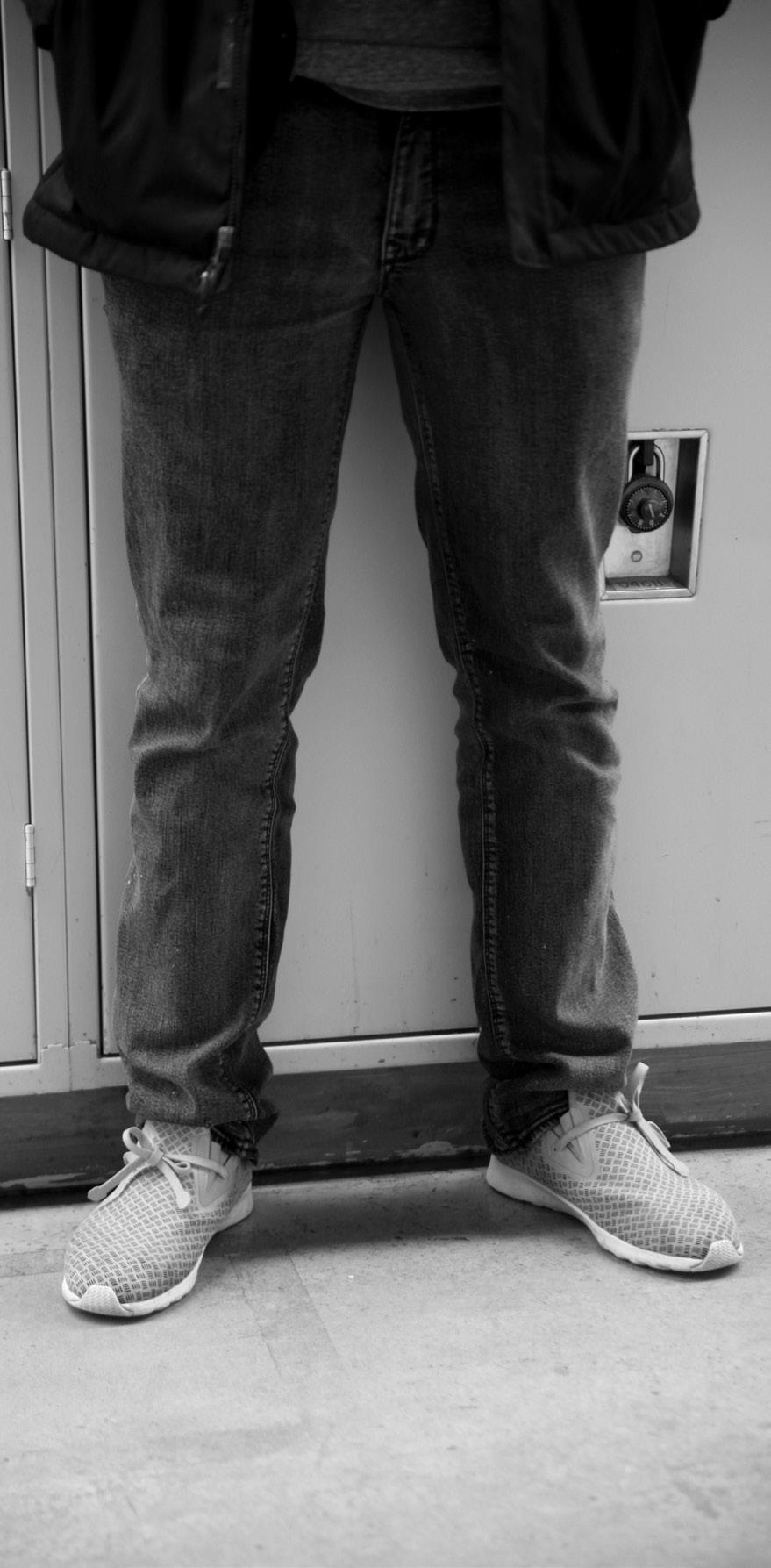
Dashing across campus shouldn’t require premium running shoes. Go for a pair of lightweight sneakers with easy laces that do not require constant re-tying throughout the day. Light material allows for easy slip-on when you’re rushing out the door. The thicker sole cushions your foot and reduces shock when pounding the pavement, and the sloped design is on trend and aerodynamic.
For everyday casual wear, choose neutral tones like sand, teak or beige that go with anything in your closet from jeans to khakis. Casual fashion sneakers are my go-to for each school day. Pairing them with everything from ripped jeans to skater skirt to bodycon dresses, sneakers provide the comfort and efortless cool needed to make a style statement on campus. Some brands of choice that make sneakers fashionable again include Native Shoes, Cortica and Adidas.
NIGHT OUT
Sneakers may be most guys’ nightlife staple, but ladies often sacrifice comfort for style. Who says sneakers can’t be festive and stylish? Interesting prints flip the script on the casual sneaker, turning them into a head-turning fashion statement. If you have a pair of plain old sneakers you’ve been thinking about throwing giving away, try DIY. Draw on them with fabric markers, glue on funky rainbow poms or use mod podge to apply glitter.
While these fancy kicks may not hold up in the gym, they definitely hold their own on the streetstyle catwalk. Leopard print sneakers are my item of choice to make a subtle statement with my footwear. I like to create a retro vibe by wearing them with something red à la Marilyn Monroe or sporting them with an all-leather look. For fun day to night sneakers, try Aldo and Superga.
WEEKEND
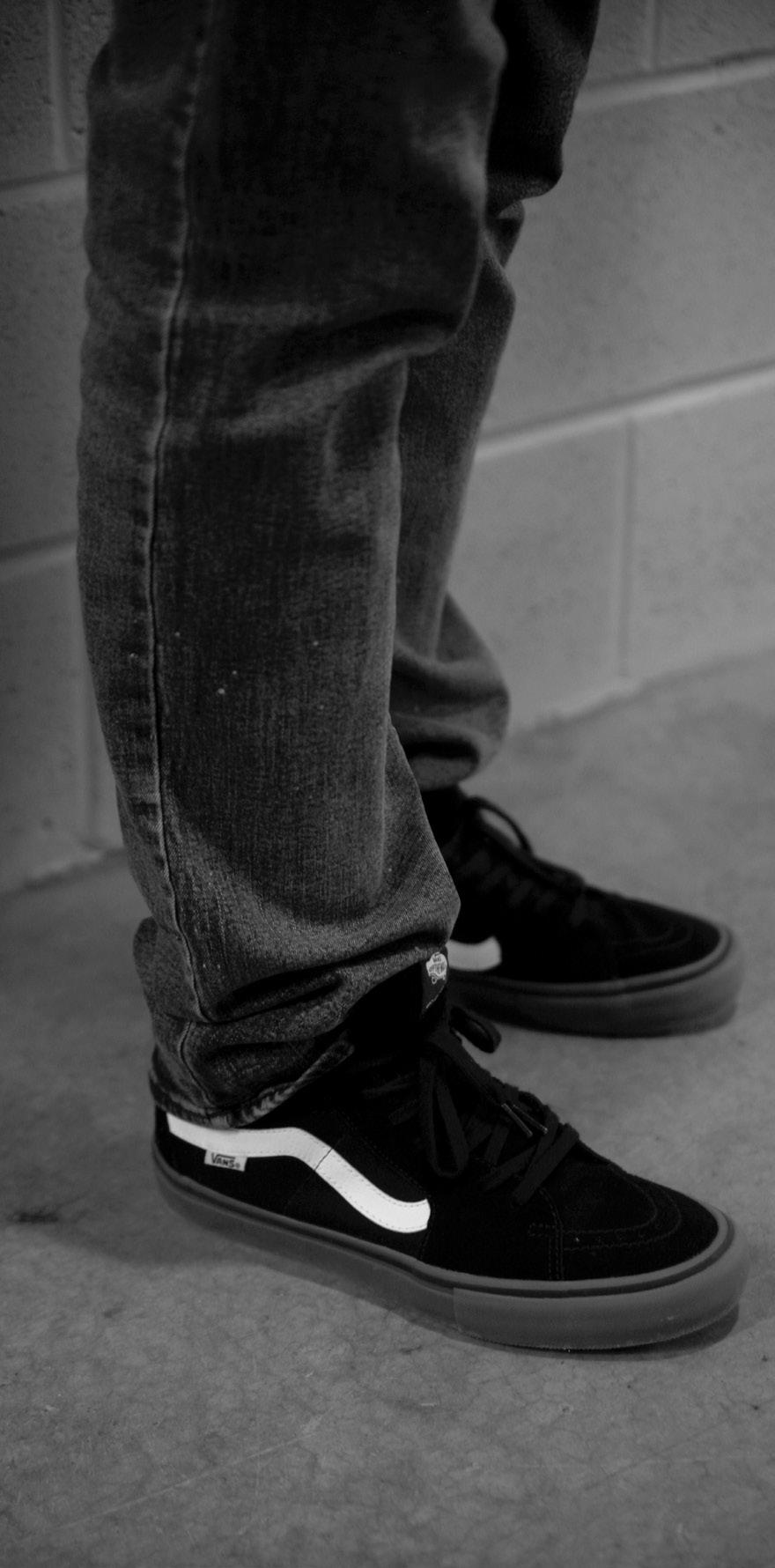
Sneakers for weekend wear should be comfortable, but a step up from your everyday footwear. Depending on your weekend activity, ranging from shopping to concerts, skate sneakers hold up in style and comfort. The wa fe sole provides excellent traction to avoid slippage, while the high-top design protects your foot in high tra fc situations while looking cool tucked in or out of a pair of skinny jeans or with high-waisted shorts.
Have fun with your color choices for weekend sneakers so that they work with your closet and personal style. For the street-style beginner, you can never go wrong with monochrome. Skate sneakers are my weekend favorites, but any sneaker that looks good in black and white is worthy of my closet. I pair my high-tops with everything from skinnies to rompers. My favorite weekend sneaker brands are Vans and Nike.
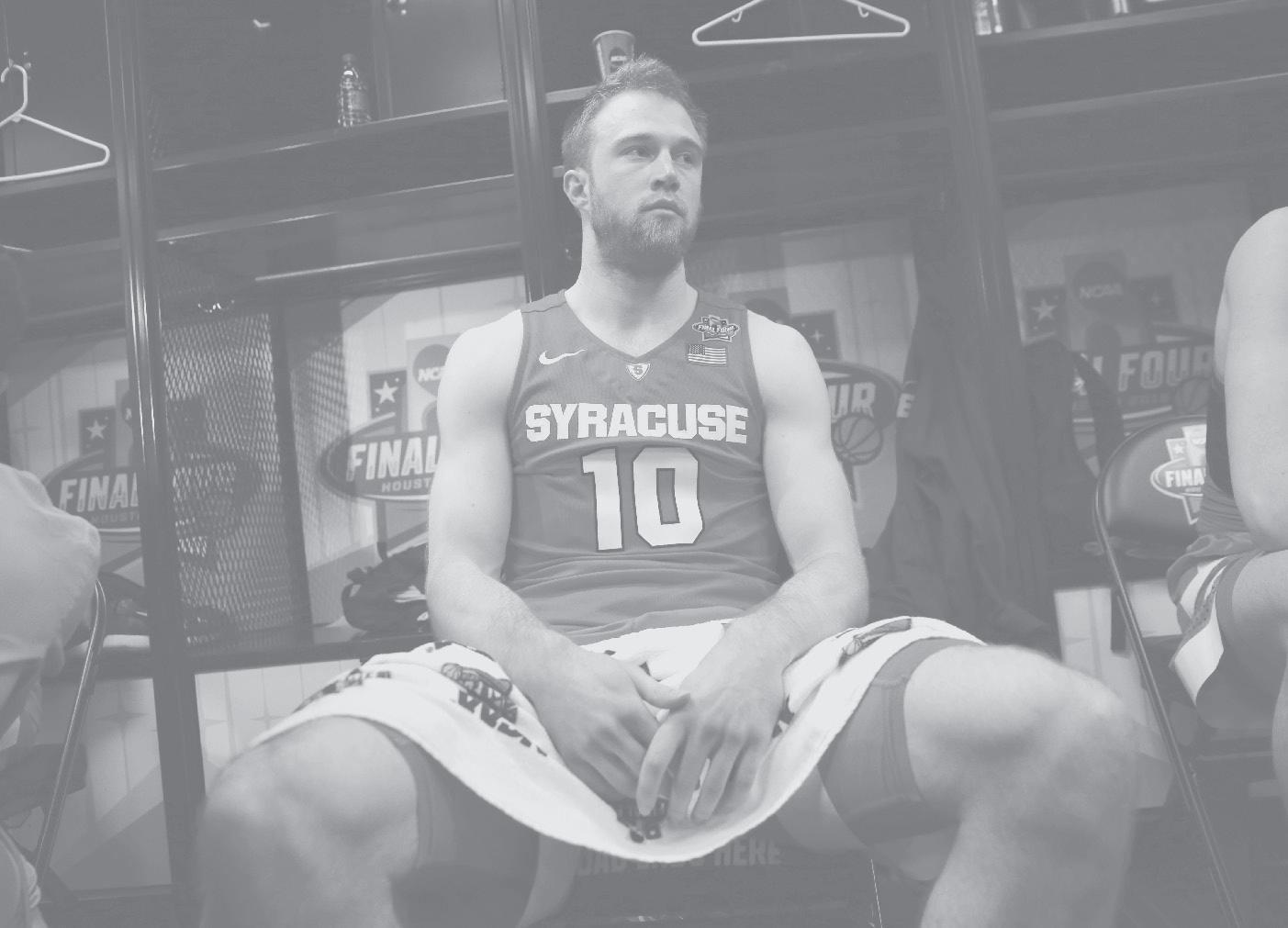
never shook — in part, some say, centered around him being the next Gerry McNamara — and he always took them in stride. His numbers, defense atop the zone and intricate e f ects on Syracuse’s o f ense made him an efective shooting guard. His inability to hit the big shots, starting on the final possession against Michigan the last time SU made the Final Four in 2013, continually had fans forgetting the positive aspects of his game.
That was a sad moment. When you think everything is hanging on that shot and the shot didn’t go in, that sucked. He was certainly feeling that.
Matt Cooney
trevor cooney’s brother
With Cooney, like most players but especially shooters, perception fluctuated on a what-have-you-done-for-melately scale. So when he missed that game-winning 3 against the Panthers in the ACC tournament on March 9, the shot that was supposed to decide if the Orange would dance into March Madness or mosey into the NIT, the book on him was just about closed.
His shot went wide left and left him an inch or two from program lore. But when Syracuse tip toed into the bracket five days later, Cooney was given one more shot yet again.
“If you have a shot at the end of the game and you think that game is going to make it into the Tournament and you miss that shot, his whole demeanor after that Pitt game was certainly very depressed,” said Matt Cooney on Sunday. “That was a sad moment. When you think everything is hanging on that shot and the shot didn’t go in, that sucked. He was certainly feeling that.
“Then talking to him after the announcement of them making the Tournament, you could just tell that someone had taken the weight of the world off his shoulders and told him he didn’t let the team down any more. They had a whole new life.”
Syracuse’s improbable run through the Tournament, starting with a win over Dayton in St. Louis and ending with the loss to UNC on Saturday, held a handful of stand-out moments. Michael Gbinije’s
game-winning layup against Gonzaga. Tyler Lydon’s game-sealing block two possesions later. Lydon’s shoeless 3 against Virginia in the Elite Eight. Malachi Richardson scoring 21 second-half points to come back and beat the Cavaliers later that night.
None of these moments directly include Cooney, but his contributions were both steady and integral throughout the four wins. He was Syracuse’s most consistent shooter, making 2-of-5 3s against Dayton, 4-of-7 against Middle Tennessee State, 1-for-2 against Gonzaga and then 4-of-11 from the field against UVA. His defense atop the zone and full-court press were key in each victory, most notably in the two come-from-behind wins in Chicago. And against North Carolina, he mixed up drives to the rim, mid-range pull-ups and long 3s to give the Orange a fighting chance.
It was a showcase of his evolution, and it came at the perfect time.
“I saw a guy out there that needed help and didn’t want to lose,” said Gbinije, who scored 12 points, missed all five of his 3 attempts and fouled out with 1:25 left in SU’s Final Four game. “I feel like I let him down a little bit. He didn’t want to lose. That’s Trevor, man. That’s just Trevor.”
After the final buzzer sounded, Cooney led a jagged line of Syracuse players of the court. He angled his walk so he could give every fan a high-five. His eyes stayed straight ahead. His cheeks were beat red. The last ounces of sweat dripped of his face and onto the black carpet. When he ducked into the tunnel and out of sight, his final career numbers took shape.
Two Final Fours, 281 career 3s (third most in program history) and 1,437 career points. If you looked at those on their own, you’d stitch that player into the fabric of Syracuse basketball’s history. But that’s not what Cooney wants you to do. He doesn’t use the numbers to define himself. All he wanted Saturday night, with a fiveyear career behind him, was a shot at a national championship.
A shot is all he ever wanted, and now they’ve all run out.
“I view myself on wins and losses. I don’t view myself on the stats that I had. I’ve said this to other reporters and I’ll say it to you, but you guys can write what you want,” Cooney said. “I’m so proud of my career and I was so proud that I was a part of this group and I wouldn’t trade it for anything.
“I got to play for Syracuse for five years and I got to go to two Final Fours and I’ve been a part of extremely, extremely good teams and I’m leaving this program a better man than when I came in.”
And after all that time, he did the writing himself.
jcdoug01@syr.edu | @dougherty_jesse
It doesn’t get much better than this! Across the street from campus 2 bedroom apartments furnished 9 month lease (315) 422-7138 jgregg1085@yahoo.com
JOBS FOR THE ENVIRONMENT
NYPIRG, the state’s leading environmental advocacy group, is hiring for campaign positions in Syracuse and 8 other locations from Buffalo to Long Island. Work with NY’s largest citizen movement to shape landmark climate change policies. $500-$700/week, benefits. Call (315) 236-2012 or apply online at JobsForActivists.Org
2-3-4-5-6-7-8 Bedrooms furnished, double beds, carpeted, laundry, off-street parking, close to campus! John O. Williams
Campus Area Apartments over 30 years of service
ELEGANTLY OVERLOOKING PARK: 1108-1207 Madison 1-2-3 bedroom apts-lofts-or house; All luxuriously furnished, heated, hot water, off-street parking. NO pets. Some pictures on web site: Fine-Interiors-Syracuse.Net Call (315) 469-0780
One Bedroom for Rent Beautiful Strathmore Home very spacious and private 10 minutes to campus. $550 a month includes utilities, internet, cable, parking and laundry Lease is month to month, graduate students or professionals preferred Contact Sarah at 315-727-4978
Studios, 1, 2, & 3 bedrooms Close to campus & 24-hour on call maintenance D.N. Drucker Ltd. Please call (315) 445-1229 OR frontdesk@dndruckerltd.com www.dndruckerltd.com Serving SU Campus for more than 30 years!
TREVOR COONEY missed a game-winning 3 against Pitt that appeared to knock SU out of the NCAA Tournament. Getting into the NCAA Tournament let him rewrite his own ending to his career. logan reidsma senior staff photographer
3 Bedroom Apartment
939 Ackerman Ave.
Sunny second foor fat Parking, porches, freplace, laundry, and hardwood foors
$500 per person
Available August 1, 2016 CoolRent@twcny.rr.com
Available NOW and Spring Semester 1 Room & Parking
737 Euclid Ave. $425 a month
Contact:
Jovan Millet at (619) 322-5527 or Tina Millet at (619) 322-6161
Quality off Campus Housing ind photos, videos, foor plans in o at www.csa syracuse.com
Private Tenant Shuttle to SU and ESF! All-inclusive living starting at $899.
Amenities include:
Extensive On-Site Fitness Center
Indoor Basketball Court
Movie Theater Outdoor Grilling Area
On-site parking
Weekly shuttle to Wegmans/Target Now Leasing 2,3, & 4 Bedroom units for Fall 2015 info@copperbeechcommons.com 300 University Ave. 315.565.7555 www.housingsu.com
2 Bedroom Apartment
Second Floor Flat, includes parking & yard Barry Park, Westcott St.
Available April 1, 2016 Information: (315) 474-3774
Lori
WHAT
women’s basketball
Opponent preview: A look at undefeated Connecticut
By Paul Schwedelson asst. sports editor
Syracuse’s improbable postseason run will continue all the way to the national championship game on Tuesday at 8:30 p.m. at Bankers Life Fieldhouse in Indianapolis. The No. 4 seed Orange (30-7, 13-3 Atlantic Coast) will take on three-time defending champion No. 1 seed Connecticut (37-0, 18-0 American Athletic). The Huskies haven’t lost in 74 straight games, and SU will try and break that streak.
On Monday, SU head coach Quentin Hillsman described the matchup between the two teams, “one that’s great and one that’s trying to be great.”
Here’s everything else you need to know before the national championship game.
All-time series history: Connecticut leads 37-12
Last time they played: Syracuse’s final game in the Big East came against Connecticut in the 2013 Big East tournament semifinal on March 11, 2013. The Orange lost 64-51 against the eventual national champions.
women’s basketball
Current WNBA player Kayla Alexander led SU with 14 points and nine rebounds. Syracuse took a 2-0 lead but trailed for the final 38 minutes of the game. Seniors Cornelia Fondren, Brittney Sykes and Brianna Butler, who were freshmen at the time, combined for 14 points on 6-of-15 shooting. UConn’s Breanna Stewart tied Alexander for a gamehigh 14 points. She also grabbed seven rebounds as the Huskies outrebounded Syracuse 38-23.
“It was hard to guard around the arc and on the inside playing a zone,” Sykes said of UConn’s personnel three years ago, “but they did a good job of moving us around but we also did a good job of guarding them.”
The Connecticut report: What makes the Huskies so dangerous is even when one or two top players are shut down, their offense can still run through everyone else. In the first half of the national semifinal, Stewart was held to two points. Still, UConn led 47-26.
“If Stewy had not come to UConn, we might still be (in the Final Four),” UConn head coach Geno Auriemma said on Saturday. “And after Stewy leaves, we might be back.”
Fellow seniors Moriah Je ferson (point guard) and Morgan Tuck (forward) have helped carry the Huskies combining for 26.1 points per game. UConn also leads the country in both points scored per game (88.2) and points allowed per game (48.3). Notre Dame and Maryland, A No. 1 and No. 2 seed in the NCAA tournament, respectively, were the closest any team came to knocking of the Huskies during the regular season. Each of those teams lost by 10 points.
“The thing about UConn is everybody that pops up to catch the ball can shoot it, pass it and drive,” Hillsman said. “So we’ve just got to have some toughness and guard the ball and get matched up.”
Stats to know:
61 percent — Breanna Stewart is shooting 61 percent from the field during the NCAA tournament.
4 — No women’s college basketball team has ever won four straight national titles. Connecticut would become the first team to do that with a win on Tuesday.
+39.9 — Connecticut’s +39.9 scoring margin
not only is the best in the country, but it’s 15.8 points better than second-best Baylor. UConn hasn’t just beaten teams, its destroyed them.
Player to watch: Breanna Stewart
The three-time defending Final Four Most Outstanding Player is eyeing her fourth to cap of what has been nothing short of a phenomenal career. Stewart, a North Syracuse native, is averaging 19.2 points, 8.7 rebounds and 3.4 blocks per game this season. When asked how to simulate UConn in practice, Hillsman said, “I don’t think you can, because you don’t have Breanna Stewart popping out to the top of your action and who can shoot it or put it on the floor. You don’t have that kind of player that dive down to the post and steal you and run (isolations) for.” Stewart is in the same category as former UConn legends Diana Taurasi and Maya Moore. Depending on who you ask, she may even be the greatest women’s college basketball player of all time. But the last time anyone will see her play in college will be on Tuesday night and all spotlights will be on her.
pmschwed@syr.edu | @pschweds
3 things Quentin Hillsman said before Orange plays UConn
By Paul Schwedelson asst. sports editor
INDIANAPOLIS — Syracuse head coach Quentin Hillsman addressed the media on Monday morning one day before his team’s national championship game meeting with Connecticut on Tuesday at 8:30 p.m. at Bankers Life Fieldhouse. The No. 4 seed Orange (30-7, 13-3 Atlantic Coast) will try to upset the No. 1 seed and three-time defending national champion Huskies (37-0, 18-0 American Athletic).
Here are three things Hillsman said at his final press conference before SU’s first-ever national title game appearance.
Syracuse’s attendance doesn’t matter to Hillsman
The Orange finished the year with the thirdto-worst attendance numbers in the ACC. SU averaged 1,018, which includes two home
NCAA tournament games that significantly helped boost the season averages. Over the prior three years, SU drew an average of 674 last year, 599 the year before that and 662 three years ago.
But Hillsman said on Monday that attendance doesn’t matter to him and it’s frustrating how often it’s brought up.
“We’re always told you can’t get here because you don’t play in front of big enough crowds,” Hillsman said. “All these crowds going to a fect you? Obviously not. It obviously has not a f ected us at all. Because we’re here. It’s about the players that’s on the floor and playing the games. It’s not about the crowd. It’s not about anything else. It’s really not.”
Hillsman would root for Breanna Stewart if she wasn’t playing Syracuse Stewart, the defending three-time Final
Four Most Outstanding Player, grew up in North Syracuse and was recruited by Hillsman and the Orange. She was the No. 1 ranked recruit in the Class of 2012 by HoopGurlz and spurned her hometown school to go to UConn because she wanted a chance to win four national titles.
On Monday, Hillsman disputed any claim that he has a poor relationship with the Stewarts. He said he still texts her dad, Brian, and they both encourage each other. If Syracuse wasn’t playing in the title game, Hillsman said he’d be rooting for her to claim her fourth national title.
“Bre and her family are good people. I’m really, really happy for her. She’s a great player and a great kid,” Hillsman said. “And Connecticut, can there be a better story line a kid from Syracuse playing against Syracuse? I don’t think there can be. I was hoping that we could fulfill the back end of it because I think
everybody has the front end already planned.”
Being the first-ever African American male head coach to reach championship game is significant, but not too significant Hillsman was the second-ever African American male head coach to reach the Final Four and now the first to reach the championship. He recognized the importance because it’s “tough being the first,” but he also pointed out that he hopes everyone has opportunities like he’s had.
“Whatever your nationality is, whatever your religion is, whatever your race is, this is an amazing seat to sit in. It really is,” Hillsman said. “It’s an amazing seat to be sitting in playing in the national championship game against the best. … I’m very happy that the landscape of basketball is changing and there’s a lot of opportunities for a lot of diferent people.” pmschwed@syr.edu | @pschweds
special. To be closing my career against the team that I grew up watching, and having attended their games, it’s cool to say that in the national championship game you are playing against your hometown team.”
The North Syracuse native will take the court on Tuesday at 8:30 p.m. for the last time with Connecticut (37-0, 18-0 American Athletic), playing in the national championship against a Syracuse (30-7, 13-3 Atlantic Coast) team that hadn’t ever advanced past the Round of 32 NCAA tournament game until this year. Not only is the lanky, 6-foot-4 guard looking to win fourth-straight title, she’s on the precipice of winning the Most Outstanding Player award in each tournament.
Her ties to the Orange are stronger than her home address. Stewart remembers watching all the Syracuse games she could with her dad, eating nachos among the few hundred fans in attendance at the Carrier Dome. She’s best friends with guard Brittney Sykes, who she was teammates with on the Philadelphia Belles AAU team
in high school. The two will meet on the court for the first time since the 2013 Big East tournament, and are even more years removed from a time when the two highprofile recruits tried swinging the college basketball pendulum and play together.
“Yeah, you know it’s a little secret story,” Sykes said of her recruiting plans with Stewart. “She chops me up about my decisions, and I get her for hers.
“She wanted to be coached by Geno (Auriemma), and I wanted to be coached by Quentin (Hillsman). So we’ve both done great things for each program.”
It might not ever be known how close Syracuse was to nabbing one of the best basketball products ever to come out of the area. Stewart’s high school coach, Eric Smith, recalled the Orange as one of her last 3-5 schools. Stewart said SU was in her top 10. Belles head coach Fran Burbidge knows Syracuse was in the conversation.
He had several of his own with Stewart and her family as they tried to grasp the best option. Burbridge forced Stewart out of her comfort zone of “political correctness” and into a blunter mindset. Getting her to acknowledge that she was the best player in the country, and to more
clearly spell out her goals.
Burbridge recalls Stewart explaining that she wanted four national championships, a platform to make Olympic teams and a premier program to do it all for. At the time, SU hadn’t ever won an NCAA tournament game. The Huskies were en route to another national championship game.
She wanted to be coached by Geno (Auriemma), and I wanted to be coached by Quentin (Hillsman). So we’ve both done great things for each program.
Brittney Sykes su guard
The numbers spoke for themselves, and it wasn’t a hard choice in the mind of her soonto-be head coach.
“No frills, no drama,” Auriemma said of Stewart’s recruitment. “(It was) ‘Coach, I just want to play basketball. I just want to
win a national championship. I want to be the best player in the country, period.’
“I said, ‘Good. So sign on the dotted line.’” And she did, on the hood of her dad’s car in downtown Syracuse. Her signature torpedoed the conversation of what could have been for an SU program, desperately trying to garner relevance in a market dominated by their male counterparts.
But finally the talk can dissipate. There’s no relevance to Hillsman’s reasoning about not facing the Huskies earlier this season. There’s no relevance to Stewart winning the last three championships while the Syracuse community wondered what could have been for its own program.
It’s happening. SU is playing in the national championship. Stewart’s final collegiate game will be against the team she quietly cheered for this year, and every one before that. The one who’s gear she still owns, and the one she’s longer been familiar with than her own.
“Seeing them being here in the Final Four, you know, I’m over-the-top happy,” Stewart said. “… It’s nice to see their program finally take that next step.” cgrossma@syr.edu | @connorgrossman
WHAT TO KNOW ABOUT UCONN
PREGAME PLAYBOOK
BREANNA STEWART BRITTNEY SYKES
buckets
Brittney Sykes has scored 16 points per game in the NCAA tournament. Her scoring production has been better than it was before the tournament.
back in action
Sykes has improved her scoring average in the NCAA tournament and looks more like the player she was before tearing her ACL.
shots fired
Sykes shot above 40 percent in the two seasons before she tore her ACL. She’s fallen below that in her three games last season and this season.
Fourth-seeded Syracuse (30-7, 13-3 Atlantic Coast) advanced to the national championship game after an 80-59 win over No. 7 seed Washington on Sunday night. Up next is Connecticut (37-0, 18-0 American Athletic) with a national title on the line.
Here is how our beat writers think the game will play out.
JON METTUS
Connecticut 79, Syracuse 55 | Close enough Syracuse has already achieved basically the best end to a season it could have possibly hoped for. This run of 17 games in which the Orange has lost just once was improbably, but continuing it with a win over Connecticut in the national championship would be a miracle. UConn is too good at every position — especially its three-headed monster of Moriah Jeferson, Morgan Tuck and Stewart, which are all considered to be WNBA-level talents. Syracuse is going to be outmatched in nearly every aspect of the game, but so has everyone else that the Huskies have played. Connecticut is going to make history with its fourth national championship in a row. But Syracuse earned the right to be on the court at the same time.
PAUL SCHWEDELSON
Connecticut 71, Syracuse 58 | No shame
The magic carpet ride for Syracuse finally comes to an end, but there’s no shame in losing to the undefeated three-time defending national champions. Not a single one of UConn’s games this season has been within single digits and the streak continues on Tuesday night. The Huskies are so dangerous because even without one or two top players, they can still dominate. Three-time NCAA tournament Most Outstanding Player Stewart only scored two first-half points in the semifinal and UConn still led by 21 at halftime. Tuck, Jefferson and Stewart, the North Syracuse native, each end their careers the only way they know how, with a national championship, and they leave college with four title rings.
CONNOR GROSSMAN
Connecticut 83, Syracuse 64 | Second fiddle Syracuse’s dream season has improbably rolled into the season’s final day. As remarkable of a run the program has had in a postseason it hadn’t won two games in before this year, that won’t be Tuesday night’s biggest storyline. Nothing is going to outshine the luster of three-time defending champion UConn, a team that has lost one game in the last 1,119 days. One. Breanna Stewart, a central New York product, is lined up to sweep a career of four national championships, and possibly four tournament Most Outstanding Player awards if she performs to her capabilities in the final game of her illustrious career. Syracuse can do its best to set its press and score in transition, and of turnovers. It’s made it further than 348 other Division I teams working of its blueprint. But even that can’t stand between Stewart, head coach Geno Auriemma and Connecticut from another title.
She took three charges on the night and finished with no blocks. It’s just the second time this year that she’s played at least 20 minutes and had zero blocks.
54%
on and off
Most star players start playing more when their teams start a playof run. But Stewart has gotten sporadic rest because UConn has been far ahead in many games.
leading the way
On a loaded and balanced Huskies team, Stewart has led the way, leading her team in scoring in 54 percent of Connecticut’s games.
Bankers Life Fieldhouse in Indianapolis.
“It’s been very frequently the last couple games that she’s stepped up defensively against some of the best post players in the country in taking charges and staying in games and not fouling,” Syracuse assistant coach Tammi Reiss said. “It’s just a credit to her being able to defend on this big of a stage against the best.”
On Sunday in the Final Four, it was Washington’s Chantel Osahor barreling through the lane at Day, resulting in Day getting pummeled into the floor just a few minutes into the first quarter.
“I commend her for that because I couldn’t do that,” Fondren said. “I’d be so scared to take the charge from girls like that. She’s done a great job of sacrificing her body ... She can rest after the season.”
In the Sweet 16 win over No. 1 seed South Carolina, Reiss watched Day take a charge and smack her head on the floor. Then Day got up and took another one soon after.
She finished the game with four charges taken.
“That’s a gut check alright,” Reiss said. “…
stats to know
from downtown
expanding her range
Stewart has been a phenomenal player her entire career, but she’s added a new facet to her game this year with her improved 3-point stroke.
So far this tournament, both Syracuse and UConn have averaged about nine 3-pointers per game en route to dominating wins.
by the numbers
10.22
Syracuse’s turnover margin, which is the best rate in the country. UConn’s 9.11 turnover margin is the third-best in the country.
505
Connecticut hasn’t lost a game in the last 505 days. The last time UConn lost was on Nov. 17, 2014, to Stanford, 88-86, in overtime.
1,113
Syracuse has taken 1,113 3s this season, good for third most in the country. UConn ranked 26th in the country.
a fighting chance
A look at SU’s percentage chance of advancing to each round of the NCAA tournament, according to FiveThirtyEight.
AFTER EACH ROUND BEFORE THE TOURNAMENT
I thought she was going to have to come out and she just shook it of.”
The switch has caught teams of guard, with their bigs lowering their shoulders into Day only to be called for ofensive fouls. Day has even taken charges from smaller guards like 5-foot-9 Alexus Atchley from Washington.
Day started getting in foul trouble because Syracuse’s perimeter defenders were allowing penetration into the center of the zone, leaving Day out to dry, head coach Quentin Hillsman said. She’d try to block every shot, and be called for fouls, so he instructed her to sacrifice her body any time an opponent breaks the foul line.
“I’m not really trying to foul out lately so
taking charges is just so much better,” Day said. “… It hurts a little bit, but it’s so fun because it’s such a big play, a big momentum play.”
Day admits that she wants to get that signature block on a national stage. She misses her free reign to send shots away. But if it comes down to it, with the national championship game on the line, she has no choice but to take the charge, she said.
That thought process has already helped Syracuse get this far this season.
“She’s going to need a tremendous ice bath on Wednesday,” Hillsman said, “because she’s been taking a lot of them.” jrmettus@syr.edu
S SPORTS
1 CONNECTICUT VS. 4 SYRACUSE
Underdog Syracuse and top-seeded Huskies match up to fnd out who’s
TOP DOG
Why center Briana Day has stopped trying to block shots
By Jon Mettus digital editor
It’s counterintuitive, but one of the Atlantic Coast Conference’s best shot blockers has chosen to stop blocking shots. Syracuse center Briana Day has forgone attempts to swat shots late in the NCAA tournament, in favor of setting her feet and trying to take a charge.
“Oooh, geez,” Syracuse guard Cornelia Fondren blurted out. “How many post
players do you think take charges like that? She steps up and sacrifices her body and that’s what we need.”
Tries at blocks equal fouls. And with the Orange having faced some of the most dominating frontcourts during its tournament run, Day couldn’t a ford to be in foul trouble. She now takes charges as a way to minimize her own fouls while maximizing those of her opponents down low. The added wrinkle into her defense has kept her on the court longer at the cost of her third best total blocks mark this season
among players in the ACC.
In the locker room after Syracuse’s win over Albany in the second round, the Orange had a list of keys to win the game hanging by the whiteboard. “Take charges on ALL drives” it said and no player has embodied that more than Day. It’ll be put to the test one last time when fourth-seeded Syracuse (30-7, 13-3 Atlantic Coast) tries to upset top-seeded Connecticut (37-0, 18-0 American Athletic) in the national championship game at 8:30 p.m. on Tuesday at
Breanna Stewart set to play hometown team in title game
By Connor Grossman asst. web editor
INDIANAPOLIS — Breanna
Stewart longed for a homecoming. Three years after foregoing an opportunity to play at Syracuse to attend Connecticut, she craved an opportunity to be on the Carrier Dome’s court again.
In a way, she expected it to happen. It’s
not uncommon for teams to schedule road games in players’ hometowns before graduating. But SU head coach Quentin Hillsman maintained there wasn’t time, that “it didn’t fit into the schedule” to go up against the three-time defending national champions.
So a reunion in the stadium “five minutes” from her backyard never happened. Stewart insists that there’s no ill feelings. That she has a good relationship with Hillsman and even Jim Boeheim. That she’s
thrilled for the once-upstart program to play in its first national title game.
That this may be the most fitting way for her illustrious college career to end. Playing her hometown team for the first time in three years, trying to sweep a career of four national titles.
“It feels like everything is coming full circle,” Stewart said. “… Having an opportunity to finish it of against (Syracuse) is
By Jesse Dougherty senior staff writer
HOUSTON — There’s always been another shot for Trevor Cooney. No matter if he won or lost, was angry or sad, tired or full of juice, he could always count on the opportunity to be alone, space out and launch a basketball toward the rim. The opportunity to, in his own way, relax and breathe.
Once he was old enough to be outside on his own, he’d shoot in his family’s Wilmington, Delaware, driveway until his parents called him in. Sometimes he went until 9 or 10 p.m. In time, the mash-up of ball on concrete, ball on rim and ball swishing through the worn net became the neighborhood’s late-night soundtrack.
When he was in middle school, Cooney would jog onto the court after University of Delaware games and start hoisting jumpers. He rarely left the Sanford (Delaware) School gym while his reputation as an athletic shooter started to swell, and head coach Stan Waterman gave Cooney a key so he and his brother Matt could sculpt an around-the-clock routine. Then he carried that to Syracuse, where for five years he shot over every road block. Every bit of criticism. Every defender who blanketed him away from the ball, leaned into his body and made it a suicide mission to not let him get of an open shot.
That’s always been Cooney’s life — shooting and shooting and more shooting — and another chapter ended for him at NRG Stadium on Saturday night. After half a decade, Cooney’s last college game was the Orange’s (23-14, 9-9 Atlantic Coast) 83-66 loss to top-seeded North Carolina (33-6, 14-4) in the Final Four. He scored a game-high 22 points. He made half his shots. He crafted his own ending, one month after a missed 3 at the Verizon Center in Washington, D.C., seemed to do that for him by pushing SU out of the NCAA Tournament field.
“It means everything to me,” Cooney said of finishing his season in Houston instead of anywhere else. “I mean making it to the Final Four is really, really tough. There are a lot of good teams that didn’t make it this far, and we made it this far with everybody saying we can’t make it this far.”
Cooney became a lightning rod in Syracuse, cheered for every make but especially ridiculed for every miss. Being recruited as a shooter carried expectations he
1. BRIANA DAY has spent this season being Syracuse’s best shot blocker, but in an effort to prevent herself from getting into foul trouble, she’s tried to take more charges in the paint instead. evan jenkins staff photographer
2. BREANNA STEWART has won multiple Most Outstanding Player awards and Naismith Player of the Year awards. She’ll look to wrap up her illustrious career against SU, her hometown team, in the national championship. courtesy of steve slade