the independent student newspaper of syracuse, new york | dailyorange.com
N
• Camping out
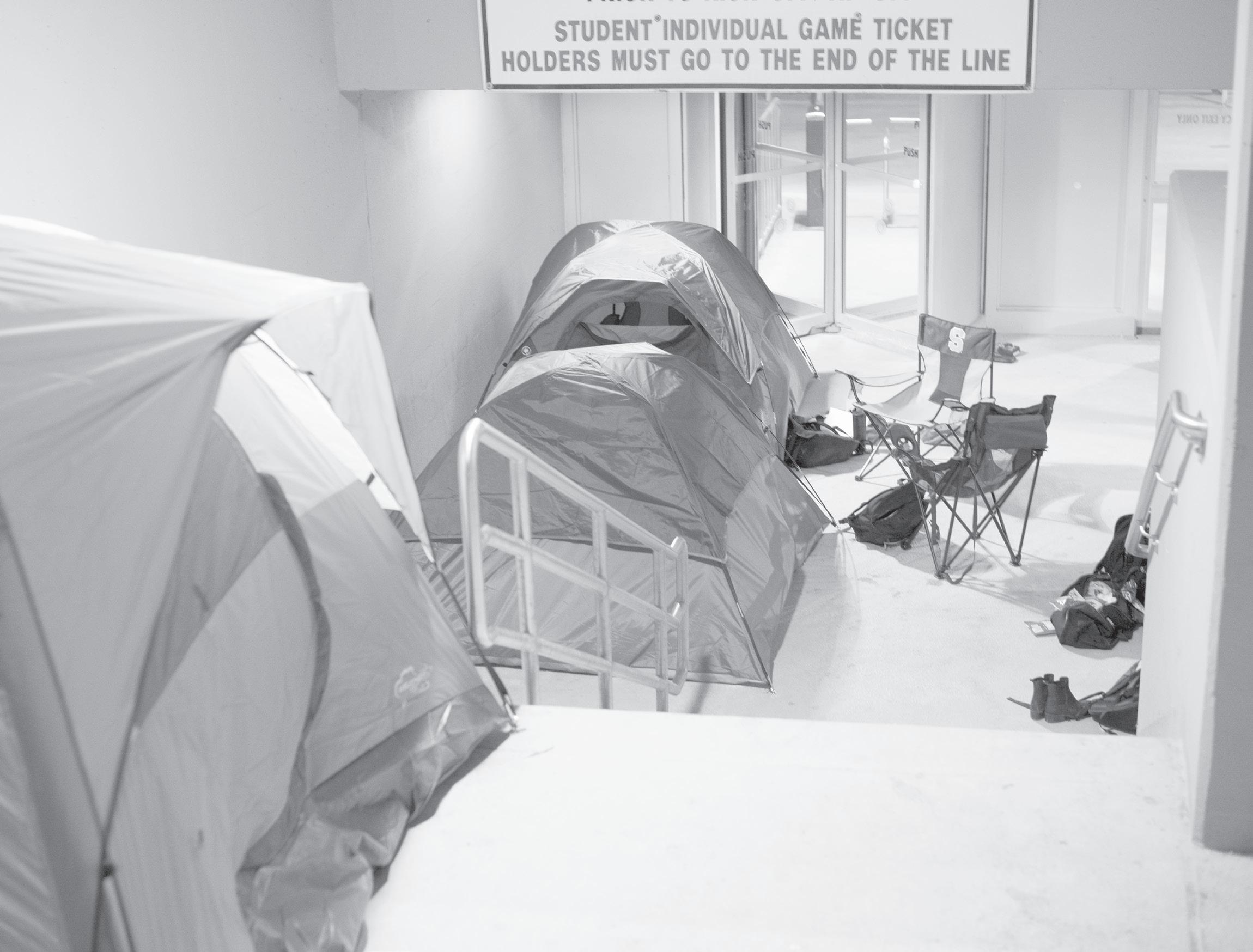
Some SU students have been staying in tents outside of the Carrier Dome ahead of Wednesday’s men’s basketball game between SU and Duke. Page 3
O • In the name Business columnist Daniel Strauss argues that Gov. Andrew Cuomo’s start-up program needs more than a name change to incentivize business growth.
5
P • Lightly salted Syracuse’s history as the Salt City goes back to the 1800s. Today, that legacy has crossed state borders and can be found in towns across the U.S. of the same name. Page 9
IN THE PAINT SU VS. DUKE SEE INSERT
Getting closer
State funding remains last hurdle for busing changes
By Rachel Sandler digital editor
Jules Nshimiye walked his usual path home from school one day last winter. Past Teall Avenue. Past the mounds of snow that inevitably form during a Syracuse winter. Past the entrance of Lincoln Park, about a mile from Henninger High School. Nshimiye had just finished soccer practice. It was dark and he was alone.
The details of what happened next are fuzzy. Nshimiye remembers walking with his head down past a group of about six or seven men. They yelled at him. Nshimiye
You have first graders you can’t see walking between cars in the road because the sidewalks aren’t shoveled. We’ve had students attacked on their way to school.
Joyce Suslovic social studies teacher at henninger high school
crime Suspect gets 3rd court date
By Delaney Van Wey asst. news editor
A misdemeanor case against one of the men charged with murdering a Syracuse University student moved forward after a pretrial hearing in Syracuse City Court on Tuesday. Cameron Isaac, 23, was charged in December with tampering with a witness in the fourth degree, a misdemeanor. He and his lawyer, Lance Cimino, appeared before Judge James Cecile on Tuesday for a pretrial hearing, during which they discussed the available evidence and how the case would proceed, Cecile said.
Cimino did not return phone calls on Tuesday.
Isaac was given a new court date, April 6, which Cecile said will be another pretrial hearing. At Isaac’s Jan. 19 court appearance, Cimino had said he would seek to have the tampering charges dismissed.
Isaac received the tampering charge in early December after he allegedly asked a witness not to testify against him in the murder case.
During the next month and a half, Isaac’s defense will undergo the discovery phase, during which they will turn over information about evidence and witnesses.
Isaac, along with Ninimbe Mitchell, 20, was charged in the fall with the October murder of Xiaopeng “Pippen” Yuan, who was a Syracuse University student from China. Isaac and Mitchell were arrested in November and formally charged with murder in the second degree, robbery in the first degree and criminal possession of a weapon in the second degree.
Last month, Isaac was indicted on first-degree murder, an upgrade from the original seconddegree charge.
is a refugee from Congo and had only been in the United States for about a year. He didn’t fully understand what they were saying, so he responded, “No English.”
What he remembers next is a fist with brass knuckles punching his head, right above his eye. A passerby called 911, and the men scattered.
“I’m losing my memories of it,” said Nshimiye, who was a 15-yearold sophomore at Henninger High School when the incident happened. “It’s not something someone wants to remember.”
Up until a year ago, he would wake up at 5:30 every morning and trek 1.6
Isaac faces the murder, robber and criminal possession of a weapon charges in Onondaga County Court.
In January, Cimino said it was possible that the tampering charge could also end up being included in county court. But whether it stays in city court or moves to county court, Cimino said he will seek to have the charge dismissed.
Yuan, 23, of China, was found dead behind the Springfield Garden Apartments located on Caton Drive on Sept. 30. Authorities have said the two suspects arranged to meet him at the apartments for what was believed to be a drug transaction. Isaac and Mitchell are accused of robbing Yuan before shooting and killing him.
JULES NSHIMIYE , a student at Henninger High School, used to have to walk 1.6 miles daily from his home to school. He now takes the bus, but other students closer to the school still must walk. ally moreo photo editor
Senior leads project to support education
By Chloe Greenwald staff writer
Alyssa Leyden is a valued member of the Syracuse University Enactus team and has personally helped Mayans in Guatemala receive education and live a more comfortable life.
The SU Enactus Team, which originated in the Martin J. Whitman School of Management in 2006, is a global non-profit organization. The team covers 10 different projects that are used to benefit a greater cause. Leyden, a senior marketing management and retail management double major, is co-project leader of Team Guatemala, or Team G. Team G partners with Mayan women in Guatemala to utilize their gift for craftsmanship combined with the students’ business skills. Team Guatemala helps by purchasing the necessary products in bulk to save money and selling them at a higher retail. The profits are retuned both by the money they save in purchasing supplies and through scholarship money.
“They can finally have lights in their homes or get another bed, things like that,” Leyden said about the effects of their work. “It puts things into perspective and makes all the work we do here on campus worth while.”
Each year, Enactus sends several students to Guatemala to visit the women. Leyden said she is grateful to have taken this trip both her sophomore and junior year. She said it was surreal to hear the women’s stories and personally see the
the women sitting on rocks creating intricate beading on jewelry and bags.
“Their gratitude makes it worth while and them sharing their stories is very beneficial to us because it makes us want to work harder,” Leyden said.
As a Whitman student, Leyden is learning the skills she needs in order to be an asset for Team G. In previous years, Leyden was on the e-board of Enactus as the vice president of communications. She was responsible for spreading Enactus’ message to its members and the community through the team’s website. Through Team G, she began a luggage tag business with the group leader, Amanda Nicholson, an associate dean for Whitman. It allowed for more bulk orders, which in turn, give the Mayan women more business.
This past fall break, Leyden took all the products home with her for a trunk show which sold roughly $1,000 worth of merchandise.
Through connecting with Nicholson on this project, Leyden has secured a job as an assistant buyer for Ross Dress for Less following her graduation this May. Reflecting on her work with Enactus, Leyden is proud that she has been essential in expanding Team G.
“Once you get involved, you get to see the benefit of it. Some other clubs it may go unnoticed. With Team G, you get to see statistically, how the work you are doing impacts them. If you sell a necklace for $20, it may not seem like much but it’s a lot for them,” she said. cjgreenw@syr.edu
Feb. 28
March 7, 14, 21, 28 April 4, 25 May 2, 9, 16, 23
$5 per evening; no RSVP necessary. Please arrive early to sign in. Ages 12 and older are welcome. Beginner and remedial classes are for students new to tap and teaches from the beginning. Classes are taught “New York City” style; students are not committed to every class, and can attend as much as they’d like.
Adult Tap Dance Classes
ALYSSA LEYDEN, a senior marketing management major, leads Team Guatemala for the Syracuse University Enactus team. She helps turn Guatemalan craftmanship into a business. kai nyguen staff photographer
@SUcampus
Calling all sports fans! Mike Tirico ’88 will be speaking on Thursday, Feb. 23 at @NewhouseSU
@SAatSU
We have have met capacity for students attending & on the wait list for the trip to the African-American History & Culture Museum
at 7
SU students camp out ahead of Duke game
By Paul Schwedelson senior Staff Writer
Not a peep could be heard across the Quad. The only light flashed from a sign in front of Hendricks Chapel. The light wind carried the brisk air much warmer than years past.
Tucked underneath a set of stairs lay nine tents outside the Carrier Dome’s Gate E. For 76 hours leading up to Syracuse’s game against Duke — Syracuse University’s marquee home game of the season — the perimeter of the southwest entrance goes by a different name.
Welcome to Boeheimburg.
A Chobani yogurt container sat outside of a tent. An empty Fritos bag flattened next to another. A Stewart’s root beer bottle stood straight like the
tents it was nestled between.
The concrete campsite fell silent as 1 a.m. approached on Tuesday morning. Forty-two hours until tip-off.
It’s only 28, 30 degrees. Sweatshirt, sleeping bag – it’s not too bad.
Phelan
Mike
One camper let out a groan.
“I’m freezing my ass off. I’m going to be so cold when I wake up.”
“We got a few hours.”
They know not to give up. The Orange has taught them that the past two seasons. SU has faced a double-digit deficit in six straight games and four of those have been decided by five points or less. Five straight wins salvaged Syracuse’s worst-ever nonconference performance. Last year’s team wasn’t supposed to make the NCAA Tournament. Then it made the Final Four.
Heading into the Orange’s fourth straight home game against a Top 10 opponent, the students are hopeful. They trust head coach Jim Boeheim, the namesake of the makeshift village. They’re nervous about SU’s (16-12, 8-6 Atlantic Coast) NCAA Tournament hopes this year, but they also know a Boeheim-led team could get hot at any time. And it could begin against the
No. 10 Blue Devils (22-5, 10-4) on Wednesday at 7 p.m.
The group features a collection of people who know their Syracuse history. Chats about Tyler Ennis, C.J. Fair and the Orange’s first ACC game against Duke arise during the 30-degree night. They’re glad they aren’t enduring the sub-zero temperatures for nearly two weeks like campers in 2014 did. They hope Wednesday’s game will be as memorable as that 91-89 overtime thriller that vaulted Syracuse to the nation’s top ranking. That’s unlikely and they know it.
Andrew Perry, a sophomore economics major, wore a Paul VI (Virginia) High School Basketball sweatshirt. That’s the same high school that SU point guard Frank Howard attended. They had the
Professors detail issues with grading leniency
By Catherine Leffert contributing writer
Though easy grading might boost a student’s confidence and GPA, a recent study concludes that grading leniency does more harm than good.
The research paper, “The Relationship Between Grading Leniency and Grading Reliability” by Ido Millet, a professor of business at Pennsylvania State University, suggests that as grading leniency goes up, grading reliability — the correlation between a student’s
The others
Businesses are preparing for the pending South Crouse Avenue construction project. See Thursday’s paper
news to know:
Here is a round-up of the biggest news stories happening in the world now.
POLITICS
REVEALING DOCUMENTS
Documents released by the Department of Homeland Security on Tuesday display the full extent of President Donald Trump’s plans to more aggressively enforce immigration laws. Trump’s new enforcement policies include stripping away immigrants’ privacy rights and the creation of new detention facilities, among other things.
source: the new york times
PROVOCATEUR RESIGNS
Milo Yiannopoulos on Tuesday resigned as tech editor from Breitbart News. Yiannopoulos, a controversial “alt-right” star, announced his resignation in New York after video surfaced over the weekend in which he appears to condone sex with underage boys.
source: usa today
WORLD
DESPITE OPPOSITION
Canadian Prime Minister Justin Trudeau on Tuesday said his country will continue to accept asylum seekers illegally crossing the border into Canada from the U.S., despite right-leaning opposition insisting the country take a more hardline stance on immigration. The border crossings have increased in recent weeks, amid fears of President Donald Trump’s aggressive enforcement of immigration policies.
source: reuters
ATTACKERS KILL SIX
Suicide bombers killed six people in an attack on Tuesday outside a courthouse in northeastern Pakistan. A Taliban splinter group claimed responsibility for the attack. The assault is just the latest in a string of violent attacks from militant groups that have killed over 100 people since last week.
source: associated press
$ BUSINESS
DEAL REACHED
In a deal reached Tuesday, it was announced that telecoms giant Verizon will buy Yahoo’s core internet business for $4.48 billion, $350 million less than was originally agreed upon. The change in the deal comes after Yahoo admitted in December it had been hit by a large cyberattack in 2013.
source: bbc
STOCKS SOAR
grade point average and the grade the student earned in a class — goes down.
“Although grading leniency may be a symptom rather than a cause of low-grading reliability, reducing grading leniency may lead to improved grading reliability,” Millet wrote in his paper.
This grading leniency is calculated in different ways across universities. However, many institutions, such as Syracuse University, do not have a specific way to collect such data.
“There is no institutionalized
way of addressing (grading reliability), but a few among us individually have been addressing it,” said Jaklin Kornfilt, director of linguistic studies at SU.
The information cited in the paper is based on data from more than 50,000 filtered classes taught at one unidentified university in North America over several years, according to a Times Higher Education article.
The purpose of the paper was to investigate the relationship between grading reliability and grading leniency by associating
the difference in the students’ average GPA — often an indicator of general performance in the classroom — and the average grade received in a specific class, per the article.
This is what Millet called the “grade lift metric”: If the students’ GPA was 3.5, but the average grade in the class was a B, the lift would be -0.5, indicating tough grading, according to the article. Some of the data showed classes of straight A students receiving B-minuses in a course,
leniency page 4
Following President Donald Trump’s election, for-profit college companies have seen an increase in stock prices. DeVry Education Group’s stock leapt up more than 40 percent, for example. Under the Obama administration, the Education Department discouraged students from attending for-profit schools. However, Trump’s administration — including Education Secretary Betsy DeVos — is now filled with individuals that have profited off for-profit colleges.
source: the new york times
Students have been staying in tents around the Carrier Dome’s Gate E this week ahead of Wednesday’s men’s basketball game between Syracuse University and Duke University. The game tips off from the Dome
p.m. colin davy asst. photo editor
Cuomo announces improvements in testing DWI cases
By Michael Burke news editor
New York state Gov. Andrew Cuomo on Tuesday announced that the state has been more efficient in recent years at testing evidence in DWI cases.
The State Police Forensic Investigation Center in Albany has improved its time to process DWI cases by 26 percent over the past two years and reduced the number of pending cases by nearly half during that time span, according to a press release from the governor’s office.
The improved processing was aided by $8.1 million in grants provided to police by the Governor’s Traffic Safety Committee, per the release. The grant allowed state police to purchase better equipment and hire 14 new analysts and support staff.
“Cracking down on drunk and impaired driving is more than vigilance on our road -
from page 3
same homeroom class at Paul VI. Perry’s not in touch with Howard any more, but “he was like right next to me in our diploma line,” Perry said.
There’s also Joe Suyemoto, an undeclared freshman in the S.I. Newhouse School of Public Communications, whose parents both went to Syracuse. He attended Syracuse’s devastating loss to No. 13 seed Vermont in the first round of the 2005 NCAA Tournament. He grew up watching Gerry McNamara and Johnny Flynn. When told Boeheim compared current point guard John Gillon to Flynn at the start of the year, he smirked.
“Well, he’s shown flashes,” Suyemoto said.
from page 3 leniency
or even C-plus students receiving grades above an A-minus.
David Miller, professor in the School of Human Development and Organizational Studies in Education at the University of Florida, said much of the evaluation for grading reliability of professors at UF is attained through syllabi and curriculum, standards similar to most institutions.
“There’s reporting requirements for the kinds of assessments that are used to look at programs in particular and they have to make sure (professors) are using reasonable
ways – it requires resources and technology to process the evidence and hold accountable those who get behind the wheel while under the influence,” Cuomo said in the release. “These investments have helped to reduce processing time, increase efficiency and create a safer, more secure New York for all.”
State police and the traffic safety committee sought in 2013 to improve the processing time for DWI cases in the lab’s toxicology section, according to the release. That section of the lab is responsible for testing blood and urine evidence in those cases.
Over the past two years, the lab has reduced its median turnaround time for DWI cases from 87 days to 64 days, according to the release. The number of pending cases for more than 90 days has also been reduced by 87 percent in that time frame, and the number of all pending cases has
For three straight meals on Tuesday, Suyemoto’s diet consisted of beef jerky and oranges. He initially brought a George Foreman grill, but a security guard told him he couldn’t keep it with him.
“We got a few burgers in before,” he said. Other campers loaded up on snacks before their night shift started and kept them inside the tent. Two others ordered Calios right before bedtime.
Conversations in Boeheimburg bounce seamlessly from schoolwork to the bubble watch, from controversial promenades to what to watch on Netflix. Some stay entertained by listening to music. Others play card games. Each tent has its go-to activity but everyone is aware of SU’s dwindling Tournament hopes. In the era of connectivity, the common theme is everyone is plugged in to the Orange.
scoring and grading procedures,” Miller said.
He added that syllabi must explicitly outline grading criteria and expectations, so the students understand how they will be academically evaluated. Despite these manners of evaluation, some professors are simply more lenient.
“How is one to know which faculty member gave more reliable grades than somebody else?” Kornfilt said. “One would need to know more than just the grades. If I were to try and judge how reliable a particular faculty member’s grades are, I would look at their history of grading different classes over different years and I would become suspicious if entire classes were getting (good grades).”
been reduced by 44 percent, per the release.
The $8.1 million in grants provided by the committee allowed police to hire new staff — some of which took on positions lost during the recession — in addition to providing training and purchasing “new, state-of-the-art testing equipment to replace systems that were breaking down or reaching obsolescence,” the release states. The new equipment replaced “aging” equipment such as drug screening instruments and added new instruments allowing the lab to detect drugs at lower levels in evidence samples, according to the release.
In 2014, New York state had a total of almost 8,000 alcohol-related car accidents, 270 of which were fatal, according to data from the state’s Department of Motor Vehicles.
State Police Superintendent George Beach said in the release that “traffic safe -
The reason to camp out varies from person to person. Freshman sport management major Justin Saxe recognized that Wednesday’s matchup will be the first between two coaches with over 1,000 wins, excluding the NCAA’s vacation of wins. If associate head coach Mike Hopkins does indeed take Boeheim’s spot after next season, this will also be the last time Boeheim coaches against Duke in the Dome (the Orange only plays the Blue Devils on the road in 2017-18).
Other campers mentioned tradition, pride and the experience as reasons they traded their beds and warm dorms for sleeping bags and air mattresses.
“It’s only 28, 30 degrees,” said Mike Phelan, a freshman chemistry major. “Sweatshirt, sleeping bag — it’s not too bad.”
There’s no doubt life in Boeheimburg
Millet, the author of the paper, wrote that he believes universities should be stricter about the strategies they employ to test grading leniency, although there are recognized reasons why institutions have been weak on grading reliability, according to the article.
In his paper, Millet wrote that maintaining standards for grading leniency at a university-level is difficult. This grading leniency, leading to low grading reliability, can encourage students to take courses in which they think they will a higher grade.
“Academia needs to move to reduce that variability because it causes dysfunctional decisions by students,” he said in an interview with Times Higher Education. “Students might be biased to pick majors, minors and electives
ty is a mission priority for the State Police, and the work performed each and every day by our Forensic Laboratory System plays a critical role in helping us fulfill that mission.”
“We appreciate the support of Governor Cuomo and the Governor’s Traffic Safety Committee in helping us address a critical need, which ultimately helps improve safety on our roadways,” Beach said.
Terri Egan, acting GTSC chair and DMV executive deputy commissioner, added that state police are cracking down on impaired driving and keeping the state’s roads a “nationwide leader in safety.”
“GTSC is proud to provide funding that enables State Police to not only improve, but speed up testing of evidence in DWI cases, which in turn helps keep dangerous drivers off New York’s roads,” Egan said, per the release.
mdburk01@syr.edu | @michaelburke47
is different than recent years. In 2014, SU was amid the national discussion and in contention for a No. 1 seed in the Tournament. In 2015, the Orange was banned from the postseason, but die-hards camped out anyway. Last year, there was no campout game due to Syracuse’s weak home schedule while classes were in session.
Two sleeps before tipoff, the only noise is the hum of the Dome. The campers are resting. They have to. The Orange’s season has been as unpredictable as any other and the last three games could be the wildest part of the rollercoaster. The citizens of Boeheimburg are strapped in, ready to go wherever the ride takes them.
“If this team has taught us anything, it’s that you never know,” Perry said. “That can be a good or bad thing.” pmschwed@syr.edu | @pschweds
where higher grades are easier to achieve.”
Grades are an important aspect of evaluation, and low grading reliability affects institutions and students’ lives, as they make academic and career decisions, Millet wrote in his paper.
Kornfilt said she believes that at SU, students should be held to a certain standard not only for academic integrity, but also for their own good.
“One of our duties as professors towards our students is to make them view themselves in a realistic way,” Kornfilt said. “So to give them a good grade that they don’t deserve is not actually treating them well in my opinion.”
ccleffer@syr.edu
Start-Up NY needs more than new name to accomplish its goals
After a rough start and a wave of criticism, New York state Gov. Andrew Cuomo’s landmark initiative Start-Up New York is getting a name change and a revamp. But the program’s face lift will still fall short of the program’s original purpose.
The goal of Start-Up NY, which is now the Excelsior Business Program, is to tap into the academic, intellectual and economic resources that exist in the state by incentivizing business partnerships between new companies and established universities to spur economic growth and help create jobs.
The original program, Start-Up NY, was criticized for only creating 408 jobs at a marketing cost of about $53 million in its first two years of operation, according to The New York Times. Considering the program was a major price tag for what was supposed to be a huge economic development boost, it’s
editorial board
Busing
DANIEL STRAUSS IT’S CHANGING
no surprise public officials are raising questions about its success. Under the new program, there will be minor changes made to the original requirements, but these changes won’t be enough to turn the Excelsior program into the economic driver it needs to be.
There are three requirements for a business to participate in the program, according to the StartUp NY website. The business must be a new or existing business in the state, partner with a university or college within the state and create at least one job in the next five years. There are some industry restrictions, as businesses in the hospitality, retail and or retail banking industries are excluded from the program. If a business
meets these requirements, they will be able to operate completely tax-free for 10 years. That means no income taxes for employees, sales taxes or property taxes.
Under the new Excelsior Business Program, there will be a change the existing job creation requirement to lower the number of jobs a business must create in order to qualify for tax benefits, according to The New York Times.
There are intrinsic benefits to the Excelsior program, but the focus is off. The foundation of the program is built on two things: tax breaks and partnerships with academic institutions. In theory, tax breaks should bring new businesses to the area, but this has clearly not been as effective as the government hoped it would be. This is mainly because start-ups in their early stages have not achieved the financial scale that would make a tax break a deciding factor in where to locate their business. Partnerships with
needs to be provided to ensure quality education for all
Funding restrictions have made it difficult for Syracuse city officials to bus district students who live relatively near their schools, but city councilors and school board representatives must continue to advocate for students who are forced to walk to school through dangerous areas and cold weather.
Students who live closer than 1.5 miles from their school are required to walk, as New York state law does not require school districts to bus students living closer than that. But 1.5 miles is still too far for children from kindergarten to 12th grade to walk in a city that boasts extreme numbers for cold weather, crime and poverty.
Busing advocates support making an exception to state law for Syracuse and diminishing the required distance to 1 mile, and many Common Council and Syracuse City School District officials back that goal. The problem lies in funding those buses, since that much of that funding would be required from the state.
Despite these obstacles, the Common Council unanimously voted in December to ask the state to fund a pilot program that would bus K-12 students living between one and 1.5 miles from school. Councilor Susan Boyle said she is optimistic the district will receive money to bus K-8 students, but said getting funding to bus high school students may be more difficult. While busing younger children should absolutely be a priority over transporting older and more capable students, it’s important that if the district does get funding to bus K-8 students that officials do not settle and continue to advocate for the well-being of high school students.
Being able to get to school easily is a basic educational need. And while walking more than 1 mile to school may not seem like a big problem in other districts, it’s a daunting reality in Syracuse. Students may be deterred from walking to school due to safety concerns, unshoveled sidewalks and bitterly cold weather. When students miss school, they fall behind and don’t get the opportunity to maximize their educational experience. And when students make it to school, they shouldn’t be spending their class periods wondering if they’ll make it home safely.
1.5 mile
The distance away from school a Syracuse City School District student must live in order to receive busing
It’s clear progress has been made on the busing front: Before last December, Syracuse didn’t provide busing to students who lived less than 2 miles away from their school, but student protests persuaded officials to decrease the distance.
Now, city and district officials still have the chance to stand for what’s right. Even if funding restrictions weaken the likelihood of busing high school students living more than 1 mile away from school, the fight isn’t over. Moving ahead, city officials cannot lose sight of the fact that even if the pilot program approved to bus K-8 students gains financial traction, there is still work to be done to ensure education is accessible to all students in Syracuse.
academic institutions, on the other hand, are strong starting points to create a more effective program.
The Excelsior program should be focused on creating a wide network of resources for new businesses to use. This network should include subject matter experts, industry experts, legal counsel and other resources that start-up companies need but can’t afford. One of the most essential things to a new company’s survival is its proximity to much needed resources.
“We need to create networks of people, service providers and resources to support start-ups,” said Linda Hartsock, executive director of the Blackstone Launchpad at Syracuse University. “And we need to integrate this environment with the local community for it to be effective.”
The Blackstone Launchpad created a network across universities to connect start-ups with all sorts of resources to help
their businesses. There’s a reason why many new companies are willing to pay the premium to operate in major cities within the United States: They have access to a vast amount of resources in one central location. This is an invaluable asset for new companies.
To create more jobs and spur economic development in New York, the government must focus on centralizing available resources and making them more accessible through an organized network — a move that would be much more beneficial for start-ups than a tax break.
Despite the negativity around the program, it is a forward-looking move to revitalize the upstate New York economy. It just needs a few adjustments to accomplish what it set out to achieve.
Daniel Strauss is a sophomore entrepreneurship and finance double major. His column appears weekly. He can be reached at dstrauss@syr.edu.
state
The percentage
Fair share
Cuomo seeks to keep high tax on millionaires
8.82
6.85
source: politico
By William Muoio staff writer
New York state Gov. Andrew Cuomo is hoping to keep taxing millionaires.
The state’s “millionaires’ tax” — a higher income tax on earners making $1 million — expires on Dec. 31. But Cuomo has said he believes that keeping the tax longer will help balance the budget.
Not everyone in Albany is in agreement, though. Democrats, who control the State Assembly, want a more progressive tax plan, while conservative groups have said they think the tax won’t do what Cuomo thinks it will.
Cuomo said in a January presentation on the 2018 executive budget that he wants the state to extend the current millionaires’ tax rate and keep it in place for an additional three years.
If New York were to cut the millionaires’ tax, the state would lose more than $4 billion over two years, Cuomo said during the presentation. This loss could be crucial, as the governor intends on cutting taxes for the middle class.
E.J. McMahon, research director for Empire Center for Public Policy, said he believes the debate over the millionaires’ tax has gained the most attention out of the executive budget. However, McMahon also said he does not believe that this proposal deserves full support from the legislature, partly because of the reliance on the tax as a revenue source.
“New York is more dependent than ever on revenues from its personal income tax, which generated nearly two-thirds of total tax revenues in fiscal 2017,” McMahon said.
There are 45,000 taxpayers in New York state who currently fall into this millionaire income bracket. Their incomes are taxed at an 8.82 percent rate for making $1.1 million or more in a year.
Cuomo’s plan to extend the tax rate on millionaires is part of his larger goal to alleviate the tax burden of the middle class. When the current tax rate expires, anyone earning over $300,000 annually would be taxed at the rate of 6.85 percent, including millionaires.
By increasing the tax rate on the millionaires, the middle class could see its tax rates decrease, Cuomo has said. Cutting the tax on the middle class is something that Cuomo promised to do in the state budget presentation.
Some assembly Democrats, though, are working against the governor.
Following the release of Cuomo’s budget, Assembly Speaker Carl Heastie introduced a progressive tax structure, and said he hopes it will “address income inequality and ensure funding for critical services,” according to a report released by Heastie on Jan. 26.
Heastie’s plan would tax those who earn an income from $1 million to $5 million at the current 8.82 percent rate. Those making $5 million to $10 million would see their tax rate increase an additional .5 percent, and those making between $10 million to $100
$150 billion
New York state's budget's approximate amount
$3.7 billion
The estimated amount the milionaires’ tax brings to the state
source: fiscal policy institute
what is the millionares’ tax?
The millionaires’ tax is a tax rate of 8.82 percent on New Yorkers who make more than $1.6 million annually. It is expected to expire this year, but Gov. Andrew Cuomo has hinted he will renew it.
million would be taxed an additional 1 percent.
If approved, this proposal would generate $5.6 billion in additional revenue while only affecting around 66,000 taxpayers, according to the report.
If the state legislature extends the millionaires’ tax, McMahon said he believes the government would need to raise an additional $683 million in revenue in fiscal year 2018 and $2.7 billion in fiscal year 2019, making the millionaires’ tax insufficient for Cuomo’s plans in the first place. That scenario is if there are no more spending cuts, McMahon added.
If Cuomo puts significant effort into extending the millionaires’ tax rate, though, there is a good chance it will be passed, said Doug Muzzio, a professor at City University of New York Baruch College.
The need for higher taxes in New York state comes down to more government services, Muzzio said.
Richard Auxier, a research associate in the UrbanBrookings Tax Policy Center at the Urban Institute, said New York’s state tax system more resembles a federal income tax, which he said is progressive.
States use the tax system as a way to increase revenue to fund additional programs. Auxier said taxing millionaires could be a good way to make money needed to fund state ventures. He said that each state is responsible for deciding what revenue streams are right for them.
“New York needs a good amount of money and has to get it from somewhere,” Auxier said. wgmuoio@syr.edu | @WillMuoio
miles to and from school, as the city didn’t provide busing to students living closer than 2 miles from school.
That changed after Henninger students formed 2 Miles Too Far, a group focused specifically on getting more buses in the district, so students like Nshimiye don’t have to walk to school. Through protests and pleas at school board meetings from members of 2 Miles Too Far, the distance was eventually lowered to 1.5 miles. The next step is to get the distance lowered even further to 1 mile.
Busing advocates say harsh winters, often with unshoveled sidewalks along with rising crime and poverty, make walking more than a mile to school difficult and unsafe. This year alone, Syracuse has gotten 100 inches of snow, making it the first large city to do so, according to Syracuse.com. And 2016 was the deadliest year in Syracuse history, with 31 homicides.
“It’s always bothered me,” said Joyce Suslovic, a social studies teacher at Henninger High School and the adviser for the students in 2 Miles Too Far. “(Students) get to school and they’re soaking wet, they’re freezing. You have first graders you can’t see walking between cars in the road because the sidewalks aren’t shoveled. We’ve had students attacked on their way to school.”
The Board of Education and the Syracuse Common Council support a plan that would reduce the “walk zone” to 1 mile, but officials say their hands are tied with state restrictions and not enough money.
“We’re on board, we’re trying to get this done, too,” said Syracuse School Board Commissioner Dan Romeo.
But despite the abundance of political will in the city itself, the district can’t afford to increase transportation for students without state funding.
“The financial reality is that we need money from the state,” Common Councilor Susan Boyle said. “Or without that, we would have to cut funding from programs in the
district if we decide that busing is a priority. That money has to come from somewhere.”
In December, the Common Council unanimously voted to ask the state to fund a pilot program that would bus K-12 students living between 1 and 1.5 miles from school.
Boyle said she’s optimistic the district will get the money for K-8 students, but added that convincing the state to give money for high school students may prove more difficult.
“A lot of people think that walking a mile to school as a high schooler isn’t that big of a deal,” she said.
Boyle added the proposal doesn’t include pre-K students. This is because the district already has a grant that could be used for transportation, she said.
The district, too, is making a conservative bet that it will get the money for K-8 students and not high school students, Romeo said. The proposed budget for the next school year includes $4.6 million, which is only enough for K-8 busing.
“So many people just don’t get it that not everyone owns a car or has a parent with a car,” Suslovic said. “What if these lawmakers had to walk home from their meetings? They might understand then.”
Current state law classifies students living closer than 1.5 miles as “non-allowables,” meaning the school district is not required to bus them. Advocates want the state to make an exemption for Syracuse, citing the city’s harsh weather and higher crime and poverty rate than other cities in New York state.
Bill Magnarelli, who represents Syracuse in the New York State Assembly, said he will push for funding and the exemption for the pilot program.
“I am hopeful that I can work with my colleagues to get this issue resolved, and help the students of the Syracuse City School District,” he said in a statement provided to The Daily Orange.
A spokesperson for David Valesky, who represents Syracuse in the New York State Senate, said he was unavailable to comment on the matter.
rsandler@syr.edu | @rachsandl
$4.6 MILLION
19.32
Percentage of Syracuse City School District’s total 2017-18 proposed budget legislative funding request went toward transportation
source: budget proposal
Amount of money the Syracuse City School District requested from the state for transportation in their 2017-18 proposed budget legislative funding request
FEBRUARY 2016
Syracuse City School District lowers the distance it won’t send buses to pick up students from 2 miles to 1.5 miles
NSHIMIYE was once attacked by a group of men during his walk to school. At the time, he was a 15-year old sophomore at Henninger High School. ally moreo photo editor
$1,000
PRIVATE BEDROOMS
ROOMMATE MATCHING AVAILABLE
@universityunion
What do you want? Tickets to Bandersnatch? Get tix at Schine & check out our Russ song of the day
Text by Joe Bloss asst. feature editor
Illustration by
Salt of the earth
Emmy Gnat head illustrator
Syracuse is known nationally for its winters. Last week it became the first city with a population of at least 100,000 to hit 100 inches of snow this season. And with that title comes plenty of salt.
Thanks to salt springs around Lake Onondaga, Syracuse garnered national recognition for its contributions to the salt industry in the 1800s. From 1797 to 1917, the Onondaga Salt Reservation produced enough salt to fill the Carrier Dome four times, according to a report from the United States Geological Survey. This massive output earned Syracuse a nickname, “The Salt City.”
The Salt City was prominent enough to instigate imposters — other cities across the country began to pop up with that same Syracuse name. Today, eight
Blah blah land
Humor columnist Patty Terhune fulfills her destiny as a film buff and writes about “La La Land.” See Thursday’s paper
The black pearl
The Caribbean Cinematic Festival comes to Syracuse this weekend to showcase Caribbean culture. See Thursday’s paper
Syracuse name permeates across nation thanks to salt industry success
states boast a city named Syracuse within its borders, and a loose connection to central New York still exists. Most are minuscule in comparison to the near 150,000-strong city, but the paths that lead to their creation aren’t all that different.
Syracuse, Missouri, is a 242-acre town in the state’s Morgan County. The U.S. Census Bureau estimated its 2015 population at a measly 170. Scan Google Earth and all you find are some houses and post office. It originally was named Pacific City because of its western endpoint position on the Pacific Railroad. But eventually it assumed the name Syracuse, taking after the New York version according to the State Historical Society of Missouri.
Along the famous Santa Fe Trail, which during the 1800s took travelers from western Missouri down to New Mexico, sits Syracuse, Kansas. Hamilton county’s seat, the town switched its name from Holidaysburg in honor of the Syracuse of New York, as reported by the Kansas State Historical Society.
And the list goes on — Indiana, South Carolina and
Utah all contain their own version of the Salt City.
Jim Oiler was born in Syracuse, Ohio, in 1945. His grandfather was a coal miner, a fact that’s helped him make sense of how the name Syracuse made its way south. Down through Virginia and moving west into Ohio, the migration path is clear.
“Anybody that traces their genealogy can pretty much find their family along that route,” Oiler said. “They were all following the mines.”
The small village of Syracuse, Ohio, is situated in the southeastern tip of the state along the Ohio River, and only twice has the census cited more than 1,000 residents. Founded by the Welsh and other European immigrants, it was built on the salt works and coal mines that provided a living to its inhabitants.
Although he’s lived a few miles away for years now, Oiler has only fond memories of growing up in Syracuse, Ohio. His family had no indoor plumbing. Their primary protein source came from the fish they caught in the see cities page 10
Nonprofit Music & Memory works to ease effects of Alzheimer’s
While we don’t currently have a cure for Alzheimer’s disease or dementia, Music & Memory, a nonprofit organization, works to help ease its effects. We all know what music means to us personally and what it is capable of doing for our own wellbeing, but it is remarkable to see its effects can help cope with diseases as seemingly hopeless as dementia and Alzheimer’s.
When Executive Director Dan
Cohen heard a radio host mention that iPods were found everywhere, he thought to himself that it may be true for young people and many adults, but unlikely for those in any kind of senior care facility. He volunteered at a local nursing home and tested out
making personalized playlists for the residents and found the results to be overwhelming. He decided to take his methods to a larger scale.
“I needed to be better able to convince others of the benefit the music was having,” Cohen said. “People were just saying, how nice you are bringing the old people music, but they didn’t understand the level of impact on improving mood and cognition,” said Cohen.
With funding, he brought the experiment to a larger scale by bringing 200 iPods to residents of four different nursing homes. The positive results led to the creation of his nonprofit organization Music & Memory in 2010. The program aims to make personalized playlists for nursing home patients suffering from Alzheimer’s or dementia. Upon hearing their favorite songs and artists from their past, they regain a sense of self and remem -
ber memories not lost to their disease. This brings them back to life, allowing them to socialize and converse better than they had been able to before.
A video of a patient named Henry reacting to hearing his old favorite music was so heartwarming and inspiring that it went viral, reaching over 11 million views. The documentary “Alive Inside,” screened at the Rubin Museum of Art in New
river themselves. Luxury wasn’t what made it a special place for Oiler because, as he put it, you never miss what you never knew.
People walked pretty much everywhere they went. When his mother called him home for supper, the whole town could hear it because there weren’t the cars to cause noise pollution. Church bells rang out on Sundays, and baseball was the staple activity — fivetime MLB all-star catcher Rollie Hemsley is the pride of Syracuse, Ohio. Everyone knew everyone, with Oiler likening the atmosphere to that of Mayberry, a fictional town from “The Andy Griffith Show.”
“It was more or less a utopian situation,” Oiler said while acknowledging the gravity of his word choice.
Oiler was positive in his description, and he came from the poorer side of town. Lynne Brinker was from the newer, richer end — she owned a pony growing up — but still shared the same sentiment.
“There was this fellowship between the people that grew up in the neighborhood,” Brinker, who is about 10 years younger than Oiler, said. “That feeling of going out and catching fireflies at night and swimming in the river, we weren’t really let run wild, but way more so than I let my children.”
That kind of life has faded now, though. Most of the town’s few establishments have closed. Brinker said she often worries the
York City soon after that viral video, eventually heading to the Sundance Film Festival in 2014.
“I found a filmmaker to just capture a few minutes of film. That turned out to be the viral Henry video. And from there we made other short videos and then decided this would make a documentary; hence, ‘Alive Inside,’” said Cohen.
town won’t have enough money to open the public swimming pool she brings her grandchildren to every summer.
But one building remains as a link to the years Brinker and Oiler cherish. The Syracuse Community Center, which used to be the town’s grade school, has hosted a “homecoming” event for the past six years, with Brinker and Oiler among those at the helm. A mixture of current and former residents, it’s Syracuse’s chance to mingle between generations and rekindle memories over a meal.
“We say the Pledge of Allegiance and sing the national anthem and open with prayer,” Brinker said. “It’s a very small-town, American gathering.”
The annual homecomings might be the last thread of the Syracuse, Ohio, that Brinker and Oiler cherish. Times have changed — and the same goes for Syracuse, Nebraska. But instead of fading away like Ohio’s Syracuse, Nebraska’s is growing.
Tomas Ortiz grew up in Syracuse, Nebraska, and returned 10 years ago after serving in the army. He wasn’t a fan of the direction his hometown was headed, and decided to do something about it. During the 2012 election cycle, he made sure everyone knew how to spell his name and ran for mayor as a write-in candidate. He won.
Ortiz took over a town that was founded in the 1850s with the hope of a salt industry as successful as the one up north. When it proved to be a bust, the town actually relocated a few miles away but kept the name. Over the years it served as a shipping hub along local
A study was conducted at Brown University, whose objective was “to compare antipsychotic use and dementia among long-stay nursing home residents with Alzheimer’s that were and were not exposed to Music & Memory.” The study concluded the Music & Memory program may be associated with reductions in dementia and antipsychotic use among nursing home residents with Alzheimer’s.
The program is finding widespread success in the United States, and is starting to
CUSEREALESTATE.COM ONLY A FEW LEFT
Large 3 Bedrooms:
708 Lancaster Ave, Apt 1 $530 Per Person with a BRAND NEW KITCHEN. 710 Lancaster Ave. $530 Per Person with a BRAND NEW KITCHEN. 719 & 721 Maryland Ave. $495 Per Person with BRAND NEW KITCHENS.
Large 5 Bedrooms: 919 Lancaster Avenue $525 Per Person. 708 Sumner Avenue $675 Per Person. 728 Sumner Avenue $675 Per Person. 938 Ackerman Avenue $525 Per Person.
Large 6 Bedrooms: 852 Ackerman Avenue $495 Per Person. LEARN MORE! www.cuserealestate.com 315-474-6791 cusere@gmail.com Tours available Monday - Friday by Appointment.
rail lines. Now, Ortiz calls it a bedroom community — its centralized location in relation to some of Nebraska’s larger cities like Lincoln and Omaha makes it a desirable place to live when commuting to those cities.
To improve Syracuse, Nebraska, Ortiz had a mission of bringing economic development to a town of about 2,100 people. So far he’s overseen improved recreational and athletic facilities and the opening of both a multi-million dollar grain elevator facility and a truck stop. Next
establish itself in Canada and Mexico, too.
But this is not enough for Cohen.
“Our goal is that every person who might benefit has access to their own music,” he said. “In the U.S. 3,600 of the 67,000 health care facilities offer Music & Memory programs so far, so we have a long way to go.”
Hopefully in the future, this program will become more widespread and reach members of our own families who might be affected by one of these diseases. It’s
month they’ll break ground on a $30 million hospital. The local government went from being reactive to proactive, Ortiz said. Ortiz also acknowledged the immigrant path that Oiler alluded to. He said often people brought along the names of wherever they originated from to remind them of what they were leaving behind on the east coast. It’s just that now these places are making a name for themselves.
jtbloss@syr.edu | @jtbloss
also exciting that there has been so much progress made, that maybe by the time we all reach such a point in our lives, music may even be able to reverse the effects of these diseases, letting us live longer and be aware of ourselves and our surroundings for a longer amount of time than those before us.
Jenny Bourque is a freshman English and textual studies major. Her column appears weekly in Pulp. You can email her at jabourqu@syr.edu.
Free internet, lawn care, and snow removal included
By Carmen Harlow, Life-Long Resident and
Alum
To order, go to www.urbansportsofsyracuse.com
The Syracuse Community Center hosts annual homecomings in Syracuse, Ohio, for residents to connect with those who have moved away. courtesy of lynne brinker
From the studio
the
a client to get permission to work with him.
BEHIND THE BARS
Freshman works as manager for 3 hip-hop artists
By Leah Meyers staff writer
Not many people are willing to go through 15 different security checkpoints just to talk to someone’s father. But 18-year-old freshman Justin Goldman, a member of the Bandier Program, did just that last Wednesday – all to establish a relationship with an artist he was managing. He needed to get permission from the artist’s father, who is currently serving time at Rikers Island Correctional Center.
Besides flying to Riker’s just to manage a new artist, Goldman has accomplished a lot in his first year at Syracuse University. He’s interned at a music magazine, and worked in artists and repertoire at a big-name hiphop record label. Goldman’s father used to be an Artists and repertoire at Sony Music Entertainment and now has his own music consulting business, has been surrounded by the music industry his entire life.
With his father and his hometown of New York City as major resources, plus a lot of hard work, Goldman began his music industry career as a junior in high school when he interned for The FADER. Last year, he started interning as an artist and repertoire at 300 Entertainment, a record label home to Young Thug, Migos and Fetty Wap. It was here that he met his business partner, Bryan Bernstein, and began managing different musicians they saw potential in.
Goldman, now a freshman in the Bandier program, manages three up-and-coming hip-hop artists: Bay Swag, a 17-year old from Queens; Ben Beal, a student at the University of Maryland; and Chris Buxton from South Carolina. Bay Swag already has over 40,000 followers on Instagram and opened up for 21 Savage at a New York City show Tuesday night. Ben Beal has over hundreds of thousands of listens on SoundCloud and is opening for rapper A-Boogie. Chris Buxton has almost a million streams on Spotify.
Although it is exciting watching artists that he manages manage make it big, for Goldman, being a manager is not just fun and games.
“You have to kind of micromanage everyone and be like ‘OK, what is the next step for each person?’ That’s kind of a pain to keep track of,” Goldman said, including that a lot of the time because his artists are young and students — not to mention far from Syracuse University — it can be difficult to communicate with them and get them to put as much effort into their music careers as Goldman and Bernstein do.
As an A&R intern at 300 Entertainment, Goldman had other experiences that not many other people his age can relate to, such as taking orders from Young Thug and watching a Migos concert backstage. While many may see Goldman’s age as a drawback, Goldman thinks it’s a benefit.
“We understand the business because we’re young. Older people don’t understand social
media and phones as well. We know how to use Instagram more-so than LinkedIn. We know how to get the word out to more kids,” he said.
Goldman’s partner, Bernstein, is four years older than Goldman, but to them, the age gap is what makes them a great team. Their ultimate goal is to make their artist’s as well-known as possible, before having them sign with a label, in order to get the artist, the most money as possible.
“We saw the opportunity for capitalizing on the time from discovering artists and the time they are ready and how valuable they are by the time they get major label interest,” said Bernstein.
Goldman’s friend, Freddy Heller, a freshman real estate major, is the bridge between Goldman and Ben Beal. Beal is Heller’s best friend from home and because Goldman manages him, Heller has witnessed Goldman as a manager first-hand.
“As a manager, Justin knows what he’s doing. The difference between Ben’s previous manager and Justin is that Justin is getting Ben bigger shows and putting his music online for everyone to see, while beforehand he couldn’t do that,” said Heller.
Bernstein admires his co-manager as well, although both of their ambition combined makes them the ultimate team.
Said Bernstein: “(Justin’s) ambition is only matched by his confidence, which served to his advantage as a young manager who has to prove he’s not too young.”
lmeyers@syr.edu
JUSTIN GOLDMAN, a freshman in the Bandier Program, currently manages three up-and-coming hip-hop artists. Last week he traveled to Rikers Island Correctional Center to meet with
father of
Goldman has also intered for the music magazine, The FADER. nalae white staff photographer
his son could prepare Eric to become a dad 13 years younger than his own father did.
“I was in basketball mode, too, man,” Devendorf said. “The father thing was new to me. I definitely matured as a person and got my priorities in order. Back then, not so much.”
The stress mounted when Devendorf’s NBA D-League stint became an overseas career that saw him play in eight foreign countries over seven years. Only during spurts in New Zealand and Australia did Devendorf’s daughters, Madelyn, now 8, and Miranda, now 6, join him. When they were home in Syracuse, where they’ve lived since birth with their mother and Devendorf’s current girlfriend, Fatriyah, Devendorf found about 30 minutes every day to FaceTime them.
Devendorf has Madelyn’s initials tattooed on his lower neck. Becoming a father, the family said, marked the turning point in his life. It’s mainly because of Madelyn and Miranda why he passed up more years as a professional basketball player to start his career as a coach. He thinks he could play professionally for another five or six years and had the option to return to New Zealand where he played last season.
Devendorf had spent multiple summers playfully reminding Jim Boeheim, Mike Hopkins and Gerry McNamara that he was always available. When Boeheim presented him an opportunity this past summer to finally join his staff, Devendorf couldn’t pass it up.
“Obviously my two daughters are here so being away from them for eight months is pretty tough. It’s overdue for me to be here,”
Devendorf said. “It’s a pretty critical age right now that they’re at. Being able to be here … it’s the second best thing to playing.”
For Devendorf, coaching is more than what his official title suggests. Instead of simply aiding players in the weight room, he sweats out pre-practice one-on-one sessions with Taurean Thompson. He drills John Gillon, Tyus Battle and Frank Howard on how to drive and kick. He counsels players on how to carry themselves as a college athlete in the spotlight, because he’s learned firsthand.
There are times when Devendorf wants to strap on a jersey and light it up from deep. That will come naturally while he’s watching Syracuse warm up, as he did earlier this season at MSG sitting just feet from where he hit that shot in 2009. But this is a new chapter in his life, and he’s become accustomed to giving to others as so many in this city have to him.
“He’s a tough, hard-nosed guy,” Boeheim said, “and it’s good to have that attitude around.”
When Cindy realized Curt wouldn’t live for much longer, she called Eric, then playing in the Philippines, and he flew home to Michigan to be with his father.
Curt saw Eric graduate from SU in May 2015, but he didn’t see him chase Madelyn and Miranda around the Philadelphia University practice gym when playing for Boeheim’s Army this past summer. He saw Eric sit on the Syracuse bench as a player but didn’t see him there in his first game as a coach. He saw Eric run out of the Carrier Dome tunnel but didn’t see Madelyn dangling over the railing last month, screaming “Daddy!” and hugging Eric as he emerged from the tunnel with
other coaches.
“Everything that he’s done for me,” Devendorf said, “it’s come to fruition, right here in front of me.”
Right in front of Devendorf, when he says that, is a full gym in the Carmelo K. Anthony Center. He’s sweating after drilling Thompson, soon to rest on a stationary bike and observe practice with his feet up. This is where it all started for Devendorf, his col-
probably going to be in pretty solid shape. And I say that in a generic sense. Some of these teams might have three in a row against bad teams and it really doesn’t help them that much. But it’s not that much of an exaggeration. Georgia Tech, Clemson, Marquette, Seton Hall, Providence,
Georgetown, Rhode Island, Michigan State, Michigan, Texas Christian, Kansas State, Arkansas, Tennessee, Georgia … And then you’re looking at does Wichita State or Illinois State win the Missouri Valley? Does Gonzaga or St. Mary’s win the West Coast Conference? Is there a bid to be found in one of the other leagues? Does someone other than SMU or Cincinnati win the American? Does somebody other than VCU or Dayton win the Atlantic-10? So, there’s
still a lot of variables in play with a little less than three weeks to go and a lot of different directions that things can go in. But that’s a pretty large group of teams to be seriously thinking about going relative to other seasons at this stage in the year.
The D.O.: What else should people be aware of from the Syracuse perspective? P.S.: The field’s a mess. The saving grace for Syracuse is that in a normal year, there would be more depth in a couple other
lege career and fatherhood.
Now he’s back, a new Eric Devendorf balancing fatherhood and basketball again in Syracuse, exactly as his father wished.
“It kind of felt like everything came full circle,” Jill said. “He’s been through a lot and he’s gone through a lot … for Eric to get that position, that was what my dad had dreamed of.”
mcschnei@syr.edu | @mattschneidman
leagues like the Atlantic-10, perhaps a Mountain West and certainly a handful of other leagues like the SEC. But they wouldn’t be particularly close to the conversation in most years. So this is a season that things just happen to be unimpressive enough across the board that they’re in the discussion. But the reality is they still have a lot to prove between now and the time they depart Brooklyn for the ACC tournament. pmschwed@syr.edu | @pschweds
(FROM LEFT) CURT, ERIC, CINDY, JILL AND ANNA DEVENDORF pose for a photo after a 2015 “The Basketball Tournament” game. courtesy of cindy devendorf
2 bedroom at 106 Clarendon call Hugh Gregg at 445-1808 Does not get any better than this
Nate Solomon could be offensive spark Syracuse needs
By Matthew Gutierrez asst. sports editor
To avoid an upset loss to Albany, to surmount an early 6-1 deficit and to finish a game before overtime, Syracuse needed a score. With under three seconds left, it was Nate Solomon, not senior Jordan Evans, who emerged from behind the cage and hit Nick Mariano with a 10-yard pass. Syracuse’s senior stroked the game-winner.
“It was a terrific feed,” 19-year SU head coach John Desko said.
Syracuse lost three of its top six threats in Dylan Donahue, Tim Barber and Derek DeJoe. Solomon has pounced on the opening at starting attack, as his up-tempo ways fit SU’s run-and-gun style. If the last two games are indication, the No. 6 Orange (2-0) will rely on its youngest threat to spark an offense that’s already put up 29 goals. The budding star has scored four and assisted on a game-winner in his first two
Administrative or Clerical Assistant Needed
Seeking administrative/ clerical assistant needed to organize mail.
This is a part time role that could eventually lead into a full time position.
Such as answering phones, faxing, filing.
Email:charlesdavids465@gmail.com
career starts.
Asked who will replace Donahue in the quarterback role, Desko didn’t waver. That’s Jordan Evans. But then he pointed to Solomon. And even though he didn’t get a shot off all game, bullied by Albany’s defense, Solomon has deepened SU’s offensive look.
“He’s been running the offense better,” Desko said. “It’s nice that he just seems to keep improving. The longer we have him, the better he’s going to get.”
He’s one of the toughest guys to cover. He’s so shifty. He’s really smart too. He really knows how to read his defender.
Tyson Bomberry sophomore defender
Solomon comes from an unlikely place — he’s Syracuse’s first-ever player from Georgia — but was bound for SU since former AllAmericans Casey Powell and Liam Banks nurtured him. Last summer, he stayed on campus to lift and and train. He has played with the starters since fall ball.
Against Siena, Solomon scored twice in transition, then twice off dodging in sixon-six settings. He’s often drawn the third defender, which has given him some wiggle room with the ball. He’s still learning the offense, Desko said, but has spotted angles and diagonals in the flow of the scheme. Through two games, he’s shown the same fearlessness and willingness to dive, run through, turn the corner and absorb checks
that made him one of the most prolific high school players in the country.
At Syracuse, Mariano and Evans are the known commodities. When they have the ball in their sticks, defenses slide their way, as evidenced on Solomon’s gamewinning assist. A pair of Albany defenders stayed near Evans off ball, even though SU’s senior attack set the screen. That may have given Solomon and Mariano the space they needed for the game-winning catch-and-shoot.
“He’s a sneaky little player,” said junior midfielder Brendan Bomberry, who leads SU with five goals. “He’s catching the defense with their heads turned. He’s helped our other guys out, creating space for them.”
In practice, Solomon goes up against
Or when to fake a dart toward goal, shift direction or change pace.
“He’s one of the toughest guys to cover,” said Tyson Bomberry. “He’s so shifty. He’s really smart, too. He really knows how to read his defense.”
Two scores in last year’s ACC tournament against eventual national champion North Carolina. Two scores versus Maryland in the NCAA quarterfinals. Four more in the season opener two weeks ago, followed by an assist that set up a game-winner. All of it suggests an ever-growing role for Syracuse’s sophomore attack. mguti100@syr.edu | @MatthewGut21
S u n. Oct. 23th
Sun. Feb. 26th
sophomore defender Tyson Bomberry. Around the cage, Solomon senses where Tyson Bomberry’s body motion is headed. He knows when to turn back at certain times.
NATE SOLOMON has been a catalyst for Syracuse this year, thriving as opposing defenses zero in on teammates Jordan Evans and Nick Mariano. He set up the Mariano game winner against Albany on Feb. 18. evan jenkins staff photographer
S SPORTS
How can SU beat Duke? Who is Blue Devils player to watch? Find out in the opponent preview.
Syracuse’s ice hockey team has bonded and stayed limber through weekly yoga sessions.
A father’s dream
Eric Devendorf fulfills late father’s wish in 1st season with Syracuse basketball
By Matt Schneidman senior staff writer
Eric Devendorf charged onto the court, his navy blue sport coat, red tie and light blue buttondown shirt all still intact. His dress shoes didn’t slow him down, his right arm wrapping Tyus Battle in a headlock as the team mobbed around them. The freshman had just hit a buzzer-beating 3-pointer to beat Clemson by one on Feb. 7, and Devendorf was the only coach swarming in front of Syracuse’s bench.
Hundreds of miles away, Jill Devendorf, Eric’s older sister by two years, watched the game on television at home in Michigan. When Battle hit the corner 3, she pulled up a YouTube video to show her daughter. A 21-year-old Eric at Madison Square Garden flashed on the screen, hitting the infamous shot that didn’t count at the end of regulation before six overtimes followed in the 2009 Big East tournament
men’s basketball
Talk it out
SU men’s lacrosse goalie Evan Molloy needs solid communication to help young defense succeed. See Thursday’s paper
ERIC DEVENDORF returned to his alma mater as a member of the coaching staff, fulfilling the dream his late father, Curt, always had for him. Devendorf also came back to SU to be closer to his daughters. jessica sheldon staff photographer
quarterfinal against Connecticut.
“Uncle Eric made a similar shot,” Jill explained to her daughter, “but it didn’t count.”
“I didn’t know my Uncle Eric was so awesome,” her daughter responded.
For Devendorf, moments like those after Battle’s heroics resurrect the itch to be on the floor at Littlejohn Coliseum or MSG or any arena in the country, rather than the second row of SU’s bench in coach’s attire. There, where Devendorf sits as the assistant strength coach, is where the former SU star’s career has come full circle in his first season on Syracuse’s staff.
It’s bittersweet for the Devendorf family. Curt Devendorf lost his battle with cancer on Jan. 13, 2016. He introduced Eric to basketball even though he never played collegiately or professionally, putting a Spalding ball in his only son’s hand at a young age in their Bay City, Michigan, driveway. Before Curt’s health deteriorated, he wished
for Eric to one day join the staff that gave him his start. Wednesday would’ve been Curt’s 65th birthday.
“Curt was out there in the driveway with him all the time, either fetching balls or throwing to him or playing horse since he was 3 years old,” said Cindy Devendorf, Eric’s mother. “… He’d always say, ‘Man it’d be so nice if E could get on with that coaching staff. That would be so cool.’ That’s the sad part, that he isn’t around to be able to see that because he would be very, very proud of him.”
When Curt gave Eric his first basketball, he couldn’t put it down. Casual driveway shooting sessions turned into endless hours smacking leather against pavement before the sun rose.
The Devendorf’s neighbors even asked if Eric could hold off practicing until at least 6 a.m. On Jill and Eric’s walk to elementary school that spanned several blocks, Eric kept palm to ball the whole way. Then the same at recess. In high
school, a friend joked with Eric that he was going to ask his Spalding to a school dance. All that stemmed from Curt. Devendorf’s career at Syracuse twisted through stardom, controversy and fatherhood. In December 2008, the University Appeals Board suspended Devendorf for an altercation with a female student in which he was found responsible for violating the SU student code of conduct for “Harassment … beyond the bounds of protected free speech.” Devendorf missed two games while completing the required 40 hours of community service.
He spent four seasons at Syracuse — one a redshirt year due to a torn ACL — and currently sits 14th on the program’s all-time scoring list after averaging 14.5 points per game over his career. But the biggest moment of Devendorf’s college years didn’t have anything to do with basketball. He became a father while still in school. Only so much that Curt taught
Bracketologist: Syracuse still left with ‘a lot to prove’
By Paul Schwedelson senior staff writer
Syracuse (16-12, 8-7 Atlantic Coast) has only three regularseason games remaining. With Selection Sunday less than three weeks away, the Orange sits on the NCAA Tournament bubble. The Orange has beaten then-No. 6 Florida State and then-No. 9 Virginia, but both those wins came at home. SU is 2-9 outside the Carrier Dome. SU hosts No. 10 Duke on Wednesday at 7 p.m., visits No. 8 Louisville on Sunday and hosts Georgia Tech on Senior Day. But before the home stretch, we caught up with bracke-
tologist Patrick Stevens to see where Syracuse stands. Stevens’ projects appear in The Washington Post and, in 2014, he was the only bracketologist, out of 121, to correctly pick all 68 teams in the field.
The following conversation has been edited for clarity.
The Daily Orange: Where does Syracuse stack up at this point?
Patrick Stevens: I would say Syracuse is on the outside of a very crowded, very muddled, very middling group of teams right at the edge of the field. I think the big issue for Syracuse — and it’s been this way really from the start of the season — is what have they done away from the Carrier Dome. And the answer
is not a whole lot. They’re 2-9 away from home and they obviously don’t have the luxury of playing any
Syracuse is on the outside looking in.
Patrick Stevens bracketologist
NCAA Tournament games in central New York this year. And as a result, you look at them and they’ve won at Clemson, which is somehow still a borderline tournament team and they’ve won at N.C. State, which
has fired its coach. There’s not a whole lot to work with there.
You think last season, how did Syracuse get in (as a No. 10 seed)?
Well, it had won at Duke, it had beaten Connecticut on a neutral floor and Texas A&M on a neutral floor. When you were looking at the edge of the field last year, that was something that fell in their favor. This year, there isn’t anything like that. ... So as a result of that, this Sunday at Louisville as well as the ACC tournament are critical chances to demonstrate some ability to beat somebody decent away from the Carrier Dome.
The D.O.: Would one win be enough in Syracuse’s last three games?
P.S.: It’s too hard to tell in that sort of specific sense, but if I were Syracuse, I’d want to win more than one game the rest of the way. …
This is a Syracuse team that, especially compared to last year, that just doesn’t have as much oomph on their profile, doesn’t have as much strength on their profile as they did at this point last year and as a result they’re probably not going to be able to back their way into the field the way they did last year as well.
The D.O.: What other bubble teams should Syracuse fans pay attention to?
P.S.: If any of these teams happen to win three in a row, they’re