CONTENTS
TRUE GRIT • 3
With a hard-nosed attitude, Scott Shafer guides an unproven Syracuse team into a new era and a new conference.
DEVILS’ AWAKENING • 5
Duke didn’t win a game for 1,015 days near the turn of the millennium. In 2013, the Blue Devils will try to reach their second straight bowl game — and second since 1995.
CLOSE QUARTERS • 6
Drew Allen and Terrel Hunt hail from vastly different backgrounds, but both are vying for Syracuse’s starting quarterback spot.
ON THE RUN • 7
DeAndre Smith has traveled around the world as a football player and coach. Now he’s at Syracuse, coaching the Orange’s strongest offensive unit.
FILLING THE GAPS • 8
As the core of the Syracuse defense, the Orange’s three starting linebackers are fixing their weaknesses and emerging as stars.
INTERESTED IN BEING A PART OF THE DAILY ORANGE?
We want writers, photographers, videographers and designers to join our staff.
Ask questions, pick up stories and be a part of the experience. Email editor@dailyorange.com for more details.
Come to 744 Ostrom Ave. on Friday, Sept. 6, at 4 p.m. for The Daily Orange’s open house.
DEATH OF THE BCS • 13
In the last season of the Bowl Championship Series, The Daily Orange looks back at the good, the bad and the ugly of BCS’ 15 years.
BEAT WRITER PREDICTIONS • 16
The Daily Orange football beat writers break down their thoughts on the upcoming season.
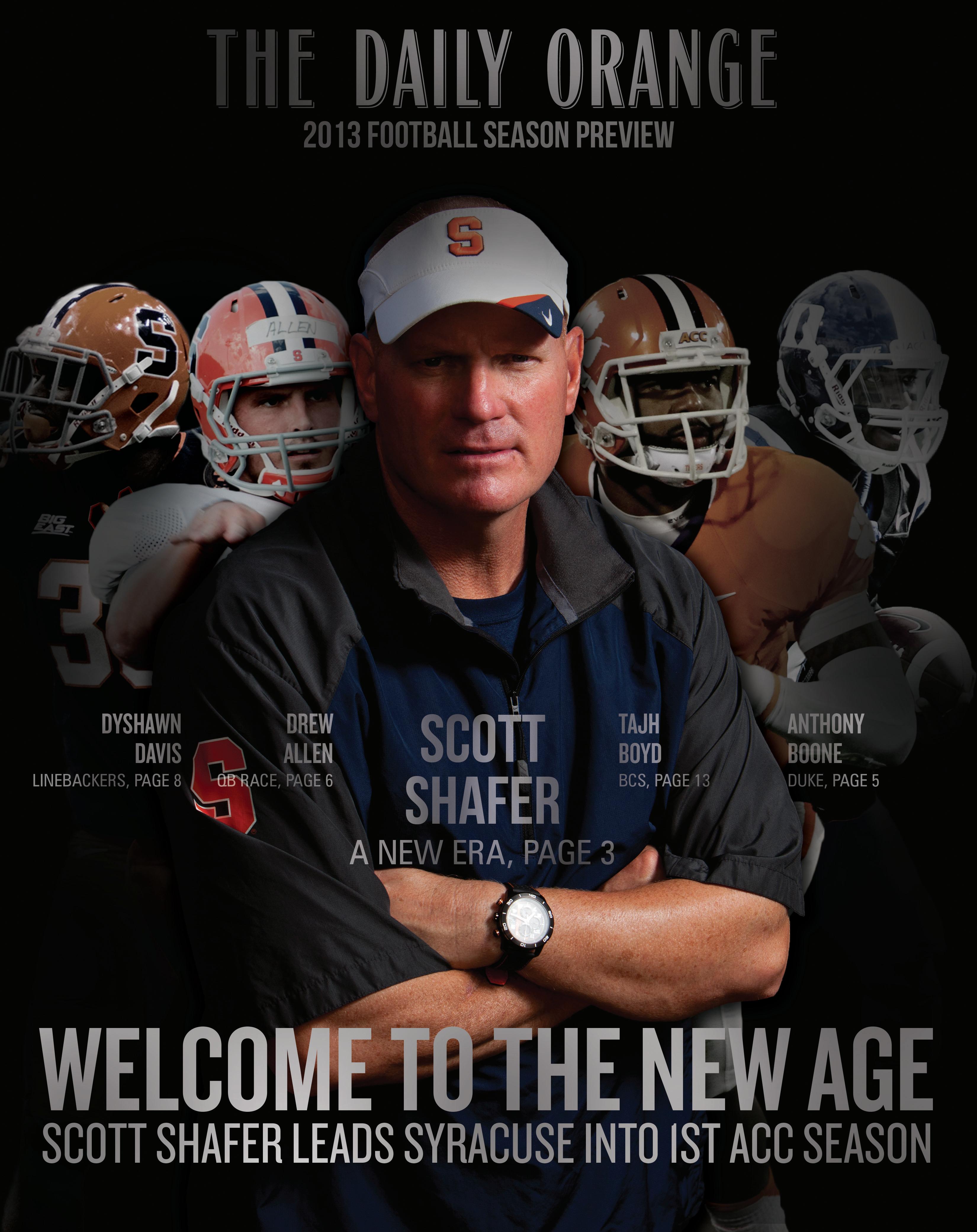
Cover photo credits from left: ziniu chen | staff photographer, ziniu chen | staff photographer, chase gaewski | photo editor, courtesy of clemson athletic communications, courtesy of duke sports information dept.
SIGNS OF CHANGE
The season is one marked by change for Syracuse. There are new players, new coaches and a new conference. Throughout the 2013 football season preview, notice the icons that symbolize stories about new coaches (see whistles), the new conference (see stadiums) and new players (see cleats).
Shafer implements ‘hard-nosed’ culture at Syracuse in 1st year as head coach in ACC
By Trevor Hass ASST. SPORTS EDITOR
Three yards and a cloud of dust. That’s the way Syracuse starts every practice.
The offense tries to move the ball three yards in three downs while the defense vehemently tries to impede its progress. The winner revels in the glory while the loser is punished with up-downs.
It’s a drill that first-year head coach Scott Shafer learned from legendary Ohio State coach Woody Hayes while growing up in Northeast Ohio. When Shafer played quarterback for his father, Ron, at Riverside High School in Painesville, the practice fields were all mud, dirt and dust.
Shafer knew that when he became a head coach – a job he’s wanted since before college –he’d make sure his team used three yards and a cloud of dust.
“It’s a frickin’ war,” Shafer said.
The drill epitomizes the brand of football Shafer wants his team to play in its first year in the Atlantic Coast Conference. The Orange will rely on “hard-nosed” football – as Shafer has dubbed it – to succeed. It’s a phrase he has
uttered frequently in his first eight months as head coach, while mastering his already adept visor toss and assembling a crew of assistant coaches equally fiery and focused.
Syracuse doesn’t have the raw talent that teams like No. 8 Clemson and No. 11 Florida State possess, but Shafer hopes intensity, relentlessness and toughness will be enough to compete. He expects passion to emanate from every drill, every workout and every game.
“We may not be as big, we may not be as fast,” Shafer said, “but doggonit, we want to play a style of football where we’re knocking the hell out of people and playing a hard-nosed game.”
Defensive line coach Tim Daoust knows all about hard-nosed football. He’s known Shafer for 12 years and believes in his relentless approach. That’s why Daoust unremittingly yells at his players – he feels the intensity will prepare them for the regular season. It’s why he lost his voice just three days into training camp.
During an Aug. 20 practice, the defense jumped offsides during a live-game simulation of a field goal. Shafer lost it.
He threw his trademark white, widebrimmed visor on the ground in disgust. Those
nuances and “controlling the controllables,” as Shafer puts it, are what he believes will determine the team’s success.
Daoust said the visor toss isn’t a new element in Shafer’s repertoire.
When Shafer was a defensive coordinator at Western Michigan, his players even made a compilation video of his best visor tosses.
“The county fair’s this week, right?” Daoust said, completely straight-faced. “We could take him to the fair and he could knock down those little milk pints or whatever they are.”
Much like Daoust, offensive line coach Pat Perles rarely lets his players off the hook. If they make a mistake, they’re always held accountable.
“F*ck you guys,” he yelled to his linemen moments after completing a Shafer-esque hat chuck. They stopped pushing forward into the cushiony orange mats before Perles deemed the drill finished.
Syracuse center Macky MacPherson detailed one drill during which Perles has his players grab 35-pound sand bags, squat and shuffle their feet. Five reps. Twenty seconds per rep. Shafer SEE SHAFER PAGE 4
SHAFERISMS
“I can’t walk past those Chick fil-A sandwiches. They’re pretty damn good.”
“We’re not afraid of anybody at Syracuse.”
“We may not be as big, we may not be as fast, but doggonit, we want to play a style of football where we’re knocking the hell out of people and playing a hard-nosed game.”
ziniu chen | staff photographer
SCOTT SHAFER watches defensive linemen do up-downs after a miscue in practice. The head coach threw his visor moments earlier, a perfect example of his intense demeanor.
SHAFER
said games are won in the trenches. Drills like those showcase the hard-nosed mentality he’s tried to infuse into the Orange’s culture.
“It’s not just a gimmick,” MacPherson said. “It’s something Coach Shafer really does believe in.”
Shafer’s wife, Missy, said she hears the phrase all the time: “Don’t you change.”
The Shafers still live in the same house despite Shafer’s promotion. Missy Shafer still shops at Wegmans with a baseball hat, no makeup and a mismatched shirt and shorts.
Just because the team lost a crop of stellar seniors – including star quarterback Ryan Nassib –doesn’t mean it has to change its ways. The approach is unwavering. Do what’s gotten you this far and you’ll be fine.
So they won’t alter too much. But the question remains whether staying the same and being mentally and physically tough will be enough.
The team has bought in. MacPherson described the Orange as an “intense, groundand-pound, we’re-gonna-impose-our-will-onyou kind of team.”
“#Hard-nosed,” MacPherson said. “It’s nose to the grindstone, blue collar, anything you can possibly imagine. Outwork your opponent and beat him down while you do it.”
It’s no secret. ACC teams are faster, stronger and certainly more skilled from top to bottom than Big East teams. Shafer knows Syracuse is in for a tall task. Doug Marrone’s departure to the Buffalo Bills in January left unanswered questions, and made the conference switch even more daunting.
The Orange is the underdog. But Assistant Athletics Director for Athletic Performance Will Hicks said that’s just fine.
“I think Coach Shafe embraces being the underdog a little bit,” Hicks said. “It gets him fired up.”
That’s who he is. Praise from his players, assistant coaches and wife is consistent. The 46-year-old Shafer’s fusion of passion and compassion is showcased in everything he does, and that blend seems to have permeated throughout the entire team.
One of the staples of Shafer’s approach is that he always holds people accountable and never lets them feel sorry for themselves. When Missy Shafer was diagnosed with malignant melanoma – the deadliest form of skin cancer – while the family lived in Michigan more than four years ago, Shafer told her not to feel sorry for herself. He supported her and helped her, never letting her give up.
“This is unfortunate, it’s tough, but it’s life,” Missy Shafer said. “It’s how you handle it and how you get through it.”
And she did. After getting surgery at one of the premier melanoma-treating hospitals in the country, the cancer was history.
Ups and downs will come in the ACC – just like they did in Missy’s case and in the Big East. It’s a matter of staying resolute and bouncing back.
Shafer took training camp as an opportunity to see how players responded to adversity. He said he was most proud of the team last season, when it dug itself out of a 2-4 start to finish 8-5 by not changing its approach and continuing to plow forward with determination.
Change is the only constant in Syracuse, but Shafer said his team is up for the challenge. He’s not concerned that SU was picked sixth out of seven in its division. He’s more preoccupied with ensuring the Orange finishes on top, despite the seemingly infinite mountain ahead.
“It’s a challenge that we relish,” Shafer said. “We’re not afraid of anybody at Syracuse. Never
have been.”
Never back down. Put in the effort and control the controllables by playing hard-nosed football. The rest will work itself out.
“He wants things to be done the right way,” Hicks said, “but it’s all in a positive approach. He’s not going to accept things not being right. There’s no gray.”
Defensive tackle Jay Bromley laughed when asked how many times Shafer says the phrase “hard-nosed” in a typical practice.
“Hard-nosed,” Bromley said, scratching his chin. “Hard-nosed. Anywhere between five,” Bromley paused and laughed again, “and 20. It depends on how we’re playing.”
Bromley said Shafer has to yell at both the offense and defense now, which means he’s shouting “hard-nosed” twice as much as he did as Syracuse’s defensive coordinator.
Even the team meetings are more intense, running back Jerome Smith said, with Shafer at the helm.
“His press conference made someone want to go out and play for him right now,” Smith said. “He has everybody fired up.”
The team believes in Shafer’s approach. Syracuse is confident it can shock some teams. The Orange opens the season against Penn State and No. 22 Northwestern. It faces national title contender Clemson just three games later.
That doesn’t faze Bromley, though. He said confidence is soaring and the players truly believe they can leave a dent in the conference. When asked about his realistic goal for the season, Bromley said he wanted Syracuse to win the ACC championship.
It sounds farfetched to an outsider, but those inside the bubble are starting to believe in Shafer’s ways. Maybe they can shock the world.
If Syracuse finds itself in a third-and-goal situation with the ball on the three in the game’s waning minutes, Shafer hopes both the offense
“He gets north and south, puts his foot in the grass. He’s a selfmade man.”
“It’s about letting those guys go dig the ditch that they’re so good at digging.”
“I think the Carrier Dome’s a really special place. It’s one of the last Mohicans.”
“Me and my family are Johnny Cash. We’re like the Cash family. We’ve been everywhere in this business.”
“Every offensive line I’ve ever been around that’s worth their hill of beans, they were tight. They believed in one another.”
and defense will know exactly what to do. Finish how they start every practice – three yards and a cloud of dust.
tbhass@syr.edu
@TrevorHass

DEVILS’ AWAKENING
After years of atrocity, Duke enters 2013 searching for 2nd straight bowl appearance
By Jesse Dougherty ASST. COPY EDITOR
In the time it took for the Duke football program to win another game, its basketball program won 64 games and a national championship.
Twenty-three straight losses spanning 19992002. Back-to-back 0-11 seasons in 2000 and 2001. 0-12 in 2006.
If any notable college football program finished a season with this mark even once, it would be shouted from the rooftops. Yet Duke, in the shadow of one of the best basketball programs in NCAA history, went unnoticed.
“That was frustrating, but we just kept at it every week,” said Justin Boyle, a running back on the 2006 team.
But things are starting to look up.
The Blue Devils are fresh off their best season since 1994-95, winning six games last season before nearly upsetting Cincinnati in the Belk
“I’ve learned a lot from Sean over the years, and it means I’m ready. I’m not nervous and I don’t think anybody should be about me taking over. The offense won’t miss a beat.”
Anthony Boone QUARTERBACK
Bowl — Duke’s first postseason appearance since 1995.
This year, Duke entered training camp with renewed energy, a new quarterback and a goal to make program history.
“We want to be the first team in program history to go to bowls in back-to-back seasons,” senior cornerback Ross Cockrell said. “This is the most energetic camp I’ve ever been a part of, and it’s because we want something.”
But that’s not to say past Blue Devils teams weren’t playing hard.
Duke’s 2006-07 record doesn’t tell the team’s entire story. The Blue Devils did finish 0-12, but competed to the tail end of some contests and were left with nothing to show for it. They lost to Wake Forest 14-13, Miami 20-15 and North Carolina 45-44.
Boyle, a junior at the time, recalls a positive locker room, despite his team’s inability to edge another.
“We always knew we had the ability,” Boyle said. “If you look back at that season, we were just a few plays away a lot of the time.” Boyle has tracked Duke since he graduated in 2008. Last season, he attended four games and watched a once depleted program grow before his eyes. When the Blue Devils earned a trip to the Belk Bowl, he, along with a number of his former teammates, planned to attend.
More than 30 players from Duke’s darkest years filed into the first few rows of the Bank of America Stadium in Charlotte, N.C. Cin-
cinnati would beat the Blue Devils 48-34, but a small crowd of alumni cheered from start to finish.
If anything, they were on hand to watch their successors try to achieve something they never could. Duke’s six wins were more than the four Boyle had won in his entire Blue Devils career.
“I don’t know if they could hear us on the sideline, but we were loud, like the Cameron Crazies at Duke basketball games,” Boyle said. “I’m already so proud of those guys after last season, and it would mean a lot to me and my teammates if they keep it moving.”
In the last five seasons, Duke has averaged 4.2 wins per year. In the previous 12, they went 19-117 — an average of just 1.58 wins per year.
Now the team is hungry to prove that last season wasn’t a fluke, hungry to have another program breathe alongside basketball and lacrosse in Durham, N.C. and hungry to further bury decades of futility with one more noteworthy campaign.
That has been head coach David Cutcliffe’s rhetoric throughout training camp.
“He keeps telling us over and over that this is the year that we can make the program good again,” Cockrell said. “Last year was great, but now our eyes are looking straight ahead.”
Searching for continued success heading into the season, Duke does have its obstacles. At the top of the list is the departure of quarterback Sean Renfree.
A three-year starter for the Blue Devils, Renfree was drafted by the Atlanta Falcons in the seventh round of the 2013 NFL Draft. The first player to be drafted out of Duke since 2004, Renfree threw for 3,113 yards and 19 touchdowns as a senior, becoming the first quarterback in program history to throw for 2,500 or more yards in three straight seasons.
Replacing him is Anthony Boone, a redshirt junior from Weddington, N.C., who has been itching for this opportunity for three seasons.
“I’ve learned a lot from Sean over the years, and it means I’m ready,” Boone said. “I’m not nervous and I don’t think anybody should be about me taking over. The offense won’t miss a beat.”
Against Wake Forest last season, Boone gave Duke a glimpse into its future.
After Renfree left with an elbow injury late in the third quarter, Boone took over and led the Blue Devils to a pivotal win. With 11:35 remaining, he scampered into the end zone and became the fifth quarterback in school history to score a game-winning touchdown on the ground.
The next week, Boone quarterbacked the Blue Devils to a 42-17 win over Virginia in his first career start when Renfree was sidelined again.
“Those two wins last year, they were team wins,” Boone said. “Everything is about the team, we don’t do anything individually, on both sides of the ball.”
With Boone behind center, Duke’s offensive attack gains an edge this year. Always a threat to run, he said the team will be moving faster and running a lot more read options and
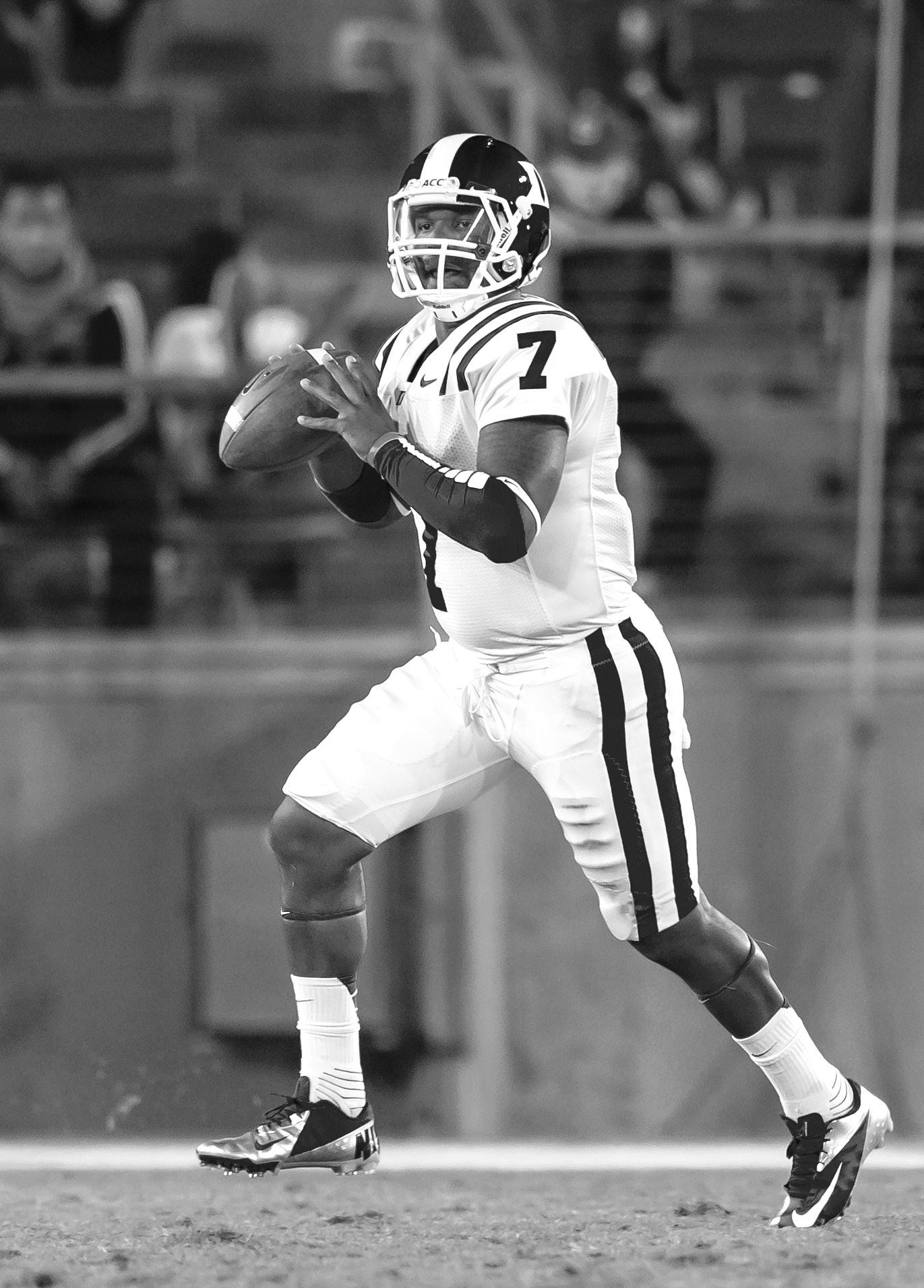
ANTHONY BOONE filled in impressively as quarterback for two of the
tories last year, and is primed to take over the starting role for
1,015 DAYS OF HELL
It took Duke nearly three calendar years to win a game, a streak lasting from Nov. 20, 1999, to Aug. 31, 2002. In that time:
Sammy Sosa, Barry Bonds and Mark McGwire hit a combined 379 home runs.
Five artists (Santana, Usher, Destiny’s Child, Nelly and Christina Aguilera) had two songs top the Billboard “Hot 100.”
The Los Angeles Lakers won three NBA championships
The Supreme Court made 66 decisions

courtesy of duke sports information dept.
Blue Devils’ vic -
Duke this upcoming fall.
CLOSE QUARTERS
By David Wilson SPORTS EDITOR
It’s not unprecedented, but it’s certainly unusual. When Syracuse opens the season, its starting quarterback will be completely unknown to all but those within the program.
It will be either Drew Allen, the transfer who threw 30 passes in three seasons at Oklahoma, or Terrel Hunt, the sophomore who has never played a game at quarterback for SU.
The former stands back in the pocket with his 6-foot-5 frame, scanning the defense like a quarterback should. The latter flaunts the skill set of a new-age signal caller, using
his legs to make plays out of the pocket. Or at least that’s what people assume.
One will take the field for the first snap against the Nittany Lions, but no one has ruled out a potential platoon system.
“No matter who gets the nod, the other guy’s going to be ready,” quarterbacks coach Tim Lester said before admitting that even he’d “be surprised if they both didn’t take a snap at some point.”
Hunt comes from New York, where football often falls behind basketball. Allen hails from Texas, where football is king. Yet with even footing and Lester’s words in mind it seems both will find a way to become important pieces for SU this year.
There’s a certain persona expected of a Texas high school quarterback. It accompanies the almost surreal world that is Texas during football season.
In Drew Allen’s world, football – even of the high school variety – is a way of life. One that captures the heart and attention of a town once every week during the fall.
The dream is to be a quarterback, play in a big-time conference — perhaps the Big 12 — and one day, if it all goes right, to become a superstar.
For Allen, step one is done. Step two is in his past. A detour to Syracuse is what could make step three a reality.
“I have one year,” Allen said, “so I’ve got to do everything in my power to get up here as early as possible, leave here late, so I’m prepared for every single day.”
Each step of Allen’s football life was taken with the intention of achieving the dream that many a young boy in Texas possess. They start playing football early there. Some strap on pads as young as 5 years old.
The Tiny-Mite division in San Antonio’s Pop Warner league requires players ages 5-7 to weigh no more than 75 pounds and allows players as light as 35.
Down South, quarterbacks are groomed. Allen’s father, Andy, played football at Texas for Hall of Fame head coach Darrell Royal.
Drew Allen’s become the idealist portrait of a Texas starting quarterback.
Six feet 5 inches, 226 pounds, a “cannon” arm and a rugged look to go with a clean-cut attitude — he’s achieved an Eagle Scout ranking. He is, in many ways, the picturesque gunslinger.
From a distance, he was more a work of fiction than a real person.
“When you see him you’re like, ‘That’s a quarterback,’” SU running back Jerome Smith said.
He had it all: the physique, the talent, the look of a quarterback — including the pedigree of a Texas state champion. That world is something of a foreign idea
Allen, Hunt bring different perspectives to Syracuse’s quarterback competition
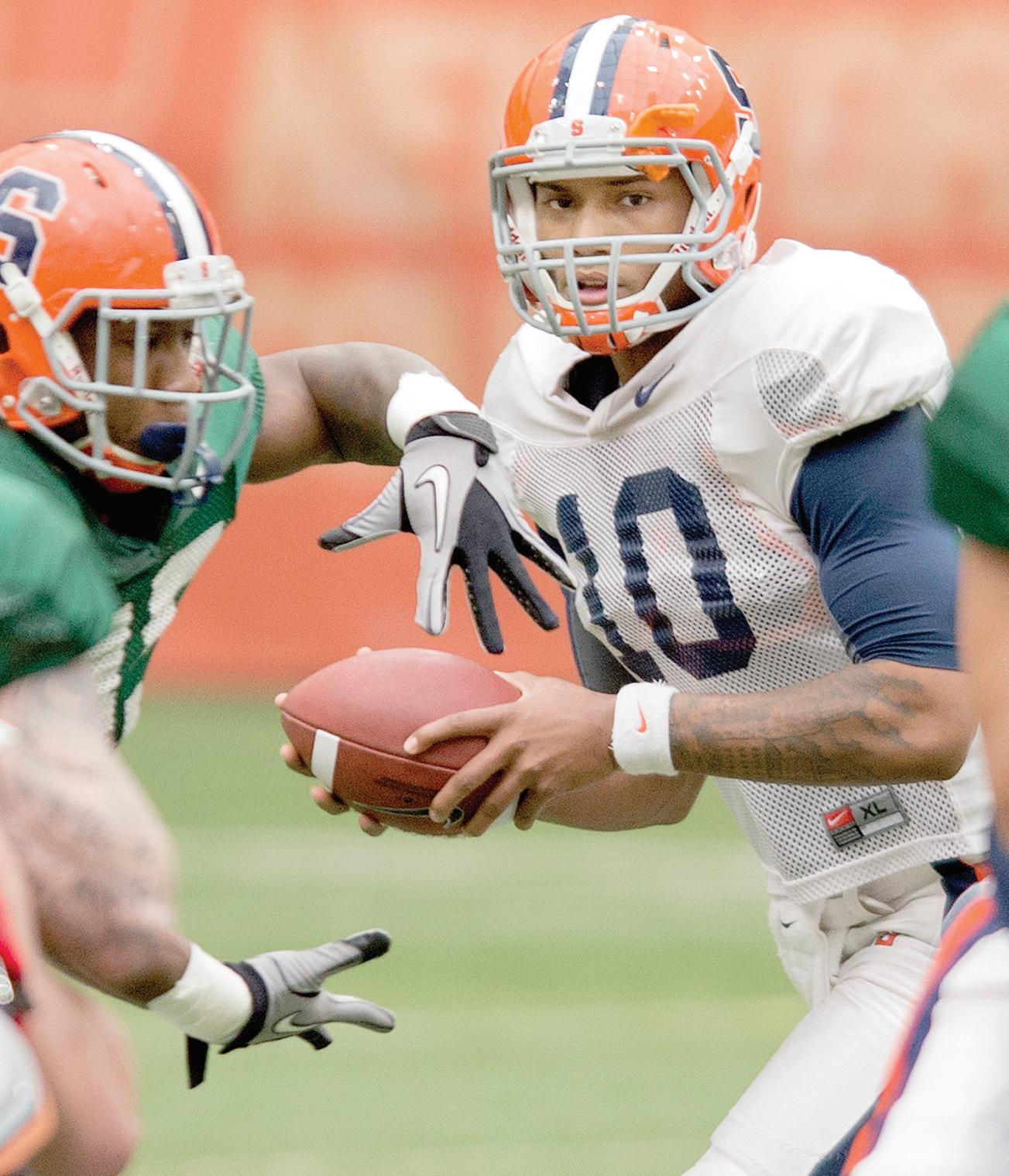
TERREL HUNT
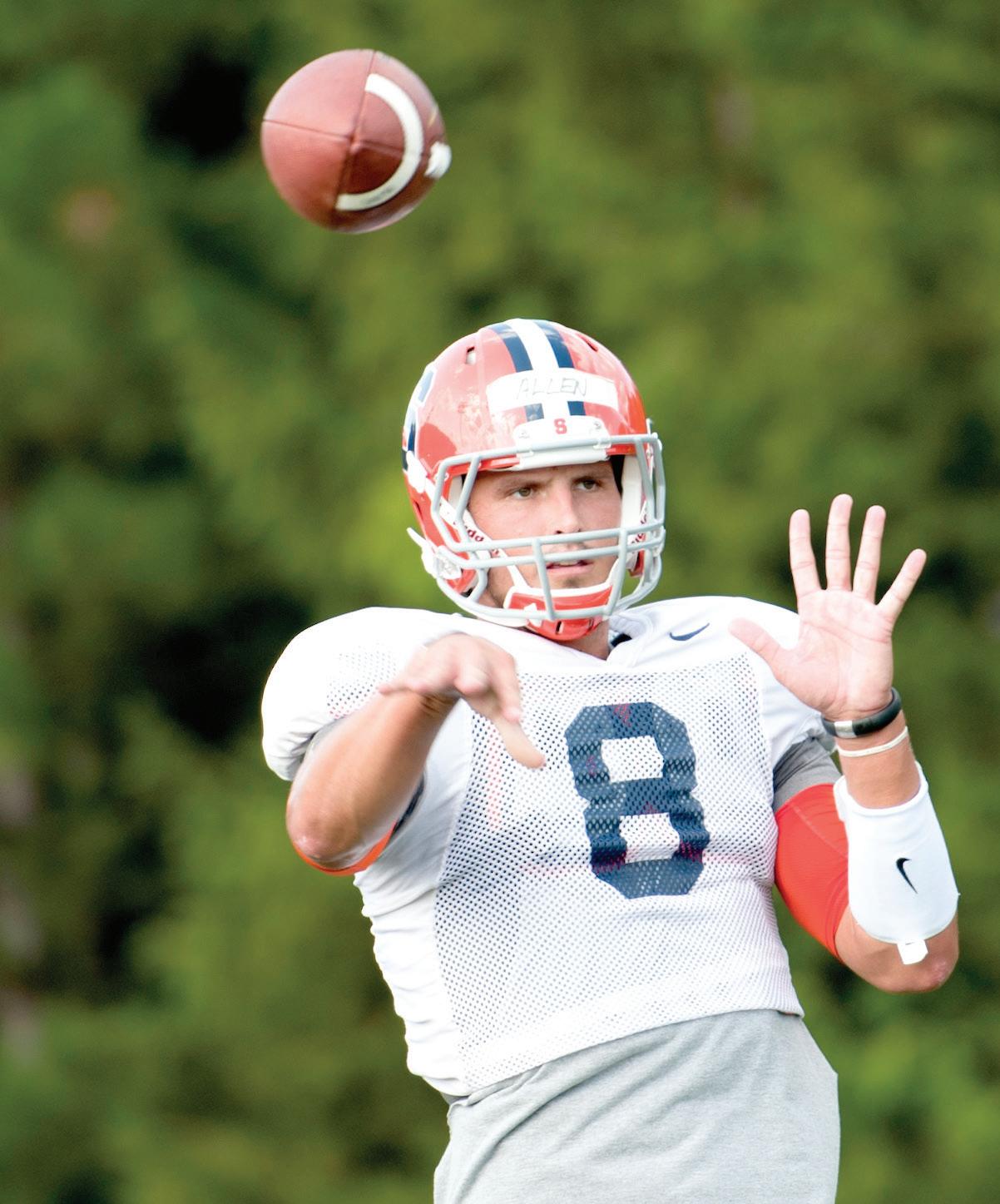
camp. Each brings a unique skill set to the table.
The football field, his father told him, was too dangerous a place for Terrel Hunt. It was on the basketball court, instead, where Hunt first flourished. It was on the basketball court where Hunt first earned recognition. And it was on the basketball court where, at least so far, Hunt turned in the greatest accomplishment of his versatile athletic career with a heavy heart and the memory of his late mother.
His mother, Katrina Hunt, died during his junior year of high school of complications from pancreatic cancer. His father, Darryl Dockery, died of kidney failure almost exactly one year later, the day before Hunt signed with Syracuse to play football.
By the time he was a senior at Christ the King Regional High School, the storied basketball program in New York, Hunt was no longer in danger on the field that his father once told him he was.
By the time he was 8 years old, Hunt had convinced his father to let him play football.
“I just wanted to hit somebody,” he said. He first played quarterback at age 10, but it wasn’t until he was 13, playing for the Valley Stream Hornets, that the position consisted of more than running the ball or handing it off. Two years later, he was starting for the varsity team at Christ the King on week one.
“I actually didn’t want to play quarterback, but my coach told me they get all the shine, they get all the girls,” Hunt said, “and I was like, ‘All right, I’m in.’”
The moves he had honed on the basketball court since he started playing at age 6 — the
crossovers, the adept body control, the pure shiftiness — are what let him take the Catholic High School Football League by storm from day one.
“Basketball is just basically instincts,” Hunt said. “Guy comes left, you cross behind your back. It’s instinct, and that helped a lot on the football field because I was doing moves I didn’t even know I had in my repertoire.”
He dazzled Cardinal Hayes High School with his legs, scoring three touchdowns and totaling 220 yards on 20 carries. And he tallied more than 100 yards through the air.
“We knew pretty much right away that his future was football, not basketball,” former Royals head coach Chris Higgins said.
But he was at Christ the King for hoops. It takes a special player to take the floor at CK. Many of his teammates play Division I or Division II basketball, including current Connecticut guard Omar Calhoun.
Hunt’s future was in football, but his present was still in basketball. Even during his senior year, when the Syracuse-bound quarterback was at the helm, the football team went just 5-4.
As a junior, his Royals won the intersectional basketball championship in triple overtime. He didn’t enter the game until the extra frames, but drained a critical free throw with 7.7 seconds remaining to ice CK’s win.
“I was just thinking about my mom because she would’ve loved to see that moment,” Hunt said. “I knew that I was going to make that shot for her.”
photos by ziniu chen | staff photographer
DREW ALLEN AND TERREL HUNT have been competing to be Syracuse’s starting quarterback since the start of training
ON THE RUN
Smith brings diverse background to Syracuse as new running backs coach
Phil D’Abbraccio ASST. COPY EDITOR
To become the coordinator he is today, DeAndre Smith first had to take his talents out of the country.
After going undrafted in 1990 out of Southwest Missouri State — now Missouri State — he trekked north of the border to play in the Canadian Football League for a season. Then, in an unprecedented step to extend his playing career, Smith traveled across the pond to play in, of all places, France.
“The funniest thing about it,” Smith said, laughing as he reflected on his time in the French League, “was at halftime, guys were eating cheese and grapes and drinking coffee. That’s probably the funniest thing I’ve ever seen, that they’re eating lunch at halftime of a football game.”
Ten years later, he’s in the Atlantic Coast Conference, coaching Syracuse’s running backs in front of crowds sometimes as large as 40,000. It’s a new perspective on the running game for the Orange after former running backs coach Tyrone Wheatley followed Doug Marrone to the Buffalo Bills in January. Wheatley starred at Michigan and played 10
years in the NFL.
Smith’s only two professional seasons were spent outside of the United States, expanding his insight. And he was the one giving the handoffs, not receiving them.
“I think they become better football players when they learn why we’re doing things as opposed to how we’re doing it,” Smith said.
“That part is why I like to think I’m unique when I teach my guys how to play.”
One of the first phone calls George McDonald made when he took control as SU’s offensive coordinator last spring was to Smith, who said it was a “no-brainer” to leave as running backs coach at the University of New Mexico and take the same role with the Orange.
Smith is tasked with coaching what is arguably Syracuse’s deepest and most talented position. The Orange rushed for 369 yards in its Pinstripe Bowl victory over West Virginia. Wheatley also mentored a 1,000-yard rusher in each of his three seasons with Syracuse.
But Smith is eagerly up to the challenge of matching his predecessor.
“I know Coach Wheatley did a great job with those guys,” Smith said, “but I’m excited because we have that opportunity to continue to
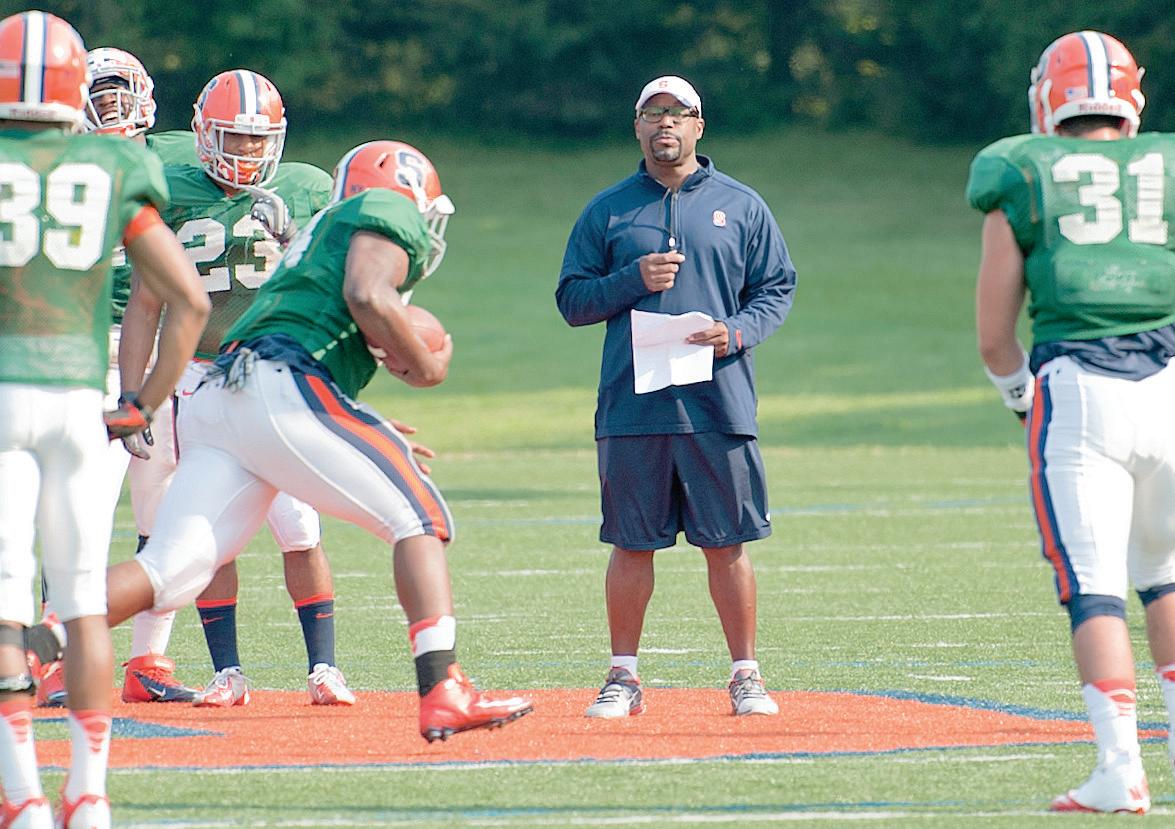
ziniu chen | staff photographer
DEANDRE SMITH comes to Syracuse with more than 10 years of experience coaching running backs. He was a quarterback in college and spent two years playing overseas.
be as good as they’ve been in the past.”
In his 14 years of coaching, Smith has guided three All-Americans, nine 1,000-yard rushers and three NFL products: Garret Wolfe, Mikel Leshoure and two-time Pro Bowler Michael Turner.
“He’s a technician,” junior running back and team captain Jerome Smith said about the running backs coach. “He’s made me detail my work. I overlooked a lot of the small things. He definitely made me humble myself, and now I’m ready to go.
“He knows all the little smart things about the game and he’s coached some really good
guys in the past, so he knows what he’s talking about. He’s a smart guy.”
A St. Louis native, Smith ran for 40 touchdowns and nearly 2,276 yards in his college career at Southwest Missouri State — as a quarterback.
The standout option quarterback earned 1990 first-team All-American honors, the 1990 Division I-AA National Offensive Player of the Year and the Gateway Conference Offensive Player of the Decade from 1985-95 – the league’s first 10 years of existence.
“A lot of people liked to classify me as

FILLING THE GAPS
SU defense hinges on trio of linebackers, each with something to prove

TBy Stephen Bailey ASST. SPORTS EDITOR
here’s no question: The linebackers are the crux of Syracuse’s defense.
With turnover in front and behind, senior Marquis Spruill and juniors Dyshawn Davis and Cameron Lynch will be relied on to keep the team competitive as a newcomer in the Atlantic Coast Conference without a proven quarterback. Yet, a quick glance at the trio of Orange veterans reveals clear deficiencies.
Spruill was charged with disorderly conduct and second-degree harassment after a dispute with police officers Dec. 2. Davis has only played the position for three years. Lynch is undersized (5-foot-11) and inexperienced (three career starts).
But that doesn’t tell the whole story. Each has undergone a transformation of sorts, starting last spring. Where they were weak, they are now strong.
And they could be the best linebacking corps since Doug Hogue, Derrell Smith and thenfreshman Spruill powered the Orange in 2010.
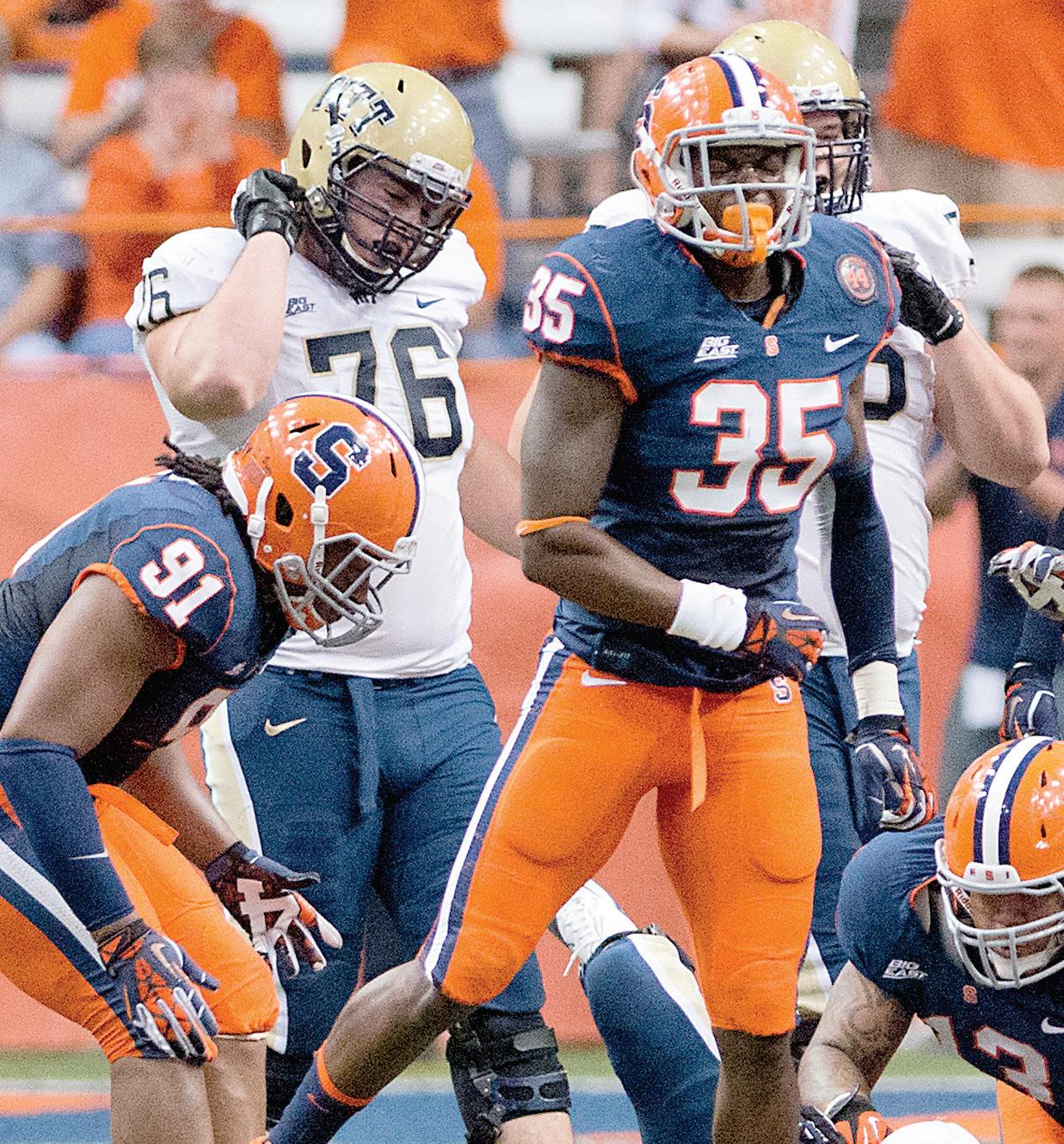
ROUNDING OUT HIS GAME
Standing in the back-left corner of the end zone, Dyshawn Davis turned away from the Carrier Dome stands and back at what he dreaded most.
The ball was in Demetrius Fields’ hands. It had soared over Davis a second earlier. Davis ripped the chinstraps off the side of his helmet and jumptwisted in frustration.
Northwestern scored with 44 seconds left to spoil Syracuse’s sea-
son opener 42-41 last year.
“Dyshawn Davis is still learning to play the position,” first-year linebackers coach Clark Lea said. “He spent a better part of his first two seasons being a runner on the field. We want him to do that because that’s a strength of his, but if we can just work on the finer points of his game to be a complete player.”
Davis might be the most physically gifted player on the team. Six feet 2 inches, 220 pounds. Strong. Fast. Explosive. That’s what got Davis the starting job as a freshman, and what’s gotten him into the backfield more
10
MARQUIS
SPRUILL
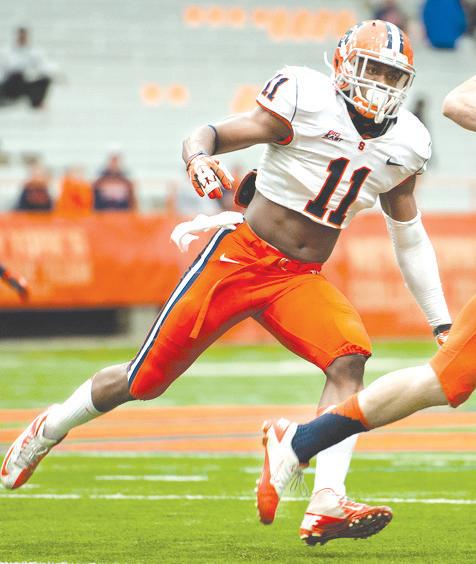
BEING A LEADER
Marquis Spruill’s transformation is just as much perception as reality.
How could he shed the details from that Saturday night in December? The ones that jumped off the police report and into the headlines as Syracuse prepared to face West Virginia in the Pinstripe Bowl.
Pulling an officer off of teammate Steve Rene.
Kicking the inside of a police van so hard that it swung open and nearly struck an officer. And all before the biggest game of his career.
Spruill and Rene have remained steadfast that the outline in that report is not exactly how they remember it. Still, it’s what Spruill had to accept when he pled guilty to the second-degree harassment charge, wrote an apology letter and participated in team counseling.
“The incident that night basically happened because tried to be a leader,” Spruill said. “I tried to go stop something from hap -
pening and it didn’t look that way. I had good intentions, it just didn’t look that way.”
Teammates and coaches understand what happened that night. They know “’Quis” best. He’s the guy who tries to keep teammates out of trouble off the field, Dyshawn Davis said. That might be why no-nonsense head coach Doug Marrone allowed Spruill to play in the Pinstripe Bowl.
“He’s just one of those guys always looking to protect his teammates, his brothers,” Davis said. “That particular night, when things went wrong, as a team we and the coaches all know that’s not him. He’s a great kid, he’s a great guy and he’s a great leader.”
For Spruill, swallowing his pride for the success of his future wasn’t new.
After receiving no offers out of Hillside (N.J.) High School, he attended Fork Union Military Academy in Virginia. There, he hated shining shoes — and boots, which were harder to clean since they had bigger pores. He hated taking orders from 10th-grade kids just because they outranked him.
“The culture of military life, I didn’t really like it at all,” Spruill said, “but I accepted it because I knew I was trying to do something.
SEE SPRUILL PAGE 10
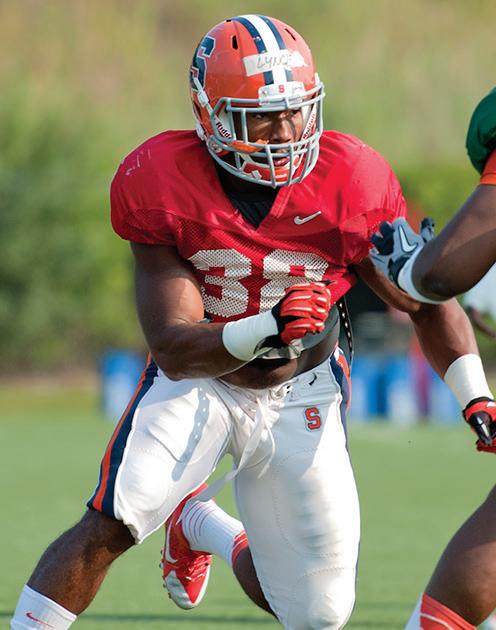
LYNCH
FINDING THE STRENGTH
Cam Lynch’s Scout.com page reads like so: The No. 54 outside linebacker in the Class of 2011. Three stars. Five feet 11 inches. Two hundred and fifteen pounds. Strengths: instincts, lateral movement, tackling technique.
Areas for improvement: size.
Three years after choosing Syracuse, Lynch has added 15 pounds of muscle.
He’s still 5 feet 11 inches, easily the shortest of the three starting linebackers, but senior defensive tackle Jay Bromley called him the strongest.
The Shamarko Thomas of linebackers, Bromley said.
“He can probably jump about 35 (inches), bench about 450 (pounds), if not more, and squat about 5(00) something,” Bromley said.
“… He’s like a bowling ball of just speed.”
Even at Brookwood High School in
Snellville, Ga., Lynch was strong. Now entering his junior year with the Orange, he’ll be a first-year starter playing against some of the fastest running backs in the country. Yet with only three career starts, Lynch’s lack of height or experience doesn’t seem to worry any of the Orange coaches or players.
Nor should it.
He was a rotation player in each of the last two seasons, starting once as a freshman and twice as a sophomore. Last year, he notched a career-high nine tackles against Missouri on Nov. 17, and added four tackles, half a sack and a forced fumble against West Virginia in the Pinstripe Bowl on Dec. 29.
This spring, he manned the starting strong linebacker spot when Davis sat out after offseason shoulder surgery.
“He spent a lot of time this summer becoming a student of the game and really trying to absorb a lot of information from a football standpoint,” linebackers coach Clark Lea said. “It made this transition to fall camp a
SEE LYNCH PAGE 10
ziniu chen staff photographer
CAMERON
ziniu chen staff photographer
ziniu chen staff photographer
DAVIS
FROM PAGES 8-9
than any other SU player these last two seasons.
Davis leads the team with 24.5 tackles for loss in the last two seasons, but dropping in coverage or filling space in the box has sometimes been problematic – like when Davis failed to hold contain on an end-around and reverse in a loss to Southern California last season.
After missing the spring season with offseason shoulder surgery, Davis began working with Lea on rounding out his game. Footwork in the box, dropping in coverage and coming out of breaks. Using his hands to control tight ends at the line of scrimmage.
“I feel like I’ve had a tremendous amount of improvement being outside the box and covering the pass,” Davis said. “Being active on the play, driving to the ball after the ball is thrown.”
Lea said Davis’ experience playing wide receiver at Woodbury (N.J.) High School shows in his ability to use his hips to change direction and his catching ability. It’s his height, Lea said, that makes perfecting the backpedaling and crossovers difficult.
While Davis is only in his third season playing linebacker, he started in limited formations as a freshman and full-time last year. Experience playing in the secondary at Wood-
Tbury and safety at Milford (N.Y.) Academy helped, but to become a multi-dimensional linebacker, he’ll need to continue to work on the intricacies of coverage.
“I hope as we move forward that he just starts rounding out his game so that he can still run and hit and do those things well,” Lea said, “but the finer points of coverage or playing in the box when he needs to and getting his body under control to make a play in space, those are things we’ve spent a good amount of time on in camp drilling.”
SPRUILL
I was trying to find a school to go to for football, so if I had to bite my tongue and do what they said, I would do it.”
It’s the same way he handled the situation this past winter. And with that maturity, he grew in the eyes of his teammates and coaches.
Davis saw the difference in the way Spruill handled the court hearings and media backlash. Spruill’s roommate of more than a year, Davis watched him work through the everyday grind of redefining his reputation as a player and leader going into his final collegiate season.
“He just changed into a different person,” Davis said.
Head coach Scott Shafer saw the difference in the way Spruill ran defensive practices this summer. Spruill held more sessions than the team has run any summer since he got here.
“He took that defense and they damn near practiced on their own three days a week,” Shafer said. “I was so proud of him.”
It was only two years ago that Shafer remembers Spruill shying away from that role. “Coach, I don’t feel comfortable being a leader,” Shafer recalls Spruill telling him.
Now the whole team looks up to Spruill, a four-year starter and established signal caller for the defense.
For Spruill, the incident in December is in the past. He doesn’t let it define him.
Sliding back into his natural middle linebacker slot this season, he has the support of all his teammates and coaches.
“We needed a little leadership, and he’s the guy,” linebackers coach Clark Lea said. “They all look to him. They all look to him and they know he can do it.”
LYNCH
lot smoother.”
His performance through camp has been inconsistent at times, Lea said, but the high points have been eye-popping.
Last Monday, Lynch trifled through the line
on back-to-back plays in a 7-on-7 drill. First, he beat tackle Sean Hickey around the outside before tagging quarterbacking offensive line coach Pat Perles for the sack.
On the next play, he ran a twist stunt with Spruill and sped past Hickey up the middle for another sack.
Lynch’s strength and speed allow him to exploit the smallest of crevices in an offensive front. Now he’s working on going through offensive linemen, as well.
“I want to sharpen up being physical at the line,” Lynch said. “I’m good at that, but being physical at the line and just working on that. Everything else is solid.”
For a guy who scored a 1435 on his SAT, according to Rivals.com, and received a scholarship offer from Harvard, identifying and understanding the quickest way into the backfield shouldn’t be a problem – especially considering he grew up in Georgia and knows the Atlantic Coast Conference brand of football well.
While Lynch can’t do anything to get taller, he’s done everything in his power to prove his size and strength are far from an area of improvement.
Bromley said Lynch turns heads in the weight room. Now he’s knocking them backward on the practice field, too.
“This guy is limitless,” Bromley said. “There’s really not much he can’t do.”
“WE’RE JUST THE THREE SOLDIERS, STICKING TOGETHER, HOLDING THE TEAM TOGETHER.”
Dyshawn Davis SU LINEBACKER
hree linebackers. Three questions. If Syracuse is to stay afloat in the ACC this year, it’ll need all three to carry its defensive weight.
Davis remembers idolizing Hogue and Smith when he watched games at Milford Academy.
He remembers getting to Syracuse and sitting down with Spruill. They talked about a dream.
“I knew in the future that we had a chance to be better than Doug and Derrell,” Davis said. “That kind of went by quick filling in the footsteps and the shoes of those guys. Now we’re
trying to be the best that we can be and try to be better than them.”
With Lynch beside them, the three form a more complete group than that of 2010. A group with arguably more pressure, but as Davis said, a group that knows how crucial it is to the team’s success.
They’re the heart and soul of the defense.
“We’re just the three soldiers,” Davis said, “sticking together, holding the team together.”
sebail01@syr.edu
@Stephen_Bailey1



that ‘fourth running back’ in the wishbone offense,” Smith said. “I was a runner. Early in my career, that was my label. Later in my career, I tried to add the passing game to it and it worked out.”
His 405 passing yards against Tulsa in 1990 set a program record, and he completed 57 percent of his passes throughout his four-year career.
He then took his talents outside of the United States to play in the Canadian Football League –and then in France.
His time in the French League was memorable, and not just because of the 1993 championship he won with the Aix-enprovence Argonauts at the back end of an undefeated season.
“For a kid like me, it was a great experience,” Smith said. “Got a chance to see the world and it was something that I’ll always cherish being able to do.”
Smith started his coaching career as the offensive coordinator and quarterbacks coach at Indiana State. When Northern Illinois was searching for a new running backs coach before the 2001 season, he was recommended
to Joe Novak, then the head coach at NIU, who brought Smith in despite his inexperience as a backfield instructor.
“This business is about who you know,” Smith said. “I had no idea how to coach running backs at all. He didn’t care. He just wanted good people around his program.”
The gamble paid off, as Smith’s expertise as a signal caller has made him an effective running backs coach with programs such as New Mexico, Illinois and UNLV.
“We don’t just talk about what the running backs do,” Smith said. “We look at safeties, we look at linebackers, we do rotations with coverages and things like that.”
SU head coach Scott Shafer said he likes the Orange’s numbers at running back, and is looking to utilize that depth on special teams, particularly in the return game.
It’s a plan that could jeopardize the health of Smith’s group, but Smith knows how he’s going to handle the halfback position the Orange will depend so heavily on in 2013.
“I try not to think about that we’re the deepest group or anything like that,” Smith said. “I’m just thankful I have the opportunity to coach them.”
pmdabbra@syr.edu
@PhilDAbb
RUNNING BACK
After making stops at five other programs since he first became a running backs coach, DeAndre Smith takes over the Syracuse backfield in 2013. Here is a breakdown of the progress Smith made with his former pupils, including NFL halfbacks Michael Turner, Garrett Wolfe and Mikel Leshoure.
NORTHERN ILLINOIS
ILLINOIS
MIAMI (OHIO)


A year passed and it was more of the same for Christ the King. The Royals were back in the title game, but Calhoun fouled out. CK’s lead had shrunk and Hunt, the mop-up man playing in the last organized basketball game of his career, was on the floor to try to stop the bleeding.
He finished with 15 points on 7-of-8 shooting and hauled in a pair of decisive rebounds in the final 30 seconds of Christ the King’s win.
“You don’t want to make big mistakes, so you just go in there and you’re like, alright, playing real hesitant,” Hunt said. “But after a while you’re like, ‘This my team. We practice all the time. I’ve been here before.’”
That, he said, is what taking the field for Syracuse would be like. Even if he’s only logged a handful of snaps in his three years, he ran with
the first team in the spring and held the lead for the starting gig heading into the summer.
He and Drew Allen now split reps, but the
“I actually didn’t want to play quarterback, but my coach told me they get all the shine, they get all the girls, and I was like, ‘Alright, I’m in.’”
Terrel Hunt
SYRACUSE QUARTERBACK
transfer is still learning. Hunt knows what he’s doing with the Orange.
But unlike Allen, he doesn’t fit the prototype. He’s only 6 feet 3 inches compared to Allen’s towering 6-foot-5 frame.
“I’ll just sum it up in one word: cannon,” defensive tackle Eric Crume said. “He’s going to let it rip.”
Hunt’s calling card in high school was his speed — he had only been playing the position for two years when he made his varsity debut — and that’s what most people still expect out of him.
He knows the stigma about black quarterbacks. They’re expected to be the run-first type, running around and making flashy plays with their legs.
He knows the perils. He’s more mature and experienced than he was as a high school sophomore. Careers for running quarterbacks are typically short-lived, and few come close to the level of success attained by traditional pocket passers.
The difference between his game in high school and his game now is that “I try to stay in the pocket,” he said, “because I want to be able to get my receivers a chance, instead of running like I did in high school.
“And if nothing’s open, I take off.”
He probably can’t match the rumored 70-yard bombs Allen can toss, and if he can, he hasn’t
shown it yet during an open practice — though center Macky MacPherson said he has an “underrated arm” — but Hunt insists he’s more than just a runner now.
“I’ve learned to stay in the pocket and only run when I have to or run when I’m dependent,” Hunt said. “I’d rather be a pocket quarterback that just knows how to run and not just being a running quarterback all the time.”
Right now he can’t think about the competition, though. Hunt can only keep two things on his mind: Playing like the quarterback he’s become, and the memory of his mother.
“I think about her 24/7 because she’s basically pushing me every time,” Hunt said. “When I start thinking, like, ‘Man, I’m getting tired. I want them to name the starter,’ she says, ‘Don’t worry about it. Your time will come when it comes, so you just keep competing and just go at it every day.’”
dbwilson@syr.edu
@DBWilson2
to much of a Syracuse roster that hails from the Northeast. Alamo Heights High School in San Antonio isn’t quite of the same quality as some schools near Dallas, but the town still shuts down on Friday nights and high school games are treated like college ones.
“It’s huge,” Allen said. “The high school revolves around their football team and kind of the success of their football team.”
They are, he said, like the movies portray them. And a quarterback like the ones painted in the movies needs a big arm. Fittingly, that’s the first thing that stands out about Allen to his teammates.
“In practice we see it and he’ll throw the deep ball,” linebacker Cameron Lynch said, “and we’re like, ‘Whoa.’”
It’s his hallmark. Even head coach Scott Shafer tells stories of Allen whizzing the ball 70 yards through the air.
But that’s not to say Allen’s arm is a proven commodity. In the Orange’s scrimmage in Fort Drum, N.Y., Allen connected on just two passes that traveled for more than 10 yards through the air. Still, his deep ball’s impressed his competition.
“Sometimes he just chucks it and it feels like the ball just never comes down,” Hunt said.
In the limited opportunities he’s had since
joining the Orange, Allen has proven to be more than a statuesque presence behind the line of scrimmage. He darted downfield for the only substantial run in SU’s Fort Drum scrimmage.
“When you see him you’re like, ‘That’s a quarterback.’”
Jerome Smith SYRACUSE RUNNING BACK
“At first I was like, ‘He’s a little stiff,’” Hunt said, “but once he started moving, I was like, ‘OK, he’s got a little moves.’”
But this is something expected of Allen. A three-star recruit from Texas, a Big 12 talent,
should be able to start at quarterback for an Orange team that has struggled for the better part of the last decade.
His world is foreign. In his apartment he shares with, among others, center Macky MacPherson, there is a pair of mounted deer antlers and a bobcat pelt placed there by the avid hunter, and a picture of family friend and former Houston Astros star Lance Berkman.
Allen is a long way from home now, but it just so happens that Syracuse is the final checkpoint he must cross to achieve his ultimate dream.
“Just the opportunity,” Allen said. “The opportunity to compete. They didn’t promise me anything, but they promised that I’d have the opportunity to compete for the starting job.”
dbwilson@syr.edu
@DBWilson2



DEATH OF THE BCS
THE BAD
1998
THE GOOD
Jan. 3, 2001
Oklahoma and Florida State’s national championship game (Orange Bowl) earns a then-record 17.8 television rating. That stood as the most-watched bowl game until 2006.
Jan. 3, 2003
Ohio State beats Miami (Fla.) 31-24 in the national championship game (Fiesta Bowl). After Miami kicks a last-second field goal to force overtime, both teams score touchdowns in the first minutes. Ohio State scores first in the second overtime, then Miami gets a first-andgoal, but is unable to score on four consecutive plays.
Jan. 4, 2006
Texas beats Southern California 41-38 in the BCS Championship Game (Rose Bowl). It is the most watched BCS game ever, earning a 21.7 share. With Texas trailing 38-33 with 26 seconds left in the game, quarterback Vince Young scrambles on a fourth-and-five from the nine-yard line and scores, giving the Longhorns a 39-38 lead. A two-point conversion extends the lead to 41-38, the game’s final score.
Jan. 1, 2007
Boise State beats Oklahoma 43-42 in the Fiesta Bowl. Oklahoma scores a touchdown and a two-point conversion with 1:26 remaining in the fourth quarter to tie the game at 28. On the first play of Boise State’s next possession, Oklahoma intercepts a pass and returns it for a touchdown, giving the Sooners a 35-28 lead with 1:02 to go. Then, Boise State embarks on arguably the most memorable drive in BCS history, ending in a hook-and-ladder touchdown on a fourth-and-18 to tie the game. Oklahoma scores on its first possession of overtime to take a 42-35 lead. On the ensuing possession, Boise State scores a touchdown on a fourth-and-two halfback pass and runs a successful Statue of Liberty play for the two-point conversion to win.
2008
For the first time, two previous Heisman Trophy winners play in the same season: Oklahoma’s Sam Bradford (2008) and Florida’s Tim Tebow (2007).
Jan. 4, 2010
Boise State faces Texas Christian in the Fiesta Bowl, the first and only time two teams from non-automatic qualifier conferences play in a BCS bowl in the same season and same game.
Tulane goes undefeated, but finishes 10th in the BCS standings and is not invited to a BCS bowl. Kansas State finishes third in the final BCS standings, but is not invited to a BCS bowl game. No. 4 Ohio State and two-loss No. 8 Florida receive at-large bids instead.
1999
Marshall finishes the year undefeated and does not make the national championship game. The BCS adopts a rule that states any team ranked in the top four in the final BCS poll is guaranteed an invitation to a BCS bowl.
2001
Nebraska finishes its regular season by losing at Colorado, 62-36. The Huskers don’t play in the Big 12 championship, with Colorado winning the conference, yet are still invited to the BCS title game over oneloss Oregon and two-loss Colorado.
2003
The season ends with a split national championship – Southern California and LSU.
2004
USC, Oklahoma, Auburn, Utah and Boise State all finish the regular season undefeated. USC and OU play for the BCS National Championship while Auburn, Utah and Boise State play in other bowl games.
Jan. 4, 2005
The national championship game between Oklahoma and USC draws the lowest television rating of any championship game to date: 13.7.
2006
Boise State finishes the year undefeated and does not make the national championship game.
2007
Hawaii finishes the regular season undefeated and does not make the national championship game.
2008
Boise State and Utah finish the year undefeated and do not make the national championship game.
2009
Boise State, Texas Christian and Cincinnati finish the year undefeated and do not make the national championship game.
2010
Texas Christian finishes the year undefeated and does not make the national championship game.
Jan. 9, 2012
In a regular-season rematch, LSU beats Alabama 21-0 for the national championship. The Tigers (13-0) beat the Tide 9-6 in overtime earlier in the season, before Alabama throttles LSU in the title game to win its 14th national championship.
WBy Josh Hyber STAFF WRITER
hen the Bowl Championship Series (BCS) began in 1998, it was envisioned to be the be-all, end-all formula to determine the national champion of Division 1-A college football. The BCS, combined with the Associated Press poll, Coaches poll and a third computer component, was the perfect way to find the true best team in college football. But in its 15-year history, the BCS has been everything but certain. The outcries have come from football analysts to President Barack Obama, and on April 25, the end was finally signaled. A four-team playoff is scheduled to begin in 2014-15.
THE UGLY
MIAMI (FLA.)
Miami booster Nevin Shapiro admits to giving coaches, players and recruits cash and memorabilia, while also taking them on his yacht and to strip clubs and paying for prostitutes. The NCAA says the benefits went to 72 then-players and three recruits.
On Aug. 30, 2012, the NCAA announces it has found that 12 players received impermissible benefits. Miami withdraws from bowl consideration for 2011 and 2012.
Miami receives a Notice of Allegations from the NCAA on Feb. 19, 2013.
OHIO STATE
Quarterback Terrelle Pryor and four teammates are suspended for the first five games of the 2012 season for selling championship rings, jerseys and awards in exchange for tattoos. Ohio State vacates victories, including a Big Ten title and a Sugar Bowl title. Ohio State went 12-0 last season, but is prevented from playing for a national title, or any bowl, because of a one-year postseason ban.
SOUTHERN CALIFORNIA
In 2004, it is discovered that USC running back Reggie Bush received improper benefits. This leads to vacated wins, a forfeited BCS championship trophy, Bush returning his Heisman Trophy and a three-year scholarship reduction, as well as a two-year ban on postseason play.
AUBURN
On Nov. 30, 2010, Auburn declares quarterback Cam Newton ineligible after the NCAA finds evidence that his father, Cecil Newton, solicited Mississippi State $120,000-$180,000 in exchange for his son to play there before he chose to play at Auburn. The NCAA reinstates Newton on Dec. 1 and declares him eligible to play in the 2010 SEC Championship game.
PENN STATE
Former assistant coach Jerry Sandusky is accused of heinous acts with children, some of which occurred at Penn State football facilities. Sandusky is arrested, tried and convicted for his actions. The scandal leads to the Nittany Lions vacating 111 wins throughout 14 seasons, and costs head coach Joe Paterno his job.

2013 ROSTER
1
2
2
3
3
4
5
5
6
7
25
25
26
27
29
30
31
32
33
35
36
38 Cameron Lynch
39
39
40
42
42 Joe Stanard
43 Franklin Santos
N.J./Ramapo HS
N.Y./C.W. Baker
5-10 175 Jr. Providence, R.I./Classical HS
45 Jerome Smith RB 6-0 226 Jr. Bear, Del./Pencader Charter
46 Jonathan Fisher P 6-1 209 Jr. Oakfield, N.Y./Oakfield-Alabama Central
47 Sam Rodgers LS 6-2 234 Jr. State College, Pa./Mercersburg Academy
48 Eric Morris LS 5-10 220 Sr. Simi Valley, Calif./Royal
49 Alryk Perry LB 6-0 211 Fr. Columbus, Ala./Glenwood School
50 Femi Aliyu LB 5-11 228 Sr. Baldwin, N.Y./Baldwin
51 Donnie Simmons DE 6-2 250 So. Hartsdale, N.Y./Archbishop Stepinac
52 Eric Crume NT 6-0 305 Jr. Detroit, Mich./Detroit Central
53 Lucas Albrecht DT 6-2 258 Sr. Hudson Falls, N.Y./Hudson Falls
54 Kennedy Kodua DE 6-1 220 Jr. Bronx, N.Y./A. Phillip Randolph
55 Marcus Coleman NT 6-1 266 RF Voorhees, N.J./Camden Catholic
55 Rob Trudo OG 6-3 284 So. Farrell, Pa./Farrell
56 John Miller OL 6-2 308 So. Carson, Calif./Redondo Union
57 Omari Palmer OG 6-2 309 RF Coram, N.Y./Longwood
58 Hernz Laguerre LB 6-0 220 So. Spring Valley, N.Y./Spring Valley
59 Macky MacPherson C 6-2 290 Sr. Syracuse, N.Y./Christian Brothers Academy
60 Sean Hickey OT 6-5 291 Jr. Murrysville, Pa./Franklin Regional HS
64 Daniel Anyaegbunam OT 6-3 290 Sr. Schenectady, N.Y./Albany Academy
65 Jamar McGloster OL 6-7 303 Fr. Hillside, N.J./Saint Anthony’s
67 Michael Lasker OL 6-4 324 So. Corona, Calif./Santiago
68 Nick Robinson OG 6-5 297 So. Baldwinsville, N.Y./C.W. Baker
69 Keith Mitsuuchi LS 5-10 221 So. Torrance, Calif./South Torrance
70 Jesse Wolf-Gould OG 6-4 328 Jr. Oneonta, N.Y./Oneonta
71 Alex Hayes OL 6-2 315 Fr. Ellenwood, Ga./Tucker
72 Ivan Foy OG 6-4 313 So. Brooklyn, N.Y./Fort Hamilton
73 Jon Burton OL 6-6 317 Fr. Spotsylvania, Va./Courtland
74 Seamus Shanley C 6-1 264 So. Syracuse, N.Y./West Genesee
76 Kyle Knapp OT 6-4 284 RF Kalamazoo, Mich./Portage Central
77 Zian Jones NT 6-4 311 Sr. Los Angeles, Calif./Eagle Rock HS/West Los Angeles College
78 Jason Emerich C 6-3 280 RF New Ringgold, Pa./Blue Mountain
80 Tyler Provo TE 6-0 246 Fr.
81
81
83

DUKE
FROM PAGE 5
designed scrambles for him.
Add that to a defense Cockrell calls “the team’s strength,” as well as a confident urgency
the program lacked in years past, and Duke is certainly ready to compete in 2013.
“If we get to the (Atlantic Coast Conference) championship, we’ll have achieved a lot of what we wanted to,” Cockrell said. “We’re shooting for it all and think we can get there.”
jcdoug01@syr.edu
@dougherty_jesse
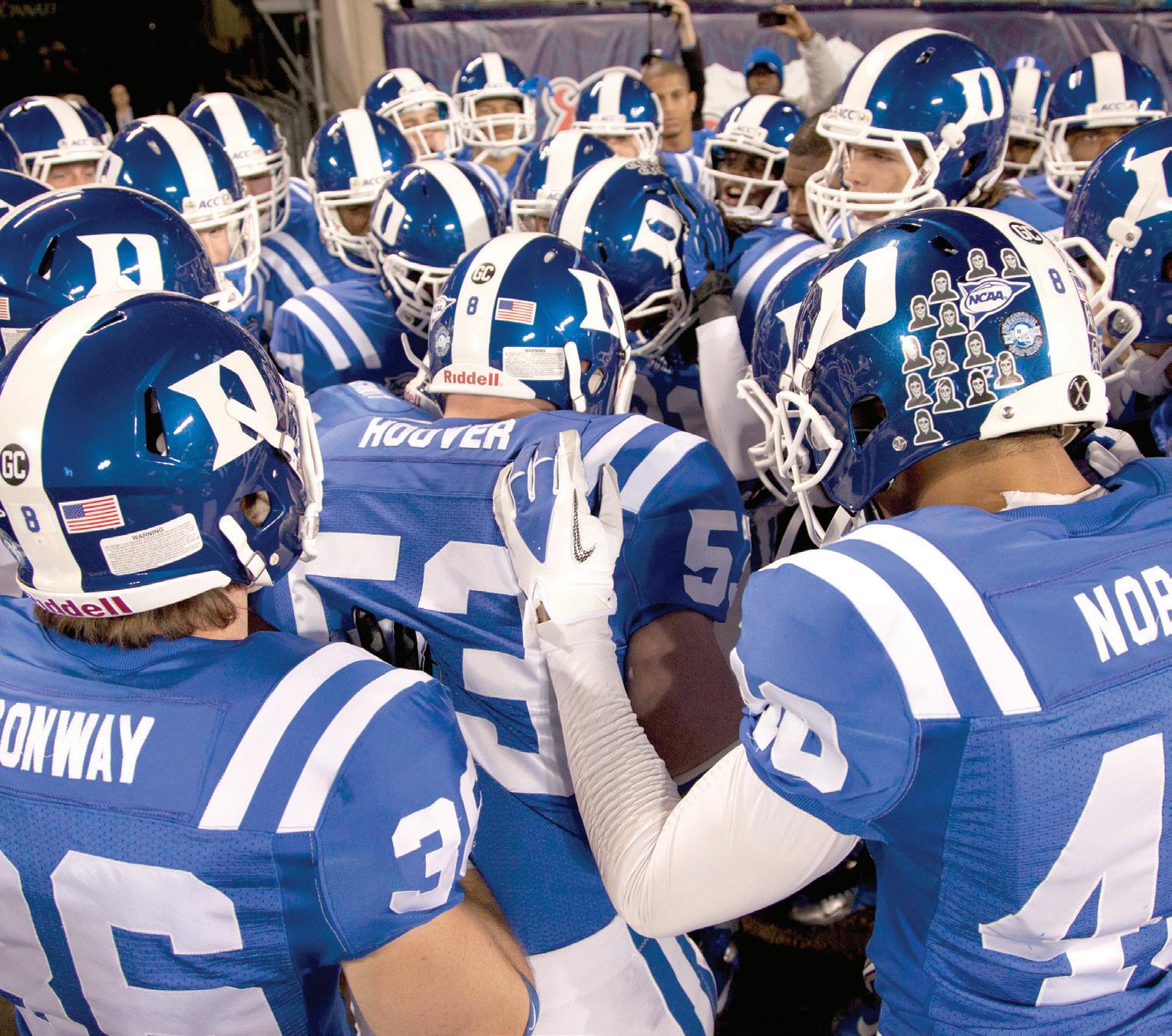
courtesy of duke sports information dept. Duke came together as a unit last season and played in a bowl game for the program’s first time since 1995. The Blue Devils’ six wins matched their win total from 2010-11.


BEAT WRITER PREDICTIONS
STEPHEN BAILEY

that’s commitment
Without an established quarterback or receiving threat, it’ll be tough for Syracuse to compete with the high-powered Atlantic Coast Conference offenses. A dynamic running game and reliable defensive front seven will be enough to knock off Wagner, Tulane and the ACC bottom-feeders, but the Orange is still a couple years away from hanging with the big boys.
I just can’t see the Orange taking down North Carolina State or Georgia Tech with Jarrod West as its top outside threat, nonetheless Clemson or Florida State.
That might change if golden boy Drew Allen or dual-threat quarterback Terrel Hunt plays surprisingly well, but head coach Scott Shafer and the Orange face an uphill battle to a bowl game in their first year in the ACC.
TREVOR HASS

Syracuse will get off to a bumpy start against Penn State and Northwestern, but will respond with two wins over Wagner and Tulane. Adjusting to the Atlantic Coast Conference is a daunting task, but the Orange will finish with an even record in conference play.
Running backs Jerome Smith and Prince-Tyson Gulley will carry SU, each rushing for more than five touchdowns. Linebacker Marquis Spruill and defensive tackle Jay Bromley will ignite a solid Syracuse defense, one that will hold opponents to fewer than 25 points per game.
As long as Terrel Hunt or Drew Allen can be relatively consistent at quarterback, Syracuse should be able to hover around .500 all season. The Orange’s pure talent level at all positions except running back is the biggest question mark.
GAME-BY-GAME PREDICTIONS
Too much overturn and too much opposing talent in a new conference. Syracuse could start as well as 4-0, but 2-2 seems more likely with tough games against Penn State and Northwestern to lead off the season.
Either way, a post-bye-week tilt against Clemson in its first ever Atlantic Coast Conference game will likely leave the Orange with ground to make up once in the conference. The stretch that follows is a critical one, as SU will likely need to snatch two or three of the four games against North Carolina State, Georgia Tech, Wake Forest and Maryland.
Ultimately, there are too many uncertainties for Syracuse to head back to a bowl game in Scott Shafer’s first season as head coach.