The Daily Northwestern
AUDIO / e Weekly
Transgender students frustrated, NU researchers make plasma discovery
AUDIO / e Weekly
Transgender students frustrated, NU researchers make plasma discovery
Students describe fear a er federal funding agreement
By XUAN DAY TRAN
On April 29, 2024, Northwestern reached the Deering Meadow Agreement in response to encampments on campus by pro-Palestinian student groups.
Today, pro-Palestinian student activists are preparing for the future of their advocacy following the University’s termination of the Deering Meadow Agreement as part of the Nov. 28 deal with the Trump administration to restore federal funding.
The November agreement states the University will “not use personal statements, diversity narratives, or any applicant reference to racial identity as a means to introduce or justify discrimination.”
“If I personally had known Northwestern would make a deal with the Trump administration, I never would have applied here in the rst place,” said a student participant in the Deering Meadow encampment.
e student participant, who requested anonymity for fear of retaliation from University and federal authorities, said they felt
the deal opposed NU’s values of equality and justice.
They added that the deal reversed the progress achieved by equality initiatives and programs.
“I think that the deal has taken away a lot of the ability of students to speak out and speak freely,” the student participant said. “ ere is a constant fear of being doxxed, being a acked or being criminalized for speaking out on an issue they feel passionate about.”
However, they said they believe there is still a future for pro-Palestinian student activism. e student participant said their experiences from the encampment, along with those of other activists, will help them face future obstacles the deal may introduce.
“Part of the future of activism is building strong communities, remaining connected and practicing empathy,” the student participant said.
Another student activist, who requested anonymity for fear of retaliation from University and federal authorities, said that due to increased surveillance from NU and federal authorities, they felt that students could not voice certain views in the current political climate.
» See ACTIVISM, page 14
PHOTO What’s in eir Bag: Startup and club founders

By EMILY DISSANAYAKE the daily northwestern
As federal immigration enforcement activity intensied in the fall, United Church
of Rogers Park Pastor Hannah Kardon visited the Immigration and Customs Enforcement facility in Broadview, Illinois, to protest ICE activity.
Since then, she said she has visited the facility a few dozen
By MAX TURETZKY assistant city editor
Northwestern students experienced an unconventional political awakening Friday a ernoon as a student delegation from the University of Chicago descended on campus with bags of raw onions and a singular mission: to overturn the Onion Futures Act of 1958.
e four UChicago student activists belong to a club called For Our Futures, which seeks to overturn a decades-old law that bans the trading of onion futures — contracts that lock in a price for onions to be delivered at a later date.
The group collected

signatures for a petition to legalize onion futures at e Arch, informing passersby about what they view as the law’s negative e ects on onion farmers and offering them free onions in exchange for signatures.
e Onion Futures Act was passed a er two traders cornered the Chicago onion futures market in 1955, then crashed prices by flooding the market with onions, which led bankrupt farmers to dump their worthless onions into the Chicago River.
“It was intended to reduce price volatility, but that has not occurred,” said UChicago student Adam Ash, the selfdescribed “generalissimo” of For Our Futures, who led the delegation. “Especially at a time when
Max Turetzky/The Daily Northwestern
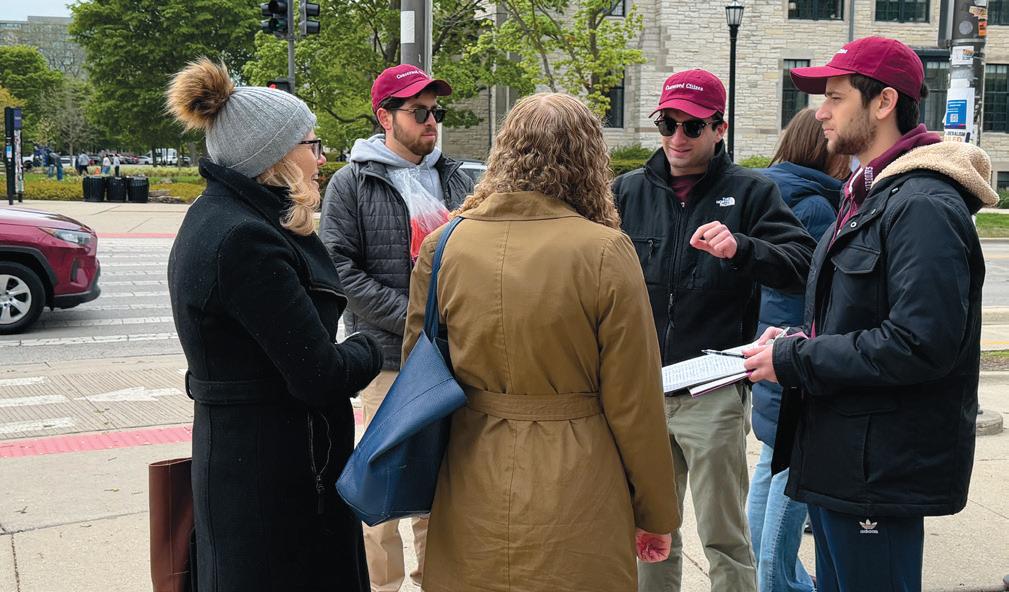
Four University of Chicago students, three of whom identified themselves only as “concerned citizens,” informed passersby about what they view as the Onion Futures Act’s negative e ects on onion farmers
our politicians are only talking about visions of utopia, we think the option you’re looking at is
marginally be er public policy.”
» See ONIONS , page 15
times. She said she “saw how devastating (the facility) was for the city of Broadview,” adding that children, neighboring daycares and houses of worship were at times exposed to tear gas deployed by federal agents.
“It’s not safe to be near a torture facility that is set up to deny human rights,” Kardon said. “So, there is a safety issue, and I don’t know if the
» See ICE , page 14
District eyes $6.3 million reductionbudget in 2027
By SOPHIE BAKER and ELIZA MARTIN the daily northwestern
The Evanston/Skokie School District 65 Board of Education assessed alternative spending cuts at its Monday meeting. Board members are currently looking to complete Phase 3 of the district’s Structural De cit Reduction Plan, which aims to cut $16 million to $18 million from the
district’s budget by scal year 2030. e district is targeting a $6.3 million budget reduction for the 2027 scal year. Superintendent Angel Turner said the board must decide where to cut an additional $635,077 of spending before the next scal year to meet that goal. In the past few weeks, the district has moved to eliminate several student-facing positions, including some counselors and middle school librarians. is has drawn signi cant pushback from parents, teachers and students,
» See D65 BOARD, page 15

By ASHLEY WEI polling editor
Evanston/Skokie School District 65’s new Master Facilities Plan dra , authored by architecture rm StudioGC, projects the district will need to devote $598 million to facilities spending over the next 49 years.
Project Executive Patrick Callahan discussed the dra with the District 65 Board of Education during the board’s March 23 meeting. According to Callahan, the report’s spending estimate is not intended to be followed directly but instead aims to inform the district’s decision-making on where to invest resources.
“ is is a set of variables that allows you to make decisions as you look at how students are educated and where they’re educated,” Callahan said at the meeting.
StudioGC’s gure marked a signi cant uptick in expenditures from the previous $188 million estimate in facilities spending over the next 20 years from the Cordogan Clark Master Facilities Plan, which was presented to the board in March 2022. Callahan said his rm took a broader scope in its assessment. He added that a built-in 4.5% annual cost increase to keep up with rising costs made up about one-third, or $202.5 million, of the new estimate.
e report also included a Facilities Condition Index for each school, a metric that compared the assessed facilities costs from 2027 to 2033 relative to the cost of replacing the entire building.
Park School and Willard Elementary and Washington Elementary Schools had the worst FCI in District 65, indicating the worst facilities conditions.
Callahan also a ributed the increased cost projection to the addition of the 10 Year Health Life Safety report, a mandatory inspection for Illinois public school buildings to identify violations of minimal health and safety standards.
e report identi es $19 million in spending across the next ve years needed to address urgent safety violations, such as outdated re alarm panels, accessibility needs and galvanized

water plumbing piping xes.
It comes as the district looks to complete Phase 3 of its Structural De cit Reduction Plan, which aims to reduce the district’s budget by $16 million to $18 million by the scal year 2030. At the board’s March 23 meeting, board members questioned whether closing schools would decrease maintenance costs at those properties.
Stacy Beardsley, assistant superintendent of performance management and accountability, noted that the district still will be responsible for some maintenance costs even a er schools close.
According to Beardsley, around 60% of maintenance costs will still be necessary.
District 65 parent Jason Orlo , a former member of the Structural De cit Reduction Plan’s Finance Commi ee, said xhe is a strong advocate

of prioritizing the $200 million deferred maintenance and capital improvements, recalling an instance a “200-pound light xture fell on (xim) from that two story ceiling.”
Orlo urged the board to prioritize the most neglected schools and most important issues.
“I can tell you for a certainty that there are utilities that are improperly installed and facilities that are crumbling, and if they are not maintained, they will not be maintainable,” Orlo said.
Orlo also criticized the current assessment for being conducted by an architecture rm that included many “nice-to-haves,” rather than being conducted by a facilities engineer who could better identify building hazards.
District 65 parent Mike Boll said the inclusion of unnecessary expenses was also an issue with
the 2022 Cordogan Clark plan.
“It would be awesome, but we’re talking about closing a school versus having air conditioning,” Boll said.
At the March 23 meeting, board member Maria Opdycke said the board will need to decide between short-term and long-term investments, especially as the district considers the planned $2.4 million in repairs to Martin Luther King Jr. Literary and Fine Arts School slated for this summer.
“Are we just going for a patch-and-maintain?” Opdycke said. “Or are we going to think more longterm about how we build a future-ready building footprint and what all that could potentially be?”
a.wei@dailynorthwestern.com



By CARMEN GASKIN copy editor
Northwestern’s African Student Association
hosted its annual Afro Met Gala on Saturday at the Zhou B Art Center, showcasing the beauty of the African diaspora and the depth of Afro-cultures.
Located in downtown Chicago, the Zhou B Art Center is a facility designed to foster collaboration between local artists, industry professionals and, in this case, an organization eager to spotlight its members’ heritage.
The night promised an evening abundant with culture, music and community as students from all regions of Africa attended.
A short runway and an ASA photo backdrop welcomed attendees. Students also had access to a tripod, a ringlight and professional photographers.
While the building is laced with industrial architecture, collections of contemporary art and bookshelves span the room and dinner tables were decorated with flowers and specialized placards.
Although he didn’t attend last year’s Afro Met Gala, Weinberg sophomore Priso Ekole said he was happy to finally make it to this year’s event.
“It’s good to see how other people grew up through dance, food, culture or outfits,” Ekole said.
Attendees had access to a full course meal subsidized by ASA. Courses featured traditional African dishes, including jollof rice, doro wat and gomen. The main course accompanied an extensive smorgasbord of desserts, such as cupcakes, cookies and shortbread.
To decide which table would enter the line for food first, students competed in trivia on African history, touching on subjects including presidents and geography.
After eating, students participated in a “bestdressed” competition. After each table sent a nominee to the front, students danced around the room to showcase their outfit and explain why they chose the ensemble they did. To decide a winner, emcees let the crowd pick the Met Gala’s best dressed.
ASA emcees later hosted a game of musical chairs, featuring student representatives from
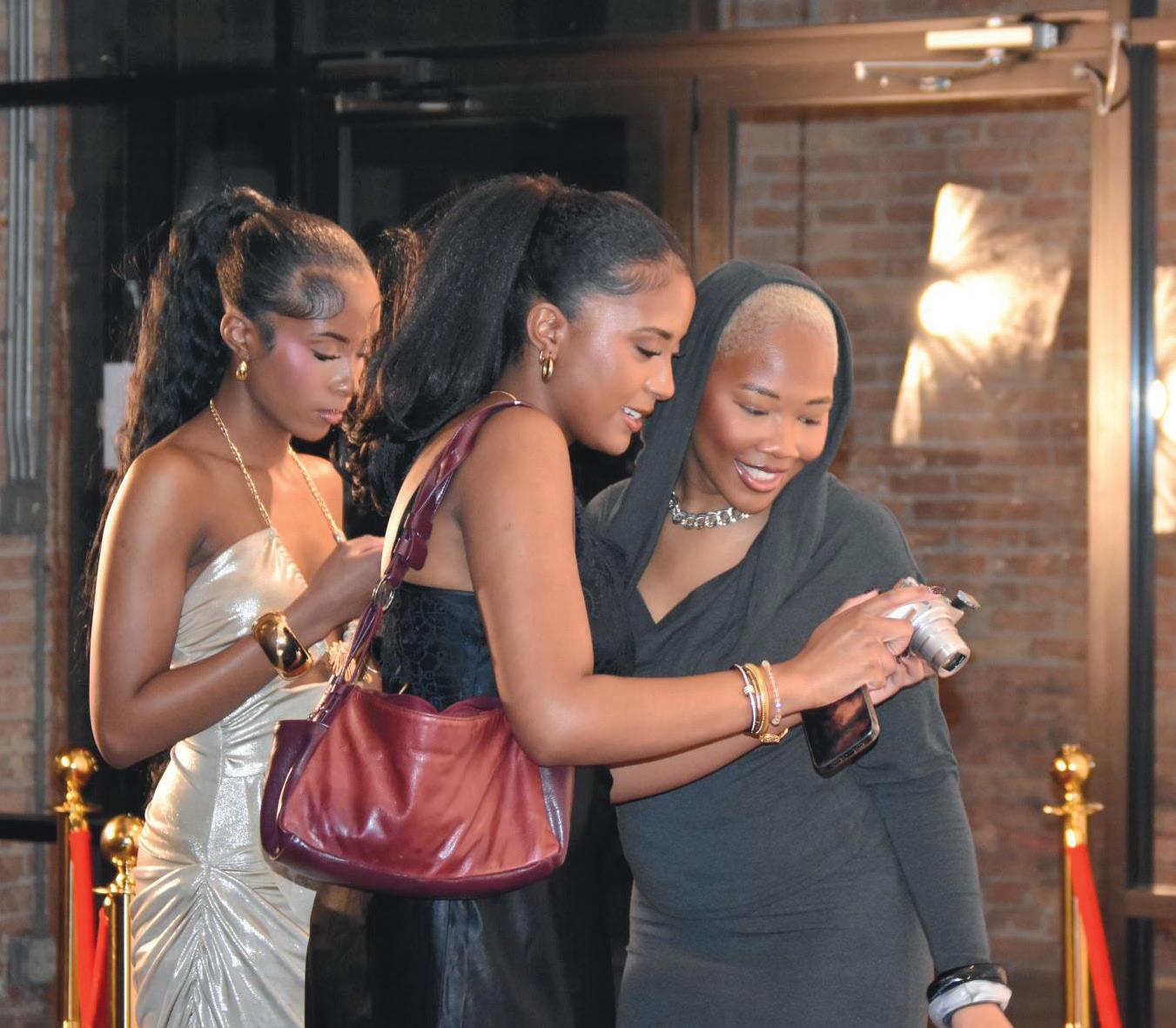
each region of Africa. DJ Dusse played brief portions of songs as each competitor was eliminated.
Weinberg first-year Amirah Chabi-Yo was the winner of the game, representing Western Africa.
“It’s very important to see individuals who live just like you, who come from similar backgrounds as you,” Chabi-Yo said. “It’s very touching to be in such an environment for you to learn other cultures and find similarities. We’re all African. We’re all Black.”
The night concluded with an opening of the dance floor and an opportunity for DJ Dusse to mix popular Afro-beats. As students danced, ASA
executive board
Weinberg first-year Sydney Clark said it was important to have Black representation in close proximity, especially in predominantly white academic spaces.
“I got to go to an event where not only is my Blackness celebrated, but my Black history is normal,” Clark said. “It shows that in our current climate Blackness in elite spaces is not something to be ashamed of.”
c.gaskin@dailynorthwestern.com
The Daily Northwestern www.dailynorthwestern.com
Editor in Chief Anavi Prakash eic@dailynorthwestern.com
General Manager Stacia Campbell stacia@dailynorthwestern.com
Holly and John Madigan Newsroom
Phone | 847.491.3222
Campus Desk campus@dailynorthwestern.com
City Desk city@dailynorthwestern.com
Sports Desk sports@dailynorthwestern.com
Ad Office | 847.491.7206 spc-compshop@northwestern.edu
The Daily Northwestern is printed each Wednesday during the academic year, except vacation periods, the two weeks preceding them and once during August, by Students Publishing Co., Inc. of Northwestern University, 1999 Campus Drive, Evanston, IL 60208. All news is published 24/7 online at Dailynorthwestern.com.
First copy of The Daily is free, additional copies are 50 cents. All material published herein, except advertising or where indicated otherwise, is Copyright 2025 The Daily Northwestern and protected under the “work made for hire” and “periodical publication” clauses of copyright law.
POSTMASTER: Send address changes to The Daily Northwestern, 1999 Campus Drive, Evanston, IL 60208. Subscriptions are $100 for the academic year. The Daily Northwestern is not responsible for more than one incorrect ad insertion. Check out








By ISABELLA KUNC
the daily northwestern
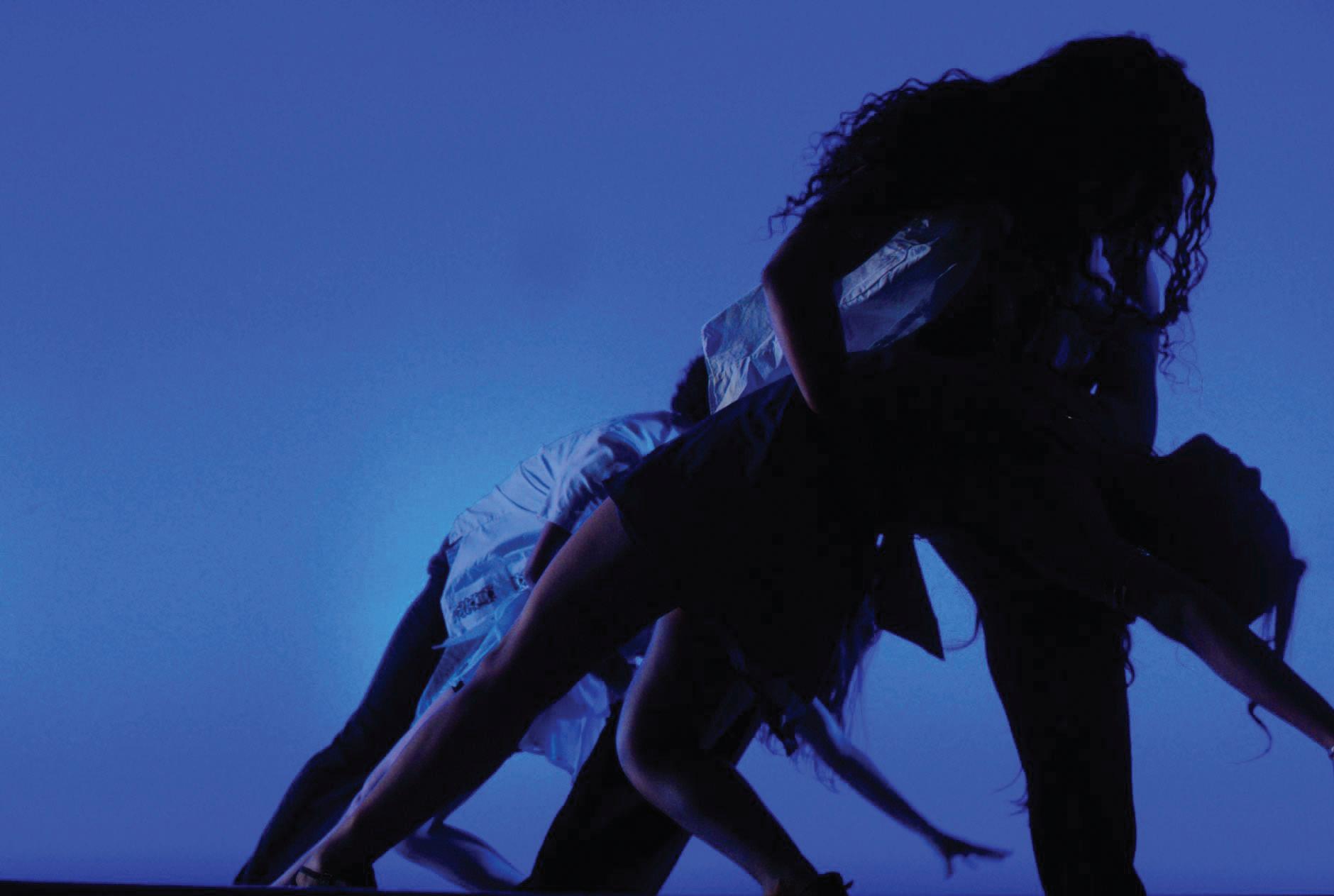
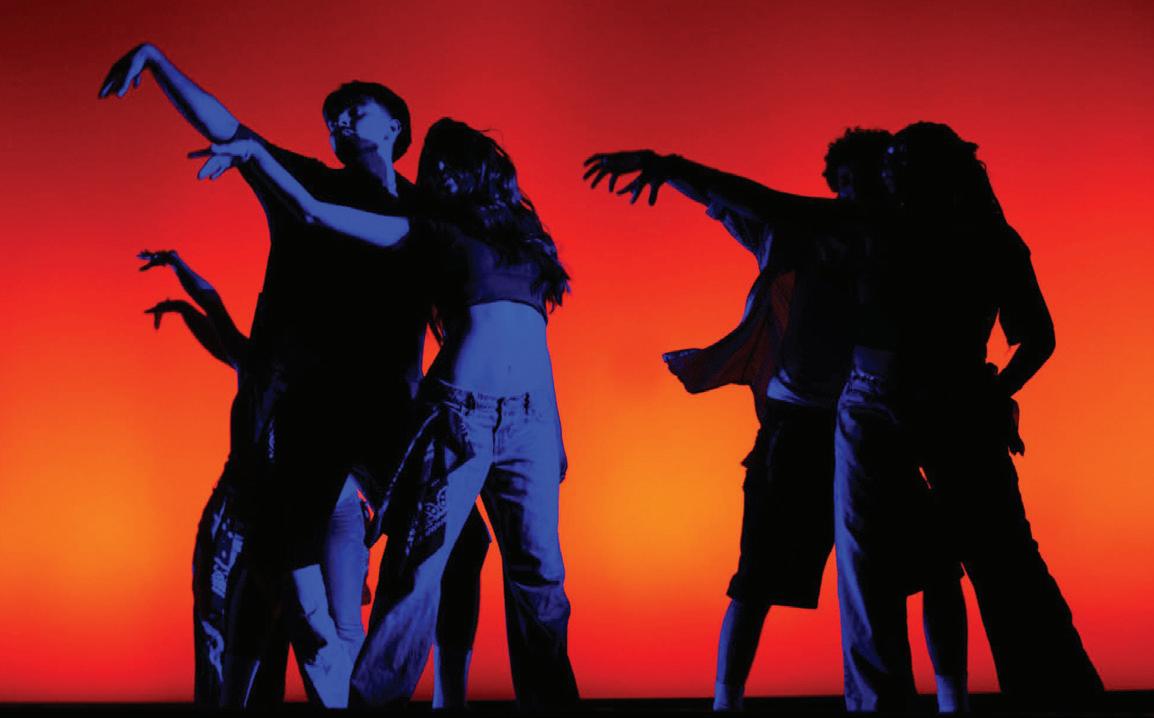
Latin dance group Dale Duro performed its seventh annual spring show, titled “Hasta La Raíz,” over the weekend in the Technological Institute’s Ryan Auditorium.
The performance featured a medley of Latin dances like bachata, dembow and salsa. Both the Friday and Saturday performances sold out for the third year in a row.
The show featured guest performers from Mariachi Northwestern and Ballet Folklorico. There were 23 sets in the show.
McCormick senior and show producer Margaret Guilarte-Silva joined Dale Duro as a first year, and said being part of its leadership team has been “crucial” in her connection to the Latino community and her ability to express herself creatively at NU.
Guilarte-Silva said the group especially wanted to highlight its culture in this year’s performance.
“It’s really important to celebrate, and specifically in times that we’re living through right now, being proud in who we are,” Guilarte-Silva said.
“And having a lot of pride in where we come from is pretty important and special.”
She added that she has enjoyed watching the group’s membership and skills grow over the past four years, but feels bittersweet about graduating and leaving the Dale Duro community.
“It’s amazing to see all the emcee bits come together,” Guilarte-Silva said before Saturday’s show. “I think that really draws in the audience, and we had a great crowd yesterday, and I’m excited to see what the crowd is going to look like today.”
The crowd cheered on performers during sets. The emcees asked for crowd energy between songs, and they received it in spades.
Medill junior and show director Jezel Martinez
said Dale Duro is unique in the way it showcases Latino culture at NU. She said she hopes the club continues to foster community and uplift Latino values.
“This year is all about celebrating your culture, your roots, your Latinidad, so for me that’s something that’s really special, especially being Latina in this political space,” Martinez said. “I really hope it’s just like a big celebration of people who love to dance and are proud of where they come from.”
Martinez said her favorite part of the show is the finale, when all of Dale Duro’s nearly 100 members dance on stage together. Alongside McCormick sophomore and assistant director Gabriela Avila, Martinez choreographed the final dance, “Echa Pa’lla (Manos Pa’rriba)” by Pitbull.
Weinberg sophomore Michelle Mejia-Benitez didn’t dance before she joined Dale Duro, but she said the club promotes itself to beginners. She said her favorite part is tech week, when the entire show
starts to come together.
Mejia-Benitez said the vibe is happy and energetic backstage during the shows.
“Last night was the first night, and I feel like I was so nervous. But once you get out there, it’s still nerve-racking, but it’s just so fun to hear the crowd cheer for everyone,” Mejia-Benitez said. “Even the other dancers cheer for me from the wings.”
After Friday’s show, visiting alumni congratulated Mejia-Benitez on her dancing in the show and her improvements from the year before.
Coming from high school where she didn’t have many Hispanic friends, Mejia-Benitez said she feels like she really found her community in Dale Duro.
“To me, Dale Duro means family, honestly,” Mejia-Benitez said. “It’s a great community, and you get so close with people here that you never thought you’d meet or run into, and you get to form long and lasting bonds.”
i.kunc@dailynorthwestern.com
By ANDREW HUNT the daily northwestern
The 95th annual Waa-Mu Show, a student-written and student-produced musical, opened Friday night in Cahn Auditorium.
This year’s show, “Dillo Day Disaster,” follows the misadventures of fictional Mayfest Productions coPresidents Emma (Communication senior Kiki Sikora) and Naomi (Communication senior Lily Ramras) as they try to save Dillo Day after headliner Lexi Starling (Communication junior Anna Rigo) goes missing.
Three performances took place last weekend, and the show continues each day from Thursday to Sunday.
The comedy pokes fun at the Northwestern community, opening with the bold number “Your Neighborhood College Students,” where rowdy students who “haven’t seen the sun since last September” swarm Evanston for Dillo Day.
Another sequence follows students from darty to darty, stereotyping business clubs, student athlete cliques and the NU Sailing Team. One song introduces a scandalous gossip magazine, “Clock It!”, that tries to get the scoop on the Dillo Day disaster before The Daily Northwestern.
“The show was super silly and ridiculous,”
McCormick and Communication first-year Marion Fusco said. “You just realize all these people are gonna be famous someday.”
In addition to writing and producing the show, students were the primary creative minds behind the show’s choreography, lighting, sound, set and costume design.
Communication juniors Jonah Mensch and Ethan Diaz served as co-chairs of this year’s production, heading a 20-person team that managed all outreach, fundraising and writing for the show.
The production process moves at a faster pace than most NU musicals, fitting all rehearsals in just four weeks.
Mensch and Diaz said that for the past several years, the show has been unregistered as a student organization, but now, it is registered again.
“We’re really just trying to keep the creative control and know that we have the support of the people who are in charge of the University and the programming,” Mensch said.
This is also the first year since 2023 that the Waa-Mu Show is again one full musical, rather than multiple short ones.
The rollicking script weaves together the work of three writing teams, but several involved students said parts of each scene changed as rehearsals went
on. Actors have added different quips into the show throughout the rehearsal process, relating the story to the current campus climate and world.
“That’s the beauty of it, is that it’s a living document,” Mensch said. “It’s unlike anything that I’ve ever experienced … The conversation we’re having between stage and audience is really special for our age to be doing … one of us is on stage, one of us is in the audience, but we both exist in the same world.”
One climactic scene of the show was restaged midway through the performance weekend, hours before Saturday’s show.
One song — a ballad between two competing spies, Sam (Communication sophomore Ethan Park) and David (Communication sophomore Eli Hoffer) — references “Heated Rivalry,” which came out after the initial draft was written.
The “Heated Rivalry” reference foreshadows a later scene where Sam and David become lovers and plan to frolic the Lakefill as “Dillo dates.”
Hoffer said that the experience brought Park and him closer together as castmates.
“Something about this being a new work that’s changing every day and everybody has to combine forces to make it work and be very adaptive is really team-building and uplifting,” Hoffer said. “It’s gonna last past this show. There are friendships we made that are not gonna go away.”
Another scene tells the story of reluctant first-year Ivy (Communication junior Diane Li ), who feels alone after many club rejections and wants to transfer to “East Southern University.”
An early heartwarming moment in the show is Emma’s ballad to Ivy, telling her of how she too felt alone until she met her best friend, Naomi. McCormick and Communication first-year Aaron Butikofer, an ensemble cast member, said Ivy’s story was a good example of how the show resonates with the NU audience.
“I guarantee every Northwestern student in that crowd felt the exact same way as Ivy felt at one point or another,” Butikofer said.
At the end of every performance, the Waa-Mu Show cast sings the song “To The Memories,” which was written 75 years ago for the show. For Communication junior Rowan Sharma, the song represents the legacy of the Waa-Mu Show.
“Tonight, I looked out and I saw people in the audience singing along,” Sharma said after Saturday’s performance. “To share a show that’s about Northwestern and is written by Northwestern students, and is part of the 95th year of this tradition, is really impactful and expansive in my soul.”
andrewhunt2029@u.northwestern.edu
By EDWARD SIMON CRUZ social media editor
This review contains spoilers.
The first time I watched “The Devil Wears Prada,” I was a first-year at Northwestern and a new Daily staffer spinning out over my work-life balance and future plans. I expected a fun film filled with snappy dialogue, flashy outfits and a comingof-age story about a young woman trying to keep her sanity in an unforgiving industry.
I didn’t expect the protagonist, Andy Sachs (Anne Hathaway), to be a Medill alum — let alone The Daily’s former editor in chief. I also didn’t expect the movie to hit so close to home beyond that connection.
For all its corny lines and seemingly contradictory plot points, “The Devil Wears Prada” remains one of my favorite movies because it doesn’t clearly differentiate the angels from the devils. In one standout moment, Andy’s boss, Miranda Priestly (Meryl Streep), demands Andy book her a flight home mid-hurricane and dismisses her as a “smart,
fat girl” after she fails. But in a later scene, Miranda is devoid of makeup as she opens up to Andy about her regrets tied to an impending divorce.
It’s those moments of vulnerability — recognizing the cost of fame, questioning whether we should lose ourselves to ambitious goals — that “The Devil Wears Prada 2” lacks.
Released Friday, the long-awaited sequel does keep the original’s writer, director and lead actors, all of whom carry over the first film’s brisk pace and pithy one-liners. The obligatory callbacks mix with new side characters, more glamorous outfits, and always-welcome needle drops from Lady Gaga and other pop artists. The fantasy still feels fun and a little fresh —anchored by a plot that’s somehow both more mature and more simplistic than that of the first film.
Andy returns to her initial job at Runway magazine after getting laid off from her previous paper and proclaiming “journalism still f–king matters” in a scene created by people who have never actually been journalists. Her former colleague, Emily Charlton (Emily Blunt), chases the money in her career as a Dior executive. Miranda pushes for
stories that generate clicks online over hard-hitting investigations, and after a few too many HR complaints, Miranda must hang up her own coat instead of throwing it onto her assistant’s desk.
In a sequence that repeatedly made me burst into laughter, Miranda learns the office building has a cafeteria when a finance bro asks to meet her there for lunch. Her outfit contains pasteled frills and adornments. He’s just wearing a blue quarterzip and vest. Imagine how boring his closet must be, and imagine how Miranda felt listening to him and his suited-up consultants — or, as Andy called them, “undertakers” — try to cut up Runway.
“The Devil Wears Prada 2” shines when it sets up this battle between old and new media, with Andy and Miranda on one side and people like Emily and her AI-loving billionaire boyfriend, Benji Barnes (Justin Theroux), on the other. But the film’s Hollywood happy ending, complete with an unnecessary romance and an unearned friendship, feels more rushed and less cathartic than its predecessor’s.
That, perhaps, is the consequence of Andy strutting back to Runway. I admired her persistence
in the face of seemingly impossible demands throughout much of the first film, and I smiled when she defied Miranda, threw her work phone into a Paris fountain and finally landed her dream job.
In that sense, “The Devil Wears Prada 2” asks what happens when your dream falls apart. In an alternate universe, Andy’s return to Runway is a cautionary tale about succumbing to the devil. Instead, it becomes the new dream.
To the credit of the cast and crew, that fantasy feels quite alluring, and I’ll relive it whenever I play this movie on an airplane or at a party. Miranda seems to recognize my predicament when she looks up at Jesus in Leonardo da Vinci’s “The Last Supper” and says that his lack of an angelic halo symbolizes how we’re all both “glorious” and “fallible.”
Like Andy, we’re returning to the familiar. I wish the film had grappled more with Miranda’s idea, but perhaps she’s right in another way. How glorious it is to be back. How fallible we are to go back. e.cruz@dailynorthwestern.com
By DALTON HANNA development & recruitment editor
On the first Monday of May, fashion’s biggest night, the Metropolitan Museum of Art steps became a runway of living masterpieces as the 2026 Met Gala embraced its boldest theme yet: “Costume Art.”
The gala explored the centrality of the dressed body, and the dress code provided was “Fashion is Art.” I believe the themes are not merely suggestions and should shape how stars formulate and design their looks each year.
The night aimed to celebrate creativity, but controversy surrounding Jeff Bezos, who served as an honorary chair and sponsor of the gala, fueled protests and calls for a boycott leading up to the night. The controversy prompted some celebrities, like Taraji P. Henson and Olivia Rodrigo, to sit out.
The gala has faced immense backlash in the past few years for its eerie tone deafness, due to the insane amounts of wealth poured in that overshadow the artistic and philanthropic mission of the event. Still, there is no denying the artistry and craftsmanship put into the looks and exhibits at the museum each year.
My best-dressed list always aligns with those who interpret the theme in creative, stunning ways that stick out from the rest.
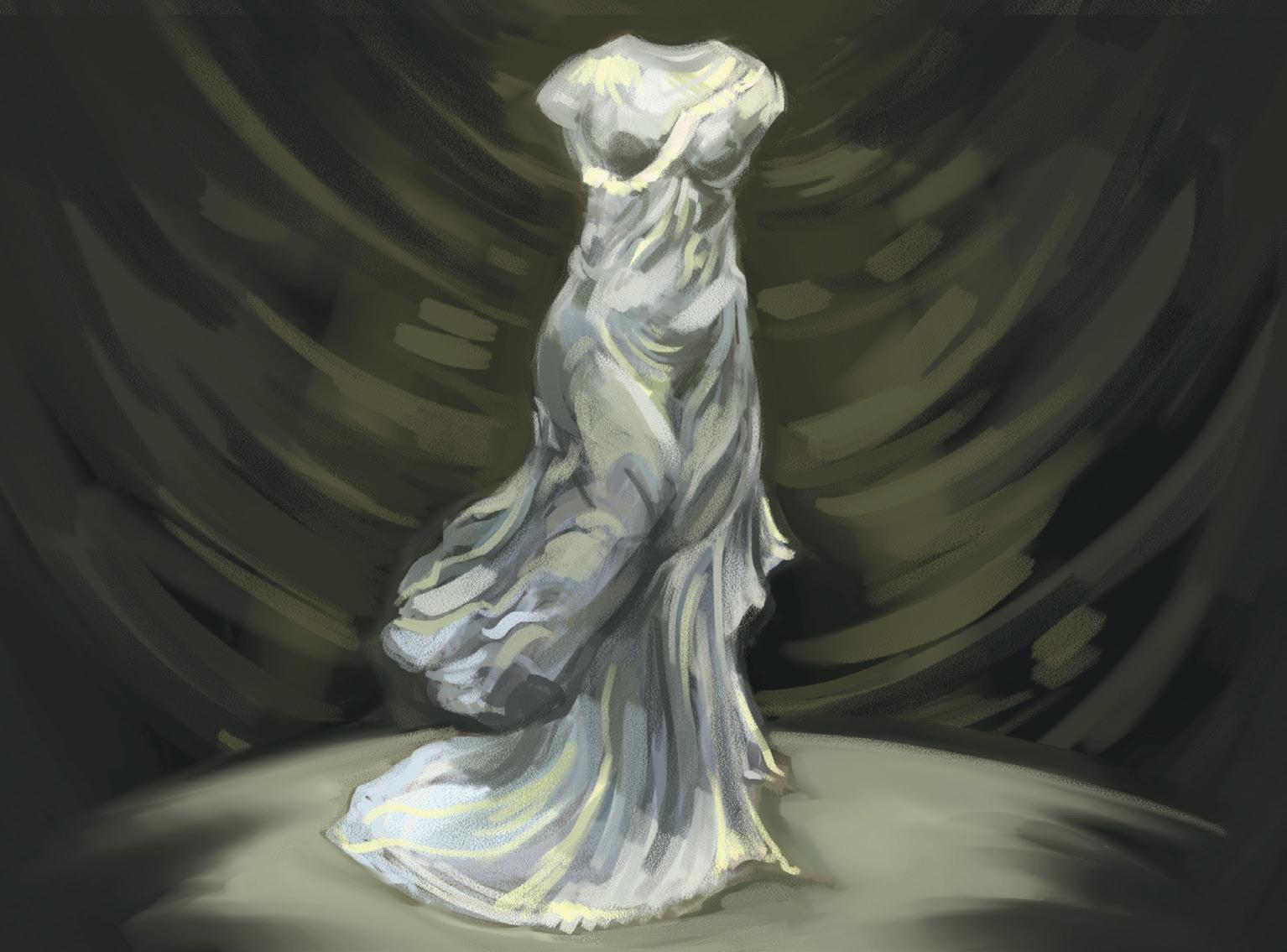
This year’s theme encouraged all sorts of ideas, with many taking the art of the human body as inspiration, and others utilizing art throughout history to compile their looks. The biggest trends I noticed were bold colors and fashion that harkened back to ancient Greek statues.
As an art lover and AP Art History survivor, I
couldn’t help but gush over looks that recreated art. For example, Hunter Schafer’s Gustav Klimt dress referenced his painting Mäda Primavesi.
The first guest I must mention was also the first to walk the carpet, Emma Chamberlain. Chamberlain has gone from an internet personality to a fashion icon over the last few years. She has served as the Met Gala carpet host numerous times, and her multi-colored, handpainted Mugler turtleneck look this year draped gorgeously. Its intricate ruffling was distinctly reminiscent of a Vincent van Gogh painting. Chamberlain strongly set the tone for the night and had a hard look to beat.
In the theme of bright colors, this year’s Met debut winner was easily “One Battle After Another” breakout star Chase Infiniti. Following her iconic fashion throughout the awards season, I had high hopes for Infiniti at the Met, and she did not disappoint. Her Thom Browne look featured more than a million sequins and was an ode to the Venus de Milo statue. While others, like Kylie Jenner, also used Alexandros of Antioch’s famed figure to inspire their looks, Infiniti’s vibrant rendition takes the cake for me.
The next shoutout goes to supermodel Anok Yai, who has become a Met Gala fan favorite over the past few years, as she never misses the mark when it comes to dressing on theme. She embraced the costume element, becoming a statue with intense makeup that gave her a gold hue and prosthetic hair that created a frozen, hard appearance. Her custom Balenciaga gown transformed her into a Black Madonna, which can be found in Catholic churches across Europe. Yai was a walking piece of art, a masterclass in this theme.
A different interpretation of the theme that’s sure to stick in everyone’s mind was Bad Bunny’s look, which involved a sleek black suit and full
makeup that dramatically advanced his age. He, like many, focused on the human body element, but instead of emphasizing the figure, his look was all about the beauty of aging. I was surprised by how beautiful I found this idea, and his unique take is sure to be remembered for years to come.
Finally, a look you might have missed was the exposed beauty of socialite Sabine Getty. I didn’t know exactly who she was, but I knew her look was perfection. Getty wore a second-skin Ashi Studio gown that fit like a glove. The front of the
piece was painted in an 18th-century style to look like a naked body. It is a true work of art, and the hands in the painting were even identical to Getty’s own hands, down to the rings. It was by far the most beautiful interpretation of the many looks dedicated to the human body. The night’s most striking moments came from those who understood that fashion, when done right, doesn’t just reference art — it becomes it. d.hanna@dailynorthwestern.com
By ALDEN FARROW assistant arts & entertainment editor
I’m not saying I applied to Northwestern just to become Andy Sachs, but I’m also not saying I didn’t. As many students may know, the University is mentioned quite often in prominent films.
While Andy Sachs might be the one who influenced me the most, there are a number of other NU-affiliated characters who are equally deserving of recognition.
“The Devil Wears Prada” (2006) I would be remiss not to begin with the iconic

Andrea “Andy” Sachs in “The Devil Wears Prada.” The film has certainly reentered the limelight with its newly released sequel, “The Devil Wears Prada 2.”
In the movie, Sachs identifies herself as a recent NU graduate and a previous editor in chief of The Daily Northwestern. Hearing that line inspired me, and I’m sure many other young folk with an interest in fashion or journalism, to see themselves at a place like the movie’s Vogue-esque magazine Runway.
Sachs’ ability to pull off an assistant job for the Anna Wintour-inspired “devil” speaks to the resilience NU can inculcate, and is one of the only main characters in popular media who attended the University.
“The DUFF” (2015)
Another more underrated movie where the main character ends up at NU is “The DUFF.” Mae Whitman plays Bianca Piper, the “DUFF,” which stands for “designated ugly, fat friend.” Piper spends the movie working for her high school paper, which eventually leads her to committing to NU for journalism at the end of the film. I coincidentally watched this the summer before my first year at Medill, unintentionally reaffirming it as the place for aspiring journalism students.
“Never Been Kissed” (1999)
A few other smaller journalism-specific mentions include “Never Been Kissed,” where Josie
Geller (Drew Barrymore) is a writer for the Chicago Sun-Times, tasked with going undercover as a high school student for an assignment. She overhears a student say they want to attend NU and she replies that she went there, blowing her cover, but still a great NU shout.
“Mean Girls” (2004)
For nonjournalism characters, there’s Aaron Samuels from “Mean Girls.” The movie is set at the fictional North Shore High School, but is said to be inspired by New Trier High School in Winnetka, a small nod to the Evanston and North Chicago area. At the end of the movie, Aaron mentions he’ll be attending NU following graduation.
While every mention of NU does make me slightly swell with Purple Pride, it is disappointing that most films’ connections to NU are mere mentions. Very few films have actually been filmed on or around campus. The last major movie filmed on campus was “Year One,” released in 2024. Even films that are intended to take place in Evanston, such as “Cheaper by the Dozen,” opted instead to shoot entirely in California. These films’ failure to fully represent the University in all its glory make its references a little less exciting. Nevertheless, every time NU is mentioned as I’m watching something, I will sit upright and point while excitedly saying, “I go there!”
a.farrow@dailynorthwestern.com
By MICAELA RIVERA PORRAS
assistant el diario editor
Cuando llegué a Northwestern por primera vez, recuerdo que el evento del cual tenía las mayores expectativas era la feria de organizaciones: el lugar donde finalmente conocería todos aquellos espacios que solía “stalkear” mientras investigaba sobre esta universidad durante mi periodo de postulaciones.
En realidad, hasta semanas antes de la feria, me pasé horas buscando en las redes sociales toda la información de cada club al que planeaba unirme. Sin embargo, aun con todas las horas de investigación que le dediqué sumergiéndome en Instagram, TikTok y Google, sentía que muchas veces quería ver mucho más que solo un post de Canva: de verdad quería escuchar las voces de los fundadores o presidentes de estos clubs explicando por qué estas agrupaciones eran tan especiales. Cuando llegué a la feria, pude conocer más sobre las agrupaciones que impactan nuestro campus, pero también noté que no hay muchas organizaciones latinas. Y aunque al inicio esto me entristeció, el ver la red de apoyo que las organizaciones latinas habían creado independientemente me inspiró. Me recordó al famoso lema del escritor hispano Antonio Machado “Caminante, no hay camino, se hace camino al andar”. Cuando no existen los recursos o las plataformas de soporte, nosotros mismos las creamos.
La comunidad latina de Northwestern está llena de líderes cuyas historias a veces pasan desapercibidas. Desde El Diario buscamos resaltar a aquellos grupos estudiantiles que tienen impacto en nuestro campus a diario, pero queremos hacerlo en un formato muy especial.
Así nace nuestra nueva serie original “Clubs en Clubs”, una plataforma donde líderes latinos de distintas organizaciones se sientan frente a frente – al estilo de la serie “Actors on Actors” de Variety – para conversar, reflexionar y compartir las historias detrás de las organizaciones por las que trabajan día a día. En cada episodio emparejamos a dos o más líderes
de dos organizaciones con misiones similares, pero con distintos medios de trabajo. Algunas de las “ediciones” que queremos lanzar de Clubs en Clubs incluyen ediciones de episodios con agrupaciones musicales, de danza, de desarrollo de comunidad y más.
Esta no es la primera vez que este formato es usado en The Daily, en realidad fue introducido en enero de este año para resaltar los actores estudiantiles. Clubs en Clubs lo reinventa desde una perspectiva latina, enfocándose en las voces y experiencias que unen a
nuestra comunidad.
A la vez, este es el primer producto multimedia original de El Diario, lo que lo convierte en un proyecto especialmente significativo. Para todo nuestro equipo, es un orgullo y un honor dar vida a este espacio y amplificar las historias que merecen ser escuchadas.
Esperamos que Clubs en Clubs dé a conocer todos estos clubes pero también inspire a la comunidad latina y a sus aliados a crear sus propias
iniciativas basadas en lo que creen que falta en nuestro campus.
m.riveraporras@dailynorthwestern.com
Escanea este código para ver el video completo de Clubs en Clubs producido por












El mercado de agricultores de Downtown Evanston abrió la temporada el sábado por la mañana, atrayendo multitudes a University Place y Oak Avenue.
El mercado, que ahora está en su 51.a temporada, cuenta con más de 50 vendedores cada sábado entre mayo y noviembre.
Un vendedor recurrente es Corban Koster, un agricultor que, junto con su padre y su hermano, gestiona Geneva Lakes Produce. Koster dijo que por al menos 15 años ha manejado las 70 millas de camino de Burlington, Wisconsin, a Evanston cada sábado durante la temporada del mercado.
“Nuestra cosecha siempre se produce y la gente siempre tiene que comer”, dijo Koster. “Lluvia o sol, estamos aquí”.
Koster comentó que le tomó años establecer relaciones con los clientes de Evanston, pero muchos de ellos ahora son sus clientes “más fanáticos”. Ha empezado a cultivar nuevas cosechas — acedera, caupíes y diferentes tipos de tomates y papas — como respuesta a los pedidos de los clientes de Evanston.
Koster dijo que la inversión mutua en las relaciones es lo que lo hace regresar.
“Tenemos un grupo muy fuerte de amigos y clientes”, explicó.
Blaque Millennium Kitchens es uno de los vendedores más recientes del mercado. El fundador, John Michaels, dijo que era su tercer año en el mercado. El puesto de Michaels vende 11 variedades de mezclas de especias gourmet, junto con palomitas de maíz sazonadas, dijo él. Añadió que ha construido una comunidad de seguidores leales durante los siete años de su negocio. Sus mezclas no contienen conservantes y pocos ingredientes sintéticos, dijo, y sus clientes se van con mayor conocimiento culinario además del producto.
“Los mercados de agricultores son muy
importantes porque ofrecen a la comunidad algo que se necesita profundamente”, explicó Michaels. “Mucha gente no puede encontrar frutas y verduras frescas de buena calidad en las tiendas porque se cosechan en diferentes lugares”.
Además de los residentes de Evanston, muchos estudiantes de Northwestern fueron al mercado el sábado.
Estudiantes de cuarto año de McCormick, George Warfel, y de Communication, Millie Rose Taub, dijeron que las visitas frecuentes al mercado son una tradición anual. Como viven fuera del
campus juntos, a la vuelta de la calle, dijeron que hacen el esfuerzo para visitar el mercado lo más posible.
“Me siento muy conectado con la comunidad, lo cual es muy lindo”, comentó Taub. “En el campus, solemos sentirnos muy aislados. En particular, nuestra calle tiene muchas viviendas estudiantiles, entonces es muy lindo ver a todas las familias y personas que realmente viven en Evanston”. Warfel comentó que ha notado que los productos agrícolas que encuentra ahí son más frescos que los de los supermercados. En general, cree que es








importante apoyar a los agricultores y productores locales.
Koster comparte este sentimiento.
`“Cada año, alrededor de 20.000 granjas pequeñas pierden su negocio y lo vemos a nuestro alrededor”, dijo. “Yo comprendo por qué. Nosotros trabajamos increíblemente duro. Tenemos un trabajo muy difícil. Es difícil encontrar personas que nos ayuden”.
t.ayalaleon@dailynorthwestern.com
m.turetzky@dailynorthwestern.com


















































By JONAH MCCLURE sports editor
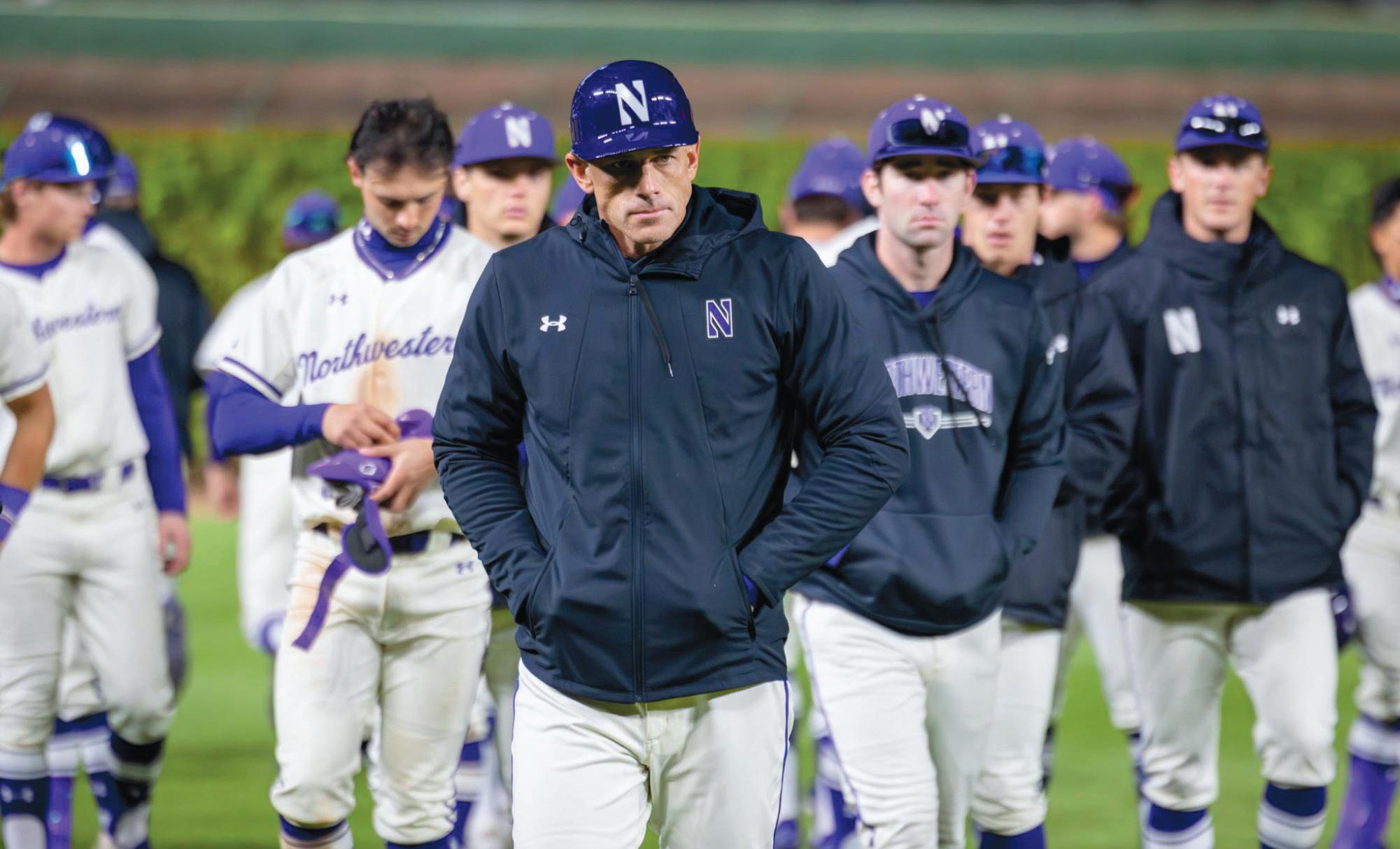
When junior shortstop Ryan Kucherak stepped up to the plate under the Saturday afternoon clouds, Northwestern was in an offensive drought. Over the past 11 innings spanning two games against Indiana, the Wildcats (19-25-1, 7-17 Big Ten) had scored just two runs.
On a 2-1 count in the third inning with the bases loaded, Kucherak smacked a ball into the left field corner, bringing home all three runners and tying the game 3-3.
From the third inning of game two to the end of game three, NU outscored the Hoosiers (21-27, 7-17 Big Ten) 16-9 and won both games.
“I thought we competed better the last couple days in the batter’s box,” coach Ben Greenspan said postgame Sunday. “Some guys on the mound really stepped up for us and gave us a chance to win.”
It marks the ’Cats’ first series win over Indiana in Evanston since 2006, a fact that surprised Greenspan, who played for the Hoosiers at the time.
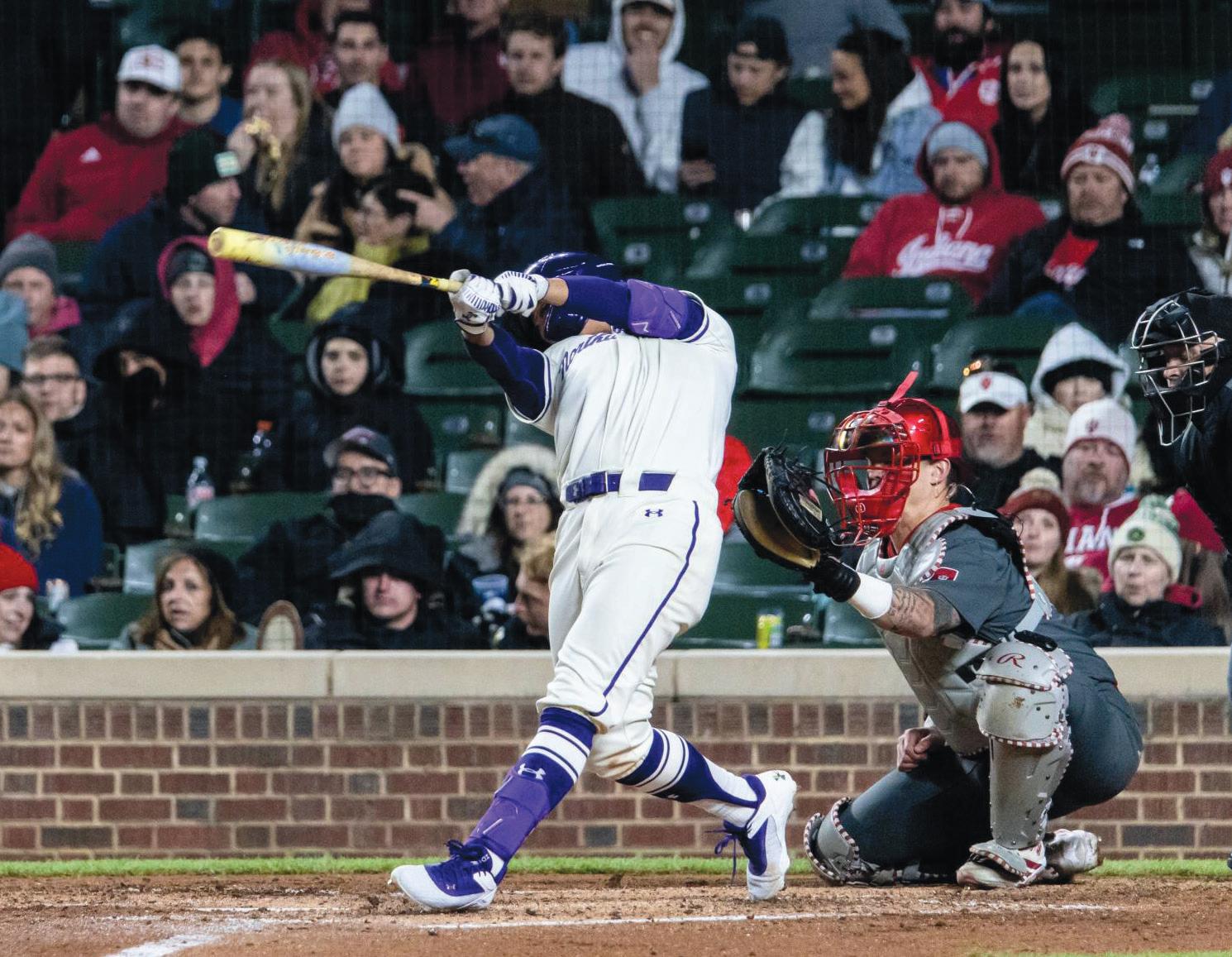
The series didn’t start off nearly as well for NU. The team fell in the series opener at Wrigley Field, the annual ’Cats’ Classic game, 9-2 Friday. The ’Cats were plagued by their own mistakes as well as some subpar hitting performances.
In the Friendly Confines, Indiana did its damage in three innings, scoring one run in the first before plating four runners in both the third and eight innings. In the third inning, the Hoosiers benefited from three wild pitches, one hit-by-pitch and one passed ball.
Graduate student left-handed pitcher Ryan Weaver started the game for NU and was responsible for all but one of Indiana’s first five runs. In the sixth inning, Greenspan turned to graduate student right-handed pitcher Sam Hliboki, who dealt two scoreless innings.
The ’Cats nabbed both of their two runs in the seventh inning on a single from graduate student second baseman Noah Ruiz, but the Hoosiers extended their lead with four more runs in the eighth. Facing a seven-run deficit, NU’s final six batters were set down in order and Indiana took game one.
“We went there to win, (and) we didn’t do that, so that was disappointing,” Greenspan said. “But when you zoom out and look at the opportunity to play the historic Wrigley Field, that’s something that those guys will never forget.”
The teams headed north to Miller Park for the second game of the series Saturday, and through the top of the third inning, the contest once again started to go south for the ’Cats. The hosts conceded a run in the first inning for the second straight day and trailed 3-0, but Kucherak’s bases-clearing double gave NU the momentum.
Over the next four innings, the ’Cats’ offense scored four more runs while their pitchers allowed just four baserunners and held the Hoosiers scoreless. After a rocky start for sophomore right-handed pitcher Matt Kouser, the starter settled in, tossing six innings of three-run ball with four strikeouts.
Indiana managed to plate one run in the eighth inning off of freshman left-handed pitcher Jake Rifenburg, but the reliever finished the game without any more trouble. He earned his first career save as NU leveled the series at one game apiece with a 7-4 victory.
Looking to take the series in Sunday’s rubber match, the ’Cats’ first-inning woes continued as sophomore left-handed pitcher Alex Grant allowed a home run to the Hoosiers’ first batter. The teams took advantage of a windy day all game, as the homer was the first of six hit by the two squads.
Unlike the previous two games, NU bounced back in the bottom of the first and tied the game 1-1. The runs poured in one inning later.
Senior center fielder Jack Lausch stepped up to bat with two runners on and two outs in the second inning. After a rocky 0-for-5 performance Friday, he bounced back in game two with two hits, including a home run, and three runs scored. His next swing showed game three would be a continuation of the second.
Lausch crushed a hanging breaking ball over the fence, nearly hitting the wall of Welsh-Ryan Arena. The three-run homer opened the scoring in the eventual five-run inning for NU. Lausch reached base in all five of his plate appearances Sunday, drawing a career-high three walks.
He emphasized the patience he has during his time at the plate.
“I’m in control of the at-bat,” Lausch said postgame Sunday. “If he beats me, he beats me, but I can dictate the flow of the at-bat, and it worked out well.”
The Hoosiers scored two runs in the third inning, but the scoring died down in the middle innings, where Greenspan said the game would be won or lost. In relief of Grant, senior right-handed pitcher Drew Dickson hurled 3.2 scoreless innings, allowing zero hits and three walks. Dickson earned the win, his first of the season, with his outing.
The ’Cats tacked on one run in the fourth and seventh innings each, but despite holding a five-run lead, Indiana wasn’t done yet. Thanks to three consecutive walks and a hit-by-pitch issued by junior right-handed pitcher Garrett Shearer, the visitors scored one run and continued to threaten in the eighth inning. Shearer completed the inning, but not before the Hoosiers scored two more runs, cutting the deficit to two.
After freshman first baseman Nick Barron’s solo home run — his third hit of the day — gave NU a bit more cushion, freshman right-handed pitcher James Whitaker entered the game looking to seal the series win.
He set down the three Indiana batters he faced in order, nabbing his first career save as the ’Cats won 9-6.
“What you learn from this weekend is that we have a good team,” Greenspan said. “I think this group is going to compete until they tell us we can’t play anymore.”
j.mcclure@dailynorthwestern.com





By RUIXIN ZHANG assistant campus editor
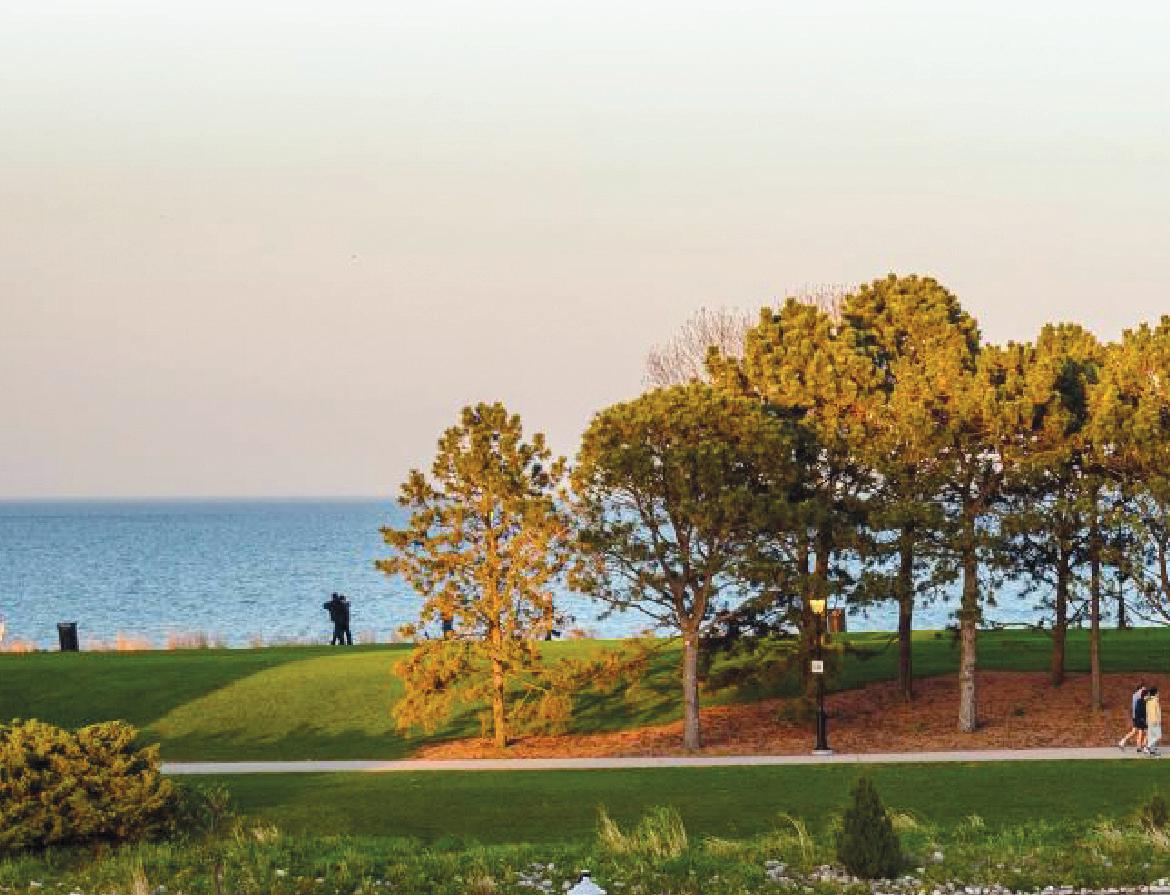
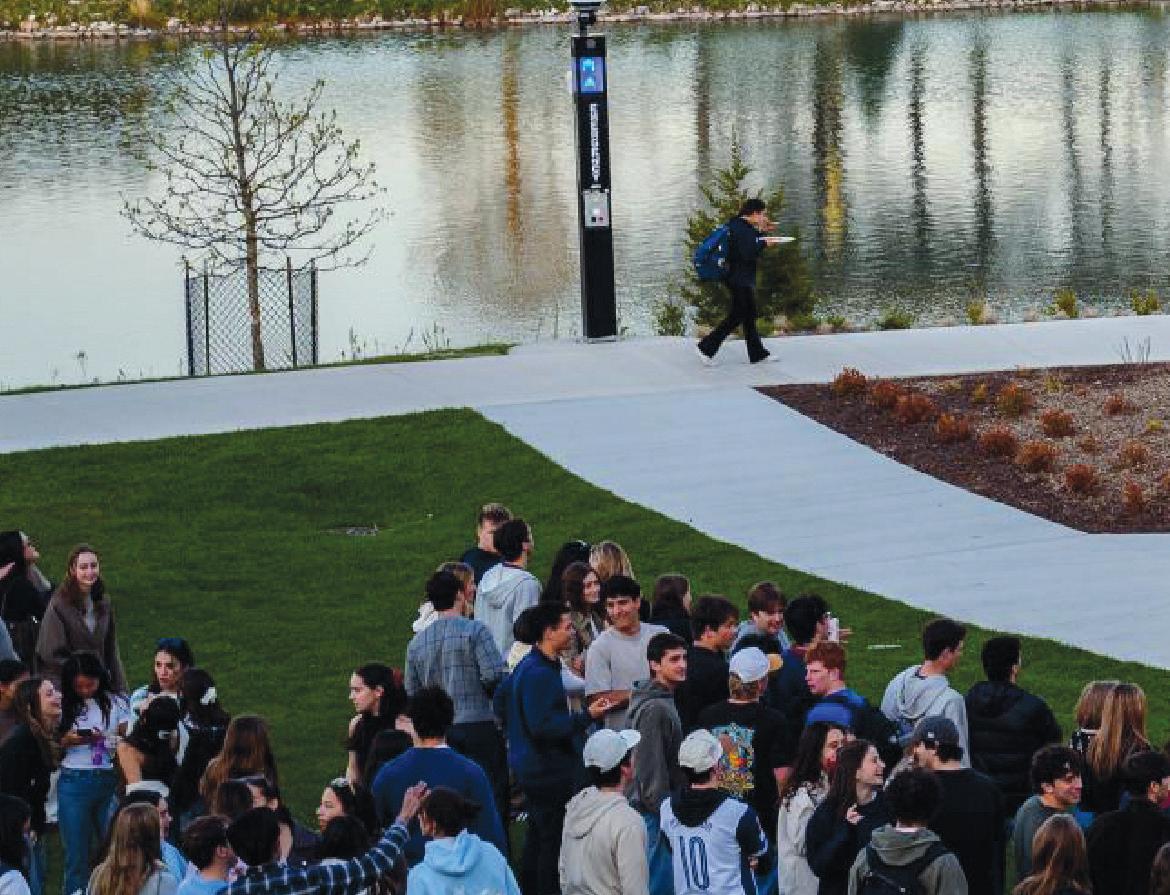
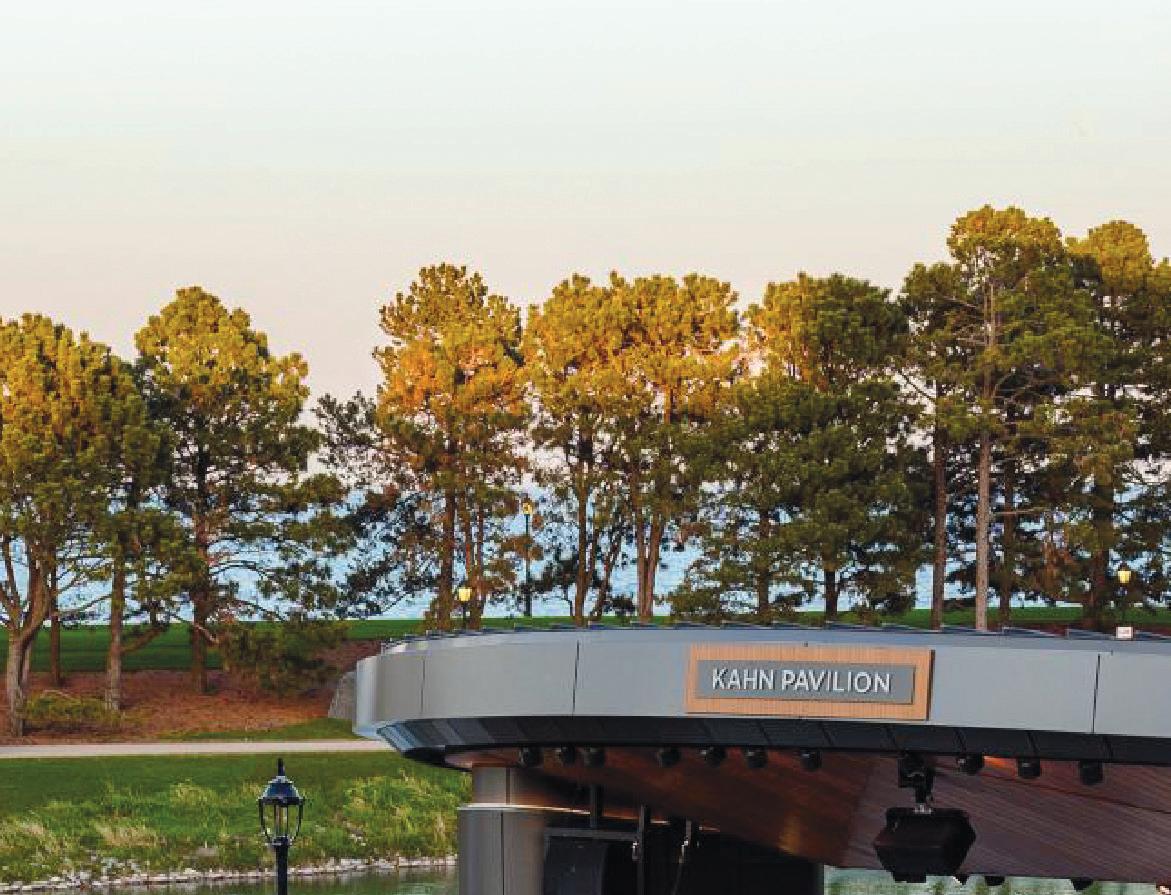
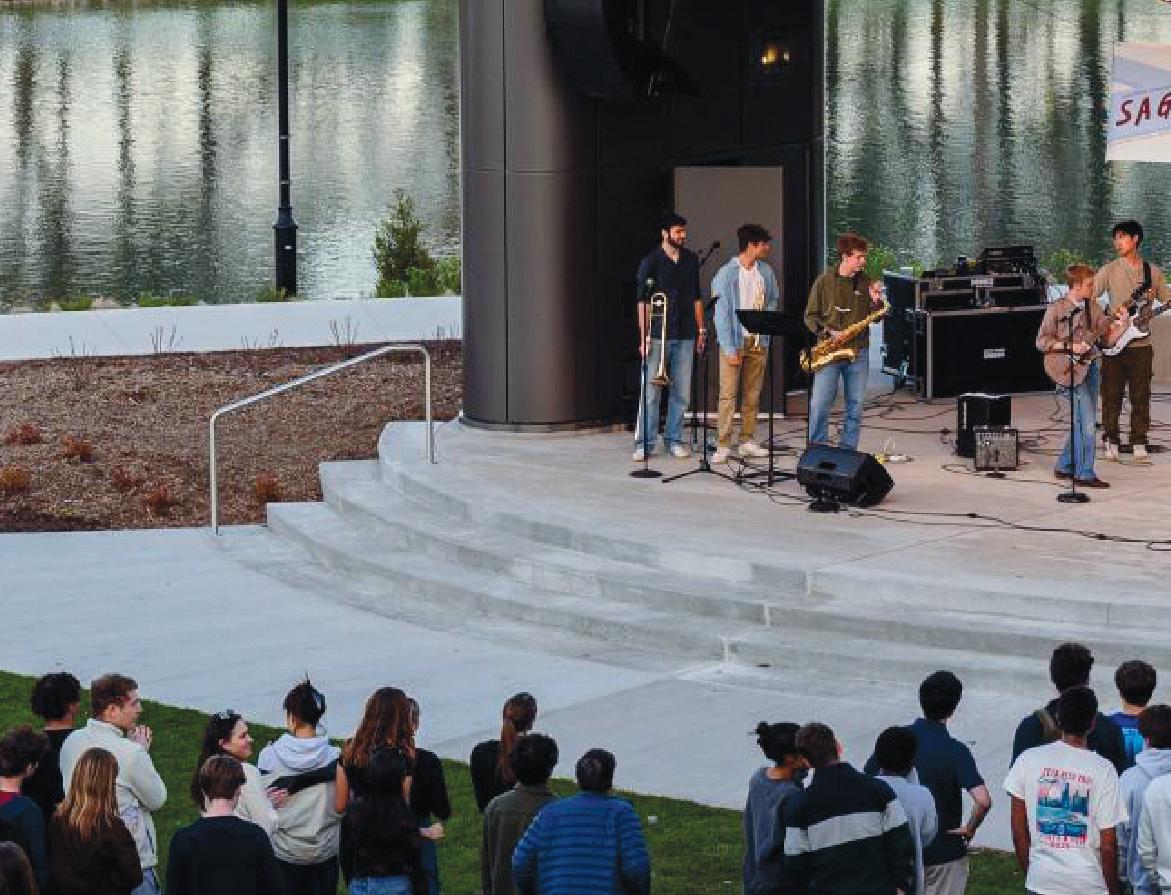
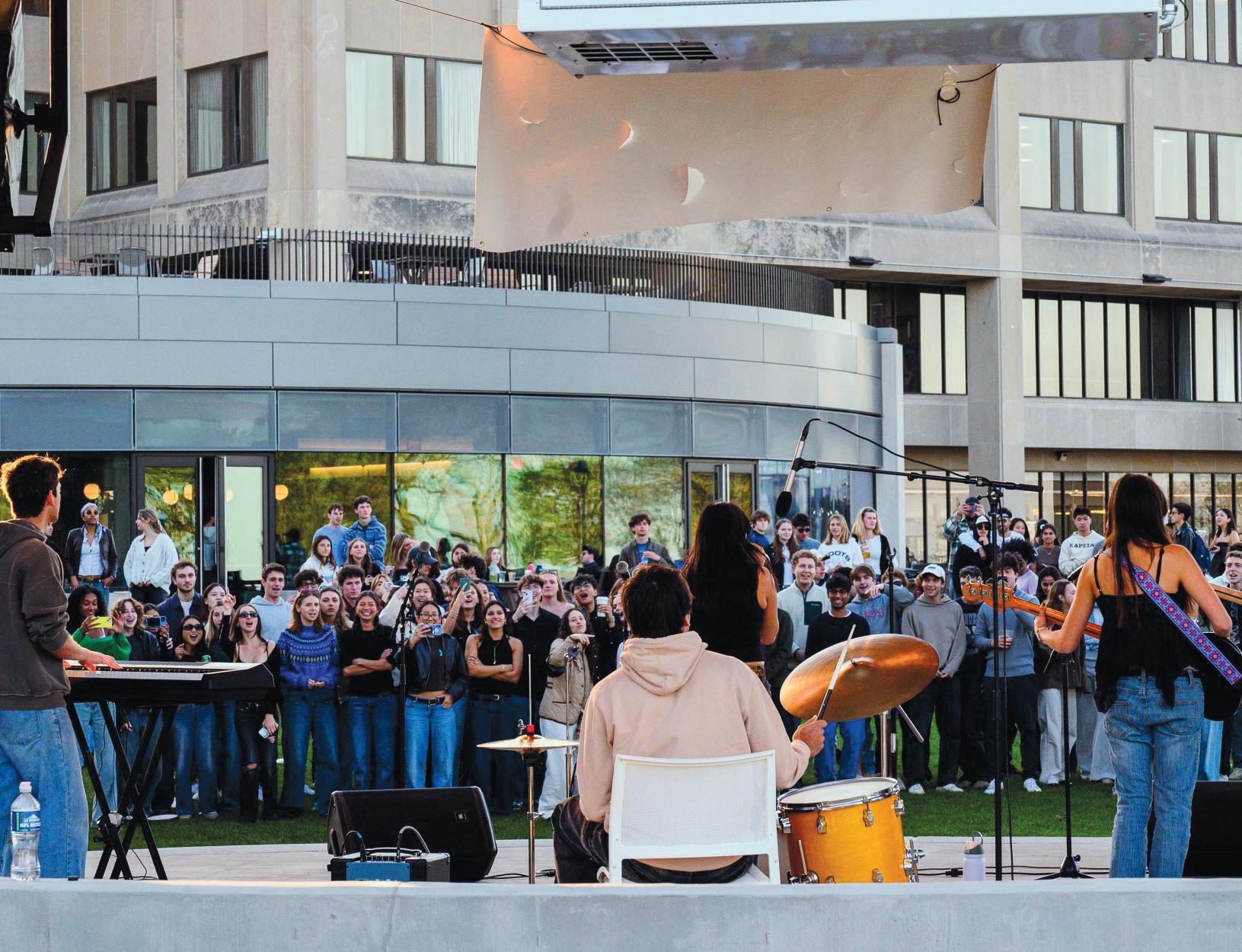
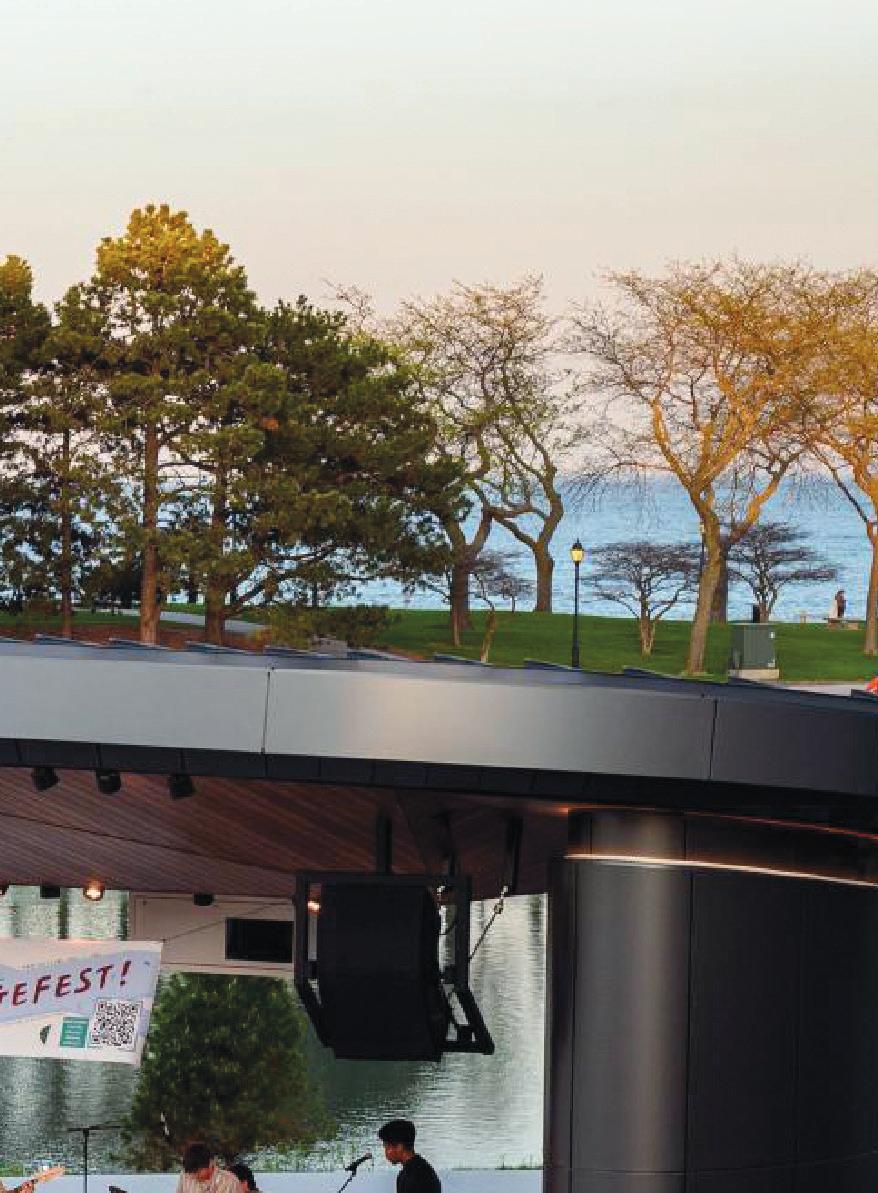
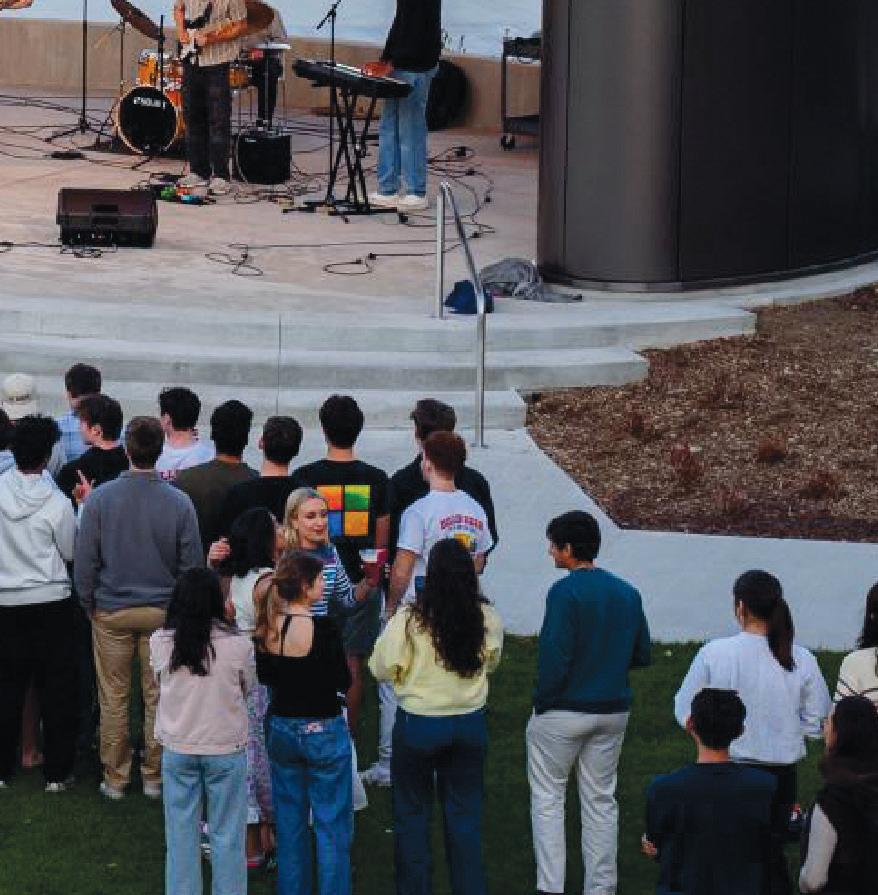
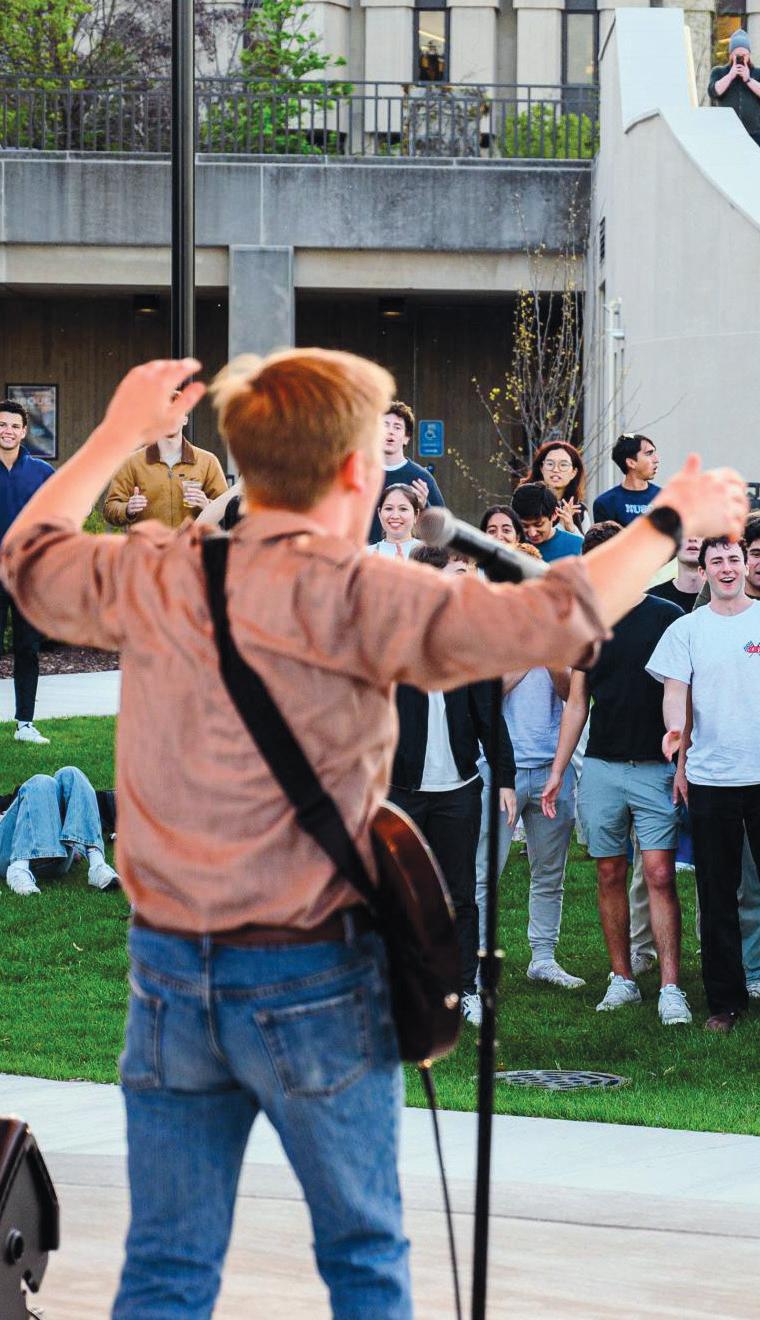
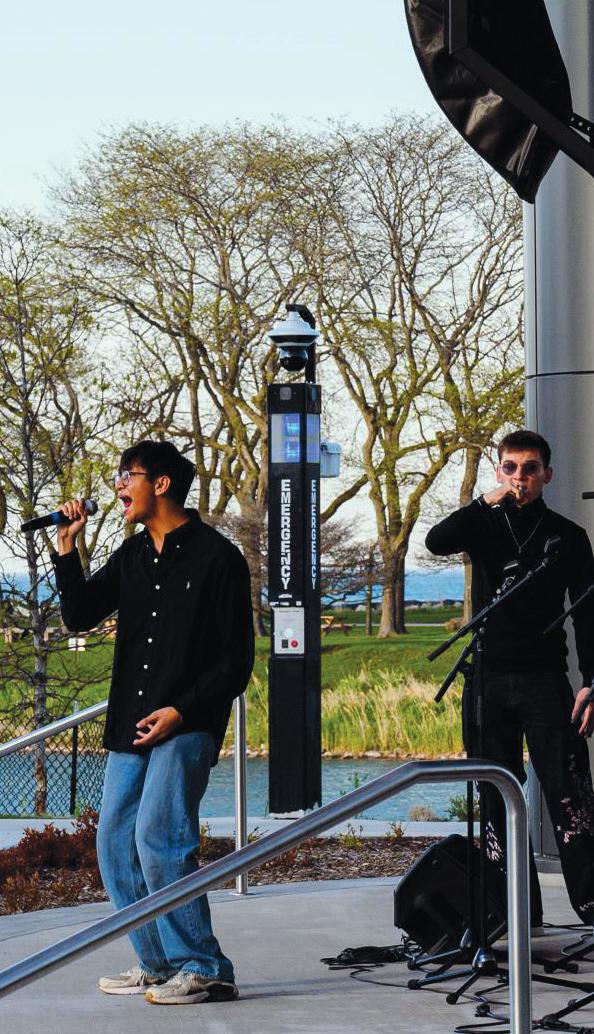
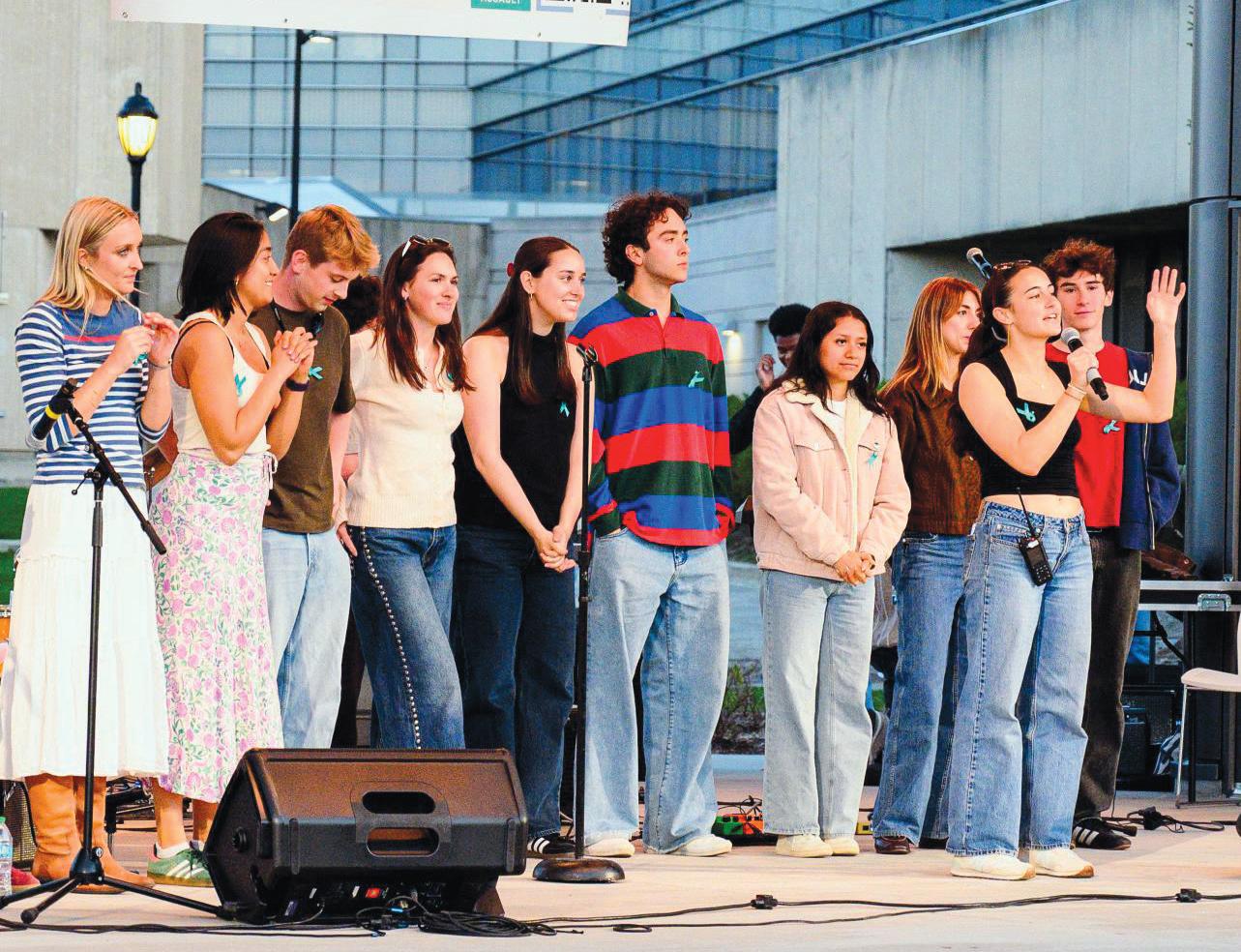
Sprawled across the lawn as the sun set over the Lakefill, a crowd gathered in front of Kahn Pavilion on Sunday for the third annual SAGEfest, hosted by Survivor Advocacy through Greek Engagement.
Founded in 2023 by Medill senior Shravya Pant and Communication senior Rose Hunskor, SAGE is an organization that aims to advocate against — and provide resources to prevent — sexual violence in Greek life.
The event raised over $3,000 for Northwest Center Against Sexual Assault, a crisis center providing aid and services to survivors of sexual assault and those close to them.
“It’s seeing everything that we idealize at SAGE come to fruition, and seeing all of these people who show that they care about our mission,” Weinberg junior and incoming SAGE co-President Nico Bers said.
SAGEfest featured student performers including a cappella groups THUNK and Extreme Measures, as well as student bands Butterfly Effect and Nosedive.
Communication junior and Extreme Measures member Ani Lawit said the group dedicated its performance to Weinberg junior Evan Hirschensohn, who recently died of
cancer.
“We’re starting with a Billie Eilish medley – Evan especially loved Billie Ellish and had a Billie Eilish song in his Instagram bio, so feel free to sing along or dance,” Lawit said to the audience. “I know he would have loved it.”
Weinberg sophomore Eric Tang said he came to SAGEfest with a friend to support one of the performers. He said the event — particularly its location — surpassed his expectations.
“I think this is a great use of the Kahn Pavilion, especially the lawn,” Tang said.
SESP sophomore and incoming SAGE co-President Kathryn Asiel said SAGE frequently hosts open meetings, community service and fundraisers to expand awareness about sexual violence in Greek life.
The organization aims “to empower survivors, foster allyship and a culture of consent, and promote a violence-free Greek life experience for all,” according to its Instagram bio.
Still, Bers said the event wasn’t limited to Greek life members because SAGE’s mission impacts the entire student body.
“The goal is not just only for improving Greek life culture, but also our school culture and Northwestern culture as a whole,” Bers said.
r.zhang@dailynorthwestern.com
By ALEX INGVOLDSTAD the daily northwestern
In some of McCormick sophomore Christa Kulanda’s STEM classes, she has noticed professors giving more weight to exams than before, citing students’ rising use of artificial intelligence. Kulanda said the change makes her feel like her “destiny was set in stone.”
Many STEM classes assign problem sets, which are designed to encourage practice on concepts learned in class and typically account for a portion of students’ final grade.
Kulanda said some of her professors have used exams for nearly the entirety of students’ final grades because of the increased use of AI chatbots like ChatGPT or Google Gemini to solve problem sets.
“It just felt like the one opportunity that I did have to redeem myself or to really just feel like I could thrive was taken away from me,” Kulanda said.
Economics Prof. Mark Witte said he has recently weighed in-class examinations more heavily in students’ grades.
Witte added he has also encouraged students to work in groups on quizzes in Canvas to discourage AI use. But although he encourages collaborative work to avoid turning to AI, Witte said it’s not the perfect solution.
Compared to past years, he said more students answer online quiz questions right on the first try — and he doesn’t know if it’s AI related or not.
“It could be that people are being much more cautious and working out the problem more carefully before they try it the first time,” Witte said. “But it could also be that people are just plunking into an LLM and saying, ‘Hey, what’s the answer?’ and then putting that in.”
Kulanda said that specifically in McCormick, she’s experienced some problem sets being worth fewer points as AI has increased in usage.
Some professors are losing sight of the fact that students who can’t necessarily perform in highstakes exam environments still use problem sets to show what they know, she said.
“It’s pretty inaccessible and inadvertently exclusionary to people who may have conditions that inhibit them from really relying on the exams to make up their entire grade,” Kulanda said.

In some classes, problem sets, which are designed to encourage practice on
grade, are now weighted less.
To use large language models to benefit their education, Witte said, instead of asking AI for answers, students should ask these chatbots to critique their understanding of concepts or create practice questions.
Due to students’ AI use, Weinberg first-year Siri Doddapaneni said quizzes that professors previously allowed students to take at home are now required to be taken in class.
Although Doddapaneni said she appreciates how in-class quizzes prepare her for exams and reduce her cramming, the newly heavily weighted tests still don’t always accurately reflect her knowledge.
“I feel like the stress and the environment of taking exams is not as conducive to my learning as having my own time to complete a problem set and truly take my time to understand the actual concepts,”
Doddapaneni said.
Still, some professors haven’t changed their grading styles.
In her material science class, Kulanda said problem sets’ weight in grading haven’t changed. She said her professor provided the worked-out answers to questions, so students didn’t turn to AI first.
Kulanda said her professor encourages students to show their work and learn from the answers he makes available.
Economics Prof. Chiara Sotis said her grading style hasn’t changed much due to AI.
With her problem sets designed to incentivize effort, rather than correctness, Sotis said she hopes to give students the opportunity to try out problems on their own without fear of a strict penalty.
“The part that I care more about is convincing people that AI can be really valuable but shouldn’t be used at every stage,” Sotis said. “There’s a lot of learning that we give up if we’re just randomly inputting stuff and getting the output back.”
Sotis said that many of her Microeconomics students have used AI to generate new practice questions based on past problem sets.
Although she finds it to be a helpful tool, Sotis said that if students are looking to AI simply for solutions, the knowledge simply won’t stick.
“I can see a thousand uses that seem completely fair and actually quite helpful,” Sotis said. “It’s more you would want it to help your learning rather than substitute your learning.”
a.ingvoldstad@dailynorthwestern.com





































By REGAN HUIZENGA print managing editor
The first time Lisa Degliantoni and Liz Cramer sat down for coffee together in 2017, Cramer told Degliantoni about the shop she wanted to open. Cramer had just left her corporate job and envisioned a local retail store selling original art and handmade goods.
Nine years later, the two are opening the first brick and mortar location for Evanston Made, the nonprofit arts organization of which they are co-directors. Shop Evanston Made is located at 822 Dempster St. and will host its grand opening on May 14.
Degliantoni said she founded Evanston Made in 2014 to fulfill “the need for visibility and opportunity for the artists who live in Evanston.”
“The bigger the organization got, the more evident it became that we needed a space to gather,” Degliantoni said.
Initially, the organization hosted studio tours, exhibitions and pop-ups. Evanston Made was “nomadic,” Cramer said, making it difficult for community members to fully understand what the organization did.
In October 2021, Evanston Made created an online store platform to sell the works of about 400 members.
According to Cramer, the new shop will be a “physical manifestation” of the online store, with a rotating, curated room of pieces to give more local artists opportunities to show their work.
“It gives them the opportunity to see the
breadth of people’s work, even though all the pieces aren’t here,” she said.
The store will also have a kiosk where customers can connect to the online platform and peruse pieces, Degliantoni added.
Longtime Evanston Made volunteer and patron Anne Wolff said that while she is excited to see all the art in the shop, she is most looking forward to the social element.
Wolff said she appreciates that the organization allows patrons to engage with artists on a personal level by providing a space for events and social gatherings
“It’s so much more fun to find a piece and connect with it when you can know the story about it, you can know the process about it, and Evanston Made allows you to just meet those people,” Wolff said. “They’re not off limits anymore. They’re right there and excited to teach you about it.”
She added the storefront was even more important because she said community members are not aware enough of the local artists in their neighborhoods.
The shop will be open Wednesday through Saturday, with Sundays reserved for trunk shows and pop-ups as the organization expands into the emerging, new artist market, Degliantoni said.
Evanston Made’s shop will complement existing businesses on Dempster Street, according to Main-Dempster Mile Executive Director Katherine Gotsick. She said the shop will be a “lovely addition” to the Dempster Design Row — a corridor of creative design and artisan businesses.
Gotsick added that Evanston Made and the
Main-Dempster Mile have been partners for many years, and the shop’s grand opening will take place on the same day as the organization’s Evanston Arts & Crafts Beverage Crawl.
“As the years have gone by, we’re doing more and more with Evanston Made, so to have them open a store in this neighborhood is super cool,” Gotsick said.
For Degliantoni, it is important that those
in the surrounding neighborhoods support local artists.
The shop’s tagline, “Buy what your neighbor makes,” emphasizes this, she said.
“We want people to understand that they do have a civic responsibility to be stewards of the arts,” Degliantoni said.
r.huizenga@dailynorthwestern.com

By TIA BETHKE assistant city editor
Applications for the final round of Evanston’s Guaranteed Income Program opened Monday, according to a news release from the city. The program will provide assistance to 102 local households.
This follows City Council’s decision to continue the second round of the program with an amendment to include those 55 and older. Participating families will receive $500 in monthly cash payments for six-months with no restrictions on how the money is spent. According to city staff, the program is designed to give families the flexibility to address their most pressing needs, whether it be groceries, utilities



or other expenses.
To qualify, residents must earn at or below 185% of the federal poverty level, and have a child in second grade or younger living in the household, or be 55 or older. Applicants must also be Evanston residents and need a 2025 tax return to apply.
Eligible applicants will be entered into a lottery for the program on June 1 and be notified
of their acceptance or denial by the city, according to Monday’s news release.
The city will host two information sessions at the Robert Crown Community Center about the program. The first session will be held on May 7 from 3 to 6 p.m. and a second will be held on May 9 from 10 a.m. to 1 p.m.
t.bethke@dailynorthwestern.com














































JAMES FRAZIER-WILSON COLUMNIST
Dear James, Sometimes I want to become better friends with people because they’re cool and awesome, but I’m too intimidated to ask for more of their time, because that’s the last thing anyone here has more of, and I’m not as cool and awesome as them, and I don’t know if they want to be friends back. And I’m afraid that if they didn’t, they wouldn’t even give it to me straight, and then I would just kind of be trapping them in a friendship that they don’t want or like, and making them worse by proximity. Should I boldly pursue friendship, or are my fears justified?
Two things can be true at once: Most people do not set out to be unkind, and most people will occasionally, in the pursuit of doing the right thing, commit acts of unkindness.
Another truth: Not everyone is going to click with each other. Some people are not going to be friends, no matter how much time they spend together. Some people are respectful to everyone regardless of hidden dislike, and some people come off as rude when they are actually lovely and genuine.
Then there’s the time issue. Northwestern students are famously busy. I’ve met a number of students here who seem to have a mental roulette wheel of topics to decide what they will fixate upon for the day. Internships, scholarships, situationships — with all this talk of “ships,” one begins to feel that they are studying in a marina instead of an accredited institution of higher education.
I only mention these things to make the point that it’s understandable — human nature, even — to be nervous about the possibility that people will reject your company. Even when removed from the confining walls of high school cliques, students tend to be very perceptive of social, physical and cognitive hierarchies. In a close-knit college environment, many of these residual issues remain unsolved.
The fundamental root of this fear is that if we open up to people, they won’t like what they find, leaving us empty, as though our deepest hopes and desires
have been yanked from within and strewn recklessly across the floor. We fear the reminder of people considering us “less than,” or we fear the unfamiliar, uncomfortable lifestyle changes should we succeed in breaking out of our shells.
Though it may stem from any number of experiential pathways, I would posit that many people at NU feel this discontent ferociously. After all, imposter syndrome is incredibly prevalent in competitive college environments, with some studies claiming that as many as 82% of students experience it at some point in their undergraduate years.
This begs the question: If nearly everyone has felt some variation of this stress within themselves, why should you let it control your social life?
In the most charitable way, you are not unique. You are not less worthy, less busy or less desirous of human connection than everyone else — or, at least, than many, many, people.
It is true that not every social scenario is likely to go the exact way you hope it will. Indeed, this is not a situation in which you — or anyone else — will get it right 100% of the time.
But if you neglect every potential connection you make because you feel like an imposition, you will
certainly never become closer friends with anyone you admire. You will find yourself entrenched in the grimy tar of habit during a time of your life which is especially conducive to social and interpersonal expansion.
Besides, any situation where you feel completely comfortable is likely not a situation in which you’ll experience real or profound growth.
Fulfillment favors the bold. Get out there and meet people as you are.
James Frazier-Wilson is a Medill sophomore. He can be contacted at james.fw@dailynorthwestern. com. If you would like to respond publicly to this op-ed, send a Letter to the Editor to opinion@ dailynorthwestern.com. The views expressed in this piece do not necessarily reflect the views of all staff members of The Daily Northwestern.
Scan this QR code to submit a query to columnist James Frazier Wilson’s “Ask a Wildcat” for general advice.
Chicago’s “L” is distinct. Not because it’s cleaner than others, not because it’s the most flashy, but because it is one of the most prominent examples of an elevated rail network done right.
Yet, despite the general success of the lines, there is one glaring outlier: the Blue Line.
Created in 1958 as the West-Northwest Route, the line made Chicago the first U.S. city to place a rapid transit line within a highway median. At the time, it was something sleek and fast, serving as a “modern” alternative to its predecessor, the Garfield Park branch.
In the city’s quest for modernization, it gradually overhauled the previous Metropolitan West Side Elevated Railroad. Stations like Damen, California and Western are some of the last remaining remnants of the Met.
At the time, the “modern” addition to Chicago’s “L” system was seen as a necessity because of just how outdated the transit network was on Chicago’s
It was day two, hour four of sorority rush. Sitting in the living room of a house I knew I would be dropped from hours later because I didn’t have the “vibe they were looking for,” I was asked my fifth hypothetical question of the day.
“If you could have dinner with any person, dead or alive, who would you choose?”
Partially due to my tendency to get bored and say things purely for shock value, I spit out “DJ X” — the artificial intelligence tool on Spotify that recommends and mixes songs for you, acting as your personal DJ.
A friend later pointed out to me that this was possibly the only “objectively incorrect” answer to the question; DJ X is neither dead, alive nor, for that matter, a person. Maybe I’m just as bad as those people who fall in love with ChatGPT, but I don’t care. Music always felt so personal to me. I saw the way my parents and brother crafted parts of their identity around what songs they liked, but I never felt that same connection. I allowed myself to be dragged around to experimental jazz concerts by my parents and always dutifully stayed silent when asked, “Who wants aux?”
Northwest and West sides.
Today, the line suffers from its proximity to car-centric transportation infrastructure. It doesn’t facilitate community engagement or development because the station’s highway locations don’t lead to anything spectacular.
In the book “Human Transit: How Clearer Thinking about Public Transit Can Enrich Our Communities and Our Lives,” author Jarrett Walker argues that successful urban transit isn’t simply a people-moving pipeline. It’s a system designed to foster the development of walkable communities — or, at least, it should be.
When people have a choice between cars and trains, they are more likely to use the easier and more efficient option.
So, riding the Blue Line, I couldn’t help but think: Is there even a choice between car and train when the line provides almost no distinguishable difference from riding a car?
By following the highway, the Blue Line doesn’t take you anywhere that a car can’t take you.
And that’s the issue.
The system practically invites commuters to disregard it because, unless one plans to go to O’Hare International Airport, the line provides subpar service to areas that are already extremely accessible
When I listened to music, it was never in a casual way. In the fourth grade, I listened to the Original Broadway Cast soundtrack of “Wicked” every single day, top to bottom. In 2021, Taylor Swift released “All Too Well (Ten Minute Version),” and it was the first thing I listened to when I hopped out of bed each morning.
When I was at the height of my teenage angst in junior year of high school, I would drive around to “Paper Bag” by Fiona Apple on full ear-bursting blast. I remember a time, stopped at a light, screamsinging, when I noticed a man crossing the street staring at me with concern. I turned my head and realized the window was open — I had just accidentally given a rageful performance to an audience of one.
I have this tendency to cling onto one thing and obsess over it — and DJ X let me do exactly that. It felt easy to have a machine define me, crafting my musical persona by recommending the same sequence of songs over and over, instead of spending my own energy figuring out who I was.
Then I got to college, where I developed an obsession: creating my new identity. I was finally surrounded by people who felt like me. The task of picking a song to accompany my walk to class no longer felt like a chore; I looked forward to it. I finally understood the allure of music, the power it has to impact your mood and the beauty in relatability.
I still don’t really know what my music taste is; it feels like an amalgamation of everyone I’ve ever
by car.
When the Blue Line is compared to other “L” systems, it is glaringly obvious that the line lacks the fundamental uniqueness to its service that all of the others possess. The other lines make travel an experience and provide alternative routes of transportation to what is simply offered by a car.
When the Purple Line isn’t traversing Evanston, it allows riders quick access to the city with its express option. In that same vein, the Brown and Pink lines weave through dense parts of the city in a way that’s both immersive and commuter-centric.
It’s ironic that the stops that still work off of the Met’s old framework are the ones that I enjoyed the most. The elevated tracks built upon the already welcoming environment of Chicago’s neighborhoods because they felt integrated into the community.
That’s what I felt was so valuable about those stops.
Of course, because it’s a designated commuter line and one of the two lines in Chicago that operate 24/7, I understand that it prioritizes function over form. I even understand that community integration isn’t necessarily what the Blue Line was made for.
But what the Blue Line really lacks is any sort of “wow” factor.
For a line that’s meant to serve people all
loved. When I listen to “The Beatles,” I think about my high school best friend Claire, with whom I’ve had long conversations about which member of the band I most closely identify with. I can’t listen to the radio without thinking about one time “Havana” played in an Uber, and my driver and I both started softly singing along to it. The song ended, and we fell into a comfortable silence, never addressing the fact that we just hit an epic duet, “Carpool Karaoke” style.
My brother will still swipe up on almost every one of my Instagram stories, asserting that he introduced me to every song I post — a claim I will vehemently deny, although I know deep in my heart that there is some truth to it.
I’m not really sure what DJ X and I would have to say to each other at dinner. I already know he’s a great conversationalist — I never skip his little interludes telling me why he picked this collection of songs for me or letting me know I am in the top 2% of his listeners.
We’d probably have to have a tough conversation. I’d drop the “it’s not you, it’s me,” to let my AI friend know I’ve outgrown his recommendations — it’s time for the bird to fly the nest and make her own playlists.
Maybe I would just thank DJ X for being there for me at a time when even the simplest decision of what to listen to felt impossible.
Ivy Frater is a Medill first-year and author of “Joke Walk.” She can be contacted at i.frater@

throughout Chicago, it fundamentally misrepresents the city through how it distances itself from the countless neighborhoods it “serves.”
It’s dull, boring, cramped and, at times, slow. So when I hear stories about it being either a good commuter line or a fun ride through the city, I have to disagree, because it’s shown it’s not good at either. While it may be a practical connection for some, part of me wishes that when I looked out the blue tint, I didn’t see dark concrete tunnels or expansive lanes rushing by. Part of me wishes I saw the culture that is so present in other Chicago lines. George Koutrouvelis is a Medill first-year and author of “Through the Blue Tint.” He can be contacted at g.koutrouvelis@dailynorthwestern.com. If you would like to respond publicly to this op-ed, send a Letter to the Editor to opinion@dailynorthwestern.com. The views expressed in this piece do not necessarily reflect the views of all staff members of The Daily Northwestern.
Scan this QR code to listen to an audio version of ‘Through the Blue Tint’ narrated by columnist George Koutrouvelis.
dailynorthwestern.com. If you would like to respond publicly to this op-ed, send a Letter to the Editor to opinion@dailynorthwestern.com. The views expressed in this piece do not necessarily reflect the views of all staff members of The Daily Northwestern.
The Daily Northwestern Volume 146, Issue 22 Editor in Chief Anavi Prakash
Creative Director Siri Reddy
Opinion Editor Alexia Sextou
Assistant Opinion Editor Ivy Frater
By DALTON HANNA development & recruitment editor
On a below-freezing Evanston day in January 2025, McCormick senior Lucia McConnell and Communication senior Rose Hunskor returned from their study abroad stints in Madrid and Copenhagen, respectively, lamenting the shocking paleness of their skin.
They shared a solution to combating their seasonal blues: spray tans.
“It makes life more fun to be tan in the winter,” Hunskor said. “I love the feeling of having a tan, going outside and feeling good about myself. Lucia and I shared a love of self tanning before all big events like formals and parties.”
The two picked up bottles of fake tan at Sephora and rubbed the product on each other’s backs in the bathroom of the Delta Gamma sorority house. Hunskor said that’s when they realized they could make money off of their new passion.
McConnell and Hunskor then launched Make Evanston Tan Again. The business provides Northwestern students with $20 spray tans in McConnell’s off-campus house’s basement.
The two split the cost for a handheld spray tan machine and foldable tanning booth to control the mess, and the business began.
META is the only nonmachine spray tan service offered in Evanston, McConnell said, and costs far less than tans at nearby salons, which typically start at around $60 per tan or involve intense membership commitments.
“Our pricing is very competitive, and it’s a really comfortable environment,” Hunskor said. “I totally understand that it can be intimidating to have to strip down in front of people you don’t know, but we make it relaxed and fun. It’s just a great way to spend not too much to get a really great outcome.”
Customers are instructed to arrive at META wearing loose clothing they don’t mind staining. In the basement, they remove jewelry and apply lotion to areas where the tan can turn blotchy, such as their knees, elbows and nails.
After putting on a shower cap to protect their hair, they step into the booth while Hunskor or
McConnell sprays the tanning solution. When the session ends, customers pay through Venmo and leave the tan on for four hours before rinsing it off to reveal the final color.META’s top local competitor, Palm Beach Tan, charges a base of $30 for a spray tan. However, that doesn’t include a long-lasting formula or an express formula that helps the tan develop faster.
Palm Beach Tan charges extra for those services, whereas META offers those built into their single $20 charge, McConnell said. The closest Palm Beach Tan is about a 15-minute drive from campus, and tans are given by machines that clients step into — not a service person.
Communication senior Teala Fishman has been getting spray tans since high school. She said she was fed up with the process and the price of tanning salons. META was the answer she’d been searching for, she said.
“It doesn’t feel like an ordeal. It feels like
something that I can do regularly to make myself feel better, feel prettier, feel my best self,” Fishman said. “It’s not a hassle. It’s not too much of a cost burden. It’s accessible and just overall a really great pick-me-up.”
Other clients have gotten their very first spray tans at META, McConnell said. The tans last a few days, so business often booms around special events like end-of-quarter formals, Spring Break and Dillo Day.
Prior to coming to NU, Weinberg first-year Vivian Lazerow had never gotten a spray tan. When all her friends were going to META before a sorority formal, she decided to take the leap.
“I chose META because it felt less intimidating for my first spray tan, especially knowing it was run by two Northwestern girls,” she said. “Since they’ve gotten so many spray tans themselves, I trusted that they knew what looked good, what felt comfortable, what would work best.”
Although Hunskor and McConnell graduate in June, the pair has big plans for META’s Spring Quarter, including posting more frequently on social media and starting discounted promotional deals to grow business.
Hunskor hopes the business continues in some form in Evanston for the NU community. McConnell said some students have become reliant on META for weekend plans, formals and vacations.
The demand to make Evanston tan, she said, isn’t going anywhere.
“It would be lovely if it had a larger significance beyond just the two of us,” McConnell said. “When we started it, we assumed that this would just be something that we were doing because we’re in college. But I do still believe that it’s filling a hole in the market, and if we could get some people to keep it going, we would be thrilled.”
d.hanna@dailynorthwestern.com


















politicians can be honest about this, but I can be honest about this. These detention facilities are horrors for the people inside them, and our eventual goal should be that absolutely none of them exist anywhere.”
Now, state lawmakers are taking steps to regulate where detention centers can operate.
In April, the Illinois House passed a bill that would ban the construction of detention center facilities 1,500 feet from the property boundaries of any school, day care center, private residence or place of religious worship. Speaker Emmanuel “Chris” Welch, whose district includes the Broadview facility, spearheaded House Bill 5024.
“This detention center is within feet of a church, of daycare centers, of schools, of parks and countless
residential homes. To see how the activities that went on there, particularly during Operation Midway Blitz, disrupted a small community and literally led to the community, to the village of Broadview, expending over $700,000 to date — it’s just been destructive,” Welch said. “These types of facilities shouldn’t be located within a neighborhood like that.”
Still, House Bill 5024 won’t retroactively affect the facility in Broadview. A majority of House Republicans voted against the bill, with some critics raising questions about the legislation’s legal capacity because it addresses federal operations. Welch said he worked with the Attorney General’s office to modify the bill’s language to ensure its constitutionality.
According to several immigrant rights advocates who support the bill, the presence of detention centers has taken a significant psychological toll on
community organizing.
But the student activist said they also believed openness about those views was a way to encourage more people to join their cause.
“When you say words like ‘apartheid,’ ‘settler colonialism,’ ‘genocide,’ those are alarming to people, and they’re not dramatic by any means,” the student activist said. “I think if more people are willing to say those things when they’re aware of the risks, that is inspiring to people.”
Debate over such terms has circulated not only on campus, but worldwide. Some nongovernmental organizations, like the United Nation’s Independent International Commission of Inquiry on the Occupied Palestinian Territory, including East Jerusalem, and Israel, label Israel’s military action in Gaza since October 2023 a genocide.
Some human rights organizations, such as B’Tselem – The Israeli Information Center for Human Rights in the Occupied Territories, have accused Israel of apartheid and restrictions on Palestinians’ rights.
According to the Anti-Defamation League, an international advocacy group that aims to combat antisemitism, allegations of apartheid and genocide are inaccurate and mischaracterize Israel rather than providing legitimate criticisms.
Still, campus activism remains inclusive and rewarding, the student activist said, and that peer mentors played a critical role in their education on
Although they said they thought repression of student activists would become worse following the federal agreement, they said the importance of the causes they organized for could energize activists in the future.
“What we’re fighting for is so much greater than any agreement or demonstration rules that the University can put in place,” the student activist said.
Weinberg senior and Jewish Voice for Peace member Evgeny Stolyarov criticized the NU’s deal with the federal government and said its language fosters fear among the community.
The federal funding deal reversed all policies previously agreed to in the Deering Meadow Agreement, as well as included language on maintaining security to address and discipline violations of University policy and requirements to provide disciplinary records of student visa holders that result in suspension, expulsion or arrest, to the extent permitted by Family Educational Rights and Privacy Act.
“The University does not want change to happen,” Stolyarov said. “We have to pressure them, and we can only do that if we are not afraid of them. Part of our work has been making it clear that we cannot be intimidated, and we cannot be silenced by this university.”
7:47
Despite frustration regarding NU’s deal with the federal government, Stolyarov said he believed that JVP’s work is important to disrupt narratives about anti-Zionist Jewish activism and helps create solidarity with Palestinians.
immigrant communities.
Angie Lopez, the suburban outreach specialist for Latino Union of Chicago, said some members are hesitant to show up to work and community events because they fear detainment.
“It’s been hard to see our membership not be able to be part of community because of that looming threat,” Lopez said. “They have lost that sense of stability, and they don’t know if they’re going to be here from one day to the next.”
Amina Barhumi, the executive director of the Illinois Muslim Civic Coalition, noted the history of Department of Homeland Security operations and the department’s disproportionate impact on members of the Muslim community. She said the “racist roots” of detention and federal enforcement activity are a critical backdrop to understand and learn from.
She added that communities have the right to
In October, NU Graduate Workers for Palestine filed a class-action lawsuit against the University over the required bias training, alleging the training included an “unscholarly and discriminatory definition of antisemitism.”
A GW4P member and fifth-year Ph.D. candidate at The Graduate School, who requested anonymity for fear of retaliation from University authorities, said they believed the federal agreement confirmed their concerns about how NU’s censorship of Palestinian activism would lead to the repression of other groups on campus.
“The way in which the pro-Palestinian movement has been repressed is scandalous, outrageous and unacceptable,” the GW4P member said. “We’ve been crying and screaming that this would open the door for other forms of repression.”
A University spokesperson wrote in a statement to The Daily that NU is “committed to free expression and is guided by our policies on demonstration, display and solicitation, and discrimination and harassment.”
A SESP junior and inactive member of Students for Justice in Palestine, who requested anonymity for fear of retaliation from University and federal authorities, said they have met people who had changed their mind on Palestine because of pro-Palestinian organizing, which they said was “always encouraging to see.”
Still, the anonymous GW4P member said that “with regard to the genocide in Palestine, (they) could not be more heartbroken and disappointed and just devastated by the overall loss,” despite believing that
thrive without the detention centers and the “surveillance apparatus” and the kind of policing that comes with them.
“It’s important to talk about what public safety looks like if these detention centers are in the backyards of neighborhoods, schools, daycares and parks and places of worship — just the kind of fear mongering that it does,” Barhumi said.
While House Bill 5024 awaits Senate approval, both Barhumi and Lopez said their respective organizations are working towards policy and legislative objectives to further protect immigrant communities in Illinois.
“This is just about dignity, safety and just making sure that our communities are places where people can thrive, and not places defined by detention,” Lopez said.
e.dissanayake@dailynorthwestern.com
speaking out does have an effect.
“I don’t think it was useless,” the GW4P member said. “But it’s very difficult to call these little victories ‘victories’ in the context of the immense lack of responsibility … (and) the ruthlessness with which the West deploys its imperial power to the detriment of such huge numbers of people who suffered.”
The SESP junior said the deal was a testament to the power of student activism.
They added that their activism as an SJP member and the federal funding deal showed them how important it was to continue applying pressure to University administration to hold them accountable.
“The agreement, more than anything else, shows that the federal government is scared of that power,” they said.
They also said that while the activism they have been involved in was “inherently polarizing,” it also meant more community members considered why issues were important to certain people.
They said that while post-encampment activism needs new methods, arguments and increased public solidarity to continue activism in light of the federal agreement, they, along with other student activists, feel “a mandate to keep going.”
The SESP junior said they believed the Deering Meadow encampment was the most important moment in student activism in decades.
“And it still wasn’t enough,” the SESP junior said. x.tran@dailynorthwestern.com
By Maryclare Nestor
37 Not recommended for younger viewers
40 (Clue to be added)
By Maryclare Nestor
By Maryclare Nestor
43 Expression of excitement
1 Singer Swift’s “___ Haze”, opening track of album “Midnights”
By Maryclare Nestor
6 What allergy sufferers might need after smelling the flowers?
37 Not recommended for younger viewers 40 (Clue to be added) 43 Expression of excitement 44 Grow up 47 Actress Michele of Glee
11 Spanish name meaning “pure” or “holy”
37 Not recommended for younger viewers
40 (Clue to be added)
43 Expression of excitement
44 Grow up
44 Grow up 47 Actress Michele of Glee 48 Scary Spice 49 Large, domesticable pack animal native to South America 52 “Queen of Soul” Franklin
47 Actress Michele of Glee
48 Scary Spice
54 Opposite of winnings
55 Small patch of a storm
13 Often accompanied by ooh
49 Large, domesticable pack animal native to South America
58 Second largest species in the deer family
14 Main ingredient in many soaps
15 Heavy seasonal rain that occurs in many parts of the world, particularly in Southeast Asia
dial 9-1-1 25 Scottish “no” 26 Domestic investigators 27 Surpass 31 Ship designed to transport large amounts of liquids or gases, typically oil 33 Athlete’s next stop after surgery
52 “Queen of Soul” Franklin
59 Gone without permission, especially in a military context
54 Opposite of winnings
55 Small patch of a storm
60 Get verbally angry with
61 Bunch of 1-Across, 1Down, and 10-Down
17 One from the “down under”
20 Measure of pure AU
21 Solo
58 Second largest species in the deer family
59 Gone without permission, especially in a military context
60 Get verbally angry with
These might be
of 1-Across, 1Down, and 10-Down
24 Who might show up if you dial 9-1-1
1 Actress Collins of “Emily in Paris,” if she were from Napa, California?
61 Bunch of 1-Across, 1Down, and 10-Down
25 Scottish “no”
26 Domestic investigators
27 Surpass
34 Edge, for a cup
35 Soda, in other words 36 Principle
transport large amounts of liquids or gases, typically oil
31 Ship designed to transport large amounts of liquids or gases, typically oil
Athlete’s next stop after surgery
Edge, for a cup
34 Edge, for a cup
Soda, in other words
2 One, some or all 3 Shape in which Canadian geese fly spelled out 4 Treatise 5 “It’s raining cats and ___!”
1 Actress Collins of “Emily in Paris,” if she were from Napa, California? 2 One, some or all
1 Actress Collins of “Emily in Paris,” if she were from Napa, California?
2 One, some or all
33 Athlete’s next stop after surgery
Pull abruptly 8 Tabula ___, Latin phrase meaning “blank slate” 9 According to a saying, every rose has one
Shape in which Canadian geese fly spelled out
Treatise
35 Soda, in other words
36 Principle
“It’s
3 Shape in which
who have attended meetings in droves to express their concern.
In a Friday announcement, Turner said the district would reinstate the middle school library program and “prioritize and retain student-facing positions.”
Board members discuss before- and afterschool programming
During Monday’s meeting, the board considered alternative options including modifying the School Age Child Care program, which provides before- and after-school programming for kindergarten through fifth grade students who are enrolled in District 65 elementary and magnet schools.
Deborah Osher, the district’s director of instructional leadership and programs and partnerships, gave a presentation on the history of the SACC program.
Osher said the current SACC model is “financially unsustainable.” She added that District 65 is unique compared to other nearby school districts in Skokie, Wilmette and Glenview in that it has a before- and after-school program funded by the district.
Osher also highlighted “long-standing existing partnerships” like Books & Breakfast that provide alternatives to the SACC program.
Still, board member Mya Wilkins said she was reluctant to make “major changes” to the program. Wilkins said she wanted to first ensure the board understood the implications of these decisions, given
From page 1
Ash donned a fedora, black overcoat and scarf, as well as socks embroidered with the portrait of Harry Truman, the final U.S. president before the passage of the Onion Futures Act.
His outfit, he said, was designed to evoke the 1950s, the decade when onion futures were last legal.
“I’m an emissary, and all diplomats dress well,” Ash said.
The other three activists — whom Adam said were members of the club’s “Politburo Standing
the program’s importance.
“One of the great things about SACC is that the people who work there really do become part of the school community and build a real relationship with students,” Wilkins said.
During public comment, community members also expressed concern about potential changes to the SACC program.
Miriam Kendall, a member of Screen Sense Evanston, said board members should prioritize “human connection” and discussed her dislike of the board’s recent iPad purchase.
“The future of education is not iPads, but is instead passionate educators, compassionate counselors, expert librarians, quality aftercare and early childhood education,” Kendall said.
The board ultimately concluded that it would call on the administration to draft a more comprehensive plan that would delineate ways to make the program sustainable.
Community members call for administrative cuts
Some community members questioned the number of administrators the district employs, which they said are not proportional to student enrollment.
Many said the district identified more than $8 million in potential administrative cuts in a slide deck at its April 20 meeting, 19 days after the contractual deadline that would have made it actionable for fiscal year 2027. At Monday’s meeting, some board members said they were not aware of this deadline.
Legion of Data Nerds member Jean Clipperton said their group had conducted an analysis that demonstrated the outsize growth of these administrators’ paychecks.
Committee” — declined to be identified except as “concerned citizens,” the same phrase printed on their matching maroon hats.
While Ash admitted his movement has a “slightly satirical” edge, he said the club’s goals are genuine.
The Onion Futures Act, the concerned citizens told onlookers, had been a raw deal for farmers: instead of reducing volatility, it had only made onion prices more volatile than those of corn and oil.
Legalizing onion futures, Ash said, would stabilize prices and reduce costs on crop insurance for farmers and the government.
Weinberg sophomore Alexander Eick signed the
“The district hired its way into the crisis and now wants students to pay their way out of it,” Clipperton said.
Board member Chris Van Nostrand agreed and said the district’s administrator-to-student ratio is “out of whack compared to peer districts” and needs to be “right-sized.”
Van Nostrand added that it was “hard” not to compare the potential cost savings of modifying the SACC program with the large potential cost savings that would result from administrative cuts.
Still, board member Andrew Wymer cautioned against making expansive administrative cuts, as he said doing so would mean the district would no longer be “functional.”
Board member Maria Opdycke expressed frustration with the perceived lack of transparency around the April 1 deadline and called for a reduction in the administrative budget.
“Recognizing that we can’t just get rid of the administration and replace them with robots, there should be an opportunity for us to say, ‘Ok, in the face of all these student-facing cuts that we are proposing, we’d like to see the central office reduce its administrative budget by $250,000,’” Opdycke said.
Board discusses other potential reductions
The board also discussed potential reductions in technology and parking, crossing guards and the district’s Family and Community Engagement liaisons program. It also decided to maintain the FACE liaison positions that are currently occupied.
Board member Sergio Hernandez spoke to the
petition because he said the group made a “pretty compelling argument,” even though he said he disagrees with market speculation in general.
“It helps small farmers who can’t protect their yield,” Eick said.
Some signatories, including Weinberg sophomore Hattie Saal, appreciated the club’s enthusiasm despite admitting to not fully understanding the economics of futures trading.
“It’s a very niche sort of thing to be advocating for, and I appreciated getting an onion in exchange,” Saal said. “I love the energy.”
During their two-and-a-half-hour stay at NU, For
importance of the program, which supports district families during times of transition both academically and socially.
“We still seem to have a lack of diversity in our staffing that reflects our student body,” Hernandez said.
In a memo to the board before Monday’s meeting, Tamara Mitchell, the district’s chief financial officer, wrote that the district will also be almost $5 million short of the necessary funds to finish construction of the new Foster School. The school is set to open for the 2026-27 school year, following decades of community advocacy for the return of a neighborhood school in the predominantly Black 5th Ward. Mitchell wrote that while lease certificates have served as the “primary funding source for construction expenditures,” those proceeds “will not cover the full cost of the project.”
While the district had anticipated using proceeds from the sale of the soon-to-be-closed Dr. Bessie Rhodes School of Global Studies, Mitchell wrote that the “timing and final amount of those proceeds remain uncertain.”
Throughout the meeting, board members and community members emphasized the importance of teachers and District 65 staff. At the meeting’s onset, Turner thanked staff for the “care and dedication” they bring to their schools.
“During what has been a difficult period in our district’s history, they continue to center students (and) support one another,” she said.
s.baker@dailynorthwestern.com
e.martin@dailynorthwestern.com
Our Futures’ activists collected 99 signatures and persuaded a number of students to appear on the group’s Instagram page, organizers said. The club said it gathered 132 signatures at a similar demonstration at UChicago in April.
Ash said NU students were generally less interested in his message than UChicago students, which he attributed to cultural differences between the schools.
“People at the University of Chicago are quite bizarre, to say the least — very eclectic,” Ash said. m.turetzky@dailynorthwestern.com
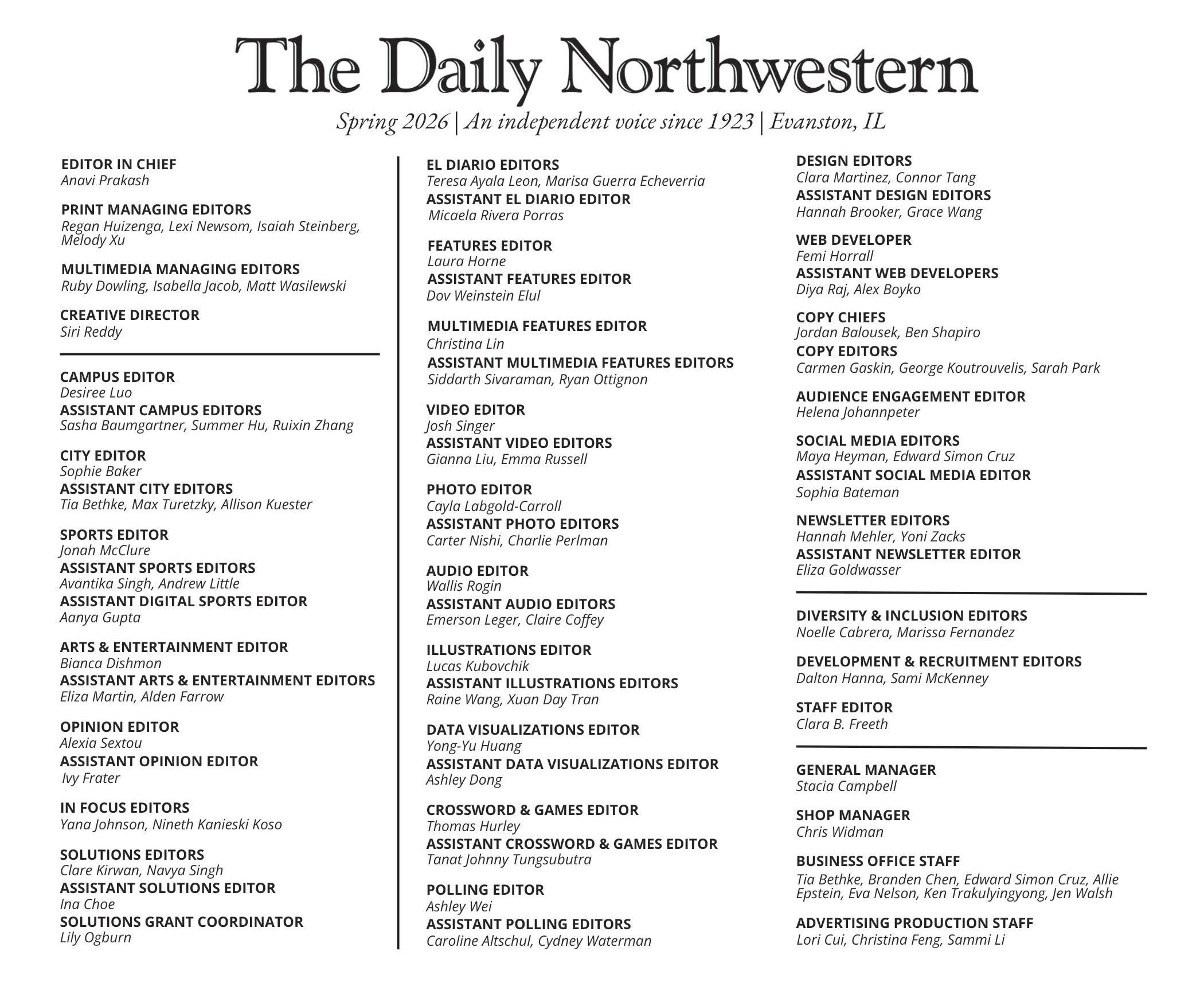
By AANYA GUPTA assistant digital sports editor
Junior shortstop Jack Counsell grew up a die-hard Milwaukee Brewers fan. After all, his father, Craig Counsell, was hired as the Brewers’ manager when Jack was 10 years old.
As children, Jack and his older brother, Brady Counsell, would hop onto the field of Miller Park after Brewers’ games and hit toward the wall, hoping to send a home run sailing over the fence. They even celebrated with the Brewers in the clubhouse after wins.
Naturally, Jack also absolutely hated the Brewers’ division rivals, the Chicago Cubs.
Fast forward a decade, Jack plays shortstop for Northwestern. Just 8.5 miles down Sheridan Road, Craig manages the Cubs.
Now, Jack identifies as a huge Cubs fan — his loyalty to his dad unwavering — and his favorite players are Nico Hoerner and Pete Crow-Armstrong.
Although his dad’s proximity was not a factor in his decision to come to NU, Jack has found the experience beneficial. Jack can go to Cubs games whenever he wants, get dinner with his dad and see his dad when he needs him. For Jack, family ties run deep — he has always taken a lot of inspiration from Craig, whom he considers his role model, and faced early competition with his brother.
This summer, Jack will spend time at Wrigley Field, working out with his favorite players, who happen to be managed by his dad. He said in the past, having interactions with players has helped him improve.
“I think the biggest thing you can do is get advice from the best players in the world,” Jack said. “So whenever I get that opportunity, I try and ask as many questions as possible, just because I know whatever they’ve got to say is going to be useful and it’s going to help me.”
Though Jack learns from current professional players, advice about the sport started with his dad, who Jack said is the reason he plays baseball.
Before Jack was born, Craig won two World Series as a player: in 1997 with the Florida Marlins and in 2001 with the Arizona Diamondbacks. Craig also won the National League Championship Series MVP award in 2001.
“(My dad)’s kind of showed me what it looks like at the highest level, and how guys at that level carry themselves,” Jack said. “Not so much the skill part of it, but mainly just how they approach their day-to-day work — how hard they work.”
Senior center fielder Jack Lausch said he has seen these values of strong work ethic and passion translate into Jack’s game.
Lausch, who is good friends with Jack, said he works hard and is a great teammate.
“I think he’s someone who has obviously been around baseball his whole life. (He) knows how to win and wants to do it,” Lausch said. “When I’m playing next to him, I know he has my best interest — he has the team’s best interest. He just wants to go out and win.”
Brady Counsell — a shortstop for the Hillsboro Hops, a minor league affiliate of the Arizona Diamondbacks — similarly said that his brother plays baseball very hard, is a good athlete and is fast, which are big parts of his identity as a player.
Jack and Brady grew up inseparable and, according to Brady, are each other’s biggest fans. For Jack, having an older brother that played the same sport as him increased his love of the game.
“We would always work out together, and it kind of created a competitive atmosphere in everything we did,” Jack said. “We were trying to go against each other, one up each other. So I think it just pushed both of us to be better in everything we did.”
Brady agreed, but quipped that Jack thought he was faster than him, but that the matter was up for debate.
The brothers faced off two years ago, when Jack was a freshman at Michigan — he transferred to NU in 2024 — and Brady was a junior at Minnesota.
“(It was) just a kind of surreal experience that not
a lot of brothers can say that they’ve experienced together, playing in the same game together on a college level,” Brady said.
Competition is not just limited to baseball in the Counsell family. Jack has two younger sisters, one of whom won a state championship in basketball earlier this year. Brady said the siblings grew up forming teams of two and playing basketball against each other, creating an ongoing love of competition.
When he was in first grade, Jack won a Little League championship with Brady on a team called the Red Wings. In his senior year of school, Jack led
Whitefish Bay High School to a Wisconsin state championship, which he said is his favorite baseball memory.
This season, Jack has his eyes set on helping the Wildcats make a Big Ten Tournament appearance and working towards his dreams of playing professional baseball.
“Something I’ve always wanted to do is play baseball at the highest level possible and then also win a World Series,” Jack said.
a.gupta@dailynorthwestern.com
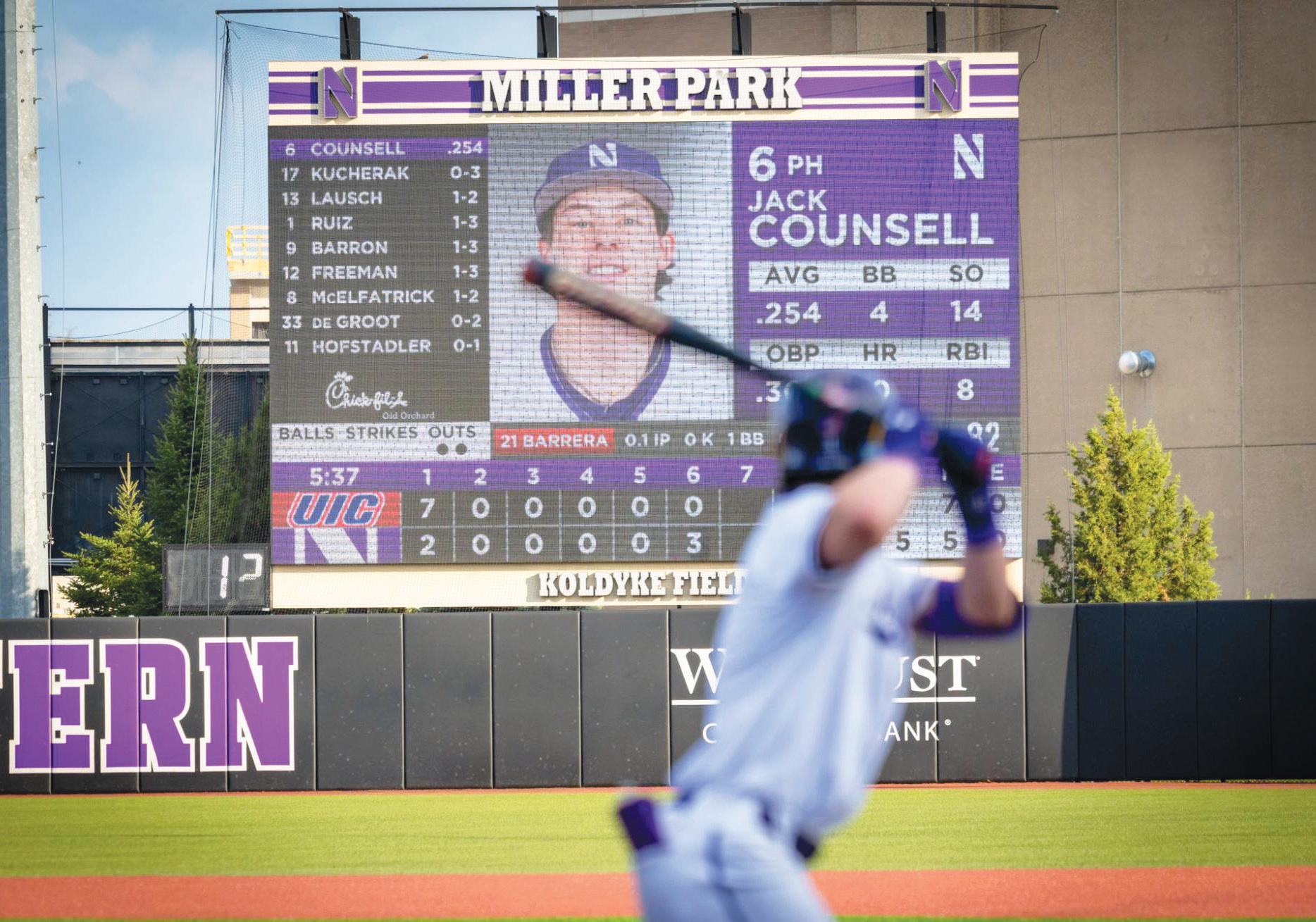
By BEN DANNEMILLER the daily northwestern
Northwestern is the No. 1 overall seed in the NCAA Division I Women’s Lacrosse Championship, the NCAA announced Sunday.
The Wildcats have earned a top-4 seed in each tournament since 2019 and most recently were awarded the No. 1 seed in both 2023 and 2024.
Since NU is a top-3 seed, the team will host a threeteam regional. James Madison and Notre Dame will play in the first round Friday, and the ’Cats face the winner in the second round Sunday. Both games will be hosted at Northwestern Medicine Field at Martin Stadium.
NU, the Big Ten champion, is entering tournament play on a 10-game winning streak, having not lost since March 15 against Ohio State.
James Madison, the American Conference champion, is coming off a 17-7 victory over USF in the conference championship game.
Notre Dame most recently lost to Clemson in the ACC quarterfinals.
Should the ’Cats advance past the second round, they would host the winner of the Boulder regional, where Colorado, Denver, Florida and Jacksonville will play in the first round.
First draw for NU’s second round matchup is set for 1 p.m.
bendannemiller2029@u.northwestern.edu
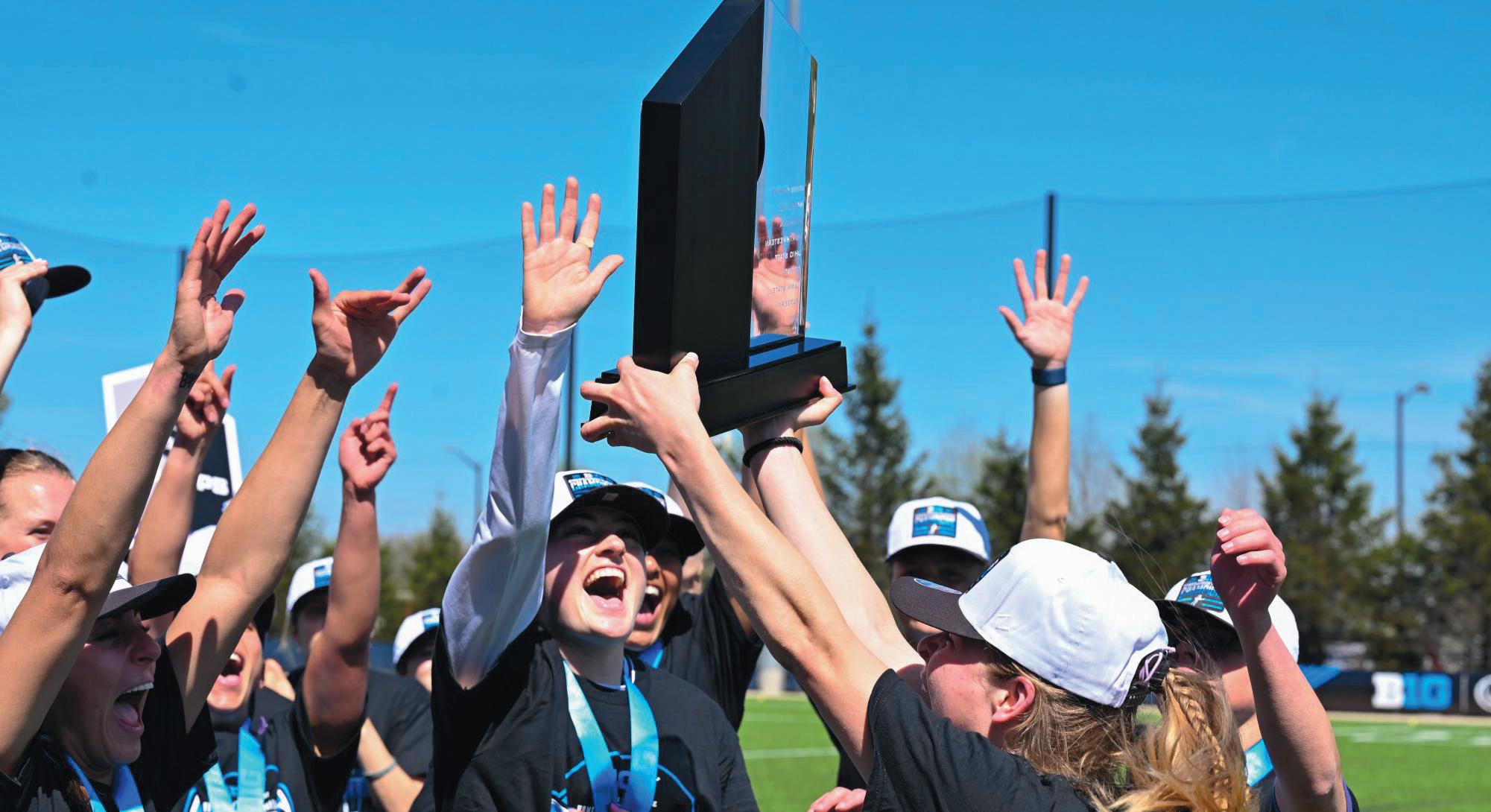
By SIDDARTH SIVARAMAN
assistant multimedia features editor
Redshirt freshman Cary Drake had never competed in the 3,000-meter steeplechase before this year. She didn’t need to; before this season, Northwestern’s women’s outdoor track team was a group of cross country runners looking to stay in shape during their offseason.
Now under a fully-fledged program, Drake holds the second-fastest steeplechase time in the Big Ten this season. Her event-winning effort in 10:04.15, a 25-second personal best set at the Badger Challenge on Friday, ranks 25th in the country for the 2026 season.
Drake said a lifetime playing lacrosse gave her an affinity for “task-oriented” exercise as opposed to simply running around a track.
So with her coaches looking to fill as many distance events as possible to maximize the team’s postseason chances, she stepped up for steeplechase.
“We had basically the whole team jump over a bunch of hurdles and see who looks athletic or who likes doing this,” Drake said. “I kind of always knew in high school that it would be something that I would really love to get to try.”
Division I outdoor track is split into East and West regions, with the top 48 times in each qualifying for the regional preliminary round. The top 12 finishers in late May’s regional race qualify for the national championships in mid-June, and Drake’s time sits 10th-best among runners in the West region.
Runners in the 3,000-meter steeplechase must clear 28 fixed barriers and seven water jumps, making an event originally designed for horses one of the most unorthodox races in collegiate track. Without a standard track on campus, Drake said
she and the rest of the Wildcats train by setting up a barrier on the turf in Ryan Fieldhouse.
Drake added that the team can’t easily replicate the water jumps. In a race, the barrier is followed by a sloped pit of water 12 feet long and more than 19 inches at its deepest. But even though graduate student Anna Hightower attempted her first water jump mere minutes before Friday’s race, she finished third in 10:14.57, good for 24th in the West region this year.
“We do the best we can, and I guess it’s proven to work out pretty well,” Drake said.
In the 5,000-meter race, redshirt sophomore Ava Criniti’s winning time of 15:51.38 was just enough to move inside the qualifying threshold at 46th. Hightower is also in position to qualify at 5,000 meters after setting the 36th-fastest time in the region — 15:46.72 — in April.
Redshirt junior Skye Ellis moved up to 30th in the West region charts for the 1,500-meter run, chipping two seconds off her personal best to
finish second in 4:14.55. In the 10,000-meter run, Criniti ranks 28th, junior Jackie Holman sits 33rd and senior Maddy Whitman is on the outside looking in at 49th. NU’s 10,000-meter squad is ranked ninth in the U.S. Track and Field and Cross Country Coaches Association’s poll, and its 5,000-meter squad sits 14th. With the regular season at a close, the ’Cats now turn to the Big Ten Outdoor Championships from May 15 to 17. Regional qualifiers will be announced May 21. Drake didn’t expect to make the qualifying list in her first season, she said, but her place at the regionals in Arkansas is now almost assuredly secured. “It’s something that I feel like I wouldn’t be able to do without all of my teammates and coaches,” she said. “We train in a really big group, so I’m just edging up towards the front as best as I can.”
s.sivaraman@dailynorthwestern.com