The Daily Northwestern













’Cats defeat North Carolina in backand-forth thriller
By JONAH MCCLURE sports editor
Northwestern found itself in a familiar position Sunday morning.
For the fourth straight season, the ’Cats were playing in the national championship. After winning it all in 2023, NU came up empty handed the following two seasons. The powerhouse program, boasting eight titles, was looking to get back to its winning ways.
As the Wildcats (19-3, 7-1 Big Ten) trailed North Carolina 11-9 entering the fourth quarter, the possibility of coming up short once again loomed large. But despite momentum and recent history stacked against NU, the team possessed a unique upper hand: home field advantage.
With Lake Show faithful packed into Martin Stadium, the ’Cats scored five unanswered goals, beating the Tar Heels (19-2, 10-0 ACC) 14-11 to secure the program’s ninth national championship. NU avenged its loss to North Carolina in last year’s final game and became the first team since Maryland in 1986 to win the title on its home turf.
“This was something special for our team, for our program, for our university,” coach Kelly Amonte Hiller said postgame Sunday. “I am literally so grateful that (Athletic Director) Mark Jackson brought this to the Midwest.” staff for approval.
Despite a dreary start to the morning in Evanston, the sun escaped from the clouds, beckoning 8,316 fans to the shores of Lake Michigan for the final game of the lacrosse season. It’s the all-time highest attendance mark for a ’Cats women’s sporting event.
Amonte Hiller applauded the in-person support, saying, “The student section, are you kidding me?”
“I’ve never been in a situation where we’ve had the most fans,” she said. “I know that was a huge asset to us. Their energy carried us, and I’m just so grateful for them all coming out.”

While much of the buzz focused on the two featured Tewaaraton Award finalists — senior attacker Madison Taylor and Tar Heels attacker Chloe Humphrey — the duo’s performances didn’t exactly match the hype. Taylor scored one goal but tied former NU legend Hannah Nielsen’s titlegame record with six assists, while Humphrey tallied two goals on 11 shots.
Leading the offensive charge in Taylor’s place was freshman attacker Gabriella McCollester, who entered Sunday’s game with six career goals. She scored a game-high four goals, including the game-tying fourth-quarter score, while filling in for senior attacker Lucy Munro, who exited the game with an injury in the first quarter.
Taylor assisted on two of McCollester’s goals and said she was unsurprised by her teammate’s impact.
“Gaby just came in and stepped up, but I knew she was capable of that,” Taylor said postgame Sunday. “I’ve seen it every single day of practice, and she amazes me every single day.”
After the ’Cats took an early 3-0 lead, North Carolina answered back, and the score sat even at 6-6 at halftime. It marked the first title game to be tied at halftime since 2018.
During the third quarter, the Tar Heels grabbed the momentum and took a 9-7 advantage. They seemed to extend their lead to three scores with a goal from attacker Reese King, but a successful challenge from Amonte Hiller overturned the score and NU cut the deficit to one less than 30 seconds later. Amonte Hiller credited the review to the team’s IT department, which she said made her “very confident” about getting the call correct.
Despite the two-goal swing, the ’Cats trailed entering the fourth quarter. Slowly but surely, they churned out goals while the defense limited North Carolina’s No. 1 scoring offense. After sophomore attacker Aditi Foster put NU ahead for the first time since the second quarter, Tar Heels attacker Caroline Godine seemed to nd the equalizing goal

WEDNESDAY, MAY 27, 2026


Evanston police tried dodging city ICE policies on Oct. 31, analysis finds
By RYAN OTTIGNON assistant multimedia features editor
Content warning: This article contains descriptions of violence by federal immigration agents.
Just past noon on Oct. 31, Evanston police received a report of federal immigration activity. It was at least the eighth report they investigated that day.
Multiple calls came in from around the intersection of Asbury Avenue and Oakton Street. A witness reported someone had pepper spray, which a dispatcher relayed to the duo of responding sergeants. Another witness, the dispatcher said, reported that the conflict involved a 10-50 — the code for a car accident.
City officials had already built up laws and protocols to guide the police response to federal immigration enforcement. One week before President Donald Trump’s second inauguration, City Council amended the Welcoming City Ordinance, a municipal law mandating city departments and employees to provide civil protections
to immigrants without permanent legal status in Evanston, including residents and visitors.
As a result of the update to the ordinance, Evanston Police Department Chief Schenita Stewart reminded staff in a July protocol that EPD would not “participate in,” “cooperate with” or “assist” federal immigration enforcement. She wrote that line-level officers could not engage with cases involving federal immigration enforcement — that was a task for supervisors, who may include sergeants and above, according to state law.
In early September, the Department of Homeland Security announced Operation Midway Blitz, a federal immigration crackdown in the Chicago area. Between then and the morning of Halloween, The Daily had tracked six detainments by federal immigration agents in Evanston.
Following the announcement, Stewart clarified in an Oct. 24 email that police should investigate “any public calls to EPD reporting possible ICE activity in Evanston.” If federal agents were still present at the scene upon

EPD’s arrival, Stewart instructed supervisors in an Oct. 27 protocol to gather “information regarding the arrest team and their activity.”
Police would test the full extent of these protocols Oct. 31 after a Border Patrol agent braked ahead of a community member, causing a rear-end collision.
The Daily’s review of more than a dozen types of records suggests EPD pushed the boundaries of the Welcoming City Ordinance at the scene of the crash that day, and later led federal agents outside city bounds in what appears to be an attempt to dodge the ordinance.
‘Violent’ detainments and police responses
On Oct. 31, three Border Patrol agents pulled Chicago resident Nancy Polanco out of her vehicle and onto the roadway. The rear-end collision had lodged her front bumper into the backside of the agents’ federal vehicle.
“Do you have papers?” one bystander yelled toward Polanco, who



By MARISA GUERRA ECHEVERRIA el diario editor
Evanston resident Jesús Eugenio Castro was detained by Immigration and Customs Enforcement on Monday during an immigration check-in at the ICE Chicago Field Office, according to his family and community organizers.
His wife, Aline Hernandez, and two young children were present at the appointment, where Hernandez said they received no explanation for Eugenio Castro’s detainment and allegedly were also told they might be deported.
As of Saturday, Eugenio Castro is being held at the Christian County Jail in Hopkinsville, Kentucky, according to his family and the ICE Online Detainee Locator System.
“I’m trying to stay positive because I want him to come back to us,” Hernandez said in Spanish. “Like the ladies here who come to help us tell me, I have to prepare for the best, but I also need to brace myself most times for the worst.”
A 26-year-old 2nd Ward resident, Eugenio Castro works as a landscaper and is due for a court date at Chicago Immigration Court on June 1, prompting a flurry of action from local immigration activists and officials.
Community organizer Jacqueline Mendoza coordinated with Evanston Latinos and Sanctuary Evanston to launch a fundraiser to pay for an immigration attorney for Eugenio Castro’s legal proceedings.
His bond will be paid with assistance from the Midwest Immigration Bond Fund, according to Mendoza.
ICE and its Chicago Field Office did not immediately respond to requests for comment over the weekend.
Eugenio Castro and his family immigrated to the U.S. from Mexico in December 2022 to live with his wife’s grandparents, who are longtime Evanston residents. According to Hernandez, their Monday appointment was their first check-in required by ICE after they arrived in the U.S. in 2022 and applied for asylum.
Hernandez said she was able to leave the field office with her children, with the condition that
the agency will continue monitoring her under the Intensive Supervision Appearance Program. She said immigration enforcement agents kept her passport and some of her and her family’s original entry documents.
Federal officials have detained immigrants at scheduled appointments in other areas, according to City Clerk Stephanie Mendoza, Jacqueline Mendoza’s sister.
Jacqueline Mendoza said this tactic is a stark contrast to the overt immigration enforcement Evanston witnessed under Operation Midway Blitz, which saw clashes between community members and immigration agents and police response to immigration activity. As such, community leaders who had grown accustomed to public arrests said it took longer to learn about the family’s case from residents.
“I was just completely heartbroken that this happened, what felt like right under our noses, and we had to find out from somebody reaching out to somebody reaching out to somebody else,” Jacqueline Mendoza said.
Ald. Matt Rodgers (8th), who said he was among the first to learn about Eugenio Castro’s case, noted that there remains a sense of distrust and fear among residents in bringing immigration concerns to the city.
Yet, he emphasized the importance of reporting federal immigration activity to city officials to build awareness and stronger legal cases for immigrants, saying the community is not “out of the woods.”
Mayor Daniel Biss, who has remained in touch with community leaders during Eugenio Castro’s detainment, said residents must continue to stay vigilant about ICE’s historically “harmful and wrong” actions beyond the fall’s immigration enforcement.
“Midway Blitz was a truly brutal and terrifying massive escalation,” Biss said. “Thank god that’s over. But all that’s done is returned us back to a situation that was already wrong.”
In the meantime, in their capacity as fellow Latino community members, the Mendoza sisters have helped Hernandez navigate the immigration system and have sought community support for the family, as Eugenio Castro is the household’s primary breadwinner.
Stephanie Mendoza said the process is further complicated by language barriers, ICE’s withholding of documents and Hernandez’s care for her young children, ages three and five.
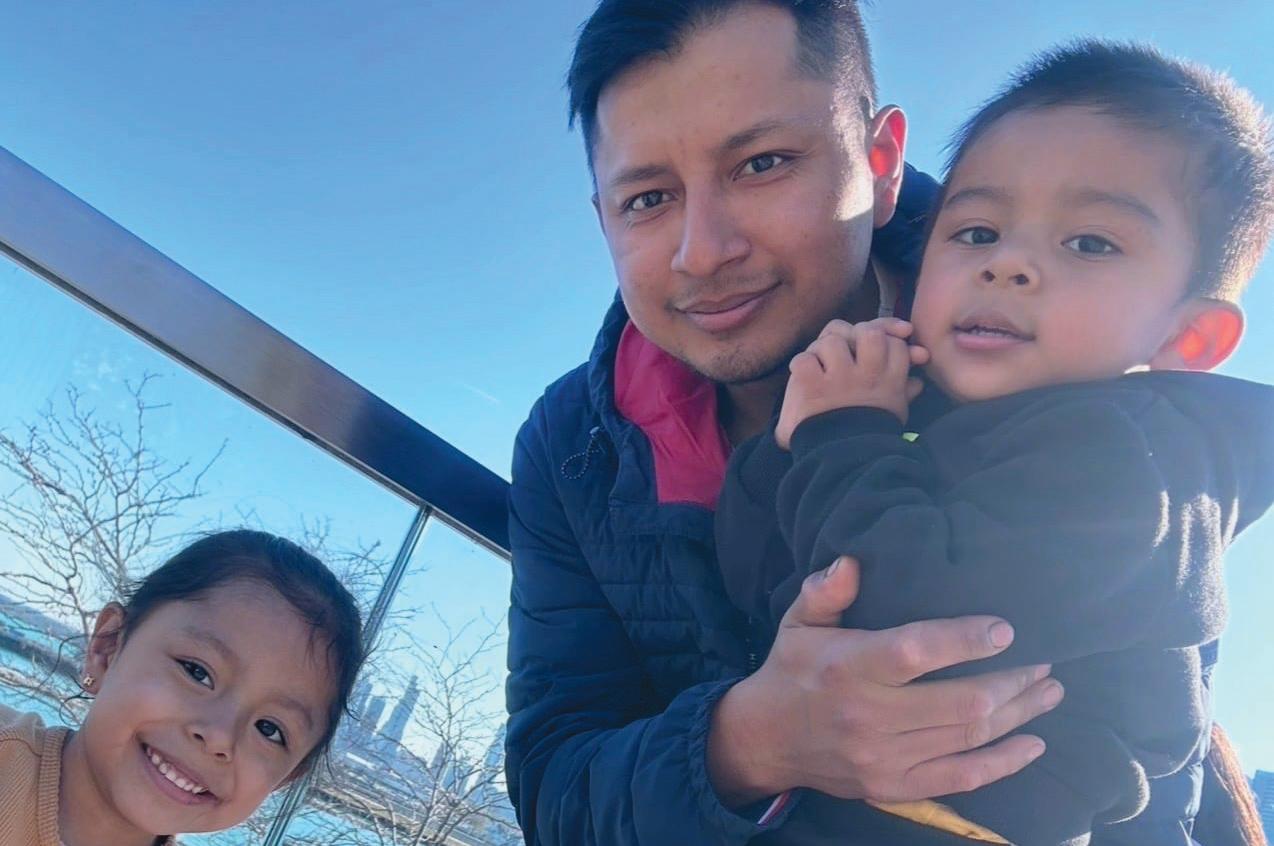
“My daughter still doesn’t know he’s in that place,” Hernandez said in Spanish. “We’ve told her he’s working, but I feel so bad because she keeps asking me, ‘When is he coming back? Why isn’t he calling? I want to see him already.’”
She added that despite her best efforts to shield her children from the situation, her three-year-old told his grandma his dad was arrested, saying he knew because he didn’t come back with the family after their immigration appointment.
Her children have a close relationship with their father, who takes them out to Evanston parks to play soccer and buys them vanilla ice cream on the weekends, she said.
Hernandez described her husband as a kind, caring father and an attentive partner. Growing up in the southwestern Mexican state of Guerrero, Eugenio Castro would help Hernandez care for her younger brother and always remembered to bring her her elote, her favorite snack, after work.
Hernandez said the past year had already proved
challenging for her family, as she said Operation Midway Blitz forced them to remain on high alert, constantly checking social media pages and staying home to keep safe.
She added that Eugenio Castro also had two near encounters with federal agents during Operation Midway Blitz, when immigration enforcement targeted landscapers.
“We never thought that following through with the immigration process the ‘right’ way would end like this,” Hernandez said in Spanish.“We’re going to have to close more schools,” Wymer said. “That’s the future, a sustainable future.”
m.guerraecheverria@dailynorthwestern.com
Escanea el código QR para leer el artículo en español.

By ASHLEY WEI polling editor
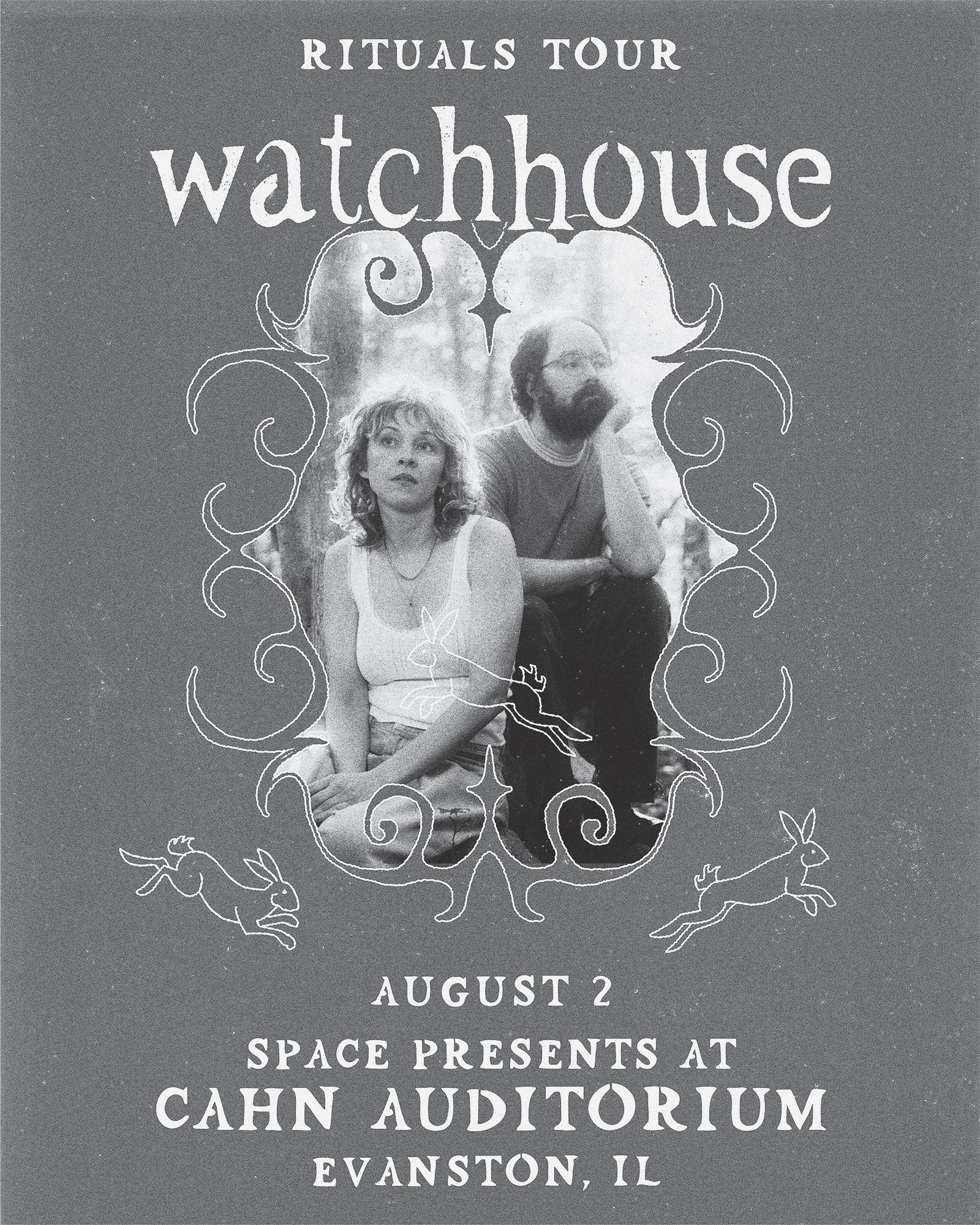
As Purdue President Mung Chiang steps into his role as the next president of Northwestern, STEM faculty at NU expressed optimism about his engineering expertise and cautioned about how past leadership translates to the University.
While NU’s three most recent presidents — Morton Schapiro, Michael Schill and Henry Bienen — are from non-STEM elds, Chiang comes from an electrical and computer engineering background.
McCormick Prof. Aggelos Katsaggelos said he co-authored four papers with Chiang, who was a Princeton University professor at the time.
“Chiang was a person that (was) extremely bright and exceptional mind, and somebody that was a rising star that was going to go places,” Katsaggelos said.
In Chiang’s career, he has published more than 450 papers and holds 26 U.S. patents.
In an interview with e Daily, Chiang said he does not believe that the Presidential Search Commi ee or the Board of Trustees focused on his engineering background when assessing his candidacy.
“My original degree is from engineering, but that was a long time ago,” Chiang said. “My job is not to serve one discipline, but comprehensively all disciplines and every member of the Wildcats family.”
Faculty express optimism that Chiang will bring successful Purdue initiatives to NU
Chiang expanded Purdue’s research to more than $1 billion in sponsored research expenditures. He also increased industry collaborations, including $3.9 billion in investments to build a SK Hynix semiconductor advanced packaging facility at Purdue.
Katsaggelos said Chiang’s successful track record at Purdue is a promising indicator for NU’s future.
“He’s a seasoned president. He has done the job,” Katsaggelos said. “He was dean of engineering, then president, so he is expected to hit the ground running.”
McCormick Prof. David Zaretsky,the assistant chair of the electrical and computer engineering department, described the “quick evolution” of Purdue’s engineering program as admirable. Zaretsky said NU requires many levels of commi ees to take action and hopefully, Chiang can bring the “agility”
of Purdue to NU.
e ability to bring in corporate engagement is valuable for the University, Zaretsky said, both for research and for students looking for future employment. Zaretsky added that Chiang’s knowledge of industry and academia makes him well positioned to align the University’s goals with the future direction of technology.
“A lot of it comes from the top down, and so it’s really important to, from that perspective, have somebody who’s very thoughtful and can see what’s coming down the pipeline and direct all of our e orts towards di erent agendas cohesively,” Zaretsky said.
Faculty share concerns about lack of humanities, liberal arts investment in presidential priorities
While Chiang grew Purdue’s STEM initiatives, Purdue curriculum and instruction Prof. Stephanie Masta said Chiang lacked investment in liberal arts and humanities education.
Resources at Purdue were put toward engineering and arti cial intelligence, Masta said. One outcome, Masta said, was decreased graduate enrollment in Purdue’s College of Education, mostly due to funding limits.
Given Chiang’s demonstrated STEM investment priorities at Purdue, Masta called the switch to NU an “interesting” move.
“Northwestern is an institution known for its humanities programs, for its liberal arts programs. ere’s a strong culture around that,” Masta said.
“I’m presuming that what’s going to be most interesting to witness, or maybe challenging, is how President Chiang thinks about institutional resources and where he wants to put those resources at.”
McCormick Prof. Luís Amaral said he views Chiang’s appointment with optimism and an open mind. However, he echoed Masta’s concerns about Chiang’s leadership priorities.
When reading about Chiang’s leadership at Purdue, Amaral said Chiang liked to be viewed as a “man of the people” but primarily responded to the Board of Trustees, rather than all members of the University. At NU, Amaral said he hopes for a president that listens to the needs of the community.
“ e Board (of Trustees) seems to like to hire
‘yes men,’ people that do what they tell them, and so my hope is that they failed, that they actually got someone that will not be a ‘yes man’ to them, and it will be someone that believes in shared governance,” Amaral said.
The strength of the humanities and social sciences hold an equal role in excellence at NU, Amaral said, and potential overprioritization of engineering is a concern.
Even so, Amaral said Chiang’s performance at Purdue is not a direct predictor of his priorities at this University.
“Faculty has to be very vigilant,” Amaral said.
Faculty hope Chiang’s engineering background brings technical understanding to leadership
McCormick Prof. Randall Berry, the chair of the electrical and computer engineering department, said he is excited to see an individual from a technical background in the role.
“Historically it’s not been the norm to see an engineer selected as the president of Northwestern, and I’m sure any faculty would be happy to see someone from their area in that role,” Berry said.
Amaral said Schapiro and Schill required a learning period to understand the needs and costs of engineering and science research enterprises.
He said that managing federal funding regulations requires talented staff, and partnerships require investments from the University.
“ ere are some things that need to be done to maintain a university at the forefront in research in (engineering and science) areas,” Amaral said. “So, I don’t think that will be an issue at all. I have no doubts that he has a very deep understanding of that.”
Feinberg Prof. Laura Miller, a Research A airs Commi ee member for the Faculty Senate, said she hopes Chiang’s engineering background will give him a more direct understanding of Faculty Senate concerns, including arti cial intelligence and the safety and security of intellectual property.
a.wei@dailynorthwestern.com
The Daily Northwestern www.dailynorthwestern.com
Editor in Chief Anavi Prakash eic@dailynorthwestern.com
General Manager Stacia Campbell stacia@dailynorthwestern.com
Holly and John Madigan Newsroom
Phone | 847.491.3222
Campus Desk campus@dailynorthwestern.com
City Desk city@dailynorthwestern.com
Sports Desk sports@dailynorthwestern.com
Ad Office | 847.491.7206 spc-compshop@northwestern.edu
THE DAILY NORTHWESTERN is printed each Wednesday during the academic year, except vacation periods, the two weeks preceding them and once during August, by Students Publishing Co., Inc. of Northwestern University, 1999 Campus Drive, Evanston, IL 60208. All news is published 24/7 online at Dailynorthwestern.com.
First copy of THE DAILY is free, additional copies are 50 cents. All material published herein, except advertising or where indicated otherwise, is Copyright 2025 THE DAILY NORTHWESTERN and protected under the “work made for hire” and “periodical publication” clauses of copyright law.
POSTMASTER: Send address changes to THE DAILY NORTHWESTERN, 1999 Campus Drive, Evanston, IL 60208. Subscriptions are $100 for the academic year. THE DAILY NORTHWESTERN is not responsible for more than one incorrect ad insertion.
Cahn Auditorium, $18/8 concertsatbienen.org 847-467-4000












































By MAX TURETZKY assistant city editor
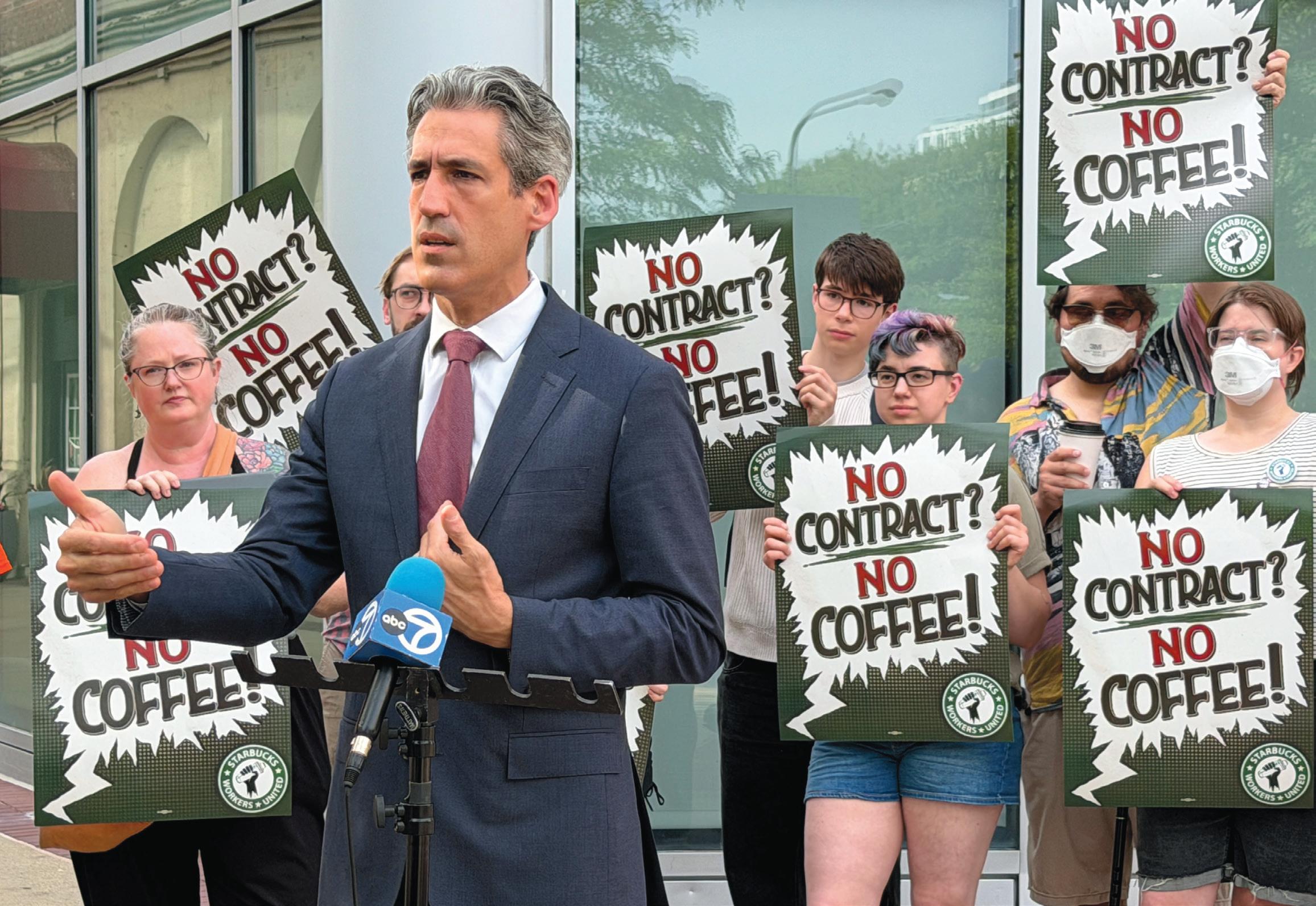
Mayor Daniel Biss joined unionized Starbucks baristas at a Thursday news conference, aligning himself with workers who accused the coffee chain of violating Evanston labor law.
Standing alongside workers bearing “No Contract? No Coffee!” signs and chanting pro-union slogans, Biss alleged the city had received credible reports of “truly abusive behavior” by Starbucks.
Starbucks did not immediately respond to a request for comment.
The news conference, held outside the Lorraine H. Morton City Hall, came as Starbucks Workers United baristas continued to push for a finalized union contract.
“We want to make sure no worker has a shift added in at the last minute, without the ability to arrange childcare, without being compensated fairly,” Biss said.
Among the attendees who turned out to support the Starbucks baristas were Ald. Juan Geracaris (9th), two volunteers with the Democratic Socialists of America and 9th Ward resident Leonard Lamkin, a longtime union organizer.
Lamkin, who previously helped collect signatures for the SUW’s “No Contract, No Coffee” consumer boycott pledge, said Biss was not initially set to speak with the Starbucks baristas.
The baristas originally planned to protest the city’s alleged failure to enforce the Fair Workweek Ordinance at the City Council meeting Tuesday evening, he said. Organizers instead decided to “thank the city for enforcing the law” after Biss expressed his support, he said.
“I think that’s the same kind of pressure we’re putting on Starbucks,” Lamkin said.
SWU launched an unfair labor practices strike at dozens of unionized stores in November to protest alleged labor law violations and pressure the company to reach an agreement with the union.
At Tuesday’s press conference, Biss said his message to workers was “simple.”
“We stand with you, and we look forward to partnering with you to make sure that our laws are enforced, so that you can do the work that you signed up to do for the pay that you signed up to get,” Biss said.
Following the press conference, SWU members
and volunteers canvassed nearby non-union stores, seeking to expand the list of unionized Starbucks in Evanston.
Pastor Luke Harris-Ferree of Grace Lutheran Church spoke after Biss in support of the union, and said Starbucks was treating workers as disposable “in pursuit of corporate profit.”
“Our scriptures remind us that God created each and every living thing in their divine image, and we should respect and honor all people as we would
the divine,” they said.
Starbucks barista and 9th Ward resident Marilyn Lett led the news conference. She said she moved from Kentucky to Evanston a year ago due to antitrans hostility in her home state and now works at the Starbucks on Sherman Avenue.
Lett told The Daily it had been a “cold union” store — meaning it had voted to unionize but lacked an active union presence — until she connected with the store’s union representative. She has since
become more involved in the Starbucks unionization effort across Evanston, and she praised Biss’ support for the union.
“I found that Mayor Biss has been super receptive,” Lett said. “He is super passionate about workers’ rights, and he really understands and supports our issues and how we should be moving forward on this.”
m.turetzky@dailynorthwestern.com
By YONI ZACKS newsletter editor
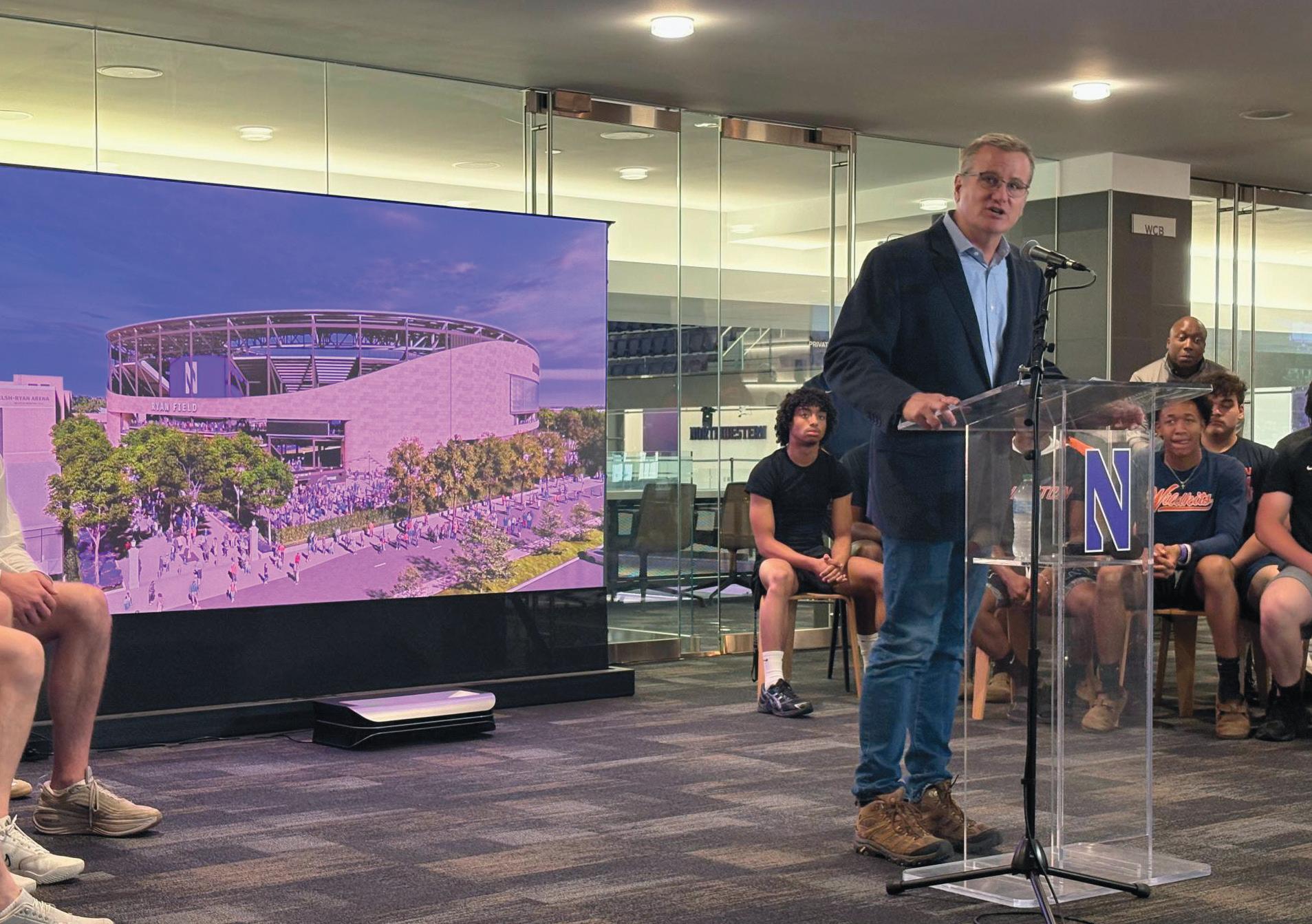
As the Northwestern community looks toward Ryan Field’s reopening on Oct. 2, the North Shore community will be watching for a later date: Oct. 16.
On that day, Evanston Township High School and New Trier High School will face off at the stadium in the latest battle of their storied rivalry, the University and Ryan Sports Development announced Tuesday in a press conference at Welsh-Ryan Arena.
“In 143 days, Evanston will be competing with New Trier in Illinois’ greatest rivalry in college football’s greatest arena,” ETHS Athletic Director Chris Livatino said at the press conference.
The game’s relocation to Ryan Field is part of NU’s goal to center the Evanston community in its plans for the new stadium, Ryan Sports Development CEO Pat Ryan Jr. said.
After announcing the University’s intention to focus on the community last year, Ryan said he is excited for the vision to become a reality.
“We are proud to deliver on the new Ryan Field being the community asset that was promised, and we appreciate the trust and faith that the Evanston community showed in taking this at our word to deliver on these promises to make it a true community asset,” Ryan said at the press conference.
He thanked former Mayor Steve Hagerty for his support in securing the city’s approval for the stadium’s construction.
Hagerty founded Field of Opportunities, a group of Evanston residents who aimed to help revive the city after the COVID-19 pandemic, according to Ryan.
Hagerty said in the press conference that he’s excited for the opening of the stadium. He compared the energy level he expects at the new Ryan Field to the atmosphere on campus during NU lacrosse’s national championship victory Sunday.
“We’re on the lake, and it was a temporary facility, and still, there was something in the air here in Evanston that’s a preview for what’s about to be in the air in Evanston over the next many years, once this new stadium is built,” Hagerty said.
Other attendees at the press conference shared this excitement. Many ETHS and New Trier football players said they were excited about the prospect of playing in a college stadium.
ETHS and New Trier’s rivalry on the gridiron dates back to 1913. Wildkit defensive tackle Joshua Olivier said it would “really mean something” to win the game at the new stadium.
“Every second of that game feels like you’re in the trenches of war,” Olivier said. “Going against
them, you want to win every single rep.” NU will also host other sports games between the two schools, including a basketball doubleheader at Welsh-Ryan Arena on Feb. 5, 2027. The Evanston Fellowship of Afro-American Men Basketball Tournament will also take place at WelshRyan Arena in September.
Dave Davis, the University’s assistant vice president of neighborhood and community relations, said the community support for the project,
exemplified by the attendance of both ETHS and New Trier players at the press conference, was a key step toward connecting the community to the stadium.
“We’re trying to build a legacy, and an institution is only deserving of that term — great — if we truly benefit the people, the neighbors, and the community that we serve,” Davis said.
y.zacks@dailynorthwestern.com
was being detained.
“My name is Nancy Polanco, I’m a United States citizen,” she yelled back.
Two bystanders, Jennifer Moriarty and Marcello Africano, both U.S. citizens, were also detained by federal agents in “swift and violent” events over the following minutes, according to a brief by the Illinois Accountability Commission.
The brief stated that Border Patrol agents Tommy Parsons and Timothy Donahue punched Africano, and that Parsons “dragged (Africano’s) face against the concrete while kneeling on his back, and placed him in a deadly chokehold—after Africano was already restrained.”
DHS Acting Assistant Secretary Lauren Bis called the IAC’s allegations “nothing more than a political stunt” in a May 19 statement to The Daily.
Donahue also said he would shoot a bystander if they did not step back and “drew and aimed his service pistol at unarmed protesters twice within 45 seconds,” according to the brief.
A third federal immigration agent, Customs and Border Protection officer Ed Maxa, pepper-sprayed another bystander “from inches away,” the brief read.
Second Ward resident Liz Myers said she was near Maxa when he used the pepper spray.
“Everything that they did was intentional,” Myers told The Daily hours after the detainments. “It was not for anyone’s protection. Everything that they did was simply aggression.”
Parsons, Donahue and Maxa did not respond to
While Hart collected the full name of Parsons, he did not ask for the agent’s badge number, which was first collected nearly 50 minutes later, the footage shows. A U.S. district judge ruled earlier in October that federal immigration agents must wear badge numbers or other visible identification while on duty. Parsons’ badge number was not visibly displayed.
Following Hart’s conversation with Parsons, the commander told the agents to “follow me,” and began walking north on Asbury Avenue.
One bystander stood in front of the Chevrolet Tahoe driven by Border Patrol agent Donahue as he drove by Hart. The commander yelled at the bystander to “get out of the way, sir,” his body camera footage shows.
“They’re trying to surround this Tahoe,” another officer said into the radio after the government vehicle ran into the bystander. “Let the Tahoe out.”
From EPD supervisors’ arrival to the federal vehicle being led off scene, the events lasted a little more than six minutes.
Three U.S. citizens remained inside the vehicle. They would be held by federal officials for more than five hours, according to the IAC brief.
“The police helped the kidnappers, unidentified, escape a scene where they caused the accident, threatened people with guns in their faces, and with tear gas,” one eyewitness told The Daily near the crash site.
A ‘tricky’ legal landscape
Two legal experts questioned EPD supervisors’ actions at the scene of the crash.
Both Evanston’s Welcoming City Ordinance and a state law, the Illinois TRUST Act, contain clauses
requests for comment for this story.
EPD supervisors arrived on scene about seven minutes after the crash to what one sergeant described to dispatchers as a “large crowd.”
Less than 30 seconds later, the sergeant’s partner, surrounded by bystanders in the street, told dispatch to “start everybody,” according to body-worn camera footage obtained by The Daily following a public records request. All available units were called to the scene, the footage shows.
“There was the Evanston Police Department, and they came, and we thought, ‘Oh, good, they’re going to detain (federal agents) there,’” one eyewitness told The Daily near the crash site.
EPD officers blocked traffic around the intersection and performed crowd control, sometimes in tandem with federal agents, the footage indicates.
The body camera of Cmdr. Gil Levy, who was a sergeant at the time, captures him telling protesters they were violating a municipal ordinance and state law by being in the roadway. It then shows him walking over to his police cruiser and speaking into the loudspeaker.
“Anybody assaulting or threatening law enforcement is subject to arrest,” Levy said to the crowd, as captured on multiple officers’ body cameras. “Get out of the street and let the Evanston Police Department handle it.”
A little more than three minutes after the supervisors’ arrival, Border Patrol agent Parsons struck up a conversation with EPD Cmdr. Jodie Hart, which was captured on Hart’s body camera.
Parsons told the commander he wanted to fill out a crash report and then clear the scene. Hart had a different order in mind.
“Would it be possible before we get off to relocate somewhere else?” Hart asked.
Parsons gave his approval.
Hart instructed Parsons to meet EPD officers at the intersection of Howard Street and Damen Avenue, which sits at the border of Evanston and the Rogers Park neighborhood of Chicago.
EPD officers at the crash scene did not verify any agents’ affiliation with the federal government before Hart instructed them to meet at a new location, according to all body camera footage obtained by The Daily.
At the question of whether EPD’s blocking of streets around Asbury Avenue and Oakton Street constitutes the establishment of a traffic perimeter, Tsao shrugged.
The IAC brief notes multiple federal agents could have unlawfully exceeded their authority in their violent detainments of citizens. Whether this could have spurred EPD officers to detain agents is uncertain, the experts said.
forbidding police from setting up a “traffic perimeter” or providing “on-site support” to assist an immigration enforcement operation, which EPD officers may have done when blocking streets around the scene.
Fred Tsao, senior policy counsel at the Illinois Coalition for Immigrant and Refugee Rights, was a contributor to the 2025 revision of Evanston’s ordinance. He said the situation is more nuanced within the context of the city’s law.
“What we contemplated when we inserted the perimeter provision, specifically, is some kind of advanced collaboration where local police would fence off an area, ICE would come in, they would carry out the operation,” Tsao said. “What has gotten tricky over the last year and a half or so is, what if police respond to a call regarding something happening like a traffic accident? The police still have responsibilities to maintain public safety and maintain traffic flow.”
been “perfect.”
‘Not gonna get in any Welcoming Ordinance trouble’
After federal agents arrived at the location Hart had decided on, which sat on the city’s border with Rogers Park, they drove around the Chicago neighborhood. Border Patrol agent Donahue repeatedly
It depends if the agents’ actions were understood to be lawful, according to Jacqueline Stevens, founding faculty director of Northwestern’s Deportation Research Clinic and NU political science professor.
“The basic rule of thumb is that if somebody is acting unlawfully, then the local or state police have the authority to arrest them,” she said. “Doesn’t matter if they’re a federal agent.”
EPD’s Stewart wrote to city officials on the evening of the detainments that federal agents “cannot be detained or delayed by local police” when they are “operating under lawful authority.”
What actions fall within that lawful authority remains “at very least an open question,” according to Tsao.
“It is troubling that a city law department would waive away the possibility of at very least investigating, if not outright prosecuting, activity that is in violation of general laws,” he said.
EPD’s approach toward cases involving federal agents was “much more lenient than how I would read it, and maybe more lenient than what case law may actually provide,” Tsao later added.
“Lawful authority is open to interpretation, so you can’t just automatically say, ‘Well, we can’t do this,’” Tsao said.
On Oct. 31, EPD officers and 911 dispatchers repeatedly told bystanders that police could not interfere with federal agents.
Shortly after Hart let the agents drive away from the scene, for example, a bystander asked him, “Can they actually take people like this?”
“Sir, they’re federal agents, OK?” he responded, as shown in his body camera footage.
Mayor Daniel Biss wrote in a May 1 statement to The Daily that he has “had multiple detailed conversations with EPD and City of Evanston leadership reviewing the incident to better understand what can be learned to improve any response in the future.”
That day, Biss also re-sent a copy of a statement The Daily received in November, where he wrote he was “grateful for the role the Evanston Police Department played amid the chaos” on Oct. 31 and that there was “simply no way” the response could have
threatened community members with pepper spray, civilian videos show.
Agents’ “brutal tactics” were an “authoritarian overreach,” wrote Julian Jackson of activist group Protect Rogers Park in a late April statement reflecting on the events of Oct. 31.
Federal agents “brake-checked” vehicles that were following them in Rogers Park at least three times, according to the IAC brief.
After reporting to EPD that the Rogers Park area was “way too hot” with “some unruly tailing,” federal agents instead arranged to meet EPD Sgt. Daniel Keeler at the Skokie Northshore Sculpture Park, just outside Evanston’s western border.
Keeler then called with Hart, his supervisor, to break the news.
“We’ve given them where we’re meeting,” Keeler said in the call, captured on his body camera. “It is not a city of Evanston location, so we’re not gonna get in any Welcoming Ordinance trouble.”
City officials have referred to the Welcoming City Ordinance as the Welcoming Ordinance in public communications, including news releases and social media posts.
Jackson called the officers’ choice to meet outside city bounds “distressing.”
“Evanston police betrayed the people they are supposed to serve and undermined these neighbors’ heroic efforts to protect each other,” Jackson wrote. To Tsao, the choice of location was the “most confusing aspect of this whole episode.” He noted the ordinance was “not restricted to the city of Evanston” for city employees, including police officers.
“I really don’t understand what difference it makes where this interaction is happening,” Tsao said. “It certainly should not make any difference whether this is within Evanston city limits or outside.”
EPD declined to comment on the incident in November and did not respond to questions in April about why Hart and Keeler chose meeting locations on or outside city boundaries.
EPD’s Stewart, Levy, Hart and Keeler did not respond to an additional request for comment in May for this story.
The Daily obtained still-unpublished comments emailed by Stewart in January to the Evanston RoundTable, which partially shed light on EPD’s decisionmaking process.
“(The choice of location) was not an attempt to skirt the ordinance,” Stewart wrote in the email. “I made that decision, and I reiterated to EPD staff that federal agents were not permitted to come to the Evanston Police Department or any other city property to exchange information.”
The statement appears to reference parts of the ordinance and TRUST Act, which both contain clauses forbidding immigration agents from using police department facilities.
Half a year after the incident, Myers, who witnessed Evanston police’s interactions with the agents on Oct. 31, is still looking for answers.
“(Police) are not going to do anything to stop this, and they don’t want to,” she told The Daily in April. “I don’t understand why they wouldn’t want to.”
The only possibility she could think of was that police officers “don’t want to be targets themselves.”
“Nothing has changed,” Myers said. “If any of this happens again, they’re not going to protect us.” Siddarth Sivaraman contributed reporting.
r.ottignon@dailynorthwestern.com
Por ALEXANDER HERNANDEZ GONZALEZ y MARISA GUERRA ECHEVER y MARISA GUERRA ECHEVERRIA el diario northwestern
Desde su inauguración en 2022, Sueños Music Festival ha atraído a latinos de todo el mundo para celebrar el arte creado tanto dentro como fuera de Chicago. En su quinta edición, presentes y artistas se reunieron para honrar la cultura, la comunidad y la colaboración. Conocido como “El Festival Latino”, Sueños se celebra anualmente en Grant Park durante el fin de semana de Memorial Day. Las presentaciones musicales en vivo son el corazón de Sueños — artistas pasados incluyen Shakira, Peso Pluma, Rauw Alejandro, Maluma y Ozuna.
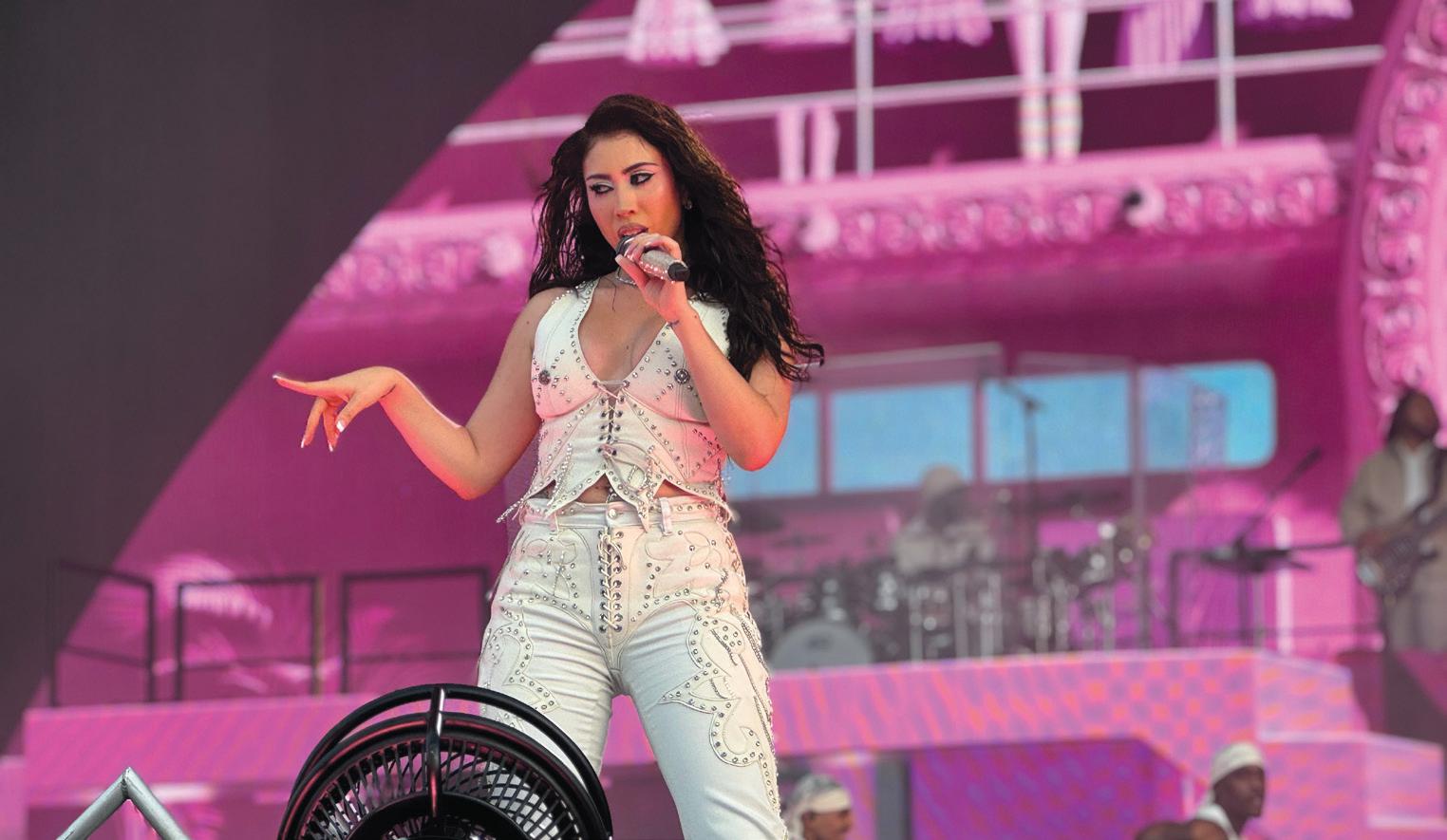
Este año, las presentaciones musicales no decepcionaron: las estrellas principales incluyeron al cantante colombiano J Balvin, a la cantante y compositora colombiana-estadounidense Kali Uchis y a Fuerza Regida, una banda estadounidense de música regional mexicana.
Aaron Ampudia y Christopher Den Uijl, cofundadores de La Familia Presenta y Sueños, dijeron que iniciaron el festival para apoyar los negocios y los programas para jóvenes al celebrar la cultura latina. Según Ampudia, el festival es un espacio donde los latinos pueden sentir orgullo de su cultura y donde los demás pueden aprender sobre ella. Den Uijl dijo que la respuesta de la comunidad ha sido “asombrosa”.
El festival contó con políticos prominentes junto con el reparto musical estelar, con breves llegadas del alcalde de Chicago, Brandon Johnson, y del gobernador, JB Pritzker. En un encuentro cultural, Pritzker estuvo acompañado por el icono cultural Dr. Simi, el personaje de la cadena mexicana de farmacias de descuento, Farmacias Similares.
Los festejos fueron vitales para que los latinos de Chicago celebraran sus diversas culturas y raíces, especialmente considerando el año retador que ha tenido la comunidad latina del área. Con la llegada de la Operación Midway Blitz en el otoño y la detención
de miles de personas, Sueños fue uno de los pocos eventos comunitarios que no habían sido cancelados ni monitoreados por temor a más redadas migratorias. Sueños le dio la bienvenida a decenas de miles de asistentes a su campo, que contaba con una rueda de la fortuna y un mercado comunitario, El Mercadito, que vendía artesanías y productos de marcas latinas locales e internacionales. También hubo docenas de vendedores de comida de todas partes de la ciudad, la mayoría vendiendo antojitos y cocinas diversas de América Latina.
El festival este año tuvo tres escenarios: el Sueños Main Stage (escenario principal) para los artistas más grandes, La Fuente para los artistas de música electrónica y La Plaza para los artistas locales.
Los presentes representaron a sus culturas y arte portando banderas latinoamericanas, playeras nacionales de fútbol y trajes típicos: desde los vestidos mexicanos folclóricos hasta los sombreros y las botas de estilo ranchero. Algunos presumieron su orgullo latino con ‘cachuchas’ y camisetas que representaban lugares de Chicago y de los estados mexicanos de Michoacán y Jalisco.
El ambiente de alegría latina del festival también trajo múltiples mascotas disfrazadas del Dr. Simi que vagaban por los jardines, bailaban e incluso presentaron un set de DJ dedicado en La Plaza Stage. La mascota de Sueños, una flor pompuda llamada FrikiFlora, también fue un éxito entre los asistentes al baile.
La alineación de artistas de este año fue nada menos que la de años anteriores. Desde talentos locales como DJ Miriam y Banda Peñasco de Zacatecas hasta artistas populares como Los Tucanes de Tijuana y Chino Pacas, la energía que aportaron a sus respectivos escenarios fue fascinante.
En el escenario principal, una presentación destacada fue la de la rapera dominicana Tokischa, cuyos hits “Chulo pt. 2” con Bad Gyal y Young Miko y “Delincuente” con Anuel AA y Ñengo Flow merecieron un tiempo nocturno para el máximo perreo. El cantante puertorriqueño Yandel también fue una fuerza a tener en cuenta, cantando éxitos de reggaetón como
“Noche de Sexo” con una orquesta en vivo.
El sábado por la noche, Uchis inició su gira “For the Girls” en el escenario principal de Sueños. La artista ganadora del Grammy llegó en un carruaje blanco, volando besos a sus fans antes de subir al escenario para interpretar temas como “Muévelo” y “Loner.”
Balvin cerró el primer día mostrando su discografía estelar. Desde su colaboración clásica con Bad Bunny en “La Canción” hasta “Qué Calor” con Major Lazer y El Alfa, su set de alta energía concluyó con fuegos artificiales.
Antes de su set del domingo, Fuerza Regida anunció su asociación con Amazon Music y Amazon Community Engagement para donar 100.000 de dólares a la Alianza de Artes Puertorriqueñas y al Museo Nacional de Arte Mexicano. Después, la banda subió al escenario principal para cerrar el festival.
El set de Fuerza, aunque a veces un poco caótico, fue una celebración de la identidad mexicana y la música regional, presentando una alineación al estilo de los Vengadores de artistas invitados, entre ellos Los Gemelos de Sinaloa y Clave Especial. Las canciones “Marlboro Rojo”, “Pues Ya Ni Pedo” y “Qué Onda” con Pacas tuvieron a la multitud cantando y bailando con sus parejas. El feroz orgullo mexicano de la banda y la llamada y respuesta con el público — una característica clásica de la música regional — fueron el toque perfecto para un fin de semana lleno de cultura, perreo y alegría latina sin igual.
a.hernandez.gonzalez@dailynorthwestern.com m.guerra-echeverria@dailynorthwestern.com

It’s hard to imagine a world without fashion. In times of difficulty and disarray, much like we’re currently seeing, fashion serves as a means of expression and protest when words might not encapsulate what one wants to say. It encourages us to look at things from new perspectives that we otherwise may not have considered.
At its core, fashion is integral to identity. Be it accessories, like a bold belt, an eyecatching makeup look or a daring outfit, fashion allows people to express themselves unapologetically.
After an arduous winter, riddled with days of false spring, intense winds and even more intense lock-ins, glimpses of summer are finally on the horizon. So, The Daily’s Summer Style Guide is coming to you at what I hope is the perfect time.

The Daily’s A&E editors and reporters have worked diligently to explore fashion, both on and off Northwestern’s campus, to compile this guide. From professors who have created startups to celebrities leading summer fashion trends to the World Cup’s influence on fashion and cultural pride — there is truly a story in this guide for everyone. I hope this year’s Summer Style Guide encourages you to see fashion as multifaceted and to view the relationship between fashion and society through a different lens.
– Bianca Dishmon, Arts & Entertainment Editor
By ELIZA MARTIN assistant arts & entertainment editor
With summer just around the corner, many are looking to freshen up their wardrobes on a student-friendly budget. Not only are thri ed pieces typically less expensive than brand-new ones, but shopping secondhand helps dodge the ethical dilemmas posed by supporting fast fashion brands. True fashionistas may even nd unique items that punctuate their signature styles on the racks.
Whether you’re looking for a signature statement piece or hoping to save money, here’s a roundup of Evanston thri and vintage clothing stores to t your needs.
Heyday Vintage Collective — 522 Davis St.
Heyday Vintage Collective o ers a wide selection of stylish clothing and accessories, vintage or not. It was recommended to me by an impeccably dressed classmate back in Fall Quarter, and it was my rst foray into the Evanston thri ing scene. ough its items are mostly priced in the $20 to
$40 range, which is a li le higher than I would like, I think it’s justi ed by its curation. Looking through the abundance of racks organized by item and color — my personal aesthetic preference — I leave with a bag in hand and le -behind pieces lingering in my thoughts each time I visit.
Crossroads Trading — 1730 Sherman Ave.
Crossroads Trading definitely caters to its Northwestern student audience. Last time I went, there was a rack designated speci cally for Lululemon clothing, and items from other trendy brands like Free People and Abercrombie & Fitch are usually displayed front and center whenever they’re in stock. However, the store’s proximity to campus also means its selection is pre y picked through, and even though it’s supposed to be curated to weed out cheap products, all that’s le might be Target brand. It’s worth a visit, but it doesn’t guarantee successful nds.
e Vintage Cat — 502 Main St.
If you’re in the market for eclectic, vintage fashion, e Vintage Cat may be your best bet.
ough many of its pieces are priced upward of $50, the store o ers a curated selection of highquality vintage clothing and accessories, among other products, including art and home goods. If the price tags scare you, I recommend monitoring the store’s social media pages to time your trip during one of its seasonal or holiday sales.
Junior League of Evanston-North Shore ri House — 920 Chicago Ave. is nonpro t store o ers a large selection of clothing, and all proceeds go toward supporting the Junior League of Evanston-North Shore. Right down the street from the Main Chicago Transit Authority stop, a weekend thri trip there would pair perfectly with a stop at Hoosier Mama Pie Company for brunch.
Goodwill Store & Donation Center in Evanston — 1916B Dempster St.
Don’t overlook the “basic” choice. For those shopping on a tight budget, Goodwill is the most reliably inexpensive option on this list. Without a curated selection, there are no guaranteed gems
waiting on the racks, but finding one will be even more satisfying — and a few bucks cheaper. If you’re like me, searching for hidden treasure makes thrifting all the more fun. Bring a friend on a free afternoon, and be ready to look through every nook and cranny.
e.martin@dailynorthwestern.com



By SAMANTHA MONJE
resent their favorite teams in style.









she enjoys wearing her jerseys for events with family and friends, but also to nd other fans to discuss games and rivalries with.


that part of my culture shown to people.”





















Vallejo said she represents multiple teams, including Club América, a team in Liga BBVA MX, the highest football league in Mexico. Club América’s bright yellow, blue and red jersey is her favorite, she said.

Sosa said she always cheers for Mexico during the World Cup and is excited to buy and style the new jersey. She plans to wear it with casual clothes, such as jeans, sneakers and sweatpants, she said.



















By ALEXANDER HERNANDEZ GONZALEZ senior staffer

“I really like how bright it is. I also like how it has this li le design with Aztec culture with a triangle going down to the bo om, ” Vallejo said. “Its logo is the map of South America, and it has a ‘CA’ for Club América.”



Weinberg sophomore Sherlyn Bravo said her favorite jerseys serve as conversation starters, which can help when making friends. Asking people about their favorite team, players and country can reveal a lot, Bravo said.





ough fns o en wear jerseys when watching games or playing soccer, jerseys can also symbolize national identity and pride.


Bravo plans to root for Mexico during the World Cup. She loves wearing long sleeves under jerseys, tucking in oversized jerseys and cropping and wearing ed jerseys when playing soccer with friends or dressing casually.


What seemed to be never-ending gloomy weather has finally vanished. You know exactly what that means … It’s summertime! The warmest season of the year not only brings much sunshine, but many more opportunities to be out and about with friends and family.
Whether it be in Colorado’s Red Rocks Park and Amphitheatre or attending Lollapalooza in Grant Park, the way we dress will adapt as temperatures rise in the coming weeks. Have no clue as to what will define the summer? Beach, please!
These five style additions will help your fashion choices and add a hint of style to your closet.
Sunglasses
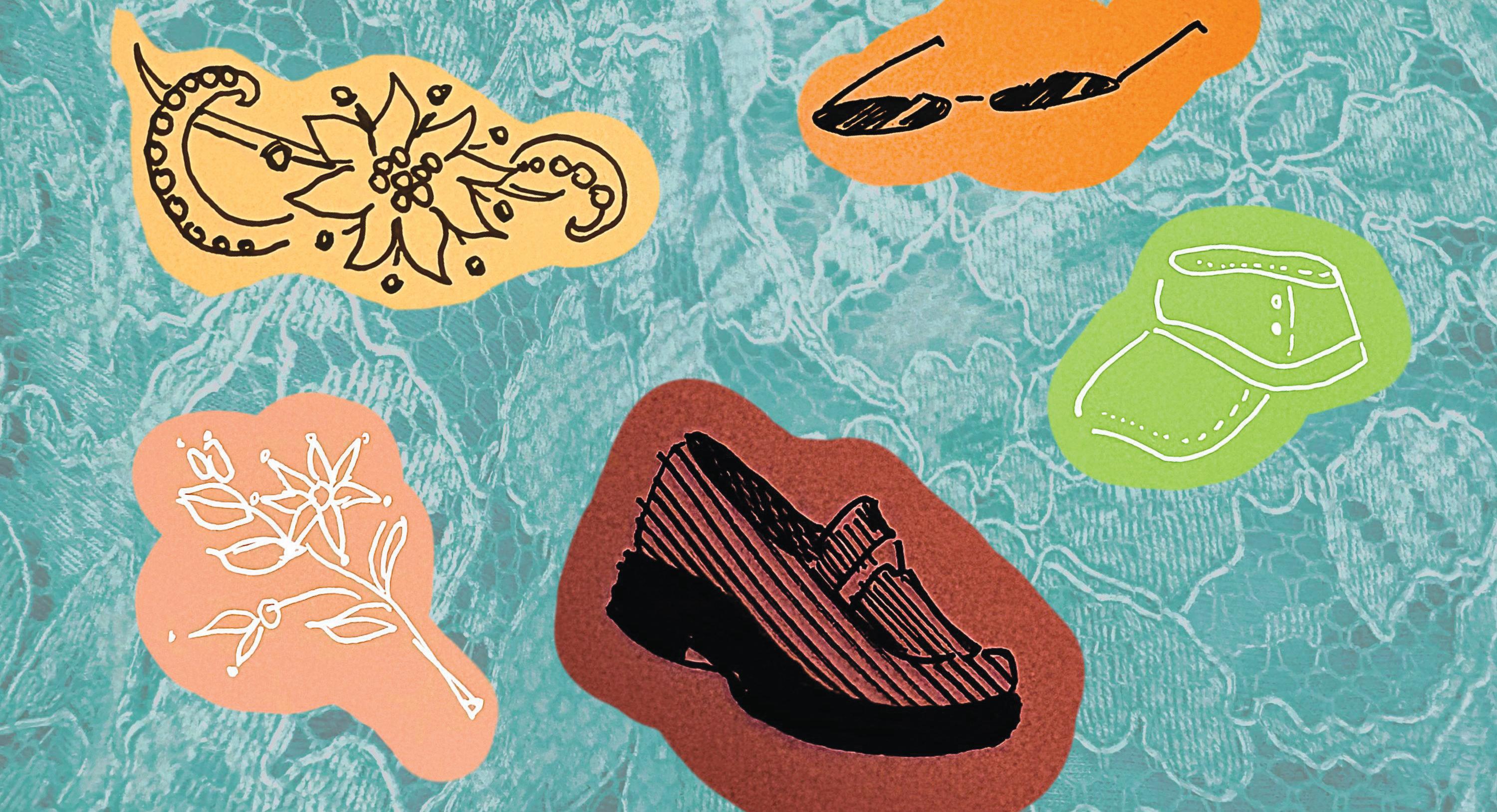
Personally, I stand firm that any type of shades can be a signature accessory throughout the year. I mean, some of my personal icons like Anna Wintour, Charli xcx and Karl Lagerfeld have made them a part of their signature looks. However, I do understand that you may not want to add some frames until it hurts to squint at Lake Michigan. Recently, I’ve been loving the adidas Sport KENTRO and Timberland’s TB00006 sunglasses for exploring the city or listening to outdoor live music. But, as long as the frames fit your outfit and make you feel good, you will survive the summer.
Floral brooches
To whoever decided that brooches are only for mature women or only belong on formalwear, check yourself. Not only can they be added to a blazer’s lapel, but they can be a captivating piece almost anywhere on your clothes. Wearing them on the collar, waist and across the chest can add elegance without sacrificing style. Alternatively, it can give some glamour to




Weinberg junior Yaleska Sosa said wearing her Mexico jersey encourages her to share her family’s culture with fellow soc-
“It makes me feel proud that I’m able to represent my country,” Sosa said. “I just feel very prideful having my parents be from Mexico and having





Bravo said she loves Mexico’s jerseys because the designs and colors change each year. She said she enjoys when countries are “adventurous” and “experiment” with their designs. While this year’s bright green is pleasing to the eye, Bravo said she had a bias towards Mexico’s last World Cup away jersey due to the white color, which she loved.





samanthamonje2028@u.northwestern.edu





your shoes and plain necklaces and even serve as an anchor to owy scarfs. Since the owers have bloomed, encapsulate their beauty in the form of a brooch this summer.
Lace
is might sound pre y well-known to some, but not to all. Despite the assumption that it’s only appropriate for the bedroom, lace is a versatile yet stylish look that won’t roast you under the sun. Since I believe shades like aqua blue and bu er yellow will be popular this summer, lace in neutral tones can balance out an out t quite well. Whether the lace is a sheer white top on
beach or a black maxi dress for a night out, consider yourself and your style safe from a lastminute out t change.
Statement hats
As many fashion lovers saw on the runway this Spring-Summer 2026 season, it’s time to put away the beach hat and embrace the quirky cap. Let’s bring the whimsy back to all parts of our outfit, and that includes the very thing that protects our scalp from the heat! From Jonathan Anderson’s Dior debut collection showcasing tricorn-esque hats, to Chanel’s striped cloche hats under Matthieu Blazy, we can do better than

Similarly to sunglasses, I truly do love a loafer for any occasion. But, it still gets categorized as a shoe solely for business or formal purposes. For the feminine dresser, penny, tassel and chunky sole loafers are great for some height, polish and durability wherever you may travel this summer. For a masculine look, horsebit, driving, slipper and formal pump-style loafers are not only comfortable, but styles that will add to your current taste in fashion.
a.hernandez.gonzalez@dailynorthwestern.com
By YHONATAN YEHUDAI
the daily northwestern
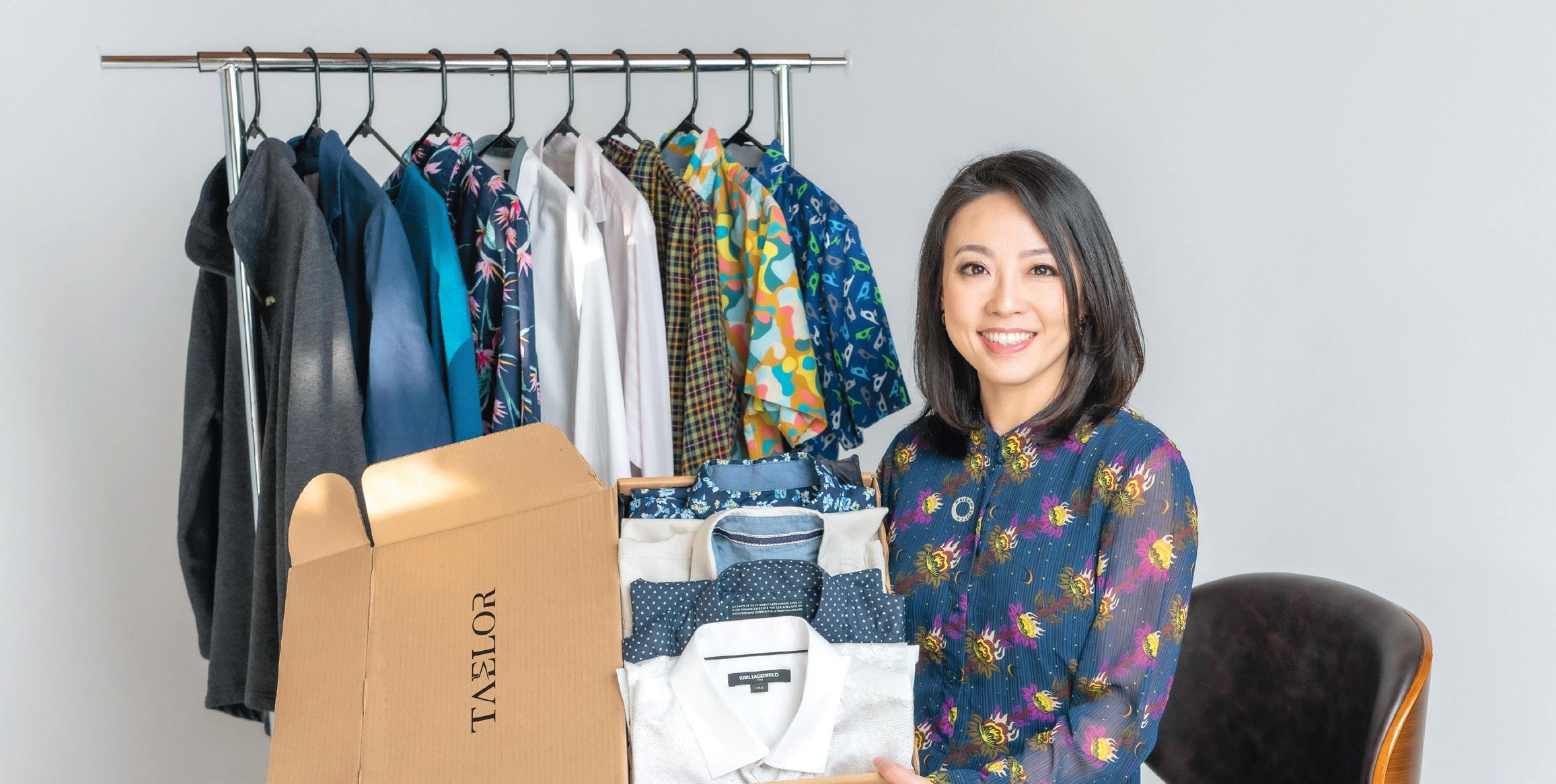
Medill adjunct lecturer Anya Cheng (Medill ’08) is combining fashion and artificial intelligence to help a stylistically challenged demographic: busy men.
Taelor is an online clothing rental subscription service that connects men with professional stylists. Stylists then send customers a monthly shipment of clothes based on their personal and professional needs.
Cheng, who is Taelor’s co-founder and CEO, said her company makes its customers’ lives better and simpler through its customization.
“I don’t think fashion matters, but style and confidence matter,” Cheng said. “We see ourselves as the ‘gadget guy’ behind a superhero.”
Through Taelor, customers can tell their stylists about occasions they might need new clothes for, like dates or business meetings.
The service also uses AI to analyze customer feedback and advise stylists on their preferences.
“Here at Taelor, (you really) get to know your customers,” said Taelor Head of Styling and Senior Lead Stylist Melissa Slavick. “Really developing that personalization for them has been very rewarding.”
Cheng said she had the idea for the startup after developing “impostor syndrome” while working for large companies like Meta and Target.
As a Taiwanese immigrant with less professional experience than her co-workers, Cheng said she wanted to impress them with her apparel. However, she was quickly overwhelmed by the number of decisions she had to make on clothing rental and subscription services.
“I realized fashion companies are not for people who want to look good. They are for people who are into fashion,” she said.

This inspired Cheng to find a way for people to get fashionable clothes without worrying about picking the wrong outfits.
She learned about the importance of catering
to consumer needs while studying at Medill’s Integrated Marketing and Communications Professional master’s program. She said the program’s “consumer-centric approach” taught her that every customer is different, so brands should adjust accordingly.
“Everyone thinks differently, so you shouldn’t treat them the same,” Cheng said.
Cheng added that the service gives customers personalized experiences thanks to AI. After returning their monthly shipment, Taelor users can review the overall quality of the clothes. The company’s AI model then analyzes this data and provides recommendations to stylists for future shipments.
Cheng said she believes Taelor and its use of
AI can improve the fashion industry for both brands and consumers. Taelor partners with more than 100 brands that send stylists early releases of garments to include in monthly shipments. In return, the stylists send brands customer feedback.
Taelor’s AI model lets brands understand and implement authentic customer feedback, Cheng said. She said the technology is paving the way for a more efficient and personalized era in the fashion industry.
This new approach to fashion is also aimed at limiting pollution in the industry. Taelor co-founder and COO Phoebe Tan said renting makes more sense than immediately buying in an industry with “picky” consumers. The
service allows users the option to buy items after renting several times in a “try it before you buy it” model.
“Eighty percent of your clothes are sitting in the closet collecting dust,” Tan said. “It’s very wasteful.”
Cheng said she hopes Taelor can eventually become a “one-stop shop” for busy men who don’t know what to buy. She hopes to make people’s lives easier while completely eliminating waste in products, she added.
“When they know what to buy, they go to Amazon,” Cheng said. “When they don’t know what to buy, they come to Taelor.”
yhonatanyehudai2029@u.northwestern.edu
By REGAN HUIZENGA print managing editor
Whether you’re hoping to dig through racks of vintage clothing, view fashion on the runway or pick up a needle and thread yourself, there are many opportunities to engage with the world of fashion in Chicago this summer.
All things vintage
Chicago will be home to many markets this summer for vintage fashion lovers to shop around and explore some of the city’s offerings. For one, the Andersonville Vintage Market is an outdoor event where attendees can browse all things vintage, including a curated mix of vintage clothing and accessories. The market will take place July 12 and 26 as well as Aug. 16 and 30 from 11 a.m. to 5 p.m. each day. In another opportunity to pursue vintage fashion, the Pickwick Vintage Show will be hosted in the Chicago Athletic Association on June 21. The event will feature more than 30 vendors, selling vintage clothing, jewelry and other accessories. A limited number of tickets will be sold ahead of the show, with more sold at the door as capacity allows. The event will run from 9:30 a.m. to 4 p.m.
For vintage, streetwear and sneaker fans alike, look no further than Navy Pier this summer, where Got Sole will host its culture festival July 25 from 12 p.m. to 6 p.m. The event encourages buying, selling and trading, and attendees can bring as many of their own pieces as they can carry. Tickets are on sale now with tiered pricing, and more will be available before the event.
Vintage House Chicago will transform Artifact Events in Chicago into a summer pop-up market, featuring curated pieces and vendors from artisan markers to beauty products July 11.
For those who may prefer to see fashion on the runway, “The Black Solstice: Always Elevating” will seek to combine fashion, art and culture. The show, hosted at The DuSable Black History Museum and Education Center in Chicago from 5 p.m. to 8 p.m. on June 7, will bring visionary designers and emerging talent together to celebrate fashion, art and culture with the community. General admission tickets are $50.

Likewise, the Fashion for a Cause event on June 13 will include dinner, entertainment and a fashion show to benefit local initiatives and forge an intersection between style and social impact. From 5 p.m. to 8:30 p.m. at the Lore o Hospital in Chicago, youth models will present pieces by West Side designers. Tickets for both the dinner and general admission to the fashion show are on sale.
Rogue Fashion Show will o er a endees an immersive runway experience on Aug. 15. Spotlighting emerging designers, the event will challenge fashion and transform the runway into a platform for individuality and expression. A endees can also hear from one of the designers during an exclusive talk before the show. e event will take place at
the Epiphany Center for the Arts from 8 p.m. to 10 p.m, and tickets are on sale now with tiered pricing.
Hands-on fashion experiences
e Chicago fashion world’s hands-on o erings include everything from dyeing silk scarves to mending clothing.
A Chicago-based textile artist will spend an a ernoon teaching the Japanese art of shibori, a dyeing technique. By the end of the workshop, a endees will have two of their own, hand-dyed silk scarves to don the remainder of the summer. e event will be hosted at Production Mode on June 27 from 1 p.m. to 4 p.m.
Production Mode will also host a mending
workshop on June 13 for those with well-worn items that need creative, durable repairs. Also led by a Chicago-based artist and open to a small group of a endees, the event will take place from 10 a.m. to 12 p.m. Tickets for both Production Mode events are available now.
FashionBar, a fashion strategy and consulting rm on Chicago’s Magni cent Mile, will also host several interactive events and workshops this summer, from a sewing class on June 1 to fashion photography workshops on June 13 and 20. For those looking to enter the industry, the organization will also hold workshops for fashion entrepreneurs and those hoping to become models.
r.huizenga@dailynorthwestern.com
By SAMI MCKENNEY development & recruitment editor
The Daily spoke with four students about how they’re adding personal flair to their internship styles.
Medill sophomore Ana Patricio will be a production intern at Family Style fashion and lifestyle magazine. McCormick junior Thekra Alkadee will work as a digital enablement intern focusing on artificial intelligence implementation at Zebra Technologies. Communication junior Bryson Shaub will be a theater intern at the William Morris Endeavor talent agency. And McCormick sophomore Trisha Krishnan will intern on the United Airlines inventory analytics team.
These interviews have been lightly edited for brevity and clarity.
The Daily: Do you think the traditional garb for your internship is compatible or incompatible with your personal style?
Patricio: Very, very compatible with my personal style. I love collared shirts. I love a nice pair of dress pants. I’ve always felt more professional and sophisticated in that way. I shop a lot of men’s clothes. I actually just bought three polos that I thrifted. They’re like old Ralph Lauren polos and I thrifted them online and got them for a good price, and they’re all men’s polos. I kind of view fashion as unisex, especially in women’s wear, because at the end of the day it’s what you feel comfortable in, and I really love wearing clothes that don’t have to be gendered.
Alkadee: I’m a little more dressy on the daily. I just like to wear dresses, skirts. On certain days, I would say I actually do dress business casual. If I have a blazer, and it’s not too cold but not too hot outside, I definitely wear a blazer out to class.

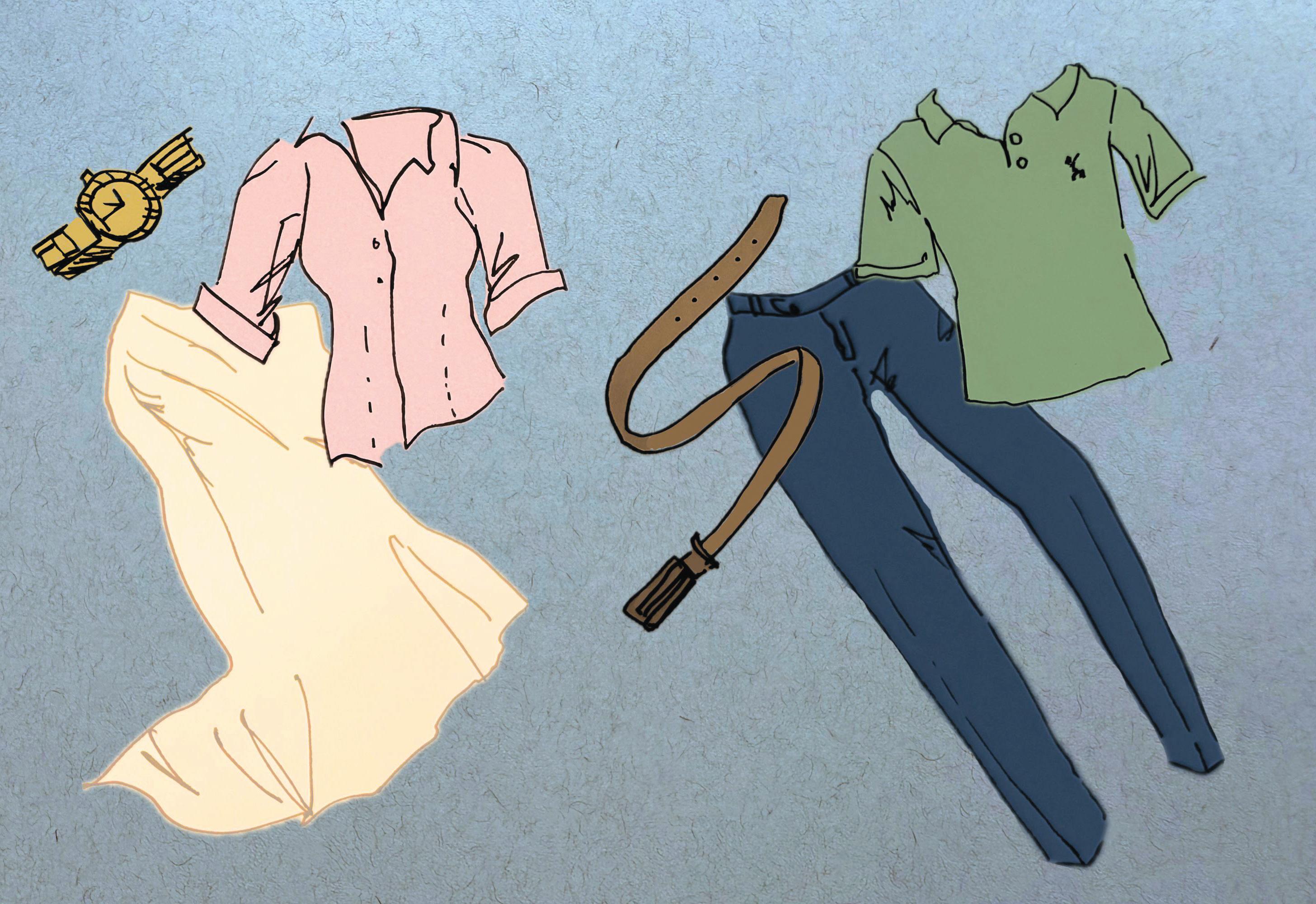


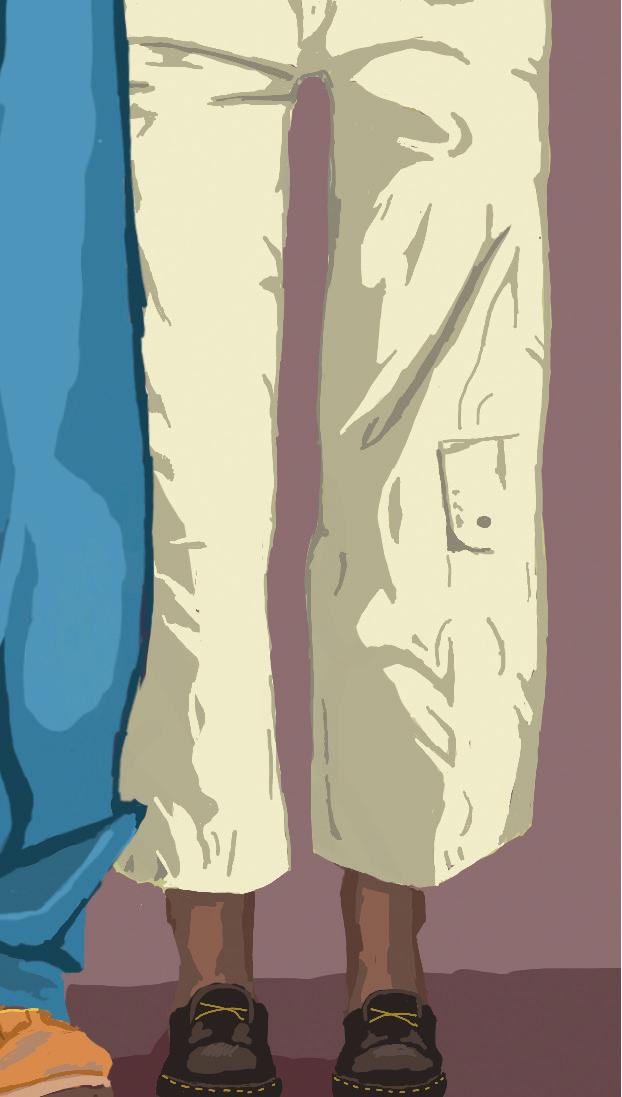
Shaub: I’d say it’s pretty compatible with my personal style. I like to actually wear tan and beige clothing. I think it’s cool that they give us the liberty to wear things like that. I think I’d probably see myself this summer wearing tan chinos with a blue collar shirt or maybe a blue suit jacket, just depending on what I feel once I’m at the internship. It’s definitely nice to not just have to wear a black suit with black pants.




















The Daily: How do you predict you’ll express yourself through clothing while at your internship this summer?




Patricio: I think there’s always a way that you can bring in your own flair into any outfit. I think a good way to do that is through accessories … If I’m wearing an all-white outfit,




bringing in like a touch of color, whether that be in the shoes or even a little necktie or in a nice statement piece belt will always bring together an outfit without doing too much. Also, jewelry is always a good way to bring in your own style into the outfit.

By LOUISE IMBER
Bu er yellow dominated last summer’s color pale e, as seen in Timothée Chalamet’s Givenchy Oscars look and Sabrina Carpenter’s Governors Ball mini dress. But the bu er is quickly melting.
Northwestern students predicted a summer pale e of bold tones, but light blue shone through as the next color of summer.
“Imagine summer, and you see the ocean and the sun,” Weinberg sophomore Emily O’Connor said. “I picked blue for this year because (of) the ocean. Last year’s color was the sun.”
A er New York Fashion Week in September, Pantone released an array of “divergent” colors for its summer 2026 predictions. Among them were Alexandrite, a “quietly glamourous teal,” and Marina, a “calming maritime blue,” synonymous with many students’ opinions. British Vogue released six summer color predictions, two of which are turquoise and sky blue.
But, there is no color consensus yet.
Communication rst-year Nate Kelly predicted the summer color trend would be orange.
“I’m feeling a brighter color,” he said. “We’ve had a gray year here, it’s been a long winter.”
Other students mentioned hot pinks and vibrant greens as standout options. McCormick sophomore Simran Bansal said she thinks turquoise is a contender for the color of summer styles.
“I feel like the bu er yellow started a lot in the media and online, but I haven’t really seen a speci c color come up yet,” she said.
Communication junior Felix Gaddie agreed that light blue is in vogue, but that gray might also have












Alkadee: The most apparent way I could express myself is I’m Muslim, so I wear the hijab. My clothes have to also reflect that in a certain way. Wearing long sleeves, no short skirts or anything like














I think that just wearing something more put together, like some sort of fitted top with a nice sweater or something, just kind of will make me feel more confident when I’m
its moment this summer.
Gaddie said the color of the summer connects to the cultural “mood,” such as hot pink for the Barbie movie in 2023 and chartreuse for “Brat Summer” in 2024.
For Communication rst-year Maddy Peterson, bright or pastel colors will be in.
Peterson said brands inspire the color of the summer. She pointed to pinks and oranges in Starbucks’ new Tropical Butterfly Lemonade Refresher and the skincare brand Good Molecules, whose products are packaged in colors like yellow and green.
“Most retailers and designers don’t want to buck a trend,” Marla Paul, a former Women’s Wear Daily editor and owner of a small business, said. “(Once) a color is declared, you see it everywhere.”
Brands last year rode the yellow train, including Glossier’s banana pudding Balm Dotcom lip balm collab with Magnolia Bakery, and Bose’s bu er yellow speaker, released in mid-2025.
Paul, who used to document fashionable Chicagoans on her Instagram account @ rebellewithmarla, thinks the color of the summer is brown, though she hopes students lean into more vibrant colors, she said.
Just because a color is trending doesn’t mean people will buy it. Many students said they might consider the color but don’t need it to de ne their wardrobes for the summer.
“I don’t think you should necessarily buy something because it’s on trend. I think you should know what looks good on you, know what makes you feel good and buy that.” Paul said. “If you see a color and fall in love with it, I think go for it.”
louiseimber2027@u.northwestern.edu
walking around the office and appear a little bit more mature. I feel like sometimes I have more of a younger face and things like that, so if I want to appear a little bit older and easier to work with in the office, I definitely would try to elevate my style and look a little bit more classy.







The Daily: Do you have a favorite article of clothing or accessory that lets you express yourself while sticking to dress code?































Patricio: I wouldn’t be wearing these in the office, but I do really, really love sunglasses. I always, always wear sunglasses. I actually just started experimenting with glasses in college. They never go out of style, sunglasses, I feel like. I also think they’re the epitome of the summertime, of walking to the office with your glasses on and no one can see you. I do love belts though. I love, love, love belts. I think

you can do so much with a belt, especially with an outfit that’s deemed more basic. I’m definitely a sneakerhead. I’m not like a shoe collector or anything, but I love looking up shoes and what shoes are popular right now. I just feel like sneakers are such an interesting part of the market of the clothing industry, and they’re so specific, and there’s so many types of shoes. I’d say that’s an aspect I get really excited about. For professional settings, I have some, like, nice fitted blouses from Zara that I like to wear under blazers and things like that because they’re also pretty inexpensive. They’re nice to have in multiple different colors. I feel like it kind of helps my outfit be more versatile, but I can still pair it with the same dress pants or something and make them different



s.mckenney@dailynorthwestern.com


By CHRISTINA LIN and WALLIS ROGIN
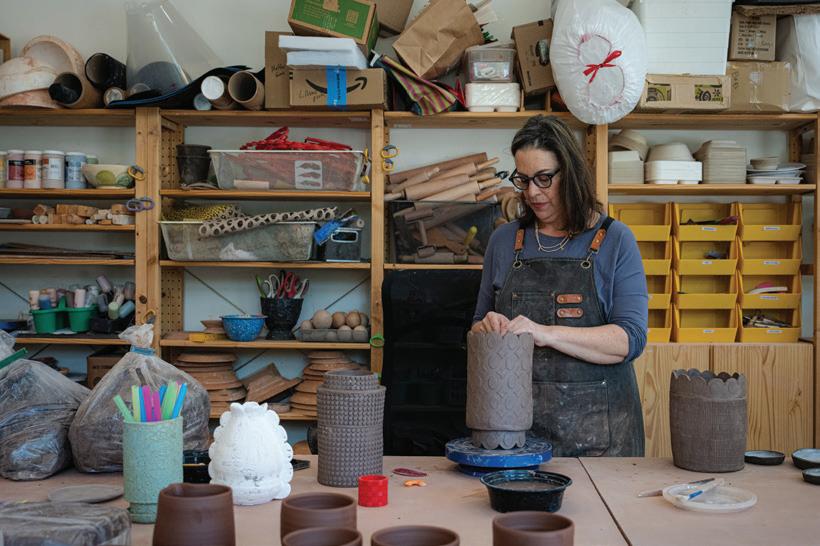
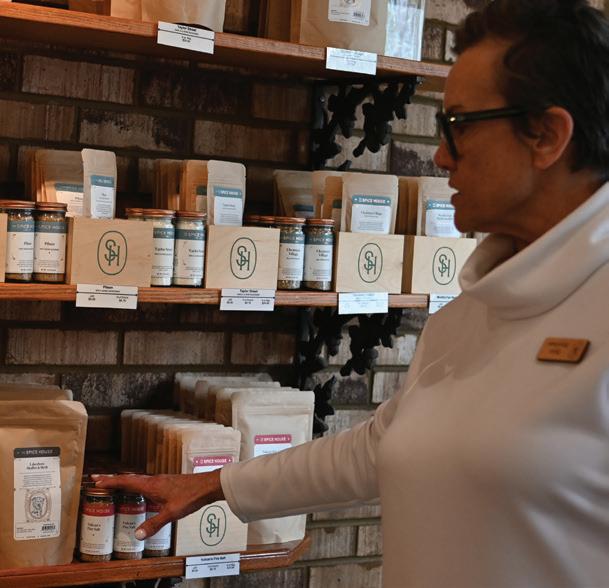
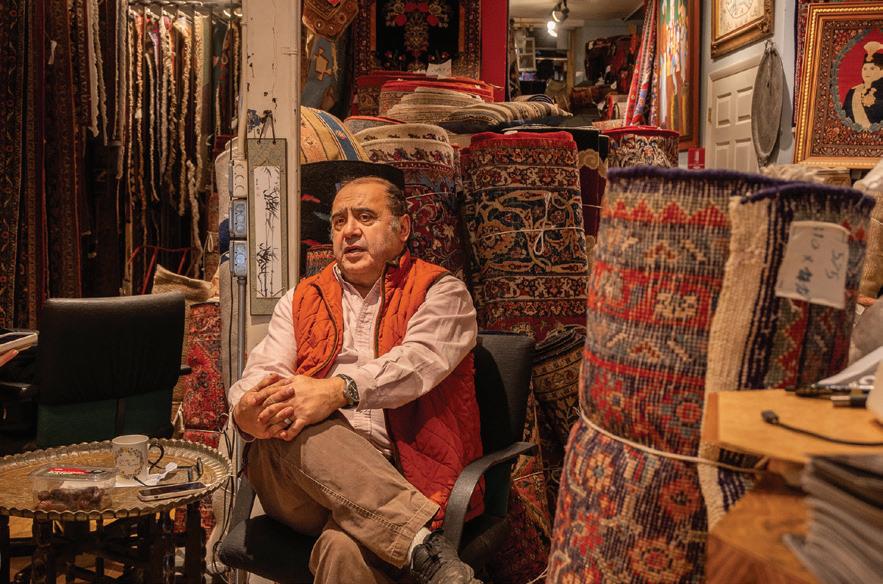
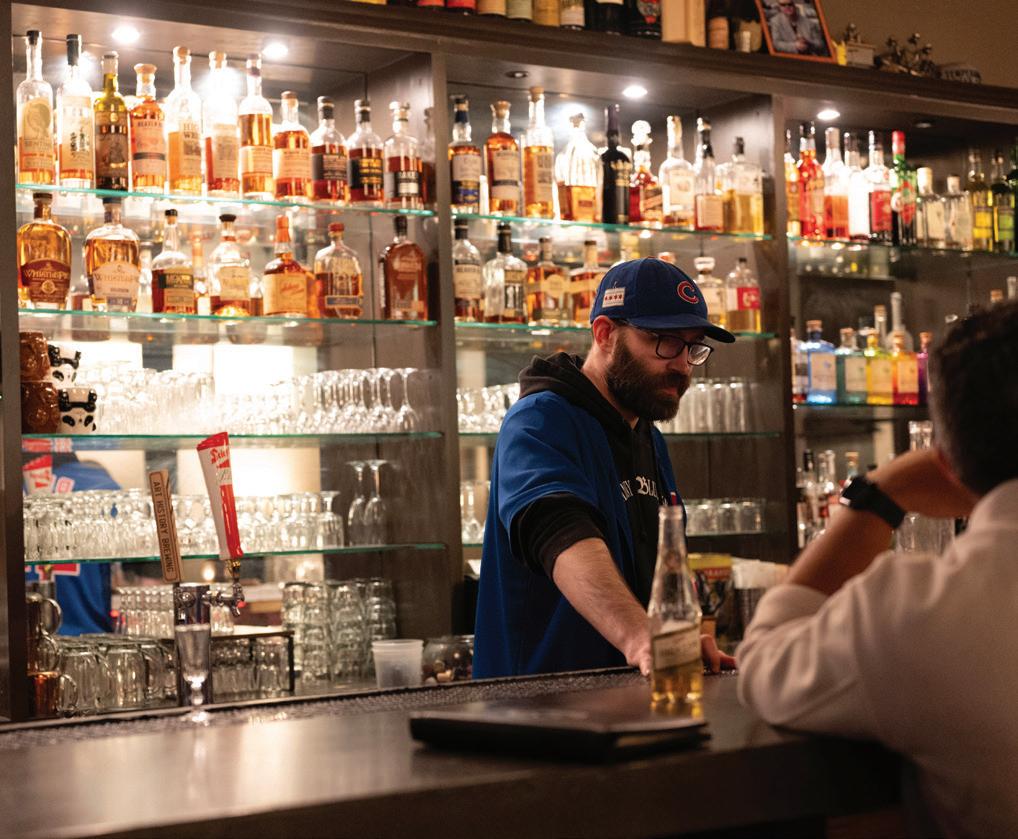
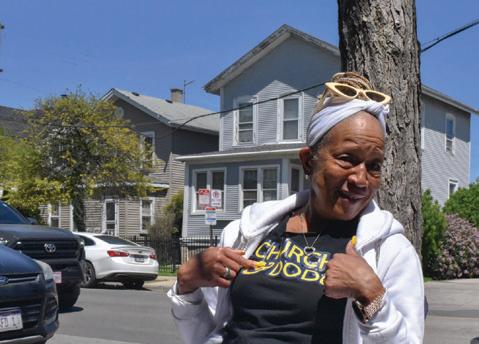
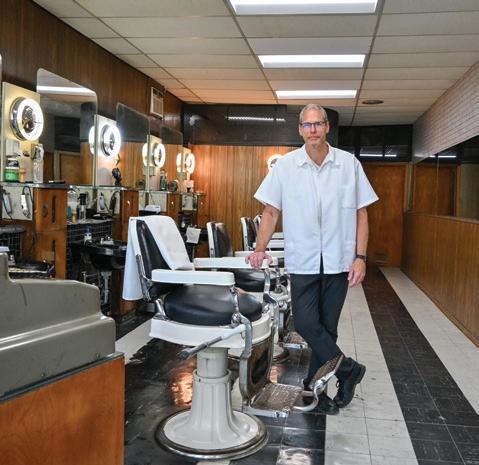
Evanston is home to 10 business districts, each with its own history, culture and trade. With a team of 18 reporters and photographers, we spent time exploring each district and telling their stories through the sights and sounds that fill them.
These business districts emerged from a medley of histories. Kris Hartzell, director of facilities, visitor services and collections at the Evanston History Center, said Evanston did not always look like it does now.
“What a lot of people don’t know is that Evanston, as it stands today, is essentially the combination of three tons,” she said.
They were known as North Evanston, South Evanston and Evanston before combining.
Hartzell said each town had its own retail hub, which became Evanston’s first three business
districts: Central Street, Downtown Evanston and Main Street — which is now part of MainDempster Mile.
“They sprang from three separate communities, and they were based on train stops because of transit-oriented shopping,” Hartzell said.
“That’s how they developed beyond that.”
Over time, the city developed into the nine wards and 10 business districts as it stands today.
Many of the city’s retail hubs fall near stops of the Chicago Transit Authority’s Purple Line or the Metra’s Union Pacific North Line. Many of our reporters took these lines to discover the stories that shape these areas.
As communities grew, so did the city’s business districts, creating the landscape of stories Evanston knows today. From local barbers to rug collectors to residents, here is part of each district’s story.
c.lin@dailynorthwestern.com w.rogin@dailynorthwestern.com













IVY
FRATER
COLUMNIST
The best thing I’ve ever done is surround myself with people who love to dance.
My first-year friends have never said “no” to a karaoke song. They always dutifully sway along to my off-key rendition of The Cranberries’ “Linger” and will twirl and skip and frolic at the drop of a hat. I will sometimes start singing softly and no matter what — whether it be on a trek down Sheridan Road or in the lobby of Main Library — someone will always join in.
We love each other loudly. We jump up and down whenever we see each other, whether it’s the first time in a month or the fifth time in a day. My friends not only go along with my odd ideas, but are active participants.
When I told my friends I wanted to have a Marriage Pact party, where we invited all of our matches from the site that tells you who your most compatible person on this campus is, they didn’t look at me like I was crazy. Instead, Josie looked up all of their numbers in Northwestern’s student
directory and Esha helped me draft a parody of a frat text inviting them all to my dorm.
When I told them about the Fizz propaganda I posted about my obsession with the all-male a cappella group Asterik, Iliana hired them to serenade me for my birthday.
When I discovered that the rapper Thirteendegrees was coming to NU to perform at a frat house, Maddy and I decided to pretend to be superfans and taped a “1” on her shirt and a “3” on mine. We then convinced someone that we had a friend wearing “2,” and sent him off to search for this nonexistent member of our trio.
For my birthday, my friends Ella and Andrew wrote and performed an eight minute long original musical inspired by my life. It is the best gift I have ever received.
I feel blessed every day to be loved, not in a superficial way, but deeply enough that I feel like my full self when I’m with them. My friends inspire me to be a better person.
My whole life, I was quiet. When I performed in a middle school production of “Pitch Perfect,” I was cast as the one girl whose entire personality is her soft voice, and I think that pretty much summed it up. My teachers would tell me to speak up at least twice a day and no one really knew anything about me, aside from the fact that I was “smart.”
In high school, I lived in a constant state of
fear of embarrassment. Everything felt mortifying — each awkward hallway interaction and time my stomach rumbled in a silent classroom felt like a bullet.
I was constantly trying to prove to myself that I was special in some way, that I felt out of place because I was smarter or more perceptive than everyone else around me. It wasn’t because I fundamentally didn’t belong, but because I could never get over the constant insecurity that engulfed me.
Coming to NU was like tasting freedom. I was reborn into the most outgoing version of myself because I was surrounded by people who felt like me.
I now go out of my way to embarrass myself. Sometimes I will purposefully post slightly bad photos of myself on my Instagram in a pursuit I call exposure therapy. On Dillo Day, Esha and I went up to every random tall skinny blonde man we saw and asked if they were Malcolm Todd.
My friend Cami and I recently signed up for a cup pong tournament, where we dressed in matching outfits and battle paint, and loudly cheered and performed our secret handshake whenever we scored a point.
Life is so freeing when you allow yourself to be a little bit weird. I spent so much time regretting the things I didn’t do, but what a
privilege it is to regret the things I did. I am absolutely heartbroken that freshman year is coming to an end. I don’t know what I am going to do without the late night conversations with my roommate, which always start with a “Wait, one more thing!” and spiral out into hours of chatter and laughter. I’m already feeling deprived of dropping first and last names in the dining hall. I’m sad that my days of petty theft from frat houses and cramming 50 people into my dorm are almost over. But I am endlessly grateful to have found people who feel like home. I now live a life full of joy and whimsy and am never going back. Perhaps we can walk it back next year.
Ivy Frater is a Medill first-year and author of “Joke Walk.” She can be contacted at i.frater@ dailynorthwestern.com. If you would like to respond publicly to this op-ed, send a Letter to the Editor to opinion@dailynorthwestern.com. The views expressed in this piece do not necessarily reflect the views of all staff members of The Daily Northwestern.

The days before Dillo Day were a whirl of wristbands and curling irons, ripped packages and early bedtimes. Mayfest posts and Fizz comments flooded our phones as the whole university waited with bated breath for the biggest day of the year.
For the past several months, Dillo was the singular event I looked forward to the most. As a first-year, the hype around Dillo started before I even set foot on campus last fall — I remember assuming it must be a lie that Kendrick Lamar once performed at Northwestern and felt astounded when I Googled for proof.
Dillo undoubtedly brought the school to life. The Lakefill, usually devoid of students, exploded with color and sound, the pulsing synth like a heartbeat. But the truth is,
Dillo wasn’t quite the euphoric experience I expected. There were moments of elation. But there were also painful shoes and bathroom lines.
I thought the performers sounded great. The festival itself was put together impressively by Mayfest. But the concerts often felt like a test I didn’t study for.
I felt occasional satisfaction upon getting a lyric right, but for the most part, I was just bobbing along, craning my neck for infrequent glimpses of the artists through the hordes of screaming, sweat-dripping students clad in leather and spandex. My knee-high boots kept sticking to my calves.
As I watched the performers flit from view from between raised arms and cellphones recording videos, I came to the disconcerting conclusion that the best parts of Dillo didn’t actually come from the festivities.
There were definitely moments during the concerts when I experienced the emotional high I’d spent the prior months chasing. I felt
that transcendence when the crowd moshed to Malcolm Todd’s “Sweet Boy,” orange fireworks emerging from behind the stage. Shouting the lyrics as Daya performed “Hide Away” also made for a welcome throwback.
But for the most part, the highlights of Dillo came from the trivial moments that I could have experienced any other day. Like perfecting an 8 a.m. smoky eye, greeting strangers and laughing at their reactions, sipping Sprite Cherry and watching the golden hour sunlight outline the Lakefill.
I find this to be the case with most major events — holidays, birthdays, trips, graduations. I expect to wake up as a different person on these days, to feel something transformative enough to warrant the months of anticipation. Only something as fantastic as an extraterrestrial encounter would meet my inflated expectations.
However, the truth is that I’m only marginally happier during big events as opposed to an average day. The parts that bring me the most
joy often aren’t the parts I hyped up. But whether or not Dillo lived up to the excitement isn’t as relevant of a question as people make it out to be. It often doesn’t matter if an event was “worth the hype.” Excitement isn’t like currency. It isn’t a trade-off, and people don’t lose anything by feeling it. Next year I’ll plan my outfit just as meticulously and check for Mayfest announcements just as steadfastly, because the anticipation is a source of pleasure in itself. Even if the simple moments, not the event as a whole, end up being what makes it worthwhile.
I’ll ditch the boots next year, though.
Allie Deutsch is a Medill first-year and author of “Two Cents.” She can be contacted at a.deutsch@ dailynorthwestern.com. If you would like to respond publicly to this op-ed, send a Letter to the Editor to opinion@dailynorthwestern.com. The views expressed in this piece do not necessarily reflect the views of all staff members of The Daily Northwestern.
What kind of Asian girl are you? Are you the Key Club President? An “Asian baby girl?” Maybe a Wasian Princess? A dragon lady? A bad Asian? A good Asian?
Earlier this May, three San Francisco tech workers hosted an “ABG / ABB maxxing event” where attendees were taught how to become an Asian baby girl or boy through “makeup tips, gaming the system, looksmaxxing, GRWM, mak(ing) abg content, X/ Twitter farming.” Of these tech workers, two have made content on being an “ABG” and how to use it as a marketing tool.
To preface — I am not an “ABG.” Far from it. I can barely do eyeliner and with my low pain tolerance, I’m probably never getting a tattoo. Jumping in on this conversation might be a “Bro thinks he’s on the team” moment, but I hope my Molly Tea addiction can count for something.
For most people, the acronym “ABG” has become synonymous with “hot Asian girl.” Some might believe it stands for “Asian baby girl,” or one of those Asian girls who loves raves and boba.
None of these interpretations are accurate to its actual history. The term was first coined in the 1980s to describe women in Asian American gangs and originally stood for “Asian baby gangsters.” While the origins of “ABG” subculture are unclear, scholars have attributed its creation to Asian American women in California. “ABGs” were often characterized as the rebels of the Asian American community, vaping and bleaching their hair blonde. Eventually, the term gained popularity online, moving away from its origins in gang culture and becoming the term most are familiar with today.
Words and meanings change — that’s a normal part of life. So, why does any of this even matter? Why do Asian baby girl chief marketing officers piss me off? In other words, why do “ABG” CMOs PMO when I could probably just scroll and move on with my day?
Recognizing all of this on top of the intense scrutiny women experience in any position of leadership (especially in the tech industry), it seems ignorant to contribute to this objectification for whatever gain — personal or professional.
One of the organizers of the “ABG / ABB maxxing event,” Katie Chen, has since released a video on X in which she refused to apologize for her actions and called the “ABG” meetup a “lighthearted event.” It’s quite fitting, honestly, for someone who has “ragebaiting” listed as one of her top skills on LinkedIn.
Perhaps I have fallen for the bait. But to commodify yourself, your identity and your community for clout and views is just irresponsible.
If you’ve ever watched “Full Metal Jacket,” you might remember the Vietnamese sex worker who delivered the lines: “Me so horny / Me love you long time.” Even if you’re not on Letterboxd, you’re probably online enough to have seen “Oxford study” comments or memes about “ABGs.” And there are plenty of Discord mods out there with a disturbing amount of anime merch. The objectification and fetishization of Asian women is not a hidden secret.
When Asian women then play into it themselves, through “ABG” meetups like this one, people are thus enabled to perpetuate the sexualization of Asian women through artificial intelligence pipelines like ABG CMO, which generates a “hyper-realistic persona” of an “ABG” to copy viral “user generated content.” The developer of ABG CMO, David Im, even built an AI persona
of an aspiring K-pop idol Asian girlfriend who sends photos from her day and calls you “when you need her.”
Despite my own misgivings about the “ABG” meetup, I do not defend the mockery of the organizer’s appearances by calling them “chopped” and such. Beauty is not a sign of morality.
I do understand — if any of what I’m speculating might be true — the desire to break out of the mold forced upon you. As somewhat of a former “Key Club Asian” myself, I spent high school dying my hair, sporting smoky makeup and threatening to study art instead of medicine just to scare my parents. I was desperate to become the worst Asian, because once I did, maybe I wouldn’t be defined by these stereotypes anymore.
Others, like these “ABG-maxxers,” might take another route. But to brush aside the consequences and implications of events like these for the broader Asian American diaspora is thoughtless. None of your actions exist in a vacuum.
We might all be pretending in one part of our lives or another — to be something or someone we are not — whether because we’re not happy with ourselves, or some other reason we have yet to admit or accept.
So you might not be an “ABG.” That’s OK. Start with being YOU.
Katareena Roska is a Medill sophomore. She can be contacted at katareenaroska2028@u.northwestern. edu. If you would like to respond publicly to this op-ed, send a Letter to the Editor to opinion@dailynorthwestern.com. The views expressed in this piece do not necessarily reflect the views of all staff members of The Daily Northwestern.
LETTERS
Editor
Creative
By ASHLEY DONG assistant data visualizations editor
Evan Hirschensohn loved being a Wildcat.
The political science and international studies major was a Peer Adviser for Wildcat Welcome and a member of the a cappella group Extreme Measures.
Hirschensohn, 21, died on April 22 after a nearly two-year battle with cancer.
“Evan genuinely brought light to everyone he met,” Weinberg junior Emani Larkin, one of his close friends, said.
Ever since he was little, Evan wanted to make a difference in the world, Kelly Hirschensohn, Evan’s mother, said. Even before he was diagnosed with cancer, he volunteered for Relay For Life, an organization partnered with the American Cancer Society that is dedicated to ending cancer.
He also volunteered with Tomorrow’s Rainbow, a children’s grief program that utilizes equine-assisted psychotherapy.
As he recovered from his first bout with cancer in the summer of 2025, he also interned with the Palm Beach County Board of County Commissioners, researching issues with water storage and food insecurity.
“He was very passionate about doing the right thing on a global scale,” Kelly Hirschensohn said.
‘An extraordinary human being’
Weinberg junior Eliza Marcus said she met Evan through Instagram before they arrived on campus.
After three years of friendship, she remains in awe of his emotional intelligence.
“He knew how to make people feel seen and heard and loved, and I think he was very wise in a way that a lot of 20 year olds aren’t,” Marcus said.
Weinberg Prof. Danielle Gilbert got to know Evan when he was in her class in Fall Quarter. He had recently switched from physics to the political science major and had many questions about her research and career, she said.
“It became quite obvious to me, over the course of those conversations, just what an extraordinary human being he was,” Gilbert said. “He was faced with the rawest deal anyone could have, yet I never saw him being anything less than grateful, enthusiastic and optimistic about his future and his community.”
‘He was so confidently himself’
Evan received his first cancer diagnosis during Thanksgiving Break 2024, and was told the same day that doctors would likely have to amputate his left arm.
His specific diagnosis was an extra-axial chordoma, an extremely rare form of cancer. Chordomas usually appear in the central nervous system, but Evan’s first appeared in his arm as a “poorly differentiated” tumor, which meant it was gel-like and harder to detect.
In March 2025, his left arm was amputated. For the last year of his life, Evan lived with a prosthetic, which was heavy to wear and required a steep learning curve. In an interview conducted in late January, Evan compared the process of learning how to operate the prosthetic to learning a new language.
“When I went back to school in the fall, I was scared that I would drop my plate as I was walking to my seat, and I think I did. I spilled a cup a few times,” Evan said with a laugh.
Sarah Hirschensohn, Evan’s sister, said she’d always admired Evan and looked up to him, despite being four years older.
“Personally, I would have been in the house all day, scared to go out,” Sarah Hirschensohn said. “But he was so confidently himself, making jokes about not having an arm.”
For Halloween, Evan dressed up as Bethany Hamilton, a professional surfer who lost her arm in a shark attack. He donned a blond wig and doused his arm stump in fake blood.
Reflecting on Evan’s enthusiasm for new experiences and living life to its fullest, his family shared a quote that they feel represents Evan well, which he also used in a TikTok video in 2024: “I didn’t wish for an easy life; I wished for a wild story to tell.”
‘I need to use my story’
In 2024, shortly after he received his first diagnosis, Evan started a fundraising campaign page for the National Pediatric Cancer Foundation. With his birthday approaching in December, he asked all his friends and family to donate to the cause in lieu of a gift.
Since being diagnosed, Evan doubled down on his mission to help others with cancer.
“I’ve become more and more in tune with the fact that I have unfinished business in this life,” Evan said in January. “I need to use my story to actually make a difference.”
He surpassed his goal of $15,000 and, at the time of
publication, raised more than $17,300. The foundation, awed by his gift, reached out to personally thank him.
At a regular check-up during Thanksgiving Break 2025, Evan found out that the cancer had metastasized to his lung and brain. He started a second birthday fundraising page, this time for the Nicklaus Children’s Hospital in Miami, where he received treatment. At the time of publication, his page has raised over $15,600.
When he passed in April, his family started a page in his honor for the Chordoma Foundation, which is dedicated to funding research for Evan’s specific type of cancer. There, the Hirschensohns have raised more than $27,800 at the time of publication.
A funeral and a celebration of life happened in Evan’s hometown of Boca Raton, Florida, in late April, and several of Evan’s friends from NU attended. Sarah Hirschensohn said these events were “filled with such love and light.”
Larkin, Evan’s close friend at NU, helped plan an on-campus memorial for Evan’s friends and family, which happened on May 3. Attendees wrote messages to Evan on lanterns and painted a rock by the Lakefill in his honor, with the message “Live Like Evan.”
According to Kelly Hirschensohn, Evan said his happy place was on the Lakefill, sitting on a bench and looking across the lake at the Chicago skyline.
Two days before Evan’s final hospitalization in March, he gave a speech for a Relay for Life event at his high school alma mater, North Broward Preparatory School.
“Cancer may have weakened my body, but it
strengthened my spirit, and I will always have gratitude for that,” Evan said in his speech.
Due to medical leave, Evan was only on campus for five quarters out of the nine he spent as an NU student. But, even when he was stuck in a hospital bed in Florida, Evan itched to return to school.
“He wanted so badly to travel abroad and go to London,” Sarah Hirschensohn said. “He was filling out applications in the hospital.”
‘His heart and mind were still fighting’ Weinberg junior Noah Padilla, Evan’s close friend and roommate, visited Evan in his final weeks. Padilla has dealt with a rare chronic illness his entire life, so the two supported each other in their health struggles.
“Even when his body was declining, his heart and his mind were still fighting for the people that he loved and for the life that he wanted to live,” Padilla said. “That is something I will carry for the rest of my life.”
Even in his final days, Evan remained focused on the positive impact he could have on his community.
“Time is the only currency that is valued in how much you spend, not how much you save, and I want to spend that time trying to leave this world in a better state than I found it in,” Evan said in his speech. “It doesn’t matter what happens to me tomorrow if I’m fulfilling my purpose today.”
a.dong@dailynorthwestern.com
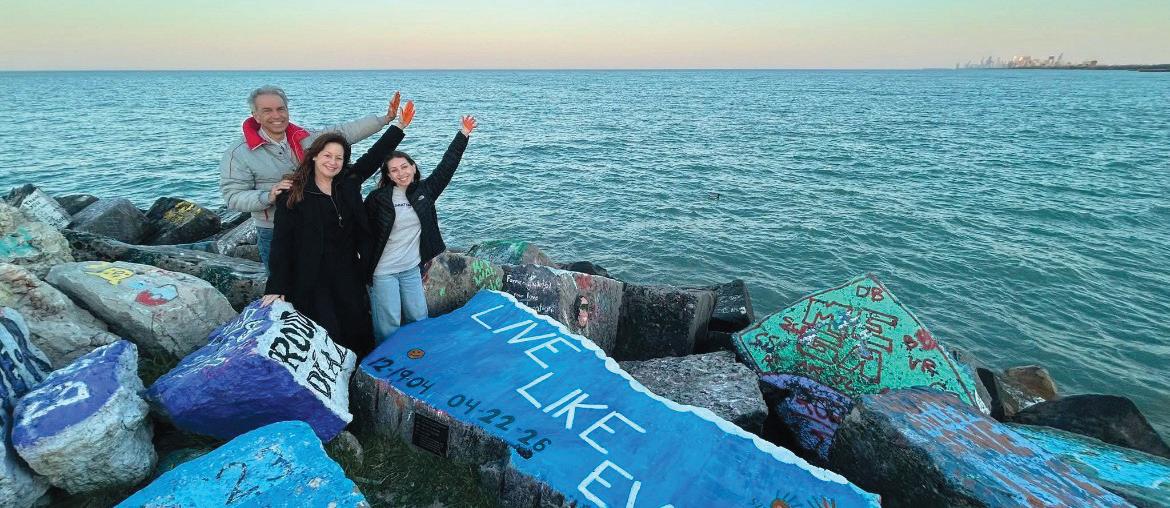





By LUCAS KUBOVCHIK illustrations editor
International students expressed concerns as Purdue President Mung Chiang prepares to assume his role as Northwestern’s next president July 1, citing an alleged policy limiting international student admissions during his time at Purdue.
In late 2025 and early 2026, articles from the scholarly journal Science, e Lafaye e Journal & Courier and Forbes alleged Purdue had an unwri en policy to limit the admission of international students from China and other countries the university deemed “adversarial” under Chiang’s leadership.
Purdue denied ever having such a policy in a March statement, according to e Purdue Exponent, a student-run newspaper covering Purdue and the surrounding community.
An international undergraduate student from China, who requested anonymity due to fear of retaliation from the University, said she and a fellow international student from China were initially hopeful when they heard the news of Chiang’s appointment.
Chiang was also an international student, moving from Hong Kong to the U.S. at 18 years old to pursue higher education at Stanford University.
“We later learned that he actually has some policies that are not really great for Chinese students, especially during his employment at Purdue University,” she said, referencing Purdue’s alleged policy under Chiang’s leadership.
She said many of her high school classmates in China who had been accepted into more competitive universities were rejected from Purdue.
e student said she fears Chiang’s appointment could mean a smaller
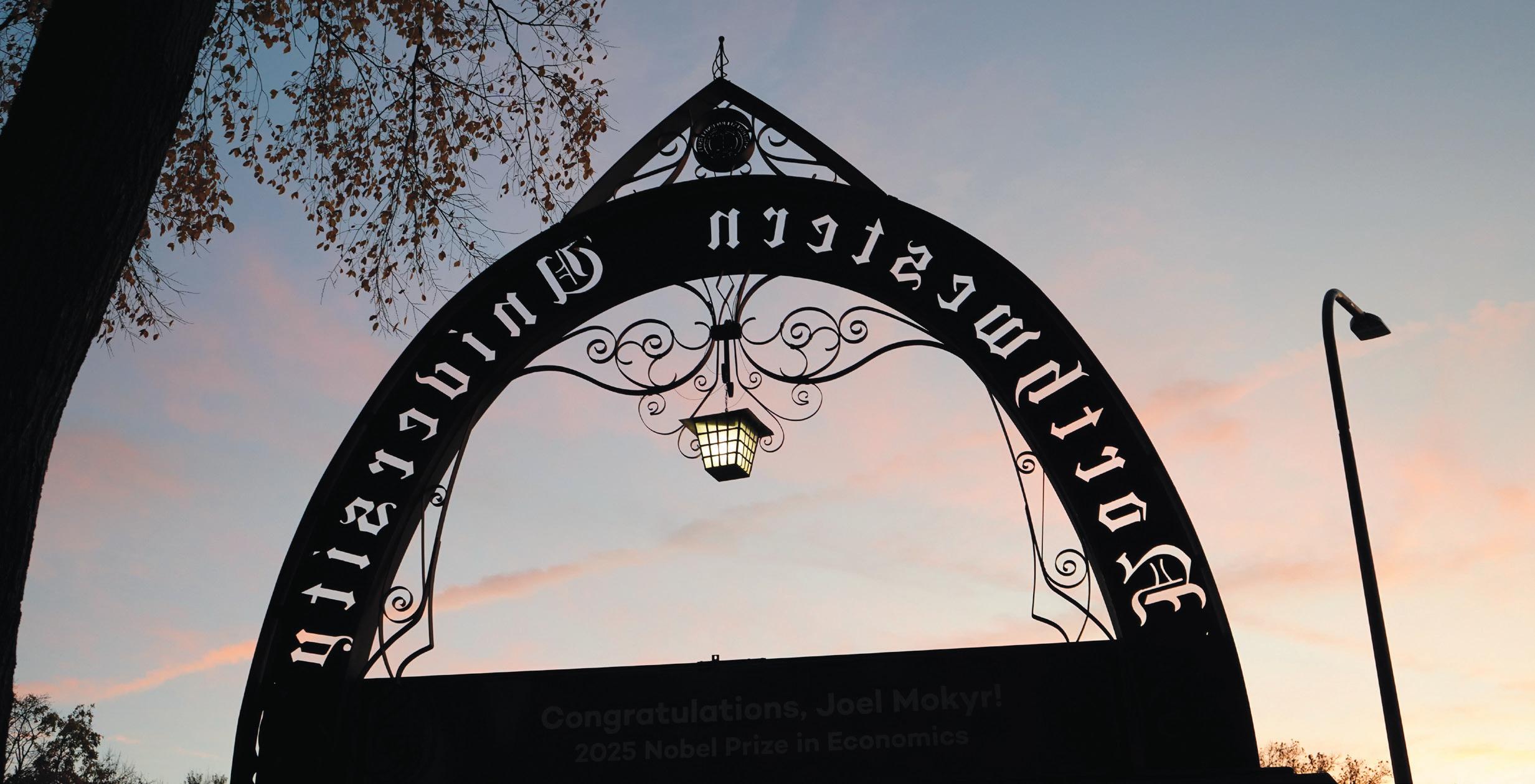
community of Chinese students at NU.
Currently, some international students already have di culties nding a sense of community among their American, English-speaking counterparts, she said.
An anonymous undergraduate student from Russia, who requested anonymity due to fear of retaliation from NU, said she was initially excited for Chiang to be the University’s rst Asian American president.
For many international students, she
said, NU is an appealing choice due to its reputation for diversity and academic rigour.
“It was always a hub for all the diverse backgrounds, ethnicities and religions, and they were generally trying to judge us based on intellectual curiosity,” the student said.
While she said she would avoid drawing conclusions regarding the future of NU’s administration under Chiang, the student said the application of a
University policy which limits the number of accepted international applicants could impact their perception of NU as an institution that welcomes international minds.
Another international student from China, who also requested anonymity due to fear of retaliation from NU, expressed doubt about Chiang’s future at NU.
She said she is still trying to understand why Chiang would allegedly restrict international student admissions while previously being an international student.
“He’s not only born in China, he’s raised in China,” she said.
She said she hopes the NU community will voice support for international students in case the University implements policies impacting international acceptances under Chiang.
Regarding Chiang’s future policies toward international students at NU, she said she’s “not very optimistic.”
l.kubovchik@dailynorthwestern.com
By Ma hew Manacek


By MAX TURETZKY assistant city editor
Veterans laid wreaths at the flagpole in Fountain Square, and members of American Legion Post 42 fired a three-volley salute, as Evanston honored fallen soldiers at its annual Memorial Day commemoration.
The Monday morning ceremony brought together veterans in service caps, community members and local politicians.
Mayor Daniel Biss delivered a brief address urging residents to reflect on the meaning of sacrifice and civic responsibility, saying service members who died did so for “something sacred.”
“They did it for the idea of this country, a country founded on an idea and a principle — something relatively unique in this world’s history — not uniting us by a race, by a religion, by an ethnicity,” Biss said.
He praised democracy as “beautiful, magical and sacred” and called on attendees to set aside political divisions to honor fallen soldiers.
Evanston resident Mary Maher said she attended the ceremony to honor her parents’ “spirit of civic leadership.” Her father served in the Navy for two years and worked for the IRS, she said.
“We don’t just have all these freedoms, liberty and a functioning society without the people who protected those rights,” Maher said. “We are all civil servants, and if we’re gonna create a good society, we have to give back to society.”
Some of the oldest veterans in attendance had served during the Vietnam War, and the youngest had served in Afghanistan. By a show of hands, none served during World War II or the Korean War.
Jim Farley, the finance officer at Post 42, said the number of veterans attending Evanston’s Memorial Day events has dwindled in recent years, but the crowds at the annual observance have grown larger and more diverse.
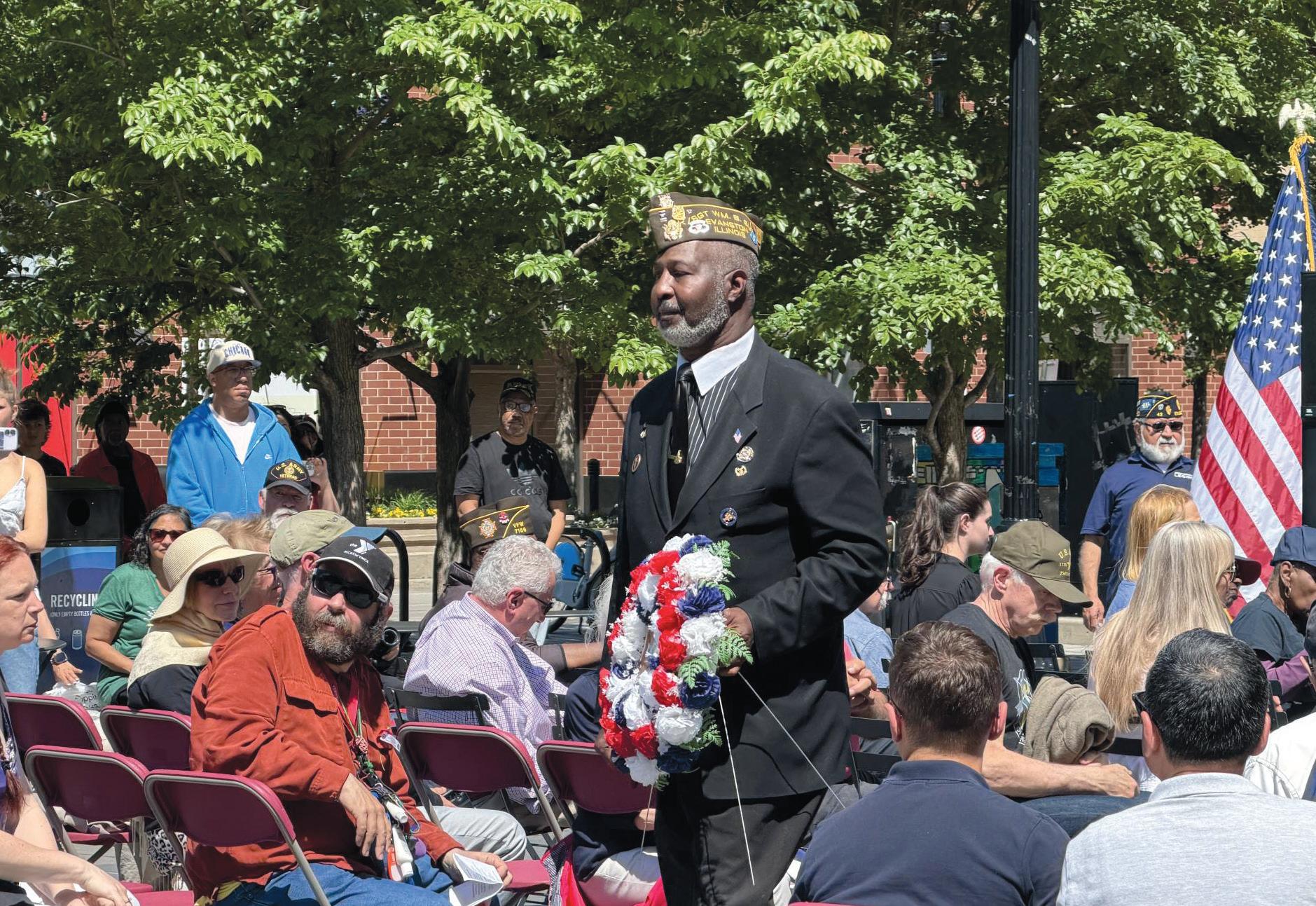
He attributed the shrinking veteran presence to the end of the draft, which permanently reduced the size of the military. World War II veterans, he said, have stopped coming within recent years, as the youngest surviving veterans are now in their late 90s and early 100s.
Ald. Matt Rodgers (8th) told The Daily that Post 42, which organized the Memorial
“I think people are generally more aware today,” Farley, who served from 1968 to 1971 and has lived in Evanston for more than 40 years, said. “The pain of Vietnam has worn off. It was a very unpopular war then, and many of the soldiers that returned from Vietnam were not treated well.”
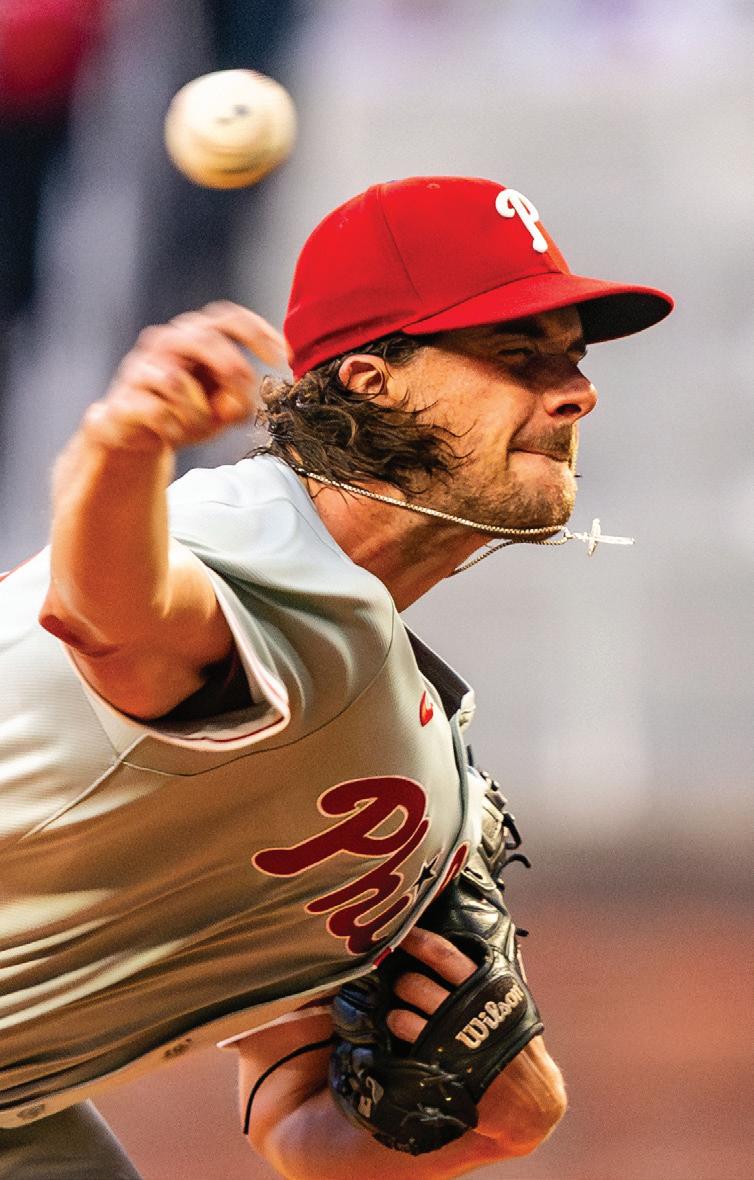
Day celebration alongside the city, has been an important resource for veterans returning from overseas.
“Somebody who’s been in war can come and tell me a story, but I’ve never experienced that,” Rodgers said. “I think it’s important that they can have a place where they can share those stories and build that camaraderie.”
Rodgers said this year’s Memorial Day is particularly significant because of the 250th


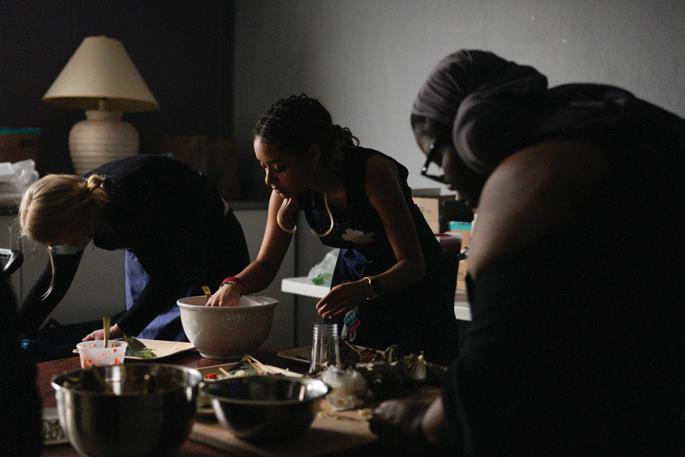

anniversary of the Declaration of Independence this July.
“(This year) is really a chance for us to sit and look at the people who have made this sacrifice so that we can be here 250 years later,” Rodgers said. “It’s important for us to reflect on that and think about what they’ve done and how their families have changed.”
m.turetzky@dailynorthwestern.com



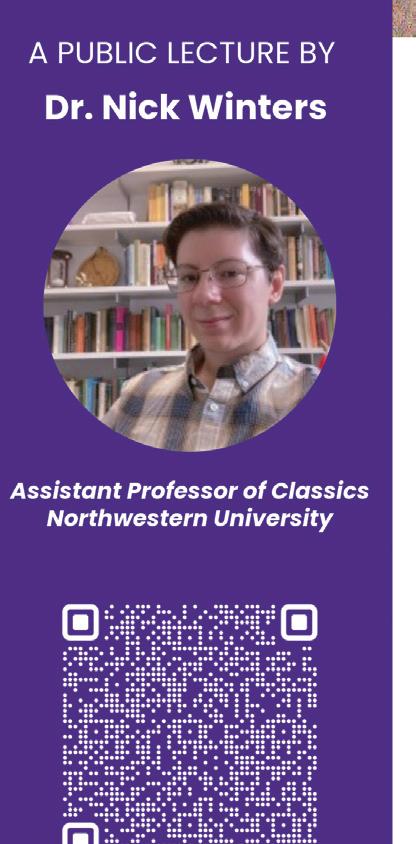

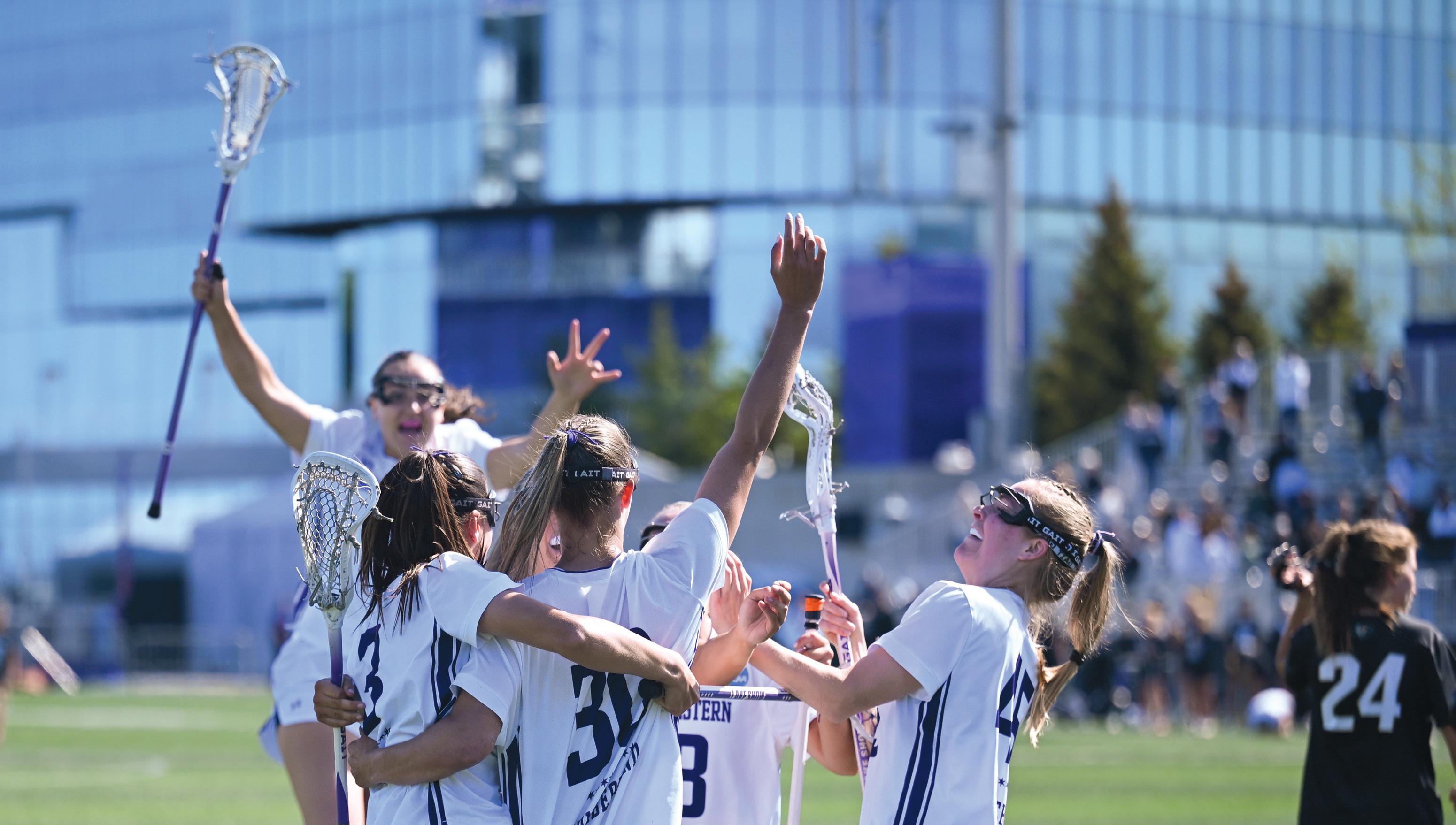
LACROSSE
From page 1
before it was reversed once again.
e ’Cats scored twice more — the second of which was Taylor’s lone goal — to extend their lead to 14-11. Taylor leaves NU with 483 career points, tying former teammate Izzy Scane for the program record. As the nal buzzer sounded, Taylor ocially bookended her career with national championships.
“I don’t know what else is be er than that,” she said postgame Sunday. “ at was like an ending that you would see in a movie, but it just happened in real life.”
On top of the seniors winning it all for the second time, Amonte Hiller etched her name further into history, as she now stands alone as the winningest coach in NCAA Championship history with nine titles.
e win once again showed the might of Midwest lacrosse, and will hopefully inspire young fans in a endance to play at a high level, Amonte Hiller said.
“ is game is universal,” she said. “You can be any shape, any size, and you can do well. And I think that’s the thing that I love about this game the most, you can be from anywhere.”
Northwestern found itself in a familiar position Sunday morning.
For the fourth straight season, the ’Cats were playing in the national championship. A er winning it all in 2023, NU came up empty handed the following two seasons. e powerhouse program, boasting eight titles, was looking to get back to its winning
By YONI ZACKS newsle er editor


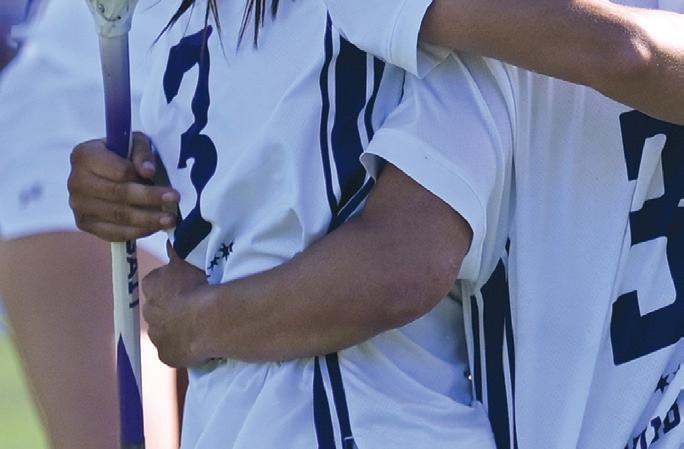
ways.
As the Wildcats (19-3, 7-1 Big Ten) trailed North Carolina 11-9 entering the fourth quarter, the possibility of coming up short once again loomed large. But despite momentum and recent history stacked against NU, the team possessed a unique upper hand: home eld advantage.














With Lake Show faithful packed into Martin Stadium, the ’Cats scored ve unanswered goals, beating the Tar Heels (19-2, 10-0 ACC) 14-11 to secure the program’s ninth national championship. NU avenged its loss to North Carolina in last year’s nal game and became the first team since Maryland in 1986 to win the title on its home turf.





“ is was something special for our team, for our program, for our university,” coach Kelly Amonte Hiller said postgame Sunday. “I am literally so grateful that (Athletic Director) Mark Jackson brought this to the Midwest.” sta for approval.




Despite a dreary start to the morning in Evanston, the sun escaped from the clouds, beckoning 8,316 fans to the shores of Lake Michigan for the nal game of the lacrosse season. It’s the all-time highest a endance mark for a ’Cats

North Carolina a acker Chloe Humphrey wound up to take a shot. e game was tied 11-11, and any goal had the chance to completely shi the momentum of the game. Humphrey, who was later named the NCAA Tournament’s Most Outstanding Player, had been quiet most of the day. Northwestern’s defense held her to just two goals up to that point, a er she averaged more than ve per game entering Sunday’s contest. is moment, however, seemed likely to give Humphrey the hat trick and the Tar Heels (19-2, 10-0 ACC) a lead with just over nine and a half minutes to go. She weaved through the defense, aimed for the goal and red. Enter graduate student goalkeeper Jenika Cuocco. Cuocco, a second-team IWLCA All-American,


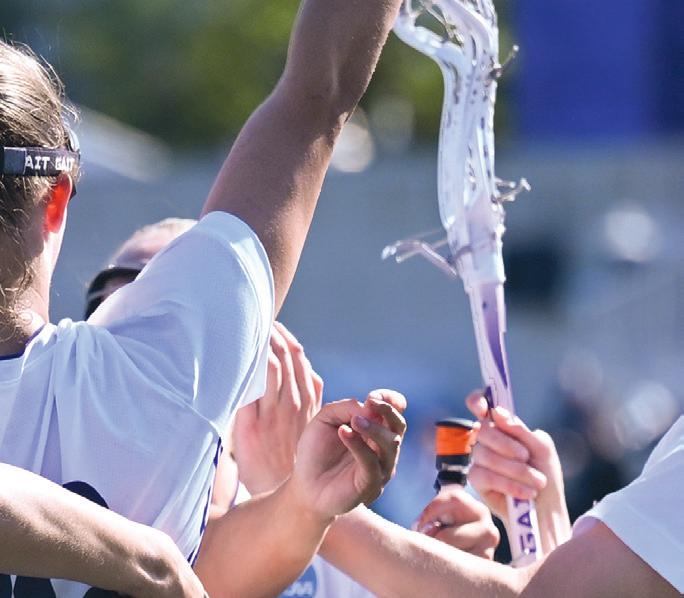
women’s sporting event.
Amonte Hiller applauded the in-person support, saying, “ e student section, are you kidding me?”
“I’ve never been in a situation where we’ve had the most fans,” she said. “I know that was a huge asset to us. eir energy carried us, and I’m just so grateful for them






mances didn’t exactly match the hype. Taylor scored one goal but tied former NU legend Hannah Nielsen’s title-game record with six assists, while Humphrey tallied two goals on 11 shots.


Leading the o ensive charge in Taylor’s place was freshman a acker Gabriella McCollester, who entered Sunday’s game with six career goals. She scored a game-high four goals, including the game-tying fourth-quarter score, while lling in for senior a acker Lucy Munro, who exited the game with an injury in the rst quarter.


Taylor assisted on two of McCollester’s goals and said she was unsurprised by her teammate’s impact.


Despite the two-goal swing, the ’Cats trailed entering the fourth quarter. Slowly but surely, they churned out goals while the defense limited North Carolina’s No. 1 scoring o ense. A er sophomore a acker Aditi Foster put NU ahead for the rst time since the second quarter, Tar Heels a acker Caroline Godine seemed to nd the equalizing goal before it was reversed once again. e ’Cats scored twice more — the second of which was Taylor’s lone goal — to extend their lead to 14-11. Taylor leaves NU with 483 career points, tying former teammate Izzy Scane for the program record. As the nal buzzer sounded, Taylor ocially bookended her career with national championships.
“Gaby just came in and stepped up, but I knew she was capable of that,” Taylor said postgame Sunday. “I’ve seen it every single day of practice, and she amazes me every single day.”


A er the ’Cats took an early 3-0 lead, North Carolina answered back, and the score sat even at 6-6 at hal ime. It marked the rst title game to be tied at hal ime since 2018.


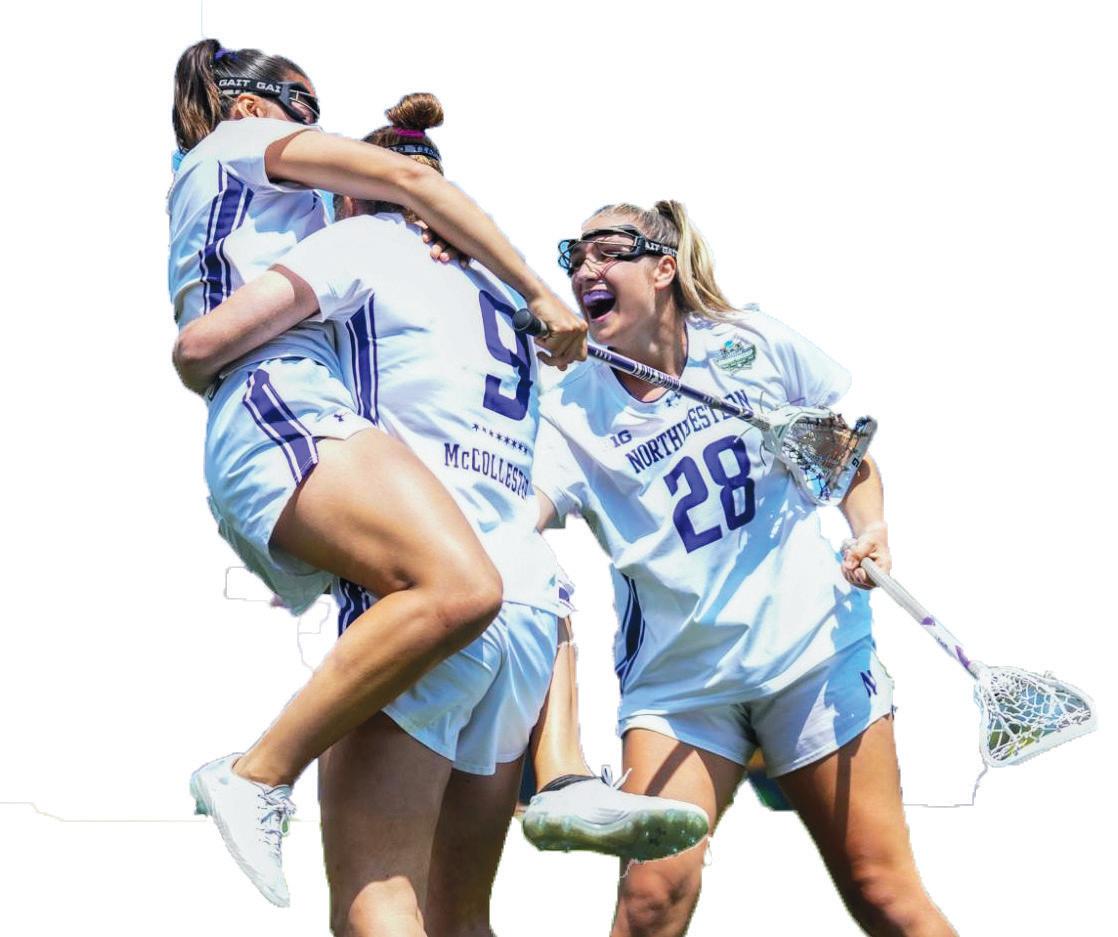
“I don’t know what else is be er than that,” she said postgame Sunday. “ at was like an ending that you would see in a movie, but it just happened in real life.” On top of the seniors winning it all for the second time, Amonte Hiller etched her name further into history, as she now stands alone as the winningest coach in NCAA Championship history with nine titles.


During the third quarter, the Tar Heels grabbed the momentum and took a 9-7 advantage. ey seemed to extend their lead to three scores with a goal from a acker Reese King, but a successful challenge from Amonte Hiller overturned the score and NU cut the de cit to one less than 30 seconds later. Amonte Hiller credited the review to the team’s IT department, which she said made her “very condent” about ge ing the call correct.
e win once again showed the might of Midwest lacrosse, and will hopefully inspire young fans in a endance to play at a high level, Amonte Hiller said. “ is game is universal,” she said. “You can be any shape, any size, and you can do well. And I think that’s the thing that I love about this game the most, you can be from anywhere.”
j.mcclure@dailynorthwestern.com
followed Humphrey throughout the play and blocked the ball with her stick. e game remained tied, and Humphrey’s offensive struggles continued.
For Cuocco, the Wildcats’ (19-3, 7-1 Big Ten) shutdown defense was a result of their collective e ort throughout the year.
“It’s not me,” Cuocco said postgame. “It’s my defense. ey gave me the shots I wanted to see. ey put their bodies on the line to get a call overturned, and they are just animals. I work for them, and they work for me. It goes vice versa, and that is a re ection of them and the hard work they have done all season.”
North Carolina’s o ense, which ranked rst in the country at 17.52 goals per game, couldn’t nd the back of the net for the entire fourth quarter, marking its rst scoreless quarter since March 30, 2025, against Notre Dame.
All game, Humphrey struggled to get things going, thanks to sophomore defender Mary Carroll — playing in her second straight championship against North Carolina — locking her and the rest of the Tar Heels down.
“I expected nothing less from Mary,” Cuocco said.
“She’s a beast and a dog. She pushes us during the week in practice, and she pushes us and our a ackers to be even be er. So, it does not even surprise me that she did so great.”
One of the reasons Carroll and NU’s defense were successful was turnovers, as the raucous crowd had the Tar Heels playing ustered and more prone to giving the ball up easily. North Carolina nished with 20 turnovers, the most it has had in a game since at least 2020.
Tar Heels coach Jenny Levy noted the ’Cats’ defensive success, giving them credit for taking advantage of the openings her team provided.
“We know they play zone and they set in lots of spaces,” Levy said. “Tactically, their defense just (did) a good job today. Also, I thought we could have moved a li le bit more. We were (playing a) seven-down — they did a great job.”
Carroll and redshirt junior mid elder Jaylen Rosga led the defensive e ort, causing a combined six turnovers. Rosga continued her strong weekend performance, leading the ’Cats and the Final Four with seven caused turnovers over the nal two games.
Coach Kelly Amonte Hiller said she believes the defense grew as a unit from the start of the season — which included being upset by then-unranked foes Colorado and Ohio State — into the one that became the rst team to win a national championship on home turf in 40 years.
“Jaylen, she is just our leader; she’s the speaking leader,” Amonte Hiller said. “ e job Mary did today was truly incredible … ( e team) just played together. ey never stopped believing”
As a team, NU found a second gear during championship weekend, causing 30 turnovers while its opponents only forced 24. Humphrey, who averaged just over 2.5 turnovers per game, had four in the championship, with two of them coming in the fourth quarter.
Cuocco said the defense was successful at stopping the UNC a ack because of their belief in themselves.
“We poured into each other, belief, everything we could, and I’m just so proud of their ght all game,” Cuocco said. y.zacks@dailynorthwestern.com