‘Wuthering Heights’ falls short of its source material’s quality, but it’s not a withering mess
9 FEATURES / Basketball
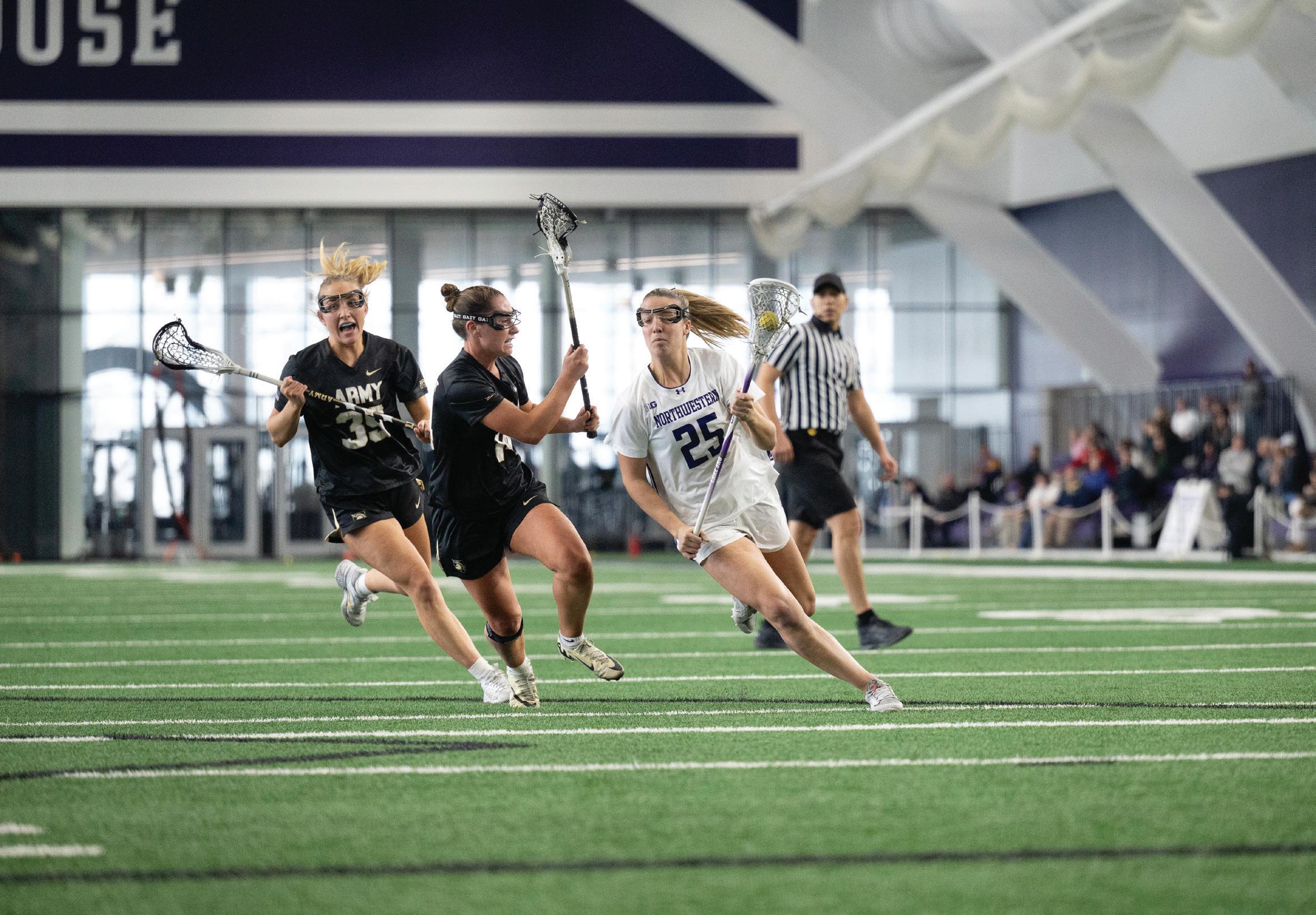
How former lacrosse star Pat Spencer’s drive took him from Evanston to the NBA
10 CAMPUS / ASG
Data shows Adarsh-Sisco won slim victory against ‘joke campaign’
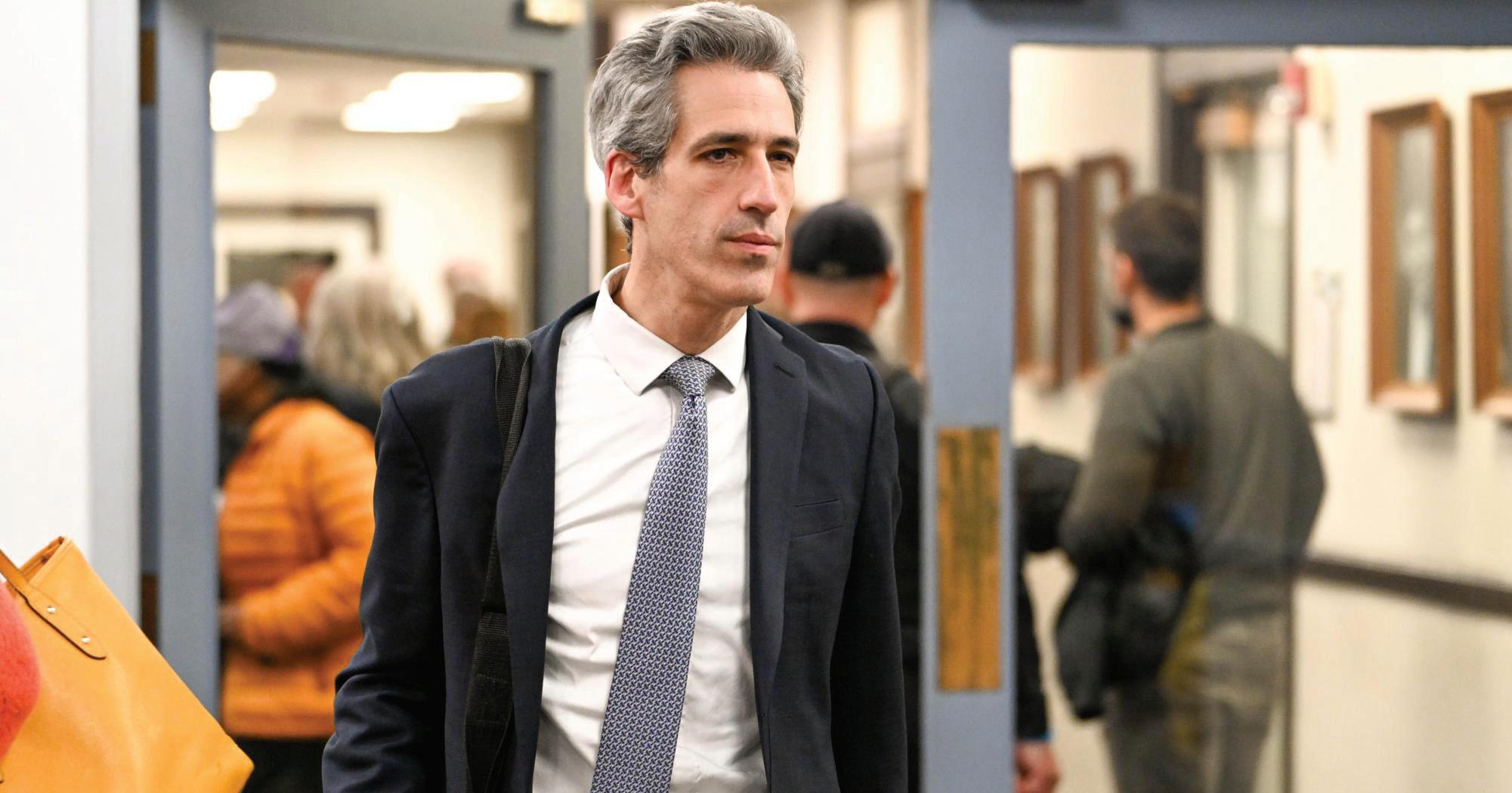
Mayor to brief House commi ee Lawmakers to question Daniel Biss on city response to encampment
By JACK BAKER daily senior staffer @jdowb2005
Mayor Daniel Biss responded to a Jan. 28 le er from U.S. Rep. Tim Walberg (R-Mich.) on Monday, defending his decision not to deploy Evanston Police Department o cers to make arrests and clear the pro-Palestinian encampment on Deering Meadow in April 2024.
Biss agreed to brief the House Education and Workforce Commi ee, which Walberg chairs, “as soon as practicable” to outline “local law enforcement coordination” between the city and Northwestern during the protest. Biss, a Democratic frontrunner in the crowded race to represent Illinois’ 9th Congressional District, called Walberg’s inquiry “a dishonest political a ack” during a news conference last month. e mayor’s wri en response comes
Potential Stars move scrutinized
7th Ward meeting on Ryan Field plan draws critics
By YONG-YU HUANG daily senior staffer @yong_yuhuang
At a virtual 7th Ward meeting on Monday night, community members debated the Chicago Stars’ unique use permit application to host professional soccer matches at Northwestern’s Ryan Field, which is nearing completion, from 2027 for up to ve years.
e Stars are scheduled to play 15 games at Martin Stadium during the 2026 season, but current zoning regulations prevent NU’s forthcoming facility from hosting professional sports.
Debate over the Stars’ potential relocation to the 7th Ward dominated the meeting, with Ald. Parielle Davis (7th) proclaiming she is “very unlikely” to support the team’s unique use permit application.
In a Feb. 9 email to 7th Ward residents, Davis wrote that she supported NU’s request to extend
construction hours but noted her position was not “an endorsement of nonstop construction.”
Instead, Davis wrote she recognized the city was “boxed” into approving working hours of up to 16 a day, six days a week, to maintain funding.
Davis described existing construction as “an extraordinary burden” for the neighborhood.
Given city promises to residents in the area, she wrote that she does not plan to support the Stars’ application to play at Ryan Field, emphasizing that her opposition is “not about women’s soccer.”
“It is about whether a taxexempt educational institution engaging in for-profit activity should continue to add new impacts to a neighborhood that has already absorbed years of construction and expanded stadium use,” the councilmember wrote.
Davis said a 2024 Memorandum of Understanding between the city and NU outlines at least four deliverables for the Ryan Field Community Advisory Council — a concert operations plan, a tra c management plan,
about a month before the March 17 primary election. A spokesperson for Biss’ campaign told e Daily on Monday that it remains unclear when the brie ng will happen or whether it will be held publicly. e spokesperson added “we are waiting to hear more details from the commi ee.”
In his response, Biss wrote he “remained in close contact” with EPD officials throughout the encampment, noting they did
not consider the demonstration a threat to students or the broader Evanston community.
He reiterated that EPD leadership cautioned that “forcibly clearing the encampment could escalate tensions and increase the risk of unrest.”
“I did not, and would not, direct the Evanston Police Department to disperse a protest or arrest protesters against the advice of
NU replaces housing vendor
New vendor to be er international student support
By TAARIQ AHMED the daily northwestern
Northwestern will switch its o -campus housing vendor to a new platform run by O Campus Partners, which is expected to launch in March.
The website will offer a cleaner digital appearance and new features to be er support international students, said Assistant Dean and Director of Strategy and Operations in the Dean of Students o ce Jason McKean, who also directs NU’s O -Campus Life o ce.
McKean said the baseline services — including a property search tool and a roommate nder that connects students for sublets — will remain the same. However, he said aesthetics and accessibility were major factors in the University’s decision to move from Places4Students, its former vendor.
“It wasn’t the most beautiful thing out there,” McKean said. “Some of their competitors had much cleaner layouts that felt a li le bit easier to navigate, so that was part of it.”
He added that the new O Campus Partners platform will
resemble that of the University of Illinois Chicago.
Another major factor in the switch was the platform’s international student-friendly lter. International students o en lack documentation required by landlords, such as a Social Security number or U.S. credit history.
“International students may not have a social security number, right?” Nadirah Muhammad, a marketing manager at O Campus Partners, said. “ ose properties understand that and already have that within their process, which is really nice.” e lter allows owners to indicate whether they accept alternative documentation instead of requiring a Social Security number, including nancial aid as proof of income, exible credit checks, exibility with guarantors and alternative identi cation such as a passport or visa.
Medill sophomore Junseo Lee, an international student from South Korea, said he used Places4Students to nd housing for next school year and has already signed a lease. He said the platform was helpful, but he sees the value in adding a feature tailored to international students.
“ e biggest obstacle is when
Adarsh-Sisco win ASG presidency
By JOSHUA SINGER daily senior staffer
Weinberg junior Gauri Adarsh and Medill junior John Sisco won this week’s election for the Associated Student Government presidency.
e two ran a campaign that promised to increase opportunities for student engagement with ASG o cers, writing a resolution to express their feelings toward Northwestern’s administration, placing ASG’s funding into an interest-bearing trust account to enable more spending, as well as other policies.
Adarsh and Sisco defeated the tickets of McCormick sophomore Nicholas Johnson and SESP junior Nur Yalinbas, SESP sophomore JJ Nabors-Moore and McCormick sophomore Patrick Eleazar, and Weinberg sophomore Alan Hu and SESP junior Noah Cohrs.
Two thousand thirty-nine students voted in this year’s election, an 11% increase from last year’s election.
“It’s a massive relief,” Adarsh said. “ is has been one of the longest weeks of our life. We’re so thankful for everyone who voted
for us. We promise we will make due on what we’ve said.”
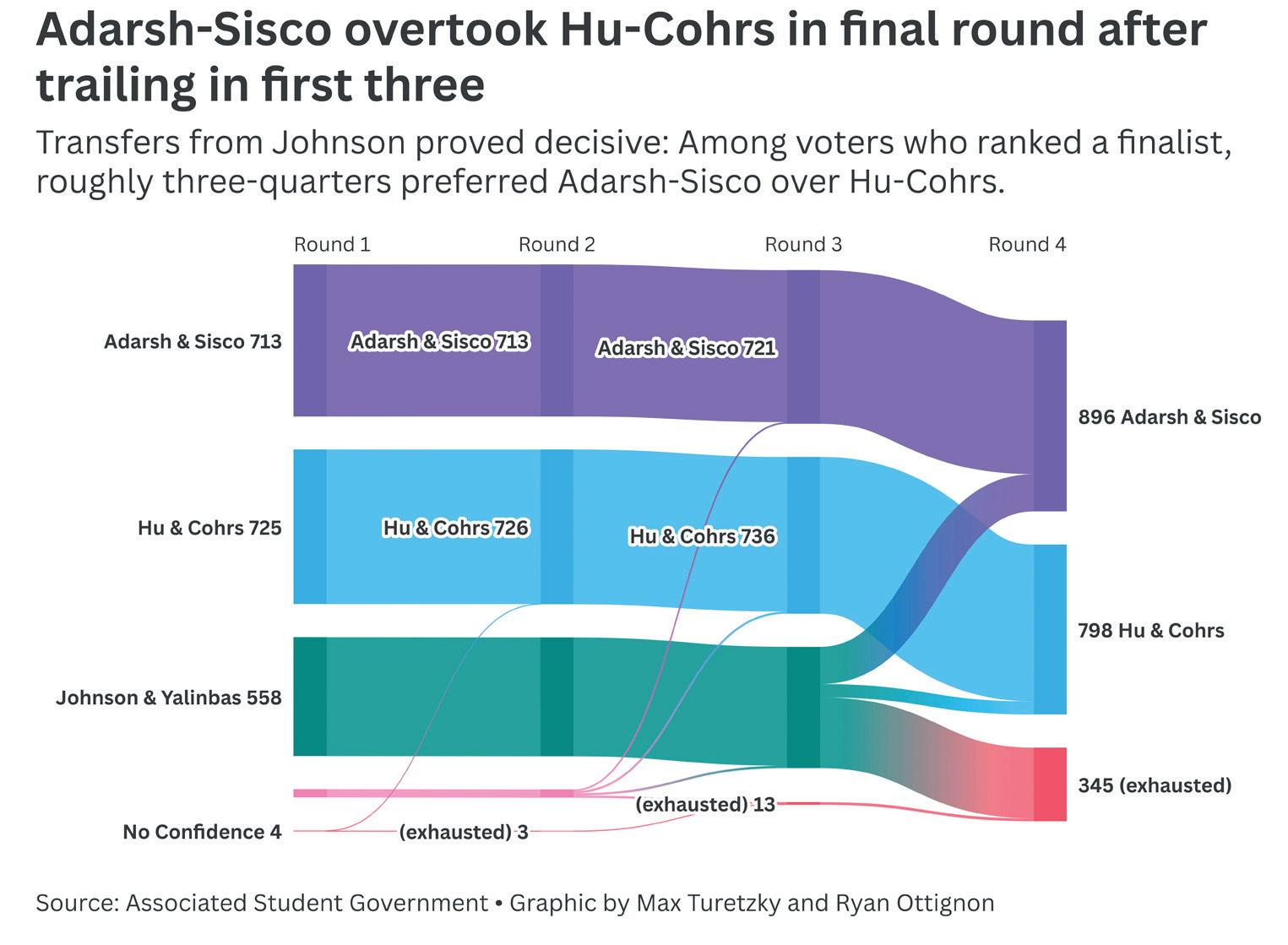
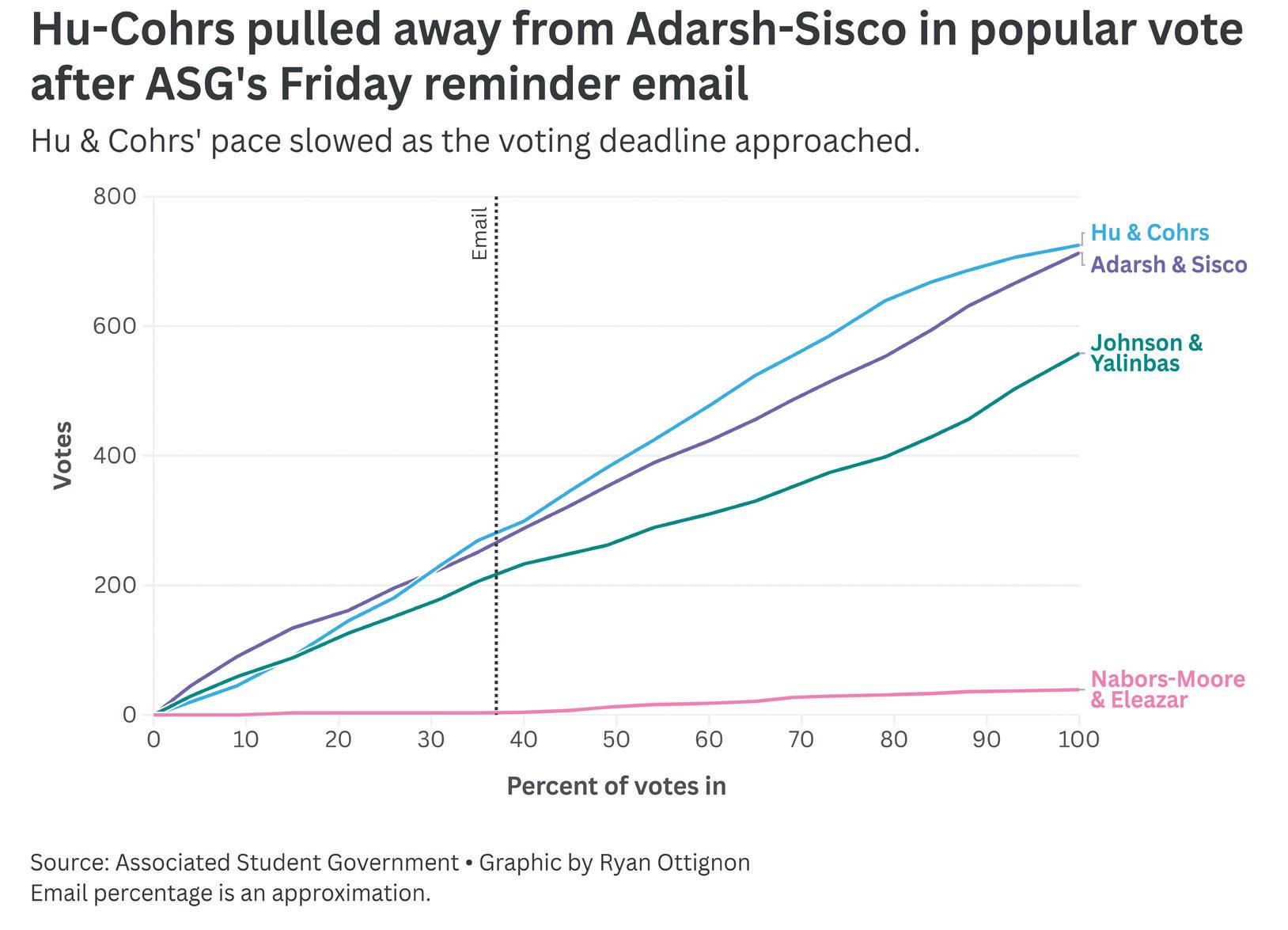
Hu and Cohrs led Adarsh and Sisco by 0.6% through round one of voting. Hu and Cohrs led throughout the ranked choice vote until the nal round, when Yalinbas and Johnson were removed from the ballot. By the end of the nal round, Adarsh and Sisco defeated Hu and Cohrs 52.89% to 47.11%.
Hu and Cohrs ran what they referred to as a “joke campaign,” with policies such as putting deer on Deering Meadow, banning Jeffrey Epstein from campus, annexing the University of Chicago and destroying the Technological Institute.
This year was the second straight year with four tickets on the ballot. Adarsh and Sisco were on last year’s ticket, but were defeated by then-McCormick junior James La Fayette Jr. and then-Weinberg sophomore Jamal Omoniyi.
j.singer@dailynorthwestern.com
Daily file photo by Shun Graves
In his letter to Walberg, Biss wrote he “remained in close contact” with EPD o icials throughout the encampment, noting they did not consider the demonstration a threat to students or the broader Evanston community.
» See DANIEL BISS , page 11
» See OCL VENDOR , page 11
Photo courtesy of Gauri Adarsh Adarsh and Sisco won the 2026 ASG presidential election.
Lunar New Year festival celebrates Asian heritage
By WILLIAM WU
daily northwestern
Community members of diverse cultural backgrounds traded red envelopes, watched dragon dance performances and chatted over cups of warm tea at Evanston SPACE Sunday to celebrate the Lunar New Year.
Lunar New Year is celebrated across many East and Southeast Asian cultures, marking the beginning of the lunar calendar. The festival is traditionally centered on family gatherings, food and wishes for prosperity.
Evanston’s free festival was organized by Evanston Asian, South Asian, Pacific Islander American and the Main-Dempster Mile, in partnership with local organizations, and featured a traditional lion dance performance, as well as community booths, storytime and songs from the Evanston Public Library.
For many attendees, the event represented more than just performances and offered a chance to connect with important cultural traditions. For Haven Middle School students Avery Smithivas and Zoe Yang, the festival provided an opportunity to reconnect with their Asian heritage.
“I went to go see some of my family in Asia this past year, and they were talking about Lunar New Year,” Smithivas said. “But we never really did any of the traditions after my parents moved to the United States, and we wanted to come and learn about it again.”
The celebration also encouraged families to learn about different parts of their heritage. For Yang, who comes from a mixed background, the event was a rare chance to access and experience cultural activities.
Many city leaders also attended Sunday’s festival. Mayor Daniel Biss noted he has attended the festival for many years and considered Sunday’s event part of a broader effort to celebrate the city’s cultural diversity.
“It will also help show to the Asian community in Evanston that has sometimes been ignored, that has sometimes been invisible and has even occasionally tragically been the victim
According to Chinese mythology, Nian was a monster that terrorized villagers on New Year Day.
of hate, that they are a cherished part of the fabric of our community,” Biss said.
Behind the performances and activities, organizers Evelyn Yang and Abby Mendoza said the event was powered by months of planning and collaboration between volunteers, local businesses and community organizations.
Evanston ASPA volunteers worked with partners like the Evanston Public Library and the YMCA to coordinate booths, performances and family-friendly activities, Evelyn Yang explained.
Evelyn Yang said events like Sunday’s festival are especially meaningful because there are limited local gatherings for Evanston’s Asian
American community.
“I think the reason why I got involved is just because there aren’t a lot of Asian faces in public,” Evelyn Yang said. “It’s something for people to actually see each other.”
willwu2027@u.northwestern.edu
ON CAMPUS
Chapel Choir returns after disbanding
By
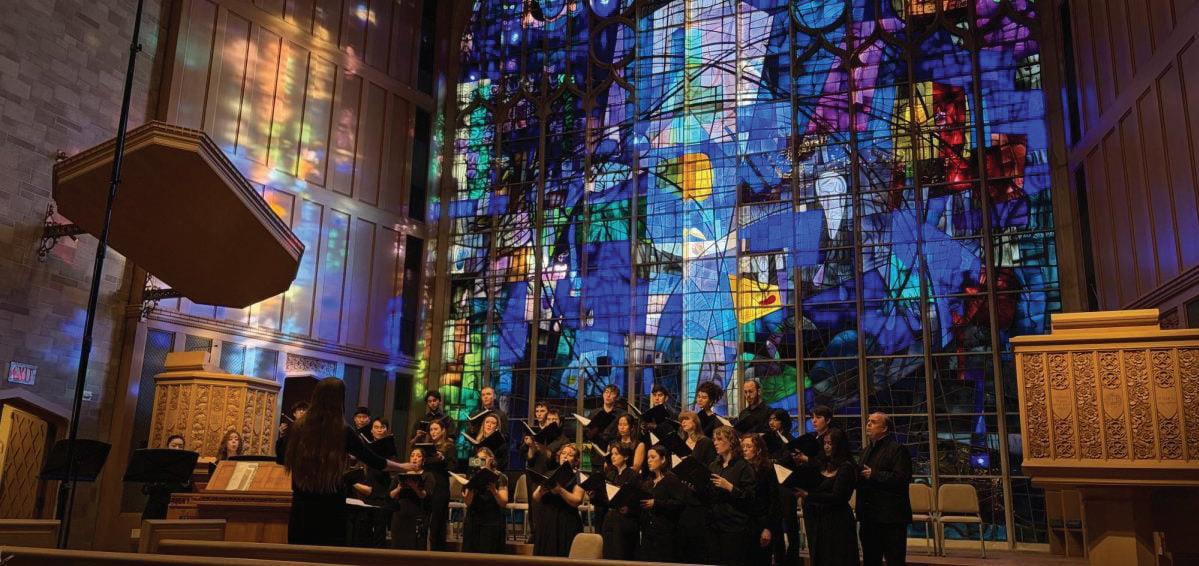
The Alice Millar Chapel Choir held its first concert since its discontinuation Sunday.
In August, the choir was discontinued for the first time after 60 years of existence. Students received an email informing them that the Trump administration’s $790 million federal funding freeze would disband the choir through program cuts. Its first performance back, titled “Joy and Light,” featured pieces such as “Blackbird” by The Beatles, “Fanfare” by Aaron Copland played on the organ and “Ruth” by Paul Ayres. The concert concluded with a rendition of “Let There Be Light” by Craig Courtney, followed by a standing ovation. “There was great weeping and gnashing of teeth
throughout the musical world, not just here on campus,” Dean Christian, who tunes the organ for the chapel, said. “You can imagine how many hundreds of kids have sung in this choir over the last 60 years. It’s a unique opportunity.”
Following the August announcement, the choir received an outpouring of support for its return, including a student-led petition. The group will be officially reinstated next quarter, with the support of interim President Henry Bienen, he told The Daily in January.
Some students lost their jobs with the disbanding, as section leaders are paid positions. Voice and opera second-year graduate student and soprano section leader Cynthia Hu said she got a new job at a church in Edgewater to supplement her loss of income.
The group is one of the only musical ensembles on campus that gives non-music major students the
opportunity to sing with music majors.
“There’’s like an energy and camaraderie about the people in this choir that I think makes it really special,” Hu said., “I know it is really disheartening for people to not be able to come together and sing music that they usually wouldn’t sing for fun. It’’s not like this is karaoke music. I think this is really teaching people skills that they otherwise wouldn’’t learn.”
The Sunday performance also featured members of the Baroque Music Ensemble, including Veronica Rokicki, who accompanied Stephen Miller’s vocals on “Gibt mir meinen Jesum wieder” by Bach.
The Chapel Choir will hold its annual Spring Festival Concert in May.
“May the joy and light and truth of music be here to stay for years to come,” conductor Stephen Alltop said at the end of the event.
ivyfrater2029@u.northwestern.edu
The Daily Northwestern www.dailynorthwestern.com
Editor in Chief Emily Lichty eic@dailynorthwestern.com
General Manager Stacia Campbell stacia@dailynorthwestern.com
Holly and John Madigan Newsroom
Phone | 847.491.3222
Campus desk campus@dailynorthwestern.com
City desk city@dailynorthwestern.com
Sports desk sports@dailynorthwestern.com
Ad Office | 847.491.7206 spc-compshop@northwestern.edu
The Daily Northwestern is printed each Wednesday during the academic year, except vacation periods, the two weeks preceding them and once during August, by Students Publishing Co., Inc. of Northwestern University, 1999 Campus Drive, Evanston, IL 60208. All news is published 24/7 online at Dailynorthwestern.com.
First copy of The Daily is free, additional copies are 50 cents. All material published herein, except advertising or where indicated otherwise, is Copyright 2025 The Daily Northwestern and protected under the “work made for hire” and “periodical publication” clauses of copyright law.
POSTMASTER: Send address changes to The Daily Northwestern, 1999 Campus Drive, Evanston, IL 60208. Subscriptions are $100 for the academic year. The Daily Northwestern is not responsible for more than one incorrect ad insertion.
Check out DAILYNORTHWESTERN.COM for breaking news
Ivy Frater/The Daily Northwestern
The Alice Millar Chapel Choir performs for its first time since its disbanding in August due to funding cuts.
A&E A&E A&E A A& &E
‘Wuthering Heights’ fails to ascend
By BIANCA DISHMON daily senior staffer
is article contains spoilers.
e moment the “Wuthering Heights” adaptation was announced, with director Emerald Fennell at its helm, I could not have been more excited. Despite not having read the book, I enjoyed Fennell’s previous lms, namely “Saltburn,” and I admire their ability to always keep me guessing.
However, as the lm began to take shape through trailers and press, my initial enthusiasm waned. I saw numerous videos complaining about the lm’s departure from its source material and the whitewashing of Heathcli , who is portrayed as racially ambiguous in the novel.
Critics also commented on Fennell’s interviews, which many believed indicated her lack of understanding of the novel’s themes. All of these criticisms were valid, but they morphed my excitement into skepticism. Walking into the theater, on Valentine’s Day no less, I was a bag of nerves, not sure what to expect from a lm that had been advertised as “the greatest love story of all time.” While I disagreed with this characterization, “Wuthering Heights” exceeded my lowered expectations.
It is not a faithful adaptation in any sense, but it is an enjoyable and emotional movie.
Inspired by Emily Brontë’s 1847 novel of the same title, “Wuthering Heights” follows upper-class Catherine Earnshaw (Margot Robbie) and her servant Heathcli (Jacob Elordi) and their tumultuous love story over the span of many years.
A er growing up alongside one another, their romance becomes complicated when Earnshaw agrees to marry the neighboring lord Edgar Linton (Shazad Latif), causing a heartbroken and distraught Heathcli
to disappear for ve years. Upon his return, Earnshaw must face her suppressed feelings for him and decide whether she is willing to sacri ce her marriage for Heathcli or continue to live unhappily.
Fennell’s scripts can be shoddily wri en, leaving the onus on the actors to perform exceptionally. ankfully, the actors across the board lived up to this pressure. In the novel, Cathy and Heathcli are both teenagers, while the lm ages the two up signi cantly.
It feels odd to see Robbie and Elordi engage in dialogue that seems wri en for two teenage actors, but they delivered performances that illustrated the pushand-pull nature of passion and romance.
eir younger counterparts, played by Owen Cooper and Charlo e Mellington, were standouts. e two beautifully portrayed the innocence of young love. Cooper, in particular, wonderfully embodied the sacrices that accompany it, in one scene taking the blame for Catherine’s wrongdoings and receiving brutal lashings that leave permanent scars.
Given their youth, I was shocked at the levels of maturity and intensity they brought to their performances, and I expect to see big things for both of them in the future.
Another standout was Alison Oliver’s performance as Isabella Linton. With Linton’s character, Fennell took complete creative liberty, giving her an inconsistent characterization. Isabella is introduced as an intelligent young woman, and in her last scene, she is portrayed as the dog in her and Heathcli ’s staged BDSM-esque relationship.
Of the actors, Oliver had one of the most di cult roles to embody. While I wish Fennell illustrated Linton’s genius more, she was one of my favorite characters, and her scenes were the most enjoyable.
Although vastly di erent from her character in the novel, Oliver, for the most part, portrayed Linton as the teenager she was intended to be. She characterized her
as lovesick, passionate and blissfully unaware. Another one of the lm’s more redeeming qualities was its cinematography. Jarring color contrasts, particularly between red and white, added to the drama at the lm’s core. Red does not represent love as I expected it to but death, while white symbolizes purity and life. ese two are frequently juxtaposed, creating a sharp visual clash and drawing a ention to what is most important in the scene. Its most impactful use is in the scene of Cathy’s death. e dark red blood contrasted with her pale, lifeless gure heightened the scene’s emotional intensity and drew many sni es from the movie’s audience because of its pure shock. As its critics suggested prior to its release, “Wuthering Heights” was rife with issues. A er reading a synopsis of the novel a er the lm, I realized how much information had been sacri ced to incorporate Fennell’s new “Fi y Shades of Grey”-inspired elements. Had these elements been le out, I would have found the lm more enjoyable. e characters also seemed more one-dimensional than those in the novel. Even the lm’s leads, Cathy and Heathcli , substantially lacked substance, something that can be a ributed to its surface-level writing. e whitewashing of Heathcli ’s character, something that has occurred in most adaptations, also takes much nuance out of the lm. It’s miraculous how Heathcli was able to climb from rags to riches, especially given the prejudice of 18th-century England. With Elordi as Heathcli , this ability to climb through the ranks falls at.
I understand the pain that the novel’s fans feel. As an adaptation, “Wuthering Heights” grossly falls short of meeting its source material’s quality. But as a lm, it is enjoyable, visually stunning and rife with wonderful performances.
b.dishmon@dailynorthwestern.com
Charli XCX’s ‘Wuthering Heights’ captures dark theatrics
By ALEXANDER HERNANDEZ GONZALEZ AND ELIZA MARTIN the daily northwestern
@alexbespeakin
Love, betrayal and a whole lot of fog. ose are only a few characteristics present in director Emerald Fennell’s romantic period drama “Wuthering Heights.” Adapted from English writer Emily Brontë’s only novel, the wildly reimagined story of Catherine Earnshaw and Heathcli has become the talk of the town.
Yet, the lm’s eponymous soundtrack, cra ed by English pop star Charli XCX, not only evokes these elements but makes its own mark as a certi ed classic.
“Wuthering Heights” is not the rst collaboration between Charli and Fennell. Charli’s 2017 song “Boys” was featured in the soundtrack to Fennell’s feature lm debut “Promising Young Woman” in 2020.
In December 2024, amid her messy yet iconic “Brat” era, Charli received a text from an unknown number, which she later found out was Fennell reaching out to her to read the lm’s script. In her Substack, Charli wrote she was intrigued by the opportunity to contribute to “Wuthering Heights.”
“I was immersing myself in a story that was not my own, a story that was steeped in history, a story that had existed since 1847 (tysm Emily Brontë),”
Charli wrote in the Substack. “I began to feel a sense of freedom again.”
Charli a empts to create a soundscape aligned with Fennell’s selective adaptation of the novel. Fennel has clari ed throughout the lm’s press tour that her stylistic choices di er from the original; Charli’s soundtrack supports the lm’s focus on creating a modernized, erotic interpretation.
“Wuthering Heights” opening track “House (featuring John Cale)” sets the stage for the haunting story ahead. Screeching violin underlays two minutes of gravelly narration by Cale, which builds to include backup vocals by Charli.
e song’s ending repeats, “I think I’m gonna die in this house,” a soundbite that went viral on TikTok with users editing their lives to look like horror movies. ough probably an unexpected outcome, the trend is proof that the album’s beginning is indeed eerie.
ough Fennell and her team seem intent on replacing the novel’s narrative of revenge with one entirely of soap-opera romance, Charli’s backtrack invents heightened tension for the audience.
Even when writing songs about Gothic England, Charli can’t help but include a club classic. “Dying for You” expertly taps into Charli’s upbeat, hyperpop style while continuing the album’s orchestral backings. Without straying too far from the soundtrack’s main themes, the song is undeniably made for late
nights and strobe lights on the dance oor.
One thing about Charli is that she truly is everywhere; “Always Everywhere” takes that idea and spins it into a haunting yet romantic narrative. e tune of a high-pitched organ alongside the artist’s echo-forward sound teleports listeners to a world with bright greenery, ouncy white garments and grey skies.
Lyrics such as “I feel like home, still you pull away” and “I can’t escape the storm you gave me” complement the intense cellos and violins that uctuate across the approximate three-minute track. e dramatics in this track are de nitely Oscar-winning.
If you are looking for something that combines eeriness and theatrics, “Altars” is your best bet. Charli dives into the complex emotions that one can experience in a place of spiritual, emotional and personal comfort.
From kneeling at the altar with tears of hopelessness to using prayer as a search for an answer, the track is a rollercoaster of what the novel conveys. Charli’s classic autotuned vocals, a repeated ticking and an impressive orchestra tie the knot beautifully.
e transition to “Eyes of the World (featuring Sky Ferreira)” was seamless, transporting listeners to a more intimate and mysterious se ing. Ferreira, a frequent collaborator and friend of Charli’s, is known for her powerful, grungy vocals.
e duo makes the perfect pair for a track that discusses the impacts of public perception on
individuals, especially with events that have challenged both of their careers at one point. Notably, the lyrics “You’re gonna think the things you think about me anyway” should win an award for “Goosebump Worthy.” e soundtrack’s ending is just as unse ling as its beginning. Actor and musician Joe Keery is credited as a co-writer on the nal track, “Funny Mouth.” Siren-like instrumentals crescendo under Charli’s sensual vocals, culminating in an EDM-style breakdown halfway through the song.
A er the break, the instrumental dissonance and reverb build before cu ing out altogether. Subdued piano and angelic background vocals accompany Charli singing, “Everyone sleeps / And everyone wakes up,” fading to silence in the song’s nal seconds.
If you expect “Wuthering Heights” to be “Brat” 2.0, you’ve come to the wrong place. We recommend Googling the di erence between a regular album and a lm soundtrack.
Charli was tasked with creating work that ts both a time-honored novel and a awed lm adaptation; “Wuthering Heights” straddles the two remarkably well. Despite the general perception of the lm thus far, Charli’s album is absolutely worth a listen.
By RAINEE LI the daily northwestern @rainydayrecord
Fiery plumes douse the world in celebration as the Year of the Fire Horse finally arrives.
Lunar New Year comes in many forms and boasts various names: The Spring Festival in China, Tết in Vietnam and Seollal in Korea, to name a few. Lasting from Feb. 17 to March 3 this year, the widespread holiday brings people together in swaths of brightly colored cheer to herald new beginnings.
As the festivities commence, allow me to guide you through some of the superstitions and traditions you can practice at home.
Fashion
From the Korean hanbok to the Chinese hànfú, the clothes worn during Lunar New Year have very few restrictions. However, there is one rule: absolutely no full monochrome. Black and white are associated with mourning, making them completely inappropriate for new beginnings.
Instead, choose to wear bright colors. Red is commonly adorned for its folklore relations to good fortune and protection from evil spirits. This time around, however, the incoming fire
horse naturally carries such prosperity. Adding red onto that can overwhelm spiritual energy, leading to conflict and scorching tempers. While you can still rock your rouge, it is best to balance out this crimson crusade with earth tones throughout the year. If you still remain wary of such color combinations, you can simply choose to wear new clothes: now is the time to treat yourself. Fresh outfits symbolize a clean slate, allowing you to leave behind all the misfortunes of the past year. Just make sure you avoid new shoes. They are a linguistic homophone for evil in Chinese. Stick to anything above the ankle and you’ll be fine.
Customs
Lunar New Year does not play when it comes to customs. One of the most well known traditions is the gifting of red envelopes. Called hóngbāo in China and lì xì in Vietnam, elders typically distribute packaged money to younger individuals, wishing prosperity and passing on their blessings.
Aside from the constant emphasis on good fortune, Lunar New Year is a time for loved ones. Gatherings between family, friends and ancestors alike are held all around the world. People honor one another and those who came before them, typically through delicious
reunion dinners.
What is a holiday without good food? As you swarm to the table, feast upon whole fish for their connections to surplus and abundance. Grab some dumplings to earn some wealth and prosperity. Serve yourself long noodles for longer life — just be careful not to break them! Regarding dessert, how about some citrus for good luck?
The cuisine surrounding Lunar New Year does not disappoint. China fosters harmony with plump rice balls filled with sweet paste called tāng yuán. Korea cooks up good fortune with savory tteokguk, rice cakes bathed in a clear beef broth. Vietnam expresses their gratitude with delicious bánh chưng wrapped up in banana leaves to hide their pork, mung bean and rice filling. While these dishes are not a requirement, I strongly recommend trying them with your loved ones this year; there is never a bad time to eat good food.
Taboos
Speaking of bad times, there are also a bunch of taboos to avoid during the festivities. Prosperity is a fickle thing — best be careful! Avoid washing your hair on the first day of Lunar New Year or you’ll be washing your wealth away. On the topic of your mane, don’t cut your hair during the first lunar month. If
you want to increase your wealth in 2026, you can’t cut yourself off before you even start. You shouldn’t be a downer either. This superstition isn’t just for the sake of celebration — discussing negative topics brings bad luck and conflict into the following year. Keep your head up and stay positive. Your future will follow suit.
A bunch of household chores are also off the table. Washing your clothes on the first and second day of the new year equates to pouring your money away, as water is often a symbol for wealth. Don’t clean, sweep or take out the garbage on the first day, as that represents dumping out good luck from your home.
On that note, you should have cleaned your home before Lunar New Year. Cleaning means sweeping away bad luck, illnesses and negative energy, making space to invite incoming prosperity. If you missed this opportunity, well, there’s always next year.
Regardless of where you’re from, I hope you’ll spend this auspicious time with the people you love, eating yummy food and shopping for future success.
Xīn Nián Kuài Lè! Chúc mừng năm mới! Saehae bok mani badeuseyo! Happy New Year, everyone!
r.li@dailynorthwestern.com
‘The President’s Cake’ offers a view on Iraq tyranny
By ISAAC PENG
is review contains spoilers.
Content warning: is review contains mentions of sexual assault and violence.
Baking a cake has never had higher stakes.
With a limited release Feb. 6, “ e President’s Cake” follows 9-year-old Lamia (Baneen Ahmad Nayyef) as she a empts to gather ingredients for a cake in celebration of brutal Iraqi dictator Saddam Hussein’s birthday.
e lm takes place in Iraq during the 1990s, when the United States imposed harsh economic sanctions on the nation at the height of the Gulf War. Basic food products and medical supplies are scarce, and much of the country is in poverty.
Despite this, Iraqis are forced to enthusiastically celebrate the president’s birthday. One student from each elementary school is randomly selected to bake a cake in honor of Hussein, facing punishment in the form of a beating if they fail to produce a cake by the next day.
e lm follows Lamia on her journey to scrounge together the ingredients in order to complete the highstakes task. Accompanied by her friend, Saeed (Sajad Mohamad Qasem), she faces a variety of obstacles along the way.
She is separated from her grandmother, who eventually passes away due to diabetes, as well as is temporarily arrested for the before she is bailed out. Eventually, she is sexually harassed by a man who promises to give her baking powder in exchange for sexual favors.
In spite of all these challenges, Lamia manages to complete her task, but the completed cake is never revealed. Just as she presents it to her teacher, air raid alarms ll the air and the school is bombed. e lm
concludes with a clip of Hussein’s birthday party, where he blows out the candle of a lavishly decorated cake, smiling gleefully at the camera.
It is this closing shot that truly pulls the lm together.
I was initially worried the storyline was at risk of falling at — the di culties of making this cake were only important to me when considering the historical context of Hussein’s regime — and the ending addressed that issue poignantly.
Director Hasan Hadi does an excellent job juxtaposing the natures of the two cakes: Lamia’s, cra ed with immense struggle, and Hussein’s, a gross display of exorbitance. He emphasizes just how out of touch Hussein is to his people, while still being able to cause deep individual loss — in this case, with Lamia and the hardships she endures.
e lm has been nominated for 12 awards and won 11. Most notably, it received the Caméra d’Or at the Cannes Film Festival, a prestigious honor given to the best feature lm by a rst-time director.
“ e President’s Cake” served as Iraq’s o cial entry into the 98th Academy Awards, looking to receive a nomination for Best International Feature. Despite making the 15- lm shortlist in the category, it fell just short of a nomination in this year’s stacked pool of foreign language lms.
However, this was the furthest an Iraqi lm has made it through Oscar voting and the rst time a lm from Iraq made the shortlist.
Lamia is played brilliantly by Nayyef, who puts on one of the best child-actor performances I’ve seen. Her naive yet stoic disposition allows her to vividly demonstrate the impact of dictatorship on the average citizen.
Alongside her, characters are motivated by a sense of fear as poverty governs their every action, and I felt like I could place myself in Hadi’s Iraq, with its
haggling vendors and bustling cars. e realism of the se ing was an undoubtedly strong point of the lm.
Although I don’t believe the lm tries to comment on any modern issues beyond its historical source material, the themes in the lm can be applied to those in power today.
Government leaders hold galas and erect ballrooms
while their policies negatively impact the lives of common citizens. If “ e President’s Cake” makes one thing clear, it’s that oppression and extravagance can coexist, widening the gap between the masses and those in control.
isaacpeng2029@u.northwestern.edu
By ASHLEY DONG daily senior staffer
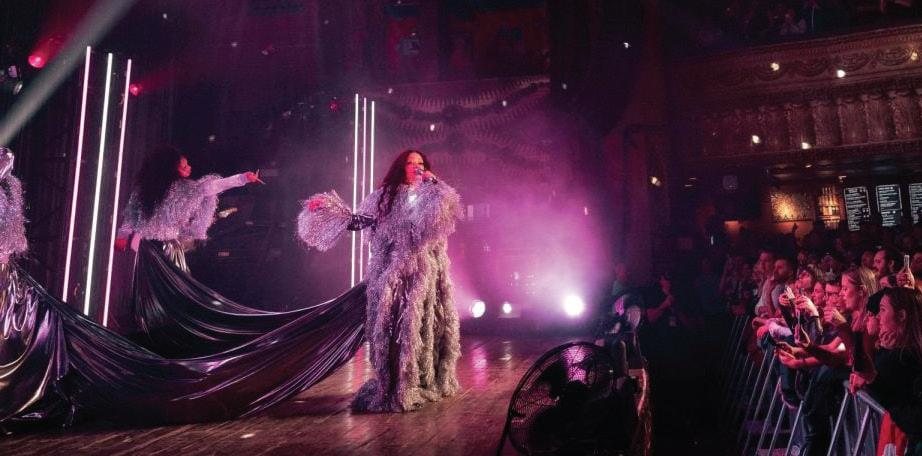
When British singer JADE stretched her sequin-clad leg out from behind the red curtains, the audience of millennial girls and gays went wild.
Jade irlwall, the pop singer and former Li le
Mix star performed to a sold-out crowd at the House of Blues on ursday, packing the intimate venue for the Chicago stop of her rst solo tour.
JADE’s setlist featured her debut solo studio album, “THAT’S SHOWBIZ BABY!,” which released in September 2025. In her glitzy yet campy album, the artist sings about the highs and lows of her experience as a woman in the entertainment industry.
Onstage, she was joined by a small but mighty team:
two backup dancers, a drummer and a guitarist who doubled as keys. In a high-intensity show, JADE kept up with demanding choreography while belting vocals nearly equal to her studio recordings.
Her girl-group background was evident in her commanding stage presence and sharp yet sultry dance moves. e 33-year-old singer got her start on “ e X-Factor” at 15 years old and eventually rose to fame in 2011 as part of the popular girl group Li le Mix.
JADE said she was “lucky” to be part of Li le Mix for over a decade, and yet is so grateful to get to do it all again — this time, on her own.
What struck me most was JADE’s sincere connection with her crowd of adoring fans.
e a endees’ facial expressions seemed to be full of pride: ey’ve followed JADE through her music career, watching her grow from her early days as a girl group member into a solo act.
Near the middle of the show, JADE, in her charming British accent, asked for the house lights on so she could see the a endees’ out t choices. e venue was small enough for her to point people out individually and have brief, but meaningful, interactions. JADE smiled at someone dressed like a “shower loofah,” who was apparently referencing a dress she wore in the early 2010s.
When a person in the crowd fainted, the singer paused the performance and o ered to bring the a endee — who was afraid of missing the show — backstage, promising to say hello to her when the
I overheard a few concertgoers complaining about how the venue was oversold. But to me, this was a heartwarming sign of JADE’s large, passionate fanbase. e venue was standing room only, so a endees were grooving along with the onstage performers. During a break between songs, someone shouted that JADE should perform in an arena next time, and she gave a cheeky grin.
In “Natural at Disaster,” JADE sat alone in the center of the stage, elegantly draped in a red velvet curtain, in what she described as a “Mother Gothel” look. For another show-stopping moment, JADE ascended to a second- oor balcony and sang “Silent Disco” an arm’s reach away from her fans. A single, golden spotlight shone on her as she crooned her ballad, and sighs of admiration echoed throughout the crowd.
e set ended on “Angel Of My Dreams,” the song that kickstarted JADE’s solo career. In the middle of the song, she disappeared into a mess of strobe lights and dramatically reemerged with large, feathery angel wings on her back and prop arrows pinned to her chest. At the end of the ninety-minute set, JADE and her company took their bows. e crowd’s applause shook the room, making it clear that her rst solo endeavor has made JADE an “IT Girl.”
a.dong@dailynorthwestern.com
Born
show ended.
Illustration by Maya Vaziri
Lamia (Baneen Ahmad Nayyef) must journey through 1990s Iraq to bake a cake for president Saddam Hussein.
Photo courtesy of Kamil Surma
EPL hosts art exhibit for Black History Month
By ISABELLA KUNC the daily northwestern @isa_bella_ku
e Evanston Public Library hosted a reception Tuesday evening for community members to explore its Black History Month Community Art Exhibit, which showcases artwork highlighting Black culture, history and important gures by Chicago-area artists.
To commemorate the 100th anniversary of Black History Month, EPL invited artists to submit work that recognizes the “lived experience and spirit of Black history and culture through the years,” according to the library’s website.
“I hope that it brings people together to acknowledge and celebrate the beauty of Black art and shared history of people across the community, not only in Evanston, but the greater Chicago area,” said EPL Engagement Services Manager Jill Skwerski.
e exhibit features poems, paintings, photographs, mixed media and textiles. It’s set to remain on display through the end of the month, but Skwerski said she hopes to keep the art up through March.
Many a endees came to the event to support local artists and their work. For some, the exhibit also represented an opportunity to bring the community together.
“What happens to me every time I’m at an exhibit is I feel connected to other people,” 4th Ward resident Denia Hester said. “ ere’s a proverb that says ‘I am because we are, and that’s what I feel.’”
Featured artists were invited to Tuesday’s reception to mingle with community members. While the pieces connected to wider themes of Black culture, they explored everything from personal experiences to famous social movements.
Evanston-based artist Jevoid Simmons painted a piece that combines important moments in Black history into a visual timeline, including images of a slave auction, a snapshot of Black soldiers ghting in the Civil War and President Barack Obama delivering a speech.
Simmons explained he wanted to capture the challenges and historical moments that brought America to “where we stand today.”
His piece’s nal panel is an image of the U.S. Supreme Court with an upside-down American ag, which he said represents his hope that the Court will step up and “ x this.”
Evanston-based artist Destini Brown, who invited her grandmother and great-grandmother to the event, submi ed a self-portrait inspired by a piece she saw at the Art Institute of Chicago.
“I think in a lot of ways, artists kind of are the conscience, very o en, of the culture,” he said. “Many want to use their art to create dialogue, and talking and guring out how to get out of this mess.”
“I really hope that other Black women and girls, speci cally younger girls, are able to see themselves as artists as well because I never saw myself as an artist growing up,” Brown said. “So it’’s really nice.”
Similarly, Chicago-based photographer Eli Williamson III had originally started making art of Black fathers because he “needed to see that as a Black father” himself.
Two photographs in the exhibit are a part of his “ e Four Virtues” project, which highlights
four virtues Williamson a aches to Black men — fatherhood, work, wonder and fellowship.
“My hope is that people are able to see themselves in Black men and boys, so I can personalize their experiences,” he said. “How people articulate Black men and boys is pre y derogatory many times, and I really want people to reframe how they see us in society.”
ikunc@dailynorthwestern.com
Isabella Kunc/The Daily Northwestern
Artists like Simmons and attendees like C. Louise Brown discussed the importance of art during the Black History Month art exhibit reception.
ANCHOR awards $2 million to Evanston projects
By NOELLE CABRERA daily senior staffer
Since 2020, Northwestern has awarded more than $2 million in grants to over 40 community organizations through its Advancing Neighborhood & Community Health, Opportunity & Resilience program.
NU’s Office of Neighborhood and Community Relations spearheaded the program, which facilitates collaboration between partners at the University and community organizations to promote health equity, economic and social empowerment and children and youth learning in Evanston and Chicago. Over $500,000 is awarded annually, with 10 organizations awarded in its latest cycle.
“What makes this program so much more successful is that we’re not just focusing on the financial elements, such as writing a check,” Dave Davis, senior executive director of Neighborhood and Community Relations, said. “We’re trying to really cultivate a strong relationship with our grantees that ultimately leads to trust.”
Women Initiating New Directions, a Chicago nonprofit that provides resources to currently and formerly incarcerated women, has received ANCHOR funding nearly every cycle. The grant has backed facets of WIND’s Bridge Program, which helps women in reentry find employment and community service opportunities.
Recent funding has allowed WIND, in collaboration with the NU Prison Education Program, to develop a feedback-tailored program where systemimpacted women develop workplace skills and experience as WIND apprentices.
“That just feels like an amazing thing to be able to witness and to be able to support women who deserve it as they pursue their goals and realize their dreams,” WIND Program Executive Director Nicole O’Connell said.
Northwestern Settlement, a Chicago-based nonprofit that combats generational poverty through resources like school and youth programs, received ANCHOR grants in 2021 and 2025. The money initiated and supports its Early Childhood Education Program’s Project Literacy Empowerment Access Partnership, which addresses racial disparities in children’s literacy outcomes.
In partnership with NU’s Child Language Lab, it hosts workshops for parents and meetings between teachers and parents.
“Being involved in a project like this helps build confidence in parents, develop(s) their knowledge around early childhood illiteracy, and share(s) it with other families,” ECE Assistant Director Irma Rodriguez said.
Open Communities, an Evanston-based fair housing agency, also received grants in 2021 and 2025. Its 2025 project works with NU’s Department of Computer Science to develop a tool that scans for local lenders engaging in modern redlining.
Its team, collaborating with NU students and professors, compares how well lenders serve minority populations and investigates housing disparities, Open Communities Director of Fair Housing Dominic Voz said. He said he hopes it can be developed into a public resource used by fair housing organizations across the country.
“Communities of color have been held back from having equitable access to good jobs, and transit and healthy communities in part because of this history of discriminatory lending,” Voz said. “We see a huge value in helping other people across the country have access to a tool like this.”
Ladies of Virtue, an organization that prepares Black girls in Chicago for leadership through mentorship programs, received its first ANCHOR grant in 2025.
It is working with the Human Development and Social Policy Program at the School of Education and Social Policy to investigate and address school discipline policies that disproportionately target Black girls.
“Our ultimate goal is to bridge that gap so that the disproportionality discipline that’s happening with Black girls doesn’t exist,” LOV Lead Researcher Deidra Bibbs said. “We want all children to be treated fairly and equally, and we all want all children to feel safe in school.”
The James B. Moran Center for Youth Advocacy, a nonprofit providing community-based legal, social and restorative services for Evanston youth and their families, received ANCHOR funding in 2021 and 2025. It used the 2025 grant to hire trained students from NU and Evanston Township High School to serve as program managers and circle keepers and lead restorative practices in classrooms at Oakton Elementary School.
The funding allowed them to expand the program to multiple classrooms of various grade levels, Moran Center Executive Director Patrick Keenan-Devlin said.
Now, the center has applied for renewed ANCHOR funding, hoping to expand further, Keenan-Devlin said.
“If we really want to build a restorative community, we can’t just concentrate on one school,” KeenanDevlin said. “This one school can be a real example of what is possible when you are thoughtful about whole school restorative justice implementation.”
Childcare Network of Evanston, a local social service organization committed to ensuring all children have access to quality early education and childcare, has received ANCHOR funding for the past three years. Its 2025 project is in collaboration with the Infant and Child Development Center and Institute for Policy Research at NU to address bias in preschools.
Before receiving funding, it developed a tool to track classroom interactions between teachers and
children. With the grant, it will analyze data and begin co-developing an intervention to disrupt bias.
“We’re making it a community effort,” CNE Executive Director Carol Teske said. “It has really made a big difference in our community and a big difference in many children’s lives in our community.”
For the 2026-27 cycle, Davis anticipates that ANCHOR will award up to 10 grants ranging from $25,000 to $65,000, according to Northwestern Now.
Moving forward, Davis added that he hopes the program will grow to award more money and expand its impact to the greater Cook County area.
“What I’’m most proud of is I feel like we’re doing this the right way, and we’re making a difference in Evanston, in Chicago,” Davis said.
noellecabrera2028@u.northwestern.edu
Daily file photo by Thomas Hurley
In recent years, Northwestern’s ANCHOR Grant Program has supported community projects promoting health equity, economic and social empowerment and children and youth learning in Evanston and Chicago.
OPINION
Koutrouvelis: e Purple Line has yet to master belonging
that same year, the NER secretly bypassed village permission to build a spur track and platform overnight, meaning North Shore residents woke up the next morning to early phases of a transit service that they did not ask for.
e Purple Line is rapid transit done right, but li le more than that.
On paper, it’s one of the Chicago Transit Authority’s most e cient routes, moving commuters quickly between the northern suburbs of Wilme e and Evanston into downtown Chicago during rush hours.
While it is clean, direct and practical, riding the line doesn’t feel like traveling through neighborhoods; it feels more like skimming past them. When I rode the Brown Line, I saw how it served as a physical and social backbone for its communities. Weaving through its neighborhoods, the Brown Line beckons its riders to explore beyond the tracks and exposes them to new areas of Chicago. at sense of community is just not there with the Purple Line. Instead, the Purple Line feels awkwardly disconnected from the areas it serves, which is no surprise given its tumultuous history.
When the Northwestern Elevated Railroad planned to extend service into Wilme e in February 1912, they weren’t greeted with open arms. Local o cials and residents fought the extension because they felt that a rapid transit link to the city would bring unwanted development to the area. But o cials didn’t listen. In April of
Mu
Beyond the line’s dubious beginnings, its identity as a distinct commuter railway, rather than a neighborhood anchor, wasn’t codi ed until decades later.
In 1949, the CTA “divorced” the suburban portion of their rail service from the rest of the north side lines, and the Purple Line was reimagined as a specialized shu le or a rush-hour express, a design that persists today.
Importantly, this “divorce” meant the line never had to integrate into the daily rhythm of the streets it passes. Rather, it became a pipeline moving people from quiet North Shore suburbs to the Loop with as li le interference as possible.
e contrast between the suburban stops and the line’s major urban stops are jarring. I got o at Fullerton, Belmont and Wilson and was struck by how interesting, full of charm and pulsing with life they are compared to the North Shore stops.
At Fullerton, I could feel the energy of DePaul University spilling into the streets, blending with the bustling a uent neighborhood of Lincoln Park. At Wilson, the vibrant history of Uptown is unmistakable. Harry S Truman College stands near what was once the line’s northern terminal, surrounded by apartment buildings, music venues and long-standing local businesses. ese all felt like real neighborhoods: dense, layered,
sometimes messy, but undeniably alive.
But standing on those platforms, the Purple Line felt like a mere visitor.
Since the CTA’s postwar service restructuring in 1949, the Red and Brown Lines have shaped the culture of stations like Fullerton, Wilson and Belmont. ose lines stop constantly, weaving through blocks, feeding local businesses and embedding themselves in the rhythm of daily life.
e Purple Line Express, by contrast, behaves like a fast pass. Even though it shares the tracks and platforms with the Red and Brown Lines, its presence feels more super cial than structural.
Between Howard and Wilson, it skips ten stops, reducing entire neighborhoods to blurs outside the window.
When the Purple Line pulls into Belmont or Fullerton during rush hour, it acts less as a community xture and more as a relief valve, siphoning pressure o overcrowded Red and Brown Line trains.
So, while the Purple Line successfully provides commuters with fast-paced transit into Chicago, it fails to cultivate the culture of the areas it surrounds.
Even in Evanston, a city with walkable streets and vibrant commerce, the Line o en feels like an a erthought. e stations sit near neighborhoods rather than within them, o en elevated on solid- ll embankments with heavy concrete walls that act as a physical reminder of how separate the train is from the neighborhoods it services. is isn’t to say the Purple Line lacks value. For
thousands, it is essential. It provides reliable access between Chicago and its North Shore suburbs for professional commuters and students alike. It does exactly what it was built to do. Yet that narrow success is precisely its limitation.
Where other lines help create density and street life, the Purple Line encourages departure, meaning that its stations don’t act as gathering points; they act as exits.
Riding it feels transactional. You board with a purpose: to get where you’re going. And then the line recedes, having le li le imprint on the neighborhoods it passes through.
In a city where transit has the power to shape culture and community, the Purple Line stands apart: e cient and reliable but notably detached from the urban fabric of Chicagoland. And in Chicagoland, that di erence ma ers. A good transit line doesn’t just connect points on a map, it connects people to neighborhoods and neighborhoods to themselves.
While the Purple Line has mastered movement, it has yet to master belonging. Stepping beyond the blue tint is impossible when the train bars commuters from communities, all in the name of e ciency.
George Koutrouvelis is a Medill eshman and author of “ rough the Blue Tint.” He can be contacted at g.koutrouvelis@dailynorthwestern.com. If you would like to respond publicly to this op-ed, send a Le er to the Editor to opinion@dailynorthwestern.com. e views expressed in this piece do not necessarily re ect the views of all sta members of e Daily Northwestern.
ñoz: Bad Bunny delivered the message we all needed
OP-ED CONTRIBUTOR
Si ing in a packed bar in Buenos Aires, surrounded by friends, I didn’t quite know what to expect as players headed to the locker room for hal ime of Super Bowl LX. en suddenly, onto the eld came a urry of people dressed as tropical plants.
What followed were 13 minutes of pure celebration. It was unexpected. It was theatrical. It was electric.
From the moment Puerto Rican superstar Benito Antonio Martínez Ocasio, also known as Bad Bunny, appeared out of the bushes and began performing his hit song “Tití Me Preguntó,” the energy in the stadium and the bar around me had revived.
In what was reported as the fourth mostviewed show in hal ime history, Benito represented, paying homage to his Puerto Rican roots throughout the show while staying true to a larger message. In a country that has felt increasingly fractured as of late, his performance boiled down to one phrase: “Love over hate.”
When the NFL announced Bad Bunny as the headliner last September, it sparked a range of reactions. While many were excited to see one of the world’s biggest artists perform on arguably the biggest international stage, others were upset by the league’s decision. Despite his musical in uence transcending genre or language, he was bashed by people like President Donald Trump as a “terrible choice” for the show and a “slap in the face” to the United States.
e backlash escalated to the point that conservative organization Turning Point USA organized an “alternative” hal ime show, thus framing Bad Bunny’s very presence as political. Somehow, a performance centered on Latino culture had become controversial simply because it existed at the Super Bowl.
And therein lies the real issue. In a nation built on cultural diversity, representation should not be radical. Yet, the controversy surrounding his performance exposed how easily cultural presence can be mistaken for political provocation. For those who criticize Bad Bunny, such cultural diversity has in fact become something to resist rather than celebrate.
As the highly anticipated Super Bowl Sunday nally arrived, I was anxious to see how Bad Bunny would respond to all the noise. Would he
ght re with re? What might his message be? What ensued was the perfect response. Performing a urry of songs from all facets of his discography, Bad Bunny kept the vibe upbeat and energized while never le ing go of his proud Boricua heritage.
Above all, though, he wove together a performance that bridged cultures rather than separated them — from his “God Bless America” tangent, during which he shouted out countries across the Americas, to waving ags that re ected the hemisphere’s diversity and closing by spiking a football stamped with the phrase, “Together, We Are America.”
Guest appearances from Lady Gaga and Ricky Martin further blended Latin and American musical culture while reinforcing an overarching theme: is wasn’t a clash of cultures, but a collaboration.
He could have easily gone another direction. Bad Bunny has never shied away from political commentary in his music or public life, and he could’ve used the stage to critique the government or respond directly to his detractors. In an era when outrage o en dominates a ention, that path might even have been rewarded by some.
Instead, on America’s biggest stage, he opted
for unity, celebration and love. Ultimately, his message to that Santa Clara crowd and the whole world last Sunday was that love — for ourselves and for one another — is the antidote for division. And at a time when division feels re exive and compassion feels conditional, that message is a necessary one.
Bad Bunny’s hal ime show was not political simply because it centered Latino culture. Instead, it was a powerful showing that reminded us that American identity has never been singular. It is multicultural, multilingual and, most of all, constantly evolving. On that night, representation didn’t divide America; it re ected it.
Miguel Muñoz is a Medill junior. He can be contacted at MiguelMunoz2027@u.northwestern.edu. If you would like to respond publicly to this op-ed, send a Le er to the Editor to opinion@dailynorthwestern.com. e views expressed in this piece do not necessarily re ect the views of all sta members of e Daily Northwestern.
The Daily Northwestern Volume 146, Issue 15
Editor in Chief Emily Lichty
Managing Editors Marisa Guerra Echeverria
Nineth Kanieski Koso Betsy Lecy Anavi Prakash
My love for love is the reason why I’m an avid Valentine’s Day hater.
It’s a holiday dedicated to hearts, owers, cards and grand gestures, yet somehow it manages to tarnish the spontaneity and intentionality of romance. As a person who is o en told she feels and thinks too much, I nd that Valentine’s Day takes the raw emotion and thought out of partnership. Valentine’s Day had great potential. It began as a non-commercial holiday in the 1400s, where people exchanged handmade, handwri en notes known as “valentines.” Around the same time, Geo rey Chaucer’s medieval poem “ e Parliament of Fowls,” where eagles chose their mates for spring, became a popular romantic reference. It later in uenced poet Oton de Grandson to write poems where love is compared to the sacri ce of a knight.
Do current-day overpriced gi s, fancy dinners and pink and red owers demonstrate such yearning? Valentine’s Day is named a er Saint Valentine, a Catholic saint who secretly married soldiers in de ance of Roman Emperor Claudius II, who had barred marriages to create more commi ed troops.
Do current-day overpriced gi s, fancy dinners and pink and red owers demonstrate such passion?
One of Valentine’s Day’s biggest aws is its shi to commercialization — pu ing a price on love. It is sort of like Christmas, where the stress of gi -buying takes away from the holiday spirit, or, in this case, takes away from its romantic spirit.
Sometimes I wonder if the emphasis on gi giving or fancy dinners are manifestations of capitalism rather than love. Does money or buying the right thing at the right time signify true care for each other? Or does it simply signify meeting societal standards?
e immigrant kid in me thinks it is much wiser to wait until everything is on sale. I cannot help but think it is a waste of valuable money to spend $20 on a box of chocolates when you can spend $10 a couple of days a er. It is be er to scam the system before you get scammed. Furthermore, calendar holidays are more or less arti cial. Se ing a date forces connection rather than allowing people to seek meaningful connection on their own time. As a hopeless romantic, I am a rm believer that if you truly care for and love someone, you should show up with that intentionality all the time, not because a calendar tells you to do so. It would be much more upli ing to receive owers on a random ursday because a partner knew you were down, or because the owers reminded them of you,
rather than receiving more expensive owers because it is a societal expectation.
On Valentine’s Day, the thrill of love is gone. e deliberateness of love is gone. e rawness of love is gone. Because Valentine’s Day love does not come from within, but from external in uences.
I have had many people tell me that I am absurd for this take or that I just have not experienced love the right way to understand the hype behind Valentine’s Day. But I would argue that the universal human desire for love is what drives my opinion.
A desire to experience the purpose and the adventure that love entails, a desire for love’s transformation of the ordinary to the extraordinary, is why this holiday does not sit right with me. Valentine’s Day provides a reason why I must experience this love, rather than le ing me experience it for simply existing.
My love for love is why I am deeply disappointed in Valentine’s Day.
Ereny Tanious is a SESP and Medill sophomore. She can be contacted at erenytanious2028@u. northwestern.edu. If you would like to respond publicly to this op-ed, send a Le er to the Editor to opinion@dailynorthwestern.com. e views expressed in this piece do not necessarily re ect the views of all sta members of e Daily Northwestern.
Multimedia Managing Editors Femi Horrall
Yong-Yu Huang
Jonah McClure
Creative Directors
Christina Lin Matt Wasilewski
Opinion Editor Aidan Klineman
Assistant Opinion Editors DJ Harrison
George Koutrouvelis
LETTERS TO THE EDITOR may be sent to 1999 Campus Drive, Evanston, IL 60208, via fax at 847-491-9905, via e-mail to opinion@ dailynorthwestern.com or by dropping a letter in the box outside THE DAILY office.
Letters have the following requirements:
• Should be typed and double-spaced
• Should include the author’s name, signature, school, class and phone number.
• Should be fewer than 800 words They will be checked for authenticity and may be edited for length, clarity, style and grammar. Letters, columns and cartoons contain the opinion of the authors, not Students Publishing Co. Inc. Submissions signed by more than three people must include at least one and no more than three names designated to represent the group.
Former lax star Pat Spencer’s drive boosts NBA career
By DOV WEINSTEIN ELUL daily senior staffer
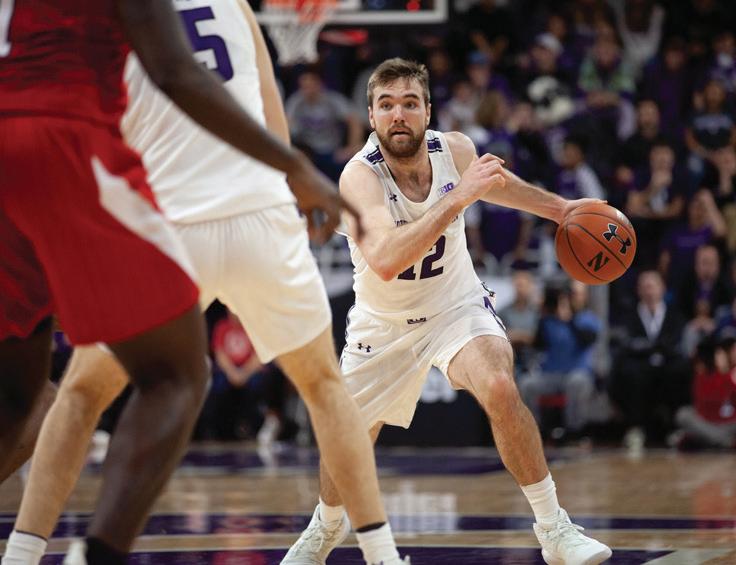
When Pat Spencer (SPS ’20) first laced up his shoes in Welsh-Ryan Arena in 2019, he was a grad student who hadn’t played a lick of college basketball.
The current Golden State Warriors guard, who’s in the midst of a breakout season, was a college lacrosse star who some still consider the greatest of all-time in the sport.
He was fresh off a historic season at Loyola University Maryland, where he’d won the Tewaaraton Award, the highest award in lacrosse, and was selected first overall in the inaugural 2019 Premier Lacrosse League Draft.
But he turned it down. From 2016 to 2019, he’d given his all to the Greyhounds. He brought them to the NCAA semifinals his freshman year and to two quarterfinals in the next three years. Upon getting drafted, he decided it was time for his story to change. Spencer set his sights on basketball, and Northwestern took a chance on him. Since then, he has grinded his way into the NBA, landing his first standard contract Feb. 7.
“He’s a dog,” Warriors point guard and two-time NBA MVP Stephen Curry told The Daily. “Find me anybody else who’s got the self-confidence to do what he’s done.”
‘Sports are meant to be won’
Though Spencer wouldn’t have his name embroidered on a collegiate basketball jersey until after a four-year lacrosse career, his journey to Northwestern basketball began more than 20 years earlier. His dad, Bruce Spencer, loved basketball since his own childhood. His mom, Donna Spencer, too played in high school and was a lifelong fan.
When Pat Spencer was born, not playing basketball wasn’t really an option. His dad took the reins, coaching the future NBA guard personally until he was 11.
Pat Spencer’s two younger brothers, Cam and Will Spencer, received the same treatment. Cam and Will Spencer would also go onto play at the collegiate level, with Cam Spencer continuing on to play in the NBA as a guard for the Memphis Grizzlies.
“We’ve always been junkies,” Bruce Spencer said.
Growing up, the Spencer family driveway became the local venue for neighborhood kids to practice their basketball game.
But with the way things were run at the Spencer household, this wasn’t your average game of pickup basketball.
“If you were coming to our house, you were getting in a game to win,” Bruce Spencer said.
Bruce Spencer is a self-described ultra competitor, something Donna Spencer said is just innate to who he is. He said he won’t even play church volleyball because “sports are meant to be won.”
To say that mentality rubbed off on his sons would be an understatement.
To this day, Pat Spencer said he credits the way his family raised him for his success. Specifically, he said his grandpa, dad and anyone else who’s “a little off in the head competitively” have served as role models.
Pat Spencer packed his schedule with almost every sport as a kid, seeking out opportunities for competition. In a given season, he was on up to as many as three teams for different sports. His parents said getting him to all his practices was a constant rush, but to feed his competitive nature, they had to make it work.
“He’s always been that ferocious, ‘I want to win’ kind of kid.” Donna Spencer said. “When he was little, we tried to temper it. But I believe part of it’s just the nature of who he is.”
Between the lacrosse field and the basketball court
By the time he entered high school, Pat Spencer’s main commitments had narrowed to lacrosse and basketball.
As a high school freshman, though, the 5-foot-4 120-pound Pat Spencer was undersized when it came to hardwood. Despite his best efforts, he got stuck on junior varsity through sophomore year.
In lacrosse, however, his size didn’t matter as much. Though he also started his high school career on junior varsity, Spencer was quickly able to make a name for himself as an attacker at summer lacrosse programs. By the start of his junior year, the pressure to commit to a school — and a sport — was mounting. With loose regulations at the time, fellow talented high school lacrosse players had already signed their offer letters, leaving limited options for Pat Spencer.
“It was the wild west back then,” Bruce Spencer said. “You had eighth and ninth graders committing to schools they couldn’t even spell the names of.”
Pat Spencer had to make a decision. He loved basketball more, but knew the odds of securing any kind of collegiate commitment at that time were slim to none. And for Pat Spencer, competing at the highest level possible was always his top priority.
Fortunately for him, Charley Toomey, the coach of Loyola Maryland men’s lacrosse, noticed Pat Spencer’s prowess on the field and still had an open spot on his team.
The Division I school would keep Pat Spencer close
to home, where his entire extended family was excited to cheer him on. After a couple visits and a few good conversations, he was in.
Once he signed, his growth skyrocketed. By the end of his junior year of high school, Pat Spencer had helped his varsity lacrosse team win a national championship.
“We knew we were getting a good one,” Toomey said.
Pat Spencer also made significant strides on the basketball court in the following years and was catching the eyes of some scouts who came to watch his teammates.
One teammate in particular, Kodye Pugh, was gaining some attention in Pat Spencer’s senior year. When the scouts came, his coach, Cliff Rees, would send Pat Spencer into the game to help Pugh showcase his talents. But Pat Spencer ended up serving as a distraction.
“Numerous times, (Rees) said the scouts came back asking about Pat, and asking ‘Is this kid committed?’”
Donna Spencer said. “And he would say, ‘Yeah. But not for basketball.’”
Pugh’s mom was upset that Pat Spencer was taking up the spotlight, Bruce Spencer said. But for Pat Spencer, going halfway has never been an option.
Becoming a lacrosse star
Pat Spencer started practicing for his freshman season at Loyola Maryland in September 2015. Once the team got going, he was immediately a star.
In his first game, the Greyhounds faced off against Virginia on the road, a team studded with experienced vets and future professional lacrosse players.
After seven minutes, Pat Spencer had already posted a goal and an assist.
By the end of the game, Virginia’s best defender was on him, Bruce Spencer said. And by the end of that season, Toomey said Pat Spencer was the best player in the country.
“The game looked slower to him than it did for a lot of kids around him,” Toomey said.
Over the next few years, Pat Spencer continued to establish himself as a generational talent.
His teammates loved him, too. He was the kind of guy to put his arm around a freshman in the locker room, Toomey said.
But what stood out the most to Toomey was the fire that Pat Spencer possessed.
“He was a constant competitor, to the point that I’ve never seen it,” Toomey said. “You don’t want to play him in checkers.”
When summer rolled around, though, it was always a different story.
“He wouldn’t pick up a lacrosse stick,” Bruce Spencer said.
Whether it was playing pick up at the Loyola gym, running competitive games at pro-ams or practicing with his brother, Pat Spencer was all basketball until regular lacrosse practice resumed in September.
Toomey said he and the Greyhounds didn’t mind as long as he wasn’t getting injured. He was getting more exercise on the basketball court than most of his teammates were with the standard strength and conditioning program, Toomey said.
Even once lacrosse season was back on, Pat Spencer needed more. He would frequently eat his lunch at the Loyola Maryland basketball team’s practices before heading back to the lacrosse field.
By the end of his time at Loyola, he had set the alltime NCAA Division I record in assists, was second in points, a one-time winner and three-time finalist for the Tewaaraton Award, the first player to receive Patriot League Offensive Player of the Year honors all four seasons, and was widely recognized as the greatest lacrosse player ever.
After being selected first in the 2019 Premier Lacrosse League Draft, Pat Spencer’s future lacrosse career was mapped out. But his itch for basketball just wouldn’t go away.
“The four years at Loyola were really magical,” Donna Spencer said. “We loved it, he loved it, but it just wasn’t his dream.”
Joining the ’Cats
Pat Spencer knew he had to give basketball a shot. But even his most loyal supporters, like Toomey, weren’t sure that giving up lacrosse was the right move.
Still, Pat Spencer never doubted himself.
“I’m a believer in, if you have a passion for something, you got to pursue it,” he said.
With no basketball tape or highlights to look at though, finding a scholarship was tough.
Only one coach decided to give him a shot: NU’s Chris Collins.
“When you’re the best in the world at something, whatever that is, there’s a greatness to that, and Pat carries some of that,” Collins said. “I just felt, even if he wasn’t a great basketball player, some of his qualities would rub off on our younger guys.”
Collins extended a scholarship to Pat Spencer and he joined the Wildcats as a grad student guard that next summer.
After a Europe trip with the team, he was excited to hone his skillset in Evanston.
“I knew I was going to have to learn a lot about my game and my body,” Pat Spencer said. “That whole year was really a learning experience for me.”
To his benefit, his lacrosse background assisted in the transition. He said many of the skills and drills
were similar across sports. Even some of the lingo was the same: pick-and-rolls, fast breaks and man-to-man defense.
The players on the NU women’s lacrosse team, meanwhile, were stoked to have Spencer joining the Wildcat family, coach Kelly Amonte Hiller said in an interview with Northwestern Athletics in 2019.
“He’s pretty much a superstar in our sport,” she said. “Everybody knows who Pat Spencer is.”
His family, too, was more than excited to see Pat Spencer in action on the court.
Cam Spencer was also playing at the collegiate level at Loyola Maryland at the time, but for their parents, Big Ten basketball was where it was at, Bruce Spencer said.
“No disrespect to the Patriot League, but they’re not quite like the Big Ten venues,” he said. “When we got that going, I was like, ‘I’m not going to miss these games.’”
And his family definitely got to see him play. Pat Spencer started in 29 of 31 games he played during his year with the ’Cats.
But his stats didn’t jump off the stat sheet. He averaged 10.4 points, 4.1 rebounds and 3.9 assists on 43.6% shooting from the field.
More importantly for Pat Spencer, though, the team didn’t perform as he would have hoped. NU went 8-23 during his year there, and his career ended on a 74-57 loss to Minnesota.
“It was frustrating in terms of losing,” he said. “First time I’d ever lost in my life.”
Still, Collins was focused on building something bigger.
Pat Spencer knew where he stood. He was the only grad student on a roster stacked with freshmen. He could see what Collins was working towards, but knew they weren’t going to get there in his time.
“I wanted to leave a blueprint of competitiveness, an edge, and a fire on some of those young guys, so they would have something going forward,” Pat Spencer said.
For one freshman in particular, Collins said Pat Spencer’s mentality left a mark: guard Boo Buie. In the years after Spencer left, Buie would go on to become the ’Cats’ all-time leading scorer and take the team to their second and third NCAA Tournament appearances.
Even for current ’Cats, the Spencer mentality has left a mark.
Senior forward Nick Martinelli recalled a time where he squared off against Cam Spencer. He said that it’s easy to see how both brothers have succeeded after witnessing his “unmatched” competitiveness first-hand.
Despite Pat Spencer’s modest performance in the 2019-20 season, he still had his sights set on the NBA.
Though Pat Spencer made great strides while at NU, even Collins said he wouldn’t have guessed that dream would come true. He could have used one more year in Evanston to finish polishing his game, Collins thought at the time.
Still, knowing Pat Spencer’s mindset, he knew better than to rule it out as a possibility.
“I just never bet against that guy in anything,” Collins said.
Making his dream a reality
The next year, after completing his master’s in sports administration over the summer and going undrafted, Pat Spencer found a spot on the Hamburg Towers in Germany.
After his brief stint abroad due to the COVID-19 pandemic, he returned to the States and continued to work hard on his individual game in Washington D.C. with a professional trainer. With the personalized coaching, he started noticing real progress.
Pat Spencer dedicated particular time to working on his 3-point shot. While at NU, the first-time college hooper shot a weak 23.5% from behind the arc. In the NBA, he has worked his way up to over 40%. In 2021, he signed with the Capital City Go-Go, the NBA G League affiliate of the Washington Wizards. A year later, he made it to California with the Warriors G League affiliate.
Pat Spencer continued to improve year over year. By last season, Pat Spencer was averaging 22 points as a star for the team. In February 2024, his performance earned him his first NBA Contract: a two-way deal with the Warriors.
This year in particular, has been a hallmark year in Pat Spencer’s career.
With Curry, the Warriors’ star guard, injured for large swaths of the season, Pat Spencer had a real opportunity to step up and get serious playing time. In typical Pat Spencer fashion, he did not take this opportunity lightly.
He got into double-digit scoring 11 times and put up as many as 13 assists in a single game before signing a full-time contract. Even to NBA players, his competitiveness is something special.
“He’s not backing down from anybody,” Curry said. “That’s why he’s where he’s at right now.” Spencer also became a media sensation this season. First, it was a clip of him going head-to-head with his brother Cam Spencer. Then, it was him shouting to the crowd after a big three, “I’m that motherf—r.” Fans couldn’t get enough. He also earned Warriors coach Steve Kerr’s respect, too.
“His coach realized that Pat is that motherf—r,” Kerr said in a postgame press conference.
Pat Spencer doesn’t care about any of it, though. He’s a simple guy, he said. He is not on any social media, rocks number 61 — a reminder of the 60 people drafted in front of him — and still drives the same car from high school.
“I don’t value material things,” he said. “I value relationships, I value hard work, I value family, I value being able to turn a game on on a Wednesday night and see my brother play in the NBA. Those are the things that are fulfilling.”
While Pat Spencer continues to defy the odds, back in Evanston, Collins is loving every minute of it. He said in his more than 25 years coaching the sport, watching the progress Pat Spencer has made is one of the more remarkable things he’s ever seen.
“I don’t think there’s anything else that makes me smile more than when I turn on a Warriors game and see him out there,” Collins told the Chicago Tribune in December.
Pat Spencer is now just one of three former ’Cats with current NBA contracts, along with Pete Nance (Communication ’22) and Brooks Barnhizer (Communication ’25).
At first, it was just a good story: a lacrosse star turned NBA player. But signing the standard contract marked something different.
Just days before inking his name, Pat Spencer said his goal was to impact winning at a high level. With a contract, he could do what he’s always loved and have the security take care of his family.
Since then, Pat Spencer has opened the doors to a future where that could be a possibility.
But going forward, he said his competitiveness still drives him. He said he’s got his mind set on the one thing he hasn’t won in any sport since high school: a national championship.
“You try to embrace everything and enjoy it along the way, but when you’re wired competitively, sometimes it’s hard to take those moments in,” Pat Spencer said. “I’m sure one day I’ll be able to look back on it all and appreciate the journey.”
dovelul2028@u.northwestern.edu
Daily file photo by Joshua Hoffman
Pat Spencer came to Northwestern basketball after playing college lacrosse for four years. Now he’s in the NBA.
Adarsh-Sisco win election overall, lose rst three rounds
Ducks Dan and Dave: Pecking Order
The Daily Northwestern Weekly Crossword
By Tanat Johnny Tungsubutra
department leadership,” Biss wrote. “Doing so would unnecessarily endanger officers, improperly suppress constitutionally protected speech, and substitute political judgment for the expertise of public safety professionals.”
In the letter, the mayor appeared to reject NU trustee Michael Sacks’ claim that Biss was likely to publicize his decision not to intervene “to shore up his progressive credentials,” which Sacks told former University President Michael Schill in a private text message in April 2024.
That message, among several others between University officials, was publicly released in Walberg’s letter to Biss last month.
“The matter became public only after your committee released the transcript of its interview with former President Schill last year, and has gained further media interest since your letter last month,” Biss wrote to Walberg, referencing a wide-ranging interview released on the day of Schill’s September resignation.
In his interview with investigators, Schill explained NU was “counting on the city of Evanston to make their policemen and women available” to arrest
OCL VENDOR
From page 1
demonstrators, adding the University “lost the ability to use force to remove the tents” after Biss declined to intervene.
During last month’s news conference, Biss questioned the timing of Walberg’s inquiry, accusing Republicans of trying to incite a “media circus.” He also denounced Walberg’s top campaign contributor, the American Israel Public Affairs Committee, which has criticized Biss and fundraised on behalf of his primary opponent State Sen. Laura Fine (D-Glenview).
Biss’ letter to Walberg was publicly released in a Monday news release from the mayor’s campaign. In the news release, Biss accused Fine of “relying on rightwing money to prop up her campaign,” citing a new pro-Fine super PAC reportedly tied to AIPAC, and of using “right-wing talking points for her attacks.”
In a separate April 2024 text message to Schill, also attached to Walberg’s letter, Sacks claimed to “know Biss well” and that “if the winds blow the wrong way he will throw you under the bus.” Fine’s spokesperson quoted those words in a statement to The Daily in response to questions about the new super PAC earlier this month.
Sacks donated $7,000 to Fine’s campaign in September, according to records from the Federal Elections Commission.
“I stand by our decisions to protect free speech in Evanston, especially in light of the Trump Administration’s crackdown on peaceful protest nationwide,” Biss wrote in Monday’s news release. “Antisemitism is a real and rising threat in our country, not a political football to be used in cheap attacks by Laura Fine and her MAGA backers.”
Biss argued voters across the 9th District should know whether Fine would have “sent in the police to clear the peaceful protest” on NU’s campus two years ago.
A spokesperson for Fine’s campaign did not directly respond to the mayor’s question, instead writing “Daniel’s sad campaign for personal glory gets sadder every day” in a Monday afternoon statement to The Daily. The spokesperson then appeared to reference a policy paper Biss himself submitted to AIPAC last year.
“The guy can’t even defend his own paper thin record without finding some tortured way to attack Laura Fine, one of the most effective legislators in Illinois,” the spokesperson wrote. “And to be more specific, to attack Laura Fine for donors he actively courted himself but failed to secure.”
According to a January Substack post by Biss, the mayor had multiple meetings with local representatives of the pro-Israel lobbying group but “never sought — and would never accept — AIPAC’s support in this campaign.”
Biss claimed that after outlining his policy positions on Israel’s military actions in Gaza during the meetings, the group decided to support Fine.
“My race may have been easier if I took this route and toed their line. But I knew then, as I do now, that I was not interested in their endorsement, and that once they knew more about my views on the issue, they probably wouldn’t be interested in me, either,” Biss wrote in the Substack post. “That turned out to be true.
Biss went on to call antisemitism “a dangerous and growing problem” in Monday’s letter. During last month’s news conference, the mayor accused Republicans of using the “very real danger of antisemitism to advance a political agenda,” citing his experience as the grandson of Holocaust survivors.
Biss also criticized the Trump administration, citing comments reportedly made by Border Patrol Cmdr. Gregory Bovino mocking the Jewish faith of a U.S. attorney in Minnesota.
“In addition to its voluminous inquiries into universities, businesses, local municipalities, and other entities, I encourage the committee to also examine the rise of antisemitic rhetoric originating from within the federal government,” Biss wrote.
j.baker@dailynorthwestern.com
SEVENTH WARD
From page 1
a security plan and a sustainability plan — all of which must be submitted six months before Ryan Field hosts its first event.
The stadium’s first event is currently scheduled to be an October NU football game, which would make the deliverables due in April.
During public comment, 7th Ward resident Frank Hill asked what the difference between a Stars and NU game would be. In response, Davis argued one involves collegiate athletics and the other is a professional sporting event.
“It is my belief that if you are going to engage in nonprofit activities, that’s fine,” Davis said. “But if you
McKean said the new website will also include a dedicated tab linking students to OCL resources, which the previous platform did not allow. The added feature will connect students directly to University guidance about the housing process.
While many students use Zillow or similar rental platforms, McKean said NU’s vendor helps
we have to involve our parents and we’re the ones signing the lease, but they’re the ones paying,” Lee said. “My parents do not speak English. They’re not here. They’re a 15-hour flight away. They’re not going to be able to help. They’re not going to be able to provide any kind of documentation, so there are obviously students who are going to struggle with that.”
are going to be engaging in for-profit activities, you should be paying taxes.”
Later, Seventh Ward Resident Jill Graham echoed Davis, questioning why NU doesn’t have to pay property taxes when renting out the field to “a profit-making business like the Stars.”
Graham said she was previously part of a church that was required to pay property taxes when renting out commercial spaces.
“It was a not-for-profit organization, but we paid property tax,” Graham said. “Because we were renting them out as rental income to the church, but those were commercial activities going on in those three little spaces.”
According to Davis, Illinois’ state charter asserts that because NU was established before the state itself, it
streamline listings by connecting students with owners open to renting to college students.
“Nobody in my office is a realtor,” McKean said. “What we want to do is make sure that students have a place where they can go that is theirs.”
Lee said he believes the University has a responsibility to support students navigating the off-campus housing process.
EDITOR IN CHIEF
Emily Lichty
PRINT MANAGING EDITORS
“People forget that we’re not really adults yet,” Lee said. “We’ve never actually done this before. No one has taught us how to sign a lease, how to read through a contract properly and the legal lingo of this process. It’s great that Northwestern encourages us to live off campus, but that also means that they need to offer us support and help to be able to do so.”
cannot be taxed on any land it owns.
She called this legal situation “very strange” and “mind-boggling.”
“There’s only a handful of specific institutions that somehow have been caught up in this loophole where they don’t have to pay any property tax on any land that they own,” Davis said. “It makes sense from a business standpoint why Northwestern would hold on to that loophole.”
However, Davis noted the Stars would be paying entertainment tax on their tickets, which would contribute to the city’s tax revenue.
Other residents expressed concern that making exceptions to current zoning regulations prohibiting professional sports at Ryan Field would open the door for professional sports to continually enter Evanston,
r.ahmed@dailynorthwestern.com
with one attendee adding it could turn the city into “a Wrigleyville.”
Seventh Ward resident Mary Rosinski criticized the possibility of professional sporting events in the city, noting that if NU wants to welcome the team, the area should become an “entertainment district.” She pointed out that the owners of Wrigley Field and United Center pay hundreds of thousands of dollars in property taxes per acre.
“Right now, we’re subsidizing Northwestern students and faculty and everything that Northwestern uses,” Rosinski said. “Either you are going to be a university education and take that tax status, or you’re going to be professional entertainment, professional sports.” y.huang@dailynorthwestern.com
The Daily Northwestern
Winter 2026 | An independent voice since 1923 | Evanston, Illinois
IN FOCUS EDITORS
Sarah Serota, Hannah Webster
SOLUTIONS EDITOR
Naomi Taxay
Marisa Guerra Echeverria, Nineth Kanieski Koso, Betsy Lecy, Anavi Prakash
MULTIMEDIA MANAGING EDITORS
Femi Horrall, Yong-Yu Huang, Jonah McClure
CREATIVE DIRECTORS
Christina Lin, Matt Wasilewski
CAMPUS EDITOR
Lexi Newsom
ASSISTANT CAMPUS EDITORS
Riq Ahmed, Sophia Bateman, Lucas Kubovchik
CITY EDITOR
Jack Baker
ASSISTANT CITY EDITORS
Claire Coffey, Wallis Rogin, Emily Dissanayake
SPORTS EDITOR
Kamran Nia
ASSISTANT SPORTS EDITORS
Sid Sivaraman, Yoni Zacks, Charlie Perlman
ARTS & ENTERTAINMENT EDITOR
Alexander Hernandez Gonzalez
ASSISTANT ARTS & ENTERTAINMENT EDITORS
Gabe Hawkins, Rainee Li
OPINION EDITOR
Aidan Klineman
ASSISTANT OPINION EDITORS
DJ Harrison, George Koutrouvelis
FEATURES EDITOR
Regan Huizenga
ASSISTANT FEATURES EDITOR
Lizzie Perry
ASSISTANT SOLUTIONS EDITORS
Kate Moores, Caroline Altschul
SOLUTIONS GRANT COORDINATOR
Lily Ogburn
AUDIO EDITOR
Ruby Dowling
ASSISTANT AUDIO EDITORS
Eliza Martin, Allegra Lief
PHOTO EDITOR
Liam Barrett
ASSISTANT PHOTO EDITORS
Drayson Jaffee, Luke Meinhardt
VIDEO EDITOR
Yana Johnson
ASSISTANT VIDEO EDITORS
Chris Kim, Miguel Tsang
ILLUSTRATIONS EDITOR
Nicole Cheah
ASSISTANT ILLUSTRATIONS EDITORS
Charlotte Nagel, Chelsea Lim
DATA VISUALIZATION EDITOR
Ryan Ottignon
ASSISTANT DATA VISUALIZATION EDITOR
Navya Singh
POLLING EDITOR
Diya Raj
ASSISTANT POLLING EDITORS
Isabella Kunc, Graciela Zhang
CROSSWORD & GAMES EDITOR
Kate Pollot
ASSISTANT CROSSWORD & GAMES EDITOR
Tanat Johnny Tungsubutra
WEB DEVELOPER
Devon Lai
DESIGN EDITORS
Clare Kirwan, Sami McKenney
ASSISTANT DESIGN EDITORS
Connor Tang, Ruixin Zhang
AUDIENCE ENGAGEMENT EDITOR
Edward Simon Cruz
NEWSLETTER EDITORS
Dalton Hanna, Maya Wong
ASSISTANT NEWSLETTER EDITORS
Maya Heyman, Hannah Mehler
SOCIAL MEDIA EDITOR
Ashley Dong, Avantika Singh
ASSISTANT SOCIAL MEDIA EDITOR
Sarah Park
COPY CHIEFS
Bianca Dishmon, Joshua Singer
COPY EDITORS
Clara Freeth, Jordan Balousek, Ina Choe
DIVERSITY & INCLUSION CHAIRS
Izzie Jacob, Teresa Ayala Leon
DEVELOPMENT AND RECRUITMENT EDITORS
Sophie Baker, Caroline Killilea, Ashley Wei
STAFF EDITOR
Siri Reddy
GENERAL MANAGER
Stacia Campbell
SHOP MANAGER
Chris Widman
BUSINESS OFFICE STAFF
Tia Bethke, Branden Chen, Edward Simon Cruz, Allie Epstein, Ken Trakulyingyong, Jen Walsh
ADVERTISING PRODUCTION STAFF
Lori Cui, Christina Feng
NU bounces back with wins over Army, Central Michgan
By JONAH MCCLURE daily senior staffer @jemccl125
Following No. 2 Northwestern’s upset loss to Colorado on Feb. 9, coach Kelly Amonte Hiller preached the need for consistency in energy and mentality going into each game.
After taking the week to reset, the Wildcats (3-1, 0-0 Big Ten) swept the weekend with strong wins over No. 20 Army and Central Michigan at Ryan Fieldhouse on Saturday and Sunday. NU dominated in the two contests, scoring 43 goals total and conceding just nine scores.
“You have to really dial in your mental side and make sure your energy is strong on day two,” Amonte Hiller said postgame Sunday. “We were excited and amped on day one … but we want to take advantage of every opportunity that we get to play this game.”
Against Central Michigan, the ’Cats recorded 53 shots, the most in a single game since at least 2007. NU attempted 21 shots in the first quarter against Central Michigan, emphasizing the hot starts of the weekend, as the ’Cats posted a 12-0 scoring margin in the first quarters combined.
Over the course of the weekend, sophomore attacker Aditi Foster scored seven goals. After tallying 12 goals last season, she has found the back of the net 12 times through four games.
Senior attacker Madison Taylor notched eight goals and four assists during the two games. She leads the nation in total points with 29.
After opening the season in a hybrid role, senior attacker Maddie Epke has taken over as the ’Cats’ primary draw controller. She corralled eight draw controls over the weekend while posting three goals and three assists.
The draw was important for NU in both games, especially against Central Michigan, when the ’Cats controlled it at a margin of 22-6.
“We weren’t too happy with our performance (on the draw) in our first game against Boston College,” Amonte Hiller said. “I feel like we’ve been learning and growing since, and that’s going to be a key for us all season long.”
During the ’Cats’ 18-7 win over the Black Knights (2-1, 0-0 Patriot League) on Saturday, the hosts completely controlled three quarters of the contest. NU didn’t allow a goal in the first quarter and conceded just three goals in the second half. The ’Cats also took advantage of Army’s 11 green and yellow cards, scoring seven of their goals with a player advantage.
In the second quarter, the only period when NU showed signs of weakness, the team was shown four penalty cards and committed four turnovers. The ’Cats were outscored 4-3 during the quarter, but immediately answered back with a 5-0 scoring run to open the second half. NU looked to alleviate the scoring burden off
of Taylor, who scored six of the team’s nine goals during the loss to Colorado. Before the veteran could score her first goal of the game, the ’Cats led 8-4, with six different players responsible for scoring. By the contest’s end, 11 players had found the back of the net.
“No matter who’s out on the field, we know that every single person has the same mindset,” redshirt freshman attacker Jenna Soto said postgame Sunday. “It all ends up coming down to gratitude and putting the team first, and that paves our path to success.”
Senior attacker Lucy Munro tallied three goals and two assists. Freshman attacker Gabriella McCollester scored her first career goal. Graduate student goalkeeper Jenika Cuocco made seven saves and allowed seven goals.
Around 24 hours later, NU returned to the field and issued a 25-2 thumping to the Chippewas (0-3, 0-0 MAC). Despite the short rest
WOMEN’S
period, the ’Cats looked fresh on their feet, and Foster’s goal less than one minute into the game set the tone for the rest of the contest.
“I don’t think there was a fatigue factor,” Amonte Hiller said about Sunday’s substitution philosophy. “I think it was more excitement to get on the field, excitement to connect off each other, to get better.”
NU opened the game with 17 unanswered goals, a streak that lasted until early in the third quarter when Central Michigan attacker Mia Bradley scored the visitors’ first goal. Similar to Saturday’s game, the ’Cats scored seven goals before Taylor could nab her first. By the end of the second quarter, she had five goals.
Along with Taylor, NU was led by Soto, who tallied four goals and four assists. After missing all of last season due to injury, she returned to the field and has played an important role within the attacking group.
GOLF
“I think seeing everyone work together and everyone has each other’s back is probably one of the most rewarding things,” Soto said. After 15 minutes of play, Cuocco earned her first minutes of rest of the season and redshirt junior goalkeeper Francesca Argentieri took over. The backup made four saves and allowed one goal before she was pulled in favor of graduate student goalkeeper Cara Nugent, who finished out the contest between the pipes. The trio combined for 10 saves and allowed just two goals. Junior midfielders Noel Cumberland and Lauren Archer each scored two goals. Freshman midfielder Sienna Connolly and redshirt freshman midfielder Annabelle Mahoney scored their first career goals. NU rounds out its four-game homestand against Marquette on Friday.
jonahmcclure2028@u.northwestern.edu
Lee wins individual championship, NU sweeps competition
By AVANTIKA SINGH daily senior staffer
In her second win of the season and third of her career, senior Dianna Lee took home the Sun Coast Spartan Invitational trophy over the weekend. She led Northwestern to a team victory, leaving the tournament as the only player to finish at or below par in all three rounds. NU finished four shots ahead of Oklahoma
to take first place, scoring 884 to the latter’s 888 across 54 holes. At the individual level, four Wildcats placed in the top 25.
Lee finished four under par with an overall score of 212. She matched the par in her first two rounds but carded a 4-under 72 in the final, propelling her to victory.
Sophomore Megan Meng finished 17th after earning a tournament-best score of one above par in the final round. She carded a double bogey in her first round and a 4-over
72 in the following round, giving her a final score of 223, seven above par.
Finishing tied for 19th, sophomore Hsin Tai Lin also scored a double bogey in the first round and a bogey in the final. Combined with her second-round score of 77, her firstand third-round results put her at 224 at the end of the tournament.
Junior Ashley Yun carded a tournamentbest 2-under 70 in her last round, the lowest score of any ’Cat in a single round. However,
INDOOR TRACK
she finished with a double bogey and nine above par in the first and second rounds, respectively, landing her in a tie for 23rd place.
Freshman Lauren E. Lee and senior Jiayi Wang finished tied for 79th and 81st, respectively.
The ’Cats return to play at the Darius Rucker Intercollegiate in Hilton Head Island, South Carolina on March 2 to 4.
avantikasingh2028@u.northwestern.edu
Northwestern sets record-breaking performances at meets
By CHARLIE PERLMAN the daily northwestern
@charlie_perlman
Northwestern put the crowds at the David Hemery Valentine Invitational and Blue Demon Alumni Classic on notice with multiple recordbreaking performances.
On Friday, redshirt freshman Cary Drake took home first place in the one-mile race, with a personal best time of 4:46:99 that elevated her into
the sixth-best time in Wildcat history. Alongside Drake, freshman Allegra Massey recorded a personal best, finishing fourth, while senior Mallory Grubb followed to round out the top five.
In the 800-meter, it was another young NU racer who turned heads with her speedy pace. Freshman Olivia Capala placed second with a time of 2:09.00 to achieve the second-fastest race in ’Cats history. On Saturday, other NU racers headed to the David Hemery Valentine Invitational in Boston, where personal bests were seemingly easy to
come by.
Redshirt sophomore Ava Criniti obliterated her previous personal best time by 17 seconds as she ran a 15:54.42 in the 5,000m. Her pace earned her the second-best time in school history as she placed 15th. Following Criniti’s lead, senior Mia Mraz also raced a personal best time of 16:32:19.
In NU’s 3000m group, three women placed in the top 20 racers, all with personal best times. Graduate student Anna Hightower ran a 9:09.13 that saw her finish 9th. Hightower’s time is the
third-best in ’Cats’ indoor history. Less than a second behind Hightower, redshirt junior Skye Ellis ran a 9:09.71 and placed 12th. Junior Jackie Holman followed shortly after Ellis with a significantly improved personal best that moved her into sixth all-time in NU history. After a successful weekend, the ’Cats will partake in their last indoor regular-season meet at the Margaret Bradley Invitational in Chicago on Saturday, Feb. 21.
charlesperlman@u.northwestern.edu
Yong-Yu Huang/The Daily Northwestern Northwestern beat No. 20 Army West Point 18-7 inside Ryan Fieldhouse Saturday afternoon.