The Daily Iowan
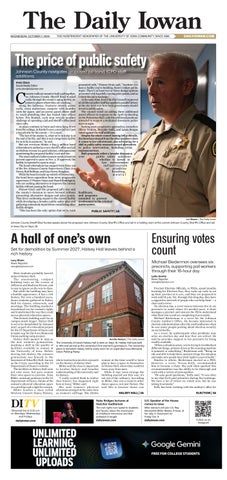
The price of public safety Johnson County navigates proposed jail bond, ICPD staff additions.
C
oncrete walls are meant to hold a jail together. As Johnson County Sheriff Brad Kunkel walks through the county’s aging facility, he points to places where they are cracking. Along the hallways, fractures stretch across walls, extra mattresses compete with laundry carts for space, and an access panel allows staff to reach plumbing that has leaked into offices below. For Kunkel, each stop reveals another challenge of operating a jail and sheriff’s office used since 1981. As pipes continue to burst and wires hang down from the ceilings, in Kunkel’s eyes, a new jail isn’t just a top priority for the county — it’s a need. “The fact of the matter is, what we’re in today is at the end of its life, and this is not a long-term facility for us to be in anymore,” he said. But not everyone thinks a $94.5 million bond referendum to authorize a new sheriff’s office and jail on Melrose Avenue is a good solution, with opponents questioning the proposed facility’s cost and size. The 2026 midterm ballot measure needs at least 60 percent approval to pass on Nov. 3. If approved, the facility is expected to open in 2030. The bond referendum has support from three out of the five Johnson County Supervisors: Chair Jon Green, Rod Sullivan, and Lisa Green-Douglass. While the board is made up entirely of Democrats, the bond faces opposition from more progressive supervisors V Fixmer-Oraiz and Mandi Remington, who are seeking alternatives to improve the current facility without passing the bond. Fixmer-Oraiz said the proposed jail’s size and the county’s decision to move forward without presenting alternative designs and price points. They favor continuing repairs to the current facility while developing a broader public safety plan and gathering community input before considering other facility designs. “This has been the only option that we’ve been
presented with,” Fixmer-Oraiz said. “Anytime you have a facility you’re building, there’s robust public input. There’s at least two or three design options presented with hopefully varying price points, and so I think this jail is too large.” At the same time, Iowa City City Council’s approval of additional police staff has sparked a parallel debate at the city level over how local governments should invest in public safety. The council voted on adding three additional patrol officers in response to the April 19 shooting on the Pedestrian Mall, with the additional positions intended to support a dedicated downtown police team at night. Seeking more progressive approaches, councilors Oliver Weilein, Mazahir Salih, and Laura Bergus voted against the staff additions. Despite the whole council leaning left politically, the three have strayed from the other members when it comes to law enforcement, also advocating for a shift in public safety resources toward alternatives to police intervention, including crisis response services. Both proposals reflect a broader discussion over public safety solutions: whether to invest in law enforcement infrastructure or prioritize housing, mental
healthcare, and programs intended to prevent involvement in the criminal justice system.
A hall of one’s own
Ensuring votes count
Michael Biederman oversees six precincts, supporting poll workers through their 16-hour day.
Set for demolition by Summer 2027, Halsey Hall leaves behind a rich history.
Most students probably haven’t noticed Halsey Hall. The una ssuming, compac t building rests on the corner of Jefferson and Madison Streets, and is easy to ignore on the way to class. But while the building may have a humble appearance, it has a rich history. For over a hundred years, dance students gathered in Halsey Hall for classes, rehearsals, and meetings. The building marked a transitional era for women's rights and transformed the way they could access physical education spaces. This historic building won’t be on campus much longer; Halsey Hall is set to be demolished by Summer 2027, as part of a relocation project for the UI Department of Dance and to make way for the Iowa Memorial Union parking ramp project. Halsey Hall opened in 1915 as the new women’s gymnasium, marking a shift in the quality of facilities available to women at the University of Iowa. Before moving into Halsey, the women’s gymnasium was housed in the basement of Schaeffer Hall, known as the Crypt, according to the UI Department of Dance’s website. The facilities in Halsey Hall were not only nicer, but gave women their own space to exercise. Zena Bibler, assistant professor in the UI Department of Dance, thinks of the women’s physical education space as a privilege and a right for women. Bibler teaches a class called Western Concert Dance History,
women at the time would’ve been glad to have a space to themselves in Halsey Hall, where they could let loose away from men. While it may seem strange the building started out this way, it’s not out of the ordinary. According to Bibler, this was a trend in other dance spaces, not just Halsey. She said this is because dance was
Precinct Election Officials, or PEOs, spend months training for Election Day; they wake up early to set up their precinct at 6 a.m., and they are prepared to work until 8 p.m. Yet, through this long day, they have a supportive network of people who can help them — a chair and a rover. On election day, a rover moves between five to six precincts to assist where it’s needed most. A chair manages a precinct and ensures the PEOs understand what their role is and are completing it accurately. Michael Biederman is a rover for the Johnson County Auditor’s Office. He became interested in election administration after the 2018 midterms when he saw many people posting about election security on social media. As a rover, he understands what problems may arise on election day and how they are solved. He said he provides support to his precincts by being readily available. “When a situation arises, you're trying to troubleshoot different things, printers down or the scanning machine is jammed or something,” Biederman said. “Being on site and able to help them, and just triage the situation and make sure people have their right to a secret ballot.” Similar to others, Biederman started as a PEO. However, a rover, Teresa Kelly, recommended him to become a chair. She said what sparked this recommendation was his ability to be thorough and work with a variety of personalities. “He asks good questions,” Kelly said. “It was clear to me that he'd paid attention during the trainings. We have a lot of videos we watch now, but he was taking it seriously.” Kelly has been working with the auditor’s office for
where instruction involves research on the history of Halsey Hall. Bibler said the class is important to localize history and broaden understanding of the university and its history. “I really wanted them to realize that history has happened right here at Iowa,” Bibler said. She said women’s physical education emerged at the same time as women’s suffrage. She thinks
The Daily Iowan
One of Fixmer-Oraiz’s major concerns is the lack of transparency regarding the jail’s full cost. They said the proposal’s cost demands closer examination of alternative designs and housing options. They said unanswered requests for diversion data and contingency plans have left them questioning whether the county has adequately established how much jail space it needs. In comparison, Wapello County, located 90 miles southwest of Iowa City, is proposing a $45 million bond this November to expand and renovate its existing jail, adding 168 beds — at half of Johnson County’s $94.5 million referendum. “When you look at the design and how much this is costing, it requires deep consideration, and that has not occurred even despite asking for the data,” Fixmer-Oraiz said. Fixmer-Oraiz said if the bond fails, they want to continue repairing the old jail while developing a broader public safety plan and gathering input from medical providers, public defenders, and people with experience in the jail system before considering alternative facility designs. “I’ve been asking for the public input, and I kept being told that that was going to come,” Fixmer-Oraiz said. “It didn’t come until about a month and a half ago. When you look at like a two-year process, that is pretty outrageous.” Other local leaders have weighed in on the jail, showing both support and opposition. Leslie Carpenter, co-founder of Iowa Mental Health Advocacy, has publicly supported the bond and said, as a mental health advocate, she wants to improve conditions for people with mental illness who are incarcerated. “There’s a different physical feeling that you have, and a different sense of mental well-being in those spaces, and more space also creates more safety and calms things down, and that matters,” she said. “No, I don’t want anybody incarcerated. That’s actually something I fear. But if they are going to be incarcerated, I want the situation to be better.” While some opponents of the jail have suggested increasing mental health programs and advocacy, including Johnson County Deserves Better, an organization funding the anti-jail campaign, Carpenter said it’s insulting to assume mental illness is the primary reason people become incarcerated. “It’s assuming most of the people in the jail have a mental illness, and that’s why they’ve ended up there,” she said. “And that’s really insulting to people who are surviving and doing quite well with mental illnesses.” According to the 2024 jail assessment, an updated facility needs more access to mental health for inmates, including a multipurpose classroom, counseling offices, and spaces for professional visits and group meetings. Carpenter said she hopes to see these changes in an updated facility to support the mental well-being of inmates. “The space capabilities will be markedly improved in a new facility for those types of supports that will help them as they’re coming back out into our community,” she said. Weilein opposes the jail and agrees with Fixmer-Oraiz that there has been a lack of engagement from the county with its constituents. Weilein worries expanding jail capacity could support increased incarceration and immigration enforcement, although Johnson County does not have a contract with U.S. Immigration and Customs Enforcement, or ICE. “I just don’t want to build the infrastructure that will be used for mass incarceration,” he said. Frederick Newell, executive director of Dream City, an Iowa City nonprofit focused on youth development and community empowerment, said he is undecided on the proposal and wants better for the county. “I would just want to know that the system, in and of itself, is not going to look the exact same as it does now,” he said. “A new building doesn’t mean less harm.” Newell said the jail should balance humane treatment with accountability for those convicted of crimes, and he hopes to see that improved whether or not the bond passes. “I would love to see people who are arrested to be treated with dignity, respect,” he said. “But [if passed], I hope the new jail, again, is a place for consequences.”
While Fixmer-Oraiz and Weilein’s concerns center on alternatives to the proposal on November’s ballot, efforts to replace the aging facility stretch back decades. Voters rejected earlier bond proposals in 2000, 2012, and 2013.
In 1977, Johnson County passed a bond referendum to build the jail and sheriff’s office on Capitol Street in Iowa City. The two-story building opened four years later and was designed with a sheriff’s office on the first floor and a 46-bed jail on the second floor. Forty-five years later, the county operates the jail in the same building with few modifications. Kunkel said due to its original design, there is no way to expand the jail. Due to structural concerns and space limitations, he said the county needs a completely new facility. The jail originally housed 46 people and was later expanded to 92 beds through double bunking, though county officials put its operational capacity at 65 because
incarceration, and what they’re identifying here is if you assume as a community we still invest heavily in the world of jail diversion, our incarceration rate can stay low, which ultimately affects the jail population,” Kunkel said. Despite this low rate of incarceration, Kunkel said inmates have been sent to jails in other counties because of space limitations at the facility. In 2025, Johnson County housed an average of 20 inmates at a time in other counties, according to the county’s jail bond information page, spending $420,859 in 2025 on outof-county housing. “We will still have to increase the amount of people we’re housing out-of-county,” Kunkel said. “The amount of money we continue to spend on out-of-county housing
¡
its layout limits the ability to separate inmates according to safety and housing requirements. The county’s average daily jail population was 88 in 2025, down from 118 in 2014. In 2025, an average of 20 people per day were housed in other counties, according to county records. “They didn’t build the foundation or the footings so that they could support upward expansion, meaning there’s nothing we can do today,” Kunkel said. “We can’t build up, and we can’t build out because we’re landlocked. So here we are, almost 50 years later, having to try and get a new facility again to meet the needs that have changed.” In November 2000, Johnson County voters rejected a $20.3 million bond referendum for a new county law enforcement center, with about 65 percent of “no” votes. In November 2012, the county failed a $46.8 million bond referendum to build a new jail. Additionally, in May 2013, a revised $43.5 million referendum did not pass. Although both of these bonds garnered over 50 percent of the county’s votes, neither met the 60 percent threshold needed to pass. Over a decade after the last failed referendum, a countycommissioned assessment documented the building’s deterioration, restoring concerns about how much longer the facility could remain in use. According to the 2022 Sheriff’s Office and Jail Facility Condition Assessment, prepared by Faithful+Gould, an international consultancy specializing in project, program, and cost management for construction, the Johnson County Jail’s condition index is 104.8 percent — well above the 60 percent threshold at which the report recommends considering replacement. Kunkel said the assessment helped renew discussions about replacing the aging facility. “When you have a neutral third party evaluating the condition of your building saying it’s at the end of its life, you need to start planning for something new,” he said. Johnson County’s jail incarceration rate was approximately 53 people per 100,000 residents in 2023, below both the state and national rates, according to the county’s 2024 jail needs assessment. “We have a very low rate of
will grow. The number of people we can still cap here remains the same, and it becomes a very expensive endeavor to keep doing business the way we are.” Beyond the number of beds, Kunkel said the jail’s nine housing units limit staff’s ability to separate inmates based on legal requirements and safety concerns. Some beds must remain open for new arrivals or people who need to be moved after conflicts, meaning an empty bed cannot always accommodate someone in custody. He also said there is minimal room for storage, leaving hallways crowded with extra mattresses and laundry carts. The updated facility — which will be located on Melrose Avenue, near the Johnson County Historic Poor Farm on Iowa City’s western edge and open in 2030 if voters approve the bond, according to county officials — is designed to accommodate increased capacity. “You have to have your infrastructure built in a way to meet future growth,” Kunkel said. “That’s what we’re also trying to accomplish here, is to have a building big enough so that if growth needs to happen 30 years from now, there’s enough room.” The proposed jail and sheriff’s office would span 118,000 square feet — more than four times the current facility’s 28,500 square feet. It would open with 120 beds, compared with the current jail’s 92 beds and operational capacity of 65 inmates, with space reserved for another 20-bed housing. Plans call for larger common areas and dedicated space for classes, counseling, and meetings with attorneys and other service providers. The county estimates the bond would cost taxpayers $88 annually for every $100,000 of taxable property value for 12 years. A property with a taxable value of $200,000 would therefore pay about $176 more per year. Taxable value differs from a home’s market or assessed value. In the meantime, Kunkel said they are working on the current jail’s HVAC system as part of roughly $3.2 million in repairs to keep the existing jail operational. The project will continue over the next few years regardless of whether voters approve the bond, he said.
The debate over the jail comes as Iowa City faces similar questions regarding how much money should be invested in law enforcement and addressing community needs. On a rainy Sept. 22 afternoon, a group of roughly 10 people gathered outside of Iowa City City Hall to protest against the three new officers added to the Iowa City Police Department. The hires were approved in a 4-3 vote by the city council on Sept. 16. In addition to the staff additions, concerns over Iowa City policing have been raised after a police officer shot and killed a person armed with a knife on Sept. 15. During the city hall protest, Veronica Kolder, an Iowa City resident, said the city should prioritize addressing underlying social needs, including housing and mental healthcare. “The focus needs to be on looking at the root causes of homelessness, mental illness, things that may have been factors in this killing,” she said. The council originally voted to defer the resolution to hire the three new officers on Sept. 1 to allow for broader discussion of public safety. Its subsequent approval on Sept. 16 drew opposition from some residents and three councilors who questioned whether additional police staff should be the city’s priority. Weilein, a self-proclaimed anarchist who fundamentally disagrees with government, according to previous reporting from The Daily Iowan, opposed the resolution. He said the city should evaluate the full cost of adding police staff and consider existing models for alternative public safety responses before making the hires. “These are some of the most, if not the most, expensive positions that we can hire for at the city, and I think without knowing the full impact of what that’s going to look like, and making these hires, especially when there are alternatives to viable ones with examples and models, it’s not just some idea that we can look into instead.” Mayor Pro Tem Megan Alter voted in favor of the resolution and has advocated in favor of a strong law enforcement presence, saying recommendations from city staff and conversations with downtown workers and students convinced her a dedicated police team on the Pedestrian Mall was necessary. “We listen to people who come to chambers, and any time there has been a concrete proposal for alternative ways to address public safety, we have funded it,” she said. “We have voted for it. For this particular situation, I felt this was warranted.” Alter said she is still interested in improving mental health programs and bringing awareness to other options available rather than calling the police. Additionally, she said the jail proposal and police staff additions address separate, immediate needs, even as opponents connect both to broader concerns about the criminal justice system. “I recognize they’re part of a larger philosophical conversation,” Alter said. “But I am looking at this in terms of what is needed most so people can be treated better in the jail, and we can dissuade people from doing harm on the Ped Mall.”
historically seen as a women’s activity. “Most dance programs started as physical education programs because early modern dance was seen as a branch of women’s physical education,” Bibler said. Even though there was no dance major, dance was still going on in Halsey Hall long before the distinction. Bibler said she thinks dancing was a large part of the physical education offered in Halsey Hall because dance was a type of exercise and self expression deemed “appropriate” for women at the time to partake in. “I’m sure they would’ve considered themselves artists,” Bibler said. As time went by, these activities morphed into the modern dance scene we see today. In 1924, the Department of Physical Education at the UI was established, bringing w ith it an opportunity for women to study physical education, according to the website for the UI Department of Dance. Elizabeth Halsey, for whom the building is named after, was the head of the Department of Physical Education from when it was founded in 1924 until 1955. After she retired, Myrtle Gladys Scott took over the role. Scott worked to establish the Department of Dance for the UI. The bachelor’s in dance degree was founded in 1976, thanks to the work of Scott, who hired faculty members and oversaw curriculum development. The Dance Department was finally founded in 1976, with its home in Halsey Hall. Lilly Aylward, a fourth-year dance student, has spent the last three years in Halsey. Though the building wasn’t always the most comfortable, she said a lot of great memories came from her time there. “ Halsey Hall definitely had her quirks, but it was fun,” she said. “It’s where I met all my best friends.” Aylward is okay with letting go. Though she recognizes the rich history in Halsey Hall, the flaws were hard to ignore. The new building provides a much better dancing experience. In the over-100-year lifespan of Halsey Hall, the building never had air conditioning. This proved to be a problem in summer months, when students were exercising in the building. Bibler said it’s a main reason she is happy for the dance department’s new home. She said doing highly aerobic activities in the hot summer months was a struggle when she taught in Halsey Hall. But while she is grateful for the amenities the new Dance Building has to offer, part of her is sad to lose such a historical building. “Part of what’s sad about losing Halsey is we’re literally destroying the space where a lot of historic and important things have happened, not just for the university, but also for the field of dance in general,” Bibler said. Because Halsey Hall was so old, members of the dance department found
it easy to express themselves without worrying about damaging the building. “Halsey was a canvas in that way. Everything was so worn that you could apply a lot of creative license to it,” Bibler said.
roughly 20 years, and currently serves as a rover. She said part of what she does is give feedback to Kenzie Northup, who is an Elections Outreach and Poll Worker clerk.Kelly said it is important to understand the skills and personalities of different poll workers because, “It's the people that make a successful election.” Northup said when working with poll workers and finding the right people for different roles, she looks for individuals who can work well with others and be a smiling face. “I think voters really look to poll workers for reassurance and for comfort,” Northup said. “So when they're able to have a happy look on their face, when they're able to really do customer service in a good way, it's reassuring to voters.” While poll workers support voters, their chairs and rovers support them. Besides troubleshooting and answering questions, Biederman said he brings snacks to all his precincts to keep spirits high. Northup appreciates this extra effort and ability to make people feel welcome. “At the end of the day, a lot of the poll workers are serving because they want human connection and to meet members of their community,” Northup said. “When we get positive people like Michael, you definitely want them to stick around.” Kelly said the learning process leading up to election day can be challenging for PEOs, and she reminds them there are experienced workers around who want to help. She also explained how new chairs may be nervous about being the leader of their own precinct.
“If it's a brand new chair, that's where I start my day, so I can help them through the whole setting up, opening up the poll process,” Kelly said. While poll workers are motivated to be a part of the democratic process, when working, they do not discuss candidates or political opinions. “I think that common goal, that we're just trying to make sure the election is successful, brings us all together,” Biederman said. At polling precincts, there are PEOs from both parties, and when voters need assistance, they can speak to a bipartisan team. A bipartisan team consists of one Republican and one Democrat. If someone is participating in curbside voting, this team would go out to assist. According to 2025 voter registration data, Johnson County had 44,513 active Democratic voters compared to 18,159 Republican voters. Kelly said when she first started working the polls, it was hard to find enough Republicans to work the election in Johnson County. Biederman echoed this statement and said to ensure a bipartisan team, they need workers from both parties. “They definitely need more Republicans to come out and make sure that we have that overseeing process, and making sure that everyone has faith in the election,” Biederman said. Whether it is someone's first time voting or they are experienced at filling out their ballot, poll workers a re c om mu n it y memb er s who have a goal to help be part of the democratic process. “They are your teachers, your coworkers, your friends, people from all different walks of life,” Northup said.
Amelia Fisher, a fifth-year dance and pre-physical therapy major, said she researched Halsey Hall when she took the Western Concert Dance History class. What she found most interesting about
Halsey is how many amenities used to exist within the building. Fisher said she learned through her class that the floor in Fitness East, which is housed in Halsey Hall, is slanted, because the area used to be a pool. Fisher said she is worried about the history that will be lost once Halsey Hall is torn down. While archives still exist about the history of the building, Fisher thinks it won’t be as easily accessible. Fisher said while she was inside Halsey, she was always aware of the storied nature of the building. “When you step in there, you immediately feel like there’s history here,” Fisher said.
OPINIONS Rape culture thrives on silence
As we learn about the Cornell gang-rape lawsuit, we must confront the culture of silence and inaction that allows sexual violence to persist.
S
ociety views sexual assault in a narrow lens. We think locking up every rapist will end America’s rape culture. But rape culture is sustained through silence and acquiescence. It follows every “harmless” joke; it follows every unanswered group chat message; it follows every party where someone notices something is wrong and decides it isn’t their business. Yet, it is their business. It’s your business. Following the reopening of Jane Doe’s case at Cornell University, this conversation has sparked outrage among people nationwide. And why wouldn’t it? A young woman’s life has been changed forever, yet Cornell's response was to require the perpetrators to write essays as if it were a punishment for talking back to a teacher in elementary school. Aside from Cornell, universities across the U.S., including the University of Iowa, need to do better protecting their students. They must realize these are real women — real human beings — who each have their own story and experience. Abril Garcia Rojas, a UI 2026 graduate, experienced this firsthand. In an interview with The Daily Iowan, she said she dated a fellow student whose outbursts she learned to excuse because he always apologized so sincerely and because she believed abuse had to be physical. One night, Garcia Rojas said, he flooded her phone with calls, and when she told him she was at another man's apartment, he said she and the man would suffer the consequences. She turned off every location tracker. A friend later spotted him outside Elray’s Live and Dive, the bar below the apartment. She called the non-emergency police line, and a file was opened. The next day, she says, the UI Title I office called, at first sounding concerned. She told them she wanted no contact and a restraining order on her abusive ex-partner.
The staffer asked whether he had ever been physical. When she described a few instances, she was told it "wasn't enough to get a restraining order." The Title I office never got back to her about a formal report. She asked her advisor to keep her out of class with him but ended up in one anyway, and she says the advisor then removed her from her ambassador program for lack of effort, though she had kept him updated. She was left to deal with it alone. According to the Rape, Abuse, Incest National Network, or RAINN, roughly 32 percent of undergraduate women and about eight percent of undergraduate men experience rape or sexual assault during four-plus years in college. And the National Sexual Violence Research Center, or NSVRC, reports that among college students, nine out of 10 women knew the perpetrator before they were attacked. In their first year, 16 percent of undergraduate women experience some form of sexual assault, mainly by force or inability to consent to the contact. This time, during the beginning of the school year, is called the “red zone,” where sexual misconduct peaks. There’s literally a name for the phenomenon because it’s so common and universal across U.S. colleges and universities. They are women who, for the most part, have been let down by authority figures, especially educational institutions. A woman can report that a man threatened her, tracked her, and showed up where she was hiding, and the first thing the office wants to know is whether he left a mark. It's the same logic that makes people ask a rape survivor whether they fought back. Part of the reason these cases stall is for an assault to seem “credible,” people — especially men — expect to hear the most horrific details, as if any non-consensual act is not enough. But every sexual assault won’t check the same boxes, and nor should we expect it to. When we only believe the survivor who fought back, screamed, and has the bruises to prove it. We teach everyone else that what
happened to them doesn't count. This mentality sees women as objects, makes excuses for shocking behavior, and constantly puts victims on trial instead of focusing on holding the alleged offenders accountable. And it starts from how men talk about women. In particular, since when did sex become something done to a woman, instead of with? Women are "hit," "railed," “nailed,” or "cracked." Men "get some" or "bag" someone, then brag about it in a group chat. There is violence associated under every one of those phrases. Our language might not directly cause an assault, but it normalizes it. Normal is exactly what online pressure can challenge, which is why I disagree with people who dismiss men reposting about this as performative. More education is necessary, and online is where it is most likely to reach the men who need it. Men want validation, and if they see their friends acknowledging sexual assault online, they may start to question what they thought was harmless. Yet, positing it is not where the education stops — it is where it begins. Online, many have started calling the men involved the "Cornell Seven." I understand the instinct to reach for a name that sticks, but this one is wrong. The Central Park Five were Black and Latino teenagers who were presumed guilty the moment they were accused because of who they were. They were convicted of a crime they didn't commit, and no one cared what happened to their futures. The Cornell case is nothing like that. Seven men accused of gang-raping a woman — and the 50 other men who sat idly — are not victims of a miscarriage of judgment. Borrowing that name erases what actually happened to the Central Park Five, and it hands the deplorable men in this case sympathy they haven't earned. That sympathy is already being claimed, particularly by one of the seven men, who admits he was inside Chi Phi that night, but not responsible for sexual assault. He is now suing Cornell to have his name removed from the lawsuits and his academic record expunged, while still being responsible for attempted sexual exploitation. He had entered a room after a message in the fraternity's Snapchat group pointed to a woman inside, and by his own account he worried someone could be in danger. He says he asked if the people inside were okay, took a “yes,” and left. He is worried about his future. But what about Jane Doe? The real story is what happens after someone reports. Disbelief dominates the conversation far out of proportion to the facts. Research puts the share of reported rapes and sexual assaults that are confirmed false at only about two-10 percent. According to uSafeUS, many cases that get labeled "false" were never proven false at all. They stalled because of insufficient evidence, or because the survivor withdrew the report rather than face the legal standard for prosecution. A case that can't be proven is not a case that didn't happen. These misclassifications can distort campus data, strengthen the misconceptions about sexual assault, and destroy the trust in institutional reporting systems. They can cause real reports to be treated as false ones. Cornell isn’t an outlier; it’s just the case that blew up. In 2020, former UI student Makena Solberg sued UI fraternity, Phi Gamma Delta, or FIJI, for sexual assault. The case was later settled, yet it caused protests for multiple days outside the fraternity house. Most recent reports at the UI by the 2024 Jeanne Clery Disclosure of Campus Security Policy, Crime Statistics and Fire Safety Annual Report, showed that reports of rape on campus more than doubled in 2023. There were reported 96 sexual assaults on campus that year. These numbers must elicit a reaction. Universities have a responsibility to take reports seriously, but they cannot be the only ones responsible for changing the culture that allows sexual violence to persist. That responsibility belongs to all of us.
UI students weigh downtown policing Following the Iowa City City Council’s decision to add police officers downtown, students are unsure about the benefits.
While the Iowa City City Council narrowly voted to add three new police officers to the downtown area, University of Iowa students have mixed opinions on law enforcement in Iowa City. After three UI students were shot at the Pedestrian Mall almost six months ago, the UI student body was rattled. In response, the UI Police Department partnered with the Iowa City Police Department to create a joint patrol in the downtown area. While understanding the fear of violence that set the plan for more officers in motion, students have a hard time supporting bolstered law enforcement. Students such as Taylor Stremlow, a third-year entrepreneurship and marketing student, feel indecisive about the additions. “Having extra protection and police presence could be helpful in situations where it’s as extreme as a shooting, but it could be intimidating to some people and disrupt the peacefulness of Iowa City,” Stremlow said. Stremlow’s words represent what many students feel as ome students who feel strongly about the issue spoke at the city council meeting. At the meeting, several UI students approached the podium during the public forum section. One by one, they made their case either for or against the resolution. T h e Un d e r g r a d u a t e S t u d e n t Government, represented at the podium by President Emily Cross, supported the ICPD staff additions. “Downtown is an important part of the student experience, and thousands of students regularly spend time in the Pedestrian Mall and surrounding areas,” Cross said. “Students should be able to attend events, support local businesses, and enjoy downtown, all while feeling safe and secure.” To decide on their stance on the resolution, USG carefully weighed the possibilities of more police officers downtown. USG City Liaison Eden Coy said the decision was difficult because of the potential burden on the city budget for new officers. However, USG ultimately decided sleep-deprived officers were a detriment to student safety, and new officers could remedy the issue. “Do we wa nt sleep - depr ived, overworked people with weapons to be working these late-night shifts, or do we want to open it up for a new role so that alert individuals can build relationships with the downtown district?” Coy said. Cr it ic s of t he decision a rg ue extra policing will not effectively increase safet y and t he money could be redirected towards
other public safety measures. City Councilors Laura Bergus, Mazahir Salih, and Oliver Weilein were the three council members who voted against the resolution for these reasons.
sa id t he cit y shou ld invest in other methods. “Giving more money to the police so they can police more is like a BandAid. It’s a reactionary solution to a
Paige Liebrecht, a graduate student at the UI, addressing the council members, spoke against the additions. “I would ask you to consider if additional police officers make you feel safe, how are your life experiences affecting that safety you feel ” Liebrecht said during the city council’s Sept. 15 meeting. “Maybe consider that other people around you don’t feel more safe in the same way that you do when there’s more police around.” Liebrecht believes extra policing is not the path to a safer downtown, and that increased police presence often does more harm than good, and
systemic problem,” Liebrecht said. “We need long-term solutions for long-term problems.” Beau Kell, a fourth-year social work student at the UI, said an increased police presence doesn’t make him feel safe. He said he already felt safe downtown, and adding police to the area doesn’t serve a significant purpose. Like other critics of the decision, Kell believes policy change, such as stricter gun control laws, is the way to bolster public safety. “It shouldn’t be so easy to access guns. That’s the biggest problem in
Iowa causing gun violence,” Kell said. A d d i s o n B e n t l e r, a t h i r d year neuroscience st udent, a lso believes the additions won’t change anything downtown. Like Kell, Bentler supported other safety methods. Specifically, she said improved bar monitoring could have a positive impact. “It’s very common for underage people to get into the bars, but if the bars monitored that more, it would create less chaos downtown in that area and just make the whole environment so much better,” Bentler said. Like the voices of UI students, the Iowa City community and councilors were divided on the issue at the city council meeting. The public forum and discussion took almost two hours due to the controversy of the issue. However, the resolution narrowly passed with a 4-3 vote. However, Stremlow ultimately trusts the city council’s decision. “If the city council has talked to the community and got input and that’s what everyone thinks is the best option, I’m going to trust that,” Stremlow said.
IC Foreign Relations Council pushes for the polls The fall lecture series, Voices into Votes, takes place in the weeks leading up to the midterm election.
By 6 p.m. on a typical Friday in Iowa City, most students have closed their laptops and made the trek to pastures greener than academic buildings around campus. However, others head to the Iowa City Public Library to jump headfirst into a lecture about Nov. 3 — Election Day. In the library, Peter Gerlach, the executive director of the Iowa City Foreign Relations Council, steps up to the podium to kickstart the council’s fall lecture series, titled “Voices into Votes: Why Turnout Matters Here, There, and Now.” Before Gerlach gives the podium to the lecturers, he asks a question to a group of students standing to his right. “What are you most hopeful for this election?” he asked. Danika Jacobsen, a University of Iowa student and education director for Hawk the Vote, takes the microphone and answers. “I’m hopeful we’re going to get a good youth turnout,” she said. “Historically, we’ve been the weak link.” A few minutes later, UI journalism professors Alex Scott and David Dowling take the stage to commence the lecture series with a conversation about media literacy in a world of AI and disinformation. Their lecture is the first of five, all including crucial knowledge for informed voters. The series came in response to concerns like Jacobsen’s. Gen-Z’s voter turnout is low; according to the U.S.
Census Bureau, only 47.7 percent of eligible citizens aged 18-24 voted in 2024. The ICFRC wants to push younger voters to the polls, especially UI students. Brett Cloyd, a UI professor and ICFRC emeritus board member, believes the series will help listeners make sense of the election. “When electioneering often focuses on ads that build up or tear down a candidate, I believe the programs from ICFRC will give a more detailed and thoughtful treatment into how elections happen and how people can play a part,” Cloyd said. Gerlach and the rest of the ICFRC have partnered with over a dozen organizations and companies to bring the series to life. One of these partners is Hawk the Vote, a student organization on campus which helps students stay informed about candidates, voting, and voter registration. The organization has worked closely with ICFRC to fulfill their shared goal of increasing turnout for college students. The student organization’s programming director, María José Blanco Arias, believes the information in the series is critical for guiding younger voters to the polls. “In this case ICFRC and letting people know that voting is more than just knowing who the candidates are, but also knowing more about why is it important, what it entails in democracy, in the government, and how there are also other topics that relate to our daily life,” Blanco Arias said.
Blanco Arias said the lecture series is not only meant to be informative but also casual and conversat iona l. That way, listeners might not be so daunted by voting and politics. “It’s like one of those interesting seminar classes that we have, and that we are able to listen to like a TED Talk,” she said. In the early brainstorming stage of the lecture series, t hose involved w it h planning decided on five subject areas to focus on, each corresponding to a lecture. The f i r st le c t u re, “Propaganda and Disinformation: Social Media, Podcasts, AI, and Cable News,” was centered around the information space. The second lecture, “Democratic Backsliding:
What Is It, How Does It Impact Elections, How Can It Be Stopped?” was given by two political science professors and the president of Freedom Hou se, a nonprof it organization that pushes for political freedom. The third lecture brought in journalists from all over the world to focus on one of the most polarizing aspects of any election: media coverage. For this lecture, titled “Freedom of the Press and the Ballot: Covering Elections Around the World,” ICFRC partnered with the 2026 World Press Institute to create a panel of journalists who advised listeners on evaluating election-related media and unreliable information. The next lecture, titled, “Who Votes, Who Does Not, and Why?” will focus
on laws and rules around election administration and how they mold participation and outcomes. “It is the challenges logistically, administratively that elections present,” Gerlach said. “It is an important question: Who gets to vote and who decides who gets to vote?” The fifth and final lecture, was planned with one thing in mind: optimism. Titled “Futureproofing Democrac y: Towards Hopeful and Achievable Elections in the U.S,” Johnson County Auditor Julie Persons will host. While planning the fifth lecture, Gerlach felt Persons’s presence would give listeners a sense of the practical aspect of elections and improvements that could be made in the
future. In his mind, having the person who actually administers the election speak was a no-brainer. “We do want there to be an understanding that this is maybe how it is, but there’s a lot of work that can be done to improve elections,” Gerlach said. “To hear from the person who’s doing it, who is leading that effort, whose job it is to administer ou r ele c t ion s e em s very important.” To Blanco Arias, the value of such a series is even greater in this election. “It’s a little bit more tense this election,” Blanco Arias said. “Because of those tensions, it’s really important for people to be asking questions, and be ready to get those questions answered from people that know.”
HAWKEYES ON THE BIG STAGE ESPN’s College GameDay returned to Iowa City for the first time in 20 years, setting up on the Pentacrest on Oct. 3. Students lined up as early as 3 p.m. the night before for a good spot and a chance to participate in Pat McAfee’s “Kicking is Easy”
Beyond the yard sign From social media to AI-generated ads, campaigns are changing how they reach voters.
T
hrough advertisements shown in their daily lives to questioning candidates’ voting record, Iowa voters are being asked whether they are truly Iowans. Claims from U.S. Rep. Ashley Hinson that “Josh Turek missed 58 percent of his votes” or from Iowa State Auditor Rob Sand that “Zach Lahn isn’t even a fulltime Iowan” are part of a battle playing out across voters’ screens as campaigns compete to define their opponents before voters define them at the ballot boxes. As Iowa campaigns compete for voters in the 2026 election, candidates are using a range of advertising strategies across digital platforms. Campaigns must decide what messages to emphasize, which voter demographics to target, and how to distinguish themselves from opponents. Kylah Hedding, assistant professor in the University of Iowa’s School of Journalism and Mass Communication, said political advertising plays a central role in helping campaigns to introduce candidates, promote policies, and shape voters’ perceptions of their opponents. “You have to figure out what’s that wedge you’re going to put in there for the persuadable voters, and then that’s just got to be repeated over and over,” she said. Hedding said campaigns need to decide what they want voters to take away from an advertisement. Depending on the campaign, this could mean introducing a candidate to voters, highlighting a specific policy or issue, building a campaign’s image, or criticizing an opponent’s position on a policy. “Campaigns do a lot of research into trying to understand what their persuadable voters want, and then they try to meet them where they are,” she said. Those decisions also depend on who the campaign is trying to reach. Hedding said campaigns can tailor messages or choose different messages based on voter demographics and voting behaviors of the intended audience.
“If they’re [a campaign] on TikTok, then they’re targeting young people. If they’re on Facebook, then they’re targeting older people,” she said. “Campaigns need to ask themselves, ‘Who are the users on the platforms, and then what are their expectations ’ and that’s how you figure out what ads you’re going to use.” The 2026 Iowa governor’s race demonstrates how campaigns can use different messages to distinguish their candidates from opponents. State Auditor and Democratic gubernatorial candidate Rob Sand’s campaign has emphasized issues including growing the economy, strengthening public education, and lowering costs. Sand’s campaign has released numerous television advertisements, regular posts on social media, and is using strategies to appeal to Iowa voters such as a 100 Town Hall Tour, where Sand plans to travel to all 99 counties in Iowa to host a town hall. In contrast, Republican candidate Lahn’s campaign has highlighted supporting Iowa farmers, making sure land in Iowa can be owned by Iowans and not out of state investors and restoring the education system in Iowa. Lahn has been campaigning on the slogan “Iowa First,” which his website said represents his commitment to Iowa families, businesses, and farmers. Lahn also has an active social media presence and has released short TV advertisements and videos. These messages and platforms have become recurring themes for both campaigns, giving voters a repeated point of contrast as they encounter candidates advertisements on different platforms. Both Sand’s and Lahn’s campaign did not respond to The Daily Iowan’s request for comment.
According to the Pew Research Center, YouTube, Facebook, and Instagram are the most widely used social media apps by Americans. Eighty-four percent of people said they use YouTube, 71 percent use Facebook, and 50 percent use Instagram.
TikTok has recently grown in popularity in the last decade, attracting a younger audience. According to Pew’s study, 37 percent of Americans now use TikTok, a 21 percent increase since 2021. Usage is especially high among adults ages 18-29, with 63 percent regularly using the platform, compared to 12 percent of adults aged 65 and older. Hedding said the growth of social media and digital advertising has given candidates more ways to reach specific groups of voters, changing the content of their advertisements and who sees them. Iowa City City Councilor Shawn Harmsen said social media advertising is even more important at the local government level because many candidates do not have the money for campaign ads. “I think the reality of running most campaigns these days is you have to have some kind of online social media presence,” he said. “The platforms you engage on and how you do it, I think that has changed over time.” In addition to managing his own successful campaigns for the District B seat in 2021 and again in 2025, Harmsen has also managed the campaigns of Iowa City Councilor Mazahir Salih, Iowa City Councilor Megan Alter, and former Johnson County Supervisor Royceann Porter. “The first campaigns I ran 10 years ago, TikTok wasn’t a thing — now it is. But that’s the nature of online anything,” he said. “It changes, and you have to decide if you want to follow this or not.” One thing that hasn’t changed, Harmson said, is the importance of physical advertising at the local government level. He said giving voters mailers, yard signs, and posters remains the most important to his campaigns. “I still think there’s definitely people that look at those mailers, see those things on the door, look at the yard signs, and I don’t think any of that really has gone away,” Harmsen said.
As campaigns create more precise ways to reach voters, the tools used to create those messages are also changing. Artificial intelligence, or AI, is giving campaigns new ways to produce and tailor advertisements, including helping write scripts, generating images, editing videos, and creating multiple versions of the same advertisement for different audiences. Political deception in advertising is nothing new in American politics. From Lyndon B. Johnson’s fear-driving, 1960s “Daisy” advertisement to manipulated images and video clips stripped of context, campaigns have used media to help shape what they want their audience to believe. Brett Johnson, media law professor in the UI SJMC, said AI builds on these tactics, making it easier to create convincing content that blurs the lines between what a candidate actually did or said. During the 2026 legislative session, Iowa lawmakers considered legislation addressing the use of AI and synthetic media in political campaigns. House File 2609 required political campaigns to include disclosures on any advertisement, social media post, or materials generated by AI. The Iowa House of Representatives passed this bill on March 12, but it did not make it through the Senate. Johnson said he would not be surprised if similar bills make an appearance again in the next legislative session. “Maybe the most favorable way to look at the Iowa legislature not passing this law is to say, ‘Let’s wait and see how this election goes,’ because this is the new AI election,” Johnson
said. “What are the harms that we’re going to recognize during this election?” Thirty-three states have regulations on AI use in campaign advertisements. These regulations include mandatory disclosures and disclaimers that AI was used in the production of the advertisement, time limits for how long AI-generated content can be on screen, and in some states complete bans on using AI in campaign material. Johnson brought up a campaign advertisement created for a race in Texas, in which an AI- generated James Talarico, a candidate running for U.S. Senate, can be heard repeating remarks about religion and gender. Many of the clips had words altered or were said out of context. “It takes that old problem, that decade-old problem of micro-targeting advertisements, and it exacerbates the problem when you use AI to create ads that are incredibly misleading to a group of people,” he said.
While campaigns use advertisements to introduce candidates and promote their own platforms, they also use them to draw attention to their opponent’s statements and positions. Attack advertisements can frame opponents as out of touch, criticize policies or decisions, and connect opponents with controversial figures and issues. These advertisements can take different forms. Some directly criticize an opponent, while others use comparisons to highlight differences between candidates. Harmsen said negative advertising can especially do harm in local races, where candidates and voters often know one another. “It’s okay to disagree with somebody, but it doesn’t have to be personal,” he said. “It doesn’t have to be tearing somebody down to build yourself up.” Harmsen pointed to a recent Johnson County Board of Supervisors race in June, criticizing an advertisement created by an Iowa City Political Action Committee called IC Progress, that “manipulated” Johnson County Board of Supervisors candidate Rod Sullivan’s words, cutting and editing two separate sentences into one. Sullivan’s opponent, V Fixmer-Oraiz, distanced themself from the organization after the advertisement was released and posted a video to Facebook saying they had no involvement in the advertisement. “That’s a level of ugliness local politics doesn’t need,” Harmsen said. “We can do better than that, and we should do better than that.” In response to deceptive campaign media, Harmsen invited elected officials across Johnson County to sign an Integrity and Media Pledge, and 22 officials have signed the pledge as of September 2026. The pledge focuses on deceptive editing and AI generated media, but doesn’t restrict what signers can believe or advocate for. Conversely, Iowa State Sen. Janice Weiner, D-Iowa City, is running unopposed, a circumstance she said gives her the opportunity to focus less on an opponent and more on her constituents. “It honestly gives me the freedom to be me without having to worry about countering something like that,” she said. Instead of spending as much funding on campaign marketing, Weiner has been able to attend more community events and talk to her constituents about issues such as housing, homelessness, and education. She also said not having an opponent has allowed her to work on other races and help her colleagues in their own campaigns. “Instead of going out and saying, ‘Please vote for me,’” she said, “I have the luxury of going out and saying, ‘What do you think we should be doing?’”
SPORTS
From the Midwest to the PNW Former Iowa offensive lineman Beau Stephens has let his personality shine with the Seattle Seahawks.
For mer Iow a of fen si ve g u a r d Beau Stephens knew nothing other than the Midwest. Now, he is traveling across the NFL world. After earning first-team All-American and All-Big Ten honors as part of the Joe Moore Award-winning Hawkeyes offensive line in 2025, Stephens — who grew up in Blue Springs, Missouri — was pick 148 in the fifth round by the Seattle Seahawks in the 2026 NFL Draft. The Seahawks were featured on this year’s HBO show, “Hard Knocks.” The show gives fans an inside look at an NFL team’s training camp every year, showing
the true personalities of coaches, players, and how the organization works. While Stephens was only featured in two scenes, his quiet and professional demeanor was not shown; rather, the opposite. Stephens has always come off as quiet and reserved, at least to people who don’t know him personally. Since joining the Seahawks, however, Stephens has begun to show off his true personality. The Seahawks have a rookie tradition during training camp, where one of them will grab a microphone between warmups and practice to get the crowd hyped up for the day. Stephens was selected to be the rookie in charge of getting the 12s fired up, and he embraced it. “When I found out about it, I was like,
‘Okay, I’m going to make this the best thing ever,’” Stephens said. “It helps younger guys get used to being in front of a crowd and connect with the fans a little bit, so it’s a pretty cool tradition.”
Stephens isn’t the only former Hawkeye on the Seahawks roster, as fellow offensive lineman Mason Richman was drafted in the seventh round of the 2025 NFL Draft. Richman played next to Stephens at left tackle during his time at Iowa. Stephens said it’s nice to have a familiar face on the team, but it isn’t always positive between the two. “At first it was really nice,” Stephens said. “Then I realized he’s a second-year guy, so he’s trying to give me as much rookie treatment pain as he got.”
One of the things Richman said he made Stephens do was carry his shoulder pads and helmet back into the locker room for him after practice. Typically, the veteran players on NFL teams make the rookies carry their equipment for them, but the fact that Richman, in just his second year, asked Stephens to do it drove him crazy. “He’s been doing a good job as a rookie,” Richman said. “I think he’s started to get comfortable being a part of that. He did a good job with the snacks, and he’s doing a better job with his jokes lately.” During their time with the Hawkeyes, Stephens’ and Richman’s lockers were near each other, helping them grow a stronger bond. Richman said sometimes they became rivals in the locker room
Iowa’s 5 find their place
Macey Howes Iowa’s cross country team added five new freshmen this year who are returns to her roots learning to navigate the transition from high school.
The first-year women’s tennis athlete comes home to Iowa City after spending years at tennis academies in Florida.
In high school, Iowa cross country’s five new freshmen were used to being at the front of the pack. Some qualified for state, while others won state titles or broke school records. Now, they are learning what it’s like to start over. The five freshmen entered college with years of running experience behind them. But at Iowa, they’ve had to learn a new training system, compete against older athletes, and figure out where they fit in a Big Ten program. “We’re transitioning from being the top dog in high school, as a senior, to now being the freshmen in college,” Slader Buckheister said. Buckheister, a Cedar Rapids, Iowa, native, followed in his dad’s footsteps as a runner and Hawkeye fan. Throughout his high school career, he saw consistent improvement each year, becoming one of the top runners in the state. Reed Robbins, from Indianola, Iowa, first joined cross country in seventh grade. After experiencing what people call “the post-run high,” he knew he wanted to keep running. Robbins became one of the top runners at Indianola and qualified for state cross country his sophomore, junior, and senior years, breaking the school record in the 5K. Aaron Yarbro, who came from Fitchburg, Wisconsin, started off his high school career as a member of his junior varsity team. However, his sophomore year was when he really started to embrace running. Yarbro qualified for state his junior and senior years. On the women’s side, Noella Ross, a Chaska, Minnesota, native, felt the encouragement the program provided when she visited Iowa. “At Iowa, they were really supportive, and you can feel that support through school, the teams, the workouts. It’s really great,” Ross said. After qualif ying for state in cross country and still holding the
state record in the 800 meters, Ross learned just how much she loved running. Avery Rump, from Fort Madison, Iowa, has been a runner her entire life. However, she always knew she wanted to go to Iowa, even if she didn’t run. Despite hitting a wall during her junior and senior year cross country seasons, she continued to push through and ended up running times at state track her senior year she never thought she was capable of. The five continue to grow accustomed to the new, enhanced level of competition at the collegiate level. “Obviously, they’re all pretty ta lented,” head coach R andy Hasenbank said. “They’re very com-
petitive, and they have impressed me so far.” While the five all found success in high school, they didn’t arrive at Iowa with the same path. “I didn’t really want to run in college for probably most of high school,” Robbins said. Yarbo was on the same page as Robbins. Ross, however, had always seen collegiate running as a part of her future. “I was surrounded by a lot of friends who were running in college,” Ross said. “So seeing that, I knew from a young age that I wanted to [compete].” Having both grown up Hawkeye
The Iowa women’s tennis team experienced immense roster turnover over the past year. The program is welcoming five freshmen to the squad and one transfer. Macey Howes is one of the new members of the team and is making her return to her hometown of Iowa City. Howes took a different path than most collegiate athletes. She didn’t go to school in Iowa City; instead, she took online classes through the Iowa Connections Academy and went to multiple prestigious tennis academies in Florida. Howes’ path to playing tennis was unique, just like her path back to the University of Iowa. Howes had been competing in gymnastics for eight years, and when the moves became more difficult and dangerous, the thought of getting injured became more real. “I had gotten extremely scared while doing gymnastics. I was doing skills that 11-year-olds should not be doing, and I had a really scary fall and almost broke my femur,” Howes said. Many Division I tennis players have had a racket in their hand since they could walk. The groundwork for many elite players comes at a very young age. Howes’ background in gymnastics provided her a unique skill set that made the switch to tennis much smoother. “I started tennis when I was 11 years old, which is extremely late because I was an elite gymnast eight years before, so I switched almost immediately,” Howes said. “I did their summer camps and started working with my dad, and they basically said, ‘You’re not going to get any better here.’ We needed to move, so I moved to Florida, and I was at the Everett Tennis Academy for probably a year.” Moving to Florida to fully commit to tennis was beneficial for improving her game, but it didn’t come without its drawbacks. Howes missed out on many traditional parts of high school to pursue the goal of becoming a Division I tennis player. “I lost contact with most of my friends in elementary school just because I didn’t have a phone until I was 17,” Howes said. “The kids at the academy are always super nice until you beat them, so it’s just a matter of how long you’re at the academy, and how long you’re able to keep a friendship.” Howes was training at these academies for up to
Hawkeyes’ reach for glory
Entering the back half of the season, Iowa field hockey looks to continue improving its game to reach new heights.
Connecting with her roots in sports The Dutch midfielder from Brisbane, Australia, appeared in all 20 games for the Hawkeyes last season.
The second, of course, is the No. 1-ranked, defending National Champion Northwestern Wildcats. This doesn’t need much of an explanation, due to Northwestern’s continuous dominance over the sport, claiming their third national title in just five years last season.That being said — what needs to be done by this Hawkeye team and coaching staff if they want a chance at a serious run First and foremost, this Iowa team has to do a quality job of spreading the ball out, getting everyone more touches, and not letting the defensive pressure get to them.To do this, the Hawkeyes need to trust everyone with their touches, instead of only relying on fifth-year leading scorer Fr derique van Cleef, and fourth-year Dionne van Aalsum to drive down the field for them. “Every time Dionne or Fr derique got the ball within our offensive, they had three, four people on them, so they were just boxing us in individually,” head coach Lisa Cellucci told Madison Hricik of the C ed ar R ap id s G az et t e after the Indiana game on Sept. 20. “We have to be able to still find a way when we get boxed like that, and that’s continuing to move the ball and really employing our 3D skills,” Cellucci previously told The Daily Iowan.
After finishing as the runner-up in the Big Ten Championship and the losing side of an NCAA Sweet 16 appearance, Iowa field hockey eyes similar success, and more, but it won’t come easy in the slightest. As the season wraps up, this final month will reveal how skillful this Hawkeye team truly can be, and just how deep a run they could make, not only in the Big Ten tournament, but in the NCAA tournament as well. Yes, Iowa is ranked high, but that doesn’t mean they’re automatic bids to see any championship games just yet. After a tough loss to an unranked Indiana at the time, it does make one question the legitimacy of this team. Of course, fluke games happen all the time, which is why there are two key matchups in this final month of play that are insanely crucial if this Hawkeye team wants to prove itself, aside from the must-win games. The first is No. 2-ranked, undefeated Maryland on Oct. 30. Like Michigan, Maryland plays incredible defense and can score at will if not defended perfectly. The Hawkeyes will enter the game with a chip on their shoulder, having lost to the Terrapins last year, 1-2.
“I can’t emphasize enough, as soon as we start to move the ball, it’s really hard for teams to stay with us,” Cellucci said. The second objective Iowa must strive for is excellent defensive play all around. Following the loss to Indiana, Cellucci has since elected to start firstyear Julia Claessens in the net, instead of third-year transfer Abby Johnson but is still giving Johnson the nod in the overtime shootouts. “I think they’re both very good goalkeepers in their own way, but they play two different styles. So it came down to what we thought we needed from a defensive perspective,” Cellucci said. Since then, Claessens has totaled 15 saves and only allowed four goals, giving her a 0.789 save percentage in just three games. Additionally, if this Iowa team can play the Big Ten defense they’ve always aspired to under Cellucci and reduce the number of shots on goal, the Hawkeyes have just as good a chance as anyone with the level their offense can score at. If last year was a successful year for the Hawkeyes, just wait. With a similar start and familiar drive to this team, the sky truly is the limit. If Iowa can continue to improve and play the team ball they seek to, a championship or two can certainly be within their grasp.
Which team will win this year’s WNBA Finals? Managing editor Riley Dunn argues for the Atlanta Dream, while managing digital editor Isabella Tisdale makes a case for the Las Vegas Aces.
While not my first pick at the beginning of the year, the Atlanta Dream have compiled a compelling resume throughout the 2026 season. The addition of star rebounder and newly-crowned Defensive Player of the Year Angel Reese, acquired through a trade deal with the Chicago Sky back in April, only strengthened an already powerful squad. Now, the Dream have a chance to take home their first-ever championship. They were one of only two teams to sweep their opponent in the first round of the playoffs, eliminating the Washington Mystics on Sept. 30 to earn a semifinals bid against the New York Liberty. The Dream entered the series against the Liberty matchup on a seven-game winning streak, including two wins against New York on Sept. 21 and Sept. 23. Atlanta also heads into the game with a wellrounded lineup. Reese led the league in rebounds throughout the regular season, tallying 12.1 boards per game and 1.8 steals per
game, showcasing her defensive prowess. Teammates Rhyne Howard and Allisha Gray have the ability to be lethal threats on offense, being a combined five-for-nine from downtown during the Dream’s final outing against the Mystics. Point guard Jordin Canada has also earned her laurels in the 2026 season, being a threat who can not only score, but also dish out upwards of seven assists on any given night, helping feed her teammates the ball. This talent was evident in both games against Washington, where Canada dished out 10 and 11 assists, respectively, earning a double-double in both games. While the Dream dropped their playoff series against the Indiana Fever in 2025, 2-1, the 2026 squad is looking at more favorable matchups, with a chip on their shoulder to boot. If Reese can continue to grab every rebound that flies in her general vicinity and Howard, Gray, and Canada can keep up a good tempo on offense, there’s no reason why this team shouldn’t give any opponent a run for their money, especially in a season where anything can happen. Besides, seeing a team like the Atlanta Dream triumph and hoist the championship trophy for the first time in their 18-year history would be a cool experience. If this team can muster up a few more gritty wins, it just might happen.
Since Becky Hammon became the head coach for the Las Vegas Aces during the 2022 season, she has shown time and time again that she knows how to coach a winning team. Within a year of her hiring, she took the team to its first WNBA championship. Then she did it again in 2023 and 2025. The Aces know how to win, even when they may not have the most dominant season. Prior to their first semifinal game against the Golden State Valkyries this year, they sat at a 31-13 record, third in the WNBA, just behind the latter. While the Aces’ record has decreased in recent years from their dominant 2023 season, when they lost only six games, a downward season for the Aces is many teams’ dream. A’ja Wilson, three-time WNBA MVP award winner and frontrunner for the honor in 2026, heads the star-studded team. Wilson is undeniably one of the
best players in the league, holding the league record for points scored in a game. Throughout the three-game series against the Indiana Fever, Wilson averaged 31 points per game and totaled six blocks. Wilson is not the only offensive standout on the team. Jackie Young and Chelsea Gray are also consistently ranked as some of the best offensive performers in the league. Mix that all together, and you have a recipe for a championship team. Coming from Iowa, we know defense wins games. Wilson has also been praised for her ability to defensively lock down a team. The center averages 11.7 rebounds per game and consistently leads the league in blocks. The Aces and Valkyries set at a 3-0 record this season. But with NaLyssa Smith out, the Aces will have to fight harder in the next few games than they have before. If Gray and Young can continue their strong offensive presence, as they have, there is no doubt they can bring their team to a fourth title in five years, especially if their offense remains paired with the defensive prowess of Wilson. Back-to-back championships by some of the league’s most iconic players is the perfect storyline; the Aces are ready to be the stars.
“
“
because of their music choices. “He would always play his louder music, and mine was a little softer,” Richman said. “If it was before practice, we just voted on who had the better music going and stuck with that.” “[I have a] good relationship with Beau. I saw him go from a young kid who came in a lot different than a lot of people,” Richman said. “I think he left learning something from Iowa and how he can take that into the next part of his life.” It wouldn’t be a strong friendship without some pranks, as Richman made sure to keep Stephens on his toes during off-season practices. Richman said on the fi rst day of the Seahawks’ spring practice period, he told Stephens he had to wear full pads, including his practice pants, thigh pads, and knee pads, to practice. “We said all rookies had to do it, and he went around telling all the rookies they had to do that,” Richman said. “He defi nitely went out there with full pads], but the other rookies could smell the cheese and see that we were pulling a prank on him. I’d say that was the biggest one so far, but we’ll have more to come, for sure.” Another tradition most NFL teams do for rookies is a talent show. Most of them find a song to sing and perform it in front of the team, while others might show off their hidden talents in different ways. Stephens decided to sing “Your Man” by Josh Turner and took the crowd by surprise with how accurate his voice was to the actual song. The Seahawks had a rookie talent show in the spring as well, where Stephens sang “Grown Man” by King George, but decided to change his selection for the real show. “I’ve never heard Beau sing before, honestly,” Richman said. “And for his voice to get that low, he sounded almost like Josh Turner in it. He did a good job and opened the show with a bang for us.” Richman said the offensive linemen enjoyed it so much, they made him sing it again in the meeting room.
Stephens said the adjustment to Seattle has been good so far, as he enjoys the
fans, Buckheister and Rump knew they wanted to go to Iowa before running became an option. While their paths were different, once they arrived, they all could agree on one thing: Iowa was the place they wanted to be. As soon as each freshman talked to Hasenbank and visited the school, they felt a sense of belonging. The athletics, academics, and camaraderie are what they believed made Iowa their top choice. “I was able to connect with a handful of guys who are on the team currently, and I really enjoyed running and hanging out with them and felt a pretty special connection,” Robbins said. “As I started considering visiting schools and looking at colleges, I found myself thinking it was going to be pretty hard to replace that feeling.” However, choosing Iowa was one thing. Figuring out where they fit within the program was another. The transition from high school cross country to college cross country isn’t anything too drastic, but it still takes some getting used to. It consists of more volume, miles, individualized workouts, intentional training, and a higher level of competition. “With our workouts, you can tell that there's so much intention,” Ross said. “It's not just something you do after school; it's something that you realize you get the opportunity to do.” “Here [at Iowa], there's a little more flexibility, so you can add miles one day or take miles away a different day, and then workouts are very personalized,”
seven hours and had to balance the workload of online classes. This time at the academies helped Howes get used to being on her own and accountable for everything. The time at the academies, and having to be responsible for herself, made the transition to the UI much easier for her. Before going to Florida, Howes was a resident of Iowa City, and it made it easy for her to get into tennis right away. She started attending summer camps and getting familiar with the coaches at the Hawkeye Tennis and Recreation Center. This laid the groundwork for her relationships with the coaches and staff around the facility. “She had been in this building so often throughout her junior tennis career and came to a lot of the matches and knew the players,” head coach Sasha Boros said. “I really feel like Macey and her family really understood Iowa tennis before she was a prospect, and when she was younger, just starting her career out, she often worked with assistant coaches from the program.”
weather and views of the Emerald City, but he has just one gripe. “There’s a lot more traffic and a lot more people in a small area,” Stephens said. “I defi nitely don’t feel like I could just hop on the freeway at any time and get anywhere in 10 minutes. It’s usually 25 minutes for a 10-minute trip, so that’s the worst part about it.” Stephens was slotted to be the thirdstring right guard for the Seahawks this season, until starter Anthony Bradford suffered knee and hip injuries, landing him on injured reserve. In the Seahawks’ Week 2 and Week 3 games, Stephens saw action at right guard, splitting reps with Christian Haynes. Offensive tackle Charles Cross, who Stephens said has helped him break out of his shell in the NFL, described Stephens as a mauler who finishes every play. “He comes in every day, works hard, and works to become a better version of
himself,” Cross said. Cross said he’s been able to help Stephens just be himself and welcomed him with open arms, helping him in any way he can. Cross also said Stephens has done a good job of embracing the advice he’s given the rookie. Now that Stephens has gotten the chance to see the field with the injury to the Seahawks’ starter, Cross has seen him take advantage of the opportunity. “In this league, injuries are something you can’t really shy away from or avoid, but things happen, and being ready when your number is called,” Cross said. “I think [Stephens] has done a great job doing that.” The similarities between how Iowa’s offensive line and the Seahawks like to play have helped Stephens adjust to the NFL, but the main difference for him has been getting to the second level quicker. “There are certain blocks where you don’t even touch the down man; you just
go straight to the second level,” Stephens said. “Iowa is more like, ‘We’re going to bring this defensive lineman to the second level,’ even on an outside zone. It’s definitely asking a lot more of the offensive line here.” Stephens said there’s an emphasis on being more of an athlete in an NFL offense, and making plays is expected. “In college, it’s like, ‘Oh, we weren’t really expecting you to do this, but you made the play, that’s nice,’” Stephens said. Richman also said he’s helped push Stephens to become a better player, and that sometimes Stephens doesn’t even know it when the veterans are trying to help him. “Sometimes he feels like we’re attacking him, but it’s coming from a place of love,” Richman said. “He’s doing a good job of handling that and taking advice from the older guys, and just continuing to keep going.”
Yarbro added. Navigating these changes is something that may come off as difficult, but this group has quickly created a support system within one another. They can talk through difficult moments, ask questions, and hold each other accountable. “We have a lot of our meals together, and just talk about the workout, talk about our classes, and it's like we’re building a community,” Ross said. “We have a lot of the same challenges as student-athletes… having someone that really understands what you are going through is pretty awesome,” Rump said. Even though this group may be starting over at Iowa, it doesn’t mean they are starting from scratch. The freshmen have arrived with years of experience behind them, and now they are surrounded by runners who can push them to a new level. As they run and train with their teammates, it gives them more opportunities to learn and compete. They have already competed in a few races so far this season, giving them more confidence heading into the rest of the season. “I think sometimes you’re a little intimidated, but this group doesn't seem to be. They know where they’re at,” Hasenbank said. “They’ve been very coachable.” For the five freshmen, the adjustment to collegiate running is only the beginning. They’re not just focused on fi nding their place on the team this season. They are already thinking about what they can accomplish over the next four years together. The group hopes to make an impact at Iowa, whether that means scor-
ing at Big Tens, pushing the team’s top runners, or continuing to improve throughout their careers. “I think we’re all dedicated to progressing these next four or fi ve years, and hopefully by our senior year we can lead this program to places that maybe we haven’t seen in a while,” Yarbro said. Their goals are a few years away,
but the progression to reach them has already begun. The fi rst-years are focused on learning the program, competing at a higher level, and building confidence with every race. “We’ll feel like the freshman class for the next four or five years, and we’ll go through all the changes together,” Ross said.
One unique aspect for Howes has been playing on a team instead of just playing tournaments on her own. The ability to have other girls to talk to and lean on has been a pleasant surprise for Howes in her first season at Iowa. “It’s really nice because if I’m having a difficult practice, I have eight other girls on the court uplifting me and giving me energy,” Howes said. The nature of tennis at this level lends itself to recruiting internationally. Look no further than Iowa; the roster is home to five athletes from outside the U. S. Getting recruits with this kind of connection to the program has become increasingly rare. Howes provides the local community the chance to cheer on an athlete they may have known when she was younger. “I am super excited for all the people who are going to come and watch. I’ve built really good relationships with all the people at the tennis facility,” Howes said. “They always wanted to know who I am, and if I was going to go to Iowa, and so now that I’m at Iowa it just feels really special, and I’m just really excited to see the atmosphere this year.”
Classifieds
HAWKS GET BUCKED
The No. 14 Iowa Hawkeyes fell to the No. 5 Ohio State Buckeyes, 31-14, on Oct. 3 at Kinnick Stadium in Iowa City. After Hank Brown was taken out by an injury in the fourth quarter, backup quarterback Jeremy Hecklinski stepped in and went 5-for-5 for 67 yards, earning the Hawkeyes its lone touchdown drive of the game.
80
HO RS
FIT TO GET LIT UI students detail the entensive process required to get ready and hit the town for a night out in Iowa City.
Game day has become a going-out look for university students UI students showcase school pride through black lacy tops with yellow knee-high boots to match.
T
iny, lacy tops are strewn across the floor. A pair of microshorts flying through the air. Playing energetic music, borrowing lipgloss from roommates, and comparing final outfits to ensure the vibes are right — for many, this is the key start to any bar-hopping night in Iowa City. It’s no secret that the University of Iowa has an absolutely gnarly night life and an even better tailgating culture. Many students make plans for the weekend days in advance, sometimes even weeks if they’re truly dedicated and willing to buy outrageously priced LineLeap passes. This past summer, the UI was ranked in the top 25 party schools for 2027, and that vibe has been felt downtown, especially with the first three football games being at home. Even after the Michigan game at Michigan Stadium, Iowa City’s bars were packed until the mandatory 2 a.m. shutdown. Each week, LineLeap, a nightlife
app, puts out a ranking of the top 10 party schools that used the app on its Instagram. Iowa has maintained its position on the list since the beginning of the 2026-27 school year. Even on non-game days, downtown Iowa City still has deranged endeavors. A Thursday or Friday night might lead to a packed Pedestrian Mall, leaving students waiting in lines outside bars for upwards of 30 minutes and buying LineLeap covers more than $15. However, there’s been a palpable shift in the way downtown night life is treated. Gone are the days of throwing on a casual tank top and jeans as we enter an era of sparkly tops, short shorts, skirts, and tall boots. Many incoming students are turning to social media to find game day outfits, and this may lead them slightly astray. New clothing trends on campus might have been a source of consternation to some of the incoming first years who were on the hunt for the perfect first game day or going-out outfit. The amount of skirts was a shock for UI firstyear Brynn Wirth.
“I’ve seen some girls in heels, too,” Wirth said. “I didn’t think that was a big thing to go out in the black, long boots or the kitten heels. I was not ready for that either.” Now, Iowa City residents can’t go downtown without seeing a sea of skirts, boots, and drapey tops. Even last year, making the choice to wear a skirt or boots was highly debated between roommates. The UI’s Big Ten status plays a major role in the way students dress on game days, and every conference brings its own vibe. The Big Ten conference, stylistically, is objectively the most “chill” of the NCAA conferences. Though Iowa game days are typically filled with casual jeans and T-shirts or sweatshirts, it seems as though Southeastern Conference, or SEC, culture is creeping into Big Ten student repertoires. SEC styling choices bring the polished look to Iowa City. Think frills, florals, feathers, and form-fitting flared tops and dresses. Every SEC outfit is put together carefully, feeling slightly business casual with dresses
and maxi skirts. Nearly every SEC girl has mastered the “Southern Belle” stereotype with their feminine silhouettes, statement necklaces, and big hair — and these stereotypes are pushed further on social media. College girls across the country love to show their outfits on social media, and many young women are taking inspiration from the SEC ladies. Some of these trends have included not wearing team logos, and instead sticking to the UI yellow-and-black color palette. Many girls wear a short dress or a yellow top with black and white stripe or polka dot shorts and a large button pin ordered from small student businesses expressing the Iowa support. Others include the banana shaded Frye boots — and all sufficient dupes — and white cowboy boots, tied together with yellow, black, and white ribbon on the sides. While Wirth and fellow first-year student, Sophie Malloy are both enjoying their time tailgating on game days, the girls noticed several things they weren’t expecting, especially when it came to attire.
Where Iowa City finds electronic music Iowa City residents have options when it comes to nightlife, but where can fans find EDM?
Between street performers in the Pedestrian Mall, live bands on Linn Street, and tunes emanating from bar windows through downtown, finding a place to enjoy live music in Iowa City is rarely a challenge. For fans of house music and EDM, the search can be a little less straight-forward. Electronic music doesn’t seem to have a set place in the city’s nightlife, leaving listeners scouring the streets for a beat rather than knowing where to reliably find one. Iowa City is known for its energetic, youthful nightlife and diverse array of bars and clubs. Whether you’re looking to dance until closing time or grab a laid-back drink while listening to a live indie band, chances are there’s a place fitting your mood. Even electronic music has wiggled its way into the schedules of some Iowa City venues. Elray’s Live and Dive is one of the few places downtown where fans can occasionally count on finding electronic music. The bar hosts live music most weekends, ranging from rock and indie to the occasional house or EDM DJ. The venue is divided into two rooms. On one side, DJs and electronic beats create a club-like atmosphere, with music being performed under flashing strobe lights. On the other, a wooden stage is home to a live band featuring guitars, drums, and captivating vocals. On Oct. 1, Elray’s leaned entirely into the EDM scene when popular DJ and producer ACRAZE took the stage. Zoe Brown, a fourth-year student at the University of Iowa, said prior to the show she hoped to experience this highly-anticipated performance. Brown said she thought the rarity of shows like ACRAZE’s in Iowa City is actually part of what makes them fun to go to, and feels a strong urge to attend because of their novelty. “I saw ACRAZE at Lollapolooza in 2023, so when I saw he was coming to Iowa City ,
I definitely wanted to go,” Brown said. “We never get stuff like this in Iowa City.” Although the venues themselves play a huge part in supporting Iowa City’s electronic music scene and EDM fans like Brown, local DJs and producers are the ones who bring the energy and atmosphere to life. Hugh Courter, a UI alumn, DJ-ed Thursday nights at The Airliner for a year and a half alongside a friend. Courter didn’t set out to become a DJ. It started casually with him and his friends playing around with a DJ board simply because it was fun. “Me and my friend just bought a cheap board and taught ourselves through social media and YouTube,” Courter said. “We started to market our stuff to bars and eventually got it to The Airliner.” Courter’s experience reflects how Iowa City’s EDM scene has grown through local connections and friends. What started as something casual with his friends eventually connected him with local bars and introduced him to a small community of people who shared his unique musical interests. “My favorite part was the relationships. It was just a fun little community,” Courter said. “Obviously it led to me being able to just hang out with friends and always have something going on at night.” Kodie Hudson, an Iowa City resident, has attended several electronic shows since moving in April and has gotten a feel for what the city has to offer. Hudson’s most memorable EDM experience since settling in Iowa City was at The Box on the south side of downtown. When Hudson attended an EDM night there, she discovered a community of people who knew where to go for her kind of night. “They brought lasers in, they had a full DJ set, like a booth with screens on it,” Hudson said. “It was clearly advertised for people who listen to EDM because everyone came with their flow stars and were dressed for a rave — it was like the only place that I’ve ever seen that here.”
For Hudson, seeing this unique crowd at The Box was something she hadn’t experienced elsewhere in Iowa City. It was the first time she had seen a space in her new town where the crowd seemed to be coming for electronic music. “Most times I’ve gone out in Iowa City , I’ve been able to catch some EDM,” Hudson noted. “I also have a friend that
has had a DJ come to their house to DJ in the past.” Hudson’s Iowa City EDM experiences demonstrated that electronic music is usually somewhere downtown, but finding it means knowing where to look. For fans like Hudson, the search for EDM might not always lead to the same bar, club, or house party, but the beat is never too far away.
New York style pizza or Chicago style pizza? Arts reporter Allyson McGowan endorses New York-style, while arts reporter Madisyn Hunt advocates for Chicago-style.
Let’s be honest with ourselves; deep dish pizza is the best pizza. It’s undeniable that it is one of Chicago’s most iconic foods, and dare I say, the most uniquely recognizable style of pizza. Even if your juvenile palate can’t handle its charm, everyone and their mother could tell you what real Chicago, Lou Malnati’s, deep dish pizza is. Seriously, could you even attempt to conjure up a feature of “New York style” pizza Yeah, that’s what I thought. Now I know what you’ll be saying, since everyone always does: “But Madisyn, the tomato sauce is so thick Where’s the cheese ” It’s under the sauce. If you just looked at the gaps between tomato chunks and looked for a white sheen of mozzarella, you’d see it. But alas, your predisposition to hate fun
blinds you to anything that isn’t a niveous layer of shredded cheese. Trust me when I say this — deep dish does not bake without the core ingredients of dough, sauce, and cheese. They’re just in a slightly different order. Sometimes you’ve just got to mix things up. If you somehow didn’t finish your filling pie, deep dish is divine, both served cold and reheated. Either way, the crunchy thick crust, te e th-sinking ly squishy che e se , and sharp sauce taste all the same. Now sure, it’s fine to dislike deep dish pizza. I am of the mind that everyone is allowed to have their own opinions. But just know that your opinion wouldn’t even stand ten-toes-down against the people of a Chicago suburb who love pizza almost as much as they love to tell people their proximity to the city. In all seriousness, I think I’ve made my point. Deep dish is just more iconic than New York style could ever be. It even has a fun and hip name instead of it just being the “place it’s made pizza.” So, unless you’re a weirdo and hate pizza — you’re excused if you’re allergic or have a dietary restriction to it, I still love you then — deep dish being simply better is irrefutable.
There’s a reason why New York City is known as the “City of Dreams,” and not Chicago; it all boils down to the pizza. When it comes to pizza, I don’t mess around. Growing up in New York, every family has their to-die-for pizza spot they’ll stand behind no matter what, and they’ll most likely refuse to order pizza from elsewhere out of sheer loyalty to their devoted dough makers. With a pizza place within walking distance no matter where you are — and I am not joking about this, they are quite literally everywhere — every New Yorker you talk to will rant about why their pizza restaurant is better than your pizza restaurant. What a New Yorker will never do, however, is tolerate a person looking them dead in the eyes to proclaim a love for Chicago-style deep dish pizza. Gross.
There’s nothing better in the world than opening up a square cardboard box to a steaming New York pizza, with slices large enough you have to use the pizza-fold technique, and a sauce-to-cheese ratio that doesn’t make the average citizen cringe in disgust. Pair that with some deliciously greasy garlic knots covered in garlic sauce and parmesan cheese, and you’ve got yourself the best meal on the planet. In fact, conjure up an image of pizza in your mind this very second. Got it Now, I’m willing to bet that this glorious image features all the iconic pizza ingredients — dough, sauce, cheese, preferred toppings — in this exact order, not in some strange “but the cheese is under the sauce” nonsense. Who thinks of a deep dish pizza as the default over the nationally recognized New York pizza And sure, maybe the New York pizza doesn’t have as insightful of a name as “type of pan used pizza,” but that’s simply because New York pizza is iconic in itself and needs no other explanation. Besides, even if a pizza place doesn’t advertise itself as serving New York-style pizza, I can assure you that’s the default style they’re trying to emulate.
It’s the season of the soup in Iowa City University of Iowa students share their favorite soup to eat during cozy season.
When the chill of autumn wind cuts straight to the bone, a thick, brothy bowl radiating heat from the inside is necessary. With temperatures beginning to drop in Iowa City, it seems soup season has already made it to the University of Iowa. Whether it’s a longstanding family recipe or a restaurant’s pride and joy, many UI students can name a soup that warms their heart when walking home has left their toes frozen. One of the most common places to find a serving is the Heirloom Salad Company & Java House on Washington Street. The coffee shop serves four soups, labeling them as “craft soups” on the menu. One is a steaming mixture of ruby delight sitting cozily inside, waiting for anyone in Iowa City to take their first spoonful. The classic tomato soup has several slightly altered recipes to give it a more specific taste for different flavor palates. Fourth-year Camden Hershberger wouldn’t call herself a soup connoisseur, but Heirloom Salad Company’s take on tomato soup is fresher than many others she has tried. “I haven’t had their other soups, but it definitely tastes like they had all the ingredients made fresh in-house, instead of it already being made and heated it up like some bigger restaurants do. I would definitely say it tasted like it was made within a couple hours,” Hershberger said. Fourth-year Julia Schneider originally
loved tomato soup. Then, when it was one of the only foods available for her to consume safely and without pain after her wisdom teeth removal surgery, broccoli cheese became her favorite — especially the Java House’s version. However, for Schneider, the milder, savory taste of broccoli mixed with the sharpness of cheese found in a broccoli cheese soup is not the top soup on her brothy list. With Schneider’s family tracing its lineage to Luxembourg, and even having citizenship there, a soup hailing from the country is what has made it on her list of soups perfect for fall: bouneschlupp. “We eat it every single year,” Schneider said. “It’s just a potato and leak soup. It’s just so ‘fall’ to me.” The traditional and national dish from Luxembourg varies from region to region. Typically, the clear broth is paired with potatoes, a meat of choice (usually bacon), and a bean of choice. With her family cooking the soup every fall, Schneider automatically associates it with the cozy feeling of autumn, despite being watery and considered the “poor man’s soup.” “It’s cozy. It’s warm. It’s not toocrazy,” Schneider said. The UI dining halls are also an everyday option for soup lovers, with a healthy variety of options. In every dining hall and every day, the soups rotate, giving famished students a chance to have a diff erent stock almost every day. One of these soups is a take on chili from the UI Hillcrest Dining Hall, recalled by a former resident. “When I lived on campus, the vegetar-
ian chili from Hillcrest Dining Hall was really good. There was no meat in it, so that was good. And it had a spice to it,” fourth-year Emma Skelley said. “I mean, I feel like it’s always good for soup season.” The concoction doesn’t simply become unsubstantial due to its lack of meat. One spoonful in, and a rainbow of beans find themselves collected in the center of the utensil. The combination of the tomato base and vegetables all come together to make a very health-conscious bite. Skelley said, one of the best ways to
shake up the soup experience is to add toppings to elevate it. Eating in a dining hall gives easy access to achieve the ideal elevated bowl with several ingredients displayed for diners to choose from. “I usually would put cheese in it from their last salad bar and whatever bread they had out,” Skelley said. In the early eve of autumn, there are many months left before Iowa City becomes frozen in winter. So while there is time to stock up on filling and long lasting food, soup is here to get anyone through the season.
lackluster. A majority of the film felt slowpaced compared to a traditional thriller movie, with several scenes that added no substance and dragged out the already unsatisfying narrative. Another problem with “Verity” was the lack of character depth. Each character felt hollow and not fully fleshed out. Dakota Johnson starred as Lowen and delivered a substantially muted performance, only worsened by the lack of personality her character was given in the script. It felt as if Johnson was trying too hard to give her character emotions, which ultimately made her character appear more robotic. The only performance in the film that was somewhat commendable was Anne Hathaway, who gave a valiant effort in her portrayal of Verity. Outside of the poor screenwriting, the on-screen writing in Verity’s novels and notes was also shockingly terrible. For a film adapted from a novel about literal authors, one would imagine the writing the characters produced would at least be somewhat appealing. Unfortunately, this was not the case. I was more entertained watching my two creative writing major friends cringe in disgust every time a sentence written by these characters appeared on screen than I was by the actual film. Truthfully, it’s hard
for me to identify an aspect of this film that doesn’t fill me with absolute vitriol.The ending of the film wasn’t even satisfying. Even though I quickly predicted the plot twists, I expected to feel at least a little bit rewarded when these twists came to light. However, there wasn’t even a definitive ending to the film, with the final revelation added entirely for shock value. After the movie, “Verity” then had the gall to display posters with a QR code for the audience to decide which character’s story was true. Instead of any real ending, Hoover disrespected audiences by taking the copout method of not writing an ending at all. I can give the film some credit for its somewhat satisfying color palette that consisted primarily of coffee-toned browns and ashy grays, but even that wasn’t anything out of the ordinary. Since the color red is one of the most widely recognizable motifs of thrillers, it’s not surprising the film capitalized on this color palette. “Verity” was a major disappointment. Even though I expected to dislike the film, I thought there would at least be a few moments to keep me intrigued, as there had been in Hoover’s previous book-to-screen adaptations. I hope fans of the original novel are at least satisfied with this adaptation, but at this point, Hollywood has to stop greenlighting these films.
‘Verity’ is thrillingly terrible The Colleen Hoover adaptation is her worst film so far.
Once again, I had found myself sitting in a packed theater full of girls — and the occasional uninterested boyfriend — waiting to be victimized by the latest Colleen Hoover book-to-film adaptation, “Verity.” As a firm Hoover hater, even I couldn’t help but be morbidly curious to see how this film would play out. Shockingly, it was far worse than I ever could have imagined. The third Hoover novel to be adapted to the big screen, “Verity” differs from Hoover’s other novels and films in genre. Hoover is known to be a popular romance writer, often showcasing morally questionable characters and controversial relationships. However, “Verity” was Hoover’s first and only attempt at exploring the thriller genre. “Verity” follows the story of Lowen Ashleigh, a small-time thriller writer without much success, who is hired to
ghostwrite for the bestselling author Verity Crawford, who can no longer write due to being paralyzed. Lowen discovers a shocking manuscript detailing horrific acts she believes Verity may have caused. As a fan of thriller books and movies, I thought “Verity” would have appealed to me. However, in a two-hour-long film, I never found myself entirely scared outside of the final five minutes — and even that was a subpar thrill at best. In fact, I was more frightened by everyone else in the theater jumping out of their seats than whatever uninspired jump scare was occurring on-screen. When the film started, I was annoyed by the large number of people in the cinema who were on their phones. Yet, as the film dragged on, I couldn’t blame them. The main problem with “Verity” was how predictable it was, and I hadn’t even read the book. Within the first 10 minutes of the film, I was already speculating about the ending, causing each plot twist to feel expected and
Across
1 “Melts in your mouth” candies … or a hint to this puzzle’s theme 7 Mattress or memo follower 10 Maine city near the mouth of the Kennebec River 14 Mama Morton of “Chicago,” for one 15 Meaning of mono16 Marco Polo made his way across it 17 Much of Mali 18 Meet and glance off a bumper, as a pool ball might
20 Multicolored implements in many art drawers 22 Markdown on Cyber Monday, e.g. 24 Maroon and mahogany, for two 25 Man’s “monkey suit” 26 Mom-to-aunt moniker 28 Muscular part of a marathoner 29 Marshall Mathers ___ Eminem 32 Met melody 34 Make sure not to miss it! 36 Made eyes at in the manner of a satyr 38 Marauder’s Map encryption
phrase in “Harry Potter” 42 Minced-meat cake 43 Male meower 44 “Mega cool!,” in modern lingo 45 Multiple-choice selection on a midterm, say: Abbr. 46 Making out openly or a mobile device, in brief 49 Modern-day name for the American Messenger Co. 51 Make free (of), maybe 52 Munificent man 54 Maximum measure of attractiveness, say 56 M.L.B. M.V.P. nicknamed the “Commerce Comet” 60 Midwest state that’s home to Moline 61 Many-toothed metal tool 65 Much-heard sound from a horse in motion 66 Martial arts master Bruce 67 Maneuver a monoplane, e.g. 68 Mechanics might provide them for their work: Abbr. 69 Modern modem inits. 70 Maniacs, maybe
Down 1 2 3 4 5
6 7 8 9 10 11
Metric measurements: Abbr. Motorists make up this org. Maximum degree in math Molière’s or Mamet’s field Maxims discouraging misconduct Minor mishap Many a mailbox locale Marmot or marmoset Month multiplied by 120 Musters support for, as a mission Men’s tennis champ with a Presidential Medal of Freedom
12 Measure of a membership 13 Milliners manufacture them 19 Milwaukie and Mount Hood are here 21 Matter to mull over 22 Malodorous Malaysian fruit 23 Manifests in the material world 25 Major metropolis on a bay of the same name 27 Map word in Marseille 29 Main man for Bill Clinton, 1993-2001 30 Maintain, as movie footage 31 Made a basic math calculation 33 Magician’s or marionettist’s performance 35 Movement of money digitally from bank to bank, in brief 37 Meander mindlessly (about) 39 Mild-mannered characteristic? 40 Miss badly, maybe 41 Music magnifier at a concert 47 Made a mere 24 hours ago 48 Military groups that meet in battle 50 Mouth moistener 52 Moves merrily 53 Mobile stand at a meeting 55 Meh … or medium-temp 56 Miniature maze runners 57 Major misfortunes 58 Medical mass 59 Means of transport in a mine 62 Musician Cooke who sang “You Send Me” 63 Made a meal of 64 Ming-Na of 1998’s “Mulan”
“I was on Pinterest all the time, scrolling and searching for game day outfits, and I have seen some amazing game day outfits here,” Wirth said. “It did, I will tell you, not prepare me at all. Some of them go crazy, and I wish I scrolled more because my outfits have not lived up to it.” However, the girls prepared the best they could for game days based on the information they were able to find while surfing social media. This meant bringing as much as they could possibly fit into their small dorm closets while still leaving room for everyday clothes. “I got everything I saw that’s yellow and black,” Wirth said. “I just brought it so I could have a mix between things, but I definitely needed more, that’s for sure. More Iowa gear, honestly just more yellow clothing.” This feeling resonated with UI first-year Sophia O’Keefe, who has yet to attend Iowa football tailgate. her first In preparation, she also scrolled social media — especially Pinterest — to get a sense of what girls are wearing downtown. However, the platforms didn’t fully prepare her for her first game day. “It definitely wasn’t what I expected,” O’Keefe said. “It’s a lot different than high school. I’d say everything here is just more, I don’t know how to explain it. More girly and put together, I guess.” For many students, especially upperclassmen, this shift has led to changes in their own going-out outfits. There’s been an influx of tiny bottoms and heeled footwear flooding the Ped Mall. “People would wear jeans a lot more before,” UI fourth-year Anna Calegari said. “I don’t know if it’s just hotter now, but when I was a freshman people just wore the little black tops and then long wide leg jeans.” For Calegari, the trends don’t always determine her outfits for the night. While she has entered her senior year at the university, she knows how to maintain her perfectly formulated going-out outfit despite the changing winds. “I go, like, 50 50,” Calegari said. “Sometimes I wear a denim skirt, and sometimes I wear long jeans. It just depends if it’s cold or warm.” This shift of trends and outfitting doesn’t change the feeling students get when going downtown and tailgating. Going out on weekends, especially game day weekends, leaves opportunity for multiple nights of fun. Many students have their favorite bars downtown, and each bar gives way for different evenings. “I met so many amazing girls tailgating for the football games; it’s been a great experience,” Wirth said. “Honestly, just the night life has been so much fun as well.
I genuinely am having the best time of my life here.” Before game days, the beer band helps to illuminate the Ped Mall, contributing to Iowa’s night life extravaganza and hyping the city up. The beer band, a Hawkeye football tradition, consists of marching band students playing their instruments throughout populated downtown areas. Familiar songs, such as “In Heaven There is No Beer” and the Iowa fight song, ring throughout the city. For many students, Brothers Bar & Grill is the way to go. Several students dig the dance floor, while others go for the vibes and the deals. This rings true for Calegari, whose favorite spot is Brothers. Other spots in the city are favorites for others. For third-year Addison Colclasure, shifts in trends aren’t the only thing affecting her change in attire. As she’s getting older, she’s realizing which trends she wants to play into and which ones she can sit out. “I feel like now, I like to have a little more coverage,” Colclasure said. “And not the laceiness [on a top] maybe. I really like my low-rise jeans, and I was wearing high rise jeans originally.” Her personal preferences don’t stop her from admiring some of the trends that have propagated in downtown Iowa
City. Although she doesn’t participate, Colclasure said she loves the low v-neck going-out tops, tiny shorts and boots that you can’t avoid in the city. Although the going-out vibes begin with the outfits students are choosing to wear, the pregame preparation parties play a significant role in making the night flawless. For many people, getting ready with friends creates the perfect conditions. Picture this: the group has already purchased all of its LineLeap passes, so you no longer have to worry about how much the cover for a bar is going to be if the party leaves later in the evening. The group has already confirmed tailgating plans, which starts in several hours and comes with the promise of free food. Now, the process of getting ready can become the main priority. “We get ready with our roommates, and then we’ll meet up in somebody’s dorm, and just do last minute touchups, and make TikToks and listen to music,” Malloy said. As first years, Wirth and Malloy have already perfected the art of getting ready. For many students, getting ready means time to bond with friends, as well as making sure their outfits give off the same vibe. This is particularly true for O’Keefe. She makes sure to get ready with her friends so she can curate a vibe worthy of game day. “Usually, they just wear tank tops and skirts and boots,” O’Keefe said. “They always have their hair done and everything.” Although O’Keefe hasn’t experienced a game day, she knows how to get her friends ready for a night downtown. Like Wirth
and Malloy, her lack of experience doesn’t affect her knowledge of getting ready vibes. “It’s very hype,” O’Keefe said. “We always like to listen to music and get ready together, and we’re always talking and having a good time, so the vibes are really high.” Iowa City has a reputation of being an electric place after hours, where the energy remains high well into the night. In fact, several online pages highlighting events in Iowa City have their own night life section, and it’s common to find visitors from neighboring colleges during downtown treks. It’s not a rare sight for parents to be downtown during the first few weeks of the fall semester. As family members eagerly flood the city during parents’ weekend and highly anticipated games, they don’t hesitate to fully engage in night life normally reserved for university students. No matter what, no matter the event, one can always count on Iowa City residents and UI students to go all out, especially when it comes to downtown affairs and tailgating. This is Calegari’s favorite thing about the beloved city. “The night life is really strong, and people are always down to dance and stuff,” Calegari said. “I like that just everyone participates, I think it’s cool.”