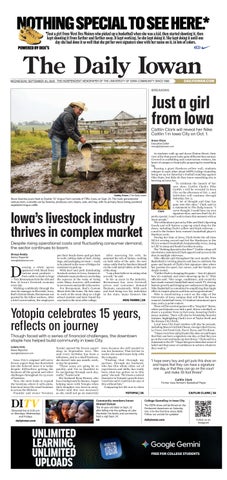
The Daily Iowan
Just a girl from Iowa
Caitlin Clark will reveal her Nike Caitlin 1 in Iowa City on Oct. 1.
Iowa’s livestock industry thrives in complex market
Despite rising operational costs and fluctuating consumer demand, the sector continues to boom.
D
onning a white apron spattered with blood from various meat products — from cattle to lamb to hogs — Trey Brenneman feels the ebb and flow of Iowa’s livestock economy every day. Walking confidently through the store he manages in Riverside, Iowa, Bud’s Custom Meats, Brenneman was greeted by his fellow workers. After a brief conversation, the employees
put their heads down and got back to work, cutting slabs of beef, slicing hogs, and packaging cut meat — ready to be placed in the rows of fridges for customers to pick up. With beef and pork dominating livestock sectors in Iowa, farmers to wholesale meat producers are feeling the squeeze in the wake of rising costs. Many, however, still continue to see success and profit in the sector. For Brenneman, Bud’s Custom Meats feels like home. He first came to work at the meat shop as a high school student and later found his way back to the store after college.
After marrying his wife, he assumed the role of farmer, working on both sides of the aisle. He now raises cattle that he butchers himself on the cold metal tables at the back of the shop. “I am a firm believer in eating what you sell,” he said. In his 15 years in the industry, Brenneman has seen livestock prices and consumer demand fluctuate consistently. With pork and beef being two key industries in the state, many farmers like
Yotopia celebrates 15 years, reflects on journey Though faced with a series of financial challenges, the downtown staple has helped build community in Iowa City.
Iowa City’s original self-serve frozen yogurt shop has ourished into the beloved store it is today despite difficulties getting the business off the ground and other challenges throughout its 15 years of business. Now, the store looks to expand the locations where it sells pints, from local Iowa City retail locations to across the Midwest. Founder and owner Veronica
Tessler opened the frozen yogurt shop in September 2011. She said every birthday has been a milestone, and as a small business, she doesn’t take any month, week, or day for granted. “These years are going by so quickly, and I’m so thankful to be navigating through each day, really,” Tessler said. Her husband Ryan Bruner, who has a background in finance, began helping more with Yotopia when their daughter was born in 2023. Tessler said this was necessary as she could not go on maternity
leave because she still needed to run her business. That led her to realize she needed more help with the company. “Finding t hat t hrough my partner, through my husband, who has this whole other set of experiences and skills, has really been what has gotten us to this point,” she said. “He’s been a central character in Yotopia’s growth since I met him and I could not do any of this without him.” Comparing her life now to when
As students walk up and down Clinton Street, their view of the Pentacrest looks quite different than normal. Covered in scaffolding and construction workers, the heart of campus is frantically preparing for something big. Passing a giant Hawkeye-yellow wall, students whisper to each other about ESPN College GameDay being set up for Saturday’s football matchup against Ohio State, but little do they know something else is brewing on Iowa Ave. To celebrate the launch of her new shoe, Caitlin Clark’s Nike Caitlin 1 will be revealed in Iowa City on the afternoon of Oct. 1, and festivities will continue through Saturday, Oct. 3. “A lot of thought and time has gone into this shoe,” Clark said in a statement to T he D aily I ow an. “I never thought I would have my own signature shoe, and now that I do, it’s pretty special. I can’t wait to share this moment with so many people.” The celebration is put on by Nike and Dick’s Sporting Goods and will feature a pop-up retail shop for the shoes, including Clark’s yellow and black colorway — a nod to the former Iowa women’s basketball player’s Hawkeye roots. During her time at Iowa, Clark broke the all-time NCAA scoring record and led the Hawkeyes to the NCAA women’s basketball championship twice, losing to SU in 2023 and South Carolina in 202 . The “Nothing Special to See Here ” Caitlin 1 shop will also feature customized Clark apparel and access to the shoe in multiple colorways. Nike o cials said throughout the next month, Nike Basketball is inviting players and fans to celebrate the game and launch of Clark’s first signature shoe where her passion for sport, her career, and her family are deeply rooted. “Caitlin Clark is changing the game — how it’s played, how it’s watched, and who’s showing up for it,” Nike o cials said. “Her range, confidence, and creativity have made women’s basketball must-watch TV, driving historic growth and bringing new audiences to the game. Nike Basketball is committed to amplifying that ripple effect to inspire players and fans across generations.” Nike is constructing a court on the edge of the University of Iowa campus that will host the Iowa women s basketball team, UI student intramural open runs, and a 3-point contest. There will be carnival games with a “long shot” theme, where participants can sink a putt, throw a football, or shoot a 3-pointer from 22 feet away, honoring Clark’s jersey number. There will also be friendship bracelet stations, highlighting Clark’s love of Taylor Swift and the ansas City Chiefs. ocal Iowa City food vendors will also be present, including Marco’s Grilled Cheese, George’s Best Gyros, e Crave, Get Fresh Cafe, Paco’s Tacos, and Tin Roost. “I hope every boy and girl puts this shoe on and hopes that they can have a signature one day, or that they can go on the court and make 35-foot threes,” Clark said in a statement to the D I . “I hope this gives them that sense of belief and that sense of confidence to achieve whatever they want to.”
The Daily Iowan
Brenneman are working to offset rising operating costs and lowering product demand. According to the Economic Research Service, Iowa is the top hog producer in the country and ranks fourth in cattle on feed, according to the Iowa Farm Bureau. Brenneman hasn’t seen a large fluctuation in meat prices except in the live cattle sector. Many farmers, he said, who used to bring in 10 different types of cows are now only bringing in eight. “People that are maybe getting halves are only getting quarters now because it’s not just that beef is expensive, but everything is expensive from what we’re seeing,” Brenneman said. According to the National Daily Cattle and Beef Summary conducted by the U.S. Department of Agriculture, the price of primal rib for the wholesaler in Iowa in August 2025 sat at 53 for choice meat. Now, that number has risen to 66 . Additionally, the number of live steers and heifers available in the state has declined by more than half, with steer numbers sitting at roughly 15,000 in 2025 to a slim 3,000 in 2026. Despite the rising costs, consumer demand for beef remains high in the state. Though the pace at which beef products were being sold slowed as prices rose, Brenneman said everyone wants to eat beef compared to chicken and pork. At Bud’s Custom Meats, consumers can expect to pay 21. for ribeye, 1 . for New York strip, 11. for sirloin, 16. for T-bone steaks, and 32. for beef tenderloin. Consumer demand for pork, however, has been declining considerably. Bud’s Custom Meats operates primarily in the commercial beef sector but offers whole and halfpasture pork options for buyers too. As cattle and pork numbers continue to rise and fall, agriculture experts in Iowa see the industry continuing to thrive, despite growing concern for the sector as a whole.
Iowa has long been a leading agriculture state, from corn and soybean production to hogs, cattle, ethanol, turkey, and dairy. However, as these sectors continue to boom, farmers across the state are facing rising prices and fluctuating consumer demand. Christopher Pudenz, economics and research manager for the Iowa Farm Bureau, has always had a personal stake in farming. Growing up in Carroll County in Western Iowa, Pudenz learned how to work hard and problem-solve on his parents’ farms, instilling a love for agriculture early on. “Sometimes you have to use what you have to solve the problem at hand even though you may wish you had more tools at your disposal,” Pudenz said. Many Iowa farmers have had to resort to such tactics, despite Iowa’s dominance in the sector. “Iowa is an agricultural production powerhouse,” Pudenz said. In recent weeks, the prices of corn and soybeans have become volatile, after previously staying relatively low. According to the USDA’s Iowa Daily Cash Grain Bids, the cost of corn is at . as of September 2026. In January 2026, the price was .13. Soybeans saw a similar increase at 10.20 in January 2026 to a now 12.6 per bushel, according to the USDA National Agricultural Statistics Service. Pudenz said despite rising costs of corn and soybeans, key components
of livestock feed, he doesn’t think the downturn indicates a crisis similar to the 1 0s farm crisis yet. “We are in a trough of a cattle cycle right now like a wave in the ocean,” Pudenz said. “You have ups and downs, and there are biological reasons we experience this cattle inventory cycle going up and down.” For hog farmers, however, returns and pork exports have been strong, he said, despite trade disruptions. The primary concern lies in domestic demand. According to the USDA, hog slaughtering was down 2.1 percent in August 2026, compared to the year prior. The third-quarter projected pork production is expected to drop by 5 million pounds from last month’s 6. billion pounds. Pudenz said the hog industry became profitable in 2025 compared to 2023 because feed costs were reduced. However, with feed costs rising, hog prices have begun to fall, and the Iowa Farm Bureau forecasts hog margins falling into the negative. “There really are no silver bullets for getting the [agriculture] industry into a better spot here in Iowa, but there are some silver linings, one of them is the hog industry has performed better,” Pudenz said.
For Iowa Farm Fresh Meats owner Jamie Reichert, she and her family have only ever been farmers. However, the West Branch native’s situation is slightly different than most generational farmers every generation, her family has to purchase land. Reichert acquired her land through word of mouth rather than on the open market and now has cattle, crops, and, uniquely, pasture pork. Though she does not function within the commercial pork sector, Reichert operates in the more niche market of pasture pork. According to the American Grassfed Association, pasture pork is raised outdoors and can consume diverse plant life, whereas commercial pork is often on a stricter diet of corn and soy. For Reichert, the pasture pork market has been steady as the pasture rent stays relatively the same despite uctuations, with many of her veterinary bills not being outstanding either. Demand in the pasture pork and livestock sector has continued to grow. “We can’t even begin to capture the demand,” Reichert said. “You have to figure out where the demand is and do that. You can’t just go about doing a bunch of things that don’t make money.” Reichert began operating in the livestock sector because of how high the demand has become in the last 25 years. According to the USDA’s World Agricultural Supply and Demand Estimates,
the consumer per capita expenditure on pork was 135.56 in 2000. That number has since nearly doubled, sitting at 2 3. . Reichert feels the financial squeeze is primarily in marketing. Though she is not concerned about bankruptcy, her full-time job in a niche market like the pasture pork sector is marketing. Reichert has to pay professional marketers to help with selling her product because of how niche it is. “Everybody thinks they can raise [it], they can sell it, but that is not actually the truth. It is not the production, so that has changed with the collaborative help of professional marketing,” Reichert said.
On the national level, the number of cattle per head has seen a slight decrease. According to the USDA, 2025 saw 6.5 million cattle in total inventory. In 2026, however, that number dropped to 6.2 million cattle per head. Similarly, cattle and calves at the state level took a similar hit, with 3.5 million in 2025 to 3. 5 million in 2026, a 1. percent decrease, according to the Iowa Farm Bureau. Cattle on feed, or cattle fed a sizable portion of hay, silage, or grain, saw a slightly more significant drop of 2.5 percent from 2025 to 2026. Pudenz said this decline can be attributed to two factors persistent drought and high demand. Drought across the country, east of the Appalachian Mountains and west of the Missouri River, has hurt cattle numbers in recent years. Though Iowa has been receiving large amounts of rain, virtually all farmers in other states are feeling squeezed. According to the U.S. Drought Monitor, which ranks drought levels from D0 to D , large portions of Colorado, Nebraska, New Mexico, and Texas are among some of the states in the D3 ranking, or extreme drought. Pudenz said because the initial stages of cattle production require large open areas for cattle to chew and feed on grass, the drought significantly impacts cattle inventories. Strong demand for beef and consumption of the product, Pudenz said, has led to high prices in the beef sector. “American consumers love beef and are consuming a lot of beef right now,” Pudenz said. “So you have a tight supply.” Bryan Whaley, chief executive officer of Iowa Cattlemen’s Association, said input prices and their impact on margins are of considerable concern. Inputs in the industry include fuel, equipment, insurance, and feed, among others. Whaley said as those prices continue to rise, market volatility and uncertainty are heightened. “It creates challenges
for our producers to make some of those decisions they need to make to make sure they continue to be as productive as possible. It really is about how to remain profitable,” Whaley said. According to the American Automobile Association’s fuel price index, fuel input prices for diesel, the primary form of fuel for farming equipment, are at a record high of roughly 6.32 as of Sept. 21. Despite these challenges, Whaley has seen many farmers in the cattle industry, particularly on the cow-calf and fed cattle side, remain profitable. Cow-calf operations are the first stage of production in which heifers, or female cows, are kept on the farm to breed cattle, according to the Pennsylvania State Extension. Fed cattle operations are where cattle are fed hay and grain before being sent to finishing feed lots, where the cattle go before slaughter, according to North Dakota State University. Whaley said the cattle from cow-calf operations come primarily from small to midsize farms, with the average cow-calf farm being roughly 0 heads. “We need to continue to make sure we have the number of cows in the state that we can use to produce the beef consumers are demanding now at the highest level,” Whaley said. Whaley said the association remains “cautiously optimistic” that farm bankruptcies will not be an issue, but given the nature of the industry, the likelihood of a downhill path is not uncommon. For those small to midsize farms concerned about bankruptcy or foreclosure, Whaley recommended diversifying one’s farm, or having an alternative stream of income to keep farms open. “The more you can diversify your operation, you can spread out your risk a little bit,” Whaley said. “If the corn market is down one year but the cattle market is up, maybe those are offsetting each other, which can help with overall leverage and your risk management plan.” Steve Swenka, owner of Double G Angus Farms in Ti n, eight miles west of Iowa City, runs a just over 100 cow-calf operation. He said many farms in Iowa are diversified, but expenses continue to eat away at profit margins despite success in one sector or the other. Swenka said he doesn’t remember ever having to pay nearly 6 for farm diesel, and the problem with agriculture today is that it is hard to get ahead of the game, particularly on the crop side of things. Swenka said these higher costs not only fall to farmers, but consumers as well. “There’s just no other way around it. The price will get past the consumer, so you have to tighten your belt as much as you possibly can to weather the storm,” Swenka said. Swenka said everything he and other farmers buy in the cattle industry is high,
whether it be new tires for a tractor or combine pickup, batteries, or repair parts.
As harvest season looms, farmers and experts alike are looking ahead to what profit margins from their respective livestock will look like and the best ways to combat soaring prices. Whaley argues Iowa is uniquely positioned to thrive within the cattle industry most seasons, given the natural resources, land, and feed that can be produced in the state. “We are very optimistic about what we can do in Iowa to really bring back some of that diversification, and we can be a huge player and have a huge role in helping ultimately rebuild the cattle herd to where it needs to be,” Whaley said. With that, he said, comes helping meet the demand of consumers with a product affordable to them as well. Pudenz echoed a similar sentiment and said, despite the ups and downs, Iowa remains “the place” to do agriculture in the U.S. due to its fertile soil to help feed cattle, hogs, and other livestock. For young farmers, Pudenz said livestock is the primary way of getting a foothold in the farming sector due to the high prices of land that make it di cult to start in the row crop sector. Reichert remains concerned for young farmers who will have to compete with investors. Though her kids will likely inherit her farm, many who have no farm to inherit will have to inherit money due to the lack of land and the rising cost of it. From a consumer and wholesale perspective, Brenneman’s concerns are rooted in the older generations who are selling their cattle but have no one to take over their operation. “What I’m more concerned about is not enough young people getting into the industry to keep it alive,” Brenneman said. Swenka hopes the economy will be able to rectify itself with high prices in the beef market. “Hopefully we will see the light and be able to find our way,” he said. The following is a statement of ownership, management, and circulation of THE DAILY IOWAN, publication number 1433-60, filed on the 29th day of September, 2026. The Daily Iowan is published 34 weeks/year in print during the academic school year. The annual in-town subscription price is $40.00. The mailing address of the publication and its publisher is: 100 Adler Journalism Building, Room E131, Iowa City, IA 52242-2004. The Publisher, Jason Brummond; the Executive Editor, Grace Olson; the Managing Editor, R iley Dunn; and the Owner, Student Publications, Inc. can be reached at the above address. No bondholders, mortgagees, or other security holders own more than 1% of any bond, mortgage, or security in Student Publications, Inc. The corporation’s non-profit authorization to mail at special rates has not changed in the preceeding 12 months. The following figures represent the extent and nature of The Daily Iowan circulation. The column below is the average number of copies during the preceeding 12 months. Total no. copies Paid circ. Mail subscriptions Total paid/requested Free distrib. by mail Free distrib. out.mail Total free distrib. Total distribution Copies not distrib. TOTAL
3,914 3,857 59 3,857 7 0 7 3,864 50 3,914
As publisher, I certify that the statements made by me are correct and complete.
birthday has been a milestone, and as a small business, she doesn’t take any month, week, or day for granted. “These years are going by so quickly, and I’m so thankful to be navigating through each day, really,” Tessler said. Her husband Ryan Bruner, who has a background in finance, began helping more with Yotopia when their daughter was born in 2023. This was necessary as, Tessler said, she could not go on maternity leave because she still needed to run her business. That led her to realize she needed more help with the company. “Finding that through my partner, through my husband, who has this whole other set of experiences and skills, has really been what has gotten us to this point,” she said. “He’s been a central character in Yotopia’s growth since I met him and I could not do any of this without him.” Comparing her life now to when Yotopia first opened really puts the time into perspective for her. “Getting to 15 years as a business has just really made me realize how long a time that is because of how my life has changed from the time I opened my business when I was 25 to this day, where I'm now a mother of two and live a very different lifestyle than when I was opening a storefront in downtown Iowa City,” Tessler said. The first day Yotopia opened its doors was an exhilarating experience for Tessler, seeing her dream come true thanks to her hard work and perseverance. But those early days were an intense time. She was working up to 100 hours a week, balancing getting her new business started while still working her full-time job, which was in Muscatine, Iowa, leaving her to commute nearly two hours round trip. She was driven, working around the clock to get her business off the ground. Adrenaline and excitement kept her going for a while. It felt like she had found her purpose, which made the long hours go by quickly. “I loved every moment of it. It was super hard, but also super, super rewarding to actually take my idea and then see it come to life,” Tessler said. In spring 2012, she stepped away from her previous job. This helped her focus on her business and prevent burnout. “So about 10 months after I opened, I realized that working 100 hours a week was not sustainable. I don't wish it on anyone,” she said. Supporting other local businesses and providing customers with high-quality ingredients were two of Yotopia’s main values she chose to hone in on. She began a partnership with Country View Dairy Farm, a local family-owned farm based in Hawkeye, Iowa, with a focus on producing premium yogurt, which stands strong to this day. Owners Dave and Carolee Rapson had just opened their farm in 2011. The frozen yogurt shop and their supplier have been g row i ng side -by- side throughout the years.
Seth Rapson co-owns the farm with his father and brother. He said working with Tessler has been incredible, and they’re enthused to continue working together on whatever adventure is next. “We’ve grown a lot in the past couple of years. Yotopia has definitely been part of that,” Rapson said. “[With our] good quality product and their expertise, and they do a really incredible job with their store marketing, we work together.” Countr y V i e w ’s milk is nonhomogenized, which leaves milk in its natural state and makes for a creamier texture that contributes to the quality of their yogurt. Their all-natural probiotic yogurt is free from preservatives, gelatin or other stabilizers, high fructose corn syrup, or artificial flavors and dyes. “For many reasons, it was the right move to switch to a local supplier in 2012,” Tessler said. “We have been so fortunate to work with such a quality family farm that is focused on the same things that we are: quality, indulgence, probiotics, and serving the community.” First-year University of Iowa student Arianna Criss tried Yotopia for the first time last week. She was impressed by the variety and selection of frozen yogurt flavors and toppings. While she’s more of an ice cream person, she enjoyed it and felt it was a good alternative. “It’s really nice for experimenting with different f lavors and combinations,” Criss said. “I feel like you could never get bored. You could come here and make so many endless possibilities of frozen yogurt.”
The COVID-19 pandemic created issues for Yotopia; to endure, they curated a menu of combinations of frozen yogurt and toppings and packaged them into pints to sell in local stores. John’s Grocery was the first store to carry their pints. Doug Alberhasky owns the store on Market Street. As a local business owner himself, he believes it is important to support other local businesses and the Iowa City community at large. “I was impressed with Veronica, the job that she was doing, and the quality,” Alberhasky said. “I just knew that we had to sell her stuff. So, like many other local products, we just got behind it and haven't looked back.” He said the reason his family’s business has been around for so long is because of customers, so it’s important to him to pay it forward and cheer for other local businesses. He also pointed out that it’s good for the city’s economy, helping dollars flow around. “It warms my heart that there are so many entrepreneurs out there who not just followed their dreams but also made their dreams a reality, and I think that’s a testament to our town and customers,” Alberhasky said. Not long after, another financial struggle arrived. “Our building was sold in 2021, and our total rental costs more than doubled,” Tessler said. “So that has also been a major challenge.” In spring 2022, Tessler considered selling Yotopia to focus on Nosh Cafe
& Eatery, a business she opened in Des Moines in 2019. But ultimately, she kept Yotopia and sold Nosh. “I realized there was so much more potential [in Yotopia] and that it was a project that I was not ready to be done with,” she said. Just earlier this month, Yotopia’s pa r t icipat ion i n a 10 -week-long program as part of the Midwest Dairy Accelerator’s 2026 cohort concluded. Tessler had the opportunity to pitch her ideas and get feedback and mentorship from industry experts. While other ideas for the company’s future have come to mind, Tessler is focusing on how far they can expand their pints to grocery stores. “We don’t know what the future holds. I like to just focus on one thing at a time and get through the process to see where it leads,” she said. “I’m a big believer in trusting your gut, which is a bad probiotic pun, in what’s next. And this is where I believe our growth will come.” Tessler theor izes that w ith the thousands of UI grads who relocate each year, and often throughout the Midwest, Yotopia wou ld a lready have loyal customers willing to buy their pints. “We have 30,000 plus University of Iowa students who come through Iowa City every year, and a lot of students relocate throughout the Midwest when they graduate,” she said. “So we want to meet them where they’re at and get into markets across the region, so they can have a taste of Iowa City and those memories of Yotopia wherever they are.”
OPINIONS
Free press is not presidential privilege Press and news media do not exist for the comfort of the government. Attempting to limit media access to the White House prevents government officials from taking accountability.
The president is not free from the press. It should be obvious, yet U.S. President Donald Trump was forced to restore White House access to C N N , MS N O W , and P O L I T I C O after U.S. District Judge Timothy Kelly ordered them temporary relief, ruling the outlets were likely deprived of their constitutional right to due process. Trump had previously announced that the news outlets would be banned from the White House press pool, accusing the outlets of “FAKE NEWS.” By that Saturday, reporters from all three organizations had been denied entry and had their press credentials confiscated. Press and news media do not exist for the comfort of the government; they are called the Fourth Estate for a reason. That responsibility has been constantly challenged with the current administration and this recent attack on free press under the First Amendment won’t be the last. Reporters have covered the U.S. governmental since we lived in colonies. By the late 1800s, the White House had become a distinct beat for journalists, and presidents increasingly interacted with reporters. The first formal presidential press conference was held by Woodrow Wilson in 1913, with the White House Correspondents’ Association established the following year. Since then, presidents have used newspapers, radio, television, social media, and now their own digital
platforms to communicate directly with Americans. But the basic role of independent journalists and the press pool hasn’t changed. The president can tell Americans what he wants them to know, but the press is supposed to ask what he does not want to answer. And if those answers aren’t convenient or well received, it is not the press at fault. It is the president and those in charge. If the only journalists consistently granted access are those willing to cover the administration in a favorable light, well-informed, balanced journalism is not plausible. There is already widespread distrust of the news media. Americans disagree about which outlets they trust, and partisan audiences often gravitate toward different sources. That makes it even more important that journalists have the ability to independently report what happens inside the institutions of government. This is precisely why Sherrill v. K nig ht mattered and will continue to. In 1977, the U.S. Court of Appeals for the D.C. Circuit held that journalists denied White House press passes were entitled to notice of the factual basis for the denial, an opportunity to respond and a written explanation. The court recognized restricting access to a bona fide journalist implicates First Amendment interests and cannot happen without adequate procedural protections. Under the Trump administration's cries for national security, there is a convenient excuse. Increasing secrecy with the guise of national security might undermine public trust, but it also keeps those in charge
from taking accountability. Richard Nixon made similar appeals to national security while the Watergate scandal unfolded. In a 1973 statement, Nixon argued that news reports and investigations surrounding Watergate had become entangled with sensitive national security operations and warned that continued disclosures could compromise that information. Yet, the scandal ultimately became one of the clearest examples in American history of why the government can’t be allowed to determine for itself what the public should be permitted to know. In fact, Kelly's eight-page ruling claimed the stories used as justification for the bans were often months old and routine, rather than evidence of immediate threats to the nation. Journalists and photographers have remained close to the president through crises, assassinations, and so much more. They have created a record to make the government observable, instead of relying on information behind closed doors. That proximity made the infamous photo of Lyndon B. Johnson’s presidential oath with Jackie Kennedy beside him possible. Without the press pool, George W. Bush’s reaction to 9/11 would remain undocumented. Removing the press from arguably one of the most important institutions sets a horrible precedent, suggesting a problem not limited to C N N , MS N O W , and P O L I T I C O . It is a precedent that both directly and indirectly affects every journalist and every person who relies on those journalists to understand government's
Iowa City activism is too focused on perfection If we want change, we need to provide activists spaces to make mistakes and learn.
The last decade has arguably been marked by extensive activism. With the power of the internet, we’ve heard just about any and every opinion imaginable on racial justice, gun violence, reproductive rights, immigration, LGBTQ+ rights, and much more. Iowa City, especially, is a hub for people to gather and use a collective voice. But within these spaces, it becomes di cult to not feel pressure to say the precisely right thing all the time. People come to Iowa City from all different backgrounds. Many are encountering new ideas for the first time. For someone unfamiliar, the pressure can make participating in activist spaces intimidating. Asking the wrong question, using the wrong term, or simply not knowing something can feel like enough to be dismissed altogether. Accountability is important when people cause harm, but activism also needs to consider what happens to people who are still learning. If activism in Iowa City is ultimately about creating change, there needs to be room for people to live and learn from mistakes to help facilitate it. A 2020 national survey conducted by the Cato Institute found 62 percent of Americans said the political climate prevented them from expressing some of their political beliefs because they feared criticism or consequences. While this does not specifically speak to participation in activism, it does re ect the cultural fear of backlash. In Iowa City, we should want activism to be an open forum of discussion. Yet when people become afraid of saying the wrong thing, it becomes easier for those who are already confident enough to speak to dominate the conversation. We have placed too much focus on being perceived as a “good activist,” distracting from the main point of activism, which is to do better. Orion Shaw is the outreach leader at Future We Demand at Iowa. “At the end of the day, we’re trying to make new people more involved,” Shaw said. “If you try to keep pushing out new people, you’re not trying to actually make change, you’re trying to make a friend group.”
This raises an important question: If we push out people who make mistakes, how much of it is actually advocating for change, and how much is surrounding ourselves with people who will agree with us? Activism — at its best — should involve trying to change people’s minds. It should involve bringing people into conversations they previously have not considered and encouraging them to see an issue differently. That becomes challenging when the expectation is everyone must already agree on the “right” opinions and understanding before they are welcomed in the conversation. Of course, not every mistake should be excused. There is a vast difference between an honest mistake and directed malice. Accountability, especially, becomes important when someone refuses to listen or change their behavior.
But there is also a middle ground between ignoring harmful behavior and completely shutting someone out. “When you start doing this kind of work, there’s a risk you take that you are going to mess up somehow, but the effort in trying to make things better is always better than not trying at all,” Shaw said. Part of creating meaningful change is accepting people are going to come into spaces with different levels of understanding. Someone might say something wrong, but if they are willing to be corrected and listen, that interaction becomes extremely valuable. No, activism in Iowa City does not have to lower its standards to be more welcoming. It can still challenge and inquire. But people should not have to be perfect activists before they have even started.
CYked! set to open in downtown IC Hothouse Yoga owner Cara Viner’s new indoor cycling studio will have a place for everyone.
A new indoor cycling studio will open this October in downtown Iowa City, just around the corner from one of its sister studios, Hothouse Yoga. CYked! will provide a variety of classes with music and high-tech bikes, lighting up with different colors. For long-time fitness instructor and founder, Cara Viner, it’s important to offer different types of classes throughout different times of the day, including weekends, to create a welcoming space. “With everything we do, there is a space for everyone, despite movement background, age, or confidence level,” she said. The bikes can adapt to bikers’ needs by allowing them to put in information such as their age, weight, and the typical amount of cardio they do in a week, to help create an even playing field. “If there’s someone who has no experience with biking, the level of intensity hopefully will feel similar to them and someone who has all the experience,” Viner said. “What’s really nice about these bikes is they take into account the actual rider and the rider’s body and experience.” While the health benefits of exercising are part of Viner’s reasons for opening CYked!, providing another community space and furthering empathy is her core mission. “The sweat [and] all that is great, but really, my whole purpose of what I do is to try to get the world to be more empathic,” she said. “And for people to build and nurture empathy for themselves, for each other, for the world as a whole.” The studio’s amenities include lockers, showers, shoe rentals, towels, and a water bottle refill station. With the different types of classes, people can decide how much technology and competitiveness they want to incorporate into their workout. CYked! OG offers a more classic cycling class experience with just music. CYked! Primary includes music, a color mode on the bikes displaying intensity level and moderate hand-weight use. CYked! Primary plus offers all that Primary does along with displaying bikers’ stats on a TV, creating a competitive atmosphere as riders race against each other. Some people love competition to push them but others don’t, which is why Viner said she made sure to offer a variety of options. Most classes will run for 45 minutes, though some will last an hour. The class schedule will be on the studio’s website, cyked.net, a few weeks prior to its opening. Currently, there is not a set opening date. “I’m hoping construction goes really well throughout September and we can open in October,” Viner said. “But we can only open when we’re ready and when it’s right.” She encourages those interested in the studio to stay up-to-date by following CYked! on social media platforms. Members who join the studio early
on will receive a discounted rate. The founder’s membership provides unlimited cycling classes for $69.99 a month, for up to a year. “So you have to buy it either the month before we open or during that first month, and you can have that price for up to a year,” Viner said. “We will require a minimum commitment of four months for it. That’s going to be a fantastic deal, and I hope a lot of people take advantage of it.” A membership option will soon be available for people who want access to Hothouse Yoga, CYked!, and another soon-to-open sister studio, PHYZX, which is focused on pilates and located in North Coralville. Student discounts will also be available. Viner believes her three studios will provide members the chance to enjoy a balanced combination of exercise. “I do very much believe in balance. I think we need cardio, strength, and stretching in terms of [taking care of] our bodies, but also mental health, the stress release, [and] community,” she said. “I feel like we all need that to survive and be healthy.” Opening CYked! and PHYZX within a month of each other while also running Hothouse Yoga’s three locations has been keeping Viner busy. She gives thanks to her great team working alongside her to make it all possible. “I have people working for me that I trust and understand my expectations and the needs of the community, the need to run the space e ciently, and provide great
programming,” Viner said. “I’m a very very busy person, but I love what I do.” Grace Balison-Esgate is an instructor at Hothouse Yoga, and she began taking classes as a member there in 2020 as a firstyear student at the University of Iowa. After moving to Iowa City from Wisconsin for school, the yoga studio became a big part of her community. “Each time I went to class, I would get to know the teachers, staff, and fellow yogis more and more, and now I couldn’t imagine my life without this community,” BalisonEsgate told T he D aily I ow an via email. “The classes at Hothouse offer me a space to move and breathe without worrying about the outcome and just lets me land.” While how much time she spends at the studio depends on how busy life gets, attending a couple of times is a central part to her week. Now, she is looking forward to seeing CYked! open. “I have taken a few cycling classes on my own at home, but I am so excited to feel the motivation and energy from a group fitness setting,” Balison-Esgate wrote. She highlights how the sister studios have a variety of exercises to choose from and encourages members to try out everything. “From vinyasa yoga to pilates to yin to dance cardio and now strength training and rebounder, and soon cycling,” BalisonEsgate said. “Rather than having to choose one or the other, you can have it all with the packages that Hothouse and PHYZX and CYked! are offering.”
The upcoming business is also part of Iowa City Downtown District’s CoSign+ Grant Program, which is sponsored by Nicolet Bank. The grant program assists businesses in downtown Iowa City with their signage and storefront needs. Executive Director for Iowa City Downtown District Betsy Potter said signage can be a high cost for businesses getting started and are sometimes one of the last things they think to invest in. “But it’s incredibly important,” she said. “We know your sign is 50 percent of your marketing and so we have had this program since 2016 to help businesses with their signage.” The grant program offers a 50 50 match to what the businesses owners pay up to $3,500 for signage. The program can be competitive as it depends on the budget for the fiscal year and is first come, first served. CYked! submitted a great application for the program, Potter said. “We’re happy to see them open downtown, and we’re just really excited for them to be in that store front,” she said. Piper Nelson is a first-year student at the UI. She has enjoyed cycling since her early childhood and biked to school from elementary through middle school. She appreciates how bike-friendly Iowa City is and has been considering renting from the Iowa City Bike Library for a while. “I love biking,” Nelson said. “If I can find the time, I would love to try out CYked! The music and color mode sounds like a vibe. I think it’d be fire.”
IC finds opportunity, industry in third spaces Third spaces are reviving themselves through engaging clubs and events.
A variety of craft supplies littered the table, from coloring pages to thin multi-colored strings for friendship bracelet making. People of all ages intricately used these supplies to channel their creativity and connect over a fun craft at the Stanley Museum of Art’s Friday Crafternoon.Friday Crafternoon and the Stanley Museum of Art provide a third space for people in the Iowa City community. A third space is somewhere people can go to connect with others that is not the workplace, school, or their home. Allie Tokarski is the assistant curator of student engagement at the Stanley Museum of Art, and part of her job is to supervise students on staff, but also to work with student interns to create student engagement projects. One of their current engagement events is the Friday Crafternoon, which came to fruition due to the Stanley Museum of Art faculty joining together to craft at lunch. Friday Crafternoon protects this time for staff to craft on breaks and allows the public to join in and connect with each other. “Being in a museum can feel like this really stifling, oppressive atmosphere where it’s white walls, and there’s text that tells you what is fact and what you’re supposed to take away from it,” Tokarski said. “I think giving people the chance to make something themselves, to make connections with the people around them will hopefully expand their concept of what art is, what it means, and what it can mean.” Jackie Jollay, the director of events at the Iowa City Downtown District, said when she was growing up in a rural community, she did not have access to many third spaces. She initially moved to Iowa City for her undergraduate degree, and she said, at first, the options were overwhelming, but it felt like there was a space for everyone. “The infrastructure of this city is built with certain spaces in mind,” Jollay said. She said the COVID-19 pandemic caused hardship for some businesses that acted as third spaces, and out of a desire for social engagement, community members began to create events and clubs to take on the role those spaces provided.
“I think these organizations are just folks who have the ability, privilege, and capacity to create that for other individuals,” Jollay said. “We have a lot of people who do that for free in Iowa City.” One of Jollay’s favorite events is the first round series, which happens every third Wednesday of the month. It’s an hourlong happy hour hosted by downtown businesses where business and academic professionals can speak about different ideas and projects. “I think something lacking for society at this point is an investment of attention and humanity in each other,” Jollay said. “We’re kind of losing touch with each other a little bit in the age of technology. We don’t spend a lot of time talking face to face anymore, and I really like being someone who’s facilitating that.” In the 1980s, when Ray Oldenburg coined the term third spaces in his book, “The Great Good Place,” he used coffee shops, bookstores, and bars as examples of third spaces. While these spaces remain, third spaces have begun to transition to be less about the physical space and more about the event taking place. Undergraduate Engagement Librarian Max Radl remembers when he was a kid growing up in Iowa City, he would take the bus downtown to visit the arcade and video rental stores. He said video rental stores cultivated a community where people could discuss films and local happenings, but also “just be a human being and be as you are.”With the closure of rental stores and fewer arcades and places for people to gather at a low price, community members have taken it on for themselves to create spaces for people to connect and foster their own community. Third spaces have also formed in online communities, which create conversation among people with similar interests, but people in these spaces may be hesitant to engage with the rise of artificial intelligence. T he Atlantic reported the “Dead Internet” theory has resurged, which suggests it is not human interaction happening online, but chatbots talking to other chatbots. “All of those questions can go away when we engage with another human face to face, when we make eye contact, when we see their body language, when we can have a dynamic conversation in the most natural
way possible, which is to speak our human language back and forth,” Radl said. To foster these conversations, Radl uses the library to host a variety of events using the library’s physical media. “I decided to build an event where I pull out sections of the collection, usually about 80 to 100 titles, and put them out on tables out here in the common space,” Radl said. “We serve free popcorn. We put a movie on in the group area, and kind of try to recreate what I think of as the video store experience.” Radl said the pop-up blockbuster event usually has an attendance of over a hundred students. He has also created video game breaks for students, and around midterms the library hosts a de-stress fest to provide students a break from their studies. Radl hopes students can feel welcomed in the library and make the space their own after these events. “Nothing is expected of anyone in any
library. You don’t have to prove that you are even a citizen. You can be here as a human person and explore these resources as you will, with nothing else required of you,” Radl said. Similar to Radl, Tokarski hosts events at the Stanley Museum of Art because it is a free and effective space to get students in the door. “You don’t feel like there’s anything expected of you when you walk into a crafternoon, so I think that’s really helped widen our audience and our audience’s perception of what we have to offer then because I feel like crafternoon can be a gateway,” Tokarski said. Radl said these spaces are about free association and accessibility. “They’re about nothing other than who we are as ourselves and connecting to other people in those ways and not generating a profit of any kind, which again is incredibly di cult to do in 2026,” Radl said.
VIGIL FOR AHMED OSMAN The Iowa City community came together at the Pheasant Ridge Neighborhood Center on Sept. 24 to celebrate the life of fifth-grader Ahmed Osman. This follows the accidental deaths of Osman and teacher Hannah Jorgensen during a Borlaug Elementary School field trip at Lake Macbride on Sept. 22.
Sand looks beyond Democrats in governor’s race Rob Sand’s campaign targets independent and Republican voters ahead of the November election.
As Rob Sand vies to be Iowa’s next governor, his campaign is looking beyond traditional Democratic voters. The Democratic state auditor has highlighted Republican voters who support his campaign through what his campaign has dubbed, “Rob-publicans,” a group Sand’s campaign has used to demonstrate his appeal across party lines. On June 22, Sand’s campaign released a list of 100 registered Republicans who had pledged their support to Sand in November. In addition to the list, the campaign has also received over 1,800 donations from registered Republicans as of June. The effort comes as Iowa voter registration numbers give Republicans a numerical advantage over Democrats in the upcoming November election. As of Sept. 23, Iowa had 6,22 active registered Republicans compared with 55 , 0 Democrats, and 22,361 registered with no party. Republicans outnumbered Democrats by roughly 1 6,51 active voters. A large percentage of voters in Iowa are individuals registered with no party, or independent voters, representing 35 percent of active voters in Iowa. Nick Mensen is a registered independent and University of Iowa third-year student who plans on voting in the upcoming midterms. He said this is the least motivated he has ever been to vote in an election. Since casting his vote for U.S. President Donald Trump in the 2024 presidential election, he has become frustrated with the direction of the Republican party. “I feel like the question society has asked themselves for the last 10 years when going to the ballot box isn’t ‘Which candidate do I like more,’ but ‘Which candidate do I dislike less?’” Mensen said. He has paid attention to how Sand has campaigned compared to Republican gubernatorial candidate Zach Lahn, and thinks Sand has run a significantly better campaign so far. Mensen said Sand’s campaign stood out to him because of the volume and targeting of his advertisements towards young people. He said it feels like Sand has a “playbook” for drawing in voters.
“Sand is stretching his assets a lot further than Lahn is to draw voters in, and I think he is more likely to win this election,” Mensen said. He has seen more advertising and
highlighted Lahn’s long-time ties to Kansas, noting that Iowans deserve a “full-time governor, not a part-time Iowan.” The campaign has also emphasized support from outside the Republican party
marketing from the Sand campaign — online and in-person. Mensen contributes this to living and going to school in Iowa City. “It’s hard to ignore how he’s winning in certain places,” Mensen said. “Sand has pushed out more significant political ads than Lahn, and is using the ‘Kansan’ card a lot against Lahn. Lahn doesn’t have an equivalent card to play against Sand’s campaign.” Sand’s campaign has repeatedly
throughout his run. UI political science professor Tim Hagle said this support is critical as he runs for a seat in a state that has become increasingly Republican. “What Sand is doing is he is trying to present himself as a middle of the road kind of Democrat,” Hagle said. Sand has also emphasized his opposition to a political system in which voters are divided between two parties. Hagle said this could appeal particularly to no party voters in Iowa.
“Sand is starting about 180,000 votes in the hole,” Hagle said. “He has to get some of the Republicans, but also he has to get a really large percentage of the no party voters.” The governor’s race has remained competitive in recent polling. A Suffolk University study conducted on Aug. 20 found Sand with 48 percent support among likely voters and Lahn at 44 percent. This is still within the margin of error of plus or minus 4.4 percent, meaning the finding is not statistically significant. Emma O’Brien, deputy campaign ma nager for Sa nd’s c a mpa ig n, pointed to his record as state auditor and his previous statewide victory as evidence that he can appeal to outside of the Democratic voter base. “Rob is just a very different kind of candidate and is able to reach folks from all different sides of the political spectrum,” O’Brien said. “People know and trust him as a leader, he’s held members of both parties accountable when they’ve broken the law or broken public trust.”
Political newcomer takes on Iowa education Mike Bergman enters the Iowa House race to address his frustration with state education policy.
Mike Bergman doesn’t view politics as an enjoyable undertaking. The longtime Mount Vernon resident saw Republican incumbent Cindy Golding was running for reelection unopposed and said he couldn’t sit back and do nothing. “There [has] been a lot of crazy laws coming out of Des Moines the last few years, and frankly, a lot of them just made me embarrassed to be an Iowan,” he said. Bergman said he took a closer look at Golding’s voting record and found several laws he disagreed with, but one issue stood out to him: her vote in favor of Iowa’s education savings account law. “The one issue that really triggered me was her vote in favor of this education savings account, or ESA, law. That name is just such a misnomer, the only people that’s saving any money for [is] the advantaged socioeconomic class of Iowa residents anyway,” he said. Bergman had to give running for o ce a good amount of thought. In the past,
he would have loved to participate in politics, describing the politics of his youth as a time of civil discussion and compromise. Bergman said now politics have gotten “ugly.” “Particularly now, when the radical Republicans have had the trifecta in Des Moines, the thought of being involved in that just sounded terrible,” he said. Signed into law by Gov. Kim Reynolds on Jan. 24, 2023, the Student First Act makes state funding available for Iowa K-12 students. The measure created education savings accounts, or ESAs, which allow families to use public dollars for tuition, fees, and other approved expenses at accredited private schools. For Bergman, the program is more than a policy disagreement. Education is a focus of his campaign, and he has made the funding of Iowa’s public schools a central issue in his challenge to Golding. “It’s basically a big taxpayer giveaway to private schools,” Bergman said. “And the primary recipients of those vouchers are already better off than the average Iowan. It’s hurting our public schools.” While knocking on doors, he said he’s gotten a lot of support for his campaign.
“It’s overwhelming how many of them do not like the idea that their tax dollars are now going to private schools while their own schools are getting shortchanged,” Bergman said. According to the Iowa Legislative Services Agency state budget preview for fiscal year 202 , ESAs cost an estimated 3 million combined in fiscal years 2024 and 2025. Bergman said he is concerned that while money given to private schools continues to climb, public schools will be left behind with state contributions not covering in ation. “For the last 10 years at least, the budget increases for the state contribution to public schools has not matched the rate of in ation. They’re getting further behind the power curve now in their funding needs,” he said. Education has been at the center of discussion ahead of Iowa’s midterm election, with gubernatorial candidates offering differing views on the state’s education savings account program. As previously reported by T he D aily I ow an, Democratic gubernatorial candidate, and Iowa State Auditor Rob Sand has criticized ESAs, arguing private
schools should have to adhere to rules governing how those funds can be spent and should face audits. He also said private schools should not be able to decide who they can admit. “Private schools that take public money should not be able to reject students,” Sand said. Republican gubernatorial candidate Zach Lahn has also spoken about ESAs, describing the accounts as a “foundational freedom” for Iowa families in an interview with PBS. He said these different models of schooling help kids with different needs. “I would love to see a day when there’s hundreds of these types of schools, not just like my school, but other types of schools across the state of Iowa, along with our public schools, operating in innovative ways to bring more choice to Iowa’s families,” Lahn said. Scott Ellison, professor of Social Foundations of Education at the University of Northern Iowa, said there are two problems the ESA program tries to solve, value-based education, and school competition. “We want schooling that is patriotic, that re ects conservative values, and often religious values,” he said. Ellison said the idea of school competition is an economic idea, where private schools are competing with public schools, for the per person funding. “What you’ve in essence created is a marketplace of schools that will respond like any other market. That will improve overall achievement, because the public school monopoly now has competition,” he said. In other states like Indiana and Louisiana where vouchers have been put in place, Ellison said there hasn’t been a promising uptick in student academic performance. Ellison speculated about the future of public schools if Iowa were to continue the voucher program, and said the state would see a drain of students out of the public sector, more consolidations, and students riding on buses longer. “I think you’re going to see greater pressure on smaller school districts in rural areas. Of course, you’re going to see a proliferation of private schools,” he said. Nearing the election, Bergman said he finds the support he has received overwhelming, hoping to see the support translate to votes. “It really helps me conclude decisively that I’m doing the right thing,” he said. “There’s just so many people that have expressed their gratitude that I’m running. I’ve seen a lot of crazy things happen in elections here lately, but just by my own uno cial polling I’ve got a winning issue here.”
SPORTS
Learning skills for life Iowa student officials gain transferable strengths from their role in intramural competitions.
University of Iowa students work in several areas across campus and Iowa City, taking on jobs in food service, retail, bartending, and many other fields. These jobs can be beneficial as they teach concepts used in the professional world,
including communication, collaboration, and time management. For some, o ciating intramurals has become their job of choice, with hundreds of teams competing across different sports and divisions every year at Iowa. Some o cials enjoy the useful skills, others stay for the activity and speed of the games they cover, while some simply enjoy the work. “The biggest thing I’m a proponent of
is the transferable skills,” Iowa’s assistant director of sport programs Colton Spaur said. “Most of our students won’t go on to a career in o ciating, but with the role certainly comes time management, how to fit one, two, three o ciating shifts a week into your schedule.” Spaur cited communication with professional staff and fellow o cials as another positive, as well as
communication with participants in an intense environment. “I think that’s definitely important, how to make decisive decisions, how to stay calm and level-headed in rising situations,” Spaur said. “I think all of those are really good transferables, and then you get the technical skills, too.”
A hot start to a historic season The Hawkeyes finished their 2026 non-conference schedule with an 11-3 record, including wins over Iowa State and Texas Tech.
The last time Iowa volleyball saw a winning season was 2017, and those wins were later vacated due to impermissible cash payments to a transfer player made by then-head coach Bond Shymansky. It’s been a long road to recovery for the program, but head coach Jim Barnes, now in his fifth year with the program, came to Iowa City to build the Hawkeyes up to a conference contender. Now, Barnes and the Hawkeyes are in a position to finally do just that. What’s different about this season For starters, there’s the non-conference stretch
of the calendar. This season, Iowa did what it couldn’t quite do in 2025 by closing the deal with combative opponents. Iowa finished this season’s nonconference outing with a very respectable 11-3 record. The 11 wins in non-conference play mark a program best since 2006. While one of the three losses was avoidable, falling at home against Missouri State after leading 3-1 on sets, Iowa’s only other losses were on the road against Power Four opponents — specifically SEC foes Mississippi State and Alabama in four sets each. The Hawkeyes started the season by doing what good teams do, and that’s winning games they’re expected to. Two of the 11 wins to open the season were also
Power Four contests against pretty strong contenders. Iowa swept Iowa State, 3-0, its first win at Ames in nearly 30 years, and knocked off another Big 12 opponent in Texas Tech, 3-1. To aid their impressive record, the Hawkeyes are playing well across all important positions. Iowa graduated veteran setter Claire Ammeraal after the 2025 season, but third-year Jenna Meitzler has carried the torch quite effectively, building off the experience she gained as a first-year following Ammeraal’s injury. The Barrington, Illinois, native tallied 5 6 assists through the program’s first 1 games, already on track to best Ammeraal’s 1,1 0 assists from last season. In fact, while
Ammeraal averaged .52 assists per set last season, Meitzler has averaged 11.0 assists per set thus far this season. Iowa’s hitting has improved as well this season. Second-year Carmel Vares entered the season as the program’s returning leader in kills, notching 306 kills last season. This year, Vares ranked fifth on the squad for kills at the start of Big Ten play. Some may read that statistic and argue that the quality of play from Vares has dropped, but nothing could be further from the truth. Vares averaged 2.55 kills per set last season, a figure that has dropped only slightly to 2.3 kills per set in the nonconference stretch this season.
A global mentality How Iowa field hockey recruits internationally and what it takes to be part of the process.
Iowa field hockey, with 2 studentathletes on its 2026 squad, takes great pride in having a diverse and global roster. Of the players involved, 13 Hawkeyes hail from different states including Illinois, Pennsylvania, and Virginia. More than half of the program consists of international competitors, including one native of Australia, two from Belgium, four from England, and seven from the Netherlands. Those countries have seen seven combined victories in the sport’s World Cup. “The general diversity [on] our team is pretty awesome,” first-year Belgian native Reine van Hoof told T he D aily I ow an. “To see what kind of differences everyone has playwise on the field, but also off the field, it’s pretty awesome.” As of the NCAA’s rankings on Sept. 22, the No. 5-ranked Iowa program had only one team ranked higher than it with more international athletes, namely No. -ranked Massachusetts, sporting 1 international players. While some may assume that such a diverse, global team would struggle
to connect, communicate, and find chemistry, these Hawkeyes have proven this idea false. “It’s nice to have an environment where everyone is coming together,” fifth-year Fr derique van Cleef, a native of Asten, Netherlands, said. This sentiment is shared by van Cleef’s teammates as well. “It just feels like we have two big groups who are really connected with each other,” van Hoof said. “It’s like one big family.” How does a team recruit internationally at the level Iowa plays The answer, it turns out, is very similar to domestic recruiting. The program staff looks over tournament and game film, speaking with coaches and agents, determining if the play style is a good fit for Iowa. These efforts are primarily led by international recruiting coordinator and associate head coach Michael Boal. “He has done a fantastic job identifying talent and going across the world to be able to see these student-athletes play,” head coach isa Cellucci said. Boal or someone else from the recruiting team will then take a trip to watch and be able to meet the athletes,
DAILYIOWAN.COM
2B | WEDNESDAY, SEPTEMBER 30, 2026 | THE DAILY IOWAN
FEATURE
The key word is ‘maturity’ Iowa soccer first-year Braelynn Galt made the decision to enroll a year early, but her success as a goalkeeper is already visible on the pitch. Jackson Mendoza Sports Reporter
sports@dailyiowan.com
From her upbringing in Channahon, Illinois, to playing soccer abroad in Scotland and Spain, first-year Braelynn Galt covered a lot of ground in her young career before coming to Iowa City. As the daughter of a coach, the game’s influence was present in her home life from a young age, leading Galt to play organized soccer as early as four years old. After her first four years on the pitch, Galt’s father realized his daughter’s value as a player was not going to come from scoring goals, but stopping them instead. Her father’s message was simple: “If you’re going to be a goalkeeper, you’re going to be the best goalkeeper you can be and play as an extra player on the field.” Galt’s initial reaction was largely positive. “I was happy about it because I didn’t have to run as much and I could just stand there,” Galt said. Taking the position more seriously, Galt would go on to compete overseas, a role that took her to the Pinatar Cup in Alicante, Spain, for her national team debut at just 13. Although she had a shot at the Scotland National team, Galt did not think she had much of a chance to make the roster, as she had only been in training camps. That was until her parents got word from the team that Galt had earned a spot on the roster. After she heard the news, she described it as the happiest she had ever been. Having flown to Scotland to train with the national team, however, was also where the homesickness really started to settle in. “At first it was hard. I didn’t have many friends over there,” Galt said. “I’d call my mom and tell her ‘I don’t know if I could be here any longer.’” While preparing for the team’s match against the U17 Sweden National team, Galt found out she was going to be starting in a team meeting, one she didn’t expect much out of in the first place. “I was so nervous afterwards but a bunch of my teammates came up to me and said, ‘You got this, we all believe in you,’” Galt said. Scotland went on to win the match, 3-2, but fell to England in the final of the MIMA Cup, 5-0. When all was said and done, Galt couldn’t help but realize how much that experience helped her. “To be around a bunch of top-level players who play on first teams in Europe helped my game out a lot,” Galt said. After her time with Scotland’s program, Galt had to make a decision on where to play next — somewhere she would be both happy and motivated. This resulted in her
Q&A | PAIGE GIOVENCO Paige Giovenco
Golfer Second-year Sellersburg, Indiana
Movies, cookies, and a little bit of golf The second-year transferred from the University of Indianapolis to join the Hawkeye golf squad. Tate Balkenende Sports Reporter
sports@dailyiowan.com
Cole Mauskemo | The Daily Iowan
The Iowa women’s soccer team huddles up after Berit Parton scores against Missouri State in Iowa City on Sept. 6, bringing the score up to 2-0. The Hawks defeated Missouri State 3-0. taking the leap to move to Florida by herself to train with the Tampa Bay Sun, part of the USL Super League. While with the Sun, Galt had the opportunity to train with players who were either Division I or National Women’s Soccer League athletes. “They would always give me pointers in training, so things like that were always helpful,” Galt said. “It took about two weeks to get used to the speed of play, but after that, I felt like I fit in.” Although Galt had a good experience with the Sun, the goalkeeper wasn’t getting as many game minutes as she needed to show off skills learned in training. She was questioning whether or not college would be the right route for her in her quest to become a professional keeper. Upon finding out assistant coach Noah Smith had moved to Iowa as a part of Dean Ward’s staff, Galt texted her mom, asking, “How much do you want to bet that Dean and them will be here in about a week?” Smith had met Galt in a youth soccer camp in Chicago while he was with Valparaiso and kept in touch with the goalkeeper while she was in Tampa Bay. One week later, Smith reached out to Galt and expressed Iowa’s interest in signing the young keeper. Although hesitant at first, it only took one visit to convince Galt to become a Hawkeye. “I loved it,” Galt said. “All the girls were so welcoming and it felt like home.” Although she was excited by the prospect of playing at the Big Ten level, Galt would have to reclassify from a high school senior to a college freshman and leave Tampa for Iowa to be possible. “It was a hard decision to either come to Iowa a year early or stay with the Sun, but I thought Iowa was the better decision so I could get some
game minutes,” Galt said. “I needed to start translating what was happening in training to games at a high level, and that was a major part in my decision.” In Iowa City, Galt got to work right away, recording clean sheets in six of her first 10 starts with the Hawkeyes. In the first couple matches of the season, the Hawkeyes scored many goals while allowing zero. Although it looked easy for Galt, she said it took a few matches to become fully comfortable in her role of being a keeper who is able to play with the ball at her feet. “I was playing safe early on with short passes, but there were moments where I could’ve gone longer, or taken space, or held the ball a little longer, but I wasn’t comfortable enough yet,” Galt said. “Now, I feel I’m more comfortable hitting those longer passes and knowing I’m good enough to make certain saves.” Her work has definitely not gone unnoticed by her teammates, including fourth-year defender Millie Greer, who has anchored the back line long before Galt got between the posts. “She’s come in with a lot of maturity and has done a lot of great things before she even came to Iowa,” Greer said. “She has a want to learn, grow, and communicate with everybody. She’s fit in seamlessly.” Fellow first-year defender Sara Batchadji echoed the same sentiment that gets thrown out a lot when talking about Galt: The key word being maturity. “I think she’s done a great job,” Batchadji said. “Coming in as a freshman, starting immediately, and making such a big impact with some great saves is not an easy thing to do. When I think back to my freshman year, I was definitely not like that. She’s grown in her voice out of the back and is helping us a lot.”
The Daily Iowan: When did you first start getting into golf? Paige Giovenco: I started playing golf the summer before I turned nine because I had just moved to a new house and it was located on a golf course. My dad got me into it, and then I just fell in love with the sport. Is there a particular part of your game you trust the most? I feel really confident in my short game, which is usually pretty consistent throughout every round. Anytime I don’t make it on the green from the fairway, I feel pretty confident that I can make an up-and-down and save par. Why did you choose to come to Iowa? I really loved the campus and the overall feel of everything. The coaches were great, and getting to meet both of them was so nice. I just loved everything they had to say about how they could make me a better player and person in general. I also got to meet Lily Huether on the team, who was so sweet and amazing, and it just really confirmed I was going to have a really great time here. And so far, I’ve loved every second of it. Do you have any pre-tournament snacks or meals? If so, what are they? If we are at a hotel for a tournament, I will usually always have a waffle. It’s kind of unhealthy, but it gets me in a good mood and gives me a little sugar. What would be your dream golf course to play? I feel like I have to say Augusta National. I got to go a few years ago and watch the Augusta National Women’s Amateur, and it was absolutely beautiful. I would also love to play Liberty National, as I think it would be so cool to see the area that it’s in and get to see the Statue of Liberty. Outside of golf, how do you like to spend your time? I love to read and watch movies. Anytime someone says they haven’t seen a movie, I’m always the one telling them they have to watch it. I also love hanging out with my friends and just relaxing because I’m always so busy with golf. Who’s your favorite golfer? My favorite golfer on the men’s side would be Jordan Spieth or Justin Thomas. On the women’s side, I really like Nelly Korda or Lexi Thompson. What’s something a lot of people don’t know about you? A lot of my teammates know this about me already, but I love to bake. I can bake really good chocolate chip cookies.
POINT/COUNTERPOINT
Who is going to win the World Series this year? Sports reporter Logan Miller argues the Atlanta Braves will win the World Series, while Regan Roberts argues for the New York Yankees.
Logan Miller Sports Reporter
Atlanta Braves
I believe that the Atlanta Braves have the firepower to not only beat the Yankees, but win the World Series. After an uncharacteristic 2025, the Braves have rebounded by winning the National League East and reaching 90 wins for the first time since 2023. The lineup was back to its previous level with a team OPS of .722, good enough for tenth in the league. Superstar Ronald Acuna Jr. has battled injuries off and on during the year, but the depth of the Braves lineup has been more than enough to propel them to a division title. First baseman Matt Olson has provided a consistent bat in the lineup since coming to Atlanta in 2022. Olson is one of the most reliable bats in the league and has paced the Braves this year with 40 home runs, 33 doubles, and a .830 OPS. Olson’s presence in the lineup has
allowed Drake Baldwin and Michael Harris II to have breakout years. One of the “holes” in the lineup is former all-star third baseman Austin Riley. He posted three straight seasons of 30+ home runs from 2021-2023, and since then, his offensive production has taken a major hit. Going into the postseason, having Riley as one of the holes in the lineup is a blessing in disguise. Riley has had numerous postseason appearances and is comfortable in the environment. The downturn in offensive production from him can’t last forever, and if he gets back to his former level, the Braves become borderline unbeatable. Chris Sale had a career resurgence when he won the NL Cy Young in 2024. Many wondered if Sale would ever return to his former level after he only made 31 starts from 2021-2023. Sale has returned to that level and arguably reached a new peak. Sale leads the Braves rotation with a 2.18 ERA and 190 strikeouts in only 157 innings pitched. In a postseason setting, having a former Cy Young winner like Sale changes the aspect of the series. The combination of a balanced lineup and a resurgent pitching staff makes the Braves an easy choice for a World Series winner.
Regan Roberts Sports Reporter
New York Yankees
Entering playoff season, the American League is narrowing down to three teams: the Yankees, Rays, Red Sox. Out of the three, the team that’s currently playing at the highest level is the New York Yankees. The Yankees have been playing their best baseball the last two months of the season; the main reason being their starting rotation. Cam Schlittler is the front runner for American League Cy Young right now, and Max Fried is one of the best left handers in baseball. And don’t forget to add Gerrit Cole and Carlos Rodon. The Yankees have a dangerously underestimated roster. Depending on Aaron Judge’s health, their lineup could be top tier in the playoffs. As of right now the Yankees’ best bats are Ben Rice, Cody Bellinger and trade deadline pickup
Luis Garcia Jr. Those three are offensive juggernauts, each a scary sight to see at any point of the game. Then, there is the emergence of Spencer Jones, who has been absolutely raking as of late, and is showing signs of becoming a future star. Also add in rookie shortstop George Lombard Jr., who is going to have a great postseason in his first go around. This team from top to bottom is a lineup that every team should be scared to see in October. Now, the big question is Judge. He is truly a wild card for this team right now, on yet another injured list stint. If he returns for the playoffs, the Yankees are back in the World Series race. This Yankees team matches up with any other team in the American League really well as no one has the same level of rotation. The young guys will play a role in all of this, and this postseason will be remembered as the Spencer Jones and George Lombard Jr show. The Yankees are going to be the team to get it done out of the American League this year.
THIS WEEK IN HAWKEYE SPORTS FIELD HOCKEY
FOOTBALL
VOLLEYBALL
SWIM AND DIVE
Sunday, October 4 Rutgers University Park, Pa. 6 p.m. Big Ten Plus
Friday, October 2 Michigan Ann Arbor, Mich. - 5 p.m. Big Ten Plus Sunday, October 4 Michigan State East Lansing, Mich.- 12 p.m. Big Ten Plus
Saturday, October 3 Ohio State Iowa City, Iowa 2:30 p.m. CBS
Thursday, October 1 Maryland College Park, Md. - 6 p.m. Big Ten Plus
Friday, October 2 Marquette Iowa City, Iowa- 3 p.m.
“
Saturday, October 3 Penn State University Park, Pa.- 6 p.m. Big Ten Plus
STAT OF THE WEEK
13
Iowa field hockey’s Fréderique Van Cleef scored her career-high 13th goal against Ohio State.
“
WOMEN’S SOCCER
Let me dovetail to one omission I made on the depth chart thing with Tyler Brown. That was me. I kind of half-assed it, quite frankly. — Kirk Ferentz on safety Tyler Brown not being listed on the depth chart ahead of Iowa’s game at Michigan.
Those technical skills can be linked to learning rules, physicality, and technique for unfamiliar sports. While Iowa offers traditional favorites, such as ag football, soccer, and basketball, more niche and creative games are also an option, such as an archery tag series. While Spaur now works in a more career-oriented role with sports and recreation at Iowa, his own roots go back to the process of o ciating. After starting as a student at Iowa in Fall 2017, he was first an official, before moving up to student supervisor. Graduate school at Western Illinois and two years of working at Indiana followed, before Spaur ultimately returned to Iowa City. “I think at times our o cials, they’re asked to do a lot, and they’re put in challenging situations,” Spaur said. “I’m just very appreciative of the work they do. I think it takes a lot for someone to want to be in this position because it’s very challenging and demanding. I think anyone who wants to be an o cial, I’m very appreciative of, and very appreciative of our staff.” With the role comes training to be e cient and disciplined. At any level of sports, calls can be perceived as unfair or met with hostility. Across different levels of competition, this can take the form of frustrated players, short-tempered coaches, or a rowdy fan base. While intramurals often lack the packed crowds and coaches that accompany a higher caliber of play, such as a Big Ten basketball game at CarverHawkeye Arena, the emotions are all still there. When one team is certain the pass caught on the ground was incomplete or there wasn’t a touch before the ball went out of bounds, the opposite call can provoke a range of emotions. Accuracy and composure are crucial to the role of o cials at all levels of competition. “Before each season, before each sport we get into, there’s training the o cials go through,” Iowa sports program coordinator Jacob Bryan said. “That’s going to consist of one to two nights in a classroom setting, going through a PowerPoint that has videos, interactive lessons where they’re working together, and then just covering as many rules as we can.”
In addition to classroom instruction, before the season, there is hands-on experience, something that can’t always be replicated by a presentation or rule book. “We’ll then go to a court, field, practice some situations and treat it like a sport practice, where they’ll do one drill of positioning,” Bryan said. “The next drill is practicing the signals. The next one is simulating plays and how they would work through those in the game. So we’ll spend one to two days doing that, and then the last day[s] are scrimmage games where we get teams that play in our league.” Unlike Spaur, Bryan’s trajectory did not begin at Iowa, but it did begin at a place familiar to both, Western Illinois, where Bryan earned both his bachelor’s and master’s degrees. Bryan didn’t start as an o cial, but his supervising role saw him fill in as one when the staff couldn’t otherwise cover all games. “There’s a lot of different sports and most of our staff, if not all, they’re working multiple different sports,” Bryan said. “The training that they go into before a season, then that season is going to last about six to eight weeks, and then we’re right into the next one.” With all this in mind, Bryan emphasized that o cials put a lot of time into what they’re doing. “It’s more demanding than other jobs on campus,” Bryan said. “They’re forced to be outside their comfort zone a lot. Understanding the toll that can take on a student from time to time is something I don’t think people think about.” Students like fourth-year Alex Milton, who started the role early on, have the opportunity to carry momentum in higher positions, similar to what Spaur and Bryan did in their time as students. Milton, now in the role of sport programs supervisor, previously played soccer at St. Ambrose University in Davenport, Iowa, but transferred to Iowa as a sophomore, where he started as an o cial. “I would say even if you don’t know the sport, it doesn’t matter,” Milton said. “You can still o ciate, there’s training and stuff for that.” Milton, whose father is an o cial for men’s basketball at the collegiate level, also credited the job as something that stood out to him personally and ended up being his way into staying involved with
getting to know them on a closer basis. Through Zoom calls and a visit or two, the staff, including Cellucci, finally begin to get to know these athletes on a deeper level, really getting to understand who they are as people, ultimately seeing how that might affect the team’s values or priorities. Of course, Iowa is far from the only program seeking international recruits, so what led these 14 student-athletes to play in Iowa City? For her part, van Cleef was being recruited by schools from all over the country from multiple different conferences, but what made her choose to wear the black and gold was the sheer amount of Dutch players already on the roster. “It was nice to have more people from home if you’re going somewhere else, especially if you’re going to travel so far away and stay there,” van Cleef said. Cellucci also brought up the fact that,
for a little over a decade, Iowa has had some amazing international talents that have seen successful stints as Hawkeyes and beyond, helping the organization gain international traction. “We’ve received great momentum from repeat club programs, different countries, and different schools,” Cellucci said. The complication with international recruiting lies within the play style of field hockey. Around the globe, most countries have their own unique style of field hockey that differs from everyone else. However, this isn’t considered by Cellucci and the rest of the coaching staff as much as one might think. The staff looks more at facts such as what the future looks like for certain positions and how these athletes can fit and impact the Iowa style. “To be honest, for us, if they’re a highly skilled student-athlete and they’re technically and fundamentally sound, and then if they’re going to contribute to our culture, we’ll find a way to make sure they can have impact here,” Cellucci said.
sports at Iowa. “It’s a good on-campus job,” Milton said. “[It’s] definitely not like sitting in an o ce, if you’re trying to stay active. It’s a really great job if you’re just trying to go out, have some fun, especially if you want to be involved with sports.” Spaur, who has been in his current role since June 2025, also made sure to give credit to the work that goes on behind
Iowa’s outside and middle hitters have shared the spotlight more effectively. The Hawkeyes’ top five for kills going into Big Ten play included Vares and two other outside hitters, with the top two spots being held by the program’s middles. Second-year Ksenija Tomic, who started her career at Oregon, has proven to be a strong acquisition for Iowa through the transfer portal. Tomic has tallied 104 kills for an average of 2.21 kills per set in non-conference play. Meanwhile, thirdyear Hallie Steponaitis leads the offense with 113 kills to start the season. Steponaitis’ 2.6 kills per set are good for second on the team. Of course, Iowa’s highoctane offense simply wouldn’t be the same without its middle hitters. Fourth-year Hannah Whittingstall and fifthyear transfer Liv Mogridge lead the way in kills with 127 and 144. Mogridge, a transfer from Georgia Tech, has averaged three kills per set over 14 contests, the highest on the team.
the scenes, work that ensures quality and capability of o cials. “I think our number one survey feedback is quality of o cials, and that comes with the nature of this,” Spaur said. “A lot of our o cials are what I would call green, newer to o ciating. Either they haven’t done it before or they have some, but limited experience. We really emphasize developing their abilities.”
Finally, the defense has come together e ciently this season. In the previous two seasons, the Hawkeyes played the portal to find their starting liberos, with transfers Joy Galles in 2024 and Milana Moisio in 2025. Both did solid work anchoring the defense. This year, Iowa entered conference action with three players at over 100 digs, two of whom have been with the program for at least a season prior. Second-year outside hitter Marichka Hoshylyk finished non-conference play with 126 digs, as well as 12 service aces and 25 kills. Third-year Jaimie Marquardt has also
Classifieds
spent her entire career with the Hawkeyes and collected 136 digs, as well as 18 service aces, good for second on the team. Iowa’s most in uential libero this season, however, has yet to play a full college season. First-year Henlee Moszkowicz has tallied 165 digs in 1 games, with an average of 3.3 digs per set. Moszkowicz’s number this season would already place her fifth on last year’s squad, and the season isn’t even half over. There’s plenty of work to be done if the Hawkeyes want to make the run that they’re yearning for in Big Ten play, but right now, they’ve put themselves on the right trajectory.
EVERY SECOND COUNTS The Iowa Hawkeyes took down the Michigan Wolverines, 20-19, in Ann Arbor, Michigan, on Sept. 26 after quarterback Hank Brown scored the gamewinning touchdown on a 16-yard throw to wide receiver Reece Vander Zee. This was Iowa’s first victory at the Big House since 2010.
8
HOURS The bar on wheels The Trolley Pub earns its spot in Iowa City’s drinking culture.
‘Bombshell’ delves into the work of journalists post atomic bomb The documentary tells the story behind the journalists who uncovered hard truths surrounding Hiroshima and Nagasaki.
Packed into a theater and full from the free popcorn offered to University of Iowa students, moviegoers prepared to dive into the history of journalism and government secrecy following the nuclear bombings of Hiroshima and Nagasaki during World War II. Following the screening of “Bombshell,” which played on Sept. 22 at FilmScene, students were given the opportunity to learn about press freedom from a panel of filmmakers and journalists. Co-producers Gaia De Simoni and Ben Loeterman and 2026 World Press Institute journalism fellow Naina Mishra participated in the discussion. Although the screening was a shortened version of the documentary — from 82 minutes to 52 minutes — the point of the film was powerfully delivered. The creators began working on “Bombshell” in 2020 after “Fallout” by Lesley M. M. Blume was released. De Simoni, a co-producer of the film, and oeterman, co-producer, writer, and director of the film, originally wanted to chronicle the story of John Hersey. Hersey was a journalist who revealed the horrifying personal toll of the bombings in a 30,000 word story, which filled an entire edition of the N ew Y ork er. “I bought the book, and I started reading. I started underlining and going to the footnotes and trying to see through this,” De Simoni said. “But for other reasons, we realized that the story was bigger than this. It was way bigger. We started, as I sat going to the footnotes, finding other books that had been written way before ‘Fallout.’” They uncovered the work of several journalists besides Hersey who fought to warn the public about the devastation these nuclear weapons bring. The findings included Leslie Nakashima, a Japanese-American journalist who traveled to Hiroshima immediately after
the bombing, and Charles oeb, a Black journalist who used his background in medical school to describe the physical effects of radiation. The story also told of Wilfred Burchett, an Australian journalist who was able to report on the ground in Hiroshima, and George Weller, an American journalist reporting from Nagasaki whose work was censored. For these filmmakers, the story felt more important than ever. Originally, they planned to release the documentary in the U.S. on the 80th anniversary of the
bombings — Aug. 6, 2025. For unknown reasons, this plan didn’t follow through. Instead, the film was shown to an audience in Hiroshima. Loerterman expressed his pride in the audience for understanding the central theme of the film. “I could have maybe imagined, a few months ago, when there was a kerfu e and a walkout of the mainstream press from the Pentagon, that you could say, ‘Well, that’s a very resonant moment,’” Loeterman said. “But we couldn’t have imagined the idea that the president would be kicking
organizations out of the White House, and that the other media organizations would think the appropriate response would be to band together and not cover the president. I mean, it’s kind of hard to wake up every day and not think about, ‘Why now?’” They called out similarities between the media landscape in the late 1940s and now. In the 1940s — as seen in the documentary — journalists were barred from visiting Hiroshima and Nagasaki and articles written about the atomic bombs had to go through a screening process. Now, several news organizations have been barred from the White House and other corporations have agreed to stop covering the president. “When the access to journalism is denied, I think press freedom deteriorates further and further, until a point that you have nothing in your hands,” Mishra said during the discussion. This is one of the main concerns of the documentary. Throughout the course of World War II, as shown in the film, the government had science journalist William L. Laurence put out false press releases, which local media blindly followed. Similarly, there is a strong decline in trust in the media, which the filmmakers hope to mitigate. Loeterman and De Simoni emphasized that it’s not only critical to read good journalism, but to be good consumers of journalism, checking sources and reading stories from reputable organizations, rather than gathering information from social media. “I really hope, especially younger generations who watch this, see what John Hersey did, what Leslie Nakashima, Charles oeb, and what George Weller, and Wilfred Burchett did, and that they’re gonna realize, ‘Maybe I can trust the media. I can read what good journalists are reporting about,’ and then you make up your own mind,” De Simoni said.
Is fall in the air or are students simply excited to consume? Arts reporters Zoe Soares and Lily Kopp go head to head in a debate as to whether students are truly excited for fall weather or victims of fall-themed consumerism.
As fall approaches, excited chatter fills campus as students buzz with anticipation. Even if it may still be 80 degrees, and no one would be caught dead in anything other than shorts and a tank top, the eager and enthusiastic prattle that fall is officially here is heard. I know as much as the next person that the second September hits, consumers are bombarded with pumpkin spice lattes, pumpkin- avored sweets, or new fall items — all before a single leaf has changed color. It may sound cliché to some, with the “white girl pumpkin spice lattes” and other stereotypical phrases thrown around this time of the year. However, it really is an irresistible urge and gets people of all ages craving the crisp feel of fall air. I believe this really is what makes people excited for autumn — especially students. It can even make going to classes more exciting. The feeling of walking into class with your pumpkin cream chai from
Starbucks or buying a limited edition fall meal from Trader Joe’s is riveting. Most of what makes people excited for fall is associated with buying, but it goes further than just food or drinks. The fall outfits, apartments splashed in fall decor, going to the pumpkin patch to grab a cute picture for their feed — it’s all marketing tactics to get people into the autumn spirit earlier. Even while walking into any coffee shop or diner in Iowa City — in their Ugg boots, obviously — people are immediately met with faux orange and yellow leaves, twinkling lights draped throughout the space, and a new limited-edition avor of their favorite drink. In a way, it helps form a community or a culture. It gives students something to look forward to when new products drop and incentive to keep buying them. Even in uencers online contribute by tempting people with reviews and fashion videos. It can be a source of comfort to have these little traditions or rituals tying everyone together. Now, I’ll admit it, I’m just as guilty of this myself. It’s not to say that once fall actually does hit, students don’t enjoy the crisp, chilly temperatures and admire the transitioning colors or the crackles of leaves under their feet. Maybe this is why the excitement starts so early — fall isn’t just a season anymore, it’s a culture that can be bought, consumed, and shared.
The weather has drastically changed within the past few days, which means the magic of fall is ready to sparkle. I do admit, I am a sucker for the overconsumption of pumpkin-related products, but my consumerism is not the object of my fall desires. However, I am a bit selfish. My birthday is in October, and I love myself, which is a large reason as to why I crave autumn. I am also utterly obsessed with nearly everything else about the crisp autumnal season — apart from the fall-themed mania that possesses corporations. First and foremost, the weather is finally at the perfect level of briskness. Last week, while enduring mid 0-degree weather, I had already decked myself out in cozy sweatshirts and prayed for just one mid-60 degree day. That dream came true when this week, I was finally able to step outside without instantly feeling sweat form on my upper lip and forehead.
My walks to class also get exponentially better when I can look at ruby red and sunset orange leaves falling from trees — although my camera roll usually starts to suffer at this point. But weather isn’t everything, and I attempt to make sure my fall is as enjoyable as possible while trying to combat my stress in the beginning of the semester. All of my walks are accompanied by perfectly curated music. I believe my fall playlist rivals my summer and Christmastime equivalents, mixing classic 1970s folk and ‘90s soft rock with modern indie and R&B. Fall means I can get cozy in the living room with my family, friends, and beloved roommates and put on a hockey or football game. I can also begin my fall ritual of rewatching the “Star Wars” and “Harry Potter” films, a tradition I’ve made with myself that absolutely must be followed. I’ll admit, I’ve already kicked my fall off with “Practical Magic” and “Hocus Pocus.” Another fall joy is rebranding yourself for the season, but with things you already own. As a broke college student, I can’t afford to buy more plastic products or get a daily pumpkin cream chai. However, I can treat fall as a new beginning to focus on school and try to get my life more organized.
UI students embrace DWTS Tuesdays “Dancing With the Stars” Season 35 kicked off on Sept. 15, resulting in University of Iowa students blocking off their Tuesday nights.
It’s Tuesday night, and several Universit y of Iowa students have been waiting for this moment all day. Everything is ready — a quick prebedtime snack and drink made, the comfiest pajamas available, as friends and roommates cuddle up on the couch with a plush blanket. Across the room, the T V screen glows as co-hosts Julianne Hough and Alfonso Ribeiro dance across the stage, introducing the remaining stars and their professional partners. Some people pick their favorites based on the professional dancer — shout out Daniella Karagach. Others may pick based on the star, like the witty Connor Wood. However, by now, nearly everyone has picked the couple they plan to support until the end. These “Dancing With the Stars” Tuesdays are special, and create a ritual some young college students follow weekly. For many, this event is a way to stay connected with their friends through the fall semester, especially as classes ramp up and midterms begin. For others, they simply like to see their friends’ raw reactions to scores and put their phones together to share votes. Second-years Hayden Kirchner and Ruby Harper echo this sentiment. They’ve been watching “Dancing With the Stars” since last year. For them, the show creates the perfect night to simply hang out and get some homework done, all while making sure they vote for their favorite stars. “We watch together so we can vote together and indicate everyone’s real, honest opinions and first thoughts,” Kirchner said. The first thoughts are important,
especially in the beginning of the season. Many people already know who they’re going to support up to the finale, but initial impressions allow for lesser-known stars to make an imprint on viewers. Although their nights are usually more laid back, Harper and Kirchner don’t always shy away from making the night more enjoyable with treats. Harper claimed the girls make fun drinks and snacks — it just depends on the night. While Harper and Kirchner watch for a relaxing night, Kacy Olson and Kayla
Clark, UI second-years, started their “Dancing With the Stars” journey as a way to support celebrities they already know and love. Olson is in her third year as a fan, while Clark is in her second. Both girls got roped into the show from clips on social media. “Charlie D’Amelio being on it helped me discover it. I’d always see her clips, and then Alix Earle went on, and I knew so much about her and the gymnast guy [Stephen Nedoroscik],” Clark said. “I knew them from their area of practice, and I was like ‘I supported them in this area, so now I want to see them try
something new.’” The “Dancing Wit h t he Stars” professionals use social media to gather support for their stars. Marketing starts weeks before the season begins, with the pros and stars making appearances on each other’s TikTok pages, trying to curate a lovable persona. This season, Julia Stiles is leaning heavily onto the jokes about her going to the esteemed university Juilliard, based on her movie “Save the Last Dance.” Although she claims a body double was used for the dance scenes, she frequently references her non-existent Juilliard degree on her social media and has even received alumni swag from the school. For Olson, Tuesday night means meeting with some friends in a dorm room to keep up with the reality dance competition. For Clark, it’s getting together after an event and watching it with teammates. For both of them, the night stays pretty casual. Both Olson and Clark also love the competition of it all. Like Kirchner and Harper, Olson and Clark like to hear their friends’ opinions and pay attention to their initial reactions to the dances and scores. “I like to see who their favorites are compared to mine,” Olson said. While laughing, Clark added on, “Yeah, because then we can argue about it.” Conjuring winners for the season and riding with them until they walk home with the coveted mirrorball trophy, or unfortunately get eliminated, is the best part for all. This year, for Kirchner and Harper, Jenna Johnson and Harry Shum Jr. are favorites, while Olson and Clark are pulling for actress Julia Stiles and athletes Ezra French and Amber Glenn.
Across 1
5 10 14 15 16 17 19 20 21
Modern lead-in to quit or bait Heat source for many hydrothermal vents Act all teenagerly, say [I have something to say ...] He has the weight of the world on his shoulders River by the Royal Shakespeare Theatre Enhancing “blemish” (3x) Rip apart Something to belly up to Tennis’s “King of Clay,” familiarly
22 23 25 29 31 32 33 34 35 39 40 41
Cautious “My guess is ...” Teach, playfully (3x) Pinocchio’s tell South American capital where Simón Bolívar was born ___ Wowie (cocktail with a rhyming name) PC key Wait for it! Sweet popcorn coating (4x) Sci-fi pilot ___ Solo Call, as a poker bet Roman author of “Metamorpho-ses”
42 Fred Flintstone’s boss at the rock quarry 45 Tech review site 46 Nut in Sausalito cookies (3x) 48 Bundles in a stationery shop 52 Pointed remarks 53 “Famous” cookie entrepreneur 55 Church fixture 56 Black mark on a credit report, in brief 57 “Unbelievable!” ... or what 17-, 25-, 35- and 46-Across are made from, letter-wise? 60 Never Have I ___ (party game) 61 April’s ___ Day 62 Bug on a pug 63 Alien incubators in “Invasion of the Body Snatchers” 64 Acrimonious, as a breakup 65 Units of verse
Down 1 Torah scholar 2 Bridge Out ___ (sign) 3 They have teeth but don’t bite 4 Ground-dwelling bird in a eucalyptus forest 5 Chichén Itzá builders 6 Taking charge? 7 Happy-sounding advocacy grp. 8 Scuff up, say 9 Set, as a price 10 Instrument associated with beans and salsa? 11 Was a ham 12 Scrunchied hairstyle 13 “The ___” (final track
18 22 24 26
27 28
30 32 33 35 36 37 38 39 43 44 45 47 49 50 51 54 56 57 58 59 dog
listed on the original “Abbey Road”) Audition Word that can precede cry or baby Picky, picky, picky Sch. attended by Steve Martin, James Dean and Jack Black (none of whom stayed to graduate) Housemother What cards with circles, stars, pluses, squares and wavy lines test for, in brief Day break? Got it all off his chest? Disc golf “hole”-in-one Capital city known as the “Jerusalem of the Balkans” Consider Disinclined Small bug with a strongsounding name “Well, let me think” Herculean tasks Almost a quarter of the Super Bowl’s run time Sometimes-uncredited appearances da-DUM, da-DUM, daDUM, da-DUM, for example Gift from a teacher’s pet Free-for-all Result of a hot pursuit? Grand Ole ___ One leg press, say Uncle ___ Minecraft resource Command to a jumpy
IC’s Trolley Pub is a party on wheels Cruising down Clinton Street, partiers drink and spend a unique time in the bar on wheels.
D
owntown Iowa City is always bustling. Bar and restaurant patios are regularly packed full, music fills the air, and friend groups crowd the Pedestrian Mall. Rolling through it all is the Iowa City Trolley Pub, a bar stationed on an electric bicycle, carrying riders through the busy downtown streets, blasting music and giving Iowa City residents a unique and energetic way to experience the city. Iowa City’s Trolley Pub has become a familiar part of downtown, guiding eager riders through the city while stopping at their favorite bars, restaurants, and other iconic local destinations. Upon boarding, enthusiastic riders are asked to buckle their seat belts and begin pedaling. Although the trolley is powered by electricity, riders are able to give it an extra push with their pedals. Branching out in 2025 from the Quad Cities, co-owners Samuel Volkmer and Will Rice scouted out Iowa City as their next Trolley Pub location. After evaluating the population size and determining if Iowa City had their core demographic — people aged 21 to 60 — the two decided Iowa City was the perfect spot for the next bar on wheels. College towns are a popular spot for the Trolley Pub to settle down. Between the young crowds, music, and nightlife, there’s rarely a shortage of energy in the streets of college towns, allowing the trolley to fit right in. Madison, Wisconsin, one of the country’s most iconic college towns, along with Chattanooga, Tennessee, and Durham, North Carolina, are all homes for separate branches of the trolley. In the eight other states a Trolley Pub resides in, specialized tours paired with the population size and demographic can be booked. North Carolina is one of the states filled with a unique experience in almost every city across the state. Fitting, as the trolley first tried out its electric wheels there in 2012. “There’s a big nightlife population, but also, people just want to do things. In the college culture, people love going out,” Volkmer said. “We find that, especially as people get older, the bar attraction starts to become less and less of an appeal. We really get senior college kids, graduates, and especially people moving to their 30s. They still want to do things with their friends, something different, just to go out and enjoy themselves. That’s where we found our niche.” Quickly becoming a popular way to celebrate birthdays, graduations, or game day, the Trolley Pub is known as a highdemand and exciting part of Iowa City’s downtown scene. The trolley’s mix of music, drinks, and friends
creates an atmosphere that feels like more than just a regular night out. UI fourth-year students Delia Fisk and Grace Comer enjoyed a magical night on the trolley for Fisk’s birthday at the beginning of September. Both friends played a part in planning the ride for Fisk’s special day, noting they had seen the trolley rolling through Iowa City on numerous occasions. “We had seen other people downtown doing it, and they looked like they were having a lot of fun,” Fisk said. “It was my first time riding it, so it was definitely an awesome way to spend my birthday.” Comer thought this would be a perfect way to celebrate her friend’s birthday, because the trolley had enough seats for all of their friends. She shared the sentiment that going to the same bars and restaurants every weekend can get boring. “I liked how you can have a lot of people on it, play your own music, and not have to walk anywhere,” she said. “This is a fun way to spice things up.” Every ride brings a different group of people with unique energy and different reasons for climbing aboard. For drivers, this is often what keeps them excited to come back to work.
“Quick, pick a number from one through 10!” At the beginning of each ride, trolley drivers assign each passenger a number. Once the trolley hits the streets, passengers ask people walking downtown to call out a number. If their number gets picked, they take a drink. “Our driver made sure to give me the number seven,” Fisk said. “He said seven is the number called out the most, and it was my birthday so it made sense.
It was like the birthday number.” This is just one way the Trolley Pub gets people involved downtown. Drivers also encourage passengers to wave at passing cars, yell out to people on the sidewalks, and even get passing drivers to honk as the trolley rolls by. “They do a really good job getting you to interact with the surroundings,” UI alumnus Mason Shaffer said. Shaffer took a ride on the trolley last May to celebrate one of his friends turning 21. During his ride, Shaffer’s group participated in the same classic game. “There were a couple games. If you got someone to honk, then you drink. When you stop at a stop sign or red light, you drink. That’s all the ones that we did,” Shaffer said. “We didn’t press any further because we entertained ourselves. But from what I understand, they had a pretty good arsenal of games in their back pocket if the atmosphere started to decline.” The Trolley Pub doesn’t just give you a ride while drinking. When Shaffer’s group got hungry, or craved a shot from a bar they were about to pass, the driver stopped without a pause, waiting until Shaffer’s group was done with its detour. “They say at the beginning they can stop at any of the bars,” Shaffer said. “They’re on our schedule, so they don’t have a very set route. You can request specifically to go out all the way to Big Grove Brewery, but they won’t go over there unless you specifically ask.” Molly Mettelman, a UI fourth-year student, has been on the trolley three times, all for separate birthday celebrations — including her own. Mettelman said one of her favorite parts of her
experiences has been people’s reactions as the trolley rolls by. “Everyone always gets so excited when they see the trolley,” Mettelman said. “It’s funny to see the people downtown from that point of view. One time a group of people even ran after us.” For Mettelman, those interactions are part of what makes the trolley different from a typical night out downtown. One of Mettelman’s rides fell on a game day earlier this year, when downtown Iowa City was already packed with enthusiastic fans and students. Between the crowds and Hawkeye pride filling the streets, there was already plenty of energy downtown before the Trolley even hit the streets. “That was probably my favorite time on [the trolley] because everybody was already so excited about the game,” Mettelman said. “The whole city was just so lively and being on the trolley made it way more fun.” For Mettelman, the trolley serves as another way to experience the one-of-a-kind energy that already exists throughout Iowa City. No matter if it’s a huge game day or a random Monday afternoon, the trolley gives riders a different view of the people and places they see every day. The connection to the city is something Volkmer sees as an important part of the trolley’s place in Iowa City. The Trolley Pub’s future in Iowa City gleams like a golden glass of beer to Volkmer and Rice. The more traction the trolley gets, the more optimistic its future looks. Playing around with the idea of adding an additional trolley
to the route, Volkmer hopes Iowa City not only brings more traction to the Trolley Pub company, but the Trolley Pub also brings more excitement to Iowa City. “We obviously love the people there and the other business owners we met have been awesome,” Volkmer said. “Granted, we are one of the few business models that bring business to other businesses. Iowa has a lot more to offer, and probably is oftentimes overlooked by travelers and people. We say it’s only as important as you make it.” As Volkmer pointed out, the trolley’s role is more than just the ride itself. Rather than competing with downtown bars and restaurants, the trolley can help bring people directly to their doors. Each trip gives riders the option to choose a bar to stop at along the way and another to end their ride at, making the trolley a connector between different parts of a night out. Instead of staying on the trolley all night, riders can hop off, spend time at a bar, and then roll on to another part of downtown Iowa City. By now, the trolley is a familiar sight to Iowa City bar workers. Groups of riders can often be spotted making their way into downtown bars after the ride or in the midst of it, carrying the same unmistakable energy from the trolley with them. The Airliner, in particular, has become one of the stops where riders choose to bring the party from the road to the bar. Usually grabbing one of their famous pizzas, the Airliner in particular has become one of the stops where riders choose
to bring the party from the road to the bar. The comfort food bars and loyal restaurants in Iowa City often serve as the places to fuel Trolley Pub patrons as they warm up for the next cold one calling their name. Bars aren’t the only establishments where Trolley Pub riders share their money. John’s Grocery, where the Trolley Pub meets its riders, often finds the aforementioned riders in its store before they hop on. JD Alberhasky works at John’s Grocery, and has made note on how many cans of alcohol guzzled on the trolley are purchased directly from the store. Although the concept of a “trolley pub” is not exclusive to Iowa City, it has definitely become a part of the city’s identity. Whether someone is riding for a birthday, a night out, or simply because they were inspired by seeing the trolley passing by, the unique experience has become something people associate with Iowa City. “It’s not really something that you normally see in other towns,” Fisk said. “I feel like every time you see it here, you’re always like ‘I wish I was on that!’” In the first half of its second year, the Trolley Pub has already found a fitting place among the countless bars and endless residents of Iowa City and the surrounding area anticipating a new way to party. And as every passing year brings a new pool of outsiders ready to call Iowa City home, the Trolley Pub waits for you, ready to take you for a cruise down Clinton Street. Editor’s note: Mason Shaffer is a relative of Arts Editor Hailey Shaffer.