The Daily Iowan
IC women’s care resources dwindle This summer saw the restructuring of the Women’s Resource and Action Center and the closure of Iowa City Planned Parenthood.
W
hen a distressed male undergraduate student came to her office, Linda Kroon knew she could help him in ways other campus resources couldn’t. The University of Iowa student was part of a conservative student organization — a club Kroon said he loved being a part of — when an male influential club member made
unwanted sexual advances toward him. The advances escalated to physical contact when the student went to Kroon, despite neither the student nor his aggressor identify as LGBTQ+. After seeking UI counseling services, the student was referred to Kroon, who was the director of the UI Women’s Resource and Action Center, or WRAC, at the time. Her role was to connect UI students and faculty members of all backgrounds and identities with the appropriate resources for their situation. As a previously confidential resource for students and fac-
ulty, Kroon outlined plans for the student, ensuring he could continue participating in an organization he loved while also avoiding uncomfortable situations with his aggressor. Together, Kroon and the student selected specific activities the club hosted in public that he could attend and made sure he never arrived at or left a meeting alone. Kroon said cases like this don’t always fit specific criteria to get help from other campus resources, and if it weren’t for WRAC, it may otherwise have been overlooked or ignored, keeping UI students and faculty from doing their
UI Dance Department enters new era of growth
Republicans fill JoCo supervisor ballot
The Dance Department looks forward to the features of its new building as it parts with historic Halsey Hall, set to be torn down.
Two Republican candidates filled the empty nominations in Districts 4 and 5.
After over a decade of planning, the Dance Department at the University of Iowa is set to relocate from the historic Halsey Hall to a new Dance Building, formerly the Museum of Art. Faculty, students, alumni, and community members are invited to the official opening ceremony, which will take place Sept. 24, at 3:30 p.m. A reception and building tours will follow. Kristin Marrs is an associate professor and the director of graduate studies for the Department of Dance. She has noticed a lot of enthusiasm and inspiration from the students thanks to the professional at mosphere t he new da nce space fosters. “We’ve been hoping for a new building for quite a while, and we’re thrilled that this moment is here,” she said. “The space is gorgeous. It fosters creativity to be in a place that feels good and looks good.” The relocation moves the Dance Department from the east to the west side of campus, positioning it next to the Theatre Building and a short walk away from Hancher Auditorium.
After securing their nominations during the June 2 primary, Johnson County’s Democratic supervisor candidates are facing a new challenge this fall as Republicans have stepped in to contest two races that initially had no GOP candidates. Following the primary, Johnson County Republicans began recruiting candidates for the races, ultimately nominating Wanda Foster to run against V FixmerOraiz in District 4 and Donna Dane to run against Mandi Remington in District 5 on Aug. 20 — under three months before the election. Now starting her campaign, Foster said she decided to run after seeing how little representation there was in District 4 from both sides. “Other voices need to be heard,” she said. “We need to have a balance of what all the different residents of this area would want to hear and what their issues are for the county government. Let's just at least get out there and get some other conversations going, and find out what other people are within.” The Johnson County Republican Party celebrated the addition of Foster and Dane on its website, calling the two candidates an “unprecedented opportunity.” The party is asking supporters to help the candidates through campaign activities including distributing signs and making financial donations. In an interview with The Daily Iowan, Teresa Horton Bumgarner, chair of the Johnson County Republicans, said the party sought candidates who were both qualified and willing to run. “They presented themselves as being excellent
The Daily Iowan
work and participating in campus activities in a safe environment. However, she said WRAC’s ability to help people on campus has been drastically reduced in light of its restructuring. Before the 2026-27 school year began, the UI Division of Student Life announced Kroon’s position as A director would not be filled following her retirement on July 9. WRAC’s six full-time employees were also reassigned to different departments within the division. “That kind of work and that kind of service that WRAC has provided to the campus community for more than 50 years is now going away,” Kroon said. “People won’t know about it until they need it. But when you need it, you need it.” WRAC is just one orginzation that has seen dramatic shifts to its operations this summer. The Iowa City Planned Parenthood organization also closed on July 31, leaving Iowa City and surrounding communities with only one in-person abortion clinic and reproductive health provider, the Emma Goldman Clinic. Kroon said she worked closely with Iowa City Planned Parenthood while she was at WRAC, and often referred students or faculty for clinic to reveive care. “The loss of the Planned Parenthood clinic in Iowa City is going to have an impact beyond things like seeking services for pregnancy decisions. Kroon said. “The Planned Parenthood provides tons of preventive screening services, things beyond what the Emma Goldman Clinic does. It just makes it harder for people to get basic kinds of care that they need and should be able to access, and it seems unnecessarily cruel to me.” A was a formerly confidential resource on the UI campus since 1971, helping students and faculty connect with necessary services and researching violence prevention. Now that WRAC has restructured, there are only three remaining confidential campus resources the ombudsperson, UI Counseling Services, and the UI Employee Assistance Program. She said WRAC’s restructuring has dangerous implications for students, as harassment or other uncomfortable situations can prevent people from completing classes or even degrees. In one case, Kroon said she worked with a female health science graduate student who faced consistent harassment from a fellow student in her lab. After she denied many of his date invitations, he started bad-mouthing her to their colleagues and professors. The situation escalated when she started finding her lab samples destroyed. The student went to her department for help, but was told nothing could be done unless she could prove who was sabotaging her work. Kroon said the student was also denied assistance from UI Campus Safety, leaving her no other option than to seek out WRAC. Despite the fact the harassment was so bad that the student was considering dropping out of her graduate program, Kroon said the Title office also couldn’t do anything for this particular case. That’s when Kroon worked with the student to find a new place to store her lab samples so they wouldn’t be tampered with, successfully moving them to another lab. “This is the kind of thing that falls between the cracks,” Kroon said. “There’s someone who’s having a series of very difficult things happen to them, but they don’t meet the letter of the policy. At one point she said, ‘Maybe I should just drop
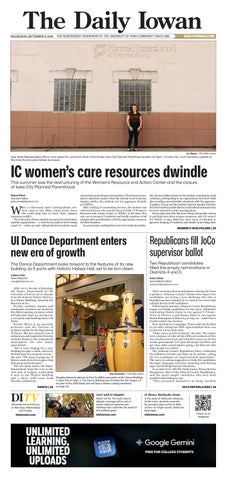
the Iowa City Planned Parenthood before it closed on July 31, hosting the UI Student Advocates for Planned Parenthood.
The Iowa City Planned Parenthood location permanently shuttered its doors on July 31, leaving a single remaining Iowa location in Des Moines. Kyrstin elagardelle, public affairs director of Iowa Planned Parenthood North Central States, said Iowa’s six-week abortion ban, coupled with edicaid defunding efforts, led to the clinic’s closure. However, she emphasized that although there won’t be an in-person provider in Iowa City, lanned arenthood still offers all its services via telehealth. These resources include birth control, emergency contraception, gender affirming care, pregnancy testing and planning, prenatal and postpartum services, STI testing and treatment, vaccines, mental health supports, perimenopause and menopause care, and some wellness and preventative care. “In addition to this being one piece of the overall healthcare fabric in Iowa that we’ve seen get cut over the last few years, abortion bans, like the six-week ban that was implemented here in Iowa, have been linked to rising infant mortality deaths in other states. I think, unfortunately, we’re going to see some of those outcomes become reality here,” Delagardelle said. A 2025 National Institutes of Health, or NIH, study found a direct link between increased infant mortality rates in states with a six-week
out and give up on this degree,’ and that is exactly what many people end up doing when they’re in situations like this.” Kroon said another uncertainty that comes with WRAC’s new organization is how it will work with partner organizations, such as the Domestic Violence Intervention Program, or DVIP, and the Rape Victims Advocacy Program, or RVAP. She said WRAC would often refer people to these organizations if it was applicable to their case. DVIP Co-Executive Director and Chief Executive Operations Officer Delaney Dixon said WRAC has always been a cornerstone of the Iowa City and UI community, and although it may look different now, its partnership with DVIP won’t change. “The Women’s Resource and Action Center has operated historically within our community as a place where people could come — even if they weren’t sure that they could name what they needed — they knew they could get support. WRAC represented a low-barrier gateway to get those resources,” she said. One resource WRAC worked closely with was
or complete ban on abortion. States with a ban like Iowa’s were found to experience a 5.6 percent relative increase in infant mortality since the ban went into effect. She echoed Levin’s concerns about educating Iowans about all the other services they’re losing when a clinic goes under or another restrictive bill is passed. “Iowans should understand that this clinic closure is part of a larger access crisis that’s already playing out in our state,” Delagardelle said. “We’ve already been facing provider shortages.” Although the Planned Parenthood clinic left Iowa City, the Emma Goldman Clinic still performs surgical abortions within the six-week limit, in addition to offering many similar services to Planned Parenthood. Francine Thompson, executive director at the Emma Goldman Clinic, said the independent provider will continue offering chemical abortions for anyone who may have otherwise used Planned Parenthood and is the only remaining clinic in the state that provides surgical abortions. “There’s no place else to go for abortion care in
the state of Iowa,” Thompson said. “We’re committed to meeting the increased need at the clinic, but, sadly, we’ve really got to work to see if we can change the legal restrictions around abortion. It’s really hard for one clinic to absorb the loss of an entire healthcare network.” Although many community members disapprove of Iowa City Planned Parenthood’s closure, pro-life organizations see it as a victory for their cause. Sheryl Schwager, executive director of Johnson County Right to Life, said the closure is a step forward for her organization, saying she’s advocating for the Emma Goldman Clinic to close too. “It’s a positive for the community because babies are being saved, but we have the scourge of chemical abortion that is so prevalent in our community and obviously throughout the country,” she said. Schwager said her advocacy extends to helping women access similar reproductive and gynecological care to what Planned Parenthood and the Emma Goldman Clinic provide, just without providing the option of abortion. She said some women can feel pressured by a partner or by a difficult financial situation to terminate their pregnancy, and she tries to give these women another option. “It’s [Planned Parenthood] not focused on holistic healthcare,” Schwager said. “As women, we all want holistic healthcare, but we don’t want to go to get good healthcare at a place that’s killing babies. We can go to a place that’s providing healthcare without that.” As Iowans continue seeking care, whether it’s reproductive care in a clinic or mental health and safety resources on their campus or in their workplace, Dixon said no one can rest on a resource always being available.
Iowa Rep. Elinor Levin, D-Iowa City, said she has focused a significant amount of her time in office working to keep owans in owa, a feat she said is increasingly difficult amid the rollout of strict abortion regulations. “We’re not just losing an abortion access provider,” she said. “We’ve lost a whole reproductive health provider because there are forces in this state that are trying to make it every other state’s problem when people need reasonable access to legal abortions. Iowa City loses OB/GYNs and loses reproductive health care. I lost my reproductive healthcare, and I am not alone.” Levin said she has personally used Iowa City’s Planned Parenthood location as her primary women’s healthcare provider for nearly two decades and understands how crucial many of the resources the organization provides aside from abortions. She said the clinic’s closure is indicative of how the majority opinion in Des Moines regarding reproductive healthcare can seep into progressive areas such as her district in Iowa City, especially areas with high concentrations of sexually active women like at the UI. “In a state where we’ve basically driven out all of the resources that are not linked to a religious affiliation or adherence for folks who are facing pregnancy and needing options, we start going after the few clinics that are left in the places where they are so universally publicly supported,” Levin said. To combat this trend, Levin said she’s found the most effective strategy is to knock doors and remind Iowans reproductive care extends beyond just abortions. “Iowans statewide believe that abortions should be safe, legal, accessible, and a decision made between the pregnant person and their medical provider and whatever family and friends they choose to involve,” she said. “The work of that is making sure folks know that they have, first of all, candidates who they can support.” Kroon shared similar sentiments, explaining how ultimatley WRAC and Planned Parenthood give community members the agency to handle their circumstances however works best for them, with no interference. “It gives people a choice of privacy,” she said. “It gives people a choice of of having easy access because it’s right on campus.” With the many women’s resource organizations that have been upended in recent years, Dixon said it’s up to everyone to ensure those that remain stay in place. “Ultimately, WRAC, DVIP, RVAP represent autonomy for all people — people’s ability to make choices for themselves,” Dixon said. “We can’t rest on our morals and say this is our norm, that it’ll always be here. We can now clearly see that that’s not the case. We always have to stay vigilant, aware, and consistently work towards supporting these causes and services so they’re here for the people that come after us.”
¡¡ ¡ ¡¡ ¡ ¡ ¡
Marrs said the department is looking forward to the closeness of the three buildings enabling closer cooperation. “We’re excited to be in closer proximity to them to hopefully open up even more opportunities for collaboration and interdisciplinary work,” she said. Marketing and Communications Director for the Office of Performing Arts and Engagement Rob Cline said since the 2008 flood less activity has occurred at the university’s old art museum. “It is exciting to reignite that part of the arts campus along the river,” Cline said. “It is also tremendously exciting to know that dance students and faculty are now working and interacting in exceptional spaces.” The new building has five dance studios, as well as an additional studio designated for students to use as a warm up space before class. One studio has wooden flooring to accommodate hiphop and street dance, while the rest have a sprung, marley floor. With high ceilings, mirrors, curtains, transportable ballet barres, and projectors, the studios can adapt to the needs of the dancers. In Halsey Hall, many of the studios had ballet barres fixed onto the walls and not every studio was equipped with projectors, which limited what classes could be taught in those rooms. The
new dance studios were designed with a lot more flexibility in mind, expanding the possibilities. Another notable upgrade is that the new building is fully climate controlled. Soon the days of having to cancel classes due to extreme hot or cold weather, because the steam heat or window units of Halsey couldn’t keep up, will be long gone. This also allows for dance classes to be taught during the summer. Scheduling and Facilities Specialist Alan Murdock said this upgraded space is a testament to the university’s strong commitment to dance and its future at the UI. “The future of the department is really bright, and I think this space creates an atmosphere that is going to continue to enrich the arts in terms of dance,” Murdock said. “The program is going to grow because we have this space and allotted history.” The open space and roomy hallways provide students a place to study or hangout. Additionally, the building is ADA accessible. With the increased amount of space and accessibility, the department hopes
to be able to invite more community members in, broadening their reach and impact. Staff members have been enjoying the upgrade from having their offices in a long, dark hallway in the basement of Halsey to the ground floor of the Dance Building with big windows to let in natural light. “Our offices are new kind of all together and facing each other. We can work, have a beautiful view of the river and see each other a lot more,” Zena Bibler, an assistant professor, said. “With the students too, we’re all running into each other. So it feels much more community oriented to have our offices in that U shape.” Halsey Hall is set to be demolished by Summer 2027. The space will be used to expand and improve the Iowa Memorial Union Parking Ramp. For graduate student Douglas Baker, who began his dance journey in Halsey Hall with the Youth Ballet and Community Dance School in 2017, like many others who have strong emotional attachment to Halsey, it’s a disappointment to hear the building
filled with decades of memories will be torn down. “I think Halsey Hall, this beautiful brick building, with so much history, is also a symbol of the communities that have grown with it over the years,” Baker said. “Having it go away, almost feels unjust.” While he wishes it didn’t have to happen, he understands the need to improve the parking ramp near the IMU and the ways the new building will improve the department and experience for those in it. Juliana Waechter, the wardrobe specialist, has been working with the department for over twenty years and also shares a sentimental attachment to Halsey. Even though this is her fifth move with the costume shops, it still will not be easy saying goodbye. “If I could go back and take something with me, there’s a giant cupboard where the laundry room was that I painted and stenciled on, really made it personal,” she said. “I will miss that giant cupboard. It would be so useful to have.” She devised ways of bringing the cupboard along, but ultimately it was too big to get through the doors. Now she is embracing the era ahead of the department and her new space. “It’s all adjusting, but it’s a great space. We’ve got a nice setup here. A lot of this is reflective of what I had at the old studio,” Waechter said. “It’s all for the students, and the students look happy. I see a lot of smiles on people’s faces, and that’s really great.”
candidates,” she said. “ They had good morals, good platforms, and seemed personable.” The 2026 election marks the first time Johnson County supervisors will be elected by district rather than at-large. The change was required under Senate File 75, a state law that divided t he c ount y into f ive super v isor districts. A ll five seats are up for reelection this year, and voters can only cast ballots for candidates running in their district. Fixmer-Oraiz called the redistricting and the new nominations a “Republican endeavor,” arguing the changes were intended to give Republicans a greater opportunity to compete for seats on the board. “They gerrymandered these districts so that they could have an opportunity,” Fi xmer- Oraiz said. “ This is ver y political, and it's, I think, obvious. So yeah, I think that that's what they’re doing. They’re doing exactly what the Republican state par t y wants them to do.” However, Foster said the Johnson Count y Republican Par t y did not approach her about running, and she decided to enter the race alone. With a background in business ethics and as a retired business professor, Foster said her experience teaching students to consider opposing sides of an issue shaped her decision to run. She said classroom debates often pushed students to think more broadly about issues they previously viewed from one perspective. “It was like a light bulb went off for them,” she said. “They just thought something was dif ferent here, just starting to understand the issue as more broad than they had previously thought.” District 2 Republican candidate Phil Hemingway told The DI earlier this summer that he believes the switch to district-based elections allows candidates to better connect with the residents they would represent. “It's great to have it. The people know, ‘Okay, you're the person who's supposed to look out for my interests, as well as the whole county,’” he said. “You get elected in one section, but it's the whole county that you represent.” Foster said her campaign will focus on three main priorities: creating
phone banking throughout District 4. “I haven't shifted. I don't plan to,” Fixmer-Oraiz said. “I also haven't seen any material out of that campaign. I've been checking to see if there's even a website for her, and I haven't found one, so it's hard to take it seriously.” Despite t he par t isan div ide surrounding the new districts, Foster said she hopes her campaign can bring more efficient county government, effectively and with good stewardship?” more perspectives into conversations addressing taxes and affordability, and Foster said. “Is this what the residents about Johnson County’s future. public safety. value the most, or are we on bunny trails “I t hink Johnson C ount y is a She said she wants the county to going off somewhere else?” wonderful place to live, and I love Iowa examine its spending for potential For Fixmer-Oraiz, they said Foster’s City,” she said. “We just want to make overlap or duplication and be more entrance into the race hasn’t changed sure that our viewpoints are balanced transparent about how taxpayer dollars their campaign strategy. They said they and well represented, and that nobody are used. plan to continue previously scheduled feels left out of any conversation. I'm “A r e we u si ng ou r r e s ou r c e s door knocking, house parties, and very positive.”
OPINIONS
Voters need to look deeper than identity Voters naturally connect with candidates who share their experiences, but policy positions should matter more than personal stories, identity, or party labels when casting a ballot.
olitics is personal. t is natural for voters to gravitate toward candidates who share similar e periences, backgrounds, or values. eeing someone who understands your story can create a sense of trust and representation. n many cases, that connection helps people feel seen within a political system that can often feel isolating. owever, a personal connection should be the beginning of a political decision, not the end all, be all of a candidate. Too often, voters are encouraged to focus on a candidate’s identity, personal story, or party affiliation without spending equal time e amining the policies they support. hile these factors may help establish a connection between candidates and voters, they do not necessarily reveal how that person will govern once elected. University of Iowa fourth-year and communication studies ma or aya eterson said although she generally leans emocrat, she would not automatically support every emocratic candidate simply because of party affiliation. think if they were pushing for something that was like, woah, that’s not something would support, then would take a step back, eterson said. er perspective highlights the importance of looking beyond party labels and evaluating candidates based on the policies they support. This is especially true in local politics, where elected officials often have the greatest impact on people’s daily lives. chool board members, city councilors, and state lawmakers make decisions that directly affect education, housing, infrastructure, and public safety. These positions are not symbolic. The policies these officials support can shape entire communities. et many voters know more about a candidate’s personal story than the policies they’re voting for. art of this can be attributed to the way political information is consumed today. ocial media allows candidates to build personal brands and connect with voters through carefully curated content. Personal narratives are easier to digest than policy proposals, making them a powerful tool for campaigns. Peterson noted that while social media can encourage political engagement, it can also create blind spots for voters. ocial media vocali es things. ut at the same time, sometimes your feed shows you exactly what you want to see,” she stated. or college students especially, social media often
serves as a primary source of political information. hile platforms like TikTok and nstagram can introduce users to important issues, they can also reinforce e isting beliefs and limit e posure to alternative viewpoints. As a result, voters may become familiar with a candidate’s image without fully understanding where that candidate stands on key issues. epresentation remains important. eople deserve to see leaders from diverse backgrounds and e perience reflected in government. ifferent perspectives can strengthen institutions and ensure more voices are heard during the policymaking process. owever, representation alone should not be enough to earn support. A candidate may share your background while supporting policies you oppose. ikewise, a candidate from a completely different background may advocate for policies that align closely with your values. udging candidates primarily by identity risks oversimplifying
what are often political beliefs. think it is important to actually break down and look at what they fully support before ust following what you think you know or what you think you’re supporting, Peterson said. That approach is particularly important for first time voters, many of whom are participating in elections without years of election e perience, like many students. ather than relying solely on campaign messaging or social media content, they should take the time to research candidate platforms, past actions, and policy priorities. The most important question in any election is not whether a candidate shares our background, identity, or even political party. The most important question is whether their policies align with the future we hope to create. dentity may spark a connection, but policy is what ultimately shapes people’s lives.
Stopping fleet services rentals was a bad decision Fleet services recently stopped its rentals, shifting to Hertz. It is not going well. In March 2026, the University of Iowa made a change to its fleet services operations. acing several money problems, the administration stopped fleet car rental services and auctioned off its vehicles to the highest bidders. nitially, the director of parking and transportation, ebby umbach, reported the university would avoid a potential . million in operational costs by shutting down fleet rental services and deferring services to Hertz. The new fleet service policy serves as another e ample of how the university prioriti es saving money over the community it seeks to foster through its student organizations. n conversation with the aily owan, umbach referred to ert as a reputable business for car rentals. ut not everyone is e cited about this switch to Hertz, and several concerns have already been rightfully raised about the lack of roadside assistance offered by this new vendor. f course, any potential failure of a vehicle or their [Hertz’s] service model is going to feel larger than life because they [students] are used to the internal service,” umbach said. A positive to this switch is that the university did not fire anyone when switching to ert . According to umbach, there were two people reassigned within to open positions in usiness ervices.
The shift from fleet services to ert rental cars marks the most recent step in the university’s new chain of cost-avoidant operational ad ustments. One of the main reasons for the change was vehicle storage space. ut a possible alternative could have been storage in the open fields in orth iberty. Although it could take more time to drive up, internal rental services could still have been offered to students and staff. The ports lub uidebook says that fleet services were an internal transfer, requiring less paperwork and offering fewer processing issues. Transferring to ert puts the pressure on students, not the university, to ensure the paperwork is perfect. t also creates more opportunities for the university to deny travel cost coverage for sports clubs. This paperwork process is often complicated, and a receipt is not enough proof to receive reimbursement. ou need an itemi ed invoice, a receipt, and the university may still ask for direct proof of purchase from the seller. The assistant director of sports programs, att chaefer, said, hoever makes the request will need to use a personal credit card to front the cost of the vehicles and then request reimbursement after the trip is complete. n addition to these e penses now incurred upfront by college students, these e penses must be accounted for weeks prior to travel, and if not, no reimbursement will occur. This means that if Hertz increases its rates in that time, the student will no longer get full reimbursement for
the rental vehicles. This also means students are shouldering the financial burden upfront that the university previously covered internally. In the short term, shifting to Hertz may be a cost effective strategy to avoid unnecessary e penditure, but avoiding problems by making them someone else’s is not how a massive student serving institution like the niversity of owa should operate in the long term, nor is it a way to solve the problem. nstead, it’s a way to avoid the problem. There was very little, if any, communication to the rest of the university about implementing this new policy, and some organi ations are still working out how they will implement the change. The change caught us by surprise, and we are still working through all the logistics, chaefer said. This policy shift feels particularly familiar, as another instance of poorly implemented policy occurred in , with the abolition of community members in sports clubs. everal clubs struggled to find adequate funding, and some have still not recovered. The niversity of owa adminton lub was once home to many high-level community members who would travel and
compete with the student organi ation. ow, the community feels fragmented, and fewer members opt to travel, knowing it will be harder to find doubles partners the will approve to play. ascia ector, the treasurer of the club, said, any of our previous community members started with the club as students and have remained involved for more than years. The badminton club is still looking for ways to recover its community. “In an era where we are doing all that we can to reduce university e penses, adding this additional financial burden to departments would have been irresponsible, umbach said. Although the niversity finds it irresponsible to shoulder the burden, the new fleet services policy was implemented irresponsibly, giving university organi ations no time to ad ust, nor an easy alternative for students with already bloated schedules who don’t want to submit endless amounts of paperwork. ot only was it communicated sloppily, but they also shifted this burden from the departments set up to support students to students, further degrading the owa e perience and adding crushing responsibility to an already long list of disorienting policy changes.
The campaign saying ‘No’ to the JoCo jail
Voices from across Johnson County are divided on the size, cost, and use of a nearly $100 million jail project.
While Johnson County approaches a critical election in November, the upcoming bond referendum to fund a $94.5 million jail construction project has become a point of contention for residents and local officials. Yard signs have popped up across Iowa City over the summer. In some cases, a person can find two particular signs, one next to the other: one supporting sitting Supervisor V Fixmer-Oraiz and one calling for a “no” vote on the referendum. Johnson County Deserves Better is a campaign funding the anti-jail signs showing up around the county. Member Elizabeth Rook Panicucci, who is also a co-founder and director of Prairielands Freedom Fund, said the campaign’s goal is not to discourage a new jail but to advocate for smarter design, community involvement, and a focus on diversion. “How can we be having the conversation around preventing incarceration with the same weight that we’re having the conversation around incarceration?” she said. The proposed jail site is 35 acres of land, recently purchased by the county Board of Supervisors for approximately $2.1 million. It would include 120 beds, with an expandable area capable of adding 20 beds for a total of 140, increasing the jail’s capacity from an operational count of 65. Panicucci said one of the 20-member campaign’s core beliefs is that additional capacity would incentivize law enforcement to fill that space to ustify the investment. Her work with Prairielands Freedom Fund partly involves paying the bonds for immigrants detained by Immigration and Customs Enforcement, ICE. Additional unused bed space, she said, could attract ICE to Johnson County, a notion Sheriff Brad Kunkel has frequently claimed as false, as the county has no active contract with the organization. The lack of a contract disproves the idea that ICE would increase its presence in Johnson County, Kunkel said, despite beliefs that the 2018-signed Senate File 481 — which obligates local agencies to comply with ICE detainers placed on inmates — could bypass a county’s ability to avoid housing ICE detainees. However, Panicucci said ICE’s past noncompliance discredits arguments on their actions’ legality. “The county supervisors will say they’d have to go into contract with ICE, which is technically, by the letter of the law, true,” she said. “It might not be true tomorrow because we’ve seen how ICE operates in this age. They operate outside of constraints, outside of morality.” She also referenced a 2025 jail inspection report that specifically praises the jail’s clean conditions as evidence the county and sheriff’s department is overplaying the urgency to replace the facility. However, Kunkel said the positive feedback from the inspection does not mean the need to address the jail’s structural problems is any less pressing. “I was proud of what he said about the staff cleaning everything, Kunkel said. “Like that’s good work, considering the age of the building and the constant problems we’re having.” A pipe burst in the jail two weeks ago, resulting in flooding. A backed up pipe drew sewage up through the floor drains in certain holding cells the day prior. These are issues, on top of damp tiles and crumbling supports and brick, the jail is
continuing to face, he said. The department is undertaking $3 million of renovations to maintain the building. Maintenance, Kunkel said, is one cost the county will continue to incur for the next few years, regardless of whether the bond vote passes. The department does not expect to move into a new facility for another three years, a timeline that will be delayed if the vote does not pass. He said costs to taxpayers as a reason to negate building a jail is unrealistic, given the upkeep costs for the current facility would only rise over time. Rising costs would also accompany delaying building a new facility, he said. If the vote does not pass in November, the facility budgeted for a referendum in future years would only cost taxpayers more. “It’s going to cost more, and we can’t keep kicking this can because it costs so much money,” he said. “I think the plan we have now in front of people is a responsible, conservative plan. There’s no fluff. Kunkel has emphasized the urgency to improve conditions. The county spends $400,000 to house inmates out of county, costs he said he would rather put toward their own facilities and not other counties. The inmate outsourcing practice also dehumanizes inmates by associating them with price tags; he said the jail system operated in Iowa counties is not a business and is interested in the well-being of inmates, adding that the work done at the jail aligns with the government’s purpose to support and protect residents. “It’s not a matter of what’s the cheapest we can do,” he said. “It’s what’s the best we can do.”
A longtime advocate for diversion
and social support programs, FixmerOraiz’s campaign occupies a growing space of socially mindful governance and de-emphasized policing, as Panicucci describes herself and the organizations to which she belongs as prison-abolitionist. Fixmer-Oraiz is a member of Johnson County Deserves Better and has canvassed with Panicucci and other campaign members. They believe the process used to design the new jail is flawed and has resulted in an inappropriately high price tag for residents. That belief coincides with their priorities for an upcoming supervisor term. pecifically, i mer rai said the county’s Criminal Justice Coordinating Committee is improperly designed and not available to the public. “At 3:30 in the afternoon on Thursday at the county building, if that’s what we’re calling a public meeting, then we have a lot of work to do,” they said. “We actually did more public input engagement in the community for our strategic plan than we did for this jail.” Fixmer-Oraiz said one of their priorities is to change the committee’s structure to fit guidelines set by the U.S. Department of Justice. Presently, the committee contains all sitting supervisors, a district judge, and a variety of other county officials and residential positions. They said this format is restrictive, and that the DOJ system would require fewer supervisors to be present and that the meeting is more accessible to the public. One spot on the committee is dedicated to a “formerly incarcerated” individual who can give insight on jail conditions. Fixmer-Oraiz said, however, the individual filling that position in Johnson
County’s committee was difficult to reach and minimally present for the meetings. The lack of a true democratic process in the jail design process and referendum decision, they said, is part of a larger priority for their campaign to make county government more accessible and service-oriented for community members. “I’m not going to discredit the validity of what the committee was working on,” Fixmer-Oraiz said. “It just was insufficient. think it falls woefully short of what anybody would consider public input.” The insufficiency of that design process lends directly to the jail being the “wrong size” for Johnson County, Fixmer-Oraiz said. At over 100 beds and $94.5 million, they said the jail was too large a concept and the committee and board previously discussed projects that cost roughly $40 million. “We haven’t had any options in terms of separating spaces from office to inmate cells,” they said. “Every time we have asked for meaningful input, we’ve been told that we will get it. Now we’re at a point where we’re just doing information sessions. That’s not a point at which you get input on a design, so it’s just been very frustrating.” Despite Kunkel’s certainty that the jail conditions will only continue to worsen, Panicucci said the best path forward is a no vote in November and emphasize a democratic process going forward to design a more suitable jail. Fixmer-Oraiz said they will prioritize building a more appropriate jail for Johnson County if the vote fails in November. “I have built my entire adult career on community engagement,” they said. “So I believe this will fail because I believe that it is too big, too expensive, and it’s not who we are in Johnson County.”
New Articulation Agreement creates more options for graduate students UI and Midwestern University created an Articulation Agreement allowing qualified UI students to get a guaranteed interview into Midwestern’s health sciences programs.
The University of Iowa and Midwestern University have created an Admissions and Articulation Agreement to provide a structured pathway for health science students to earn graduate degrees. The UI has articulation agreements, contracts that dictate how courses will transfer between schools, with a variety of community colleges, allowing students with their associate’s degree to transfer to the having already fulfilled their general education requirements. This is only the second time the UI has had an articulation agreement with a graduate school, Des Moines University being the first. The articulation agreement with Midwestern University would allow UI students who meet specific qualifications to receive a guaranteed admissions interview. Senior Academic Advisor and Pre-Health Coordinator at the UI, Kate Karacay, said this partnership may help students connect with a graduate school. “The nice thing about an articulation agreement is that it can provide a clearer path for a student, and just give a little bit more information to them about what that school is like, if it’s a good fit for them, and
then a connection at that school if they wanted to go there,” Karacay said. Director of Education and Innovation and Development Ryan Palmer said Midwestern University is a graduate health sciences university with two campuses, one in Arizona and another in Illinois, where it hosts more than 20 programs. “The big thing we have here too is a 12-to-1 student to faculty ratio,” Palmer said. “That’s really where a lot of value is because faculty know students by name.” Midwestern University approached the UI about forming an articulation agreement due to its history of admitting quality students from the UI. “As we were looking at our different schools that would feed us students,” Palmer said. “We really wanted to partner with ones that we felt brought us great students, and that we really respected as a really prestigious institution.” The UI has many students on the prehealth track, and for those students, future career paths involving graduate school and medical school may be necessary. Choosing their next school is no easy task, leading many students to consult their advisors. Karacay said her role is not to recommend graduate programs to students, but to help them find schools that fit their needs. e help students find schools, and then the student makes their decisions based on
their unique needs,” she said. “It could be geography. It could be the type of program that they want. Some programs get students involved in clinical work sooner rather than later, so it’s just a very unique, tailored thing. So we can never just recommend a school for students.” addy teit is a first year at the , on the pre-optometry track. The UI does not have an optometry program, so she knows she will have to look elsewhere for graduate school. “What I plan to look for is what rate of students that go through the program can pass the board exam,” Steitz said. “Because some schools will have a 95 percent acceptance rate into the school, but then their acceptance rate for the board exam, or the passing rate for the board exam, is really low, and I don’t want to be set up for failure.” While Steitz said she would not choose Midwestern University solely because of a partnership, knowing it has an agreement with the UI gives her comfort. “That definitely gives me a sense of security, especially since there’s not a lot of security knowing that there’s not a program here,” she said. “But knowing that they have a partnership with a place that has a program, it makes me feel more secure in my future.” In an email statement to The Daily
Iowan, UI Public Relations Manager Chris Brewer said the university is dedicated to providing its students with the highest quality education. “Our partnerships with Midwestern University and Des Moines University are examples of our commitment to ensuring students have multiple opportunities to pursue their professional goals across a variety of health disciplines,” he wrote. Midwestern University has had UI students attend the school in the past, and Palmer said faculty and programs have responded positively to UI students, and this agreement has the potential to strengthen that relationship. “It’s just a matter of basically saying, ‘Hey, let’s make it easier for Iowa students to see who we are, get visibility, and keep attracting really strong students because what it does for us is we get really, really strong students,’” Palmer said. Midwestern University has 24 partner schools, and Palmer said President and C.E.O. Dr. Joshua Baker wants to lean further into partnerships and the community to become more externally facing. “It’s a really great time to be partnered with Midwestern because a lot of people haven’t heard of it, but I don’t think that’s going to be the case for much longer,” Palmer said.
Iowa prepares for property tax legislation Johnson County and Iowa City local governments weigh future budget cuts.
As 2027 approaches, local governments are preparing for Iowa property tax shifts, reviewing budgets for upcoming tax cuts. Signed into law in May 2026, Senate File 2472 will save Iowa homeowners $4.2 billion over six years, according to a press release from ov. Kim eynolds’ office. The law limits how much cities and counties can increase property tax revenue from certain levies, generally limiting annual growth to 2 percent, while excluding new property from the calculation. The law will take effect an. , and apply to property ta es and budgets for fiscal years beginning on or after uly , . The law also replaces the homestead tax credit with a homestead tax exemption, which e empts percent of a home’s taxable value from taxation. A Common Sense Institute Iowa analysis ranked owa th most burdensome nationally for local property ta es and th for total local ta burden. Io w a R e p. C a r t e r No r d m a n , R-Guthrie, said the bill will “finally” put Iowa taxpayers first. “For too long our property tax system has put cer taint y for government budgets over the certainty of family budgets,” he said. While the bill didn’t include everything the democratic caucus wanted, Iowa Sen. Tony Bisignano, D-Polk said they had input in the bill that was written. “We think at this point this is the best bill that we’ve seen,” he said. “Not one that we wrote, but one that we have some input, and that’s significant in and of itself. The balance between tax relief and funding for local services is one of the broader issues raised by the bill. Phuong Nguyen, a professor in the University of Iowa School of Planning and Public Affairs, said communities face a tradeoff between more money or more tax burdens, with local services provided. “ This may reduce t heir budget significantly, and local residents may see cuts in ser v ices as well in the future,” Nguyen said. Nguyen speculated on how local governments could offset reductions and said communities could see increased fines and fees. “We don’t know for sure what [they are] going to do to offset the cuts,” he said. “If they can’t compensate for the
loss and they cut the personnel, you can see a lower response rate to some services, and we’re not sure which one we’re gonna get cut first.” Geoff Fruin, city manager for the City of Iowa City, spoke to the Iowa City ity ouncil ept. about the property tax changes and said the challenge is unlike those council members may have experienced in the past. “It’s not time-constrained, meaning that when you have an economic recession, there’s a reasonable belief conditions will change. That’s not what we’re looking at here,” he said. “We’re looking at structural reform of local government finance.” ruin said the different services owa ity offers will need to be watered down and may not meet expectations in all areas. According to Fruin’s presentation, property taxes make up 70 percent of the general fund revenue. A rough estimate found about a $2.5 million reduction in taxes for the city. icole avies, finance director for the City of Iowa City, said looking forward to the year 2036, there is an estimated gap between revenue and expenditures of . million or . percent of the general fund budget. For the transit fund, there is an estimated gap of $4.8 million, which is 27.7 percent of the budget. Options were proposed to the city council as ways to close the gap, including increasing fees for permits, services, and programs, increasing the utility franchise fee, utilizing the Local Option Sales Tax to replace services currently funded by the general fund, and maximizing employee benefits levy — which would include a 34.5 percent increase in property tax levy. Options for the transit fund include increasing fees for parking permits and hourly services, charging bus fare for transit services, increasing utility franchise fees, utilizing the Local Option Sales Tax, and eliminating or modifying services to the public. Davies said not one of these would make a huge difference by itself, but rather some combination of all the options. ohnson ounty upervisor i mer Oraiz said they were disappointed by the bill, finding it to be anti growth and taking away local control. “I think, in general, tapping our ability to utilize property tax at certain levels means that we cannot pay for the services that our residents have come
to know and why they live and move to ohnson ounty, i mer rai said. Heading into the county’s budget season in November, Fixmer-Oraiz said the county is looking into internal policies to find more efficiencies. They said the county is still waiting on rules on how to apply these property tax laws. “It doesn’t make any sense, and they still don’t have actual rules as to how to apply this,” they said. Cedar Rapids resident Tyler Gibson said the bill didn’t mean much to him, calling it “political lip service,” using
the tax cut to say they did something while not offering substantial change. Gibson said the current property tax system is pushing people out of the state, with him personally seeing family and friends leave. While Gibson said he’d like the tax cut, he believes the state needs to cut state property taxes entirely for Iowans, comparing property taxes to renting the house you own. “If you want to tax something, tax your initial purchase,” Gibson said. “But continually paying for something that you already bought is absurd.”
Ruling could shape Iowa sports landscape Supreme Court reinforces Iowa’s restrictions while raising questions about Title IX.
For Iowa high school swimmer Ariana Swanson, the debate over transgender athletes is not something she has encountered in the pool.
While the issue has been a major legal and political fight, wanson, who swims competitively for both her high school and club team, said she has not heard of a transgender swimmer competing in Iowa. After the U.S. Supreme Court’s decision allowing states to restrict transgender girls and women from competing in female
sports, she said the issue could affect athletes competing for spots at high-level meets. “The idea of having a transgender swimmer competing with or against me feels unfair,” Swanson said. “There is just such a huge difference in the endurance and strength aspect.” According to the Open Water Swimming Association, men swim 7 percent faster than women on average in open water races. The Supreme Court’s decision does not require states to adopt restrictions on transgender athletes, but it gives states an opportunity to maintain and enforce them. For Iowa, this was previously decided in 2022 when Gov. Kim Reynolds signed ouse ile , effectively banning transgender girls and women from competing on female sports teams in schools, colleges, and universities. Iowa is one of 28 other states with similar legislation in place for transgender athletes as of 2026. The ruling has drawn criticism from LGBTQ+ rights organizations, which argue restrictions on transgender athletes discriminate against transgender students. The Iowa American Civil Liberties Union legal director Rita Bettis Austen said in a statement to The Daily Iowan the decision makes it more difficult for transgender girls to participate in school athletics. She also argued sports bans can expose female athletes to intrusive challenges over their sex. “This is a very difficult ruling for transgender girls who ask for nothing more than the same opportunities afforded to their peers,” she said in the statement. “We continue to advance the fundamental principle that all young people deserve equal opportunity to thrive and succeed.” For Swanson, her experience shows a distinction between the national debate over transgender athletes and what Iowa
high school athletes are encountering in their sports. Nationally, 3.3 percent of high schoolers identify as transgender, according to a report done by the UCLA School of Law. oshua ens, a niversity of owa sports law professor and former athletics compliance administrator, said the ruling gives states more authority to enforce restrictions like Iowa’s. “I think this is something that has been building up, and it finally made it to the Supreme Court this summer,” Lens said. Lens said one of the biggest questions moving forward involved Title IX, the federal law that prohibits sex based discrimination in federally funded education programs. “For a long time we’ve used this threepronged system to make sure our athletic department and programs are satisfying Title IX,” Lens said. The system requires schools to ensure their participation numbers are proportional, expand opportunities, and accommodate all interests and abilities among athletes. Lens said the decision could lead to changes in how athletic departments determine compliance with Title IX. The decision also comes as college athletic organizations already have their own rules regarding transgender athletes. Lens said the NCA A has its own policy to address the participation of transgender women and girls, adopted in 2025. Lens said one potential consequence could be athletes moving to states where transgender participation is permitted. He compared this to how athletes have responded to differences between state laws governing name, image, and likeness compensation. “We saw athletes crossing state lines to play in another state if the laws in that state were more favorable,” Lens said.
Inaugural UI writing award enables passion Tony Tulathimutte, an alumnus of the Iowa Writers’ Workshop, received the honor.
The University of Iowa Writers’ Workshop has created an award that aims to assist writers in the pursuit of their creative work. Tony Tulathimutte, an alum of the workshop and a current associate professor at the UI, was named the inaugural recipient of the $150,000 Jack Galef Award. The award and prize are unique in their purpose. Unlike most other literary awards, it is not given out for any specific novel or piece. Instead, the prize’s purpose is to reward and provide financial assistance to authors who are seen by the committee as underrecognized in their field. Tulathimutte was born and grew up in Springfield, Massachusetts. He is ThaiAmerican and the son of immigrants. He graduated from Stanford University in 2005 with a master’s in symbolic systems. After graduating, Tulathimutte worked for the tech industry in San Francisco for five years as a writer and user experience researcher. However, he was not happy in this field. He still had a passion for writing and creativity. Through his interest in further exploring this passion, he applied to the Iowa Writers’ Workshop. “I guess it was part curiosity, part luck,” he said. Only a few weeks af ter he was ac cepted into t he work shop, he was laid off. His first novel, “Private Citizens,” was published in 2016. The book follows numerous Stanford graduates trying to navigate their careers post-college before the 2008 recession. The novel received praise for its use of humor and its ability to relate to the millennial experience, winning a Whiting Award in 2017. The annual honor awards ten writers in nonfiction, fiction, poetry, and drama $50,000 based on accomplishments early in their careers. His second major public at ion,
“Rejection,” came out in 2024 and is a collection of short stories that explore themes of loneliness and depression through a comedic lens. Eshna Sharma, one of Tulathimutte’s for mer work shop st udent s, sa id Tulat himut te was a coincidenta l incentive to move from India to Iowa. She said she was trying to plan out the move and she was talking with students in the workshop to understand the logistics of the program, and at the same time she was reading one of Tulathimutte’s books. “I was reading “Rejection” at the time, and then somebody I spoke to mentioned that he is going to be visiting next year,” Sharma said. “I’m just astounded by the way he thinks and how deep of an insight he has into human psychology.” Sharma appreciated the clarity in his writing and how personal it feels. “Even after the workshop is over, I find myself going back and re-reading or listening to his podcasts again because I just like the way that he uses words,” she said. Tulathimutte’s writing style is often recognized by critics and readers for its
bleakness and dark, satirical humor. He likes leaning into more “cringe comedy” and subject matter that might lead to some discomfort. In that, he is able to take things that personally stress him out and laugh at them. “Most of what I write causes anxiety,” he said. “Writing helps take an absurdist approach to topics that scare you.” Lan Samantha Chang, the program director for the Iowa Writers’ Workshop, said Tulathimtte’s work is very personal and deserving of higher praise. “Tony is iconic and highly individual,”
Chang said. “His first book was called the first great millennial novel, but he didn’t get enough praise.” The award will be handed out every even-numbered year. For the recipients, the award will alternate between fiction w riting and poetr y as categories. Tulathimutte is set to receive the award on Sept. 29 in Hancher Auditorium, where there will be a small ceremony at 4 p.m. at the Stanley Café. The event is open to the public, and Tulathimutte will do a reading from one of his works. “There is a really big commitment to not have it wasted,” Tulathimutte said. “I
want to do right by the people who have given me this opportunity.” Even for somebody who had been in the writing field, Sharma mentioned how little compensation writers receive, and how financial stress can negatively impact a writer’s creative ability. “I think it is an unmitigated good when young writers get the pressure of finances off of them,” Tulathimutte said. He mentioned his own struggles with publishing his first two books. It took four years for him to publish “Private Citizens,” and over 10 for “Rejection.”With this award, he said he hopes to get more of his work out there. To a student like Sharma, and many others in the writing program at the UI, this new award will provide lifechanging assistance in their pursuits “The fact that it is also targeted toward emerging writers gives me hope,” Sharma said. “It gives me a little bit of a kick to keep on working hard.”
Wrigleyville fosters Chicago subculture in IC Wrigleyville is hitting a home run with Chicago sports fans in Iowa City, bringing Cubs-inspired life to Iowa.
For some Chicago spor ts fans, watching the big game is a way of life. These fans have now found a bar in downtown Iowa City where they can call home: Wrigleyville. Stepping inside Wrigleyville doesn’t feel much different than stepping onto Wrigley Field itself. Inside, the lights are dimmed with a blue tint, adding to the theme. Chicago Cubs flags line the rafters, and the bar’s exterior is coated in the team’s dark royal blue. Tommy Chapman, a University of Iowa student, has watched multiple games this season at Wrigleyville. “I came up here for the Cubs and White Sox game,” Chapman said. “The environment is like no other. During games, ever y hit, home run, and strikeout is celebrated with a cheer.” Chapman said he and his friends plan on going to Wrigleyville for the Cubs’ postseason. “Wrigleyville has been the perfect place to watch Cubs’ games,” Chapman said. “The last time the Cubs were in the World Series, I had a watch party with my friends.” The bar’s aesthetic details help fans feel connected to the team, even when they are hundreds of miles from Chicago. With a consistently large share of the UI student population from Chicagoland, opening Wrigleyville was a no-brainer for owner Tracy Barkalow. “I looked at the target audience and demographic and thought there is no other bar like this in the area,” he said. “There are a lot of students here in the Chicago area.” The space Wrigleyville occupies in the Pedestrian Mall previously housed Hazzard County for roughly a year and The Field House for years before that. Barkalow and his staff spent the summer painting and prepping the bar for their opening. After its opening, they were overwhelmed with how the community reacted. “People watch games religiously,” Barkalow said. “We have had fans stay until one in the morning to watch the game.” Now that the bar has been open for some time, the owner plans on adding Chicago-style food to the menu. With the addition of a chef, Barkalow plans to add the famous Chicago-style hot dog to the menu, along with other concessionstand-like items such as nachos, hot beef sandwiches, and pizza. Before t he post se a son st a r t s, Barkalow and his management team plan on doing specials and giveaways. “We are currently discussing having more deals for the postseason games,” Barkalow said. “My management team and staff are full of Cubs fans. They
do an amazing job putting together specials.” During the game, there are many Chicago sports-themed, handcrafted cocktails to enjoy, such as The Wrigley Bomb, Da Bears Old Fashioned, and Wrigley Sunrise. Lilliana Bentley is a bartender at Wrigley ville and also tends bar at Fieldhouse and ReUnion Brewery. “Wrigley ville is the perfect place to catch a game or just grab a drink,” Bentley said. “Even if you are not a Cubs fan, the bar is still a welcoming place to enjoy an evening with your friends.” Even when the Cubs have a day off, the bar still offers happy hour specials. “Saturday nights are still busy, even when the games are not going on. People love our drinks,” Bentley said.
The Cubs have given Chicago plenty to celebrate this season. Sitting at 78-62 as September begins, the team has remained firmly in the National League playoff picture, despite trailing the Milwaukee Brewers in the National League Central division. With the postseason approaching, excitement surrounding the Cubs is only growing. If Chicago secures a playoff spot, Wrigleyville could become a gathering place for Iowa City fans hoping to watch the team make a deep postseason run. For lifelong Cubs fans like Jacob Rozenberg, a UI student, each game brings another chance to celebrate a big hit, a late-game comeback, or another historic moment. “I have been paying close attention
this season,” he said. “I hope the Cubs make the playoffs this year. I plan on going to Wrigley ville to watch with other Cubs fans. I want to experience watching with other fans.” One of the biggest stories in the MLB this season has been center fielder Pete Crow-Armstrong, who has developed into one of baseball’s most exciting young stars. Crow-Armstrong has been going head-to-head with last year’s National League Most Valuable Player, Shohei Ohtani, for the 2026 National League MVP race. “Pete Crow-A r mstrong or A lex Bregman are my favorite players,” Rozenberg said. “A r mstrong and Bregman can hit like no other. It is always worth tuning in to watch them play.” But the Chicago sports experience at Wrigleyville doesn’t end when the Cubs’ season does. As the Cubs continue to w rap up their historic season, Chicago fans are gearing up for the start of football season to cheer on the Chicago Bears. “I’m incredibly excited for the Bears season,” Rozenberg said. “Luther Burden is going to be a stud this year.”
DANCING TO NEW HEIGHTS The UI Department of Dance relocated to the former UI Museum of Art building, which closed after the 2008 flood. Faculty, students, alumni, and community members are invited to the official opening ceremony on Sept. 24.
SPORTS
Three countries. Three stories. One new chapter for Iowa women’s golf
As Iowa women’s golf kicks off its fall season, it welcomes a group of freshmen from all over the world.
F
or three of the incoming freshmen on the Iowa women’s golf team, this is not only the beginning of a new season, but the beginning of a new story in a new country. Iris Gu arrived from Valencia, Spain. Eva Kristinsdottir came from Reykjavik, Iceland. Maria Moczarska made the trip from Warsaw, Poland. Now, thousands of miles from home, these three are learning what it means to be Hawkeyes, together. “We always appreciate whenever we have players from different countries on our roster,” head coach Megan Menzel stated. “It’s just fun to see how they
approach things and how they go about the training process.” And for each of them, those experiences overseas helped prepare them for the challenges of becoming a Hawkeye. Xinyi “Iris” Gu graduated from the American School of Valencia in Betera, Spain, in the spring of 2026. She signed her letter of intent to the Hawkeyes back in November of 2025, with a strong resume making it hard for Iowa to pass her up. In 2024, Gu traveled to the U.S. to showcase her talent to a new crowd of people. Competing in the 2024 Orlando International Amateur, she went in hoping for coaches to notice her talent. Instead, she won the tournament. The following year, Gu captured a
historic victory at one of golf’s most legendary international venues, winning the 2025 St. Andrews Junior Ladies Open. If there is one thing a college coach likes to see, it’s consistency, and out of all of the events Gu competed in leading up to college, she finished in the top ten nearly 30 times, making her one of the most reliable recruits in her international class. Reliability was something all three of these girls had in common. Moczarska was an elite member of the Polish National Team, and her high school years were defined by a passport to international competition, rather than traditional school sports. She represented Poland in a number
of different events, such as the orld Junior Girls Golf Championship, the Annika Invitational, the European Girls Team Championships, and the German Girls Open. And just like her teammate, she finished in the top 10 at high-level tournaments nearly 23 times. She signed to play for Coach Menzel on Nov. 20, 2025, and hasn’t looked back. “As we got into conversations with these girls, we really liked their personalities,” Menzel said. “They are very disciplined yet humble, and pretty confident kids who will bring a lot to our team.” Iowa’s third freshman made quite
Senior center back serves as silent anchor of Iowa soccer
Although she doesn’t light up the scoreboard with goals, fourth-year Millie Greer’s defensive presence has been vital for the Hawkeyes throughout her career.
Millie Greer started her soccer journey just like everyone else. She played the sport because her friends were on the team and got to play as a forward. Although she enjoyed playing up top and having the ball, she now finds herself as owa’s starting center back. The fourth-year defender hails from Scottsdale, Arizona. Despite the hefty distance from Iowa City, she discovered Iowa through a connection between her club coach and owa’s old coaching staff. Although skeptical at first, after visiting the
campus, seeing the facilities, and meeting her new teammates, Greer knew Iowa was the place for her. Additionally, it helped that the rest of Iowa’s athletics were doing well at the time. “Being able to see other athletes at such high levels like women’s basketball and men’s and women’s wrestling was intriguing,” Greer said. “It’s just fun to go to a school that is good at everything they do.” Greer, accompanied by fellow fourth-year ofia ush, arrived on campus as freshmen during the start of the spring semester and were welcomed by the harsh Iowa winter weather, something unfamiliar to the Scottsdale native.
The first few weeks were definitely a bit shocking for me being from Arizona,” Greer said. Coming to Iowa a semester early proved to be beneficial for reer, who could acclimate herself not only to the Iowa culture, but life as a college student in general. “There were a lot of meetings outside of practice and just a lot of time put into it that you wouldn’t normally think,” Greer said. “But it was helpful to get in tune with how everything works and the standard culturewise.” Greer made an immediate impact in her first year, starting in all games of the season while playing all 90 minutes in 17
of them. Surrounded by upperclassmen such as Maggie Johnston, Macy Enneking and Samantha Carey, the team recorded a program record shutouts in reer’s first season. “It wasn’t something I thought about while I was doing it,” Greer said. “But looking back now it’s kind of crazy to see that I started and did all of that since day one.” As her career at Iowa has continued, the team’s defensive success has continued. Greer has recorded the most minutes played out of position among players over the past two seasons and regularly stays on the pitch
Keeping it steady Iowa volleyball second-year Ksenija Tomic brings a consistent effort to an aggressive position.
A kill is arguably one of the most important statistics in volleyball. Not only does the action, when done correctly, provide a point to the attacking team, but according popular volleyball brand Wilson’s website, “You want to make as many kills as possible during the game.” In recent seasons, Hawkeye leaders in kills have been outside hitters. The 2025 season saw hitter Chard’e Vanzandt tally 386 kills on the season, followed by Carmel Vares with 306 kills, the latter of whom returned to the program for her second season. Now, there’s a new face in Iowa City looking to continue the trend. After a season at Oregon where she averaged 1.24 kills per set, second-year Ksenija Tomic is repping the black and gold. “Ksenija had a good end of spring and a really great summer,” head coach Jim Barnes said during a media availability on Aug. 31. “She got in tremendous shape and came in twice the player when we
started our first practices at the beginning of August.” Originally from Belgrade, Serbia, Tomic performed at a high level long before the Big Ten, being named best outside hitter of the 2024-25 Serbian Super League regular season. Tomic was also a threetime medalist within the Serbian national program. “She is a six-rotation player, those are extremely valuable,” Barnes said. “I think as she gets more and more confident in what she’s doing and what we’re doing, her game will keep rising.” The role of an outside hitter tackles several different aspects of the game, such as blocking, serving, and attacking. Tomic described the position as everything in one. “I think it’s one of the main positions for the team to work out,” Tomic said. e pass, we do defense, we do offense, we block, we serve, we do practically everything on [the] court.” Of the available suitors in the transfer portal, Tomic chose the Hawkeyes
Collaboration through competition
Iowa field hockey’s goalkeeper battle this offseason proved more than just a battle for the starting spot.
Cross country’s Wilson talks goals for the season
The Cedar Rapids native was Iowa’s top finisher at last year’s Joe Piane Invite.
Following the graduation of Iowa field hockey goalkeeper Mia Magnotta this previous offseason, the program’s coaching staff had a tough job ahead of them in deciding who they wanted as their new brick wall. Filling the shoes of Magnotta was no easy task. The goalie earned herself a total of 361 saves, 21 shutouts, 32 wins, and 3,791 minutes across 61 games played with the Hawkeyes. Iowa brought in two new goalkeepers this offseason, namely first-year Julia Claessens from the Netherlands, as well as third-year New Hampshire transfer Abby Johnson. Both joined two seasoned Hawkeyes in fourth-year Allie Curry and third-year Mack Panko. The decision to field four goalkeepers on the squad was not an easy one for the coaching staff, nor is it very common, with most rosters containing one or two backups compared to Iowa’s three. “It’s just the way it worked out and we wanted to give everyone a fair shot,” Head Coach Lisa Cellucci told The Daily Iowan. “We needed to ensure we were going to be really competitive in the position, because it wasn’t clear.” With the talent on the team and in the position, the coaching staff knew this was the right direction to go, knowing they had options to fall back on if the spot needed filling. “We really lean on each other at practice, we help each other out,
and we talk through what’s going on,” Johnson said. Fourth-year defender Lauren DeRose, who appeared in all 20 games last season, echoed this sentiment. “It’s really nice to know that no matter what happens, we have something to fall back on,” DeRose said. “We have the ability to go back and look through the rest of our team and it’s not going to downput the level of our game.” Following Iowa’s first two matches this season, played in the Big Ten/ACC Challenge against No. 11-ranked Wake Forest and No. 2-ranked North Carolina, it was Johnson who made her presence known in the net as the Hawkeye starter, totaling 11 saves in two games. Nine of these saves came in the Hawkeyes’ nailbiter finish over the Tar Heels, 3-2. “The atmosphere is nothing like I’ve ever seen before,” Johnson said. “I’ve never played in a game that felt as high-stakes as both of those.” DeRose, for her part, expressed optimism following the 2-0 start. “I think it’s only going up from here and I’m really proud of what Abby did this past weekend,” DeRose said. When it came time to choose someone to be in the net, Cellucci and the rest of the coaching staff decided to go with the experience, a move that greatly paid off. “What it came down to with naming Abby was truly about her ability to organize a defense and
just having that experience, and then her shot saving experience,” Cellucci said. While the spot may be filled by a particular name down the line, with the level of competition between the Iowa goalkeepers, Cellucci emphasized that no decision is really final. If they need someone else to step up, they will make it happen. Although only one athlete can be in goal for the Hawkeyes, this does not mean there is no purpose to carrying four goalkeepers. “They’re very selfless people and they show up, and whatever role they’re asked to play, they embrace it,” Cellucci said. “That’s what I’ve been so impressed with because it is difficult to be the one not in the cage, but then you have to show up every day and work really hard and challenge your teammates, and that’s what they do.” Not getting the game reps is hard when you want to compete. However, while only in practice, getting to take shots from the team’s two leading scorers, fourth-year Dionne van Aalsum and fifthyear r derique van leef, gives a great advantage in growth and provides a challenge. After the first two games of the season, even with a few extra goalkeepers, the team seems to be in a very comfortable position moving forward. “Coming out of the weekend, especially in the second half of the UNC game, I can feel myself kind of stepping into these roles, and it’s very big shoes to fill,” Johnson said. “I definitely can’t do it alone.”
What was the best Cy-hawk football game?
Sports reporter Regan Roberts argues for 2021’s matchup, while fellow sports reporter Tate Balkenende believes it to be 2017’s.
The Cy-Hawk Rivalry is one of the most historic rivalries in college football with many great games. The game that sticks out the most to me was 2021. The 2021 edition of this game will go down in history for Cy-Hawk games for a multitude of reasons. First, the build up. Going into the 2021 game, the buzz around the Cy-Hawk game was at an all time high. Iowa had just beaten No. 17 Indiana, 34-6, while owa tate was coming off their best season ever in 2020, going 9-3 and winning the iesta owl. or the first time in this game’s history, we were getting a top ten matchup between the two teams. College Gameday recognized the amplitude of the matchup as well, resulting in the second time in the show’s history that it would be at the Cy-Hawk game.
With such a long and rich history, you’d expect the greatest Cy-Hawk matchup to be long in the past. But when you look at the battles these teams have had, there is no doubt the 2017 matchup is the best all-out brawl we’ve seen between the two. Coming into the season, Iowa State looked like they were ready to make a name for themselves. After landing Georgia quarterback transfer acob ark and returning 23 starters from their 2016 roster, they were not planning on repeating their 3-9 record from the year prior. This game featured many talented players who would go on to be NFL stars such as David Montgomery, T.J. Hockenson, Noah Fant, and Allen Lazard. The game began with Iowa taking a 14-10 lead going into halftime, then increasing
that to a 21-10 lead midway through the 3rd quarter. Then, the momentum started to shift. Park threw a 74-yard passing touchdown to Hakeem Butler to take a 38-31 lead with just under 5 minutes left in the game. This is where Akrum Wadley took the game into his own hands, breaking tackles, shaking off defenders, and being wrestled down into the end zone to tie the game, 38-38, with 1:09 on the clock. With both teams showing incredible persistence throughout the entire matchup, it was anybody’s game going into overtime. The yclones were not able to find the end zone in overtime, so they settled for a field goal. n the awkeyes’ drive, quarterback ate tanley would find freshman wide receiver Ihmir Smith-Marsette in single coverage, who then hauled in the game-winning touchdown. Not only did this game have an amazing end, but both teams produced on the box score. Stanley and Park threw for 300+ passing yards and 4+ passing touchdowns, alongside Montgomery and Wadley rushing for 100+ yards and a touchdown each. The 2017 Cy-Hawk matchup wasn’t just a regular game; it was the perfect example of why rivalries run college football.
¡ ¡
¡
“
“
Now, for the actual game. The Cyclones would take the early lead, 3-0, at the end of the first quarter. The awkeyes then responded in the second quarter by scoring two touchdowns. One, a rushing touchdown by Tyler Goodson, and the second, a receiving touchdown from Charlie Jones to take a 14-3 lead. However, right before halftime, owa tate would quickly respond with a touchdown of their own to make it a 14-10 game at the break. Tides turned back in Iowa’s favor after Jack Campbell returned a Breece Hall fumble on the Cyclones’ own six-yard line for a score to make it a 21-10 ballgame. owa would then tack on two field goals to extend their lead, 27-10, before Iowa State would add a consolation touchdown late in the fourth quarter to finali e owa’s win at 27-17.The Cyclones’ stars struggled, playing a huge part in the loss for them. Brock Purdy was 13/27 with only 138 yards and 3 interceptions. Breece Hall’s fumble shifted the momentum of the game drastically as well. From the pregame hype to the game itself, fans of the Cy-Hawk rivalry will forever remember the 2021 edition of the matchup.
the name for herself in Iceland, building her resume before she even set foot in Iowa City. Kristinsdottir represented Iceland at the World Junior irls hampionship in anada, finishing as the country’s best individual. he also finished th at the Annika nvitational urope, won the unior tournament at Korpa, and won the celandic and under club championship. These accomplishments led Kristinsdottir to be named Golfer of the Year by her club, following the season. ut despite her success on an international stage, coming to Iowa meant adapting to a whole new environment on and off the course. “The weather has been really hard because it’s so hot, so it’s hard to practice golf in this heat,” Kristinsdottir said. The courses here are much different than back home, especially the rough, so it’s a little hard adjusting to that.” But the changes haven’t been limited to the golf course. For Kristinsdottir, moving from Reykjavik to Iowa City meant leaving behind the familiar and starting over in a new place. ut finding a welcoming team made that transition easier. “I chose Iowa because of the coaches, as I think those are really important,” Kristinsdottir
said. “And all the girls I met on my visit were super nice and welcoming, which was also important to me.” Kristinsdottir was the lone international freshman to compete with the Hawkeyes in their opening tournament, hosted by urdue in est afayette on Aug. and ept. . he recorded an eight over par on the first day, following with a four over par and a si over par on the second day. Moczarska also competed in the tournament as an individual, recording a seven over par , five over par , and eight over par . he finished in th place on the leaderboard. “I think the team is pretty competitive from top to bottom,” Menzel said. “They all came in prepared and trained well this summer. We have a lot of respect” for that.” But above all, representing black and gold with their teammates is something these women will cherish just as much as golf. efore team practice started, we all went to es oines and went shopping together, so granted we spent a lot of time in the car, fourth year aura eters stated. ily Huether and I just kept looking at each other throughout the car ride because we knew this season was going to be a really good time and a really good group of girls.” For three golfers who traveled thousands of miles
from home, their first season as awkeyes is more than adjusting to a new country or a new level of competition. t’s about finding a team to call home. “I really love being in a team because it makes sports so much more fun,” Kristinsdottir said. “Everyone on the team has been really supportive of being successful and encouraging others to play well.” And just maybe, the women on the team will get to experience what their teammates call home someday. “We’ve had players in the past that have traveled home to see someone’s country,” Menzel stated. “We just think it’s really cool when you broaden the world for all of these players.” As for beginning a new life as a Hawkeye, it seems the three of them have already begun to find their footing. And whenever they decide to travel back to their origin countries, they know upon their return to Iowa City, a family will be waiting for them. “They are going to get a great education, and they are going to meet awesome people along the way,” Menzel said. “They are going to hear people yelling ‘Go hawks’ in their airport.” “We are really enjoying the team culture so far, and we can kind of just see where it’s headed, which was one of our goals as seniors,” Peters said. “I think that group is going to do that pretty well for this team.”
for the whole 90 minutes. For Greer, she said it just “happens to be that way”. e have a lot of good players on the field at all times, and it’s just fun to be out there, I want to be out there,” Greer said. “It’s something I’m able to do because we have hard practices that make the games a lot easier.” Greer’s veteran presence has been both admired and appreciated by first year head coach ean ard. “She’s been in big environments and big games before, and you can’t really replicate and teach that,” Ward said. “The fact that she’s been there and done that is a great plus for us.” With a new head coach, Greer has been asked to play her game a little differently. ard hopes to see more playmaking from the defender from the back line and has seen it in action. “It adds another dimension to her game,” Ward said. “In a game where things aren’t going so well, she can step up in the moment and be on the bal, want the ball, and step up in those key moments of a game.” As her four years have gone on, Greer has stepped up her leadership both on and off the field. he describes it as an “action leader” where if people see you doing it, they are going to do it too. Coach Ward has recognized Greer’s leadership impact as well. “She has high standards and expects her teammates to have high standards as well,” Ward said. “She leads by example and pushes herself, which in turn pushes the people around her as well.” While most people would rather be at the top of the pitch scoring goals and recording assists, Greer has enjoyed being a defensive anchor at a high level for three seasons. What she loves most about being a defender? Greer described it in the most cynical, but accurate, way possible: “Taking away momentum and hope for the other team.”
after a season with the ucks, where the then first year played in matches with nine starts. The decision was aided by Iowa’s Big Ten status, Tomic’s enjoyment of the Midwest, and the people that made up the program, such as the transfer’s new teammates. “From the start, they welcomed me very well, and I felt the team chemistry,” Tomic said. “It was not hard to have a relationship with my teammates.” Tomic also attributed some of that success to the presence of other newcomers, with Iowa picking up athletes such as Georgia Tech transfer Liv Mogridge in the offseason. “Now, when the season is about to start, that’s our strength because we know each other on the court and off the court really well, Tomic said. Tomic didn’t immediately start racking up kills in her first game as a Hawkeye. Instead, her adjustment to Iowa’s program was gradual,
implementing months of work since arriving in ecember. In Iowa’s season opener against Army, part of a si game road stretch to start the 2026 season, Tomic tallied one kill, as well as eight digs, both across all three sets. The kill came in the game’s third set, giving the awkeyes a lead over the Black Knights. Iowa would go on to win the set, , capping off a sweep on Army to start the season with a victory. Tomic again saw action in every set of Iowa’s
second contest, a triumph over UAlbany. Her stats this time around didn’t include any kills, but she recorded an assist and an additional six digs. By the time of the Hawkeyes’ third match, Tomic’s offensive numbers began to increase. uring owa’s sweep of Sacred Heart, the last of three games in the Black Knight Invitational, hosted in West Point, New York, Tomic rocketed in eight kills and secured two assists and eight digs. The Oregon transfer’s kills were good for third on her team and fifth across all players on the court. Following the win, the Hawkeyes were outright champions of the event, with Tomic’s teammate and fellow outside hitter, third year Hallie Steponaitis, being named the tournament’s MVP. “I’m really excited to get on the court and just be in an environment with them, third year setter Jenna Meitzler said at a media availability on Aug. 20. “I’ve been watching thelast two years, and it’s taught me a lot about appreciating it. I’m really excited to get out there and be able to actually do it now.”
Classifieds
Pacing competition The Iowa men’s cross country team claimed the Hawkeye Invitational title on Sept. 4 at the Ashton Cross Country course. This was the first race of the 2026 season, with the team traveling to Ames to compete on Sept. 18.
80 HOURS
A press for the Midwest Founded by Iowa-based authors, Hayseed Press champions Midwestern voices and stories.
UI student digs deeper into children’s publishing Through the UI publishing track, Ashlyn Solinsky expanded her repertoire from writing children’s fiction into designing it. The University of Iowa attracts many people who want to become successful writers, but for Ashlyn Solinsky, it was a place to take her success to the next level. Solinsky, a third-year undergraduate student majoring in English and creative writing on the publishing track, came to the UI with three self-published book titles already under her belt. From 2020-23, Solinsky wrote and published early learning children’s picture books: “Happy Snappy Wonderful Places to Go,” “The Adventures of Sammy C. Sunshine,” and “Jack’s Unexpected Journeys.” Her books can be found in bookstores around Iowa City. From a young age, Solinsky decided she was going to be a writer. In her rural hometown of Stratford, Wisconsin, she had been deer hunting with her dad since she was five years old. or the last eight years, she’d been deer hunting on her own — and a quiet, isolated deer stand is the perfect condition for her writing. Over fall break in 2025, Solinsky went rifle hunting for a week straight, sitting in the deer stand for eight to 12 hours each day, which served as the perfect writing retreat. She described the pen-and-paper setup as ideal for writing. “I probably would’ve gotten more deer at the start of the season if I wasn’t writing,” Solinsky said. “In the deer stand, there’s no pressure to write fast or well. A full week of sitting in a deer stand… boredom is the best food for creativity.” Solinsky’s parents, who taught her how to deer hunt, were also the main supporters of her publications. Solinsky’s mother, Sara Solinsky, initially suggested publishing and supported Solinsky by handling the books’ copyrighting, as Solinsky was under eighteen when they were published. “They didn’t talk about reality,” Ashlyn Solinsky said. “They were really supportive and encouraged me to dream.”
Sara Solinsky was the person who encouraged Ashlyn Solinsky to attend the University of Iowa. “Once we got on campus, it was like, this is definitely the place, ara olinsky said. Her parents also connected her with Nico 11 Publishing & Design, an independent publisher based in Wisconsin, which helped Solinsky find her illustrator, Rob Peters. Solinsky and Peters collaborated to finalize a version of the book, and then published it on Amazon. Solinsky recalled the first time she got to hold a physical copy of “Happy Snappy Places To Go!” “The first moment was incredible,” she said. “This was a huge win during the moments of isolation in COVID.” n her first semester, olinsky connected with UI alumnus Visiting Associate Professor David Gould, who helped her expand her love of writing. Solinsky often talked with Gould about her current pieces and asked questions about the craft. The following summer, Solinsky and Gould exchanged drafts of stories and scripts, forming a writing relationship. “She writes extensively…an avid reader. She doesn’t mind failure,” Gould said. At the UI, Solinsky’s passion for children’s literature and publishing kicked into high gear. uring her first two years, Solinsky became involved with several UI writing organizations, including the Iowa Writers Living Learning Community, the Iowa Youth Writing Project, Ink Literary Magazine, and earthwords Literary Magazine and became a Writing Fellow through the UI Honors Program. Solinsky is also involved in UI Dance Marathon, where she serves as a family correspondent. Last year, the family she was working with brought copies of her books to Dance Marathon 32 — which she happily signed. In summer 2026, Solinsky completed an internship in Milan with the Vicki Satlow Literary Agency, for which she received a portion of the Hawkeye Experience Grant from the Pomerantz Career Center. Between the Vicki Satlow
internship, the UI publishing track, and her time at earthwords, Solinsky discovered her passion manifested most in book design. From there, Solinsky invested time in her interior and exterior book design interests. She also deepened her understanding of the industry, which she said was helpful when considering how to handle her future manuscripts.
Solinsky is currently working on a novel, which was featured as part of her writing exchange with Gould. Because of Solinsky’s knowledge and connections, she has many options to consider when she’s ready to publish it. “Even if I don’t publish it, it was still worth doing because I learned so much,” Solinsky said. “I proved to myself that I could do it.”
Beating the heat with gameday outfits Students tackle how to deal with the overwhelmingly hot temperatures in Iowa City on football gameday as following themes and fashion trends becomes more complicated with the weather.
UIfirst-year Charlotte Huebsch
Looking cute on gameday becomes a daunting task when you need to factor in the blood boiling, skin bubbling heat plaguing the air. ith the niversity of owa’s first football game of the 2026 season falling in tandem with blistering temperatures of over 90 degrees on Saturday, Sept. 3, clothing selection became a bit more complicated. As if the situation wasn’t complicated enough, the game against Northern Illinois University called for a “Gold Out” theme, encouraging UI students to throw one more factor into their fashion dilemma. Despite the scorching environment, sticky air, and internal styling battles, Hawkeye fans persevered. A multitude of tailgates were scattered throughout the city before kickoff, celebrating the opening game and acting as cesspools for apparel decisions.
UI Spring 2025 Alumnus Frankie Mesec “I heard the theme was gold, and so are [my clothes], and it’s also 100 degrees out, so I needed something lightweight and fun. I’ve had this fan since I went to a Savannah Bananas game,” Mesec said. Mesec noted that he prioritized fashion over comfort and wore a cooling fan around his neck.
“My mom actually got this outfit for me, and it’s so hot, so I just had to wear it. The gold out theme heavily influenced it. ith these boots, definitely prioritized fashion over comfort,” Huebsch said.
UI second-year Megan Tracy “I probably would’ve worn a jersey if it wasn’t a bajillion degrees outside. I chose my outfit today because my skirt is new, and I knew it would be hot out,” Tracy said. Tracy mentioned that the “Gold Out” theme was high on her priority list, and she put fashion over comfort while choosing her outfit.
UI fourth-year Kylie McLuen “I really do not own many gold outfits. All of my gold stuff is like sweatshirts, which obviously I cannot be wearing today. I just went to the store, bought a cheap shirt, and cut it up because I wanted to be as cool as possible, and while the UV is still good, I gotta get those tan lines,” McLuen said.
UI fourth-year John Heitman have worn this outfit for every awkeye football game I have ever attended, so for me, it’s all about tradition,” Heitman said. “The heat didn’t affect the choice at all. t makes you think once or twice in the morning, and then you gotta go, ‘Hey, this is what I’ve always done. This is what’s always worked, this is what I’m gonna do.’”
Students say goodbye to UI Starbucks The Main Library’s Food for Thought Cafe is no longer serving Starbucks drinks, causing an uproar on campus.
In previous semesters, the University of Iowa’s Food for Thought Cafe, located inside the Main Library, was a bustling hub of activity and shouted drink orders. Lines as long as 20 students would form, backed up across two registers. Drink and food orders would overflow the countertops, and available table space to sit and eat would be scarce. Howe ver, t h i s onc e - ener g i z e d environment has been cast into disarray — its glory a fragment of what once was. The culprit behind this momentous shift: the removal of Starbucks-branded drinks and merchandising. For many students, the Food for Thought Cafe became an essential visit for every library study session or between-class coffee run. UI secondyear biology major Mozz Mozzammil is no different and frequently enjoyed stopping by the cafe for a coffee. “I buy mochas all the time from there, and I feel as if a lot of students will be very upset and disappointed with the fact that they no longer serve Starbucks coffee, and eventually not a lot of students would want to study there,” Mozzammil said. The declining attendance at the Food for Thought Cafe due to the lack of Starbucks items is not a secluded phenomenon. Third-year marketing major Emily Gordon shared a similar sentiment, expressing her own concerns about the change. “No more Starbucks upsets me. I used to go there a lot, and I’ll definitely go there less now,” Gordon said. According to previous reporting by
The Daily Iowan, Starbucks’ removal from the Food for Thought Cafe was due to its contract simply expiring. Now, the cafe is slowly transitioning to a new vendor, Canteen. However, some students worry that this replacement won’t be the same. “I’m disappointed that they got rid of [Starbucks] because I love going to the main library to study and get drinks there. I’ll really miss the strawberry acai refreshers most,” Lexi Petridis, a second-year finance and accounting major, said. “I’d be interested to try their other drinks, but sometimes I just want my usual.” Even with Canteen staking a claim on the Food for Thought Cafe to sell their own food and beverage items, another concern among students is the appeal Starbucks brought to the cafe. Due to Starbucks’ popularity, many students felt comfortable ordering their familiar drinks, leading them to worry about what this change might bring. “Starbucks is the most common [cof fee] that most students get,” Mozzammil said. “If there is a new coffee shop there, I feel as though not so many students would really go to them as much as they would for Starbucks.” Even though the familiar it y of Starbucks’ drinks is leaving, some students hope the change to Canteen can bring new and exciting refreshment options to the cafe. Since Starbucks had previously operated at the Food for Thought Cafe for several semesters, this change can bring new favorites to the students adventurous enough to try them. “I hope they can bring in some better food options, like better sandwiches or breakfast items,” Gordon said. “Starbucks’ items can be quite expensive
for a small amount, so I hope they have new options with better quality for the same price.” Despite the Food for Thought Cafe no longer serving Starbucks, an on-campus alternative is still available at the Hawk Shop Cafe and Market on the Ground Floor of the Iowa Memorial Union, which proudly serves Starbucks items. Outside of this, students can also still purchase Starbucks drinks at the downtown Iowa City location or at the
BizHub, located on the third floor of the John Pappajohn Business Building. While Starbucks leaving the Food for Thought Cafe may still sound like a detrimental horror, UI students can still be hopeful for what this change can bring. As Canteen finalizes its preparations and begins serving merchandise at the cafe, some people may even begin to forget that Starbucks operated at the Food for Thought Cafe at all.
Across 1 & 6 #1 hit 12 & 14 Ultimately fruitless 15 & 16 Beverage sold in pastel-colored cans 17 & 18 Measures of search engine optimization 20 & 22 Pocket ID holder 26 & 28 Temple services? 32 & 34 Sequestration of a greenhouse gas 35 & 36 Sparsely populated African land 37 & 39 Web crawlers, e.g. 40 & 41 Loses all one’s
dough 43 & 46 Starbuck vis-à-vis Captain Ahab 50 & 54 Math that underpins computer logic 57 & 58 Member of the last undefeated N.C.A.A. Division I men’s basketball team (1976) 59 & 60 Tallies attendees Down 1 Michael of “Barbie” 2 Alexander who served under Reagan, Nixon
and Ford 3 Axlike tool depicted in hieroglyphs 4 City on Guanabara Bay, familiarly 5 Paramount ancestor, in brief 6 Apt rhyme of “clock” 7 Isn’t settled up 8 High degree 9 Word with project or peeve 10 Before, in a hymnbook 11 Stephen of “V for Vendetta” 12 One of 25 in a track 10K 13 Actress Teri 14 Writer Anaïs whose name is hidden in this clue 19 Capt.’s superior 20 Pole tossed in a Scottish game 21 Beautify 22 Stone figure? 23 Petri dish gels 24 Company that debuted Sonic the Hedgehog 25 Legal termination? 26 Proverbial waste maker 27 Some Deco works 29 “Well, I have to save my ___” (Shrek line) 30 Total guesses 31 “Ooh-la-la!” 32 Our “-zoic” 33 Florence-to-Venice dir. 35 Part of a George Washington costume (though he rarely wore one) 38 Cable channel with
many reruns 42 Site of the 2002 and 2034 Winter Olympics 43 Big success 44 Actors McKellen and McShane 45 Messenger ___ 46 Imbroglio 47 Rose’s lover of 1920s Broadway 48 Número de Caballeros in a 1944 film 49 Something that may be\ lent or bent 50 Pen letters? 51 Musical Yoko 52 Sch. in Norfolk, Va. 53 “Hamilton” star ___-Manuel Miranda 55 Apt name for a groundskeeper? 56 Word that becomes its own synonym when “p” is added to the end
Midwest writers embrace Iowa-based stories through Hayseed Press The press, which began as a dream of Nick Narigon, highlights authors from Iowa and stories set in the state.
E
very night after dinner, Calvin and Nile Hennick set aside the hustle of their everyday lives and came together to craft the story of a selfdestructive anthropomorphic onion. The father-son team would start working around 7 or 8 p.m. and continue for a couple of hours. This process lasted for between two and three years, until their 250page graphic novel, “Drunk Onion,” was complete. Nile Hennick, an accomplished artist by age 15, drew the illustrations, while his father, Calvin Hennick, wrote and edited the text. In the end, the two published a chaotic, heartfelt, and darkly comedic portrayal of addiction and redemption. The path to get to that point was long and had its fair share of challenges. The story the Hennicks wanted to tell did not fit into the traditional publishing market. However, it was a story embraced by their hometown community: Iowans. In particular, “Drunk Onion” was picked up by Cedar Falls-based Hayseed Press. Co-founded by brothers Nick and Aaron Narigon, Hayseed was created by Iowa authors for Iowa authors. Over the past several years, Hayseed Press has taken on more authors and continued to put together short story collections, all of which have some relation to Iowa, either through their settings or authors.
Hayseed Press came to be through the combined expertise and efforts of the Narigon brothers. The idea originated with Nick Narigon, who has loved writing all his life. “There is a long route that got me here, but every step along the way made sense at the time,” Narigon said. “For me, the dream has always been to write the Great American Novel.” The first step toward that dream was to fall into journalism. Journalism served as a way for Narigon to practice writing and editing. A University of Iowa alum, Narigon kickstarted his journalism career as a news editor at The Daily Iowan. While in school, Narigon not only grew his passion for journalism, but also met his future wife. After a gap year from journalism to pursue music, Narigon returned to the writing world and got a job at the Marengo P ioneer R ep u b lic an. There, he met Melinda Wichmann, whose book, “Exercise Finished,” he would eventually publish through Hayseed. “I worked my way up to editor-in-chief there, so I was overseeing seven weekly newspapers between Iowa County and Bethel County,” Narigon said. “I was in charge, plus I was doing all my own reporting, and learning the skills I’m using now in the publishing world.” Having graduated from college with only reporting experience, it was a challenge for arigon to learn how to edit and run a staff. He also had to learn how to do photography, design, and layout. Both the design and layout skills helped in Narigon’s transition over to publishing. Despite acknowledging the “grind”of designing, Narigon also believed it could be one of the most fun parts of the publishing process. “A l l t he w r it i ng’s done, a l l the editing’s done, and you can sit dow n a nd put t he pu z z le
together and make creative art,” Narigon said. At the same time he was running the Pioneer Republican, Narigon was also maintaining a long-distance relationship with his wife, who was Japanese and had moved back to Tokyo to pursue her career after graduation. Narigon later moved to be with her and their family, where he became a freelancer and eventually a senior editor at Tok yo W eek end er magazine. At the magazine, Narigon began by writing a monthly column and later rose to become senior editor. He described his editing job as his “dream job” and traveled around Japan, writing about artists and musicians. However, after acquiring his position, his wife’s job required moving her — and by extension him — overseas to Singapore. While living there, Narigon was unable to work because of his dependent visa and spent several years as a stay-at-home dad. “From a career standpoint, it was not an ideal decision, but for my family, it was the best,” Narigon said.
His love for writing never left. The Singapore Writers Festival is a biennial event which began in 1986 and is one of Asia’s premier literary festivals. Over three weeks, Narigon heard international writers speak, attended seminars, and learned about fiction writing. “I was like, ‘This is my chance. I’m in my forties, and if I want to write a novel, this is the time to do it,’” Narigon said. He reconnected with Wichmann from the P ioneer R ep u b lic an, who also happened to be working on her first novel. After researching, Narigon decided not to go the route of self-publishing, wanting to still have a professional publisher’s name in his book. “I did more research, and it turns out it’s pretty easy to launch your own publishing company, especially in Iowa,” Narigon said. “I still maintained an address at my parents’ house in Cedar Falls, where it was 50 dollars to register your business.” When he visited his brother in Summer 2024, Nick Narigon asked his brother, Aaron Narigon, if he would be interested in helping start a publishing company. In addition to Nick Narigon’s editing experience, Aaron Narigon also had an academic background, having worked as a professor of English at Hawkeye Community College since 2002. “I have a lot of experience in terms of reading, analyzing, and evaluating pieces and trying to make them better,” Aaron Narigon said. “I brought that to the table and decided, yeah, [the press] sounds like a fun thing to do.”
Aaron Narigon said Hayseed started out slow, with the first year consisting of the brothers figuring things out. They had a couple of “practice” books to work with initially. One such book was Nick Narigon’s debut, “The F-Man Himself.” Another was their grandfather’s memoir. A few other pieces were released throughout the year. After those initial publications, the Narigons decided to go a more unconventional route and try out a couple of short story collections. “We know a lot of people are looking for novels, but thought we’d try a different te t with some of the things we offered, Aaron Narigon said. After putting out a call for stories, Hayseed Press released “Iowa Weird Volume 1” in 2025, which included stories from 15 Iowa authors. The collection
was meant to celebrate creepy, spooky, and out-of-this-world stories based on true experiences. “Initially, we didn’t get a lot of true stories, but we did get a lot of interesting creative pieces,” Aaron Narigon said. “And we were really happy with the way it turned out.” Before “Iowa Weird” was released, the Narigons were expecting sales to cap at around 100 copies. Instead, Hayseed has sold around five times that in less than a year. ollowing the success of the first book, Hayseed released “Iowa Weird Volume 2” in August 2026.
The month prior to “Volume 2’s” release, Wichmann released her second novel, “Exercise Finished,” through Hayseed. ith her first novel, ow to ive with a Ghost,” Wichmann published through a different press. he said her e perience with that publication could’ve been better, and with her second book, she wanted to make a change. “I knew Nick and Aaron had started Hayseed, so I connected with them and said, ‘Hey, I’ve got a manuscript ready to go,’” Wichmann said. “Their catalog is pretty effective. said, ey, do you want to do a murder mystery?’ We went through the whole dance, sent them the first ten pages, and they were all in.” With “Exercise Finished,” Wichmann embraced the concept of “write what you know” and focused the story around dog shows, specifically a murder mystery at a dog training center. Having participated in dog shows for fifty years, it was easier for her to create the world of her second book. “When I grew up, my family didn’t have a TV. So I read. And I grew up thinking,
‘Wouldn’t it be cool to write a book?’” Wichmann said. “My parents didn’t really encourage that as a career path, so I went into journalism because I wanted to write. But it was always in the back of my mind that someday I would return to the story.”
As Wichmann discovered Hayseed as the perfect fit for her novel, alvin and ile Hennick also saw the press as the right place to house their collaborative graphic novel, “Drunk Onion.” “I thought that it was a fit partly because he [Nick Narigon] wanted it, but also because they [Hayseed] were small and energetic and looking to do some interesting weird stuff. And I thought that it would work well, and it has,” Calvin Hennick said. At first, the ennicks attempted to go the traditional publishing route and secure an agent. However, each agent told them their novel didn’t fit into the marketplace. alvin Hennick connected with Nick Narigon from their days working together as editors at The Daily Iowan. The story behind “Drunk Onion” had been in the works for years before it was published by Hayseed in May 2026. When Nile Hennick was 12 years old, Calvin Hennick saw the Boston Children’s Museum was sending out applications for four people to design murals for their exhibit. Nile Hennick applied and got one of the spots, alongside three adults. “Me and Dad, we had this comic before, when I was younger, called ‘The Doom Shrooms,’ which was about small mushroom humanoid guys coming to existence in a toxic waste accident and imitating humans,” Nile Hennick said. or the first three drafts of the pro ect, Nile Hennick adapted the “doom shrooms” having a rock concert. Around the fourth draft, the museum reached out and requested a new idea due to the potential correlation between mushrooms and drugs. Nile Hennick researched a few other designs before settling on anthropomorphic vegetables, including a tomato, broccoli, and onion. “I threw in an onion dude with sunglasses who was sticking his head out of the window with his tongue out, and he looked really stupid, and it was funny. And me and my dad were like, ‘You know what? He should be the next main character of whatever we make,’” Nile Hennick said. Prior to “Drunk Onion,” they had worked on comics together for about three years, including a 100-page graphic novel titled “Bad Cop versus Good Cop.” “I do the writing, but then I do the page layout. So I’ll say, ‘All right, for this next chapter, I think we need this page to have this many panels, and we need the characters to be saying and doing this.’” Calvin Hennick said. “He’ll give his thoughts, and then we’ll finali e the layout, and he’ll draw to that layout. But then often ’ll change the final te t in response to his art.” The final published product of runk Onion” was available at Hayseed Press’s table at the second One for Us festival on Sept. 5, alongside Hayseed Press’s other print publications. Currently, Hayseed has shifted focus to its upcoming Christmasthemed short story collection. “My goal as a writer was to have my book at rairie ights, ick arigon said. “They’re going to have “Iowa Weird Volume 2” on the shelves there, and now we’ll work on Iowa Weird Christmas, which will be out during the Christmas season. My passion is helping writers get published, and not just get published but get to that next level.”