



A collection of our best photo journalism
A collection of our best photo journalism






































































































Students navigate shifting habits, financial pressures as they learn to manage money.





From groceries and gas to sorority dues, Kyla Eha stretches $100 a month to cover it all — a self-imposed limit demanding discipline with every purchase. But with gas prices rising nationwide in recent weeks, adding roughly 30 cents per gallon on average, that fixed budget now has even less room to stretch.
As she nears the end of her first year at the University of Iowa, Eha said the constraint has turned into a system. What started as a limit has become a carefully structured budget, shaping how she spends, saves, and plans ahead.
“It's really important to get used to not going over a budget, learning how to save money, making sure a savings account is set up, and knowing where to put a paycheck,” she said. “I think these are all really important things to have a good foundation moving forward.”
But not all college students are so careful in

their financial planning.


Research from McKinsey & Company, a management consulting firm based in New York City, shows Gen Z consumers — those born between 1997 and 2021 — often balance a strong desire for financial security with a willingness to spend, especially on everyday “micro” purchases and experiences.

In a global survey from McKinsey, a majority of Gen Z respondents said they still splurge in categories that matter to them, even as they express concern about their financial futures.
“Gen Z is investing quite a bit in experiences rather than things,” McKinsey partner Christina Adams said in a 2025 podcast. “They’re also spending on microexperiences — they’re willing to pay for the cup of coffee that brings them joy at the beginning of the day, or they’re willing to invest in nutrition, which they view as important.”
The tension between discipline and discretionary spending highlights a divide among students: while some like Eha build strict budgets, others are still figuring out how to manage money in an environment where small, frequent purchases quickly add up.
Move-out fills dumpsters with unwanted dorm items across campus.
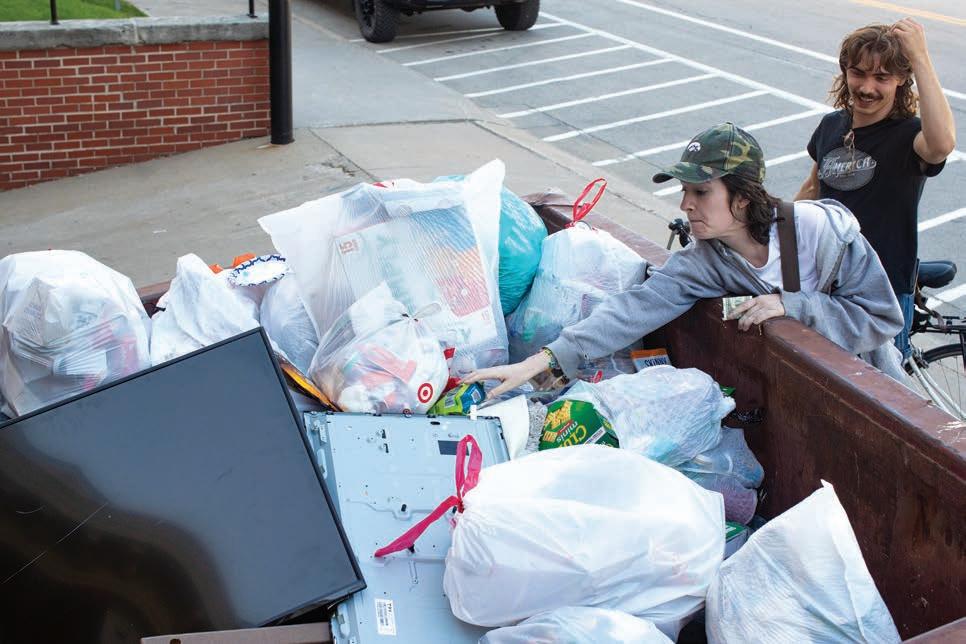
“I am planning on throwing out my rug because it has so much hair in it, and it’s gross,” Blake said. “I want to give my mattress topper to an incoming freshman because I won’t need it next year, and it is in good shape.” Blake said some purchases made at the beginning of the year proved unnecessary and were not used as much as she had anticipated.
According to the Rachel Carson Council, an environmental group that focuses on sustainability, the average college student produces 640 pounds of waste annually, most of which occurs during the move-out process. “My roommate bought a ton of decorative pillows for her bed, and we don’t use any of them,” she said. “They are stuffed behind our couch.













to students’ already tight budgets. According to the Associated Press, a “weakening” U.S. dollar has driven up the cost of everyday goods, from groceries to travel, effectively reducing the purchasing power





Kelsey Ryder, senior associate director for the office of financial aid at the UI, said when starting a budget, it’s important to have a sense of where money is going and how much is being spent monthly.

“Track your spending as a starting point,” she said. “Understanding where your money is going can really help you think about what you would want your goals to be.”
Even as financial aid officials emphasize the importance of tracking spending, students are also navigating outside influences that shape how and where they spend their money.
Data shows the sales of physical media have grown nationally, and Iowa store openings are coinciding with the increased demand.
With the rise of streaming services and declining sales, it seemed as if DVDs and vinyl were going to become a distant memory. However, over the last couple of years, a jump in sales and a newfound appreciation for physical media among younger generations has breathed new life into the market at a time when individuals are struggling with affording streaming services and the cost of living.
In March 2026, the Recording Industry Association of America, the trade organization that represents the major U.S. music labels, released a 2025 sales report showing U.S. vinyl record sales surpassed $1 billion in 2025, marking the 19th consecutive year vinyl sales had grown in the U.S. For DVDs, the Digital Media Entertainment Group, a trade organization specializing in the promotion of entertainment platforms and products, released its 2025 year-end report, showing DVD sales still decreased, but only by 10 percent, a much lower rate than years prior, and 4K ultra high definition DVD sales increased by 12 percent. In December 2025, Chris DeLine opened Razzle Dazzle Music & Movies in the Lindale Mall in Cedar Rapids, Iowa. Before establishing the store, he started taking the online sales business seriously in 2022 with the intention of launching his own store.

I also brought picture frames I wanted to hang on the wall with command strips, and they all fell and ripped the paint off. Hayden Gamble, a UI thirdyear student and resident assistant in Currier Residence Hall, said the most common items he sees thrown away are futons, fridges, and ottomans. Gamble advised any incoming freshman to make sure they are buying dorm furniture they will actually use.
That pattern of overbuying and quick disposal, Gamble said, often stems from inexperience and uncertainty surrounding what dorm life actually re uires.
This experience is common for many first-year students ad ust ing to dorm life, Amy Colbert, a UI professor and faculty director of the Social Impact Commu nity in the Tippie College of usiness, said.
Colbert said big-box stores like Target attract customers because they provide convenience and ine pensive products.
“Then I think people are more li ely to ust throw those away, partly because the move-out process is also a little overwhelming, she said.
She said timing plays a ma or role in the number of items being discarded during the move-out process.

With finals week coinciding with move-out, she said students often lack the time or resources to donate unused items.
“There’s no easy way to donate things, Colbert said. “If there is something students didn’t use or don’t want to take home with them, it gets tossed in the nearest dumpster.
Gamble said the residence halls are beginning a new partnership with oodwill of the eartland.
The residence halls are hosting a donation truck that will make stops at each of the residence halls between ay - .
The trucks will allow students to drop off used items in the truc s instead of discarding them in the trash.
The location schedule has not been released by the university at the time of publication.
“Now that we have Goodwill coming, hopefully now people will put futons and other dorm stuff in the truc s, amble said. “I’m happy the residence halls are creating a way to make donating for students easier.
Students also say the pressure to overprepare contributes to the problem. Christina cKelvy, a
De ine, who has been collecting physical media for about years, said the appeal of it now in the digital age is the sense of control people have because they do not need to rely on a streaming service for it.
“That provides a significant value that streaming can never because streaming never provides control, De ine said. “ ou’re always at the whims of whether it’s a licensing fee or ust, hey, we don’t want to pay for this anymore.
In a streaming service report from Civic Science, a consumer analytics and market intelligence platform, data showed that 37 percent of young subscribers said they canceled one or more streaming services because of feelings of subscription fatigue and 29 percent said they haven’t but they plan to cancel in the future. f young subscribers, percent said they don’t feel subscription fatigue. arlier this year, University of Iowa graduate Isaac Smith opened Zig Zog’s Records in North iberty. Smith said he finally made the decision to open his own store after recognizing the size of his record collection.
UI first-year student, said uncertainty about dorm living led her to buy more than she needed.
“There is definitely pressure to get certain dorm essentials, and I honestly think that ust comes from the panic of moving to a new place and living without your parents for the first time, cKelvy said. “I ust wanted to be prepared for anything and everything. This preparation often leads to these items piling up and eventually getting thrown away. cKelvy said she brought a shoe rack she did not end up using and has been shoved under her bed for months.
She also had a lot of unnecessary storage containers, especially for food and her des . Colbert said these purchasing habits are often tied to an iety.
“Sometimes I think that over-
consumption is used to address situations in which we’re feeling an iety, she said. “That sometimes happens as we’re thinking about going away to college and what we might need.
According to the National Retail Federation, the average college freshman spends $1,365 for their upcoming school year. Dorm furnishings, according to the report, are in the second largest category of spending, only surpassed by electronics. n average, students spend .4 per year on electronics and .4 for dorm and apartment furnishings.
While some purchases, like decorations that can make a dorm room feel more like home, can be meaningful, Colbert emphasized the importance of reusing rather than disposing.
“When you’re done with those things, finding a way to allow
somebody else to reuse them is definitely preferable to throwing them away, Colbert said.
Colbert said certain categories of waste appear more frequently than others. Colbert pointed to specific items that lose their usefulness when students move out.
“I do think there are a lot of dorm room accessories, organizational systems, crates, and those sorts of things that maybe work in that space, but they’re not going to wor in an apartment, Colbert said. “ nd often they’re plastics that are thrown away, and plastics have a negative impact on the environment.
ccording to the U.S. nvironmental Protection Agency, more than species have been known to ingest plastics due to plastic ta ing between to , years to decompose.
cKelvy said she is maing efforts to reduce waste during move-out, such as selling their futon instead of discarding it and donating dorm room decorations.
“Don’t buy anything you don’t already use, cKelvy said. “If it isn’t in your house you grew up in, chances are you won’t need it in your dorm room either.
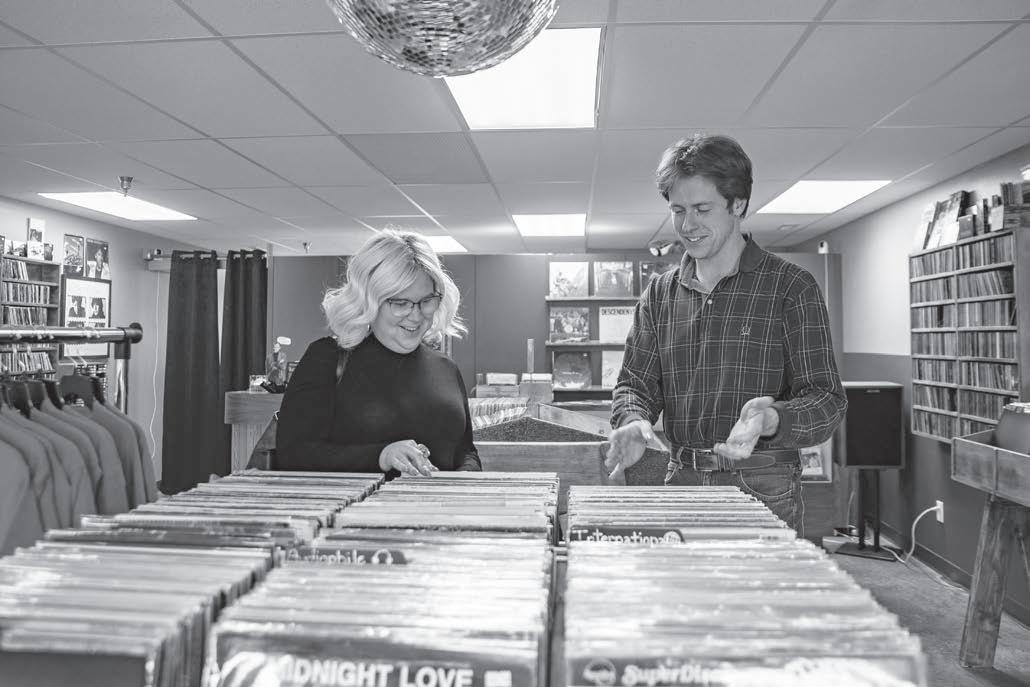
He said a large part of why he decided to start his own record store in was from seeing countless young adults buying and appreciating vinyl despite not growing up with that form of media.
Smith said for young people, the allure of vinyl is the medium’s tangibility compared to the nonphysical nature of streaming sites.
“ ou don’t really own something until you hold it in your hands, Smith said. “ s time goes on and technology develops in certain ways, you’re going to have less and less of that physical ob ect and that personality that goes along with it.
UI Communication
Studies Department chair and professor Kembrew c eod said he is not surprised by the rise in sales, especially for young people because they have largely been unacquainted with the feeling of owning and consuming physical media. At the same time, consumers are paying more for streaming services. ccording to data from eviews. org, Americans spent an average of . annually on streaming services, or . a month, a . percent increase from 4.
“A generation raised in a media environment that is completely intangible, that has been mediated by internet and digital technologies, it’s no surprise that there might be this longing to be able to consume media that they can actually hold in their hands, c eod said.
In the two and a half months that Zig Zogs has
been open, Smith said residents of orth iberty have been en oying the space he’s cultivated, especially since there are not many places like it in the area, with only about 25 to record stores in Iowa.
c eod said the reason places li e a le Da le and Zig Zogs are opening now is to accommodate the desires of consumers who have longed for physical media outlets.
“So there was a really big pendulum swing from the s to the beginning of the 21st century, and I think what we’re seeing now is kind of what economists call market correction, where the demand for physical media never actually went away, c eod said.
Corrine ones, a h.D. candidate for media studies at the UI and a vinyl collector, said she sees a link between desiring physical media and the affordability struggles countless young people face when
buying a home.
“I thin that is definitely something that comes with it, and being able to ust have something that you own, that’s a collection that’s special to you, is really important in a time where owning a car even is uestionable at best, ones said.
ccording to ealtor. com, housing data showed that in , there were nearly 2 million fewer households among people aged to 44 than in .
The same report cited the National Association of
Realtors, which published data from showing the median age of firsttime homebuyers had risen to 4 years old, an all-time high. Jones said as the idea of future assets, such as home ownership, seems unimaginable to her and her peers right now, she views her vinyl collection as her own.
“I see my record collection as something that’s mine and can’t be taken away from me, ones said. “I can’t be evicted from my record collection.

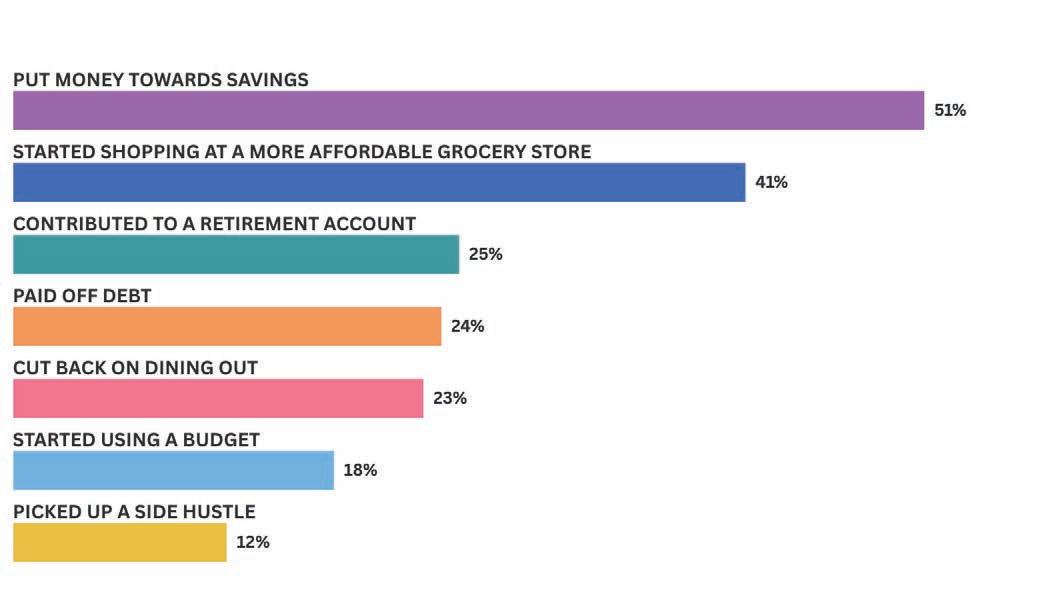
A 2025 survey from Bank of America found more than half of Gen Z adults spend nothing on discretionary activities — like dating or going out with friends— each month in a move to prioritize savings and debt reduction.
Additionally, the survey noted a 15 percent decrease in financial support from parents or family year over year. A focus on reducing expenses was reported by 64 percent of respondents, with 41 percent dining out less and 23 percent shopping for more affordable food.
The national trend appears in different ways locally among college students navigating similar financial pressures.
In Iowa City, UI student experience surveys consistently show that financial concerns are a major part of student life, as students report ongoing strain around everyday expenses like housing, food, and employment while balancing school and social life.
Anne Villamil, a UI economics professor, said students often underestimate how quickly small, repeated expenses can add up. She said spending management requires active attention rather than passive awareness.
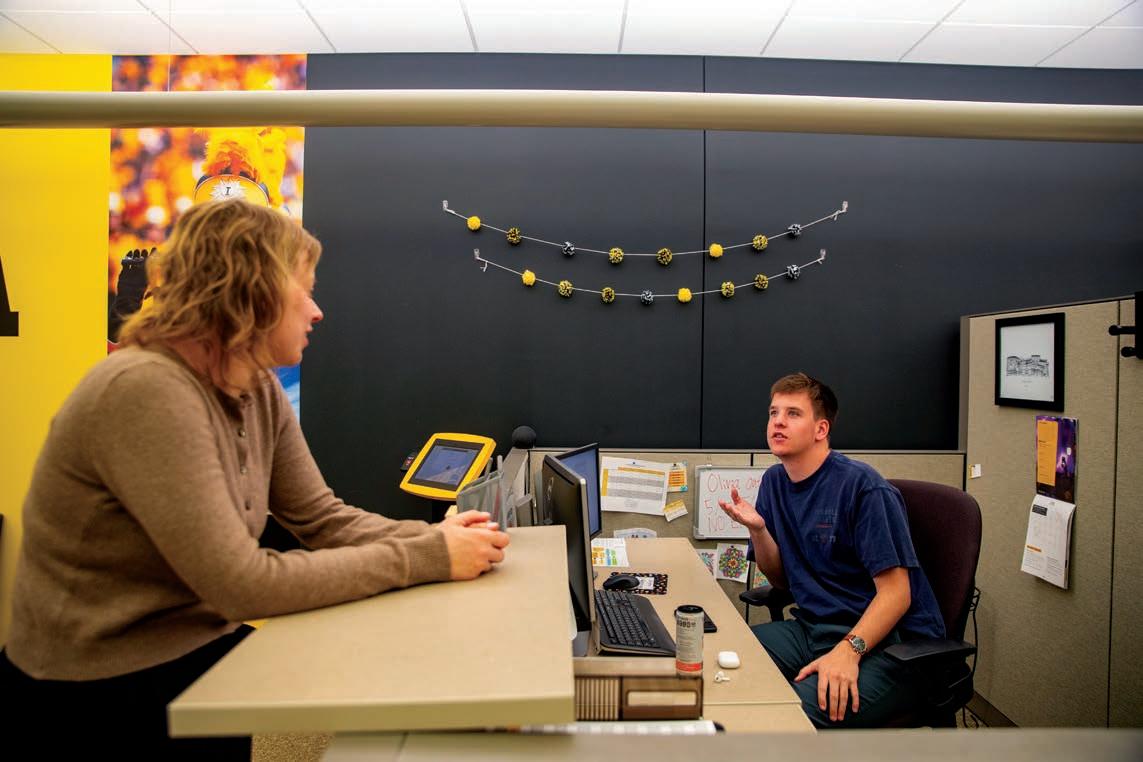
She said by keeping track of what subscriptions you have and are paying for can help students avoid unnecessary or forgotten recurring costs that can quietly strain a budget over time.
“Track these expenditures and cancel them if you no longer use them or the introductory deal expires,” Villamill said. “Can you still share with your family and roommates to lower costs? In addition, social media accelerates trends. Track and think about these expenditures. Are they important to you?”
yder, from the o ce of financial aid, said many students underestimate how small, routine purchases can quietly erode their budgets over time.
“A lot of times, we're spending more of our money than we realize through what we call ‘spending leaks,’” she said. “Starbucks or gum at the gas station, those little things tend to add up more than we realize.”
Those small, everyday purchases are now increasingly happening online, where spending can be even easier to overlook.
According to a 2025 study from Science Direct, social media platforms such as TikTok and Instagram have been shown to significantly shape consumer behavior by increasing exposure to in uencer-driven content and “social proof,” meaning the number of likes and comments on a post, which can lead to impulse purchasing and trend-based spending decisions among users.
The influence is especially strong among younger consumers, who are more likely to encounter products through short-form videos, in uencer promotions, and algorithm-driven recommendations.
For college students managing limited budgets, researchers said dynamic spending can make purchases harder to control, as buying decisions are increasingly shaped by what appears in their feeds as opposed to planned expenditures.
Ryder said social media has significantly influenced what college students spend their money on, often turning impulse-driven trends on platforms like TikTok and Instagram into real-world purchases that can strain already tight budgets.
She encouraged students to monitor their spending habits on these platforms by taking time to assess the need of a purchase before impulsively buying.
“If you're going to put something in your Amazon or your TikTok Shop cart, put it in the cart, but don't check out right away,” she said. “Come back the next day and ask yourself, ‘Do I really want this?’”
Ryder said she has seen an increase in students thrifting and buying cheaper, secondhand items as a way to stretch limited budgets while still keeping up with trends and everyday needs.
“Try to cash in on other people's
trendiness so that you can get a better deal,” she said. “And same thing, if you have stuff where you re li e, aybe I bought this, and it's not as useful as I thought,’ maybe try to sell it on Facebook ar etplace and see if you get some money back for it.”
Economists also point to the lasting impact of the C VID- pandemic on how Gen Z spends and shops.
A 2021 national study from the Federal Reserve Bank of Boston found the C VID- pandemic significantly accelerated shifts in consumer spending behavior, including increased use of online platforms, digital payments, and delivery services as consumers prioritized convenience and reduced in-person transactions.
“The use of cards for purchases — particularly credit cards — rose as consumers substituted away from cash,” according to the study.
Since C VID- , Villamil said spending habits have shifted toward convenience, with students more li ely to prioriti e time-saving options over cost.
“During COVID, food delivery and on-demand services surged,
often comes with a growing reliance on credit cards and student loans that can quickly shape their spending habits and long-term debt.
According to the Federal Reserve, student loan debt remains the largest form of non-housing debt for young adults, totaling more than $1.6 trillion nationally.
ccording to UI financial aid data, the average cost of attendance for in-state undergraduates in the - academic year is about , per year, re ecting how borrowing is a common part of paying for college, though rising costs and reduced financial e ibility have increased how much students rely on debt to cover basic living expenses as well as tuition.
This financial reality shapes how students approach budgeting on a dayto-day basis.
Ryder said managing student loans alongside other expenses requires students to treat debt repayment as a fi ed part of their monthly budget rather than an afterthought.
“You can work that into your budget from the beginning so that you are actually paying down what you have,
and avoid long-term financial strain, students need to approach credit cards with intentional, controlled usage rather than treating them as extra income.
Financial literacy resources including Legal Charity warn paying only the minimum balance — often just 1 to 3 percent of what’s owed — can stretch repayment over years or even decades as interest continues to accumulate, making small purchases far more expensive over time.
“If you have a credit card, maybe just charge one bill a month, or use it to get gas and pay it off every month, she said. “That's going to help build credit.”
Eha said she has a student credit card which she uses as a tool to build her credit score while practicing disciplined repayment habits instead of relying on it to extend her spending power.
“I'm planning ahead now by buying a couple things a week on my credit card and paying it back as soon as I can, and then just making sure I'm getting used to not overspending on that as well,” she said.
As students move out of the dorm and into houses or apartments where they have to pay rent, yder said financial responsibility quickly multiplies, as expenses shift from a single bundled housing cost to a range of monthly bills and day-to-day purchases that re uire more active management.
she said. “ ost people, including students, are spending more for time and convenience.”
That shift is reflected in the rapid growth of delivery platforms like DoorDash and Uber Eats, which saw demand spike during the pandemic and remain elevated afterward.
According to the Business of Apps, a global app industry authority, DoorDash’s revenue, for example, jumped from about $885 million in to . billion in and has continued climbing to more than $13 billion in 2025, showing how deeply food delivery has become embedded in everyday spending habits.
For many college students, the transition to financial independence
and then factoring that in,” she said. “‘OK, once I pay $200 on this student loan, what's left over?’ Then you can decide how much to do with your other spending.”
According to a CreditCards.com and ar et atch survey of en credit card holders, about one-third of en consumers carry credit card debt, often relying on credit for everyday expenses such as food, transportation, and schoolrelated costs.
hile en tends to carry lower balances than older generations — averaging about ,4 compared to , for millennials and , for Generation X, according to Experian — researchers said younger borrowers are taking on debt earlier and using credit more frequently for routine spending.
lthough yder said the financial aid o ce doesn’t get a lot of students from the UI who deal with credit card debt, she said to spend within their means
According to Zillow rental market data, Iowa City rents have increased steadily in recent years, with typical asking rents rising faster than wage growth, re ecting growing pressure on renters in a market shaped by student demand and limited housing supply.
“It is more complicated once you move off campus, but it s still the same ind of concept of knowing where you want your money to go and then kind of seeing if that's actually what's happening,” she said.
Villamil said it’s important to start a budget with key categories including fi ed e penses li e rent, tuition, and utilities, variable necessities like food and transportation, discretionary expenses like entertainment and travel, and other spending specific to your lifestyle.
“Rent and tuition are important priorities, she said. “ inimi e student loans and keep those expenditures focused on educational necessities. Remember that this includes textbooks.” Beyond covering essential expenses, Ryder said allocating money toward savings is important.
She said even small, consistent contributions can help students build a financial cushion over time.
“Trying to build some kind of emergency fund is a really good thing, even if it's just $100 to cover parking tickets,” Ryder said. “I think the amount depends on what works for you, even if it's $10 a month that you're putting aside, that's a good thing.”
For students like Eha, those small savings habits are shaping how they plan for future expenses. She said she is planning to up her budget to $125 a month next year.
She will be living in a sorority house, where she pays a at fee at the beginning of the year which covers housing, and meals are provided through the house’s dining setup, so she will not be responsible for monthly rent or regular grocery costs.
Still, she said her expenses will shift as her schedule changes, especially with increased travel for her nursing program and the added cost of gas.
To prepare, Eha said she plans to work more over the summer to build a financial buffer, while still eeping her spending disciplined through a minimal dining plan and limited discretionary purchases.
“It's super important to take that step in independence,” she said. “Being on our own in college, there s a lot of firsts, and I think this is the most important one to get ahead of because there are a lot more ways to spend money and a lot more ways to be irresponsible.”
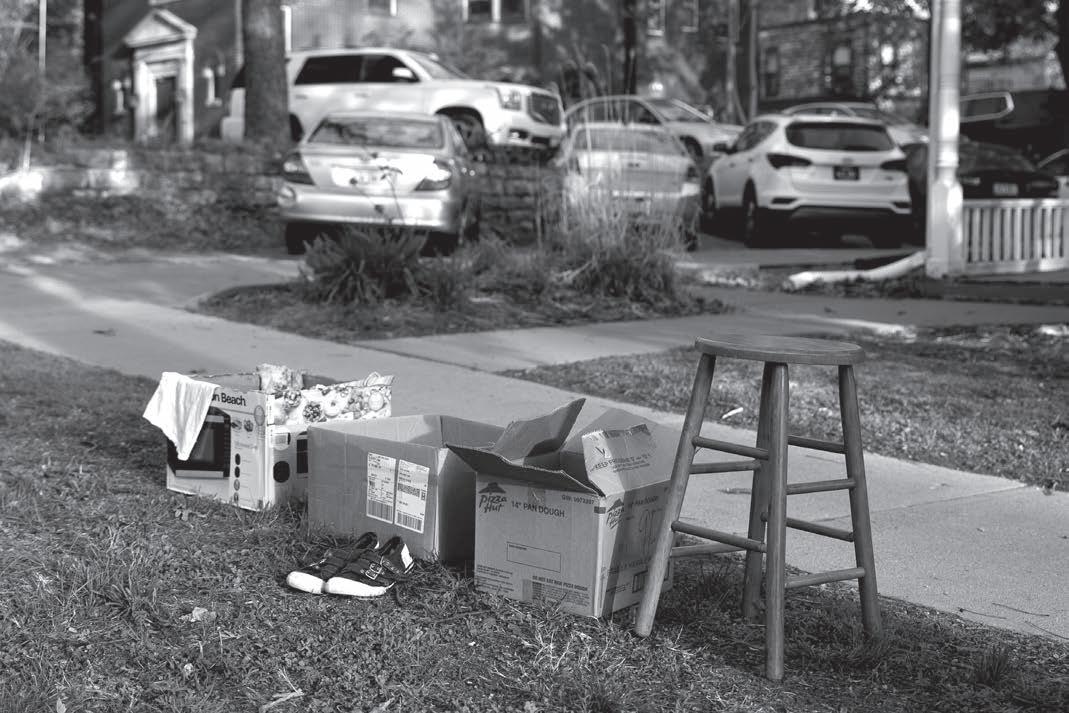
Source your furniture from the curb this move-in season.

It is still rewarding to hunt and gather in the modern age. Like the hunter in a dime novel hauling a buck back to his cabin, I haul — through distress and some innovation — an 80-pound La-Z-Boy chair from the curb to my third- oor apartment.
According to a May 2025 Curiouz blogpost, the U.S. tosses over 12 million tons of furniture a year. But not this chair. No, this chair is mine.
It is mine, despite the various burn stains that haunt it, one the shape of an exclamation mark and the other the size and shape of a chicken nugget.
It is mine even though the back massager does not work, despite what the optimistic “free” note claimed. It is mine even though I lost my phone for four hours when it slipped into a mysterious crack in the upholstery. I only got it back after taking a knife to the thing.
This chair, despite its warts, is mine.
I plan to take some fabric from Goodwill

that you “need” something to live a satisfactory life, then it’s perceived that your life must be unsatisfactory without of purchase. "The social media-fostered overconsumption doesn’t do the
my life. Turns out I don’t need five hairbrushes,” TikTok user G.bateyy said in a video posted on April 23.
solution. We need to collectively challenge consumer narratives. Please, think before you buy.
The initiative is connecting business strategy with real-world social impact.
The University of Iowa’s Social Impact Community is challenging the traditional view of business as solely profit-driven, pushing students and faculty to consider how business decisions affect people, communities, and the environment.
The Social Impact Community, housed within the UI Tippie College of Business, is an initiative connecting students, faculty, and staff around the idea that business decisions affect multiple stakeholders, including employees, communities, and the environment.
“The mission of the Social Impact Community is to elevate the ways that business can be a force for good and how business can have positive impacts on society,” program coordinator for the Social Impact Community Mae McDonough said.
UI Faculty Director Amy Colbert said the idea is often framed as the “triple bottom line,” where businesses consider not ust profit but also their impact on people and the planet — with the bottom line in business traditionally referring to financial profit or overall net earnings.
ver the past five years, products ma ing environmental, social, and governance, or ESG-related claims accounted for percent of all growth, according to McKinsey and NielsenIQ data, showing that sustainability-focused products are increasingly driving market growth as consumer demand shifts and companies adjust to keep up.
The Social Impact Community is pushing students to confront the downsides of consumer-driven growth, applying business strategies to reduce waste, and rethink overconsumption.
The idea began in when Colbert spoke with other Tippie faculty about ways to connect the college’s six departments. Sustainability, in some form, emerged as a common focus across their research.
Colbert said the organization is intentionally broad, with the goal of including multiple stakeholders — from employees to local communities to society as a whole.
“For us, social impact is anything that may influence multiple stakeholders,” Colb ert said. “Any decision that a business ma es in uences someone who relies on that business, whether that’s employees, society in general, or their local community.”
Over time, the initiative began to expand. McDonough said the organization steadily grew by adding new opportunities for students and community engagement.
“We started adding elements of education for students and communitybased projects, where we take the research and education we focus on and elevate it so that communities actively working to address environmental and social issues have the tools and knowledge they need to solve them,” McDonough said.
That work often materializes by applying traditional business strategies to problems beyond profit.
cDonough said concepts such as marketing and data analysis can be used to in uence behavior and support environmental and social goals rather than just sell products.
“I am always surprised by the ways you can take business principles and apply them to other situations to make the world a better place,” McDonough said.
That philosophy has since taken shape in a range of student-facing programs and community partnerships.
The organization has hosted case competitions for students across the U.S., challenging them to develop solutions to real-world problems. Last year, students created proposals for a sustainable soccer stadium in Des Moines, a real project in development which got funding approved by the Des Moines City Council in December .
“That was a really meaningful project to be a part of because I love seeing students ma e a difference in the community through their work and have it impact a real, tangible project,” McDonough said.
In this year’s case competition, students worked with Goodwill of the Heartland, brainstorming new ways to divert more of their textiles for reuse or recycling.
Other initiatives include developing toolkits for communities navigating data
JoCo farmers are struggling to ba le increased local food demand from consumers.
when grocery store prices became volatile.
center development, hosting “adopt-awater-bottle” events, and organizing roundtable discussions.
Eleanor Cooper-Ohm, a third-year UI environmental policy student, joined the Social Impact Community as a first-year intern and has since watched the organization grow in both size and recognition within the college.
“We started as this small student group trying to get EXPO markers and paper switched to recycled materials, and we were working so hard on that one program that year,” Cooper-Ohm said.
She said the organization has since expanded beyond those early efforts, becoming a more established presence at Tippie and a resource for students looking to connect with others interested in social impact.
Cooper-Ohm said she believes sustainability is one of the most important areas in business because of the scale of in uence businesses have.
“Business students have one of the biggest chances to impact the world,” Cooper-Ohm said. “Every single one of these students still has the opportunity to do good within their work. They just need to
be introduced to it.”
The Social Impact Community reaches students primarily through partnerships with Tippie Senate and other student organizations, co-hosting initiatives like Impact Week and volunteer events.
Cooper-Ohm said Impact Week was one of her favorite memories, seeing people volunteer who normally didn’t have time to.
“I just saw all these business people who don’t usually get the chance to volunteer in their busy schedules sitting down and spending like an hour and then like two hours and three hours writing letters, and it was just like the best part of their day, and it was something they didn’t usually get the chance to do,” Cooper- Ohm, said. ith percent of en those born in between to sustainable purchases are more important than brand name, according to a orld conomic Forum study. Colbert said this generation stands out for its concern over the environment and its ability to discern whether companies truly care about sustainability.
“This generation is holding corporations accountable by choosing jobs at places that promote social impact and sustainability.,” Colbert said.
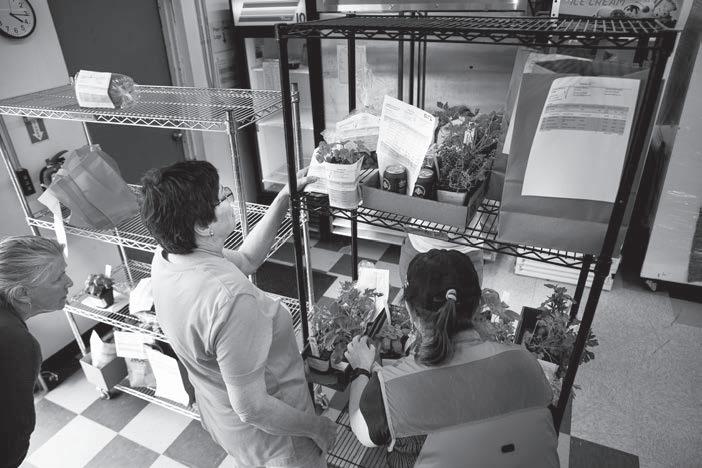
As costs for land, equipment, and other inputs remain high, agriculture leaders in Johnson County say fewer support systems resulting from USDA cuts could make it harder for farmers to produce and sell locally grown food, despite consumer demand for local food increasing.
The USDA announced the cancellation of the Increasing, Land, Capital, and Market Access Program, a USDA $300 million grant program designed to aid beginning and underserved farmers in accessing land, effective arch .
Emmaly Renshaw, the senior program director of the Iowa Valley Resource Conservation and Development, a regional nonprofit supporting rural development and local agriculture projects, she said Iowa Valley was well-equipped to host the land access program before it was canceled.
“We really had the setup to be able to host the fellowship here,” she said. “The goal was to have this really intensive one-year program where, by the end of the program, the second year, farmers would have gone out to a regional farm of their choice.”
Iowa Valley had begun training new farmers with the grant money at Johnson County’s Historic Poor Farm two weeks before the cancellation notice.
“These were individuals who had left their livelihoods,” Renshaw said. “They left jobs to come join the Iowa Valley, and that was really hard. We had about three days from the day we received our letter to our staff wor date. It was a heart-wrenching and difficult time for brand-new employees.”
The program termination follows a line of USD cuts in Iowa. In , the Local Food for Schools program and the Local Food for Schools and Child Care programs were terminated, costing Iowa $11.3 million.
The USDA’s cuts come despite an increased demand among Iowans for locally grown foods.
The most recent Iowa Farm Bureau Food & Farm Index, an annual survey conducted by The Harris Poll that gauges consumer attitudes toward food purchasing, found that 4 percent of the Iowa adults surveyed look for a locally grown label on the foods they purchase, 8 percent higher than the previous 4 survey.
The most recent survey also found that percent of grocery shoppers have purchased groceries directly from farmers or networks of farmers through their websites, farm stores, or farmers markets.
Ilsa DeWald, Johnson County’s local food and farm manager, said demand for local food in Johnson County has been increasing since the C VID- pandemic proved the resilience of local food costs
“There’s definitely an increasing demand for local food products,” she said. “The demand is there, the interest is there, but we do not have enough farmers to fill that demand. Farming is an entrepreneurial business, and it is di cult to start and sustain any entrepreneurial business.”
Renshaw said Iowa Valley mainly assists vegetable farmers, most of whom are first generation and struggle to secure land access. Land access is the ability of new farmers to secure land for producing crops.
“If you don’t have family ties, the road to land access is seven to 10 years in Iowa,” she said. “It is a long, grueling walk to get there. Even if farmers do get land, our agricultural system in Iowa is not set up for vegetable farming. That farmer might have to shell out , to put a well in for irrigation.
enshaw said in light of global tariff instability, crop markets such as corn and soybeans have been volatile, incentivizing a new generation of farmers to train and grow diverse arrays of crops to stabilize their farms.
“Looking at what farming could be in Iowa, when we ask what is conducive to the ne t generation, maybe it’s not the acres of corn and soy, but maybe it’s the acres of diversified specialty crops the ne t generation is interested in,” she said.
Renshaw said the Increasing Land access grant cut is a heavy blow for local farmers wanting to get involved in Johnson County’s locally grown food market.
“This grant and other USDA programs are an investment in Iowa,” she said. “If we want farmers who are ready to produce and be part of that local economy, we have to have these programs in place to get them trained and ready to sell into our local communities.”
Michelle Kenyon, director of Field to Family, a nonprofit organization that increases access to healthy local food, said the USDA cuts are harmful because beginning farmers need sustained funding for years to stay a oat.
“We have lost a lot of food farmers over these years,” she said. “They’ve been at the point where they’ve gotten started, and they’ve had a year or two to grow food and find mar ets and be successful. ut ultimately, you can’t scale up super fast and still survive.”
Kenyon said Field to Family helped local farmers sell their food to school districts through the Local Food for Schools program in . Field to Family was expecting to distribute , worth of food in but only distributed about $330,000 due to the program’s termination.
“It was a big cut from what we were told to expect and plan for,” she said. “But people are still purchasing local food when they can. We work with colleges, universities, and other institutions. We’re working with
a lot of different producers still. e’re still getting a lot of food out.”
Kenyon said while there are not enough local farmers to meet the demand for locally grown food in Iowa, the demand could help to increase the number of farmers, as higher demand typically leads to increased supply.
As demand for local food grows and USDA support declines, local agriculture groups are adapting to fill the gap.
Renshaw said Iowa Valley is working with Johnson County businesses by surveying employees to understand what types of local food they want, and connecting them with farmers who supply those products to workplaces.
Meanwhile, DeWald said at the Historic Poor Farm, Johnson County will continue to focus on growing a wide variety of crops, especially specific foods not typically found in grocery stores, such as leaves of sweet potatoes and different parts of eggplants. She said the county will also continue to encourage direct-to-consumer farming, a model where farmers sell their products directly to consumers rather than using any intermediary retailers.
“It become harder for farmers when farm operations have to be so big in order to survive,” she said. “Direct-to-consumer farming is a way for farm enterprises to begin small and to be able to grow for the community.”


UI student’s experience highlights limits of Iowa’s minimum wage.
The walk to class is two miles, but it starts long before Drew Owen steps outside.
By the time he locks his door, he has already begun calculating the day — how many hours he can work, what he can afford to spend, what e penses have to wait. The sidewalks stretch out in long, uninterrupted lines. e doesn’t have a car anymore. The bike he bought to replace it is gone, too. What remains is the distance and the quiet arithmetic that follows him from one place to the ne t.
Iowa follows the federal minimum wage, unchanged since 2009, which stands at $7.25 an hour. The number e ists as policy, but in wen’s life, it functions as a constraint, shaping not only what he can afford but how he moves through each day.
“I wal , on average, miles a day, he said.
At 24 years old, Owen is a third-year student studying creative writing at the University of Iowa, returning to school after years in the workforce. He works 20 to 25 hours a week as a barback at Quinton’s Bar and Deli in downtown Iowa City, earning minimum wage.
Before coming back to school, Owen had a steady job as a general manager at Insomnia Cookies in downtown Iowa City. The salary allowed him to support himself without constant stress. Rent was manageable. Bills were predictable. Life felt structured in a way that made planning possible, but the stability came at a cost he could not ignore.
The job, he said, pushed him toward burnout and unhealthy coping mechanisms, leaving him with a choice that felt both simple and impossible.
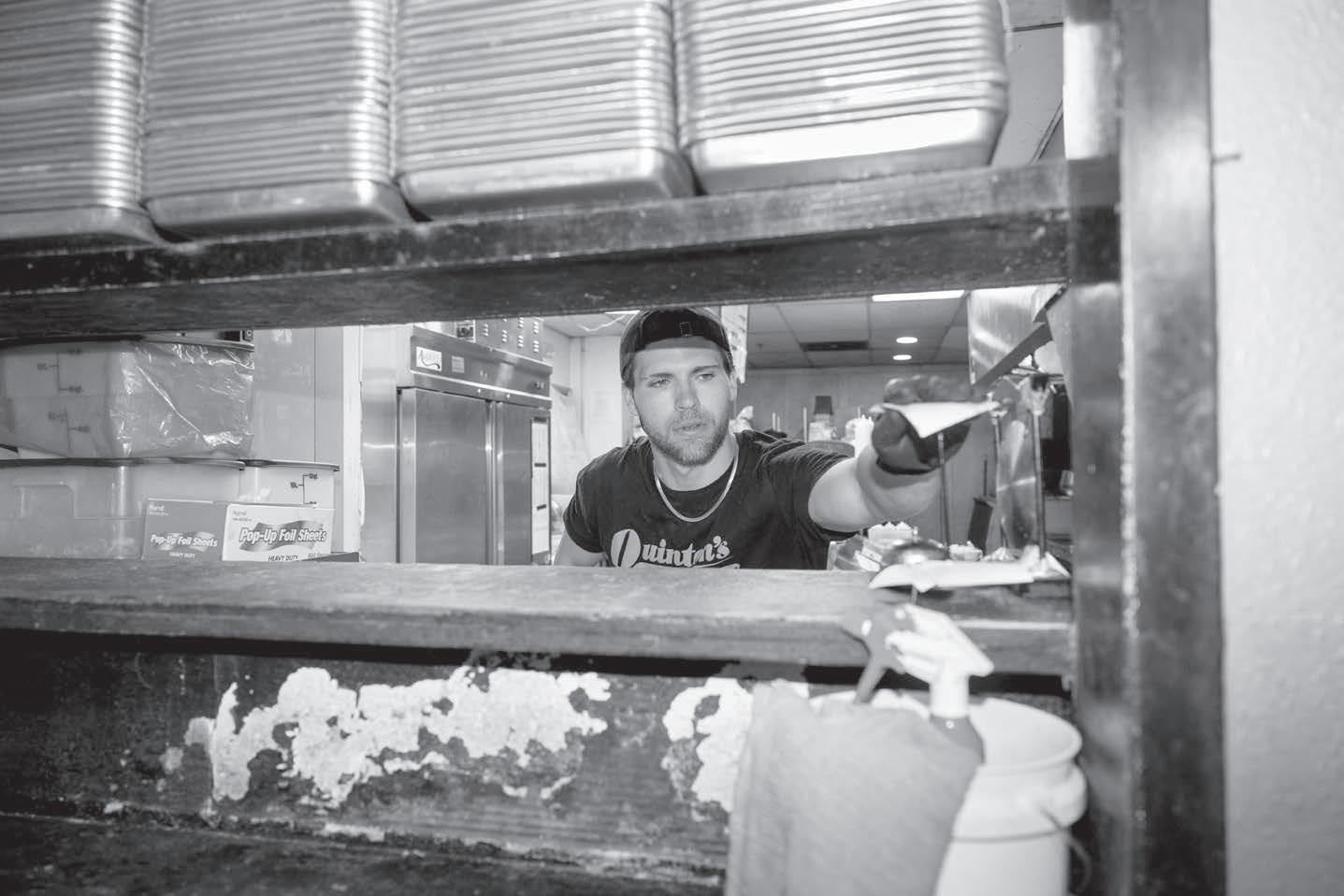
“I had to choose between permanent, debilitating hatred for my job in order to survive, or feel stress financially in e change for happiness, he said.
eturning to school offered something he had not had in years — the chance to focus on creative writing, to engage with ideas, and to build a future that felt meaningful. But it also meant stepping into a different ind of instability, one defined not by e haustion but by scarcity.
That scarcity became immediate when his car broke down early in the spring semester. A blown gasket left him without transportation, and because he had been driving for Uber, it also eliminated a source of income. The loss was compounded after he bought a bike to get around, and months later, it was stolen.
“It was a fun little o e from the world, Owen said.
Without reliable transportation, the cost of everyday life increased in ways that are di cult to measure but impossible to ignore.
Walking added hours to his day, and those hours limited how much he could work. Reduced income made it harder to recover from the initial setbac , creating a cycle that reinforced itself.
There were months when the conse uences became unavoidable. Owen fell behind on rent, something he had never e perienced before.
He said those two months were not a single breaking point but an accumulation of smaller pressures — each one manageable on its own but overwhelming in combination. To stay a oat, he relied on a networ of resources donating plasma, using the student food bank, and accessing emergency grants through the university.
ach solution provided temporary relief, but none resolved the underlying gap between what Owen earned and what he needed.
“ very dollar counts a lot more nowadays, he said.
For wen, the effects of low wages are not limited to finances. inimum wage shapes his e perience of college itself. is wor schedule leaves little room for weekends, and the time he spends wal ing reduces what e ibility remains.
ce hours, study sessions, and social events often fall outside what he can realistically attend. ven being with friends becomes something to calculate.
The result is a life that feels increasingly narrow, defined by a small set of repeated spaces — home, campus, wor and the routines re uired to move between them.
For lawma ers, the debate over minimum wage in Iowa is not abstract. It is about whether workers can keep up or fall behind.
Iowa Sen. Janice Weiner, D-Iowa City, said the state’s wage oor has remained stagnant for so long that it no longer re ects reality.
“It’s been at $7.25 for close to two decades now, she said.
Weiner said Iowa now stands out — not for growth, but for how far behind it has fallen compared to neighboring states.
“ e have by far the lowest minimum wage of all our neighboring states, she said.
Iowa last raised its minimum wage to . in , where it has remained ever since, matching the federal rate that was finali ed in . Since then, more than half of U.S. states have adopted higher minimum wages, leaving Iowa among those that still follow the federal oor.
In the idwest, neighboring states li e Illinois and innesota have raised wages well above , while others, including issouri and South Da ota, have also increased their rates through voterapproved measures or legislation.
That gap, Weiner said, is not just economic. It is personal. It shows up at kitchen tables, in grocery bills, and in the choices families are forced to make every day.
“If you look at the skyrocketing price of gas right now, it’s gas, food, housing, child care, ust basics, people are having to choose between, she said. “ one of that is getting any cheaper.
Weiner said she supports raising the minimum wage to an hour, and argued anything less leaves wor ers trying to keep up with an economy that has already moved past them.
Legislation introduced by Iowa Democrats would gradually raise the state’s minimum wage to an hour re ecting the position voiced by einer, but the proposals have not advanced in the Republican-controlled legislature.
One measure, House File 2378, would increase the wage in steps — reaching by and tie future increases to in ation, while a similar Senate proposal outlines a comparable path. Despite these efforts, both bills remain stalled in committee. Without change, she said, the consequences ripple outward — pushing wor ers to leave the state and ma ing it harder for communities to grow.
While opponents often warn higher wages could hurt small businesses, Weiner said many employers are already ad usting to survive in a tight labor market. Businesses, she said, understand that low wages make it harder to hire and keep workers.
Still, Weiner acknowledged the limits of what can be done at the local level.
After the state legislature blocked counties from enforcing higher wages, she said, efforts li e ohnson County’s serve more as signals than solutions.
In and again in pril , Johnson County attempted to address that gap directly.
ohnson County oard of Supervisor
od Sullivan remembers the effort as a response to a wage oor that no longer re ected reality.
“The minimum wage is just way, way, way too low, he said.
The county implemented a . minimum wage, and tens of thousands of workers saw pay increases. But the policy did not last. The Iowa legislature later passed a law preventing local governments from setting wages above the state level, effectively overriding the ordinance.
The move shifted the debate from local action to state-level responsibility.
Iowa Sen. ach ahls, D-Coralville, framed the issue as one of fairness.
“Iowa’s minimum wage has been stuck at . since . That’s a disgrace,
Wahls said in a statement to The Daily Iowan. “ o one wor ing full-time in Iowa should be living in poverty.
Wahls said he supports raising the wage to at least an hour and tying it to in ation, and said wor ers should not have to wait decades for wages to catch up with the cost of living.
The living wage for an adult with no children in ohnson County is . an hour. The poverty wage is . . ahls said the effects of low wages e tend beyond individual wor ers, shaping the state’s workforce and economy. When pay fails to keep up, he said, people leave or stop participating altogether.
“Too many people are not getting paid enough for their wor , ahls said. “They’re leaving the state or dropping out of the wor force entirely.
While some critics argue higher wages could strain businesses, Wahls said the concern he hears most often from employers is different not about paying wor ers, but finding them.
“I hear way more concerns about being able to hire and retain employees, he said.
For Wahls, the larger obstacle is not economics, but politics. He described a system where efforts to raise wages have repeatedly stalled, leaving wor ers to absorb the consequences.
“The people doing the work get s uee ed, and the people writing the chec s to politicians get richer, he said.
Sarah Frank, a UI economics professor, said stories li e wen’s e ist alongside a debate that remains unresolved within her field.
She said economic theory predicts raising the minimum wage could reduce employment, particularly for low-wage workers. But empirical research has not produced a clear answer.
“It loo s li e employment is fine, Frank said. “But if you dig more deeply, now everybody’s part-time, and that’s bad for wor ers.
In Iowa, part-time work is already embedded in the labor market. In 2025, about . percent of Iowa’s wor force fell into the broadest category of underemployment, which includes people wor ing part-time even for those who want full-time wor but cannot find it.
In Iowa, the minimum wage has effectively lost its relevance as a binding policy, Fran said. ar et wages for low-s illed obs already e ceed . , meaning employers rarely pay the legal minimum. owever, the stagnation of that number still matters when viewed over time.
Adjusted for inflation, the federal minimum wage has declined significantly in real value, eroding its ability to support wor ers even as costs continue to rise.
‘It’s just shameful that the federal and state minimum wages have remained where they’re at for so long, Sullivan said.
For him, the issue re ects a broader tension between local and state authority. Rather than establishing a baseline, Sullivan said, the state has limited the ability of local governments to respond to the specific needs of their communities.
“We can’t do better than the state, and we would like to, in many cases, do better than the state, he said.
Haifeng Qian, UI professor of planning and public affairs, said the minimum wage policy is only one part of a larger conversation about ine uality.
Raising wages can increase income for the lowest earners, he said, but its overall impact is limited by the number of workers it affects and the broader structure of the economy, leaving less than percent of wage earners impacted.
Qian said research suggests increases in the minimum wage do not significantly reduce employment, challenging traditional economic assumptions. Still, the policy’s effects vary depending on conte t, particularly cost of living.
In a high-cost city, a higher wage may not be enough to meaningfully change living conditions. In a place li e Iowa, the same increase could have a more noticeable impact on daily life. Yet in Iowa, minimum wage has not been a central focus of recent legislative debates, reflecting broader political priorities and divisions over how best to address inequality.
For Owen, those debates feel distant, even abstract. hat matters is not the theory but the reality of his daily life — the time it takes to get to class, the money it takes to get through the week, and the trade-offs re uired to do both.
The strain is not only financial but psychological. He said thinking about money constantly shapes how he sees himself and his place in the world.
“It ma es you feel li e you’re less, Owen said.
He acknowledged how his circumstances have shaped him. ithout a safety net, he has learned to navigate systems, find resources, and adapt quickly to changing conditions.
“When it’s sink or swim, you get really good at swimming, wen said. Still, resilience does not eliminate the underlying pressure. It only makes it possible to continue despite it.
If his wage were higher, he would not e pect anything e travagant. wen said he would focus on what would be restored time, clarity, and stability.
“The lack of stress would open up a lot more room in my brain, he said.
That mental space would allow him to engage more fully with his education, to think more clearly, and to participate in college life in ways that feel out of reach, he said. It might mean attending a professor’s office hours, or simply spending time with people he cares about without calculating the cost of every interaction.
“I could finally diversify my life a little bit more, wen said.
The distance has not changed. The wage has not changed. The debate continues, shaped by policy and politics.
But for Owen, the question is not theoretical. It is measured in time, in energy, and in what he has to give up to keep going.
Each step forward is not just about getting to class — it is about how far that $7.25 can really take him.


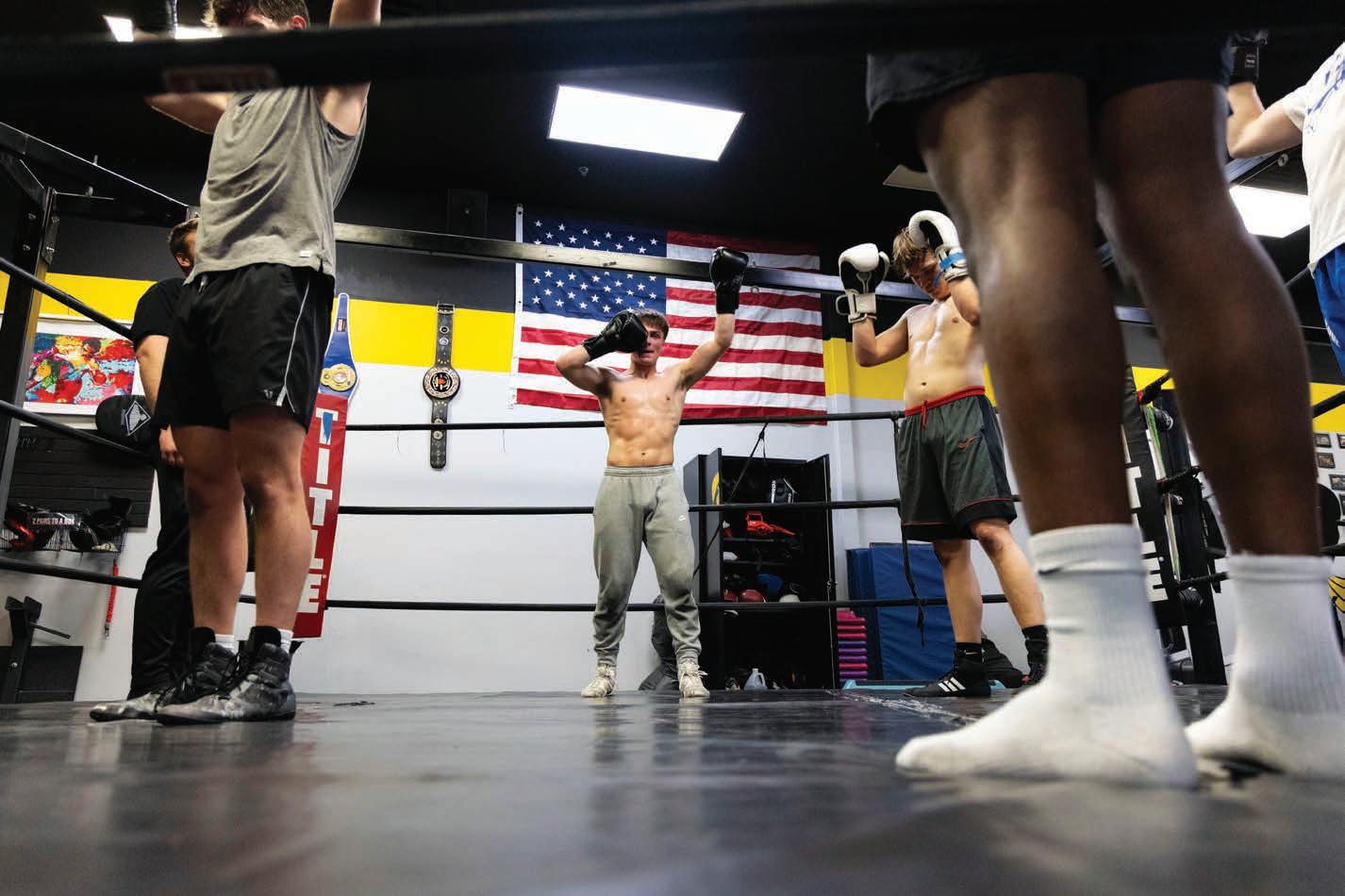
Inside the University of Iowa Boxing Club, discipline means pushing through the final 30 seconds, even when there is nothing left. For two boxers at the UI, that mindset is shaping more than just their performance in the ring – it’s defining who they are.
Freshman Luciano Cardozo-Torres and sophomore Samson Diener, members of the boxing club, come from different backgrounds and levels of experience. However, through long practices, tough losses, and the daily challenge of staying consistent, both are discovering how boxing demands discipline and, in turn, shapes their sense of identity.
“I wanted to be different,” CardozoTorres said.
Boxing offered Cardozo-Torres something other sports couldn’t — complete control over the outcome. No teammates to rely on, no one else to blame but himself. Inside the club, that responsibility is a privilege he holds in high esteem. Self-reliance shapes not only how he trains, but how he sees himself.
From Iowa City, Cardozo-Torres was involved in the martial arts form of taekwondo for most of his childhood. In middle school, he realized he wanted to focus on something similar, but with his fists. What started as an interest and a fun pastime quickly became a commitment as he started consistently training at Big George’s Boxing Gym and winning two state titles in high school.
As an exercise science major, his schedule now revolves around early runs, long practices, and constant repetition, all while balancing classes.
“One of the hardest parts of training is just being consistent,” Cardozo-Torres said. “There’s some days where you don’t want to wake up early, but just being here is important.”
That consistency has shaped more than his physical ability. It builds confidence. Once unsure of himself, Cardozo-Torres now brings a different presence, in and out of the ring.
“Boxing has boosted my selfconfidence,” he said. “Once I started boxing, I found it easier to be confident with other things as well.”
In the ring, that confidence is shown through precise movements and composure, something he believes is often misunderstood about boxing.
“I think a lot of people misunderstand that boxing isn’t just about hitting another person,” Cardozo-Torres said.
“It’s like an art.”
With aspirations of winning the
The UI’s Unified Sports programs foster an inclusive atmosphere for athletes with disabilities.

met 10 standards of excellence, ranging from training to participation to engagement.
Nearly four million athletes and Unified Sports partners participate in Special Olympics, according to the organization’s website. Of the participants, over three million are people with intellectual disabilities, while over 600,000 more are Unified partners without intellectual disabilities. The two groups are integrated teams who compete against one another in a variety of sports. Training, playing, and competing together, bonds are formed through people from all different backgrounds, in different places all around the world.
The University of Iowa is one of over 18,000 Unified Schools across the globe, housing multiple Unified leagues for sports such as flag football, soccer, basketball, and volleyball. Athletes with disabilities and Unified partners join forces to win games, advance to playoffs, and travel for various competitions. In 2021, Iowa was one of 68 schools in the country to be selected as a Special Olympics Unified Champion School, having
“One of the biggest benefits is [that] it’s two unique groups that may not connect as much without this opportunity, or at least not have this sort of opportunity to connect,” Colton Spaur, Iowa’s assistant director of intramural sports, said. “We provide that. They get to play alongside each other in sport. Everyone involved gets to be active and have those natural benefits of sport.”
Spaur started with the program as a student official in 2017, his first year at Iowa, and credited the programs as being an educational resource for its partners as well.
“For our partners, especially, it builds an awareness and understanding of how to interact and work with individuals with disabilities,” Spaur said. “It provides everyone with a sense of community and a lot of fun.”
Unified Sports has also provided opportunities for students in Iowa’s Realizing Education and Career Hopes, or REACH, Program to learn about and compete
National Collegiate Boxing Association, or NCBA, Nationals and eventually becoming a professional, he sees boxing not just as a sport, but as an avenue to the future. Placing second at this year’s NCBA Nationals at 119 pounds, CardozoTorres is already making a name for himself. Through discipline, repetition, and the pressure of being alone in the ring, he’s learned that success isn’t shared; it’s earned.
“It’s all on you,” he said. But not everyone in the gym comes in with years of experience or a clear path forward. For Diener, a Des Moines native studying criminal justice, boxing started almost by accident. What began as a month-long commitment through a fraternity boxing event, known as Knockout University, turned into something more when he decided to
Iowa tennis’ Sasha Boros is the winningest head coach in program history.
As the Iowa tennis team’s season wrapped up at the end of April, falling short of an NCAA tournament bid, one person did have something to celebrate. With the Hawkeyes’ win against Minnesota on April 17, head coach Sasha Boros earned her 113th career win and became the winningest coach in program history.
After another win over Northern Iowa, Boros currently sits at a record of 114109, two victories ahead of former Iowa tennis coach Micki Schillig, who led the Hawkeyes from 1987-95.
Boros initially didn’t know she had accomplished such a feat. She ignores social media during the season and heard the news from a close friend. Boros, an Iowa alum who played under Schillig from 1992-96, couldn’t be more grateful.

“Schillig was the one who recruited me and believed in me as I started my life with the Iowa Hawkeye program, and to pass her in the number of coaching wins just makes coaching here that much more special,” Boros said.
Boros, a four-time letter-winner and team MVP in 1996, returned the following season as the team’s assistant coach while attending law school at the university. Serving in that position until 1999, she helped the Hawkeyes reach the NCAA Championship for the first time in program history, a top-25 national ranking, and an NCAA Sweet 16 berth.
After 15 years away coaching at Stetson and Missouri, Boros returned to her alma mater as the program’s eighth head coach in 2016. Over her decade in charge in Iowa City, learning and adapting were constant.
“I think the thing that comes most with coaching is trying to find peace with the uncontrollables like weather, injuries, travel delays,” Boros said. “But ultimately it’s about building the relationships and seeing the growth with the young women that come through our program.”
Iowa pitcher Maddux Frese is following in his father’s footsteps with the Hawkeyes.
When Maddux Frese was just 2 years old, he stood in the hallways of Principal Park in Des Moines and played catch with his father, Nate, who was playing his final season for the Iowa Cubs.
Nate Frese played for the Hawkeyes from 1996 to 1998, where he was drafted by the Chicago Cubs in the 10th round of the MLB Draft. He played seven seasons in the minor leagues, advancing as high as AAA in Des Moines.
Nate Frese played in 601 games and finished his professional career with a .249 average with 32 home runs and 222 RBIs. He also stole 29 bases and hit 100 doubles in his seven-year career. Now, in 2026, the same kid who grew up playing catch in the bowels of a minor league stadium is following his father’s footsteps at the University of Iowa, wearing the same number that Nate Frese did during his time at Iowa.
“I chose it,” Maddux Frese said about wearing his father’s number.
“It just creates a special connection between him and me.”
Maddux Frese also said he always wanted to follow in his father’s footsteps, and landing in Iowa City was always the dream as he went through high school. The pitcher, however, had to take a slight detour to end up where he always wanted to be.
The junior spent his first two seasons at Southeastern Community College in West Burlington, Iowa. There, Frese pitched innings in two seasons, posting a 2.96 earned run average and 79 strikeouts.
Maddux Frese also logged 20 at-bats in 2024, collecting six hits with two RBIs, before switching to a

full-time pitcher in 2025. ow in his first season with the Hawkeyes, Maddux Frese has replicated that success. The Norway, Iowa, native has made five starts and 11 appearances in 2026, pitching to a 2.56 ERA with 36 strikeouts and just wal s in innings.
“He’s been great, locating extremely well,” head coach Rick Heller said. “Pounding the zone, working ahead in the count, getting tons of bad contact. He’s been fantastic for us.”
Maddux Frese said his time at Southeastern helped prepare him for Big Ten competition, specifically putting on weight and adding velocity.
“In high school, I was a little
undersized,” Maddux Frese said. “Iowa was my dream school, so I went there [Southeastern], put on some weight, put on some velo, and Southeastern really set me up for the stuff I do now.
The combination of two years of college experience before transferring to Iowa and his father’s guidance has made Maddux Frese the most consistent pitcher on the aw eye staff, throwing five or more innings in three of his five starts and in five of his appearances.
“He just taught me with his own experiences,” Maddux Frese said about how his father has helped him throughout college. “If I have a bad outing, ust ush it, and stuff like that.”
What about the decathlon is so appealing to you?
The Daily Iowan: What is your earliest track and field memory?
Sal Capaldo: e did a trac and field day during middle school, where you kind of just go out there and do a few different events, just whatever you want to do. I think we only started doing track in like seventh grade where I came from, so I never did much before then.
Who on the team challenges you to be your very best?
I think I would say coach Cameron Burrows. He pushes me to do my best in whatever event we’re doing, and he defi nitely e pects the best uality wor and the most effort from me. Every day, he expects me to crush whatever workout we got, or during competition to execute whatever we’ve been working on, and he holds me to a pretty high standard.
Maddux Frese isn’t the only Iowa player whose father played for the Hawkeyes, as Brian Mitchell, Troy Wulf, and current pitching coach Wes Obermueller all played at the same time and even roomed together.
“It’s a testament to the program,” Heller said about the legacy of former Hawkeyes’ sons. “They all want to be Hawkeyes and feel proud that they’re here.”
When Maddux Frese committed to Iowa as a transfer, his father’s reaction immediately let him know that joining the Hawkeyes was the right decision.
“He said it was awesome,” Maddux Frese said. “Wouldn’t want it any other way.”
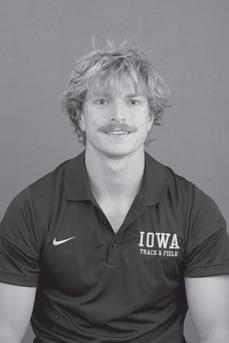
When I was getting recruited, they asked me if I wanted to do the decathlon, and I was kind of like, “ This is my only ticket to being a DI athlete,” so I kind of had to. But now that I’ve done it for four years, the appeal of it is just that no one does it. No one does as much training or competing as me. There’s just a certain pride in it that it’s di cult to do, and not everyone can do it at a high level.
Other than track and field, what is your favorite sport?
I’ve always been a big football guy, that was my main sport in high school. I don’t watch too many other sports, but I grew up a Hawkeye. My dad is a huge Hawkeye fan, so I grew up with my uncles at every tailgate every year, so I’ve been to a good amount of games at Kinnick. I’m pretty much a homegrown Hawkeye.
What is your favorite memory at Iowa?
It probably just has to be getting third place last year at Big Tens last year indoors. Coming from not being the best recruit out of high school, learning a lot of these events, to get third in a Power Four conference, it was pretty surreal.
What is your favorite music genre and artist?
I’ve been pretty big on the yacht rock recently. The biggest name on my playlist is probably Steely Dan.
What are some of your favorite things to do outside of track?
I’m getting into golf here now, so playing a lot of golf. Video games with hometown friends. Frisbee golf once it starts getting nicer. Other than that, just hanging out.
Sports reporters Patrick Halma and Chris Meglio argue between the SEC and Big Ten.

When it comes to which is the best NCAA conference, many will opt for the obvious choice: the Big Ten, based on this year with titles in men’s and women’s basketball, football, men’s soccer, and men’s wrestling. Looking back over the past few years, one has been more consistent: the Southeastern Conference, or SEC.
Over the past few years in football, the SEC has developed a winning mentality with a 21-14 record in the College Football layoff, including a total of six championships — Alabama 2015, 2017, 2020; LSU 2019; Georgia 2021, 2022 — compared to the Big Ten’s three and the ACC’s two. Just this year, the S C owned five of the CF spots, with four of them making uarterfinal appearances.
In men’s basketball, the SEC has become a norm in the national tournament, sending multiple teams every year, including Florida, which won in 2025. Arkansas and Texas each made the Elite Eight
this season. And who can forget the dominance of South Carolina on the women’s side, who have reached the Final Four the last six seasons, earning a pair of titles.
The SEC won the 2025 volleyball tournament, with Texas A&M upsetting No. 1 Nebraska in the quarterfinals and eventually sweeping No. 1 Kentucky in three sets to win the program’s first national championship. But really, where the SEC stands out is in the spring sports. The SEC owns six of the current top15 spots in the NCAA baseball rankings, having won seven of the last 10 college world series, with LSU having won the last three straight.
The SEC also owns seven of the top-10 in the NCAA softball rankings, having won all but two college softball world series in the last 13 years, with Oklahoma winning seven of them.
The SEC has had teams competing on the national level in track and field, golf, swimming, and gymnastics, where Oklahoma just won back-to-back national titles. While recency bias favors the Big Ten, history doesn’t lie. The PAC-12 was once called the “Conference of Champions,” but after a majority of its teams departed during realignment, such an honor belongs to the SEC.


Is there even a debate right now? The Big Ten is on a historic tear, so much so that there isn’t even a real argument as to which conference stands atop the rest of the field. Let’s start with football. The last three NCAA champions were Indiana, Ohio State, and Michigan. First of all, the fact that Indiana won a college football championship is like pigs ying. oo up in the s y, and you might see one. But that’s the impact head coach Curt Cignetti has had on this program in just his second year. egardless, that’s the first ig Ten college football three-peat champion since World War II was active in the early 1940s. The SEC has been dethroned of their college football crown mainly due to the inclusion of Name, Image, and Likeness, which now allows those Big Ten
schools to do what the SEC has illegally done for decades — pay athletes to play at their school.
Now, let’s move to basketball.
The men’s NCAA Tournament saw a record-setting six teams make the Sweet Sixteen, all of which were not a part of the recent expansion: Michigan, Purdue, Illinois, Michigan State, Nebraska, and, of course, Iowa. Only Michigan State and Nebraska lost in the Sweet Sixteen, the conference setting yet another record for most teams reaching the Elite Eight with four. nd for the first time in 11 years and the ninth time ever, two Big Ten teams — Illinois and Michigan — reached the Final Four. Michigan prevailed and ended the 26-year Big Ten title drought.
And when UCLA secured the women’s national title, breaking a 27-year Big Ten women’s national title drought, the conference did something that has never been done in college sports history — win football, men’s basketball, and women’s basketball titles in the same school year.
There’s no way anyone hears that stat and tries to argue that the Big Ten doesn’t rule college sports right now.
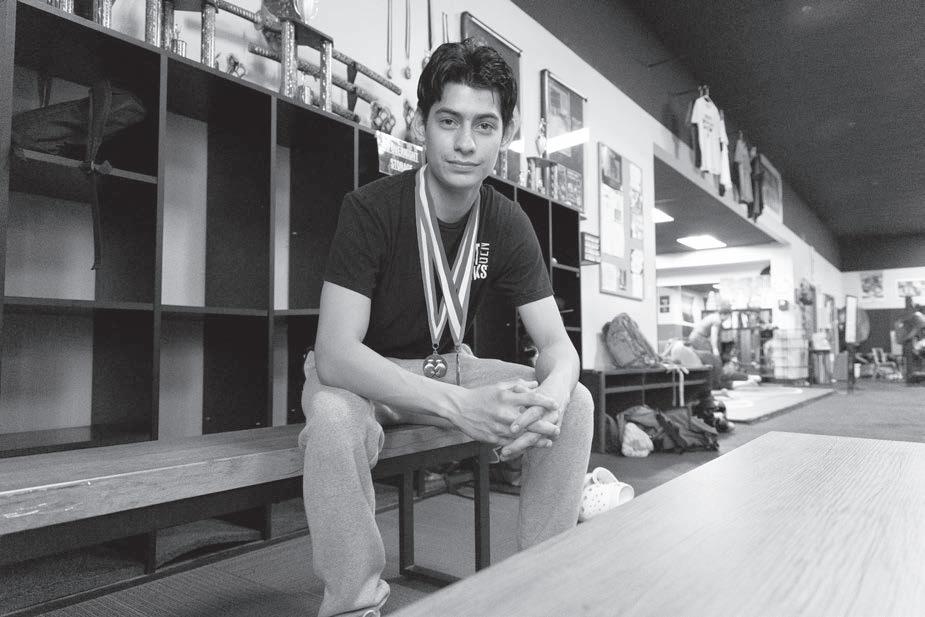
environment in the gym is highly teamoriented. Built on shared effort, respect, and responsibility, these athletes work together and push themselves to the best they can be.
“The boxing gym is kind of a cool home for anyone who wants it,” Knoop said. “As long as you’re willing to show up and work, it doesn’t matter who you are or where you came from. If you’re putting in the work, people will like you and respect you.”
Head coach George Chamberlain, who has been with the program since its founding in 2018, sees that same culture as something deeper than competition. For him, boxing is about learning how to handle resistance, both inside and outside the ring.
“Any time you set a goal with a time frame, you have resistance,” Chamberlain said. “These are full-time students … and still make it to the gym. That shows me that they want to learn and grow as athletes and people.”
That growth looks different for every athlete. Cardozo-Torres and Diener, though stylistically different, both reflect the values of the program in their own way.
“Luciano is quiet and humble,” Knoop said. “He’s got a ton of talent, but you almost won’t notice him unless you were looking. When he gets in the ring, he shines.”
keep wanting to improve.”
For the coaches, that work is what matters most. The gym is designed to push athletes physically through conditioning and repetition, but also mentally: teaching them how to respond to pressure, failure, and growth. As Chamberlain said, “In the gym we win or we learn, and if done correctly, we do both.”
“Sometimes things suck, but if we just push forward a little longer, it will probably get better,” Knoop said.
Over time, those lessons extend beyond boxing and into life itself. The sport becomes a way of understanding effort, identity, and personal limits.
“You have to identify what you’re good at and maximize that,” Knoop said. “That translates to life.”
For Cardozo-Torres and Diener, the path forward may look different: the former chasing a sport in the future, and the latter still discovering where it might take him. But, inside the club, the lesson remains the same. Through early mornings, long practices, and the decision to keep showing up, the pair combine discipline with a continual love for the sport.
“The most important thing about it is just going in there and having fun,” Cardozo-Torres said.
keep showing up.
“Most guys didn’t continue after that, but I just stuck around,” Diener said.
Six months into boxing, his focus isn’t on mastering the sport; it’s on learning how to stay consistent, same with Cardozo-Torres.
“You’re not going to see big changes one at a time,” he said. “But if you keep going and stay consistent, you’ll get better.”
With practices in the evening, he builds his schedule around getting schoolwork done first, using boxing as a way to create routine rather than disrupt it.
“It helps having a structure every day,” Diener said.
Still early in his boxing career, he’s learning one of boxing’s hardest lessons: humility.
“One of the hardest parts of training would be realizing you’re not the best boxer out there,” he said. “You have to learn to be humble with it and take it all in and learn.”
In the ring, that process takes shape through his aggressive style that contrasts with his personality. But, for
Diener, that difference is what makes boxing meaningful. It’s not about having everything figured out; it’s about becoming something new through the work it takes to improve. After winning the novice Iowa Golden Gloves title at 165 pounds, he hopes to capture the title at NCBA Nationals.
“One of the best things people can learn is what you can do if you really set your mind to it,” Diener said. “You can achieve things that you didn’t think you could.”
Inside the gym, the differences between athletes like Diener and Cardozo-Torres are clear, but the expectations placed on them are the same. The culture, according to coaches, is built less on talent and more on persistence. Assistant coach Zach Knoop said consistency is what separates those who improve from those who don’t.
“Hard work beats talent any day,” he said. “If you come to practice once a week and kind of try, I’ll teach you some stuff. But if you’re there every day, even if you don’t have a ton of talent, I’m interested in teaching because you’re putting in the commitment.”
The daily commitment defines how the gym operates. While boxing is often viewed as an individual sport, the
Diener, on the other hand, has a more outgoing presence. He is very compassionate and brings energy into the room but also shares the same foundation of effort and discipline, his coaches said.
“They are both great guys,” Chamberlain said. “They work hard and
Boros created countless relationships with student athletes that have come through the program over the years. From veterans to newcomers, freshmen to transfers, Boros has made an impact on their collegiate careers.
Senior Daianne Hayashida just completed her final season with the program. Since the Peru native arrived in Iowa City for her freshman year, Boros always made an effort for Hayashida to feel seen and welcome.
“She had a big impact because she is a coach that you can connect with on and off the court, ayashida said. “That trust and relationship off builds the on-court relationship even more.”
Though Hayashida came into Iowa’s program with years of skill and experience, Boros taught her to trust in herself and build the self-confidence that has pushed her over the last four seasons, which included a fi rst-team ll- ig Ten nod last season.
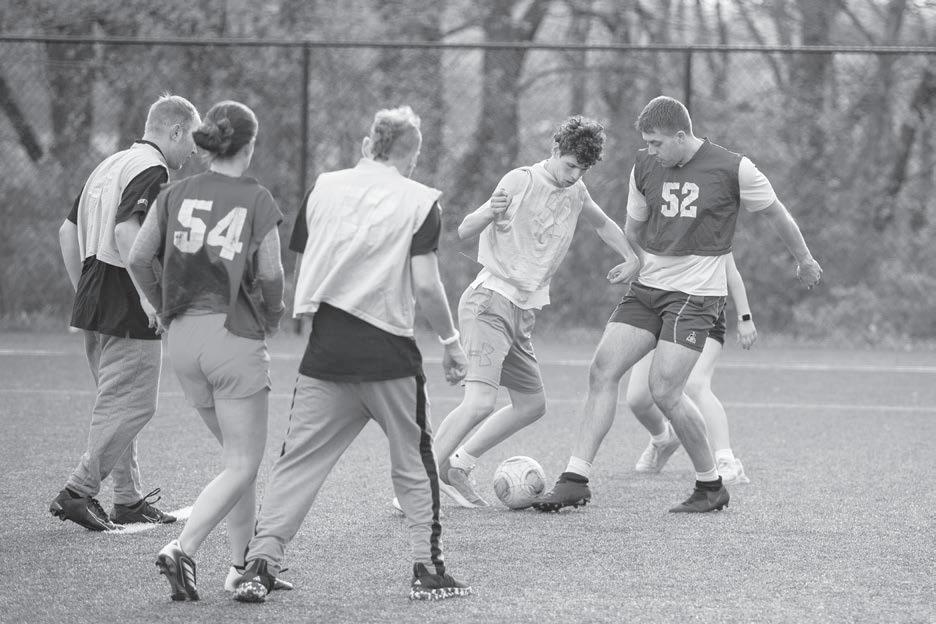
It was only fitting that her singles victory cliched Boros’ recordbreaking win.
“Coming into the Minnesota meet, I was sick, feeling a ton of emotions, and still to win was an incredible feeling,” Hayashida said. “But after they told us she moved into the most wins, it made it feel even better because of the relationship we had and the
faith she had in me.”
Through all the highs and lows over her career, Boros does not have one unique moment she will remember for years to come. Last year’s team to her was a really special team, where they fought through the lows to get to the highs and ultimately earned a spot in the NCAA tournament for the first time in years.
The Hawkeyes helped their berth significantly with a road win over regon that season, Boros said.
She still remembers the third-set tiebreaker and the joy that followed from the athletes, whose hard work made such memorable moments possible.
Having achieved the most wins as a coach, Boros still wants to help her team achieve a national tournament appearance on an annual basis, which is a goal, dream, and aspiration she and her players want to have happen in the coming years.
The program will be seeing quite a few new faces next season, with four seniors and a student-manager graduating, in addition to assistant coach Elise van Heuvelen Treadwell, who is moving on to pursue her own tennis coaching career back home in England.
“This type of transition is hard, but for somebody like me who has been doing this for a long time, it’s kind of exciting to kind of restart with a new face, personality, and energy,” Boros said. “I am really looking forward to it and building a new era for Iowa tennis.”
in sports that they enjoy.
For senior Desmond “Dez” Kapayou, this has even led to interning in a supervising capacity for Unified flag football, volleyball, and soccer as well as playing Unified basketball. Last year even saw Kapayou’s team advance to the league championships at Carver-Hawkeye Arena.
Although his team lost, Kapayou credited the experience as an enjoyable one.
“We were in the lead, but we lost it at the end, and we lost by one point,” he said. “It taught us a lesson, but we’re playing to have fun.”
For UI medical student and Unified partner Madison Brewster, the experience has been nothing short of a highlight of her time at Iowa.
“It’s an opportunity for all kinds of people from different walks of life to come together, play sports together,” Brewster said. “We have all kinds of different seasons throughout the year.”
Brewster shares Kapayou and Spaur’s beliefs that the community
aspect of Unified is a major benefit. After attending Loras College in Dubuque, Iowa, Brewster made easy connections in Iowa City.
“There’s a lot of athletes and families that have been a part of this community, this program, for such a long time, so it really does feel like a tight-knit group,” Brewster said. “I feel like when I came into the program, I was immediately welcomed by the whole group and had really fast connections. It’s a great way for a lot of people to get together and connect in a nonacademic setting.”

In particular, Brewster recalled a highlight of her time playing basketball at a tournament last year.
“We were competing in the nationals basketball tournament in Madison, Wisconsin, and we hit a game-winner to advance to the finals,” Brewster said. “That was pretty awesome, watching everybody celebrate. There was a lot of teamwork; I was involved in that play, too, to make it happen.”
When asked if he wanted to say or add anything about Unified Sports, Kapayou’s response was simple.
“Just come out and play with us.”






The Iowa Hawkeyes track and field team hosted the Musco Twilight meet in Coralville, Iowa, on May 2. The Hawkeyes walked away with four event titles.




Inside how companies frame marketing toward students and young people in an increasingly online environment.
sensory part of it.”
If someone is swiping on TikTok or Instagram, Mona said, they might get a custom or personalized ad based on their feed. It's user-generated content that could have a sponsor in the corner. ith in uencers, they’re being paid to do these campaigns.
Alex Mona, a University of Iowa graduate student, has at least 10 rewards apps downloaded on her phone.
“I feel like if I don’t have this app downloaded, I can’t be reaping the benefits of all these rewards,” Mona said. “Maybe that’s a Gen Z thing.”
Mona’s mindset marks similar experiences among Gen Z, as marketing shifts to pull in a young consumer base.
The marketing teaching assistant said ever since the development of the iPhone in 2007, Gen Z has become more reliant on social media than television for viewing advertisements because of its personalized algorithm that matches users’ different interests.
“ veryone’s feed is completely different, it definitely draws more people in than the coo ie cutter one-si e-fits-all TV mar eting, Mona said. “The algorithm became so customized and personalized to tailor to each individual that their direct feed that they would seek would be so one-to-one with what they want to see or hear.”
Mona said Gen Z tends to purchase products based on new trends or memes that they see through social media.
“People are more drawn to buying or consuming things for pleasure or selfexpression rather than something that's practical or useful,” Mona said. “These kinds of meme-ish drinks or fads that people make videos about probably don’t have any sort of usefulness, but they are so drawn to the
Soogand Alavi, an assistant marketing professor at the UI, said companies are trying to reposition marketing strategies away from traditional TV advertisements, causing their marketing to be more condensed on social media apps.
“They try to make their content more funny compared to traditional kind of content,” Alavi said. “In terms of content strategy, social media platforms are designing their features, and content is also becoming shorter, so we have micro-ads on YouTube, we have [Instagram] reels as ads. So the content in terms of the advertising is becoming much shorter as well.”
en tends to rely on in uencers for deciding on purchasing a product rather than a celebrity or professional-focused approach because of the audience seeking authenticity and relatability.
According to Civic Science, a consumer analytics platform founded in 2008 as a part of a Carnegie Mellon University incubator project, 56 percent of Gen Z aged 18- 29 years old purchased a service or product because an in uencer or blog recommended it or promoted it on social media, compared to only 27 percent of U.S. adults aged at least 30. This data was based on over 1,366 responses from June 2023 to July 2025.
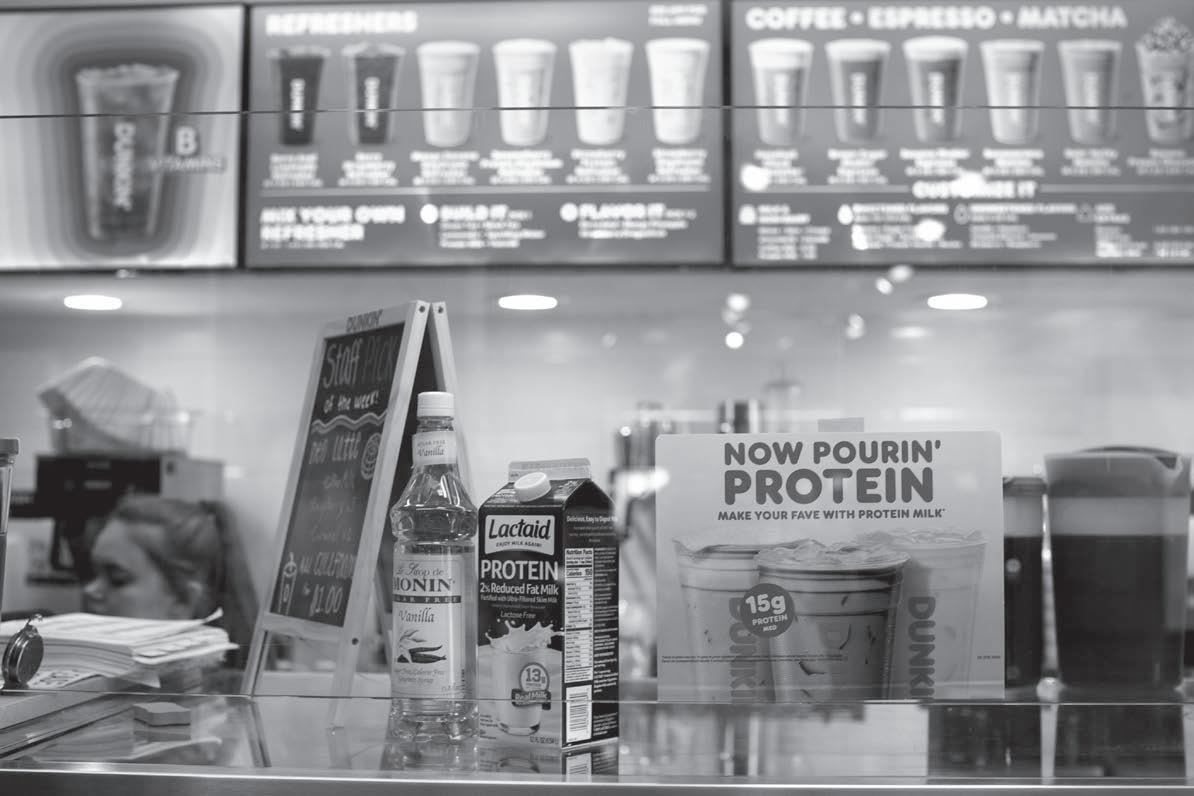
According to over 46,000 responses to Civic Science's suvery from January 2023 to July 2025, 72 percent of Gen Z said social
Students explain why they prefer thrifting and
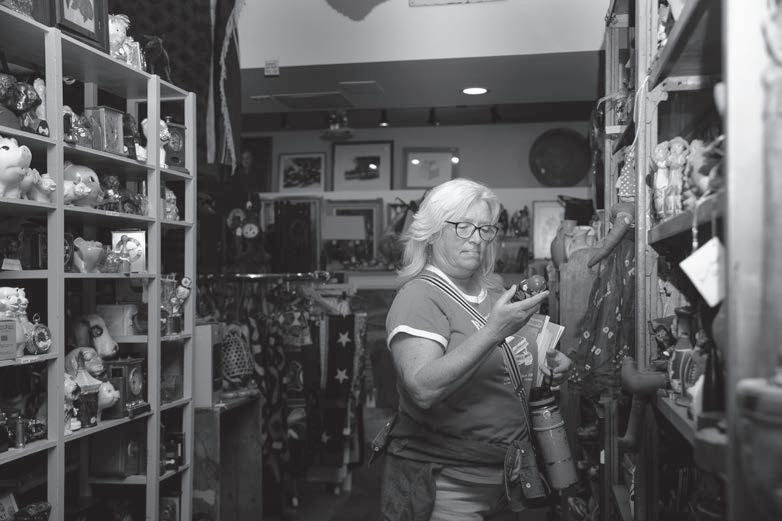
than buying brand new, and it's so much more ecologically sensitive,” Ginsberg said.
Ruhrer-Johnson loves the era of 1940s-1960s. But from dresses to art nouveau, her favorite collection is her clocks.
At the very end of the University of Iowa Currier esidence all s third oor toward the south wing, two dorms sit across from each other. On the left is a double that greets anyone who’s looking for company. At least, that’s what it feels like to sit down with UI second-year student Annabelle Ruhrer-Johnson.
With walls plastered in art nouveau posters and buttons all around, the room is quite cozy.
is the most human thing,” she said. “I love that. I want to see where someone tried to follow the stitching when her dress came apart. Same with a clock. I love seeing mistakes because human error is such a human thing.”
Ava Schilling, a second-year UI student and friend of Ruhrer-Johnson, also thinks of herself as a collector. That is, until she saw the extent of what Ruhrer-Johnson had.
Shopping has become more about staying up to date with trends rather than buying things you li e, feel confident wearing, and will have in your closets for a long time.
While fast fashion is a constantly growing market, alternatives such as thrifting, vintage shopping, and buying secondhand are gaining more traction and popularity.
These alternatives are no longer stigmatized as they were 20 years ago, but rather celebrated. Today, buying secondhand is viewed as cool, cultured, and thoughtful. If I ask someone where they got something, and they say Aritzia, I think, “Oh, nice, you spent $80 on sweatpants.”
When someone says they thrifted something, though, I think, “Oh, you’re cool and have good taste.” Whether you like shopping in person or online, buying secondhand has options for all shoppers. From cool thrift and vintage stores to online websites such as ThredUp and Depop, secondhand shopping has become easily accessible.
Buying secondhand is not only generally cooler, but also more environmentally friendly. Fast fashion feeds climate change by producing massive amounts of waste, pollution, and carbon emissions driven by rapid and low-quality production. Choosing to shop secondhand over brand new may feel small in the grand scheme of things, but it is a meaningful way to push back against the system.
Gen Z is largely responsible for the increasing popularity that thrifting and buying secondhand have received. I asked my music writing class what their thoughts are on buying secondhand, considering most of them thrift.
In my class of 17 people, 13 of them said they prefer thrifting to buying brand new, 14 if I include my professor, Julia Conrad. Parker Field, a second-year UI student, said he finds all of his best stuff secondhand. He added that the pieces he found at thrift stores tended to be more unique. Eleanor Ginsberg, a UI student, echoed Field’s opinion.
“ uying secondhand is infinitely cheaper
The few that disagreed had strong opinions against thrifting. Nate White, a UI student, said because he is so tall, it's often harder to find clothes that fit him right.
“I prefer buying brand new because I can buy clothes nowing they will for sure fit me, White said.
“I didn’t grow up around secondhand stores or cool vintage shops, buying brand new clothes just feels more reliable,” Cali Weber, an Iowa native, said.
I also spoke to another student, Avery Fricke, who is getting married this May. She told me all about how buying secondhand has been her saving grace for her wedding.
“To buy new for every event, it would have cost us thousands,” Avery said. “I have always loved thrifting, I think it's the process of finding uni ue items that no one else has that feels so fun to me.”
She said she prefers thrifting because it’s nice to know she isn’t producing as much waste and is a believer in passing down items to family or friends.
Fricke said she values creating a wedding she can feel proud of and also secure in the fact that she saved money and did not contribute to the growing problem of climate change.
In my opinion, buying secondhand is superior to buying brand new. I can understand needing to buy brand new for a tall pair of jeans or a new pair of sneakers, but if you’re loo ing for a cool annel, head to the thrift store and find one for rather than a retail store that will sell you a polyester one for $80.
Revival, in downtown Iowa City, does a fantastic job at meshing both secondhand and brand-new clothes. Their store includes secondhand items, from Burberry boots to Old Navy t-shirts and everything in between. They also sell brand-new retail items from eco-friendly brands such as The Blank Lab and Baggu.
There are many other great secondhand stores in the Iowa City area as well, such as Second ct Vintage, Ulysses odern, Ragstock, Goodwill, Salvation Army, and Wonderland, just to name a few. There are also seasonal ea mar ets that happen in Iowa City.
Ruhrer-Johnson is a collector, which is notable from all the little details of the maximalist room by itself. But it becomes even clearer when she points out the eight clocks she was able to bring with her to campus, and the 12 she had to leave behind.
“I started gravitating towards clocks without even knowing,” she said. “And then I ended up with a bunch of clocks and I’m like, ‘Well, I have so many of them now, why don’t I just make this my own thing?’”
At the age of 15, Ruhrer-Johnson started collecting her clocks. She went through Facebook Marketplace and Goodwill stores before realizing that the best pieces in her collection came to her when she waited.
“It’s more li e they find me. I never go somewhere looking for a clock,” she said.
In her dorm alone, Ruhrer-Johnson had three standing clocks sitting on her windowsill, painted and slowly ticking. But by just the turn of a head, there was a ower shaped cloc hanging above her door. arfield-themed cloc , and an enlarged leather wristwatch were attached onto the left wall, and two more clocks were tucked away by her desk.
To Ruhrer-Johnson, collecting, especially something niche, has given her a larger sense of community she had not had before.
“They do so much for me,” she said.
“ hen I’m loo ing for something specific or maybe have some newfound room, they’re there. It’s a give and take. That’s the basis of community.”
Though not featured in her shared dorm, Ruhrer-Johnson estimates she has an even bigger collection at home of a completely different ind of ob ect 4 s60s standard wear dresses. Particularly, plus sized.
One common theme throughout Ruhrer-Johnson’s vintage collections is her profound love of noticing errors and use in the everyday objects. This, she said, was something that gravitated her toward these items.
“I do find it interesting because it’s showing that something’s been used. That
“I believe I can no longer call myself a collector after seeing all the stuff she has, Schilling said. “She really knows where to find and store things. It’s pretty ama ing. Hayden Gamble, UI third-year student and friend of Ruhrer-Johnson’s roommate, has also had his definition of collections changed after seeing RuhrerJohnson’s dorm.
“Most collectors have everything in one spot,” he said. “She’s got art with posters, and sculptures with her TV. It’s very uni ue and shows a different perspective for me on knowing how collections can be shown.”
After collecting for so many years, the act itself has become deeply a part of
who Ruhrer-Johnson is. This became a fundamental part in how she views other methods of collecting.
“If I get to a point of overconsumption, I’ll reach out to my community — my clock girlies — or even Facebook Marketplace. I just think that someone will be appreciative of my item because the last thing I’m going to do is put it in the trash or box it in the basement.”
Her knowledge in collecting has also allowed her to form a fine line of what is overconsumption versus collecting.
In Ruhrer-Johnson’s eyes, if there is no use or meaning in the ob ects, it’s ust stuff.
“Everyone probably has a different standard for what is too much. But for me, if it starts to become too much or not a fun time, it’s not collecting,” she said. “When it starts to become a hassle or a responsibility or something that I’m not getting immediate and pure joy out of, it’s no longer a collection, it’s just a burden.
That’s a responsibility.”
The Italian charm bracelet trend from the early 2000s is making a comeback.
lot of my feeds had Italian things showing up, and I believe I discovered them that way,” Ella Heimer, a first-year UI student, said.
In the current digital world, social media has been an important tool for determining and sparking trends. From finding music to listen to, shows to watch, and clothes to wear, social media has made major impacts on the way people live their lives.
Jewelry has become another addition to this long list of influencer-pushed products, with jewelry trends sprouting from whatever popular social media influencers or celebrities are caught wearing. These photos and promotional videos often serve as gateways for many people to buy their own replica jewelry pieces.
“When I see a cool piece on TikTok or Instagram, I’ll look to see if I can find something similar if I like it,” Verin VanGinkel, a first-year University of Iowa student, said.
Another jewelry trend is on the rise with Italian charm bracelets. These customizable linking bracelets can be seen adorning the wrists of many celebrities online and students across the UI campus.
From the late 1990s to the early 2000s, Italian charm bracelets were a quickselling sensation in North America and Europe. The fi rst bracelet of this style was created by the Italian jewelry brand Nomination Italy, which is where the bracelet style gets its name from. Now, these bracelets are popular once again, and social media has been a large factor behind the surge in popularity.
“One of my favorite bands is Italian, so a
Even though Nomination was the first jewelry company to patent the Italian charm bracelet idea, several other companies have jumped onto the trend as well. Most notably seen in advertisements is the brand Charmette, which sells Italian charm bracelets at a significantly discounted price compared to Nomination.
What sets Italian charm bracelets apart from other charm bracelets is the flat, modular charms that construct the bracelet. Each charm snaps onto the next, creating a bracelet that expands and contracts with ease, depending on how many charms are linked together.
The number of charms needed to complete a whole bracelet depends on wrist size and comfort, as having too many can make the bracelet loose and fall off, while too few can cause uncomfortable pinching when worn.
“They’re one of my favorite pieces of jewelry I own. I’ve gotten so many different charms, and I love how there are so many websites that provide them,” Heimer said. “They’re so easy to change out and customize, and I love how anyone can wear them because you can customize them to match you and your outfits.”
The big selling point for this style of jewelry is the level of customization that comes with it. With thousands of unique designs, each charm is different and gives the owner the ability to fully personalize their jewelry to fit their unique aesthetic. Charms come in a range of metal selections, like silver or gold, and can
feature anything from funky drawings to fun phrases.
“A lot of my charms are fun phrases I like or small pieces of my life. I have one of a rabbit for my pet bunny, another of a cat for my cat, tulips because they’re my parents’ favorite flower, and 21 since it’s my favorite number,” Heimer said. “Some are just because I thought they were pretty, but a lot of them have meaning to me.”
With meaning behind every individual charm, or the bracelet as a whole, Italian charm bracelets have been a way to connect with others. Due to their customizable factor, these bracelets can symbolize countless events, relationships, and individual personalities.
for movie tickets, no matter what fi lm or day of the week it is.
FilmScene also offers a special discount on Friday nights, where tickets to see the latest releases are at a price of only $4 for students. FilmScene features plenty of programming selected by the Bijou Film Board, with all Bijou fi lms being free to attend for students.
“I was with my best friend walking around Iowa City, and we went into the store CIELO, which unfortunately closed down now, but we decided to get matching Italian charm bracelets,” Mikey Russo, a second-year UI student, said. “I actually wear it almost all the time, especially since it signifies my and my best friend’s friendship.” What began on social media and quickly developed into a fast-selling jewelry style, the Italian charm bracelet trend is thriving once more. With complete control over personalization and an easily addictive nature to collecting charms, Italian charm bracelets are quickly asserting that they’re a trend that’s going to be here to stay.
while walking across campus to being a source of study motivation, music is a foundational pillar of many college students’ lives. However, while you’re jamming to tunes, the worst thing that could happen is an unexpected advertisement breaking the union between yourself and the music’s flow. Spotify offers a student-discounted premium plan at half the price of their regular plan.
Between balancing long lectures, brutal exams, and budding social lives, being a college student is a difficult job. What’s even more difficult is balancing finances when tuition is high, and class schedules are rigorous and time-consuming. To combat this, student discounts have been a lifesaver for many college students looking to manage their money. If you’re looking for more ways to save, these deals are a game changer.
One of the most convenient ways to shop as a college student is online, and Amazon is by far the nation’s most popular online shopping service. The unfortunate dilemma when shopping online, though, is the long shipping times a package can take to be delivered. With Amazon Prime, however, the waiting time is significantly decreased, with free shipping included. Offering an extended 6-month free trial

before payment kicks in, Amazon has discounts for students to enjoy Amazon Prime at half the normal price, which includes services like Amazon Prime Video and access to unlimited music and reading options as well.
Nothing’s better than rewarding yourself with a sweet treat after a long study session, an aced exam, or a little pick-me-up when something’s gone awry. With a store directly across the street from the Old Capitol Building, Dunkin’s coffees and donuts are staples around campus, and the perfect mood booster. Plus, with Dunkin’s 10 percent student discount with proof of a valid student ID, the treats are even sweeter.
Going to the movies is a great way to relax after the stress of assignments has passed. For UI students looking to catch a fi lm, FilmScene offers student discounts
Hancher Auditorium, features live music performances and theater productions. With an annual Broadway Series bringing big productions to Iowa City and several other exciting festivals and events throughout the year, Hancher has a show for everyone. With discounted student tickets ranging anywhere from $5 to 50 percent off certain events, the venue brings both appealing productions and affordable prices.
If you’re looking to enjoy a live performance downtown in Iowa City, look no further than The Englert Theatre. From touring stand-up comedians to local melodic orchestra performances, The Englert Theatre presents a wide variety of events throughout the year. The theater hosts several free events to attend, for ticketed performances, the theatre offers student discounts with proof of a valid student ID, reducing the usual ticket sale price heavily.
From blasting through headphones
With a two-story building located in downtown Iowa City, Target is a convenient place for many students on campus to buy groceries and necessities. While prices can rack up easily, this is where Target’s discounts come into play. After verifying a student ID, students can get the Target Circle 360 membership at a large discount, opening up many opportunities for coupons, free shipping, and free monthly gifts. Plus, signing up for the program comes with an automatic 20 percent off coupon for your next purchase.
Whether students need poster supplies for a group presentation or paints for an art assignment, Blick Art Materials is known for being the closest craft store to campus. Even though art materials can be on the pricey side, Blick offers a student discount for 10 percent off every purchase, as long as a valid student ID is shown during checkout. A great way to save on supplies, this discount is useful for any student, art major or not.

media in uences the electronics they buy, compared to percent of U.S. adults. Seventy-one percent of en said social media in uences the clothing and accessories they buy, compared to percent of U.S. adults. lso, percent of en said social media in uences the food they buy, compared to percent for US adults.
“ aybe you don’t align with these almost robotic-feeling corporations and you’d rather choose a product based on someone’s in uence or their promotion of that product, ona said. “These big companies are transitioning towards reaching out to creators to promote their products rather than themselves outright doing it. If I get a promoted sponsorship inside of a video, I might be more inclined to listen to it because it’s someone that I now.
ona said the fear of missing out is another factor in how en engages with products online.
“ big thing that I’ve seen with en , because of how social we are online and in-person, is the concept of social proof, ona said. “ h, they’re doing this, so it must be good’ or h, my friends are wearing this clothing line, maybe I should have the same brand so I fit in.’ So we see what’s popular with other people, and then it tric les down.
rtifi cial intelligence, or I, within mar eting has evolved over time, as machine learning tools are used to ma e higher accuracy predictions on product performance based on customer data.
lavi said the newer generative I is used for content generation for mar eting, and companies are still evaluating the efficiency of using the technology within social media.
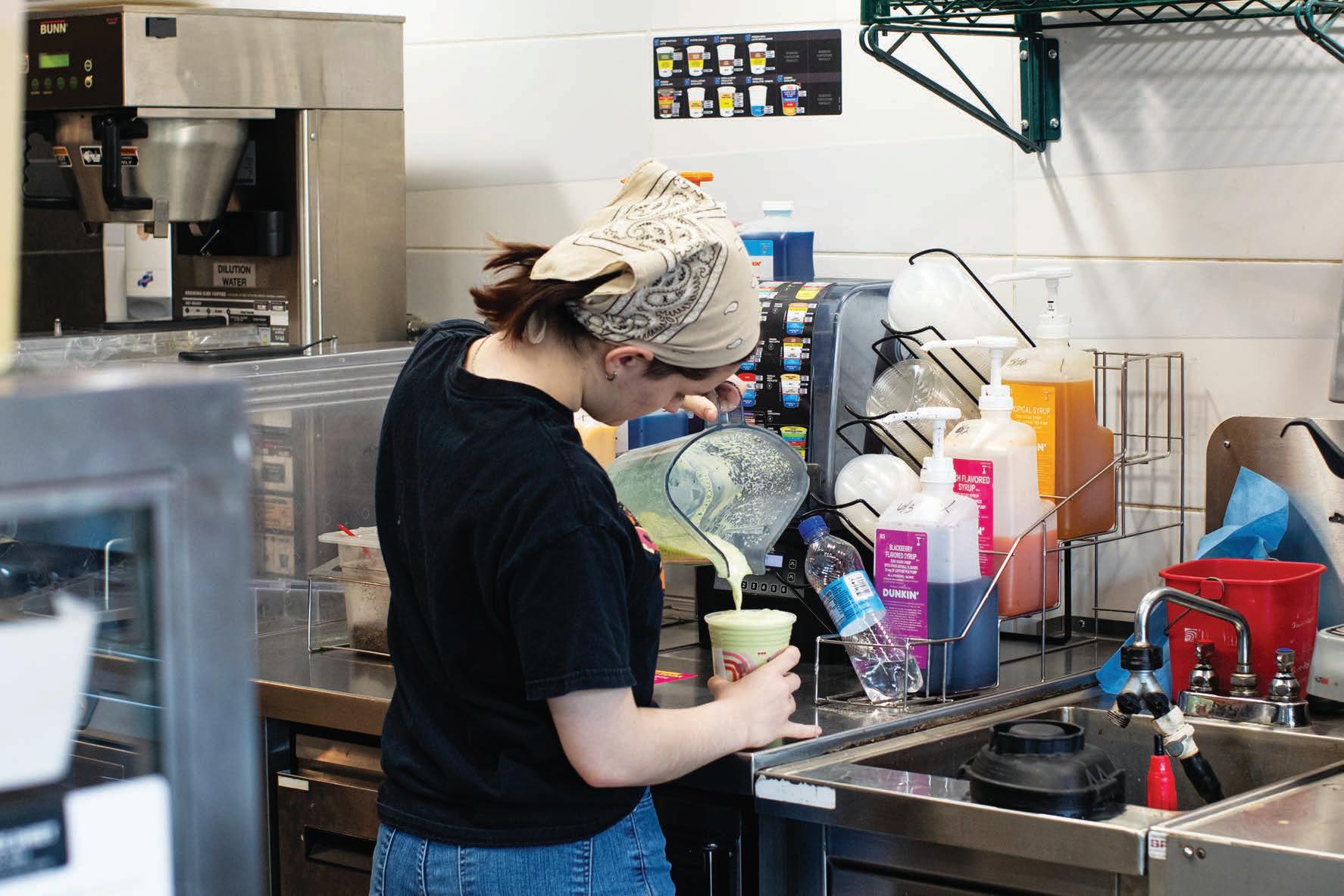
In the past five to years, companies would have their own social media teams to manage that social media presence, lavi said. These days, I agents could go automatically post, tweet, or write about their company and automatically create and post content.
“Social media is the dominant way that companies are communicating, and it’s really important for them to be successful in that presence, lavi said. “ e don’t have enough evidence and data of whether it’s effective or not. ut what we now is that they’re trying it out and the technology e ists to fully automate that process and ma e it more e cient and automated.
Utili ing the newest forms of technology to appeal to younger
healthy eating being a hot topic online at the moment, it’s not odd to see the trend of protein infused foods following suit. This is most prominent in grocery stores and almarts but can occasionally be found advertised on the windows of chain stores in Iowa City. ne of these is Clinton Street’s Dun in’ Donuts. n Feb. , the company released a new protein mil in collaboration with hip-hop singer and rapper egan
Thee Stallion, which was shared on the website’s blog section. The mil can be added to any Dun in drin and contributes a whopping grams.
Dun in’ Donuts employee and fourthyear student at the UI, a oleton, has noticed trends surrounding the protein mil .
“I would say a lot of time that I see men and girls that are somewhat athletic getting it. robably en . They’re all college ids, oleton said. “The targeted demographic, I would definitely say, is probably people in their early s ust


oleton said the protein cra e has been hitting every demographic, so it’s hard to say who would be buying the product outside of a location predominantly filled with young adults.
Trevor Fernau, also a Dun in’ Donuts employee, noticed a variety of people purchasing the protein mil . hen it comes to a possible increase in sales at the Clinton location, Fernau pointed to the emerging summer weather being a heavy factor.
“It’s a coincidence with the weather getting warmer now and sales. s people are starting to figure out about the protein mil , it could be a slight increase, Fernau said. “ ut, I thin it’s more so people seeing it advertised, wanting to try it, trying it, and thin ing it’s pretty good.
UI fourth-year student sei omeah was one customer who decided to buy the protein mil practically on a whim two wee s ago and has been buying it ever since.
“I tried the mango refresher for the first time, and it was really good. So I started coming here almost every day for the past two wee s. I got it because I had a gift card at the time, omeah said.
is important.
oleton said trend hopping in general, especially if the trend is popular online, is a strategy that companies li e Dun in’ Donuts parta e in to draw in a younger audience.
“I typically want to try a product when I see actual people trying it. I only tried the protein mil because my cowor er did and as ed if I wanted to try it, oleton said. “I’m a little more apt to try things if someone isn’t overbearingly encouraging of the product. I’m drawn if a real person tries it. ot li e celebrities aren’t actual people but, you now, daily people. utriSport and Smoothie, located in the ld Capitol Town Center, is another e ample of a store that sells smoothies, salads, and a variety of supplements for weight training and fitness. addie allagher, a second-year student employee, said the signs and social media draw customers in, particularly UI students.


There is also another diet trend floating around caf chains sugar free products. Ingredients and products being sugar free is nothing new. Dun in’ Donuts, however, too advantage of the rise of protein products to reintroduce their sugar free syrups and drin s to a new health focused audience.
“ esterday on Sundays we had smoothie and wrap deals, and we have signs all over that say that that definitely brought people in yesterday, allagher said. “It contributed to us being pretty busy. nd our social media team, I thin that’s a big pull for college students because they’re always scrolling, so seeing things on instagram is always helpful. allagher said the store’s protein supplements and smoothies are popular among customers.





“They were running before, but they came bac around four months ago when I started wor ing. So these are pretty new. I would say a lot more girls though get it, oleton said.
“In general, the high protein is definitely a trend right now, allagher said. “ a ing sure that you’re getting the protein in. ut for sure for students, smoothies are a huge pull ust because you can drin one on the way to class and it’s uite good for you.