The Daily Iowan
What the water carries
Iowa farmers call for conservation amid cancer diagnoses and nitrate contamination.
P
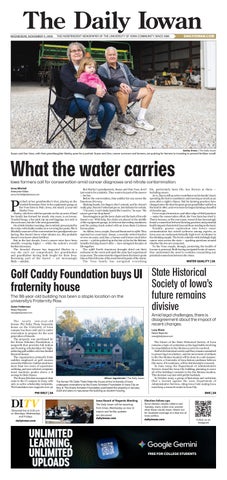
erched at her grandmother’s feet, playing on the crushed limestone floor in the equipment garage at the Voss farm in Palo, Iowa, sits nearly 3-year-old Marley Voss. Marley, who lives with her parents on the 40 acres of land her family has farmed for nearly 160 years, is an Iowan. Tousled bangs, a hot pink zip-up and leggings, not only is she an Iowan, but she’s the next generation. On a brisk October morning, she is entirely preoccupied by the rocks, with chalky residue now covering her pants. She is blissfully unaware of the conversation her grandparents are having. She doesn’t know what nitrates are. She probably doesn’t even know about fertilizer. But in the last decade, Iowa’s cancer rates have been steadily creeping higher — while the nation’s overall burden decreases. The dreaded disease has impacted Marley in a way she can’t yet comprehend, her grandmother and grandfather having both fought for their lives. Becoming part of the feared — yet increasingly likely — statistic.
But Marley’s grandparents, Susan and Dan Voss, don’t just want to be a statistic. They want to be part of the answer — for her. Before the conversation, Dan ambles his way across the limestone driveway. Shaking hands, his fingers don’t extend, and he doesn’t really grip. Dan isn’t reluctant per se, but delicate for certain. “I’m sorry, I can’t shake hands like I used to,” he says. “My cancer gave me drop hand.” Dan struggles to get the lawn chairs out the back of his wife Susan’s car. With help, the chairs are placed in the middle of the equipment garage, in between harvesting machinery and the pickup truck suited with an Iowa State Cyclones license plate. An Atkins, Iowa, couple, Dan and Susan met in 1986. They married two years later. Susan, a recently-retired teacher of over 20 years, and Dan, a farmer and former rural letter carrier — a job he picked up in the late 1970s for the lifetime benefits farming doesn’t offer — have navigated decades of life together. The 1988 North American drought dried out their soybeans in the worst arid spell the state had experienced in 50 years. The 2020 derecho ripped down the farm’s grain bins as Palo felt some of the most forceful gusts of the storm. The Voss family has navigated everything
life, particularly farm life, has thrown at them — including cancer. At 71, Dan is still an active contributor on his family’s land, operating the farm’s machinery and mowing as much as 30 acres after a night’s dinner. But his farming practices have changed since the time his great-great-grandfather settled on the land in 1867, and even since he began farming a handful of decades ago. Cover crops, bioreactors, and other edge-of-field practices — name the conservation effort, the Voss farm has tried it. That is because, as the years pass, research has increasingly found a connection between farming practices and potential health impacts that stretch beyond those tending to the land. Notably, greater exploration into Iowa’s water contamination has raised eyebrows among experts, as Iowa sees an uncharacteristically high level of nitrates in the drinking supply. The levels coincide with strikingly high cancer rates across the state — sparking questions around whether the two are connected. To the Voss couple, though, protecting the health of Iowans is personal. Both having navigated bouts of cancer, they understand the need to continue researching any potential connection between the crises.
Golf Caddy Foundation buys UI State Historical Society of Iowa’s fraternity house
The 98-year-old building has been a staple location on the university’s Fraternity Row.
The nearly 100-year-old former Phi Delta Theta fraternity house on the University of Iowa campus has been sold and is under renovation to prepare for the next generation of tenants. The property was purchased by the Evans Scholars Foundation, a nonprofit that provides full tuition and housing scholarships for highachieving golf caddies who face limited financial means. The organization primarily finds caddies employed at golf courses across the Midwest. Caddies must have more than two years of experience caddying, and once selected, recipients must maintain grades above a B average in their classes. The Evans Scholars inaugural class came to the UI campus in 2023, with only 10 active scholarship recipients. The foundation now supports over 40
Amid legal challenges, there is disagreement about the impact of recent changes.
future remains divisive
The future of the State Historical Society of Iowa remains a topic of contention as the legal battle involving its consolidation in Des Moines is yet to be resolved. Staff at the historical society said they remain committed to preserving Iowa history, and the movement of artifacts to the Des Moines location will be done in a safe manner. However, a University of Iowa history professor believes this move, if it continues, will be detrimental to research. In June 2025, the Department of Administrative Services closed the Iowa City building, planning to move all of the building’s contents to the Des Moines location. This decision was met with public backlash. In October 2025, a group of historians and archivists filed a lawsuit against the Iowa Department of Administrative Services, citing Iowa Code stating Iowa must keep a research center in Iowa City.
“If you know better you do better, and we know a lot more than we used to,” Susan said. Dan worries about the future generations, which include his granddaughter Marley, if Iowans turn a blind eye to the research in front of them and negate the work needed to address the agriculture industry’s participation in the water crisis.
Every other month, Dan and his wife hop in the car to make the 160mile trip north to the Mayo Clinic in Rochester, Minnesota. They’ve taken the drive up I-380 for over a decade, as Susan received cancer treatment at Mayo Clinic for over 11 years before Dan’s diagnosis. In Rochester, his cancer team waits to prod him with needles and scan for any remnants of disease. Six rounds of chemotherapy and a maintenance treatment drug later, Dan said his doctor told him the cancer was inactive. He also said it’s likely to return. Dan doesn’t mind making the drive. In fact, it’s a trip he’s grateful to take, though he said it can be tiring at times. It was 2023 when Dan began to notice complications following carpal tunnel surgery in his hands. Over the span of the next six months, Dan experienced blood blisters on his hands and feet, and knots on his knuckles. He knew something was very wrong. Then, he was diagnosed with a three-in-a-million case: a rare form of non-Hodgkin’s lymphoma called Waldenström’s macroglobulin. It was 2012 when Susan was diagnosed with liver cancer after a doctor noticed enlargement in her upper abdomen during a routine checkup. A couple years of chemotherapy pills, repeated chemotherapy embolizations, and eventually surgery to remove half her liver later, she calls herself a miracle survivor. Liver cancer being a rare diagnosis, her doctor couldn’t attribute her condition to any genetic or typical cause. “It had to be something you are breathing or eating,” the doctor told her. Neither Dan nor Susan can concretely attribute their diagnoses to agriculture practices or the water crisis in Iowa. Dan said it could be a factor, and is more likely to be in his case than his wife’s, but the question remains unanswered. The uncertainty is why the pair calls for preventative farming practices and increased research into the potential connections. Particularly at the time of Susan’s diagnosis, nitrate contamination wasn’t a conversation in Iowa. But despite a decrease nationally, her cancer case became a part of Iowa’s sharp uptick in new diagnoses. Iowa has the second highest and fastest growing cancer incidence rate nationwide. The Iowa Cancer Registry estimated 21,700 new cancers would be diagnosed in the state this year. Researchers have pointed to Iowa’s unique presence of radon, along with its high smoking, drinking, and obesity levels to explain the surge. But no answer is all-encompassing or definitive. Peter Weyer, former director of the University of Iowa’s Center for ealth ffects of nvironmental Contamination, pioneered a landmark study in 2001 that initially connected nitrates to cancer risk in the state. But it wasn’t until research in recent years, such as that from the Iowa Cancer Registry, demonstrating the breadth of Iowa’s cancer crisis and its contrast between the declining incidence rates in other states, did the correlation pick up steam in the public eye.
Marley, getting antsy, moves between sitting and standing, rubbing the dust off her pants and then rolling in it again, before finally standing up and positioning herself behind her grandmother. Peeking around her leg curiously, Marley is
smudging the limestone residue all over her grandmother’s jeans. Dan sits propped in the lawnchair, tapping his foot as he speaks. Susan stands across from him — in part to control the energy of her granddaughter whom she babysits during the week. The conversation is shifting, casually, into one not about cancer, but about farming, and about the agriculture industry’s role in a contaminated water supply. Nitrate contamination is generally attributed to fertilizer runoff and manure. am ackeyTaylor, director of the Iowa Chapter of the Sierra Club, called Iowa “ground zero” for this pollution. “It’s perfect farmland for growing corn,” she said. “Corn means fertilizer, and fertilizer means nitrates. On top of that, [Iowa has more confinements than any other state.” David Cwertiny, Weyer’s successor in directing CHEEC and a UI professor of civil environmental engineering and chemistry, now heads the research on how water contaminants impact public health and how to get pollutants out of Iowa’s drinking supply. The Environmental Protection Agency’s current standard for nitrate exposure is set at 10 mg/L but Cwertiny said the level is outdated and only accounts for short-term acute impacts, namely blue baby syndrome, or oxygen deprivation in infants. While contamination varies across the state, roughly 12 percent of Iowa’s private wells and 29 percent of surface water test samples exceed that limit. The standard might discount more long-term adverse effects, such as cancer, he said. Three to five to years of above five milligrams per liter could increase risks of some of those longterm health effects, Cwertiny said. Nitrate levels are most frequently linked to colorectal cancer, with Cwertiny calling the chemical a “precursor of the chain that leads to cancer potentially happening.” When in the drinking water, nitrates get converted through oral bacteria into the related chemical nitrite. The nitrate, Cwertiny said, can convert into cancer-causing compounds when it hits the stomach — which is why colorectal cancer is a potentially associated with nitrate contamination, along with gastric, bladder, and kidney, among other cancers. The question is whether the amount of nitrate contamination in Iowa’s drinking water is enough to cause that internal, cancer-causing process — which Cwertiny said isn’t an easy answer. Cwertiny doesn’t question the science, but also acknowledged the di culty in pinpointing cancer to one specific root cause. The EPA has recognized the evidence suggesting the need to revisit the 10 mg/L standard and assess whether a stricter limit is needed. But, Cwertiny said the agency has been “dragging their feet for 15-16 years.” “It’s good science,” he said. “It should be enough to give us concern and want us to be vigilant, but it hasn’t been strong enough to compel any change. That’s where we are stuck.”
Getting even more squirmy as the conversation continues, Marley grabs at her grandmother’s zip-up jacket — with the logo for Central Lutheran School in Newhall, Iowa, the school she retired from following the birth of her granddaughter, emblemed on the right side of her chest. The Voss couple go back and forth with each other. Recognizing a pattern, they name a handful of neighbors and community members who have had adverse health effects potentially related to agriculture. It’s known that the agriculture industry plays a significant role in nitrate contamination. To Cwertiny, the natural next question is simple: How much is Iowa’s nitrate contamination risk increasing and potentially contributing to the damning cancer rates? A 2019 study by the
Environmental Working Group concluded that anywhere between 75 and 338 cancer cases in Iowa could be attributed to nitrate contamination — landing the state in the top-four nationwide. While it’s a drop in the bucket of Iowa’s overall cancer burden, its a part of the overall number that is largely preventable. The study found a higher frequency of cancer in those who are ingesting high levels of nitrates. But Iowa has an excess of around 2,600 cancer cases a year, according to analysis from the UI College of Public Health. Cwertiny estimated nitrates are contributing to around 10 percent of Iowa’s excess cancer burden, but that it’s not a singular attributable factor in Iowa’s standout number of diagnoses. “Even if nitrate is contributing, it’s not one factor for one type of cancer, and it’s not nearly enough to explain all of the cancer challenges that we have in Iowa,” he said.
When Susan was diagnosed in 2012, the connection between longterm health impacts and agriculture practices was hardly a conversation. In the years since, the Voss family has paid attention to how they can adapt to the emerging research surrounding the industry. The Voss family has adopted a vast array of conservation practices to do their individual part in mitigating long-term health risks for Iowans. They are huge proponents of cover cropping, or planting crops between harvesting seasons with the intention of improving soil health to reduce nitrogen use. The practice is attributed to a long-term increase in corn and soybean yield, which Dan said falls in line with his 10-year average yield on the farm. Despite the Voss farm’s individual success with cover cropping, they said not enough farmers have adopted the practice. “For whatever reason, we haven’t moved the needle as far as we should,” Dan said. “That’s why I think this discussion is good.” The Voss farm also has bioreactor filters under the ground to reduce nitrates in tile water, and are planning to install a water quality wetland — a self-made pond designed to filter the water and catch up to 90 percent of nitrates before it can run off. The bioreactor and wetland are considered types of edge-of-field practices, or conservation methods installed at the border of agricultural fields to catch pollutants before they reach local waterways. The reality is, at a time when margins are lower than ever for farmers, there remains a hesitancy in installing conservation methods. Not only can they be an investment, but they may even take what would otherwise be farming land out of commission. According to the Sustainable Agriculture Research Education, the average cost per acre for cover cropping is $37. That’s $1,480 annually if the Voss farm put cover crops on all of their land. The short-term expense makes it more di cult for farmers to see the long-term benefit. “It’s tough being a farmer, but you know we also need to do what’s right for the environment and for our own families,” Mackey-Taylor said. Much of Iowa’s pollution runs off land over a broad area and into waterways. Cwertiny said cover crops and other voluntary reduction strategies reduce this runoff, but he warned that without mandatory regulation, the pace of adaptation isn’t strong enough to outpace the increasing intensity of Iowa’s agricultural production The balance is between finding regulatory approaches that won’t bankrupt farmers while incentivizing them enough to achieve water quality goals. Dan said he understands farmers are feeling the squeeze, but that it’s a worthy investment into the longterm health of Iowans. He also said it may be an opportunity for a government cost-share to take some burden off individual farms.
“We’ve got some problems,” Dan said. “But they are solvable, or we can at least make them better.” The alternative approaches to a less contaminated water supply don’t come without their drawbacks, though. dge-of-field practices take land out of production. Cover crops need to be burned at the end of the season, which is most frequently done using controversial chemical glyphosate — which is divisive for its potential connection to cancer, such as non-Hodgkin’s lymphoma, and its impacts on biodiversity. Cwertiny said if Iowa reaches its set cover crop goals, glyphosate use will increase by 50 percent, which could have detrimental impacts on humans and the environment. Setting stricter water standards, and then enforcing requirements if they are not met, should be the standard in Iowa, according to Cwertiny. He said the state needs to “deincentivize the status quo,” by holding Iowans accountable for how they manage their land, while being sure to not trade one problem for another. “We need to be far more holistic and think about broader, interconnected systems to make sure we make decisions that are smart and not just easy and convenient,” Cwertiny said. Many advocates are pushing for diversification of owa’s landscape to make the system less nutrient dependent, but there is no single answer to Iowa’s problem. Mackey-Taylor said farmers should more heavily rely on the Nitrogen Rate Calculator that determines how much fertilizer farmers should be using on their land, as many overapply as an “insurance policy,” but instead of producing better yield, more chemicals run off into the water supply.
The wind in the equipment garage has picked up. Pulling his unzipped Mayo Clinic zip-up tighter around his stomach, Dan shifts in his lawn chair. Even knowing about the potential risks from chemicals in the ag industry, he says he wouldn’t quit farming, as “foolish” as it may be. As he’s aged, though, he’s gotten more careful about his exposure to chemicals, his wife reminds him — Marley still rolling around her feet. But Dan says the research has certainly changed the way he views farming practices, making him more cognizant of the impact he’s making on the environment. “What we’re doing on the farm, conservation-wise, it’s better for society, and hopefully over time, the movement will continue to grow,” he says. To Dan, the people are the most important part of Iowa, with soil and water being an interchangeable number two and three, making it essential to adapt to keep them clean. The best time to start doing things differently is now. “Change is hard. Not just in agriculture, but in society.” Dan says. The easy answer for Susan would be to attribute Iowa’s cancer crisis to agriculture practices. But she said people can’t just do that — rather, more research needs to be done to be able to differentiate the cause, because it isn’t feasible for agriculture to be the sole contributor to the crisis. Dan and Susan are continuing to push for increased conservation on farms across the state, not only for the health of farmers, but for the next generation. For Marley. Dan’s advice to his fellow farmers is simple: Start small. Do what you can and educate yourself on the benefits of conservation. He said it’s regrettable to look back at what impact his farming practices have had on water contamination. But, there’s more information than there used to be. As Susan said, “when you know better, you do better.” “You’re not going to change the state overnight, or maybe never,” Dan said. “But the more conservation we have, the better.”
The Daily Iowan
students at the university. The fraternity house was owned by the alumni housing board and o cially sold to the vans Scholars oundation in January for $2.125 million. ccording to previous reporting by The Daily Iowan, found Phi Delta Theta was accused of hazing and other conduct violations in anuary , but a formal investigation found no evidence to support the allegations. owever, in , the fraternity was cited for alcohol violations, leading to a -year suspension of the chapter. Construction for the over , -square-foot property began in , with the inaugural tenants moving in six years later. The Phi Delta Theta chapter at owa occupied the house until . n ovember , a o und e was started, asking for monetary support to “ensure Phi Delta Theta survives.” The fundraiser said the donations would cover loan payment, taxes, utilities, and upkeep until recolonization of the house could occur. ecolonization would mean the fraternity could have live-in members again. efore donations were paused, the fundraiser received donations, totaling , . The fundraiser’s goal was to raise , .
Craig ustaveson is a hi elta Theta alumnus who lived in the house in the early s. ustaveson was part of the first pledge class after the chapter returned to the house, following another previous suspension. verall, ustaveson reflected positively on his time living in the house. Though they still participated in the traditional fraternity activities, he also noted times when the group helped out with community service efforts.
members live at the S apartments. e can’t comment on the record about that property right now, but we’d love to provide more information at a later date. Senior Vice resident of Communications for the vans Scholars oundation my uller said in a statement to the DI. essica eardon, a third-year finance and accounting student and the vice president of events and philanthropy for the ’s vans Scholars chapter, said
ustaveson voiced initial concerns after the property was sold regarding the building’s preservation since the university opted to repurpose it similar to surrounding buildings. The property next door used to be a fraternity when was there, and they tore that down to turn it into apartments, he said. lot of our fears were, because of the location, the university was going to tear it down and build something ugly.” The housing is one of the highlights of the scholarship. Currently, freshman and sophomore recipients live in aum esidence all, while unior and senior
the scholarship significantly reduces financial burdens for students, allowing them to achieve far more during their time in school. eing able to come to college and not have to worry about that financial pressure ’ve worried about my whole life is definitely one of the largest impacts, she said. The foundation was founded by Chick vans, a .S. pen winner. t has created a network of over , alumni across universities. The organization functions similarly to the reek life system, helping students
n September , a udge ruled against the planned closure of the State istorical Society research building in owa City, barring the state from continuing to remove archives from the building. ames arew, an owa City-based attorney, represented the plaintiffs who sued the state of owa to block the closure of the State istorical Society of owa research facility in owa City. arew said after the State istorical Society appealed the determination that the closure of the facility violated owa law, his clients became concerned with the care of artifacts in the collection. e said his clients applied for a limited remand, meaning they asked the court to take artifacts into consideration to ensure no damage occurs to the collection. e said the matter is still being considered by the appellate court. e anticipate the court will issue a ruling sometime in the near future, with respect to whether a limited remand should be ordered, he said. Valerie Van ooten, administrator for the State istorical Society of owa, said the organization’s goal is to continue to preserve and promote owa’s history. eople want to think that nothing happens in owa, she said. ut we have such a rich history here, and it makes me excited to share that with people. Van ooten said the preservation and education about history remains extremely important, and should be something people continue to acknowledge. verything that happens to us today has been shaped by what has happened in the past, she said. hen it comes to the consolidation of the State istorical Society in es oines, Van ooten said this move was necessary. e simply could not keep the owa City branch open anymore for what it was costing us and for the number of people who were using it, she said. Van ooten said the plan remains for the society to move all of the artifacts from the owa City branch to the es oines location however, she wants to assure community members the artifacts will be kept safe. othing is going to be destroyed, she said. There are some rumors about that, and it’s not going to happen. She said some artifacts have already been moved, but since the court in unction from
connect with others who come from similar backgrounds. Something value ust as much is the friendships ’ve made through all these caddies ’ve met at owa, eardon said. ike Sobocinski served as a board member of the household association for the Phi Delta Theta house from the s through the s. The household association consisted of alumni who took care of the building’s maintenance and supervised household activities. Sobocinski took care of the property for over years, seeing it through the flood. espite the house approaching its centennial mark, Sobocinski said the building’s foundation was sound and a product of quality masonry construction. hi elta Theta’s suspension ends in , allowing them to return to campus. The house’s sale agreement includes a ight of irst efusal clause, which allows the fraternity to match any third-party offer for the property for the potential to reclaim the building. eardon confirmed the . ubuque St. location is intended to be the new student living space on campus, with the renovations expected to be completed over the upcoming summer break. owa has a great vans chapter with great people, and we’re looking forward to moving into the house to all be together, eardon said. September, the State istorical Society has not been able to move anything out of the building. Van ooten also said the organization has a deal with the niversity of owa, where if all artifacts are transferred to es oines, individuals can order artifacts to be brought from es oines to owa City for use. nthony ahn, state archivist for the State istorical Society of owa, said historical preservation is important to provide context and documentation of how our society has evolved. e said archives can help individuals better understand themselves, as well as how they fit into society. ahn said his role in the consolidation of the State istorical Society to the es oines location is to facilitate the relocation of artifacts. e said if the court rules the society can continue to move artifacts to es oines, they will make sure everything is moved correctly and safely. e work with the team and make sure not only we’re collecting the right things, but once we collect it, we make sure it is being protected, he said. owever, Stephen arren, professor and department chair for history at the , doesn’t support the closure. arren said closing the owa City facility eopardizes the ’s ability to access artifacts from the building for research purposes. “The danger now is you have the foremost research university in the state essentially cut off from being able to do research related to the state’s history, he said. e said with the closing of the owa City building, he is worried important history will be inaccessible. There will be whole categories of our state’s past that will be lost because the state has decided it can’t afford to archive its past, he said. arren said the decision to shutter the owa City building has already had a direct impact on the history department because students have previously relied on the archives for research. eing able to work with archivists at the building, he said, was helpful for students to gain a deeper understanding of history from sources other than a professor. arren said this decision shows the state believes historical research to be too expensive to continue to fund. The state has essentially said it can’t afford to study, preserve, or encourage research on its past, he said.
OPINIONS
Iowa rides the blue wave
From Iowa to Texas, the 2026 midterms challenged assumptions about which states are politically out of reach.
B
efore dawn, the first voter at the Robert A. Lee Community Recreation Center showed up an hour before polls opened on Nov. 3. They stood with enthusiasm and hope, waiting for the chance to vote. As someone who worked the polls that Tuesday, handing out ballots, I could feel a buzz in the room all day. People came in ready, and over and over, voters stopped to thank the poll workers. It felt like people understood this election mattered. That feeling turned out to be the whole story of the night. Voter turnout in Johnson County was the second highest in county history, specifically 18 percent higher than the 2022 midterms. For two years, dissenting Americans were told the political map was fixed and to “get over it.” Iowa was supposed to be one of those settled places. But, on Election Day, that changed. Rob Sand defeated Zach Lahn to become the first Democrat elected Iowa governor since Chet Culver in 2006. And in the U.S. Senate, paralympian Josh Turek became the first Democrat Iowa has elected since Tom Harkin won reelection in 2008. His win ended more than a decade of Republican control of both of the state’s senate seats. Democrats Sarah Trone Garriott, Lindsay James, and Christina Bohannan won three of Iowa’s four U.S. House seats, and Democrats also won the races for attorney general and state auditor. The party even broke the Republican supermajority in the Iowa House. Even the oddities pointed the same direction. In Iowa House District 20, Democrat Eric Armstrong announced in early September that he was ending his campaign because of health problems. Since Iowa law requires candidates to withdraw 81 days before the election, his name stayed on the ballot. Voters elected him anyway, giving him over 55 percent of the vote. A candidate nobody was campaigning for still overwhelmed a Republican-leaning seat. That says something about how strong the current was running. But the election’s significance extends beyond Johnson County. Evan Muegge, a Quad Cities resident and Scott Community College student, comes from a part of Iowa that has experienced a shift toward Republican support in recent presidential elections. Scott County, for example, voted for Joe
Biden in 2020 before backing Donald Trump in 2024, a roughly seven-point swing toward the GOP. For Muegge, however, the midterm results brought a sense of relief that went beyond party politics. His twin brother is transgender, and he said the election was one of the most relieving nights of his life after years of uncertainty about his brother’s future. “My entire life he has been such a pure and unproblematic individual. Seeing him and his community being painted as evil and mentally ill made me and my mom hurt,” Muegge said. “After years and years of being uncertain about his future, we finally got all that weight off our shoulders.” The results were a reminder that elections are never just about party control or numbers on a map. For some voters, like Muegge, they determine whether their families feel represented, whether their communities feel protected, and whether they can imagine a future in which they are not treated as political talking points. That is what makes voter participation matter beyond Election Day. And Iowa was far from an isolated case. I never thought Texas would flip blue, but here we are. Across the country, Democrats made historic gains in states that had long been considered Republican strongholds. In Kansas, Democrat Adam Hamilton defeated incumbent Republican Sen. Roger Marshall, making him the first Democrat elected to represent Kansas in the U.S. Senate since the Great Depression. In Texas, Democrat James Talarico won a Senate seat, marking the first Democratic victory in a Texas Senate race in 38 years. Democrat Gina Hinojosa also defeated three-term Republican Gov. Greg Abbott, becoming the state’s first Latina governor and ending a 31-year Republican hold on the office. The significance of these results is not necessarily that the country’s political divisions have disappeared. Rather, they challenge the idea that certain states and communities are permanently out of reach. For Disha Patel, a journalism and mass communications University of Iowa student from Georgia, seeing political representation shift in the South was particularly significant. She recalled watching Stacey Abrams’ unsuccessful 2018 gubernatorial campaign as a child and said the recent election results made her feel progress was finally happening. “This election gave me hope. It’s one thing that a lot of these candidates are younger, but also more diverse, which I appreciate. Across the board, though, I’m seeing candidates winning who
actually care about local concerns and are willing to stand for change, not just bash Trump,” Patel said. Still, Patel cautioned against treating one election as a permanent political transformation. “This is only the first battle, though, so I’m trying to stay rational. But I’m excited to see what elected officials will do and who will be in the running for the 2028 election,” Patel said. I don’t think one election is enough to declare a political realignment, and it would be naive to pretend the country’s divisions have suddenly disappeared. But it would be equally naive to dismiss what happened. Voters who were repeatedly told their states were unwinnable watched those assumptions fall apart. Elle Green, a UI senior, encourages people to look beyond the two-party system and politicians for change and remember the power is in their hands. “We don’t have to play by the oppressors’ rules and if we do, we’re actually screwed. People are forgetting that they can ask for more,” Green said. While representation doesn’t replace policy, it changes who is willing to run, and who shows up to vote for them, sometimes an hour before the doors open.
“It is extremely moving, culturally, to see some of the representation occurring, especially with El-Sayed in Michigan, who in his speech gets the whole crowd to say Alhamdulillah,” Green continued, “It’s insane to see him succeeding within the U.S. government even if they have contributed so much to Islamophobia in the U.S.” A child on a reservation in New Mexico now sees a governor from her own community. A Muslim kid in Michigan will see a senator who prays the way his family does. A young girl watching from Georgia can see a Black woman leading a state that once rejected that possibility. But to seek further change from the current administration, voters must continue doing what brought them to the polls in the first place: paying attention, organizing their communities, speaking out and refusing to accept political decisions that threaten their rights. Elected officials should not get a free pass simply because they belong to the party voters wanted to win. Historic firsts only count if they become the first of many. The door swung wider on Nov. 3. Now we have to work on keeping it open.
Pedaling to new heights
Ph.D. student Jackson Begolka enrolled in University of Iowa professor Steve McGuire’s popular hand-built bike course, leading to an expedition across Iceland.
For doctoral student Jackson Begolka, a chance encounter with a long-admired professor at a stoplight led to a 21-day trip spanning 700 miles through Iceland’s unforgiving climate and harsh volcanic terrain. Begolka grew up in West Des Moines, attending Valley High School. At the University of Iowa, he chose to study mechanical engineering because of the major’s broad scope. Before his final year of undergrad, egolka participated in his first Student Airborne Research Program with NASA in Virginia. He worked on the ground to collect data on soil moisture levels, while other units analyzed flyover and satellite data. During this experience, Begolka met a NASA employee who was hired by Matthew McGill, the deputy director of NASA Goddard’s Earth Science Division for almost 20 years before becoming a professor at the University of Iowa. After the research program, Begolka returned to the UI and sought out McGill. One major disappointment Begolka, and many other students within the mechanical engineering program, faced was the lack of hands-on experience within the coursework. “When he came to see me, he was all gaga because he loved the experience he had,” McGill said. “He discovered that he liked the hands-on experience and instrumentation.” Begolka transferred from his undergraduate to graduate program and spent his final year of undergrad working with McGill in his lab. When the opportunity arose for Begolka to enroll in the doctorate program, it required a lot of reflection on whether it was the right decision. “It was a big commitment because you’re extending your school by five years, he said. “There was a lot to consider there, but it was a good choice because it was a cool door that opened up, and I was really happy to take it.” Begolka began the doctoral program in 2024, still working under McGill on lidar instrumentation. Another course at the UI that has gained a lot of attention, including from Begolka, is art professor Steve McGuire’s hand-built bicycle shop. McGuire has taught the class since 2011, and though it technically falls under the art and design umbrella, it has grown extremely popular among engineering students because of its hands-on nature. Begolka followed McGuire’s activity on social media, having been interested in taking the course for a long time.
However, the course is extremely competitive, taking in only 12 students per semester. “I try to look at each student in terms of what they want to get out of the course, with an eye toward how the course could really match that,” McGuire said. “I’m looking for really good students to be in the course.” While riding through Iowa City one day, Begolka spotted McGuire in the wild. After a quick conversation about their bikes, McGuire offered to talk more about getting Begolka enrolled in the course. McGuire’s passion for adventure has led him to host multiple long rides with handfuls of students. This year, Begolka was one of the select few students invited to a highaltitude balloon research trip in Iceland. Begolka designed his bike for extreme long-distance riding, while also building it to endure the dramatic weather and terrain. He named the bike Dreki, the Icelandic word for dragon. The main program included 22 students across multiple different studies. egolka was part of a separate group with the end goal of following the path of totality for the Aug. 12 solar eclipse, while gathering more
atmospheric data along the way. The journey began in the northern city of Akureyri, Iceland, the country’s secondlargest urban area. Begolka remembered riding through the beautiful haven nestled deeply inland on a bay. “We’re leaving, and the world is beautiful, green, and full of life,” he said. “Very quickly, you watch the green fade away, and you enter this gray abyss where there’s nothing. There’s no life, no vegetation, it’s entirely rock and ash.” The team navigated through volcanic plains, fields of glaciers, and the central highlands as they made their way through the Icelandic Divide, which spans nearly 350 miles. Begolka remembered the wind being the biggest obstacle, slowing the journey to a crawl. ou would get knocked off of your bike at times,” he said. “Sometimes it would be blowing so hard it just wasn’t practical to move, but you had to keep trudging, and it was insane. On day two, it took us about 11 hours to go 30 miles on a bike.” After reaching the southern coast, the team turned for the final push toward the Westfjords region. Despite the demoralizing weather, Begolka maintained sanity by being able to laugh at the misery.
“There were moments where it was like, ‘holy s---’, this is real,” he said. “My body is tired, I’m running out of food, I have enough to get me there, but I’m eating wet granola bars. It’s been raining for an entire day, and if stop biking for five minutes, get shaky and hypothermic. So just gotta keep trudging and eating my wet granola bars and making it through.” The team was able to reach its final destination and successfully launch their balloon, finishing their three-week ourney. espite the significant physical and mental strain, Begolka cherished the experience. “When am I ever going to get to experience something like this again?” he said. “What a unique and human opportunity it is to step away from everything and be so intertwined with this landscape.” Begolka is now halfway through his Ph.D. program at Iowa. He is working on the Global Orbital Research with a Diurnal Observing Network project. GORDON is a NASA-funded project aiming to develop affordable light detection technology. “He’s done spectacular academically. He’s so self-motivated. I can explain things to him, and he’ll go off on his own, c ill said. “He’s a natural grad student in that sense.”
Tippie receives student mental health funding The University of Iowa’s Tippie College of Business has received $3.5 million for Tippie Thrive.
This is an ins t allm ent of a s er ies ex p lor ing you t h m ent al healt h. The Daily Iowan has r ec eiv ed a g r ant and is p ar t ner ing wit h t he S olu t ions J ou r nalis m N et wor k t o ex p lor e t he t op ic . The University of Iowa’s Tippie College of Business has received $3.5 million in funding for Tippie Thrive, a peer-led student mental health program. The funding will be used for costs related to the program to continue connecting students with mental health resources. Kati Schneider, director and founder of Tippie Thrive, said the program takes a preventative approach to mental health, using proactive methods to best reach students. She said the funding is an endowment set up through the UI Center for Advancement to be used for Tippie Thrive. Schneider said in the three and a half years Tippie Thrive has been active, the program has already seen significant growth, reaching over 4,700 students in its programming. She said last year, Thrive Trainers led 80 classroom sessions and workshops. The funding comes from one primary donor — Chris DeWolf and Suzy DeWolf of the DeWolf Family Foundation of Cedar Rapids. Schneider said the endowment is for all programming related to Tippie Thrive. She said all funding for Tippie Thrive is funded through donors. The funding covers costs for aspects of the program like curricula, student wages, and staff funding. “Our hope is the endowment will continue to grow, and people will give to that endowment to sustain programming for Tippie Thrive for years to come,” she said. Emily Marshall, a fourth-year UI student studying economics and ethics and public policy, works for Tippie Thrive. Marshall is a Thrive trainer with the program, and as part of her job, she speaks in business classes and presents different services and approaches to mental health. They’re learning different strategies and tips that can help them in their journey as well as connecting them with resources,” she said. Marshall said speaking with students is more impactful than other outreach methods. Rather than just posting information on an online page, she believes live presentations can better provide details about how to access resources. Ethan Tauler, a fourth-year UI business analytics student, also works as a Thrive Trainer. He enjoys his position and believes it is a privilege to talk about mental health in a classroom environment. He said he has seen many students show an interest in his presentations, with some coming up to him afterward to learn more about mental health resources. “It’s honestly an honor to talk about such an important topic like this,” he said. “It goes under the rug, especially in the business space.” Schneider said, in addition to classroom programming, Tippie Thrive offers a variety of elective programming for students to get involved in. She said there are many different
initiatives within Tippie Thrive to connect students with resources, like Thrive Talk, a peer-led discussion initiative, and Lunch and Learn events. Schneider said while the programming started at Tippie, she wants the program to spread universitywide. “This is not something we want only for business students,” she said. “We want it to be spread into other colleges and departments around campus.” She said next steps for the program include looking at how it can expand across different colleges while also recognizing outreach efforts won’t look exactly the same across different disciplines. Schneider said while the peer-involvement aspect of Tippie Thrive is universal, she wants programming to be more specific to individual needs. “We want the lessons to be tailored to that specific audience. What are the stressors those students are facing at that specific time, or what will they face in their chosen profession she said. That will look different in other colleges.” Marshall has similar hopes for the future of the program. She said she has already seen growth with the Thrive Talk initiative created this fall. She said it has helped get more students involved with the program. “Last year, being a Thrive Trainer, I always had students coming up and asking how they can get involved,” she said. Marshall said becoming a Thrive Trainer requires a commitment. Students involved are employed through the program.
“Thrive Talk is a way for people who maybe aren’t looking to apply for a position we have, but still want to get involved,” she said. She said Thrive Talk provides a place for students to normalize conversations around mental health, something she recognizes can be an awkward subject. Tauler has hopes for the expansion of Tippie Thrive and said he has gotten questions from students from other colleges who are curious about the program. “Potentially getting more trainers, more facilitators, more advocates, and expanding into other colleges would be awesome,” he said. Schneider also said she has hopes for similar programming being used in other areas. “Maybe other universities will pick up this model and begin to implement a model like this,” she said. arshall said being a part of Tippie Thrive has benefitted her growth in significant ways. “When I initially started in this position at the beginning of the last school year, I was super uncomfortable speaking in front of people,” she said. Marshall said by the end of last year’s spring semester, she presented to a class with over 300 students. “The change in my confidence and being able to articulate my ideas is not only beneficial to communicate our ideas to the students, but also in my professional life,” she said.
BLUE WAVE HITS IOWA
A week past the midterm elections, The Daily Iowan looks back on election night victories. Democrats made significant gains nationwide, winning control of both U.S. Congressional chambers for the first time since 2021 and flipping gubernatorial seats in several longtime Republican states, including Iowa.
The red wall crumbles
After years of Republican dominance, Iowa voters delivered a Democratic resurgence.
I
owa voters spent years watching Republicans consolidate power across the state. On Nov. 3, they began dismantling it. In an election reshaping Iowa’s political landscape, Democrats captured the governor’s race, flipped a U.S. Senate seat, and won three of the state’s four congressional districts, delivering one of the party’s most significant electoral victories in decades. The results marked a dramatic reversal in a state President Donald Trump carried by approximately 14 percentage points two years earlier, raising questions about the strength of Republican support and whether Iowa’s political trajectory is beginning to shift. The victories came despite a last-minute push from the highest levels of Republican leadership. Just two days before Election Day, Trump traveled to Iowa alongside U.S. House Speaker Mike Johnson to rally support for republican candidates, including Ashley Hinson and Zach Lahn. The president urged Iowans to approach the midterms as though his own name appeared on the ballot, emphasizing the importance of preserving Republican control on Capitol Hill and in Des Moines. But when the votes were counted, both Hinson and Lahn had lost, along with two Republican members of Iowa’s congressional delegation. For the first time in 20 years, Iowa elected a Democratic governor. For the first time since 2008, voters sent a Democrat to the U.S. Senate, and a congressional delegation that entered Election Day entirely Republican emerged with a Democratic majority. Still, the election was far from a complete political reversal. Republicans retained control of both chambers of the Iowa Legislature and several statewide o ces, leaving emocrats with significant victories but no guarantee of an easy path forward. After months of campaigning on promises of change, Iowa’s newly elected leaders face a different challenge delivering it.
Democratic Governor-elect Rob Sand defeated Republican gubernatorial candiadate Lahn with approximately 55.5 percent of the vote, ending nearly a decade of Republican Gov. Kim Reynolds’ leadership and becoming the first Democrat elected Iowa governor since Chet Culver, who served from 2007 to 2011. Sand received more than 757,000 votes, roughly 150,000 more than Lahn, according to Associated Press election results. His victory extended beyond traditionally Democratic strongholds. According to a Nov. 4 analysis by Axios Des Moines, Sand carried 20 counties that supported Trump in 2024, illustrating the appeal of a campaign centered on government accountability, bipartisanship, and a return to Iowa’s political traditions. Speaking to supporters on election night, Sand characterized his victory as a rejection of partisan government rather than a victory for one political party. “Left wing, right wing, same bird,” Sand said, returning to a familiar campaign refrain.
His campaign, which included approximately 200 town halls, sought support from independents and Republicans alongside Democrats. But the political balance Sand celebrated will also define the limitations of his administration. Republicans retained majorities in the Iowa House and Senate, although they lost their supermajorities. The outcome leaves Sand facing a divided state government, with Republican lawmakers able to block much of his legislative agenda but unable to override his vetoes without Democratic support. Iowa Republican Party Chair Jeff Kaufmann made it clear on election night the party intended to use its remaining legislative power. “There’s still a red wall, and the red wall is called the Iowa Legislature,” Kaufmann said. For Sand, the arrangement presents both an opportunity and a test. His campaign argued Iowa functions best when lawmakers are required to compromise. Beginning in January, that argument will move from the campaign trail to the governor’s o ce. “Come January, we will be forced to work together,” Sand said. Lahn, meanwhile, conceded the election but framed his campaign as the beginning of a broader conservative movement. The Republican emphasized Iowa’s cancer rates, water quality, public education, family farms, and the importance of keeping young people in the state. “Tonight didn’t work out how we hoped, but I still believe in those people,” Lahn said. espite their ideological differences, both candidates made Iowa’s environmental concerns, rural communities, and public schools central to their campaigns. Whether those shared priorities become areas of bipartisan agreement remains one of the most consequential questions facing the next administration.
Perhaps the most nationally consequential Iowa result came in the race for U.S. Senate, where state Rep. Josh Turek, D-Council luffs, defeated .S. ep. inson, - owa. Turek received approximately 50.5 percent of the vote compared with Hinson’s 46.4 percent, returning the seat once held by longtime Democratic U.S. Sen. Tom Harkin, to Democratic control. The victory also contributed to Democrats regaining control of the U.S. Senate, giving Iowa’s election consequences extending far beyond state lines. For Turek, a Paralympic gold medalist born with spina bifida, the victory represented another challenge to expectations. “Iowa, you sure do love an underdog,” Turek told supporters at his watch party on Nov. 3. Turek spent 448 days campaigning across all 99 Iowa counties, emphasizing rising living costs, healthcare, tariffs, and economic struggles facing working families. His victory speech connected those concerns to a broader critique of Washington, where he promised to challenge corporate influence, protect public education, and pursue congressional ethics reforms. But his margin also revealed an important distinction in Iowa’s Democratic resurgence. Sand received roughly 71,000 more votes than Turek, demonstrating support for the governor-elect did not automatically translate into support for every Democrat on the ballot. xios identified that difference as one of
the election’s defining takeaways, noting Sand won counties where Turek fell short. The discrepancy suggests Iowa voters were making individual judgments about candidates, even amid a broader national backlash against the party controlling the White House. Hinson acknowledged the defeat in a concession speech, saying she had called Turek to congratulate him. “Josh and I, to put it mildly, disagree on a lot, but tonight I hope that we can agree on this that the campaign is behind us, and the work of serving the people of Iowa remains ahead,” Hinson said. She urged elected o cials to lower the political temperature and focus on Iowa families, farmers, veterans, and students. The fight for common sense is far from over,” Hinson said.
The Democratic momentum extended across Iowa’s congressional map, where three epublican-held districts flipped. In Iowa’s 1st Congressional District, Democrat Christina Bohannan defeated U.S. Rep. Mariannette Miller-Meeks, R-Iowa, ending a political rivalry stretching across three election cycles. Bohannan received approximately 52.8 percent of the vote compared with MillerMeeks’ 43.6 percent, a substantially wider margin than their previous contests. After narrowly losing in 2024, Bohannan attributed her success to building relationships in rural communities and reaching voters who had previously supported Republicans. “These are very small places that a lot of politicians never bother to go to because there aren’t that many people there,” Bohannan said in a post-election interview. “But they’re Iowans too, and they deserve representation.” In Iowa’s 3rd Congressional District, state Sen. Sarah Trone Garriott, D-West Des Moines, defeated U.S. Rep. Zach Nunn, R-Iowa, capturing approximately 53.6 percent of the vote. Trone Garriott, a Lutheran minister, campaigned heavily on affordability, healthcare access, and government accountability. During her victory speech, she promised to continue holding open town halls across the district and pursue policies addressing tariffs and rising costs. “Your vote is an act of hope, and I am deeply honored and humbled to be your next representative,” Trone Garriott said. unn, who first won the seat in , congratulated Trone Garriott and defended his record in Congress. He highlighted constituent assistance, bipartisan legislation, and federal investments secured for Iowa, including funding for water infrastructure, rural housing, transportation, and healthcare. The Democratic victories continued in Iowa’s 2nd Congressional District, where state Rep. Lindsay James, D-Dubuque, defeated Republican Joe Mitchell for the open seat held by Hinson. James received approximately 49.5 percent of the vote, defeating Mitchell by about four percentage points. The exception was Iowa’s 4th Congressional District, where Republican Chris McGowan defeated Democrat Dave Dawson, maintaining GOP representation in the state’s heavily Republican northwest region. The result underscored the limits of Democratic gains. Iowa’s political geography
remains divided, and the party’s victories depended on reaching voters beyond its traditional base.
Democrats also made gains in Iowa’s statewide o ces. Democrat Nate Willems defeated Republican Attorney General Brenna Bird, while Democrat Taylor Wettach won the state auditor’s race, replacing Sand, who had held the position since 2019. Republicans retained the offices of secretary of state, treasurer, and secretary of agriculture, with Paul Pate, Roby Smith, and Mike Naig winning their respective contests. The mixed results illustrate why the election cannot be understood simply as Iowa turning from red to blue. Although Democrats made substantial gains in the Iowa House, Republicans retained control of the state legislature. That distinction will shape everything from education funding and Medicaid policy to taxes and environmental regulation. For Republicans, the Legislature provides an opportunity to preserve much of the policy agenda developed under Reynolds. For Democrats, the governor’s veto power offers a significant new check on epublican legislation. Neither party will be able to govern entirely on its own.
Potentially the most striking aspect of Iowa’s election was not simply who won, but who could not prevent the losses. Trump carried Iowa in three consecutive presidential elections, helping transform a former presidential battleground into what appeared to be reliably Republican territory. But the Republican coalition that delivered Iowa to Trump in 2024 did not produce the same results in 2026. The results raised a question extending beyond owa ow much of Trump’s political success can other Republicans replicate when he is not on the ballot? Rising prices, economic uncertainty, tariffs, and the war in Iran emerged as recurring concerns throughout the campaign, contributing to dissatisfaction with the Trump administration, according to Axios. The election also raises questions about Iowa’s place in national Democratic politics. After the Democratic National Committee removed owa from its traditional first-inthe-nation presidential nominating position, Sand’s victory could strengthen arguments for restoring the state’s prominence in the 2028 presidential calendar. But replicating that success will require more than a recognizable candidate or a favorable election cycle. For Iowa Democrats, Tuesday represented their strongest political showing in years. For Republicans, it delivered a warning about voter dissatisfaction without entirely removing their ability to shape state policy. For everyday Iowans, the election produced a government whose competing political interests may require the very cooperation candidates spent months promising. The ballots have been counted, the victory speeches delivered, and the concession calls made. But the larger question remains unanswered as ov. the beginning of a lasting political transformation, or a temporary correction in a state still divided over its future? The election settled who won. What those victories will mean for Iowa is only beginning to unfold.
SPORTS
A sideline assist The Iowa women’s basketball male practice squad prepares the Hawkeyes ready for competition.
A
fter the Iowa women’s basketball team’s seasonopening victory over Towson on Nov. 2, third-year Chazadi “Chit-Chat” Wright recalled a particularly unique memory — the time she talked trash with Iowa’s “gray squad,” the program’s dedicated team of practice players. In one of the team’s last practices before the game, Wright got into a back-and-forth smack-talking battle with one of the male practice players. One might think there would be some hard feelings after an interaction
like this. But, in reality, the practice player was doing his job — helping Wright and her Iowa teammates prepare for the season ahead. After a 14-point, four-rebound performance to open the regular season, there was no need to talk trash. Not after the Hawkeyes toppled the Towson Tigers, 73-45, nor when, with ust over five seconds left in the first half, right snatched a pass from third-year Dani Carnegie and drained a threepointer from the corner, capping off a - owa run. At Iowa, the gray squad refers to the male players who practice against the women’s team, getting the Hawkeyes ready for their opponents. The number of players on the practice squad varies by year, with as few as eight practice players to ust shy of during the Caitlin Clark era.
Guess who’s back? Warner’s back The former five-time All-American and national finalist for the Hawkeyes returns to the men’s wrestling program ahead of the 2026-27 season.
Iowa is one of many women’s basketball programs that uses a practice squad, a group who may go by different names on different campuses. t S , they’re the ream Team,” while Vanderbilt refers to its male practice players as the old Squad. Students across all years of college can be selected for the team, with past selections having been both formal tryout processes and informal pickings. The program itself gets its name from the color of the squad’s practice gear, while a “grayshirt” colloquially refers to a student-athlete who attends a school but doesn’t enroll full-time or receive a scholarship during their first semester.
Jenna Meitzler embraces leadership role After spending her first two seasons making an impact off the court, the third-year setter has stepped up.
“I told [Buchanan] when he won that national title, ‘Hey, I’m really happy for you, but selfishly I’m so happy because it makes me feel very good that you won,’” Warner said. “It’s one of the coolest and most fulfilling moments I can have when a guy reaches their potential.” Warner’s championship pedigree doesn’t end with his work with Buchanan. The five-time All-American was on the last Hawkeye team to win an NCAA team championship in . arner’s fourth-place finish in helped propel the awkeyes toward their first team national title since .
Jenna Meitzler was aware she wouldn’t be able to make an immediate impact on the court for Iowa when she arrived as a freshman. However, the thirdyear setter has been able to find different ways to make her mark on the program as she has worked her way into the starting lineup for the Hawkeye volleyball team. n her first two seasons, eitzler concentrated on building relationships with her teammates and improving on the court in practice. While she didn’t get to play as much as she would have liked, she understood the small things she was doing on a daily basis could eventually translate into a larger role. couldn’t make an immediate impact on the floor, so tried to find different ways to make impacts, whether that be connecting with teammates or showing up to practice,” Meitzler said. Now in her third year with the Hawkeyes, Meitzler has made the transition from sideline support to the driver of the owa awkeyes offense as starting setter. Meitzler has grown into a key contributor on the awkeyes’ offense as she facilitates the attack and leads on the court. “The small things that happen day to day are still the same, she said, Still connecting with teammates, still showing up for others.” In addition to contributing on the court, Meitzler has had individual success as well. n a match against o. ashington on ct. , eitzler reached , assists on the season in the second set of the match. n the same game, she tallied assists, showing her consistent presence in owa’s offense. Head coach Jim Barnes praised Meitzler for how she has handled the responsibility of leading the Hawkeyes’ offense this season. She competes her heart out, arnes said. Barnes said he’s tried to keep Meitzler’s mind clear by giving her only a few things to focus on during matches and allowing her to make the decisions. The relationship between backup setter Nicolea efter and eitzler has been a key factor in eitzler’s development as well.
The Iowa men’s wrestling team has welcomed back Jacob Warner to the coaching staff. Warner — a former five-time All-American — is replacing former coach and All-American for the Hawkeyes, Bobby Telford. During his time at Iowa, Warner competed at 197 pounds and was a national finalist at the C Championships. He was also an instrumental piece in getting Stephen uchanan to the top of the podium at the C Championships.
Grading the Iowa field hockey season
The 12-4 Hawkeyes entered the Big Ten Tournament as the No. 6 seed, although a rocky season may have this team dangerously underrated.
Diving into life outside the pool
Now that Iowa field hockey’s regular season is officially in the rearview, it’s time to assess the rollercoaster of Iowa’s season. Ending the season with a 12-4 record, the No. 10-ranked Hawkeyes had highs and lows that each contributed to the same type of success reached last season. At the start of the season, Iowa looked to be unstoppable, claiming statement wins over then No. 2-ranked North Carolina and No. 7-ranked Wake Forest. Since the Hawkeyes’ first two thrilling matches, a couple bumps in the road have set back what appeared to be a historic season. First, a Big Ten loss to then unranked Indiana began to slow the momentum for Iowa. Although, they did get their revenge against the Hoosiers two days later. A loss on the road to No. 1-ranked Northwestern nearly a month later didn’t affect the Hawkeyes much; however, the 3-2 defeat against Rutgers directly afterward did. “To be completely honest, very disappointing for us, the Indiana and the Rutgers loss,” head coach Lisa Cellucci said. “We really feel we could have won both of those games; it just didn’t go our way.” Finally, for the last game of the regular season, Iowa had the opportunity to go to No. 2-ranked Maryland and make a statement. owever, a three-goal first quarter for the Terrapins aided them in a blowout, 5-1 win over the Hawkeyes. Looking back on this Iowa team’s performance, the negatives seem to take up a lot of space, though the positives show great potential for upcoming tournament play. Among the other top teams in the country, this Iowa team has wins over six ranked opponents, something most other programs cannot claim. “That’s fantastic,” Cellucci said. “It proves the schedule that we’ve played. Game in and game out, we’re continually being tested, and we have a target on our back, and we like it that way.” Succeeding the graduation of long-time starting goalkeeper, Mia Magnotta, and star defender, Millie Short, Cellucci knew those two holes had to be filled if they wanted another chance at a championship run. Although the skill may not be totally replaced, what their replacements lack in skill, they make up for in resilience.
How the Iowa fourth-year swimmer spends her time on land.
This has been shown time and time again in the second half of several matches where the Hawkeyes found ways to win when a loss seemed imminent. “To be down in some of those games we have, and come back and win against; we’re talking top-five, top- teams is unheard of, Cellucci said. By taking a look at the results of this season and last season, striking similarities emerge, which could tell a lot about future possibilities for the Hawkeyes. Although a few new faces have stepped up, they’ve done their jobs well enough to match the team’s record entering the Big Ten Tournament last season. A win in the first round of the tournament would give Iowa a chance for revenge in the semi-final, likely playing the same Maryland team the Hawkeyes lost to in the regular season.
Entering the Big Ten Tournament, the Hawkeyes lost three of their last four Big Ten matchups to earn themselves the sixth seed; also losing earlier in the season to Indiana. Iowa’s seeding gave them the draw of playing No. 12 Penn State in the uarterfinals on ednesday, ov. . This sneaky good Nittany Lions team claimed the lead early in the first period, forcing the awkeyes on their back foot. r derique van Cleef came in clutch for Iowa, as in the second period, she tied the game, 1-1, transferring the momentum the Hawkeyes way entering halftime. Iowa would yet again complete another comeback, as fourth-year
Dionne van Aalsum found the back of the net, sealing the 2-1 victory for the Hawkeyes. The Semifinal matchup delivered a rematch between Iowa and No. 1-ranked Maryland, with thoughts of the Big Ten Championship in mind. However, for the Hawkeyes, the revenge game didn’t turn out the way they had hoped. The dominant Terrapins offense succeeded owa’s in every way. Maryland came out of the gates early, and secured a 2-0 lead that lasted them all the way through halftime. The Terrapins then added one more to their tally, early in the third period, to extend the lead to 3-0. Shortly after, Iowa’s fifth-year r derique van Cleef managed to cut the lead back down to two with a goal of her own, and hopes of another comeback. Though, with just ten seconds remaining in the third period, Maryland’s Babs Van Hest earned her second goal of the game, silencing Iowa’s momentum. scoreless final quarter o cially handed owa the loss, and ended its hopes of getting a 2025 Big Ten Championship rematch against Northwestern. With striking parallels to its previous season, owa field hockey has in no way had a lackluster season in 2026. Although some minor mistakes have set the team back a peg or two, overall, the Hawkeyes can call their regular season a success once again. “This team is capable of beating anyone in the country, and I’ve told them that numerous times. We’ve seen such amazing hockey from them,” Cellucci said.
Who is the best quarterback in the NFL? Sports reporter Logan Miller makes an argument for Caleb Williams, while fellow sports reporter Kate Blodig argues for Drake Maye.
The best quarterback in the has finally shifted. The years of atrick Mahomes’ dominating defenses and winning MVPs have stopped for the time being. The crown for the best quarterback has been left open. Caleb Williams, in his third year with the Chicago Bears, has snatched that honor. No week goes by without Williams making a throw or escaping a sack that many thought impossible. Each week watching Williams is a gift. The league was put on notice last year, but nobody is prepared for the level Williams can and will reach. Williams has only been in the league three years, but the combination of his elite play at quarterback, paired with the playcalling of Bears head coach Ben Johnson, has changed the league. Williams’ first year in the league was modest with 3,541 passing yards, 20 passing touchdowns, and only six interceptions. One massive caveat must be made: when Williams entered the league, he was tasked with dealing with the dysfunctional Bears franchise that had Matt Eberflus coaching.
fter finishing as runner-up V last year in one of the closest NFL races in 25 years, rake aye is no doubt the best quarterback in the league. He put himself back into the NFL MVP conversation this year due to his incredible performances in recent weeks. espite struggling to find his confidence and rhythm the first four weeks of the season, Maye has shown what he is capable of and is a true contender for MVP. Maye’s stats from the 2025-26 season prove how good he is at the position. He transformed the New England Patriots from a 4-13 team to a 14-3 powerhouse and AFC contender in two years. As one of the youngest quarterbacks to lead his team to a Super Bowl game, Maye is following in Tom Brady’s footsteps as the greatest of all time. Maye led the NFL last season with a 72 percent completion percentage, breaking the Patriots’ single-season completion percentage record. He also led the league in yards per attempt (8.9) and adjusted QBR . , which measures a quarterback’s overall value and e ciency on a scale of 0-100, with the average being 50. This season, Maye is at a 76.5, ranking fifth out of all quarterbacks. There’s still so
much season left this number will go up. Maye is one of the most dangerous quarterbacks when plays break down, adding significant expected points added (EPA) on scramble drills and extended drop backs lasting four seconds or more. Maye is also considered a dual-threat quarterback. While he is primarily a big-armed pocket passer, his size, athleticism, and ability to scramble and pick up yardage as a runner make him a lethal weapon. Maye excels as a vertical passer, consistently layering throws over coverage with a strong arm and touch on deep attempts of 20+ yards. From the fifth through eighth weeks of play this season, Maye racked up 1,209 passing yards and 14 total touchdowns while throwing only one interception. Last season, Maye led the NFL in passer rating with a grade of 113.5. Maye ranks top ten in about all of the most meaningful quarterback stats so far in the 2026-27 season. It’s more impressive when you consider how much he’s been pressured and the injuries to his top targets in the passing attack. The Patriots’ offensive line has been banged up all season, with two of their starting guards on injury reserve. Additionally, their top three wide receivers have faced injury all season, and in their game against the Dolphins, Maye lost his most trusted target, tight end Hunter Henry. ven with his offense struggling to stay healthy, Maye is still playing at a high level and giving the Patriots a strong chance to win each week.
“
“
Williams’ first year was plagued by mental mistakes from the defense and mind-numbing coaching errors that left everyone baffled. Nevertheless, Williams prevailed through unfortunate circumstances and received the gift of former Detroit Lions offensive coordinator Ben Johnson in the offseason. Williams took off under the playcalling of Johnson and set an NFL record of the most consecutive regular season games with at least 20 pass attempts and no more than one interception. The third-year quarterback has played 22 regular season games with Johnson as the head coach and has totaled a 15-7 record. Williams’ impact goes beyond the field, however. The star quarterback has rallied a team and city around him that desperately needed it. The first year with Johnson immediately showed success. The Bears defeated the Green Bay Packers, 31-27, in an instant classic, and in one year with Johnson and Williams, the Bears reversed the heartbreak that plagued their fans for 15 years. Getting the Bears back into playoff contention is an achievement in of itself, but bringing the Bears their first playoff win in 15 years? That’s monumental. The combination of a generational arm and leadership traits rarely found in a young quarterback has made Caleb illiams an easy choice as the best quarterback in the NFL.
This concept is not a new one. Former Iowa head coach Lisa Bluder has had a grey squad since she coached at Drake in the 1990. Following Bluder’s retirement after Iowa’s landmark run to the NCAA Tournament Finals in 2023 and 2024, as well as the graduation of legendary guard Clark to the WNBA, the squad continued under Bluder’s successor — longtime associate Jan Jensen. “We have a really good male practice squad this year, we always have,” Jensen said. “They’re really great shooters. [They] can knock it down, stab it in your heart. We’ve been playing defense for 29 seconds, and we got a kid that can drain it from the logo.” It’s that long-range shooting ability that can make guarding the gray squad a challenge for the Hawkeyes. “They’re a versatile set of guys, and they compete really, really hard,” Jensen said. “They want to win. There’s never any easy part of a scrimmage, but they’re great guys, and I consider them a part of our team.” The set includes players like secondyear Isaac Rich, has been with the program since he came to Iowa. Originally from Crawfordsville, Iowa, Rich played as a varsity point guard at WACO High School, as well as a wide receiver in varsity football. Rich said providing a different competitor for the women’s team, as opposed to simply scrimmaging against themselves, is one importance of his role as a practice player. “They need the competition to play against us,” Rich said one of the most important aspects of his role as a practice player is providing the women’s team with a different opponent, allowing players to compete against someone other than their teamates. Despite the prestige of the Iowa women’s team, the deep shooting and other skills present on both teams have led to this friendly rivalry. n her first season with the awkeyes, Wright recorded 387 points, 138 assists, and 93 boards. “They’re a competetive dynamic, and you don’t see that on a lot of college teams,” Wright said. “Bringing that intensity every practice, they bring that every time, so we [have] to make sure
During Warner’s career on the mat, he was notoriously hard to take down and score points against. He went his entire career in the Hawkeye lineup only losing by worse than a decision once. The transition to the coaching side has given Warner the chance to instill those traits on the team. hen you’re on your offense, that’s when you’re the hardest to take down,” he said. “Having sound defense is incredibly important; if you can not get taken down, you can ride, and if you can get out, you’re probably going to win a lot of matches.” Warner’s return to the coaching staff presents a familiar face for many wrestlers on the roster. While no current Iowa men’s wrestlers were on the same roster as him, they shared the same practice rooms and weights,
“The only reason Nicolea’s not starting is that Jenna will not let up a second. They make each other better,” Barnes said. Teammate Hannah Whittingstall, a fourth-year middle hitter, said she has seen firsthand how eitzler’s presence can make a difference on the team. “Her ability to run a fast offense, but also understand what each individual needs, has helped me a ton,” Whittingstall said. “We’ve always had a
we’re really focused on our defense and also our offense. Carnegie, one of four transfers Iowa acquired this offseason, was ranked the No. 6 transfer in the portal before arriving in Iowa City. Her crisp fundamentals and deep shooting have made an impact early on. “They’re a good bunch of guys that get us prepared through everything,” Carnegie said. “They can shoot that ball, and they play well together. It helps us to play against other people because they’re harder and we know if we can beat our boys, we can beat the girls.” The third-year tallied 30 points in Iowa’s 124-67 exhibition win over aryville on ct. , followed by a 21-point performance, including three triples — in the season opener on Nov. 2. The ount Vernon, ew ork, native, who was First Team All-SEC at Georgia last season, calls the squad her older brothers.
“They do anything for us,” Carnegie said. “They’ll come shoot with me late at night, they’ll help me during practice. They teach me because they’ve been here longer than me too, and they know the system better than me.” embers of the squad get free tickets for all women’s home games, while some more experienced players can travel with the team. While the positions are unpaid, male athletes can get Iowa-branded shorts, T-shirts, and even Nike shoes on occasion. “I always want to try to win most of the games and competitions,” third-year grayshirt annon c uire said. The ultimate goal is to help them get better, so the harder I work, the better it is for the team.” c uire, a aple rovem, innesota, native, , was also a basketball player in high school and a player for innesota eat oops, an
basketball program. etting a different person, different skill set, different abilities, really helps them prepare for teams like Conn or Texas that they might have to play later in the year, c uire said. Rich said the squad’s impact goes beyond just scrimmaging or running drills. “I like to help around a lot,” Rich said. “Even if I’m not in a drill, I’ll go grab some balls, ref maybe if ’m not in the five-onfive, little stuff like that, he said. or c uire, it’s refreshing to have a close relationship with the women’s team that extends beyond the fandom on the court. veryone idolizes the women’s team, and it’s cool to have that relationship with them, c uire said. ost people get to see the basketball side of them, signing posters. We get to build relationships with them, which is really neat.”
a connection that is not lost on the 2026-27 team. “Warner’s the man; he was actually the host when I visited here. He’s good stuff. I’m glad he is one of our coaches,” fourth-year heavyweight Ben Kueter said. The new assistant coach recounted a story of Kueter’s and Gabe Arnold’s visit when they stormed the field after an Iowa football victory over Penn State in 2021. “I remember running up and down elrose screaming ueter’ because we rushed the field together, then I lost him,” Warner said. “It was awesome, I got to see their personalities and get to know them better, and now I get to coach them.” Warner’s past as a Hawkeye wrestler follows the trend of the Iowa coaching staff being connected to the program. Head coach Tom Brands was a three-
time National Champion during his time competing with the Hawkeyes. Associate head coach Terry Brands was a two-time National Champion during his tenure, and assistant coach yan orningstar was a two-time All-American in 2009 and 2010. Warner’s background as a 197-pounder in college naturally leads him into working more with the upperweights. Warner comes into his first year on program staff with high-level talent to work with at the heavier weights. The current squad feature three wrestlers ranked inside the top 10 from 174 pounds to 285 pounds. According to FloWrestling, Arnold starts the year ranked seventh at 174 pounds, Angelo Ferrari is ranked third at 184 pounds, and Kueter starts the year as the No.1 ranked wrestler at 285 pounds.
Head coach Tom Brands wants to make sure veterans like Arnold and Kueter aren’t complacent. “[Kueter is] the number one heavyweight in America right now,” Tom Brands said. “That doesn’t mean the number one heavyweight in America; he still has to prove that every time out. Sometimes when you’re at that point you forget about the ingredients.” e emphasized the importance of dedication prioritizing getting better each day. The addition of Warner provides a sense of familiarity while also bringing in a fresh voice for important discussions. “I’m going on year nine or 10, so the goal and mission doesn’t change. It’s about getting these guys better,” Warner said. “I’m involved in more conversations. I get to see a little bit behind the scenes, but in the wrestling room, it’s just about getting these guys better.”
great connection. I’m glad we’re able to showcase it.” hittingstall said eitzler’s leadership has been especially important during some of the Hawkeyes’ tougher matches this season. “Even though we might be losing some of these sets and some of these games, [we’re] just improving point by point, no matter what the outcome is, said eitzler. hittingstall noted eitzler’s ability to keep the awkeyes calm in di cult situations on the court.
“She’s the one to sit us all down, say something in a huddle, and get us back on track,” she said. Whittingstall has made a strong impact on eitzler as well. “She helped me transition into the role ’ve had this year, eitzler said. She’s always been a great leader, so she’s helped me find my way and how to motivate my team and myself.” ff the court, eitzler is an outgoing person who likes to make her teammates laugh. “There will be a room full of silent people, and enna is the first one to crack a joke,” she said. hittingstall recalled playing afia, a social deduction game, with eitzler and other teammates. “She likes to narrate it and makes
it very funny. It brings everyone together, and we have a good time,” Whittingstall said. The setter finds the most rewarding part of playing for Iowa has been seeing the growth of her teammates who she arrived with at Iowa. “Seeing where we all were and how we were able to grow together, it’s been really cool to see how we’ve all grown since getting here, eitzler said. She said she has always looked to make an impact on the team whether she’s on the court or not. For her, the most important thing is making sure she and her teammates are succeeding while enjoying themselves along the way. “I honestly hope they remember that playing with me was fun, eitzler said.
Classifieds
WILDCATS TAMED
The then-No. 19 Iowa Hawkeyes defeated the Northwestern Wildcats, 24-10, at Ryan Field in Evanston, Illinois, on Nov. 7. Ahead of the matchup, both teams secured a 6-2 overall record and 3-2 in conference play.
80 HOURS Bringing sculpture art to life in IC A behind the scenes look at three outdoor art installations.
Iowa City’s annual Sculpture Showcase brings 3D art to life
A walk in the park is now met with compelling new sculptures installed around the city.
E
ight sculptures are scattered throughout the flora of owa City parks, nestled in nature and hidden in plain sight. From colorful arrays twisting in a spiral toward the sky to towering copper and metal sculptures jutting toward the ground, each piece of artwork stands out from the space around it. The art installations were selected by Iowa City’s Public Art Advisory Committee to be part of the showcase. The temporary exhibits will be on display through July 2028, with each artist receiving a commission of $2,250 for their work. Sculpture has long been an artform that leaves an impression. Chicago is home to the ntitled metal animal by ablo
icasso and silvery mirror Cloud ate by Anish Kapoor commonly known as “The ean. St. ouis has its bowed -foot metal sculpture, The ateway rch. ew ork City has The Charging ull by rturo Di Modica. ocally, sculpture art can be spotted in various locations around Iowa City. “Herky on arade is owa’s largest public art display, with 101 statues of the University of Iowa mascot, Herky the Hawk, hidden around Johnson County. Each wears custom costumes to match its location. The acto, created by ames Sanborn, fixed in the back of the University of Iowa Adler Journalism and Mass Communication building, contains codes in different languages punched out of the metal. At night, the punched out lettering reflects a white light onto the walls
around it. s the first SC City of iterature in the U.S., Iowa City has been recognized for its picturesque art scene. The “Ridge and urrow — informally known as rain ock — is one of the most iconic examples that comes to mind for UI fourth-year atthew Coffelt, who is working toward a BFA in art. “Art gives a good break, especially big installations or anything of the sort, are a really good way for people to check out for ust a second, Coffelt said. ven if they don’t try to pay attention, they still have a break in whatever thought processes or stress that was going on in their head — a temporary reset. Even UI students who aren’t art majors have an opinion on the city’s sculptures. Second-year education
major Athena Dahlstrom has seen her fair share of sculptures placed around the Iowa City area, and found a sense of community and shared history within them. “There’s sculptures around the [Pedestrian] Mall or the Stanley [Museum of Art] that are really important to the community. The art pieces show relevancy to what’s happening in owa City, Dahlstrom said. Sculpture artists from the nnual Iowa City Sculptor Showcase contributed to the sense of community both Dahlstrom and Coffelt spoke on. The showcases’ works were first revealed on Sept. . Three of the eight artists in particular gave insight on their works.
Nail artist initiates community and comfort in Iowa City Giselle Rubio has grown her business through detailed nail art and client care.
The sharp scent of nail products lingers in the air as the nail drill buzzes against the room’s serenity. Vials of nail polish in opaque pinks, electric blues, and pearlescent whites crowd the polished tabletop, interspersed with tiny decorative charms and jars of glitter. A lithe brush paints the canvas of the nail beds, while another brings the pendulous petals of an Asiatic lily to life. The hands behind the intricate designs belong to Giselle Rubio, an Iowa City nail technician for almost three years. Rubio’s interest in doing nails began with a desire to have her own manicures done without the expense of regular salon visits. Having visited a salon only three times before, she began looking for a cheaper alternative to get her nails done. “I bought a little [nail] kit at Walmart, and it was really bad at first. t didn’t help, Rubio said. “It was really hard because I was teaching myself. But slowly, my mom would also buy me more supplies, and I started to save money to buy more products. I started practicing on myself more often. Initially, Rubio had little interest in turning her subdued hobby into a business. She practiced on herself first, eventually offering to do her cousins’ and friends’ nails as she became more comfortable with the process. Much of Rubio’s early learning came from watching other nail technicians online. YouTube tutorials and videos on TikTok provided her with a starting point for understanding different techniques and basic designs, while Pinterest gave her designs to use as inspiration. “It was hard because it didn’t look how theirs did — it was lumpy, and the designs weren’t cute — but as time went
on, it got better because you get used to all the materials and how to work with the products, ubio said. Rubio’s work also began reaching people beyond her immediate circle. After creating an Instagram account to share her designs, she started receiving messages from people interested in booking appointments with her. Rubio completed a four-month nail school course to obtain her nail technician license and establish a steady, growing clientele. Her clientele expanded beyond Iowa City, drawing clients from Cedar Rapids and Davenport for appointments. Rubio quickly realized creating a professional space where clients felt comfortable was an essential part of her business. Rubio’s father created a makeshift studio outside of their home, allowing her to grow her business.
“[My studio] is a comfortable space. I have drinks, I have a TV; I also provide silent appointments if my clients don’t want to talk and ust want to watch the TV, Rubio said. “I try to get to know all [of my clients and ask them questions.
For Angelina Ortega, who has been getting her nails done by Rubio for about a year-and-a-half, that approach is what keeps her coming back. Ortega heard about
Rubio through word of mouth and was drawn to her designs after looking through her Instagram. “[Giselle] has been so memorable as my nail tech that once I went to her for so long, will not go to anybody else, rtega said. “It’s not because she’s ‘perfection’ or because the prices are ‘right;’ it’s genuinely her. It’s her business tone. It’s her customer service, her hospitality. Ortega recalled being anxious about returning to a nail salon after going several years without an appointment. She had previously felt self-conscious about the condition of her hands and feet, particularly when she could not afford to get them done regularly. Rubio’s response made her feel accepted rather than judged. “It makes me want to cry; she was so accepting of me as a person. It was more than just a nail design for me. I knew at the very moment, the way that she catered to me as a person first, and not as a clientele, made all the difference in the world to me, Ortega said. Morgan Sievert, a University of Iowa fourth-year, is another regular client of Rubio’s. After finding Rubio through a friend’s recommendation, Sievert fell in love with Rubio’s professionalism and personality. “She was super professional but still really personable, Sievert said. felt really comfortable with her, and if I ever wanted something tweaked, she’d make me feel comfortable in being able to do that. Sievert also saw Rubio’s work as a way for clients like her to express themselves. Working at a hospital, where she typically wears scrubs, Sievert said her nails give her another way to express herself. “Giselle can bring a sense of identity to the community of the girls that do get her nails done with her, Sievert said. ou feel good beforehand, and you feel good after the appointment.
‘Jim Swim:’ Teacher by day, DJ by night The local R&B artist discusses his background and where he’s at in his musical career.
Tyler James, informally known by the stage name “Jim Swim,” is recognized in Iowa City for his R&B style music and DJ-ing. He has performed at a multitude of venues in the college town over the years, most recently making an appearance at Pullman Bar & Diner during the Iowa City Songwriters Festival. He recently released his debut LP record “TOWNIE” on Oct. 23. The artist opened up about his inspirations, music career, and keeping a work-life balance between his nine-to-five as a high school English teacher, and five-to-nine as a performer. As a self-proclaimed ‘studio rat,’ who has lived and worked in Iowa City for over 17 years, he has developed a sense for what he enjoys the most about performing throughout his expansive career. The Daily Iowan: Can you talk about what artists you’re influenced by? Jim Swim: I always say I started wanting to make music because of upe Fiasco, who’s a rapper, who was really big in the early 2000s. And then, young Bob Dylan, when he was doing a lot of talking blues songs that I really love another side of Bob Dylan and the Free Wheel. Those were the first vinyls that had. I always feel like there was some intersection point between what I was hearing in upe and rappers like that, and what Dylan was doing early on, more melodically, and I just wanted to try to blend those. Those were really good inspirations.
What makes performing in a smaller venue like you will be during the Songwriter’s Festival different from other performances that you’ve done in the past? I really like talking directly to people when I’m performing and having it feel a little bit like a conversation. I enjoy the unconventional dinner theater vibe of it. I was also hoping to do some backyard gigs, so it’s a good chance to try out those smaller venues. Can you talk a little bit more about your background and your music career? I went to undergrad at the University of Iowa. I worked at Gabe’s and I met some guys who actually were in a band that broke up, and we jammed a few times. I was really into improvising — I really loved making up lyrics on the spot with a lot of musicians and they were really good, way better than me at the time. I started a campaign to get them to get back together, even though they were mad at each other. And they did, and so we did the band for, like, three years. We had a van called Vanna White, and we did three or four day tours around the Midwest, in Chicago and inneapolis and stuff like that. nd then as bands do, our band broke up and I needed to get health insurance, so I got a job. But I stayed around Iowa City and went back to school to get my master’s to teach. The lesson I learned from the band is, if all of your songs are with other people, if that relationship dissolves, then those songs are gone. So I really got dedicated to making my own stuff. Then when play with other people,
we’re playing my stuff and that can survive, even if ’m working with different players. So a lot of it was learning how to produce and learning how to play instruments myself. That’s probably been the process that I’ve been spending the most hours on over the past, like, decade, trying to get better as a player and a producer and a writer. How often do you perform? Once or twice a month, so I also have a
group with my friend Alyx Rush. We have an R&B duo called Sun Centauri, and he sings and I produce, and so between Jim Swim and Sun Centauri, I’d probably play like two a month, which is a good balance. I’m actually more of a studio rat than I am a performer. I like performing, but I really like writing. So I say yes to most gigs, but I don’t seek them out. If someone asks, then I’m like yeah, I’m down, but if no one asks, then I stay in the studio.
A guide to finding vintage Hawkeye gear These spots offer students and Iowa City residents the best vintage Iowa apparel and memorabilia.
With fast fashion everywhere and sustainability becoming an increasingly important conversation, there’s something extra special about giving clothing a second life, especially if it means finding a way to represent the University of Iowa. There are plenty of places around Iowa City to track down the perfect piece of vintage black and gold, whether you’re looking for a faded yellow T-shirt to wear around the house or a 1990s black bomber jacket decked out in Hawkeye emblems. ere are my five favorite spots with the most unique vintage UI pieces.
Your Dad’s Closet is easily one of the most unique spots on this list, and definitely one of my favorites. ounded by Iowa City High School student Jasper Ray, the business started with pop-ups and appointment-only shopping, and even after opening a storefront on Clinton St. back in October, the shop has stuck with this hard-to-come-by model. You can’t walk in whenever you want, which makes getting the chance to shop here very exciting — and weirdly makes me want to spend my whole paycheck during one trip. When the doors open, customers can browse pieces of black-and-gold Hawkeye gear, featuring rare, older university logos. If you’re looking to stand out on game day, keep your eyes peeled for when the place is open.
Ragstock might look overwhelming at first glance with its overbearingly colorful racks and the fact that it’s completely
underground — but don’t let this scare you away. agstock offers everything from second-hand Halloween costumes to retro leather jackets. And in the midst of it all, it hides some serious Hawkeye gems. Give yourself some time to look around because you might walk in looking for a cute vintage gameday outfit and leave with a alloween costume for next year and five random sweatshirts from colleges you’ve never heard of.
The shop is filled with old-school memorabilia, including vintage pins, posters, and all kinds of quirky UI collectibles. It’s the kind of store where you could spend three hours browsing and still feel like you haven’t seen everything. The walls are plastered in vintage signs, old photographs, and decades-old pieces of Iowa history. Besides potentially leaving with an impressive vintage item, Artifacts is a fun place to spend an afternoon. I’d recommend asking someone at the front desk what vintage Iowa memorabilia they least one unique piece of vintage black have available. The employees seem to and gold. The best part about Vice is that somehow know exactly where everything the assortment of vintage styles seems to Anyone who appreciates vintage or streetwear in Iowa City has heard of is, so they can point you in the right be constantly changing. Tribute Kicks. Although the shop isn’t direction if you aren’t willing to search the store top to bottom. technically in Iowa City, as it’s permanently Probably the most unexpected spot located in the Coral Ridge Mall — with on the list, Ulysses Modern is a mix of occasional sightings at downtown flea o r a n y o n e w h o a p p r e c i a t e s vintage clothing, retro sports merch, markets — I simply had to include it. streetwear-esque vintage apparel, Vice furniture, and all kinds of throwback Tribute Kicks looks like a shoe store at is the perfect spot for you. Vice has a little pieces. The shop seems to have a little first, with colorful retro ike and didas bit of everything, from throwback sports bit of everything old-school, so if you shoes lining the walls, but trust me, merch to recognizable streetwear brands come in looking for some vintage Iowa there’s almost always a vintage Hawkeye to vintage jackets. gear, prepare to be stopped by some crewneck or bomber jacket hiding on a Vice definitely doesn’t look like your eye-catching, mid-century modern rack. Keep an eye out for when Tribute typical vintage shop with its modernized furniture. It can definitely be a bit Kicks decides to do a pop-up at a vintage and colorful interior. Despite this, if you challenging to keep your eye on the prize fair or flea market, because they always dedicate a few minutes to sifting through in this store, but that’s what makes the have the best pieces to put together an some racks, you’re sure to leave with at place so fun. awesome game day outfit.
How far are fans willing to go for Harry Styles residency? The British pop star recently concluded a 30-night residency at Madison Square Garden.
When Gabby Dayton walked into night three of Harry Styles’ “Together, Together” tour, she said the beaming neon lights dimmed and the massive crowd jolted in anticipation for the artist’s grand entrance. The University of Iowa student along with thousands of die-hard Harries — arry Styles fans — filled the arena with ecstatic screams as Styles strutted onto the Madison Square Garden stage. Dayton saw Harry Styles perform at Madison Square Garden for her birthday weekend, making it the third time she had seen him live. Styles would repeat the same entrance onto the stage for 30 nights as part of his Together, Together tour in support of his fourth studio album, “Kiss All the Time. Disco, Occasionally.” The British pop icon is no stranger to the incredible energy his fans bring to MSG. At just 18 years old, Styles headlined MSG with his One Direction bandmates for a crowd of passionate fans. During his 2022 tour, “Love on Tour,” he played 15 sold-out
nights at the Garden, earning a permanent banner in the rafters for his success. Styles’ “Together, Together” residency concluded on Oct. 31, once again with sold-out performances and over 500,000 fans in the audience. On “Harryween,” the final night of his MSG residency, ew ork nicks point guard alen Brunson presented Styles with his second permanent banner for the arena’s rafters. The President of Manhattan Borough, Brad Hoylman-Sigal, declared Oct. 30 as Harry Styles Appreciation Day. Despite the residency’s outward success, even some of Styles’ most adoring and dedicated fans couldn’t justify attending the tour. The median price for a general admission ticket was $711, and a hotel in Manhattan typically costs around $336 per night. That’s already over $1,000, without including the cost of transportation, food, or souvenirs. UI first-year Morgan Doubek said she has been a Styles fan since he was a member of One Direction, but even she couldn’t rationalize the cost of attending a concert during his residency. After seeing Styles at Soldier ield during ove on Tour, oubek
felt disappointed when she saw the considerable price increase of tickets. “It doesn’t make sense why he would make the ticket prices so absurdly high on top of having his residency in the most expensive city in the country,” Doubek said. “I wanted to go so badly, but there’s just no way to justify the price of transportation, a hotel, and food on top of nosebleed tickets being a thousand dollars.” The day before night eight of his residency, Styles announced a 2027 global stadium tour extension. Included in the announcement was the promise of five nights at Soldier ield, which is the closest concert location for Midwestern fans. Before UI second-year Paige Mook knew about the tour extension, she believed Styles was misjudging what was in the best interest of his fans. was definitely upset before knew he would be touring outside of ew ork. The residency itself felt like more of a personal decision for Harry versus what was best for the fans,” Mook said. “I wanted to see him in ew ork, but could not ustify the ticket prices and all the arrangements I would have to make and pay for.” Mook has been a fan of Styles’ music
since the 2022 release of “Harry’s House.” She was shocked when she began to see online news and social media posts about the immense turnout for his residency, especially seeing fans traveling from different continents to see him perform. “This dedication proves that his fanbase respects and looks up to him enough to continually attend shows,” Mook said. “It’s impressive how he has created such a strong connection with his fans through years of involvement and support.” Upon the tour announcement, and before tickets were even available, Dayton said her mom had immediately booked a flight and hotel in Manhattan in manifestation that they would get tickets. As a lifelong fan since his time in One Direction, Dayton said Styles’ overwhelming support from his fanbase is what makes them want to see him live again and again. “I remember when we were waiting in line to get into the arena, my mom and were talking with families from ew Jersey, Minnesota, and Arizona,” Dayton said. “People will travel any distance for his concerts because the fanbase that he has cultivated is one of the best and healthiest I’ve ever seen in any artist.”
41 43 46 47 48 51 52 53 55 57 58 59 60 61 62 63 64
Across 1 “No seats” sign 4 Dolly Parton vis-à-vis Dollywood 9 ___-famous (reel popular?) 14 LOL lite 15 Come again 16 Curry complements 17 Call to cruisers, for short 18 Well-manored men? 19 Some concert refuse 20 Staunchly loyal 22 Solo for a soprano
23 24 28 29 30 31
Wrecks beyond repair Popular date night Event-planning platform Big blare “I do” Team with a stadium on the Ohio River 32 “Been there, done that” 36 React with exaggerated surprise ... or how to form the shorter shaded answers from the longer ones 40 Cut back a bit
Protein source “That’s infuriating!” B.C. neighbor Kid’s comeback Macs and wellies, e.g. Snow bunnies are inclined to hit them Spots that may need clearing up Aquaman’s domain Brought into being Like the descendants of some dinosaurs In Rio, janeiro starts it Mislead Expression de gratitude Abbr. on a box for an air conditioner Bygone company whose website has been revived as satire Serious schleps Lush
Down 1 Break to pieces 2 Gently scolded 3 Sly reply to “You can’t possibly know that!” 4 Knob on an amplifier 5 Becomes good as new 6 Silk shade 7 Stereotypically uncooperative creatures 8 IV sites 9 Collecting org. 10 E-cigarette claim 11 Durable 12 Shin guards protect
them 13 Some chemistry lab procedures 21 Vexes 25 Musical artist with the fastest video to reach one billion views on YouTube 26 Helped through a rough patch, with “over” 27 Peck or parsec 32 Patterned fabric 33 Afro-Cuban dance 34 Big name in cloud services 35 Hall with a self-titled daytime talk show 37 Regalia for some queens 38 Monitor closely, with “on” 39 Slowly get familiar with 42 Chuck 43 Pinup icon Betty 44 Arrive out of breath, perhaps 45 Close lookalike 47 Singer Morissette with the 1995 #1 album “Jagged Little Pill” 49 Real swell 50 All-night party attendee 51 In need of tightening, maybe 54 Start to fade 56 Trucker’s measure 57 Paycheck fig.
with me just so I could keep in contact with them,” Adams said. “I know if the whole world hates it, my mom and my wife will say they love it.” Adams’ pride for his art being on display didn’t come from the attention it would gather, but rather his love for the art form. He said he makes art for himself, regardless of others opinions on it. “It doesn’t matter what other people think, I do it because it keeps me sane,” Adams said. “The biggest thing I’ve learned about public art is if you do what you think people are going to like, you’re going to suck.”
Born and raised in Webster City, Iowa, Tim Adams participated in the 2026 showcase with his sculpture “Purple in Nature.” Located at the Riverfront Crossings ark, his whimsical, flowerlike sculpture twirling out of the ground blended its environment. The conceptual plant is a reminiscent shape of a grape hyacinth or purple lupin. The very tip of the stem rivals the height of a lamppost, sitting just a few feet over. The indigo circles shrink as they creep up the jasmine green coil of a stem. The leaves filled with fenestrations fan downward, warding off the sun from the base of the flower. With a background in landscape architecture, Adams held a special interest in making sculptures since attending Iowa State University. Adams said he started out doing hand-drawn art when applying to exhibits, but quickly had to adapt to the changing winds of art in the 21st century by working with 3D sculptures. He loves to incorporate nature into his pieces. Whether making it the center of the piece, or just using it as inspiration, he commonly uses elements of nature for his creativity. “I like to take real things like a leaf, and then make it abstract, pick up on one element and make it the center of the piece, but it still looks like the piece,” Adams said. Adams’ art houses a special connection to his family. The artistry business became an outlet to keep in contact with those close to him. “I’ve dragged my family members along
osie Schauls is a fourth-year niversity of Northern Iowa student studying art education and fine arts with a minor in art history. Originally from Minnesota, she debuted her sculpture titled “Relief, Release” in 2025 at the Clear Lake Art Center in Clear Lake, Iowa. Her scarlet sculpture of interlocking chains winding into space goes hand in hand with another one of her pieces, called “Rise Above,” and she said she hopes to display them together one day. The inspiration for these projects came from her earlier years of art experience — specifically, working with chain mail. The visuals of these interlocking metal pieces translated into her work as inspiration and hold meaning for her. “When I think of chain mail, I think of armor or protection,” Schauls said. used to have a chain-mail ewelry business, and still make a lot of fine artwork with chain mail.” Schauls has loved art ever since she was a kid, but had only welded one other small project before the Clear Lake
showcase. This project came with trial and error as she had to navigate bringing a big project to life while working with an unfamiliar medium. Though she had already displayed this sculpture elsewhere, she said the new public display was a different experience because more people will see it. “It’s hard for me to comprehend how many people are just walking by seeing my art, compared to in a gallery. With a sculpture, it’s out there for everyone to see,” she said. With such a public piece, it was hard for Schauls to predict what passersbys’ reactions would be. However, she had some thoughts about what she hoped viewers would take with them when viewing her piece. “It’s not really complimenting the space around it,” Schauls said. “I want it to jump out and for people to be like ‘what is that?’” veryone has different interpretations of artwork, which is why she puts more emphasis on the materials themselves. This way, the materials can speak for themselves. “When I’m making art, I think of the objects as having meaning within themselves,” Shauls said. “I love using materials as meaning rather than imagery in my art, so that’s why I really love making sculptures.”
The sculpture, “Walking Man” found at the Terry Trueblood Recreation area, provides more than what meets the eye. The viewer is faced with a glaring, elongated human shape striding forward, and was described as having patterns of “metamorphosis” by its creator, v.skip Wilits. The sculpture spiders around a thin bone frame, wrapping poinciana red nerve endings and sinew to stretch the poor creature out. Hands stick out statically with flexed phalanges, spirals carved into the palms. It barely holds a face, and its shoulders hunch over from the weight of its nature. Wilits has an abundance of experience with welding, tracing back to their childhood. It was the seed that would help grow their love of welding and sculpting. “When I was nine or 10, I decided I wanted to be an artist,” they said. “My dad was a welder in a factory called the Climax
Engine Works. On weekends we’d go in and he’d teach me to weld. So I naturally gravitated to welding and eventually largescale public art.” Wilits’ inspiration for “Walking Man” came from a real life experience. fleeting, unforgettable encounter they witnessed inspired them to capture the moment and keep it forever. “The rest of the sculpture title is utterfly igure.’ was out in the woods one early morning, when suddenly, a mass of monarch butterflies woke up and started fluttering all about me, on me, inside my shirt,” Wilits said. They said the process for most of their projects came with its fair share of di culties, and alking an was no exception. In fact, Wilits described the process to be more challenging than what they’re used to. Wilits’ artistic process included planning, building, breaking down, and starting again, sometimes multiple times. “With this project, that process was more intense than usual, and I really loved it,” Wilits said. “Being in the studio, processing, creating, working, living, it’s a great place to be, for me,” n building this iacometti-esque statue, the main challenge was the process of finding what worked best out of the scrap metal and other materials. rom various metals to bits and pieces of leftover scraps, sifting through these was only the start of a long process for Wilits. “In this case, I needed to select materials and shapes that were specific to the visual in my mind.” Wilits said. “I’ve got a large supply of various metals, collected odds and ends, recycled and knew that I had to choose what will work for this project.” To Wilits, their art is more than just one rigid definition. t’s not meant to have a single meaning, rather it’s an outlet for the artist to show their inner self and life experiences. This allows passerbys to gather their own feelings from the piece, and for Wilits to tell their story through the piece. “There’s this statement I’ve used for years to try and describe what I do,” Wilits said. “I’ve tried to expand it but always seem to cut it back down to the essential: My sculptures don’t contain a message, collectively they tell a story of what is so about my life. Peace.”