13
CELEB RATIN G FRIDAY, AUGUST 21, 2026
OVE R
50
YE A R S
O F
IN DE PE N D E N T
ST U D E NT
THE INDEPENDENT STUDENT NEWSPAPER AT BOSTON UNIVERSITY
J O U R NA L I S M
ORIENTATION ISSUE
YEAR LVI. VOLUME A. ISSUE I
From East campus to West, Terriers make friendships that last COMMUNITY
WRITTEN BY AVA WISELEY
GRAPHICS BY HANNAH YU Graphics Editor
Associate Community Editor
F
rom club meetings to rides on pppppppppppthe Green Line, Terriers have pppppppppppfound myriad ways to form pppppppppppstrong connections at BU. Nicholas Wagner, psychology professor and director of BU’s developmental science program, said strong social relationships are critical throughout one’s life while highlighting their importance through times of transition — like beginning college. But how do you make those strong friendships? Citing relationship formation research, Wagner said the easiest way to connect with new people is to create opportunities to interact with the same new people multiple times, like in class, at a campus job or during club meetings. The Daily Free Press spoke to six BU students who formed friendships in these ways and more about their experiences and advice.
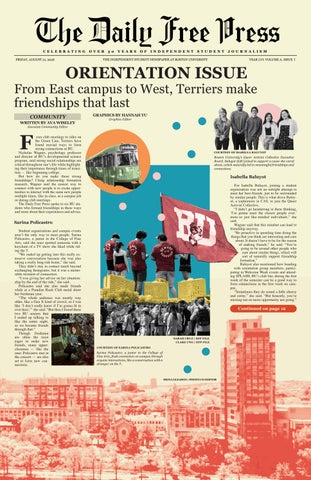
COURTESY OF ISABELLA BALUYOT
Boston University’s Queer Activist Collective Executive Board. Baluyot (left) joined to support a cause she cared about, which naturally led to meaningful friendships and connections.
Isabella Baluyot For Isabella Baluyot, joining a student organization was not an outright attempt to meet her best friends, just to be surrounded by similar people. This is what drove Baluyot, a sophomore in CAS, to join the Queer Activist Collective. “I didn’t go headstrong in there thinking, ‘I’m gonna meet the closest people ever,’ more-so just like-minded individuals,” she said. Wagner said that this mindset can lead to friendship anyway. “Be proactive in spending time doing the things that you think are interesting and care about. It doesn’t have to be for the reason of making friends,” he said. “You’re going to be around other people who care about similar things, which will sort of naturally support friendship formation.” Baluyot also mentioned how bonding with orientation group members, participating in Welcome Week events and attending SPLASH, BU’s club fair, during the first week of the semester can be a good way to form connections in the first week on campus. “Sometimes they do sound a little cheesy and corny,” she said. “But honestly, you’re missing out on more opportunity not going.”
Sarina Policastro Student organizations and campus events aren’t the only way to meet people. Sarina Policastro, a junior in the College of Fine Arts, said she once spotted someone with a keychain of a TV show she liked while riding the T. “We ended up getting into this really extensive conversation because she was also taking a really long ride home,” she said. They didn’t stay in contact much beyond exchanging Instagrams, but it was a memorable moment of connection. “I was giving her advice on her situationship by the end of the ride,” she said. Policastro said she also made friends while at a Paradise Rock Club metal show her freshman year. “The whole audience was mostly way older, like a Gen X kind of crowd, so I was like ‘I don’t really know if I’m gonna fit in over here,’” she said. “But then I found these two BU seniors that I ended up talking to like the entire night, so we became friends through that.” Though freshmen are often the most eager to make new friends, many upperclassmen — like the ones Policastro met at the concert — are also set to form new connections.
Continued on page 12
SARAH CRUZ | DFP FILE CLARE UNG | DFP FILE COURTESY OF SARINA POLICASTRO
Sarina Policastro, a junior in the College of Fine Arts, finds connection on campus through organic interactions, like a conversation with a stranger on the T.
SIENA GLEASON | PHOTO CO-EDITOR
2 1NEWS
BU’s new financial aid ‘Promise’ will meet demonstrated interest without loans CAMPUS
BY ELENA PEJIC
Associate Campus Editor
Boston University announced the “BU Promise” initiative Aug. 6, which will grant 100% of financial aid needs without loans for first-year domestic students. The program aims to increase transparency in financial aid packages and prevent finances from standing in the way of admitted students, according to BU’s financial aid website. “It’s really trying to make it much more easily understandable to create confidence,” said Rachel Lapal Cavallario, BU’s vice president of public relations. “Those are really the drivers … of family-first, student-first thinking to make sure that the program was clear to them at the outset.” Starting in the 2026-2027 academic year, all admitted firstyear students who are U.S. citizens will pay no more than $20,000 per year if their family makes under $200,000 a year and with typical assets, according to BU’s financial aid website. The new cost for qualifying students covers full tuition and a portion of standard housing and dining costs. The BU Promise also expands financial aid packages to households with lower incomes, as families that make under $75,000 can now receive a full ride education at BU. With the new promise, any student’s scholarship or financial aid package is met without loans starting this year. With the new program, students may still receive other scholarships or federal loans on top of their financial aid, the website states. BU’s financial aid program previously met a student’s entire “demonstrated need,” but sometimes included institution student loans.
The program follows a trend of private universities expanding their financial aid packages, including Massachusetts Institute of Technology, Harvard University and Tufts University, all of whom began offering full rides to students with under a $200,000 household income this past academic year. In an interview with The Daily Free Press last spring, BU President Melissa Gilliam explained that the University also completed its financial aid project during the past academic year, but did not initially announce it publicly due to “where we were in the admission cycle.” “We’re different than those schools,” Gilliam said. “We don’t have the endowment that they do, but we definitely have their same commitment to students.” BU students showed mixed reactions to the BU Promise, with several current students expressing disappointment that their financial aid packages are not updated to match the new policy for incoming students. Junior Owen Butler said the new program feels like a tactic to keep up with other schools in the area and increase application numbers. He would have liked to see the initiative apply to all BU undergraduates retroactively, he added. Butler said he chose to attend BU because of the financial aid package the University offered, but he has been “less than pleased” with the accommodations he’s been given. “BU is very generous with financial aid, but as a student who has gone through the financial aid processes on campus, the resources that they have are very sparse,” he said. “I just question if they have the capacity to truly take on a larger population of … students with financial need and if that’s really what they’re trying to do with this
SUMMER LAROSE | PHOTO CO-EDITOR
881 Commonwealth Avenue, the location of Boston University’s Financial Assistance office. BU is revising financial aid packages for newly admitted students who have family incomes under $200,000 a year, and the University will meet students’ scholarships or financial aid packages without loans.
new policy.” Sophomore Josh Eagle expressed frustration that only incoming students will reap the benefits of BU Promise, but said he sees the University’s efforts as a positive change for low-income families and the BU community. “Am I a little salty that it’s only incoming first years? A little bit,” he said. “But that’s like saying if a cure came out for some deadly disease and I had it and died from it, or a family member had died from it, that doesn’t mean I don’t want a cure to still be found.” Incoming freshman Kaylee Yau
said she would like to see more opportunities for international students to receive scholarships. “It is inherently a privilege to be able to afford higher education, and even more so to be able to do it internationally where the fees are higher,” Yau wrote in a message to The Daily Free Press. “I do however wish that BU gave more opportunities for scholarships or some form of financial aid, as the tuition as an international student is still … crazy expensive.” Nonetheless, many students see BU’s strides towards financial equality as a way to make the
University more inclusive and achievable to hardworking students worldwide. Incoming freshman Niku Joshi said that the BU Promise gives students a chance to think less about their financial situation when applying to college and more about what they could achieve inside the classroom. “I think it’s very good for BU as a whole,” she said. “I think it really gives students the proper opportunity to put aside financials and really focus on what schools they want to go to.”
BU announces new non-discrimination policy shortly after inauguration of new President’s Cabinet Positon CAMPUS
BY OLIVIA RUZIC AND AVERY FOX Campus Co-Editors
Boston University announced the finalization of a new NonDiscrimination Policy, which took effect August 1 and replaced the Interim Equal Opportunity and Title IX Policy. Manuel Cuevas-Trisán, the inaugural senior vice president for People, Belonging, and Culture, and Provost Colin Duckett sent an email to the BU community July 30, announcing the new policy. “Maintaining a safe, respectful, and inclusive community is a shared responsibility,” Cuevas-Trisán and Duckett wrote. “Every member of our community plays an important role in preventing, recognizing, and addressing conduct prohibited by the policy.” The new non-discrimination policy outlines BU’s position on discrimination, the policy’s scope, prohibited behaviors, the reporting process and resources for student pregnancy, pregnancy-related conditions, childbirth or parental or marital status. The announcement email emphasized the reporting framework, where any cases of discrimination, harassment, sexual misconduct and retaliation are eligible for review by BU’s Equal Opportunity Office. The policies and procedures fall
SUMMER LAROSE | PHOTO CO-EDITOR
Boston University’s West Campus. BU replaced its Interim Equal Opportunity and TItle IX Policy with a new Non-Discrimination policy and set of procedures Aug. 1.
under the EOO — it responds to reports under the policy and serves as a resource for students, faculty and staff. The EOO is “committed to maintaining processes that are fair, responsive and informed by evolving legal requirements, best practices and ongoing feedback from the BU community,” the email states. The changes reflect the University’s ongoing commitment to fostering a community where
everyone is treated with dignity and respect and “have the opportunity to learn, work, and thrive free from discrimination and harassment, including sexual misconduct,” according to the email. The Interim Equal Opportunity and Title IX Policy and procedures went into effect on Oct. 15, 2024. The interim policy addressed prohibited behavior in a framework structured around the 2020 Title IX regulatory framework, and
was generally limited to conduct occurring under a University education program or activity. The new policy addresses prohibited behavior reported outside of a University education program or activity if it fosters a hostile working, learning or living environment. Cuevas-Trisán became the new role of senior vice president for People, Belonging and Culture July 1, BU President Melissa
Gilliam announced in a May letter to faculty and staff. The year prior, Gilliam wrote in a June 2025 letter to faculty and staff that multiple administrative divisions would be “regrouped under a new unit that collectively focus on people and institutional culture,” effective July 1, 2025. “The role is an important part of the University’s commitment to building a World-Class Community of Talent, a key pillar and priority of BU’s Strategic Framework,” wrote Rachel Lapal Cavallario, vice president of BU Public Relations. Cuevas-Trisán’s new role will focus on building a more inclusive school culture among staff and students, and collaborating with Human Resources, Community and Inclusion, the Equal Opportunity Office and the Office of the Ombuds, Cavallario wrote. Cuevas-Trisán previously worked as vice president of human resources at Northwestern University, then Harvard University before his employment at BU. “We would like to thank the many individuals who contributed their time, expertise, and thoughtful feedback throughout the policy development process,” CuevasTrisán and Duckett wrote in their email. “Their efforts have helped strengthen the University’s commitment to equity, inclusion, accountability, and community well-being.”
NEWS 3
Boston leaders push to extend nightlife hours post-World Cup CITY
BY ANNA GOHMAN Associate City Editor
Boston city leaders are pushing to extend the city’s nightlife hours after a summer pilot program boosted revenue for businesses and attracted visitors during the 2026 FIFA World Cup. Restaurants and bars were allowed to apply for a 3 a.m. closing time and established designated outdoor public drinking zones until July 31. City Councilor Brian Worrell, who represents the Mattapan and Dorchester neighborhoods, as well as parts of Jamaica Plain and Roslindale, filed a home-rule petition at the June 24 city council meeting to authorize a 3 a.m. last call permanently in Boston. “At its core this [petition] is about recognizing that when attracting major events, supporting our hospitality industry, keeping young people here and creating a more vibrant city, we can have conversations about what that looks like,” Worrell said during the meeting. Councilor Julia Mejia, at-large city councilor and co-sponsor of the petition, added that expanding business hours will increase profit
for small businesses, provide more hours for workers and generate more revenue for the city. The proposal would impact bar and nightlife hubs, such as those in the Allston and Fenway neighborhoods that college students frequent when they return to campus. Ten of the 13 city councilors signed onto the petition, which offers a localized backup plan for the city as the statewide “fun agenda” currently in committee faces pushback in the House. Mayor Michelle Wu also supports extending the program, the City of Boston Director of Nightlife Economy Corean Reynolds told The Daily Free Press in an interview. The Massachusetts Senate tacked on a package of nightlife and cultural amendments, dubbed the “fun agenda,” to an over $500 million economic development bond bill on July 24. With two different versions of the bill passed in the House and Senate as of Aug. 20, the bill will go to conference committee. If passed, the bill would make the 3 a.m. closing option and social districts permanent, lift the state’s longstanding ban on happy hour discounts, allow businesses to sell alcohol before 10 a.m. on Sundays, create a state-level office of outdoor recreation and cap concert
ticket resale prices to improve affordability. Mejia said these changes to Boston nightlife would be especially impactful “considering that we are in economically difficult times.” A Boston Finance Commission budget and revenue analysis released on June 10 showed the city faces great financial pressures and declining revenues. These economic concerns have been raised to state officials on multiple occasions, according to the analysis, urging the need to “change the way the city does business.” During the recent pilot program, over 200 Boston businesses were approved by the Licensing Board to extend their hours. Reynolds said economic impact data collected shows an increase in consumer spending of around 80%. Over 50% of responding businesses also saw an increase in patrons and nearly 60% reported higher earnings compared with the same period the previous year, according to a Business Impact Survey released in July. Reynolds said participating businesses “were extremely favorable to the program,” seeing a significant increase in their revenue historically, not just compared to last summer.
JENNY CHEN | SENIOR PHOTOGRAPHER
Cathedral Station Sports Bar, in the South End. Boston politicians are motivated to expand the city’s nightlife scene after the 2026 FIFA World Cup brought increased revenue to businesses and boosted the hospitality industry.
“We’re really proud of being able to allow that to happen for our constituents and hope it can continue,” Reynolds said. Although the pilot program did not report any spike in public safety incidents or infractions, Reynolds said that if the bill passes, the Office of Nightlife Economy will work closely with the Boston Police Department to monitor and proactively address concerns, expand training programs in partnership with Boston EMS and continue to distribute resources such as drink covers.
“This is a cultural shift … so I think there will be some trial and error,” Reynolds said. “We will continue to equip businesses with the resources and the access to ourselves for training.” Larry Calderone, president of the Boston Police Patrolmen’s Association, wrote in a statement to The Daily Free Press that the union is against 3 a.m. last call requests. “The BPPA and our BPPA/ EMS brothers and sisters are completely against the proposed 3
Continued on page 10
Boston’s international students to face four-year visa caps, tighter regulations on extending stay CITY BY MADELINE CAMPBELL Associate City Editor
Boston-area colleges are bracing for the potential effects of new federal restrictions on their international student populations. Under a new federal rule effective Sept. 15, international students will face new limits on how long they can remain in the United States and additional hurdles to extend their stay. The Department of Homeland Security published a final rule July 17 replacing the long-standing “duration of status” policy for F, J and I visa holders, which include international students, exchange visitors and foreign media representatives working in the U.S. International Students were
SIENA GLEASON | DFP FILE
originally admitted into the U.S. for an unspecified length of time under the “duration of status” policy to accommodate for any changes in their course of study. Now, these groups are admitted until a set date by which visa holders must leave the country or apply for an extension. This fixed period of time is dependent on their program of study but cannot exceed four years. Boston University was among several higher education institutions that formally objected to the proposed changes, submitting a public comment to the DHS in September 2025. BU hosted approximately 12,000 F-1 students and 700 J-1 exchange visitors in the 20242025 year, according to the letter. “The proposed rule would hurt our international students and scholars, who are vital members
Boston University International Students and Scholars Office. The Department of Homeland Security passed a new federal rule that will further restrict international students in the United States, effective this September.
of the BU and U.S. community, undercut our ability to attract and retain the best talent in the world, and hold back our country’s economy and global competitiveness,” the letter states. The extension of stay requests are more restrictive, requiring students to go through both their schools’ designated officials and U.S. Citizenship and Immigration Services for requests, applications, fees and to submit biometrics. The new policy will also further regulate international students’ ability to change degree programs and transfer to different higher education institutions. Additionally, it will halve the 60day departure period previously granted to international students. BU has one of the largest international undergraduate populations in the Boston area, ahead of the Massachusetts Institute of Technology, Northeastern University and Harvard University’s enrollment. The University enrolled 3,676 international undergraduates in Fall 2025, according to its 2025–26 Common Data Set, representing about 20% of the undergraduate student body. The school also enrolled 12,845 total international students between undergraduate and graduate programs in 2024, according to the International Students and Scholars Office. BU ranked behind Northeastern, which enrolled over 25,000 students that year. “A United States Citizenship and Immigration Services officer, with no knowledge of the
specialized fields in which our international students study or our international scholars teach and conduct research, would decide whether to issue an extension of stay,” BU’s letter states. “This would inject uncertainty into the work of scholars and the academic careers of students, including those who wish to engage in postcompletion Optional Practical Training.” The letter also criticized the four-year limit, noting its median PhD completion time was 5.72 years, identical to the national average. BU’s MD/PhD program requires at least seven years, the letter states. Students would need to apply for extension to finish programs on the normal timeline, which could impose as much as $304.3 million annually in fees, time and assistance costs on the affected international community, the letter states. These costs do not include Student and Exchange Visitor Information System, visa and employment-authorization fees. Since DHS finalized the rule, universities in the Boston area have been working to keep previously enrolled and incoming international students up to date with the changes. According to BU’s ISSO, the University has been communicating directly with international students and will continue to send any updates, information sessions or new resources to them via email. Rachel Lapal Cavallario, BU’s vice president of Public relations, said the ISSO has hosted multiple
town meetings since the rule was finalized. One of these town halls had over 500 attendees, she said. Cavallario said the meetings are intended to connect with the community, support students and provide them with the opportunity to ask questions. The ISSO is slated to host more town halls from now until late October to address specific student populations, such as undergraduate and graduate students. The ISSO website also highlights other resources for international students, such as the BU Support Pathways resource hub. BU offers free and confidential meetings with immigration attorneys and refers students to Student Health Services and other resources for mental health for stability during uncertain times, according to the website. Following the release of DHS’ final rule, MIT sent an email to their international student population on July 24 with resources to stay updated and informed on changes to their status. “There are still a number of questions to be answered that will depend on communications/ guidance from various U.S. government agencies prior to the implementation of these changes,” the email from MIT reads. Additionally, MIT’s International Student Office created a webpage dedicated to updates, general information and frequently asked questions, and it
Continued on page 10
412FEATURES
BU School of Theatre’s upcoming season celebrates, interrogates America’s 250th anniversary ARTS BY BEN SIEGEL Associate Arts Editor
Over 250 years ago, in 1773, the people of Boston hauled tea over the hull of three boats in the Boston Harbor. Replicas of those ships, the Freedom Trail and historic locations like the Old State House make Boston uniquely situated to celebrate America’s 250th birthday. But at Boston University’s School of Theatre, students can go beyond the tourist attractions to celebrate — and interrogate — the country’s history. Designed to correlate with the country’s anniversary, SOT’s 20262027 season follows the theme “American Genius,” with each project exploring the diversity and creativity of American voices. The theme stretches from works by some of the country’s most celebrated playwrights to a German opera. “[The theme] is meant to be intentionally broad … and maybe even shake up the canon a little bit about what we usually see on American stages,” SOT Director Kirsten Greenidge said. One of the fall productions, scheduled for October, is Branden Jacobs-Jenkins’ “Everybody.” Greenidge pointed to JacobsJenkins, a two-time Tony Award winner, as an example of her interest in giving students the opportunity to work with plays by prominent living writers from the United States. In November, students will perform “The Sign in Sidney Brustein’s Window” by Lorraine Hansberry, who is best known for her 1959 play “A Raisin in the Sun.” “The Sign in Sidney Brustein’s Window” allows SOT to engage with the work of an American writer through a seldom produced
COURTESY OF RODRIGO LARIOS VIA MADDIE SEBASTIAN
Boston University’s School of Theatre’s 2026 production of Medea. This season, SOT will follow the theme “American Genius,” celebrating the nation’s 250th birthday and exploring the diversity of American voices.
piece, according to Greenridge. The play follows a group of characters navigating the political and cultural climate of 1960s New York, examining American idealism. The season also includes “Violet,” a musical by Jeanine Tesori and Brian Crawley that will be directed by MFA directing student Shira Helena Gitlin. The show follows a young woman traveling through the American South in the 1960s hoping that a televangelist can heal her facial scar from a childhood accident. “She goes on this journey that is very akin to a religious journey or a pilgrimage,” Gitlin said. “[She] starts to experience the larger world outside of her small town, where she’s able to get a better sense of who she is and also face her own demons and her own past.” Throughout the season’s selection process, Gitlin said, the
SOT aimed to find voices that spotlighted the “diverse spectrum” of people in America. Violet’s journey unfolds towards the end of the Jim Crow era and beginning of the Vietnam War. “Race comes into play there — something that I think has been obviously very, very integral to the American story,” Gitlin said. The “American Genius” theme will also apply to SOT’s longtime collaboration with BU’s Opera Institute. During the annual Fringe Festival, the two programs present “fringe” — or rarely performed — works in unique, smaller settings. “We have young singers working with young designers, people who are all going to be venturing out into the world and making their professional lives together, so it’s special to be able to mentor different types of students in these projects,” said Nathan Troup, a BU
professor who will direct one of this year’s operas. “It’s also great to see them collaborate with their peers.” The Fringe Festival’s smaller setting gives audiences a more intimate introduction to opera than a traditional large-scale production, which can be a more accessible experience for those new to the genre, Troup said. “You experience a certain type of electrical charge from the performance when you’re really sitting that close and can see the actors thinking,” he said. Troup will direct Kurt Weill and Bretolt Brecht’s German work “The Seven Deadly Sins.” The sung ballet follows Anna, a young woman who leaves her family and travels across seven American cities using her talents to make enough money to build a home. The character is divided between
Anna I, who sings, and Anna II, who dances. Troup’s production will use the two Annas to explore different versions of the character over the course of her journey — a journey that “serves as a counterpoint to the American dream,” he said. Alongside the season’s dramas, Assistant Professor of Directing Jim Fagan will bring together several Christopher Durang comedies for a night of one-acts staged in one of SOT’s rehearsal halls rather than a theater. Greenridge said the comedies are new for the previously dramadriven program, an answer to student requests for more comedic works. Whether it’s a comedy, drama or opera, SOT’s productions give audiences an opportunity to see high-quality theater in a college setting, Gitlin said, pointing to program graduates who have gone on to work in the Boston theater scene and on Broadway. “The talent levels are just absolutely peak,” Gitlin said. “This is a really great opportunity to see some of these plays and some of these artists before they really hit it big.” The “American Genius” theme extends into the spring semester, which will include shows like the folksy play-with-music “The Old Man and the Old Moon” and the haunting opera “The Rape of Lucretia,” among others. Through various dramatic, comedic and musical works of playwrights both alive and dead, the SOT’s “American Genius” lineup explores themes ranging from mental illness and sanity to race and class to further investigate different American experiences. “We have a really vibrant season,” Greenidge said. “There’s tons to choose from, no matter what you might be excited about.”
How do Questrom students feel about the school’s expansion of AI-focused programs? BUSINESS
BY CARINA MCCALLUM Associate Business Editor
The world of business is being reshaped by rapid developments in artificial intelligence, and institutions like Boston University are working to keep the pace. As part of its push to lead in information technology, the Questrom School of Business is launching its new online Master of Science in AI in Business. According to the program’s website, Questrom is scheduled to welcome its first cohort into the program in Fall 2026. The fully online and asynchronous program is designed to be completed in two years and costs $25,000 for total tuition. The curriculum focuses on AI strategy and responsible adoption for business leaders and aims to teach leaders to translate experimentation with AI into concrete business strategy and structured execution, the site’s homepage explains. “We built this program to meet the moment. There is a lot of excitement and noise around AI — this program is designed to help you harness its power to succeed in business,” wrote Paul Carlile, senior associate dean at Questrom, in a Boston University Virtual article about the program. Across BU, graduate colleges are incorporating AI into their respective curriculums. For example, in the Wheelock College of Education and Human Development, another online
master’s program teaches educators how to most effectively use AI in the classroom. For some business students, Questrom’s enhanced technological integration is a welcome change. Urja Joshi, a junior pursuing a dual degree in business and data science, is the president of the BU Entrepreneur’s Club. Joshi said the club is increasingly leaning toward an AI-focused teaching interface. “It’s the need of the hour, honestly,” she said. “If there’s specifically something like a master’s program to facilitate that, that’s very forward of BU. It’s awesome.” For Joshi, AI was a crucial consideration while planning her degree path. AI’s future effects on business industries were the primary reason she decided to pick up the dual degree in data science, she said. “Having a good technical edge is so important in the job market these days,” Joshi said. While she may wait before pursuing a program like the new master’s, an MBA involving AI would interest her, she said. Sierra Isbill, a Questrom sophomore with a concentration in marketing, shared Carlile’s sentiment. “It’s really good for Questrom to be implementing AI, especially in their future programs, because it’s going to affect the job world so much,” Isbill said. Though, while she believes AI integration could be beneficial for Questrom, she is slightly apprehensive about over-relying on the technology, she said.
“[There] has to be a balance between the old and the new and not relying on AI technology for everything when it comes to our educational programs, especially within Questrom,” she said. Isbill said Questrom’s multifaceted approach to incorporating AI was a strong suit but that the ethics surrounding AI should also be considered as the college increasingly integrates it into curriculum. As BU’s administration encourages a “critical embrace” of AI in its schools and colleges, RACHEL FEINSTEIN | DFP PHOTOGRAPHER faculty have a variety of views on its value in People walk into the entrance of Boston University’s Questrom School of Business. Questrom is introducing an online Master of Science in AI in Business, starting this fall. the classroom. BU School of Law to have programs that keep up with of ethical issues, he said. professors Woodrow Hartzog and what is currently relevant in the Questrom’s diversity could Jessica Silbey published an article business world. be a unique strength regarding stating AI “destroys institutions.” “It is always exciting to see a implementing technology into Meanwhile, Aimee Christian, plethora of opportunities, especially a professor of the practice in ones that are trying to be innovative curriculum, he added. public relations in the College of in a space that is rapidly evolving,” “We pull people from all over Communication, said in an article the world, so we have a very for the college that she hopes he said. O’Sullivan also agreed that amid unique perspective about how we students view AI as an “important, expansion, being mindful of ethics could best utilize the technology if not vital” part of future work. Jack O’Sullivan, a senior is important. While Questrom’s in a plethora of countries and studying business administration in programs should reflect what’s communities,” O’Sullivan said. “I Questrom and film and television going on in broader society, they in COM, said that for Questrom to should also be “cognizant of think that’s really a differentiator remain competitive, it is important different guardrails” and mindful that we have.”
FEATURES 5
‘Research is for everyone’: BU undergraduates find research opportunities from pipettes to poetry SCIENCE BY RAYAN KHAN Associate Science Editor
With over 1,500 laboratories, formal research plays a crucial role in the fabric of Boston University. Students in areas of study ranging from biochemistry to art get to do impactful work while learning from experts in their respective fields. The opportunities are seemingly endless — but what does research actually look like at BU? How do you find a lab? For many incoming freshmen, the task of finding these opportunities can seem quite daunting. However, the path to a lab can look different for each person. Matthew Jung, a rising sophomore studying neurobiology in the College of Arts and Sciences, found his way to a lab when a front desk assistant in the biology department mentioned a National Science Foundation program to him. He said he applied to BU’s Summer Undergraduate Research Fellowship, which is funded by the National Science Foundation’s Research Experiences for Undergraduates program in March. After applying and waiting several weeks, Jung said he landed a spot in a lab on the BU Medical Campus for the summer, which will continue through the fall. “The lab I’m working in is studying microglia, which are the resident … immune cells, of the … brain and the spinal cord,” Jung said. “Specifically, we are dealing with Alzheimer’s disease.” Over the summer, he said his
COURTESY OF HOPE AYIM VIA MATTHEW JUNG
Matthew Jung, a Boston University student in the Undergraduate Research Opportunities Program, works in a lab on the BU Medical Campus. Undergraduate research at BU spans every discipline, from the arts to STEM.
days started at 8 a.m. and often stretched into the evening. He commuted by BU Shuttle to BUMC, spent hours looking into
a microscope, and drafted papers and presentations toward the end of the program. “It’s a lot of sitting at your
computer for hours and just like changing the parameter a little bit,” Jung said. “It pretty much amounts to just a figure of a paper, but it takes a lot of time.” Nonetheless, he said he feels that he is making an impact by helping produce something that might assist others. He said a “special thing” that happened over the summer was contributing to a published research paper. “There’s definitely a stigma of [going] into research and maybe you don’t even do much for a whole semester. You’re just mixing solutions or processing data,” he said. “But it all amounts to something bigger.” However, the path to research placement is not always through an application, and not all research takes place in a science lab. Senior Sophia Tang, a computer science major in CAS, said that her pursuit of research rose from her desire to fill gaps in her education. While BU does offer ethicsrelated courses under the Faculty of Computing and Data Sciences, Tang said that she felt that the CS major “has no space for you to talk about” AI ethics, prompting her to look for an extracurricular. Tang said she first got interested in the topic after attending a lecture from a CDS professor on the lack of ethical standards in AI research. After emailing Pol Pardini Gisbert, a philosophy PhD candidate on the leadership team of the Humanities and Artificial Intelligence Lab, Gisbert invited her to join HAIL as a student research member. HAIL is a student group built around weekly discussions of AI ethics to form a collective opinion
about it, Tang said. “Even if you have less knowledge on one side, someone else is going to help with that,” she said, adding that the diversity of experience in HAIL makes it a unique opportunity. Melissa Johnson, director of the Undergraduate Research Opportunities Program, said she helps connect students with funded, faculty-mentored research in any discipline, not just STEM. Her advice for students who are struggling to get involved with research is to not give up, even if they do not initially get a response from a faculty member. “Being persistent is really important here because BU does have a lot of opportunities, but they also have a lot of students,” she said. In her January presidential address, BU President Melissa Gilliam laid out a “North Star” vision for the University’s future and emphasized the importance of interdisciplinary and convergent research to solve complex problems. “Convergence is the key to who we are, and who we can be — it is our North Star,” Gilliam said. Johnson said what surprises students most is the interdisciplinary approach to research at BU. She said she has worked with students researching lighting design, building databases around 11th-century Japanese poetry and studying the J-Pop industry. “Research is for everyone,” she said. “And research is happening in every discipline.”
612PHOTO
Bostonians soak up the late summer sun GALLERY BY SUMMER LAROSE Photo Co-Editor
AND JENNY CHEN Senior Photographer
Boston residents are escaping the August heat at the city’s oceans and ponds as the end of summertime grows near. Squirrels joined swans at the Boston Common, while wooden elephants walked along Commonwealth Avenue — soon to be joined by BU students. JENNY CHEN | SENIOR PHOTOGRAPHER
A cyclist rests on a dock along the esplanade, gazing across the Charles River.
SUMMER LAROSE | PHOTO CO-EDITOR
A food stand patron places some cash in the tip jar on a warm afternoon at the Common. JENNY CHEN | SENIOR PHOTOGRAPHER
SUMMER LAROSE | PHOTO CO-EDITOR
Two people look at prints displayed for sale at SoWa Open A Boston Common squirrel snacks beneath the shade of a tree while a Market, examining the artwork along a row of vendor booths. swan boat drifts along the pond.
JENNY CHEN | SENIOR PHOTOGRAPHER
A plane flies over Pleasure Bay Beach in South Boston as beachgoers soak up the sun.
JENNY CHEN | SENIOR PHOTOGRAPHER JENNY CHEN | SENIOR PHOTOGRAPHER
Visitors pose for photos with handcrafted elephant sculptures along Commonwealth Avenue Mall.
Customers line up to order frozen treats from a Frosty ice cream truck outside of the Boston Public Garden.
JENNY CHEN | SENIOR PHOTOGRAPHER
People line the outdoor courtyard of the Boston Public Library, enjoying the shade.
SUMMER LAROSE | PHOTO CO-EDITOR
Visitors snake through a herd of wooden Commonwealth Avenue Mall in Back Bay.
elephants
SUMMER LAROSE | PHOTO CO-EDITOR
on A member of Friends of the Public Garden, an advocacy group for Boston’s public parks, pauses his maintenance work to gaze out at the pond.
OPINION137
OPPOSING OPINIONS
The Hub’s problems are real, but so is its value COLUMN BY VELANA VALDEZ
Opinion Co-Editor
Like many students, I’ve had my fair share of criticisms of Boston University’s Hub curriculum. No one is denying that this program has been far from perfect since its creation in 2018. Sometimes I find myself questioning unclear course attributes or wondering why a required class won’t count towards my major. Regardless of the complaint, the reaction is a valid one, and Hub organizers themselves don’t deny the challenges it brings to students. Before we write off the framework entirely, however, it is worth asking whether we fully appreciate how and why it works. Beneath the administrative complexity lies a system with considerably more merit than its reputation suggests. Rather than forcing students through a rigid, prescribed checklist of traditional general education courses, the Hub replaced standard distribution requirements with flexible “capacities.” It intentionally encourages crossdisciplinary exploration, enabling students to gain credit for broader intellectual interests without sacrificing their degree timeline. Because many of BU’s near 2,000 Hub-approved courses carry multiple units (a figure that consistently surprises faculty at peer schools, where general education offerings rarely exceed 100 to 200 options) most undergraduates fulfill their 26 requirements within just 10 to 12 classes by strategically overlapping courses. Beyond this structural convenience, the Hub also aligns directly with what post-graduate success often demands. A report from the Association of American Colleges and Universities demonstrates that more than nine in 10 employers prioritize broader skills such as critical thinking, teamwork, ethical reasoning and cross-functional communication over rigid specialization. With fewer than 30 percent of college graduates remaining in their major’s exact field long-term, transferable adaptability is no longer a luxury, but rather the baseline requirement
of a dynamic contemporary career. Interdisciplinary programs such as BU’s Cross-College Challenge exemplify this value, frequently providing students with the hands-on exposure necessary to pivot career trajectories before entering the workforce. The Cross-College Challenge program is a distinctive, project-based course that brings students from different majors and undergraduate schools together to tackle real world problems, making it a relatively rare opportunity for truly interdisciplinary, hands-on learning. Perhaps its most important attribute, the Hub was constructed with an evolving framework in mind. With mandatory fiveyear review processes built into its charter, faculty continually evaluate course effectiveness, adjust requirements and consult direct student feedback — particularly with BU Student Government — which makes the Hub incredibly receptive to student needs. Simultaneously, the Hub pushes instructors to explicitly articulate which skills students gain, sharpening courses into a more intentional, studentcentered practice. Student grievances regarding major symmetry and credit distribution deserve ongoing attention and refinement. Yet, evaluating the Hub purely as an inconvenient hurdle misses its foundational purpose. It exists to break down academic silos, cultivate versatile skills and foster lifelong engagement with a complex world. While imperfect, the Hub remains a deliberately constructed tool designed to serve us long after we leave campus.
The problems with the Hub go far beyond BU’s curriculum COLUMN BY ADA SUSSMAN Senior Writer
Boston University’s Hub curriculum has been advertised as alternative and innovative means of satisfying the much-disdained prerequisites of broader general education requirements, but this marketing has not prevented it from being an object of torment to many BU students. Despite its re-articulation of general education requirements to fit into both a pedagogicallyagnostic r o l e and
to maintain a reputation of academic rigor, the Hub curriculum, anecdotally, is met with the same collective groan as many general education programs are around the
HANNAH YU Graphics Editor
country. BU students cite a variety of reasons for disliking the program, despite its marketed revolutionary approach to general education — primarily, how its requirements map onto some degree programs better than others, stacking the deck towards specific programs in terms of ease of completion.
But critiques of the Hub curriculum, and general education at large, have less to do with the specifics of each individual attempt at rounding out a student’s experience in their undergraduate education, and more with the ever-morphing expectations of a college degree, especially one from an elite university. Every college student will find a gripe with the program they are required to complete because that is the nature of completing hard tasks. No, the real issue involves the increasing expectation of the return investment of a college degree, and the increasing anxiety that there simply won’t be a return at all. As the job market seems to steadily grow bleaker and bleaker, the value of education in and of itself has floundered in the face of the ever-escaping promise of the opportunity that it grants. In the mind of a student who has chosen their academic path based purely on a projected baseline salary — a valid and increasingly popular motivation for undergrads — Hub requirements may just be seen as a box to check, an annoying requirement that deserves little effort and should be overcome by the path of least resistance. But, while understandably rationalized considering the world’s increasingly rampant career anxiety, this logic belies the value of an interdisciplinary education in and of itself. When we devalue education, we dehumanize ourselves. We bury every possible seed of curiosity to see our learning as a market transaction. We reproduce the mindset of the workplace, and make educating ourselves a passively performed task with an quantifiable economic output. We also unconsciously endorse the state of the education system at large, one that continuously reproduces an apparatus of inequality, by devaluing the process of learning. The Hub can morph as much as we want it to, but as long as students are forced to evaluate their education as purely transactional, thanks to BU’s absurd price tag, that value of an education as both an individually fulfilling and liberatory practice will fall by the wayside.
A shield for sources is a shield for democracy EDITORIAL When a source decides to speak to a journalist, the stakes can be far greater than whether their name appears in print. A government employee exposing misconduct could jeopardize their career. A university employee could face retaliation. A survivor sharing a traumatic experience could put themselves in harm’s way. For journalists, the ability to protect that source can determine whether the story gets told at all. That is the purpose of a shield law. These laws protect journalists from being compelled by the government to reveal confidential sources or unpublished reporting materials, preserving the trust between reporters and the people who provide them information. Massachusetts, however, remains one of only nine states without a statutory shield law, making the commonwealth a national outlier.
The Massachusetts Senate’s recent passage of shield protections on Aug. 6 is an important step in the right direction. Under current state law, state courts decide reporter privilege case by case, balancing source protection against a litigant’s need for information. What’s more, the Supreme Judicial Court has never formally recognized a reporter’s privilege. For journalists, this is a compromising position. Shield protections do more than prevent subpoenas. They provide journalists and their sources greater certainty that confidential information will remain private, preserving the trust that encourages sources to come forward in the first place. Relationships between reporters and their sources are built on trust, and the promise of a secure exchange of information is essential to building that trust. Sources must feel confident that what they share with journalists will not expose them to retaliation or be revealed without justification. Without that confidence, sources may choose not to speak, cutting journalists off
from information they need to hold es. institutions and people in power acIf the public recogcountable. nizes that there are The Daily Free Press has encoun- legitimate circumtered this firsthand. In our own re- stances for anonporting, sources have requested ano- ymous sourcing, nymity because they fear retaliation and more by our university’s administration. If Boston University faculty and r dito cs E staff feel the need to protect their phi a r |G identities when speaking with YU AH sourcstudent journalists, imagine N N HA es are seeking the pressure facing a government official considering whether to anonymity to protect themdisclose critical information about selves from retaliation, the law systemic misconduct or abuses of should reflect that sentiment by protecting the relationships between power. Anonymous sources are not an journalists and the sources who deanomaly in journalism. Journal- pend on confidentiality. Protecting sources becomes ists regularly rely on confidential sources when those sources face even more crucial when dealing professional, personal or physical with sources who have experienced consequences for speaking public- trauma. As the Global Center for ly. While critics often assume that Journalism and Trauma notes in its confidentiality weakens journal- guidance, protecting sources from ism’s credibility, the public large- harm is an important principle of ly disagrees. The Pew Research trauma-informed journalism. For survivors of abuse, trafficking, Center found that roughly 80% of U.S. adults believe there are circum- war or other traumatic experiences, stances in which it is acceptable for a journalist’s ability to promise anojournalists to use anonymous sourc- nymity is not only essential to main-
taini n g trust with a source, but can also be critical to protecting them from further harm. Exposing corruption and abuses by those in power has historically been one of the press’s most important roles. Whether that power sits within an institution like BU or the U.S. government, journalists rely on sources willing to speak from within. Protecting those relationships gives journalists a secure
Continued on page 8
814LIFESTYLE
A Massachusetts shield law is needed Seven Spots for Editorial continued from page 7
channel to information that institutions may otherwise have little incentive to make public, strengthening the press’s ability to demand transparency from those in power. These protections are especially important at a time when public trust in journalism is strained and journalists face increasing hostility for doing their jobs. The answer to declining trust cannot be to weaken the relationships that allow journalists to report the truth. That need is even more apparent as the Trump administration has continually tested the boundaries of press freedom and free ex-
pression. A functioning democracy depends on an independent press that can scrutinize those in power, including when the information it uncovers is uncomfortable or politically inconvenient. Shield protections are not a partisan safeguard or a special privilege for journalists. They are a fundamental protection for the free press. In a time when both press freedom and public trust are under strain, Massachusetts must recognize shield protections as a necessary safeguard for a free press and a functioning democracy. This Editorial was written by Opinion Co-Editor Kai Godwin.
A Fan Edit of Boston BY AVA MALAMUT Lifestyle Editor
One of the perks of moving to a major city is having a blank slate. Boston has so much to offer, and there is plenty of media to cover its many facets. If asked to make a fan edit of our fair city, these are the essential pop culture pieces of the puzzle.
Music
It would be disgraceful to not include the song “I’m Shipping Up to Boston” by the Dropkick Murphys, an Irish jig meets rock tune that is best hummed along to near Fenway Park or TD Garden. If pop music is more your speed, Kaleb Cohen’s “Boston” or Stella Lefty’s song of the same name are both danceable, upbeat love songs. While a solid chunk of Noah Kahan’s discography references New England, his song “Staying Still” references multiple iconic Boston locations, such as Logan International Airport, Storrow Drive and the Charles River. Finally, as Boston University students, “Hey Baby” by DJ Otzi is a must-have for any hockey game, and it will get stuck in your head no matter what.
Movies
If you’re on the right side of TikTok, some of the best edits are movie and TV show clips. From docu-drama to romance to action to tear-jerkers, Boston is the setting or filming location of plenty of Letterboxd favorites. Starring Massachusetts unofficial spokespeople Matt Damon and Ben Affleck, “Good Will Hunting” is a must-see drama about a genius janitor helped to reach his full potential. If you are more in the mood for a historical docu-dramas, the 2015 film “Spotlight” starring Mark Ruffalo, Michael Keaton and Rachel McAdams would be the pick. It follows an early 2000s team at the Boston Globe working to provide proof of a cover up by Boston’s Catholic Church to force confession of wrongdoing by a priest. In the same decade, Facebook was invented by then-Harvard student Mark Zuckerberg and several peers, a story conveyed in the film “The Social Network.” Leave your Prada at the cleaners and come back when you understand the reference. Sometimes you just want to watch some dramatic action, with a side helping of gore. “Boondock Saints” is the perfect choice. This action/thriller follows two Irish Catholic brothers who feel called by their faith to cleanse Boston’s crime scene through controversial vigilantism. For a somewhat sad, but mostly romantic palate c l e a n s e r, pivot to
“Love Rosie,” a friends-to-lovers story starring Lily Collins of “Emily in Paris” and Sam Claflin of “Daisy Jones and the Six” and “The Hunger Games.”
TV
TV shows by nature produce more content, and therefore have more to edit and appreciate. “Cheers,” a show from 1982-1993, follows a group of friends hanging out in a basement bar, perfect for fans of “How I Met Your Mother.” If law dramas like “Suits” are more engaging to you, check out “Ally McBeal,” a series about a young woman who joins a law firm with a wild staff. While not taking place in Boston specifically, some New England-based shows had to make this list. School in New England, especially in fall and winter, must be paired with a seasonal rewatch of “Gilmore Girls.” This show about a small-town mother/daughter duo is a lifestyle and a rule. While not in Boston, the fictional town of Hastings is the setting for the “Off Campus” hockey romance series, and main character Garrett Graham is a major Boston Bruins fan.
Books
Off Campus is based on a series of books, and has spinoff series “Briar University” and “Campus Diaries,” all of which take place in and around Boston — if you would rather read than watch this rom-com. Author Elle Kennedy is not the only romance author to focus on Boston, however. Ali Hazelwood, known for her STEM romances like “The Love Hypothesis,” wrote the romance “Love Theoretically” about rivals-to-lovers physicists. The main character even works as an adjunct professor at BU. While love is certainly one aspect of this book, Lily King captures many more feelings along the journey of her protagonist in “Writers and Lovers.” This contemporary romance follows a character navigating a new stage of life in a new setting, specifically Boston and Cambridge. Coming-of-age and internal conflicts also run rampant in Boston-set “The Bell Jar,” a semi-autobiographical novel by Sylvia Plath. Should her brand of dark storytelling be your cup of tea, perhaps try the thriller “Mystic River” by Dennis Lehane, where the tragic murder of a teenage girl unites three childhood friends — her ex-convict father, the last person to see her alive and the homicide detective on the case. No matter your genre preference or favorite media type, there are plenty of options to see Boston through a different lens. As you become a fan of this city, pop culture and media can be a guide to tourist spots, local favorites and city life. When you’re ready to expand the list, return to this section of The Daily Free Press.
Your New Favorite Sweet Treat BY KRISTINA CAHALY Associate Lifestyle Editor
For many people — and for me personally — dessert is the best part of a meal. When arriving in a new city, it can be hard to find the best places to grab a sweet treat. As someone who’s lived in the greater Boston area for my entire life, I’ve tried a variety of dessert options around the city, and here are a few of my favorites. Lil Sweet Treat - Newbury St., Back Bay Lil Sweet Treat has many locations across the country, with their Boston location on the ever-popular Newbury Street. They sell a “pick ‘n’ mix” candy style — not unlike the viral candy salads — where you grab a bag and scoop as much, or as little, of each candy as you’d like, before weighing your bag at the checkout counter. Their selections rotate as supplies run out — usually every one to two weeks — and their candy is sourced from various European countries. Due to their rotating options, it’s nearly impossible to get bored. To keep up with their weekly specials, you can follow them on Instagram at @lil.sweet.treat. Lindt - Copley Square, Back Bay Although Lindt is a worldwide chocolate brand, which can be found in most grocery stores, the Lindt store in Copley Square takes their famous chocolate and turns it into a more special experience than grabbing a bag off a shelf. Just like Lil Sweet Treat, Lindt Copley has pick ‘n’ mix-style truffles, available in many more flavors than what most grocery stores carry, including seasonal specials. Along with the selection of their chocolate truffles, they also sell chocolate bark and chocolate gift boxes. I’ve enjoyed Lindt chocolates since I was really young, when my grandmother gave me one at 4 years old — and when I walked into the Lindt Copley store for the first time at age 17, I felt like I was in chocolate heaven. You can check out some of their offerings on Instagram at @ Lindt_USA. Various Stands - Eataly, Prudential Center, Back Bay Located in the Prudential Center in Back Bay, Eataly is an Italian marketplace featuring a grocery store and several restaurants and food stands. I definitely recommend checking out their restaurants, but they also have many dessert options at a variety of food stands One of my favorites is their gelato. Given the warm weather we’ve had in Boston lately, it’s a very refreshing treat. Another one of my other favorites is their bomboloni, which are Italian stuffed donuts, and Eataly has custard-filled or chocolate-filled varieties. They’re very fluffy, and the filling ensures they’re not too dry. You can visit them on Instagram at @eatalyboston. Frozen Greek Yogurt - Saloniki, Various Locations Saloniki has various locations around Boston, but their three locations that are closest to Boston University are located in Fenway, Newbury Street and their newest storefront in Allston. Along with serving Greek and Mediterranean cuisine, they serve frozen Greek yogurt, and just recently opened a frozen Greek yogurt takeout window at their Newbury Street location. Their frozen yogurt doesn’t taste like the traditional type you’d find at a self-serve store, but rather has a slightly sour undertone, which balances out the flavors of their toppings. There are a few topping combinations to choose from, such as Dubai chocolate, caramel pistachio, olive oil and sea salt, sweet matcha and my personal favorite, sour cherry. I haven’t quite mustered up the courage to try the olive oil and sea salt yet, but the sweetness of the cherries matched with the tartness of the frozen Greek yogurt makes the sour cherry a must-have. The toppings include pieces of cherry, along with cherry-flavored syrup, ensuring there’s flavor in each bite. To
see their locations and popular items, check them out on Instagram at @ salonikigreek. Loukoumades - Greco, Various Locations Continuing with Greek desserts, the loukoumades — lightly fried Greek donut holes served warm with various toppings — at Greco are a great grab- a n d - g o treat. Greco has various locations around Boston, with the nearest one to BU being on Newbury Street. Along with serving my favorite Greek food in Boston, Greco serves these loukoumades with your choice of honey and walnuts or chocolate sauce and Oreos. I’ve personally tried both, and both were great, but my favorite was the combination of Oreos and chocolate — known as Yia Yia’s. To see these treats as well as their savory menu, check out their Instagram page at @greco. Bova’s, North End The North End has many famous bakeries, sparking the eternal debate over which serves the best cannoli, a Boston staple. Although Mike’s Pastry and Modern Pastry are also great options, my favorite is Bova’s. It feels more like a local stop than a large tourist attraction. I did a more in-depth comparison of the three last April for The Daily Free Press, so I’ve put a good amount of thought into this conclusion. When I was younger, I have many fond memories of standing in the streets of the North End, and as all of us debated which bakery to go to, I passionately shared my desire to go to Bova’s. Bova’s has a variety of cannolis outside of the traditional options, boasting flavors such as créme brulée and peanut butter. Along with cannolis, Bova’s has a variety of equally-delicious options, including cookies, calzones and “bricks” — a two-layered, square-shaped cake. To make things even better, you can get these on any day, at any time, as Bova’s is open twenty-four-seven. You can stay updated on their offerings and specials at @bovasbakery on Instagram. Taiyaki NYC – Seaport Last, but certainly not least, Taiyaki NYC in Boston’s Seaport serves fish-shaped ice cream cones, which you may have seen on your social media. They can be filled with red bean paste or custard, and you can choose from various ice cream flavors, such as chocolate, matcha, mango and more. They offer a variety of toppings, ranging from sprinkles to mochi bites. Taiyaki ice cream cones provide a highly customizable ice cream experience, meaning you can go back many times, and try something different each visit. The first time I went to Taiyaki NYC was as a junior in high school, after my first time at Snowport, Seaport’s winter festival. After that, I practically begged to stop there anytime we went to Boston. Although I spent a while testing different combinations — four years to be exact — I now have two go-to orders, depending on what I’m in the mood for. Both start with a custard-filled cone, and one has vanilla ice cream, strawberry drizzle, sprinkles and mochi bites, while the other is strawberry-mango swirl, typically with the same toppings. Even in Boston’s colder weather, Taiyaki ice cream always hits the spot. They can be found on Instagram at @taiyakinyc. There you have it — my favorite desserts around Boston, just to name a few. Of course, there are many different desserts to try in the area, and this is just a small list of the many, many options you have in the city.
GAMES159
EDITORIAL BOARD THE INDEPENDENT STUDENT NEWSPAPER AT BOSTON UNIVERSITY YEAR LVII. VOLUME A. ISSUE I. Published Friday, August 21, 2026. The Daily Free Press is published Sunday through Thursday during the academic year, except during vacation and exam periods, by Back Bay Publishing Co., Inc., a nonprofit corporation operated by Boston University students. Copyright © 2026 Back Bay Publishing Co., Inc. All rights reserved. Emma Clement, Editor-in-Chief Jack Schwed, Managing Co-Editor Toby Moses, Managing Co-Editor Avery Fox, Campus Co-Editor Olivia Ruzic, Campus Co-Editor Anika Kapasi, City Co-Editor Grace Whinnery, City Co-Editor Kiran Rajamani, Investigative Editor BY EMMA JEE
Kyle Appleby, Sports Co-Editor Olivia Barrett, Sports Co-Editor Mary Goetz, Arts & Community Editor John Tatum, Business & Science Editor Kai Godwin, Opinion Co-Editor Velana Valdez, Opinion Co-Editor Ava Malamut, Lifestyle Editor Siena Gleason, Photo Co-Editor Summer LaRose, Photo Co-Editor Emma Jee, Master of Games Natalie Pela, Multimedia Editor Fiona Bright Holton, Video Editor Angelina Pires, Podcast Editor Hannah Yu, Graphics Editor Anna Peelen, Layout Editor
58. Took the BUS ACROSS 59. Nighttime 1. Rages, in video games disturbance, perhaps 6. Mink’s relative 63. Italian volcano 11. BU school with a 67. Annoy program in 9-Down 68. Aug 26. - Sep 1., 14. Fawn over or what 17, 30, and 50 Across have in 15. One of the Great Lakes common 16. Ready for action 70. The square root of 64? 17. Aligning 19. Tomato sauce brand 71. Inquired 72. Summer fabric 20. If’s counterpart, when coding 73. Selective high school org. 21. Wrote down, in class 74. Serves dinner to 22. Checklist header 75. Acute, for one 23. Driving test org. DOWN 25. Dining hall break1. Poster adhesive fast station 2. K-pop star 27. BUSBC snow 3. Defeat activity, for one 30. Get one’s ___, in an 4. Attempted 5. Tennis unit unfamiliar place 34. CAS climate degree 6. “Get out of here!” program 7. May, to Peter Parker 35. Goose genus 8. Creamy cheese 36. Position 9. English study abroad spot 40. Rich hall area, on campus 10. BU STEM school 42. ___ ligation 11. Christmastime song 44. Clearance 12. G in GPA 45. Rot, as in food 13. MIT measuring unit 47. Sentence frowned 18. Innovate@BU’s upon in writing class mission 49. BU counseling col- 22. Finals lege, for short 24. Questrom post-grad 50. “Wya?” answer opt. 52. Plaything 26. Dosage units, for short 53. Adjusted to 27. Sutures 56. Beer vessel
Master of Games
28. Google notekeeping app 29. BU transnational support org. 31. Hindu spirit 32. BU Mock Trial’s response 33. Tehran resident 37. Granby Street T stop 38. “On top of that…” 39. Wet, like morning grass 41. Spanish accent 43. Peruse, in a museum 46. More than a little 48. Opposite of SSW 51. Rough, like stubble 53. Boston, as an area 54. Fenway Campus, from Commonwealth Avenue 55. Ekes out a win 57. “___ loser, we’re going shopping!” 60. Longest interstate highway in Massachusetts, colloquially 61. Necessity 62. Terminates 64. Glass tapping sound 65. 11-Down, e.g. 66. Hathaway, from “The Odyssey” 68. Buffoon 69. Before carte
16 SPORTS 10
Looking ahead to the 2026 season of BU soccer
‘You never know who’s really gonna ‘It’s a clean sheet. It’s a new season’ League play and be really successful,” Burke BY JENNY CHEN win. So every game is important’ said. BY JENNY CHEN Senior Writer
For two years in a row, the Boston University men’s soccer team ended its season at the same point and in the same way: a 1-0 loss in the Patriot League semifinals. One game at home on Nickerson Field, the other in Bethlehem, Pennsylvania. “It stings, and you think about it for the whole year again,” senior forward Andrea Di Blasio said. “You just want to get back to that moment and try to change the outcome.” The Terriers last won the championship back in 2023, and they are hoping to do it again. “We all want to do well. We all want to win the Patriot League. We want to make a run in the NCAA tournament,” Di Blasio said. BU opened its season on the road once again on Thursday at the University of Central Florida, falling 1-0. The team will continue its away trip playing at Northeastern University and Providence College. “For us to play [at] home in August when school’s not in session, I don’t know if there’s an advantage to that. So let’s go play a couple of away games where there’s going to be an atmosphere, where guys are going to have to be able to do it away from home, in another environment, another type of field,” head coach Kevin Nylen said. BU will then return to campus for a threegame stretch starting with their home opener on Sept. 4 against the University of New Hampshire. Next they take on the 2024 National Champions, the University of Vermont, before beginning conference play with a matchup against Army West Point on Sept. 12, a team they lost to early last year. As the season approaches the one-month mark, the Terriers will host two local rivals — Harvard University on Sept. 22 and Boston College on Oct. 13. While they narrowly beat the Crimson 3-2 last year on a late goal, the Eagles got the best of BU in the same fashion, handing them a 2-1 loss. The Patriot League semifinal rematch against Lehigh University is set for Oct. 24, once again in Bethlehem, and the team will wrap up the regular season with a short road trip to Worcester to face the Holy Cross Crusaders on Nov. 3. Preparation for this season, however, looked different than previous years. Rather than playing five scrimmages like the Terriers have in the past, earlier this year, BU hosted Southern Connecticut State University before competing in the inaugural Northeast Spring Cup. “It didn’t change how we viewed the spring from a training perspective, but it
did give an added factor in terms of a possibility of hoisting a trophy,” Nylen said. Over late March and through April, they faced BC, UNH, UVM and Providence, winning each game except for the matchup against the Eagles. The Terriers will face the same four teams again this season in non-conference play. “Just knowing where you’re at compared to [last] fall, then into the spring, and then into this upcoming fall … It’ll be exciting to see all those teams again in a few months,” senior defender Charlie Tuckerman said. BU finished third in the Northeast Spring Cup, the placement a promising baseline for a young team that graduated 11 seniors last year — many of whom played key starting roles and won end-of-season awards. “We scored a bunch of goals in the spring,” Nylen said. “We saw guys increase minutes and roles, and so it was a really positive spring.” Three transfers and eight freshmen make up the new faces on the team. Two of those transfer students led their team in points last season: junior forward Ben Bagshaw for the College of Charleston and fellow junior forward Louis Crofts for George Washington University. But even with the newcomers making up around one-third of the team, the Terriers retained plenty of experienced players. Di Blasio, who has contributed to much of the Terriers’ recent success in the last few seasons, was announced as a selection to the preseason All-Patriot League Team and as a player to watch by the United Soccer Coaches. Arriving on Comm. Ave. after two seasons at Syracuse University, he has been one of the top goalscorers for BU in both the 2024 and 2025 seasons. “He’s a threat. He can finish in the box. He can run at you. He can get beyond,” Nylen said. Junior midfielder Pharis Petrica joins Di Blasio as a preseason All-Patriot League honoree. In his first season in the scarlet and white, he became the team’s main playmaker, leading the team with 7 assists. The conference preseason poll has BU ranked second behind American University, receiving 70 total points with one first-place vote. Losing a group of experienced athletes is tough, but it provides an opportunity for a new chapter of BU men’s soccer. Yet, the road to a Patriot League championship is lengthy and never the same. The league has not had a repeat champion since 2018, but the Terriers are the only team to make the semifinals each of the last four seasons. “You have 10 teams [in the Patriot League]. Teams play different ways, different styles, different formations, and so it’s a week-to-week battle. It’s a weekto-week preparation. You have to be prepared and look at every detail,” Nylen said.
Senior Writer
The 2025 season was a year of firsts for the Boston University women’s soccer team. Head coach Megan Burke spent her first year at the helm of the team, and her coaching staff was recognized as Patriot League Coaching Staff of the Year for their efforts. Then-senior midfielder Giulianna Gianino set the program record for assists in a single season and was named the conference’s Midfielder of the Year. Then-senior defender Helene Tyburczy, who is now a graduate student at BU, was awarded Patriot League Defensive Player of the Year. The Terriers led the conference in All-Patriot League First Team selections with four. BU finished as the No. 1 seed to the Patriot League tournament and won the regular season title. But one “first” was missing: the Patriot League trophy. On home soil, BU lost 3-2 to Army West Point in the final, unable to defend their 2024 title. “Obviously the goal every year is going to be to win the Patriot League Championship,” Burke said. “We fell a little short last year in the championship game, so the girls came back really hungry and just ready to go.” The Terriers did exactly that to start the season in their home opener against Northeastern University on Aug. 13, generating 6 shots in the opening half compared to the Huskies’ 1. Despite the strong start, the team could not round out the game and notched a 1-0 loss, conceding a goal to Northeastern eight minutes into the second half. “It’s one of those losses that’s super frustrating. I thought we played really well,” Burke said. “We just have to be better about putting the ball in the back of the net at the end of the day.” With another game three days later, the Terriers bounced back in dominant fashion, trouncing SUNY Albany 5-1. Not only did the team find itself back in the win column, they also scored the most goals in a non-conference game since 2003. “I think that was a big focus coming in, to show some of the freshmen how we like to set a high standard for each other and play for each other as a whole,” junior forward Olivia Avellar said. BU then fell short on the road against Fairfield on Thursday, the final score 5-2. The Terriers play nine nonconference matchups that make up the first half of their regular season, and the final nine games are all against Patriot League opponents. Northeastern, UAlbany and Fairfield aside, BU will match up against the University of Connecticut, the University of San Francisco, Harvard University, Providence College, Boston College and Bryant University as non-conference opponents. “This non-conference schedule is difficult, but I’m excited about it because I think it’s really going to set us up to get to Patriot
BU faced five of these nine teams last year as well — going 1-2-1 — with the game against the Huskies cancelled due to inclement weather. Conference play begins Sept. 19 on Nickerson Field against the United States Naval Academy, and the championship rematch is scheduled for Sept. 30, once again at home. Expectations are high for the Terriers in the Patriot League. They finished second in preseason voting, receiving 76 points — just one less than Army West Point — and four firstplace votes. Additionally, Avellar, Tyburczy and senior midfielder Ciara Kennedy were all honored as members of the preseason AllPatriot League. Kennedy has steadily improved her presence in BU’s midfield over her collegiate career. Often operating in central midfield, her vision of the field carries the team’s transition game. Avellar will be a key offensive weapon for the team. During her sophomore campaign, she was in the top five in all offensive categories — points, goals, assists, shots, shots on goal and game-winning goals. “[She] is so crafty. She’s really, really smart,” Burke said. “She does things with the ball sometimes that I never in my life would have imagined doing.” Tyburczy has been the backbone of the Terrier defense since she transferred from Auburn University, and she was named the Patriot League Preseason Defensive Player of the Year preceding her fifth year of collegiate soccer. “It’s very bittersweet coming into preseason,” Tyburczy said. “Just excited for another year.” Six freshmen will don the scarlet and white for the first time in 2026, taking over the spots once filled by six seniors — a group that included four All-Patriot League players and a tournament MVP. However, a new season provides opportunities for new players to step up. Junior forward Jaiden Schultz scored twice against UAlbany after missing her entire sophomore season due to injury — and was named Patriot League Forward of the Week. Freshman midfielder Elle Ceres and Tyburczy received honorable mention recognition for their strong play in week two. In the first two games, BU has already debuted five freshmen, returned a couple players from long-term injury and played all outfield players on its roster. In a season that averages more than a game per week, positional depth will be key. While the Terriers record sits at 1-2, the stats book tells another story: one of a strong start to a 2026 campaign. Specifically, the team leads opponents across the board in offensive stats. When the ball was kicked off against Northeastern, a new chapter in the story of BU women’s soccer also commenced. “This is our fresh start, and it is important for us to go into it together,” Avellar said.
Popular leftist politics are here. Democrats will do anything to
JENNY CHEN | SENIOR PHOTOGRAPHER
Senior forward Andrea Di Blasio (7) eyes the ball midair. After falling in the Patriot League semifinals the last two seasons, Boston University’s men’s soccer team looks to hoist the trophy again, this year with a younger team.
JENNY CHEN | SENIOR PHOTOGRAPHER
Graduate student defender Helen Tyburczy (21) kicks the soccer ball. With six newcomers, Boston University’s women’s soccer team eyes another Patriot League championship, beginning their season 1-2 so far.
Officials reassess as ‘Fun Agenda’ Local universities oppose DHS policy, support international students faces legislative delays continued from page 3
a.m. last call requests,” Calderone wrote. “Currently, the BPD is 600 officers short (BPD Command Staff #’s) and cannot cover the shifts currently required without overtime [personnel]. Boston EMS also has personnel shortages and are stretched way too thin with emergency calls around the clock.” As a union representing Boston police and emergency medical services, the BPPA represents a major enforcer of the law if it were to pass. “We believe it’s completely irresponsible to put the community and our public safety members at further risk by advocating longer alcoholic beverage consumption,” Calderone wrote. “Over the past few months alone, we’ve had police officers and other innocent people killed by the over consumption of alcohol. It’s ridiculous to think businesses or elected
officials would be more interested about making an extra dollar than protecting the general public or its emergency responders.” The Daily Free Press could not independently verify the fact that individuals in Boston, including police officers, were killed by the overconsumption of alcohol over the past few months. As the “fun agenda” awaits action from state lawmakers, the city is encouraging the growth of its social scene through programs including late-night food trucks with hours extending to 3 a.m. and City Hall Plaza community events like the Donna Summer Disco Party on Aug. 28. “Despite the legislation not enacted at the moment, there are still opportunities to have a good night in Boston that are low in cost and aren’t alcohol-centered,” Reynolds said. “Life is not just about alcohol — it’s about gathering.”
continued from page 3
organized a webinar for the MIT community to summarize the new regulation and allow for any questions from students. Harvard and Northeastern also launched webpages with simplified information, frequently asked questions and links to important documents and government websites as resources for international students. In its final rule, DHS connected increased oversight of international students to national security concerns. According to the agency, SEVIS provides government agencies with essential data to preserve national security. The final rule also points to the government’s response to the Sept. 11, 2001 attacks, after which a presidential directive called for a program to track the status of
foreign students. The DHS stated in the final rule that there were 1.8 million admissions for F status students in 2024, a “dramatic rise” of 11% from the previous year. The agency claimed the influx of international students since the duration-of-status rule was introduced in 1978 has posed a challenge to DHS’s ability to monitor international students, visitors and members of foreign media while they are in the country. “This has undermined DHS’s ability to effectively enforce compliance with statutory inadmissibility grounds related to unlawful presence and has created national security vulnerabilities and incentives for fraud and abuse,” DHS wrote in its final rule. “DHS believes that this rule will provide DHS with the mechanisms to address some of the concerns surrounding the integrity of F, J, and I programs.”
SPORTS 11
Six Returning Terriers Poised to Lead BU’s Rebound BY HANNAH CONNORS Boston Hockey Blog Director
Boston University hockey experienced disappointing seasons last year. On the men’s side, a team with 19 NHL Draft picks came into the season with some of the highest expectations in the NCAA, ranked No. 2 nationally in the USCHO Division I men’s hockey preseason poll. To put it simply, they failed to meet those expectations, with their season culminating in an upsetting 5-3 loss against UConn in the Hockey East Quarterfinals. It was the worst season in the Jay Pandolfo coaching era and left many wondering if BU’s philosophy of bringing young, high-end talent who typically don’t stay all four years is a winning recipe. The women’s team faced a similar fate. Coming off their first Hockey East Championship in a decade and a run in the NCAA tournament, the Terriers started their season with a 2-10 record. Eventually, the team found their bearings in the middle of the season with a Friendship Series championship win. However, a devastating loss against Harvard in the Beanpot caused their season to revert to its earlier struggles. An overtime loss to Northeastern in the Hockey East playoffs ended the women’s season. But the question will now be how both the teams rebound. BU is a hockey school after all, and the expectation of winning is not going to be relinquished. With both teams losing parts of their core — the women graduating eight seniors and the men losing a chunk of their defensive backbone to the transfer portal and pros — both programs will look to some returners with the hopes of reinvigorating the season ahead. Here are three returning players on the men’s and women’s sides to look out for this coming season:
BU Men’s Hockey Sophomore Forward Tynan Lawrence Lawrence joined BU midway
MARCUS ANTONELLI | BHB FILE CRISTINA ROMANO | BHB FILE
through the 2025-26 season with the hopes of rejuvenating BU’s year. He left the USHL’s Muskegon Lumberjacks, where he helped lead the team to a title and was named the 2025 Clark Cup MVP after recording 18 points (eight goals, 10 assists) in 14 playoff games. Lawrence was rewarded during the 2026 Draft, being picked 11th overall by the St. Louis Blues. Lawrence is an agile skater, moving well through transitions. He’s relentless in puck battles and on the forecheck, but not the flashiest player. His 200foot game makes him a reliable special‑teams option in both units. The Fredericton, New Brunswick native doesn’t cheat the game — a trait Pandolfo pointed to time and time again as BU’s biggest struggle this past season. After experiencing half a season of college hockey, he’s poised to take another leap forward this year, specifically in point production. Sophomore Defender Charlie Trethewey The Pittsburgh Penguins draft pick spent the majority of the 2025-26 season on the second defensive pair alongside former Terrier Sascha Boumedienne.
Of the four freshmen defensemen who joined BU last season — Trethewey, Malte Vass, Kyle Kim and Carter Amico — Trethewey was the only player to see consistent minutes throughout the season. He ended the year with one goal, nine assists and 38 blocked shots. With one year of college hockey under his belt and the departure of Cole Hutson and Gavin McCarthy on the top defensive pair, Trethewey will face added responsibility as one of few returning defensemen who have contributed to BU’s blue line. Senior Forward Jack Harvey The former assistant captain appeared in all 36 games, scoring a career-high 13 goals in the 202526 season. A reliable two‑way presence, Harvey played on both sides of special teams last year, scoring four power play goals and leading the Terriers with three shorthanded tallies. Harvey has two playoff berth seasons under his belt — the 2023-24 season that ended in the Frozen Four and the 2024-25 season that ended with a National Championship loss — both of which he contributed points to. With a veteran resume and leadership experience under his
belt, I’d expect him to fill a bigger role this season, hungry for a successful senior campaign.
BU Women’s Hockey Senior Goaltender Mari Pietersen Pietersen found herself in a tandem alongside graduate student goaltender Michelle Pasiechnyk during her junior year. Though both netminders posted similar numbers, Pietersen played in the biggest moments — the Belpot, Beanpot and Hockey East Playoffs. When it came to door-die hockey, Pietersen was the choice. With international experience — having been named to Canada’s National Women’s Development Team this summer — Pietersen is positioned to elevate her game even further as BU’s likely choice for the starting job. Returning a reliable goaltender will be crucial for a team working on a rebuild year. Junior Defender Keira Healey The Arthur, Ontario native returns to BU for her third year with two successful stints on the blue line. Typically playing on the top two d-pairs, Healey saw regular minutes through her first two seasons at BU — specifically this
past season when head coach Tara Watchorn shortened the defense bench, sometimes only rostering five defenders. With Maeve Carey and Maeve Kelly’s graduation, Healey comes in as one of four returning defenders who consistently saw herself on one of the top pairs. Looking to rebuild, the Terriers will have to rely on Healey’s defense to anchor the group. Sophomore Forward Lexie Bertelsen Bertelsen closed out her rookie campaign with nine points (four goals, five assists), showing flashes of a speed‑driven game that makes her a natural fit in BU’s system. Bertelsen is an explosive skater, using her speed to generate quick breaks and offensive opportunities. At 5 feet 2, she’s relentless on the forecheck and able to maintain offensive possession because of her refusal to quit on pucks. What makes her intriguing this season is how her skill set will align with BU’s need for more consistent offensive contributors. With the departure of BU’s top goal-scorer for the past two seasons, Sydney Healey, someone will need to step up as a reliable scorer, and I see Bertelsen filling that role.
Title Town Takes: The Red Sox have had surprising success — will the Celtics surprise us too? COLUMN BY TROY BOLDUC
Senior Columnist
Boston Red Sox To say the Red Sox have had a rollercoaster of a season is an understatement. This Boston team has reached all-time franchise lows and highs within a matter of months. Given the Sox’s shaky performance in May, their excellence this summer has been nothing short of shocking. Boston’s unassuming lineup was unbeatable in July. Their bats came alive, complemented by dominant pitching from the starters and the bullpen. Chief Baseball Officer Craig Breslow tried to capitalize at the deadline by adding infielder Curtis Mead, relief pitcher Erik Miller and three-time All-Star catcher Adley Rutschman. However, things have come down to earth on Jersey Street. As of Aug. 19, Boston is 4-6 over the last ten games, at times looking all too similar to the floundering team of a couple months ago.
Still, there is no need to panic — yet. Baseball is streaky, and this team has demonstrated that as much as any team has. Many have been quick to jump at Rutschman for his lack of production since returning from injury last week, but he deserves a minute to acclimate and find his footing. When he does, he will join a group that has shown they’re capable of competing with the best. Even during the team’s recent struggles, outfielder Wilyer Abreu has been one of the best hitters in baseball. He is tied for the most home runs in the MLB since the All-Star break with 11. Additionally, shortstop Trevor Story and outfielder Roman Anthony have scheduled rehab assignments this week. If these two can return to their 2025 form, Boston could do some serious damage. Both key pieces, their health is crucial to help ignite a late September and October run. This team has given me reason to be excited for what lies ahead. When at full force, the sky is the limit for Boston. The Boston Celtics President of Basketball
Operations Brad Stevens had a controversial offseason, headlined by the trading of former NBA Finals MVP Jaylen Brown after the most productive season of his career. Many have been critical of Stevens for the return he got for Brown, myself included. But what’s done is done, and it’s time to look at what the Celtics can do with their current roster post-trade. Call me crazy, but I think the Celtics will still be very competitive this season. Many offseason power rankings suggest the Celtics will be a middling team this year, but let’s not forget what Boston did last season. Despite low expectations entering the year and the prolonged absence of superstar Jayson Tatum, the Celtics finished as the second seed in the Eastern Conference. They looked primed to go on a run before ultimately choking away a 3-1 lead to the Philadelphia 76ers — Brown’s new team. This Celtics squad is better than the team was at this time last year. Although it’s not an offseason addition, Tatum is back and will replace and hopefully exceed Brown’s production.
EMMA CLEMENT | Editor-in-Chief
The addition of center Mitchell Robinson provides much-needed rebounding and rim protection, a weakness that led to Boston’s postseason collapse. Robinson and Tatum should benefit from each other’s presence and create opportunities to score at the rim. On top of that, Paul George is still a quality player and has juice left in the tank, despite what detractors may say. He is an elite defender who can handle the ball and shoot well. Is he the MVPcontender he was seven years ago?
Of course not. But that doesn’t mean he can’t help the Celtics win games this year. I understand that the New York Knicks are coming off a championship and that Philadelphia has assembled a super-team, but that doesn’t mean that Boston should wave the white flag. I still trust that Brad Stevens knows what he’s doing, and I’m looking forward to seeing what this new-look Celtics team will do.
12 12 FEATURES Continued from page 1 Michael Tsegaye When Michael Tsegaye — BU’s student government president and a junior in CAS — was a freshman, he joined the International Affairs Association’s Model UN team. He said he felt socially disconnected from the team until he received a text message from one of its leaders over winter break that encouraged him to participate and attend more meetings. Tsegaye listened, which led him to hold a position on the team’s executive board the following year. “That text was one of the most inspiring messages I’d ever received,” Tsegaye said. “I thought that I was practically invisible, and he proved to me that I was not.” Wagner said psychology research supports a quality-over-quantity argument when it comes to these relationships. “It’s not necessarily establishing the largest sort of social network that you can, but really it seems that feeling that you have high-quality, sort of strong connections, even with one or two people, is really valuable,” he said. “It’s those really strong relationships that seem to matter most.” Tsegaye described the relationship between new and continuing students as a “two-way street.” “People entering into the university need to be readily able to join and form community,” he said. “But the people already in it also need to be healthily open to new additions.”
Laurel Purcell Laurel Purcell, a senior studying data science, said it can be worthwhile to try joining clubs or organizations that feel like a step outside your comfort zone. Purcell has been in Kappa Theta Pi — a professional technology fraternity — since her sophomore year. She now sits as its co-president. At first, though, Purcell said she wasn’t sure if it would be a good fit for her. “I was initially a little bit skeptical,” she said. “I had never really seen myself fitting the mold for what Greek life would look like or a traditional fraternity or sorority.” She said KTP succeeds in combining its social and professional aspects, helping her make some of her closest friends at BU. Purcell encouraged freshmen to take advantage of the fact that every first-year is also looking to build connections. “Try things out,” she said. “Even if you don’t stick with the club, it’s a great way to kind of just introduce yourself to people and use it as a jumping-off point to form friendships.” Wagner described the beginning of college as a significant life transition. There’s more independence, a higher workload and, in some cases, higher social pressure. These quality relationships, he said, can serve as a “buffer” against some of that new stress.
COURTESY OF MICHAEL TSEGAYE
Members of Boston University’s International Affairs Association’s Model UN team.
COURTESY OF LAUREL PURCELL
Members of Boston University’s Kappa Theta Pi, a professional technology fraternity. Laurel Purcell (center) formed some of her closest friendships through KTP, despite being initially skeptical of Greek life.
CAROLINE FERNANDEZ | DFP FILE
Tyler Tang
PHOTO COURTESY OF GRACE CASSALIA
Grace Cassalia (left) and Ava Rubin (right). Cassalia and Rubin met during their freshman year at a WTBU meeting and are now close friends.
Grace Cassalia On her way to her first meeting for Boston University’s student radio station, WTBU, Grace Cassalia — then a freshman, now a junior in the College of Communication — said she was lost in a hallway until she saw a friendly face: fellow freshman Ava Rubin. “She was like a beacon of light, like my angel,” Cassalia said. “She’s like, ‘You looking for COM 101?’ … We sat together, and our friendship started from there.” Today, Cassalia said she considers Rubin one of her closest friends at BU. She said she owes their friendship — and many of her other friendships — to WTBU. Cassalia said getting involved early on campus was a gateway to lasting connections. “I think it’s hard [to adjust], definitely, as a freshman,” Cassalia said. “But just making at least a day out of the week dedicated time to go to one of these club events, even though you don’t exactly want to, or maybe you don’t know anyone who’s going … It’s always a way to meet somebody.”
Tyler Tang, a sophomore in the College of Arts and Sciences, had a similar experience when joining BU’s Society of Asian Scientists and Engineers. With two friends he met during orientation, Tang attended a CAS ice cream social and saw SASE tabling. The three of them decided to join, and Tang said the club has brought them even more familiar faces around campus. “You bring other people that you know to the club, and everyone gets to know each other,” Tang said. “You meet other people that visit SASE all the time, and eventually, when you walk around campus, you’re like, ‘Oh, hey, I saw you at that event last night.’” Wagner said being around like-minded individuals in a group setting, like Tang and his friends experienced with SASE, can support friendship development. “You’re spending time doing the things that you care about,” he said. “You’re going to be around other people who care about similar things, which will sort of naturally support friendship formation.”
CHLOE HETU | DFP FILE
COURTESY OF TYLER TANG
Members of Boston University’s Society of Asian Scientists and Engineers. Tyler Tang (back center) found that joining SASE made BU’s campus seem smaller.