CURRENT LONG BEACH
LONG BEACH STATE’S NEWS SOURCE SINCE 1949
Vol. LXXVIII, Issue 9
lbcurrent.com
Tuesday, October 27, 2026
Long1250BBellflower each Current Blvd., LA4-203
Long Beach, CA, 90804 Angela Osorio Editorial Office Editor-in-Chief Phone (562) 985-8000 eic@lbcurrent.com Skylar Stock Multimedia Managing Editor multimedia@lbcurrent.com
Leyla Crail Managing Editor managing@lbcurrent.com
Valentina Villarreal Community Engagement Editor community@lbcurrent.com
Monica Boerger Business Manager business@gobeach.media
ON THE COVER
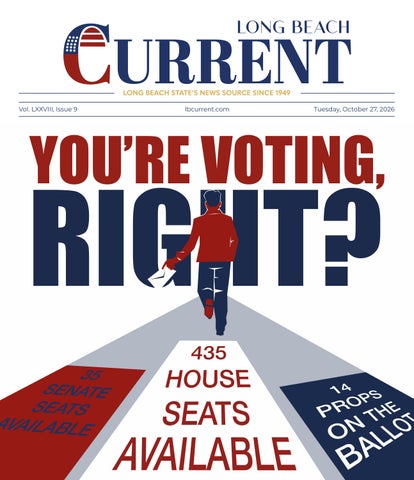
GABRIELLE LASHLEY | Long Beach Current Californians are set to vote on 14 propositions this midterm season, in addition to 435 seats for the House of Representatives and 35 for the Senate. Competitive races across the country could shift the balance of power in Congress, as Republicans fight to maintain control of the House and the Senate.
NEWS
Students weigh in on midterm elections
Editors
News Editor
Josephine Robinson news@lbcurrent.com Arts & Life Editor Joseph Lee arts@lbcurrent.com Opinions Editor Christian Robledo opinions@lbcurrent.com Sports Editor Brianna Apodaca sports@lbcurrent.com Design Editor Gabrielle Lashley design@lbcurrent.com Chief Copy Editor Sasha Marantz copy@lbcurrent.com Photo Editor Rehansa Kulatilleke photo@lbcurrent.com Social Media Editor Bella Beltran socials@lbcurrent.com Video Editor Mikaela Perez video@lbcurrent.com Podcast Editor Bryan Viteri podcast@lbcurrent.com Assistants News Reporters Jayden Sandstrom Claire Morris Alexa Partida Josephine Kim Arts & Life Reporters Ni Baliness Dominic Maddan Mason Mangus Nataly Valencia Lila Mukasa Opinions Writers Tyler Kols Simone Godse Sports Reporters Dupree De La Peña Veronica Minogue John-Wyatt Cristan Ervin Alan Ibarra Design Assistant Ellie Nakamura Copy Assistants Ayah El Reda Annabelle Qi Isaac Cordon Maizi Merklein Staff Photographers Eddy Cermeno Diego Perez Charlotte LoCicero James Tinoco Jamie Garcia Social Media Assistants Eva LeBlanc Alexis Munoz Jana Truong Video Reporters Arianna Jackson Eli Vice Podcast Assistants Alejandra Guerra Gabriel Duarte Monica Garcia Victor Alcocer
Business Advertising Manager Jocelyn Baltazar advertising@gobeach.media Creative Director Alicia Taylor creative@gobeach.media Web & Technology Director Melanie Cativo web@gobeach.media PR & Marketing Manager Mikayla Hubbard pr@gobeach.media Distribution Manager SeIana Spencer-Kendrick distribution@gobeach.media
BY TYLER KOLS Opinions Writer
A
new governor, wealth taxes and voting rights are among several issues Californians are set to vote on this year as midterm elections approach Nov. 3. At a nationwide level, voters will also determine their Congress representatives going into the latter half of President Trump’s second term in office. While Republicans currently hold a congressional and senate majority, Trump has faced record low approval ratings since he began his second term last year, many Americans pointing toward Trump’s foreign policy, the economy and immigration. Californians will decide whether they want Democrat candidate Xavier Becerra or Republican candidate Steve Hilton as their next governor, following Gov. Gavin Newsom’s term ending in January 2027. As students prepare to cast their ballots, the Long Beach Current asked students about their thoughts on this year’s propositions and what changes they want to see this midterm season. Taxes Measures on the ballot could decide if wealthier residents will face higher tax rates. Prop 40 would enact a one-time 5% tax on 200 Californians whose accumulated wealth exceeds $1 billion. Prop 3 could also solidify an increased marginal income tax on high-earning Californians
Advertising & Business Adviser
Gary Metzker Barbara Kingsley-Wilson Ashley Hopkins Jennifer Newton
JAMIE GARCIA / Long Beach Current
One of the many ballot drop-off boxes where people can cast their votes are located on campus infront of the McIntosh Humanities Building on Monday, Oct.19. With elections coming up on Nov. 3, thousands of Californians prepare for midterm elections. that was set to expire in 2031. These programs would help fund state healthcare programs and public education. Third-year psychology major Sophia Torres believes high-income Californians should pay more in taxes. “The people who pay the most in taxes do not have a high income compared to the billionaires and millionaires that live in California that can afford to pay such large taxes,” said Sophia Torres, third-year psychology major. Click here to read the full story.
Land Acknowledgment Here at the Long Beach Current we acknowledge that the school we report on is located on the sacred site of Puvungna, “the gathering place.” We are on the land of the Tongva/ Gabrieleño and the Acjachemen/Juaneño Nations who have lived and continue to live here. We also acknowledge the Gabrieleño/Tongva (pronounced: GABRIEL-EN-YO/TONG – VAH) and Acjachemen/Juaneño (pronounced: AH-HACH-AH-MEN/JUAN-EN-YO) as the traditional custodians of the Los Angeles region along with the Chumash (pronounced: CHOO-MOSH) to the north and west, and the Tataviam (pronounced: TAH-TAH-VEE-YUM) and Cahuilla (pronounced: KAH-WEE-YAH) Nations to the east. We respect and value the many ways the Tongva/Acjachemen cultural heritage and beliefs continue to have significance to the living people and remind us about the sacred and spiritual relationship that has always existed here at what we now call California State University Long Beach. Editorials: All opinions expressed in the columns, letters and cartoons in the issue are those of the writers or artists. The opinons of the Long Beach Current are expressed only in unsigned editorials and do not necessarily reflect the opinions of the journalism department or the views of all staff members. All such editorials are written by the editorial board of the Long Beach Current.
Advisers Design Adviser Content Advisers
For story concerns email: news@lbcurrent.com
2
Letter Policy: All letters and emails
must bear the phone number of the writer and must be no more than 300 words. The Long Beach Current reserves the right to edit letters for publication in regard to space.
Tuesday, October 27, 2026
NEWS
Midterm elections could turn the tide for House and Senate control
This initiative began after President
Graphic by SKYLAR STOCK /Long Beach Current Trump urged Texas lawmakers to redraw
Republicans current hold the majority in Congress. In order for the Senate to tip in Democrats’ favor, Democrats need to maintain their 47 Senate seats and obtain an additional four seats.
BY JAYDEN SANDSTROM News Reporter
K
ey U.S. Senate and House of Representatives races this midterm season could shift who controls Congress and reshape its legislative priorities. Republicans currently hold a House and Senate majority; however, as all 50 states hold House elections and 35 Senate seats are up for grabs, it is possible the scales could tip in Democrats’ favor. The U.S. Senate currently has 53 Republicans, 45 Democrats and two Independents. Thirty-five of the 100 Senate seats are up for election this November. For Democrats to gain a Senate majority, they would need a net gain of four seats. The House of Representatives has 218 Republicans and 214 Democrats. For Democrats to secure the House, they would need a net gain of three seats. All 435 House seats are up for election this November. Early polling points to a competitive Senate race, which could potentially shift the balance of power.
lbcurrent.com | @lbcurrent
What happens if Democrats secure the Congress majority? A Democratic majority would allow Democrats to choose the Senate majority leader, who works with committee chairs to decide what bills come up for debate. Democrats would also have more committee seats, giving them more influence over hearings and investigations around federal agencies. The Senate also votes on presidential nominees, including judges and Cabinet officials, so a Democratic majority could affect what nominees are confirmed. Political analysts foresee that in order for the Senate to tip in Democrats’ favor, Democrats not only need to maintain their 47 Senate seats – including in battleground states like Georgia, Michigan and New Hampshire – but also obtain an additional four seats. These could be gained from state race victories in Texas, Ohio, Iowa, North Carolina and Alaska. Which party has the advantage? The midterm elections arrive after several states have redrawn their congressional districts since August 2025.
their districts to help Republicans gain five additional seats in the House for the 2026 midterm elections. “We’re gonna win the midterms,” Republican House Speaker Mike Johnson said in July on “This Week on Capitol Hill,” a talk show podcast providing weekly insight into the decision-making of the House. “With each passing day, I’m more confident.” California legislators responded by approving Proposition 50, which voters passed in November 2025 to allow the state to redraw its own districts as a counter effort. Several states also followed suit, including North Carolina, Ohio, Florida, Tennessee, Louisiana and Alabama, to favor Republicans for a total of nine House seats. Republican state lawmakers are facing continued pressure from the White House to add GOP seats because federal officials worry legislation from Trump may be blocked if they lose the House and Senate majority. Legislation must pass both chambers of Congress before it can become law. The state legislature draws the majority of states’ congressional districts after a census is taken, usually around every 10 years. However, many states decided to redraw their maps mid-decade
Tuesday, October 27, 2026
to give their respective political party a competitive edge in the upcoming midterms. Even as one-third of the nation’s districts were redrawn, the national House map only shifted slightly toward Republicans, according to an Associated Press analysis of presidential margins in the new boundaries, making control of the House still possible for Democrats. “House Democrats are poised to take back the majority,” Democrat House Rep. Hakeem Jeffries said in a statement earlier this month. Jeffries is set to take Johnson’s place should Democrats take House control. “The American people are not buying what MAGA Republicans are trying to sell,” Jeffries added in a statement to AP. The push to secure more Republican House seats from the Trump administration may rise from impeachment concerns. Trump also faces record-low approval ratings since beginning his second term in 2025, which currently sit at 36%, the lowest a president has ever received before midterm elections. “We do great when I’m on the ballot, when I’m not on the ballot, people don’t go and vote so much,” Trump said to voters at an Oklahoma rally on Oct. 1. “Pretend I’m running, please. If we don’t win, they’ll end up impeaching me.”
3
NEWS
What’s on your ballot? Our guide t BY JOSEPHINE ROBINSON & JAYDEN SANDSTROM News Editor & News Reporter
A
s Election Day approaches, Californians are set to vote on 14 propositions this midterm season, ranging from taxing billionaires and raising income taxes for high earners to voter identification requirements and more.
Here is the Long Beach Current’s guide to all 14 propositions, and what to look out for on your ballot.
Allows the state to borrow $11.25 billion in bonds. Supporters: Gov. Gavin Newsom, the California Apartment Association and the California Democratic Party Opponents: A handful of Republican lawmakers
Doubles California’s rainy day fund from 10% to 20%.
Supporters: California Professional Firefighters; Los Angeles Chamber of Commerce; Gov. Gavin Newsom and the California Democratic Party Opponents: Reform California and a handful of legislative Republicans
4
Makes permanent an income tax that was voted into California law in 2012 and set to expire in 2031. Supporters: California Teachers Association, California State Parent Teacher Association, California Democratic Party and the California Medical Association Opponents: The California Taxpayers Association
Tuesday, October 27, 2026
Allows publ toward politic
Supporters: League of Women Vo ation, Mental Health Advocacy, Consumer Watchdog Opponents: California Taxpayers payers Association, Family Busi and the United Latinos Action
lbcurrent.com | @lbcurrent
NEWS
to all 14 of California’s propositions People wait in line to cast their votes on the first day of early voting, Saturday, Oct. 24, in New York.
HEATHER KHALIFA / Associated Press
Authorizes California to create housing assistance programs and borrow up to $25 billion in bonds. Supporters: California Democratic Party, Xavier Becerra Opponents: Reform California and the League of Women Voters
lic funds to go cal campaigns.
Voters, California Nurses AssociSocial Security Works and the
Association, Howard Jarvis Taxiness Association of California
Changes the way a replacement is chosen once a state officer is recalled.
Authorizes $8.4 billion in bonds to go toward funding research focused on fighting cancer, heart disease and Alzheimer’s disease.
Supporters: California Common Cause, California Democratic Party, and the League of Women Voters Opponents: Election Integrity Project California, California Republican Party, and Reform California
Supporters: American Association of Immunologists, California Democratic Party Opponents: The Orange County Register, California Health Policy Strategies and League of Women Voters
lbcurrent.com | @lbcurrent
Tuesday, October 27, 2026
5
NEWS
What’s on your ballot? Our guide t
Requires California residents to show a government-issued ID in order to vote at the polls.
Enacts a one-time 5% tax on an estimated 200 Californians with net worths exceeding $1 billion.
Requires the s review any speci before it goes to v harder t
Supporters: California Republican Party, Reform California Opponents: American Civil Liberties Union, Common Cause and California Democratic Party
Supporters: Vermont Sen. Bernie Sanders, Teamsters California Union Opponents: California Teachers Association, Planned Parenthood and California Professional Firefighters
Supporters: Reform California Opponents: Vermont Sen. Berni International Union-United Hea California Democratic Party
Imposes penalties on nonprofit Federally Qualified Health Centers that spend less than 90% of their revenue on patient and health care services. Supporters: SEIU-United Healthcare Workers West Opponents: California Primary Care Association, California Medical Association and Planned Parenthood Affiliates of California
People grab stickers on the first day of early voting in New York, on Saturday, Oct. 24.
6
Tuesday, October 27, 2026
lbcurrent.com | @lbcurrent
For story concerns, email: news@lbcurrent.com
NEWS
to all 14 of California’s propositions
state auditor to ial tax proposal voters, making it to pass.
ie Sanders, Service Employees althcare Workers West and the
Bans new personal property taxes and prohibit new taxes on asset ownership.
Limits voters’ ability to pass local and voter-proposed special taxes, such as real estate taxes, by increasing the percentage of votes required to approve them.
Supporters: Reform California, Building a Better California and Google co-founder Sergey Brin Opponents: SEIU-United Healthcare Workers West and the California Democratic Party
Supporters: Howard Jarvis Taxpayers Association and Reform California Opponents: California Democratic Party
Imposes a 365-day limit on environmental reviews and requires state courts to rule within 270 days on lawsuits. Supporters: California Chamber of Commerce and the California Republican Party Opponents: The National Wildlife Federation, Clean Water Action and California Labor Federation
HEATHER KHALIFA/ Associated Press
lbcurrent.com | @lbcurrent
Tuesday, October 27, 2026
WATCH THE VIDEO By Josephine Robinson, News Editor
7
NEWS
5 tax measures are on California’s ballot this year. Here’s what you need to know BY CLAIRE MORRIS News Reporter
C
alifornia’s 2026 midterm elections have voters deciding on five tax-related propositions — the most the state’s ballot has seen in a decade. Proposition 3 and Proposition 40 focuses on taxing high-income earners and those who possess large accumulated wealth. Revenue collected from these taxes could improve and maintain institutions like public education and state healthcare, which would benefit voters from all economic backgrounds. Among these tax measures, voters must also decipher Propositions 42, 41 and 43, which focus on taxing thresholds and audits for new programs, and could nullify Proposition 40 whether it passes or not. With this midterm season’s influx in tax specific measures, California voters must distinguish between each issue, including who their vote is meant to benefit. “It’s another California tradition, that is, having more than one proposition on the same topic in the same election,” said Matt Lesenyie, an associate professor of political science at Long Beach State. “And that is deliberately done to confuse voters.” Proposition 40, also known as the billionaire tax, proposes a one-time 5% tax on those whose assets and accumulated wealth exceed $1 billion, which accounts for 200 California residents. Of the revenue collected from Proposition 40, 90% will be allocated to funding public health care services, leaving the remaining 10% to support education, food assistance and administration of the wealth tax. Proposed by Vermont Senator Bernie Sanders, the measure also aims to address the loss of federal funding for health and education following President Donald
8
Trump’s tax reconciliation law, the One Big Beautiful Bill Act. Passed in July 2025, the bill set the largest ever social safety net program cut in U.S. history to provide tax relief for corporations and high-income Americans, raising deductions to stimulate long-term economic growth. The act slashed federal funding toward programs such as Medicaid and the Supplemental Nutrition Assistance Program. Cuts to these programs have resulted in many Americans losing jobs, health insurance and accessible nutritional resources, which is expected to continue. “I’ve worked in healthcare for over 20 years, and I cannot imagine how many people are going to lose their jobs because of these cuts,” said Datosha Williams, a medical customer service representative for Kaiser Permanente. As a frontline healthcare worker in Southern California’s South Bay region, Williams said she has had first-hand experience seeing hospitals struggle under budget cuts, including the closing of hospitals and reduced access to healthcare. “People come to me of all ages, whether they have newborn babies or whether they’re over 100 years old, in navigating the healthcare system,” Williams said. “It’s really difficult unless you have that insurance knowledge to explain why people are paying higher [insurance] costs.” If passed, Prop 40 could increase hospital employment and patient resources. Increased funding could also provide funding for healthcare initiatives like Medi-Cal, California’s free or lowcost health insurance program for lowincome residents as well as allocating funds for nutrition and education. “This is the right thing, to present hope to the California healthcare system and to our communities that we serve,” Williams said. “I just want to urge California to be on the right side of
Graphic by SKYLAR STOCK / Long Beach Current history and do something that can really change our future.” However, opponents like the California Medical Association argue that Prop 40 will backfire and could lead high-earners to leave the state, as California already has the nation’s highest income tax rate. Opposers also say the same for Proposition 3, also known as the highincome tax, which solidifies an income tax that was already implemented by voters in 2012, and is set to expire in 2031. The tax is set on high earners whose single-income earnings surpass $361,000, and joint-earnings surpass $721,000. Of the tax revenue, 88% will be allocated toward funding education and healthcare. Voters must reapprove the measure, which now aims to transition from expiring to remaining as a permanent rate. The income tax already generates around $5 billion to $15 billion a year, with a majority of the funds going toward
Tuesday, October 27, 2026
public K-12 schools and a smaller portion toward community colleges. Supporters like The California Teachers Association and The California Democratic Party reinforce that the revenue received from Proposition 3 has been vital for the maintenance of public schools, preserving budgets for education and faculty/staff employment. “They [voters] like the idea of ‘If I do have to pay, at least it’s gonna go to the schools,’” Lesenyie said. Teachers’ unions and associations supporting the measure have rallied $50.3 million in campaign finances. Money donated to funding can contribute to campaign activities such as advertising, voter outreach and polling – all in an effort to gain increased support. Finances in support of Proposition 3 display a stark contrast to the $5,500 raised by opponents like Reform California. “There’s no place like California,” Lesenyie said.
lbcurrent.com | @lbcurrent
NEWS
Becerra v. Hilton: What to know about the candidates running for governor BY JOSEPHINE ROBINSON News Editor
V
oters are set to decide California’s next governor this midterm season as Gov. Gavin Newsom’s term comes to an end in January. Democrat Xavier Becerra and Republican Steve Hilton have stepped up to the bat as candidates hoping to take his place. The governor plays a key role in shaping policies, signing or vetoing legislation and appointing judges for regulatory agencies like the California Supreme and Superior Courts. Here is the Long Beach Current’s guide to the two gubernatorial candidates. You can cast your vote on or before Election Day on Nov. 3.
Becerra
Hilton
JACQUELYN MARTIN /Associated Press
Health and Human Services Secretary Xavier Becerra speaks during an interview in Washington in 2022. Another member of President Joe Biden’s cabinet has tested positive for COVID-19. Xavier Becerra, Democrat Supports: Progressive income taxes, affordable housing initiatives (Prop 37) and preventing wildfire risk Opposes: California billionaire wealth tax (Prop 40); President Trump’s immigration, climate change and tariff policies Becerra is a first generation Mexican-American from Sacramento. He attended Stanford University from 1976 to 1984, and later served as a U.S House of Representatives member for Los Angeles from 1993 to 2017. Becerra previously served as California’s State Attorney General from 2017 to 2021, before working alongside President Joe Biden as Secretary of Health and Human Services. If elected, he would be California’s first Latino governor since 1875. Becerra’s campaign outlines
lbcurrent.com | @lbcurrent
a progressive income tax system, affordable housing initiatives and potentially revising California’s clean energy climate goals to make gas and energy more affordable. He supports Prop 37, which outlines the state’s down payment assistance program to aid middle-income homebuyers. If elected, Becerra said he will continue to challenge President Trump. When he was attorney general, he led 122 lawsuits against the first Trump administration to challenge national policies on immigration, climate change and consumer rights. “When the federal government continues to overreach, I will challenge it in court and refuse to back down to ensure California keeps moving forward and building together,” Becerra stated on his campaign website.
JAE C. HONG /Associated Press
Steve Hilton speaks during a California gubernatorial debate hosted by CBS LA at Pomona College in Claremont, Calif., April 28. Steve Hilton, Republican Supports: Reducing tax rates for gas, electricity and utilities; reducing income taxes and implementing starter family housing plans Opposes: California billionaire wealth tax (Prop 40) Hilton is a British-American from the U.K who moved to California in 2012, where he co-founded Silicon Valley political crowdfunding platform CrowdPac. Hilton previously served as a senior adviser to U.K. prime minister David Cameron from 2010 to 2012, before joining Fox News as a host for their weekly talk show “The Next Revolution,” which served as a commentary forum exploring right-wing nationalism. Hilton has outlined plans to lower gas prices by suspending environmental regulations, cutting income taxes for upper and middle-class residents, and
Tuesday, October 27, 2026
developing more single-family starter homes. As California residents currently pay the second highest residential electricity rates in the U.S, with bundled rates steadily increasing by 52% in the last six years, Hilton said he is open to rolling back the state’s clean energy transition goals to reduce costs. This would mean ending requirements for utilities and businesses to purchase solar and wind power, which will allow more natural gas production. If elected, Hilton said he plans on working closely with Trump to help the state secure more federal assistance. Hilton plans on eliminating income tax rates on the first $150,000 of Californians’ earnings, and implementing a flat 8% tax rate on those whose income exceeds $150,000. He plans on cutting the state’s gas tax in half and lowering gas prices to $3 a gallon.
9
ARTS & LIFE
Cast your vote, Long Beach: 6 voting sites near campus
One of the many places where students can vote on campus include the LBS Financial Credit Union Pyramid. JORGE HERNANDEZ/ Long Beach Current BY NATALY VALENCIA Arts & Life Reporter
T
he midterms are in full swing, with Election Day quickly approaching on Nov. 3. Californian voters will elect a new governor as well as Congress and state representatives. Voters will also decide on 14 statewide propositions, including the Prop 40 “billionaire tax” and voter identification requirements. Locally, voters will decide on two L.A. County charter amendments, measures A and E. These measures will decide how public safety labor disputes are resolved and whether to provide greater structure and independence to the county’s ethics commission. If you missed the deadline to register to vote, same-day voter registration is available up until Election Day at vote centers and polling places. In Long Beach, you can drop off your ballot at several locations throughout the city, including on campus. Some locations are already available for early voting.
10
If you want to make your voice heard, visit these six voting sites on or before Nov. 3. To view these locations on our interactive map, click here. Voting places on campus: LBS Financial Credit Union Pyramid’s voting site This early in-person voting center will be located at The Pointe, in sunset rooms A and B, from Oct. 31, to Nov. 2, from 10 a.m. to 7 p.m. On Election Day, hours will run from 7 a.m. to 8 p.m. CSULB ballot drop-off box Right by the McIntosh building is a white and yellow drop-off box that will accept ballots 24 hours a day, seven days a week until Nov. 2. On Election Day, ballots will be accepted until 8 p.m. Voting places near campus: International City Masonic Center’s voting site Located 1.3 miles west of campus, this nonprofit organization will host an early voting site from Saturday, Oct. 24,
to Nov. 2. Hours will run from 10 a.m. to 7 p.m. On Election Day, hours will run from 7 a.m. to 8 p.m. Address: 5155 E. Pacific Coast Highway. 90804 Marina Vista Park’s ballot drop-off Located 1.4 miles south of campus, this park is the nearest off campus ballot drop-off zone. Ballots are accepted 24 hours a day, seven days a week. On Election Day, Nov. 3, ballots will be accepted until 8 p.m. Address: 5355 E. Eliot St.
an early voting site in their gymnasium from Oct. 31, to Nov. 2. Hours will run from 10 a.m. to 7 p.m. On Election Day, hours will run from 7 a.m. to 8 p.m. Address: 5200 E. The Toledo Ave.
VIEW THE MAP By Nataly Valencia, Arts & Life Reporter
St. Gregory’s Episcopal Church’s voting site Located 1.8 miles north of campus, this Christian church will serve as an early voting site from Oct. 31, to Nov. 2, from 10 a.m. to 7 p.m. On Election Day, hours will run from 7 a.m. to 8 p.m. Address: 6201 E. Willow St. Bay Shore Community Congregational Church’s voting site Located 2.1 miles south of campus, this Christian church will be hosting
Tuesday, October 27, 2026
lbcurrent.com | @lbcurrent
For story concerns, email: arts@lbcurrent.com BY JOSEPH LEE Arts & Life Editor
A
ssistant professor of political science Matt Lesenyie has taught at Long Beach State since 2020, and serves as the preeminent campus expert in California politics. Having interned for Gov. Arnold Schwarzenegger and served as a fellow in the Office of the State Assembly Chief Clerk E. Dotson Wilson, the 43-year-old brings a wealth of political experience from working in California government. In 2012, he co-authored “Power to the People: Checking Special Interests in California,” which advocated for greater government transparency and public participation as a means of countering special interest influence in California politics. Lesenyie teaches several political science courses at CSULB this semester, including POSC 100, POSC 422 and POSC 550. As the deadline to vote in November’s midterm election nears, the Long Beach Current interviewed Lesenyie to get an expert’s opinion on the races, ballot measures and local issues that impact students. Q: What races, ballot measures and local issues should students on campus pay attention to in the midterm elections and how could it affect their lives? A: The [LA] mayor’s race has got some salience for students [depending on where they live]. I think [this race shows] a generational difference between two Democrats. While they probably agree substantively on most things, they’re gonna just take a different approach and a different urgency. It’s also the case that [LA Mayor] Karen Bass has had biblically bad luck, like natural disasters have happened on her term, which isn’t really her fault, but people attribute that to the incumbent. So that could shorten her political career just from unluckiness. Everybody says this is an important election. I don’t know that I always buy that and that’s not something that I would say, but I do think there are options on the ballot that signal a stylistic shift in priorities and that gives me hope, as saccharine and goofy as that sounds. There are some real options both here [in California] and across the U.S..
lbcurrent.com | @lbcurrent
ARTS & LIFE
Q&A with CSULB professor, California politics expert
A: In the past, we have [said], “We need to have a real, fair tax system” and the arguments around taxation have been highly susceptible to frames [of judgment] like “fairness.” So when we talk about taxing somebody who’s got $8 billion or $200 billion, [we can’t just say], “Make this fair.” Well, the [wealth] distribution is so unfair. There’s no way we’re even going to rein that in without some aggressive correction. [Prop 40] isn’t doing that. It’s not working to redistribute the money downward to people. [What] it does acknowledge is that we have probably allowed too many people to take too much money out of the system that would have otherwise been captured and used by the state. At the same time, there are two competing measures that seek to nullify that same tax. So that conversation is still going on about who will pay. On Prop 41 and 42, you have provisions that if [Prop 41] and [Prop 42] pass, [the tax is] nullified. [Prop 41 says], “We need this audit mechanism” [but in reality,] it’s just a poison pill to bring down [Prop 40]. That’s nothing new. That’s a regularity of our proposition process that a popular idea gets the ballot and then rich folks get another thing on there that neuters it or complicates the whole issue. Q: On a practical level, what are the
Photo courtesy of MATT LESENYIE consequences of a midterm election?
Matt Lesenyie has interned for Gov. Arnold Schwarzenegger and was a fellow in the Office of the State Assembly Chief Clerk E. Dotson Wilson. Lesenyie, 43, began teaching at CSULB in 2020.
”
Your vote goes a lot further for the city council and the school board. Matt Lesenyie CSULB Political Science Assistant Professor Q: Much has been said about Prop 40, “the billionaire’s tax,” which would impose a one-time 5% tax on the net worth of California’s billionaires.
What do you make of this proposition and what significance does it hold for students?
Tuesday, October 27, 2026
A: When we think about the consequences [of a midterm election], who’s on city council matters because they set the parking ticket [prices] so that’s a big deal here in Long Beach [as far as] how much we’re ticketing and how much the rate is. The standard street sweeping ticket went up this year by [$5 to come out to $80], so if you get a parking ticket for street sweeping, that’s real money. The County [Board of] Supervisors, the mayor, the sheriff, all of them have way more [of an] effect on your life than does the Governor or the President. At a time when many of us are desiring rapid change, if you look across the ballot, who’s the better person for your neighborhood? Because there’s a good chance, they’ll be in office for 20 to 25 years. So you are making a real choice in how [your neighborhood] is going to be represented across several offices for a better part of your life.
11
AD
12
Tuesday, October 27, 2026
lbcurrent.com | @lbcurrent
OPINIONS
Juggling political jargon
Graphic by Gabrielle Lashley / Long Beach Current
BY CHRISTIAN ROBLEDO 0pinions Editor
a list to help explain these terms that often confuse my peers.
be looked at when the issue you’d be advising on is brought up.
least the fiscal impact statements should help us read between the lines.
: “How do I go about voting if I don’t understand what they’re even talking about on the ballot?” - Politically Pensive A: Dear Pensive, It’s completely understandable to feel underprepared when it comes to voting and the language used in the world of politics. After all, there does seem to be something a little sinister when it comes to campaign and ballot speak. As we continue to emphasize the importance of the student vote, it’s equally important to make sure that these students can read between the lines and understand exactly what they’re reading before they make their decision. The best way to combat political pitfalls? Staying informed and knowledgeable about the terminology policy writers use to confuse voters. So, to help you and others better understand some legal lingo, I’ve created
Referendum The best way to explain a referendum is a vote on a law that already exists. This allows the voter a voice on specific issues that may concern them. Some referendums are mandatory, while others are optional.
Appropriation/Gann limit This limit is essentially the cap on government spending. When seen on a ballot it is likely that you are being asked whether or not you agree to allow the government to exceed this cap.
Negation Stacking You won’t see this term too often, but it’s important to know, as it means flipping words so that a yes equals a no, causing a manipulative vote. I highly suggest looking out for double or triple negatives on a ballot. You don’t want to not vote on a bill that would help if you had voted in the negative. As the midterm elections fast approach, let us aim to be informed voters. Not only on the issues that appear but the language used to trick us as well. While I have hopefully helped more than one pensive participant, I have to reiterate that the best way to vote is with research and definitions by your side. If something doesn’t make sense to you on an upcoming proposition, explore the definitions until they do. That way, every decision you make is a well-informed one.
q
lbcurrent.com | @lbcurrent
Retention and Recall These two words work hand in hand to decide whether or not voters would like to keep an official in office or have them removed. Retention means keep, while recall means take away. Just like a product, it’s up to you to choose whether or not you believe an official should stay in position or has expired. Advisory Measure While this may look like a real vote on a ballot, this is simply an opinion poll. It means nothing in terms of actual action and has no promise of being completed. That being said, it is good to look at if you wish to add to a statistic that may
Supermajority Threshold One of the best examples of creating words just to be misleading is supermajority. In practice, it means nothing more than a majority of 50% plus one. If the others before this haven’t proved to be unnecessary, words like supermajority show the true intent of political wordplay. Fiscal Impact Statements These statements are how a given proposition will affect the economy. Given that most parts of a bill are written with hidden agendas, these are one of the only parts of the ballot that is based on neutrality. If we can’t trust policymakers to write propositions in legible ways at
Tuesday, October 27, 2026
13
OPINIONS
Comic by Gabrielle Lashley / Long Beach Current
14
Tuesday, October 27, 2026
lbcurrent.com | @lbcurrent