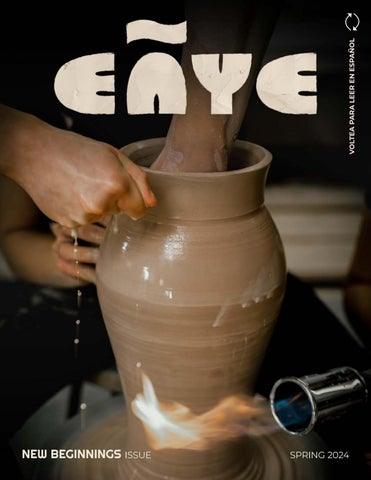
NEW BEGINNINGS ISS U E
COVER
NEW BEGINNINGS ISSUE
SPRIN G 2024
SPRING 2024
PARA LEER EN ESPAÑOL VOLTEA VOLTEA PARA LEER EN ESPAÑOL
MeValeYoViajoEnBus Los problemas de tener auto, como levantarse demasiado temprano para evitar el tráfico, ya no es tu problema. Ahorra en los viajes en autobús con el Go Beach! Pass para Long Beach Transit, solamente para estudiantes de CSULB.
AD 1
Escanea el código para obtener más información o visita ridelbt.com/csulb
ENYE Team
Shaping Clay, Connections and Narratives By Briana Méndez-Padilla
Letter from The Editor
Reignite the Rhythm: Salsa Club Returns to CSULB By Leila Alarcón
Retro Revival at Girl Coded Vintage By Megan Chen
The Art Without A Face By Natalia Chairez
Setting the Stage for Diversity By Elizabeth Carroll
Mariachi Los Tiburones Keeps Tradition Alive at the Beach By Olivia Weinstock
TOC
Staff Page
ENYE TEAM SPRING 2024
i
Photos by Dacne Moreno | Designed by Jennix BW
ENYE TEAM
LETTER FROM
STAFF WRITERS
This letter, like any new beginning, is bittersweet. It’s a farewell to my time as EIC, where I’ve learned and grown from the wonderful people who make up my staff and now some of my closest friends. But it is also a greeting to a new chapter of this amazing publication, it’s been an honor to be at the helm of such a momentous time of change.
SPRING 2024 Leila Alarcón, Writer Evelin Alvarado Soriano, Writer Emmanuel Barrera, Writer Karin Best, Writer Elizabeth Carroll, Writer Natalia Chairez, Writer Megan Chen, Writer Joshua García, Writer Naoki Gima, Writer Natalia Hernández, Writer Melissa Luy, Writer Adriana Martínez Ortiz, Writer Cynthia Mazariegos, Writer Yasmine Poot, Writer Mike Reza, Writer Danha Sánchez Martínez, Writer John Edeson Sayoc, Writer Diana Vargas, Writer Olivia Weinstock, Writer
BUSINESS
You are holding in your hands the inaugural issue of ENYE, the culmination of almost a year of reimagining who we are. Formerly known as DÍG En Español, we are the newly rebranded bilingual publication at CSULB working to uplift stories on and for the Latinx community. This rebrand would not be possible without the unwavering support and hard work of my team.
FACULTY ADVISORS
Teresa Puente, Editorial Advisor teresa.puente@csulb.edu Jennifer Newton, Business Advisor jennifer.newton@csulb.edu
Photographer: Mike Reza Designer: Jennix Bien-Walker Artists: Jas Alas Stephanie Hernández Angel Prudencio
ENYE is the phonetic spelling of “ñ,” a letter present in many of our last names and the Spanish language but not in the English alphabet or on most keyboards. Our new name both highlights our culture and represents our unwillingness to sacrifice it. ENYE is our new beginning; a tribute to the people and culture that claimed the space for us to be here, and the culture we will continue to champion and make space for.
EIC letter
Kristina Agresta, Director of Business Operations Jennix Bien-Walker, Creative Director Leila Nuñez, Web & Technology Manager Sai Lwin, Advertising Manager Naoki Gima, Distribution Manager
COVER CREDIT
THE EDITOR
I hope our readers will continue to find people who look like them in the pages of our magazine and learn more about people who don’t. As you read about mariachi players, salsa dancers and ceramic majors fearlessly sculpting their own beginnings, I hope you become a little less frightened of embarking on your own. My time at ENYE is coming to an end, but the magazine will continue growing because of the people in it. Working alongside my wildly talented and beloved team, whom this would not be possible without, has been my greatest pleasure. Con cariño,
ii
By Megan Chen
Retro Vintage
Six large windows with bubblegum pink trim cover the front of the store, displaying six personally styled mannequins. Metal clothing-filled racks, organized by item and color, line the perimeter of the store. It’s a far cry from her mom’s garage, where Chelsey López first began selling vintage clothes. López opened Girl Coded Vintage, a Latina-owned clothing store that specializes in late 1990s and early 2000’s fashion, in January 2024. She first began her business in 2020, at the height of COVID-19, while she was just a junior in high school. As classes moved online, López realized how much free time she had on her hands and needed something to occupy it. López and her mother decided to clean out their garage one day and realized the large amount of clothing that had accumulated there over time. “My mom had suggested selling them online, and there were a lot of cute pieces in there,” said López. “I had found a bunch of her old clothes from the 90’s and decided, yeah, let’s try it out.”
Any updated hours will be posted on IG story
@girlcodedvintage
ENYE MAGAZINE
21
López decided to make an Instagram account specifically for thrifting. From there, with the support of her family and close friends, Girl Coded Vintage was born.
“The girlies loved it!” said López while wearing one of her own curations: a long black, beaded skirt. “We ran out of things from the garage; it was completely cleared out.”
she had met online, López started attending flea markets as a vendor and completely fell in love with it.
“You meet a lot of different vendors, and from there you all enter this kind of community, and you all grow together ,” López said. “You see your supporters in real life; when you’re online it’s kind of hard. Like yes, they’ll message you and stuff, but it is not the same as seeing their live reaction.” Wendy Rodríguez, a close friend of López for about six years, was a big part of her emotional support system through the growth and opening of Girl Coded Vintage. Rodríguez was there to offer words of encouragement through thoughts of doubt and lend a helping hand during flea markets. “Her work ethic is very genuine,” said Rodríguez. “She is very outgoing and outspoken with her customers. She is willing to do anything if she knows it’ s going to help them.” Through the flea markets, López began making personal connections with other small businesses. As demand increased, she had to start branching out to different vendors and wholesalers to curate items for her brand. López didn’t limit herself to just Long Beach; she has expanded to Southern California and even out of state. “Recently, I went to Arizona to pick up some shoes because they were all vintage,” said López. “It’s everywhere; you really have to branch out; if not, you
won’t be able to find enough stuff, especially for the store.”
Genesis Mata has been a customer of Girl Coded Vintage since López was selling clothes out of her family’s garage. Mata emphasized that she feels there is no other clothing store as unique and genuine as López’s.
“Chelsey does a really good job of finding things that are ethically sourced. They’re going to last you forever and are in style,” said Mata.
Retro Vintage
López’s thrifting account now has abou t 9,000 followers and supporters sole ly from the clothing she was reselling from her family’s garage. She decided to continue the upward momentum of her small business and began looking at different sources for clothing. She visited different thrift stores around Long Beach and surrounding cities for unique pieces that fit her late 1990s to early 2000s aesthetic and eventually expanded her business from e-commerce to flea markets. Some of her pieces include velvet tank tops with lace straps, maxi skirts with beads and sequins, mini skirts of all different colors and flared low-rise jeans. With the encouragement of colleague s
“A lot of her pieces are super unique. They’re staples, but I’m not going to be able to find them, like at the mall or something. They stand out and are timeless.” After nearly three years of saving up from every flea market she has ever attended, López signed a lease in December 2023 for her storefront located at 5470 Long Beach Blvd. While still attending flea markets and maintaining the store, López still has bigger plan s for her business in the future. “I didn’t want to work for someone else , pushing me to meet their standards,” said López. “I wanted to rely on myself and create my own schedule.”
MON: 12:00PM-6:00PM TUES: 12:00PM-6:00PM WED: 12:00PM-6:00PM
THUR: 12:00PM-6:00PM FRI: 12:00PM-6:00PM SAT: 12:00PM-6:00PM
5470 Long Beach Blvd, Long Beach, CA 90805
5470 Long Beach Blvd, Long Beach, CA 90805
ENYE MAGAZINE
Designed & Illustrated by Jennix Bien-Walker
3 2
“At Long Beach, we’ve been so lucky
Set-
to do shows that tell different stories,” said Martins. “A different part of my being has been represented in every show that I’ve done.”
Standing up on the stage for the first time with the crowd looking on, the lights in her eyes and a large blonde wig bestowed upon her head, a then 5-year-old Victoria Martins was playing Sally in “You’re a Good Man, Charlie Brown,” and officially beginning her journey as an actor.
ting the Stage
Martins began taking an interest in acting from the age of four. She started gaining roles with a small sister-owned acting agency and went on to perform throughout elementary, middle and high school in various school plays. Now, at 20 years old, Martins is a leading actress in Cal State Long Beach’s theater and performing arts department. “This is what we’re doing for the rest of our lives, no matter how hard it is, no matter how zero dollars we have, we’re doing this,” said Martins. While Martins hopes her passion will one day turn into her full-time career, statistics around Latinx representation in film and T.V. reveal that roles for people who look like her are limited in mainstream media. Despite the data, the next generation of up-and-coming actors from underrepresented backgrounds like Martins continue to try and prove that their stories deserve to be told on the world’s largest screens and stages.
ENYE MAGAZINE
3
By Elizabeth Carroll “In a more professional world, things that the whole world is consuming, [there is] definitely under-representation, in everything, not just people of color, [but also] of queer people, of everything,” said Martins, a member of both the Latinx and queer communities. According to the UCLA Hollywood Diversity report, only 46.2% of roles are cast to non-white actors. A November 2023 study from the USC Annenberg School of Communication and Journalism found that across 1,600 different movies released between the years 2007 and 2022, only 5.5% of the over 62,000 speaking roles were given to a Latinx actor.
rather than the more accurate and diverse stories that exist. With a dream of staying in live theater and performing on Broadway, Martins ensures that she takes every opportunity given to her in CSULB’s diverse program, a program “proud of [the] range of POC and LGBTQ+ alumni who have starred in television, film and on Broadway as well as in major regional theaters” after attending CSULB, according to Ezra LeBank, chair of the theater arts department.
Setting the Stage
“It will take a lot of hard work, that’s a given,” said Jazmine Cordero, 20, a first-generation Salvadoran-American theater student at CSULB. “[While] I feel I don’t have to work harder [just] because I’m Latina, I feel I’ll have a harder time representing my culture on stage because not a lot of stories focus on it.” Cordero explained that though there are roles for Latinx actors within the industry, the majority surround the stereotypical storyline of the Latinx community being poor or undocumented immigrants,
“At Long Beach, we’ve been so lucky to do shows that tell different stories,” said Martins. “A different part of my being has been represented in every show that I’ve done.” Above all, Martins takes inspiration from Latinx and other minority celebrities, like Eva Noblezada and Jinkx Monsoon, who are helping to tell the stories through theater and performance of all people regardless of gender, sexuality, age and race. “I never really saw people like me [growing up], but now I do... there are so many stories in the world, which is the point of theater, to tell people’s stories,” Martins said.
Illustrations by Krizzha Dee
ENYE MAGAZINE
4
Sound AD 2
Bite Try Prime Student for 6 months at $0 New members only. Terms apply. Amazon Music and Grubhub+ included with Prime.
AD 3
Shaping By Briana Méndez-Padilla
S
tephanie Hernández thought she wanted to be a stone carver. She envisioned herself moving to Italy and learning how to carve perfect people. She wasn’t expecting that in the final year of her studio art degree at Cal State Long Beach, she’d take a miscellaneous ceramics class—an offhanded recommendation from a friend—and her life would transform completely.
clay] I was like, I don’t want to do anything else,” Hernández said. The Guatemalan artist was drawn to how environmental-oriented the medium was; all you need is air, dirt, water and fire. The more Hernández learned about the clay—how mud clay is essentially recycled clay and has a smooth finish while Dixon is red and rough with sand and small pieces of rock that leave a groggy finish—the more fascinated she became.
Latinx Ceramics Students “As soon as I touched [the
Connections Photos by Mike Reza
“What you’re doing is alive; it keeps shrinking, it keeps moving… and you have to learn its personality,”
Hernández said.
nect to their culture, process their emotions and create visual representations of their experiences. However, they must still balance the complexity of creating art that vastly differs from the Eurocentric art style taught in their classes and reflected in the major museums to make art more accessible and representative of the diversity of CSULB and beyond.
The art of ceramics has helped young Latinx artists like Hernández con-
Ceramics have been part of the Central American indigenous traditions for
ENYE MAGAZINE
thousands of years. Archaeologists date the earliest Mayan pots to nearly 3,000 years ago. Most of their work was for utilitarian purposes like pots, pans and bowls but they would also create small, carved ceramic figures. Mayan culture has been influential in Hernandez’s work as she explores her faith through an ancestral perspective. Ceramics major Angel Prudencio is in his last year at CSULB and has firsthand experience receiv-
ing mixed reactions to his art. He describes his art as “very figurative,” often creating sculptures that reflect faces and emotions. He said others describe it as “very dark” which has both garnered praise and hesitancy from people interacting with it. “I had a series where I was making all kinds of faces but all the faces that I was making were either gruesome or they were very scary for some people, especially when you think about it like, ‘Oh, we’re
7
Clay
“I don’t plan anything. I just alter it as I go, whatever feels right in the moment, kind of like how we are as humans, our emotions can be so sporadic,” Alas said.
gonna go see ceramics’ [they] don’t expect this type of content to pop up,” Prudencio said. Born and raised in Jalisco, México, Prudencio immigrated to the Coachella Valley when he was 15. Having to essentially restart his life was hard on him; he felt lonely and sad. Prudencio began creating these types of faces as a representation of his own insecurities with the English language.
Alas creates large vessels that are altered in some organic way. She said her process has become much more intuitive; each idea begins with an emotion she is trying to process. It has made her work more vulnerable and emotional and has made the process therapeutic.
Continuing this work is important to Alas because it helps diversify ceramics and offers representation for artists who come from backgrounds like hers. Both she and Hernández talked about how underrepresented Central American artists are even within the Latinx diaspora. They mentioned how while there needs to be more diverse art, a lot of spaces seem to focus solely on Mexican and Chicano art.
Latinx Ceramics Students
“There’s often a little anger, a little anguish, and then I think that reflects just how frustrated I was by that language barrier,” said Prudencio. “I get mixed reactions. I think a lot of people are shocked or a lot of people are scared. But even though that might be the case, they still recognize the craftsmanship.”
For Jas Alas, who’s in her second year at CSULB, her art creations may not explicitly incorporate her culture, but doing ceramics has helped her feel connected to her family back in El Salvador. Her family has been doing ceramics work for decades–although she did not know that until a couple of years into her ceramics journey.
One of her favorite pieces is a large sculpture with scattered hollow cavities with a crimson ooze coming out of them. It has an airbrushed gradient of purple and pink hues reminiscent of bruises. She made it her first semester and titled it “Sure, I can take a few more hits.”
“I feel like just presenting myself as a Central American artist or like a Salvadoran American artist is just a little push into more representation for everyone,” Alas said.
Designed by Jennix Bien-Walker
Narratives
ENYE MAGAZINE
8
Salsa Club REIGNITE THE RHYTHM: By Leila Alarcón
Photos by Mike Reza
Salsa Club Returns to CSULB
Designed by Jennix Bien-Walker
ENYE MAGAZINE
9
L
aughter and conversation can be heard faintly over the sound of the salsa music blasting from a speaker and the footsteps of those dancing. The beginnings of lifelong connections to a culture, a genre of music, and other people are in the making at the newly reinstated Salsa Club at Cal State Long Beach.
“It’s a tight-knit community. You can dance salsa anywhere in the world, and you do not have to speak the same language,” said salsa instructor Jenny Mee, who teaches weekly salsa classes at CSULB. “It can be romantic, it can be fun, it can be silly. It just has so many facets to it, and that’s why I love salsa.” Salsa Club activities halted in June 2021 after COVID-19 restrictions kept club members from meeting in person. Club advisor Amythyst Fritzler and club member Eliana Wong tried to restart club activities last year during the fall semester, but the president at the time was unable to start the club. When plans fell through, Wong stepped up to the position of president. Fueled by her desire to continue learning salsa, Wong began to reach out to people who had previously been involved with the club via social media. “I wish I was more connected to the culture. I want to know more about it, but I really like dancing, and I was like, I want to partner dance,” Wong said.
ENYE MAGAZINE
According to the United States Patent and Trademark Office, the history of salsa dancing traces back to Johnny Pacheco, a Dominican musician, arranger, composer, bandleader and producer who founded Fania Records in 1964. Fania Records is an independent record label created when Pacheco’s previous record label, Alegre, went under. It was a partnership between Pacheco and his lawyer, Jerry Masucci, and is currently a part of Craft Recordings. Pacheco and other artists under Fania Records catered their Afro-Caribbean sound to New York City Latinos. Pacheco’s Fania Records came up with the name “salsa” for their sound and culture. Puerto Ricans and Cubans living in New York developed the dance style, and it blossomed into the salsa culture we know today. Many Salsa Club members feel a connection to the dance style. Samara Plasencia, a second-year student and club member, had taken dance classes before with her family and saw Salsa Club as an opportunity to build more connections on campus, learn to partner dance and connect with her roots.
They are both passionate about salsa dancing, as the two first met on the dance floor. When they were contacted about the reinstating Salsa Club, it was a no-brainer; the club holds a special place in their hearts, especially for Araiza, who is a CSULB alumnus.
Wong’s goal is to create a large community among club members inside and outside the club. To foster this big community, the salsa music keeps playing at the end of the salsa lesson, and members are encouraged to ask each other to dance and practice the skills they just learned. Araiza was not expecting to become a professional dancer, but he fell in love as he learned about the culture, the music, the art, and most importantly, the people. To Araiza and Mee, the salsa community feels like their family.
Salsa Club “I’ve always grown up around salsa dancing. The music is at every family event, every birthday, every holiday, and it’s just nice to be able to dance it that way you can connect with your family members,” Plasencia said. Plasencia hopes the Salsa Club will give her the skills to dance when she goes out in the future or at family events. Throughout the lesson, salsa instructors Mee and Peter Araiza have members switch partners around to get them comfortable dancing with one another. Araiza and Mee have been a part of the Salsa Club for over a decade, starting out as guest instructors and later becoming official instructors of the club.
“We’ve seen our students get married. We’ve seen them have kids. You know, like she said, our best friends are from this club itself,” Araiza said. “It definitely has shaped our journey as individuals as a couple. But it allowed us to also influence the journeys of a lot of other people.” Even as the clock hits 8 p.m., the music continues to play and students continue to dance until “Por Ella” by Victor Manuelle comes to an end.
Moving forward, lessons will be for official members who pay the $45 dues, fill out the Sports Easy form, and follow the club on the events and organization page on the student single-signon, giving them access to 11 salsa classes held every Wednesday. Members can follow Salsa Club on Instagram @csulbsalsaclub and Discord to stay updated.
10
As the ending cr edits of “Arthur” on PBS Kids played on the televisio n screen, young Da isy Velasco began her art journey throug h a five-minute tu torial on how to dr aw the characte rs on the show.
By Natalia Chairez
From there, she moved on to m ore intricate projects . Velasco, 25 , is a first-generation Chicana and 2022 Cal State Long Beac h Fine Arts alum na. The painter enca psulates the m undane and bittersw eet aspects of he r infancy as an adult through bright co lors. The characters in her paintings ha ve no faces, a patte rn she started ar ound her final year at CSULB. Velasco said the concept deve loped from her routine of hang-dryin g clothes outside on a clothesline.
“I imagined [t hes] becoming realhewitclhotan movement such as windyblow or when my younger cousins ing would run th h the line s of clothes,” Velascroo ug said.
The Art Without A Face
CSULB alumna De de Lucía met Velas co in an advanced color theory class , but their friendshi p developed af te r working next to he r in the art studio . “I think her work speaks to many ki nds of people —the un seen, the undera ppreciated, the un acknowledged, th e unmerited,” Lucía said. Her former art pr ofessor at CSULB, Daniel Dove, belie ved in her potent ial from the beginn ing. “There are a lot of young artists who are very interested in exploring their cultural and ethn ic identity as part of the content of their work,” Dove said.“But it’s inte resting to be som eone who paints th e figure but then , in a way, erases th e identity in the painting.”
ENYE MAGAZINE
11
Designed by Jennix Bie
Over the years, Ve lasco’s themes ha ve shifted from focu sing on mental health issues stemming from op pressive traditional La tinx experiences to th e mundane yet blat ant color palettes of gender roles, traditio n and domestic violenc e. The emphasis on cloth es and bodiless char acters has remained co nstant. “I think that surre alist art can go of f the rails pretty quickly whe n the artist feels like th eir only job is to just blow your mind with how w eird they can be,” Dove said. “If they don’t unde rstand it at all, they feel alienated and they walk of f. But if they fe el like
n-Walker
Photos courtesy of Da isy Velasco
The Art Without A Face
there’s something to connect with and then something elusive, that’s when they stay in front of the painting.”
Velasco’s work became more personal once she began exploring it as a way to take her power back from witnessing domestic violence in her childhood home. The burnout from her class workload during her final year at CSULB made her tap into that vulnerability.
“It was always in my head and ” it’s a lot for a child to take in, Velasco said. “I thought ‘Why not paint this? If it’s haunting me, and then I might as well paint it see what happens.’” in Today, she shares an art studio space 14 with eles Ang Los in TLALOC Studios elf. other like-minded creatives like hers piec her She frequently paints and shares work job e -tim es while balancing a part . eens pret and ing with children
ENYE MAGAZINE
“It’s just like a nice feeling just being surrounded by so many talented artists,” Veled asco said. “It’s a community that’s form with rent diffe are who le peop between the same interests and goals in mind and that’s always super cool to have.”
to Velasco has since had the opportunity ss acro ns bitio exhi art at showcase her art casshow nt curre her ding inclu California ing at The Muzeo Museum and Cultural opCenter in Anaheim. She even had the an g durin art her case portunity to show aGerm in, Berl in n bitio exhi nal internatio ny.
“As an emerging artist, she is carving away at an old, white male-dominated industry—which is a formidable challenge,” says Lucía.“But specifically, it serves countless young artists of the future by example.”
12
Mariachi Los Tiburones Keeps Tradition Alive at the Beach By Olivia Weinstock As Ariana Hernandez read her sheet music in the music halls of Cal State Long Beach, each note flew off the page with every dip of her bow into the horsetail-made strings. The mariachi-style music flowing from her violin brings her back to a nostalgic time in her childhood. She knew she wanted to pursue music since she joined a mariachi group in eighth grade, and when her college didn’t have a similar group, she stepped up to keep the tradition alive.
i a r c a h m i
“My mother always played mariachi music when I was a kid, so it is truly a part of me,” said Hernandez.
De
sig n Ph ed b oto y J s b en y K ni ob x B i e B . en Ló W p e a lk z e
r
Her mother and those early memories inspired Hernández to found CSULB’s Mariachi Los Tiburones, a group of student musicians with a strong connection to the traditional music genre. The violinist created a full board of five members including Vice President Justin Jimenez, Treasurer Marla Lorillo Farfan, Publicity Chair Alejandro Esparza and Secretary Ryan Gallagher.
CSULB Mariachi Club
The club officially launched in March 2023 after overcoming the hurdle of finding an advisor. They had their first performance later that year in April and have since played at different CSULB events like Latinx Week of Welcome. Vice President Alejandro Esparza plays the guitarrón and joined the club when Hernandez started forming the group in 2022. Esparza is extremely passionate about his love for music and acts as the musical director for the band. The guitarrón player takes practices very seriously and prepares the music ahead of time for practices.
The band practices for hours every Tuesday as they prepare for their upcoming show. Their focus on maintaining the mariachi tradition remains strong throughout the performances. The band’s favorite song to play is a piece called “El Todo Viejo.” Some of the band’s regular songs include “El Son de la Negra,” “El Relámpago” and “Las Mañanitas.” “We are really starting to finally analyze and get that song completely and learn every part,” said musical director Esparza.
kate martínez is a fan of mariachi and it’s been a part of her life for as long as she can remember. she reminisces on the times her grandma and her dad would sing “hermosa cariño” by vincente fernandez—one of los tiburones’ regular songs now. the club has brought martinez’s nostalgic childhood memories to her university campus. “Every time I hear the song that my grandma used to listen to, [it] brings me joy,” Martinez said.
ENYE MAGAZINE
13
los tibu
PRIMAVERA 2024 do ña se
po
rJ
en
ni x
B ie
er alk n-W
Fo to
s p or K
e
B .
b l u s en c
tradición del mariachi se mantiene fuerte durante todas las presentaciones. La canción favorita de la banda es una pieza llamada “El Todo Viejo”. Algunas de las canciones habituales de la banda incluyen “El Son de la Negra”, “El Relámpago” y “Las Mañanitas”.
e n o
a v i v n ció
r
a Weinstock livi por Juanit a O r O cido lay Po Tradu a
ez
s mantiene la tr a d rone i Tibu
p Ló
s hi Lo
Mientras Ariana Hernández leía su partitura en las salas de música de Cal State Long Beach, cada nota salía volando de la página con cada inmersión de su arco en las cuerdas hechas con cola de caballo. La música estilo mariachi que fluye de su violín la devuelve a una época nostálgica de su infancia. Sabía que quería dedicarse a la música desde que se unió a un grupo de mariachi en octavo grado, y cuando su universidad no tenía un grupo similar, dio un paso al frente para mantenerviva la tradición.
ob
Di
El mariac
EDICIÓN NUEVOS COMIENZOS
“Realmente estamos empezando a analizar finalmente y entender esa canción por completo y aprender cada parte”, dijo el director musical Esparza.
PAGE
FLIP TO READ IN ENGLISH
“Mi madre siempre tocaba música de mariachi kate martínez es fanática cuando yo era niño, así que realmente es parte del mariachi y ha sido de mí”, dijo Hernández. parte de su vida desde Su madre y esos primeros recuerdos inspiraron a Hernández a fundar el Mariachi Los Tibu- que tiene uso de rones de CSULB, un grupo de estudiantes de razón. remúsica con una fuerte conexión con el género musical tradicional. El violinista creó una junta cuerda los completa de cinco miembros, incluido el vicetiempos presidente Justin Jiménez, la tesorera Marla Lorillo Farfán, el presidente de publicidad Ale- en que su jandro Esparza y el secretario Ryan Gallagher. abuela y El club se inauguró oficialmente en marzo de su papá 2023 después de superar el obstáculo de encontrar un asesor. Tuvieron su primera pre- cantaban sentación ese mismo año en abril y desde en- “hermosa tonces han tocado en diferentes eventos de CSULB como la Semana de Bienvenida Latinx. cariño” de vicente fernández, una de las canciones habituales de los tiburones ahora. el club ha traído los nostálgicos recuerdos de la infancia de martínez a su campus universitario. El vicepresidente Alejandro Esparza toca el guitarrón y se unió al club cuando Hernández comenzó a formar el grupo en 2022. Esparza es extremadamente apasionado por su amor a la música y actúa como director musical de la banda.El guitarrista se toma muy en serio las prácticas y prepara la música con antelación para las prácticas. La banda practica durante horas todos los martes mientras se preparan para su próximo espectáculo. Su enfoque en mantener la
“Cada vez que escucho la canción que solía escuchar mi abuela, me da alegría”, dijo Martínez.
13
REVISTA ENYE
MeValeYoViajoEnBus Los problemas de tener auto, como levantarse demasiado temprano para evitar el tráfico, ya no es tu problema. Ahorra en los viajes en autobús con el Go Beach! Pass para Long Beach Transit, solamente para estudiantes de CSULB.
PAGE
Escanea el código para obtener más información o visita ridelbt.com/csulb
Equipo de ENYE
Carta de la Editora editora
Girl Coded Vintage Revive revivelo loRetro retro Por Megan Chen Preparando el Escenario escenario Para para la la Diversidad diversidad Por Elizabeth Carroll
Moldeando Arcilla, Conexiones y Narrativas Por Briana Méndez-Padilla Reavivando el Ritmo: ritmo: El Club club de de salsa Salsa Vuelve vuelve a a CSULB CSULB Por Leila Alarcón El Arte arte sin Sinrostro Rostro Por Natalia Chairez El Mariachi mariachi Los Tiburones Mantiene mantiene la Tradición tradición Viva viva en en CSULB CSULB Por Olivia Weinstock
PAGE
PAGE
EQUIPO DE ENYE PRIMAVERA 2024
i
Fotos por Dacne Moreno | Diseñado por Jennix BW
EQUIPO DE ENYE
PRIMAVERA 2024 ESCRITORES DEL STAFF Leila Alarcón, Escritora Evelin Alvarado Soriano, Escritora Emmanuel Barrera, Escritor Karin Best, Escritora Elizabeth Carroll, Escritora Natalia Chairez, Escritora Megan Chen, Escritora Joshua García, Escritor Naoki Gima, Escritor Natalia Hernández, Escritora Melissa Luy, Escritora Adriana Martínez Ortiz, Escritora Cynthia Mazariegos, Escritora Yasmine Poot, Escritora Mike Reza, Escritor Danha Sánchez Martínez, Escritora John Edeson Sayoc, Escritor Diana Vargas, Escritora Olivia Weinstock, Escritora
NEGOCIOS
Kristina Agresta, Directora de Operaciones Jennix Bien-Walker, Directora Creativa Leila Nuñez, Gestora de Web y Tecnología Sai Lwin, Director de Publicidad Naoki Gima, Director de Distribución
ASESORES DE LA FACULTAD
Teresa Puente, Asesora Editorial teresa.puente@csulb.edu Jennifer Newton, Asesora Comercial jennifer.newton@csulb.edu
CRÉDITOS DE LA PORTADA Fotógrafo: Mike Reza Diseñadora: Jennix Bien-Walker Artistas: Jas Alas Stephanie Hernández Angel Prudencio
CARTA DE LA
EDITORA
Esta carta, como cualquier nuevo comienzo, es agridulce. Es una despedida a mi etapa como editora principal, en la que he aprendido y crecido con las maravillosas personas que forman parte de mi equipo y ahora algunos se han convertido en mis amigos más cercanos. Pero también es un saludo a un nuevo capítulo de esta increíble publicación, ha sido un honor estar al timón de un momento de cambio tan trascendental. Tienes en tus manos la edición inaugural de ENYE, la culminación de casi un año de reimaginar quiénes somos. Anteriormente conocida como DÍG en Español, somos la nueva publicación bilingüe de CSULB que busca elevar las historias sobre y para la comunidad Latinx. Este rediseño no sería posible sin el apoyo incondicional y el trabajo arduo de mi equipo. ENYE es la pronunciación fonética de la “ñ”, una letra presente en muchos de nuestros apellidos y en el idioma español, pero no en el alfabeto inglés ni en la mayoría de los teclados. Nuestro nuevo nombre resalta nuestra cultura y representa nuestra negación a sacrificarla. ENYE es nuestro nuevo comienzo; un homenaje a las personas y la cultura que reclamó el espacio para que nosotros estuviéramos aquí, y la cultura que seguiremos defendiendo y a la que seguiremos dando espacio.
PAGE
Espero que nuestros lectores sigan encontrando en las páginas de nuestra revista a personas que se parezcan a ellos y aprendan más sobre aquellas que no. Al leer sobre mariachis, bailadores de salsa y estudiantes de cerámica que esculpen sin miedo sus propios comienzos, espero que tengan menos miedo a embarcarse en los suyos. Mi etapa en ENYE toca a su fin, pero la revista seguirá creciendo gracias a las personas que la forman. El haber trabajado junto a mi equipo, tan talentoso y querido, sin el cual esto no sería posible, ha sido mi mayor placer. Con cariño,
ii
Por Megan Chen | Traducido por Juanita Olaya
Retro Vintage
Seis grandes ventanales con adornos de color rosa chicle cubren el frente de la tienda y muestran seis maniquíes con un estilo personal. Percheros metálicos llenos de ropa, organizados por artículo y color, se alinean en el perímetro de la tienda. Es un gran cambio del garaje de su madre, donde Chelsey López comenzó a vender ropa vintage.
López abrió Girl Coded Vintage, una tienda de ropa que se especializa en moda de finales de los años 90 y principios de los 2000, en enero de 2024. Comenzó su negocio por primera vez en 2020, en el apogeo del virus COVID-19, cuando apenas era una estudiante de tercer año de secundaria. A medida que las clases pasaron a ser en línea, López se dio cuenta de cuánto tiempo libre tenía en sus manos y necesitaba algo en qué ocuparlo. López y su madre decidieron un día limpiar su garaje y se dieron cuenta de la gran cantidad de ropa que allí se había acumulado con el tiempo.
“Mi mamá había sugerido venderlas en línea y había muchas piezas lindas allí”, dijo López. “Encontré un montón de su ropa vieja de los años 90 y decidí, sí, intentémoslo”.
Any updated hours will be posted on IG story
@girlcodedvintage
ENYE MAGAZINE REVISTA ENYE
41
López decidió crear una cuenta de Instagram específicamente para el thrifting. A partir de ahí, con el apoyo de su familia y amigos cercanos, nació Girl Coded Vintage.
“¡A las chicas les encantó!” dijo López mientras vestía una de sus propias curaciones: una falda larga negra con pedrería. “Nos quedamos sin cosas del garaje; quedó completamente vacío”.
de talle bajo.
Con el apoyo de colegas que había conocido en línea, López comenzó a asistir a mercados de pulgas como vendedora y se enamoró por completo de ello. “Conoces a muchos vendedores difer entes y a partir de ahí todos ingresan a este tipo de comunidad y todos crecen juntos”, dijo López. “Ves a tus seguidore s en la vida real; cuando estás en línea es un poco difícil. O sea, sí, te envían men sajes y esas cosas, pero no es lo mismo que ver su reacción en vivo”. Wendy Rodríguez, amiga cercana de López por unos seis años, fue una gran parte de su sistema de apoyo emocional durante el crecimiento y la apertura de Girl Coded Vintage. Rodríguez estuvo allí para ofrecer palabras de aliento a través de pensamientos de duda y echa r una mano en los mercados de pulga. “Su ética de trabajo es muy genuina”, dijo Rodríguez. “Ella es muy extrovertida y franca con sus clientes. Está dispuesta a hacer cualquier cosa si sabe que les ayudará”.
hay que diversificarse; si no, no podrás encontrar suficientes cosas, especialmente para la tienda”. Génesis Mata ha sido cliente de Girl Coded Vintage desde que López vendía ropa en el garaje de su familia. Mata enfatizó que siente que no existe otra tienda de ropa tan única y genuina como la de López.
“Chelsey hace un trabajo realmente bueno al encontrar cosas que se obtengan de manera ética. Te durarán para siempre y están de moda”, dijo Mata.
Retro Vintage
La cuenta de segunda mano de Lópe z ahora tiene alrededor de 9.000 seguidores y partidarios únicamente de la ropa que revendía en el garaje de su familia. Decidió continuar con el impulso ascendente de su pequeña empresa y comenzó a buscar diferentes fuentes de ropa. Visitó diferentes tiendas de segunda mano en Long Beach y ciudades circundantes en busca de piezas únicas que se ajustaran a su estética de finales de los 90 y principios de los 2000 y, finalmente, expandió su negocio del comercio electrónico a los mercados de pulgas. Algunas de sus piezas incluyen camisetas sin mangas de terciopelo con tirantes de encaje, faldas largas con cuentas y lentejuelas, minifaldas de diferentes colores y jeans acampanados
A través de los mercados de pulgas, López comenzó a hacer conexiones personales con otras pequeñas empresas. A medida que aumentó la demanda , tuvo que empezar a diversificarse con diferentes proveedores y mayoristas para seleccionar artículos para su marca. López no se limitó sólo a Long Beach; se ha expandido al sur de California e incluso fuera del estado. “Hace poco fui a Arizona a comprar unos zapatos porque todos eran vintage”, dijo López. “Está en todas partes; realmente
“Muchas de sus piezas son súper únicas. Son productos básicos, pero no podré encontrarlos, como en el centro comercial o algo así. Destacan y son eternos”. Después de casi tres años de ahorrar en todos los mercados de pulgas a los que ha asistido, López firmó un contrato de arrendamiento en diciembre de 2023 para su tienda ubicada en 5470 Long Beach Blvd. Aunque sigue asistiendo a mercados de pulgas y manteniendo la tienda, López todavía tiene planes más grandes para su negocio en el futuro. “No quería trabajar para nadie más, presionándome para cumplir con sus estándares”, dijo López. “Quería confiar en mí misma y crear mi propio horario”.
MON: 12:00PM-6:00PM TUES: 12:00PM-6:00PM WED: 12:00PM-6:00PM
THUR: 12:00PM-6:00PM FRI: 12:00PM-6:00PM SAT: 12:00PM-6:00PM
5470 Long Beach Blvd, Long Beach, CA 90805
5470 Long Beach Blvd, Long Beach, CA 90805
ENYE MAGAZINE REVISTA ENYE
Diseñado e ilustrado por Jennix Bien-Walker
5 2
“En Long
Por primera vez de pie en el escenario ante la multitud, las luces en sus ojos y una gran peluca rubia sobre su cabeza, Victoria Martins, entonces de cinco años, interpretaba a Sally en “You ‘re a Good Man, Charlie Brown”, comenzando así oficialmente su viaje como actriz.
Beach, hemos sido muy afortunados de hacer shows que cuentan historias
Martins comenzó a interesarse por la actuación a partir de los cuatro años. Comenzó a obtener papeles a través de una pequeña agencia de actuación propiedad de hermanas y continuó actuando durante la escuela primaria, secundaria y preparatoria en varias obras de teatro escolares. Ahora, a los 20 años, Martins es una actriz principal en el departamento de teatro y artes escénicas de Cal State Long Beach.
PAGE
diferentes”, dijo
Martins. “Una parte diferente de mi ser
ha sido representada en cada show que he hecho”.
“Esto es lo que haremos por el resto de nuestras vidas, no importa lo difícil que sea, no importa si tenemos cero dólares, lo haremos”, dijo Martins. Si bien Martins espera que su pasión algún día se convierta en su carrera de tiempo completo, las estadísticas sobre la representación de los latinos en el cine y la televisión revelan que los roles de las personas de su misma comunidad son limitados en los principales medios de comunicación. A pesar de las cifras, la próxima generación de actores prometedores de entornos subrepresentados como Martins continúa tratando de demostrar que sus historias merecen ser contadas en las pantallas y escenarios más grandes del mundo.
REVISTA ENYE
3
Por Elizabeth Carroll
Traducido por Linda Gómez Hernández
“En un mundo más profesional, medios que todo el mundo consume, [definitivamente hay] subrepresentación, en todo, no solo en las personas de color, de personas queer, de todo”, dijo Martins, miembro de la comunidad latina y queer. Según el informe de Diversidad de Hollywood de UCLA, solo el 46.2% de los papeles son para actores no blancos. Un estudio de noviembre de 2023 de la Escuela de Comunicación y Periodismo Annenberg de USC descubrió que en 1.600 películas diferentes estrenadas entre los años 2007 y 2022, sólo el 5,5% de los más de 62.000 papeles hablados fueron otorgados a un actor latino.
Con el sueño de permanecer en el teatro en vivo y actuar en Broadway, Martins se asegura de aprovechar todas las oportunidades que se le brindan en el diverso programa de CSULB, un programa “orgulloso de [la] variedad de exalumnos POC (personas de color, por sus siglas en inglés) y LGBTQ+ que han protagonizado en televisión, cine y en Broadway, así como en los principales teatros regionales” después de asistir a CSULB, según Ezra LeBank, presidente del departamento de artes teatrales.
PAGE
“Tomará mucho trabajo, eso es un hecho”, dijo Jazmine Cordero, de 20 años y estudiante de teatro salvadoreña-estadounidense de primera generación en CSULB. “[Aunque] siento que no tengo que trabajar más duro [solo] porque soy latina, siento que me costará más representar mi cultura en el escenario porque no muchas historias se centran en ella”. Cordero explicó que, aunque hay roles para los actores latinos dentro de la industria, la mayoría son reducidos a estereotipos de la comunidad latina de inmigrantes indocumentados o pobres en lugar de historias más precisas y diversas que existen.
“En Long Beach, hemos sido muy afortunados de hacer shows que cuentan historias diferentes”, dijo Martins. “Una parte diferente de mi ser ha sido representada en cada show que he hecho”. Sobre todo, Martins se inspira en celebridades latinas y de otras minorías, como Eva Noblezada y Jinkx Monsoon, que están ayudando a contar historias de todas las personas a través del teatro y la actuación, independientemente de su género, sexualidad, edad y raza. “Nunca vi a gente como yo [al crecer], pero ahora sí... hay tantas historias en el mundo, que ese es el objetivo del teatro, contar las historias de la gente”, dijo Martins.
Ilustraciones de Krizzha Dee
REVISTA ENYE
4
Sound PAGE
Bite Try Prime Student for 6 months at $0 New members only. Terms apply. Amazon Music and Grubhub+ included with Prime.
PAGE
Moldeand Por Briana Méndez-Padilla
Traducido por Linda Gómez Hernández
S
tephanie Hernández pensó que quería ser una talladora de piedra. Se imaginó a sí misma mudándose a Italia y aprender a tallar personas perfectas. No esperaba que en el último año de su licenciatura en estudio de arte en Cal State Long Beach tomaría una clase de cerámica miscelánea, una recomendación de último minuto por parte de un amigo, y que su vida se transformaría por completo
ero hacer nada más”, dijo Hernández. La artista guatemalteca se sintió atraída por la orientación ambiental del medio; todo lo que se necesita es aire, tierra, agua y fuego. Cuanto más aprendía Hernández sobre la arcilla, sobre cómo la arcilla de barro es esencialmente reciclada y tiene un acabado liso mientras la arcilla Dixon es roja y áspera con arena y pequeños trozos de roca que dejan un acabado tosco, más fascinada se sentía.
Latinx Ceramics Students “Tan pronto como toqué [la arcilla] pensé, no qui-
Conexiones
Fotos por Mike Reza
“Lo que estás moldeando está vivo; sigue encogiéndose, sigue moviéndose...y tienes que aprender su personalidad”, dijo Hernández. El arte de la cerámica ha ayudado a jóvenes artistas latinos como Hernández a conectarse con su cultura, procesar sus emociones y
ENYE MAGAZINE REVISTA ENYE
crear representaciones visuales de sus experiencias. Sin embargo, aún deben equilibrar la complejidad de crear arte que difiere enormemente del estilo de arte eurocéntrico enseñado en sus clases y reflejado en los principales museos para hacer que el arte sea más accesible y representativo de la diversidad de CSULB y más allá.
primeras vasijas mayas hace casi 3.000 años. La mayor parte de su trabajo era para fines utilitarios como ollas, sartenes y cuencos, pero también creaban pequeñas figuras de cerámica tallada. La cultura maya ha sido influyente en el trabajo de Hernández mientras explora su fe a través de una perspectiva ancestral.
La cerámica forma parte de las tradiciones indígenas centroamericanas desde hace miles de años. Los arqueólogos datan las
Ángel Prudencio está en su último año en CSULB y tiene experiencia recibiendo reacciones mixtas hacia su arte. Describe su
arte como “muy figurativo”, a menudo creando esculturas que reflejan rostros y emociones. Dijo que otros lo describen como “muy oscuro”, lo que ha cosechado elogios y dudas por parte de las personas que interactúan con su arte. “Tuve una serie en la que estaba haciendo todo tipo de caras, pero todas las caras que estaba haciendo eran horripilantes o eran muy aterradoras para algunas personas, especialmente cuando lo piensas
7
o Arcilla como, ‘Oh, vamos a ir a ver cerámica’ [ellos] no esperan que aparezca este tipo de contenido”, dijo Prudencio. Nacido y criado en Jalisco, México, Prudencio emigró al Valle de Coachella cuando tenía 15 años. Tener que reiniciar su vida fue difícil para él; se sentía solo y triste. Prudencio comenzó a crear este tipo de rostros como representación de sus propias inseguridades con el idioma inglés.
Alas crea grandes vasijas alteradas de alguna manera orgánica. Dijo que su proceso se ha vuelto mucho más intuitivo; cada idea comienza con una emoción que está tratando de procesar. Ha hecho que su trabajo sea más vulnerable y emocional y ha hecho que el proceso sea terapéutico. Una de sus piezas favoritas es una gran escultura con cavidades huecas dispersas con un exudado carmesí que sale de ellas. Tiene un degradado hecho con un aerógrafo de tonos morados y rosados que simulan moretones. Lo hizo en su primer semestre y lo tituló “Claro, puedo soportar unos golpes más”.
“No planeo nada. Simplemente lo altero a medida que avanzo, lo que sea que se sienta bien en el momento, algo así como cómo somos los humanos, nuestras emociones pueden ser tan esporádicas”, dijo Alas. Continuar con este trabajo es importante para Alas porque ayuda a diversificar la cerámica y ofrece representación para artistas que provienen de entornos como el suyo. Tanto ella como Hernández hablaron sobre cómo los artistas centroamericanos están subrepresentados incluso dentro de la diáspora latina. Mencionaron cómo, si bien es necesario que haya arte más diverso, muchos espacios parecen centrarse únicamente en el arte mexicano y chicano.
Latinx Ceramics Students
“A menudo hay un poco de ira, un poco de angustia, y luego creo que eso refleja lo frustrado que estaba por esa barrera del idioma”, dijo Prudencio. “Obtengo reacciones mixtas. Creo que mucha gente está conmocionada o asustada. Pero a pesar de que ese podría ser el caso, todavía reconocen la artesanía”.
Para Jas Alas, que está en su segundo año en CSULB, sus creaciones artísticas puede que no incorporen su cultura explícitamente, pero hacer cerámica la ha ayudado a sentirse conectada con su familia en El Salvador. Su familia ha estado haciendo trabajos de cerámica durante décadas, aunque ella no lo supo hasta un par de años después de su viaje en la cerámica.
“Siento que solo presentarme como un artista centroamericano o como un artista salvadoreño americano es solo un pequeño empujón hacia una mayor representación para todos”, dijo Alas.
Diseñado por Jennix Bien-Walker
Narrativas
ENYE MAGAZINE REVISTA ENYE
8
PAGE REAVIVANDO EL RITMO: Por Leila Alarcón
Traducido por Claudia Ramírez
Fotos por Mike Reza
El Club de Salsa Vuelve a CSULB
Diseñado por Jennix Bien-Walker
REVISTA ENYE
9
L
as risas y conversaciones se oyen tenuemente por encima del sonido de la música de salsa saliente de un altavoz y de los pasos de los que bailan. En el recién restablecido Club de Salsa de Cal State Long Beach, se están forjando los primeros vínculos de toda una vida con una cultura, un género musical y otras personas.
“Es una comunidad muy unida. Se puede bailar salsa en cualquier parte del mundo, y no hace falta hablar el mismo idioma”, dijo la profesora de salsa Jenny Mee, quien da clases semanales de salsa en la CSULB. “Puede ser romántico, divertido o bobo. Tiene muchas facetas, y por eso me encanta la salsa”. Las actividades del Club de Salsa se detuvieron en junio de 2021 después de que las restricciones de COVID-19 impidieron a los miembros del club reunirse en persona. Amythyst Fritzler, asesora del club, y Eliana Wong, miembro del club, intentaron reanudar las actividades el año pasado durante el semestre de otoño, pero el presidente de entonces no pudo poner en marcha el club.
Según la Oficina de Patentes y Marcas de Estados Unidos, la historia de la salsa se remonta a Johnny Pacheco: músico, arreglista, compositor, director de orquesta y productor dominicano que fundó Fania Records en 1964. Fania Records es un sello discográfico independiente creado cuando la anterior discográfica de Pacheco, Alegre, quebró. Fue una asociación entre Pacheco y su abogado, Jerry Masucci, y actualmente forma parte de Craft Recordings. Pacheco y otros artistas de Fania Records dirigían su sonido afrocaribeño a los latinos de Nueva York. La discográfica de Pacheco, Fania Records, inventó el nombre “salsa” para su sonido y su cultura. Los puertorriqueños y cubanos que vivían en Nueva York desarrollaron el estilo de baile que floreció hasta convertirse en la cultura de la salsa que conocemos hoy día. Muchos miembros del club de salsa sienten una conexión con este estilo de baile. Samara Plasencia, estu diante de segundo año y miembro del club, había tomado clases de baile anteriormente con su familia y vio el club de salsa como una oportunidad para crear más conexiones en el campus, aprender a bailar en pareja y conectar con sus raíces.
PAGE
“Siempre he crecido bailando salsa. La música está en todos los eventos familiares, en todos los cumpleaños, en todas las fiestas, y es bonito poder bailarla para conectar con los miembros de tu familia”, dijo Plasencia. Plasencia espera que el club de salsa le dé las habilidades para bailar cuando salga en el futuro o en eventos familiares.
Cuando los planes fracasaron, Wong asumió el cargo de presidenta. Impulsada por su deseo de seguir aprendiendo salsa, Wong empezó a ponerse en contacto a través de las redes sociales con personas que habían participado anteriormente en el club.
A lo largo de la clase, los instructores de salsa Mee y Peter Araiza hacen que los miembros cambien de pareja para que se sientan cómodos bailando unos con otros. Araiza y Mee forman parte del club de salsa desde hace más de una década, quienes empezaron como instructores invitados y más tarde se convirtieron en instructores oficiales del club.
“Me gustaría estar más conectada con la cultura. Quiero saber más sobre ella, pero me gusta mucho bailar, y quiero bailar en pareja”, dijo Wong.
Ambos son unos apasionados de la salsa, ya que se conocieron en la pista de baile. Cuando se pusieron en contacto con ellos para que volvie-
REVISTA ENYE
ran a formar parte del Club de Salsa, fue algo obvio; el club ocupa un lugar especial en sus corazones, sobre todo para Araiza, quien es egresado de CSULB.
El objetivo de Wong es crear una gran comunidad entre los socios dentro y fuera del club. Para fomentar esta gran comunidad, la música sigue sonando al final de la clase de salsa, y se anima a los miembros a que se inviten a bailar unos a otros y practiquen las técnicas que acaban de aprender. Araiza no esperaba convertirse en bailarín profesional, pero se enamoró al conocer la cultura, la música, el arte y, lo que es más importante, la gente. Para Araiza y Mee, la comunidad salsera es como su familia. “Hemos visto a nuestros estudiantes casarse. Les hemos visto tener hijos. Ya sabes, como ella dijo, nuestros mejores amigos son de este mismo club”, dijo Araiza. “Definitivamente le ha dado sentido a nuestro viaje como individuos y como pareja. Pero también nos ha permitido influir en la trayectoria de muchas otras personas”. Aunque el reloj marca las 8 de la tarde, la música sigue sonando y los alumnos continúan bailando hasta que “Por Ella” de Víctor Manuelle llega a su fin.
A partir de ahora, las clases serán para los miembros oficiales que paguen la cuota de $45 dólares, rellenen el formulario de Sports Easy y sigan al club en la página de eventos y organizaciones en el single-sign-on estudiantil, dándoles acceso a 11 clases de salsa que se imparten todos los miércoles. Los miembros pueden seguir al club de salsa en Instagram @csulbsalsaclub y Discord para mantenerse al día.
10
Mientras los créd itos finales de “Arthur” en PBS Kids sonaban en la pa ntalla de televisió n, la joven Daisy Velasco comenzaba su viaje artístico a través de un tuto rial de cinco min utos sobre cómo dibu jar los personaje s del programa. De ahí pasó a pr oyectos más com plejos. Velasco, de 25 años, es una chica na de primera gene ración y alumna egresada de Bellas Ar tes en Cal State Lo ng Beach en 2022.
Por Natalia Chairez
Traducido por Claudia Ramirez
PAGE
La pintora enca psula los aspe ctos mundanos y agrid ulces de su infanc ia a través de colore s brillantes. Los personajes de sus cu adros carecen de rostro, una tendencia que inició en torn oa su último año en CSULB. Velasco ex plica que el concep to surgió de su ru tina de tender la ropa en un tendedero.
“Imaginé que [la ropa] se volv real con cualquier movimien ía como el soplo del viento o cuto, mis primos pequeños corrían ando las líneas de ropa”, dijo Velaentre sco.
La egresada de CSULB Dede Lu cía conoció a Velasco en una clase de teoría del color avan zada, pero su am istad surgió despué s de trabajar junt oa ella en el estudio de arte. “Creo que su ob ra se dirige a muc hos tipos de personas : las que no se ven, las menospreciadas , las no recono cidas, las inmerecidas”, afirmó Lucía. Su antiguo profes or de arte en CSUL B, Daniel Dove, crey ó en su potencial desde el principio. “Hay muchos ar tistas jóvenes qu e están muy interesa dos en explorar su identidad cultura l y étnica como pa rte del contenido de su obra”, dijo Do ve, “pero es interesa nte ser alguien que pinta la figura pe ro luego, en cie rto modo, borra la id entidad en el cuad ro”.
REVISTA ENYE
11
Diseñado por Jennix Bie
A lo largo de lo s años, los temas de Velasco han pasado de centrarse en cuestio nes de salud mental de rivadas de las experienc ias latinas tradicionalmente opresivas a las mundanas pero desc aradas paletas de colore s sobre los roles de géne ro, la tradición y la vio lencia doméstica. El én fasis en la ropa y los pers onajes sin cuerpo ha pe rmanecido constantem ente. “Creo que el ar te surrealista se puede descarrilar muy rápida mente cuando el artista siente que su único tra bajo es dejarte alucinado con lo raro que puede llegar a ser”, afirma Dove . “Si no lo entienden en absoluto, se sienten ali enados
Fotos cortesía de Daisy Ve
y se van. Pero si sienten que hay algo con se lo que conectar y algo elusivo, entonces quedan delante del cuadro”. oEl trabajo de Velasco se hizo más pers una o com o orarl nal cuando empezó a expl r forma de recuperar su poder tras habe su en a éstic dom ncia viole de go sido testi nto casa durante su infancia. El agotamie su nte dura lar esco por la carga de trabajo esa otar expl hizo le LB último año en CSU vulnerabilidad.
“Siempre estaba en mi cabeza y es mucho para un niño”, dijo Velasco. “Pensé: ‘¿Por qué no pintarlo? Si me está atormentando, entonces podría pintarlo y ver qué pasa’”. en Hoy comparte un estudio de arte con eles, Áng Los TLALOC Studios, en . otras 14 mentes creativas afines a la suya mien s obra sus ir part com y r Suele pinta tras compagina un trabajo a tiempo parcial con niños y preadolescentes.
REVISTA ENYE
n-Walker
lasco
PAGE
a“Es una sensación agradable estar rode Vedice to”, talen da de tantos artistas con a lasco. “Es una comunidad que se form los con s ente difer son que onas entre pers y mismos intereses y objetivos en mente rlo”. eso siempre es genial tene la Desde entonces, Velasco ha tenido siexpo en arte su bir exhi oportunidad de exciones por toda California, incluida su posición actual en el Museo y Centro Culla tural Muzeo de Anaheim. Incluso tuvo nte dura arte su trar mos oportunidad de ín, una exposición internacional en Berl Alemania.
“Como artista emergente, está esculpiendo una industria vieja y dominada por hombres blancos, lo que supone un reto formidable”, dice Lucía, “pero, en concreto, sirve de ejemplo a innumerables artistas jóvenes del futuro”.
12
PAGE