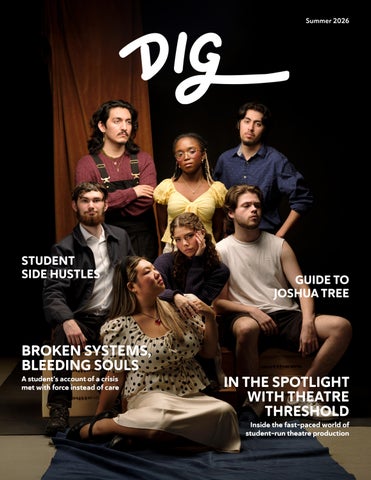
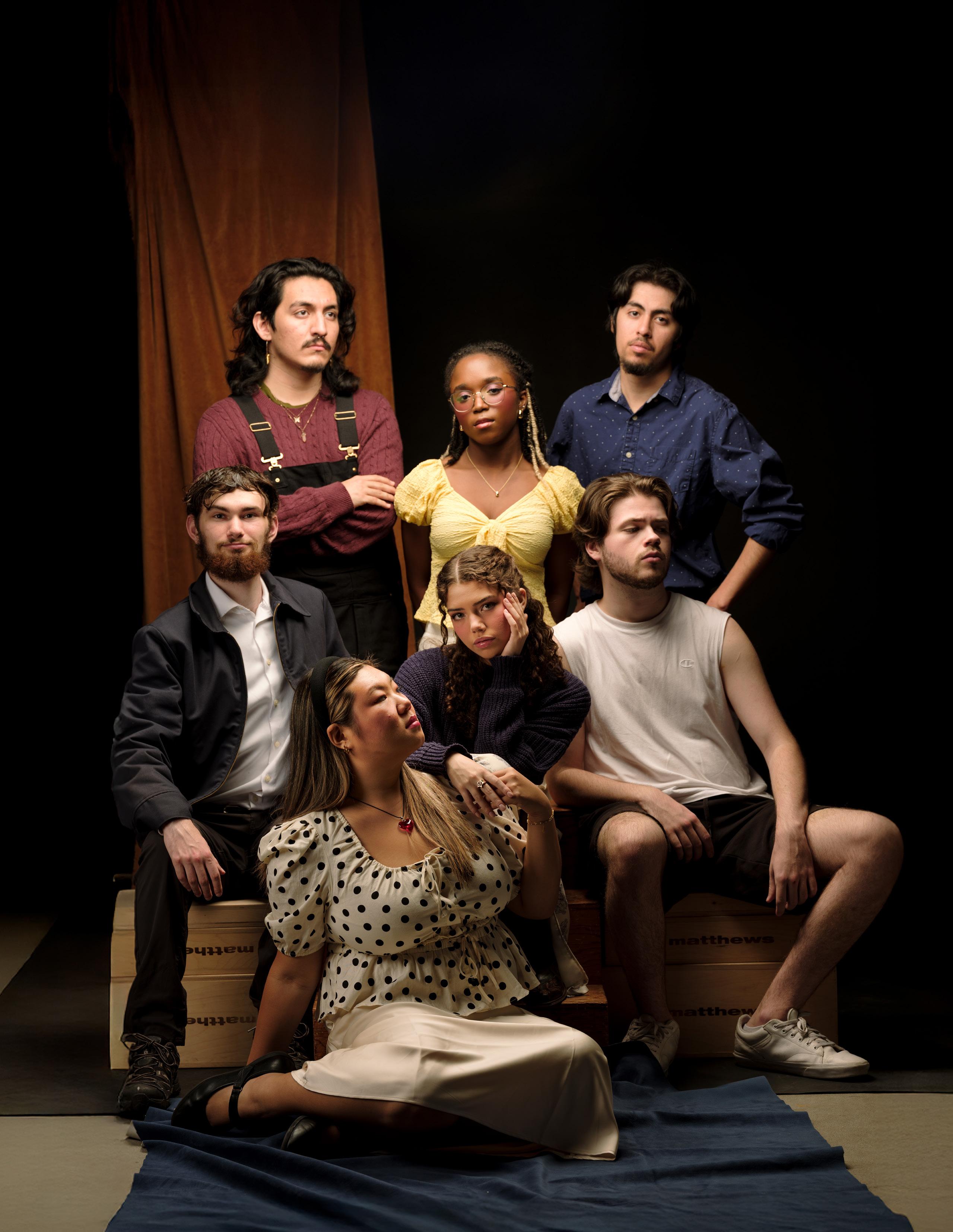
Come behind the scenes with Theatre Threshold, a completely student-run theatre company at CSULB that provides directors, writers and actors with hands-on experience by producing a number of plays and events every semester.
Broken Systems, Bleeding Souls
BY KARUNA NAMALA
After this now-CSULB student shared a vulnerable thought with their therapist as a teenager, they woke up to police and handcuffs. What was supposed to be a delicate intervention ended with swollen wrists and years of hurt.
The Coolest Place You’ve Never Been
BY JENNY FASULKEY
In the midst of lesser-known resources at CSULB lies ISPACE. Beneath the University Library, this innovation lab gives students access to 3D printing, podcasting and virtual reality tools that transform ideas into hands-on creation across disciplines.
A Student’s Guide to Joshua Tree
BY YALINA HARRIS
No big vacation fund? No problem! CSULB student Yalina Harris walks you through her own budgetfriendly weekend getaway to Joshua Tree National Park — where to camp, what to bring and most importantly, how much it all costs.
Photo by Gopi Vadsak.
ABOUT US
DIG MAGAZINE is the insider’s guide to Long Beach for the CSULB community, inspiring readers to immerse themselves in the Long Beach lifestyle through in-the-know stories about the latest in food, arts, entertainment and culture; in-depth features about people and trends on the campus and in the city; poetry, fiction, and literary journalism written by students; and beautiful photography and design. Published by the Department of Journalism and Public Relations at CSULB, it is produced entirely by students.
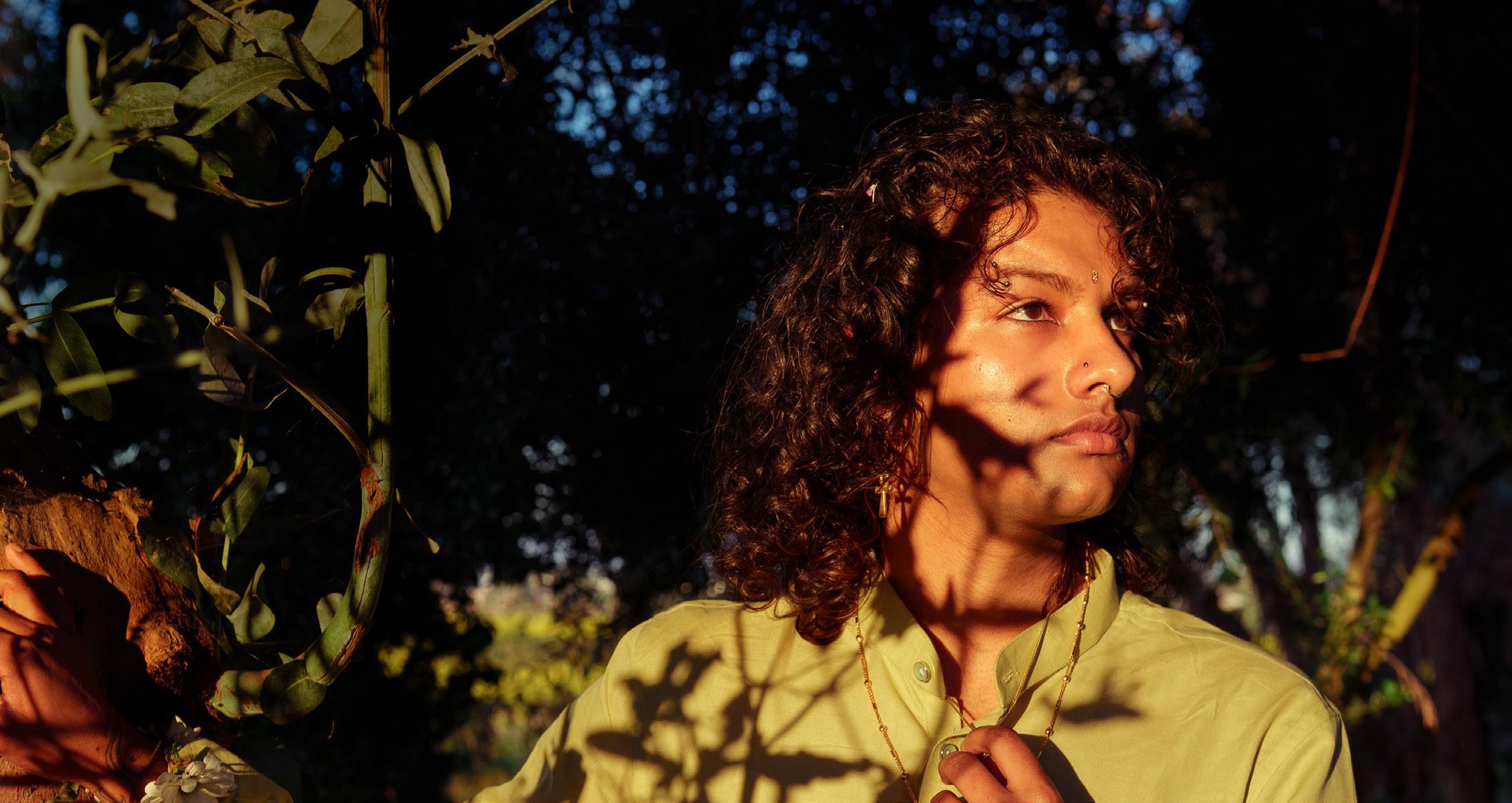
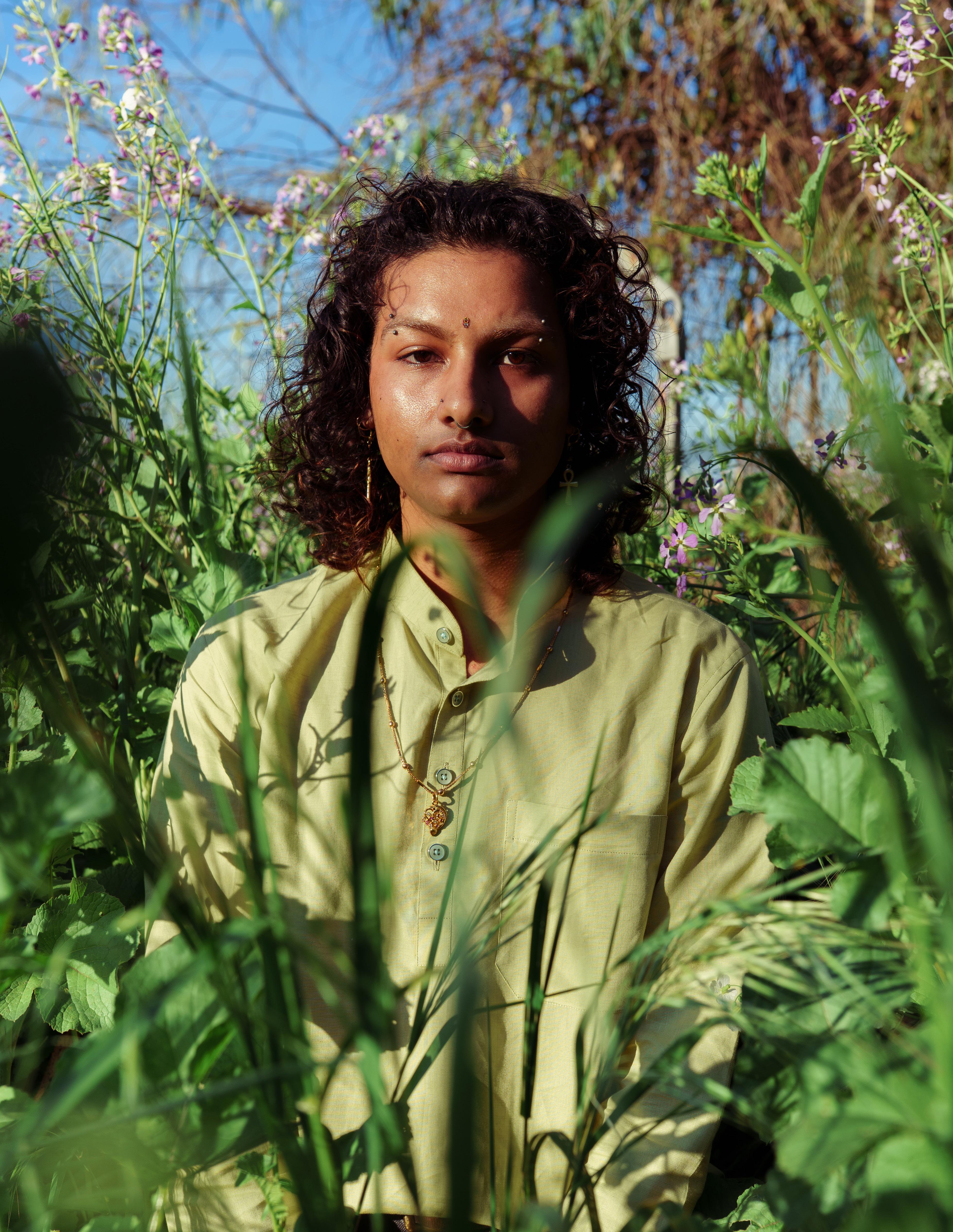
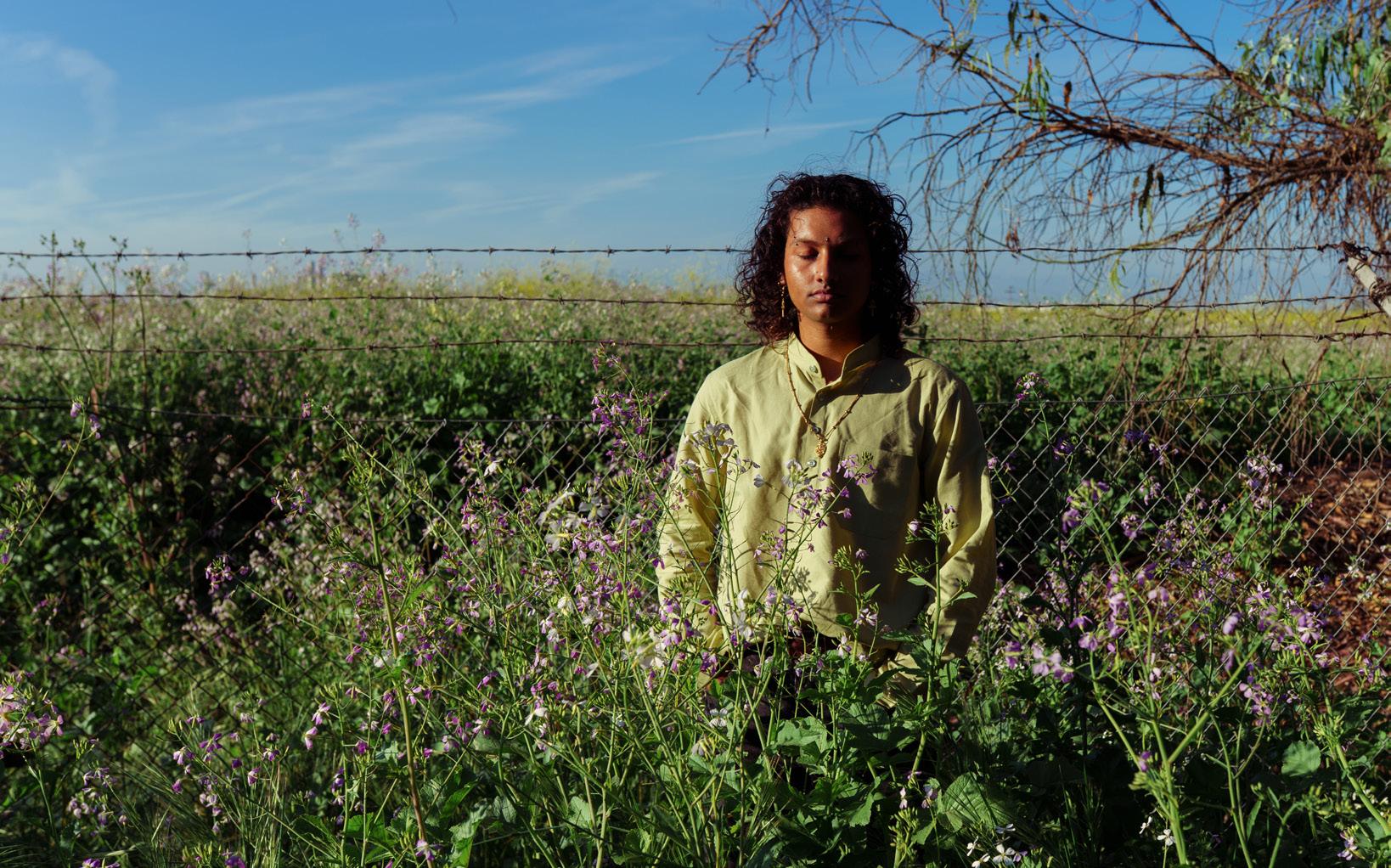
As soon as I stepped out of my car, my face was flooded with light. My eyes instinctively closed and for a few seconds I kept them shut, reveling in the warmth building on my cheeks and the golden hues I saw from the backs of my eyelids. At one hour until sunset, Gum Grove Park in Seal Beach was dazzling.
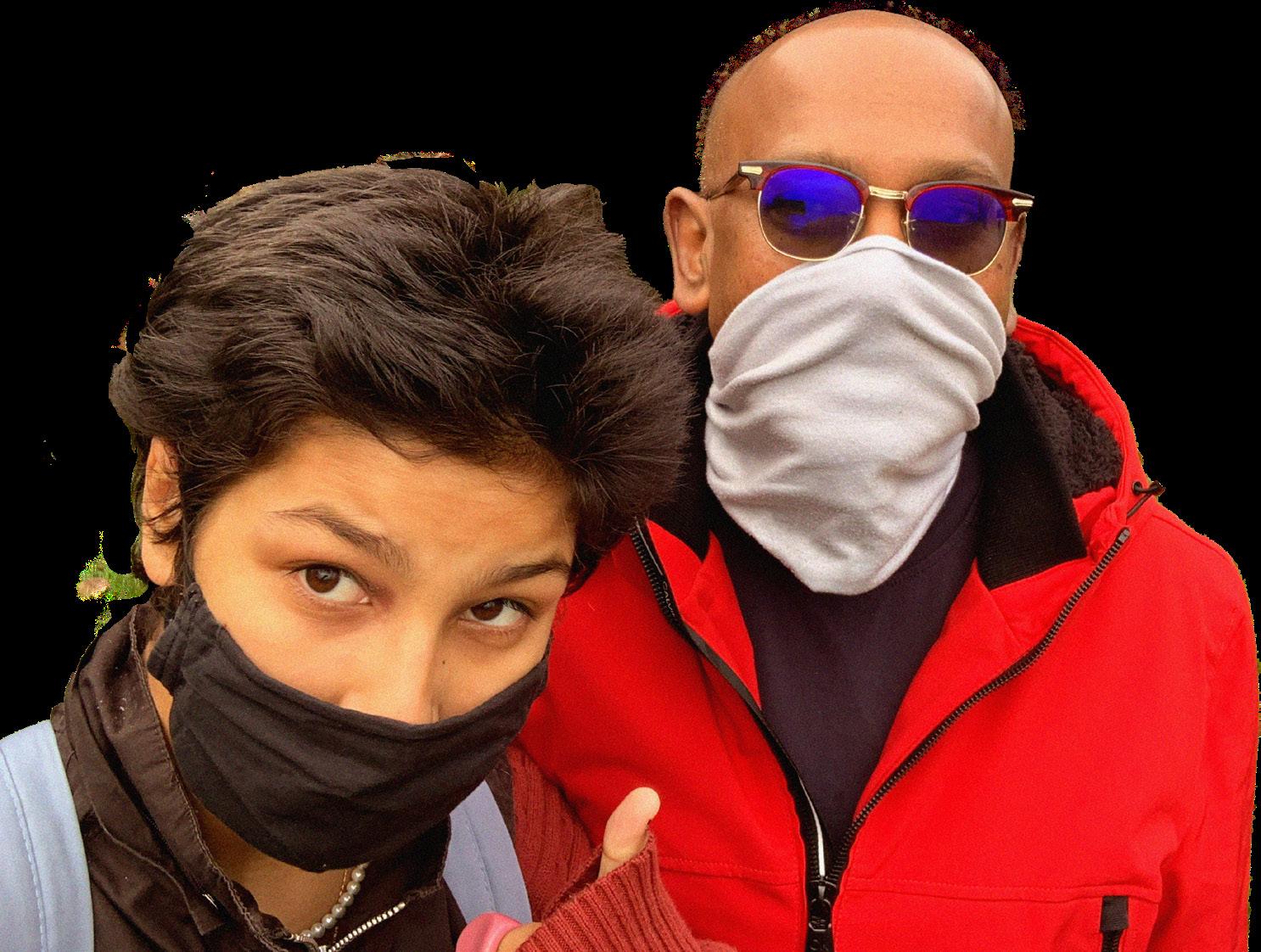
I was with Gopi, DIG’s brilliant photographer, and Karuna, the author of “Broken Systems, Bleeding Souls,” a haunting personal essay featured in this issue.
We walked down the dirt path; wildflowers and weeds surrounded us. To our left, the sun shone across the adjacent wetlands, through the wired gate and painted vivid color across the overgrown hill to our right.
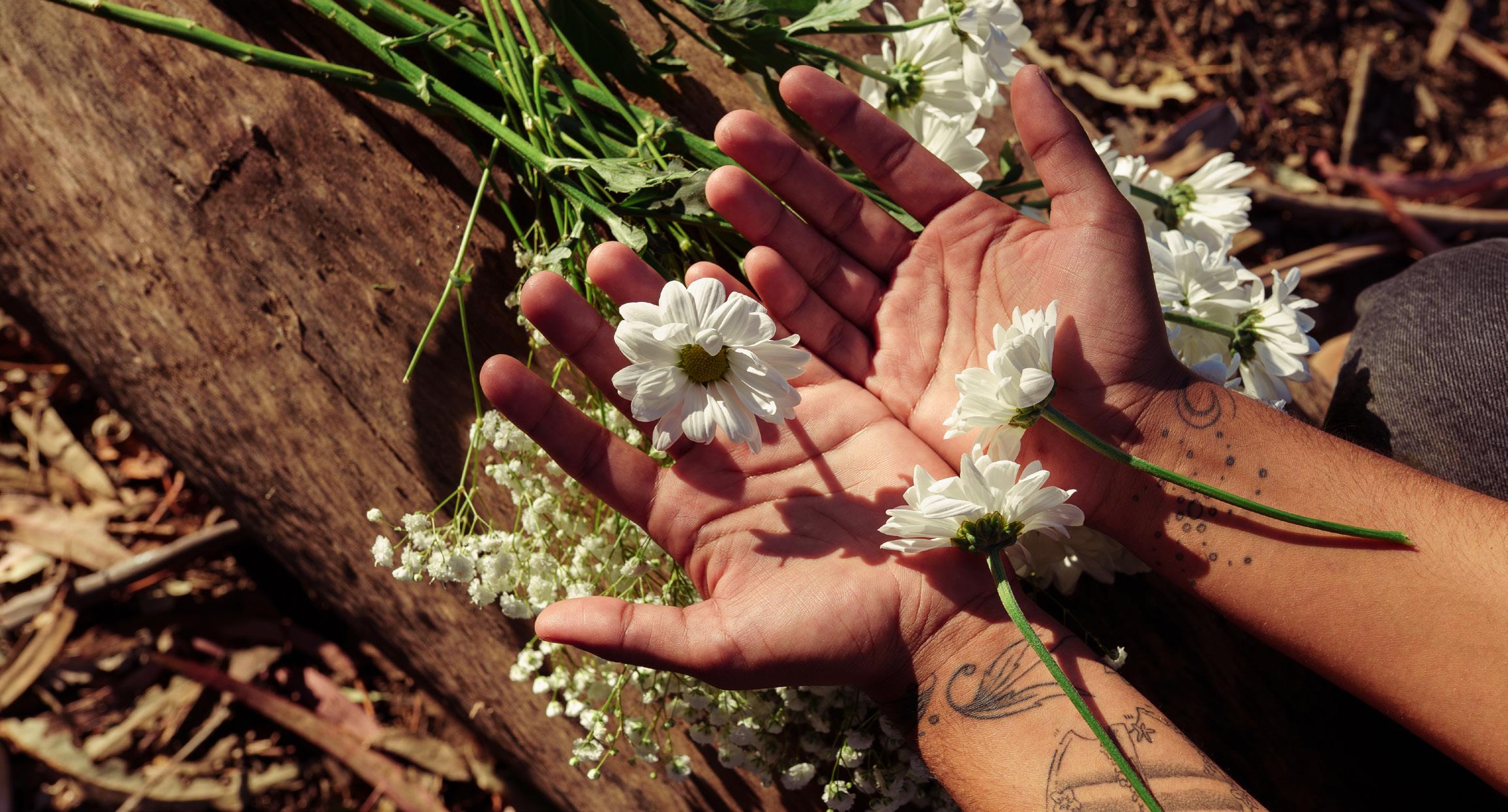
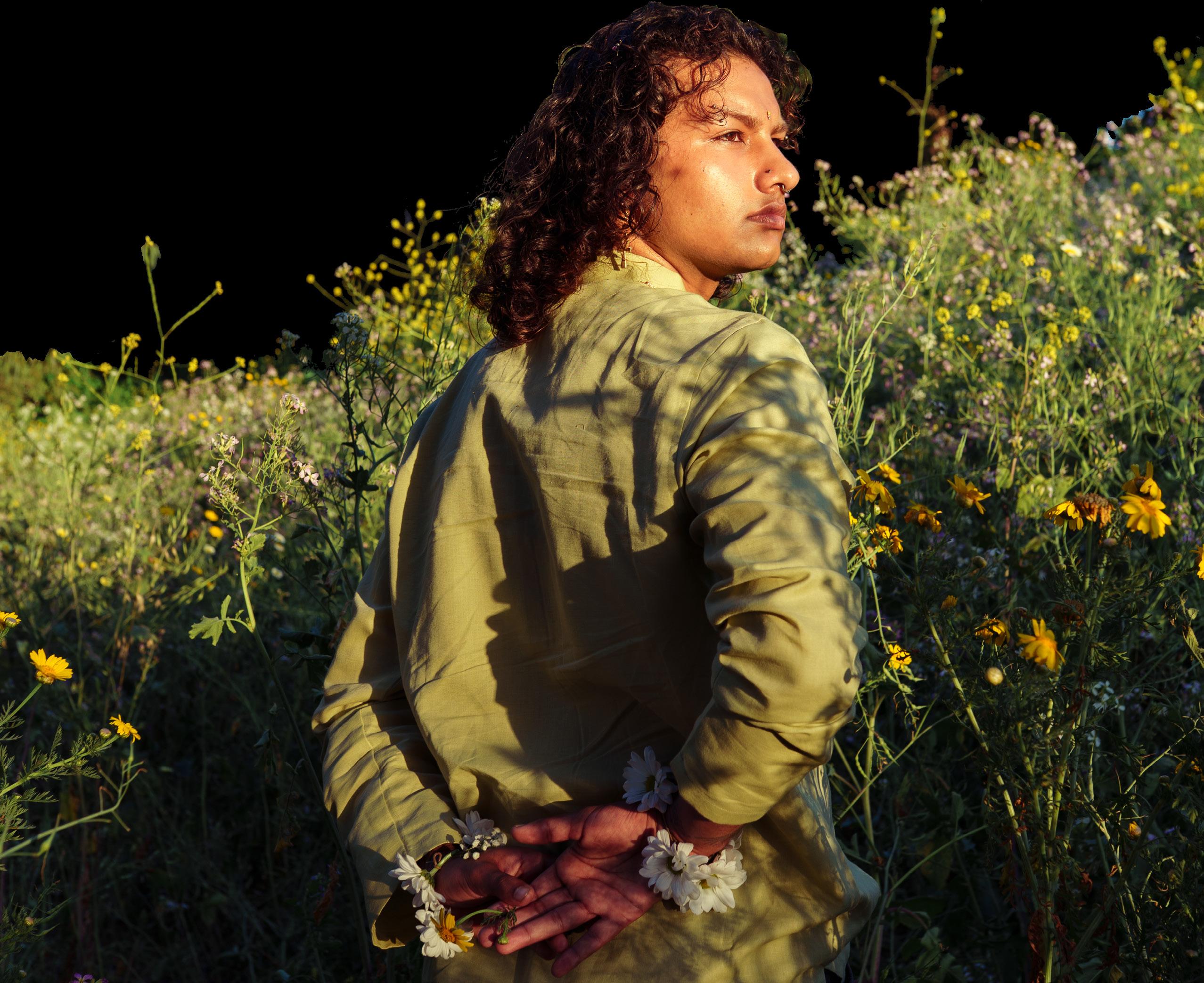
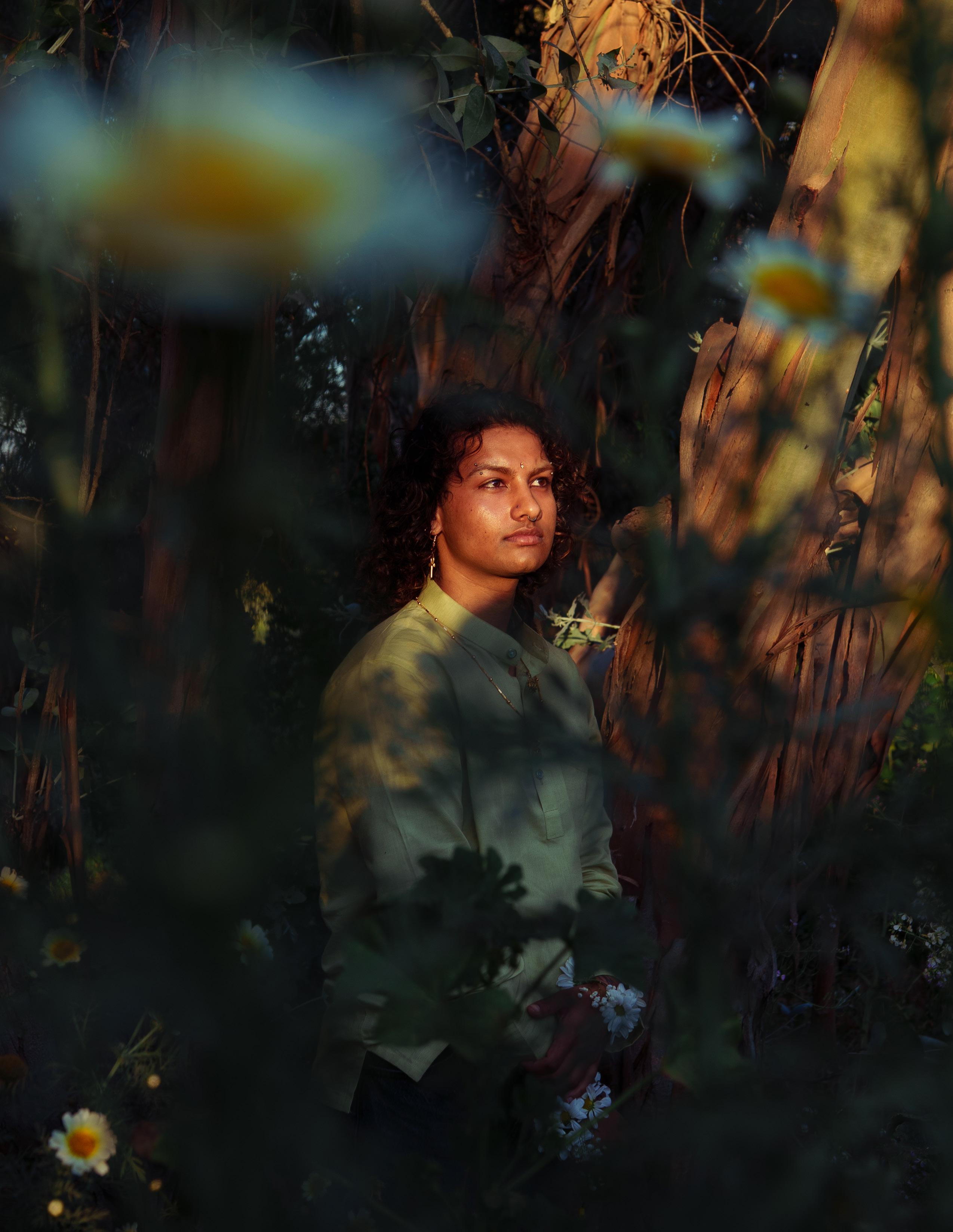
After capturing a few photos, we made our way to a large, horizontal log, and I took out the twine and daisies I brought to create a delicate floral band around Karuna’s wrists.
As I wrapped the twine and placed the flowers, I began studying Karuna’s tattoos and thinking about their story. The pain, the scars, the weight of it all. If I hadn’t read Karuna’s essay, I would have never known. How could I?
What else do I not see? Certainly not the journeys of the students I pass in the hallways, and in many cases not even those of friends or acquaintances I’ve known for a while. But when I do hear their stories, I’m often struck by the weight people carry.
Just as their pain is hidden to many, mine is too. Both of my DIG companions weren’t aware of the sadness I was carrying as I walked with them at the park, how the sunlight warming my skin strengthened me enough to push my struggles aside for a while.
The more I grow, the more I see that to be alive is to struggle. All life forms — humans, animals, plants, microbes — have struggled to get to where they are today. But we humans have something more, the capacity to share in each other’s struggle. Listening is a powerful tool; it can unburden, heal. Even so, we often enter people’s lives without ever asking or listening, even if we get the chance to.
Placing the last daisy on Karuna’s wrist, I thought about how much more whole we’d be if we shared more of ourselves, and more importantly, if we listened closely enough to see what isn’t immediately visible.
As I depart this magazine, I’d like to thank the DIG staff and faculty advisors for all their admirable work, and for giving me the opportunity to serve as editor-in-chief this past year. Writing this now, I find myself reflecting on all the incredible people I have come to know through DIG and wondering how much of their stories I have yet to understand, what each person has quietly carried while bringing this publication to life.
Let us listen.
With gratitude,
Nikoletta Anagnostou EDITOR-IN-CHIEF
THE COLLEGE $IDE-HUSTLE ECONOMY
STORY BY JOANNAH CLEMENTE
For many CSULB students, the school day doesn’t end when classes do. From handmade ceramics to content creation, these students support their education while gaining realworld experience through their side hustles.
TURNING CLAY INTO INCOME
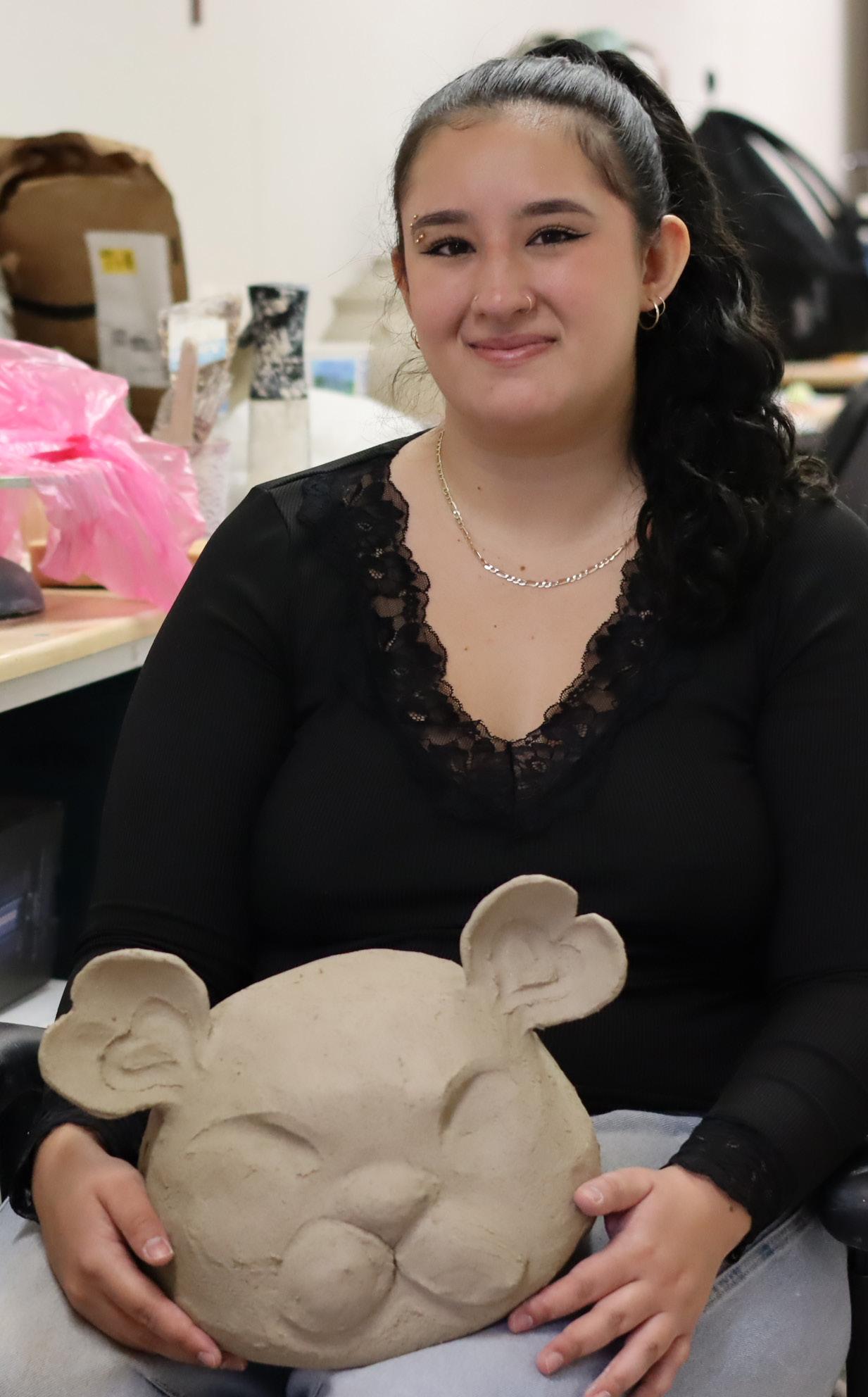
Jannelle Lennarz, a fine arts senior specializing in ceramics, turned her passion into a thriving side hustle, crafting handpainted mugs one wheel at a time.
She first dipped into sales at an elementary school PTA fundraiser in spring 2025.
“Cups and bowls flew off the table so fast,” Lennarz said. “[I thought] ‘Okay… people actually want this.’”
Lennarz now vends once or twice a month at local spots such as 4th Street Market and Good Time, a Long Beach cafe. Her nature-inspired functional ware features handpainted fish, bunnies, birds, moths and drawings inspired by the East Asian porcelain traditions she studies.
Smaller mugs start at $25 and the larger ones go for around $50, depending on the detail, size, and materials used. Lennarz usually profits anywhere from $300 to $600 per event. While the university provides the studio equipment, she pays out of pocket for materials.
“Of course making money on the side is great, but meeting people and forming community is one of my favorite parts of vending at markets,” Lennarz said.
Lennarz is also working on her senior show, a culmination of her work as a fine arts student, which will take place this fall and feature life-size leopard and bird sculptures. Lennarz accepts commissions through her Instagram @klarysas.kiln.
Janelle Lennarz poses in CSULB’s art studio, where she turns hand-painted and cobalt-blue mugs into a fun side hustle.
Photo by Joannah Clemente.
TEACHING IN THE WILDERNESS
Katherin Rubio-Suarez, a studio art senior, supports her studies by working as an art instructor and counselor at a sleepaway camp at La Cañada Flintridge.
From June to August, she drives into the wilderness once a month for weekend retreats, where she teaches kids how to make candles, build birdhouses and paint. She also trains teenagers to be counselors and teaches other leadership skills that can be applied to real life.
“I personally love teaching art,” Rubio-Suarez said. “It’s a great way for me to practice that skill.”
As a camp counselor, her duties also include chaperoning a cabin of girls overnight, ensuring their safety — bears and all. The position pays about $300 per weekend and includes housing, meals, and personal fulfillment.
Now three summers in, the role has strengthened her leadership skillsas well as taught Rubio-Suarez how to best budget her time.
“[During] finals week I had to go in to work … I had 20 illustrations due … I was stressed out, but I managed it … even with the kids. On breaks, I worked on my iPad. It’s possible to have balance.”
Eileen
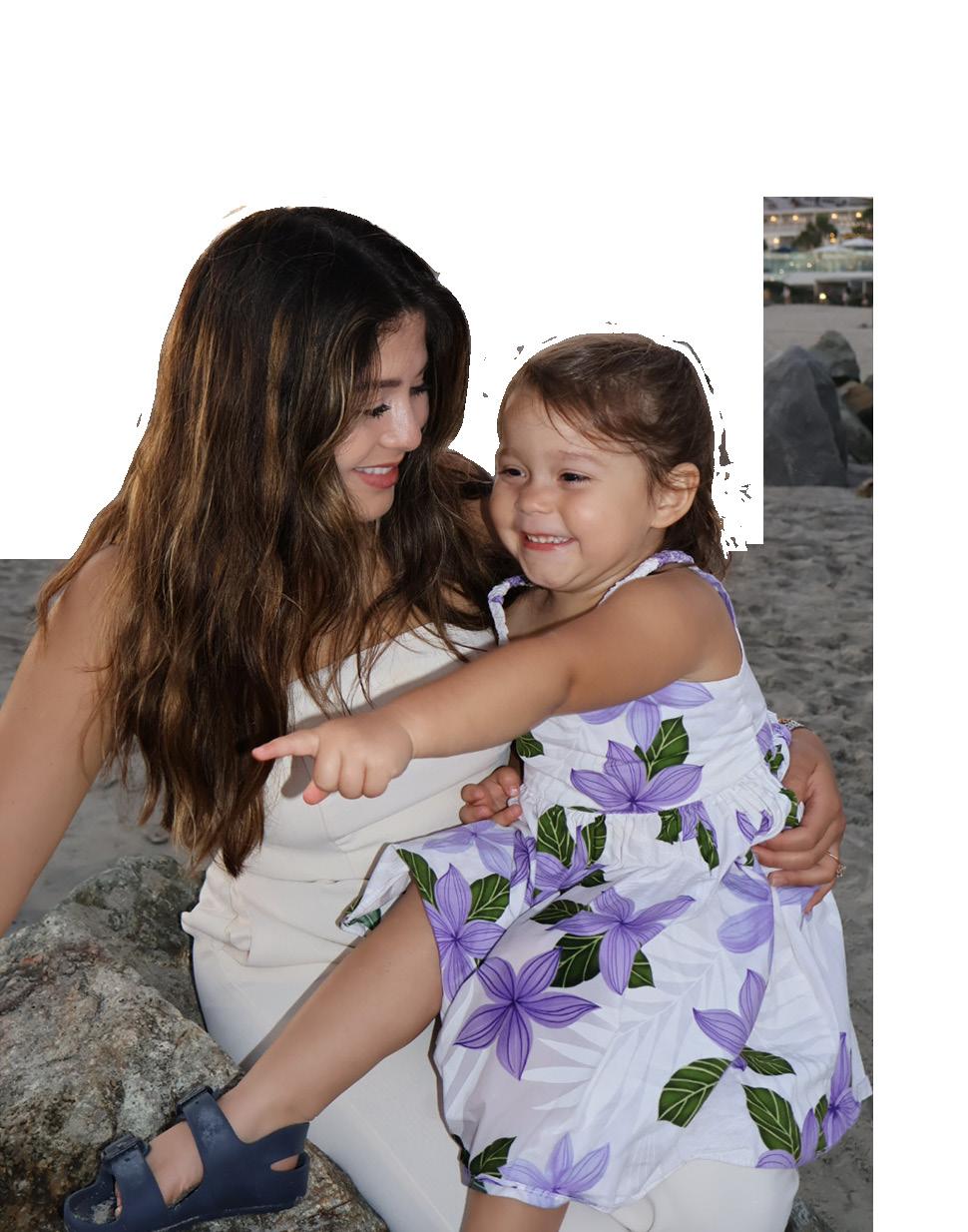
Flores smiles with her daughter Emerson, who is Flores’ driving motivation and a frequent guest in her relatable Instagram mom content.
Photo courtesy of Eileen Flores.
“On breaks, I worked on my iPad. It’s possible to have balance.”
BALANCING MOTHERHOOD AND CONTENT CREATION
Eileen Flores, a marketing analytics graduate student and single mother, has spent the past three years building her social media platform while raising her 3-year-old daughter, Emerson. Her content focuses on being a parent.
Flores has amassed nearly 20,000 followers on her Instagram account, @leenie_flores, where she shares motherhood tips and relatable videos.
This past December, Flores launched “Becoming Her Unfiltered,” a podcast focused on growth, motherhood and healing, inspired in part by a difficult breakup.
“[The podcast] came from wanting to share my experience, healing journey, and connect with other women going through similar things,” Flores said. “It felt like a deeper way to tell my story beyond Instagram.”
Flores earns around $200 per month from content collaborations, along with additional perks that have been valued at thousands of dollars, including memberships, event invitations, and a hosted stay at Hilton La Jolla Torrey Pines.
In addition to school, motherhood and content creation, Flores works full-time as a media planner at RPA, an advertising and marketing agency. Graduating in May, Flores wakes up at 5 a.m. every morning, determined to achieve her goals and create a bright future for her daughter.
“After having a kid, I don’t give a fuck what anyone thinks of me,” Flores said. “I’m going for it because it’s my future with hers.”
Katherin RubioSuarez spends her weekends surrounded by nature, children and animals as a camp counselor.
Photo courtesy of Katherin Rubio-Suarez.
LATANYA SHEFFIELD’S MINDSET TO SUCCESS
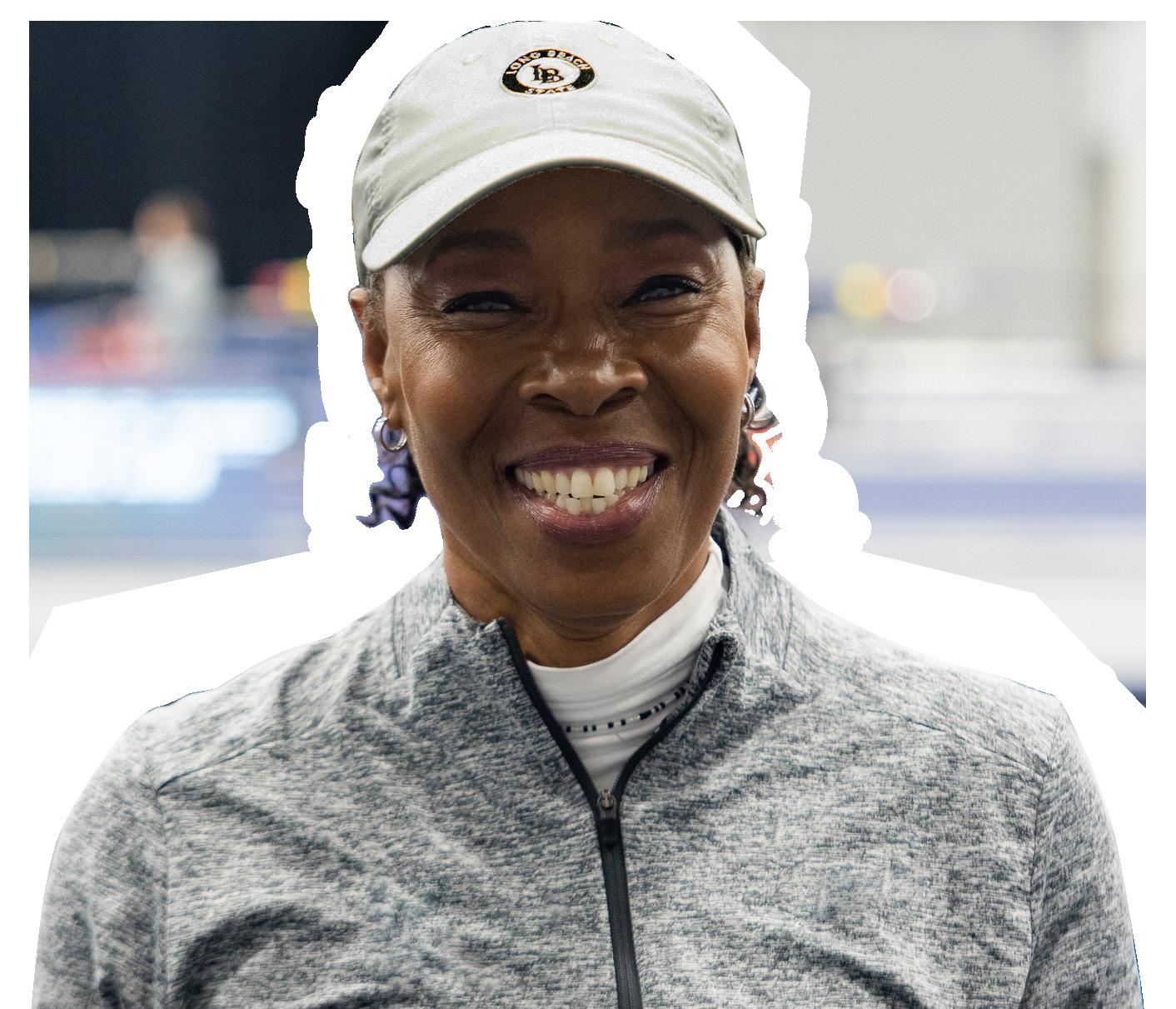
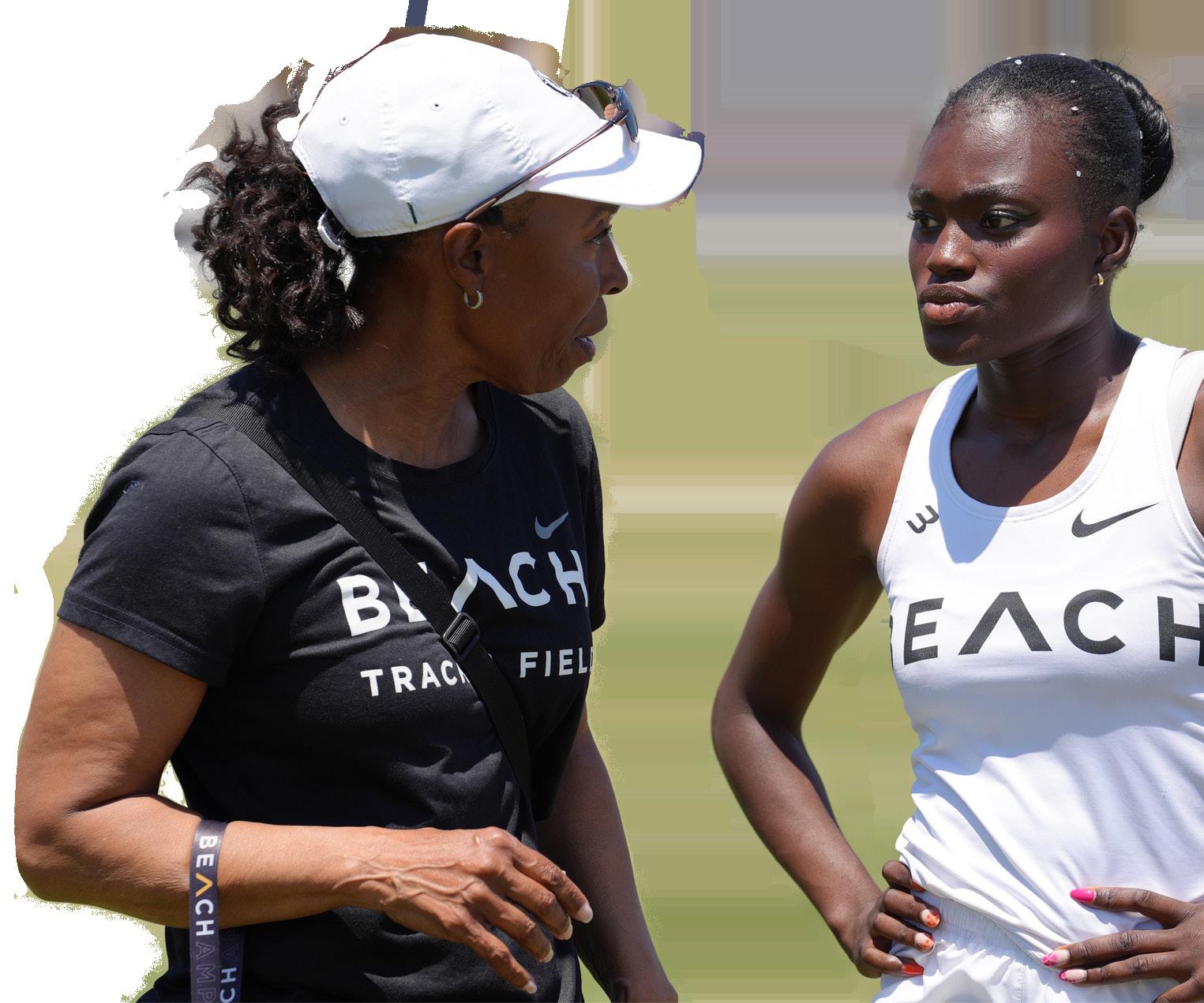
LaTanya Sheffield, the director of track and field for CSULB athletics shares her experiences in the sports world and the wisdom she has gained along the way.
STORY BY LARISSA SAMANO
PHOTOS COURTESY OF LBSU ATHLETICS
DIRECTOR of Track and Field at Cal State Long Beach, LaTanya Sheffield, has had a distinguished athletic and coaching career, from setting an American 40-meter record at San Diego State University, competing in the 400-meter hurdles at the 1988 Olympics, and coaching at the last three Summer Olympics. Now in her 14th season coaching track and field at CSULB — and with prior experience coaching high school and club teams — she draws on her personal athletic experience and her years of coaching to share wisdom, guide and inspire her athletes.
Q:
When did you know you’d be able to compete in track at college level?
A: My brother recommended that I try out for the team [at SDSU]. And he really was the one to craft that whole thing. It wasn’t the turning point mentally, but that was the route that I started to lean into. It was Monday, Tuesday, Wednesday training. that I saw I could handle. We would train in these little groups, and I would certainly be in the back because I had no business being in the front. As I continued training, I started just to become a little bit more courageous and challenge myself.
Q: Would you say that how you were raised contributed to the mindset you have today?
A: Absolutely. My mom was a widow with children. How we approached life was affected by that lens and those experiences. [My siblings and I] saw a female manage it all. Maybe in her mind, she was juggling. But from my lens, she was managing [everything] with a snap. [When it came to] cleaning the house, whether it’s washing the dishes and not just putting them in the dish rack and letting them dry, but drying them and putting them away, [she was all about] completing processes. She was instilling in us the idea that if something’s worth doing, it’s worth
After over a decade of coaching at CSULB, LaTanya Sheffield was named director of track and field in July 2025.
Q: What was it like to compete in the Olympics as an athlete?
A: My perspective was to compete to the best of my ability to get my physical and mental in alignment to represent our country in the most momentous stage, right? To literally get on the platform to on the podium for metals and such. So the perspective was, let me do it. Let me put my best foot forward. I’m the one in control of my physical and emotional state.
Q:
How important do you think mindset is when you’re looking to accomplish anything in life?
A: That’s the crust. Your mindset is everything. It’s not talent. The hard work, influences, and building your mindset. So keep at it. Sand the floor, paint the fence. Roll your sleeves up and you go to work, and make it happen. Whatever you want to do, just make it happen. All those excuses, girls, stop that. Don’t do that. All you’re doing is just opening the door of “can’t” wider and wider. You want to shut that door, you want to lock it, you want to bolt it. [There’s] two words all of the athletes that I coach know: “So what?” “The dog ate my homework.” So what? So what are you gonna do now?
Q: How was your experience as coach at the Olympics different?
A: When I became a representative of the United States as a coach, that was so much different. I’m just more mature. I’m a married woman with children, and seeing life through the perspective of a mom and wife and entrepreneur. As an athlete, I wasn’t concerned about taking care of anybody, but just taking care of myself. But when you are coaching, it is being a person of service. And that is so rewarding. I [was] in the position to uplift and obviously, that is who I am. That’s what I’m made of. Just loving to inspire folks and motivate and guide folks and things of that sort. So being in the role of a coach of an Olympic team is just really the ultimate.
Q: What is something that you’ve learned as an athlete that you
wanted to share with your athletes as a coach?
A: Patience. It could just merely not be your time. And be okay with that, and just be okay just in life. It’s all right to be patient. It’s all right to wait. And while you’re waiting, you’re actively waiting. You’re waiting for that shot. If they’re a little early, you’re ready. If they’re a little late, you’re still ready, because you’ve already done the things to have prepared.
The past few years have been very successful for Sheffield. In 2024, she served as the head women’s track and field coach for Team USA at the Paris Olympics. In 2025, Sheffield coached three student athletes to new CSULB records.
WHERE ART
PHOTOS COURTESY OF KIYOMI FUKUI NANNERY AND MICHAEL NANNERY
STORY BY ANA LIKAR AND MARTY TRIPLETT
TAKES ROOT
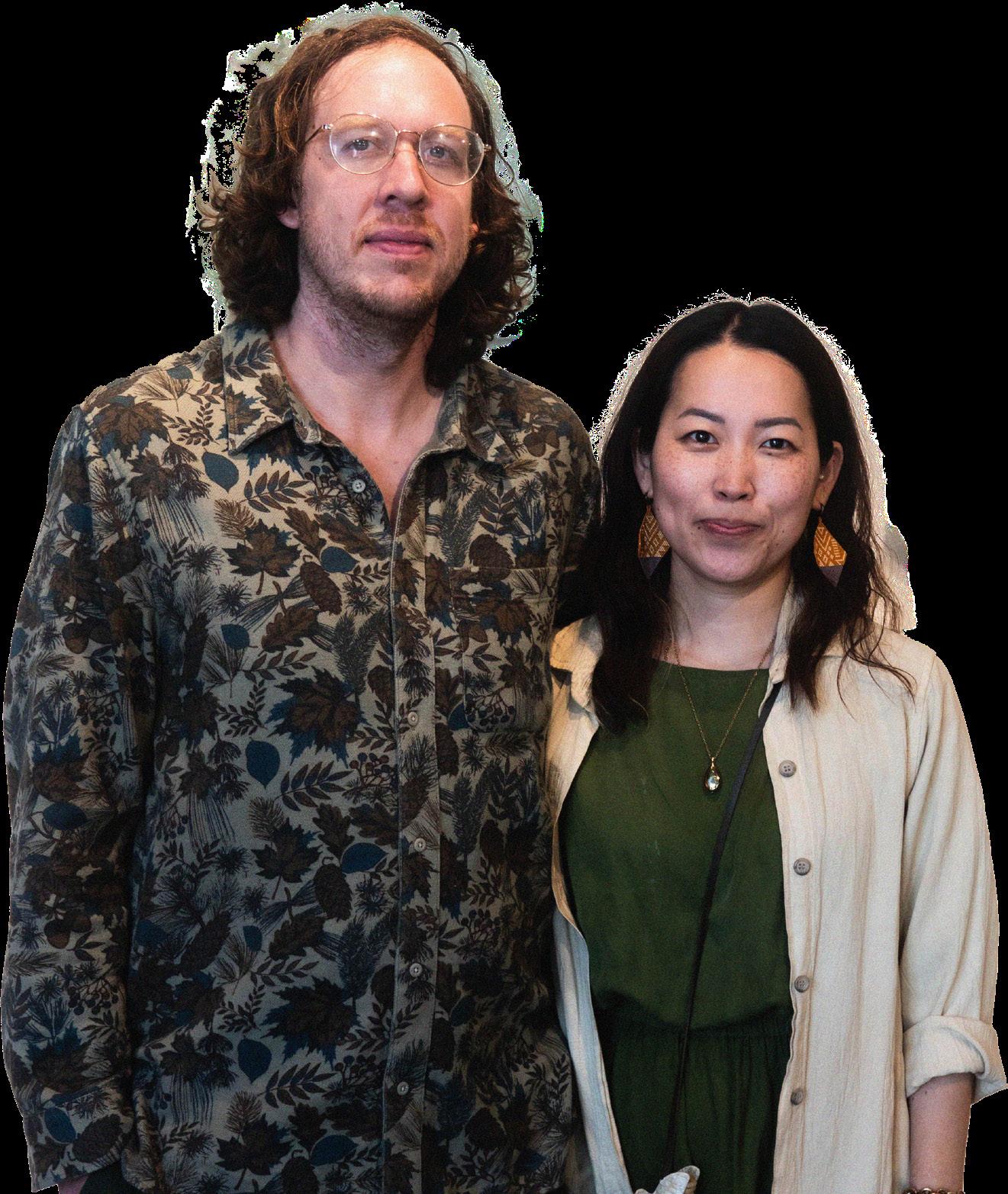
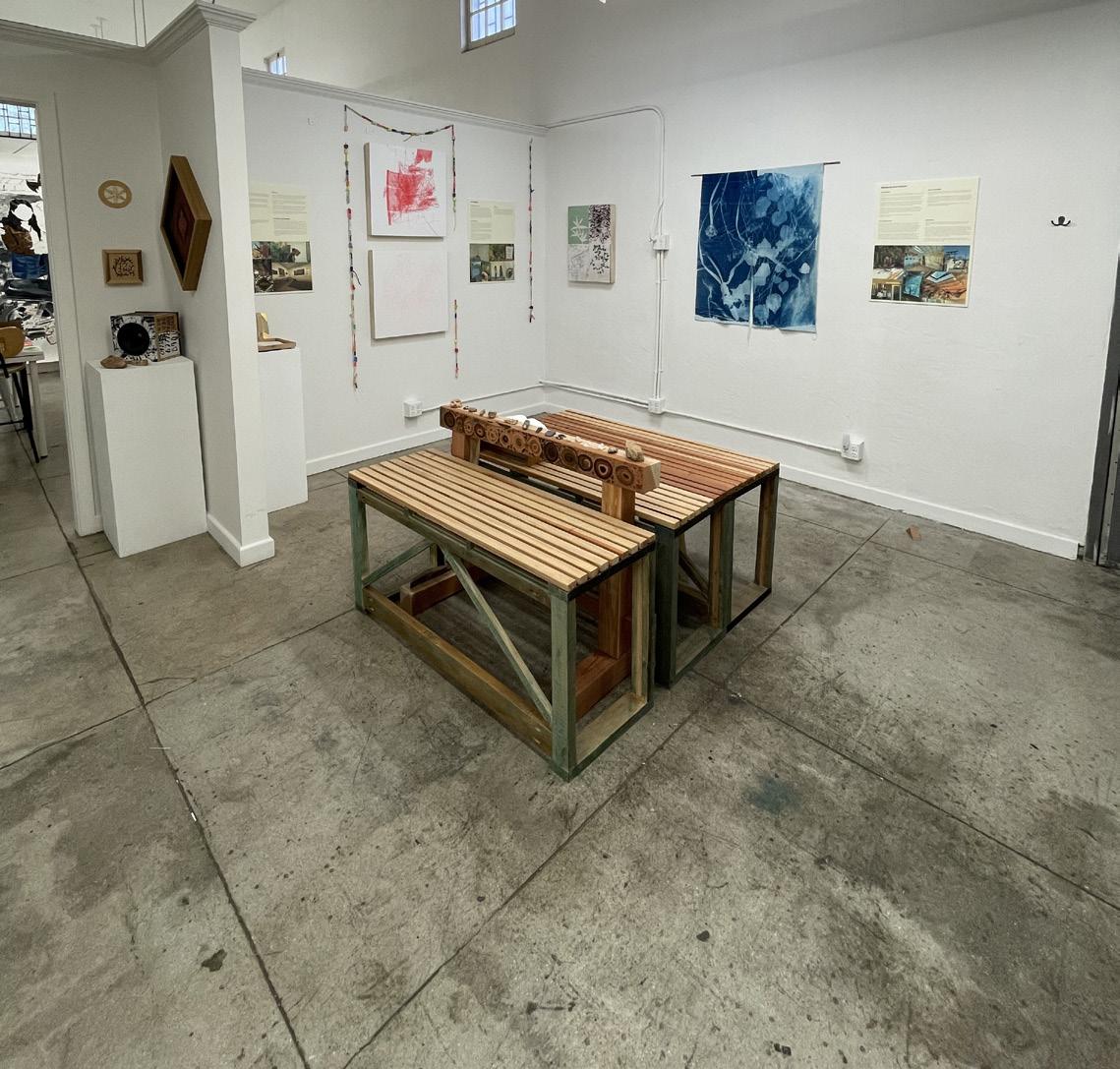
These married CSULB professors run a printmaking studio and microfarm, where sustainable art practices and organic plants grow side by side.
“Art is a really important and transformative experience, so I feel like being able to open that door for people is a really special thing.”
INSPIRATION can grow from the smallest of places. For Kiyomi Fukui Nannery and Michael Nannery, it grows from the seedlings of their microfarm and the community from their gallery.
Kiyomi and Michael, both current professors in Cal State Long Beach’s School of Art, met in 2013 while working toward their bachelor’s of fine art degrees in printmaking. The pair quickly fell in love and married in 2017. Since meeting, their passion for each other, art, life and gardening motivated them to foster a botanical space in their home, which ultimately inspired their company, Peace Lily Press & Microfarm.
Peace Lily Press & Microfarm is an artist-run space that specializes in nontoxic printmaking, natural dyes and pigments, organic food production, and sustainable practices. They offer microresidencies, project and exhibition spaces to artists on an invite-only basis, as well as workshops open to the public.
These free workshops, hosted year round, often consist of a simple, self-guided artistic experience with open donations that go towards the company or nonprofit organizations such as CSULB’s Associated Students Inc. food pantry.
“People want to make art. They go out and see art in a gallery or a museum and then they want to do it themselves, but maybe they don’t even know where to begin. Art is a really important and transformative experience, so I feel like being able to open that door for people is a really special thing,” Michael said.
Both Kiyomi and Michael work in printmaking, a medium in which images are created and transferred onto other surfaces. They were drawn to this medium in particular because of its slow and intricate process.
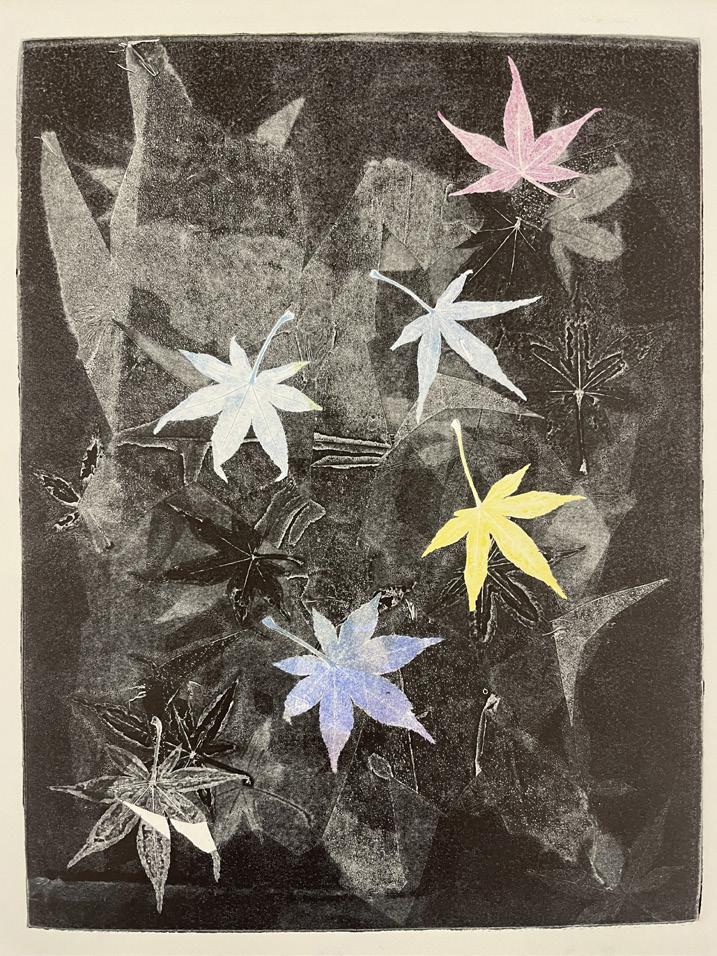
“Falling Leaves,” by Michael Nannery, featuring Japanese maple leaves.
Michael Nannery and Kiyomi Fukui Nannery.
“Because [printmaking] breaks things down to different steps, it slows down the process so much, and I think there’s something about slowness that I love,” Kiyomi said. “It feels like the opposite of Instagram in the best way.”
In the early stages of their studio, Kiyomi and Michael produced art from their own home, collaborating with other artists, family and friends to sell prints relating to their garden. One of their most beloved plants they tend to is the Peace Lily, which ultimately inspired the name of their business.
“We really did have a ‘micro-farm,’” Michael said. “We were growing dozens of different plants, including the Peace Lily, on a very small scale capacity.” It was a connection with art, light, nature and plants all connected in one.”
Their organic garden space is home to countless different crops that often have diverse uses. Whether it is cabbage turned to sauerkraut, or stinging nettles used for allergies, each plant is grown organically and with intention.
Once Kiyomi and Michael moved to a new home in 2020 with a studio gallery in the backyard, they decided to expand their reach and invited other artists to do residency projects within their space. After these artists finalized their pieces over the course of a few months, Kiyomi and Michael would host exhibitions in the backyard studio gallery, inviting friends, family, and other people in their community to come and enjoy the show.
“It was initially a very homegrown art experience,” Michael said.
“Because [printmaking] breaks things down to different steps, it slows down the process so much and I think there’s something about slowness that I love. It feels like the opposite of Instagram in the best way.”
After three years, the couple moved to a smaller home, and had to modify their artist residency program and workshops because of the limited space.
“For a while, we weren’t really sure what was next. We continued to do artist workshops in that time without a specific home base for our studio,” Michael said.
However, as of last summer, the couple found a beautiful studio location in downtown Long Beach where they plan to stay long term. As artists themselves, Kiyomi and Michael use this space for their personal artistic production, while continuing to support the spirit of communal artist-run spaces. They still offer artist residencies, regularly host workshops, and hold open studio days, maintaining an active and welcoming environment for the community.
“Right now I’m doing a lot of image based art about personal experience and personal exploration, so having Peace Lily Press as a platform is a nice way to still have that social engagement and uplifting of other artists that I would like to see thrive,” said Kiyomi.
In the microfarm at their new location, they grow a lot of the natural dyes that they use for their pieces. The biggest crop that they grow is Japanese indigo, whose blue pigment is used as the inspiration for artist workshops every summer.
For the duo, holding workshops, hosting artists, and microframing is a way to make art more accessible for those who may not be able to take a college course but still want to engage with art. As they continue to expand their reach,
the couple hopes that their sustainable and communal space remains a beacon of accessibility, community and artistry for many.
“I always talk to people and they’re like ‘Oh, I’m not an artist.’ I believe everybody is an artist, and part of our mission is to find different ways to activate artistic experiences with people in our community,” Michael said.
To stay up-to-date or to visit Peace Lily Press & Microfarm, visit their Instagram, @peacelilypress_microfarm, or their website peacelilypress.com.
An inside look of the studio at Peace Lily Press & Microfarm in downtown Long Beach.
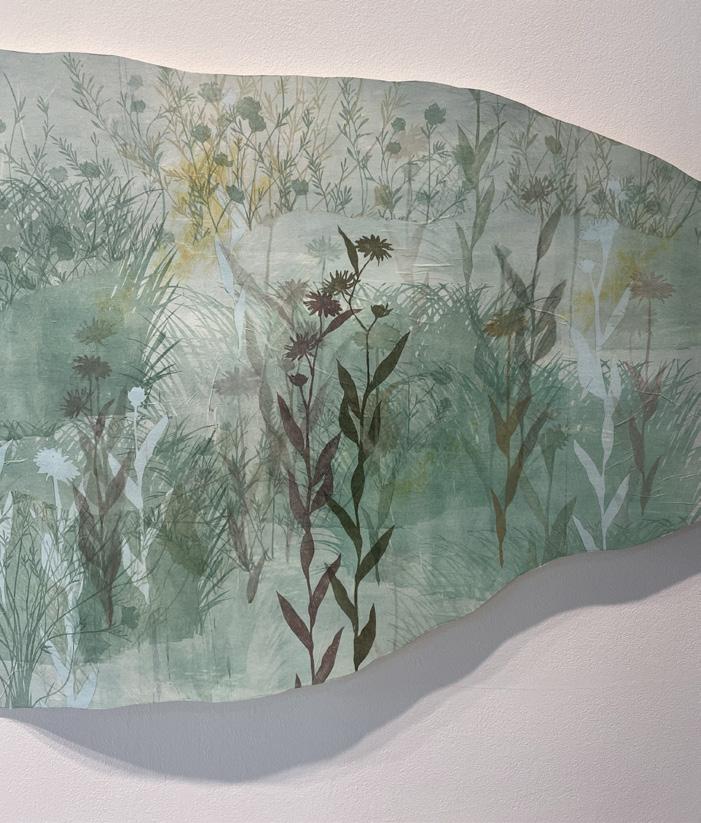
A detail shot of “Ghosts of the Marsh,” a two-piece artwork by Kiyomi Fukui Nannery.
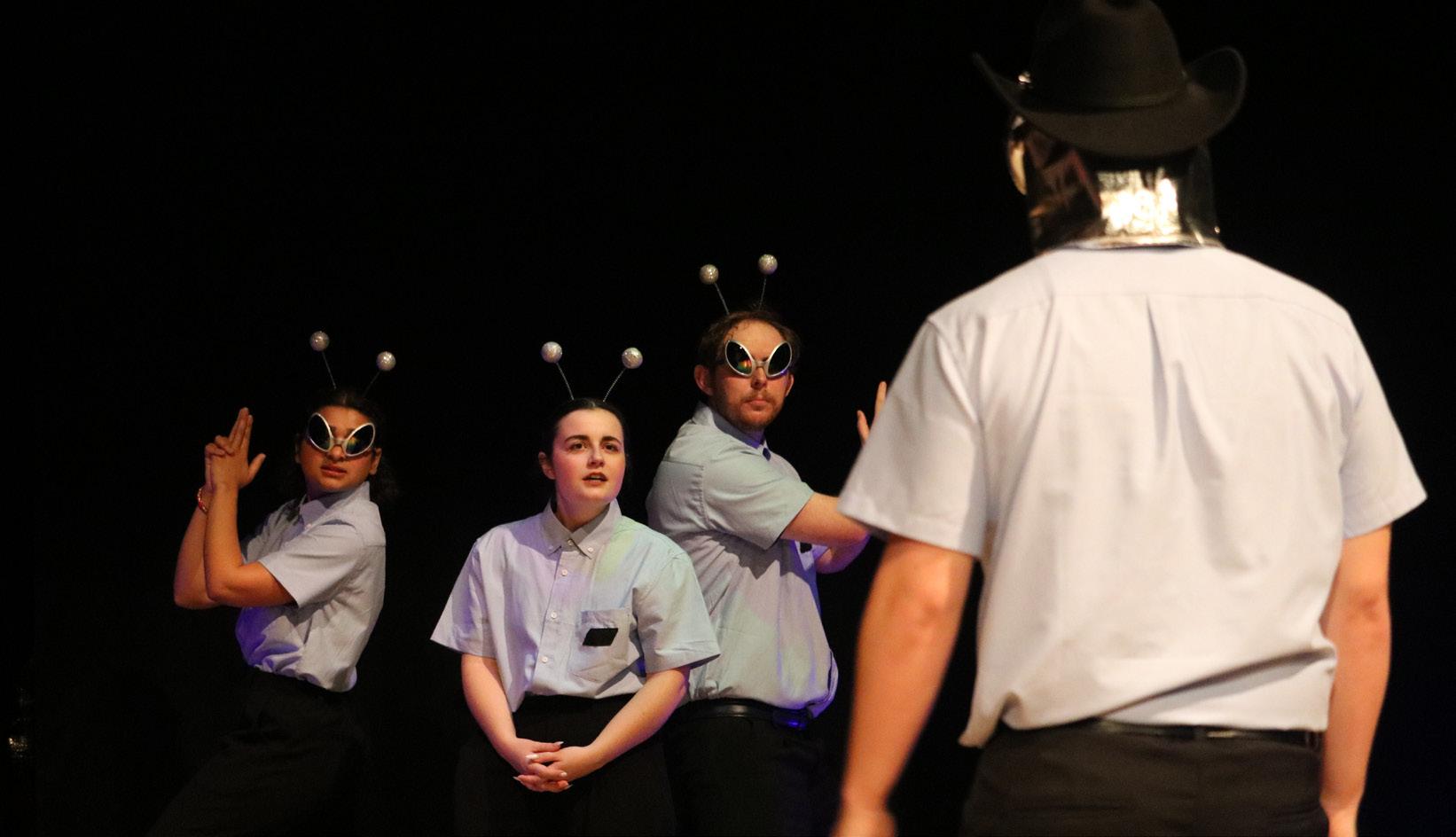
From writing, casting, acting, tech and production, this CSULB student-run theatre company does it all.
WEEK ONE: Time for auditions, callbacks, and casting! Check cast and director availability and make sure the actors can get comfortable with one another and their scripts.
Week two: Actors and directors start scene-by-scene rehearsals, iron out the blocking, and work on memorizing lines.
Week three: It’s tech week! Sound, setting, and set designers come to rehearsal and figure out how to make the production seamless.
Week four: More rehearsals from 6 p.m. to 10 p.m., and on Thursday and Friday, it’s showtime!
This is the whirlwind of a schedule behind every show that Theatre Threshold produces.
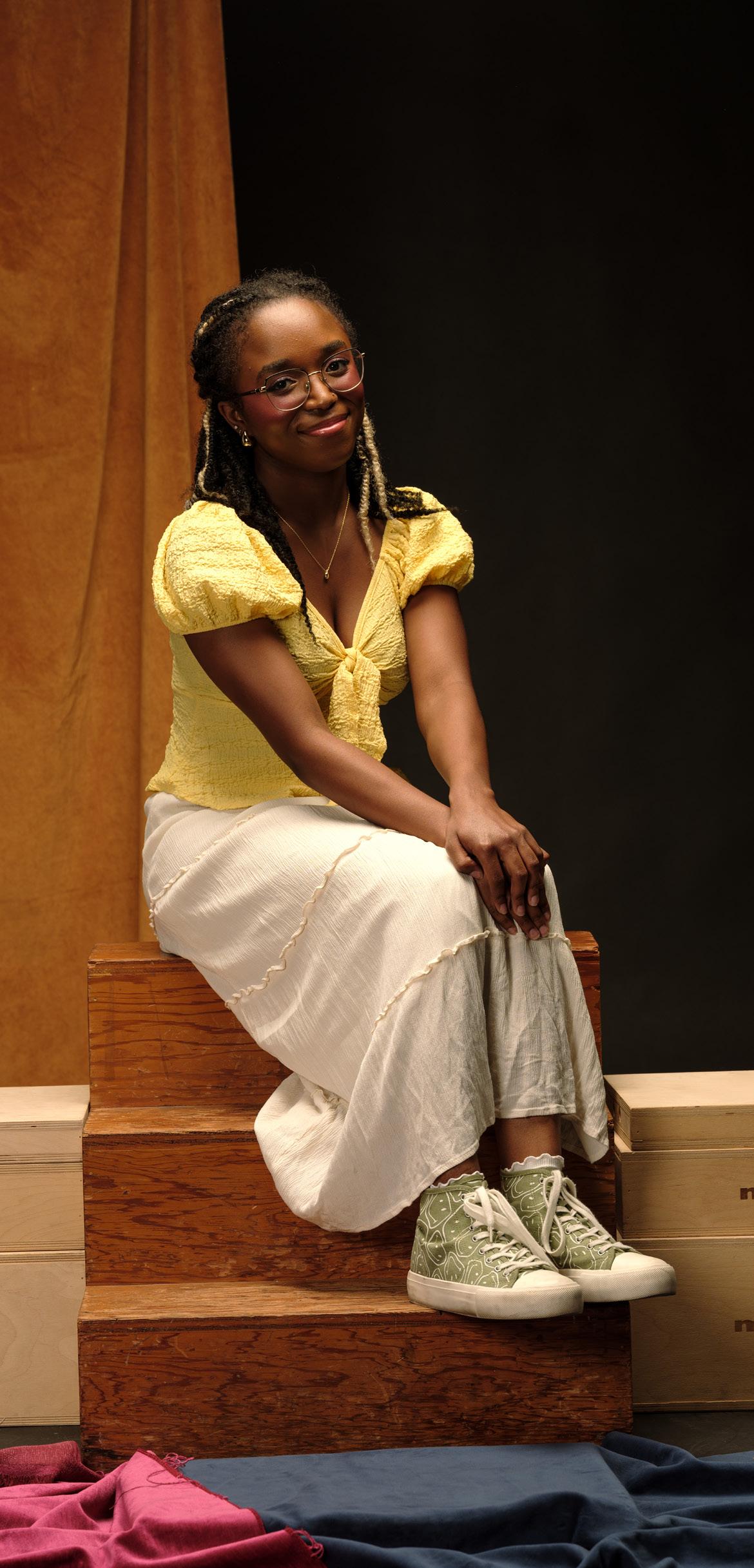
Theatre Threshold is a theatre production company that is completely run by Cal State Long Beach students, giving playwrights, actors, set, costume, lighting and sound designers a unique chance to gain hands-on, technical experience in the field of theatre.
The organization is led by fifteen board members, who provide resources and support to a number of teams who write, direct, technically produce, market and act in shows throughout the semester.
“We base our company and the way in which we run things off of how real professional theatre companies run,” explained Abby Lane, one of Threshold’s artistic directors. “So we’re all learning,
we’re all supporting each other, and we’re also all trying to get work experience.”
Every week, the board hosts an event or produces a play. This semester, the team will put on a total of five shows: “Just Keep Rolling,” “for you.,” “First Dates,” “Wrong Side of the Bed” and “Thank you, Places!” The shows are selected by the board and usually have a thematic through line.
“Last semester, we had a lot of shows involving community and coming together,” explained Devin Addiego, Threshold’s second artistic director. “This semester, I feel like each of our shows represents determination or perseverance, especially in relation to art.”
“It can be very chaotic. That’s the culture in Theatre — we’re just all used to doing a lot very fast with very little resources. ”
“In the past, we’ve done a lot of dramatic pieces, and we wanted to do more comedic [ones] this semester… giving a relief to what artists and young people are going through right now,” added Lane. “So a lot of this semester’s shows are comedic, or just fun or crazy to give audiences a break from the world that we’re living in.”
STORY BY KIMBERLY WONG
BY GOPI VADSAK
Since Threshold puts on so many shows every semester, production time is limited — most plays are produced over the course of four weeks. This isn’t unusual for theatre, though, and allows for flexibility for everyone involved. To keep everything running smoothly and avoid unnecessary drama, the members of Threshold have a strict communication structure and emphasize open and frequent conversations.
“It can be very chaotic,” laughed Lane. “That’s the culture in theatre — we’re just all used to doing a lot very fast with very little resources. It’s a lot of pressure sometimes, because all of us want it to go well, because we care about it. But this semester, we have a really good team, and everyone in our program is really eager to learn and pick up the slack when people need help.”
Early on during the semester, playwrights submit their work, and the Threshold board, especially the artistic directors, select plays to produce based on completion and feasibility. Once plays are selected, casting and figuring out which board members, directors and crew members will work on which show happens almost immediately.
Marlene Morales, a playwright and actor, who has written two plays that Threshold has produced, “Fragments of Time” and “First Dates,” explained that the inspiration for their plays and the plays of other Threshold writers often come from personal experience and explore ideas relevant to the CSULB community.
PHOTOS
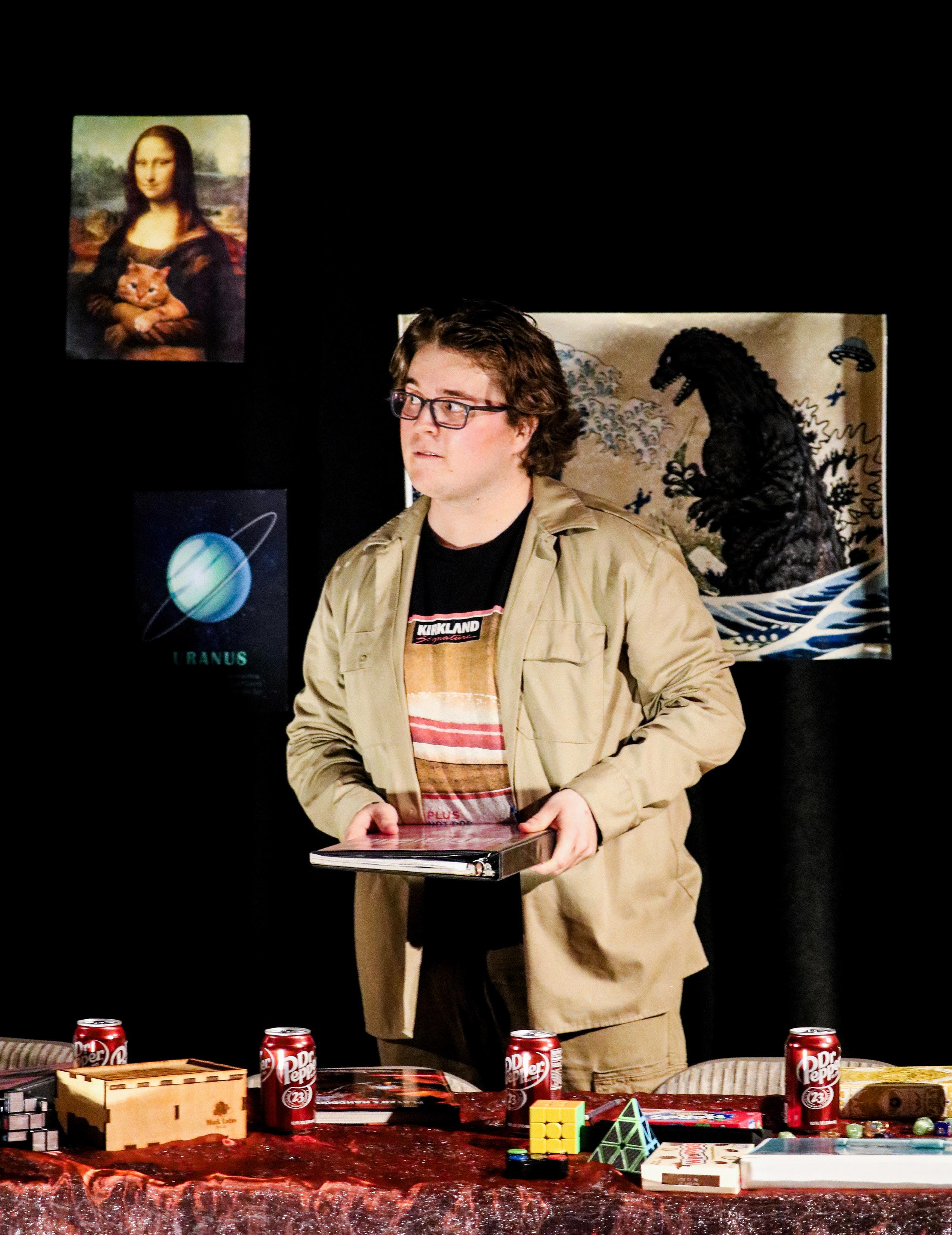
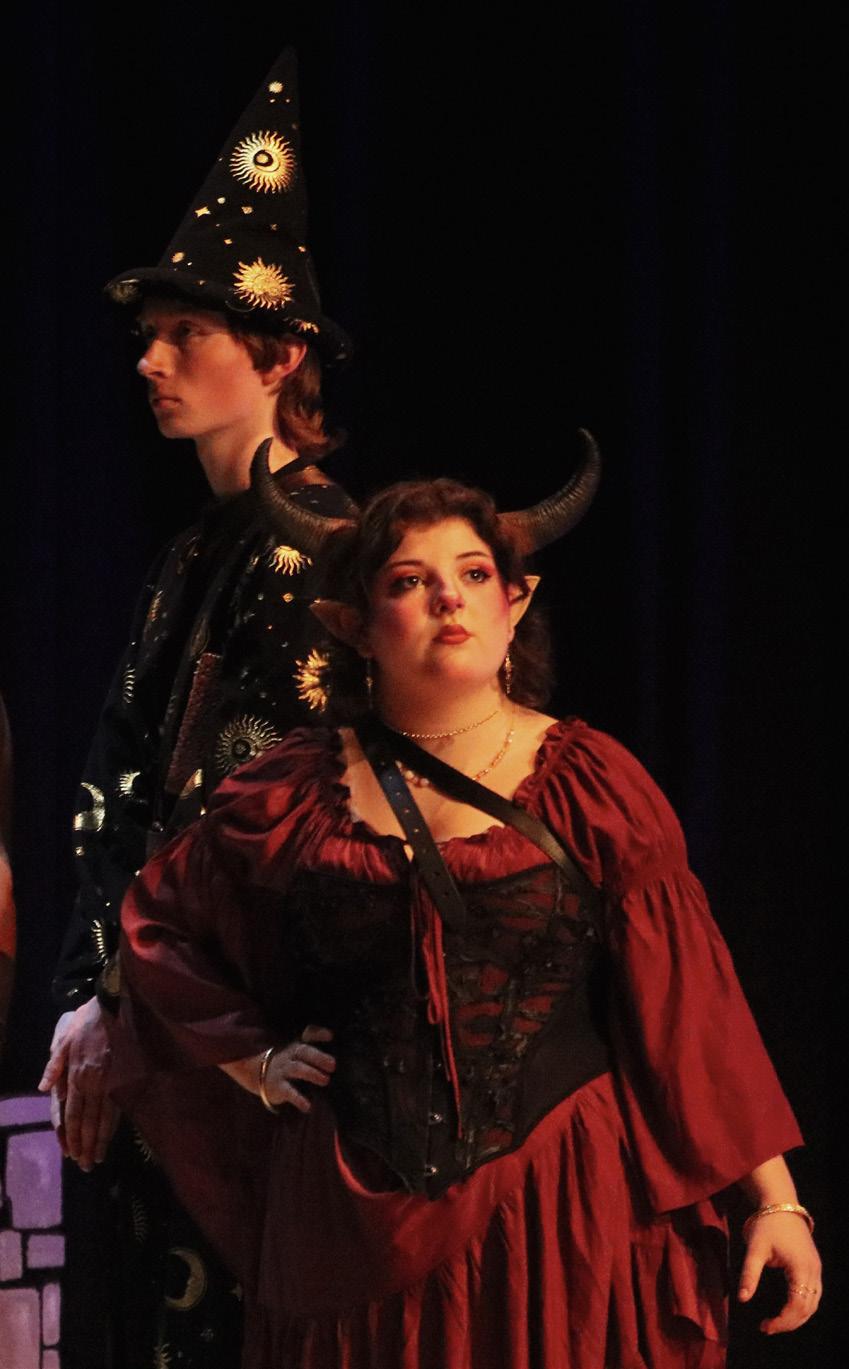
In the play “Just Keep Rolling,”
Eric Gale acts as the character Emmett, the Dungeon Master of a high school friend group’s Dungeons and Dragons group.
Photo by Eva Holdorf.
The playwrights then communicate their vision to their directors, who manage actors and members of the crew. Another unique aspect to Threshold is that playwrights are sometimes involved in rehearsals.
“It’s a more collaborative process,” said Evan Oukrop, an actor in “First Dates,” on the difference between Threshold productions and other CSULB plays. “Your directors are students, and so are your playwrights, and so everybody is on your level. Nowadays, [Threshold] makes sure that the playwright is also involved in the actual rehearsal process too. It’s collaborative and loose, but still professional and efficient. It’s very freeing and just a lot of fun.”
Besides playwrights, behind the scenes of a Threshold production, the directors, stage managers, and technical designers, who handle lighting, sound, scenic design, props, hair, makeup and costumes, are hard at work. Many crew members originally got involved with Threshold as actors, but decided to learn another skill. Threshold’s board is designed for this flexibility — built into its roles are technical directors, who each specialize in a certain field and are able to teach newcomers the ropes.
“There’s a lot of encouragement for people to try different things,” explained Morales. “Most of our [lighting, sound or set] designers have never done it before, but they wanted to give it a shot, and so they do it for the show. If you want to do
In the play “Just Keep Rolling,” Eric Gale acts as the character Emmett, the DM of a high school friend group’s D&D group.
by Eva Holdorf.
something, and you’re here, and you’re available, go for it. Feel free to make mistakes. It’s a learning process, and it’s a learning curve.”
“Ever since I started doing sound tech for Threshold, I found a new interest and passion for tech,” said Gigi Navarro, an actor and sound designer. “We get into tech week, and you have like, two days to get everything [programmed] before you have to run the show with the actors, and then the show opens.”
For one of Threshold’s recent productions, “For You,” which changed plot direction based on the audience’s participation, Navarro juggled over 158 sound cues.
“Someone told me that there were like, 156 different ways the play could have gone,” Navarro laughed. “The script was amazing. To give you perspective on how many sound cues a show for Threshold might have, my record for the highest number of sound cues for one show was around 50, and I tripled it for this show. Because of the way [this show] ran, I had to just scroll and think on my feet, which was hard, but it was the best show I’ve ever done.”
Even though the organization focuses on providing professional-level experience, it’s also open to everyone — theatre major or not.
“I feel like what puts a lot of people off is they’re like, ‘Well, I’m an accounting major,’ or I’m a business major,’” said Elaina Loza, Threshold’s dramaturg, who acts as a bridge between Threshold’s playwrights and the rest of the teams in charge of production. “But Theatre Threshold is just a great way to explore theatre, because even if you don’t want to be an actor, like, you can still apply to crew on a show or work as a stage manager. So it’s really for anyone and everyone at CSULB.”
Photo
The cast and crew of “For You” remained on their toes, having to adapt the performance to follow the audience’s choices as the show went on.
Photo by Eva Holdorf.
These experiences help guide members towards new realizations regarding the world of theatre.
“Keep theatre alive. Hate AI, love Threshold, and support student written work.”
“It’s made me fall in love with stage work more,” said Oukrop, who was involved in multiple Threshold plays throughout his time at CSULB. “I’ve always known that I wanted to be an actor, but I always kind of thought that I want to do TV and film and all that. And while I still want to do those things, the more I’ve gotten experience within the collaborative environment that Threshold provides, the more I’ve been like, ‘Wow, maybe I want to continue stage acting.’”
“[Being on tech] gave me such a different perspective and a big appreciation for all tech and crew,” said Navarro. “When I first started acting, I never really understood tech and the crew and just how much they put effort into a show and how much goes backstage.”
Beyond gaining professional experience, the members of Theatre Threshold also cultivate lasting friendships.
“I’ve got new friends because of the cast,” said David Gleichenhaus, an actor in “First Dates.” “I’ve got new people that I probably would have never interacted with if I wasn’t part of the cast, and it has just been a great time [discovering] community and bonding with my peers.”
“When you spend four years in a place and you get to work with different people, and sometimes you work with the same people, and sometimes you work with completely new people, but always, by the time the show ends, it’s always so sad. It’s always like, ‘Oh, we just spent so much time together, and now it’s over.’ And then you do another show, and then you’re like, ‘Oh my god, we’re working together again!’” said Navarro.
Though relatively unknown outside of the theatre department, Threshold members emphasized the significance that this club has to the CSULB theatre community.
“To my eyes, Threshold is the underground theatre that [we as] students put on ourselves,” said Gleichenhaus. “These are really the student stories that are some of the most impactful to Long Beach students.”
This semester, Threshold has made efforts to extend outside of the theatre department by collaborating with CSULB’s graphic design BFA students and working with Theatre Arts professors to put on shows written by CSULB faculty. Looking to the future, the organization hopes that more people outside
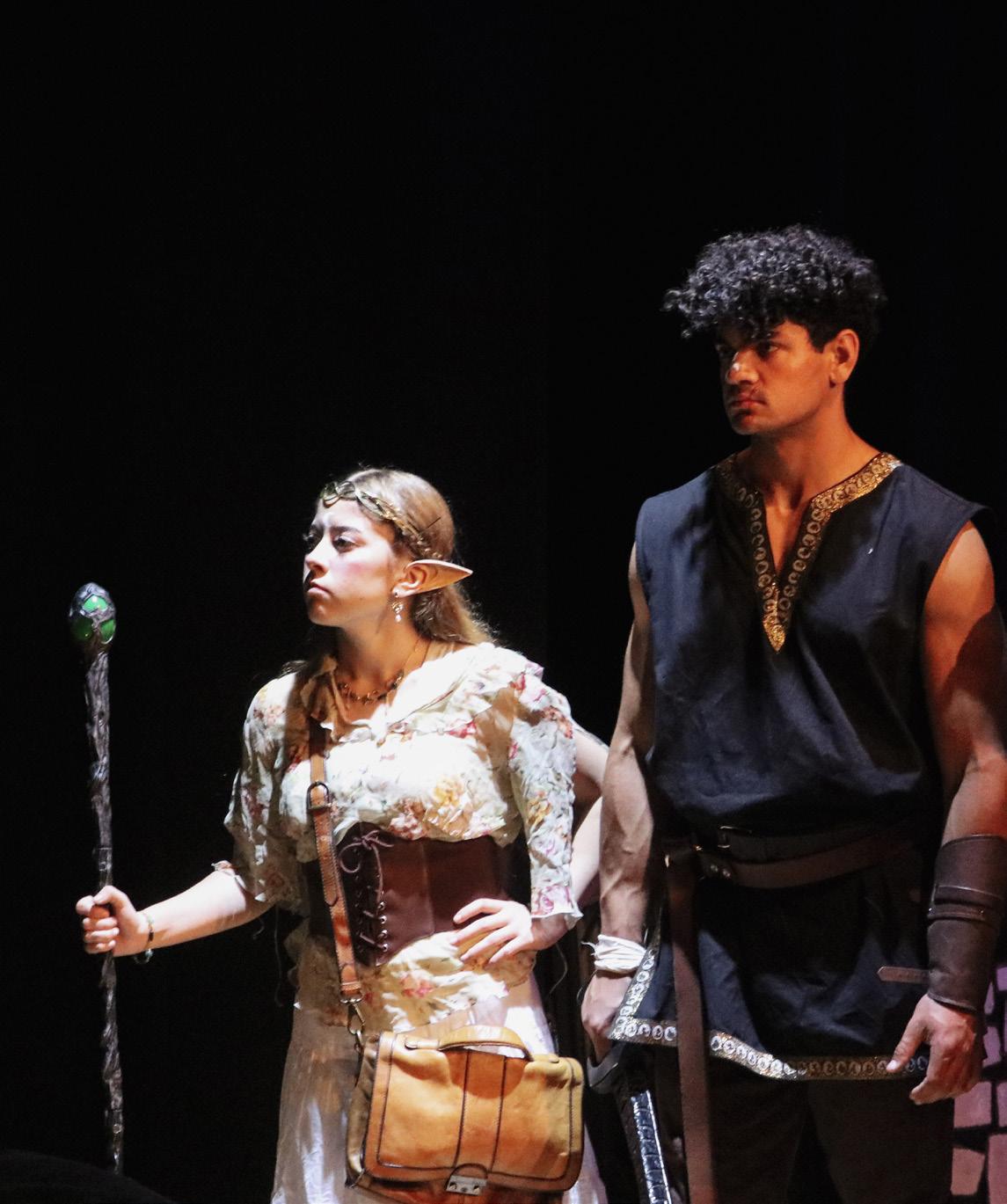
Lorelai Dumas and Esai Calderon star in “First Dates” as Mina and Theo, who go on a number of disasterous first dates with others before finally meeting one another.
Photo by Gopi Vadsak.
of the Theatre Arts department will get involved with Theatre Threshold and fall in love with the artform.
Within the digital-focused moment we live in and the broader trend of defunding arts programs, Threshold members stressed the importance of supporting the art of live theatre.
“Nobody knows that there’s this really cool thing that is happening on campus, and it’s free!” said Oukrop. “All of our shows are free, and I think it’s a real shame that not a whole lot of people know about what we do here.”
“Keep theatre alive. Hate AI, love Threshold, and support student written work,” summarized Loza.
To stay up to date with Theatre Threshold’s shows and events and find out how to get involved, follow them on Instagram @csulbthreshold.
BROKEN SYSTEMS, BLEEDING SOULS
When I was 15, I fell through the cracks in the system, and it shattered me. I should’ve been treated by mental health professionals, not by an armed officer who pushed me against a wall and handcuffed me for being suicidal.
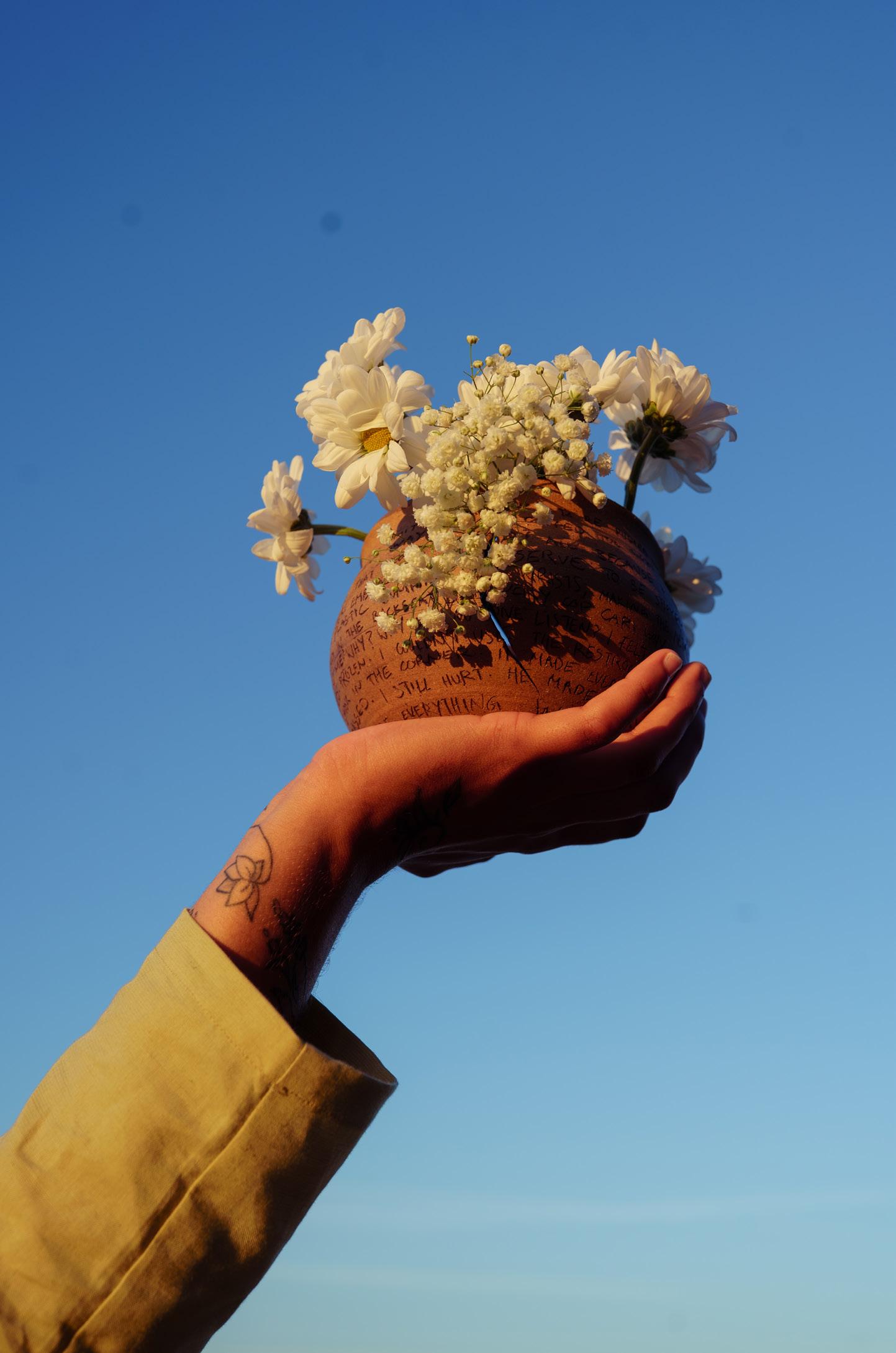
I made this vase to process my emotions following my experience with a California’s 5150 code. Etched into the surface is what happened and how I felt. While I didn’t intend for the vase to crack, it became a symbol of the scars left behind from that experience.
STORY BY KARUNA NAMALA PHOTOS BY GOPI VADSAK
WE could’ve been anywhere in the world, but I wouldn’t have cared or noticed, because my eyes were glued to my wrists, and all I could think about was volleyball.
I had played for six years. I was a libero, staring down the receiving end of a mean spike with my wrists bound together, my knees bent, and my ego ready to go down a notch when I dove to get the ball in the most unflattering form. I used to lead the defense line, but I’d never felt so weak.
My mom was driving, with her red hair done up in a messy bun and her crimson glasses perched perfectly on the bridge of her nose.
“I don’t think I’ll ever play volleyball again,” I said.
My mom just stared at me blankly. We weren’t talking about volleyball; I hadn’t played in a while. We weren’t talking about anything at all.
“I don’t think I can ever put my wrists together again.”
I saw it click for her. I saw her relive every second of that day again. She didn’t say a word. She looked at me, and I saw tears well up through her lenses. They felt big enough to swallow me whole.
I couldn’t say anything else. I stared at my wrists and wondered why I could still feel the sharp sting of metal digging into my wrists after months.
I was 15 years old when my regularly scheduled therapy session went south, and the police took me from my home and kept me in a hospital for nearly 12 hours.
Almost five years ago, on a Thursday afternoon, I sat in my room with my laptop propped open, waiting for my therapist to start the Zoom meeting. I dreaded it as much as I needed it. I didn’t want to talk. All I had done since that morning was fantasize about my death, just stuck in a limbo of waiting for my time to be up.
Wrapped around my wrists are two tattoos. On my left is lavender and edelweiss, and on my right is my own small galaxy. After that traumatic event, I avoided looking at my own body. My tattoos were a chance to reclaim that, to turn my scars into beautiful artwork.
When the meeting started, I felt soulless. Before I could think, I was rambling on about all the ways I wanted to die. I never looked into the camera once; my eyes stayed fixed on the wall. I was exhausted. I felt disconnected.
I’m sure her response came swiftly, but I didn’t hear it. I said I was done talking and closed my laptop. I shuffled up the stairs to my loft and went to sleep. I woke up to missed calls and texts. I got another call, but this time I picked it up.
“Mom?”
She was crying. Something about me wanting to kill myself, something about the police coming. She hadn’t answered because she was in class. Something about dad not picking up either, and the police were coming.
My dad came into my room and asked me if I was going to harm myself.
“I just woke up from a nap,” I said. He told me that the police were coming anyway.
I panicked. I ran into the laundry room and hid, shaking on top of the washing machine. I could hear them; they asked my dad where I was.
only my room and the laundry room disconnected from the house, so it wasn’t long before they found me.
God knows what they said to me. I just know there were six of them lined up. Guns strapped in holsters, blocking my exit, asking me if I was going to kill myself. At that point, I had tears streaming profusely down my cheeks.
“No, I’m sorry, I’m not gonna kill myself. Please leave. I’m sorry,” I cried.
Our place was small; it was a duplex with
My dad called my therapist; it was obvious to him that the presence of the police was doing more harm than good. I’m a brown, trans, first-generation American; it’s safe to say I’m not exactly buddies with the police.
“Karu says he’s not going to do anything,” my dad said. “Can you please tell the officers it’s okay to leave?”
“No, they should take him in,” my therapist responded.
I panicked and tried to hide again, but it was to no avail. I stepped outside with the officers.
I had barely set foot out of my room before one of the officers told me to turn around. He pressed me up against the wall and began patting me down. He put
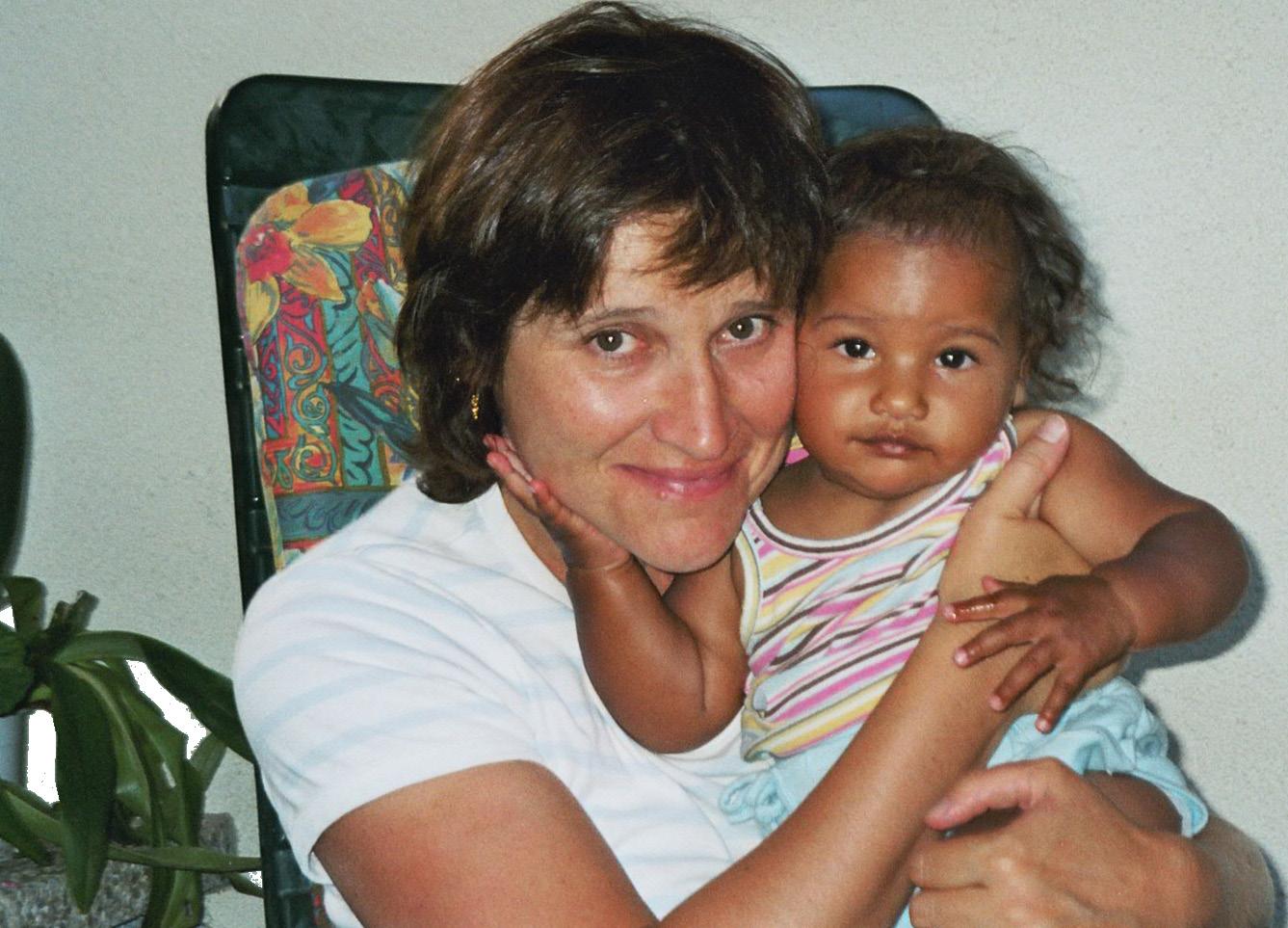
My mom and I pictured together while on a trip to visit her family in Austria.
Photo courtesy of Karuna Namala.
his hands in my pants pockets and took out my ChapStick. I couldn’t fathom how I’d kill myself with only a ChapStick, but I said nothing.
“Hands behind your back,” the officers ordered me.
I wasn’t an idiot; I obliged. I felt metal snap around my wrists. The cold metal bit into my skin, and I felt the handcuffs jostle when he finally let me off the wall.
I finally looked at my dad. I’d never seen him like that. He looked so scared and confused. I was used to him being calm and quiet, even when I told him I’d tried to kill myself.
“Can I come with him?” my dad pleaded. “He’s only 15.”
“No. Not in the car,” the officers said. “But you can follow us in your car.”
I cried harder. I wanted to be with my dad. But before I could look back, the officer marched me out of my house through the back gate.
“You need to be cuffed because you’re a danger to yourself and others,” the officer said.
And others?
I’d never once thought of hurting someone else. I’d never once reported homicidal ideation. It had always only been myself I wanted gone. But the
officers didn’t care. That was apparent when I was ripped away from my dad.
They put me in the backseat. My mask grew damp, soaked in tears and snot. With every pothole, the cuffs bumped against hard plastic seats and snagged on my skin. I pressed my forehead against the cool window and bit my lip to soften my sobs. I didn’t dare look at the officers.
The ride to the hospital made fifteen minutes feel like three hours. My throat felt hoarse from the sobbing, and my head pounded.
“If you try to do anything, we will forcibly restrain you.”
I nodded. The officers loomed over me, but even larger loomed the fear of being tackled in the hospital’s waiting room. With a click, they took the handcuffs off me. They left my wrists red and raw, and I rubbed them, hoping to see the marks fade. They didn’t fade for days.
“A system that was meant to protect me left me with nothing but scars that cut deep.”
The pain that the handcuffs caused me blossomed into strength that carries me through each day.
My dad was there when I stepped in. I went and sat next to him, but to my surprise, two officers stayed with us.
The hours blurred together as my dad and I waited.
My mom left work early and rushed to the hospital. I had taken my sopping mask off and replaced it with a new one. I toyed with the old one and pulled the little wire out that was meant to cinch it close around your nose. My dad told me to throw it away before the officers saw and restrained me again for poking at its pointed edge.
There was an air of fear and fury that lingered in the waiting room.
At some point, Flynn, my oldest sibling, came with my headphones and hoodie in hand, like my knight in shining armor. I slipped into my hoodie and put my headphones on, finally trying to regulate.
I remember my sigh of relief when the officers left. I felt like I could finally breathe again.
It must have been 10 hours by the time I was finally admitted to the hospital. I brought Flynn with me. I couldn’t bear to look into my parents’ eyes anymore. They looked so broken.
The nurse made me take my gold necklace off, the one that had hung from my neck since I was 5. I didn’t have a room, just a cot in a hallway with another suicide watch patient.
I’ll never forget him. He couldn’t have been older than 23, and he just kept asking the nurses when he could go home. He kept saying he missed his mom. I missed mine too.
I was scared they’d make me stay as long as him. I didn’t say a word to him, but we sat in shared horror as other patients rolled in, bloodied and battered.
How the hell is this supposed to help me?
It took another hour for the psychiatrist to see me. She saw me as I was, broken and distressed, and not a threat. I was a scrawny kid, I didn’t eat well, and I barely went outside, so my skin bordered on green. I was shaky and exhausted, my eyes puffy from all the crying, and eye bags deep enough to look bruised. She sent me home immediately — but not without an exhaus list of inpatient, partial hospitalization, and outpatient care options.
The weeks after were grueling. It was constant phone calls and meetings trying to find the right care for me. I fought with my parents for days over my refusal to go to inpatient treatment.
My dad basically lived on the phone; if he wasn’t trying to nail down my treatment, he was on the phone with city officials trying to fix things. Nothing ever
City officials heard my story, but I didn’t get anything from it. Nothing they said would change the fact that every siren sound I heard made me curl into a trembling ball with my hands pressed tightly against my ears.
But I grew. I went to outpatient treatment for months, I got a new therapist and left an abusive relationship. I got more than just the mental health care I needed; I got gender affirming care, too. I learned that I didn’t have to bear my problems alone.
Nearly five years have passed since that day. I’m 20 now. I’ve been completely clean for over a year. It’s been three years since my last attempt, and I owe it to all the people who’ve supported me when I had no hope.
But it’s far from perfect. Those feelings come back with every officer I see and every police car I pass. My body tenses all over again. I will always see my scrawny 15-year-old self in the backseat, with a grown-out buzzcut and tears streaming so profusely into their mask that it seemed to disintegrate.
I had just wanted to go home, I had just wanted to go back to sleep, I just wanted the nightmare to end.
I was a kid with no fight left. I will never understand why my pain was met with aggression and punishment. A system that was meant to protect me left me with nothing but scars that cut deep.
I deserved better.
My dad and I a few weeks before everything happened. Photo courtesy of Karuna Namala.
THE COOLEST PLACE YOU’VE NEVER BEEN
STORY AND PHOTOS BY JENNY FASULKEY
Hidden beneath the CSULB library, ISPACE is the campus lab where 3D prints, podcasts and virtual worlds all come to life.
ever wanted to step inside a virtual world, record a podcast or watch your digital design become a physical object, you don’t have to leave campus to do it.
Tucked inside the lower level of the University Library at Cal State Long Beach, ISPACE works to provide cutting-edge technology across disciplines, so students experiment beyond the limits of a traditional classroom and gain hands-on experience with the tools shaping their future fields.
Home to a 3D print lab, a 360 degree theater, an XR lab, and two podcast studios, ISPACE feels less like a traditional academic facility and more like a launchpad for big ideas. Behind glass doors, students create custom signage, engrave designs on different materials, conduct virtual field trips and step into immersive augmented and virtual reality environments.
Formally known as the Innovation Space, the collaborative technology hub is open to all CSULB students, faculty and staff. ISPACE is operated through Academic Technology Services and funded by Gerald M. Kline Family Foundation along with Student Excellence Fees. It was created to expand access to emerging technology and integrate experimentation into learning.
“I think one of the goals was providing an interdisciplinary space for students to have access to technology that they wouldn’t be able to obtain otherwise,” Tom Nguyen, the ISPACE architect said. “A lot of the other labs on campus provide technology, but they’re specific to the major or to the course.”
When ISPACE opened in August 2018, it focused primarily on industrial-grade 3D printing and laser cutting. The industrial-grade 3D printers enabled full-color and multi-material prints, large-format builds, fiber-reinforced composite parts, and complex geometries using dissolvable support materials. Students could prototype their designs at a professional scale, which was something often reserved for specialized departments.
“One of the goals was providing an interdisciplinary space for students to have access to technology that they wouldn’t be able to obtain otherwise.”
As faculty and students began pushing the boundaries of what they could create, ISPACE expanded to include The XR Lab, an extended reality lab with a 360-degree
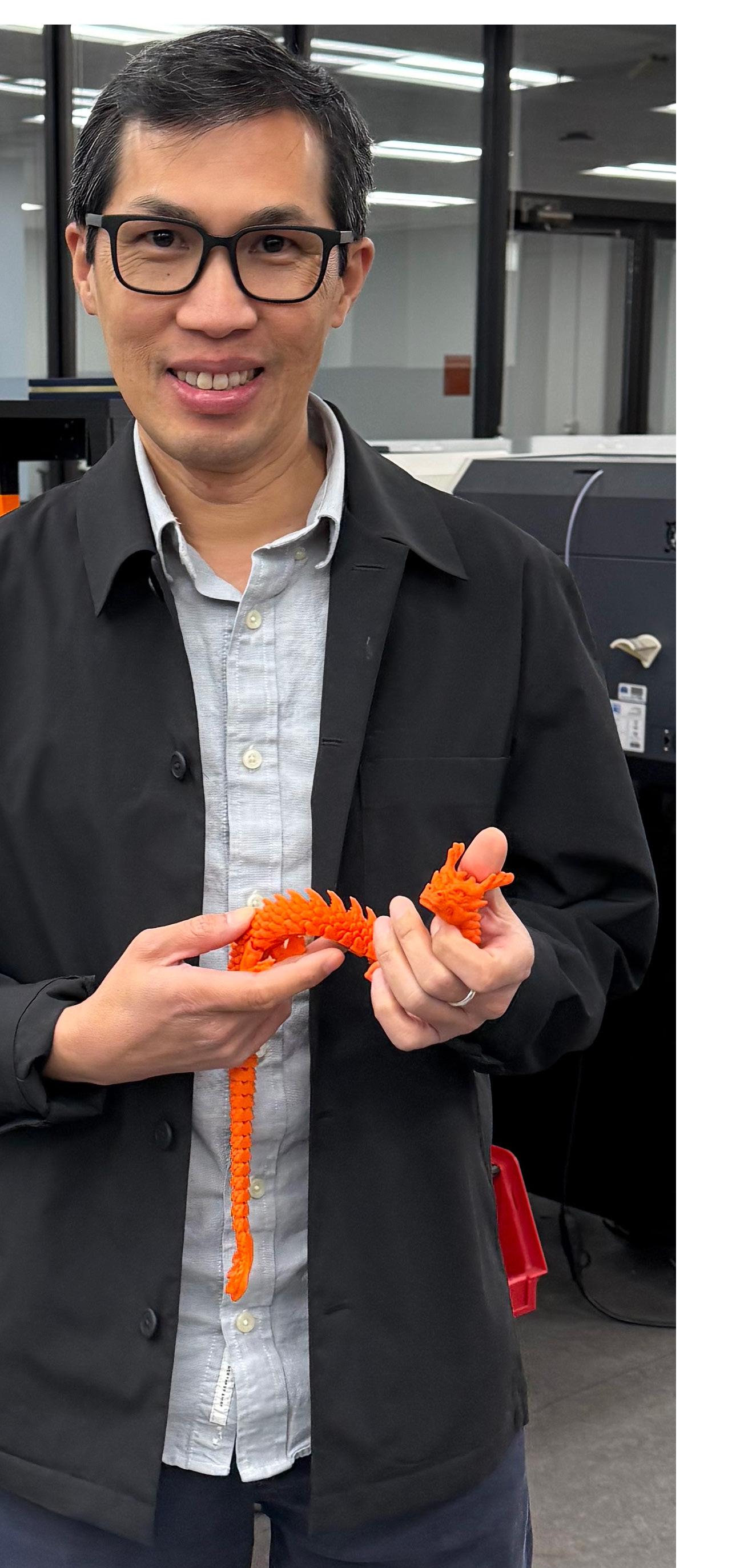
Tom Nguyen, ISPACE architect, with a 3d printed dragon. As the ISPACE architect, Nguyen oversees the operations and technology of the lab.
immersive theater and two podcast studios. Each addition grew organically from demand.
“When we introduced the XR lab, there was a need to make even more content,” Nguyen said. “So that’s why the podcast rooms came about.”
Interior architectural design major Jasmine Phochatkaew discovered ISPACE not through a formal introduction or tour, but through necessity. Her department’s lab had limited machines, and competition for time slots was intense, so Phochatkaew took the advice of a friend and booked a consultation.
eventually found ISPACE, a solution to her lab dilemma.
“ISPACE is more than just exciting technology, it can play a huge role in a student’s life,” Phochatkaew said. “The people here are always open to help everyone out to their best ability. They never turn a student down. That’s what makes ISPACE so special.”
“We actually have our own lab in the design department too, but it’s really small,” she said. “We have one laser cutter and like a few 3D printers. So, when that was getting busy, we were like, ‘Oh, we need somewhere else.’”
For one major project, Phochatkaew had to transform a restaurant concept into a detailed physical model measuring nearly 3 feet by 2 feet. The assignment required precision, patience and technical skill. That “somewhere else” became pivotal and she went in search of a place where she could complete her project. She
ISPACE provided Phochatkaew the resources to learn about file formatting, material strength and machine timing, real-world considerations that mirror professional design work. What began as a class assignment became handson training. Her positive experience eventually inspired her to volunteer at ISPACE. Now working at the front desk and assisting with VR sessions and the 360° Theater, Phochatkaew sees students arrive with the same uncertainty she once felt.
“Everyone is really nice here. They’re willing to help you out,” Phochatkaew said. “I’m here basically looking back at my journey and want to help students that are taking the modeling class right now. I see myself back then, so now I want to help these people and I want them to have an easier time than I did.”
That culture of accessibility is intentional. The space is designed to support beginners as much as experienced users. ISPACE offers
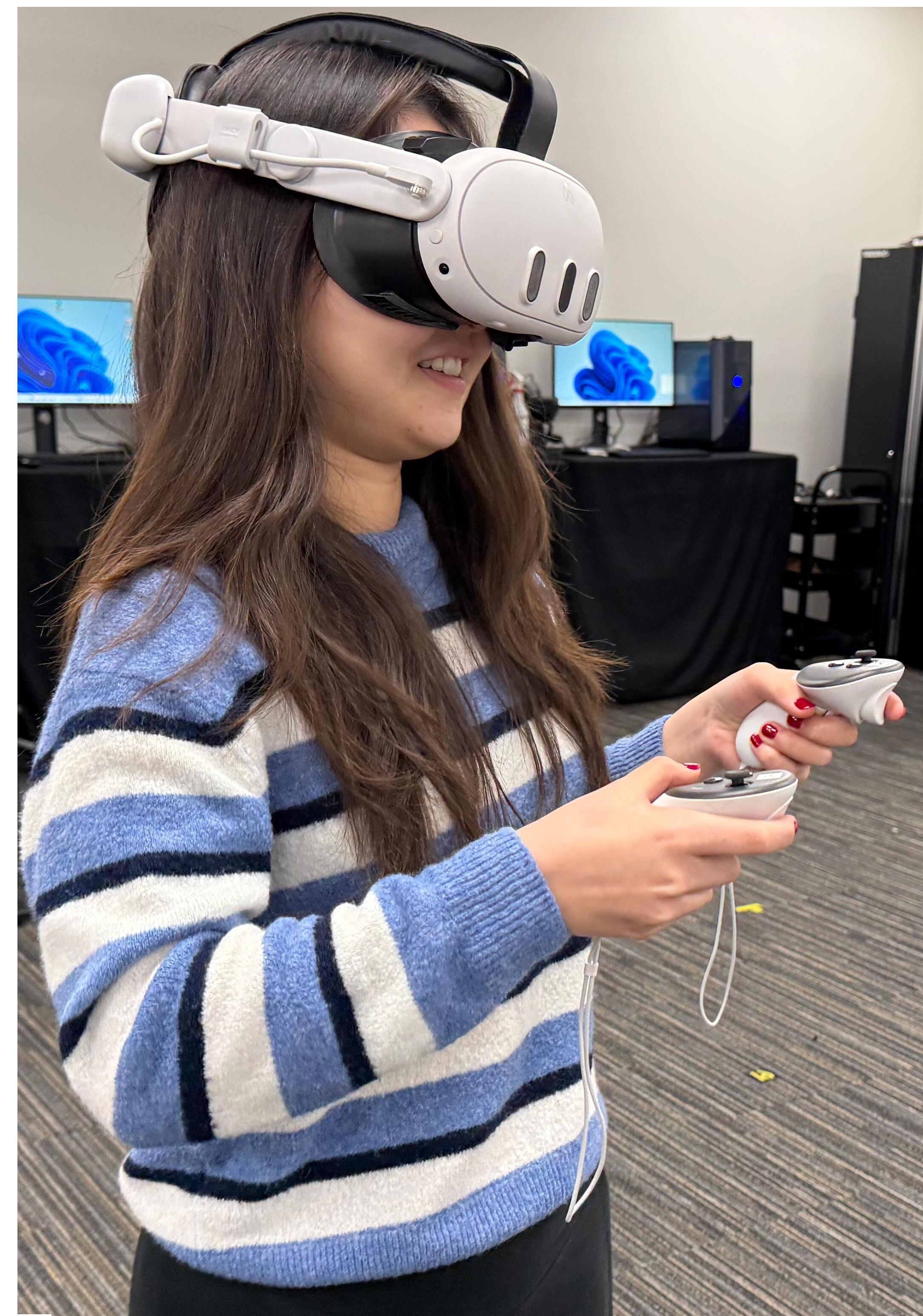
Jasmine Phochatkaew demonstrates the VR technology that ISPACE has.
“ISPACE remains somewhat unnoticed, tucked quietly beneath the library. Students often discover it through class tours or word of mouth.”
consultations for students at any stage of a project, whether they’re printing a prototype, recording audio or building immersive media.
Accessibility also extends to affordability. When using the 3D printers, users must pay for material costs, and students receive 70% off 3D printing services. ISPACE also offers free workshops throughout the semester for those who want to learn the fundamentals of 3D modeling.
The space’s cross-disciplinary reach is perhaps its most surprising feature. While journalism and film students frequently use the podcast studios for interviews and voiceovers, students in other majors have found unexpected applications.
Nguyen said his most memorable experience was helping biomedical engineering students use the XR lab to conduct motion-capture research to study how people with flat feet walk while they collected data for a thesis
project. He also said Kinesiology students experiment with immersive simulations and communication classes integrate audio production into assignments. With help from trained ISPACE volunteers and employees, the facility’s equipment aims to support projects that blur traditional academic boundaries.
That mindset reflects a broader shift in higher education toward technology exposure as preparation for the workforce. By integrating advanced tools into coursework, ISPACE allows students to graduate with practical, hands-on experience. According to Nguyen, faculty frequently consult with staff to design assignments. For some, that means recording lecture supplements or student podcasts. For others, it means using the XR lab for research simulations or prototyping class projects in the 3D printing lab.
Nguyen’s goal is to get a full-body 3D scanner capable of generating detailed digital avatars for animation, gaming and film production.
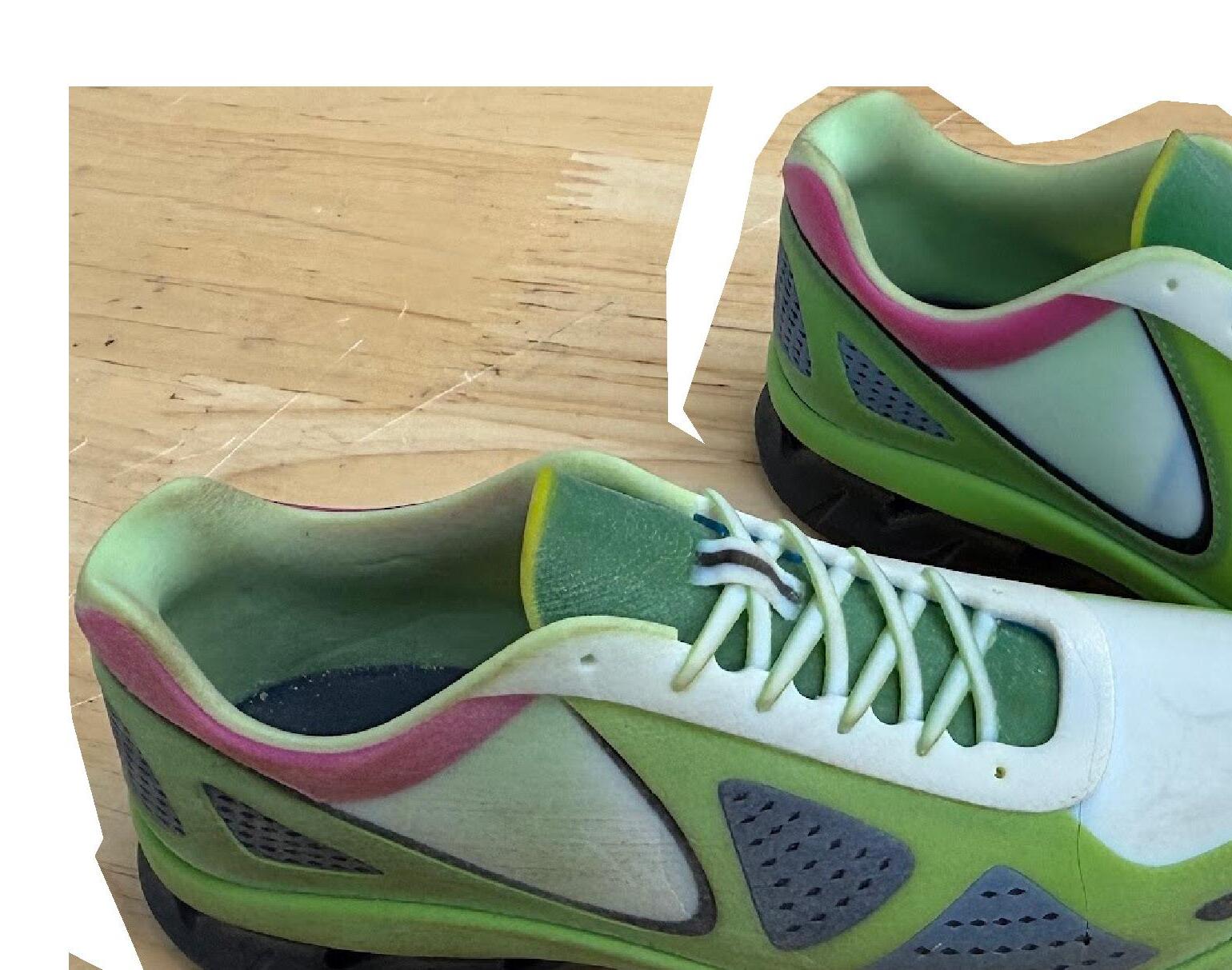
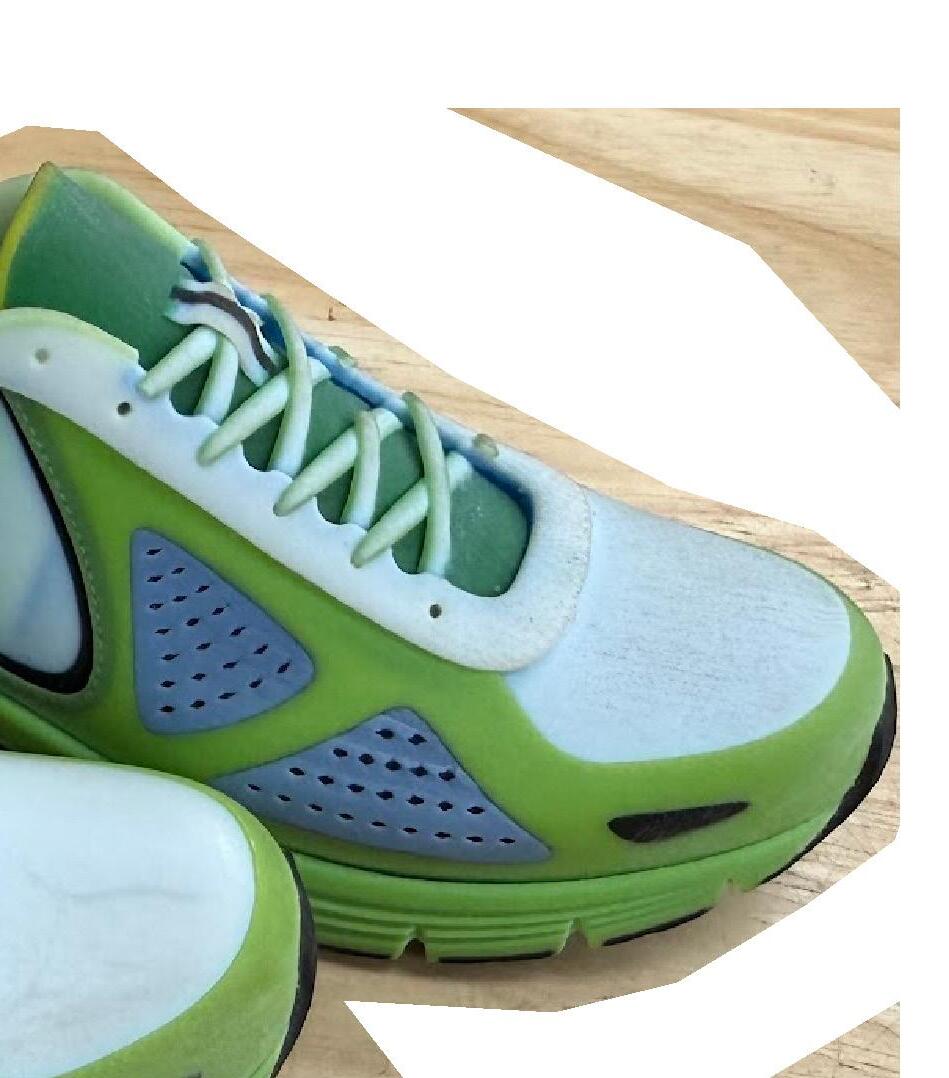
A pair of 3D-printed shoes made at ISPACE.
“With that full body scanner, you can actually … take a picture of somebody and create a real model of them,” Nguyen said. “That way, they can bring [that model] into animation, game, film, whatever.”
Though space and funding limitations may delay these ideas, ISPACE staff continues to explore and research hands-on opportunities for students to experiment with various emerging technologies.
Today, despite the location’s rapid development, ISPACE remains somewhat unnoticed, tucked quietly beneath the library. Students often discover it through class tours or word of mouth.
For Phochatkaew, that hidden quality adds to its appeal.
“It’s just a really cool space and not a lot of students know it’s there,” she said. “Students should come check it out.”
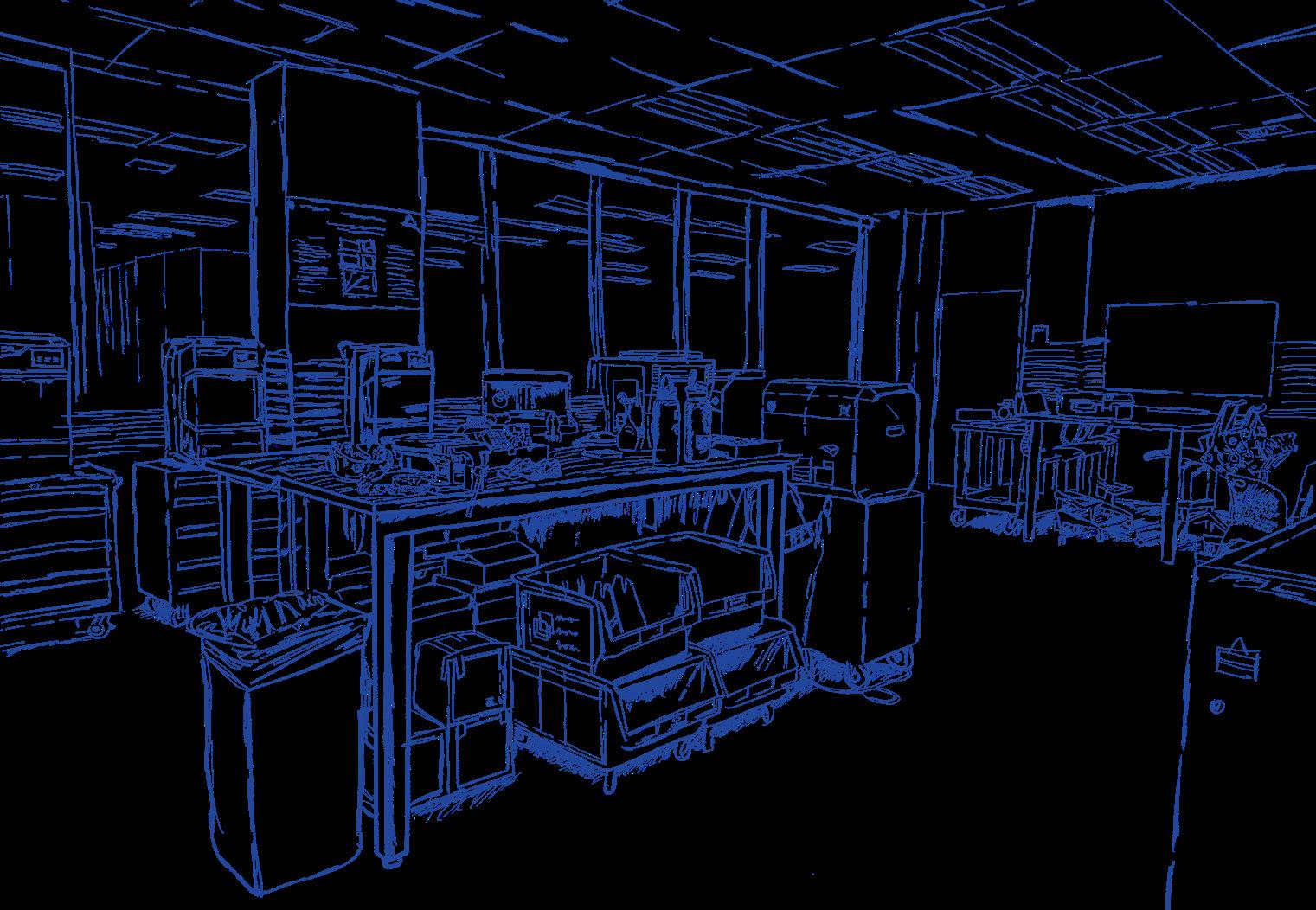
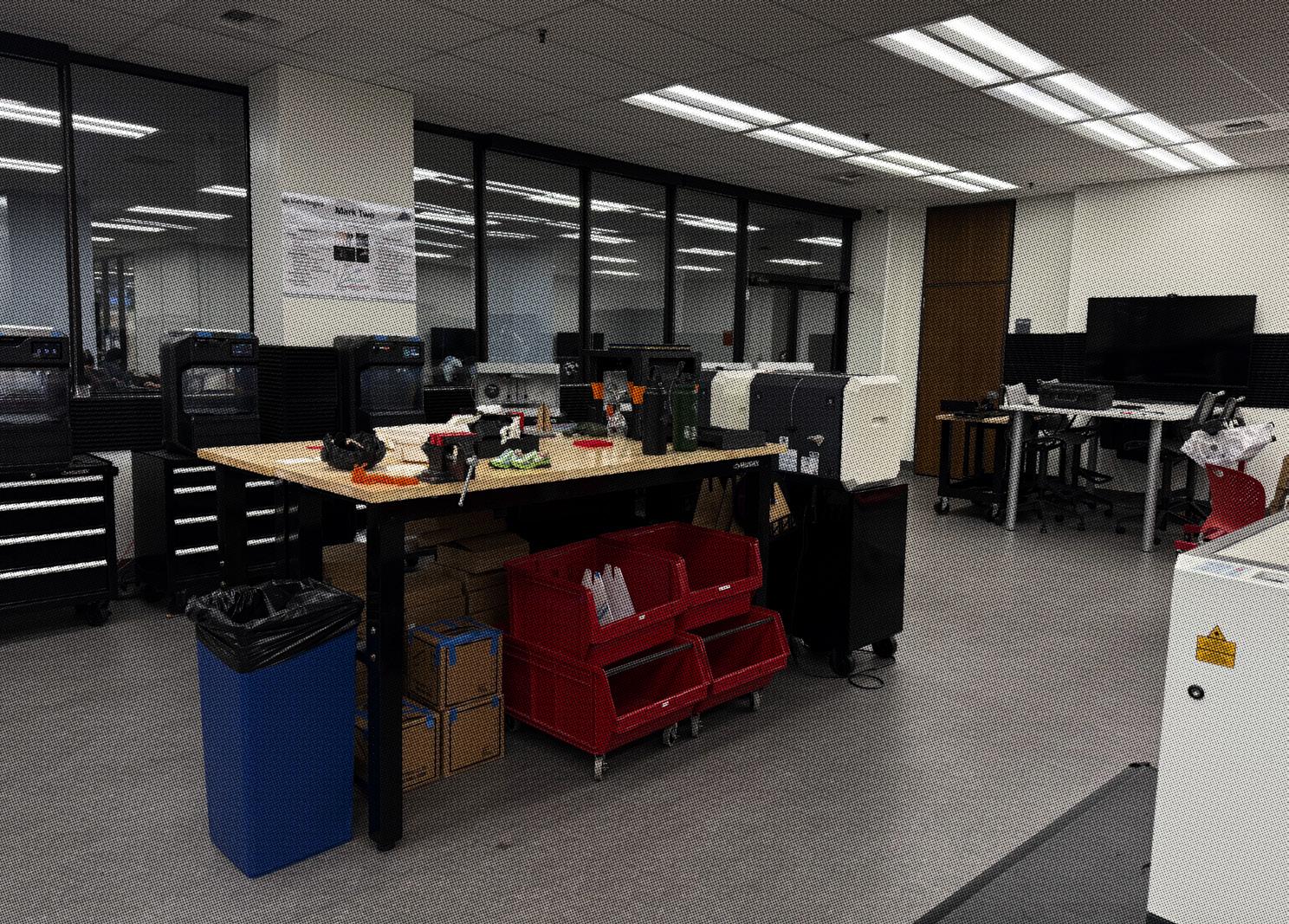
ISPACE 3D Print Lab, CSULB. Illustration by Damien Herrera.
Only a three-hour drive from Long Beach, Joshua Tree National Park offers numerous hiking trails and over 300 campsites, making it the perfect low-budget, student-friendly trip.
“VACATION” is not a word often uttered by college students in the throes of tight budgets and stressful exams. Long Beach, however, is just a few-hour drive from some of the most beautiful places in California. It’s impossible not to get the travel bug.
One of these gems is Joshua Tree National Park. Featuring tons of unique flora and about 300 miles of hiking trails, it is the 15th largest national park in the United States. It is also only about three hours away from Cal State Long Beach, making it the perfect trip for beginner climbers and backpackers.
STORY AND PHOTOS BY YALINA HARRIS
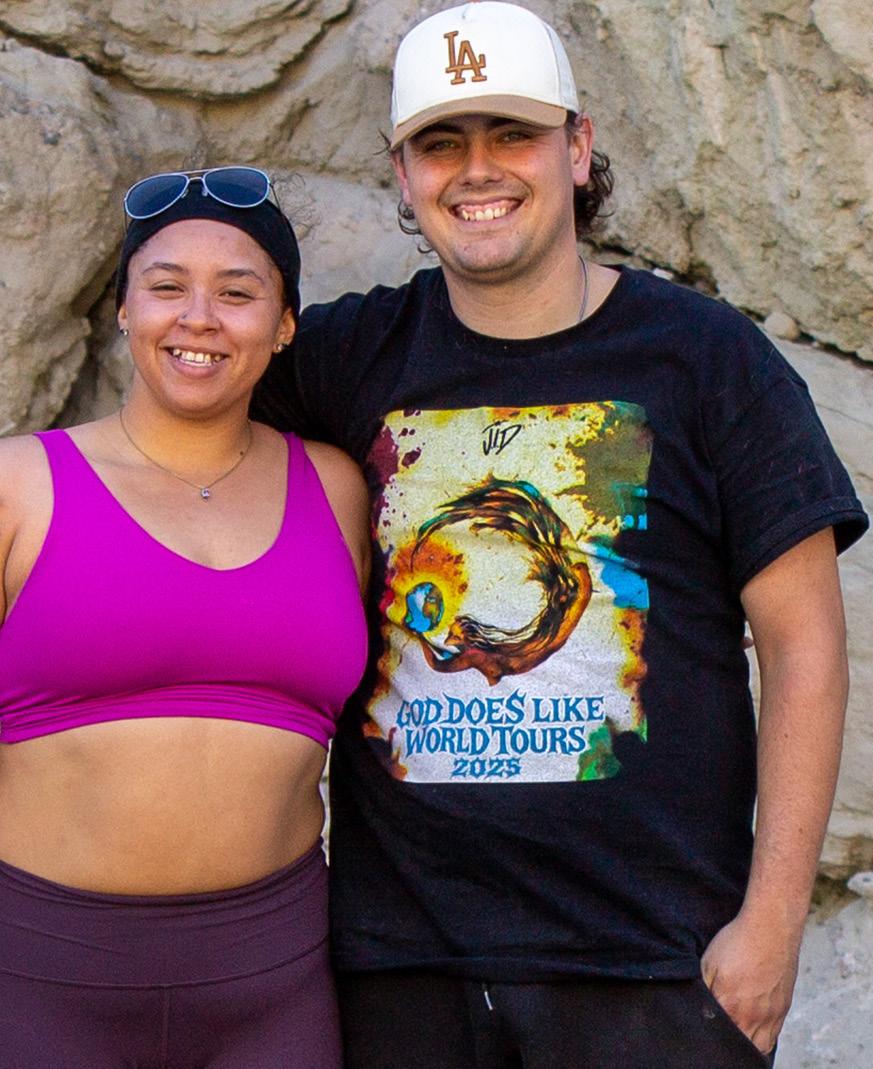
My boyfriend, Miqhi Rickson, and I at Black Rock Campsite while waiting to check in to our campground.
GAS
Gas and a safe route come first when preparing for any road trip. The most fuel efficient route from CSULB is roughly 135 miles long using CA-91, but this will vary depending on where you live. In my 2012 Volkswagen Jetta, I get 300 miles on a full tank, averaging 27 miles per gallon.
On my trip, I used a tank and a half of gas because we explored neighboring cities like Indio, Palm Springs, and the Salton Sea. My total cost for gas was roughly $80.
CAMPING
Joshua Tree National Park has eight campgrounds. Three of them are first-come, first-serve and the other five are reservation only. Entrance to the park costs $30 per vehicle, which includes a seven-day pass that allows you to travel in and out of the park as you please.
My boyfriend, Miqhi Rickson, and I left on Friday morning with my dog, Whisky, and had already reserved a spot in Black Rock Campground for Friday and Saturday night, which cost $70. This campground is on the northwest side of Joshua Tree, just south of Yucca Valley.
On Sunday, we ventured into the national park and stayed at the first-come, first-serve Hidden Valley Campground, which cost only $25 per night. The campsites fill up fast, so we woke up at 7 a.m., packed up and headed there to wait for a spot.
Camping equipment can get expensive. To stay budgetfriendly, consider purchasing used camping equipment or borrowing from a friend. Nighttime temperatures can drop below 30 degrees, so bringing sufficiently warm bedding is a necessity. If you’re unable to thrift a tent, additional options are to car-camp, which is free, or purchase a used tent and sleeping bags online.
All of the campsites on the Black Rock site came equipped with grills and fire pits. We opted to purchase firewood from a local grocery outlet and cook over the open flame grill, using kitchen pans that we brought from home. Our total firewood cost was just $30.
FOOD
When being cost effective, you have to make sacrifices somewhere. We chose to purchase food and cook at the campsite, which was exponentially cheaper than going out to eat every day. For my trip, we purchased pre-seasoned meat, veggies, protein bars and trail mix for hiking.
We stored all of our food in an ice chest, which we already owned. Ice will cost around $10.
We didn’t need to purchase more food while there, but if necessary, the Black Rock Campground is near Yucca Valley with a few local eateries. Once in the park, it becomes a longer journey to get food, so make sure to prepare beforehand. Our total food cost was about $80.
Black Rock Campground.
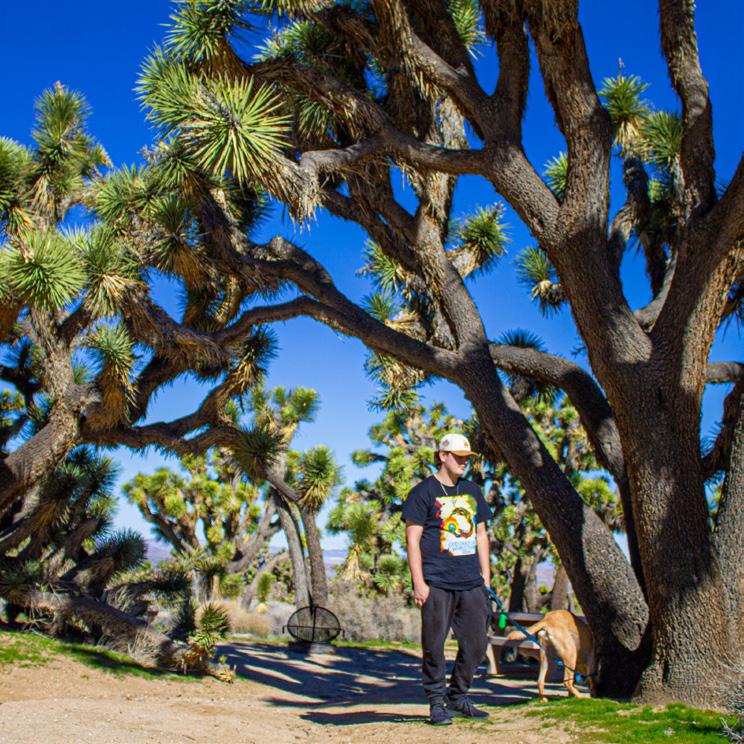
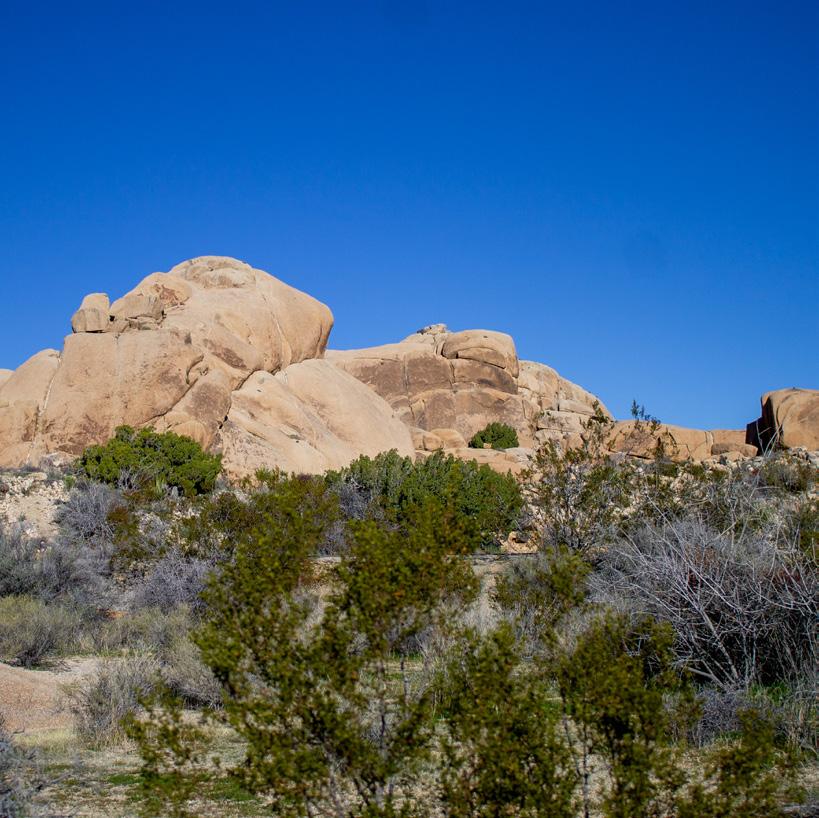
Rock formations in Joshua Tree National Park.
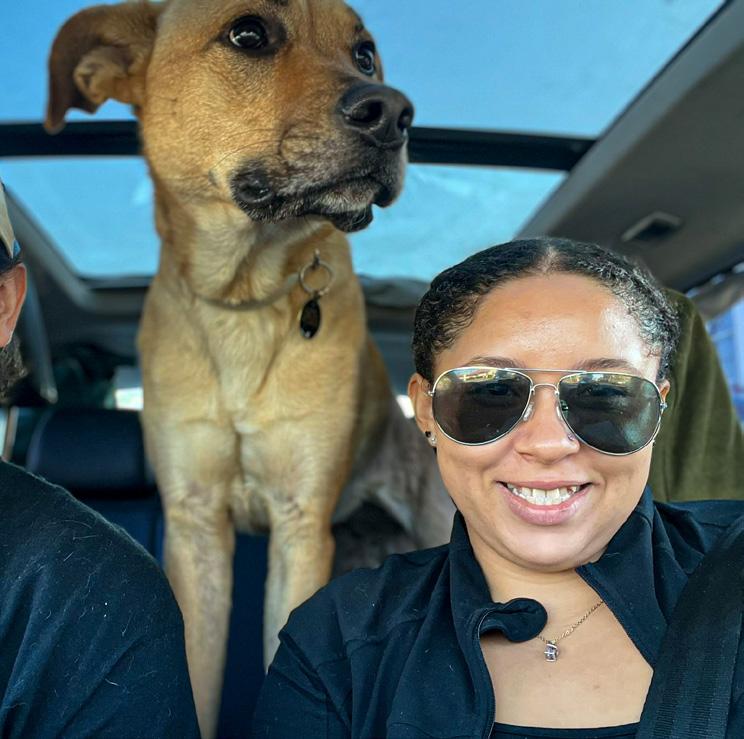
My dog, Whisky, and I driving through Joshua Tree on Friday morning.
ACTIVITIES IN NATURE
The wonderful thing about being in the desert is that the main attraction — nature — is free! We spent most of our weekend hiking and taking photographs.
Our first hike was Skull Rock Trail. This trail is a 1.7-mile loop that took us about 2.5 hours to complete. The rock formations throughout the trail were very unique. We enjoyed seeing a variety a wildlife — I saw more lizards than I could count. We also spotted an American Robin, a transient winter bird with a bright orange belly. This was a slow hike, so we took our time and stopped for lunch about halfway through.
Another breathtaking landmark outside of Joshua Tree is the Salton Sea. To reach this location, we drove through the entire national park, stopping at great photo opportunities along the way. The Salton Sea is a 348-mile long saltwater lake that sits between Riverside and Imperial County.
The Salton Sea was roughly 2 hours from our hiking trail and 2 hours from the Black Rock campground. We spent time doing an interactive bird watching tour at the Salton Sea which was completely free.
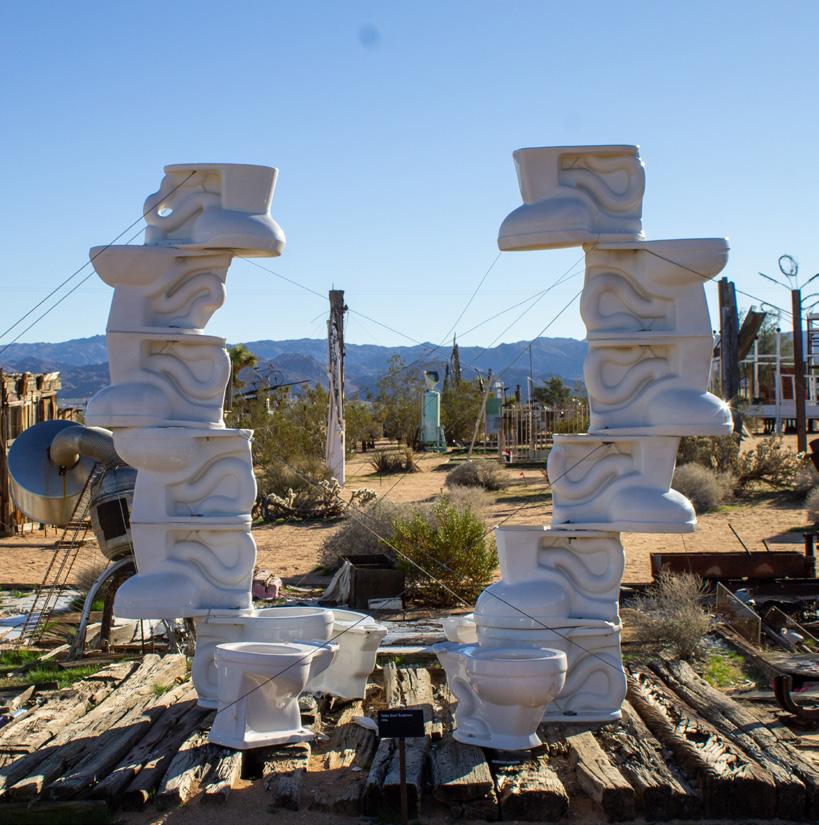
Friday afternoon after we checked into our campsite at Black Rock, we drove 30 minutes from our campsite to visit the The Noah Purifoy Outdoor Museum of Assemblage Art, which is free to experience. The museum is composed of about two tons of debris from the city of Los Angeles, and the themes revolve around redefining the Black creative consciousness through assemblage sculptures.
The artwork here includes sculptures with political messages that are made up of scrap items. From tiny slanted houses to castles made of toilets, Purifoy worked on this outdoor exhibit from 1989 to his death in 2004. My favorite piece was titled “Adrian’s Little Theater,” which had a stage that we could walk across. This was a highlight of the trip and was a great opportunity for photography practice.
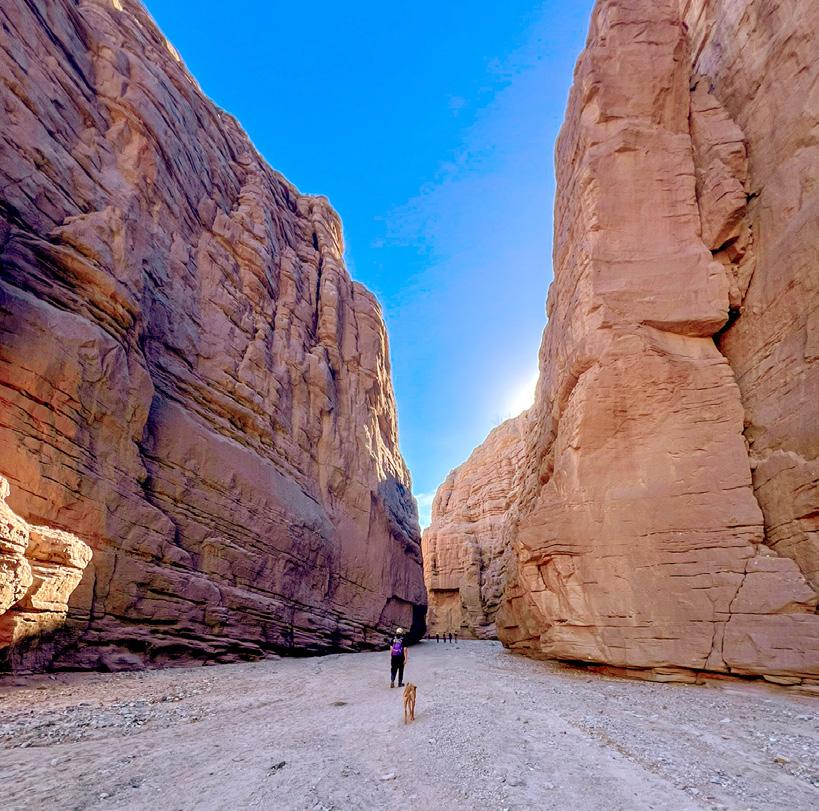
On Sunday morning, we headed to the Painted Canyon in Mecca Hills — about 40 minutes from Joshua Tree. The Painted Canyon trail is located on a dirt road and is somewhat difficult to access. Once you travel through a mile of dirt roads, you will reach the trailhead. The trail is a 4.7-mile loop hike which winds through a number of huge canyons.
The entire trail took us four hours (breaks included), and we both carried backpacks filled with light snacks and water. If you are looking to do this hike, I recommend getting there as early as possible to avoid the blistering heat and wearing a lot of sun protection.
As college students, we may be on a budget, but that doesn’t mean we should shy away from fun experiences. In total, including miscellaneous expenses, our trip cost around $350, and my boyfriend and I split the cost, so my share came out to around $175. For a magical weekend hiking, viewing artwork and sleeping under the stars, it was so worth it.