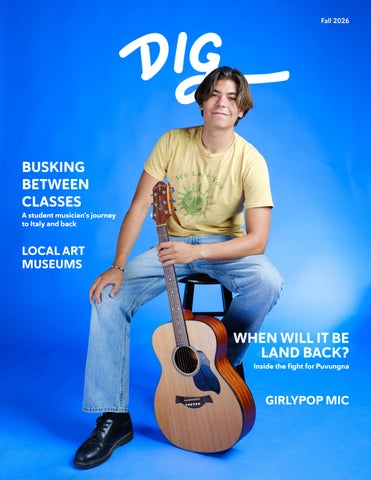
Fall 2026
BUSKING BETWEEN CLASSES
A student musician’s journey to Italy and back
LOCAL ART MUSEUMS
WHEN WILL IT BE LAND BACK? Inside the fight for Puvungna
GIRLYPOP MIC
Finance your laptop or iPad at Beach Shops with a %
0 Tech Loan from LBS Financial!*
Visit us on the 2nd floor of Beach Shops.
lbsfcu.org/beach • 562.598.9007 *0% Technology Loan only available for CSULB faculty, staff, and students purchasing at Beach Shops. LBS Financial technology loans are offered up to $4,000 with 12 month, 24 month, and 30 month terms for repayment. Loan must be over $1,500 to qualify for a 24 or 30 month term, otherwise the term will be 12 months or less. To qualify for the Interest-Free (0% rate) technology loan promotion, must be an LBS Financial Member over the age of 18 and have an LBS Financial checking account. Member must also set up monthly automatic payments from their LBS Financial checking account to the technology loan and have a monthly direct deposit of any amount to their LBS Financial checking account or a minimum of 5 debit card purchase transactions per month and maintain these requirements throughout the life of the loan. If loan is delinquent for more than 60 days and/or the 0% interest-free requirements are not met for three consecutive months, the rate will revert to the rate stated on the Loan and Security Agreements and Disclosure Statement. Once disqualified for promotion, the 0% rate offer cannot be reinstated. Payment Examples: A technology loan for $2,000 at 0.00% APR for 24 months would have a payment of $83.33 per month. A technology loan for $2,000 at 9.99% APR for 24 months would have a payment of $92.28 per month. All Credit Union loan programs, rates, terms and conditions are subject to change at any time without notice. Federally Insured by NCUA
TABLE OF CONTENTS Photo courtesy of Rebecca Robles.
DEPARTMENTS 05 Editor’s Letter 5 06 Top A Chief Curator’s Top 5 Art Museums
the Community 08 DIG Making a Difference, One Sign at a Time
10
Hidden Figures
Taking Back the Mic
FEATURES Will It Really Be Land Back? 12 When BY KARUNA NAMALA Puvunga has remained a sacred and disputed piece of land at CSULB for generations. As Indigenous members continue the fight to protect and restore it, the question remains: is preservation enough, or is it time to ask what Land Back could really look like?
Between Classes 16 Busking BY VICTORIA FRANCO Musician, band member, and CSULB engineering student Hyde McFerson has found connection, confidence and community through music, from Long Beach to the streets of Florence.
Distance and the Cost of Leaving Home 20 Care, BY JOANNAH CLEMENTE Balikbayan boxes — care packages sent by Filipinos abroad to loved ones back home — carry distance, sacrifice and care stretched across oceans. These boxes reveal how Filipinos stay connected despite migration, turning simple packages into vessels of love, obligation and the work of holding a family together from afar.
3
ABOUT US DIG MAGAZINE is the insider’s guide to Long Beach for the CSULB community, inspiring readers to immerse themselves in the Long Beach lifestyle through in-the-know stories about the latest in food, arts, entertainment and culture; in-depth features about people and trends on the campus and in the city; poetry, fiction, and literary journalism written by students; and beautiful photography and design. Published by the Department of Journalism and Public Relations at CSULB, it is produced entirely by students.
Editor-in-Chief
Photo Editor
Managing Editor
Assistant Photo Editors
Kimberly Wong Chloe Nguyen
Art Director
Genevie Nguyen
Social Media Director
Melissa Quintero Pulido
Features Editors Yalina Harris Ana Likar Karuna Namala Marty Triplett Alice Wolf
Graphic Designers
Abigail Cinco Rebecca Lavond Melissa Quintero Pulido
Gopi Vadsak
Marko Almado Jr. Diego Perez
Podcast Director Yalina Harris
Podcast Editor Claire Morris
Faculty Advisers Robin Jones Jennifer Newton
Cover Photo Gopi Vadsak
Cover Model
Hyde McFerson
Social Media Editors Angelica Avila Meagan Escarcha
FIND US ONLINE Web: digmaglb.com Instagram: @digcsulb TikTok: @digcsulb Facebook: DIG Magazine Youtube: @digcsulb Spotify: DIG Podcasts LinkedIn: DIG Magazine ©DIG and Beach Media 2026 DIG is a publication of Beach Media. California State University, Long Beach, 1250 Bellflower Blvd., LA-4 203, Long Beach, CA 90840-4601
4
Photo by Marko Almado Jr.
LET’S CONNECT SUBMISSIONS
digmagazinelb@gmail.com
ADVERTISING
Jocelyn Baltazar advertising@gobeach.media (562) 985-8000
DEAR READER, I am so excited to present you with this wonderful set of six stories. Over the summer, thanks to the educational staff of the nearby Rancho Los Alamitos, I have gotten the chance to learn about the sacred land that we as Cal State Long Beach students occupy — Puvungna. This state that many of us call home has passed hands many times over the past few centuries. Our presence is recent history — non-Natives have only existed on this land for four percent of its entire history. The land that CSULB resides upon is the sacred site of Puvungna, the home of the Great Chief Wiyot and the First People, and continues to be an important meeting place for the Tongva people. One of the main points emphasized to the third graders who visit the Rancho and go on its Native history school tour is the Tongva’s perspective on how to treat the land, which is summarized as “Never take more than you need, and always give back.” Time and time again, I think most of us have all failed in some way at this goal, but the Tongva’s persistence and the Friends of Puvungna’s dedication to fighting for the preservation of this sacred site located so near to us has both deeply inspired and humbled me. After engaging with this land’s history along with the rest of the stories in this issue, I noticed how all of the stories were connected to the theme of homelands near and far, and how the spaces that we now all share — and can so often take for granted — have provided so many people with a source of connection and inspiration for years.
Jennifer Burnett noticed a problem with the way comedy is structured, and has worked to create a platform through which to uplift local female and queer comedians. The local galleries and museums curator Erin Stout has highlighted — a few of which are spaces I myself have enjoyed and found inspiration in — are able to be sources of inspiration and education to our community. Similarly, Elizabeth Jackson was inspired by a familiar detail in the Long Beach landscape, turned that idea into art, and has since committed her efforts towards giving back to our community through mutual aid and organization. Joannah Clemente’s story explains the Filipino tradition of balikbayan boxes, or special care packages sent across the world from members of the diaspora here in Long Beach across the world as a reminder of their care and support for the family they leave behind. And finally, Hyde, our cover model, traveled throughout the world, finding a shared connection with the people of Italy through a shared language — music — strengthening his passion for performing and his desire to play with his brothers in their band here at home. I hope that with this magazine, we are able to honor those who have come before us and give back by providing you, our reader, with a source of inspiration for the times to come. With gratitude,
Kimberly Wong EDITOR-IN-CHIEF
5
TOP 5
A CHIEF CURATOR’S
TOP 5 LOCAL ART MUSEUMS
STORY BY JAMIE AUSTRIA PHOTOS BY MARKO ALMADO JR.
Discover Kleefeld Contemporary chief curator Erin Stout’s top five local museum recommendations for students, including admission prices and more.
SOUTHERN CALIFORNIA is home to a number of art museums focused on a variety of time periods and cultures, allowing for visitors to learn about the past and present while promoting cultural exchange and visual literacy. From world-famous collections spanning multiple exhibits to hidden gems in more intimate spaces, there is something for everyone looking to discover something new. Erin Stout is the chief curator and interim co-director of the Carolyn Campagna Kleefeld
Contemporary Art Museum, which is located on Cal State Long Beach’s campus near the Horn Center. Since entering the role of curator in 2024, Stout has played a large role in curating and managing the exhibits and pieces that are displayed at the university museum. Here are five of Stout’s favorite local art museums and exhibition Erin Stout, the Kleefeld Contemporary’s spaces for students looking to dip interim co-director and chief curator. their toes into the art world. Photo courtesy of Erin Stout.
THE MUSEUM OF LATIN AMERICAN ART
628 Alamitos Ave, Long Beach, CA 90802
The Museum of Latin American Art, located in downtown Long Beach, is the only museum in the United States which is dedicated to exhibiting modern and contemporary Latin American and Latino art. Their site hosts a sculpture garden and number of rotating exhibitions, and MOLAA also has a digital archive of exhibits and artworks for those wanting to explore their collection from the comfort of their own homes. The museum frequently hosts a variety of educational and community-focused events, from tours and artist talks to film screenings and gatherings centered around aspects of Latin-American culture. “MOLAA is so accessible to Long Beach. It is an amazing Long Beach cultural resource, and their programming is really spectacular,” Stout said. “It’s a very welcoming and inclusive environment, so it’s a real gem.” Student admission is $10 with a valid ID, general admission is $15, and admission is free on Sundays. 6
FALL 2026
ABLE ARTS WORK
4321 Atlantic Ave., Long Beach
LONG BEACH MUSEUM OF ART 2300 E Ocean Blvd., Long Beach
The Long Beach Museum of Art was originally built as a summer house by Elizabeth Milbank Anderson in 1911, and remains one of the city’s oldest structures. The space had different uses, including serving as the Navy Chief Petty Officer Club during World War II. In 1950, the community succeeded in converting the space into a museum to showcase contemporary art. Since its opening, the museum has accumulated a permanent collection of over 4,000 pieces and become nationally recognized for the quality of its exhibits. Exhibitions often focus on contemporary work produced by Southern Californian artists. The museum has since expanded to two locations, one on the oceanfront and another in downtown Long Beach. “We’re very lucky to have the Long Beach Museum of Art in our community,” Stout said. “They do a lot of contemporary art shows, so there’s a lot of stuff that you will see there that you won’t see in other places.” Student admission is $10, while general admission is $15.
Able ARTS Work is an organization that provides a space for those of all ages with developmental disabilities and autism to make, display, and exhibit art when they might not otherwise have the opportunity. The George V. Deneff Gallery puts on quarterly exhibits showcasing the creative work of resident artists. The exhibit is dedicated to promoting and advancing the work of artists with disabilities. The artwork may be sold to private and corporate collections, with its artists earning 50% commission on their pieces. The non-profit uses the artists’ works to provide educational, vocational, and therapeutic services. Other artists volunteer with the organization to come help, teach and put on different programs. “They produce absolutely amazing programs,” Stout said. “The folks who are involved there are incredibly creative.” Admission is free.
CAROLYN CAMPAGNA KLEEFELD CONTEMPORARY ART MUSEUM
1250 N Bellflower Blvd., Long Beach
ANGELS GATE CULTURAL CENTER 3601 S Gaffey St., San Pedro
The Angels Gate Cultural Center is a reformed 1940s-era army barracks which was transformed into an artist studio and exhibition space. Their staff collaborates with local artists and educators in order to provide a multitude of services to the arts community in San Pedro, from educational programming to affordable studio spaces for local artists to work. Galleries frequently showcase the work of local and resident artists creating a variety of work pertinent to today’s issues. The AGCC frequently accepts curatorial proposals and puts out open calls for artwork from our community. Stout appreciates the exhibitions, as well as the center’s work within the Los Angeles County community to promote arts and culture, from exhibitions to education. Admission is free.
Located on the Cal State Long Beach campus, the Carolyn Campagna Kleefeld Contemporary Art Museum is an accredited contemporary art museum that displays works by students and international artists. “We think a lot about what the students want to see and the ways in which students can see themselves in exhibitions,” Stout said. Exhibitions rotate every semester. Currently, the museum is displaying three shows focusing on the work of different visual artists, “Carol Ann McChrystal: Export Quality,” which centers on the artist’s experience as a member of the Filipino diaspora, “Jacqueline Valenzuela: In Practice of Return,” a multimedia exhibition dedicated to Los Angeles and lowrider culture and “Peter Carr: This Is How We Will All Be Saved,” a look at the visual art of Peter Carr, an activist and former CSULB professor. These exhibitions close December 10. Stout emphasized that Kleefeld Contemporary also makes an effort to provide a modern museum-going experience. Steering away from the traditional quiet of museums, exhibitions in the Kleefeld occasionally feature audio and interactive experiences for attendees. Admission is free. 7
DIG THE COMMUNITY
MAKING A DIFFERENCE, ONE SIGN AT A TIME
STORY BY JENNY FASULKEY
PHOTOS COURTESY OF ELIZABETH JACKSON
Elizabeth Jackson turned a simple idea into Homespun Long Beach, a business rooted in community care. Through handcrafted address signs and a growing mutual aid network, she’s uplifting local families, proving that small businesses can make a big impact, especially when led by a woman.
Elizabeth Jackson, founder of HomeSpunLB.
HOMESPUN LONG BEACH owner Elizabeth Jackson was driving around with her oldest son one day when he pointed out the recognizable brown park signs adorned with a retro font and palm tree scattered throughout Long Beach. “You’re right, those [signs] are pretty cool,” Jackson remembers saying to him. “I bet we could make one for our yard.” His simple observation quickly became a source of major inspiration for Jackson. She wondered if she could recreate the iconic signs and then realized others might want them, too. Jackson first launched Homespun Long Beach, named for the cozy feel of homemade goods, in October 8
2022, as a decorating business. She “I love being able to discover areas I’ve used locally sourced plants to create never been to before.” seasonal decor to spruce up home While connection is central to her entrances. But after that car ride with work, giving back is the driving force her son, her idea for customized Long behind it. Jackson donates 10% of all Beach park signs quickly pivoted the sign sales to the Homespun Community trajectory of her business. Aid fund, her grassroots initiative and “I had a feeling that the signs were sister business supporting local families going to be well received once I started and organizations. What began as getting orders from people I didn’t know,” an individual effort has grown into a Jackson said. “When I posted my first collective of Long Beach women who batch of mini [signs] and they sold out in organize fundraisers, food distributions minutes, I said to myself, ‘You might have and community-centered events. to start getting serious about this.’” Jackson’s bold mindset shows up in Today, Homespun Long Beach the group’s swift and decisive actions, sells customized signs and plants. Each redistributing resources and stepping sign begins with careful measurements in where traditional systems fall short. taken from the real Long Beach After the ICE raids started to escalate signs to ensure they are true-to- around Long Beach and other the scale replicas, or for her mini signs, to surrounding areas, Jackson started ensure they are proportional to scale. organizing fundraisers for ÓRALE, She partners with local Long Beach woodworkers to cut and assemble the pieces, keeping production within the community. From there, Jackson completes each sign by hand: priming, painting, lettering and sealing every detail herself. Once a batch of signs is complete, Jackson loads her car and delivers them herself, often in a single day. It’s her favorite part of the job, giving her the chance to drive across Long Beach, discover new neighborhoods and see her work become part of someone else’s home. “I feel like I usually have at least one order from every part of Long Beach,” she said.
One of Jackson’s sign alongside its inspiration, a Long Beach city sign.
FALL 2026
Jackson and her community aid team giving out supplies and food to residents in need.
a local organization that works to help immigrants. Between her Instagram advertising and plant sales in front of local businesses, Jackson raised over $2,500 for the organization. After that, Jackson said people started reaching out and asking how they could get involved. Her next step was to start the Homespun Community Aid Fund group officially and split her free time between the two ventures. She intentionally releases signs for sale every few months so she can focus on both providing community aid and raising funds. “It’s not lost on me how truly lucky I am to be able to afford the basics that my family needs,” Jackson said. “Everyone deserves to not have to worry about that, and I just want to do whatever I can to help other families in Long Beach.” The group’s first official fundraiser
with local nonprofits. Ultimately, for Jackson, the goal isn’t just to make Long Beach look more like home. It’s to make it feel that way, too. Jackson says that families and children will always be at the center of everything she does. The group runs on what Jackson calls a “matriarchal” approach to community care which is less about hierarchy and more about showing up for each other. “Let’s face it, patriarchy is getting us nowhere and women get shit done,” Jackson said.
Elizabeth Jackson holding both her full size and mini address signs.
“Let’s face it, patriarchy is getting us nowhere and women get shit done.” raised more than $800 for Long Beach Community Table, a mutual aid organization that provides food, and their work has continued to evolve, recently shifting toward direct support for families in need. In the future, the Homespun Community Aid group hopes to hold school supply drives, seasonal fundraisers and collaborations
9
DIG THE FIGURES HIDDEN COMMUNITY
TAKING THE
BACK MIC
In just a few years, Girlypop Mic has become one of Long Beach’s most popular open mics, thanks to its founders’ efforts in creating a safe space for marginalized voices in comedy.
O ST
BY RY
IN AM U SH JO
CONTINUOUS LAUGHS echo through the basement of WERK Long Beach (formerly known as Executive Suite) once a week. This three-story Long Beach venue is most known for being a LGBTQ+ friendly bar, but on Wednesdays, comedian Jenny Burnett takes the stage and tells jokes as the host of Girlypop Mic. Burnett is a Cal State Long Beach graduate and works in the enrollment services department for the university. As CSULB admits more students,
“I wanted it to be centered around women and LGBTQ+ comedians — communities I’m part of myself.”
Formerly known as the Executive Suite Night Club, WERK is an LGBTQ+ bar. Werk hosts comedy shows each Wednesday and Jenny Burnett, a CSULB graduate, takes the 10 opportunity to perform at the weekly comedy shows. Photo by Diego Perez.
10
breaking a school-record with over 42,000 enrolled students, it is fitting that someone in admissions would also be involved in providing an inclusive platform for any and all aspiring comics who want to take the stage. Founded in August 2024 by Burnett, Girlypop Mic is an open mic centered around female and LGBTQ+ standup comedians. Considering the comedy scene was synonymous with a hostile, male-dominated environment, Burnett aspired to create a safe space for her and other comics from the same ilk. “I wanted it to be centered around women and LGBTQ+ comedians — communities I’m part of myself,” Burnett said. “Comedy is overwhelmingly maledominated, and it can be difficult for women and queer people to even feel comfortable walking into a mic. A lot of the feedback I’ve received has been from women saying they’re grateful that there’s finally a space that feels safe and inclusive.” Everything that went into establishing Girlypop Mic was intentional, from the name to the venue. “I didn’t want to attract a certain type of audience,” Burnett said. “The branding is very ‘girl and gay’ coded, and it naturally filters out people who might not be comfortable in a diverse space.” The venue that is hosting the mic is WERK Long Beach. The upper level hosts drag shows and is a premier nightclub spot for the LGBTQ+ community. The lower level is a rentable space for private parties — complete with arcade video games and a claw machine. On Wednesday nights at 7 p.m., it is all Girlypop’s. “[Hosting at the WERK Long Beach] was also intentional,” she said. “Hosting at a gay bar helps ensure that the people who show up are respectful and open-minded.” Girlypop Mic has only two rules, which contributes to the inclusive environment it is famous for. RULE ONE
Comics must buy a drink to sign up.
RULE TWO
No jokes related to sexual assault.
The supportive environment laid the foundation for the event’s rapid success. Burnett’s idea has grown from a casual gathering into the hit it is today, drawing five aspiring comics in its first week before ballooning into a sensation. “After doing it for a year, we’ve had to cap the list,” Burnett said. “We get 20 people on any given Wednesday. I have to turn people away, which is honestly unheard of for an open mic.”
SUMMER FALL 2026 The Girlypop Mic quarterly show takes place on the top floor of WERK Long Beach, a change of pace from the basement where the weekly Open Mics occur.
Those members, especially the regulars, have helped build a community at Girlypop Mic. The open mic is a great space for writing, trying out bits, getting stage time and engaging with an actively listening audience, Burnett said. “I think the Long Beach comedy scene is unique in that it actually feels like more of a community,” Burnett said. “The LA comedy scene was a little more competitive. What’s different about Long Beach is it’s a diverse city, and it almost feels like it’s a big city, but it does have kind of a small town vibe.”
The city of Long Beach also helps sustain Girlypop Mic. Burnett was awarded a $1000 microgrant earlier this year from the Long Beach Arts Council. The microgrant program grants funding for artists and organizations best designed for small-scale, high-impact projects that benefit Long Beach residents. “[The microgrant] was a huge validation of what we’re creating because the Long Beach Arts Council is basically saying that they vouch for what we’re building,” Burnett said. “They see an artistic value in it.” Aside from the open mics, open to everybody, Burnett and co-producer Ryan Hill put together a show with an entrance fee featuring several established comedians at WERK Long Beach. The event is known as “Girlypop Mic Presents: A Night of Comedy” and
will switch from monthly productions to quarterly to provide Burnett more time to connect with new comedians, find new voices and promote. The type of comedians at the paid shows are no different from the ones who grind at the open mics — women, LGBTQ+ and comedians of color dominate the stage. Comic and CSULB alumna Gigi Garcia closed the April 15 show to big laughs after participating in the weekly open mics several times since starting standup five years ago. “What’s really cool about Girlypop and what Jenny’s cultivated is that space for comics to come in, especially [if] you’re femme or queer to come in and feel accepted,” Garcia said. “I see other mics trying to do it … but I feel like Girlypop is really for [us], so [Burnett] is doing a great job.”
Comedian Gigi Garcia gets big laughs during her set as the closer of the night. Photo by Joshua Min.
11
WHEN WILL IT REALLY BE STORY AND BY PHOTOS BY KARUNA NAMALA
Cal State Long Beach was built on indigenous land, and a strip of it remains today. While Puvungna remains, it wasn’t left untouched, forcing the indigenous community to come together more than once to protect it. Today, protection for Puvungna is semi-guaranteed, but it has yet to come into its full potential.
LAND BACK?
THE CALIFORNIA education system briefly covers indigenous history, but it barely begins to scratch the surface. In elementary school, you’d have learned about the missions, and maybe even visited one. You studied the structure of one enough to build a model out of lasagna noodles and popsicle sticks. But unless you were indigenous yourself, or in my case, had a professor of Native American studies for a mother, you probably didn’t bat an eye at that. Most likely, your elementary school curriculum never explicitly taught you that missions were tools of genocide.
The sole sign marking Puvungna from parking lot G2.
12
After elementary school, you probably learned about indigenous tribes. Maybe you heard of the land back movement, but it wasn’t a topic covered in class. Unless you took specific classes on indigenous history, you probably last heard about indigenous communities in a brief land acknowledgement at college orientation or on the first day of class. But a few short sentences don’t even begin to encapsulate the atrocities of genocide. Not until page two of Cal State Long Beach’s land acknowledgement does the university acknowledge that the land still exists today. The land isn’t even labeled on CSULB’s interactive map. Surrounding the G2 parking lot, stretching along North Bellflower Boulevard lies the remaining 22 acres of Puvungna. It is the ancestral land and a burial site for the Tongva and Acjachemen nations, and is the home of their creator, Wiyot, and the birthplace of the lawgiver Chinigchinich. HISTORY OF PUVUNGNA CSULB was built on Puvungna. For the most part, the remaining 22-acre strip of land is untouched. According to Susan Salas, the former director of practicum education at the CSULB School of Social Work, the campus had a pamphlet labeling Puvungna as a sacred site in the 1990s. Despite labeling it as a sacred site, the university planned to build a mini mall on the land in 1993. But the land hadn’t been abandoned; Tongva and Acjachemen communities held events and ceremonies on the land. In response to the development plans, Lillian Robles, a Long Beach native and Acjachemen elder, and community members brought their concerns to California’s Native American Heritage Commission. This marked the start of the Save Puvungna Coalition. Local indigenous communities came together, including Robles and Salas, with the NAHC and legally challenged CSULB.
FALL 2026
Prayer ties are left on the entrance of Puvungna as an offering to accompany the visitors’ prayers.
The NAHC agreed that the site was sacred and should not be disturbed. “The religious and sacred significance of the site cannot be determined by trenching and excavation,” the NAHC wrote during the lawsuit. “Only the Indian people can determine those values.” Following the lawsuit, no building was done on the land, but a settlement was never reached. Puvungna was suspended
in limbo; legally, the university couldn’t build on the land, and the land still didn’t legally belong to its people. The community continued to perform ceremonies and events, and care for Puvungna, under the limited circumstances. The Save Puvungna Coalition began to fade along with the threat to the land. That was until 2019.
AILMENTS OF THE RECENT PAST In 2019, the university dumped construction soil and debris onto the land. “I used to say that we were protecting the land from being desecrated,” Salas said. “But... the land has been desecrated. Now we’re stopping it from being developed.” The soil created about 5 berms, each stretching to around 60 feet. According to Rebecca Robles, an Acjachemen elder 13
WHEN WILL IT REALLY BE LAND BACK?
Trash is scattered on the outskirts of Puvunga that surround parking lot G2.
“My mom would always say, ‘This is California Indian [history]. But this is California’s history, also. We have the link with it because we’re California natives, but it’s really all of California’s history.”
and Lillian Robles’ daughter, no one in the community was told about the dumping until after. The coalition reformed, but this time as Friends of Puvungna, with Rebecca Robles as president. Once again, a lawsuit was filed against CSULB. It only settled in November 2021, when CSULB signed a declaration of restrictive covenant stating that the university cannot build structures or dump debris on the land. Following the covenant, the university included the lands in its master plan through the California Environmental Quality Act process. As a term in the
settlement, CSULB must appoint an official land conservancy for Puvungna. In 2024, Friends of Puvungna was one of two applicants for the position, but the university rejected both, leaving it unfilled. In the meantime, CSULB has been working to maintain Puvungna alongside certain tribes in the California NAHC. PUVUNGNA TODAY Despite being in my final year at CSULB, I only recently visited Puvungna. I pulled into parking lot G2 to take pictures to gain a better understanding, but what I saw only upset me. Within seconds of stepping out of my
Members pull weeds and clean up trash on a community caretaking day organized by Friends of Puvungna. Photo courtesy of Rebecca Robles.
14
FALL 2026 car, I saw trash scattered across the land. I’d collected handfuls of cigarettes, fast food containers, and shredded plastic bags. It was disregard for sacred land. The only marker is a small Puvungna sign in the back corner of the parking lot. Otherwise, you’d think parking lot G2 was amidst a dehydrated field of straw. None of this is to say the land has been forgotten. On the contrary, Friends of Puvunga continues to work towards becoming the official land conservancy and continues to tend to the land. The organization recently became a registered non-profit, and with funding from grants as well as help from volunteers, they care for the land twice a month. The work is far from easy; it’s grueling hours of kneeling in the sun, pulling weeds and picking up trash to clean and restore the land. On the second and fourth Saturday of the month, Friends of Puvungna organizes a food drive for locals. They hold song fests, community socials, poetry readings, and ceremonies on the land as well. According to Rebecca Robles, the university also has a budget set aside for land care, and they mow a few times a year. Puvungna hasn’t been forgotten, but awareness is lacking. Salas incorporates Puvungna into her class, but she said her students are always surprised to learn about it.
HOPES FOR PUVUNGNA The fight for Puvungna is far from over. Friends of Puvungna’s goal continues to be restoration and education. “My mom would always say, ‘This is California Indian [history]. But this is California’s history, also,’” Rebecca Robles said. “We have the link with it because we’re California natives, but it’s really all of California’s history.” The non-profit aims to build community and bring back native species to Puvungna. Rebecca Robles envisions Puvungna as a space for students and Indigenous communities, with a community garden and a space for student engagement. Salas also hopes to include Puvungna in the orientation tour. “I’m very hopeful,” Rebecca Robles said. “I think we have a blank slate to create something [lasting]. You know, Puvungna is the issue [that] won’t go away.”
In parking lot G2, members of the Friends of Puvungna pass out food to members of the community during a monthly food drive. Photo courtesy of Rebecca Robles.
Members of the Friends of Puvungna congregate to organize donations to give away to the community during their monthly free food basket events. Photo courtesy of Rebecca Robles.
15
“
I kept falling more in love with music, until eventually music was part of me.
”
16
FALL 2026
McFerson balances classes with family, music, and personal obligations. Photo by Gopi Vadsak.
BUSKING BETWEEN CLASSES
STORY BY VICTORIA FRANCO PHOTOS COURTESY OF HYDE MCFERSON
Musician, band member, and CSULB engineering student Hyde McFerson has found connection, confidence and community through music, from Long Beach to the streets of Florence. TAKE A WALK through upper campus, and you might hear singing and the strumming of an acoustic guitar echo through the halls as you make your way to class. That’s the sound of Hyde McFerson, brother, band member and Cal State Long Beach computer engineering student, practicing for his next gig. McFerson, who recently turned 20, is one of three brothers who make up the local band The Lanais. Frequently found roaming on campus with a guitar strapped to his back and belting past Liberal Arts 4, McFerson knew he was drawn to music at a young age. As the middle of three brothers, McFerson was encouraged by his father to learn an instrument. At 12, he picked up the bass. “I was just playing the bass because my dad wanted me to play,” he said. “But as I kept playing, I kept falling more in love with music, until eventually music was part of me. Now it’s like the only thing I think about.”
After four years of playing bass in his high school’s jazz band, McFerson decided it was time for a change. The summer before starting college, McFerson set aside his bass and picked up a six-string guitar instead. Surrounded by musicians he had grown up playing with, he formed The Lanais with his brothers, Leif and Ian. The band takes its name from the street where they grew up. Performing everywhere from local bars to college house parties, McFerson was used to playing alongside his brothers with familiar faces in the crowd. That changed when he stepped into a completely new performance environment: Florence, Italy. During the fall semester of his sophomore year, McFerson studied abroad in Florence, where he spent most of his free time busking between classes. “Honestly, that was such a surreal time. I could just wake up in the morning and then just go to a random bridge and just play,” said McFerson. “I always had a guitar on my back.” 17
BUSKING BETWEEN CLASSES
McFerson said his guitar opened the door to opportunities abroad, making it easier to connect with strangers. “It would be much harder to go into a random piazza and start a conversation,” said McFerson. “But if I went into one, singing a couple of songs, people would just come up to me, and I would just start talking to them.” Performing for strangers, especially alone, came with a vulnerability that McFerson had to learn to embrace. There was no guarantee anyone would stop, listen, or care, and yet, he played anyway. McFerson explained he grew to enjoy the shift from performing for a local crowd of familiar faces to playing for local audiences abroad, like Italian grandmothers listening through open windows above the streets and playing with fellow buskers. Although he initially busked on the streets for extra cash and conversation, the experience also led to some other unexpected opportunities. While playing on the Ponte Vecchio, Florence’s oldest bridge, McFerson caught the attention of an older Italian man who invited McFerson and his roommate to a music festival celebrating the end of summer in the Tuscan countryside. When McFerson arrived at the festival, he was greeted by a stage mounted to a tractor and the sound of live rock music. After a few sets from the band, McFerson was unexpectedly invited on stage. “I hopped up on stage in front of maybe a hundred Italians that I didn’t know and had never met, and I just started playing some original songs for them,” said McFerson. “Then, I played Ciao Bella. And at the end of the night, I camped out there under the stars with all the Italian friends that I made, and they were all singing Ciao Bella.”
Hyde playing and singing on campus.
18
The impromptu performance became one of the defining moments of his semester abroad. Playing alongside musicians he had never met reinforced his belief that music could connect people regardless of language or culture. “Some musicians got up on stage with me and started playing along to my songs,” he continued. “A drummer hopped up, a keyboardist hopped up, and we were all [improvising on] the songs that I had written. I had never met any of these musicians before, and I couldn’t even speak the same language as most of the people I was around. But because I could speak the language of music, I was so easily able to connect with … everyone around me. It totally opened up a whole new world for me that night.” Although he enjoyed performing solo in Italy, McFerson said that playing alongside his brothers remains his favorite creative outlet. Their music draws inspiration from artists like Paul McCartney from the Beatles and Cameron Winters from the rock band Geese. McFerson describes the music he writes with his brothers as individualistic and expressive. McFerson balances his dedication to his music career with a realistic perspective. While he’s serious about music, practicing and performing every chance he gets, he also continues
FALL 2026
working towards his degree in computer engineering at CSULB. He enjoys the stability that computer engineering promises, while still remaining open and dedicated to a career in music.
“Because I could speak the language of music, I was so easily able to connect with … everyone around me.”
McFerson and his family recreate cover of The Beatles’ album “Abbey Road” in London.
“If I happen to become a rock star, there’s no way I can say no to that,” McFerson said. “I’m chasing the goal. I’m putting in my reps every day.” McFerson often spends his free time playing guitar around campus between classes. He said the habit began after seeing another student playing the banjo one afternoon. “If I’m going to be a performer, I need to perform as many times as possible to get comfortable playing in front of anyone,” he said. “It’s a really good mental challenge to go and commit and just sit down and start playing in front of everyone that I don’t know and just share my music with them.”
Pictured from left to right: Leif McFerson, Ian McFerson, Aron Estrada (drummer) and Hyde McFerson. 19
CARE, DISTANCE AND THE
COST OF LEAVING HOME STORY BY JOANNAH CLEMENTE ILLUSTRATIONS BY ABIGAIL CINCO
20
Balikbayan boxes — care packages sent by Filipinos abroad to loved ones back home — carry distance, sacrifice and care stretched across oceans. These boxes reveal how Filipinos stay connected despite migration, turning simple packages into vessels of love, obligation and the work of holding a family together from afar. THAT IMPORTED MICROWAVE wasn’t meant for cooking. When my siblings and I opened it, we peeled back layers of clothes and found phones and a PlayStation Portable tucked inside — as if the box had been quietly holding a second life. It had traveled across oceans from the United Arab Emirates to our home in the Philippines, sealed inside a balikbayan box my mother sent in her place. My mother was a single parent raising five children. When I was six, she left for Abu Dhabi, joining millions of Overseas Filipino Workers, who leave home to
support their families. From 2007 to 2013, she built a life for us from afar, sending balikbayan boxes instead of being there in person. For years, she came back to us in pieces: taped cardboard, folded clothes, canned goods and objects we didn’t ask for but learned to value. Across the Filipino diaspora, balikbayan boxes move in steady cycles — packed in one country, opened in another, bridging the distance migration creates. What might look like a simple package is actually a symbol of a larger global system shaped by migration, labor and history.
FALL 2026
“The balikbayan box can’t be separated from the post-1965 transformation of U.S. immigration law,” Thea Fojas de Borja, a lecturer in Asian and Asian American Studies at Cal State Long Beach, said of the tradition. The 1965 Hart-Celler Act reshaped immigration patterns, particularly for Filipinos, and accelerated the migration of highly skilled workers. “It caused a brain drain that affected the Philippines,” Fojas de Borja said. “All the highly educated professionals decided to immigrate because it’s more lucrative.” Fojas de Borja traced this pattern further back to histories of colonial extraction. Within that context, we can see how migration is more than just movement: it’s part of a global system that produces opportunity for those involved at the cost of being separated from their loved ones. The balikbayan box itself was formalized under state policy during Ferdinand Marcos Sr.’s martial law, when the Balikbayan program encouraged overseas Filipinos to send goods home tariff-free. While the program promoted economic ties between the U.S. and the Philippines, it also reinforced the reality that Filipinos were being exported as labor, while remaining emotionally and economically tied to home.
“It represents love and care of someone who was lucky enough to leave the Philippines and start a new life in a developed country,” he said. Manny Paez, founder of Manila Forwarders, started his shipping business in 1998 in California. He operates a service that transports balikbayan boxes from the U.S. to the Philippines, describing it as a form of care that connects Filipino migrants with their families across borders. Photo courtesy of Manny Paez.
“[The issue] is even more emotional than economical,” Fojas de Borja said. “[These boxes are] vessels of stories, of longing … of wanting to be home, but not being able to,” she said. She described the boxes as time capsules or “love letters to yourself, but also to your loved ones and descendants.” For those moving the boxes, the process is deeply personal. Manny Paez, founder of Manila Forwarders, began his shipping business in 1998 in California after working multiple import-export ventures while on active duty. “Every time I wake up in the morning, I motivate myself that I’m doing something that will be fruitful because I’ll be helping a lot of Filipinos,” Paez said.
CARE, DISTANCE, AND THE COST OF LEAVING HOME He describes the balikbayan box as something built on routine and obligation. “It represents love and care of someone who was lucky enough to leave the Philippines and start a new life in a developed country,” he said. But that “luck” comes with expectations. “Their lives revolved around balikbayan boxes,” Paez said. “They don’t do anything else but keep on thinking about their families in the Philippines.” Shipping can take a week by air or one to two months by sea from Southern California to Manila, Philippines. Costs fluctuate from $58 to $73 depending on the service, but the rhythm stays the same: packages leave, and people wait. “It’s a package of care,” Paez said. “The sender teaches the recipients how to fish, not just providing them with fish.” In homes across the U.S., that care takes shape slowly.
Five balikbayan boxes sit in Brielle Fredeluces’s home for weeks before they are shipped overseas. Slowly, they are layered with canned goods, folded clothes and toiletries, carefully chosen items for family she sees only through a screen. For Fredeluces, a first-generation Filipino American, the practice is familiar. She said her household plans months in advance, asking relatives in the Philippines what they need and setting aside items at home. “We’d look through our closets, see what they could use or what they wanted and maybe donate the rest to Goodwill,” Fredeluces said. “Then we spend maybe a week or two packing those boxes. It’s like playing Tetris — you have to pack it strategically so everything fits.” Beneath the routine lies a heavy emotional weight. Maria Elma Burleigh is pictured packing items strategically into a balikbayan box in preparation for shipment to family in the Philippines in 2021. Photo by Joannah Clemente.
“There’s a part of you that wants to help your family out and give back, and they’re expecting something from you. You keep thinking about maybe they ran out of something they need,” she said. Her mother, who was the only one in her family to migrate from the Philippines to the U.S., anchors that responsibility. “It’s the mindset of giving back the blessings because of what they were able to do for my mother to have the opportunity to study and work here,” Fredeluces said.
“It’s [about] being rooted in the culture, and the thought that there’s someone waiting for you, and that will always be home, even if you’re not there.” Arlo Alegre, associate director at the Filipino Migrant Center in Long Beach, has worked with Filipino migrant families for over a decade. He sees balikbayan boxes as part of a larger system of labor and migration. “It reflects family separation,” he said. “It doesn’t replace presence, but
22
[reflects] an effort to be together despite separation.” For many Filipino migrants, leaving is driven by necessity rather than choice. Alegre pointed to long-standing labor shortages and limited job opportunities in the Philippines as key drivers of migration. “Filipino migrants work multiple jobs just to send money back home,” he said. He added that balikbayan boxes are another form of support, or “bawi,” and can be a way of making up for being away. The packages often become substitutes for missed milestones from birthdays and holidays to the ordinary days that family members spend apart.“This is your birthday gift. This is your Christmas gift,” Alegre said. “Filipinos will buy a box and fill it enough to send it back.”
And yet, some intangibles can never be sent overseas. “If I were to send something, it would be Disneyland or our home here,” Fredeluces said. “So we could all sit at our little fancy table and just enjoy the air.” Now our family home in the Philippines is being renovated, and the microwave that once traveled from Abu Dhabi inside a balikbayan box is no longer there. The phones and PlayStation Portable that came with it are gone too. For a time, they marked my mother’s presence in her absence — objects that connected our home to her life overseas. What remains isn’t the items, but the pattern: one box after another, sent while she worked abroad — each one standing in for the moment she couldn’t be here.
FALL 2026
Brielle Fredeluces, a first-generation Filipino American, prepares balikbayan boxes with her family in California, carefully packing clothing, household goods and personal items to send to relatives in the Philippines. Photo courtesy of Brielle Fredeluces. In 2021, the author’s family in California carefully prepared household items and necessities to send to relatives in the Philippines. Photo by Joannah Clemente. Thea Fojas de Borja, a lecturer in Asian and Asian American Studies at California State University, Long Beach, discusses how Filipino migration is shaped by U.S. immigration policy and colonial history, including the 1965 HartCeller Act and its role in labor “brain drain” and transnational family separation sustained because of balikbayan boxes. Photo courtesy of Thea Fojas de Borja.
23
24