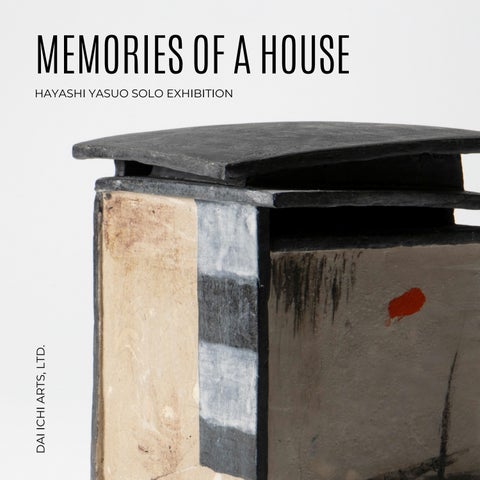
MEMORIES OF A HOUSE
DAI ICHI ARTS, LTD.
HAYASHI YASUO SOLO EXHIBITION
Dai Ichi Arts, Ltd. is a fine art gallery exclusively dedicated to presenting modern and contemporary works of ceramic art from Japan. Since our inception in 1989, we have focused on placing important Japanese ceramics at the center of New York’s contemporary art scene. The gallery has introduced pieces to the permanent collections of several major museums, including The Metropolitan Museum of Art, The Art Institute of Chicago, the Minneapolis Institute of Art, the Indianapolis Museum of Art, the Princeton University Art Museum, and many more. We are committed to providing authoritative expertise to collectors, liaising with artists, and showing inspiring exhibitions and artworks. We welcome you to contact us for more information.
Memories of a House: Hayashi Yasuo solo exhibition Exhibition catalog On view: January 22 – February 5, 2026 18 East 64th Street, Ste. 1F New York, NY, 10065, USA www.daiichiarts.com
1
FOREWORD
BEATRICE CHANG
2
Portrait of Hayashi Yasuo, 1998. Image courtesy of the artist.
3
In the early 1990s, not long after I founded Dai Ichi Arts, I received a phone call from The Minneapolis Institute of Art. The museum asked me to appraise a group of ceramic works that had been donated by a private collector. That unexpected request opened a new lens through which I began lifelong discoveries and engagement with the work of the modern ceramic pioneer and artist Hayashi Yasuo .
林 康夫
At that time, my understanding of Japanese ceramics was still largely framed by the tradition of The Six Ancient Kilns: Shigaraki, Iga, Tamba, Bizen, Tokoname, and Seto. While I was aware of the vigorous, experimental ceramic movements that had already taken root in postwar Japan, particularly in Kyoto, it did not capture my focus until I encountered Hayashi sensei’s work. Time spent engaging at his work revealed to me that living, evolving language of ceramics, introducing a new vocabulary that was abstract, intellectual, and avant-garde. The following year, I was invited to visit Hayashi’s home in Kyoto. He and his wife, Hayashi Teruko , welcomed me warmly into their home and studio. That visit marked the beginning of my representation of Hayashi and, more importantly, a profound expansion of my understanding of Japanese ceramics.
林 照子
Born in 1928, Hayashi Yasuo is one of the most pivotal figures of the first post-war generation that helped define contemporary Japanese ceramics. As a young man, he was drafted as a kamikaze pilot. The sudden end of the war saved his life and returned him to Kyoto. He initially took over his father’s studio—his father was a painter— and Hayashi himself began his career in painting before pivoting to ceramics after the cessation of the Pacific War and WWII.
4
Cloud, 1948, glazed Stoneware, (h) 33.7 × (w) 33.0 × (d) 27.5. Permanent collections of the The National Museum of Modern Art, Kyoto. Image courtesy of the museum.
5
Hayashi Yasuo pictured with his wife, Teruko at Dai Ichi Arts gallery.
Among Kyoto’s cultural circles, he associated with leading artists of the time, including Noguchi Isamu (1904–1988), and notably, he exhibited with Noguchi in 1947 in Paris while still very young.
野口 勇
In November of that same year, he became one of the inaugural members of the first avant-garde sculptural ceramic movement called "Shiko-kai " in Kyoto. And, in 1948, the group held the very first exhibition of ceramic objects. These were "Objets" or "Obuje-yaki" (kiln-fired object), a term used to describe ceramic objects that consciously subverted the Japanese tradition of vessel-based ceramics. In this exhibition, Hayashi showed the important ceramic objet “Cloud.”
四耕社
For this historicity, I am forever grateful for the teachings and scholarship of ceramic historian, art critic, and dear friend Todate Kazuko , Professor at Tama Art University. Her rigorous documentation of Japanese ceramic art history has clarified the historical significance of “Objets” within twentieth-century ceramics. Her writing expanded my visual vocabulary and fostered a more disciplined and precise understanding of modern ceramic practice.
外舘 和子
6
7
Hayashi never apprenticed in a traditional ceramic lineage. Instead, he developed his own methods through disciplined experimentation. Working closely with Hayashi Teruko, his steadfast partner in both life and practice, Hayashi built his sculptures using coiled clay strips, gradually forming dense, architectural volumes of extraordinary precision, before applying various skillful surface applications such as engobe and thereafter bisque firing. He once joked that “mathematics would cry” at his works, as viewers are often unable to determine a central optical starting point. His objets contain complex optical illusions that frequently arise in the perception of their three-dimensional construction. These illusions present themselves with authority and clarity. His surfaces are equally compelling: Glaze is blown onto the clay, creating layered optical effects that shift with light and movement. His works are not only three-dimensional; they speak directly to the senses as experiential objects, thus resisting easy photography and demanding one’s physical experience. Hayashi’s creativity extended beyond ceramics. He designed stage sets, taught at Osaka University of Arts, and inspired generations of younger artists through both his work and his integrity. In later years, his deep social conscience became especially evident. After the devastating tsunami in Japan, Hayashi traveled repeatedly to the affected regions. Since 2020, he has created a series of works in response to tragedy— many of which were exhibited in museums across Japan— and donated all proceeds from their sale to support the victims who are still living with the repercussions of the tragedy today. To live as an artist with such discipline, humility, and sense of social responsibility is no small feat. I am grateful to have worked with Hayashi Yasuo for over three decades, and remain in deep admiration for his work. His spirit, focus, and unwavering commitment continue to inspire me. This exhibition, though modest in scale, brings together works from key periods of his long career that spans over eight decades, from early explorations to recent creations. I hope it offers viewers a glimpse into the lifelong dedication of an artist who helped define contemporary Japanese ceramics.
8
9
EARLY YEARS
“It was on the day of the formation of Shiko-kai [in November of 1947] that I came in touch with the new world of plastic arts and set my mind toward pursuing free ceramic expressions. On that day, I learned about Max Ernst at Mr. Sango Uno’s house for the first time. In those days, there was a torrent-like inflow of new information about Western modern arts, which came as a pleasant shock to me and sank deeply into my mind in spite of the pain of hunger from the difficulty of obtaining food. Around mid-1948 this germ of an interest in “objet (object)” began to take concrete shape in my mind, which soon naturally became the determinant course of my life.” – Words by Hayashi Yasuo from “The Works of Yasuo Hayashi” (1998), published by the Tsukamoto Educational Institute Grant-in-aid (No. 12, 1998). Pictured: Detail of Max Ernst (1891–1976), Zoomorphic Couple, 1933, Oil on canvas, 91.9 x 73.3 cm, The Solomon R. Guggenheim Foundation Peggy Guggenheim Collection, Venice, 1976. Image © 2023 Artists Rights Society (ARS), New York/ADAGP, Paris.
10
11
12
“The works of Yasuo Hayashi... took a stoic attitude to start pursuing ceramics as a plastic art, and continued to have reddish surfaces for a considerable period in his early years. The impression of their color tone was a factor that contributed to those works in having a clean, yet sometimes sensuous, soft texture and a warm feeling. They are filled with an air of favorable impression in lean and pruned forms. It is in the mid-1970’s that his works gradually began to change to intellectual expressions. The period from those early years to the 1980’s can be considered to be two distinctive points in the history of his art. The artist’s mind began to focus on space that stretches away rather than on forms of centripetal masses. Attempts based on ideas of organized architectural space appeared. Thus intellectual forms, which now importantly characterize the ceramic art of Hayashi, originated in that period. The mixture of reality and illusion began to be seen during this period.” – Translated excerpt from “Space of Ceramics in the Works of Yasuo Hayashi” by art critic and scholar Toru Takahashi, from The Works of Yasuo Hayashi (1998), published by the Tsukamoto Educational Institute Grant-in-aid (No. 12, 1998).
13
14
Max Ernst (1891–1976), Après nous la maternité (After Us Motherhood), 1927, oil on canvas, 146.5 x 114.5 cm, Permanent collections of Kunstsammlung Nordrhein-Westfalen, Düsseldorf, Germany. Image courtesy of Kunstsammlung Nordrhein-Westfalen.
15
16
“This work was created in the postwar period, a time when society sought the restoration of humanity after defeat. Having already lived through two wars [by this point], I began by asking the fundamental question: what does it mean to be human? Based on the abstract treatment of the human figure that characterized the 1960s, the work is composed only of what I felt to be essential. The form is primary, without unnecessary surface embellishment, allowing the natural tonality of the red clay to emerge and giving the sculpture a sense of softness and gentle presence. This piece represents a stage in the process that eventually led to my receiving the Grand Prize at the Faenza International Ceramic Competition in Italy in 1972, as well as subsequent awards in Canada and France.” – Hayashi Yasuo, 2025, on the pictured sculpture “Form,” 1969.
17 17
18
19
MEMORIES OF A HOUSE
When the German architect Bruno Taut (1880–1938) visited Japan, he praised the traditional Japanese house in “Houses and People of Japan.”
“The most interesting feature of the house is not its material appearance but its life. The Japanese house … is like a stage in an open-air theatre, the background of which, visible through the open wall, is nature” – Bruno Taut, Houses and people of Japan (1937).
Taut was referring to the machiya, traditional wooden Japanese townhouses that originated in the 12th century as temporary merchant stalls that doubled as residential dwellings in town centers. Typified in Kyoto, machiya (kyōmachiya ) are constructed with earthen walls and tiled roofs. The structure comprises a long wooden house with a narrow street frontage that extends into the city block. Additionally, these homes often include one or more open interior courtyard gardens. In Kyoto, machiya define the city’s historical character and, because the city was spared by both natural disasters and World War II bombing, kyōmachiya continue to play a central role in its urban landscape today.
京町家
20
“During his service at the Naval Flying Corps during World War II, he experienced the unknown perceptions of space and speed in various drills including night flights, which must have had some psychological repercussions upon him.”
- Excerpt from “Yasuo Hayashi: The Evolution of his Art” by Yasuhiko Okumura, Art Critic, scholar, and curator of The Museum of Modern Art, Wakayama, from “The Works of Yasuo Hayashi” (1998), published by the Tsukamoto Educational Institute Grant-in-aid (No. 12, 1998).
Photograph of a young Hayashi Yasuo during World War II. Image courtesy of NHK news and Hayashi Yasuo.
21
The machiya continues to provide an important reference point for Hayashi Yasuo’s work. Having been drafted as a pilot during his teenage years during World War II, Hayashi was extremely lucky to survive. He had flown numerous night training flights over Kyoto. From the air, he encountered the city as a dense field of kyōmachiya, their earthenware tiled roofs spreading across the darkness below. In the air at night, perception– shaped by distance, speed, and weather– distorted the familiar forms of inhabited homes. For Hayashi, perceptions of the domestic kyōmachiya from his flights, combined with the unquestionable confrontation of death imparted a powerful, disquieting psychological memory. Through his expression of kyōmachiya forms, he continues to consider the important value of life. The tension from this experience has remained a persistent and powerful theme that Hayashi has returned to throughout his ceramic career.
22
23
Not only are kyōmachiya a part of daily life for many Kyoto residents, but it’s qualities of modularity, spatial harmony, open form and asymmetry are central to the internalized visual vocabularies of many Japanese architects, artists and designers working with space and construction. Although many machiya across Japan have been renovated and adapted for contemporary use, their spatial logic has infrequently been examined in scholarly depth by architects. Hayashi, though not an architect but a ceramic artist, engages this logic through clay, reimagining architectural possibility at a different scale and medium. Formally, these ideas are most clearly articulated in Hayashi Yasuo’s “Memories of a House” series. The works reference the spatial intelligence of the kyōmachiya in the language of abstraction. In particular, in works from the past decade, Hayashi has adapted its modular logic directly. Some pieces can be disassembled and reconfigured, merging sculptural and architectural approaches to create fluid objects with multiple orientations and readings.
24
“This sepia film-2 was created with the overall meaning of asking, ‘In each person's life, they've surely experienced various histories, memories, and events in their own way. Think back on your own life so far.’ and with my own feelings from harsh transitions. The figure depicted might be me.” – Hayashi Yasuo, 2026, on Memories of a House “Sepia Film-2,” pictured right and below.
25
26
“The recent work of Yasuo Hayashi often makes it difficult— sometimes even impossible — for us to discern from photographs how the works are constructed. Which parts are in the front and which are in the back— the construction of space itself —is often hard to read in images alone. When we encounter the actual works, viewed in good light and from multiple perspectives while also sensing their texture, complex optical illusions frequently arise in the perception of their three-dimensional construction. This effect is all the more pronounced in photographs with limited tonal range. This experience of Hayashi’s work is so skillfully constructed that one suspects the artist may even take pleasure in creating forms that produce such effects in photographs. In Hayashi’s forms, there are clear indications of elaborate calculation toward these visual effects.” – Translated excerpt from “Space of Ceramics in the Works of Yasuo Hayashi” by art critic and scholar Toru Takahashi, from The Works of Yasuo Hayashi (1998), published by the Tsukamoto Educational Institute Grant-in-aid (No. 12, 1998).
27
28
29
30
31
32
33
SCENES OF NAMIE TOWN
The following sculptural works are from Hayashi’s “Scenes of Namie Town” series created between 2020 and 2025. These sculptures were made in memory of the victims and those who are still affected by the March 2011 Tōhoku earthquake and tsunami, almost 15 years on. It reflects Hayashi's artistic spirit, which seeks to ensure that history and memory remain present in our lives. At the same time, they serve as an austere reminder of the fragile relationship between humanity and nature, urging us to cherish the preciousness of fleeting life. In 2024, the Mashiko Ceramic Art Museum hosted the exhibition "Hayashi Yasuo: Dedicated to Namie" featuring works from this series.
34
35
36
37
38
“In 2011, Fukushima Prefecture suffered catastrophic damage from a massive tsunami, which in turn caused a major accident at the nuclear power plant. On that day, I was in my studio preparing a work for the annual three-person exhibition in Osaka held every May. I had placed a piece on my worktable and was pondering it. Shortly after 2:30 in the afternoon, I decided to take a short break and went upstairs for tea. When I turned on the television and the kettle, terrifying images of the tsunami filled the screen. I was utterly breathless. From that moment on, I could no longer bring myself to touch the work at all. The following day, I received a message via the Wakayama Museum of Modern Art. The AizuWakamatsu Museum was asking artists and craftspeople in the Kansai region to send words of encouragement—any form would do—to the craftspeople of Fukushima, who were facing an unimaginable situation. I immediately sent photographs of the work that had come to a complete halt to the Aizu-Wakamatsu Museum via the internet. I had intended to donate the piece whenever the opportunity arose, and at last, in November 2018, I was able to visit the museum and fulfill that responsibility. The next day, I traveled to a point approximately six to seven kilometers north of the nuclear plant in Namie Town. Now, more than six years later, I was stunned by how bleak and desolate the landscape remained. The entire area appeared white from the spraying of herbicides. Here and there, objects resembling these works (No. 7 and 8) seemed to cling to the ground, like growths or warts rising from the earth. Along the roadside, the traces of houses continued in a line—foundation stones, boundary markers—prompting me to imagine a landscape that had vanished in an instant. The impact of that sight was too overwhelming to give concrete form to. Yet upon returning to Kansai, I found myself in a world where no one seemed to think about such things at all. I felt strongly that this reality must be conveyed, and I continue to work toward that end. These works, too, are allegorical dwellings.” – Hayashi Yasuo, 2025, on the birth of his “Scenes of Namie Town” series.
39
40
41
42
43
44
45
46
47
48
省てれた事いだの私 み消道もに込と集は てえにのもみ思積こ のたなとあがいがの 制もっ っ別まあ年 作のたどてなする齢 でが事お曖方記事ま すそなし昧向憶にで 。うどてなではよ生 でをももあ正りき な考思のれし て いえい。ばい今来 と 出し違事をら も想せかっも生れ 言像なしたあきた えしい数事れ明背 なても多にば日後 いみのいなそにに てが記っうつ 長、あ憶たでな様 い残っのりなが々 様って中物いるな でた に事事も記 短も何はのもの憶 いのか厳表あがが 人がの然裏るああ 生よ分とは るり をくかし何思のそ “Behind the fact that I have lived to this age lies a vast accumulation of memories. It is through this accumulation that I am able to live in the present and remain connected to tomorrow. Some memories are accurate while others are not. Every matter has its front and back, and ambiguity is inherent in all things. Among countless memories, there are those that remain unmistakably vivid, and those that I cannot recall no matter how hard I try. When I imagine the moments that may have been turning points— forks in the road —I cannot say that what remains is always good and what has disappeared is always not; perhaps the opposite is true. This work is made in reflection on a life that feels long and yet is, in fact, short.” – Hayashi Yasuo, 2025, on No.4 House
寓舎, 2023, pictured above and right.
49
50
51
LIST OF WORKS
1. Hayashi Yasuo Sculpture, 1969
康
林 康夫
Signed at the base “ 69.10," accompanied by signed certificate of authenticity by the artist, 2025, stoneware, (h) 47 × (w) 22.9 × (d) 19.1 cm
林 康夫
With signed wood box and signed at the base '78, white engobe, bisque-fired stoneware with Irabo glaze, (h) 10.1 × (w) 35.5 × (d) 36cm
2. Hayashi Yasuo Truck III , 1978
軌
3. Hayashi Yasuo An Encounter’ 78
林 康夫 語らい, 1978
林 康夫
4. Hayashi Yasuo Memory of a House #1, 2003
With signed wood box, stoneware, (h) 29.8 × (w) 35 × (d) 23.7 cm
With signed wood box, stoneware, (h) 23.1 × (w) 43.1 × (d) 15.2cm
林康夫 寓 Ⅱ
With signed wood box, signed at the base '05 Yasuo, stoneware, (h) 31.7 × (w) 35.5 × (d) 19cm
5. Hayashi Yasuo Memories of a House “Sepia Film-2” FILM , 2005
With signed wood box, stoneware, (h) 30.2 × (w) 31.5 × (d) 16 cm
6. Hayashi Yasuo No. 3 Memory of a House 05-A, 2005
With signed wood box, stoneware, (h) 30.2 × (w) 31.5 × (d) 16 cm
7. Hayashi Yasuo No. 4 Object "Window," 2010
With signed wood box, stoneware, (h) 23.9 × (w) 17.3 × (d) 16.5 cm
8. Hayashi Yasuo House ‘17-B, ’17 B, 2017
舎セピアの
林 康夫
寓舎の記憶
林 康夫
寓舎 ー
林 康夫
林 康夫
9. Hayashi Yasuo No. 2 House , 2022
寓舎
林 康夫
10. Hayashi Yasuo No. 5 House , 2022
寓舎
林 康夫
11. Hayashi Yasuo No. 7 House , 2022
寓舎
林 康夫
12. Hayashi Yasuo No. 11 House , 2022
寓舎
With signed wood box, stoneware, (h) 19.7 × (w) 17.8 × (d) 16.5 cm
With signed wood box, stoneware, (h) 21.6 × (w) 16.5 × (d) 13.3 cm
With signed wood box, stoneware, (h) 10.5 × (w) 14.2 × (d) 13 cm
With signed wood box, stoneware, (h) 20.3 × (w) 19.1 × (d) 17.8 cm
林 康夫 寓舎
With signed wood box, stoneware, (h) 15.3 × (w) 12 × (d) 11.6 cm
13. Hayashi Yasuo No. 1 House , 2023
With signed wood box, stoneware, (h) 26 × (w) 17.8 × (d) 15.2 cm
14. Hayashi Yasuo No. 4 House , 2023
With signed wood box, stoneware, (h) 21.6 × (w) 17.8 × (d) 14.6 cm
15. Hayashi Yasuo No. 3 House , 2024
林 康夫 寓舎
林 康夫 寓舎
Portrait of Hayashi Yasuo. Image courtesy of Gendai-Tojiki, 2025.
ARTIST BIOGRAPHY
HAYASHI YASUO
林 康夫 ( B . 1 9 2 8 )
1928 Born in Kyoto, Japan 1940 Studied traditional Japanese painting 1943 Drafted into the Imperial Japanese Navy Air Service during World War II 1946 Began making pottery under his father’s guidance 1947 Joined Shikōkai (avant-garde ceramic group) as one of the founders 1959 Commissioned relief for the Hyogo Prefectural Labor Hall, Kobe 1962–1977 Joined Sōdeisha (avant-garde ceramic group) 1968 Started teaching at Craft Department, Osaka University of Arts 1972 Professor, Department of Crafts, Osaka University of Arts; Emeritus 2000 1973 Member, International Academy of Ceramics (IAC) 1974 Commissioned relief for Shingu Primary School, Hyogo 1980 Japan-US Association University Study Trip to California College of Art & Craft, San Francisco and Auckland Conference of I.A.C. in Kyoto 1981 Commissioned relief for Kamo Hospital 1987 Artist in Residence in International Experimental Studio, Kecskemet, Hungary Published Hayashi Yasuo: Documents and Chronology 1990 Artist in Residence in Canberra School of Art, Australia, funded by Japan Foundation Served as judge, Commonwealth Bank National Ceramic Award, Canberra, Australia 1995 The 5th International Potters Festival, Aberystwyth, Wales, UK 1998 Publication of Works of Hayashi Yasuo, Kawade Shobō Shinsha, Ltd. Designated Person of Cultural Merit, Kyoto City 1999 Kyoto Art and Culture Award recipient 2001 Published Works of Yasuo Hayashi: The Allure of Ceramic Objects, Paramita Museum Gave lecture and served as artist-in-residence, Shigaraki Ceramic Park Museum 2002 Served as judge, Fugaku Biennale (16th–20th exhibitions, final edition) 2003 Served as judge, 21st Asahi Modern Craft Competition 2004 Served as judge, 17th Fugoku Biennale, Asahi Newspaper 2005 Served as judge, 51st All Kansai Art Exhibition, Osaka Municipal Museum of Art 2016 Published The Works of Yasuo Hayashi: House 2018 Honorary Member, International Academy of Ceramics (IAC) Received Kyoto Shimbun Grand Prize – Culture and Academic Award
2022 2024 2025
Received Kyoto Prefecture Cultural Award for Special Achievement Publication: Avant-Garde Ceramics: The Life of Hayashi Yasuo by Shinobu Sakagami Commendation from the Governor of Kyoto Prefecture; Awarded the Konju Hōshō (Blue Ribbon Medal) Gold Prize, Japan Ceramic Society Award.
SELECTED EXHIBITIONS 1947–1957 1962–1977 1950 1958 1959 1953–1956 1964-1965 1972 1973 1974 1976-1977 1978 1981 1982 1982-1983 1984 1985 1986 1987
1988 1989 1990 1991 1992 1993
Founding member of Shikōkai; participated in all exhibitions Participated in Sōdeisha exhibitions Contemporary Japanese Ceramics, Musée Cernuschi, Paris Sato Gallery, Tokyo Hankyu Department Store, Osaka/ Yoseido Gallery, Tokyo GENBI Exhibition (Association for Contemporary Art Discussions), Kobe and Kyoto Gallery 16, Kyoto Faenza International Ceramic Exhibition, Italy (Grand Prize) Calgary International Ceramic Exhibition, Canada (Grand Prize) Vallauris International Ceramic Exhibition, France (Grand Prix d’Honneur) Seibu Department Store, Ikebukuro Tokyo Daimaru Department Store, Seikado Gallery, Hotel Okura, Tokyo Osaka Contemporary Art Center, Osaka Vallauris International Ceramic Exhibition (Vallauris Association of Arts and Culture Award) Gallery Chayamachi, Osaka Invited artist, Faenza Maestro Exhibition, Italy Daiken Gallery, Osaka/ Gallery Sanjo, Kyoto/ Gallery Haku, Osaka Akasaka Green Gallery, Tokyo Óbidos Biennale, Portugal (Grand Prize) Artist-in-residence, International Ceramic Experimental Workshop, Kecskemét, Hungary Akasaka Green Gallery, Tokyo / Gallery Beni, Kyoto Institute Franco-Japonais du Kansai, Kyoto Akasaka Green Gallery, Tokyo / Canberra School of Art, Australia Gallery Beni, Kyoto Akasaka Green Gallery, Tokyo / Hirakata Kintetsu Art Gallery, Osaka Contemporary Japanese Ceramics: Continuity and Change, USA Gallery Tenjiku, Tokyo / Contemporary Crafts Gallery, Portland
1996 1997 1998
2000 2001 2002 2003 2005
2006 2009 2010 2011
2012 2013 2014 2015 2016 2017
2018 2019
Akasaka Green Gallery, Tokyo / Gallery Beni, Kyoto Akasaka Green Gallery, Tokyo / Seoul Ceramic Biennale ’97, Korea Mathematics and Ceramics, Osaka Prefectural Contemporary Art Center; held in conjunction with the International Congress of Mathematicians, Ofen- und Keramikmuseum Velten, Berlin, Germany Akasaka Green Gallery, Tokyo / Gallery Sanjo, Kyoto Contributed stage design for the opera Peony Pavilion, Nice and Cannes, France Kyoto Crafts 1945–2000, Kyoto and Tokyo Akasaka Green Gallery, Tokyo / Gallery Sanjo, Kyoto Aoyama Green Gallery, Tokyo Gion Konishi Gallery, Kyoto Transformation: The Language of Craft, National Gallery of Australia, Canberra Hayashi Yasuo Exhibition, CURATOR’S CUBE, Tokyo Hayashi Yasuo Exhibition, Dai Ichi Arts, New York Contemporary Japanese Ceramics, Boston, USA Hayashi Yasuo Exhibition (three-month solo exhibition), Paramita Museum, Mie Sculpture by Three Artists (Japan, Spain, Hungary), Heidelberg and Kecskemét Japan–Spain Contemporary Ceramics, Tokyo and Valencia Contemporary Japanese Ceramics: Tradition and New Currents, Esashi and Seto, Aichi Japanese Winners of the Faenza Prize, Istituto Italiano di Cultura, Tokyo Masterpieces Exhibition, Aichi Prefectural Ceramic Museum Collection Japanese Objects: Fragments from the 1920s–1970s, Urawa, Saitama group85 Exhibition, Bangaro Gallery, Osaka group86/74/65 Exhibition, Gallery Yuragi, Kyoto Europe & Beyond: 12 Artists in Clay, Peppercanister Gallery, Dublin, Ireland Revisiting 20th-Century Japanese Art: The 1940s, Mie Prefectural Art Museum Borderless Postwar Avant-Garde Ceramics, Ashiya City Museum of Art & History Cubism in Japan: The Picasso Impact, Tottori Prefectural Museum / Saitama Museum of Modern Art / Kochi Museum of Art Hayashi Yasuo: A Quest Through Clay, Museum of Ceramic Art, Hyogo New Vista: Postwar Ceramic Expression, Sokyo Gallery, Kyoto Work acquired by The Metropolitan Museum of Art, New York Yingge Ceramics Museum, IAC Members Exhibition (lecture), New Taipei City, Taiwan MAM Research 007: Sōdeisha and the Birth of Contemporary Ceramics, Mori Art Museum, Tokyo (photographic documentation only) Hayashi Yasuo Exhibition, Kyoto Ceramic Hall Gave lecture: From Gojō-zaka Rakuchū Exhibition, Kitano Tenmangū Shrine, Kyoto
2020 2021 2023
2024
2025
Works acquired by The National Museum of Modern Art, Kyoto (Cloud, High Heels, and two additional works) Modern Craft Chronicle, The National Museum of Modern Art, Kyoto Sōdeisha Group: An Era Born Out of Avant-garde Ceramics, The National Museum of Modern Art, Kyoto / Gifu City Museum of Art / Okayama Prefectural Museum of Art Hayashi Yasuo Exhibition, Gion Konishi Gallery Hayashi Yasuo & Tsuboi Asuka: The Spirit of Avant-Garde Expression, Kyoto Institute, Library and Archives Innovation Through Clay, Wakayama Museum of Modern Art Hayashi Yasuo Exhibition, Kawanotei Art Gallery & Laboratoire Dedicated to Namie: Hayashi Yasuo Exhibition, Mashiko Museum of Ceramic Art Sōdeisha Group: An Era Born Out of Avant-garde Ceramics, Tomo Museum of Art Works shown from collections of Kure City Museum of Art, Higashihiroshima City Museum of Art, and Hiroshima Prefectural Art Museum Ceramic Frontiers Shikōkai & Sōdeisha Group Exhibition, Dai Ichi Arts, New York Japan Ceramic Society Award Winners Exhibition, Kochūkyo Lecture, Nagano Prefectural Art Museum Collection Exhibition Memories of a House: Hayashi Yasuo solo exhibition, Dai Ichi Arts, New York “Wave” A black ceramic sculpture of abstract form acquired by The British Museum
SELECTED PUBLIC COLLECTIONS USA – Metropolitan Museum of Art, New York, USA Herbert F. Johnson Museum of Art, Cornell University, Ithaca, New York, USA Museum of Art and Design, New York, USA Everson Museum of Art, Syracuse, New York, USA Museum of Fine Arts, Houston, Houston, Texas, USA Contemporary Crafts Museum & Gallery, Portland, Oregon, USA New Orleans Museum of Art, LA, USA Institute for Japanese Art, Hanford, CA, USA Minneapolis Museum of Arts, Minnesota, USA JAPAN – Hokkaido Museum of Modern Art, Sapporo, Japan Museum of Contemporary Ceramics, Shigaraki, Japan National Museum of Art, Osaka, Japan Museum of Modern Art, Wakayama, Japan Kyoto Municipal Museum of Art, Japan
National Museum of Modern Art, Kyoto, Japan Hiroshima Prefectural Art Museum, Japan National Museum of Modern Art, Tokyo, Japan Takamatsu City Museum of Art, Japan Kyoto Prefectural Library and Archives, Japan Nagano Prefectural Shinano Art Museum, Japan Osaka University of Arts, Japan Misho School of Flower Arrangement, Japan Ohara School of Flower Arrangement, Japan Chushin Art Foundation, Kyoto, Japan Japan Foundation, Tokyo, Japan INTERNATIONAL – Musée National de Céramique, Sèvres, France Musée Municipal de Céramique et d’Art Moderne, Vallauris, France Museo Internazionale delle Ceramiche, Faenza, Italy Museu de Óbidos, Portugal Musée Ariana, Geneva, Switzerland Victoria & Albert Museum, London, U.K. British Museum, London, U.K Aberystwyth University, Wales, U.K International Experimental Ceramic Studio, Kecskemet, Hungary Kecskemét International Ceramic Museum, Hungary Museum of Decorative Arts, Prague, Czech Republic National Museum of History, Taipei, Taiwan Seoul Metropolitan Museum of Art, South Korea Icheon World Ceramic Center, South Korea Total Museum of Contemporary Art, Seoul, South Korea Canadian Clay & Glass Gallery, Ontario, Canada Museo de Arte Moderno, Buenos Aires, Argentina Art Gallery of Western Australia, Perth, Australia Australian National University, Canberra, Australia National Gallery of Australia, Canberra, Australia
Hayashi Yasuo and Hayashi Teruko at their Kyoto residence, 2022.
Hayashi Yasuo and Beatrice Chang pictured in Kyoto at the artist’s residence, 2023.
Image of the Shikokai group in its early days, photographed 1947, Image courtesy of Hayashi Yasuo.
Memories of a House: Hayashi Yasuo solo exhibition | Exhibition catalog Project curator and director: Beatrice Chang Authors: Beatrice Chang, Hayashi Yasuo With words by: Toru Takahashi, Yasuhiko Okumura Catalog production: Kristie Lui, Haruka Miyazaki, Ichiho Nishiki, Naomi Saito Photography: Yoriko Kuzumi Museum and further images courtesy of: The National Museum of Modern Art, Kyoto, The Solomon R. Guggenheim Foundation Peggy Guggenheim Collection Artists Rights Society (ARS), New York/ADAGP, Paris Kunstsammlung Nordrhein-Westfalen, Düsseldorf, Germany Gendai-Tojiki, 2025
ISBN: 979-8-9985525-3-3 Published by Dai Ichi Arts, LTD. © 2026 All rights reserved.
DAI ICHI ARTS, LTD. 18 EAST 64TH STREET, STE. 1F NEW YORK, NY, 10065, USA WWW.DAIICHIARTS.COM