The
DACORBulletin
An Organization of Foreign Affairs Professionals
VOLUME LXXVII | ISSUE 9 November 2025
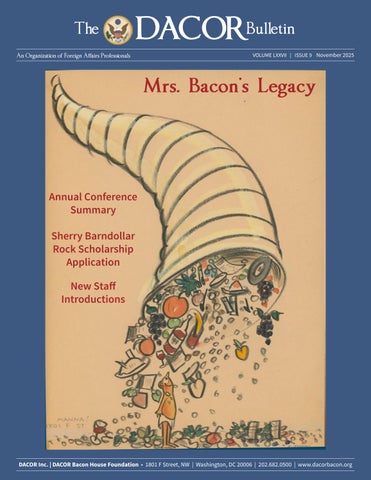
Mrs. Bacon's Legacy
Annual Conference Summary Sherry Barndollar Rock Scholarship Application New Staff Introductions
DACOR Inc. | DACOR Bacon House Foundation • 1801 F Street, NW | Washington, DC 20006 | 202.682.0500 | www.dacorbacon.org
DACOR Programs & Policies LUNCHEON TALKS
OFFICERS President:
Amb. Thomas Shannon
Vice President: Amb. Marcia Bernicat Secretary:
Elizabeth Warner
Asst. Secretary: Alfreda Meyers Treasurer:
Richard Morford
Asst. Treasurer: Janice Bay
STAFF Front Desk: 202.682.0500 Executive Director Alyson Reed x114 areed@dacorbacon.org Director of Operations Meg Sharley x110 msharley@dacorbacon.org Director of Finance Abdul Raheem Raheem, x116 araheem@dacorbacon.org Director of Communications & Programs Bulletin Editor & Designer Christine Skodon, x117 clskodon@dacorbacon.org Events Coordinator Sylvia Whitacker x125 events@dacorbacon.org Staff Accountant Alexandra Pizzi, x113 apizzi@dacorbacon.org Administrative Assistant Laska Hurley, x111 adminassist@dacorbacon.org Chef Darrylvon Smith, x126 General Inquiries dacor@dacorbacon.org The DACOR Bacon House is built on the Indigenous lands of the Nacotchtank (Anacostan) and later Piscataway people. The House was built in 1825 by enslaved laborers. Enslaved people lived and worked in the DACOR Bacon House until 1862 when the District of Columbia Emancipation Act was signed.
Members, along with guests they accompany, are invited to attend luncheon talks which are held weekly throughout the year. Unless otherwise noted, these talks begin at noon with a cash bar reception in honor of the speaker. Lunch starts at 12:30 pm, followed by the speaker’s remarks which conclude by 2:00 pm; attendees are free to leave at that time. The charge is $35 per DACOR member and reservations are required. (The charge for attending only the speaker portion of the program from 1 – 2 pm is $15.) Changes and/or cancellations to programs are announced in our e-blasts and on our website.
OTHER EVENTS
All members of DACOR are invited to attend ADST/DACOR book launch receptions, receptions for newly-commissioned FSOs, and DCM/PO receptions for DCMs and Principal Officers. There is no entry charge, but reservations are necessary. Members are also welcome at the Sunday afternoon Huston Musicales; a fee of $35 per DACOR member and $45 for guests is collected at the door. Children under 18 are admitted free. Disclaimer: DACOR encourages vigorous expression and questioning of points of view, while striving for balance. No endorsement of speakers’ views or of their charitable, professional or commercial bona fides should be inferred.
MEMBERS’ LUNCHEONS
Members and their guests are invited to lunch on Tuesdays and Thursdays, reservations are required. Members' Luncheons include a biscuit/bread, an entree, a dessert, and a cup of coffee/tea and cost $35. A cash bar is available from 12 and lunch is served from 12:30 to 1:30. NO-SHOWS & CANCELLATIONS NOT RECEIVED BY 9 AM THE BUSINESS DAY BEFORE AN EVENT WILL BE BILLED.
— TO MAKE OR CANCEL RESERVATIONS — Register through the Calendar of Events at www.dacorbacon.org Or contact us at programs@dacorbacon.org or 202.682.0500 x120. DACOR routinely takes photos at its events. Members and guests should notify the DACOR photographer if they want to restrict the use of their names and images.
DRESS CODE
DACOR maintains a professional business attire dress code in the DACOR Bacon House. While suits, ties and heels are always welcome, they are not required. For individual events, or categories of events, DACOR may apply a formal business attire dress code where men are expected to wear a suit or jacket and tie, and women should wear commensurate attire. Promotional material for these events will specify that formal business attire is required. During summer months, from Memorial Day to Labor Day, business casual may be worn.
The DACOR Bulletin is published by Diplomatic & Consular Officers Retired 2 DACOR Bulletin • November 2025
From the President
Cover: 1801 F St. described as "Manna!" from cartoonist Richard Osborn to his friend Mrs. Virginia Murray Bacon. DACOR Bacon House Collection.
Inside this Issue I am honored to assume the presidency of the board of DACOR and the DACOR Bacon House Foundation. Following in the illustrious footsteps of Angela Dickey and other remarkable leaders and diplomats, I look forward to working with all of you to advance the mission of both institutions: To bring foreign affairs professionals together to support diplomacy, the Foreign Service, and public understanding of diplomacy, and to preserve the historic DACOR Bacon House. I am pleased to be joined in this project by the new vice-president of the board, Ambassador Marcia Bernicat, and our new executive director Alyson Reed. Marcia brings extraordinary global experience to her latest challenge and will lead our efforts to review and refashion DACOR’s strategic plan in response to a rapidly changing domestic and international environment. Alyson, who brings more than 30 years of experience managing non-profit organizations, will lead efforts to improve and enhance DACOR’s operations and programs, and advance fundraising and the financial well-being of DACOR and the DACOR Bacon House Foundation. The three of us will begin our tenures as we celebrate the 200th anniversary of DACOR Bacon House. This house, which has been home to DACOR since 1985, has played a central role in the social, political, and diplomatic life of our nation’s capital since it was built in 1825 when John Quincy Adams was President. We are also in the midst of a significant fundraising effort for the House’s main dining room and to name it in honor of Secretary of State George Shultz. Our purpose is to enhance the physical integrity of the House, upgrade our ability to provide a welcoming space for members, and remind all visitors of the extraordinary and historic career of one of America’s greatest public servants. DACOR was founded in 1952 with the purpose of providing for the well-being of members and to educate a broader public on the importance of diplomacy. That mission remains relevant and important today. As our foreign affairs community undergoes significant changes, we want to recognize and respect the work of all our foreign affairs professionals, especially those in transition to new jobs and lives. We want to create a space for dialogue and camaraderie. We want to continue our discussion groups, education programs, student scholarships, and mentoring to advance nonpartisan engagement and understanding. And we want to underscore, day after day, the importance of diplomacy as the guiding tool of American presence in the world. During our Civil War, President Abraham Lincoln would visit DACOR Bacon House, then owned by William Carroll, frequently. It provided a place for Lincoln to escape the demands of the White
Save the Dates
4
House Closure
4
Cocktails in the House
5
FS Cup Nominations
6
New Staff
7
SBR Scholarship App
7
Log-In Quick Guide
7
Bicentennial Time Line
8
Gift of DACOR
10
2025 Holiday Ornament
11
From a Fellow
12
Year of Change?
13
Travel with WAC
13
In & Around
14
Conference Summaries
16
In Memoriam
20
In Remembrance
21
House and War Room. It also provided him a place to assuage his grief following the death of his son Willie. At the time, Lincoln said the fight to preserve the Union was undertaken for a “vast posterity.” At DACOR and the DACOR Bacon Foundation, we continue to believe that our audience is a vast posterity.
Tom Shannon
November 2025 • DACOR Bulletin 3
Save the Dates We are planning many programs for 2026! Here are a few special events that we will be holding. More information will be available soon.
Valentine's Day Candlelit Dinner
Networking Breakfasts
Thursdays, February 12th, April 9th & June 11th 8 - 9 am
Saturday, February 14th 6:30 - 8:30 pm
Mother's Day Brunch
Sunday, May 10th 11 am - 1 pm
St. Patrick's Day Dinner Party
Tuesday, March 17th 6:30 - 9 pm
Topical Breakfast Speaker Series
Dates & Times TBA
Notice: As usual, the DACOR Bacon House will be closed for Federal Holidays. Visit www.opm.gov for a full list. In addition, the House will be closed December 26th - 31st. DACOR staff offices will also be closed during these times.
4 DACOR Bulletin • November 2025
Robert Burns Birthday Supper Thursday, January 22nd, 6:30 pm Early bird (until 12/11) $110; Regular price $130 Dress Code: Highland Evening/Black Tie Join us for our annual Burns Night celebration including Scottish music, songs & poetry by Robert Burns, Scottish spirits tasting, insightful toasts/speeches, delicious food, and great camaraderie at the historic DACOR Bacon House. This event is expected to sell out so sign up now through our online calendar or by contacting programs@dacorbacon.org or 202-682-0500 x120
Cocktails in the House First Thursday of the Month 5 - 7 pm (January Cocktails on the 8th)
Join us for drinks and great camaraderie in our beautiful, historic house. Features a cash & credit card bar. Members are encouraged to bring guests. November 2025 • DACOR Bulletin 5
Call for FOREIGN SERVICE CUP Nominations The Awards Committee seeks nominations for the 2026 Foreign Service Cup Award. The Cup recognizes the recipient’s outstanding contributions to U.S. foreign policy and their activities as a retired FSO that further the objectives of DACOR, particularly diffusing knowledge of U.S. foreign policy and strengthening the career Foreign Service.
On Foreign Affairs Day, Friday, May 1, 2026, the President of DACOR will award the Cup to a retired FSO who: • has made significant post-retirement contributions to the broad field encompassed by the term “foreign affairs”; • had a distinguished Foreign Service career; • has been retired for more than five years; • has not previously received the DACOR Foreign Service Cup or the Director General’s Cup; • is present to receive it.
Previous recipients of the DACOR Foreign Service Cup: 2025 2024 2023 2022 2021 2020 2019 2018 2017 2016 2015 2014 2013 2012 2011 2010 2009 2008 2007 2006 2005 2004 2003 2002 2001 2000 1999 1998 1997 1996
R. Nicholas Burns Harry W. Kopp Aurelia E. Brazeal Nancy J. Powell Dennis Jett Thomas Tracy Jacques Paul Klein H. Allen Holmes Thomas E. McNamara Kenton Keith Ronald E. Neumann Richard Kauzlarich Alan Larson Rozanne L. Ridgway J. Stapleton Roy Edward W. Gnehm Jr. Alexander F. Watson Joseph H. Melrose Robert H. Miller William P. Stedman Jr. William D. Calderhead Stephen Low Dennis Kux Willard De Pree Frank C. Carlucci III William C. Harrop Thomas D. Boyatt L. Bruce Laingen Charles Stuart Kennedy Jr. Andrew I. Killgore
1995 1994 1993 1992 1991 1990 1989 1988 1987 1986 1985 1984 1983 1982 1981 1980 1979 1978 1977 1976 1975 1974 1973 1972 1971 1970 1969 1968 1967
Jean Mary Wilkowski John S. Service Harry G. Barnes Jr. Hermann F. Eilts William H. Luers Robert M. Sayre Richard B. Parker Joseph John Jova David Newsom Claude G. Ross Malcolm Toon Lucius D. Battle Edwin W. Martin C. Burke Elbrick U. Alexis Johnson W. Averell Harriman Jacob D. Beam Ellsworth Bunker Raymond A. Har Livingston T. Merchant No Foreign Service Day David K. E. Bruce Frances E. Willis H. Freeman Matthews Jefferson Caffery James C. Dunn Norman Armour Robert Murphy Loy W. Henderson
Any DACOR member may submit a nomination. Those wishing to re-nominate a candidate should send in a new nomination. Those making nominations should be sure that their choice will, if selected, be present on May 1. Nominations should be typed, double-spaced, no more than two pages in length, and include a draft citation. Nominations should be sent to: Awards Committee, c/o Alyson Reed 1801 F Street, NW • Washington, DC 20006 or email: nominations@dacorbacon.org
The deadline for submissions is Monday — February 23, 2026. 6 DACOR Bulletin • November 2025
Introducing New Staff Laska Hurley, DACOR’s Administrative Assistant, started in September, 2025. Prior to DACOR she was an administrative assistant at the National Endowment for the Arts for 25 years.
Christopher Vance started as a Development Consultant for the DACOR Bacon House Foundation in October. He has decades of experience in development and fundraising with particular emphasis in membership organizations, health-related causes, and social service non-profits. He has a successful background in donor relations, stewardship, and revenue generation. In addition, Christopher has trained many board and chapter members on all aspects of development including direct mail, foundation/corporate outreach, individual donors (including major, monthly, and planned givers), and special events. Christopher has a great interest in history and architecture and is excited to part of the DACOR Bacon House Foundation.
DACOR
Bacon House Foundation
SHERRY BARNDOLLAR ROCK SCHOLARSHIP
• •
Logging into DACOR's Website QUICK GUIDE • Go to www.dacorbacon.org, click Members Portal and then select the menu option you want. • When the login page appears, enter your username and password if you have them and continue to the last bullet point below. If not, or if you need to reset them, go to the Reset Your Password section and enter your email we have on file. Click the Reset my Password button. • Look for the reset email in your inbox. Don't see it? Check your spam folder. • Take note of your username in the email (you can change it if you want to) and click on the reset link. • Follow the prompts to reset your password. • Enjoy all DACOR's website has to offer! Need additional help? Contact us at adminassist@dacorbacon.org or 202.682.0500 x111.
November 2025 • DACOR Bulletin 7
200 Years of DACOR Bacon House History DACOR Bacon House is celebrating its bicentennial year in 2024-2025 with a series of programs that highlight important events in the house’s history and the contributions its occupants made to our nation’s capital and to our national history. We have divided the two-hundred-year period into significant eras. For our November 2025 issue, we cover the period from 1975-1985. Virginia Murray Bacon, the last private owner of the house, was determined that her treasured home would remain a meeting place for “statesmen,” policymakers and others interested in civic and foreign affairs. She therefore set in motion a chain of events which led to DACOR Bacon House Foundation becoming the owner of 1801 F Street in 1985 following Virginia Murray Bacon’s death in 1980. Terry Walz, DACOR Historian Elizabeth Warner, DACOR Archivist
1975-1985 Virginia Murray Bacon's Legacy 1975
Virginia Bacon considered many alternatives as she sought to preserve her beloved home and ensure it would remain a vital part of Washington, D.C. culture after she was gone. The organizations and institutions she approached as potential stewards included the State Department, the U.S. Supreme Court, the Kennedy Center for the Performing Arts (which she had been instrumental in creating), the Council on Foreign Relations and the Aspen Institute. She also successfully petitioned to list the house on the National Register of Historic Places. In 1975, Virginia Bacon created a foundation that would take title to 1801 F Street upon her death and maintain it as a meeting place where “statesmen and those who . . . devote their lives to civic service, can get together
8 DACOR Bulletin • November 2025
and exchange views on world problems.” In further pursuit of this goal, Virginia organized some seminars on topical issues under the “Bacon House” name, including in 1976 a discussion led by George Kennan on U.S.-Soviet competition for influence in the so-called Third World.
1976
The pianist Arthur Rubinstein was one of Virginia Bacon’s special friends. Her relationship with Rubinstein and his family extended over a 30-year period and included overseas travel together as well as her sponsorship of Rubinstein’s daughters when they became debutantes. Rubinstein usually stayed overnight at 1801 F Street when he came to town to perform at the Kennedy Center or Constitution Hall. Virginia would host a gathering in his honor, and he often practiced or played on the Steinway Grand piano she bought in 1929 that still graces the drawing room of the house. In 1976, Virginia was instrumental in securing for her friend the Presidential Medal of Freedom. Her lobbying efforts included a handwritten letter to First Lady Betty Ford expressing confidence that “a word from you to the wise will be sufficient” to ensure the award. Letter from the Kennan Institute announcing a discussion at 1801 F Street to be led by George Kennan on Soviet influence in the Third World. (Booth Family Center for Special Collections, Georgetown University)
Left: Letter on behalf of First Lady Betty Ford acknowledging Virginia Bacon’s letter to her urging that Arthur Rubinstein be awarded the Presidential Medal of Freedom, which he received on April 1, 1976. (Gerald R. Ford Presidential Library). Right: List of pallbearers at Virginia Bacon’s funeral. Persons of note include Amb. Lucius Battle, longtime CIA analyst Samuel Belk, Secretary of the Smithsonian Institution S. Dillon Ripley and Sen. Charles McC. Mathias, Jr. (Booth Family Center for Special Collections, Georgetown University) To be continued in the December edition . . .
▶
1980
Virginia Murray Bacon died on February 24, 1980, of congestive heart failure at the age of 89. Half a century earlier she had written to her mother saying that she hoped to live at 1801 F Street until her dying day, and she basically got her wish. At her memorial service, held in St. John’s Church on Lafayette Square, her good friend Amb. Lucius Battle said of her: She made her house a setting for discussion, and now and then resolution, of some of the problems of her age. It was her hope that the house could go on providing this kind of environment for those who cope with the swift and startling problems of our time. The house, which she has entrusted to posterity, could never be the same without her and her special quality of dedication. She served mankind’s better directions, giving fully and totally of energy and drive that lasted throughout her life. “We shall keep faith,” he concluded. “But an era is over.”
1985
Mrs. Bacon had left Bacon House with an endowment of $1.2 million, but it had been recognized by her advisors in the year prior to her death that this was not going to be sufficient to conserve and maintain the property, which was now over 150 years old. A partner would be needed. DACOR had long been identified as a suitable candidate—Virginia herself had been a member in the 1950s and 60s, and her association with its members dated back to the days of “The Family,” the informal group of bachelor diplomats who had owned a rowhouse at 1718
In 1980, the kitchen at 1801 F Street was on the ground floor, in space that now serves as the Calderhead Meeting Room. This image from that period looks north, though the windows and onto the Mews. (HABS Library of Congress)
H Street in the first half of the 20th century. Negotiations proceeded during the early 1980s to unite Bacon House and the DACOR Educational and Welfare Foundation, which became the DACOR Bacon House Foundation following their merger in 1985. At the same time, long-overdue repairs and renovations began, with a view to making the house more suitable and welcoming in its new institutional role. Among other things, the ground floor was prepared for public use and the kitchen was relocated to the second floor.
November 2025 • DACOR Bulletin 9
Limited Edition
DACOR Bacon House Bicentennial Pins are now available through our online boutique.
The antique gold pin showcases the DACOR Bacon House bicentennial logo. Celebrate your pride in our historic home by purchasing your pin today. And they make a great gift too! $10/pin • Shipping (additional charge) or pick-up options available. The pin is also available for sale at the DACOR Bacon House.
DACOR Bacon House
Need a Last Minute Gift?
Give the Gift of DACOR!
Boutique Looking for the perfect gift? Visit the DACOR Bacon House Boutique today! A great place for gifts for family, friends, and colleagues or yourself. The Boutique's link can be found in the upper right hand corner of www.dacorbacon.org.
10 DACOR Bulletin • November 2025
One of the easiest ways to support DACOR -- recruit through a gift of membership! Recruiting is also a great New Year’s Resolution so you can accomplish a lot with a gifted membership for 2026! DACOR is also offering special options for our colleagues in the foreign affairs community who have been negatively affected by staffing changes this year. Visit https://www.dacorbacon.org/ membership.php to find out more. Contact staff to start arranging your gift today!
Celebrate the Bicentennial of the Historic DACOR Bacon House with our 2025 Holiday Ornament featuring the Bicentennial logo in a 2-sided design
Available as a Thank You to All $200+ House Preservation Fund Year-End Donors. Collect the Full Set of DACOR Bacon House Ornaments Through Our Online Boutique or by Contacting development@dacorbacon.org.
November 2025 • DACOR Bulletin 11
Education: From a Fellow Zohneseh Fopenawoh University of Maryland, College Park – Department of Government and Politics Graduate School Focus: Master of Arts in International Relations Undergraduate School: University of Maryland, College Park Hometown: Silver Spring, Maryland; Born in Cameroon
The Katherine and S. Pinkney Tuck Memorial Fellowship • What has been the most memorable moment for you during your studies?
One of the most memorable moments of my graduate studies was attending the United Nations Association of the National Capital Area (UNA-NCA) Young Professionals Happy Hour in Washington, D.C. The event brought together emerging leaders and practitioners in international affairs from across the DMV area. It was inspiring to meet so many passionate individuals working in diplomacy, development, and human rights, and to hear their diverse perspectives on global challenges. I had the opportunity to connect with mentors and peers who share my commitment to international cooperation and social impact. I also had the opportunity to meet and befriend a fellow DACOR Bacon fellow, which made the experience even more meaningful.
• Where have you worked or interned during your studies? What have you gained from the experiences?
During my studies, I completed several internships that allowed me to apply my academic learning in a practical, real-world setting and gave me a glimpse of what my future career might look like. Sustainable Micro-Internship, Universitas 21: Completed a U21 micro-internship focused on SDG 8: Decent Work and Economic Growth. I had the opportunity to collaborate with international students to design a fundraising campaign for the Antarang Foundation in India, aimed at strengthening their communications team and empowering young adults to
12 DACOR Bulletin • November 2025
pursue sustainable careers. American Civil Liberties Union (ACLU), Baltimore, MD: I worked as a legal intern at the ACLU where I reviewed legal requests related to civil rights issues, maintained client databases, drafted and edited advocacy materials, and conducted legal research. International Rescue Committee (IRC), Maryland: I also volunteered at the IRC and had the opportunity to work directly with clients applying for adjustment of status, U.S. citizenship, family reunification, and other immigration benefits. SHC Afghan Refugee Assistance Project, Maryland: I participated in the Afghan Refugee Assistance Project at the University of Maryland, in partnership with Solutions in Hometown Connections. In this role, I tutored Afghan children from kindergarten through 12th grade to help them adjust to a new educational system, and supported Afghan adults as they prepared for the U.S. Naturalization exam. I also researched and provided critical resources to refugee clients, including assistance with SNAP/EBT applications, locating food banks, and accessing free mental health services.
• Where have you traveled during your studies?
Costa Rica, Mexico, Turks and Caicos, the Bahamas, and the Dominican Republic.
• What are your goals for the future?
I aspire to pursue a career in international law and foreign affairs whether through diplomacy or legal advocacy. While my long-term goals have remained
consistent, my studies and professional experiences have helped me refine and clarify my focus.
• What has your scholarship/fellowship allowed you to do that you would not otherwise have been able to do? Receiving the grant has lifted a tremendous burden off my shoulders. As someone who once had to sacrifice stable housing in order to pursue my education and
who nearly dropped out due to the inability to afford tuition, this grant provides financial support to help me complete my master’s degree in International Relations. Beyond funding, it has connected me with a network of professional mentors whose careers I deeply admire and hope to emulate. I also had the opportunity to study human trafficking abroad in Costa Rica, where I wrote a research paper titled “The Impact of Neocolonial Economic Globalization and Tourism on Labor Trafficking in Costa Rica."
Has 2025 Been a Year of Change for You? Please let us know if: • You have moved this year • You are using a new email address • You have reached your 90th birthday
• You would like to take advantage of the young professional membership categories introduced in 2025
All these things affect our ability to bill membership dues correctly. If 2025 has been a year of change for you, please inform us at dacor@dacorbacon.org.
WORLD AFFAIRS TRAVEL PROGRAM 65+ YEARS OF TRAVEL EXPERIENCE
TRAVEL WITH US
BOOK NOW
Bohemian Wonders - Czech Republic led by FSO (ret.) Frank Almaguer
European Coastal Cruise led by US Amb Barbara Stephenson
Expert-led tours focused on international affairs Travel with cultural diplomacy enthusiasts Exclusive tour access for DACOR members
40+ annual tours
May 16 - May 25, 2026 Starting at $5,295 per person LEARN MORE
May 23 - June 1, 2026 Starting at $7,495 per person LEARN MORE
DACOR, Inc. is partnering with World Affairs Council of Philadelphia to offer exclusive travel experiences with VIP access to DACOR Members and Friends of the Historic DACOR Bacon House. Traveling with World Affairs directly supports the DACOR Bacon House Foundation.
November 2025 • DACOR Bulletin 13
In & Around the House
A lot of work was done around the House in its Bicentennial Year. Here are a few examples. Clockwise from top left: Interns install a new exhibit about the history of DACOR on the 4th floor. The ceiling of the Calderhead Meeting Room gets a major upgrade, exposing the historic wooden beams. Sections of our patio get bricks relaid. The roof of the House is repaired and repainted. Various bathrooms receive new toilets which were unboxed on the patio before installation.
14 DACOR Bulletin • November 2025
The Washington Revels Heritage Voices perform at a DACOR Bacon House Bicentennial Musicale in October.
Top right: Good conversation is had at the annual Fall Reception held in October. Right: Sam Lerman, founder and CEO of SPYRT Worldwide, leads a wine tasting of Ukrainian wines from SHABO Winery.
The October Salon "On Military Power and Warfare in Our Time" featuring Col (Ret) John Agoglia was a sellout.
Attendees enjoy the Virginia Murray Bacon Tea in their tea appropriate hats and finery.
November 2025 • DACOR Bulletin 15
From the DACOR Dais DACOR Bacon House Foundation 2025 Annual Conference
Iran in the Middle East September 12, 2025 Summary by KEITH MCCORMICK, Conference Co-Organizer The topic for this year’s annual DACOR Bacon House Foundation Conference, held September 12, was “Iran in the Middle East.” To provide more time for participant’s questions, it consisted of two slightly longer panels instead of three shorter ones. The first examined the situation facing Iran in the region after the loss or weakening of key allies, the bombing of its nuclear facilities, and increasing economic and internal political challenges. The second focused on the prospects for diplomacy. The keynote, given by Vali Nasr, analyzed Iran’s grand strategy in dealing with the region and the world.
Panel #1
The New Situation Facing Iran in the Middle East Alex Vatanka, a senior fellow at the Middle East Institute, described the bleak situation facing the ayatollahs’ regime. For years, they had pursued a strategy known as Forward Defense, which was supposed to keep war away from the homeland by conducting it in Syria, Lebanon, and other areas closer to the Mediterranean. With the loss of the Assad regime in Syria and the weakening of Hezbollah, that strategy is in ruins, while the U.S. and Israeli bombing of its nuclear facilities exposed Iran’s lack of air defenses or protection from Russia or China. The regime was not decapitated – leaders who were killed were quickly replaced – and Iran is confident there will be no actual invasion, but the country is braced for another attack by Israel. In response to this defeat, the ayatollahs have pivoted from ideology to nationalism – from exporting Islamic revolution to defending the ancient Persian nation. Vatanka doubted whether this will work: the Iranian public doesn’t sense any imminent collapse, but the stubborn, 86-year-old Ayatollah Khamenei, who has ruled since 1989, is being forced to tolerate an unprecedented amount 16 DACOR Bulletin • November 2025
of public debate about what course Iran should follow now. The U.S. and Israel should give diplomacy another chance. Patricia Karam, who has spent her career devising strategies for promoting human rights and democracy in her native Iran, said the mullahs have reacted to humiliating military setbacks by doubling down on oppression. They have increased censorship, making effective use of surveillance technology from China. Executions have increased – there have been 841 so far in 2025, many for
old protests that predate the current situation. There is no doubt that the bombing of Iran’s nuclear facilities caused an upsurge of outraged nationalism, but that is not the same thing as loyalty to the clerical regime. Dr. Karam, who has made comparative studies of the collapse of the Soviet and other dictatorships, believes that only a fracture within the elite coalition could lead to regime change in Tehran. In response to questions, she said broad economic sanctions are unlikely to have much effect in weakening the regime, but sanctions narrowly
targeted to individual human rights offenders can because so many of the elite, despite their public statements of religious fundamentalism, care deeply about their personal careers and secular wealth. Alan Eyre, a former U.S. diplomat with decades of experience dealing with Iran, said Iran faced many other problems besides its military setbacks. We tend to view the country through the prism of our own immediate concerns, and Washington focuses narrowly on nuclear weapons and human rights. But what will really bite Iran are under-reported, chronic trends
including climate change, the growing water shortages, the energy crisis and demographic change. Iran is waterbankrupt, meaning urban Iranians cannot get water delivered to their apartments and there are constant, rolling blackouts of electricity in factories and schools. Economic sanctions have been largely ineffective: ordinary Iranians have suffered, but the regime has still been able to fund proxies, sell oil, and find finance. More damage has been done by the mullahs’ own insistence on growing food the country’s water cannot support as part of their
ideology of radical self-sufficiency and their opposition to foreign trade. By suppressing discussion of such issues and forbidding anti-corruption campaigns, the aging Khamenei protects the interests of a shrinking older generation while a growing youthful population is increasingly contemptuous of the clerical regime. (It is also increasingly secular: there are 70,000 empty mosques in the country.) Intelligent as he is, Khamenei is even more clueless about America than we are about Iran.
Panel #2
The Prospects for Diplomacy with Iran Barbara Leaf, former Assistant Secretary of State for the Middle East, said the region’s landscape had been fundamentally altered by the current conflict. Israel was now the strongest power and Iran had lost key allies, proxies, and its air defenses. Tehran might be ready to consider diplomacy, but she was skeptical about the chances for a breakthrough. A clock is ticking on diplomatic efforts: under the terms of the original nuclear agreement, global “snapback” sanctions automatically go into effect this fall on almost all Iranian trade except for oil. Despite its recent agreement to resume cooperation with the IAEA, it is not clear that Tehran is doing anything to prevent this. A renewal of conflict seems more likely than immediate diplomatic progress. Israel is determined to use force to forestall any Iranian nuclear program and destroy its air defenses. The Iranians misjudged their negotiating space, and are now in a tough position. A new agreement on nuclear weapons is possible, but Israel does not trust such deals and is committed to overturning the Iranian regime through force. Negotiations on a regional ceasefire were effectively
derailed by the Israeli attacks on the Hamas negotiating team in Qatar. A bilateral rapprochement between the U.S. and Iran appears unlikely: the Trump administration is viewed as unpredictable by Iran, and the U.S. foreign policy structure has been weakened by confusion and the loss of experienced experts. As always in the Middle East, though, there could be a surprise development. In response to questions, Ambassador Leaf said the countries of the region are less concerned about the nuclear issue than about Iranian proxies. The Saudis made a separate, bilateral deal with Iran in 2023. China views the region as a quagmire and is unlikely to intervene in a major way, though it has given important support to the Houthis’ campaign to disrupt Western shipping. Instead of playing a short-term game of musical chairs, with countries making shifting changes in alliances to avoid being isolated and attacked, the U.S. strategy should be to seek a comprehensive security framework for the entire region. Trita Parsi, executive vice president of the Quincy Institute, thought it likely that new conflict in the region could break out soon. The key driver
is Israel’s strategic objectives. The first, a 20-year-long attempt to involve the U.S. in direct conflict with Iran, succeeded. The second – to decapitate the Iranian regime – did not. The third – to be able to bomb Iran whenever it felt necessary, as it has been able to do in Syria, Lebanon and Gaza – means that Israel cannot afford to let Iran recuperate and rebuild its air defenses. Iran has concluded that its strategy of carefully graduated missile attacks was a mistake; next time it will seek to hit much harder and all at once. A diplomatic resolution seems unlikely. There is a window between now and the U.S. midterms, but President Trump is impatient and distracted, with a decimated Mideast staff and only a single negotiator to deal with both Iran and Gaza; the U.S. position is that it is off Trump’s desk. Iran’s position was hardened by the Israeli attacks two days before U.S. and Iranian diplomats were scheduled to meet. The Europeans feel they have been excluded from negotiations, while the countries of the Gulf are worried that the U.S. is unwilling to protect them. Iranian nuclear capacity was not “obliterated” by the U.S. bombing, and it cannot reveal locations to the IAEA November 2025 • DACOR Bulletin 17
now for fear the U.S. will again attack them. And Israel could always block a U.S.-Iranian nuclear agreement by attacking Iran to disrupt it. In view of this bleak outlook, Parsi questioned whether diplomacy is the best strategy right now. The Iranians think the U.S. uses diplomacy as a mask to cover surprise attacks. He worried that a major initiative now would fail and discredit diplomacy.
Barbara Slavin, a career journalist who founded the Future of Iran Initiative at the Atlantic Council, noted that progress in U.S.Iran relations had occurred only in the second administrations of Democratic presidents (Clinton and Obama). Initially, it appeared that the Trump administration wanted a new agreement, and the Americans demanded only that Iran give up its
nuclear weapons. Suddenly, however, new demands – no missiles, no enrichment of uranium for peaceful purposes – were added. In the murky world of Washington foreignpolicy making, these appeared to be deliberate deal-breakers. All countries in the Middle East are indicating that it is becoming harder to predict what Washington will do or understand its actions. Qatar had just given President Trump a $400 million airplane when he permitted – or did not prevent --the Israeli attack on Qatar. Slavin agreed with other speakers that sanctions have largely failed or even backfired. Sanctions relief might actually help ordinary Iranians more than the regime. In the end, real change is unlikely to be imposed from without but will have to come from within, perhaps with an Iranian Gorbachev and perestroika of some form. The wild card, of course, could be the death of Khamenei, who is now 86.
Keynote Address
Iran's Current Strategy at Home, in the Region and Towards the U.S. Vali Nasr, former dean of SAIS and the author of Iran’s Grand Strategy: A Political History, told the conference that Iran is more secular than we think. Despite their rhetoric, the mullahs’ most important goals are based on national security rather than religion. As a Shi’a Persian island in a Sunni Arab sea, Iran has always felt insecure. Iranians are also sensitive to “two centuries of national humiliation,” when the country was effectively divided between the British and the Soviets. The clerical regime is not primarily interested in exporting Ayatollah Khomeini’s revolutionary ideology, but in maintaining Iranian independence against what they believe is a relentless and implacable attack by Israel and America. 18 DACOR Bulletin • November 2025
But how? The leaders of today are veterans of the Iran/Iraq war, which dragged on for six painful years in the 1980s. That “disastrous stalemate” convinced them that their western border was indefensible -- they needed to ensure that future wars would be fought much further west, away from the homeland. Prior to 1982, Iran had cooperated with Israel against the Arabs (even helping Israel bomb suspected Iraqi nuclear facilities at Osirak). Then it decided that Lebanon should be the battle line against U.S. imperialism. The mullahs believe they forced the U.S. out of Lebanon with the Beirut bombings during the Reagan administration, as they later forced it out of Iraq, but with every such battle Iran kept getting dragged more deeply
into the strategy they call Forward Defense. Today, their most dangerous enemy is Israel, their allies in Lebanon and Syria have been lost, and this strategy lies in ruins. Does that mean Iran is ready to consider an agreement with the United States? In some ways, it has already passed that Rubicon. Supreme Leader Khamenei took great criticism for agreeing to talks with U.S. envoy Witkoff, but may now have few choices but to double down on that bet. The U.S. may appear particularly unreliable right now, but it is the U.S., not Iran, that is holding back from a potential deal. In response to questions, Dr. Nasr said he did not believe the Iranian nuclear program was primarily for
deterrence: if it had been, Iran would have done it in secret, as India and Pakistan did. The Iranians saw it as primarily an industrial project, with hundreds of companies involved, and as leverage with the West. They knew that the bigger their nuclear program, the more likely it was that the U.S. would engage them seriously. Today, with an unknown portion of their nuclear assets having survived the U.S. bombing but their air defenses destroyed by Israel, it would probably take them 2-3 years to turn the program into a credible deterrent. Despite the mullahs’ fear that “foreign intrigues” would use the “excuse” of human rights to stir
up popular dissatisfaction, Iran’s worst challenges may be self-imposed. Not only has the nuclear program been an expensive failure, but Tehran’s grand strategy of sacrificing personal freedom, economic growth, and membership in the international community to make the country selfsufficient enough to survive a siege has led to environmental and social stresses that are at least as daunting as any from the West.
Watch the Annual Conference and Other Past DACOR Speaker Programs from Home! • Visit www.dacorbacon.org. Under the Members Portal in the top menu, click on Past Programs. • You will be asked to log in. (For login instructions and/or password reset steps, please see page 7.) • A list of recorded programs is on this page – they’re organized by season and then reverse chronological order. • Once you have located your program of choice, simply click play, sit back and enjoy! If you have questions contact us at dacor@dacorbacon.org.
SUPPORT AFSA! BE Connected, BE Engaged, BE Aware, and support your profession. Join AFSA as an Alumni Member: afsa.org/alumni-membership. Donate to the Legal Defense Fund: afsa.org/donate.
November 2025 • DACOR Bulletin 19
Contributions In Memoriam The officers and trustees of the DACOR Bacon House Foundation acknowledge with gratitude the following memorial contributions: John P. BECKER
Hon. James R. KEITH
Hon. Paul CLEVELAND
Henry J. KENNY
Dale Dean
James Dandridge II & Margarete Dandridge
Hon. Ruth A. DAVIS
James Dandridge II & Margarete Dandridge Hon. Edward "Skip" W. Gnehm, Jr.
James W. EIGHMIE Jr. Hon. Edward "Skip" W. Gnehm, Jr.
Hon. Lino GUTIÉRREZ
Hon. Michael J. Adler
Far East Luncheon Group
James Dandridge II & Margarete Dandridge
Hon. Richard W. MURPHY
Hon. Daniel Anthony O'DONOHUE
Lt. Gen. Ervin J. ROKKE
James Dandridge II & Margarete Dandridge
Hon. Albert G. Nahas
Hon. Sandra VOGELSANG Hon. William Courtney Hon. Raymond C. Ewing & Penelope Yungblut
Alfred WHITE
James Dandridge II & Margarete Dandridge Hon. Edward "Skip" W. Gnehm, Jr.
Hon. Raymond C. Ewing & Penelope Yungblut Robert Kott & Barbara Kott
Hon. Terence A. TODMAN
Hon. Jacques Paul Klein
Hon. Ed ROWELL
Thomas “Tom” F. JOHNSON
Dale Dean
Alec Georges TOUMAYAN
Hon. William C. HARROP
Judy Ikels
Thomas Maxwell Fisk TIMBERMAN
Dale Dean
Hon. Edward "Skip" W. Gnehm, Jr.
Larry IKELS
Robert Kott & Barbara Kott Walter A. Lundy
Hon. Alan LUKENS
James Dandridge II & Margarete Dandridge
James Dandridge II & Margarete Dandridge
Hon. Michael SOUTHWICK
John SHUMATE
Hon. Edward "Skip" W. Gnehm, Jr. Paula Jakub
Hon. Raymond C. Ewing & Penelope Yungblut
Hon. Johnny YOUNG
James Dandridge II & Margarete Dandridge Hon. Edward "Skip" W. Gnehm, Jr.
Remember a friend or colleague with a contribution to the
DACOR Bacon House Foundation Tax-deductible Tribute Gifts to the DACOR Bacon House Foundation House Operating Fund in memory of / in honor of [living] Foreign Affairs siblings are always welcome. Please note “IMO” or “IHO” along with the Full Name in the memo line of your check or in the appropriate fields on our on-line form available through the QR code.
20 DACOR Bulletin • November 2025
In Remembrance of Their Service to Their Country The officers and governors of DACOR note with deep regret the deaths of the following DACOR members and extend sympathy and condolences to members of the families and to colleagues and friends. Thomas Fontaine JOHNSON,
retired Foreign Service Officer, died September 12, 2025, in Fairfax, Virginia, at the age of 85. Mr. Johnson was born March 26, 1940, in Galesburg, Illinois. He received a bachelor’s degree in history from Union College in New York and spent the summer of 1961 in Berlin, Germany—an experience that coincided with the building of the Berlin Wall and deeply influenced the direction of his life. He returned to Berlin to complete a master’s degree in political science from Freie Universität Berlin (1962–1966). He joined the Foreign Service in 1967. Over his 24-year diplomatic career, Mr. Johnson served in Washington DC/ VA, Paraguay, Germany, Liberia, and Mexico. He retired in 1991. Following his Foreign Service career, Mr. Johnson worked with Youth for Understanding and Asia Pacific Economic Cooperation (APEC) in Singapore, before returning to the Department of State for an additional 20 years. Mr. Johnson was an active member at Little River United Church of Christ (LRUCC) in Annandale, VA;
Congressional Summer Assembly (CSA) in Frankfort, MI; the Lions Club chapters in Frankfurt, Germany, and Annandale, VA; and DACOR in Washington, D.C. Mr. Johnson is survived by his wife of 55 years, Carolyn; his brother, Bruce; his children, Patrick Johnson and Suzanne Mabaso; daughters-inlaw, Diane Bibb and Jennifer Johnson; son-in-law, Tony Mabaso Mondlane; and grandchildren, Ashlyn BibbJohnson, Emily Johnson, Simphiwe Kawulela Mondlane, Tau Mabaso, and Khanyi Aliya Mabaso, along with many dear friends around the world. He was predeceased by his son, Erik Johnson; his parents, Norman and Gene Johnson; and his older brother, Alan Johnson.
Tess JOHNSTON,
retired Foreign Service staff corps secretary, who was posted to South Vietnam during the war and documented her experience there, then spent many years in Shanghai rallying support for the preservation of its vanishing colonial architecture, died September 14, 2025, in Washington,
D.C., at the age of 93. Lestine Rebecca Johnston was born September 17, 1931, in Charlotte, North Carolina. After graduating from high school, she briefly worked for an advertising agency in Richmond, Virginia, before joining the Foreign Service as a secretary in 1953. Ms. Johnston’s first post was the American consulate in Düsseldorf, Germany, where she became interested in vintage buildings. She soon returned home to the University of Virginia. She wanted to major in architectural history, she said, but found that the subject was not available to undergraduate women. Instead, she studied English, history and German literature, receiving a bachelor’s degree in education in 1961 and a master’s degree in German in 1963. She also obtained a master’s degree from the College of William and Mary in 1964. That same year , she joined the U.S. Agency for International Development in South Vietnam, where she worked as an aide to Wilbur Wilson and John Paul Vann, military advisers to the South Vietnamese Army. She documented her experiences there in A War Away: An American Woman in
Memorial Services DACOR offers special rates for Memorial Services For details contact Meg Sharley at:
msharley@dacorbacon.org or 202.682.0500 x110
November 2025 • DACOR Bulletin 21
Vietnam, 1967-1974, a 2018 memoir in which she recounted witnessing the Tet offensive by the North Vietnamese and Vietcong in 1968. Ms. Johnston didn’t hesitate to visit hazardous combat zones. Mr. Vann, she wrote, “loved gutsy females,” and she recalled that when visiting dignitaries were reluctant to accompany him on helicopter tours of the battlefields, he would reply, “My secretaries go out with me all the time.” Following the war, Ms. Johnston rejoined the State Department, serving in New Delhi and Tehran before being transferred to Shanghai in 1981 and named executive secretary to the consul general. Apart from a brief stint
in Paris in the late 1980s, Ms. Johnston would remain in Shanghai for 35 years. In 1986, she was named Foreign Service Secretary of the Year for her role in coordinating President Ronald Reagan’s visit to Shanghai. She retired in from the State Department in 1996. Ms. Johnston, who had no formal training in historic preservation, focused on Shanghai’s eclectic colonial architecture — its early20th-century Spanish villas, oniondomed Russian Orthodox churches and Art Deco structures — all built by expatriates from 1842, when China ceded control of the urban core to the British after the First Opium War, until World War II and the Communist
takeover in 1949. She documented the architecture on virtually every street. With the Shanghai photographer Er Dong Qiang (also known as Deke Erh), she published A Last Look: Western Architecture in Old Shanghai, the first of her two dozen books on architectural history and walking tours, in 1993. Ms. Johnston returned to Washington, D.C. in 2016. She left no immediate survivors but left a very generous bequest to the DACOR Bacon House Foundation to establish the Tess Johnston Endowment Fund for Architectural Preservation and Asian Art Conservation.
The officers and governors of DACOR were saddened to learn of the deaths of the following colleagues and friends. Charles Robert “Bob” BEECHAM,
retired Foreign Service Officer with the United States Information Agency (USIA), died April 17, 2025, in Lake of the Woods, Virginia, at the age of 102. Mr. Beecham was born March 2, 1923, in Madison, South Dakota. After graduating from high school in Kansas, he moved to Washington, D.C. to work for the FBI. In 1943, he joined the Army as an infantryman and was first sent to Italy, then to Germany as a machine gunner. After the war, he received a bachelor’s degree from University of Kansas and returned to Washington. While there, he worked again with the FBI and attended art school at the Corcoran. In 1953, he joined USIA, at the time a new independent foreign affairs organization within the executive branch of the U.S. government whose mission was to promote foreign policy and national interests through overseas information programs. Mr. Beecham spent six years in Tokyo, then returned to the U.S. to study international relations at Stanford University. He was then posted for six years to Bangkok, 22 DACOR Bulletin • November 2025
Thailand, during the Vietnam War. He returned to USIA headquarters in Washington and worked as an editor at the Voice of America. In 1974 he became director of USIA's Press and Publications Service, serving in this capacity until his retirement in 1979. After retirement, Mr. Beecham spent five years writing and publishing a newsletter, the Chronicle of International Communication. He eventually moved to Lake of the Woods, Virginia, where he continued to play golf, paint, sculpt and draw. Never one to remain idle, at the age of 94 he wrote and published a novel, Dire Road to the Untold loosely based on his life and career in public diplomacy. Mr. Beecham is survived by his second wife Jane Taylor-Beecham, daughters Joan, Tane (Stuart) , Megan (Thomas), stepdaughters Angela (Philip) Joseph and Pamela (Michael) Smith and their children. His son Jeff preceded him in death in 2020.
Lally WEYMOUTH,
a globe-trotting journalist and socialite who belonged to the Graham family
that owned The Washington Post for 80 years, and who carved out her own niche largely away from the paper by securing hard-to-land interviews with foreign leaders, including Saddam Hussein, Yasir Arafat and Muammar elQaddafi, died September 29, 2025, in New York City, at the age of 82. Elizabeth Morris Graham was born July 3, 1943, in Baltimore, Maryland, the first of four siblings and her parents’ only daughter. She graduated from the private Madeira School in Mclean, Virginia, and received a bachelor’s degree from Radcliffe in 1965. In 1964, while a senior, she married Yann Weymouth, an architect, who later designed the Salvador Dali Museum in Florida and worked with I.M. Pei on the remodeling of the Louvre. She was briefly a reporter for The Boston Globe before becoming a mother. She had 2 daughters before divorcing her husband. As the granddaughter, daughter, sister and mother of five Washington Post publishers, Ms. Weymouth moved in social circles that helped shape American media and government, from the Camelot age of John F.
Kennedy to the dawn of the Trump era more than 50 years later. She secured hard-to-land interviews with foreign leaders but found few opportunities for a leadership role at her family’s newspaper, The Washington Post. Ms. Weymouth joined The Post in 1986, rising to become a senior associate editor while publishing her interviews in Outlook, the paper’s
commentary and analysis section. She also wrote for Newsweek, another Graham family holding, where she held the title of special diplomatic correspondent until 2010, when the publication was put up for sale. She was the last Graham family member with ties to the Post. She sat down with Prime Minister Benazir Bhutto of Pakistan two weeks before she was
assassinated in 2007 and interviewed President Volodymyr Zelensky of Ukraine in January 2022, a month before Russia invaded. Ms. Weymouth is survived by her daughters Katharine and Pamela; her brothers Donald and Stephen; and five grandchildren. Her brother William died in 2017.
DACOR Bulletin Obituaries DACOR welcomes receiving obituaries of foreign affairs professionals, whether DACOR members or otherwise. They are reviewed by Obituaries Editor Frances Burnet, primarily for length; 500 words usually suffices. The deadline for submissions is the 1st day of the previous month; i.e. for the December issue, please email the obit by November 1st to — Christine Skodon at: clskodon@dacorbacon.org
The obituaries that are featured in the DACOR Bulletin are adapted from a variety of sources: information provided by loved ones of the deceased; the Washington Post, New York Times, Foreign Service Journal and other periodicals; ADST's Oral History Collection; historical documents; and others. Please contact DACOR for sources used for a specific obituary.
DACOR maintains two burial sections at Rock Creek Cemetery in honor of DACOR members who served their country through Foreign Service. Currently, ground and niche sites are available; each site accommodates two caskets or urns. The sections are wellmaintained by the DACOR Memorial Committee and include a granite monument inscribed “In Remembrance of their Service to their Country” as well as a sitting and reflection area.
DACOR Memorial Area at Rock Creek Cemetery
For more information, contact Rock Creek Cemetery at 202.726.2080 November 2025 • DACOR Bulletin 23
DACOR Bacon House 1801 F Street, NW Washington, D.C. 20006
www.dacorbacon.org
SENIOR LIVING FOUNDATION OF THE AMERICAN FOREIGN SERVICE
slfoundation.org (202) 887-8170
Your donations and support can help our retired foreign service community SLF is sponsored by the American Foreign Service Protective Association.