The DACOR Bacon House is built on the Indigenous lands of the Nacotchtank (Anacostan) and later Piscataway people. The House was built in 1825 by enslaved laborers. Enslaved people lived and worked in the DACOR Bacon House until 1862 when the District of Columbia Emancipation Act was signed.
DACOR Programs & Policies
LUNCHEON TALKS
Members, along with guests they accompany, are invited to attend luncheon talks which are held weekly throughout the year. Unless otherwise noted, these talks begin at noon with a cash bar reception in honor of the speaker. Lunch starts at 12:30 pm, followed by the speaker’s remarks which conclude by 2:00 pm; attendees are free to leave at that time.
The charge is $35 per DACOR member and reservations are required. (The charge for attending only the speaker portion of the program from 1 – 2 pm is $15.) Changes and/or cancellations to programs are announced in our e-blasts and on our website.
OTHER EVENTS
All members of DACOR are invited to attend ADST/DACOR book launch receptions, receptions for newly-commissioned FSOs, and DCM/PO receptions for DCMs and Principal Officers. There is no entry charge, but reservations are necessary. Members are also welcome at the Sunday afternoon Huston Musicales; a fee of $35 per DACOR member and $45 for guests is collected at the door. Children under 18 are admitted free.
Disclaimer: DACOR encourages vigorous expression and questioning of points of view, while striving for balance. No endorsement of speakers’ views or of their charitable, professional or commercial bona fides should be inferred.
MEMBERS’ LUNCHEONS
Members and their guests are invited to lunch on Tuesdays and Thursdays, reservations are required. Members' Luncheons include a biscuit/bread, an entree, a dessert, and a cup of coffee/tea and cost $35. A cash bar is available from 12 and lunch is served from 12:30 to 1:30.
NO-SHOWS & CANCELLATIONS NOT RECEIVED BY 9 AM THE BUSINESS DAY BEFORE AN EVENT WILL BE BILLED.
— TO MAKE OR CANCEL RESERVATIONS — Register through the Calendar of Events at www.dacorbacon.org Or contact us at programs@dacorbacon.org or 202.682.0500 x120.
DACOR routinely takes photos at its events. Members and guests should notify the DACOR photographer if they want to restrict the use of their names and images.
DRESS CODE
DACOR maintains a professional business attire dress code in the DACOR Bacon House. While suits, ties and heels are always welcome, they are not required. For individual events, or categories of events, DACOR may apply a formal business attire dress code where men are expected to wear a suit or jacket and tie, and women should wear commensurate attire. Promotional material for these events will specify that formal business attire is required. During summer months, from Memorial Day to Labor Day, business casual may be worn.
From the President Emerita
"The play is done; the curtain drops, Slow falling to the prompter's bell A moment yet the actor stops And looks around to say farewell." ~ William Makepeace Thackeray
As I write to you, sultry summer has descended on DACOR Bacon House. Cocktails have returned to the patio, at least on breathable Thursday evenings. And finally our leadership transition has begun. On June 27, the DACOR Board of Governors elected Ambassador Tom Shannon, former Under Secretary of State for Political Affairs, and Ambassador Marcia Bernicat, former Director General of the Foreign Service, to serve as the next President and Vice President, respectively, of our dear DACOR. These two luminaries of the U.S. Foreign Service automatically assume the top two leadership positions for the DACOR Bacon House Foundation as well.
Ambassadors Shannon and Bernicat will officially take up their duties on July 14. Meanwhile, on July 7, a new Executive Director will join us. After a 4-month odyssey that began with reviewing the applications of 40 candidates, our Search Committee (which included a diversity of members of the ExCom and Board) narrowed the field to a baker’s dozen, then eight, then three. From the crowd one candidate stood out for a background uniquely suited to meet this DACOR moment. Her name is Alyson Reed, and she has spent more than 30 years working in non-profit organizations, including 25 years leading and managing change at the executive level.
Many other candidates in the running also had impressive resumes and records of achievement, and we thank them all for having entered the competition. We were especially pleased that a handful of very devoted, talented DACOR members applied. In the end we chose Alyson because she is the individual we need at the moment to fill this important seat. With her expertise in managing all facets of nonprofits—fundraising, budgeting, membership, leading staff, and so on—she will focus on the internal workings of our two organizations while Ambassador Shannon and Ambassador Bernicat can devote their considerable talents to the outward-facing needs of DACOR. The headwinds are strong internally and externally, and so I am greatly relieved that as I step down the afore mentioned “dream team” will be coming on board.
It has been my great honor to serve DACOR and the Foundation as your president and briefly, as interim executive director. I am grateful to the terrific support, passion, and skill of the many of you who jumped into the boat with me and helped paddle through the rapids of the last couple of years. We have overcome challenges, and we have registered notable success. What we can say for sure is that DACOR and our historic House make a formidable team, one worth fighting for. Thanks to members who stay with us decade in and decade out, we have the human and basic financial resources to weather whatever comes next. And our House is still here too, a place where history keeps happening, to many, a place to call home, the center of community.
Angela Dickey
Upcoming DACOR PROgRAms & EvEnts
Wednesday • July 16 • 12 - 2:30
Mr. PHILIP TAUBMAN
Author; Lecturer, Center for International Security and Cooperation, Stanford University thE LifE AnD timEs Of gEORgE P. shuLtz
Join DACOR for a discussion of the definitive biography of George P. Shultz, US Secretary of Labor, Secretary of the Treasury and Secretary of State with author Philip Taubman.
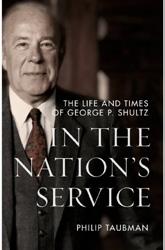
Taubman's book, In the Nation's Service: The Life and Times of George P. Shultz, explores how this distinguished public servant was pivotal in steering the great powers towards the end of the Cold War. Deftly solving critical but intractable national and global problems was the leitmotif of George Pratt Shultz's life. No one at the highest levels of the United States government did it better or with greater consequence in the last half of the 20th century, often against withering resistance. His quiet, effective leadership altered the arc of history. While political, social, and cultural dynamics have changed profoundly since Shultz served at the commanding heights of American power in the 1970s and 1980s, his legacy and the lessons of his career have even greater meaning now that the Shultz brand of conservatism has been almost erased in the modern Republican Party.
Philip Taubman is a lecturer at Stanford University's Center for International Security and Cooperation. Before joining CISAC, Mr. Taubman worked at The New York Times as a reporter and editor for nearly 30 years, specializing in national security issues, including intelligence and defense policies and operations.
A full bio may be found in the online program announcement.
AnD AiD?
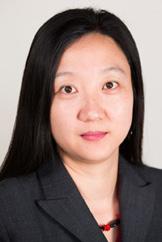
These are tumultuous times in world affairs, not least in the exercise of US trade, aid, and diplomacy. An important question is how and whether China will fill the various vacuums the United States Government is busily creating by cutting foreign aid, reducing embassies, surrendering influence at the UN, and many other steps. Join us to hear from Dr. Yun Sun, a Stimson Center and Brookings scholar whose work is steeped in examining just this highly current topic. She is the author of a recent commentary entitled "Can China fill the void in foreign aid?" She will explore this issue and the broader topic of "How Will China Exploit the Retreat of U.S. Diplomacy and Aid?"
A full bio may be found in the online program announcement.
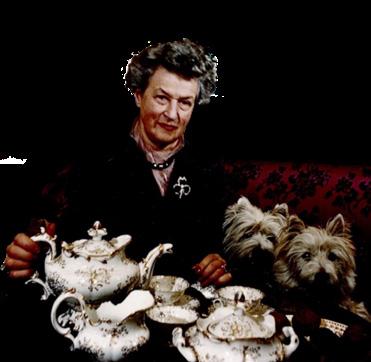
You and your guests are cordially invited for a Tea in the Afternoon to Celebrate the 135th Birthday of our Original Benefactor Virginia Murray Bacon Benefitting the House Preservation Fund
Enjoy Tea, Sandwiches, Scones, and Assorted Sweets, a Welcome Drink and Entertainments
Thursday, September 4th at two thirty pm
Subscription: $200 ($100 is a charitable contribution)
RSVP through our online calendar of events or to programs@dacorbacon.org by August 28th
DACOR Bacon House 1801 F Street, Northwest Washington, DC
Dress Code: Business Attire (hats or fascinators, & gloves encouraged )
2025 Annual Conference
IRAN IN THE MIDDLE EAST
September 12, 2025 • 8:30 am - 2:30 pm
$75/DACOR Member In-person; $85/Non-Member In-Person
Virtual Attendance $30/person (registration will be available to non-members starting 8/28)
Please register through our online calendar of events or contact us at programs@dacorbacon.org or 202.682.0500 x120.
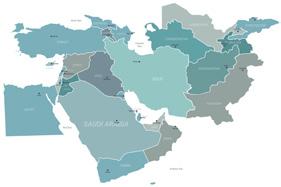
Featuring expert panels exploring current events, the situation facing Iran in the Middle East following the weakening of Iran's allies in the region, and the prospects for détente in our bilateral relations with Iran, with a Keynote by Dr. Vali Nasr.
Join DACOR for a wine tasting evening featuring SHABO Winery. Since 2003, SHABO Winery has been creating Great Wines that have gained wide international recognition, proving that Ukraine is a winemaking country which has a huge potential. The winery was founded by Vaja Iukuridze and his family and boasts more than 200 years of winemaking traditions.
Shabo is one of the oldest Ukrainian terroirs. Its history dates back more than 2,000 years. Located between the Dniester estuary and the Black Sea, offering perfect soils and climate, this region and its potential was highly appreciated by Swiss colonists as early as 1822. They founded a wine-making settlement, developing viticulture and winemaking in the region.
The tasting will be led by Sam Lerman, founder and CEO of SPYRT Worldwide, a distributor of Ukrainian goods in the U.S. He will lead a discussion about the history of Ukrainian wine and SHABO and a tasting of a curated selection of wines. Matched food pairings will be served with the wine.
More information may be found in the online program announcement.
Keep your eyes on your email: More programs are being scheduled for the summer/early fall now.
The Bicentennial Year was launched by Bicentennial Honorary Chair Ambassador Thomas Shannon and President Angela Dickey on August 6, 2024, with a celebration of “200 Years of French Connections,” featuring H. E. Laurent Bili, the French Ambassador to the U.S.
Upcoming Bicentennial Programs
October 5, 2025, 3 - 5 PM, Music Performance
"An Evening of 19th Century Song in the Carroll Home at 18th and F Street."
Featuring music performed by the Jubilee Singers from the volume of sheet music owned by Alida Carroll, 1866. Plus a rendition of the "Esterhazy Ripple," composed in honor of her sister Sally Carroll Countess Esterhazy.
October 30, 2025, 6 - 8:30 PM, Dinner and Talk
"The Civil War and Foggy Bottom."
How the Carroll Family and their neighbors in Foggy Bottom played out the terrible conflict. Panel discussion with local historian Frank Leone on Camp Frye, Jessica Barnes on the F Street House and its connection with Gen. Grant and his family, and Terry Walz, DACOR Historian, on the multiple contributions of the Carrolls to the war effort. Co-sponsored by the Civil War Roundtable of the District of Columbia.
December 7, 2025, 3 - 5 PM, Music Performance
Holiday Musicale
An exploration of the music of America over the 200 years of the DACOR Bacon House.
Bicentennial Program Co-chairs: Meredith Whiting and Terry Walz
Bicentennial Garden Party Chair: Dana Linnet
Please
Thank you for being a DACOR member!
WORLD AFFAIRS TRAVEL PROGRAM
Expert-led tours focused on international affairs
Travel with cultural diplomacy enthusiasts
Exclusive tour access for DACOR members
40+ annual tours
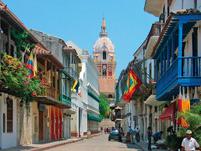
Jewels of Colombia Starting at $6,247 per person
Feb 17-26, 2026
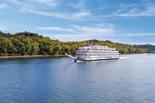
Southern Mississippi River Starting at $8,990 per person
March 3-11, 2026 Insider’s Japan
at $8,284 per person
11-23,
DACOR, Inc is partnering with World Affairs Council of Philadelphia to offer exclusive travel experiences with VIP access to DACOR Members and Friends of the Historic DACOR Bacon House. Traveling with World Affairs directly supports the DACOR Bacon House Foundation.
LEARN MORE
LEARN MORE
LEARN MORE
200 yEARs Of DACOR BACOn hOusE histORy
DACOR Bacon House is celebrating its bicentennial year in 2024-2025 with a series of programs that highlight important events in the house’s history and the contributions its occupants made to our nation’s capital and to our national history. We have divided the two-hundred-year period into significant eras. For our July/August 2025 issue, we cover the period from 1938 to 1945 when Virginia Bacon became a widow and the world was engulfed in war.
Terry Walz, DACOR Historian
Elizabeth Warner, DACOR Archivist
1938 - 1945
The War Years
1938
By 1938, Robert and Virginia Bacon were at the top of their game: Robert was running for his 8th term in Congress and Virginia had become a political activist in her own right, giving speeches to large audiences up and down the East Coast. The Bacons had now occupied 1801 F Street for 15 years, burnishing its reputation for hosting A-list celebrities, diplomats and power brokers. But on September 12, 1938, Robert Bacon died suddenly of a massive heart attack. Stricken with grief, Virginia turned down the chance to run for Congress in his stead, and the normally effervescent records she produced of her life went dark for a time before she turned her attention toward the looming threat of fascism and war in Europe.
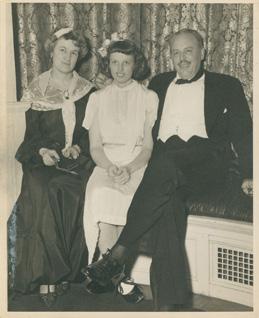
Robert and Virginia Bacon in the mid 1930s, seated on the second-floor landing of 1801 F Street with a young debutante, likely their second daughter Ivy or a niece.
1939-41
In the summer of 1939, weeks before Hitler invaded Poland, Virginia Bacon traveled along the Baltic coast and observed Nazi militias already taking power in what is now Gdansk ("No one could call his soul his own,” she reported), as well as extreme poverty in Leningrad (now St. Petersburg) (“long queues of half-clad, ill-shaped, starved-looking people”). Armed with first-hand knowledge (and some clandestine photographic and video evidence) of the devastating effects of totalitarianism and vengeful dictators, she excoriated the “America First” isolationists, saying, “we must stop Nazi aggression before it reaches our shores. The time for decision and debate has gone by.” In the fall of 1941, Virginia began coordinating women’s civil defense activities on Long Island, where she maintained a family estate. Her own readiness preparations included learning how to operate a radio and transmit Morse Code; her daughter Martha meanwhile obtained a commercial aviator’s license.
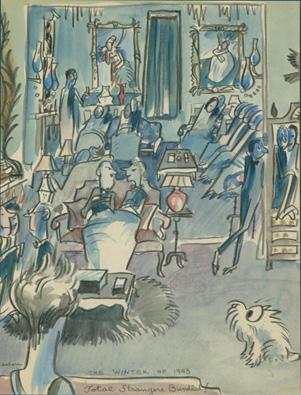
Above Left: Public service announcement from 1942 urging Americans to take measures to conserve fuel and plan for shortages. Above Right: Cartoonist Robert Osborn drew this image in 1943 of guests at 1801 F Street bundling up to stay warm while socializing at one of Virginia Bacon’s parties.
1942-43
The surprise attack by the Japanese on Pearl Harbor in December 1941 brought a reluctant United States into the war and galvanized the population. The massive production and spending required for the war effort brought an effective end to the Depression but also created shortages and necessitated rationing of everything from food to fuel. In 1942 Virginia Bacon began offering a free daily buffet lunch at 1801 F Street to War Department and other government employees. She also maintained a vigorous social schedule that continued to bring the best and the brightest to her home, somehow finding ways to provide entertainment if not always adequate heat to her soirees.
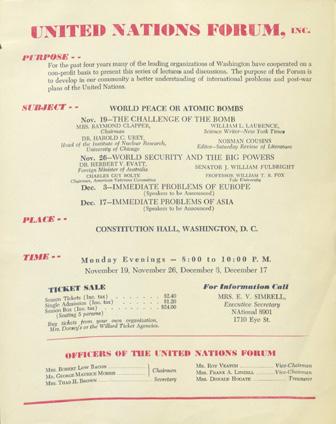
Right: Flyer for lecture series offered in late 1945 by the United Nations Forum, a civil society consortium led by Virginia Bacon to educate the public about the importance of world government.
1944-45
By the summer of 1944 the tide was turning in the war, and the United States and its allies became increasingly confident of victory. In September the gathering of allied leaders in Georgetown at Dumbarton Oaks, which had been donated to Harvard University by Virginia Bacon’s good friends Amb. Robert and Mildred Bliss, began to sketch out the institutional framework for what became the United Nations. At the same time, Virginia lent her fundraising and organizational skills to an independent civil society consortium that offered a paid lecture series designed to educate the public on the need for world government to maintain peace and security. Virginia ultimately became co-Chair of this organization, laying
To be continued in the September edition . .
the foundation for her own monthly World Affairs Forum series, which continued until her death in 1980.
Introducing the Young Professional Membership Subcategory
The DACOR Board of Governors adopted a resolution to start a new Young Professional membership subcategory for DACOR members at their March meeting:
RESOLVED, that beginning on June 1, 2025, a Young Professional subcategory of Regular Members is established, who will be assessed dues at the following discounted rates, based on their age as of January 1 for the applicable year (rounding up or down to a more convenient figure is permitted):
i. Under 30—20% of the full rate, $0 initiation fee
ii. 30 to 34—50% of the full rate, $0 initiation fee
iii. 35 and above—full rate
In 2025, these rates are:
Resident Non-resident
Under 30 $99 $35
30-34 $248 $86
35 and above $495 $171
IMPORTANT NOTE: In order to be billed at the Young Professional rate, one must provide DACOR membership staff one’s date of birth.
Since we are starting this new subcategory in the middle of our dues year, members eligible for the young professional rate who paid their 2025 membership dues at the regular rate will receive a credit for the difference that will be applied to future dues going forward. Members who qualify should contact Christine Skodon at clskodon@ dacorbacon.org and provide their date of birth if not already in the database.
In 2026, provided we have their date of birth, those eligible for the young professional rate will be billed accordingly, after taking into account any applicable credit.
All DACOR members are encouraged to help spread the word about our new young professional rates. Visit https:// www.dacorbacon.org/membership for more information about dues rates and benefits.
The officers and trustees of the DACOR Bacon House Foundation acknowledge with gratitude the following donations in honor of living individuals:
Hon. Robert Nicholas BURNS
Hon. Raymond C. Ewing & Penelope Yungblut
Adam Clayton POWELL III
Geoffrey Cowan
August 16th - September 1st
Fareed ABDULLAH and Bianca FLAMENGO
Throughout his 15-year Foreign Service career, Fareed Abdullah has had the privilege of serving in China, Libya, Iraq, and Senegal, using public diplomacy to build bridges across cultures. Whether managing high-profile programs, fostering partnerships, or navigating complex diplomatic landscapes, he thrives on connecting people and ideas. He obtained his Master’s degree at Columbia University, and returned to the Foreign Service to work in Dubai as Deputy Head of Public Affairs, where he continues to craft impactful initiatives that advance U.S. engagement in the region. He has previously served as Information Officer at the U.S. Embassy Dakar (2019-2022) and External Political Officer at the Libya External Office (2017-2019). He was introduced to DACOR by Dana Linnet.
William ARNOLD
William Arnold is a Diplomatic Technology Officer for the U.S. Foreign Service, and is currently enrolled in orientation class at Foreign Service Institute.
Henry BISHARAT
Henry Bisharat retired in 2014 after 28 years as a State Department Foreign Service political officer (1986 to 2014) and moved to Florida in 2018. In Washington, he served in the bureaus of Western Hemisphere Affairs (1988-90); Intelligence and Research (1993-94); European Affairs (200106); and International Organizations (2012-14). His overseas diplomatic assignments took him to nine countries on five continents: Guatemala (1986-88), Tunisia (1990-91), Saudi Arabia (1991-93), Peru (1994-97), Djibouti (1997-99), Guyana (1999-2001), Northern Ireland (2006-09), Iraq (2009-10), and Switzerland (2011-12). In Iraq, Henry served briefly as Acting Team Leader of the Provincial Reconstruction Team (PRT) for Baghdad Province as well as leading for three months an embedded PRT with the U.S. military in East Baghdad Province. During his career he also served briefly as Acting Consul General in Belfast, Northern Ireland, and Political/Economic Counselor at the U.S. Embassy in Bern, Switzerland. He was introduced to DACOR by Ambassador Lange Schermerhorn.
Stacey BOYCE and C. O. Lee BOYCE
As Senior Director for External Relations for Stanford's Human Centered Artificial Intelligence Institute, Stacey Boyce works with the Policy team on annual training for
congressional leaders from the U.S. House, Senate, and Agencies. In addition, HAI was asked to bring their training to Singapore to train ASEAN leaders in May 2025. HAI meets with heads of state and foreign affairs agencies to advocate for the ethical and safe use of AI, most recently at the Paris AI Summit. At the World Economic Forum in Davos, Switzerland, HAI delivered panels and sessions for c-suite executives, foreign affairs professionals, and more. Stacey was introduced to DACOR by Jared Hughes.
Geoffrey BRITTON and Tricia SUMARIJANTO
After studying in Beijing, Geoffrey Britton became a China analyst for DoD. Upon completing 6 years as an analyst in Japan, he went on to implement DoD policy in Indonesia (2012-2014) and Croatia (2015-2018) as the Deputy Defense Attaché. After returning to Washington, DC, he served as the Chief of Operations tasked with opening operational opportunities in the Pacific Island Countries. He has an MS in International Relations and is currently pursuing a PhD focused on developing bilateral approaches for U.S.Indonesian relations to improve security in SE Asia.
Nora BROWN
Nora Brown is a five-time Chief of Party at DAI managing USAID projects including Afghanistan Value Chains Program (2024-2025); USAID INVEST (2021-2024); Vietnam Urban Energy Security (2020-2021); Center for Development Innovation; and Grand Challenges for Development. She has worked at DAI, a USAID implementing partner for more than 11 years, and prior to that she was co-founder and COO of the Global Business School Network, a nonprofit that originated in the IFC focused on strengthening business education in emerging markets.
Stephen CLAY and Amelia CLAY
Stephen Clay is a retired senior officer with 33 years of leadership experience in the Central Intelligence Agency and the U.S. Department of State, with five overseas PCS tours in Africa, the Near East, and East Asia, respectively, as well as multiple domestic assignments in Washington, DC, and elsewhere. He led a variety of multi-disciplinary and multi-agency units focused on the most sensitive national security challenges, including finance intelligence issues; emerging technologies, such as the integration of AI/ML and FINTECH; counterterrorism/insurgencies; and key hard target collection priorities. Additionally, for two years, he
was the Director of a National-level training facility serving the entire Intelligence Community. Since retiring in 2022, he currently serves a Senior Consultant and Business Development leader focused on building positive, proactive relationships across Government and industry in the WMA.
Alice COMMAROTO-ROVERINI and Brian COMMAROTO-ROVERINI
Alice Commaroto-Roverini is an active Eligible Family Member (EFM), and her husband Brian is an active Foreign Service ECON Officer working full-time in the ECON section in El Salvador. She has been an EFM since 2010, previously serving at U.S. Embassies in Mauritania, Bolivia, Rome, and in Washington, DC. She is a certified Special Education, ESOL, and Italian teacher with over nine years of experience teaching diverse student populations across four continents. She is currently completing her second Master’s degree in Applied Behavior Analysis at George Mason University. At post, she collaborates with local orphanages, providing educational and behavioral support to children with special needs. She is also a dedicated mother of two, expecting a third, and passionate about inclusive, community-based service. Alice is the DACOR Bacon House Foundation 2025-2026 Sherry Barndollar Rock Scholarship recipient.
Ellen CONWAY and Peter CLOSE
Ellen Conway has served as Office Director, Children’s Issues, Overseas Citizens Services, Bureau of Consular Affairs, Department of State, 2005-2007; Consular Chief, U.S. Embassy Oslo, Norway, 2002-2005; and Consular Officer and Staff Aide to Ambassador, U.S. Embassy Manila, Philippines, 1988-1990. Other prior positions include AGSO, U.S. Embassy Warsaw, Poland, 1986-87, where she supported the visit of then-VP Bush in Fall 1987; working on U.S.-USSR arms control verification as PM/NRRC Watch Officer, 1990-1; EUR/EE Polish Desk Officer 1991-3, where she also covered various former Yugoslav republics following the breakup of Yugoslavia; Consular Chief as well as law enforcement liaison, U.S. Embassy Riga, Latvia, 1994-6. Consular Officer, CA/OCS/Children’s Issues,1996-98; multilateral work on forest issues, OES/ETC, 19982000; Deputy Director and A-100 Coordinator, FSI/SPAS Orientation Division, 2000-2002, during major increase in A-100 class sizes; VO/P and VO/F Office Directors, 2007-2011, where she beta tested the first online visa application.
Cynthia COOK and Bradley CARLSON
Cynthia Cook has been a Foreign Service Officer (Political Officer) since 2008, focusing on conflict areas in Eastern Europe and the Middle East. Her postings have included
EUR Deputy Director for Eastern Europe; Deputy PolEcon Chief in Pristina, Kosovo; Director for Israel and Palestinian Affairs at the NSC; Deputy Political Chief in Jerusalem; Azerbaijan Desk Officer in EUR; Watch Officer in the Operations Center; Deputy Spokesperson in Manila; Consular Officer in Baghdad; and Public Affairs Officer in Dhahran. She was introduced to DACOR by Dana Linnet.
L. Julian DEMCHUK
Beginning in professional radio broadcasting, Julian Demchuk followed the fall of the Berlin Wall into the world of the Former Soviet States. With program support from USIA, his family foundation developed ESL, democracy development and government officials programs since 1993 primarily in Ukraine. The foundation continues democracy enhancing programming as an FCC Full Power FM radio station broadcasting Ukraine news to date. He was invited in 2002 to join DOD Pentagon ATL ITS as an Ukraine area expert, which was constructed into US PolyTech in 2007 to focus on Ukraine military tech startups, military and security equipment as a US State Department Defense Trade company working in Ukraine, Czech, Italy, Poland and UK to date.
Paul FRITCH
Paul Fritch has served 34 years in the Foreign Service, including senior executive positions with international organizations. His focus is on Euro-Atlantic and Eurasian security, and he is the former Director of Russia and Ukraine Relations on the NATO International Staff, former Deputy Secretary General of the OSCE, and co-author of the 2022 National Defense Strategy and National Military Strategy.
Jennifer GALT
Ambassador Jennifer Zimdahl Galt retired from a distinguished 41-year career in the U.S. Foreign Service in April 2024. She served as Acting Deputy Director and an Assessor at the Foreign Service Board of Examiners (BEX) 2022-24, Senior Foreign Policy Advisor at Indo-Pacific Command from 2020-22, Principal Deputy Assistant Secretary (PDAS) for Educational and Cultural Affairs (ECA) 2017-19, Ambassador to Mongolia from 2015-17, and as Principal Officer of the U.S. Consulate General in Guangzhou, China from 2012-15. Her previous postings overseas include Belgrade, Taipei with the American Institute in Taiwan, Mumbai, Beijing, Shanghai, and the U.S. Mission to the North Atlantic Treaty Organization. Ambassador Galt holds Masters degrees from National Defense University and Johns Hopkins University School of Advanced International Studies (SAIS), as well as a bachelor’s degree in political science, history and
languages from Colorado College in her home state of Colorado. She was awarded an Honorary Doctorate of Juris Prudence from Colorado College in 2016.
Lisa HELLER and James HELLER
Lisa Heller served for 34 years as an FSO, including in Beijing (3 times), Shenyang, Guangzhou, Taipei, Seoul, Islamabad and Kyiv, and several positions in Washington, DC, until her retirement in November 2024.
Camilla HELLMAN
Camilla Hellman’s career has been in transatlantic relations, undertaking projects both in Britain and the United States to further collaboration between the two countries. Brought up in Britain, Camilla came to the USA in 1990 and started an import company representing leading luxury manufacturers and selling to major retailers. Moved by the events of 9/11, she conceived and led on the creation of the British Memorial Garden in Manhattan’s Financial District and headed its organization as President from 2002–2009. The Park was honored by a visit from HM Queen Elizabeth II in 2010 when it was renamed the Queen Elizabeth II September 11 Garden. In 2007, Camilla was honored by HM Queen Elizabeth II and awarded the MBE for services to British-American transatlantic relations. She joined the American-Scottish Foundation in 2009 as Development Director, becoming Executive Director in 2012 and President of ASF in 2017. She was introduced to DACOR by John Bellassai and Dana Linnet.
Lisa HEYES
Lisa Heyes has served as Senior Advisor, Radio Free Asia (1996-2006); Program officer, The Asia Foundation (1994-1996); Staff Consultant, U.S. House Foreign Affairs Committee (Asia and UN concentrations) (1986-1993); and in the World Bank’s Operations Policy Department, United Nations Unit as a consultant. More recently, she has held positions at the MITRE Corporation (Senior Principal, seven years) and the Defense Advanced Research Projects Agency (Special Assistant to DARPA Director for Strategy and Policy, five years). She was introduced to DACOR by David Benton.
Julianna KIM
Julianna Kim has been an FSO since 2003. She was introduced to DACOR by Allison Lee and Jared Hughes.
Michael MACINDOE
Michael MacIndoe is currently a Refugee Officer within Refugee and International Operations at the Department
of Homeland Security, where he works closely with partners at the Department of State and UNHCR for each assignment. His previous tours of duty include Uganda (Feb-April 2023); Rwanda (May-June 2023); Zambia/Malawi (August-October 2023); Thailand (February-March 2024); Zimbabwe/Kenya (May-June 2024); Peru (SeptemberOctober 2024); Guatemala (November-December 2024). He has also worked in Senegal in a remote location for the U.S. Peace Corps to promote economic development, with a focus on small business formalization.
Patricia MAHONEY
Patricia Mahoney was a Foreign Service Officer for nearly 35 years, serving in DC, Asia and Africa. Details include the National War College and two years at the National Security Council.
Andrea MAZZA
Andrea Mazza is a current staffer at the U.S. Department of State's Office of Negotiations and Agreements. Previously, he was an Intelligence Analyst at the U.S. Army's Special Operations Command. He was introduced to DACOR by Robert H. Gregory.
Matthew MCMANUS
Matthew McManus is a senior economics officer and Deputy Office Director in the State Department with wide ranging work in the E family on economics, trade, energy, and Latin America. He started his career as a Presidential Management Fellow negotiating NAFTA, has travelled extensively to the WHA region, and worked closely with USOAS, USOECD and on G7 and G20 Summits. His previous positions include Division Chief, Energy Producer Country Affairs, Bureau of Economic, Business and Energy, Department of State (1995-2011); and Foreign Affairs Officer, Bureau of Economic and Business Affairs (19901995).
Ken MOSKOWITZ and Yoko MOSKOWITZ
Ken Moskowitz completed a 30-year career as a FSO as an inspector in the Office of the Inspector General. His overseas postings, where he specialized in press and cultural work, included the U.S. embassies in Sofia, Budapest, Kyiv, and Tokyo, where he was the American Center Director. He was introduced to DACOR by Donald Kursch.
Mary NANDI and Rahul NANDI
Mary Nandi is a Commercial Officer with the U.S. and Foreign Commercial Service. She is currently serving in Singapore as Minister Counselor for Commercial Affairs, and has previously served in DC, New Delhi, El Salvador, Silicon Valley, Chennai, Kolkata and Mexico City.
Katherine OBRADOVICH
Katherine Obradovich is a 22-year veteran of the U.S. Army reserve with three deployments abroad, including to organizations under joint command. After retirement, she continued civilian service supporting U.S. Army Cyber Command & positions above in Europe that required coordination and consideration of U.S. foreign policy and U.S. diplomatic relations with allies and partners. She currently serves as Civilian Harm Mitigation & Response Program Officer at U.S. Army Europe & Africa, Wiesbaden Germany, where she coordinates with NATO partners for protection of civilians during wartime. Previously, she was Deputy Chief of Strategic Engagement & Outreach. U.S. Africa Command (2017-2018), where she was primary contact for military liaisons from 20+ nations to the command; and Strategic Planner at US Army Installation Command - Europe (2000-2024), where she was responsible for planning and implementing a new garrison in Poland, including representing U.S. equities in concert with U.S. European Command during negotiations with Poland on Poland Provided Logistical Support (a component of the Enhanced Defense Cooperation Agreement between POL & USA).
Robert RILEY and Fatima YNOT
Robert Riley has served as U.S. Ambassador to the Federated States of Micronesia; Minister Counselor for Management, Embassy Jakarta, Indonesia; and Management Counselor, Embassies Manila, Hanoi, and Islamabad. He spent 40 years working in foreign affairs agencies, all but four of them overseas. He spent 12 years in the Peace Corps as a Volunteer (3.5 yrs) and staff (8.5 yrs), and worked as a Foreign Service Officer for 27 years, including 3 as a Financial Management Officer, 10 as a Management Counselor, and four as an Ambassador. After retiring in 2020, he worked as the Chief Operating Officer for the East-West Center in Honolulu. He is currently Executive Director for the Maryland Vietnamese Mutual Association.
Michael RUHSENBERGER and Tonya RUHSENBERGER
Michael Ruhsenberger’s diplomatic career started as the naval attaché to Ukraine leading up to the Russian invasion of Crimea in 2014, where he was a key advisor to the
Ukrainian Navy in its integration with NATO naval forces. He also served in Moldova as the human rights advisor, providing the ambassador guidance on the Human Rights Report and Religious Freedom report; in Colombia as the head of the Visa Fraud Prevention Unit; and in Mexico specializing in economic development in Southern Mexico.
Irene SANDVOLD HYDLE
Irene Sandvold Hydle has worked in hospitals, public health departments (Alameda County and San Francisco County), and for USAID both as a public health nurse advisor and short term consultant. She worked for USAID in long term training in South Vietnam (1968-1970) and while on assignments with her husband, Lars Holman Hydle, an FSO, in Ghana (1980-1982) and Trinidad and Tobago (1982-1985), and was a faculty member in the Maternal Child Health Department at the School of Public Health, Johns Hopkins University (1970-1973).
Cameron SINCLAIR and Bethany HALBREICH
Cameron Sinclair served on ACVFA for three years from 20132016 under Rajiv Shah. Over the years, he has served as a consultant and advisor to various UN agencies, in relation to historic preservation, post-disaster reconstruction and refugee shelter solutions. For 25 years, he has worked at the intersection of architecture, preservation, and international development. His career has been defined by collaborating with diverse stakeholders including government agencies, design and arts organizations, and humanitarian response groups to address the needs of communities, particularly in post-conflict and post-disaster regions. Teams he has been a part of have raised and implemented over $80 million in community-based programs, building purpose-driven communities at local, national, and international levels. Internationally he has done tours of service in Afghanistan, Cambodia, Ethiopia, Haiti, India, Japan, Namibia and South Africa. Beyond his professional work, he has served on boards and advisory roles for a range of innovative startups, nonprofits, and civic institutions, including the Applied Hope Foundation, Art of Hope, Paint the World, the Royal Society of the Arts, and the World Economic Forum as a Young Global Leader. He was introduced to DACOR by Jared Hughes.
Kenneth THOMAS
Kenneth Thomas served as a Foreign Service Officer from 1991-2015 and in the Office of the Legal Advisor to the Secretary of State from 2015-2025. He served as a Political or Economic Officer in South Africa, Russia, Jerusalem, and Washington, DC, and was also Chief of the Counternarcotics
Operations (INL) in Afghanistan from 2003-2004 for 14 months. He was then with the Iraq Reconstruction Group in Basrah, Iraq, from 2004-2005 and the PRT Lead in Basrah, Iraq, from 2010-2011.
Bruce TURNER and Veronique TURNER
Bruce Turner is a career member of the Senior Foreign Service and has served as Ambassador/Permanent Representative to the Conference on Disarmament, Geneva 2022-2025; Deputy Assistant Secretary, Bureau of Arms Control, Verification and Compliance 2015-2021, Department of State; Consul General St. Petersburg, 20112014; INL Director Kabul; and EUR/RPM Director. He joined the Department of State in 1985. He was introduced to DACOR by Greg Delawie.
Andrew WALSH and Monica WALSH
Andrew V. Walsh is the Deputy Chancellor and State Department Chair at the National Defense University (NDU) College of Information and Cyberspace (CIC). He serves as an advisor to the Chancellor, Provost, and National Defense University President on programs related to cyberspace and information. He is a career member of the Senior Foreign Service with the rank of Counselor. Before his assignment at NDU-CIC, he served as the Tri-Mission Counselor for Diplomatic Technology for the U.S. Missions to Belgium, the European Union, and U.S. NATO; in Washington, DC, as Global IT Modernization Division Chief responsible for global lifecycle of all technology within State; and overseas assignments in Munich, Beijing, Managua, London, and Nairobi. In addition to his work at State, he has commanded Cyber Protection Teams across the U.S. and the Command & General Staff College in Europe. He is currently assigned as an Army Reserve Colonel in the National Mission Command Center at the Pentagon. Mr. Walsh earned a Bachelor’s degree in political science and philosophy from St. Ambrose University and a Master’s in public administration from Southern Illinois University. He is an Army War College and U.S. Army Command & General Staff resident
program graduate. His wife Monica also served within the Department of Defense and the Department of State. He was introduced to DACOR by Ambassador Andrew Young.
Gratian YATSEVITCH III and Monica MORRILL
Growing up as a part of a U.S. Diplomatic family, Gratian Yatsevitch has lived in Bulgaria, Turkey, Iran, and the UK. After receiving a BA in History at Dartmouth College, and a stint in the U.S. Army infantry, he moved to Paris and traveled in Western Europe and India for business. He remained in the US Army Reserve, and has worked in the investment banking industry since the 1980s. He is married with two children, and immensely enjoys interacting with people of different cultures and languages. He speaks French fluently. He was introduced to DACOR by his late father, Colonel Gratian M. Yatsevitch.
Wenchi YU
Wenchi Yu is a Fellow at Harvard Kennedy School and a global affairs advisor and business operator specializing in cross-border and market access strategies between Asia and the United States. Her business experience includes high-growth global technology companies where she advises on public policy, social impact, and public relations, as well as Goldman Sachs where she headed strategic philanthropy and stakeholder engagement in Asia. Before joining the private sector, she worked in the US Department of State and US Congress. She started her career in the nonprofit sector. Her writing has appeared in the Wall Street Journal, Council on Foreign Relations blogs, Caixin, and Forbes. She is a Nonresident Research Fellow at Harvard Kennedy School’s Ash Center for Democratic Governance and Innovation, a life member of the Council on Foreign Relations and an Asia 21 Advisory Board member of Asia Society. She has an M.A. in international relations from the University of Chicago and a B.A. in political science from National Taiwan University.
Logging into DACOR's Website QUICK GUIDE
• Go to www.dacorbacon.org, click Members Portal and then select the menu option you want.
• When the login page appears, enter your username and password if you have them and continue to the last bullet point below. If not, or if you need to reset them, go to the Reset Your Password section and enter your email we have on file. Click the Reset my Password button.
• Look for the reset email in your inbox. Don't see it? Check your spam folder.
• Take note of your username in the email (you can change it if you want to) and click on the reset link.
• Follow the prompts to reset your password.
• Enjoy all DACOR's website has to offer! Need additional help? Contact Megan at adminassist@dacorbacon.org or 202.682.0500 x111.
Introducing Our Summer Interns
Development
Hailey Craver is a rising senior at Miami University in Oxford, Ohio, double majoring in Political Science and Journalism. Originally from Toledo, Ohio, Hailey lives with her mother, her two younger brothers and sisters, and their dog, Mick Jagger.
On campus, Hailey is an active member of Delta Zeta sorority, where she serves as the assistant social chair, planning events that foster community and connection among her sisters. She is also involved in the Women in Law club, where she regularly attends speaker sessions featuring women working in politics, law, and public policy—experiences that continue to inspire her academic and career goals. This coming semester she is slated as the Food and Restaurant Critic for Miami’s college newspaper, The Miami Student, reviewing the 80 different restaurants in Oxford encompassing a diverse array of dining options beyond fast food including American diners, international cuisines, cafés, and fine dining venues. She also has volunteered with Labre, a food service group that delivers homemade food to people in need in downtown Toledo.
In the classroom, Hailey is especially passionate about policy writing. Her favorite academic projects involve drafting policy briefs, and she recently completed one examining the effects of gun violence in America, offering practical policy alternatives for improving public safety.
Outside of academics, Hailey enjoys a wide range of hobbies including creative writing, cooking, spending time with friends and family, playing tennis, traveling & exploring new cities, and going to concerts.
After graduating, Hailey plans to pursue a master’s degree in Public Administration or Political Science, with the longterm career goal of public service or government communications.
museum
Ella Conner is from Kansas City, Missouri, and is a senior pursuing a Bachelor of Arts degree from Northern Arizona University (NAU). Ella is majoring in Comparative Cultural Studies with minors in Art History, Italian, and Museum Studies. She just returned from a semester abroad in Florence, Italy, where she studied art history and Italian language while exploring several museums and cultural sites all around Europe. In Italy, Ella did a work study with The Friends of the Uffizi to prepare presentations and tours for donor outreach initiatives. She is currently the president and founder of the Museum Studies Club at NAU and is an aspiring art museum curator. Her interest also extends into the realm of cultural property law as well as repatriation and restitution ethics. After graduation, she hopes to pursue a master's degree in art history and then later attend law school.
Ethan Espenship is from Jupiter, Florida, and is currently a senior from the University of Central Florida. He majors in political science on the international relations track. He spent a summer abroad in 2023 participating in an archaeological dig in Jordan at Abila of the Decapolis with John Brown University. His group was tasked with excavating and collecting
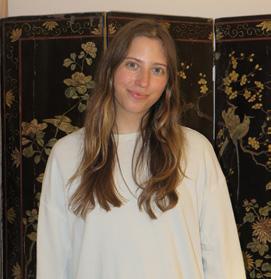
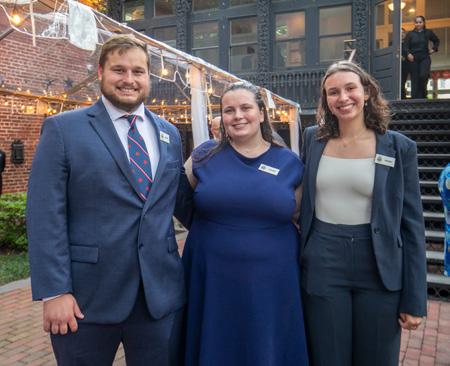
From left to right: Ethan Espenship, Lucie Miller, and Ella Conner.
artifacts in a Byzantine church. He later spent a semester in 2024 studying at the American University in Cairo completing classes that covered international law, politics and security. For the past 6 months he has worked with his father in payment processing for Merchant Pro Services LLC. He spent time in the office renovating the company’s client file system. When out of the office, he would assist clients in troubleshooting credit card terminals. He wants to work as a diplomat for the United States in the Middle East and is also interested in working for the Smithsonian Institute.
Lucie Miller is a senior at East Stroudsburg University majoring in History. She has dedicated her undergraduate studies to public history, archival work, and historical preservation, with a focus on uncovering underrepresented voices in the historical record. At ESU, she works in the university archives and museum, experiences that have strengthened her research, interpretation, and curatorial skills. Lucie also hosts a campus radio show, History’s Hidden Voices, where she highlights overlooked figures and events from the past. She is also a member of Phi Alpha Theta National History Honors Society. While interning in Washington, D.C., she hopes to deepen her understanding of museum education, nonprofit operations, and the broader role of public history in civic engagement. She looks forward to contributing to DACOR’s mission while learning from the accomplished professionals and the legacy of the DACOR Bacon House Foundation.
The President’s Cup for Exceptional Service 2025
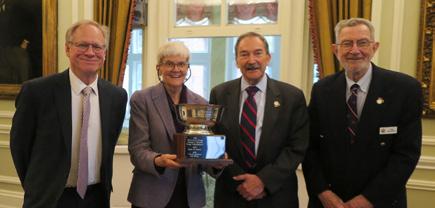
The President’s Cup is given at the discretion of the DACOR President in recognition of a member who has made exceptional contributions to the organization and the DACOR Bacon House Foundation. It is given when the President wishes to bestow this recognition. President Angela Dickey elected to give four members an award this year at the May meeting of the Board of Governors. Their citations are below. Please join us in a well-deserved round of applause for the 2025 President’s Cup recipients.
DACOR Awards J. Thomas Brannan the President’s Cup for Exceptional Service 2025
To J. Thomas Brannan, for devotion to DACOR and DACOR Bacon House Foundation as an active volunteer and participant in governance and committee work, to include founding and serving as the first chair of the Public Outreach Committee and establishing DACOR’s first mentoring relationships with two area universities, and for never turning down a request for assistance from any DACOR colleague; and for unfailingly good advice to the president, 2023-2035.
DACOR Awards Paul Denig the President’s Cup for Exceptional Service 2025
To Paul Denig, for devotion to DACOR and DACOR Bacon House Foundation as demonstrated over many years of service as Assistant Secretary, Secretary, Vice President, and President; as a beloved leader and indefatigable participant in governance, member lunches, and committee work, most notably as a co-chair of the Development Committee; and as an invaluable source of counsel and support to the president, 2023-2025.
DACOR Awards Richard Morford the President’s Cup for Exceptional Service 2025
To Richard Morford, for devotion to DACOR and DACOR Bacon House Foundation as demonstrated through many years of voluntary service on numerous committees, culminating in five years as Treasurer, during which time his incomparable mastery of data and finances guide our organizations through the pandemic and post-pandemic financial difficulties and led to his fame as our resident “computer brain,” and for invaluable support as a key adviser to the president, 2023-2025.
DACOR Awards Terry Walz the President’s Cup for Exceptional Service 2025
To Terry Walz, for bringing to bear, to the enormous benefit of DACOR and the Foundation, bona fides honed over many years as an academic historian; for excavating, ferreting out, and telling new stories about DACOR Bacon House and thereby bringing to life the many personalities, famous and unsung, who inhabited that 200-year old residence; for providing key research, writing and editing to the Historic Structure Report, which will guide our maintenance and preservation of the House for many years; and for bringing honor and repute to DACOR Bacon House for his research and discoveries, which have been presented at the DC History Conference and published by the White House Historical Association and the Supreme Court Historical Society.
From left to right: Richard Morford, Angela Dickey, Paul Denig, Tom Brannan. Recipient Terry Walz was not present at the Board meeting.
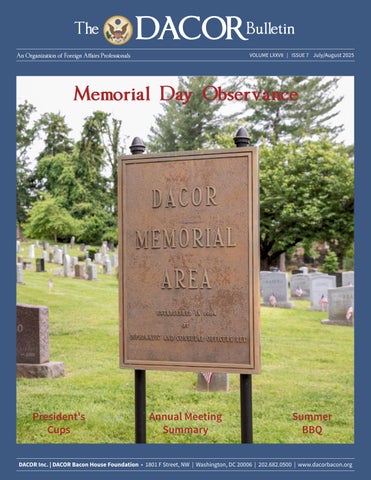
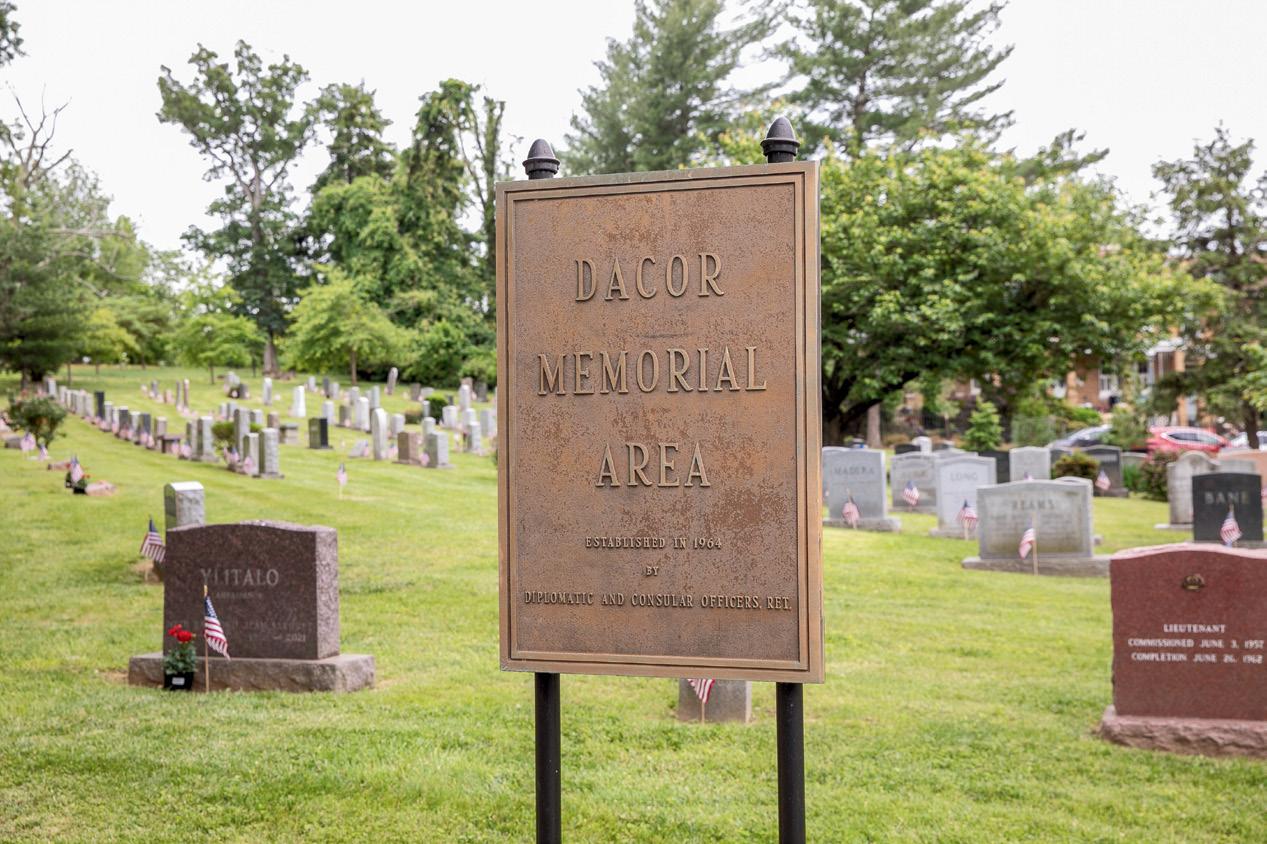
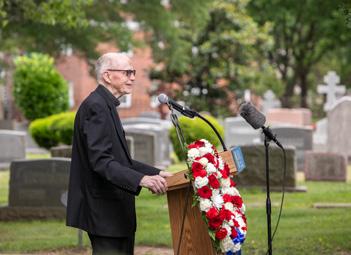
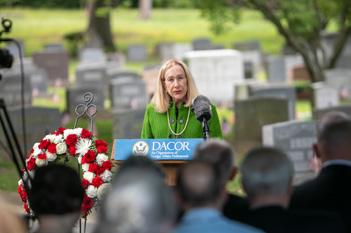
DACOR Memorial Day Observance Rock Creek Cemetery, Washington, DC May 26, 2025
Invocation
Rev. John Hurley
Loving Lord, we come together this Memorial Day morning to Rock Creek Cemetery, to remember and honor members and colleagues of the Foreign Service family, who represented the values and heritage of our nation, and now here and elsewhere share in the promise of eternal glory.
In his reflections on the Psalms, St. Augustine urges that “our thoughts in this present life should turn on the praise of God, because it is in praising God that we shall rejoice for ever in the life to come”.
There are two periods of time, Augustine points out, “the one that now is, beset with the trials and troubles of this life, and the other yet to come, a life of everlasting serenity and joy.” While “the season before Easter signifies the troubles in which we live here and now, the time after Easter which we are celebrating at present signifies the happiness that will be ours in the future.”
Augustine notes, “we praise God during our earthly life . . . at the same time we make our petitions to Him. Our praise is expressed with joy, our petitions with yearning.”
So it is that we praise you God now, assembled as we are in this DACOR resting place, we present our petitions, yearning
- That our loved ones now are at peace and experiencing eternal joy;
- That those here mourning may be graced by awareness of your love;
- That those suffering the ravages of violence of any kind throughout the world may be comforted by your presence in their lives as one who also suffered;
- That our diplomats and peacemakers may find encouragement and progress in their efforts, in all the continents of our world;
- That governmental and religious leaders may recognize the dignity of all of your creation;
- And finally that we, your children, may never forget our loved ones here, may never forget your love for us, and never forget to “know you more clearly, love you more dearly, and follow you more nearly, day by day.” Amen!
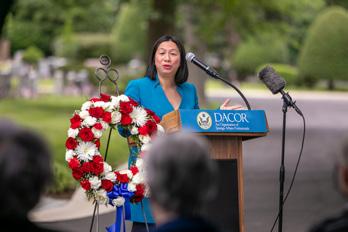
Remarks by Tina Wong, State Vice President, AFSA
Thank you, Angela, and it is great to also welcome former Director General of the State Department Marcia Bernicat with us today. Good morning, it’s my great honor to represent the American Foreign Service Association and our 17 thousand active duty Foreign Service employees as we gather today to remember all the talented and heroic members of our Foreign Service who preceded us.
Standing here in historic Rock Creek Cemetery, I am thankful for our community of Foreign Service generalists, specialist, and local staff who run our embassies and consulates abroad and all the ways our colleagues make sacrifices serving the United States to make it safer, more secure, and more prosperous every day.
In particular, I want to take a special moment to remember Ambassadors Ruth Davis and Lino Gutierrez, who were
trailblazers in their own right, and also a mentor and friend to many of us, as well as advocates for reforms that have tangibly improved our institution’s personnel system, both from within and on the outside.
These and many other more individuals on Memorial Day remind us of the collective strength of our community – one that cares for one another’s professional development, mental and physical health, and provides opportunities to lift each other up.
As you all know, I speak to hundreds of foreign service employees on a daily basis, and the honest truth is that our community is being tested at every corner, as we face organizational restructuring, changes to our personnel system, and potential reductions in force.
Amidst a lot of uncertainty and confusion, I remain in awe of our active duty’s strong commitment, alongside our foreign affairs professional associations, to take care of the long term health and voice of our foreign service institutions.
So our gathering during this solemn Memorial Day ceremony is both a tradition and an opportunity to gather family, friends, and employees to again learn the collective wisdom, contributions and sacrifices of all those who worked in the Foreign Service. We know this strength of community can and will prevail, and we will continue to shape the future of our institution.
Thank you.
Remarks
by Susan Johnson, President, ADST
Dear Friends and Colleagues,
We gather on this Memorial Day to remember, honor and pay tribute to generations of our compatriots who have given their lives in service to our country. It’s good to remember what they defended – not just physical territory, but the ideas and values reflected in the founding documents of our nation – the Declaration of Independence and the Constitution. Many in the United States Foreign Service, including those laid to rest here in this special and historic Rock Creek Cemetery, established in 1719 in the then British colonial province of Maryland, defended those values and ideas with a lifetime of service to nation and, for several hundreds, with their lives as well.
Both my parents – a Foreign Service couple who - after serving in the Army and Navy respectively in WW2 – wanted to continue in service to the nation and joined the United States Foreign Service. They are buried here in the DACOR Foreign Service Section. Both loved public service, the work and the life of diplomacy – and the institution of the FS itself – a nonpartisan, professional career cadre dedicated to service to country and to the cause of diplomacy in service to the American people. I look back on both as patriots who served quietly, without fanfare and with resolute dedication to country and Constitution.
This year, 2025, marks 250 years of American diplomacy and foreign relations beginning in 1775 with the establishment of the Committee of Secret Correspondence, the forerunner of the Department of State. Today, the Foreign Service, along with our Civil Service colleagues face existential challenges. The basic principles which underlie the 1883 Pendleton Civil Service Act and the 1924 Foreign Service Act are being called into question. We, the American people, are also at a crossroad, perhaps one of the most challenging one we have faced in our lifetimes. Will the Constitution that Foreign Service Officers (FSOs) take an oath to respect and defend – and the rule of law it embodies - survive these times? Few are more aware of the importance of the Constitution and rule of law to America’s prosperity, growth and progress over 2.5 centuries than foreign affairs practitioners.
Challenging moments present opportunities more clearly than quieter times. The USFS today faces an opportunity to rededicate itself to the oath of office its members take to uphold the Constitution upon which our Republic depends. It can reflect anew on its purpose, mission, values and ethos and dedicate itself to preserving and strengthening its identity as a professional nonpartisan career service that is the backbone of America’s institutional diplomatic and development capacity.
We – the Foreign Service - can strengthen our collective ability to do this through deepening our understanding of solidarity and mutual respect, by embracing moral courage, self-confidence and patriotism based on deep affection for country and all of its people, recognition of our shared identity and bonds of union, and lived respect - not only for our flag and national symbols – but for the institutions of the country and above all, for our Constitution.
DACOR and ADST offer an example of partnership in the best tradition of Foreign Service solidarity and mutual support. This partnership, formally established in 1995, crystallized around co-sponsorship of the DACOR-ADST book program which has encouraged and helped bring about over 100 books about diplomacy, development and foreign affairs by practitioners. Our sustained collaboration has made this possible and our mutual support has strengthened both organizations.
Ten sister foreign affairs organizations are represented on ADST’s board of directors as ex officio members. This is a practical way to reflect our view that it is important that they all be represented in, and supportive of, ADST’s flagship foreign affairs oral history program and collection – a rich primary source treasure trove that documents the service, sacrifice, experience and contributions of generations of foreign affairs practitioners and makes them publicly available.
May our reflections this Memorial Day 2025 inspire us to honor the lives and the legacy of those who served and sacrificed so much over the last hundred years by renewed solidarity and courage in upholding the Constitution and founding values that those we remember and honor today died to protect and defend.
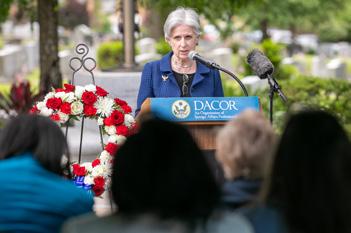
Remarks by
Dr. Lucy Melbourne, DACOR Member
President emerita and acting executive director Dickey, DACOR and DACOR Bacon House Trustees and Governors, Committee Chairs and Volunteers, Fellow DACORians, House Staff, Honored Guests--
Good morning! I am deeply touched to be here today at thenPresident Angela Dickey’s kind invitation as we honor Foreign Service Officers and their families at the annual Memorial Day service in the DACOR section of Rock Creek Cemetery. On this day, as has been traditional since the Civil War, people commemorate the deceased who gave military service. Our gathering here today, however, is unique: it acknowledges the arduous work of deceased patriots who defended democracy through global encounters to engage in diplomacy--to engage in dialogue seeking the common humanity that sustains peace. It is thus appropriate that since 1964 this DACOR section of Rock Creek Cemetery has served as the official counterpart to Arlington National Cemetery. And, since 1984, DACOR has held its annual ecumenical Memorial Day service here.
The dedication of Foreign Service Officers and their families both at home and overseas is just as noteworthy as those of their uniformed colleagues. Foreign Service Officers serve under often fraught conditions, from exposure to disease, endure an erratic family life, or interrupted educations--and face threats of violence. Two of the eight American ambassadors murdered in the line of duty are buried here. John Gordon Mein killed in Guatemala in 1968 and Frances Meloy killed in Beirut in 1977.
So, I am honored to be here today among these great Americans in the DACOR section of Rock Creek Cemetery where my father, mother, and sister are also interred. And, perhaps, like me, you are personally reflecting on your loved ones, their families and friends, and on those whose lives they touched. And, perhaps you are thankful, as I am, for the vision that lead to the founding of this Foreign Service section of Rock Creek Cemetery.
My father, Roy M. Melbourne, joined the Foreign Service in its infancy, when people still confused it with a popular film image of the Foreign Legion. In 1937, during the depths of the Depression, after a three-year hiatus to the Foreign Service entrance exam--because the Department was strapped for funds and had no jobs to offer--my father finally swore his Officer’s oath to protect and defend the Constitution of the United States of America and that very evening boarded the overnight train to his first assignment as vice consul in Montréal, Canada. He was all of 24. Over a 35-year Foreign Service career he was interned in Japan in 1941, came under fire when chargé in Baghdad, helped people flee communist Romania, and suffered the loss of a beloved daughter. Despite his admiration for individual initiative, he strongly affirmed that the greatest strength of the Foreign Service was the group ésprit de corps of its fine men and women. In his book on the Foreign Service, Conflict and Crises, he singled out the Officer he most admired: “Loy was the finest Foreign Service Officer I ever knew.”
Loy Henderson remains a Foreign Service legend: career Ambassador, former Under Secretary, DACOR member, and catalyst for establishing the DACOR section of Rock Creek Cemetery under the Graves Commission. He mentored my dad throughout his career, urging restraint and a consistent ethical imperative; and their friendship cemented when Loy, the American Ambassador to Iran, served as Dad’s boss in 1950s Tehran. When Ambassador Henderson died at age 93 he was known as “Mr. Foreign Service” and he, like the so-called “Father of the Foreign Service,” Wilbur J. Carr, is buried here.
It was Loy Henderson who spearheaded the establishment of this Foreign Service section of Rock Creek Cemetery in the 1960s, and I vividly recall my parents ardently discussing Loy’s vision and the efforts they both made in urging colleagues to support this long overdue project. A few years later, I accompanied my dad on a visit to the cemetery and was startled at his ebullience: as he passed memorials of colleagues and mentors, he pronounced each name, offering colorful thumbnail sketches of their exploits. Then I understood: Dad was happy because he was at home here among his Foreign Service family and felt vindicated that their names continued a vibrant legacy of diplomatic service. And now, for those of us who have no “home town” except Washington, the DACOR section of Rock Creek Cemetery offers a continuing relationship across generations and, indeed, across the broader world that these men and women inhabited in their quest for peace.
At my father’s retirement ceremony from the Foreign Service, Ambassador Henderson warmly thanked Dad for his dedication--and then turned to specifically address my mother and then each of us children individually in expressing his gratitude for our life of service. As a mere “Foreign Service brat,” I was startled to be singled out and felt a surge of affection for this wise and kindly man who had so graciously framed my family’s life with honor. And in so doing those words of “Mr. Foreign Service” still resonate to include all of us in the Foreign Service community today.
I thank DACOR for establishing this solemn ceremony where we can commemorate those dear to us. And, while I await my time to join my parents and sister here among our Foreign Service family, this beautiful DACOR section of Rock Creek Cemetery remains an ongoing source of hope, of deep joy --and peace.
Benediction
Rev. John Hurley
May our loving God bless you, as you go forth to visit the graves of loved ones and deceased colleagues, here buried or entombed, with the prayer that they do indeed now share in eternal joy and peace.
And, let us likewise ask the Lord’s blessings for ourselves in the meaningful words of John Henry Newman:
“May He support us all the day long, till the shades lengthen, and the evening comes, and the busy world is hushed, and the fever of life is over, and our work is done!
Then in His mercy may He give us a safe lodging, and a holy rest, and peace at last.” Amen.
A recording of the 2025 Memorial Day Observance is available at https://www.dacorbacon.org/dacor_memorial_section_of_rock
If you were at the event on May 26th and would like access to photographs taken by Jenifer Morris (including those printed here), please email clskodon@dacorbacon.org.
Thank you and Good Luck: DACOR Says Goodbye to Seou
DACOR leaders, members, staff and all those who have stayed at the DACOR Bacon House guest rooms wish Seou Park good luck on the next adventure in her professional career. Seou's last month at DACOR was May.
Seou started working at DACOR as the Administrative Assistant in March of 2024. Her duties inlcuded assisting our members, Executive Committee and Boards, guests in the overnight guest rooms, reciprocal club visitors, fellow staff and others. Situated at the front desk, she welcomed all who came to the DACOR offices warmly. Seou helped us all in various capacities and contributed greatly to our community and organization. She will certainly be missed.
We thank Seou for her hard work and wish her a fond farewell!
EDuCAtiOn
DACOR Bacon House Foundation
Scholarships & Fellowships 2025-2026
▶ Foreign Service Dependent Scholarships
These awards are funded by bequests from Heyward Gibbes Hill and Virginia Thurgood Bingham for undergraduate students. The Foundation’s contribution for this program, for children of Foreign Service members administered by the American Foreign Service Association totals $40,000.
TBA
▶ Metro Undergraduate Scholarships
The Foundation awarded six $6,000 undergraduate scholarships through the Heyward Gibbes Hill Memorial Fellowship Metro Scholarship program and individual donations to students pursuing degrees in foreign affairs. Special consideration is given to minority applicants. Each university chooses its recipient. Congratulations to these high-achievers.
ViViAnA BArAhonA
KeyeTTe GillAm-WilliAmson
Griffin henry
luis hernAndez
AlexAndrA KosTAKis
Trinity University
NCCIIE
George Mason University
University of the District of Columbia
University of Maryland
TBA Howard University
▶ Louis G. Dreyfus Awards
Scholarships have been awarded to children or grandchildren of Foreign Service Professionals, active or retired, through the generous bequest of Ambassador Louis G. Dreyfus, Jr. Students attending The Hotchkiss School or Yale University are eligible. DACOR heartily congratulates the following recipients:
nicholAs smiTh
▶ Gantenbein Medical Fund Fellowship
The Hotchkiss School
The Gantenbein Medical Fund was established through the bequest of Mary F. Gantenbein in memory of her husband, FSO James W. Gantenbein, as she believed the world was in need of more doctors. This fellowship is a total of $30,000 per year; $25,000 for tuition and $5,000 for living expenses.
dAnielle seroTA
▶ Sherry Barndollar Rock Scholarship
Washington University School of Medicine in St. Louis
The Sherry Barndollar Rock Scholarship, established in the honor of our former Executive Director, meets the educational needs of Foreign Service spouses and partners. The Scholarship grants up to $4,000 annually to the spouses and partners of Foreign Service employees assigned abroad to pursue educational goals which may have been disrupted by the spouse’s Foreign Service career.
Alice commAroTo-roVerini
George Mason University
▶ Graduate Fellowships
The Education Committee is pleased to announce that 10 $10,000 Foundation Fellowships were awarded to graduate students studying foreign affairs. Committee members selected recipients based on a combination of interviews, academic performance and personal accomplishments. This year, those attending local schools were interviewed inperson while those attending schools outside of the DMV were interviewed virtually. These fellowships are funded by bequests from Margaret Niles Butler, Marjorie Webster & Philip W. Ireland, Vadim W. Sounitza, Dr. Ben H. & Clare Roy Thibodeaux, and Katherine & S. Pinkney Tuck.
Margaret Niles Butler Memorial Fellowship
AdAm Koussih University of Virginia
Marjorie Webster & Philip W. Ireland Memorial Fellowship
mArcus KhAnnA University of Florida
Harold & Elsa Rhodes & Elizabeth Johnston (Sekeres) Memorial Fellowship
ryAn lindner Univeristy of Pittsburgh
Dr. Ben H. & Clare Roy Thibodeaux Memorial Fellowships
solomon BenneTT
deBorAh dA sol JeonG
emmA KnuTTy
AlexAndre nAzAire
Jocelyn nieTo
Georgetown University
Fletcher School/Tufts University
The George Washington University
SAIS/Johns Hopkins University
American University
Katherine & S. Pinkney Tuck Memorial Fellowships
mArGAreT enGel
Syracuse University
zohneseh fopenAWoh University of Maryland
SUPPORT AFSA!
AnnuAL mEmBERs’ mEEting, APRiL 24, 2025 Meeting Summary
The Annual Meeting of the DACOR membership took place at DACOR Bacon House on April 24, 2025, pursuant to Article VII of the DACOR Bylaws. The meeting was held in person at the DACOR Bacon House, 1801 F Street NW, Washington, DC 20006, and was available on-line via Go-to-Meeting for those who wanted to attend virtually. At least 78 participants attended on-line and in person, including 15 members of the Board of Governors (a quorum for the meeting is at least seven Governors).
The main purposes of the Annual Meeting are (i) for members to vote on the slate of persons who have been nominated for election to the Board of Governors, and (ii) for DACOR leadership to report to the membership on the business conducted by DACOR, the DACOR Bacon House Foundation (DBHF) and their standing committees over the previous year. All DACOR members on the mailing list and those attending the meeting received a packet of material containing an agenda, committee reports and other information, along with draft minutes from the 2024 Annual Members’ meeting and special meeting held on November 25, 2024. Voting was conducted both on-line and by mail.
President Dickey called the Annual Meeting to order at 10:20 a.m. The meeting began with a moment of silence in honor of those members who died in the last year, including Mike Jakub, husband of Board member Paula Jakub. The Minutes of the 2024 Annual Meeting and November special meeting were adopted by consensus with minor corrections from Marilyn Wong Gleysteen. Standing committee reports followed for both DACOR and The DACOR Bacon House Foundation (DBHF). The results of the voting for Board members were announced, and the President gave her report.
Many committee chairs and co-chairs called for additional volunteers to assist in their work, and members were urged repeatedly to become more involved in planning program events, helping to maintain and preserve our historic House, and to work on budgeting and finance matters. Extra assistance is needed with our ambitious Bicentennial Year schedule.
Members approved a new membership category with reduced dues levels for persons under 35 years of age as follows:
i. Under 30—20% of the full rate, $0 initiation fee
ii. 30 to 34—50% of the full rate, $0 initiation fee
iii. 35 and above—full rate
The meeting adjourned at 12:15 p.m.
DACOR and DBHF Welcome New Governors
Jim Benson, who headed the nominating committee, announced the results of the election of Governors (who
also serve as Trustees of DBHF). The following new Board members were elected: the Hon. Gene Christy, Dr. Maggie New, Julianne Paunescu, Dr. Daniel Stoll and Ellen Thorburn. The Hon. R. Clarke Cooper, Gene Harris and Meredith Whiting were re-elected to a second term. Outgoing Board members (Carolee Heileman, Joanna Martin, Keith McCormick, Marc Wall and Ashley Wills) were thanked for their service. Unfortunately, Mr. Cooper had to withdraw from consideration shortly before this meeting and will not be able to serve as Governor. (In May 2025, Eric Rubin was selected by the Board of Governors to fill this vacancy.)
President’s Report
President Angela Dickey, stepping down after two terms in that office, delivered her summary of the last year and a look ahead. She noted that DACOR and DBHF are in the midst of some dramatic changes in Washington with the new Administration and at home with the recent retirement of our longtime Executive Director John Bradshaw. Angela is acting as interim Executive Director while we search for a new candidate; we are lucky in that we have an abundance of highly qualified applicants and hope to be able to appoint someone to the position in early summer. Angela praised the DACOR staff and volunteer members who have supported her during this transition time.
President Dickey observed that no matter what is happening out there in the world, our House has seen it all before for over 200 years, and we are still standing. DACOR continues to serve as a much-needed “third space” for the foreign affairs community as we grapple with how best to represent and support our membership in these turbulent times. Angela praised the leadership of Meredith Whiting and Terry Walz for heading up our Bicentennial Committee with the outstanding support of Ambassador Tom Shannon and offering us such wonderful programs, including upcoming events on the history of the women of the House and our gala Garden Party on June 10. Harry Baumgarten has provided draft resolutions for the Senate, House, DC Council, and DC Mayor’s office to commemorate our 200th anniversary. We will also be looking to have the short block in front of our F Street door receive a ceremonial name, DACOR Bacon House Way.
As part of our effort to recruit more younger members, the ExCom and Board last month approved a new lower fee structure for members under 35. Our upcoming Memorial Day ceremony at Rock Creek Cemetery will give us an additional opportunity to tell the story of DACOR to a wider public and recruit new members.
President Dickey reported that DACOR received
notification from the Department of Justice claiming that we were not eligible for the Paycheck Protection Plan loan we took out in 2020 during the COVID pandemic and which was later forgiven. It turns out that only certain types of nonprofit organizations were eligible for the program; the instructions at the time of our application were not very clear, and DACOR believed it was eligible and acted in good faith. We are working with a legal team that has agreed to represent us pro bono in order to resolve this matter, but we will probably have to pay back the loan proceeds and some additional amounts depending on our negotiations with DOJ.
In closing, Angela stated that serving as DACOR and DBHF’s President has been the honor of a lifetime, and she thanked our officers, ExCom members, Board members and volunteers for all their interest in DACOR, in historic preservation, and all that we do.
DACOR Bacon House Foundation Reports
Finance and Budget Committee Report: Treasurer Dick Morford led off the reporting with his presentation of finances for the four parts of the DBHF budget: House Operations, which pays DBHF personnel and House expenses, taxes and utilities; House Preservation, which provides for the preservation of the House; Education, which funds and administers DBHF educational grants and scholarships; and Other Restricted, which provides a small amount for the Tragen and other awards.
House Operations ended 2024 with a deficit of more than $115,000, even after adding $132,000 in unrestricted donations as previously approved by the Board. This resulted in a draw of 7.2%, significantly above the 4.5% draw target. Revenues were in line with the budget, but expenditures exceeded budgeted amounts by over $50,000. The House Preservation Fund received donations of $426,381 and earned a profit of $185,000. The Education Fund provided $204,000 in scholarships and grants, received contributions of $25,000 and had a draw of 4.75%.
cautioned that although the House Preservation Fund briefly topped $5 million in 2024, which is the level specified in our current Strategic Plan that would trigger conversion of the Fund into a self-sustaining endowment, the Executive Committee currently believes that $10 million is is a more realistic figure needed to turn the HPF into an endowment that could fund House preservation and modernization in the long term. Nevertheless, a working group has been formed to begin planning for the transition. The Treasurer referred everyone to the chart of DBHF portfolio values in his report and pointed out that despite recent nominal gains, our portfolio values have not kept up with inflation over the last five years.
Development Committee: Co-chair Paul Denig reported that we received $650,537 in donations from 410 donors in 2024, of which $426,381 went into the House Preservation Fund. The real estate condo donated to us in late 2023 was sold in 2024 for a net profit of $230K. We also received $26K in bequests and gained nine new Legacy Society members last year. Paul thanked Development Director Jared Hughes for his tireless work with members and prospective donors, which contributed much to our success.
As in prior years, the committee made four formal “asks” of the membership – one for each quarter. Of these four, the Virginia Bacon Teas were the most successful, raising over $22K in donations. In December 2024 we launched the “silent” phase of the George P. Shultz Dining Room Naming Campaign. By the end of 2024, we were only $394,000 short of the total $1 million required, so we are well on our way.
Paul extended special thanks to those volunteers who donated their time as well as funds, citing the work of Terry Walz and Meredith Whiting on the Bicentennial Committee, Jewel Norlin for design expertise and Angela Dickey for her leadership in obtaining the two reader rails now installed outside the House.
Despite draws totaling $400,000 in 2024, the overall DBHF portfolio ended the year with a profit of 10.8% net of fees and stood at $14.26 million, up from $13.15 million at the end of 2023. The Treasurer
Education Committee: Chair Marti Estel reported for the Education Committee, which oversees six scholarship and fellowship programs. Of the $254,000 budgeted for scholarships and fellowships in 2024, the Committee disbursed $209,479, which funded awards for 32 undergraduate and graduate students. Marti also reported that the alumni group formed last year has 87 members, and she urged more people to get involved. A working group has been formed to examine ways to better manage the programs and get them better aligned.
House and Garden Committee: Co-chair Jewel Norlin reported on the various projects that had been funded and fulfilled in 2024. The restoration of the garden wall and the installation of the Tangier Gate in the Calderhead Meeting Room were completed, as well as a number of continuing maintenance projects such as replacing downspouts, windows and blinds and replacement of Mews doors,
repairs to chimneys and the replacement of HVAC units on the second floor. All of these activities are in line with the recommendations of the Historic Structure Report from 2021.
Projects budgeted for 2025 include upgrading the ceiling in the Calderhead Meeting Room and installation of a new sound system, painting the Green Room (completed), replacing worn carpet in the stairwell and repairs to upholstery.
Museum and Docents Committee: Curator and Committee Chair T.J. Holland reported on recent collaboration with other committees to enhance outreach and development, engage in collaborative management of the collections and coordinate events and presentations for the Rogers Act centenary and the Bicentennial of the House. Other projects undertaken included the reconfiguration of the Green Room with artifacts that had not previously been on display. T.J. gave a special recognition to the volunteer docents and student interns, who are involved in preparing recommendations for accession, preservation and identification of the many objects in our collections. Two additions of note include documents containing signatures of 20th century Presidents and Secretaries of State donated by the Perkins family and Asian artifacts donated by Tess Johnson.
Music Committee: Chair Marilyn Wong Glysteen delivered her report, celebrating the 31st season of musicales with five performances in 2024. She emphasized the small, intimate setting at the House, perfect for chamber music recitals, as well as presenting events as part of a series, such as women composers, husband-wife duos and other themes. Participants have left enthusiastic reviews and requests for more jazz programs, which we will endeavor to host in 2025, along with music relating to the history of the House. We are also looking forward to installation of a better sound system, thanks to some generous donations.
Bicentennial Committee: Co-Chair Meredith Whiting outlined the robust schedule of programs that began in 2024 and continues into 2025 celebrating the 200th anniversary of the DACOR Bacon House. These events showcase its distinguished history and the contributions made by its occupants, as well as its status as an iconic structure that is home to a respected, active organization of foreign affairs professionals. The celebration began in August 2024 with a luncheon drawing attention to the role of Tench Ringgold, builder of the House, in welcoming General Lafayette back to the United States for his visit in 1824-25. In early February 2025 Amb. Tom Shannon led us in a Bicentennial kick-off event that featured the unveiling of new “reader rails” outside the House. Other programs focused on the “President’s Neighborhood” (November 2024), and the management of great houses in the 19th century (March
2025). In May we will examine the role of Virginia Murray Bacon and other women in creating the culture of the “Washington Salon” (April). We are also looking ahead to our gala Garden Party in June.
We also had several notable publications by DACORians. Historian Terry Walz’s article on Eugene Brooks, the messenger of Chief Justice Fuller while he lived in the House, appeared in the Journal of Supreme Court History in November 2024; Tom Brannan’s article on the history of the House was published in The Foreign Service Journal in February; and archivist Elizabeth Warner’s article on the life of Virginia Murray Bacon will appear in the Spring issue of Washington History magazine. Other upcoming programs include several musical events.
Meredith noted that all events so far had sold out attendance, and that roughly 40% of the audience have been new-to-the-House attendees.
DACOR Reports
Finance
and Budget Committee Report: Treasurer Dick Morford explained operational results for 2024, as well as portfolio performance and trend lines, highlighting various charts and figures in the committee report. DACOR posted an operating deficit of nearly $300K in 2024, which was an improvement over 2023 but still required a draw of 5.93%, above the targeted draw of 4.5%. Simply put, revenues were lower and expenses were higher. The chief disappointment was that catering ran a deficit of $62,250, higher than the $47K of last year and despite extensive analysis on the part of the Catering Working Group, which was set up to find ways to narrow the gap. Another disappointment was that guest room income was $11K shorter than budgeted. Many other expenses were also above budget, leading to an expense shortfall of about $100K.
To lower the 2025 deficit, the Board adopted a budget with higher dues and prices for some events, aiming for a 4.5% draw. We have established a continuing Catering Liaison Group to continue the work of making our food service operations more efficient and profitable, and we have also established a group that is working to integrate our various financial systems so that they function more smoothly.
Turning to portfolio performance, Dick noted that while the DACOR portfolio returned 10.2% in 2024, the net return for the year after withdrawals was barely 1%,
and the total value stood at $4.44 million at the end of 2024. (Since that time, the value has dropped about 2.5%, and we will need to make our first draw for the year very soon.) Dick directed attention to a chart demonstrating that in order to have kept up with inflation over the last four years our portfolio value would need to be at about $6.2 million, so it is critical to avoid excessive draws, and equally important to raise revenues in order to sustain current rates of spending.
Audit Committee: The Audit Committee serves both DACOR and DBHF. Chair Leo Cecchini reported that the audit for 2024 was completed and the accounts were in accordance with standard US accounting practices.
Awards Committee: Vice President Sylvia Stanfield reported that the Foreign Service Cup is awarded annually to a retired Foreign Service Officer who has made outstanding contributions to U.S. foreign policy and to further the objectives of DACOR. The Cup for 2024 was awarded to Harry Kopp, whose advocacy has included three books about foreign service issues. The presentation is expected to occur on Foreign Affairs Day in May. The Tragen Award for Volunteerism was awarded to Meghan Kuhn.
Catering Working Group: Assistant Secretary Janice Bay summarized the recent report of the group, which explored ways to reduce the catering deficit and contained a number of suggestions designed to reduce costs, increase attendance at events, identify break-even points and more accurately allocate staff resources. President Dickey added that one area of focus lies in the differences in pricing for private events and DACOR events; in general, private events have been more profitable.
Membership Committee: Co-chair Jim Benson reported current membership stands at 1,763, dropping a little from 1820 at the end of 2024. This is ahead of our Strategic Plan goal of 1,750 but needs to be thought of as a base. DACOR members approved an increase in dues at the special meeting held last November and we also imposed a one-time registration fee on new members. The Board of Governor has also approved, and members are now being asked to vote on a “Young Professionals” category with dues at a reduced rate for our younger members. (The vote, held at the end of the meeting, was successful.)
Public Outreach Committee: Co-chair Dan Stoll delivered his report. The committee focuses on three principal areas: 1) student engagement, through its mentoring programs with the University of the District of Columbia (UDC) and the Elliott School of International Affairs at George Washington University (GWU); 2) social media outreach; and 3) public programming. Dan reported that the agreement with UDC was renewed this year for another three-year term. As of January 2025, there are 12 mentor/student pairings with
UDC students and 39 pairings from GWU. As of April 14, DACOR has 2,539 followers on LinkedIn, compared to 1,411 a year ago. The POC is also collaborating with affinity groups in the Washington area to host programs highlighting the work on contributions of diverse communities to foreign affairs, including a reception in November 2024 co-hosted by the Native American Foreign Affairs Councils.
Reciprocal Relations Committee: Chair Leo Cecchini reported the addition of the very posh Casino de Madrid in Spain to our roster of reciprocal clubs, which now stands at 37, half of which are overseas. The National Arts Club in New York is another top-level addition to this network.
Strategic Plan Implementation: Vice President Sylvia Stanfield reported that all the various committees submit their reports with a view to documenting their progress in meeting the goals set forth our current Strategic Plan. President Dickey added that the current plan ends this year, and we will need volunteers soon to start organizing for the next one.
Task Force on 100th Anniversary of the Rogers Act:
Chair Tom Brannan noted that this task force was created to coordinate DACOR planning for the 100th anniversary of legislation creating the Foreign Service in conjunction with other foreign service and diplomacy organizations. To mark this event, DACOR co-sponsored with the Elliott School of International Affairs and the Academy of American Diplomacy a public webinar on June 24, 2024, to examine the historical significance of the 1924 Rogers Act and current opportunities and challenges in light of various proposals to modernize the Foreign Service and to reclassify many civil and foreign service officers as political appointees. This event drew 208 participants, the highest number we have ever had at one of our events.
Nominating Committee/Election Results: Chair Jim Benson presented the slate of nominees for the Board of Governors/Trustees. (See above under Welcoming new Governors) The Board of Governors is structured so that members serve staggered three-year terms. A total of 118 ballots were received: (114 on line, 4 mail-in). There were three write-in names, and all other votes were in favor of the named candidates. Accordingly, all eight candidates on the ballot were elected to their respective positions. President Dickey then announced that unfortunately, Clarke Cooper had to withdraw from consideration after being placed on the ballot. His slot will be likely filled by the Board after a suitable candidate is identified.
intRiguing ARtifACts Of DACOR BACOn hOusE Gardens Across the World
By Audrey Straw, Program Intern
During these warmer months, gardens become a place of rest and relaxation in addition to a space where we gather with our friends and loved ones. Certainly, here at DACOR, the garden is a much beloved place where we gather for lunches, happy hours, and many other special events. We know summer is approaching once the garden is open. Gardens can be found across the world, and within DACOR’s art collection, there are three particular depictions of gardens from around the world and from varying time periods, providing insight into how gardens have been enjoyed in different regions across the globe.
The first garden we will be observing is a painting entitled, “Afternoon in the Garden.” Donated to the Family in 1924, this was a gift from Mrs. Willard Straight. The painting came into DACOR’s possession in 1954 when they purchased it from the Family. The painting is from the Ch’ing Dynasty in China, demonstrating what a garden would look like during this period. The painting depicts ten women in the garden, surrounded by bright foliage full of colorful flowers.
During this era, Chinese gardens were both an expression of nature and of art.1 Many of the gardens were created to represent the idealized landscapes found in paintings, while also acting as a space for people to gather.2 Gardens were influenced by the natural geographical environment and folk customs and traditions, with landscape planting emphasizing the concept of planting with the spirit. This nature spirit is often encapsulated in pieces like “Afternoon in the Garden.” As is the practice in many Chinese paintings of the era, the foliage is clustered to draw the viewer to
certain areas of the piece, while also providing a balance to the painting. Trees are quite popular within Chinese gardens, as they add an elegance to the environment while also providing shade and reducing noise. The flowers planted in the garden are often a symbol of the character and philosophy of the owner.3 Chrysanthemums feature prominently in the garden, which were a symbol of moral integrity. Rocks also play a role in the Chinese garden, to divide space and add texture to the surrounding area. The Afternoon in the Garden depicts this, with flowers growing out of areas of rock.4 Water sources were often located near the gardens, but were kept out of sight by buildings, plants, and bridges.5 In “Afternoon in the Garden” there are some hints that the water is hidden in the foreground.
Also on the Asian continent, a Four-panel Japanese screen depicting a rock garden, likely made in the 20th century, is located by the business door of the DACOR Bacon House. The piece was donated by Kyoko Schmidt in 2013. This painting has a gold leaf background and depicts a rocky garden with bamboo branches and floral decorations. Made of teakwood, a durable wood occasionally used for carvings, the stems and leaves of the plants are carved into the piece. The plants come from the water and the rocks that serve as the base of the garden.
Japanese gardens serve many purposes within society, including as a space of mediation, a place to stroll, and a place to gather. Rather than showing individual engagement with the garden, the piece strictly demonstrates the look of what part of a Japanese garden of the era might look
1. Jun-ji, Fu and Tang Xiao-xiang. “Naturalistic, Harmonious, and Emotional: An Aesthetic Study of Plants of Chinese Gardens in the Qing Dynasty.” Journal of Literature and Art Studies 9 (12): 2019.
like. Japanese gardens have a unique spatial structure and are designed with four metaphorical themes in mind: awareness of the power of nature, Buddhist teaching, literature, and the tea ceremony. Rocks featured prominently in Japanese gardens, in addition to ponds, both depicted in the painting. These pieces of nature are often representative of gods, with rocks often representing the seat of the gods. The choice of plants in a Japanese garden are meant to represent the season, both in color and form. Japanese garden layout falls into three categories: the landscape garden, the dry garden, and the tea garden.6 The one depicted in the painting is likely a snapshot of the landscape garden. Gardens play a significant role with the imperial court of Japan and served as a model for smaller gardens within the country.
Finally, we move to France to look at an oil painting of a “Garden Scene,” which can be found in the gallery. This piece has been in DACOR’s possession since 1985. Though the artist is unknown, it is done in the style of Jean Honoré Fragonard (1732-1806), a French Enlightenment painter who worked in the Rococo style.7 The painting itself depicts several women and children in a garden with a grand fountain.
Many of the French gardens of this era were designed in the Rococo style.8 After the death of Louis XIV in 1715, more gardens popped up in France as a new form of social leisure, becoming a place for picnics and social gatherings.9 Many gardens followed the trend started by Louis XIV with the building of the garden of Versailles, often being linked with the aristocratic way of life.10 Fountains were often the center of French gardens.11 The gardens were symmetrical and grand.12 Gardens were often used to host diplomatic occasions and parties, with royalty inviting important individuals to host political affairs.13 French gardens also represented the increased capacity of French artisans, laborers, soldiers and gardeners.14 André Le Nôtre was the
6. Goto, Seiko and Takahiro Naka. “Introduction” from Japanese Gardens: Symbolism and Design. 2016, 1-7.
principal gardener during this period, creating the gardens at the châteaux of Vaux-le-Vicomte, Chantilly, and especially Versailles.15
Each of the three garden pieces depict what gardens can represent across different cultural and time periods. Gardens serve as both places to gather and symbolic representations of culture. While sitting in our very own garden, this can lead us to wonder what our garden represents to us.
9. https://www.metmuseum.org/essays/from-italy-to-francegardens-in-the-court-of-louis-xiv-and-after 10. Mukerji, Chandra. “The Political Mobilization of Nature in Seventeenth-Century French Formal Gardens.” Theory and Society 23 (5):1994.
The officers and trustees of the DACOR Bacon House Foundation acknowledge with gratitude the following memorial contributions:
Claudia E. ANYASO
Hon. Thomas N. Hull & Jill P. Hull
Hon. Richard L. ARMITAGE
Hon. Jacques Paul Klein
John P. BECKER
Robert J. Kott
Larry W. Semakis
Hon. Paul CLEVELAND
James Dandridge II & Margarete Dandridge
Harry L. COBURN
Hon. Raymond C. Ewing & Penelope Yungblut
Carolyn G. Harding
Rep. Gerry CONNOLLY
Hon. Jacques Paul Klein
Hon. Ruth A. DAVIS
James Dandridge II & Margarete Dandridge
Hon. Raymond C. Ewing & Penelope Yungblut
Joann M. Jenkins & Robert M. Jenkins
Hon. Jacques Paul Klein
Walter A. Lundy
Albert E. FAIRCHILD
Hon. Raymond C. Ewing & Penelope Yungblut
Robert J. Kott
Burton L. GERBER
Dudley Sipprelle & Linda Mills Sipprelle
Stephen Hall GRANT
Hon. Raymond C. Ewing & Penelope Yungblut
Cornelia Nichols
Marion S. GUGGENHEIM
Hon. Raymond C. Ewing & Penelope Yungblut
Hon. Lino GUTIÉRREZ
Hon. Michael Senko
Hon. William Caldwell HARROP
James Dandridge II & Margarete Dandridge
Rodney L. HUFF
Hon. Thomas N. Hull & Jill P. Hull
Michael JAKUB
Hon. Raymond C. Ewing & Penelope Yungblut
Paula Jakub
Melvyn LEVITSKY
Hon. Jacques Paul Klein
Hon. Alan LUKENS
James Dandridge II & Margarete Dandridge
Robert MACCALLUM
Hon. Raymond C. Ewing & Penelope Yungblut
Joann M. Jenkins & Robert M. Jenkins
Hon. Thomas M.T. NILES
Hon. William H. Courtney
Hon. Jacques Paul Klein
Joseph S. NYE Jr.
Hon. Jacques Paul Klein
Hon. Daniel Anthony O'DONOHUE
James Dandridge II & Margarete Dandridge
Robert J. PALMERI
Hon. Thomas N. Hull & Jill P. Hull
Bronson Edward PERCIVAL
Hon. Raymond C. Ewing & Penelope Yungblut
Hon. Matthew P. Daley & Hon. Joan M. Davenport
Hon. Ed ROWELL
James Dandridge II & Margarete Dandridge
Theodore SELLIN
James Ford Cooper & Magda H. Cooper
John SHUMATE
Paula Jakub
Thomas Maxwell Fisk TIMBERMAN
Hon. Raymond C. Ewing & Penelope Yungblut
Hon. Terence A. TODMAN
James Dandridge II & Margarete Dandridge
Eleanor Dodson TRAGEN
Irving Tragen
Hon. Frank G. WISNER
Hon. Matthew P. Daley & Hon. Joan M. Davenport
Hon. Johnny YOUNG
James Dandridge II & Margarete Dandridge
The officers and governors of DACOR note with deep regret the deaths of the following DACOR members and extend sympathy and condolences to members of the families and to colleagues and friends.
Hon. Raymond Emmanuel GONZALEZ,
former ambassador to Ecuador and retired Foreign Service Officer, died April 11, 2025, in San Diego, California, at the age of 100.
Ambassador Gonzalez was born December 24, 1924, in Pasadena, California. After serving in the U.S. Army in World War II, he received his bachelor’s degree from University of Southern California, and a master’s degree from the Fletcher School of Law and Diplomacy at Tufts University. In Washington, he worked at the Library of Congress before joining the Department of State.
In a distinguished 38-year career in the Foreign Service, Ambassador Gonzalez served in consular and diplomatic assignments in Ecuador, Italy, Luxembourg, Belgium, Costa Rica, Peru, and Panama. In Washington, he worked as an international economist at State (1962-63), followed by an assignment as political advisor to the U.S. representative on the Council of the Organization of American States (1963-65), after which he attended the National War College (1965-66). This was followed by assignments to San José, Costa Rica as a political officer (1966-70); Lima, Peru-chief of the political section (1970-74); Panama, deputy chief of mission (1974-78). During this time, he was an integral part of the Panama Canal negotiations and the signing of the treaty which returned the Canal back to Panama on December 31, 1999. In 1978, President Jimmy Carter appointed him ambassador to Ecuador. During his tenure, the Ecuadorean government, which was under the
control of a military junta, underwent a peaceful transfer of power back to a democratically elected civilian government. He served one year as a diplomat-in-residence at the Monterey Institute of International Studies in Monterey, California. He also served as a senior inspector in the office of the Inspector General in Washington DC, leading teams in the inspection of US embassies and mission facilities around the world (1984-88). He retired in 1988.
In retirement, Ambassador Gonzalez continued as a contractor until 1993 when he fully retired and moved to San Diego to be closer to his wife’s family. While there, he served as foreman for the grand jury of the superior court in the mid-1990s.
Ambassador Gonzalez was predeceased by his wife Ernestine in 2017. He is survived by his sister Mary, of Pasadena, California; sons Carl, of Fresno, California; Paul (Larry), of Apex, North Carolina; Greg (Cheryl), of Denver, Colorado; Rick (Lili), of San Diego, California; Chris, and Phil (Rhonda), of San Marcos, California; and Caroline “Pepi”; grandchildren Sharline, Gabriel (Jessica), Adrienne (Gilad), Genevieve “Vivi”, Aleah (Scott), Andrew (Natalie), Nick (Lana), Michael (Laurie), and Wes; great-grandchildren Dayton, Keaton, Thailyn, Graecyn, Pierce, Hudson, Helena, Louisa, Sylvie, and Penn; and by niece Laura and nephew John, and many cousins, friends and all those whose lives he touched.
Michael
A.
JAKUB,
retired civil servant with the Defense Intelligence Agency and the State Department, died April 16, 2025, in Manassas, Virginia, at the age of 81.
Mr. Jakub was born November 20, 1943, in Pittsburgh, Pennsylvania. He received a bachelor’s degree from Duquesne University in 1966, while also being active in the U.S. Army ROTC and Pershing Rifles. He continued his education at George Washington University in Washington, DC, obtaining a master’s degree in public policy.
After serving active duty during the Vietnam War, where he received the National Defense Service Medal, and U.S. Army Reserves, Mr. Jakub pursued a distinguished career in civil service at the Defense Intelligence Agency and the State Department. He retired as the director for technical programs at the office of the coordinator for counterterrorism in 2011.
In retirement, Mr. Jakub was a dedicated and frequent fan of his grandkids' activities and spent many hours on soccer fields, softball diamonds, and baseball fields.
Mr. Jakub is survived by his wife, Paula; his five children, Mary Elizabeth (Mark), Michael (Lydia), Neil Miller (Abigail), Steven (Rosemary), and Beth Csider (Chris); his five grandchildren, Neil Michael, Anna, Eva, Kiersten, and Michael; and three siblings, Kathy, Tom, and Bill.
The officers and governors of DACOR were saddened to learn of the deaths of the following colleagues and friends.
Warren I. COHEN, preeminent expert on diplomatic history, who illuminated the complex, evolving American relationship with China and the rest of Asia, died April 30, 2025, in Washington, D.C., at the age of 90.
Dr. Cohen was born June 20, 1934, in Brooklyn, New York. After receiving a bachelor’s degree from Columbia in 1955, he earned a master’s degree in 1956 from the Fletcher School of Law and Diplomacy at Tufts University. Shortly thereafter, he enlisted in the Navy and served in the Pacific Fleet. He received a doctorate in Chinese studies and diplomatic history from University of Washington in 1962 before being hired at Michigan State University, where he remained for 30 years, until he accepted a job at the University of Maryland Baltimore County to be closer to his second wife, the notable East Asian historian Nancy Bernkopf Tucker.
Dr. Cohen wrote over a dozen books. His book “America’s Response to China” has been perhaps the most widely used textbook on U.S.-Chinese relations since its publication in 1971, the year national security adviser Henry Kissinger secretly visited Beijing. He wrote a biography of Dean Rusk, who defended U.S. involvement in the Vietnam War as secretary of state in the Kennedy and Johnson administrations, in part to understand “how exceptionally able men went wrong,” Dr. Cohen later said.
Dr. Cohen served as a consultant to many government bodies and officials, including the Senate Foreign Relations Committee and the CIA. In 1990, he resigned as chair of the Department of State’s historical advisory committee in protest of State’s decision to expunge the role of the CIA in the 1953 Iranian coup d’etat from its official publications.
Dr. Cohen was predeceased by his second wife, Ms. Tucker, in 2012. He
is survived by his children, Geoff and Anne; 4 grandchildren, and 4 greatgrandchildren.
Stanley FISCHER,
former No. 2 at both the Federal Reserve and International Monetary Fund (IMF), whose policies helped defuse financial crises for decades, died May 31, 2025, in Lexington, Massachusetts, at the age of 81.
Dr. Fischer was born October 15, 1943, in Lusaka, Northern Rhodesia (now Zambia). He received bachelor’s (1962) and master’s (1966) degrees from the London School of Economics, and a doctorate in economics from Massachusetts Institute of Technology (MIT) in 1969.
As a professor at MIT, Dr. Fischer was a thesis adviser or mentor to an extraordinary range of future leaders, including Ben Bernanke, later chairman of the Fed; Mario Draghi, president of the European Central Bank; and Kazuo Ueda, governor of the Bank of Japan. His former students also included two people who chaired the U.S. Council of Economic Advisers, Christina D. Romer and N. Gregory Mankiw, as well as Lawrence H. Summers, who served as secretary of the Treasury and president of Harvard University.
Dr. Fischer served as chief economist at the World Bank (1988-90)), and first deputy managing director at the IMF (1994-2001) during the Asian financial crisis and was then vice chairman at Citigroup (2002-2005). During an eight-year stint as Israel's central bank chief (2005-2013), he helped the country weather the 2008 global financial crisis with minimal economic damage, elevating Israel's economy on the global stage, while creating a monetary policy committee to decide on interest rates. He also served as the vice chairman of the Federal Reserve Board (2014-17) and as a director at
Bank Hapoalim (2020-21).
Dr. Fischer was predeceased by his wife, Rhoda Keet, in 2020. He is survived by 3 sons, Michael, David, and Jonathan; and 9 grandchildren.
Richard L. GARWIN,
an architect of America’s hydrogen bomb, a polymathic physicist and geopolitical thinker, arms-control advocate, and advisor to presidents, who sought limits on deadly weapons’ testing and proliferation, died May 13, 2025, in Scarsdale, New York, at the age of 97.
Dr. Garwin was born April 19, 1928, in Cleveland, Ohio. He received a bachelor’s degree at Cleveland’s Case School of Applied Science (Case Western Reserve University) and a doctorate from University of Chicago in 1949. He later joined the faculty there and, at his mentor Enrico Fermi’s urging, spent his summers at the Los Alamos National Laboratory, where he helped scientists build the first hydrogen bomb.
In 1952, Dr. Garwin accepted a position with International Business Machines (IBM), which offered a faculty appointment and use of the Thomas J. Watson Laboratory at Columbia University, with wide freedom to pursue his research interests. He retired from IBM 4 decades later in 1993.
Dr. Garwin served on presidential panels, advising commanders in chief from Eisenhower to Obama on weapons development, arms control, energy policy, counterterrorism and other matters of pressing scientific concern. He chaired the State Department’s Arms Control and Nonproliferation Advisory Board until 2001. He served in 1998 on the Commission to Assess the Ballistic Missile Threat to the United States. During the Obama administration, he advised Energy Secretary Steven Chu
on the U.S. responses to the Deepwater Horizon oil spill in the Gulf of Mexico and the Fukushima nuclear disaster in Japan.
In 2016, Dr. Garwin was awarded the Presidential Medal of Freedom by President Obama. The White House cited Garwin’s contributions to “U.S. defense and intelligence technologies, low-temperature and nuclear physics, detection of gravitational radiation, magnetic resonance imaging (MRI), computer systems, laser printing, and nuclear arms control and nonproliferation.”
Dr. Garwin was predeceased by his wife, Lois Levy, in 2018. He is survived by 3 children, 5 grandchildren, and 1 great-grandson.
Michael LEDEEN,
a prominent neoconservative who advised Washington policymakers to crush Islamic terrorists, disparaged a free press, and helped instigate the Iran-contra arms-for-hostages scandal during the Reagan administration, died May 18, 2025, in Austin, Texas, at the age of 83.
A trained historian and author of 3 dozen books, Mr. Ledeen was born August 1, 1941, in Los Angeles, California. He received a bachelor’s degree in 1962 from Pomona College and earned a doctorate from the University of Wisconsin in 1969. He took a teaching position in 1973 at the University of Rome, where he stayed for four years while also contributing stories to the New Republic. The Reagan administration recruited him in 1981 as a special adviser to Secretary of State Alexander M. Haig, Jr.
Serving as a White House gobetween in 1985, Mr. Ledeen facilitated arms sales to Iran, the first step to what became the Iran-contra scandal— the revelations that the Reagan administration, defying Congress, illegally sold arms to Iran and used some of the proceeds to support rightwing rebels in Nicaragua known as the contras. Mr. Ledeen, however, was
never accused of wrongdoing in the affair.
Mr. Ledeen was a founder of The Washington Quarterly, a journal covering global security issues, and its executive editor from 1977 to 1981; and a resident scholar at the conservative American Enterprise Institute for 20 years, before moving to the Foundation for Defense of Democracies, a research group in Washington.
In books, essays and speeches, Mr. Ledeen held tight to Cold War ideas forged by scholar and writer Irving Kristol that American military power and intelligence networks should be laser-focused on rattling adversaries, including seeking to topple regimes when needed. “Faster, please” became one of Mr. Ledeen’s catchphrases to bemoan the slower paths of diplomacy and alliance building.
Mr. Ledeen’s survivors include his second wife, Barbara Schlacter; 2 sons, Gabriel and Daniel; and a daughter, Simone Ledeen, who was deputy assistant secretary of defense for Middle East policy during President Donald Trump’s first term.
Hon.
William H.
LUERS,
former ambassador to Venezuela and Czechoslovakia, retired Foreign Service Officer, and president of the Metropolitan Museum of Art, died May 10, 2025, in Washington Depot, Connecticut, at the age of 95.
Ambassador Luers was born May 15, 1929, in Springfield, Illinois. He received a bachelor’s degree from Hamilton College in 1951, after which he joined the Navy during the Korean War. He received a master’s degree from Columbia in 1957 and joined the Foreign Service shortly thereafter.
Fluent in Russian, Spanish and Italian, Ambassador Luers worked at embassies in Moscow, Rome and other capitals of Europe and Latin America. While in Washington, he served in the Bureau of Intelligence and Research (1965-69); deputy head, executive secretariat and aide to Henry Kissinger
(1973-75); and deputy assistant secretary of state in the Ford and Carter administrations. Later, he was appointed ambassador to Venezuela (1978-82) and Czechoslovakia (198386). Long before the term “soft power” came into vogue, he looked to the arts as a way to exercise American influence, build relationships, and foster understanding.
When he was ambassador to Czechoslovakia, Mr. Luers launched a publicity campaign to shield playwright Vaclav Havel from possible imprisonment by enlisting American celebrities to visit Prague, meet with him, and then, at news conferences, recast him in a protective armor of global publicity. The recruited celebrities included Kurt Vonnegut and Katharine Graham, the publisher of The Washington Post, among many others. His efforts helped elevate Havel’s profile in the West, providing a bit of diplomatic cover for him in the dissident movement known as Charter 77. Long after he left Prague, the protective effects of the stratagem lingered, and Mr. Havel played a major role in the peaceful revolution that toppled the Czech puppet government in 1989.
After retiring from State in 1986, Ambassador Luers spent 13 years as president of the Met, where he coordinated financing and fundraising for the institution. After leaving the Met, he served as president of the United Nations Association of the United States.
Mr. Luers is survived by his second wife, Wendy Woods Turnbull; 3 children; 2 stepchildren, and 10 grandchildren.
Joseph S. NYE, Jr.,
Harvard professor who coined the term “soft power” to describe how cultural forces, humanitarian aid and education can be as effective in diplomatic efforts as military and economic might, died May 6, 2025, in Cambridge, Massachusetts, at the age of 88.
Dr. Nye was born January 19, 1937, in
South Orange, New Jersey. He received a bachelor’s degree from Princeton University in 1958, after which he studied on a Rhodes scholarship at the University of Oxford. In 1964, he earned a doctorate from Harvard, joined the Harvard faculty, and two years later, was among the founding faculty members of the modern Kennedy School, beginning an almost six-decade association with them.
During the Carter Administration, Dr. Nye served as deputy undersecretary of state for security assistance, science, and technology, and oversaw nuclear nonproliferation. While leading the Belfer Center (1989-93), he engaged in some of the twentieth century’s most consequential research on arms control and energy competition. In the Clinton administration, he was chair of the National Intelligence Council and assistant secretary of defense for international security affairs.
Dr. Nye concluded that many nonmilitary programs the United States had put forth since the 1940s — including Voice of America, the Marshall
Plan, Fulbright fellowships for students, the Peace Corps, humanitarian aid, and even American preeminence in film and popular culture — seemed to grow from a set of common values. He believed — and for many years, so did officials in the federal government — that international investment in medical assistance, educational and agricultural programs, and news broadcasts from Radio Free Europe and other outlets paid dividends in protecting global security and raising America’s stature in the world.
Dr. Nye lived in Lexington, Massachusetts, and owned a farm in New Hampshire, where he did much of his writing. His autobiography, “A Life in the American Century,” was published last year. He was a member of the executive committee of the Trilateral Commission, which seeks to foster international cooperation, and a fellow of the American Academy of Arts and Sciences.
Dr. Nye was predeceased by his wife, Molly Harding. Survivors include three sons and 9 grandchildren.
DACOR Bulletin Obituaries
DACOR welcomes receiving obituaries of foreign affairs professionals, whether DACOR members or otherwise. They are reviewed by Obituaries Editor Frances Burnet, primarily for length; 500 words usually suffices.
The deadline for submissions is the 1st day of the previous month; i.e. for the September issue, please email the obit by August 1st to Christine Skodon at: clskodon@dacorbacon.org
The obituaries that are featured in the DACOR Bulletin are adapted from a variety of sources: information provided by loved ones of the deceased; the Washington Post, New York Times, Foreign Service Journal and other periodicals; ADST's Oral History Collection; historical documents; and others. Please contact DACOR for sources used for a specific obituary.
Tax-deductible Tribute Gifts to the DACOR Bacon House Foundation House Operating Fund in memory of / in honor of [living] Foreign Affairs siblings are always welcome. Please note “IMO” or “IHO” along with the Full Name in the memo line of your check or in the appropriate fields on our on-line form available through the QR code.
www.dacorbacon.org
Cocktails
Starting May 8th ♦ 5 - 7 pm most Thursdays
Bring friends, colleagues & potential new members!