AUTUMN 2026
www.czechleaders.com
including electronic version
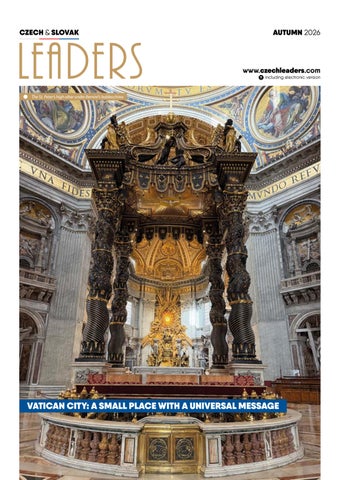
The St. Peter’s high altar under Bernini’s baldacchino
VATICAN CITY: A SMALL PLACE WITH A UNIVERSAL MESSAGE
AUTUMN 2026
CONTENTS
INSIGHTS
INTERVIEWS
1
6
250 YEARS OF INDEPENDENCE: WHAT AMERICA’S STORY MEANS FOR US By H.E. Mr. Nicholas Merrick, Ambassador of the USA to the Czech Republic
40
30 YEARS LATER
Interview with H.E. Mr. Nicholas Merrick, Ambassador of the USA
12
Olga Havlová through the eyes of those who knew her
48
LA MODE EN MAJESTÉ. ROYAL THAI DRESS FROM TRADITION TO MODERNITY.
IN AN ERA OF AI-GENERATED IMAGES, HOW ABOUT AUTHENTICITY?
16
THE GLAMOR OF THAI NATIONAL DRESS The Royal Thai Embassy in the Czech Republic recently organized a unique exhibition of Thai National Dress - Chud Thai.
70
ARGENTINIAN COMFORT FOOD IN CENTRAL PRAGUE
20
26
TO KNOW SOMEONE IS TO LOVE THEM Interview with Mr. Amirul Zaki bin Fadzir, Chargé d’Affaires a.i. of Malaysia
34
EUROPE HAS ALWAYS MANAGED TO PULL TOGETHER IN TIMES OF CRISIS Interview with Monika Ladmanová, Head of the Representation of the European Commission in the Czech Republic
FROM ROME TO THE WORLD: THE VATICAN, WHERE BEAUTY, FAITH AND HUMANITY MEET. Our special visit to Vatican City as a gesture of gratitude to H.E. Monsignor Jude Thaddeus Okolo
DIPLOMACY HAS NOT CHANGED WHO I AM Interview with H.E. Ms. Theresa Adjei-Mensah, Ambassador of Ghana
Visiting “La Paisanita” restaurant in Prague 6
76
DIPLOMACY IS NOT ABOUT WINNING ARGUMENTS; IT IS ABOUT FINDING SOLUTIONS THAT BENEFIT EVERYONE INVOLVED Interview with H.E. Mr. Orlando Leite Ribeiro, Ambassador of Brazil
By Shalev Man, Photographer and Co-founder of KAMO AI
66
BE GENUINELY INTERESTED IN YOUR INTERLOCUTORS Interview with H.E. Mr. Amir Weissbrod, Ambassador of Israel
The exhibition highlighting the development of Thai court dress and its place on the international stage
56
STRENGTHENING THE HISTORICAL BONDS BETWEEN OUR TWO NATIONS
44
EDUCATION GOES FAR BEYOND GRADES Interview with Stefano Cavagnetto, Dean of School of Business and IT, UNYP
IN MEMORIAM 30
60
IT’S NEVER TOO LATE TO BEGIN Interview with Ivana Ostřanská, Founder of Ostranska brand
“HE LIVED MORE THAN ONE LIFE” The legacy of Ivan Hodáč, remembered across Brussels, Prague, and Central Europe
FAREWELL LETTERS 39
THANK YOU FOR YOUR SYMPATHY AND FRIENDSHIP A farewell message from H.E. Mr. András Baranyi, Ambassador of Hungary
Benke Aikell – Founder | Eva Anderová & Meshulam Zisso – Owners & Executive Editors | Petra Kubernátová – Webmaster | Martina Hošková – Editing & Translation | Martin Mikeš – Graphic Design | Printing house – Tiskárna H.R.G. Litomyšl | Publisher PRIME (1998) s.r.o., Olgy Havlové 2914\52, 130 00 Žižkov - Prague 3, IČ: 25682784, DIČ: CZ25682784, e-mail: info@czechleaders.com, www.czechleaders.com | Czech & Slovak Leaders, Olgy Havlové 2914\52, 130 00 Žižkov - Prague 3, email: info@czechleaders.com, www.czechleaders.com | Licence: MK ČR E 13147 | No reproduction is permitted in whole or part without the express consent of Czech & Slovak Leaders | The advertiser is responsible for the advertising contents | Opinions expressed in this publication are those of the authors or persons interviewed and do not necessarily reflect the views of the editors or Czech & Slovak Leaders | All editorial material and photos in Czech & Slovak Leaders Magazine is digitally stored and may be republished by Czech & Slovak Leaders either in printed form or in various digital media | All correspondence to Czech & Slovak Leaders Magazine may be published.
250 YEARS OF INDEPENDENCE: WHAT AMERICA’S STORY MEANS FOR US By H.E. Mr. Nicholas Merrick, Ambassador of the USA to the Czech Republic
This year, the United States marks 250 years since declaring its independence, making it the oldest continuous democracy in the world. It is an important milestone worth celebrating in the United States, but also further afield. We should do so not just as a look back at history as a case study, but as a reminder of ideas that still shape how we think about freedom today, including here in Czechia. Two hundred fifty years ago, in Philadelphia, a group of delegates signed a document that would go on to change the world: the Declaration of Independence. That document has profound effects on my country, but also on so much of modern history.
Ordinary men, extraordinary risk It is easy to think of the Founding Fathers as legendary figures from the start. But before they were remembered in textbooks, they were just 56 men – lawyers, farmers, merchants – who had comfortable lives under British rule. They did not have to rebel. They chose to
take risks, subordinate their own self-interests, and aspire to ideals greater than themselves. And when they signed that declaration, they knew they might be signing their own death warrants. What made them remarkable was not that they invented brand-new ideas. Ideas about human rights, 1
INSIGHTS
Convoy of Liberty
Convoy of Liberty
INSIGHTS
2
and about governments existing to serve the people rather than rule over them, had been developing in Europe for generations. The American founding fathers took those ideas on topics like individual freedom and liberty, the rule of law, and the importance of self government, and wove them together as the basis of a new form of government that was different than the imperial monarchies of the time. That new system of government has proven both responsive enough and flexible enough to last 250 years. Strong Czech connections Czech and American history have been intertwined since long before either country’s independence. The first Czechs arrived in North America in the 1500s. One of them, Joachim Gaunz, a metallurgist
born in Prague, is believed to be the first Czech – and the first recorded Jewish visitor – to set foot in America. Later, Augustin Heřman of Mšeno mapped the Chesapeake and Delaware Bay regions with remarkable accuracy, helping shape early colonial geography. Between 1850 and 1914, roughly 400,000 people from the Czech lands crossed the Atlantic, drawn by cheap farmland and job opportunities. Today we have approximately 1.5 million Czech Americans, many of whom still proudly carry on the traditions of their homeland. Two nations, one democratic spirit The bond deepened dramatically in the 20th century. Tomáš Garrigue Masaryk –inspired partly by American democratic ideals,
and by his American wife, Charlotte – built a close relationship with U.S. President Woodrow Wilson that helped secure American support for Czechoslovak independence after World War I. It is a striking fact: the U.S. Constitution of 1787 and the Czechoslovak Constitution of 1920 share the same core structure – a republicbased government with power belonging to the people, manifested through a system of three branches of government, checks and balances, and a two-chamber parliament. That bond was tested, and proven, in World War II. American soldiers helped liberate western and southern Bohemia, and conducted air campaigns against Nazi industry in Moravia and Silesia. More than 130 American soldiers died and at least 400 were wounded fighting for Czechoslovak freedom. Towns
Pilsen Commemoration
3
INSIGHTS
WW2 Veterans Visit
WW2 Veterans Visit
INSIGHTS
4
and villages –including Plzeň – welcomed their liberators with celebrations that would later be revived after 1989. During the Cold War, Radio Free Europe and Voice of America gave Czechs and Slovaks a lifeline to independent news behind the Iron Curtain. And when Václav Havel and thousands of citizens took to the streets in 1989, demanding change, the United States stood with them. A modern friendship Our partnership was reignited by the Velvet Revolution. Václav Havel addressed the U.S. Congress in 1990. President George H.W. Bush visited Prague the same year and gave the country a replica of the Liberty Bell – one that was rung again this year
during our Independence Day celebrations. And Madeleine Albright, born in Prague, became the first woman to serve as U.S. Secretary of State, helping guide the Czech Republic into NATO in 1999. As President Bush once said in Prague: “Our countries share a history. We share a vision. And we share a friendship.” Looking to the future – together That friendship is still building new chapters. This year, NASA’s Artemis II mission carried astronauts farther from Earth than ever before. Soon, Czech astronaut Aleš Svoboda will pilot a U.S. spacecraft to the International Space Station – the first Czech to do so, continuing a shared legacy of space exploration. We will
work together on joint defense and energy projects; we will see more U.S. investment come to the Czech Republic and more Czechs investing in the United States. We will continue our robust peopleto-people ties. We will continue to build a safer and more prosperous world. The Founders of 1776 gave the world more than a country. They gave it a model for turning bold ideas into lasting institutions, and a reminder that freedom requires responsibility. That spirit connects Philadelphia in 1776 to Prague in 1989 – and it is the same spirit carrying both countries forward today.
TEXT:
H.E. Mr. Nicholas Merrick,
Ambassador of the USA to the Czech Republic PHOTO:
Archive
H.E. Mr. Nicholas Merrick, Ambassador of the USA and Petr Pavel, President of the Czech Republic
5
INSIGHTS
STRENGTHENING THE HISTORICAL BONDS BETWEEN OUR TWO NATIONS Interview with H.E. Mr. Nicholas Merrick, Ambassador of the USA
H.E. Mr. Nicholas Merrick, Ambassador of the USA
Seasoned businessman H.E. Nicholas Merrick, a proud Texan and patriot, first visited Prague as a young tourist in 1993. Now he is back again in the role of his country´s Ambassador. “I believe in the President’s vision for taking America forward, promoting individual freedoms, and enhancing global security. The current bilateral relationship is excellent, and Czechia is held in high regard in Washington. My mandate here is to help actively shape a relationship that is being progressively modernized and positioned to thrive across multiple sectors”, he explains about his mission.
INTERVIEWS
6
To begin in a traditional way, could you tell us a bit about yourself? I am honored to serve as the United States Ambassador to the Czech Republic, representing President Trump and his administration’s agenda here.
Professionally, I bring 40 years of business experience to this post, having traveled extensively and conducted business around the world. On a personal note, I am a proud Texan from Dallas, where I raised my family. I have four children and two grandchildren, and my wife Leslie and I have
H.E. Mr. Nicholas Merrick and Ms. Leslie Merrick
been married for 37 years. I am a deep admirer of our nation’s history, and my family and I like to stay active. In fact, both of my sons played college football, just like I did at the University of Virginia. I have spent my career navigating complex commercial environments, and I am incredibly grateful to now apply that background alongside our fantastic embassy team to strengthen the historical bonds between our two nations. What inspired you to pursue the role of ambassador? My decision to step into this diplomatic role was driven by a deep desire to carry out President Trump’s forward-looking agenda and to serve my country in a new way. I believe in the
President’s vision for taking America forward, promoting individual freedoms, and enhancing global security. With decades of business experience, I felt uniquely positioned to transition from the private sector to public service. My mandate here is to help actively shape a relationship that is being progressively modernized and positioned to thrive across multiple sectors. It is a tremendous privilege to use my background to foster closer bilateral alignment on critical matters of shared values, defense capabilities, energy security, and robust commercial growth. You have been in the Czech Republic for almost a year now. Do you still remember your first impression?
I have been in office for approximately nine months. My very first impression of the Czech Republic dates back to 1993, when my wife and I visited Prague as young, budget-conscious tourists. Returning decades later as ambassador, I approached this posting as an open book, deliberately leaving behind rigid expectations or preconceived thoughts. I love walking through Prague and enjoying the historic buildings and cobblestone streets. My most immediate impression when I arrived was discovering that the baseline value systems of Czechs and Americans are remarkably similar. We Texans love our independence and the great outdoors; I’ve found that many Czechs share the same passions. Whether prioritizing family or placing 7
INTERVIEWS
deep structural importance on individual identity, the cultural similarities between the United States and the Czech Republic are undeniable. This shared foundation has served as the absolute bedrock from which all our ongoing diplomatic, defense, and economic collaborations naturally flow. Could you share some of the major moments from your time here so far? My time as Ambassador has been filled with meaningful milestones that underscore the depth of our bilateral connection. On a historical level, it was an honor to participate in multiple WWII commemoration ceremonies celebrating our shared history and our role in liberating western Czechoslovakia.
I have also had many opportunities to speak to Czech students about the relationship between our two countries, and have been consistently impressed with the energy, curiosity, and enthusiasm of the next generation. Finally, hosting my very first July 4th Independence Day celebration during America’s 250th anniversary, alongside President Pavel, numerous U.S. companies, and our Czech friends, was unforgettable. We even concluded the evening by gathering together to cheer on the Czech team in the World Cup. Does serving as an ambassador suit your lifestyle? Serving as ambassador demands full, energetic engagement with government officials, business leaders, other diplomats, and
Mr. Petr Pavel, President of the Czech Republic, Ms. Leslie Merrick, and H.E. Mr. Nicholas Merrick
INTERVIEWS
8
local communities, and that fits well with my active, professional lifestyle. I also really enjoy mentoring younger professionals, so I am enjoying my role as head of the U.S. Embassy as well, where I can support others and help them grow in their careers. Backed by a world-class team here at the embassy, I have been able to translate my commercial expertise into the arena of diplomacy to benefit the American people. Balancing tough policy negotiations with more cultural events makes the diplomatic lifestyle deeply rewarding and highly aligned with my personal values. For example, I recently threw out the opening pitch at Prague Baseball Week, a fantastic event that represents our shared love of sports like baseball.
What has been the most memorable adventure you have experienced as ambassador? Professionally, navigating the rapid pace of modern international diplomacy alongside our Czech partners is its own incredible adventure. Working strategically to advance our mutual defense interests, opening up new direct transatlantic flight paths, and finding innovative ways to support U.S.-Czech economic relations presents a daily challenge that requires drawing on every bit of my experience. I have to say, the job of an ambassador, especially in a place like the Czech Republic, presents the opportunity for an incredible range of experiences and adventures every single day. One weekend, I was able to visit an ancient, Cistercian monastery in Vyšší Brod; the next weekend, I attended the Pitbull concert in Prague. What is the most surprising challenge you have encountered? I think the most surprising thing I have encountered as an ambassador – and maybe the most difficult thing I have ever done in my life – is learning the Czech language, with its complicated verb conjugations and noun declensions. I take weekly language lessons, which have really helped, but it is still a challenge. As is often the case, I have found that the language reflects the culture. And just as the Czech language is deep and complex and difficult to decipher, I have found that the Czech way of thinking is often equally deep and complex. I have loved getting to know Czechs in person and learning how to read that deep Czech psychology and all the subtleties of both the language and culture, while figuring
out what makes people tick. It’s been a challenge, but a worthwhile one. In your view, what is the most difficult part of the ambassadorial role? The most challenging aspect of this role is navigating tough, frank conversations when close international partners do not immediately see eye-to-eye on strategic matters. Whether addressing discrepancies in defense spending targets, reviewing NATO capability timelines, or managing complex internal political debates, diplomacy can be tough. However, I firmly believe that the mere presence of disagreement is never the sign of an unhealthy relationship. Friends need to be honest with each other. What distinguishes
healthy, resilient institutions and allied governments is that we can work constructively through those conflicts together. It takes constant effort to look past short-term geopolitical noise and keep both nations focused on the broader, long-term effort to ensure mutual security and prosperity. How do you like to spend your free time while living in Prague? I’ve spent a lot of time in Czechia entertaining visitors and guests from the United States. The Czech Republic is a fantastic travel destination, and many of my friends and relatives from home have used Prague as a springboard to experience everything that this beautiful country has to offer, from historic cities and gorgeous old towns to the incredible natural 9
INTERVIEWS
H.E. Mr. Nicholas Merrick, Ms. Leslie Merrick, and Mr. Karel Havlíček, Deputy PM and Minister of Industry and Trade of the Czech Republic, with guests at the 250th Annive
diversity of your lakes, rivers, and forests. I never get tired of introducing new people to all the incredible things that the Czech Republic has to offer. The United States is an appealing holiday destination for many Czechs. How do you promote your country here? Honestly, we do not really need to! American culture – including our music, Hollywood movies, and television shows – all play a part in culture worldwide. We find that Czechs are often already curious about and interested in the United States, whether it’s from seeing New York City portrayed on television, having grown up watching movies set INTERVIEWS
10
in the American Wild West, or seen videos from influencers and ordinary people all experiencing and enjoying America’s hospitality during the World Cup. There are also many Czechs who are proud to have relatives and extended family living in the United States, and they are often curious to go experience America for themselves. Given all of that, you could say that America promotes itself without my help. It makes my job as the U.S. Ambassador that much easier. What is the current status of Czech - U.S. relations? The current bilateral relationship is excellent, and Czechia is held in high regard in Washington. I consistently use two specific
words to describe our status: the relationship is being modernized, and it is being positioned to thrive. We are modernizing our security framework through critical defense investments, such as the Czech commitment to next-generation F-35 aircraft. Economically, the relationship is thriving through immense commercial linkages; hundreds of U.S. companies operate here, while significant Czech investments are flowing directly into the United States. Furthermore, our government-to-government cooperation is rock solid. We applaud Czechia’s decisive leadership in turning entirely away from Russian gas, as well as its vital contributions to the regional ammunition initiative.
the shared democratic visions of President Masaryk and Woodrow Wilson. I hope the Czech people maintain their deep pride, strong identity, and commitment to core values.
ersary of the United States of America’s Independence
Looking ahead, I wish for the successful realization of your defense modernization goals within NATO. Developing robust, credible capabilities is the single most critical factor in achieving the deterrence required to stand up to hostile predator nations, bring a lasting diplomatic resolution to the conflict in Ukraine, and guarantee permanent peace and freedom across Central Europe. Finally, let us return to the uniquely strong bond between your home state of Texas and the Czech Republic. What makes this connection so meaningful in your view?
This interview coincides with a major anniversary your country is celebrating. What are your wishes for the United States at this moment? As we celebrate the milestone of 250 years of American independence, I look back with admiration for the 56 founding fathers who signed the Declaration of Independence in 1776. These men were winners under the existing system, yet they willingly risked everything to achieve the noble ideal of self-rule. My primary wish for the United States is that we remain fiercely dedicated to those enduring values of freedom and democracy while fully embracing the global responsibilities that come with being a living democracy. I wish for
our nation to continue its steady journey along the highway toward a more perfect union. I hope we always maintain our patriotic spirit, keeping our communities safe, clean, and vibrant for future generations. We need to continue to educate others about our history and carry that knowledge forward. I’ve found a similar and equally inspirational spirit here in the Czech Republic. And what are your wishes for the Czech Republic? I wish the Czech Republic continued prosperity, security, and unwavering strength as a premier ally of the United States. Our two countries share over 170 years of common experiences, from early Czech settlers in Texas to
I am always proud to put in a special plug for Texas because our historical and modern bonds are uniquely strong. Texas is home to the largest population of Czech immigrants in the United States, meaning our cultures are deeply intertwined. This history has manifested in powerful modern partnerships, such as our active State National Guard partnership. Most importantly, we have proven that we are there for each other in times of crisis. When Texas suffered severe flooding last year, Czech searchand-rescue teams deployed to assist us, just as Texas guardsmen previously deployed here during historic floods. It is a beautiful, tangible example of our shared values, responsibility, and community action in real-time.
TEXT:
Martina Hošková, M. Zisso
PHOTO:
Archive
11
INTERVIEWS
BE GENUINELY INTERESTED IN YOUR INTERLOCUTORS Interview with H.E. Mr. Amir Weissbrod, Ambassador of Israel H.E. Mr. Amir Weissbrod, Ambassador of Israel and Mr. Petr Pavel, President of the Czech Republic
A lifelong diplomat, H.E. Mr. Amir Weissbrod, Ambassador of Israel, arrived in Prague almost a year ago. True to the advice he gives the next generation of ambassadors, he shows genuine interest in his Czech interlocutors – even to the point of becoming a dedicated student of our quite difficult language. “Our countries enjoy an excellent political relationship based on many historical factors. There are also strong people-to-people ties, and the Czech Republic is the fourth most popular destination worldwide for Israeli tourists,” he shares.
INTERVIEWS
12
H.E. Mr. Amir Weissbrod, Ambassador of Israel to the Czech Republic, H.E. Ms. Veronika Kuchyňová Šmigolová, Ambassador of the Czech Republic to Israel, Mr. Petr Macinka, Deputy Prime Minister and Minister of Foreign Affairs of the Czech Republic, Mr. Gideon Saar, Minister of Foreign Affairs of Israel, and Rabbi Shmuel Rabinovutch, the Rabbi of the Western Wall (the Kotel) and the Holy Sites of Israel
Can you briefly introduce yourself to our readers?
What made you become a diplomat?
cultural events, which I enjoy very much.
My name is Amir Weissbrod. I joined the Israeli Ministry of Foreign Affairs in 1995. I have served in Morocco, twice in Jordan (including as Ambassador from 2018 to 2021), at the United Nations in New York, and now in the Czech Republic as Ambassador. Before taking up my current post, I served as Deputy Director General for UN Affairs at Israel’s Ministry of Foreign Affairs from 2022 to 2025.
I was driven by curiosity to learn about different cultures, and by a desire to promote better relations between Israel and the Arab world after graduating in Middle Eastern Studies.
What is the most difficult part of your profession?
I am married and have three children. I enjoy basketball and rock music.
Does being an ambassador fit your lifestyle? I like variety and prefer not to do the same thing for too long, and diplomacy provides exactly that opportunity. Being an ambassador also gives you the opportunity to attend many
Having to be a representative all the time. Among all the experiences your career has offered, is there an adventure you would highlight as the most remarkable? I would mention two experiences: travelling to Saudi Arabia in September 2023 as the first Israeli diplomat to enter the country using an official Israeli passport, 13
INTERVIEWS
and a visit to Mauritania in 2000 with a delegation of Israeli Members of Parliament, including a four-wheel-drive journey through the Mauritanian desert with magnificent scenery. You took your post in Czechia about a year ago. What is your impression so far? My impression of the Czech Republic is that it is a beautiful country with a rich history and talented people. I think every Czech should appreciate their good fortune and say “Bohudík jsem tady” every day. Professionally, the highlights of my term so far include four visits by our Foreign Ministers in just eight months, as well as a very successful Israeli business mission to the Czech Republic in May. On a personal level, I have enjoyed visiting many remarkable places across the country: Tiské stěny, which reminded me of The Last of the Mohicans; attending the famous SlaviaSparta football match; visiting Český Krumlov; and enjoying a beer in Žatec, famous for its world-renowned hops. You actually speak Czech, which is a very difficult language. How did you do it? I still have a long way to go – I am only a beginner. I had an excellent teacher, and I read the news every day while memorizing new words. Czech is a beautiful language, but its grammar is certainly one of the biggest challenges I have ever encountered. Besides practising the Czech language, what else do you do in your free time? I travel a lot, watch sports, and read books.
INTERVIEWS
14
Do you have a piece of advice to the next generation of ambassadors? The best meetings are often the informal ones rather than the formal ones. Be genuinely interested in your interlocutors – what motivates them, and what their hobbies are. Also, do not focus only on the capital – travel and work in other regions of the country as well. Can you tell us about your relations with the Jewish and Israeli communities in the Czech Republic?
nature – a true melting pot of East and West. Can you evaluate the current status of Czech-Israeli relations? We enjoy an excellent political relationship based on many historical factors. There are also strong people-to-people ties, and the Czech Republic is the fourth most popular destination worldwide for Israeli tourists. We are currently working to strengthen our economic and academic cooperation, and over the past four months we have organized two major business delegations.
I have a very close relationship with both communities and have many good friends among them. Naturally, there are frequent interactions on both the professional and personal levels, and I greatly value these connections.
On the occasion of your Independence Day, what are your wishes for Israel – and for the Czech Republic?
What do you think brings Czech visitors to your country?
For the Czech Republic, I wish continued prosperity and safety. You have a wonderful country and people, and you should be very proud of it.
Israel is, of course, the cradle of the monotheistic religions, but it is also a highly diverse destination offering outstanding food, wine, culture, history, and
For my country, I wish simply for peace and security.
TEXT:
Martina Hošková, M. Zisso
PHOTO:
Archive
Iris Malca, previous Consul of Israel to the Czech Republic, H.E. Mr. Amir Weissbrod, Ambassador of Israel to the Czech Republic, and Roni Abramson, previous Deputy Ambassador of Israel to the Czech Republic
15
INTERVIEWS
DIPLOMACY IS NOT ABOUT WINNING ARGUMENTS; IT IS ABOUT FINDING SOLUTIONS THAT BENEFIT EVERYONE INVOLVED Interview with H.E. Mr. Orlando Leite Ribeiro, Ambassador of Brazil
H.E. Mr. Orlando Leite Ribeiro, Ambassador of Brazil
H.E. Mr. Orlando Leite Ribeiro, Ambassador of Brazil, arrived in the Czech Republic almost a year ago, bringing with him decades of diplomatic experience and a deep understanding of international affairs. “When two countries know each other better, they discover opportunities that neither had imagined before – and that is precisely what diplomacy is all about: building trust, creating opportunities, and bringing people closer together,” he sums up his seasoned perspective.
INTERVIEWS
16
Can you tell us a bit about yourself? I am a Brazilian career diplomat with more than three decades of experience in international relations. Throughout my career, I have had the privilege of serving Brazil in different parts of the world, working on issues ranging from trade and investment to political affairs, agriculture, and public diplomacy. Before coming to Prague, I served as Ambassador to Spain and Andorra.
remarkable warmth. My first impression was of a country that combines extraordinary historical heritage with impressive modernity.
surprised by the country’s innovative spirit, its vibrant economy, and its strong commitment to science, technology, and industrial excellence.
Prague is undoubtedly one of Europe’s most beautiful capitals, but what impressed me even more was the professionalism and kindness of the Czech people. I have also been pleasantly
During this first year, I have had the opportunity to travel beyond Prague and meet government officials, business leaders, academics, and members of the Brazilian community.
I am also an economist by training, which has shaped my interest in international economics and sustainable development. Beyond diplomacy, I enjoy travelling, discovering different cultures, practicing sports, and meeting people. I believe that diplomacy is ultimately about people: building trust, creating opportunities, and bringing societies closer together. What inspired you to pursue a career in diplomacy? Growing up in a diplomatic family certainly influenced me. My grandfather, my uncle, and my father were all diplomats, so international affairs were often discussed around the dinner table. However, becoming a diplomat was ultimately my own choice. I have always been fascinated by different cultures, languages, and history. Diplomacy offered the opportunity to combine these interests with public service. Representing Brazil abroad is not simply a profession –it is a privilege and a responsibility. Every day brings new challenges, and every country teaches us something new. It has been almost a year since you arrived in Prague. Can you share some of your impressions? The Czech Republic welcomed my wife Renata and me with 17
INTERVIEWS
These encounters have reinforced my conviction that our two countries have much more in common than geographical distance might suggest.
We see diplomacy not only as negotiations between governments, but also as creating friendships and mutual understanding between societies.
Dialogue remains humanity’s best instrument for solving differences.
What other countries have you served in?
With a diplomatic career of over 30 years, can you give a piece of advice to the next generation of ambassadors?
Perhaps the greatest challenge is balancing national interests with the need to build consensus.
Throughout my diplomatic career, I have served in Paraguay, twice in the United States – first at the Brazilian Government Trade Bureau in New York and later at the Embassy of Brazil in Washington, D.C. – then in Spain, where I was Ambassador to Spain and Andorra, and now in the Czech Republic. In Brasília, I have also held several senior positions at Brazil’s Ministry of Foreign Affairs, and, more recently, served as Secretary for Trade and International Relations at the Ministry of Agriculture, a position equivalent to Vice Minister. In that role, I was responsible for promoting Brazil’s international agricultural agenda, expanding market access, strengthening trade relations, and attracting foreign investment. Each assignment has been unique. Every country has its own character, and every position – whether abroad or in Brasília – has broadened my understanding of international relations and reinforced my conviction that diplomacy is ultimately about building trust, creating opportunities, and bringing people closer together. How does being an ambassador fit into your lifestyle? For diplomats, professional and personal lives are closely intertwined. Representing your country is not something you do only during office hours – it is a way of life. My wife Renata plays an essential role in this journey. Together, we enjoy hosting people, promoting Brazilian culture, and building bridges between our countries. INTERVIEWS
18
Never stop learning. The world changes constantly, and diplomacy changes with it. Technical knowledge is important, but curiosity, empathy, and the ability to listen are even more valuable. Good diplomats should understand economics, politics, history, and technology – but above all, they should understand people. I would also encourage young diplomats to remain optimistic.
What is the most difficult part of being an ambassador?
Diplomacy is not about winning arguments; it is about finding solutions that benefit everyone involved. This requires patience, resilience, and the ability to understand different perspectives. On a personal level, living far from family and constantly moving between countries also requires adaptation, but it is a small price to pay for such a rewarding career. How do you like to spend your free time?
H.E. Mr. Orlando Leite Ribeiro, Ambassador of Brazil and President Petr Pavel
here. We already cooperate in areas such as defence, aviation, energy, science, education, and innovation, and I believe these partnerships will continue to deepen. Beyond economics, our countries share important values, including democracy, respect for international law, and a commitment to peaceful dialogue. There is enormous potential to strengthen cooperation in many different fields. This interview is done on the occasion of the National Day of Brazil. What are you wishing for your country? And for the Czech Republic?
H.E. Mr. Orlando Leite Ribeiro, Ambassador of Brazil
I enjoy staying active, and like playing sports whenever I can. One of my goals here in Prague is to find a good place to start playing padel again. Renata and I also love travelling – not only to other countries but also within the countries where we live. We enjoy discovering smaller towns, learning about local history, experiencing different cultures, and, of course, trying the local cuisine. Those experiences often become some of our best memories. At home, we enjoy unwinding together by watching a good TV series. We also spend a great deal of time with our two dogs, Maia, a Shetland Sheepdog, and Zara, a Golden Retriever. Whether it’s taking them for long walks or simply playing ball in the garden, they certainly keep us active – and entertained! What is your strategy for promoting your country as a holiday destination for Czech people?
Brazil is much more than beautiful beaches and Carnival, although we are certainly proud of both. I try to present Brazil as a country of continental dimensions, extraordinary biodiversity, cultural diversity, innovation, entrepreneurship, and business opportunities. Tourism is naturally an important part of that story, but so are science, education, renewable energy, agribusiness, aviation, technology, and culture. Every cultural event, business meeting, academic exchange, or institutional visit contributes to presenting a richer and more complete image of Brazil. What is the current status of Czech-Brazilian relations? Our bilateral relationship is excellent, and has significant room for further growth.
For Brazil, I wish continued progress with social inclusion, sustainable economic growth, and greater opportunities for all Brazilians. Our country possesses extraordinary human talent and immense natural wealth, and I hope we continue transforming these assets into prosperity and wellbeing. For the Czech Republic, I wish continued success, innovation, and prosperity. It is a country with a remarkable history and an impressive capacity to reinvent itself. Above all, I wish that the friendship between Brazil and the Czech Republic continues to grow stronger. When two countries know each other better, they discover opportunities that neither had imagined before – and that is precisely what diplomacy is all about.
TEXT:
Martina Hošková, M. Zisso
PHOTO:
Archive
Trade has expanded steadily – Czech companies are increasingly interested in Brazil, and Brazilian companies also see opportunities 19
INTERVIEWS
DIPLOMACY HAS NOT CHANGED WHO I AM Interview with H.E. Ms. Theresa Adjei-Mensah, Ambassador of Ghana
H.E. Ms. Theresa Adjei-Mensah and President Petr Pavel
INTERVIEWS
20
H.E. Ms. Theresa Adjei-Mensah, Ambassador of Ghana, stays deeply connected to her roots even on the global stage. “Becoming an ambassador has been a natural extension of the life I have always lived, one rooted in service, community engagement, and a deep commitment to Ghana’s development. It allows me to channel my experience in community development into a broader arena such as strengthening bilateral relations, supporting our citizens abroad, and promoting Ghana as a stable, democratic, and investor-friendly nation,” she explains.
Could you tell us about yourself and your country? My name is Theresa Adjei-Mensah, a Ghanaian deeply committed to social development. I am a mother, wife, sister to many women in my community, and a development practitioner whose passion for service was shaped by witnessing firsthand the development disparities in Ghana’s middle belt, where I hail from. I dedicated my professional life to local governance, community development, and philanthropic work, guided by a strong commitment to public service. As for my country, I will say it is a stable and well-established democracy in West Africa, widely respected as an influential actor within this sub-region and the African continent as a whole. Our foreign policy, rooted in good neighbourliness and friendship with all, has helped sustain Ghana’s reputation for peace, stability, and constructive engagement. Ghana’s economy has demonstrated renewed resilience and steady recovery, reflecting deliberate reforms aimed at stabilizing macroeconomic conditions and restoring investor confidence. Recent gains include declining inflation, improved fiscal discipline, and strengthened collaboration with international financial institutions, all of which have contributed to a more predictable business environment. Growth is being driven by agriculture, gold and cocoa production, oil and gas, manufacturing, and an expanding digital services sector, supported by targeted government initiatives to boost productivity and private sector participation. Ghana remains one of West Africa’s most investor-friendly destinations, offering political stability, a rules-
based regulatory environment, and access to over 400 million consumers through ECOWAS and the AfCFTA. Ongoing reforms in public financial management, tax administration, and investment facilitation continue to enhance transparency and ease of doing business, reinforcing Ghana’s position as a competitive and welcoming destination for global investors. What made you become an ambassador? Under the Constitution of Ghana, the President is empowered to appoint ambassadors in consultation with the Council of State, selecting individuals whose professional integrity, public-service records, and capacity to represent the nation’s interest abroad are well established. It is with deep humility and gratitude that I have been recognized and nominated by the President of Ghana H.E. John Dramani Mahama to serve as Ghana’s Ambassador to the Czech Republic, with concurrent accreditation to the Republic of Poland and Romania; an honour I regard as both a privilege and a solemn call to duty in service. What made me accept the appointment is rooted in my lifelong dedication to community development, social empowerment, and nation building. Over the years, my commitment to public service, combined with my experience as a development practitioner, prepared me to contribute to Ghana’s foreign policy objectives on a broader stage. Ambassadorial appointments consider not only professional competence but also one’s ability to advance Ghana’s diplomatic, economic, and cultural interests abroad. I am deeply honoured that the President has entrusted me with this role, and confident that my background, values, and dedication align with the high standards expected of Ghana’s representatives.
Serving as Ambassador is therefore a continuation of my service to Ghana, as well as an opportunity to strengthen our nation’s engagement with Central European countries, deepen cooperation, and uphold Ghana’s longstanding reputation as a stable, democratic, and forward-looking country. You have been in the Czech Republic for almost a year now. Looking back, what was your very first impression, and how has that perspective evolved so far? I arrived in the Czech Republic in December 2025, right at the height of winter. Coming from a temperate region, the weather was my first real encounter with the country, and it certainly took some adjusting to. Yet, over time, I have come to appreciate it. Beyond the cold, what struck me immediately was the beauty of the Czech Republic: its elegant architecture, orderly cities, and the warmth and courtesy of its people. It is a country with a rich culture and a quiet confidence that reveals itself the more one engages with it. One thing I have realized since arriving is that much of what I had read about the Czech Republic beforehand only partially captured the essence of the country – there is not as much written about it as the country truly deserves. Living here has shown me a nation far more vibrant, innovative, and culturally rich than the limited literature suggests. My first year has therefore been a journey of discovery of a place where history and modernity coexist gracefully, where institutions are strong, and where the people’s hospitality makes diplomatic work both meaningful and enjoyable. These impressions have strengthened my resolve to deepen Ghana-Czechia relations and to help showcase the Czech Republic more widely, not only as 21
INTERVIEWS
a partner to Ghana but as a country of remarkable character and potential. How many countries have you served in so far? This is my first appointment as ambassador. I have the privilege of representing my country in both Poland and Romania, serving in a concurrent capacity. How does being an ambassador fit into your lifestyle? Becoming an ambassador has been a natural extension of the life I have always lived – one rooted in service, community engagement, and a deep commitment to Ghana’s development. In many ways, the ambassadorial role fits seamlessly into my lifestyle because it reflects values I have practiced for years – dedication,
empathy, discipline, and a genuine interest in people’s welfare. My background in social development and local governance prepared me for a life of constant interaction, problem solving, and advocacy. As a mother, wife, and sister to many women in my community, I have long been accustomed to balancing multiple responsibilities with care and intentionality. Diplomacy requires similar qualities: patience, listening, cultural sensitivity, and the ability to build bridges. These are traits I have cultivated throughout my personal and professional journey. Being an ambassador also aligns with my passion for representing Ghana’s interests and telling Ghana’s story. It allows me to channel my experience in community development into a broader arena such as
strengthening bilateral relations, supporting our citizens abroad, and promoting Ghana as a stable, democratic, and investor-friendly nation. The role demands structure, discipline, and constant engagement, but it also offers the privilege of serving Ghana at the highest level of international representation. In essence, diplomacy has not changed who I am; it has simply elevated the platform on which I serve. It fits into my lifestyle because service has always been at the centre of my life. What is the best adventure you have had here? Since arriving in the Czech Republic in December 2025 right in the heart of winter (as I mentioned earlier), my journey here has been both memorable and meaningful.
From Left: Her Excellency Theresa Adjei-Mensah, Ambassador of the Republic of Ghana to the Czech Republic, His Excellency John Dramani Mahama, President of the Republic of Ghana, and Her Excellency Professor Naana Jane Opoku-Agyemang, Vice President of the Republic of Ghana
INTERVIEWS
22
I have discovered a nation of striking beauty, rich culture, and warm, gracious people. Exploring Prague’s historic streets, visiting cultural sites, and engaging with communities across the country have all enriched my experience. In the course of my duties, I have travelled to most of the major cities across the Czech Republic, pursuing bilateral opportunities of mutual interest between our two nations and attending to the welfare of Ghanaians residing in these areas. These journeys, though undertaken in an official capacity, have allowed me to witness firsthand the country’s architectural elegance, efficiency, and strong civic spirit. Beyond the physical travel, the deeper adventure has been the opportunity to represent Ghana at the highest diplomatic level. Diplomacy is dynamic – each day brings new engagements, partnerships, and insights. Navigating cultural differences, building bridges between nations, and promoting Ghana’s interests in Central Europe have all been profoundly fulfilling. This ambassadorial role challenges me, inspires me, and aligns perfectly with my lifelong commitment to service. While my travels so far have been official, I look forward to exploring the country in a personal capacity and discovering whatever best adventure it has to offer. In many ways, this diplomatic journey has already become one of the most meaningful adventures of my life, combining service, discovery, and purpose in a way that resonates deeply with who I am. Besides travelling, how else do you like to spend your free time here? In my leisure time, I find great enjoyment in cooking and listening to good music; activities that help
me unwind and stay grounded amid the demands of diplomatic life. Cooking allows me to reconnect with home, experiment with flavours, and create moments of calm, while music has always been a source of inspiration and relaxation. These simple pleasures complement the structured nature of my work and provide a healthy balance to the responsibilities of representing Ghana abroad. They keep me centred, refreshed, and ready to serve with clarity and purpose. What is the most difficult part of being an ambassador? The most difficult part of being an ambassador is not a single challenge but a delicate balance of responsibilities that all demand equal attention and emotional intelligence. The role requires constant navigation between national duty and personal life, and that balance is rarely simple. As an ambassador, I carry the responsibility of representing Ghana’s interests every day, in every interaction, and in every decision. This means long hours, extensive travel, and continuous engagement with government officials, business leaders, diaspora communities, and partners across multiple countries. It is a life of service, and service rarely pauses. Another difficult aspect is the weight of expectation. An ambassador must be a bridge between cultures, governments, and people. You must listen deeply, negotiate carefully, and respond diplomatically – even in complex or sensitive situations. The role demands patience, tact, and the ability to remain composed under pressure. You are constantly aware that your words and actions reflect your country. There is also the challenge of supporting citizens abroad,
especially in moments of distress. Whether it is a legal issue, a welfare concern, or a crisis requiring evacuation, you become the first point of hope for Ghanaians far from home. These situations can be emotionally demanding, but they are also among the most meaningful parts of the job. Yet, despite these challenges, the role is profoundly fulfilling. It allows me to serve Ghana at the highest level, deepen international partnerships, and contribute to the welfare of our citizens and the advancement of our national interests. Do you also work on encouraging Czechs to spend their holidays in your country? Ghana stands as one of the premier holiday destinations on the African continent. Each December, the country welcomes hundreds of thousands of visitors from around the world for what has become known as the December in Ghana experience, a vibrant celebration that has grown into a signature cultural and tourism event. Ghana offers travellers a compelling mix of attributes: a peaceful and safe environment, warm and welcoming people, rich culinary traditions, diverse tourist attractions, and a deep, well-preserved cultural heritage. Compared to many other African destinations, Ghana also provides exceptional value for money without compromising on the quality of the vacation experience. From the scenic coastal regions to the wildlife-rich savannas of the north, Ghana offers something for every kind of traveller. For Czech visitors in particular, Ghana presents a unique blend of tropical beaches, vibrant culture, rich history, and warm hospitality. Whether exploring the serene coastlines of the Western and Central Regions, experiencing 23
INTERVIEWS
H.E. Ms. Theresa Adjei-Mensah and Mrs. Marie Chatardová, Deputy Minister of Foreign Affairs of the Czech Republic
the cultural vibrancy of Accra and Kumasi, or visiting the historic Cape Coast and Elmina Castles, or visiting Sunyani, the cleanest city in Ghana with its greenery forest reserves, or exploring the mountains of the Volta region, travellers find an experience that is both relaxing and deeply enriching. Our stable democracy and friendly people make Ghana an ideal entry point for anyone wishing to explore West Africa. As ambassador, promoting Ghana is a central part of my mandate. I highlight Ghana’s tourism potential, investment opportunities, cultural richness, and economic stability in my engagements with government institutions, private sector actors, academic bodies, and the general public. I actively participate in cultural events, business forums, and diplomatic platforms to showcase Ghana’s strengths. I also work closely with the Ghanaian community and Czech partners to create opportunities for cultural exchange, trade missions, and tourism promotion. Through these efforts, I aim to INTERVIEWS
24
ensure that Ghana is not only known but is also appreciated as a destination of choice for leisure, business, and long-term partnership. Can you evaluate the current status of Czechia-Ghana relations? Relations between Ghana and the Czech Republic have been excellent since the establishment of diplomatic missions several decades ago. Both nations have consistently respected each other’s sovereignty and have regarded one another as reliable and valued partners. This strong foundation has been reinforced through high-level exchanges, including the historic visit of the Czech President to Ghana in 2025. The President of Ghana has also expressed keen interest in undertaking a reciprocal visit to the Czech Republic, a development that will further deepen our ties. Building on this momentum, both countries are advancing cooperation through the establishment of formal political consultations
aimed at strengthening collaboration in areas of mutual interest. Ghana-Czechia relations today are strong, warm, and steadily expanding, grounded in decades of respectful engagement and shared democratic values. The partnership is marked by active political dialogue, growing economic engagement, and increasing people-to-people exchanges, making it one of Ghana’s most constructive relationships in Central Europe. At the political level, cooperation remains excellent, with regular engagements between government institutions, parliamentary groups, and sector ministries. The Czech Republic views Ghana as a stable and reliable partner in West Africa, while Ghana values the Czech Republic’s technological advancement, institutional strength, and long tradition of industrial excellence. Economically, the relationship continues to gain momentum. Czech companies are increasingly exploring opportunities in areas
of engineering, manufacturing, energy, agriculture, health, and security where Czech expertise aligns well with Ghana’s development priorities. Several Czech firms already operate in Ghana, and new partnerships are emerging through trade missions, business forums, and bilateral consultations. Development cooperation has also been significant. The Czech Republic has supported Ghana in healthcare, security equipment, technical training, and human capacity building, contributing meaningfully to Ghana’s broader development agenda. Cultural and educational exchanges
are growing as well, with more Ghanaians studying, working, and living in the Czech Republic. Overall, Ghana-Czechia relations are healthy, forward-looking, and full of potential. As ambassador, my role is to deepen this cooperation, expand economic and cultural ties, and ensure that both countries continue to benefit from a partnership built on mutual respect and shared interests. This interview is on the occasion of your national day. What do you wish for your country and for the Czech Republic?
H.E. Ms. Theresa Adjei-Mensah, Ambassador of Ghana
On the occasion of Ghana’s national day, my foremost wish for my country is one of continued peace, unity, and prosperity. Ghana has long been admired for its stability, democratic values, and the warmth of its people, and my hope is that we continue to build on this strong foundation. I wish for sustained economic growth, deeper social cohesion, and greater opportunities for all Ghanaians, particularly our youth, whose creativity and resilience continue to inspire confidence in Ghana’s future. I also hope for strengthened institutions, expanded innovation, and a collective commitment to national development that ensures Ghana remains a beacon of hope and progress on the African continent. As Ghana celebrates seventy years of independence, it is both my personal wish as a Ghanaian and my hope as an ambassador that our peace and stability will endure, and that our economic gains will translate into real, tangible improvements in the lives of our people, strengthening our capacity for self-reliance. To the Czech Republic, I extend my warmest wishes for continued peace, stability, and prosperity as well. The Czech Republic is a nation with remarkable cultural heritage, strong institutions, and impressive technological advancement. My wish is that the country continues to thrive, and that the bonds of friendship between Ghana and the Czech Republic grow even stronger. I look forward to deeper cooperation, expanded economic partnerships, and increased cultural exchange between our peoples. It is my sincere hope that both nations will continue to benefit from a relationship built on mutual respect, shared values, and a genuine commitment to collaboration.
TEXT:
Martina Hošková, M. Zisso
PHOTO:
25
Archive
INTERVIEWS
TO KNOW SOMEONE IS TO LOVE THEM Interview with Mr. Amirul Zaki bin Fadzir, Chargé d’Affaires a.i. of Malaysia
Prague is the first overseas diplomatic posting of Mr. Amirul Zaki bin Fadzir, Chargé d’Affaires a.i. of Malaysia, a role he considers both a privilege and a great learning opportunity. “Diplomacy is about balancing different expectations while maintaining trust and strong relationships. Our role is to listen, understand different perspectives, and find a common ground whenever possible. Diplomacy allows me to build bridges, encourage a dialogue, and help others gain a better understanding of Malaysia”, he says.
Could you tell us a little about yourself? I am the younger of two siblings, and the only one in my family who chose the path of law and diplomacy. I studied law and began my career with a brief engagement at the UNHCR before moving into private legal practice, where I specialised in litigation. Those early years taught me to think critically, communicate clearly, and appreciate different perspectives – skills that have proved invaluable in diplomacy. I later joined Malaysia’s Ministry of Foreign Affairs and served in several capacities, including at the Southeast Asia Regional Centre for Counter-Terrorism (SEARCCT) INTERVIEWS
26
Mr. Amirul Zaki bin Fadzir, Chargé d’Affaires a.i. of Malaysia
and the National Authority for the Chemical Weapons Convention (NACWC), before receiving my first overseas posting to Prague. Looking back, it has been an
unexpected but very rewarding journey. Every stage has prepared me for the next, and I still feel that I am learning something new every day.
Mr. Amirul Zaki bin Fadzir, Chargé d’Affaires a.i. of Malaysia
Can you tell us a bit about your country?
What inspired you to become a diplomat?
Malaysia is a country shaped by both its people and geography. Situated at the heart of Southeast Asia, along the Strait of Malacca and the South China Sea, we have been connected to the world through trade for centuries. That openness has shaped Malaysia into a multicultural nation where different cultures, religions, and traditions live side by side in harmony.
I have always been curious about people and different cultures. There is a Malaysian proverb that I often reflect on: “Tak kenal maka tak cinta”, which can be translated as “To know someone is to love them.” I think that saying captures the essence of diplomacy.
As a trading nation, Malaysia plays an important role in global supply chains, particularly in semiconductors, palm oil, and liquefied natural gas. However, beyond our economic achievements, I believe our greatest strength lies in our diversity – it is what gives Malaysia its unique identity, and what many visitors remember the most after experiencing our country.
I also wanted to serve my country in a meaningful way. Diplomacy allows me to build bridges, encourage a dialogue, and help others gain a better understanding of Malaysia. Coming from a legal background, I enjoy analysing issues, finding a common ground, and working towards practical solutions. It is also a profession that constantly presents a challenge. No two days are ever the same, and that is one of the things I enjoy the most about this career.
You have been in the Czech Republic for two years, including more than a year as the Chargé d’Affaires a.i. What are your impressions so far? Prague is my first overseas posting, so it will always hold a special place in my heart. Like many visitors, I was immediately captivated by the city’s beauty and history. Beyond that, I was impressed by how well organised everything is, and by the balance the Czech Republic has found between preserving its heritage and embracing modern development. Over the past two years, I have also come to appreciate the warmth and sincerity of the Czech people. Whether through official engagements or everyday conversations, I have always found people to be welcoming 27
INTERVIEWS
Mr. Amirul Zaki bin Fadzir, Chargé d’Affaires a.i. of Malaysia
and genuine. Those personal connections are often what makes a diplomatic posting truly memorable. Where did you serve before coming to Prague? As I have already mentioned, the Czech Republic is my first overseas diplomatic posting. Before coming to Prague, I served in various divisions within Malaysia’s Ministry of Foreign Affairs, working on regional and international issues. Beginning my overseas diplomatic career here has been both a privilege and an excellent learning experience. How does the diplomatic profession fit into your lifestyle? It suits me very well because I genuinely enjoy meeting people and learning from them. One of the privileges of this INTERVIEWS
28
profession is that it allows you to engage with people from every walk of life – government officials, business leaders, academics, students, artists, and members of civil society. Every conversation offers a different perspective, and I believe that is one of the most rewarding aspects of diplomacy. At the end of the day, diplomacy is really about people and the relationships we build. What would you consider your greatest professional adventure so far? Taking on the role of the Chargé d’Affaires a.i. at a relatively young stage in my career has certainly been my greatest professional adventure. Leading an embassy carries a significant responsibility. You are not only representing your country but also overseeing the work of the entire mission. It has challenged me in many ways, but it has also given me invaluable
experience and a much broader perspective on leadership, teamwork, and diplomacy. On the other hand, what is the most unusual thing you have ever dealt with? Fortunately, nothing too unusual comes to my mind. One thing I have learned is that diplomacy is full of surprises. You learn to expect the unexpected, and often it is the small, unplanned moments – rather than the major events – that stay with you the longest. What would you say is the most difficult part of being a diplomat? I would not necessarily describe it as difficult, but it certainly requires patience, flexibility, and careful judgement. Diplomacy is about balancing different expectations while maintaining trust and strong
relationships. Whether we are working with governments, businesses, academics, or our own Malaysian community abroad, everyone naturally has different priorities. Our role is to listen, understand different perspectives, and find a common ground wherever possible.
Our multicultural heritage is another unique attraction. Visitors can experience different traditions, festivals, and cuisines, often within the same city.
with the EU Deforestation Regulation (EUDR). We hope it will further enhance trade and cooperation between Malaysia and the European Union. How would you describe Czech-Malaysian relations today?
That is both the challenge and the beauty of diplomacy.
And, of course, Malaysian hospitality is something we are especially proud of. We always want visitors to feel at home and leave with wonderful memories of our country.
How do you like to spend your time outside of work?
Do you also promote Malaysia here in Czechia?
I enjoy reading, exercising, and building scale models. Model building is particularly relaxing because it requires patience, focus, and attention to detail – qualities that are equally valuable in diplomacy.
Absolutely. A recent example is the ASEAN Plus Film Festival, held at the Municipal Library in Prague.
Whenever the time permits, I also enjoy travelling around the Czech Republic and discovering its history, architecture, and beautiful landscapes. Malaysia has a great potential as a holiday destination for Czech travellers. How do you encourage people to visit? I usually tell people that Malaysia offers an incredible variety of experiences within one country. You can experience vibrant modern cities with iconic landmarks such as the Petronas Twin Towers and Merdeka 118 (the second tallest building in the world). At the same time, you can explore rainforests that are around 130 million years old (making them among the oldest tropical rainforests on Earth), relax on beautiful islands with crystal-clear waters, enjoy world-class diving, mountain climbing, or discover extraordinary wildlife. Malaysia is recognised as one of the world’s 17 megadiverse countries, so nature lovers are truly spoilt for choice.
Malaysia’s featured film, Babah, was part of this year’s program. It offers a wonderful opportunity to experience Malaysian storytelling and gain a deeper appreciation of our culture through cinema. I am really glad that many Czech friends have shown interest in the festival. The EU recently recognised the Malaysian Sustainable Palm Oil certification. Why is this recognition important? This recognition is significant because it acknowledges Malaysia’s commitment to producing palm oil in a sustainable and responsible manner. Malaysia maintains approximately 54-55% forest cover, demonstrating our commitment to balancing economic development with environmental conservation. As the world’s second-largest producer of palm oil, it is important that our products meet internationally recognised sustainability standards. The EU’s recognition of the Malaysian Sustainable Palm Oil (MSPO) certification strengthens the confidence in our sustainability efforts and supports compliance
The relationship between Malaysia and the Czech Republic is warm, friendly, and continues to develop positively. Our cooperation extends across many areas, including trade, investment, education, tourism, and people-to-people exchanges. We also value the Czech Republic’s role within the European Union and appreciate its constructive support in strengthening Malaysia-EU relations. This interview is being published around your National Day. What are your wishes for Malaysia and for the Czech Republic on this occasion? Malaysia celebrates its Independence Day on 31st August, followed by Malaysia Day on 16th September. This year’s National Day theme, “Malaysia MADANI: Kesejahteraan Dinikmati”, reflects our aspiration for shared prosperity and inclusive development. My hope is that Malaysians will continue to cherish our diversity, strengthen our unity, and work together to build an even brighter future for the generations to come. For the Czech Republic, I wish continued peace, prosperity, and happiness. I also hope that the friendship between our two countries will continue to grow, creating an even stronger cooperation and closer people-to-people ties in the years ahead. TEXT:
Martina Hošková, M. Zisso
PHOTO:
29
Archive
INTERVIEWS
“HE LIVED MORE THAN ONE LIFE” The legacy of Ivan Hodáč, remembered across Brussels, Prague, and Central Europe
Ivan Hodáč at the Aspen Institute Central Europe 13th anniversary reception at the British Embassy in May 2025
Ivan Hodáč, founder of the Aspen Institute Central Europe and for twelve years Secretary-General of the European Automobile Manufacturers’ Association (ACEA), passed away unexpectedly on July 1, 2026, two months before his 80th birthday. The Financial Times once named him among Brussels’ most influential lobbyists; those who knew him remember him fondly as a mentor and a friend.
IN MEMORIAM
30
Ivan Hodáč was born in Prague in 1946. His father, also named Ivan Hodáč, was a champion racing driver and a businessman; his aunt was the film star Nataša Gollová. He studied mechanical engineering in Prague, but after the Soviet-led invasion of Czechoslovakia in 1968 he chose exile, settling in Denmark, where he later earned a degree in economics and political science at the University of Copenhagen. He completed his education at the College of Europe in Bruges, where he stayed on as an assistant professor. His career took him through the Secretariat-General of the international trade body IFMA/IMACE, after that he became a Senior Vice-President at Time Warner to lead their European corporate office and in 2001, he became Secretary-General of ACEA, the organisation representing Europe’s car manufacturers — a post he held for twelve years, through some of Brussels’ most turbulent car-industry regulation. The Financial Times repeatedly named him among Brussels’ most influential figures; he later advised the European Commission on the EU-US trade partnership (TTIP) and the Czech government on European affairs.
Ivan Hodáč with Madeleine Albright
It was in the final year of his ACEA tenure that Hodáč co-founded what became the Aspen Institute Central Europe, an organisation he would go on to lead for over a decade as President, then Honorary Chairman of the Board and Chairman of its Supervisory Board. Under his direction, what began as a modest idea grew into one of the region’s most respected platforms for democratic dialogue and values-based leadership.
Ivan Hodáč, Founder and Chairman of the Supervisory Board of Aspen Institute Central Europe, alongside Dita Charanzová, Vice-President of Aspen Institute Central Europe and former Vice-President of the European Parliament, present the Aspen CE Madeleine K. Albright Leadership Award to Dr. Zsófia Szlamka, Co-Founder of Let’s CEE and Research Lead at Orygen Global, and Bára Stárek, Head of Díky, že můžem, January 2026.
31
IN MEMORIAM
Over the years, the institute directly touched the lives of more than 600 young leaders across Central Europe. Colleagues say he rarely missed a conference or seminar, and always made time for the young people passing through the programme, generously sharing his experience, advice, and encouragement. “Nobody can imagine the Aspen Institute in Central Europe without Ivan,” said Tomáš Klvaňa, the institute’s Executive Director, in a tribute published after his death. Pavel Řehák, President of the Institute’s Board, remembered him as a man of enormous energy who left “an enormous footprint – not only in concrete achievements, but above all in the people he inspired.” Dita Charanzová, former Vice-President of the European Parliament and Vice-President of the Institute’s Board, called him one of the most distinctive Czech faces in Brussels and said few people had done as much for the country as he had. Ivan Hodáč firewalking at Aspen Young Leaders Program in 2018 — friends, colleagues, and young leaders consistently describe him as a man of boundless energy.
Younger members of the Aspen community shared their own memories online. Aneta Hanus said she had always felt he had lived more than one life, and that she was deeply grateful for the community his vision had created. Hubert Czyżewski called him a true European. Zsofia Szlamka said they would remember him as an exceptional person who generously shared his ideas with the younger generation. Petr Roháček recalled meeting Ivan at a crossroads in his life and career, and how Ivan made almost an hour of time to talk everything through with him — a conversation that led to what turned out to be the best possible decision. News of his death also drew tributes from across Czech politics and business. Ivan Hodáč with Pepper de Callier, with whom he co-founded the Aspen Institute CE, at the organisation’s launch. Former prime minister Mirek Topolánek wrote simply, ‘We will miss you, my friend.’ MEP Danuše Nerudová called him someone who had helped everyone enormously, adding that his absence would leave a huge, empty space. Fellow MEP Jan Farský remembered him as a lobbyist who never pushed, yet always managed to move things forward the most. Music was another lifelong passion. Hodáč was a long-standing board member of the International Yehudi Menuhin Foundation in Brussels, which he began supporting while heading Time Warner’s European office, attending its concerts regularly with his wife Inneke and lending the Foundation his network and expertise for its programmes of social inclusion through the arts. IN MEMORIAM
32
Ivan Hodáč with Karolina Kania at an Aspen Young Leaders Meeting in 2026 — he made a point of mentoring the next generation in person. person
Ivan Hodáč with Jan Švejnar, Professor of Economics at Columbia University and CERGE-EI (left), and Pavel Řehák, President of Aspen Institute CE and Founder of Direct Family (right) — Tomáš Klvaňa, Executive Director of Aspen Institute CE, visible just behind him — at the 2026 Aspen Annual Conference
Ivan Hodáč (second row, first from the right) surrounded by young leaders at the 17th edition of the Aspen Young Leaders Program in Świeradów-Zdrój, Poland, in 2025. Photo: Tomáš Princ
Ivan Hodáč passed away unexpectedly on July 1, 2026, while road cycling with friends in the Pyrenees — doing, to the end, exactly what he loved. He is survived by his wife, sons, and grandchildren, and by a community of young leaders across Central Europe that he spent the last chapter of his life building — one that carries on, and grows stronger, with everyone who joins it. “Rest in peace” never quite suited people who never stopped moving — as his longtime colleague Petr Jonák, a board member of the Confederation of Industry of the Czech Republic, put it in his own tribute, coining a phrase now echoed by many who knew him: Rest in action, Ivan. TEXT:
Jana Neupauerová, Deputy Director of Aspen Institute
PHOTO:
Ondřej Besperát and Aspen Institute
33
IN MEMORIAM
EUROPE HAS ALWAYS MANAGED TO PULL TOGETHER IN TIMES OF CRISIS Interview with Monika Ladmanová, Head of the Representation of the European Commission in the Czech Republic
Monika Ladmanová, Head of the Representation of the European Commission in the Czech Republic
Can you walk us through the key milestones in your career that led you to your current role as the EU Representative? I grew up in communism, and shortly after the Velvet Revolution in 1989 started my INTERVIEWS
34
law school studies. This shaped my future path a lot. After graduation, I decided to join the non-profit sector, which was something very new in a country that was transforming itself from socialism to capitalism. For all of us at that time, the ‘90s were
Earning her law degree and beginning her professional career during the turbulent years of Czechia’s transition from a socialist system to capitalism played a significant role in shaping Monika Ladmanová’s commitment to actively promoting the country’s democratic legal order. Since 2022, she has been doing so as the Head of the European Commission’s Representation in the Czech Republic. “The European Union is essentially a miracle that has maintained peace among its members for decades – an achievement for which it actually received the Nobel Peace Prize in 2012,” she emphasises.
Taken on Národní třída in Prague during last year’s November 17th celebrations, the photo features Ms. Monika Ladmanová alongside ambassadors from European Union member states.
a great opportunity to be part of this unimaginable and extraordinary transition. My focus was on democracy, and on how to apply changes to the legal order in order to transform the system into a democratic one. Part of this became the accession process of the Czech Republic into the European Union. This led me to various areas where I actively advocated for legislative transition, such as human rights, equality, non-discrimination, justice, and the rule of law. Everything was new and exciting; the mood in society was exceptional, driven by optimism and euphoria. I am very glad I could be part of it. I spent fifteen years in the leadership of the Open Society Fund Prague, a foundation focused on projects aimed at strengthening democracy, eliminating discrimination, combating corruption, and building resilience. When Věra Jourová became European Commissioner for Justice, Consumers, and Equality, she
invited me to join her team in Brussels. I stayed in her Cabinet when she later secured the position of Vice-President for Values and Transparency. Her entire mandate covered the exact areas I had been working on since the beginning of my career. It was another immense opportunity for me, to help prepare and shape European policies. After this experience, in 2022, I became the Head of the Representation of the European Commission in the Czech Republic. What are your main responsibilities in this role? I represent the European Commission vis-à-vis national, regional, and local authorities, the parliament, and other institutions. At the Representation, we foster continuous dialogue with partners in national and local administration, as well as with social partners, and those in academia and civil society. We also provide logistical and other support during visits by European Commissioners
and senior officials from Brussels to the Czech Republic. We also monitor political, economic, and social developments in the country. We share these insights with our colleagues to enable the European Commission to respond to the needs of the public, industry, and other stakeholders. Furthermore, we are in contact with the media, produce creative campaigns, and organise public events and discussions. Most importantly, we speak with students and citizens and introduce the EU to them – there is truly a lot that we do. After four years in this role, what stands out to you when you look back at your experiences? By the time I was appointed by Ursula von der Leyen, I had already worked in the Commissioner’s Cabinet, so I knew what my role would entail. Every day is different and interesting in its own way. I have great colleagues, 35
INTERVIEWS
and I meet many interesting and inspiring people; I am grateful for it. If I had to choose one event that brought joy to both me and my colleagues, it would certainly be the visits by President von der Leyen and President Petr Pavel. They found time in their packed schedules to come and greet the entire team.
Ukraine, followed by the migration crisis, Brexit, the COVID-19 pandemic, and then a full-scale war broke out. So, over those years, the focus shifted significantly. In parallel, social media run by big IT platforms had become a major tool for communication and for influencing people’s views.
You have been working for the European Commission for 12 years. How has the institution evolved during this time, and how do you see its future?
Today, we are in a period of “polycrisis”, or rather “permanent” crisis, which serves as yet another stress test for our European unity. I believe that we, as the EU, are emerging and will emerge from it stronger, because Europe has always managed to pull together in times of crisis. However, an armed conflict in a country bordering the EU has changed a lot. We had to ask ourselves whether the current security architecture can stand up to these challenges. Member states are now coordinating their defence activities much more closely, cooperation
When I joined Commissioner Jourová’s Cabinet in 2014, the European Commission was led by President Jean-Claude Juncker. It was a Commission fully focused on managing the aftermath of the financial crisis. Since then, much has changed, and the Union has adapted to challenging situations over time. Indeed, in that same year, Russia occupied part of
between the EU and NATO is closer, and we are focusing more on sovereignty in security, energy, and critical raw materials as well as production – these are the tangible consequences of all the changes we have witnessed in recent years. Looking ahead, we need to remain optimistic and work on sticking together, because we are always stronger together. How does being a diplomat align with your lifestyle? In the environment of European diplomacy, a certain refinement of debate, an effort to understand partners, and a search for compromise and common solutions are inevitable. This suits me in my personal life as well. I try to seek and create harmony that many might consider utopian. It is natural for me to talk to people, to seek their views, including their
The photo taken on the occasion of Europe Day, 9 May 2026 features Ms. Monika Ladmanová with (from left to right): MEP Luděk Niedermayer, European Commissioner for International Partnerships Jozef Síkela, Senator of the Senate of the Parliament of the Czech Republic Jan Schiller, Ambassador of Ukraine to the Czech Republic Vasyl Zvarych, and Head of the European Parliament Office in the Czech Republic Jindřich Pietras.
INTERVIEWS
36
Europe Day 2026 , EU Ambassadors in the Czech Republic
emotions and feelings. I can find common ground with anyone who is open to dialogue. This is also one of my tasks as Head of the Representation. I like to be active and sociable, but I don’t force things; instead, I achieve results through discussions with people from a wide variety of backgrounds. Returning to the role of the European Commission, I want to mention that one of our tasks is to support Member States and help them achieve a common goal. And that is no small feat. After all, the European Union is essentially a miracle that has maintained peace among its members for decades – an achievement for which it actually received the Nobel Peace Prize in 2012. It is truly a globally unique project that we must nurture. Which of your professional experiences would you call your greatest adventure?
I had the opportunity to spend 12 years close to top political leaders. I had the chance to be there when complex issues were often being resolved, or legislation impacting the lives of millions was being negotiated. In a way, it was an adventure to be in situations where truly important documents had to be prepared overnight – materials that might decide the direction Europe would take in certain fields. I had to learn a great deal in a very short time about things I originally had only superficial knowledge of. And that affects your personal life as well, because, during those intense moments, (your personal life) has to take a backseat. But it has all enriched me as a person. What is the most peculiar challenge you’ve had to deal with? The first thing that comes to mind is a grim, yet strange, memory of
the 2016 Brussels terrorist attacks. Back then, I was commuting to work by metro from the city centre, and I absolutely had to be in the office by nine o’clock. So, I took the last possible train to “Schuman” – the station located near the Berlaymont, the main European Commission building. I got off, rushed to the office, and on my way to the 12th floor of the building I received the news that the attacks in the metro, at the station I had just passed through, had occurred. Many people died that day, and hundreds were injured. If I had taken a later train, I probably wouldn’t have made it. Which aspect of diplomatic work do you find the most difficult? I wouldn’t say that any part of my job is difficult, but rather that it is challenging. And I like challenges and love my job; I approach it with the utmost responsibility 37
INTERVIEWS
and humility. Sometimes, I participate in meetings that do not go smoothly, where consensus is hard to find, and I would love to step in and help unblock the situation. But in diplomacy, we all have our roles, so it is important to stick to them and sometimes accept that things do not go exactly as we might imagine. What do you do in your free time? Culture and sports – this is the combination that helps me organise my thoughts, which constantly revolve around the European project. Even in my free time, I look for inspiration, talk to people about Europe, and look for ways to strengthen it. Can you give a piece of advice to the next generation of diplomats? It is important to keep our shared history in mind and view the EU through this lens. I don’t want to repeat myself, but what has been achieved on the European continent over the past 70 years is truly something exceptional. I would like all of us to always keep this in mind, wherever work or life may take us on this planet. Europe is, after all, the safest harbour in the world, and working for it is worth it. What is the current status of Czechia-EU relations? The Czech Republic has already been a full member of the European Union for 22 years, yet we still encounter the “us” vs “them” narrative. We are all the EU; we belong to it, shape it, and decide the direction it will take. Therefore, speaking about EU-CZ relations is like dealing with relationships within a single family, such as between siblings. As the guardian of the treaties, the European Commission has a specific role. It proposes INTERVIEWS
38
Ms. Monika Ladmanová with the Ambassador of Ukraine to the Czech Republic Vasyl Zvarych
legislation, functions as an administration, represents the EU externally, negotiates important trade agreements with third countries, and ensures that member states comply with what they themselves have agreed upon. All these activities are complex and can naturally lead to friction. However, we build on dialogue, partnership, and a shared commitment to a prosperous Europe. Looking to the future, which hopes do you have for the EU and the Czech Republic? Building our European sovereignty is now more important than ever. It is about standing on our own two feet, e.g., manufacturing chips, knowing how to effectively
leverage AI, and securing critical raw materials. All of this will make us stronger and less dependent on the outside world. As Emmanuel Macron put it, the era of relying on Russia for energy, on China for production, and on the US for security is over. But we are a rich, successful continent. We might win this. To paraphrase one of the EU’s “founding fathers”, yet another Frenchman, former Foreign Minister Robert Schuman: Europe was not built based on a single plan, but through gradual steps that subsequently created mutual solidarity. Let’s strengthen it, be proud, and believe in ourselves.
TEXT:
Martina Hošková, M. Zisso
PHOTO:
Archive
THANK YOU FOR YOUR SYMPATHY AND FRIENDSHIP A farewell message from H.E. Mr. András Baranyi, Ambassador of Hungary Dear Colleagues, dear Friends, I had the honour and pleasure of holding my farewell reception at the most beautiful place of the most beautiful city in the world - at the Strahov Monastery gardens in Prague. I fell in love with this place the very first time I visited it. Since arriving in Prague, unfortunately I have grown four years older, but at the same time fortunately also four years richer in treasured memories. Let me begin with a few tangible memories which I collected here and will keep after my return home. The first is a business card from today’s Minister of Foreign Affairs, Mr. Petr Macinka. I received it from him four years ago, and kept it – including his mobile number – without knowing he would one day become minister. Then there is a Christmas postcard from President Klaus, who wrote me some really kind words. Finally, I have a personal letter from First Deputy Prime Minister Havlíček, who honoured me with a birthday greeting. Of course, I also carry many intangible experiences. Let me share one that is almost unbelievable. When our Minister decided to visit Prague a few months ago, he asked me to arrange several meetings. I approached representatives of the Czech government with my request and - to my surprise in just 15 minutes the whole programme was confirmed. Receiving answers from all ministries in such an exceptionally short time was an unprecedented experience for me.
H.E. Mr. András Baranyi and his spouse, Emese
When I was a teenager, I had three major wishes. The first one was to find a beautiful girl and establish a family. Now, after 28 years together, with two adult children, I am very proud that this most important wish came true. My second wish was professional: diplomacy. I have always been drawn to meeting new people and discovering different nations, cultures, and languages. This dream also came true, as I am now completing my second ambassadorial term. My third dream was to stay for a while in Prague. My love for the Czech Republic began with Czechoslovak television. Back then, we had no smartphones or internet, so TV was the only source of entertainment. Whenever Hungarian TV offered a boring programme, I switched to Czechoslovak TV. That was the beginning of my connection with Czech culture, and it has only grown ever since.
After four years here, I feel that the positive emotions I have towards the Czech people, Prague, and this fantastic country have become at least partially mutual, as now I can truely feel your sympathy. My words of appreciation go to my Czech partners for these shared feelings and for the friendships you have honoured me with. I would also like to thank the Diplomatic Corps for our excellent cooperation – and especially for the smiles you returned to mine. My gratitude extends to my excellent colleagues at the Embassy. And last but not least my thank you goes to my wife, for her patience and support. I wish you all the very best. András Baranyi Ambassador of Hungary to the Czech Republic (August 2022 – July 2026)
39
FAREWELL LETTERS
30 YEARS LATER Olga Havlová through the eyes of those who knew her
This year marks the 30th anniversary of the passing of Olga Havlová, a woman who left a profound mark on Czech society. She was not only the First Lady by Václav Havel’s side, but a person with an extraordinary sense of justice, human dignity, and compassion. The values on which she founded the ‘Committee of Good Will – Olga Havel Foundation’ continue to inspire the foundation’s work and the thousands of people it supports. What was Olga Havlová really like? What did her friends and colleagues admire most about her? Read the memories of those who shared part of their lives with her and whose words remind us why her legacy still remains, three decades after her passing.
INSIGHTS
40
IVAN DOUDA Founding member and current member of the Board of Trustees of the Committee of Good Will – Olga Havel Foundation “Olga was extraordinarily socially sensitive. On the one hand, she was very straightforward. Everyone was a little afraid of her, and everyone respected her immensely. She was highly intelligent while also having the ability to call things exactly as they were, without embellishment.”
ANNA FREIMANOVÁ Close friend of Olga Havlová and editor at the Václav Havel Library “I admired Olga’s practicality, her determination to maintain a good atmosphere, support people, and create a welcoming, friendly environment. (...) Olga entered life under difficult circumstances. She had no opportunity to pursue higher education and came from a poor family. She knew how to cope with life naturally and with dignity. Through constant reading, going to the cinema and theatre, and educating herself, she was able to hold her own not only among the intellectuals around Václav Havel but also among leading artists, creators, and thinkers.”
ONDŘEJ NĚMEC Photographer “Olga could seem rather strict, yet she was very sociable and loved having fun. She never hesitated to make it clear when she disliked something, but she was genuinely committed to helping people. I think of Olga very often because she left a profound mark not only on my life, but on the lives of so many others.” 41
INSIGHTS
ANNA ŠABATOVÁ Vice-Chair of the Board of Trustees of the Committee of Good Will – Olga Havel Foundation “Olga approached people with humanity and practicality, without any ostentatious display of sympathy. There was a sense of equality in the way she communicated with everyone. (...) What I admired was that even after Václav Havel became President, she never abandoned her old friends, many of whom were completely ordinary people. She treated them exactly the same as she always had.”
President Václav Havel and Olga Havlová
OLGA SOMMEROVÁ Documentary filmmaker “She was a person of unwavering integrity. I believe she was the solid rock that everyone could rely on and lean against. (...) I have two personal saints. One is Božena Němcová, whom I think of in difficult moments of life. The other is Olga Havlová, whose photograph still stands on my desk. These are my two moral role models.” INSIGHTS
42
Princes Diana, Jana Fraňková, Olga Havlová, and Věra Čáslavská
MICHAEL ŽANTOVSKÝ Translator, writer, and diplomat “Olga was a true lady. Not because she placed herself above others, but because she spoke to everyone directly, as an equal, eye to eye. She was a lady, and we all respected her, admired her, and were just a little afraid of her. (…) Olga also had a tremendous sense of humour. She most often directed it at her husband. She loved teasing Václav, and the more famous and important he became, the more she enjoyed doing so.” TEXT:
Martina Hošková, M. Zisso
PHOTO:
Archive
The Committee of Good Will – Olga Havel Foundation The Committee of Good Will has been active since 1990, when it was founded by Olga Havlová, the first wife of President Václav Havel. Today, the foundation proudly continues her legacy. It supports people who are unable to care for themselves due to health or social disadvantages and promotes education, human rights, spiritual development, and other humanitarian values. Thanks to the generosity of individual and corporate donors, the foundation provides funding for medical and assistive devices, supports non-profit organisations, and offers scholarships to students facing health or social disadvantages. Since its establishment, the foundation has supported more than 32,000 individuals and organisations with a total of billion Czech crowns. You can support the foundation’s projects by scanning the QR code Výbor dobré vůle – Nadace Olgy Havlové
darujme.cz/organizace/139
43
INSIGHTS
EDUCATION GOES FAR BEYOND GRADES Interview with Stefano Cavagnetto, Dean of School of Business and IT, UNYP
Stefano Cavagnetto, Dean of School of Business and IT, UNYP
Before we talk about your work, who are you outside of your roles as a dean and an academic? Outside my academic and leadership roles, I’m a quiet and reflective person who values peace and simplicity. I find joy in collecting and reading the classics, the kind of books that INTERVIEWS
44
invite you to slow down, think deeply, and return to them with new eyes. Although the world has changed dramatically, I’ve found that their insights continue to help us understand ourselves, learn from human experience, and approach today’s choices and challenges with greater perspective. Music is another constant in my
As Dean of the University of New York in Prague, Dr. Stefano Cavagnetto brings experience from multiple senior academic leadership positions held across different countries. His scholarly work spans mathematics, philosophy, strategy, and financial economics. “I believe education should be rigorous, but also deeply student-centered: every student brings different strengths, ambitions, and ways of thinking. My role is not simply to transmit or mediate knowledge, but to challenge, support, and guide them in becoming confident, independent thinkers”, he explains.
life, offering both inspiration and space for thinking –without words, it can express emotions and experiences that are often difficult to articulate. It reminds me that not everything meaningful needs to be explained; sometimes understanding comes simply from listening, reflecting, and allowing ourselves to experience the moment. Also, I would add nature – I love reconnecting with the natural world; for me, nature is both a source of energy and a reminder of the importance of balance and simplicity in life. How did growing up in Italy shape your views on education and success? Growing up in Italy taught me that education goes far beyond grades; it’s about curiosity, creativity, and learning to see the world from different perspectives. It also
shaped my view of success: not simply as professional achievement, but as finding a meaningful balance between ambition, relationships, and enjoying life. Above all, I learned to value tradition while staying open to new ideas, and to use what we learn to make a meaningful difference for ourselves and for others. When you think back to your student days, was there a teacher, mentor, or turning point that had a lasting influence on you or led you toward academia? Why was it so significant to you? Looking back, in the first part of my studies I was fortunate to study with prominent Italian logicians and philosophers such as Professor Paolo Casalegno, Professor Diego Marconi, and Professor Sergio Cremaschi.
In the second part, during my stay at the Institute of Mathematics of the Academy of Sciences of the Czech Republic, I was fortunate to study with world-renowned Czech mathematicians who profoundly shaped the way I think, teach, and work with students today. I owe all of them a great debt of gratitude, but Professor Jan Krajíček, my PhD supervisor and a recent recipient of the Schoenfield Prize for outstanding expository writing in Mathematical Logic, had a particularly lasting influence. Almost twenty years ago, he showed me that great teaching is about finding the right balance between intellectual rigor and genuine support and care for the students. That lesson has stayed with me and remains at the heart of my approach to education today, and to some extent has influenced my academic management approach as well.
45
INTERVIEWS
Stefano Cavagnetto, Dean of School of Business and IT, UNYP
What motivates or excites you most about teaching and working with students? What excites me most about teaching is seeing students discover their own potential. I believe education should be rigorous, but also deeply INTERVIEWS
46
student-centered: every student brings different strengths, ambitions, and ways of thinking. My role is not simply to transmit or mediate knowledge, but to challenge, support, and guide them in becoming confident, independent thinkers. This is something I learned from my own mentors,
particularly Professor Jan Krajíček, and, after twenty years, it still remains the most rewarding part of teaching for me. Beyond subject knowledge and a degree, what should students gain from a university education?
Beyond knowledge and a degree, university should give students the confidence to think independently, the courage to question assumptions, critical thinking, and the curiosity to keep learning. Learning should contribute to the development of the whole person rather than simply transmitting information. Education should create conditions in which students learn to exercise their own judgment, confront different perspectives, and gradually develop an intellectual voice of their own. Ultimately, education is not about teaching students what to think but how to think, and how to turn that thinking into meaningful action for others, and more broadly for society. What changes in the world of professional employment, such as the growing use of AI, are universities not yet fully preparing students for? AI is transforming not only what we do, but how we think, learn, and work. I believe that there is an important call to which universities must respond: they must go beyond teaching students how to use new technologies. We need to prepare them to question, evaluate, and work creatively alongside them, which means placing greater emphasis on critical thinking, adaptability, ethical judgment, and human skills. These qualities will enable students not simply to respond to change, but to shape it for a better future. It might be a great opportunity for everyone! As someone who has recently joined UNYP, what have you noticed about the university, its students, and its community? What struck me most about UNYP is its strong sense of community and its genuinely student-centered culture. Students are not simply part of
the university; they are at the heart of it. There is a real commitment to knowing them as individuals, understanding their aspirations, and supporting both their academic and personal growth. That combination of community, genuine care, and a shared passion for education is what has impressed me most.
quickly, understand technology, and, above all, bring human judgment and creativity to the decisions that will shape the future.
Who is UNYP for, and how can its student-centered “You Explore You” approach help students discover their strengths and prepare for the future?
A great example I would say is the Professional Immersion Experience at the end of the program, where students step beyond the classroom and apply what they have learned in a real professional environment. It is an opportunity to confront real-world challenges, connect theory with practice, and develop the confidence and judgment that cannot be learned from textbooks alone. In many ways, it is the real bridge between being a student and becoming a professional.
UNYP is for students who want more from university than simply earning a degree. “You Explore You” means putting each student at the center of their education and helping them discover their strengths, challenge themselves, and find their own direction. In a rapidly changing world, we cannot predict every career our students will have – but we can give them confidence, curiosity, and adaptability to shape their own future. What makes UNYP’s business program distinctive, and why should someone consider a business degree in today’s rapidly changing economy? What makes UNYP’s business program distinctive is a great combination of an international outlook, solid academic fundamentals, and practical experience, all within a genuinely student-centered educational approach. Students are encouraged to explore their strengths, connect theory with real business challenges, and develop their own direction. In an economy that is being rapidly reshaped by AI and technology a business degree matters more than ever, but only if it develops more than technical knowledge. We need graduates who can think critically, adapt
Can you give an example of how the program prepares students for real-world challenges?
Speaking from personal experience rather than as a dean, what is the one piece of advice you would give today’s students? Stay curious, inquisitive, and open-minded, keep learning even after your studies, and never let someone else define success for you. University is more than preparing for a career; it is a unique opportunity to discover who you are, challenge what you think you know, and find what truly matters to you. Knowledge will change, technology will change, and careers will change, but the ability to think critically and independently, keep learning, and remain true to your own values will stay with you for life.
TEXT:
Martina Hošková, M. Zisso
PHOTO:
47
Archive
INTERVIEWS
LA MODE EN MAJESTÉ ROYAL THAI DRESS FROM TRADITION TO MODERNITY The exhibition highlighting the development of Thai court dress and its place on the international stage
H.M. Queen Sirikit in Thai Boromphiman attire - Photographed by Reginald Davis
INSIGHTS
48
From May 13 to November 1, 2026, the Musée des Arts Décoratifs, in Paris, presents, under the high patronage of Her Royal Highness Princess Sirivannavari Nariratana Rajakanya, the exhibition La Mode en Majesté. Royal Thai Dress from Tradition to Modernity. This project offers an unprecedented reading of the evolution of dress at the Thai court, from the 1960s to the present day. Nearly 200 pieces, dresses and accessories designed primarily by the couturier Pierre Balmain and the house of Lesage, as well as by Thai designers, highlight the development of Thai court dress and its place on the international stage.
Objects, textiles, and photographs from the royal collections complete this presentation. Through the prism of fashion, the exhibition analyses the role of costume as a cultural and diplomatic language. Presented for the first time in France, these court wardrobes, structured around the eight formats of traditional costume, were conceived by Her Majesty Queen Sirikit, in collaboration with Thai historians and designers. The exhibition is organized in partnership with the Queen Sirikit Museum of Textiles (QSMT) and The Sustainable Arts and Crafts Institute of Thailand (SACIT) as part of the celebrations marking the 340th anniversary of the
first diplomatic mission and the 170th anniversary of diplomatic relations between France and Thailand, formerly the Kingdom of Siam. Committed to the preservation of craftsmanship, Queen Sirikit created the SUPPORT Foundation in 1976, dedicated to safeguarding textile arts and handicrafts. Today, under the patronage of Her Majesty Queen Suthida, the Foundation continues this mission, while Her Royal Highness Princess Sirivannavari Nariratana Rajakanya extends its legacy through her commitment to contemporary creation and support for Thai designers.
Her Majesty Queen Sirikit for Vogue 1962 © horst P. Horst\ conde nast via Getty Image
49
INSIGHTS
Balmain, 12 October 1960
Queen Sirikit and the Modernization of Court Attire From the first Siamese embassies to the Court of France to contemporary collaborations in the fields of art, haute couture, fashion, and textiles, these exchanges contribute to the representation of Thailand and France on the international stage. The exhibition pathway considers fashion as a form of cultural diplomacy, based on image, materials, and craftsmanship. Thai silks and ceremonial attire gained international visibility through collaborations with Parisian couture, while French expertise in turn contributed to the global dissemination of Thai textiles, in a relationship founded on reciprocity and creative exchange. Thailand and France: Fashion as Cultural Diplomacy The exhibition opens with the 1960s, a period during which Her INSIGHTS
50
Majesty Queen Sirikit maintained close relations with the great French couture houses and undertook an official visit to France with her husband, King Rama IX. She played a decisive role in the modernization of court attire, presenting her creations during official trips made in 1960 to 14 European countries and the United States. With the couturier Pierre Balmain, she developed a new expression of Thai royal elegance, reconciling fidelity to heritage with international openness. The exhibition presents a selection of pieces from the wardrobes of the royal family, offering insight into the richness of Thai textile traditions and accessories.
influenced the international perception of Thailand at a pivotal moment in its history. In the 1960s, her appearances during state visits, particularly abroad, attracted the attention of the international press, making her an emblematic figure whose elegance extended beyond the diplomatic sphere. In the context of the post–Second World War period, as Thailand reaffirmed its place on the world stage under the reign of King Bhumibol Adulyadej (Rama IX), clothing became a vehicle of identity affirmation, combining refinement and cultural continuity.
Queen Sirikit: The Image of a Nation
An essential section of the exhibition is dedicated to Thai craftsmanship, focusing on the techniques and processes used to create the accessories and decorative elements that accompany Thai court dress today.
The exhibition is structured around the wardrobe of Her Majesty Queen Sirikit, whose style and modernity profoundly
Celebrations of Hands: Crafts and Accessories
QSMT - Collection of H.M. Queen Sirikit, Balmain 1960
Golden era
51
INSIGHTS
Selected craft objects are presented alongside close-up videos of the making process, offering insight into the skilled hands, methods, and material knowledge behind court attire and its continued influence on contemporary creation. The practices highlighted include lipao weaving, folding fan painting, niello work, and gold damascening — crafts historically associated with court culture and still used today in the making of refined accessories accompanying Thai dress — as well as Bencharong ceramic painting, presented within the broader context of royal decorative arts. The preservation of these traditions is closely linked to the work of the SUPPORT
Foundation, established to safeguard traditional skills and support sustainable livelihoods for rural artisans. Through longterm support, training, and market development, the Foundation plays a central role in the transmission and continuity of craft practices. In addition, a programme of demonstrations by Thai master artisans will be presented at the Musée des Arts Décoratifs. Thai Fashion Today: Contemporary Thai Dress The exhibition presents Thai fashion as a constantly evolving tradition. Alongside historical
Pierre Balmain in Thailand
QSMT - Collection of H.M. Queen Sirikit, Thai Chakraphat
pieces associated with Queen Sirikit, it also brings together outfits worn or commissioned by Her Majesty Queen Suthida and Her Royal Highness Princess Sirivannavari Nariratana Rajakanya. These works testify to the continuity of the principles established under the reign of Queen Sirikit — clarity of form, mastery of textiles, reinterpretation of traditional dress — which continue to nourish contemporary creation and the international influence of Thai fashion. The exhibition concludes with a presentation of contemporary Thai designers, heirs and interpreters of this still deeply rooted and living tradition. The creations of the house SIRIVANNAVARI, founded by Her Royal Highness Princess Sirivannavari Nariratana Rajakanya, enter into dialogue with those of designers such as ASAVA, VATIT ITTHI, WISHARAWISH, TIRAPAN, and MESHMUSEUM. INSIGHTS
52
Collection of H.M. Queen Sirikit, René Mancini
These works inscribe Thai dress in the present and the future, affirming the voice of contemporary Thai creation within international fashion ecosystems. Modern National Heritage: Pierre Balmain and Haute Couture For her state visits abroad, Her Majesty Queen Sirikit entrusted Pierre Balmain with the design of a wardrobe capable of translating Thai heritage through the craftsmanship of the French house. The couturier approached Thai attire as a true haute couture composition, conducting an
in-depth study of forms, proportions, and textiles, derived from a tradition based on wrapping and draping rather than Western tailoring. Working with Thai silk, brocade, mat mii (ikat), and embroidery, he developed silhouettes suited to international official contexts, both deeply rooted in tradition and open to modernity. The exhibition reveals, for the first time, the process of work and research between Her Majesty Queen Sirikit, the House of Balmain, the House of Lesage, and the SUPPORT Foundation through drawings and samples of textiles and embroidery.
53
INSIGHTS
INSIGHTS
54
Partnerships and copyrights La Mode en Majesté. Royal Thai Dress from Tradition to Modernity. is organized in partnership with the Musée des Arts Décoratifs (MAD), the Queen Sirikit Museum of Textiles (QSMT), and the Sustainable Arts and Crafts Institute of Thailand (SACIT). Curators Béatrice Quette, Curator of the Asian and Islamic collections assisted by Astrid Novembre, Exhibition assistant, and Louise Lartillot, Curator assistant bourse du Japon The curator team at the Queen Sirikit Museum of Textiles, in collaboration with SACIT
TEXT:
M. Zisso
PHOTO:
(Sustainable Arts and Crafts Institute of Thailand) • Piyavara Teekara Natenoi Director, Queen Sirikit Museum of Textiles • Sappasit Foongfaungchaveng Independent Curator • Sarttarat Muddin Chief Curator & Educator, Queen Sirikit Museum of Textiles • Alisa Saisavetvaree Curator, Queen Sirikit Museum of Textiles • Conservation & Registration Team Queen Sirikit Museum of Textiles — Les Arts Décoratifs Paris, Patrimoine Balmain ©️ Patrimoine Balmain, Collection of Her Majesty Queen Sirikit, Collection of SIRIVANNAVARI
The not-for-profit organization Les Arts Décoratifs brings together the Musée des Arts Décoratifs, the Musée Nissim de Camondo, the Camondo School, the Ateliers du Carrousel, and the Library. • Lionel Sauvage, President • Sophie-Justine Lieber, Chief Executive Officer • Camille Herody, Deputy Chief Executive Officer • Bénédicte Gady, Museum Director, Deputy Chief Executive Officer. Musée des Arts Décoratifs 107 rue de Rivoli, 75001 Paris +33 (0) 1 44 55 57 50 Métro: Palais-Royal
Archive
55
INSIGHTS
IN AN ERA OF AI-GENERATED IMAGES, HOW ABOUT AUTHENTICITY? By Shalev Man, Photographer and Co-founder of KAMO AI
While artificial intelligence is transforming photography through AI-created visuals, KAMO AI is taking a different path. Instead of generating artificial realities, we use AI to help people capture real spaces with professional-level photography, all while preserving authenticity.
What problem does KAMO HOUSE solve? What if the biggest challenge in the future of visual content is not creating more AI-generated images, but knowing which ones can still be trusted? INSIGHTS
56
In industries such as real estate, hospitality, and vacation rentals, trust is essential. Guests booking an apartment, travellers choosing a hotel, or buyers viewing a property expect online images to accurately reflect what they will experience. At the same time, presentation
Simplicity has been one of our core design principles from day one. We wanted to build a product that anyone could learn to use in just a couple of minutes, regardless of their photography experience. If the technology isn’t simple to use, it won’t solve the real problem.
matters. Strong composition, perspective, and lighting can significantly improve how a property is perceived. KAMO HOUSE was created to bridge this gap. We call our approach Robotic Photography, a new, evolving category in which AI transfers the knowledge and experience of a professional photographer to the user, rather than replacing reality with synthetic images. Professional photography delivers outstanding results but is often expensive, time-consuming, and difficult to schedule. Although modern smartphones have excellent cameras, achieving professional-quality images still requires experience in composition, framing, perspective, and visual storytelling.
How was it created? Throughout my career, I recognized that the missing ingredient was not better cameras, but guidance. During photography workshops, I observed that when I simply showed people where to stand, how to position their smartphone, and how to frame a scene, the quality of their photos improved dramatically. This insight became the foundation of KAMO: an intelligent photography companion that guides users through every step of the shooting process. The name KAMO, meaning “friend” in Czech, reflects our vision of an AI companion that helps anyone photograph like a professional.
Turning that vision into reality was far from simple. Several development teams believed the concept was impossible to build. The breakthrough came when I shared the idea with my childhood friend Eran Charas, a technology entrepreneur with over two decades of experience building AI solutions, mobile platforms, and scalable products. Eran immediately recognized the potential of the concept and mapped out the technological direction that would make it achievable. Together, we combined complementary expertise in photography, artificial intelligence, computer vision, entrepreneurship, and business leadership. Eran defined the technology strategy and product development roadmap, while I contributed my professional photography expertise, interna57
INSIGHTS
tional management experience, and entrepreneurial background. This combination enabled us to develop KAMO HOUSE, our first AI-powered solution for real estate and hospitality. How does it work? Instead of generating images, KAMO HOUSE analyses each space in real time and acts like an automated professional photographer. Using artificial intelligence, computer vision, and augmented reality, it understands the environment, identifies the optimal shooting positions, and guides users with simple on-screen instructions showing exactly where to stand, how to position their smartphone, and how to frame each shot. Once everything is aligned, the photo is captured automatically through a fast, intuitive process that most users learn in just a few minutes, even with no previous photography experience. After each photo is taken, KAMO HOUSE automatically INSIGHTS
58
applies natural post-processing to deliver a consistent, professional result while remaining completely faithful to the real property. As our company worked closely with property owners, managers, hotels, and real estate professionals, we identified another important need: floor plans. In response, KAMO HOUSE added floor plan generation, giving users another professional marketing asset that helps present properties more effectively and allows potential buyers and guests to better understand the layout before visiting. What does it deliver? The result is professional-level photos of a real place – not an AI-generated image, but an authentic one enhanced through intuitive-intelligent guidance. By enabling property owners, hotels, vacation rental operators, and real estate professionals to
create professional marketing images themselves, KAMO HOUSE reduces photography costs by up to 80% while improving the consistency and quality of property listings. Although KAMO HOUSE is our first product, focused on real estate and hospitality, it represents a much broader vision: making professional-quality photography accessible to everyone. We aim to expand our technology across additional industries and use cases, enabling people to create authentic, professional photographs with the guidance of artificial intelligence. Our mission is to help people capture real moments and real places exactly as they are, while presenting them in the most visually compelling way.
TEXT: PHOTO:
Shalev Man, Photographer and Co-founder of KAMO AI KAMO HOUSE and Adam Man
Photos of the Presidential Castle in Austria by KAMO HOUSE
SHALEV MAN, co-founder of the Czech-Israeli AI startup KAMO AI, has over 15 years of experience as a professional photographer and photography instructor. He combines extensive photography expertise with entrepreneurial and management experience, having built photography businesses across two continents while serving international clients.
Read more about Shalev Man in our previous article Text: Alex Wandersee and Martina Hošková; Photo: Shalev Man
The other side is just the other side 59
INSIGHTS
IT’S NEVER TOO LATE TO BEGIN Interview with Ivana Ostřanská, Founder of Ostranska brand
“Age is just a number” is a phrase we hear often, but it truly comes to life in the story of Ivana Ostřanská. I believe that staying curious, active, and creative is the key to enjoying life, whether we are 30 or 60 – passion doesn’t have an expiration date, and neither does the courage to begin something new. Ivana is a beautiful example of this. She founded her own leather handbag brand, Ostranska, later in life, proving that experience, craftsmanship, and determination can be the foundation of a successful business. Her story is an inspiration to anyone who believes it’s never too late to follow your dream.
Ivana Ostřanská, Founder of Ostranska brand
Dear Ivana, why handbags? Why not furniture, fashion, or another design discipline? What is it about a handbag that continues to fascinate you after so many years? INTERVIEWS
60
I remember being fascinated by the clothes and handbags my mother received from my aunt, who had emigrated to Switzerland. Few people today can imagine the sense of wonder I felt
I hope we see more women like her, who continue creating, learning, and inspiring others at every stage of life.
when I first saw a Chanel coat. The fabric, the craftsmanship – I simply couldn’t understand how something so beautiful could even be made. Italian handbags inspired the same sense of awe. From that moment on, one seemingly simple question stayed with me: how is it made? After 1989, I met a woman who worked as a leather craftswoman
at the Centre for Folk Art Production (ÚLUV). Fashion itself did not captivate me nearly as much – leather goods seemed far more mysterious and magical. But curiosity alone was never enough. I had graduated from a traditional grammar school, and wanted to understand everything about the craft – the technology, the materials, the construction, the techniques – every detail.
That is why I studied Leather Goods Manufacturing at the Secondary School of Leather Technology. At that time, I had no ambition to become a designer. Design simply wasn’t on my mind yet. I am still in touch with my class teacher from those years. When I told him that I was considering pursuing a university degree in technology, he smiled and said, “You should study design instead.”
61
INTERVIEWS
I took his advice, and enrolled at the Design programme at the university in Zlín. It turned out to be one of the best decisions I have ever made. I fell completely in love with design. It became a lifelong passion – perhaps even an obsession. To this day, I remain fascinated by the search for the perfect balance between craftsmanship, technology, and aesthetics. And I still find myself asking the very same question I did as a child: how is it made? When did you first realize that you wanted to create a brand carrying your own vision, instead of designing for others? I ran my own brand for nearly twenty years. Then I accepted an offer from a company in Prague. Part of the reason was simply exhaustion – years of studying, raising a family, and managing employees. I no longer wanted to spend my time dealing with the aspects of running a business that never inspired me. What truly interested me was design, pattern making, and technology. Marketing, despite having earned my degree in it, was never my passion. I have never regretted that decision. Working for the company pushed me forward tremendously, both professionally and personally. Unfortunately, due to poor management, the business eventually ran into serious financial difficulties. By then, I was already working as a studio assistant in the Fashion Design Studio at the Faculty of Design and Art Ladislav Sutnar in Pilsen. At the age of sixty, I found myself facing an important decision: should I remain solely in my academic role, or should I take the risk of building my own brand once again? INTERVIEWS
62
After careful consideration – and with the full support of my family – I decided to take the leap. To be honest, I simply couldn’t imagine my life without this work. For the first time, I knew exactly what I wanted to create and how I wanted to create it. Some people simply find their true direction later in life. Only now do I have complete clarity about what I want to offer – without compromise. Your handbags don’t rely on visible logos. In today’s luxury market, where branding is often louder than craftsmanship, that feels almost rebellious. Was this a conscious decision from the beginning? Your question actually contains the answer. Branding is undoubtedly important, but I am not creating for clients who need luxury labels to affirm their social status. My products naturally carry my logo, but that has never been what matters most to me. What I value far more is purity of form, thoughtful proportions, exceptional materials, precise craftsmanship, and sound construction. I have no interest in adding unnecessary details that serve no real purpose and only distract from the aesthetic I strive to achieve. My design language is restrained and focused on what is essential. I believe this sense of restraint is the natural outcome of a lifetime devoted to my craft. It is simply where my journey has led me. If I gave you a completely blank sheet of paper today and asked you to design your very first handbag again, what would you do differently? My answer to this one is quite simple. I no longer remember my very first handbag, but I know
with absolute certainty that today I would do about 80% of it differently – especially when it comes to its construction and the way it was made. You’ve spent decades perfecting your craft before launching your own brand. Do you believe experience can sometimes be a greater advantage than youth in entrepreneurship? The experience I have gained over the years is invaluable. It is undoubtedly one of my greatest strengths. And courage has never been in short supply –otherwise, I would never have embarked on
what I am doing now at the age of sixty. The only real disadvantage is that, by sixty, you know your time is more limited. It’s something I am aware of every single day. Many young designers dream of starting their own brand. Looking back, what mistakes do you see them making most often? Impatience, and sometimes a lack of humility, is a natural part of being young. But if I truly wanted to master the craft, I had to learn to listen patiently to the advice of
those who had come before me. And when there was no one to guide me, the only way forward was through trial and error – making mistakes, failing repeatedly, and trying again until I found the right solution on my own. As someone who has dedicated her life to leather craftsmanship, how do you view the growing interest in alternative materials? I am, of course, familiar with these materials. I have had the opportunity to see them – and literally feel them for myself – at the trade fairs
in Milan. I completely understand why many brands choose to work with them. I believe, however, that the issue is far more complex than it may appear at first glance. Have you ever experimented with innovative materials such as pineapple leather, cactus leather, or mushroom leather? No, in this respect I am rather conservative. These alternative materials have completely different properties, which makes them easier to work with in many ways. 63
INTERVIEWS
Leather, by contrast, is a natural, non-homogeneous material. Its properties vary depending on the direction of the grain and on the specific area of the hide, reflecting differences in the density of its collagen fibre structure. Understanding how the tanning and manufacturing processes influence its character, strength, stretch, and suitability for a particular application is essential. That complexity is precisely what fascinates me. The more you learn about leather, the greater your respect for it becomes.
For me, leather goods are where natural material, craftsmanship, technology, and experience come together. That is what continues to inspire me every day. Sustainability means different things to different people. Is creating a handbag that lasts for decades, in itself, the most sustainable approach? I cannot say whether this is the single most sustainable approach. What I do believe, however, is that truly good design is one of the most sustainable choices we can
make. A well-designed product should lose neither its beauty nor its functionality after a year, two years, or even many years of use. Ultimately, it is about responsibility – for what you create, the materials you choose, and the way the product is made. It is equally important to ask where, how, and under what conditions a product was produced. Responsibility does not rest solely with the maker; it also belongs to the person who chooses to buy it. Today, however, I feel that the constant noise of marketing has gradually emptied words such as craftsmanship and design of their true meaning. They are used so frequently that they have become little more than slogans. As a result, people are increasingly losing the ability to recognise genuine quality. You’ve spent many years teaching. What is the one lesson you hope every young designer leaves your classroom with? That is a difficult question. If I had to choose just one lesson, it would be this: believe in your own work. I always try to teach my students that they must first be convinced of what they create themselves. Only then can they convince others of its value. Who taught you the most about craftsmanship? Was there someone who fundamentally shaped the way you think about design? In the early stages of my career, my secondary school professor was a tremendous help when it came to craftsmanship. Later, an important source of inspiration became a colleague who worked as a technologist in the leather goods industry and completed professional training in Italy. We still regularly have long conversations about technology,
INTERVIEWS
64
construction, and manufacturing processes. As for design, I naturally have my own international role models. I am particularly drawn to the originality of Phoebe Philo, and I have always admired the purity and timelessness of Jil Sander’s work. Is there a book that has influenced your creative thinking, or perhaps one you believe every designer should read? Yes. Design: Aktualita, nebo věčnost? (Design: Relevance or Timelessness?) by Martina Pachmanová (2005). It is a book I return to regularly because it explores questions that I believe remain central to design today: what gives design its lasting value, and whether it can endure long after passing trends have faded. I would recommend it to anyone. I consider Martina Pachmanová to be one of the most influential figures in Czech art and design theory. Her ability to place design within a broader cultural and social context is, in my view, truly inspiring.
When you feel creatively blocked, where do you go? What helps you reconnect with your ideas?
love. I see it as a gift. I have worked hard all my life, and work has always been a natural and meaningful part of who I am.
The best way for me to recharge is simply to change what I’m doing. Working in the garden or going for a walk usually does the trick. We live in a beautiful place, and I never take it for granted. Sometimes it’s enough just to pause and listen to the birds in the garden.
What brings me the greatest joy, however, is hearing from my customers. When they tell me they have never seen such precise craftsmanship, or that the handbag is even more beautiful in person than it appeared in the photographs, I consider that the highest compliment. And I am fortunate to work with a truly exceptional photographer.
Or, I clean the house. There is something surprisingly satisfying about it – you can see the results of your work immediately. (smiles) You’ve reached a stage in life where many people think about slowing down. Instead, you chose to build a new brand. What gives you that energy? I think it largely comes down to mindset. I have always been an active person by nature. I eat simply and in moderation, and try to exercise every day, even if only for a short while. It helps me maintain both my energy and my focus. I am grateful to be healthy and to be able to do work that I truly
Teaching is another great source of fulfilment. I enjoy sharing my experience with students, and I am lucky to work alongside wonderful colleagues. If you could give one piece of advice to every woman who dreams of starting something later in life, what would it be? I would tell them just one thing: do it. Later in life, you are unlikely to regret not being more successful – you are far more likely to regret never having tried. And if not now, then when? TEXT:
Alice Botnarenco
PHOTO:
Archive
Interview by Alice Botnarenco, a Romanian entrepreneur, founder of the Women in Business organisation, and owner of ALISIA ENCO, a fashion brand for businesswomen who need to respect a formal dress code but still wish to express their personality. By founding Women in Business in 2009, Alice created a network for women to share solutions and ideas. The organisation has been growing beautifully throughout the years. Since 2012, she has been a Mentor for the European Network of Mentors for Women Entrepreneurs. She also represented Romania at the Global Summit of Women. During this time, she had her TV show called Business for Women. Scan the QR to explore the brand Ivana Ostřanská
ostranska.cz 65
INTERVIEWS
THE GLAMOR OF THAI NATIONAL DRESS
The Royal Thai Embassy in the Czech Republic recently organized a unique exhibition of Thai National Dress - Chud Thai (ชุดไทย). I would like to express my gratitude to H.E. Mr. Pichit Boonsud, the Ambassador of the Kingdom of Thailand to the Czech Republic, and his team for their help in bringing you this special article. Chud Thai (ชุดไทย) literally translates to “Thai outfit” or “Thai dress”. It refers to the traditional and official national costume of Thailand, worn by men, women, and children. Developed in the 1960s by H.M. Queen Sirikit The Queen Mother of the Kingdom of Thailand, these classic ensembles are primarily reserved for weddings, religious ceremonies, and royal events. Each style is used for different occasions, and the ensembles can be layered with rich symbolism. What contributes to the elegant silhouettes is the rich and luminous textiles like Thai silk and metal-thread brocade from which they were crafted. The women’s styles are most famous, often consisting of a wrapped skirt (pha nung) and an elegant shoulder sash (sabai). Eight official formal styles known as Thai Ruean Ton, Thai Chitralada, Thai Amarin, Thai Boromphiman, Thai Chakri, Thai Dusit, Thai Siwalai and Thai Chakraphat were established by H.M. Queen Sirikit The Queen Mother in the 1960s, blending historical elegance with contemporary silhouettes for modern weddings, temple visits, and royal ceremonies. These dresses have come into regular use by the public. INSIGHTS
66
67
INSIGHTS
Thai Chitralada Thai Chitralada is named after Chitralada Villa, Their Majesties’ residence in Bangkok. This long-sleeved, high-collared silk jacket and long, plain silk or silk brocade wrap skirt is formal daytime attire. Two beautiful Thai Chitralada dresses in lotus petal and yellow color that the Embassy put on display were tailor-made from Thai silk, namely Lamphun Brocade Silk or Lamphun Yok Dok Silk textile, and they have carefully and exquisitely been weaved by Thai female inmates at the Chiang Mai Women’s Correctional Institution. This vocational rehabilitation program has been launched under the Royal Project entitled “Kamlangjai” (or “Inspire”) of H.R.H. Princess Bajrakitiyabha Narendiradebyavati Kromluangrajasarinisiribajra Mahavajrarajadhita with the aim of lending a helping hand to those in need of opportunity in the Thai society. The program teaches imprisoned women traditional, highly intricate weaving techniques and provides them with certified job skills and income to support their reintegration into society. In light of H.R.H. Princess Bajrakitiyabha Narendiradebyavati’s advocacy for women empowerment and penal reform - as clearly illustrated by the above Royal Project - the Royal Thai Government, in 2010, proposed a draft resolution to the United Nations General Assembly to establish guidelines to address the specific needs of women in the criminal justice system. This draft resolution entitled “the UN Rules for the Treatment of Women Prisoners and Non-custodial Measures for Women Offenders” was adopted on 21 December 2010 and known globally as “the Bangkok Rules”.
INSIGHTS
68
Suea Praratchathan for men and Thai Chitralada for women In 1979, H.M. King Bhumibol Adulyadej The Great graciously bestowed upon Thai men a national attire commonly known as the “Suea Praratchathan”. The shirt features a high collar, five front buttons, and Thai textile. It is available in both short-sleeved and long-sleeved styles and can be worn with trousers in modest, formal colors. For significant ceremonial occasions, a waist sash may be added to complete the full formal attire. The vivid yellow long-sleeved shirt, as shown in the picture, was made of handwoven silk from Baan Krua community in Central Bangkok. Baan Krua is a historic, canal-side weaving village of Cham Muslims, whose weavers partnered with American entrepreneur Jim Thompson in 1951 to revive the Thai silk industry. This extraordinary yellow silk was created by Mr. Niphon Manuthas, the 77-year-old owner of the only weaving business in operation at Baan Krua. Mr. Niphon graduated from Germany and studied textile and adapted his knowledge to create soft yellow silk which has natural colors from silkworms and a special touch. It was later given the name “Sirindhorn Yellow” by H.R.H. Princess Maha Chakri Sirindhorn. Considering the history and legacy of Chud Thai which is deemed one of the most outstanding cultural heritage and pride of the nation, the Royal Thai Government has nominated “Chud Thai: Knowledge, Craftsmanship, and Practices of the Thai National Costume” for inscription on the UNESCO Representative List of the Intangible Cultural Heritage of Humanity in 2026. TEXT:
M. Zisso
PHOTO:
Archive
69
INSIGHTS
ARGENTINIAN COMFORT FOOD IN CENTRAL PRAGUE By Mesh Zisso Romina Del Pino and Diego Acosta
Behind every Argentinian dish is a story: of family gatherings, weekend asados, and recipes guarded like treasures. In Prague, these stories come alive again at the “La Paisanita” restaurant in Dejvice, carried by people who brought their culinary heritage with them across continents.
INSIGHTS
70
I love Argentinian food; it’s no secret. I’ve enjoyed this cuisine on many occasions, from events hosted by the Argentinian Ambassador, H.E. Mr. Claudio Javier Rozencwaig, to the Diplomatic International Market, organized by Prague 6. I love the taste of homemade empanadas, with different fillings and an authentic Argentinian flavour.
Romina Del Pino, H.E. Mr. Claudio Javier Rozencwaig, Ambassador of Argentina to the Czech Republic, and Diego Acosta
At the last Diplomatic International Market, after eating a few empanadas, I was curious to know who made them and met Romina Del Pino and Diego Acosta. They were friendly from the first moment, even though there was a long queue of people waiting for their homemade empanadas. Today I visited their restaurant, “La Paisanita”, located in Dejvice, Prague 6.
Romina Del Pino
Tania
71
INSIGHTS
Romina Del Pino and Diego Acosta have a very interesting story They grew up in Córdoba, Argentina, surrounded by family gatherings, weekend asados, and handmade empanadas. Food was never just fuel. It was family, connection, celebration, and love. When they moved to Prague in 2016, they missed those flavours – the homemade dough, the slow-cooked fillings, and the recipes passed down from generation to generation. They started in a small kitchen, which became “La Paisanita,” a place where every empanada is hand-folded, every chipotle is baked fresh, and every dish carries the warmth of home, bringing Argentina to Prague. Romina has a motto: “I want to bring to Prague and all the Czech Republic authentic Argentinian and South American healthy food, cooked the same way my grandmother did — only fresh, and without artificial ingredients.” The menu is waiting for you You should come very hungry to this restaurant if you want to taste everything.
Handmade Argentinian empanadas with classic fillings
There are eight kinds of empanadas with meat, five kinds for vegetarians, and four kinds for vegans. Chipa
Chipa - warm cheese rolls, a popular Argentinian and South American snack. Grilled provolone with oregano and chili
INSIGHTS
72
Smoky and irresistible.
Milanesas
Milanesas - marinated meat with herbs and garlic, coated in a crispy layer of artisan breadcrumbs and panko, and fried until golden brown. A special “La Paisanita” signature dish is their homemade tomato sauce and baked mozzarella, served with fries. There are three kinds; one is for vegetarians.
Asado
Asado - slow-grilled Argentinian barbecue, including beef ribs. And of course, Alfajores - delicate cookies with dulce de leche covered in chocolate. Plus four other types of desserts. Prices are moderate, and the service is good and friendly.
Alfajores
73
INSIGHTS
How to get the best from your frozen handmade takeaway We took home frozen handmade empanadas and chipas, ready to bake whenever you feel like it. Just pop them in the oven or air fryer and they should be ready in 15 minutes.
INSIGHTS
74
The dough is handmade. When it’s ready, it should rest a bit to cool down, making it easier to work with. Then, a special machine is used to create the round shape. There are three kinds of dough: white for the meat empanadas, yellow for vegetarian empanadas (which gets its colour from cumin), and green for vegan empanadas (coloured with spinach). There are eight kinds of meat empanadas with cheese, five vegetarian varieties with cheese and vegetables, and four vegan options with soy and grilled vegetables, plus two mushroom varieties. Romina prepared the filling from meat, vegetables, and mozzarella, and Thania folded the empanadas. Especially for our readers, here is a secret tip for making the best of your frozen handmade Argentinian empanadas when preparing them at home: When they are ready, they are quick-frozen to keep their shape. Only before serving are the empanadas baked in an air fryer (the same kind we use at home) and served fresh.
TEXT:
M. Zisso
PHOTO:
Archive
LA PAISANITA Kyjevská 341/1, 160 00 Praha 6-Dejvice +420 608 190 008 E-mail: info@lapaisanita.cz
LA PAISANITA
75
INSIGHTS
FROM ROME TO THE WORLD: THE VATICAN, WHERE BEAUTY, FAITH, AND HUMANITY MEET.
In every issue, we publish an original travel article. This issue’s article is a special one: a gesture of gratitude to H.E. Monsignor Jude Thaddeus Okolo, for his great service in the Czech Republic. A few months ago, we were looking for a way to show our respect and gratitude to H.E. Monsignor Jude Thaddeus Okolo, Apostolic Nuncio to the Czech Republic (2022–2026), who is ending his term in the Czech Republic and will soon start his new position in Haiti. A special visit to Vatican City, bringing beauty, faith, and humanity, was the best way to show it.
INSIGHTS
76
Palazzo Apostolico di Castel Gandolfo We started our Vatican tour just a few km outside of Rome, at the Palazzo Apostolico di Castel Gandolfo (also known as the Papal or Apostolic Palace). It is a complex of buildings in a garden setting in the city of Castel Gandolfo, overlooking Lake Albano. The complex includes the principal 17th-century villa, an observatory, and a farmhouse. The palace has served for centuries as a summer residence and vacation retreat for the popes, with the main Apostolic Palace building serving as a museum since October 2016. It was designed by the Swiss-Italian architect Carlo Maderno for Pope Urban VIII, who began using it in the spring of 1626.
St. Peter’s Basilica
During World War II, an unknown number of Jewish refugees took shelter at the palace under the protection of the Holy See. Many people used the site as a refuge from Allied bombing raids in 1944. However, more than 500 people died in one such attack. In October 2016, the palace was opened to the public for viewing without undergoing any structural changes. Later, in June 2025, a communiqué of the Prefecture of the Pontifical Household was issued, which restored the palace to its status as a place of papal residency. The communiqué stated that Pope Leo XIV planned to take up residence in the palace for part of his summer holidays. In July 2025, Pope Leo XIV stayed at Castel Gandolfo for a six-week vacation, thus resuming the tradition of Castel Gandolfo being used as the pope’s retreat and summer home. However, the main Apostolic Palace at Castel Gandolfo still remains a museum. Pope Leo XIV stays at Castel Gandolfo once a week as part of his work and life routine. 77
INSIGHTS
After visiting the Papal Palace, it was just a short drive to our Rome hotel near the Colosseum. Basilica of San Giovanni in Laterano The Archbasilica of Saint John Lateran is the official cathedral of Rome and the mother church of the entire Catholic world. Many people think of St. Peter’s Basilica as the main papal church, but San Giovanni in Laterano is the actual ecclesiastical seat of the bishop of Rome – the pope. An inscription on the building calls it Omnium urbis et orbis ecclesiarum mater et caput, meaning “The Mother and Head of all churches in the city and the world”. It ranks higher than all other basilicas, including St. Peter’s. As the oldest public church in the West, it was built in the 4th century AD under Roman Emperor Constantine the Great, making it the first official Christian basilica constructed in Rome. This historical papal centre served as the primary home of the popes for roughly 1,000 years before the papacy moved to Avignon and later settled in Vatican City. The adjacent Lateran Palace once served this purpose. Six papal tombs remain in the basilica. INSIGHTS
78
79
INSIGHTS
Basilica of Santa Maria Maggiore The Basilica of Santa Maria Maggiore, or the Liberian Basilica, is in Rome’s historic centre. It is the only basilica in Rome to have preserved its original early Christian structure, and is associated with the Spanish Monarchy and the King of Spain. The Liberian Chapter is presided over by the Cardinal Archpriest and is composed of canons, all appointed by the Pope. This special college of priests is complemented by coadjutors, also appointed by the Pope, who together represent the clergy responsible for the liturgical and administrative care of the entire papal basilica. The Basilica of Santa Maria Maggiore houses the tombs of eight pontiffs. We paid our respects to the last pope, Francis (2013-2025).
You can read “Pope Francis – The Final Farewell” by H.E. the Most Reverend Jude Thaddeus Okolo, Apostolic Nuncio, here.
INSIGHTS
80
The Big Day – Visiting Vatican City We had been looking forward to this day for over four months. We would like to express our appreciation to H.E. Monsignor Jude Thaddeus Okolo and to the Media Projects Office of the Dicastery for Communication for their kind support.
It was a hot day in Rome, about 39°C, but that couldn’t stop us from enjoying this special occasion. We had visited Vatican City a few times before as tourists; even so, the excitement was high. Early in the morning, we met Mr. Antonino Puleo from the Media Office, who took us inside St. Peter’s Basilica via a special entrance. Even though it was very early in the morning, the basilica was already full of people from all around the world. It is a holy place, and the visitors behaved accordingly. The Papal Basilica of Saint Peter in the Vatican, simply known as St. Peter’s Basilica, is an Italian Renaissance church located in Vatican City. It was initially planned in the 15th century by Pope Nicholas V (and then by Pope Julius II) to replace the aging Old St. Peter’s Basilica, which was built in the 4th century by the Roman emperor Constantine the Great. Construction began on 18th April 1506 and was completed on 18th November 1626. 81
INSIGHTS
Designed principally by Donato Bramante, Michelangelo, and Carlo Maderno, with the piazza and fittings by Gian Lorenzo Bernini, Saint Peter’s is one of the most renowned works of Italian Renaissance architecture. Saint Peter’s Basilica is the largest church in the world. It is the heart of Christianity, and a universal symbol of spirituality. You can explore the basilica by following a path of art and faith that reveals the deeper details of this extraordinary place and its priceless artworks, from Bernini’s majestic Baldachin to Michelangelo’s Pietà.
INSIGHTS
82
Catholic tradition holds that the basilica is the burial site of Saint Peter, chief among Jesus’ apostles, and also the first Bishop of Rome, i.e. the pope. Saint Peter’s tomb is directly below the high altar of the basilica, also known as the Altar of the Confession. For this reason, many popes, cardinals, and bishops have been interred at St. Peter’s since the early Christian period. St. Peter’s is ranked second, after the Archbasilica of Saint John Lateran, among the four churches in the world that hold the rank of major papal basilica, all four of which are in Rome. It is also one of the Seven Pilgrim Churches of Rome. Contrary to popular misconception, it is not a cathedral because it is not the seat of a bishop. The entire interior of St. Peter’s is lavishly decorated with marble, reliefs, architectural sculpture, and gilding. The basilica contains a large number of tombs of popes and other notable people, many of which are considered outstanding artworks. There are also many sculptures in niches and chapels, including Michelangelo’s Pietà. The central feature is the Baldachin, or canopy over the Papal Altar, designed by Gian Lorenzo Bernini. The apse culminates in a sculptural ensemble, also by Bernini, containing the symbolic Chair of Saint Peter. Mr. Antonino Puleo specifically showed us several elements that are connected to Prague and the Czech Republic.
A few details about St. Peter’s Basilica
The size of St. Vitus Cathedral in Prague compared to St. Peter’s Basilica The original grave of the 33rd Archbishop of Prague, Josef Beran (1888–1969)
• Total length: 220 m • Total width: 150 m • Interior length including the vestibule: 211.5 m • Length of the transepts in the interior: 137 m • Width of the nave: 27.5 m • Width at the tribune: 24 m • Internal width at the transepts: 137 m • Internal height of the nave: 46.2 m • Total area: 21,095 m2 • Internal area: 15,160.12 m2 • Height from the pavement to the top of the cross: 136.6 m • Façade: 51 m high by 114 m wide • Vestibule: 71 m wide, 13.5 m deep, and 28 m high • Internal columns and pilasters: 28 m tall • Circumference of the central piers: 73 m • Outer diameter of the dome: 42 m • Drum of the dome: 190 m in circumference, 20 m high, rising to 73 m from the ground • Lantern: 19 m high • The ball and the cross: 2.4 m and 4.9 m, respectively • St. Peter’s Square: 340 m long, 240 m wide • Each arm of the colonnade: 93 m long and 20 m high • The colonnades have 284 columns, 88 pilasters, and 140 statues • Obelisk: 25.5 m high. Total height with the base and the cross: 40 m. • Weight of the obelisk: 326,800 kg
83
INSIGHTS
After more than two hours, we left this beautiful place and headed to the Vatican Museums. We visited the Vatican Museums as regular tourists, buying our tickets online, waiting in a very long queue, and taking pictures, just like any other visitor. Since our last visit to the museums, a few exhibitions had been reopened. Pope Julius II founded the museums in the early 16th century. They display works from the immense collection amassed by the Catholic Church and the papacy throughout the centuries, including several of the best-known Roman sculptures and the most important masterpieces of Renaissance art in the world. There are 24 galleries and rooms in total, including the Sistine Chapel.
Picture from CTK. Credit: Larrea, Javier / LOOK-foto / Profimedia
The Sistine Chapel Between 1508 and 1512, under the patronage of Pope Julius II, Michelangelo painted the chapel’s ceiling, a project that changed the course of Western art and is regarded as one of the major artistic accomplishments of human civilization. In a different political climate, after the Sack of Rome, he returned, and, between 1535 and 1541, painted The Last Judgment for popes Clement VII and Paul III. The fame of Michelangelo’s paintings has drawn multitudes of visitors to the chapel since they were unveiled five centuries ago. The Sistine Chapel also serves as the sacred site where cardinals gather to elect a new pope. You need three to five hours to visit the Vatican Museums and the Sistine Chapel. After a day full of unforgettable experiences, we left Vatican City. This article was dedicated to the Vatican. In one of our future issues, we will publish another article, telling you more about our holiday in beautiful Italy. INSIGHTS
84
TEXT: PHOTO:
M. Zisso
EDITING:
Martina Hošková
Václav Pavlas and Archive