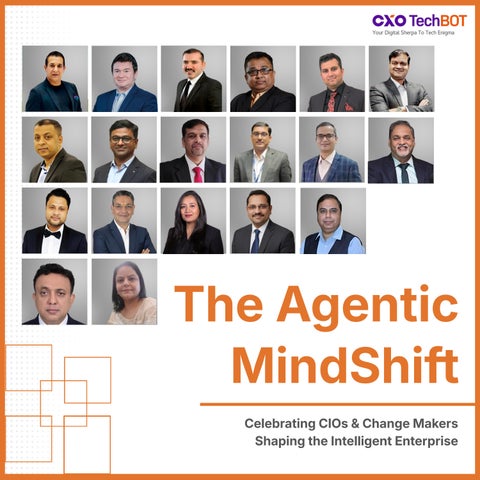
The Agentic MindShift Celebrating CIOs & Change Makers Shaping the Intelligent Enterprise
FOREWORD The Dawn of Agentic Intelligence We stand at an extraordinary inflection point in technological history, one that will be remembered not merely for the advancement of artificial intelligence, but for the fundamental transformation in how we think about intelligence itself. This coffee table book celebrates the visionary CIOs who recognized this shift early, who understood that agentic AI represents far more than incremental progress. It marks a paradigm change from tools that respond to our commands to intelligent systems that anticipate, reason, and act with purpose. These are the leaders who saw beyond the headlines and hype, recognizing that agentic AI would redefine not just technology infrastructure, but the very nature of work, decisionmaking, and humanmachine collaboration. The stories captured in these pages chronicle a remarkable journey. Our featured CIOs didn't simply implement new technologies, they reimagined entire organizations. They asked difficult questions about autonomy, trust, and responsibility. They navigated uncharted ethical territories. They balanced innovation with governance, ambition with prudence, and possibility with practicality. What emerges from their collective experience is a portrait of leadership in transition technical acumen paired with philosophical depth, strategic vision grounded in operational reality, and the courage to champion transformation even when the destination remained unclear. This book is both a celebration and documentation of a recognition of pioneering leadership at a moment when such leadership matters most. The agentic AI mindshift is not a distant future, it is unfolding now, shaped by the decisions and insights of the remarkable individuals profiled here. May these stories inspire your own journey into this new era of intelligent partnership.
Swati Gupta CEO & Managing Editor
INDEX Enterprise GPT: The Intelligence Layer That Transforms Organizations
8
The Digital Continuum: Building Foundations, Driving Transformation, Creating Value
12
Designing a Business That Can Think and Act: From Automation to Autonomy
14
From Data Silos to Shared Intelligence: Designing AI for Connected Progress
16
Protecting the Digital Core: Scaling Cyber Resilience with Autonomous AI Defense
18
From Components to Intelligence: How AI is Rewiring Automotive Manufacturing
20
The Decision Framework: When to Deploy Agents
22
Reengineering Clinical Intelligence: Turning Medical Narratives into Decisions
28
The Agentic Mindshift: Architecting the Future of Intelligent Enterprises
30
Enabling Faster Decisions Everywhere: AI That Shortens the Distance to Answers
32
From Pilots to Scale: Architecting Responsible AI Adoption
34
Data, Data everywhere, but no one knows a thing
36
INDEX Why CIOs are the New Chief Orchestrators
38
Intelligent Manufacturing: Building Smart Factories for Sustainable Growth
42
Redefining Enterprise Intelligence with Purpose and Scale
44
Designing Intelligence that Thinks Ahead: From Automation to Agentic AI
46
Healing Beyond Walls: How Digital Access Strengthens Human-Centred Healthcare
48
AI for Connected Ecosystems: Building Intelligence Across Stakeholders
50
Distributed Intelligence: How Agentic Systems Are Reshaping Corporate Hierarchy
52
Agentic Leadership: Using Intelligence to Elevate Human Potential
56
Engineering Intelligence with Intent: Scaling AI from Possibility to Impact
58
AI at Scale: Architecting Inclusive and Responsible Transformation in India
60
Driving Global Business Transformation through Data, Digital & Technology
62
From Automation to Autonomy: The CIO's Transition from System Integrator to Decision Architect
64
CXO TechBOT Executive Masterclass Agentic AI 2.0
Designing Self-Driving Enterprises for the Next Decade
Why This Masterclass? Agentic AI is no longer just an experimental playground for data scientists - it’s the strategic lever for autonomous decision-making, self-optimizing operations, and intelligent orchestration of enterprise ecosystems. This exclusive, advanced-level program will help C-Suite leaders move beyond AI pilots and into Agentic AIdriven business architecture, unlocking productivity at scale, operational autonomy, and competitive moats.
Key Learning Outcomes Agentic AI Strategy Playbook – From AI Assistants to Autonomous Decision Units Enterprise Autonomy Blueprint – How to design workflows where AI agents self-initiate, self-correct & self-scale Multi-Agent Collaboration Models – Interoperability between finance, supply chain, and customer engagement agents Trust, Compliance & AI Governance – Building an ethical & controllable autonomous enterprise ROI Mapping & Value Realization – Quantifying the business impact of autonomy before board approvals Case Studies – Early movers in BFSI, manufacturing, and smart infrastructure using Agentic AI at scale
Format 4 Weeks | High-Intensity Cohort Live Masterclass Sessions with Industry AI Architects & Transformation Leaders
C-Suite Peer Networking Pods Capstone: Enterprise Autonomy Roadmap for Your Organization
Who Should Attend? CIOs, CTOs, CEOs, CDOs, Transformation Heads, Strategy Officers, Innovation Leaders
COHORT STARTS
SEATS
February 2026
Limited to 30 Leaders
Hosted by CXO TechBOT | Agentic AI Leadership Series
www.cxotechbot.com
contact@cxotechbot.com
+91-7304670468
ENTERPRISE GPT The Intelligence Layer That Transforms Organizations Every technology era has its defining infrastructure. The mainframe era had centralized computing. The client/server era had networks. The cloud era had distributed computing. The agentic era has Enterprise GPT-the intelligence layer that sits between your people, your data, and your outcomes. But Enterprise GPT is fundamentally misunderstood. It's not a chatbot for employees. It's not a search engine for corporate knowledge. It's not even just an AI assistant, despite how it often presents itself. Enterprise GPT is the connective intelligence tissue of the modern organization, a reasoning layer that understands context, translates intent, accesses knowledge, executes tasks, and learns from every interaction. It's infrastructure that thinks.
Beyond the Chat Interface The chat interface is merely the entry point, not the innovation. What matters is what happens behind that deceptively simple text box. When an employee asks Enterprise GPT a question, the system doesn't just retrieve information-it orchestrates a complex workflow. It interprets intent, determines what knowledge is needed, accesses multiple systems with appropriate permissions, synthesizes information across sources, applies business logic and compliance rules, generates insights, and presents answers in context. A Marketing Manager asks "What's our Q3 performance in the Northeast region compared to last year, & should we adjust our Q4 budget allocation?" Enterprise GPT doesn't just pull numbers. It accesses CRM data, analyzes sales trends, retrieves budget documents, applies financial policies, considers market conditions, and generates a recommendation with supporting analysis all in seconds, all with appropriate governance.This is orchestration, not retrieval. It's the difference between a library & a research assistant who understands your goals.
08
The Four Dimensions of Enterprise Value Knowledge Democratization: Enterprise GPT eliminates the knowledge bottleneck that constrains organizational velocity. Historically, critical information lived in specific systems, specific documents, and specific people's heads. Finding the right information meant knowing who to ask or where to look for institutional knowledge that took years to develop. Enterprise GPT makes organizational knowledge instantly accessible to everyone with appropriate permissions. A new hire can access decades of institutional wisdom. A field technician can retrieve complex troubleshooting procedures. A finance analyst can understand engineering constraints. Knowledge becomes a shared asset rather than a competitive advantage hoarded by veterans. Workflow Acceleration: The average knowledge worker switches between applications over 1,000 times per day, manually moving information between systems, translating formats, and maintaining context across platforms. Enterprise GPT collapses these friction points.
Instead of manually gathering data from six systems to create a report, you describe what you need. Instead of navigating complex software interfaces for routine tasks, you state your intent. Instead of remembering which system holds which information, you ask for outcomes. The intelligence layer handles the orchestration, letting humans focus on judgment rather than mechanics. Decision Enhancement: Enterprise GPT doesn't replace human decisionmaking; it elevates it. By synthesizing information across domains, identifying patterns humans might miss, surfacing relevant historical context, and stresstesting assumptions, it transforms decision quality. A supply chain manager evaluating vendor options gets not just pricing data but risk assessments, historical performance, geopolitical considerations, and financial stability indicators all contextualized for the specific decision at hand. Better inputs yield better outcomes. Continuous Learning: Unlike traditional enterprise software that remains static until the next update, Enterprise GPT learns from organizational usage. Every query, every interaction, every outcome teaches the system about your business context, your terminology, your workflows, your priorities. Over time, it develops institutional intelligence that reflects your organization's unique knowledge and culture. It becomes more valuable as it's used a rare quality in enterprise technology.
09
The CIO's Strategic Considerations Deploying Enterprise GPT requires thinking beyond technology implementation to organizational transformation. Data foundations matter profoundly: Enterprise GPT is only as good as the data it can access. Siloed, inconsistent, or poorly governed data severely limits value. Many organizations discover that Enterprise GPT deployment forces long overdue data modernization which becomes a hidden benefit. Permission architecture becomes critical: Enterprise GPT must respect access controls across all enterprise systems it touches. This isn't just a security requirement, it's a trust requirement. Employees must trust that the system won't surface information they shouldn't see. Organizational change exceeds technical change: The biggest barrier isn't technology, it's helping people understand how to work with an intelligence layer. This requires new skills, new workflows, and new mental models about how work gets done. Measurement must evolve beyond ROI: Traditional metrics miss Enterprise GPT's compounding value. How do you measure faster decisionmaking, improved onboarding, or knowledge that would have remained hidden? Value accrues through countless microimprovements across the organization.
The Strategic Imperative Enterprise GPT represents a fundamental shift in how organizations operate. Companies that master this intelligence layer gain velocity, adaptability, and decision quality that competitors can't match through traditional means. The question isn't whether to deploy Enterprise GPT, it's how quickly you can do so effectively, how deeply you can integrate it into workflows, and how completely you can leverage it to transform organizational capability. The intelligence layer is here.The organizations that make it foundational infrastructure rather than experimental technology will define the next decade of competitive advantage.
10
Your enterprise needs intelligence infrastructure. Enterprise GPT is how you build it.
Digital transformation succeeds when technology, business intent, & execution discipline move forward together.
Vinay Kumar CIO, McDonald's India
12
Vinay Kumar is an accomplished digital transformation and technology leader, certified in Digital Transformation from IIM Ahmedabad. He brings extensive experience in enterprise IT operations, including ERP implementation, IT infrastructure management, service delivery, strategic planning, and business analysis. Vinay has partnered with business leaders across FMCG (Coca-Cola FBO), QSR (McDonald’s), and Retail (Bata) to align technology initiatives with organizational goals, driving efficiency, scalability, and measurable outcomes. His cross-industry expertise enables him to design practical, businessfocused solutions that address operational challenges, optimize value chains, and support long-term digital transformation objectives.
The Digital Continuum Building Foundations, Driving Transformation, Creating Value Digital transformation is not a single milestone but a structured progression, one that begins with strong operational foundations, advances through business-aligned innovation, and matures into sustained value creation. My professional journey has been shaped by this continuum, where technology is designed not as support, but as a strategic driver of enterprise outcomes. The foundation of transformation lies in building scalable and resilient technology operations. Certified in Digital Transformation from IIM Ahmedabad, I have focused on establishing enterprise-wide IT capabilities that enable agility, reliability, and growth. My work across ERP implementations, infrastructure modernization, and service delivery has centered on creating integrated ecosystems where data, platforms, and governance work in harmony. A strong emphasis on data-led oversight and standardized processes has helped organizations improve efficiency, control costs, and accelerate execution. Transformation gains real momentum when technology is tightly aligned with business priorities. My experience across FMCG (Coca-Cola FBO), QSR (McDonald’s), and Retail (Bata) has provided deep exposure to fast-moving, customer-centric environments. By combining business analysis with IT consulting, I have led the digitization of core functions such as sales, supply chain, and customer engagement. Automation, analytics, and AI-driven insights have enabled greater visibility, faster decision-making, and systems that adapt to changing market demands. Long-term impact comes from sustained value creation, not one-off programs. My approach emphasizes strong vendor partnerships, disciplined negotiations, and cross-functional collaboration to support cloud-first, agile, and customer-focused architectures. Equally important is change management, building capabilities, driving adoption, and ensuring every digital initiative delivers measurable business value. Digital transformation, at its core, is a leadership discipline. Organizations that succeed are those that continuously evolve, combining strategic clarity, execution rigor, and a future ready mindset.
13
Technology should take work away from people, so people can make decisions that move businesses forward.
Shashwat Singh CIO, boAt
14
Shashwat Singh is the CIO at boAt, where he is building the company’s technology backbone from the ground up, shaping digital strategy, strengthening core systems, and leading the teams that deliver them. With 18+ years of experience at organizations such as Hindustan Unilever and Asian Paints, he has driven transformation across fast-moving, dynamic businesses. Recognised as one of Asia’s 100 Power Leaders in Technology and a Young Alumni Achiever of IIT Kharagpur, Shashwat focuses on using technology that improves execution, sharpens decisions, and supports long-term growth.
Technology Enables People to Move Beyond Tasks and Focus on Decisions That Drive Business Forward In our organisation, digital transformation started with a goal of automating what slows people down. Over the years, we achieved that through ERP modernization, RPA, and workflow orchestration. But efficiency alone eventually delivered its full value. We could automate tasks, while decisions continued to rely on human judgment. That is where my focus on AI began: shifting from execution to judgment. Today, we are entering the age of Agentic AI; systems that donʼt just provide answers, but carry out actions based on clear business intent. It is the difference between asking a question and assigning a responsibility. In this evolution, the actual challenge is how the business operates. To prepare for autonomous systems, we are redesigning core elements of the organization 1. Operating Model Built on Outcomes: Instead of step-by-step handoffs, processes are re-shaped into goals that agents can pursue end-to-end, from validating data to triggering downstream actions. 2. Security as Architecture, Not Afterthought: Agents interface with multiple platforms, so guardrails must be embedded: identity governance, monitored delegation, and a clear boundary between what agents can do and what remains human oversight. 3. Clear Ownership of Decision Rights: Delegation is not abdication. For every autonomous function, the accountable human remains known and is fully auditable. Workforces are evolving, too. The skill isnʼt to replace people. Its̓ʼ to raise them. Teams learn how to collaborate with AI: checking assumptions, guiding objectives, and focusing on negotiation, creativity, and strategic problem-solving, the work humans do best. Scaling this vision requires discipline: embed AI into systems people already use, link every initiative directly to business value, and secure active CXO sponsorship. Proof-of-concepts donʼt transform companies. Ownership does. Agentic AI isnʼt a trend we're chasing. Its̓ʼ the operating reality we are building toward, where systems solve problems, leaders set direction, and organizations become more adaptive than ever before. The future of work is not automation but autonomy with accountability.
15
AI real legacy will be measured not in algorithms, but how it empowers every individual to dream bigger & achieve more.
Keyur Desai Head IT (CIO) Prince Pipes and Fittings Ltd
16
Keyur Desai is a distinguished CIO and digital transformation leader with over 24 years of experience driving technology-enabled business growth across diverse industries. Currently serving as Head IT at Prince Pipes & Fittings Ltd., he leads enterprise modernisation through ERP, cybersecurity governance, and AI-driven manufacturing initiatives that boost operational resilience and strategic decision-making. A multiaward-winning industry voice, keynote speaker, and mentor, Keyur has built unified digital ecosystems, advanced cyber defence frameworks, and scalable data intelligence capabilities that deliver measurable business value. He continues to champion human-centred innovation, shaping future- ready enterprises that thrive with secure, intelligent, and connected technology.
From Data Silos to Shared Intelligence Designing AI for Connected Progress My journey with AI has always been shaped by a simple belief: when people and information are connected, progress accelerates. Early in my career, I saw how valuable insights often remained fragmented across systems, geographies, and functions. Critical decisions slowed because technology was limiting them. That realisation guided me toward AI as a force for clarity, connected growth, and collective intelligence. Today, the focus is on building AI-driven platforms that break down silos and deliver decision-ready intelligence across the enterprise. Instead of data sitting locked within departments, AI now interprets signals from supply chains, finance systems, customer interactions, and operations, helping leaders act together with speed and confidence. One of the most transformative opportunities has been autonomous predictive decision-making across business units. When demand shifts in one region, AI can instantly adjust forecasts, reallocate supply priorities, and alert teams before a disruption turns into loss. Decision-making has evolved from being reactive to becoming a shared, real-time advantage. The result is more than efficiency; it’s alignment and trust. It’s about creating a culture where people across continents solve challenges as one connected organisation. Looking ahead, the next phase lies in self-learning enterprise systems that continuously adapt to change. But scaling AI successfully is not just about technology-it’s a mindset. It means designing with responsibility Ensuring diverse, representative data to minimise bias Making outcomes transparent for accountability Embedding constant review to keep ethics at the centre It’s important to remember that AI isn’t only powering faster work; it’s reshaping how we treat one another and how our decisions influence society. The opportunity ahead is extraordinary, but only if people remain the anchor. AI should amplify judgment, not replace it. It should open doors to talent, not close them. And above all, it should help build a future of progress that everyone can share.
17
Cyber defense succeeds when people focus on progress, while AI ensures business never pause.
Partha Protim Mondal CIO, Berger Paints India
18
Partha Protim Mondal is a visionary technology and enterprise applications leader with over 27 years of techno-functional expertise in Oracle Applications, Cloud Infrastructure, and Digital Transformation. He has successfully led large-scale implementations across ERP, Enterprise Planning, Oracle Process Manufacturing, and Business Intelligence & Analytics for prestigious clients including WHO, GE Security, Toshiba, Jindal Steel, and Sanmina SCI. Partha specializes in project management, IT security, generative AI, OCI/OIC, and advanced analytics, ensuring on-time delivery of high-quality solutions. Known for his strong client engagement, problem-solving, and governance skills, he drives innovation, operational efficiency, and enterprisescale technology transformations.
Protecting the Digital Core Scaling Cyber Resilience with Autonomous AI Defense
Instead of automation, our AI journey began with protection. In an industry where uptime and trust define market leadership, we realised that traditional cybersecurity methods could no longer defend against modern threats. Attackers were evolving faster than manual responses. Logs were exploding in volume, while risk visibility was scattered across tools. The only way forward was autonomous intelligence: systems that detect, learn, and respond at machine speed. This led us to build a Self-Healing Cyber Defense Framework powered by AI. It analyses billions of signals across endpoints, cloud workloads, networks, and identities. When anomalies emerge (lateral movement, ransomware signatures, privilege escalation), the system isolates the event, initiates remediation workflows, and brings operations back online without human intervention. The result is zero-touch resiliency. Threat investigation times dropped from hours to minutes. Incident containment achieved 24×7 continuity without relying solely on security teams. Most importantly, our defences became proactive, predicting vulnerabilities before exploitation. This innovation extended beyond IT. As a market leader serving dealers, distributors, contractors, and large consumer ecosystems, we infused intelligence across every customer-facing system. AI-driven monitoring ensures secure transactions, safeguards supply chains, and preserves trust in every interaction. Cyber resiliency became a business enabler. Our next step is Autonomous Threat Exchange, a capability that allows our internal AI engines to collaborate across business units, benchmarking behaviours, and elevating protection collectively. The learning accelerates with every new signal. The organisation becomes stronger with every attempted breach. Responsibility remains central. We deploy explainable AI, enforce transparent governance, and continuously test for bias in models that impact identity verification and fraud detection. Security must protect people; never discriminate against them. For me, the true power of AI is seeing humans do what machines cannot: applying judgment, empathy, and creativity, while technology guards the foundation that enables them. We are building a future where business never pauses, where cyber resilience fuels growth, and where AI stands as both shield and engine for transformation.
19
Smart factories are not born from technology alone, but from trust, collaboration, and a willingness to evolve.
Ajay Kumar Ajmera Group CIO Rockman Industries
20
Ajay Kumar Ajmera is a seasoned CIO and digital transformation strategist with more than two decades of experience driving Industry 4.0 initiatives across manufacturing and industrial enterprises. As Group CIO at Rockman Industries, he leads AI adoption, SAP S/4HANA transformation, and cybersecurity modernization to build intelligent, resilient, and data- driven factories. With deep expertise in smart supply chains, cloud, automation, and operational technology integration, Ajay continues to enable organisations to scale with innovation while keeping people and security at the core of progress.
From Components to Intelligence How AI is Rewiring Automotive Manufacturing We are living through a defining moment in manufacturing. As the automotive components industry embraces Industry 4.0, Artificial Intelligence (AI) has moved from being a concept to the operational backbone of our factories. At Rockman Industries Limited, this shift means intelligence woven into every process, every line, and every decision. Our journey began with a simple goal: reduce downtime and improve quality. We used machine-learning algorithms to monitor equipment behavior in real time, predict failures before they happen, and schedule interventions proactively. On the assembly line, we deployed computer-vision systems to spot defects instantly, rejecting faults earlier and cutting waste significantly. Yet the technology alone did not guarantee transformation. We learned quickly that data is the proper foundation. Only when data was clean, connected, and contextualised could AI deliver value. So we invested in a robust data governance framework that cleaned, unified, and protected the information flowing across supply chain, production, and quality departments. We also recognised that culture matters. AI adoption required a transformation. We upskilled teams, made them AIliterate, and invited every stakeholder to shape the change. We created a shared mindset: automation is not a threat but a tool to enhance human capability. Cybersecurity and ethics have been bedrock as well. With vast operational and customer data at risk, we built transparent, fair, and accountable AI solutions. From supplier data to production parameters, every algorithm is subject to governance and review because trust is non-negotiable. Now, we are looking forward to edge computing, IoT convergence, and adaptive manufacturing systems. AI will soon enable factories that self-optimise, self-learn, and flow with demand dynamically. And as CIO, my role is to ensure that this digital transition isn’t just technology-led, but business-driven, anchored in value, people, and purpose. The road ahead is fast and data-driven. We are engineering the future by embracing innovation, building capacity, and maintaining responsibility.
21
THE DECISION FRAMEWORK When to Deploy Agents Not every problem needs an agent. Not every agent deployment succeeds. The difference between transformative results and expensive disappointment often comes down to a single question asked at the right time: Should we? The pressure to deploy AI agents is immense. Competitors announce initiatives. Vendors promise revolution. Your board asks why you're not moving faster. But seasoned CIOs know that strategic deployment beats rushed adoption every time. The framework isn't whether you can deploy agents, it's when, where, and how.
The Readiness Matrix Before evaluating specific use cases, assess your organization across four critical dimensions. Think of these as prerequisites, not checkboxes. Data Foundation: Agents learn from data and act on data. If your data is siloed, inconsistent, or poorly governed, agents will amplify these problems rather than solve them. Ask yourself Can an agent access the information it needs to make decisions? Is that information reliable? Do we have clear data ownership and quality standards? Process Clarity: Agents excel at executing well-defined processes with clear decision criteria. Ambiguous, constantly changing, or poorly documented workflows create confusion for humans-they create chaos for agents.
22
The paradox: organizations with the messiest processes often want agents most desperately, but they're the least ready to deploy them effectively. Risk Tolerance: Every agent deployment involves accepting some level of autonomous decisionmaking. What's your actual appetite for letting systems act independently? This isn't about technology comfortit's about organizational culture and regulatory constraints. A financial services firm has different risk parameters than a retail company. Organizational Learning Capacity: Agents don't deploy themselves. They need training, monitoring, refinement, and continuous improvement. Do you have teams capable of managing agentic systems? Can your organization learn from agent failures without abandoning the entire initiative?
Filter Two: The ValueRisk Equation What's the potential impact versus the downside if the agent makes mistakes? Highvalue, lowrisk use cases are obvious starting points. Customer service chatbots handling routine inquiries: significant volume, limited downside. Agents autonomously approving million dollar contracts: high stakes, better suited for later deployment stages. Calculate not just financial ROI but also learning value. Some lower impact use cases might be worth pursuing because they build organizational capability and understanding with minimal risk. Filter Three: The Feedback Loop Can you measure whether the agent is performing well?
The Use Case Filter Once you've assessed organizational readiness, evaluate specific opportunities through three sequential filters. Filter One: The Agency Test
Can you intervene when it's not? The best agent deployments have clear performance metrics, human oversight mechanisms, and the ability to quickly adjust or pause. Avoid "black box" scenarios where you deploy agents into processes you can't effectively monitor.
Does this use case actually benefit from agency, or would traditional automation suffice? Agents add value when tasks require judgment, adaptation, or coordination across multiple systems. If you're simply automating a deterministic workflow, traditional RPA might be faster, cheaper, & less complex. Ask Does this task require making decisions based on context? Will conditions change in ways we can't fully predict? Does success require coordinating across multiple processes or systems?
23
The Maturity Pathway Smart CIOs don't deploy agents everywhere simultaneously. They follow a maturity progression that builds capability, confidence, and organizational learning. Stage 1: Assisted Intelligence Start with agents that augment human decisionmaking rather than replace it. Deploy agents that research, analyze, and recommend-but humans retain decision authority. A procurement agent that identifies potential vendors and summarizes options, with humans making final selections. This stage builds trust and understanding. Stage 2: Bounded Autonomy Graduate to agents making routine decisions within narrow constraints. Clear rules about when to escalate. A fraud detection agent that flags suspicious transactions and automatically declines obvious violations while escalating borderline cases. You're giving autonomy, but with guardrails. Stage 3: Adaptive Systems Deploy agents that not only execute but learn and improve their decisionmaking over time. These agents adjust strategies based on outcomes, but within governance frameworks you've established. A supply chain agent that optimizes ordering patterns based on emerging demand signals and supplier performance. Stage 4: Orchestrated Ecosystems The mature state: multiple agents working together, coordinating across functions, with humans setting strategic direction and handling exceptions. This is the ultimate goal, but it requires mastery of the earlier stages.
24
Building Your Roadmap The most effective agent roadmaps balance ambition with pragmatism. Start with a portfolio approach: identify 35 use cases across the maturity spectrum. Deploy quick wins that build confidence while simultaneously piloting more complex applications that drive longterm value. Set clear success criteria before deployment not just ROI, but learning objectives, capability development, and organizational adoption. Plan for iteration. Your first deployment won't be perfect, but it should generate insights that inform the second. Most importantly, communicate the journey. Help your organization understand that agent deployment is a transformation, not an implementation. You're building new capabilities, new ways of working, new forms of collaboration. That takes time, experimentation, and patience.
The Strategic Imperative Red Flags and Green Lights Deploy agents when Processes are well documented with clear decision criteria You have clean, accessible data and strong governance Volume justifies the investment in setup and monitoring Failure modes are manageable and detectable You can iterate based on performance data Delay deployment when Core processes are in flux or poorly understood Data quality or accessibility is questionable Regulatory or ethical implications are unclear You lack technical capability to monitor and adjust The organization hasn't developed agent literacy
The question isn't whether to deploy agents-it's whether you're deploying them strategically. With cleareyed assessment of readiness, rigorous evaluation of use cases, and a thoughtful maturity progression, agents become powerful collaborators that transform how your organization creates value. Without that framework, they become expensive experiments that consume resources and erode confidence in AI's potential. Choose wisely. Deploy deliberately. Scale thoughtfully. The agentic future belongs to organizations that approach deployment as strategic capability building, not technology shopping. Your framework determines your results. Make it count.
25
In healthcare, innovation succeeds only when it makes care safer, faster, and more humane.
Mohit Tandon Vice President(IT) Metro Group Of Hospitals
28
Mohit Tandon is Vice President of Information Technology at Metro Group of Hospitals, where he leads technology modernization to improve clinical decision-making, strengthen patient safety, and support scalable care delivery. With 17 years of experience in healthcare IT, he has driven significant advances in EHR integration, infrastructure modernization, and cybersecurity compliance across multi-facility hospital environments. Mohit focuses on turning digital capability into clinical value, enabling doctors and care teams with systems that are faster, clearer, and built around real patient needs.
Reengineering Clinical Intelligence Turning Medical Narratives into Decisions Healthcare generates an enormous amount of information, but much of it is locked away in unstructured clinical notes, discharge summaries, and diagnostic reports. The challenge was never a lack of data. Practically, it was the inability to use it meaningfully in real time. That insight drove our work with Natural Language Processing (NLP) in clinical systems. The goal was understanding. Hospitals can now surface crucial patient insights within seconds by enabling systems to extract context from clinician-written text. Comorbidities that previously lay hidden within long case histories are now recognized immediately. Drug interaction risks are flagged before harm occurs. Risk indicators for severe conditions like sepsis can be detected while time still matters. This transformation has reshaped three primary outcomes in healthcare delivery Clinical decision-making is better supported Care teams spend less time searching and more time treating Patient safety has stronger safeguards What makes this transformative is responsible adoption. Models are validated with clinical experts, outputs remain fully auditable, and physicians keep final authority. AI augments judgment; it never replaces it. Looking ahead, the next leap is AI-powered autonomous healthcare operations. Instead of episodic interventions, systems will continuously monitor, learn, and act by adjusting workflows, reallocating resources, and coordinating care well before bottlenecks develop. The future healthcare enterprise will be proactive, not reactive. Scaling this future requires disciplined execution Data infrastructure that prioritizes quality and privacy Governance frameworks rooted in clinical safety Workforce readiness for human-AI collaboration Most importantly, success depends on one principle: technology must serve care, not the other way around. The work continues with a clear intent to convert every captured word into knowledge and every insight into better patient outcomes.
29
AI is not just a tool; It’s a mindset shift for enterprises to think, adapt, & evolve
Rahul Rai Head - Service Management Platform Syngenta Group
30
Rahul Rai is a visionary global technology leader with 22+ years driving enterprise transformation across Artificial Intelligence including Generative & Agentic AI, Deep Learning, SAP, Business Intelligence (SAP Analytics Cloud, Qlik, Tableau), and advanced analytics. His work spanning AI projects, automation, business intelligence, sentiment analysis, Agentic AI solutions, and the establishment of a Reporting Factory has enabled data‑driven decision‑making at scale. Having held senior roles at Capgemini, IBM, and Cognizant, Rahul now focuses on architecting next‑generation intelligent systems to power enterprise innovation. A recognized thought leader and recipient of multiple prestigious awards, he is a frequent speaker at NASSCOM forums, leading academic institutions & industry platforms, contributes AI articles to pan‑India magazines, mentors leaders on ethical AI & prompt engineering & actively advances AI literacy across organizations.
The Agentic Mindshift Architecting the Future of Intelligent Enterprises Artificial Intelligence has evolved not in sudden leaps, but through deliberate phases of learning and refinement. From rule-based automation to machine learning, deep learning, generative AI, and now agentic AI, each stage has expanded what enterprises can imagine and achieve. What makes this moment distinct is not just technological advancement, but the convergence of intelligence, autonomy, and scale. My journey with AI has been shaped by this progression. Over time, the focus has shifted from deploying tools to architecting systems that think, adapt, and collaborate. AI today is no longer confined to isolated use cases. When designed thoughtfully, it becomes an enterprise fabric that connects data, processes, and decisions across industries such as healthcare, education, manufacturing, and agriculture. Emerging technologies like quantum computing will only accelerate this trajectory, redefining strategic boundaries in the years ahead. The next wave of innovation lies in multimodal intelligence and autonomous agents working in concert. Generative AI, strengthened by Retrieval-Augmented Generation architectures, allows organizations to blend creativity with precision. Agentic frameworks enable systems to execute complex, multi-step workflows while remaining context-aware and outcome-driven. This convergence is reshaping operations, enabling leaner processes, hyper-personalized experiences, and business models built for resilience and adaptability. Yet, intelligence without responsibility is fragile. Ethical governance must anchor every AI strategy. Human oversight, dynamic guardrails, and rigorous architectural review are essential to ensure autonomy does not compromise trust. Strong data foundations, coupled with transparent monitoring, protect integrity while enabling innovation. Equally important is AI literacy across the organization, ensuring confident and compliant adoption aligned with broader ESG and sustainability goals. The workforce transformation ahead is as critical as the technology itself. Leaders must cultivate continuous learning, encourage experimentation, and bridge the gap between IT and business. Centers of Excellence play a vital role in translating vision into execution, enabling enterprises to scale AI initiatives from pilots to production with clarity and purpose. Ultimately, AI is not just a tool; it is a mindset shift. Organizations that succeed will be those that combine architectural discipline with imagination, ethics with agility, and innovation with intent. In doing so, they will not merely adapt to the future, but actively shape it.
31
Enterprise AI must think fast, act responsibly, and earn trust- only then does intelligence scale.
Shibin Chulliparambil Head of IT Malabar Group
32
Shibin Chulliparambil is a global technology leader with over 23 years of experience driving digital transformation and business growth. As Head of IT at Malabar Group, he leads enterprise modernization initiatives, including SAP S/4HANA implementation and strategic IT infrastructure advancement. A former CEO with a Doctorate in Business Administration (IT), Shibin combines strong business acumen with deep technology expertise, enabling organizations to scale, innovate, and excel in competitive markets.
Enabling Faster Decisions Everywhere AI That Shortens the Distance to Answers For many organisations, digital transformation begins with automation, but for us, transformation started with a question: How quickly can people find the correct answers? In sales, every delay has a cost. When product details require expert clarification or approvals take time, customers move on. Internally too, employees lose hours searching for policies, eligibility rules, or compliance approvals. These inefficiencies were hidden, but they were genuine. We responded with a bold goal of delivering the correct answer in seconds. That vision led to our AI-powered Intelligent Sales Knowledge Engine, trained on technical data, configuration guides, and historical customer queries. When sales teams enter a question, from product safety specifications to regulatory requirements, the system retrieves context, summarises alternatives, and suggests the best solution path. The outcome has been transformative Turnaround time reduced from days to minutes Increased conversion rates and customer confidence Sales teams now spend more time closing Inside the organisation, we built a companion capability; an AI Policy & Eligibility Assistant. Employees can simply ask “Am I eligible for this benefit?”, “What is the approval flow for this request?” , “Can you generate a summary for my submission?” The chatbot responds instantly, eliminating long email loops and dependency on support desks. Consequently, productivity rose, frustration fell, and people felt empowered. Looking ahead, our focus is on brilliant enterprise systems that anticipate the following query before it is asked, which may include risk identification, decision guidance, and agility activation across business functions. Throughout this journey, we have followed a responsible design model Transparent decision logic Strong data privacy safeguards Continuous audits against bias Ethical accountability embedded in deployment The future belongs to organisations where intelligent information access fuels every interaction, with customers, colleagues, and growth itself. We are on a mission to build precisely that future.
33
Experiments spark innovation, but only structure sustains it. Transformation begins when curiosity meets accountability.
Kamal Matta CIO & CISO Sonic Biochem Extractions Ltd.
34
Kamal Matta is a CIO and CISO leading digital transformation at Sonic Biochem Extractions Ltd. With expertise in IT governance, cybersecurity, and business continuity (CISA, CISM, ISO 27k LA), he has successfully turned IT from a support function into a strategic profit center. Over his career, Kamal has driven system integration, e-commerce modernization, and secure infrastructure development to align technology with enterprise growth. His leadership blends innovation with resilience, ensuring technology remains both an enabler and a safeguard for business success.
From Pilots to Scale Architecting Responsible AI Adoption Every wave of technology begins with curiosity. For us, the first explorations into intelligent systems were small pilots, focused on problems like fraud detection, predictive maintenance, and customer experience. These efforts proved their worth, but they also revealed a limitation: experiments alone cannot carry out the transformation. True impact comes when innovation is embedded into the fabric of the enterprise, scaled with discipline, and guided by responsibility. That insight has shaped our approach. Each initiative begins with precision, defining the business challenge, linking it to measurable outcomes, and securing leadership alignment. Once clarity is established, we select use cases that can demonstrate tangible value and build a foundation for scale. Early wins create confidence, but the goal is always continuity, moving from proof-of-concept to enterprise adoption. Integration is where progress accelerates. Cross-functional teams dissolve silos, while scalable architectures and modern deployment practices allow replication across business units. Cultural alignment is equally important: resistance is addressed through communication, learning programmes, and recognition of those who lead adoption. Responsibility, meanwhile, forms the bedrock; bias audits, privacy-preserving techniques, and model explainability create the scaffolding of trust. This disciplined model has reshaped outcomes in multiple domains. Predictive frameworks have strengthened operational continuity in manufacturing, generative models have accelerated design cycles, and advanced forecasting has improved accuracy in finance and healthcare. The benefit is not only efficiency; it is the ability for people to devote their energy to creativity, strategy, and meaningful collaboration. Looking ahead, the horizon is shifting towards multimodal systems, capable of processing language, imagery, and sensor data together, and edge intelligence that brings capability directly to the point of action. These advances will redefine industries from mobility to education. However, technology alone is insufficient. The future requires governance frameworks, ethical standards, and workforces prepared to collaborate with intelligent systems at scale. Our contribution has been to demonstrate that transformation is not achieved through experimentation alone. It demands structure, discipline, and trust.
35
The future belongs to those who use AI to amplify human judgment, creativity, and ethical decision-making, not to replace it.
Minanath Dhaske Head of IT TATA AutoComp Systems Ltd
36
Minanath Dhaske is a accomplished technology leader and continuous learner with a crossdisciplinary career spanning mechanical engineering, supply chain, IT infrastructure, information security, and digital transformation. He currently leads IT for the EV Components business at Tata AutoComp Systems, shaping the digital roadmap for the electric mobility sector. Minanath drives initiatives in Industry 4.0, SAP EWM, MES, MRP, and secure, scalable greenfield manufacturing operations. Previously, he spearheaded advanced IIoT, RPA, AR/VR, and defence-grade cybersecurity programs, delivering measurable business impact and operational excellence. Known for building future-ready teams and resilient IT foundations, he aligns technology strategy with organizational growth and innovation.
Data, Data everywhere, but no one knows a thing The data generation due to digitalization by the overall business ecosystem has been prominent in the last few years. On the other hand, business leaders starving to get insights even after getting deep into scattered data led my Data & AI journey. The AI vision has evolved over the last few years drastically with generative and agentic AI intervention. I can see the professional and personal life of human beings getting simplified with AI assistants. Certain roles will exist, certain roles will be transformed, certain will not exist - this is a matter of debate. But whoever exists will be AI enabled for sure. I have been instrumental in leveraging AI in document comprehension using Natural Language Processing (NLP), predictive analysis of manufacturing ecosystems (using Linear and non-linear models). The larger impact of AI will be seen in automation, personalization, content generation, cybersecurity and big data insights. The rise in the AI ecosystem will also fuel the ethics discussions. Fairness and transparency will be demanded across the AI systems. I feel this problem should be addressed in the design of the AI system itself. The explainability and the comprehensiveness of the training data will make things simple and models unbiased. The skillsets of the future would be divided in major two parts - skills complementing use of AI and the skills which cannot be adopted by AI. The skills which can scale faster with the help of AI will get transformed, we can see huge throughput scaling using AI. Skills like strategic, ethical thinking will be prominent skillsets of the future and we don’t see AI adopting these skills soon. The skills of mundane nature and prototype work content-based roles will be eliminated in future. Overall mankind will be pushed towards a more intelligent, emotional, ethical, innovative and artistic way of working. The success of AI systems is in scaling. They look attractive in POC because of the limited dataset. The major shift in scaling the AI system can be achieved by continuously tuning the systems and keeping it relevant to the use case. Apart from technical, business alignment, user buy-in and communication are non-negotiable things for scaling AI systems. “Fail fast, fail forward” is my major learning in AI and Digital transformation so far. Try, fail and eliminate one unsuccessful path. Try, succeed and find out better ways to do things. One should be always skillful in his own core skillsets like finance, marketing, design etc. and should acquire AI skills in addition. Not a single business will be left unimpacted by AI, hence it is better to be equipped.
37
WHY CIOs ARE THE NEW CHIEF ORCHESTRATORS Technology, Trust, Talent, & Transformation
The job description just changed. For years, the CIO role centered on three core responsibilities keep systems running, enable the business through technology, and manage the IT organization. Execution, enablement, efficiency. Critical functions, but fundamentally operational. The agentic era elevates the CIO to strategic orchestrator of four interdependent forces that will define organizational success: Technology, Trust, Talent, and Transformation. Master the orchestration, and your organization thrives. Fail at any one element, and the entire system falters.
Technology From Stack to Ecosystem You're no longer managing a technology stack. You're cultivating an ecosystem where humans, agents, data, and processes interact dynamically. The questions shift from "What platforms do we deploy?" to "How do different forms of intelligence collaborate effectively?" Your technology decisions now shape collaboration patterns. Which agents should communicate directly? Where do humans add unique value? How does information flow between autonomous systems? The architecture isn't just technical-it's social, organizational, and cognitive.
38
Trust The New Infrastructure In a world where systems make consequential decisions independently, trust becomes infrastructure-as foundational as networks or databases. Your organization must trust that agents will act appropriately, that their decisions align with values, that they'll escalate when uncertain. Building trust architecture requires transparency in how agents reason, accountability for their actions, and the ability to intervene when needed. It demands continuous verification, not blind faith. Trust isn't about eliminating risk-it's about managing it intelligently while enabling autonomous action. You're the architect of institutional trust in hybrid humanagent organizations.
Talent Orchestrating Hybrid Teams Your talent strategy now encompasses humans and agents working together. What capabilities should live in humans versus agents? How do you develop people whose primary role is managing, training, and collaborating with AI systems? What does career development look like when agents handle tasks that used to define entire professions? The answers require rethinking everything from hiring to evaluation to organizational design. You're not replacing humans with agents-you're composing teams where both contribute their distinctive strengths. That composition is leadership, not technology deployment.
Transformation Leading Through Ambiguity Perhaps most critically, you're guiding your organization through a transformation that nobody fully understands yet. The roadmap is being written as we travel it. Your people are excited, anxious, confused, and energized-often simultaneously. Your role is to provide direction without false certainty, to enable experimentation within appropriate bounds, to learn from both successes and failures, and to help your organization develop new capabilities while maintaining operational stability.
The Orchestrator's Challenge Orchestration isn't controlled. A conductor doesn't play every instrument-they bring out the best in each musician while ensuring the whole creates something greater than its parts. Similarly, you're not directing every decision or dictating every interaction. You're shaping the conditions where technology, trust, talent, and transformation harmonize.
39
This requires different skills than traditional CIO leadership demanded. Less about command and control, more about cultivation and emergence. Less about detailed planning, more about adaptive strategy. Less about managing resources, more about orchestrating intelligence. You're conducting a symphony where some musicians are human, others are AI, the score is being written in realtime, and the audience expects a masterpiece. The CIO role has been elevated, expanded, and fundamentally reimagined. Technology leadership is now about orchestrating the four forces that determine whether organizations thrive or struggle in the agentic era.The baton is in your hand. The ensemble is assembled. The era has begun.
The Agentic Era Reshapes Leadership Intelligence
→
Distributed to edges, intentionality centralized at core
Architecture
→ From system integration to decision design
Leadership
→ From operational manager to strategic orchestrator
The New CIO Mandate Architect systems that think, build organizations that trust them, develop teams that collaborate with them, and lead transformation toward futures we're still discovering.
40
EMAIL SECURITY THAT EVOLVES Email was never designed for today’s threat landscape. Yet it remains the primary channel for business-critical communication. VIPRE Integrated Email Security is built to close that gap with intelligence that evolves as attacks do. Designed specifically for Microsoft 365 environments, VIPRE delivers context-aware, intent-driven protection that goes beyond traditional rules and signatures. It secures inboxes where modern threats operate without disrupting your existing infrastructure. Trusted globally, VIPRE combines advanced threat intelligence, automation, and human clarity to protect what matters most: people, data, and decisions.
Why Organizations Choose VIPRE Purpose-built for Microsoft 365 Enterprise-grade protection tailored for SMEs Global threat intelligence cloud Proven, award-winning customer support Simplified security without sacrificing depth
Proven at Scale Trusted by 50,000+ customers & partners worldwide 25+ years of cybersecurity expertise 20 million endpoints protected 1.8 billion emails processed every quarter 10 million+ inboxes secured
Security should evolve as fast as threats do. VIPRE makes that possible.
www.vipre.com
info@cyberveritas.co.uk
+91 99102 66770
Technology can automate processes, but it’s people who give intelligence purpose. Our role is to bridge both.
Shrenik Kothari Regional IT Infra Head Gestamp India
42
Shrenik Kothari is an accomplished IT leader with over 22 years of experience in the manufacturing and automotive sectors. As Regional IT Infrastructure Head at Gestamp India, he oversees infrastructure strategy and execution across India, while also supporting in Japan. His expertise spans SD-WAN, Industry 4.0, Smart Factory, IoT, cybersecurity, and IT project management. Shrenik has successfully led six greenfield plant setups, building IT infrastructure from scratch to full operational readiness. He holds certifications in Efficient Time Management,IT Project & Program Management, SD-WAN, and Microsoft Exchange Server 2019 Administration, He has been recognised with several awards, including the World CIO 200 – Legend Category (2023–2025), NEXT100 Future CIO 2024, and the Automation Hero Award 2024. He is also an Associate Member of the National Cyber Security Standards.
Intelligent Manufacturing Building Smart Factories for Sustainable Growth
Manufacturing has always been about precision, efficiency, and scale. Yet, as industries confront rising complexity, it has become clear that traditional automation alone is not enough. At Gestamp Automotive India, our vision has been to move beyond automation to intelligent systems; factories that predict, adapt, and self-correct in real time. This journey took shape across six greenfield plants we built from the ground up, with a seventh now underway in Gujarat.By embedding machine intelligence-powered IoT platforms into our core infrastructure, we enabled predictive maintenance, energy optimisation, and real-time production monitoring. The impact has been profound: improved uptime, reduced costs, and higher resilience in a highly competitive sector. These outcomes reflect more than technology; they represent a shift towards manufacturing intelligence as the foundation of growth. Our contribution to India’s AI journey lies in showing what is possible when Industry 4.0 principles are applied at scale. Smart factories are not abstract visions; they are operational realities where data-driven insights shape decisions, processes optimize themselves, and teams are empowered to act with foresight. By integrating intelligence into infrastructure, we have helped create production systems that are not only more efficient but also safer, more sustainable, and better prepared for future demands. The road ahead points to even greater transformation. We see autonomous operations and digital twins as the next leap forward, systems capable of simulating, optimising, and executing decisions with minimal intervention, while giving leaders unprecedented visibility into operations. For India’s manufacturing sector, these capabilities will be a gamechanger, unlocking both global competitiveness and sustainable growth. Of course, progress must remain responsible. At Gestamp India, every deployment is guided by transparency, fairness, and accountability. Cross-functional collaboration ensures systems are inclusive in design, while audits and governance frameworks reinforce trust. For us, eliminating bias and embedding fairness is not a technical checkbox; it is a leadership responsibility. Future readiness will also depend on people. We are committed to equipping teams with the skills and mindset to thrive in intelligent factories, technical acumen, cross-disciplinary collaboration, and a focus on value creation rather than task execution
43
Courage builds innovation, clarity shapes it, and purpose sustains it, thats’s how we turn intelligence into impact.
Golam Mustafa Deputy CIO Emami Agrotech Limited
44
Golam Mustafa is an IIMA-certified Tech Leader and an award-winning technology executive with over two decades of experience driving enterprise transformation across manufacturing, supply chain, and customer experience. Recognised among CIO100 – The Game Changer, CIO Accelerator X, and EmergeTech 2025, he specialises in turning technology from a cost centre into a growth engine. His expertise spans SAP S/4HANA, Salesforce, AWS, and AI strategy, delivering measurable business outcomes through digital innovation. As the author of The Tech Driver and a sought-after speaker, Golam champions technology leadership built on Courage, Clarity and Code.
Redefining Enterprise Intelligence with Purpose & Scale Technology has always been seen as a support system. For me, the turning point came when I realised it could be far more, the growth engine of business itself. Over the past two decades, across roles at IBM, Accenture, and now as Deputy CIO at Emami Agrotech, I have witnessed this shift firsthand: from automation for efficiency to embedding intelligence into the very core of enterprise strategy. At Emami Agrotech, this ideology has shaped our operations. By integrating intelligence across planning, execution, and reporting, we have transformed the way the enterprise anticipates demand, empowers its salesforce, and equips leadership with real-time insights. The impact has been tangible: greater agility, resilience in volatile markets, and measurable value creation. For us, intelligence is not an add-on but the foundation for strategic decisions. The future, as I see it, lies in autonomous digital agents, intelligent systems that don’t simply respond but act proactively, capable of self-optimising workflows, managing complexity, and amplifying human creativity at scale. These agents will redefine industries, reshaping supply chains, customer experiences, and even how societies tackle sustainability and healthcare. Yet progress without responsibility risks losing trust. That is why transparency, fairness, and inclusivity are embedded in every initiative we pursue. Governance frameworks ensure that intelligence augments human potential, never replaces it. Leaders, I believe, must act as custodians of trust-championing diversity, eliminating bias, and ensuring systems serve both business and society with integrity. Preparing for this future will also demand a new kind of leadership; one that blends technical fluency with empathy, adaptive thinking, and ethical judgment. At Emami, we nurture this mindset through a culture of continuous learning, empowering teams to view intelligent systems as partners in success rather than as replacements. Scaling intelligence across an organisation is not primarily a technology challenge; it is a change management journey. By tying every initiative to business outcomes, securing executive sponsorship, and fostering cross-functional ownership, we have moved projects from pilots to enterprise-wide adoption. Let’s anchor innovation in outcomes, lead with ethics, and remain curious. The future will not be built by those who manage technology, but by those who drive it with courage, clarity and purpose.
45
The true power of AI lies not in automation, but in its ability to anticipate, adapt, and act responsibly.
Mohan Shah CTO, ClaimPro Assist
46
Mohan Shah is an award-winning technology leader with over 28 years of experience driving digital transformation, enterprise IT, and scalable platforms across InsurTech, logistics, transportation, and real estate. As Chief Technology Officer at ClaimPro Assist Pvt. Ltd., he leads the design and scaling of secure, real-time, and predictive platforms that modernize insurance claims and nationwide logistics coordination. Mohan has architected highavailability systems handling millions of transactions, delivered significant cost optimization, and improved operational turnaround times. Recognized by ETCIO, VARINDIA, and the Indian Express Group, he is passionate about building customer-centric, future-ready technology that bridges innovation with measurable business outcomes.
Designing Intelligence that Thinks Ahead From Automation to Agentic AI Artificial Intelligence entered my professional journey not as a trend, but as a conviction. After nearly three decades in IT, I had witnessed many technology waves, yet AI stood apart because it could learn, anticipate, and improve with experience. Early experiments began with automation, but they quickly revealed something larger: the opportunity to build systems that do not merely support operations, but actively enhance how businesses function. Over time, my perspective on AI evolved. What began as efficiency-driven experimentation became a broader vision of intelligence embedded across the enterprise. When applied thoughtfully, AI shifts organizations from reactive decisionmaking to predictive and preventive action. It enables faster insights, smarter operations, and experiences that feel intuitive rather than engineered. This transformation has been especially evident in areas such as logistics and insurance, where intelligent automation has simplified complex workflows. By combining predictive analytics, conversational interfaces, and workflow orchestration, AI has delivered faster decisions, reduced errors, and improved service reliability. More importantly, it has encouraged a culture where data informs judgment and teams trust intelligent systems as partners in execution. Responsible adoption remains critical. Ethical design, transparent data practices, and continuous model audits are nonnegotiable. Fairness, explainability, and inclusivity must be built into AI systems from inception. Technology should enhance trust, not compromise it. Looking ahead, the next evolution is Agentic AI. These intelligent agents will operate as digital co-workers, managing multi-step processes, collaborating with humans, and continuously optimizing outcomes. Realizing this future requires strong data foundations, governance rooted in accountability, and a workforce prepared for human–AI collaboration. Ultimately, AI delivers value only when it solves real problems with intent. The leaders who succeed will be those who combine technical depth with ethical judgment, curiosity, and empathy, ensuring intelligence serves progress, not complexity.
47
Technology should make care faster and easier, while humanity should make it meaningful.
Girish Koppar CGO, ABI Health
48
Girish Koppar, BE, PGDMS, is a visionary leader and mentor in Healthcare IT with over 30 years of experience across Healthcare, Manufacturing, and Textile sectors. A Certified Independent Director, CHCIO, PMP, and ITIL professional, he currently serves as an independent consultant and advisor to startups, guiding digital transformation initiatives. Girish is a board member and secretary of CHIME India Chapter, an assessor for NaBH Digital Health Standards, and visiting faculty at TISS Mumbai. Recognized multiple times in the CIO Powerlist, he is a thought leader, mentor, and contributor to advancing healthcare IT standards, innovation, and leadership across India.
Healing Beyond Walls How Digital Access Strengthens Human-Centred Healthcare For decades, hospitals were designed around clinical systems and operational efficiency. Today, patients arrive far more informed, armed with research, opinions, and expectations shaped by a digital-first world. Information has become the new authority. Modern hospitals are no longer just care centres; they are service organisations whose success depends on trust, responsiveness, and experience. Over the past several years, we have focused on transforming healthcare operations while preserving what matters most, the human touch. Digital tools now simplify the patient journey even before they step inside our doors. Online appointments, pre-visit notifications, doctor introduction videos, and virtual follow-ups have reduced anxiety, increased transparency, and built early trust. Yet the most meaningful transformation has occurred at the moment patients feel it most, the discharge process. When a doctor says, “You’re good to go,” the only thing a patient wants is to go home. Historically, however, discharge has been slowed by insurance coordination, documentation, and multi-department approvals. This has created unnecessary stress at a moment of relief. To address this, we introduced AI- and RPA-assisted discharge automation. Intelligent workflows now automate claims documentation, validation checks, and insurer communication. Manual scanning and repetitive data entry have been replaced with rule-based, AI-enabled processes that move information instantly and accurately. The impact has been significant: Faster discharge turnaround times Reduced patient anxiety and frustration Improved bed availability and operational flow Stronger financial and compliance outcomes Beyond operations, AI is reshaping healthcare at a deeper level. As digital transformation accelerates, vast volumes of clean, structured clinical data are being captured through Electronic Medical Records (EMRs). This shift is changing care delivery from reactive and preventive models to predictive and corrective care. Risks are identified earlier, interventions are personalised, and outcomes improve. We are just beginning this journey. As AI models mature, they will help predict discharge readiness, flag insurance gaps in advance, and proactively resolve bottlenecks. In many cases, this will happen before patients are even aware of them. This is the future of healthcare, where operational excellence supports clinical excellence, and technology clears the path for compassion to lead every interaction. Because in healthcare, patients remember how we made them feel, long after they forget everything else.
49
Connected intelligence turns every transaction into a relationship & every process into shared progress.
Purvi Shah CIO, Real Estate Industry
50
Purvi Shah is a forward-thinking CIO with 19 years of experience driving digital transformation in the real estate Industry. She combines strategic foresight with a deep understanding of technology to align IT initiatives with business growth. She has proven expertise in Salesforce, SAP, and cybersecurity and has led large-scale implementations that improved profitability, efficiency, and customer experience. Purvi is recognised for her structured leadership, analytical approach, and ability to turn innovation into measurable value.
AI for Connected Ecosystems Building Intelligence Across Stakeholders At our organisation, AI has always been about forging connections. Customers, partners, and vendors may function in distinct domains, yet intelligent systems have the capacity to integrate them into a cohesive ecosystem. We believe in deploying AI to create networks where insights, decisions, and actions circulate seamlessly across stakeholders. Our early initiatives demonstrated this potential. Predictive analytics reshaped customer journeys, prioritising leads, tailoring follow-ups, and significantly improving conversion. Channel partners benefited from AI-driven performance tiers such as Silver, Gold, and Platinum, which introduced clarity, accountability, and stronger alignment. For vendors, automated triggers and benchmarking reduced approval cycles, lowered costs, and enhanced procurement negotiations. Individually, these innovations delivered measurable gains; collectively, they established a performanceoriented ecosystem that redefined engagement. This ecosystem-led approach represents our company’s contribution to India’s AI progress. Instead of building isolated solutions, we architected platforms that interlink stakeholders and industries. In sectors as diverse as real estate and infrastructure, these systems have enabled enterprises to achieve efficiency while reinforcing transparency and collaboration. By breaking silos and cultivating interdependence, AI has become both a driver of growth and a catalyst for trust. Scaling such an approach required more than technology. Governance, fairness, and accountability were embedded from the outset. Departmental AI champions contextualised adoption, reduced risk, and safeguarded ethical alignment, ensuring that responsibility was distributed rather than centralised. This model turned AI into an organisational capability, anchored in culture as much as in technology. Looking ahead, we believe India’s next inflection point will be the emergence of autonomous, context-aware ecosystems. These will extend beyond prediction, actively reshaping outcomes through real-time decisions in risk management, resource planning, and personalised services. To seize this opportunity, enterprises must evolve towards AI-first operating models and invest in reskilling so people and machines can advance in tandem. For us, AI's enduring value lies in its connective power. We contribute to an India where growth is accelerated, collaboration is deepened, and progress is inclusive and sustainable.
51
Distributed Intelligence How Agentic Systems Are Reshaping Corporate Hierarchy In an age defined by autonomy and artificial intelligence, a silent revolution is underway within corporate structures. Traditional hierarchies built on control and command are giving way to distributed intelligence,a new paradigm where human leaders and AI agents collaborate, coordinate, and cocreate.
The Great Shift From Command & Control to Collaborate & Coordinate For decades, corporate success relied on linear hierarchies clear roles, reporting lines, and authority ladders. But this model, designed for the industrial age, is increasingly incompatible with the speed, complexity, and data density of the digital era. Agentic systems -networks of autonomous, selflearning AI agents are dismantling this rigidity. Instead of topdown directives, decisions now emerge dynamically from intelligent nodes that continuously sense, reason, and act. “The future of leadership isn’t about control,it’s about coordination.” Consider a manufacturing enterprise where digital agents autonomously handle procurement, production, and logistics. These agents communicate, learn from each other, and optimize outcomes in real time forming a self-organizing ecosystem where intelligence is distributed, not dictated.
52
Rise of the Digital Colleagues Agentic AI has given birth to a new class of collaboratorsdigital colleagues. These entities can perform complex cognitive tasks, from strategy and operations to innovation and customer engagement. Imagine a corporate strategy room where AI strategists sit alongside executives continuously scanning global trends, running simulations, and offering insights. Human leaders focus on creativity and ethics, while their AI counterparts manage complexity and computation. This human-AI symbiosis marks the rise of capability-driven influence over hierarchical power. Decisions are no longer confined to the C suite; they are made wherever the most relevant intelligence resides. “Power in the age of agentic systems will shift from titles to capability networks.”
Decentralized DecisionMaking The Flat Enterprise Distributed intelligence naturally leads to decentralized decisionmaking. Intelligent agents embedded within departments can make context-aware choices instantly.
Challenges on the Horizon Trust, Alignment, & Accountability Yet, the rise of agentic systems introduces new questions Who is accountable when an AI agent’s autonomous decision goes wrong? How can thousands of agents remain ethically aligned with corporate values? To navigate this, organizations must design responsible autonomy frameworks-embedding explainable AI, transparent audit trails, and decentralized governance models. New roles such as Chief Agent Officer may emerge to oversee AI orchestration, ethics, and compliance. “Leadership in distributed enterprises will be defined by trust, transparency, and technological empathy.” Human leaders will need to focus less on authority and more on principled stewardship-defining the moral and strategic boundaries within which autonomous systems operate.
Marketing agents adjust campaigns in real time. Finance agents rebalance portfolios based on predictive data. HR agents design personalized learning journeys. The result? A flatter, faster, and fluid organization where hierarchy becomes a dynamic mesh of connected intelligence. Leadership evolves from command to sensemaking and synchronization. The CEO’s role shifts too from being the “chief decisionmaker” to the “chief orchestrator” of distributed intelligence. Middle management, traditionally responsible for information mediation, transforms into AI coordination layers ensuring harmony among human and digital contributors.
53
The Future Networked Enterprises & Living Organizations Tomorrow’s corporations will not function as rigid pyramids, but as intelligent ecosystems interconnected webs of humans and AI agents cocreating value. Teams will assemble dynamically around projects, with agents identifying skills, coordinating resources, and even mentoring human counterparts. Decisionmaking will become contextual, continuous, and collective. The enterprise of the future will thrive not on hierarchy, but on connectivity, adaptability, and cognition. “Distributed intelligence is not just about AI,it’s about rethinking how intelligence itself is organized.”
The Conclusive Factor From Hierarchies to Harmonies As agentic systems evolve, they will not merely automate work they will redefine the structure of intelligence within organizations. Success will depend on a company’s ability to balance autonomy with alignment, ensuring that distributed decisions drive shared purpose. The corporate hierarchy of the future will not be vertical but networked, dynamic, and deeply intelligent. The leaders who thrive will be those who can orchestrate a symphony of human and machine capabilities-where intelligence flows freely, and every node contributes to the greater whole. Key Takeaways Hierarchies are shifting to distributed, AIaugmented networks. Agentic systems enable self-organizing decisionmaking. Leadership evolves from control to orchestration. Trust and alignment are the new pillars of governance. The future enterprise is a living, learning ecosystem.
54
Secure with Confidence. Comply with Clarity. In an era where cyber threats evolve faster than regulations can keep pace, organizations need more than protection. Cyber Veritas bridges the gap between cybersecurity excellence and regulatory compliance, ensuring your business stays secure, compliant, and competitive. We deliver risk-led cybersecurity strategies and compliance advisory aligned with GDPR, NIST, ISO 27001, IASME Cyber Essentials, and PCI DSS. Our approach ensures security supports business growth rather than slowing it down. Cyber Risk Assessments and Compliance Advisory Penetration Testing and Vulnerability Management Incident Response and Ransomware Readiness Application Security (SCA, SAST, DAST) Governance, Risk and Compliance (GRC) Secure Digital Transformation
Why CyberVeritas Risk-Centric. Regulation-Ready. Business-Aligned. With over 20 years of experience and a strong Big Four pedigree, CyberVeritas brings enterprise-grade expertise with proven real-world delivery. Our methodology identifies genuine risks, tests actual weaknesses, and enables leadership teams to make confident security decisions under pressure. Security should never be theoretical. It must perform when it matters most.
www.cyberveritas.com
info@cyberveritas.co.uk
+91 99102 66770
Technology should elevate the human experience. With AI, we are not just transforming systems, we are redefining how enterprises think, decide, and lead.
Rahul Kawthankar Group CIO & CISO Sri Adhikari Brothers Network
56
Rahul Kawthankar is a technology pioneer with over 25 years of exemplary experience across enterprise IT, information security, and cybersecurity. He has led large-scale digital transformation initiatives, cloud modernization programs, and enterprise security frameworks that strengthen business resilience and enable sustainable growth. A trusted advisor to boards and senior leadership, Rahul excels at translating complex technology and risk landscapes into clear strategic opportunities. Widely recognized for visionary leadership and cybersecurity innovation, he has consistently delivered measurable enterprise impact. His expertise spans IT governance, cyber risk management, business continuity, data privacy, infrastructure modernization, and value-driven technology investment.
Agentic Leadership Using Intelligence to Elevate Human Potential I have always believed that technology finds its highest purpose when it elevates the human experience. Across more than twenty-five years of leadership in IT, cybersecurity, and digital platforms, particularly within the media and entertainment industry, my journey has been shaped by a single question: how can intelligence help people think faster, act wiser, and lead with greater clarity? My entry into artificial intelligence was not driven by fascination with algorithms, but by a recurring limitation I witnessed across enterprises. Organizations were rich in data, yet constrained by human bandwidth. Critical decisions were delayed not because information was unavailable, but because meaning could not be extracted in time. AI, to me, became a bridge between information and insight. Over time, this perspective evolved from automation to augmentation. The most impactful systems are not those that replace human judgment, but those that sense context, learn continuously, and act with intent. One such effort was the creation of a predictive security intelligence fabric, designed to detect behavioral anomalies, anticipate risks, and trigger automated responses. What emerged was not merely faster incident response, but a shift in mindset. Cybersecurity moved from reactive defense to proactive resilience. As AI systems grow more autonomous, trust becomes the defining currency. Ethical leadership must guide every design decision. Transparency, fairness, and accountability are not technical features, they are moral commitments. Responsible AI is not about regulation alone; it is about preserving human agency in an increasingly intelligent world. Equally critical is preparing people for this transformation. The future belongs to leaders who combine technical fluency with empathy, who are comfortable with ambiguity, and who view learning as a continuous discipline. AI succeeds at scale only when it is co-created with stakeholders, communicated with clarity, and adopted with confidence. Looking ahead, autonomous agents will orchestrate enterprises end to end. Yet their true value will be measured not by efficiency alone, but by how effectively they free humans to imagine, create, and lead. Technology may shape what is possible, but values will always define what is meaningful.
57
AI creates value only when it sharpens human judgment and aligns clearly with purpose.
Atin Agarwal Fractional CIO InsightCIO
58
Atin Agarwal is a Visionary technology and transformation leader with over 25 years of exemplary experience driving large-scale IT and digital transformations across Telecom, Manufacturing, FMCG, and IT Services. He has led complex enterprise programs delivering significant cost optimization, operational efficiency, and measurable business impact. Atin brings deep expertise in enterprise IT strategy, AI-driven digital transformation, cloud modernization, ERP programs (SAP and Oracle), and M&A integration. Passionate about building high-performing global teams, he focuses on positioning technology as a strategic enabler for sustainable growth, innovation, and customer value.
Engineering Intelligence with Intent Scaling AI from Possibility to Impact Artificial Intelligence did not enter enterprises as a single breakthrough moment. It arrived quietly, through fragmented pilots, narrow use cases, and proof-of-concept experiments that promised efficiency but rarely delivered transformation. The real challenge was never algorithmic capability. It was an alignment. Alignment between business intent, data readiness, and human trust. That realization shaped my journey with AI. The question evolved from what AI can do to what AI should do. When designed with purpose, AI becomes more than automation, it becomes an intelligence layer that helps organizations see patterns earlier, decide faster, and act with greater precision. Across deployments, the most valuable outcomes emerged when AI systems moved beyond prediction and began informing decisions embedded directly into workflows. Well-architected AI systems today enable leaders to detect risks before they surface, optimize operations in real time, and personalize outcomes at scale. The impact is visible across three dimensions Decisions become data-informed rather than assumption-driven Teams shift focus from manual intervention to strategic judgment Organizations gain resilience through anticipatory intelligence What makes AI adoption sustainable is responsible execution. Models must be transparent, governance must be deliberate, and accountability must remain human. AI should challenge thinking, not override it. Bias mitigation, auditability, and explainability are not constraints, they are enablers of trust. Looking ahead, the next transformation lies in autonomous, learning enterprises. AI systems will not operate in isolation but continuously adapt, coordinating processes, reallocating resources, and optimizing outcomes before inefficiencies emerge. This shift demands rigor: Strong data foundations built on quality and security Governance frameworks that balance innovation with responsibility A workforce prepared for human-AI collaboration, not replacement Ultimately, AI succeeds only when it serves a clear purpose. Technology must amplify human capability, not distract from it. The future belongs to organizations that treat AI not as a project, but as a discipline; one that converts insight into action and intelligence into lasting value.
59
True transformation happens when technology empowers people to think boldly, innovate fearlessly, and build a future that includes everyone.
Archana Goel CIO, Advisory & Consultancy
60
Archana Goel is a seasoned technology leader with over 28 years of experience driving digital transformation across diverse business environments. She excels at aligning IT strategy with organisational vision, enhancing operational efficiency, and enabling scalable growth. With strong expertise in cloud, infrastructure, and cybersecurity, Archana has successfully led complex projects and fortified enterprise systems against evolving risks. A peoplefocused leader, she builds high-performance teams and fosters a culture of innovation and agility. Beyond her corporate journey, she is also a dedicated Yoga Guru and active contributor to social causes through HelpingHands.
AI at Scale Architecting Inclusive and Responsible Transformation in India My work with artificial intelligence began with a question that still frames my approach: how can technology transform the way organisations operate, instead of merely sustaining established processes? Over time, this question became more than curiosity. It shaped a commitment to place our company at the forefront of India’s AI transformation. Our early steps were deliberately focused. We developed predictive platforms that reduced downtime and streamlined IT operations. The outcome was not limited to efficiency. It altered how teams approached challenges. Once routine tasks were automated, people redirected their attention to analysis, foresight, and creative problem-solving. That shift prepared the organisation for broader adoption. A significant milestone was the introduction of a decision intelligence platform. It improved forecasting accuracy and accelerated data-driven decision-making across functions. More importantly, it reshaped our culture. Teams began relying on collective intelligence, gaining the confidence to act quickly and decisively in a demanding environment. Today, our contribution extends beyond operational improvements. We are building adaptive systems that connect across industries and generate shared value. These ecosystems are designed not only to enhance productivity but also to foster resilience, inclusivity, and long-term growth. Responsible practice has been a constant principle. Governance, fairness, and transparency are embedded into every stage, from how data is sourced to how models are deployed. Diversity in our teams is equally deliberate because inclusive design leads to outcomes that resonate more broadly. Trust, once built, becomes the foundation for adoption at scale. Preparing people is just as important as advancing systems. Technical proficiency matters, but adaptability, ethical discernment, and intellectual curiosity will define the workforce of the future. Our learning programmes are centred on cultivating these qualities so that employees can grow alongside the technologies shaping their roles. As digital landscape evolves, I want to be focused to contribute solutions that are scalable, responsible, and humancentred. For me, the enduring strength of AI lies not in displacing human judgment but in amplifying it, helping people and organisations address challenges once considered beyond reach.
61
Transformation works when technology stops being a project and starts being how the business runs.
Amit Aggarwal Executive Technology & Data Leader Former Global CIO
Amit Aggarwal is a global technology and transformation leader with over 26 years of international experience across consumer, industrial, and manufacturing sectors. He has held senior leadership roles at organizations including Dyson, PepsiCo, Whirlpool, Sun Pharma, and Varel Energy Solutions. Amit specializes in digital transformation, enterprise platforms, data & analytics, and global capability center strategy, with a strong track record of strengthening data governance, simplifying complex global landscapes, and building high-impact teams that accelerate delivery while optimizing cost. An alumnus of IIT Delhi and ISB, Amit believes technology earns its place when it makes the business faster, clearer, and better aligned.
62
Driving Global Business Transformation through Data, Digital & Technology In today’s fast-evolving business landscape, Amit Aggarwal is recognized as a global technology and transformation leader who combines strategic vision with hands-on execution to deliver measurable business outcomes across industries. With leadership experience spanning organizations such as PepsiCo, Dyson, Whirlpool, Sun Pharma, and Varel Energy Solutions, Amit has consistently transformed technology functions into strategic enablers of growth, efficiency, and resilience. At PepsiCo, Amit led the development of data and digital solutions that unified analytics across markets, enabling faster, insight-driven decision-making and strengthening data-led thinking across global operations. At Dyson, he drove global IT and digital transformation initiatives focused on consumer experience, scalability, and operational agility-aligning business priorities with modern digital platforms that enhanced both performance and customer engagement. More recently, Amit played a key role in leading large-scale, multi-year global transformation programs in the industrial sector, with a strong focus on Modernizing core enterprise platforms, including SAP and mission-critical applications Building robust data and analytics ecosystems to drive transparency and informed decision-making Digitizing and automating global business processes Establishing and scaling a Global Capability Center in India, serving as a hub for technology innovation, data excellence, and process optimization across global operations Amit’s leadership philosophy is simple yet powerful Digital Transformation is not about technology alone-it is about reimagining how technology empowers people, improves processes, and drives performance. His career reflects a consistent vision-to make technology a strategic lever for sustainable growth, operational clarity, and long-term business resilience.
63
FROM AUTOMATION TO AUTONOMY
64
The CIO's Transition from System Integrator to Decision Architect
65
There's a word missing from most conversations about AI: Autonomy. We talk endlessly about automation-making processes faster, cheaper, more efficient. But automation is deterministic. It follows rules. It executes predefined workflows. It's sophisticated, valuable, and fundamentally limited. When conditions change, automation breaks. When exceptions arise, automation escalates. Autonomy is different. Autonomous systems don't just execute processes-they navigate situations. They assess context, evaluate options, make tradeoffs, and take action. They don't ask "What rule applies here?" They ask "What outcome matters most?" This distinction reshapes everything about technology leadership. As a system integrator, you connected components, standardized interfaces, and optimized data flows. Success meant seamless information exchange & reliable process execution. Your architecture was plumbing essential, complex, but ultimately about moving resources from point A to point B. As a decision architect, you design systems that make choices. You define what constitutes good judgment in different contexts. You establish criteria for tradeoffs when objectives conflict. You create governance frameworks that allow autonomous action within bounded authority. The integration mindset asks How do systems share information? The architecture mindset asks How do systems make decisions? Consider procurement. The integration challenge is connecting requisition systems, approval workflows, vendor databases, and payment platforms. The architecture challenge is defining how an autonomous procurement agent should balance cost, speed, quality, and risk when selecting vendors-& when it should defer to human judgment. This transition isn't optional. As AI systems gain autonomy, the quality of your decision architecture directly determines the value they create and the risks they introduce. Poor decision architecture produces agents that optimize the wrong objectives, make brittle tradeoffs, or fail in novel situations.
66
Decision architecture has three layers Objective Architecture What outcomes matter? How do we measure success? What happens when objectives conflict? Your agents need clarity on what they're trying to achieve-not just in ideal cases, but in messy reality. Learning Architecture How do agents improve from experience? What feedback loops inform adaptation? How do we prevent optimizing for local maxima while missing strategic goals? The best decision architecture enables continuous learning while preventing drift from core values. Constraint Architecture What boundaries must never be crossed? What authority levels apply to different decisions? When must humans intervene? Autonomy without constraints is chaos. Constraints without flexibility are just automation. The irony is that giving systems more autonomy requires more thoughtful leadership, not less.
You're not delegating responsibility, you're architecting judgment. You're not eliminating human involvementyou're elevating it to the decisions that genuinely require human wisdom. From system integrator to decision architect. From connecting components to shaping judgment. From building infrastructure to cultivating intelligence. The transition defines this decade of technology leadership.
67
TechBOT Research & Insights Turning Intelligence into Industry Advantage Our Specialised Services Custom Industry Research Reports Go-to-Market (GTM) Strategy Papers Competitive Intelligence Briefs Emerging Technology Spotlights Boardroom-Ready Presentations
Latest AI Industry Research Highlights Agentic AI Market Outlook 2026-2030 AI in Public Governance Enterprise AI Adoption Index GenAI in Manufacturing 4.0 AI Cyber Risk Landscape 2026
Why CXO TechBOT Research? Trusted by CXOs across Fortune 500s, high-growth startups, and government bodies Multi-industry expertise – BFSI, Manufacturing, Energy, Defence, EdTech, Smart Infrastructure AI-Augmented Research Methodology – Faster, deeper, more accurate insights Network of global analysts, data scientists, and industry advisors
We don’t just track industry trends , we decode them into clear, competitive actions for your leadership team. Let’s Build Your Next Strategic Advantage www.cxotechbot.com
contact@cxotechbot.com
+91-7304670468