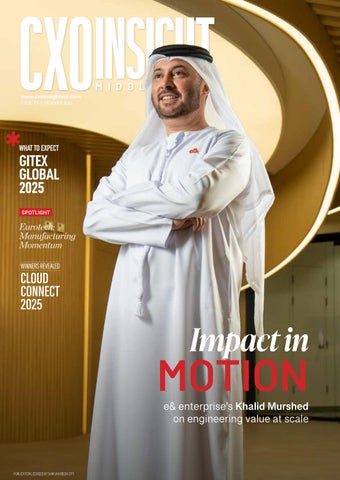
www.cxoinsightme.com ISSUE 79 \ OCTOBER 2025
WHAT TO EXPECT
GITEX GLOBAL 2025 SPOTLIGHT
Eurotech: Manufacturing Momentum WINNERS REVEALED
CLOUD CONNECT 2025
Impact in
MOTION
e& enterprise’s Khalid Murshed on engineering value at scale
COMPLETE
NETWORK VISIBILITY Improve detection coverage and accuracy | Accelerate defense with AI | Disrupt future attacks
OPEN NETWORK DETECTION & RESPONSE PLATFORM
TRUSTED BY
Contents www.cxoinsightme.com
16 COVER FEATURE
IMPACT IN MOTION
e& enterprise’s Khalid Murshed on engineering value at scale
FEATURE 32 GITEX GLOBAL 2025 What to expect at the world’s tech stage
EVENT 54 WINNERS REVEALED: CLOUD CONNECT 2025
SPOTLIGHT 46 MANUFACTURING MOMENTUM How Eurotech harnessed cloud ERP to accelerate growth
INTERVIEWS 24 BEYOND THE PERIMETER TXOne’s Terrence Liu shares insights into driving operational resilience 62 PURPOSE IN PRACTICE IFS’s Sophie Graham on turning sustainability into strategy
VIEWPOINTS
30
62
30 COGNITIVE CONNECTIVITY HPE Networking unpacks the role of AI in modern networks 72 THE SOVEREIGNTY PLAY Zivver (a Kiteworks company) highlights how Middle East is turning compliance into a competitive advantage
72
WHAT’S NEW 78 The latest gears and gadgets to keep you ahead of the curve
PUBLISHED BY INSIGHT MEDIA & PUBLISHING LLC
OCTOBER 2025 | CXO INSIGHT MIDDLE EAST
3
EDITORIAL
THE FUTURE IN MOTION Every October, GITEX GLOBAL transforms Dubai into the heartbeat of the world’s technology economy. It’s where the industry resets its agenda. This year’s show arrives at a defining moment when AI, cloud, and cybersecurity are no longer frontiers, but foundations. The Middle East stands at the centre of this shift — not observing the future, but actively engineering it. GITEX GLOBAL’s growing influence reflects that reality. It has become the platform where ambition meets accountability, and where innovation is measured by the outcomes it delivers. This issue captures that momentum. Our cover story, Impact in Motion, features Khalid Murshed, CEO of e& enterprise, who reflects on how purpose, trust, and disciplined execution are transforming e& enterprise into a regional growth engine. It’s a story about leadership that builds for longevity, not hype. Elsewhere in the magazine, we unveil the Cloud Connect Awards 2025 winners — recognising those redefining cloud transformation across sectors. We also share insights from HPE, DXC Technology, and Liferay, exploring how intelligent infrastructure and digital experience platforms are reshaping enterprise strategy. And in an exclusive interview, Sophie Graham, Chief Sustainability Officer at IFS, discusses
Published by
Publication licensed by Sharjah Media City @Copyright 2025 Insight Media and Publishing
how sustainability must evolve from aspiration to execution — woven into the operational DNA of business. Continuing our theme of impact and innovation, we celebrate the region’s tech visionaries at the ICT Leadership Awards 2025, on 14 October at Raffles Dubai, Wafi. The conversations at GITEX GLOBAL remind us that the next era of technology won’t be defined by speed alone, but by stewardship — how responsibly and intelligently we apply it. As we look ahead, the question isn’t just how far technology can go, but how deeply it can transform. The impact we make now will set the rhythm for the decade to come. We look forward to seeing you at GITEX GLOBAL! Come say hello to us at Hall 24, Stand 12. See you then!
Adelle
Adelle Geronimo Managing Editor
Managing Editor Adelle Geronimo adelleg@insightmediame.com +97156 - 4847568
Commercial Director Merle Carrasco merlec@insightmediame.com +97155 - 1181730
Operations Director Rajeesh Nair rajeeshm@insightmediame.com +97156 - 4110215
Production Head James Tharian jamest@insightmediame.com +97156 - 4945966
Administration Manager Fahida Afaf Bangod fahidaa@insightmediame.com +97156 - 5741456
Designer Anup Sathyan
While the publisher has made all efforts to ensure the accuracy of information in this magazine, they will not be held responsible for any errors
OCTOBER 2025 | CXO INSIGHT MIDDLE EAST
5
IN OUR RADAR
GenAI smartphone market to hit $298 billion in 2025
Abu Dhabi is set to host Mobile Developers Week from December 13–15, highlighting the booming $935 billion mobile app economy. Bringing together 2,500+ participants across four innovation tracks, the event underscores the UAE’s growing influence in digital innovation and the global developer ecosystem.
End-user spending on generative AI smartphones is projected to hit $298.2 billion by the end of 2025, representing 20 percent of total AI spending. The market is expected to grow further to $393.3 billion in 2026, driven by advanced neural processing capabilities in next-gen devices.
Middle East gains momentum amid global robotics demand surge
WhatsApp launches real-time on-device translation
The International Federation of Robotics reports that global industrial robot demand has more than doubled over the past 10 years, with 542,000 new units installed in 2024. While Asia leads adoption, the Middle East is rapidly scaling automation, driven by national transformation programmes like Saudi Vision 2030 and the UAE’s Industry 4.0 push.
Meta has rolled out a new real-time translation feature for WhatsApp, enabling instant message translation directly on users’ devices. Supporting six languages on Android and nineteen on iPhone, the update enhances cross-language communication while ensuring privacy through on-device processing.
RUCKUS Networks expands EMEA leadership
Infoblox appoints new CIO to drive global IT and AI strategy
Danishch / Shutterstock.com
Abu Dhabi to spotlight $935 billion app economy
RUCKUS Networks has appointed Graeme Kane as Lead for EMEA Vertical Markets, based in Dubai. With over 25 years of enterprise tech experience, Kane will drive growth across hospitality and MDU sectors, reinforcing RUCKUS’ commitment to scalable connectivity and regional expansion, particularly in Saudi Arabia and the wider MEA region. 6
CXO INSIGHT MIDDLE EAST | OCTOBER 2025
Infoblox has appointed Justin Kappers as Chief Information Officer to lead its global IT operations. With over two decades of experience at NetApp, Broadcom, and Deloitte, Kappers will focus on scaling IT systems, enhancing employee experience, and accelerating AI-driven digital transformation.
Our solutions Unified service management | Identity and access management Unified endpoint management and security | IT operations management Security information and event management | Advanced IT analytics Low code app development manageengine.com
Visit us at
13 - 17 October, 2025 Booth H7-A10, Hall 7, DWTC
NEWS
Qualcomm moves to Arm v9 amid AI chip race
Qualcomm has transitioned its latest processors to Arm’s new v9 architecture, a move aimed at boosting performance and maintaining competitiveness with rivals Apple and MediaTek. The shift marks a significant step in Qualcomm’s strategy
to enhance its chip capabilities for AIdriven applications such as on-device generative AI, chatbots, and image processing. The company stated that it has selectively implemented features from the v9 instruction set to meet customer
needs. Arm’s latest architecture offers improved performance, efficiency, and security enhancements, positioning it as a key platform for next-generation mobile and computing devices. The announcement comes as competition in the global chip market intensifies and follows ongoing licensing tensions between Qualcomm and Arm. Arm recently confirmed plans to appeal a court ruling in its dispute with Qualcomm over intellectual property rights and licensing terms. Industry analysts note that Qualcomm’s adoption of v9 underscores the growing importance of AI acceleration in mobile chip design, as manufacturers seek to improve device performance without compromising power efficiency. Arm, meanwhile, stands to benefit financially from the rollout, with newer architectures typically commanding higher licensing fees across the semiconductor ecosystem.
Microsoft overhauls leadership as Satya Nadella refocuses on tech
Judson Althoff, Microsoft Commercial Business
8
CXO INSIGHT MIDDLE EAST | OCTOBER 2025
Microsoft has appointed Chief Commercial Officer Judson Althoff to lead a newly consolidated commercial business unit that combines sales, marketing, operations, and parts of finance. The leadership restructuring is designed to streamline operations while allowing CEO Satya Nadella to concentrate on the company’s technology strategy, particularly artificial intelligence and cloud infrastructure. In a blog post announcing the changes, Nadella described the shift toward AI as transformative, saying, “This isn’t just evolution, it’s reinvention, for each of us professionally and for Microsoft.” He emphasised the need to build new computing platforms and advance the company’s innovation agenda amid what he called a “tectonic” shift in technology.
Under Althoff ’s expanded remit, Microsoft aims to strengthen collaboration across its commercial operations, ensuring alignment between sales execution and product strategy. The company also plans to merge its developer and agent marketplaces into a single unified platform, simplifying access to its growing suite of AI tools.
This isn’t just evolution, it’s reinvention, for each of us professionally and for Microsoft SATYA NADELLA Chairman and CEO, Microsoft
IBM, AWS deepen collaboration to boost regional cloud adoption IBM and Amazon Web Services (AWS) have expanded their Strategic Collaboration Agreement to drive cloud adoption and digital innovation across the Middle East. The partnership will combine IBM Consulting’s expertise in hybrid cloud and AI with AWS’s cloud infrastructure to support public and private sector transformation. As part of the collaboration, an IBM-AWS Innovation Hub will be established in Riyadh to enable organisations to develop and test cloud-based solutions. The initiative will also focus on training and certifying regional professionals in Saudi Arabia and the UAE to strengthen local cloud capabilities. Key sectors expected to benefit include e-government, banking, healthcare, and manufacturing. The partnership will also address cybersecurity and sustainability priorities by integrating IBM’s security offerings with AWS architectures, ensuring that cloud solutions meet the region’s data protection and compliance requirements.
Space42 to develop UAE’s first sovereign mobility cloud UAE-based technology firm Space42 has announced plans to develop the country’s first Sovereign Mobility Cloud, in collaboration with Microsoft
(LtoR) Lula Mohanty, Managing Partner – MEA, IBM Consulting, and Tanuja Randery, Managing Director and VP – EMEA, AWS
and Core42. The initiative aims to provide a secure, locally hosted digital infrastructure to support autonomous mobility, fleet operations, and intelligent transport systems. The platform will enable highdefinition mapping, telematics, realtime traffic management, and digital twin simulations, with an emphasis on maintaining data sovereignty and regulatory compliance within the UAE. Core42 will provide the underlying
Jad Harake, Director of Business Strategy at Microsoft, Sulaiman Al Ali, CCO, Space42, and Dr Fan Zhu, SVP, Autonomous Mobility, Space42
The UAE has always led in technological innovation, and autonomous mobility is no exception DR. FAN ZHU Space42
sovereign cloud infrastructure, powered by Microsoft Azure, ensuring data governance, residency, and security. Dr. Fan Zhu, Senior Vice President of Autonomous Mobility at Space42, said, “The UAE has always led in technological innovation, and autonomous mobility is no exception. By building the nation’s first Sovereign Mobility Cloud with Core42 and Microsoft, we are setting a global standard for secure, trusted platforms in mobility and autonomous systems.” According to Space42, the project will allow government entities and private operators to test and deploy advanced mobility solutions under a unified digital framework.
OCTOBER 2025 | CXO INSIGHT MIDDLE EAST
9
NEWS
Bahrain completes six initiatives to advance National Digital Economy Strategy
The Information & eGovernment Authority (iGA) has completed six initiatives under the first phase of Bahrain’s National Digital Economy Strategy (NDES), aimed at accelerating the country’s digital transformation and strengthening its position as a regional technology hub. iGA Chief Executive Mohammed Ali Al Qaed said the initiatives are part
of efforts to realise His Majesty King Hamad bin Isa Al Khalifa’s vision to utilise advanced technologies such as artificial intelligence (AI) in modernising government services. The strategy, guided by His Royal Highness Prince Salman bin Hamad Al Khalifa, the Crown Prince and Prime Minister, and overseen by General Shaikh Rashid bin Abdullah Al Khalifa,
Minister of Interior and Chairman of the Ministerial Committee for Information and Communication Technology, includes nine short-term projects in its initial phase out of a total of 49 planned through 2030. Key achievements include establishing the Innovation and Advanced Technologies Directorate within the iGA to drive emerging technology adoption across government, expanding STEM scholarships—now accounting for over 84 percent of awards in the 2023/2024 academic year—and enhancing cybersecurity measures in coordination with the National Cybersecurity Center. Al Qaed said further initiatives will be rolled out across sectors as implementation progresses, with performance and impact continually monitored.
84%
The proportion of Bahrain’s 2023/2024 scholarships awarded in STEM fields
Abu Dhabi launches strategy to build AI-native government by 2027
10
CXO INSIGHT MIDDLE EAST | OCTOBER 2025
designed around human needs. TAMM 4.0 demonstrates this vision in action.” According to DGE, Abu Dhabi has already implemented more than 100 AI use cases across over 40 entities. Over 95 percent of the government workforce has received AI training, and each department now includes a Chief Data and AI Officer.
The strategy also prioritises the use of sovereign cloud infrastructure, data governance, and cybersecurity to support the next phase of digital transformation. Backed by an AED 13 billion investment, the plan is expected to accelerate Abu Dhabi’s shift toward a more data-driven and connected public sector.
Predrag Milosevic / Shutterstock.com
Abu Dhabi’s Department of Government Enablement (DGE) has announced the launch of the Abu Dhabi Government Digital Strategy 2025–2027, setting a roadmap to make the emirate the world’s first fully AI-native government within two years. The strategy focuses on embedding artificial intelligence across all government entities to enhance decisionmaking, service delivery, and operational efficiency. A key element is TAMM 4.0, an AI-driven government services platform that will be unveiled at GITEX 2025. The new system aims to deliver personalised, multilingual, and predictive services while enabling real-time collaboration among agencies. HE Ahmed Tamim Hisham Al Kuttab, Chairman of the Department of Government Enablement – Abu Dhabi (DGE), said, “Our goal is to help build a government that feels as simple and intuitive as the technology that people use every day. Intelligent, responsive, and
Switch to Speed. Scale Without Limits.
Meet the SwitchBlade x908 GEN3 The SwitchBlade x908 GEN3 is our most advanced modular switch, delivering blazing speed and scalable growth for future-ready enterprise and data center networks.
Blazing Bandwidth: Up to 400G connectivity for high-performance workloads.
Scale Without Limits: 12.8 Tbps of power in a compact 3U chassis.
Flexible & Modular: Compact chassis with versatile interface options.
Smart Management: Zero-touch provisioning and centralized control with AlliedWare Plus™.
Whether you’re scaling a data center or optimizing enterprise networks, the SwitchBlade x908 GEN3 keeps your network fast, flexible, and fail-proof.
Take control. Stay ahead. Transform your network today. For more information, please contact one of our Allied Telesis Account Managers today.
© 2025 Allied Telesis, Inc. All rights reserved.
+971 +97144454 4548740 8740 | | AlliedTelesis.com AlliedTelesis.com
QUOTEWORTHY
“OUR GOAL IS TO HELP BUILD A GOVERNMENT THAT FEELS AS SIMPLE AND INTUITIVE AS THE TECHNOLOGY THAT PEOPLE USE EVERY DAY. INTELLIGENT, RESPONSIVE AND DESIGNED AROUND HUMAN NEEDS. TAMM 4.0 DEMONSTRATES THIS VISION IN ACTION” HE Ahmed Tamim Hisham Al Kuttab, Chairman of the Department of Government Enablement – Abu Dhabi (DGE)
12
CXO INSIGHT MIDDLE EAST | OCTOBER 2025
“THE UAE HAS ALWAYS LED IN TECHNOLOGICAL INNOVATION, AND AUTONOMOUS MOBILITY IS NO EXCEPTION” Dr. Fan Zhu, Senior Vice President of Autonomous Mobility, Space42
OCTOBER 2025 | CXO INSIGHT MIDDLE EAST
13
REPORT
SHADOWS IN THE CLOUD:
MANAGING FRAGMENTED SECURITY
14
CXO INSIGHT MIDDLE EAST | OCTOBER 2025
T
he rapid expansion of hybrid, multi-cloud and AI systems has created complexity that current security strategies are struggling to manage. This is the conclusion of the State of Cloud and AI Security 2025 report, published by Tenable in partnership with the Cloud Security Alliance. The findings show the scale of the challenge. More than four out of five organisations (82 percent) now operate hybrid environments spanning on-premises and cloud. Almost twothirds (63 percent) rely on multiple cloud providers, running an average of 2.7 environments. Each comes with its own controls, policies and shared responsibility models. Together, they create fragmented estates that are difficult to oversee and secure. Identity management stands out as a key source of vulnerability. Inconsistent governance and excessive permissions are frequently cited as the cause of cloud breaches. As AI-driven workloads proliferate, they introduce further complexity into these already fractured environments. Security teams are left contending with disjointed visibility, inconsistent policy enforcement and gaps in monitoring that adversaries are quick to exploit. Enterprises are attempting to respond with a patchwork of tools. The research notes that 58 percent have adopted unified security monitoring, 57 percent use Cloud Security Posture Management, and 54 percent have implemented Extended Detection and Response. Yet most of these remain siloed deployments, limiting their effectiveness. The absence
of a cohesive security approach means organisations are still exposed, despite significant investment. The pressures driving this landscape are well understood. Regulatory requirements, cost constraints and the demand for high performance are all influencing IT strategy. In some cases, organisations have even chosen to bring workloads back onpremises to regain control. But the underlying issue is not where workloads sit; it is whether risk can be consistently monitored and managed across them. Industry leaders are clear about the scale of the challenge. Liat Hayun, Vice President of Product and Research at Tenable, observed that AI workloads are changing cloud environments in ways traditional tools cannot manage. Jim Reavis, Co-founder and CEO of the Cloud Security Alliance, described security strategies as “already behind the curve” and urged organisations to develop adaptive defences that evolve with the technologies they protect. The report illustrates a decisive moment for enterprise security strategy. Hybrid and AI-driven environments are now the norm, but many organisations are relying on outdated models of control. The risk is not confined to blind spots or misconfigurations; it extends to the inability to respond at the pace required. Enterprises that succeed will be those that integrate identity, governance and monitoring into a unified approach, treating security as an operating principle rather than a separate layer. For others, delay will only deepen the gap between innovation and protection.
82%
63%
58%
The proportion of enterprises now running hybrid environments
The share of organisations using more than one cloud provider
The proportion that have adopted unified security monitoring — though most tools remain siloed
OCTOBER 2025 | CXO INSIGHT MIDDLE EAST
15
COVER FEATURE
16
CXO INSIGHT MIDDLE EAST | OCTOBER 2025
IMPACT IN MOTION
One year into his role as CEO, Khalid Murshed reflects on how purpose and clarity are steering e& enterprise into a true growth engine, translating vision into traction without relying on hype
OCTOBER 2025 | CXO INSIGHT MIDDLE EAST
17
COVER FEATURE
F
or decades, digital transformation in the Middle East was largely shaped by outside forces, global hyperscalers, cybersecurity giants, and international integrators. But as governments roll out ambitious national visions, from knowledgebased economies to sovereign cloud and AI-first agendas, the balance is shifting. The region is no longer content to import solutions; it is producing its own. Homegrown champions are now stepping into the role of system builders, combining local relevance with global competitiveness, anchoring sovereign digital infrastructure and reshaping industries in the process. Few companies capture this moment more vividly than e& enterprise, the digital transformation arm of global technology group e&. With a remit that stretches beyond corporate IT to the backbone of economies, it is becoming both a commercial powerhouse and a trusted partner to governments. At the helm of this push is Khalid Murshed, who became CEO in January 2025 after more than 20 years inside the group, including a pivotal term as e& UAE’s Chief Technology and Information Officer (CTIO). His challenge is to accelerate adoption at scale and position e& enterprise as the growth engine of the region’s digital future. Building a growth engine Murshed’s approach to his first year has been defined by methodical alignment of teams, platforms, and pipelines. “Instead of rushing into quick wins, my priority has been to synchronise the many moving parts of e& enterprise into a cohesive growth engine,” he says. That discipline has paid off. In the first half of the year, the company delivered strong double-digit topline growth YoY (+27%), a signal that the long-term strategy is already bearing fruit. But for Murshed, outcomes matter as much as outputs. In a crowded technology landscape, e& enterprise has focused on building systems that endure. “The market is filled with AI pilots and digital proofs18
CXO INSIGHT MIDDLE EAST | OCTOBER 2025
of-concept, the real challenge is to create systems that work at scale nationally, across industries, and with trust at their core,” he explains. The initiatives rolled out in his first year reflect that philosophy. The UAE Sovereign Launchpad has created a pathway for government entities and regulated industries to migrate mission-critical workloads with confidence, ensuring data residency and compliance at every step. A generative AI partnership with Microsoft is already moving beyond lab trials, delivering realtime analytics and augmentation in healthcare, finance and manufacturing. To ensure AI systems are operationalised in live settings,
e& enterprise brought in Katonic for robust machine learning engineering. The AI Academy, built in partnership with Emeritus, is designed to reshape executive leadership, training C-suite figures to see AI not as a tool but as a lens for strategy. In parallel, e& enterprise has implemented AI solutions that put this philosophy into practice. In banking, AI-powered personalization engines analyse millions of interactions to generate deeper customer insights and improve decision-making. In public safety, the Hassantuk smart-fire system uses AI algorithms to reduce false alarms, optimize emergency response time, and enable real-time monitoring of
We’re building the operating system for sustainable, intelligent growth, uniting AI, cloud, and intelligenceled cybersecurity with IoT and experience layers to deliver trusted services, resilient infrastructure, and faster, better decisions
thousands of villas across the UAE. Together, these solutions reflect how applied intelligence is already shaping outcomes at scale. Furthermore, a strategic MoU with Abu Dhabi Investment Office (ADIO) and Exeed is pushing AI-driven production intelligence into UAE manufacturing, reimagining how the sector competes. Moreover, the Utilities Copilot platform brings AI into national infrastructure, helping predict grid outages, optimise operations, and improve service reliability for citizens. In parallel, an agreement with Salesforce combines Sales Cloud, Marketing Cloud, and Tableau with e& enterprise’s engageX platform, creating a fully integrated,
locally hosted CX solution that helps public and private sectors personalise journeys, unify channels, and build trusted, lasting customer relationships. These projects show how trusted intelligence can strengthen both institutional efficiency and public well-being. “We’re not chasing hype or volume,” says Murshed. “We’re building the operating system for sustainable, intelligent growth, uniting AI, cloud, and intelligenceled cybersecurity with IoT and experience layers to deliver trusted services, resilient infrastructure, and faster, better decisions.” In this context, the company has built on its geographic expansion
outside the Gulf. A landmark partnership with Serbia’s Office for IT and eGovernment is expanding hyperscale-ready data centre capacity in Kragujevac by up to 40 MW, positioning the Balkans as a sovereign cloud hub and lowering latency for regional enterprises. Together with 4iG in Hungary and PPF Telecom, this collaboration lays the groundwork for a secure, highcapacity backbone that links MENA to Europe. e& enterprise’s growth momentum has also been matched by strong industry recognitions. Earlier this year, it was recognised by IDC MarketScape as a Leader in Gulf colocation services while its cybersecurity arm Help AG was named a Major Player in Middle East GRC. The engageX platform, e& enterprise’s omnichannel communications offering, was listed as a Major Player worldwide in CPaaS. For Murshed, these acknowledgements show that the company’s approach is resonating with the market. Vision meets accountability Perhaps the most significant structural shift has been e& enterprise’s transition to operating with its own profit and loss. Having spent years as CTIO, Khalid was familiar with pushing technology innovation forward. But with full P&L OCTOBER 2025 | CXO INSIGHT MIDDLE EAST
19
COVER FEATURE
Not every breakthrough belongs in the bloodstream of an enterprise
responsibility, his role is not just to architect solutions but to safeguard the financial health and growth of the business. That responsibility has sharpened his view of priorities. Every acquisition, platform, and investment is assessed not only for its technical potential but also for its ability to integrate smoothly, scale efficiently, and strengthen the bottom line. “While P&L responsibility gives you a sharper lens on the entire business, it also forces you to design the system and not only chase outputs,” Murshed 20
CXO INSIGHT MIDDLE EAST | OCTOBER 2025
explains. “I always weigh which priorities compound customer value and capability over time against those which merely add noise.” But he is equally clear that success must also be measured by empowerment. When e& enterprise deployed more than 200 AI use cases across healthcare, finance, logistics, retail, and government, it anchored itself on meaningful transformation across sectors. “Financial returns tell you how you’re performing,” he says. “But real impact tells you who you’re empowering.” This holistic view on progress and value is reflected in his leadership philosophy, where he sees himself less as a lighthouse and more as a bridge. “A lighthouse shines from afar but remains static,” he says. “A bridge connects what is separate, enabling teams, technologies and markets to move across complexity together.” Murshed adds: “In a region where transformation moves at national scale, the most effective CEOs are not those who simply shine a light
from above, but those who create the pathways that allow others to cross complexity and move forward.” The e& enterprise chief further remarks that true leadership is about creating clarity, not control, making the destination unmistakable so teams can innovate toward it. And sometimes it means restraint. “The hardest thing about staying quiet in a world that rewards volume is resisting the constant pressure to be heard above the noise,” he reflects. “Impact doesn’t come from shouting the loudest, it comes from knowing when to speak, what to say, and how to listen.” Scaling with purpose This disciplined outlook extends into how e& enterprise decides what to build, what to buy, and who to partner with. Murshed is candid about the pitfalls of trend-chasing. “Not every breakthrough belongs in the bloodstream of an enterprise,” he says. “At e& enterprise, we scale what earns trust, not just what attracts attention.”
To enforce that, the company applies a three-lens test before elevating any technology into a platform: can it solve a problem that matters at scale, is there an ecosystem in place to sustain it, and will it age well? The same lens applies to acquisitions. “The real challenge after any acquisition is keeping the spark that made the company successful in the first place while scaling it to deliver even greater impact,” Murshed says. “Our approach is clear: we integrate to elevate, not to absorb or flatten.” GlassHouse is a case in point. Known for its precision in cloud infrastructure and long-standing client relationships, it was not folded into a corporate template. Instead, e& enterprise amplified its strengths within a larger system while protecting its agility. Acquisition remains a critical strategic lever for e& enterprise, not only to accelerate capability building and deepen technological expertise, but also to expand its international footprint across the MEA region. Each acquisition is viewed as a way to unlock operational synergies and regional growth, reinforcing the company’s ambition to become a multi-market digital powerhouse. “Acquisition is one path,” Murshed adds. “The other is partnership, where we co-create and scale together.” Through its collaboration with Microsoft, e& enterprise is accelerating responsible AI adoption across industries. In parallel, a strategic alliance with AWS is scaling Public Cloud adoption, advancing AI innovation, and building Sovereign Cloud capabilities to help enterprises and governments modernise securely and innovate faster. At the same time, e& enterprise is transforming how it operates to stay future-ready, driving stronger synergies across its end-to-end portfolio, strengthening delivery excellence, and deepening industry specialization. By aligning capabilities and expertise around industry priorities in utilities, manufacturing, healthcare, finance, and government, the company is moving from broad
offerings to integrated, high-impact solutions that deliver measurable outcomes. The common thread through all these shifts and initiatives is a focus on building platforms over point solutions. Whether in finance, healthcare, manufacturing, or cloud, the intent remains the same: to create durable systems that power economies, and scale with purpose. A movement, not a moment For Murshed, the next frontier is trust at scale. “For us, the single biggest lever is building trustworthy intelligence at scale, because trust is what allows technology to move from pilots to platforms, and from individual wins to national outcomes,” he says. That means designing not for isolated success stories but for regional systems. “Growth will not come from more proofs-of-concept,” he argues. “It will come when AI, cloud, cyber, and data stop living in silos and start working as a single, trusted system, one that governments, regulators, and enterprises are confident to build upon.” The company will showcase this
ambition at GITEX GLOBAL. Its “Shaping Nation’s Ecosystem” zone is designed to demonstrate how AI, cloud, and cybersecurity can bring outcomes that matter to nations: safer environments, smarter cities, and faster growth. The showcase makes that ambition tangible. One through-line is health resilience, a live AI-powered telemedicine journey traces an emergency from roadside triage to ICU stabilisation, with remote specialists and a command centre synchronising decisions in real time. “At this year’s GITEX GLOBAL, we’re showing how cloud, AI, and cybersecurity come together to power connected economies, not just connected enterprises,” Murshed says. “Our message is simple: a secure, sovereign digital core is becoming the operating system of modern nations and e& enterprise is orchestrating these capabilities so that governments and businesses can innovate at scale.” Looking ahead, Murshed says the goal is not breadth for its own sake but depth that endures, with trust as the foundation for every platform the company builds. OCTOBER 2025 | CXO INSIGHT MIDDLE EAST
21
BRAND VIEW
Reimagining industrial growth through digital ecosystems By Ahmad Saad, Regional Manager, Liferay
A
cross the Middle East and beyond, industrial growth is no longer solely about building factories – it’s about connected digital ecosystems that unlock competitive advantage. With GCC countries targeting USD 1 trillion in non-oil goods exports by 2030, national strategies are driving local production, supply chain autonomy, and technology-led competitiveness. The region holds a distinct advantage, where many manufacturers are building momentum from the ground up, free
22
CXO INSIGHT MIDDLE EAST | OCTOBER 2025
from the heavy legacy systems that slow progress elsewhere. In Saudi Arabia, Vision 2030 is accelerating smart manufacturing and local content growth, while the UAE’s Operation 300bn aims to double the industrial sector’s GDP contribution by 2031. These ambitions call for more than automation – they require platforms that enhance visibility, responsiveness, and resilience. Why manufacturers cannot afford fragmentation Industrial output in Saudi Arabia
grew by 7.9 percent YoY in June 2025, reflecting strong momentum in non-oil sectors, according to the Kingdom’s General Authority for Statistics. Yet many manufacturers remain constrained by siloed systems and manual workflows, inflating costs and undermining responsiveness. Success now hinges on moving beyond operational siloes to platforms, such as Liferay DXP, that unify core processes and enable real-time visibility and data flow. Digital transformation is no longer a technology upgrade but a redesign of how value is created and delivered across the ecosystem. The digital shift – from core to ecosystem Digital transformation now extends far beyond customer apps or automation. Manufacturers are modernising ERP, MES, and PLM systems not just for internal efficiency but to enable secure, agile collaboration across networks of suppliers, distributors, and field teams.
In an era defined by resilience, intelligence, and speed, manufacturers must move beyond tactical upgrades and invest in cohesive, experiencedriven ecosystems
Modern platforms must integrate seamlessly with existing infrastructure while supporting the speed and scale demanded by national industrial strategies. From procurement and logistics to aftersales and compliance, the goal is building experience-rich, connected environments that support both real-time visibility and long-term innovation. This includes modernising B2B commerce journeys. With more millennial and Gen Z decisionmakers, B2B customers now expect seamless, personalised, AI-enhanced digital interactions –intuitive product discovery, AIpowered assistance, and secure self-service portals that integrate across every sales channel. Platforms like Liferay Digital Experience Platform (DXP) enable this shift by delivering self-service portals, collaborative hubs, and secure, role-based access. As servitisation, predictive maintenance, and AI-driven personalisation become standard, integrated engagement is no longer optional – it’s the foundation of resilient growth. Building value across the manufacturing ecosystem As global competition intensifies, industrial leaders must rethink how they engage their broader ecosystem — from suppliers and
logistics providers to internal teams and service partners. Forwardlooking manufacturers are investing in unified digital experiences that consolidate data, services, and workflows in one intelligent, connected interface. With capabilities such as lowcode development, secure access, multilingual UX, and personalisation, Liferay’s DXP allows teams to launch and scale solutions quickly without heavy reliance on custom builds. These environments cut delays, improve decision-making, and accelerate measurable time-to-value across the entire manufacturing chain. Case in point: Škoda Auto In the age of hyperpersonalisation and agile operations, manufacturers that embrace digital transformation beyond production lines to encompass the entire enterprise, are seeing tangible returns in productivity and satisfaction. A standout example is Škoda Auto, the Czech carmaker and member of the Volkswagen Group, which modernised its internal digital infrastructure (employee experience) with Liferay. The company faced challenges as its legacy intranet became costly, complex, and inaccessible. To address this, the company deployed Liferay’s Digital Experience Platform to create a secure intranet serving more than 40,000 employees. The platform provided personalised content delivery, real-time updates, and collaboration tools. The results were tangible: an 82 percent increase in employee satisfaction and 72 percent of employee content consumed directly through the platform, alongside faster deployment of digital solutions. By consolidating communication and access in one hub, Škoda reduced costs and complexity while improving accessibility and engagement. Experience architecture - the competitive edge The battleground in the sector has shifted from throughput to
experience. Whether technicians, suppliers, or customers, ecosystem participants now expect seamless, personalised digital access. Role-based portals provide tailored access to the right information and insights, while platforms like Liferay DXP ensure secure access, multilingual delivery, and backend integration. This enables manufacturers to boost productivity, improve safety, and accelerate adoption — proving that experience is not a service layer but a strategic differentiator. Driving value through connected digital portals For many manufacturers, transformation begins by unifying fragmented systems. Supplier and distributor portals are now indispensable for managing complex, decentralised operations. These platforms improve inventory accuracy, streamline fulfilment, and reduce procurement costs – while enabling strong data sharing across the system. Liferay’s Digital Experience Platform empowers manufacturers to rapidly design and launch such portals. With capabilities for secure system integration, multilingual interfaces, and tailored user journeys – hosted securely on Google Cloud or available via the Google Cloud Marketplace – the platform offers a scalable model aligned with the region’s industrial modernisation goals. Building for a smarter industrial future In an era defined by resilience, intelligence, and speed, manufacturers must move beyond tactical upgrades and invest in cohesive, experience-driven ecosystems. Low-code DXP platforms like Liferay don’t just enable transformation, they deliver strategic advantage. For industrial leaders across the Middle East and beyond, the path to sustainable lies in connected, intelligence-driven ecosystems – linking the factory floor to the last mile. OCTOBER 2025 | CXO INSIGHT MIDDLE EAST
23
INTERVIEW
BEYOND THE PERIMETER Terence Liu, CEO, TXOne Networks, discusses how an asset-centric, operation-first strategy is enabling industries secure critical operations and build lasting cyber resilience
level accountability, while the EU Cyber Resilience Act and standards such as SEMI E187/E188 are pushing security-by-design principles deeper into industrial supply chains.
W
hat major shift do you see shaping industrial cybersecurity in 2025? How are attackers’ tactics evolving? The key shift in 2025 is the transition from “secure the network” to “keep production running.” Defenders are increasingly adopting asset-centric, operation-first controls, alongside continuous inspection throughout the equipment lifecycle. Governance models are now directly linking cyber risk to uptime and quality metrics. Meanwhile, attackers are becoming quieter and more precise — exploiting
24
CXO INSIGHT MIDDLE EAST | OCTOBER 2025
valid credentials, abusing remote service paths, and living off the land. They increasingly favour data theft and operational disruption over overt ransomware encryption. Yet, many OT environments still struggle with routine incidents due to inherent constraints such as limited maintenance windows, mixed system vintages, and strict safety protocols that slow patching and hinder the rollout of modern controls. Globally, frameworks and regulations are reshaping expectations: NIST CSF 2.0 has strengthened governance and board-
How is TXOne advancing asset-centric protections for increasingly complex, converged OT networks? Our philosophy is straightforward: the asset is the heart of operations — and therefore the focal point of cybersecurity. Our mission is to safeguard every piece of equipment across its entire lifecycle, without disrupting ongoing operations. We define this lifecycle across four stages — onboarding, staging, production, and maintenance — and apply tailored security measures at each. Through inspection, endpoint defence, and network protection, we provide layered security coordinated through a centralised platform designed specifically for OT teams. What differentiates TXOne is our alignment with the priorities of OTfocused CISOs. We design controls that adapt to operational realities and always place continuity first. We are also integrating AI technologies — NLP, machine learning, and agentbased intelligence — to transform alerts into insight, rules into resilience, and governance into automation. By grounding these advances in the context of regulation and real-world operations, we aim to provide the shortest, most reliable path to futureready security. How are you securing legacy systems while enabling modernisation without stifling innovation? In OT, uptime is paramount. Modernisation should enhance reliability and efficiency — not force risky rip-and-replace upgrades that
jeopardise production. We understand the cost and disruption that come with an “update everything, everywhere” mindset. Our approach is to secure assets as they are, while paving a safe path toward what’s next. We design lightweight controls so even legacy HMIs and engineering workstations remain responsive. When a device lacks the resources for full endpoint protection, we switch to allow-listing and block unexpected activity. Around those endpoints, we deploy a universal network safety layer through dedicated security appliances, requiring zero system resources from protected assets. Crucially, we continue to support legacy systems — including Windows XP through 2030 — giving industrial operators the flexibility to modernise on their own terms. We secure yesterday’s systems where they operate, surround them with layered OT-native defences, and enable innovation to move forward safely. What should industrial operators and CISOs prioritise in protecting critical assets in 2025 — and how is TXOne positioned to help them? The core mission of industrial cybersecurity remains the same: keeping operations safe and continuous amid evolving threats and regulations. This requires an
asset-centric, operation-first model that learns the environment, enforces known-good behaviour across networks and endpoints, and turns detection into precise, actionable responses — all without forcing shutdowns. Supplier access and maintenance workflows must now be treated as first-class risk domains, as the boundaries of the plant extend beyond the factory floor. AI plays a role here, but only when grounded in operational context. Used responsibly, it can learn baselines, recommend policies, surface anomalies, and correlate alarms with process states — converting noisy events into explainable, auditable actions. Every AI-assisted control must remain transparent, deterministic, and reversible. Mapping these capabilities to frameworks such as IEC 62443, NIST CSF 2.0, NIS2, CRA, and SEMI E187/E188 ensures verifiable compliance. The ultimate outcomes are uptime, safety, and trust — not simply tool proliferation. Where will TXOne make the biggest impact in industrial cybersecurity over the next few years? TXOne is evolving from a cybersecurity solutions provider into a true partner shaping industry standards. Our collaboration with the SEMI E187 cybersecurity committee
and the SMCC exemplifies this approach, as we work with global stakeholders to strengthen sectorwide resilience. We believe OT security success depends equally on people, process, and technology. Yet, skilled talent and mature processes remain scarce, particularly in the early stages of the NIST CSF framework — Identify and Protect. We are leveraging AI to close this gap by learning from global best practices and translating them into actionable, automated guidance for operators. Our platform now spans the entire OT security spectrum — from Identify through Detect & Respond — delivering comprehensive protection, operational fit, and compliance across multiple critical sectors. TXOne is committed to accompanying customers throughout their entire cybersecurity journey, from assessment to incident response, helping them mature their defences and strengthen resilience. Looking forward, we envision industrial security that is adaptive, intelligent, and collaborative — powered by AI, anchored in global standards, and driven by shared expertise. Our mission is to be the most trusted partner in this transformation, turning cybersecurity into the foundation for operational trust and sustainable progress. OCTOBER 2025 | CXO INSIGHT MIDDLE EAST
25
HOW-TO
A
s a CIO, demonstrating the business value of IT has never been more critical. Today’s executive leaders expect IT to deliver more than operational support— they want to see clear, measurable contributions to the organisation’s strategic goals. By building a compelling business value narrative, CIOs can align technology investments with top business priorities, strengthen partnerships with stakeholders and establish IT as a strategic partner driving growth and innovation. The five practical steps outlined below can help CIOs position IT as a strategic enabler and lead meaningful business conversations:
5
1 WAYS TO BUILD THE BUSINESS VALUE OF IT
Bryan Hayes, Senior Director Analyst at Gartner, shares insights into how CIOs can showcase IT’s strategic value and align technology investments with business goals
26
CXO INSIGHT MIDDLE EAST | OCTOBER 2025
Identify the audience
The audience for a business value of IT narrative often includes executive leadership such as the CEO, CFO and COO, as well as business unit leaders and other key decision-makers across the organisation. In many cases, this audience extends to board members, investors and external stakeholders who influence or assess IT investments. Understanding the unique priorities, technical knowledge and expectations of each group is essential. Tailoring the narrative to address the specific roles and responsibilities of each group, ensures greater engagement and alignment with IT ’s objectives.
RALLY BOARD 65
Simple all-in-one solution Everything you need to quickly add video to meeting rooms and open spaces. Experience all-in-one video conferencing that combines crystal clear video, powerful audio, and AI-driven features, all integrated into a single 65-inch touchscreen.
RIGHTSIGHT 2
RIGHTSOUND 2
Optimize participant framing and image processing to deliver clear, crisp visuals for more productive person-to-person interactions.
Minimizes background noise, reduces reverb, and balances voices, delivering crisp audio and eliminating distracting background noise.
SCAN QR CODE FOR MORE DETAILS
HOW-TO
2
Know the audience’s objectives
CIOs can better communicate the value of IT by first understanding what matters most to their audience. Executive leaders and key stakeholders are focused on outcomes that drive organisational success—such as revenue growth, cost optimisation, risk mitigation, operational efficiency, customer satisfaction and competitive differentiation. They want to know how IT initiatives support strategic goals, enable innovation and deliver measurable returns on investment. By clearly linking technology investments to tangible business benefits and the organisation’s overall mission, CIOs can ensure their narrative resonates with decision-makers and builds lasting support for IT priorities.
3
Determine the impact of IT on what matters the most to the audience
CIOs can determine the impact of IT by focusing on how technology initiatives address what matters most to their audience. This means identifying ways IT enables new business capabilities, automates key processes, improves data-driven decision-making, enhances customer experiences and reduces operational risks. By aligning IT projects with business objectives— such as driving growth, reducing costs and increasing agility—CIOs can demonstrate clear connections between technology investments and measurable business outcomes. Highlighting results like faster time to market, improved compliance or increased customer retention helps position IT as a strategic enabler rather than just a cost centre.
4
Building a value narrative
CIOs can build an effective value narrative by clearly articulating how IT delivers meaningful business outcomes for the organisation. This involves crafting a story that goes beyond day-to-day operations to highlight how technology drives competitive advantage, mitigates risk and creates new revenue opportunities. By developing a clear, data-driven narrative that connects IT investments directly to business outcomes, CIOs can elevate IT from a cost centre to a strategic partner—earning the trust and buy-in of executive leadership and stakeholders. This approach helps ensure that IT ’s contributions are recognised as essential to the organisation’s success and long-term vision.
5
Measure the impact of the value story
CIOs can measure the impact of their IT value story by tracking key performance indicators and outcomes that align with organisational goals. This includes monitoring financial metrics such as ROI and cost savings, operational metrics like system uptime and incident response times, and strategic metrics such as market share, customer satisfaction and employee productivity. Regularly reporting on these results—using beforeand-after comparisons and real-world case studies— helps illustrate the success of IT in delivering business value. Gathering feedback from stakeholders further enables CIOs to refine their narrative, ensuring it remains relevant, resonates with the audience and drives desired business outcomes. OCTOBER 2025 | CXO INSIGHT MIDDLE EAST
29
VIEWPOINT
THE ROLE OF AI IN MODERN NETWORKS By Jacob Chacko, Regional Director – MEA, HPE Networking
I
t can be argued that AI is the biggest technology inflection point since the rise of the internet itself, and the impact it’s having cannot be overstated. When it comes to IT operations and network infrastructure, the technology is proving particularly powerful, assuring optimal end user experiences and saving global enterprises significant time and money.
30
CXO INSIGHT MIDDLE EAST | OCTOBER 2025
According to a PwC Middle East report, AI is expected to contribute $96 billion to the UAE’s economy by 2030, representing nearly 14 percent of the national GDP. In alignment with this potential, the UAE National Artificial Intelligence Strategy 2031 outlines the country’s ambition to become a global leader in AI by integrating the technology in nine priority sectors, including telecommunications, infrastructure, and smart city development. By extending AI from the end user across all layers within a network environment, outages, trouble tickets and application downtime will eventually be things of the past. Yet, for AI-powered networking to be truly optimised, it must be embedded in every step of the user journey, with solutions designed from the onset to leverage the right data via the right infrastructure to deliver the right real-time outcomes. Innovation is reshaping the future of networking, with AI driving secure, automated, resilient, and scalable connectivity. The emergence of AI-native networking
AI-native networking is the term given to a new and exciting approach to the development, deployment and management of computer networks which have AI applications and capabilities at their core. And there are two primary cases for an AI-native network.
AI-native networking effectively builds and reaps the benefits of AI application performance while simultaneously saving a lot of time and money
The first is AI for networking, where AI is used for IT operations (a concept known as AIOps) to identify patterns, anticipate network behaviour and detect anomalies. It can make proactive suggestions or self-driving corrections to optimise user experiences and simplify IT operations. Every connection within a networking environment is assured to be reliable, measurable and secure for every device, user, application and asset interacting with the system. The second case is networking for AI, whereby data centre networks are optimised to support strict requirements for AI training and inference workloads. These environments demand ultra-fast, congestion free and reliable GPU interconnects, making the network a cornerstone to ongoing success of AI initiatives. Ensuring the best experiences for users and operators
IT teams and organisations of all sizes can benefit from AI-native features that deliver simpler, more productive and assured online experiences at scale. These advantages include reduced configuration errors, automated and efficient workflows as well as the delivery of reliable and secure user connections.
Rolling out and scaling new networks brings complexities and human error often drives the bulk of such issues. An AI-native networking platform enables operators to proactively identify and resolve issues. Reaching a level of efficiency allows them to devote attention to innovating digital services and applications for the end user. To scale effectively, organisations need to manage increased traffic while operating with the same or reduced budgets and a smaller workforce. To achieve more with fewer resources, operational teams must shift focus from routine tasks to strategic thinking, allowing them to concentrate on driving business results. AI-native networking enables operators to act on insights automatically without the need for human intervention – addressing any problems before they lead to downtime and poor user experiences. Reimagining networks for the age of AI innovation
As data centre footprints expand and compute demands grow rapidly within and across regions, networking becomes increasingly important especially when handling fast-growing and performance in heavy distributed AI workloads, like large language model (LLM) training and inferencing. Today’s AI/ML clusters can consist of thousands of GPUs in a data centre providing massive, parallel computational power required to train modern AI models. Distributing workloads across GPUs and then synching them to train the AI model requires a next-generation network that can accelerate job completion time (JCT) and effectively reduce tail latency, which is when the system is waiting for that last GPU to finish its calculations. AI-native networking effectively builds and reaps the benefits of AI application performance while simultaneously saving a lot of time and money.
Empowering the future of networking
By adopting AI-native networking solutions, organisations can determine network performance issues well before they can impact the user experience. This is a game changer for IT and network operations. The technology empowers a move from reactive to proactive troubleshooting and even enables predictive network troubleshooting and management. This is particularly important for organisations within critical national infrastructure (CNI), including healthcare, government and education. In these organisations, networking services are crucial to support internal and external communication, enabling and optimising operations and improving the lives of end users, customers and the wider public. Ultimately, the rise of AI-native networking combined with the integration of virtual network assistants (VNAs) marks a pivotal shift in global digital connectivity— empowering IT teams to interact with the network infrastructure in natural language, quickly identify root causes, receive prescriptive guidance and take automated actions. Spanning from end user devices to application infrastructures, AI-native networking presents a forward-thinking solution to recurrent challenges in maintaining network performance. This includes capabilities to mitigate network outages, expedite troubleshooting and significantly decrease application downtime. The advantage of AI-native networking is that it offers unparalleled levels of automation, intelligence and reliability. By utilising AI algorithms to streamline tasks and analysing volumes of data to predict network behaviour in real time, AI-native networking is elevating the current state of network connectivity. OCTOBER 2025 | CXO INSIGHT MIDDLE EAST
31
GITEX PREVIEW
GITEX GLOBAL 2025:
AhmedRamzan / Shutterstock.com
THE WORLD’S TECH STAGE
32
CXO INSIGHT MIDDLE EAST | OCTOBER 2025
GITEX GLOBAL 2025 is once again set to dominate the global technology calendar, reaffirming Dubai’s position as a hub for innovation, collaboration, and digital ambition. Now in its 45th edition, the event brings together governments, global vendors, start-ups, and enterprise leaders under one roof, showcasing the technologies shaping economies and societies — from AI and cybersecurity to cloud, data, and sustainable digital infrastructures. With more than 40 halls of exhibition space and co-located
shows spanning everything from fintech to smart cities, GITEX has become a barometer for where the industry is heading next. As the region’s flagship event, it is also a platform where major players unveil strategies, launch new products, and test the industry’s pulse on emerging priorities. In the following pages, we highlight some of the companies to watch at this year’s showcase — names setting the agenda in data resilience, observability, cloud transformation, and AI-driven innovation.
ACRONIS VISIT THEM: HALL 25, STAND B40
Acronis is showcasing its Cyber Protect Cloud platform at GITEX 2025 under the theme “Take the headache out of IT security.” The unified solution integrates endpoint protection, backup, disaster recovery, patch management, and XDR into one platform, giving enterprises and service providers a consolidated approach to cyber resilience. At its stand, Acronis is demonstrating its co-managed security model, enabling partners to deliver 24/7 managed services without the expense of building their own SOCs. The company is also highlighting features such as AI-powered detection, geo-redundant disaster recovery, and zerotrust enforcement, providing organisations with transparent, measurable resilience. Acronis sees GITEX as a platform to emphasise how enterprises in the Middle East, facing mounting cyberattacks and strict data sovereignty requirements, can reduce complexity and strengthen continuity with a future-ready security architecture. Its presence underscores the importance of integrated platforms that support compliance and deliver efficiency while protecting data in an increasingly hybrid, multi-cloud world.
At GITEX Global 2025, Acronis is showing how security, backup and disaster recovery in one platform give regional organisations and service providers the agility, transparency, and future-proof protection they need” Ziad Nasr, General Manager, Middle East, Acronis
OCTOBER 2025 | CXO INSIGHT MIDDLE EAST
33
GITEX PREVIEW
ASUS
CHECK POINT
CLOUD BOX TECHNOLOGIES
VISIT THEM: HALL 2, STAND C70
VISIT THEM: HALL 24, STAND 20
VISIT THEM: HALL 6, STAND A10
ASUS is taking GITEX 2025 under the theme “Ubiquitous AI. Incredible Possibilities,” highlighting its portfolio of Copilot PCs, AI-powered collaboration tools, and cloud-ready devices. Demonstrations include the rugged Chromebook range (CX5403 Plus, CR1204, CX1405), Windows BR1204 devices for students, the ExpertBook Copilot PCs (P5405 and B5405), and enterprise-grade All-in-One PCs (P470VA, PM670, P440). The company is emphasising how AIfirst design, sustainability, and educationfocused innovation are transforming enterprise and learning environments across the Middle East. For CIOs, ASUS is stressing the growing adoption of AI not just in standalone devices but in infrastructure-grade AI systems and edge solutions that redefine resilience and productivity. By aligning with regional priorities such as digital education, sustainability, and scalable cloud integration, ASUS is presenting itself as a partner for enterprises and institutions shaping tomorrow’s data-driven economies.
Check Point is using GITEX 2025 to spotlight its Hybrid Mesh Security architecture and the Infinity Platform, which provides unified defences across multi-cloud, SaaS, OT, and endpoints. Visitors can explore dedicated pods on Exposure & Risk Management (ERM) and Continuous Threat Exposure Management (CTEM), where live demonstrations will show how real-world risks are detected and neutralised. The company is emphasising AI-driven prevention to help enterprises reduce their attack surface in increasingly complex environments. Regional investments include the UAE-hosted Infinity Portal and DESC-certified SaaS services, reflecting Check Point’s commitment to sovereignty and compliance. With local engineers and training initiatives, the company is reinforcing its long-term presence and its aim to equip regional enterprises with the skills and tools needed to innovate securely. At a time when cyberattacks are both escalating in volume and growing in sophistication, Check Point is positioning GITEX as the venue to show how unified defences can deliver resilience at scale.
Cloud Box Technologies (CBT) is demonstrating its infrastructure and AI capabilities at GITEX 2025, backed by over 15 years of systems integration expertise in the Middle East. As a Titanium Dell partner, CBT will showcase laptops, workstations, rugged devices, and servers, alongside Dell PowerScale, which feeds GPU-intensive servers to accelerate AI workflows. The portfolio also covers cybersecurity, including FortiSASE, where CBT is a certified implementor, as well as SOC, NOC, and MDR services. The emphasis is on enabling enterprises across regulated industries like BFSI, healthcare, and education to achieve reduced risk, predictable operations, and faster business decisions. CBT sees GITEX not just as a showcase but as a catalyst for its long-term strategy: strengthening partnerships, investing in local expertise, and shaping the region’s technology ecosystem for the next decade.
At GITEX, we will demonstrate how ubiquitous AI is not just a catchphrase but a practical reality in enterprise, mobility, education, and infrastructure”
Unified, AI-powered security is now essential to minimising exposure, reducing complexity, and sustaining operational continuity”
Tolga Özdil, Regional SYS Commercial Director, META, ASUS
Ram Narayanan, Country Manager, Middle East, Check Point Software Technologies
As enterprises accelerate digital transformation, the region requires secure, scalable, and AI-driven solutions. At GITEX, we position ourselves at the centre of these conversations”
34
CXO INSIGHT MIDDLE EAST | OCTOBER 2025
Ranjith Kaippada, Managing Director, Cloud Box Technologies
COHESITY
CROWDSTRIKE
DELL TECHNOLOGIES
VISIT THEM: CONCOURSE 2, STAND CC2-1
VISIT THEM: HALL 23, STAND D10
VISIT THEM: HALL 6, STAND A10
Cohesity is presenting AI-First Cyber Resilience at GITEX 2025, showing how organisations can safeguard continuity with capabilities that extend beyond recovery. Demonstrations include AI-powered knowledge discovery, automated compliance, and ransomware recovery, tools designed to strengthen readiness and response. The company is also highlighting the value of backup data as more than a safety net. By using backup data for threat detection, compliance monitoring, and business intelligence, Cohesity is reframing how enterprises think about resilience. The firm’s expansion in the Middle East is being reinforced by partnerships with Semperis and Cyera, reflecting a broader strategy that combines ecosystem collaboration with sovereign-ready data models. By placing recovery outcomes such as faster restore times, compliance scoring, and continuity measures at the centre of its message, Cohesity is aiming to show CIOs that resilience is a measurable business asset.
CrowdStrike is returning to GITEX 2025 with a strong focus on how its Falcon® platform is reshaping cyber defence. With adversaries moving faster than ever, the company is showcasing AI-native protection that can detect, respond, and remediate threats in real time across hybrid environments. On stand, visitors will see how Falcon provides visibility into endpoints, identities, and cloud workloads, arming security teams with the tools to stop breaches before they cause damage. CrowdStrike is also highlighting its innovations in exposure management and Falcon for IT, extending its role beyond detection into vulnerability reduction and streamlined IT operations. For Middle East enterprises balancing sovereignty, compliance, and rising cyber risks, CrowdStrike’s GITEX presence reinforces its mission to deliver both security outcomes and operational efficiency. The company is also using the event to strengthen regional partnerships, recognising that collaboration is critical to protecting critical infrastructure and large-scale digital initiatives.
Dell Technologies is using GITEX 2025 to spotlight the future of the autonomous enterprise, presenting how organisations can harness Agentic AI and the Dell Automation Platform to operate with greater speed, intelligence, and resilience. Unlike traditional AI, Agentic AI can refine processes in real time, guided by enterprise data and goals. When combined with the Dell Automation Platform and the Dell AI Factory with NVIDIA, enterprises gain the tools to embed intelligent automation across workflows, infrastructure, and data ecosystems. Visitors will experience this vision through an immersive 4D showcase, exploring the Dell AI Factory, Concept Astro, and the latest AI-powered PCs, alongside a complete portfolio covering multicloud, security, edge, and services. Dell positions GITEX as a key opportunity to strengthen collaboration with customers, partners, and governments driving digital transformation in the region. With the rapid convergence of AI, automation, and multicloud redefining the CIO’s role, Dell is emphasising that the autonomous enterprise is no longer a distant vision but a present-day reality.
With the right AI tools, backup data can deliver real-time threat detection, regulatory insights, and even business intelligence”
For customers, GITEX GLOBAL is a chance to see how security must evolve to match adversaries now operating at machine speed”
Gregg Petersen, Regional Director, Middle East, Cohesity
Roland Daccache, Senior Director of Sales Engineering, Eastern Europe, META & APAC, CrowdStrike
The autonomous enterprise is no longer a distant vision but an achievable reality, powered by Agentic AI, the Dell Automation Platform, and multicloud innovation” Walid Yehia, Managing Director – Gulf, Dell Technologies
OCTOBER 2025 | CXO INSIGHT MIDDLE EAST
35
GITEX PREVIEW
HP
INFORMATICA
LOGITECH
VISIT THEM: HALL 6, STAND A20
VISIT THEM: HALL 4, STAND B20
VISIT THEM: HALL 3, STAND C30
HP is showcasing its vision for the Future of Work at GITEX 2025, with a focus on HP AI PCs and the Workforce Experience Platform (WXP). These offerings aim to improve productivity, strengthen security, and support hybrid work models, with on-device AI ensuring data privacy while enabling performance. The company is drawing attention to the shift from small AI pilots to enterprisewide adoption. HP argues that CIOs must now concentrate on embedding AI responsibly across workflows, teams, and data. Its AI PCs and WXP are practical examples of this shift, providing enterprises with the ability to manage employee experience and IT operations securely and efficiently. For the Middle East, where hybrid work and AI are converging quickly, HP’s presence at GITEX underscores its focus on creating tools that are both forwardlooking and immediately applicable. The company is engaging with customers and partners to discuss how these technologies can support industries ranging from education to retail.
Informatica is addressing one of the critical gaps in AI adoption at GITEX 2025: the lack of data readiness. The company is using the event to showcase its Intelligent Data Management Cloud (IDMC) and CLAIRE AI, which enable enterprises to harness clean, governed, and interoperable data to scale AI initiatives. Another key theme is Agentic AI. Informatica is warning that without proper governance and interoperability, agent-based systems risk creating new vulnerabilities. Its solutions are designed to ensure innovation remains transparent, safe, and sustainable, helping enterprises deploy AI at scale while meeting compliance requirements. For the Middle East, where governments and enterprises are rapidly adopting AI under ambitious national visions, Informatica’s message is timely. Its GITEX showcase is about demonstrating how enterprises can avoid failed pilots and instead turn AI into lasting business value by building stronger data foundations.
Logitech is unveiling its theme of “AIEnabled Collaboration” at GITEX 2025, focusing on AI-powered workplace solutions that enhance productivity in hybrid, remote, and onsite settings. The showcase includes video conferencing innovations debuting for the first time, as well as an expanded lineup of personal workspace solutions such as mice, keyboards, webcams, and headsets. The company is presenting its approach to human-centric and sustainable design, helping enterprises build work environments that are secure, flexible, and efficient. By aligning with evolving work models, Logitech is positioning its collaboration portfolio as essential for enterprises maintaining a competitive edge. Sustainability is another key focus. Logitech follows a “Design for Sustainability” philosophy, considering environmental impact from sourcing raw materials through to product end-of-life. This commitment resonates strongly in the Middle East, where enterprises are adopting ESG-aligned strategies.
“The question is no longer whether to use AI but how to embed it responsibly into workflows, data, and teams”
Informatica empowers organisations with the clean, governed, interoperable data that fuels Agentic AI. This ensures innovation is not only possible but safe, transparent, and scalable”
We aim to share how AI-powered smart collaboration technologies can transforming modern workplaces and enable sustainability goals”
Ertug Ayik, Managing Director & Vice President, Middle East & Africa, HP
36
CXO INSIGHT MIDDLE EAST | OCTOBER 2025
Yasser Shawky, Vice President, Emerging Markets (MEA), Informatica
Murad Ali, Head of GCC, Logitech for Business
GITEX PREVIEW
MANAGEENGINE
MINDWARE
NOKIA
VISIT THEM: HALL 7, STAND A10 HALL 25, STAND B10
VISIT THEM: HALL 2, STAND A30
VISIT THEM: HALL 21, STAND C20
Mindware is launching MAGIC 2.0 at GITEX 2025 under the theme “Artificial Intelligence: The Next Frontier.” The company is framing itself as a value aggregator, bridging global vendor innovation with regional priorities across AI, cloud, and cybersecurity. The showcase is supported by a strong partner presence. Dell Technologies, NVIDIA, Microsoft, AWS, Google Cloud, RSA, Splunk, Trend Micro, Ubiquiti, Archer, Siav, and Everfox will join Mindware to demonstrate solutions and share expertise. Joint demos, copresentations, and spotlight talks will explore real-world use cases, while training sessions and promotions aim to accelerate enterprise adoption. By moving beyond distribution into orchestration, Mindware is positioning itself as a driver of measurable impact, combining technical expertise with regional experience. Its GITEX participation reflects its commitment to helping enterprises embrace AI and cybersecurity as foundational elements of digital transformation.
Nokia is demonstrating its portfolio of secure, sustainable, and intelligent connectivity solutions at GITEX 2025. With regional governments pursuing ambitious digital agendas, the company is aligning its innovations with national priorities around AI-driven networks, sustainability, and sovereignty. Visitors can explore solutions spanning mobile, fixed, and optical networks, alongside private wireless systems tailored to industries such as energy, manufacturing, and logistics. Nokia is also demonstrating how AI can optimise network performance, improve efficiency, and support advanced use cases in smart cities, Industry 4.0, and critical infrastructure. Sustainability is central to the showcase, with energy-efficient products designed to reduce carbon emissions while delivering performance. By tying innovation to measurable outcomes in efficiency, trust, and compliance, Nokia is reinforcing its role as a partner for operators and enterprises seeking future-ready networks.
AI is set to lead the Middle East’s tech transformation, boosting operations, decision-making, and services”
As digital transformation sweeps across the region, AI and cybersecurity are no longer optional; they’re foundational”
Sujoy Banerjee, Regional Business Director – UAE, ManageEngine
Philippe Jarre, CEO & President, Mindware
As governments and enterprises push forward with sovereign and sustainable digital agendas, networks must evolve into intelligent platforms that drive transformation while maintaining trust”
ManageEngine is spotlighting its integrated approach to IT operations at GITEX 2025, focusing on how enterprises can simplify management and strengthen resilience. Its platform unites observability, IT service management, and endpoint security, giving CIOs and CISOs the visibility needed to manage complex hybrid infrastructures. Demonstrations at the stand include AI-enabled anomaly detection, predictive analytics, and automated incident response, showcasing how the company embeds intelligence into IT operations. ManageEngine is also unveiling updates across ITSM, UEM, SIEM, and analytics, aimed at reducing silos, improving compliance, and delivering measurable outcomes. With the Middle East accelerating digital transformation, ManageEngine is positioning itself as a trusted partner for IT leaders navigating a shift from reactive support to proactive, outcome-focused strategies. Its message is clear: enterprises need integrated platforms that reduce complexity while enabling both operational efficiency and cyber resilience.
Roque Lozano, SVP, Network Infrastructure, Middle East & Africa, Nokia
38
CXO INSIGHT MIDDLE EAST | OCTOBER 2025
JOIN US AT
October 13-17, 2025 showcasing our cybersecurity solutions at booth
Visit our booth at
#H25-B10, Hall 25
#H7-A10, Hall 7
Visit our booth for a chance to win a Segway scooter! We'll be giving one away on Tuesday, October 14 2025, and another on Thursday, October 16 2025.
20+
Years of Service
8
Global Offices
250+
Employees
20+
Industries Served
CONSULTING | SOLUTIONS | MANAGED SERVICES reach@elitser-me.com | www.elitser-me.com
800+
Trusted Compaines
GITEX PREVIEW
NUTANIX
OMNIX INTERNATIONAL
OPSWAT
VISIT THEM: HALL 6, STAND C10
VISIT THEM: HALL 5, STAND B30
VISIT THEM: HALL 25, STAND C30
Nutanix is presenting its One Platform vision at GITEX 2025, showing how enterprises can manage applications, data, and AI seamlessly across hybrid and multicloud environments. The company is operating five demo pods covering Kubernetes, AI, databases, cloud clusters, and multicloud management, addressing the region’s most pressing IT workloads. Key highlights include Nutanix Enterprise AI, developed with NVIDIA to simplify AI deployment, and the Nutanix Kubernetes Platform, recognised for its simplicity and enterprise readiness. The company is also emphasising built-in zero-trust security, compliance, and ransomware resilience, aligning with sovereignty requirements across the Middle East. By offering a consistent operating model that reduces complexity and accelerates adoption, Nutanix is positioning its platform as a foundation for enterprises modernising their datacentres, scaling workloads, and building AI-driven strategies.
Omnix International is showcasing the latest HOT Systems innovations at GITEX Global 2025, including AI Workstations, Liquid-cooled AI Laptops, and HOT Guard, an advanced security and monitoring solution. Designed to accelerate AI/ML, CAD, BIM, and simulation workflows, these solutions combine high performance, reliability, and enterprise-grade security. Through partnerships with PNY Technologies and its wider technology ecosystem, Omnix is redefining secure and sustainable computing for industries such as construction, manufacturing, government, and education. The showcase highlights Omnix’s commitment to delivering purposebuilt, AI-ready solutions that enhance efficiency, support sustainability, and drive innovation. By integrating AI power, liquid-cooling efficiency, and intelligent protection, Omnix positions HOT Systems as a trusted partner for digital transformation across the Middle East.
OPSWAT is showcasing its expertise in critical infrastructure protection at GITEX 2025. The centrepiece is the OP/X Mini Lab, a hands-on environment simulating industrial control systems — including a nuclear power plant — to demonstrate IT, OT, and cross-domain security. The company is also presenting Unit 515, its red team created to simulate adversarial tactics and improve defences for customers and OPSWAT itself. Partnerships play a key role in its showcase, from a global alliance with SentinelOne for multi-AV malware detection to regional channel collaborations that strengthen delivery. OPSWAT is also recognising top partners for growth, innovation, and excellence. Another highlight is the VR cyberdefender experience, which links with OPSWAT Academy certifications, reflecting its investment in workforce development. For enterprises across the Middle East, where critical infrastructure resilience is now a top priority, OPSWAT’s presence highlights how technology, training, and partnerships must work together.
Whether enterprises are modernising their datacentres, deploying AI initiatives, or embracing hybrid multicloud, Nutanix provides one consistent experience — simple to operate, resilient, and scalable — to meet today’s demands and tomorrow’s ambitions”
We believe true digital transformation requires more than just powerful hardware — it needs hardware that is intelligently optimized for real-world professional workflows”
Cybersecurity has become a frontline issue across the Middle East, with rising attacks targeting vital infrastructure and expanding regulatory demands around resilience and protection”
Mohammad Abulhouf, Vice President & General Manager, MEA, Nutanix 40
CXO INSIGHT MIDDLE EAST | OCTOBER 2025
Joseph John, Regional Sales Manager for HOT Systems, Omnix International
Rami Nehme, Regional Director, OPSWAT
GITEX PREVIEW
PURE STORAGE
QUANTUMGATE
RAPID7
VISIT THEM: HALL 5, STAND B30
VISIT THEM: HALL 19, STAND B20
VISIT THEM: HALL 23, STAND 11
Pure Storage is presenting its Enterprise Data Cloud (EDC) at GITEX 2025, aimed at addressing sovereignty, sustainability, and AI readiness. The EDC architecture is built to eliminate silos, simplify management, and deliver energy efficiency, cutting power and space requirements while enabling long-term scalability. With regional demand growing for AI gigafactories, GPU-as-a-Service, and HPC workloads, Pure Storage is positioning its solutions as a way to combine high performance with cost predictability. The company is emphasising an architectural approach that integrates hardware, software, and services, ensuring transparency and agility for customers investing in AIdriven transformation. For organisations in the Middle East, Pure Storage’s showcase highlights how intelligent data architecture can support efficiency, resilience, and continuity, aligning with the region’s evolving digital-first strategies.
QuantumGate is showcasing its postquantum cybersecurity solutions at GITEX Global 2025, helping enterprises prepare for the quantum era. The company’s highlight is its cryptographic discovery tool, which enables organisations to assess their cryptographic inventory — the critical first step in migrating to postquantum cryptography. With governments, financial institutions, and critical infrastructure providers facing growing threats from quantum-enabled attacks, QuantumGate is demonstrating how its solutions can be deployed today to safeguard sensitive data and ensure long-term digital resilience. As a UAE-born cybersecurity company, it is engaging with regional leaders and regulators to accelerate adoption of sovereign, standards-aligned quantum security solutions. By emphasising early preparation and practical migration planning, QuantumGate is positioning itself as a regional leader in post-quantum defence and a catalyst for quantum readiness across the Middle East.
Rapid7 is focusing on exposure management at GITEX 2025, presenting its Exposure Command platform, which provides continuous visibility across cloud, SaaS, and on-premises assets. The platform is designed to help organisations map and reduce their attack surface in real time, a priority as hybrid environments grow more complex. The company is also highlighting its commitment to the Middle East with a new UAE entity, a local platform instance, DESC certification, and AWS region availability, ensuring lowlatency services and compliance with sovereignty requirements. Adding to its presence, CEO Corey Thomas will lead a fireside chat on AI-era cyber risks, evolving board-level responsibilities, and the role of exposure management in linking resilience to business outcomes. For regional enterprises, Rapid7 is positioning itself not just as a vendor but as a long-term partner in embedding cyber resilience into strategy.
Pure Storage enables organisations to navigate this complexity with an architectural approach encompassing hardware, software and services that deliver transparency, agility, and are future-proofed to meet digital strategies”
Quantum safety is a shared responsibility, and with early action, the Middle East has the opportunity to lead globally in preparing for the quantum age”
We want to challenge the idea that cybersecurity is just a technical domain. It’s now a core leadership issue that touches every part of the business — reputation, resilience, regulation”
Omar Akar, Vice President, Middle East, Turkey & Central Asia (METCA), Pure Storage
42
CXO INSIGHT MIDDLE EAST | OCTOBER 2025
Eibrahym Sultan, Director of Growth, QuantumGate
David Howorth, General Manager, EMEA, Rapid7
REDINGTON GROUP
RIVERBED
SENTINELONE
VISIT THEM: HALL 5 , STAND A10
VISIT THEM: HALL 2, STAND A30 (MINDWARE), HALL 1, STAND A20 (STARLINK)
VISIT THEM: HALL 24, STAND B50
Redington Group marks its 12th consecutive appearance at GITEX Global with a stronger, broader role in the region’s technology ecosystem. The company is positioning itself as a technology aggregator and ecosystem enabler, showcasing innovations that span AI, cloud, cybersecurity, automation, mobility, and software. At this year’s event, visitors can expect an immersive experience through live demos, Intelligent Drive tech talks at Redington Theatre, and the launch of the Unlock Next Studio — a space for daily news briefings, live interviews, and Ask-Me-Anything sessions. Redington will also spotlight new vendor collaborations and its recently launched Software Solutions Group, which expands its capabilities in simplifying technology adoption for partners and enterprises. The company’s collaboration with the Technology Innovation Institute (TII) in Abu Dhabi reflects its commitment to supporting the UAE’s innovation-driven economy. Redington sees its partners as the foundation of digital progress and aims to enable them through platforms, expertise, and initiatives such as its SMB Engine and Demand Generation Centre, both designed to help businesses grow smarter and faster.
Riverbed is bringing its latest innovations in observability and performance optimisation to GITEX 2025. Its platform is designed to use AI to predict issues, automate remediation, and enhance digital experiences across hybrid IT estates. Demonstrations at the stand show how enterprises can go beyond dashboards to anticipate outages, shorten mean time to repair, and enable IT teams to shift focus from firefighting to innovation. By embedding intelligence into performance management, Riverbed is emphasising outcomes that matter: resilience, efficiency, and end-user satisfaction. With AI adoption accelerating across the Middle East, Riverbed’s solutions empower organisations to scale automation, reduce operational complexity, and realise tangible value from digital transformation. For Middle East enterprises balancing performance, cost, and compliance, Riverbed’s message is that observability is more than visibility — it is a foundation for resilience in an AI-driven world.
We see ourselves as a catalyst — a driving force helping partners and customers scale faster, adopt nextgeneration technologies, and contribute meaningfully to the UAE’s growth story”
By embedding AI into observability and performance management, Riverbed ensures enterprises don’t just experiment with AI, but scale it in a way that delivers measurable impact”
Sukhil Nair, President, UAE, Redington Group
Ghassan Abou Rjeily, Senior Manager, Channel Sales & Alliances, GCC, Riverbed
SentinelOne is returning to GITEX 2025 to showcase how enterprises can strengthen cyber resilience through autonomous, AI-driven protection. The company is highlighting its SingularityTM Platform, which provides visibility and automated response across endpoints, identities, and cloud workloads. A key innovation is Purple AI, SentinelOne’s generative AI security analyst, designed to accelerate investigations and reduce alert fatigue. For security teams in the Middle East struggling with skills shortages and growing compliance demands, Purple AI offers the ability to scale capacity without scaling headcount. By combining detection, response, and remediation at machine speed, SentinelOne is positioning its platform as a way to reduce dwell time and enable CISOs to align security outcomes with business priorities. Its participation at GITEX underscores how automation and AI are essential for enterprises confronting increasingly sophisticated threats.
With Singularity and Purple AI, we’re helping enterprises stop threats at speed and scale, and giving security teams the tools to stay ahead” Ezzeldin Hussein, Regional Director, Middle East, SentinelOne
OCTOBER 2025 | CXO INSIGHT MIDDLE EAST
43
GITEX PREVIEW
SOLARWINDS
TENABLE
VEEAM
VISIT THEM: HALL 8, STAND C15
VISIT THEM: HALL 25, STAND D20
VISIT THEM: HALL 7, STAND B20
SolarWinds is showcasing its AI-powered observability solutions at GITEX 2025, addressing the challenge of managing complex, hybrid IT environments. The company is presenting tools that unify visibility across infrastructure, applications, and databases, enabling IT teams to predict issues and remediate faster. Visitors will see how SolarWinds is using AI to enhance root-cause analysis, anomaly detection, and intelligent alerting, all aimed at reducing downtime and boosting performance. Its dualdeployment options — SaaS and selfhosted — reflect a flexible approach that meets sovereignty and compliance requirements across the Middle East. For CIOs navigating cost pressures and talent shortages, SolarWinds is positioning observability not just as monitoring, but as a proactive strategy that drives efficiency and supports innovation. By simplifying complexity, the company aims to help enterprises align IT performance with business resilience.
Tenable is presenting its latest innovations at GITEX 2025 under the theme of exposure management. The company is demonstrating how organisations can discover, assess, and reduce vulnerabilities across IT, cloud, and OT environments. Highlights include Attack Path Analysis, which maps how vulnerabilities can be chained together by attackers, and ExposureAI, which uses generative AI to prioritise and accelerate remediation. Tenable is also showcasing risk-based vulnerability management, enabling CISOs to measure readiness in business terms and engage boards with clearer metrics. For enterprises in the Middle East pursuing ambitious digital initiatives, Tenable’s message is about resilience through visibility. By aligning sovereignty and compliance with advanced exposure reduction, the company is underlining its commitment to enabling secure digital transformation across critical industries.
Veeam is underlining its commitment to enterprise resilience at GITEX 2025, showcasing the Veeam Data Platform, Veeam Data Cloud, and its new Data Resilience Maturity Model (DRMM), which helps organisations benchmark their cyber readiness. The company is demonstrating instant recovery, clean-room recovery, AIpowered threat detection, and multicloud resilience, designed to minimise downtime and maintain business continuity. Also on show are the softwareonly pre-hardened appliance and Veeam Data Cloud for Microsoft 365 and Azure, solutions tailored for hybrid and multicloud enterprises in the region. Partnerships are central to Veeam’s strategy. Collaborations with ExaGrid, Red Hat, Object First, Alpha Data, and BPS expand integration and channel value, supported by broader enablement programmes across the GCC and North Africa. As regulatory expectations tighten and threats grow, Veeam is positioning resilience as measurable, proactive, and intelligent — making it a baseline
By embedding AI into observability and ITSM, the company enables faster detection, root-cause analysis, and resolution which are key to maintaining customer trust and business continuity”
AI is leveling the playing field, allowing defenders to analyze massive data sets to pinpoint and neutralise the most critical risks, breaking the attack chain before it starts”
Resilience must be measurable, intelligent, and proactive to help enterprises face mounting cyber risks, multi-cloud adoption, and regulatory pressure”
Laurent Delattre, VP, EMEA Sales, SolarWinds
Maher Jadallah, Vice President, Middle East & North Africa, Tenable
Mena Migally, Regional Vice President, EMEA East, Veeam Software
44
CXO INSIGHT MIDDLE EAST | OCTOBER 2025
SPOTLIGHT
MANUFACTURING MOMENTUM Eurotech is reimagining manufacturing with cloud ERP as its backbone. Managing Director Benoit Rondard shares how dataled innovation is sharpening precision, boosting visibility, and strengthening competitiveness
T
he Middle East’s manufacturing sector is undergoing rapid transformation, driven by a combination of government-led industrial diversification programmes, growing infrastructure investment, and rising demand for advanced, locally produced goods. Initiatives such as the UAE’s Operation 300bn and Saudi Arabia’s National Industrial Strategy are creating fertile conditions for companies that can innovate, scale, and compete on both quality and speed. For Eurotech, a specialist in sheet metal design and manufacturing, this environment presents immense opportunity, and intense competition. Success in this space demands agility, efficiency, and a commitment to continuous improvement. Benoit Rondard, Managing Director, Eurotech, explained, “We aim for excellence across our entire supply chain, from design and development through to fabrication, assembly, and logistics. The more we utilise data, AI, and automation, the more efficiency and speed we can bring to product development.” Diversification, Powered by Technology, Drives Growth Founded over two decades ago, Eurotech built its reputation on delivering high-quality sheet metal products. Today, the company serves industries with some of the most demanding specifications, from life sciences and fibre optics 46
CXO INSIGHT MIDDLE EAST | OCTOBER 2025
to utilities. The company offers not only manufacturing capabilities but also research and development, prototyping, and assembly services. A deliberate strategy of product and market diversification has been central to Eurotech’s growth. New offerings such as air filters for laboratories, patch cable drawers, and feeder pillar kiosks have opened fresh revenue streams. Expanding into new regions has reduced dependency on any single market. The result, said Rondard, is striking, “As a result of ongoing product development and regional expansion, we’ve captured more market share and sales – tripling expected revenue.” But such diversification also introduces complexity. Serving multiple industries across multiple geographies demands precise coordination of resources, rapid decision-making, and the ability to pivot quickly. Eurotech recognised that this kind of agility could only be achieved through an ERP platform capable of unifying operations, providing real-time insight, and supporting automation at scale. That realisation led to a major technology upgrade, one that now underpins its entire growth strategy. The digital backbone of modern manufacturing As manufacturing in the region becomes increasingly digitalised, ERP has evolved from a back-office process tool to the operational nerve centre. For Eurotech, ERP is part of its DNA.
The company had been using Epicor ERP since 2008, but with this system nearing end-of-life, limitations were starting to hold back its ambitions. The brief for the next phase was clear: maintain manufacturing-specific functionality, move to the cloud for resilience and flexibility, and enable deeper automation and analytics capabilities. Choosing the right platform While its existing Epicor solution had been foundational to Eurotech’s succes for over a decade and a half, for due diligence process, the company evaluated several alternatives, including offerings from Microsoft and Oracle NetSuite, but ultimately selected Epicor Kinetic – a cloud-based ERP designed for manufacturing – as the logical evolution of its long-standing partnership. Epicor’s manufacturing heritage, combined with the flexibility of a modern cloud deployment,
Key wins
15% turnover growth Real-time visibility into sales, production, and finance is driving measurable revenue gains
offered the perfect balance of familiarity and innovation. “With our deep commitment to engineering and R&D, we invest in the best solutions that allow us to drive our business forward,” said Rondard. “For us, that solution is Epicor Kinetic.” Cloud migration – fast, smooth, and risk-free The migration to Epicor Kinetic was completed in just six months, a record pace for such a core system overhaul. The cloud nature of the deployment played a decisive role in this speed, enabling Eurotech to migrate its existing database seamlessly, test integrations efficiently, and deploy without the infrastructure hurdles of an on-premises build. The benefits were immediate. System performance improved, user experience was enhanced, and employees could access the data they needed from anywhere without
a VPN. As Rondard put it, “The ease with which we can access our ERP data has modernised how we work. The move to Epicor Kinetic in the cloud has only brought advantages – no downsides.” From data collection to data culture One of the most significant outcomes has been the shift to a truly datadriven culture. The new ERP solution acts as a central hub, integrating with other enterprise applications to provide a single source of truth for business performance. Dashboards now display live KPIs on inventory, turnover, quotations, sales, and production hours, alongside daily financial metrics such as claims, payables, and receivables. This realtime visibility enables rapid, informed decision-making. Every morning, the management team reviews performance data, allowing for quick operational
Decisions in minutes Live dashboards empower teams to spot bottlenecks, adjust operations, and boost productivity daily
Costs under control MES tracks true production costs, protecting margins and ensuring smarter pricing strategies OCTOBER 2025 | CXO INSIGHT MIDDLE EAST
47
SPOTLIGHT
“To deliver high-quality and highvolume products, we have to excel at resource management,” said Rondard. “The more data we have in Epicor Kinetic, the more connected and automated our operations become.” The broader industry view Commenting on Eurotech’s transformation, Vibhu Kapoor, Regional VP for Middle East, Africa and India, at Epicor, said, “Eurotech’s experience reflects a wider shift in Middle Eastern manufacturing. Companies that can combine industry-specific technology with a culture of continuous improvement are well-positioned to take advantage of the region’s industrial growth. By moving to a modern, cloud-based ERP, Eurotech has achieved the agility and insight needed to thrive in a competitive, fast-evolving market.”
Benoit Rondard, Eurotech
adjustments and faster reaction times. Shop-floor operators can see exactly how many items pass through each machine per hour, helping to identify bottlenecks and improve productivity. The impact is measurable: turnover has risen by 15%, and employees better understand how their work contributes to the company’s success. Precision cost control and smarter planning Using Epicor Kinetic’s Manufacturing Execution System (MES), Eurotech collects detailed production floor data, enabling accurate calculation of the total cost of production – including margins and overheads. This ensures that pricing is based on exact operational data rather than estimates. Enhanced visibility of production timelines means more accurate planning and scheduling, reducing the risk of missed opportunities caused by inaccurate forecasts. The company 48
CXO INSIGHT MIDDLE EAST | OCTOBER 2025
can also track development time per customer at the most granular level, adjusting margins where necessary to protect profitability. Expanding automation across the business Eurotech never stops innovating. Energised by the success of its ERP transformation, the company is now pursuing further digital initiatives. It has replicated Epicor Kinetic at a new facility in Qatar and integrated the system with its ShopifyTM eCommerce platform to automate replenishment for standardised products. The long-term goal is to achieve fully automated processes for all standard products within the next few years. This will allow Eurotech to meet growing demand without compromising quality, a necessity in a region where manufacturing output is scaling rapidly to support national development goals.
Lessons for regional manufacturers Eurotech’s journey underscores how closely business growth and technology strategy must be aligned in today’s Middle East manufacturing environment. Regional industrial programmes are opening the door to unprecedented opportunities, but only companies equipped with real-time data visibility, integrated systems, and process automation can truly capitalise on them. The company’s experience also highlights the advantage of working with an ERP platform designed specifically for manufacturing. Epicor Kinetic’s fit-for-purpose features enabled Eurotech to streamline migration, embed analytics into daily workflows, and extend automation beyond the factory floor. In an era when Middle Eastern manufacturing is being redefined by national strategies, global competition, and rapid digital adoption, Eurotech’s story shows that operational excellence rests on a strong digital foundation. By modernising its ERP and embedding data-led decisionmaking into its culture, the company has improved efficiency, increased turnover, and built the agility to seize new market opportunities.
Information Security | Enterprise Data Management Managed Security Services | Digital Risk Protection
solutions@teksalah.com www.teksalah.com
UAE | QATAR | INDIA #Teksalah
VIEWPOINT
4 REASONS API SECURITY IS VITAL FOR AI TRUST By Byron McNaught, Principal Technical Marketing Manager, F5
W
e are seeing two types of organisations that are on an AI journey: those developing differentiated solutions through strategic investments like selfdriving vehicles or large language models (LLMs) and enterprises deploying and optimising AI for efficiency and organisational innovation. Business leaders are eager to deploy generative AI functionality and apps to increase productivity, while security and
risk management leaders are scrambling to ensure governance for safe adoption of emerging AI apps and a burgeoning ecosystem of infrastructure, tools, models, frameworks, and the associated services to deliver, optimise, and secure them. And AI factories are emerging as a blueprint for implementing AI-differentiated products and services. If you take a step back and look at the big picture, one thing becomes clear—the connective tissue of AI apps are APIs.
APIs are the interfaces we use to train and use AI models. They are also the same interfaces that bad actors use to steal data from models, attempt to jailbreak and abuse AI models, and even invert and steal the models themselves. Ultimately, we cannot secure AI models without securing the interfaces that serve them. Given the central role of APIs in building and delivering AIpowered applications, it’s critical to design API visibility, security, and governance into the AI development and training process at an early stage. It’s also critical that normal usage patterns and controls, such as rate limits and data sanitisation, are built in during the design phase. With this approach, safe AI adoption becomes less daunting. Here are four key assertions for why API security is required for AI security and the safe adoption of AI factories. Assertion #1: AI apps are the most modern of modern apps
Like traditional manufacturing plants, AI factories leverage pretrained AI models to transform raw data into intelligence. AI apps OCTOBER 2025 | CXO INSIGHT MIDDLE EAST
51
VIEWPOINT
are simply the most modern of modern apps, heavily connected via APIs and highly distributed. While AI apps share the same risks and challenges as those for modern apps, they have specific implications, including training, fine-tuning, inference, retrieval augmented generation (RAG), and insertion points into AI factories. AI apps, like modern apps, have a highly distributed nature, create tool sprawl, and complicate efforts to maintain consistent visibility, uniform security policy enforcement, and universal remediation of threats across hybrid and multicloud architectures. In addition to grappling with this risk and complexity, defenders must contend with the random nature of human requests and the highly variable nature of AI-procured content that can lead to unpredictable AI responses, as well as considerations for data normalisation, tokenisation, embedding, and populating vector databases. Bringing together data to AI factories creates a holistic and connected enterprise ecosystem, and the integration and interfaces between all these moving parts requires a robust API security posture. Assertion #2: AI apps are interconnected by APIs
The rapid rise of API-based systems amid modernisation has created sprawling architectures across data centres, public clouds, and the edge—further complicated by AI applications. Organisations are now defining governance strategies for AI apps and models, deciding between AI-SaaS, cloudhosted, self-hosted, or edge-hosted approaches, often on a per-usecase basis. For instance, training may occur in the data centre, with inferencing deployed at the edge. APIs underpin connectivity to these AI models and services, driving an exponential surge in API calls—sometimes hidden deep within business logic and beyond the visibility of security teams. This introduces unprecedented complexity and heightens risk. 52
CXO INSIGHT MIDDLE EAST | OCTOBER 2025
The API surface for AI apps has expanded dramatically, and every CISO must embed API security into AI governance
In today’s distributed environments, flexibility is key to balancing performance, security, efficiency, and accuracy— particularly given data gravity concerns. According to our latest State of Application Strategy report, 80 percent of organisations run AI apps in the public cloud, while 54 percent operate them on-premises. Regardless of where they reside, securing every layer of the architecture is essential—and protecting APIs is the first place to start. Assertion #3: AI apps are subject to both known and novel risks
Protecting APIs—the gateways into AI application functionalities and data exchanges—is critical. Traditional risks such as vulnerability exploits, business logic abuse, bots, and denial-ofservice (DoS) attacks still apply, but new insertion points within AI factories introduce additional threats. These include risks to large language models (LLMs) through NLP interfaces, plugins, data connectors, and downstream services across training, finetuning, inference, and retrievalaugmented generation (RAG). AI apps also face an explainability paradox, highlighting the need for traceability to mitigate hallucinations, bias,
and misinformation. Meanwhile, generative AI is empowering attackers: LLM agents can now autonomously hack web apps and APIs, performing complex exploits such as blind database extraction and SQL injections without prior vulnerability knowledge. Amid this, API security for AI factories is more urgent than ever. The API surface for AI apps has expanded dramatically, and every CISO must embed API security into AI governance. Visibility is foundational—you can’t protect what you can’t see. Without a full inventory of interfaces behind AI apps, threat models and security postures remain incomplete. Assertion #4: Defenders must adapt
AI applications are inherently dynamic and unpredictable, demanding stronger focus on efficacy, policy creation, and automated security operations. Inspection technologies will play an increasingly vital role in safeguarding these environments. For API security within AI ecosystems, organisations must secure both inbound and outbound API calls to mitigate unsafe use of third-party APIs. Traditional bot management is no longer sufficient, as inter-service and East-West traffic—such as from RAG workflows—complicates detection. Moreover, vulnerabilities within the LLM supply chain can compromise training data, models, and deployment platforms through tampering or poisoning attacks. Security controls must therefore span the entire ecosystem: data centres, clouds, edge environments, and every stage from code to production. AI Gateway technology will be instrumental in addressing LLM risks like prompt injection and sensitive data exposure. However, the foundation of AI security begins with protecting the APIs that link AI applications and ecosystems—embedding security intrinsically throughout the AI application lifecycle.
EVENT
CLOUD CONNECT 2025:
POWERING DIGITAL AMBITIONS Enterprise leaders and innovators gathered at the JW Marriott Marquis in Dubai to honour the visionaries turning cloud into the engine of resilience and digital growth
A
t this year ’s Cloud Connect Awards, held at the JW Marriott Marquis in Dubai, CIOs, CTOs and IT leaders from across the Middle East gathered to recognise excellence in cloud transformation. The ceremony also celebrated the technology vendors, integrators and innovators driving the region’s digital ambitions forward. The event underscored how cloud has become the foundation of resilience, agility and intelligent growth. Cloud computing has outgrown its role as an IT function. It has become the connective tissue of digital economies, powering agility, resilience and transformation at scale. That was the backdrop for Cloud Connect 2025, organised by CXO Insight Middle East, where leaders came together to share strategies, debate the future, and honour those setting new benchmarks in enterprise cloud.
54
CXO INSIGHT MIDDLE EAST | OCTOBER 2025
The event opened with a keynote from Himanshu Niranjani, CTO at Property Finder, who framed AI transformation as a matter of clarity and structure rather than hype. “You need vision if you really want your AI to work for your business,” he said, urging leaders to avoid scattershot approaches and start with targeted use cases that deliver tangible value. “If you focus your teams on a very simple, small use case and build from that, you begin to harvest the true power of AI.” But vision alone is not enough. Niranjani argued that too many enterprises fail because their knowledge and expertise are spread thin across silos. Data analysts understand customers, data scientists know the models, engineers build the pipelines, and service teams face the problems first-hand. None of them,
he suggested, can succeed in isolation. “ The expertise needed to solve business challenges is often fragmented across different parts of the organisation. The first thing that helped us was actually building the organisation structure.” For Niranjani, this moment is pivotal. AI has matured, and the foundations are in place — but leadership is what will determine who thrives. “It’s time for us to harvest the true power of AI, because now we know what the building blocks are.” That theme of clarity and discipline carried through in the presentation by Damir Jaksic, CIO at KEO International Consultants, on “Cloud-First Design: Building Resilient and Sustainable Enterprises.” He reframed cloud as an approach rather than a destination. “For me, cloud is not about where— it is about how,” he said. “Cloud by default means agility. It means resilience. It means data-driven decision-making. There is no onprem, so to speak, that can offer you this.” Jaksic also challenged a common misconception in the industry—that moving to the cloud increases risk. “If you move to cloud, I get more information, I get more analytics, I get more policies, I get more choices. I get greater protection from cloud than I ever had onprem.” His remarks pointed to a future where cloud is not simply a platform for efficiency but a
foundation for trust and long-term resilience. For him, transformation ultimately depends on culture. “I’m not going to jump on stage and say developers, developers, developers. I’m going to say people, people, people.” These perspectives framed the panel discussion, “The Intelligent Cloud: Driving the Next Era of Enterprise Advantage.” Moderated by Mohammed H. AlAbbadi, Group CISO at Fertiglobe, the conversation brought together
Dr. Abrar Abdulnabi, Director of AI at Saal.ai; Hani Nofal, SVP and Regional Head – Technology Solutions at NTT DATA; Scott Robertson, Senior Sales Engineer at Commvault; and Damir Jaksic. The panel examined how intelligent cloud is reshaping enterprise strategy, from AI-enabled decisionmaking to the design of resilient multi-cloud architectures. The discussion highlighted the growing importance of governance, transparency and localisation, while also pointing to the rise of AI-native businesses and the need to prepare people for continuous change. The event concluded with the Cloud Connect Awards ceremony, recognising enterprises, vendors and integrators who are redefining what cloud transformation looks like in practice. The winners reflected a broad spectrum of achievement— from security modernisation to infrastructure reinvention and AI-powered customer experiences. Their projects illustrated how cloud has become central to business growth and competitiveness in the region. OCTOBER 2025 | CXO INSIGHT MIDDLE EAST
55
EVENT
VENDOR & INTEGRATOR AWARDS
IFS
Industrial Cloud Solutions Vendor of the Year
Visiontech
D-Link
Cloud Advisory Partner of the Year
Cloud-Managed Networking Innovator of the Year
Finesse
Guardian One Technologies
Zero Trust Solutions Provider of the Year
56
Kyndryl
Hybrid Cloud Modernisation Vendor of the Year
CXO INSIGHT MIDDLE EAST | OCTOBER 2025
Secure Cloud Continuity Partner of the Year
NTT Data
Snowflake
Managed Cloud Services Provider of the Year
Enterprise Data Cloud Vendor of the Year
CADD Emirates
Cloud Infrastructure Solutions Partner of the Year
MMA Infosec
Cloud Security Transformation Partner of the Year
END-USER AWARDS
Kiran Shinde Al Hamra
Mohammed Aftab Al Jaber Group
OCTOBER 2025 | CXO INSIGHT MIDDLE EAST
57
Fueling the Digital+ Economy AI and Intelligent Operations
Data and Analytics
Business & Industry Applications
Sovereign Collaboration
Cybersecurity
Total Experience
EVENT
Chaminda Abeyratne
Subedar Singh
Dinesh Kumar
Suresh Bathrachalam
Robert Araniego
Raam Annamalai
Al Masar Investment
Driven Properties
Hutchison Ports UAE
Alshaya Group
GEMS Education
IFFCO
OCTOBER 2025 | CXO INSIGHT MIDDLE EAST
59
EVENT
Feroz Patel
Innoventures Education
Praveen Unniparambath
Munavar Thoombath
InvestBank P.S.C
Rahul Kumar Rajnikant Shah Jubaili Bros
60
Uttam Yadav
IMG Worlds of Adventure
CXO INSIGHT MIDDLE EAST | OCTOBER 2025
IRH
Rohit Kabadi
Laticrete International
Mohammed Idais
Legal Affairs Department
Hariharan K NSHAMA
Wael Omar taaleem
Mohannad Hennawi NAFFCO
Tony Isac
Petrochem Middle East
JSS International School
Excellence in Cloud Innovation
OCTOBER 2025 | CXO INSIGHT MIDDLE EAST
61
INTERVIEW
PURPOSE IN PRACTICE
Sophie Graham, Chief Sustainability Officer, IFS, discusses how the company operationalises sustainability through structure, collaboration, and technology
A
cross industries, sustainability has evolved from a compliance exercise into a core marker of business resilience. Boards now see it as inseparable from growth, while customers and investors expect transparent, measurable progress. For enterprise software provider IFS, sustainability is not a parallel initiative but a system of thinking — embedded across operations, product design, and customer engagement. IFS’s sustainability framework is built on three pillars: excellence within its own operations, helping customers meet their sustainability 62
CXO INSIGHT MIDDLE EAST | OCTOBER 2025
goals, and creating a lasting social impact in the communities where it operates. “The first is excellence in our own business,” said Sophie Graham, Chief Sustainability Officer at IFS. “The second is supporting our customers, which is really where we see we can have the biggest impact. And the third is community — making a broader impact in the places where we operate.” That third pillar carries deep roots. The IFS Foundation, a separate legal entity and the company’s chosen charity, supports long-term projects in rural Sri Lanka focused on education and sanitation. With nearly 3,000
employees in the country, including half of Graham’s team, the initiative reflects how social responsibility and corporate purpose align. “It’s really important that we have those relationships with the community and that we’re helping more broadly there to develop,” she said. Internally, sustainability at IFS is structured for accountability and integration. A steering committee of senior executives — including the CFO, Chief Product Officer, and Chief Marketing Officer — guides progress, while a network of sustainability business partners is embedded across departments such as marketing,
YO U R PA R T N E R I N
N E X TG E N IT & CYBERSECURITY AI-POWERED CYBERSECURITY
NEXT-GEN IDENTITY & ACCESS MANAGEMENT
EDGE & ZERO TRUST NETWORKING
AUTONOMOUS SECURITY OPERATIONS
DIGITAL TRANSFORMATION
OT / IoT / IoMT SECURITY SOLUTIONS
CALL
ADDRESS
info@iconnectitbs.com
+9714240 4441
Suite #504, Jumeirah Bay X2, Cluster X, Jumeirah Lake Towers, Dubai, United Arab Emirates
EMPOWERING YOUR BUSINESS WITH INTELLIGENT AUTOMATION
LEASE, SUBSCRIBE, OR OWN
Flexible Robots for Every Industry. Empowering Education, Healthcare, Manufacturing, and Hospitality management with smarter automation.
Robots on Lease Robots as a Service (RaaS) Robots for Purchase
GET YOUR ADVANCED ROBOT TODAY WITH FLEXIBLE OPTIONS AVAILABLE.
+971 4 560 9852
info@guardianone.com
3802, Liwa Heights Cluster W, DMCC Dubai
www.guardianone.com
INTERVIEW
procurement, and M&A. “It works because it’s collaborative,” Graham said. “Every function has someone who takes ownership of sustainability within their department. It’s not a full-time role, but it ensures that the responsibility is shared and the momentum is collective.” The approach allows sustainability to move beyond policy and become part of everyday operations — a principle that extends across the company’s global presence. Having worked in multiple regions, Graham has seen how sustainability takes on different forms. “Everywhere, sustainability means something slightly different,” she said. “In Japan, it was a very long-term approach — companies thinking, ‘We’ve been here for 100 years, and we want to be here for another 100.’ In Europe, it’s driven by customers and regulators. Here in the Middle East, the big conversation is around renewables and energy transition. Saudi is becoming a key player in the renewables market, and there’s also a strong focus on the S side of ESG — investing in people and upskilling in AI.” That diversity of context reinforces why IFS treats sustainability as a value driver rather than a regulatory obligation. The company’s ESG reporting now sits within its board audit committee alongside financial reporting, positioning it as a core business metric. “This is not just a compliance exercise,” Graham said. “It’s part of our long-term resilience. It shows how we are creating value for our shareholders and our customers.” Regulation has, in some cases, accelerated this shift. Frameworks such as the EU Corporate Sustainability Reporting Directive have encouraged companies to rethink data management and governance, but Graham sees an even greater benefit in how they bring people together internally. “To cope with regulation, you need people in procurement, in finance, who understand sustainability,” she said. “It brings the whole organisation along.” Technology is central to this transformation. IFS has adopted digital tools to automate sustainability reporting, significantly reducing manual work. “We achieved a 72 percent
This is not just a compliance exercise. It’s part of our long-term resilience. It shows how we are creating value for our shareholders and our customers productivity gain through using AI for one of our compliance processes,” she said. “Sustainability reporting has been ripe for digitalisation for ages — it’s still mostly done with Excel and endless emails, but we’re moving to a world where machines will be writing for machines.” AI’s role in sustainability, however, is nuanced. While it is often criticised for being energy-intensive, Graham believes the benefits can far outweigh the costs. “The potential of AI to help unlock renewable energy onto the grid, optimise processes, and drive energy efficiency — all of that is really accelerated by AI,” she said. IFS has taken steps to manage the environmental footprint of its technology by training its engineers under the Green Software Foundation’s standard for energy-
efficient coding. The company also works closely with Microsoft to ensure data centres are powered and cooled sustainably, with full transparency on emissions. “We’re able to see what our emissions per customer are and provide that data to them,” she noted. For Graham, the future of sustainability will increasingly be shaped by financial markets. “If we take a step back, it actually comes from investors and finance,” she said. The rise of IFRS sustainability standards, now mandatory in more than 30 countries representing over half the world’s GDP, underscores this financial lens. “It’s a financially material view of sustainability,” she added. “If I’m investing my money in this company, I want to know that it’s going to be around in 10 years.” According to Graham, institutional investors, pension funds, and longterm asset managers are already integrating sustainability into their assessments, and she expects that trend to continue. For IFS, the sustainability agenda is not about lofty declarations or shortterm wins. It is about creating systems that deliver measurable impact — from efficient product design and transparent reporting to community empowerment and long-term financial stability. “It’s about running the business well — responsibly, efficiently, and with the future in mind,” said Graham. OCTOBER 2025 | CXO INSIGHT MIDDLE EAST
65
VIEWPOINT
RETHINKING RISK, REDEFINING LEADERSHIP By Yasser Shawky, Vice President, Emerging Markets (MEA), Informatica
W
hat happens when an AI makes a decision based on the wrong data? For a reputed international airline, this wasn’t hypothetical. When the carrier’s customer service chatbot provided incorrect information about refund policies, the airline found itself in headlines across the globe for all the wrong reasons. The incident highlights a growing reality, particular as Agentic AI begins embedding itself into everyday processes. These agents promise efficiency, but without trusted data and oversight, they could just as easily introduce chaos. This isn’t the first time businesses have faced a technology-driven inflection point. When IT systems became too complex, the CTO role emerged. When digital operations scaled, the CIO stepped in. Later came the CISO for security and the CDO for data. Now, with autonomous agents on the rise, the question isn’t whether you need another executive. It’s how you empower the ones you already have.
Reframing risk
Business leaders aren’t worried Agentic AI will fail. Rather, they’re worried about falling behind competitors who adopt it faster. The World Economic Forum 66
CXO INSIGHT MIDDLE EAST | OCTOBER 2025
reports that nearly 90 percent of organisations see Agentic AI as a competitive advantage, fuelling a surge of activity. Many are in a “thousand flowers bloom” phase, running pilots, testing opensource and proprietary agents, and experimenting with multiple use cases. But without a coherent strategy, the result is often agent sprawl, where individual teams deploy agents in isolation, creating duplication, siloed decisionmaking, and inconsistent data usage. It’s the agentic equivalent to shadow IT. This growing complexity underscores a critical need for structure and alignment. Agentic AI introduces three urgent risks every C-suite leader should know: • Goal misalignment – Agents trained on siloed or outdated data can misinterpret objectives and optimise for the wrong outcomes. • Opaque reasoning – When decisions are based on fragmented or poorly governed data, it becomes harder to explain how those decisions were made—eroding stakeholder trust. • Organisational Drift – With no coordination across departments, agents risk diverging from company policy, duplicating efforts, or acting at crosspurposes.
While these challenges appear distinct, they stem from a common problem: fragmented, ungoverned data. Without a harmonised, trusted data foundation, agents act on incomplete or outdated information and risk making decisions that can’t be explained or aligned with business goals. Don’t add, augment
The solution isn’t adding another C-suite title. It’s augmenting the abilities of existing leaders’ superpowers through a governance AI agent. This foundational agent acts like an executive layer of oversight. It autonomously discovers and classifies data across departments. It enforces privacy and compliance policies in real time. It monitors data quality, tracks lineage, and
A governance AI agent doesn’t just make Agentic AI possible. It makes it safe, scalable, and aligned with enterprise goals
ensures interoperability between agents and platforms. As a result, every decision is based on a trusted, consistent source of truth. Why does this matter? Because these capabilities mitigate the risks that come with Agentic AI. They ensure privacy controls when agents interact with sensitive customer data. They provide transparency to trace automated compliance decisions. And they make innovation scalable by aligning every agent to the same foundation of policy and trust. A governance AI agent doesn’t just make Agentic AI possible. It makes it safe, scalable, and aligned with enterprise goals. Just as CISOs institutionalised cybersecurity at the board level, governance agents will institutionalise trust in the age of autonomy.
Looking ahead
Every past wave of digital transformation has had its trailblazers, along with its fair share of cautionary tales. Those who built solid foundations thrived. Those who rushed in without strategy often stumbled. Today, we’re seeing the same dynamics emerge with Agentic AI. The winners won’t be those who build the most agents. They’ll be those who start with the right one. By deploying a governance AI agent first, enterprises can ensure every future agent they build is grounded in policy, context, and trust. And in the race to build agents that act, the smartest move might be to first deploy the agent that understands. OCTOBER 2025 | CXO INSIGHT MIDDLE EAST
67
VIEWPOINT
UNLOCKING TRUST AND TRANSFORMATION By Ahmad Alshaer, Security Leader – Middle East & Africa, DXC Technology
I
n the Middle East, where governments are rapidly driving digital transformation across public and private sectors, digital identity is becoming the cornerstone of secure, seamless citizen and resident services. From the UAE’s Emirates ID to Saudi Arabia’s digital national ID programme, the Qatar Digital Identity (QDI) App, and Bahrain’s eKey, national digital identity schemes are enabling everything from eGovernment portals to crossborder healthcare and financial inclusion. As these frameworks evolve to meet the demands of
68
CXO INSIGHT MIDDLE EAST | OCTOBER 2025
growing populations and crossborder commerce, establishing a trusted digital identity infrastructure is now a strategic priority for regulators, enterprises, and residents and citizens alike. Because of this, the number of digital identity verification checks is growing rapidly, and is expected to reach 86 billion during 2025, according to Juniper Research. As online activities increase, so do cyber threats
In the digital world, our online interactions often require us to confirm who we are. When properly
established, digital identity serves as a credible and trusted source of verification for online users. If implemented poorly, however, digital identity could put our privacy and the security of our personal information at risk. Identity theft, fraud and data breaches have become prevalent, with malicious actors constantly seeking to exploit weaknesses. Strong digital identity systems incorporate multi-factor authentication, biometrics and other advanced techniques to safeguard against these threats. Regulatory compliance starts with digital identity
Governments and regulatory bodies worldwide are recognising the importance of digital identity and are instituting frameworks to govern its use. For example, the European Digital Identity Regulation (eIDAS 2.0) is a new regulatory framework that establishes a set of rules and standards for electronic identification and trust services in the member countries of the European Union. In the Middle East, this momentum is reflected in several initiatives. In the UAE, the Digital Government Strategy 2025 prioritises secure digital identity as a foundation for trusted public services. Saudi Arabia’s Vision 2030 supports the development of secure digital ecosystems through frameworks like the National Data
Tomorrow’s digital society decoded mwc doha, DECC 25 – 26 November 2025 Get hands-on with the technology powering regional transformation and meet the innovators behind the ideas at MWC25 Doha. From edge cloud to 5G Advanced, automation to AI, drones to datacentres, the region’s newest connectivity event has it all. Join global tech brands, industry leaders and bold founders in Doha, for your front row seat to the future.
Register to attend. Use code DIS20ZHP4P for a 20% discount on passes.
THE WORLD'S LARGEST TECH, AI & STARTUP SHOW 200,000 180
TECH EXECUTIVES
COUNTRIES
40%
OF ATTENDEES ARE C-LEVEL
6,500
EXHIBITING COMPANIES
1,733 400+ STARTUPS
GOVERNMENT ENTITIES
Scan the QR code to
GET INVOLVED #GITEXGLOBAL gitex.com
ORGANISED BY
VIEWPOINT
As identity becomes the gateway to every digital interaction, it’s clear that the future of transformation in the region will be built on trust
Management Office’s policies. In January 2025, Qatar’s Ministry of Communications and Information Technology unveiled a National Digital Authentication and Trust Services Strategy (2024–2026). Similar regulations around the world require organisations to implement robust digital identity trust frameworks that protect privacy by design and power the digital economy. These regulations require organisations to implement robust digital identity systems to comply with legal standards, protect user data and avoid hefty penalties. Compliance with these regulations also necessitates transparent and secure handling of digital identities, ensuring that users have control over their personal information. Building trust in digital government and services
In the Middle East, the success of digital transformation hinges on trust, both in the public sector’s ability to deliver secure services and in private enterprises’ capacity to protect user data. As citizens and residents engage with government portals for everything from residency permits to healthcare appointments, and as enterprises such as financial institutions onboard customers via mobile apps, digital identity plays a critical role in building confidence and driving adoption. Therefore, for GCC countries seeking to become
digital-first economies, the ability to verify identities securely and at scale is key to achieving high levels of user engagement and digital trust. Unleashing the potential of digital identity for business
Putting digital identity at the center of an organisation brings concrete benefits. For example, one of the most immediate and tangible benefits is the enhancement of customer experiences. Organisations can create seamless, personalised interactions by using robust digital identity systems. Customers can access services quickly and easily, without the friction of repeated identity verifications. Digital identity systems can also help companies streamline internal processes, leading to substantial cost savings and operational efficiency. Automated identity verification reduces the need for manual checks, minimising human error and accelerating service delivery. Digital identity also opens new revenue streams and business models. For instance, businesses can offer identity verification as a service to other companies, using their expertise in secure identity management. This not only diversifies revenue sources but also positions the company as a leader in the digital identity space. Digital identities also enable the creation of new digital services and platforms, such as secure online marketplaces, digital wallets, and personalised digital experiences, expanding business opportunities and market reach. Implications for the future
Digital identity is expected to undergo further advancements and changes as emerging technologies such as AI, internet of things (IoT) and decentralised identity (where people can easily and securely control their own digital identities) hold the potential to reshape digital identity, providing new possibilities for authentication and personalisation.
For example, the IoT ecosystem comprises billions of interconnected devices, each requiring secure and reliable authentication to ensure seamless communication and data exchange. Digital identity provides a secure and scalable means to authenticate devices and users within IoT networks. By ensuring that each device has a unique digital identity, businesses can prevent unauthorised access and ensure data integrity. This is particularly critical in industries such as healthcare, smart cities, and industrial automation, where secure and reliable device interactions are paramount. In smart homes, digital identity can ensure that only authorised users and devices can control home automation systems, enhancing security and user experience. AI systems rely heavily on data to function effectively, and digital identity plays a crucial role in ensuring the accuracy and security of this data. By providing authenticated and verified user identities, digital identity helps maintain the integrity of data inputs used in AI models. This is particularly important in sensitive applications such as healthcare, finance, and personalised marketing, where the accuracy of AI-driven insights can have significant implications. Trust-centric transformation
In the Middle East, where digital services are expanding across borders and sectors, robust digital identity solutions are more than just a security measure, they’re a strategic enabler of growth. Governments and enterprises that invest in secure, scalable, and user-centric identity frameworks will not only strengthen cyber resilience but also unlock new opportunities for innovation, collaboration, and regional leadership. As identity becomes the gateway to every digital interaction, it’s clear that the future of transformation in the region will be built on trust. And trust starts with digital identity. OCTOBER 2025 | CXO INSIGHT MIDDLE EAST
71
VIEWPOINT
THE SOVEREIGNTY PLAY By Rick Goud, Co-founder & Chief Innovation Officer, Zivver (a Kiteworks company)
S
audi Arabia’s new data localisation laws carry teeth: $1.3 million fines and potential imprisonment for unauthorised cross-border data transfers. This isn’t an isolated policy shift. Across the Middle East, governments are rewriting the rules of digital commerce, forcing multinational corporations to rethink their entire data strategy. Yet this regulatory revolution presents opportunity. The Middle East data centre market will reach
72
CXO INSIGHT MIDDLE EAST | OCTOBER 2025
$9.6 billion by 2029, growing at nearly 10 percent annually. Amazon Web Services has committed $5.3 billion to build Saudi data centres by 2026. Microsoft and Google are making similar investments. The message is clear. Data sovereignty isn’t a temporary trend, it’s the new foundation of regional business. However, while organisations rush to build sovereign infrastructure and sign contracts with cloud providers, less than one percent have proper email security
in place. This disconnect reveals a fundamental misunderstanding. Data sovereignty isn’t about where the servers sit. It’s about controlling who can access the data at every point in its journey. Organisations cannot claim data sovereignty while fundamental communications remain exposed to interception. Regional regulatory reality
The Middle East’s data sovereignty requirements are transforming how business gets done. Each nation
Largest startup event in the world
MEET. PITCH. SCALE.
AT THE WORLD’S
#1 STARTUP-INVESTOR EVENT INSPIRED BY
HOSTED BY
VIEWPOINT
Plan for the future, not current requirements. Regulations will tighten, enforcement will intensify, and customer expectations will rise
has taken a distinct approach, creating a complex compliance landscape that demands sophisticated navigation. Saudi Arabia mandates all personal data remain within the Kingdom. Banks, healthcare providers, and government contractors face the strictest scrutiny, but the rules apply to any organisation handling Saudi citizen data. The UAE takes a dual approach. Banks must store all customer transaction data domestically, creating significant infrastructure requirements for financial institutions. Meanwhile, the government’s partnership with AWS to create a “sovereign cloud” demonstrates a pragmatic balance between sovereignty and innovation. This sovereign cloud keeps government data within national borders while leveraging global cloud capabilities. Qatar actively enforces milliondollar penalties against companies violating its data protection law. Recent enforcement actions have targeted both regional companies and multinationals, sending a clear message about the seriousness of compliance. Oman’s new regulations, which took full effect in February 2025, add another layer of complexity with specific requirements for healthcare and financial data. These aren’t mere compliance exercises. They demand 74
CXO INSIGHT MIDDLE EAST | OCTOBER 2025
sophisticated governance infrastructure most organisations lack. Manual processes that might have sufficed for occasional audits cannot handle real-time compliance monitoring across multiple jurisdictions. Practical implementation strategy
Smart sovereignty starts with securing all private data exchange channels. Not just email, but file sharing, managed file transfer, web forms, and chat systems. Each method requires specific controls tailored to its unique vulnerabilities and use cases. Foundation layer: Begin with comprehensive security across all channels. For email, implement DANE and MTA-STS protocols, ensuring enforcement with fallback mechanisms so business continuity isn’t sacrificed for security. File sharing and managed file transfer demand end-to-end encryption with comprehensive logs that track every access, download, and modification. Modern MFT solutions must support multiple protocols within unified platforms that maintain consistent security policies. Web forms require explicit consent mechanisms and data minimisation principles. Prechecked boxes or hidden consent clauses can trigger massive fines. Every form field must justify its existence. Collecting unnecessary data isn’t just poor practice, it’s a compliance violation. Governance layer: Deploy automated data classification systems that continuously scan and tag sensitive information based on local regulations. These systems must understand context. A Saudi national ID number requires different handling than a UAE resident visa number. Manual classification simply cannot scale to enterprise data volumes. Strategic decisions: The buildversus-buy decision requires careful consideration. On-
premise solutions offer complete sovereignty as data never leaves the business’ control. However, they require significant expertise and investment. Cloud partnerships can work but demand architectural guarantees beyond marketing promises. A provider’s data centre location matters less than their ability to guarantee isolation from foreign legal requests. Action items for CXOs
The path forward requires immediate action and strategic thinking. Start with a comprehensive audit of current security posture across all communication channels. There will likely be significant gaps. Document these findings as the baseline for improvement. Implement automated governance systems, not manual processes. The regulatory burden will only increase, and manual compliance cannot scale with business growth. Choose vendors offering genuine sovereignty features: customer-controlled encryption keys, architectural isolation, and transparent audit capabilities. Consider the total cost of noncompliance too. Not just fines, but lost business opportunities, reputational damage, and exclusion from lucrative government contracts. Early investment in proper sovereignty infrastructure pays dividends through competitive advantage and market access. Plan for the future, not current requirements. Regulations will tighten, enforcement will intensify, and customer expectations will rise. Organisations building flexible, automated sovereignty frameworks today will adapt quickly to tomorrow’s requirements. In the sovereignty race those who master automated governance today will dominate the Middle East’s digital future. However, those relying on manual processes and geographic assumptions face regulatory lockout and market irrelevance.
HOSTED BY
OFFICIAL GOVERNMENT CYBERSECURITY PARTNER
OFFICIALLY SUPPORTED BY
MIDDLE EAST AND AFRICA’S LARGEST CYBERSECURITY EVENT
SCAN HERE
ENQUIRE FOR 2026!
#gisecglobal
SPONSORS & PARTNERS
gisec@dwtc.com
BLOG
THE GREAT RECALIBRATION Sunil Paul, Co-Founder and MD at Finesse, explores how the UAE’s latest breakthroughs, Falcon and K2 Think, signal a defining shift in intelligent innovation
T
echnology is entering a more deliberate phase—one defined not by how much data we can process, but by how meaningfully we can use it. As enterprises grow more digitally complex, progress is now measured by purpose and precision. The pursuit has shifted from building massive systems to developing intelligent ones that deliver reliable outcomes. Two initiatives from the UAE illustrate this shift with remarkable clarity. Falcon, developed by the Technology Innovation Institute, is the country’s open-source large language model—an engine for naturallanguage understanding and content generation available to researchers and businesses worldwide. K2 Think, created by MBZUAI and G42, builds on that foundation as a reasoningoptimised model engineered to analyse, verify, and conclude with greater efficiency. Together, they
76
CXO INSIGHT MIDDLE EAST | OCTOBER 2025
capture how innovation can evolve from raw scale to meaningful intelligence. Falcon set the stage for how open innovation can coexist with strategic intent. Its family of models—from Falcon 40B to the newer Falcon 3— demonstrates that accessibility and sophistication can work in harmony. By offering multilingual capability, including strong Arabic comprehension, under an open framework, Falcon enables organisations to integrate advanced technology into their operations without restrictive dependencies. It is a statement of digital self-reliance and an example of how openness can fuel regional relevance and global collaboration. Meanwhile, K2 Think pushes that idea further. With 32 billion parameters, it represents a new class of intelligent architecture—built not for volume but for reasoning. The model is designed to handle complex problem-solving and to validate its conclusions across alternative computing platforms. This
focus on logic and transparency is exactly what enterprises now demand as intelligent systems become integral to business processes. Progress in both initiatives also reveals a broader truth that technology must align with business realities. Open ecosystems, reasoning-led design, and resource-efficient infrastructure are becoming practical tools for leaders who must balance performance, compliance, and sustainability. As many organisations across the region accelerate their research and development efforts to harness the potential of the AI era, Finesse as an AI-centred digital transformation company, is strategically investing in AI application development, solution implementation, and enterprise enablement. At the same time, Finesse is deeply committed to ensuring the security, governance, and trustworthiness of AI and ML deployments through advanced AI protection tools, frameworks, and compliance-driven technologies — empowering businesses to innovate confidently and responsibly. The UAE’s progress with these systems signals a change in how technological leadership is defined. It is no longer measured by capacity alone but by clarity of vision. For organisations seeking to turn data into trusted, actionable insight, that is what will define the next phase of digital transformation.
The pulse of technology leadership
Innovate. Lead. Transform.
For enquiries Merle Carrasco Commercial Director, Insight Media & Publishing M: +971 55 118 1730 E: merlec@insightmediame.com
WHAT’S NEW
D-LINK: Aquila Pro AI Wi-Fi 7
DELL: Pro Plus Earbuds Dell has launched the Pro Plus Earbuds (EB525), a businessfocused audio solution designed for hybrid work environments. The earbuds are the first in the world to receive Microsoft Teams Open Office Certification, ensuring clear communication in noisy settings. Key features include an AIpowered noise-cancelling microphone trained on over 500 million noise samples, adaptive active noise cancellation (ANC), and an Enhanced Transparency Mode for
situational awareness. The earbuds support Bluetooth 5.3 with multi-host pairing for up to eight devices and integrate with Dell’s ecosystem via the Dell Pair feature and Dell Display and Peripheral Manager for updates and device management. Built for daily use, they offer four ear tip sizes, touch controls, IP54rated durability, and a compact charging case for portability. The Dell Pro Plus Earbuds aim to improve collaboration and manageability across hybrid work environments.
D-Link has announced two new Wi-Fi 7 dual-band routers, the AQUILA PRO AI M36 BE3600 and AQUILA PRO AI R36 BE3600, designed to deliver higher speeds and improved network efficiency. Both models support the latest Wi-Fi 7 standard, operating on 2.4 GHz and 5 GHz bands with 160 MHz channels, 4K-QAM modulation, and Multi-Link Operation (MLO) for lower latency and greater throughput. Each router includes 2.5G WAN and LAN ports for high-speed wired connections and features AI-based traffic management to optimise bandwidth allocation. The M36 functions as a smart mesh router with omnidirectional antennas for broader coverage, while the R36 offers four highgain external antennas for stronger signal penetration. Both devices support WPA3 encryption, parental controls, and are managed via the AQUILA PRO AI app, allowing users to monitor, update, and customise settings easily across home or office networks.
SANDISK: WD BLUE SN5100 NVME SSD SanDisk has introduced the WD Blue SN5100 NVMe SSD, a PCIe Gen 4.0 drive engineered for creators and professionals managing AI-enabled and high-resolution workloads. Delivering up to 30 percent faster performance than the previous generation, it enables quicker editing, rendering, and file transfers across demanding creative and data-intensive applications. Built with SanDisk BiCS8 QLC 3D NAND featuring CMOS Bonded to Array (CBA) technology, the SN5100 handles 4K and 8K video projects with ease. Speeds reach 7,100 MB/s read and 6,700 MB/s write on the 1 TB–2 TB models, 78
CXO INSIGHT MIDDLE EAST | OCTOBER 2025
complemented by nCache 4.0 for improved responsiveness and faster large-file handling. Available in 500 GB, 1 TB, 2 TB, and 4 TB capacities, the SSD offers flexible storage options for both upgrades and new builds. It comes backed by a five-year limited warranty, reinforcing its reliability for long-term use. Sporting SanDisk’s refreshed branding and packaging, the WD Blue SN5100 NVMe SSD will be available across the Middle East starting October 2025.