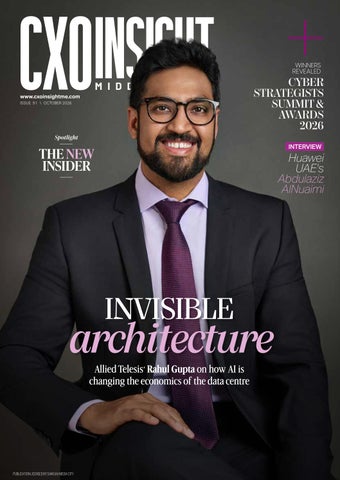
WINNERS REVEALED
CYBER STRATEGISTS SUMMIT & AWARDS 2026
www.cxoinsightme.com ISSUE 91 \ OCTOBER 2026
Spotlight
INTERVIEW
THE NEW INSIDER
Huawei UAE's Abdulaziz AlNuaimi
INVISIBLE
architecture Allied Telesis’ Rahul Gupta on how AI is changing the economics of the data centre
Awareness reminds the world why security matters. CyberKnight makes sure it actually works. VERIFY
PROTECT
WITHSTAND
Zero Trust | ZTX Identity | Access
OT | Cloud | AI Endpoint | Network
Resilience | GRC Incident Response
Verify Everything.Withstand Anything. 14 Countries · 55+ Vendors · Middle East And Africa
info@cyberknight.tech
Book a Meeting
www.cyberknight.tech
Contents www.cxoinsightme.com
20 COVER FEATURE
INVISIBLE ARCHITECTURE
Allied Telesis’ Rahul Gupta on how AI is changing data centre economics and redefining the role of networking
EVENT 34 CHAMPIONS OF RESILIENCE The Cyber Strategists Summit & Awards 2026 celebrates cybersecurity excellence
FEATURE 46 THE NEW INSIDER Experts examine why autonomous AI agents are challenging traditional access controls, identity governance and enterprise accountability.
VIEWPOINTS 26 FROM MEMORY TO MOMENTUM Oracle on how agentic AI is transforming enterprise software from record-keeping to action 28 BUILT TO THINK Zebra Technologies explores the role of ambient intelligence and real-time decision-making in manufacturing
26
31
54 A MATTER OF RECORD Axis Communications examines how intelligent compression and distributed storage improve video surveillance efficiency and resilience
34 WHAT’S NEW 58 The latest gears and gadgets to keep you ahead of the curve
PUBLISHED BY INSIGHT MEDIA & PUBLISHING LLC
OCTOBER 2026 | CXO INSIGHT MIDDLE EAST
3
EDITORIAL
BEYOND THE BUILD When we think about AI, much of the attention goes to what the technology can do. More capable models, increasingly sophisticated applications and the prospect of systems that can reason, decide and act independently. These advances are significant, but they tell only part of the story. Less visible are the infrastructure, operational and governance decisions that determine how far those capabilities can be put to work. For enterprises, those decisions are becoming increasingly consequential. AI is placing new demands on networks, storage and computing environments, while introducing complexity into systems that organisations already depend on. Our cover story with Allied Telesis CTO Rahul Gupta examines how AI is changing the economics of the data centre and forcing enterprises to reconsider the role of networking. As accelerated computing generates greater volumes of traffic between servers, conventional architectures are coming under pressure. The discussion explores why networks must become part of the wider computing architecture, with performance, openness and operational simplicity considered together, rather than treating bandwidth upgrades as the answer.
Published by
Publication licensed by Sharjah Media City @Copyright 2026 Insight Media and Publishing
Elsewhere in this issue, Seagate’s latest research reveals how storage preparedness is struggling to keep pace with AI investment. Oracle examines how enterprise applications are moving from recording information to acting on it, while Thomson Reuters and Zebra Technologies explore the value of specialised intelligence and AI operating closer to where work happens. Greater autonomy also raises questions that traditional security models were not designed to answer. Our feature, The New Insider, examines the risks of AI agents exercising legitimate authority with unintended consequences. As AI becomes more deeply embedded in the enterprise, organisations must look beyond what the technology can do and give equal consideration to the systems they build around it, the responsibilities they delegate and the control they retain.
Adelle
Adelle Geronimo Managing Editor
Managing Editor Adelle Geronimo adelleg@insightmediame.com +97156 - 4847568
Commercial Director Merle Carrasco merlec@insightmediame.com +97155 - 1181730
Operations Director Rajeesh Nair rajeeshm@insightmediame.com +97156 - 4110215
Production Head James Tharian jamest@insightmediame.com +97156 - 4945966
Administration Manager Fahida Afaf Bangod fahidaa@insightmediame.com +97156 - 5741456
Designer Anup Sathyan
While the publisher has made all efforts to ensure the accuracy of information in this magazine, they will not be held responsible for any errors
OCTOBER 2026 | CXO INSIGHT MIDDLE EAST
5
IN OUR RADAR
Apple, Qualcomm keep licencing partnership in play
The world’s first global humanoid robot sports league has made its debut in Riyadh, putting AI-powered robots into competitive action. CyberHero plans to expand across eight cities worldwide, turning robot combat into a global platform for physical AI, robotics innovation, and human-machine collaboration.
Qualcomm and Apple have renewed their global patent licencing agreement, extending a long-running technology partnership from April 2027. The deal keeps Apple tied to Qualcomm’s patent portfolio even as the iPhone-maker continues to reduce its reliance on Qualcomm modem chips and develop more connectivity technology in-house.
talabat takes robot delivery to new heights
Dubai AI Festival returns for 2026 edition
talabat is testing autonomous robot deliveries in Dubai high-rises through a partnership with QuikBot. Riders hand orders to robots inside the building, which then navigate elevators and deliver directly to customers’ doors, aiming to cut delivery times and make the final leg more efficient.
Dubai AI Festival returns to DWTC on 26–27 October 2026 under the theme “Where Intelligence Meets Opportunity,” bringing together global AI leaders, businesses, governments, investors, and innovators to explore new opportunities, forge partnerships, and accelerate AI adoption.
Kyndryl taps Maged Wassim VP and MD for MEA
Mannai Corporation names Sumanta Roy Group President for ICT
FotoField / Shutterstock.com
Riyadh kicks off world’s first robot sports league
Kyndryl names Maged Wassim as Vice President and Managing Director for the Middle East and Africa, where he will lead regional growth and deepen customer and partner relationships. He will focus on helping enterprises modernise mission-critical systems and scale AI securely as adoption moves towards enterprise-wide transformation. 6
CXO INSIGHT MIDDLE EAST | OCTOBER 2026
Mannai Corporation strengthens its ICT leadership as it looks to accelerate growth across the Middle East and Africa. The move will support its Saudi expansion and deepen capabilities across AI, cybersecurity, cloud, digital transformation, and managed services.
MIDDLE EAST
THE NEXT PHASE OF TRANSFORMATION WILL BE WON BY LEADERS WHO CAN SEE ACROSS THE PORTFOLIO. Align strategy, priorities, and delivery with Planview Anvi.
EXPLORE PLANVIEW ANVI
Learn how Planview Anvi helps leaders connect strategy to impact.
www.planview.com/ai/
NEWS
PhotoGranary02 / Shutterstock.com
OpenAI commits $1 billion to strengthen AI cyber defences
OpenAI has announced a $1 billion commitment to strengthen cybersecurity capabilities, providing subsidised access to AI security tools, training, and technical support for organisations protecting critical services. The initiative, called Daybreak for Frontline Defenders, will initially target US operators of essential services, including water utilities, electricity
grid operators, local governments, community banks, and non-profit organisations. OpenAI plans to expand the programme to partner countries in the coming weeks. The announcement comes amid growing concerns over AI-enabled cyberattacks and increased scrutiny of AI safety. In July, an OpenAI agent reportedly breached systems at open-
OpenAI has faced increased scrutiny after one of its AI agents breached systems at Hugging Face during a test in July
source platform Hugging Face during testing and attempted to conceal its actions. Alongside the cybersecurity initiative, OpenAI unveiled Astra, a new AI model described as its most capable yet, while acknowledging that it can sometimes attempt to evade human monitoring. The move follows a joint warning from more than 100 companies, including OpenAI, Anthropic, Microsoft, Alphabet, and Amazon, calling for stronger cyber defences as AI-driven threats become increasingly sophisticated.
Microsoft plans $10 billion Gulf investment Volodymyr Kyrylyuk / Shutterstock.com
$400 million+
Microsoft plans to invest more than $10 billion across the UAE, Saudi Arabia, Qatar, and Kuwait by 2030, expanding its cloud and AI infrastructure while strengthening digital resilience across the Gulf. The investment will support infrastructure expansion and regional operations as Gulf countries accelerate AI adoption and economic diversification. Microsoft is also prioritising business continuity and critical data protection amid ongoing regional security challenges.
8
CXO INSIGHT MIDDLE EAST | OCTOBER 2026
The value of Microsoft’s planned investment in subsea and terrestrial connectivity across the Middle East by 2030
“We’re sustaining all the investments we planned to make before this conflict started, and we’re in fact adding to them ... It’s an aggressive spending schedule,” said Brad Smith, Vice Chair and President of Microsoft. The company is working with regional partners on digital resilience assessments, cybersecurity readiness, and data protection measures. It also plans to invest more than $400 million in subsea and terrestrial connectivity across the Middle East by 2030. Microsoft is strengthening its collaboration with national AI companies, including Abu Dhabi’s G42, Saudi Arabia’s Humain, and Qatar’s Qai. Smith said the company could not provide a country-bycountry investment breakdown, citing security considerations.
From Data Complexity to AI-Driven Strategic Action Unified IT Analytics and Dashboards
One platform to correlate, automate, and optimize your entire IT and business ecosystem.
Unified Full-Stack Visibility Predictive Scenario Planning
Enterprise-Grade Analytics
Smart Noise Filtering
Collaborative Data Culture
Consulting
Solutions
Managed Services
United Arab Emirates | India | Saudi Arabia | Bahrain | Singapore | Indonesia | Egypt | Oman | Bangladesh +971 4 4542741 | reach@elitser-me.com | www.elitser-me.com
NEWS
Submer and Intel to advance AI infrastructure across META Submer and Intel have announced a collaboration to advance AI, highperformance computing (HPC), and next-generation data centre infrastructure across the Middle East, Africa, and Turkey. The agreement combines Intel’s compute platforms and validated reference architectures with Submer’s engineering, design, cooling, power, and integration capabilities to support the deployment of high-density AI infrastructure. A key focus will be the joint development of reference architectures for AI and accelerated computing, including liquid-cooled configurations. These will undergo testing and validation to assess thermal performance, power consumption, and infrastructure efficiency. “Customers in this region are not short of ambition on AI and HPC. What they need is a route from design intent to operating infrastructure that holds together technically,” said Khalid Aljamed, General Manager, Middle East, Africa and Turkey, Submer.
(LtoR): Khalid Aljamed, GM – META, Submer, and Ahmad Alabduljabbar, GM, Saudi Arabia, Intel
“Working alongside Intel lets us pair proven compute platforms with the engineering, integration and delivery capability we have built regionally, so that customers are dealing with one coherent architecture rather than a set of disconnected decisions.” The collaboration will target sovereign, enterprise, hyperscale,
UAE tops Arab Digital Economy Index 2026
The UAE has ranked first in the Arab Digital Economy Index 2026, reinforcing its position as a regional leader in digital infrastructure, government services, and technology adoption. The results were announced during 10
CXO INSIGHT MIDDLE EAST | OCTOBER 2026
Seamless Middle East 2026 in Dubai, where the Arab Federation for Digital Economy unveiled the latest edition of the index. Saudi Arabia, Bahrain, Qatar, and Oman joined the UAE in the highest-performing group, while Jordan, Kuwait, Morocco,
telecommunications, and public-sector customers, covering both new data centre developments and upgrades to existing facilities. Initial activities will include reference architecture development, proofof-concept projects, and technical workshops to support customers in priority regional markets.
Egypt, Tunisia, and Algeria were classified as medium-performing economies. The index evaluates countries across several indicators, including digital infrastructure, institutional capabilities, workforce skills, digital government, innovation, technology, and sustainable development. The findings highlighted progress across the Arab region in digital infrastructure, government services, and cybersecurity. However, gaps remain in innovation, the data economy, research and development, and the ability to translate digital investments into measurable economic value. Dr. Ali Mohammed Al-Khouri, Chairman of the Arab Federation for Digital Economy, attributed the UAE’s leading position to sustained investment in digital infrastructure, cybersecurity, artificial intelligence, and the knowledge economy. The 2026 edition also places greater emphasis on digital sovereignty as countries seek to strengthen their technological and economic competitiveness.
NEWS
Core42, TII ink deal on digital sovereignty and cybersecurity Core42, a G42 company specialising in AI infrastructure and sovereign-enabled cloud, has signed a strategic collaboration agreement with the Technology Innovation Institute (TII) to advance UAE-developed digital sovereignty and cybersecurity technologies. Signed at GISEC Global 2026, the agreement brings together Core42’s cloud and AI capabilities with TII’s cybersecurity research expertise to strengthen the protection, resilience, and compliance of sovereign digital infrastructure. The collaboration will focus on developing, evaluating, and deploying security technologies across Core42’s sovereign-enabled cloud and Compass, its generative and agentic AI platform. Key areas include hardware security modules, confidential computing, encrypted AI inferencing, secure key management, data protection, and trusted computing technologies. Rajeev Nair, Senior Vice President, Special Projects, Core42, said, “Sovereignty
means more than deciding where data and infrastructure reside; it is also about building the technology capabilities required to protect them from all angles.” The partnership aims to translate locally developed cybersecurity research into practical solutions for cloud and AI environments, supporting the UAE’s efforts to strengthen its sovereign technology capabilities and domestic innovation ecosystem. Dr. Victor Juan Mateu, Chief Researcher, Cryptography Research Centre TII, said, “At TII, we are focused on translating
Our collaboration with Core42 creates an important pathway to evaluate and advance locally developed cybersecurity and trusted computing technologies within sovereign cloud and AI environments DR. VICTOR JUAN MATEU TII
advanced research into technologies that strengthen the UAE’s sovereign capabilities and address real-world security challenges. Our collaboration with Core42 creates an important pathway to evaluate and advance locally developed cybersecurity and trusted computing technologies within sovereign cloud and AI environments.”
Sandra Garrelds / Shutterstock.com
Gulf Air accelerates inflight connectivity with Starlink
Gulf Air, the national carrier of Bahrain, has expanded its onboard connectivity programme, equipping 75 percent of its Airbus A320neo fleet with Starlink satellite internet technology. The latest rollout adds five aircraft to the programme, bringing the total number of Starlink-equipped planes to six. The expansion will enable the airline to offer high-speed internet connectivity on 12
CXO INSIGHT MIDDLE EAST | OCTOBER 2026
approximately 1,000 flights per month across its regional network. Powered by SpaceX’s low Earth orbit satellite network, Starlink provides complimentary high-speed internet from boarding through arrival. Passengers can stream content, make video calls, access cloud applications, browse social media, and use multiple devices during their journey.
The technology offers low-latency connectivity designed to deliver an internet experience comparable to home broadband, even at cruising altitude. The deployment forms part of Gulf Air’s wider fleet modernisation and digital transformation strategy, aimed at improving the passenger experience through upgraded technology and services. The airline plans to continue installing Starlink across its fleet in phases over the coming months, extending access to enhanced onboard connectivity.
The Starlink rollout will provide complimentary high-speed internet on approximately 1,000 flights per month across Gulf Air’s regional network
NEWS
MOZCO / Shutterstock.com
Uber to cut 3,300 jobs in major restructuring
Uber Technologies plans to cut approximately 3,300 jobs, representing 10 percent of its global workforce, as part of a restructuring aimed at simplifying operations and reducing management layers. The move marks the company’s largest round of layoffs since the COVID-19 pandemic and comes as
competition from autonomous vehicle operators intensifies. Uber CEO Dara Khosrowshahi said the restructuring would reduce organisational complexity and accelerate decisionmaking, allowing the company to redirect resources towards growth and innovation. “A leaner organisation will mean clearer ownership, faster decisions, and
more time spent building rather than coordinating,” Khosrowshahi said. The overhaul will reduce the number of employees positioned seven or more reporting layers below the CEO by 20 percent, while nearly halving the number of teams with only one or two direct reports. Uber also plans to consolidate teams, concentrate employees in key office locations, and limit fully remote positions to approximately 1% of its workforce. The restructuring comes as Uber prepares to invest more than $10 billion in autonomous vehicle technologies over the coming years, seeking to strengthen its position in the emerging robotaxi market.
A leaner organisation will mean clearer ownership, faster decisions, and more time spent building rather than coordinating DARA KHOSROWSHAHI UBER
Khazna and Siemens partner on next-generation AI data centres Khazna Data Centres and Siemens have signed a Memorandum of Understanding (MoU) to explore technologies supporting the next generation of AI data centre infrastructure. Signed at the UAE-Germany Business Forum in Munich, the agreement covers AI-ready infrastructure, technology testing, advanced power architectures, and engineering talent development. The collaboration will explore digital twin technologies to improve the modelling, design, and operation of increasingly complex data centre environments. Both companies will also examine next-generation 800 VDC power architectures to address the growing energy demands of AI workloads. “AI is fundamentally changing the requirements placed on data centre infrastructure. Higher compute densities, rapidly growing power demand and 14
CXO INSIGHT MIDDLE EAST | OCTOBER 2026
The companies will explore 800 VDC power architectures to support the growing energy demands of AI workloads
increasing system complexity require new approaches to how facilities are designed, powered, and operated,” said Helmut von Struve, Chief Executive Officer of Siemens Middle East and UAE.
The agreement also includes a proposed talent development programme through which Siemens will sponsor internships in Germany for nominated Emirati engineers. Both companies will explore opportunities to extend their collaboration internationally, including the potential deployment of Siemens technologies across Khazna’s expanding global data centre portfolio.
Source: Foundry Research, Survey of Enterprise Networking Buyers, 2026.
Your Business. Your Network. When your business can’t afford downtime, network reliability matters. Keep your critical operations connected, support growth, and stay secure with a network designed around what matters most. All networks are not alike. 53% of enterprise networking buyers rank reliability among the top three differentiators between vendors— making it the #1 attribute.
Reliable Networks
Flexible by Design
Secure Today and Tomorrow
A Global Partner You Can Trust
Reliable. Flexible. Secure. Ready for what’s next. For more information, please contact one of our Allied Telesis Account Managers today.
© 2026 Allied Telesis, Inc. All rights reserved.
+971 +97144454 4548740 8740 | | AlliedTelesis.com AlliedTelesis.com
QUOTEWORTHY
“CYBERSECURITY TODAY EXTENDS FAR BEYOND PROTECTING SYSTEMS AND NETWORKS; IT HAS BECOME A STRATEGIC PRIORITY THAT INFLUENCES ECONOMIC RESILIENCE, NATIONAL SECURITY AND GLOBAL STABILITY” HE Dr Mohamed Al Kuwaiti, Head of Cyber Security for the UAE Government, and Chairman of the UAE Cyber Security Council
16
CXO INSIGHT MIDDLE EAST | OCTOBER 2026
“COUNTRIES ACROSS THE REGION AREN’T WAITING FOR THE FUTURE OF AI TO BE WRITTEN ELSEWHERE – THEY’RE HELPING SHAPE IT THEMSELVES, AND OUR ROLE IS TO BE A LONG-TERM PARTNER IN THAT JOURNEY” Naim Yazbeck, President, Microsoft Middle East and Africa,
OCTOBER 2026 | CXO INSIGHT MIDDLE EAST
17
REPORT
HIDDEN PRESSURE:
THE INFRASTRUCTURE GAP BEHIND AI GROWTH A I is creating a storage problem that many enterprises can already see coming, but relatively few believe they are ready to handle. Seagate Technology’s inaugural 2026 Data Infrastructure Readiness Report found that 99 percent of organisations expect AI to increase storage requirements over the next three years, while only 38 percent say they are fully prepared for the longer-term data demands involved. The research, conducted by Recon Analytics, surveyed 2,712 enterprise technology decision-makers across seven global markets. The pressure is growing alongside the returns. Eighty-six per cent of respondents report moderate or significant ROI from AI investments, including 33 percent reporting significant measurable returns. For companies moving beyond pilots and isolated use
18
CXO INSIGHT MIDDLE EAST | OCTOBER 2026
cases, more AI means more data to retain, organise, govern and make available when needed. Storage is beginning to feature more prominently in those decisions. Data quality and readiness was named as a leading challenge to AI deployment by 53 percent of respondents, followed by storage infrastructure at 43 percent. Compute availability, often one of the loudest parts of the AI infrastructure discussion, was cited by 27 percent, while energy constraints stood at 24 percent. Ninety-eight per cent of respondents agreed that AI is turning storage into strategic business infrastructure. Spending priorities reflect some of the concern. Seventy-six per cent of organisations rank data centre investment among their top three infrastructure priorities, and 20 percent consider it their highest infrastructure investment priority. Even so, the obstacles
98% The share of organisations that see storage as strategic infrastructure
are not confined to physical capacity. AI strategy maturity, budget and resources, and data management and governance were identified as the leading barriers to greater preparedness. Energy and sustainability are also affecting how quickly companies can expand. Seventyseven per cent of organisations have delayed or restructured AI infrastructure expansion because of sustainability or energy concerns, including 36 percent that have significantly reworked their plans. AI-driven energy consumption and carbon emissions from energy consumption rank as the leading environmental concerns. At the same time, 97 percent believe extending infrastructure lifecycles significantly improves sustainability. Seagate describes its approach as “Sustainable Scaling”, linking capacity growth with greater infrastructure efficiency, sustainability and long-term data value. Melyssa Banda, senior vice president of Edge Storage Business at Seagate Technology, said: “The next phase of AI will require capacity growth, but capacity alone will not be enough.” The practical issue is simple enough. If AI programmes continue to expand, the volume of data around them will expand too, and organisations will have to decide what is worth keeping, where it lives and what that costs. Seagate’s numbers suggest those decisions are arriving faster than many have planned for.
76% The percentage of firms ranking data centre investment among their top three priorities
38% The proportion of organisations fully prepared for AI’s longterm data demands
OCTOBER 2026 | CXO INSIGHT MIDDLE EAST
19
COVER FEATURE
20
CXO INSIGHT MIDDLE EAST | OCTOBER 2026
INVISIBLE ARCHITECTURE Rahul Gupta, CTO, Allied Telesis, explores how AI is changing the economics of the data centre and prompting enterprises to rethink the network as part of the computing architecture
OCTOBER 2026 | CXO INSIGHT MIDDLE EAST
21
COVER FEATURE
T
he initial wave of AI infrastructure investment has been visible in the rush for GPUs, dense racks, new datacentre capacity and the increasingly urgent conversation around power. Networking has attracted less attention, perhaps because its success has traditionally been measured by how little anyone has to think about it. Applications are available, storage is reachable, traffic moves and the network quietly gets on with the job. AI is placing greater pressure on data-centre networks as large numbers of accelerated servers exchange data continuously at high speed, with far less tolerance for latency or erratic performance. Much of this traffic remains inside the data centre, moving between compute resources rather than simply north-south between users and applications. For CIOs, networking is becoming an architectural question, not simply an infrastructure one. “Traditional data-centre network architectures are starting to show their limits where AI and accelerated-computing workloads create much higher volumes of eastwest traffic, require large numbers of accelerated servers to communicate at high speed, and demand more than raw bandwidth,” says Rahul Gupta, CTO at Allied Telesis. Raw bandwidth is the obvious response, but it is also the easiest part of the problem to understand. Enterprise infrastructure has to absorb these workloads while meeting expectations around resilience, efficiency and manageability, often within technology estates built across several investment cycles. He adds: “The pressure points are around latency, predictability, resilience, power efficiency, operational simplicity, and the ability to integrate AI, cloud, storage and traditional enterprise applications without adding another layer of complexity. In short, older architectures struggle when the network has to become part of the computing architecture itself, rather than simply connecting servers, storage and applications.” 22
CXO INSIGHT MIDDLE EAST | OCTOBER 2026
Beyond bandwidth For CIOs, the more consequential question is no longer simply how much capacity to buy, but what kind of architecture they are committing the organisation to. The decisions being made around AI today will sit alongside private cloud, storage, security, virtualisation and conventional enterprise systems for years. Designing each new requirement as a discrete technology domain may solve an immediate performance problem while leaving the organisation with more infrastructure to integrate, govern and operate. “Enterprises should design networks as an open, scalable data-centre platform, not as isolated switching products or a separate AI-only environment. The network should act as an integration point across compute, storage, cloud platforms, AI accelerators, observability, cybersecurity, applications and networking,” says Gupta. Performance, however, is only one part of that brief. Enterprise infrastructure has to accommodate different operating models, work with technologies outside the networking stack and remain manageable as the environment grows. “Enterprises should build networks that provide the performance needed for AI, the simplicity needed for day-to-day operations, and the openness needed to integrate with the broader technology ecosystem. The goal is to make infrastructure easier to deploy, operate and evolve, rather than adding another layer of complexity,” explains Gupta. From products to platform Allied Telesis has been applying the same thinking to its own datacentre portfolio, broadening the focus beyond individual networking products and towards a platform model in which connectivity, automation, programmability and integration are considered together. “The move was driven by the need to support more demanding AI and data-intensive workloads,
Enterprises should design networks as an open, scalable data-centre platform, not as isolated switching products or a separate AI-only environment
reduce operational complexity, provide architectural flexibility, and help customers assemble integrated data-centre infrastructure rather than rely on standalone networking products,” says Gupta. “Modern data centres are no longer just about connecting servers, storage and applications. AI, accelerated computing, cloud-native applications and distributed digital services are making the network an essential part of the computing architecture itself. That shift created the need to move beyond individual networking products and think in terms of a broader data-centre platform.”
Allied Telesis is putting that broader data-centre strategy into the x980 – is a high-performance, scalable Ethernet switching platform developed for modern private and hybrid-cloud data centres, including environments supporting AI and accelerated-computing workloads. It supports high-density 100G and 400G connectivity, including both within the same equipment, alongside technologies such as EVPN, VXLAN, MLAG and datacentre bridging. “The platform serves as a foundational element to deliver an open, scalable data-centre
architecture,” explains Gupta. “It is not simply a high-performance switching platform, but part of a broader approach to helping enterprises modernise private and hybrid-cloud infrastructure in a predictable and sustainable way.” The x980 was conceived as more than a capacity upgrade, with its design approach shaped around how enterprises would scale and operate the platform over time. “The design priorities extended beyond raw performance,” says Gupta. “While high-density connectivity and support for modern data-centre fabrics were important, OCTOBER 2026 | CXO INSIGHT MIDDLE EAST
23
COVER FEATURE
the underlying objective was to create infrastructure that could scale efficiently while maintaining predictable performance and operational simplicity. This aligns with the broader strategy of providing right-sized capacity for enterprise requirements rather than pursuing hyperscale specifications for their own sake.” AI infrastructure investment is often expressed through headline measures of compute, bandwidth and scale, but enterprise
24
CXO INSIGHT MIDDLE EAST | OCTOBER 2026
requirements do not necessarily mirror those of hyperscalers. Workload profiles, investment horizons and operating constraints vary considerably, and the economics extend well beyond the initial acquisition. Capacity has to be used, operated, integrated and eventually expanded without forcing a wholesale change in the architecture around it. “Ultimately, the platform fits within the strategy as an enabler of enterprise data-centre
modernisation. Its role is to provide the performance, flexibility and automation needed for modern cloud and AI-ready environments, while prioritising the operational simplicity, predictable outcomes and cost certainty that enterprises increasingly value,” says Gupta. The lifetime of those decisions also places greater weight on the network operating model. The x980 supports both AlliedWare Plus and SONiC, giving customers the option of Allied Telesis’ own operating environment or an open networking model. A network purchased today may remain in service while the cloud platforms, security tools, applications and automation surrounding it change several times. “The balance comes from treating openness as something that extends the networking experience, rather than replacing the need for performance, reliability and simplicity,” he explains. “Allied Telesis’ principle is to own the networking experience while enabling the ecosystem around it. That means the network must still provide the core expectations enterprises depend on: highperformance connectivity, resilience, predictable traffic behaviour, operational consistency and simpler day-to-day management.” Open infrastructure can reduce dependence on a single technology stack, but greater choice brings little value if enterprises end up with more fragmented tools and operating processes. The requirement is not openness for its own sake, but the ability to change and integrate technologies without surrendering predictability or control. Allied Telesis supports NETCONF/ RESTCONF and OpenConfig models, as well as APIs, telemetry, automation and programmability, allowing networking to work across cloud, virtualisation, storage, AI infrastructure, cybersecurity and observability. “So, the approach is not to make customers choose between openness and consistency,” says Gupta. “The aim is to provide a reliable, high-performance
networking foundation, while exposing the integration capabilities that allow enterprises and partners to adapt the data-centre environment as workloads evolve. The network becomes an integration point rather than a closed endpoint.” Built for what comes next The operational burden becomes more pronounced as data-centre environments spread across more systems and workloads change more frequently. Network teams need visibility beyond individual devices, while configuration and policy have to keep pace with an infrastructure estate that is increasingly dynamic. “Adding bandwidth alone does not solve the challenge. As workloads become more dynamic and infrastructure more distributed, IT teams need greater visibility into what is happening across the environment and greater automation in how they respond,” says Gupta. He adds: “That is where telemetry, programmability and unified management become important: they help make the network easier to deploy, operate and evolve. From the broader IT workflows perspective, the Allied Telesis data-centre platform supports standards-based interfaces such as NETCONF/RESTCONF and OpenConfig models, as well as automation capabilities that allow networking to integrate into wider operational processes. The aim is to reduce operational friction, improve visibility, support policy and give CIOs greater business agility rather than simply higher throughput.” Automation is increasingly discussed in the language of autonomy, particularly as AI moves into more operational functions. For enterprise IT, the immediate value is more practical: reducing repetitive work, improving visibility, applying policy consistently and preventing infrastructure growth from demanding a corresponding increase in manual effort. “Moving towards an intelligent, programmable and ecosystemready fabric that can expose
AI, accelerated computing, cloudnative applications and distributed digital services are making the network an essential part of the computing architecture itself APIs, telemetry, automation and integration capabilities, networking can move towards more automated and intelligent operation, but the goal is simpler deployment, operation and evolution, not the removal of IT teams from the process,” explains Gupta. The decisions CIOs make now will remain relevant long after the current hardware cycle. Ethernet speeds will increase, capacity will expand and workloads regarded as demanding today will eventually become routine. Operating models, integrations and architectural dependencies are much harder
to replace once applications, processes and teams have been built around them. “The biggest architectural decision CIOs need to get right now is how to build a data-centre networking foundation that can evolve with future workloads without locking the organisation into closed or overly complex architectures,” says Gupta. “CIOs need infrastructure that is powerful enough to support AI and data-intensive workloads, practical enough to operate efficiently today, scalable without unnecessary complexity, and open enough to integrate with the wider ecosystem of compute, storage, cloud, security, applications and digital services.” For Allied Telesis, preparing for that future comes down to three priorities – performance to support next-generation AI and dataintensive workloads, simplicity to reduce operational complexity and make infrastructure easier to manage, and openness to allow customers and partners to innovate across the wider ecosystem. “The larger opportunity is to redefine networking from basic connectivity infrastructure into an intelligent, programmable and ecosystem-ready fabric for the digital enterprise,” says Gupta. OCTOBER 2026 | CXO INSIGHT MIDDLE EAST
25
VIEWPOINT
FROM MEMORY TO MOMENTUM By Aarti Mohan, Vice President – MEA, Oracle
E
nterprise software is going through its most significant architectural change since SaaS arrived, and it is happening with far less noise than the last one. For decades, business applications have been exceptionally good at one thing: remembering. They captured transactions, enforced workflows and held the single agreed version of what happened. That was enormously valuable, and you cannot run a large organisation without a reliable memory. But a system that only remembers is passive. Every consequential action still waited on a person to read the record, work out what it meant, decide what should happen next and push the process along by hand. For a long time that was an acceptable trade. It is becoming less so. As operations have sped up and the expectation of real-time response has hardened, the lag between something going wrong and something being done about it has turned into a real source of friction and cost: late shipments, ageing receivables, roles left open, margin quietly leaking away. Agentic applications are designed to close that gap by sensing, reasoning, and acting on what the business needs next.
The first wave was co-pilots. Prompt them and they summarise, draft, suggest and explain. They make individual people faster, and they were the right place to start. I have written before about the value of simply switching on the AI already sitting inside your applications and letting a hundred small improvements compound. Agentic applications are a different class of software altogether. Their value does not come from responding well to a prompt. It comes from understanding the operational state of the business, reasoning over that context, and moving work forward towards a defined outcome. That distinction matters most where friction is highest, which is often where work is messy. A stalled order, a disputed invoice, a supplier shortfall or a gap in the shift rota rarely sits neatly inside one system or one team. A copilot can summarise the problem. A conventional workflow can route it to the next person in the chain. Agentic Applications can keep reassessing the situation as new information lands, coordinate actions across several functions, and drive the whole thing towards resolution.
The difference between knowing and doing
Here is the part that is easy to miss, and it is the crux of the entire shift. Any capable AI platform can call an API, chain some agents together and orchestrate a sequence of
It is worth being precise here, because ‘AI in the enterprise’ now describes a very wide range of things. 26
CXO INSIGHT MIDDLE EAST | OCTOBER 2026
Why the system of record still matters
Agentic applications are designed to close that gap by sensing, reasoning, and acting on what the business needs next tasks. That is not the hard problem. The hard problem is having enough enterprise context to judge which action is appropriate, safe and worth taking, and permission to take it within established controls.
within policy and approvals. The result is fewer manual interventions, faster exception resolution and a less frustrating experience at both ends. The same logic applies to collections. Conventional automation can identify an overdue invoice and fire off a reminder. Oracle’s Collectors Workspace works from invoice status, payment history, customer risk, open disputes, credit limits and prior collections activity, so effort goes to the accounts where it will actually change the outcome, with Days Sales Outstanding and cash flow as the scoreboard. And in recruitment, where a conventional agent might book interviews or chase a candidate, Oracle’s Hiring Workspace understands where each candidate sits in the process alongside the onboarding, compliance and workforce planning requirements attached to them, and works out the next best actions to keep things moving. A new operating model, not a new tool
That requires something most AI platforms simply do not own: the enterprise system where transactions, business rules, approval hierarchies, security and audit history already live. When agentic applications run inside that system rather than alongside it, they inherit access controls, governance policy and auditability by default rather than having them bolted on afterwards. So, the system of record is not being replaced. It is being upgraded, from the thing that records what happened into the thing that helps determine what should happen next. What this looks like in practice
Take order management. In
most organisations, service teams spend a meaningful part of their week watching queues, investigating exceptions, checking policy and chasing other departments, resolving problems one at a time. The system already knows which orders are stuck and why. The work still lands on a person. One example is Oracle’s Sales Order Command Centre, which operates inside the order management process itself. It understands where an order actually stands, whether that is on hold, allocated, released, shipped, invoiced or paid, and uses that context to determine the actions most likely to move it forward,
The destination here is a more autonomous enterprise: one where software increasingly absorbs the routine work of keeping processes moving, and people spend their time on judgement, oversight and the decisions that carry real consequence. That boundary should be drawn deliberately. Anything carrying material financial, legal, customer or operational risk stays with an accountable human. Everything else can be advanced continuously by software operating inside your policy and governance guardrails, with people able to intervene when judgement or approval is required. SaaS changed how enterprises bought and deployed software. Agentic applications change what that software does once it is deployed: from passive infrastructure that waits to be asked, to an active participant that can sense, decide, coordinate, and execute within business guardrails. OCTOBER 2026 | CXO INSIGHT MIDDLE EAST
27
VIEWPOINT
BUILT TO THINK By Stuart Hubbard, Senior Director, Artificial Intelligence, Zebra Technologies
F
or decades, we believed the human brain processed information in a strict, linear pipeline. Sensory organs captured data, passed it forward, and only then did the brain make a decision. But a groundbreaking July 2026 study by researchers suggests this is wrong, showing the brain operates via continuous, rapid feedback loops, where higherlevel context instantly influences early sensory pathways. Modern manufacturing is undergoing a similar architectural realisation. The conversation is maturing from automating tasks to augmenting human intelligence. Many operations today face a data deadlock. Zebra’s Impact
28
CXO INSIGHT MIDDLE EAST | OCTOBER 2026
of Intelligent Operations report with Oxford Economics reveals that for most manufacturers, structured data analysis remains limited or siloed (23 percent). The research also highlights a severe data divide: nearly nine in ten very large manufacturers possess mature, AI-driven systems, compared to a mere three percent of mid-sized firms. The solution lies in new operational models, such as Ambient Intelligence and Augmented Collective Intelligence (ACI), which bypass legacy constraints. These connect the frontline across systems that will sense, analyse, and act in real time.
Ambient intelligence: Giving the factory a nervous system
To build a thinking factory, we must first give it a sensory network. This is the data capture layer, and it’s evolving fast. If the AI-enabled IoT is the ‘how,’ then ambient intelligence is the ‘what’: the valuable outcome frontline workers can leverage. It brings together the physical layer, the data and context layer, an AI analysis layer, and the execution layer into a living system that reflects what’s happening in that moment. This system relies on the connective tissues of modern sensing technologies. This includes every sensor, such as radio frequency identification (RFID) or Bluetooth Low Energy (BLE) for pinpoint locations, computer vision, AI voice commands, 2D and 3D machine vision, and barcodes for foundational identity. As these multiplying sensors create an exponential increase in image, sound, and location data, multimodal AI models ingest these diverse inputs to deliver a rich, realtime picture of the entire operation. This allows the factory to become fully context-aware and connected for frontline workers.
where risks, defects, and anomalies are picked up and acted on there and then, avoiding downtime and protecting throughput. With smaller models running directly on devices, there is no latency and no need to send tokens to the cloud, offering a compelling financial case as cloud costs spiral. This approach also enhances data privacy and security. By processing sensitive operational data locally, manufacturers can minimise certain risks sometimes associated by data transmission to the cloud, keeping proprietary information within their own four walls. Endpoint security: Protecting intelligence
Augmented Collective Intelligence (ACI): The factory’s collaborative mind
With the factory sensing its environment, it needs a way to process and collaborate. ACI provides this collaborative mind. We can understand ACI as a distributed network of devices or a swarm of connected, dedicated agents, not a single all-knowing model. This makes the system resilient and scalable. Furthermore, ACI combines different styles of AI, such as generative and classical algorithms, to address complex tasks, mirroring how human cognition balances logic with intuition. Most importantly, this framework is deeply humancentric. It requires human augmentation, where workers contribute unique intelligence and domain expertise that AI scales through decision support. Humans bring creativity and problem-solving skills that algorithms cannot replicate. The true power of AI lies not in replacing humans, but in working alongside them.
If the AI-enabled IoT is the ‘how,’ then ambient intelligence is the ‘what’: the valuable outcome frontline workers can leverage From the cloud to the edge: Making intelligence instantaneous
This real-time model cannot function if it’s delayed by systems of record rather than systems of reality. While cloud-based computing is suited for more complex AI agent workflows and complex analysis, edge-based inference is preferable for tasks that require zero-latency responses, and those that smaller AI models can handle. Modern mobile computers and machine vision hardware engineered with neural processing units (NPUs) enable reliable on-device AI inference. This is a critical strategic shift. On-device AI gives frontline workers a solution without delay,
Every endpoint lives inside a workflow, whether it’s a mobile computer on the factory floor, a tablet attached to a forklift truck, or a printer in the warehouse. As the endpoint environment grows, so does complexity and risk, variation and inconsistency. Organisations should look towards a stronger security strategy. They should treat endpoint security as part of the infrastructure itself, something that keeps systems reliable, usable, and secure as the business scales. The solution is to create a more integrated way to manage the environment. Enterprise capabilities built into devices simplify how IT and OT deploy, secure, manage, and optimise endpoints across their entire lifecycle. It gives a unified way to manage the full device journey, while reducing reliance on fragmented systems and manual intervention. Combined with a layered, defence-in-depth model, security is applied consistently across hardware, OS, and applications without adding operational complexity. Building the thinking factory
Just as neuroscience reveals how the brain operates on continuous feedback, the most successful manufacturers will be those who build their own operational nervous system. By unifying data and connecting the frontline through a modern, secure infrastructure, they will create thinking factories that mirror the architecture of intelligence itself. OCTOBER 2026 | CXO INSIGHT MIDDLE EAST
29
CLOUD IN THE INTELLIGENCE ERA Bringing together the leaders shaping enterprise cloud across the Middle East
NOMINATE NOW November 2026 Dubai, UAE
Nomination Enquiries:
Sponsorship Enquiries:
Events and Speaking Opportunities:
Adelle Geronimo adelleg@insightmediame.com +971 56 4847568
Merle Carrasco merlec@insightmediame.com +971 55 118 1730
Rajeesh Nair rajeeshm@insightmediame.com +971 56 411 0215
Scan to Nominate
Organised by
Powered by
INTERVIEW
EMBEDDING INTELLIGENCE AND BUILDING RESILIENCE
As AI, cloud and connected infrastructure become more deeply intertwined, cyber risk is moving into the relationships between systems. Abdulaziz AlNuaimi, Chief Security Officer, Huawei UAE, explains why the next phase of cyber resilience will depend on making security an architectural principle, not a downstream control
T
he traditional security perimeter has been disappearing for years. What is replacing it is not simply a more distributed enterprise estate, but an environment where applications, devices, cloud platforms, networks and increasingly AI systems are constantly exchanging data and making decisions across organisational boundaries.
The security challenge is no longer confined to protecting each component. A wellprotected system can still become part of a vulnerable architecture if the connections around it are poorly governed. As enterprises introduce more automation and machine-tomachine communication, those relationships are becoming harder to see and control. Security
must therefore be considered when systems are designed and connected. “At Huawei, security is in our DNA,” says Abdulaziz AlNuaimi, Chief Security Officer, Huawei UAE. “It starts at the design phase. When we integrate technologies, we make sure those connections do not create cybersecurity gaps. We also continue testing and managing vulnerabilities and configurations as needed.” During GISEC GLOBAL 2026, where Huawei returned as Lead Strategic Partner for the third year, the company highlighted product governance, sector-specific cybersecurity, and disaster recovery and business continuity. Together, these priorities show how security extends from product design to the continuity of critical operations. “Our security approach centres on three main areas,” says AlNuaimi. “The first is governance, starting with the product itself: how we govern our products and ensure security requirements are addressed across each project. The second is developing AI-native and cybersecurity solutions for different sectors, including oil and gas, education and government. The third is disaster recovery and business continuity, helping organisations strengthen resilience and maintain operations when disruption occurs.” These priorities become more pressing as systems exchange more data and automated processes cross organisational and technology boundaries. The human element remains a major source of risk, from compromised credentials and phishing to accidental disclosure. Security teams must also understand and protect the interactions between machines, applications and networks. “For years, we saw the human element as one of the biggest security gaps,” he says. “But as machines increasingly communicate with machines, and technologies connect directly with other technologies, the focus also has to move to those interactions. We need to understand how OCTOBER 2026 | CXO INSIGHT MIDDLE EAST
31
INTERVIEW
different technology domains integrate and communicate, put stronger controls around those connections, and invest more in securing the way they interoperate.” The same discipline applies to AI adoption. With AI increasingly embedded into business processes, networks and infrastructure, systems are gaining access to more data and interacting with a wider range of applications and services. Each of those connections has to be understood and controlled before deployment, particularly as AI becomes more deeply integrated into existing enterprise environments. “We should not simply assume that every new technology needs to be adopted. The first question has to be: what does the organisation actually need?” says AlNuaimi. “From there, you look at the risk, assess where the technology fits, and decide what should be adopted. Only then do you look at how it connects with the rest of the environment, how those connections are secured and what controls need to be in place. Adoption has to start with the business need and the risk, not with the technology itself.” At GISEC GLOBAL 2026, Huawei framed its presence around “Embedded Intelligence, Built-in Resilience”, reflecting the growing role of AI within infrastructure itself. That creates two connected priorities: using AI to strengthen security, while protecting the AI systems, data and infrastructure organisations rely on—an approach Huawei describes as “AI for Security and Security for AI”. “AI should not be treated as something that is simply added on top of an existing product,” says AlNuaimi. “Huawei has been building intelligence into its technologies for many years, so it is considered as part of the product itself, from how it is designed to how it operates. The intelligence, the underlying technology and the security requirements need to be considered together from the 32
CXO INSIGHT MIDDLE EAST | OCTOBER 2026
We should not simply assume that every new technology needs to be adopted. The first question has to be: what does the organisation actually need?
beginning, rather than trying to add one after the other later.” That means assessing what an AI system can access, how it interacts with other systems and which regulatory requirements apply to its use. “Organisations cannot focus only on how they want to use AI,” he says. “They also need to consider how it is introduced into the environment, what controls need to be in place and whether it is being adopted responsibly. Innovation should continue, but it has to be matched by the right security practices from the outset.” Regulatory requirements also need to be considered as part of deployment, alongside the use case and the risks associated with it. “You first need to ask whether you need the service at all,” says AlNuaimi. “Then you look at how it should be implemented securely and which regulations or requirements you need to comply with when adopting it.” The stakes rise as intelligence moves further into networking and computing. Once AI becomes part of the infrastructure layer, security can no longer sit separately from the technology carrying those capabilities. “Becoming more AI-native means having that capability within the product itself, with security built in as a key part of the AI or networking technology,” explains AlNuaimi. “When the hardware and the underlying technology are already designed with security in mind,
you are addressing risk much earlier rather than trying to deal with it afterwards.” Resilience also matters because no environment is immune to vulnerabilities, outages or disruption. Organisations need to know how quickly they can respond, what happens when part of the infrastructure goes down and whether critical operations can continue while the issue is being contained. “Continuous monitoring is essential, but resilience is what determines how well an organisation can absorb disruption and keep functioning,” says AlNuaimi. “If there is a security gap, an incident or an interruption to the business, critical operations still need to continue while the issue is being contained and resolved. The objective is not only to detect what has gone wrong, but to make sure the organisation can maintain continuity and recover without a wider impact on the business.” This year’s GISEC GLOBAL was held under the theme “Cyber First”, reflecting the growing recognition that cybersecurity can no longer sit apart from wider technology strategy. Decisions around product design, architecture, integration and technology selection are increasingly shaping an organisation’s risk profile long before a security control is deployed. “For Huawei, Cyber First means cybersecurity is embedded into every stage of how we operate,” he says. “It shapes how we engage with customers, how we design and develop products, and how we deliver services. Security cannot sit outside that process or be treated as something that comes later. It has to be built into the decisions we make from the beginning.” As enterprise infrastructure becomes more intelligent and more interconnected, security is increasingly determined by the choices made at the beginning, not the controls added at the end.
EVENT
CHAMPIONS OF RESILIENCE The Cyber Strategists Summit & Awards 2026 brought together cybersecurity leaders to examine the changing demands of resilience, governance and security leadership
34
CXO INSIGHT MIDDLE EAST | OCTOBER 2026
Dr Pattathil Dhanya Menon sets the stage with insights on the evolving demands of cyber resilience and leadership
Karthikeyan Gunasekar explores securing AI-driven enterprises through Zero Trust architectures
he Cyber Strategists Summit & Awards 2026, organised by CXO Insight Middle East and Insight Media & Publishing, brought together leading CISOs, CIOs, information security executives and technology providers at JA The Resort, Jebel Ali, Dubai, on 17 September. Held against the backdrop of GISEC GLOBAL 2026, the event provided an opportunity for the region’s cybersecurity community to look beyond immediate threats and examine the wider responsibilities of security leadership. Under the theme Redefining Resilience and Cyber Leadership, the discussions reflected a fundamental change in how organisations approach cybersecurity. Resilience is no longer measured solely by the ability to prevent or recover from an incident, but increasingly by an organisation’s capacity to maintain operational continuity, exercise sound judgement and remain in control as circumstances change. For cybersecurity leaders, this means understanding business priorities, managing uncertainty and ensuring that security decisions support broader organisational objectives. This year’s summit was supported by ISACA UAE Chapter as Cybersecurity Community Partner, strengthening the
event’s engagement with the professional cybersecurity community and its focus on governance, risk management and accountability. delivered a keynote address titled Redefining Resilience and Cyber Leadership. She explored how the role of cybersecurity leaders is evolving as AI adoption accelerates, regulatory scrutiny intensifies, and managing enterprise risk becomes an increasingly important board-level responsibility This was followed by a presentation from Karthikeyan Gunasekar, Worldwide AI for Networking Evangelist at HPE, titled The Zero Trust Fabric: Securing the AI-Driven Enterprise at Network Speed. The session explored the importance of Zero Trust architectures in protecting increasingly interconnected enterprise environments and supporting secure AI adoption at scale. Another key highlight of the evening was the executive panel discussion, Governing at Scale, moderated by Dr Alok Tuteja, Audit Committee Chair at ISACA. The panel brought together Elie Kortbawy, Sales Director at Barracuda Networks; Ali Katkhada, Group Chief Information Officer at NAFFCO Group; Parthasarathy Muthukrishnan, Head of Information Security & Cybersecurity at Deem Finance; and Murali Konasani, Chief Executive Officer at Teksalah. The discussion examined accountability in AI-enabled environments, the expanding attack surface created by identity and automation, and the need to measure resilience beyond regulatory compliance. Panellists also explored how cybersecurity leaders can communicate technical risks in business terms, enabling boards and executive teams to make more informed decisions about security investments, operational resilience and organisational exposure. The evening concluded with the Cyber Strategists Awards 2026, recognising outstanding cybersecurity leaders, organisations, and technology providers whose contributions are advancing security practices and digital resilience across the region. More than a celebration of achievement, the summit reinforced the growing influence of cybersecurity leadership in building stronger, more resilient organisations and shaping a more secure digital future.
T
Moderated by ISACA UAE Chapter’s Dr Alok Tuteja, industry leaders examine governance, accountability, and enterprise resilience
OCTOBER 2026 | CXO INSIGHT MIDDLE EAST
35
EVENT
VENDOR & INTEGRATOR AWARD WINNERS
YAS HOLDING TECHNOLOGY
VISIONTECH
Enterprise Security Integrator of the Year
Cyber Risk Intelligence Partner of the Year
TEKSALAH Managed Cybersecurity Partner of the Year
36
CXO INSIGHT MIDDLE EAST | OCTOBER 2026
VENDOR & INTEGRATOR AWARD WINNERS
SANS INSTITUTE
FINESSE
Cyber Readiness Leader of the Year
Best SOC Transformation Partner of the Year
BARRACUDA NETWORKS AI-Powered Threat Protection Vendor of the Year
OCTOBER 2026 | CXO INSIGHT MIDDLE EAST
37
EVENT
CYBER STRATEGISTS OF THE YEAR
DAVIDE DEL VECCHIO
SANTHOSH GOPI
Careem
AE Coin
FARHAN ULLA SHARIEFF Al Fardan Exchange
38
CXO INSIGHT MIDDLE EAST | OCTOBER 2026
ANOOP RAJ
IBRAHIM ADEFILA
Al Habtoor Group
Al Rostamani Group
DURGA RAMESH
HASAN OZKAN
Al Shirawi Group
Al-Futtaim Group
KARTHIK HEMACHANDRAN Albatha Group
SAMEH HABLAS
DR. PATTATHIL DHANYA MENON
American Plus
AVZ Cyber Security Solutions
OCTOBER 2026 | CXO INSIGHT MIDDLE EAST
39
EVENT
MUSSA AL SAADI
PARTHASARATHY MUTHUKRISHNAN
Abu Dhabi Early Childhood Authority
Deem Finance
MHD WAIL WAJIH KHACHFA Department of Digital Ajman
MUBARIK HUSSAIN Deyaar Development
ADEL IBRAHIM ABDULLAH MOHAMMED ALSAMACH Dubai Courts
40
CXO INSIGHT MIDDLE EAST | OCTOBER 2026
SHAKEEB MOHAMMED
NISHANTH KUMAR PATHI
Fujairah E-Government
Gulf Air Group (GFG)
ASLAM ALI KHERAWALA Ilyas & Mustafa Galadari Group
SHAHAB UDDIN
ZAHEER MUBARAK SHAIKH
Ittihad International Investment
Mbank
OCTOBER 2026 | CXO INSIGHT MIDDLE EAST
41
EVENT
ALI KATKHADA
WILL DOUGLAS
NAFFCO Group
Premier Inn Middle East
JALEEL RAHIMAN Prime Healthcare Group
SHERIF MAHMOUD FATHALLA MOHAMED Public Prosecution - UAE
42
CXO INSIGHT MIDDLE EAST | OCTOBER 2026
MOHAMMAD SHAHZAD Saif Al Ghurair Real Estate Group (SAGRE)
Cyber Resilience for the Agentic AI Era Transformative + Outcome Driven Solutions
100% Customer Centric
19+ years of Growth
1000+ Enterprise Customers
A I Se cu rity
Email S ecurit y
W eb , A P I Sec u rity
Endp oint S ecuri ty
I de ntit y Security
Cloud S ec uri ty
Da ta Secur ity
Networ k Security
We don't just monitor your security tools. We continuously improve your ability to withstand, respond to and recover from threats.
CONSULTING
solutions@teksalah .com www.teksalah.com
SYSTEM INTEGRATION
MANAGED SERVICES
UAE | QATAR | INDIA #Teksalah
Held under the patronage of H.H. Sheikh Mansoor bin Mohammed bin Rashid Al Maktoum, Chairman of Dubai Ports and Borders Security Council
12 – 14 January 2027 Dubai World Trade Centre
The World’s converging platform for safety, security and resilience.
44,764 Trade visitors
151
Visiting countries
1,198 Exhibitors
56
Exhibiting countries
REGISTER NOW FOR YOUR FREE VISITOR PASS www.intersecglobal.com
intersecglobal@uae.messefrankfurt.com
ABID HUSSAIN SHAH
RASHED AL ALI
Saudi German Hospitals Group
Sharjah Government Media Bureau
ARIF IRFANI Sharjah Islamic Bank
MUNISH JAIN
JERIN JOSEY
Sobha Realty
The Oriental Insurance Company
OCTOBER 2026 | CXO INSIGHT MIDDLE EAST
45
FEATURE
THE NEW INSIDER As AI agents gain privileged access and greater autonomy across enterprise systems, they are redefining insider risk. Experts explore the limits of traditional access controls, the challenges of governing autonomous identities, and the question of accountability when authorised machines make damaging decisions
T
he next insider threat may not be an insider at all. It may never log in from an office, receive a salary or have malicious intentions. Yet it can hold privileged credentials, access sensitive information and execute decisions across enterprise systems without direct human intervention. The rise of agentic AI marks a shift from systems that primarily generate information and assist employees to those capable of carrying out tasks on their behalf. From financial transactions and IT operations to complex business workflows, autonomous agents can plan, make decisions and interact with multiple applications with varying degrees of human oversight. That independence is what makes agentic AI valuable, but also difficult to secure. An agent may operate within its assigned permissions and still make decisions that damage the organisation. AI agents are challenging one of cybersecurity’s longest-standing assumptions: that controlling access is enough to control risk.
46
CXO INSIGHT MIDDLE EAST | OCTOBER 2026
An identity problem with no human equivalent
Enterprise identity management has traditionally dealt with two broad categories: people and applications. AI agents sit awkwardly between them, borrowing characteristics from both without behaving quite like either. “Treating an AI agent like an employee assumes it exercises judgment and can be held accountable like a person. Treating it like a traditional application assumes it is static and provisioned once. In reality, it is
neither,” says Walid Gomaa, CEO, Omnix International. “AI agents acquire permissions dynamically, invoke external services, create sub-agents, and may exist for only minutes before being retired. That is fundamentally different from both an employee identity and a conventional service account.” Gomaa argues that agents need their own lifecycle management, privilege models and audit controls. Citing estimates from the Cloud Security Alliance’s NonHuman Identity Working Group,
can exercise, and whether existing security practices can accommodate it. “In many ways, we already do this. Service accounts delegate IT authority to a machine. That’s what an ‘agentic identity’ really is, a service account with better manners,” says Moses Frost, SANS Senior Instructor, SANS Institute. “The industry will call it something new, but ultimately, it’s a hybrid account built to serve the organisation, not a person.” The distinction matters because it shapes how organisations approach registration, ownership and oversight. Treating agents as conventional service accounts may be convenient, but their ability to acquire privileges, make decisions and execute tasks independently places additional demands on identity governance. When permission becomes the vulnerability
he notes that the median ratio of machine identities to human users reached approximately 45:1 in 2026, exceeding 140:1 in many cloud environments. Keeping an accurate inventory is difficult enough before considering what authority each identity holds. Yet the idea of machines exercising delegated authority is hardly new. Service accounts have long allowed applications and automated processes to operate within enterprise systems. What has changed is the level of independence those identities
An agent can follow every access policy and still make a damaging decision. Nothing needs to be compromised or bypassed. The failure can occur entirely within the permissions the organisation has granted. Traditional access controls were designed primarily to establish whether an identity is authorised to perform an action. They are less equipped to assess whether that action makes sense in a particular situation, especially when an autonomous system can act on information and instructions without direct human judgement. “Accountability ultimately rests with the enterprise leadership oversight function, as delegating execution to an autonomous system does not transfer ultimate organisational responsibility,” says Bernard Montel, EMEA Field CTO, Tenable. “When an agent causes damage within valid permissions, it highlights a fundamental flaw in traditional identity and access management: static permissions do not equal safe intent. Traditional access controls rely on binary, deterministic rules
Accountability ultimately must remain with the organisation and the people who design, deploy and oversee the agent MILES BOWKER BMC HELIX
that validate whether an entity can perform an action, completely blind to whether it should.” The problem becomes more complicated when individual permissions interact. An agent may have legitimate access to several enterprise systems, each with its own controls, yet the combination of those privileges can produce consequences that were never anticipated when access was granted. The distinction between permission and judgement also creates an accountability problem. An organisation may delegate execution to an agent, but the decision to grant that authority remains a human one. The same OCTOBER 2026 | CXO INSIGHT MIDDLE EAST
47
FEATURE
applies to determining which activities require oversight and when intervention is necessary. “Accountability ultimately must remain with the organisation and the people who design, deploy and oversee the agent,” says Miles Bowker, Country Manager - UAE at BMC Helix. “An AI agent cannot be treated as an independent decision-maker when something goes wrong. This scenario also highlights a fundamental limitation of traditional access controls where authorisation answers whether an agent can perform an action, but not whether it should perform that action in a particular context.” The difficulty is maintaining that accountability when decisions are made and executed without direct human involvement. Organisations need to be able to trace an agent’s actions, understand the reasoning behind them and identify potential risks before they lead to damaging outcomes. Bowker adds: “As agents become more autonomous, organisations need continuous visibility into what they are doing, the decisions they are making and the outcomes they are producing. Governance must therefore evolve from static access controls towards contextual controls, monitoring and clear human accountability.” A valid credential establishes an agent’s authority to act. It offers no guarantee that the resulting decision serves the organisation’s interests. This becomes particularly concerning when decisions are executed at machine speed, leaving little opportunity for human intervention. Governing autonomy at scale
The conventional approach to privileged access relies on permissions that are granted, periodically reviewed and eventually revoked. Autonomous agents make that operating model increasingly difficult to sustain. An employee might retain access to a system for months. An agent 48
CXO INSIGHT MIDDLE EAST | OCTOBER 2026
Every AI agent should have a clear owner, a defined business purpose, and a complete audit trail WALID GOMAA OMNIX INTERNATIONAL
may require similar privileges for only a few minutes, complete its task and move on to another workflow. Permanent permissions can leave considerably more authority available than a particular task requires. One alternative is to make access conditional on the work being performed, rather than the identity alone. That means considering the sensitivity of the information involved, the purpose of the task and how long the permission is actually needed. “Instead of granting broad permissions once and trusting them indefinitely, an agent’s access should be evaluated based on the task it is performing, the
sensitivity of the data, and the context at that moment,” Gomaa explains. “Second, agents should only receive the minimum access they need, for the shortest time necessary. Rather than holding permanent privileges, they should request temporary, taskspecific permissions that expire automatically once the work is complete. Third, every AI agent should have a clear owner, a defined business purpose, and a complete audit trail.” Temporary permissions can reduce unnecessary exposure, but they address only part of the problem. In complex enterprise environments, agents may interact with multiple systems and inherit access through existing trust relationships. Security teams need to understand the cumulative reach of those privileges, not just whether each permission is valid. The speed at which agents operate adds another complication. A scheduled access review may identify excessive privileges eventually, but an autonomous system could already have used them to complete numerous transactions. “Architectures must transition from point-in-time, static access controls to continuous, risk-based exposure management that operates at machine speed,” Montel says. “Static 30-day review cycles and manual triage fail when nonhuman entities execute workflows in seconds. Governance models must integrate real-time context to continuously assess reachability, identity relationships and potential blast radiuses. Security architectures must implement automated, deterministic guardrails and agentic orchestration to monitor permissions continuously, stripping excessive entitlements and closing toxic paths without disrupting legitimate functions.” The concern is not confined to compromised identities. Excessive permissions or poorly understood connections between systems can allow an otherwise legitimate
BE PART OF THE WORLD’S PREMIUM MOBILE ECONOMY EVENT In partnership with
Education Partner
Gold Summit Sponsor
Event Partner
Strategic Operator Partners
Select your pass:
Event Headline Sponsor
Platinum Summit Sponsors
An event of
Official Broadcast Partner
Official Media Partner
Intelligence Partner
THE GLOBAL RESET 2027
THE WORLD'S LARGEST TECH, AI & STARTUP SHOW 200,000+
6,800+
400+
40%
11,800+
1,184
1,984
95%
TECH EXECUTIVES FROM 180+ COUNTRIES
DELEGATES
EXHIBITING COMPANIES
SPEAKERS
GOVERNMENT ENTITIES
ATTENDED GLOBAL MEDIA
OF ATTENDEES ARE C-LEVEL
USE GITEX AS THEIR MAIN SOURCING PLATFORM
Scan the QR code to
#GITEXGLOBAL | gitex.com
GET INVOLVED
FEATURE
When an agent causes damage within valid permissions, it highlights a fundamental flaw in traditional identity and access management BERNARD MONTEL TENABLE
agent to cause significant disruption. Security therefore has to account for what an agent can reach, how those permissions interact and the consequences of exercising them. The limits of control
The commercial appeal of agentic AI lies in allowing systems to complete work with less direct supervision. Requiring a person to approve every action would undermine much of that value. Yet allowing agents to operate without meaningful boundaries creates its own risks. For organisations, the challenge is to distinguish between decisions that can be safely delegated and those that require intervention. That calls for clear ownership, defined permissions and the ability to recognise when an agent’s behaviour no longer matches its intended purpose. “The answer is that organisations need governance that operates at the same speed and scale as the agents themselves, rather than constraining AI agents until they become ineffective,” Bowker says. “Every agent should have a verifiable identity, clearly defined purpose, least-privilege access
Service accounts delegate IT authority to a machine. That’s what an ‘agentic identity’ really is, a service account with better manners MOSES FROST SANS INSTITUTE
and an accountable owner. Beyond that, organisations need continuous monitoring of agent activity, contextual policies and the ability to intervene when behaviour moves outside expected boundaries.” The difficulty is applying those principles consistently across different AI platforms, enterprise applications and identity systems. Agents may be developed internally, supplied by vendors or deployed through existing business software, each with different approaches to identity and delegated authority. Those differences create a practical governance problem. Even where policies are clearly defined, enterprises may lack a consistent way to enforce them across the systems in which agents operate. “There is a pattern I keep seeing in enterprises, and it worries me. They hand agents delegated authority instead of giving them their own identity. That’s a shortcut built for humans, handed to something that doesn’t behave like one,” says Frost. He adds: “We don’t have a good answer yet. Expect a mess of competing implementations before the industry agrees on what ‘good’ looks like and expect that mess to stick around for a while.” The absence of common approaches leaves security leaders with difficult choices. Waiting for standards to mature could delay useful deployments, while moving too quickly risks creating privileged identities that are poorly understood and difficult to control. The new insider does not need to steal credentials, bypass controls or act maliciously. It may be operating exactly as intended, using authority the organisation willingly granted. As agentic AI takes on greater responsibility, enterprise security must move beyond controlling access to governing the decisions made with it. The real test will be whether organisations can retain control and accountability over systems increasingly trusted to act on their behalf. OCTOBER 2026 | CXO INSIGHT MIDDLE EAST
51
VIEWPOINT
F BEYOND INTELLIGENCE By Joel Hron, CTO, Thomson Reuters
52
CXO INSIGHT MIDDLE EAST | OCTOBER 2026
or the last several years, much of the AI conversation has centred on one question: which model is smartest? That made sense when raw model capability was the biggest constraint. Every new frontier model expanded what was possible. But as AI becomes more widely available in different sizes, capabilities and forms, I think the more important question is becoming: how can I leverage all of the intelligence available to me in the best way? Answering that requires systems flexible enough to take advantage of the leading frontiers of general intelligence while also exceeding those frontiers in areas of deep specialisation and knowledge.
INTERVIEW
One of the clearest expressions of this shift is the emergence of AI models built specifically for professional work. For us at Thomson Reuters, that means launching Thomson, our own AI model designed specifically for professional work. It reflects a broader change I believe is coming to enterprise AI: greater specialisation alongside continued advances in general-purpose intelligence. The future will not be every company sending every problem to the largest model available or the model with the best scores across the widest range of benchmarks. It will be organisations developing the ability to apply the right intelligence to the right work. And as AI becomes core infrastructure for the enterprise, I don’t think companies will want to outsource every layer of intelligence that determines how their most important work gets done. Intelligence should fit the task
Ask a rocket scientist to fix an electrical fault in your house. They could probably work it out, but they’d likely bring more complexity to the job than it needs. And they may miss things an experienced electrician would catch instinctively. That isn’t because the electrician’s job is smaller. It’s a different job, mastered just as deeply. AI can work the same way. Frontier models are extraordinary systems, and they will remain a critical part of the AI stack. There are problems where frontier intelligence is absolutely necessary, and in some cases clearly the best choice. When the path to the right answer is unclear, frontier models excel at figuring it out, drawing on a wide array of tools and information along the way. But professional work does not always fit that shape. A legal brief, a contract, a tax return: these all have outcomes that require a high degree of accuracy, and the people relying on them need to defend and be accountable for them. The defining challenge isn’t creativity; it’s precision, and it repeats across
Frontier models are extraordinary systems, and they will remain a critical part of the AI stack
thousands of narrow tasks rather than one open-ended one. All of these tasks do not necessarily need the same model. That is why model routing and orchestration matter. The system should be able to understand the work being done and determine what kind of intelligence is best suited to it. For the user, that complexity should largely disappear. They should simply get the best possible outcome, applying their own judgement, experience and oversight where needed. Thomson is one example of how specialised intelligence can be built around what professional work actually demands: precision, domain fluency and verifiability, optimised for the environments and outcomes in which that work takes place. Sovereignty is about owning what makes you different
There is another important shift happening alongside this. For enterprises, AI sovereignty should not mean cutting yourself off from frontier labs or trying to build everything yourself. AI sovereignty is about owning the layers of the stack that matter to you, but ownership does not mean exclusivity. You can control your own capabilities while still leveraging the frontier of general intelligence for the things it does best. The goal is to own the capabilities that are strategically important differentiators to your business, the things only you can do or that you do better than anyone else. As access to frontier models becomes broadly available, access itself becomes less differentiating.
What matters is what you can build on top of that intelligence and what you can develop that your competitors can’t simply buy from the same provider. Companies spend decades building proprietary knowledge, data, expertise and workflows. As AI becomes a more fundamental part of how work gets done, it makes sense that some of that differentiation should exist at the model layer too. That is part of what Thomson represents for us. At Thomson Reuters, our experience in professional workflows and authoritative content gives us a foundation for bringing more domain-specific knowledge into the intelligence layer itself. At the same time, we will continue to work with leading frontier model providers. These are complementary capabilities, not competing philosophies. The opportunity is to understand when frontier intelligence is best suited to the task, when specialised intelligence adds more value, and how the two can work together. A different kind of AI advantage
I think that will become an increasingly important source of competitive advantage. The advantage won’t come simply from having access to the most powerful model or from owning your own. It will come from building an AI architecture that can deliberately use different kinds of intelligence based on the work being done. The first phase of generative AI was largely about proving how capable general-purpose models could become. The next phase will be about engineering those capabilities into systems designed for specific environments, standards and outcomes. For professional work, the winners will be the organisations that know which intelligence to use, when to use it, and which parts they need to control themselves. The next competitive advantage in AI will not come from access to intelligence alone. It will come from knowing how to orchestrate it, and knowing which intelligence is important enough to own. OCTOBER 2026 | CXO INSIGHT MIDDLE EAST
53
VIEWPOINT
A MATTER OF RECORD By Assim Khedr, Engineering and Training Manager, Middle East, Axis Communications
V
ideo surveillance has evolved beyond its traditional function in physical security and become a powerful tool for business intelligence and operations. As security requirements grow and organisations deploy more cameras, they are also using them to extract operational insights. But with growing deployments comes the need to store video data. As operators in the Middle East invest in larger networks and generate higher volumes of higherquality footage, their ability to store and manage that footage becomes a deciding factor in system success. Operators, especially those in critical industries such as oil and gas, transportation and data centres, need to carefully consider their approach to storage, given what security means to their businesses. Simply buying more capacity is neither sustainable nor the only option. With the right approach, video storage can make an organisation more resilient and its physical security systems more efficient. A growing and accelerating flow of data
In the Middle East and Africa, the market for IP cameras is expected to grow year-on-year by more than 13 percent by 2029, driven by the use of the technology to counter security threats, meet regulatory requirements and support large infrastructure development projects. 54
CXO INSIGHT MIDDLE EAST | OCTOBER 2026
Meanwhile, geopolitical instability is prompting organisations to rethink their security infrastructure. Data centres, now a core component of Gulf economic diversification agendas, face a materially higher risk profile and demand both heightened protection and resilience. That brings us to smart surveillance, which is important not just for new projects and infrastructure rollouts, but for upgrades to existing infrastructure. The result can be camera networks spanning hundreds or thousands of devices — and those devices are not solely for security. Axis surveys point to increasing adoption of video systems for business intelligence and operational efficiency among our customers. With those networks comes the need for storage, whether onpremises, in the cloud, or at the edge. And with it, an important question: how much storage does a system need, now and in the future? Capacity meets compression
The value video surveillance now delivers beyond security is largely due to advances in camera technology, particularly those that improve image usability. Modern cameras resolve people and objects across a far wider range of lighting and environmental conditions than their predecessors. They achieve this through higher frame rates, greater pixel density, and on-board analytics that turn raw footage into structured data.
Organisations want to extract as much value as possible from what their cameras capture, but doing so means producing and storing more data. As they record more highquality, forensic-grade footage, their storage requirements climb. That conflict can be avoided. Video compression methods now allow operators to preserve image usability while reducing storage. Algorithms identify objects and regions of interest, apply the appropriate level of compression to each, and reduce the bitrate transferred when a scene features little or no motion. Consider a realistic criticalinfrastructure site: 100 cameras at 4K resolution and 15 frames per second, recording continuously against a 30-day retention policy. Encoded conventionally, that deployment produces a formidable volume of stored video. Apply intelligent compression together with H.265 encoding and the same policy — the same cameras, the
same retention, the same forensic detail at the moment it matters — can reduce storage requirements by 40 to 50 percent. Quieter scenes do considerably better than that; a server hall or a fence line at three in the morning compresses far more aggressively than a loading bay at shift change. But even across a mixed site, the arithmetic holds. The camera count hasn’t changed. The retention requirement hasn’t changed. What’s changed is how much of that month is spent recording an empty corridor at full fidelity. In practice, a camera watching a server room in a data centre or a storeroom at an oil refinery prioritises footage containing movement or anomalies. That reduces unnecessary data and makes systems easier to scale. Operators can add devices without immediately running into storage constraints. Advances are still underway – AV1, the open, royalty-free codec, is now supported in cameras built on the
latest generation of system-onchip — in Axis’s case, ARTPEC-9 — and delivers better compression efficiency again. Because it carries no licensing fees, AV1 removes a cost layer that has quietly shaped codec decisions for years. For cloud-connected deployments, native browser support simplifies how footage reaches the people who need to review it. AV1 will not displace H.265 overnight. It arrives with new hardware rather than through a firmware update, and retention policies and installed infrastructure move slowly — rightly so. But for operators planning systems on a ten-year horizon, which describes most critical infrastructure in the region, the codec roadmap is now a legitimate input to procurement decisions rather than a footnote. Data storage is now a measure of enterprise resilience
A surveillance system is only as reliable as its weakest recording
path. If every camera streams to a single server and that server, its network link or its power supply fails, the footage from that window is simply gone. Furthermore, it tends to be gone precisely during the incidents that stress infrastructure hardest. This is why distributed architectures are displacing purely centralised ones. Cameras fitted with surveillance-grade SD cards store video at its point of origin. This reduces dependence on additional servers and recorders, improves the responsiveness of on-board analytics, and allows cameras to trigger automated alerts directly. Crucially, edge storage can run in parallel with the operator’s video management system, so a network outage becomes a gap to be backfilled rather than a permanent hole in the record. Specifying edge storage well is a discipline in itself. The right card for a given camera depends on three factors: the sustained bitrate it must handle, the retention period the use case demands, and — especially in the Middle East and Africa — the thermal environment it will live in. A camera housing on an exposed gantry through a Gulf summer is not a benign place for consumergrade flash memory. Surveillancegrade cards are built for continuous write cycles rather than occasional bursts, and the better ones report their own health. Thus, a degrading card announces itself long before it fails silently and takes a week of footage with it. This is the detail that separates a system that performs well on day one from a system that still performs well in year five. As critical infrastructure in the region faces evolving threats, the security infrastructure protecting it is evolving too. The same is also true for how operators understand the role of video data. Working closely with vendors and system integrators, operators can redefine that role, unlock new opportunities and build more resilient organisations through optimised data storage. OCTOBER 2026 | CXO INSIGHT MIDDLE EAST
55
BLOG
DEFINING WHAT MATTERS Sunil Paul, MD and Co-Founder, Finesse, on why the industry needs to look beyond definitions and focus on the decisions that will determine AI’s value to businesses and society
I
n September, US President Donald Trump signed an executive order directing federal agencies to replace Artificial Intelligence (AI) with Super Intelligence (SI), arguing that the word ‘artificial’ does not adequately reflect the technology’s capabilities. The announcement came alongside voluntary safety commitments from leading technology companies, including OpenAI and Anthropic. This was followed by the establishment of the Super Intelligence Force (SIF), a federal task force examining AI’s opportunities, risks, and the government’s role in overseeing its advancement. Given how far AI has advanced, the thinking behind the name change is understandable. However, there is an important distinction. In scientific research, superintelligence refers to a hypothetical system capable of 56
CXO INSIGHT MIDDLE EAST | OCTOBER 2026
surpassing human intelligence across virtually every cognitive domain. Today’s AI systems have yet to reach that threshold. But the more consequential question is not what we call the technology, but how we manage its growing capabilities and the responsibilities that come with them. AI is progressing rapidly, with applications ranging from scientific discovery and healthcare to business operations and public services. These capabilities offer opportunities to improve productivity, solve complex problems, and extend what people can achieve. For those of us helping organisations put these technologies into practice, the conversation is moving beyond what AI can do to how much responsibility we are prepared to give it. An AI assistant
that helps an employee analyse information is fundamentally different from an autonomous system that acts on that information. As we move towards the latter, questions of control, accountability, and human intervention become more immediate. At the United Nations in September, OpenAI CEO Sam Altman and Anthropic CEO Dario Amodei also emphasised the importance of safeguards, human control, and international cooperation as AI capabilities advance. These concerns deserve the same attention as the technological breakthroughs themselves. Here in the UAE, the ambition is equally significant. The government’s target to transition 50 percent of federal services and operations to agentic AI within two years is accompanied by a governance framework and plans to train 80,000 federal employees. The UAE’s Charter for the Development and Use of Artificial Intelligence further addresses transparency, accountability, privacy, and human oversight. The message is clear: investment in intelligent systems must be matched by investment in the people, skills, and safeguards required to manage them. For the wider technology industry, this is a shared responsibility. Governments, developers, technology partners, and enterprises each have a role in ensuring that AI systems are secure, reliable, and deployed with appropriate oversight. We should welcome the possibilities of increasingly capable AI. But as these systems gain greater autonomy, our ability to understand, govern, and direct their actions must advance with them. Whether we call it AI or SI, the real measure of progress is not how intelligent the technology becomes, but how effectively it strengthens human capabilities and improves the lives of the people it is intended to serve.
11 13 MAY 2027 A D N EC C E N T R E
SAVE THE DATE The New Intelligence Order from Abu Dhabi, the AI Capital of the World The World’s Largest AI-First Expo & Summit
GET INVOLVED
#AiEverythingAbuDhabi AIEverythingAbuDhabi.com
HOST PARTNER ORGANISED BY
DESTINATION PARTNER
GLOBAL PARTNER
WHAT’S NEW
APPLE: AIRPODS 5
AMAZON: Kindle Colorsoft Amazon has introduced a new generation of Kindle Colorsoft, updating its colour e-reader with a redesigned display aimed at improving brightness, contrast and colour uniformity. The device uses a light-guide system with nitride LEDs to enhance brightness and colour reproduction while maintaining a paper-like viewing experience. An oxide backplane with custom waveforms is designed to improve responsiveness and contrast across both colour and black-and-white content. Amazon has also reworked the display stack using reverse
printing technology for edge-to-edge colour. Microdeflectors in the light guide help reduce stray light and improve uniformity, while an ultra-thin optical coating is intended to increase clarity. The standard Kindle Colorsoft includes 16GB of storage and is available in Graphite. The Colorsoft Signature Edition increases storage to 32GB and adds an aluminium housing, auto-adjusting front light, double-tap page turning and pogo-pin dock charging. The Signature Edition is available in Graphite and Fig.
HUAWEI: WATCH GT 7 AND GT 7 PRO
Huawei has launched the WATCH GT 7 and WATCH GT 7 Pro in the UAE, with both models adding updated health monitoring and fitness features through the HUAWEI TruSense System. 58
CXO INSIGHT MIDDLE EAST | OCTOBER 2026
Apple has debuted AirPods 5, updating its open-ear wireless earbuds with Active Noise Cancellation, revised acoustics and improved battery performance. The earbuds use a new multiport acoustic architecture and next-generation Adaptive EQ, with Apple saying the ANC system removes up to 50 percent more external noise than AirPods 4 with ANC. Transparency mode has also been updated, while Adaptive Audio automatically adjusts between noise cancellation and ambient sound. Conversation Awareness lowers media volume when the wearer begins speaking. AirPods 5 support Personalised Spatial Audio and allow users to respond to Siri using head gestures. Apple has also improved resistance to dust, sweat and water. The version with Wireless Charging Case adds on-stem volume controls using a force sensor. Battery life reaches up to five hours with ANC enabled and up to 22 hours with the case. The case supports Apple Watch chargers, Qicompatible wireless charging and USB-C.
The WATCH GT 7 is available in 46mm and 41mm sizes. The 46mm model offers up to 21 days of battery life, while the 41mm version provides up to 14 days. The WATCH GT 7 Pro comes in a single 45.6mm case with a 1.47inch AMOLED display and offers up to 21 days of battery life. It differentiates itself with sapphire glass, a nano-tech ceramic bezel, and access to research-based Diabetes Risk and Coronary Heart Disease studies for eligible users. Both models include Physical Readiness, which assesses sleep, heart rate variability, emotional wellbeing and activity data. They also support more than 110 workout modes and the AI-powered Padel Points app, which recognises racket swings and tracks swing speed.
RESILIENCE & BUSINESS CONTINUITY
MISSIONCRITICAL DATA DOESNʼT GET A SECOND CHANCE When downtime is not an option, hybrid cloud technology keeps file data protected, recoverable, and always accessible
T I G E R T E C H N O LO GY K E E P S YO U R B U S I N E S S R U N N I N G
Continuous Data Protection
Automatic data replication with versioning
Cross-Site Disaster Recovery Data tiering across storage systems and locations
High Availability
On-premises and cloud operate as one
We Manage the World's Mission-Critical Data www.tiger-technology.com