Zain Group’s AbdulGhaffar Setareh explores risk, uncertainty and why resilience has become central to decision-making across digital economies
32 SCALING INTELLIGENCE
Endava’s Joe Dunleavy on moving AI beyond pilots, managing agentic systems and creating lasting business value at scale
TRENDS
36 5 GOOGLE AI INNOVATIONS SET FOR THE ARAB WORLD
Top announcements that signal where Google’s AI strategy is heading next
VIEWPOINTS
26 A TALE OF TWO TECHNOLOGIES
HP examines the dual cybersecurity challenge of AI-powered threats and the coming impact of quantum computing
34 THE NEW FRONTLINE OF ENTERPRISE AI
Lenovo on shadow AI, governance gaps and the execution challenges shaping the next phase of enterprise adoption
40 INTELLIGENCE IN, RISK OUT
OPSWAT explores how organisations can adopt AI while maintaining strict control over sensitive and regulated environments
50 The latest gears and gadgets to keep you ahead of the curve
FROM DATA TO INTELLIGENCE
ClickHouse’s Arno van Driel on why AI agents are reshaping enterprise data infrastructure and turning the database into a strategic layer for real-time intelligence
BUILDING ON INTELLIGENCE
importance of foundations. While AI continues to dominate investment agendas, discussions increasingly return to far less visible subjects: data quality, infrastructure readiness,
recently announced government framework, revealed by HH Sheikh Mohammed bin Rashid Al Maktoum, to deploy agentic AI across 50 percent of government sectors and operations within the next two years highlights just how quickly AI is moving from experimentation into real-world
As organisations place greater responsibility in the hands of intelligent systems, attention is increasingly turning to the data, infrastructure and controls that allow those
That reality comes through strongly in our cover feature this month. ClickHouse’s Arno van Driel discusses how AI agents are creating new demands on enterprise data environments and why organisations are being forced to pay closer attention to the infrastructure sitting beneath their AI ambitions. As systems move from generating
database is becoming a far more strategic part of the conversation than many anticipated. Questions around data freshness, real-time access and observability are
Elsewhere in the issue, Endava’s Joe Dunleavy examines what distinguishes organisations successfully scaling AI from those struggling to move beyond isolated projects, while Zain Group’s AbdulGhaffar Setareh explores how resilience, uncertainty and risk management are influencing decision-making across increasingly complex operating environments.
We also feature perspectives from Cisco on how organisations are strengthening digital resilience and simplifying increasingly complex security environments, HP on the evolving role of AI-enabled devices and workforce productivity, and Lenovo on balancing innovation with sustainability and infrastructure efficiency as enterprise AI adoption accelerates.
Agentic AI continues to evolve at extraordinary speed. But as the industry moves from experimentation to large-scale deployment, one reality is becoming impossible to ignore: the organisations that succeed with AI will not necessarily be those chasing the latest models, but those investing in the resilience, intelligence and operational foundations capable of sustaining longterm transformation.
While the publisher has made all efforts to ensure the accuracy of information in this magazine, they will not be held responsible for any errors
Egypt is preparing to launch a dedicated SIM card for children by mid-2026, featuring built-in internet restrictions and parental controls. The initiative aims to create a safer online environment for younger users, giving parents greater oversight while supporting responsible digital engagement among children.
Lenovo has officially opened its Middle East, Türkiye and Africa regional headquarters in Riyadh, deepening its longterm commitment to Saudi Arabia. The new hub will oversee operations across more than 60 markets, supporting regional growth, local talent development and the Kingdom’s ambitions to become a global technology and innovation centre.
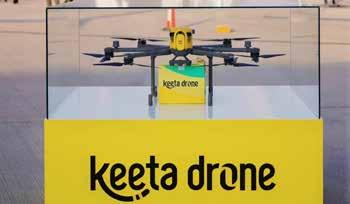
Dubai’s drone delivery ambitions are taking flight, with Sobha Realty partnering Keeta Drone to bring aerial deliveries to residential communities. The move signals a shift towards faster, on-demand logistics while advancing the city’s push to embed autonomous services into everyday urban living.
Microsoft’s long-standing exclusive access to OpenAI’s technology is coming to an end under a revised partnership agreement. While Microsoft remains OpenAI’s primary cloud partner, the AI company can now offer its models and products across rival cloud platforms, opening the door to broader industry adoption and increased competition in the AI market.
du Pay has appointed fintech veteran Roberto Mancone as CEO to lead its next phase of growth in the UAE. With more than 25 years of experience in digital banking and financial services, he will oversee expansion efforts as the company broadens its fintech ecosystem beyond payments.
Huawei has named Corey Deng as Chief Cybersecurity and Privacy Officer for the Middle East and Central Asia, underscoring its focus on strengthening regional security and compliance. He will oversee cybersecurity strategy, privacy frameworks and risk management as digital ecosystems across the region continue to expand.
Egypt moves to safer connectivity with child SIM initiative
Microsoft, OpenAI end exclusive partnership
du Pay names Roberto Mancone as CEO
Huawei appoints Corey Deng as MECA cybersecurity chief
Dubai takes delivery to the skies with Sobha–Keeta deal
Lenovo opens META regional HQ in Riyadh
Meta signs space solar power deal to support AI data centres
Meta Platforms has signed an agreement with startup Overview Energy to secure power from the company’s space-based solar energy infrastructure as it looks to meet the growing energy demands of its data centre operations.
Under the agreement, Meta will receive
early access to up to 1 gigawatt (GW) of capacity from Overview Energy’s planned system, which is designed to collect solar energy in space and beam it to facilities on Earth for round-the-clock power generation. Financial terms of the deal were not disclosed.
Overview Energy is developing technology that would collect solar energy in orbit and transmit it to ground-based facilities, enabling continuous power generation regardless of weather conditions or daylight hours. The companies said an initial orbital demonstration is expected in 2028, with commercial power delivery targeted for 2030.
“Space solar technology represents a transformative step forward by leveraging existing terrestrial infrastructure to deliver new, uninterrupted energy from orbit,” said Nat Sahlstrom, vice president of energy and sustainability, Meta
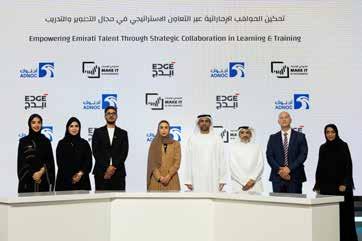
EDGE Group, ADNOC partner on AI workforce development
EDGE and ADNOC have signed a Memorandum of Understanding (MoU) under which EDGE will deliver capability development training to ADNOC employees through BRIDGE’s advanced training and support programmes. The initiative is aimed at supporting ADNOC’s AI and workforce transformation efforts through tailored training and development programmes.
Under the agreement, BRIDGE will support ADNOC’s AI initiatives across human capital and technology integration through programmes covering leadership development, diversity and inclusion, upskilling and advanced capability building, innovation and applied challenges, workforce enablement, and critical and dual-use technologies spanning energy assets, sustainability, and infrastructure resilience.
Sana AlDaoumi, Group Senior Vice President, Human Capital, EDGE, said, “By bringing EDGE’s advanced technology, AI, and workforce development expertise directly into ADNOC’s operations, this collaboration accelerates the development of world-class, sustainable in-country capabilities that serve the UAE’s long-term national vision.”
Ahmed Al Mheiri, Senior Vice President, Group People & Culture Shared Services, ADNOC, said, “This strategic agreement between ADNOC and EDGE underscores our commitment to enable local talent to harness the power of AI to support ADNOC’s growth and drive progress for the UAE.”
BRIDGE, EDGE’s strategic enabler for advancing technologies from development to production, industrialisation
Space solar technology represents a transformative step forward by leveraging existing terrestrial infrastructure to deliver new, uninterrupted energy from orbit
The agreement forms part of Meta’s broader effort to secure long-term energy supplies as demand for artificial intelligence infrastructure continues to rise. The company is currently building several large-scale data centres across the United States and has also entered partnerships with companies including Vistra, Oklo and TerraPower as part of its energy strategy.
This strategic agreement underscores our commitment to enable local talent to harness the power of AI to support ADNOC’s growth and drive progress for the UAE
AHMED AL MHEIRI
ADNOC
and operational excellence, has previously trained more than 450 ADNOC employees, equipping them with practical AI knowledge, leadership skills, and tools to support data-driven decision-making and digital transformation.
UAE Cabinet approves framework to deploy Agentic AI across federal government
The UAE Cabinet has approved a federal framework for implementing Agentic AI across ministries and government entities, marking the next phase of the country’s plan to transform government operations through artificial intelligence.
The decision was announced following a Cabinet meeting chaired by His Highness Sheikh Mohammed bin Rashid Al Maktoum, Vice President, Prime Minister of the UAE and Ruler of Dubai, at Qasr Al Watan in Abu Dhabi.
According to Sheikh Mohammed, the Cabinet reviewed the national transformation strategy directed by UAE President His Highness Sheikh Mohamed bin Zayed Al Nahyan, which aims to make the UAE the first government in the world to deploy Agentic AI across 50 percent of its services and operations.
“I chaired a Cabinet meeting at Qasr Al Watan in Abu Dhabi, where we discussed the national transformation strategy directed by the UAE President
to make the UAE the first government in the world to deploy Agentic AI across 50 percent of its services and operations. During the meeting, we defined the governance framework setting out the roles and responsibilities of all ministries and federal entities in this national project,” Sheikh Mohammed said.
The Cabinet also approved what Sheikh Mohammed described as the largest training programme in the history of the UAE Government. The initiative will train 80,000 government employees in Agentic AI technologies and tools, covering ministers, senior executives and employees across ministries, authorities and federal entities.
“We also launched the largest training programme in the history of the UAE Government, training 80,000 employees in Agentic AI tools and technologies, from ministers and senior executives to new joiners across every ministry, authority, and government entity,” Sheikh Mohammed said.
In addition, the Cabinet approved the first package of government services to be redesigned around Agentic AI. The initial service bundles will target citizens, residents, businesses and investors as part of the wider transformation programme.
“We will convene a national retreat to develop the full transformation strategy, and Sheikh Mansour will lead and oversee this journey. Our ambition is clear: to be the world’s leading government in adopting Agentic AI,” said Sheikh Mohammed.
The meeting also approved a National Policy for Advancing Digital Healthcare Services and Artificial Intelligence in the Health Sector, aimed at supporting the adoption of AI-enabled healthcare services across the UAE.
The UAE has approved a nationwide Agentic AI rollout across 50 percent of government services and operations
Qiddiya taps Google Cloud to power mega Saudi entertainment city
Qiddiya Investment Company and Google Cloud have expanded their collaboration to establish the digital foundation for Qiddiya City, one of Saudi Arabia’s largest entertainment and tourism developments.
Through systems integrator Master Works, Qiddiya will deploy Google Cloud’s data and AI technologies to
support city operations, construction oversight, visitor services, and real-time decision-making. Qiddiya City spans 360 square kilometres and more than 20 neighbourhoods, bringing together entertainment, sports, gaming, and cultural attractions as part of Saudi Vision 2030.
Salesforce Expands Enterprise AI Access for GCC Small Businesses
Salesforce has introduced Salesforce Foundations across the GCC, a new offering designed to bring enterprisegrade AI, customer relationship management (CRM), and automation capabilities to small and medium-sized businesses (SMBs).
The package combines sales, service, marketing, commerce, and AI tools within a single platform and includes access to Agentforce, Salesforce’s AI agent technology, and Data Cloud, its unified data platform. The company said the offering is designed to help SMBs deploy AI-powered capabilities and streamline business processes without the complexity typically associated with large-scale enterprise implementations.
According to Salesforce, SMBs account for more than 90 percent of businesses across the GCC and play a key role in driving economic growth and diversification throughout the region. Salesforce Foundations aims to provide smaller organisations with access to integrated technologies that can help improve customer engagement, automate workflows, and support business operations.
“The businesses shaping the GCC’s future need technology that can grow with them,” said Mert Yentur,
Under the agreement, Qiddiya will implement a unified data platform built on BigQuery, an AI Factory powered by the Gemini Enterprise Agent Platform, and an enhanced version of its proprietary AI platform, Q-Brain. The technologies are designed to provide real-time insights into construction progress, visitor demand, and operational performance.
“Our goal is a seamless digital experience that connects Qiddiya City with our growing nationwide entertainment portfolio,” said Abdulrahman Alali, chief technology officer at Qiddiya Investment Company.
“By combining Google Cloud’s technology with Master Works’ integration expertise, we are establishing a robust, data-driven foundation that turns a massive project into a manageable, intelligent reality for both our operators and visitors.”
Abdul Rahman Al Thehaiban, Managing Director – Middle East, North Africa and Turkey, Google Cloud, said, “By integrating Google Cloud’s globalscale infrastructure and cutting-edge AI into its operations, Qiddiya is building a foundation that turns massive data into actionable intelligence.”
Regional Vice President, Salesforce Middle East. “Salesforce Foundations gives small and medium-sized businesses access to the same trusted platform, data, and AI capabilities used by the world’s largest enterprises, helping them accelerate growth and deliver better customer experiences.” Salesforce said Foundations integrates with existing Salesforce applications and provides pre-configured functionality to simplify deployment and accelerate adoption for growing businesses across the region.
Alexandre.ROSA / Shutterstock.com
Kevin Paul Davis
The Intelligent Core of Your Cyber Defense
One Platform. Total Visibility. Absolute Security.
Turn fragmented data into decisive action. Our SIEM eliminates blind spots, providing the real-time insights you need to detect, investigate, and neutralize threats before they disrupt your operations.
Detect Early
Spot ransomware, phishing, and insider threats instantly.
Stay compliant
Automate audit logs for GDPR, HIPAA, and PCI DSS.
Respond Faster
Automate incident response to slash recovery times.
Unify Everything
One view for cloud, on-prem, and remote teams.
Ooredoo Qatar launches Smart Wi-Fi analytics for real-time network intelligence
Ooredoo Qatar has launched Smart WiFi Analytics, a new service designed to transform enterprise Wi-Fi networks into a source of real-time operational intelligence across large-scale environments, including shopping malls, universities, and office buildings. The service is available as an add-on to Ooredoo’s Smart Wi-Fi portfolio.
According to Ooredoo, the solution converts Wi-Fi data into actionable insights, enabling organisations to adopt a
Saudi Arabia launches sandbox initiative for municipal and housing sectors
Saudi Arabia’s Minister of Municipalities and Housing, Majed Al-Hogail, has launched the Sandbox initiative, a new programme designed to accelerate innovation in the municipal and housing sectors by providing a controlled environment for testing emerging solutions and business models.
According to the Ministry, the initiative enables innovators, entrepreneurs, and companies to trial products, services, and operational
more proactive and data-driven approach to network management and performance optimisation. The platform introduces a unified analytics dashboard that provides visibility into network health, user behaviour, and application performance in real time.
The service also delivers indoor location insights, allowing organisations to analyse movement patterns, optimise space utilisation, and support operational
models under regulatory supervision before wider deployment. The Sandbox is intended to support the development of practical solutions while reducing the risks associated with implementation and scaling.
The initiative is built around an integrated operating model that brings together government entities, privatesector organisations, and industry stakeholders to collaborate on testing and refining innovations. Participating organisations will have access to a
We believe connectivity should do more than just keep businesses online; it should provide the intelligence needed to run them better
decision-making across their facilities. Ooredoo said the platform is designed to help businesses identify issues early through proactive monitoring and rapid root-cause analysis, reducing manual intervention and minimising downtime.
Hassan Ismail Al Emadi, Chief Business Officer, Ooredoo Qatar, said, “At Ooredoo, we believe connectivity should do more than just keep businesses online; it should provide the intelligence needed to run them better. With the Smart Wi-Fi Analytics, we are enabling our customers to gain real-time visibility, take control of their networks, and deliver consistently high-quality digital experiences at scale.”
Smart Wi-Fi Analytics is available to existing Smart Wi-Fi customers and extends the capabilities of Ooredoo’s managed connectivity portfolio for enterprise environments.
structured environment where solutions can be evaluated, improved, and validated against sector requirements.
The Ministry said the Sandbox will contribute to improving decisionmaking by generating data and insights from real-world testing scenarios. It is also designed to support the adoption of new technologies and innovative approaches across municipal services and housing projects.
Applications for the programme will be submitted through a dedicated digital platform, allowing innovators to propose solutions and participate in testing and development phases.
The Sandbox initiative forms part of the Ministry’s efforts to foster innovation and encourage the development of solutions that address challenges across the municipal and housing sectors while supporting broader development objectives in the Kingdom.
“OUR
AMBITION IS CLEAR: TO BE THE WORLD’S LEADING GOVERNMENT IN ADOPTING AGENTIC AI”
HH
Sheikh Mohammed bin Rashid Al Maktoum, Vice President and Prime Minister of the UAE, and the Ruler of Dubai
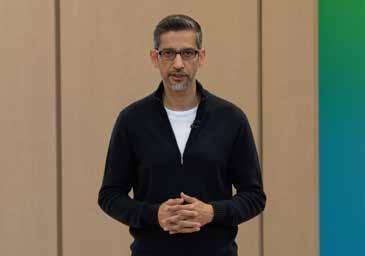
“TEN YEARS SINCE WE PIVOTED THE COMPANY TO BE AI-FIRST, WE STILL SEE AI AS THE MOST PROFOUND WAY TO ADVANCE OUR MISSION AND IMPROVE PEOPLE’S LIVES AT SCALE”
Sundar Pichai, CEO, Google and Alphabet
IDENTITY SPRAWL
THE SECURITY BLIND SPOT AMID THE AI BOOM
Over the past few years, identity security has revolved around people. The challenge facing security teams was relatively straightforward: establish who should have access to systems, determine what privileges they require, and ensure those permissions are monitored and controlled over time. While cloud adoption, hybrid work and digital transformation have added complexity, the underlying
assumption remained largely unchanged. Human users sat at the centre of the identity ecosystem.
CyberArk’s, a Palo Alto Networks company, Identity Security Landscape Report 2026 suggests that assumption is becoming increasingly difficult to sustain. The company found that machine identities now outnumber human identities by 116 to one in the UAE, up from 67 to one a year ago. The growth reflects
the proliferation of cloud workloads, applications, APIs, certificates, connected devices and automation platforms. Increasingly, it also reflects the arrival of AI agents, many of which are being granted access to enterprise systems and data to perform tasks with varying degrees of autonomy.
This shift is occurring at a time when organisations are already struggling to maintain control over increasingly fragmented identity environments. According to the research, 92 percent of UAE organisations experienced at least three successful identity-related breaches during the past year, while 96 percent reported at least one such incident. Those figures place the UAE above the broader EMEA average and reinforce a reality many security leaders have been grappling with for several years: identity has become one of the most attractive entry points for attackers.
Part of the difficulty lies in the fact that identity growth is no longer tied primarily to workforce expansion. Organisations may hire hundreds of employees, but they are deploying thousands of new machine identities as cloud services expand, automation initiatives mature and AI systems become embedded within business processes.
CyberArk found that 90 percent of UAE organisations expect machine identities to increase over the next 12 months, with AI and large language model deployments ranking among the most significant drivers. Seventy-eight per cent expect growth in AI identities.
The security implications extend beyond scale. Machine identities interact with applications, exchange data and perform operational functions that often require privileged access. The report found that, on average, 37 percent of AI agents and machine identities already have access to organisational data, including sensitive information and critical systems. Yet many organisations appear to be introducing these capabilities faster than they are developing the controls required to govern them. Only a minority currently apply behavioural monitoring or credential revocation controls to autonomous AI agents, conversational AI systems or generative AI tools.
CyberArk found that 90 percent of respondents believe fragmented identity systems are already affecting their ability to detect and respond to threats, while 70 percent have yet to fully automate certificate monitoring and renewal across all environments. The company estimates that shortcomings in certificate lifecycle management could cost UAE organisations nearly AED 1 million on average. Much of the conversation around AI remains focused on productivity gains and business outcomes. Less attention is paid to the identities operating behind the scenes and the access they are being granted across enterprise environments. As organisations continue to expand their use of AI, the more immediate challenge for security leaders may be understanding how many of those identities exist across their organisations, what they can access, and whether anyone is truly keeping watch.
116:1
The ratio of machine to human identities in UAE organisations
92%
The proportion of UAE organisations that experienced multiple identity-related breaches
37%
The average share of AI agents and machine identities with access to organisational data
FROM DATA TO INTELLIGENCE
Arno van Driel, Vice President – EMEA, ClickHouse, examines how the rise of AI agents is transforming enterprise data infrastructure and redefining the role of the database
As enterprises aggressively scale their artificial intelligence deployments, initial capital investments have naturally poured into foundational large language models (LLMs), AI copilots, and raw GPU clusters. However, organisations are now hitting a critical architectural bottleneck: the infrastructure that processes, stores, and serves fullfidelity data in real time.
For decades, enterprise data environments were architected around a human-driven loop: static dashboards, scheduled batch reporting, and occasional queries. AI systems operate completely differently. They query and ingest vastly larger data volumes, require absolute data fidelity, and generate relentless, hyper-concurrent workloads that legacy database architectures were simply never designed to withstand.
This monumental shift is driving massive momentum for platforms like ClickHouse, an open-source columnar database engineered for real-time analytics, observability, and large-scale data warehousing.
“ClickHouse, the company started almost five years ago with a small team,” says Arno van Driel, Vice President – EMEA, ClickHouse.
“Today, we are more than 600 people globally.”
The market reality is clear: adopting AI requires fundamentally rethinking your data strategy. If your data engine fails to feed models at machine speed, your enterprise AI initiatives will stall.
The convergence problem: Collapsing the three pillars
Historically, enterprise data infrastructure split into separate tech domains to survive. ClickHouse built its business around three of them.
The first is real-time analytics, where sub-second queries across billions of rows are often critical to business performance.
The second is observability, centred on collecting and analysing vast volumes of telemetry data, including logs, metrics, and traces, through
It’s a true privilege and a strong testament to the market’s realisation that ClickHouse is becoming a foundational pillar of modern enterprise architecture
standards such as OpenTelemetry.
The third is data warehousing, combining deep historical datasets with live streams of information to create a more complete operational picture, for example, from retail transactions to supply chain activity.
These three pillars operated as siloed technology domains. AI is completely collapsing these boundaries.
Because AI agents require simultaneous access to analytical data, operational logs, and historical context to make decisions, these three silos converge at the data layer into a single requirement: high-concurrency, real-time query execution over unsampled data.
Moving beyond the dashboard to “agent-native” infrastructure The shift from human users to
machine users changes every rule of database design. Industry experts are calling this the dawn of Agent-Native Data Infrastructure, driven by three major disruptions.
One of the biggest changes is that conversational AI is replacing the dashboard. Instead of looking at a static report, business users now use natural language to interact with data. This shift is mirrored in engineering, where Site Reliability Engineers
(SREs) are abandoning traditional monitoring dashboards in favour of AI interfaces that conduct automated root-cause analysis directly inside the data layer.
Another change concerns data retention and fidelity. Humans accept compromises. To save on expensive SSD storage, organisations historically enforced seven-day log retention, sampled data, or used pre-aggregated batch rollups.
For AI agents, these human compromises become problematic. An AI agent cannot use “gut feeling” to compensate for a missing one percent of sampled data, nor can an AI SRE investigate a failure today if its institutional memory was wiped by a 14-day retention limit.
ClickHouse’s decoupling of storage and compute leverages object storage economics, significantly reducing effective costs. This allows
organisations to keep 30 to 365 days of full-fidelity, unsampled data as a baseline.
The third change is the rise of machine-speed workloads. Humans run a query and pause. Autonomous AI agents operate 24/7 in continuous reasoning loops. An agent won’t stop branching after 10 experiments; it will query datasets in parallel at high concurrency. ClickHouse delivers the sub-second response times these
machine workloads demand.
To bridge this gap, ClickHouse has focused heavily on the Model Context Protocol (MCP), exposing the database natively as a tool that LLMs can invoke to discover schemas and safely generate SQL internally. ClickHouse acquired LibreChat, a leading open-source AI chat platform, to help enterprises deploy an end-toend “Agentic Data Stack” out of the box.
Deployment flexibility and sovereignty
As AI workloads move closer to highly regulated operational data,
deployment freedom is paramount. Van Driel notes that while many organisations instinctively demand sovereign cloud environments, the real architectural question is determining which data genuinely requires sovereignty and which can live in the public cloud.
In response, ClickHouse supports multiple deployment models, ranging from ClickHouse Cloud and Bring Your Own Cloud (BYOC) customer-controlled environments to ClickHouse Private, a fully air-gapped solution for isolated deployments.
The company also believes simplicity remains important as
Every company now has AI in the back of their minds. But AI ultimately comes back to data
organisations scale increasingly complex AI initiatives.
“ClickHouse is an SQL database,” van Driel says. “If you can talk SQL, which everybody does, you can interact with the database. That simplicity is extremely important, not only for AI adoption but also for reducing infrastructure complexity overall.”
Regional momentum: Gaining ground in the Middle East
The Middle East has emerged as one of the most active global hubs for AI, cloud, and digital infrastructure investment. “We had roundtables, events and meetups in Dubai and Saudi Arabia before we invested heavily in the region,” van Driel explains. “That helped us understand where ClickHouse was gaining traction, the use cases driving adoption, and the deployment models customers were looking for.”
Today, ClickHouse has a dedicated team in Dubai, collaborating with the local ecosystem. “Beyond our current established relationships with partners like Gulf Business Machines, Saudi Business Machines, Bassirah, Digityze Solutions, and FunctionGroup Analytics, we are
experiencing a continuous influx of new partnership requests from across the region,” says van Driel. “It’s a true privilege and a strong testament to the market’s realisation that ClickHouse is becoming a foundational pillar of modern enterprise architecture.”
This structural market growth has fundamentally altered the local tech talent landscape.
“A significant trend we are seeing alongside this regional momentum is a surge in demand for ClickHousespecific skills,” says van Driel. “Because so many organisations in the Middle East are already leveraging ClickHouse Open Source in some capacity, there is a strong appetite to formalise and deepen that expertise. Through both ClickHouseled instructor enablement and our local partner ecosystem, we are actively driving knowledge transfer. It’s incredibly rewarding to see that technical professionals in the region
view mastering ClickHouse not just as an infrastructure win, but as a powerful catalyst for their own career growth, both internally and within the broader industry.”
The region’s customer base perfectly reflects the diverse infrastructure requirements of the modern market—from public cloud agility to strict air-gapped security: PropertyFinder migrated its data platform, reduced critical query times from 50 seconds to just two seconds while radically lowering operational costs, and Tabby balances rapid financial innovation and scale with strict regional data residency and regulatory sovereignty.
ClickHouse already has a close partnership with Microsoft and AWS in the region which makes ClickHouse Cloud available for the region. To fully unlock this potential for highly regulated sectors, ClickHouse continues to invest in its managed cloud offering
in Saudi Arabia in the near future. This localised managed offering will enable Saudi enterprises to leverage ClickHouse’s capabilities while remaining 100 percent compliant with local data-residency mandates.
The core-first vision
As legacy database companies scramble to enter the AI market by building superficial, bolted-on addons, ClickHouse remains committed to an engine-level approach.
“Our vision is to make sure that the database, from the core, is actually serving these needs and not building add-ons that need to be separately maintained,” says van Driel. “Every company now has AI in the back of their minds. But AI ultimately comes back to data. Whether it’s analytics, observability, data warehousing, or AI-native applications, customers need infrastructure capable of processing data at scale. That’s exactly where ClickHouse is positioned.”
RESILIENCE ECONOMICS
By Abdelilah Nejjari, Managing Director – Gulf and Levant, Cisco
The UAE has built one of the region’s most dynamic digital economies by moving early, investing boldly, and planning for the long term. From digital government and smart services to AI and cloud adoption, the UAE has consistently led from the front. As the next phase of growth begins, business continuity is becoming a more urgent leadership priority across every sector.
Foundations for the digital economy
In today’s fast-moving digital economy, ‘business continuity’ is no longer a question of implementing contingency plans or backup solutions to eventually get business up and running after an outage. It’s a question of whether organisations can keep services constantly available, employees connected, data protected, and operations running when disruption occurs. Digital resilience is no longer simply a technology concern: it is a strategic capability that underpins an organisation’s performance, brand trust, and competitiveness. Disruption can come from many directions. It may be a cyberattack, cloud outage, software failure, degraded network performance, or an issue affecting a third-party provider. The challenge for leaders is no longer simply how to prevent every incident. It is to have a plan in place that can be executed quickly,
allowing teams to reduce or negate business impact and recover with confidence.
The three pillars of business continuity
The urgency is reflected in the data: Cisco’s 2025 Cybersecurity Readiness Index reveals that only 30 percent of UAE organisations are mature enough to withstand current threats, while 93 percent have faced AI-related security incidents and 75 percent anticipate disruptions within the next two years.
Because the impact of these incidents extends far beyond IT, affecting revenue, customer experience, and brand reputation; leaders must move beyond reactive measures. When an incident occurs, the primary challenge is often a lack of visibility across complex, fragmented environments, which slows response times and prolongs downtime.
To bridge this gap, business continuity must rely on three integrated capabilities: assurance across digital connections, deep observability across applications and infrastructure, and unified security operations. Ultimately, true resilience is not just about staying online; it is the ability to see clearly, act decisively, and recover with confidence.
AI readiness as an economic pillar
The UAE’s vision is to double its digital economy by 2032, with AI projected to drive 20 percent of non-oil GDP by 2031. This demands a robust digital foundation, elevating digital resilience from a simple enterprise requirement to a cornerstone of the nation’s long-term economic strategy. This strategy is now accelerating with the newly announced directive of the nation’s transition of 50 percent of government operations
to Agentic AI within two years; a global first.
The data confirms this urgency: 35 percent of organisations are prioritising infrastructure upgrades, while 42 percent anticipate a surge in AI workloads. By proactively scaling capacity and ensuring the workforce is equipped to manage these autonomous systems, businesses can secure the stability required to power the UAE’s next chapter of economic growth.
The trust imperative
The UAE already has a strong base from which to build. It scored 98.3 out of 100 on the ICT Development Index 2025, positioning the UAE as a global leader in digital transformation. This reflects years of sustained investment and national focus. Yet in an environment shaped by AI, cloud, and alwayson digital services, maintaining this momentum requires a shift
from isolated management to an integrated approach.
True continuity connects infrastructure, security, and visibility, with governance and transparency at its core. When disruption occurs, trust is preserved not just through technology, but through accountability. Leaders must move beyond asking, “are we investing in innovation? to “can we sustain operations under pressure, and does our response reflect a commitment to the transparency that keeps customer trust intact?”
Resilience also depends on people
Digital resilience is not only about systems. It is also about people with the skills to operate, secure, and scale increasingly complex digital environments. This is a global challenge, and the UAE is no exception: 53 percent of local organisations report significant
Digital resilience is not only about systems. It is also about people with the skills to operate, secure, and scale increasingly complex digital environments
cybersecurity staffing shortages, with many roles remaining unfilled.
Addressing this requires a dual focus: upskilling the existing workforce and fostering a pipeline of new talent. Since 1999, the Cisco Networking Academy has trained over 144,000 learners in the UAE, including 29,000 last year alone, demonstrating that building local capability is essential. In a fastchanging landscape, skilled people are the bridge that turns technology investments into operational strength.
Building the next chapter
Cisco has been part of the UAE’s digital journey since 1998, working alongside customers and partners across government, telecommunications, energy, finance, education, and other critical sectors. That long-term presence matters because resilience is not built in a moment. It is built over time through trusted partnerships, local understanding, and a shared commitment to outcomes that last.
The UAE has the vision, connectivity, and ambition to shape one of the world’s most compelling digital futures. And the next chapter of leadership will be defined not only by how quickly organisations innovate. It will be defined by how confidently they can continue operating through disruption, securely, visibly, and at scale.
A TALE OF TWO TECHNOLOGIES
By Peter Oganesean, Managing Director, Middle East and East Africa, HP Inc.
Across the UAE, rapid advances in artificial intelligence and digital infrastructure are transforming how public services, businesses, and individuals operate. As this digital momentum continues, organisations must confront two cybersecurity challenges that define different ends of the risk spectrum, one immediate and visible, the other strategic and approaching. Artificial intelligence agents are already being deployed by cybercriminals to automate attacks with greater efficiency and scale. At the same time, quantum computing presents a looming threat to the cryptographic foundations protecting today’s digital systems. Both technologies need attention now more than ever as public and private sectors in the UAE invest in endpoint devices like commercial PCs and printers that will remain in service well into the next decade.
AI agents: Scaling attacks with automation
Cybercriminals are no longer relying solely on human effort for reconnaissance or vulnerability scanning. In 2026, AI agents are expected to take over many preparatory steps in the attack lifecycle – researching targets, identifying weak points, and even crafting social engineering campaigns. This evolution marks a shift from manual intrusion to scalable, AI-driven attack models. These agents are being used to assist with complex tasks like discovering unpatched
vulnerabilities and gaining access to enterprise infrastructure. The fast adoption of hybrid work models and distributed teams makes these attacks more difficult to detect and contain, particularly as endpoints become more mobile and varied. Traditional security tools may fail to intercept such dynamic, adaptive threats. Organisations must pivot toward containment and isolation strategies that assume breaches will happen and focus on minimising damage. PCs now play a critical role in this model, through built-in self-healing firmware, application isolation, and endpoint threat telemetry that ensures quick response without disruption to productivity.
Quantum computing: A long-term risk with strategic impact
While AI enables attackers to act faster, quantum computing introduces a different risk: the ability to break encryption that secures data today. The global cybersecurity community now sees quantum decryption as a realistic threat within the decade, prompting governments and critical sectors to begin migrating to quantumresistant algorithms.
This has immediate implications for the UAE’s IT and procurement leaders. Many of the endpoint devices and IT systems deployed in 2026, particularly in government, healthcare, finance, and infrastructure, will still be active when quantum computing reaches cryptographically relevant capability. Devices with long refresh cycles,
such as commercial PCs and officeclass printers, must be evaluated not only for today’s risks but for their ability to withstand tomorrow’s.
Quantum resilience is no longer optional for forward-looking organisations. Devices must be designed with cryptographic agility in mind, ensuring that algorithms can be upgraded or replaced in line with evolving global standards. Procurement decisions made now will determine whether systems deployed in the late 2020s remain trustworthy through the 2030s.
A security strategy built for two timelines
Tackling both of these risks requires a dual strategy. In the near term, organisations must strengthen
The
convergence of AI and quantum is reshaping cybersecurity from two directions –one pressing and fast-evolving, the other distant but unavoidable
defence mechanisms against AIdriven attacks by upgrading endpoint security, reducing reliance on legacy authentication models, and adopting zero trust principles that limit lateral movement after a breach.
Simultaneously, longer-term security planning must prioritise quantum resilience. That means working with technology partners that are already embedding nextgeneration cryptography into their hardware and firmware layers, and selecting device platforms with security controllers capable of resisting both current and future decryption techniques.
This approach is not just about managing risk. It reflects a broader shift toward securing national digital infrastructure, especially in
regions like the Middle East where AI and automation strategies are critical to long-term economic competitiveness.
Conclusion
The convergence of AI and quantum is reshaping cybersecurity from two directions – one pressing and fast-evolving, the other distant but unavoidable. One demands agility. The other requires foresight. As the UAE moves deeper into its digital transformation journey, organisations that build both short-term resilience and longterm protection into their endpoint strategies will be best positioned to protect their operations, data, and reputations in an increasingly complex digital landscape.
RESILIENCE IN MOTION
As telecom networks become the backbone of digital economies, risk is no longer something organisations can isolate or defer. AbdulGhaffar Setareh, Chief Risk Officer, Zain Group, explains how managing uncertainty has moved to the centre of decision-making, shaping how the business invests, operates, and stays resilient under pressure
Risk has always been part of running a large business, but the way it behaves has changed. Regulatory shifts, cyberattacks, geopolitical disruption and technology failures do not arrive in isolation. They compound, often faster than organisations are structured to respond. In telecom, that reality is more exposed than in most sectors. Operators make long-term infrastructure investments in markets where the rules governing that infrastructure can change
with little notice. At the same time, the expectation of uninterrupted service has only strengthened. When connectivity fails, the impact extends well beyond telecom itself.
The business reality
As an ever-evolving and fastgrowing TechCo, Zain Group carries that pressure across eight markets, Kuwait, Bahrain, Iraq, Jordan, Saudi Arabia, Sudan and South Sudan (plus UAE), serving more than 51 million customers across a geography where the operating
conditions are rarely consistent and sometimes extreme for its core mobile, data and B2B operations as well as for its fintech and digital entities. Similar challenges are also faced by its three ICT enterprise focused entities headquartered in the UAE and operating regionally, namely ZainTECH, Zain Omantel International (ZOI) and TASC Towers.
To accelerate the business and overcome challenges, Zain launched its ‘4WARD–Progress with Purpose’ corporate strategy to bolster its evolution from a predominantly
mobile-centric operator into a purpose-driven, customer-centric, future-ready regional Technology and Investment Group (TechCo) focusing on four key strategic pillars: Customer Delight, Digital Zain, Purpose & Action, and Collaborative Growth.
In compliance with the 4WARD strategy, managing risk across that footprint requires something more deliberate than a centralised compliance function. It requires risk to be present at the point where decisions are made, not brought in afterwards to review them.
“Zain’s goal is not to have a risk-free business, that would be the wrong objective entirely,” says AbdulGhaffar Setareh, Zain Group Chief Risk Officer. “What we are trying to do is take decisions with a clear understanding of the exposure we are carrying. Risk management is an independent function that reports to the board on governance matters, and the Risk department’s role is to make sure the company is well
protected, with clearly defined risk appetites across every category of risk we face, and that those appetites guide how we make business decisions.”
That applies whether Zain is acquiring a company, backing a new technology, or moving into a new market. Due diligence is not the last step before a decision, it shapes the decision itself. “The board sets the thresholds for our risk appetite, and the team’s job is to assess whether the exposure sits within those thresholds before the business commits.”
Those thresholds get tested in markets where the ground shifts in ways that no framework fully anticipates. Each of Zain’s eight markets is assessed individually, because the risks in one country bear little resemblance to those in another. Iraq is a good example.
“The country is a challenging but rewarding environment to operate in, the macroeconomic pressures are significant, the geopolitical situation is complex, and these are not background conditions that you manage around. They shape how the business operates on a daily basis and you need to be agile there to succeed.”
Regulatory instability presents a different kind of strain. In South Sudan, import duties on equipment rose drastically in a short window, immediately forcing a reassessment of investments planned under different assumptions.
“Regulatory environments across our markets are becoming increasingly unpredictable,” Setareh says. “You can build a five-year investment plan on a set of informed data, and then find that a key variable has shifted within months. That is the reality we plan against.”
Operating across eight markets means that when instability strikes anywhere within that footprint, it lands inside the business almost immediately. For Zain, the early months of 2026 brought that reality into sharp focus, with staff across multiple markets, infrastructure running through affected corridors, and customers depending on
Employees are the most important asset we have, more important than any system or piece of infrastructure we operate
connectivity that could not simply be switched off while the situation resolved itself.
The first call was about people.
“Employees are the most important asset we have, more important than any system or piece of infrastructure we operate,” explains Setareh. “When the security situation became serious, the decision was straightforward: people should not be required to come into the office. We moved to working from home, and we did it quickly. Safety has to come first, and everything else follows from that.”
With the workforce protected, attention moved to the network. When subsea cables were impacted
and connectivity degraded across parts of the region, ZOI rerouted traffic through alternative routes across its networks, managing customer communications throughout. The response drew on strong contingency measures built well before the disruption arrived.
“Reliable and secure connectivity has become essential for people and society at large, they depend on it for work, for financial transactions, for accessing public services. That means the obligation to keep services running does not pause because the conditions around us are difficult. We have to find a way to maintain continuity, and that requires preparing for scenarios that are hard to predict in advance,” he says.
The technology layer
The disruptions Zain navigates in the field, regulatory shifts, regional instability, infrastructure failures, are visible and immediate. The risks that sit beneath them are quieter but no less demanding. Cyber-attacks on critical infrastructure have grown in frequency and sophistication globally, with telecoms among the most consistently targeted sectors given the volume of sensitive data their networks carry.
“Cybersecurity is not something you solve and move past, it is a risk
Cybersecurity is not something you solve and move past, it is a risk you have to live with and manage continuously
you have to live with and manage continuously. Even the largest and most sophisticated organisations in the world are being attacked regularly, and the sophistication of those attacks is increasing year on year. The threat does not diminish as your defences improve; it evolves alongside them,” Setareh says adding that ZainTECH is well primed to support the company’s many entities and its customers.
AI has added a layer of complexity that is still being mapped in real time. Zain introduced an AI centre of excellence and an internal security policy for AI use, but found it needed updating within months of being
written. “The technology is moving faster than the governance around it, and the maturity simply is not there yet. The risks are still taking shape, and our frameworks have to keep pace with how people are actually using these tools,” explains Setareh.
The pressure point is data. “A great deal of information and data flows into AI systems, and that can become very alarming when you think about it at scale. The moment you make a tool available across the organisation, thousands of people can be sending company data through it, and the consequences of that are not always visible until the damage is done,” he says.
Finding and keeping the people capable of managing all of it has become one of the most persistent pressures across the business. “The talent gap in technical and security roles is a real challenge, finding the right people is hard enough, but keeping them is harder. The market is competitive, and when you lose someone with years of experience on your systems, you are not just filling a position, you are rebuilding knowledge that took a long time to accumulate.”
Addressing those gaps is not something the business can do alone. In areas where skills are scarce and systems are complex, external expertise becomes part of the operating model. “Partners like Huawei and other trusted global solution providers bring deep technical knowledge and experience delivering across complex environments, they understand how to build and maintain resilience at scale, and that expertise is genuinely valuable when you are trying to keep critical systems running across multiple markets simultaneously,” he adds.
The risks Zain navigates are not going to simplify. Regulatory environments will keep shifting, cyber threats will keep growing in sophistication, and AI will keep outpacing the governance built around it. What Setareh returns to is not removing that complexity, but understanding the exposure it creates before decisions are made.
Switch to Speed. Scale Without Limits.
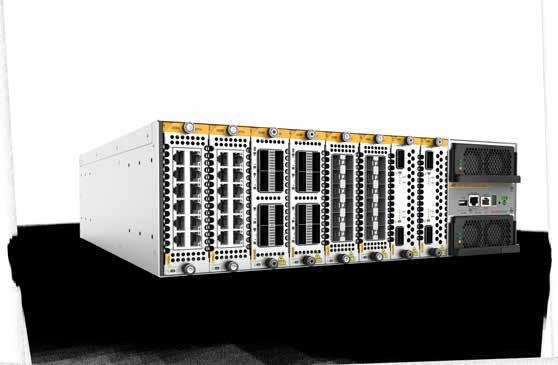
Meet the SwitchBlade x908 GEN3
The SwitchBlade x908 GEN3 is our most advanced modular switch, delivering blazing speed and scalable growth for future-ready enterprise and data center networks.
Blazing Bandwidth: Up to 400G connectivity for high-performance workloads.
Scale Without Limits: 12.8 Tbps of power in a compact 3U chassis.
Flexible & Modular: Compact chassis with versatile interface options.
Smart Management: Zero-touch provisioning and centralized control with AlliedWare Plus™.
Whether you’re scaling a data center or optimizing enterprise networks, the SwitchBlade x908 GEN3 keeps your network fast, flexible, and fail-proof.
Take control. Stay ahead. Transform your network today.
SCALING INTELLIGENCE
Joe
Dunleavy, Regional CTO and Global Head of the Dava.X AI group at Endava, examines how organisations can scale AI responsibly, balancing innovation, control and measurable business outcomes
What separates organisations that are successfully scaling AI from those that remain stuck in pilot mode?
Specific to Gen AI, what we’re seeing very clearly is that successful AI scale starts with strong data, and is less about models. Organisations that get this right invest early in acquiring, integrating and preparing high-quality “gold standard” data, and crucially, in putting systems in place to continuously measure AI outputs. Without that foundation, scale actually becomes a risk. Poor data propagates at machine speed, and fixing it often means additional costs and lost opportunity. Structurally, the organisations making progress are breaking
down silos. They’re bringing together business, IT and data teams into unified delivery models, supported by standardised tools and governance frameworks. That reduces friction and improves visibility into AI performance. They’re also realistic about scope. Rather than trying to scale everything at once, they prioritise high-impact use cases and expand iteratively. Because ultimately, scaling AI isn’t a one-off milestone, it’s an iterative and collaborative process of continuous refinement.
As organisations move towards agentic and multi-agent systems, what operational disciplines become essential to maintain oversight and control at scale?
Getting an AI agent into production feels like a milestone, but in reality, it’s just the start of a much more complex phase. At scale, the real challenge is keeping these systems useful, safe and cost-effective over time. That doesn’t happen by default, it requires a deliberate operating model and methodology. We typically think about this in four parts. The first is performance and user satisfaction. You need to track not just technical metrics like latency and accuracy, but also how users experience the system, and continuously refine both. Second is cost optimisation. Agentic systems can become expensive quickly, so leaders need to actively manage model choice, infrastructure and usage patterns. Third, lifecycle management. These systems can’t be static. They need structured retraining, versioning and, where necessary, controlled rollback. And finally, continuous improvement. The organisations doing this well are embedding feedback loops that allow these systems to evolve alongside business needs, not drift away from them. This is one of the reasons we have created Dava.Flow, to help clients with the deployment of solutions that are supported by Agentic AI throughout the lifecycle.
Many organisations can demonstrate productivity gains from AI. What distinguishes those that are creating lasting business value from those simply improving efficiency?
This really gets to the heart of a shift many organisations are now grappling with. Until relatively recently, the focus of AI endeavours has almost entirely been on productivity, automation and
efficiency gains. And while those are real, they’re ultimately incremental and offer only a fleeting competitive edge. They optimise business, but don’t necessarily transform it.
The organisations starting to see meaningful ROI are the ones reframing the question. Instead of asking “how do we do this faster?”, they’re asking “what can we now do that wasn’t possible before with high quality built in?” That’s where AI starts to create new revenue streams, whether that’s through entirely new services, more personalised offerings, or faster routes to market.
To get to this point, organisations need to align AI initiatives directly to business outcomes, not just technical milestones. That means measuring impact in terms of revenue growth, customer acquisition, and speed of innovation, for example. And this is important because in a more cost-conscious environment, AI doesn’t justify itself through marginal gains. It has to prove its ability to drive transformation and ultimately increased revenue.
As AI systems take on more complex decision-making and execution tasks, how should organisations think about accountability and oversight? Accountability has to be designed in from the outset. It can’t be something you retrofit once systems are already operating at scale. At Endava, we advocate for putting in layered controls. That includes humanin-the-loop oversight for critical decisions, formal risk management frameworks and safeguards implemented in what we call “policy as code” as part of Dava.Flow. But internal controls are only part of the story. Accountability also needs to extend to the customer. Consider an AI system that declines a loan or flags a transaction. For such high-impact use cases, there must be a clear and accessible path for that decision to be challenged and reviewed by a human, potentially even the end customer. That transparency and detailed testing is critical.
Accountability has to be designed in from the outset. It can’t be something you retrofit once systems are already operating at scale
How can organisations build governance frameworks that actually support AI adoption and scale?
When innovation accelerates at breakneck speed, thoughtful regulation becomes a stabilising force. This isn’t about slowing progress. It’s about sustaining it. High-impact AI systems, particularly in banking or healthcare, should face independent validation, bias testing, documented impact assessments, ongoing monitoring and robust audit trails. Customers should receive clear reason codes for decisions and access to human review.
A risk-based approach that protects proprietary innovation, while enforcing accountability, would strengthen trust. And companies don’t need to wait. Building explainability, auditability and governance now not only prepares them for inevitable regulation, it improves operations immediately.
How is AI changing what organisations expect from technology, data and security leaders?
There’s an interesting shift happening here. I came across this recent research on AI governance from Optro, which found that no single function owns AI. In fact, it showed that IT accounts for just 25 percent of responsibility, with risk, leadership and cross-functional teams all sharing the rest. That fragmentation is something we’re seeing more broadly. And it creates real challenges, particularly when
it comes to accountability and incident response.
What’s becoming non-negotiable is clear ownership. Leaders need to move beyond shared responsibility models and define who is ultimately accountable for AI outcomes, including who has the authority to intervene or make critical decisions around AI systems.
At the same time, there’s a growing necessity for leaders to be AI fluent across domains. CIOs and CTOs need to understand risk and governance. CISOs need to engage with data and AI. And CDOs need to connect data strategy directly to business value. In short, AI is forcing a convergence of roles and the leaders who succeed will be the ones who can operate across these boundaries, not within them.
How is Endava helping organisations move from AI experimentation to responsible, enterprise-scale adoption?
Endava plays a critical role in supporting clients as they adopt and scale artificial intelligence across their organisations and customer-facing solutions. Central to this is Dava.Flow, our AI engagement methodology, designed for the post-agile era where agentic AI has the potential to deliver significant business value.
Dava.Flow embeds responsible AI practices directly into delivery, ensuring governance is not an afterthought but a core component of every solution. Through a “policy as code” approach, AI governance is integrated into the full lifecycle, enabling organisations to operationalise compliance, transparency, and ethical standards at scale.
Importantly, Dava.Flow remains technology-agnostic. At Endava, we work closely with clients to support informed decisions on AI platforms and providers, while ensuring that AI adoption is purposeful, efficient, and aligned to measurable outcomes. This approach enables organisations to maximise the impact of AI investments while avoiding fragmented or wasteful implementation.
THE NEW FRONTLINE OF ENTERPRISE AI
ABy Thibault Dousson, Director, Lenovo Services and Solutions Group META
cross Europe, enterprise leaders are entering what might best be described as the governed AI era. Regulation is tightening, scrutiny is rising, and AI is fast becoming a core operating layer of the modern enterprise rather than an experimental productivity tool. Yet our latest Lenovo Work Reborn research shows a paradox: while strategic intent around AI has never been stronger, control over how AI is actually used inside organisations remains alarmingly weak.
More than 70 percent of European employees are already using AI tools weekly, often without formal training, approved platforms, or IT oversight, creating a growing phenomenon of “shadow AI” that exposes organisations to compliance, security, and operational risk. As the EU AI Act approaches enforcement in 2026, this execution gap is no longer a technical nuisance, it is an enterprise risk.
What makes Europe particularly instructive, however, is that it is not an outlier. If anything, it is an early signal of a reality already unfolding elsewhere, including across the Middle East.
The same AI race, a faster track in the Middle East While Europe grapples with governance catching up to
adoption, the Middle East is moving at even greater speed.
According to PwC’s Middle East Workforce Hopes and Fears Survey 2025, 75 percent of employees in the region already use AI at work, significantly above the global average, with nearly one third using generative AI tools daily.
BCG’s AI at Work in the GCC research reveals an even sharper insight: 63 percent of GCC employees say they would continue using AI tools even without employer authorisation, directly mirroring, and in some cases exceeding the “shadow AI” challenge identified in Europe.
The difference is not appetite. Employees in both regions are enthusiastic, optimistic, and results driven. The difference is structure. In Europe, regulation is forcing enterprises to confront
governance debt. In the Middle East, national AI ambitions and digital acceleration have propelled adoption forward at a pace where governance, training, and integration often struggle to keep up. The risk profile is therefore converging.
Why AI is no longer an IT issue, but an execution problem
The message is clear: optimism without enablement eventually turns into risk
Lenovo’s Work Reborn research highlights a critical shift: AI adoption is no longer constrained by technology availability. It is constrained by human enablement. Employees report strong productivity gains, higher creativity, and improved quality of work, yet many still lack enterprise grade tools, ongoing training, or confidence in data protection.
This creates a two tier workforce:
• One tier operates inside governed, sanctioned AI environments.
• The other moves faster, independently, and invisibly outside IT control.
In Europe, this fragmentation threatens compliance with emerging regulations such as the EU AI Act. In the Middle East, it threatens scale, security, and long term value realisation, particularly as organisations move from pilots to enterprise wide deployment.
McKinsey’s research on AI in GCC countries underscores this point. While 84 percent of organisations report some level of AI adoption, only 31 percent have
successfully scaled AI across the enterprise, revealing a widening gap between experimentation and measurable impact.
Trust, training, and the illusion of readiness
One of the most telling insights in the Work Reborn report is that AI confidence is built less on ambition and more on experience. Employees who trust AI tools, receive continuous training, and see AI embedded into their workflows report dramatically higher productivity gains and engagement. This finding is reinforced regionally. PwC research shows that Middle East employees are more optimistic about AI than their global peers, but also increasingly concerned about job
security, workload intensity, and clarity around how AI will change their roles.
The message is clear: optimism without enablement eventually turns into risk.
Banning shadow AI does not restore control, it simply drives usage underground. Sustainable AI adoption depends on making governance visible, training continuous, and AI tools genuinely useful in daily work.
From tools to teammates:
Redefining the enterprise AI model
As AI agents and assistants become embedded across enterprise systems, the role of natural language as the primary interface to work is accelerating. Employees overwhelmingly say their ideal AI experience is not another standalone platform, but intelligence embedded into the tools they already use.
The enterprises that succeed, whether in Europe, the Middle East, or elsewhere, will be those that recognise a simple truth: employees are not recipients of AI transformation; they are its execution layer.
Winning the AI race means bringing everyone onto the field
The AI race will not be won by the organisation with the most pilots, the largest budgets, or the boldest vision statements. It will be won by those that unify their workforce around a clear AI model, one that balances innovation with governance, speed with trust, and autonomy with accountability.
Europe’s experience offers a warning. The Middle East’s momentum offers an opportunity. Together, they point to the same conclusion: enterprise AI transformation is less about technology leadership and more about human alignment at scale.
The future of AI at work will not be decided in boardrooms or policy documents alone, but in the everyday decisions employees make when they choose which tools to trust, which systems to use, and whether AI feels like a risk or a teammate.
5 Google AI innovations set for the Arab world
Google’s latest AI showcase was notable not simply for the number of announcements, but for the breadth of products involved. New models, search capabilities, content verification tools, shopping experiences and autonomous agent platforms all featured prominently. Several of the technologies are also being rolled out across the Arab World, placing regional users among the first to gain access.
Beneath the product launches sits a broader shift in priorities. The conversation around AI is moving beyond chat interfaces and isolated model releases. Technology companies are increasingly focused on embedding AI into products people already use while expanding what those systems can do on their behalf.
Here are five developments that stand out.
RYO
Sundar Pichai, CEO, Google and Alphabet
1
Google is taking Gemini into video
Video generation has quickly become one of the most competitive areas of AI development.
While text and image generation became mainstream over the past two years, video has remained considerably more difficult. Producing coherent scenes, maintaining visual consistency and supporting meaningful editing workflows requires significantly more computing power and model sophistication.
Google’s latest effort is Gemini Omni Flash, the first model in its new Omni family.
The model combines Gemini’s reasoning capabilities with video generation and editing. Users can work across multiple input formats, including text, images, audio and video. Rather than generating a video from a single prompt, the system allows users to refine content through conversation, adjusting visual styles, environments, camera angles and specific scene elements across multiple iterations.
Google says Gemini Omni Flash will be available through the Gemini app, Google Flow and YouTube Shorts in the Arab World.
The launch places Google alongside a growing group of AI companies seeking to make video generation a practical tool rather than a technical demonstration. For enterprises, potential applications extend beyond marketing and creative work. Product training, internal communications, educational content and customer engagement are all areas where video production remains costly and time-consuming.
Google also confirmed that videos generated through Omni will include SynthID watermarking.
2
Search is becoming less about keywords
Few products have remained as familiar as Google Search.
For decades, users typed a query into a box and received a ranked list of results. The underlying technology changed dramatically over time, but the experience itself remained remarkably consistent.
Google is now introducing what it describes as the biggest update to the Search box in more than 25 years. The new interface is designed around longer, more detailed interactions. Users can submit queries using text, images, files, videos and even Chrome tabs. AIgenerated suggestions help shape questions before they are submitted, while conventional search results continue to
appear alongside AI-powered responses.
The redesign follows a noticeable change in how many people now interact with digital information. Users increasingly describe problems rather than search for keywords. They provide context, objectives and constraints, expecting systems to interpret intent rather than match specific phrases.
Search is gradually adapting to that behaviour.
For businesses, the implications extend beyond the interface itself. Search remains one of the internet’s primary discovery mechanisms. Changes to how information is surfaced inevitably affect publishers, advertisers, retailers and organisations that depend on visibility within search results.
3
Gemini 3.5 Flash puts performance and speed on equal footing
The AI industry spent much of the last two years competing on model intelligence.
Benchmark scores, reasoning capabilities and technical performance dominated product launches. Those measures remain important, but organisations deploying AI at scale are increasingly focused on a different set of questions. How quickly does a model respond? Can it support large numbers of users simultaneously? What are the infrastructure and operating costs?
Google’s latest model, Gemini 3.5 Flash, appears designed with those considerations in mind.
The company says the model performs better than Gemini 3.1 Pro across most benchmarks, with particular gains in coding and real-world task execution. Google also
highlighted stronger performance on GDPVal, a benchmark intended to measure economically valuable tasks.
Speed featured just as prominently as capability. According to Google, Gemini 3.5 Flash generates output four times faster than other frontier models while maintaining comparable levels of intelligence.
That balance is becoming increasingly important as AI moves into production environments. A highly capable model may perform well in testing, but responsiveness, efficiency and scalability often determine whether organisations can deploy it widely.
Gemini 3.5 Flash is available immediately across Google’s products and APIs. Gemini 3.5 Pro is expected to follow next month.
4
Content verification is becoming a bigger priority
As generative AI systems become more sophisticated, identifying AI-created content is becoming increasingly difficult.
Images, videos and audio can now be produced at a quality level that often makes manual verification challenging. Policymakers, researchers and technology companies have spent much of the past year debating how authenticity can be preserved as synthetic media becomes more common.
Google’s latest updates focus heavily on provenance.
The company announced that Content Credentials verification and SynthID detection are being expanded to Search and Chrome. The tools are intended to help users understand whether content originated from a camera or an AI system and whether generative AI tools were involved in the editing process.
Google also disclosed that OpenAI, Ka-Kow and ElevenLabs are adopting SynthID. Nvidia joined the initiative last year.
The growing number of participants matters because verification systems become more useful when they operate across multiple platforms. A fragmented approach, where every provider develops its own method for identifying AIgenerated content, creates limited value for users trying to assess authenticity.
Questions around provenance are likely to become increasingly important as AI-generated media becomes commonplace across social platforms, marketing campaigns, news environments and enterprise communications.
5Google’s attention is shifting toward agents
Some of the most interesting announcements received less attention than the new models.
Google revealed new developments around Android XR, including smart glasses that provide spoken assistance and versions featuring small displays embedded within the lens. The company also introduced Universal Cart, a shopping system designed to work across Search, Gemini and merchant platforms, with future plans to expand into YouTube and Gmail.
The longer-term significance may lie with Antigravity 2.0.
Originally focused on coding workflows, Antigravity is evolving into a platform for developing and managing groups of autonomous AI agents. Google described a standalone desktop application that serves as a central environment where users can coordinate agents across different tasks.
Over the past year, many of the largest technology companies have begun talking less about chatbots and more about agents. The distinction is important. Chat interfaces respond to requests. Agent-based systems are intended to carry out actions, interact with applications and complete workflows with varying degrees of autonomy.
The concept remains early. Questions around governance, reliability, security and oversight are still being debated across the industry. Yet much of the current investment from major technology providers is flowing in that direction.
While video generation attracted significant attention, Google’s broader strategy was visible across almost every announcement. Search, software development, shopping, content creation and digital trust are all being reworked around increasingly capable AI systems. The objective appears to be extending AI far beyond standalone assistants and embedding it directly into the products and workflows people already use.
INTELLIGENCE IN, RISK OUT
By Kris Voorspoels, Director of Products & Solutions, OPSWAT
Every board today is asking the same question: “How are we using AI to stay competitive?” However, for CISOs and IT leaders in sectors such as defence, critical infrastructure, and financial services, this question comes with a pertinent caveat: how do we effectively embrace AI without increasing our risk profile?
For these organisations, AI adoption is not simply a technology upgrade. It is a decision that touches on regulated data, operational resilience, intellectual property and, in some cases, national security. The appetite for innovation is real, as is the growing intolerance for uncontrolled exposure.
Increasingly, the answer lies in rethinking architecture at a fundamental level. Hardwareenforced one-way mechanisms, such as data
diodes, are emerging as a critical control point for enabling AI safely. A data diode is a physically enforced, one-directional data transfer mechanism, allowing information to move in a single direction while making reverse flow impossible, regardless of software behaviour, misconfiguration or compromise. In the context of AI, this means organisations can feed systems the data they need without creating any path for that data, or derived outputs, to leave.
A familiar pattern: From cloud to AI
This architectural shift is not happening in isolation. We have seen this tension before. When public cloud first emerged, critical industries hesitated. The solution was not to reject the cloud entirely, but to reshape it. In time, private cloud, sovereign cloud and hybrid architectures allowed these organisations to modernise while retaining control.
AI is now following a similar path. Rather than sending sensitive data to external platforms, many organisations are deploying agentic AI on local machines and within tightly controlled environments. Advances in high-performance chips and more efficient models mean powerful AI capabilities can now run directly on workstations and edge systems. This promises real-time analysis, low latency, and data that never leaves the perimeter.
However, architecture still determines whether that promise holds, or if it simply provides a false sense of security. AI systems do not operate in isolation. They rely on continuous inputs: logs, telemetry, sensor outputs, threat intelligence feeds, operational reports and external updates. To make local AI effective, organisations must feed it, which inevitably creates pathways for information to enter the environment.
The
illusion
of control
In theory, these pathways can be tightly controlled. Segmentation, firewalls and access policies are designed to ensure data flows as intended. In practice, however,
Advances in highperformance chips and more efficient models mean powerful AI capabilities can now run directly on workstations and edge systems
In practical terms, this means an AI-enabled system can ingest threat intelligence feeds, operational telemetry or lower-trust network data, but cannot transmit anything back across that boundary. There are no firewall rules to maintain, no policies to interpret, and no reliance on application behaviour to preserve directionality. The constraint is absolute.
Real-world impact across critical sectors
these controls remain softwareenforced and therefore inherently fallible. Misconfigurations occur. APIs expose more than expected. Even the most mature environments operate under layers of complexity where absolute certainty is difficult to maintain.
Introduce agentic AI into this equation, and the stakes rise further. These systems do more than passively analyse data. They summarise, correlate, generate outputs and, in some cases, initiate actions. They can transform sensitive inputs into structured insights and interact with external content streams. They are also susceptible to manipulation techniques such as prompt injection or maliciously crafted inputs. In this context, any bidirectional pathway, no matter how well governed, becomes a potential conduit for unintended data movement. The risk is not simply malicious insiders or external attackers; it is architectural ambiguity. When connectivity exists, even under strict policy control, the possibility of unintended outbound flow remains.
This is precisely where data diodes move from being a niche control to a strategic enabler. By enforcing one-way data transfer at the hardware level, they remove ambiguity entirely. Instead of asking teams to configure, monitor and continuously validate complex rulesets, they eliminate the very possibility of reverse flow.
The real-world impact of this approach is already becoming clear across critical sectors. In manufacturing and industrial environments, local AI can analyse machine telemetry for predictive maintenance while ingesting supplier updates or vulnerability alerts, without creating any path for proprietary production data to leak outward.
In security operations centres, AI can assist analysts by correlating alerts and consuming external threat intelligence feeds. Even if the system were manipulated or compromised, it would have no ability to transmit findings, summaries or sensitive logs beyond its designated boundary.
In defence and government settings, where classified networks have long been isolated for good reason, local AI can reason over imported datasets while preserving absolute containment. Meanwhile, in financial services and R&D environments, proprietary models, fraud analytics and intellectual property can be analysed without introducing new exfiltration channels.
Inhibiting transmission, accelerating innovation
If high-impact sectors hope to ride the next wave of technological progress, they will need to accelerate AI adoption. The organisations that lead will not be those who block AI out of fear, nor those who connect it recklessly in pursuit of speed. They will be the ones who redesign their architectures at the outset, ensuring intelligence can flow in, while risk is structurally designed out.
THE AGENTIC BLIND SPOT
By Sid Bhatia, Area VP and GM, Middle East, Turkey, and Africa (META), Dataiku
Very soon, AI agents will be everywhere. For a snapshot of how adoption could evolve, it would be prudent to observe the United Arab Emirates, where early adoption of technologies has become a tradition across both the public and private sectors. While the buoyancy of the nascent UAE agentic AI market is difficult to gauge, one estimate predicts the nation’s overall autonomous systems market, of which agentic AI is a part, could top US$4 billion by 2033.
Already, UAE organizations have chosen to embed AI agents into everyday live corporate workflows, giving them jobs from coordination to decision-making. APIs connect agentic AI to core systems and databases, and agents have even begun to work with other agents. But while focusing on the potential rewards – greater efficiency, enhanced accuracy, reduced costs – how many enterprises have made progress on understanding the risks agents pose?
Let’s start by remembering that agentic AI does not rely on prompts. An agent is built to embark on multi-step operations and given significant freedom in its execution. Agents operate probabilistically, which is why they can adapt in real time. Taken together with their collaboration with other agents, complexity compounds rapidly when each of these agents can call
multiple others and each can run multiple tools. Humans have little insight into what decisions the AI agent makes or into the reasoning behind them. Often, all that can be seen is that an agent invoked a service. There is no visibility of why. We can see successes and failures without any traceability of how they arose. Observability has become the number-one issue in autonomous AI.
Say ‘no’ to grey areas
Given the business’s responsibilities to its industry, market, and government, there can be no grey areas in agentic AI. Uptime metrics are of no help when something goes wrong. Postmortems do not, of themselves, restore market confidence. Agent decisions must be traceable; risks must be detectable. AI observability is the term we use to describe the methodology that captures the telemetry of AI operation – every logical step, every decision, every API call, every model interaction. Underpinning observability is what we call MELT (Metrics, Events, Logs, Traces) data. Metrics measure performance and cost (e.g. latency, token usage, and model accuracy); events include everything from API calls to human handoffs; logs are records of interactions (prompts, outputs, and so on) used for debugging or audits; and
traces connect the other telemetry, recording the full path of a workflow. Observability has become a necessary part of AI governance, a way of guaranteeing operational reliability, cost management, and compliance. It removes agentic AI from its black box and makes it a manageable, complianceready asset. Of course, derisking multi-agent environments – where agents can call not only multiple tools but also other agents with the same invocation capabilities – is much more complicated. In these environments, observability must also capture agent-to-agent interactions.
Observability in practice
Given the business’s responsibilities to its industry, market, and government, there can be no grey areas in agentic AI
To integrate observability into governance, we must integrate it into the AI lifecycle. Predeployment evaluation must determine an agent’s reliability and dashboards must show its minuteby-minute progress, including the presence of model drift. The agent and its monitors must be guided by policies that prevent unsafe or non-compliant actions. It is in these steps that we make agentic AI fit for purpose and for scalability. Indeed, we can justifiably claim that observability does not impede innovation. It enables it. Technical
and line-of-business teams can use the insights brought to them by observability to experiment safely with new ideas while making sure confidence in production systems never slips. It is understood that delivery of observability is essentially delivery of a cultural change within the business – one in which designers and users of agents understand the necessity of being able to see each step as it unfolds.
To deliver effective observability will require more than standalone monitoring tools. To capture the complex interactions of prompts, models, tools, data, systems, and policy, organizations will need a unified, enterprise-grade AI platform that unites data preparation, model development, deployment, and governance. With observability treated as part of the AI lifecycle, teams gain insights across data pipelines, models, and agent workflows. They will see everything that occurs, from initial user input and prompt construction, through model inference and tool calls, to the final output. Users will be able to dissect cross-layer lineage, observing data sources, feature transformations, model versions, and agent decisions. Real-time data on token usage, performance, and failure points will be fed to users from multiple agents through the enterprise AI platform. Enterprise AI cannot survive without observability. Agentic AI’s rapid rise means systems move from concept to field operations too quickly for current oversight approaches to adequately capture. Agents are de facto colleagues to human employees. They are customer-facing team members with real-world responsibilities. As such, their potential for real-world impact cannot be ignored. Relying on a system that behaves in ways that cannot be explained is a recipe for non-compliance. We must know how AI reasons, how it uses data, and how it evolves over time. Only then can we claim to trust it. Transparency is critical to that trust. And observability is critical to transparency.
THE RISE OF THE VIRTUAL C-SUITE
TSunil Paul, Managing Director of Finesse, examines how the changing economics of executive expertise are redefining how organisations access leadership
he challenge facing many organisations today is not a lack of ambition. It is a lack of access to specialised leadership.
Boards recognise the importance of artificial intelligence, cybersecurity, data privacy, governance, risk management, and digital transformation. These have become strategic priorities. Yet finding experienced leaders capable of guiding these initiatives remains increasingly difficult.
Demand for specialist expertise has expanded rapidly over the past few years. The pool of executives with deep experience in emerging disciplines has not grown at the same pace. As a result, many organisations find themselves in
an uncomfortable position. They recognise the need for strategic guidance but struggle to justify, attract, or retain full-time executives for every specialist function.
This is where the concept of the Virtual CxO (vCXO) is becoming increasingly relevant.
The model is straightforward. Organisations engage senior executives on a fractional basis, gaining access to specialised expertise without the cost and longterm commitment of a permanent appointment. The approach mirrors a model long used in other professions, where highly specialised expertise is shared across multiple organisations rather than confined to one.
A Virtual Chief AI Officer (vCAIO) can help organisations establish
governance frameworks, assess risks, identify meaningful use cases, and ensure AI initiatives remain aligned with business objectives. A Virtual Chief Digital Transformation Officer (vCDO) can provide strategic direction for transformation programmes that often lose momentum due to competing priorities and limited executive bandwidth.
Similarly, a Virtual Chief Information Officer (vCIO) can guide technology strategy and operational modernisation, while a Virtual Chief Information Security Officer (vCISO) provides oversight of cyber risk, resilience, regulatory requirements, and board-level reporting. As privacy regulations become more complex across jurisdictions, Virtual Data Privacy Officers (vDPOs) can help organisations strengthen compliance and accountability.
Virtual Governance, Risk and Compliance Officers (vGRCOs) can support the development of governance frameworks and improve organisational readiness for regulatory scrutiny.
The value of the model extends beyond cost considerations. Fractional executives bring experience gained across multiple organisations, industries, and transformation programmes. They offer an external perspective, practical lessons from previous engagements, and the ability to accelerate decision-making in areas where uncertainty often slows progress.
At Finesse, our 1CxO service is designed to provide organisations with flexible access to senior expertise across AI, cybersecurity, digital transformation, privacy, governance, and technology leadership. The goal is not to replace internal teams, but to complement them with specialist knowledge when it is needed most.
As technology continues to evolve and specialist skills become harder to find, organisations may need to rethink how leadership itself is acquired. Success will increasingly depend not only on having the right strategy, but on having access to the right expertise at the right time.
OPPO: Find N6
OPPO has launched the OPPO Find N6, its latest flagship foldable smartphone, introducing a redesigned hinge and display system aimed at reducing the visible crease commonly associated with foldable devices.
The Find N6 features what OPPO calls a “Zero-Feel Crease,” achieved through its secondgeneration Titanium Flexion Hinge and Auto-Smoothing Flex Glass technology. According to the company, the hinge reduces height variance to 0.05mm and has been certified by TÜV Rheinland to maintain display flatness after 600,000 folds.
The device includes a 6.62inch outer display and an 8.12inch inner foldable screen, both capable of reaching 1,800 nits
peak brightness. It also supports 2160Hz PWM dimming for reduced eye strain.
Powered by Qualcomm’s Snapdragon 8 Elite Gen 5 platform, the Find N6 includes a 6,000mAh silicon-carbon battery with support for 80W wired and 50W wireless charging.
The smartphone runs ColorOS 16 and introduces multitasking tools such as Free-Flow Window, allowing users to run up to four apps simultaneously. It also supports the new OPPO AI Pen, which offers 4,096 pressure levels for note-taking and annotations.
For imaging, the Find N6 includes a 200MP Hasselblad main camera, alongside 50MP ultra-wide and telephoto lenses.
AMD: Instinct MI350P
AMD has introduced the AMD Instinct MI350P, a new PCIebased AI accelerator designed for enterprise inference workloads and on-premises AI deployments.
Built on AMD’s CDNA 4 architecture, the MI350P is aimed at organisations looking to run generative and agentic AI models